The post Forming connections to make history engaging appeared first on History Blog.
]]>What makes her a people person?
History — a study of lives, stories and legacies throughout time.
“I feel like a big unification of humanity is our shared pasts,” Hardy said.
As a history major, it is her mission to build informed citizens and share her knowledge with others.
Identifying the source of her interests
Growing up in Nixa, Missouri, Hardy embraced an appreciation for history.
“My family would always go to history museums and things like that. Like, we would go to Colonial Williamsburg instead of Disneyland for vacations,” she said.
While Hardy initially came to Missouri State to study public relations, she soon redirected her interests toward historic preservation and public education.
“If I can work to help other people love [history] to the same degree that I do and if people love it that much, then I think it makes people better humans in a way, because it encourages them to think critically and encourages empathy.”
Hardy’s instructors found fun and meaningful ways to help her connect with the course material.
“I feel like the faculty really care about helping the students succeed. I feel like that’s kind of across the board of the entire university,” she said. “That’s what I think makes Missouri State so special is the relationships that you form with people, even though we’re a pretty large school.”
One professor who played an instrumental role in Hardy’s education was Dr. Julia Troche, an associate professor in history.
Taking steps to prepare for her future, Hardy is grateful for Troche’s mentorship through the process.
“She is brilliant. She’s so knowledgeable, and a lot of my interests align with ancient history and things like that. And she’s really encouraged that and exploring that, and then also just being a big advocate for me,” Hardy said.

Encapsulating history in public conversations
As an active student, Hardy has a long list of valuable experiences, from setting up a museum exhibit at the Springfield Art Museum to networking with museum educators in Philadelphia.
In 2023, she traveled to Washington D.C. to be a public educator at the Smithsonian Folklife Festival.
“History and culture are intertwined, and this was a lot about the Ozarks, like the folk life of the Ozarks. I’m from here, and so I care a lot about that. And so, I got to see the kinds of things that people really connect with. The kinds of things that they find interesting, the kind of things they don’t find interesting, the kind of questions that they ask,” she said.
She also interned at the Springfield Greene County Archives, where she cleaned and preserved documents.
“That was a ton of fun,” Hardy said. “I knew that I wanted to do something with public history and that’s kind of related to anything that the public is accessing and interacting with.”
Her internship provided good opportunities for her to uncover her hidden talents and practice skills she could use in her future.
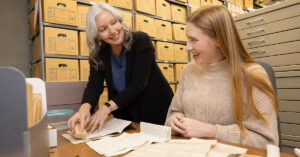
Examining diverse perspectives as a leader
Aside from her community involvement, Hardy is also a natural leader on campus.
She is currently in her second year as the president of Phi Alpha Theta, the history honor society.
For this club, she attends professional development conferences and schedules history programs, like special lectures taught by historians and MSU professors.
“I really want to make sure that people are finding things interesting, but also learning the facts about stuff, carrying empathy with them, actually learning it and not holding onto stereotypes.”
Hardy has also used her programming skills to help plan events with the Student Activities Council.
Through this organization, she’s learned how to organize events, how to connect people to the events and what kind of things people find interesting.
As a university ambassador, Hardy gives tours of the MSU campus, which has helped her develop her public communication skills.
Most notably, Hardy is known for her role as student representative on Missouri State University’s Board of Governors.
Her interest in history has been influential in this position as well.
“I think some of the skills you pick up as a ‘historian’ or a historian in training [have] a lot to do with acknowledging different perspectives and things like that,” Hardy said. “So, [it’s] just hearing different sides of events or issues or things and taking those in and then figuring out how to convey that, and that’s definitely something that you have to use whenever you’re the one student representing the entire student body.”

And the rest is her story…
Having made her mark at Missouri State, Hardy plans to graduate in May 2025.
Her next step: a master’s degree.
So far, she has applied to 11 graduate programs, two of which are in the United Kingdom.
She is focusing her master’s in either museum studies or public history.
“I’ve connected a lot with history, because of my experience with museums and historic sites,” she said. “But other people don’t feel that way, and so how do we make sure that we’re showcasing the importance of history and history is fun to the broadest range of people as possible?”
In her future career, she hopes to continue working in the public-facing realm of history, such as programming, education and exhibit curation.
The post Forming connections to make history engaging appeared first on History Blog.
]]>The post A legal career rooted in historical foundations appeared first on History Blog.
]]>Aly Weitkamp won’t settle for less than that.
That’s why she chose to major in history at Missouri State.
Relocating from Wentzville, Missouri, Weitkamp found MSU to be the perfect distance from her hometown.
She also loved the environment on campus, explaining that MSU is “a big university that feels small.”
“I loved going to Missouri State. I miss a lot of it every day,” Weitkamp said. “A lot of my favorite memories happened just walking around campus and getting to see all of my friends consistently. I loved hanging out in Strong Hall and right by the fountain when they put all the new tables in.”
In 2016, she began her academic journey by studying journalism and French, but after a while, Weitkamp decided to pursue a greater interest.
“I’d always loved history and specifically ancient civilizations,” she said. “A lot of times you don’t end up using your degree after you graduate, so if I was going to end up not using it, I’d rather have a degree in something I enjoyed.”
A heart for history, a mind for law
While a history degree was a fun pursuit for her, she also began taking law classes.
Weitkamp soon found herself at a crossroads about her future.
She began to debate: PhD or law school?
Weighing her options, she consulted faculty in the history department.
“My advisor was Julia Troche who is an incredible professor and advisor,” Weitkamp said.
Dr. Troche suggested that Weitkamp combine her two interests by studying art and museum law.
Under the guidance of faculty, like Troche and Dr. Bryan Brinkman (an assistant professor in the languages, cultures and religions department at MSU), Weitkamp developed her critical thinking skills and opened her mind to different perspectives on life.
“I think everybody, as a kid, goes through a period where you’re obsessed with an ancient civilization,” Weitkamp said. “I managed to be obsessed with three of them…with Egypt, Greece, and Rome. I kind of lucked into an opportunity to end up specializing in ancient civilizations and, specifically, ancient Egypt with Dr. Troche, so I got to delve into that childhood obsession.”

Balancing the scales of passion and purpose
Weitkamp graduated from Missouri State in 2020.
A few years later, she passed the bar exam and earned her juris doctorate at DePaul University in Illinois.
She spent some time in insurance defense for civil litigation, but she is currently looking into career opportunities in intellectual property with trademark and copyright law.
As an attorney in Chicago, she can confidently say that her knowledge and experiences as a Bear prepared her for her career field.
“It taught me a lot about how to talk to people, how to introduce myself, how to interact with those around me, and I feel like that has been crucial to becoming an attorney and having to talk to people who are so different from me in every aspect of life,” she said.
Weitkamp still holds onto her desire to get involved in art and museum law someday.
She encourages other students not to settle for something that sounds good but feels like a chore. Her main advice: “find something that makes you happy.”
Earn your bachelor’s in history at MSU
The post A legal career rooted in historical foundations appeared first on History Blog.
]]>The post Reimagining the sands of time appeared first on History Blog.
]]>It’s a gateway to different times and places.
As a history scholar, Charles Rhodes found his future in studying the past.
His enthusiasm for history began when he was 17 years old.
“In high school, I was taking dual credit classes, and I took a class called College Western Civilization,” Rhodes said. “It was taught by a teacher at my school. He had a PhD, and so he was a historian. I was just really enamored with him and liked how he thought about history and talked about the past. And that kind of just got me really excited about maybe studying history.”
Rhodes began his undergraduate studies at Missouri State in August 2015. He declared his major in history with a minor in religious studies.
Originally from the St. Louis area, Rhodes wanted to attend “a bigger school.”
For him, Missouri State was the right size and the right distance away from home at the right price. It also had the right “feel.”
“I still really love Missouri State’s campus, how compact it is,” Rhodes said. “I also like when you’re walking near the fountain and everything; it’s kind of a nice way to build your day back up.”
Awakening the mysteries of history
In his junior year, he registered for a class about ancient history in the Near East, which was taught by his history advisor, Dr. Julia Troche.
The class focused on ancient civilizations, like Egypt, Mesopotamia, Babylonia and Syria.
“I just had so much fun with it. It was really just questions about ancient ideologies and ancient religion and things like that, and it just reawoken my passion, my interest in history,” Rhodes said.
He credits Troche for being a major influence in his academics. She listened to his ideas and helped cultivate his passion for Egyptology.
“I think, really, that was what made me want to continue pursuing ancient Egypt. It was just that I had a mentor who really showed interest in me.”
Another professor who helped him pave his way toward graduate school was Dr. Alicia Walker, an associate professor in sociology.
“She was a great resource during my time at Missouri State. She’s great. Wonderful person,” he said. “And I think she was also one of the first people I told I wanted to get a PhD to during my time at Missouri State. She talked to me a little bit about that process.”

An expedition into ancient wonders
One of Rhodes’ favorite experiences from his time at Missouri State was his Study Away trip to Jordan through the Archaeological Field School.
Having never been outside of the United States, Rhodes stepped out of his comfort zone to engage in a month-long learning experience.
“Having the opportunity to do that — we were working in Jordan in the Middle East — I think it was just a really eye-opening experience for me. Kind of taught me a lot about what field work is,” he said.
Opening the door to another country also led him to develop new perspectives and ideas in history and Egyptology.
“I think when you’re not really sure about processes and things like that, and you’re just stuck reading all the time, it kind of gives you a warped understanding of what field work looks like for scholars in the humanities,” Rhodes said. “It also kind of limits you to what you understand is possible, and so I think that field work alone opened me up to different connections. Kind of showed me what’s possible within the field that I’m interested in.”
He further demonstrated his knowledge of ancient Egypt by composing a research essay called “Servitude or Employment: An Analysis of Language Construction and Spelling Surrounding Nubian Mercenaries in the Old and Middle Kingdoms.”
His essay won Best Undergraduate Student Paper in 2020.
Establishing his legacy
After his time at Missouri State, he attended the University of Memphis where he earned his master’s degree in ancient history with a concentration in ancient Egypt.
He is currently pursuing his PhD in Egyptology and Nubian studies at the University of California, Los Angeles (UCLA).
Rhodes hopes to graduate from UCLA in 2028. He plans to use his degree to become a professor.
“The history department at Missouri State actually does a pretty fantastic job teaching students,” he said. “When you go to other places, you kind of notice differences in, like, what a lecture class looks like and, like, what a discussion-based class looks like.”
“I think Missouri State was really good at showing me the ways in which a class can be designed to be engaging for students to get good discussion going.”
Paying it forward, he wants to create an environment where future historians can find their interests like he did.
“I think the way in which I was taught at Missouri State is one of the reasons that I want to be in education and want to continue that and hopefully be someone to a student that my mentors were to me,” Rhodes said.
Major in history at Missouri State
The post Reimagining the sands of time appeared first on History Blog.
]]>The post MSU Board of Governors announces new student member appeared first on History Blog.
]]>Hardy replaced Bradley Cooper as the next student governor. Cooper stepped off the board in May.
According to Hardy, this appointment is a great honor.

“Missouri State has truly changed my life and I’m looking forward to giving back to the university that has given me so much,” Hardy said. “Over the course of my term, I’ll aim to serve as a strong student voice, providing perspective and advocating for the needs of the student body.”
Hardy’s board service begins immediately
Hardy is a senior majoring in history. She currently serves as an educational program intern at the State Historical Society of Missouri.
Previously, she was director of academic affairs for the Student Government Association at Missouri State.
In 2023, Hardy received a Citizen Scholar Award, the highest award available to Missouri State students. It recognizes outstanding students for their achievements in academics, community engagement and leadership.
Her term begins immediately and ends Dec. 31, 2025. Her appointment is subject to confirmation by the Missouri State Senate.
The post MSU Board of Governors announces new student member appeared first on History Blog.
]]>The post New book shines a light on Women’s Airforce Service Pilots appeared first on History Blog.
]]> March is Women’s History Month, which honors and celebrates the contributions of women to events in history and contemporary society.
A new book by Dr. Sarah Myers, a Missouri State University history alumna, shines a light on the Women’s Airforce Service Pilots or WASPs and their impact during and after World War II.
It’s titled, “Earning Their Wings: The WASPs of World War II and the Fight for Veteran Recognition.”
Myers, who’s also associate professor of history at Messiah University, discusses her first book, which began as a thesis project at MSU.
Turning a master’s thesis into a book
The post New book shines a light on Women’s Airforce Service Pilots appeared first on History Blog.
]]>The post Practice sustainable gift giving during the holidays appeared first on History Blog.
]]>With such a large quantity of gifts being given away, it’s important to consider: What’s the carbon footprint of these gifts? How can consumers be more intentional about gifting more sustainably this holiday season?
Missouri State University sophomore Sam Wang offers some insights about sustainable gift giving. He is a double major in history and anthropology. He currently serves as the chief sustainability commissioner for the Student Government Association.
The post Practice sustainable gift giving during the holidays appeared first on History Blog.
]]>The post Talking History: Missouri State Department of History’s New Radio Show! appeared first on History Blog.
]]>What is Talking History?
Talking History is a monthly radio program and podcast in which hosts Djene Bajalan and Patrick Needham interview scholars and historians about the ideas, people, and events that have shaped our world. This includes the wonderful faculty here at Missouri State University!
When and How Can I Listen to Talking History?
You can listen to Talking History live at 12:06 pm on KSMU on the first Thursday of the month. But don’t worry if you can’t catch the live broadcast! You can listen to an extended version of the show as a podcast — Talking History Extra — available on the KSMU website!
Listen Now!
Interested? No need to wait! Talking History already has two episodes! In the first episode, Dr. Jeremy Neely talks about his research on the effect of the Civil War on Cimbaline Fike, a homemaker from Illinois, whose husband, Henry, served as an officer in the Union Army. For episode two, Dr. Sarah Mellors-Rodriguez discusses the impact of China’s “One Child Policy” on Chinese Society.
To keep up on the latest from Talking History, follow us on Twitter and Facebook!
Listen to Talking History Now!
The post Talking History: Missouri State Department of History’s New Radio Show! appeared first on History Blog.
]]>The post Best Essay Awards (2022-2023) appeared first on History Blog.
]]>For the academic year 2022-2023, the best undergraduate essay prize was awarded to Carson Lolley for her paper “Fighting Uphill: SCCAHW Involvement in the Remediation of Weldon Spring” (nominated by Steve McIntyre). The best graduate paper prize was awarded to Anna Guenter for her paper “Critical Theory in Postcolonial Studies” (nominated by Sarah Panzer).
The post Best Essay Awards (2022-2023) appeared first on History Blog.
]]>The post Understanding Juneteenth appeared first on History Blog.
]]>Dr. Marlin Barber, senior instructor of history at Missouri State University, explains to BestColleges.com the meaning and significance of Juneteenth, as well as how colleges and students can celebrate it.
The post Understanding Juneteenth appeared first on History Blog.
]]>The post Congratulations, Dr. Troche appeared first on History Blog.
]]>Her story, which focuses on her interests in power structures and death in the ancient world, was recently posted on the site.
Here’s an excerpt from the story:
A key goal of Troche’s research is to analyze and present information from a different angle than the way it has been taught or described in publications.
That’s why in addressing power in her book, Troche includes both top-down and bottom-up power. Instead of focusing only on the king’s actions, she also highlights what the elites and other Egyptians did.
“When we think about power, we don’t just look at the one in charge. We also have to think about all the other people – the subjugated others,” she said. “It doesn’t mean they don’t have agency and power because they’re subjugated.”
You can read the whole piece online
Congratulations, Dr. Troche!
The post Congratulations, Dr. Troche appeared first on History Blog.
]]>