The post Katie John Day – May 31st appeared first on Copper River Native Association.
]]>Each year, Katie John Day offers an opportunity to reflect on the extraordinary life and lasting impact of Katie John. She was a respected Ahtna Elder whose courage and determination helped protect the subsistence rights of Alaska Native people for generations to come.
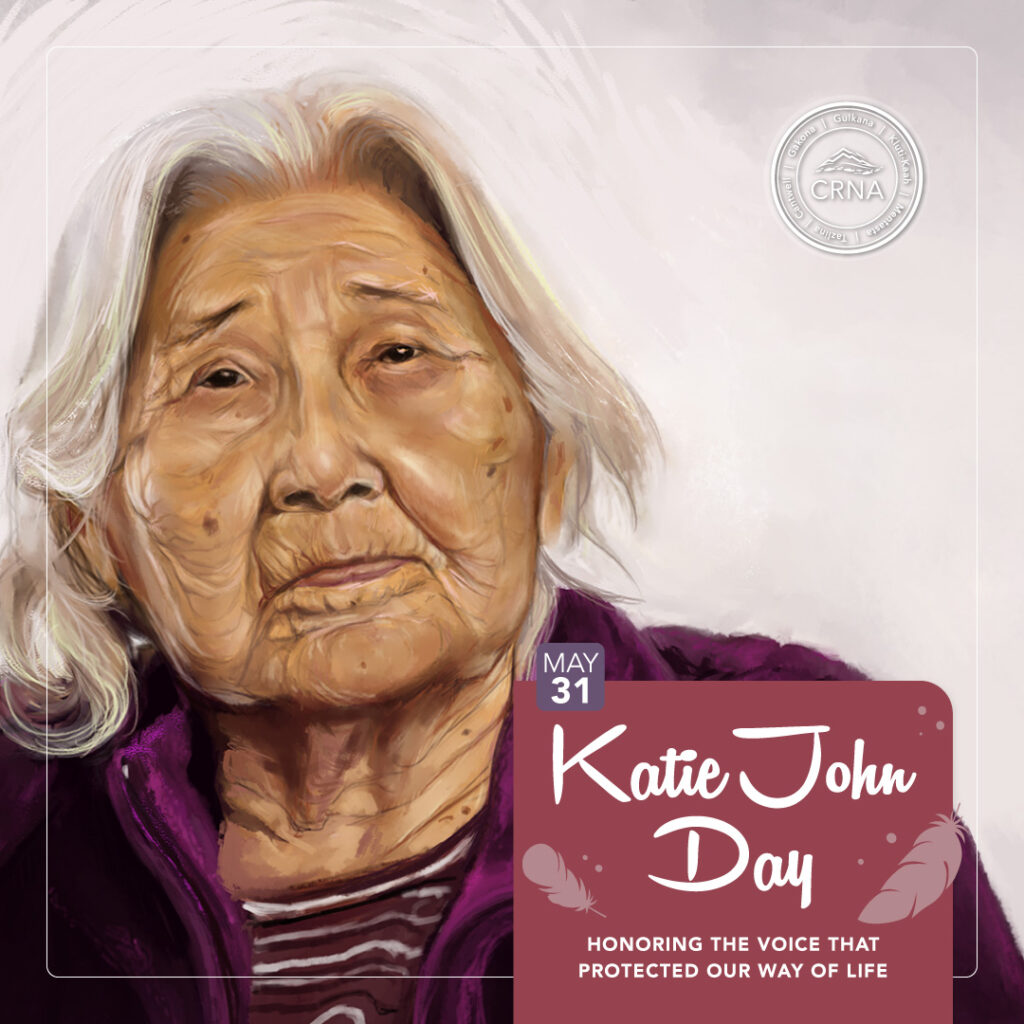
The Copper River Native Association proudly joins communities across Alaska in honoring her legacy, her advocacy, and the cultural values she fought tirelessly to preserve.
Born on Ahtna land and deeply rooted in Ahtna traditions, Katie John understood the importance of living in relationship with the land, waters, and cultural practices passed down through generations. Subsistence was not simply a way to gather food. It was, and continues to be, a way of life deeply connected to identity, family, survival, and stewardship.
Throughout her life, Katie John became a powerful voice for Indigenous Peoples’ rights. She is best known for her decades-long legal fight to protect subsistence fishing rights for Alaska Native people. Her advocacy ultimately led to landmark legal victories that affirmed the rights of rural Alaskans and Indigenous communities to continue traditional subsistence practices on federal lands and waters.
But Katie John’s impact extended far beyond the courtroom.
She was a teacher, culture bearer, and role model who demonstrated the importance of perseverance, humility, and protecting future generations. Her work inspired Native leaders throughout Alaska and strengthened efforts to preserve Indigenous languages, traditions, and ways of life.
For the Ahtna people, her legacy remains deeply personal. Katie John represented the strength of ancestors who have cared for the Copper River region since time immemorial. She carried forward the responsibility to protect the land and waters not only for today, but for the generations still to come.
At CRNA, we believe honoring Katie John also means continuing the work she championed by supporting healthy Native communities, preserving culture and language, advocating for Indigenous rights, and ensuring our youth understand the strength and resilience of their heritage.
Katie John Day is more than a remembrance. It is a celebration of Indigenous leadership, cultural survival, and the enduring connection between people, land, and tradition.
As we honor her today, may we continue to walk forward with the same courage, wisdom, and love for community that Katie John showed throughout her life.
Quyana, Katie John. Your legacy lives on.
#KatieJohnDay | #CRNA | #AhtnaPride | #SubsistenceRights | #CulturalSovereignty
The information presented in this blog post is based on detailed research and historical records. For further reading and to explore the source material in depth, please visit these resources that offer comprehensive insights into Katie John’s life, legacy, and the lasting impact of her work on subsistence rights.
Celebrating Katie John Day (U.S. National Park Service)
Alaska’s first Katie John Day: A celebration of her fight for subsistence rights – Indian Country Today
The post Katie John Day – May 31st appeared first on Copper River Native Association.
]]>The post Elizabeth Peratrovich appeared first on Copper River Native Association.
]]>Elizabeth Peratrovich Day, each year on February 16, honors the life and legacy of a woman whose courage helped change the course of civil rights in the United States. A proud Tlingit woman and civil rights leader, Elizabeth Peratrovich stood at the forefront of the fight against discrimination at a time when Alaska Native people faced widespread, legalized racism.
In the early 1940s, segregation was openly practiced across Alaska. Businesses and public spaces commonly displayed signs reading “No Natives Allowed” or “No Dogs or Natives.” Alaska Native people were routinely denied access to restaurants, hotels, theaters, and employment opportunities—simply because of who they were.
Rather than accepting injustice, Elizabeth Peratrovich and her husband, Roy Peratrovich, organized and advocated through the Alaska Native Brotherhood (ANB) and Alaska Native Sisterhood (ANS). Their efforts culminated in the passage of the Alaska Anti-Discrimination Act of 1945, making Alaska the first U.S. territory or state to pass a comprehensive civil rights law banning discrimination based on race.
A Turning Point in Civil Rights History
Elizabeth Peratrovich is especially remembered for her powerful testimony before the Alaska Territorial Legislature on February 16, 1945. When legislators used demeaning and racist language to argue against the bill, Elizabeth responded with dignity, clarity, and strength. She challenged lawmakers to confront the fear and hatred behind discrimination and to recognize the humanity of Alaska Native people.
Her testimony is widely credited with shifting the tone of the debate. The bill passed the House by a narrow margin and was signed into law by Governor Ernest Gruening later that year.
Why this moment matters:
- The Alaska Anti-Discrimination Act of 1945 predated the federal Civil Rights Act of 1964 by nearly 20 years
- It prohibited discrimination in public accommodations, employment, and housing
- Violators could face fines and jail time, an unprecedented enforcement measure at the time
Elizabeth Peratrovich’s courage helped lay the groundwork for future civil rights movements across the country.
More Than a Day of Remembrance
Elizabeth Peratrovich Day, observed annually on February 16, is more than a celebration of history—it is a call to action. Her story reminds us that meaningful change often begins with ordinary people who refuse to stay silent in the face of injustice.
For Alaska Native communities, her legacy is deeply personal. It represents resilience, advocacy, and the power of Native voices to shape laws, systems, and futures.
As we honor Elizabeth Peratrovich today, we reflect on both how far we have come and how important it remains to continue the work of equality, respect, and inclusion for all people. Her legacy lives on in every effort to protect Native rights, uplift Native voices, and build a more just Alaska.
References & Further Reading
- Alaska State Legislature. History of the Alaska Anti-Discrimination Act of 1945
- Alaska Native Brotherhood & Alaska Native Sisterhood Archives
- Alaska State Library, Historical Collections
- National Park Service. Elizabeth Peratrovich and Alaska’s Civil Rights Movement
- Governor Ernest Gruening Papers, University of Alaska Fairbanks
All of the information presented in this blog post is based on detailed research and historical records. For further reading and to explore the source material in depth, please visit the Library of Congress blog at https://blogs.loc.gov/law/2021/11/elizabeth-peratrovich-civil-and-voting-rights-activist/. This resource offers comprehensive insights into Elizabeth Peratrovich’s life, activism, and the lasting impact of her work on civil and voting rights.
The post Elizabeth Peratrovich appeared first on Copper River Native Association.
]]>The post Our Urgent Care Extended Hours Pilot Project Has Ended appeared first on Copper River Native Association.
]]>Our clinic will resume normal business hours effective September 4, 2024. We are still offering Urgent Care and Walk-In services during normal hours. The After-Hours Nurse Triage Line is available by contacting CRNA at (907) 822-5241.
Regular Hours:
Monday / Wednesday / Friday 8:00 AM – 4:30 PM
Tuesday / Thursday 8:00 AM – 5:30 PM
What is the difference between Urgent Care and Primary Care?

What is Urgent Care?
Urgent Care is for when your health needs are pressing and you can’t wait for a Primary Care visit. At CRNA Urgent Care, we handle a variety of urgent medical needs, including but not limited to:
- Sprains, strains, and broken bones
- Difficulty breathing or chest pain
- Other urgent health issues
Should you have any doubts about your condition, our dedicated Urgent Care Line is always available to assist.
What is a Primary Care visit?
Unlike Urgent Care, which addresses immediate health concerns, a Primary Care visit is focused on your ongoing health and preventative care. These visits with your regular doctor are key to managing your overall health and wellness over time. In a Primary Care setting, you can expect:
- Routine health check-ups and physicals, essential for tracking your health status.
- Vaccinations and immunizations, crucial for preventing illnesses.
- Management of chronic conditions, ensuring they are kept under control and don’t escalate.
Conclusion:
Healthcare is a journey, and we are here to walk with you every step of the way. With our Urgent Care services, we hope to make this journey a little easier and a lot more convenient. Don’t wait for the care you need; call our dedicated line for assistance.
The post Our Urgent Care Extended Hours Pilot Project Has Ended appeared first on Copper River Native Association.
]]>