Lesley A. Sharp
‘Strange Harvest ‘Organ Transplants, Denatured Bodies, and the Transformed Self’
http://www.ucpress.edu/book.php?isbn=9780520247864
Troubling dimensions of heart transplantation, Medical Humanities 2009; 35:35-38
]]>On the final day of The Body is a Big Place exhibition at Performance Space a heart transplant surgeon, Dr Kumud Dhital, wandered in to the installation by chance. He was visibly moved by it and invited us to undertake a residency at the Heart and Lung Transplant Unit at St Vincent’s Hospital, Darlinghurst (HLTU) where he is a Consultant Cardiothoracic and Transplant Surgeon. We secured the ANAT Synapse Art/Science Residency grant to enable us to spend 4 months from September 2012 to January 2013 in the HLTU and nearby Victor Chang Cardiac Research Institute (VCCRI), working with Dr Dhital. Ambiguities arising out of heart transplant protocols have a direct relevance to questions we have been pursuing broadly for over ten years. The residency at HLTU and VCCRI offers us exposure to a new set of experiences, not currently available at any other institution in Australia, that focuses these questions in a unique and pointed way.
The liminal nature of hearts in transit
In Mexico in January 2012 two medics rushing a heart to a waiting recipient accidently dropped the esky containing the heart, spilling its contents. The soft tissue of the heart impacted with the hard asphalt of the pavement, exposing it to the cold light of day and taking it from the space of ‘medicine’ inside the esky to the street we inhabit. This incident draws our attention to the uncanny status of the heart during its journey from donor to recipient and the tensions created by the heart’s appearance in the space of the everyday.
The liminal nature of heart transplant recipients
Heart transplant recipients could be said to reside in a liminal domain. In the lead-up to transplant surgery they frequently hover on the edge of life with a heart that is steadily failing. After transplant they rely for survival on the heart of an unknown stranger that will inhabit their body for the remainder of their lives, rupturing a sense of unitary identity. They also live with an uncertain future as their immune system can reject the ‘guest’ organ at any time, despite a life-long requirement to take immuno-suppressant medication.
The ambiguous boundary between life and death
The spectre of the heart travelling between donor and recipient raises questions about its status – is it living, dead, semi-living? Death is an extended durational process, rather than a single moment in time. Organ transplantation makes this explicit as it relies on the fact that the cessation of function of the cells and tissues takes place in different ways and at different rates. This ambiguity underlies the malleable and contested definition of death, which continues to respond to newly available surgical possibilities.
This ambiguity is one reason why death is understood differently within specific cultural, historical, and legal contexts. In many jurisdictions including Australia, hearts for donation are obtained from ‘brain stem dead’ patients, signalled by the absence of reflexes through the brain stem. More recently, a new category of heart donation has appeared on the organ transplant landscape, designated as ‘Donation after Circulatory Death’ (DCD). In this case donors have not reached brain stem death, although they may have extensive neurological injury to the brain that prevents life without artificial life support.
The advent of DCD has prompted a fresh round of questions regarding where the line should be drawn in clinical situations, to both respect the dignity of donors whilst enabling access to hearts in good condition for donation.
Key research questions
This residency will focus on questions prompted by both conventional heart transplantation and new DCD protocols:
- Definitions of death are responding to newly available technologies and surgical possibilities. In the case of heart transplants, what is the status – living, non-living, or semi-living – of a heart that is in transit from donor to recipient, particularly if it is in a beating state and being perfused under physiological conditions?
- Some understandings of the body view consciousness as distributed throughout the body, rather than being located solely in the brain. If this is the case, what are the implications of heart transplantation?
Links to the Cardiothoracic Department at St Vincent’s Hosptial and the Victor Chang Research Institute:
http://exwwwsvh.stvincents.com.au/index.php?option=com_content&task=view&id=191&Itemid=220
http://exwwwsvh.stvincents.com.au/index.php?option=com_content&task=view&id=344&Itemid=368
]]>‘The Body is a Big Place’ was a large-scale, immersive installation developed through collaboration between artists and scientists. The work explored organ transplantation and the ambiguous thresholds between life and death, revealing the process of death as an extended durational process, rather than an event that occurs in a single moment in time. The work’s title referred to the capacity for parts of the body to traverse vast geographic, temporal and interpersonal distances during organ transplantation processes. As part of the installation a fully functioning heart perfusion system was used to reanimate to a beating state a pair of fresh pig hearts during 2 live performances. Rather than sensationalising these events, the artists sought to encourage empathic responses from viewers, opening up the possibility of a deeper awareness of viewers’ own interiors. Performers in the work’s projected underwater video sequences were members of the organ transplant community in Melbourne, individuals who have traversed extraordinary experiences in the form of receiving, donating, or standing closely by loved ones as they received or posthumously donated human organs.
Links to the project:
http://prix2012.aec.at/prixwinner/6286/
Links to Artist’s websites:
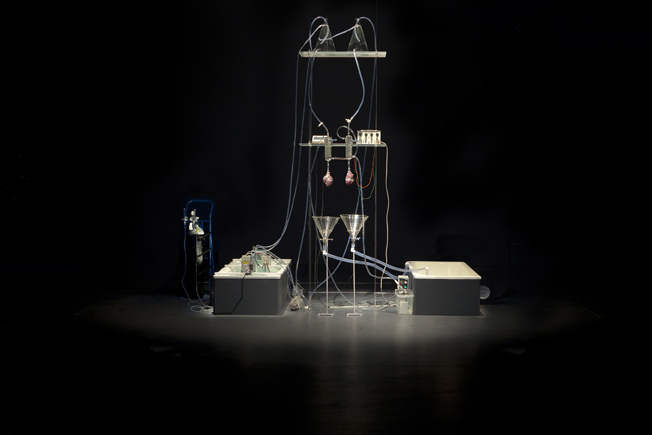


The Body is a Big Place
Peta Clancy and Helen Pynor
2011
New media installation and pig hearts performances
5-channel video projection, heart perfusion device, single video screen, soundscape by Gail Priest
Performance Space, Sydney, Nov 2011
Installation photographs: Geordie Cargill, Peta Clancy, Helen Pynor
]]>