Q: How has teaching changed since you first started?
A: The digital footprint, for sure. There were no 1 to 1 devices. When I first started, the expectation was that kids were working off paper. This was 20 years ago, so it would be 2006. The only exception would be doing final drafts of essays. I think personality-wise, behaviors are actually fairly similar. I feel like students’ attention spans are getting shorter. The more phones are used, the weaker the imagination becomes, and the less ability they have to hold concepts in their heads.
Q: What changes, if any, have you noticed in students?
A: Kids are kids, and sometimes they misbehave. But when I call out kids now, I wonder if I was doing the same thing. I, for sure, acted like an idiot all too often. I think the difference is I feel like the long-term goal of making everyone happy with your work has diminished, because people are not regulating how much time students spend on screens.
Q: What has been the most surprising change in education over the years?
A: I feel like the most surprising change is that in the middle grades, teachers teach more than one subject. When I was first hired 20 years ago I was a content specialist and was 1 of 4 teachers. I find it unusual that we in the middle grades have gone down to 2 teachers, especially when the students go up to 7 teachers in high school.
Q: How has technology and AI changed the way you teach and the way students learn?
A: Professionally, if I’m struggling on time I will sometimes have AI give me a polished version of what I am looking for. But we need to know its limitations as well. Just knowing that it can be wrong, and knowing that it will sometimes be redundant if I ask it to help me create a rubric.
Q: Do you think technology has improved learning, made it harder, or a mix of both?
A: I feel like other than spell check, I do worry that AI is doing more harm than good. If we’re talking about things like Grammarly, I feel comfortable with us moving away from handwriting and spending so much time with spelling and punctuation. I DO worry that AI will take away student voice and their ability to organize and write their thoughts. My bias is I’m okay with it correcting grammar, but I’m concerned it’s taking away from the “why’s” and the deeper understandings as well.
Q: What are some strategies you use now that you didn’t use earlier in your career?
A: Back when social studies got equal time as math, I was able to make some interactive simulation games. Once, we did a thing where students were in groups and they would be competing against each other for resources and trying to build an empire. Now I definitely feel like the pull of math is considered to be one of the core subjects, so the state mandates schools to have a certain amount of minutes for math that varies for every grade.
Q: How do you keep students engaged in today’s classroom environment?
A: I still try to use humor, but I have to watch what I say. Whenever possible, if I’m going to create a warm-up problem, if I can find the right student to name in the problem without crossing a line, I try to do that. I also try to invent as many games as possible. Another thing we use for motivation is class cash, and students can redeem it for prizes.
Q: Looking back, is there anything you wish you had done differently when teaching earlier classes?
A: I feel like I worried too much about what I looked and sounded like to my principal at the time, and now I concentrate on trying to form a connection with my students.
Q: Where do you see education in 10 years from now?
A: I don’t think teachers will be replaced by any long stretch of the imagination. I think we are turning toward moving away from tech because of its drawbacks. Overall, I think it will be relatively the same. Devices may look different, and you will still see a human up front teaching. It’s hard to predict where technology will go, but I think we’ll still be using a classroom-centric model with 15-20 kids in a class with a teacher and some support. I think there’s a chance we could have content specialization again. I would like to think that in 10 years, social studies will make a comeback and start being re-emphasized.
Q: What advice would you give to students preparing for the future?
A: Don’t take shortcuts. Don’t let technology do your work. Your schoolwork isn’t just a series of tasks to keep you busy. Ask yourself: ‘Why are my teachers making me do this?’. Ultimately, I want people to be thinking for themselves.
]]>
Q: Where did you grow up?
A: I grew up in Atlanta, Georgia. I graduated from high school in a place called Flowery Branch, which is a rural lakefront town about an hour outside of Atlanta. College brought me back to the city, as I went to college in Atlanta. And then I also did some brief studying in Guadalajara.
Q: What inspired you to teach Spanish?
A: I spoke it a lot in Atlanta and it was just an immediate satisfaction. I was able to communicate better with parents and students, many of whom spoke it exclusively.
Q: How did you learn Spanish?
A: There were Saturday classes for teachers in the Atlanta school district. I took those and then I also watched a lot of YouTube. I did some old school stuff, too, like flashcards. I really threw myself at it. I also cleared out a guest room in my house with no distractions, and there was nothing to do in that room except study and practice.
Q: What made you decide to come to BFA?
A: I came here because of the super cool building. I like the traditions, too. It seems so positive and structured here. I read in the news that there were a lot of cool ways to get better attendance here. It really is a structured and organized place, and it makes me feel good being here.
Q: What is your approach to teaching Spanish?
A: Doing a lot of speaking and listening. I like to do a lot of games, including circle games and also some high tech games. I love trying to get anything that has some creativity in it, and that is connected to students and what they talk about.
Q: Why do you think it is important to learn a new language, particularly Spanish?
A: Spanish is a United Nations language. It is the most common non-English language. And I think frankly, we should be a more bilingual society. There’s a ton of benefits [to learning Spanish]. And for high schoolers, it’s about that global citizenship and confidence building.
Q: What advice would you give to students who think learning a new language is too difficult?
A: I got fluent in Spanish pretty late in life. I was, like, twenty-five. So you can still do it. Any high schooler should be able to jump into learning a new language. I didn’t even take Spanish in high school. Instead, I took French. But I couldn’t meaningfully immerse myself in that language.
Q: What is your favorite Spanish dish?
A: I love a good taco. There’s also the drowned sandwich, and that’s the delicacy of Jalisco. The bread is slightly crunchy like a French baguette, and it is dipped in a spicy soup.
Q: What are you looking forward to most about the new school year?
A: I am looking forward to no recess in the winter. I am used to teaching middle school and supervising recess everyday, and I will not miss it.
]]>
Q: What were some of the early challenges you faced?
A: Being young and stupid. I had no advertising background, and I made a lot of marketing mistakes. I spent money on different programs that didn’t pan out to give me any sales. The challenge was trying to figure out how to lead and figure out how to train new people.
Q: What did a typical day look like for you as the owner?
A: A typical day was going in at about nine and making sure the previous night’s cleaning was sufficient, placing produce/supply orders if needed and then prepping out various needed items whether that was pizza dough, sauce, cheese, pepperoni, etc. Then opening at 11:00 a.m. and doing the lunch crowd. After lunch, finish prep, go to the bank for previous nights deposits and get ready for the dinner and late night rush. Finally cleaning the restaurant for the next day.
Q: What is the biggest lesson you learned from owning a restaurant?
A: You need to keep your numbers like food and labor cost on track. Also the more success you have, the more there will be people making it hard for you to be successful. Three additional pizza shops opened in downtown Burlington which created serious competition and a fight for sales. Success bred competition. It’s not always best to get bigger.
Q: Do you have any funny or unexpected stories from your time running the restaurant?
A: Most of the stories that immediately come to mind have a deep context to them and/or are not school appropriate! But here is one. I used to have the local YMCA preschool groups come down to visit the restaurant with their teachers. We did a tour, answered questions, and I gave each kid some dough to play with before feeding them pizza. In the middle of a tour one preschooler said to me, “My Dad hates your pizza!” The teachers were horrified and worried that I would be upset but the kid’s Dad was probably a fan of Domino’s or the other five pizza restaurants in town.
In terms of unexpected stories, Burlington had an antiquated storm drainage system to deal with flash thunderstorms and several times we experienced basement floods from the downpour running down Main Street. The water would back up deeper than the hood of a car. I once saw a car stall next to the store in the intersection and the passenger panicked and opened the door. Nasty drainage water flooded the interior leaving those inside the car to crouch on their seats to try and stay out of it. I was in the basement in a plastic 50 gallon trash can pushing myself around thigh deep water to save supplies that were stored low and using a 2×4 to push myself around all the floating supplies.
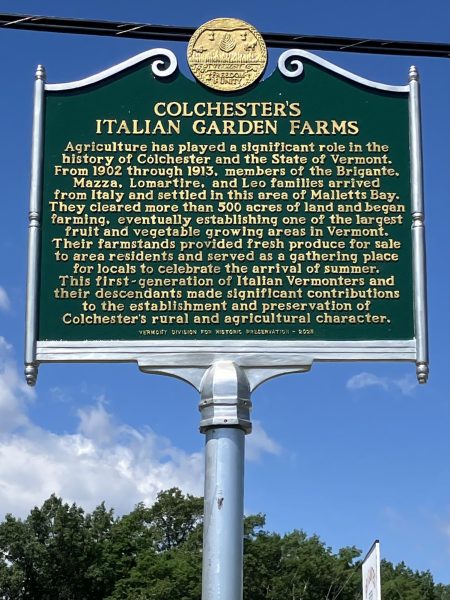
Most recently, a historic marker was erected on Malletts Bay Avenue in Colchester to honor the Italian families who have farmed hundreds of acres of land in Colchester, selling their fruits and vegetables to the community. A dedication ceremony for this event took place on Saturday, June 13, from 10 A.M. to 11 A.M., with traditional Italian refreshments and snacks for attendees. The event saw a large turnout, with community members, many of whom shared Italian descent, gathering at Brigante’s Farmstand at 682 Malletts Bay Avenue for the celebration.
Two other historic markers were added in 2026, including one honoring the life and legacy of Ann Story in Salisbury, as well as one placed at Riverside Cemetery in Swanton for
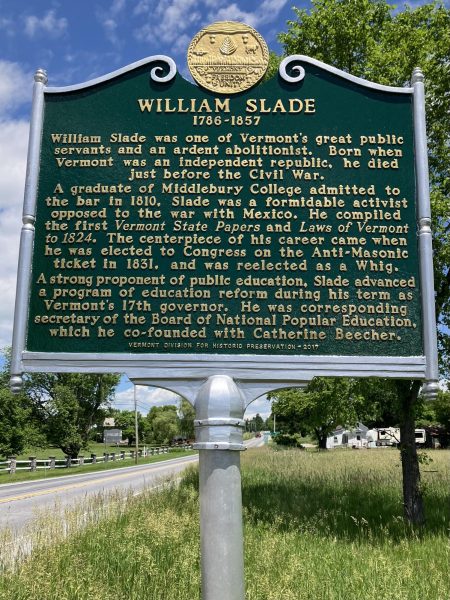
Leonard A. Lord. The unveiling of these markers took place on May 30 and April 12, respectively. The next historic marker dedication ceremony will take place in Sunderland on July 26, and it will be the second marker in Vermont honoring Lucy Terry Prince. On August 22, the Burying Ground historic marker will be placed in Isle La Motte. Meanwhile, several markers that were previously removed for refurbishment have been returned to their original posts. These include the William Slade / The Gag Rule sign in Cornwall, and the Chester Depot marker in Chester. The marker for Wagon Wheel Farm in Royalton is expected to make a return at some point this year as well.
Also happening in the coming years, the Bennington Battle Monument sign on the Old Bennington village green will be replaced with an updated marker at Monument Circle. At its original location, the Department of Historic Preservation will put a new marker for either Walloomsac Inn or Catamount Tavern.
For upcoming historic marker dedication ceremonies, and for an official listing of all 345 markers and status updates, check Vermont.gov.
]]>Zach Bryan isn’t your typical country artist, which is part of why so many people like him. He originally got popular by posting songs online while he was still serving in the Navy, which is pretty different from how most artists get discovered. Instead of going through the normal music industry path, he kind of built everything from the ground up. Over time, more and more people started listening because they connected with how real and emotional his music is. By the time Zach Bryan came out in 2023, he already had a huge fanbase. One of the biggest songs from the album, “I Remember Everything” with Kacey Musgraves, even won a Grammy, which shows how much attention he’s getting now.
The overall vibe of the album is pretty chill, but also kind of emotional and reflective. A lot of the songs focus on relationships, memories, and dealing with stuff like regret, change, and growing up. It’s the kind of music you listen to when you’re in your feelings a little bit or just thinking about life. The lyrics aren’t super complicated or poetic in a fancy way, but they still hit hard because they feel honest. In songs like “Tourniquet,” you can tell he’s talking about trying to fix things in life or in relationships, but still feeling kind of broken. That theme shows up a lot throughout the album, which makes it feel really consistent.
There are definitely some standout tracks that make the album worth listening to. “I Remember Everything” is probably the most popular one, and the duet with Kacey Musgraves sounds really smooth and emotional. “Overtime” is another great song, it’s a little more upbeat and catchy, but still has meaningful lyrics. “East Side of Sorrow” is also really strong and has a mix of sadness and hope that a lot of people can relate to. At the same time, not every song stands out as much. Some tracks can start to blend together because they have a similar slow, acoustic style. It’s not bad, but if you listen to the whole album in one sitting, it can feel a little repetitive. Still, compared to a lot of other country albums, this one feels way more genuine and less commercial.
Overall, I’d give Zach Bryan about an 8.5/10. It’s not perfect, but it’s super real, emotional, and easy to connect with. If you like music that tells stories and actually feels honest, it’s definitely worth checking out.
]]>
Stravinsky likes odd instrumentation, evident in the use of quite a few unusual piccolo instruments: clarinet, trumpet, and timpani are some of them. He also liked to experiment with chromaticisms (a technique where a composer uses notes outside of the standard diatonic scale), which brings a certain unstable feel to the music. He did the same with his Firebird Suite, which was his big break back in 1910. As a side effect, when the Rite was premiered, he was already quite well-known. This fact may have further contributed to its success later on.
He clearly composed the Rite with the intention of it being jarring. There’s no argument there, seeing how the time signature changes hundreds of times throughout the 35-minute piece. Some of the less common ones traditionally used are 5/16, 11/4, and 3/8, just to name a few. If you ever want to look at the score, it really is a sight to behold. Try to follow along if you can read sheet music; it can be a fun challenge to test your brain.
There are clearly some standout sections with this work. The introduction to part 1 with the extremely unusual bassoon solo immediately comes to mind, for example. I suppose another one to listen out for would be the chugging strings in The Augurs of Spring—especially those unpredictable hits where you least expect.
This piece is a 5/5 stars for me. Some people may find it to be too much, but I enjoy the chaos—a perfect mix of classic orchestral scores and modernist pandemonium.
]]>
Q: What initially drew you to sculpting?
A: My journey with sculpture began with Don Osborn, my first sculpture professor at SUNY Plattsburgh. I was enrolled in an introductory sculpture class when Don, a well-respected and nationally recognized artist in his own right, pulled me out of that class and placed me into Sculpture II in the middle of the semester. He was a welder, and during my junior year, I started learning how to properly weld. At the time, my emphasis was in film photography, but suddenly I found myself creating all of these robust steel sculptures. Don gave me the confidence and inspiration to lean into sculpture, although I continued with photography, eventually graduating with a double major in sculpture and photography. I haven’t stopped making sculptures since. When my days at SUNY Plattsburgh ended, I entered graduate school where steel is plentiful, and earned my MFA in sculpture from Northern Illinois University.
Q: What ideas or influences inspire your sculptures?
A: I find inspiration in nature, recycled and repurposed materials, and steel itself. My focus is on taking materials typically used for construction purposes and presenting them in a completely different light.
Q: How do you use recycled materials to create sculptures?
A: The large steel circles found in many of my sculptures come from old wheels, hosting a history with Vermont farms. I also use a lot of repurposed material from Queen City Steel in Burlington. Those are the main elements I work with, but I occasionally incorporate old chains and antique cogs from garden equipment as well.
Q: What is the hardest part of making a sculpture?
A: Vision and shape are what one first notices in sculpture. You have to step back and appreciate the work and nuance that goes into actually welding the materials to connect strength to eliminate noticeable flaws, or slag. When I first started making sculptures, the hardest part was learning how to use the tools. I had to learn how to use an oxy-acetylene torch and how to weld. Every sculpture has moments where you’re trying to resolve what you want to say through the piece, but I wouldn’t necessarily call it difficult because I enjoy the process. Sometimes the most challenging part is simply the physicality of moving heavy sculptures.
Q: Do you have a personal favorite sculpture you have made?
A: I have a few sculptures that I created as an undergraduate student in Plattsburgh and a graduate student at Northern Illinois, and I still have them today. Those are pieces I will never sell. Plus a few sculptures that are for my family.
Q: What sculptures are you working on now?
A: Recently, I’ve been working on sun sculptures. I’ve completed two of those, along with two abstract sculptures that incorporate antique and repurposed wheels. I’ve also created fish and bird sculptures. Series are constantly evolving, offering a variety to speak to many.
Q: Can you talk about your open studio?
A: My open studio takes place Memorial Day Weekend, May 23 and 24, from 10 a.m. to 5 p.m. It’s part of an event where artists from all around Vermont open their studios to the public so visitors can experience their artwork firsthand. I’m fortunate to live in Underhill, where many other artists also participate. We typically welcome visitors from all over New England, Pennsylvania and New York, and usually see around 100–150 people over the course of the weekend.
Q: Where can some of your sculptures be found?
A: My sculptures can be found at businesses and public spaces throughout Vermont, including locations in Manchester and Johnson. In St. Albans, there are two sculptures near The Connector and another at Reid Commons, a senior living facility built last year. There are also numerous sculptures at Lemon Fair Sculpture in Shoreham. In addition, my work is included in private collections throughout New England, Pennsylvania, Ohio, New York, Washington DC, and South Carolina.
Q: Can you talk about the process of making sculptures?
A: Sometimes I begin with sketches or drawings, but the process is also shaped by the materials I have collected. From there, I start creating. While I may begin with an original drawing, the sculpture often changes significantly during the process. The work evolves intuitively as I sculpt in the studio. Most of my time is spent cutting, welding, and grinding steel.
Q: What advice would you give to aspiring young artists?
A: If you’re passionate about art, spend as much time creating as you possibly can. The more time you dedicate to it, the more you improve. It’s also important to promote your work and find ways to get it out into the world. Create an Instagram account, a Facebook page, and a website. Enter as many juried exhibitions as possible, and if you don’t get accepted into one, keep applying to others. You won’t get into every show, but each experience helps build your resume and career. Spend as much time in the studio as you can because your professors will notice your dedication, and that can lead to strong letters of recommendation. Ultimately, success comes down to commitment and passion.
]]>Ann Story was born on February 27, 1735/1736 in Preston, Connecticut, but later settled in Salisbury, Vermont. Story played a significant role during the Revolutionary War by acting as a spy for the Green Mountain Boys. She died on April 5, 1817, and will be remembered as a war hero who risked her life and her children’s lives to fight for Vermont’s independence.
To honor her legacy, the marker will be placed at the intersection of Story Drive and Shard Villa Road in Salisbury. All are welcome to attend the ceremony, and parking will be in the nearby meadows. Picnicking will be permitted, weather dependent. The event will be hosted by Friends of Ann Story and will feature a world premiere performance of ‘ANN STORY: A Place Among You’, directed by Kevin Commins.
]]>
Ella Langley is a newer country artist who’s been growing in popularity, especially on social media. She’s from Alabama, and you can definitely hear the southern influences in her music. Even though she’s not as famous as other singers and songwriters, she’s starting to build a strong fan base. Coming out with albums like Excuse The Mess is helping her get more recognition, and it shows that she has a lot of potential in the country music world.
The overall theme of the album is about embracing imperfections and dealing with real-life situations like heartbreak, independence, and figuring yourself out. A lot of the lyrics actually feel like something a friend might say, which makes the songs in the album easy to connect to. Some lines about messy relationships and not having everything together really stood out to me because they felt honest instead of cliché. The album switches between more emotional songs and confident, to more upbeat ones, but everything still fits together.
There are definitely some standout tracks on the album. Songs like “That’s why we fight” that are super catchy and nice to listen to, and there are also some other ones that are upbeat and fun as well. Compared to other country albums, this country album stands out to me because it’s less polished and more real than some, which I think a lot of people will like.
Overall, I give this album 4 out of 5 stars. I think there could be more songs in it, and it’s not perfect, but it’s honest and relatable, which makes it really enjoyable.
]]>Zach Bryan isn’t your typical country artist, which is part of why so many people like him. He originally got popular by posting songs online while he was still serving in the Navy, which is pretty different from how most artists get discovered. Instead of going through the normal music industry path, he kind of built everything from the ground up. Over time, more and more people started listening because they connected with how real and emotional his music is. By the time Zach Bryan came out in 2023, he already had a huge fanbase. One of the biggest songs from the album, “I Remember Everything” with Kacey Musgraves, even won a Grammy, which shows how much attention he’s getting now.
The overall vibe of the album is pretty chill, but also kind of emotional and reflective. A lot of the songs focus on relationships, memories, and dealing with stuff like regret, change, and growing up. It’s the kind of music you listen to when you’re in your feelings a little bit or just thinking about life. The lyrics aren’t super complicated or poetic in a fancy way, but they still hit hard because they feel honest. In songs like “Tourniquet,” you can tell he’s talking about trying to fix things in life or in relationships, but still feeling kind of broken. That theme shows up a lot throughout the album, which makes it feel really consistent.
There are definitely some standout tracks that make the album worth listening to. “I Remember Everything” is probably the most popular one, and the duet with Kacey Musgraves sounds really smooth and emotional. “Overtime” is another great song, it’s a little more upbeat and catchy, but still has meaningful lyrics. “East Side of Sorrow” is also really strong and has a mix of sadness and hope that a lot of people can relate to. At the same time, not every song stands out as much. Some tracks can start to blend together because they have a similar slow, acoustic style. It’s not bad, but if you listen to the whole album in one sitting, it can feel a little repetitive. Still, compared to a lot of other country albums, this one feels way more genuine and less commercial.
Overall, I’d give Zach Bryan about an 8.5/10. It’s not perfect, but it’s super real, emotional, and easy to connect with. If you like music that tells stories and actually feels honest, it’s definitely worth checking out.
]]>