-Tyler Walczak
We are pleased to present this guest blog post by Lynn Jarvi. She serves as a Construction Supervisor for Copper Country Habitat for Humanity. In March 2025, she earned her Green Belt certification, demonstrating a strong foundation in continuous improvement principles. In this blog, Lynn discusses a recent project where she worked alongside students from Ferris State University’s School of Business, aimed at streamlining the volunteer paperwork process.
As one of two Construction Supervisors for Copper Country Habitat for Humanity, I was frustrated by issues with volunteer paperwork. We rely on volunteers to help build our houses, and each one must fill out paper forms at the jobsite before starting work.
This system bugged me. We had to make sure forms and pens were always available, there were delays while people filled them out, the information had to be transferred manually to a spreadsheet back at the office, and there was a risk of exposing private information.
While working toward my green belt certification through Michigan Tech’s Office of Continuous Improvement, one of our group projects was to co-facilitate a small kaizen event. Our group chose to take on the Habitat’s volunteer form process.
Thanks to a group member’s suggestion, we were able to hand this improvement project over to students from Ferris State University’s School of Business to carry it across the finish line. They facilitated their own kaizen event, meeting virtually over several weeks with Habitat’s administrative assistant, a volunteer, and me, going to the Gemba with us online. Ultimately, they developed a plan to digitize the volunteer forms.
We’re grateful to MTU’s Office of Continuous Improvement and Ferris State’s School of Business for generously sharing their Lean expertise to further Habitat for Humanity’s mission of providing affordable housing to our community, one kaizen project at a time.
Watch this continuous improvement journey by clicking on the video below!
Want to learn more about Continuous Improvement and see more videos like this one? Visit our YouTube channel by clicking on this link!

Copper Country Habitat for Humanity Form Digitization
-Shanda Miller
Shanda Miller serves as the Administrative Aide and Buyer for school supplies at the Campus Bookstore of Michigan Technological University. She led a presentation on the process involved in managing graduation caps and gowns. Her focus was on developing a structured process, executing it effectively, and continuously refining it for improvement.
Watch this continuous improvement journey by clicking on the video below!
Want to learn more about Continuous Improvement and see more videos like this one? Visit our YouTube channel by clicking on this link!
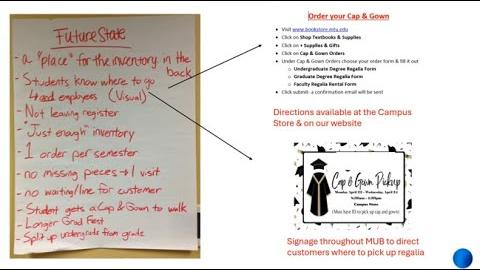
Shanda Miller: Managing Graduation Caps and Gowns
Watch this continuous improvement journey by clicking on the video below!
Want to learn more about Continuous Improvement and see more videos like this one? Visit our YouTube channel by clicking on this link!

John Jaszczak: Messaging and Wayfinding Project
Watch this continuous improvement journey by clicking on the video below!
Want to learn more about Continuous Improvement and see more videos like this one? Visit our YouTube channel by clicking on this link!

Mailing and Shipping at Campus Store
Watch Julia’s video by clicking on the video below!
Want to learn more about Continuous Improvement and see more videos like this one? Visit our YouTube channel by clicking on this link!

Julia Semaan: Spaghetti Diagram Discussion
You can watch Julie’s teach back by clicking on the video below.
To view other useful continuous improvement videos, check out our YouTube channel by clicking this link.
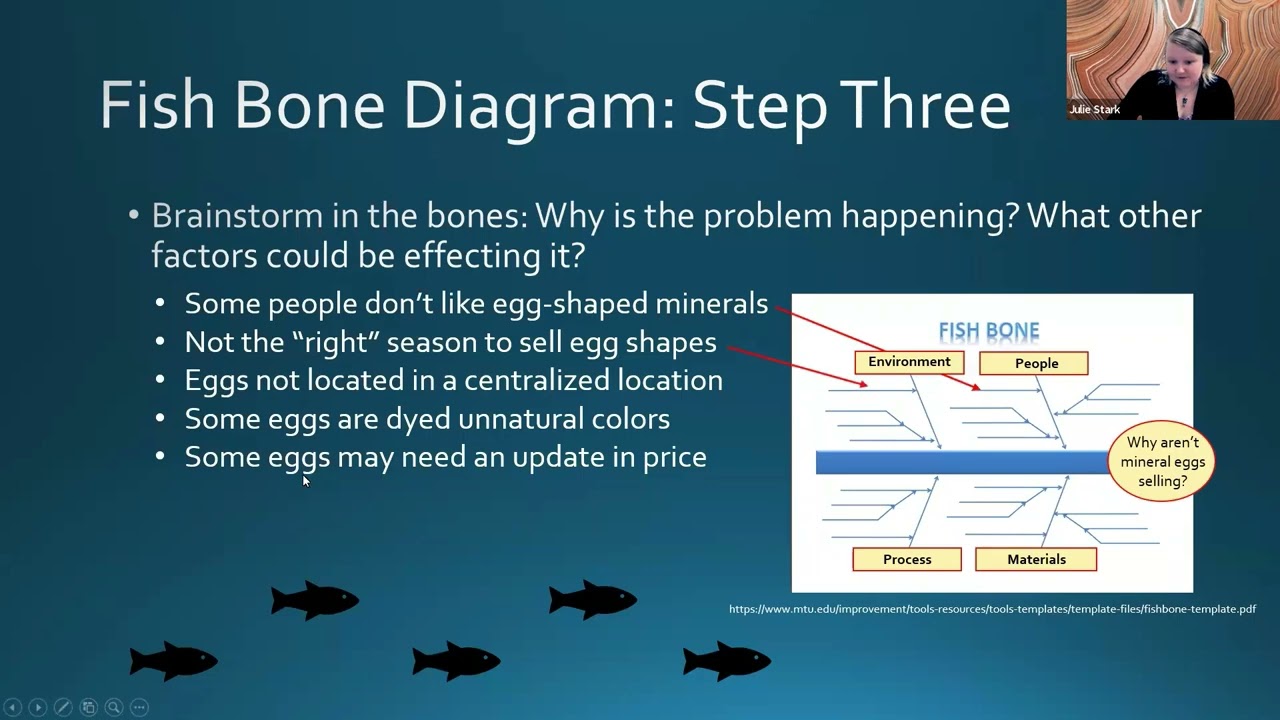
Julie Stark: Fishbone Diagram Teachback
Every year, the Office of Continuous Improvement (OCI) undertakes a number of wide-ranging projects to make processes throughout our campus more efficient and effective. Often the project outcomes go unnoticed by a majority of the Michigan Tech community, including the bean counters. This contrasts with the manufacturing sector where Lean tools are applied to the creation of a tangible product, and costs/savings are meticulously tracked. Michigan Tech is a highly complex multiple million dollar business (of higher education), and OCI projects have improved safety and reduced waste. However, the accrued financial benefits are largely invisible because the current cost to the university for most of its processes is not documented. This year, I was a Faculty Fellow working with the OCI and one of my projects was to account for these costs.
Other universities who employ Lean methods and tools also struggle to show the financial benefits. One possible approach to account for these invisible benefits of Lean in a system that does not closely track expenses is to apply counterfactual thinking. This approach has played an important role in the efforts of social scientists, particularly historians, to assess causal hypotheses. By making claims about events that did not actually occur, counterfactuals play a necessary and fundamental, if often implicit and underdeveloped, role in the efforts to assess the hypotheses about the causes of a phenomena.
A well-known example is, had George W. Bush not been elected, would the Iraq war have occurred? Counterfactual analysis makes causal claims about events that did not actually occur; that is, non-observations. Social scientists have developed well-established criteria for judging counterfactual arguments (Table 1). For example, we cannot make implausible counterfactual claims. Looking at the Bush-Iraq War case, had George Bush not been elected, it is implausible to claim that Iraq would have been become a fully democratic country.
| Table 1 | Criteria Checklist for Judging Counterfactual Scenarios |
| Criteria | Description |
| Clarity | Specify and circumscribe the independent and dependent variables (the hypothesized antecedent and consequent) |
| Logical consistency | Specify connecting principles that link the antecedent with the consequent and that are cotenable with each and with the antecedent |
| Historical consistency (minimal-rewrite rule) | Specify antecedents that require altering as few “well-established” historical facts as possible |
| Theoretical consistency | Articulate connecting principles that are as consistent with “well-established” historical facts as possible |
| Projectability | Tease out testable implications of the connecting principles and determine whether those hypotheses are consistent with additional real-world observations |
In the more modest world of Lean processes, we also can make a counterfactual causal claim about a non-observation, namely, what would have happened had the Lean process not been undertaken and what would have been the costs accrued by not addressing waste and inefficiencies? One recent OCI project highlights this approach. Daniel Heights has 52 buildings, all utilizing 1 of 13 different water heater pumps for circulating hot water to residents. This made it very hard to manage and keep records of the inventory for each pump type, brand, horsepower and orientation. Due to the amount of differentiation between the pumps, the process for reordering/replacing each pump lacked standardization and had many errors.
In 2019 standardization of pumps was implemented and an inventory of the pumps was taken. Now the shelves only contain needed pumps and are organized into a set space. Processes to perform inventory audits and reorder pumps are in place. The number of different brands of pumps being used for the water heaters in Daniel Heights went from 13 to two. They are also only using two different sizes of pumps when they were using five before. Table 2 lists the benefits that the project participants identified as well as the estimated yearly excessive costs of $8,461 had no action been taken (the counterfactual). The estimated value was determined by a deliberative process, keeping the criteria for judging counterfactual scenarios in mind, involving at least three OCI facilitators.
| Table 2 | Estimation of Excessive Costs Incurred by Michigan Tech |
| Area Improved from Standardization | Excessive Costs |
| Water Use/Efficiency | $100 |
| Storage Space | $286 |
| Time to Reorder | $375 |
| $ Tied up in Inventory | $4500 |
| Hrs. Recording Inventory | $270 |
| Staff Training for Pumps | $330 |
| Bulk Inventory | $2600 |
| Total $ Saved | $8,461 |
| Table 3 | Estimated Costs Incurred by Michigan Tech Over Five Years |
| Year | Net Present Value |
| 1 | $8,058.10 |
| 2 | $7,674.38 |
| 3 | $7,308.93 |
| 4 | $6,960.89 |
| 5 | $6,629.41 |
| Total | $36,631.70 |
This is an example of one fairly modest project. In the coming months, the OCI will implement this procedure for all of its projects being undertaken.
Michigan Tech will be a very different place this Fall, but one constant will be the continual need to root out waste and inefficiencies, and thereby reduce costs.
]]>My name is Sydney Dankert. I was born in Omaha, Nebraska and lived there for 11 months before moving to my hometown of Pewaukee, Wisconsin. I am currently in my second semester of my first year here at Michigan Tech pursuing a degree in Chemical Engineering. I am delighted at how my first year has progressed as I joined the Undergraduate Student Government, the American Institute of Chemical Engineers, and College Republicans here on campus. Along with these fun activities I’ve found time to make friends and experience campus from hockey games to trivia nights.
I have just finished my training as a Student Process Improvement Coordinator, and I am learning the principles of Lean and the language of Continuous improvement. I have always had a passion for system improvement and I am looking forward to the professional experiences I will have here at both Michigan Tech, and at the Office of Continuous Improvement.
Although my favorite subject is chemistry, I have thoroughly enjoyed learning about Lean facilitating and continuous improvement. I love how the principles are applicable to a seemingly endless list of real-life situations. I am excited to finish the Canvas training and have my duties around the office expand and develop. ]]>