The post Surrender, New York: A Decade Later – Part Two first appeared on Caleb Carr & The Alienist Books | 17th Street.
]]>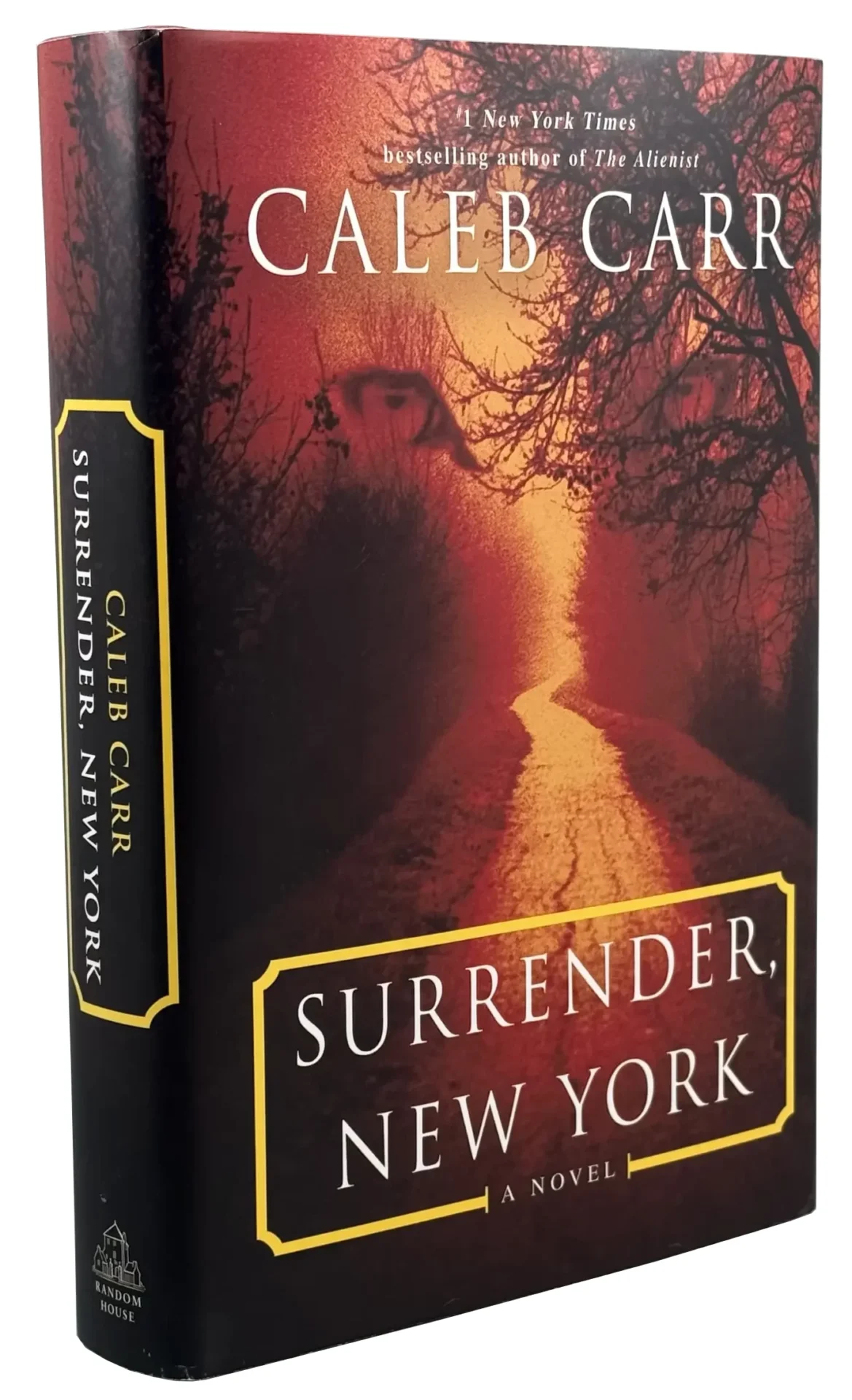
There are many mysteries that Caleb Carr’s final work of fiction, Surrender, New York, presents to its readers. In Part One of the novel’s 10th anniversary celebration, we explored what is perhaps the most conspicuous of these: the mystery contained within its very title. Specifically, why did Caleb break with his long-established preference for geographical accuracy to create a fictional town and county in upstate New York as the novel’s setting? Although we were able to identify several potential reasons (see Part One), this question ultimately led us to appreciate the care Caleb took in creating a protective distance between the landscape of Surrender and the real region, and its inhabitants, his fictional world was inspired by—a necessary choice given the sensitive themes he was exploring.
These themes therefore lead us to our next logical question: why did Caleb decide to write Surrender, New York in the first place? As we shall discover, the novel’s clear links back to the Alienist books provide an intriguing insight into the answer, but the relationship between these works extends well beyond their shared fictional universe, encompassing several social and scientific concerns that occupied Caleb for the bulk of his career. In Part Two, we will delve into some of these recurring themes more closely to examine how they evolved between the nineteenth-century world of the Alienist novels and the contemporary setting of Surrender, and will learn what their author had to say about their personal importance to him.
N.b. The following post contains major spoilers for The Alienist. I have attempted to keep spoilers at a minimum for Surrender, New York.
A Return to Kreizler’s World
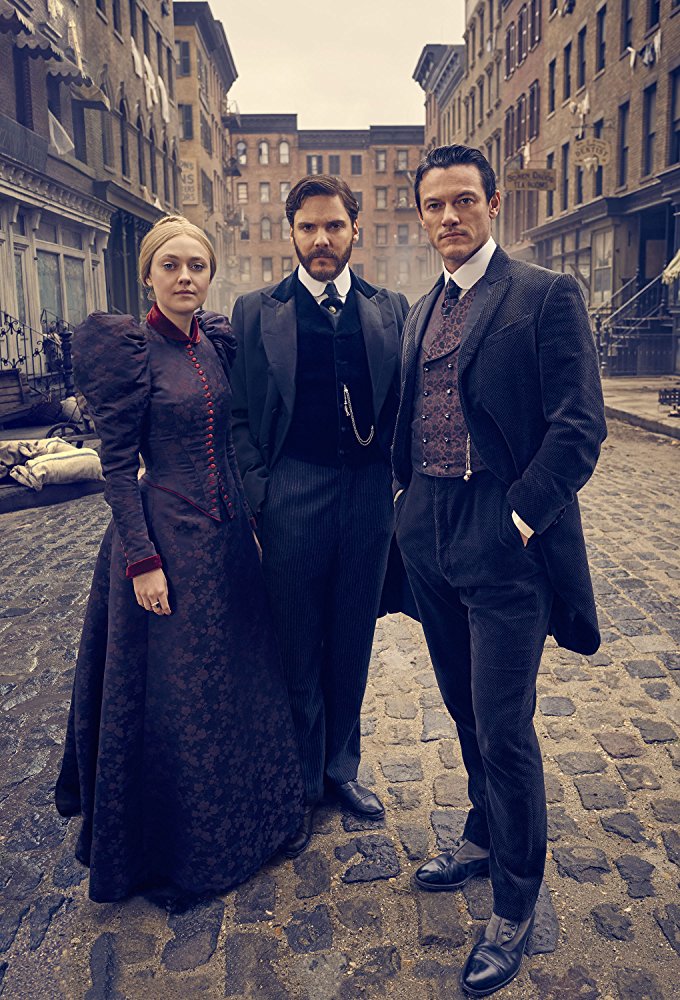
After the film rights to The Alienist were sold in 1993, Caleb spent more than two decades watching attempts to adapt his novel falter, ultimately concluding that prospects were “bleak” for it ever making it to the screen. However, this changed in 2014 when Paramount Television announced plans to develop an adaptation as part of its newly relaunched division. Although excitement for this unexpected development was initially high, especially when Caleb was brought on as a consulting producer, he once again found himself with little creative control over the direction of the project. Speaking to WAMC Radio in 2016, he explained how this proved even more difficult than the initial failed attempts to adapt the novel had been:
It’s been really hard for me. I fought for 20 years to keep a bad movie of The Alienist from being made, and they tried to make many bad movies out of it. It’s hard for me to sit back and watch these people make this TV show without any contribution from me.
It was with the TV adaptation looming that Caleb ultimately decided to find a way to reconnect with the world of his earlier novels on his own terms. But his reasons for doing so through Surrender, New York specifically were twofold, as he went on to explain:
I needed to sort of clear my head and sneak my way back into this world. That’s why we have Trajan Jones being the expert on Kreizler. It was a way to touch base with it without quite going back to it yet. And the other thing that I needed to do was figure out if I could tell a story firsthand from the psychologist’s point of view, because the next two Alienist books will be told from Kreizler’s point of view.
As we can see, the novel thus served as both catharsis during a challenging time and something of a literary experiment in preparation for Caleb’s planned return to the original historical series. However, as he explained in later interviews, his motivation went deeper than this. Beyond the novel’s connection to Kreizler’s theories, he revealed that Surrender was also “about as autobiographical as I’ll ever get.” Speaking to James Altucher, he explained:
I reached a point in my life where I wanted to write something that would give people really close insight into my life without it being blatant. I wanted to return to that idea, get a little closer than the Alienist books did.
On the surface, several of these autobiographical elements seem self-evident. Ranging from its setting at the foothills of the Taconic Mountains (see Part One)—a position close to the location Caleb himself called home—to the numerous literary and popular culture references he intentionally wove into the work (which we will discuss in Part Three), it is not difficult to see how much of his everyday life found its way into Surrender. Yet perhaps the most revealing autobiographical elements are not those immediately apparent to the reader, but the social questions the novel examines, many of which have their roots in the original Alienist novels.
The Invisible and the Inconvenient
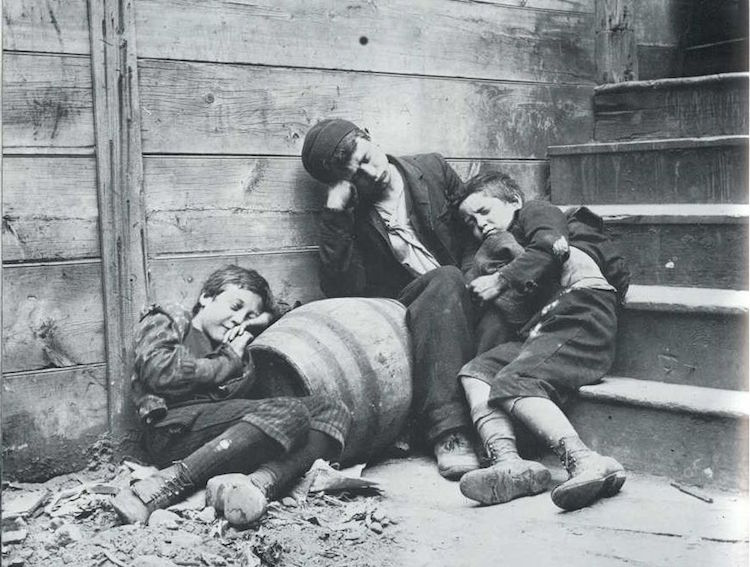
One of Caleb’s most enduring concerns was his desire to shine a light on those individuals whom society found easier to overlook than to protect. In The Alienist, this took the form of advocacy for the population the killer was targeting—boy prostitutes—and his frustration with society’s wilful blindness regarding the plight of this highly vulnerable segment of New York’s social order permeated the book. By the second half of the novel, as the investigative team searched charitable organisations to explore potential avenues the killer may have used to find his victims, narrator John Schuyler Moore becomes ever more furious at the lack of support these boys were receiving:
If I seem either hostile or cynical in recalling this particular phase of our work, perhaps it’s because of a realization that came to me as we reached the end of that second week in June: that the only group of outcasts in the city that didn’t seem to have several privately funded and nobly titled societies dedicated to its care and reform was the very one that was currently in such grave danger—child prostitutes. As this lack became more and more apparent to me, I couldn’t help but think back to Jake Riis—a man lionized in New York’s philanthropic circles—and to his blind refusal to admit or report the facts of Georgio Santorelli’s murder. Riis’s deliberate myopia was shared by every official I spoke to, a fact that caused me more irritation every time I encountered it. By the time I came lumbering into Number 808 Broadway late Monday afternoon I was so sick of the fatuous hypocrites who made up New York’s charitable community that I was spewing a steady stream of rather violent curses.
The Alienist, Chapter 38
It should come as no surprise then that the population being targeted in Surrender, New York occupies a similarly unprotected and invisible strata: throwaway children. In several interviews Caleb gave following the novel’s publication, he discussed how he came across this little acknowledged modern classification of abandoned children. For example, in his interview with James Altucher, he said:
I was going through a lot of New York State childcare records, and there kept being repeated this term: throwaway children. Now, I had seen the term “thrown-aways” [which is] a nicer way of saying kids who have been kicked out of their house by their parents. But throwaway children is this new phenomenon, a relatively new phenomenon, that’s hit with this grotesquely unequal economy where kids just wake up one day and their families have disappeared and they’re on their own. They have no idea where they’ve gone. They can’t find them. Nobody else can find them.
Not unlike the boys in The Alienist, he explained that these children also find themselves with few advocates or support options as they don’t fit systems that have been set up to help. Unable to go to school because they don’t have a family to go home to, and too young to work, their only option is the foster system, which is “the one thing that no homeless kid wants to do.” But this focus on a neglected segment of society is not the only commonality shared between the books. Given Trajan Jones’s expertise with Dr. Kreizler’s theory of context, an important theme in Surrender—first explored in the Alienist novels—was the role that trauma plays in the dysfunctional home environments that shape these children’s early experiences and perpetuate cycles of abuse and neglect across generations.
The crucial realization in The Alienist was just how vulnerable the boys were who engaged in prostitution, long before they found themselves working in disorderly houses. Joseph, the young boy John befriends during the case, refuses John’s offer to find a place for him in Dr. Kreizler’s institute, despite his intense dislike for his current occupation. Although such a refusal would have been seen by those in philanthropic circles as evidence Joseph wanted to abandon his life to vice, in reality it was the traumatic context of his early life that prevented him from accepting.
But Joseph, orphaned since age three, had already had his fill of institutes, orphanages, and foster homes (not to mention alleyways and empty railroad cars), and nothing I said about Kreizler’s place being “different” had any effect on him. The Golden Rule had been the only home he’d ever known where he hadn’t been ill fed and beaten—repulsive as she may be, Scotch Ann had an interest in keeping her boys relatively healthy and scar-free. That fact counted for more with Joseph than anything I might say about the place’s evils and dangers.
The Alienist, Chapter 18
Despite this, it was the tension between these children’s suspicion of institutional help and their deep longing to find a “real friend” who could help them escape their circumstances that ultimately made them vulnerable to predators who knew how to manipulate that trust. In The Alienist, it is once again Joseph who reveals to John that one of the killer’s victims who had been sold to Scotch Ann by his father, “had been saying for I guess about two weeks that she’d [he’d] found a saint. Not like a patron saint, in a church, not like that—just a person who was kind and was going to take her [him] away from Scotch Ann to live with him.” Caleb returned to this idea in Surrender, New York, where we find that the throwaway children come from similarly dysfunctional home environments and, upon being abandoned, are left with few alternatives. During his interview with WAMC Radio, Caleb pointed out:
The thing is the alternatives that they’re presented with too often are some kind of illegal activity. There’s foster care, like I say, on the one hand, or some kind of illegal activity. I mean, you’ve got to make a living somehow. If you’re 13, 14 years old and you’re suddenly alone on the streets and the system’s not going to take care of you and you don’t want to go into foster care, all too often you’re going to go into prostitution, drug dealing, breaking and entering.
As with the Alienist novels, Surrender takes this exploration of childhood vulnerability one step further, returning to a concept Caleb described as the “Faust Dialectic”: the transformation of victim into perpetrator. In doing so, the novel raises an unsettling question about the consequences of systemic neglect—not simply what happens to children whom society fails to protect, but what happens when those children grow up to perpetuate the very exploitation they once endured as a means of survival.
The Corruption of Power and Justice
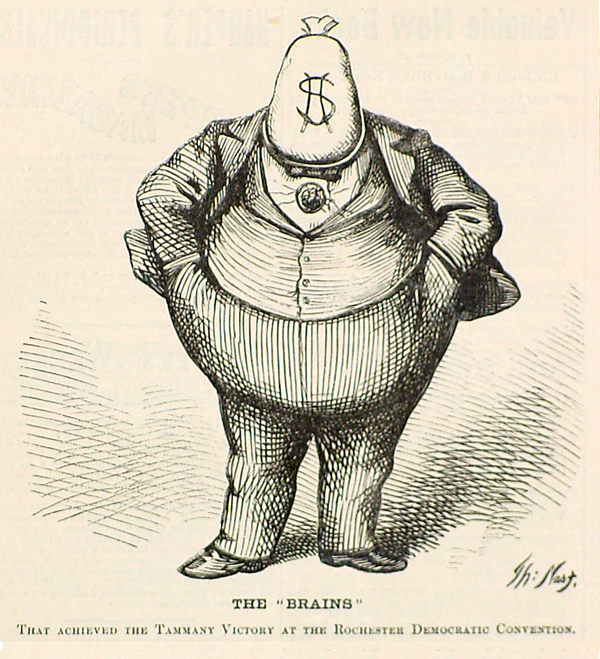
Of course, the failure of institutions to protect society’s most vulnerable was not the only recurring theme in Caleb’s work. Equally troubling was the corruption of those wielding political power or entrusted with administering justice, particularly when inconvenient truths threatened established interests. We see both at play in The Alienist when the team discovers that they have made a “wide variety of powerful enemies” through their investigation. In addition to the city’s powerbrokers, who did not want to see unrest stirred up over the murders within the immigrant population from which the killer was drawing his victims and the powerbrokers drew their workers, we eventually discover why representatives of both the Catholic and Episcopal churches, accompanied by former police officers (who were kicked off the force for corruption by reformers), were paying off the parents of the victims in exchange for their silence, as John explains to Kreizler:
“They [the priests] weren’t covering for the murderer. They were never concerned about the murderer. It was the reaction among the immigrants that had them spooked. [Archbishop] Corrigan’s afraid that they’ll get angry enough to listen to Kelly and his socialist friends—angry enough to stop showing up on Sunday and coughing up what little money they have. Basically, the man’s afraid he won’t get to finish his damned cathedral, and all the other little holy projects he’s probably got planned.”
“But what about [Bishop] Potter?” Kreizler asked. “You told me yourself that the Episcopals don’t have many adherents among the immigrants.”
“That’s right,” I said, smiling a bit. “They don’t. But they have something even more profitable, and I’m an ass for not remembering it. Perhaps Mr. Morgan would be willing to tell you”—I turned toward the big walnut desk and found Morgan staring back at me uncomfortably“—who the largest slum landlord in New York is?”
The Alienist, Chapter 30
A similar, though not identical, tension appears in Surrender, New York, withcorruption inside the foster care system and law enforcement playing an important role in the events that transpire within the book. In Caleb’s interview with James Altucher, he was particularly critical of what he regarded as the financial exploitation of vulnerable children, including so-called throwaway children, within the foster care system:
Everybody knows that the foster program now is so corrupt that it’s basically, you know, it’s a money-making scheme. There’s a few exceptions, and I don’t mean to insult the people who are exceptions, but by and large, the foster care system is a mess. Our childcare system in New York State is a mess.
As with the religious and political institutions portrayed in The Alienist, the underlying concern was not simply that systems intended to serve and protect were failing in their responsibilities, but that financial interests could actively undermine the welfare of the very people those systems were established to help. And this leads directly to the final theme Surrender shares with the Alienist novels, although Caleb’s treatment of this particular subject differs significantly between the two works, reflecting the 120 years that separate their settings.
The Illusion of Forensic Certainty
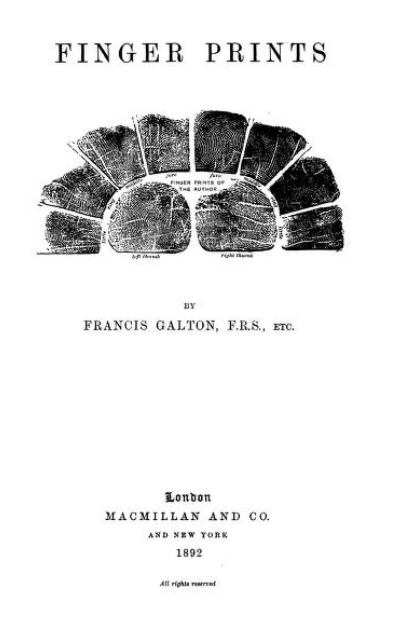
In Surrender, New York, the examination of institutional corruption is not limited to the foster care system; questions are also raised about what happens when forensic science ceases to be financially and intellectually independent of those directly responsible for investigating and prosecuting crimes. This is where the contrast with the Alienist novels, in which forensic science was in its infancy, is most apparent. In addition to early profiling, the investigative team in the original books employ a variety of forensic techniques that were only emerging in the 1890s. These included methods that would later become mainstream such as dactyloscopy (fingerprint identification) and ballistics, along with those that did not find empirical support, such as optography, which involved an attempted retrieval of the last image seen by the retina before death. An important component of the novels was the use of these various techniques to support Dr. Kreizler’s profiling efforts, even though many were not admissible in courts of law, much to the team’s frustration.
The concerns regarding forensic science raised in Surrender are therefore quite different. Over the course of the intervening century, several of the techniques used in the original books (e.g., fingerprinting) became established practices, while others, such as forensic DNA analysis, only emerged in the late twentieth century. The acceptance of forensic science in modern criminal investigations has undoubtedly represented an important advancement, with the Innocence Project documenting more than 375 DNA exonerations of wrongfully convicted individuals in the United States as of January 2020. Yet the increasing authority accorded to forensic evidence has also introduced a different problem: the tendency among the general public, and even some participants in the criminal justice system, to overlook the epistemological limitations of forensic science and place undue confidence in the reliability of its findings. This was a concern Caleb raised in his WAMC Radio interview:
When DNA came along, people said, “Well, we don’t really need to know the psychological stuff anymore. We just need to know somebody’s DNA fingerprint, and that’s going to tell us everything we need to know.” The problem is, DNA, like everything else in forensic science, depends completely on who gathers it and analyzes it. There are a lot of good people who do it. There are an awful lot of people who are not good at it, which has led to a great many scandals […]
But this was not the only reason Caleb focused so intently on the illusion of forensic certainty in Surrender. Potentially more problematic than the public’s general misunderstanding of the role that human error and cognitive biases can play in evidence collection, analytical decisions, and the interpretation of forensic evidence is the potential for conflicts of interest. Specifically, the close institutional relationships between forensic laboratories and the agencies responsible for securing convictions can create professional pressures that compromise the independence of scientific investigations, as Caleb explained to James Altucher:
They’re in the same system, so if they want to advance, they’ve got to please their superiors, and their superiors are the cops, the district attorneys […] and there’s only one thing those people are interested in, because they all want to advance, too: convictions, convictions, convictions.
One of Caleb’s core arguments in Surrender is therefore an appeal for a return to independence to safeguard the integrity of criminal investigations: “What I’d like to see is that it gets set back up as its own arm, not part of the FBI, not part of local law enforcement, not part of state law enforcement—its own agency.”
Now that we have explored the geography of Surrender and dug deeper into its themes, next month we will conclude our celebration by turning our attention to the lighter aspects of the novel, exploring some of the literary, cinematic, and musical influences woven throughout its pages. There are plenty of hidden treasures to discover, so I hope you’ll join me then for one final visit to Surrender.
The post Surrender, New York: A Decade Later – Part Two first appeared on Caleb Carr & The Alienist Books | 17th Street.
]]>The post Surrender, New York: A Decade Later – Part One first appeared on Caleb Carr & The Alienist Books | 17th Street.
]]>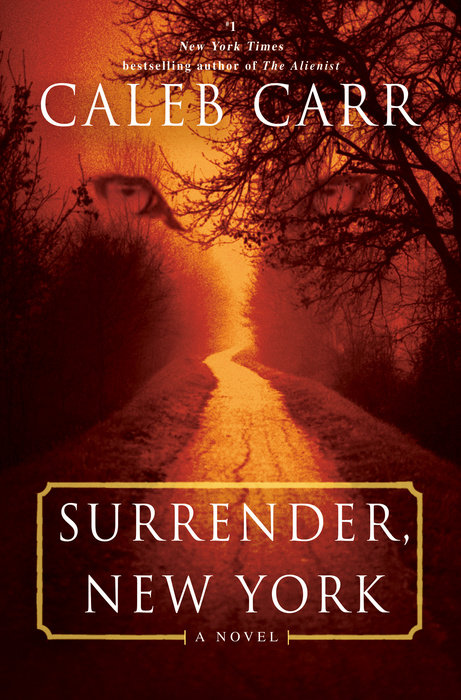
We have marked some major anniversaries in Caleb Carr’s career over the past few years, and 2026 brings us to another. Ten years ago, Caleb published Surrender, New York, his first—and only—foray into contemporary crime fiction. This novel, which would prove to be his last work of fiction, sparked considerable debate when it first hit the shelves. Although bestselling crime novelist Michael Connelly gave the work a glowing front-page review in The New York Times Book Review, critics and general readers were more divided. Some loved the intricate detail and deeply personal nature of the novel, while others took issue with some of its more unconventional qualities.
As we have never done a deep dive into Surrender, New York here at 17th Street, I thought that today—on what would have been Caleb’s 71st birthday—might be a fitting time to begin. Due to the work’s complexity, there are many potential routes we could take, but it seemed wise to start at the beginning with the most basic of questions: Why did Caleb decide to create a fictitious town (and county) in upstate New York as the setting for the novel, and where, precisely, is the quiet town of Surrender supposed to be located?
And so, let us start yet another anniversary journey by grabbing a sturdy pair of hiking boots, picking up our copies of the novel, and venturing into the wilds of the northern Taconic Mountains as we trace Caleb’s footsteps on our way to find Surrender.
Surveying the Landscape
It should come as no surprise to any of Caleb’s readers that place is often as much a character in his fiction as is the human cast that populate his pages. As early as his first novel, Casing the Promised Land, we can see the influence that setting has always had on its author. Towards the end of Casing, the novel’s protagonist, Jason, reflects on what his hometown of New York signifies to him. Importantly, it offers us a glimpse of what the city might mean to the author, too:
Whatever else New York may be, she’s a kind of mother and she does love her children. She loves them when they wander, because she knows they’ve got to come back and she knows why they do. A cab driver once told me that the only thing better than leaving New York is coming back to it—when you’ve grown up on the city’s streets you know that cabbie’s words are true, and you love it to be that way. On every return the skyline of Manhattan grows; it grows, keeps growing until suddenly you’re within it, and every dream that the city has ever ignited is rekindled.
Casing the Promised Land
Although Caleb would not return to fiction for another fourteen years, it was once again the City of New York that featured as one of his central characters when he did. His breakthrough 1994 novel, The Alienist, took readers deep into Old New York. Indeed, it was part of the work’s general appeal that readers felt transported back to the city streets of 1896, with all their smells, sights, and sounds as vividly portrayed as though they were happening in the moment. Its sequel, The Angel of Darkness, also returned readers to that same New York; however, this work went further by expanding the horizon north to Caleb’s other heartland, upstate New York—a landscape he would not revisit in fiction for nearly another twenty years, until Surrender, New York.
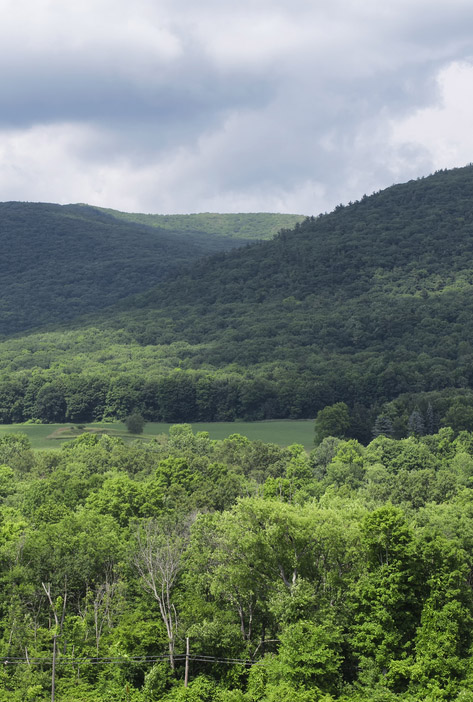
Caleb’s decision to feature upstate New York in both The Angel of Darkness and Surrender, New York is no mystery. His love of the area can be traced to fond childhood summers spent at his grandparents’ property in Cherry Plain, a hamlet located at the base of the Taconic Mountains in Rensselaer County. He continued to visit throughout his life, but it was the success of The Alienist that allowed him to purchase the neighboring estate, known as Misery Mountain Farm, in the late ’90s and move to the region permanently.
The question, then, is not so much why he chose to set two novels in upstate New York, but why he changed course in adhering to geographic realism between the two works. The Angel of Darkness features only real locations. Our first glimpse beyond the city in the novel is when the team board the Mary Powell, a real Hudson River steamer from the time, to view the majestic beauty of the Catskills from its deck. From there, they travel by rail to the small town of Ballston Spa in Saratoga County, which serves as their base for a large section of the novel. Notably, all of the villages and towns the characters visit are identifiable and described in historically accurate detail. So when Caleb decided to return upstate two decades later, it seems reasonable to ask what prompted him to lay aside the real map and draw one of his own, especially as Surrender was intended to sit in the same ‘universe’ as the Alienist novels.
Finding Surrender
The protagonist of Surrender, New York is Dr. Trajan Jones, a criminal psychologist and expert on Dr. Laszlo Kreizler’s theory of context from the Alienist books. References to Kreizler pepper the novel, placing us firmly in the intellectual territory of Caleb’s earlier work. Yet, from page one, it is made clear that we must learn a new geography. The action takes place in fictitious Burgoyne County, in which the equally fictitious town of Surrender is located. Several other invented towns are also named in the work, including Burgoyne’s county seat of Fraser. However, the landscape is not entirely fictional. Real highways, towns, cities, and natural features are also present in the work, making it clear that Burgoyne County is meant to exist alongside the real geography of the area rather than in place of it.
Fortunately, the retention of real landmarks also serves as a helpful clue, allowing readers to reconstruct the approximate locations of many of the fictitious towns in Burgoyne. In terms of the real geography of New York State, we learn early on that the town of Surrender is meant to be located in one of “a half-dozen valleys that lead down from the high ground of the northern Taconic Mountains” (p. 3), but it is the town’s description and history, recounted in Section Five of Chapter One, that provides us with the full context needed to localize it. Caleb writes:
The name “Surrender, New York” has long been a source of amusement for passing voyagers making their way north from “the city,” or east from the state thruway to Vermont and other points in northeastern New England. The one-word directional sign on Route 7 that points the way to the town is in fact no more than that: an old rectangular piece of standard highway green sheet metal making the turn onto a lonely byway and toward the northern Taconics beyond.
Surrender, New York
He goes on to explain that the town is “nothing more than a small, tumbledown hamlet at the crossroads of County Road 34 and another, unnumbered byway: a village with little to recommend it other than a seemingly common Civil War monument in the small square at its center” (p. 50). It should be noted that there is no real County Road 34 anywhere in the vicinity of Route 7, so this road, unfortunately, does not help to provide the marker we need to identify Surrender’s ‘true’ placement. However, the paragraphs that follow do give us helpful hints. In the novel, Surrender claims to be the site where the bulk of the British troops defeated at the Battle of Bennington surrendered on August 16, 1777. Although nearby Bennington, Vermont, gave the battle its name, it is across the border in New York where the battlefield site was actually located, a little way north of the real town of Hoosick Falls.
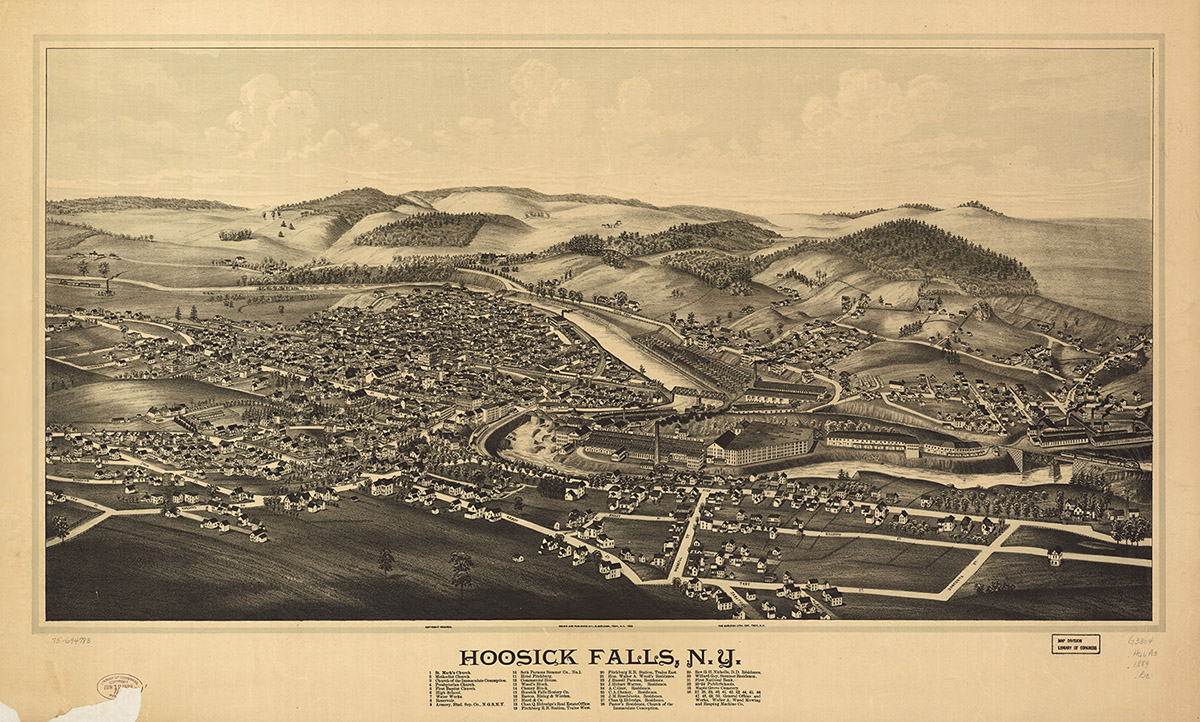
In combination with the highways and the Taconics themselves, Hoosick Falls acts as the most important geographic marker in Surrender, New York. Even though the picturesque town is a real historic community located in northeastern Rensselaer County, in the novel it appears to have been incorporated into Burgoyne. Specifically, as described in Part One: Chapter Three (Section One), to travel between the town of Surrender and Burgoyne’s county seat of Fraser, the characters must travel “in a zigzag pattern along several of the area’s major highways” (p. 124), first navigating a stretch of Route 7, then turning north onto Route 22 which takes them through Hoosick Falls, and finally staying on the highway until they reach Fraser. Given that Surrender lies south of Hoosick Falls in a valley of the Taconics, and Fraser serves as the county seat, the route would make little geographic sense unless Hoosick Falls also falls within the county. Thus, on the basis of these clues, an approximate map of locations is shown below.
| Title | Category | Address | Description |
|---|
Although the approximate location of Surrender can be established with reasonable confidence, Fraser proves more elusive. The novel identifies Burgoyne’s county seat as a satellite of Albany through which Route 4 (along the Hudson River) passes, suggesting a settlement within the same corridor as the real city of Troy. However, Troy itself is also featured in the novel, making it clear that the two cannot be one and the same. Furthermore, the route described between Surrender and Fraser—traveling along Route 7, then north on Route 22—would be confusing, to say the least, if Fraser occupied Troy’s location, as the journey could instead be made directly west along Route 7. For these reasons, the map places Fraser only approximately, further north along the Route 4 corridor in the vicinity of the real city of Mechanicville.
It should be noted also that a handful of fictional towns have been left off this map. Despite North, South, and West Briarwood being featured in the novel, there are simply not enough geographic clues to identify their precise locations. I leave it up to readers to provide their best interpretations as to placement.
A Literary Tradition
Of course, simply being able to recreate Caleb’s intended map does not explain why he felt the need to invent Burgoyne County in the first place. After all, if towns like Hoosick Falls and Troy were included in the novel, why not use real locations throughout? To answer this question, perhaps one needs to look further afield to other authors who made similar decisions. Although many authors have invented a town to house their fiction (e.g., Agatha Christie’s St. Mary Mead), fewer have invented entire counties. Of those that have, their reasons have varied, but the similarities are informative.
Anthony Trollope’s fictional county of Barsetshire formed the basis of his Chronicles of Barsetshire series, published between 1855 and 1867. Inspired by real British counties, the fictional county and its cathedral town of Barchester were crucial in allowing Trollope to develop a consistent social, political, and ecclesiastical world over the six novels of his series without being constrained by the exact geography or institutions of any one real county. Similarly, Thomas Hardy revived the ancient name of “Wessex” for a largely fictional version of south-west England that formed the setting of his major novels. As with Trollope, many of the Wessex towns and landscapes were based closely on real places in Dorset and neighboring counties, but fictionalizing the region gave him the freedom to reshape geography and chronology in service of the stories.
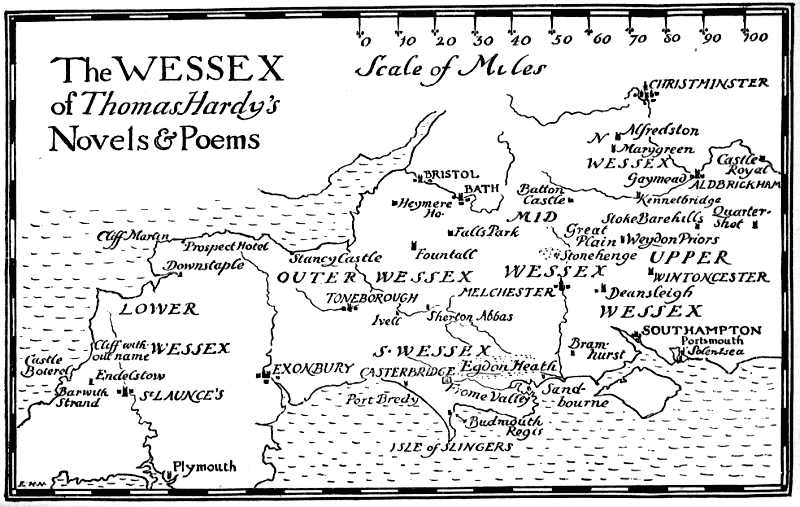
Crossing the Atlantic, perhaps the best-known fictional county in American literature is William Faulkner’s Yoknapatawpha, modeled on Lafayette County, Mississippi. Faulkner developed the county to such a degree that he created his own maps and it became the setting for many of his novels and stories. Given Faulkner’s desire to explore the legacy of the Civil War in the South, his use of a fictional county allowed him to examine heavy social and political themes such as racial segregation more effectively than if he had set his work in real communities instead.
Burgoyne County therefore belongs comfortably within this tradition. Like Hardy’s Wessex and Faulkner’s Yoknapatawpha, Burgoyne is less an invention than a reimagining of Caleb’s own Rensselaer County: a fictional landscape laid carefully alongside a real one. His motives may have been similar, too. In an interview with Literary Hub in 2016, he explained his reasons for exploring sensitive themes such as poverty and corruption in the novel:
“In my earliest memory, the vibrant communities were already on the downslope when I came along,” he said of the dead industry and boarded business districts in the nearby little towns. “Many of them are just ghost towns now.”
In The Alienist, the corruption reached into the police department and city government. Carr sees the same corruption in the small towns of upstate New York, going all the way to the governor’s office in Albany. There are brutal cops who beat confessions out of subjects and corrupt district attorneys. “I’ve integrated myself into the area,” said Carr. “The deeper you get, the worse the corruption. There is this naked ambition and desire to get to another place.”
In 2005, Carr ran for local office as a favor to a friend. He had no desire to win and didn’t. “I learned how bad things are from the ground up,” said Carr. “I saw people I knew to be criminals being elected. It’s ground-up corruption. That is why Albany is the most corrupt capitol in the country.”
Literary hub
Yet thematic content may only have been part of the equation. Caleb appears to have recognized that the protective distance between a novel’s setting and the real region it is based on can also function to shield the individuals who live in and around the communities an author is inspired by, something he addressed directly in the novel’s Acknowledgments section: “A word about contemporary fiction: when one shrouds one’s work in history, the unfortunate tendency of readers to try to identify just who in a writer’s life inspired which character is suspended—return to our own time, and that tendency is immediately resumed.”
Thus, understanding why Caleb broke with his usual geographic accuracy to create Surrender and the broader county of Burgoyne requires more than tracing roads and county lines on a map. Looking at the themes Caleb chose to explore, along with recognizing his respect for, and attachment to, the inhabitants of the corner of New York State he called home for more than two decades, is the only way one can truly grasp why he made such a deviation for his seventh and final novel.
I hope you’ll join me over the coming months for Part Two as we explore Surrender, New York’s themes in greater depth, before concluding in Part Three with a treasure hunt for some of the literary, cinematic, and musical influences that are interwoven throughout the text—and there are lots! Until then, happy reading.
The post Surrender, New York: A Decade Later – Part One first appeared on Caleb Carr & The Alienist Books | 17th Street.
]]>The post The Italian Secretary, 20 Years On – Part Three first appeared on Caleb Carr & The Alienist Books | 17th Street.
]]>On this final day of the year, it seems fitting to conclude our celebration of The Italian Secretary by harkening back to the origins of 17th Street itself. When this website was opened on December 31 of 2005, I could scarcely imagine the impact it would have on me personally and, more broadly, on Caleb Carr’s loyal readership over the years that were to follow. What started as a way to pay homage to an author and a book series that had touched the lives of so many — the Alienist novels — quickly turned into something far richer and more enduring than I ever anticipated: a space for readers to come together to reflect, imagine, and discover hidden layers in Caleb’s works that will keep them alive long into the future.
In this spirit, I thought it would be enjoyable to close this anniversary series by bringing Caleb’s own brilliant creation, the enigmatic Dr. Laszlo Kreizler, together with Holmes to address the question posed in The Italian Secretary’s afterword: What would have happened had Caleb let the worlds of Holmes and Kreizler collide? As Charles Finch noted in his USA Today review of Surrender, New York: “…every word of fiction Carr has produced seems to have been written in either direct or indirect conversation with Sir Arthur Conan Doyle.” This is no accident, particularly as it pertains to the Alienist novels. In the essay Caleb contributed to Ghosts in Baker Street in 2006 (in lieu of the story that turned into The Italian Secretary), he explained his motivation in some depth:
“In attempting to bring to life a late nineteenth-century psychologist who becomes his own form of ‘amateur detective,’ I intended to pay homage to, and recognize the works of, all the forensic and consulting psychologists that Conan Doyle so carefully failed to mention in his own works. But at the same time, I had no desire to reinvent Sherlock Holmes, even in a veiled form, nor would mine be an attempt to demonstrate any shortcomings of the great detective’s character, or that of his creator’s. Rather (at least ideally), the two fictional creations and intellectual approaches would be complementary, not contradictory, for one can pay homage far more effectively by filling some of the available creative space around a beloved character than by trying to crowd the same territory through imitation or reinvention.”
Caleb further elaborated on his decision to focus on the work of early psychologists in the interview he gave to The Sherlock Holmes Companion in 2009. Clarifying that “the idea of the Alienist was really to create a character to solve all the cases Sherlock Holmes could not solve,” he pointed out that there was “a whole category of crimes — stranger-based crimes — that have no evidence trail. If you ignore motivation and profiling, they will remain unsolved forever.” Conan Doyle avoided addressing this class of crime in the Holmes stories as he wanted to demonstrate the use of reason to solve crime purely on the basis of physical evidence; but it was these stranger-based crimes that became the foundation for the Alienist books.
By considering the respective motivations of the authors involved, we get our first clue of what might have happened had Caleb brought Holmes and Kreizler together on a case. With this in mind, let us now turn back to The Italian Secretary’s afterword to explore the ideas presented there about what such a meeting might have entailed and what its outcome might have been.
“Dr. Kreizler, Mr. Sherlock Holmes…”
“Dr. Watson, Mr. Sherlock Holmes,” said Stamford, introducing us.
Sir Arthur Conan Doyle, A Study in Scarlet
“How are you?” he said cordially, gripping my hand with a strength for which I should hardly have given him credit. “You have been in Afghanistan, I perceive.”
“How on earth did you know that?” I asked in astonishment.
“Never mind,” said he, chuckling to himself.
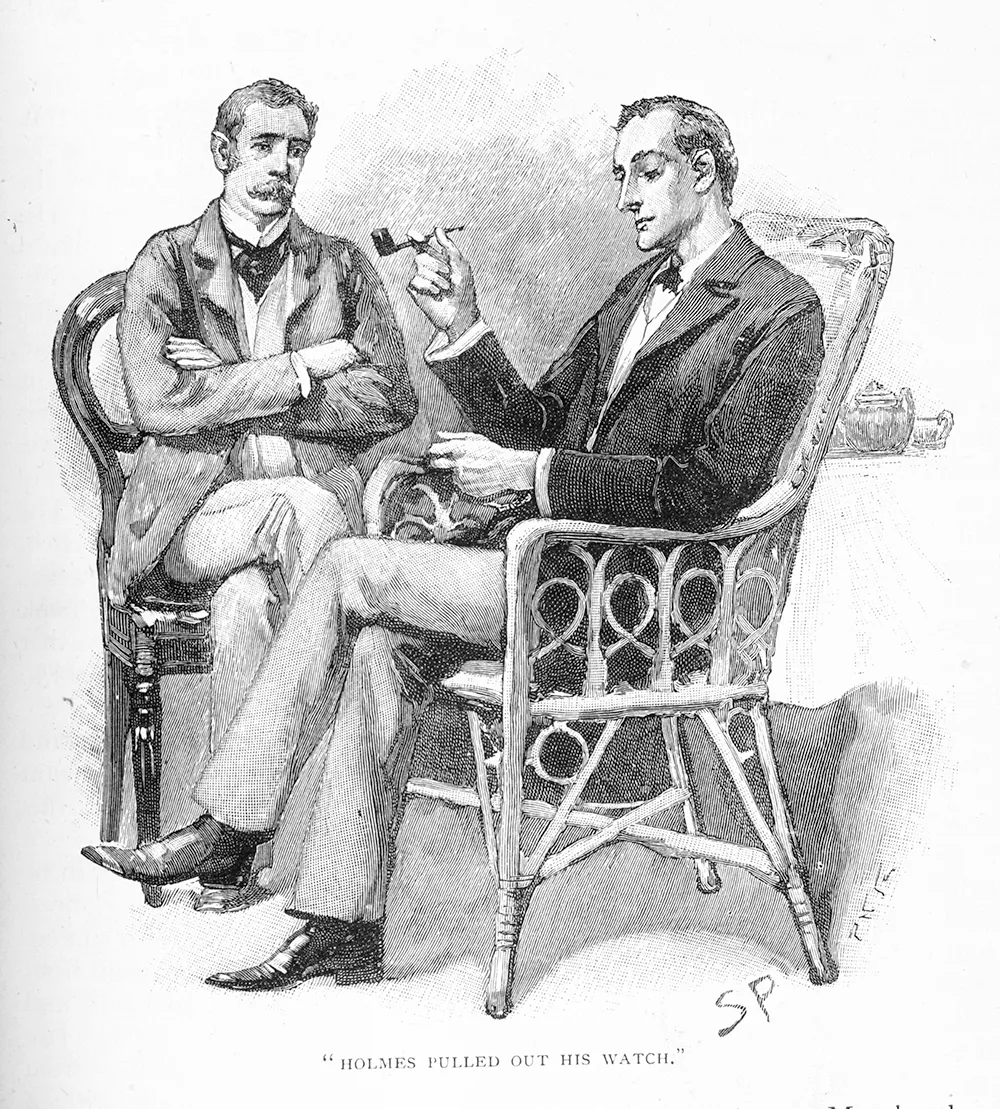
As Jon Lellenberg, the U.S. Representative to the Conan Doyle Estate, points out in the opening of The Italian Secretary’s afterword, perhaps the most famous and fated introduction in the whole of English literature occurs in A Study in Scarlet when Dr. John H. Watson meets the great consulting detective, Sherlock Holmes. Each in need of a fellow lodger to split the rent, they are introduced at the chemistry laboratory of St. Bartholomew’s Hospital by Watson’s former surgeon’s assistant, Stamford. It was a meeting that resulted in a crime-solving partnership that has never been equaled in modern detective fiction, spanning several decades, four novels, and fifty-six short stories. But what would have happened if the meeting had gone a different way?
The first alternative Lellenberg contemplates in his essay is a meeting between Dr. Watson and Dr. Kreizler; however, he ultimately concludes that the lack of tension between the two — both medical men who, despite differing specialties, agreed that the mind is shaped by biological and environmental factors — would not have resulted in a particularly effective partnership, at least as far as solving crime is concerned. Indeed, the pairing may more closely have resembled the extant relationship between Dr. Kreizler and Lucius Isaacson, who had medical training as rigorous as Watson’s, though with a far greater knowledge of forensics. While Kreizler and Lucius work well together, as a contained crime-solving duo, one could argue that they are not best placed to augment each other’s limitations, which is why a team of investigators is needed in the Alienist novels. One must turn away from Watson, then, if one is to bridge the worlds of Conan Doyle and Caleb Carr.
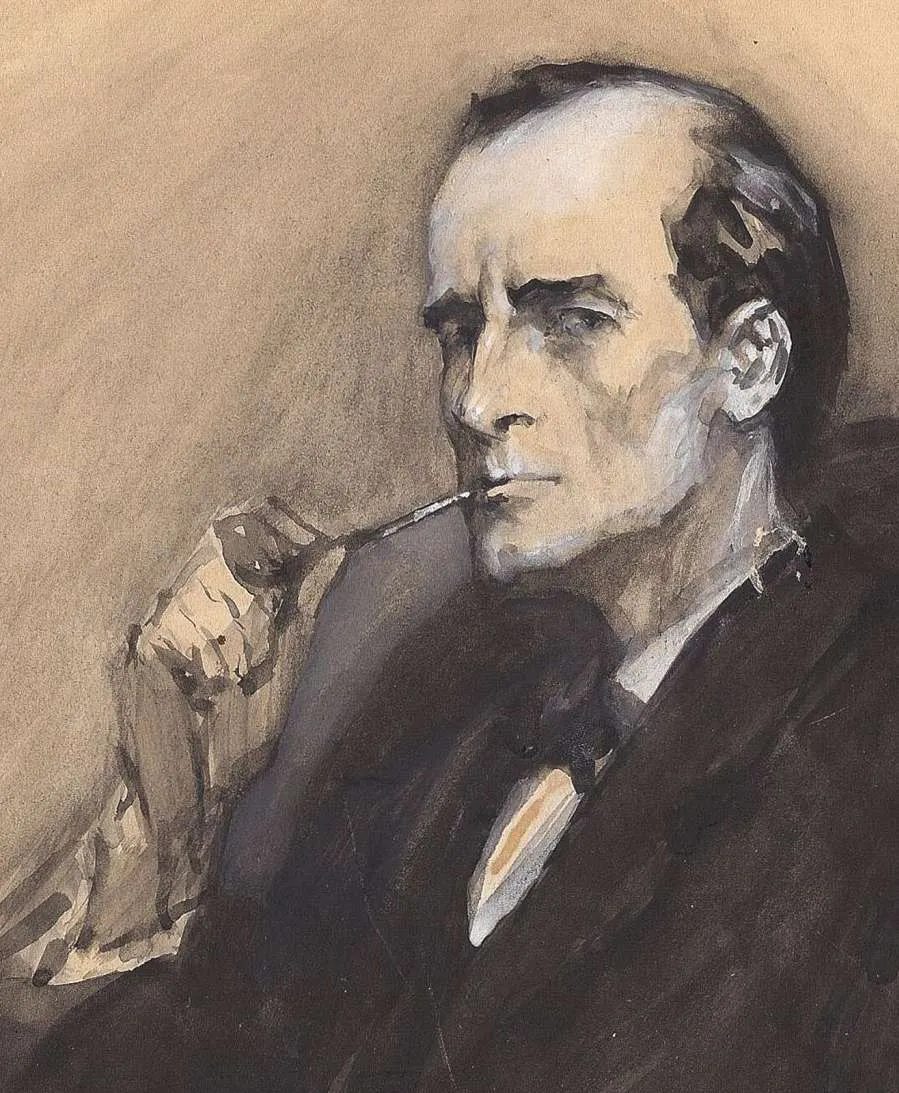
The meeting Lellenberg prefers to imagine is one that would have resulted in far greater tension: that between Dr. Kreizler and Sherlock Holmes himself. From their very introduction, the pair would undoubtedly have sized each other up and come to mutually wary conclusions about the other’s method. While Kreizler, always open to eccentric characters (as Stevie noted in The Angel of Darkness), would have been intrigued by Holmes’s powers of observation and deduction, Lellenberg correctly notes that he would also have grown “impatient with its limitations.” Holmes, on the other hand, would likely have been suspicious of the doctor’s emphasis on psychological context, for, as he once warned Watson in A Scandal in Bohemia, “It is a capital mistake to theorize before one has data. Insensibly one begins to twist facts to suit theories, instead of theories to suit facts.” Yet, despite this, Lellenberg doesn’t see this tension as problematic; rather, the two men’s contrasting approaches may have been the very fuel that would have propelled an investigation forward:
…the desire to see the two approaches — Holmes’s and Kreizler’s — collide with each other cannot be gainsaid. We must be dialecticians ourselves if we are to give both approaches their just due. Whether a collaboration would be set in London or New York at the end of the nineteenth century is immaterial — both of those great metropolises offer fertile ground for a case that would challenge each of these men, and make for a partnership profoundly upsetting to both, but tremendously interesting to the reader. Sparks would fly, and it is easy to imagine Watson and Moore quietly retiring to one of their clubs every so often to get away from the scene and commiserate together. But the temptation is there. I hope Mr. Carr succumbs to it eventually.
The Italian Secretary, Afterword
Unfortunately, when Caleb was asked in an interview with The Age whether he was ever likely to succumb to the temptation, he was not enthusiastic. “That’s not my fictional style,” he explained. “I’m known for incorporating real historical characters into my books. It’s far more likely that Conan Doyle, rather than Holmes, would appear in a Kreizler tale.” Although this may have disappointed readers keen to see the first consulting detective collaborate with the first forensic psychologist, Caleb’s instinct was a perceptive one, particularly given his motivation regarding the Alienist novels themselves. After all, Kreizler was not interested in brilliant minds for their own sake; he was interested in the psychological contexts that shaped them. In this light, Conan Doyle himself — rather than his creation — may have been the most compelling subject for a Kreizler inquiry.
“Dr. Kreizler, Sir Arthur Conan Doyle…”
“Do not,” Kreizler answered slowly, trying very hard to be clear, “look for causes in this city. Nor in recent circumstances, nor in recent events. The creature you seek was created long ago. Perhaps in his infancy — certainly in childhood. And not necessarily here.”
The Alienist, Chapter 6
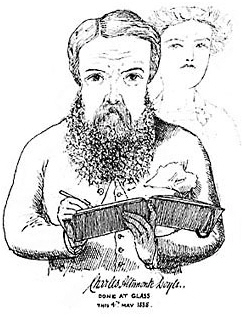
The year 1893 was a momentous one for Sir Arthur Conan Doyle. On October 10, the newly famous author’s father, Charles Altamont Doyle, died suddenly at the age of 61 from what was described as “a fit during the night” while confined at the Crichton Royal Institution in Dumfries, Scotland. An illustrator and watercolorist who had once exhibited at the Royal Scottish Academy, Charles Doyle had spent much of the previous decade at Sunnyside, the Montrose Royal Lunatic Asylum, after struggling with depression and alcoholism. In later years, his dependence on alcohol was compounded by epileptic seizures and episodes of memory loss.
This alone would have been a tragic set of circumstances. However, just two months after Charles Doyle’s death, in December of the same year, his son added to them by making the unthinkable decision to kill off his most famous creation — a character who also was no stranger to addiction, as we see in the opening paragraphs of The Sign of Four, published in 1890:
Sherlock Holmes took his bottle from the corner of the mantel-piece and his hypodermic syringe from its neat morocco case. With his long, white, nervous fingers he adjusted the delicate needle, and rolled back his left shirt-cuff. For some little time his eyes rested thoughtfully upon the sinewy forearm and wrist all dotted and scarred with innumerable puncture-marks. Finally he thrust the sharp point home, pressed down the tiny piston, and sank back into the velvet-lined arm-chair with a long sigh of satisfaction.
The Sign of Four, Chapter 1
Three times a day for many months I had witnessed this performance, but custom had not reconciled my mind to it. On the contrary, from day to day I had become more irritable at the sight, and my conscience swelled nightly within me at the thought that I had lacked the courage to protest. Again and again I had registered a vow that I should deliver my soul upon the subject, but there was that in the cool, nonchalant air of my companion which made him the last man with whom one would care to take anything approaching to a liberty. His great powers, his masterly manner, and the experience which I had had of his many extraordinary qualities, all made me diffident and backward in crossing him.
Yet upon that afternoon, whether it was the Beaune which I had taken with my lunch, or the additional exasperation produced by the extreme deliberation of his manner, I suddenly felt that I could hold out no longer.
“Which is it to-day?” I asked,—“morphine or cocaine?”
He raised his eyes languidly from the old black-letter volume which he had opened. “It is cocaine,” he said,—“a seven-per-cent. solution. Would you care to try it?”
Although Conan Doyle would eventually resurrect his great detective, the events of 1893 invite a more searching question, one that Dr. Kreizler, with his insistence that “the answers one gives to life’s crucial questions are never truly spontaneous,” would surely have asked. Of course, Conan Doyle always insisted that the hyperrational Holmes — far removed in temperament from his troubled, artistic father — was largely inspired by another important figure in his life, Dr. Joseph Bell, for whom he had clerked at the Royal Infirmary of Edinburgh; but it is noteworthy that Bell himself rejected the idea, writing to his former clerk, “You are yourself Sherlock Holmes and well you know it.”
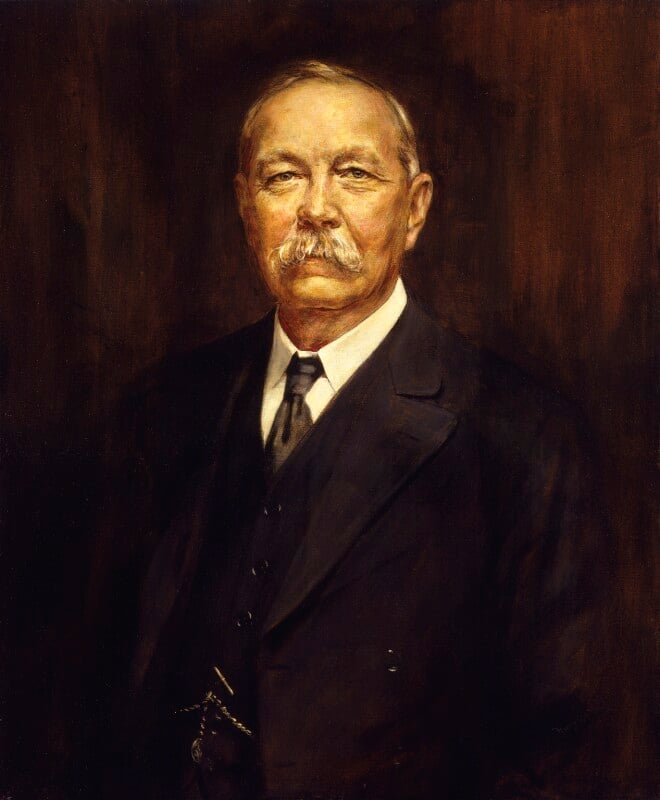
It is curious to consider what Dr. Kreizler would have made of Sir Arthur Conan Doyle. As we saw in Part One, Caleb was deeply sympathetic to the creator of Holmes, particularly in relation to the author’s struggles with grief. And perhaps it is this that would have offered the most likely opportunity to bring the author into Kreizler’s orbit, had Caleb decided to go down such a path. There were, after all, only limited opportunities for the two to have credibly crossed paths, as Conan Doyle visited New York a mere handful of times: once in 1894 — which would have required a prequel to the Alienist novels — or later, between 1922 and 1923, when he was on his speaking tour devoted to spiritualism.
I favor the latter as the more compelling opportunity for Caleb to have brought the two together. By the early 1920s, an aging Kreizler would have been facing his own reckoning with grief as Stevie’s health declined, forcing him to confront the limits of intellect and reason in the face of loss. Conan Doyle, too, arrived in New York in 1922 carrying the heavy weight of bereavement. Although he had turned to spiritualism prior to the Great War, the deaths of his son Kingsley, his brother Innes, and other close family members during this time only strengthened his commitment to his metaphysical beliefs.
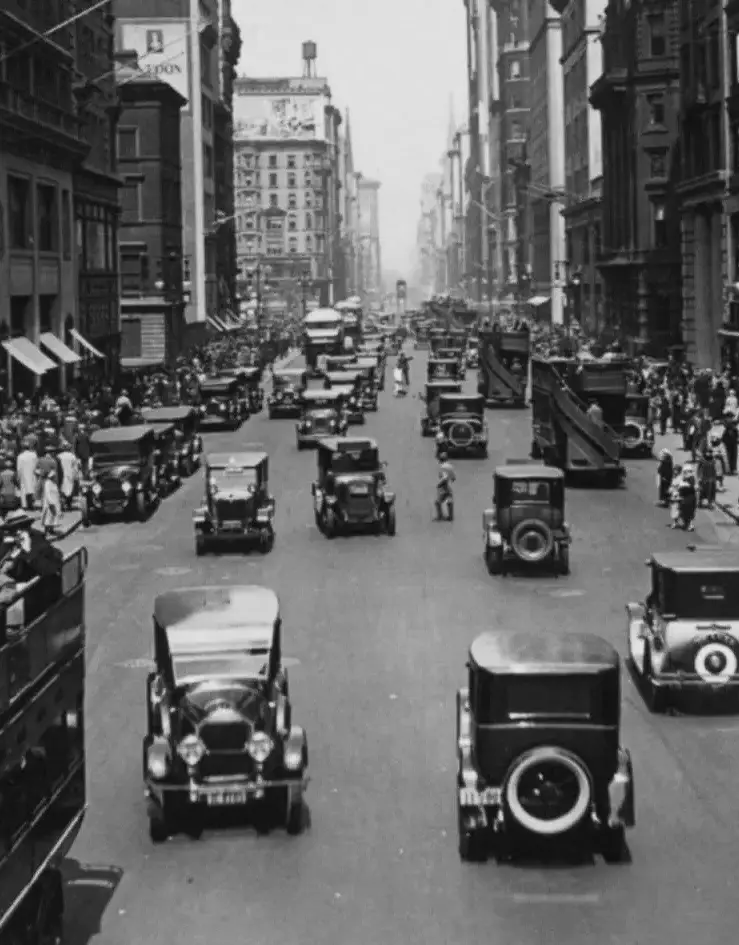
While it is, of course, Caleb alone who could have best brought these characters together, one can nonetheless imagine a scenario in which the world-famous author might have found his way to the door of 283 East Seventeenth Street with an unsettling case only Dr. Kreizler and his team could hope to address. For my own part, I think it would have been fascinating to see how these characters — now aging, reflective, and increasingly aware of mortality — might have applied their respective approaches in the altered intellectual and social landscape of New York in the 1920s. Such a meeting, had it occurred, could have proved revealing on all sides.
Alas, we must leave such imaginings where they belong: in the realm of speculation. For whatever reason, the meeting between Kreizler and Conan Doyle was never written, but the fact that it feels so tantalizingly possible speaks to the care with which Caleb shaped his fictional worlds, all of which were deeply rooted in history, psychology, and moral inquiry. As we end The Italian Secretary’s anniversary series, and 17th Street enters its third decade, it feels appropriate to simply be thankful that we have been left with such a treasure-trove of richly imagined works that they still invite analysis and reflection this many years on.
The post The Italian Secretary, 20 Years On – Part Three first appeared on Caleb Carr & The Alienist Books | 17th Street.
]]>The post The Italian Secretary, 20 Years On – Part Two first appeared on Caleb Carr & The Alienist Books | 17th Street.
]]>
With the festive season now upon us, I invite you to pause for a moment as we continue our tribute to The Italian Secretary — Caleb Carr’s contribution to the Holmes legacy — for its 20th anniversary this year. Last month, we began this series by exploring how Conan Doyle’s interest in Spiritualism, and its subtle influence on the original Holmes canon, helped to inspire the supernatural thread that runs through the novel. Yet, as we learned in Part One, there was far more to Caleb’s choice of subject matter than this alone.
In the novel’s afterword, the U.S. Representative to the Conan Doyle Estate, Jon Lellenberg, explained that The Italian Secretary had originally been commissioned to form part of a short story collection he co-edited, Ghosts in Baker Street. Caleb, a lifelong Sherlockian, had been invited to contribute; however, the deeper he delved into the real historical crime he’d selected as inspiration, the richer (and longer!) his contribution became — so much so that the decision was made to publish it as its own novel.
In today’s post, we therefore move away from the supernatural (if only briefly) to learn what it was about the 16th-century murder of David Rizzio, the titular “Italian secretary”, that captured Caleb’s imagination. It is a story that draws us back to the Edinburgh of Mary, Queen of Scots, and a tower where a ghastly deed took place…
Northward to the Scottish Border
“Furious stabbings… bombs… Holmes, what in Heaven’s name are we entering into?”
The Italian Secretary, Chapter 4
Holmes glanced up and out of the window. “Scotland, I should say…”
To understand why Caleb chose to center his Holmes tale in Scotland, we need look no further than the novel’s dedication. Beyond his beloved feline companion at the time, Caleb credited Hilary Hale, his editor in London, as the person responsible for his visit to the location that ultimately became the setting for The Italian Secretary: the Royal Palace of Holyroodhouse. He explains how this happened in the Acknowledgments section:
“I could not have known, when she dispatched me to Scotland once on a book tour, that a chance visit to the royal palace of Holyrood would one day become this story; but I do know that without the hard work, infinite patience, and support of Hilary (and of her brilliant co-workers at Little, Brown UK), that trip would probably never have taken place.”
The tour Caleb is referring to took place several years earlier, at a pivotal moment in his career. According to The Bookseller, the unexpected success of The Alienist meant that his UK publisher had decided to give its sequel, The Angel of Darkness, considerable backing when it was released in early 1998. In addition to a first print run of 25,000 copies, it also received an international book tour. Starting in Ireland before crossing to London, Caleb gave talks at the Waterstones branches in Dublin, Manchester, Leamington Spa, and Edinburgh. It was the Edinburgh leg of the tour, which took place on March 13, 1998, that would prove fateful, as it marked Caleb’s first visit to the Palace of Holyroodhouse.
The Secrets of Holyroodhouse
“I went also to see Mary Queen of Scots’ Bedchamber (a very small one it is) from whence David Rizzio was drag’d out and stab’d in the ante room where there is some of his Blood which they can’t get wash’d out.”
Elizabeth, Baroness Percy (1760)
The Palace of Holyroodhouse (also known as Holyrood Palace) dates to the early 16th century when it was constructed by James IV. Located beside the Augustinian Holyrood Abbey that was erected several centuries earlier in 1128, it is said to be named either for a vision of the cross King David I had while hunting in the area, or for a relic of the True Cross (known as the Holy Rood) that belonged to his mother, Saint Margaret. Unlike the vast ceremonial palaces more commonly associated with the British monarchy, Holyroodhouse has always been an intimate and lived-in seat of power, with its private apartments closely interwoven with its public spaces. While the public may be more familiar with Balmoral — the current royal family’s favored private Scottish estate — Holyroodhouse has long been the official royal residence in Scotland, a tradition that continues to the present day.
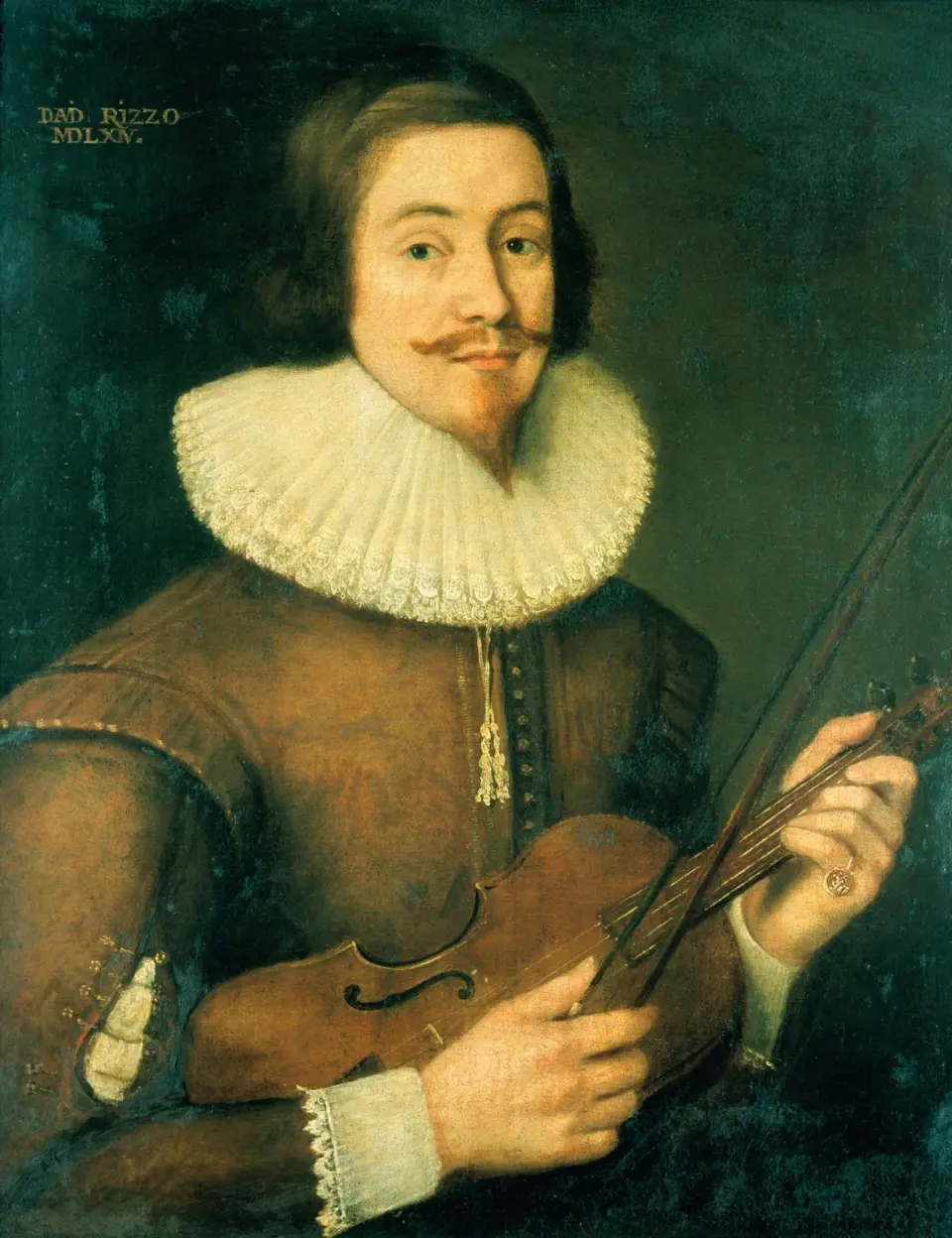
Although Caleb never publicly discussed his tour of Holyroodhouse, it seems likely he would have had an experience just as affecting as other visitors have reported for over two hundred years. According to the Royal Collection Trust, public fascination with the doomed reign of one of the palace’s most intriguing monarchs — and a central figure of The Italian Secretary — Mary, Queen of Scots, has attracted visitors since the latter half of the 18th century. From these earliest years, visitors to Mary’s former private apartments have been confronted with the gruesome sight of bloodied floorboards, the last remaining evidence of the murder of David Rizzio, her private secretary. As this murder forms the basis for The Italian Secretary, it seems plausible that this remnant from the palace’s violent past may have served as Caleb’s first direct inspiration for the story during his visit.
Given that Caleb included a vivid description of how the 1566 murder of Rizzio took place in the novel, I will avoid going into detail here in order not to ruin the book for readers who may not have familiarized themselves with the tale. However, for the sake of providing historical context and wonderful visuals of the palace itself, I strongly recommend watching the following video from the Royal Collection Trust, which opens with a brief summary of the famous assassination:
What gave the murder of David Rizzio its unusual longevity was not only its brutal nature and political significance, but the way it continued to haunt Holyroodhouse itself — quite literally. Indeed, this may be another reason Caleb decided to feature the story. Over the centuries, rumors have persisted of disturbances and apparitions at the palace tied to the murder. In addition to the bloodstained floorboards where Rizzio’s body had lain after his death (the boards have been replaced several times, with the stains said to reappear in the same location each time), a ghostly figure attributed to the secretary has been observed in the area. But Rizzio is not the only spirit tied to the killing who has been said to linger within the palace walls.
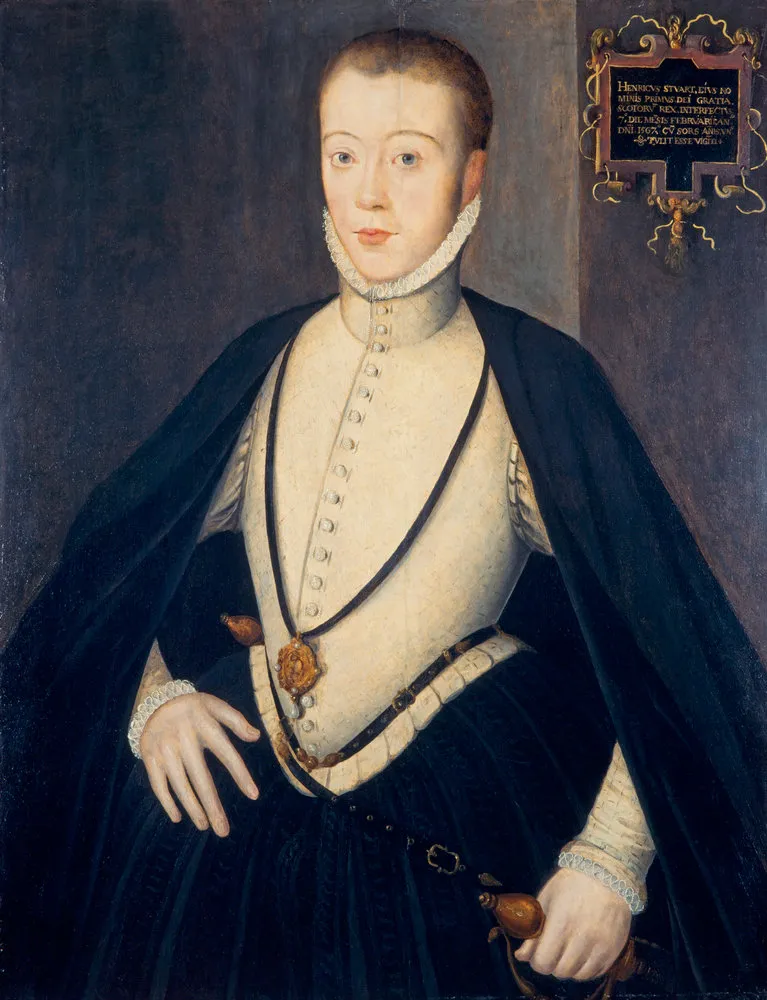
Not long after the secretary’s death, Lord Darnley — Mary’s husband and one of the instigators of Rizzio’s assassination — also met a violent end. Although initially believed to have died in a house explosion while recovering from illness, his body showed signs of strangulation. Suspicion for the murder fell on Mary and her future husband, the Earl of Bothwell, though it was ultimately several of the Earl’s servants and acquaintances who were found guilty and executed. Of relevance here, as with the secretary he helped to dispatch, Lord Darnley’s spirit is also said to haunt his former rooms at Holyroodhouse.
Whether one lends credence to such stories or not, they form part of the accumulated atmosphere of Holyroodhouse, a place where history, intrigue, and the unexplained overlap. For a writer like Caleb, it is easy to see how this charged setting might have suggested itself when he was invited to write a Holmes story with an other-worldly element. In this light, his decision to center The Italian Secretary on the murder of David Rizzio seems less an imaginative leap than a natural convergence: his interest in Conan Doyle’s metaphysical curiosity (see Part One), his book tour to Edinburgh, and his lifelong fascination with history all pointing in a single direction.
I hope you have enjoyed exploring some of the inspirations for The Italian Secretary. To conclude the year and our celebration of the novel’s anniversary, in Part Three we will give our imaginations room to roam as we consider what might have happened had Caleb followed Jon Lellenberg’s suggestion in the novel’s afterword and brought the worlds of Holmes and Kreizler together. I trust you will join me then, but in the meantime, happy reading!
The post The Italian Secretary, 20 Years On – Part Two first appeared on Caleb Carr & The Alienist Books | 17th Street.
]]>The post The Italian Secretary, 20 Years On – Part One first appeared on Caleb Carr & The Alienist Books | 17th Street.
]]>
As the year draws to a close, it brings with it two significant milestones: the 20th anniversary of The Italian Secretary, and with it, the 20th anniversary of 17th Street itself. Although I fell in love with Caleb Carr’s work several years before opening 17th Street, it was The Italian Secretary — Caleb’s homage to Sir Arthur Conan Doyle, the author who shaped his literary life — that ultimately inspired me to pay my own tribute to Caleb’s work, a tribute that has continued to grow over the past two decades. To mark this occasion, I have therefore decided to put together a short blog series to honor the book that inadvertently started it all.
In the first two parts of this series, we will explore the various facets of Caleb’s inspiration for the novel, ranging from the supernatural (Part One) to the historical (Part Two). The series will conclude in Part Three with the intriguing hypothetical raised in the novel’s afterword: What might have happened had Caleb decided to take the plunge and blend the world of The Alienist with that of Conan Doyle? The afterword framed the idea as a meeting that would delight and fascinate mystery readers (“Dr. Kreizler, Mr. Sherlock Holmes…”), but is that truly the direction Caleb would have taken?
So, if you haven’t done so already this year, I hope you’ll join me in picking up your copy of The Italian Secretary for its 20th anniversary to explore it in a way you may not have done before. Let us leave 17th Street behind then, to journey back to 221B Baker Street and the Scottish border beyond!
No Ghosts Need Apply
I attempted the most severe tone possible, given the increasingly late hour and our growing need for haste: “You might have shown more respect for her beliefs, Holmes, different though they are from your own.” At that, I hurried off to my bedroom, and began hurriedly packing some few items into a Gladstone.
The Italian Secretary, Chapter 2
Holmes’s distinctly puzzled voice drifted in: “And what makes you think they are so different, Watson?”
“All I mean to say,” I elaborated, going into a closet to fetch my rods and tackle, “is that if Mrs. Hudson entertains notions about hauntings and ghosts, why go out of your way—”
“Oh, but I entertain such notions myself, Watson.”
The notion that Caleb Carr, a lifelong Sherlockian and creator of Dr. Laszlo Kreizler, pioneer in forensic psychology, would write a Holmes tale in which the eminently rational detective entertains the possibility of a supernatural — indeed, ghostly — origin for a series of murders might, at first glance, invite surprise. It was Holmes, after all, who famously stated in The Adventure of the Sussex Vampire: “The world is big enough for us. No ghosts need apply.” The occult does not feature in the Alienist novels either. Readers might recall Dr. Kreizler’s exchange with John on the topic following the secret exhumation of Matthew Hatch in The Angel of Darkness:
“Do you think Matthew Hatch will reach out from the grave, Moore?” the Doctor needled. “To rebuke you for disturbing his eternal rest?”
The Angel of Darkness, Chapter 33
“Maybe,” Mr. Moore answered. “Something like that. You don’t seem too damned troubled along those lines, Kreizler, I must say.”
“Perhaps I have a different understanding of what we’ve just done,” the Doctor answered, his voice growing more serious. “Perhaps I believe that Matthew Hatch’s soul has not yet known peace, eternal or otherwise—and that we represent his only chance of attaining it.”
Why, then, did Caleb decide to write a tale centered on other-worldly subject matter for his contribution to the Holmes legacy? As it turns out, the idea was not his at all. In the afterword of The Italian Secretary, the U.S. representative to the Conan Doyle Estate, Jon Lellenberg, explained that he and co-editors Daniel Stashower and Martin Greenberg had decided to commission a set of short stories for a new collection, Ghosts in Baker Street, in which Holmes would be brought face-to-face with the paranormal. Lellenberg acknowledged feeling some misgiving at the decision. After all, ghosts are “non-canonical,” and he was not at all sure that Conan Doyle would approve. Nevertheless, there is no denying that the detective’s most famous adventure was about a spectral canine; and so, with The Hound of the Baskervilles providing “excuse and inspiration,” he gave permission to proceed. This, however, doesn’t explain why Caleb agreed to contribute.
That Caleb would be willing to accept a commission to write a Holmes tale at all requires no explanation. From his youth, he was an avid reader of Conan Doyle. As he explained in an interview for The Sherlock Holmes Companion in 2009: “I grew up in a very crazy household and the stories’ appeal was that process of using reason to deal with people and the extreme things they do.” His love of Holmes extended to the film adaptations as well. When asked how hard it was to write in Conan Doyle’s voice in an interview with CBS in 2005, he responded that it wasn’t difficult for him: “I could speak like Basil Rathbone being Sherlock Holmes by the time I was ten.” Yet, this still doesn’t answer the beguiling question of why he chose this particular story.
It seems fair to say that Caleb’s love of Holmes, longstanding friendship with Lellenberg, and inspiration he drew from a trip to Edinburgh several years earlier (more on this in Part Two) all played important roles in his willingness to accept the Estate’s commission. Indeed, according to the novel’s afterword, it was Caleb’s fascination with the real historical crime that sits the heart of the story which resulted in it growing to such an unwieldly length that it necessitated separate publication as its own novel, rather than forming part of the original commissioned collection. But even this doesn’t explain why he decided to accept the challenge of a Holmes story with supernatural themes.
The nearest answer one can get can be found in his interview with The Sherlock Holmes Companion. When asked what challenges he faced in writing a new Holmes story, he responded in part:
The big challenge was to make it faithful. When I was asked to do it, they said I should try to be faithful but try to add something of my own. That threw me into a bit of a loop for a while. Because I wanted it to be as faithful as possible, but I knew that they didn’t just want a carbon copy. I wasn’t originally going to do anything connected to the supernatural, even though I’ve always been fascinated by that part of Conan Doyle’s life […] There are a lot of fans who really don’t think Holmes should or would be involved in any supernatural stuff. They quote the line about ‘no ghosts need apply’ but on the other hand there are lots of stories where he concedes the possibility of other dimensions in life. And that conveniently gets forgotten. So that was another reason to bring in the supernatural element. But I knew that would be hard. It had to play a crucial role but not the crucial role. The story would have to work without it. And that was a difficult line to walk.
Thus, to understand how Conan Doyle’s interest in the supernatural may have played a role in Caleb’s decision to agree to include a supernatural element in The Italian Secretary, it is necessary to explore Conan Doyle’s involvement in Spiritualism and how this influenced his own work.
Conan Doyle and the Unseen World
Perhaps the greatest of the Sherlock Holmes mysteries is this: that when we talk of him we invariably fall into the fancy of his existence. Collins, after all, is more real to his readers than Cuff; Poe is more real than Dupin; but Sir A. Conan Doyle, the eminent spiritualist of whom we read in Sunday papers, the author of a number of exciting stories which we read years ago and have forgotten, what has he to do with Holmes?
T.S. Eliot
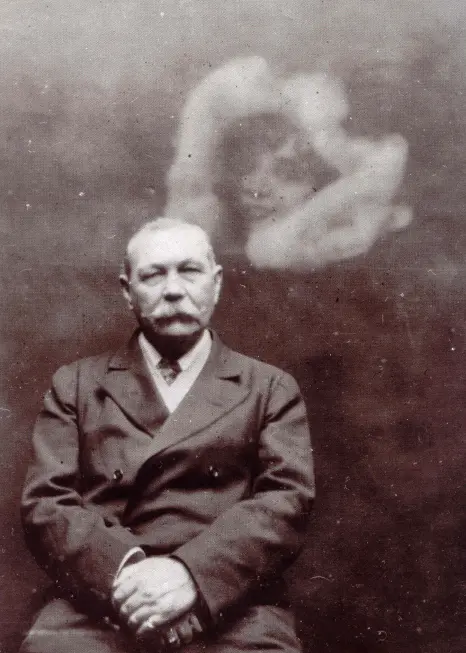
When Sir Arthur Conan Doyle and his family arrived in New York City in 1922, he was at the height of his fame. Now 62 years of age, the creator of Sherlock had published all four Holmes novels, four collections of Holmes short stories, numerous works of historical and science fiction, volumes of military history, and even collections of poetry. Yet, this trip was not a book tour. The eminent British author had made the passage across the Atlantic to embark on a three-month-long speaking tour of the United States and Canada about his new life’s passion: Spiritualism.
Founded in 1848, the Spiritualist movement emerged in upstate New York, when the Fox sisters’ rappings (said to be produced by communication with spirits) were put on display during a series of public demonstrations across the Northeast. From these humble origins, the movement expanded into private homes, churches, and public halls across America and Britain, drawing in those who were skeptical, grieving, or simply eager for the possibility that death did not sever the bonds of affection. Spiritualists believed that human personality survived bodily death, that communication between the living and the departed was not only possible but natural, and that mediums served as intermediaries capable of bridging the two worlds. By late century, séances, trance sittings, table tilting, and automatic writing were no longer fringe spectacles but part of a widespread cultural conversation about consciousness and the limits of the material world.
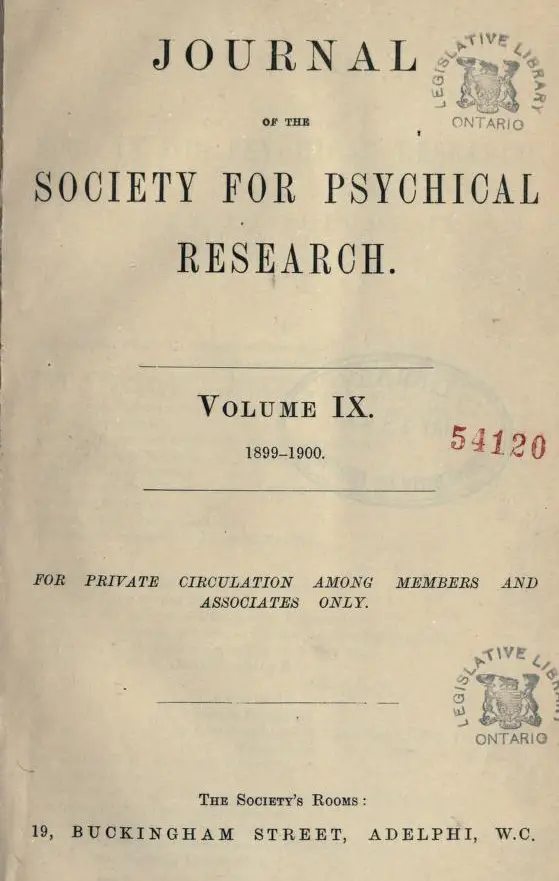
If it seems strange that Conan Doyle, whose most lauded creation reveled in the rational, had become a passionate defender of this new metaphysical movement, it is worth remembering that the public of the time were no less enthusiastic. On his 1922 tour alone, he filled Carnegie Hall six times with standing-room only crowds. The following year, he filled it three times. Despite its detractors, Spiritualism had moved into the mainstream, with many of the most enlightened minds of the age, including such luminaries as psychologist William James and physicist Sir Oliver Lodge, wishing to investigate the reported phenomena. To facilitate this, the Society for Psychical Research was established in 1882 to bring scientific scrutiny to claims of apparitions, mediumship, telepathy, and other experiences that challenged traditional explanations. It was in this environment, where the scientific and the spiritual met, that Conan Doyle’s own interest deepened and eventually transformed into the lifelong passion he would champion so publicly.
Although modern readers of Sherlock may scoff at Conan Doyle’s involvement with Spiritualism, particularly when it led to him endorsing the ‘coming of fairies’ which was later exposed as a hoax, it is noteworthy for our purposes here that Caleb did not share this cynical attitude. As noted earlier, Caleb explained in his interview for The Sherlock Holmes Companion that he was “always fascinated” by this part of Conan Doyle’s life, going on to say:
I understood why he got involved with Spiritualism and the fairy hoax. There was some kind of pathos in the story that I found very humanizing. At times you could almost lose sight of him as a human because he was so larger than life and he lived by these principles that he exhorted other people to live by. When his son died in the war it was such a crushing thing for him and he got more heavily involved with that stuff, seeing mediums to try and talk to his son.
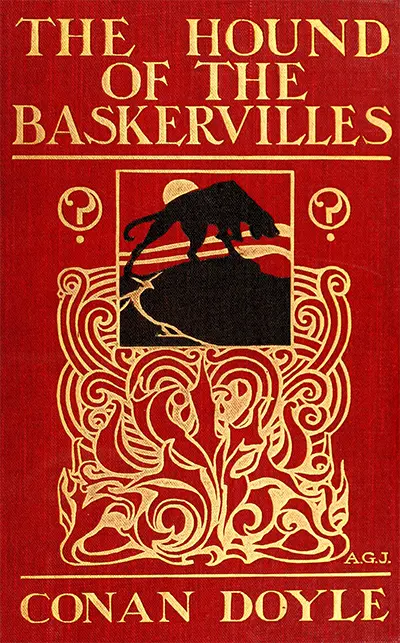
Beyond this general sympathy, Caleb was also of the view that there were Holmes stories in which the detective “concedes the possibility of other dimensions in life”. In addition to The Hound of the Baskervilles, which is the clearest example of Holmes confronting an ostensibly supernatural threat, several other stories demonstrate that Conan Doyle was open to allowing the uncanny to cast its shadow before unveiling the rational explanation behind it. The Adventure of the Sussex Vampire is the most frequently cited case, with its teasing suggestion of vampirism (even if this was the story where Holmes stated ‘no ghosts need apply’). The Adventure of the Devil’s Foot, too, places Holmes and Watson in an atmosphere that borders on the occult. In each instance, Conan Doyle ultimately reasserts reason, yet the stories themselves suggest an author comfortable letting the boundary between the natural and supernatural blur just long enough to unsettle both his characters and readers.
We can therefore see that The Italian Secretary was, in fact, exploring subject matter that was both within Conan Doyle’s own field of interest and wasn’t out of keeping with the canonical Holmes stories. However, to gain insight into why Caleb chose the specific haunting that lies at the heart of the novel, we must turn from Conan Doyle’s worldview to the real historical crime that first captured Caleb’s imagination, a story that takes us to the Royal Palace of Holyroodhouse.
I hope you’ll join me next month for Part Two as we delve into the true crime that inspired the novel, before we conclude our celebration by exploring how the worlds of Holmes and Kreizler might have come together, as suggested in The Italian Secretary’s afterword.
The post The Italian Secretary, 20 Years On – Part One first appeared on Caleb Carr & The Alienist Books | 17th Street.
]]>The post A Peek Behind the Scenes of The Alienist first appeared on Caleb Carr & The Alienist Books | 17th Street.
]]>…he devoted “seven to eight months” to “pure research” and plotting. Carr points to a wall of the room. “From the corner of this room all the way across the wall, The Alienist was plotted out on tiny strips of paper.” After an equal amount of time spent writing, he turned in the manuscript.
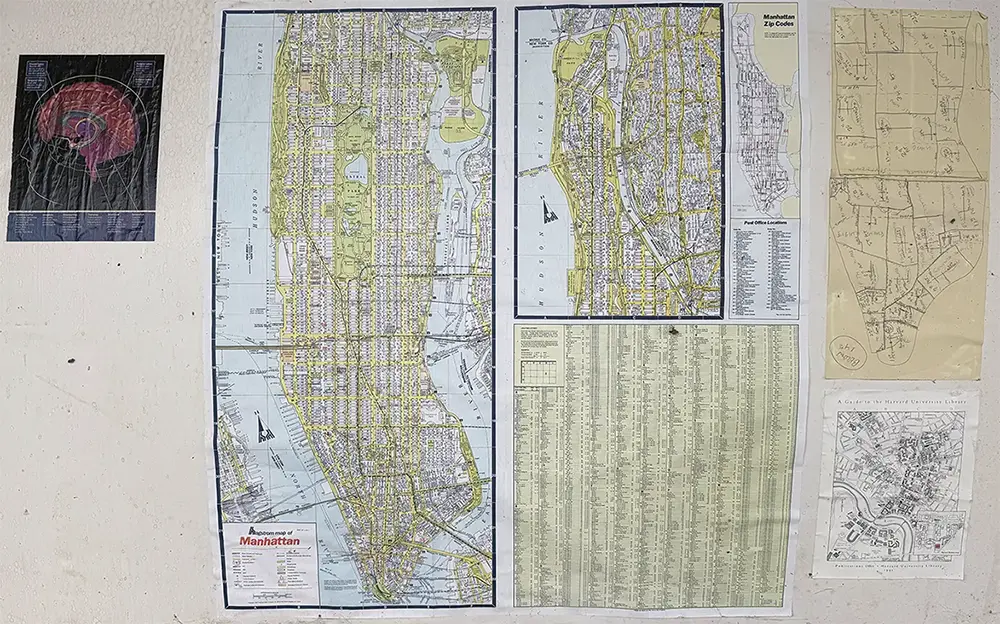
Although the tiny strips of paper have not been found (if they still exist), we can now glimpse a tangible remnant from that time. A large board was recently unearthed containing a poster of the brain, along with several maps directly tied to The Alienist. In today’s post, we will take a closer look at two of these maps—and in doing so, learn more about the real history that shaped Caleb’s vision for The Alienist.
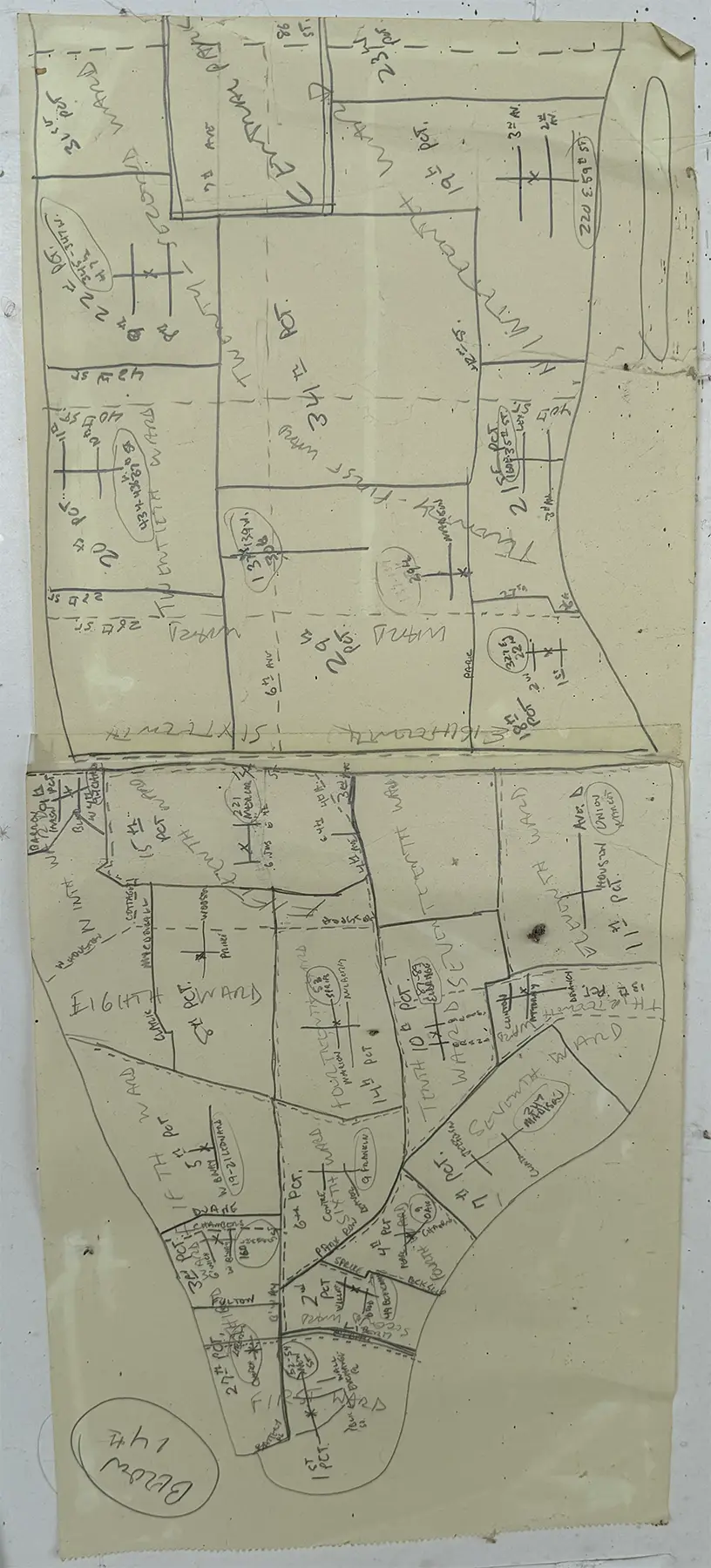
Wards and Police Precincts
Even though a street map of contemporary Manhattan occupies the largest section of the board, it is the hand-drawn map pinned beside it that offers the greatest insight into Caleb’s research process for the book. Focused on Midtown and Lower Manhattan, the dark pencil lines on this map mark the boundaries of Manhattan’s police precincts from the 1890s. Each precinct is labelled according to its number (e.g., ‘1st Pct.’), and in the middle of each is a star with street intersections corresponding to the precinct’s station house. For example, Caleb has noted that the First Precinct’s station house was located at 52-54 New Street, which is consistent with the station house’s address noted in The Manual of the Corporation of the City of New York.
Readers of The Alienist will remember that police precincts play an important role in the novel. As early as Chapter 2 when John visits the first crime scene, the fact that police from two different precincts were in attendance provided the first clue that the murders under investigation were of a concerning variety:
Near the entrance to the watchtowers atop the anchor, standing under the flimsy light of a few electric bulbs and bearing portable lanterns, were several patrolmen whose small brass insignia marked them as coming from the Thirteenth Precinct (we had passed the station house moments before on Delancey Street). With them was a sergeant from the Fifteenth, a fact that immediately struck me as odd—in two years of covering the criminal beat for the Times, not to mention a childhood in New York, I’d learned that each of the city’s police precincts guarded its terrain jealously. (Indeed, at mid-century the various police factions had openly warred with each other.) For the Thirteenth to have summoned a man from the Fifteenth indicated that something significant was going on.
But the precincts aren’t the only focus of the map. A close inspection shows lightly dashed pencil markings atop the precinct boundaries. These markings, which don’t directly match the precincts, correspond to New York’s administrative ‘wards’. From 1686 until the mid-19th century, these subdivisions were the smallest political unit in the city and played a crucial role in local elections. Ward ‘bosses’ (often saloonkeepers) wielded considerable influence, and by the 1850s, the ward system was viewed by reformers as the city’s principal source of corruption.
Even so, this wasn’t the reason Caleb was interested in ward boundaries. By the 1890s, New York’s wards had been replaced with districts for political purposes. Indeed, at this time in the city’s history, the ward system only served two vestigial functions: the administration of public schools (this was centralized in 1896) and the conduct of state and federal censuses. It is the latter of these that caused wards to play a role in The Alienist, and an important one at that.
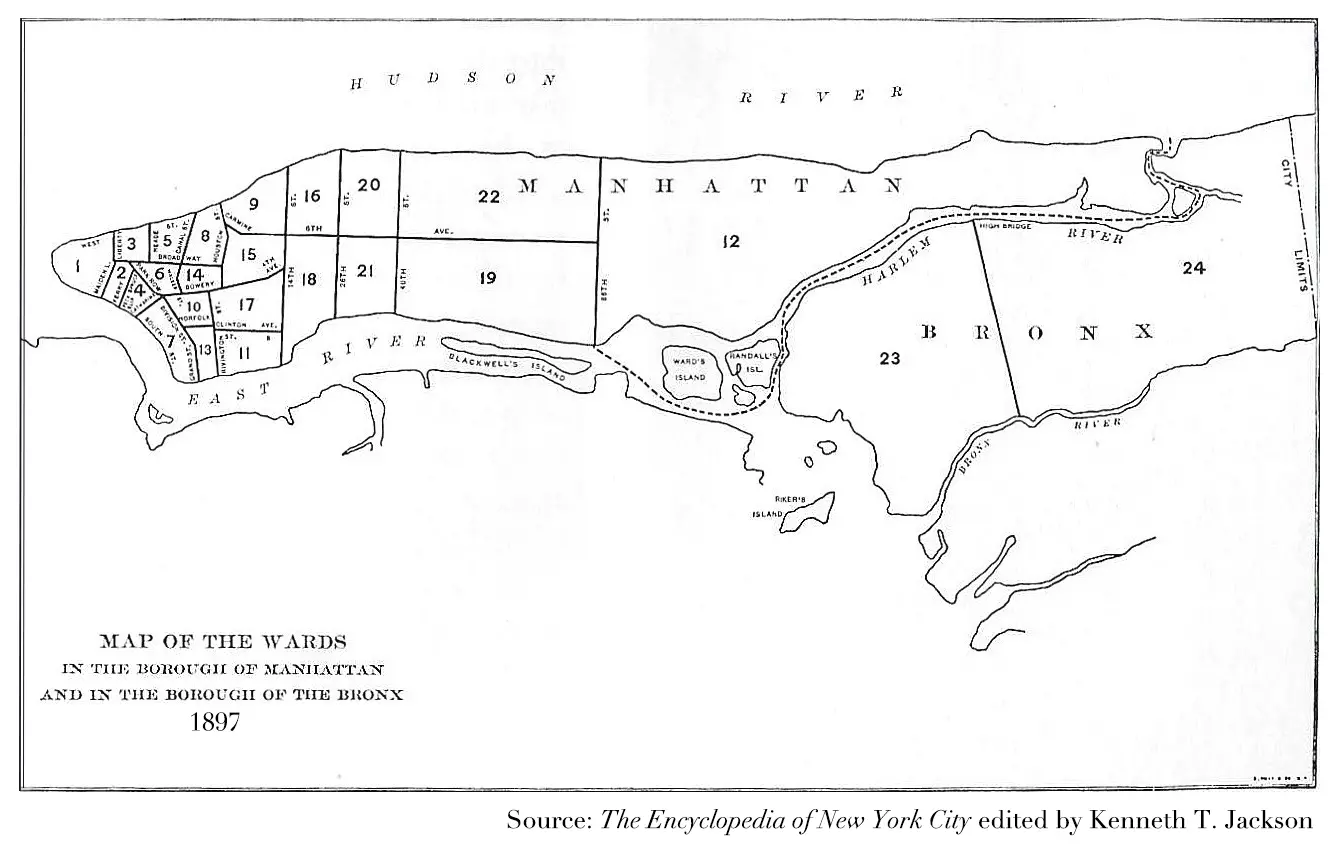
In Chapter 39, John Moore and Sara Howard pay a visit to Mr. Murray of the Census Bureau to determine whether Beecham, the murderer, may have worked as an enumerator during the 1890 census. While there, the following exchange takes place:
I tried another tack: “I trust he didn’t do anything untoward while he was working in the Thirteenth Ward?”
Murray grunted once. “If he had, I hardly would have promoted him from enumerator to office clerk and kept him on for another five years—” Murray caught himself and jerked his head up. “Just a minute. How did you know he was assigned to the Thirteenth Ward?”
I smiled. “It’s of no consequence. Thank you, Mr. Murray, and good evening.”
Further on in the chapter, John explains:
Enumerators had received their assignments according to congressional districts, which in New York had been subdivided according to wards. My question to Murray about Beecham in the Thirteenth Ward had, I told Sara, been a guess: I knew that Benjamin and Sofia Zweig had lived in that ward, and I was going on the theory that Beecham had met them while working in the area, perhaps even while interviewing their family for the census.
We can see clearly that it was John’s knowledge of the city’s wards and the role they played in the census that led to a breakthrough in the case. One hand-drawn map can therefore tell us much about the novel and Caleb’s process in writing it.
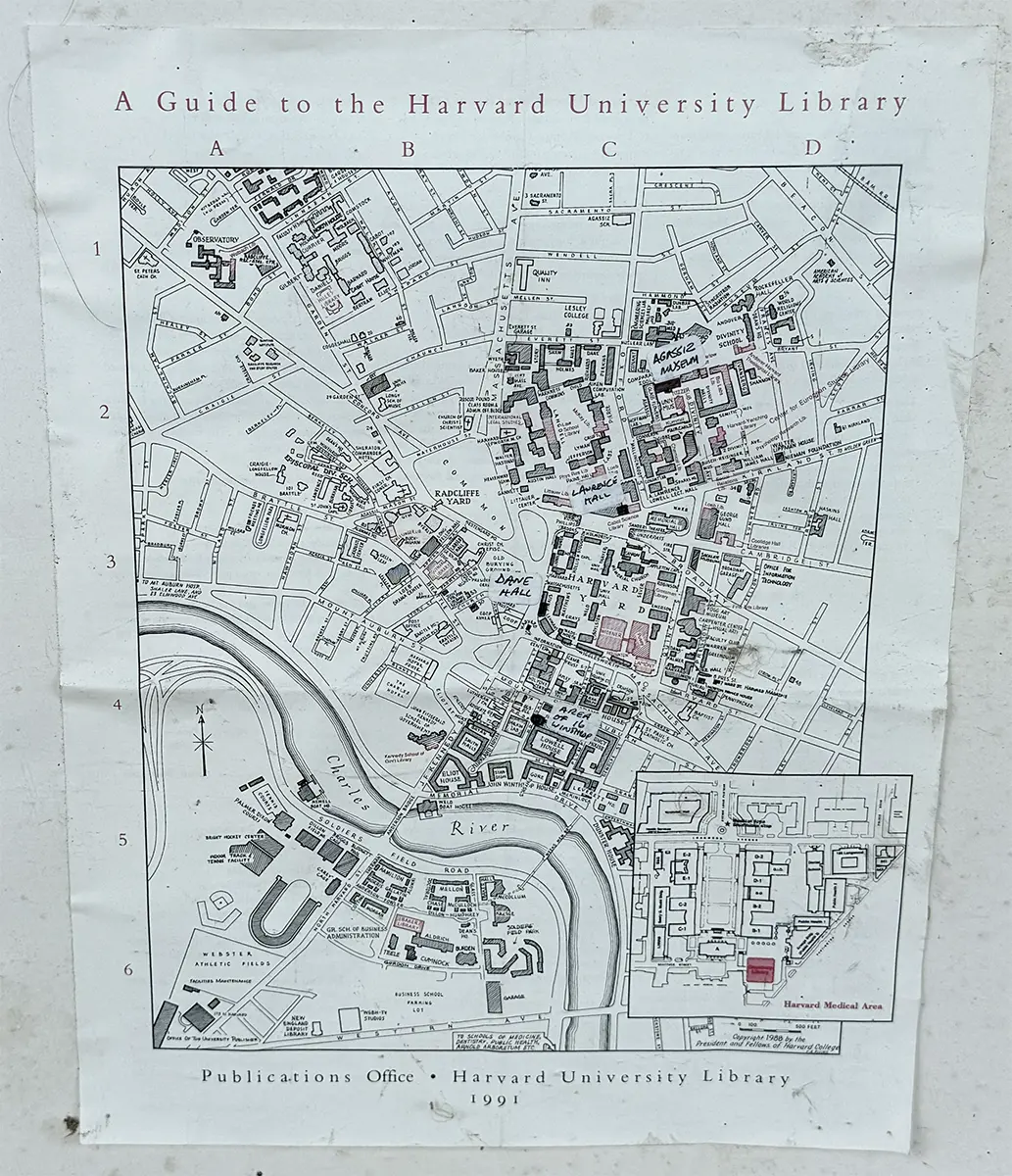
Harvard Campus Map
In addition to the precinct map, the other item of interest on the board is a hand labelled map of the Harvard campus. Like the street map next to it, the document is contemporary, but the locations Caleb marked with sticky notes provide a fascinating insight into his outlining and planning process. Of note, most of the locations are not featured in the single flashback scene in The Alienist set at Harvard, so readers may wonder at their significance. To address this, we must first turn back to Chapter 5 in the novel where we learn about the fateful clash that first brought Theodore Roosevelt, Laszlo Kreizler, and John Moore together while they were studying at Harvard in the fall of 1877.
In this scene, we learn that Moore and Roosevelt had, for differing reasons, decided to take a course in comparative anatomy taught by William James, the man who would come to be viewed as the father of modern American psychology but who, at that time, was teaching philosophy and anatomy to undergraduates. At the same time, Kreizler had also been drawn to study with James, but for a different reason. The young Dr. Kreizler had recently completed his medical degree at Columbia’s College of Physicians and Surgeons and was undertaking a new graduate course in psychology offered by James.
Although the youthful Kreizler admired his professor, the two had a fundamental disagreement over a long-standing philosophical debate that still sits at the heart of psychology today, as John explains:
James had been a maudlin, unhealthy boy, and as a young man had more than once contemplated suicide; but he overcame this tendency as a result of reading the works of the French philosopher Renouvier, who taught that a man could, by force of will, overcome all psychic (and many physical) ailments. “My first act of free will shall be to believe in free will!” had been James’s early battle cry, an attitude that continued to dominate his thinking in 1877. Such a philosophy was bound to collide with Kreizler’s developing belief in what he called “context”: the theory that every man’s actions are to a very decisive extent influenced by his early experiences, and that no man’s behavior can be analyzed or affected without knowledge of those experiences.
What started as a battle between the two in the new psychology laboratory James had established in Lawrence Hall eventually led the pair to host a public debate at University Hall, with most of the student body in attendance. Somewhat predictably, the engaging professor won the debate, but this was not the end of Kreizler’s battles that night. Dining with Moore at a tavern across the Charles River, the young Roosevelt approached and engaged Kreizler in an argument that turned personal:
Kreizler laid down the challenge for an affair of honor, and Theodore delightedly took him up, suggesting a boxing match. I knew Laszlo would have preferred fencing foils—with his bad left arm he stood little chance in a ring—but he agreed, in keeping with the code duello, which gave Theodore, as the challenged party, the choice of weapons. To Roosevelt’s credit, when the two men had stripped to their waists in the Hemenway Gymnasium (entered, at that late hour, by way of a set of keys I had won from a custodian in a poker game earlier in the year) and saw Kreizler’s arm, he offered to let him choose some weapon other than fists; but Kreizler was stubborn and proud, and though he was, for the second time in the same evening, predestined for defeat, he put up a far better fight than anyone had expected. His gameness impressed all present and, predictably, won him Roosevelt’s heartfelt admiration.
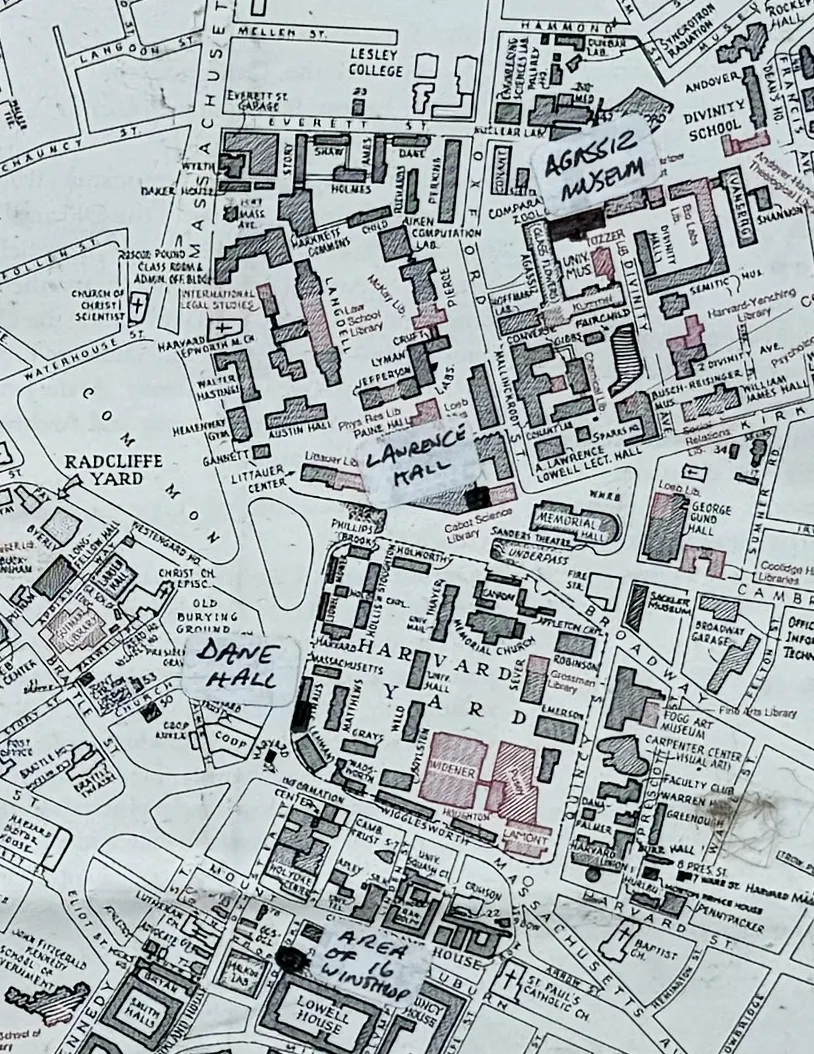
This richly painted scene established the background needed to bring the three characters back together twenty years later. Yet, if we look closely, the locations featured only included Lawrence Hall, University Hall, the Hemenway Gymnasium, and the unnamed tavern across the Charles River. Of these, only Lawrence Hall is marked on Caleb’s map. What are the other locations, then?
The answer can be found in biographies of Theodore Roosevelt. In the youthful Roosevelt’s freshman year at college, he lived in Mrs. Richardson’s boarding house at 16 Winthrop Street, one of the locations marked on the map. Similarly, the Agassiz Museum, otherwise known as the Museum of Comparative Zoology, was one the young man’s haunts in his junior and senior years. The significance of Dane Hall is a little more difficult to establish, but perhaps the solution lies in the fact that it was only a short distance from the Hemenway Gymnasium where the fateful boxing match in the novel takes place.
Although we can never know for certain, it appears as though this map was annotated before the scene at Harvard was plotted. And it seems likely from the locations marked that Caleb worked backwards from Roosevelt’s time at the college to plan the scene. Perhaps his original ideas included 16 Winthrop Street or the Agassiz Museum, or perhaps he was merely working out relative distances.
In any case, like the precinct map, it provides an intriguing insight into his process. I hope readers found this sneak peek behind the scenes of The Alienist as interesting as I did researching it. Happy Birthday, Caleb. You are missed.
The post A Peek Behind the Scenes of The Alienist first appeared on Caleb Carr & The Alienist Books | 17th Street.
]]>The post Interview from the KPFA Archives first appeared on Caleb Carr & The Alienist Books | 17th Street.
]]>In addition, the Press page has been updated to include two interviews I had not previously been aware of. One from the New York Times News Service in 1999 describes Caleb’s purchase of his Cherry Plain property, and the other from The Denver Post in 2001 focuses on his future-oriented novel, Killing Time.
I hope you enjoy these newly unearthed interviews. If you know of any others that aren’t already on the Press page, please feel free to contact me.
The post Interview from the KPFA Archives first appeared on Caleb Carr & The Alienist Books | 17th Street.
]]>The post My Beloved Monster – New Statesman Book of the Year first appeared on Caleb Carr & The Alienist Books | 17th Street.
]]>Caleb Carr’s My Beloved Monster (Allen Lane), an account of the life he shared for 17 years with a Siberian forest cat, is a profound story of mortality, grief and love. Left to die in a locked apartment, Masha was found by Carr in an animal sanctuary, where she adopted him as much as he adopted her. Abused as a child by his violent father and suffering poor health for the rest of his life, he formed a more enduring relationship with her than with any human being. While he was writing in the remote farmhouse they shared in upstate New York, she was “hunting and defending our territory” and comforting him in his illnesses. When she died of cancer Carr was desolated, and died himself, also from cancer, not long after. My Beloved Monster will be compared with JR Ackerley’s classic My Dog Tulip (1956), but to my mind Carr tells a more extraordinary tale. Unlike Ackerley’s Alsatian, Masha remained untamed, befriending an ailing human without ever giving up her wild nature.
The selection coincided with the UK release of My Beloved Monster in late October by Allen Lane. Already a New York Times bestseller from its earlier US publication in April, it has garnered lovely reviews from across the Atlantic as well.
Reviewing for The Times, Francesca Angelini called the memoir “a warm, heavy love letter to Masha and her feline predecessors,” while Kathryn Hughes, reviewing for The Guardian, described the memoir as “one of the finest meditations on animal companionship that I have ever read.” Hughes explained:
In this exquisite book novelist Caleb Carr tells the story of the “shared existence” he enjoyed for 17 years with his beloved cat, Masha. At the time of writing she is gone, he is going, and all that remains is to explain how they made each other’s difficult lives bearable. The result is not just a lyrical double biography of man and cat but a wider philosophical inquiry into our moral failures towards a species which, cute internet memes notwithstanding, continues to get a raw deal.
For those who may have missed them, you can find Caleb Carr’s interviews about My Beloved Monster given late last year here.
And if you have not yet met the remarkable Masha, like the reviewers above I recommend giving Caleb’s final, heartfelt memoir a try. Whether you are a cat aficionado or not, My Beloved Monster is a moving tribute to both Masha and her human companion of 17 years, and provides a glimpse the kind of deeply loving relationship possible between feline and human, if only more humans would give them a chance to come that close.
The post My Beloved Monster – New Statesman Book of the Year first appeared on Caleb Carr & The Alienist Books | 17th Street.
]]>The post Celebrating 30 Years of The Alienist – Part Five first appeared on Caleb Carr & The Alienist Books | 17th Street.
]]>With the year nearing its end, the time has come for the last post in our celebration of the 30th anniversary of The Alienist’s publication. To honor the novel and its author, we have so far discussed its origins and first/special editions (Parts One and Two), explored early attempts to adapt it to the screen (Part Three), and summarized the publication history of its sequel, The Angel of Darkness (Part Four). In order to complete our homage today, we now turn our attention to the novel’s many translations and consider its enduring legacy.
Translations
Perhaps one of the best markers of a novel’s success is how widely translated it has been, and The Alienist is no exception. Although our celebration so far has primarily focused on the novel’s reception in the United States, this is only the tip of the iceberg when it comes to its status as a bestseller. As described in Part Two, The Alienist was a worldwide phenomenon upon its release. Since that time, millions of copies have been sold, and it has been translated into over two dozen languages.
While it is beyond the scope of this blog series to provide details about each and every translation, a very small subset of covers for translated editions can be viewed below. These include editions in German, French, Italian, Spanish, Czech, and Russian.
Continuation of the series
Over the past 20 years, perhaps the most frequently asked question I’ve received as the owner of 17th Street relates to whether the series will ever be continued. Although the idea of a third novel was floated on and off in interviews with Caleb Carr following The Angel of Darkness’ publication (see Part Four), it wasn’t until 2016 that the long-awaited announcement was made: Mulholland Books would be publishing two new Alienist novels intended to ‘bookend’ the series. More exciting still, the books would shed light on the two most enigmatic characters in the series: Miss Sara Howard and Dr. Kreizler himself.
The first novel, titled The Alienist at Armageddon, would focus on Kreizler. Set 18 years after The Angel of Darkness and drawing on Caleb’s expertise as a military historian, the Vice President of Mulholland Books explained that the novel would be “set against a stage of rising nationalist violence and the early spy state,” and was “centered on nativist violence and terrorism during America’s involvement in World War I.” The blurb, which can still be found on the defunct Amazon page (it was never published), describes the story in the following way:
The Alienist at Armageddon begins in the winter of 1915, soon after the start of the First World War. Reuniting the original’s beloved characters, the story is told from the perspective of Dr. Laszlo Kreizler–the famous psychologist, or “alienist,” and his friend and comrade, John Moore, crime reporter for the New York Times. A massive explosive detonates mere feet from Kreizler’s home, marking the fourth in New York City in as many months.
With his friends at his heels, Kreizler takes up his own case, and the cases of the other explosions. Amid the turmoil in New York City, they receive a news report: the RMS Luisitania, a British passenger ship bound for Liverpool from New York with Americans on board, has sunk mysteriously just eleven miles off the Irish coast. With international tensions high at the onset of the Great War, and many in Europe clamoring for American intervention, Kreizler’s case threatens to embroil not only his own life, but the lives of his countrymen, in the greatest and most deadly conflict modern civilization had ever seen.
Not as much is known about the second novel, which was set to act as a prequel. This work, titled The Strange Case of Miss Sara X, was described in the announcement as a story in which “a youthful Kreizler, after finishing his psychology training at Harvard, falls under the spell of William James, has his first run-in with Roosevelt, and delves into the secret life of Sara Howard, heroine of the first books.” Presumably, it was intended to finally reveal the mystery at the heart of Sara’s story: what really happened to her father.
Unfortunately, five years after the series continuation was announced, Caleb revealed to 17th Street that the first novel had suffered a significant delay due to a necessary change in its concept and plot. More importantly, he was waging a formidable health battle that had further slowed its progress. The wider circumstances around this extremely difficult period can be learned in My Beloved Monster, the memoir Caleb ultimately devoted his final years to completing — a beautiful tribute that memorialized the loving relationship he shared with his feline companion, Masha.
Surrender, New York
Even though fans of The Alienist did not, in the end, get the direct series continuation they may have been hoping for, the books were not left completely unresolved. In 2016, Caleb published what would turn out to be his last work of fiction, Surrender, New York, in which a modern criminal psychologist was drawn into a puzzling case involving the deaths of local children abandoned by their parents. Despite being set in the present day, the novel shared several key thematic elements with the original series and directly referenced the trailblazing theories of Dr. Kreizler.
“The idea that came to me was what if you had a man who used some modern tools, but applied Kreizler’s principles to a modern case?” Caleb said in an interview with Literary Hub in 2016. Beyond the references to Kreizler’s theories woven throughout the story, the novel required the same rigorous research as the original works. “I was going through these New York State documents, and I kept finding references to ‘throwaway children,'” he explained. “It turns out it is a widespread problem. That is the pitfall of research. It takes you places you didn’t plan to go. It stopped being a simple book.”
In addition to the victims in the novel being youths from vulnerable sections of society (like those in the Alienist books), Surrender also explored themes that ran through the earlier works such as corruption, what happens when investigators get too emotionally involved in a case, and the contrast between crime in rural and urban regions of New York. Even the book jacket design shared similarities with the hardcover editions of the original series, from its color palette to the title design elements.
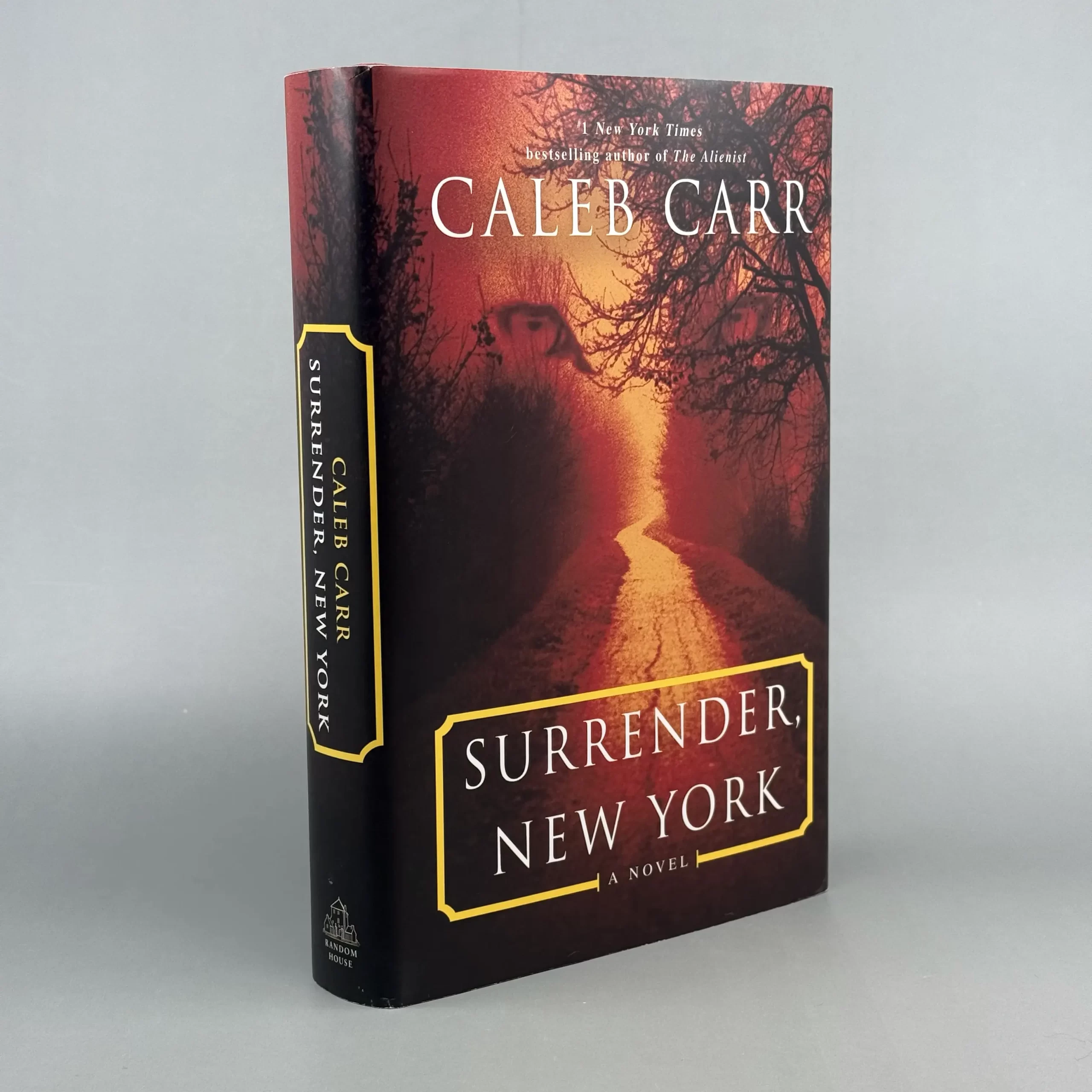
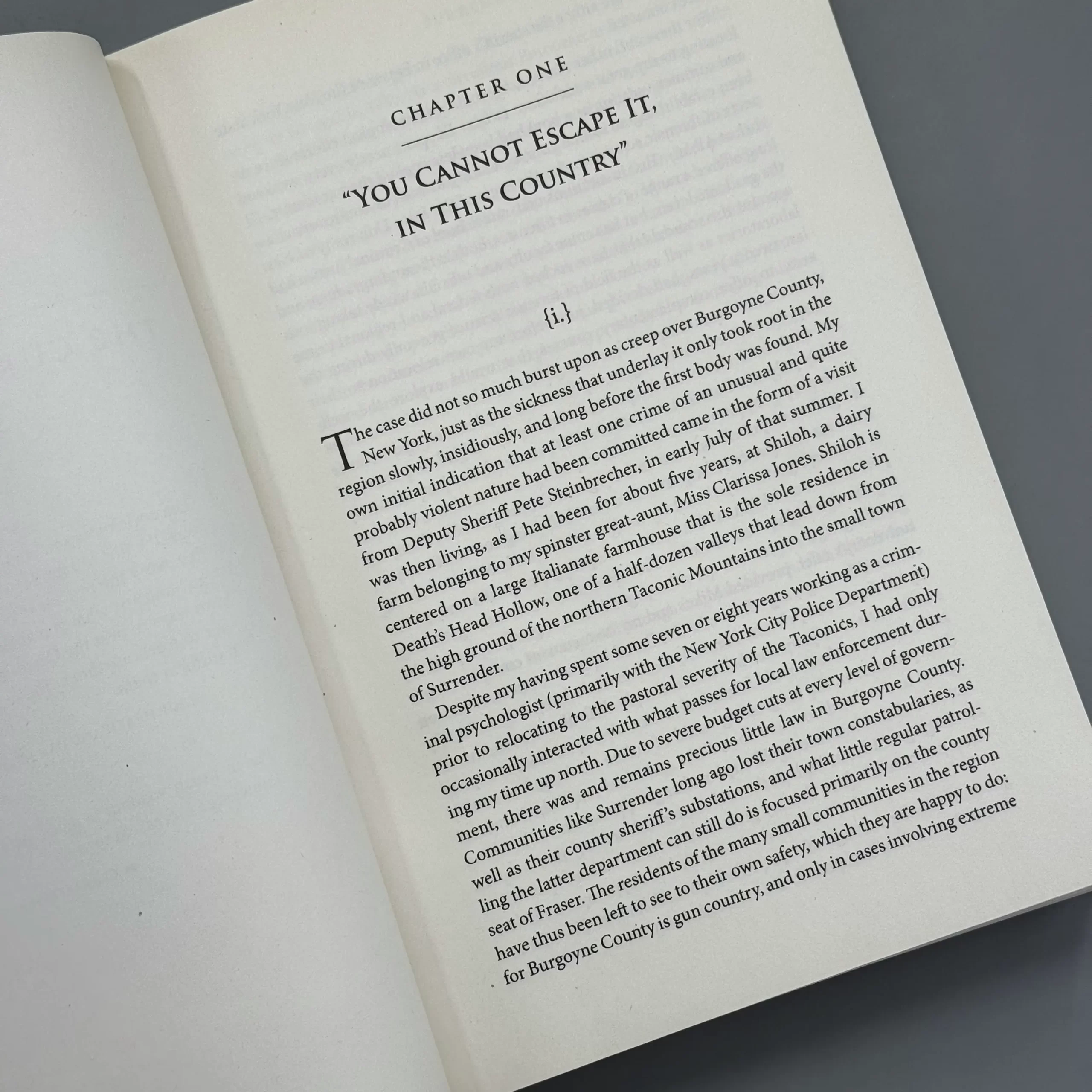
While I wouldn’t recommend that readers approach Surrender, New York expecting the same atmosphere as the original novels given its contemporary setting, fans can still enjoy digging into a world in which Dr. Kreizler’s legacy has been kept alive for more than 100 years by an equally interesting and complex team of investigators. In more ways than one, Surrender, New York can be thought of as a fitting capstone for a series that made a mark on the historical thriller genre that even its author never anticipated.
I hope you have enjoyed this exploration of The Alienist’s publication history. Even though this post concludes the 30th anniversary celebration, the journey doesn’t end here!
17th Street will be continuing to add and update content over the coming years, exploring different aspects of Caleb Carr’s work (not just the Alienist books) to keep his legacy alive. If you would like to receive periodic updates, I encourage you to sign up for the newsletter. You are also welcome to get in contact to suggest topics for discussion or examination here on the blog.
The post Celebrating 30 Years of The Alienist – Part Five first appeared on Caleb Carr & The Alienist Books | 17th Street.
]]>The post Celebrating 30 Years of The Alienist – Part Four first appeared on Caleb Carr & The Alienist Books | 17th Street.
]]>We have now reached the penultimate post in our celebration of the 30th anniversary of The Alienist’s publication. In the series so far, we have discussed the novel’s origins (Part One), its release and first/special editions (Part Two), and the early attempts to adapt the novel to the screen, including glimpsing a rare leather-bound copy of Steven Katz’s script (Part Three). In today’s post, we will examine how the success of The Alienist led to the publication of a sequel before exploring the various uncorrected proofs (including a very rare proof), an advanced reader copy, first editions, and one example of a paperback that have been released for the novel over the years.
A sequel is called for
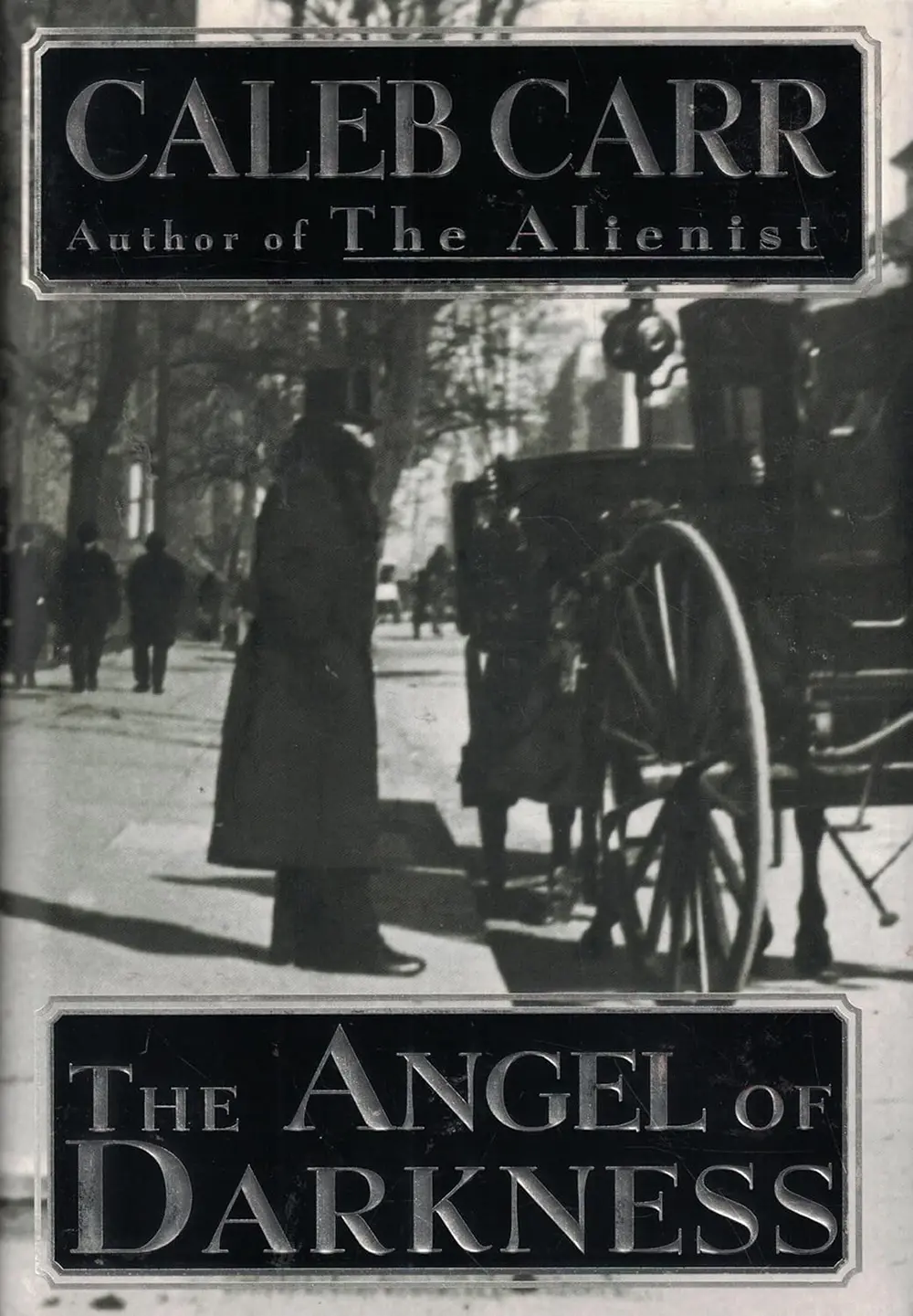
It should come as no surprise that the phenomenal success of The Alienist led to a book deal for a second. Partially inspired by Wilkie Collins who often had multiple characters narrating a single mystery, Caleb Carr revealed in interviews that he had similar plans for alternating narrators in the Alienist novels. Speaking to Crime Time in 1997, he explained that the original idea was for “the narration of each book [to] shift from person to person to person, with each narrator telling the story that was most significant for them. I chose Moore in the first book, as he was the most accessible of the group. He was modern in some ways, and I felt that people would have the least trouble with him.”
For the sequel, Caleb decided to shift to a narrator who was, in some respects, easier to write. He told The Seattle Times in 1997 that “Stevie is a little closer to me personally, in terms of growing up in a lot of different worlds, a lot of different levels of society, in New York.” In response to the Crime Time interviewer suggesting that this shift in narrator involved “cheating,” as Stevie was less educated than Moore, Caleb argued, “I didn’t have Moore’s attitudes myself, so you could say that I had to cheat with him as well. This is really to do with language: the way Stevie views the city is not slumming. He’s been there, he has lived in the lower depths, unlike Moore. To a degree, this reflects my background: I lived in an area where it was a question of slumming for the rich kids when they came to buy drugs and act disgracefully, before going back to their well-upholstered homes.”
In an interview with NewCity in 1997, Caleb revealed that he spent eighteen months “creating the world” for the novel that would become the sequel; and, according to Times Union, he would “disappear into 12-hour writing binges” while cloistered “in a fifth-floor walk-up apartment on the Lower East Side (in a family-owned brownstone).” The end result would be The Angel of Darkness, a 629-page novel that focused on a female serial killer driven to violence by society’s insistence that motherhood was the only “way for her to be a full, complete woman.” Speaking to Salon about why people find maternal violence particularly difficult to grasp, he said: “You want to believe that there’s one relationship in life that’s beyond betrayal—a relationship that’s beyond that kind of hurt—and there isn’t.”
The proofs are distributed
It is unclear when the manuscript that would become The Angel of Darkness was finally turned in to Random House, but a kind visitor to 17th Street, Steve Rogers, recently obtained what is likely to be one of the earliest extant copies: an extremely rare, non-copy-edited manuscript, signed by Caleb Carr, that was sent to a magazine reviewer in early July of 1997 to meet the lead time for their October issue. The manuscript came presented in a red two-piece tray case, and included a protective cover, a letter addressed to the reviewer by Pamela K. Cannon (a senior publicist at Random House), and an information page about the book. This is a truly special find.


A few weeks later, the novel’s standard uncorrected proofs were distributed to reviewers, critics, and industry professionals. As you can see in Part One, the proof for The Angel of Darkness had the same standard blue and white Random House paperback binding as The Alienist. The copy shown below also came with a letter and information page about the novel that would have accompanied each proof when they were sent out.


The Angel of Darkness is released
Several months after the uncorrected proofs and advance reader copies were distributed, the highly anticipated sequel was released in September of 1997. Like its predecessor, The Angel of Darkness had its true first edition published by the Franklin Library as part of their Signed First Edition series. As explained in Part Two, these beautiful editions were printed on acid-free paper with gilt edging, were fully leather-bound with 22 karat gold ornamentation, and included a custom illustration. Each edition was limited to 1,500 copies worldwide.
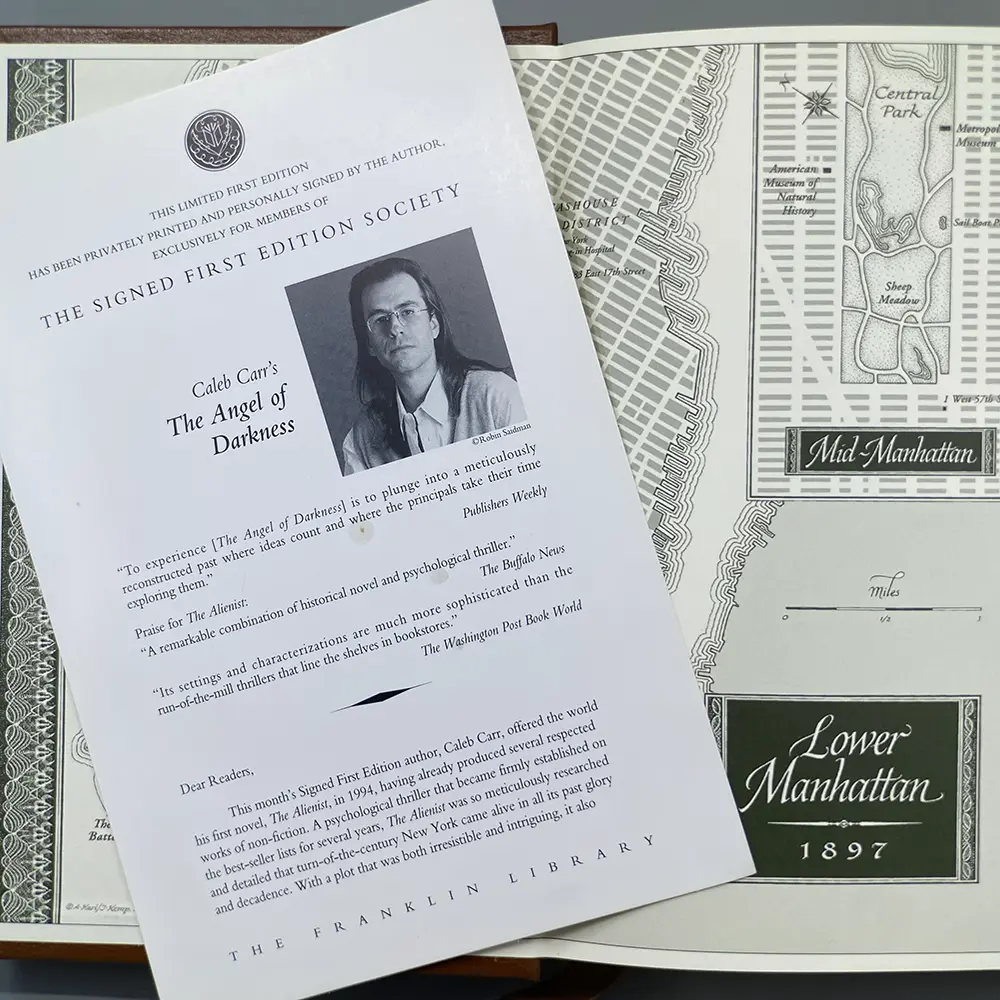
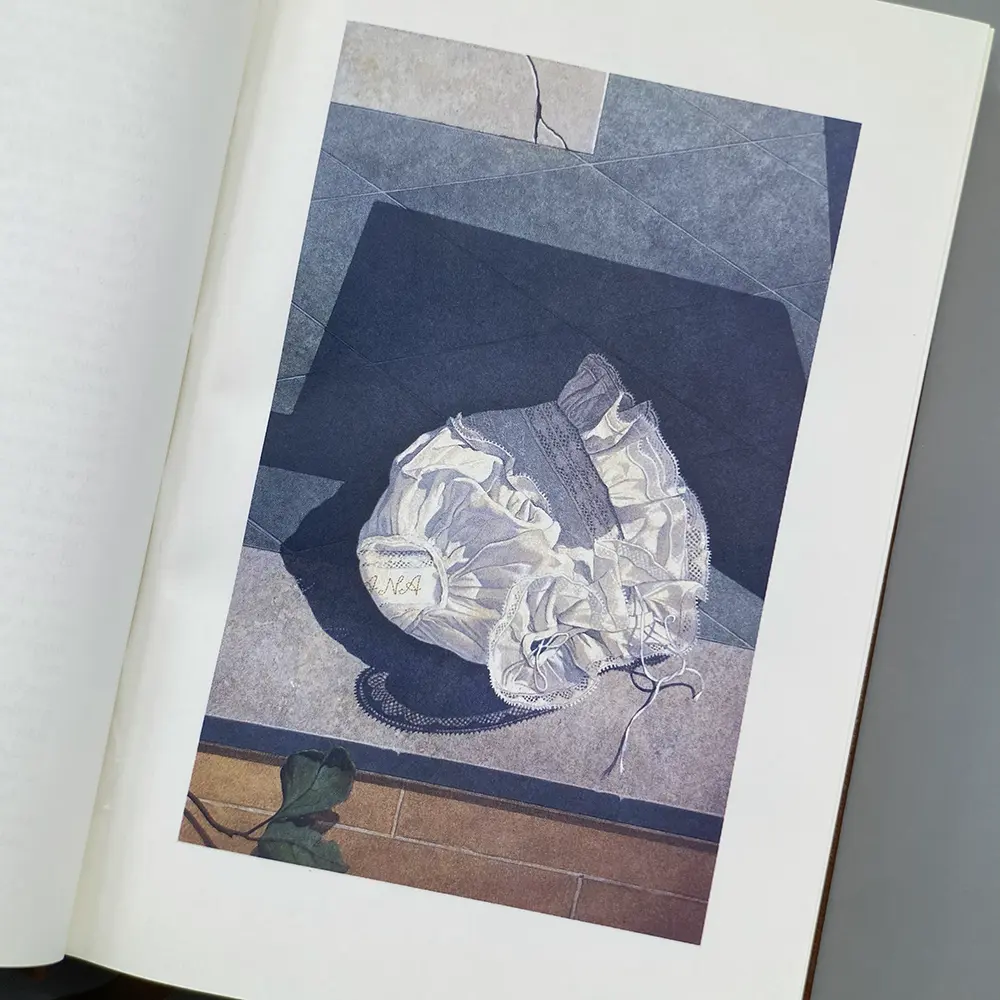
But again, as with The Alienist, it was the Random House first edition that most readers would be familiar with. I have tried to identify the photographer of the black and white photo that was used to illustrate the cover, but as it was not credited anywhere in the book, I was unable to find the source. However, in a blog post from 2008, Ephemeral New York dated the photograph to 1898 and identified it as having been taken on Fifth Avenue and Eighth Street. And for collectors, the first printing of the first edition can be identified by the printer’s key “2 4 6 8 9 7 5 3” and “First Trade Edition” on the copyright page.
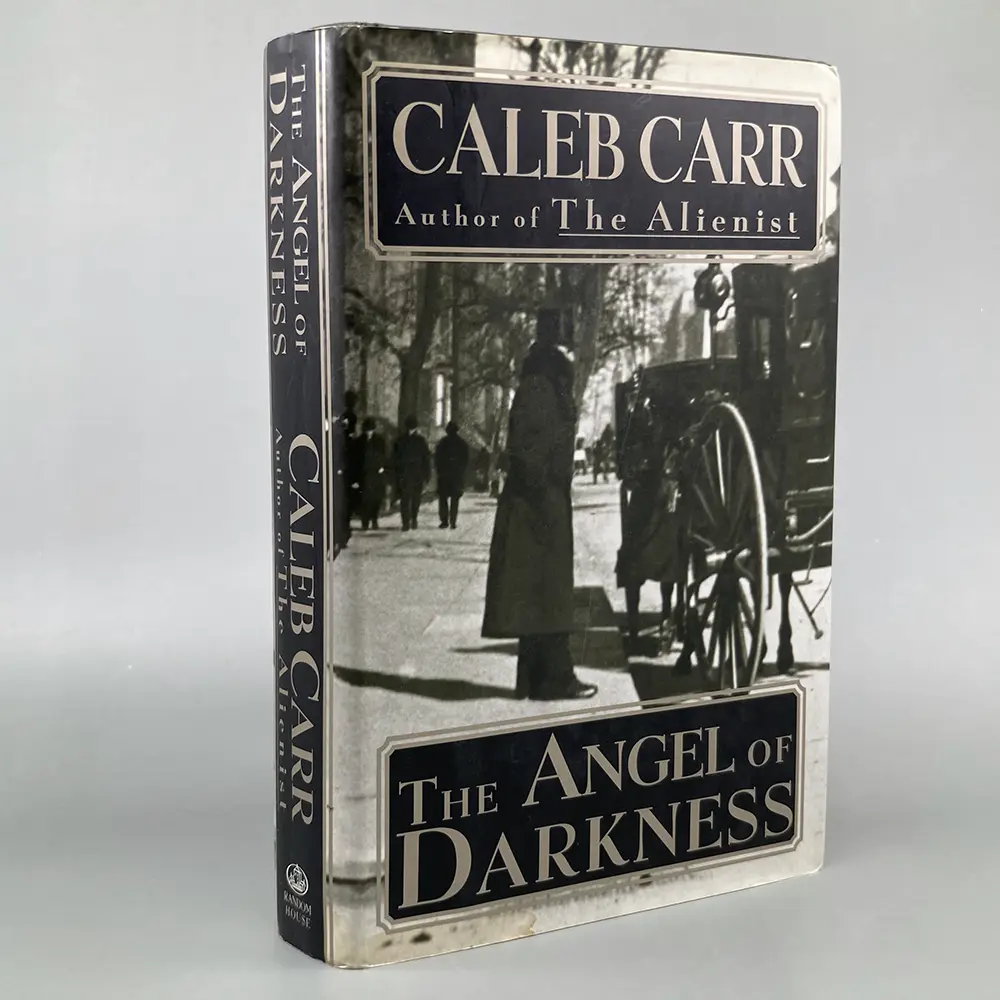
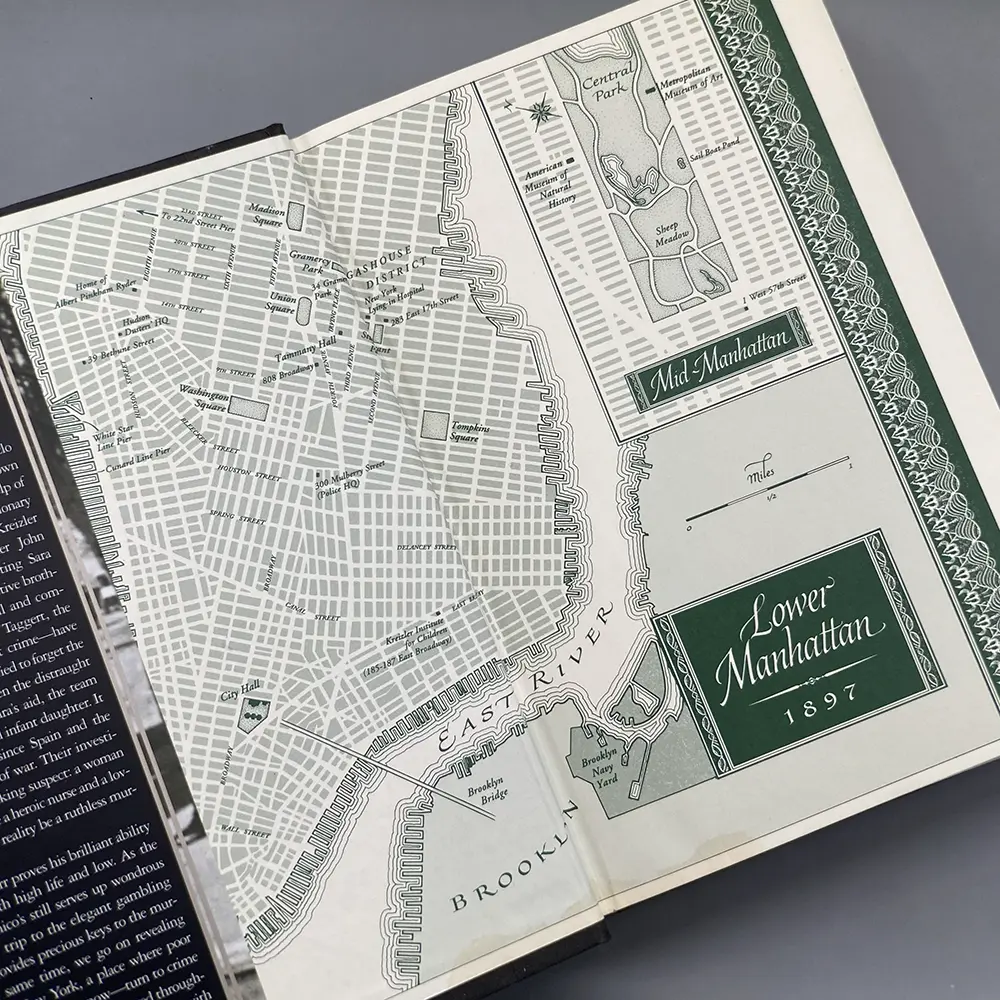

A wonderful feature of both editions is the map that illustrates the endpapers, created for the book by Anita Karl and Jim Kemp. The map plots all the key locations in the novel — at least, those that take place in the New York City portions of the story — and add an extra layer of interest and authenticity to the read (but which, unfortunately, were not included in all of the later paperback editions of the novel).
Reception and other editions
Unsurprisingly, The Angel of Darkness was an instant bestseller. The public’s love of The Alienist led the sequel to debut at number 3 on the Publishers Weekly and Wall Street Journal hardcover bestseller lists, and number 4 on The New York Times bestseller list. Although some of the critical reception of the novel was mixed, with a few reviewers preferring the faster pacing and narration of the original, overall it was extremely well-received and went on to spend 11 months on the hardback and paperback bestseller lists. When it was released, the reviewer for The New York Times wrote:
“Sequels usually don’t work, but in The Angel of Darkness, Caleb Carr has written at least as winning a historical thriller as his best seller The Alienist. Once again, he has created a turn-of-the-century New York City that feels as authentic as a fading tintype… Best of all, the theme of The Angel of Darkness is both historically accurate and contemporary, concerning as it does the social pressure on women to be mothers and what happens to their psyches when they lack the instinct to nurture.”
On a personal note, The Angel of Darkness happens to be my favorite of the two novels (though I obviously love The Alienist as well), and the most prized edition of any of Caleb’s work that I possess is a custom-bound leather copy with gilt edging, marbled endpapers, and a slip-case that was given to me as a gift many years ago. I debated sharing these photos as they are not of an official or publicly available copy, but given that celebration is the theme of these blogs, I decided to include them anyway.
As you might be able to tell, this custom-bound copy was created from the novel’s UK first edition published by Little, Brown and Company. Interestingly, unlike The Alienist which had different UK and US covers, the original UK first edition of the novel had the same cover design as Random House. The primary differences between the two editions is the color of the cover’s photograph (the UK edition has a pale green hue) and minor changes to the title and author text placement.


In addition to the UK and other international editions, the sequel’s success led to numerous paperback editions over the years as well. Unlike The Alienist, the novel never received any special anniversary editions, but most paperbacks have continued to use the original cover photograph in varying designs. The following is an example trade paperback released by Random House in 2018 to coincide with the TV series release.
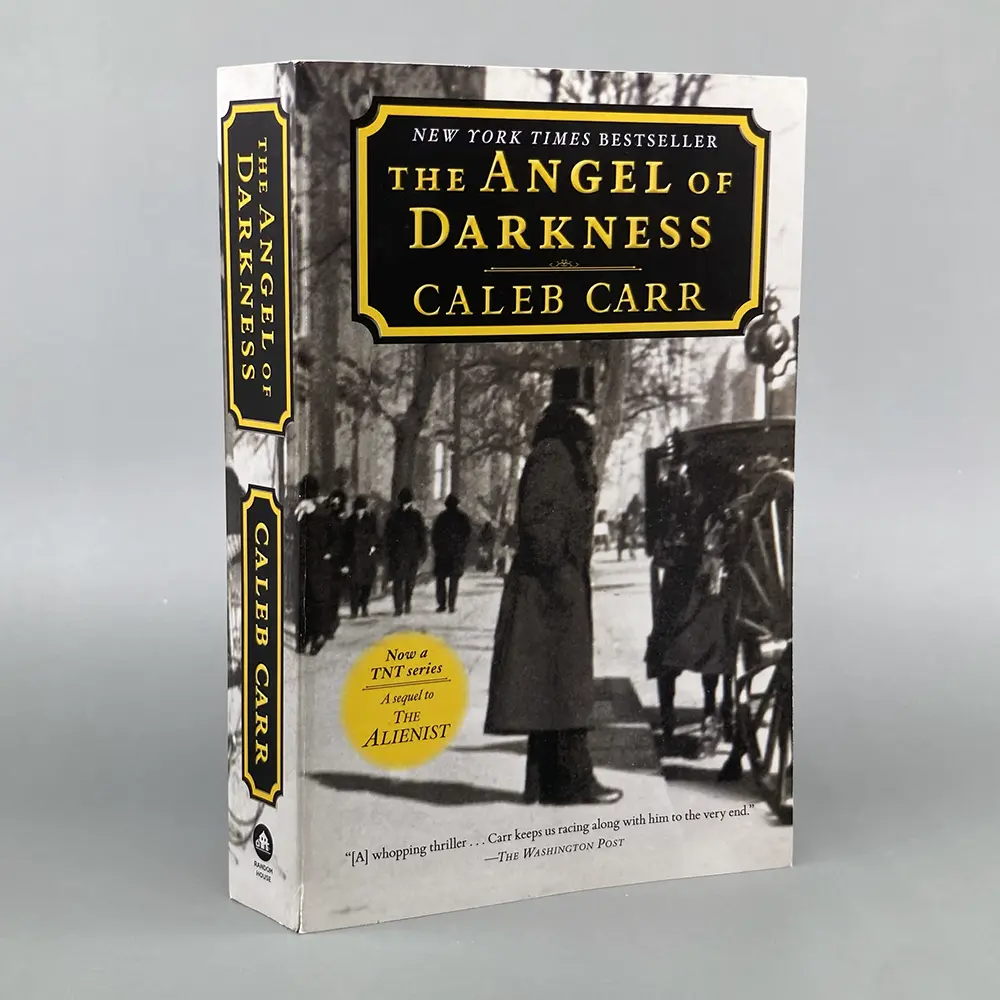
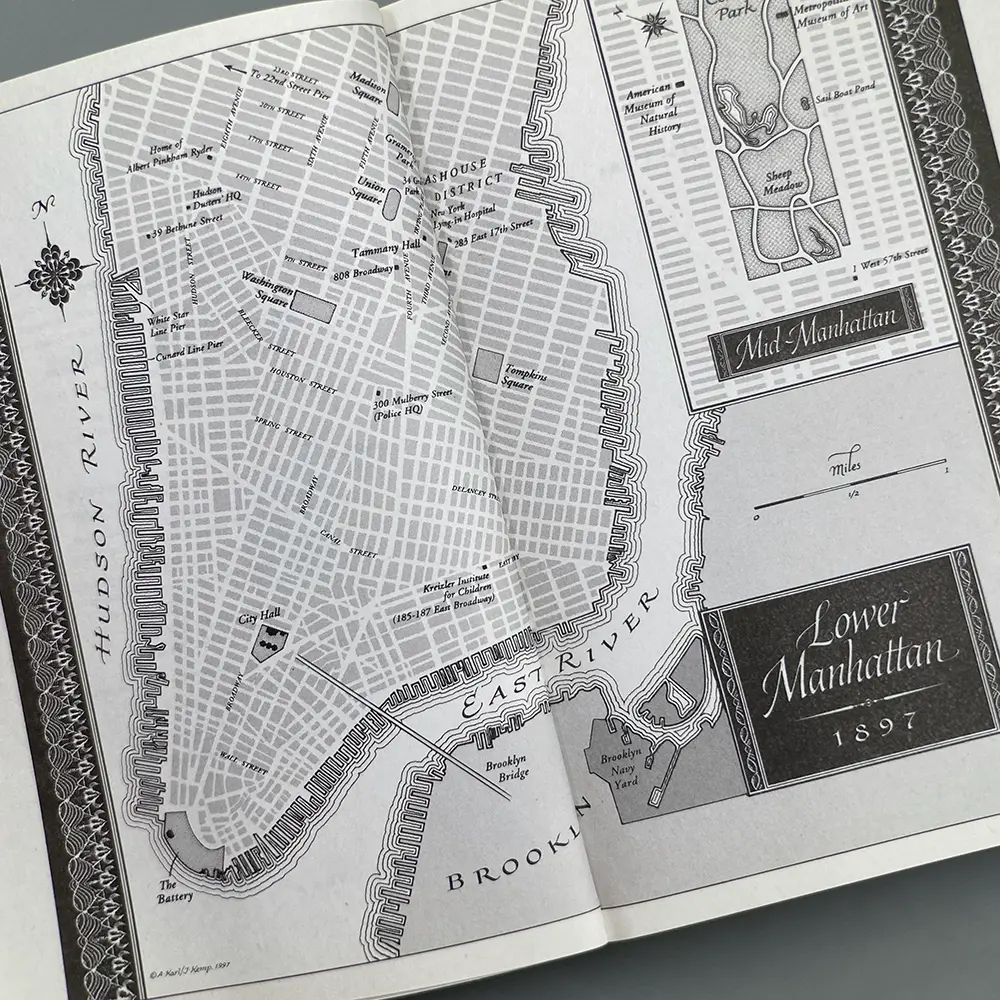
And that is all for our exploration of the publication history for The Angel of Darkness. In the final post of the 30th anniversary series, we will examine some of the international editions for both The Alienist and The Angel of Darkness, and discuss the enduring legacy of the books. You can continue reading here.
The post Celebrating 30 Years of The Alienist – Part Four first appeared on Caleb Carr & The Alienist Books | 17th Street.
]]>