The post GBEN6003 : Contemporary Issues in Entrepreneurship Assignment appeared first on .
]]>
GBEN6003 Entrepreneurship Assignment Guide 2026 – A visual overview of the module, assessment requirements, entrepreneurship themes, essay structure, and academic support from AssignmentBee.
GBEN6003 – Contemporary Issues in Entrepreneurship module is assessed through a critical essay. Your task is to develop a clear analytical argument supported by academic and industry sources, focusing on one of the following contemporary entrepreneurial themes:
- Access to finance and legitimacy
- Digital entrepreneurship and platform innovation
- Sustainable entrepreneurship and green ventures
- Migrant and community entrepreneurship
After selecting the theme, you should define a clear analytical focus within that area. For example, you might choose to analyse a particular industry (e.g. technology or creative industries), a specific entrepreneurial activity (e.g. digital start-ups or sustainability-driven ventures), a distinct group of entrepreneurs (e.g. migrant or women entrepreneurs), or market context (e.g. the UK market or platform-based economies). These examples illustrate possible analytical focuses, but you are not restricted to them.
Component details
Your essay should be 3,000 words and, to meet the standard required, it must move beyond purely descriptive writing to demonstrate critical analysis, theoretical application, and evidence-based evaluation. Your submission should fulfil the following core requirements:
- Theoretical Application: Justify and apply a relevant theory to analyse your chosen issue within your defined analytical focus. Compare and contrast the theory chosen with alternative theoretical explanations to show differing assumptions and limitations.
- Evidence-based Analysis: Analyse the causes, effects, and wider economic, technological, or societal developments shaping the issue using a range of academic and industry sources.
- Evaluation and Response: Critically evaluate how effectively your chosen theory explains the real-world evidence and propose practical, evidence-based responses for stakeholders.
- Implications: Consider relevant ethical, sustainability, professional, and institutional implications of the analysis and proposed responses.
We have provided a suggested structure for your essay below, but please feel free to adapt or move away from it to best suit your argument.
- Introduction: Defining the entrepreneurial issue and analytical focus – LO1
Establish your precise topic statement, specify the industry, entrepreneurial activity, group of entrepreneurs, or market being analysed, state the core challenge, relationship, or process, and outline the direction of the essay.
- Theoretical explanations of the issue – LO1
Justify the theory chosen, contrast alternative theoretical explanations, and demonstrate differences in assumptions, explanatory focus, strengths, and limitations.
- Analysis of the entrepreneurial issue using evidence – LO1, LO2
Analyse how the entrepreneurial issue develops by investigating relationships, causes, and effects influencing entrepreneurial activity. Interpret and contrast relevant academic and industry evidence to support the analytical explanation.
- Evaluation of the explanation and proposed responses – LO2, LO3
Evaluate how effectively the selected theory explains the entrepreneurial issue by assessing its explanatory strengths and limitations. Develop and justify practical responses to the issue using theory and evidence.
- Conclusion: Synthesis of findings – LO1, LO2, LO3
Synthesise the main analytical findings of the essay, demonstrate how the key arguments address the essay’s original aim, and highlight the significance of your proposed responses for future entrepreneurial activity and decision making.
Need help with your GBEN6003 assignment? AssignmentBee offers expert guidance, well-researched content, and plagiarism-free academic support tailored to UK university standards.
The post GBEN6003 : Contemporary Issues in Entrepreneurship Assignment appeared first on .
]]>The post TMDIBS302 International Strategic Management Assignment guide appeared first on .
]]>
TMDIBS302 Analytical Report : 2500 words
The TMDIBS302 International Strategic Management Assignment requires students to critically evaluate strategic business issues, apply recognised management frameworks, and develop evidence-based recommendations for organisations operating across international markets. A thorough understanding of strategic analysis, competitive positioning, and sustainable business growth is essential for producing a high-quality academic report.
Learning Outcomes:
LO1. Develop a critical understanding of organisational strategies appropriate for international business activities and apply this to emerging market economies.
LO2. Critically assess a range of leadership and management models, theories and frameworks, with emphasis on their application in international business practice and emerging market economies.
Assignment Brief
BYD’s transformation from a Chinese battery producer into one of the world’s largest electric vehicles (EV) manufacturers provides a powerful and contemporary case study for examining international strategic management within an emerging market multinational enterprise. Operating across Asia, Europe, Latin America, the Middle East, and increasingly North America, BYD demonstrates how firms from emerging market economies can challenge established global competitors through innovation, vertical integration, strategic internationalisation, and adaptation to changing political and economic environments. BYD offers a rich and multifaceted case for exploring international strategic management due to:
- Global Expansion Strategy: BYD has evolved from a domestic Chinese manufacturer into a global automotive company operating in over 70 countries. Its international expansion strategy combines exports, strategic partnerships, local manufacturing facilities, and market-specific adaptation while leveraging China’s position as the world’s largest EV market.
- Adaptation to Diverse International Markets: BYD has adapted its products, operations, and market-entry strategies to address different regulatory environments, consumer preferences, sustainability policies, and competitive conditions. The company faces challenges associated with varying safety standards, environmental regulations, tariff barriers, and consumer perceptions of Chinese brands.
- Disruptive Innovation and Vertical Integration: BYD’s vertically integrated business model, encompassing battery production, semiconductor development, vehicle manufacturing, and software systems, has disrupted traditional automotive industry structures. This strategic modelhas enhanced cost efficiency, supply chain resilience, and technological independence.
- Technological Leadership and Sustainable Mobility: BYD’s investments in battery technologies, electric mobility solutions, and intelligent vehicle systems have enabled the company to compete globally with established manufacturers such as Tesla, Volkswagen, and Toyota. Innovation has become a key driver of international competitiveness and long-term strategic growth. Analyse, critique and reflect upon strategic management and how this is applied to the case study to operate internationally. Provide a clear and logical analytical report following the guidelines below:
- Discuss the key drivers behind the need for BYD to adapt their strategic approaches in response to the changing landscape in international business practices and emerging market economies.
- Consider the impact of environments on strategic management. Evaluate using theoretical frameworks how operating in emerging market economies affect strategic choices such as competitiveness, specialisation/diversification, internationalisation and globalisation. Discuss the opportunities and challenges these strategic choices present to BYD case study.
- Provide an overview of organizational strategies and leadership models within the context of international business of case study. Explain the role these strategies and leadership approaches play in this organisation’s global competitiveness and adapting to changinginternational business landscape with particular focus on businesses from emerging market economies.
Your report is 2,500 words. However please note that word count from tables and diagrams is not included in this total.
Whether you’re starting your TMDIBS302 International Strategic Management assignment or reviewing your final draft, this guide provides practical support with strategic analysis, report structure, academic research, and Harvard referencing. For personalised academic assistance, AssignmentBee’s experienced experts are here to support you throughout your assignment journey.
The post TMDIBS302 International Strategic Management Assignment guide appeared first on .
]]>The post TMDIBS304 International Business Assignment Guide appeared first on .
]]>
TMDIBS304 IB Management report
TMDIBS304 Component 2 : 2500 words
This TMDIBS304 International Business Assignment Guide has been created to help students understand the assessment requirements, organise their work effectively, and approach each section of the assignment with confidence. Whether you’re analysing international market entry strategies, evaluating the impact of globalisation, or examining cross-cultural business practices, having a clear understanding of the module expectations can make a significant difference to the quality of your work.
Learning Outcomes:
LO1. Critically appraise external “environmental” influences on international business, such as the political, economic, sociocultural, technological, ethical and legal framework.
LO2. Critically assess the internal firm response to external “environmental” influences such as international HRM, international marketing, international finance and accounting and international logistics.
LO4. Apply key strategies relevant to international businesses, using case studies or referring to exemplar organisations, and formulate recommendations.
TMDIBS304 Assignment Details:
ASML is a Netherlands-based multinational company and the world’s leading manufacturer of photolithography systems it is the only company capable of producing Extreme Ultraviolet (EUV) lithography machines, one of the most advanced technologies required for manufacturing cutting-edge semiconductors. China represented one of ASML’s fastest- growing markets due to significant investment in semiconductor manufacturing capabilities.
The U.S. government has implemented export control policies aimed at restricting China’s access to advanced semiconductor technologies. Although ASML is a Dutch company, its products incorporate technologies and components originating from multiple countries, including the United States. Through diplomatic pressure and strategic cooperation with allies, the U.S. government has encouraged the Dutch government to restrict exports of ASML’s most advanced equipment to Chinese customers.
Write a report critically evaluating the external and internal environmental influences of ASML’s decisions on international business and the impact of U.S.–China tariff wars and the trade conflict.
You must demonstrate your knowledge discussions by referencing reliable sources, such as government publications or other credible materials relevant to your chosen case study.
Key Requirements:
- Critically assess both external and internal environmental influences using appropriate theories.
- Discuss the impact of tariffs – both challenges and advantages for ASML
- Reference reliable, relevant sources (e.g., government reports, academic journals).
- Structure your report professionally, including all standard sections.
- Use UK academic English, avoiding first person and contractions.
- Word count: 2,500 words (excluding tables, figures, and references).
Your report is 2,500 words. However please note that word count from tables and diagrams is not included in this total.
Need help with your TMDIBS304 International Business assignment? AssignmentBee provides professional academic support for students at every stage of the assignment process. From understanding the assessment requirements and conducting in-depth research to structuring reports, applying international business theories, and perfecting Harvard referencing, our experts are here to help you achieve your academic goals with confidence.
The post TMDIBS304 International Business Assignment Guide appeared first on .
]]>The post IMA7001 International Marketing Management Assignment Guide appeared first on .
]]>
IMA7001 International Marketing Management Assessment Brief 2026 – A comprehensive visual guide covering module overview, learning outcomes, assessment tasks, marking criteria, recommended marketing models, references, and expert assignment help from AssignmentBee.
IMA7001 Strategic Case Study Report: Global Marketing in Crisis
Scenario: Brief Background on the E-Commerce Sector
The IMA7001 International Marketing Management Assessment Brief 2026 requires students to prepare a strategic report analysing the global marketing challenges faced by an international organisation. This page explains the assessment requirements, learning outcomes, marking criteria, report structure and provides academic guidance to help you understand the brief.
The e‑commerce sector is widely recognised as one of the most transformative and rapidly expanding segments of the global economy, characterised by accelerating digitalisation, shifting consumer behaviour, and intensifying competition across both established and emerging markets (Kotler and Keller, 2022). The proliferation of smartphones, high‑speed internet, and digital payment infrastructure has fundamentally redefined how consumers discover, evaluate, and purchase products. This has compelled organisations to invest heavily in personalisation technologies, logistics innovation, and seamless omnichannel experiences to remain competitive on a global scale (Chaffey and Ellis‑Chadwick, 2019).
Major multinational platforms such as Amazon, Alibaba, Shopify, and eBay operate in highly saturated and price‑sensitive environments, where customer acquisition costs, platform dominance, and last‑mile delivery efficiency are critical determinants of sustained competitive advantage (Grant, 2021). External forces are also significantly reshaping the sector’s strategic landscape. Geopolitical tensions, particularly between the United States and China, have increased regulatory scrutiny concerning cross‑border data flows, foreign platform ownership, digital taxation, and supply chain resilience (Witt, 2019). Simultaneously, evolving data privacy regulations, including the European Union’s General Data Protection Regulation (GDPR) and California’s Consumer Privacy Act (CCPA), have compelled e‑commerce firms to reassess their customer data strategies, targeted advertising models, and consent management frameworks across diverse jurisdictions (Culnan and Bies, 2020). The post‑pandemic acceleration of digital commerce has further intensified consumer expectations for hyper‑personalised and frictionless shopping experiences, making artificial intelligence, predictive analytics, and real‑time inventory management central pillars of global e‑commerce strategy (Sheth, 2021). Sustainability and ethical considerations have also grown in strategic importance within the sector. Concerns related to the environmental impact of digitalisation, including high energy consumption, electronic waste, and the sustainability challenges associated with technology-driven business models, have increased pressure on e‑commerce organisations to integrate Environmental, Social, and Governance (ESG) principles into their strategic and operational frameworks (Rosario and Dias, 2023). Consumer trust, once primarily driven by price and convenience, is increasingly influenced by brand transparency, ethical sourcing, and demonstrable corporate responsibility. Collectively, these dynamics render the e‑commerce sector a strategically complex and highly dynamic environment, where global marketing decisions must balance growth ambitions, technological capability, regulatory compliance, cultural localisation, and evolving stakeholder expectations.
IMA7001 Assignment Task(s)
You are required to select a multinational corporation within E-commerce sector that has faced significant global marketing challenges in the past five years (2020-2025) and develop a comprehensive strategic global marketing plan addressing all four learning outcomes. The report should demonstrate advanced critical appraisal of relevant concepts and theories regarding their application in the global strategic marketing planning process.
- Executive Summary: (At the beginning of the report)
Provide a concise executive summary that offers a brief overview of the chosen organisation and the key global marketing challenges it is facing, followed by a clear synthesis of the main aspects of global marketing plan.
- Global Marketing Challenge Analysis
Critically evaluate the main global marketing challenges your chosen organisation is facing. Analyse the issues and their impact on international strategic decisions. Evaluate current climate, political, economic and cultural pressures the organisation is facing across globe and is making marketing across different countries more complex and challenging
- Design and Evaluate New Global Marketing Plan
Develop a strategic global marketing plan addressing the identified challenges. The plan should explain how the organisation creates customer value, adapts to market conditions, strengthens brand positioning, and enhances its marketing mix, digital communications, and international market entry strategies, while critically evaluating a range of theoretical models used, including their strengths, limitations, and contribution to sustainable competitive advantage.
- Reflection
Reflect on your semester/block journey. Critically discuss how this module has enhanced your understanding and appreciation of the processes and outcomes involved in the implementation of the global marketing planning process of your chosen organisation.
“You can order IMA7001 International Marketing Management ASSESSMENT from our service and can get a completely high-quality custom paper. Our service offers any of the IMA7001 Academic paper written from scratch, according to all customers’ requirements, expectations and highest standards.”
The post IMA7001 International Marketing Management Assignment Guide appeared first on .
]]>The post BM632 Managing & Developing Innovation Creativity Assignment appeared first on .
]]>
BM632 assignment guide highlighting innovation management concepts, creativity techniques, organisational innovation, key theories, recommended report structure, and tips for achieving higher grades.
BM632 PR1: Film presentation (10 minutes) with a written report (1200 words)
Assignment Brief: Local Innovation Challenge (Individual Challenge).
For BM632 Assignment, You are required to explore and propose an innovative idea that supports the growth, sustainability, or impact of a local independent organisation within your town centre. This could involve an existing small business, a charity, a not-for-profit organisation, or a completely new venture that you design.
The objective is to identify a clear gap, challenge, or unmet need within the local market and develop a creative, practical solution that demonstrates both originality and commercial or social viability. Your final submission (presentation video) should clearly communicate and “pitch” your idea, showcasing both your innovation thinking and professional communication skills.
Note: You must focus on independent organisations, local initiatives, or your own original idea. Large chains or franchises are not permitted.
What You Need to Do
- Define the Opportunity
Identify and clearly explain a specific local issue, customer need, or business opportunity. This may relate to:
- Supporting independent local businesses through new offerings
- Addressing sustainability or environmental concerns
- Improving customer experience or accessibility
- Creating a new start-up concept
- Enhancing ethical or community-focused practices etc.
- Conduct Research
Support your idea with relevant evidence, including:
- Secondary (desk) research such as reports, articles, or market data
- Primary research where appropriate (e.g. surveys, interviews, observations)
This research should justify the need for your proposed solution.
- Generate and Select Ideas
Use creative thinking techniques to develop multiple potential solutions.
Evaluate these options and select the strongest idea based on:
- Feasibility
- Potential impact
- Alignment with the identified problem/opportunity
Provide clear justification for your final choice.
- Apply Innovation Frameworks
Demonstrate your understanding of innovation processes by applying at least one recognised model, such as:
- Innovation funnel models (Tidd and Bessant, 2020)
- Design thinking frameworks (Utley and Klebhan, 2021)
Show how your idea evolves through this process.
- Use Problem-Solving Tools
Incorporate appropriate techniques to analyse and refine your idea, such as:
- Brainstorming or mind mapping
- Cause-and-effect analysis
- Creative modification tools (e.g. SCAMPER)
Explain how these tools contributed to your development process.
- Implementation Plan (12 Months)
Develop a structured plan outlining how your solution could be introduced over the next year. Include:
- Key milestones and stages
- Required resources (financial, human, physical)
- Stakeholder involvement and collaboration
- A clear timeline
- Strategic and Project Considerations
Demonstrate your ability to think like a project manager or junior executive by including:
- Basic business or operational planning
- Stakeholder mapping and engagement strategies
- Strategic considerations relevant to your idea
- Risk and Innovation Audit
Evaluate potential risks and barriers to success. Consider:
- Market demand and readiness
- Legal or regulatory factors
- Resource constraints
- Community acceptance or participation
Suggest ways to mitigate these challenges.
The post BM632 Managing & Developing Innovation Creativity Assignment appeared first on .
]]>The post Charlotte Tilbury Marketing Strategy: 4Ps & Online Marketing appeared first on .
]]>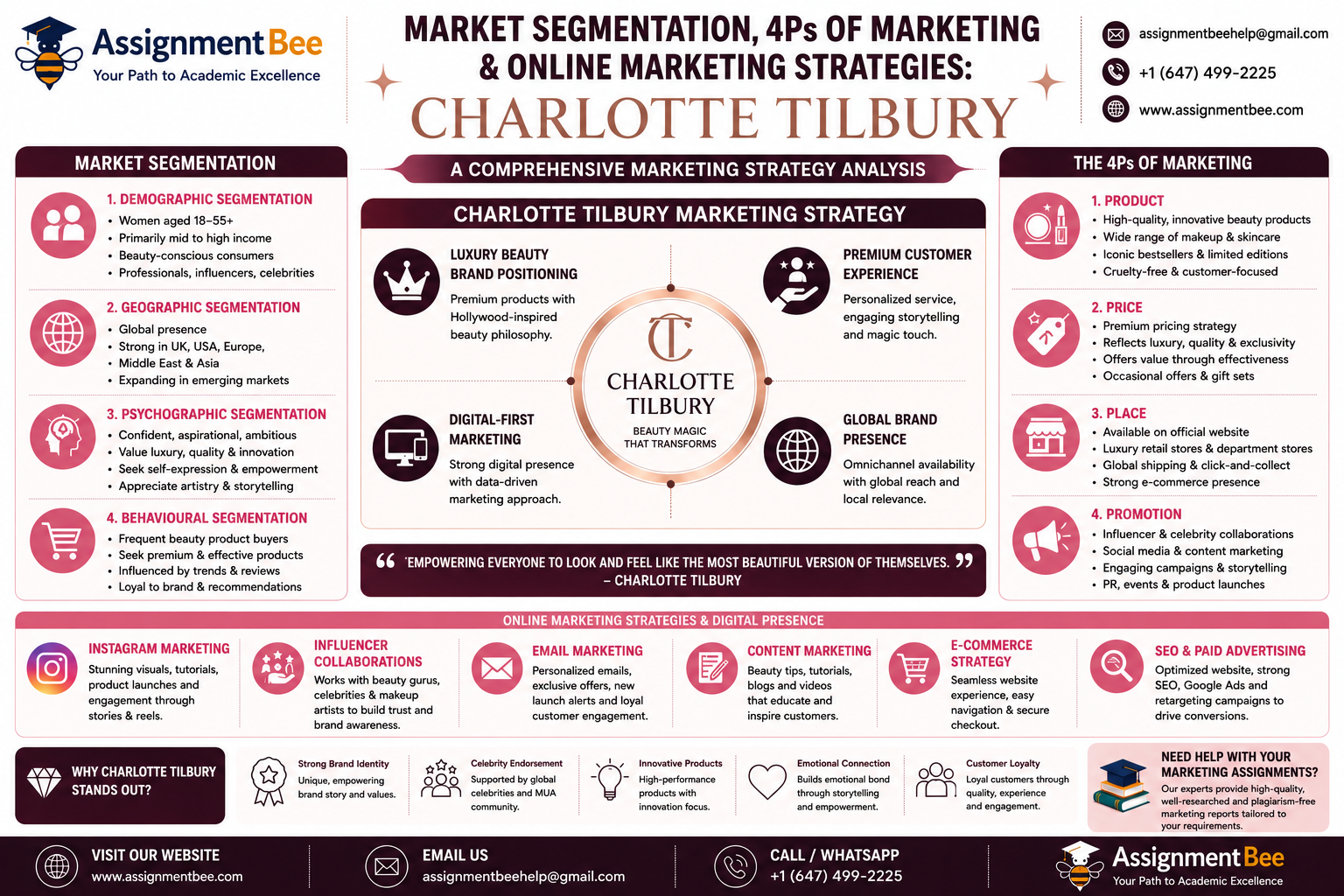
Explore Charlotte Tilbury’s marketing strategy, including market segmentation, the 4Ps of marketing, brand positioning, and online marketing strategies that drive global beauty brand success.
Charlotte Tilbury Marketing Strategy combines premium brand positioning, customer-centric marketing, and digital innovation to create a distinctive presence in the competitive beauty sector. By leveraging market segmentation, the 4Ps of marketing, and online engagement channels, the brand continues to strengthen customer loyalty and global growth.
Market Segmentation and Target Customers of Charlotte Tilbury
Market segmentation is the process of dividing a market into segments based on their attributes and needs, so that they can be targeted more efficiently (Kotler, Keller and Chernev, 2022). The luxury cosmetics market is the domain of Charlotte Tilbury, which is segmented into demographic, psychographic and behavioural segments.
The brand’s target audience is mainly female, between the ages of 25–54, and has medium to high disposable income. These consumers have multiple styles and are willing to pay higher price tags for high-quality beauty products and are very active in beauty and self-care trends. The business has also been tapping into the younger Generation Z audience with digital marketing and social media campaigns. Research indicates that younger luxury beauty shoppers are looking for brands that help them to express themselves, promote their social standing, and enable them to live out their aspirations (Singh and Nigam, 2021).
Glamour, confidence and luxury are the psychographic qualities that Charlotte Tilbury is looking for in its consumers. The brand sees beauty as a transformative experience, and it empowers and self-enhances with its products and marketing communications. The positioning of Charlotte Tilbury to their target customers is of great relevance as prestige, exclusivity and symbolic value are all significant factors that drive luxury cosmetics purchasing behaviour (Jaravaza and Moyo, 2024).
The company targets behaviourally people who are passionate about beauty, love to follow the trends, are active online and buy cosmetic products frequently. They are among consumers who are looking for innovative products and are likely to become loyal to brands that give them good experiences. In the luxury beauty sector, attachment to the brand and positive experiences can have significant effects on customer loyalty, as found by Ungarala (2021). Hence, Charlotte Tilbury’s segmentation approach is effective in reaching affluent, tech-savvy people who are after high-end beauty experiences.
Charlotte Tilbury Marketing Strategy :the 4Ps of Marketing
Product
Charlotte Tilbury has a wide range of luxury beauty products, such as make-up, skin care, perfumes and accessories. It is the top seller of its line, Magic Cream and Pillow Talk, which have gained global brand recognition. The company’s success is based on high-quality formulations, expert make-up knowledge and engaging brand marketing.
One aspect of Charlotte Tilbury’s product strategy that is particularly effective is the constant innovation. New product launches and limited collections are able to keep customers interested and keep them coming back. With this strategy, the firm can stay competitive in the fast-changing beauty industry and enhance its luxurious image.
Price
The company has a premium product pricing as it has positioned itself as a luxury brand. Additionally, the cost of Charlotte Tilbury products is far higher than many mass market cosmetic brands, further bolstering the idea of being exclusive and high quality.
The premium price is consistent with the expectations of luxury consumers, who tend to equate higher prices with prestige and performance. As argued by Jaravaza, Moyo and Mukucha (2024), luxury consumers often see pricing as a good measure of the value of the brand and social standing. The strategy can, however, restrict access for more price-sensitive consumers, especially during times of economic downturn.
Place
Charlotte Tilbury follows an Omni-Channel distribution strategy – Online/Offline. The products are sold via the company’s website and its flagship stores, luxury department stores as well as beauty stores like Sephora and Ulta Beauty.
This approach will help ensure product is available across a broad range with a premium shopping experience. Digital and physical channels can be integrated, enabling customers to interact with the brand in a number of touchpoints, which contributes to convenience and customer satisfaction. With the ever-increasing trend of online beauty shopping worldwide, the company’s robust e-commerce presence stands out as crucial.
Promotion
Charlotte Tilbury’s greatest asset for marketing is promotion. The company has implemented a comprehensive promotional strategy comprising social media, influencer marketing, celebrity endorsements, public relations and experiential marketing.
Founder Charlotte Tilbury is a strong brand ambassador that helps to create authenticity and consumer trust. The company also generates interesting tutorials, product demonstrations and storytelling driven campaigns that enhance emotional relationships with clients. According to Dhillon, Rajput and Agarwal (2021), experiential marketing can significantly improve customer satisfaction and brand loyalty in the luxury cosmetics sector, highlighting the effectiveness of Charlotte Tilbury’s promotional approach.
Charlotte Tilbury Marketing Strategy : Online Marketing Strategies
Charlotte Tilbury’s success is strongly supported by its sophisticated digital marketing strategy, which focuses on attracting new customers while retaining existing ones.
Social media marketing is one of the key elements of the company’s strategy. The brand is active on Instagram, TikTok, YouTube and Facebook, posting tutorials, beauty tips and tricks, product releases, and user-generated content. These platforms allow Charlotte Tilbury to reach the consumers and boost brand visibility. The study by Kumar and Prasad (2024) suggests that social media is a key driver in the purchase of luxury beauty products, and it has a greater impact on brand awareness and building consumer relationships.
Another crucial strategy for success in social media marketing is influencer marketing. Charlotte Tilbury works with beauty influencers, celebrities and makeup artists to market its products to highly engaged audiences. These partnerships create electronic word-of-mouth (eWOM) which tends to be more believable than conventional advertising. Influencer marketing, therefore, can serve as a means of drawing in new customers and bolstering the brand’s credibility.
The company has also adopted personalised marketing strategies to boost customer retention. By embracing email marketing, personalized ads, loyalty initiatives, and AI-driven product suggestions, Charlotte Tilbury provides personalized experiences that foster repeat sales. Luxury beauty shoppers feel more attached to personal interactions and are more loyal as a result, says Ungarala (2021).
The reliance on the social media and influencers has its drawbacks but those are not significant to the company’s strengths. The campaign’s effectiveness can be hampered by platform algorithm changes, influencer controversies, and changes in consumer preferences. But Charlotte Tilbury has reduced these risks with a powerful brand, multi-platform digital presence and innovation.
Overall, Charlotte Tilbury’s online marketing strategies effectively attract customers through engaging content, influencer collaborations, and strong digital visibility while retaining them through personalisation, loyalty initiatives, and ongoing customer engagement.
References
Dhillon, R., Rajput, N. and Agarwal, B. (2021) ‘Determining the impact of experiential marketing on consumer satisfaction: A case of India’s luxury cosmetic industry’, Innovative Marketing, 17(4), pp. 62–74.
Jaravaza, D.C., Moyo, T. and Mukucha, P. (2024) ‘Luxury beauty products purchase behaviour of affluent consumers: The role of brand consciousness and brand distinctiveness’, Cogent Business & Management, 11(1), pp. 1–13.
Kotler, P., Keller, K.L. and Chernev, A. (2022) Marketing Management. 16th edn. Harlow: Pearson.
Kumar, M.R. and Prasad, S.S. (2024) ‘Factors affecting consumers’ purchase intention and behaviour towards luxury cosmetics’, IUP Journal of Marketing Management, 23(3), pp. 1–22.
Singh, N. and Nigam, S. (2021) ‘Value-based segmentation of Generation Z women consumers in India’, Prabandhan: Indian Journal of Management, 14(10), pp. 40–55.
Ungarala, D.P. (2021) ‘Impact of brand experience on purchase intention and loyalty of luxury cosmetics brands’, Psychology and Education Journal, 58(2), pp. 4490–4502.
The post Charlotte Tilbury Marketing Strategy: 4Ps & Online Marketing appeared first on .
]]>The post BMM5163 People Management Assignment & Report Guide appeared first on .
]]>
Comprehensive BMM5163 People Management report guide covering recruitment, training, motivation, performance management, leadership theories, report structure, and academic writing best practices for higher grades.
BMM5163 Individual Report (4000 words)
BMM5163 Learning Outcomes:
By the end of BMM5163 module, the student should be able to
- Appraise the effectiveness of a range of people management models, theories, and concepts, including those dealing with setting up teams.
- Recognise the role of the personnel and HRM specialists in public and private organisations.
- Demonstrate the ability to work within a team and reflecting on their personal skills and areas for development.
- Analyse and present complex information from research as part of the team.
Task Requirements:
People management literature shows that effective people management is essential for organisational success, as it leverages the potential of employees to contribute to the attainment of strategic objectives (Lepak & Gowan, 2010).
- Critically discuss, analyse, and evaluate approaches to people management in practice in the organisational context, by using and applying theory, models, and approaches studied in this module to an organisation and/or a manager of your choice, to contextualise your analysis, critique, arguments, discussion, and conclusions.
- Introduction and context (500 words)
- Theoretical Framework (i.e., which theories/approaches and frameworks/models of people management and why; in what order and why, justify your choices) (1500 words)
- Application of Theories, Analysis, and Discussion (i.e., how, you may link your selected theories/approaches and frameworks/models of people management with factors influencing their successful application) (1500 words).
- Conclusion and Recommendations (500 words)
- References
- List of Figures
- List of Tables Your assignment may include the following structure:
- Appendices
Core texts:
- Armstrong, M., & Taylor, S. (2020). Armstrong’s handbook of human resource management practice (15th edition). Kogan Page
- Torrington, D., Hall, L., Taylor, S. & Atkinson, C. (2017) Human resource management, 10th ed., Harlow: Pearson.
- Wilkinson, A., Redman,T. & Dundon, T. (2017) Contemporary human resource management: text and cases, 5th ed., Harlow: Pearson.
- Bratton, J. & Gold J. (2017) Human Resource Management: Theory and Practice London, Palgrave.
Recommended texts:
- Furnham, A. (2008) People Management in turbulent times, London, Palgrave Macmillan.
- Kouzes, J. & Posner, B. (2008) The Leadership Challenge, London: Jossey-Bass.
- Thompson, N. (2013) People Management, London: Palgrave MacMillan
Useful Websites
- TED – https://www.ted.com/topics
- CIPD – CIPD The Professional Body for Human Resources and People Development
- People Management – People Management homepage
- Management Today
- com
Useful Journals
Academy of Management Learning and Education
British Journal of Management
Human Resource Management
Journal of Management History
Management Learning
Need help with your BMM5163 People Management report? Our academic experts provide plagiarism-free guidance, report planning, research support, and referencing assistance.
The post BMM5163 People Management Assignment & Report Guide appeared first on .
]]>The post MN7001QA Operations and Technology Management Assessment appeared first on .
]]>
A visual guide to the MN7001QA Operations and Technology Management Assessment, covering process improvement, automation, digital transformation, technology adoption, operational efficiency and strategic recommendations.
MN7001QA assessment mainly assesses learning outcomes (LO) 2 and 4 of the module, but builds upon LO1 and LO3, the LOs are that on successful completion of the module students will be able to:
- Analyse how technology is used currently and may be used in the future to deliver value (LO1).
- Critically evaluate the contribution of operations management and information systems to a business organisation’s strategic aims (LO2).
- Critically evaluate the key concepts and theories of digital business (LO3).
- Critique key concepts and theories within the areas of operations management, service operations, and process management (LO4).
Objective of MN7001QA assessment
The operations function of any enterprise has a direct and significant impact on the competitiveness and success of the firm. Upon completion of this project, you will have gained a deeper understanding of how the goals and objectives of an operation are realized in the way they do business. The project will draw upon one of the below concepts, theories and models about the use of operation management in your chosen company:
a) Lean Operations
b) Capacity planning and management
c) Inventory management
d) Material Requirement Planning (MRP)
e) Enterprise Resource Planning (ERP)
f) Quality management and improvement
g) Process technology
h) Supply chain management and logistics
i) Managing risks
Service or manufacturing Organizations: Case Study
Select an organisation that you can apply what you are learning on this course, and research relevant articles in journals and conferences. This could be a service operation, such as a coffee shop, project and construction companies, other retail or distribution, transport or manufacturing operation but it has to be one where you can identify the contribution of operations management. As suggestion, you may select the company from the following list (but are not limited to):
- FedEx
- NHS
- Tesco
- Amazon
- H&M
- Toyota
- ZARA
- Starbucks
- McDonald
- KFC
- VOLVO
- Nike
- Schindler UK
- Unilever4
- Rolls-Royce
- BMW
- Intel
- Ford
- Boeing
- Xerox
- Burger King
Required to answer in your report:
In accordance to learning outcomes 2 and 4, there are two main parts should be answered in your report. You need to concentrate on the following sections and questions while strategizing and preparing your report.
- Evaluate the objectives of the selected organisation. You might discuss aspects of operations strategy, goals and objectives, contribution to competitive priorities. Flowing on from this analysis, in a strategic sense what is operations management expected to deliver?
- How does the organisation do operations?
- How does Operations and technology management translate these organisational goals into tangible outcomes and processes?
- What does it aim to be exceptional at?
- How does operation management deliver on the competitive advantage identified above?
- Essentially address the question how does the operation management of your organisation deliver on the strategy?
- What are the opportunities and barriers of implementing operations management in your chosen company?
Please include at least one of the following operations management (OM) outputs into your coursework e.g. statistics, results, charts, figures, tables, reports with in-text citation
- process mapping, appropriate process measurements
- pull versus push system and just in time (JIT) outputs
- sources of wastes, lean production tools
- continuous improvement, Plan, Do, Check Act (PDCA),
- quality function deployment (QFD)
- level versus chase capacity plan and results
- economic order quantity analysis and calculations
- MRP analysis and reports
- supply chain network
- supplier selection and evaluation
- quality tools
- flow Principle
- TQM, EFQM, ISO standards implementation and results
- failure mode and effect analysis (FMEA) outputs.
- Assessing and reporting the impact of a process technology on OM performance e.g. IoT, Industry 4.0, RFID
“You can order MN7001QA Operations and Technology Management (2026) Assessment from our service and can get a completely high-quality custom paper. Our service offers any of the MN7001QA Academic paper written from scratch, according to all customers’ requirements, expectations and highest standards.”
The post MN7001QA Operations and Technology Management Assessment appeared first on .
]]>The post CA7013QA Assignment : Sustainability Strategies of two companies appeared first on .
]]>
A visual guide to CA7013QA Sustainability Strategies of Two Companies covering ESG practices, CSR initiatives, environmental responsibility, governance and sustainable business performance.
CA7013QA Assessment 2: Sustainability Strategies of two companies
Individual Report : 1,500 words
CA7013QA Report title
A critical review of the sustainability strategies of two companies as communicated by their sustainability or CSR reporting. This report will compare the levels of engagement in the sustainability challenges and evaluate resilience to potential or actual business risks.
You are free to choose whichever companies you are interested in learning more about. You might want to choose a company that is listed on the GRI database. Not all of them follow the GRI framework but they all use this as their main, but not their only, source of sustainability communication. If you find a different reporting framework that is appropriate, make sure that the companies you look into are following the same. The report is NOT meant to focus on website-only information.
Task
Write a 1500-word report on the following:
CA7013QA assignment is a critical review of the sustainability strategies of two multinational companies as communicated by their Sustainability reports. This report will compare the levels of engagement in the sustainability challenges and evaluate resilience to potential or actual business risks.
“You can order CA7013QA Assignment : Sustainability Strategies of two companies from our service and can get a completely high-quality custom paper. Our service offers any of the CA7013QA Academic paper written from scratch, according to all customers’ requirements, expectations and highest standards.”
The post CA7013QA Assignment : Sustainability Strategies of two companies appeared first on .
]]>The post MC7080QA Digital Marketing & Social Media Assignment appeared first on .
]]>
A visual guide to the MC7080QA Digital Marketing Social Media Individual Written Report covering digital marketing strategies, social media campaigns, analytics and customer engagement.
The MC7080QA written report requires students to provide a digital marketing plan containing a justified digital marketing and social media campaign for the brand addressed in assessment 1. Students should refer to and link their findings of the current digital audit, and poster content from assessment 1, to guide and justify the proposed objectives, strategies, tactics, and action and control tasks of their intended digital marketing campaign.
MC7080QA Task: Using the same brand and poster content from assessment 1, develop a digital marketing plan that explains and justifies, the marketing strategies and tactics that will be used to display and promote the poster content, and attract the target audience to specific online communication channels and platforms of the brand.
You are specifically requested to deliver the campaign under a 4 month period, and launch the campaign from 1st August 2026 to end November 2026.
The MC7080QA report must contain an executive summary that provides an overview of the proposed digital marketing and social media campaign. This should be no more than half a page (250 words).
After your executive summary page, provide specific objectives and an online value proposition (OVP) of your digital marketing and social media campaign. It will be essential to include frameworks like, the 5S (Sell, Serve, Speak, Save, and Sizzle) objectives and 6Cs (Content, Customisation, Community and participation, Convenience, Cost reduction, and Choice). Apply two or three of the 5S objectives and the 6Cs that correspond with the main purpose of the campaign.
There must be a clearly defined customer / target audience segmentation strategy, that details a customer profile. There must be a content strategy that includes reference to the content matrix and anticipated consumer behaviours relevant to the campaign, and for the poster content developed in Assessment 1. Using a table, demonstrate the order sequence of the tactics, with reference to the digital customer journey map stages, and RACE framework (Reach, Act, Covert, and Engagement). Explain the digital marketing and social media tactics that will used, supporting your arguments with appropriate and professional resources and references. Provide a timed action plan in the form of a table, you can use a Gantt if preferred, outlining the key tasks and Key Performance Indicators (KPIs).
“You can order MC7080QA Digital Marketing & Social Media Assignment from our service and can get a completely high-quality custom paper. Our service offers any of the MC7080QA Academic paper written from scratch, according to all customers’ requirements, expectations and highest standards.”
The post MC7080QA Digital Marketing & Social Media Assignment appeared first on .
]]>