is an event dedicated to exploring the intersection of gaming culture, technology, and the experiences of BIPOC communities worldwide. Our aim is to provide a space for scholars, game developers, industry professionals, and enthusiasts to engage in critical discussions, share research findings, and foster collaboration in the field. This conference brings together peer-reviewed research from leading academics, perspective from industry and fosters community among consumers, game-makers and academia.
* * *
Welcome
—Mirek Stolee, The Strong Museum
Just over a year ago, I started my position as curator for tabletop games and puzzles at The Strong National Museum of Play. My background was primarily academic, teaching game design and doing game studies research. Like many folks in game studies, I came to the field through a roundabout route. It wasn’t until the senior year of my undergrad that I even learned that academics studied games. At the time, of course, “games” meant “video games” to me. Yet, I had also fallen deep into collecting and playing hobbyist board games in my personal life. I spent many sleepless nights in high school playing Arkham Horror with my friends, and played Dominion nearly every day in college, but had never considered that people were studying analog games. So, discovering the Analog Game Studies journal (AGS) was a revelation. I first encountered it when my master’s thesis advisor, Nathan Altice, sent me his article examining playing cards as a computational platform. I’ve since attended the AGS’s online Generation Analog conference several times, starting with the first one in 2020. The AGS community is among the most welcoming academic groups I’ve encountered.
At the inaugural BIPOC Game Studies Conference, I had the pleasure of finally meeting several members of the AGS staff and giving them a tour of The Strong’s collections. At the AGS roundtable, it was fascinating to learn how AGS has so intentionally cultivated its community through a spirit of mentorship and collaboration. By eschewing double-blind processes for a collaborative model between author and editor, AGS has been instrumental in cultivating the skill sets of junior scholars and marginalized authors and making scholarship on analog games freely available and accessible to readers both within and outside of academia. Yet, the practices that have made AGS so accessible have sometimes made it illegible to entities like tenure committees. It’s challenging advocating for research that is undervalued by existing institutional structures.
The AGS roundtable had me reflecting on my own advocacy capabilities in a position outside of traditional academia. This past year, I’ve been thinking about my role at the museum and what I can do for the creators, players, and scholars of analog games and puzzles. Working at a museum gives me unique opportunities for sharing game history and historiography with public audiences. The Strong’s broad definition of play means that our collection includes toys, video games, art, ephemera, clothing, and many more categories. This puts our institution in a unique position for drawing connections between various forms of play, but it also means that we are trying to cover a lot of bases. As one of several curators, it’s my job to advocate for the collection, display, and interpretation of analog games and their communities. Speaking with the AGS staff helped me develop ideas for diversifying my part of the collection. The indie TTRPG space is one area that I’d like to build out further, for instance. So many exciting games come from marginalized folks working within TTRPGs, and The Strong should be collaborating with creators and players to preserve those materials.
AGS has shown me how institutions like journals and conferences can be powerful advocates for marginalized players, creators, and scholars. At the museum, we are already thinking about how we can continue hosting the BIPOC Game Studies Conference in future years. While I was not heavily involved with the organization of this year’s conference, it was a joy to attend. The issues of representation and identity discussed at the conference are crucial for gaming culture, both analog and digital. I hope to ensure that diverse designers and scholars of analog games have an even greater presence at future conferences. I can’t wait.
* * *
(Un)Learning through Play
—Megan Condis, Texas Tech University
I was so impressed by this event and even more so by the hosting institution. The Strong Museum of Play is truly a treasure, and between the panels, the game demos, attending the keynotes, and just wandering around the museum and seeing folks learning about/through play was extremely generative and inspiring.
I want to give a special shout out in these notes to Elaine Gómez, Dan Cook, and Roxanne Blouin-Payer for their talk “Decolonizing Play: Frameworks for Game Design Free of Colonial Values.” Their talk explored how imperialist and colonialist logics can sometimes infiltrate play in unintentional ways, even in games that don’t feature violent themes. For example, many of the core game design verbs that we rely on, such as the “four X” verbs (explore, expand, exploit, exterminate), as well as genre-defining verbs like loot, conquer, control, capture, and manage, revolve around the exercise of power and the subjugation of people and spaces. I highly recommend that you read their paper in the conference proceedings (available here: https://works.hcommons.org/records/vfk96-nwk35).
The talk, which was informed by their experiences as commercial game designers, outlined a four-step framework for game designers to think through their projects in order to discover these patterns where they arise and create new frameworks where possible. The first step is to assess the risks associated with your game, determining whether it falls into a genre or is associated with a franchise that has had a tendency to rely on colonial values in the past. Games in high-risk genres like strategy games, survival games, MMORPGs or factory/automation games will require extra thought and care as players will have become used to existing patterns of interaction and will require extra scaffolding to move away from them.
The second step is to look for places in which your project is flexible, the places where your game is still able to be changed and the places where it can no longer be easily modified. Coming from a commercial game design space, the speakers discussed how, depending on how far along a game is in its development, certain elements such as game mechanics that have already been announced to the public or economies of monetization may already be “baked in,” while other elements, like the design of assets or the storyline, may be more open to change.
Next, they recommend game developers brainstorm a list of “antonyms” to the gameplay verbs that they wish to change. Perhaps “control” can be reenvisioned as “liberate,” “exploit” can become “preserve,” or “loot” can transform into “restore.” Finally, they recommend getting feedback from other people about your design, including professionals like sensitivity readers and cultural consultants as well as players.
What struck me most strongly about the talk was their definition of decolonization, which they described as “unlearning to relearn.” This got me thinking about how their framework might be applied to the classroom. What exploitative logics might we be importing into higher education that we aren’t aware of? What places are we able to create change immediately and without the need for institutional support (which, in our current political climate, may or may not be forthcoming)? What new interactions can we foster for our students and how might we gain valuable feedback from them about how they perceive the college experience?
Many thanks to the conference organizers, the Strong, and the city of Rochester for the fantastic event!
* * *

That “Aha” Moment
—Amanda Kporwofa, University of Cincinnati
When my professor first mentioned the BIPOC Conference to me, I was genuinely excited. It was the first conference of its kind dedicated specifically to people of color in game studies and design, a welcoming and inclusive space to connect with other game designers like me. I immediately saw it as an opportunity to learn from diverse voices, share experiences, and understand how other creators use games as a medium for storytelling and cultural expression.
When I finally arrived, I was amazed to see a vibrant mix of creators showcasing their works, from analog board games to digital and video games. Each presentation carried a unique signature of the creator’s background, history, and environment. As a game designer from the Global South, I was deeply inspired by how each designer’s work reflected their geographical and cultural context. That moment gave me an “aha” realization: I could intentionally design my games to represent and center the Global South, including its stories, cultures, and lived experiences. Seeing how others used their games to explore themes like identity, race, history, and belonging encouraged me to think more deeply about how games can be a form of research, cultural preservation, and resistance.
One of the sessions that left a lasting impact on me was the “Diversity, Citational Justice, and Analog Game Studies” roundtable featuring Dr. Edmond Chang, Dr. Evan Torner, Dr. Megan Condis, Dr. Shelly Jones, and Luke Hernandez. The discussion emphasized the importance of collaboration in both game creation and research. As someone who had always designed games independently, hearing that game designers could come together, combining different skills, perspectives, and disciplines, was transformative. It expanded how I view game development, not just as a creative practice but also as a collective intellectual process. This insight has already led to a new collaboration I am currently pursuing with one of the renowned game designers I met at the event. Working together has shown me that collaboration allows for the creation of more layered and representative games that speak across cultures and disciplines.
After the session, I had meaningful conversations with Dr. Torner, my professor and mentor, and Dr. Condis, who both encouraged me to continue developing games rooted in the Global South context. They reminded me that people from the Global South understand their cultures and lived experiences best and that our voices are essential in diversifying global game design. This insight has significantly shifted my research focus toward Global South-centered game scholarship, where I aim to explore how culturally grounded games can challenge dominant Western narratives in game studies. I was especially thrilled to leave the conference with a clear idea for my future dissertation, inspired by these conversations and the broader discussions throughout the event.
Overall, the BIPOC Conference was an eye-opening and empowering experience. It affirmed my identity as a game designer from the Global South and strengthened my commitment to creating culturally grounded games that speak to local realities while contributing to global conversations in environmental and educational game design. Beyond that, it reminded me that representation matters not only in the stories we tell through games but also in who gets to design them. The conference left me motivated to continue using my creative and scholarly work to amplify underrepresented voices, build collaborations across continents, and redefine what inclusive and globally conscious game design can look like.
* * *
Playful Studies
—Shelly Jones (they/them), SUNY Delhi
Throughout the conference, we heard themes of revisiting the past to inform and produce the future. For me, a native of Rochester, I felt as though I were a living embodiment of homesickness, past remembrance, and hopeful possibilities. I have fond (albeit hazy) memories of the Strong Museum, having visited there as a child. Walking through that familiar, yet much-changed, space was rather surreal. Here I was, an adult, revisiting a museum that heralds the importance of play, that documents the way we play, remembering being a child, dazzled by all the exhibits. But now, not only am I an adult, but I’m an adult who studies play and games, so I walked through the exhibits (particularly the miniaturized Wegmans market) with academic eyes rather than simply child-like wonder. But I still felt that sense of awe, especially as a few of us were taken on a behind-the-scenes tour of the collection: row after row after row of games, toys, action figures, books. Throughout the tour, we’d all invariably shout, “I had that when I was a kid!” or “I remember those!”—our bodies aching with delight and nostalgia, our minds buzzing with ideas for future studies and essays.
Resurfacing from the archives and our heady trip down memory lane, the conference all at once felt safe, collaborative, and deeply personal. At each panel, the person and the human were at the center of it all. We may have been discussing chits and code and rules, but really we were discussing humanity, identity, and community. Real human connections and support were made, like when an established Black woman in the games industry stood up to applaud the next generation of scholars, admiring their willingness to speak out, to point out injustices, to advocate for more inclusive representation and practices. To keep going.
Another aspect of the conference that struck me was the variety of types of talks: industry-focused keynotes; talks expressing the way that making games have impacted their lives; talks analyzing games as tools for socio-political revolution; and so much more. The AGS crew presented a roundtable on diversity and citational justice. That dialogue morphed and transformed into an open discussion on professionalization that too often goes unsaid. Breaking down some of the hidden curriculum of academia, those implicit expectations that often further alienate already marginalized folks, is its own kind of justice and empowerment: a practical one.
Ultimately, when I look back on this conference in years to come, I may not remember the theoretical nuances and underpinnings of every paper and talk, but I will remember the safe space we shared, the wonder and awe we experienced, the connection we found in one another through play.
Echoing others’ thanks to the conference organizers, the Strong, and the city of Rochester for such a welcoming and supportive event!
* * *
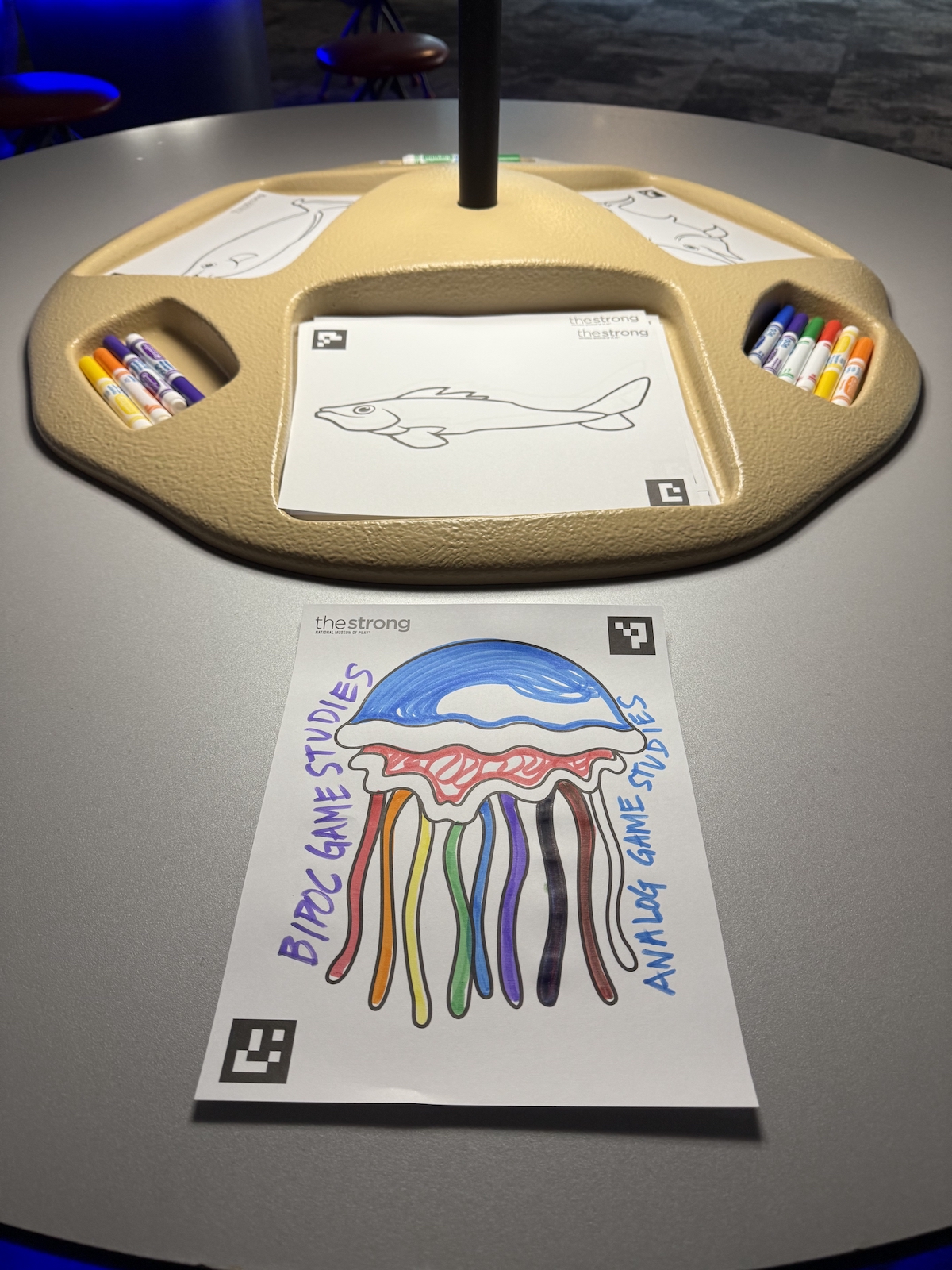
Lived Experiences
—Luke Hernandez, The University of Texas at Dallas
Over the years we are constantly reminded about aspects of games and media remain hostile towards BIPOC communities. It gets frustrating to still see how gaming culture and industry are not receptive to the lived experiences of marginalized communities and the vast systemic issues throughout gaming. What I appreciate is the way the Conference on BIPOC Game Studies holds space for people’s work that addresses these very issues while also doing the work itself by cultivating an inclusive event that dares to look towards a joyous future for all folks.
As a scholar from Texas that focuses on Queer and Latinx communities in gaming, I absolutely felt at home during my time at the conference in Rochester, NY. I was thoroughly engaged in the conference from listening to people’s research that centers marginalized experiences and discussing ways aspiring creators navigate the gaming industry as BIPOC. Events like these are becoming so important, especially considering recent political uncertainty such as efforts to target initiatives that aim to uplift our communities.
The Conference on BIPOC Game Studies offers not only a crucial space to promote solidarity between game makers, game players, and game scholars but across various communities where our differences and similarities are celebrated while working to address change and challenging the many harmful systems that color our experience.
I had the opportunity to meet so many amazing people at the conference and was able to reconnect with old friends. Shout out to my colleague and friend Diamond Beverly-Porter, who is an Assistant Professor at Washington State University! We met in Dallas as master’s students, and now we are eating at a bar and grill playing Mario Kart in upstate New York—life is strange. Her work includes Critical Game Studies and creating digital games that speak the experience of marginalized communities, specifically Black women, on negotiating identity, resistance, and futures! Seeing work like that in a dedicated space for these types of stories is truly inspiring to me as both a researcher and gamer.
All in all, events such the Conference on BIPOC Game Studies are important to shifting the culture and working towards just futures. While there were serious matters being addressed at my time at Rochester, I had a joyous time hearing other people’s creative and scholarly work and connecting with people who are passionate about making games more inclusive and accessible for everyone. I hope it continues.
* * *
Coalitions
—Evan Torner, University of Cincinnati
I can start with the vibe: resigned, but determined. Every institution of origin for every presenter, be it university, business, or even the Strong Museum itself, is now under a dark cloud of uncertainty; ideological pressure that disallows so many of us from fully serving our constituent populations. We continued to assert that what we do matters but, at least in our own panel and the talk by Elisabeth LaPensée, we felt safe in the space to open up about our trauma as well. By revisiting and sharing our pasts, we help produce the future in which we can better protect ourselves and our communities. That’s the hope, anyway.
As is often the case, I had to attend with my son, because leaving my partner alone with 2 children to care for is too big of an ask during the beginning of the school year. As it turns out, there is no better place to bring your kid to a conference than the Strong Museum of Play. There are rooms dedicated to virtually every aspect of human play, from pinball machines to carousels, from dollhouses to mystery rooms. My son had an absolute blast when we weren’t in the conference sessions or keynotes, to which he also listened. Moreover—and this is really important to someone like me who still harbors shame and embarrassment about needing to bring my children into rarefied academic spaces—he was treated very well by fellow conference attendees and the organizers. It reflects well on everyone when children are respected and valued, even when their inclusion isn’t always foreseen.
Gaming spaces haven’t been safe for BIPOC for a long time, nor have they been particularly accepting of parents, nor anyone different from a perceived identity norm. But concerted efforts and intentional organizing can begin to change that. The resigned-but-determined attitude underlying the conference makes me think there is much more to come from this coalition, and we should all contribute to its efforts to bring about the better future we all deserve.
* * *

Better Than a Garbage Plate
—Edmond Y. Chang, Ohio University
The unexpected. Mixed with color, wonder, and a healthy dose of nostalgia. My first visit to The Strong National Museum of Play evoked a lot of ideas, questions, feelings, even memories for me. The building itself, newly renovated and expanded in 2023, is a brightly-hued kaleidoscope of planes, shapes, textures, volumes, and installations from the giant, glowing squiggle of the “Portal of Play” that marks the front entrance to the 18-foot high Dungeons & Dragons fire-breathing dragon to the rainbow exterior of the museum’s parking garage. Inside, The Strong amazed me with the 123 Sesame Street stoop, the 3000-square-foot-child-sized Wegmans Super Kids Market, and a labyrinth of exhibits about superheroes, Black doll designers, board games, video games, and more. I think my favorite was the Rainbow Reef “digital aquarium,” where visitors (of all ages) can color a fish, scan it, and watch it magically appear swimming around the projected coral reef. (I made two.) I was impressed by how space and place, form and function, design and play really worked in The Strong.
Perhaps the most intense experience of the museum was getting to peek behind the scenes, to delve its depths like some fantasy adventuring party. Thanks to Mirek Stolee, a curator at The Strong and Analog Game Studies (AGS) alum, some of the AGS editorial board got to explore the museum’s archives, which includes toys, undoubtedly haunted dolls (kept safe in locked cabinets), magazines, catalogs, comic books, prototypes, game show paraphernalia, and all sorts of digital and analog games. Especially impressive and important is the Brian Sutton-Smith Library and Archives of Play, which houses so many TTRPG rulebooks and game materials. Even with the expansion, the museum seemed chock full, and we talked about all of the things that get acquired or donated, how and what gets chosen for preservation, and ultimately, what gets lost or destroyed. (I thought about my own collection of games, books, and writing, and wondered if someday, if I was so lucky and honored, they might make their way to The Strong or some other archive.) Recently, I just learned that Sutton-Smith Library has partnered with Play Story Press, who published all of AGS’s books, to collect physical and digital copies of PSP’s current and future catalog including Analog Game Studies. In a way, the archives themselves were about play, exploration, unexpected discoveries, histories, and connections. I could spend a lifetime playing around in the past-, present-, and afterlives of all of these much-handled, hopefully cherished things. (Just not the creepy dolls.)
I linger on the setting because not only did it genuinely surprise me, but it was the perfect venue for a game studies conference. The conference was unexpected, too. Much of the programming focused on video games, digital storytelling, and educational technologies—not a surprise given that the conference was organized by Dr. Lindsay Grace, Knight Chair in Interactive Media and professor in the School of Communication at the University of Miami, and Stephen Jacobs, Scholar-in Residence at The Strong and Professor of Interactive Games and Media at Rochester Institute of Technology (RIT), with sponsorship from The Strong, the Entertainment Software Association, the Knight Foundation, and others. However, I was hoping for some more mixing of digital and analog—especially since the site combines both—but I was thrilled to see so many different people, talks, institutions, and objects of study in the program. Highlights included the undergraduate students that presented on “Decolonial Frameworks and Indigenous Voices” (though they ran out of time due to no fault of their own), the panel on “Race, Representation, and Resistance in Story-Driven Games,” the session on “Community, Design, and Play Cultures” (which featured AGS’s Luke Hernandez), and especially, the keynote by Elizabeth LaPensée. I was especially edified to know that AGS was included in the program and would be repping analog game studies at the conference.
Our panel, entitled Diversity, Citational Justice, and Analog Game Studies: A Roundtable,” brought together some of the editorial board of Analog Game Studies to cover the current state of game studies scholarship, publication, professionalization, as well as the intersections with game design, industry, technology, and popular culture. In particular, the roundtable specifically addressed the need for further citational diversity and justice; while game studies as a field is growing and changing, we argue that much of game development, marketing, and criticism is still largely white, normative, and homogenous. Our panel highlighted the ways that AGS has tried to encourage interdisciplinarity and multimodality; mentorship and collaboration across and among scholars, teachers, artists, and designers; foreground underrepresented and marginalized authors and creators; and challenge and reimagine traditional models of academic publishing, professionalizing, and promotion. (The tea was hot and spilled.) It was great to see so many people from different areas of gaming and game studies and at different places in their education, jobs, or lives attend our session. In fact, if there was something that would strengthen the conference overall, it would be to further diversify the kinds of games, gamers and communities, as well as disciplines, methodologies, and histories included in and invited into the program.
Thank you to the organizers of the conference, thank you to The Strong Museum, thank you to the presenters and developers, and thank you to my fellow roundtablers and to Mirek Stolee for welcoming us, for sharing such great work. All in all, the conference was illuminating and encouraging; my first visit to The Strong was life-changing (I want to apply to be a fellow), and my first visit to Rochester was lovely, even if I never actually got to get a garbage plate. Thanks to friends, peers, and fellow travels for being a part of the adventure.
–
Featured image of giant Scrabble PLAY tiles at The Strong Museum. Photo by Edmond Y. Chang. Used with permission.
–
Abstract:
This collaborative essay brings together seven participants to reflect on their observations and experiences at the 2025 BIPOC Game Studies Conference at The Strong National Museum of Play in Rochester, NY.
Keywords: conference, postcards, BIPOC game studies, The Strong Museum, archives, citational justice, Rochester
–
Edmond Y. Chang, PhD is an Associate Professor of English at Ohio University. His areas of research include technoculture, race/gender/sexuality, queer game studies, feminist media studies, popular culture, and 20/21C American literature, particularly speculative literatures of color and games of color. He is the co-author of Video Games, Literature, and Close Playing: A Practical Guide with Timothy Welsh, and he is the co-editor of Roll with Advantage: Creative, Collaborative, and Critical Responses to Dungeons & Dragons with Suzanne Richardson. Moreover, he is the creator of Tellings, a high fantasy tabletop RPG, and Archaea, a live-action role-playing game. He is also a contributing editor for Gamers With Glasses.
Megan Condis, PhD is an assistant professor of Communication Studies at Texas Tech University. Her book, Gaming Masculinity: Trolls, Fake Geeks, and the Gendered Battle for Online Culture was published by the University of Iowa Press in 2018.
Luke Hernandez is Ph.D. student studying Arts, Technology, and Emerging Communication at the University of Texas at Dallas. His research lies at the intersection of Critical Game Studies, Latinx Studies, and Queer Media Studies. His work focuses on how online marginalized communities thrive throughout games spaces. Luke is also an Aquarius.
Shelly Jones, PhD (they/them) is a Professor of English at SUNY Delhi, where they teach classes in transmedia storytelling, mythology, and writing. Their research examines games through the lenses of intersectional feminism and disability studies. A Pushcart nominee and Best Microfiction finalist, their creative works have been published widely.
Amanda Kporwofa is a Ph.D. student in Communication at the University of Cincinnati whose research explores the intersections of gaming, environmental communication, and technology. She is a game designer from Ghana and the creator of the country’s first sustainability board and mobile games addressing deforestation, illegal mining, and air pollution. Through her work, Amanda designs culturally grounded environmental games for the Global South, using play as a tool for education and social change.
Mirek Stolee is the curator for tabletop games and puzzles at The Strong National Museum of Play and a Texts & Technology Ph.D. Student at the University of Central Florida. His research explores the intersections between analog and digital play, and his dissertation is a local history of escape rooms in Western New York.
Evan Torner, PhD is Associate Professor of German Studies and Niehoff Professor of Film & Media Studies at the University of Cincinnati, where he also serves as Undergraduate Director of German Studies, the Director of the UC Game Lab, and the Program Coordinator of the BFA in Games and Animation, a degree he co-developed. He is co-founder and an Editor of the journal Analog Game Studies. His fields of expertise include East German genre cinema, German film history, critical race theory, science fiction. role-playing game studies, Nordic larp, cultural criticism, and second-language pedagogy.
]]>Our interrogation of the generic term “mancala,” here employed to discuss classic African board games in board game studies, is informed by a decolonial perspective on knowledge and knowledge building. Contemporary scholars acknowledge the historical interconnection of colonization with research. Decolonization is a process that results in the intellectual, psychological, and physical liberation of the colonized from the colonial system impose on them. Adopting a decolonial perspective in research allows the dismantling of contemporary knowledge and the recreation of new knowledge; helps rethink how knowledge is gathered, produced, and shared. For us, decolonizing research also means taking apart the current story, giving voice to people and things that are often unknown. Indeed, the impacts of colonization are physical, psychological, mental, as well as spiritual, because the greatest weapon of imperialism is the “cultural bomb.” A cultural bomb is the annihilation of a people’s belief in their names, in their languages, in their environment, in their heritage of struggle, in their unity, in their capacities and ultimately in themselves. Hence, decolonization means freeing the mind, body, language, culture, praxis, thoughts, theory, research, and ceremonies from Western ideas, philosophies, beliefs, and theories dependency. A decolonial approach allows us as members of communities that play these classic African board games to deconstruct the generic term “mancala,” as we challenge its use in board game studies as a blanket term for classic African board games. The use of “mancala” as a generic name is, in our view, the colonization of these African board games through the annihilation of the communities’ given names. Moreover, the encapsulation of classic African board games into the term “mancala” results in the colonization of classic African board game research by Western board game studies.
As previously mentioned, colonization touches many aspects of names and language. Inherent to decolonization or a decolonial perspective is also the need to address the harm of cultural genocide and linguicide. As members of communities that have been playing some of these classic African board games for centuries, we discuss, in the next section, a) the importance of naming in relation to African culture; b) examine the meaning of “mancala”; and c) explore the literature to explain how this generic term in board game literature participate in a colonial project that intends to annihilate the names, heritage, history, and language of colonized people. In other words, we are getting into good trouble with analog game studies by demonstrating that “mancala” erases the culture, identity, history, creativity, agency, and language of various communities in Africa.
Names Matter
Naming is critical when one wants to meaningfully address a situation, problem, or phenomenon. Indeed, names are “given to entities of cultural importance and of significance for humans in social life; name usage and name-giving practices reflect social beliefs and cultural values; and their meaning is strongly shaped by cultural and historical contexts.” Names can influence the individual or phenomenon under investigation, while reflecting the history, rationale, or biases of the researcher labeling the phenomenon. Therefore, names can be misleading or superficial, which may result in framing a situation or object differently or in telling a different story. Names do not just describe a phenomenon; they also reflect the rationale that leads to name creation. As Oyèrónké Oyěwùmí, and Hewan Girma explain, “Names are consequential labels with strong affective meaning that can fulfil multiple purposes as anchors of identity, symbols for the self and markers of ethnicity.”
Naming a phenomenon captures assumptions, feelings, beliefs, and even history about the said phenomenon or object; thus, misnaming or changing an object’s name inherently undermines or misrepresents any situation or object under study. Addressing naming and naming practices in Africa, Oyèrónké Oyěwùmí argues:
names constitute valuable sources of historical and ethnographic information and help to unveil endogenous forms of knowledge… Apart from documenting historical experiences, … names help to unveil endogenous forms of knowledge… names and naming practices [in]… different African cultures … reveal the historical and epistemic significance of given names.
In other words, naming makes evident the inferences and characteristics about the object or event labeled; it gives it a general meaning, and shapes how to approach the object, or event, and informs assumptions about the event or object under investigation. Understanding that naming has consequences on how we understand and conceive a phenomenon, our paper focuses on the generic label “mancala” often used in the literature to refer to a family or group of traditional African board games, referred in this article as classic African board games.
Mancala and Its Meaning
Mancala is a term borrowed from the Arabic “manqala “or “minqala” (from the verb naqala, “to move”), which has been applied to a “set of games involving the distribution of a series of stones or seeds among a number of holes arranged in two, three or four rows.” Informed by a decolonial approach, we contend that the danger of using the generic name mancala to refer to all these board games erases the culture, identity, creativity, history, and design history of the various communities/ethnic groups where these games are played and were developed. For instance, some authors state that mancala is a game with various forms found in Africa and Asia; mancala has common elements across its variations on the African continent such as always played by two people on boards with rows of holes—the most popular being two rows with six holes and two large holes at each end. While recognizing that neighboring countries have different names such as Oware in Ghana, Gabata in Ethiopia, Sora in East Africa, and Ayo in Nigeria, Anthula Natsoulas still explains and assumes that elements of the game mancala are universal, even with special rules, the format remains similar for all games. Other researchers define mancala as games made of rows of holes and often played with seeds or shells. The name “mancala” appears to have been attributed to any game that can be described as played on a board with holes, seeds, or shells. The use of “mancala” as a generic label for these classic African board games in scholarship and literature could be explained by the fact that African thoughts and realities are often conceived acceptable only when they fit or are defined within or in relation to other paradigms. We argue that the desire to categorize all classic African board games played with seeds and on boards with holes under “mancala” is an attempt to apply Western ways of classification. In other words, labeling all these games “mancala” aligns with a) Western language practices of grouping what is deemed similar and b) expectations that Africans should translate these “universal” concepts into their own languages or simply accept foreign concepts or labels.
In the next section, we examine the usage of “mancala” in recent years. We are interested in knowing whether researchers discussing classic African board games have only employed the name as known by the communities that play these games in their research or have they preferred to use mancala or a combination of mancala and game name from these communities.
Trends in the Use of the Term “Mancala” in Analog Game Studies
To examine the use of “mancala” as a generic name for classic African board games in recent years, we first explore the popularity of the word “mancala” in the board game studies literature, using a combination of a) Google Books Ngram Viewer, which is a text analysis tool that analyzes how words and phrases have been used over time by searching through a large collection of books, documents, and other textual sources scanned by Google from 1500-2022; and b) JSTOR’s Data for Research (DfR), a service that offers text mining of content from multiple platforms, and allows users to analyze word frequencies and trends within academic publications from 1900-2024. DfR allows researchers to conduct text analysis focusing on journal articles, while Ngram enabled us to mine text mainly in books and documents. The combination of these text analysis tools provided us with a general overview of the history of the use of the term “mancala” in books and journal articles and helped us have a sense of the popularity of this term at different timespan. Textual analysis is an analysis method that enables a close encounter with the text and is used to examine messages with the goal of understanding sense making practices of people. Using Ngram, we were also able to understand what terms were mostly used alongside the term “mancala.”
In the context of this study, Ngram and DfR provide a historical understanding of the use of mancala. In addition to using Ngram and DfR datasets to examine the history of the use of mancala and its popularity in literature, we consider research published in the past five years. Search terms such as “mancala,” “African board games,” and “mancala board games” were employed in the authors’ libraries Quick Search tool and in Google Scholar for the past five years. We were only interested in peer-reviewed articles and not in books or reports. While our search yielded 35 articles with “mancala” or African board games in their titles or abstracts, we discussed selected excerpts. Indeed, using Voyant, which is an open-source, web-based application, we performed a textual analysis of these articles. Textual analysis allows for the examination of a phenomenon or concept as a window into pieces of subculture that may have not been previously studied.
Overview of Mancala Use
Given our interest in understanding the use of “mancala” as a generic term to refer to classic African board games in the most recent literature, it was important for us to show the historical trend of its usage (Ngram and DfR) but also to take a closer look at the most recent literature to understand whether the term was used in combination with other words, such as the game name known by the communities that play the game or where used interchangeably.
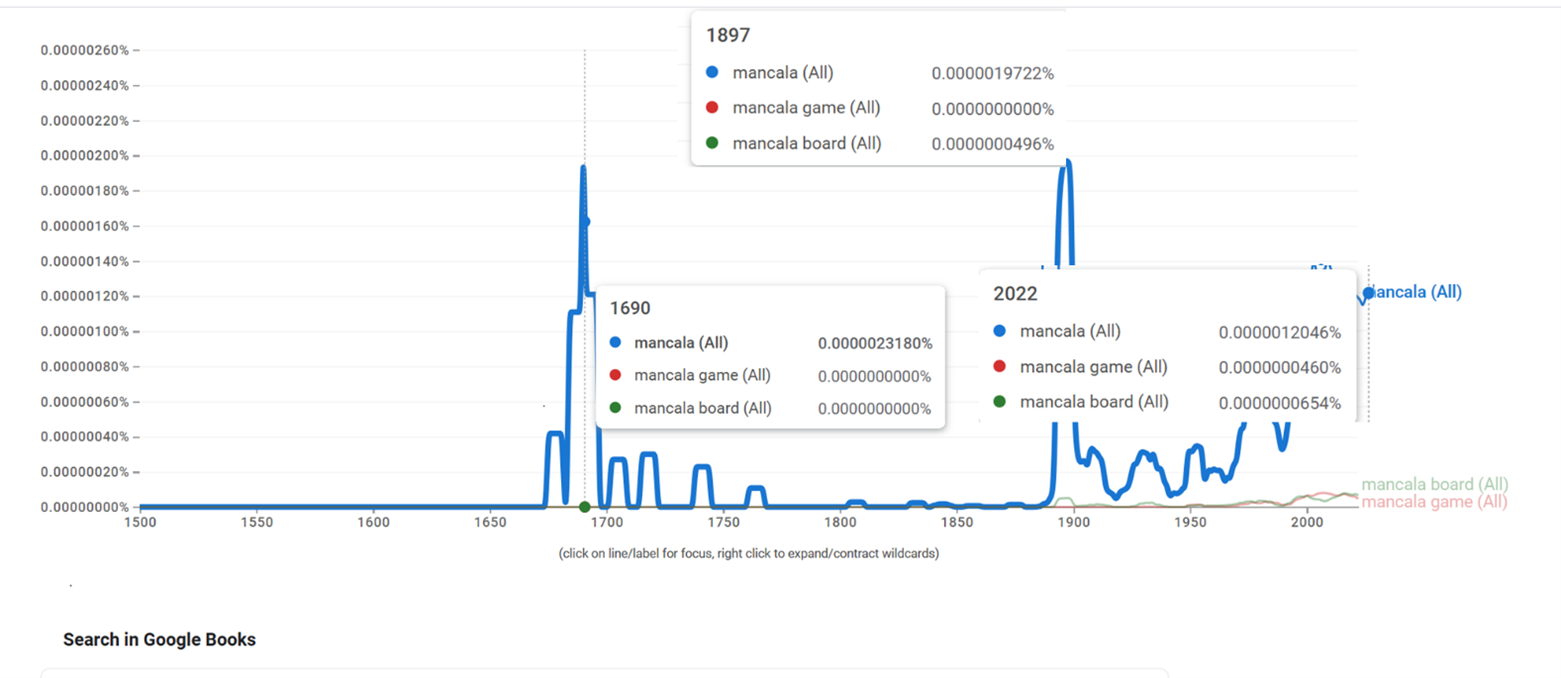
We first examined the historical use of these terms within Google Books database with Ngram, and within JSTOR journal database supported by Constellate, using DfR. We searched for the following words in Ngram and DfR: “mancala,” “mancala game,” “mancala board,” and “mancala African game.” The Ngram results (Figure 1) of the textual analysis ranged from 1500–2022 and indicate that the term “mancala” has been employed by researchers since 1675. This date corresponds to the 17th Century in which Western empires were increasingly establishing colonies in Africa and in other parts of the world. Embedded in the project of colonization is the idea that the colonized are irrational, idle, and backward people; it is an individual who needs to “break free from his customary ways of thinking, being, and worshipping to adopt European arts, sciences, and knowledge.” We see an increase usage in the 1690s and then in 1897. Figure 1 also shows a slight increase in the years 2000s and 2022, after a decrease in the 1980s. The book by Jean De Thévenot, titled The Travels of Monsieur De Thevenot into the Levant: In Three Parts, is one of the earliest references to the use of “mancala” in Google Books database. In the 1900s, John H. Weeks, with his book titled Among Congo Cannibals, also employs mancala to describe a game played by the people of Congo. The results further show that the utilization of “mancala” as the name for classic African board games spreads across three centuries (Figure 1). For instance, books that contain the word “mancala” from 2019- 2022 include: Culin, Mancala, the National Game of Africa; Daniels, Make Your Own Board Game; Huylebrouck, Africa and Mathematics; and Ian Livingstone and James Wallis, Board Games in 100 Moves.
Similarly, we completed a textual analysis in JSTOR DfR in a total of 829 journal articles, from 1900–2024. The findings (Figure 2) show that the word “mancala” was the most used in the literature, starting in the 1900s, with a spike in its frequency in 2010, and a decrease in 2020. The combination of mancala with other terms such as game, board, or African game was not that frequent in the database.
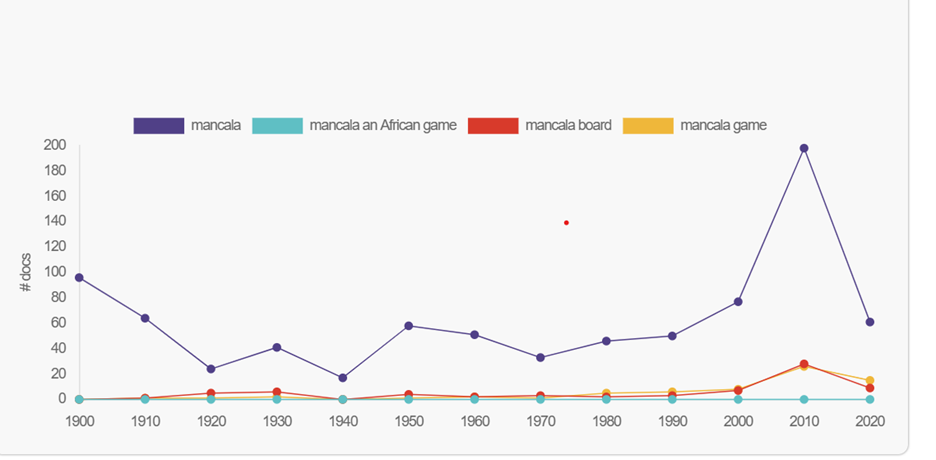
Like Figure 1, Figure 2 signals that in the literature discussing classic African board games, or board games with holes, and played with seeds, “mancala” appears to be the most frequently utilize word. However, it should be noted that the apparent decline in the use of “mancala” in Figures 1 and 2 does not necessarily mean that the term was no longer employed; this may mean that studies on classic African board games were limited during that period. Still, Figures 1 and 2 demonstrate that it is during the European colonial project that the term “mancala” emerged in western descriptions and literature discussing classic African board games. The practice of imposing a different name to these African games appears to have persisted till the year 2022.
We were also interested in understanding the use of this term in the past five years. For instance, we wanted to take a closer look at the context in which “mancala” has been used in board game research. In other words, we were interested in understanding how “mancala” was employed in relation to other words. The quantitative textual analysis of our data corpus in Voyant, from 2019-2024 (35 articles), shows that the name “mancala” was the most used word (971 times) in our data corpus after the terms “games and game” (Figure 3).
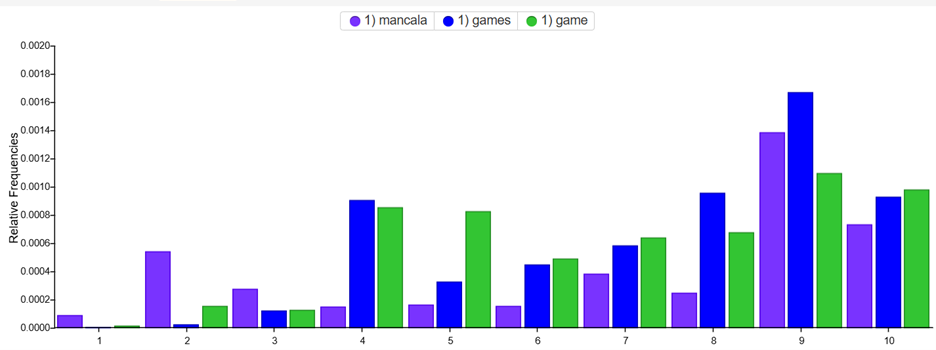
Our analysis also shows that the name “mancala” was often employed as an umbrella word that refers to any game played on a board with rows, and holes as shown in the following excerpts: “mancala is again played on two rows of six holes and sometimes longer rows are attested as well”; “One of the most popular board games that is played in many African countries is mancala;” “mancala” is a broad term referring to a class of board games featuring two or four rows of cup-shaped holes and using various pieces, such as seeds, stones, or shells.”
The following excerpt further evidences the generic use of mancala to refer to any board game with a board, holes, and rows:
The family of Mancala games is a famous, favorite, and one of the oldest representatives of board games ever … The term “mancala” comes from the Arab word “nagala” for “move” …this group of board games commonly consists of two or four rows of cup-shaped holes (pits) in which a proportionate number of counters (seeds, stones, shells, etc.) is placed.
Furthermore, our analysis also shows that even in instances where a different name is employed, the name mancala is still mentioned to somehow demonstrate that it is the reference, and most recognizable term for these games.
In Africa, the mancala board game is also known as Bao…Other names given to mancala board games in Africa are ayo, gabata, soro, and Wari…. The name Ayo for a mancala board game is from Nigeria, while Wari is from Senegal… Mancala is a name given to a family of board games… Bao is considered the most complex mancala game played on a board with four-row of eight holes and enlarged holes in the middle…. Bao is played by two people at any one given moment.
Implications of “Mancala” Use on African Games
The names assigned by the communities playing these games were sometimes present in our data; yet, when mentioned, the word “mancala” was added to indicate similarity or affiliation to “mancala” games family. The term “mancala” has become essential for any research related to these classic African board games. In effect, even when using the playing community game name such as Ntxuva, Ayo, or Bao, mancala is often mentioned to situate the game within the analog game literature. Yet, mancala robs these games of their connection with the communities and ethnic groups they are part of. The term “mancala” participates in the erasure of the history of these ethnic groups or communities. We contend that the name “mancala” is the manifestation of the colonial project that seeks to annihilate African names and beliefs. The various names identified in the literature (e.g., Songo, Boa, Oware, and Tsoro) embody the memory, history, experiences, values, culture, worldviews, and realities of the respective communities. Indeed, these names reflect these communities’ philosophy, conception of time and space. Hence, researchers using “mancala” as a generic term for classic African board games are imposing this term on ethnic groups’ game names. They also ignore or dismiss these communities’ contributions to the history of games, and gameplay in the world. Board game research is colonizing these African communities by using “mancala” as the umbrella for all classic African board games. Yet, these communities game names reflect different ethnic groups and communities’ values, norms, way of being, living, and even approach to life. These games experience in the game studies the erasure that multiple communities in Africa underwent during colonization:
In African culture properly understood, names and labels are central to the human quest for life, development, and fulfillment. They locate both the individual and his/her society in time and space, serving as embodiments of memory, repositories of spiritual and emotional experiences, and expressions of the existential realities of a given people.
It is worth noting that other names have been used to organize classic African board games: for example, “count and capture” and “sowing games” as other names for these games. It should also be noted that historically, anthropological work in Africa has been rooted in the hegemonic colonial discourse that represented Africa and Africans as savage. Ethnographic texts were written by anthropologists that were either “reluctant imperialists” or willing co-conspirators in imposing theoretical ideas and practices. In these early ethnographic texts, the authors often did not care to know what Africans thought and anchored the African body of knowledge (including their description or classification of classic African board games) within foreign discourses and within “a western epistemological territory”—there “they remain colonized and thus beyond adequate representation and understanding.” These ethnographic texts’ portrayal of African worlds as well as classic African board games are a) distorted in the expression of these realities in non-African languages, and b) modified by anthropological and philosophical categories used by western scholars. We argue that even suggesting another generic name for these games, as explained above, implies defining, co-opting, and colonizing these games within Western paradigms, dismissing their African realities, African knowledge, and African conceptual frameworks. Furthermore, suggesting a generic label for these games continues to ask these ethnic groups to express their realities in a foreign language, taking away their agency and their freedom to express their realities in their own terms. In the following section, we examine the names of a selected number of games often referred to as “mancala.”
Why Classic African Board Games Names Matter
Classic African board games such as Ayo Olopon, shortened as “Ayo” are often classified as “mancala.” Ayo is often assimilated to other classic African board games such as Awele or Omweso, given that the “mancala” label in the literature helps morph them into one identical game. In other words, discussing “mancala” often means discussing all classic African board games. For instance, Maxwell Mkondiwa explains that “there are hundreds of variants of mancala games in Africa.” In a similar vein, Alex de Voogt argues, “Mancala games are commonly defined by the appearance of the boards and mode of moving the pieces. The similarities have led to the belief that most mancala games are historically related or that they may be identified by appearances alone.”
However, the game Ayo Olopon is the name utilized by the people of Yoruba descent in the southwest of Nigeria. Ayo means seeds, whereas Olopon means seed holder. The name is based on the farming structure or agricultural system of the Yorubas, where they were expected to harvest crops and the seeds utilized for the game. Historically, the Ayo game was not just played for entertainment but also for the early mathematical skills to be acquired amongst the Yorubas. The seeds used for Ayo gameplay were mostly from a fruit called “Agbalumo” (also known as the African star apple). Ayo is rectangular in shape and consists of 12 holes (six on each side) with four seeds per hole making a total of 24 seeds (Figure 4).
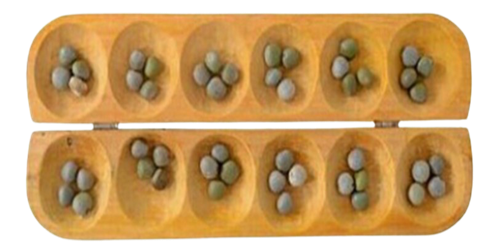
Oware, pronounced as “O-Ware,” is a popular game among the Akan people in Ghana. It is a game of the ancestors, which was typically played by kings and their collaborators, and is used to assess the intellectual abilities of the respective players and a demonstration of players’ intelligence. Ware means “let me marry,” while Oware means married in Akan language, which explains why the game is also played to assess the trustworthiness, behavior, and character of a potential spouse. Oware is played with seeds called Oware Aba/Setswana; they are seeds from a tree of a similar name. A popular proverb linked to Oware game reads as follows: “Ntim Gyakari asoa ne man abo no Feyiease,” which means “Ntim Gyakari was a brave man who didn’t respect anyone; for this reason, he carried his own country from Denkyira and destroyed it at Feyiease.” This proverb is often used to state that anyone who refuses to listen to advice will encounter evil or insurmountable difficulties; therefore, it is critical for anyone to listen to elders. The meaning of the game name among the Akan ethnic group, the historical context of its gameplay, and the proverb attached to its gameplay, show the uniqueness of Oware among the Akan. Oware is often in a circular or rectangular shape with 24 seeds and 12 holes (Figure 5).

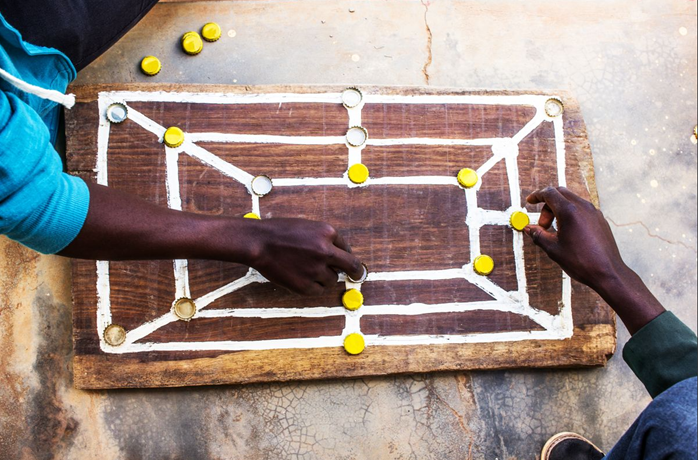
Morabaraba is a southern African game played extensively by the Sotho, an ethnic group that can be found in both South Africa and Lesotho. The word Morabaraba is derived from the Sotho language word moraba-raba which means to go round in a circle. Morabaraba is said to have been historically used to teach herd boys strategic thinking and tactics when dealing with cattle. The Sotho are known for milling and cattle hearing, and Morabaraba is played by two players, each having twelve “cows” of different colors. The playing pieces being called “cows” speaks to the activity of cattle hearing popular among the Sotho people in South Africa (Figure 6).
Conclusion
The names of the few games discussed above show the relationship of these games with the history and practices of the ethnic groups that have been playing the game for centuries. The name “mancala” used in the literature to group and label these classic African games erases the history of these games and of these communities as well. Indeed, we argue that the use of “mancala” continues to colonize these games often negating the contribution and connection between these games and their respective ethnic groups. We argue that these game names capture the existence of these ethnic groups or communities; the names give to these communities a voice, and a “presence [that] colonialism had done everything to deny, suppress, and ultimately destroy.”
While we have only used three examples of games to highlight the critical role of names and labels in researching African games, we argue that naming is important for research in any field. The comments made here are relevant to a wide range of fields/disciplines. As shown above, we argue that naming games appropriately can avoid ambiguities, while ensuring researchers accurately represent the phenomenon or object understudy. “Mancala” as a term when employed participate in the colonization of African games in analog game studies, and with this study, we are calling for the decolonization of the field in relation to classic African board games.
–
Featured image from: https://commons.wikimedia.org/wiki/File:Game,_Pallaanguzi_1.jpg. CC BY-SA 3.0.
–
Abstract
This paper discusses the term “mancala “and the implication of its use as a generic term for all classic African board games with holes, and seeds. We textually analyzed recent literature on classic African board games; we address the use of “mancala” in the literature. We focused on the names of three classic African board games and discussed these games names and the historical relationship between the game name and the ethnic group to argue that history, culture, and identity erasure happen when mancala is used as a generic term to classify these games. Mancala reflects the dismissal or neglect of African communities and ethnic groups contribution to the expansion of knowledge about games and gameplay. As shown by the literature of different fields, we contend that precise and appropriate use of names limits ambiguity, and even prevents the erasure of a group’s history, creativity, and game design approach.
Keywords: mancala; African classic board games; names; board games; African games, label
–
Dr. Rebecca Y. Bayeck is an Assistant Professor in the department of Instructional Technology & Learning Sciences at Utah State University. She holds a dual-Ph.D. degree in Learning Design and Technology & Comparative International Education from the Pennsylvania State University. Her research lies at the intersection of learning sciences, educational technology, literacy studies, and the interdisciplinary field of game studies. She is also interested in how culture shapes learning and literacy practices in different environments.
Joseph M. Bayeck is a researcher and educator. His research interests are at the intersection of learning, race, and culture. At this intersection, he also explores ways to leverage culture, technology, and mentoring to improve the learning experiences of minoritized student.
Dr. Olu Randle is a Game design Lecturer at the University of the Witwatersrand, South Africa. His academic research interests include video and board games design; video games as a tool for preserving African culture and history. He is also involved in the utilization of Machine learning techniques in improving performance of video and board games.
]]>I rely heavily on the work of Meriläinen, Stenros, and Heljakka for the theoretical scaffolding of this article. In particular, I adopt their naming conventions for the larger hobby within which miniatures wargaming is located. “Miniaturing” is theirs, referring to the meta-hobby of using miniatures. The term “miniaturist” is my own, derives from their work, and refers to those engaged in miniaturing.
Miniatures wargaming is a type of analog game in which two or more players recreate battles of various scales through the use of miniatures and, for the most part, three-dimensional terrain. Each miniature is a representation of an individual person or, rarely, unit on the battlefield. One of the few definitions of miniatures comes from games studies scholars Meriläinen, et al., who define them as “scaled-down metal or plastic representations of historical and fictional characters, creatures and objects, typically used for gaming and display purposes.” Participants assemble and usually paint miniatures prior to play, and miniatures range from fidelitous recreations of historical soldiers to sci-fi Space Marines to fantasy elves or orcs. There are hundreds of such games, depicting a range of historical periods and literary genres. The presence of the miniature and terrain are necessary components of miniatures wargaming. The more general term “wargame” also includes two-dimensional analog games such as Panzer Leader by Avalon Hill. Those games are more akin to complicated boardgames such as Stratego, and most often use cardboard “chits” as playing pieces.
Analog Taxonomies
There are multiple types of analog game, each with their own specific practices, including: boardgames (which includes board-based wargames of the old Avalon Hill style), card games (which includes games like Magic: The Gathering as well as older games like poker), tabletop role-playing games or TTRPGs (such as Dungeons & Dragons), and miniatures wargames. Of these, the miniatures wargame has received the least attention in game studies literature.
The contours of the miniatures wargames industry closely mirror those of the role-playing game industry. Within that industry, Dungeons & Dragons (D&D) has become so dominant that the brand name is synonymous with role-playing as an activity. D&D, along with Magic: The Gathering, keeps Hasbro profitable. A singular publisher also dominates the miniatures wargames industry. There, the dominant company is Games Workshop, producer of the Warhammer series (this includes Warhammer Fantasy Battles, Warhammer: Age of Sigmar, and Warhammer 40,000, henceforth referenced as WFB, AoS, and 40k, respectively). Games Workshop is at least as dominant in miniatures wargames as WotC is in tabletop role-playing and card games, and nearly as profitable, with revenue in 2022 of £385 million. Further, Games Workshop is a comparatively healthier company than WotC parent company Hasbro; it is regularly one of the top performing stocks on the London Stock Exchange.
That miniatures wargaming has received less attention than other analog games is surprising, not only because of Games Workshop’s financial success, but because histories of modern games, whether digital or analog, find their common starting point in the miniatures wargame. Miniaturists often consider Little Wars by H.G. Wells the precursor to modern miniatures wargaming. While drawing from the older wargame Kriegsspiel, which uses wooden blocks to represent soldiers, Little Wars popularized the usage of miniatures in wargames. It was also one of the first wargames of any type made for a popular audience. Little Wars served as inspiration for the creation and design of D&D, as creator Gary Gygax has noted. In turn, D&D served as the model for computer games such as the Ultima series and World of Warcraft. A chain of influence stretches from the first military wargames through modern tabletop role-playing games to today’s technologically sophisticated digital games.
Miniaturing as a Practical Framework
Today, miniatures wargaming constitutes a distinct mode of play and craft. This section describes miniatures wargaming in a formal sense. Much of the history of miniatures wargaming is left to a network of non-academic blogs, forum posts, and popular press works. These are quite useful. Zhu Bajiee’s examination of early Warhammer’s left-wing satirical history is exhaustive in its analysis. Nonetheless, there is often confusion around what miniatures wargaming is. Mikko Meriläinen, Jaakko Stenros, and Katriina Haljakka offer the most comprehensive analysis, based on a qualitative survey of the practices and attitudes of Finnish wargamers. They posit that miniatures wargamers do more than just play, paint, or imagine. They engage in a complex assemblage of interlinking and overlapping practices, which they call, simply, miniaturing.
The “pastime” of miniaturing, according to Meriläinen, et al, include practices of crafting, gaming, storytelling, collecting, socializing, and displaying/appreciating. Miniaturists engage with these practices to varying degrees. Some do all of them, others practice one to the exclusion of others. Tournament players provide an example of the latter. Tournament players “chase the meta” (i.e. pursuing maximum efficiency and competitiveness) of a given miniatures wargame by cycling through armies in the hopes of building the most powerful force for competitive play. They frequently hire others to assemble and paint their armies, are uninterested in storytelling, and collect only temporarily before selling and moving on to the next army as the metagame shifts. This situation around tournament play creates a small but vibrant economy of professional painters, such as at White Metal Games in Raleigh, NC, who eke out a living by doing the craftwork which tournament players eschew.
Meriläinen, et al. make special note that, of these practices, crafting and gaming constitute the “dual core” of miniaturing. These two practices are most prominent in their survey responses and serve as a precondition of sorts to the others: miniatures are bought unassembled and unpainted, necessitating at the very least some amount of assembly and the social expectation that they be painted (even if someone else does this work), while playing games with miniatures is the presumptive primary activity for which they are used.

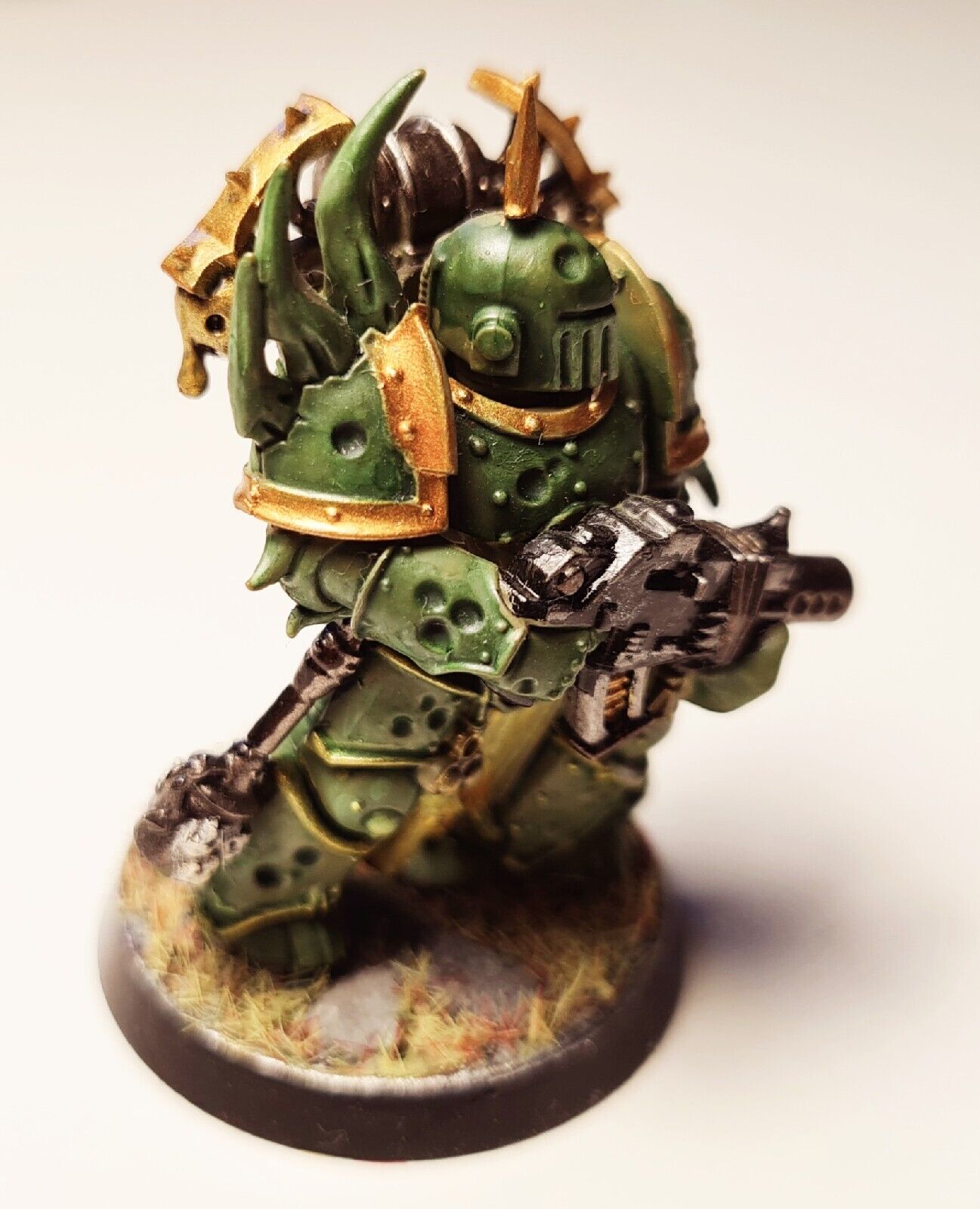
The fully-assembled and painted miniature is a small statue, most commonly between 28-32mm. It does not start out as a statue but as of a set of disconnected parts on a frame (in this case plastic), called a “sprue.” The sprue is an artifact of the miniatures production process; whether through injection molding in plastic miniatures or a process called “casting” in metal miniatures, sprues provide stability to the shipped product, lowering shipping costs by decreasing their physical footprint and weight, and as a means by which workers remove miniatures from their molds.
Individual sculptors create miniatures in artisanal fashion. They are sculpted by hand, in clay or epoxy, or with digital sculpting computer-aided design (CAD) software. When the individual statue is complete, it is broken down into multiple parts for mass production and shipping. At this stage, it ceases to be a statue. The miniatures are mass produced by the hundreds or thousands for shipping to hobby stores. There, miniaturists buy them before assembling and painting them. Every miniaturist crafts, if only by putting the miniature together. Not everyone paints, even though the community prefers that miniatures be painted. Those who do usually paint to what is colloquially called “tabletop standard,” a barebones approach which ignores rigorous shading and highlighting in favor of block colors. Others paint their miniatures in lavish fashion for display in their homes or on the internet. While craft remains core to the miniaturing pastime that Meriläinen, et al. describe, there is a spectrum of intensity to the individualized practices that reflects the diversity of commitments within and across miniaturing communities.
Art blogger Patrick Stuart argues that miniatures are the most popular statues in history and the first that people have regularly painted since Ancient Greece. He attends to how people use miniatures, emphasizing the importance of gaming in miniaturing even for those who do not game with them: they are designed as they are because they are meant to be played with. According to Stuart, the ubiquitous Space Marines of Warhammer 40,000, with their large, rounded shoulders and menacing poses, look the way they do “because the player is always looking down on them from above — and they need to pop against a mixed background.” Put another way, even the miniaturist least invested in gaming assesses a miniature in its capacity as a game piece, not in spite of it.
From Miniaturing to Miniatures Wargaming
Meriläinen, et al. stress that “Miniaturing is a particularly material pastime.” This phrasing contains within it two demands. One, the observer must note the particularities of miniaturing, which carry over to the broader milieu within which miniaturing exists, i.e., the game, and even more specifically, for my purposes, the miniatures wargame. Two, all games are material,but miniaturing and its associated games have an especially intense focus on the material. As Meriläinen, et al. note, “The pastime features a constant interplay of the material and the immaterial: the miniature serves as a focus for activities, and the activities contextualize the miniature.” This is not merely an intellectual exercise. Games Workshop considers Warhammer intensely material. One of the differences between Games Workshop and WotC is that the former insists that there will never be a 1:1 translation of Warhammer to the digital. There are video games based on Warhammer, but no exact digital copy of the tabletop game.
While Meriläinen, et al.’s analysis is rigorous and foundational, it is not exhaustive: while they do a thorough job of theorizing the miniaturing pastime, they provide no definition of what a miniatures wargame is. Their interest lies in the use of miniatures in a variety of analog games, rather than in wargames, specifically. For instance, players expected the presence of miniatures in early D&D play, though such miniatures were not required and were used in smaller quantities than in miniatures wargames. Some boardgames, such as Gloomhaven and Descent, also use miniatures. Miniaturing practices, expectations, and norms differ across the various analog games where they are used or present. Meriläinen, et al. note that miniaturing as a pastime contains within it “a number of contentious areas.” As a lifelong analog gamer, for instance, I have observed that the social expectation that miniatures be painted is more intense within miniatures wargaming circles than other analog games communities.
The use or presence of miniatures alone is not what makes a miniatures wargame a miniatures wargame, even as it is true that the use of miniatures is the basic precondition for a miniatures wargame to exist. With Meriläinen et al.’s exhortation to pay attention to the particulars and materiality of miniaturing and, thus, miniatures wargames, in mind, I return to what I consider to be the main elements to a miniatures wargame: the centrality of the table to gaming, the use of non-discrete movement, a particular order of operations in play, the use of bricolage to populate the game space, and the centralized production of miniatures wargames. My elaborations upon each of these, in turn, are informed by my status as a longtime miniaturist and as acafan. I am both participant and observer, and my definition builds on my knowledge of and experience within miniaturing.
1) The Centrality of the Table
The centrality of the table is the distinguishing aspect of miniatures wargaming, even more so than the presence of miniatures. The table’s notability here seems odd. After all, aren’t all analog games played on tables of some sort or another? The answer is yes, but nowhere else does the table organize proceedings to the extent that it does in miniatures wargames. Space is a major consideration. Miniatures wargames require a larger spatial footprint than other analog games. The traditional size of a miniatures wargame has remained remarkably uniform for most of the form’s history at 6’x4’. When WFB launched its third edition, in 1987, the recommended table size was 8’x 4’ but Games Workshop quickly adjusted to the more standard 6’x 4’. Taking cues from the industry leader, these dimensions were de rigeur until recently. Compared with other analog games, these spatial requirements are enormous. A standard home has room for only one table, while even large stores and gaming clubs are limited in the number of tables they can provide.
The standardized table dimensions are important due to the use of measurement and perceptual grids rather than the designer demarcated grids that one sees in boardgames. This mode of gaming, in which players measure in inches and may move their miniatures in any direction, creates a form which is hungry for space. That hunger for space creates something of a tautology within the miniaturing culture: I need more space to fill with miniatures and I fill it with miniatures because I have more space.
A boardgame or card game takes place on a table, but its dimensions are set to something smaller than the entirety of a table—you play Settlers of Catan on a portion of your kitchen table, leaving space between the various boards and cards for drinks or snacks. Miniatures wargaming takes place over the entirety of the table, which miniatures wargamers consider a sacrosanct place. They do not place drinks on it, and they never roll dice too close to the miniatures for fear of knocking them over. While Johan Huizinga’s notion of the magic circle has fallen out of fashion in game studies because it tends towards a transhistorical definition of play, it is useful here: the miniatures wargaming table creates a conceptual barrier to certain modes of engagement relating to the table and what is upon it. Nicholas Taylor cautions against reading the magic circle as truly magical despite the enduring allure of escape from “everyday cares”: the magic is underpinned by a host of material conditions related to gender, race, and class. The widespread no drinks on the table rule illustrates miniatures wargaming’s allure as a means to withdraw from and refuse feminized domestic labor.
The table is ordinarily beneath notice, both figuratively and literally. The gamer pays attention to what is upon the table (the miniatures, the terrain) but rarely thinks of the table explicitly. It is always, however, at the back of their mind as a physical presence which makes the game possible. The miniatures wargamer might have a dedicated space for playing—a “man-cave” (and it is almost always a man-cave, given the overwhelmingly male demographic of the miniaturist)—defined specifically by the presence of the table. The table is always near at hand linguistically and socially: in miniatures wargaming parlance, to remove all of an opponent’s pieces from the table is to table an opponent, a verb-form acknowledgement that the table is an active participant. To have the same done to you is to be “tabled”.
Jason Edwards, via Henri Lefebvre, notes that ‘Space… does not denote an empty void or the given physical environment in which human beings live. Space is rather the social space produced by the material practices of human beings.”The miniatures wargaming table reconfigures space in its immediate location. A table becomes a social relation rather than a thing. As a personal example, most of my miniatures wargaming takes place in my brother’s gaming room in Greensboro, NC. We withdraw upstairs and sequester ourselves away from the rest of the house by playing games for hours. Dominating the room is the miniatures wargaming table, a fact which denotes the space for miniaturing. The gaming room is a space for playing games, which are themselves a particular set of social arrangements shaped by the presence of a dedicated wargaming table. When we are there, we play. When we eat, we go to the dining room. When it is time to talk about politics, philosophy, or work, we go to the porch.
Not everyone has the free space or money to commit to such a configuration. A friend and colleague plays 40k with his daughter on his dining room table. For the duration of their games, the dining room table is not, in any important sense, a dining room table. The social function of the entire room changes from a domestic space to a play space. When the game ends, the social function of the room shifts once again. Physically, the table is the same object. It is our relation to it which changes and, in so doing, it changes us. However we use it in any given moment, the table is integral to our configuration of sociality around and upon it, where (at the appropriate time) a game’s rules both adhere to and help to determine certain social conventions related to its presence.
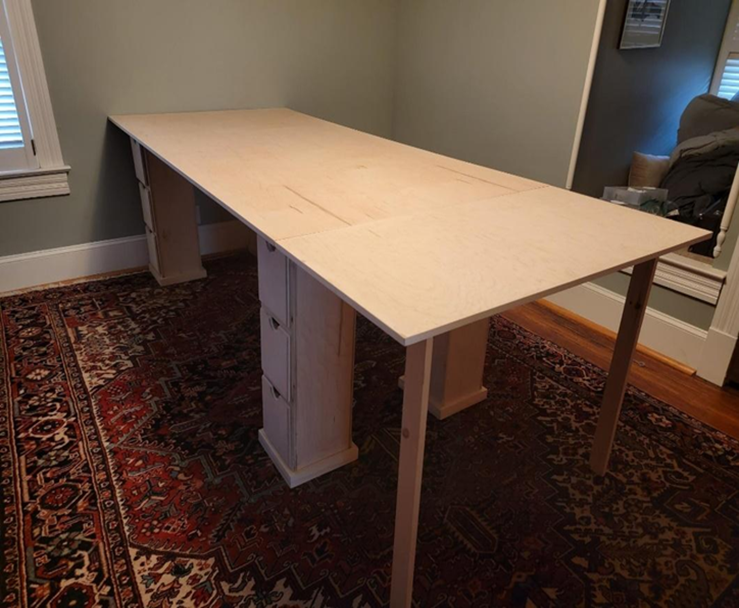
The shifting yet always central role of the table to the miniatures wargame is not limited to domestic spaces. In the North American context, games most often take place in hobby stores, while in the UK they occur in miniatures wargaming clubs. These clubs are organized along the lines of other civic clubs, with dues and elections. The club model creates a different set of social expectations than in the commercially oriented hobby stores. Both have large wargaming tables, but the sociality around them changes: the hobby store prominently places paints and miniatures near the miniatures wargaming tables to drive impulse sales, while the miniatures wargaming club holds its meetings in a public space. Alexandra Kviat, in her sociological survey of how people encounter various spaces for board games (cafes, homes, clubs, and stores), notes that her participants felt uncomfortable and rushed when playing in stores when compared to clubs and cafes. This is especially true of women she interviewed, who felt unwelcome by the heavily male clientele of gaming stores.
This set of relations links to political economic concerns which miniaturists are barely aware of, if at all. Starting in 2020, Games Workshop moved away from the decades old 6×4’ standard for their games. Replacing it were odd sizes: 44×30”, 44×60”, and 44×90”, depending on how many miniatures are in play. During qualitative research at a miniatures wargames studio in Nottingham, UK, I expressed my puzzlement at the shift to a man who used to work at Games Workshop. It turns out he was privy to the meetings where the table size changed, and the answer was simple. The new table sizes, disrupting the settled upon standard going back at least 30 years, mapped to the sizes of the most popular IKEA tables. Games Workshop had relevant sales data, calculated that IKEA makes the most popular tables in the world, and changed their design paradigms accordingly. The ramifications to this decision are important: designers need to adjust rules, the number of miniatures Games Workshop sells changes, and gaming’s implication in global supply chains takes on more .
Miniatures wargaming tables do not have pre-printed grids on them except for a very few games, such as BattleTech (which also has rules for playing without a grid). The above picture of my group’s regular table should be taken as a standard set-up and suggests the next primary pillar of miniatures wargaming: the use of non-discrete movement.
2) Non-discrete Movement and Seeing the Grid
Avalon Hill’s games typify the used of gridded movement in the early commercial wargame. These simulate large scale conflicts such as the American Civil War and various World War II battles. While classified as wargames, this style physically resembles boardgames: the games take place on a board with demarcated hexes or grids for gaming purposes and rarely, if ever, contain miniatures, opting instead for small cardboard representations of the statistical quality of soldiers, tanks, and the like (see Figure 5).
Miniatures wargames are different. Games take place on a table, as detailed above, but there are no grids or hexes. These games always use miniatures, and the battlefield terrain is three-dimensional, often consisting of elaborate crafting projects in their own right, as I detail below. In the absence of grids, players use measurements in order to determine how and where individual miniatures move. Measuring distance in a grid-less play space comes with the attendant accoutrements of such activity, such as tape measures. Miniatures wargame designers Ford and Hutchinson refer to this as “non-discrete” movement.
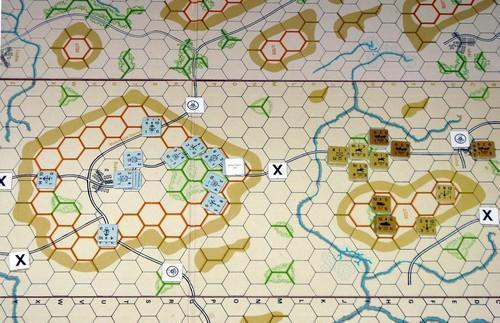

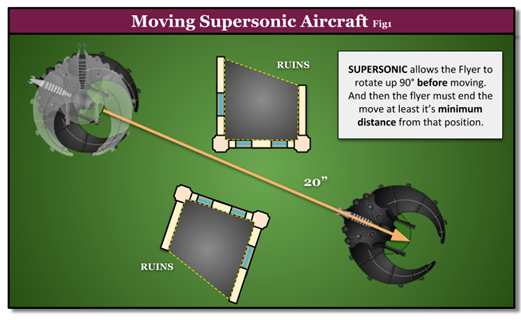
The above photos provide examples of these differences. In Figure 4 is Avalon Hill’s Panzer Leader. Note the hexes and small cardboard playing pieces. Figure 5 shows a game of WFB, with its miniatures, larger gaming space, and lack of grid. Lastly, Figure 6 shows a tutorial image for how to move aircraft in 40k.
The tutorial image is of particular importance. There is a grid, but it is not pre-measured and imprinted upon the play area. Rather, the grid is perceptual and imposed by the players through the use of non-discrete movement during play. Here, 40k serves as a pedagogical tool for a specific way of how to map space in a grid and by measurement. The openness of a miniatures wargame obfuscates this approach. If I have a particular miniature which can move 6” per turn, then I am drawing imaginary lines of 6” each turn with the aid of a measuring device. I anticipate my opponent’s movement in turn.
As Bernhard Siegert and Geoffrey Winthrop-Young note, the imposition of gridded perceptions underpins Western conceptions of space. Miniatures wargaming is a part of this way of conceptualizing space. During play, game movement is non-discrete and detached from a printed grid, but a perceptual grid is always in mind. During play, a way of seeing and thinking arises as a game plays out over the perceptual grid, one which merges “operations geared toward representing humans and things with those of governance.” I measure the space, myself, and it is to be advanced through, taken, or held. Using Siegert and Winthrop-Young’s theorizations of the grid, to impose a grid upon a gridless table is to govern and control it. The perceptual grid imposed in play upon the table is part of an assemblage of multiple such grids. The miniatures wargames table is either square or rectangular. When within a square room—that is, most rooms—it is a grid within a grid. If we zoom out once more, the room is one square room amongst others, in a square house on a city block. While such thinking exists within the boardgame style of wargaming, it is the player’s own control over the measuring and occupation of unmeasured space which intensifies this mode of thinking.
This mode of thinking about space becomes dominant during the Napoleonic Wars. Not coincidentally, this is when the first modern wargames arise. The requirements for ever more meticulous war planning during the Napoleonic Wars gave rise to wargames in which representations of troops and supplies were modeled as and through wargames. The new wargames were representative of and derived from new ways of thinking about space and logistics as they came into being during early 19th century modernity. The book Empire of Chance by Anders Engberg Pedersen traces the rise of statistical ways of thinking, particularly about space and time, to this period. He notes that new modes of measurement regarding logistics, mapping, measurement, and combat which coincided with the Napoleonic Wars created the conditions of possibility for those same innovations to be applied to other spheres of life and economics throughout the 19th and 20th centuries: modern efficiency regimes, total war, the rise of advanced supply chain logistics, and colonial depredations in Africa. Officers of the time modeled a tremendous amount of math which prior wars did not have. Logistics were considerably more complicated with the rise of transatlantic trade and supply routes, while the Napoleonic Wars saw troop movements across Europe and North Africa rather than in comparatively smaller areas of past wars.
The movement of troops and supplies demanded mathematical modeling: how far can Army A move before encountering Army B? Can I, as a general, push Army A faster and at what cost? Will Army A be undersupplied with munitions if it does so and what does that mean for the inevitable conflict? New battlefield technologies such as advanced artillery and early rifling compounded these concerns. The legacy of this logistical and spatial planning is still with us today in the miniatures wargame. While miniatures wargames invariably model the tactical, rather than strategic layer of conflict, the intent of these games is to model precision in movement and supply.
The wargame as tool of war did not remain within its bounds for long. As wargames and miniatures wargames were commercialized in the 20th century, a specific order of operations to play developed. This order of operations remains even after the even later development of role-playing games and still differentiates the two.
3) The Order of Operations in Miniatures Wargaming
The miniatures wargame, much like the tabletop role-playing game, contains a strong element of storytelling aimed at creating co-authored, spontaneous, improvisational narratives which arise during the circumstances of play. How players achieve this differs from tabletop role-playing, however. In a tabletop role-playing game, each player creates and portrays a single character. Character creation precedes conventional play: rolling dice, fighting villains, gaining experience, and the like. Character creation may be elaborate or complex, but in all cases aims to set the stage for the improvisational play to come. For example, in a study comparing role-playing to stage acting and improv theatre, Sarah Lynne Bowman writes, “Role-playing is most similar to improv in that players enact spontaneous, unscripted roles, but for longer periods of time in a persistent fictional world. Additionally, role-playing involves a first-person audience rather than external viewership, meaning that the other role-players are the only audience members and are also immersed in their roles.” This is not to say that role-playing game play is scripted; it is not. Instead, the role precedes and is vital to the ensuing act of play. As role-players design a role for themselves as a first-person audience, they find themselves in the position of playwrights as well as actors.
As tabletop role-playing games developed, design increasingly focused on rules which allowed for ease of dramatic portrayal in addition to combat effectiveness. The 1991 publication of Vampire: the Masquerade is exemplary. Key to the success of Vampire (and the broader World of Darkness series of games which followed) are a suite of character creation rules codifying personality and mental traits during character creation. Character creation in Vampire is complex and time-consuming, most notably in its “merits and flaws” system, whereby players pay for advantages and disadvantages with points, providing a mechanical link to character portrayal. Players spend enormous effort developing elaborate backstories to justify the mechanics (and vice versa).
John Cocking and Peter Williams, designers of the tabletop role-playing game Beyond the Wall and Other Adventures, refer to this sort of pre-game creation of player characters in TTRPGs as the “lonely fun time” problem. They use the concept of “lonely fun time” to describe the counter-productive use of time writing elaborate player character narratives while scouring rulebooks in order to align mechanics with conceived role. While their description is tongue in cheek, it speaks to a persistent problem within role-playing design in the post-White Wolf era. A similar wariness permeates the upper echelons of successful role-playing design in the 21st century, as current trends skew toward lighter, group-oriented character creation and play. Designers of the popular role-playing game Apocalypse World describe their approach as “play to find out what happens,” or in other words, the nuances of character creation occur through communal play rather than in solitary exercises.
“Lonely fun time” also reflects a specific order of operations in conventional tabletop role-playing games: first you design a character with a backstory, then you enact the role according to the expectations a backstory would suggest. The largely solitary creation of character backstory is regardless of what the other players, with their own backstories and lonely fun time, might desire. A mighty warrior born in a rural village would be expected to behave differently from a weak wizard raised on the streets of a large city, to use common tropes from Dungeons & Dragons. The sort of solitary creation which typifies “lonely fun time” is no longer uniform in TTRPGs. Rather, it is a problem which TTRPG designers have sought to address in various ways (e.g. establishing intra-character relationships at character creation) over the past 25 years, most notably during the foment of the early 2000s indie TTRPG scene. In other words, whatever one calls “lonely fun time” it has been a known design issue in TTRPGs dating back 25 years, if not longer.
In a miniatures wargame, the order of operations is reversed and hence “lonely fun time” has never been a significant design issue. Each player controls dozens, sometimes hundreds of figures, each one representing an individual soldier or unit: an army of ciphers. It is impossible to offer unique characterizations for each individual. This is not to say that there are no attempts at such characterizations, merely that “lonely fun time” is impossible in a miniatures wargame. Personal backstories are not relevant, at least not to the same degree, even in smaller scale skirmish games. A 40k player may concoct a backstory for a Space Marine unit—for instance, that they are veterans of countless wars—but that backstory does not define the unit’s in-game behavior beyond the barest of statistical measurements (e.g. a Space Marine veteran unit has better weapons). The backstory is for pleasure, rarely manifested in rules beyond the aforementioned statistics, and always returns to the physical presence of the miniatures, themselves. As Meriläinen, et al. put it, “The fiction and the physical miniature exist in symbiosis: the figurine can be an expression of the fiction, crafting it both a physical and an imaginative act. Reciprocally, what happens to the miniature in crafting and in play feed back into the fiction.” Most of the pre-action expression in a miniatures wargame materializes in the craft practices of the miniaturing pastime, as the miniaturist paints their miniatures in unique ways or converts (i.e., customizes) them. These expressions have little effect on gameplay. Although many tournament organizers give points for well-painted miniatures, a better painted or highly customized army does not roll or maneuver better than one which is unpainted grey plastic. In the inverse of a TTRPG, stories in miniatures wargames arise almost entirely out of moment to moment play.
One other significant pillar of miniatures wargaming derives from the intersection of table, non-discrete movement, and storytelling through miniatures. A table without grids must be filled with terrain in order to play and, in order to maintain consistency in storytelling and aesthetics, it is often hand crafted.
4) Bricolage, Craft, and Terrain
Craft is an integral part of miniaturist practice, but it is also necessary to play a miniatures wargame. One of the hallmarks of miniatures wargaming is that the table changes with each game. A miniatures wargame is not played on a uniform surface like a boardgame, with setup instructions and grids which are the same for each game. In a miniatures wargame, one places hills, forests, and buildings, never in quite the same place twice, even if the variation in placement is miniscule. To shepherd this style of play, miniatures wargamers need what is termed terrain or scenery. Terrain is crafted, too. At its simplest level, you can buy terrain, assemble it, and paint it, but there is a strong craft tradition in miniatures wargaming around making it from scratch. While there are vendors who sell two-dimensional terrain, they are small and make only rare appearances in store and club play.
Crafted terrain is usually made out of trash and household materials. You can see one of my pieces on my perpetually stained and uneven crafting table below (Figure 7). I made it for a game called Necromunda, an offshoot of 40k centered on warring gangs in the depths of a far-future industrial city. Fictionally, it is a vat of some sort of goo. I made it out of an empty almond tin and a hard drive bay, plus some of my daughter’s old toys. I added a tea light stripped of its casing. Then I painted it and made it look gross.
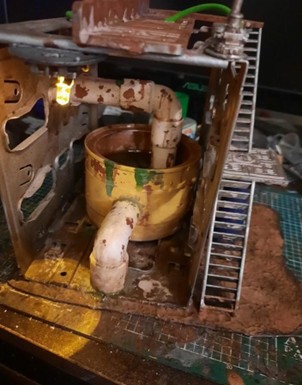
My creation of this vat is a form of bricolage, an assemblage of the discarded and leftover which creates something new. Bricoleurs rearrange and reassemble commodities to create new meanings, in this case the meanings transmitted by games. Necromunda takes place in a dirty, brutal world of advanced extractive capitalism. When I use trash in my terrain building, it transmits the themes and moods of that fictional world at multiple levels of signification. For this reason, Necromunda terrain is some of the most popular terrain to build: it is easy, because we do not know for certain what such a world looks like when it is real, but we recognize that we act as Necromundans by repurposing the detritus of industrial capitalism. The creation of terrain has become a sort of secret handshake amongst miniaturists, where it is a rite to examine terrain and figure out what it’s made from. The terrain crafter as bricoleur recognizes other bricoleurs.
In this last sense, terrain making resembles Hebdige’s designation of bricolage as subcultural language. Noting that “It is basically the way in which commodities are used in subculture which mark the subculture off from more orthodox cultural formations,” one could argue that the network of trash-obsessed terrain crafters, particularly online at sites such as The Terrain Tutor and Eric’s Hobby Workshop, resemble a subculture. They create hierarchies of distinction, with those who simply buy mass-produced terrain products separate from the more prestigious subculture of dumpster diving terrain crafters. Handcrafting terrain signifies expertise and subcultural cache, as the recognition of specific pieces of trash within the assembled bricolage of terrain becomes a marker of knowledge. The terrain bricoleur “juxtaposes two apparently incompatible realities,” in this case that of a fictional world and our non-fictional world of discarded commodities.
A final difference from other forms of analog gaming is in how miniatures wargames are made. I admit here that this is less a formal element of miniatures wargames play. Nonetheless, the distinctive production methods in the miniatures wargames industry set them apart from other analog game genres and influence their formal elements.
5) The Centralization of Production
Miniatures wargames production requires a high concentration of industry nearby for production at scale. At miniatures studios, all design, art, sculpting, and mass production usually take place in the same building. In my research visits, these locations have painting studios next door to the production room, which is next door to the distribution warehouse. The net effect is that there remains a centralization and concentration of miniatures production that persists where production of other analog games is more dispersed. This is not to say that there is no disbursement in the miniatures wargames industry, particularly in the age of cheap 3D printing, which presents something of an event horizon for the health of the industry, but that centralization is still the norm.
This centralization is most realized in Nottingham, UK. The concentration of miniatures studios is so dense that it is colloquially known as the Lead Belt, so named because miniatures used to be made of lead alloys. The concentration of miniatures wargames production in this specific local context leads to talent exchange, sharing of materials, and a sociality which influences design, as well as cultivating a common interest in topics (e.g. a particular interest in WWII and the Napoleonic Wars) and aesthetics.
Conclusion
I conclude where I began: I do not consider this article the final, settled definition of miniatures wargames as a genre of analog game. My impetus for studying the ludic and production elements of miniatures wargames derives from the relative absence of study of these matters when compared to other genres of analog game. Defining the miniatures wargame as simply an analog game which uses a lot of miniatures is not enough, partly because it is not true (skirmish games use few miniatures while some boardgames use many) and partly because noting the presence of miniatures does little to explore the specificities of the form. The centrality of the table, the use of non-discrete movement, the peculiar nature of game-derived storytelling, the prominent use of bricolage in terrain building, and the industrial/craft hybridity which necessitates a more centralized production than other analog game forms all distinguish miniatures wargames. I sincerely hope that my definitions entailed here spark conversation and pushback from experienced game designers and academics, alike.
–
Featured image by wirestock on Freepik.
–
Abstract
This article provides a preliminary description and definition of the miniatures wargame. Rather than defining the miniatures wargame via the use of miniatures, which is obvious, it locates the specificity of the miniatures wargame in the centrality of the table to play, the use of non-discrete movement, the prominence of bricolage style craft in customization and terrain building, the order of operations in ludic storytelling, and the centralization of the hybrid industrial/craft miniatures wargames industry. The article aims to spark discussion of the specificity of miniatures wargames as a genre of analog game.
Keywords: miniaturing, miniatures wargames, Warhammer, design, game production, game materials, craft, gaming table
–
Ian Williams studies relationships between craft and industry in the games industries. He received his doctorate in communication from the University of North Carolina at Chapel Hill. Prior to this, he was a labor reporter and cultural critic.
]]>
Tabletop roleplaying games (TTRPGs) remediate and remix various media and genres, and they are often part of larger transmedia storytelling projects. As Paul Booth explains, “Transmediation of games requires both the active participation of the audience as well as recognition of key attributes of the core medium.” Though Booth was speaking specifically about board game adaptations of The Walking Dead franchise, the same principle applies to roleplaying games. Roleplaying games, however, offer a different set of media and narrative affordances and constraints than board games. Consequently, a close reading of the “the key attributes of the core medium” is warranted. Scholars have considered the materiality and positionality of board games as media, studied TTRPGs’ intersections with transmedia storytelling, their mediatization, how TTRPGs facilitate the construction of narrative and immersion, how TTRPG systems facilitate identity and the transmission of cultural values, and more. Here I want to add to these conversations by looking at how transmedia adaptation in TTRPGs can often lead to what videogame designer Clint Hocking has described as “ludonarrative dissonance,” when the narrative and ludic elements of a game are at odds with one another—when it “suffer[s] from a powerful dissonance between what it is about as a game, and what it is about as a story.” While Hocking was speaking about how a videogame’s mechanics reflect or frustrate a story’s thematic elements, I hope to expand on the notion to explore how tropes and expectations from genres in transmedia spaces can further serve as sources for ludonarrative dissonance looking at two editions of the Marvel Super Heroes Role-Playing Game (MSHRPG).
In prior work, I have argued that TTRPGs are not a medium per se, “but rather a hypermedium comprised of several parent media, remediated and repurposed for the sake of the rhetorical action they’re intended to facilitate.” I see TTRPGS as a multi-modal genre—one that draws on various media to help participants meet the needs of a recurring rhetorical situation: the co-creation of a shared narrative.. As rhetorician Carolyn Miller explains, rather than static categories, genres are “typified rhetorical actions based in recurrent situations” whose definition “must be centered not on the substance or form of discourse but on the action it is used to accomplish.” Genres facilitate social action, inform (and are informed by) audience expectations, and more crucially, they draw on genre knowledge to address a new situation. Gamers participate in the genre of the tabletop roleplaying game session while drawing on several other genres like improv theater, fantasy novels, gaming rulebooks, and more. When weaving genres and media together to address a new rhetorical situation, game designers can draw on familiar genres and media—even if they are incongruous or inconsistent for the new situation such as drawing on crunchy simulationist mechanics for a more narrative-oriented game. In turn, many of the audience expectations, genre features, and media features can often conflict with one another. This flexibility and adaptability of medium and genre are what make TTRPGs so rich, but as this analysis will demonstrate, these conflicts can also exacerbate ludonarrative dissonance.
The practice of translating genres of fiction into roleplaying games (RPGs) has been a feature of TTRPGs for as long as they’ve existed. Dungeons & Dragons’ incorporation of Tolkien-isms such as balrogs, hobbits, and treants (though later with the more identifiable/brandable intellectual property or IP markers removed) is one of the earliest examples of this phenomenon, followed by Star Wars, Indiana Jones, Elf Quest, and so on. Recent TTRPG adaptations include Transformers and Avatar: The Last Airbender, both released in 2022, and 2023’s Marvel Multiverse Roleplaying Game (MMRPG), the latest in a long series of attempts by different companies at translating Marvel comics IP into a TTRPG. Given the increasing cross-pollination, transmedia storytelling, and cross-platform marketing that occurs in these spaces such as making unique D&D-branded cards for Magic the Gathering or invoking novels and other setting-specific IP for video games such as Larian Studio’s Baldur’s Gate 3, more attention to the work of transmediation in TTRPGs is clearly needed. As noted earlier, it is perhaps unsurprising that most of the scholarship on the topic deals with transmediation in digital spaces. Therefore TTRPG scholars and analog game designers can learn a lot from this earlier, pre-digital form of transmediation to think about how genre, mediums, rules, stories, and more interact and get remixed.
Specifically, I argue that roleplaying game designers who adapt existing media properties must navigate often conflicting or competing impulses in design informed by the affordances and constraints of various parent genre and media. I share a case study of two editions of the Marvel Super Heroes Role-Playing Game (MSHRPG), released originally in 1984 (which will be called “Original Set” for the rest of this essay) with a later revision into an Advanced rules set (which will be referred to as “Advanced Set”) in 1986. The MSHRPG is a fruitful site for considering transmedia in that it features the first adaptation of the Marvel comics superhero genre to the genre of “pen-and-paper” roleplaying game. The superhero comics genre is well established and features various well-known genre tropes, making this initial edition ideal to examine early transmedia adaptation.
The revision of the 1984 Original Set to the 1986 Advanced Set is particularly interesting because it demonstrates how even seemingly minor changes in the mechanics facilitate a vastly different play experience regarding fidelity to the parent genres and narratives. In remediating reader/player expectations and adjusting them to the “advanced” sub-genre of roleplaying games, ludonarrative dissonance of a unique sort is introduced to the game wherein attempts in the design to simulate “reality” conflict with the ability to simulate the sorts of narrative flow. Each of these editions also reflect the norms and expectations around gaming and comics during a pivotal time in both industries, highlighting the complex rhetorical interplay between comics audiences, writers, storylines, gamers, designers, and markets in each industry and hobby. As Henry Jenkins explains, “In the ideal form of transmedia storytelling, each medium does what it does best—so that a story might be introduced in a film, expanded through television, novels, and comics, and its world might be explored and experienced through game play.” However, a hypermedium like the TTRPG has several medial affordances and what it “does best” can vary depending on the needs of the given rhetorical situation, whether to provide a sort of systems granularity that supports “realism” or a broad resolution system that covers a swath of tropes associated with a particular genre of fiction such as comics.

Developing the Marvel Super Heroes RPG
MSHRPG finds its beginnings in a years-long homebrew game that designer Jeff Grubb ran for friends at college before his time at TSR, the company that eventually published the game. TSR was able to secure the license from Marvel, and TSR paired Grubb with Steve Winter to act as editor and coauthor. They began playtesting iterations of the rules with other designers and young children. Grubb and Winter aimed for a design that was accessible, that was easy to understand for first-time users, and that catered to casual comics fans. At that time, the comics industry was moving to the direct market, and as Grubb explains,
We were looking at a new game to break into, get a new audience, not sell it necessarily to the same group that was playing D&D, but sort of take that group and expand out on it. And at this time was when comic books were expanding as well with the direct sale marketplace. It used to be that if you’d go to the local drug store, you could buy the comics. They were there every month. Well, the direct sale market basically were working through a distribution channel, like magazines. And the direct sale market of comics, basically the shop got the comics directly from the printer. So they cut out the middleman and it was a way of making sure that you had all the comics you needed.
The effects of this shift were far-reaching for the comics industry, but for the purposes of this article, it meant that comics shops could cater directly to comics fans. This, in turn, allowed them to market ancillary products like action figures, t-shirts, posters, and more. MSHRPG, then, provided retailers with a novel item to sell to this fandom. RPGs were not commonly sold in these relatively new venues, so it enabled TSR to target a new audience directly. The desire for a new audience strongly influenced both the presentation and design philosophy informing the game: it would speak to the new audience’s familiarity with comics while instructing them in how to remediate that familiarity to the new genre.
The 1984 Original Set: Adapting Comics to RPGs
Style and Visual Cues
The Original Set of MSHRPG was packaged in a bright yellow box bearing cover art drawn by famed Marvel comics artist John Romita, Sr. It contained a yellow “Battle Book,” an orange “Campaign Book,” as well as a glossy cardstock foldout containing the full-color character art and game statistics for eight established Marvel heroes such as Captain America, Spider-Man, and The Thing. There were also several accessories such as a thick full-color cardstock block of “chits” for the map (to stand in for miniatures), two ten-sided dice, and a double-sided, full-color poster map. One side of the map showed a city neighborhood and the other various interiors to be used as a sort of “board” in the game. The game could be played in one of two modes: a boardgame-like battle simulation between the characters included in the set or a more traditional TTRPG. Accordingly, the two rulebooks differed from the typical division of a TTRPG rules of a players’ manual and a game master’s (GM) manual. Newer players could simply use the Battle Book to run MSHRPG like a board game, staging fights between their favorite Marvel characters. If they wanted to run a more traditional RPG-style game, they referred to the Campaign Book.
The black and white interior art largely came directly from the artists working at Marvel (the “Marvel Bullpen”), and the line art was provided by Al Milgrom, a regular Marvel artist known for adhering to the Marvel “house style” that was prominent at the time. The visual style of the books is thus in accord with what readers of Marvel comics would expect. Moreover, the books feature several examples of paneled sequential art to explain game concepts. The inside front cover, for example, depicts a six-panel sequence that alternates between scenes of the players at a table roleplaying the events and scenes enacted in the game world. Each panel is captioned with dialogue from the players or characters, demonstrating how the heroes stop a robbery. Rather than explaining mechanics, this bit of art explains the genre of the TTRPG through the medium most accessible to comics fans: comics. Other pieces of sequential art include a three-panel illustration depicting Spider-Man swinging down to scoop a dog out of the way of an oncoming truck. This sequence occurs below a textual explanation of the core mechanic of the game (the FEAT roll). The final sequence of the Battle Book demonstrates the basic combat mechanic of the game, captioned with explanations of the game mechanics facilitating the action in each panel. Finally, single panels are used throughout the text to illustrate various rules and mechanics, such as Spider-Man holding his breath underwater while being grappled by an octopus.
The Marvel visual style is reinforced by Steve Winter’s prose style, which very much mimics Stan Lee’s bombastic editorial and authorial voice from the comics. Designer Grubb explains, “I would be doing design work, and he [Winter] was basically doing the pitch as far as how the rules are presented. A lot of people were thinking it was Jeff: ‘oh, he’s doing the whole Stan the Man thing—face front, true believer!’ That was Steve! And he did an incredible job. Marvel was as good as it was—that first one we did—because of Steve Winter.” In particular, the books feature prominent Marvel characters (most especially Spider-Man) explaining various rules in character, often breaking the fourth wall. For instance, in the bottom right corner of the first page of the Battle Book, there is an illustration of Spider-Man using his web to turn the page, encouraging the reader to join him on the next page. There are also asterisked “Editor’s Notes” from Steve Winter in the style of Marvel’s editors notes, such as “See ‘It’s Clobberin’ Time,’ p. 10—Sentient Steve.” Comics fans encountering this material for the first time would obviously know they are navigating a new genre, but the game draws on the newcomer’s media and genre repertoires to help them acclimate to the new medial environment.
Mechanics and Genre Tropes vs. “Realism”
The core mechanic of MSHRPG is the FEAT roll: (“Function of Extraordinary Ability or Talent”). When a player or the Judge (the game’s term for “Game Master” or “GM”) wishes their character to perform an action beyond the ordinary, they attempt a FEAT roll. They roll two 10-sided dice or 1d100 (one counting as the tens place, the other the ones place) to result in a number between 1 and 100. They then consult the Universal Table found on the back cover of either book. The numbers designate the row consulted, and the columns are the Ability being tested. The player checks the result to determine the color of the result: white (failure), green (a modest success), yellow (a greater success), or red (the best success).

For example, if someone were playing a character with a Fighting of Incredible (40) and rolled a “62” when attempting to punch a villain, they would check the Universal Chart to find that they scored a “Yellow” result, hitting the villain and potentially slamming them into another area. The system is simple enough for the target demographic of newcomers to the hobby to understand, flexible enough to apply to the variety of situations commonly found in the genre, and variable enough to produce different outcomes, thus leading to further complications in a given encounter. For its design, Grubb adapted mechanics from old Avalon Hill and SPI wargames: the “combat results tables.” In these games, comparative unit strength was typically more of a deciding factor of success rather than the dice (as in most RPGs), which accounted only for small differences between units. Grubb retained this feature by introducing a mechanic adopted from the spy game Top Secret that he labeled “Karma.”
Karma Mechanics and “Feet of Clay”
At a glance, Karma could be considered a “hero point” system similar to other games that rely on probability to determine success such as the fifth edition of Dungeons & Dragons’ Inspiration mechanic. Basically, it is a resource that is spent on a 1-for-1 basis to modify die rolls: spending 30 Karma will increase a roll by 30 points on the die. Forty points of Karma can also be spent to reduce incoming attacks by a color rank, allowing characters to be strategic about the sorts of attacks they are willing to suffer. Finally, it can be saved to eventually improve the character’s game statistics. However, Karma is a much more free-flowing resource in MSHRPG than hero points are in most other TTRPGs, and it has a profound impact on play and on the implied ideologies of the game world. In short, this mechanic—combined with the Universal Table—facilitates a play experience much more in alignment with the tropes of the superhero genre than with a traditional TTRPG’s focus on simulating reality. It is thus a fundamental feature for how this TTRPG remediates the superhero genre from the comics.
For instance, Karma is awarded to heroes for adhering to Marvel comics’ overarching tropes: heroes with “feet of clay” who struggle to balance heroics with relationships and personal obligations, heroes who navigate moral dilemmas between least harm and deontological imperatives. In MSHSRP, characters are awarded Karma for rescuing people, defeating villains, stopping crimes, engaging in public service, cracking jokes, honoring their commitments to work and family, and so on. They lose Karma for committing crimes, for property damage, for breaking commitments, and for public defeat. Perhaps most importantly, they lose all Karma if they kill (or allow someone to be killed). This system sets up a sort of moral roleplaying calculus that mimics many of the storytelling tropes of Marvel comics: if Peter fails to make his dinner date with May (-10 Karma), he can potentially stop the Rhino’s rampage (+50 Karma for defeating the Rhino, +20 for preventing a destructive crime). This can, in turn, lead to further storytelling consequences and drama. As Grubb explains, “[T]hat fit in with how Marvel comics work. It was the mid-80s. Spider-man would have to meet with Aunt May but be interrupted by the Kangaroo. These were the sorts of stories we were embodying and simulating.”
More importantly, given how free-flowing Karma is in the game, the hero’s Abilities and powers are less determinative in their success for a given FEAT roll than the amount of Karma the character has. The defining feature of a character in MSHRPG—their most determinative factor in success in the mechanics—is thus not their powers or scores (their “game stats”) but that they are a good person (as conceived by the bronze age Marvel comics). A hero with an Incredible (40) Fighting score may need less Karma to succeed in punching a villain than a hero with an Excellent (20) Fighting score, but if the hero with Excellent (20) Fighting has performed more consistently within the parameters of Marvel comics morality and aesthetics, she will be more effective overall.
The Karma mechanic also combines with other mechanics to privilege simulating superhero comics genre tropes over simulating “realism.” For instance, a mortared brick wall in the MSHRPG has a Material Strength of Good (10). This means that normal people have a small chance (2%) of breaking through a brick wall. While not being terribly realistic on the surface, when considered alongside Karma, it facilitates comic book genre tropes well: the desperate captive finds a hairline crack in the wall and implausibly bursts forth, her previous good deeds and commitments motivating her to press forward; a desperate hero swings a wild haymaker at a villain, smashing him through a brick wall. A hero who has accumulated Karma can make the improbable become certain.
Villains also have Karma rules in MSHRPG. They receive it for performing crimes, beginning encounters with both their base amount of Karma as well as a bonus for the type of crime they’re committing. Interestingly, Silver and Bronze Age values are in play here as well, as villains will still lose a modest amount of Karma for killing (unless the victim is a henchman of the villain). They also gain Karma for exposition, for capturing rather than killing heroes, for putting heroes in death traps, and for property damage. In short, the mechanics reward the gamemaster for abiding by comic tropes by providing them with enough Karma to prolong fights with the heroes and heighten the uncertainty of the outcome.
Karma is thus more than a “carrot and stick” mechanic to encourage or discourage certain approaches to play: it adds stakes to those choices and facilitates meaningful choices around resource management. In combat, for example, villain teams can pool Karma. Along with Karma’s ability to reduce the effectiveness of incoming attacks, fights are often more akin to playing poker against the Judge, each side wanting only to bet enough Karma to gain a desired result but occasionally needing to spend more to avoid their move being negated by the other’s Karma expenditure. Combined with the variable degrees of success, players can thus weigh probability against outcome to make informed and meaningful choices about even relatively small actions (dodging, attacking, etc.). As Joris Dormans explains, game mechanics and the dice can contribute “to the feeling that the characters’ actions affect the game world and that the player has some control over the fate of his or her character and by extension over the direction of the game.” Karma thus provides a means of steering exerting control over the narrative beyond mere probability.
For instance, heroes can increase the damage inflicted on an opponent by ripping up the terrain and using it as a weapon (a common trope in the superhero genre). Doing so, however, comes at a small price to Karma at first, becoming greater should the damage spread. Conversely villains may sacrifice a turn to cause havoc and property destruction, losing an opportunity to harm the hero but recharging some lost Karma. The dynamics of the fight inform the decisions around Karma expenditure: losing Karma to damage property (and thus end the fight sooner) may provide a net Karma gain, but if the villain is also damaging property, the hero might abstain to avoid a greater Karma loss.
Spidey vs. Rhino, or, Using the Rules to Emulate the Fiction
This calculus extends to other sorts of problem solving and choice-making in the core combat system, which further seeks to facilitate the genre. Consider, for example, a fight between Spider-Man and the Rhino from the Marvel comics. In Rhino’s first appearance in Amazing Spider-Man #41, Spider-Man is incapable of directly harming Rhino—Rhino’s armor deflects Spider-Man’s first blow. Instead, Spider-Man relies on other tactics. For example, he dodges out of Rhino’s way, letting Rhino hurt himself by hitting the objects behind Spider-Man. Spider-Man then webs Rhino up to buy himself time and wear Rhino down. Finally, Spider-Man charges him, ultimately knocking Rhino out.
The MSHRPG mechanics facilitate this sort of dynamic fight. Because Rhino’s Amazing (50) Body Armor is greater than Spider-Man’s Incredible (40) Strength, Spider-Man cannot simply strike Rhino with his fists. Rather, he has other choices he can make. For instance, he can tear up the scenery to use as a melee weapon (such as a telephone pole or errant motorcycle), granting him a +1 column shift to his damage. This would equal the Rhino’s Body Armor; while this wouldn’t directly damage the Rhino, it would now leave Rhino subject to being slammed (and thus stalled) or Stunned, potentially ending the fight there. Spider-Man accepts a bit of collateral damage (-5 to -25 Karma) for a slight chance to end the fight. Spider-Man can also attempt to web Rhino up. In game terms, if Spider-Man is successful, Rhino must spend a turn attempting to break free. Given the webs—Monstrous (75) Material Strength—are stronger than Rhino’s Incredible (40) Strength, he will have to spend a great deal of Karma on the attempt. This, in turn, makes him less likely to avoid Spider-Man’s attacks, simulating the comics’ depiction of him getting worn down while fighting his way out of the webbing.
Alternatively, Spider-Man can Charge the Rhino. This maneuver gives him a much greater increase in damage, but carries with it the risk of missing and thus potentially harming himself after hitting a wall or leaving himself stunned and vulnerable to attack. Further, Spider-Man can also bait Rhino and dodge Rhino’s Charge. This plays to Spider-Man’s high Agility score, meaning less of a Karma gamble, but a greater penalty should he fail. In each of these scenarios, combatants can be Slammed over distances, thus emphasizing the importance of placement and movement in the fight. In short, the mechanics of the game emulate what readers see on the comics page well. It may not be terribly realistic for the armored Rhino to be knocked out by telephone booths and wooden telephone poles, but the game privileges genre emulation over “realism” while also supporting player choice and agency: the Rhino is not an unbeatable figure but rather a problem to be solved using the available resources and game moves. To return to our opening quandary for game designers, the 1984 edition of the game privileges fidelity to the parent genre and meaningful player choice and agency against “realism” and granularity. The 1986 edition, by contrast, made considerably different choices that lean more toward realism.

The 1986 Advanced Edition: Remediating Rules and Responding to Trends
The original game proved immensely popular and was supported by an array of adventure modules and setting supplements. Two years later, the release of the 1986 Advanced Set of the MSHRPG coincided with the emergence of two significant trends in comics and roleplaying games. First, comics were fully amid the so-called “Iron Age,” wherein darker, more mature themes prevailed. 1986 saw the publication of both Watchmen and Batman: The Dark Knight Returns. And though these were watershed moments in the Iron Age, they were preceded by a more general trend toward more mature storytelling in the superhero genre such as Miller’s run on Daredevil, the rise of anti-heroes such as Punisher and Wolverine, and Iron Man Tony Stark’s alcoholism. The MSHRPG books reflect this sensibility with antiheroes being featured on many of the covers of the Advanced set releases.
Second, there was a trend during this period among tabletop roleplaying game publishers to release advanced or revised versions of their rule systems. This trend was largely influenced by several factors, including the growing popularity of RPGs, the maturation of the gaming industry, and the desire to refine and expand upon existing game mechanics. While Advanced Dungeons & Dragons (AD&D) is the most obvious of these games, other TTRPG publishers followed suit by releasing advanced editions or revised rulebooks for their games. For instance, Chaosium, Inc. released in 1983 an advanced edition of their popular horror RPG, Call of Cthulhu, which included expanded rules for character creation, combat, and sanity mechanics. Other RPGs like Traveller, Warhammer Fantasy, and Fantasy Trip (which was later changed to GURPS) published similar releases. Even the board game HeroQuest had an “Advanced” TTRPG release. These advanced versions of the game allowed publishers to cater to both new players and experienced veterans of their games. New players could “onboard” with the original or basic rules and gradually delve deeper into the more complex mechanics of the advanced version. Experienced players could enjoy the added depth and complexity provided by the advanced rules. But more than this, the often-baroque rules associated with so-called advanced editions of games promised to facilitate a certain realism via more granular outcomes and mechanics.
Advanced MSHRPG featured several changes that reflected these sensibilities. Many of these changes were additive: new rules for avoiding attacks, more granular forms of damage and attack types, more powers and talents, and more options in combat. It also reflected Iron Age comics sensibilities in its greatly expanded weapon and equipment lists. Compared to the firearms featured in the Original Set, guns were also made more dangerous. Most importantly, however, is that many of the core rules of the Original were subtly changed in seemingly minor ways that had profound effects on play. For instance, in the Original Set, all players received a full Karma award for participating in an encounter. In the Advanced Set, Karma awards are divided among all participating heroes. Alongside players losing the ability to reduce incoming attack results through Karma expenditure, this resource (being a good person) became far less the deciding factor of a character’s effectiveness than did their abilities. Further, in not being able to reduce incoming hits, dealing and mitigating damage became far more important. These changes, along with the newfound availability and utility of guns, made for a far more Iron Age-oriented game. With Karma awards being only a fraction of what they were in the prior version, killing enemies made more sense: even with the complete loss of all Karma, it would be a relatively minor setback given the comparatively small amount that heroes would begin with in the encounter. Further, despite losing Karma upon killing a villain, they would still be awarded Karma after the encounter for preventing/stopping a crime, thus possibly resulting in a net gain for the hero (however small that may be).
Many of these changes, however, often bore incoherent results. This is likely due to conflicting impulses driving the design: fidelity to the Original set (which privileged comic book genre emulation) versus the more simulationist (re: realist) impulses of the genre of so-called Advanced roleplaying texts. That is, the Advanced rules attempted to simulate the real world via detailed (and often baroque) mechanics while also trying to drive toward universal systems that cut across contexts—even when those mechanics may not cleanly facilitate the desired effect.
For instance, in the Original Set, the consequence of falling is simply a matter of determining the number of stories fallen: the character loses 10 Health per floor. If, for example, someone fell from a 15-story building, they would take 150 damage. Given that an average person would have roughly 24 Health (and heroes might have several hundred Health depending on their power level), it emulates the comics genre fairly well and resolves quickly. In the Advanced set, however, the rules for charging an opponent are appropriated and applied to falling: the implication being that falling is a form of charging at the ground. However, the rules around falling and charging are explained inconsistently from the examples provided, which seem to imply that the damage would be equal to just the material of the ground: typically 20 or 30, regardless of the height fallen. This contradicts the “FAQs” provided at the time by TSR’s Skip Williams in Dungeon Magazine, which implied that damage would equal the number of floors fallen in a given round, up to a maximum of 20. Either instance results in the average person with 24 Health falling 20 stories, landing, and walking away. This does not seem to simulate either realism or the genre. Rather, it reflects a taste in “Advanced” systems of the time for mechanics that transcended particular situations and could be applied broadly. That is, to address situations that vaguely looked like Charging—such as falling, a “fastball special,” vehicular crashes, and more—the rules adapted the Charging rules, even when the range of possible results couldn’t match the narrative. Realism is touted as the driver behind the mechanics even when they lead to unrealistic results.
The emphasis on realism is reflected elsewhere in his Dragon Magazine column when Williams responded to a fan question regarding the table on leaping distance: “According to designer Jeff Grubb, this information was extrapolated from real world numbers and existing game data.” In sum, early examples such as this demonstrate the sometimes conflicting impulses between unified mechanics and attempts at simulating realism inherent in the genre of advanced TTRPG rulesets. But more striking than this failure of design is that the new mechanics often fail to simulate the parent medium/genre (Marvel superhero comics) in favor of privileging the genre of the “Advanced TTRPG.” To explain, I return now to the example of Spider-Man versus the Rhino.
Spidey vs. The Rhino, Round Two, or, When Rules Frustrate the Fiction
In the Original Set, Spider-Man has four immediate options beyond merely punching Rhino to defeat him: tearing up the scenery to use as makeshift weapons, dodging Rhino’s charge, charging Rhino, and/or webbing up Rhino. In Advanced, the situation is quite murkier. Spider-Man, for instance, can no longer employ makeshift weapons against the Rhino. The Advanced set has codified Material Strength in relation to weapons. Even the strongest materials such as Osmium Steel would only bump Spider-Man’s damage to 46, which would not be enough to provoke a potential Slam or Stun. This common feature of the comics page is thus not available in the new edition of the game.
Similarly, dodging the Rhino’s charge is no longer a viable option. The Original set’s option to spend Karma to reduce the effectiveness of an incoming attack is no longer available. This makes the maneuver even more unfeasible for Spider-Man: performing morally good works is no longer a guarantor of success. Spider-Man is far more likely to be hit than not in the new rules. Even if it were, the attempt would still not be worthwhile due to revisions in the Slamming rules, because anything on the map the Rhino would Charge into—accidentally or otherwise—would not be strong enough to damage the Rhino. Like the previous example, this common trope in the comics is no longer an option in the revised rules—more realistic, perhaps, but not emblematic of the fiction.
Despite seeing Spider-Man charge the Rhino on the comics page, players attempting the maneuver in the Advanced rules would find such a move actually harms Spider-Man. The Original set used a +1 Column Shift modifier to damage for each Area charged through (thus increasing Spider-Man’s damage from 40 to 100). In the Advanced set, only two points of damage are gained for each Area. Spider-Man’s damage would increase only to 46. Further, in a nod toward realism, the new rules discourage charging an opponent with greater Body Armor than the hero’s strength: “If the defender’s Body Armor is greater than the damage inflicted by the attacker, the damage is rebounded onto the attacker” (Player’s Book, p. 27). Rhino’s Amazing (50) Body Armor is greater than the 46 damage Spider-Man would now inflict. Charging the Rhino would now result in Spider-Man, not Rhino, would take the damage of his own charge. This maneuver is thus no longer a viable choice for players.
Conclusion
I share these above examples to illustrate how, while seemingly additive and expansive, the design impulses toward realism and universality in mechanics (a feature of the Advanced TTRPG genre) ended up being subtractive—both from the fidelity to the parent genre/medium as well as to actual play experience: there are now fewer viable option for players in the new edition. The newer edition attempted to privilege granularity and realism; this was always going to be at odds with the Original Set’s emphasis on comics genre tropes and speed of play. The revision attempted to revise elements of the RPG genre of the “advanced rules set” alongside a revision of the “superhero comics genre” in a way that made the express purpose of the initial rules set—to, as Grubb put it, “embody and simulate” the sorts of stories seen on the Marvel comics page—unfeasible. Players thus experience ludonarrative dissonance.
It may be tempting to attribute the dissonance of the Advanced set of MSHRPG to poor editing—after all, original coauthor and editor Steve Winter did not contribute to the revision. One might also suspect rules bloat or a lack of playtesting. But this essay is not concerned with identifying design flaws, nor is it a paean to the Original Set, which was itself a product of its time. Rather, my aim has been to explore the complex interplay between medium, genre, and rules-as-medium; between designers, markets, comics audiences, and gamers; between audience expectations, media trends, and game mechanics. Game rules are inherently rhetorical: they facilitate, direct, and at times frustrate human social action. The social is always already rhetorical, and rhetoric tends to crystallize in genres. If we view TTRPGs as a genre that enables typified social action, then the media affiliated with them—books, dice, computers, and rules themselves—become constitutive features of that genre.
Because TTRPGs draw from, adapt, remix, and remediate multiple genres and media, design conflicts are not only common but perhaps inevitable—especially during kairotic cultural moments when designers must respond to multiple, competing inflections in a rhetorical situation. In Jeff Grubb’s case, significant shifts were underway in both the comics and TTRPG industries. Given the trends of the time, it would have seemed natural to attempt an “advanced” version of the game. Grubb drew on conventions from a familiar genre—the advanced TTRPG rules manual, with its emphasis on realism and mechanical granularity—and applied them in a context where those conventions may not have translated cleanly: the revision of a TTRPG built to emulate the stylized, often fantastical genre of Marvel comics. As seen in the Spider-Man vs. Rhino example, the Advanced rules’ commitment to realism didn’t just complicate gameplay—it actively foreclosed the creative tactics that defined the Original Set’s tone. This kind of mechanical narrowing reflects broader tensions in transmedia design.
This case thus highlights the risks and possibilities of adapting across genres and media within the TTRPG space. When designers import conventions from one genre into another—particularly during moments of industrial, cultural, or rhetorical transition—they risk introducing frictions not just between story and system, but also between audience expectation and ludic possibility. These moments of ludonarrative dissonance are not merely design missteps; they are deeply rhetorical events, emerging from the social negotiations of genre knowledge, market demand, and medial constraint. For designers, this means attending not just to balance or simulationist accuracy, but to the rhetorical resonances of genre conventions they import. For scholars, it invites an expanded vocabulary for discussing design choices not as neutral technical decisions, but as situated responses to cultural pressures and media histories. This case is only one example of how genre friction shapes play. Further research might examine how contemporary TTRPGs negotiate similar tensions in transmedia franchises like Star Wars, Critical Role, or The Witcher across even greater ranges of media and parent genres.
As TTRPGs continue to evolve in increasingly transmedial contexts—entwined with streaming, branding, and cross-platform storytelling—the challenge of navigating these rhetorical tensions will only grow. Attending to TTRPGs as rhetorical genres, rather than fixed media forms, enables scholars and designers to better understand how these games function in practice: as collaborative, contingent, and often messy negotiations of meaning. If nothing else, MSHRPG reminds us that every die roll, rule tweak, or stat block participates in a larger rhetorical system—one that not only reflects but actively shapes how we imagine, share, and inhabit transmedia storyworlds together.
–
Featured image by Lucas Mota, free to use, from Unsplash: https://unsplash.com/photos/a-pile-of-toy-figurines-sitting-on-top-of-each-other-AzjavCqyQRc.
–
Abstract
While most transmedia scholarship has focused on narrative and its permutation across digital platforms, earlier analog examples—especially in tabletop role-playing games (TTRPGs)—remain valuable for exploring how different media enable or constrain storytelling. This essay examines how transmedia adaptation in TTRPGs can produce ludonarrative dissonance, a conflict between a game’s narrative and ludic (gameplay) elements. Through a rhetorical analysis of the “Original” and “Advanced” editions of the Marvel Super Heroes Role-Playing Game (MSHRPG), I show how dissonance can emerge when designers attempt to reconcile the fantastical conventions of the genre of superhero comics with rule systems drawn from TTRPG genres that prioritize realism and mechanical granularity. These tensions illuminate the stakes of adapting across media and genres in the TTRPG space.
Keywords: Transmedia Storytelling, TTRPG, Marvel Super Heroes, Ludonarrative Dissonance, Genre Theory, Game Mechanics, Rhetorical Analysis
–
Daniel Lawson is a Professor of English at Central Michigan University, where he serves as the writing center director. He has published on rhetoric, writing centers, comics, and game studies. His work in games studies have appeared in edited collections such as Guns, Grenades, and Grunts: First Person Shooter Games as well as Roleplaying Games in the Digital Age: Essays on Transmedia Storytelling, Tabletop RPGs and Fandom.
]]>
Historical simulation and games-based learning have demonstrated over the last two decades that they are mediums that support learning about the peoples of the past. In ways, they are pedagogical tools that are relatively more effective in cognitive and affective gains in students when compared to traditional and more passive mediums such as books, film and TV.
But there is a dearth of simulations and games that deal with recent and harrowing periods of history such as the Troubles of Northern Ireland. Often it is the negative and less serious connotations attached to the term ‘game’ that suggests that this medium is inappropriate for serious and sympathetic study. Furthermore, the field of conflict studies often demonstrates a reluctance to engage with controversial periods of history—particularly those in which violence was directed at civilian populations rather than confined to conventional battlefields.
However, The Troubles (2026) is a card-driven (CDG) tabletop simulation that deals with one of the 20th century’s “previously overlooked histories”—Northern Ireland. All research, design and development were undertaken by the author of this paper and it is intended for commercial publication and international distribution by Compass Games LLC in the U.S.
Boardgames “are by their nature communal and collaborative in nature, with all participants sitting around a table together on an equal footing.” Through realistic collaborative and competitive play, where player decisions, actions, and outcomes that closely mirror the logic, constraints, and consequences of real-world events or behavior that are historically grounded, The Troubles immerses each player as one of six key factions in the “personal feelings and emotions connected with a complex understanding of history.” It provides many emergent historical and ahistorical narratives as players participate politically, militarily, or paramilitarily in the national and international affairs of Northern Ireland between 1964 and 1998. In this way, The Troubles is an essential pedagogical tool in Historical Memory Education, which is used to study recent, contested and competing histories.
Furthermore, simulations—or the recently introduced concept historically-structured boardgames—like The Troubles are like museums in that these powerful and affective narratives are produced by artefacts within a specific historical context. This paper examines how the physical elements of informal learning sources like games and museums contribute to empathetic simulations of violent conflict. It focuses on the components of The Troubles and how they interact with players to represent the experiences of those affected by the Northern Ireland conflict.
Historical Context: Ireland’s Conflicted Past and Present
Ireland had been under English rule since 1604. The Protestant British and Catholic Irish divide fueled centuries of conflict, worsened by land seizures from Catholics to Protestant landowners. British efforts to control Ireland saw greater success in the Protestant-majority north (Ulster), while rebellion persisted in the south. The Great Famine (1845–1852) was a catastrophic period of mass starvation, disease, and emigration in Ireland, caused primarily by potato crop failures due to blight and exacerbated by British government policies. This event only drove greater demands for Irish self-rule.
The Home Rule movement sought Irish independence, but Northern Protestants opposed it, identifying as British. Failed Home Rule Bills (1886, 1893, and 1912) escalated tensions, leading to the formation of paramilitary groups: the pro-Union Ulster Volunteer Force (UVF) and the nationalist Irish Volunteers. The Easter Rising, a 1916 armed insurrection in Dublin by Irish republicans aiming to end British rule and establish an independent Irish Republic failed, but the Irish War of Independence (1919–1921) and electoral success for Sinn Fein, an Irish political party that advocates for Irish reunification and traditionally supports a nationalist and republican perspective, led to the partition of Ireland under the Government of Ireland Act (1920). The Irish Free State was created in 1921, while Northern Ireland remained in the UK, with contemporaneous governmental reports such as The Cameron Report (1969) and The Scarman Report (1972) acknowledging a system of gerrymandering that favored Protestants. Catholics in Northern Ireland faced socio-economic discrimination from the majority Unionist government.
Civil rights efforts in the 1960s sought reforms, but Unionist resistance and paramilitary violence reignited tensions. The Irish Republican Army (IRA) re-emerged, leading to the Troubles (1964–1998), a violent sectarian conflict that claimed 3,500 lives and caused widespread structural harm: trauma-inducing violence that would limit the population’s quality of life and therefore decreasing their life expectancy.
Educational Context: Teaching the Troubles
In 1998 the Good Friday Agreement was a political deal that established a power-sharing government drawn from both the Nationalist and Unionist political parties. Acknowledging both British and Irish identities, it aimed to end decades of conflict known as the Troubles, and since this historic year there have been formal and informal educational attempts at reconciling the competing narratives associated with the Troubles. Opening up old wounds and perpetuating the division and hatred of the other community is a key concern of societies which are transitioning from historical violence.
Education is only one facet in strategies aimed at continued engagement and discourse about ongoing “sectarian tensions and possible reconciliation.” Teaching the Troubles presents a unique challenge for educators as they must navigate deeply personal and polarized perspectives. Already with the demands of curriculum and educational policy, they have to ensure that student’s well-being is met and that community relations are not imperiled by undertaking sensitive and discomforting pedagogical practices. Teachers must be cognizant of their own biases whilst attempting to maintain neutrality and sensitivity.
Personal and collective memory plays a crucial role in how individuals understand and engage with the history of the Troubles. This history is recent, with many families still dealing with the loss or injuries of the Troubles. Personal memory is constituted and deeply ingrained through the combination of familial testimony and community allegiances. Educators must synthesize this with personal, collective and accepted history.
Incorporating diverse storytelling methods—literature, film, oral history, and digital media—allows students to explore multiple memories and perspectives and develop both cognitive and affective empathy. No single approach should be used: it should be interdisciplinary and diverse. Moreover, the power of narrative—telling or writing stories—is certainly a recurring theme at the heart of previous research into the Troubles and used as a way of allowing participants to accommodate or even consider alternative perspectives.
An effective approach to teaching the Troubles requires balancing emotional engagement with critical thinking, fostering an understanding of both historical complexity and the shared human cost of conflict. History teaching of such topics must engage feeling and thinking, inviting us “to care with, and about, people in the past, to be concerned with what happened to them and how they experienced their lives” and the use of narrative as a medium to do so focuses on the “common humanity” that exists across the divide. Educators and students alike must explore the realities of what was done, and what the true human cost was.
What these authors agree on is the polarization of opinions on the historical period between 1969 and 1998. However, critical engagement is essential in order that the nuances that exist between these stratified opinions may be revealed as they are often deeply personal stories of actual lived experiences that must be valued and that we “make space for the messiness of people’s lived experience.”

Theoretical Framework
Historical Memory Education (HME)
The latter half of the 20th Century is replete with conflicts spanning the globe: the Middle East, Asia, Latin America, Europe, and Asia—it seems that no continent has been untouched, each attempting to heal its scars through citizenship education. Many remain unknown, forgotten or even excluded through what is called the ‘null curriculum’, referring to knowledge and perspectives systematically omitted from formal education.
Regardless of where human rights abuses, war crimes, or civilian killings have occurred—whether by terrorists or state actors—certain common approaches emerge. At the same time, there are numerous barriers to effectively teaching or simulating these events. Research has identified a need for approaching what are often bitterly divisive, polarizing, and abhorrent histories.
Historical Memory Education (HME) is a branch of peace education. Peace education promotes knowledge, skills, attitudes, and values that help people prevent conflict, resolve disputes non-violently, and build a culture of peace. HME focuses on designing and reviewing educational experiences related to healing the wounds of recent violent conflicts and authoritarian regimes. It aims to support victims’ rights to truth and to ensure that such violence is not repeated. Education plays a key role in achieving these goals. It emphasizes the importance of domain knowledge and the narratives from personal and collective engagement with the historical focus of study.
Furthermore, more recent conflicts are considered pertinent areas of study, as is the focus on the human cost to historical expediency—the way that players make decisions based on what would have been practical, strategic, or necessary in a specific historical context, even if those choices conflict with our values or ethics. This foregrounds the tension between doing what is morally right and what is historically realistic or advantageous. This aids players to understand the difficult compromises faced by people in the past.
Participants are not simply learning historical facts: they are afforded the opportunity to interrogate and undertake an interpretative approach to history: key characteristics are participant agency and the ability to react and reflect, collectively, on the consequences and results of an event. From this agency comes an increased sense of historical identity, the participants’ adoption (temporarily) or understanding of the beliefs, values, perspectives, and social roles of people from the past, helping players connect cognitively and affectively with events, encouraging deeper empathy and insight into the complexities of the past.
Controversial historical events and accounts are difficult, often taboo: they cause others to relive the trauma. There are many competing narrative perspectives, which may be maintained by some parties to manipulate what was done in the name of some ideology as “glorious deeds of the past.” But there is a need for honesty and reciprocity in sharing responsibility, whilst relaxing intellectual control that stifles agency and meritocracy.
There are important personal and societal benefits to active political participation and dialogue supported by the socially constructed and often conflicting discourse found in social education programs. Narrative-based simulations and games, where players take on roles within stories involving consequences and dilemmas, contribute to this process. These experiences highlight the human cost of conflict, allowing participants to “visualize the tragedy…the numbers of people affected, the different points of view…the complexity of these [particular] kinds of historical events.”
It is our duty that the horrors are not forgotten or diminished and that the perpetrators are brought to account, morally and legally: “irrespective of where the victimization originated the function of the victim who educates is to share their experience and the injustice that they suffered.” The key aim is that by critically engaging with historical conflict “if we all remember, it will not happen again”; and that “to confront imaginatively the harsh reality of suffering and death, political differences are perceived as being very secondary indeed.”
HME outlines the educational and human benefits derived from engaging with “all parties to the past conflict,” no matter how undesirable and distasteful this may seem to the various participants involved in what are often profoundly violent conflicts, as their “goals and circumstances” act as moral agents in the journey of fostering moral agency; diverse narratives do not, as previously believed, exist in mutual exclusivity.
Historical Empathy
This work considers the use of history in simulation and play. Historical knowledge is gained from a study of people and events from the past with an understanding of the context in which events occurred, so that such an undertaking informs those embarking on such inquiries develops as individuals and as part of society—“it changes what [students] see in the world and how they see it.” The study of history should be rigorous and critical, adding to the knowledge of the individual studying it. History aspires to an evidence-informed account of the past where learning immerses students in “a collective inquiry into knowledge, and coming to a deeper understanding through interactive questioning, dialogue, and continuing improvement of ideas.”
If it allows students of its discipline to inhabit the world in which they are placed, then simulated histories allow players to be better informed in challenging, probing and understanding the characters that they meet, and assume the identity of. To do so, we must develop historical empathy by inhabiting the individuals and their perspectives of the socio-cultural structures that formed their opinions and shaped their actions within invariably complex historical situations.
Historical empathy is important because it gives us a richer understanding of history then and its consequential impact on others as well as our own lives. We achieve a dual perspective through empathy with historical actors because we do not bring our present-day understandings into their world. We recreate the social-economic structures of their time of action, and using play allows students of history to be analyzed as “geopolitical texts” which constitute part of a society’s “everyday life.” This creates a “heuristic cycle” between the cognitive and affective domains of the individual imaginatively and critically exploring the past.
Cognitively, the more knowledge of the subject area, the more coherent and grounded the participant shall be as their imaginative constructions require as much knowledge and detail for them to be realistic and sustainable. Therefore, this scaffolded knowledge allows participants to connect affectively with the social world that they are attempting to inhabit. Ways of acting within this period of history are derived from the knowledge and context of this world and affording wider player agency in the pursuit of authenticity. This knowledge of the imagined world depends also on the degree of familiarity in the varied personal histories of the players themselves and is augmented by the associated historical supplement that is included with The Troubles.
In the development of board games on recent and contested histories like the Troubles in Northern Ireland, it is essential to consider the ethical implications of representing sensitive historical events in a game format. Ethical considerations should encompass issues of accuracy, respect for the lived experiences of those involved, potential biases, and the impact on players’ perceptions of historical events. Balancing historical accuracy with sensitivity and inclusivity is crucial in creating a game that fosters understanding and empathy without trivializing or sensationalizing the complexities of the conflict.

Historical Simulations, Games & Study
One approach to studying history is through analog board games and digital simulations and games. Pedagogical in goal, historical simulations model real-world systems of the past and provide an opportunity to examine the behaviors of processes and people involved. Similarly, games attempt to provide an immersive representation of a period from the past, enabling participants to ‘play’ in that re-constructed world. Both terms are used often used interchangeably, but the label ‘game’ carries connotations of fun, enjoyment and that it treats its subject matter in a light and fanciful manner, often at a higher level of abstraction than a simulation. Often the phrases “serious game” or “historically structured board game” are used in acknowledgement of this contention and wish to highlight that there is a serious pedagogical aim.
There is a plethora of historical wargames and other genres of games that allow players to immerse themselves in historical moments and play within their historical ‘surroundings’, for example, Paths of Glory (1999), We the People (1993), This War of Mine (2014). Many historical games do not just impart historical facts, they encourage critical reimagining and interpretations of the past. But history itself is a constructed and often contested discourse, shaped by power, perspective, and selective memory. Historical perspective is therefore inherently contentious, polyvocal, and frequently deemed controversial, with studies revealing “deeply hegemonic interpretations of and perspectives on the past.” Rodino et al refer to this as the development, through commission or omission, of a “null curriculum” while Ondek and Laurence call it a “rhetoric of silence.” Ostensibly the existence of such a curriculum may be a sign that a society or nation is wishing to leave behind a violent past as a sign of progress and therefore its education system does not include these important events and topics. However, omitting the truths and memories of the past fails to provide the necessary justice for its victims, and it also risks preventing future generations of a society from making critically informed decisions about its past.
This dearth of instructional implementation of curricula in education that approaches and challenges difficult histories is matched by the reluctance to design and publish games or simulations centered on controversial periods or aspects of history.
Narrative-Based Simulations
As a response to this scarcity, narrative-based simulations emerge as a compelling approach, offering a means to navigate sensitive histories by structuring complex content through the accessible and humanizing lens of storytelling.
Our lives depend upon communication, narratives are imperative to how we see the world. It is through narrative that we access history: events “are the basic building blocks of narrative.” Historically, narratives are one method with which we “humanize complex information.”
Schell argues that “there are four fundamental elements that constitute a game namely: aesthetics, mechanics, story, and technology—the ‘elemental tetrad’ game design framework.” The first three are of priority with traditional physical table-top games and simulations. The idea of aesthetics is extended beyond the physical attributes of dimensions and color associated with the map boards and components of many simulations, as Hunicke et al. look at the affective effects upon the player(s): color and symbology continue to define the ingrained identities of the historical actors, cultures, and ideologies, and other parties involved in the game’s narrative. In effective game and simulation design, story is deemed “the Golden Rule,” and mechanics—the rules, the actions of each player and their interactions—will lead to a more immersive, compelling and realistic narrative experience if they match the theme or historical period being represented.
The story relates to the real-world events that provide both the accepted (and contested) narratives that are being simulated; the emergent discourse that develops as players compete and collaborate to succeed augment or provide alternatives to existing stories.
The narrative design and the mechanics deliver the “historical context” that is then juxtaposed with the “historical action” and collective narrative experience of the players. Both the presence and the agency afforded any factions are integral to the verisimilitude of the narrative, the authentic characterization of the story being modelled, generating more immersion, engagement, and motivation; pedagogically, the inclusion of controversial viewpoints and actions “supports the comprehension of other people’s goals and circumstances as moral agents” which are integral to our development of “moral agency.”
Using the lens of HME, The Troubles tabletop simulation provides the “expert knowledge” of the authored narrative present in the game’s design, alongside the co-constructed, emergent personal and collective narratives of players in “a societal context…cultural, sub-cultural, political, economic, historical.” This adoption of an empathetic perspective of the historical actor “when people narrate morally relevant experiences, they engage in constructing an account of actions and consequences that also includes beliefs, desires and emotions”they are narrating through the faction and themselves.
Museums and Simulations
Museums are important and contextualized places of informal learning about the past. They provide opportunities for visitors to create “emotion-laden memories” from accounts relating to their visits, which are self-motivated and are supported from non-linear approaches to exhibits.
It is widely evidenced that narratives are powerful tools in knowledge learning, and retention especially when such learning is situated and given a context. Moreover, as with all communication, museum learning is socially mediated at both individual and group levels with meaning-making being shared and providing a myriad of viewpoints. Museums provide human beings with opportunities to co-create distributed narratives during and after their visit: the language of discourse is a powerful function of memory and knowledge as visitors reflect individually or mediate with others on what they saw, touched, smelled; the captions and labels that they read; the audio descriptions or ‘tours’ that were personally presented to them or delivered via a headset.
Since museums can move people and evoke strong emotional responses, so should tabletop games and simulations that deal with controversial historical events, developing both the cognitive and empathetic traits of its human players. To conflict studies and Historical Memory Education (HME), museums can therefore offer opportunities for formal and informal learning about past atrocities and violations of human rights. In this way, The Troubles acts in a similar way as a museum experience.
Museums offer their visitors the opportunity to view, touch, and even manipulate objects. The tactile nature of these elements allows players to engage more deeply with the game world, fostering a sense of presence and connection. This cognitive engagement is further enhanced by the need to mentally map the game’s physical space and anticipate the consequences of each move.
Whereas traditional narratives—textbooks, documentaries, films—are linear in their exposition, visitors to museums and participants in a game often choose their own path(s); the overall narrative may appear fractured and episodic, but these visitors have a greater sense of control and agency in their participation in an “ever-changing social, cultural and physical world” to mentally organize and collate their visits as stories. The physical act of placing a cube or moving a counter can serve as a focal point for conversation and shared decision-making.
However, museums are subject to financing their operations within the non-profit sector as they compete against other institutions in garnering public interest and their valuable time. There are also limitations to how much public expenditure is awarded to museums due to the predilections of changing governments.
Museums are increasingly challenged by the spread of virtual experiences, virtual collections which are often privately funded, situated, and bound to a geographical location with constraints on volume of visitors, opening times, and other restrictions to the access of its valuable resources. Within this static location, a singular pathway and thus ‘narrative route’ may be all that is accessible once and once only. The use of games and simulations are an alternative path to introduce patrons of this genre to other aspects of history, which may be appealing because of the growth in both the analog and digital mediums, which in recent decades have led to:
developments within the historical profession and the emergence of a new set of representational possibilities [that] are countless and the opportunities for obsessively detailed gaming scenarios and speculative intervention endless.
Such historical ‘exhibitions’ are brought to them; historical games and simulations are not a physical (and perhaps time-limited) event to which they must travel.
Case Study: The Troubles
Overview
The Northern Ireland conflict, known as the Troubles, spanned the years from 1969 to 1998 and remains a deeply complex and contentious historical event. The Troubles board game is the first tabletop simulation to engage with this recent conflict. And some may say too recent, as many of those who were affected by it are still alive, and the necessary time for a proper objectivity of perspective has not elapsed. The game explores themes of historical oppression and the representation of marginalized identities against a backdrop of four decades of violence that resulted in the direct loss of over three thousand lives.
Source: VASSAL, from The Troubles: Shadow War in Northern Ireland. Reprinted with permission from Compass Games LLC.
At the time of writing, it has been assigned an age rating of 16+ on Board Game Geek, which concurs with discussions with Compass Games LLC. This decision has been made with a view to it being used in higher educational contexts (i.e. beyond school) based on its complexity and the events it depicts.
Designed as a historically structured board game, The Troubles conveys its narrative, including its mechanics, through a design informed by historical sources. The game features a chronologically adaptive map, period-appropriate faction actions, and a 260-card historical Narrative Deck, which can be played either chronologically or in an alternative order. This deck provides key events from the conflict, offering both historical and counterfactual play.
Additionally, there is a 72-page rulebook as well as a 52-page historical supplement that gives players historical context about the conflict, background information on each of the six factions, and design notes and narrative summaries for each of the 260 narrative cards.
Source: The Troubles: Shadow War in Northern Ireland. Reprinted with permission from Compass Games LLC.
Both the rulebook and supplement provide extensive bibliographies that list the source materials and other educational media that was used in the formation of the entire design and which may be used by players and pedagogists to support further study. To this domain knowledge players bring their prior knowledge, presuppositions, and biases to the game, engaging in historical meaning-making through immersion in the conflict’s social complexity—a process required in Historical Model Empathy (HME).
Game Overview: The Troubles: Shadow War in Northern Ireland 1964-1998
The Troubles is a two-to-six player, asymmetric card-driven game (CDG) designed to simulate the political and military struggles of Northern Ireland.
The main playing area depicts a map of Northern Ireland as well as other status tables:
- the score track, which holds status markers for victory conditions;
- the situation area, which tracks things such as the UK Terror Threat, IRA/LOY and NAT/LOY support;
- the Dublin track, which models the Republic of Ireland’s stance towards the IRA;
- the turn sequence area;
- the Peace Sequence of Play area (an in-game mechanic for simulating the machinations of the LOY or IRA factions embarking on a road to peace;
- place holders for the narrative cards—current card and remaining deck;
- the international area, where arms deals are facilitated;
- the Westminster area that displays an overview of the 12 (increasing to 18 by 1997) county seats;
- the funds and resources area to track each faction’s currency that facilitates actions.
There is also smaller separate map depicts the city of Belfast (see Figure 2). The main map is bordered by six smaller player boards, one for each faction; each board contains a mix of cardboard counters and either cubes or octagons of a variety of colors. For example (see Figure 3) the LOY faction has 40 volunteers and 10 bases available for deployment. It has the ability to undertake use the car bomb mechanic and relocate volunteers and bases in Great Britain (indicated by the Carbomb and Mainland development counters). It has established 2 Arms Deals and accrued 3 Arms Dumps.
Source: VASSAL, from The Troubles: Shadow War in Northern Ireland. Reprinted with permission from Compass Games LLC.
Source: VASSAL, from The Troubles: Shadow War in Northern Ireland. Reprinted with permission from Compass Games LLC.
Factions and Objectives
Each player assumes the role of one of six factions attempting to influence Northern Irish affairs through political, military, and paramilitary means. The game blends area control with resource management, as players contest control over Westminster parliamentary seats in Northern Ireland, the presence of British Troops on Irish soil, and preservation of the union between Northern Ireland and Great Britain.

The six playable factions are:
- British Forces (BF)—Includes the British Army and the Ulster Defense Regiment (UDR)
- Royal Ulster Constabulary (RUC)—The Northern Irish security force and the Ulster Special Constabulary (“B Specials”)
- Provisional Irish Republican Army (IRA)—Irish republican paramilitary organization
- Loyalist Paramilitaries (LOY)—Various loyalist militant groups
- Nationalist (NAT) Political Parties—Representing the political wing of the nationalist movement
- Unionist (UNI) Political Parties—Representing the unionist political agenda
Game Mechanics and Components
Each faction has access to a distinct set of resources, funds, and abilities that influence both their strategic and tactical decisions.
Core Components
The game includes:
- Military/paramilitary units (troops, volunteers, bases, special units)
- Political Influence counters (representation of each faction’s sway over Northern Irish politics)
- County Seat counters (used to determine political and martial control over electoral regions)
- Civilians & Status counters (tracking civilian imprisonments, and county and faction states)
- Border Control & Military Checkpoints counters (representing key security measures within Northern Ireland, and the border between the Republic of Ireland)
- Development counters (technological and intelligence advancements that evolve over time)
- Narrative cards (a deck of 260 detailed historical cards representing key events)
Source: The Troubles: Shadow War in Northern Ireland. Reprinted with permission from Compass Games LLC.
Turn Structure and Actions
Play is executed across two phases. In each phase, three factions assume a turn position that not only grants them a turn but also facilitates their ability to affect the preceding faction’s opportunities.
Source: VASSAL, from The Troubles: Shadow War in Northern Ireland. Reprinted with permission from Compass Games LLC.
Each faction may use their Primary and Secondary Actions, abilities analogous to its real-world counterpart (e.g. Arrest, Attack (Bomb), Canvass, Relocate). Or they may choose to play one of the narrative cards for that particular Scenario (see Figure 5): the 260 narrative cards are divided into nine key epochs in Northern Ireland’s recent history (see also Table 2):
- 1964 – 1970: “Wars and rumours of wars…the end is still to come” (Matthew24:6)
- 1970 – 1974(F): The Bloody Years
- 1974 (F) – 1974 (O): Sunningdale
- 1974 (O) – 1979: Talks & H-Blocks
- 1979 – 1983: The Thatcher Years #1: Iron and Hunger
- 1983 – 1987: The Thatcher Years #2: Target Mainland
- 1987 – 1992: The Thatcher Years #3: Iron and Hunger
- 1992 – 1997: The Road to Peace
- 1997 – 1998: “They shall beat their swords into plowshares” (Isiah, 2:4)
Source: VASSAL, from The Troubles: Shadow War in Northern Ireland. Reprinted with permission from Compass Games LLC.
Source: VASSAL, from The Troubles: Shadow War in Northern Ireland. Reprinted with permission from Compass Games LLC.
International & Political Dimensions
The game’s mechanics encompass the international dimensions of this recent conflict, foregrounding the USA, Great Britain and European’s role in supporting the terrorists’ arms networks. It also depicts the complex relationship that existed between the Republic of Ireland, Britain, and Northern Ireland.
Developments, a feature that mirrors the increasing technological and intelligence-led advancements on both sides, are also featured and, like the Victory Conditions for factions, they evolve as play progresses. Victory Conditions encompass shifting strands of collaboration and competition. For example, when the Power Sharing Development is enabled, the opposing political factions, the UNI and NAT, may then opt to share governance of Northern Ireland and therefore work together, assisted by the security forces of the BF and RUC, to remove the paramilitary threats posed by the IRA and LOY, whilst simultaneously reducing the number of deployed BF troops. Alternatively, when the Collusion Development is enabled, the BF and RUC forces may enlist the help of the Loyalist paramilitary faction (LOY) in targeting the IRA, maintaining the majority rule of the UNI political faction. Both situations actually occurred during the time of the Troubles, with the British Government still facing a growing body of evidence that indicates that throughout the decades-long conflict in Northern Ireland, various British military, police, and security agencies conducted a covert ‘dirty war,’ often disregarding human rights and legal standards in the pursuit of counter-insurgency operations.
Narrativizing Tabletop Simulations as Museum Experiences
As spaces of exploration contextualized by the objects, texts, and iconography they contain, historical simulations and games resemble museums. A ruleset and a manifest of components dictate the initial setup of a play session of many simulations and games. They then become living storied histories as players interact and curate the components during sessions of play. Using the lens of HME, The Troubles provides the “expert knowledge” of the authored narrative present in the game’s design, alongside the co-constructed, emergent personal and collective narratives of players in “a societal context…cultural, sub-cultural, political, economic, historical.” This adoption of an empathetic perspective toward the historical actor enables players to “reinforce their understanding of the complexity of individuals, situations, and judgments” while narrating through both the faction and themselves.
Leinhardt and Crowley propose four characteristics that make museum objects suitable narrative “nodes” for connoting cognitive and affective responses in people, as well as acting as anchors in the emergent narrative webs that are formed during and after a visit:
- Resolution and density of information;
- Scale;
- Authenticity;
- Value.
Each of these attributes are evident in The Troubles.
Resolution and Density of Information
As play progresses, general elections, arms deals, murders, negotiations, arrests, and peace deals are fresh in the memories of those affected, as concrete as the towns, highways, and ferry routes that still exist on this map, and upon which cardboard and wooden components are placed, moved, and removed.
Resolution and density of information relates to the physicality, and the visceral cognitive and emotional response that the museum object imparts to the viewer or beholder. Objects have “a fixed form and a definite factual history”, which are the ‘realistic constraints’ that a viewer must have when attempting to view and interpret it.
Transferring this first feature of museum to simulations such as The Troubles relates to the literal information as well as the connotative effects that the wooden and cardboard components, colors, symbols, place names, and historical events construct from the period known as the Troubles in the imagination of the players, emphasizing individual experience and daily life over traditional historical events and structures.
Already well-established in the games industry for political and wargame-themed titles such as 1960: The Making of a President (2007), Labyrinth (2010), and Red Flag Over Paris (2021), Domhnall Hegarty produced all artwork for The Troubles, stating:
I went with a color scheme that most reflects my memories of the troubles. Late Seventies through mid-Eighties, the time when I was least consciously aware that there was anything out of the norm with the state of things.
During play, there is something visceral, veridical, in holding between one’s finger and thumb a black, 15mm by 8mm hexagon, embossed on one end with a golden phoenix and knowing that this represents an Active Service Unit (ASU) of the Provisional Irish Republican Army (PIRA); the sound it makes contact with the paper playing board and slides slowly across one of the major roadways, perhaps at midnight. The hexagon, standing tall at 15mm literally and metaphorically casts a shadow on the town at which it stops, the black representative of the berets often seen in propaganda footage as a handful of Republicans practice maneuvers in front of the VHS camera, amongst the heather and scrub of County Armagh; the phoenix, an important symbol of rebirth, that of the formation of the Provisional IRA from the ashes of the existing IRA. The non-embossed black end connoting that this ‘sleeper cell’ carries potential, an innumerable number of (mainly) young men bound together through the Armalite. The act of flipping it indicating the power afforded the player: to carry out an attack on the foreign boots of the British Army; to avenge recent Loyalist atrocities; to facilitate an arms deal; or to deposit an incendiary device in the name of freedom from British imperialism.

A white-backed counter displaying a single word, ‘Civilians,’ and silhouettes of heterogeneous human beings rests in the ‘Casualties’ area at the top of the map (see Figure 8). The lost lives. Innumerable Civilian prisoners and fatalities backgrounded by this atrocity and ignored in the desperation for vengeance or collateral; each side blaming the other.
Source: VASSAL, from The Troubles: Shadow War in Northern Ireland. Reprinted with permission from Compass Games LLC.
A small tan cube is deployed to Londonderry (highlighted in Figure 9). This 8mm x 8mm tan-colored wooden component represents British Army troops: some seasoned veterans conducting another ‘tour of duty’; among them are some fresh recruits, not yet twenty years-old inside an armored troop carrier. It joins two dark blue Royal Ulster Constabulary (RUC) and 1 light blue Ulster Defense Regiment (UDR) unit; this area is in Civil Disorder due to the Active Service Units (ASUs) of the IRA and LOY, depicted as black and red hexagons.
It comes to rest beside a small, red cylinder—embossed with the Red Hand of Ulster—which denotes that it is a Loyalist (UVF) base. It may represent men in balaclavas in a dusty upper room in West Belfast, tables arrayed with a cache of weapons including hand grenades and small arms (note the Arms Dump counter); it may represent footsteps upon rain-soaked cobblestones of an alleyway, pistols drawn.
Simultaneous to the play between the Security Forces and the paramilitary factions, orange and green counters bearing golden harps and red hand of Ulster images representing the political factions, the Nationalists (NAT) and Unionists (UNI), are added or removed, representing volunteers carrying out canvassing activities, harangued by housewives on doorsteps, vying for political equity amidst the bullets and the bombs, trying to make gains in this marginal seat. Trying to find a political solution to the Troubles, vying for parliamentary representation at Westminster (see Figure 10).
Source: VASSAL, from The Troubles: Shadow War in Northern Ireland. Reprinted with permission from Compass Games LLC.
This sample scenario is demonstrative of one of the four qualities exemplified by artefacts of tabletop simulations, which are analogous to the ‘reading’ of museum exhibitions; the constellation of nodes is traversed by invisible threads of relation and meaning, which help to create the episodic “basic building blocks of historical narrative.”
Scale
The second characteristic, scale, relates to the physical size of the object in relation to other elements in the ‘exhibit’ or the viewer(s). The size of an object is not only important in conveying its innate function, but also its relationship with other objects and people: how it is interpreted by its literal size and in relation to others.
The maps and components of The Troubles are merely representative of the objects, people or places that they represent; one must mentally transform small pieces of wood and cardboard into human beings, beliefs and material. Looking at these objects collectively there is a real responsibility, real sense of agency and control, as well as choice and consequence. Almost full gnosis is given to the players; a few exceptions facilitate the randomness and chaos of the setting.
Utilizing the terrain—urban and rural—as well as the Nationalist and Unionist communities, the IRA and Loyalist octagons are of a similar scale to the British Forces (BF); this helps to illustrate the power balance this, and many other, insurgency-based conflicts shared. An Active Service Unit (ASU) may lack the intelligence or technological sophistication of the force represented by the small tan cube, yet on the map they are of equitable threat to the British Armed Forces (see Figure 11) when one considers that the power of the Republican and Loyalist paramilitaries was often supported by foreign governments and international organizations.

The smallness of an ASU is paralleled by the physical characteristics, mentally transforming them to realize that they have the power to wreck a Peace Agreement, cause the fall of a government, and wreck so many lives. The vulnerability and powerlessness of civilians forced to provide a ‘safe house’, suffer loss or imprisonment, be extorted financially and emotionally, and failed by a state currently accused of facilitating and colluding.
The entire ‘world’ inhabited by the six factions is confined within a 22” by 34” playing space that depicts the Six Counties of Northern Ireland. It represents 14 thousand square kilometers of urban, open and rural land upon which thousands of lives were lost. It depicts the border between the North and the South of Ireland, which for some represents a scar remnant of hundreds of years of wrestling; for others a fragile, porous division between Home Rule and Unionism. The names on the map: Londonderry (Derry), Belfast, Westminster, Dublin, Enniskillen, Omagh. Small pinpricks on the map; huge reservoirs of hurt, once peaceful communities now forever grieving.
This relatively small footprint of land demonstrates how internationally relevant the United Kingdom and Ireland were and continue to be post-Brexit. Much of the terror was domestic, but there was international culpability, too. The long reach of the invisible tendrils of the illegal arms networks spanned Europe, the Middle East and the USA, and through which funds and materiel pulsed. And so too would the Peace Agreement require European and International co-operation and resolution.
Authenticity
Authenticity refers to the object’s uniqueness to the historical event(s), its provenance, creating a bridge in time between recipient and producer or original owner. The authenticity of museum pieces relates to their specificity as individual cultural entities.
In The Troubles, play begins in accordance with a setup Scenario that commences immediately following the resolution of a U.K. General Election. Players are directed in the positioning of all playing pieces, trackers, and the complement of cards to be used as the narrative card deck. The location and volume of British Forces and Royal Ulster Constabulary bases, position of military checkpoints, border crossings, the political temperature between Great Britain and the Republic of Ireland, electoral ratios and Westminster Seat distribution are all replicated using military records and electoral data. It is perhaps unsurprising that paramilitary base locations and related information regarding paramilitary forces are less specific.
Each Scenario (named an ‘Epoch’) contains a specific series of narrative cards, each of which represents an actual event from the Troubles. Mainly episodic in nature, these artefacts depict a day or a succession of days in the historical timeline of Northern Ireland between 1964 and 1998, and each card has an accompanying summary of the actual event in the accompanying documentation. The symbology (see Figure 5) and colors are authentic and continue to evoke emotional responses.
1966 witnessed the 50th anniversary of the Easter Rising, a commemoration of the IRA’s failed attempt in Dublin to secure Home Rule. Republican celebrations led to one specific incident contravening Northern Ireland’s Flags and Emblems Act of 1954, which saw an Irish Tricolour (the flag of the South, Republic of Ireland) being displayed in the window of a Sinn Fein office in the west of Belfast. Rioting ensued after Rev Ian Paisley threatened to march and remove the offending article, with the Royal Ulster Constabulary deploying 350 police officers to restore order—after two attempts to remove the flag: non-Union flags were disallowed if they were deemed to threaten the peace. Nationalists deemed that this law primarily discriminated against them.
Protestants and Unionists in Northern Ireland cling to the Red Hand of Ulster and the Union Jack; the color orange, the ‘sash’ collarette, King William of Orange, “No Surrender”, and marching flute bands. On the other side of the divide, the Harp is a Catholic, Nationalist symbol connoting the entirety of Ireland and therefore island’s separateness from Great Britain; the color green defines their affiliation to the Republic of Ireland, slogans such as “Brits Out”, and the image of a phoenix rising from the flames—the transformation of the IRA becoming the Provisional IRA.
These are no mere shibboleths. Fiercely guarded, these images and sounds and cultural acts are integral to each community’s identity and belonging, used to forge identity in the face of threat or division in a land that is physically, socially, and politically divided. These are commonplace items—the cubes, hexagons, and cardboard counters; but their ‘contents’ are semiotically invaluable—a matter of life and death.
Placing a Political Influence counter in a County Seat area on the map that is defined as Unionist should instill in the faction player the tension that would have been present at that time, canvassers with loud hailers and leaflets—often identified as undemocratic since they were ostensibly the public face of the terrorist organizations with which they were affiliated (rightly or wrongly)—exhorting the need for peace, a time to vote for change, or to maintain the status quo.
Hegarty elucidates on the authenticity of each of the 260 unique narrative cards present in The Troubles, many of which feature a still image derived from the medium of the time (see Figure 12):
The images are meant to evoke the main media of news in my youth—newspapers, with TV style and color coming later in the cards. They are meant to be rough and a bit fragmentary like many of my memories of the Troubles. I remember mistaking an image of bombed out Beirut for Belfast when I was still in primary school…Hard black/white contrast like the narratives of the sides.
Source: VASSAL, from The Troubles: Shadow War in Northern Ireland. Reprinted with permission from Compass Games LLC.
As with the other components in The Troubles, each narrative card provides an episodic narrative element, which is drawn from an actual historical event. Most cards also provide the executing faction with an ahistorical alternative.
To the designer and those that lived this terrible period, there is obviously cultural import to each aspect of the design of this simulation drawn from many dimensions of personal experience, domestic, scholastic:
the color scheme was the colors of my youth—not just in print design but school wall, public spaces etc…it’s a palette of what I remember from the late 70s and early eighties rather than anything else. The pic treatment is again how I remember newsprint and early photocopies and spirit prints run off by the teacher. coarse and dark and hard to read.
From the narrative card imagery and the paratextual elements—the rulebook and historical supplement (see Figure 13)—players are under no illusion that they are dealing with anything other than actual events, many of which involved atrocities and the fatalities of approximately two thousand innocent human beings.
Source: The Troubles: Shadow War in Northern Ireland. Reprinted with permission from Compass Games LLC.
Value
The fourth and final characteristic defined in Leinhardt and Crowley is the value of an object: its physical uniqueness, and both its monetary and emotional cost.
Each playable Faction in The Troubles has a limited number of physical components and abstract Resources with which to carry out actions that facilitate their manipulation. A single Resource value or wooden component holds the power to control a map location by the barrel of a gun or generate income through extortion of local business owners; to decimate or degrade the opposition using Semtex or bullets; or to change the course of elections and affect the overall power balance for a community that feels second class or forgotten. A player may use a counter or wooden component to declare a Ceasefire and embark upon the Peace process. The inherent value of each individual piece mimics the currency of terror; they are also the currency of peace.
The inherent value of an object in a simulation—its functional and symbolic value—is a powerful motivator in strengthening the realism and therefore the sense of agency afforded play. However, thematically, the civilian counters are representative of lives lost, fatalities indirectly affected by operations undertaken by all sides. They represent the wrongly imprisoned and tortured; for being in the wrong place at the wrong time; or being in the right place at the wrong time. They represent those people who still live with these past events even to this day, and to this stark realism the value of a component should also afford sensitivity.
Neitze defines narrative structure as a “double temporal sequence…the time of the thing told and the time of the telling.” This “Story Time and Narrative Time” allows players to discuss a powerful story that has become abstract over time but now appears ‘on the table’ in very concrete terms, the objects—cube, hexagon, counter, narrative card—anchoring it in historical detail.
Each individual narrative card is historically significant, affecting the course of the narrative—or not, enhancing or limiting the activities of a faction—permanently or temporarily. Behind each card are real people, places, and events; each card—each life—unique.

The “semantic nets” of meaning that develop across the various simulation artefacts during play are grounded in historical detail.
Many objects represent the actual victims, combatants, and materiel. And in this way the object “enlivens” discussion through the appropriation of the object, whereby new concepts and impressions of a historical event can evolve, and in discussion of these ideas they can be applied to the physical space in front of the players in concrete terms, generating the possibility that generalizations and abstractions may be applied to current and future conflict situations.
Museums and simulations of difficult and often controversial periods of history both “curate difficult knowledge”. But it is how to “transform the game experience into learning” that is key to experiences involving both museums and tabletop simulations, and an ethical imperative as the following section discusses.
Discussion: Curating History Learning
Historical Narrative
The objects of The Troubles are less unique than pieces in an exhibition; however, they are finite in number and do represent a limited number of actual lives and multifarious materiel.
When placed, an object in The Troubles can have both their inherent status change as well as be changed depending on physical positioning from what has been created by the game designer and authored by the players.
A counter or an object may carry one connotative impression in a specific area of the map, generating a completely different set of connotations in another. Objects themselves may have an inherent mechanic—a status, whereby it may adopt a dual-identity. Furthermore, this oscillation of meaning attached to an object may also be affected by the presence (or absence) and proximity of another object(s): objects may be complementary, supplementary, or providing an oppositional force between each other.
This interplay of each faction’s forces and counters, each conveying different meaning depending on their inherent status and their physical location on the map and the meta-mechanics of the story arc, their proximity to other ‘nodes’ in the emergent constellations of meaning, creates a dynamism. Each sparking connotative ideas and facilitating these constellations of narrative threads and thematic tensions.
Historical Identities
Players ‘visiting’ The Troubles are invited to assume one of the six identities that have been implemented, where the mechanics model the historical structures and constraints that allow players to internalize the perspectives of their faction, not just the historically grounded agency of making strategic decisions. Further complicated as play progresses and the narrative context adapts to activity from the players and thus altering co-operation and competition considering changes to goals or victory conditions. Players can, collectively, create exhibit narratives for others to consider acting as both curator and visitor; they experience and interact with their own and the nodes of others.
It is hoped that new knowledge about the conflict in Northern Ireland will be gained as well as allowing those who experience The Troubles to apply the theme to other contexts and locations in time, taking the abstract from the concrete game play around the table. Players, like visitors, may forge a variety of routes through the exhibition that is The Troubles; each time they ‘visit’ will differ depending on which faction they have chosen as their particular vehicle, as well as those with them. In this way the players themselves are actors in the narrative, the story that has been weaved together from the object nodes; the players are narrating from experience, not from didactic memory.
Unlike museum participants, players are identified with/immersed within/anchored to a particular faction in game; a more concrete presence in the space on the table as opposed to a museum. When they discuss during and after a session, they are making sense of, questioning, and critiquing a narrative that is historically bound but also co-created and emerging by themselves and those with whom the table is shared. This makes the simulation experience similar and different in relation to identity.
How and When Learning Takes Place
Visibility
Unlike patrons and visitors to a museum, players have an almost omniscient view of the components and the simultaneous narratives; there are some gnoseological elements of design in order that the daily (and almost hourly) randomness of events may be simulated: there are random event chits (RECs) which allow players to play—or cancel—a prescribed action immediately; the narrative card deck displays only the current and next card in the sequence, leaving the other cards hidden.
However, a key feature of simulations is that all players are in close physical proximity and can witness every action and articulated, verbal and non-verbal, decision.
Curation in Simulations
Unlike museum artefacts, which are fixed in situ even if they may be manipulated, objects of a simulation are bound by the “environmental response rule” and are therefore relocatable but within rules that limit or facilitate this movement. Players of simulations have more control in the curation of what components are in front of them. Their repositioning is often expedient and motivated by achieving victory.
Differing from a museum, the participants themselves act as the curators, with the nodes appearing and shifting more frequently than objects in an art gallery or museum. What is present, what is absent; how each object relates to the other depends on the players themselves. This invisible tension exists, an invisible thread of dynamism, the players forging or blocking the routes through which the session shall run.
Narrative Routes
As with visibility of components, players may see all the possible routes available to them: they are afforded more choice, more options. The physical space and organization of routes through a museum exhibition is relatively static: visitors may choose to look at and examine any number of objects which have been curated, selected, and placed in a particular area and next to other objects for practical or thematic reasons. This is the authorship referred to as being performed by an “implied author.”
There are similarities with The Troubles and similar simulations, the story is chosen, rules derived or applied to the idea. However, through the mechanics of play and the ‘environmental response rule,’ the co-construction and co-authorship of the game’s story introduces a state of flux, creating—deliberately or unconsciously—these pathways, limiting or even disabling route to and from particular geographic or political areas. In this way, the players create episodic sub-narratives, all within an overarching meta-narrative as items are variably placed, creating relocatable nodes that can have binary or non-binary weightings of meaning.
Debriefing: Listening and Talking
Learning in tabletop simulations occurs dynamically during gameplay and is further enriched through discussions and debriefing sessions, making both aspects essential for a comprehensive learning experience. According to Crookall, the discourse that occurs during and after engagement in any simulated activity is just as important as the design of the physical components and the mechanics:
game design should start with the place where the participants are going to learn, that is, with the debriefing. At the very least, the debriefing should be a design consideration right from the start.
Similarly for museums, the key message is that “conversation is a primary mechanism of knowledge construction and distributed meaning-making,” and this should underpin the understanding as to the metacognitive efficacy of any museum learning experience.
Engaging in discussion about controversial issues helps in the development of four key skills in any citizenry: to make judgements that are critically-based; the use of evidence from a variety of sources; recognizing the polyvocal and conflicting nature of the points of view of others; the democratic necessitude for compromise. Talking and Listening are integral to the ‘Four Capacities’ of Literacy: to “explain, instruct, question, analyze, speculate, imagine, discuss…” is essential to both learning and the development of empathy.
The very nature of games-based learning and simulations such as The Troubles are non-repetitive and offer a unique experience in each game session. In this way, such simulations offer a multitude of experiences and situations upon which players can engage critically and discursively.
Each object is important in itself—the map, the narrative cards and each wooden component that encapsulates four aspects particular to ‘exhibits’ and which are symbolic and operate within the authentic social and cultural boundaries that have been authored by the designer and emergently co-authored by the players themselves.
This paper highlights that both designers and players can gain emotionally and cognitively from the experience, akin to the engagement with physical artifacts in a museum. This suggests that learning is not confined to the act of playing but is significantly enhanced through reflective discussions afterward. In more formal educational contexts, the teacher plays a crucial role as a facilitator. They may guide discussions during and after gameplay, helping students reflect on their experiences and the historical context of the game. Educators may also integrate use of The Troubles within a curriculum that already draws incorporates documentaries, other primary sources, and other educational media alongside gameplay. The Troubles accommodates being used to study specific periods, even allowing the focus to be on specific months or even days of this conflict.
Bias
The domain knowledge used to construct the narratives within The Troubles game is based on historical events, providing players with a mix of both historical and counterfactual play options. The game designer aimed to present a balanced view by incorporating multiple perspectives and allowing players to engage critically with the complexities of the conflict. As with museums, any curation is based on omission and commission. To mitigate such potentialities, considerations of objectivity and potential bias were addressed by:
- collaborating with historians, political scientists, ex-military personnel;
- providing a historical context through supplementary materials, extensive bibliographies;
- including ahistorical alternatives in the narrative cards, enabling players to explore different outcomes and perspectives while maintaining historical accuracy;
- including diverse perspectives, moving from an oversimplification of what were tragic events;
- sensitive visual representation that took cognisance that many events focused on individual, familial or community suffering.
Future Research
The author intends to investigate the longitudinal impact of The Troubles on empathy development in diverse educational settings, focusing on how different demographics respond to its historical narratives.
Mixed methods approaches could explore the effectiveness of the various game mechanics and their efficacy in enhancing emotional engagement and understanding of the Troubles, assessing which elements resonate most with players, and in particular the linguistic features that constituted the emerging oral narratives. This may present opportunities to analyze the portrayal of historical events and characters to identify potential biases and their effects on players’ understanding and empathy towards different perspective. Alternatively, the simulation may not adequately address the emotional impact of certain historical narratives, which presents the potential for The Troubles to develop and grow, shaped through the reflexivity of play and feedback from players.
And with or without the presence of a teacher, lecturer or other learning facilitator to mediate and support a deeper understanding of the curriculum presented, there are opportunities to conduct comparative studies between existing and more traditional educational methods of teaching the conflict of Northern Ireland, and simulation- and game-based learning approaches to determine the relative effectiveness in fostering empathy and critical thinking about historical conflicts.
Conclusion
The Troubles provides the potential of serving as an appropriate medium through which to support the teaching of the Northern Ireland conflict known as the Troubles. Viewed through the lens of Historical Memory Education (HME), we should encourage participants to obtain and develop skills and knowledge as they think critically and reflexively about the complex socio-economic and historical contexts in which they find themselves.
From an ethical and pedagogical standpoint, narrative-based simulations such as The Troubles are designed to provide an immersive and authentic medium that provides the necessary social context to support a safe and sensitive exploration of a controversial and harrowing period in history. Participants are given free agency to engage with their own and that of others’ “political and ideological positionings…related not only to knowledge, but also to action”. Players—students—of The Troubles should be active author-readers in this history; from an ethical and pedagogical standpoint, simulations like it provide unique opportunities that other, more traditional forms and modes of instruction often do not or cannot, particularly agency.
Just as museum visitors can choose to navigate through exhibits in different ways, players of The Troubles have the agency to approach the game from various perspectives. Unlike traditional mediums, The Troubles provides an innumerable constellation of objects and cards constantly creating a multitude of narrative nodes and nets of possibility for the student of history.
By drawing parallels between museums and tabletop games in facilitating engaging learning experiences, designers and players of controversial simulations like The Troubles co-author powerful and polyvocal narratives of the past. Through this collaborative process, players gain historical knowledge while engaging in the cycle of historical empathy, critically and morally participating in some of the most complex and harrowing historical contexts.
Acknowledgements
This research is dedicated to those who were directly and indirectly affected by the Troubles in Northern Ireland. I acknowledge the immense suffering and trauma experienced by individuals, families, and communities during this challenging period. I extend my deepest sympathy and respect to those who lost loved ones, endured hardship, or were impacted by the violence, conflict, and division.
I am grateful to the survivors, witnesses, and individuals who shared their stories and experiences, often under difficult circumstances, for the purpose of this research. Their courage and resilience in the face of adversity have profoundly shaped this work.
This research aims to contribute to the ongoing efforts of understanding and healing, and I hope it offers a small part in the broader dialogue of reconciliation and peace.
I would like to express my deepest gratitude to Liz Boyle and Murray Leith for their invaluable guidance, support, and encouragement throughout the course of this research. I also wish to thank Thomas Ambrosio for his assistance and for his invaluable work on historically-structured boardgames (HSBGs).
Special thanks to my colleagues and friends, Hamish MacLeod, for their insightful feedback and moral support.
Lastly, I would like to acknowledge my family for their unwavering support and encouragement, which provided me with the strength to complete this work.
Conflicts of Interest
The author of this paper was involved in designing The Troubles: Shadow War in Northern Ireland 1964-1998. The author has received no funding for the production of this paper.
Games
Hugh O’Donnell. The Troubles. Compass Games LLC, 2026.
Jason Matthews and Christian Leonhard. 1960: The Making of a President. GMT Games, 2007.
Frédéric Serval. Red Flag Over Paris. GMT Games, 2021.
Volko Ruhnke. Labyrinth. GMT Games, 2010.
–
Featured image provided by author. Used with permission.
–
Abstract
There are a multitude of digital and analogue games and simulations that place players in historical situations. However, there is a dearth of such mediums that foreground the human cost to both the historical actors being studied and players themselves. This paper suggests that approaches to recent controversial conflicts should be undertaken through the medium of narrative-based games and simulations. It focuses on how game design can lead both designers and players to gain emotionally and cognitively in the same way that visitors do when they visit a museum and engage with the physical artefacts on display.
Keywords
game design, narrative games, game-based learning, tabletop simulations, museums, history, conflict, Northern Ireland, the Troubles
–
Hugh O’Donnell has been interested in narrative-based game-based learning for the past 15 years, which resulted in successful Masters-level study at Edinburgh University in 2014. Since 2015, Mr O’Donnell has been researching and designing ‘The Troubles’, a narrative-based simulation of the Troubles of Northern Ireland, which is scheduled for publication in 2026 by Compass Games LLC.
]]>
The unpredictable elements that we face in our social lives, or indeterminacy, offer opportunities for developing new logics, as well as growth, transformation, and abandonment of the logics we already hold. These logics hold power over our values, decisions, actions in social life, and can be helpful when guiding behavior through productive patterns, but maladaptive when they undermine our assumptions of self-efficacy.
Clinically, a negative attributional style identifies clients that view the negative aspects of their lives as internal, stable, and global elements of their lives. That is to say that the bad things that happen to them are uniformly their fault (internal), are situationally fixed (stable), and exist regardless of the context that they occur within (global). Self-efficacy is considered a key influence of overall mental health. Fundamentally, a higher sense of control over their lives offers patients better emotional and physical health outcomes. Patients with stronger senses of self-efficacy tend to be more resilient to mental strain, and quicker to recover from illnesses that strain may lead to. Inversely, patients with negative affective style, characterized by low self-efficacy are more likely to face depression and anxiety disorders.
The following seeks to examine how tactics wrought in contingency can offer a novel approach to understanding indeterminacy as a resource, rather than a burden. It uses the show Taskmaster to identify exaggerated examples of these instances that are explicitly contended with during the show to better understand how contingency can be leveraged. From there, this paper applies the mechanisms through which contingency is leveraged and identifies analogs where mental health clinicians utilize these tactics in their treatment of clients. Clinical data was collected in completion of a master’s degree disquisition through ethnographic interviews with 15 clinicians that utilize table-top role-playing games in their practices. These clinicians were selected through gatekeeper and snowball sampling techniques throughout the United States and Canada. Clinicians were conveniently selected across several criteria such as geography, gender, sexuality, and whether their practice was private or as part of a larger institutional framework such as the Veterans Administration, a university health system, or a large non-profit organization.
Indeterminacy
Indeterminacy is created by the unknown forces within play and practice that lead to unclear, or unpredictable outcomes. Distinct from the internal cognitive phenomenon of uncertainty, anthropologists recognize the open-endedness of social encounters as the background condition of our own inability to fully predict the future. Often this is due to cultural norms that allow for wiggle-room within social spaces -identified by Moore as normative indeterminacy that inheres where social expectations are not always uniform or explicit. Similarly, Jackson posits the indeterminate (or as he puts it, aleatory) dimension of experience as a consequence of; our ‘thrownness’ into circumstances not of our own making. Indeterminacy is further explored in broader social theory. Giddens suggests that contingency is ever-present in our social processes and insists on social science attention to the unintended consequence of social action. Further, McIntyre articulates the limits of predictive or positivist social science in its tendency to ignore the multiple sources of the indeterminate in human experience.
Recent works by Tsing (2015) and Schnegg (2019) clearly illustrate the role that complex systems, with their richly indeterminate outcomes, play in confounding our ability to predict. Weather and ecological systems are both indeterminate driving forces for social life resulting in economic realities that could have been substantially different. Schnegg draws on meaningful accounts of such events as themselves fraught with indeterminacy following Sahlins’ discussion of cultural frameworks’ influence on notions of rationality and action. Finally, Malaby, following McIntyre, outlines a functional taxonomy that organizes thinking about indeterminacy around the sources that create the unknown; seeming randomness, performativity, social guess work, and the open-endedness of meaning itself. The discussion of indeterminacy offered here follows this tradition.
To begin with, the most easily identified driver of indeterminacy within a conventional game is stochastic. Stochastic contingency is indeterminacy created by systems that are complex enough to be mistaken for random. Clear examples of stochastic contingency are offered in the form of dice, as above, well shuffled cards, or complex algorithms that are unseen by the players of video games that create random, or seemingly random outcomes. Rolling a natural 20 on a given 20-sided die roll is just as likely as rolling a natural 14. Drawing three kings on the river is as likely as drawing a specific, though unsuited 3, 7, and jack. In a mental health setting, low self-efficacy might see unsuccessful results (a rolled 14, and unsuited 3, 7, and Jack) as deserved, fated, or determined through some other form of magical thinking. This is despite the equal likelihood of more desirable results.

Notably even if we identify all the relevant information we can prior to a stochastic event, the 33% likelihood of a Druid, Priest, Warrior glove token being awarded as a result of slaying the raid boss, The Curator, the stochastic event, the loot table algorithmic roll, still create indeterminacy for the balance druid desperate for their 4-piece set bonus. Trick plays, and on-side kicks show clear examples of social contingency in sports. Ecological elements also present stochastic contingency in these sports settings, such as throwing a football into the sun, or wind, or rained out baseball games.
In addition to the chaotic elements provided by complex systems, a given participant is subject to their own performative contingency as well. This is often attributed to errors in performance, or oversights. Typical examples are missed free throws, and false starts in sports. In games, such as tabletop role-playing games, this can occur when a player attempts to demonstrate a skill outside their archetype’s wheelhouse. When applied to low self-efficacy, performative failures re-enforce low self-efficacy offering global frames for their failures that are perceived to continue offering failure regardless of the context of a given endeavor.
Social contingency results from an uncertainty about other participants’ resources, values, or points of view. Trick plays, and onside kicks show clear examples of social contingency in sports. In games like Dungeons and Dragons, examples arise when clerics refuse to heal because they “aren’t that kind of cleric.” Real-time strategy games often result in ambushes, or so-called cheese strategies that opposing players fail to predict or refuse to engage in. Social failures re-enforce low self-efficacy when participants internalize failures demanding the full responsibility for them when values or beliefs are not shared uniformly.
Finally, semiotic contingency arises from a lack of a shared understanding of symbols, generally language. Here, indeterminacy is founded in a disconnect between participants about what the game is, and what the rules are. Often the most common examples here are points of contention prior to the participation in a game, “is it one-two-three-shoot, or shoot ON three,” “what ‘house rules’ should we be aware of?” et cetera. At times semiotic contingencies extend even to individual sports, a 50-meter swim does not end at 50-meters, it ends when the swimmer touches the sensor at the end of the lane. Again, individuals re-enforce low self-efficacy when they take on full responsibility for a disconnect in the meaning of the symbols they encounter with others rather than sharing responsibility for poor results.
A Case for Tactics
In general the indeterminate is viewed as a series of obstacles or constraints that need to be managed for success in a given action. In games, dice determine the number of spaces travelled around a board or resources to be gained, or a stochastic element added to a fixed value to determine success. Shuffled cards, once dealt, offer a limit to the resources available to players from which they must create the strongest hand. Rules offer semiotic guidelines that must be operated within lest participants be accused of cheating.
This understanding of contingency prioritizes the bureaucracy-like structures and arbitrary limitations of games while overlooking the practice undertaken by participants. Failing to recognize the agency brought to games by participants suggests they leave several cards on the table. Instead, in understanding contingency as a resource that can be leveraged, contingency expands from limitation to tactical gambit when confronted by creative actors. While this paper focuses on a very new product, Taskmaster a British television show piloted in 2015, the use of contingency as tactic has been a hallmark of games, often baked into them as both constraint and objective.
Opportunities for leveraging stochastic contingency may be the most challenging to conceive of, obscured by complex systematized elements that seem inflexible. However, those inflexible elements are often used to gain advantage. Throughout the 1980s the NFL had limited facilities requirements for home teams, but amenities used on home team benches were required to be provided for guests. This allowed the Minnesota Vikings to gain an advantage by refusing to provide heaters for their benches, allowing them a stochastic advantage over away teams that practiced in warmer environments. Similarly, competitive long-distance runners train at altitude, leveraging an ecological advantage to breathing and oxygenation when they compete at sea level. The most prevalent TTRPG Dungeons and Dragons offers built in mechanics for players to leverage stochastic contingency by finding ways to gain advantage on a given roll (or at least mitigate disadvantage) allowing them to roll their D20 twice and take the higher value. Similarly, the game master can offer inspiration as a currency to be cashed in by players to gain advantage, when they feel the need to use it.
Performative contingency bares the clearest opportunity for tactical leverage, particularly in sports. Conceptually, sports are built for individuals or teams to meet each other on a level playing field and perform their sport to the best of their ability. In general, the presumption is the side that trains the hardest and roots out the most performative errors might be the winner (though notably, genetic physicality, and coordination also play a role). In this way, sports training often includes a large focus on so-called fundamentals, practicing free-throws, kicking field goals, et cetera. Actors (both teams and individual participants) seek to minimize the threat performative contingency has on their actions, and leverage an advantage over less prepared, more error-prone opponents.

Leveraging social contingency is conceptually built into an entire genre of games as the ultimate goal. Social deduction games like One Night Werewolf, Blood on the Clocktower, and Secret Hitler, pit participants against each other to determine the roles one-another play and secure their desired outcomes. When outmatched in skills of coordination, youth basketball teams can train in conditioning instead, allowing them to use their endurance as a tactic when skill is lacking. Additionally, money-ball management techniques seek to make the most out of finite resources aiming for successful mediocrity over the limitations of the sensational. Notably, salary caps arise in professional sporting leagues as an institutional limit specifically targeted to limit leveraging social contingency by pumping financial resources into a team until it cannot be beaten.
Finally, semiotic contingency is often leveraged with the creation of house rules in games. Free Parking offers the player who lands there the taxes collected in Monopoly but only if it is agreed upon as a house rule beforehand. Again, semiotic contingency is often built into the tactics of games like Codenames where team captains must communicate messages to their teams in order to select the correct cards and avoid opponent’s or bomb cards. The clearest example of semiotic contingency as a tactic is the immediate success at charades that saccharine couples find in popular television situation comedies, so in touch with one another, that they need very little language to communicate their messages.
At base level, tactics always leverage some contingent element of events they create gambits within. Below, this paper examines the exaggerated and explicitly analyzed tactics devised and implemented within the British panel show Taskmaster as a foundation providing a template on how they can be implemented by clinical mental health practitioners.
Taskmaster
At time of writing the British show Taskmaster is currently broadcasting its 15th series. It has inspired several international versions, including an unsuccessful U.S. adaptation. Further, Taskmaster features several one-off events such as the annual New Year’s Treat, and the Champion of Champions event that occurs every fifth series. The core format of the show involves five contestants, generally comedians or TV Personalities, competing in humorous and creative challenges set by the Taskmaster, Greg Davies, and Taskmaster’s Assistant, Alex Horne.
The tasks are broadly divided into two categories: pre-recorded and live tasks. Pre-recorded tasks are filmed at a dedicated set, The Taskmaster’s House under the supervision of Alex Horne, while live tasks are performed in front of a live studio audience. Live tasks consist of the Prize Task, where contestants bring items that fulfill a thematic prompt to win initial points, and an episodic Studio Task concluding each episode with a live often kinesthetically challenging task. Contestants earn points for their performances, and each episode crowns a winner based on total points. Further, the series winner, determined by cumulative points across all series episodes, is granted the title Grand Champion and awarded a gilded trophy modeled after Greg Davies’ Head.
The pre-recorded tasks are further delineated through team tasks, long-term tasks, and individual tasks. Team tasks involve teams of competitors grouped asymmetrically by producers in a team of two and team of three expecting participants to work collaboratively on tasks ranging from physical tasks to creative projects. Long-term tasks combine pre-recorded and live elements, such as buying a gift for the Taskmaster or completing a thematic photo challenge. Individual tasks are smaller, often lighthearted challenges assigned to a single contestant. These often do not award points and are used as humorous interludes and broadcast bumps into advertisements in the original television feed.
While generally consumed as a broadcast media product (as legacy media in the UK, and digitally available media in the US), Taskmaster remains a distinctly analog endeavor. The physicality of the game in real space(s), as well as the face-to-face elements derived from the live broadcast where points are awarded creates a space where participants must negotiate and defend their tactics in real-time to be successful. The materiality and uniformity of the tools offered for completion of the tasks creates physical constraints that are generally understood by contestants. Still, the charismatically created reality related to rules, the tasks, and the universe in which contestants complete them all create opportunities for contestants to negotiate success and failure of tactics that are hardcoded out of digital alternatives. As final arbitrator, Greg Davies further iterates these opportunities as he creates, re-enforces, and abandons logics throughout the canon of the show. Examples are provided throughout this text.
Tactics in Taskmaster
In general, a first blush examination of tasks in Taskmaster create opportunities for social and performative contingency either to be seen as the obstacle that the task is intended to present, or as the tactic competitors are intended to utilize. Because of this the tasks often default to performative tactics in the case of physical and kinesthetic tasks, and social tactics in what seem more creative ones.
Notably, the in-studio tasks often offer the clearest social, or performative tactics. Prize tasks are always dependent on social contingency, and social tactics, though on occasion they leave room for semiotic tactics as well. In the case of prize tasks contestants are expected to rely on their own values and resources to bring in items that fit the category, however in examples like “coolest blue thing,” semiotic tactics are utilized by John Richardson, and Joe Wilkinson using regional definitions of “blue” shared throughout Northern England. While the other three contestants bring in objects that are the color blue, Richardson and Wilkinson bring in items that are lude. This regional understanding offers Richardson and Wilkinson an opportunity to charismatically defend their entries as unique, or unpredicted items that encourage Davies to award points based on the humor that is offered, rather than a strict interpretation of the task based on conventional definitions.
Alternatively, the final in-studio task of every episode is usually a physical or kinesthetic task, although exceptions exist where the task is a social task instead. These include tasks like, “Stack your buckets so that they are taller than you, then put one beanbag on top of the buckets. You may not leave your spot at any point.”
Notably, the physicality of these tasks is not always limited to a single performative tactic. While the intention presented in the prompt provided likely calls for participants to carefully stack their buckets, Jimali Maddix engages in a second performative tactic, throwing bean bags and buckets at other contestants’ stacks in order to sabotage their attempt. In this way, Maddix aims to succeed not only by building his own tower, but also by mitigating his opponent’s success in the endeavor.
While the tasks lean toward the tactical default of performative or social tactic, stochastic contingency is leveraged as well, as is to a much more frequent degree semiotic contingency. Rarely do seemingly random processes show their face throughout the series of Taskmaster, possibly because a stochastic element built into a task seems like a constraint that goes beyond the expected limitations of other tasks and seemingly limits tactical approaches. The example that opened this paper provides one of the limited number of stochastic examples. When a stochastic element determines the tools available to complete a task, Lou Sanders leverages stochastic contingency and keeps rolling a die until she has earned the tool presumed to be optimal. Similarly, when asked to “Draw the biggest and best circle. Your circle must be completed in one single sweep”, Kerry Godliman is the only contestant that benefits from having accumulated snowfall at the Taskmaster House and utilizes a garden full of snow as a canvas. Meanwhile, other contestants resort to finding supplies that work together in large format, for example chalk and concrete, or permanent marker on a scaled map arguing the scale increases the size of the circle (leveraging semiotic contingency instead of merely performative).
Beyond this example, semiotic contingency is regularly leveraged to gain an edge over competitors. Tasks are regularly redefined or intentionally misinterpreted to challenge presumed expectations. These shifts lead to the most resistance from competitors and the most debate from the taskmaster, and his assistant. Occasionally, subject-object agreement is challenged, as in the team task, “wearing these hands on each of your hands at all times, communicate to your teammates the names of these films, books or TV programmes. You may not raise your voice . While Sara Pascoe, and Rob Beckett attempt charades to act out the names of the media titles, Dave Gorman, enlists the help of a passerby to shout the names of the titles across to his teammates Paul Chowdhry, and Al Murray, thus not raising his own voice, but requesting an assistant raise their voice, not addressed by the task.
During these contentious assessments, Davies’ role is magnified. Ultimately, Taskmaster offers an example of charismatic authority derived from the whim and fiat of Davies, however, this authority is often cached in the appearance of traditional authority derived from the fifteen series history of the show. While a traditional view of authority would view the run of the show as canonical, identifying the language to inform the rules of the tasks, examples exist where Davies defies that traditional expectation and employing his own social contingency sways from prior opinions.
Prime examples of this disconnect, and exploration of charismatic authority show themselves in what Horne describes as “the classically ambiguous English prepositional phrase,” and eggs as being “enclosed in a chalky shell.” In the former example, prepositional phrases within tasks offer inconsistent flexibility in what is considered acceptable for their completion. When asked to “place these three exercise balls on the yoga mat on the top of that hill. The task is complete when all three balls sit fully inflated and stationary on the mat,” four contestants devise various performative tactics to carry the three large exercise balls to the yoga mat at the top of the hill. They ask for passers-by to assist them in carrying the balls to the top of the hill or ask for assistance from strangers to ensure the balls do not blow down the hill as the contestant runs back down the hill to bring the remaining balls.
Instead, Richard Osman climbs the hill, retrieves the yoga mat from the top of the hill, brings it to the yoga balls, and places them on top of it at their original site. When his tactic is questioned by his competitors, Alex Horne enlists the expertise of noted British lexicographer Suzie Dent, who offers that Osman’s interpretation was less common, but acceptable due to the “classic ambiguity of the English prepositional phrase.”
While traditional authority would extend this flexibility to future tasks where prepositions could be exploited within the text of the tasks, Davies intervenes exercising charismatic authority instead. When presented with the task, “maintaining eye contact and making continuous small talk with this Swedish person, put on the wetsuit, flippers, face mask and snorkel. Your head may not leave the Swedish person’s frame at any point. You may not move the laptop from its current position,” Noel Fielding devises a tactic that similarly exploits prepositional ambiguity stacking the wetsuit, flippers, face mask, and snorkel on his head, thus ensuring they are “on” him. Despite canonical logic of traditional authority, Davies disqualifies and chastises Fielding for failing to complete the task.
Similar disconnect occurs throughout the show, though less explicitly, when defining an egg. When completing the tasks, “using only the items currently on this table, get the egg as high as possible. The egg must not break,“ and “find the boiled egg. You may touch two eggs. You may damage two eggs. You may not damage the boiled egg,“ the shells of eggs are defined as a part of the egg. If the shells break, the contestants are disqualified. However, when presented the tasks, “eat me [an egg]. Fastest wins,” and “get and entire egg into one of those metal things. The highest single score wins. If you get an entire egg into one of these metal things without the egg breaking the score is doubled. You may not move the chair or the metal things, and you must release the egg while on the chair” the egg’s shell is defined as a distinct container of the egg itself. This is despite the latter’s egg breaking language explicated written within the task. This time Alex Horne exercises charismatic authority, rather than Davies, as he declares that “the shells is not relevant. The eggs of birds are enclosed in a chalky shell.”

Notably, within the context of the show, eggs are defined as including their shells in series one when asked to throw eggs, though shells are excluded from their definition when asked to eat eggs, included once again when asked not to break an egg, and once again explicitly excluded from an egg above in series 9. The history of the show has negligible impact on how eggs are defined, or how tactics are delineated as allowed, or not allowed. The charismatic authority exercised by Davies, and Horne in response to tactical gambits is reliant on leveraging contingency. In response to contestants offering appeals that would align with the canon of the show, charismatic authority is used to disrupt logics that develop throughout the show’s tenure.
Therapeutic Applications of Contingency as Tactic Through Games
While the tactics devised by contestants on a British panel show are exaggerated examples of leveraging contingency for presumed success, the notion is often unknowingly extended into other realms beyond the scope of games, and mere entertainment in much more subtle ways. A contingency as tactic paradigm could be useful when considering a myriad of other aspects that actors view as beleaguered by indeterminacy, while the benefits are overlooked. In reframing the problems of indeterminacy as resources actors can leverage, we can bring innovative approaches and move beyond conventional paradigms.
One such shift away from conventional paradigms is exemplified by creative arts therapies like music and art therapies and psychodrama. The foundations of creative arts therapies rely on six key processes. While most associated with Psychodrama, these extend to art therapy, music therapy, and most recently emergent therapeutically applied tabletop roleplaying games. As a goal, psychodrama aims to reorganize perceptions and reduce mental pain by employing six fundamental processes: (1) Expression/Communication, (2) Art Making Processes, (3) Reflection/Awareness, (4) Relationships, (5) Intersubjectivity, and (6) Ruptures.
At their surface, TTRPGs offer the opportunity for participants to explore three social worlds simultaneously, deeply exploring their sense of “self,” and “other.” Notably, participants simultaneously occupy space in three distinct frames; that of the person engaging in their everyday lives, burdened by bills, transportation, technological problems et cetera; that of the player engaged in a game responsible for relevant mechanical and social rules (to the degree that they are enforced), navigating their relationships with other players; and that of their characters that have motivations, interests, abilities, and relationships distinct from the social space they occupy.
With trained guidance, this shift in frame offer participants opportunities to enact their characters (expression/communication), develop stories collectively (art making process), engage in critical assessment of character’s circumstance and envision unique solutions to problems (reflection/awareness), contemplate the differences between themselves, and their character (relationship), share story focus and attention (intersubjectivity), and strive to develop new ways of doing things and understanding the play world (rupture). The processes of psychodrama are part in parcel of the genre.
Under guided frame shifting from clinical professionals, the mechanical rules of tabletop games offer patients the opportunity to explore additional explanations for their shortcomings. TTRPGs offer opportunities to retrain internal, stable, and global logics. Character creation mechanics govern character abilities, granting patients an external cause of failure. The necessity of dice rolling offers players limits to the stability of failure. Finally, the skills system of many TTRPGs provide various specific tasks at which characters can fail or succeed independently from one-another, undermining global understandings for failure.
The extension of games into mental health modality is one prime example of the utility of contingency as a resource, rather than an obstacle. Clinicians that offer APA accredited therapeutically applied tabletop role-playing games leverage contingency to promote better outcomes amongst their clients. The first step is reframing “patients” as “clients.” As mental health professionals engage their clients as willing, and equal participants in their mental health, they are reframed as assets that are mobilized to promote their own success. This frame is far afield from a traditional deficit based medical model where “patients” are broken, or incomplete things to be “fixed” by professionals. The social contingency offered by the participants that walk through a clinic door shifts from obstacle to tactic.
After reframing patients to clients that are allies and actors to be counted on to promote their own mental health, contingency becomes even more imbedded in the therapeutic work that clinicians practice through therapeutically applied tabletop role-playing games. Stochastic contingency is embedded in the game mechanics used by clinicians. The dice offer an element that can be deferred to as a stochastic arbiter of success, but not necessarily one that has final say. This occurs both explicitly within the rules of the games used, and illicitly defying explicit rules as well as general social conventions of the games.
As a result of the 5th edition of Dungeons and Dragons, and its dominance in the genre, many modern games have an advantage mechanic. This allows players to roll two dice and take the higher result. This is weighed against a disadvantage mechanic that has the inverse effect. Many specified mechanical situations that offer advantage are outlined in the manuals of Dungeons and Dragons, and 5th edition compatible alternatives. This includes magic spells such as Truestrike, class abilities such as the Barbarians Reckless Attack, and conditions such as Invisibility. Similarly, spells, class abilities and conditions may impose disadvantage, as well as environmental circumstances such as obscured vision from fog, or darkness. In addition to these mechanically awarded chances to leverage contingency, clinicians can make use of the advantage/disadvantage mechanic by rewarding, or penalizing participants that make choices that are in-line, or out of line with their therapeutic goals withing the context of a specific roll. This benefit can be leveraged as inspiration, a kind of currency offered by game masters that can be banked and utilized later. This is valuable as a reward if a client makes a choice that is particularly in line with their therapeutic goals, but the situation does not warrant a roll.
Further, clinicians can cheat if it makes for more effective therapeutic intervention. While fudging dice rolls is often frowned upon among game participants outside of a clinical setting, clinicians operate with a different goal in mind, growth in the mental health of their clients. This means the game rules and social norms that would normally be shunned are at clinicians’ discretion. If a client would benefit from them rolling poorly as a game master, they can choose to report a poorer result than was generated by the stochastic arbiter.
Leveraging of stochastic contingency allows a frame for success and failure that lies outside of the individual making the role. When a check is called for by a game master the player makes a roll (typically of a 20-sided die) and adds several modifiers to the die-roll rarely exceeding 10. Ultimately, this means that often the die-roll has the largest impact on success or failure. Stochasticity of the die-roll offers clients the opportunity to externalize their own success or failure and point to a great, or terrible roll as the cause.
Clinicians also leverage performative contingency by catering the goals of the current game session around the needs of their clients. If a client needs to work on engaging with others and being more socially active, clinicians can offer obstacles that can only be addressed by their class’s skillset. A fighter or barbarian might encounter a large obstacle that needs to be moved through sheer strength, or a wizard may encounter some form of ancient arcane script that needs to be deciphered. Importantly, this tactic can also be used to move the focus away from participants that need to work on impulse control or allowing others to take the lead.
Due to the class structure of many TTRPGs leveraging performative contingency creates a non-global framework for success and failure. If Fighters and Barbarians are good at things that require strength, there is no reasonable expectation that they would be successful in a check to determine the origins of a magical doodad. Similarly, Wizards’ skills generally lie in their knowledge, rather than their might. It should not surprise a client playing a Wizard that they failed at an athletic attempt to move a large rock. Their skills lie elsewhere. The class structure of these games creates context around success and failure that mitigate global perspectives of failure. Failure at lifting a heavy rock does not predict failure to identify a narrative McGuffin.
Social contingency is leveraged by clinicians hoping to create a need for their clients to be more flexible in their approaches. If a therapeutic group meets little challenge in encounters because they have developed a standard approach that proves successful, a clinician can offer encounters that take advantage of alternate roles being unfulfilled. If the healing cleric misses a session, the clinicians can offer encounters that do not allow the group to take as much damage or rely on other strategies to heal or mitigate that damage. The clinicians may create a trap that separates the fighter from the rest of the party and attack that party while it is missing its regularly relied upon durable damage taker. Similarly, opportunities to leverage social contingency arise when players create characters that play against type, such as creating a Cleric that refuses to heal relying on the time-honored battle-cry “I’m not that kind of Cleric.”
The creation of a demand for new tactics undermines stable logics. As circumstances shift, so do successful approaches to navigating those circumstances. If success depends on circumstance, so must failure related to checks, encounters, and narrative arcs. A new approach offers new opportunities to highlight different characters, focus on new clients, and explore new techniques.
Finally, clinicians can leverage semiotic contingency to offer clients agency, even when things seem thoroughly decided. The most extreme example of this is in character death. When a client’s character dies, they may be forced to roll a new character, they may get to roll a new character, or the party may decide that they do not accept the death of that character and face the new objective of bringing that character back. The latter choice offers whole new set of contingencies on how that might be done; the party can blackmail a priest to resurrect a character, raise enough money to resurrect that character themselves, or find a portal to hell and take the characters soul back by force.
Leveraging semiotic contingency allows for new interpretations and experiences focused on external, circumstantial, and shifting client frameworks for success and failure. This extends up to and including whether an outcome was a failure or not. In redefining death as an opportunity for the next arc of the game, clients (as players) suspend the final arbitration for failure to the end of the next chapter.
An Applied Future in Games
While commercial games are rarely developed primarily as a therapeutic tool, and secondarily as a social exercise, the development of TTRPGs specifically for the purpose of mental health, education, or other training is underway. The development of Critical Core by Game to Grow marks a concerted effort to create games specifically aligned to therapeutic intervention. Its developers describe the game as “combin[ing] modern developmental therapies with the mechanics of tabletop role-playing games to help kids connect with their families, their friends, and the world around them. Players build social confidence, communication, and collaboration skills, develop frustration tolerance, emotional resilience, and caring for others, all while rolling dice and having fun.”
Recognizing more broadly the mechanical aspects of games that allow for therapeutic, education, or other training intervention, provides an opportunity to create new, and modify existing games in ways that offer bolstered opportunities for growth. Paying attention to the opportunities to leverage contingency by allowing clinicians and educators to manipulate mechanics of developing games allows for more engaging, and more accessible sessions. This could create opportunities to address issues that are currently underexamined, and under resourced.
In framing therapeutic sessions as a game night rather than a group therapy session, stigmas associated with seeking treatments can be better managed and mitigated. This is particularly the case with veteran clients that may have shame or be ostracized by their cohorts based on long-standing institutionalized expectations related to seeking help. Similar populations may exist within marginalized groups in both urban and rural communities.
Further, specified communities may see the flexibility of games as a valuable modality to address their own trauma through their own terms. Internalized inferiority is often due to historical events beyond the reach of individual clients. These include individual perception of inferiority built on historical experiences of White Supremacy, internalized community-based inferiority from systematized marginalization medical and mental health institutions, and internalized ancestral inferiority because of colonization practices. It is possible that intergenerational traumas may be mitigated when these communities develop games or build narrative structures within existing games that face these historical traumas head-on, allowing clients to process their inherited statuses.
–
Featured image is public domain from Free-Images.com.
–
Abstract: This essay seeks to examine how tactics wrought in contingency can offer a novel approach to understanding indeterminacy as a resource, rather than a burden. It uses the show Taskmaster to identify exaggerated examples of these instances that are explicitly contended with during the show to better understand how contingency can be leveraged. From there, this paper applies the mechanisms through which contingency is leveraged and identifies analogs where mental health clinicians utilize these tactics in their treatment of clients. Clinical data was collected in completion of a master’s degree disquisition through ethnographic interviews with 15 clinicians that utilize table-top role-playing games in their practices.
Keywords: contingency, indeterminacy, failure, Taskmaster, mental health, therapy, education, TTRPG
Cite This Essay: Thomas, Brian. “The Case for Chaos: Leveraging Contingency in Taskmaster and in Mental Health.” Analog Game Studies 12, no. 3 (2025).
–
Brian Thomas is an STS scholar and PhD student in Cultural Anthropology at University of Wisconsin – Milwaukee where he serves as the Technical Director of the Digital Cultures Collaboratory. In addition, he is an Instructor of Statistics at Saint Anthony’s College of Nursing. His dissertation research focuses on Mental Health applications in TTRPGs. In addition, he studies organized play structures and Professional Wrestling.
–
]]>Around the World in Eighty Games (hereafter Eighty Games), published in October 2023, is the latest popular mathematics book by Marcus Du Sautoy, who is the Simonyi Professor for the Public Understanding of Science at the University of Oxford, a fellow of New College, Oxford, and a Fellow of the Royal Society. As the title suggests, the book consists of 80 essays focusing on games and topics in gaming. Du Sautoy is an award-winning mathematician and a communicator of science, having earned honors from the Royal Society both for original research in theoretical mathematics and for popular communication of mathematics and science. This contribution to popular ludology continues his efforts in popular math and science communication and maintains the standard of quality that has led Du Sautoy to prominence beyond mathematical research. As much memoir as exposition, it shines a light on the deeply interdisciplinary nature of the study and development of games while being accessible to the interested casual reader, weaving fascinating historical details and approachable math among tales of Du Sautoy’s travels as mathematician and boardgame afficionado.
The publication of Eighty Games coincided with my development of a new first-year seminar on games at the State University of New York (SUNY) Oneonta. SUNY Oneonta had just revised its General Education program to include a first-year interdisciplinary seminar on special topics as a “cornerstone of its General Education program.” Founded in active learning principles, discussion, and problem solving, these seminars introduce college-level work and reading expectations and the competencies of Critical Thinking and Reasoning, Information Literacy, and Global Literacy. Notably, neither the book nor the course are targeted at math students.
This article first provides a brief overview of Eighty Games and then an examination of its use for two semesters as a primary text for that course, titled “Game On! An Exploration of Games from the Ancient to the Modern.” We mention most, but not all, games by name, using italics to reference both games and essay titles from Eighty Games.
An Overview of Eighty Games
Du Sautoy’s writing in Eighty Games, starting with his choice to model the book as an homage to Jules Verne’s Around the World in Eighty Days, is rife with theme. He references Phileas Fogg’s journey as an analog to his own travels, which allowed him to explore many cultures and the games they have brought into the world. Du Sautoy’s passions for board gaming, travel, and mathematics are evident, and he invites readers to relive his travels with him, learning about games and the people who play them. The book’s journey weaves together a variety of topics in ludology: narrative and the human experience, culture and anthropology, mathematics and decision-making, as well as philosophy as psychology of games.
Eighty Games occupies the space between casual and academic reading, including an index and bibliography, but not in-text citations. Du Sautoy regales the reader with tales of his many encounters with people and games from around the world, which brim with historical details and tantalizing glimpses of related academic themes. It is not encyclopedic — the selection of games and topics was personal and intended to discuss “the philosophy, culture, mathematics, and sociology of the games we play,” and it is clear that many of these games have marked destinations for him along his own journey.
Du Sautoy nods to the fact that each reader will take their own journey through the book by offering an optional gamification of the book itself, suggesting the reader roll dice to determine the reading order for the eighty essays. If we apply the ideas he espouses about what makes a game great to this “game,” we are forced to conclude that it is not a great game. However, some readers may enjoy that approach, and it does not need to be a great game to be a great book. When read by a class or other group, it is worth discussing whether to let the dice determine the order, read it straight through, or choose some other ordering. But the order it was written was chosen carefully, giving the feel of a journey to fit the theme, and also with a trend from the early history to the modern hobby and an interleaving of games and related topics. It is bookended by philosophical topics, including essays on scholarly attempts to define game and musings on games and life. About half the chapters cover games originating in a specific region, country, or continent, while the rest, named after seas, explore related gaming topics.
The focus of Eighty Games is analog games. The Mesoamerican game Pitz is the only sport highlighted, and one chapter is dedicated to video games. Unsurprisingly, Dungeons & Dragons is the only role-playing game mentioned. The collection is at times eclectic, but each essay adds value to what amounts to a well-rounded survey, and the essays are tied together with the thread of Du Sautoy’s personal narrative. He does not shy away from the mathematics in these games; indeed, the book is in large part an effort to place fascinating and accessible mathematics in front of curious readers. In a fashion not uncommon in modern popular math (see, e.g., Mathematics for Human Flourishing, by Francis Su), mathematical discussions are set apart in boxed text. Du Sautoy offers, “If these mathematical dives leave you feeling out of your depth, feel free to return to the surface.”
Eighty Games in the Classroom
The Class at a Glance
While Du Sautoy is a world-renowned mathematics researcher, the interdisciplinary nature of ludology takes him many places where he is not an expert, and he acknowledges this. As an academic creating a new interdisciplinary course not housed within my discipline, I found this forthrightness helpful both in developing the course and in communicating with students about how we can contribute to a discussion while acknowledging that we still have much to learn. In
class, we discuss both Du Sautoy’s and my own relevant credentials, and lack thereof, and the benefits we can still gain by exploring together. This has proved to be a good launching pad for the themes of rhetorical ethos and the scholarly conversation. It also clarifies the expectation that students will critically consider the perspectives of the author and their instructor alongside their own and voice disagreement with reasoned arguments when they feel it is appropriate.
Overall, the book is well-received by most students, who tend to be willing to engage with and comment on the readings. Du Sautoy’s conversational style is approachable to new college students and provides many opportunities to connect with and build upon the themes of the book, which we develop together in discussions that consist of an initial online post, followed by in-person discussions, followed by “concluding” online responses. This structure both “primes” the in-class discussion and provides students options for expressing themselves. Students routinely bring up salient points from the book, often acknowledging that they have gained new perspective. In part, this is because the wide-ranging conversation touches on so many topics that are meaningful in their lives. For example, the quote “a novel may move you to tears, but a game can make you feel guilty for your actions” has evoked student reflections ranging from family Monopoly sessions to difficult choices made while playing Red Dead Redemption.
One goal for this seminar was to provide first-year students with a sense of opportunity. This class is part of an introduction to the college experience, intended to be filled with doors that might be opened — and new paths followed — when interests are piqued. So, title of the introduction to Eighty Games, “Opening Moves” is suitable: we intertwine the ideas of starting a new game, introducing a new book, and beginning a new phase in life. Just as the opening moves in a game set the stage, the academic experiences a student has in their first year of college can have a powerful impact on the direction that journey takes. Throughout the course, I looked for “door openers” to call out, potential paths that students might step down in further exploration. One “opening move” I have used has been to play Wits & Wagers — a rare game that works well in very large groups — as a class in the first week, since it has characteristics that make for a good ice-breaker, giving students something to talk about, but also surprising them. They assume at first that it is a trivia game, but it is also about taking risks and hedging, which makes it a nice segue from the familiar to the new.
Eighty Games provided inspiration for the framing the course in terms of four broad themes:
- The Landscape of Gaming – What is a game? Who plays games? Types of gaming discourse.
- Games and Social Discourse – Information literacy and socio-cultural issues.
- Games, Reasoning, and Decision-making – Problem solving and decision-making, game theory.
- Games as Tools for Learning, Therapy, and Creativity – Games in the arts or as art, gamification, games and research or therapy tools.
Even for a survey course, there is far too much here to cover. In practice, I have incorporated ideas from the final part into first three, and I am restructuring the course to reflect this. The reading order for Eighty Games was selected to pair with these themes. While we play some games in class, it was built around discussion and activities. After a debrief with my students during the second semester, I have resolved to fit more gameplay that serves the learning objectives into future iterations of the course.
Assignments consist of online and in-class discussion from Eighty Games and paired readings, class activities, reflections, and the following three major assignments:
- Exploring the World of Gaming. Introduced early in the semester, this aims to help students get more comfortable speaking to large groups. There is a two-minute oral game recommendation, with one or two “share-outs” per meeting, spread throughout the semester, and a five-minute slide show presentation on “Games I’d Like to Try,” which also asks students to practice crediting sources.
- Review of the Review. This involves a rhetorical analysis of a board or video game review along with creating a “review” of how well the selected game review accomplished its goals.
- Gaming UnEssay Project. This project is scaffolded over the final month of the semester, culminating in a final presentation and statement. The freedom of an UnEssay (a project where the specific topic, medium, and format are up to the student) is intimidating to first year students, but scaffolding and early discussions help set them on track. The second time I ran the course, I invited a student from the previous semester to present their work, which helped smooth the initial steps. Throughout the semester, I encourage students to consider potential project ideas, and I make it clear that this is an opportunity to either leverage a skill they already have or to try something new, since they are not being graded on their ability with the chosen medium or on research methodology, but on their engagement with the process and their reflection in on what they learned through the experience.
The Landscape of Gaming
On Gaming Discourse
We begin the class by trying to get a sense for the world of gaming and the many types of related discourse. Three short assignments at the beginning of the semester get students thinking about the landscape of gaming. First, I ask them to use the table of contents for Eighty Games to select three essays they feel most interested in reading, based only on their titles, and provide brief explanations for their choices. I also ask them to reflect on their experiences with gaming and provide a personal narrative. Finally, I ask them to find three sources online that explicitly or implicitly claim to speak authoritatively about games, gaming, or play, and provide a little bit of information about them, including what kind of media they are (for example, scholarly, corporate, industry blog, governmental regulation, etc.) We discuss these together and try to “lay out the map” of gaming discourse on the board as an exercise in examining the landscape of gaming and to set the stage for interrogating sources of information.
Eighty Games itself is a major part of the discourse that we dissect, and Du Sautoy’s early comments on gaming fit into this landscape. His criteria for a “great” game have been a focal point for class discussion and provide an opportunity for students to take in the author’s perspective critically and ask questions like: Do I agree? On what authority is the author speaking? Is this a matter of fact or opinion? This could be taken a step further by asking the students to critique his ideas and develop their own list of what makes a game great.
Students tend to be intrigued by the discussion of attempts to define games and play introduced in Homo Ludens with the ludology scholars Johan Huizinga and Roger Caillois. We explore this further with Wittgenstein’s Language Games, examining the broader use of the word “game,” as well as the difficulty of defining words and how we understand them through use. Bernard Suits’ The Grasshopper shares the satisfyingly punchy “playing a game is a voluntary attempt to overcome unnecessary obstacles.” This bit of philosophy early in the semester tends to be eye-opening. Some students latch on to the discussion that when money or other gain is involved, “play” might turn into work, and the concept of “grinding” in video games is brought up. One might ask students to dig deeper into defining games with an article such as Thomas S. Henricks’, which explores the distinctions between Huizinga’s and Caillois’ perspectives.
Games and Social Discourse
Information literacy by its nature is scattered throughout the course, but we try to focus on it explicitly here, along with issues of global and social awareness.
On Games and Spirituality
Beginning our “journey” with the earliest recorded games in the Middle East, including Senet and The Royal Game of Ur, we highlight the significance of spiritual life, divination, and fascination with the afterlife in early gaming. This theme recurs throughout the book, appearing in Snakes and Ladders and Pick-up Sticks. In Games and Riddles, about spirituality and the Norse game Hnefatafl, Du Sautoy notes that riddles about this game are thought to have influenced J.R.R. Tolkien in writing The Hobbit. However, The Buddha’s Banned Games provides a counter-thread on religious attempts to control play, continued in The Mansion of Happiness, which eschews dice in favor of a dowel to discourage gambling. Du Sautoy points out the irony that spinning tops have also long been a tool for gambling. These discussions open the door to explore similar, more recent, issues in gaming, such as the “satanic panic” with Dungeons & Dragons or moral panic over video games.
On Cultural Interactions, Colonization, and Appropriation
In India and China, we explore the early history of card games (Ganjifa Cards and Zi Pai, Khanoo, and the Origins of Playing Cards) and tile games (Dominos and Mah-jong), and cards are revisited with Whist, Bridge, and the essay “Spades, Hearts, Diamonds, and Clubs.” Du Sautoy’s assertion that a pack of cards is “one of humanity’s most extraordinary inventions” is backed up by his brief vignette on the math of the perfect deal; but also cards games tend to have a certain universality, enabling most students to find the topic relatable. Card collecting in Lady Charlotte and the Game of Parliament segues into a fascinating glimpse into the origins of Tarot, examining the writings of Michael Dummett and Olivia Mann. Most students will not be aware that Tarot originated as a game and has only recently been adopted by believers in the occult. We also learn here that trump (trionfi, “triumph”) cards first appeared in Tarot. In Japan, Du Sautoy was introduced to Hanafuda, linking analog and digital gaming through Nintendo, which was founded in the late 1800s to sell hanafuda cards. His choice to focus on Pokémon for collectible card games is in large part due to his personal experience with it, but there is substantive consideration given to Magic: The Gathering as the originator of the genre, as well.
Appropriation is a critical topic in modern gaming, and Eighty Games has multiple passages on this topic. Some of Du Sautoy’s earliest and most impactful personal brushes with historical board games occurred during his childhood visits to the British National Museum. In The Royal Game of Ur he acknowledges that collections like those
at the British Museum often come from artifact theft:
My nine-year-old self didn’t question why a museum in London should be home to a game from Mesopotamia. But returning to gaze on the game as an adult, I am acutely aware that the fascination of earlier generations with collecting artifacts from around the world robbed those cultures of their heritage. It is a valuable reminder as I make my own journey around the world: there is a fine line between celebrating a culture through exploration of its games and plundering those games disrespectfully for my own amusement. Even if a physical game isn’t stolen, an idea can be.
In class, this has generated lively discussion, ranging from distinguishing between inspiration and outright plunder to how different cultures may conceptualize sharing and ownership.
Examples that arose in these discussions include the how Dread and Star Crossed utilize the mechanism from Jenga, Mysterium’s application of Dixit-style art, and Monopoly copying The
Landlord’s Game.
Many students are eager to discuss Monopoly, as it remains perhaps the most popular mainstream board game. The fact that it was based without attribution on the very similar Landlord’s Game by Lizzie J. Magie is interesting news to many students, but perhaps of more interest is that the Landlord’s Game itself is thought to have been inspired by the indigenous American game Zohn Ahl, offering an opportunity to contrast evolution in game design versus copying.
Du Sautoy is also explicit about his effort to be inclusive of cultures affected by colonization in his chapters on South and Central America, Africa, and Australasia. While discussing the Māori
game Mu Torere, which offers an opportunity to study ethnomathematics, he laments “it was a familiar story: the Europeans who came to the region in the eighteenth and nineteenth centuries brought the games they loved playing, and those familiar games ended up defining the gaming culture up to the present.”
Games from South and Central America illustrate the play of indigenous games alongside the adoption of non-indigenous games into a culture. Among Mexican Bingo (Loteria), Sapo, Jogo do Bicho, Adugo and Komikan, Truco, Perudo (Liar’s Dice), and Pitz, there is much opportunity to explore cultural interactions as well as potentially parallel evolution. In class, when students have spoken about their experiences playing Loteria and Truco with family, this has led to greater engagement on the cultural significance of these games.
The games from Africa also provide plenty to talk about. Among U.S. students, Mancala is certainly the most famous African game; and this and other games from Africa, such as Achi and Bolotoudou, which are more interesting alternatives to Tic-Tac-Toe, offer opportunities to explore strategies and decision making in games. The Nigerian card game Agram, known throughout Africa by numerous other names, opens discussion of the slave trade and Brenda Romero’s game New World, an educational game about the horrors of the Middle Passage. Gulugufe and Fanorona give examples of cultural cross-pollination with India as well as possibly parallel evolution of the “jump over to capture” game mechanic seen in checkers, Adugo and Komikan, and Fox and Geese.
On Inclusivity, Representation and Community-Building
L’Attaque and Women in the Gaming Industry covers the issue of gender imbalance among game designers and introduces Hermance Edan, designer of the Stratego predecessor L’Attaque, and Wingspan designer Elizabeth Hargrave, as well as Gemma Newton (Plotalot)
and Brenda Romero (Train). I pair this with a reading of Hargrave’s guest blog post on the Stonemaier Games blog, which presents a personal perspective from an industry insider and also cites the work of Pobuda on representation. I also share Pobuda & Jones’ work on gender inclusivity in board game rulebooks along with industry reports such as The Geena Davis’ Institute’s Changing the Narrative. From an information literacy perspective, it is useful to compare and contrast books such as Eighty Games, industry insider posts such as Hargrave’s, interest group documents, and scholarly works. I also asked students to watch a brief documentary on the creation and marketing of Jenga, designed by Leslie Scott, on the YouTube channel Seize the Play.
It is clear that Du Sautoy’s limited experience playing Dungeons & Dragons was impactful; the “games can make us regret our actions” observation made earlier resonates as he reflects upon how easily his family fell into the “murder-hobo” pattern, in which player-characters disconnected from consequences choose to solve all of their in-game problems with violence. D&D is a highly anticipated topic among students, and he covers much ground in few pages, offering lessons on the value of diversity in building teams, creating safe spaces to explore identity, how games can bring people together, as well as hinting at therapeutic value in games. He contrasts how D&D taps into “the very human need to sit around the campfire and tell stories” with the performative nature of social media. There are many possible paired readings, but Blakinger on Dungeons & Dragons in prison and Abramson (Abramson, 2025) on roleplaying-games as therapy are good options. It could be beneficial to include a role-playing game as a class activity, though I haven’t found the right game yet. In addition to his pitch for D&D’s ability to promote diversity in team building, the Equilateral Triangle game, an improv icebreaker game, can be used with the class to illustrate self-organization and collaboration.
On Information and Media Literacy
Students tend to have a fair amount to say about gamification, sharing experiences with sites like Kahoot! and Sumdog, so Du Sautoy’s introduction to his own MangaHigh.com is more a launching point for this topic than a focus. I ask the students to play the web game Bad News, which utilizes inoculation theory to educate its players to better resist online misinformation strategies, allowing me to serve two goals by using gamification to explore information literacy. Student reflections show this to be a very popular activity, and they happily to discuss their ideas about misinformation gleaned from the game.
The Game of Life introduces John Conway’s pioneering cellular automaton, which Du Sautoy uses to discuss the idea of Turing-completeness (also noted in discussing Magic: the Gathering), but in this class I find it more relevant to introduce simulations as a way to learn about social issues. I share the article “Seeing Around Corners” by Jonathan Rauch on the legacy of Conway’s Game of Life to scientific research, such as the work of Thomas Schelling, as well as the opportunity to “play” Life on websites. Much more could be explored about the relationships between games and simulations, but we focus on the connections between gamification, simulations, and issues of media consumption and implicit bias by exploring The Parable of the Polygons, an interactive exploration of emergent segregation inspired by Thomas Schelling’s work, and We Become What We Behold, “a game about news cycles, vicious cycles, infinite cycles,” the latter of which I added upon the recommendation of a student.
On Games, the Arts and Human Experience
The theme of Games in the Arts get its own eclectic chapter exploring “the interesting dialogue that games have not had with mathematics, but with the creative arts.” We explore the murder-mystery genre with Cluedo (Clue in the US), focusing mostly on Agatha Christie. This and “Azad and The Player of Games” continue the theme of games and literature that begins with “The Master of Go” and is wrapped up with Hermann Hesse’s The Glass Bead Game. We touch on music theory and randomness with Mozart’s Dice Game. Musically inclined students have enjoyed exploring the relationship between music and video games; in both semesters, students have chosen to create scores or arrangements for either existing or hypothetical video games as their UnEssay projects.
While Du Sautoy sets other fictional games like A Game of Thrones’s Cyvasse and Harry Potter’s Wizard’s Chess aside as a mere “distraction for the book’s characters,” some students find these to be relevant entry points into the discussion, for example arguing for the significant role that Wizard’s Chess played in the character-developing climax of Harry Potter and the Philosopher’s Stone. This connection between games, play, and literature offers yet another enticing doorway. While work has been done — see e.g. Detweiler, which offers a broad survey of games, play, and playfulness in literature or Gualeni which targets imaginary games such as Azad or The Hunger Games — it seems there is ample room for continued examination.
While almost all students can speak to some analog gameplay, most students’ experiences come from video games, including both solo and communal experiences, and so much classroom discussion will cite experiences with video games. In Prince of Persia, we get the sense of deep immersion that video games can create as well as the ability of even single-player games to bring people together. However, Du Sautoy’s lamentation about the “rather antisocial nature of playing on your own” seems poorly considered, given that even single-player games can provide a foundation for deep social connections and community-building. Many of the great conversations in class are about common experiences with single-player games.
Games, Reasoning, and Decision-making
On Winning Games
There are many vignettes in Eighty Games that allow a class to explore reasoning and quantitative decision making. The early essays on Backgammon, Rolling Bones, Polyhedral Dice, and The Doubling Cube introduce the first of Du Sautoy’s mathematical sidebars on the Platonic solids (recognizable to any D&D player) and strategic probabilities in Backgammon. His discussion of a famous allegory about grains of rice on a Chess board makes the significance of exponential growth — a concept with which informed adults must be familiar — concrete. Similarly, the logical deduction puzzle provided with Cluedo can engage students in logical argumentation. Activities and discussions along these lines are sprinkled throughout the course.
We explore reasoning about winning games as a segue to game theory. A typical introductory game theory question is: In a given game, does the first or second player have an advantage? In Chocolate Chili Roulette, there is a pile of chocolates on a table and a single hot chili pepper, and two players take turns removing chocolates, either one or two at a time, until none are left. The losing player is the one who cannot take chocolates on their turn, and they must eat the pepper. I ask the students: Do you want to be the first player or the second? Nim, a similar but deeper game whose historical predecessor is the Chinese game Tsyan-shizi, follows the same principle. Du Sautoy tells of beating elementary students at Chocolate Chili Roulette, so the reader can feel comforted knowing they are receiving a gentler lesson than those students did! But the topic is also gentle in that the math to analyze this game is simple and intuitive, among the most accessible math in Eighty Games. Both hygiene concerns and a desire to avoid punishing my students by making them eat hot peppers led me to use an alternative game in the classroom, called 21 Count-Up. In the version we played, beginning from 0, players take turns adding 1 or 2 until someone can say “21”. That person wins the game. It is quick to learn and play, so we can explore multiple rounds in class, tracking wins and losses, and asking students to consider what strategies work as they try to build a theory of how to win.
There are a number of other simple and either familiar or easy-to-learn games that can work to similar effect, but I appreciate 21 Count-Up for its reliable and elegant efficiency in allowing students to discover and vocalize strategy. Another example that may be worth exploring as a class is the “pen and paper” game Pipopipette [Dots and Boxes], invented by the number theorist Eduard Lucas (also famous for inventing The Towers of Hanoi), which has a strategy that is more interesting than, say, Tic-Tac-Toe. Games, like the classroom and the sports field, are (or should be) a safe context for building skills that can translate to the real world. By understanding that we can think logically and quantitatively to obtain better outcomes in games, and by practicing decision-making skills, we are practicing the skills that can lead to better outcomes in other contexts. Transfer in learning, the application of knowledge or skills from one context to another, is notoriously difficult to achieve, but we can be explicit about its value to students.
On Shifting Perspective
In Nim, the reader who sticks with the discussion is shown a new counting trick, but this time counting in binary. While more challenging, this discussion is remarkable for showing how shifting one’s perspective a on problem can lead to unexpected solutions. Binary comes up earlier in the book with Pick-up Sticks, wherein Du Sautoy connects the ancient I Ching, a Chinese philosophical and divination text, to modern computing through binary. This connection can be further explored with a paired reading from the Guardian. Using binary with Nim illustrates the value of alternative perspectives and is perhaps an apt piece of math for a class on games, since it makes students play by different rules.
In a similar vein, one of the history’s most famous examples of “playing by different rules” is the emergence of non-Euclidean geometry, an extended story of humanity’s grappling with the reality that our perceptions are not definitive, and that finding avenues to perceive differently can offer great value. Du Sautoy covers this in Spacewar!, but I like to begin by asking my students “what is the shape of Pac-Man’s world?” to explore the torus and challenge our notions of space. We watch a video exploring non-Euclidean space and talk about games featuring non-Euclidean geometry, and I ask them to create a short sales pitch and sell-sheet, either for a new game or a modification to a game, featuring non-Euclidean geometry. From a survey at the end of class, I was surprised to find that among a small, but vocal, group, this was seen as least helpful assignment; some enjoyed the “sales pitch” and “sell sheet” but saw less value in
exploring non-Euclidean games.
On Game Theory
With The Ultimatum Game, Du Sautoy discusses his encounter with, and the work of, Nobel-prize winning Israeli-American game theorist Robert Aumann. Despite, or perhaps because of, the heaviness of this topic, students have not seemed inclined to discuss it. I have tended to focus on allowing student interests to direct conversation, saving my own contributions to highlight connections to the learning objectives or between the ideas we have seen. The game theory theme continues with one of its most famous topics, The Prisoner’s Dilemma, including its origins and its relevance to the history of computer science, going into detail on Robert Axelrod’s famous algorithmic competition with winning strategy “Tit for Tat,” which is as relevant to sociology as computing. This highlights that sometimes the better question is about what happens over multiple iterations of a game, rather than in a single instance. This is a premise in studying games of chance, but The Prisoner’s Dilemma shows that inherent randomness is not a requirement for a game to be best analyzed this way.
The relevance of psychology to these questions, traditionally ignored by game theory’s assumption of rational actors, speaks to an ample opportunity to explore connections between game theory and social deduction games. One approachable scholarly article connecting these is by Wiseman & Lewis, which analyzes the game Betrayer’s Banquet, evocatively reviewed by Quintin Smith and discussed in a GameTek segment of the Ludology podcast. Betrayer’s Banquet is a social dining game (players attend an actual banquet) which brings the iterated prisoner’s dilemma to life.
On Large Numbers, Probability & Randomness
Games are extraordinarily fertile ground for exploring counting and probability, which offers many mind-bending learning moments. In class we discuss the beautiful and mind-blowing mathematics of “the perfect deal,” and the astronomically large number of possible
arrangements in the shuffling of a deck: “To get a sense of the size of this number: if everyone on earth had dealt cards at one deal per second for the lifetime of the current universe, we still wouldn’t have dealt that many hands.” It is satisfying that something as common as a pack of cards provides an ideal example of how readily numbers arising from counting possibilities tend to outpace numbers arising in the physical world. Other discussions of numerical analysis in gaming are found in Catan’s modular board, as well as examinations of game balance in Risk and Ticket to Ride.
If a pack of cards can show us that the world is perhaps larger than we imagined, then a class might also explore the “birthday paradox”, a similarly unintuitive result that shows the world is often smaller than we expect: in any group of 23 people, there is a slightly better than 50% chance that two people share the same birthday. One might begin by asking students, “given that there are 365 days in a year, how many people do you think would need to be in the room
before the likelihood of at least two of them sharing a birthday is greater than 50%?”
We also try to build some intuition for probability with The Casino, which tends to entice some students for whom gambling holds a kind of glamor. The applied probability of understanding how casinos work an opportunity to practice some critical thinking and information literacy that can have a very real impact. It is not difficult to fit in a mini-lesson on expected value with an activity to simulate rounds of gambling, observing the typical result when the house sets the odds.
Rock-Paper-Scissors provides a remarkable example for studying the unintuitive nature of randomness and the difficult we have in simulating it. Du Sautoy shows how pattern-defying transcendental numbers such as π can be useful. In class, we do an activity in which some students flip 100 coins while others fake 100 flips, keeping secret which is which. The results are put on the board and students guess which were truly random and which were fake. The inspiration for this activity came from an episode of the podcast Radiolab in which they talked through a similar activity facilitated by Professor Deborah Nolan, of University of California, Berkeley. I cannot help but think of the meme RNGesus, where people apply a divine will to the randomness so common in gaming. I use a roll-and-write “proto-Catan” with a given board configuration and focused only on die rolling, akin to Machi Koro or Space Base, to effectively explore probability as a class and help students move away from the commonly expressed misconception that randomness means your choices do not matter and toward understanding that because some outcomes are more likely, decisions based on understanding of probability can lead to better long-term results. Finally, from a game design perspective, I cannot resist asking students to reflect on input randomness versus output randomness and the role they play in creating a gaming experience.
On Technology, Artificial Intelligence, and Information Theory
Scrabble and Wordle introduce frequency analysis, cryptography, and information theory. Du Sautoy quotes former US National Scrabble Association Director John Williams, noting that competitive Scrabble “is a math game. It’s like poker. It’s all about probabilities,” and he provides an example on the problem of choosing the best starting word in Wordle, which is very accessible and shows the power of taking time to find a reason approach to solving the puzzle. The applied logic of word games and information theory feel strongly connected to social deduction games, and I found it useful to make this explicit in my class by having my students read Nancy Foasberg on using Spyfall to teach about the scholarly conversation. In class, we play a round or two of Werewolf to similar effect. It would also be easy include a cryptogram activity explicitly focused on frequency analysis, perhaps leading deeper into cryptology by
investigating simple rotation cyphers such as the Caesar cypher. There are also many word games that might work well for exploring information theory and critical thinking in the classroom, from quick rounds of Just One or Codenames to perhaps the more involved or mind-bending Letter Jam, Decrypto, or That’s So Clover.
Gaming has historically been one of the most common applications of applied artificial intelligence and a proving-ground for AI research. In Tic-Tac-Toe, Du Sautoy finds an excuse to investigate an early example of “game AI,” and in both Chess and Go, we see milestones of artificial intelligence in gaming. Given the increasing prevalence of large language models and generative AI, the topic of machine learning is ever more relevant to both information literacy and ethics.
Concluding Our Journey
Having begun with ancient games in the middle east, Du Sautoy comes full circle to modern analog gaming back home in Europe. Germany’s culture and history of board-gaming are noted in Spiel Des Jahres, and Pandemic provides a case study for collaborative games. In “The Best Board Game Ever,” Du Sautoy makes his case for Catan, whose modular design was an eye-opening innovation that lured many of us to (or back to) board games. Two other games that may be familiar to hobbyists are Dobble (Spot It! in the US) and Set, which both involve real-time “searching” among cards and have rich connections to the fascinating mathematics of finite geometries. He notes that Set, which may also be familiar as a puzzle offered by the New York Times, was originally invented by population geneticist Marsha Jean Falco as a result of her studying epilepsy in German shepherds, illustrating the undefinable value of playful exploration.
He closes another loop by ending on philosophical notes with “Mornington Crescent and Nongames”, “Infinite Games and The Glass Bead Game.” Mornington Crescent appeared as part of the BBC radio show I’m Sorry I Haven’t a Clue. Like the gameshow Numberwang! from That Mitchell and Webb Look, Mornington Crescent is a nongame – a “game” (perhaps fictional) which does not have clear rules, often for absurdist humor. He dutifully brings up a similar phenomenon, The Game, which you just lost. In “Infinite Games,” Du Sautoy discusses the 1986 book by religious scholar James P. Carse, whose “whoever must play cannot play” provides an example of a meaningful paradox revisiting the nature of play. Finally, we arrive at what he professes to be his favorite game, The Glass Bead Game, a fictional game in the book of the same name by Hermann Hesse, which feels like an intellectual home for Du Sautoy. He notes: “…when I read the book, I became obsessed with trying to play this game, and I think everything I’ve done since that moment has been an attempt to become a master of it,” going on to explain that “players of the game are expected to synthesize themes from music, mathematics, history, linguistics, philosophy, and art, woven together almost like a story as the game proceeds.”
While Du Sautoy remarks, “this book can be regarded as an attempt to play Wittgenstein’s Language Game,” it is as suitable to call it an admirable attempt to play a round of The Glass Bead Game – a playful contribution to the deeply interdisciplinary world of ludology. He writes of mathematicians, “we love doing math for the sheer playing of the game,” a sentiment which can be broadened to all academics, as the appeals of academic pursuits are as broad as the types and themes of games that people play. My appreciation for Eighty Games has improved upon revisiting it, just as Du Sautoy’s did with The Glass Bead Game, and just as players can expect from a great game. However, Du Sautoy also took away the lesson that “putting the game back in the box and moving on is as important as that exciting moment when you first throw the dice or move a pawn or play a card at the beginning of the next game,” which we
should keep in mind.
The pages of Eighty Games provide far more fodder for classroom discussion and discovery than can fit in a single semester, and they offer many opportunities to explore critical thinking, understanding global relationships, and information literacy. As an academic and educator, it is my mission to reach out to my students and serve as a kind of guide to the academic paths that lay waiting before them, inviting them to adventure, if they so desire. Eighty Games, a celebration of games and life and passionate pursuit of understanding, offers an engaging toolkit to begin that journey.
–
Featured Image “Old Globe New World” CC-BY Irewolede at Pixabay
–
Abstract: The book Around the World in 80 Games, by Marcus Du Sautoy, is a collection of essays about board, card, and other games based on Du Sautoy’s experiences traveling the world as a research mathematician. This article is a review of the book and a retrospective on its use as a foundation for a first-year general education seminar course on topics in gaming, targeting competency in critical thinking, information literacy, and global literacy.
Keywords: book review, education, pedagogy, popular ludology, mathematics, teaching with games, TTRPG, board games
–
Keith Jones is an Associate Professor of Mathematics at SUNY Oneonta. After completing a Master of Science in Computer Science at Rochester Institute of Technology, he went on to obtain his Ph.D in Mathematics at Binghamton University, focusing on geometric and topological group theory. His recent research focuses on understanding infinity in topological spaces related to groups, in particular the horofunction and star boundaries of spaces related to Diestel-Leader graphs. Over the last decade, Keith has explored methods and tools for making mathematics more approachable to students through open and accessible online educational resources.
]]>
Game Engine Studies
The emerging field of game engine studies examines the ways that digital game engines delimit what is possible and imaginable within games and virtual worlds. But game engine studies itself has done its fair share of delimiting. In The Persistence of Code in Game Engine Culture, for example, Eric Freedman defines a game engine as “a single piece of software that produces common functionality for multiple games; […] as a software abstraction of a graphics processing unit, engines are development tools for interactive digital content creation, and code frameworks that determine and control the attributes of the field of play across platforms and devices.” Built into the foundations of this field is the understanding that game engines are pieces of software enacted by a computer.
But the widespread use of the term “engine” in the TTRPG community seems to suggest that frameworks like Powered by the Apocalypse fulfill a similar role to digital engines like Unity and Unreal. Like digital game engines, they include logics that determine in real time what happens in response to player actions, and just as digital game engines include “a tool suite or content editor (for game creation and object-oriented asset manipulation),” the rules, logics, and objects of analog engines can be homebrewed, hacked, and retooled by players and developers. There is a critical difference, however: while digital game engines hide computational processes behind code that is typically made invisible to players, analog engines invite players to perform computational processes, by rolling dice and calculating the results, rotating or flipping cards, inscribing game world elements onto paper, or updating maps.
Platform Studies
The study of game engines is closely related to platform studies, a field that aims to decenter formal and visual analysis in the study of computational media by focusing on the affordances, limitations, and histories of hardware. In their seminal piece “Platform Studies: Frequently Questioned Answers,” Nick Montfort and Ian Bogost describe six misconceptions about platform studies, one of which is that “everything these days is a platform.” They argue for a focus on “the study of computational or computing systems that allow developers to work creatively on them,” noting rather sardonically that “we consider computational platforms without denying that there are other sorts of platforms as well—oil-drilling platforms, railroad platforms, political platforms, and communications platforms, to name a few.” For them, what makes platforms interesting as objects of study are the specific ways in which developers can interact with them through computation and code; as such, platforms must be programmable.
Feminist and queer theorists of platforms critique the hard boundaries delineated by Montfort and Bogost between formal analysis and the study of code, and between the human and the computational, with the goal of delineating a more complex relationship between body, computer, and media. Aubrey Anable, for example, notes that “in Montfort and Bogost’s model of platforms as the foundation of computational systems, […] the player’s body, identity, and audiovisual representations are peripheral to the primacy of the hardware” and calls for a feminist and queer analysis of platforms as “porous, penetrating, and penetrable.” For Anable and others, the hardware and software of platforms are inseparable from, and discursively created by, the contexts in which they are developed, used, and retooled.
Speculating on Queer Platforms
Feminist platform studies is founded upon the core belief in the potential for queer and feminist theories to reframe what is possible across digital and material worlds. According to this speculative line of thinking, the porousness of platforms creates space to imagine and encode new relational forms—but this possibility is often articulated in speculative terms, as if queer and feminist technologies do not yet exist.
For example, in “Queer OS,” Kara Keeling articulates queerness as a kind of operating system. Drawing on Tara McPherson, Keeling interprets the term “operating system” broadly as a set of logics that enforce particular behaviors and relations, including cultural, racial, and heteronormative logics as well as specifically computational ones. Keeling uses this definition in order to imagine an alternative set of queer logics—“a society-level operating system (and perhaps an operating system that can run on computer hardware) to facilitate and support imaginative, unexpected, and ethical relations between and among living beings and the environment, even when they have little, and perhaps nothing, in common.” While abstract, Keeling’s use of computational terms to describe the organization of social formations makes room to imagine actual computational processes, including engines and platforms, that encode more equitable relational structures.
The collaboratively-written piece “Queer OS: A User’s Manual” takes up Keeling’s challenge by suggesting several possible design principles for a queer operating system, many of which are articulated in opposition to common conventions in software design.
These include:
- Enthusiastic consent, as opposed to deliberately obtuse terms of service;
- Interfaces that “transform both the user and the system” in open and non-pre-determined ways;
- A more multiplicitous vision of a user-avatar, in opposition to discrete users identified by their data along demographic lines;
- Data structures that embrace uncertainty, contradictions, and crashes;
- Applications that are open source, alterable, and developed without single predetermined use-cases, in opposition to “killer apps” developed as technological “solutions” to complex social and political problems;
- Memory structures that complicate processes of remembering and forgetting; and
- Input-output features that allow for hardware and software that are traditionally excluded.
In developing these design principles, the authors adopt the language of a user manual while acknowledging that technical limitations currently make many of their ideas impossible—to the extent that they can only describe some of their ideas on the register of queer theory, without concrete ideas for how these principles might work on the level of design. While this approach is conceptually generative, suggesting ways for users to relate to technology that are more equitable, transparent, and historically situated, it positions queer technology as speculative and theoretical—something the authors make explicit when they draw from José Esteban Muñoz’s work on queer futurity, which imagines queerness as “not yet here.”
I argue that we do not need to look to the future to find queer technologies; queer game engines exist already. Feminist platform studies allows us to interpret terms like computation and operating system more broadly, and expanding them to include analog games reveals that tabletop role-playing games are already embodying many of the principles of Queer OS. In fact, analog game studies has already come to many of the same conclusions about users, bodies, and computation as feminist and queer theorists of technology.
Analog (Platform) Studies
Theorists studying analog games have long adapted frameworks from platform studies to understand the affordances and limitations of physical game objects and mechanics. For example, in “The Playing Card Platform,” Nathan Altice conducts a close reading of playing cards, arguing that they can be understood as a platform whose “‘hardware’ supports particular styles, systems, and subjects of play while stymying others.” In “What Counts: Configuring the Human in Platform Studies,” Ian Bellomy takes this line of thinking a step further, arguing that “while computation may be essential to platform studies, technology is not essential for computation” – humans can perform computation instead. Bellomy notes that analog games require players to perform computation and enact algorithms, and uses this framework to consider humans themselves as platforms with specific affordances. As both Altice and Bellomy realize, including analog games in these discussions problematizes the boundaries of platforms and of what constitutes computation and code.
However, while these interventions are provocative, Bellomy and Altice largely deploy them in response to the specific definition of platform studies put forward by Bogost and Montfort. Feminist scholars within platform studies, meanwhile, have made similar attempts to complicate the boundaries between people, platforms and code—attempts that have largely gone overlooked in the context of analog games, even as they resonate more with the questions analog games raise. By staging analog platform studies in conversation exclusively with traditional platform studies a la Montfort and Bogost, we risk missing out on accounts of platforms that, by attending to slippages and blurring between computational processes and embodied experience, can offer far more to the study of analog games. Reading Altice and Bellomy alongside “Queer OS: A User Manual,” for example, reveals that analog game mechanics, including playing cards and human computation, offer currently-possible adaptations of queer design principles.
I now turn to Powered by the Apocalypse, which I consider in detail as a concretization of queer design principles, as a sort of Queer OS. I focus on the discursive nature of PbtA’s development, the way it predicates play on collaborative improvisation, and its use of qualitative tagging to categorize in-game objects. These elements, I argue, mimic computational logic while leveraging the generative potential of collaborative co-creation, in ways that align with Queer OS’s principles for queer technology. I conclude each section by considering PbtA as a speculation on the queer possibilities of digital game engine, and suggest ways that digital game engines might adapt PbtA’s structures to create more equitable gamemaking processes.
What Does It Mean to be Powered by the Apocalypse?
Compared to relatively discrete digital game engines like Unity and Unreal, PbtA is a slippery object to analyze. The creators of Apocalypse World, nominally the inspiration for all PbtA games, express ambivalence about the idea that it is an engine at all: in an open letter on the Apocalypse World website, they say that PbtA “isn’t the name of a category of games, a set of games’ features, or the thrust of any games’ design. It’s the name of Meg’s and my policy concerning others’ use of our intellectual property and creative work.”
In this letter they provide an impossibly expansive definition of the engine, asking the reader, “is Apocalypse World an inspiration for your game? Enough so that you want to call your game PbtA? Did you follow Meg’s and my policy [with regard to] publishing it? Then cool, your game is Powered by the Apocalypse.” As such, there is no central database or ruleset that defines a PbtA game, only rules and design principles that are commonly recognized as PbtA by TTRPG designers and players. This messiness proves problematic for scholars (such as myself) who hope to conduct a formal analysis of PbtA, but it also creates space for developers to reproduce and reimagine the engine.
While the developers are reluctant to create an official definition for PbtA, they have shown interest in describing what they see as its common conventions. Vincent Baker has written a series of design guides and summaries on his blog intended for TTRPG designers, Game Masters (GMs), and players interested in developing their own PbtA games; each guide covers one mechanic he sees as conventional for the engine. In the first part of this series, Baker describes the structure of Apocalypse World as a layering of concentric circles (fig. 2). For Baker, “a crucial feature of Apocalypse World’s design is that these layers are designed to collapse gracefully inward,” and GMs and designers can remove or ignore layers of the design while maintaining a common experience. This productive tension between decentralization and design features, between “cool, your game is Powered by the Apocalypse” and collapsing “gracefully inward,” mean that the boundaries of the PbtA engine are decided by its users, namely developers, GMs, and players. Baker acknowledges this in an introductory article on his blog titled “What is PbtA?,” stating that “each new PbtA game changes and expands what “PbtA” means and includes,” and discouraging readers from policing the boundaries of the engine.
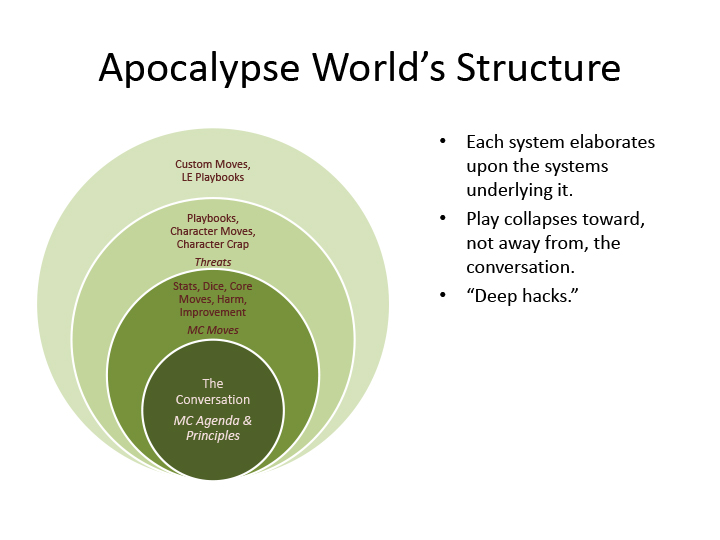
Of course, as feminist media scholars note, all platforms are discursively developed by their users. In their critique of strands of platform studies that separate technological constraints and affordances from social and historical contexts, Jussi Parikka and Thomas Apperley argue that “platforms are not recalled and rediscovered through platform studies, rather in the process of ‘doing’ platform studies, a uniform platform is produced.” Similarly, discussing Montfort and Bogost’s account of the Atari VCS (Video Computer System), Bellomy notes that “the console’s capabilities expand over time due to the growth of shared knowledge about tricks and techniques. In this way, the constraints of the platform cannot be cleanly separated from the community of practitioners.” But by making this notion explicit and building it into the very structure of its design, PbtA denies the teleology of normative applications, opening itself up to the possibility that its rules might be used for other purposes and in other directions than originally intended. This fulfills the queer design principle of applications, and suggests that leaving the purpose of an application up to its users could be generative and compelling.
This prompts us to ask: what might a digital engine so deliberately malleable and discursively oriented look like? How can digital game engines leverage the affordances created by the discursive formation of platforms? As tabletop developer Avery Alder points out in an interview with Bo Ruberg, one barrier to malleability in digital game engines is the requirement that developers have technical expertise. In tabletop games the technical barrier to entry is much lower: “there’s something beautiful about tabletop role-playing games where you can play a game once and then you know how to design your own. You engage with the mechanics of the game directly. The same isn’t true for digital games. You can’t just play video games until you understand the code. Tabletop role-playing games are transparent, replicable, and hackable.” But we might also see this as a provocation that digital games, and their engines, are not transparent, replicable, and hackable enough. By designing engines with the goal of accommodating disagreement, dissent, and alternative interpretation, we might create space for users to imagine their own unpredictable, queer relations.
Computation and Improvisation
I want to turn now to some rules and mechanics that are often part of PbtA games with, of course, the caveat that in so doing I might breed some dissent. With the explicit goal of inspiring more developers to create PbtA games, Avery Alder in 2013 wrote Simple World, a “streamlined, generic” PbtA game that does not involve any genre- or setting-specific elements. As a text both inspired by and inspiring of PbtA games, Simple World serves as a useful, though by no means comprehensive, object to read for common features and mechanics.
Perhaps the most recognizable mechanic in PbtA games, noted by both Alder and Vincent Baker, is the structure of moves. Moves in PbtA tend to utilize this basic structure:
- A player triggers a move by taking a relevant action.
- The player rolls two six-sided dice to decide the outcome of their move.
- On a ten or higher, the player succeeds;
- On a seven to nine, they achieve a partial or conditional success;
- On a six or lower, they fail, and the GM decides what happens next.
- The GM improvises the results of successes and failures.
This structure differs from other TTRPGs in several key ways. First, in other TTRPG systems, players often call on moves directly. For example, they might say “I use ‘Go Aggro’” to activate the Apocalypse World move of that name. In PbtA games, by contrast, Go Aggro triggers automatically when the player attempts to intimidate someone. Second, in contrast with other TTRPG systems in which players can either succeed or fail, PbtA games offer a third option when players roll a seven, eight or nine, in which “the [GM] will offer you a hard bargain or a cost. If you agree to that hard bargain or cost, you succeed at your goal.” This structure leverages the probability curve of two six-sided dice to encourage collaborative improvisation between players: by far the most common result is a partial success, in which the GM and player must compromise together on the course of events. Third, in contrast with other TTRPGs that emphasize pre-prepared scenarios by GMs, PbtA, as articulated by Alder in Simple World, cements collaborative improvisation as the core agenda of play, through the provocation to “play to find out what happens.”
The collaborative improvisation of PbtA structures a specific relational mode between players by combining computational processes with the affordances of the human platform. Bellomy addresses three affordances: the material and phenomenological experience of enacting computation; the assigning of meaning to objects to aid in performing computation; and the incorporation of non-algorithmic processes with computation. PbtA moves incorporate all three of these affordances in order to structure a specific relational mode between players.
Imagine a hypothetical play session. The player, stuck in a tough spot, devises a tricky, fancy maneuver to escape. The GM, who is tired of the player’s constant attempts at unconventional maneuvers, sees an opportunity to create hardship for their character if they fail: perhaps they will have to learn not to rely on such fancy techniques in the future (incorporating the non-algorithmic process of their own value system that prefers direct solutions over fancy ones). The player reaches for the two dice in the middle of the table (assigning meaning to them as computational aids), as everyone leans forward to see the result (cultivating a phenomenological experience of anticipation and anxiety in the process of rolling the dice)…and they roll a seven. The character succeeds in their trick, thwarting the GM’s goals. But the GM devises a complication: in completing their maneuver, the player reveals a weakness in their technique to their enemy, who will remember this in the future. They might not be so lucky next time.
This scenario leverages the affordances of the human platform to scaffold a specific form of compromise between the player and GM. What is unique here is not the use of these affordances—indeed, most analog games incorporate all of them in some way—but of the specific experience they create in combination with the mixed success roll in which both the player and GM get something, but not everything, they anxiously want. In tandem with PbtA’s insistence on improvisation over pre-preparation, these partial success rolls accumulate within a session and across a campaign, structuring the story that players tell together into an aggregate of small compromises, difficult decisions and complications. This aligns with the Queer OS User Manual’s notion of “an interface with the capacity for co-constitutive modification” in which it takes “self-modification as its ontological premise, such that interaction with an interface might transform both the user and the [system.]” PbtA’s move system is designed to “take self-modification as its ontological premise” by transforming the characters and the story beyond the original intentions of the players and the GM. This often creates friction—not only do players and GMs often have to compromise on their goals in frustrating ways, but mixed success rolls can spin out into new characters, subplots, and enemies in unexpected ways. (To return to our hypothetical play example, perhaps the enemy who noticed the player’s weakness will become a recurring character with their own motivations.) This friction aligns with the Manual’s insistence on creating data structures that center interference and instability, even if this creates “an unreliable system full of precarity, [which] reflects the condition of contemporary queer subjectivity.”
Different PbtA games leverage these complications towards different affective ends: the game Blades in the Dark, for example, uses mixed successes to create a building sense of complexity reminiscent of the heist genre, while Avery Alder’s Monsterhearts uses them to negotiate humanity, monstrosity and interpersonal power dynamics. Key to this mechanic in the PbtA engine, though, is the way it foregrounds tension and complexity. To borrow some vocabulary from McPherson, PbtA moves call attention to and engage with difference, but they also leave open the possibility for something more evocative and impactful to come from this engagement.
With current technology, we cannot create in a digital engine the kind of generative, collaborative improvisation afforded by the human platform as it is used in PbtA. But through its moves system, PbtA concretizes the challenge put forward by feminist media scholars by offering an example of what collaborative computational processes could look like. It prompts us to ask: how might we re-frame digital engines as a form of collaborative creation? How might digital engines integrate collaboration (with other users, with the content editor or interface, and with the logic of the engine itself) in ways that foreground difference, compromise, and the unexpected?
Tagging
One aspect of PbtA games is particularly evocative of computational processes: tagging, a form of categorization for objects and moves highly reminiscent of the same system in social media. In lieu of, or sometimes in addition to, complex stats and attributes, PbtA games use descriptive tags to denote what specific objects can do. Apocalypse World describes three types of tags: mechanical tags describe properties that connect directly to other mechanics (like how many bullets a gun can hold, or how many points of harm a knife can do); constraints denote restrictions on when an item can be used (like at what distances a ranged weapon can reliably work); cues inspire interpretations that create opportunities for improvisation in play (like “alive,” “loud,” “messy,” “volatile” or “valuable”). Players can create tags of their own, add or remove tags from objects through play, and negotiate the meaning and particular use case of the tags they create.
Apocalypse World, Simple World, Dungeon World, and numerous other influential PbtA games were released in the early 2010s, at the height of the popularity of the social media website Tumblr, and when the fanfiction repository Archive of Our Own (AO3) was gaining traction among fan communities. Both Tumblr and AO3 were known for their use of tagging, in which users could tag their content with keywords by which it would then become searchable. While tagging was likely developed to facilitate the categorization of vast amounts of user-generated data, the open structure of tagging allowed for social practices, norms and memes to form. As one study on Tumblr, Etsy and AO3 noted, “fans used tags in a variety of ways quite apart from classification purposes,” including “as meta-commentary and a means of dialogue between users, as well as expressors of emotion and affect towards posts.” The messy and chaotic ways in which AO3 users deployed tags resulted in the proliferation of volunteer “tag-wranglers” who attempt to refine tags to create consistency and searchability. Tagging in PbtA games allows for the same forms of categorization afforded by social media tags, and also creates the opportunity for similar emergent forms of interaction, improvisation, and user-created categorization as seen in Tumblr and AO3. Players might debate the meaning of the “alive” tag, apply it to an object out of curiosity as to what might happen, or use it to connote a feeling of hauntedness the characters sense from it (whether real or imagined). When combined with the partial success mechanic discussed previously, tags can also become complications that prompt further negotiation and compromise—the “alive” tag, for example, might become a form of possession that players must take into consideration when handling an object to which it has been applied.
Playing with specific tags in this way might inspire players to integrate them into future play sessions or to create new meanings for them. Meanwhile, tabletop developers can integrate their own systems of meaning and meaning-making into the tags they use in their PbtA games. For example, the cyberpunk PbtA game The Veil specifically encourages players to use tags to expand their understanding of the technology they use, to interrogate what is considered good and bad in their futuristic world. These interactions between play, interpretation and meaning-making evoke the Queer OS Operating Manual’s design principle of memory, in which, in engaging with tags, “users are haunted by the specter of their own memory, of their own utopian possibilities, of their own input, of the input of other users, and of their own processing habits.” Lived experience, history, and social context all influence the ways users deploy tags, creating both a sense of haunting and the possibility for new and narratively compelling interpretations. Tagging is thus one example of the ways that computational processes can inform analog tabletop engines, while provoking new possibilities for these processes in digital engines.
PbtA’s use of this computational process towards generative ends challenges us to ask: what other tools already exist in digital engines that might allow users to create new systems of meaning-making? How might digital engines leverage the unexpected hacks, workarounds and systems of meaning that players develop within them?
Conclusion
The notion that tabletop RPGs speculate on what is possible for digital games is nothing new: TTRPGs have long inspired digital games and game systems. Many digital games, including Baldur’s Gate, Diablo, Disco Elysium, and Citizen Sleeper were all inspired by TTRPG systems, and innumerable game worlds have been inspired by tabletop RPG campaigns conducted by their developers (fig. 3). Citizen Sleeper in particular provides a compelling example here, as its mechanics are reminiscient of PbtA specifically. Citizen Sleeper, a single-player narrative game, is played across a number of in-game days; each day, the player rolls a set of dice and then allocates the resulting numbers to specific actions. The number on the roll determines the likelihood of succeeding at a given action; some rolls can result in a “neutral” outcome, reminiscent of the partial success mechanic from PbtA (fig. 3). As Citizen Sleeper exemplifies, the forms of computation suggested by tabletop RPGs inspire digital game mechanics, even as digital games are not yet capable of generative, improvisational storytelling in the same ways as analog games. Taking seriously the notion that systems like PbtA are game engines allows us to better articulate this relationship.
Previously I described a tendency by feminist platform studies to situate its interventions in the future, as technological and social structures that do not yet exist. As I have argued here, concrete forms of these provocations already exist in the form of analog games. Expanding the definition of game engines to include the analog allows us to see the ways in which creators are already producing queer entanglements between body, computation, and system. For the study and development of digital game engines, it also illuminates a path by which they might adopt queer design principles, in order to facilitate gamemaking processes that are “curiously porous, queerly promiscuous, and radically leaky” and thus push the boundaries of the medium. For scholars of analog games, incorporating feminist theories of platforms gives us a rich new vocabulary with which to consider questions of human computation, analog platforms, and embodied play. It also prompts us to reimagine the way we relate to digital studies. As PbtA reveals, analog games can offer to the digital a concretization of what is not yet possible, a kind of queer possibility that is generative for new technologies and new forms of design.
–
Featured image from Pixabay: https://pixabay.com/illustrations/angel-of-death-art-gothic-colors-1875423/.
–
Abstract: In this essay I argue that analog game engines speculate on what is possible for the digital, in a way that concretizes queer visions of the messy relationship between humans, systems, and computation. Drawing on Kara Keeling and Tara McPherson, I analyze the analog game engine Powered by the Apocalypse as an example of Keeling’s notion of a “Queer OS,” or an operating system that encodes queer relational structures. In my close analysis of Powered by the Apocalypse’s mechanics and conceptual boundaries, I bring feminist platform studies and analog game studies into dialogue in order to argue for a more expansive definition of “game engine” that accounts for the ways in which analog games imagine forms of computation and human-computer interaction that are not yet possible for digital game engines.
Keywords: TTRPG, PbtA, game engines, queer, operating system, platform studies, analog games, digital games
–
Kaelan Doyle-Myerscough (they/he) is a PhD student in Cinema and Media Studies at the University of Chicago. Kaelan’s dissertation research centers on the theory, politics and practice of worldbuilding. As part of their critical work, Kaelan develops games that put into practice radical and experimental worldbuilding methods; their games have been showcased in Toronto, Hong Kong and Japan. Kaelan’s scholarly work has been published in InVisible Culture and the Dark Arts Journal, and they have served on the Board of Directors for the Queerness and Games Conference (QGCon) since 2019.
]]>self harm, climate change anxiety.
Introduction: Solo Journaling Games as Critical Intervention
The game tells me I probably will not survive, and I do not the first time I play. Instead, I go insane, destroy all the equipment I need to stay alive, and die a horrible and unrecorded death, alone and afraid, drowned, suffocated, and crushed to death in my tiny bathysphere hundreds of meters out of reach of sunlight.
In this article, I detail key experiences in my playthroughs of two solo journaling games that engage explicitly with environmental themes and use them to model material interventions into queer theory. In the first game, The Crushing Dark: A Solo Journaling RPG (2021), I explore the fragility of subjecthood by documenting my player character’s (PC) attempts to maintain the integrity of a bathysphere against an inhospitable, albeit beautiful, submarine world. In the second game, Dwelling: A Solo Game for Ghosts (2021), I investigate the erotic possibilities of memory as a ghost floating through rooms, creating memories, and making marks. A solo journaling game is, more or less, what it sounds like: a one-player game a person plays by recording events in a journal of some sort. But even these two seemingly basic features are slippery to pin down when considering the many forms they can take. The recorded events can be real, fictitious, or somewhere in between, and the journal itself can take a myriad of different forms from written entries to marks on the skin. Moreover, the very mechanic of producing a personal journal for a fictional character highlights the tenuous slippages between the player and the player character. These slippages are not unique to solo journaling games. Terminology like “bleed” already exists to describe situations when the feelings of a player and the feelings of their character influence one another. These concepts, however, are typically treated as conditions that can arise from play and not the foundational mechanic by which gameplay happens in the first place. Finally, as these journals are personal, they are always selective. By producing inherently incomplete records of gameplay, solo journaling games always linger unresolved past their own completion. This unreliable physical evidence of play, at once a faithful record and a fabricated story, unsettles the presumed stability of the arbitrary stopping point we colloquially call ending a game, in which a game neatly stops and its player neatly disengages after they are done playing.
The slippages these games’ journaling mechanics hold in focus closely mirrors a slippage often missed in queer theory, especially high queer theory that derives abstract concepts from queer subjects without centering the material limitations of those subjects’ lived realities. Yet, as the world becomes increasingly precarious for queer people, it becomes more important than ever to be critical of what the material possibilities of queer thought creates for queer thinkers. One place we might begin to think through those possibilities is by considering the accidental vulnerabilities possible in mediated interactions with objects of study and play. To do so, I supplement queer theorizations with the environmental humanities concepts that actualize the material limitations of queer bodies existing in the world: precarity and porousness. Precarity is the likelihood of a subject to lose a position they hold in the world, like a house being swept away in a flood, and porousness is the exchange of fluids between the inside and outside of a subject, like breathing toxins in and out. I begin with a brief overview of queer subjectivity or how queer theory imagines queer subjects in order to situate my critical interventions and then provide a close reading of each game, highlighting how the experiences that emerged from play offered concrete perspectives on more theoretical inquiries.
As a final note, when I say “material” or “physical,” what I do not mean is “more real” or “more authentic.” Reality is different from materiality, and any claim to authenticity is inherently an imposition of arbitrary political stakes onto something else. Claims to either realism or authenticity are not interventions I am interested in making here. In my case, neither of the characters nor the situations I role-played in The Crushing Dark or Dwelling were realistic for me. Instead, I am interested in how, through the act of journaling fictional events, I engaged in personal acts, recalled memories, reflected, and otherwise had genuinely meaningful experiences. While the situations were fabricated by the game, the experiences of joy, fear, frustration, and epiphany were all my own. I found both games to be insightful but imperfect, critically engaging but occasionally challenging to engage with. There were aspects of these games that I enjoyed, but there were just as many that were confusing, boring, or downright unpleasant. Therefore, in discussing my own resonances with these games, I also seek to embrace the ways these games did not resonate with me. In doing so, I follow scholars like Jean Ketterling in remaining “purposefully ambivalent,” seeking to resist the urge to situate my observations and experiences with these games into overarching frameworks of power and authority and instead explore what might come from allowing potential ambiguities and inconsistencies to persist unresolved.

Critical Materials and Critical Environments
Queer identities and imaginations may be fluid, embracing volatility and flowing easily from one state to another, but queer people are much less so. It is painful, dangerous, and exhausting to evade capture by normative systems of identification, and it is painful, dangerous, and exhausting to iterate beyond hegemonic cultural imagination. For example, Eve Sedgwick’s Touching Feeling focuses on the intimacy and vulnerability that comes from engaging with objects that resist static form and stable understanding, as well as on the capacity of affective relations to reshape our understandings of the world. Yet, while works like Sedgwick’s are vital in teaching us the analytic value of disorientation and exploring the implicit ambiguity in our identities, cultures, and institutions, they do not offer practical solutions for considering the concrete, material expressions of these interventions.
By centering the ever-shifting material environment in which queer subjects sit, however, we can better consider these lived conditions. For example, thinking about atmosphere as opposed to metaphysical space draws attention away from a subject’s fluid exchange with concepts and toward more concrete considerations of a body’s vulnerability. What this framework makes more immediately legible is that the conceptualizations of fluid identity queer theory explores are always as much avenues for danger and violence as they are for joy and fulfillment. In other words, what sustains us might also imperil us. As Jean-Thomas Tremblay argues in Breathing Aesthetics, the very act of breathing, one of the most central and essential life functions is “inevitably morbid…As long as we breathe, and as long as we’re porous, we cannot fully shield ourselves from airborne toxins and toxicants as well as other ambient threats.”
Therefore, while theorists rightfully laud the excessive potential of queerness in imagining radical alternate subjects, we would also do well to consider the effects these theorizations have on actual people. Trans scholars like Hil Malatino, for instance, remind us of the rage, burnout, and other “bad feelings” that accumulate in people when performing the work of resisting oppressive, hegemonic systems. A critical place to engage with these effects and affects is through games, play, and media studies that have taken up these bad feelings as generative sites of inquiry. Bo Ruberg argues through the provocation of “no fun,” that we should “explore alternate ways of feeling, desiring and being” and “[disrupt] dominant and implicitly heteronormative presumptions about the affective purpose of [games].” Similarly, Ela Przybylo’s “asexual erotics” concurs with Ruberg’s goal of pushing us to resist politics of capitalist consumer culture’s rampant expenditure and endless disposability. Przybylo cautions, however, that in order to do so, we must consider both ways of being that are “potentially excessive of capitalistic white structures, identity categories, and contemporary modes of being together” and disavow “celebratory rhetoric in relation to identity formation, and [attune] to the darker modes of queerness.” Through journaling in The Crushing Dark and Dwelling, I blurred the boundaries between many kinds of subjecthood—player, player character, genuine memories, fabricated memories—but had to put in effort to do so managing difficult emotions, performing physical tasks, allocating time and resources. Critically centering an act like journaling, therefore, helps to navigate queer subjecthood without losing sight of the concrete precarity of being a queer person living in the world. In doing so, critically playing these games offers the generative value of imagining ways to disrupt hegemonic ideologies about identity and subjectivity, while also considering the accrued exhaustion that comes with these iterative efforts.
Games, particularly analog games that require players to physically act out gameplay mechanics, help to generate uniquely rich spaces to explore these critical interventions. For The Crushing Dark and Dwelling, the framework of precarity and porousness is relevant, not only because each game’s content engages with environmental themes, but also because of solo games’ unique position within the tabletop world. Solo games are economic products; as such, they participate in systems of resource extraction, environmental devastation, and colonialist distribution and yet tend to exist at the margins rather than at the center of large-scale, highly profitable, highly reproducible analog game markets. They are often independently produced and decentralized in terms of distribution, manufacturing, and design, especially when compared to a highly-profitable franchise like Dungeons & Dragons.
Critically playing games like The Crushing Dark and Dwelling offers alternative modalities and relationships of queerness, queer identity, and queer play. This practice allows for more nuanced and emergent possibilities to understand the critical value of queer, affect, environmental, play, and game studies as well as to consider the complex relationships that arise when these disciplines are put in conversation with each other rather than treated as separate, unrelated fields. Therefore, I draw on the work of Max Liboiron, who understands humans and environments as co-consitutive and in relation to one another rather than understand environments simply as inert, passive things to be damaged by humans. These ludic, queer, and environmental relationships are always slippery, pervasive, and unruly, oscillating between abstractness and materiality but never settling in either position.

Precarity and Subjecthood in The Crushing Dark
After I die, the game invites me to consider how my journal might be found and I decide it won’t be. How could it? If I could not survive, how would a flimsy few pieces of paper succeed where I could not?
I sit in the dark, contemplating these questions until I remember an assignment due tomorrow and turn the lights in my living room back on. Even as I begin working, a moment from the game lingers in my mind: there was a moment, you see, where I could have cheated, where I realized that the pile of stone representing my lifeline was going to fall over. Instinctively, I grabbed for them, began to stabilize them. I considered holding them like that another round or deconstructing the tower and playing on as though it were still standing. No one would have to know—it was just me, alone in the dark about to die and realizing I didn’t want to die this way. Gently, I let go and let the tower fall.
The Crushing Dark is a game about decisiveness and indecision, about stability and precarity, about death and survival. It is a game about dying alone and afraid and a game about realizing that you do not want to die alone and afraid. In it, a player takes on the role of a brilliant but overzealous 1950s scientist descending into the depths of the west Pacific Ocean in a small bathysphere of their own experimental design. To play, the player uses a deck of cards and several dice to determine the events of each day. The player interprets and records these events at the end of day (provided they survive) in a series of journal entries addressed to a fellow scientist and hopeless crush somewhere above the surface. The player also starts with a pile of stones of their own choosing which represent the integrity of the bathysphere. I mean this statement literally: the game actually instructs the player to go out and gather stones before they begin playing. Whenever something bad happens, the player stacks these one on top of the other, and since the player has picked the stones, if the pile is difficult to balance (as it was for me) they have their own material selection to blame. If the pile falls over at any point, the vessel fails, the player character is killed, and the game ends immediately.
The potential events range from good to bad to distressing to catastrophic. In my particular playthrough, I experienced imposter syndrome, saw ethereal deep-sea creatures, fixed a hot cocoa machine, and sabotaged my adventuring vessel in a fit of temporary insanity. These events within the player’s bathysphere highlight the main source of both engagement and horror in the game: the fragility of their position. As long as the game is in session, the PC is alive, but their survival is always wholly dependent upon the maintenance of a thin, increasingly precarious layer of metal. From a practical standpoint, everything is fine at any given moment. Everything also has the potential to very rapidly become not fine, but if the player does nothing, they can assume they are safe because neither water nor ocean life can get into the bathysphere. The horror arrives, however, in the realization that none of the game’s mechanics allow the player to do nothing. The momentum of gameplay keeps the player descending further and further into the ocean and away from any kind of permanent safety. Each card drawn, each die rolled, each stone stacked increases the likelihood that something will go unsalvageably wrong and the player character will suffer a horrible end. Everything hangs not so much in balance, but in tension, quite literally between life and death. Everything that happens mechanically in The Crushing Dark, therefore, is reducible to playful mediation of the tension remaining alive in a precarious environment. Every event, from every scientific observation to every breath is directly mediated by the thin metal walls of the vessel the PC descends within. When I played this game, whatever happened, my ultimate question was always reducible to “how does this affect the integrity of my vessel?”—if the vessel is lost, so am I.
Yet, the more uncertain my survival seemed, the more sure I became about the emotional and physical state of my character and what they would do at any given moment. As my character’s safety measures began to erode, as their mental fortitude began to deteriorate, I began to reinforce them, supplementing the failing bathysphere with my own feelings, my own fears and doubts, my own hopes and triumphs. In other words the more precarious my character’s situation became, the more certain I became of who this character was, what they wanted, and how they would act. Yet, the more certain I became of who this character was, the less clearly I was able to differentiate between that character and myself. When I realized my character was going to die, I knew they didn’t want to die because in that moment, I did not want to die either.

In having the player pick their own stones, the game draws attention to craft as a prerequisite for adventure. Rather than simply tell them that they have built the bathysphere they spend the game inside, The Crushing Dark, has its players roleplay precarity by drawing attention to the process of craft. The transparency of process here serves two main functions. First, at the level of practical game design, it is a way of engaging the player. By starting the game in an unstable device of one’s own creation, the game opens the door for play with hubris and guilt. When something inevitably goes wrong with the device, the PC might have any one of a myriad of emotional reactions to that event. More investment simply makes for a more engaging play session.
More relevant to this piece, however, is that the player explores the entangled involvement of journaling, not through a personal diary but through an official scientific data log. Personal involvement is often elided out the presentation of real world scientific studies, and critics of queer theorizations often deploy cold, hard data in order to undermine it with supposedly more objective and foundational forms of knowledge. However, as Mikhaila Friske et al. argue in their work linking datafication to artistic craft, data is not an event but a process. It does not leap forth fully-formed; instead, “materials, data, and humans collaborate to produce physical data representations.” When I played The Crushing Dark, I could easily imagine my character pacing about a busy lab muttering into a tape recorder or scribbling observations and calculations into a notebook. Indeed, many of my entries, even the most personal ones, included some measure of scientific engagement, whether a key observation or simply a commitment to record keeping. In envisioning my journal as a data log as much as a personal account, I learned to roleplay what Friske et al. call “contrasting the experience of the data with data of the experience.” I could not parse a singular dominant narrative from my data; instead, narrative emerged organically as I wrote entries entries piece by painful piece.
The fact that the events of the game take place in an inverted fish tank is not lost on me. I see crafting as a link between Friske et al.’s interventions into data narrative and Samantha Muka’s provocations in Oceans Under Glass. In that book, Muka tells the story of tank craft by framing it through a lens of hobbycraft. The aquariums so pivotal in the serious study of such fields as marine biology are completely dependent upon the intimate passion projects of hobbyists. Aquarium enclosures draw attention to the constructed artificiality of so many of our encounters with the ocean. Viewed through this lens, the bathysphere in The Crushing Dark operates as a multi-directional aquarium. Since the PC is contained within it, it draws our attention to the arbitrary centering of human actors in the field of science and in turn, the artificiality of their importance within it.
The transparency of craft and the mechanics of data entry draw attention to the messy process rather than the quantifiable event of data. Yet, we must still trouble the presentation of scientific inquiry in The Crushing Dark as hobbycraft and the presentation of the playable character as an agentive outsider. As Aaron Trammell details in The Privilege of Play, “the hobby,” the network of war games, role-playing games (RPGs), and board games, collectively “gatekeep minoritized people from participation.” Because of embedded networks of white privilege, those most likely to have the time, space, leisure, and disposable income needed to acquire and maintain a collection of miniatures at cis, heterosexual white men. The hobby is foundationally an expression of white supremacist logics, and The Crushing Dark is in no way immune to this history. Indeed the PC’s infatuation with a non-agentive non-player character in a one-sided courtship travels uncomfortably close to toxic masculinist cultural norms that seek to entitle men to sex with women rather than empower the agency of both parties.
We can, however, also excavate a concurrent reading by viewing the game through the lens of material and experiential data narrative: The Crushing Dark’s bathysphere certainly invites the player to roleplay the hubris of an individual determined to center themselves in a hostile environment to which they are not accustomed, but so too does it highlight the irresistible pull of an intimate immersion into an environment facilitated not by impersonal scientific calculation but passionate curiosity. I use “cold” here not to foreclose the possibility that a scientist might be driven to their work by passion but instead to draw attention to the overlying and wondrous subjectivity that always shapes the acquisition, analysis, and implementation of supposedly objective data. In doing so, it invites us to consider what possibilities might emerge from considering technologies of mediations as extending vulnerable entanglements rather than foreclosing the possibility of intimate slippages.
If I could voice only one qualm with the design of The Crushing Dark, it is that so much of the game is concerned with facilitating and fostering a claustrophobic sense of dread that it is easy to forget that the game pays just as much close attention to the strange and wonderful things the PC observes outside their windows. Typically, each section has an even split of prompts, half bolstering a sense of hope, half feeding a sense of dread. For instance, one prompt reads:
You enter a strata of the deep that is tinged a dull orange. The incredible number of lumens emitted by your not-yet-patented wet-sulphur torches seems to congeal and puddle about you, only six or eight feet beyond. You see dark, squirming shapes within the orange glow if you look too long.
For this particular prompt, nothing happens to measurably worsen the player’s situation. They are free to respond, record, or ignore the lights as they see fit without having to place a stone on the increasingly precarious pile in front of them. In giving the player something engaging though not quite explicitly hostile, the narrative of the game draws the player in closer, close enough to bite, certainly, but also close enough to caress, close enough for mutual, reciprocal recognition, that seductive negative space of infinite iteration that always draws in closer, always envelops further.

Porousness and Homemaking in Dwelling
When the game tells me to make a mark on my skin, I do it lightly with a fingertip. As I do so, my finger runs over the small, raised marks on my skin from when I opened my arm with a razor blade in my teenage years, now a subtle array of parallel lines running up my forearm. I can remember the pain and the pleasure of making these marks, but can no longer recall the exact moment of inscription the way I could a decade ago. As my finger glides up my arm, the marks crisscross for just a moment, one fading almost as soon as it is made, the other lingering long past its initial moment of inscription, past my memory of it, past, likely, my entire life.
Playing Dwelling was painful. It made me think of the fragility of my existence and of the enormity of the world and of the smallness of my place in it. It made my body feel unstable, permeable, malleable, diffusive, expansive. It made me want to hold onto things, to batten down the hatches, to keep myself safe against the world outside, to shut the door to myself and never open it again.
In Dwelling, a player plays an embodied, spectral spectator navigating a home that was once familiar but is no longer. The gameplay mechanics revolve around this figure seeking to recuperate fading memories by leaving impermanent marks alternately on the game itself and on their body. Through its gameplay, Dwelling troubles the idea that meaningful play is necessarily additive. In being a game that is as much about forgetting as it is about remembering, the game creates a critical play space in which memory itself operates as a mechanic for creating ephemeral and impermanent affective moments. The game explores these moments through its three key mechanics: summon, remember, and mark. In each case, something past manifests in the present, and the player must represent this event as a mark on their journal page, their body, or their mind. Through marking, Dwelling shows itself to be a game about lingering residue, but the game is also about turning the page, about watching marks on one’s body fade over time, and about forgetting the specifics of a moment of inscription.
I read this duality as an erotic exchange between the inside of a porous subject and the environment in which that subject sits. By erotics, I mean rooting my definition wholly in play—play between inside and outside, surface and depth, and self and other. Within the site of Dwelling’s home, this malleable and ever-changing space of erotic play, queerness enacts itself as a haunting, atmospheric hyper-presence that complicates both the radical denial of preservation implied by the act of forgetting and the perpetual iteration called upon by seeking to remember anyway. As a result, play sessions of Dwelling emerge as mediations on the expansive possibilities of erotic exchange between the inside of a porous subject and the subject’s environment. In mediating between extreme presence of a spectral ghost and individuated instances of specific memories, Dwelling actualizes the stakes of living in a world that is intolerant of certain kinds of life. By blurring the boundaries between what it means to haunt a place and to live in one, the game complicates cultural understandings of persistence and belonging, allowing its players to parse the ways in which one’s unique combination of precarious circumstances coalesces into this thing we call “home.”
We speak often of the restless or vengeful ghost, but we do not often consider the specter who simply remains in a place or the spectator who watches events but cannot meaningfully affect them. As Seb Pines writes in their artist statement for Dwelling,
Greetings to the “I” we both are in this story. I hope it wasn’t an uncomfortable shift, the I that is you becoming the I that is me. We can both haunt these pages as there is plenty of room for the two of us, and even the additional “you”’s that may return to it from time to time.
Environmental humanities is littered with analyses of objects that linger past their time resisting containment or removal. These analyses tend to focus on inorganic actors that do not belong because they do not arise without the intervention of human technologies: the irradiated area following a nuclear power plant meltdown or plastic contaminants in the pacific ocean. Rarely, however, do we apply this lens to things that live—to the endangered species or to the family in the flood zone that resists relocation. In seeking to decenter humans as the referential point in environmental studies, how might we use the embodied spectator in Dwelling to unlock potential analyses of actors, both human and non-human seeking to persist in a volatile and hostile environment? What is contained in the idea of a ghost that is non-malicious, that does not aim to frighten but simply to stay in a place that is already in the process of disappearing?
Dwelling reminds its players that in seeking homes, what we are desperate for is often not places but a fugitive feeling of belonging, the feeling that anything we hold dear might last. In pursuing that goal we often seek out not fixed locations but immanent flukes in the same systems that oppress us and create precarity. Take, for instance the shift from “homeless” to “unhoused.” In seeking to humanize people without permanent living arrangements, this term shifts focus away from the detrimental psychological damage being without a place one can call one’s home does to a person. The reduction of this issue to a building with four walls and a roof distracts from the trauma of feeling permanently out of place, like you don’t belong, and of being forced to wander through a world that systematically refuses even to see you. It is always holding your breath while you wait for the wind to be knocked out of you. It is this feeling of debilitating alienation that Dwelling lives in producing, maintaining, and re-enacting for its player, in drawing attention of the fragility of the place, belonging, and homestead. How do we hold onto things that are always decaying away around our ears?
Echoing Tremblay’s words above about breathing’s inherent capacity as a morbid practice, I posit that a dwelling is just as much a place to die as it is a place to live; it is just as much a place to fade away as it is to linger. If you have ever come home from a long day of work and taken a sigh, you will know that a home is a place in which we permit ourselves to expel the breath we must hold to preserve ourselves in the world outside, just as it is also a place where we refresh our breath to venture outside again. Similarly, Dwelling’s journal is a place where you teach yourself to forget, and, of course, a place to which you can return if, all of a sudden, you find yourself needing to remember. Dwelling’s setting of the house, therefore, operates as a kind of body which the atmosphere can permeate, once whose inhabitants have some but never total control over who and what is allowed to enter or leave. I notice the precarity of these arrangements everywhere, most imminently in the cocktail of compounded socio-cultural minoritizations that make up the ever-shifting legibility of my identity. The effect is that I feel frequently that I have overstayed in a place before I have even arrived—socially-speaking, I always haunt every dwelling I inhabit.

Conclusion
In this article, I have used environmental humanities interventions in order to interrogate the stakes of the solo journaling game genre within queer studies, affect studies, and game studies. Through close analysis of two examples of the solo journaling genre of games, I have sought to use considerations of precarity and porousness to materially ground queer studies’ more abstract theoretical interventions of subjecthood, while recognizing all the while that the ground we stand on is always already, figuratively and literally, constantly shifting. In navigating the messiness of these circumstances, we can use critical play methodologies to think through the practical labor of implementing queer imaginaries in our lived realities. However, as Liboiron demonstrates, “methodology is a way of being in the world and…ways of being are tied up in obligation.” Scholars like Rainforest Scully-Blaker and PB Berge urge us to remember that solo journaling games are, like all games, inseparably entangled within cisheteronomative power structures that precede our analyses of them. It goes very nearly (but not quite) without saying that the literal materials that compose them—paper, cardboard, plastic, and so on—and that the industries that create and maintain them are finite, extractive, and unsustainable.
Yet, as we move through this complex cycle of imagination, iteration, harm, and survival, we would do well to turn to Tremblay’s reflections on breath as inherently (metaphorically, literally, and etymologically) aspirational. For him, avenues for violence like breath can also pathways for wishful experimentation, and while he cautions that “aesthetic experimentation cannot realistically solve breathing, or disentangle it from its status as evidence of vulnerability to violence or neglect,” he also notes that “aesthetic experimentation can…produce a breath that exceeds this status. The cultivation of such excess makes breathing, more than an index of crises, a resource for living through them.” Similarly, while solo journaling games are not themselves inherently subversive objects, examining and playing them critically reveals generative ways of looking at, thinking about, and negotiating with queer subjectivities and experiences. They help us attune to the slip and slide of unstable critical subjectivities within rigid, gamic systems and embrace the unruliness inherent in our material relations.
–
Featured image from Henrique Alvim Corrêa’s Illustrations for The War of the Worlds (1906). Available at the Public Domain Image Archive: https://pdimagearchive.org/images/34130069-1049-45a5-9e9a-0fddde108dd5/.
–
Abstract
In this article, I detail key experiences in my playthroughs of two solo journaling games that engage explicitly with environmental themes and use them to model material interventions into queer theory. In the first game, The Crushing Dark: A Solo Journaling RPG (2021), I explore the fragility of subjecthood and by documenting my player character’s (PC) attempts to maintain the integrity of a bathysphere against an inhospitable, albeit beautiful, submarine world. The second game, Dwelling: A Solo Game for Ghosts (2021), I investigate the erotic possibilities of memory as a ghost floating through rooms, creating memories, and making marks. I explore these vulnerabilities materially through the environmental humanities concepts of precarity and porosity. I argue that, while this intervention is not unique to the format of solo journaling games, this genre is a generative place of study because its format highlights the precarity of the player. To play one of these games is to engage head-on with queer understandings of unruly subjecthood and precarity—it is no wonder, therefore, that the tone of so many of these games is introspective melancholy, and that journeys through these games are so often journeys into oneself at least as much as they are journeys through a game’s world. Yet a self never exists in isolation but is always located in an environment which permeates as much as it shapes. Understanding our entanglements with slippery, sticky, or otherwise fluid media helps us to reconceptualize the fixedness of apparently static social structures and hierarchical relationships.
Keywords: environmental games, solo games, TTRPG, queer theory, journaling, memory, affect, materiality, subjectivity
–
Brandon Blackburn (he/him) is a 4th-year doctoral candidate in Film and Media Studies at the University of California, Irvine. His research examines intimacy with and within the fractures of rigid structures of play. By looking at depictions of monstrosity and affects of horror through the lenses of race and queerness in playable media, he seeks to articulate both resonances and slippages between players and the games they play. His work has been published in TOPIA and Amherst College Press.
]]>“Once upon a time, the world was cruel, and there was a witch who knew it well. And so, she sold her heart away and built a house in the woods where the world could never find her.” Yazeba’s Bed and Breakfast (Possum Creek Games) by Jay Dragon and M Veselak begins with these words and presents a game focused on found family and queer domesticity in a whimsically detailed world. Each session revolves around small acts of care and chaos inside a magical, liminal home. Yazeba’s does this structurally and narratively through a legacy-style, slice-of-life system set in a magical, ever-changing house populated by a rotating cast of characters called Residents. The game owner is called “the Concierge,” who is described as a facilitator and narrator rather than a game master. The game is composed of standalone chapters that can be played in any order with mechanics that vary by chapter and often mirror the chapter’s tone. These features create a flexible, emotionally rich play experience shaped by both narrative choices and evolving game materials. Yazeba’s also encourages players to modify the physical game materials by adding marginalia as they progress through the chapters. This creates a personalized and evolving game experience that reflects the group’s collective storytelling journey.
Yazeba’s remediates, remixes, and alters the traditional mechanics of analog tabletop games. It actively encourages diverse forms of play, evocative of Boluk and Lemieux’s understanding of metagaming, the type of play that “ruptures the logic of the game, escaping the formal autonomy of both ideal rules and utopian play via those practical and material factors not immediately enclosed within the game as we know it.” There is a curated level of double awareness that is encouraged in Yazeba’s. Players are encouraged to “cheat” and unlock chapters if it feels true to their gameplay. Even the Concierge is instructed to respond a player’s contradiction of their own description of game reality with the phrase, “As you say,” and allow the player’s version to take precedence.
The game presents of vision of queered, cozy, and gameful domestic life. But does its very domesticity undercut the potential for queer play? Sparked by my own experience of playing Yazeba’s with a queer group, this article seeks to broadly interrogate how the aesthetic environments—the visual, affective, and tonal choices that shape the sensory and emotional experience of play—of the created worlds in which we play may reinforce or demand certain types of play. In this piece, I explore the tensions between cozy aesthetics and queer disruption through a close reading of Yazeba’s Bed & Breakfast, drawing on both gameplay experiences and philosophical reflections. Furthermore, putting different philosophical theories of aesthetics in conversation with queer theory, I unpack the relationship between our created worlds and queer gaming to examine the importance of resisting normative expectations of identity, narrative, and success in analog play.
My central question is not whether the game is queer enough—it undoubtedly is and delightfully so, down to its mechanics and vision of home. Rather, I use Yazeba’s as a case study to interrogate a more subtle tension: how game aesthetics, particularly those of coziness and domesticity, might shape or constrain the emotional and narrative registers available to queer play. In doing so, this piece is meant to contribute to an emergent conversation in queer game studies about how tone, affect, and visual and mechanical design intersect with queerness, not only in terms of representation, but in how we play. I argue that aesthetics are not merely a backdrop, but an active force that can invite or foreclose queer chaos, conflict, and failure. This essay ultimately explores what it means to make space for unruly, dissonant queer experience within the aesthetics of comfort and care.

Queerily Home At Yazeba’s
There is no one correct way to play Yazeba’s and that is by design. Game sessions and chapters feature changing rules, with most chapters utilizing an ever-shifting primary character’s perspective. Game designer and pop culture critic Armaan Babu described Yazeba’s as
…a single place, fixed in time, a single story that can be told a thousand different ways, but growing, always growing. About community. About becoming who you have chosen to be — and having the agency to decide how fast that happens, when that happens, and how that happens. It is a game about making memories.
Gameplay focuses on cooperation, complexity, and aspects of what Edmond Y. Chang calls queergaming or gaming that “engages different grammars of play, radical play, not grounded in normative ideologies like competition, exploitation, colonization, speed, violence, rugged individualism, leveling up, and win states.”
Specifically, Yazeba’s evinces what Chang calls queer remediation or the taking elements and aspects, remixing them, having them come together and interplay and interact in games in different ways. The initial characters of the residents are pre-determined misfits like Gertrude, a teenage runaway; Parish, a gallant knight transformed into a frog who now serves as the inn’s cook; Hey Kid, a mischievous devil-child; Amelie, a robotic housekeeper; and Sal, a wandering musician. The game is structured into 48 distinct chapters, each functioning as a standalone mini-game with its own unique mechanics and even different components. For example, one chapter might involve investigating a basement and have players draw playing cards from a standard deck to determine what they find. Others may involve a large group of players and involve flipping coins frantically to determine success. This episodic format allows players to explore different narratives and gameplay styles in each session.
Play of Residents is rotated through different people, all of whom have the power to alter aspects of the character’s fate, motivation, and even abilities through their choices. The Yazeba’s gamebook intentionally encourages this rotation, saying,
Whenever we play, it’s likely that we’ll swap between Residents from Chapter to Chapter. We shouldn’t worry about playing a Resident precisely the same way another player did; everyone will bring out different facets of a Resident, and all of them are equally authentic. It’s a lot of fun to share Residents, and to mix up which Characters we play. When we give a Character to someone else, it gives that Character a chance to grow in new ways.
These repercussions are passed along to the next gaming session. You might come into a session to find that someone has played Parish the week before and added notes to the character sheet.
Moreover, the game discourages a fixation on linear storytelling and continuity. Players are intentionally encouraged to reject the idea of canon. The gamebook’s section on play philosophy says, “There can be no definitive canon, and every version has its own reality and truth.” It is understood that chapters will be played out of chronological sequence and that this style will not be a barrier to player understanding.
For my first game of Yazeba’s, I was playing with a completely queer table of fellow gamers who played together many times before. We were a group of gamers who delighted in independent games, telling weird stories, and evoking emotional experiences from gameplay. I had actively had conversations about the emotional impact and transformative power of TTRPGs with many of the other players at the table. With this knowledge in mind, I approached my first session of Yazeba’s anticipating and expecting the eruptive, meta, and flirtatiously unstable play that Chang later calls “queer chaos,” an extension of queergaming, a mode of queer play that embraces exuberance, disruption, and affective messiness to resist the normative expectations of narrative and performance. Chang describes at length:
First, queer chaos is queer excess, queer exuberance. It is totally extra, totally meta. It further reimagines, even unravels, the fantasy of the magic circle, the fantasies of immersion and interactivity. Second, queer chaos is queer challenge, queer change. It is disruptive, even eruptive. It reconfigures our relationship to desire, to identity, to performance, to play. Finally, queer chaos is queer mending, queer healing, queer repair. It is disruptive, even eruptive. Queer chaos is not always legible to non-queer players and observers. It is play that subverts and appropriates the narrative of “straight” or “proper” play to center queer, BIPOC, and non-normative identities, practices, and participation. Ultimately, queer chaos is troubling play, troubling performance, and troubling the past, present, and future; it is finding new and alternative paths to the future.
Queergaming and queer chaos resists the logic of tidy narrative arcs and proper conduct. I entered my first session of Yazeba’s hungry for this chaos and excited for the potentiality for queer joy with a primarily queer table. What I got was pancakes.
The chapter our table played centered on one of the residents starting a rival bed and breakfast in the backyard so that they can eat pancakes all day long, and the panic that ensues. The session I attended essentially ended up playing out almost exactly like an episode of a TGIF sitcom from the late 1980s, complete with moments of lesson learning and emotional repair. While the game experience was lovely, at the end of it, several of the players, including myself, reflected on the vanilla, family-friendly tale we explicitly enacted. The whole thing felt cloyingly sweet, cozy, and hauntingly straight.
Whither Queer Chaos: An Aesthetic Problem?
Despite a queer-identified group of players playing a very queer game, the story we collectively created felt cloyingly heteronormative. Players began joking that they had been typecast into familiar roles: the sitcom dad, the zany (vampire) aunt, the precocious child. While Yazeba’s promotes a vision of inclusive and harmonious domestic life, that togetherness as it manifested in our session may have inadvertently aligned with traditional ideas of domesticity. This was a vision of home that embraced stability and harmony, potentially at the expense of acknowledging and embracing and fluidity and complexity that often surrounds and queer identities, stories and experiences. Players articulated not wanting to disturb the setting of Yazeba’s itself.
I wonder if the overall aesthetic of the game show us a desire for a domestic vision that may truncate the experience of queering play? Or, what kind of home is Yazeba’s, and what kinds of queer play and politics does it enable or inhibit? Stephen Vider reminds us that “home has been a crucial though contradictory space in LGBTQ life and politics—a site of constraint and a site of self-expression, a site of secrecy and a site of recognition.” While the game never explicitly instructed us to follow these harmonious and peaceable paths, the aesthetic cues (with twee illustrations, language of “whoopsies” and “bingos” in lieu of success or failures, et cetera) seemed to pull us toward domestic harmony that left little space for queer volatility. Yazeba’s also had an element of almost chasteness that made the possibility of more erotic play seem out of the question. Upon further reflection, I believe my gaming table was not pushed towards good wholesome play by mechanics alone, but by something about the cozy aesthetic of the game that also seemed to domesticate us. The games seemed to exert a gravitational pull toward suburbanized family values and emotional stasis. This is not a flaw of Yazeba’s design, but a reminder that aesthetic form shapes affective response. Our gameplay was not merely guided by mechanics, but domesticated by the game’s aesthetic frame. The experience raised even deeper questions: Can cozy aesthetics (however well-intentioned) pacify queer potential? Can a world designed to feel safe still hold space for the risk, rupture, and excess that queerness sometimes demands?
Cozy games, which are notoriously difficult to define and range widely across genres, are often described as being defined by their aesthetic goals, and not their topics or mechanics. Cozy aesthetics typically evoke feelings of warmth, harmony, and emotional safety, often drawing from visual and narrative cues rooted in domesticity, nostalgia, and homeyness. The session showcased the aesthetic demands that were also being placed upon player gameplay.
The experience we had at Yazeba’s points to the impact of aesthetics on our lived reality and behavior. Aesthetics refers to the study of perception, taste, and the nature of beauty and artistic experience. It examines how people are moved by forms and sensations, and how style and design influence one’s understanding of the world. But aesthetics is not just about beauty or design—it is inherently ideological and political, shaping what is seen as valuable, acceptable, or possible within a given cultural frame. Terry Eagleton vividly describe aesthetics as “nothing less than the whole of our sensate life—the business of affections and aversions, of how the world strikes the body on its sensory surfaces, of what takes root in the guts and the gaze.” Aesthetic conversations in game studies have often focused player experience and design elements, emphasizing how visual style, sound, and mechanics produce affective responses and shape gameplay. Scholars like Jesper Juul and Miguel Sicart highlight how aesthetics are deeply tied to interactivity, with Sicart arguing that games are “ethically and aesthetically expressive systems” that communicate values through play. Thinking aesthetically involves understanding the meanings and values embedded in pleasure and design. This extends to Juul’s idea of “ludic aesthetics,” which even considers the pleasure derived from the rules and gameplay itself. Ludic aesthetics refer not just to how a game looks or sounds but to the aesthetic experience produced by its rules, structure, and mechanics. In cozy games like Yazeba’s, the rules themselves may also be gentle, forgiving, and collaborative, but these qualities also produce a certain kind of affective tone.
When ludic aesthetics emphasize harmony or comfort, they can predispose players toward cooperative, low-stakes narratives, reinforcing emotional safety at the expense of narrative risk or rupture. Through ludic aesthetics, rules can actively shape the affective palette of a game world and help determine what kinds of stories feel appropriate or playable. This approach is notably pragmatic, attending to how aesthetic choices influence player behavior and immersion. On the surface, this could seem to solve the predicament of pancakes that my fellow players and I experienced. However, Yazeba’s should not receive the blame for our gameplay’s descent into heteronormitive play so quickly.
While in game studies, aesthetics are often treated as structuring player experience through things like game feel and affective affordances, in the philosophical tradition, aesthetics also examines personal judgment and reflection spurred by what we experience through our senses. Where game studies often treat aesthetics as instrumental to engagement, philosophy interrogates aesthetics as a mode of critical reflection potentially separate from utility. Instead of foregrounding what aesthetics do, philosophy often asks what aesthetics mean and how aesthetic experience relates to truth, subjectivity, or the social world. These are not separate frameworks, but incomplete when left apart. If game studies sometimes fails to account for the political and ideological weight of aesthetic form, then queer game studies must take up the task of integrating both approaches.
Game aesthetics are never neutral: they encode assumptions about the world, the self, and what kinds of futures are imaginable. This is especially urgent in cozy games like Yazeba’s, where the warmth of design may unintentionally narrow the field of queer play. This tension invites further interrogation when games adopt aesthetic frameworks, like “coziness,” that might carry cultural and ideological weight. Aesthetic categories like “coziness,” are treated as innocuous design choices, but carry embedded ideological assumptions. What game studies might analyze in terms of affect and design, philosophical aesthetics might interrogate for ideological content or complicity in systems of commodified comfort. Taking several philosophical lenses to the gaming experience I had playing Yazeba’s can help bridge these perspectives and reveal how aesthetic categories are not merely stylistic, but epistemological and political, shaping not only how we play, but how we think, feel, and relate to the world. This works in tandem with Jason Bryant’s understanding that when a home is queer, the category of the domestic is scrambled and now expanded to be both a simple place of shelter and the feelings of belonging.
To fully understand the ideological force of cozy aesthetics and their impact on queer play, we must examine how aesthetic forms mediate power, comfort, and identity. Immanuel Kant, Gaston Bachelard, and Theodor Adorno offer distinct but overlapping insights into how aesthetic experiences shape not only perception, but the political and affective boundaries of what feels possible. Read together, they reveal how cozy games like Yazeba’s might unintentionally limit queer chaos by aestheticizing harmony, suppressing discomfort, and channeling desire into familiar, culturally sanctioned forms.
Beautiful or Sublime?: Yazeba’s Through A Kantian Aesthetic Lens
Immanuel Kant’s Critique of Judgment offers a foundational distinction between the beautiful and the sublime that further expands the aesthetic orientation and interpretation of Yazeba’s. In his seminal work on the philosophy of aesthetics, Kant discusses the beautiful and the sublime. These aesthetic poles offer a lens to critique cozy play as harmonizing and safe, in contrast to the overwhelming intensity of queer chaos. For Kant, the beautiful is characterized by harmony and proportion (e.g. a perfectly symmetrical daisy) and had “purposiveness without purpose.” Beautiful things express purposiveness because they have a structure or form that our minds recognize. But they just exist and do need to be utilized like tools to have worth. They are beautiful, and that is all they need to be.
In many ways, Yazeba’s, game world has purposiveness without purpose. Its stories are emotionally rich, its game book lovingly designed, and it encourages growth and connection, not the “winning” or completing a quest. The game creates a world that feels meaningful, structured, and pleasing without being subordinated to a goal. The gamebook’s reminder that there is no canon timeline in gameplay echoes this saying, “We can replay the same Chapter again and again without worrying about what happened the last time, or which playthrough was the ‘real’ playthrough.” It is an aesthetic experience in Kant’s sense—disinterested, harmonious, and self-contained.
However, this beauty may unintentionally suppress the unruly, uncanny, or painful aspects of queer experience that fall within the aesthetic register of the sublime. For Kant, the sublime refers to objects or experiences that are overwhelming, vast, or the sort of awe that borders on discomfort. This aesthetic leaves room for the importance of things that overwhelm us, not just what pleases us. Especially within the framework of the queer experience, the need to hold space for the overwhelming is essential to not erasing the history or experience of the community. Eve Kosofsky Sedgwick’s Epistemology of the Closet emphasizes the perennial nature of instability, opacity, and affective intensity of queer experience. Queerness, for Sedgwick, is not always joyful. It is often sad, paranoid, or even ambivalent.
Interestingly, a deeper examination of Yazeba’s game book reveals space for the sublime. The book explains that many of the Chapters (scenarios for sessions of play) have tags. These tags serve to indicate to the Concierge the tone of the chapters and include frantic, pensive, eerie, and heavy. The heavy tag explicitly says “This indicates the Chapter is heavier in tone than usual, dealing more explicitly with real-life themes, oppression, danger, or trauma.” This points to clear space within Yazeba’s for the uncozy and often frightening aspects of the sublime.
Cozy and the Aesthetic Effect of Home: Yazeba’s through Bachelard
If aesthetic experience shapes our epistemologies and politics, then attending to the emotional textures of games like Yazeba’s reveals more than just player preferences. Yazeba’s a definition of home is a queer, affective sanctuary. It is a space where care and co-created narrative replace violent conflict and rejection. It reimagines domesticity not through binary heteronormative obligation, but typically through elective kinship, gentle rituals, and player-driven imagination. A robot is a housekeeper. A former knight does the dishes.

To understand this affective tilt toward the harmonious and its impact, we must examine the philosophical and aesthetic roots of cozy domesticity. Gaston Bachelard’s The Poetics of Space explores the phenomenology of the home not merely as a physical shelter, but as a site of reverie, imagination, and a “topography of our intimate being.” He asserts that the homes should be understood as also serving as a psychic state that encourages intimacy. Yazeba’s echoes this vision, creating a space where chosen family is fostered and imagination is cultivated precisely through the emphasis on player agency and leaning into the feeling of something as being reflective of truth. The bed-and-breakfast becomes a sanctuary for chosen family, a queer utopia grounded in shared meals, seasonal celebrations, and gentle growth.
Yet Bachelard also acknowledges that domestic spaces can conceal as much as they reveal and cautions that domestic spaces can trap us. They are repositories of secrets, silences, and emotional stasis reinforced by both broader external expectations and personal ones. The very structures that nurture can also enclose. The same spaces that nurture fantasy and care can become sites of stagnation or even melancholy when it becomes very difficult to leave the safety of a home environment for places of intense anxiety or struggle.
This ambivalence becomes crucial in reading cozy aesthetics critically. Cozy environments can often lead those within them to seek further safety away from risk rather than using the safety to experiment. Warm environments like Yazeba’s might encourage a player to replicate the comfort food narratives they were raised on rather than experiment with bolder and more chaotic stories. For instance, instead of embracing a storyline where a character never finds reconciliation with their estranged parent, a player might steer the plot toward healing and reunion because it “feels right.” Rather than exploring characters who reject traditional roles, players might default to tales of belonging, forgiveness, or cheerful domestic integration. They might avoid conflict-heavy scenes, skip over interpersonal messiness, or resolve narrative tension quickly to preserve group harmony. In this way, the safety of cozy aesthetics can foster a kind of narrative risk-aversion, encouraging repetition of sanitized storylines over exploration of queer, contradictory, or emotionally difficult possibilities. Bachelard helps us see how domestic space is both intimate and entrapping and how cozy aesthetics can shelter queer play, but also contain it.
No Room for Suffering: Adorno and the Cost of Aesthetic Comfort
Yazeba’s does not reinforce heteronormativity, but players’ commitment to the game’s cozy aesthetic may nonetheless replicate a similarly limiting logic. In other words, while the game’s design explicitly affirms queerness, its tonal emphasis can inadvertently pacify the more volatile, disruptive, or politically potent dimensions of queer experience. At our table, this manifested not through the game’s mechanics, but through the stories we chose to tell—ones that leaned into nostalgic comfort and away from conflict and rage.
The work of Theodor Adorno is helpful in illuminating some of the subtle ways in which our table may have been drawn towards a peaceable and overly harmonious way of playing. Theodor Adorno’s Aesthetic Theory warns that harmonious or reconciled aesthetic experiences risk reproducing the pacifying tendencies of what he famously called the culture industry. Adorno, a German-Jewish philosopher and critical theorist, fled Nazi Germany and developed much of his thought in exile. His historical context profoundly shaped his pessimism about mass culture. Adorno’s aesthetic theory insists that true art must resist easy pleasure, clarity, or emotional reconciliation. “Art is the social antithesis of society,” he writes, “not directly deducible from it.” That is, genuine artworks remain unfinished, difficult, and even contradictory. They are meant to allow suffering and conflict to be witnessed rather than soothe it away.
Adorno’s suspicion of aesthetic reconciliation helps articulate the danger of coziness as emotional pacification, when softness becomes complicity. For Adorno, the danger of aesthetic experiences that offer comfort without critique is that they risk becoming complicit with dominant ideologies. Such works may reproduce the false sense of wholeness and emotional equilibrium that capitalism sells as happiness. Yazeba’s presented our table with a colorful home, but we made the move to fill it with a saccharine TGIF narrative sold to us in our childhood that sidestepped conflict and negativity.
This aesthetic drift aligns with Lisa Duggan’s concept of “the new homonormativity” in The Twilight of Equality?, where queer inclusion is predicated on neoliberal values of privacy, consumption, and domesticity. Duggan describes this politics as one that “does not contest dominant heteronormative assumptions and institutions, but upholds and sustains them.” While Yazeba’s itself resists overt heteronormative structures, the ways players embrace its coziness can subtly reinscribe familiar norms under the guise of comfort. It may celebrate queerness insofar as it is soft, kind, and found family-oriented, while leaving less space for queer rage and excess.
Our game was not the fault of Yazeba’s pastel palette or the language of Bingos and Whoopsies, but rather, a reminder that sometimes the calls are just coming from inside our own heteronormatized houses. My gaming table and I were not critiquing our own kinds of internalized desires and instead falling into aesthetic funnels that Adorno reminded us can be tricks or traps. Adorno reminds us to be careful about the ways in which we may mindlessly replicate culture we do not believe when we surrender to aesthetic experiences.
Queer Aesthetics, Queer Failure, and Reparative Play
While Adorno and Duggan offer incisive critiques of how aesthetic comfort can neutralize political potential, their frameworks also point toward a deeper question: what might queer aesthetics look like when they refuse reconciliation? If we resist being pacified by beauty, harmony, or homonormativity, where can we turn to find aesthetic models that affirm queer volatility, contradiction, and risk? This brings us to the work of José Esteban Muñoz and Jack Halberstam, who refuse to frame queerness solely through the lens of recognition or safety. Instead, they offer alternative visions of queerness grounded in disidentification and failure. These are frameworks that may help reclaim queer chaos even within aesthetics that would prefer to keep us docile.
José Esteban Muñoz’s concept of disidentification, from Disidentifications: Queers of Color and the Performance of Politics, involves negotiating and resisting dominant norms. Disidentification is a strategy used by marginalized individuals to navigate and transform dominant cultural frameworks. Yazeba’s portrayal of found family and queer domesticity can be seen as a form of disidentification, creating a space for alternative identities and relationships. By presenting a vision of inclusive, cooperative domestic life, Yazeba’s challenges traditional notions of family and home. However, Muñoz’s concept also invites us to consider how these spaces can be both transformative and constraining. In these queer spaces, we neither need to reject nor accept norms. His work asks us not only to resist reconciliation, but to interrogate how normativity co-opts even queer performance, and how marginalized subjects navigate such terrain tactically.
While Muñoz’s concept of disidentification reveals how queers of color might tactically inhabit and subvert dominant cultural scripts, Jack Halberstam offers a different, though complementary, pathway toward resistance: failure. Where Muñoz locates political agency in the performance of navigating and transforming existing norms, Halberstam turns to the refusal to participate in them altogether. The Queer Art of Failure celebrates getting it wrong and opting out not as a loss, but as a creative undoing of systems that demand coherence, productivity, and success.
Halberstam’s work encourages embracing failure as a form of resistance and a way to create alternative modes of being and knowing. This perspective aligns with the game’s subversion of traditional success narratives and highlights the potential for queer art and culture to offer alternative visions. Failure is an active resistance if we find ourselves being moved in a particular direction that is inauthentic, or worse, mired in the success-driven logic of capitalism and heteronormativity. In games, this translates to rejecting the pressure to “win” or conform to traditional narrative arcs. If a game tries to force you to play in a particular way that feels constraining or heteronomative, queer resistance might be intentional failure.
Failure as action against the goal of an oppressive game can produce alternative ways of being or knowing. The concept of “playing to lose” is a form of embracing queer failure in games. This idea is gaining more traction with game designers (especially horror games) and game scholars alike and invites players to understand that their character’s inevitable doom can invite creative play choices and ways of being. Failure then transforms into a site of narrative richness. The goal of the playing the game shifts from control to exploration of the uncanny, the overwhelming, and the emotionally fraught. Eric Stein argues that intentional failure allows players to access vulnerability, intimacy, and atmosphere.
In the context of Yazeba’s, this principle becomes especially resonant. While the game mechanics don’t necessarily enforce a “winning” trajectory, the aesthetic tone can exert a normative pull toward tidy, conflict-free narratives. Yet queer players can choose to subvert this, not by rejecting the game, but by playing against the grain. Queer failure in Yazeba’s might look like intentionally fracturing harmony, leaning into emotional mess, or enacting chaotic disruption. I played that same chapter of Yazeba’s with a different group weeks later and had a wildly different experience. In it, Yazeba the witch barely managed to come out of her bedroom because she was depressed. She chain-smoked Virginia Slims cigarettes and just impassively watched the pancake war, and finally gave Hey Kid the ultimatum of potentially needing to leave the B&B. It was tense, chaotic, mournful, and deeply satisfying. The difference was not in the mechanics or aesthetics of the game—we were still playing Yazeba’s. It was in the players’ willingness to lean into disruption, to follow the thread of queer chaos rather than overwrite it with a familiar template from a homogenized upbringing.
However, it is important to acknowledge that failure is not a neutral strategy. Critics have pointed out that Halberstam’s vision of queer failure often relies on a subject position unburdened by the risks that come with structural oppression. Muñoz’s framework of disidentification helps illuminate anchor Halberstram’s failure by insisting that any exploration of queer aesthetics must account for whose bodies, risks, and desires are at stake. Disidentification is not about aesthetic rebellion alone, but survival and improvisation shaped by constraint. Halberstam’s queer failure offers useful tools, but they require careful contextualization to avoid flattening differences in privilege and access.
Framing of failure as solely subversive or liberatory risks universalizing what is, in fact, a highly contingent and racialized experience. As Aaron Trammell argues in Repairing Play: A Black Phenomenology, traditional play theory has long ignored the painful, coercive, and racialized aspects of play. When play is defined solely through pleasure or refusal, it excludes BIPOC experiences of play as surveillance, discipline, or even torturous. Dominant definitions of play too often rely on assumptions of voluntariness and pleasure that erase how marginalized communities and especially BIPOC players are frequently subjected to play as surveillance or coercion. In this context, queer chaos cannot be disentangled from questions of racialized power: not all players approach the table with equal safety to disrupt or improvise. Some are always already positioned as spectacle, as risk, or as the ones being “played” with.
This insight deeply complicates Halberstam’s queer failure. What looks like playful refusal from one positionality might resemble dangerous vulnerability from another. Trammell’s critique reminds us that not all queer bodies are granted the freedom to fail safely. It is Muñoz’s disidentification, grounded in the friction and navigation of hostile structures that may offer a more materially situated path for queer aesthetics. Disidentification is not just symbolic, it is survival.
This theoretical framing invites us to return to the table not just as a site of play, but as a site of aesthetic and political decision-making. The dynamics Trammell and Muñoz describe are not abstract; they unfold in real time, in real bodies, through real choices. Nowhere was this clearer than in the contrast between two of my own play sessions. Yazeba’s was never forcing my first table and I into reenacting wholesome elements and understandings of domesticity taken from other rigidly straight media. We just leaned into those old scripts, where my second table leaned out and embraced chaotic disidentification and aesthetic failure. If queer chaos unsettles narrative norms, in Yazeba’s or other games whose initial aesthetic may be more domestic, this can mean rejecting the pull toward coziness, not because softness is inherently bad, but because unquestioned comfort can pacify.
Making Room for Queer Chaos
Is there room for queer chaos at Yazeba’s Bed and Breakfast? Of course. But rather than antithetically trying to find the “perfect” platform to enact queer chaos (which feel a bit like planning to be spontaneous), I argue that queer chaos makes room within us. The task, then, is not to ensure that every session becomes an aesthetic revolt, but to remain attuned to the contradictions and desires that animate our play, even when they are messy, nostalgic, or simply “too queer.” I will close by advocating for two practical approaches to make room for chaos within ourselves as players – attuning to our desires and practicing domesticity without domestication.
This attentiveness begins with the seemingly simple, but profoundly political practice of listening to desire. That first pancake session was not without merit. Yes, it echoed heteronormative sitcom tropes. But it was also joyful, funny, full of care, and a lot of fun. Chang’s conceptualization of queer chaos offers a helpful illumination on this experiences. To reiterate, queer chaos is play “that subverts and appropriates the narrative of ‘straight’ or ‘proper’ play to center queer, BIPOC, and non-normative identities, practices, and participation.” Although the table was playing out the straight-laced nuclear family stereotypes of a TGIF episode, our desires as a queer table was to participate and weave the narrative of wholesomeness through our own experience. This was a table of players whose queerness had led to experiences of tension with blood family and alienation from communities of origin. I found myself, a disaffected Catholic, suggesting that our characters all go to church together and have pancakes after every week to prevent conflict in the future, echoing my own family’s rituals of pizza after 5pm Saturday mass growing up. While tongue-in-cheek in the moment and intended to fit the narrative of sitcom we were weaving, I can see in my actions my own desire for queer reclamation of ritual that is no longer available to me.
As queer players, we are often caught between the need to resist the scripts imposed on us and the desire to remix them into something livable. Desire, in this sense, is not a pure or primal truth, but a site of negotiation between memory and possibility, comfort and disruption. Trammell’s reparative approach to play urges us to attend to how grief, survival, and inherited pain shape the affective field of gameplay. For some players, desire is already inflected with violence and play may be less about subversion than endurance, less about fun than finding fragments of freedom within deeply constrained systems. This reframes desire in games not as a spontaneous outpouring of inner truth, but as something cultivated within systems.
In practical terms, players can cultivate space for queer chaos by setting tone at the table and explicitly naming if they have a willingness to explore tension, failure, or mess. Trammell urges us to reconsider whose play is centered and whose pain is obscured. “Repairing play,” he writes, “means rethinking how we understand questions of consent…recognizing how one person’s play is another’s prison.” This could include a GM checking in about group tone when sessions feel overly saccharine, or asking players to rotate characters mid-session to destabilize fixed roles. The second group’s willingness to lean into depressive stagnation, emotional mess, and ambiguous intimacy acknowledged that coziness can erase the real costs of care and comfort. These practices do not reject cozy games; they refuse to let coziness become a cage that keeps a table of player from following a desire together. Vider frames domestic norms as “a script: socially determined yet individually enacted; predetermined yet open to interpretation, improvisation, revision, and failure.” Just as gender is constituted through stylized repetition, Yazeba’s players are invited to rehearse domestic scripts, but they may also rewrite them. Cozy, in this view, is both opportunity and trap. The invitation of queer chaos is not to reject a desire for sweetness, softness, or structure outright in games, but to ask whose scripts and pleasure we are centering and why.
To borrow from Kant’s idea of purposiveness without purpose, we need to embrace domesticity without domestication. That is, to engage in narratives of care and home without being captured by their normative constraints. This might mean noticing when we default to harmony because it feels easier than rupture or interruption of a table dynamic. It might mean letting our characters be selfish, chaotic, or unresolved or letting a session end in silence rather than closure if you are GMing a game. In Yazeba’s, it might mean choosing the chapter tagged heavy when your impulse is to avoid it. Queer domesticity is not about perfect comfort, but the creation of a space of safety for discovery. Game designers, too, can help un-domesticate domesticity. This does not mean abandoning gentleness, but expanding its emotional range. This may include intentional mechanics that reward ambiguity or interruption.
What does domesticity without domestication look like, especially for queer players whose relationships to “home” are often complex, haunted, or ambivalent? One possibility lies in third spaces: liminal, collective environments that resist ownership, obligation, and permanence. Queer games and gaming table can function as such a space, not because it replicates the nuclear family or offers a fixed sanctuary, but because it allows for flux, difference, and refusal. In Yazeba’s, no one owns the narrative. Characters are shared. Chapters are shuffled. Continuity is optional. This design offers a model for a kind of queer domesticity that is less about containment than about movement. Vider’s vison of a queerer home in The Queerness of Home included “recognizing the material, psychological, and cultural meanings embedded in the everyday practice of homemaking—not to deny or reify its power and primacy, but to question and expand its limits.” It is a home that doesn’t trap us in inherited roles. A space of care that does not calcify into conformity. If every session is a return and a departure, then what we build together is not a house in the woods to hide from the world, but a door that swings open and shut freely, never locked, never owned.
In that sense, the queer tabletop becomes a testing ground for what José Esteban Muñoz called queer utopia, a glimpse of possibility that doesn’t require arrival or perfection. When we allow Yazeba’s and even D&D to be strange, sublime, heavy, and even absurd, we do more than subvert heteronormative aesthetics. We practice queer world-building. Chang’s work on queer chaos is an invitation to allow space in how we define queer play. Reflecting on this Chang says,
Given that games are designed experiences, structures of feelings, and systems of power, I am thinking about ways to extend my definition of queergaming to imagine what it means to play when the rules and roles of respectable play are ignored, repurposed, even exploded. It is time to update the definition, to add to the list, and to try different add-ons and expansions. In other words, how might queergaming surrender to queer chaos, queer excess, and disaster queerness.
In the surrender to queer chaos, we can build and rebuild a shared space of queer play that no one owns, but everyone sustains. That might be the truest form of queer home.
–
Featured image from Lisa Hartman and friends’ Yazeba’s Bed and Breakfast game materials. Used with permission.
–
Abstract: This article explores the aesthetic and philosophical tensions embedded in Yazeba’s Bed & Breakfast, a narrative tabletop role-playing game that centers on queer domesticity, found family, and emotional intimacy. Drawing from a personal gameplay experience and broader theoretical frameworks, the essay interrogates how the game’s cozy aesthetic might both invite and constrain queer play. While Yazeba’s champions narrative openness and queergaming practices such as character sharing and metagaming, some of its visual and tonal cues may inadvertently domesticate queerness into normative forms of comfort and stability. Through the lens of aesthetic philosophy and queer theory, the article engages the works of Bachelard, Kant, Adorno, Muñoz, and Halberstam to question whether comfort-centered design can flatten the volatile, messy, and dissonant dimensions of queer experience.
Keywords: TTRPG, Yazeba’s, aesthetics, disidentification, cozy games, queergaming, queer failure, queer chaos
–
Susan Haarman is Associate Director at Loyola University Chicago’s Center for Engaged Learning, Teaching, and Scholarship where she facilitates faculty development and the university’s service-learning program. She holds a PhD in Cultural and Educational Policy Studies and is also a licensed therapist. Dr. Haarman’s interdisciplinary research focuses on the intersections of social justice education and community-based learning, but her heart belongs to her work on John Dewey’s educational and democratic philosophy and the capacity of tabletop role-playing games as formative tools for civic identity and imagination. She has been running a three-year campaign that takes inspiration from the history of Chicago, which is always more fantastical than fiction.
]]>