The elections were conducted across 309 urban local bodies, comprising 10 municipal corporations, 47 municipal councils and 252 municipalities. The BJP secured clear majorities in Jaipur, Kota, Udaipur and Bhilwara municipal corporations, while the Congress registered a majority in Bikaner. Independent candidates also emerged as a significant force in several urban bodies, making their support important in the formation of municipal boards.
Throughout the election campaign, Chief Minister Sharma remained actively involved in the party’s organisational preparations, candidate selection and campaign management. Senior BJP leaders were assigned responsibilities across different regions, with regular feedback sought on electoral developments. Sharma also conducted roadshows across the state’s 10 municipal corporations, including a campaign in Jaipur’s historic Walled City.
The BJP’s performance in Jaipur was among the notable outcomes of the elections. The party secured a majority in the municipal corporation, while Sunil Kothari, its mayoral candidate, won his councillor election from the Walled City area. During his campaign, the Chief Minister also addressed issues including religious conversion legislation, the Disturbed Areas Bill and the Uniform Civil Code. The party has attributed its performance in the capital to its campaign strategy, organisational efforts and engagement with voters.
In Bharatpur, the BJP secured the mayoral post despite independent candidates winning 36 of the corporation’s 65 wards. BJP candidate Anuradha Singh was declared elected unopposed after independent candidate Vichitra Singh withdrew her nomination. The BJP had won 20 councillor seats, while the Congress secured seven. The development highlighted the importance of post-election negotiations and support from independent councillors in determining control of the municipal corporation.
The BJP also secured a substantial share of the uncontested mayoral and municipal chairperson positions. According to figures reported by the State Election Commission on September 18, candidates in 32 urban local bodies were elected unopposed, including 28 from the BJP, two from the Congress and two Independents. These included the mayoral positions in Bharatpur and Bhilwara.
The election results have provided the ruling party with an opportunity to expand its presence in urban local governance. However, the performance of independent candidates and the Congress in several municipalities has also demonstrated the importance of local political equations and post-election alliances.
With elections for the remaining mayoral and municipal chairperson positions scheduled for September 21, the final composition of several municipal boards will depend on the outcome of these contests and the support secured by the competing parties
]]>The UCC seeks to reform the personal laws on marriage, divorce, inheritance and succession etc. It has been an item on BJP’s agenda for a long time, and is one of the unfinished items among the party’s ideological objectives. The other objectives – abrogation of Article 370 that gave a special status to Jammu & Kashmir; and construction of a Ram temple in Ayodhya – are now achieved. After the Gujarat Assembly passed the UCC Bill in March 2026, Shah had said that having one law for every citizen had been a commitment of the party “since its inception”.
The promise to pass the UCC stems from Article 44 of the Constitution of India that says: “The State shall endeavour to secure for the citizens a uniform civil code throughout the territory of India.” This Article was adopted by the Constituent Assembly on November 23, 1948, after a spirited debate. The Constituent Assembly had no consensus on what a UCC would entail, which was among the reasons it was placed among the Directive Principles of State Policy, not the Fundamental Rights. Under Article 37, the Directive Principles are fundamental to governance but are not enforceable by any court.
The debate has continued since then. The debate around UCC has always been about what should be made uniform and how that uniformity should be reconciled with freedom of religion, customary practices and constitutional protections for tribal communities. The BJP kept the debate alive since its inception. It gained momentum after Uttarakhand, a BJP-ruled hill state, became the first Indian state to implement a UCC in January 2025, providing common rules on marriage, divorce, inheritance and succession, prohibiting polygamy and mandating marriage registration. One of the code’s most distinctive features is the regulation of live-in relationships: couples are required to register the relationship and its termination, while children born from such relationships are recognised as legitimate. Enactment of the UCC was one of the BJP’s key poll promises in the state during the 2022 Assembly elections. After returning to power, Chief Minister Pushkar Singh Dhami appointed a committee led by retired Supreme Court judge Justice Ranjana P Desai to make a draft code. The committee submitted the draft on February 2, 2024, and the Dhami government tabled the Uniform Civil Code (UCC) Bill in the state Assembly on February 6, 2024. The Assembly passed the bill the next day, that is on February 7, and the bill got the President’s assent in March the same year. Uniform Civil Code Act, 2024, became effective from January 2025. Three other BJP-ruled states Gujarat, Assam and Madhya Pradesh have also passed the UCC bills in March, May and July this year, respectively, and broadly follow the Uttarakhand model. A significant common feature of the codes in these four states is that Scheduled Tribes are excluded from these laws, with Uttarakhand also exempting certain communities protected by constitutional customary-law provisions. The four codes are therefore similar, but not identical and none is literally universal.
BJP and its allies in the NDA view the UCC as a progressive step toward achieving equality and eliminating discriminatory practices based on religion – Uttarakhand CM called it historic when the bill was passed in the state Assembly – but the opposition’s position has been this: the UCC infringes on the religious and cultural rights of minorities, particularly concerning marriage, inheritance, and personal laws. A UCC could homogenize diverse traditions and undermine social harmony, they state. The Muslims, particularly, are apprehensive about the impact of the UCC on their existing personal laws, calling UCC a “Hindu code”. The Congress has questioned whether the BJP’s UCC is genuinely a gender-equality reform or an attempt to alter the personal laws of minorities through a majoritarian framework. The party opposed the Gujarat Bill as “anti-Muslim”, while in Madhya Pradesh it criticised the legislation as an RSS agenda. Opposition parties in Assam also sought wider consultation and raised concerns over the tribal exemption and regulation of live-in relationships. Even BJP’s NDA allies such as the JD(U) have said they are not opposed to UCC but want it to emerge through consensus rather than being imposed. Nitish Kumar had told the Law Commission that a UCC should respect India’s “delicate balance” between different religious and ethnic groups. TDP has similarly called for discussion and consensus and, in 2024, said it would ensure that Muslim interests were protected.
Even the Law Commission has called it “neither necessary nor desirable”. The 21st Law Commission, in its 2018 Consultation Paper on Reform of Family Law, argued for reforming discriminatory provisions across personal laws while preserving India’s diversity. Its emphasis was on achieving “equality within communities” between men and women rather than “equality between” communities, and on making piecemeal changes rather than imposing absolute uniformity. It also flagged the constitutional protections enjoyed by tribal and North-eastern communities as a complication.
The 22nd Law Commission reopened the issue in 2023, seeking fresh views from the public and recognised religious organisations. It said more than three years had elapsed since the 2018 consultation and that developments, including court orders, warranted a fresh examination.
The UCC is rooted in the RSS thought – although the organisation’s approach has been more cautious on the manner and timing of implementation – and the Sangh’s preference was for BJP-ruled states to enact their own codes first, with the Centre potentially considering an overarching law later. But the BJP is preferring to go for a state-first strategy and may not go for a national code because a single national code would have to negotiate India’s enormous variation in personal laws and customary practices, particularly among tribal communities and in the Northeast. BJP leaders have insisted that UCC could not simply be “codified” like the criminal law because an Uttarakhand or Himachal tribal community had very different practices from one in Chhattisgarh or the Northeast.
Amit Shah’s statement in Mumbai keeps UCC politically alive while allowing the party to present it as a measure of equal rights and social reform.
]]>According to the BJP, the campaign reflected Prime Minister Modi’s emphasis on public service and social reform, an approach the party said he has consistently followed from his tenure as Gujarat Chief Minister to his years as Prime Minister. During the fortnight, party workers, along with programmes involving central and state governments, organised activities aimed at connecting citizens with welfare schemes and encouraging greater participation in community initiatives.
The Sewa Pakhwada was designed around several themes so that people from different sections of society could participate. A key focus was on taking government welfare schemes to poorer and marginalised communities. The campaign also included programmes promoting cleanliness, strengthening awareness around water supply and conservation, and encouraging environmental protection.
The initiative also highlighted flagship government programmes and sought to take information about public welfare schemes closer to intended beneficiaries. For the BJP, the campaign was positioned as an extension of the idea that politics should ultimately remain connected with service to people, particularly those in need.
Cleanliness formed an important part of the fortnight, reflecting the wider emphasis placed by the Modi government on sanitation and civic responsibility through initiatives such as Swachh Bharat. Environmental activities and community outreach were also organised to encourage citizens to see development as a shared responsibility rather than solely the work of government agencies.
The timing of the campaign carried symbolic significance. Beginning on Prime Minister Modi’s birthday and concluding on October 2, it linked the occasion with the values of public service, simplicity and civic responsibility associated with Mahatma Gandhi and Lal Bahadur Shastri.
The Sewa Pakhwada also gave BJP workers an opportunity to engage directly with communities at the local level. Rather than being centred only around political meetings or celebrations, the campaign sought to encourage participation through service-oriented activities and awareness programmes.
Over the years, welfare delivery has become an important part of the Modi government’s public agenda, with programmes related to sanitation, financial inclusion, housing, health, drinking water and support for economically weaker sections receiving significant attention. The Sewa Pakhwada provided the party with another platform to highlight these initiatives and take their message to the grassroots.
At the same time, the effectiveness of such campaigns ultimately depends on implementation at the local level. Awareness drives can help citizens learn about government schemes, but their larger impact comes when people are able to access those benefits and when community participation continues beyond the duration of the campaign.
By dedicating the period around the Prime Minister’s birthday to service and outreach, the BJP sought to underline a broader political message — that public leadership should be closely linked with welfare, participation and service to citizens.
]]>Organised by Changing Tomorrow (ChaT), the summit has evolved into a youth leadership platform that connects young people with changemakers, entrepreneurs, artists, social leaders and creative voices from diverse fields. The 2026 edition featured Aruna Roy, Manini De, Bindabasini Kansakar and Punit Pania, each bringing a distinctive perspective and personal journey to the platform.
Janta Janardhan: The summit opened with noted social activist, former civil servant and MKSS co-founder Aruna Roy, who joined the audience virtually due to an unforeseen personal reason. In an inspiring and thought-provoking interaction, Roy encouraged young people to ensure that the benefits of development, quality education and basic necessities reach the last person in society, particularly in rural India.
She urged students not to be afraid of asking questions, emphasising that questioning leads to answers, understanding and growth. Roy also encouraged young people to challenge stereotypes and spoke about the importance of an individual’s freedom to define oneself within the framework of law. Her session offered valuable lessons on independent thinking, responsible citizenship and social awareness.
Many Me’s : The second session featured acclaimed actor, psychotherapist, healer and voice mentor Manini De. Energetic and spontaneous, De connected closely with the young audience while sharing experiences from her professional and personal journey. She spoke about self-belief, emotional strength, discipline, positivity and staying focused on one’s goals. Her interaction encouraged students to look at challenges as opportunities to learn, evolve and become stronger.
Face Value: One of the most moving sessions of the day came from Bindabasini Kansakar, acid attack survivor, former Member of Parliament from Nepal and advocate for survivors’ rights. Sharing her deeply personal journey of pain, recovery and rebuilding, Kansakar left the audience visibly moved. She spoke about finding the strength to move forward and transforming her own experience into a mission to support other acid attack survivors. Her story became a powerful lesson in courage, dignity, empathy and resilience.
Bhai Mazak Thodi Hai: The summit concluded with stand-up comedian Punit Pania, who brought laughter, satire and reflection together on the ChaT stage. Known for his observational humour, Pania connected with students through his witty take on careers, social expectations and everyday life. He also shared lessons from his own journey of following his passion for comedy, reminding young people of the importance of finding their own path.
The 2026 edition once again reflected the core idea behind ChaT – young people need not only stories of success, but also honest conversations about uncertainty, setbacks, choices, courage and reinvention.
From Aruna Roy’s call to question and think independently, to Manini De’s message of positivity and focus, Bindabasini Kansakar’s extraordinary resilience and Punit Pania’s humour-driven perspective on life, ChaT International Youth Summit 2026 offered four very different yet equally meaningful journeys.
The organisers said ChaT will continue creating conversations that encourage young people to question, learn, lead and create change in their own way.
]]>Presented by Vedanta and supported by the Government of Rajasthan, the 20th Jaipur Literature Festival will be held in Jaipur from January 14 to 18, 2027. Over the years, the Festival has grown from a relatively intimate literary gathering into one of India’s best-known cultural platforms, drawing authors, readers and public intellectuals from across the world.
Founded in 2006, the Festival has played an important role in taking literary conversations beyond conventional publishing and academic spaces. Its format has brought literature into a more open public setting, where discussions range not only across fiction and poetry but also history, politics, economics, philosophy, science, gender, migration, health, the environment and contemporary culture.
According to the organisers, over the course of its journey the Festival has hosted thousands of writers, speakers and artists and attracted millions of visitors, while its sessions and conversations have reached much wider audiences through digital platforms, broadcasts and media partnerships.
A defining feature of the Jaipur Literature Festival has been its effort to create a meeting ground for very different voices. Nobel laureates, Booker Prize winners, acclaimed Indian and international writers, economists, artists, political leaders, academics and cultural figures have shared Festival stages over the years. At the same time, the platform has sought to introduce emerging writers and regional literary traditions to wider audiences.
Its influence has also extended beyond Jaipur. Over the years, the Festival has developed international editions and initiatives in different parts of the world, creating opportunities for Indian literature and ideas to engage with global audiences while bringing international conversations into dialogue with Indian perspectives.
Multilingualism has remained an important part of this journey. India’s literary tradition does not exist in one language, and the Festival has increasingly highlighted writing, translation and conversations across Indian as well as international languages. Through multilingual sessions and translation-focused initiatives, it has attempted to create greater visibility for regional literature and encourage interaction between different linguistic traditions.
As part of the 20th-edition celebrations, the Festival is also highlighting India’s linguistic diversity through initiatives connected to the country’s 22 Scheduled Languages. The milestone reflects the organisers’ belief that stories expressed in different languages carry distinct histories, memories and perspectives, all of which contribute to a larger cultural conversation.
The Festival’s association with Rajasthan has been central to its identity. Jaipur’s history, architecture, hospitality and cultural traditions have provided a distinctive backdrop to the event, while the support of the Government of Rajasthan has helped the Festival grow into an internationally recognised cultural gathering. In turn, JLF has contributed to positioning Jaipur prominently on the global literary and cultural calendar.
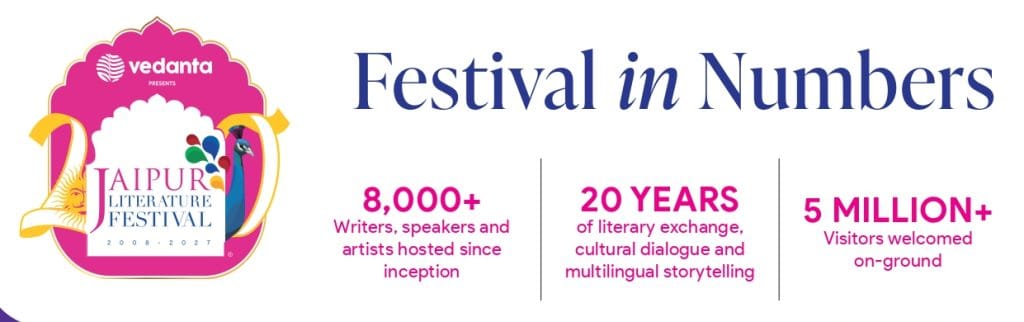
Speaking about the milestone, Sanjoy K. Roy, Managing Director of Teamwork Arts and Producer of the Jaipur Literature Festival, said that the Festival was built on the belief that books and ideas have the power to bring people together. He credited its journey to the generosity of writers, the curiosity of audiences and a continuing commitment to dialogue across cultures, languages and perspectives.
Namita Gokhale, Festival Co-Director, emphasised India’s literary heritage and linguistic diversity and said the milestone year would include a tribute to the country’s many languages through the Festival’s Bhasha Swarmala series.
The 20th edition will be anchored around the theme “20 Years of Ideas. Stories. Conversations.” It will look back at the Festival’s evolution while also examining how literature and public dialogue are changing in an increasingly digital, interconnected and often divided world.
The anniversary is significant not simply because of the Festival’s scale but because of how literary festivals have changed the way audiences interact with books. Authors who were once encountered mainly through the printed page can now engage directly with readers, while discussions around literature increasingly overlap with some of the most pressing social, political, scientific and cultural questions of our time.
As the Jaipur Literature Festival enters its third decade, its continuing challenge will be to remain open, diverse and relevant while preserving what has defined it from the beginning: the belief that meaningful conversation still matters, and that books and ideas can create spaces where people listen, question, disagree and discover new ways of understanding the world.
]]>To be held at the Rajasthan International Centre, Jaipur, from 10 am to 2 pm, this year’s summit will focus on the theme “Women in Leadership and Their Empowerment & Start-up Culture.”
Over its past seven editions, ChaT has impacted more than 25,000 students and hosted over 70 speakers and changemakers from diverse fields including entrepreneurship, public service, social impact, entertainment, sports, arts and innovation.
The 2026 edition will follow ChaT’s interactive format of curated talks, fireside chats, conversations and networking, aimed at giving young people an opportunity to hear directly from individuals whose journeys have challenged conventions and created an impact.
Diverse Voices Take Centre Stage
Among the confirmed speakers is acclaimed dancer and social activist Mallika Sarabhai, one of India’s best-known voices at the intersection of performing arts and social change. A leading exponent of Bharatanatyam and Kuchipudi, Sarabhai has used theatre and dance extensively to address issues including gender equality, human rights and women’s empowerment. She is also associated with the Darpana Academy of Performing Arts and is a recipient of the Padma Bhushan.
Joining her will be Bindabasini Kansakar of Nepal, an acid-attack survivor who transformed her personal experience into advocacy for stronger protections and support for survivors. Kansakar has served as a member of Nepal’s House of Representatives and has been involved in efforts to strengthen laws dealing with acid attacks and other forms of burn violence. Recent reports describe her as a former lawmaker and a prominent advocate for survivors’ rights.
Aruna Roy, social activist and professor, will bring a strong perspective on grassroots democracy, social accountability, citizens’ rights and public participation, adding depth to the summit’s conversations on leadership and responsible citizenship.
Bringing a very different voice to the stage will be Mumbai-based stand-up comedian Punit Pania, known for observational humour and social commentary. Having moved from a corporate career into comedy, Pania’s work frequently explores everyday life, politics, cities, careers and contemporary social issues through satire.
The diversity of the speaker line-up reflects ChaT’s larger idea of leadership, not as a single career path, but as the ability to question, create, persevere and influence society in different ways.
A Legacy of Influential Speakers
Over the years, the ChaT platform has featured an eclectic list of business leaders, entrepreneurs, public figures, artists, sportspersons and social changemakers.
Past speakers have included Amit Jain, CEO & Co-Founder of CarDekho; Ritesh Agarwal, Founder & CEO of OYO; Sanjeev Bikhchandani, Founder of Naukri.com; Phanindra Sama, Co-Founder of redBus; Anshu Gupta, Founder of Goonj and Ramon Magsaysay Award recipient; Kiran Bedi, former IPS officer and former Lieutenant Governor of Puducherry; Diya Kumari, Deputy Chief Minister of Rajasthan; Sachin Pilot, former Deputy Chief Minister of Rajasthan; Javed Jaaferi, actor and choreographer; Raveena Tandon, actor and producer; Raghavendra Rathore, fashion designer; Varun Grover, lyricist and writer; Luke Coutinho, nutrition and lifestyle expert and master coach; Gursimran Khamba, comedian and former AIB member; Amit Tandon, stand-up comedian; and mountaineer Arjun Vajpai, among several others.
By exposing students to people from widely different backgrounds, the summit seeks to move beyond conventional motivational speeches and encourage conversations around real journeys, setbacks, choices, resilience and responsibility.
Focus on Women Leadership and Start-up Culture
With women’s leadership, empowerment and start-up culture forming the central themes this year, the summit comes at a time when young Indians are increasingly looking beyond traditional career paths towards entrepreneurship, social enterprise, creative industries and purpose-driven careers.
Sessions are expected to encourage students to think about leadership not merely in terms of position or authority, but through initiative, independent thinking, empathy and the ability to create meaningful change.
The organisers expect participation from schools, colleges and educational institutions, with 600 plus delegates attending the one-day programme. Participation has been kept limited to maintain an interactive environment, with institutions being encouraged to nominate students who can benefit most from the experience.
With its mix of activism, entrepreneurship, art, humour and lived experience, ChaT International Youth Summit 2026 aims to give Jaipur’s young audience something increasingly valuable an opportunity not only to hear successful people speak, but to engage with ideas that can influence how they think about their own future.
]]>The theme for JJS 2026, “Coloured Gemstones – An Indispensable Part of Jaipur Heritage,” celebrates Jaipur’s centuries-old legacy in coloured gemstones and highlights the city’s global reputation for gemstone cutting, craftsmanship and trade.
The theme poster was unveiled in the presence of the JJS delegation comprising Rajiv Jain (Chairman), Dinesh Khatoria, Kamal Kothari and Mahavir P. Sharma, who briefed the Chief Minister on the preparations for the forthcoming edition of the exhibition.
During the meeting, the delegation extended a formal invitation to the Chief Minister to inaugurate JJS 2026, which will be held from 22 to 25 December 2026 at the Novotel Jaipur Convention Centre (JECC), Jaipur. Shri Bhajan Lal Sharma graciously accepted the invitation and consented to inaugurate the exhibition on its opening day.
Expressing his gratitude, JJS Chairman Rajiv Jain said, “We are honoured by the Chief Minister’s encouragement and support. The theme is a tribute to Jaipur’s rich coloured gemstone heritage, which has earned the city worldwide recognition as a leading centre for gemstone cutting, craftsmanship and trade. JJS has consistently showcased the strength of India’s gem and jewellery industry while promoting Jaipur’s unique legacy on the global stage.”
Recognised as one of India’s premier B2B and B2C gem and jewellery exhibitions, the Jaipur Jewellery Show brings together leading manufacturers, exporters, retailers, designers and buyers from across India and overseas. The annual exhibition serves as a significant platform for business, innovation and networking, while further reinforcing Jaipur’s stature as the global hub of coloured gemstones and fine jewellery.
]]>In July 2026, the government relaxed foreign investment rules for e-commerce exports. Foreign-funded online marketplaces can now purchase products manufactured in India, hold them as inventory and sell them directly to customers outside the country. The change applies only to exports. Foreign-funded e-commerce companies are still not permitted to follow the same inventory-led model for domestic online retail. Earlier, these platforms largely acted as marketplaces, connecting independent Indian sellers with buyers. Under the revised export model, a platform can purchase goods directly from an Indian producer and take responsibility for storing, marketing, shipping and selling them overseas. For a small seller, that could remove several difficult steps.
Exporting traditionally involves finding buyers, arranging international payments, understanding customs procedures, managing overseas warehouses and handling returns. Many small businesses have good products but lack the money and expertise to manage this entire chain. The new model may allow a handicraft unit, garment manufacturer or beauty-products business to concentrate on production while a larger platform handles the international customer.
The biggest opportunity may lie in India’s specialised manufacturing clusters. Jaipur is known for jewellery, textiles, home décor and handicrafts. Moradabad produces metalware, while Bhadohi is famous for carpets. Tiruppur has a large garment industry, Kannauj is known for perfume, and parts of Uttar Pradesh and Rajasthan produce leather goods, wooden products and traditional crafts. These businesses often have distinctive products but limited access to international markets. E-commerce can connect them directly with overseas buyers who are looking for handmade, sustainable or culturally rooted products.
Digital exports can also help newer sectors. Indian beauty and personal-care brands, packaged-food companies, wellness businesses, home-furnishing startups and eco-friendly product makers are increasingly discovering demand outside the country. A small brand no longer needs to open an office in London or New York before testing international demand. It can begin with a limited range, study customer response and expand gradually.
The government has also introduced measures to make smaller export consignments easier. Export incentives have been extended to eligible shipments made through the postal network. The earlier ₹10 lakh value limit on individual courier export consignments has been removed. Rules related to returned or rejected parcels have also been simplified. These changes matter because online exports often begin with small packages rather than full containers. A seller may receive ten overseas orders in a week, each going to a different city. Postal and courier channels are therefore essential for small e-commerce exporters. Working-capital support has also been proposed for eligible MSMEs using postal, courier and overseas fulfilment services. This could help businesses manufacture inventory and manage the time gap between shipping a product and receiving payment.
However, putting a product online does not automatically make it export-ready. Every country has its own regulations. Food products may require safety approvals and detailed ingredient labels. Cosmetics can face restrictions on formulations and health claims. Toys may need safety certification, while garments must follow rules on material description, sizing and labelling. Packaging is another major challenge. A product that travels safely from Jaipur to Delhi may not survive a long international journey involving several warehouses and delivery partners. International returns are also expensive. A returned item may cost more to bring back than its original selling price. Sellers must therefore provide accurate descriptions, clear photographs and correct size information. The costs can add up quickly. Online marketplace commissions, digital advertising, international shipping, customs duties and currency movements may reduce margins. A product that appears profitable at first can become expensive once every charge is included.
There is also the risk of becoming too dependent on one large platform. A marketplace may provide customers, logistics and payment support. But it can also change commission rates, advertising rules or product visibility. Sellers may find themselves competing with hundreds of similar products while paying more to remain visible in search results. The concern becomes greater when a platform starts purchasing goods directly. While this can give manufacturers larger and more predictable orders, it may also give the platform greater control over prices, production schedules and product design. Small manufacturers must therefore avoid becoming invisible suppliers. They should use marketplaces to reach customers, but also work on building their own brand identity. A Jaipur textile seller, for example, should not simply market a bedsheet as another low-cost product. The story of its fabric, printing method, artisans and regional design can help it stand out and command a better price. Protecting original designs is equally important. Once a product becomes successful online, it can be copied quickly. Small businesses need greater awareness of trademarks, design registration and intellectual-property protection.
India’s e-commerce export opportunity is real, but businesses will need support beyond policy announcements. District-level export centres, industry associations and colleges can provide training in digital marketing, international standards, packaging, taxation and online fraud prevention. Clear and affordable compliance support will be especially important for first-time exporters who cannot hire legal and logistics teams. The new rules have opened another door for Indian businesses. A small manufacturer can now dream of becoming an international seller without first becoming a large company. But the winners will not necessarily be those who list the most products. They will be businesses that maintain quality, understand foreign customers, calculate costs carefully and build brands that cannot easily be replaced. Indian products already have global appeal. The real challenge is to ensure that as those products travel across the world, the small businesses and artisans behind them also grow.
]]>Himachal Pradesh may now be showing that this trend can be reversed.
According to Chief Minister Sukhvinder Singh Sukhu, around 24,000 students have moved from private schools to 150 government schools following the introduction of the CBSE curriculum during the current academic year. The state government says the shift reflects growing confidence among parents in public education.
The change is important because parents do not usually shift their children from private to government schools without a strong reason. For many families, the attraction appears to be a nationally recognised curriculum, better academic choices and the possibility of receiving quality education without paying high fees.
Himachal Pradesh has secured CBSE affiliation for 151 government schools. The state has also announced plans to offer medical, non-medical and commerce streams in these schools, along with the appointment of subject teachers.
The early numbers are encouraging. Some schools have reported sharp increases in enrolment, including schools in Killar, Janjehli, Reckong Peo and Nerwa. However, the real test will be whether these students stay and whether learning levels improve over the next few years.
Changing the board alone will not transform a school.
Parents also want qualified teachers, regular classes, English-language support, science and computer laboratories, sports facilities, clean toilets and a safe environment. A CBSE signboard will create expectations, but those expectations must be matched by everyday performance.
English education is another major factor. Many parents choose private schools because they believe English-medium education will give their children greater confidence and better career opportunities. Government schools need to strengthen spoken and written English without making children feel ashamed of their mother tongue.
At the same time, education should not become limited to marks and board examinations. Students need communication skills, digital knowledge, creativity, sports and practical learning. They must be prepared not only for college entrance tests but also for life and future careers.
Government schools have several natural strengths. They are more affordable, available in rural areas and supported by public funds. Many also have well-qualified teachers selected through competitive recruitment. When proper infrastructure, accountability and updated teaching methods are added, they can compete strongly with private institutions.
A revival of government schools would benefit more than individual families. It could reduce the financial pressure of private-school fees and give children from different economic backgrounds an opportunity to study together.
But reforms must be carefully monitored. Teacher shortages, weak internet access, administrative delays and resistance to policy changes can slow progress. Thousands of primary teachers in Himachal Pradesh have also protested against the state’s School Complex System, showing that education reforms need consultation with teachers as well as parents.
Himachal Pradesh’s experience sends an encouraging message: parents have not completely lost faith in government schools. They are willing to return when they see visible improvement.
The question is no longer whether public schools can attract students. They clearly can.
The bigger challenge is whether they can provide consistent quality after the excitement of new admissions fades. If trained teachers, modern infrastructure, English support and strong accountability come together, government schools could once again become the first choice, not the last option.
]]>Released in association with Sony Music India and Sony Pictures India, the special “Barsaat x Spider-Man: Brand New Day Edition” combines the song with scenes reflecting Peter Parker’s loneliness, sacrifice and memories of MJ.
One fact, however, needs to be made clear: Barsaat has not been confirmed as part of the film’s original soundtrack. It is a promotional music video created for Indian audiences.
That distinction does not make the collaboration any less meaningful.
Banjaare is a Haryanvi music project formed by two brothers. Unlike the loud, dance-heavy sound often associated with mainstream Haryanvi music, their songs focus on softer emotions such as love, separation and heartbreak. The duo describes its work as an attempt to connect Haryana’s earthy musical roots with a modern sound.
That emotional style fits Peter Parker’s story well. After the events of Spider-Man: No Way Home, Peter remembers MJ, but she no longer remembers him. Barsaat, built around the pain of losing someone and learning to let go, gives that familiar superhero story an unexpectedly Indian voice.
The collaboration also shows how India’s regional music market is changing. A song no longer needs to be part of a Bollywood film to travel across the country. Streaming platforms, YouTube and short-video apps have allowed artists singing in Haryanvi, Punjabi, Bhojpuri and other regional languages to reach audiences far beyond their home states.
For Hollywood studios, regional collaborations offer something that dubbed trailers alone cannot: an emotional and cultural connection with local viewers. Sony has also promoted Spider-Man: Brand New Day through other India-specific music collaborations, showing that the country is increasingly being approached as a collection of distinct language and cultural markets rather than as one uniform audience.
For independent musicians, the message is equally important. They do not always have to abandon their language or identity to reach a larger stage.
A Haryanvi song may not appear in the film itself, but being officially paired with Spider-Man is still a notable moment. It shows that regional music can move beyond geographical and linguistic boundaries when the emotion is honest.
Spider-Man belongs to New York. Barsaat belongs to Haryana. But heartbreak, as this collaboration proves, needs no translation.
]]>