-
Pin on home page
-
Exclude from Top
Journalistic malfeasance when writing about statistics

Sep 18 at 4:41 pm


Property tax assessment windfall should lead to lower tax rates

Sep 17 at 7:19 am


A lighthouse strategy for economic development

Sep 17 at 7:06 am


A golden era for Chambers and industry groups?

Sep 10 at 10:09 am


Diane Francis needs to rethink her position on immigration

Sep 8 at 7:39 pm


Your community's talent pipeline = growth potential

Sep 4 at 8:17 am


August 2021

We should still means test income support programs

Aug 20 at 10:22 am


Grannies and grampies getting the Big Stamp?

Aug 18 at 9:53 pm


The Greatest New Brunswicker (s)?

Aug 7 at 11:58 am


July 2021

Where are the Mad Men (and Mad Women)?

Jul 29 at 7:00 am


New Brunswick needs growth industries

Jul 27 at 4:19 pm


Don't go home.

Jul 26 at 7:15 am


When it comes to the costs of addressing our climate change commitments, give it to the people straight

Jul 12 at 10:33 am


Bad rap: Musings on government directed culture


Freddy Beach all growed up and now sitting at the big kids table

Jul 7 at 3:34 pm


Volunteering: The secret sauce for inclusive communities?

Jun 28 at 9:14 am
]]>
The Q1 2021 job vacancy data has settled down somewhat and I think is back to reflecting longer term trends in New Brunswick.
This chart shows the vacancy rate (%) by region around New Brunswick in Q1 each year since 2016. As always I don’t like comparing month-to-month (or quarter-to-quarter) because of seasonality so the year-over-year is a better comparison (IMO).
In Q1 2021 the job vacancy rate in New Brunswick was 3.2% or slightly higher than last year but following an ongoing trend. The rate has increased by 88% in the past five years. Campbellton-Miramichi, Moncton and Edmundston have the highest job vacancy rates but Campbellton-Miramichi has seen the largest increase by far. AGain this could be somewhat Covid-related because there was a significant spike in the past year.

The second table shows the actual number of job vacancies in each region of the province. The number of job vacancies in the Moncton region was actually slightly lower in Q1 2021 (my contention is immigration) but 36% of all job vacancies around the province are in the Moncton-Richibucto region. Again, consider Campbellton-Miramichi, a 236% increase in the number of vacant jobs over five years. In Q1 2016 there were only 495 vacant jobs. Now there are 1,665 (again this could be Covid-influenced).

The final table is the average hourly wage on offer for the vacant jobs. Job vacancies in general tend to be higher in lower wage industries but the average wage on offer has been increasing faster in New Brunswick than across the country in recent years (but not by a wide margin). Campbellton-Miramichi is the outlier with a massive rise just in the past year (again likely Covid related) while the second lowest increase over five years. In fact, before Covid, the average hourly wage for jobs on offer in Campbellton-Miramichi had declined. Between Q1 2016 and Q1 2020, C-M was the only region in NB to see a decline in the average wage on offer.

It will likely be one or two more quarters before we see the effects of Covid-19 waning. But this data for me confirms the ongoing reality that job vacancies are rising across the province and this is a serious risk to economic growth.
]]>I also volunteer on two other community boards. In fact, since returning to New Brunswick in the early 1990s there hasn’t been a time that I was not volunteering with at least one organization.
I have written quite a bit over the years about the importance of volunteerism but after my column this weekend, I was thinking about it in the context of inclusion.
The latest survey data from Statistics Canada (for 2018) indicates that 42% of adults in New Brunswick volunteer formally and 78% volunteer either formally or informally during the year. That is impressive.
This represents 124 million hours per year of volunteering across New Brunswick. Just for fun, let’s say that volunteerism is ‘worth’ about $30/hour. In other words, if those were paid hours, the direct, indirect and induced economic impacts would conservatively boost GDP by $30/hour. So all that volunteering is ‘worth’ nearly $4 billion that is not included in the formal GDP statistics.
As I have said in the past, the high level of volunteerism in Canada is one of the things that sets us apart from many other countries.
I think it also helps with the goal of inclusion. Imagine if community sports leagues were unable to rely on volunteers. It’s already expensive enough to put kids into sports – imagine if all the volunteers had to be paid? Community sports leagues would be priced out for all but the richest families.
Imagine if support organizations such as food banks, shelters, etc. didn’t have a legion of volunteers. It could double or triple – or even more – the cost of the services making it much harder to reach the folks that need the services.
As we look to become an even more inclusive place in the years ahead, I think the role of volunteerism will become even more pronounced.
I am a little concerned the volunteerism rate drops significantly among older NBers (specifically the 55-64 age cohort). For formal volunteerism, the rate among those aged 55-64 is only 33% (compared to 43.5% among those aged 45-54 and nearly 47% among those aged 35-44).
I suspect the higher rates of volunteerism among younger people is related to children and volunteerism in schools, sports, etc.
If we want to be a diverse and inclusive society in the years ahead, we will have ample opportunity. Immigrants will be streaming in by the thousands each year. Historically marginalized groups will need more support. The relationship between Indigenous and non-Indigenous populations needs a lot of work – not just at the governmental level – at the community and individual level.
Volunteerism will be key to ensuring we are a diverse and inclusive society moving forward.
]]>I meant to write about this before but it slipped my mind. For those of you that do not know, Fredericton is becoming a CMA (Census Metropolitan Area) as of the 2021 Census. This is kind of a big deal on a number of fronts but the biggest reason is that Fredericton is now in the ranks of the largest urban centres in Canada. Freddy Beach is not alone, Red Deer, (Alta.), Kamloops, (B.C.), Chilliwack, (B.C.), and Nanaimo, (B.C.) are all becoming CMAs. This is the dividend of growth. To graduate into a CMA you need 50,000 in the main population centre and at least 100,000 in the overall CA area.
The other interesting change is that Quispamsis – Rothesay, (N.B.) has become a secondary core population. A secondary core is a population centre with a population of at least 10,000 that is located outside the municipality of the primary core but within the CMA or CA. The primary core is centered in Saint John (city) but this new population centre shows how a growing share of the population in the Saint John CMA is clustering outside the main population centre. Stats. Can counts nearly 25,000 in this secondary core population.
I still remember the fights we had to get Moncton – CMA status. I was arming Senator Robertson in the Senate and recall watching the head of the senate telling Senator Robertson that “Moncton seems to be doing fine without being a CMA”. Back then the standard was 100,000 in the urban core and the Moncton population centre was just below 100,000. Now it is well above 100,000 – when the Census comes out next year I expect there to be at least 115,000 in the Moncton population centre (and 160,000 in the CMA total). Fredericton will have likely 65,000 or so in its population centre when the Census data comes out, well above the 50,000 threshold. I expect the new Fredericton CMA will have a population somewhere around 115,000.
Saint John’s CMA population should exceed 134,000 or so from the Census. I suspect it’s population centre will only be around 60,000 or 61,000. I know you keeners will remark that Saint John has been a CMA for decades so how can it have a population centre of only 60,000 (instead of the previous standard of 100,000). As I recall Saint John was grandfathered in as the only CMA in New Brunswick many decades ago.
Cape Breton is an interesting case as it has nearly 100,000 in the overall CA area but only around 30,000 in its core population centre. It will need a push to get the Sydneyish population up to 50,000 within 20 years or so and then, presto, it will be the next CMA in Atlantic Canada.
Likely Charlottetown will go first. It has close to 50,000 in its urban core but only 80,000 in its CA area. It will need to add 20,000 to its CA population and a little more to its population centre. Maybe a decade from now? At current growth rates that is possible.
I’ve always had this nagging feeling that government should do more to promote a positive image of places like New Brunswick. It just seems so capricious to leave it to the media or even social media. In both of those environments New Brunswick stories are more likely to be told if they are negative. If it bleeds it leads. Anne Murray’s lament about “a little good news” remains in force today.
Of course that is not entirely true. There have been stories in the national press about people moving to Atlantic Canada during the pandemic. It’s not quite right to say the stories all have to be negative but they have to be interesting and it just so happens that crime, murder, plant closures, bad weather, reports on the dependency of the Maritimes, EI usage, etc. seem to be more interesting.
So, should government actively promote a positive image of New Brunswick culture by commissioning books, music and other art that project a positive story of the province? Should the taxpayer fund story telling about how great the place is to live and work? Maybe pay David Adams Richards to write about the lovely, bucolic life in rural Miramichi these days?
In my youth I would have said: heck, yeah. I’m tired of reading about how backward and miserable we are in the drive thru province.
The Chinese government is paying rappers to sing government propaganda. There was a great story on this in the Economist magazine podcast complete with audio clips. For added benefit, these government-funded rappers tell their stories in both Chinese and English. Instead of booty, drugs, gangs and guns, these Chinese rappers are telling stories of western decadence and efforts to subvert the peaceful rise of the Chinese nation. It’s awful. Well, to my ears it sounds just like the rap you can find on Spotify but the lyrics are so strange it overwhelms the music. Imagine Chance the Rapper reading out government press releases in rhyme.
Maybe I was wrong. Maybe government shouldn’t overly direct the stories told about New Brunswick.
Fund cultural and artistic activities, yes, but don’t try and be directive about what artists want to say. They are telling our stories and do not need any help from government bureaucrats.
Heaven help us all if we ever turn on the radio to hear the next generation Stompin’ Tom Connors rapping about the benevolence of the PEI government.
I have concluded that politicians these days would rather gin up the benefits of a policy decision and ignore the costs, rather than tell it to people straight.
When it comes to addressing our climate change commitments, people need to know it will come with a cost. Either the taxpayer or the ratepayer in places like New Brunswick and Nova Scotia will have to pay billions of dollars over the next 30+ years. Any expert I have talked to or read, say that electricity costs will be higher – at least for some period of time until certain technologies (e.g. grid scale batteries) mature. The cost of converting oil-heated homes will be significant. The cost to migrate the transportation system off fossil fuel energy will be huge. The cost for many of our important industries to move from natural gas to hydrogen or other energy sources, well, you get the picture.
So when NS Premier Rankin talked about the move away from coal fired electricity last week, it was all sweetness and apple pie. An RFP for 10% of Nova Scotia electricity from renewables such as wind and solar will create 4,000 jobs mostly in rural Nova Scotia and generate more than $550 million in construction activity “in wind-rich areas, such as Guysborough, Pictou, Antigonish, Hants, Cumberland, and Colchester counties.”
The press release goes on: “This is about doing what’s right for ratepayers and keeping electricity affordable,” said Premier Rankin. “It also ensures we mitigate risks for ratepayers and establish an energy sector that attracts business.” Wind is now the cheapest source of electrical energy in Canada.
First of all, I agree with getting off coal-fired electricity. We have to do this. I just think the residents of Nova Scotia need to know what it will really cost and what the benefits will be.
The 4,000 jobs in rural Nova Scotia will be short term construction jobs. The annual jobs associated with operating and maintaining wind and solar farms are marginal and not likely to replace the 300+ inevitable jobs lost in Cape Breton alone with the two coal-fired plants and their supply chains. Not being clear about this with residents is a mistake. Now, if I am wrong and this will create 4,000 good paying annual jobs ongoing for decades, then I would like to see how they can pull that off.
Second, while wind is becoming a lower cost source of electricity with improved technology, in my understanding that does not include the cost of ensuring you have a robust electricity system. When the wind isn’t blowing or the sun isn’t shining or – more importantly – in February when it is 30 below. With the old technologies you just shovel more coal into the furnace or open the natural gas valve. With wind and solar either you a) have huge excess capacity on standby or b) you buy the power from NB or Quebec at very high rates to meet demand.
So, what the Premier should have said here is “we expect these changes to impact electricity rates by xx but we must do this for the good of the planet”. If indeed the all-in lifetime costs of wind and solar are going to push down electricity rates, they should be open and transparent about the math.
When NB Power was asked about early closure of the Belledune coal-fired plant, there were articles in the newspaper suggesting rates could rise by 30% or more. This kind of analysis should be done in Nova Scotia.
Nova Scotians pay nearly 40% more of their household income for “water, fuel and electricity” compared to the average Canadian household. It is important to be transparent with people about how these policies will impact their costs. A thousand dollar increase in annual household energy costs will hurt much more in Nova Scotia than in Ontario.
Where is the regulator on this? They comb through Emera’s executive expense accounts to find a few thousands dollars of ineligible expenses but they don’t weigh in on the cost to ratepayers from a large scale shift to renewables?
The other big Nova Scotia issue is oil heated homes. The Premier wants rural residents to focus on the 4,000 construction jobs for a couple of years and the wind and solar farms that will dot the horizon, but he needs to explain how the 192,500 homes that use heating oil will be addressed. According to Statistics Canada home heating oil accounts for 51% of all household energy consumption in Nova Scotia. Someone is going to have to pay for a massive conversion – either the resident, the general taxpayer or the ratepayer. If this heating oil conversion is to electricity – the ratepayers will need to know how all this increased capacity will be paid for. Remember, heating oil you just turn the valve in February when you need more (metaphorically). If you are relying on the electricity grid, and renewables, it gets far more complicated. Maybe the best solution for replacing heating oil will be localized – roof-top solar, micro-wind – but someone will need to pay.
In conclusion, I think politicians would be better advised to play it straight with this one. Tell people what needs to be done to completely de-carbonize the economy by 2050 (or better define what you mean by ‘net’) and explain how we are going to collectively pay for it.
The carbon tax, clean fuel standard and other costs are comin’. I’m not sure the average resident in Atlantic Canada realizes how it will impact them.
Now normally I don’t like to jump to conclusions. Possibly, this GO HOME note was etched by his wife as her cell phone battery was dead. Maybe he was from Ontario and so excited to be going home that he wrote those two words himself. Maybe he was an actor in an anti-racism campaign and was driving the car around town to spark a conversation among unsuspecting travelers on their way to the ballet, or the beach or some other benign activity.
Given the thinness of those scenarios, it is likely this guy was on the receiving end of a nasty racist event. He might have cut someone off on the highway or ‘stolen’ the best parking spot. Maybe he rejected a romantic partner. Or, maybe, someone just didn’t like the color of his skin or his place of birth.
This bothered me. A lot. In fact, I had trouble sleeping last night.
I am the one who chafes when people say there are racists in New Brunswick. I prefer to say there are people who have no experience with immigration or with people of colour and all we need is better communication. We don’t have racists – i.e. those who believe they are fundamentally superior to others based on skin colour or ethnic origin – rather we have ignorance – people who don’t know why we need to attract immigrants or who read on Facebook that immigrants ‘take our jobs’ or ‘dilute our culture’ or other incendiary allegations.
I spent 6+ years living in Virginia and while I loved much about the place – I did see real racism there in the late 1980s. I saw the lady that cut flowers where I worked grimace when a black person accidentally rubbed up against her. I heard her whisper the ‘n’ word through her teeth. I saw the raised eyebrows when I took my African American girlfriend to a barbeque.
But I didn’t think it was here. At least not prevalent. Here it wasn’t racism – it was ignorance.
Carving the words “GO HOME” into the car door of a person of colour is racism. There is no nuance, no explanation, no yah buts. The person who does this is an idiot and should be ashamed. It’s hard to imagine that a public awareness campaign will have any impact on people such as this.
To all the people who have faced “GO HOME” in any form, I am truly sorry.
Most New Brunswickers want you here and know you will help us build stronger communities in the years ahead. Don’t GO HOME, STAY and build your lives, families and careers here.
To those of us who have lived here all or most of our lives we can and need to do better. Anytime some in your circle or beyond makes anything from a snide remark to an outright racist comment, you need to push back hard.
This goes way beyond economics or demographics. This is fundamentally about what kind of person you are and what kind of a society we are.
We can turn inward and isolate around the familiar with ever hardening views of anything or anyone that is different. Or we can open up.
You choose.
]]>We have been spending a lot of time in the past few years talking about how we boost the talent pipeline as a driver of economic development. We can’t forget, however; that we actually need growth industries if we want to ‘grow’. I believe there is a causal relationship between a tightening labour market and the province’s weak economic growth since 2007 but that is by no means the only cause.
One of the challenges is that the main drivers of private sector GDP growth before 2007 have either dropped into decline or are not contributing as much post 2007.
Normally we don’t spend a lot of time showing real GDP by industry because it can be a bit confusing. Not only is GDP a sub-set of industry output in this case it is shown in Chained 2012 dollars. I want to show this to show absolute impact on GDP growth. We could look at percentage change but that can be misleading because an increase from $1 to $2 is a 100% increase whereas an increase from $1000 to $1002 is only a 0.2% increase but it adds more to the GDP than the first set of numbers.
The average annual real GDP growth between 1997 and 2006 was 2.9% and the average since has only been 0.5% (excluding 2020 which was an outlier as GDP dropped by 3.7%).
When you look on a sector-by-sector basis, you can see what has happened. The first table shows the industry groups that added at least $40 million per year to real GDP between 1997 and 2006. The ICT sector, construction (overall), manufacturing (overall), wholesale and retail trade, real estate, admin. support services, health care and public administration all had robust GDP growth. Look at the ‘call centre’ sector (admin. services). It led all private sector industries for GDP growth with the exception of construction, adding nearly $700 million to its GDP contribution over the nine year period. Since? It’s GDP contribution has declined (although it still contributes more GDP than the ICT industry, agriculture (excluding value added processing) and oil refining sector. The bottom line is that we had private sector growth and public sector growth.

Fast forward to the 2006-2019 period. Only one sector saw $40M real GDP growth per year and that is real estate, renting and leasing. I put the overall public sector GDP growth here too as it shows how even the public sector GDP is driven by other factors such as private sector growth and population growth. You don’t want to rely on real estate GDP growth, trust me on this.

I dropped the threshold down to $20M in real GDP growth per year since 2006. Still no other private sector makes the list – except one – retail trade. Again, not the right sector to rely on to grow your economy.

I dropped the threshold all the way down to $10M in real GDP growth per year since 2006. A few more private sector industries start to show up but even then only a few of them are export-focused: ICT, food manufacturing and maybe some professional services.

So this is the economic story of New Brunswick in a nutshell. Few new growth industries have emerged that have made more than a nominal impact on GDP.
Contrast this with Canada overall. Over the same timeframe, the country has seen robust GDP growth in agriculture, ICT, PSE, tourism-related GDP, administrative and support services, along with the public sector. And fairly strong growth in mining (excluding oil and gas), food manufacturing and chemical manufacturing.
So where is the next generation of private sector GDP drivers in New Brunswick?
I think there is potential for more agriculture and value-added processing but this is heavily dependent on workers and sector investment.
ICT has an opportunity to grow here but there are risks. Most of the top IT firms in New Brunswick now have offices in other places – Halifax, Toronto, the U.S. some Europe and Latin America. They may grow here if it makes sense but they could also grow their global footprint.
Tourism – NB is a laggard here but I think there is potential but again talent and investment will be key.
Admin. services?? Tricky one. The GDP is growing nationally in this sector but it is heavily dependent on workers – back office, customer service, support – telephone-based, computer-based work. There are not nearly enough NBers interested in this kind of work these days.
Manufacturing? Maybe but so much of our manufacturing GDP is tied to our natural resources – trees, fish, potatoes, etc. If we don’t have more trees, more fish, more potatoes, it’s hard to see significant increases in GDP.
Professional services GDP has risen strongly in Canada – robust growth in legal and accounting services, as well as architectural and engineering services. But to grow those sectors above average from here means export revenue and export revenue means you have to have the value proposition and the firms to build export markets.
One last one that is kind of interesting. The federal government is a major employer in New Brunswick (DoD, ACOA, etc.). As of 2020 there were 11,288 federal government employees in New Brunswick. This was a 29% increase or nearly +2,600 since 2013. Some people don’t like to think of government jobs and GDP as a ‘growth’ industry but when it comes to the federal government, it is. That payroll flowing into New Brunswick is every bit as good as the private sector, and even better if the average wages are higher because of more tax revenue.
I’d still like to see either a) a bit federal government cybersecurity operation in the new cyber-building in Fredericton and or b) a large federal government language translation centre. But seeing as NB has more federal workers, as a share of total employment than any other province except PEI (yes, we passed NS back in 2013), I’m not sure how much more we can expect.

I’ll reiterate the stats. Forget 2020 as it was the Covid year. Between 1999 and 2019, the relative GDP contribution from advertising, public relations, and related services [NAICS 5418] in New Brunswick declined by 35% (that is New Brunswick’s share of the GDP in the 10 provinces combined). New Brunswick now accounts for a microscopic 0.3% of the 10-province GDP from this sector.
We have 0.46% of the national total of advertising and PR hours worked (or 46 out of every 10,000 hours worked across the country). As of 2019, that was 45% less than in the peak year of 1998.

And when you look at the trade data, you see why New Brunswick has such a tiny advertising and PR sector. We imported just under $90 million in advertising and public relations services in 2017 (mostly from firms in Ontario, $53.5M) and we exported only $8.7M. This includes interprovincial and international exports. Adjusted for population size, New Brunswick had the largest trade deficit in this sector of any province (where data is published).

I will reiterate that every $1M revenue in these services creates $916,000 in provincial GDP, $650,000 in payroll and supports 16 FTE jobs. If we had even just Nova Scotia level exports, that would add 368 jobs and several million dollars in tax revenue for provincial and local governments.
When I ask industry folks (and I apologize for asking every time I see one), they promote a variety of reasons for this weakness. The older folks talk about the NBTel effect. NBTel used to be a multimillion dollar client for the sector and Bell now does almost nothing with NB-based firms. Others talk about how the national firms are scooping up much of the large firm/government business. Others say it is unrealistic to think that NB advertising and PR firms could win national accounts or business in other jurisdictions – even though Nova Scotia firms generate 3.7 times as much export revenue as NB firms in this sector.
Or maybe it is because Nova Scotia has a larger presence of national firms (small n and big N in this case) that do more work for national clients in Nova Scotia.
I can’t help but think it would be interesting to give this sector the NouLab treatment. Get the best and brightest minds in the space and try to figure out why we are not doing well here and what might be done about it. How much of that $90M imports could be repatriated? How? Do we need more entrepreneurs? Do we need to attract a national or international firm (s) and convince them to do creative work here? Is there a role for PSE? Do we need to attract more international talent?
I’d bring in Roger Attlee, Patrick Lacroix, Bonfire, Hawk, BrainWorks, etc. and just for the fun of it spend a few hour thinking about how we might carve out a small niche for ourselves.
]]>Someone asked me this week to name my top 10 most influential New Brunswickers since I started my career in the early 90s. A few of the obvious came to mind but really I think it depends on what you mean by ‘great’. If you mean in terms of GDP contribution (business leadership) you would have to put names like:
Robert Irving (from almost no employment in the Moncton region when he landed here to some 1,800 employees today in manufacturing, transportation, IT, etc.)* – nearly one out of every 10 net new private sector jobs over that timeframe;
Gerry Pond (the father of the IT industry in New Brunswick with at least two dozen IT firms that were either funded by him or that had leadership who worked for him in the past);
Wes Armour – who built a company with 2,000+ employees based in Moncton;
Allison McCain – you could argue the company was built into a global player before I started my career in the early 1990s but the GDP contribution from frozen foods (French fries, etc.) in New Brunswick doubled from the mid 1990s to the mid 2010s and further, he has solidified the company’s commitment to New Brunswick investing in startups and innovation here.
If you mean in terms of political contribution, this will always have a partisan lens to it but it would have to include include Frank McKenna, possibly Dominic LeBlanc, Doug Young, etc. At the local level there have been institutions such as Elsie Wayne in Saint John or Brad Woodside in Fredericton.
How about contribution to arts and culture? Then we need to consider folks like Susan Chalmers-Gauvin – founder of Atlantic Ballet or Measha Brueggergosman. David Adams Richards has been among the most important NB writers in the past 30 years.
Then there are those I would consider highly influential in a multi-faceted capacity of which Frank McKenna would be top of the list. Others on that list would have to include:
Aldea Landry – her influence cuts across multiple areas including provincial Cabinet Minister/Deputy PM, entrepreneur, chair of APEC, Bank of Canada board member, Chair of Vitalite Health Network, board member on more than a dozen national and international companies and Chancellor of the Université Sainte-Anne of Nova-Scotia. She has also mentored dozens of young women and been a champion of women in leadership across New Brunswick and Canada.
Francis McGuire – My first boss in the good old days, he was successful as a provincial Deputy Minister, investor in startups, CEO of a multinational firm based here, and now head of ACOA. There would be few in the business community that do not know the name of Francis McGuire.
Then there are the academics and thinkers – the folks who lead the way in the conversations about modernizing New Brunswick – such as Dr. John McLaughlin at UNB.
How about public sector leadership? We don’t spend a lot of time talking up the contribution of Deputy Ministers or other public sector leaders but there have to be some that really stood out in the past 30 years. I am familiar with Don Dennison and what he did as DM but also after (such as helping to startup the Business Council). I always liked Bill Levesque but that is because of his maverick style.
The truth is that at the end of the day, this kind of discussion is better had at the local level. I talk above of the influence of Robert Irving in the Moncton region but people like Jean Claude Savoie had a similar influence in western Restigouche (or Normand Caissie in Kent County). If you mention the name Larry Nelson in Moncton or Bud Bird in Fredericton in those two cities you will get back a laundry list of things they have done. I was always impressed by Bill MacMackin in Saint John. He owns a business in area but I’ve been around nearly 30 years and he seems to keep popping up in just about everything meant to foster growth in the region.
I’d be interested to know who would be on your list of top 10 most influential New Brunswickers since 1990.
*Robert and Jim are co-CEOs of the company. I put Robert here because he is physically located in the Moncton region.
The good news is that more New Brunswickers are staying in the workforce longer. Over the 2009 to 2019 timeframe, the number of those aged 65 and older who reported employment income doubled.
And the number reporting EI income rose by 160%.
Ah, New Brunswick.

Across the country, the growth in 65+ EI recipients was half the growth rate in New Brunswick over the same timeframe. In 2009, NBers 65+ collected EI at a rate 2.6 times the national level. By 2019, the ratio was 3.2 times as many.
I guess in some ways it is a logical consequence of my strategy. I am suggesting older NBers shouldn’t have to work year round or full time work. So that, I guess, means that many will work enough to get their EI cheques.
But the fact that 3.2 times as many seniors collect EI in New Brunswick compared to the rest of the country – it fits the stereotype.
Grannies and grampies getting the big stamp? Par for the course, I guess.
]]>When my wife and I had young children we were getting cheques from government right and left. HST rebate cheques, child tax credit cheques – multiple times a year. As we started earning more income those cheques dried up and, now instead of cheques, I get stern reminders from government that I need to pay instalments on the future taxes I am expecting to pay in the year ahead. I calculated last year we paid more taxes to government than my wife and I earned in total income when we first got married.
And that’s OK. People that earn more money should be paying a lot more taxes and should not be getting direct cash from governments.
I worry that governments are going in the other direction. The NDP always knew that universal social and income support programs would be a winner with the public but the other parties have figured it out too.
Direct government transfers to individuals in New Brunswick (excluding CPP which is self-sustaining) as a share of total income rose by more than 11% between 2014 and 2019 – pre-pandemic. New Brunswickers received nearly $800 million more in cash direct from government in 2019 than in 2014.
The following table shows the percentage increase in income transfers direct to individuals from government sources between 2014-2019. This doesn’t include things like the subsidized cost of institutionalized Long Term Care.

Now we are getting proposals for broad-based, non-means tested child care, free post-secondary education and other programs.
The new thinking on this is that if you give everyone the benefit – regardless of need – you will get far more support. People think it is ‘unfair’ if someone else gets a benefit and not them. So why not give it to everyone!
The CERB was highly popular because everyone got it (although they announced later there would be tax implications). In the U.S. the stimulus cheques went to everyone rich and poor and for some experts, that was the reason why the program was very popular. We have rich relatives in Boston that got their cheques in the mail.
I think we need to get back to means testing. If people need income support or tax incentives to achieve social goals like reducing poverty, access to the workforce, access to education, etc. let’s develop high quality programs to support these goals. Let’s not just dump out bags of money from the top of the legislature because it is popular.
I know that deficits and debt have fallen out of fashion because of low interest rates and new theories such as MMT. But I am starting to worry that interest rate rises are acomin’ and that could require very painful adjustments down the road.
Some of you will push back and say how far do we take means testing? Should health care be means tested? Should education? How about toll roads?
We can have this debate all day long. I’m on the record supporting some form of means-tested payment for basic health care services. I want the public system to fully cover the big stuff $10k, $100k – costs that could cause hardship/bankrupt people – but $15 for a blood test, $35 to visit the doctor, etc. I think would make the system stronger.
At the risk of sounding like an old fogie, I remember the deep cuts of the early-mid 1990s that came about because public spending growth in real terms continued to outpace economic growth.
Politicians should avoid the seduction of income transfer programs for all and get back to means testing programs based on need.

When I first started in economic development back in the early 1990s our sales pitch to local, national and international industries focused on the size of the available talent pool in New Brunswick. If you set up a manufacturing operation here you will get thousands of qualified applicants. If you set up a back office here you will get 5 qualified applicants for every available job. If you put an IT development shop here the talent will be lined up at the door before you even put out the help wanted sign.
One of the benefits of my job is that I get to work on interesting projects communities large and small from St. John’s to Winnipeg and nowadays the lack of talent is a barrier to growth just about everywhere. It’s not just a pandemic thing. This was brewing way before Covid-19 – the pandemic just accelerated things.
I have been working on a few projects in the London, Ontario region and am increasingly convinced the ability to demonstrate a very strong talent pipeline is the key to attracting investment and economic growth. In other words, you don’t have to show a lot of surplus talent in the current workforce but you must be able to signal clearly that you have more talent in the pipe than other communities. If companies locate in your community they will be better able to recruit workers compared to other communities as long as they offer competitive wages and a good working environment.
What is the talent pipeline?
Come back to London – among the most successful urban centres in Canada for a while now. The community has 60,000 post-secondary education students or 213 PSE students for every 1,000 in the workforce. Halifax and the Waterloo region are others with a very high PSE/workforce ratio.
This benefits a community in multiple ways. It provides a lot of student workers to ease shortages in retail and service industries and it provides an ongoing talent pool for local industries. It is also a good source of entrepreneurs. It clearly demonstrates an ongoing pool of talent and signals to industry a commitment to churning out talent.
Of course there needs to be some focus on aligning with workforce demand. If you are graduating 60,000 basket weavers that would be another thing (although you might end up with quite a cluster of basket weaving companies).
So, in general, this statistic below concerns me. New Brunswick as of the 2018-2019 school year has by far the fewest enrolled in post-secondary education (university and college). From the peak enrolment of nearly 35,000 in 2004-2005, NB PSE enrolment is down by 23 percent even as it has risen by 28 percent across Canada.

In my opinion, New Brunswick should be turning out surplus talent in industries that we see as holding export-focused growth potential such as cybersecurity, next generation back office activity, tourism, etc. If some of the graduates leave to find work elsewhere, so be it. I’m not sure it is a bad thing if NB is training cybersecurity workers who then deploy elsewhere. They may end up back here some day.
I’m not suggesting we over-graduate plumbers, hair dressers or janitors – unless some enterprising entrepreneurs could turn that surplus into a business opportunity – but in industries where growth potential is tightly correlated to the talent pool – I would.
Of course PSE is not the only source of talent. Communities that can show a clear and sustained ability to attract immigrants or migrants from elsewhere in Canada can also trumpet a strong talent pipeline.
If I was marketing a community these days I would lead with this data. Forget about your beautiful beaches and nice people. Don’t worry too much about the unemployment rate. Push the talent pipeline:
- We have 213 PSE enrolment per 1,000 in the workforce – top five in the country among urban centres.
- We have an annual inflow of 154 immigrants per 10,000 population.
Again, ultimately the message needs more fine grained calibration – aligned with workforce demand – but at a high level – showing your talent pipeline is now the most important way to promote your community.
If word gets around that companies are easily able to find workers in your community that becomes the killer app.
]]>National Post columnist and normally business friendly Diane Francis wrote a fairly sharp piece in the Financial Post criticizing the Liberals’ “unsustainable immigration plan” concluding that 400,000 per year way to many, even calling it a ‘flood’.
Francis likely knows the numbers. Between 2015 and 2019 Canada added 195,000 landed immigrants to the workforce each year, on average. Over the same period the average annual additions to the workforce from those born in Canada was only 17,000. In fact, in 2013 there were about as many born in Canada workers in the labour market as there were seven years later in 2019. Over the same period, a million landed immigrants were added to the Canadian workforce.
So there is some simple math at work here. If you are adding 200,000 immigrants to the workforce each year and if you add in non-working spouses and some children coming along with the immigrants, that gets you pretty close to 400,000/year. Of course we are also bringing in 100,000+ temporary foreign workers and a large share of the 600,000 international students also work.
Her argument is that Covid-19 has pushed up unemployment which after the dust settles (i.e. after the enhanced EI program converts to the regular EI program) we shall see how much structural unemployment is left.
Beyond Covid-19, economic growth in Canada is highly correlated to workforce/employment growth. Yes there are some productivity gains (i.e. GDP growth rises faster than workforce growth over time) but there is no denying the economy is heavily dependent on workers and if the workforce tightens too much it constrains economic growth.
Maybe Francis wants to see if Canada can grow at 2% or more per year without growth in the size of the workforce. Maybe she thinks employers will respond by deploying new labour saving technology.
I don’t want to take that risk. We did take a step back with immigration during the pandemic. According to Statistics Canada, only 284,000 immigrants were added to the population in 2019-2020 and the number of non-permanent residents was cut by more than half.
Here’s my concern. Let’s say Francis gets her way and the national immigration numbers are dropped to 300,000.
The Ontario government recently released its population growth forecasts through 2046. They are expecting 187,000 immigrants next year (reference case) or 224,000 in the high growth case.
Let’s do a little more math. Ontario is home to 39% of Canada’s population. And they want at least 187,000 immigrants per year or 224,000.
Guess which province (s) will end up with the short end of the stick if Francis’ gets her way?
The following table shows a population-based distribution of immigrants. If Ontario wants at least 187,000 (or even 224,000) and let’s assume BC, etc. want a similar level, what’s left over for the Atl. Provinces? Newfoundland and Labrador just announced they want 5,100 by 2026. New Brunswick wants 8,000 (I think we need a minimum of 10,000). PEI is already at an immigration level commensurate with 500,000 across the country.
So the question for Francis is simple. Who loses in her model?

I have to say my first interactions with Chambers of Commerce and industry associations was not particularly positive. It was in the mid 1990s and I couldn’t really figure out what they were doing. At the time, ACOA was pumping a pile of cash into a number of industry groups and one mandarin complained to me that all they got for the cash was an industry directory and an annual golf tournament.
I had been researching economic development in the United States and in many particularly southern States Chambers of Commerce were self-funding economic development. They had teams of sales staff out hustling industry to move to their community. In my opinion, in New Brunswick we got networking sessions and golf tournaments.
Since then I have started to become a big fan of these groups – in general – the intermediaries that represent an industry or a segment of the economy. Groups like Chambers, CFIB, CENB, NBBC, industry associations, etc. I like them as a category although certainly some are stronger than others.
The case for these intermediaries is stronger than ever. Forget BBQs and online directories, many industries are struggling with fundamental issues of workforce development, entrepreneurship development, productivity, export market development along with the standard government advocacy work around regulation, taxes, etc.
It is much harder for individual firms to address most of these issues but if they throw a few hundred bucks into a pot, they can band together to address important issues – again not golf tournaments – issues that are fundamental to the bottom line.
I have said before I am a big fan of the Fredericton Chamber and particularly Krista Ross. She is not your typical Chamber CEO. She is everywhere – working on a broad range of issues – lobbying, chiding, advocating, implementing concrete initiatives. John Wishart in Greater Moncton is, in my opinion also doing very good stuff – and it is important to point out I don’t get any revenue from those groups – I just like the cut of their jibs.
I have clients, such as the Tourism Industry Association of NB, that have also broadened their role in recent years – they have a very solid tourism workforce development plan and are diligently working to meet the objectives (disclosure I was involved in its development).
Now could be a golden era for these groups. It is hard to find an industry these days that isn’t facing a host of important sector-wide challenges. This is where the ‘intermediaries’ come in.
So through 0.02% of your revenue into a pot and work with your peers to address the challenges of our time as they relate to your industry. Demand quality and accountability but now, more than ever, is the time for these groups to shine.
We have a romantic notion of the small firm – the entrepreneur who bootstraps an idea to something big – but at some point it morphs into a big corporation preying on its workers, suppliers, and governments. That’s over the top hyperbole but I think you get my point.
Most successful export-focused industries have larger firms that set the pace. Take a look at some of the highest labour productivity sectors in New Brunswick.
I was the first to express concern when the Quebec firms took over the dairy product manufacturing sector but so far – productivity went through the roof and total GDP contribution has been rising. The risk that Quebec-based firms will make decisions not to the benefit of NB is there but so far things have been going well. These are lighthouse firms but they are not based here.

Consider the other sectors with high labour productivity. In each of these cases there is one or two (maybe three) large firms that have the scale to address productivity opportunities. Obviously the NB Power example is a unique case as it is a vertically integrated monopoly (although this would include SJ Energy, etc.) but I put it in there because there has been a significant increase in productivity in that sector over the past decade.
Office administrative services – mostly big firms – paper manufacturing 2 big firms now (maybe 3?). Converted paper products – 1 or 2? This doesn’t preclude smaller firms (although in the case of capital intensive industries that becomes a natural barrier to entry) but it means that there are advantages to scale and having a couple of big lighthouses can end up being good for all the firms in the sector and supply chain.
Labour productivity is not everything and we have to be careful not to compare apples to oranges – i.e. crop farming in NB to Saskatchewan – but it is an important indicator. The other one I love to cite as a counterfactual is the brewery sector. In 2007 there were only 150 people working in the sector in NB (mostly Moosehead and Molson). Total compensation was $84/hour (that includes all wages as well as payroll costs and other benefits). By 2019 there were 400 employed in the sector and total compensation per hour was cut in half. Labour productivity dropped from $303/hour to $94/hour. Why? Because we went from two big capital-intensive players to a couple of dozen or more small breweries and that pushed productivity and wages way down. If you asked most beer drinkers in NB they would strenuously object to going back to the good old high productivity/high wage days.
I’m not suggesting we pursue a monopoly-based approach to economic development but I am suggesting we need to have a few leaders of the pack – lighthouses – to lead the development of a cluster of firms – think Mariner in the NB IT sector.
The implication of this is simple. When we look to develop opportunities – the role of those ‘lighthouses’ needs to be lit up.
]]>It is likely if you have ever spoken to anyone who has moved here from elsewhere in Canada they will complain about property taxes. I have had people tell me they were shocked at how much property taxes they had to pay.
In reality most of them haven’t thought about the issue enough. They just think “the assessed value of my house went from $1.4 million in Toronto to $290,000 in Fredericton but my tax bill is the same!” “How is that possible!”
But if you think about it for a moment, the services your taxes pay for in Fredericton cost a similar amount as in Toronto – maybe more or less but – the salaries of a police officer are not 80% lower than in Toronto. On a per capita basis, the cost of local services might be modestly lower in Freddy than Toronto but actually could be higher if the larger cities benefit from economies of scale.
So a better measure would be property taxes as a share of household income or something.
The Globe and Mail has great examples: $1.8M property in Toronto, $6k taxes. $1.5M 1,800 sq. ft bungalow in Etobicoke, $4.5k taxes. $700K condo, $2k in taxes. Poor old David C – $4.5K taxes on an assessment in the low to mid $200s.
So give municipalities a break.
But at the same time, if assessments go up well above a ‘normal’ increase, that should not have councillors salivating – it should force a sober conversation about tax rates. Maybe you could even bring them down once in a while.
]]>I saw several stories on my social media about the “fastest growing occupations in the United States” over the next decade. The list was put together by the reputable US Bureau of Labor Statistics. In total, the BLS is expecting 11.9 million incremental jobs by 2030 across the county. The stories I read (three) all focused on the fact that green energy jobs were the ‘fastest’ growing jobs in the U.S. Here is an excerpt from CNBC:

Now, I have used my blog from time to time to talk about the appropriate use of economic and demographic statistics. I find that some journalists are pretty fast and loose with how the position data points such as this.
When you read this statement what do you think? That there will be massive new jobs in green energy, of course. The journalist all but tells you that – “Interest in wind and solar energy has skyrocketed” after all.
Here is the list published by the BLS but this time by the number of jobs that will be created by 2030:

I’m not kidding. This is literally a screen shot of the BLS data. There are going to be more jobs created as film and video editors than wind turbine technicians. For pete’s sake, there will be more actors – more statistician jobs created than wind turbine techs and solar installers combined!
So the journalist wasn’t lying. The percentage change was higher for wind turbine techs but when you talk about something like the outlook for jobs over next 10 years the absolute number is really all that matters.
The journalist obviously wanted to gin up the fact that the green energy revolution is going to create massive new jobs. A more accurate story here would have focused on the real jobs that will be in demand – 1.1 million home care workers, 560,000 cooks, 121,000 exercise trainers, 115,000 nurse practitioners – in fact most of the occupations with the biggest expansion are in health care.
When you see data like this it is important to tell the story that matters. The % change is only a small part of the story. As I have said before, if you have $1.00 and someone gives you $9 more you now have ten times as much as you had before but you really only have $9 more dollars. If you have $1 million and someone gives you $10 more you really have $10 more dollars (0.001% more as a percentage).
At that time I was in my mid-20s so she seemed ancient but now I realize she was likely in her early 50s and at that time could retire with a full pension at some point before she turned 60.
There was a big focus on ‘freedom 55’ back then. A lot of public and some private sector pensions allowed folks to retire in their 50s with full or almost full pensions. TV shows were filled with commercials showing grey-haired couples golfing, sailing and walking through the streets of Paris. Retire at 55 and live the life you always wanted!
Many (certainly not all) now think this was a mistake on many fronts. For society this means less people working in what for many are the prime years of life – post children but 20 years or more away from being ‘old’. It means less tax revenue for government as retired people pay on average considerably less taxes. I would argue for many that retired in their 50s it isn’t particularly great for their quality of life. A friend of mine in Ontario lasted 4-5 months before jumping back into the labour market.
When western society more or less settled on 60-65 as the right age to retire from work, people were living on average to around 70. Now people are living well into their 80s and more and more into their 90s. I have a friend who retired as a teacher at 55. He is now just under 80. Will likely live well into his 80s. He will end up being ‘retired’ more than he worked.
Starting around 2000, the share of persons aged 55-69 active in the New Brunswick workforce started to decline and now sits at 50 percent. Half of everyone in that age group is not participating in the workforce.

On an absolute basis, then, we now have 88,000 people aged 55-69 who are not working in New Brunswick. Imagine if just half of those folks were in the workforce – it would add 44,000 workers and dramatically relieve the workforce shortages emerging in many industries.

Don’t panic. I’m not calling for government to conscript older folks into the workforce or slash their pensions or anything else. If someone 55 – heck if someone 25 – doesn’t want to work – and they can afford not to – who am I to tell them to work?
But I know from personal experience there are many that would like to continue working – on their own terms – maybe part time, maybe seasonal – maybe for more than one company – maybe even fully volunteer – and that’s great. Some tell me they are penalized for working through pension claw backs. Some need more training.
One of the little discussed parts of the Liberal platform was a “career extension tax credit” which in the costing of the platform they suggest could be worth over $600 million per year.
I like the idea. If 600,000-700,000 or more Canadians stay in the workforce to 70 or so (again not necessarily full time/full year) it should ease some of the workforce challenges we are starting to see.
It can be a prickly subject but keeping older Canadians in the workforce longer is an important conversation we need to have.
]]>I break out in a wide grin at every new twist in the controversy over the World Bank’s Ease of Doing Business survey. This report was started quite a while ago to assess how hard it was to start and run a business in countries around the world. I’m not sure how many businesses made decisions using it but as was recounted in a recent Economist article, countries started to take it seriously and worked to raise their ranking, which was a good thing.
Now a new report has found that World Bank officials tweaked the methodology after being pressured by the Chinese government. It has become a big controversy with many countries including the United States calling for the head of the IMF (who was in charge of the EODB survey before) to be fired. It’s another example of China’s increasingly brazen behaviour, yadda yadda yadda.
Why I chuckle about this is my recollection of KPMG’s Competitive Alternatives report which was started way back in the 1990s, funded by the Canadian government and others. Long timers will remember that report. It compared the cost of doing business across multiple industries in something like 150 countries and conveniently, most Canadian cities (especially New Brunswick!) looked real good.
The first year that report came out, Quebec cities didn’t fair particularly well.
The second year the report came out, a number of Quebec cities were at or near the top of the pile.
What had happened? KMPG tweaked the methodology and, presto, Quebec was highly competitive for business investment.
I suspect no high level official at Industry Canada was fired. There was no global controversy. A number of economic developers, like myself, grumbled about it but to no avail.
The use of data and statistics to support economic development is my core business. It has animated my career since I first walked into the 5th Floor of the Centennial Building in Fredericton in 1993 to take a 3-month job building business cost models meant to position New Brunswick as a more cost effective location to do business. If I had turned right instead of left that day who knows what might have been?
The bottom line is there is ‘objectivity’ and there is objectivity. When I am working with a community or industry to position it better for investment and growth, I use factual statistical data.
I’ve never made up a statistic in my life (except to plug gaps in data and then I am clear in the assumptions).
But I am not particularly objective. In the case of economic development promotion, we use statistics that help our story. In the case of economic development policy, we are using statistics to help strengthen our value proposition. The two audiences are completely different.
So the World Bank EODB survey should not have changed its methodology or at the very least should have been very clear with the readers they did and the reason for the changes.
The KPMG Competitive Alternatives? That one is a little more tricky. On the one hand, it is paid for by the Canadian government and on the other government wants to use the KPMG brand to establish credibility. In the end, this one is caveat emptor.
BioNB celebrated its 25th anniversary yesterday. As you know I am a fan of these intermediary organizations – not government, not individual firms – set up to advance the opportunities in a specific industry. When these entities are working badly all we get is a company directory, annual golf tournament, a website, maybe some tweets, the occasional special speaker. When they are working well, we can see industry transformation.
There are things that can be done far more effectively at the group level that would be hard or impossible to do at the individual firm or organization level. Further, because much of what is done is meant to benefit the group, if an individual firm or organization does it, you end up with a free rider problem: one pays, all benefit.
So I am advocating for an even stronger role for organizations such as BioNB in the years ahead in areas such as R&D, entrepreneurship support, infrastructure development, talent attraction, etc.
Infrastructure, you say? Again, if it can benefit multiple firms/organizations and there is a strong case, why not? Think about COVE’s test bed for marine instrumentation or bioreactors at the Verschuren Centre for Sustainability in Energy and the Environment at UCB. That infrastructure is attracting entrepreneurs from across Canada and beyond because the cost of them purchasing the infrastructure individually would be prohibitive.
There are lots of folks that believe the bioeconomy – broadly defined – will be a major driver of economic development in the years ahead as we look to address climate change, sustainability, human health and, more generally, progress as a society. There are those that think Atlantic Canada should position itself as a region to take advantage of the opportunities.
The BioNB 25th celebration was fun. Lots of good history on the organization and a taste of what’s ahead. Although there was a question on the quiz (overall I failed) that suggested the province could be self-sufficient if we went back the level of agricultural output in the 1930s. I’m not sure that is strictly correct.
I’ll be watching to see what’s next for BioNB.
With a strong intermediary we stand a much better chance of success than without.
Across the board, self-employment is more prevalent in males than females across Canada. About 14% of non-immigrant males were self-employed at the time of the Census compared to 9% of females. Among those with paid employees, 5.7% of males were self-employed compared to 2.5% of females (i.e males had more that double the self-employment/with employees) rate.
Among immigrants, males are also more likely to be self-employed with an 18% self-employment rate in 2016 compared to 11% among females and 8.% self-employment/with employees compared to 4.2% among immigrant females.
But when the comparison shifts to just female entrepreneurship (self-employment), immigrants tend to have higher self-employment.
As shown in the chart, across all industries, immigrant women are 18% more likely to be self-employed (relative to total employment). I put both the percentage point change and the percentage change as the latter is a better measure of relative impact. For example, in the finance and insurance sector female immigrant have only have a one percentage point larger self-employment rate over non-immigrants but because the overall rate is low, the relative difference is 43% higher.
On a sector basis, non-immigrants have a higher self-employment rate in only the primary industries (agriculture, mining, etc.), manufacturing, professional services (legal, accounting, etc.), administrative and support services and other services (such as personal care).

When you look at only those self-employed persons that have paid staff, the relative difference widens. Immigrant women are 70% more likely to own a business with employees than non-immigrant women (as of the 2016 Census). On a sector basis, non-immigrant women have a higher share self-employed/with employees in only primary industries.

Finally, females have a much higher self-employment rate in Atlantic Canada compared to the rest of the country. You have to view this with some caution because the absolute numbers are quite low. For example, in Newfoundland and Labrador there are only 135 immigrant females who are self-employed and have employees compared to over 42,000 in Ontario. But still, the rates are much higher in Atlantic Canada.

The 2021 Census data on this issue will be interesting given the rise in immigration across the country. But you will have to wait until sometime in 2022 for this data.
The overall population increased by 6,021 or 0.8%, slightly less than last year (6,076) and the year before (6,827) but still quite good given the pandemic. The population growth rate was 0.8%, same as last year but less than the 1% growth rate in 2019, pre-pandemic.
Once again we significantly under-performed our peers in the Maritimes. Nova Scotia’s population increased by 1% and PEI led the country again with a 1.9% growth rate. We were faster growing than the country overall for the first time in forever (shout out to Frozen).

The big concern was the 47% drop in immigration compared to the pre-pandemic 2019. This was tied for the largest percentage point drop with PEI and SK among the 10 provinces. Ontario’s immigrant numbers declined by only 22% in 2021 compared to pre-pandemic 2019. That worries me for reasons covered in a previous post.
The good news was the large influx from other provinces, mostly Ontario. New Brunswick attracted 3,900 (net) from the rest of Canada. Adjusted for population size, however, that dwarfed Nova Scotia – a province that attracted twice as many as New Brunswick adjusted for population size. Even PEI had a higher interprovincial migration rate. A good question would be why? What do the Bluenosers have over the Herringchokers? Was it access to housing? Was it Halifax? Data in the near future should shed light on this. Maybe we need a new nickname.

Where are these interprovincial migrants coming from? Well, Ontario, of course. over 6,100 of them in 2020 to 2021. On a net basis we attracted 3,388 more than we lost to Ontario. However, adjusted for population size we lost more population to Nova Scotia in 2020-2021.
They don’t want our bees but apparently they take people (there is a very prominent sign at the border outlawing illegal immigrant bees, although I’m not sure how they enforce the border).

All in all the past year + 4 months has been a very interesting time economically and demographically across Canada.
If Ontario continues to lose folks to interprovincial migration you can be sure they will make it up through immigration muscling out the smaller provinces. My prediction is this will settle down after the pandemic subsides but when that will be is still in the air – we have added ‘waves’ to the pandemic lexicon.
New Brunswick needs to focus on getting its immigrant numbers back on track in addition to encouraging folks from elsewhere in Canada to move here. By my estimates I think we need to get up to 1.5% per year population growth – skewed towards younger people – to ensure we meet workforce demand into the future.
]]>I’ve had a couple of interesting conversations in the past week about my position on the Employment Insurance situation in Atlantic Canada. Ultimately, I don’t think there will be any big change to the program itself – i.e. far fewer people collecting EI each year but can’t we just find a way to once and for all remove the fiction that there is very high ‘unemployment’ in rural Atlantic Canada? Because when the average person hears the phrase ‘high unemployment’ it denotes a lot of people looking for work, economic hardship, etc. When was the last time you heard someone say “community x has an unemployment rate of 20% and a booming economy?”
My point is that if you remove the 50%-80% of the unemployed in certain communities that are ‘seasonally’ unemployed, the real ‘unemployed’ drops dramatically and if you go even further and define the unemployed as those who are not working but would be willing to take just about any job on offer (which was how I saw it when I was unemployed in 1991 and worked as a short order cook wearing my cap and gown from receiving a recent MBA) the number of unemployment drops to virtually zero.
So, my contention is that in a number of communities across Atlantic Canada (and elsewhere such as Quebec) the ‘real’ unemployment rate – i.e. if you want workers in lower wage/hard employment sectors – is virtually zero.
Why does it matter? It matters because instead of requiring employers to do LMIA statements or pushing back on efforts to attract immigrants to these communities we should even be pushing harder. If an employer runs a job advertisement for a short period of time offering occupational average wages and can’t get interest, in most cases, that should be enough.
Here’s the problem. The following is Statistics Canada’s definition of unemployment:
Unemployed persons are those who, during reference week:
· were on temporary layoff during the reference week with an expectation of recall and were available for work, or
· were without work, had looked for work in the past four weeks, and were available for work, or
· had a new job to start within four weeks from reference week, and were available for work.
Note that in the above definition there are two groups for which job search is not required: persons on temporary layoff and persons with a job to start at a definite date in the future. Persons on layoff are included among the unemployed on the grounds that their willingness to supply labour services is apparent in their expectation of returning to work.
Now consider a specific example: The following is a typical situation in a community with a high use of seasonal employment. At peak usage of the program, the workforce situation would look something like this:
Adult population (15+): 5,000
In the labour force: 3,600
Participation rate: 72%
Employed: 2,400
Employment rate: 67%
Unemployed: 1,000
Unemployment rate: 28%
Now, assume that 80 0 of the 1,000 were not actually unemployed in my strict definition that they are available and looking for work. Let’s pull them out of the labour force. This to me more adequately reflects the reality on the ground in the community, if you are using ‘unemployment’ as a measure of how many people are actively looking for work.
Adult population (15+): 5,000
In the labour force: 2,600
Participation rate: 52%
Employed: 2,400
Employment rate: 92%
Actual unemployed: 200
Unemployment rate: 8%
In larger places like Toronto or Calgary, this little fudge “persons on layoff are included among the unemployed on the grounds that their willingness to supply labour services is apparent in their expectation of returning to work” only makes up a small share of the workforce – and is likely the reason why economists say the unemployment rate in Canada will always be approximately two percentage points higher than the United States. But in small rural communities the unemployment situation is distorted massively.
Now, the problem with my ‘fix’ to how we report unemployment is simple. The federal government links the number of weeks/hours you need to work to be eligible to collect EI to the unemployment rate. The higher the unemployment rate the less you need to work each year to qualify. So, if you removed the seasonally unemployed from the ranks of the unemployed (i.e. limited it to those actually looking for work), you would reduce the unemployment rate dramatically and force up the number of weeks needed to work – leading to political unrest, and a host of other problems in the most impacted communities.
In conclusion, don’t position me in the ranks calling for a radical solution – that eliminates the seasonal use of the EI program. But I am calling for a reform to the system that reflects the reality on the ground today. We shouldn’t be allowing people to make Christmas wreaths for 12 weeks and then go on EI the rest of the year. Those folks should be encouraged to retrain and take on the growing number of available year-round jobs.
But in the short term, maybe we need to grandfather certain groups, or put in place a long transition period or whatever.
At the very least, we should not pretend there is very high unemployment across most of rural Atlantic Canada right now. If you can prove it to me, I am willing to listen. But as long as there are vacant jobs as gas station attendants, coffee shop workers, assembly line workers at $14/hour, loggers, agricultural workers, trucker, home support workers, etc., you will have a hard time convincing me.
]]>It has been a good year for Halifax. Atlantic Canada’s largest urban centre by a wide margin (more that double the population of St. John’s) was tied with Oshawa for the fastest population growth in 2020 among all CMAs across the country.
The no-gall-at-all folks at MacLeans changed their minds about Halifax as a good place to live boosting the city from 131st last year to 1st in Canada in their annual ranking of best places to live across the country. Apparently poor old Burlington dropped from first to 35th because of the bad old pandemic. Sheesh. Now they have to discard all those digital placards and banners.
The labour market fared quite well in Halifax too. There were actually more people in the workforce in 2020 than in 2019 (although slightly fewer employed) and the unemployment rate, although higher than previous years was below average among CMAs.
Moving into 2021, Halifax needs to get back to being a magnet for immigrants. The number of permanent residents settling in the city in 2020 was down 55% due to the pandemic (IRCC data on PR admissions) compared to only a drop of 40% in Moncton. The population growth number above is based on the population on July 1 compared to the previous year, so it doesn’t pick up a lot of the Covid-19 impacts (for better or worse).
The city needs to ensure a steady supply of housing. The number of housing starts has been rising – up 40% since 2016 – but not keeping pace with population growth. This could erode one of Gotham’s advantages – relatively lower cost housing compared to the larger urban centres. Moncton actually takes centre stage on the podium in 2020 with 108 housing starts per 10,000 population – the most among all CMAs across the country adjusted for population size. However, this is ‘catch-up’ building as between 2016-2018 Moncton had well below average housing starts.
I would argue Halifax is having a great run. It may or may not be tied to hiring Moncton’s former City Manager, Jacques Dubé – correlation is not necessarily causation. Besides, Moncton has had a pretty good run itself in the past five years – just behind Gotham. Suffice to say there is more to Dubé than colorful bowties.
Atlantic Canada needs a prosperous Halifax.
As for Burlington? Keep a stiff upper lip. It’s likely the folks at MacLean’s will get bored and change their minds again next year.
]]>But a small number of those engineers decided they didn’t want to leave and set up companies that (at least eventually) did engineering work around the world (ADI, Neil & Gunter, etc.) from New Brunswick, mostly Fredericton.
Now, don’t get me wrong. Most of them had a significant base of work in New Brunswick (think about how upset they were when the Graham government proposed selling NB Power). But this only proves the economic development theory. Firms get really good at what they do in their home market and they take that expertise to the world.
Eventually they all sold out to national and international firms and we now have Stantec, EXP, etc.
The concern voiced by myself and many others at the time was that these firms based elsewhere will have no reason to continue doing export work from New Brunswick unless there is a compelling reason to do it from here.
The data suggests this could be happening. Between 1997 and 2006, the real GDP in New Brunswick from the architectural, engineering and related services sector rose by 77% and from 2006 to 2017 by only 1.5%. Now, there are two challenges with the data: 1) it includes architectural services and 2) most of that GDP is related to what is going on in New Brunswick and not export markets so the 77% run up could have been mostly based on growth in the local market.
However, Statistics Canada does publish data on interprovincial and international trade. It is lagged by a couple of years due to the collection of interprovincial data. As shown in the following chart the level of exports peaked in 2013 at around $155 million and has been slowly declining since. Interestingly, however; the amount of imports has risen significantly leading to a large trade deficit in this area. Most of this increase is due to interprovincial imports and so it certainly looks like the national/international firms are doing work elsewhere (e.g. Calgary) for projects in New Brunswick. We certainly don’t have enough data to say one way or the other. It could just be all the back office, administrative and management functions have moved elsewhere. Regardless of what is going on, we went from a modest trade deficit in this sector in 2013 of -$25 million to -$213 million in 2017.
The silver lining is that GDP from the architectural, engineering and related services sector increased again in 2018 and 2019. That is likely due to the expansion of construction and infrastructure development and we won’t know for some time the impact of imports and exports.
The question I have for UNB and the engineering sector in New Brunswick now is a simple. Where is the next generation of ADIs, Neil & Gunters, etc. and is there anything that can be done from a policy, training/education or infrastructure perspective to make Fredericton/NB an attractive place to stage global engineering activities?

There seems to be some impetus to do something on local government reform in the coming months. I thought about writing something on this but after reading what Richard Wilbur wrote in New Brunswick: An Annual Review, 1960-2006, I decided it would be even more valuable just to quote him verbatim. This is from 1976:
“One report with far-reaching implications, however, was tabled April 6 by E.G. Allen, a deputy minister who since the previous spring had headed a task force to study the feasibility of establishing a new form of local government for the non-incorporated areas. Translated from the bureaucratese, the board had sought citizens’ opinions on the future of the old county councils, abolished in 1967 with the Program of Equal Opportunity. Since then the rural municipalities, representing 96 percent of the province’s entire territory and 250,000 people, had been in a state of limbo, virtually without any direct control, especially fiscal, over their day-to-day affairs.
The Allen report recommended the formation of eleven rural municipalities (compared to the fifteen county councils existing before 1967) with the same powers (emphasis added to original text) as existing municipalities like Moncton, Fredericton, or Saint John. They would be able to set local taxes and be eligible for unconditional provincial grants. Allen denied that the report was attempting to dismantle the Equal Opportunity Program, arguing instead that the 216 local services districts set up by the Robichaud government had proven unwieldy and undemocratic. He also noted that in the past decade more and more New Brunswickers had been moving to rural areas (emphasis added to original text), primarily to escape high taxes, but insisting on urban services. The only way they could get these services, Allen argued, was to pay for them; the report predicted higher taxes for the eleven new districts, if and when they were created.”
What’s that old saying, the more things change the more they stay the same?
What are the odds we will get meaningful, democratic government for the population now in LSDs (and, cringe, tax reform)?
]]>He’s right, of course. The federal government is not following its own guidelines on the program. It’s almost as if a person has been collecting EI for several years straight the bureaucrats don’t even ask the question any more.
Covid-19 has just blown up EI usage in New Brunswick. It’s like handing out candy at Halloween. In January 2021 there were 75,400 people using the EI program or more than one in five of all workers. If you back out public sector workers……
Even outside of Covid-19, New Brunswickers’ use of EI hasn’t changed much in the past 20 years. Even as many industries struggle to find workers and we are bringing in thousands of immigrants each year, the number reporting EI income on their tax form in 2018 was 104,000 – only slightly fewer than way back in 2000 (107,000). One out of every four persons with employment income also reported EI income in 2018. Of course that doesn’t tell the whole story as the top number includes a lot of folks ineligible for EI.
On a regional basis 36% of everyone earning employment income in 2018 in rural areas (non-CMA/CA) also reported EI income. In the Campbellton CA it was 34% and in the Miramichi CA it was 32% – or nearly one out of every three workers.
The best story I heard recently was the fish plant that shut down in Charlotte County laying of something like 50 or 100 workers. The fish plant across the street said they would hire them all, and, if the anecdotal story is correct, only 2-3 went to work in the other plant.
Of course you will say why would they? But that is in direct contravention of the rules of the EI program. If there is a job in your field in your community you must take that job. But, again, the decision is up to the folks enforcing the rules. And that is what has Blaine Higgs up in arms.
I don’t know what to do about it. The federal MPs don’t want change – 104,000 voters used EI in 2018 and those 104,000 voters have spouses and other voting family members. In some regions of the province half the households or more collect EI each year.
I wrote a paper on this in 2019 for the Public Policy Forum.
It was kind of like peeing into the wind.
]]>For the last eight months the Growing Pains podcast has engaged leaders from across Atlantic Canada on issues related to the region’s future prosperity. We talked to Rory Francis about the booming biosciences sector on Prince Edward Island, Charlene Johnson about the outlook for Newfoundland and Labrador’s offshore oil and gas sector and Miriam Zitner on the exciting things happening in the Halifax Innovation District. Alicia Roisman Ismach gave us her grand vision for Fintech in Atlantic Canada and economist Richard Saillant provided thoughtful insight into economic development in northern New Brunswick over the next 20 years. Dr. Herb Emery was a frequent guest enlightening us on the past, present and future potential of our region.
We talked about Covid-19, entrepreneurship, natural resources development, immigration and innovation. In total, 41conversations helping us zoom in on the issues, challenges and opportunities associated with building a strong and prosperous economy and sustainable high quality public services.
Now I am excited to announce a sort of Growing Pains 2.0. Starting on April 8th, Don Mills will join me as we continue to explore the issues and put concrete solutions on the table. Don Mills needs no introduction for most of you. Over 40 years, the firm he founded, Corporate Research Associates (CRA) was the go-to source for insight into the the attitudes and opinions of Atlantic Canadians.
I have been studying economic and demographic data on Atlantic Canadians for 25 years. Don’s been in their heads for 40.
Between the two of us we will continue to interview leading thinkers, policy makers, politicians and business leaders across Atlantic Canada to help us as we address the growing pains of building a larger, stronger and more vibrant economy and population in the region.
Search for Huddle Insights wherever you get your podcasts. Follow Don on Twitter (@DonMillsHFX) and David (@jupia) and connect with us on LinkedIn.
You can read more of my observations about economic development in Atlantic Canada at www.davidwcampbell.com or by subscribing to this newsletter.
]]>
This at a time when population growth was starting to take off again:

I don’t know how I missed this. On the NB Multicultural Council tour around New Brunswick over the past few weeks this was the number one issue raised – urban, rural, north, south -didn’t matter.
I am sure the residential construction industry has a dozen explanations for this.
It doesn’t matter.
This is now a front and centre matter for government. It is squarely in the public interest to address this issue. I’m not suggesting heavy handed government intervention is the answer but we are going to need a lot of new housing. The last time New Brunswick’s population grew by the rate we will need in the coming years was the 1970s when we were building 800-900 new dwellings per 100,000 per year around the province – three times the 2015-2019 rate.
This won’t wait. We need a housing revolution – urban, rural, north, south, east, west. Modular homes could be part of the solution. Rural residents need to be able to get a mortgage. Immigrants need to be able to get a mortgage. We need more rental housing. We need housing that is affordable and we need housing that is tailored to young families. We need more housing for international students in post-secondary education.
What is possibly the most scary part of this all is that I’m hearing a big part of the challenge is the construction workforce. There are not enough workers.
And more than one out of every three construction trades – carpenter, electrician, etc. is set to retire in the next decade. Even as we need to triple home building.
Tick. Tock. Tick. Tock.
This rockets to the top of the agenda right now.
Our economic renewal depends on it.
]]>Those are all fair questions but the reality is there are hundreds – maybe even thousands – of economists, government employees, policy influencers, journalists and pundits all grappling with those questions.
And no one is asking why the Village of Chipman lost 30 businesses in the past five years (employers and non-employers with at least $30,000 in revenue).
You may say, who cares about Chipman?
I’m not suggesting that the hundreds and thousands of people grappling with national and international challenges should turn there view towards Chipman.
But someone should.
Twenty-five+ years into economic development and I am growing even more convinced the solution to sustainable, long term economic development and prosperity is found in local communities.
I’m not suggesting there is no role for provincial and national strategies. There certainly is when it comes to issues that are provincial and national in scope. If the federal government, for example, decided to curtail immigration into New Brunswick it would bring any economic renewal to a screeching halt.
But in the end, provinces are collections of communities and countries are even bigger collections of communities and if enough of those communities are ignoring economic development and population growth, it will harm provinces, regions and possibly eventually even the country.
So why did Chipman lose 30 businesses?
I would like to see strong, ground up strategies for economic development in New Brunswick that focus on building vibrant local communities.
What entrepreneurial ventures could work in Chipman? Is there a local demand that people have to leave the village to address (e.g. go to Fredericton). If so, why not find entrepreneurs to fill that local demand? Are there agricultural opportunities in the surrounding areas? Are there tourism opportunities? Other natural resources development opportunities? Who’s out hustling?
Again, you say, who should care about Chipman?
If that is your view, then who should care about Fredericton? Or Bathurst or Edmundston? Where do you cut off your concern?
I would rather have model in place that ensures all regions of the province have the means to develop economic opportunities and work to attract population.
Not all will be successful.
But all should try.
]]>
Most people don’t realize that I have been writing the It’s the Economy, Stupid! blog for over 16 years. I started writing in 2004 after being egged on by David Jonah, New Brunswick’s original Internet cowboy.
After more than 3,900 posts (that’s more than 200 per year going all the way back to 2004) and the equivalent of more than 10,000 pages, I am committed to continue writing into the future. Why not? The carpenter uses her hammer. The painter his brush. I write about the economy. Giddy up.
If you subscribe you get the blogs as I write them. I will also promote the Growing Pains podcast and other initiatives I am involved in.
I will continue to cross-post in the original source – www.davidwcampbell.com. As always a warning not to type in www.davidcampbell.com as that will take you to the site of a good looking Australian actor.
]]>I don’t have a problem with targets per se – in fact I believe governments should have a set of clear targets but what concerns me (and many others) is that many times government sets targets that seem to be totally unrealistic and then put almost no $$ or real effort to achieve those targets. That’s the real problem.
Bernard Lord wanted New Brunswick to be among the top provinces in Canada for R&D but then only invested $25 million – a one time amount – into the new NBIF. I said at the time that a quick calculation showed New Brunswick would need $100 million more per year in R&D spending (public and private) to hit the government’s target. There was no realistic way that New Brunswick could have ever reached the Lord target. We still rank last or 9th among the provinces in Canada for R&D spending – depending on the metric you are using.
Then there was Shawn Graham and his self-sufficiency agenda – easily the most ambitious plan ever – as it called for the elimination of federal equalization cash by 2026. As was pointed out at the time by myself (and others) we would have needed to likely triple the size of the economy in 20 years to kill equalization or we would have needed a massive new high value/high royalty industry like oil and gas – not just a little – but an offshore NL sized industry – to eliminate our need for equalization.
Since 2006, federal equalization flowing to GNB has increased from $1.4 billion to $2 billion (in the 2020 budget) but, as a share of total provincial revenue it has dropped from 24.3% to $21.4%. At this rate we will be off equalization by sometime in the middle of next century (assuming the trend holds) and Graham’s great, great, great grand niece will be Premier and take the credit.
But there is one Graham target that could be actually within reach. The self-sufficiency agenda called for the population of New Brunswick to rise by 100,000 by 2026 (within 20 years). At the time there was a lot of skepticism about this target too because we had just been through 15 straight years with almost no population growth (estimated at 745,600 in 1991 and 745,600 in 2006) and it had taken from 1972 to 2006 to growth the New Brunswick population by 100,000 previously and that was with a significant natural population growth rate (more births than deaths).
So most people discounted this target and it sits -along with the rest of the self-sufficiency agenda – gathering dust on the shelf at the New Brunswick Legislative Library.
Or does it?
After 2006, the population ticked up a tiny amount (+0.2% per year on average through 2015). But since 2015, the population is up to nearly 782,000 – an average annual growth rate of 0.6% – six times higher than the 0.1% average annual growth rate between 1991 and 2015.
Of course I’m sure it was just consequential, er, I meant to say coincidental – that I became Chief Economist with the Jobs Board Secretariat in 2015.
The point is that the self-sufficiency agenda target of net growth in the population by 100,000 by 2026 is now within reasonable sight. It would take a more than doubling of the ‘Campbell’ growth rate of 0.6% to 1.35% or an annual average of just under 11,000 per year in population growth but I think this is not only possible it is needed to bolster the labour market and GDP growth targets.
I think we can hit this one but it will take getting immigration up to at least 10,000 per year in the very near future and growing from there (we were at 6,000 in pre-Covid 2019).

]]>
 I used to say there are two kinds of entrepreneurs: a) someone with an idea who becomes an entrepreneur or b) an entrepreneur who goes out and finds a good idea. My former boss at ShiftCentral, Mario Theriault, was the latter. I am convinced he would have been successful if he had gotten into the chair manufacturing business. He had (has) the soul of an entrepreneur. Cashed out his RRSPs, built a swanky office spent a year pursuing an idea with no market – lost a pile of cash – pivoted – and build a very successful market intelligence company that was bought out by an LA-based firm.
Wes Armour was the former. His dad started a small trucking company and Wes took it over at the tender age of 22 building it into a company that had over 2,000 employees in 2017, 26 terminals and over 700,000 square feet of warehousing space.
Now Armour Transport will be run out of Cape Breton as the company was sold last week to Seaboard Transport.
Entrepreneurs such as Theriault and Armour are key to a successful and dynamic economy. There are lots of national and international firms (think Costco, Walmart, Pizza Hut, Amazon) present in most urban centres of any size and there are a large number of tiny, mom and pop type shops catering to the local market only (pizza restaurants, niche retailers, consulting companies, accountants, etc.). But the Armours and Theriaults – entrepreneurs who build national or international businesses out of the local community are critical to long term economic development.
A hundred years ago, firms such as ShiftCentral or Armour Transport might have been passed down to the next generation but that doesn’t seem to happen as much any more. And, as I have said many times before, I am not critical of entrepreneurs who sell their business at some point to monetize their years of effort.
But, consistent with my 1.5 principle, for every entrepreneur that sells out, we need 1.5 to take their place. There are some firms in New Brunswick after an acquisition that thrive for many more years but there are also a lot that are bought up and closed or severely downsized within a few years. Take the example of the dairy product manufacturing sector. It wasn’t that long ago I was pushing for an effort to expand that industry in New Brunswick – taking on new products, expanding into export markets – our friends in Quebec who bought up the industry – have shrunk the workforce around the province from 500+ direct workers in the 1990s to less than 200 in 2019. The good news is the workers who are left are making more money but….
Then there was Hub Meat Packers. I don’t want to re-litigate the Maple Leaf acquisition on these pages as we have many times before but suffice it to say that jobs in the meat product sector in New Brunswick dropped steadily from between 800-900 in the 1990s to less than 400 in 2007 but actually have rebounded since then and even with the little dip after Maple Leaf finally closed the Moncton plant in 2014 total employment province wide rose again to 900 by 2014. It’s down on a downward trajectory.

So, a tip of the hat to all the entrepreneurs who built up their businesses to a point there were attractive to an external buyer and were able to monetize all the value they put in over the years. For every Armour or Theriault or Alston or LeBrun there have been dozens who were unable to monetize their effort even though they put in as much time and effort over the years.
Now we need a new generation to step up. I asked a couple of friends recently who have senior roles in the business community to name for me a few entrepreneurs under the age of 40 who are building companies with revenue of $20 million, $50 million, $100 million more more in the Maritimes. One named a couple of entrepreneurs in Nova Scotia. None came to mind for them in New Brunswick.
This is important.
We don’t want to be exclusively a ‘branch plant’ economy nor do we want to be exclusively a mom and pop economy. We need it all – multinationals, dewy-eyed dragon slayers/upstarts and local niche fillers.
]]>
Not long after Lund tells the story of speaking to an auditorium of high schoolers in Saint John and asking how many of them planned on staying in New Brunswick after graduation. He claims only a smattering of hands went up around the room.
He got interested in demographics real quick.
The link, of course, between demographics (more specifically workforce) and economic development is clear.
I think there is some evidence today’s youth in New Brunswick are even more prone to leaving the province than earlier generations – despite the irony of there being far fewer of them (and, at least in theory, less competition here for jobs).
I recently took a look at the population born in New Brunswick between 1971 and 2000. To be precise, I used the Statistics Canada data for those 0 years old in each year 1971 to 2000. That is not exactly the same as in-province births as some could have moved in as babies and a tiny number passed on. Further, because this data is annual estimates, it is not as precise as the Census data. However, for our purposes it is good enough.
In 1971 there were 11,564 under the age of 1 in New Brunswick. By the time that group turned 20 in 1991 there were 12,132 of them (or a 5% increase). By the time they turned 30, there were 10,397 in New Brunswick (or a 10% drop).
Remember there are lots of folks moving in and out each year so I am not saying that 10,397 of the 11,564 in 1971 were still around in 2001. I’m saying the population of that age had dropped by 10% over 30 years.
The chart below shows the numbers for each year through 2000 (for obvious reasons I don’t show the 30 year old data for those born after 1991).
What you see in the chart is a steep drop in the annual population under the age of 1 – but really only starting in earnest in the early to mid 1990s. Between 1971 and 1980, the population under the age of 1 increased by 26%. Between 1980 and 1990 it dropped by 20% and between 1990 and 2000 it dropped by 36%. For those of you old enough, remember David Foot.
But probably an even more important statistic is the 20 year decline in population. Despite everything going on in the economy, there was only a slight decline in the population born in the 1980s and early 1990s and the number in New Brunswick 20 years later.
But when you get into the group born in 1997 (the year Frank McKenna stepped down, by coincidence) through 2000 the population 20 years later started to fall precipitously. Among those born in 2000, there has been a 25% decline in the number in the province 20 years later.
Now we don’t have the data post 2000 because that group hasn’t reach 20 years old yet. We do know the number born in 2001and beyond has continued to decline (down another 18% between 2000 and 2020) and we will have to see if Lund’s concern and the trend we started to see in the late 1990s continues.
To me this actually makes sense.
Young people today travel more than ever. They are connected to populations outside their community and province more than ever. The cost and access of post-secondary education outside their province is easier than ever. Their access to media has been almost completely globalized. And, most importantly, the competition for their workforce services is higher than ever (beyond the Covid-19 bubble).
There are only two things we can do:
1) Make sure all young NBers are clear about their career opportunities in New Brunswick. Why move to Toronto to take an entry level job in a bank or insurance firm when you can get those jobs in the exact same firms right here in the province? Why move for an IT job in Vancouver when there are is a growing pool of great IT firms right here?
Now lots of young people want to leave to see a bit of the world. If they do, let them go. Don’t guilt them into staying. After they have sowed their oats so to speak, remind them of what they are missing back home.
2) For every one that leaves, bring in 1.5. It’s that simple. There are people lined up to move to Canada. It’s known to be one of the best places in the world to live (although at 17 below this morning….) and raise a family. Find folks who want to live in Canada and that have the skills and interest for the jobs on offer or the entrepreneurial ventures available.
This is the challenge of small jurisdictions – particularly small jurisdictions that do not control borders like a Canadian province. We can’t stop New Brunswickers from spending their tourism dollars elsewhere. We can’t stop Vestcor from investing all the public sector pension money anywhere but New Brunswick. We can’t stop people from moving out. We can’t stop goods from flowing in.
David Campbell’s 1.5 Principle
We just have to make sure that for every 1 that leaves, 1.5 comes back.
For every dollar lost to imports, we need $1.50 in exports.
For every dollar in lost investment as your public sector pension, RRSP, etc. is invested outside the province – we need to attract $1.50 in investment from outside the province.
For every person lost to outward migration, we need to attract 1.5 to move here.
For every New Brunswicker that goes to Toronto or New York or Disney to spend their tourism dollars, we need to attract 1.5 tourists from outside the province.
For every young New Brunswickers who leaves the province to study at university, we need to attract 1.5 from outside to study here.

This kind of story gets repeated a lot. For people who travel a lot to Toronto or Montreal, they argue in many ways it is easier to get to a meeting in Toronto from Moncton or Saint John than from the periphery of the GTA itself.
That may be an exaggeration but it points to the very real importance of airports and air transportation.
Now as the provincial government embarks on a strategy to attract more remote workers even as it looks to significantly increase the annual intake of immigrants, the importance of our airports becomes even more pronounced.
And, as Dr. Herb Emery points out, this is even more important as high speed rail rolls out across southern Ontario. Right now you could argue that depending on the time of day it is as easy to commute into Toronto from Fredericton as it is from Waterloo (in terms of time, not $$). After high speed rail is deployed remote workers in the greater greater Toronto Area will have a distinct advantage. Imagine if in New Brunswick we add another hour or two to the commute to Toronto on the front end?
Getting back to at least where we were before the pandemic in terms of flights, competition and ticket prices should be a goal of the provincial government’s transportation strategy (and the federal government). Ideally things would even be better but it is unlikely we will ever get direct access to a U.S. hub airport because of Osama Bin Laden (and the resultant pre-clearance at Canadian airports).
You may look at the chart below and think “good, we don’t travel that means more money spent at home”. I look at it and think it is a sign of our insularity. Spending the least among the 10 provinces on air travel and 55% below average for the country overall is not success – it is, in many ways, failure.
Do you think closing airports and scaling back service will either a) help or b) hurt this situation?

Let’s put air transportation on the long list of important public policy issues facing the province and country in 2021.
]]>
The one time I am happy they were wrong is with the population forecasts (although technically this isn’t an error, just a projection model that didn’t anticipate the province’s significant new focus on immigration).
The following chart shows the nine different population projections for 2020 and they are all wrong. New Brunswick’s population growth was nearly 4,000 more than the most optimistic scenario released in 2017.

If you project out the actual population growth in New Brunswick since 2016 (and the population growth strategy that I worked on while in government, ahem) through 2040 you get to 888,000 population within two decades – again well above any of the many projection scenarios put out there by Statistics Canada.

Of course, I’m greedy. I want population growth to be even faster in the coming years. I don’t believe the current growth rate will be enough to ensure we have the working age population to address both workforce replacement and growth demand so I want a population growth rate of 1.3% (only a little over double the recent rate but we are moving in the right direction).
If we get to where I’d like to see us go, we would have one million folks living in NB by 2040.
And we will have a strong economy, vibrant local communities and sustainable public finances and – we will all live happily ever after.

What good to you, the reader and overall society comes from crapping all over someone’s good faith attempt to address a perplexing question? First of all, likely few read all the comments and second even if they do the response is either a) @#$! yeah! (agree) or b) cripes that is depressing (disagree). So what have we done? We have satisfied a tiny dopamine craving and provided no social good and likely a social bad.
Instead of snarky tweets, why not do something good with your time? In 2008 New Brunswickers worked 670 million hours. In 2019 we worked 637 million hours. So we are working 13 million hours less each year (before Covid-19).
The volunteerism data from Statistics Canada suggests we are likely volunteering millions of less hours each year too in New Brunswick – although they advise caution with the data. This is particularly true – strangely – among older New Brunswickers, who presumably have more time on their hands these days (all this data is before Covid-19).
So we have 20+ million hours of more free time in New Brunswick and we decide to spend most of that time on social media.
According to one source, adult Canadians spend 1.5 hours per day just on social media (not including streaming video, listening to music or games). So, there are roughly 670,000 adults in New Brunswick (15+) at 1.5 hours per day and 365 days per year equating to 367 million hours on social media.
How about we shave 10% from our scrolling through Instagram, TikTok, Facebook and Twitter and put that time into something worthy like helping out a charity in our local community.
We will still have 10 hours a week for social media, outrage and snarky commenting (and no reduction of the 23 hours of TV or streaming media we watch on average each week).
If you volunteer more and help out your community, you might just end up with a little less righteous outrage and a little more understanding of the society around you.
I realize this is untimely advice in the time of Covid-19 but I still felt compelled…..
]]>
As I have always maintained, it depends on what we want as a society.
Here in New Brunswick we have not grown the economy by much over the past 13 years and now the provincial government debt has doubled, the share of GDP accounted for by the public sector has risen 2.5 times faster than the private sector (2008-2019) and we have way more people working for the public sector or collecting public pension income than we did a decade or so ago.
In other words, we have had growth – just growth in publicly-funded economic activity and the concern, among many, is that this is not sustainable (albeit not the sustainability envisioned in the title) in the long term.
So, in New Brunswick, the question we should be asking is: do we want economic growth at all? We may not have the luxury of asking about inclusive or sustainable growth. Although, cynics would say that by relying far more on the public sector and on government transfer income it would seem to be more inclusive and by dumping a lot of our ‘dirty’ GDP in recent years (mining, smelter, forest products mills, etc.) our environmental footprint has declined.
And, in the past three years, the average net worth of the two highest family net income cohorts in New Brunswick has declined sharply compared to modest growth for families across Canada.

So the inclusive and sustainable growth folks in New Brunswick should be feeling pretty good right now. The rich have less income, the public sector is much larger and we are polluting a lot less. The flipside is among North America’s highest tax burdens, the doubling of public debt in just over a decade and the sustainability of high quality public services is becoming increasingly questionable.
And I’m not sure Canada overall is that far behind. If you want what the folks in Alberta used to call sarcastically ‘gold plated’ public services, you need the private sector to pay for it. In the past 20 years across Canada public sector industries have been growing faster than private sector industries.

And the amount of total personal income from government transfers has increased 43% faster than employment income between 2000 and 2018. Remember this is Canada, not New Brunswick. You can laud the massive push into tax credits to support families at lower income cohorts (I do). You can puff out your chest and laud the fact that pension and government support for the elderly has risen well above employment income – after all it should – as the number of oldies outpaces the number of workforce aged population.
BTW, the ‘private pensions’ figure here is a bit of a misnomer as a large share of this is public sector employee pensions.

Forget about New Brunswick for a minute, explain to me how Canada could survive 15-20 years of New Brunswick-level economic growth?
So this brings me back to my original thesis. There may be countries and jurisdictions around the world that are strong enough to handle zero growth or shrinking economies and still provided high quality public services, government transfers and public infrastructure.
I’m not sure Canada is one of them and I am really sure New Brunswick is not.
]]>That’s the main long term findings from the new household spending survey out from Statistics Canada. I looked at all household spending categories in 2019 with at least $500 spent and compared that spending in 2010 – relative to total household spending.
For example the average household in New Brunswick spent $629 on charitable giving in 2010 and by 2019 that was down to $544 – or a 14% decline in absolute terms. However, that is not really the right basis of comparison. What we really want to compare is the share of household income going to charitable giving in 2019 compared to 2010. In 2010 we spent about 1% of our income on charitable donations – and by 2019 we were down to 0.7% or about a 31% decline relative to our total spending.
We make that up on booze. The average household spent $506 on booze in 2010 and by 2019 we spent $835 or a 65% increase in absolute terms. Again, as a share of total spending the increase was 31%.
Most of this is a reflection of our demographics. There are 70,000 more of us over the age of 55 and 8,000 less under the age of 20. It makes sense we are spending more on our pets and less on child care. The charitable spending thing is worrying but it might be tied to a longer term decline in church attendance/contribution (?). Across Canada there has been a 21% relative decline.
The booze and cigs? Who knows? Relative spending on booze across Canada has declined by 4% over the same period. We are up 31% and the rest down 4%? Lest you think we are all boozers, we do spend considerably less per household on booze ($835 versus $1,115) but we are catching up.
We are not smoking more but the cost has risen. We now spend considerably more on cigarettes than the average Canadian household ($411 versus $318).

This chart should say decreases:

Nope. Halifax is not even Nova Scotia’s second fastest growing municipality.
Setting aside what the word ‘rated’ means, Halifax actually ranks sixth among Nova Scotia municipalities for population growth between July 2019 and June 2020. The fastest growing was the Shelburne Municipal District followed by Port Hawkesbury which saw its population rocket ahead by 2.6% in one year.

The Halifax CMA is the second fastest growing among the country’s 35 Census Metropolitan Areas – which is a huge feat.
But compared to all municipalities in Canada – there are several thousand – Halifax is a laggard. Kugaaruk (HAM) in Nunavut clocked in at a one-year population growth rate of 11% (from 1,063 to 1,180). The Town of Montague on PEI grew its population by a scorching 5.2% (from 2,003 to 2,107). How about the big town of Cobourg in Ontario – up a whopping 7.8% (from 20,316 to 21,696).
Among larger cities, Brampton ate Halifax for lunch with a 3.42% population growth rate (from 690,000 to 713,500). Oakville, Oshawa, Barrie, Whitby, Milton, Waterloo, Edmonton, Surrey and Kelowna all increased population faster than Halifax.
Again this is not to diminish what is happening in Halifax. It is a shining example of how an Atlantic Canadian city can thrive. It’s universities are mostly rocking. The startup scene is very strong. It’s role as a regional services hub is strengthening.
But we need to a) use the right terms when telling these stories (municipality versus urban area versus economic region, etc.); and b) we need to ensure the readers understand the full context when embarking on the broader thrust of the article.
]]>

In the last few months I have been thinking more about the longer term in New Brunswick. By the longer term I am talking about after 2040. This actually doesn’t seem that ‘long term’ given that many of us were active in our careers 20 and even 30 years ago.
In discussions with some of the top thinkers on this there is a mostly a bleak view of post 2040. Some think that places like Moncton and Fredericton – on the TCH – will likely be okay but the rest of the province there is greater concern. Woodstock, Neguac, Campbellton and Sussex – in their minds – it’s hard to position them as viable after 2040.
There are concerns that fall into several buckets:
Demographics – there is a view among some that we will not be able to fully address our demographic challenge. They argue that we will not be able to attract and retain enough immigrants and that few will want to stay and work ‘lower wage’ jobs here – so wages will rise to and likely above the national level fundamentally resetting what type of economic development could occur. We will lose most of our export-focused jobs (except those related to the exploitation of a resource) and the economy will wane.
Industries – the concern is that technological change will kill off many of our export-focused industries or at least the jobs associated with those industries. Take the Moncton CMA as an example. While the AI/automation/robotics revolution will not have a massive impact in the next 3-5 years most believe by 2040 it will have had a profound impact. Driverless vehicles means the potential loss of 4,000+ jobs just in the southeastern region (truckers, taxi drivers, delivery drivers). Robotics means a loss of 1,000 jobs in warehousing. AI means that 8,000 administration jobs could be gone. The nearly 19,000 employed in trade (wholesale and retail) – could be replaced by fully automated trade systems. Most of the 9,000 manufacturing jobs could be gone – maybe 90% replaced by machines with the only humans being Homer Simpson. Most restaurant and hotel jobs might be automated as well but that is harder by 2040.
In short, in this technology apocalypse the only ‘jobs’ left would be those that cannot be automated meaning dog groomers (although that is likely coming), home care workers and doctors.
Government – there is some view that Atlantic Canada’s place in the confederation will be substantially weakened by 2040 – as a result of being diminished in terms of population and economy relative to the country overall and because the next 20 years will require Ottawa to focus on western Canada even as it tries to shore up our competitive place in the world (translation: focusing on Toronto, Montreal and Vancouver).
Over my coming up on 30 year career so far I realize I am not a pessimist – in general. I look at a video produced in the 1950s talking about Woodstock and all its economic strengths, I seem the efforts underway now to attract population to Woodstock and it seems to me that Woodstock will be a going concern in 2040 and likely even in 2100. There could be apocalyptic things coming that might change this but if I was a betting man I would say New Brunswick and most of its communities are going to ‘survive’.
But that doesn’t mean we don’t need an urgent focus now on population renewal. In the very short term we want newcomers to find jobs aligned with their skills and interests but what we really want is them to put down roots here and then steer into the skid just like everyone else. As technology changes certain industries, others will emerge. In my opinion we could have a lot more farmers by 2040 – maybe not as many farm labourers -but lots of owners. We could carve off our piece of the high tech labour market that will remain post 2040. And of course we will need all those workers to service the elderly boomers most of whom will be well into their 80s and 90s by then.
Who knows? Maybe Keynes’ prediction of a 10 or 20 hour work week will come along.
All I know is that communities are made up of people not machines and in 20 years I think the goal for Woodstock would be to have a lower median age in 2040 than it does today. For this to happen, we need to bring in lots of young families to rebalance the population. Yes it is very important in the short term to ensure these folks have jobs or own businesses. Yes it is very important to ensure that our main industries are adapting to technological change (so the economic activity in whatever form stays here). Yes we need to be fostering a whole new generation of entrepreneurs to build new industries for the next 20-30 years.
And, yes, I share some of the pessimism around the federal government. Politics in the end is a game of votes (with some documents and institutions as a long term check on the mob). It is conceivable that federal equalization could start to drop significantly as a share of GNB’s budget within the next two decades. It is possible that federal interest in economic development down here could wane even more (I have shown data in the past related to the already significant decline in federal funding for economic development in this region as a share of the national budget).
But we need the feds continue to broaden access to international migration here. To make it even easier to settle in this region. In many countries around the world the national government provides incentives for immigrants to settle in places like New Brunswick. I would argue that across the board it is still easier to immigrant into Canada’s largest cities (with some exceptions).
And we need the federal government to view Atlantic Canada as a growth region over the next 20 years. If they get it in their heads collectively that the region is in a long term decline they will continue to ratchet up funding for public service delivery (e.g. health care, home care, etc.) and ratchet down funding for economic development (ACOA, R&D, etc.). We need a full partner in the economic development of this region.
In the end, no one knows. Maybe there will be war. Maybe pandemics. Maybe broad upheaval that will hold back progress.
But we have to proceed as if we are moving towards the broad, sunlit uplands. A dark pessimistic vision of New Brunswick’s future serves no one.
Let’s use the clearly identifiable risks as challenges to be overcome.
Let’s leave this region better off than we found it.
And then RIP.
]]>
What about the $2B infrastructure on site? It’s worth zero – actually less than zero to Nutrien – as they would have to pay 10s of millions if not hundreds of millions to fully remove all the infrastructure and remediate the site back to its original state.
They cannot just squat on that site and lock up that resource forever. If they want to remove all the infrastructure, fine. You have six months to move it otherwise government will take it over and promote the mine to other operators.
The potash market is close to a cartel. Closing Sussex (and other mines) was meant to remove production and push up the price.
But there may be some operator out there – Chinese, Ukrainian – that would take it over if their capital costs were low.
For those of you who would decry the government taking over a mine site like this what is the alternative? The assets are worth nothing to Nutrien. They are written down. They should have no right to lock up that asset for another generation or more.
If no other operator is interested – after a good faith effort and a very competitive royalty rate structure – then so be it.
But government owes it to New Brunswickers to try.
]]>One way would be to use the population growth figures from the Labour Force Survey. They are only for the population 15 and older and are based on a fairly small sample size but they tend to be correlated pretty strongly with the actual population trends over time.
Using December 2019 to December 2020 figures from the LFS (unadjusted), Halifax’s 15+ population increased by 2.1% (similar to the number out last week) and Moncton increased by 1.7% again similar to the figure last week. Saint John’s population 15+ growth using the LFS was 0.8% – but this is trending solidly in the right direction. This specific table is for CMAs so Fredericton, et. al. is not included.
Based on this it looks like at least the CMA population growth figures held up through the pandemic. These could be underestimates as well if all the UHaul and house buying sight unseen that we read about in the media are pointing towards significant inward interprovincial migration.

We can use the monthly IRCC data on permanent residents to estimate immigrant settlement. You can see from the attached table that everyone is down sharply (Moncton’s numbers are down the least but still down by 40% year-over-year). It’s important to realize that some of this is due to the slowing down of PR application processing. In fact many people here on work or other permits are waiting to get their PR – so they are actually here just not showing up in the PR numbers they way they would have last year at this time.
I think it is fair to say though that for the calendar year, immigration numbers will be down sharply in 2020 but should rebound strongly in 2021.

Anyway here is the detailed data for NB urban centres. The Moncton CMA added 2,850 to its population in 2020 (July 2019 to June 2020) down from 3,310 the year before – likely a Covid-19 impact but we don’t know yet. Still that was enough to make the Moncton CMA 7th out of 35 CMAs for population growth – second only to Halifax east of Oshawa. Fredericton had a strong population growth and Saint John added population again – now up 3,500 from its low in 2015. We still need to see more growth in Saint John.


The natural population growth rate is positive in only Moncton and Fredericton. Edmundston and Campbellton have among the worst natural population growth rates among urban centres. It is imperative to see more young people settling in northern NB unless we want to hit a hard demographic wall up there in a few short years.

The Moncton CMA had another record year for immigration – up slightly from 1,694 last year. That is very likely a Covid-19 impact as we have PR data from IRCC showing a steep decline after March 2020. Moncton was likely on the way to 2,000ish PRs in 2020 until the pandemic hit. Fredericton was down 350 immigrants in 2020 but again that is likely mostly a pandemic impact. Saint John had essentially the same immigrant numbers in 2020 as 2019. Interesting to see the strong growth in immigrants settling outside the CMAs/CAs – up 300 in just two years.

Fredericton leads the way in net intraprovincial migration with a rate of 32.7 per 10,000 population – all other urban centres and the non-CMA/CA areas are leaking population into Moncton and Fredericton.

Fredericton continues to have a fairly bad net interprovincial migration rate. While Moncton attracted a net 352 from other provinces, Fredericton lost a net 422 to other provinces. This is bottom quartile among the 160+ CMAs/CAs across the country but there is a trend. Many smaller urban centres with well above average immigration rates the past few years saw significant negative interprovincial migration (see the table below). It could be these small urban centres are having a harder to retain immigrants.


Finally, Moncton had the highest number of non-permanent residents (net) but actually Campbelltown and Bathurst have the highest ‘rate’ of non-permanent residents. Hopefully we can convert these folks into permanent residents.

There is not a whole lot in here that I didn’t know from reading other books about the period. I think it was more what was not written about and the tone that was the most interesting.
In general, New Brunswick was growing rapidly at the time. In 1821, the population was 74,000, in 1834 it had risen to 119,457 and by 1840 it was up to 156,000. Even though the new Census had not been taken as of 1846, the author estimates the population to be around 200,000.
The book contains strangely little writing at all about the province’s Acadian/Francophone population. We know that by this time there would have been thousands and thousands of Francophones living in a large area of the province. Even though the Acadian deportation was less than 100 years in the past at that time, the writer only mentions “a series of conflicts” between England and France that led to “the French troops were driven from Nova Scotia and New Brunswick”. Both provinces were “left in possession of the British forces”. No mention of the forced civilian migration at all. It seems that even by the 1850s the story of the deportation, to paraphrase Churchill, was being shaped by the victors.
The author does say the Indians had “lived in such good friendship” with the Acadian French but that “they [Indians] were not so charitable to the Christians from Massachusetts.
Taxation was already a thorny issue in New Brunswick. There was a Governor called Archibald Campbell in the 1830s who resigned in ‘disgust’ after the Legislative Assembly started charging import duties “predicting that much evil would result” from this new form of revenue. Maybe this is where I get my free trader instincts.
On a city and town basis, the landscape was quite different in 1846. Saint John already had the reputation of being a city that can “survive misfortune and rise again with new vigor from its ashes with increased elegance and advantage” (referring to more than one major fire in the city). Saint John is covered more extensively than any other city in New Brunswick – by a wide margin – followed by Fredericton. Moncton is hardly mentioned. In fact, Dorchester was the Shire Town at that time. Moncton only started to become a town with prominence later in the 19th century.
The discussion of climate at the time is very interesting. The writer says “winters are very pleasant” and infers there has been a significant warming of the climate in the first half of the 19th century suggesting “considerable alteration in the climate” leading to “fields bare of snow in any month of the winter”.
He says the soil of New Brunswick is considered to be “superior to that of the adjoining eastern states of America” but goes on to say agriculture has been neglected “owing to the great repute of the timber trade, ship building and other pursuits”. There are three pages listing all the different varieties of fish – some of which I hadn’t heard of – Sprats, Cusk, Collops, Shiners, Gizzard Fish and Toledi (the author makes a point of saying “the French pronounced this Two Lady”). There was a robust fishery for seals and porpoises too (he claims they are “taken to considerable extent”).
Apparently 170 yeas ago New Brunswick was a significant producer of plums and cherries. Times have changed. My mother tells me in the 1940s she remembers some old plum trees on her property in Blissfield but doesn’t remember getting any fruit from them. Statistics Canada says there are still areas where plums exist but no real production.
New Brunswick was already exporting minerals – coal, gypsum and grindstone and the author was bullish on a variety of other minerals.
Apparently caribou were prolific in 1840s New Brunswick (spelled Carraboo).
Municipal government reform was a hot topic even in 1846! There had been attempts to give more power to municipalities but “When we look at the workings of municipal corporations in the Untied States, see their constant or continuous elections, and witness the ruinous effects of their numerous taxes, we see nothing desirable in their system”. Sometimes the reason change is so difficult is embedded deep in our DNA.
The author is very positive about the influx of immigrants to New Brunswick at the time although he does say they arrive “in this province quite ignorant of their best interests, and under very erroneous impressions as to the best method of proceeding” which sounds a bit like some of our in-migrants these days.
The New Brunswick economy was already heavily focused on exports – with a major wood ship building industry along with timber exports to Europe – fish, horses and lumber to the West Indies and gypsum and grindstone to the United States. Interestingly enough there is no mention at all about any trade with upper Canada.
The most depressing part of the book relates to the author’s comments on the indigenous population. I realize that context matters – 1846 was not 2021 – but it is still shocking to read.
The author suggests the ‘Milicete’ Indians “wander about the country, few in number, degraded in appearance, and destitute in their circumstances’ few acquire either a competency or improvement of their circumstances. Their general habits of drunkenness keep them degraded and miserable; and were it not for the charitable donations of clothing and provisions given them by the Government, they would suffer more. All endeavors to educate them has been of little advantage; the Milicete is an Indian still.”
“They seem to have retained not even a traditional account of their country, and care little for the success of their posterity.”
It can be very hard to purge deeply embedded cultural prejudices (notwithstanding the historical revisionism of the recent Anne series on CBC). If our forebears felt this way about New Brunswick’s indigenous population it is not hard to believe some of that thinking still line our cultural arteries.
I was reading this book as there are growing calls from David Alston and others to establish an inquiry into systemic racism against indigenous communities. While I am not an expert on this issue at all, it seems to be a good idea.
In the end, I enjoyed much of this short book but it does get me wondering how today’s New Brunswick will be reflected on down the road. Did we attract a new wave of population to ensure we have a strong labour market and tax base? Did we embrace new industries and new technologies? Did the evolution to a carbon free economy help or hurt us? Did our heavy reliance on federal transfers constrain our economic potential? Did our Acadian community thrive and grow in the first half of the 21st Century? How about the First Nations relationship?
It’s hard to know the answers as the pages are just now being written.
]]>
When I was in government just a few years ago with the Jobs Board we were looking at the potential of health care as an export industry. In other words, we would provide health care services for customers elsewhere in Canada and abroad. We already provide some services for residents on PEI and western NS and as shown in the chart below dentists charged people living outside New Brunswick $7.9 million (in 2017).
As an aside, while in government it was kind of nice having bureaucrats at least consider my hairbrained economic development schemes. We actually hired a consultant and went through a fairly rigorous process looking at the potential of the Stan Cassidy Rehab Centre in Fredericton in conjunction with UNB’s Institute for Biomedical Engineering attracting medical tourists from across Canada and around the world.
Of course this was (again see the word hairbrained above) never really going to get traction. Horizon wasn’t ‘in the economic development business’ as I was told. Besides we already have a wait list for New Brunswickers – what about them – do the paying customers jump the queue? Then there was the reality of what provinces are able to charge for health care services – apparently it is below cost/relatively low – and this benefits New Brunswickers as we are in a deficit position (see the chart below).
Ultimately, the idea of Saudi Sheiks and Yankee millionaires coming here for health care was a non-starter.
But you can’t fault me for trying. Why couldn’t we do telecare for other provinces? Aren’t we the ‘call centre capital’ of North America? Why couldn’t we provide medical tourism for Islanders, Quebeckers and Mainiacs – particularly for residents far from health care services in their jurisdiction? Why couldn’t we get really good in just few highly specialized areas (i.e. Stan Cassidy, Atl. Cancer Research Institute, etc.) and offer those services far and wide?
Now I read Herb Emery wants to boost health care imports as a way to reduce our primary care crisis (e.g. lack of family doctors). This is a huge issue that needs to be addressed – the goal should be for all NBers to have a family doctor – but farming that out to doctors in other provinces (remote family doctors) would send even more money out of the province. According to Statistics Canada we already have a $100 million trade deficit in health care services (as of 2017) although I’m not sure how robust the data is and I can’t find any additional detail to explain a $73.9 million trade deficit in “other health practitioner services”.
Anyway not a great example, but it is another example of us losing business because of a ‘tight’ labour market.

I, on the other hand, have always felt if there was a legitimate market demand for services in smaller areas, why wouldn’t we encourage entrepreneurs to address that demand?
My hunch is that the urbanites are of the view that if we squeeze rural NB hard enough people will move to the cities and we will move from the 48% rural population to the less than 20% rural population level across the country.
But, again, I feel that if you empty out smaller towns and rural areas – particularly given they are mostly within the orbit of an urban centre anyway – government will still incur the costs of providing public services and infrastructure to a dwindling population base. Have you ever been to Elgin? Beautiful tiny community an hour or so from Moncton. A couple of hundred people. Still needs ambulance services, police services, snow removal services, electric power services and, increasingly the demand for high speed Internet services. So you either shut it down completely like Newfoundland’s outports or maybe we take a different route.
If you want to grow your urban centres, than grow your urban centres but a deliberate policy (or default policy) to empty rural NB is not the best way to do it. Across Canada since the 1950s, the rural population has increased by more than a million people. The difference is the urban population has increased by 18 million.
This is why I welcomed hearing that a dentist is looking to set up a practice in Blackville – to service a population base of a few thousand people from, say, Renous to Blissfield. The easy thing to do would be to set up in a city (Fredericton or Miramichi) and just assume the folks will drive to the service provider. An ambitious entrepreneur would make their mark by going to the customers. Rural economic development should be about determining what legitimate market opportunities exist to be exploited in the small community or rural area from dentists to mineral mining to ecotourism. The problem, as I have detailed elsewhere, is that we don’t really have the capacity to do this kind of economic development in much of rural New Brunswick.
It gets a little more tricky with public services but the theory remains intact. If there is enough demand for a public service (a Service NB office or a health clinic or a salt shed, etc.) in a town or rural area, then the same thing should apply. Don’t just opt for some consolidated service because it is more convenient. Now, if it is sufficiently cheaper and better to consolidate public services enough to justify making the clients drive a lot longer to access the service then do so.
I was just looking at the new data from Statistic’s Canada on municipally owned culture, recreation and sport facilities in Canada and as you can see from the charts below, rural New Brunswick has far more culture, recreation and sports infrastructure – adjusted for population size – than the country overall. We have nearly three times as many indoor gyms (municipally owned), 2.9 times as many tennis courts, 2.3 times as many ice arenas, etc. (great to see the walking and biking trails data – this we should promote heavily).
So the data itself does not lend itself to easy solutions. The Statistics Canada report doesn’t speak to the quality of the infrastructure nor to the demand for it. In general, however, it does point to potential benefits from better municipal collaboration or regional governance. Again, come back to the dentist example. Every little community would like a dentist but if the market in ‘Upper’ Blackville cannot support one – having one in Blackville is better than one 45 minutes or more away.


In the end I would like to see a ‘market-based’ approach to services – public and private. This would hopefully support better economic development around the province and reinforce the need for population growth across New Brunswick.
]]>I picked up another interesting book this week (by picked up I mean ran across it online) called “The History of New Brunswick, from Its First Settlement” written in 1846.
I haven’t even started this book yet but the dedication page (below) is fascinating. The author wrote this book (in 1846) because of the “prevailing ignorance” of the area. Further the author states that in our schools the “geography of other countries is taught…” and students are “unable to describe the parish they reside in, or the name of the adjoining parish.”
The purpose of this book is as a manual about all things New Brunswick for a) the traveller, 3) for schools to teach children about the province; c) for immigrants and d) for ‘men of business’.
This book was written before the U.S. civil war and it feels like we could use an update 170 years later. For those of you with children ask them about our indigenous population, the Grand Dérangement, who founded the city/town you live in or any other question about New Brunswick and its history and see what you get.
Somewhat paradoxically the more we globalize the more we need our roots to run deeper. I find it strange that we don’t really teach New Brunswick history in any serious way in the schools and I find it equally strange that not many of us really care that much about the history of our community and province.
If we knew a little bit more about the community building and struggles of our forebears maybe we would take a little more interest in the current moment – a moment when we need New Brunswickers to be thinking seriously about the future of our communities.
After reading the book, I’ll come back with some thoughts. I’d have the author on Growing Pains but I suspect they are no longer with us…..


Unfortunately we don’t have any hard data from Statistics Canada to back this up. The stats agency’s quarterly migration estimates show considerably fewer inward migrants in Q2 and Q3 this year compared to last (7,500 last year, 6,200 this year). The same pattern holds for Nova Scotia (11,200 last year, 9,700 this year). The type of migrant might have changed but the data so far suggests the overall numbers are down. Outward migration from New Brunswick is also down slightly this year compared to last.
It is possible Statistics Canada could be wrong. This is why the data is called an estimate. 
I have had the opportunity to interact with at least a couple of dozen folks who have moved here from the Toronto region in the past 2-3 years. They fall into several categories:
*Sold a house in Toronto for a pile of cash and moved here on spec hoping it would work out.
*Took a job here – sometimes at a lower salary – to take advantage of lower housing costs.
*Moved here to start a family or with a young family to benefit from a ‘slower pace of life’.
*Came here to start a small business or to work in a business they were thriving at in Toronto (e.g. real estate agent).
*Came to retire.
**Came here as a newcomer because it is easier to ‘get PR’ here (hearing more of this anecdotally).
I am thrilled that people are moving here and believe our future as a province and region is totally dependent on our ability to attract people – particularly younger workers and entrepreneurs. But I want people to do their research and know what they are getting or not when they move here.
I know examples of people who came here and burned through their surplus housing value (e.g. sold in Toronto at $1.2M, bought here for $450K) and after a few years quit and went back to Toronto to basically start over building up housing equity. I know examples of people who moved here for a job, it didn’t work out, and they couldn’t find an alternative and went back. I know examples of folks who moved here to start or grow their family but were not able to replace their Toronto income and went back. I know examples of people who came here to start a business and didn’t really understand the market.
As for newcomers moving here as a quicker pathway to PR only to move back to Ontario upon receiving it, all I can say is that employers should not be hiring people who are overqualified for the job.
If you are looking to move to this region, you will find friendly people, lower housing costs (watch out for property taxes), some products can be a little more expensive (the Brits complain about our high priced cheese), lower commute times (unless you plan on living 100 KM away from your job and other benefits. Many surveys and other data points confirm this is a great place to live, raise a family and ultimately retire.
But you have to do your research. For some people, selling it all, renting a truck and moving here without any plan is exciting and just what the doctor ordered. But for the rest, here are a few recommendations:
If you are moving here for a job, do some research on lateral career moves in case your new job doesn’t work out. This includes the potential of going it on your own as an entrepreneur.
If you are a professional, instead of coming here without a job and hoping to find one in a local professional services firm, why not try and bring your work with you? If you are currently employed, ask your firm if they would consider letting you work remotely. If not, why not hang out a shingle and work as a freelancer for existing or similar clients in the big city? In the past 10 years I have heard more and more about people moving here and bringing their clients with them. This is great for the local economy (as it is export revenue alongside a taxpayer).
Look at business opportunities here. There are an increasing number of business owners looking to retire and you could use some of that surplus housing cash to invest. But be careful. You need to understand the dynamics of this market – how stuff gets sold, margins, customer preferences, etc. You can’t impose the Vaughan or Oakville socioeconomic profile on Miramichi or Charlottetown.
In the same vein, if you have had roaring success at what you were doing in Toronto or Calgary it might not translate here. I have witnessed this with professional services providers, real estate agents, real estate developers, small niche retailers – you gotta know the market.
Your quality of life will be based on many things – income is only one of them. Meaningful relationships, pastimes, family considerations, etc. are all important. If you want to just accumulate cash you might have better luck elsewhere. But having said that there are opportunities here for entrepreneurs looking to invest. There are opportunities for ambitious professionals looking to advance their careers. There are public sector entities looking for talent to ensure we have high quality public services in this region.
There are great companies for those looking to start careers. You can build your resume here and who knows where you may end up?
In the end, New Brunswick and the rest of the Maritimes will benefit if people do their research. We don’t need a wave of naïve people to cash out in the big city, move here, burn through the cash and then, disgruntled, move back.
We do need a wave of folks to come here, integrate into the economy, workforce, neighbourhoods and social institutions and help us build a stronger, more durable economy for the next 30-40 years.
]]>I’m actually not one to spend a lot of time on hypotheticals. That industry opportunity came and went. New Brunswickers didn’t want it and made that clear at the polls. Did they make the right decision? I still maintain the answer is no.
New Brunswick and the other Maritime provinces import hundreds of millions of dollars worth of natural gas each year from far flung places like Pennsylvania and Alberta. And, we will continue importing natural gas for 20-30 years and more to meet the demand of industry, businesses and households. There is not a lot of debate about this. When Enbridge NB negotiated its new deal with the provincial government (before selling to Liberty) it agreed on a 25 year + another 25 year agreement.
Further, I am reasonably sure we would be exporting LNG to Europe right now using New Brunswick natural gas. Yes I know the Germans aren’t big fans of fracking but if we could have shown them the environmental record here (which I believe would have been very strong) I think they would have taken our gas.
So it is reasonable – depending on how you define that word – that if SWN had finished up their exploration work by around 2010-2011 and if there had been no protests and disruption and if other things had fallen into place, SWN would have made a few hundred million in infrastructure investments before the structurally decline in gas prices that would likely have meant that it would have gone ahead with exploration and production in New Brunswick.
Yes the price would have been much lower than SWN would have liked but it would have had a fairly captive market in this region at least as shippers from Alberta and Pennsylvania would have had to pay the pipeline tolls along the way. And if the LNG export terminal had been constructed (who knows, Germany may not have needed to agree to that highly controversial pipeline from Russia), New Brunswick could have had by now a major new export industry.
There is no reason to revisit the past except to learn for the future.
New Brunswickers need to have open and honest conversations about our natural resources. The aquaculture industry is under pressure – there are those who would like to close it here and let Asian, South American and European countries bear the costs and benefits of that industry. There are others who would like us to dramatically reduce our forest products industry even as countries like Australia are ramping up as wood is a renewable resource compared to many other raw materials.
There are those who would like to stop any potential mining projects because they come with environmental risk. The federal government would like to see the country produce more of critical minerals needed to make our energy transition over the next few decades but some will say “anywhere but here”.
We could be promoting New Brunswick-based nuclear energy technology around the world. Our federal government could be leading the global push to replace baseload coal fired energy with new, safe nuclear energy. There are credible folks saying this is the only way to truly get off coal and fossil-fuel-based electricity by 2050. But this is New Brunswick and we have lots of voices against – and even sarcastically stating there is no way our nuclear energy could be competitive. Why don’t you just let this play out? Governments have poured hundreds of billions of dollars into renewable energy around the world.
New Brunswick could have had a modest natural gas industry here employing hundreds of people directly in the industry and supporting several thousand good paying jobs across the economy (or more). We could have had better prices and price stability for industry, businesses and residences. We may not have benefitted from hundreds of millions in royalty revenues but we would have benefitted from significant tax revenue from the high wage labour income and supply chain activity.
We said no to natural gas and moved on.
Let’s be a little more thoughtful and deliberate in the future.
]]>
My main concern – as an economic development guy – remains the skin in the game problem. If the Prime Minister had announced Ontario – or how about Quebec? – would lose one-third of its GDP by 2050 with no clear path forward, I suspect this news would have been met with much more consternation.
If the PM had guaranteed that Alberta, Newfoundland and Saskatchewan would be made ‘whole’ by 2050 – in other words we guarantee we will replace that lost GDP with equally high value economic activity, no one would have been fussed. Of course no one could make this guarantee but as I have said before when you have winners and losers in national policy decisions there is an obligation on the part of the national government to help with the transition.
The simplest solution – as I have written before – would be to count up all the lost revenue over the next 50-60 years or more to AB, SK and NL and cut them a cheque. That way the full cost of our carbon commitment would be borne by all Canadians and not just a few. Now you might retort that AB, SK and NL have disproportionately benefited from oil and gas too over the years so maybe we make some adjustment for that but in the end, the idea would be that if one set of Canadians wants policies that hurt another set of Canadians, maybe they should share the cost.
Of course this is not going to happen.
We will undoubtedly see billions and billions of federal cash flowing into the oil and gas producing provinces to build new industries – we are already hearing about hydrogen, nuclear energy, agriculture, tourism as potentials.
It will be very hard to replace the capital intensive, high wage, high tax/royalty, oil and gas industry. Current politicians likely console themselves by the fact they won’t be running things in 30 years and they will be able to reflectively argue “I told you so” as Alberta reverts to a pre-oil agriculture and tourism economy.
]]>
It’s a pretty good indication that we still have a way to go. The following chart shows it by October each year and confirms a 20,000+ jump over the average in recent years.

Of course, with EI in New Brunswick we have to use caution. A share – likely a large share – of the 52,000 are either seasonal users or others who are not actually looking for work. There are 7,710 between the ages of 15-24 and the PSE students collecting EI aren’t likely to be out there beating the bushes for work.
Which is why even with 52,000 people – an amount equivalent to more than 13% of the total labour force in October, we still have firms complaining they can’t find workers.
The number of only job postings in New Brunswick surpassed 3,400 in September this year.

We have a way to go before the workforce and economy are back to pre-pandemic levels.
]]>The top four universities received 35% of the incremental sponsored research dollars between 2009 and 2019. If you add in Calgary, Laval and Ottawa those 7 universities accounted for 60% of all the growth in research spending in the top 50 – or should I say the top 47. I excluded Acadia, Ontario Tech and the Université du Québec en Outaouais because they either weren’t on the list in 2009 or there was a change.
Despite recent gains in sponsored research at UNB, the university had less sponsored research in 2019 than it did way back in 2009 ($51M in 2009 and $48.5M in 2019). Let’s not show that research spending relative to total university spending.
UdeM is growing its research slowly – up from $10.2M in 2009 to $13M in 2019.
I know both UNB and UdeM have big plans to grow research activities in the coming years but how do we ensure that by 2029 we haven’t just basically flatlined as a province? I love the new UNB SJ initiative around health system research (see the recent Growing Pains podcast on this).
Some of the most impressive moves – outside the giants – are interesting. Université de Sherbrooke went from $97M in 2009 to $169M in 2019 – making it a bonafide top tier research university in Canada. Simon Fraser – Simon Fraser? – went from $83M in 2009 to $161M in 2019. Either that is a typo or someone should tell me what is going on out there.
Then there is Memorial. The Rock is known for its offshore oil and quite a bit of fish but how about more than doubling sponsored research from $72M in 2009 (in the ballpark of UNB) to $161 million in 2019 (in a different ballpark). In fact, Memorial has roared past Dalhousie (collective inhaling of breath) which had $151M in sponsored research in 2019.
There are a few smaller players that have rocketed ahead. Ryerson went from a piddling $22M in 2009 to $80M in 2019. Concordia went from 27% less research dollars in 2009 to 28% more by 2019 – in just a decade.
A bit of a surprise – UPEI – actually has seen a decline from $16M to $11M over the decade. Given the growth in population, GDP, etc. that there would have been more focus on higher education research.
This is not time for an esoteric debate.
Our universities and colleges are going to be critical in the next 5-10 years. We have to restock our labour market and the talent pipeline to address the wave of boomer retirements. We have to substantially boost our innovation capacity to be able to compete in our traded sectors. We need a big fat cohort of new ambitious entrepreneurs looking to take on the world and our universities can be talent incubators and IP factories.
We are facing massive industry disruption – our energy sector will transform – automation and AI are coming – the move towards populism and nativism around the world could really hurt small, export-dependent places like New Brunswick. We need our biggest brains on the job and, to be frank, our PhDs are clustered in the education sector. The following table shows the number of persons with earned doctorate degrees (excluding those with doctorate degrees in medicine, dentistry, veterinary medicine or optometry) per 100,000 population. New Brunswick ranks last in Canada by a fairly wide margin (we need over 400 more PhDs just to catch PEI). And we have the second highest concentration of all PhDs in the education sector. Only the Rock has more of its PhDs in the education sector. So we have few of them and the bulk are in our universities.
If you want to find the biggest brains, just chase the ivy.

I guess what I am saying in the end is if you want Granny to be able to have a comfortable life and get good health care over the next 20 years, you should be worried about the lack of university research in New Brunswick.
If you want to see the full list, click here.
]]>
Unfortunately I can’t attend because I am speaking at another event that day but I am sure it will be an interesting conversation.
What does manufacturing competitiveness mean?
It’s an issue I have been grappling with for a number of years ever since we starting seeing many of the big forest products firms exiting New Brunswick and blaming a ‘lack of competitiveness’ for their disinvestment. When a bunch of furniture manufacturers closed or moved they claimed a lack of workers at competitive labour costs. When Maple Leaf closed its 800 person plant in Moncton the issue was also burnished.
And, of course, a more recent example, when a Moncton-based plastic bottle manufacturing moved its production to Brampton because it could hire workers for $7/hour less than in Moncton (I was told).
Most people view the issue of manufacturing competitiveness through the lens of government because government does control or at least influence many if not most of the levers of competitiveness. Access to a manufacturing workforce is very much related to government policy. Are we promoting manufacturing jobs in high schools? Are we attracting immigrants to work in the manufacturing sector?
Many of a manufacturing firm’s operating costs are government controlled or influenced including energy, labour, taxes, etc.
Manufacturing-related infrastructure is very much government controlled or influenced from access to water to transportation and energy infrastructure.
Even manufacturing capital investment can be influenced by government through tax policy, economic development programs and general support for manufacturing.
Even public attitudes towards manufacturing can be influenced by government. Witness the large protests against a Chinese manufacturing plant proposed for Stratford, Ontario. To Be or Not to Be is very much the question and right now it looks like Not to Be is the likely outcome.
It is unlikely we will see large manufacturing subsidy programs again like the rail transportation subsides of the 1980s or the extra large electricity user subsidy in the 1990s. New Brunswick never really played seriously in the manufacturing subsidy game. I was part of a team trying to attract a Michelin plant to New Brunswick in the 1990s. The government scraped together an incentive package worth around $20 million (if memory serves) including federal government support. The firm ended up with a $100 million+ deal to put the plant in the southern US and got a ‘right to work’ state as a kicker.
So, manufacturing investment will have to come with minimal/token direct subsidies.
So what can government do?
I think government should deliberately commit to addressing the things it can address:
We won’t lose manufacturing plants to Ontario because those plants can more easily recruit workers than in New Brunswick. That is Alice in Wonderland upside down stuff. This should never happen. Like Maple Leaf in Brandon, Manitoba we will go to Mexico and help recruit workers if necessary.
We will encourage manufacturing entrepreneurs to locate in New Brunswick. Want to tinker on a food production startup idea? We will have a space and services for you. Want to get into the SMR supply chain? Have we got a deal for you. Have a manufacturing concept but are unsure of some of the mechanics? Pick up the phone and call Eric Cook at RPC.
We will make manufacturing ‘great again’ by promoting the making of things as a New Brunswick value – “Made in New Brunswick”. We won’t look down our noses on manufacturing.
We will have a competitive tax regime to encourage manufacturing investment and productivity.
And as for other government-influenced costs, we will keep manufacturing front and centre in our minds when policies are proposed.
From my time in government, there are MECs (Memorandums to Executive Council) that go to Cabinet and increasingly those MECs require that all policies have a gender, environment, First Nations and other targeted impacts review before Cabinet will made a decision. How about an impact on the manufacturing sector? How will policy x impact our manufacturers? Now that would be an interesting experiment.
In the end I think there is a future for manufacturing in New Brunswick. We have lots of land and resources. We have good highway infrastructure. We have uncongested urban centres.
Working on the competitive environment is a good step.
]]>
Air travel is a good example. As I have written before we have made substantial progress in that area in the past 25 years across Atlantic Canada. Let’s not let a 16 month or so pandemic kill years of progress.
I realize there are two parts: 1) health of the airports and the transportation infrastructure and 2) health of the airlines and they are both very important.
Let’s not get distracted by the announcement this week from Air Canada. The company is responding to a steep drop off in demand. Are they doing the right thing? Who knows. I’m not the defender of the airline industry in Canada. It’s one of the most mercenary industries there is – and as long as there is competition – that can be good – but if we get to a point post-pandemic where only one airline is operating services to this region or to most of its airports – we risk going back in time.
We need to get back to Air Canada, WestJet, Porter nipping around and other low cost carriers lurking in the back – waiting to strike if the main provider decides to jack prices or cut service.
As for this idea that has been rebooted about a big airport in Sussex – I have said that I am not in theory opposed to it but I think in practice there will be way too much push back relative to the potential benefit. Further, if it means closing one, two or more airports while things are getting sorted out – we could be looking at years when large areas of the province will end 2+ hours’ drive from an airport.
Make no mistake folks, the next 2-3 years are huge for this province. We need to get our inward population flow back on track. We need a large scale increase in our international student population. We have more potential than ever to attract the mobile professional workforce. Our exporting companies will need to rebuild fraying relationships with clients through face-to-face interaction. Our residents are going to want to get out there and travel – Bahamas, Florida, Vancouver – etc. I believe there will be pent up demand.
All of this requires a good level of air transportation services. If we diddle around for a few years while everything gets sorted out we will lose momentum.
I’d put this issue higher on the government agenda.
Being asleep at the wheel is how we get steamrolled by other jurisdictions.
]]>It’s actually an interesting question.
In the 2019-20 budget year, GNB forecasted $1.8 billion in revenue from personal income tax and $1.6 billion from HST revenue. What if GNB eliminated all PIT and it attracted a wave of mobile professionals. What would happen?
First the practical considerations, then the political considerations.
In practical terms it would require a wave of professionals to move here. Not only do you need to replace the lost $1.8 billion in PIT you need to boost spending on services to support that wave of professionals. Granted that group tends to need less public services in general but they do have children in schools, require health care services, as well as using public roads and infrastructure.
A very rough estimate would be that the province would have to attract a lot of mobile professionals. The effective GNB HST rate on personal income in New Brunswick is a little less than 6%. In 2018, New Brunswickers claimed a total of $25.7 billion in income on their tax forms (from all source). To generate at least the $1.8 billion in PIT from HST without raising the HST rate, would require the total income in the province to more than double over night. $30 billion taxed at 6% = $1.8 billion but remember we would need more income to cover the cost of public services for the tens of thousands who would move here. There would be other taxes induced – fuel taxes, corporate income taxes, etc. but it is clear it would take a massive boost in income.
How much is $30 billion? It’s not a simple calculus but it equates to 200,000 people earing $150,000 per year. In other words, you would need to attract the equivalent of everyone earning $150,000 or more in British Columbia, Saskatchewan, Manitoba, Nova Scotia, Newfoundland and Labrador and Prince Edward Island combined.

Now if the average income was $100,000 it would require 300,000 people to move here.
You can see the practical problems with the concept. There would likely not be 200,000 truly mobile professionals at $150,000/year in all of Canada. You could certainly attract international people too but I think the scale of what would be required is colossal.
What would likely happen is the province would attract 10,000 or maybe even 20,000 higher income professionals but that wouldn’t even come close to offsetting the lost tax revenue.
We know from the U.S. example that zero state PIT rates are not uniformly associated with economic growth. The states with no income tax are Alaska, Florida, Nevada, South Dakota, Texas, Washington, and Wyoming. New Hampshire or Tennessee don’t tax income but do tax investment earnings. People are not flocking to Alaska and most of the growth in the other places is primarily due to other factors.
That brings me to the political considerations.
There is zero chance Ontario, Alberta, et. al. would allow New Brunswick to cut its PIT rate to zero. It can be done in the United States because of how things are structured there but it couldn’t be done here. There are no more words to be written on this. Zero.
What about variations on the theme?
Eliminate personal income taxes on just those moving into the province – This has been proposed several times in my lifetime by certain politicians but it goes nowhere because those here already would be severely angered and they make up a much larger share of voters. I know it is done in other jurisdictions but NBers seem to be more sensitive to ‘fairness’ than most.
Eliminate personal income taxes on just specific industries or occupations – again, has been proposed – for example on IT workers – but other industries would be pissed (see note on fairness above).
Just reduce the PIT rate on higher income professionals – say those earning $100k or higher – The top 1% of income earners in New Brunswick pay more income tax than the bottom 50%. So you would have to attract likely tens of thousands to offset the lost revenue, which would problematic – and everyone making $50k or $75k would be pissed they are paying income tax when you are not (you as in high income earners).
Eliminate personal income taxes for a period of time – say 5 years – on those moving in to help cover their moving costs and induce them to settle here – this idea is slightly more possible – it would be similar to the grants certain jurisdictions are giving out to attract people. Would it be enough to keep them after the 5 years? Maybe. It is likely worth studying further.
Eliminate PIT but raise HST to compensate – in other words – add another 10 percentage points to the HST (bringing it to 25%), cut PIT to zero and hold on for dear life. This concept would have to be a) better modelled and b) focus tested with the public and potential movers. Further, there would need to be a sophisticated system for HST rebates developed to align it with the income tax distribution shown in the graphic below. Few people would propose to put more tax on folks at the lower end of the income distribution. In addition, it is unclear how much of incremental income would be subject to HST. If ‘richer’ people are saving more or travelling more or spending more outside the province, or just no spending the same share on HST eligible purchases, it would have to be properly modelled.
And I still think if the goal was to woo rich professionals out of Ontario that would be a non-starter. I already had an Ontario colleague grumbling when he heard that Moncton is attracting more people these days from Toronto than vice versa.
One of the complications of being on the Equalization hind teat is that New Brunswick really doesn’t have a lot of say on its tax policy – on the margin yes – but any big changes would wake the beast.
So, on the whole, I think aggressively reduce taxes to woo people here is unlikely to be practical or politically feasible.

I admire what they are trying to do. Collectively they probably have more than a thousand years’ experience.
I have said in the past and continue to believe that older New Brunswickers are key to any future economic renaissance. If they don’t want immigration – it will slam the door on any attempts to grow the population. If they don’t want new natural resources development – it won’t happen. If they want an increasing share of public spending to be directed towards health care at the expense of investments in education, etc. there is a strong likelihood this will happen. If they are okay with governments running up huge deficits building up the burden on future generations, this is likely to continue. It’s not a criticism per se, just that we live in a democracy and if the largest voting block holds certain views – views that are more aligned with their age and stage in life – that is likely what will be reflected back in political outcomes.
At the risk of sounding a little condescending, I would like to challenge older New Brunswickers a bit. I think I can get away with it at least a bit because I have fewer years ahead of me than behind. In 2021, I am entering the 28th year of my post-MBA graduation career. I work with young folks on a weekly basis that are the age of my eldest daughter. In other words, I’m no spring chicken myself.
As I told Daryl recently, the economic prosperity and quality of life of the average New Brusnwickers made significant gains over the period of his and his peer’s careers. The life expectancy of the average New Brunswicker rose from the early 70s in the 1960s and 1970s to 82+ years today. The per capita GDP and income gap narrowed significantly. Between the 1950s and 2016 the per capita household income gap shrunk by two thirds. Structural unemployment has collapsed (i.e. non-seasonal unemployment) in the past 30-40 years. The share of the population below the poverty line is lower. The quality of public infrastructure has massively improved – hospitals, roads, airports, etc. We have more kms of four-lane highway than any other province adjusted for population size.

But after a lost decade of economic growth, a domestic population and workforce in outright decline and an entrepreneurial class where over 40% are pushing retirement, we risk giving back a lot of the gains made over the past 50 years or so.
This was my message to Daryl and the Travelling Wilburys (I realize the TWs have become a metaphor for older musicians getting together late in life – they were actually in their 40s and 50s at the time) was we should all be focused on ensuring those gains don’t fritter away over the next 20-30 years.

Now others – namely Richard Saillant and Herb Emery – remind me that much of the ‘gains’ over the past 50 years are due to the expansion of federal transfer payments – Equalization and payments to individuals – Employment Insurance (which provided $900 million to NBers in 2018). That is true. Look at the following chart. In rural New Brunswick, almost one out of every four dollars in total personal income reported on tax forms was from the government* compared to only 4% in Fort McMurray/Wood Buffalo.
To put this another way, for every dollar of employment income earned in rural New Brunswick in 2018, there was 39 cents of government transfer income.
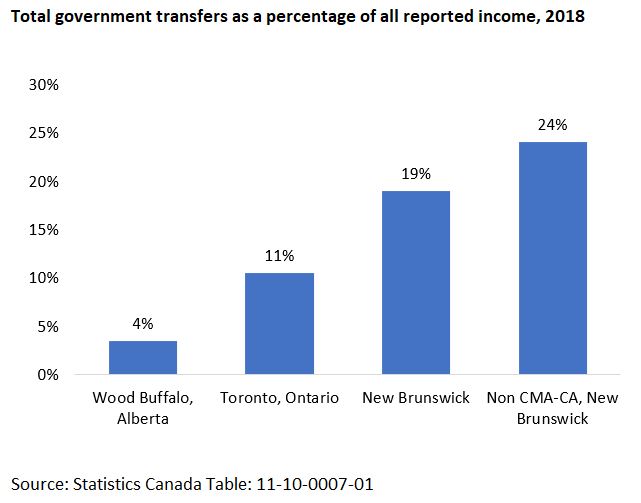
But it’s not the whole story. A number of new export-focused industries emerged. Private sector investment expanded through much of the 1960s-early 2000s.
Plus, even if that is true -all the more reason to get the Golden Girls and Boys together with the dewy-eyed dragon slayers to come up with a growth plan for the future.
Someone’s gotta do if. If the retirees want to retrench and play shuffleboard and golf and if the young ‘uns just shrug and move to Toronto, who’s left to work on this place in this time?
*Includes all government transfers to individuals – EI, CPP, OAS, workers’ comp, social assistance, etc.
]]>
One Latin phrase came to mind when reading about Premier Higg’s desire to not have to duplicate public services and infrastructure in every single community around the province. He’s not wrong, in theory, but there are some practical realities.
There are dozens of communities across New Brunswick where health care is the largest employer. The map below shows the 63 municipalities with a health care facility employing at least 50 people (from Statistics Canada’s June 2020 business counts). In 13 of those communities there is no other employer larger than that one health care organization.
So rationalization of health care facilities is not just about access to the service – it’s about the fact that health care is the most important or one of the most important industries around the province.
Communities across New Brunswick with one or more health care facilities with at least 50 employees*

*includes nursing homes and related facilities.
So the quid pro quo idea is simple. If we are rationalizing public services or not building public infrastructure in every community, what will support economic growth in those communities?
Back in the Robichaud, Hatfield and McKenna days, politicians would roll into town with a big new mining project or a new smelter or a new sawmill or pulp mill or frozen food manufacturing facility or a new port or some other large private sector/publicly supported economic development project.
There is not as much of that anymore leaving communities holding on for dear life to their schools, hospitals and other public services (e.g. Service NB office).
I’d like to see broader plans for municipalities and regions around New Brunswick. Right now there is a lot of uncertainty because of demographics, aging entrepreneurs, etc. The conversation of public services and infrastructure rationalization should be held in the context of a broader plan for the province.
]]>
Try it with your mayor, if you have one.
It makes some sense as the mayor is the face of the city – constantly in the media – the spokesperson for the good, bad and ugly. And now with social media their presence is only amplified.
However, around 30-35% of New Brunswickers don’t have a mayor. They have no real local government at all.
I have been writing for years that every New Brunswicker deserves a mayor (whether they know it or not). Effective and accountable local government should be part of our democracy – hopefully with at least enough scale to properly plan, fund economic development, invest in infrastructure, etc.
The three levels of government in Canada have distinct and important functions (I know, I know, you wonks will tell me there really isn’t a ‘local government’ as it is a creature of the provincial government and can only pass by-laws and not ‘real’ laws – but I am talking about the role and not the legislated structure).
Local government is needed. It is closest to the people. It is the only level of government uniquely and specifically interested in what goes on in local communities. This is not to say provincial and federal governments don’t care about what goes on locally but they have by definition broader interests. In other words, a province could be widely successful in economic, population and quality of life terms but dozens of individual communities could be really struggling.
Having a local government doesn’t guarantee success, of course. But not having one, I believe, over time can lead to atrophy and I think that is happening in much of New Brunswick.
When we have potential rural development projects in LSDs, who is the local government champion? Who is advocating for the tens of thousands of people living around the province in these areas? I know there are advisory groups and regional services commissions but I stand by my conviction that everyone needs an elected and accountable mayor (and council).
So why doesn’t New Brunswick just make it so?
Because the people living in the LSDs – at least we believe – overwhelmingly don’t want it. They want to be left alone on their plot of land far enough outside of urbanity to give them peace and quiet and a property tax rate far below what most of their fellow citizens pay.
Just about everyone that moves to a city in New Brunswick from outside the province instantly complains about property taxes. It doesn’t matter if they came from Alberta, Ontario or British Columbia, they will complain of their property tax bill being much higher here than where they lived before. I ask them you mean the property tax rate? Surely when you consider the lower assessed value of your property the overall taxes paid must be lower. No. They insist that even with a lower valued home their property tax bill is much higher.
So how do you square this with the fact that the average New Brunswick household (owned dwelling) pays 24% less than the average household in Alberta and 42% less than the average household in Ontario?

I’m going to let you run out and look at your property tax bill. My suspicion is that if you live in any kind of municipality with a mayor and council, your tax bill is likely higher than the average shown in the chart above.
So, of course, the conversation about LSDs, municipalization, who merges with whom, etc. almost always comes down to property taxes.
There is something about property tax. That tax seems to bug people more than any other even though the average household will pay far more in personal income tax and sales tax than they do in property tax each year. I have speculated in the past that cities don’t do a good enough job of explaining to people where the thousands in taxes paid each year gets spent. I think people have a better understanding of what their income and sales taxes funds – health care, education, roads, etc.
Moncton and other municipalities now develop a booklet every year that clearly lays out where the spending goes – police, fire, snow removal, garbage removal, public parks/spaces, etc. and this has been a good step.
A few years ago the government raised the provincial portion of the HST by two percentage points – or 25% in one swoop – which costs the average 2+ person household something like $800/year – and there was surprisingly little pushback. I guess people realized the 15% HST was already in place in Nova Scotia and believed the increase in NB was inevitable.
But my point is that a couple hundred dollar rise in property taxes – is considered by many to be an outrage.
I think the conversation needs to be elevated beyond just property taxes – although there does need to be fairness in taxation.
The everyone needs a mayor conversation is more about the quality of life and sustainability in the longer run. It’s about planning. It’s about economic development. It’s about advocacy.
As I have said before I think municipalities need to be even more engaged in their destiny. In a small province like New Brunswick it is easy to punt responsibility to Fredericton but I think that’s a cop out. If you have fallow farmland in and around your municipality – don’t wait for the province to come knocking. If you have mining opportunities or tourism opportunities or other sectors of the economy – you might be waiting a long time. If you need to attract population. If you need to boost enrolment in your local NBCC/CCNB. If you need entrepreneurial renewal because 50% of your small business owners are over 55 – don’t just wait around and hope for the best. Hope is not a strategy.
Package up these opportunities – go to the provincial government – and partner with them on a plan to for economic development for your specific community and region.
Everyone needs a mayor and local council to lead the development of their community and partner with adjacent municipalities on regional priorities.
Right now our current local government configuration hampers this.
]]>
I would say that the majority of economic development folks in Atlantic Canada mostly agree with my main tenets. In general they see my writing and advocacy as aligned with their view of what is the appropriate role for government and other organizations to help foster a strong economy.
When it comes to exports development, I think many of my colleagues – and many reading this post – may disagree with me and that’s okay. I don’t have a monopoly on good ideas.
If a province or country (or city) wants to grow the total value of exports (i.e. increase the amount of goods and services that are developed in the jurisdiction but sold to markets outside the jurisdiction) what is the best way to do it based on actual evidence specific to Atlantic Canada?
1. Set up a program to help small firms export more – help them become ‘export ready’, take them to trade shows, give them grants and loans to develop international markets, help them hire a marketing person, etc.
2. Help nurture a few large firms or large-scale sector export growth opportunities (i.e. a $600 million tungsten mine, an LNG export terminal, the expansion of a large manufacturing facility, etc.).
3. Attract national or international firms with existing global markets and sales channels in place to either set up a greenfield operation in your province or acquire a smaller firm giving it access to the global markets and sales channels.
4. And, of course, some variation of the all of the above.
Let’s start with #1 – trying to help small and slightly larger business grow their export markets. This is very common – there are provincial and federal programs and dozens and dozens of economic developers trying to help small firms become export ready, explore new markets, etc. Indeed, if you read the economic development plans, this seems to be the backbone of export development strategies.
The problem is that other than some anecdotes – there is no evidence this works. I’ve been involved in economic development in Atlantic Canada for over 25 years and in that time I have seen dozens of export development schemes come and go. And the result? There are fewer international exporter companies in Atlantic Canada now than 15-20 years ago. Three of the four Atlantic Provinces have seen a fairly steep decline in the number of exporters, in fact.

Just ignore PEI. That province has been an outlier across the board for a decade or more – leading in the country in export growth, immigration, population growth, etc. They have attracted hundreds of immigrant business investors – many many who never really got properly going – but some that did so it is not surprising that province has seen a modest increase in exporting firms but remember the number of exporters only rose from 182 in 2005 to 234 in 2019 – hardly a massive increase in the number of exporters.
I don’t have recent data on the breakdown of export revenue by firm size but nationally establishments with between 20-99 employees only account for 14% of the value of all international exports and only 11% of the value of interprovincial exports.
I’m just not sure that if your goal is “to grow export revenue” then the strategy of helping small businesses export makes sense – particularly in much of Atlantic Canada. If you take a long term view of the total value of international exports, New Brunswick and Nova Scotia are at the bottom of the pile for growth (again forget about PEI there’s something in the soil over there) and Newfoundland and Labrador’s export growth is driven by two things: oil and minerals.

And despite 30 years of trying to help small firms export more, this region still has considerably few exporters – adjusted for size than the country overall.

The typical provincial export strategy will talk about ‘diversifying exports’ or ‘boosting the number of exporters’ or other similar statements. When I ask economic developers they will tell me that large firms don’t want or shouldn’t need our help and, in fact, we get political blowback when we give money to large firms. Whereas, the little firms need our help and the public is far more supportive of helping the little entrepreneur. This may be the case. But then you should call your strategy the “help small businesses export” strategy and not a strategy that is meant to grow the overall aggregate export revenue for the jurisdiction.
The second broad way to grow exports is to nurture a few large firms or large-scale sector export growth opportunities (i.e. a new mining project, an LNG export terminal, the expansion of a large manufacturing facility, etc.). Many provinces and states have done this successfully including PEI, Saskatchewan and Manitoba. Normally, in Canada, this revolves around natural resources but not always (aerospace on PEI, for one example). This is decidedly different than a small business-focused export strategy.
The third broad way is to attract national or international firms with existing global markets and sales channels in place to either set up a greenfield operation in your province or acquire a smaller firm giving it access to the global markets and sales channels. This has been particularly successful in this region among services-based export sectors. In New Brunswick, if you add up all the export revenue from national or international firms that have set up here directly or through acquisitions in business services and ICT, it is approaching $2 billion/year (international and interprovincial). There is a high correlation between FDI (or external investment) and exports growth but governments tend to look at them as distinct.
And finally I want to revisit what we define as exports in the first place. There is a tendency to narrowly define what we think of as exports and that is just not aligned with reality.
I have been saying we should not restrict our definition of exports to the obvious (pewter, French Fries and maple syrup). If we have a really good understanding of what we are actually exporting and we correlate that to growth in global market demand we will have a better change of success.
Take a look at the export values for selected New Brunswick industries (2016) – interprovincial and international exports combined.

I just threw in ‘used motor vehicles’ for kicks. Portfolio management services is a $100 million industry for New Brunswick-based financial services firms. Universities generated $64 million in tuition in 2016 from students outside New Brunswick – role in their living and other expenses and that likely triples or more. NB-based data centres are generating $100 million in export revenue. Management and consulting firms are a $32 million export sector for New Brunswick (my firm accounts for a portion of that revenue). Lawyers generate $31 million in export revenue. Architects and engineering firms $125 million.
Of course, you are saying those numbers mean nothing out of context. They could be large or small. So let’s compare a few with Nova Scotia – a province that is moderately larger in size but not by much. Nova Scotia generates 3.5 times as much export revenue from universities, 4.7 times as much from custom software development, 3.2 times as much from management and related consulting services, 2.3 times as much from legal services, 2.4 times as much from R&D services, and 3.3 times as much from advertising and PR services. New Brunswick, by contrast, dominates in the call centre-related export areas. NB generated $1.1 billion more export revenue from business support services and office administrative services than Nova Scotia in 2016.

In conclusion, if a jurisdiction’s goal is to help small businesses export -that is fine but not the same thing as an export strategy. In fact, I would argue that if we put the bulk of the effort on helping small businesses export and we lose out on big sector or FDI-based opportunities, we will hurt our economic development outcomes.
Questions to ask if you want to develop a successful export strategy:
- In which sectors or opportunities does our region have a strong comparative advantage? What can we do to bolster the value proposition (while avoiding massive subsidies or market distorting policies)?
- Which of these sectors or opportunities have growing global demand? Do those sectors with declining global demand have emerging alternatives or new niche areas?
- Do we have enough firms at scale that have global market reach? If yes, what can be done to encourage growth in exports? If no, where will we find the exporters? By supporting current firms with export potential? By encouraging external firms to invest here (greenfield or through acquisitions)?
]]>
Most immigrants in Canada until recently settled in Toronto and the biggest urban centres. Places like Moncton or Charlottetown or Estevan, Saskatchewan relied mostly on natural population growth and intraprovincial migration. A large share of the few immigrants that did initially settle in places like Moncton ended up in Toronto anyway.
In recent years, Toronto’s share of Canada’s annual immigrant flow had been dropping and fairly sharply (with an uptick again in 2018 and 2019). Between 2001 and 2006, on average over 102,000 immigrants settled in the Big Smoke each year. Between 2007 and 2017, the average number dropped to 83,000 per year, a 19% decline.
Meanwhile places like Moncton were elbowing their way into the game. In the early 2000s Moncton was attracting a couple hundred immigrants per year. In 2019, over 1,700 immigrants settled in the Moncton CMA. And this trend was playing out in smaller urban centres across the country from Charlottetown to Kelowna.
As shown in the chart, the immigration ‘rate’ per 10,000 people in the Toronto CMA people dropped from an average of 201 per 10,000 in the early-mid 2000s to 133 between 2014-2017 (a 34% decline) and back up to 162 in 2018 and 2019. In Moncton it went from 14 per 10,000 to over 100 per 10,000 in 2018 and 2019.

To make matters worse for Hogtown, the urban centre was having a harder time relying on people to move in from places like Moncton. In 2018, more people moved to Moncton from Toronto than vice versa.
So, either directly or indirectly, Toronto cracked the whip. What Toronto wants, Toronto gets.
This is likely the main reason why the Canada government announced it would be increasing annual immigrant levels over the next three years. The smaller urban centres want in. The big ones want to continue to grow. They are all facing older populations and far more people retiring each year than in the past.
Oh, and by the way, that cute trick of relying more on non-permanent residents is not the solution. In the past three years, the number in Toronto has skyrocketed (and country-wide). It’s not like the city has added a whole bunch of greenhouses needing TFW agricultural workers. Don’t use temporary workers to artificially boost the annual cap. If you need more, boost the cap.

As I have said many times before, immigration levels need to be set as an aggregate of provincial targets. Almost all provinces want more immigrants ergo the annual national number should increase.
Of course Covid-19 has thrown a wrench in the gears but I think most provincial governments realize the longer term demographic trends and will push to ensure they can have the workforce needed to grow their economies.
There is always going to be interprovincial mobility of immigrants (and non-immigrants). To use the currently en vogue cliché, this is a feature not a bug. We want to live in a country where people can move to take advantage of opportunity. Don’t make this a reason to restrict immigration into specific provinces. Work harder to target those coming in to ensure they have a good local economic opportunity (i.e. aligned with the job experience and skills) and have a ‘fit’ with the city or town they are moving into I think we can and must do a better job with targeting.
In the end, immigration is controlled by the federal government. More than any time in the past (at least the recent past) the feds control the main lever of economic growth at the provincial level. They would be wise to scooch over and let the province’s help steer the plane. It might get a little crowded in the cockpit but it will be best for the country.
]]>The one thing that bugs me is that for a lot of very strategic career choices the outlook is calling for a decline in the number of jobs over the next decade.
We have ONB, TechImpact, NBIF and a host of other groups out there trying to grow the IT industry in this province and the government’s forecast is that there will be 55 less people working as computer programmers in 2028 than there were in 2019. Yes, you read that right. 257 retirees, a net drop in the total working meaning an estimated 201 jobs to be filled over the next 10 years.


What about cybersecurity? What about digital health?
When I was in government, just to be sneaky, I asked for a separate run of the data only I injected a little life into the economy at strategic points – and, presto, the labour market roared back to life and a lot of new jobs were created in high value occupations like computer programmer.
This isn’t just an academic exercise. A lot of folks use these forecasts. Kids are going in and realizing there will be fewer programmers here in 2028 than back in 2019. By the way, the forecast nationally calls for a 19% increase in the number of programmers across the country.
If it was me I would fake it.
You heard me.
We are going to need 1000 new programmers between now and 2028. Why? Because David Campbell said so, that’s why.
Which do you prefer?
Have a little ambition.
What’s the worse that can happen?
Best case scenario you over-supply the economy with programmers (through PSE, immigration, etc.) and firms expand here to take advantage of all that labour.
Worst case scenario, some young people have to leave because there are too many workers for the available jobs.
Which would you prefer?
]]>
I have been writing for years about how governments equate transportation infrastructure with roads. The New Brunswick government spends hundreds of millions of tax dollars each year on roads but very little on every other area of transportation infrastructure (airports, rail, ports, etc.). The former is considered a fundamental role of government and the latter somehow must be totally direct user-funded.
This always seemed strange to me. The economic development of this province relies on a robust transportation system – not just highways and roads. For the most part the rail system has gone the way of the dodo bird in this province (it is booming in many places). It is amazing how quickly we forgot about the strategic value of the rail system.
Luckily there was a different view of the air transportation system and in the past 20 years we have benefited from more flights, more destinations and better costs. I still think we need a small commuter airport in Edmundston but beyond that things have gone reasonably well. I know there is a nascent movement to look at consolidating airports in Sussex but I can’t see how you would ever get buy-in for that.
Likely a better option would be going back to a ‘milk run’ whereby the plane starts in one city, drops down and picks up in a second and then off to Toronto, etc. I know the airlines don’t like that option, however.
The bigger point is that government needs to a) ensure we don’t lose our airports in the short term, and b) the system swings back to ‘normal’ post-pandemic (with some thought for a small commuter airport in Edmundston, sorry for the preoccupation but in the long run making people drive 2+ hours to access flights is not good).
I know there are those of you who would like everyone to drive to a single airport somewhere even if it takes 2-3 hours to get there. You will argue that on average your total travel time will be shorter because that single airport would have more and more frequent routes (and lower costs). Maybe, but you still have this lingering long term reality that cities/towns without an airport over the long run have much lower economic growth than those that do (based on my analysis almost 20 years ago).
So, for now don’t panic. If WestJet only has 6 people on a flight how can you expect them to continue flying?
Let’s focus on my two principles: a) ensure we don’t lose our airports in the short term, and b) the system swings back to ‘normal’ post-pandemic.
]]>
I have to say looking back it was a politically tumultuous time. As one example, President Reagan just fired all the air traffic controllers. Margaret Thatcher in the UK was cracking the whip. Economically we were facing simultaneously high inflation and low growth (does anyone remember stagflation?). The Yanks were intervening in conflicts around the world – particularly Latin America (can you remember Imelda Marcos’ 3,000 pairs of shoes?). As an aside, as a caterer in those years, I served coffee to a meeting featuring Oliver North of the Iran-Contra affair.
My point is that politics was turbulent in the 1980s. For those of you who were there time and context may have dulled our collective memories but I would recommend avoiding Pollyanna-ish recollections of that time. I still remember hearing about – in the 1980s – nuclear war school drills where the children would be told to get down and crouch under their desks. In the 1980s.
Cold war raging. Domestic and international terrorism expanding. Stagflation. High unemployment. Quebec separatism. Acid rain. I still remember in elementary school (late1970s) watching a film about the ecological devastation industrialization was wreaking on North American society. Even crime, by many measures, was quite bad in the 1980s. Homicide has never been as bad in Canada as in the U.S. and many other countries but the rate nearly doubled from the 1960s to the 1980s and early 1990s before settling back down to almost the 1960s level again in the 2010s.

My university roommate was a member of the young Republicans club on campus and was convinced there was a leftwing conspiracy to bring down America as he knew it. He particularly had a hate on for mainstream journalists like Sam Donaldson (sound familiar?). The whole edifice that had led to the betterment of America – the first time I heard the phrase ‘manifest destiny’ was when I lived in the States – was under threat and even with a Republican in the Whitehouse we were standing on the edge of a precipice.
Why all this rambling and reminiscence on a Thanksgiving holiday Monday?
Because I am starting to worry that all the doom and gloom out there could actually lead to a self-fulfilling prophecy. We need to shake our heads a bit and reset around some core principles.
“Old men see visions and young men dream dreams”
But what happens when there are far more old men and women than young?
We need more young people dreaming dreams of a positive future while old timers and their visions of apocalypse need to take it down a notch.
It got a lot better – in most ways – from the 1980s to now – and there is no reason to think it won’t get better moving forward.
We can’t bury our heads in the sand and hope that the big challenges of the day will just disappear but we can’t live in frustration, anger and fear all the time either.
Let’s put our biggest brains on our technological challenges, give them the support they need and cheer them on.
Let’s reform our economic model – but not blow it up.
Let’s focus on rebuilding social trust (not everyone that disagrees with you is evil). The dictionary definition of tolerance is “the ability or willingness to tolerate something, in particular the existence of opinions or behavior that one does not necessarily agree with”.
Let’s get back to having faith in our institutions – that faith may need to be re-established in many cases – but let’s not throw out the bedrock institutions that have guided our development since the Enlightenment.
I have no reason to believe things are descending into chaos and anarchy. We are in a moment right now but I think we can get through it.
]]>But after looking the recent immigration data – permanent residents settling in New Brunswick – I had a bit of a lightbulb moment. Pro-natalist policies now could actually help boost the working age population now – the parents (and soon-to-be-parents) of the children induced by such policies are workforce age.
Take a look at the breakdown of permanent residents admitted to New Brunswick in 2019 by age group for Moncton compared to the Province of Ontario overall. The share of 15-29 year olds admitted was substantially less in Moncton than in Ontario while the share under the age of 15 was significantly higher. If you combine the immigration numbers from the 30-44 and 0-14 age group, they accounted for 69% of all immigrants to Moncton but only 53% to Ontario.

If you think about it this actually makes intuitive sense. If you attract a lot of unattached young professionals to New Brunswick they are footloose and fancy free. They, like many young New Brunswickers, might yearn for the bright lights of the big city. But young parents aren’t as interested in high cost housing, long commutes, congestion and all of the other challenges that come from living in a very large urban centre.
So the lightbulb moment is this. Promote pro-natalist policies now – not for the babies induced but for the parents it will attract (and retain). And this is not just about immigration. Young New Brunswickers who bolted after high school and now have young kids are moving back.
We have some data to suggest this could be happening. If you look at interprovincial inward migration, the combined number under the age of 10 and between the ages of 30 and 44 increased by more than a thousand between 2013 and 2020. This doesn’t include immigrants.

What are pro-natalist policies? Simply put they can be anything that is meant to encourage more babies and larger families. These can include big ticket items such as lucrative child tax credits, subsidized child care and parental leave but also a host of smaller issues that make it easier to have and raise children.
Should we try and position New Brunswick as an excellent place to have children and raise a family? Do we have a strong value proposition? Do we have very strong pro-natalist policies (big ones and little ones) that make it easier here?
I know there are a lot of demands on government. Grow the economy. Cut taxes, Invest in education. Invest in health care. Fill the potholes.
But maybe this is one of those issues that will have positive ripple effects.
Let’s bring on a baby boom!
We have work to do. If you look at the data, the numbers were mostly on a steady decline for 30 years but then levelled off and started to actually rise again by the Great Recession of 2008. Then it went back to its downward trajectory.

According to Statistics Canada the unemployment rate is the “number of unemployed persons expressed as a percentage of the labour force” which isn’t particularly helpful. The agency defines unemployment as follows: “Unemployed persons are those who, during reference week, were available for work and were either on temporary layoff, had looked for work in the past four weeks or had a job to start within the next four weeks”.
So it looks like in the formal definition of unemployment, the unemployed don’t actually have to be seeking employment. This is a huge distinction when looking at potential reforms to the EI program.
My thesis is that the EI program is distorting the local labour market picture in many regions of Atlantic Canada and that is leading to bad public policy decisions.
The biggest impact in recent years has been around the attraction of immigrants and the challenges bringing in temporary foreign workers.
There are communities in the region that have a headline unemployment rate of 15% or higher but when you ask employers on the ground they say there is not a single person available for work. How is this possible?
At least in theory, when there is a high unemployment rate it should be relatively easy to find workers. This is not the case in dozens of communities across the region because a large share of the unemployed – I would argue – the vast majority – maybe 80% or so – are not actually unemployed in the sense they are available for work and actually looking for work. They are collecting EI cheques until their seasonal job begins next year.
When fighting for increased flexibility around immigration and TFWs while in government I had federal government officials say “why should we increase your immigration levels when you have such high unemployment?”
You see the challenge?
Of course, it is getting better. The Atlantic Immigration Pilot Program and other initiatives are making it easier but I contend it is still far far easier to attract immigrants to Toronto than it is to Caraquet – and that imbalance puts the latter at another competitive disadvantage.
One solution I propose is that we publish an unemployment rate with all seasonal EI users backed out. I realize that Statistic Canada ‘seasonally adjusts’ the data but again, on an adjusted basis, there can be thousands and thousands in a region that are ‘unemployed’ but not actually seeking work.
What would be the unemployment ‘rate’ then? If in an area where 40-50% of all workers collect EI at some point during they year what would happen to the rate if they were removed?
I contend the unemployment rate should reflect real unemployment in a community – specifically – the number of people that are available and looking for work at any given time. If we don’t know this – the rate is 15% or 5%, what good is it?
In my paper for the PPF, I propose other options. I will discuss those further in future posts.
]]>
Keep your stick on the ice.
Keep your head up.
We can’t led Covid-19 derail New Brunswick’s progress.
The new population figures from Statistics Canada are out. These are provincial figures and are based on the population estimate in July 2020. New Brunswick witnessed modest population growth even with the onset of Covid-19 but as shown in the chart only two other provinces had a slower growth rate. Between 2019 and 2020, the population increased by only 0.6%. Last year, the population of New Brunswick increased by 0.9%. We need to get up to 1.5-2.0% per year.

Because, Covid or no-Covid, annual deaths are increasing year over year. Retirements are increasing year over year. Demography is destiny. If we don’t rebalance ours, the economy and sustainability of public finances will be at risk. All we have to do is mimic PEI. That can’t be too hard (?). The median age on PEI dropped again this year – that province is getting ‘younger’ every year.

New Brunswick was on track for a record year in terms of attracting immigrants. Unfortunately Covid-19 hit and we actually saw a decline in 2020 but not by a large amount (the number of temporary residents dropped by 1,000 however, from 1,600 to 600). We need to get back to the 7,500 and then the 10,000 and then higher in the next few years.

And we need to be laser focused on attracting folks who have an economic reason to be here – to study, to work, to start a business, to buy a business, etc. The number of interprovincial out-migrants had been decreasing in the past few years even as the number of in-migrants were rising. But there was a big jump in 2019-2020 – out-migrants increased by 16% over the previous year. We still had a positive migration rate – more in than out – but really need to focus on folks that want to make a go of it here.

It will be very frustrating if the modest bending of the curve upward we have seen in the past few years – goes back into negative territory because of Covid-19. There is no reason for this.
Let’s keep our eye on the prize.
]]>If you think it was hard to compare New Brunswick’s spending over time, it is even harder to compare economic development budgets and spending between provinces. There is no province that has set up economic development spending the same as in New Brunswick so a comparison is almost impossible.
However, Statistics Canada does track government subsidies to industry and that gives us one measure of comparison.
What is a subsidy? I’ll let Statistics Canada’s definitions stand unedited:
Subsidies on production: Subsidies except subsidies on products that resident enterprises may receive as a consequence of engaging in production. Examples include: a) subsidies on payroll or workforce: these consist of subsidies payable on the total wage or salary bill, or total work force, or on the employment of particular types of persons such as physically handicapped persons or persons who have been unemployed for long periods. The subsidies may also be intended to cover some or all of the costs of training schemes organized or financed by enterprises; b) Subsidies to reduce pollution: these consist of subsidies intended to cover some or all of the costs of additional processing undertaken to reduce or eliminate the discharge of pollutants into the environment.
Subsidies on products: A subsidy payable per unit of a good or service. The subsidy may be a specific amount of money per unit of quantity of a good or service, or it may be calculated ad valorem as a specified percentage of the price per unit. It may also be calculated as the difference between a specified target price and the market price actually paid by a buyer. A subsidy on a product usually becomes payable when the good or service is produced, sold or imported, but it may also be payable in other circumstances such as when a good is transferred, leased, delivered or used for own consumption or own capital formation. Examples are those paid for agricultural products, transportation services and energy. Government subsidies received by industries are treated as revenues, and are shown as negative entries on the expenditure (input) side of industries. Direct payments to persons are not included here. Government payments to cover operating losses of government business enterprises are included.
Using those definitions, governments in New Brunswick (this isn’t specific to the provincial government) subsidy industry less than all other provinces as a share of industry output. These subsidies vary from year to year so I took an average of the seven years 2010-2016 just to be sure.
In fact, New Brunswick subsidizes industry 31% less on average than its next closest competitor, Alberta (ahem). Across all industries, the subsidy rate is running around 0.4 cents per dollar of output in New Brunswick. In Quebec, it is 4.6 times higher.

That’s not fair, you say, because it includes subsidies to agriculture and that is a sector we all should be subsidizing so we can get local carrots and, increasingly, soy, on our plate. Well, it is true that agricultural subsidies are a fairly large part of the pot but this is not the only industry getting subsidized.

How about manufacturing? I can’t even use the seven year period because there were years in there when Statistics Canada couldn’t find any subsidies for New Brunswick but using the period where there is data, New Brunswick ranks last – by far – and the free market Alberta? I’ll let you read the chart yourself.

For those of you wondering about the IT sector, New Brunswick does have a higher subsidization rate in this sector – similar to Quebec but lower than PE and NL.

And no analysis of subsidies would be complete without the grand poohbah of subsidies, the film and video industries production sector. The table below is only for 2016 because in the past New Brunswick had one of the highest subsidization rates in the country but changed its mind around 2015. Yes, you are reading this correct. Subsidies for this sector are in the 40+ cents per dollar of industry output in four Canadian provinces. But, in fairness, residents of provinces with high subsidy rates get to see their cities, towns and rural areas on Netflix every once in a while.

I have said many times I’m actually not a huge fan of direct subsidies to industry. I know there is a new paradigm emerging – led by Mariana Mazzucato and others that focuses on ‘co-creation’ of strategic industries and that government should play a far more direct role in deciding what industries should grow and who should benefit.
There is a public interest in this, of course, but I am just a poor humble guy who started his life in Petitcodiac and has longstanding roots in the Miramichi. Instead of the grand vision for the world, my preoccupation is laser focused on New Brunswick and the other Atlantic Provinces.
And here, I think we should be focusing on what industries and opportunities have the best potential here – on the ground – and determining what the right role is for government to help foster business investment and entrepreneurship in these opportunities. I’ll leave the grander view – and likely Nobel Prize in Economics some day – to Mariana. Maybe I’ll win runner up Person of the Year from the Digby Chamber of Commerce or something.
And, I would say, government in New Brunswick should be spending enough to ensure that every region of the province is doing a proper job of identifying opportunities, building out the value proposition and selling those opportunities to the world. This, increasingly, includes the value proposition for attracting people.
So, is it a $75 million deficit? A $50 million deficit? A $100 million deficit?
I wouldn’t get too caught up in that debate. The real question is are we doing enough – across the province- to foster a strong economy so that we can continue to offer high quality public services and invest properly in public infrastructure? Are we doing enough to ensure that young New Brunswickers have opportunities to stay at home after graduation should they want to? Are we doing enough to create the conditions such that newcomers will want to stay here long term and put down roots?
If we are comfortable answering yes to these questions, then we are investing enough.
]]>
So, it’s time to get serious about economic development.
In 1999-2000, the New Brunswick government spent 2.5% of its total expenditures on economic development. I use the term loosely here because that included the Department of Economic Development, Tourism and Culture and the Regional Development Corporation – and many of the expenditures in both EDTC and RDC really aren’t directly economic development.
In the recent 2020-2021 budget,the New Brunswick government spent 1.7% of its total expenditures on economic development. Again, this includes ONB, RDC and Tourism, Heritage and Culture, and many of the expenditures don’t really count as economic development but it is the closest we can get to apples to apples. One of the things that governments have done over the years is modify departments and spending just enough after each change in government to make a true apples to apples comparison over time much harder but this comparison is pretty good.
So what does it mean?
It means that government is spending $75 million less on economic development today each year than it was back in 1999-2000 as a share of total provincial government expenditures.
Those of you that follow this blog – and some of you have done so since it started in the early 2000s – know that I have never equated the amount of spending on economic development as the main way to measure the importance of economic development. I don’t necessarily believe that pumping cash into firms is the best way to do economic development, either. But as one indication of your commitment to economic growth, I think the $75 million deficit is worth a conversation.
Why has the amount slipped over the years?
General atrophy is likely one good reason. If you were to ask the public do you want more spending on health care or giving cash to big evil corporations – which do you think they would pick?
The truth is that governments have not done a great job of defining what they mean when they use the term economic development. If it was about empowering communities, building a strong economic base in all regions of the province, etc. that might get more public support than “grants and loans to industry” as the one definition that many New Brunswickers put on economic development.
How would I recommend investing the $75 million?
We need stronger regional economic development efforts. I talked to another community just today trying to foster economic development in a town and surrounding region of 15-20K with one full time economic developer who spends a lot of time and effort trying to pry a few dollars more out of RDC and ACOA. If you want strong regional economies around New Brunswick we need to empower local stakeholders. We need to challenge them to come up with workable economic development and population growth plans and the capacity to implement. Then we need to have a high level of accountability.
As I have said ad nauseum not every region of the province has the same assets, attributes and opportunities and therefore not all regions can expect the same outcomes but all regions should have a fair chance at development. Cutting economic development spending as a share of the provincial budget by one-third over 20 years is not necessarily the right move.
I know this current government is a little skiddish about giving out cash to firms. Then give the new money to accountable, private sector-led regional economic development groups working closely with municipal governments around the province. Build a strong team provincially for the things that can and should be done at a provincial level and ensure that local and regional partners have the tools they need to properly fund economic development and population growth.
For years I talked about a dedicated property tax to fund economic development at the local/regional level. It never got any traction. If you don’t want it baked into the tax system, then find another mechanism.
I’m not naive. I don’t expect government to reinstate economic development funding to the 2000 level although given annual real GDP growth now is 80% less than it was back then you would think at least a few voices would call for this. Imagine if our health care outcomes were 80% worse or our K-12 standardized test scores were 80% worse or our potholes were 80% worse. Trumpets would sound.
But the performance of the overall economy 80% worse? Crickets.

This is likely because many people don’t believe government can influence the trajectory of a $30+ billion economy by spending a few dollars more. Fair enough.
But couple appropriate spending with excellent policy and an economic development-friendly environment (with a huge dollop of people attraction) – and I do believe over time we can move the needle.
Four ideas on where to spend my fantasy new investment into economic development:
1. Spend more on economic development capacity around the province with a focus on a) building the case and shining a light on economic opportunities specific to each region; b) ensuring a pipeline of entrepreneurs to take advantage of local opportunities; and c) putting in place population growth plans to ensure there are enough workers to meet labour demand in the future (this includes enough housing stock).
2. Bring provincial investment in R&D up to at least the average among the provinces. Bernard Lord’s goal way back in 1999 was far more ambitious than this but if we could at least get to mediocre I would be happier. Again, not just willy nilly spending on R&D but investing in ways that leverage other sources of funding and boost the value proposition for private sector investment in specific sector opportunities.
3. While not part of economic development spending, double down on immigration and on boosting international student enrolment in our PSE. This is critical.
4. Put the focus back on leveraging what we are good at as a province to drive sustainable longer term economic growth. Are we really doing enough with our mineral resources? Are we maximizing the potential of our agriculture? Are we building centres of excellence around strengths in our universities and colleges? Are we really serious about tourism? What other opportunities are there – small and large? I’d like to see the province humming with energy and activity – from one end to the other.
I know there is institutional memory in government. There are still those who remember Bricklin and Atcon. In the residual memory there is LJR’s attempts in the 1970s to build industrial parks and port infrastructure all over the place to attract investment. Maybe we start with something a little less ambitious. Just start with having bodies on the ground around the province working on economic opportunity identification and development.
When the Premier visits St. Stephen or Campbellton or Woodstock he can ask “what are the 10 things you are working on right now to ensure your community will have a prosperous future?”
If we get this right, he will get an answer.
]]>
While scanning for changes in the data, I came across the Translation and interpretation services industry (NAICS 54193). The business counts for this sector across New Brunswick are as follows:
53 without employees
10 with employees: 9 of them with less than five employees and only one with more than five employees.
I will likely go to my grave never really understanding why we haven’t been able to develop an export-focused language translation and services sector in this province, the only officially bilingual province in Canada. According to Statistics Canada, there is now only one firm across the entire province in the translation and interpretation services sector with more than five employees (and that firm is a legacy of a previous shipbuilding contract).
There is far more employment in this sector in Manitoba than in New Brunswick.
There are fewer firms with employees now than back in 2012.
It seems to me on paper this industry remains an ideal case study of how we should focus our economic development efforts. We pump out thousands of at least nominally bilingual people each year from our K-12 school system. We have post-secondary language and translation assets such as the Université de Moncton’s Département de traduction et des langues. Governments and industry spend millions of dollars per year on document translation costs. We can’t leverage all this into something that can compete with Manitoba? Manitoba?
Consider this example. Imagine if we were graduating thousands of kids from high school each year that had been studying computer programming for 10 years. Imagine if we had one of the few universities in Canada that was producing expert computer programmers. And imagine if our governments and industry were spending tens of millions more per year than other jurisdictions on computer programming – and giving almost all of the work to local firms.
Don’t you think we might have a teeny-weeny advantage that could be leveraged?
I have talked to just about everyone about this sector over the past 20 years including UdeM, provincial and federal economic development agencies, the industry association, and individual translators. It seems to me very simple. We have a group of translators that each individually do quite well (or as well as they want) and they see no need to build and grow bigger export-focused businesses. In trade agreements there are carve outs for small contracts such that the government doesn’t need to open up most translation contracts to outside bidders. So there is no real reason to do anything. Why build larger firms that have to compete for work outside New Brunswick?
Imagine if the firms in the forestry sector said the same thing? Or farmers. Or fishermen and women. Why compete outside New Brunswick for markets? Let’s produce just enough wood, potatoes and lobster for New Brunswick consumers.
New Brunswick already runs a significant trade deficit (interprovincial and international) as we have to import our cars, televisions, computers, phones, furniture and the bulk of what we eat every day. If we didn’t have our export industries we would likely not even exist as a province.
As the economy shifts to more services we are now running into increasing trade imbalances in services. We import more IT services than we export. We import far more professional services (legal, marketing, etc.) than we export.


If we have all the building blocks for a successful translation industry, why don’t we work harder to build one? Why not attract more global firms?
I think we desperately need a few ambitious entrepreneurs to get involved in that sector. Sixty-three firms and sole-proprietors with at least $30,000 in annual revenue and only one has more than five workers? We must be able to do better than that.
We need a few champion firms to emerge – get great here – and then become a national hub for English/French and French/English translation. When companies in British Columbia or Ontario want to get documents translated, they should be getting pitched by NB firms.
Where do entrepreneurs come from?
The translators are technical experts in language – not in running or growing a business. For this to happen it will likely take some non-translator entrepreneur to flesh out the opportunity and pursue it with capitalist vigor.
]]>
When I say ‘politicize’ I mean one party staking out a position for/against an idea for political gain or differentiation regardless of whether it is a good idea or a bad one.
I remember candidate Bernard Lord criticizing Frank McKenna for focusing on attracting industry to the province and promising a “made in New Brunswick” approach to economic development. I cringed. Someone had the bright idea to take the one thing McKenna was best known for (everyone has a story about a cab driver in Toronto talking about McKenna) and propose doing the exact opposite.
Of course, when in office, Lord ended up attracting almost as much FDI as McKenna (although much of it was residual from previous efforts).
So when I read the dust-up over cybersecurity recently I got a little nervous. The Libs criticized the Tories for dropping the ball and the Tories came back hard about Lib failures in this area.
No matter who wins the election, we need to pursue this opportunity.
New Brunswick has a core value proposition for cybersecurity including anchor firms (IBM, Siemens, Shipley’s firm, etc.), research and education assets and a workforce. I would suggest we should be broadening the scope of what we call ‘cybersecurity’ – I would have liked to see some of Facebook’s 35,000 content monitors located here. Aligning our strengths in customer service and engagement to our cyber industry strengthens the case for investment.
I know there was an effort to attract federal government/DnD/CSIS type ‘real’ cybersecurity jobs here but I was never optimistic. The decision makers are highly unlikely to put those high paying/high value jobs in New Brunswick.
We need to recalibrate our efforts – focus on cyber-training – people should come to UNB/NBCC/CCNB from around the world to study cybersecurity. We need to put on cyber-training and conferences. We need to incubate cyber startups and we need to attract more world class firms like IBM and Siemens to put cyber operations in New Brunswick. We need more private sector R&D dollars.
There are potentially thousands of jobs at stake.
Let’s not politicize this opportunity.
]]>I don’t mind helping if I can but the reality is I don’t have a fat Rolodex of contacts willing to hire people based on my recommendation, and that assumes I will recommend someone I only met briefly.
I do have a few observations for those starting out in their careers or who have just moved here and are looking to start their careers – for what they are worth.
First, I empathize with you. I graduated with an MBA and no real experience in 1991. It took me nearly two full years to land a job that I could parlay into a career. I didn’t know the ‘numbers’ back then but it’s lucky I ended up getting a job at all. Look at the following chart. In the early 90s there were nearly 117,000 young people living in New Brunswick (aged 15-24) – at some stage of seeking employment – this during a recession/aftermath and at a time of chronically high unemployment. Further the number retiring each year was a fraction of those joining the workforce (far more coming in than going out). By 2019, the number aged 15-24 living in New Brunswick has dropped precipitously while the number between the ages of 55 and 69 has more than doubled.

In those days many firms (certainly not all) sent what was known colloquially as ‘PFO letters’. I’ll let your mind wander to define what that acronym means (hint, they were polite about it). At least they took the time. Today most firms/organizations don’t even respond.
I have saved 70+ of these letters just for the fun of it (see the pic below). I put NBTel on top of the pile because a recruitment manager that I talked with told me they had thousands of qualified applicants for a handful of positions. Further, she said, they would prefer to hire graduates from a Canadian university (oopsy, I went to the U.S.). The list of PFO letters is quite something – and includes all the big consultancies, many cities/towns and multiple economic development agencies including Miramichi.

After hundreds of applications filled out, a couple of dozen interviews and a stint trying to find jobs in Alberta, I ended up getting a three month contract job with the Government of New Brunswick paying $12/hour (around $19/hour today, but because I worked 60/hours/week it was likely more like $8/hour). This brings me to my second point.
Take anything in the short term that builds your resume. I know that unpaid internships have mostly gone out of fashion but after months and months of searching I would have paid a firm to bring me on a for a few months to prove my worth.
Work hard and make yourself un-let-go-able. I was determined when I got that three month job to turn it into 6 months, a year, more – and I worked really hard. Again, I suspect the idea of working 60-70 hours a week has fallen out of favour but I was usually the first in and the last out – sometimes then Deputy Minister Francis McGuire would still be in his office – but everyone else was gone. I went to the UNB library and poured over Statistics Canada tables to find little nuggets of data that we used to promote New Brunswick.
I understand this idea sounds a bit cliched but I think it remains very relevant. If you get in the door – internship, coop, probationary period, whatever – look around and observe other young people that are excelling and try to mimic them. If the firm/organization is small – understand what really matters and determine to make yourself un-let-go-able.
Boost your education. Don’t spend an extended period of time just unemployed. This won’t be good for you and it won’t look good to potential employers. I’m not saying go get a Master’s degree but take relevant courses online, boost your bilingualism, do something to show you are committed to your career.
Work. Again, don’t spend an extended period of time just unemployed. Work in retail or food service or anything to keep busy and get actual work experience. Who knows? You may just work your way up. I know someone who started in a minimum wage front line job and worked their way in that company to a head office job.
Network. Despite my seeming cynicism above, it is important to build your network. Even that little 3-month job I got came from someone who was related indirectly to family (thanks, Mike M.). I’m not recommending you spam your LinkedIn contacts but build a few key relationships – through school, through social settings, etc. They might pan out eventually.
Be prepared to move. I know my colleagues in the economic development biz will hoot and holler but New Brunswick is a small place. If you are open to living anywhere in Canada (or beyond) you will expand your opportunities. I know for some this is harder than others but if you are mobile it can really helps your career path. Besides, a lot of folks leave for work, get really good at something and then move back. New Brunswick is seeing consistently positive migration rates among those in their 30s and early 40s. We may not be the best place in the world if you are looking for a rave but if you are looking to raise kids – this is a pretty good place to do it.
Don’t give up. There was a brief window where I grew my hair into a pony tail, tied it up in a bandanna and worked my way around the U.S. for weeks in a 1975 Chev Nova. I can now say I’ve been in every U.S. state (continental) and Canadian province and territory but I’m not sure this helped my career prospects.
]]>
The forestry industry is a good example. For a variety of historical reasons New Brunswick has kept its land primarily forested (many others deliberately deforested to create agricultural land). We now have a vibrant forest sector with 1,100 firms in 217 of the province’s 273 communities (Census subdivisions). Some 13,000 people are employed in the industry around the province – in jobs ranging from tree planting through to value added manufacturing. Thousands more are employed as a result of the industry in professional services, transportation, retail – across the economy.
By sub-sector, the most firms are in forestry and logging – most are very small firms – active in the management and harvesting activities. We have 173 firms in wood product manufacturing, another 180+ in support activities (such as silviculture) and 18 in paper manufacturing.

On a community basis, Saint John has the most forest products-related employment but in terms of the number of firms there are more in Edmundston, Kedgwick, Saint-Quentin, etc. Fredericton has 24 different firms in the industry.

As a share of total businesses (and in this case the data includes public sector establishments too), many communities have at least 10% of all of their businesses in the forestry sector. The following chart shows communities with at least 10% in forestry-related sectors (and at least 50 businesses in total).

If you add in the multiplier effects, the forest products industry is easily the most important of our export-focused industries. Using Statistics Canada GDP and multiplier data from 2016, total labour income generated in 2016 by the forest products industry = $753 million compared to agriculture/food manufacturing $382 million and fish/seafood processing $294 million.
So, when we start talking about banning glyphosate or allocating far more of our land mass to conservation or other major policy decisions we need to have the economic, employment and small business impacts front and centre in the conversation. Again, that doesn’t mean social, environment and other considerations are not relevant – they are very relevant but we need to have a facts-based public debate on these issues.
Speaking of principles, I am starting to think my ‘skin in the game’ principle (adapted from Taleb) needs to be seriously considered when addressing big public policy issues. It seems to me that increasingly those with little or no skin in the game (nothing to lose) are making decisions (or influencing decisions) that will impact those with a lot to lose.
The farmers, foresters, forest products truckers, people with careers in the industry -and the many small communities involved – should have a higher weight in the decisions – than pensioned off retirees that don’t want pulp trucks rumbling down their rural roads.
]]>
In the 1960s through to the McKenna years, the economy was a primary driver of votes. In my latest Growing Pains podcast I talk with historian Dimitry Anastakis about New Brunswick’s efforts to attract a car manufacturer in the early 1970s. He says Hatfield made this a central theme in his election campaign. In the LJR years, big economic development promises (such as new industrial parks, new mining projects, new infrastructure investments) were peppered throughout campaign platforms.
I am sure the parties will all say they have a robust economic development plan in 2020 but there hasn’t been much so far. Lots about Covid-19 and safety, school reopening, heath care, the cities are pushing municipal reform, affordable housing is now on the radar (a good thing and linked to future economic growth). Most of the parties are proposing some $$ for targeted groups.
But other than the Liberal push for more cybersecurity, I haven’t seen many new proposals on the economy. Certainly gone are the days of government making big audacious economic development promises.
I’m actually not criticizing the politicians. They are trying to reflect what they think are the priorities of New Brunswickers. You can bet if a political party thought it would be a vote getter to promise attracting Elon Musk and electric car manufacturing to New Brunswick, someone would make the promise.
So, here is the platform I want to see if a party wants my vote. I hope it correlates with some of you, and I hope it resonates with at least some politicians.
Campbell’s political wish list for the 2020 election:
Have a strong Covid-19 economic recovery plan. Most of this so far has been the focus of the federal government. The provincial government may have to do more heavy lifting. There are hard challenges ahead. We want to be a place where local entrepreneurship can thrive but we don’t want to keep zombie companies afloat with taxpayer money. As I have pointed out elsewhere, in a typical month pre-Covid-19 more than 600 businesses closed across the province. Hundreds of businesses go bankrupt each year in normal times. Our goals should be to come out of this pandemic with a thriving economy and lots of local entrepreneurs duking it out for local business markets. If there are structural changes in the labour market, we will need a plan to address this. If we have permanently lost certain export markets, we need to think about how to replace those markets. In short, we need a government that takes this seriously.
Commit fully to increasing immigration even in the time and aftermath of Covid-19. Our underlying demographic challenges have not magically disappeared and, in fact, Covid-19 might hasten the exit of some older New Brunswickers from the workforce. New Brunswick has seen a sharp increase in the number of immigrants active in the workforce even during Covid-19. I’d like to see us up to around 10,000 per year (immigrants and TFWs) within three years from now. An inability to meet labour demand will crush our economic potential in the years ahead.
Engage with communities and regions around the province to develop meaningful economic development strategy based on local/regional strengths, assets and attributes. We have some people working on this at the provincial level and a few working at the local/regional level but I believe we need lots more. This isn’t about matching entrepreneurs to government funding programs. If your economic developers are spending the bulk of their time helping entrepreneurs access government funding, you are making a mistake. For me, it would be ideal if there were clear opportunities with hard metrics being pursued in Charlotte County, Victoria County, the Acadian Peninsula, etc. This would definitely include population attraction and housing development.
Speaking of housing, we need to address the housing crisis around the province but be clear that it is only partially about ‘affordable’ housing in the traditional sense of that term – meaning subsidized housing for the lowest income New Brunswickers. There certainly are places in New Brunswick where this is an issue but also important is access to ‘affordable’ and appropriate housing for people moving here. We have seen an uptick in the number of people moving to New Brunswick and not a corresponding uptick in appropriate housing tailored for the folks moving in. We may need some more ‘subsidized’ housing but we also need more appropriate housing for folks moving in.
Better engage and give more responsibility to local government and to local NGOs to help address some of our thorniest challenges. I know in a small province there is a tendency to centralize decision making in the provincial government but the solutions are more likely to be found locally and if local government, NGOs and community leaders feel they have some control over their destiny they will put more skin in the game. New Brunswick has 50-60% fewer workers in local and regional public administration adjusted for population size compared to Alberta, Saskatchewan and Ontario and 13% fewer than our neighbour in Nova Scotia (NL and PEI #s suppressed in this data set). What does that mean in practical terms? We would need nearly 1,000 more local government workers to match the per capita level in Nova Scotia. We could put 50% of these into economic development roles (smiley face). Empower local communities and regional collaborations but also push for accountability and results.

Commit to reading It’s the Economy, Stupid! and listening to Growing Pains on the Unsettled Media network.
Agree to my six points above, and you will get my vote (I can’t commit my wife and kids as they seem to have gone rogue).
]]>Sometimes a data point is just a data point.
We can certainly unpack it, analyze it, set it in context, look at comparative trends, implications on taxation and public finances, fairness, risk, etc.
But, just for once, enjoy the fact that Saint John is a top exporter.
We can only self-flagellate so much in this province. Eventually we just get numb.
]]>
First a definition. Statistics Canada defines closing businesses are “businesses that transition from having at least one employee in the previous month to having no employees in the current month.” This doesn’t mean they are permanently closing. In addition, it is only available for the province and CMAs.
In the Moncton CMA, in a typical month, there are 117 business closures (going back to January 2015). In April 2020 there were 299 closures – or 2.5 times as many as normal. In Saint John, there are typically 98 closures and there were 251 in April 2020 – or 2.5 times as many as normal just like Moncton. Across the rest of the province, there are typically 480 closures in a normal month compared to 960 in April 2020 – only about double the increase in closures.
This is a first look at this of course. Moving forward it will be important to track this closely as there are thousands of businesses across the province that are trying to make a go of it with social distancing, higher costs and skiddish customers. How many of these can survive six months? 12 months? We shall see.
There is a general principle in this data too. Business closures are not necessarily a bad thing. In a typical month across Canada there are 38,000 business closures. The real issue is the ratio of business starts to closures.
In Moncton, for example, for every 1000 closures there are 1014 business openings – going back to 2015 (excluding April 2020). Roughly the same average monthly ratio of openings to closures in Halifax. Saint John has been slightly below 1 to 1. Across Canada the ratio is slightly above 1 business start to 1 business closure.
Interestingly, using this approach, Ontario does the best in terms of openings to closings. At least going back to 2015. Prince Edward Island is also interesting given its attraction of so many immigrant investors in recent years. Moncton is the highest ranking CMA on this list going back to 2015.

]]>
Most New Brunswick workers in this industry are helping people solve problems: If they have a health issue or a problem with their computer; If they need to book a hotel or airline reservation; If their vehicle breaks down or if they need to file an insurance claim. There is very little outbound sales activity. In fact, one manager told me New Brunswickers aren’t particularly good at sales but they are good at helping people.
This week, the only employee of Contact NB was let go. Not enough funds to keep his position afloat. I can’t speak to the work of Contact NB or the individual employee but I can say I was surprised and a little frustrated to see the only organization involved in supporting this $1.4 billion export industry unable to maintain a single staff person.
I used to joke the business services industry should have its own government department. Why not? The industry generates more GDP and jobs than some industries that are included in government departmental names. Instead of a whole department, now I would be happy if just 2-3 people across the 400+ economic developers in New Brunswick are paying attention to this industry.
We are at a crossroads. Many of our business services providers got hit hard by Covid-19 (e.g. hotels, airlines, etc.). Now more than ever they are able to hire people who work from home. These people can live anywhere. The value proposition for a physical location in New Brunswick is waning.
I think we should double down on this industry. New Brunswick should be the help desk for North America. As the technology evolves, we evolve right along with it.
As work moves more to home-based environments, we should steer into the skid. How about a lucrative tax credit to help people build home offices? How about a relocation tax credit to encourage people to move here and bring their job with them? How about boosting related training at the colleges around New Brunswick? How about investing in related R&D?
The problem is the industry is essentially hidden. It doesn’t show up in the monthly export statistics. Much of the employment is sprinkled across multiple industries – finance, insurance, telecommunications, etc. so it is harder to track as a whole.
If you don’t care about this industry, what do you suggest we replace it with? If you suck $1.4 billion export revenue out of the economy and the thousands of jobs what comes next?
Every time I look around someone is trying to hire people in this sector – The Co-operators, Shopify, VidCruiter (an NB success story!) etc. If they can’t find the workers here, they will find them elsewhere. It’s that simple.
I believe we have a head start on the competition. We have a 25+ year track record. We should deliberately position New Brunswick (as ONB is with Shopify) as the best place in North America for this type of work. Then we should go out and attract people from around the world to come here to work the jobs.
Potential value proposition elements:
-Tax incentives to help people build home offices
-Tax incentives to help people relocate here to work in this industry
-Immigrant attraction targeted at this industry
-NBCC/CCNB training – generic and company specific – to train up talent for the industry
-Possibly some kind of telecom package for home-based workers (where is NBTel when you need it?)
-Support for employee ‘meet up’ spaces – e.g. if you have 200 home-based Twitter workers in New Brunswick, you still encourage them to meet up on a regular basis in a central location
-A team of public and private sector folks working to strengthen this value proposition and attract new companies to the cluster (i.e. to hire NB workers)
-A job board specifically targeted to this type of work – scour the Web for good home-based jobs and aggregate them in one place for NBers seeking work
]]>
Obviously these things are tricky. First of all when a new Premier/government comes into office even if they have great policies it might take several years for liftoff. Also, there are so many things out of the control of a provincial government (e.g. the loss of the offshore gas industry). However, with these caveats, we should be scoring our governments on their economic performance in this region.
So how did McNeil do?
On the broadest measure, real GDP growth, things improved under McNeil but still lagged relative the median province.
Between 2009 and 2013, real GDP growth in NS averaged 0.4% per year. Between 2014 and 2019 it jumped to 1.4% per year. Still considerably below the longer term post-recession average of closer to 2.5% per year – depending on what time frame you use. To my point about lag time, however, in the past three years, real GDP growth averaged 1.8% – above NS, SK and NL but below the rest of the provinces.

If you back out public sector GDP – public admin, health care and education – real GDP growth was slightly faster in NS 1.9% per year over the past three whereas in NB it goes down a bit 1.2% per year. PEI continues to ‘cook with gas’ as my dad used to say – 4.4% real GDP growth on average per year over the past three.
If you consider population growth, again NS was significantly better compared to the past but not as much compared to peers. Over the time he was in office, the population in NS rose by 4.1% – compared to 7.7% across Canada. Only NB and NL had slower population growth. PEI’s population expanded by 10.2%. The good news is the population growth rate was improving each year since his arrival on the scene – rising from a slight decline the year he took office to 1.2% in 2019.

Like his peers in the Maritimes, McNeil realized the importance of immigration early on – and the number settling in NS in 2019 was more than double the number in 2014. And, like the rest of Canada, NS significantly increased its non-permanent residents in large part to meet labour demand. Including both immigrants and net non-permanent residents, the number increased by 3.5 times between 2013 and 2019.

This helped push up population and helped bring the median age down slightly for the first time in years. The median age in 2019 was 44.9 compared to 45.1 in 2017.
Finally, how did he do fiscally?
According to RBC Economics, he ran five straight surpluses (only 3 provinces achieved that).
The growth in per capita provincial government expenses on programs increased more slowly in Nova Scotia than all other provinces except one between 2014-2015 and 2019-2020.

In summary, it looks like Nova Scotia is moving in the right direction while keeping the public spending taps turned to low.
There are no easy solutions to building a sustained economic growth trajectory for a province such as Nova Scotia.
I think I would give McNeil a B grade on his economic development scorecard and I would humbly suggest that his successor double down on an economic development agenda that includes a major focus on people attraction. While challenging it should also not rely entirely on Halifax. I think there continues to be significant opportunity to develop export-led sectors across the province assuming the talent pipeline is robust. Post covid-19 there will be even more opportunity to develop agriculture, forest products, minerals (I hear this one is a big federal focus), and I would suggest post-secondary education – particularly at the college level.
]]>

Now, it is very unlikely that many – or any – of Ms. Grogan’s followers – actually follow It’s the Economy, Stupid but in case some do, here is my response to this commentary which could have come right out of 1970s New Brunswick.
#1 – NB is one of the poorest provinces in Canada. First of all there are only 10 provinces so saying ‘one of the most’ when the total is 10 isn’t saying much. The reality is the term ‘poor’ can mean many things but you have to put things in perspective. The following chart shows the median total income of couple families in New Brunswick by age group compared to the rest of Canada.
The median young couple in New Brunswick earns 4% less than the median young couple across Canada. You read that correct. This is from 2017 taxfiler data. The median couple in the 45-54 age group in New Brunswick reported $110,000 family income, or 8% less than the median across the country (don’t forget housing costs are less than half here compared to the average).
Poorer? Yes, but please put give it some perspective.

#2 NB has one of the lowest ranked education systems. I’m not downplaying this one – I have written about our challenges before but, again, please put in perspective. On the PISA tests taken by 15 year olds around the world, for achievement in reading, New Brunswick ranked ahead of all but a handful of OECD countries including the Netherlands, Austria, Switzerland, Italy and Israel. For achievement in science, New Brunswick ranked ahead of dozens of countries including Portugal, Norway, Spain, etc. On that measure we were even ahead of Manitoba! We need to work on this for sure but let’s put things in perspective.
#3 NB has one of the highest unemployment rates. What do young people say? Something about a mic drop? Betcha haven’t seen this one before:

But, seriously, well seriously this is the unemployment rate right now. But before Covid-19, I and many others have argued that New Brunswick’s real unemployment rate is rock bottom. Broad use of the EI program to support seasonal workers in New Brunswick distorts the unemployment picture. Pre-Covid-19 there were more jobs than workers to fill the jobs as measured by many sources including the Job Vacancy Survey.
#4 NB has one of the oldest populations. Again, you have to put this in perspective. In Canada, we do but compared to many places in Europe we are relatively young. And, because we are importing younger immigrants, I project we will actually start to see the median age decline in New Brunswick (i.e. we will be getting younger) by 2021.
#5 NB has nepotism in government hiring. This one is completely subjective because who would be counting? But based on my experience this type of thing is way down these days – it may still exist – but I would be surprised if it is anything like the stories in the 1970s.
#6 Nothing has changed in the last 40 years. Well, where to begin. The unemployment rate has dropped significantly since the late 1970s/early 1980s. Real household disposable income per capita is up 80% since the 1970s. Real GDP per capita is up 90%. Remember these are inflation adjusted. Based on the low income cut-offs before tax, 1992 base, the share of the adult population in low income has dropped from 21.7% in 1978 to 7.8% in 2018. If Rip Van Winkle hasn’t seen this in his/her life – that’s sad – but for the vast majority of New Brunswickers life is much better now economically than it was in the 1970s. As for the impact of technology, the hundreds of kilometres of twinned highways (NB now has more kilometres of four-lane highway per capita than all other provinces) and other infrastructure and amenities that people didn’t have 40 years ago, I’ll leave it to you to decide better or worse. Oh, and don’t forget avocados. I don’t recall buying avocados at the Tingley’s grocery store in Fredericton 40 years ago.
#7 Many folks who want to be successful have chosen to leave NB. This is correct, but again, some nuance is needed. First, in the past 3 years more people have moved to New Brunswick through interprovincial migration than have moved out. In other words more came here from other provinces than left. Second, if you factor in immigration, more people moved to New Brunswick in 10 of the past 12 years than have moved out. So this ‘goin’ down the road’ thing that Rip Van Winkle remembers is a thing of the past. Now, of course people leave to pursue their careers elsewhere. That happens in every province – Toronto has a negative migration rate with the rest of Ontario – more people move out than in – Toronto! The key number is the net number.
As I see it the problem we have here is that there are a number of older, embittered New Brunswickers who figured out how to use social media and are projecting their aches, pains and grievances on the kids.
I would suggest young people do your own research (e.g. follow this blog and listen to the Growing Pains with David Campbell podcast) and let the oldtimers rant and rave.
By the way, you should follow some old timers with a good vision of the world. They are out there too.
]]>Economists talk about the problem of large numbers. When people are confronted by very large numbers they have a hard time interpreting what it means. When someone says the federal government will run a $343 billion deficit this year it’s such a large number that people can’t fathom what it actually means. It works out to be about $23,000 per household across the country.
I think there is also a ‘small number’ problem. When people talk about 0.2% or 1.8% or some other tiny fractions, it is hard to put these into any perspective. For example, is it clear that 1.8% is nine times larger than 0.2%?
This starts to matter a lot when looking at the performance of economies. Some people see average annual real GDP growth of 0.6% in New Brunswick versus 2.5% and they think that is only a couple of percentage points difference, so what’s the big deal?
In reality, the difference between 0.6% and 2.5% over a long period of time can be monumental. First of all, a 2.5% growth rate is over 4 times faster than a 0.6% growth rate.
To put this in greater perspective, between 2009 and 2018, the GDP across Canada increased by a cumulative 22% (compared to a cumulative 5.6% in New Brunswick). If the New Brunswick economy over this period had grown by the national growth rate of 22%, the economy in 2018 would be over $5 billion larger (real GDP, 2012 dollars).
What is $5 billion in real GDP? Well, for one thing the New Brunswick government generates own-source revenue at an amount equivalent to 16% of GDP so that would add another $820 million per year in GNB taxes and other own-source revenues without raising tax rates at all.
I argue is is going to take somewhere in the range of 2% to 2.5% per year in New Brunswick over the next 20 years to be able to sustain public sector funding of health care (without gutting other spending or assuming massive new federal transfers).
So these tiny numbers do matter.
We need to push our elected officials to make getting back to a moderate level of economic growth a primary focus in the years ahead.
]]>
I know some folks are concerned with the term ‘incentives’ but in reality what is being proposed is an effort to make Canadian offshore oil and gas investment competitive. If the exploration costs (and the risks of exploration) are much higher here than elsewhere in the world (e.g. Norway) why would firms invest here?
Just this week I got an email from someone suggesting that if we eliminated all the vast subsidies to the oil and gas industry and invested all that money into renewables we would have a stronger and greener economy.
I have written about this before. I don’t understand this logic.
The old trope applies – 100% of nothing is nothing whereas 20% of something is at least something. Canadian governments – provincial and federal – need to put regimes in place that are competitive with other jurisdictions around the world. Pushing up tax or royalty rates to the point they dramatically curb or eliminate investment is essentially the same as designing a program to ensure no investment.
If you had a 80% corporate income tax rate on manufacturing and you decided you wanted to attract manufacturing investment you would do you research and determine the tax rate needed to drop to 15% to be competitive. It could be argued that would be a massive subsidy or it could be argued this is just making your jurisdiction competitive for manufacturing investment.
Let me illustrate with the math:
Government A charges what would amount to $100 million in tax and royalties to develop Oil and Gas Project B. Government A realizes they can’t attract investment at $100 million so drops the amount to $50 million and is able to attract Oil and Gas Project B. As a result the government doesn’t get $100 million but they get $50 million.
The opponents of the oil and gas industry call the lost $50 million a ‘subsidy’ and say that if the $50 million oil and gas ‘subsidy’ was plowed into renewables we would have a green and clean economy.
But as I just showed, in this example, adding that $50 million to the cost would kill the development of Oil and Gas Project B. So not only is the $50 million ‘subsidy’ lost so is the other $50 million in oil and gas tax and royalty revenue.
So instead of plowing the $50 million in oil and gas subsidies into renewables, we are out $100 million and have minus $50 million in revenue to fund health care.
This is the point with the oil and gas sector. We want an industry that is generating significant tax and royalty benefits but we need an environment that attracts investment – not repels it. This applies to the exploration environment. If other jurisdictions have far greater risk mitigation regimes, we will not attract the investment.
I thought that Justin Trudeau (and Rachel Notley) had the language on this right in 2015. As I remember it he was talking about Canada significantly reducing its carbon footprint while ensuring its oil and gas industry could compete for global oil and gas demand as long as that demand lasted.
If it could be shown that Canada “leaving it in the ground” would reduce global supply and accelerate renewable energy, that would be one thing. But there is no evidence of this. We are no longer talking about peak oil from a supply perspective, we are talking about peak demand.
If Canada stops producing or doesn’t develop its oil and gas assets, other countries will step up and take our place. We will lose the economic benefit with no appreciable benefit to the cause of global warming.
The only other point I would make is one that is becoming a mantra for me these days – those with nothing to lose shouldn’t be dictating the policies that apply to those with everything to lose. In a democracy, this is a recipe for instability.
If we all shared the cost of a certain policy – say the moratorium on cod fishing – then it would be fine for everyone to have an equal say. But if we lose nothing and ‘they’ lose everything, ‘they’ should have a greater say on the policy. I’m not saying this is sacrosanct. This isn’t Moses coming down the mount with the tablets of stone. But as a policy guide, those with the most to lose should have a strong voice compared to those with nothing to lose.
If we want to kill oil and gas development, then maybe all of us should pay for that loss. If every household in Canada (including in NL) wrote a cheque now for $8,000 and sent it to the Rock that would be enough to cover the lost revenue (net to government) from oil and gas over the next decades (14M households, $8000 = $112 billion).
These days, of course, you don’t need to write a cheque.
E-Transfer is fine.
Listen to the conversation here: https://www.buzzsprout.com/920539.
]]>
Now, you need the backstory. My father was a Baptist minister. He had a canned sermon that he would trot out on a regular basis on “the love of money is the root of all evil”. He wasn’t exactly enamoured with capitalists and capitalism. But he appreciated then (and now) that business owners – entrepreneurs – are an incredibly important part of our society. He might not have a detailed knowledge of it but he has an intuitive understanding and, in fact, has asked me rhetorically in the past “where have all the business owners gone?” when reflecting on what has changed in his neck of rural New Brunswick.
Entrepreneurs are critical to the success of economies. They amass a little capital (sometimes a lot of capital) – normally a large chunk of which is their own – and they deploy this capital. Some ideas work. Some don’t. Many successful entrepreneurs plow some of their profits back into their communities both philanthropically but also to support other entrepreneurs.
My father pines for the day when every small community had its own general store, accountant, lawyer, doctor, etc.
I’m not suggesting we need to get back to that idyllic vision of entrepreneurship but I do believe if there is a market opportunity – no matter how big or small the community, you want entrepreneurs ready to pounce.
More than a decade ago now, my brother decided to set up a physiotherapy clinic in Doaktown because he saw a clear opportunity as everyone had to drive into Miramichi or Fredericton to access the service. He was a health care entrepreneur – saw a niche and grabbed it. He thrived there for months until the government sent out one of their physios to compete with him (he charged, the government physio was free), he lost the business and had to close the shop (the sign, incidentally is still there). Within weeks, the government changed its mind and patients were forced to drive in to the big city again to access physiotherapy.
Health care may not be the best example to use in New Brunswick but if Minto needs another dentist, if Harvey could use a cafe, if Neguac could use more construction contractors, if St. Quentin could use some more accommodation providers, etc. we want to be a place that nurtures and supports this kind of entrepreneurial environment.
Forcing everyone to drive into the largest cities for services is lazy and, I would argue, even sloppy. Intrepid entrepreneurs should be able to pick up on that and exploit market niches.
This certainly applies well beyond local services. If a researcher at UNB has a great idea that could become IP and taken to market we need to be a place where that is relatively easy. If an officer worker at a bank has an idea for a piece of software to streamline a process, she should be easily able to jump into entrepreneurship. If an inventor has an idea on a new use for potash, that inventor should have the supports needed to move the idea forward.
Having the second lowest business exit rate among the 10 provinces and having the the second lowest business entry rate among the 10 provinces should be a warning sign. Having the business exit rate on a steady decline is is not necessarily a good thing. It could also be a sign of less entreprenuerial risk taking particularly when coupled with the declining business entry rate.

Don’t misread me, I’m not talking about taking away entrepreneurial risk. Good ideas should win, bad ideas should lose – government shouldn’t be in the business of picking. But an environment that is supportive of entrepreneurs will have stakeholders that also take risk (capital providers), governments that explicitly want to encourage entrepreneurship and a focused strategy to make the community or jurisdiction ideal for entrepreneurs. This, increasingly, includes the attraction of entrepreneurs.
I also don’t believe this means there is no role for national and international firms. There is a crucial role for big firms to support thriving local economies and communities. Just not an overriding role. If our communities end up post-Covid-19 with just a bunch of multinational firms – Costco, Walmart, Pizza Hut, etc. and far fewer local firms – that will be a fail, IMO.
We need to double down on being a place that fosters, encourages, nurtures, pokes and prods, entrepreneurship. We need to attract entrepreneurs from far and wide to come and, along with local young entrepreneurs, take over for the 40%+ of business owners that will be retiring soon.
I provided some data on entrepreneurship in New Brunswick in the recent Turning Point series. While this data is clunky as a profile of entrepreneurship, it does provide us with something to talk about.
The number of persons in New Brunswick who are self-employed and also have paid workers has dropped by over 4,000 or 22% between 1998 and 2018. This was before Covid-19.

Looking at most industries that service both local markets and also have export markets, New Brunswick seems to have fewer entrepreneurs compared to the country overall. Take IT services. Despite 20 years of trying encourage the growth of the IT sector in New Brunswick, we have 32% fewer entrepreneurs (with paid help) compared to the country overall and 38% fewer female IT entrepreneurs.

This actually doesn’t apply to more limited risk public sector-focused entrepreneurship. If you look at self-employment in ambulatory health care, New Brunswick has an above average self-employment rate – among females and young people too.

]]>
I think the concept has merit but with a few caveats. For example, you can’t just apply a national target to individual provinces. Most of Canada’s provinces have vast sparsely populated areas – except the Maritimes. New Brunswick has nearly 40% of its population living outside CMAs/CAs. In Ontario it is 11% – and Ontario is 12 times larger by land area.

Statistics Canada calculates an Index of Remoteness to show the proximity of households in municipalities to service centres (population centres). According to the agency, geographic proximity to service centres and population centres is an important determinant of socio-economic and health outcomes. Toronto is the least remote with an Index rating of 0.00 and Grise Fiord in Nunavut is the most remote with an Index rating of 1.00.
Take a look at the chart. New Brunswick only has two communities with an index of remoteness score greater than 0.50. The Parish of Lorne and Grand Manan. That’s it. Quebec has 117 communities with a remoteness score greater than 0.50, BC has 212. Ontario 100.
In other words, New Brunswickers all live a stone’s throw away from each other.

This should matter when thinking about permanent conservation. We don’t have vast wilderness areas that can easily be cut of from all development – residential, forestry, agriculture, etc. the way other provinces do.
Also, we can’t forget about the First Nations. They should and will have a big say in these conversations.
]]>Between HST and other taxes, especially the taxes induced by the labour income generated by the workers, the government will receive at least the 20% back in incremental taxes – likely considerably more, again depending on how you are calculating things (don’t forget the new accommodation levies).
Obviously the economic impacts of tourism spending are greater than spending on most consumer goods because most consumer goods are produced elsewhere while tourism is produced here.
If the rebate ensures that a few hundred or more smaller tourism operators can stay in business that will have longer term positive impacts.
If the rebate helps New Brunswickers actually see more of the province – hopefully a lot of south-north and west-east and vice versa tourism will go on – that can only help.
So, keep social distance, wear a mask when you can’t and wash your hands a pile – and get out there and recreate.
]]>
You can see from the following chart that we had started to turn a corner in the past couple of years – I believe mostly to the boost in immigration and I am hopeful that the provincial economy could get back to something that looks like normal in the near future. But I am concerned about the slew of export-focused firms that announced layoffs in the past few weeks – Irving Oil, WestJet, the hotel reservation centres, etc. These are export dollars that come into the province and boost the local economy. 1,000 export-focused jobs creates enough labour income to support hundreds of jobs in local retail, restaurants and other services but the relationship doesn’t run two-way. 1,000 jobs in restaurants or pet care doesn’t create export-based jobs. To put this another way, the loss of export-based jobs is much more harmful to the economy than the loss of jobs that are reliant on local markets.

Accommodation and food services employment is holding up as much as we could hope – down only 13.5% year-over-year. We don’t have more granularity in these figures.

Manufacturing employment, again mostly export-focused, is down but not dramatically. This is one we need to keep an eye on – particularly GDP and income figures as some sectors are getting more productive in recent years.

You know my annoyance with the mining sector…..

Finance and insurance is mostly locally-focused and is holding up nicely in the wake of the pandemic.

The business, building and other support services sector is where most of New Brunswick’s call centres, business services centres and other back office activity is classified. This is a huge export sector for New Brunswick bringing in something like $1.4 billion in export revenue each year. This is a sector we need to worry about as this work – post-Covid 19 – can be done from homes anywhere in North America and around the world. We need it to stay – and hopefully grow – here.

Public administration employment has held up and, in fact, is growing – up by more than 3,000 in June compared to June in 2017. Health care, education and public administration is up by 6,000 jobs over the same period. Remember the Saillant thesis.

I conclude from all this the labour market has held up and is coming back relatively strong but I worry about the underlying export-based sectors. If we lose more activity there in the coming months and years it will keep the brakes on the nascent economic recovery we were witnessing pre-Covid 19.
]]>As I have said before New Brunswickers spent more outside the province on tourism (the chart below is accommodation and food services but it is the same for entertainment). Obviously the $278 million we normally spend just on food and accommodation internationally each year won’t be spent in Paris or Florida so why not spend it here?

Long time readers will know of my affection for farming. Sometimes it’s hard to see the ‘value’ from what I and many other office workers do all day pushing paper around and tweeting a little too much – but there is no mistaking the value of farming.
In the early 1950s, New Brunswick used to have 3.5 million acres of farmland but the number steadily declined over the decades.

Because of the steep decline in the early decades inthe chart above it is a little hard to see the 17% decline in farm acreage since 1986 (most of this decline in the past few years). As shown in the graph, only NL has witnessed a larger drop according to Statistics Canada. Good old BC has actually witnessed an increase in farm acres (although the number dipped between 2006 and 2016).

I have been saying we should do as much as we can to promote farming. I know we are a small province and it’s hard to have farms at scale but maybe we should be trying to figure this out.
We are looking for economic growth opportunities. I’m not suggesting we cut down all the trees and turn the land into farmland the way so many jurisdictions have done but there must be several million acres of land here that used to be farmland that could be again.
Questions:
Where are the potential farmers?
What are the farming opportunities that could have commercial scale potential?
What is the appropriate role for government?
Who is working on this? Particularly at the community level? Inventorying land, addressing farmer succession, helping to assess local, regional, national and international demand for crops and animals that thrive in our environment?
]]>
Governments decided a while ago that we don’t want to protect national champions anymore by putting up huge tariffs and other barriers to entry for foreign competition (although the auto manufacturing sector and others are still ‘carved out’ for special treatment). Governments also don’t want to provide massive subsidies to attract investment here. So the result is that New Brunswick constantly has among the lowest rates of government subsidization of industry in the country (and probably North America but that is harder to calculate).
New Brunswick’s largest export sector (by GDP value) is the forest products sector and it gets constantly scrutinized by the Yanks to determine if the province is in violation of treaties (mostly rejected). Apparently Ontario and Quebec are not as scrutinized. The following table shows the average annual government subsidies* on production per $1 million of sector output for the period 2012-2016. For New Brunswick, Statistics Canada is showing nothing for subsidies in all forest products sub-sectors except sawmills and that subsidy worked out to be a paltry $200 per $1 million in output. Quebec shows subsidies for four of the five main subsectors and Ontario goes big when it subsidizes a sector. As the definition below states, this could be cash to help with environmental goals or training or whatever.

This is why I got some goosebumps this morning when I read that Saskatchewan “is plowing ahead on a $4-billion megaproject to double the irrigable land in the province, completing a vision to harness the waters of Lake Diefenbaker that was abandoned almost 50 years ago.” “Premier Scott Moe revealed the 10-year plan to irrigate up to 500,000 acres of land in west-central and southern Saskatchewan. He called it a “generational project” that will yield massive economic returns.”
Essentially a provincial government in a province not much larger than New Brunswick is committing to an investment of $4 billion in taxpayer dollars to ensure an industry – farming – can grow in in the future.
When was the last time we saw a $4 billion investment in New Brunswick to ensure inter-generational growth in a specific industry?
We used to build large electricity generation facilities when a company came along and wanted to build a pulp mill. Now, I’m not sure. There have been a few very large electricity users nosing around in recent years and I think the response has been basically that we don’t have the capacity to service them (I could be wrong).
I don’t have any specific ideas here. I am not suggesting New Brunswick give Tesla $2 billion to put their auto manufacturing plant here. I am still not a fan of huge direct subsidies into specific firms.
But I am a fan of governments looking at economic strengths, assets and attributes and determining the “appropriate role for government” when about long term economic development.
In the past we used to invest the equivalent in today’s terms of tens of millions to assess mineral deposits in the province and then shop that data to mining firms to entice them here (like Nalcor does today). Now we don’t.
We spend a few bucks on tree planting/silviculture every year but the taxpayer investment is really quite modest.
What else? Should we boost public investment in post-secondary education? Should we carve out a huge area of land out the Paster Rock-Renous highway for agriculture development?
Should we invest in large scale water irrigation systems and turn a big chunk of the St. John River Valley into Leamington, Ontario’s greenhouse sector?
What about cybersecurity? Again, maybe not direct subsidies to firms but how about becoming a talent and research factory for the globe?
Or maybe we continue to believe the best role for government is providing small business loans and dribbling a few bucks here and there to keep the lights on at a few sector initiatives?
I don’t know. Talk amongst yourselves.
*From Statistics Canada:
Subsidies on production are subsidies that enterprises may receive as a consequence of engaging in production. Examples include: a) subsidies on payroll or workforce: these consist of subsidies payable on the total wage or salary bill, or total work force, or on the employment of particular types of persons such as physically handicapped persons or persons who have been unemployed for long periods. The subsidies may also be intended to cover some or all of the costs of training schemes organized or financed by enterprises; b) Subsidies to reduce pollution: these consist of subsidies intended to cover some or all of the costs of additional processing undertaken to reduce or eliminate the discharge of pollutants into the environment.
But, as is normally the case in New Brunswick, many folks want to change the channel to social issues and challenges. We also heard a lot about income inequality, systemic racism, people who struggle to attach to the labour market, environmental concerns, etc.
A key part of the Saillant thesis is that ensuring at least a modest level of private sector growth (and the resulting tax revenues) is needed to provide the funding to work on social, environmental and community challenges.
According to Statistics Canada, provincial government own-source revenue relative to total GDP has risen by 26% between 2000 and 2016. Basically, relative to the size of the economy the provincial government is extracting more taxes out of the economy now than it was back in 2000. Remember this is just GNB taxes and other fees. Add in federal government taxes and municipal taxes and the total tax burden relative to GDP is in the range of 35%.

So, how do we square the sides? How do we encourage policy makers and the public to get interested in and support policies that lead to solid economic growth? By linking economic growth and social objectives more directly.
I suggest we frame this conversation in terms of sharing the dividends of growth moving forward. I was going to use UNB professor Dan Doiron’s term, the ‘spoils of growth’ but that sounds a little too mercenary.
The global narrative has been that the dividends of growth over the past 30+ years have gone to too few.
I think this narrative is too simplistic but on the other hand we certainly can and should be more deliberate about linking economic growth to social and community goals.
If we get back to a solid rate of economic growth (pre-2008 levels), if we attract and develop enough talent to ensure this level of growth, if we collectively work on growth opportunities, if we encourage and support the entrepreneurially-minded, if we work on competitiveness so that New Brunswick attracts private investment, then we can talk about sharing the dividends of growth:
-Entrepreneurs and those deploying capital should make a decent return on their investment.
–Workers should get their share of the dividends in the form of wage growth.
-Communities should get more tax revenue to ensure they can remain great places to live.
-The provincial government should get its share of the dividends to sustainably fund public services and invest in infrastructure.
-We should use some of the proceeds of growth to ensure New Brunswick can meet its environmental commitments.
-We should work to protect the most vulnerable and innovate our social support systems.
-We should invest properly to ensure newcomers can settle and thrive in our communities.
If we get this right, we we can have our cake and eat it, too.
]]>
In my defense, however, we did put a huge push on population growth and that has improved significantly and we did put a big focus on clearly identifying and developing specific economic opportunities that we have a clear value prop for rather than abstractions – and I would say we made some progress on that (e.g. cybersecurity). But on the whole I accept that my broadest vision for economic development did not get much traction. I’m moderately good at ideas. Not so good at influence.
So, what has happened in Nova Scotia since the launch of the “Now or Never” plan in 2014? I was asked to help write that plan but was busy on other files but I was able to consult with the team and wrote one of the chapters in Now or Never.
This one was kind of strange right out of the gate. First it wasn’t actually a government plan. It was published by a commission of Nova Scotia leaders from around the province led by Ray Ivany and government actually went through the dozens of recommendations and picked out a few for it to champion but the rest would have to be led by other actors. Then they published a dashboard where all of the comparative data points on the economy are there for all to see – good, bad and ugly.
For me this was the greatest failing of the ‘plans’ in New Brunswick. Governments started by providing good benchmark data but when the numbers turned sour they would massage the data and eventually just give up on reporting at all.
So instead of going through a line-by-line analysis of what has worked and hasn’t in Nova Scotia, here is the bottom line:
GDP growth has risen from an annual average of 0.2% per year between 2011 and 2015 to 1.6% per year between 2016 and 2019. Not rocket ship to the moon growth but a very strong increase.
Between 1989 and 2015, Nova Scotia’s population increased by 33,000. Over 26 years. Between 2015 and 2019 Nova Scotia’s population increased by 35,000. Let that sink in. Over four years. And the population moving in is predominately younger meaning the median age in the province is actually lower in 2019 than it was in 2016.
So it seems like some folks took the ‘now’ in Now or Never seriously.
I am sure there can be debate about what went right and what went wrong – some of the indicators in the dashboard are a bright red. I know some will argue that Halifax and environs is driving most of this growth and what about the rest of the province? But on the big indicators it looks like the province is moving in the right direction.
Now Nova Scotia is leaning into Quality of Life. A report was published in March of this year that covers dozens of social indicators from social inclusion to food security and the data is published by region around the province and the report doesn’t pull any punches about what parts of the province are struggling the most. The goal now is to develop strategy and plans to address deficiencies by regional and locality around the province. If one town has a high food security problem – then tackle it locally with volunteers, philanthropy and a dollop of government support.
We shall see how this initiative turns out.
I raise it because there is a lesson in here for New Brunswick and elsewhere. I have seen a very similar report for this province by community and it was never formally published because I assume government did not want to reveal that certain communities are really struggling on key social indicators. But if you don’t publish the data – warts and all – how can there ever be progress?
I say publish the data then engage at the community and regional level to help develop solutions. I don’t think we can ever completely eliminate social problems. It’s part of the human condition. But I think we can make progress but we need to a) know what the scope of the problem is and b) define a targeted plan to address it (as local as possible).
BTW, New Brunswick has also made considerable progress in the past few years on population growth – less so on GDP growth. There are lots of other good things happening. But I do feel we still struggle with a proper approach to local engagement to address the challenges of the day. It’s hard to impose from Ottawa or Fredericton a solution on Neguac or Saint John. And for those waiting for a top down solution – they never really seem to come.
Ideally you get the big policy direction stuff right at the provincial and federal government level but communities are actively engaged in forging their own destiny. Population growth is a local issue. Housing development to support population growth is a local issue. 90% of the decision where to locate a new manufacturing plant is based on local factors. Entrepreneurship is mostly a local issue. Social challenges are mostly local and influenced by local realities.
I know the problem is scale – we don’t have enough municipalities of a size to tackle important issues so we default to Fredericton for the solution.
In the end the time is ‘now’. We need a blend of McKenna’s determination and strength of will, Lord’s focus on innovation, Graham’s unhinged optimism, Alward’s sincerity, Gallant’s youthful pragmatism and Higg’s quiet determination.
After reading off this list, ideally we would have a female Premier at some point soon.
I don’t know about you but I am ready for a little less testosterone at the top of the pile.
]]>I decided to write a column expressing my outrage. Not necessarily at the project’s demise but at the apathy across the board about this project. I was going to talk in this column about how communities across the United States were stumbling over for Tesla’s $1.1 billion plant. The winning jurisdiction is likely to offer somewhere close to $1 billion in incentives.
I might have remarked in this column that people have been skeptical of this project since Day 1. Why would anyone want to put $1.5 billion into Belledune? Never mind the area is ideal for the project because of its proximity to the iron ore (Quebec), its need for a good port (Belledune) and its use of coal and that its markets will be North America – displacing product from Asia.
I was going to talk about how the product to be produced in Belledune is critical to the functioning of the economy including the new Tesla plant. Yes. Telsa has decided to use even more steel in its newer models. Imagine a New Brunswick community playing a key role in the North American supply chain for steel products.
Just to convey my annoyance, I would have particularly zoomed in on this little blurb from the CBC story from the environmental impact technical committee report: “It fails to note more than 100 daily truck trips to and from the site will “likely result” in air quality problems beyond Canadian Ambient Air Quality Standards.”
Within 10 minutes of my house I can show you a dozen warehouses in Moncton/Dieppe that handle more than 100 daily trucks. We now live in a world where 100 daily truck trips to and from and industrial facility is considered a problem.
I might have remarked that while NB Power is worried about the impact on taxpayers, although it was quite vague on this point, no one over there seems to mind the tens of millions of dollars in lost revenue from the Brunswick Smelter in the coming years. How will that revenue be replaced? How about a pig iron plant? The lost revenue and stranded debt associated with Belledune? Nary a mention.
I would have probably remarked the carbon emissions from this activity will occur. Pig iron needs to be processed. Tesla and thousands of other manufactured goods need the steel. Your life revolves around steel. The carbon emissions from this activity will occur – just not here and neither will the hundreds of good paying jobs in the plant and supply chain.
I’ve heard politicians bragging about New Brunswick’s reduction in carbon emissions. They are less quick to tell people this has come by closing industrial plants and from among the weakest economic growth among the 60 U.S. states and Canadian provinces since 2008. I might have snarkily remarked the best way to reduce your carbon emissions is to shut down your province.
If New Brunswick becomes the nursing home for North America over the next 10-20 years, our carbon footprint will be nice and low.
If I was particularly cranky while writing the column, I might have remarked that instead of Belledune re-emerging as a key player in the North American supply chain for steel products, it will continue to wither away.
Not one for hyperbole, I still would have likely indicated that I hope we are not as cavalier about the 20,000+ jobs in New Brunswick we just figured out – as a result of Covid-19 – that can be done anywhere. The thousands and thousands of New Brunswickers who earn their livelihood supporting people with roadside assistance, insurance claim processing, mortgage applications, IT support, hotel reservations, airline reservations and telehealth now face competition from home-based workers across the world. Our computer programmers, graphic designers and just about every other kind of professional services worker too just realized the exposed brick and beam, high ceiling office with a beer fridge and pool table may not be needed any more.
I would have said I hope New Brunswick government and economic development officials are laying awake at night trying to dream up ways to make this province the ideal location for that type of work. Otherwise it will drain away over the next 5-10 years at a slow drip. I know its a lose connection between Maritime Iron and knowledge workers but I can’t help thinking somewhere in the back of my mind if you won’t stand up for one…..
I might have mentioned my concern that New Brunswick will never see another large industrial or mining project again. We have manufactured a political climate where there is almost no tolerance for it. Imagine, 100 trucks per day.
I fear it will be more like that scene in Casablana where Ugarte is arrested and taken off to be interrogated and then killed. Another anonymous guy in a white linen suit sidles up to Rick and says “when they come for me, I hope you will be more help” to which Rick says “I stick my neck out for nobody”. While other jurisdictions are bending over backwards to develop large industrial projects like the LNG export facility and associated natural gas development in British Columbia – New Brunswick just won’t have the stomach for it.
Everybody talks about Frank McKenna.
It is absolutely incredible – even farcical – that more than 20 years after his exit from New Brunswick politics – I hear his name on a weekly basis. Only now it is young people – hardly born at the time- repeating the McKenna stories with reverence they way someone might talk about Mickey Mantle or Babe Ruth.
But, deep down, everyone knows McKenna would have been hustling – even now – to get that project done in Belledune. For those of you old enough to remember, think about who rammed through the Belledune electricity generation facility itself?
Maritime Iron is an industrial process requiring massive amounts of energy but I don’t see any reason why it couldn’t have occurred in New Brunswick with the most up to date environmental protocols and processes. But when we are at the point where 100 trucks coming in and out of the site is stated concern, what else is there to be said?
I guess the 100 cars coming in and out of the nursing homes is not a problem for ambient air quality standards.
But after reading about this project and realizing that no one else is concerned, I guess I decided to follow the crowd.
So I shrugged it off, gave up on writing the column and went back to binge watching NetFlix.
American Factory, to be specific.
]]>An example might be the debate over oil and gas development. The strongest opponents tend to be those not benefiting from the industry in any way or living in a community that benefits from the industry. In other words, they have nothing (or not much) to lose*.
It also works the other way. When we debated shale gas development in New Brunswick those in communities where the industry would be located complained the strongest voices in favour of the industry were in the cities and nowhere near the development. In that instance, the opponents to shale gas – those with skin in the game – won a decisive victory.
We have to be careful not to see Covid-19 as an exact parallel because health and economic impacts are different but it does look to me like many of the loudest voices against opening up the economy are retirees and folks in secure employment (i.e. nothing to lose from lock-downs) and those pushing hard for opening – e.g the Maritimes bubble, etc. – are business owners and workers in affected industries (i.e. those with the most to lose economically).
Again, this case is different because of the potential health impacts but it still remains that you have a large constituency that is hurting and many small business owners teetering on the brink of bankruptcy, if they are not already there. Their voices should have some weight when contrasted with those who are arguing for the strictest controls on bubbles, education, gatherings, etc. but are not impacted at all (at least economically).
In general, those with skin in the game – or those with the most to lose from public policy decisions – should get more weight than those with nothing to lose. I’m not suggesting this principle is sacrosanct, but we can’t have those with nothing to lose deciding the fate of those with everything to lose.
That has the potential to create an incredibly unstable society.
Besides, the guy who immortalized the skin in the game argument, Nassim Taleb of The Black Swan fame, says if we all wear face masks in public and keep our hands sanitized the risk of ongoing transmission drops to close to zero. And he has charts and graphs to prove it!
*Of course they believe (as do I) that they have a lot to lose generally in the long run from the impact of climate change but in the short term they have very little if anything to lose by strenuously opposing oil and gas development and in some cases have a lot to gain (if they are pushing alternatives).
]]>How do you come to a consensus solution when supporters have everything to lose and opponents have nothing to lose?
Like any debate the issue is not easily reduced to a binary choice. Supporters of oil and gas development say that disinvestment in the industry will cost all taxpayers in the long run as hundreds of billions of dollars in taxes and royalties will not be raised and will have to be raised elsewhere and opponents of oil and gas development will say the environmental impacts of not shutting down the industry mean they do have something to lose eventually.
But in terms of direct effects, my argument stands.
To put it another way if every strident opponent of the oil and gas industry was going to have to pay $200,000 directly out of their income then their stridency to shut down the industry would at least be backed up with some skin in the game. Of course, the oil and gas worker would suggest over the next 25 years the cost to them in lost income will be many multiples of the $200,000 but at least both parties would perceive they have something to lose?
So we end up with power politics. Each side ramping up the rhetoric every more starkly and each side less and less interested in compromise eventually hoping their hard position will win out.
I am on the record and continue to believe that Canada should develop its oil and gas resources as long as their is a demand for the product. I see no economic or environmental benefit from unilaterally disengaging. Other countries such as Russia, Saudi Arabia, etc. would just ramp up to fill in demand and likely make even more money because Canada took 5% of the world’s supply off the table.
At the same time, I think we should use this time to dramatically reduce our carbon footprint at home and work globally to reduce the demand for fossil fuels. Of course I am biased – like everyone normally is – as I would like to see a fleet of SMR nuclear reactors deployed around the world to get us completely off coal-fired electricity by 2035 or so. Right now, many countries are still planning to build new coal-fired electricity plants into the 2030s at least – with a productive life of 50 years or more.
I realize I am becoming a minority view on this. Most government officials and others in New Brunswick are perfectly contented to import $400-$500 million in natural gas and NGLs every year even as we have a large store right under our feet. It’s okay to give the economic benefits of that gas to other jurisdictions and to pay the environmental price of shipping that gas thousands of kilometres to get it here.
In the end, I hope we come to an agreed upon solution that achieves some consensus. Democracies are messy. Authoritarian regimes can make decisions a lot easier. During times of crisis even people in the West tend to gravitate to the strong leader.
But in my opinion big decisions that hurt millions of people and many communities to the bone (those with skin in the game) and have no impact on those who were the most stridently arguing for those decisions – tend to make politics and society more unstable.
]]>Somewhere in the 2007-2008 time frame I first met Pat Darrah. I had heard of Pat but never met. I was presenting at a conference and immediately after he steamrolled right up to me, introduced himself, and immediately started on a long monologue about what we need to do to get Saint John back into growth mode.
After that I would routinely receive telephone calls from him and anytime I was in Saint John speaking at an event or conference he would be there and we would chat about the city and region to which he dedicated his career.
The truth is that strong communities need folks like Pat Darrah. You may not agree with all his ideas but he was passionate about his community and put in countless hours to support projects and activities meant for its improvement.
I hope the next generation – Saint John and elsewhere in Atlantic Canada – steps up like Pat Darrah. Government is very important to the health of local communities but it is not the only game in town. We need community leaders to step up as champions and advocates, take on key volunteer roles, invest a little of their net worth philanthropically.
RIP, Pat Darrah.
]]>courage to change the things I can,
and wisdom to know the difference.
-Reinhold Niebuhr
I have enjoyed playing a role in the Turning Point series hosted by the NB Multicultural Council and a number of other partners. While the online format may not be as impressive as a physical gathering it makes it so much easier.
I do think a challenge we always face is the pull to debate and ruminate over stuff that is not in our control and then only lightly touch on the stuff that is directly in our control. A little place like New Brunswick has little control over global trends in education but we have considerable control over our own educational institutions.
We have little control over global technological innovation but we have considerable influence over how our own firms and industries embrace innovation. As I have said before for most things we will be innovation takers but for some things we could be innovation makers and we need to have the wisdom to know the difference (tip o’ the hat to Niebuhr).
This is my challenge with most economists and indeed policy wonks – they are far more comfortable talking about the grand issues facing the world – income inequality, the money supply and inflation, etc. than what can Stanley or Neguac do to ensure they exist as going concern communities 30 years from now.
We need our best minds here to focus on the here and now.
Don’t ignore global trends. Try and understand how they will impact us and how we can best steer into the skid. But if we have little or no control over them – don’t brood over them and the possible impact here.
At the highest level New Brunswick faces challenges:
Demographics – a wave of people retiring or heading towards retirement in the near future.
Economy – dampened private sector investment and moderate apathy among the populous (I haven’t seen any protests with placards demanding more economic development). Imagine if people were actually protesting in Dalhousie for a new pig iron smelting plant.
How do we compete in a world where there is heightened competition for talent/migrants, investment and entrepreneurs?
And, yes, how do we steer into the technology skid (remote work, online education, automation, robotics, big data, etc.) – here not in some generic sense?
It’s easy to get distracted and there is nothing wrong with worrying about problems around the world but we need a little more thinking about what is going on right here in our back yard.

]]>
It was the main reason why places like China, India and Ireland have boomed over the past 25-30 years. It was used in the U.S. south (particularly the auto manufacturing sector) to drive above average economic growth.
Even in Atlantic Canada, FDI was key to the development of the financial services sector in Nova Scotia, the business services/back office cluster in New Brunswick and, I would argue currently with the fast growing biosciences cluster on PEI which has 26 firms with founders from outside Canada.
But we have always had a troubled relationship with FDI.
Way back in the mid 1990s when Bernard Lord was running for Premier he ran on a “New Brunswick first” approach to economic development implicitly rejecting Frank McKenna’s signature accomplishment – attracting dozens of national and international firms to invest in New Brunswick.
Now many economists and other policy makers as well as government officials talk of focusing on New Brunswick firms and growing them rather than attracting industry. They continue to raise the old canards that the only reason why multinational firms would locate in your jurisdiction is because of vast subsidies or to exploit cheap labour. Once these are gone they will flee your jurisdiction.
Stephen Lund spent 20+ years on the front lines of economic development including efforts to attract industry here. We ask him if FDI-led economic development dead in New Brunswick and across Atlantic Canada from two perspectives:
1. We have lost the political and institutional interest in attracting firms to our province and region.
2. We have lost the original value proposition that attracted them in the first place – namely lower costs, and an abundant supply of lower wage but talented workers?
Stephen reflected on his efforts including anecdotes such as meeting with the N.A. CEO of Michelin and getting the deal done to see that firm expand in Nova Scotia. He talks about return on investment (ROI) and avoiding getting into bidding wars for FDI projects.
I think this remains a central challenge for New Brunswick. Many of our firms are investing capital in other markets – the U.S., other places in Canada and beyond. Most of our pension monies flow out to invest in companies and projects around the world (very little invested here, almost none). We need capital flowing in.
Hope you enjoy the podcast: https://www.buzzsprout.com/920539
]]>
We talked about the opportunity to attract freelance or remote workers to the province (and encourage those here to work these types of jobs). In the fragile, post-pandemic a lot of folks are saying that footloose professionals that could live anywhere could choose to locate in smaller urban centres and even rural communities (assuming the broadband infrastructure is in place). The value proposition for this has never been higher.
But my frustration is that we have talked about this for years. If we think about this as a real opportunity why not treat it as such??
If you look at self-employment as a share of workers in the professional, scientific and technical services sector (as one example), New Brunswick is well below average company to the country as a whole.
If this is a bonafide opportunity, we should treat it as such. Set up a team similar to CyberNB, give it a mandate and tools and get out there and sell, sell, sell. There are communities across North America offering cash incentives – $5,000, $10,000 – free land, etc. to attract these footloose professionals. What are we doing?
This comes back to my fundamental view that if a community, region or province has an identifiable opportunity to attract investment, we should give it a go. Sure we have to balance the potential of opportunity A over opportunity B but in the end for the As, we need to take these seriously. If we want to get back to a sustained level of economic growth and ensure New Brunswick remains a prosperous place that can sustainably fund public services, we need more investment, new industries and a big increase in entrepreneurship.
]]>
I would like Growing Pains with David Campbell to become a go-to source for folks in the region that are interested in economic development. This includes government employees, community leaders, politicians, media – anyone that has an interest in the subject.
I’ve been asking friends and colleagues about their podcast usage and it ranges widely from none at all to several hours per day but when I ask for specifics most of these folks are listening to podcasts unrelated to Atlantic Canada – typically either the big name entertainment or media podcasts or niche ones that cater to their interests.
So my challenge is how to get more people listening to the podcast. Don’t get me wrong, we get a couple hundred listeners on average to each one but I think the audience should be wider.
We have offered and continue to offer to tackle any related subject (within reason). If you want to know about the economic impact of festivals or how do develop and implement a supply chain development strategy. If you want to know more about a specific industry or opportunity. If I don’t have the data or any insight, we will try to bring someone on who does.
So, I encourage you to share this with your network and let me know what you want to discuss. If you have a guest you would like to hear from we can reach out to them.
I think one of the challenges is that people like to listen to stuff more applicable to the wider world. Talking about the apple industry in the Annapolis Valley is not as riveting as systemic racism in the United States. But if we want to move this region forward – we’ve got a lot of work ahead of us (much of which is being discussed in the NBMC’s Turning Point webinars over the next couple of weeks.
So, let’s audit what’s going on out there in the wider world but let’s dig in to what is going in our own backyard.
You can download recent episodes here:
https://www.buzzsprout.com/920539
]]>