Relationship marketing is different from the traditional marketing approach. It focuses on increasing the amount of single sales. In transactional marketing, the customer might purchase but it doesn’t assure you that the customer will come back without a strong relationship marketing strategy. While transactional marketing is important, relationship marketing is starting to be more important for companies.
Relationship Marketing Helps You Retain Long-Term Customers.
Study has shown that the longer time a customer stays with a brand, they become more valuable. Did you know that an annual increase of even 1% in your retention in customers could be 20% annual revenue increase. When you build a relationship with your customer, and you don’t just sell to them, you develop customer loyalty which means your customers become more likely to stick with your shop for a longer time, especially if you have what they need.
Relationship Marketing Increases the Likelihood of Referrals.
No matter how many marketing techniques are available today, the most powerful technique would still be word of mouth. There are as much as 84% consumers who are citing recommendations from friends and family as their source of recommendation because of trust. When you satisfy and make your customers loyal, it becomes more likely for them to refer your brand to people they know. Relationship marketing is the best way to do this.
Relationship Marketing Makes Price Changes Easier.
A lot of businesses hate hiking up their prices because they’re afraid they might lose their customers by doing so. But with our economy, we have to consider price increases from time to time. When you have developed a solid relationship marketing strategy with your customers you can make rolling a price increase smoother. Because when you have developed a strong relationship with your customers, because of their loyalty, they would understand and stay even after a price change.
Relationship marketing is a good way to ask for feedbacks
When you have a group of loyal, happy customers, you have a test market right in your hands. Whenever you would need to try a new product or share a new service, your loyal customers could stand as your ready test market. If you want to know how your business is doing, you can ask your loyal customers. Your loyal customers feedback would help you determine what the strengths of your business is, it will help them identify which areas need improvement.
Relationship marketing gives you an advantage competitively
The fact that not everybody has jumped into the relationship marketing bandwagon is good news for you. This means that there’s a big chance that your competitor isn’t leveraging from this powerful marketing strategy yet. When you offer a personal touch to your products and services you will have a head start from those who are stuck in the old marketing era. When you take the shift towards relationship marketing, you would be on the right way to retaining and attracting customers who love your brand.
Relationship marketing tips for businesses
So, now you see why relationship marketing is important. How do we get started?
1. Make sure your customers understand and have the information they need:
You have to research your customers before you implement your campaign to make sure it goes successfully. Make sure you take the time to understand what they need and what they are interested in, so you can use that knowledge to give them valuable information. It’s best to know the best format so you could deliver appropriate content. In order to help in making a decision, evaluate what content your audience is interested in and what medium you have to use so you can get your message to them. Some people are more interested in reading blogs, some are into marketing guides, and other people like videos and podcasts, it all depends on them so make sure you choose what they’re more likely to notice.
Also, make sure that your content actually meet what your audience need. Put in examples, and make sure you paint a picture in their mind to help them grasp the content better. To make your content even better, make sure your write with the right tone. Are they serious type of people? Are they into humor? What type of sentences would resonate with them?
You could invite your readers to participate in the process of creating it. Like when you create blog posts, you can ask your customers for tips and ideas, or even what they want to learn next. Be as interactive as you can be.
2. Make your brand identity strong
If you want to keep people excited in your brand, you have to make sure you’re creating a stronger brand identity. You must make sure your audiences see the difference you have from your competitors, you have to make sure your customers know why they should buy from you instead of looking elsewhere.
You have to make it easy for your customers to be able to identify you from other brands and show them why they should pick your business. This all starts with the basic branding elements such as the slogans, logo, and unique selling propositions. Are your products superior to other businesses on the market? You should definitely have a different mission aside from your sales. You should also make sure your customer service is exceptional. Make sure that you also deliver every promise that you say.
3. Make sure that you follow up after sales
After your customer purchases from your brand, make sure that you follow up whether they are satisfied with your service or not. You can request them to give a feedback, review, or answer surveys. You could also offer to make their negative experience better.
4. Send them email updates
Email newsletters are a good way to keep in contact with them. There are a lot of things that you could include in your newsletter such as important updates, promotions, contests, sales, and others more. This strategy would keep your audience engaged and encourages them to go back to your store in the future.
Restaurants as well as other retailers could email coupons to customers and encourage them to come back and receive a discount.
5. Give your loyal customers a reward
Everybody loves rewards, everybody likes to be recognized for being loyal customers. When you give your customers a reason to go back to your store, you give them a reason to come back because you give them rewards every time you purchase. This strategy would keep your stores filled with shoppers and you’d need to restock constantly.
Companies that are killing the relationship marketing game
Starbucks
When we talk about relationship marketing, Starbucks is one company you can study for the skills they do. Their loyalty program allow users to load money into their card so they could buy drinks, this card even holds more money than some banks already. Starbucks does a good job in rewarding their loyal customers, thus the reason why many come back. There are other perks that Starbucks offer such as free WiFi, ordering screens that are undeniably fancy, baristas who have actually tasted every Starbucks coffee they offer. Their customers could expect the same experience from all their other locations world-wide, and that what makes people love them.
Etsy
Entrepreneurs from all over the world uses this site to sell the items they make with their hands. Etsy customizes the shopping experience with the products that are relevant to an individual’s interest. In order to achieve this goal, Etsy has made recommendations based on different factors such as what an individual views on the site.
Zappos
Zappos has been known for their customer service icon, and they have clearly shown their dedication to go out of their way for the satisfaction of their customers. Some people even say that when it comes to customer service, Zappos is royalty. Zappos, instead of focusing on marketing ads and campaigns, focused on their customer service. They do everything in their power to exceed the expectations of their customers and make sure that it’s as hassle free as possible to find, purchase and receive what they need.
Conclusion
Relationship marketing may be a bit new to the industry but it sure is an effective way to keep your customers coming back for more. This article has everything you need to get started, go ahead and join the bandwagon to be ahead of your competitors.
]]>
Shifting away from rudimentary questions like “Is my keyword on the page?” and “Am I ranking number one for ‘X’?” has put much more of a focus on what really matters to eCommerce retailers — being seen, getting clicks, and making money.
In this article, we will identify the essential pieces of information that you will need to display to your potential customers, to show social proof, build customer confidence, and ultimately increase click-thru-rates to your online storefront. We will focus specifically on implementing structured data snippets to display rich results for users and provide examples of brands that are executing these tactics to perfection.
Wait, I Have to Do More Work to Win Over the Customer?
Rich Results for a Razer Blade Stealth Laptop
Yes. Both users and search engines have gotten smarter, and the SEO tactics of 2008 will no longer be sufficient for winning over new traffic to your website. Take the example above, for the Razer Blade Stealth laptop. The listing for Best Buy does not even show up until position three, drowned out by two Amazon search listings. However, Best Buy is the only complete rich result in this example, making it look more credible. The extra work this team put in to give users all the information they need to properly tee-up their expectations will go a long way here.
By marking this URL up with several types of structured data from Schema.org, Best Buy has made this listing eligible to display rich results including breadcrumbs, aggregate rating, price, and availability.
As you have been scouring the web for the best Black Friday and Cyber Monday deals for you and your loved ones, you have probably encountered a rich result or two without even realizing it. Previously known as “rich-snippets” these elements of the search experience are generally a result of webmasters marking-up eligible items with structured data to provide more context for search engines like Google and also consequently providing more information for searchers that can make or break the click-thru.
BONUS TIP: Though Google may not always take the meta description field seriously (as noted in a study by Yoast in 2018), this can be incredibly important for illustrating product features and differentiators for users before they click-thru to the website. In the example above, one item that stood out to me was the meta description for Best Buy’s listing that called out “incredibly sharp visuals” and “512GB” hard drive space. In a niche that is hyper-focused on technical specifications, these are details that would win me over as a consumer and are lacking from Amazon’s listings.
When your team is writing meta descriptions for your eCommerce products, focus on “hooking” the user in the first sentence and delivering a strong call-to-action (CTA) to round out the description.
How Can I Use Rich Results to My Advantage as a Merchant?
If you are familiar with search engine optimization (SEO), you have already heard the age-old pitch, “I’ll get you to rank number one on Google.” What many of us will fail to consider until now, is “now what?”. Just having a number one ranking will not pay the bills. Sure, it will help, but focusing on the click-thru-rate on that search listing now that you are at the top of results is what digital marketing is all about — consistent tweaks and improvement to squeeze out the maximum results for the lowest costs. In fact, in a study conducted by Hubspot in 2018, identified that61% of marketers say improving SEO and growing their organic presence is their top inbound marketing priority. And there is a good reason for that. When done correctly, SEO can have the potential to generate 20 times the traffic of its paid counterparts, according to Jumpshot and Moz in a 2017 study.
Stand Out From Your Online Competition
Rich results give the average eCommerce store the opportunity to stand out, even when you are not number one in the pack. For example, which product in this listing for the query “blue microphones yeticaster price”, would you select?
A rich result for the Blue Microphones Yeti paired with the knowledge panel and sponsored content
Best Buy has a lot going for them in this specific case. In the Knowledge Panel on the right, they have got the product I am looking for at the lowest price among competitors, along with an aggregate number of 1,706 great reviews. If you scroll down, you will see there is a nice breakdown of these reviews, and Best Buy is the first one that shows up:
An example of aggregate ratings for the Blue Microphones Yeticaster Bundle showing up on the Knowledge Panel
Not to mention that their organic search listing is set-up to meet and exceed my expectations when I click through to the website. I know at an instant that the product is in-stock, has 7 reviews that average 5-stars, and I can expect $199.99 or less for it.
Protect Your Online Reputation
Aside from getting more clicks to your online store, rich results offer a unique opportunity to build and preserve your brand’s reputation. By advertising to searchers that numerous users have reviewed the particular product that is for sale, you send the signal that you are trustworthy; accurately advertising and delivering products to paying customers. I cannot speak for every online consumer, but I personally will not buy a product 9 times out of 10 if it has no reviews associated with it.
What Information is Important for My Consumers?
1) Product Structured Data
Search engines are very good at reading text on the page and putting together a general idea of what exists for the user, but you as a marketer can help nudge that bot in the right direction. Your first concern as a retailer should be to help Google understand that your page is a product detail page (PDP) (as compared to a blog or resource guide). When the search engine clearly understands the type of page you are presenting it with, it can better position your listing around what the user-intent is; this has become even more important as we have moved away from keywords to full-concepts as RankBrain rolled out.
A rich result for Christmas trees at The Home Depot featuring site links
In the example above from The Home Depot, advertising Christmas trees, you can see that this page is clearly understood to be a product detail page. While we do not see the price and review rich results populating, there are site links that direct users to other product categories on the website that may be relevant to the user’s initial search.
Rich results for Christmas trees at Lowes featuring breadcrumb and aggregate rating elements
An even better example of a company that carries the same products previously mentioned and does a great job of identifying to Google that the intention of this URL is to sell a product is this listing from Lowes. Note that this search result contains information about the physical dimensions of the product, an aggregate of the customer reviews, and the breadcrumb navigation trail that a user could take to get to it from the homepage.
While it may not directly lead to a higher position in rankings, providing the user with the most information possible before clicking-thru to your website will have a positive impact on your business and likely future-proof as structured data becomes more important in the future.
2) Aggregate Rating Structured Data
Selling a product online without a customer review has become all but impossible, with over 80% of local business consumers saying they trust online reviews as much as a personal recommendation and 69% of online users wanting more reviews from eCommerce retailers.
In the case of the same Lowes.com listing we saw above, the company has used the aggregate rating snippet to assert not only that the product they are advertising is good, according to 160 3rd-party reviewers, but also that they are a reputable online business by implementing similar snippets on all of their listings.
As an online consumer like the rest of you, I can admit that I will not buy a product unless the company that is selling it can demonstrate that it is committed to this transparency with its customers.
3) The Price Attribute
One of the first things, aside from social proof (or the aggregate rating), that potential customers will be looking for is the price of the product and how it compares to other sellers.
A rich result from above featuring a clearly defined price for a Razer Blade Stealth 13.3″ laptop using product structured data
In the example above, Best Buy does a great job of indicating that the product is in-stock and available now at a price of $1,499.99. Providing searchers with the price, availability, and user rating in one go can have a profound effect on their decision to choose you as they continue their purchase journey.
4) The Availability Attribute
How frustrated were you when the product you had been eyeing for months was out of stock once you got to the store?
Many consumers are shopping online out of convenience and to avoid the frustration explained above. By providing them with availability information in their first impression of your online business (organic search), you are on the right path for building their trust and turning them into long-time customers.
A rich result for an iPad Pro at Best Buy featuring availability information
5) Breadcrumb List Structured Data
Just like Hansel and Gretel, your users need to understand where they are landing (their position in your website’s architecture) and how they got there. Additionally, search engines need additional information about how to place your selection of page listings now that they understand the goal of your page is to sell a product.
A rich result for a 46in Samsung TV at Samsung featuring aggregate ratings and breadcrumbs
In the example above, you will see the path the user and/or search engine would take to get to this URL is clearly defined by breadcrumbs noting the path as Home > TV > All Televisions > Full HD & HD TVs.
The bottom line: The better you can define your website’s architecture for users and search engines, the likelier it is you will receive a rankings boost from this breadcrumb information you are providing.
6) Technical Specifications
Would it not be great if you could provide as much information as possible to your potential customers without the use of any code snippets? As of recently, you can! In the example below, you will see an additional element that includes detailed technical specifications for the product listing below the meta description field. This rich element enables customers to get a clear picture of sizing, uses, weight, etc. before even clicking on to the website.
Displaying rich results doesn’t only have to do with snippets of code your development team is implementing. Simply providing information like technical specifications in an easily digestible format can bring rewards in search results.
The above example is what I would consider the “perfect listing”, containing all of the rich-elements possible for a product page and giving me as a user all of the tools that I need to make a decision in the least amount of clicks possible. Getting Google to display the technical specifications of your products is as simple as putting this information in a standard HTML table or in some other easily accessible form, no special JSON knowledge required.
How Do I Get Search Engines to Display Rich Results?
Do not worry, in many eCommerce content management systems (Shopify Plus, Magento, BigCommerce, etc.), you will have the opportunity to implement these items on a global template versus URL by URL.
To start, you will have to inform search engines that your pages contain products, by using the product object as outlined by the authority in structured data, Schema.org. This notation can be used to markup existing on-site text (Microdata) or live in the background, invisible to the user (JSON+LD). Once the product object exists, some of our other attributes (price, availability, and aggregate rating) will be nested within it, providing search engines a clear picture of what exists on the page. Breadcrumbs can exist as a separate code snippet.
Microdata
Microdata is a version of structured data that is used to add metadata to content that already exists on the page, visible to users.
Using the example above from AT&T’s listing for the iPad Pro, we can see that their team has implemented properties outlined by the Schema.org website to help search engines better understand this page in the form of microdata snippets.
Microdata example for the Apple iPad search listing above
JSON+LD
JavaScript Object Notation for Linked Data (JSON+LD) is a method of linking data together behind the scenes and is not viewable by your store’s users. Some merchants prefer this to microdata because it is considerably less messy.
Using the example above from Best Buy’s listing for the Razer Blade Stealth 13.3” Laptop, we can see that their team has implemented JSON+LD to inform search engines that a product exists on this page without changing anything on the front-end for the user.
JSON+LD example for the Razer Blade Laptop above
Is It As Easy as Dropping In a Few Lines of Code?
Any SEO veteran will tell you, it depends.Simply injecting some code on to your store’s product pages will provide more context for search engines and enable better comprehension by bits, but it does not guarantee a rich result will show up for each of your search listings. To test the eligibility of individual URLs for rich results, Google has released the Rich Results Test. This tool is currently limited to the following types of structured data, but will be ready to test your products in the near future:
That said, it is still up to the search engine to decide whether or not your page is worthy of these special elements. The best practice is to focus on providing the best quality information to your users, and likely Google’s comprehension of this information will improve with time.
Structured Data Resources
If you felt a little bit lost when we started talking about code snippets, fear not, there is plenty of great tools to help you make sense of it all:
Google’s Structured Data Markup Helper
To get started, all you will need is the URL of the page you are hoping to improve with structured data. Input the URL in the “URL” field and select product under the “Markup Type” section.
Google Structured Data Markup Helper Homepage
Google Structured Data Markup Helper with Best Buy Example of Razer Blade Stealth Laptop
Once you have clicked, “Start Tagging”, you will be met with a page that contains a rendering of your URL and a list of attributes to the right. Select the items on the page you would like to create structured data for, and tag away!
Once you have finished defining attributes, click “Create HTML”, and the tool will provide you with the applicable Microdata or JSON+LD (you can toggle back and forth between the two types)
Code snippet results from using the Google Structured Data Markup Helper
Google’s Structured Data Testing Tool
If you are trying to diagnose why your website is not showing rich results or trying to validate your new implementation of structured data, the Structure Data Testing Tool will come in handy. Simply input a URL or paste in the raw HTML of a particular page.
Google Structured Data Testing Tool Homepage
The tool will output what it believes you have provided it and/or any applicable errors with your implementation:
Code snippet results from using the Google Structured Data Testing Tool.
There are other tools that will let you validate URLs in bulk such as Screaming Frog and Sitebulb, but Google’s tool tends to get the job done for the average merchant.
Rich Results Are Not A Quick Win; They Are Essential to Your Online Success
Ensuring that your customers’ expectations are met when they click-thru to your website from organic search is paramount to your success as an online retailer, especially as the search engines and the SEO industry move from execution based on keywords to strategizing based on user intent.
Implementing structured data to make your search listings stand out among a sea of competitors will help your top-listings perform better, and showing customers price, availability, and aggregate ratings will build up your online reputation with potential customers.
Bonus Tip:If you made it all the way through this article and want to further enhance the product objects in your eCommerce store, consider adding additional attributes from the Product Ontology library. Many retailers are not yet using this additional type of data, and it can further specify exactly what you are selling to customers for search engines.
Companies That Are Killing It With Rich Results
Just a few examples for you to consider before you go.
REI Co-op
Many of REI’s listings look just like this one, with a crisp, clean, and informative set of rich elements.
Dick’s Sporting Goods
When you have 21,000 reviews, use them! This is a great example of a company putting user-generated content to work for them.
Target
With an especially competitive arena like home goods and appliances, it is crucial to set yourself apart from the competition with rich results.
Let me know your tips for ecommerce rich results in the comments below.
As a guide, we spent the last few months sifting through new and old entrants alike to isolate the online shopping trends shaping today’s landscape.
Don’t Be Everywhere: Data Over “Ego”
The proliferation of channels — social, marketplaces, brick-and-mortar, etc. — is daunting, demanding, and deceptive. Instead of everywhere, ruthlessly select where (1) your customers already are, (2) you can add real value, and (3) return on ad spend (ROAS) is strongest. With each, data holds the key.
“Retail is filled with a very natural ego,” says Nate Checketts, co-founder of Rhone. “People love to tell you, ‘Oh, we’ve got a store in Tokyo, and Paris, and New York, and London, and LA.’ When you think about how DTC [direct-to-consumer] brands are now approaching retail, it’s much more data-driven. Every store that we open is not only building that customer in an offline channel, but it’s also building that customer in an online channel.”

Online, this means understanding where your visitors come from and what they do once they arrive: i.e., attribution. Prioritize profitability using a tool like Google Analytics — coupled with Google Data Studio — for ecommerce conversions, assisted conversions, and “Multi-Channel Funnels” or leverage “Sales by traffic referrer” reports.
Offline, it’s about tracking fulfillment patterns to identify regions, cities, and even neighborhoods where orders are being sent. Those represent the most fertile ground. Monitoring online sales during and after physical events (as well as for owned storefronts) is equally important to gauge their impact on local revenue.
In other words, rather than thinking of multi-channel, omni-channel, and online-to-offline as separate strategies — each demanding to be mastered at once — set your sights on the channels that provide the best customer experience as evidenced by the numbers.
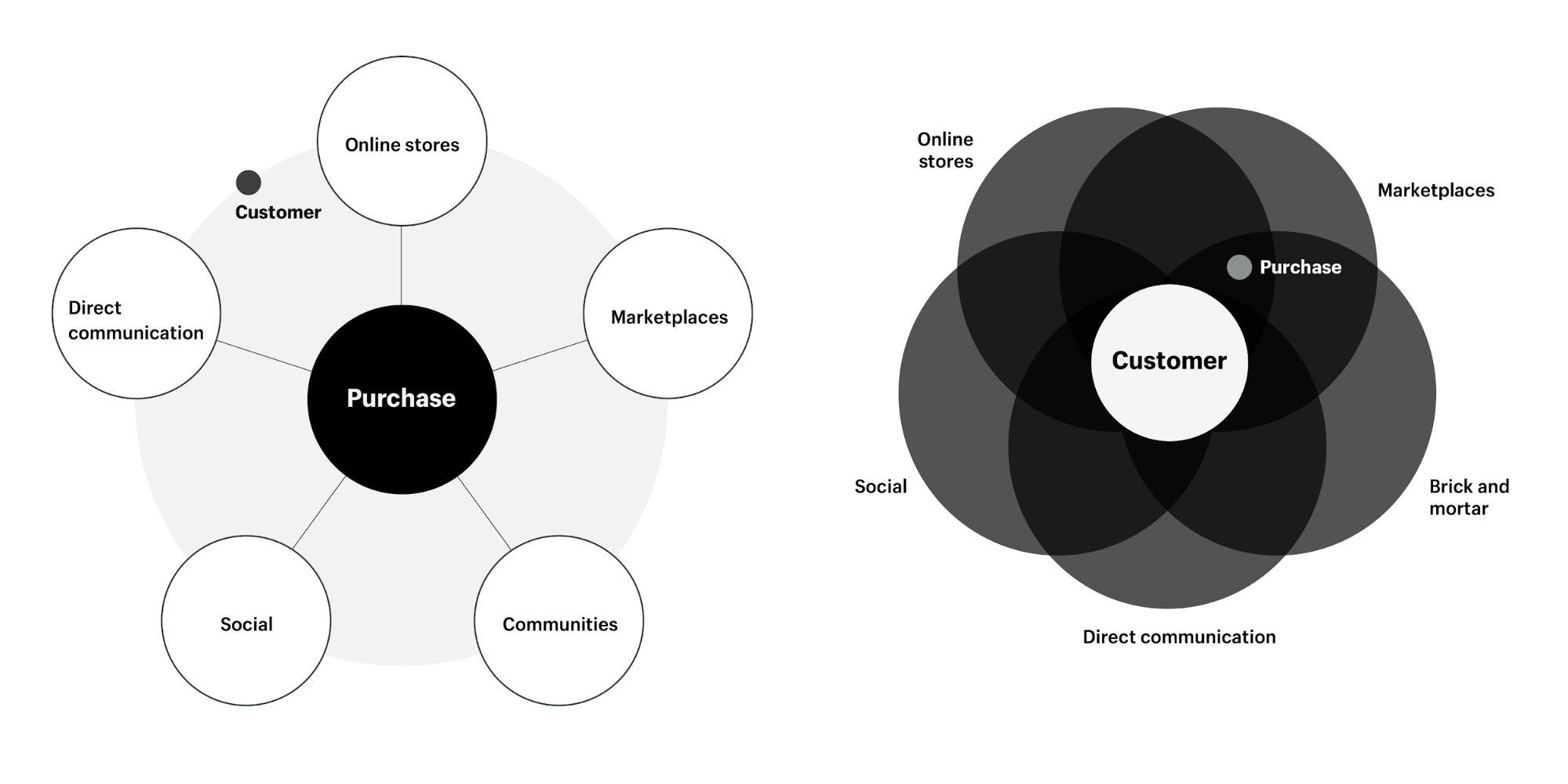
As a pure-play ecommerce example, Pura Vida Bracelets chose to focus on micro-influencers and referrals, using email and Instagram as its primary channels. After revamping its referral program, the brand amassed an army of over 110,000 “reps.” This increased sales from referrals by ~300% year-over-year and lifted average order value by 11%. “It’s not about ‘all,’” wrote Steve Dennis in Forbes. “It’s about relevant and remarkable where it truly matters.”
Start at the End: Retention Comes First
The fight for customers isn’t new, but it is intensifying. David Perell and Nik Sharma summarize the impasse: “DNVBs [digitally native vertical brands] go to war for the same customers on the same platforms (such as Facebook and Google). Customer acquisition costs soar as they fight for limited advertising space. As companies grow, so do costs of acquiring each additional customer.”
While other causes may be at play, this war touches all paths to purchase. Chamath Palihapitiya — an early senior executive at Facebook and now CEO of Social Capital — estimates “40 cents of every VC [venture capital] dollar” is spent on acquisition. Over the last five years, Facebook’s average CPC has increased 612.5%. And, Facebook CPM for “product catalog sales” ads are now 645% more expensive than “store visits.” Simply put, buying a visitor who wants to buy from you is exponentially more expensive than buying a visitor.

As backward as it sounds, retention must precede acquisition. The only way to survive higher new-customer spend is through higher customer lifetime value.
Tactically, this means front-loading loyalty programs that are easy to use and offer meaningful rewards from the jump. Such programs cannot be merely transactional but also community-building by incentivizing engagement. Cater to ardent fans and equip them with opportunities to sell you — rather than sell yourself — through user-generated content (UGC), reviews, and referrals.
Subscriptions are another avenue of attack. Last year, Hubble grew its contact-lens service to over $30 million in sales and, in 2017, Native — a DTC natural deodorant built largely on subscriptions — was acquired by P&G for $100 million. As Wilson Hung explains, “Brands with products suitable for a recurring subscription, with high average order values and margins are the ones that are best suited to scale a paid media first strategy.” Subscriptions give companies the “luxury” of high acquisition costs.
Amidst the tactics, never ignore the centrality of every brand’s most valuable asset. Increasing lifetime value and lowering acquisition costs come from placing people (not products) at the heart of growth.
Then, Acquisition: Seek & They Shall Find Ye
Fully 85% of product searches begin either on Amazon or Google. No surprise there. What is surprising is how few online retailers — even large or enterprise organizations — have mastered acquisition via search. Setting aside Bezos’ beast, the cardinal sin of search engine marketing is casting the net too wide. ROAS comes alive in granularity; wastefulness, in breadth.
First, match search queries, ads, and landing pages as closely as possible to eliminate friction: shoppers should be given ad copy and landing pages with the exact keywords — or glaringly obvious synonyms — they first entered into the engine. Whether you use single keyword ad groups (one keyword that triggers one campaign or ad), or tightly knit groups of 5-15 keywords isn’t as important as the principle: customers should experience a throughline from start to finish.

Second, separate campaigns for more effective budgets and bidding: (1) high-purchase intent — “buy women’s purple flats” — from (2) informational intent — “most comfortable women’s flats for standing” — from (3) unknown intent — “women’s flats.” Separation is also important for branded (your company’s name and exact product titles) versus non-branded keywords.
Third, keep a close watch on negative keywords — words that prevent an ad from being triggered by terms associated with your keywords but not your product. For casual or dress flats, this would include athletic terms or dance terms so that someone looking for “ballet shoes” doesn’t get served an ad for “everyday flats.”
Failure to monitor negative keywords drags down ROAS, especially on Google Shopping where triggering is dependant on product feeds (the product title and descriptions from which Google draws normally linked directly to an ecommerce site’s backend). Lastly, experiment with competitive campaigns by targeting other company’s names or products, and — in everything — test, iterate, and follow the data.
Organic search remains the holy grail. Master SEO, giving particular care to how you format product descriptions. ThirdLove’s paid and organic efforts tie together these methods beautifully. For the phrase “try bras at home,” ThirdLove occupies the first ad result along with positions two and three organically:

Content Then Commerce: “It’s the [Audience], Stupid”
Nobody likes to be sold to. Everybody likes to be entertained. More than that, we all love to belong. Humans are irreducibly relational and self-centered. That’s the genius of storytelling. Great content connects us simultaneously to something bigger than ourselves and a vision of who we can be. Great sales copy — particular copywriting formulas built on human emotions — does the same thing. Brands that deliver this sew themselves into the lives of their customers in a way that commerce can’t.
“We’ve noticed that if we have content that has real meaning,” says Chris Pfaff, founder of Young & Reckless, “People are more likely to click and go look at the actual product, as opposed to saying, ‘Hey, look how cool this photo is.’ If you get across your brand message and make people feel inspired or motivated, then they’ll go and buy your product.”
Originally a wholesale brand, four years ago Y&R turned its sights online. Today, digital isn’t just a marketing channel, it’s a factory for audience creation. Social accounts for half of all Y&R’s traffic and the company is “tripling down” on YouTube because “people go there to be engaged, whereas it’s more passive on Instagram and Facebook.”

Or, consider The Hundreds: media first, products second. “We’re not a T-shirt brand,” Bobby Hundreds has said. “This is content and culture and community. The T-shirt is just merch.” Alina Nguyen, Editor-in-Chief of The Hundreds, puts it like this: “At the core of The Hundreds’ ethos is storytelling on a personal level. The story that exists on the undertow lays the foundation for everything our brand stands for, and every collaboration and project we do in the clothing sector.”
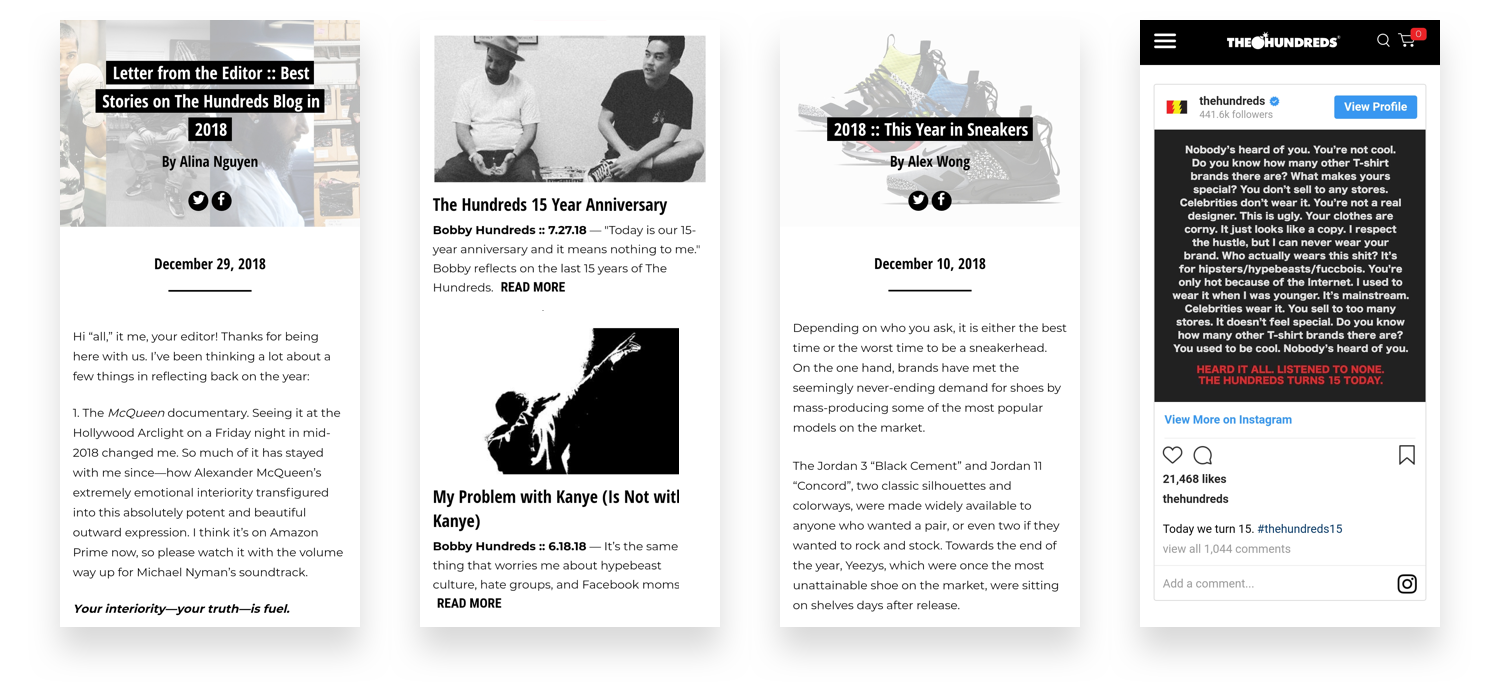
Other models exist. Morphe Brushes (though influencers) and Glossier (through micro-influencers) curate UGC onsite and off, layering videos, images, and reviews by customers into their site and social media. Temporary tattoo makers Inkbox invest in trend reports — promoted via Facebook Messenger — and regularly answer FAQs on YouTube. Chubbies and Purple have forgone influencers and centered themselves on videos, events, and written content that’s permeated by a unique voice.
Whatever form content takes, certainly optimize to drive product interest and sales, but never at the expense of serving, entertaining, and embodying your audience.
Beware of “Rented” Land (For the Right Reasons)
First, the facts: revenue from Amazon Marketplace is now double the company’s retail sales; half of all product searches start on Amazon; advertising is its fastest-growing arm; and Amazon is aggressively courting DTC brands. Conclusion: no business can ignore it. Except, maybe you should.
When it comes to Amazon, more valuable than following the money is intentionality — weighing carefully the choice to list or not to list; to partner with Amazon or not — mixed with a healthy dose of fear. Just not the fear most sellers have:

The real danger is a disconnect between business goals and how to get there — namely, selling products versus building a brand. Think carefully about any intermediary between you and your customers. Covet that connection and that data: email addresses, social profiles, buying preferences, and demographics (like age and location), all of which Amazon withholds from Marketplace sellers.
For some, the answer lies in symbiosis. “There’s a symbiotic relationship where Amazon advertising works great — more the manual stuff than the automatic,” says Nolan Walsh, co-founder of Thursday Boots Company. “We don’t put all of our products up on Amazon. It’s really more the best sellers where we’re not strapped for scarcity.” UNTUCKit uses Amazon to “offload older styles” and Buzzfeed mixes standalone sites featuring core products with an Amazon storefront for “merch.”
For intrepid sellers, Amazon can be a mix of distribution and acquisition. Fulfillment by merchant offers the most flexibility in creating a branded unboxing experience, but inserts driving customers onsite are against Amazon’s terms of service. “Our biggest driver,” says a Fulfillment by Amazon seller who asked to remain anonymous, “is chatbots.”
Because Amazon allows contacting for “order fulfillment and related customer service,” the seller — a high seven-figure brand that has operated on Amazon for three years — creates custom Facebook audiences using shipping information. “We are interpreting the rule liberally,” says the seller, “but many times people who have ignored our ‘how was your order’ email through Amazon end up having an issue that we can solve once we connect on Messenger, and they’re super happy about it.” It’s a murky line, but from those positive interactions, the move to direct customer is natural.
For others, like Paul Munford — CEO of Lean Luxe — the line is far more clear. “If you give up control of customer experience and that direct relationship with the customer, then what do you really have?” says Munford. “That’s the lifeblood of today’s best brands and it’s the future: healthy little fiefdoms with their own moats. Frankly, if I’m a brand on this path, I’m not even remotely worried about being on Amazon. It commodifies the brand. Nor am I really even looking to stock my stuff in non-Amazon third-party marketplaces either, because again that creates just another barrier between me and my customer. It depends on what your outcomes are as a company.”
And, as for many of the DTC brands Amazon is courting, it’s not a line, but a barricade. “Selling on Amazon doesn’t work for a customer-centric brand,” Melanie Travis, founder of Andie Swim, told Digiday. “They basically want to reduce us from a brand to a product. They’re all nice people, but they’re a monster platform.”
Online Shopping Trends That Matter
Naturally, much could be added. Personalized product recommendations and onsite search are increasingly powerful. For marketing, email reigns supreme, but chatbots are on the rise. Ecommerce automation is giving companies their time back while improving the bottom line. And the specter of global ecommerce looms large.
Amidst the noise and excitement, what matters is investing in the online shopping trends shaping ecommerce — new or old — and ignoring the rest.
About the Author
Previously the Editor in Chief of Shopify Plus, Aaron Orendorff is the founder of iconiContent, a strategic agency “saving the world from bad content.” Named by Forbes as one of the top 10 B2B content marketers, his work has appeared on Mashable, Entrepreneur, Business Insider, Fast Company, Inc., Success Magazine, The Next Web, Content Marketing Institute, and more.