The post <strong>Grit as a Tool for Focus</strong> appeared first on Bluebird Sky.
]]>“A lack of grit can come from having less coherent goal structures.” Author Angela Duckworth talks a lot about grit, and the lack of it, in her book Grit: The Power of Passion and Perseverance.
But let’s back up a bit. What’s “grit,” anyway? According to Duckworth, Grit = Passion + Perseverance.
Grit is a tool. In fact, it’s a bit of a multitool, a Swiss Army knife that can be helpful in many different situations.
Like any tool, grit can be misused. For instance, you certainly wouldn’t want to grit yourself up a mountain in dangerous conditions and wind up seriously injured or dead. Similarly, in your work, you don’t want to grit yourself into burnout or bankruptcy.
How do you make sure you’re using the tool of grit to help and not harm? Focus on your goals.
Duckworth uses this diagram to illustrate this point.
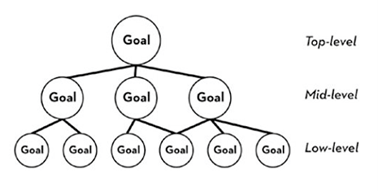
The low-level goals are more concrete. As we tackle them, they move us on to mid-level goals, which might be more difficult to achieve. Think of low-level goals as the 5K runs a person who wants to take on a marathon takes early in their training, or the omelets and burgers that an apprentice chef creates before moving on to more complex recipes. Strategic grit, at this point, preserves mental energy because you’ve already identified the basic steps you must take to reach bigger goals.
The mid-level goals start to answer the question of “Why?” Why do the low-level goals matter? What skills or opportunities did they create to make the jump to the next level of success? Think of the runner entering a small, local race to practice putting together the basic elements honed in their 5K runs. Think of the chef using the culinary techniques and artistry learned in creating simple plates to test a new recipe that will be spotlighted as the restaurant’s Lunch Special. Mid-level goals serve as milestones at which time performance can be measured and critiqued. Are things working as planned? Are tweaks needed? Is it time to pivot towards a new goal?
The top-level goal is the end goal. It is what the other goals will help us achieve. Think of the runner successfully competing in their first marathon and feeling proud of the medal around their neck. Think of the chef who moves up in the kitchen, finally seeing their practice and effort paying off in recognition and new stature at the restaurant.
When we take a big goal and break it down into smaller goals, we don’t kill ourselves trying to achieve personal greatness in a week’s time. The runner doesn’t get shin splints trying to run too far too soon; the chef doesn’t char an expensive piece of beef and mar the restaurant’s reputation by ruining an influential patron’s dining experience. Instead, there’s a steady build-up in skill and confidence, which ultimately gets us to where we want to go.
Now that’s strategic grit.
The post <strong>Grit as a Tool for Focus</strong> appeared first on Bluebird Sky.
]]>The post Messy challenge? Try conversation. appeared first on Bluebird Sky.
]]>Feeling overwhelmed by a challenge? Try conversation, the most powerful problem-solving technology we have. Conversation can move people from ideation to experimentation and learning to solution. What’s more, there’s a structure to these types of productive conversations that can be defined and practiced.
The article linked here from Fast Company describes a big challenge that was addressed in a powerfully elegant way by a collection of people from around the world. The group came together virtually to converse and design a way to tackle the challenge—in this case, creating an almanac about climate change.
As the article describes, 300 volunteers from 41 countries rallied around a clear purpose and practiced frequent and positive communication, which created the trust that allowed them to tap into the huge range of knowledge and skill within the group. This process created new learning and produced a published almanac—which itself will be a tool to foster more needed conversations about climate change.
The excitement of the project was contagious to me as I read the article. It was a refreshing change of pace to see the way this global network of, often, strangers came to work together so effectively.
I was struck, too, by the realization that this project is an example of Strategic Doing in its most organic form.
Strategic Doing is a methodology for using strategic thinking, planning, and action within innovating networks to tackle messy challenges. The foundational value of the approach is trust, since solving complex problems requires that people have deep, focused conversations, which cannot take place without trust. It is also an iterative approach, focusing on taking incremental actions to create new learning and work toward transformational change. This iterative nature of the methodology is reflective of another core value of Strategic Doing: action.
This is why I love helping people learn about and implement Strategic Doing. It helps people move from feeling overwhelmed by the complex challenges we face to feeling energized and optimistic about tackling them.
Want to learn more? Please reach out!
The post Messy challenge? Try conversation. appeared first on Bluebird Sky.
]]>The post Strategic Grit™: You Are Here appeared first on Bluebird Sky.
]]>Holly:
Recently, my family and I were driving to dinner when we came across a car accident that had just occurred. It was clear the people involved needed assistance, so we called 911. The initial dialogue with the operator was simple: we were calling to report a car accident and no, we weren’t involved or injured.
But her next question stumped us. Where is the accident located? We were silent. We felt bewildered because we were on a major highway that we’ve traveled hundreds of times, but we couldn’t come up with an accurate description of our exact location. After what seemed like an eternity, we were finally able to piece together a helpful description of the location using the nearest exit ramp as a reference point. Whew. How often does this same phenomenon occur with our clients? It happens often because it’s easier to focus on where we want to go and how we’re going to get there than it is to describe our baseline. And if we don’t invest the time to accurately describe the ‘you are here’ state, we miss out on creating common understanding and the opportunity to create alignment.
When I begin working with individuals and small teams, I spend a significant amount of time studying their self-awareness levels. The common language I hear during this phase of my assessment is: I’m not good at conflict; I get nervous when I have to speak to so-and-so; I want to be able to perform at X, Y or Z level of work/management; I struggle with self-confidence. These thoughts and words are great prompts to explore and develop a baseline statement.
Baseline statements are critical to understanding the gap between the current state and the ideal state. They help us plot how we’re going to use the strategic grit process to get from where we are today to where we want to be.
Take self-confidence as an example. A business client might share examples of times when he or she lacked self-confidence and what impact this lack of confidence had on his or her team or manager. We’ll talk about what an increased level of self-confidence would look like and why it’s important that he or she achieve this new level of confidence. Ultimately, we’ll come up with a current-state measurement of self-confidence. It could be as simple as a Likert scale to rank their current level of self-confidence on a scale of 1 to 10.
When I work with athletes, the dialogue is similar. If the goal is to perform at a certain level of athleticism, I pose questions about what it’ll take to get there, but also about evaluating the current state. Often, this is a key step to understanding just how wide the gap is and how realistic our chances are of closing it.
Jennifer:
One thing I hope you noticed when you read Holly’s section of this post is that, early in the process, she helps her clients picture or define the future they want to create. The process isn’t: This is my problem; how do I fix it? Rather, it is: This is the future state I would like to bring to life; how can I get there?
The answer to that question requires taking a deep look at where you are now. Just as your cell phone map app can’t direct you anyplace without knowing your current location, you can’t plot your own path to a goal without knowing where you are in the process of achieving it.
It’s the same with an organization. When everyone on a team or across an organization holds a vivid, shared picture of the future in mind, and they also develop a shared understanding of the current state, then they are much more likely to be successful in collectively bringing that imagined future to life.
What are some ways an organization can develop that shared understanding of the current state? There are tried-and-true tools such as a SWOT analysis. Here the organization gathers input from multiple stakeholders regarding perceived internal strengths (S), internal weaknesses (W), external opportunities (O), and external threats (T). Inputs on these topics can be gathered via structured interviews, surveys, and focus groups.
A SWOT analysis is often complemented by data analysis. An organization may look at relevant data trends over time, including actual performance compared with predicted or targeted performance.
The most important element of any organization is its people, so another tool I find valuable is conversation. Sometimes I talk individually with people from a wide range of roles within an organization to learn how each one views or experiences key topics or issues. Aggregating the input from these conversations can reveal valuable insights and create a rich picture of the current state.
Other times I guide small discussion groups to initiate conversations among colleagues about critical issues. These conversations can lead to new perspectives and a-ha moments when people unexpectedly realize they have a different understanding or interpretation of foundational elements of the organization—or that they are more aligned than they previously realized.
Creating a shared vision of the future and a shared understanding of the present make it much easier to collaborate on plotting the path forward. That’s when Siri says: “Starting route to your destination.”
Putting it together:
We would love to hear about ways you and/or your organization create a clear understanding of your baseline. What are ways you develop your own self-awareness? How does your team or company help everyone understand where things currently stand? If you’re struggling with finding your starting point, we’re more than happy to help you with your geo-localization.
About Holly: Holly works with individuals and teams to help them forge and refine purposeful leadership and authentic collaboration as they navigate planned routes and unexpected detours. She is a certified Human Resources Professional and Mental Toughness Trainer. Learn more at https://hollyadamsconsulting.com/.
About Jennifer: Jennifer helps businesses, nonprofits, community coalitions, and governmental entities with strategic evolution: tackling complex problems, determining strategic direction, and developing a discipline of action to create a new future. She is a Fellow of the Strategic Doing Institute. Learn more at https://bluebirdskysolutions.com/.
About Strategic Grit™: Strategic Grit was born of the lessons (sometimes painful, sometimes joyful) we learned thanks to pandemic times. We learned some of these lessons on our own through research, study, and personal experience; others we learned through our work with clients. But the theme that stands out is this: Those best equipped to ride out tumultuous times are agile, persistent, and forward-thinking. These are people and organizations with Strategic Grit, a resilience that is not random but planned, effective, and durable.
Photo by Tamas Tuzes-Katai on Unsplash
The post Strategic Grit™: You Are Here appeared first on Bluebird Sky.
]]>The post Strategic Grit™: Incorporating Rest into Growth appeared first on Bluebird Sky.
]]>There’s a word that comes up often in my work with clients and that is tired. We are all feeling tired right now. A mistaken assumption about grit is that you must plow through exhaustion, ignore it, or push it to the side. But if you are feeling overwhelmed and uncertain, burnout might be around the corner. This means that what you really need to do is to take a break.
Professionally, it’s unlikely that anyone is ever going to tell you to slow down or stop. People tend to be rewarded for doing a good job by being asked to do even more work and take on even more responsibility. Why? Because you’ve proven you can handle it. And, as a society, we hold up “busyness” like a trophy.
But how do you—or your employer or colleagues—know when a healthy challenge crosses the threshold to being overloaded? How do you know when you are headed for burnout?
Workplace stress and burnout are becoming all too common. The American Psychological Association’s 2021 Work and Well-Being survey revealed that 79% of US adult employees had experienced work-related stress in the month before the survey. Furthermore, the effects of work-related stress (like cognitive weariness, emotional exhaustion and physical fatigue) have increased over the last several years.
Don’t “grit” yourself into a place you didn’t intend to go. Instead, incorporate rest into your growth system.
In her book, Grit, Dr. Angela Duckworth reminds us how much we love the idea of a “natural,” someone who appears to reach high levels of achievement effortlessly. In reality, achieving excellence and becoming a high performer come from repeating mundane tasks or actions until you master them. This notion of repetition as the route to perfection is the focus of Malcolm Gladwell’s famous book Outliers, in which he states that it takes roughly 10,000 hours of practice to become an expert.
Many of us are enthusiastic and passionate when it comes to our work and our desire to do it better, but Dr. Duckworth warns us that constantly striving for ultimate performance can also exhaust us. How do we endure? We rest.
This might be a counterintuitive concept for many of us who often rush toward something. But what if we took our time, took baby steps instead of leaps? What if we fully lived each phase of growth instead of rushing to cross the next task off the to-do list, reach the next phase, or secure the next title?
Try these steps:
- Build in accountability. Check in regularly to make sure you’re heading in the right direction.
- Build in reflection. Ensure there are appropriately spaced rest stops to reflect.
- Build in adjustment. Take opportunities to adjust or redefine success if you’ve experienced circumstances you weren’t anticipating.
- Build in rest. Understand that periodic rest is a critical element of success.
Jennifer:
“Build in rest.” Have you ever felt so tired that you couldn’t even get yourself to bed?
Research shows that humans can spend at most 3-4 hours per day on work that requires creativity or other forms of intense focus. On top of this, we need a break of 15 minutes or more after 90 minutes of this type of work.
If you’re like me, sometimes you willfully ignore this human truth and push on. And it becomes a cycle of rapidly diminishing returns. An hour of intended productivity turns into a three-hour slog of low-quality work and growing frustration. What might seem like grit or discipline in pushing through tiredness is actually the opposite: a squandered opportunity for rest to fuel new effort.
What if you were to reframe the concept of “discipline” to mean that you create and stick to a growth system in which rest is a critical element? And what if your organization practiced a similar discipline, building in time to experiment and reflect for important projects?
Here’s another question: Think back on your best ideas, the ones you’re most excited about. What were you doing when you had these ideas?
I’m going to bet you were not seated at your desk in front of your computer typing them out on deadline. I bet you were doing something indirectly related—or maybe even completely unrelated—to your idea.
When I was in college, I was usually doing something like brushing my teeth when I got my best ideas for papers and projects. Today, when I’m seeking a new idea, I’ll ride my bike on gravel roads, occupying my physical self while allowing my mind to roam. New ideas and perspectives need time to wander the inner corridors of the brain and find new connections and meaning before surfacing.
In fact, brain researchers will tell you that we need a balance of two types of concentration and interpretation, a balance of conscious and unconscious interpretation of all that we take in. While, by definition, we don’t control our subconscious, we can establish discipline through which we create time and space for the subconscious to do its work.
Groups or organizations are similar: they need processing time to allow the strongest ideas to surface. When I start working with a new organization to tackle a challenge, I make sure I know how much time the group is willing to take for the process. Not time-on-task, elapsed time. Insight, learning, and change simply cannot happen completely on demand. New input requires focused and unfocused attention and processing. The most effective organizations create time and space for both.
This is an element of the strategic part of “strategic grit.” It’s understanding the process needed for achieving the goals and behaving with discipline to follow that process. As Holly says, effective organizations and groups don’t “grit” themselves forward at all costs. Doing this often leads to more of the same old thing, rather than movement toward a new desired future. Instead, organizations that build time for rest and reflection into their project cycles are much more likely to succeed in building the new desired future.
Putting it together: This month, challenge yourself to opt out of the Busy Olympics. Turn your focus away from the to-do list and toward the time and space in between action items: pay attention to the moments of rest. Challenge yourself to sustain those moments, experience them fully. We’re going to bet this makes you feel a lot better—and that your to-do list is A-OK, too. Let us know if our bet is well placed!
About Holly: Holly works with individuals and teams to help them forge and refine purposeful leadership and authentic collaboration as they navigate planned routes and unexpected detours. She is a certified Human Resources Professional and Mental Toughness Trainer. Learn more at https://hollyadamsconsulting.com/.
About Jennifer: Jennifer helps businesses, nonprofits, community coalitions, and governmental entities with strategic evolution: tackling complex problems, determining strategic direction, and developing a discipline of action to create a new future. She is a Fellow of the Strategic Doing Institute. Learn more at https://bluebirdskysolutions.com/.
About Strategic Grit™: Strategic Grit was born of the lessons (sometimes painful, sometimes joyful) we learned thanks to pandemic times. We learned some of these lessons on our own through research, study, and personal experience; others we learned through our work with clients. But the theme that stands out is this: Those best equipped to ride out tumultuous times are agile, persistent, and forward-thinking. These are people and organizations with Strategic Grit, a resilience that is not random but planned, effective, and durable.
The post Strategic Grit™: Incorporating Rest into Growth appeared first on Bluebird Sky.
]]>The post Strategic Grit™: Seeds of Inspiration appeared first on Bluebird Sky.
]]>Holly: “Everyone has a story.” This was an observation a dear friend of mine made several years ago, and it helped me realize that we all have a seed of grit within us. Recognizing and acknowledging that seed in ourselves and others can be inspiring.
My friend Dee and I were attending an event where speakers shared dark periods of their lives. We listened to stories about surviving physical abuse and achieving sobriety after years of alcohol and drug abuse, among others. The stories were powerful and presented excellent examples of grit.
One speaker stood out to us. Her story was shocking in many ways but also incredibly inspiring. At the end of it, Dee commented that we all have stories, some of which might also inspire others if only they knew about them. She was right.
Over the years, I have often thought of Dee’s observation. She helped me recognize the importance of the stories we carry around, and now, with Jennifer, I think it’s time we celebrate them.
More and more often, I notice individuals and organizations that exemplify strategic grit, which lifts my spirits. I believe it’s essential to celebrate strategic grit in others and recognize how often those who inspire us the most are our friends and family members, not celebrities or social media influencers.
So, let’s take some time during February, the month of love, to honor those who inspire us with their strategic grit.
During sessions with clients, I often ask them to talk about someone they know who exemplifies strategic grit. When I think about people I know with strategic grit, I think about:
- A full-time HR professional and mom who coordinated (mostly remotely) the care her sister needed to make a complete mental and physical recovery after an accident
- A dear friend who gracefully orchestrated her family’s international move during the pandemic
- Military spouses who work, manage households and maintain a “normal” life for themselves and their kids during a spouse’s deployment
These people have very diverse personal stories, but they acted similarly when they needed to get through a difficult time. They:
- Identified the goal or purpose
- Understood the gap between their current and ideal state
- Acknowledged emotional components but didn’t let them prevent action
- TOOK ACTION
The actions they took to create a better future is what I admire and draw inspiration from.
Jennifer: I agree, Holly, that stories can be powerful vehicles for learning. We are all writing our own story, and in many ways, organizations write their own stories, too. Any writer will tell you that you don’t have a story if you don’t have conflict. That conflict can take many forms, whether within the self or with another person, nature, or society. But without some conflict or challenge, the character can’t evolve, and if there’s no evolution, there’s no story.
When a challenge presents itself, it is, of course, possible to fail. Countless businesses no longer exist because they did not respond to challenges in a way that allowed them to survive or thrive. Sometimes, the emotional element of a challenge is so overwhelming that it’s hard to see what response would be helpful, or it makes giving up the most appealing response.
However, a hallmark of strategic grit is keeping the desired future in mind and taking steps, no matter how small, in the general direction of that future. Learning from each step helps illuminate where the next step should lead, all in the direction of the desired future state. This is how the people Holly listed wrote their stories of strategic grit. It’s also how organizations I’ve had the good fortune to work with have written their stories.
Some examples:
- A college testing company that, in the face of a dramatically changing landscape of higher education and workforce development, evolved to support learning and training for elementary school-aged children to mature professionals.
- A food pantry that responded to the changing needs of its community by evolving into a hub of many resources, not only food.
- Two social services agencies that stopped competing and merged to amplify their impact on individuals with disabilities.
In each of these examples, the organizations made what could, on the surface, be seen as radical changes. But after stepping back, it becomes apparent that the core purpose of each organization remained the same. The actions taken in response to the changing world around them were altered. They kept their focus on the desired future state while making incremental steps in that direction. And the world is better for it.
Putting it together: They say that necessity is the mother of invention. We believe that strategic grit is the midwife.
Innovation without follow-through does little good. Likewise, persistence simply for the sake of persisting is wasteful. Compelling stories are written when challenge spurs mindfully guided innovation—when the power of strategic grit is applied.
Whose story do you take inspiration from? Let them know!
About Holly: Holly works with individuals and teams to help them forge and refine purposeful leadership and authentic collaboration as they navigate planned routes and unexpected detours. She is a certified Human Resources Professional and Mental Toughness Trainer. Learn more at https://hollyadamsconsulting.com/.
About Jennifer: Jennifer helps businesses, nonprofits, community coalitions, and governmental entities with strategic evolution: tackling complex problems, determining strategic direction, and developing a discipline of action to create a new future. She is a Fellow of the Strategic Doing Institute. Learn more at https://bluebirdskysolutions.com/.
About Strategic Grit™: Strategic Grit was born of the lessons (sometimes painful, sometimes joyful) we learned thanks to pandemic times. We learned some of these lessons on our own through research, study, and personal experience; others we learned through our work with clients. But the theme that stands out is this: Those best equipped to ride out tumultuous times are agile, persistent, and forward-thinking. These are people and organizations with Strategic Grit, a resilience that is not random but planned, effective, and durable.
Photo credit: hush-naidoo-jade-photography
The post Strategic Grit™: Seeds of Inspiration appeared first on Bluebird Sky.
]]>The post Strategic Grit™—Talking, Trust, and Tenacity: Solve Problems Faster appeared first on Bluebird Sky.
]]>Jennifer: I’ve been thinking a lot about the complex problems we citizens of the world face today, the ones that have no easy, obvious solution. We read news stories about the tussling and political theatrics involved in hammering out critically needed legislation. We watch climate activists express distress and frustration at a lack of progress on climate policy and action. We hear the hollering around issues such as immigration and social justice. These are big, big issues that we ignore at our peril.
Compounding the challenge is the fact that media outlets love covering conflict and drama. It’s profitable to stir up anger and fear. This creates a perception of chaos and a sense of mistrust. Craving order and clarity, people seek comfort in messages that reinforce their views, which means they are less likely to talk to people who don’t hold the same views or who, worse yet, might challenge their views.
But what if there was a way out of the fear mongering and echo chamber? I’m an optimist and a practitioner of Strategic Doing, so my answer is: We need to have more conversations.
Seriously. We need to actually talk with one another. We need to speak our thoughts and listen to each other’s thoughts.
The only way complex problems are solved is through deep conversation among people of diverse perspectives, expertise, and experience. Deep conversation allows people to share what they know so that individual knowledge becomes shared knowledge. Shared knowledge can become applied in novel ways, which in turn produces pieces of the solutions for complex problems.
There is nothing quite so energizing as being in the room where knowledge and ideas are being connected and turned into solutions. Whether it’s debating a colleague’s idea for a new economic development effort or gathering community members to envision ways to help high school students tackle social justice, engaging diverse people in deep, focused conversation is the most effective way to develop solutions.
Of course, deep and focused conversations don’t happen by chance. This is good news, because it means that there are steps we can take to make sure they happen and that they happen more often.
First, create and maintain expectations for what Amy Edmondson of Harvard Business School calls team psychological safety, which provides team members with a sense of safety when speaking out. You can achieve this by focusing on shared learning rather than specific outcomes and by asking questions, listening carefully, and contributing meaningfully to the conversation. It also helps to consider the physical location of the conversation; it’s best to talk in a neutral location that is accessible and welcoming to all participants.
Second, use ground rules to ensure that everyone has equity of voice, which means that each person speaks for roughly the same amount of time. Research from the National Science Foundation shows that this practice leads to improved collaboration among group members.
Psychological safety and equity of voice work together to help group members develop trust. Once trust among group members is created, then the true work of addressing and solving complex problems can happen.
Take a moment to visualize how this happens: Did you know that the Founders set rules of civility for America’s 1787 Constitutional Convention? One rule required members to actively listen to those whose turn it was to speak. Another specified how the group would ensure that everyone gathered would have a chance to speak. Adhering to these rules helped the 55 delegates, who held a wide range of views (often ones that clashed), produce the Constitution, an astounding feat.
Can you imagine the Constitutional Convention taking place in today’s contentious political environment? Neither can I. Now imagine how current elected officials could improve the odds of a successful legislative outcome by teaching and practicing psychological safety and equity of voice. Wow! What a difference it would make.
Are you currently part of a group wrestling with a tough problem? Could these practices make a difference in reaching your desired outcome?
Holly: I’m totally in agreement with what Jennifer is saying. It’s easy to feel overwhelmed. But if we can use some ground rules (psychological safety and equity of voice) to create trust between opposing sides, we’re on the right track to bringing back sanity and social progress into our lives, no matter where we stand.
Trust is an integral part of Strategic Grit™. When we use strategic grit to solve big problems, we have to be ready to experiment with different iterations, and we have to trust ourselves and our process. We can’t be fixated on failure because failure is required for growth; it’s the only way we know for sure what will and what won’t work.
Judith E. Glaser, author of Conversational Intelligence: How Great Leaders Build Trust and Get Extraordinary Results, says it well:
To get to the next level of greatness depends on the quality of our culture, which depends in the quality of our relationships, which depends on the quality of our conversations. Everything happens through conversations!
So yes, Jennifer. We need to have conversations. Real dialogue. Meaningful exchanges. And physically/neurologically, we cannot have deep conversations if our brains are in a state of fear. Fear triggers our amygdala. Think: fight, flight, freeze, or appease. As Glaser explains, we need to move on the Conversational Dashboard™ from Level 1 (amygdala engagement, which focuses on self-protection), through Level 2 (limbic engagement to begin regulating emotional response), and on to Level 3 (prefrontal cortex engagement to allow openness and flexibility in thinking). When we aren’t fearful, we have the greatest capacity for strategic thinking (and doing!) and collaborating to find creative solutions.
As an illustration, my most important personal and professional relationships are built on trust. Good things come out of these relationships because when I engage with people I trust, I don’t have to filter my thoughts or be concerned about whether my well-being is being somehow threatened. There is a shared understanding that we are willing to do what it takes for the “greater good,” there is no ego involved (no winner/loser), and there is a respect for what each person contributes to the conversation, even if there’s no agreement.
Our brain needs to be out of fight/flight/freeze/appease mode in order to trust and, in turn, to engage in true dialogue to solve complex problems. When trust is lacking, our ego will try to limit our engagement to protect us from feeling stupid or otherwise threatened. We’ll waste energy on filtering our thoughts, over-analyze before sharing anything, and generally cause the process to be extremely inefficient. This is a clear indication we lack psychological safety.
To make it work, we need a basic level of self-awareness. Are we modelling the behaviors of trust that we expect from others? Trust is a two-way street, so if we want people to trust us, we have to trust them. And during a prolonged conversation about a difficult topic, maintaining this trust is going to create some uncomfortable feelings, so we’re going to need persistence, aka strategic grit. If we don’t persist, we’re likely to end up with a solution that’s only slightly better than status quo, or we might even quit. Instead, we must find motivation in our discomfort.
When I look at what’s happening in our world right now, I believe many of us lack strategic grit. We let our emotions control us and we leave the room as soon as we are confronted with an idea that doesn’t match with our own. We squirm at the discomfort of knowing that our views cut us off from others, even those we love, but we can’t summon enough grit to simply listen. Our emotions rule our lives and as a result, we can feel isolated and miserable. Out-of-control emotions limit our creativity and problem-solving abilities and make us vulnerable to egotistical thoughts and actions. I think it’s safe to say there’s not a lot of psychological safety in our world right now, and that hurts us all.
But it doesn’t have to stay that way. Wouldn’t it be exciting—and powerful—if we all took even the smallest steps toward building trust?
Putting it together: The tools we’re recommending—psychological safety, equity of voice, and persistence to listen to others without prejudice—could help you and your organization, or even your family, to find connection and common ground.
The bottom line is that most of us in are a place we’ve never been in before. We don’t know what the future holds. Trust = confidence and results when it comes to the problem-solving process. And we’ve got a lot of problems that need creative and innovative solutions.
Our challenge for you today is this: Take a chance on a conversation with someone different. See what unexpected ideas emerge.
About Holly: Holly works with individuals and teams to help them forge and refine purposeful leadership and authentic collaboration as they navigate planned routes and unexpected detours. She is a certified Human Resources Professional and Mental Toughness Trainer. Learn more at https://hollyadamsconsulting.com/.
About Jennifer: Jennifer helps businesses, nonprofits, community coalitions, and governmental entities with strategic evolution: tackling complex problems, determining strategic direction, and developing a discipline of action to create a new future. She is a Certified Strategic Doing Workshop Leader. Learn more at https://bluebirdskysolutions.com/.
About Strategic Grit™: Strategic Grit was born of the lessons (sometimes painful, sometimes joyful) we learned thanks to pandemic times. We learned some of these lessons on our own through research, study, and personal experience; others we learned through our work with clients. But the theme that stands out is this: Those best equipped to ride out tumultuous times are agile, persistent, and forward-thinking. These are people and organizations with Strategic Grit, a resilience that is not random but planned, effective, and durable.
Photo: By Metin Ozer on Unsplash
The post Strategic Grit™—Talking, Trust, and Tenacity: Solve Problems Faster appeared first on Bluebird Sky.
]]>The post Strategic Grit: Emotions appeared first on Bluebird Sky.
]]>Holly: Since we’re talking about emotions, I’ll admit that I had some powerful ones during the writing of this post. It took a strong dose of Strategic Grit to get me through the creative process. But my experience is not unique, and it provides the perfect segue for talking about emotions and how they can make us feel incompetent and completely stuck.
When I first sat down to write this post, I followed my and Jennifer’s recommendations: I set a goal to write the first draft of this post by a specific date, and then I chunked the larger goal into smaller ones to ensure that I met my deadline.
But then life happened. Marathon training runs and preparations for my parents’ 50th wedding anniversary kicked in at the same time as my kids’ school and sports activities ramped up. I missed my first deadline and so I extended it. I missed the second deadline, as well. I felt like a time-frazzled loser.
It’s important to share how I felt at this point. First of all, it’s a reminder that Strategic Grit doesn’t mean emotional stoicism; you are entitled to feel let down and disappointed, sad or lost in the process of achieving goals.
At this point, I was disappointed with myself and upset about my inability to deliver on a promise I had made to a close colleague. I was also frustrated because I have used the Strategic Grit method to start projects countless times before, but this time, it wasn’t yielding results.
I was also embarrassed that I, the Strategic Grit expert, was feeling rotten about my writing and missed deadlines. I felt like an imposter.
So, how did I overcome this challenge? There’s a success story brewing! 😊
I reread our original Strategic Grit series and started experimenting with Thoughtful Experimentation and Discipline, and eventually, I started to gain Momentum.
I tried writing for different lengths of time. Instead of writing at my computer, I took notes on my phone, sticky notes, and even a football roster sheet. I posted a sign with my deadline on a wall in my office. Finally, I asked a friend to hold me accountable.
My previous process of blocking out writing time in one-hour increments wasn’t working due to my busy personal life, so I switched to 15- and 30-minute increments. Also, I gave myself permission to write a “shitty first draft,” something my favorite author does, instead of seeking perfection.
Folks, it worked! When I recognized the need to take small steps forward to start DOING, it helped me keep going until I had a draft.
VICTORY!
Jennifer: I can relate to all of it, Holly! Thanks for the reminder that even coaches need to practice what they teach.
Your personal story of taming emotions to stay on track with Strategic Grit can also be applied to companies and organizations. After all, people (and their feelings) are at the heart of every business and institution.
Strategic plans often fail because the people who put them together fail to implement them. A big reason they don’t implement them, and why so many strategic plans wind up in a drawer, is because people have feelings and those feelings can lead to inertia. Let’s be honest, we’ve all seen this happen, and it’s a big concern for any group that’s contemplating reorganization or a strategy update.
If you want your strategic plan to have the impact it was intended to have, here are three things to consider:
- Immunity to change: Harvard researchers Robert Kegan and Lisa Laskow Lahey study how our assumptions and conflicting commitments cause unconscious resistance to change. The threat of impending change can trigger defense mechanisms, even if we believe we’re genuinely committed to change. Their book, Immunity to Change, is a fascinating dive into this phenomenon and how to overcome it.
- Psychology of change: There are many models that describe how people approach and respond to change. One I find useful was created by Amy Morin, LCSW, author of 13 Things Mentally Strong People Don’t Do. Morin offers five steps to successful change: 1) pre-contemplation; 2) contemplation; 3) preparation; 4) action; and 5) maintenance. Take another look at those steps. Action doesn’t occur until Steps 4 and 5, after a whole lot of thinking. But I believe Step 5 is the most important of all. This is where the discipline of taking a small action, learning from the experience, and iterating intentionally can truly transform a group or organization.
- The power of small steps: As Holly described, a blank page or Excel spreadsheet can lead to powerful feelings of overwhelm and self-doubt. In these moments, all we want to do is escape the task at hand. However, I hope that you’ve also experienced, as Holly did, the power of small steps. Every analytical report begins with the first letter of a word, then the first articulation of an idea. Every significant organizational accomplishment is built from countless small actions.
I have worked with organizations that set ambitious goals that made their employees feel paralyzed. It’s exciting to think about a radically different future, but making it happen can seem intimidating. Ignoring the emotional impact of daunting tasks could put your organization at risk of losing its most valuable resource: its people.
Strategic Grit doesn’t cancel out valid human feelings. Instead, Strategic Grit acknowledges and embraces their existence, then develops action plans that help people work through and past them.
Putting it together:
Take it from us: there is great power in the SFD (the “shitty first draft”). Embrace it!
And remember: Every team is made up of people who, like yourself, experience the exquisite range of human emotion. Making plans that consider this fact will help you and your organization navigate challenges and opportunities much more productively.
About Strategic Grit: Strategic Grit was born of the lessons (sometimes painful, sometimes joyful) we learned thanks to pandemic times. We learned some of these lessons on our own through research, study, and personal experience; others we learned through our work with clients. But the theme that stands out is this: Those best equipped to ride out tumultuous times are agile, persistent, and forward-thinking. These are people and organizations with Strategic Grit, a resilience that is not random but planned, effective, and durable.
About Holly: Holly works with individuals and teams to help them forge and refine purposeful leadership and authentic collaboration as they navigate planned routes and unexpected detours. She is a certified Human Resources Professional and Mental Toughness Trainer. Learn more at https://hollyadamsconsulting.com/.
About Jennifer: Jennifer helps businesses, nonprofits, community coalitions, and governmental entities with strategic evolution: tackling complex problems, determining strategic direction, and developing a discipline of action to create a new future. She is a Certified Strategic Doing Workshop Leader. Learn more at https://bluebirdskysolutions.com/.
The post Strategic Grit: Emotions appeared first on Bluebird Sky.
]]>The post Strategic Grit: Sustaining appeared first on Bluebird Sky.
]]>By Jennifer Horn-Frasier and Holly Adams
In our second round of Strategic Grit blog posts, we focus on real-life stories, sharing examples of real people who use Strategic Grit to get things done and move themselves and their organizations forward.
In past posts, we’ve explored envisioning the future and taking the first steps in doing what is needed to create that future. Today, we’re exploring sustaining the effort of doing what is needed over time.
Jennifer: During the pandemic, lots of people bought houseplants. So many new plant parents! I received a lovely succulent to brighten my office space. I read the care instructions that came with the plant and made a mental note: water every three weeks. I so wanted to be a good plant parent.
But six months later, my succulent is two-thirds brown, clearly distressed, and undergoing emergency porch therapy in hopes that the fresh (humid) summer air and brighter light will perk it up. It’s not looking good.
Why did I fail? Because I didn’t practice what I preach.
When an organization sets aside the time and energy to devote to envisioning and planning for a new future, it must commit to realizing that future. No organization should envision and plan for the future unless it is committed to investment in those plans. A regular investment of time and energy is the only way to bring the envisioned future to life.
In the Strategic Doing methodology that I use with organizations, this regular investment relies on 30/30 meetings. 30/30s require teams to look back at what has been accomplished since the last meeting (30 days prior); to evaluate how effective actions taken were in moving the team closer to its goals; to adjust plans based on learning and current conditions; to personally commit to taking specific actions during the next 30 days; and to set the date and time for the next 30/30 meeting.
In other words, each 30/30 meeting includes an evaluation of what’s been done, an adjustment of plans as needed, and the creation of a clear plan of action for the next 30 days. 30/30 meetings allow for rapid learning and quick changes that help keep projects on the path forward.
In the case of my poor succulent, I left out the learning/adapting part of the 30/30 equation. I didn’t monitor the soil between waterings. I didn’t consider the shock of the transition from dry, forced-air heating to open-windows warmth and humidity. I made the classic error of making a plan (to water my plant every three weeks) and then sticking it on the shelf to gather dust (not giving it regular attention and energy).
My clients have much better results.
A coalition of people was concerned about the lack of affordable and accessible child care in their community, and they came together to find solutions. They developed a shared vision of a better future and started designing projects to move the community toward this future. But then the pandemic changed everything, and none of the original plans made sense.
In a traditional strategic planning situation, this might have caused the group to put everything on hold. But because this group was using Strategic Doing, it was equipped to adapt. The group still had its overarching goal of creating a community with high-quality, affordable, and accessible childcare, so the group adjusted to accommodate the changed circumstances.
The group’s discipline of regular meetings with clear actions, evaluations of effectiveness, and informed adjustments enabled them to move forward despite the pandemic. They succeeded in providing desperately needed childcare solutions in time for the start of the school year. Now that vaccines have arrived, the group is once again reassessing the path to their goal.
Take action. Evaluate effectiveness. Commit to the next action. Repeat.
Holly: I thought puppies were popular during the pandemic, not houseplants! But you make an excellent point, Jennifer. 😊
Failure to sustain an action is common. There are personal ones such as the New Year’s resolution to visit the gym twice a week that lasts a week. Or the plan to “get organized” that doesn’t even last a day. There are professional examples, too. The “strategic initiative” communicated at the company-wide meeting that’s forgotten as soon as the energy of delivering the message fades. A local company recently rolled out an accountability-based program (complete with “action” cards) that was quickly abandoned when employees realized there was no buy-in from managers.
Ah, but the success stories can be amazing.
I have an elderly friend who had COVID-19, was under intense medical care for quite awhile, and is now back at home. I have a client who met her goal of scoring high on the MCAT. I know a manager who is building a solid foundation of trust with her newly-formed team, and a thought leader who is creating an impressive network of professional connections by sharing his specialized expertise on LinkedIn.
The keywords in any successful Strategic Grit story are grace and discipline.
When I say “grace,” I don’t mean accepting defeat with poise. I mean handling adversity with equanimity. The failed attempts at determining the most effective process provide the best learning opportunities. And every one of the people mentioned above gave themselves some grace, considered the difficulty as a data point, and adjusted their course accordingly. In some cases, they did quit, but they only stopped the parts of the process that weren’t working for them.
When the original study schedule for the MCAT wasn’t working for my client, she switched her workouts from morning to midday and added an extra 30 minutes of study time between tutoring sessions. When the manager received critical feedback from a tenured employee, she kept her emotions in check and responded with a genuine appreciation for the employee’s critique. The thought leader struck out a couple of times when followers disagreed with his thinking, but this didn’t stop him from trying again. He sought feedback and honed his message.
Grace comes first, followed by discipline. By incorporating an evaluation element into the Strategic Grit formula, we can identify an ineffective course of action and adjust. We need the discipline to evaluate, the discipline to know what to keep, and the discipline to know what to toss.
Putting it together:
As we’ve worked through our blog series, we’ve developed a working definition of Strategic Grit: Applying grace and discipline as you take action, evaluate, commit, and repeat. We also acknowledge that Strategic Grit includes an element of “strategic quit,” knowing what to stop doing because it no longer gets us where we need to go.
Strategy and development are all about responding to the questions of “Where are we going?” and “How will we get there?” We delight in helping organizations (Jennifer) and individuals and teams (Holly) learn and apply the concepts of Strategic Grit to create the future they desire.
Whether you have thoughts to share about Strategic Grit or are curious about what it might look like to work together, we’d love to hear from you. We’ll be back with more soon!
About Jennifer:
Jennifer helps businesses, nonprofits, and community coalitions with strategic evolution: tackling complex problems, determining strategic direction, and taking action to create a new future. She is a Certified Strategic Doing Workshop Leader. Learn more at https://bluebirdskysolutions.com/.
About Holly:
Holly works with individuals and teams to help them forge and refine purposeful leadership and authentic collaboration as they navigate planned routes and unexpected detours. She is a certified Human Resources Professional and Mental Toughness Trainer. Learn more at https://hollyadamsconsulting.com/.
Strategic Grit was born of the lessons (sometimes painful, sometimes joyful) we learned in 2020, a unique year in many ways. We learned some of these lessons on our own through our research and personal experiences, and some through our work with clients. But the theme that stands out is this: Those best equipped to ride out tumultuous times are agile, resilient, and forward-thinking. These are people and organizations with Strategic Grit: a resilience that is not random but well-planned, effective, and durable.
The post Strategic Grit: Sustaining appeared first on Bluebird Sky.
]]>The post Strategic Grit: Doing appeared first on Bluebird Sky.
]]>By Jennifer Horn-Frasier and Holly Adams
May 2021
In our second round of Strategic Grit blog posts, we are focusing on real-life stories, sharing examples of real people who use Strategic Grit to get things done and move themselves and their organizations forward.
Holly: To kick things off, I’m going to “sing” a few lines from one of my favorite Elvis songs. 😊
Come on baby, I’m tired of talking
Grab your coat and let’s start walking
A little less conversation, a little more action.
To encourage action, I ask clients: What’s the ONE thing you can do such that by doing it everything else will be easier or unnecessary? The question is from the book, The One Thing: The Surprisingly Simple Truth Behind Extraordinary Results, by Gary Keller and Jay Papasan.
Profoundly simple, this question is the first step to clarifying what to do FIRST. Even when we have fantastic, grand plans, the real magic is in doing, and the most challenging part to doing is initiating the doing.
Let me walk you through an example of using Strategic Grit to address overwhelm, which makes doing impossible. My client, a mid-level manager, struggled to keep up with her day-to-day responsibilities. She felt like she was always putting out fires and that she was missing out on building relationships with her team or proactively addressing compliance concerns.
When I asked her the One Thing question, her answer was delegation. Ah, ha! She knew what to do, but she wasn’t doing it. I pressed on with another question. What exactly did she need to delegate? She had a project in mind, creating annual compliance reports for her clients, that she wanted to transition to a team member. Even more clarity! We were then able to pinpoint specific action items that would ensure the successful transition of the project to the team member within 90 days. Boom!
There are two additional elements to consider when building and maintaining momentum.
- Start with the smallest incremental step possible.
- When I first started a mindfulness practice, I literally started with a 1-minute meditation. I gradually added time to each session, but I knew I had to start small to make the habit stick.
- Understand that you will have to experiment.
- Try something, evaluate its effectiveness, and then make adjustments. Back to my mindfulness practice. I tried sitting in silence for a minute; it wasn’t comfortable and didn’t yield the results I was looking for. I tried guided meditation (in which someone walked me through breathing exercises and relaxation techniques); it worked much better. I continue to make adjustments. Rarely do we have the “secret” figured out from the get-go.
Jennifer: You might know this quote from management expert Peter Drucker: “Plans are only good intentions unless they immediately degenerate into hard work.” And there is an excellent reason this quote is so often referenced: It can be hard to translate plans into action, to turn thinking into doing.
In our last post, we shared examples from the first steps of Strategic Grit: vividly picturing the future an individual or a team wants to bring to life. Once that future vision is created in detail, plans for achieving it develop. The conversation moves from “What could we do?” to “What should we do?” And then it is time to answer the question of “What will we do?”
It is at this point that momentum can screech to a halt. The energy must move from the conversation and collective dreaming to actions individual people agree to take on. This can feel daunting. It takes grit to power through.
Let’s look at an example.
A team of multidisciplinary faculty members at a large research university joined together to create a new research center. Their vision was a thriving research community centered on gaming that would strengthen 21st Century work and learning. They engaged in deep conversations to collectively imagine what achieving this vision would look like. As you can imagine, it was a complex picture, involving many different stakeholders, critical infrastructure, events, and more.
In addition to creating this shared vision, they inventoried the assets or resources they collectively had to put to use. They looked at what they could do with these assets in support of the vision, then they evaluated what they should do with them.
Because time and resources are limited—you can’t tackle everything at once—a starting point needed to be identified. So, the team rated the whittled-down list of what should be done according to how easy or difficult it would be to implement each idea, as well as how great of an impact each would likely have on moving the group closer to achieving their vision. Using this rating system, the group identified a starting point.
This starting point was a “pathfinder project” focused not on winning multi-million-dollar research grants or hosting a national conference—both of which are future goals—but on developing a sense of community among the members of the center. Each member was part of the new center because s/he was already engaged in related work. Allowing everyone to learn more about each other’s work would help create a sense of team and reveal existing synergies; where work in support of the center’s goals could grow out of work already under way.
A small team of center members was formed to devise ways to help the center’s members learn more about one another’s work and develop camaraderie. Each team member committed to taking an action in support of this sub-goal. No more than an hour or two of work/action was required of each person. In the end, the entire center enjoyed a series of informative and social events that allowed everyone to develop a deeper understanding of their colleagues’ work and to begin to identify potential collaborations.
When you step back and look at this from a distance, the first action seems much less grand than the overall vision for the center. It’s important to remember that a journey of a thousand miles begins with a single step. The move from planning to doing is crucial.
Putting it together:
How about you? What have you been thinking about and planning? What is just one small step you can take this week to start your shift from planning to doing?
For our next post, we’ll look at ways to sustain the action once you get started. In the meantime, if you’d like a sounding board, we’d love to hear from you.
Strategic Grit was born of the lessons (sometimes painful, sometimes joyful) we learned in 2020, a unique year in many ways. Some of these lessons we learned on our own, through our research and personal experiences, and some were learned through our work with clients. But the theme that stands out is this: Those best equipped to ride out tumultuous times are nimble, resilient, and forward-thinking. These are people and organizations with Strategic Grit: a resilience that is not random but well-planned, effective, and durable.
The post Strategic Grit: Doing appeared first on Bluebird Sky.
]]>The post Strategic Grit: Envisioning appeared first on Bluebird Sky.
]]>By Jennifer Horn-Frasier and Holly Adams
April 2021
Strategic Grit was born of the lessons (sometimes painful, sometimes joyful) that we learned in 2020, a unique year in many ways. Some of these lessons we learned on our own, through our research and personal experiences, and some were learned through our work with clients. But the theme that stands out to us is this: Those best equipped to ride out tumultuous times are nimble, resilient, and forward-thinking. These are people and organizations with Strategic Grit: a resilience that is not random but well-planned, effective, and durable.
As we begin our next series of blog posts, we want to share Strategic Grit success stories. We’ll be sharing examples of real people who use Strategic Grit to get things done and move themselves and their businesses forward.
Holly: Lewis Carroll said, “If you don’t know where you’re going, any road will get you there.” The first step in developing Strategic Grit and using it as a force of good for yourself and your team is to define where you want to go. Together, we establish an end (product) goal and then develop sub (process) goals to help motivate and move us toward the end goal.
Where do we start? First, define success. It’s critical to tackle this seemingly simple step before we do anything else. But, too often, leaders, athletes, and team members kick off a project, season, or workweek without clearly defining what success looks like.
If you’re a student, your idea of success might be a minimum score of 510 on the MCAT (medical college admissions test). If you’re an athlete, your idea of success might be to place in the top 8 in your weight class at the state wrestling competition. You get my drift: the more specific, the better.
Executive coaching examples are more complex. Goals might include building self-confidence to win that coveted c-suite office, increasing virtual team member engagement, mending a fractured relationship with a critical colleague, or managing feelings of overwhelm and incompetence.
A favorite coaching example of mine is when I worked with a mid-level manager to develop interpersonal skills to match his high level of technical skills. Step 1 – Define success. In this situation, we used a clarifying question: What’s the gap between where you are now and where you want to be? His team rated his leadership skills a 5 on a scale of 1-10; he wanted a rating of 8 or higher.
Once we clearly defined his definition of success (a rating of 8 or higher from his team), we focused on what he needed to do to improve his ranking from a 5 to an 8 (end goal). From there, we established more minor (process) goals to make incremental strides toward the end goal.
For the manager, this meant:
- Completing two work style assessments to increase his self-awareness
- Soliciting feedback from his team about communication preferences and meeting efficiency
- Engaging in a crucial conversation with a manager from another department upon which this manager’s team heavily depends for accurate inventory updates
Clearly defining success is simple and critical to developing Strategic Grit. And when success requires more than one person, it’s even more vital to ensure that everyone is clear about success. Jennifer has some great insights. Take it away!
Jennifer: One of my favorite things in the world is to ride a mountain bike in the woods. It’s also fun to introduce new people to the sport. One extremely practical piece of advice for new mountain bikers is to make sure you look where you want to go, not at that rock or tree root you’re trying to avoid. Why? We steer our bike in the direction we’re looking.
The same is true elsewhere in life: We move in the direction of our thoughts and conversations.
This is why it is crucial to imagine and define where we—our company, our nonprofit, our team, our project—want to go. And that’s why the first step in group strategizing is envisioning.
In Strategic Doing, groups begin with a “framing question,” which invites curiosity and enthusiasm for vividly picturing the desired future—the place everyone is focusing on. A team needs to wrestle with its framing question until it genuinely captures the essence of what they hope for in the future. This process of shaping the question can take a few days up to a few weeks.
Here are some examples of framing questions I’ve helped teams shape:
- Imagine that by 2025, our school shines brightly in the region for providing valued opportunities not available elsewhere in the educational ecosystem to a diverse group of students. What does this look like?
- What would it look like if our local live music scene included the performances, perspectives, and skills of women and men equally?
- What if, by the end of 2021, residents viewed our community pantry as a key factor in fostering resilience and recovery from the pandemic. What would that look like?
Once you have the framing question, it’s time to paint a vivid picture, whether with words or images. The team that developed the last framing question in the list did just that: they spent time individually creating verbal descriptions and colorful drawings that pictured the community pantry at the heart of their community’s pandemic recovery.
Each person shared their vision, and then the team developed a collective, shared concept. Out of the sharing and discussion emerged an exciting new future that included a pantry that provided much more than food and was much more holistic in its approach to supporting those in need.
Once the team agreed on a shared vision of the future they intended to bring to life, they could start to build a plan and confidently work together to realize it. There was no doubt about what they were laboring to create.
Putting it together: Whether you are an individual on a solo journey or a member of an organization that’s looking to build a new future, the first step of your journey should be defining where you want to go. Create that clear picture of future success. Define the future vision you’ll work to bring to life. Then you’ll be in position to craft your plans for the rest of the journey.
If you wanted to develop new facets of your abilities, your role, your team, your organization, or your field, where would you begin? How would you start to create your definition of success? How would you create a shared vision of a new future reality?
Every journey requires the first step. What will be yours?
The post Strategic Grit: Envisioning appeared first on Bluebird Sky.
]]>