What happens when TED Fellows converge? They cross-pollinate their unconventional approaches to help each other achieve big objectives.
MAPPR is a cloud-based tool that makes creating network visualizations an easy task. This service is the brainchild of TED Fellows Eric Berlow, David Gurman and Kaustuv De Biswas, and it debuted at TED2014. At this conference, De Biswas got excited about using the tech to help ophthalmologist Anthony Vipin Das visualize the 127 clinics of the LV Prasad Eye Institute in India, to get a better understanding of how resources and referrals move between the clinics. They spun this visualization up in about two hours, and Vipin Das sees many possibilities for how to use it. “We could overlay performance metrics on top of these networks, which will let us design optimal solutions for eye care delivery,” he says.
Meanwhile De Biswas is working with another opthamalogist in the Fellows universe — Andrew Bastawrous — to build a map that will help him identify bottlenecks and balance resources as he works on eye care delivery in Lima, Peru.
Read more about this collaboration on the TED Fellows Blog »
]]>What’s this galaxy-like cluster of dots and lines? It’s the TED Fellows Collaboration Network MAPP, a rich and interactive web that shows the patterns of cross-disciplinary collaboration among TED Fellows over the past four years. This rainbow visualization was created using MAPPR, a cloud-based network mapping tool that Eric Berlow demoed during TED2014. It allows anyone to make shareable, interactive network visualizations.
The TED Fellows program began as a way to support and amplify the work of thinkers and innovators through the conference. But then something unexpected happened – the professionally diverse community, which includes scientists, makers, activists, artists, technologists and more, became its own living, breathing organism. Fellows began reaching out to each other for all manner of cross-disciplinary collaborations. A few examples include:
- Filmmaker and sitar player Andrew Mendelson working with open-hardware guru Catarina Mota to incorporate programmable Arduino-powered tuners on his Carbon Fiber Sitar project.
- Satirist and designer Safwat Saleem working with applied mathematician Max Little to help make all the visuals for his TEDMED talk on his revolutionary work to blend math and data science for the advancement of medicine.
- Microbial ecologist Jessica Green collaborating with photojournalist John Adam Huggins and filmmaker Anita Doron to create a sci-fi graphic novel about the human microbiome set in Paris.
-
Tissue engineer Nina Tandon writing a TED Book with architect and futurist Mitch Joachim called Super Cells: Building with Biology.
-
Social media entrepreneur Suleiman Bakhit collaborating with strategist Adrian Hong during the Libyan revolution in 2011, to help open the door for the evacuation of tens of thousands of injured civilians and provide them with urgent medical care in Jordan. This collaboration had to be kept secret to avoid retaliation from the Libyan regime; it was mentioned publicly for the first time on the TED Fellows stage in Vancouver this year.
-
Bakhit also happens to be working with neuroscientist and poet Ivana Gadjanski to turn one of her poems into a comic book.
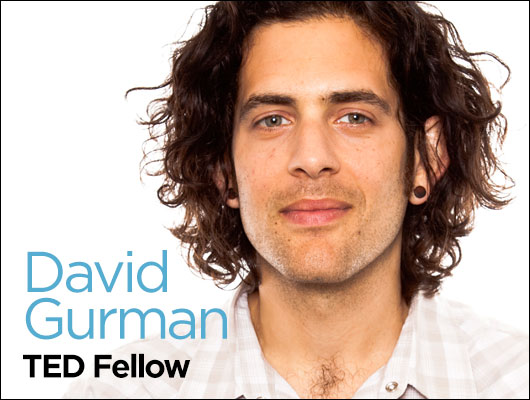
A whopping 84% of the Fellows documented in the collaboration network had at least one cross-disciplinary collaboration. And MAPPR itself is a creative collaboration among three Fellows: ecologist and network scientist Eric Berlow, artist/designer David Gurman and computer scientist Kaustuv DeBiswas, who together launched Vibrant Data, a data storytelling boutique in San Francisco’s Chinatown. They’re now focused on building MAPPR to enable the understanding of complex networks. Custom projects include mapping the collaboration network of faculty at the University of California, Berkeley, and visualizing the ecology of human creativity.
We asked Berlow to tell us more. Below, an edited transcript of our conversation.
What is MAPPR? What does it do?
It’s a cloud-based tool that lets anyone publish interactive visual stories about how things are connected. These network stories can be about anything — from the network structure of collaborations as with the TED Fellows, to identifying patterns of funding among donors and grant recipients, to unraveling the complexity of conflict. In one of our recent projects, we have mapped the conflict in Syria (see below), in collaboration with Vibrant Data’s conflict analyst, Scott Field. The Syrian civil war is widely regarded as the defining political crisis for the future of the Middle East. One of the main reasons it will be so hard to resolve is that is not a “stand-alone” conflict, but involves a complex intertwining of the vital strategic interests of all major powers that make up the regional security system. The Vibrant Data team aggregated expert analysis of the conflict to visualize that tangle of interests and identify its emergent structure. We hope that visualizing the structure of this conflict—and others—might help suggest pathways to resolving them sooner.
How does MAPPR work and who can use it?
MAPPR allows you to upload custom datasets of relationships and publish them as online custom network visualization stories. Each node and link in the network can be its own multimedia microsite. For example, in the TED Fellows collaboration network, each node can contain people’s bios, images, videos and so on, and each link can display multimedia information about that specific collaboration.
Network visualization isn’t new, but it has remained relatively inaccessible to non-experts. Anyone can use MAPPR. It’s designed to make network science accessible to anyone interested in visualizing and sharing a story — or Network MAPP — about how things are connected. MAPPR is currently in private beta, and people can sign up at Mappr.io. We’ll notify them when it’s ready, likely at the end of April 2014.
During your talk at TED2014, you seemed bowled over by the results of the Fellows collaborations survey. Why do you think TED Fellows collaborations are so prolific and unusual?
We live in a world where we generally match like with like. Just look at any online suggestion engine! While this approach is great if you’re shopping for red shoes, if broadly applied, it has the potential to kill the creative innovation that comes from serendipitous encounter and unexpected remixes. The Fellows program does a remarkable job of selecting individuals who are not only incredibly diverse and interdisciplinary, but also have in common that they are extraordinarily open to new ideas and working together.
]]>
How did you start thinking about conflict in art?
I was interested in resonance and wave patterns and energetic exchanges as early as 1996, but I started making work directly about conflict in 2003 when the US invaded Iraq. I was sitting with my parents watching television and seeing the green hue of the night vision cameras, watching the pops of bombs falling on Baghdad. And it almost looked like fireworks or some sort of celestial asteroid shower. It looked so abstract and felt so distant. I felt a deep sense of complicity, but also a deep sense of distance and an inability to understand.
So I started making real-time memorials that connect to conflict zones using data feeds, to parse how I felt about this. The notion is to collapse spaces, create a portal between the site of the installation and the site of conflict, so that we can understand on some level what’s happening in that place and meditate on it, feel a deeper sense of connection and simultaneously a sense of disconnection or distance from that zone.
People are always talking about how technology brings us closer together. I think that’s true, but it can also be a way we can understand that we’re actually quite far apart. There’s a lot of nuance that’s lost through technology as well. So the work becomes a space to wrestle with complex topics such as conflict and loss, but also a way to maybe site all of that in a larger meta-narrative: we’re on this big, geologic, hot ball of gas and rock hurtling through space at the same time. We get stuck in these human dramas, but there’s also a much larger narrative in play. And that’s why I really like using data feeds like seismic activity, allowing the Earth’s biorhythms to create a natural resonance and compose the narrative of my installations.
Can you give us an example of how your pieces work?
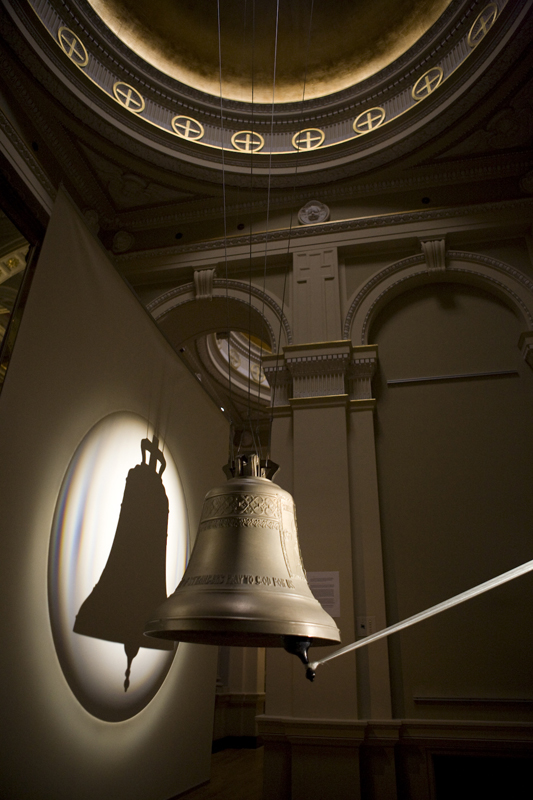
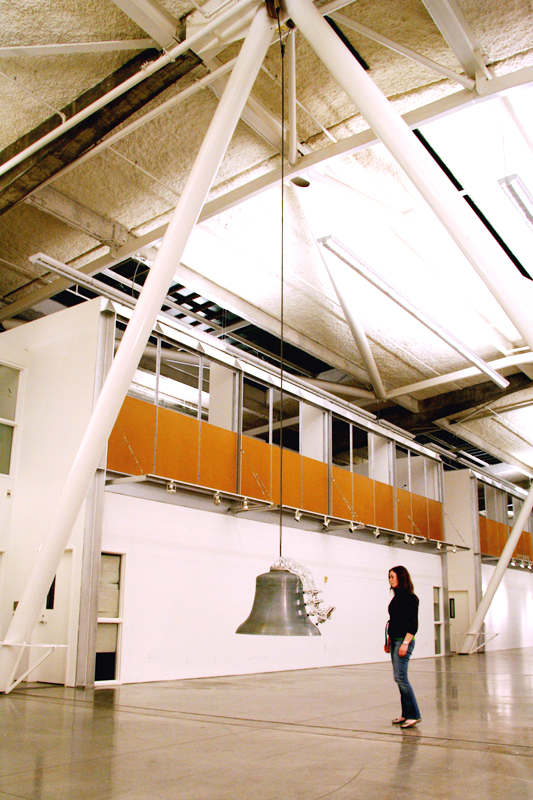
Well, The Divine Strake Project robotically tolled a bell, signaling large concussive disturbances from the Nevada Test Site, the US’s foremost nuclear weapons testing ground. I worked with seismologists Joshua Stachnik from University of Wyoming and Glen Biasi from University of Nevada, Reno, to pull a real-time data stream from an array of seismometers out on the test site. The data controlled a large bell located in San Francisco, at California College of the Arts. The bell tolled based on what was happening on the test site, without drawing a distinction between latent seismic events and nuclear weapons tests. Large seismic disturbances in the magnitude range of weapons tests resulted in a heavy toll at the sound bow of the bell.
In The Nicholas Shadow, the data feed came from citizen journalists in Iraq, via the website iraqbodycount.org. I installed a bell inside a former confessional chapel in St Ignatius church in San Francisco that, again, robotically tolled hourly the civilian death toll for that day.
Why do you use bells?
We have a long history and bodily relationship with bells. The bell is the size of, essentially, a human core. The ones I select are about 42 inches high, so they become bodily surrogates, in a way. And in the church, you really felt the intense energy of the bell tolling in that confined space. It shook the whole building. I also find it interesting that bells are tolled both as a call to worship and the call to arms. During the US Civil War, bells were pulled from churches and melted down for bronze to cast cannons. When the war was over, the cannons were melted down and church bells were cast from gunmetal. So they are complex objects that have been historically used in our most spiritual and violent practices.
I borrow most of the bells from historical collections. In the case of Divine Strake, I borrowed the bell from Hastings College because they had one that was cast in one of the first weapons-production facilities in the United States, around the time of the Revolutionary War. I found it interesting that they cast bells out of the same alloy as cannons. So this bell was resonating in my mind with the sounds of Manifest Destiny, that this was all steeped into this object, this history.
What are you working on now?
It’s a piece called Pax Americana that uses seismic activity from conflict zones around the world to resonate, or vibrate, a 15-foot diameter pool of water — proportional to whatever’s going on in each one of the zones at that moment. Light will be bounced off the surface of the pool and reflect those wave disturbance patterns as reflections into the space. So if there’s a bomb explosion or a mortar attack in, say, Syria, you’ll see proportionally modeled shadow play on the walls that looks somewhat like an explosion, in real time.
The first iteration will be installed at the Luggage Store Gallery in San Francisco, a nonprofit installation space down on Market Street. Then I’d like to tour it internationally and domestically. I built this project to be sited, ideally, at the US Capitol rotunda, with the idea that politicians on their way to work would have a place to pause and reflect, so that they could see the resonance of their decisions in real time and have a moment to meditate — a complete feedback loop. I think a much more realistic and possible site would be the UN Plaza in New York. But any federal or public space where a lot of people who also make decisions shaping the world circulate is a good zone for it.
The project now has a good deal of momentum and generous support from Boulder Real Time Technologies, the Andy Warhol Foundation for the Visual Arts, the Phyllis C Wattis Foundation and the Fleishhacker Foundation — and I just found out that it will receive funding from the National Endowment for the Arts. Now I need help getting the project to the UN Plaza and on to the Capitol rotunda.
What is the message you’re trying to get across that links your memorial pieces with the seismic pieces? Is it about creating a connection between forces that you don’t normally see?
I think it’s about creating a connection to things that we know about, that are in our psychic space, and maybe are mediated to us through traditional news media, but we have generally no access to, or we might never have been impacted by it directly. I’ve never been to a conflict zone, so a lot of this work is an attempt to connect to these spaces that I hear about every day, but have no direct relationship to. Obviously many do, but for those at a great distance, like myself, it’s about creating that sense of real time. The thing about news media is that we have these long latency periods where we hear about an event, but it gets distilled down to essentially a sound bite and some statistics about what happened. And there’s something lost in our kinesthetic awareness of what has just happened. There’s a disjuncture in time.
So the work is more asking questions than saying anything. And the questions are: How does it shape our perception of our presence in the world if we are signaled at the exact moment a violent event occurs? And how is it different from being present at the event versus watching the news versus monitoring it remotely from one of these installations? And if you don’t know much about it, but you experience something that physicalizes an event’s relative intensity — not even necessarily human loss, per se, or destruction — how does that change the way you make sense of it?
These are really questions about our current relationship with technologies that allow us to watch and act from a distance.
Have you seen any concrete changes that may have resulted from the narratives you’ve revealed in your work?
I don’t think I have seen any change that I could measure. I know that there have definitely been people who’ve had profound experiences with the work. And I personally have been profoundly moved through conversations with those people while the work was up. So it raised awareness or broadened consciousness, and that was why I did it.
At first the parishioners were pretty resistant to the Nicholas Shadow project, and the priests as well. They allowed it, but then they were kind of like, “Well, how long is this thing going to be here? It’s gonna interrupt all of our mass services. I think you should turn it off during weddings or funerals or masses” — basically any time anyone was in the church. So I made a case that, in order for it to be a powerful mechanism for dialogue, we should keep it going all the time. They still wanted it turned off. I decided to leave it on, interrupting a mass. One of the priests responded by giving a really moving talk about what it was, why it was there. He spoke about the complexity of loss, militarism and colonialism in the context of religion and spirituality. He brought up all these amazing ideas, and then they all agreed to leave it on permanently for the 66 days that it was installed.
It interrupted every ceremony from then on, in some cases for long periods. There was one day that 72 people died in a bomb attack in a marketplace in Baghdad, and the bell tolled for a really long time — around18 minutes of every hour. But it became a talking point in all of the following ceremonies that happened at the church. And then people started going to it and praying and spending time with it.
You described the bell piece as “disruptive and meditative.” Is that a quality you’d like to have in all of your pieces?
Yeah, definitely. The notion of meditation holds a pretty key role in my life. It’s something that I do quite often and that has been really helpful for me in terms of reconciling certain experiences. Or just as a moment to observe. And the impulse of my work is offering something that is, on some level, poetic and abstract and beautiful. But maybe within the context of that beautiful image or sound or whatever it happens to be, there’s something about loss that’s communicated. And I feel like to get into such complex territory as loss, we need to be in somewhat of a meditative or soothed or nourished space.
So I try to make it a palatable space. I try to make it something that’s comfortable and beautiful and ethereal and also extremely ephemeral. These works come and go.
Tell us about some of your collaborations with other Fellows.
I also work as a designer, and run a small organization called Brainvise. We do everything from apps to art and we work with clients having a big impact by doing good things in the world. Right now we’re collaborating with TED Senior Fellow Eric Berlow and his endeavor, TRU NORTH LABS.
Eric is an ecologist and complexity scientist, and he’s looking for a way to make complex problems more simple to understand. He does a mapping exercise where he essentially characterizes the ‘ecosystem’ of a problem by identifying how all the parts influence one another. Then from that ecosystem map, he identifies the key leverage points — the key issues or nodes with the most potential influence. Those are the places where creative solutions could have the most widespread positive impact on a problem.
Right now, Brainvise is working on videos, interactive infographics, and a website, and has built an app, TRU NORTH LABS MAPPR, that allows Eric to crowdsource data with which to make the problem-eco-maps. The one we’re working with right now is the Vibrant Data Project, sponsored by Intel. It’s about trying to understand what boons and barriers social entrepreneurs face as they develop social platforms, and what can be done that might augment what they’re already doing to enhance social justice, health care, economic opportunity, health and well-being. With the help of our collaborator Juliette Powell, we have more than 50 social entrepreneurs participating, including a bunch of TED Fellows (Sonaar Luthra, James Patten, Dominic Muren, Jon Gosier, Erik Hersman and Juliana Rotich from Ushahidi, Esra’a Al Shefei, Walid Al-Saqaf, Bre Pettis, Jean-Baptiste Michel, Jimmy Lin, Cesar Harada, Su Kahumbu, Faisal Chohan, Michael Karnjaprakorn and Jessica Green). Other folks participating include John Battelle and John Perry Barlow from the Electronic Frontier Foundation.
For me, it’s awesome because the creative side of my work gets to be expressed, but it also satisfies a deep desire to have an impact. Art works on a much longer timeline in its effects. But in terms of my work with Eric, I can see how my work directly augments the efforts of people who are trying to do good things.
]]>