My relationship with the Honor Principle has been incredibly important in shaping my personality and the way I act, and it’s helped me directly deal with less-than-ideal situations. Consequently, when I joined Honor Council and started to get acquainted with the group, naïve me started to think I had the Honor Principle figured out, and that I had a permanent definition I could use to guide me for the rest of Reed (and, on a lesser level, my life).
Casual, obvious foreshadowing in the last paragraph suggests that’s not the case. Instead of resting comfortably in my definition of honor, I was confronted with a facet of honor I’d never thought of before.
My transition to college was marred by a lot of huge personal, familial issues that I had to overcome while immersing myself in this stressful ~~$^*LifeOfTheMind *^$~~, and it hasn’t been an easy road. Breakdowns were often, and second semester was a challenge. Throughout this, I managed to still follow what I considered to be “honorable” behavior by helping others when I could, and keeping an outward appearance of cheerfulness (which, for the most part, was genuine). Even though most of the time I was doing great, when I was doing badly, I was doing very badly.
Around this same time, I overheard someone’s definition of honor that was very different from what I had. “Treat others and yourself as healthily and positively as you can,” was a large part of it that stuck with me. Before, I was only considering honor in relation to other people, forgetting the whole time that, in order to take care of others, I have to take care of myself in the process. I was exhausting myself to a point where I wasn’t enjoying my time at Reed, which is something I knew I could do with some life changes.
Over the following few months I would take many more steps to take care of myself (learning coping strategies, keeping a journal, getting enough sleep), in reaction to both increased personal stress and to this new outlook on the Honor Principle. Unfortunately, taking care of yourself can be harder than taking care of others in my experience, and it’s been a very time-consuming, energy-draining process. It hasn’t been perfect, but I’ve noticed improvement in my confidence, happiness, and self-esteem, and I’m very happy with where I am now. Not only am I happier, but I’m able to help everyone around me be happy much better than I used to.
I want to make clear that I’m not trying to be prescriptive about the definition of the Honor Principle; in many interpretations, honor isn’t a consideration when talking about your relationship with yourself, and for many people, given how Reed-specific it is, the Honor Principle solely governs community or interpersonal interactions. Each of these definitions (or lack of definitions for a lot of people) are completely good. Likewise, I know that taking care of yourself is super-mega difficult sometimes, and I don’t want to say that failing to take care of yourself is inherently dishonorable (because that’s kind of awful and prescriptive and not true). People have different ways to take care of themselves, and the Honor Principle as I applied it really helped me out. On this note, if you ever need to talk to anyone about something going on in your life, or a conflict with another person, or anything at all, Honor Council is here to help you, listen to you, and give you the resources you need. 
I guess the point of this post is two-fold; I want to encourage people to rethink what contexts they apply the Honor Principle to, but, more importantly, I want you to know that it’s totally okay (and I’d say even great!) to have your definition of the Honor Principle change based on setting, life experience, personality, and whatever else is happening in your life. The beauty of the Honor Principle is how individual and communal it is at the same time, and it’s worth exploring both aspects when figuring out what “honor” is to you.
]]>The first topic here might seem out of left field. But, my discovery of the effect of federal mandates for colleges on the Honor Principle was a real catalyst for my personal understanding of honor at Reed. It happened like this; I was having a conversation with a fellow student government member about the Alcohol and Other Drugs (AOD) Policy at Reed. He had mentioned the policy to an alum who then recounted that in their time at Reed, there was no AOD Policy. The alum recalled that students used drugs with curiosity, due diligence and with honor in mind. My friend and I began to discuss the introduction of the AOD Policy and speculate as to its origins. I became exhilarated with the political and institutional implications of our hypothesis and decided to do more research. What I found was truly scintillating and I kinda want to thesis on this, but for the purposes of this blog entry, I’ll just say it has a lot do with the The Clery Act, a federal statute that was signed into law in 1990. The code requires that any federally funded school must be able to deliver crime statistics reports on an annual basis to the U.S. Department of Education, or risk losing funding. As one of its several sections, The Clery Act requires that the school must submit,
A statement of policy regarding the possession, use, and sale of alcoholic beverages and enforcement of State underage drinking laws and a statement of policy regarding the possession, use, and sale of illegal drugs and enforcement of Federal and State drug laws and a description of any drug or alcohol abuse education programs
If we remember the alum’s sentiment about Reed students using recreational drugs honorably, a Reed world with no AOD’s, then we can imagine a campus where illegal drug-related activities were taking place, perhaps with the medical or disciplinary guidance of campus resources, but certainly not producing a deliverable data-set of illegal activities. The AOD Policy at Reed was introduced and passed in 1993. I want to make it explicitly clear that while I am drawing attention to a chronological sequence of the federal and Reed policies, it would be preemptive to confirm a positive correlation between them. I think the language of the AOD Policy itself makes the impetus for its creation quite clear. However, with that said – what does the AOD Policy implicate for honor in our community? This question has been the most useful way I have found to experiment with my sense of honor. Combine that with the fact that I tend to think or logic economically, and I see the relationship between an enforceable policy and the Honor Principle as a conflict in incentives.
This concerns me. When those outside the community ask me about Reed, I often recount the amount of student autonomy, activism and involvement as a defining characteristic. The ability to govern ourselves is facilitated by the Honor Principle. But, the Honor Principle works because it is something intangible and undefined that we actively stew on for the course of our time at Reed. Through thought experiments, like my own with the AOD Policy, we engage in an individualized philosophical enterprise designed to build a collective good. When external forces, such as federal mandates, like the very recent Violence Against Women Act, change the scripting of our campus policies – for example, the spring 2015 changes to our DHSM and Title IX policy – they have implications for honor within our community. Being on Honor Council puts me in a position to promote the vitality of honor in this community and I get to channel my concerns into real engagement. That engagement is done through my position as Community Rights Subcommittee Chair.
To explain that role, here’s a beautiful summary written by Frankie Breedlove, current Educational Subcommittee Chair on Honor Council:
“Community Rights Subcommittee: The community rights subcommittee (CRS) is a little-known gem. In a nutshell the community right subcommittee takes a case through the Honor Process on behalf of the community. What does that mean? It means that if a potential violation of the Honor Principle occurs but it affects a whole community as opposed to an individual it might be an appropriate case for CRS. CRS will take a case if it is a more appropriate body to move forward with the case than any individual in particular. The CRS can choose to attempt informal or formal mediation or even take the case to J-Board should it be appropriate. The CRS chair can even investigate a case by interviewing relevant witnesses.”
I believe that Reed is special to all of us for our own reasons. If you know me at all,* you understand why Reed is so special to me – I feel great privilege being here. To quote former SB prez, Danielle Juncal ’15, “I came to Reed and found a place that embraced me. I wanted to embrace it back.” When I see the quad full of buzzing tables at student activity fair and a full house at signator training, I am inspired and enlivened by the amount of autonomy and involvement in this community. Analytical and impassioned discussions with friends, like the one I mentioned above are (sometimes painfully) commonplace. Holding CRS Chair allows me to embrace the community. We have so much to protect, and that is why I am honored to be on Honor Council.
* If you don’t know me at all, please come by my Honor Council office hours between 6-7pm every Thursday and introduce yourself! I’d love to know you.
]]>
The term is neutrality. The basic idea of neutrality is that you remain unbiased and open to all points of view. Together with confidentiality, these are the two most important tenets for the Honor Council. Without neutrality and confidentiality, we have no reason to exist.
Why is neutrality so important? First and foremost, the Honor Council exists to educate all members of the community and to serve as a resource for all members of the community. If any single member of the Reed community is in need of a confidential space, an ear to turn to, a place to get information about resources available to them, assistance in navigating the judicial process at Reed, etc., we are here for them. Because of this, we need to work to ensure that every member of the community feels safe and comfortable turning to us for support. If there were any chance that a statement made by an Honor Council member could be perceived as biased, or make a community member feel that they would be unwelcome or misunderstood by Honor Council, then we sacrifice the unique role that we play on campus.
Honor Council members are available for consultation on a variety of topics, many of which are unpleasant or personally distressing. For example, a student might come in stating that they have been accused of academic misconduct. While as an Honor Council member, you might be personally disgusted at the thought of academic misconduct, and experience bias as a result, you must remain calm in your outward projection and express empathy for the person’s situation. You must offer the student all the appropriate resources for their consideration, and walk the student through the steps of the Honor Process for that particular case. On another day, you may be required to speak to someone making an allegation of academic misconduct against someone else. Even though it’s the opposite situation, you would use the same procedures.
Another reason why neutrality is so important is that it allows individuals to feel however they choose about the circumstances affecting them. If a student comes in wanting to talk about a resident of their dorm who used a slur in the common room, it would be inappropriate to project any kind of value on the situation. For example, if you reacted with, “Oh my gosh, that’s so terrible. I’m so sorry that happened,” when the student wasn’t all that upset about it, you may incite panic, and cause them to feel that it was worse than they thought, or that you don’t understand their motivations for coming to you. Likewise, if you reacted with, “Oh, well, that’s not bad. It could have been way worse!” in an attempt to mitigate the harm and make them feel better, you likewise run the risk of invalidating their feelings if they were, indeed, affected greatly by the incident. As an Honor Council member, you are there to listen and support. A neutral option could be something like, “It sounds like this event has impacted you, and you’d like to feel more comfortable in your living space.” Of course, gathering more information and asking questions about exactly what the student is looking for will help you come up with more neutral, but relevant, responses.
Lastly, it also important to remain neutral when providing resource options (if the community member wants resource options, that is!). Somebody may come in to discuss something that is personally outrageous or offensive to you and you may have strong opinions about what should be done about it. It is not, however, your situation, and it is not the place of the Honor Council to assign any valence to any of the possible options a community member may choose. All resources that we have to offer are valid options, and it is our job to provide factual information and let those who come to us choose what will be best for them.
Some people have told me that they think neutrality is a fundamental flaw with the Honor Council. Neutrality is often cast as siding with the oppressor, or as a coward’s choice. It can be considered by some to be worse than outright opposition, since it can be seen as an insidious work-around, a shirking of the responsibility to take sides in important matters. While I can recognize where this viewpoint comes from, it would be extremely difficult for the Honor Council to serve all community members without maintaining neutrality.
Remaining neutral can be, at times, very taxing. We are all individuals, and, of course, all have personal beliefs and opinions. Because neutrality is a tall order, the members of Honor Council work to support each other in this difficult endeavor. We are always available to help each other brainstorm neutral phrasing, debrief particularly challenging interactions, and generally vent about the burden that neutrality can at times become.
In this vein, it is important to note that there are some exceptions to our commitment to neutrality. When it is something that affects you personally, neutrality may not be a safe choice for your mental wellbeing. In these circumstances, there are a few options. Of course, if you absolutely cannot remain neutral about something, you always have the right to refer a student to another Honor Council member who will be able to better serve them. Outside of direct Honor Council interactions, if you would like to discuss something that is of personal experience, we never want the requirements of neutrality to silence lived experiences.
In general however, the job of an Honor Council member is to present all available and appropriate options neutrally to whomever may seek them, no matter the circumstances. Neutrality is a profoundly difficult responsibility that affects how members of Honor Council conduct themselves both personally and publicly, but it is a responsibility that we carry out to make ourselves available to every community member.
]]>The Subcommittees
Mediation Subcommittee: The mediation subcommittee is responsible for providing formal mediation to the community. If you’ve had a problem with someone and you’ve tried talking to them and the problem has persisted or communication broke down, formal mediation might be a good option for you. Honor Council will provide a trained mediator who will act as an unbiased third party and facilitate communication between you and the other person. Something to keep in mind about mediation is that both parties must agree to come to mediation and either may choose to end the session at any time. Honor Council also provides mediation training to the community once per semester, so you too could become a mediator! Mediation request forms are available outside the Honor Council office (GCC-033A) or online athttp://www.reed.edu/honor_principle/honor_council.html. If you want more information about how mediation works, how to request a mediation, or when mediation might be a good option stop by office hours or email hc-mediation@reed.edu
Community Rights Subcommittee: The community rights subcommittee (CRS) is a little-known gem. In a nutshell the community right subcommittee takes a case through the Honor Process on behalf of the community. What does that mean? It means that if a potential violation of the Honor Principle occurs but it affects a whole community as opposed to an individual it might be an appropriate case for CRS. CRS will take a case if it is a more appropriate body to move forward with the case than any individual in particular. The CRS can choose to attempt informal or formal mediation or even take the case to J-Board should it be appropriate. The CRS chair can even investigate a case by interviewing relevant witnesses. For more information about how CRS works or how to bring a case to CRS come to weekly office hours or email hc-communityrights@reed.edu
Education Subcommittee: The education subcommittee is responsible for engaging the Reed community in discussions about the Honor Principle and educating about the Honor Process.
Projects: The education subcommittee varies semester to semester in what kinds of projects to take on in our quest to raise awareness of the Honor Principle and the Honor Process. Projects have included writing Quest articles, updating and maintaining the website and blog, a scavenger hunt (TBA *wink* *wink*), making t-shirts, attempting to gather and record institutional memory, forums, planning Honor-related orientation events, hosting Paideia classes, giving Renn Fayre dorm talks, and much, much more.
Liaisonships: In addition to an individual member’s project Honor Council members also choose a liaisonship. Liaisonships are flexible and change depending on the needs of the community. Liaisonships often require members to keep in contact with folks in a bunch of different departments on campus. Current liaisonships include: Secretary, Community Safety, Senate, J-Board, Public Relations, Events, Student Activities, Staff and Faculty Outreach, and more.
Office Hours: One of the Honor Council mainstays is office hours. Office hours are currently held every Monday-Thursday 6-7pm (check SB info if you want to know a particular Honor Council member’s day). Office hours is great place to go if you’re looking for information about the Honor Process, need unbiased advice about a conflict or other problem, or want to wax philosophical about the Honor Principle. Office hours is a confidential space where Honor Council members can refer you to more specific resources or simply listen to you. Oftentimes office hours is pretty relaxed and so long as no one is in need of immediate attention it is also a fun place to hangout in the Honor Council office and get to know some Honor Council members!
Well, there you have it! There’s a basic overview of the things Honor Council members do. I love working with Honor Council because it’s flexible. Projects and liasionships can and do change depending on where we want to focus our energy. It also allows me to engage with the community and with students when they really need someone to listen. If you’d like to learn more about what Honor Council members do or if you’d like to get to know us better feel free to come by our office hours. Our office is located at GCC-033A.
]]>4:00pm, Vollum Lounge
Honor Council present, Emily facilitated
Around 90 students, faculty, and staff in attendance.
Bullet points signify an opinion expressed by a person, subpoints made by the same person.
The comments at the end tend more toward recommendations for future directions, and is separated.
Opening Statements
Roman Garcia (Honor Council)
• Introduce subject
• Neutral facilitation
• Ground Rules
• Be compassionate
Mike Brody
• Consistent with Honor Principle to provide venues to seek comfort, repair, and healing when not able to confront person who caused them harm
• Importance of Title IX: If there is a hostile environment, Reed must investigate
• An investigation is an inquiry
Dean
• Disappointed with Pantheon
• Steps are being taken to make sure this doesn’t happen again—HumPlay handout
o Give people a heads up
o Improve communication of what this is for
Opened up the Floor
• Student expresses importance of nudity to them
o Supports continued tradition of portrayal of Gods & Goddesses
o Nudity is part of her identity
o We need to communicate if people are uncomfortable
o If there are restrictions placed, it will affect nudists in community
• Director of HumPlay in 2008
o Made artistic choice to be naked
o This is a way men can oppress women
o Rules of conduct: we should think more holistically
o Does not believe anything that makes anyone uncomfortable is a Reed tradition
• Concern: focusing on nudity versus the behavior that was aggressive/threatening
o Should be aware of how we appear to those outside Reed College
• HumPlay director this year: taking measures to address issues
• Difficult balance between providing Trigger warnings and banning something outright
• Blurring line between appearance & behavior: creating restrictions against nudity risks saying something about bodies is inherently bad
• Must address issue of access: people need to be able to get to class
o Assumption of knowledge restricts access
o There is only 1 wheelchair accessible entrance to Vollum
o Avoid gendered violence
• Definition of sex: does the nakedness really constitute discrimination if done to both genders?
o Censorship is the wrong direction
o It is not fair to limit everyone based on a few individuals
• Aggressive behavior and access is a problem
o Reed traditions often hinge on surprise
o We should provide alternatives, make sure there is forewarning
• Question: is nudity in itself a problem, or was it the aggressive behavior
• There are groups of people on campus who find nudity uncomfortable, such as international students
• A HumPlay participant: Future plans to make the Pantheon clothed, contained, and less aggressive, and provide forewarning
o Distinction between offensive v. uncomfortable v. Triggering (trauma response)
• Former HumPlay director: need more communication between leaders
o Older directors should advise new directors
• What decides communal discomfort?
• Intent is important
o Assume good intent
o Be aware of issues of malice
o Surprise makes it beautiful
• How does Honor inform informal confrontations?
• Fairness: Honor Principle asks us to go beyond what is fair. We should be compassionate
• The fact that the event is welcoming makes it especially important that we not risk peoples’ comfort
• Issue affects faculty and staff as well as students
• Nudity is not necessarily sexual
o Should inform people that nudity will be occurring, but it should be peoples’ job to avoid nudity if it offends them
• Some appreciate the discomfort of the Pantheon
o It’s a growing experience
o We need to evaluate the benefits and potential harm
• Concerned with callousness of Reed’s response
o If something is less than honorable to someone, people should pay attention
• Two conversations happening
o Pantheon
o Bigger context: Honor, SA, triggers
o Where will it go?
• Where do we draw the line of cultural difference versus triggers?
o We need to look at our values and principles and ask what would we sacrifice
• When something makes someone uncomfortable, and this is the objective of the tradition, should this still be a Reed tradition?
Recommendations
• We should also let people know in advance what makes Reed ‘spicy’
• Reed should institutionalize education about trauma
• We need to make sure the community addresses concerns
• We should all try to understand triggers
• Encourage being up front about Reed traditions in admissions office
• Reed should not be a place where if you aren’t comfortable you have to get out
• The goal should be to expose people to a non-threatening nude person ]]>
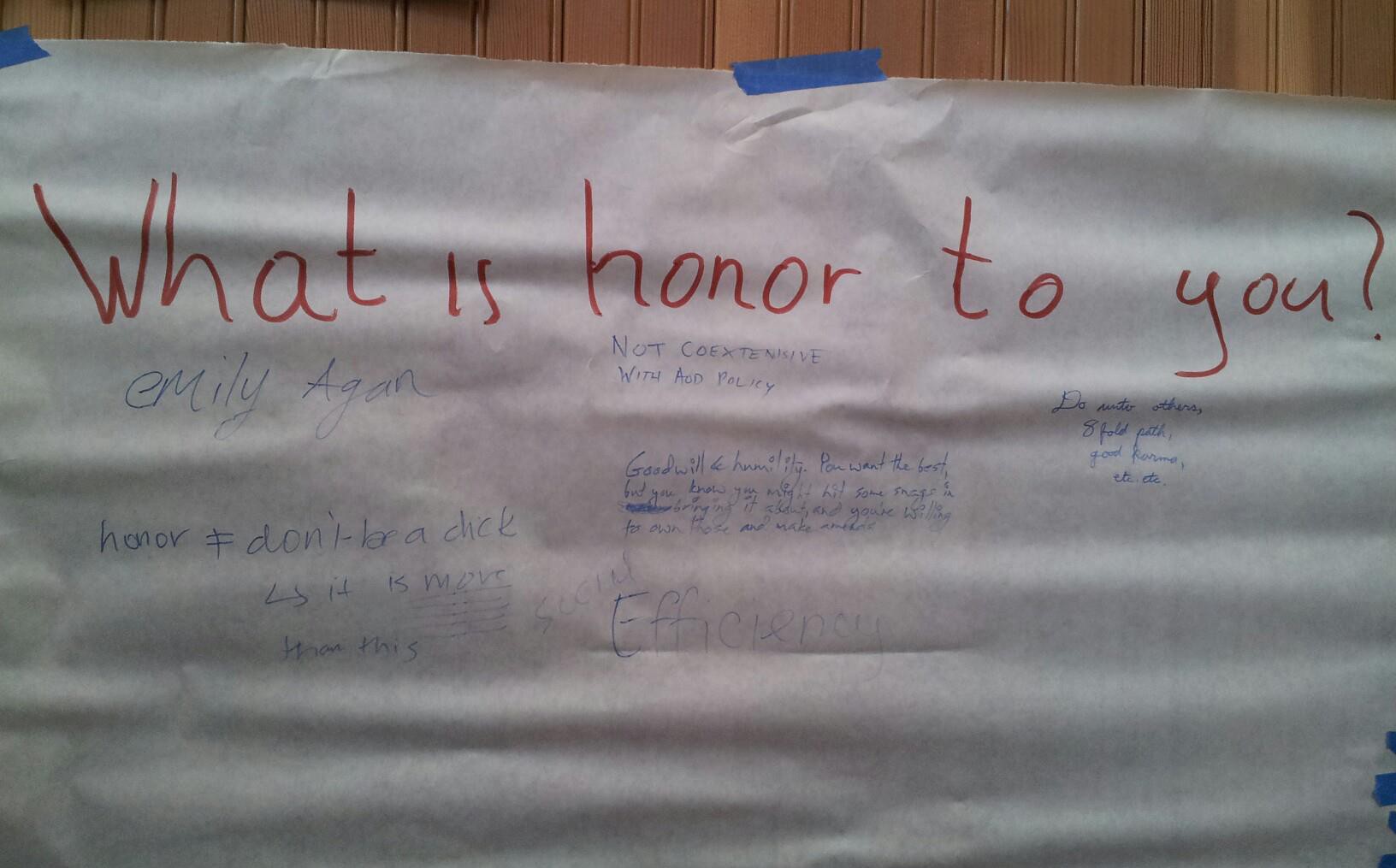
The posters were put up as a response to student outcry after the lower GCC bathrooms were painted white. These posters, along with a lunchtime discussion and afternoon forum, were meant to provide community members with the opportunity to share their varying & conflicting opinions.
Questions/Comments/Concerns? Email us at hc-students@lists.edu.
note: poster 13 has been edited due to someone’s full name being used derogatorily
]]>