A corrupt PST file can quickly turn into a serious problem, especially if it contains important Outlook emails, contacts, calendar entries, attachments, tasks, or business records. One day, Outlook works normally. Next, you may see an error message, experience crashes, or find that your mailbox data is no longer accessible.
For many users, the first instinct is to try Microsoft’s built-in Inbox Repair Tool, also known as ScanPST.exe. That can be helpful in some situations, but it may not be sufficient when the PST file is large, severely damaged, or affected by more complex corruption. In those cases, using an Outlook PST repair solution can be a more practical next step.
If you want to repair a corrupt PST file online, Stellar’s Online PST Repair solution offers a browser-based way to upload, analyze, repair, preview, and download a repaired PST file without installing software. For larger files or advanced recovery needs, Stellar also offers a desktop PST repair tool with more robust repair and recovery options.
What Is a PST File?
A PST file, or Personal Storage Table file, is an Outlook data file used to store mailbox information locally. Depending on how Outlook is configured, a PST file may contain emails, attachments, contacts, calendars, notes, tasks, and other mailbox items.
Because PST files can hold years of important communication, corruption can be frustrating and disruptive. A damaged PST file may prevent Outlook from opening properly or make certain folders, messages, or attachments inaccessible.
Common Signs of a Corrupt PST File
PST corruption is not always obvious at first. Sometimes Outlook slows down or freezes before the file becomes completely inaccessible. In other cases, the problem appears suddenly.
Common signs include:
- Outlook cannot open the PST file.
- Outlook crashes or freezes when accessing mailbox data.
- Emails, folders, contacts, or calendar items are missing.
- You receive errors when trying to open or import a PST file.
- Send/receive functions stop working properly.
- The PST file becomes unreadable or inaccessible.
- ScanPST.exe fails to repair the file.
- Outlook shows repeated prompts or errors related to the data file.
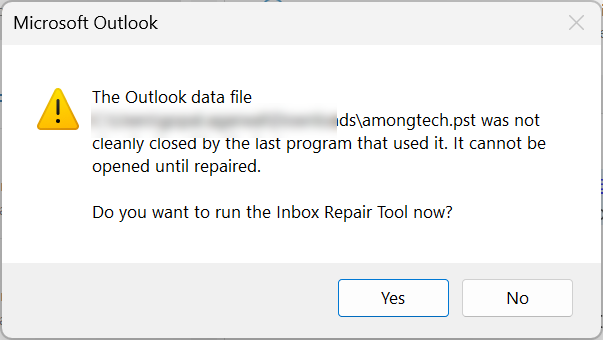
When these issues appear, it is important to stop repeatedly opening and closing the same file. Continued attempts can make recovery more difficult, especially if the PST file is stored on an unstable drive.
Why PST Files Become Corrupt
PST files can become corrupt for several reasons. Some issues are related to Outlook itself, while others are caused by storage, system, or file-size problems.
Common causes include:
- Oversized PST files
- Improper Outlook shutdowns
- Sudden system crashes
- Power failure while Outlook is running
- Bad sectors on a hard drive
- Malware or virus infection
- Failed import or export processes
- Network interruption while accessing a PST file
- Synchronization conflicts
- Header corruption or file structure damage
Large PST files are especially vulnerable because they can become harder for Outlook to manage over time. If the file is already unstable, crashes or failed repair attempts may make the problem worse.
First Step: Try to Repair the Corrupt PST File Online
For many users, the simplest starting point is an online PST repair tool. This avoids the need to install software and can be especially useful when you need a straightforward way to repair a single corrupt Outlook data file.
Stellar Online PST Repair is designed to repair corrupt or damaged PST files through a secure browser-based process. Users can upload a corrupt PST file, allow the system to analyze and repair it, preview the recovered folder structure, and then download the repaired file. The online solution can also help restore mailbox items such as emails, attachments, contacts, calendars, tasks, notes, and journals.
This makes the online solution a good first option if:
- You want to repair a PST file without installing software.
- You are working with a single corrupt PST file.
- You need a fast, browser-based repair process.
- You want to preview the repaired folder structure before downloading.
- You do not have Outlook installed on the same device.
- The file size fits the online solution’s supported limits.
For larger files or more complex recovery needs, the desktop edition may be the better fit.
How to Repair a Corrupt PST File Online with Stellar
The online repair process is designed to be simple. Here is the general workflow:
1. Go to Stellar Online PST Repair
Start by visiting the Stellar Online PST Repair page. This is the browser-based repair option for users who want to fix a corrupt PST file without installing desktop software.
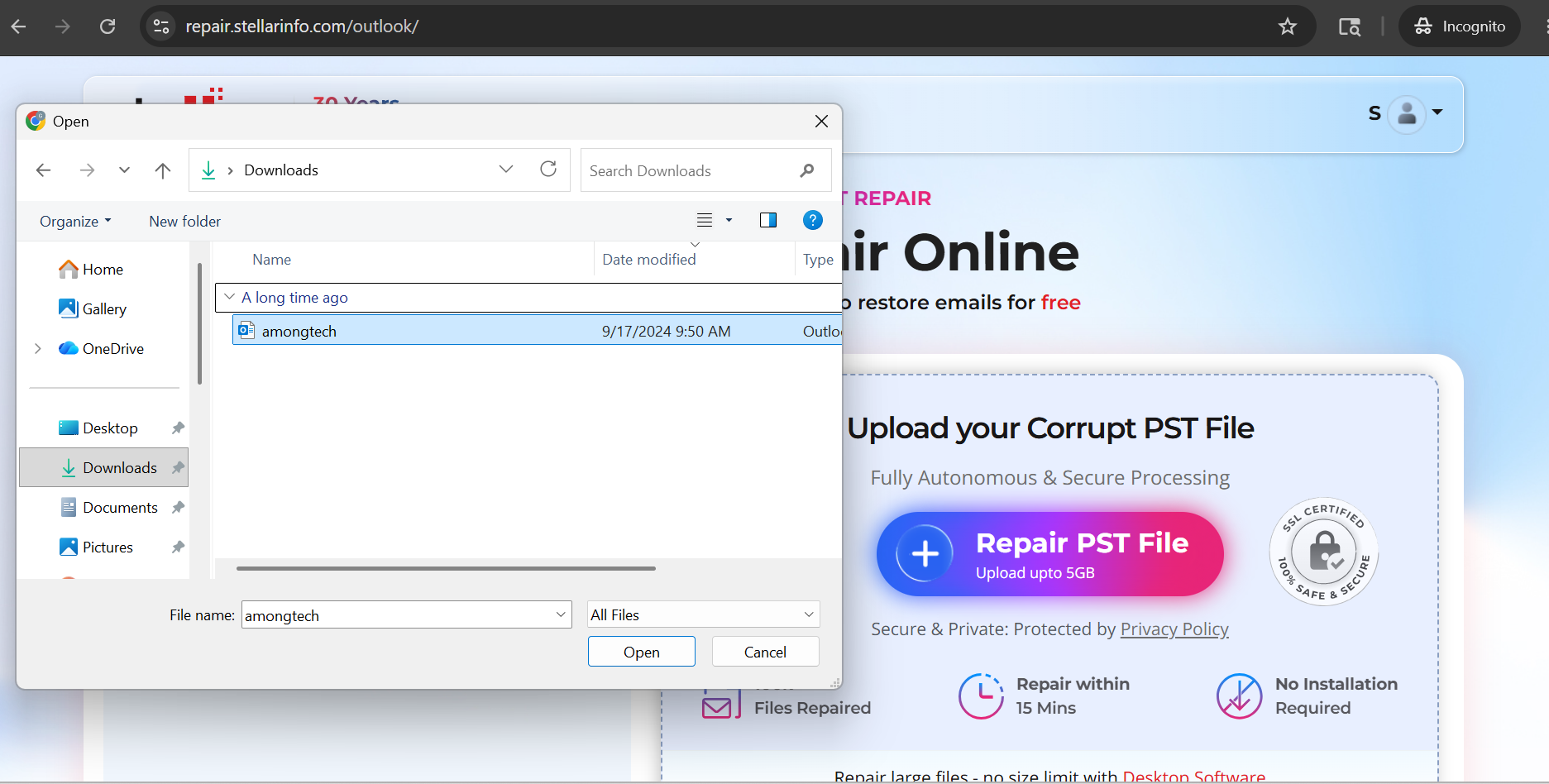
2. Upload the Corrupt PST File
Sign up and select the damaged PST file from your system and upload it to Stellar’s secure repair environment. The online tool supports one PST file at a time, so users with multiple damaged files may need to process them separately.

3. Let the Tool Analyze and Repair the File
Once the file is uploaded, click on “Start Repair” Button. The system analyzes the PST file and attempts to repair the corruption. The time required can vary depending on the PST file size, corruption level, and internet speed.
3.1 The tool first analyzes the uploaded PST file to identify corruption and assess the extent of damage.
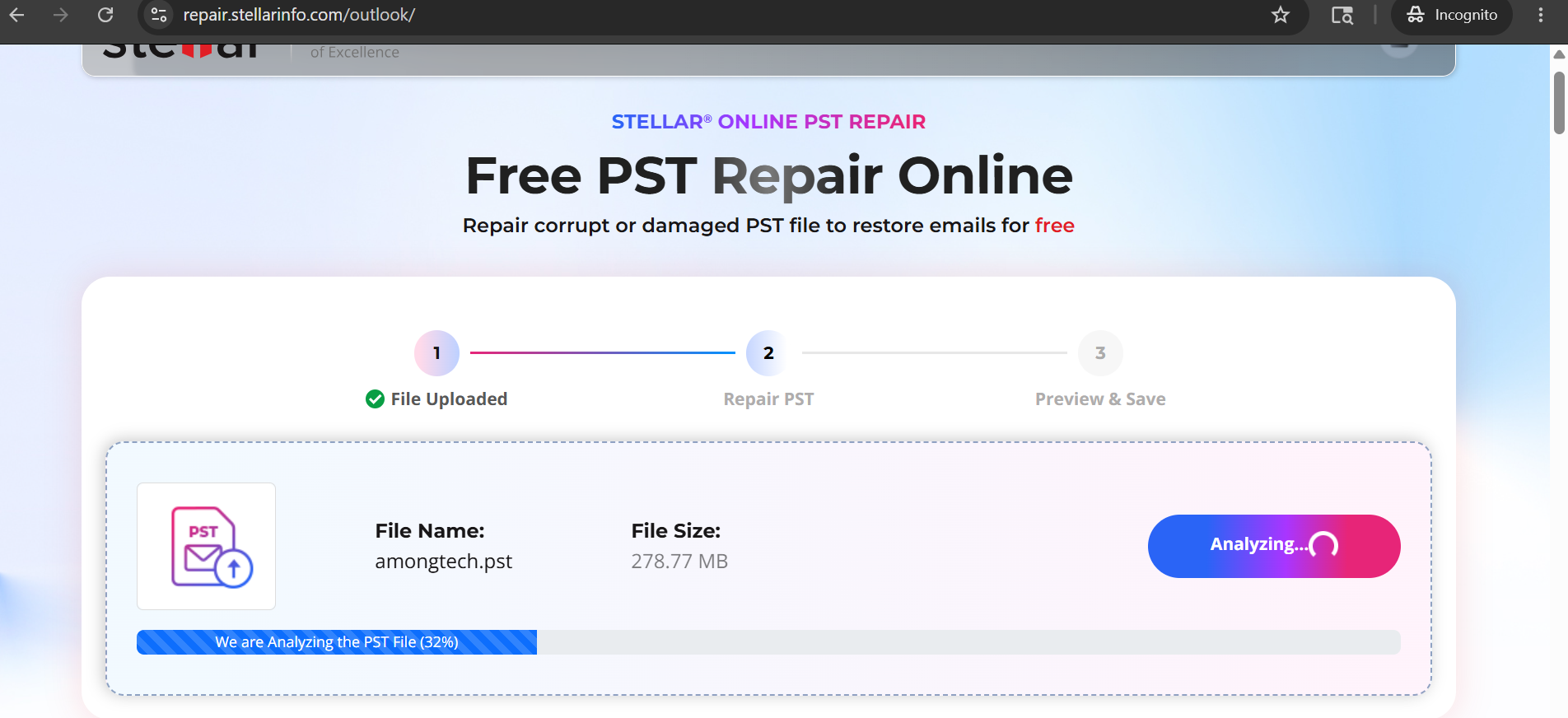
3.2: After the analysis is completed, the tool automatically begins the repair process to restore the PST file data.
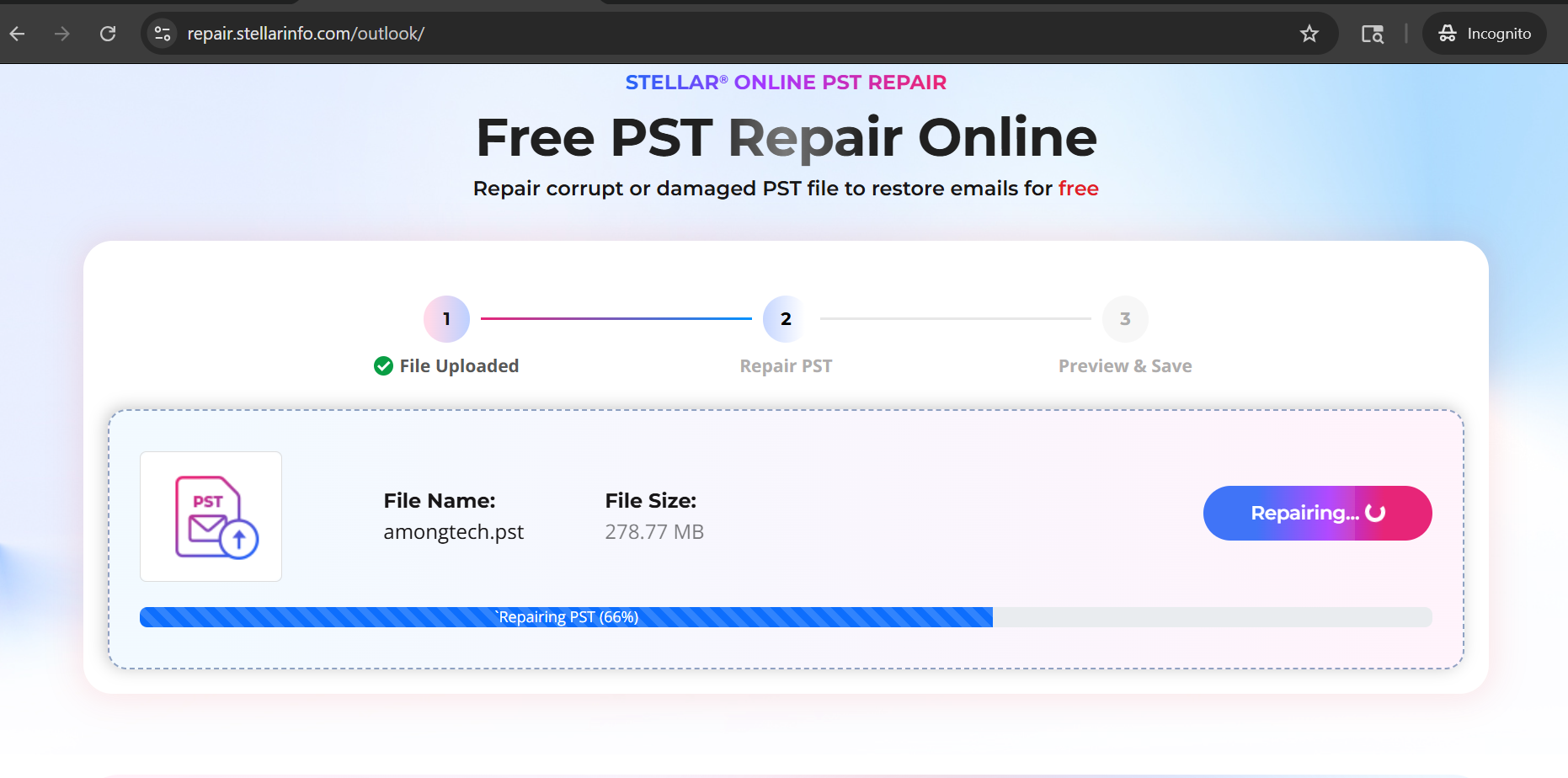
4. Preview the Repaired Folder Structure
After the repair process, users can preview the recovered folder structure and item count before downloading the repaired file. This helps confirm whether the tool was able to detect and repair the mailbox data.

5. Download the Repaired PST File
Once the repair is complete, download the repaired PST file to your computer. Save it somewhere separate from the original corrupt file so you can keep an untouched backup.
6. Open or Import the Repaired File in Outlook
After downloading the repaired PST file, you can save it to your preferred location and open or import it in Outlook.
Best Practices Before Repairing a PST File
Before attempting any PST repair, take a few precautions. These steps can help reduce the risk of further data loss and make the repair process cleaner.
- First, create a backup copy of the corrupt PST file. Even if the file will not open, keeping an untouched copy is useful in case you need to try another repair method later.
- Second, avoid saving the repaired file to the same location if the original PST file is stored on a failing drive. If the storage device is unstable, move the file to a healthy drive before attempting repair.
- Third, close Outlook before working with the PST file. Trying to repair a file while Outlook is actively using it can create conflicts.
- Fourth, make sure you have enough free storage space for the repaired PST file. Depending on the size of the original mailbox, the repaired file may require significant space.
Finally, do not rely on a single repair attempt if the PST file contains business-critical data. For larger or severely damaged files, a desktop PST repair solution by Stellar Repair for Outlook may provide more control.
When to Use Stellar Repair for Outlook Desktop Software
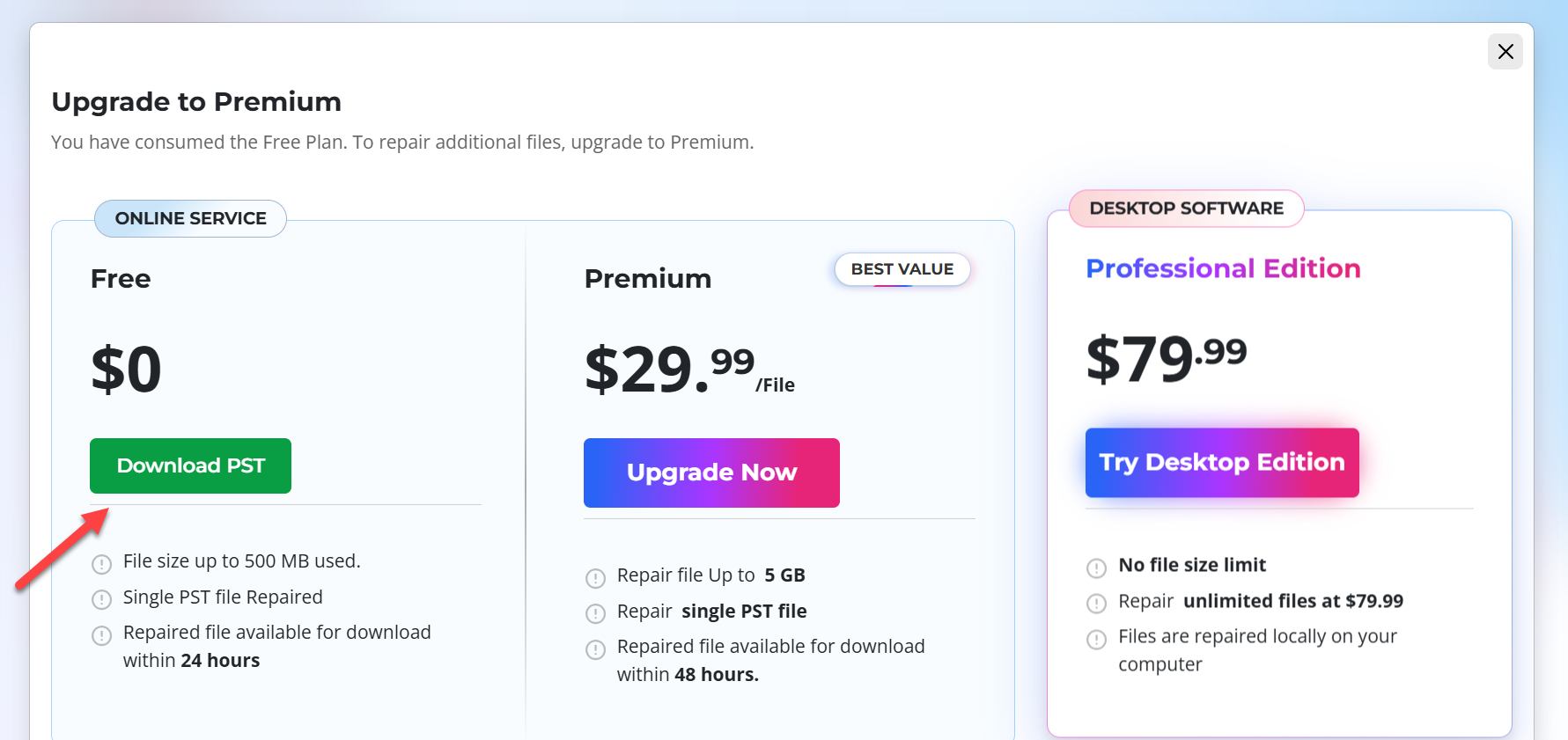
The online PST repair tool is a strong starting point, but it is not always the right option for every situation. If your PST file is very large, severely corrupt, or requires more advanced handling, Stellar Repair for Outlook desktop software may be more appropriate.
The desktop version is designed to repair corrupt or damaged PST files and recover mailbox items such as emails, attachments, contacts, calendar entries, tasks, notes, and journals. It is also useful for users who want more control over the repair process, including previewing recoverable data before saving.
Consider the desktop solution if:
- Your PST file is larger than the online limit.
- You need to repair multiple PST files.
- The file is severely damaged.
- You want to scan and preview recoverable mailbox items before saving.
- You prefer to process the file locally on your computer.
- You need advanced save or export options.
- You are an IT admin handling business-critical Outlook data.
Online PST Repair vs Desktop PST Repair
Stellar offers both online and desktop PST repair options based on your recovery requirements.
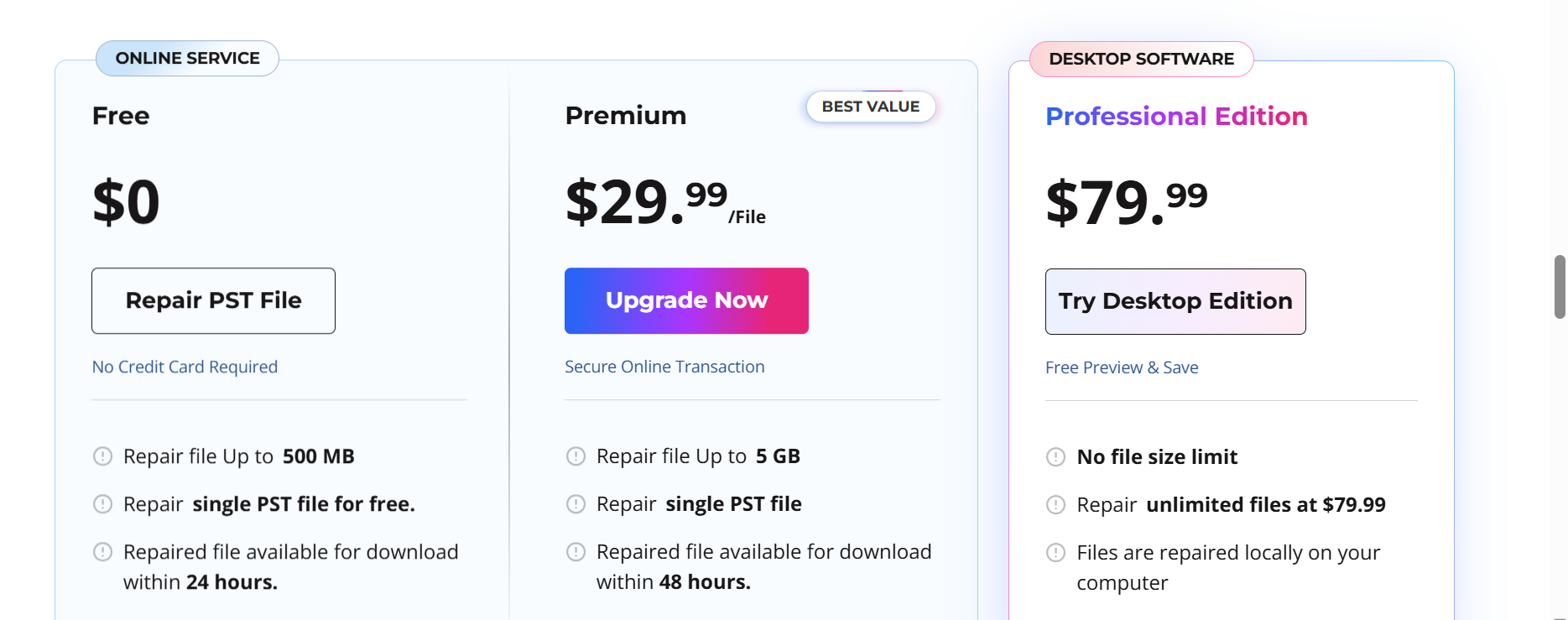
Choosing between online and desktop repair depends on the size of the file, the severity of corruption, and how much control you need during recovery.
| Situation | Recommended Option |
|---|---|
| You want a quick browser-based repair | Online PST Repair |
| You do not want to install software | Online PST Repair |
| You need to repair one PST file | Online PST Repair |
| Your PST file is small or moderately sized | Online PST Repair |
| Your PST file is very large | Desktop PST Repair |
| You need to repair multiple PST files | Desktop PST Repair |
| You want local file processing | Desktop PST Repair |
| You need advanced preview and save options
You want save repaired PST file in multiple file formats such as: PST, MSG, EML, RTF, PDF & HTML |
Desktop PST Repair
Desktop PST Repair |
For most users, the best path is simple: start with the online solution if the file size and repair needs are straightforward. Move to the desktop solution if the PST file is large, severely corrupt, or requires advanced recovery.
Why ScanPST.exe May Not Be Enough
Microsoft includes ScanPST.exe, also known as the Inbox Repair Tool, with Outlook. It can help repair minor PST file issues, but it has limitations. If the corruption is severe, the file is oversized, or the damage affects deeper file structures, ScanPST.exe may fail or only partially repair the data.
That is when a dedicated PST repair solution becomes useful. Stellar’s online and desktop PST repair options are built specifically for Outlook PST corruption scenarios, including inaccessible files, Outlook crashes, oversized PST issues, bad sectors, malware-related damage, synchronization conflicts, and other common corruption causes.
What Mailbox Items Can Be Recovered?
A corrupt PST file may contain more than just emails. Depending on how the Outlook profile was used, the file may also include contacts, calendar events, attachments, tasks, notes, and journals.
Stellar PST repair solutions are designed to help recover key Outlook mailbox items, including:
- Emails
- Attachments
- Contacts
- Calendar entries
- Tasks
- Notes
- Journals
- Folder structures
This is important because many users do not realize how much critical information is stored inside a PST file until Outlook stops opening it.
Is Online PST Repair Secure?
Security matters when uploading any mailbox file because PST files can contain sensitive business and personal information.
A secure online PST repair solution should use a protected upload and repair process, limit access to user data, and remove repaired files after a defined period. Users should also follow good data-handling practices before uploading any mailbox file.
If the PST file contains highly sensitive corporate, legal, healthcare, financial, or regulated information, confirm that the online process aligns with your organization’s security requirements before uploading the file. In those cases, the desktop tool may be preferable because files can be repaired locally on the user’s computer.
Tips to Prevent PST File Corruption in the Future
After repairing a PST file, it is worth taking steps to reduce the risk of future corruption.
- Keep PST files at a manageable size. Large PST files are more likely to become slow, unstable, or difficult to repair. Close Outlook properly before shutting down your computer. Sudden shutdowns while Outlook is writing data can damage the file.
- Back up Outlook data regularly, especially if you rely on PST files for important emails or archives.
- Avoid storing active PST files on unreliable external drives or network locations. Connection interruptions can increase the risk of corruption.
- Keep your system protected from malware and viruses. Malicious software can damage Outlook data files and other important documents.
- Check storage health if corruption happens repeatedly. A damaged hard drive or SSD can continue to corrupt repaired or newly created files.
A corrupt PST file can prevent access to important Outlook data, including emails, contacts, calendars, and attachments. While ScanPST.exe may fix minor issues, severe corruption often requires a dedicated repair solution. Stellar Repair for Outlook offers a simple browser-based way to repair damaged PST files without installing Outlook or additional software. For larger or more complex corruption cases, Stellar Repair for Outlook desktop software provides advanced recovery and repair capabilities.
Frequently Asked Questions
Can I repair a corrupt PST file online?
Yes. An online PST repair solution can help repair a corrupt or damaged Outlook PST file through a browser-based process. This is often a convenient first step for users who want to fix a PST file without installing software.
Do I need Outlook installed to repair a PST file online?
In many cases, online PST repair tools do not require Outlook to be installed on the same device. The file is uploaded and repaired through the online platform.
What should I do before repairing a PST file?
Create a backup copy of the corrupt PST file, close Outlook, check that you have enough storage space, and avoid saving repaired data to a damaged or unstable drive.
Should I use an online or desktop PST repair tool?
Use an online PST repair tool if you want a quick browser-based option for a single corrupt PST file. Use desktop PST repair software if the file is very large, severely corrupt, or requires advanced recovery options.
Can a PST repair tool recover attachments?
Yes. A dedicated PST repair solution can help recover emails and associated mailbox items, including attachments, contacts, calendars, tasks, notes, and folder structures.
What if ScanPST.exe does not fix the PST file?
If ScanPST.exe fails or only partially repairs the file, use a dedicated Outlook PST repair solution. More advanced tools are designed to handle deeper corruption, larger files, and more complex recovery scenarios.
]]>
From chance to choice: the evolution of traditional dating
Today, that dynamic has shifted. Technology has replaced much of that randomness with near-infinite choice. However, more options don’t always lead to better outcomes. In fact, many people feel overwhelmed by the sheer number of possibilities.
Interestingly, traditional ways of meeting a potential partner are making a quiet comeback. In a world full of curated profiles and digital filters, many are rediscovering the value of real, spontaneous encounters.
Dating apps: fast, convenient, and superficial?
Dating apps are probably the most evident example of how tech has influenced modern relationships. Dating platforms like Tinder, Bumble, or Hinge have turned dating into a fast, often game-like experience.
A profile picture and a few lines of text are all it takes for someone to decide – often within seconds – whether they’re interested or not. This has made dating faster and more accessible, but also more superficial.
There are evident advantages:
- Instant access to a wide pool of potential partners
- Filters for interests, location, and lifestyle
- Lower barriers to starting conversations
At the same time, many users experience what’s often called “swipe fatigue.” While starting conversations may come effortlessly, they often fail to progress meaningfully. Although technology simplifies the process of meeting new people, it certainly doesn’t ensure deeper connections.
Algorithms as matchmakers
An often overlooked factor shaping modern dating is the influence of algorithms. These systems evaluate your behaviour, preferences, and interactions to recommend potential matches. In essence, your love life takes on a partially data-driven dimension.
This may look helpful – after all, the goal is to connect people with shared interests or compatibility. However, it also raises an important question: how much of your choice is truly yours?
Dating algorithms tend to favour profiles that perform well, especially those that receive more likes or engagement. This could lead to a subtle hierarchy and potentially restrict the diversity of people you come across. Over time, you might end up stuck in a cycle of permanently facing similar profiles.
Technology helps narrow down options, but it can also shape them in ways we don’t always detect.
Discretion and new styles of connection
Beyond conventional dating apps, more personalised methods of connecting with others have gained popularity. One such option is a discreet escort service, a practice that has notably transformed through digital advancements. Nowadays, these services are easily accessible online, requiring just a few clicks and providing a more streamlined and dependable experience.
This type of service sector is often misunderstood, but in the context of modern technology, it reflects a broader shift toward personalisation and control. Online dating platforms and specialised professional escort agencies today provide a more transparent, safe, and professional way to arrange such encounters, often with verified profiles and clear service standards.
This approach offers:
- A clear, no-strings-attached form of companionship
- Privacy and discretion
- Defined expectations without emotional ambiguity
Technology has made these options more accessible and, in many cases, less stigmatised. It allows individuals to choose a partner who suits their lifestyle, whether through a discrete escort agency or an independent escort girl, without necessarily following traditional dating paths.
Between closeness and distance
Despite all the digital innovation, dating remains deeply human. Emotions, expectations, and vulnerability can’t be fully translated into code.
One of the biggest challenges today is balancing connection and distance. Technology makes it easy to stay in touch, but it may also create emotional gaps. Text messages replace conversations, emojis replace expressions, and “ghosting” has become a common way to end things.
At the same time, digital tools can also bring people closer. Video calls, voice notes, and shared online experiences allow connections to grow even across long distances.
In the end, it’s not about whether technology is good or bad it’s about how we use it.
The future of dating: a hybrid approach
Looking ahead, dating is likely to become even more hybrid. People are already combining digital tools with real-world interactions, choosing what works best for them.
Some trends we may see:
- AI-driven matchmaking becoming more precise
- Virtual reality creating immersive first-date experiences
- A stronger focus on authenticity rather than perfection in profiles
At the same time, there’s growing awareness that real connection takes time. Technology can support the process, but it can’t replace genuine human interaction.
More freedom, greater responsibility
Technology has made dating more open, faster, and more diverse than ever before. It offers countless ways to meet people and explore different types of relationships.
However, with all that freedom also comes responsibility. People need to be more intentional about how they use these tools and what they’re actually looking for.
Whether it’s traditional dating, apps, or alternative options like discreet encounters, one thing remains the same: at its core, dating is about connection. Technology may change how we get there, but not why we seek it.
]]>
Here’s the countdown of the top 10 anime that are so good, you’ll forget to sleep.

10. Demon Slayer: Kimetsu no Yaiba
“Demon Slayer” exploded into global fame for a reason. This anime series delivers stunning animation, emotional depth, and fast-paced sword battles that make every episode unforgettable.
The story follows Tanjiro Kamado, a kind-hearted boy who becomes a demon slayer after his family is slaughtered and his sister Nezuko is turned into a demon. Each battle isn’t just about physical strength but emotional endurance.
What makes this anime so addictive is its pacing. Every episode ends with a moment that makes you hit “next” without thinking. Add in the breathtaking artwork by Ufotable Studios, and you’ve got one of the most visually captivating series ever made.
9. Death Note
“Death Note” redefined psychological thrillers. It follows Light Yagami, a genius high school student who discovers a notebook that allows him to kill anyone whose name he writes in it. His battle of wits against the mysterious detective L is a masterclass in suspense.
This anime series pulls you in with its morality-driven story. Who’s right, and who’s wrong? You’ll find yourself justifying Light’s choices one minute and questioning them the next. The mental chess game between Light and L is so intense that it’s nearly impossible to stop watching once it starts.
8. Attack on Titan
If you’re into massive battles, political intrigue, and deep storytelling, “Attack on Titan” will become your obsession. Set in a world where humanity is on the brink of extinction due to giant humanoid creatures known as Titans, this anime series keeps viewers guessing from start to finish.
Eren Yeager’s journey from a passionate soldier to a complex antihero is one of anime’s most gripping arcs. The series combines shocking twists, character development, and social commentary in a way that few shows can match. By the time you reach the later seasons, you’ll realize there’s no such thing as “just one episode.”

7. Tokyo Ghoul
“Tokyo Ghoul” is a dark and emotional ride through a world where humans coexist with flesh-eating ghouls. After a fateful encounter, college student Kaneki becomes half-ghoul and must learn to survive in a society that fears what he has become.
This anime series dives deep into themes of identity, morality, and loneliness. The haunting music and beautiful animation create a chilling atmosphere that keeps you on edge. Every fight scene feels raw and emotional, making this one of the most binge-worthy dark fantasy shows out there.
6. My Hero Academia
Ever wondered what life would be like if almost everyone had superpowers? “My Hero Academia” answers that question with heart, humor, and nonstop action. Set in a world where 80% of the population has unique abilities known as Quirks, the story follows Izuku Midoriya, a powerless boy determined to become a hero.
This anime series captures the classic shonen spirit but adds emotional storytelling that makes you root for every character. Each episode leaves you feeling inspired and ready for more. With heroic rivalries, incredible animation, and powerful themes about courage, it’s no surprise fans can’t stop watching.
5. One Punch Man
Imagine being so powerful that every fight ends in a single punch. That’s Saitama’s life in “One Punch Man.” What sounds like a funny premise quickly becomes one of the most entertaining and thought-provoking anime around.
This anime series balances humor with action perfectly. Saitama’s boredom as a superhero who can’t find a worthy opponent is surprisingly relatable. The show pokes fun at superhero tropes while delivering some of the best fight scenes ever animated. It’s hilarious, exciting, and oddly philosophical.

4. Jujutsu Kaisen
“Jujutsu Kaisen” has quickly become one of the most popular modern anime hits. It follows Yuji Itadori, a kind-hearted teenager who becomes involved with cursed spirits after swallowing a powerful cursed object.
This anime series is known for its slick animation, dynamic characters, and stunningly choreographed fights. The blend of horror and humor keeps viewers engaged, while the emotional depth of its characters gives it staying power. With each episode building more momentum, it’s easy to see why fans binge it nonstop.
3. Hunter x Hunter
At first glance, “Hunter x Hunter” looks like a standard adventure anime, but it’s far more than that. This anime series follows Gon Freecss, a cheerful boy who sets out to become a Hunter and find his missing father.
What makes it so addictive is how it grows with the audience. What starts as a lighthearted journey evolves into a deep, emotional narrative filled with strategy, complex villains, and powerful friendships. The storytelling is brilliant, and the pacing makes it almost impossible to pause once you start.
2. Fullmetal Alchemist: Brotherhood
This series is often hailed as one of the best in anime history—and for good reason. It tells the story of brothers Edward and Alphonse Elric, who use forbidden alchemy in an attempt to bring their mother back to life. Their journey to restore what they’ve lost becomes a breathtaking tale of sacrifice, morality, and redemption.
Every element of this anime series works perfectly: the pacing, the world-building, and the emotional payoff. The characters are unforgettable, and the themes resonate long after the final episode. It’s one of those rare shows that’s both entertaining and deeply moving, making it one of the best binge experiences in anime.
1. One Piece
Topping the list is “One Piece,” a series that defines the word “addictive.” For over two decades, this anime series has captivated fans around the world with its blend of adventure, emotion, and imagination.
Monkey D. Luffy and his crew of Straw Hat Pirates sail across oceans in search of the legendary treasure known as the One Piece. But beyond the pirate battles and humor lies a story of dreams, friendship, and freedom.
What makes “One Piece” truly unforgettable is its consistency. Even after more than a thousand episodes, the story keeps evolving, introducing new islands, new characters, and emotional arcs that hit harder than expected. It’s the kind of anime you start one night and realize you’re still watching weeks later.
Bonus Section: Best Anime for Sports Lovers
If you’re passionate about both athletics and anime, you’re in luck. Sports-themed anime are some of the most motivational and exciting stories around. They combine competition, teamwork, and personal growth in ways that make you cheer like you’re watching a real game.
Series like Haikyuu!! (volleyball), Kuroko’s Basketball and Blue Lock (soccer) bring adrenaline-pumping matches to life while exploring the psychology of teamwork and ambition. These shows highlight how athletic spirit and emotional storytelling can blend perfectly.
If you’re a fan of soccer in particular, check out this detailed guide on anime about soccer. It’s a great resource for discovering which anime series bring the intensity of real matches to the screen. Whether you love strategy-driven storylines or fast-paced action, these shows prove that sports anime can be just as thrilling as any big game.
Why These Anime Keep You Watching
Each of these anime series has its own unique formula for addiction. Some hook you with non-stop action, others with complex characters or emotional storytelling. What they all share is the ability to make you forget about time completely.
The artistry, pacing, and emotional connection these shows deliver set anime apart from anything else on television. Once you dive into one of these worlds, you’ll quickly understand why fans often say, “Just one more episode” before realizing it’s morning.
]]>If you have ever switched from an Outlook Mac computer to a Windows PC, you know that the transition can be exciting but also challenging. One of the biggest challenges is email migration, especially for Outlook users. Outlook for Mac stores data in OLM files, while Outlook for Windows relies on PST files. The two formats are not cross-compatible, which leaves many users wondering how to move their emails, contacts, calendars, and attachments safely.
The answer is simple: you need a reliable tool to convert OLM to PST. Among the available solutions, Stellar Converter for OLM stands out as a professional-grade software that makes the process smooth, accurate, and quick.
In this detailed guide, we will explain what OLM and PST files are, why conversion is necessary, and how to use Stellar Converter for OLM to complete the task with minimal hassle.
What Are OLM and PST Files?
OLM Files
OLM files are the proprietary format that Outlook for Mac uses to store mailbox data. These files contain emails, calendars, notes, contacts, attachments, and even archived messages. Unfortunately, Windows Outlook cannot open OLM files, which creates a roadblock when you switch devices.
PST Files
PST stands for Personal Storage Table. This format is supported by Microsoft Outlook for Windows and is widely used in corporate environments and personal use alike. PST files can be imported directly into Outlook, making them the preferred standard for Windows users.
To put it simply, if you want to access your Outlook for Mac data on Windows Outlook, you need to convert OLM to PST.
Why Do You Need to Convert OLM to PST?
There are several reasons why users face the need to convert OLM to PST, including:
- Switching from Mac to Windows: If you switch computers, you will likely need access to your old Outlook data.
- Corporate migrations: Businesses often move employees from macOS devices to Windows systems for uniformity.
- Backup purposes: PST files are often used as backups because they can be imported easily into multiple Outlook versions.
- Accessibility: Having your mailbox in PST format ensures you can share it across platforms and recover it if necessary.
Without conversion, your OLM file is practically locked and inaccessible in a Windows environment.
Challenges of Converting OLM Files without Tools
Manually attempting to convert OLM files into PST format is not only tedious but also risky. You may end up with lost attachments, corrupted calendars, or misaligned formatting.
Some of the common issues with manual conversion include:
- Data corruption
- Partial export (missing emails or folders)
- No guarantee of maintaining folder hierarchy
- Limited support for attachments and embedded images
This is why professionals and individuals alike prefer a specialized tool designed to handle the process correctly.
Why Stellar Converter for OLM?
Stellar Converter for OLM is one of the most trusted tools on the market for OLM to PST migration. It has been designed with both technical and non-technical users in mind, offering an intuitive interface without compromising on features.
Key Features
- Comprehensive conversion: Converts emails, contacts, calendars, notes, attachments, and more.
- Preview before saving: The demo version allows you to preview mailbox items before exporting them.
- Flexibility: You can save data into a new PST file or append it to an existing PST.
- Multiple formats supported: Export not only to PST but also to MSG, EML, RTF, HTML, or PDF if required.
- Preserves integrity: Maintains folder structure, metadata, and formatting.
- Handles large files: Works with big OLM files without crashing.
- Compatibility: Supports Outlook 2021, 2019, 2016, and older versions, as well as Windows 11 and 10.
How to Convert OLM to PST Using Stellar Converter for OLM
Here is a step-by-step process to convert OLM to PST seamlessly:
Step 1: Install the Software
- Download Stellar Converter for OLM from the official website.
- Install it on your Windows PC by following the on-screen instructions.
Step 2: Select the OLM File
- Launch the software.

- Click on Browse if you know the OLM file location.

- If you are unsure, use the Find option to locate it automatically.
Step 3: Scan the File
- Once selected, the software scans the OLM file.

- This step might take a few minutes depending on the file size.
Step 4: Preview Mailbox Data
- After scanning, you can see a preview of all mailbox items.

- Click on different folders (Inbox, Drafts, Sent Items, etc.) to review your emails, contacts, and calendar entries.
Step 5: Choose Save Options
- Select Save Converted File.

- Choose PST as your output format.
- You may opt to create a new PST file or append the data to an existing PST.
Step 6: Import the PST into Outlook
- Open Microsoft Outlook on Windows.
- Navigate to File > Open & Export > Import/Export.
- Choose Import from another program or file.
- Select the PST file you created and complete the process.
That’s it. You have successfully used Stellar Converter for OLM to convert OLM to PST.
System Requirements
To ensure smooth installation and operation, make sure your system meets these requirements:
- Operating System: Windows 11, 10, 8.1, 8, 7
- RAM: Minimum 4 GB (8 GB recommended)
- Disk Space: 250 MB free
- Outlook Versions Supported: 2021, 2019, 2016, 2013, 2010
Licensing and Pricing
Stellar Converter for OLM comes in two versions:
- Demo Version: Allows scanning and previewing OLM data. Useful if you want to see what the software can recover.
- Full Version: Unlocks the ability to save converted files in PST or other formats.
Pricing varies depending on the license plan (Standard, Technician, etc.), but all include free technical support and updates.
Tips for Smooth OLM to PST Conversion
- Backup before conversion: Always keep a copy of your OLM file as a safeguard.
- Check Outlook version: Ensure your Outlook is updated for compatibility.
- Use reliable hardware: Large files may require sufficient RAM and storage space.
- Organize data post-conversion: Once imported, arrange folders in Outlook for easy access.
FAQs
Can I convert OLM files without software?
Technically, yes, but the process is extremely complicated and prone to data loss. A professional tool like Stellar Converter for OLM is far more reliable.
Does the software keep attachments intact?
Yes. Attachments, images, and formatting are preserved during conversion.
Is the conversion secure?
Yes. All conversion is done locally on your computer. No data is uploaded to external servers.
Why Stellar Converter for OLM is Worth It
The tool is not just about helping you convert OLM to PST; it’s about giving you peace of mind. It ensures your emails and other important data are transferred intact, without any surprises. Whether you are an IT administrator handling a corporate migration or an individual moving from Mac to Windows, the tool saves hours of frustration.
Switching from Outlook for Mac to Outlook for Windows can seem overwhelming, but with the right tool, the process is straightforward. Stellar Converter for OLM takes the complexity out of the equation by providing a reliable, user-friendly solution to convert OLM to PST.
Instead of worrying about losing important emails, attachments, or contacts, you can trust Stellar to keep your data safe and accessible. Download the demo version today to preview your files, and when you are ready, activate the full version to complete the migration.
]]>
In this guide, we’ll break down the key differences between a custodial Roth IRA and a UGMA account, how each one works, and which might be the better fit depending on your family’s goals.

What Is a Custodial Roth IRA?
A custodial Roth IRA is a retirement account opened on behalf of a minor by a parent or guardian. It works much like a standard Roth IRA, but the adult manages the account until the child reaches the age of majority (usually 18 or 21, depending on the state).
The main catch? Your child must have earned income to contribute. That means babysitting jobs, lawn care work, or even part-time jobs qualify. Parents can help fund the account, but contributions can’t exceed the child’s actual earnings for the year or the IRS limit (whichever is lower).
Why does this matter? Because contributions to a custodial Roth IRA grow tax-free, and withdrawals in retirement are also tax-free if the rules are followed. Starting early allows decades of compounding growth, potentially giving your child a massive financial head start.
What Is a UGMA Account?
UGMA accounts (Uniform Gifts to Minors Act accounts) are custodial accounts that allow adults to transfer assets to children without setting up a formal trust. Parents can contribute cash, stocks, bonds, or mutual funds. Unlike the custodial Roth IRA, the child doesn’t need to have earned income to receive contributions.
The assets in a UGMA account legally belong to the child, and once they reach the age of majority, they gain full control over the funds. That means the money can be used for anything—college, a car, or even a vacation. There are no restrictions tied to retirement or specific uses.
While flexible, UGMA accounts don’t have the same tax advantages as a custodial Roth IRA. The earnings are subject to what’s called the “kiddie tax,” which can limit the amount of untaxed or low-taxed growth.
Key Differences Between Custodial Roth IRA and UGMA Accounts
While both accounts help parents build wealth for their children, the differences can be significant:
- Eligibility to contribute: A custodial Roth IRA requires the child to have earned income, while UGMA accounts do not.
- Tax treatment: A custodial Roth IRA grows tax-free, while UGMA accounts may face taxes on investment earnings.
- Use of funds: UGMA accounts can be used for anything once the child reaches adulthood. A custodial Roth IRA is designed for retirement, with penalties for early withdrawals (though there are exceptions, such as for first-time home purchases or education costs).
- Ownership: Both accounts become the child’s legal property once they reach the age of majority, but the restrictions on use vary.

Why Choose a Custodial Roth IRA?
For parents thinking long-term, a custodial Roth IRA offers unique advantages. The biggest benefit is time. Starting retirement savings as a teenager gives decades of compounding growth that most adults only dream of.
For example, if a 16-year-old contributes $3,000 annually for just three years and never adds another dollar, that money could grow into hundreds of thousands by retirement age, assuming average market returns. That’s the power of starting early.
Additionally, the tax-free withdrawals in retirement can be life-changing. Unlike UGMA funds, which may be spent quickly once your child gains access, a custodial Roth IRA encourages long-term discipline and financial security.
Why Choose a UGMA Account?
UGMA accounts are better suited for short- to medium-term goals. If you want your child to have money available for college, a first apartment, or buying a car, UGMA funds offer flexibility that a custodial Roth IRA doesn’t.
They also make sense for families whose children don’t yet have earned income, since contributions to a custodial Roth IRA require it. In this case, a UGMA account allows parents and grandparents to still contribute assets to their child’s future without waiting for them to get a job.
Custodial Roth IRA vs. UGMA: Which Is Right for Your Family?
The decision often depends on your goals and your child’s situation:
- If your main focus is retirement savings and your child has earned income, the custodial Roth IRA is hard to beat.
- If you want flexibility for your child to use the money however they choose once they’re an adult, a UGMA account is a strong option.
- Some parents even use both accounts—a custodial Roth IRA for long-term retirement savings and a UGMA for shorter-term expenses like college or early adulthood needs.
How Custodial Roth IRA Contributions Work
Since contributions to a custodial Roth IRA are tied to earned income, parents often wonder how much they can contribute. For 2025, the annual contribution limit is $7,000, or the child’s total earned income—whichever is lower.
So, if your teen earns $5,000 from a summer job, you (as the parent) can contribute up to $5,000 into the custodial Roth IRA on their behalf. This creates a unique opportunity: the child gets the benefit of retirement savings without needing to spend their own cash.
Tax Advantages of a Custodial Roth IRA vs. UGMA
Taxes are a big part of this decision. With a custodial Roth IRA, all contributions are made with after-tax dollars, and qualified withdrawals are tax-free. That means once the money goes in, your child never has to worry about paying taxes on that growth.
UGMA accounts, however, are subject to the kiddie tax. The first $1,300 in earnings is tax-free, and the next $1,300 is taxed at the child’s rate. Beyond that, earnings are taxed at the parent’s rate. Over time, this tax drag can make a noticeable difference in how much wealth the account accumulates.
Planning for College: Custodial Roth IRA vs. UGMA
One of the biggest concerns for parents is how these accounts impact college financial aid. A custodial Roth IRA has less impact because retirement accounts are generally excluded from FAFSA calculations.
On the other hand, UGMA accounts are counted as student assets, which can significantly reduce a child’s eligibility for need-based aid. If college planning is a big part of your strategy, this difference is crucial.
The Role of the Custodial Roth IRA in Teaching Financial Literacy
Beyond just the financial benefits, opening a custodial Roth IRA is an incredible teaching tool. It helps children understand concepts like saving, investing, and compound growth at an early age. Parents can involve their kids in the process, showing them statements, explaining how stocks and bonds work, and demonstrating the importance of long-term planning.
UGMA accounts can also be used this way, but since they often become accessible at age 18, the temptation to spend quickly can undermine those lessons. A custodial Roth IRA naturally reinforces patience and the rewards of waiting.
Combining Strategies: Why Many Families Use Both
There’s no rule saying you have to pick one or the other. Many parents use a dual approach:
- A custodial Roth IRA for long-term retirement savings.
- A UGMA account for near-term goals like education, housing, or early adulthood needs.
This balanced strategy gives children financial flexibility without sacrificing the powerful long-term growth of retirement savings.
Building Wealth That Lasts
When it comes to building wealth for your child, both a UGMA account and a custodial Roth IRA can play a valuable role. The custodial Roth IRA stands out for its tax-free growth, retirement focus, and educational opportunities for young savers. UGMA accounts shine for flexibility and short-term access to funds.
The best option often depends on your family’s financial goals, your child’s income situation, and how much control you want them to have when they reach adulthood. In some cases, combining both can offer the strongest foundation.
No matter which route you take, starting early is the key. By exploring these tools now, you can help your child enter adulthood with not just savings, but a roadmap to long-term financial success.
]]>Virtual reality fitness programs have evolved since their infancy, when they were little more than livestreamed yoga and aerobics classes with minimal interaction between the user and the instructor. The growth of VR headsets, exercise equipment, and gamified fitness solutions has led to the emergence of a new exercise industry, with an estimated market value of $14.15 billion. VR fitness is also proving effective, with the National Library of Medicine reporting VR workouts can reduce blood pressure, waist circumference, and BMI as effectively as onsite programs. As long as there’s a reliable internet service provider in your area, it’s easier than ever to sweat smarter at home.
1. Start With a Purpose-Built Home Gym Space
Creating a home gym may sound intimidating, but it largely depends on the type of virtual reality fitness programs you’re interested in. True, you can spend a fortune on weight machines, special flooring, lighting, and ventilation, but not everyone needs this elaborate a home gym. A corner of the room with weights, mats, stable Wi-Fi, and ample space to move is all you need for many VR fitness programs. Add a fan and a Bluetooth speaker for your workout tunes, and you’re all set!
2. Explore Virtual Reality Fitness Programs for Full Immersion
Virtual reality fitness programs are sometimes referred to as gamified workouts because they combine elements of video games with fitness to make exercise more engaging and motivating. Peloton became a household name by combining gamification with live coaches and exercise equipment; however, some VR programs only require headsets.
Gamified fitness programs have several benefits. Without the intimidating factor of a gym class, they’re very welcoming to beginners. The game elements of the program provide engagement and immersion, and the competitive elements are tailored to your fitness level: you won’t be competing with dedicated athletes, just yourself and people like you. Platforms like Supernatural and FitXR are excellent options for individuals interested in cardio, strength training, and mindful exercise.
3. Use Smart Fitness Apps With Real-Time Feedback
Like most areas of modern life, artificial intelligence is changing how we work. Many fitness apps now come with AI-powered rep counting and form correction features, giving you the benefits of a personal trainer without the price tag. Some AI fitness apps utilize your phone’s camera to provide feedback, while others connect to wearable accessories or smart mirrors.
Examples of AI fitness apps include:
- Agit: Uses your phone camera to provide accurate reports and fine-tune your form.
- Caliber: With a focus on strength training, Caliber uses AI personal trainers for quick feedback.
- Fitbod: Creates personalized workouts based on your fitness level and available equipment, and adjusts your routine over time.
- MagicAI: Provides personalized, on-demand training through a smart mirror.
- Nike Training Club: Integrates with wearables to track progress and provide real-time feedback.

4. Upgrade Your Internet to Avoid Lag Mid-Workout
If you’re serious about virtual reality fitness programs, consider learning how to upgrade your internet service. Few things derail a live-streamed class or VR workout quite like lag or a dropped connection.
To see if your internet can support VR workouts, run an internet speed test. You’ll need at least 25 Mbps for HD VR headsets, or more if you’re exercising in a multi-device household. Fiber internet is your best choice, as it offers consistent and high-speed data uploads and downloads, along with reliable Wi-Fi. If fiber isn’t an option, you may be able to reduce lag by moving your router closer to your workout space.
5. Join a Virtual Fitness Community for Motivation
Virtual reality fitness programs are great, but working out alone can drain your motivation. Consider joining an online class platform with built-in community tools, such as Peloton, Apple Fitness+, and YouTube Live. Leaderboards, class shout-outs, and virtual workout buddies can help keep you committed to showing up for your next workout.
6. Layer in Wellness Tech: Trackers, Smart Scales, and More
Enhance your VR workouts by incorporating smart fitness technology. Wearables like Apple Watch and Whoop track heart rate, workouts, number of steps walked, and even sleep quality, allowing you to evaluate how your workouts impact your health and fitness over time. Wearables can also integrate with VR workouts and smart medical devices, such as blood pressure monitors.
Smart scales help you track your progress in weight loss, muscle mass, bone density, and body fat. Like other health tech, smart scales can integrate with fitness trackers and smartwatches.
Healthcare dashboards aggregate data from smart devices, medical records, and test results, displaying all your health data in one easy-to-read location. Dashboards help you track nutrition, sleep patterns, fitness goals, and other health-related information.
Get Fit on Your Terms—No Commute Required
Virtual reality fitness programs have made it easier than ever to get moving. You can work out on your schedule without making time to go to the gym, the expense of personal trainers, or the feeling that everyone working out around you is healthier and stronger.
You don’t need to completely set up a home gym before starting on your fitness journey. Start with buying some basic equipment or a fitness tracker. Try streaming a new class or trying an AI-powered fitness app. Even optimizing your Wi-Fi for use with a VR headset is a small step towards a newer, healthier you!
]]>
This guide will walk you through the process of safely recovering your files from a non-booting system. Whether you’re dealing with a corrupted Windows PC or a Mac that won’t load properly, we’ll explain what causes crashes, what tools to use, and how to rescue your data before trying to fix or reinstall your OS.

What Causes an Operating System to Crash?
Before learning how to recover data from a crashed OS, it’s important to understand why the crash happened in the first place. A system crash usually means your computer is struggling to load essential system files. These files are what allow your operating system to function properly. When they’re damaged or missing, the system can fail to start, and recovering your files may require extra steps—or even help from professional data recovery tools or services.
Common causes include:
- A failed update or software installation
- Malware or virus infection
- Corrupted system files
- Hardware failure, such as a damaged hard drive
- Power surges or improper shutdowns
No matter the reason, the most important thing is that your files may still be intact. Your goal is to access those files without making the problem worse.
Step 1: Stop Using the Computer Immediately
The first and most critical rule when dealing with a crashed OS is simple: stop using the affected computer. Every attempt to restart or repair the system risks overwriting the data you’re trying to save. If you want to recover data from a crashed OS, your best shot is preserving the current state of the drive.
Turn off the machine as soon as you notice signs of failure. For laptops, power down and leave it off. For desktops, shut it down and unplug it entirely. Avoid running system tools like Windows Startup Repair or macOS Disk Utility until your important files are safely recovered.
If recovery is your goal, it’s better to remove the drive and connect it to another computer for scanning. This is where Stellar Data Recovery becomes extremely useful. By installing Stellar’s software on a healthy system, you can safely scan the affected drive without further risking data loss. Preserving the drive’s original state gives you the best possible chance of a successful recovery.
Step 2: Try Safe Mode (If Possible)
Sometimes your OS might still start in Safe Mode. This is a stripped-down version of your operating system that loads only the most essential drivers and software.
To try Safe Mode on a Windows PC:
- Restart the computer and press F8 (older versions) or hold Shift + F8 before Windows begins loading.
- On Windows 10 and 11, you may need to interrupt startup three times to launch recovery mode, then select Startup Settings > Enable Safe Mode.
If Safe Mode works, you can access your files and copy them to a USB drive or cloud storage.
On a Mac:
- Hold Shift during boot-up to enter Safe Mode.
- If the system boots, transfer your files to an external drive or use AirDrop to move them to another device.
If Safe Mode fails, move to the next step in recovering your data.
Step 3: Use a Live CD or Bootable USB
A popular method to recover data from a crashed OS is to use a Live CD or bootable USB drive. These are special disks or flash drives with their own operating systems—like Linux—that can run directly from the device without installing anything to your hard drive.
How to Do It:
- Use another working computer to download a Linux distribution like Ubuntu.
- Use a tool like Rufus or BalenaEtcher to create a bootable USB.
- Insert the USB into the crashed computer and boot from it by selecting it in the BIOS/UEFI menu.
- Once Ubuntu (or another Linux OS) loads, you’ll be able to access the internal hard drive.
- Open the file manager and locate your folders—Documents, Pictures, Downloads, etc.
- Copy them to another USB drive, external hard drive, or cloud account.
This method works great because it doesn’t rely on your original OS functioning properly. You’re using an entirely different system to access your data.
Step 4: Remove the Hard Drive and Use an External Enclosure
If booting from USB doesn’t work, you can physically remove the hard drive from your computer and connect it to another one. This method lets you recover data from a crashed OS by turning your old drive into an external storage device.
Here’s how:
- Remove the hard drive from the broken computer (carefully!).
- Buy a hard drive enclosure or USB-to-SATA adapter—these are inexpensive and widely available online.
- Insert the drive into the enclosure and plug it into a working computer via USB.
- The drive should appear like any other USB device.
- Open it and browse your files. Drag and drop the data to a safe location.
This works for both HDD and SSD drives, but be sure the enclosure or adapter supports your drive type and size (2.5″ or 3.5″).
Step 5: Use Professional Data Recovery Software Like Stellar
If your drive mounts but your files are missing, corrupted, or inaccessible, the next step is to try specialized data recovery software. These programs are designed to scan your drive for lost data and restore files that may have been deleted or damaged during the crash.
One of the most trusted tools for this job is Stellar Data Recovery. It supports a wide range of file types and can recover data from crashed, unbootable, or partially functional systems. Stellar’s software enables you to scan your drive, preview recoverable files, and selectively restore only the necessary data.
For best results:
-
Install Stellar Data Recovery on a separate working computer.
-
Connect your affected drive using a USB or SATA adapter.
-
Run the scan and allow the software to search for recoverable data.
-
Preview and select the files you wish to recover, then save them to a safe location.
Using Stellar Data Recovery is one of the most reliable last-resort methods to recover data from a crashed OS, especially when manual access is no longer possible.
Step 6: Backup Your Recovered Data
Once you successfully recover data from a crashed OS, don’t stop there. Make a backup.
Store your recovered files on:
- A cloud storage platform like Google Drive or Dropbox
- An external hard drive or SSD
- Another computer
Also, create a full system backup once your new OS installation is working. Having a reliable backup plan is the best way to protect yourself from future data loss. Use tools like Windows File History, macOS Time Machine, or third-party backup software.
Step 7: Repair or Reinstall the Operating System
Now that your data is safe, you can turn your attention to fixing or reinstalling your OS. If your OS is only slightly damaged, running a repair installation might be enough. Otherwise, you’ll need to do a clean install.
Windows Users:
Use the Windows Media Creation Tool to create a new installation USB. Boot from it and follow the steps to either repair or reinstall Windows.
Mac Users:
Hold Command + R at startup to enter Recovery Mode. From there, you can reinstall macOS or restore from a Time Machine backup.
Make sure not to format your hard drive unless you’ve already recovered your files. Once you’ve completed the reinstall, you can copy your files back to the system or restore your user profile.
Tips to Prevent Future Crashes
While you can’t control every issue, you can reduce your risk of data loss. Here are some simple ways to protect your system and avoid having to recover data from a crashed OS again:
- Regularly back up your data to the cloud or an external drive
- Avoid risky downloads or unknown software
- Install updates cautiously—read release notes before applying major patches
- Keep your antivirus software up to date
- Use a surge protector or UPS to guard against power failures
These small actions can make a big difference in keeping your system stable and your data secure.
When to Call a Professional
Sometimes the damage is too severe or the data is too valuable to risk doing it yourself. In that case, consider contacting a professional data recovery service. They have the tools and clean-room environments to recover files from even physically damaged drives.
Be aware that these services can be expensive, often starting at a few hundred dollars and going up based on the complexity of the issue. However, if you’re trying to recover data from a crashed OS that contains critical financial records, sensitive documents, or irreplaceable memories, it may be worth the cost.
Dealing with a system crash is never fun, but it doesn’t have to mean losing everything. With the right steps, tools, and a bit of patience, you can often recover data from a crashed OS and get back to normal.
Whether you’re using a Live USB, taking the hard drive out, or trying recovery software, the key is to stay calm and act carefully. Once your data is safe, take the time to rebuild your system the right way—and don’t forget to create regular backups from now on.
Technology isn’t perfect, but preparation can turn a disaster into a minor bump in the road. Now that you know how to recover data from a crashed OS, you’re better prepared for whatever comes next.
]]>Leading the charge is thesportseconomist.com, a blog that’s earned its reputation through sharp analysis, SEO expertise, and a tech stack built for performance and growth.

What Makes TheSportsEconomist.com Stand Out
In a crowded field of betting blogs, thesportseconomist.com has carved out a reputation as one of the best sports betting blogs by consistently delivering value, accuracy, and integrity. Its rapid rise isn’t due to gimmicks or viral luck—it’s the result of careful strategy, expert analysis, and a clear understanding of what bettors actually want.
Built on Credibility and Accuracy
Every piece of content published on thesportseconomist.com is backed by thorough research and real-time data. The site cross-references sportsbook lines, historical performance, and public betting trends using trusted data feeds and sports betting APIs. This ensures that every prediction, projection, or breakdown is grounded in facts rather than guesswork. That attention to detail has helped the site earn credibility not only with casual readers but also with veteran bettors looking for reliable angles.
A Model of Transparency
One of the reasons thesportseconomist.com stands out among the best sports betting blogs is its openness. The site is clear about how it makes money, whether through affiliate partnerships or sponsored posts, and it never masks advertisements as editorial content. Picks are explained, methodologies are shared, and bias is openly disclosed when relevant. This level of honesty builds trust—a rare and valuable currency in the sports betting world.
Consistent, Timely Coverage
Bettors depend on up-to-date insights, and thesportseconomist.com delivers. The site follows a structured publishing schedule aligned with major sports seasons and events. Whether it’s NFL Sunday, March Madness, or a high-profile UFC fight card, readers know they can visit the blog and find fresh, relevant betting content that’s ready when they need it most.
Actionable Betting Insight, Not Just Filler
What really separates thesportseconomist.com from other betting blogs is its depth of analysis. It doesn’t just recap matchups or provide surface-level commentary. The site digs into data-driven trends, line movement, market inefficiencies, and situational factors that influence betting outcomes. Readers leave with real strategies and insights they can apply—not fluff or clickbait.
By delivering credible, transparent, and consistently valuable content, thesportseconomist.com continues to raise the bar for what the best sports betting blogs should look like in 2025 and beyond.

How They Build and Maintain Their Reputation
For blogs like thesportseconomist.com, reputation isn’t just about traffic—it’s about authority. This comes from:
- Featuring Expert Voices: Many successful sites bring in professional bettors, former athletes, or oddsmakers to provide unique insights.
- High-Quality Backlink Profiles: Guest posts on reputable sports sites and references from affiliate partners help build domain authority.
- Consistent Engagement: Leading blogs respond to comments, engage on social media, and maintain active email newsletters to retain their audience.
Thesportseconomist.com, in particular, has grown its following by combining sharp editorial strategy with real-time responsiveness to industry trends.
How the Best Sports Betting Blogs Choose Content Topics
One of the defining traits of the best sports betting blogs is their ability to consistently publish relevant, timely, and high-ranking content. But this doesn’t happen by accident. Content creation for these sites is rooted in strategy, research, and data. Blogs like thesportseconomist.com follow a detailed process to identify which topics will attract readers, perform well in search engines, and provide real value to the betting community.
Keyword Research Powers Strategic Planning
Understanding What Bettors Are Searching For
The first step in the content creation process is keyword research. Leading blogs rely on advanced tools like Ahrefs, SEMrush, and Google Keyword Planner to uncover the terms and questions that bettors are actively searching for. Whether it’s “MLB underdog picks,” “NFL over/under trends,” or “NBA moneyline analysis,” these keywords serve as the blueprint for article topics.
This research isn’t just about volume—it’s about intent. The best sports betting blogs analyze which keywords indicate that a user is ready to act or place a bet, rather than just browsing for general information. They target both short-tail terms (like “betting odds”) and long-tail phrases (like “best underdog picks for NFL week 6”) to capture a wide range of search queries.
Applying Keywords Throughout the Content
Once the target terms are selected, they’re integrated naturally into the article’s headline, subheadings, meta description, and body content. Sites like thesportseconomist.com ensure the keyword density remains optimal—neither too light nor spammy—while maintaining a natural flow that engages both the reader and the search engine.
Monitoring Online Trends and Communities
Staying Ahead of Conversations That Matter
Another key method used by the best sports betting blogs is trend monitoring. Blogs actively track real-time conversations happening on platforms like Google Trends, Reddit (especially subreddits like r/sportsbook), and Twitter/X. These platforms serve as early warning systems for what the betting community is interested in—sometimes even before it shows up in search data.
If a major player injury is being discussed in online forums or a specific game line is rapidly moving, top blogs act fast. They’ll produce articles or betting previews that align with that buzz, ensuring they’re among the first to publish when interest is peaking. This type of responsiveness is part of what makes thesportseconomist.com so successful at delivering content that feels fresh and urgent.

Using Analytics to Guide and Improve
Letting Data Dictate What Stays, Goes, or Evolves
Content doesn’t stop being evaluated after it’s published. In fact, post-publish analytics is where many of the best sports betting blogs set themselves apart. By using tools like Google Analytics and Search Console, blog owners monitor performance metrics like pageviews, average time on page, bounce rates, and search rankings.
If a piece is underperforming, it’s not ignored. It may be updated with new data, improved for readability, or optimized with fresh keywords. In some cases, it might be merged with a more successful post or redirected entirely. At thesportseconomist.com, regular content audits ensure that every published article continues to add value—either by informing readers or driving traffic.
Top-performing content, on the other hand, gets highlighted. These articles may be added to navigation menus, promoted via email newsletters, or used as cornerstone content for related internal linking strategies.
Aligning With the Sports Calendar
Publishing With the Season in Mind
Timing is everything in sports betting, and the best blogs know how to publish with precision. Content calendars are built around the rhythms of the NFL season, NBA games, March Madness, World Cup events, UFC fight nights, and more. Instead of reacting to events, elite blogs plan for them months in advance.
For example, thesportseconomist.com doesn’t wait until Super Bowl week to publish related content—it starts producing articles around Super Bowl futures, playoff betting trends, and prop bet strategies weeks earlier. This forward-thinking approach allows the blog to build search engine traction before the competition and ensures it’s fully prepared when reader interest peaks.
By syncing content with the sports schedule and betting cycles, the best sports betting blogs remain relevant and visible throughout the year. It also allows them to repurpose seasonal content, updating and republishing it annually with fresh data and insights.

The Power of Sports Betting APIs
Real-time data is non-negotiable. The best sports betting blogs rely on APIs to deliver live odds, historical trends, and betting insights.
Here are a few APIs commonly used:
- Sportradar: Delivers live game data, betting odds, player stats, and injury updates.
- The Odds API: Offers real-time odds from multiple sportsbooks, crucial for comparing and recommending the best lines.
- Betfair Exchange API: Tracks movement in betting markets and provides data for advanced modeling.
By embedding this data into their content, blogs like thesportseconomist.com provide timely, actionable information that keeps readers engaged and returning.
Crafting Content That Converts and Engages
Great sports betting content does more than inform—it builds trust and converts readers into loyal followers. The best sports betting blogs achieve this with:
- Clear Headlines and Strong Hooks: Content titles like “Why the Celtics Are a Trap Bet Tonight” outperform generic picks lists.
- Scannable Layouts: Bullet points, tables, and data boxes help users digest complex betting data fast.
- Content for Every Experience Level: New bettors get beginner guides. Veterans get in-depth line movement analysis.
Thesportseconomist.com masters this balance, offering weekly features that range from basic bankroll tips to advanced betting models.
The Tech Stack Behind the Best Sports Betting Blogs
What’s under the hood is just as important as what readers see. Here’s how the best sports betting blogs build fast, scalable, and secure platforms.
High-Performance Hosting
Fast page loads are critical, especially for time-sensitive content like betting previews. That’s why sites like thesportseconomist.com invest in:
- VPS or Cloud Hosting (e.g., AWS, DigitalOcean, Kinsta): These offer better uptime and flexibility than shared hosting.
- Content Delivery Networks (CDNs): Improve load speeds for global users and protect against traffic spikes.
- Daily Backups and Staging Sites: Critical for updating content without risking downtime.
SEO Tools and On-Page Optimization
The best sports betting blogs treat SEO like a science. Here’s how:
- Yoast SEO or RankMath: Ensure every post is optimized for target keywords, including “best sports betting blogs.”
- Schema Markup: Helps Google better understand content structure and boosts the chances of appearing in featured snippets.
- Internal Linking Strategy: Boosts session duration and distributes page authority across the blog.
Email Systems That Work
Communication is key—especially for handling reader inquiries, media requests, and affiliate deals.
- Google Workspace or Zoho Mail: These provide professional, reliable email hosting.
- Autoresponders and Lead Nurture Tools (e.g., Mailchimp, Brevo): Used to manage newsletters, betting alerts, and promotions.
A sports betting blog with no email marketing system leaves money and user engagement on the table.
Security Infrastructure
Reputation is everything in the betting world. That’s why the best blogs use:
- SSL Certificates: Required for Google ranking and user trust.
- Web Application Firewalls (WAF): Protect against bots, scraping, and hacking attempts.
- 2FA for Admin Access: Secures backend access to prevent unauthorized changes.
Thesportseconomist.com goes further, ensuring their platform is compliant with industry data protection standards.
Why TheSportEconomist.com Leads the Pack
Among all the best sports betting blogs, thesportseconomist.com stands out as the complete package. Here’s why:
- Smart Content Strategy: Every article is designed with SEO, user experience, and monetization in mind.
- Real-Time Data: They incorporate odds APIs and trend analysis to deliver value with every post.
- Tech-Forward Infrastructure: Fast hosting, strong email systems, and top-tier security make their site dependable and scalable.
They’ve also built a recognizable brand by staying true to their mission: delivering analytical, actionable sports betting content grounded in economic thinking and real-world data.
The best sports betting blogs aren’t just good writers with hot takes. They’re tech-savvy, data-driven, and built to scale. From hosting and SEO to content and community, every decision is intentional and measurable.
If you’re looking for a model to follow or a partner to work with, thesportseconomist.com is the gold standard in the sports betting blogosphere. Whether you’re a new bettor, an affiliate marketer, or a content strategist, there’s a lot to learn from how they operate—and even more value in working with them.
]]>The pandemic may no longer dominate headlines, but its lasting impact has reshaped how we approach relationships. Virtual connections, once a backup option, are now the norm for millions of singles navigating a busy, tech-driven world.
Despite this surge in usage, many people still struggle to get meaningful matches or profile traction. The good news? You can improve your results. Whether you’re new to dating apps or frustrated with low engagement, here are the must-know strategies for standing out in the online dating scene in 2025.

1. Take Pictures That Actually Reflect Who You Are
In online dating in 2025, visuals are still king. Your profile photo is your first impression—and in many cases, it’s the only one that counts. But the game has evolved.
It’s no longer just about good lighting and posing. Now, users want authenticity. Use a mix of candid photos, hobby-based shots, and even short video clips (many apps now support this). AI features can highlight your best angles, but nothing beats genuine, in-the-moment pictures.
Pro Tips:
- Include one photo of you doing something you love—surfing, painting, hiking.
- Avoid group photos as your main profile picture.
- Smile, make eye contact, and don’t over-edit. Filters are out. Real is in.
2. Online Dating in 2025 Means Embracing Video
Video dates are no longer a pandemic workaround—they’re a core part of online dating in 2025. They allow you to test chemistry without investing hours getting ready or commuting. Many apps offer integrated video calling, making the experience seamless and secure.
Virtual first dates are also a great way to reduce safety risks and screen matches efficiently.
Use Video Wisely:
- Keep it casual but presentable.
- Choose a clean, quiet environment.
- Set a time limit to keep the energy fun and low-pressure.
3. Don’t Aim for Perfection—Aim for Personality
Perfection is overrated. In fact, perfection can feel suspicious in online dating in 2025. With AI-generated profiles and bots flooding apps, users are more drawn to profiles that feel human—quirks and all.
Highlight your hobbies, opinions, and even small imperfections. Like being a terrible cook? Joke about it. Love true crime podcasts? Mention it.
Prompt Example:
Instead of: “I love travel, fitness, and wine.”
Try: “I once hiked 10 miles for a slice of pie and I have no regrets. Let’s find the next one together.”
4. Update Your Bio to Match the Times
Online dating in 2025 rewards originality and clarity. Your bio should be informative, witty, and forward-looking. Are you open to long-distance? Looking for something serious? Want kids someday? Say it upfront.
Use emojis sparingly. Add specifics. Mention your favorite AI tool, your work-from-home coffee setup, or that random hobby you picked up in 2022 and still love.
5. Keep Learning and Updating
Apps now use algorithms that prioritize active, engaged users. That means if your profile hasn’t changed in months, you’re likely buried in the queue.
To win at online dating in 2025:
- Refresh your photos regularly.
- Update your prompts every few weeks.
- Log in consistently to stay visible in app searches.
Many apps now reward engagement with premium boosts or feature exposure. Be smart and stay active.
6. Try Niche Dating Apps
Mainstream apps are great, but niche platforms are booming in 2025. Whether you’re into fitness, crypto, spirituality, gaming, or plant-based living, there’s likely an app for you.
Online dating in niche communities often leads to stronger connections and less ghosting. If you’re tired of Tinder, apps like Veggly (for vegans), Muzmatch (for Muslims), or Kippo (for gamers) might be a refreshing change.
7. Let AI Help You—But Don’t Overdo It
AI has taken over most aspects of our digital lives, including dating. From optimizing your bio to recommending ideal matches based on subtle behavioral cues, machine learning plays a major role in online dating in 2025.
Apps now include built-in bio suggestions, conversation starters, and even AI-generated profile summaries. Use these tools to refine your approach—but make sure your voice still shines through.
People want to date you, not your AI assistant.
8. Be Smart About Safety
With the rise of video and voice tools, catfishing is down—but scams and data risks are up.
To stay safe while navigating online dating in 2025:
- Use in-app messaging until trust is built.
- Never send money or sensitive information.
- Verify profiles using video chats or social media links (most apps now have this feature built-in).
9. Plan for Virtual and In-Person Balance
Online dating in 2025 blends the digital and real world more than ever. Start online, but don’t live there. Make a goal to meet matches face-to-face within two weeks (if you’re both comfortable).
With flexible work and digital nomad life being so common now, some people date in multiple cities. Keep expectations clear about travel, relocation, and timing.
10. Explore Your Personal Growth Journey
Sometimes, online dating isn’t just about finding a partner—it’s about learning more about yourself. Are you ready for a relationship? Are your expectations realistic? What kind of energy are you bringing?
Journaling, therapy, and even digital self-improvement apps can help you uncover blind spots. The better you know yourself, the better your online dating results.
11. Network Through Dating
Online dating in 2025 isn’t just romantic—it can also be social or even professional. Plenty of people meet great friends or business partners through dating apps.
Being open to different kinds of connections reduces pressure and often leads to better long-term results.
12. Embrace the New Normal
Gone are the days when meeting online carried stigma. According to a 2025 Pew Research report, 72% of couples under 35 met through a dating app. It’s normal, accepted, and even expected now.
Many weddings in 2025 have an “app-versary” celebration worked into their story.
Online dating in 2025 is more exciting—and competitive—than ever. With video calls, AI tools, hyper-niche communities, and smarter algorithms, the way we connect has fundamentally changed. But while the platforms evolve, the fundamentals stay the same: be kind, be clear, be yourself.
If you’re authentic, engaged, and open to trying new things, you’ll thrive in today’s digital dating world.
]]>
AI for Player Analytics and Performance
Measuring Every Move
When teams ask, “How is AI used in the NBA Playoffs to get better results?”, the first answer is player tracking. Tiny cameras track player positions on the court hundreds of times per second. AI analyzes that data to measure speed, distance, and positioning.
These stats are more than just nerd numbers. Coaches use them to scout opponents. They study how fast a player sprints during a fast break, how well defenders move to help, and how big men box out for rebounds. AI used in the NBA Playoffs helps find tiny advantages that win games.
Preventing Injuries
Injuries can end a playoff run. That’s why teams ask: Could we spot this problem before it happens? Enter AI.
By studying training data—like how many minutes a player logged, how much they sprinted, and their jump heights—AI finds small changes. If a player lands slower than normal or runs fewer sprints, those could be red flags. AI used in the NBA Playoffs spots these flags and helps trainers give rest or treatment before an injury takes hold.
AI in Coaching and Strategy
Game Planning Made Smarter
Coaches use video clips and stats to prepare game plans, then AI makes things faster. Coaches ask: How can AI be used in the NBA Playoffs to stay ahead? The answer is smart scouting tools.
AI scans hundreds of hours of game tape and pinpoints how teams set up plays, how they react under pressure, and which players make the most shots from each spot. Then coaches know: If we double-team Player X, Player Y might attack the basket. AI used in the NBA Playoffs gives coaches sharper insights with less effort.
Real-Time Adjustments
During games, coaches decide what substitutions to make and when to call timeouts. Now, AI helps them decide faster.
Imagine a coach gets a hint saying: The opposing center’s fatigue index is low; they’re missing defensive assignments. That hint comes from AI analyzing player tracking and performance stats live. Coaches respond by flooding the paint or using ball screens. AI used in the NBA Playoffs is helping coaches react in moments that matter.
AI and Sports Betting in the NBA Playoffs
One of the fastest-growing areas where AI is making an impact is sports betting. During the high-stakes intensity of the NBA Playoffs, bettors want real-time data, sharper odds, and smarter insights. This is exactly where AI used in the NBA Playoffs is quietly transforming the game for sportsbooks and fans alike.
Advanced AI models now pull in everything from live game statistics to player fatigue levels, previous matchup data, and even crowd noise. These tools help sportsbooks adjust in-game betting lines faster and more accurately than ever before. That way, when momentum shifts quickly in a playoff game, the odds keep up with the action—something traditional systems often struggled to do.
Bookmakers also rely on AI to detect patterns in betting behavior, helping them identify sharp action and manage risk. For bettors, AI tools can be used to compare lines, find hidden value in player props, or run simulations that show which teams are more likely to cover the spread based on advanced stats.
Whether you’re a casual bettor or a seasoned pro, the presence of AI used in the NBA Playoffs is raising the bar for how people approach wagers. It’s turning what used to be gut-based decisions into data-driven strategies—and the results are changing how we think about playoff betting altogether.

AI for Officiating and Fair Play
Review and Replay
NBA games get tight, and playoff moments matter most. Officials can now rely on AI-powered tools in the replay room.
When referees review a possible foul or out-of-bounds play, AI can quickly show player positions, hand placement, and movement speeds. AI used in the NBA Playoffs helps officials slow down the moment, see angles clearly, and make more accurate calls—helping fairness and confidence.
Consistent Rule Enforcement
Before AI, referees relied on their views and memory. But now, game data and AI flag close calls automatically.
If a player commits too many fouls or travels often, AI can detect patterns and alert referees. This keeps calling consistently and prevents mistakes that could shift a playoff series. AI used in the NBA Playoffs adds an extra eye that never blinks.
AI Enhancing the Fan Experience
Smart Highlights and Recaps
YouTube and social media thrive on highlight reels. But AI used in the NBA Playoffs helps platforms find the best moments fast.
AI analyzes crowd noise, camera angles, and player impact to select exciting plays. Then it packages them into short clips that fans can watch on their phones. If someone missed the game, AI can even summarize it in seconds. AI used in the NBA Playoffs means you never miss a moment—even if you skipped tip-off.
Customize What You Watch
Are you into three-pointers only? Blocks? Blocks and steals? AI tools let fans choose.
Sports apps now allow users to pick the types of plays they want to see. The app then curates a watchlist based on those choices, thanks to AI used in the NBA Playoffs. That means if you only follow rebounds or star player highlights, you get content that matters to you.
AI Improving Sports Betting and Fantasy
Real-Time Odds
Sportsbooks set odds before games, but AI used in the NBA Playoffs updates those odds live.
AI reacts to changing stats—like a star player scoring 20 points in the first quarter, or the lead changing hands often. AI shifts the odds so you can bet during halftime or even later. The real-time factor makes betting more thrilling, and AI keeps odds in sync with the game flow.
Fantasy Optimization
Fantasy players want to win. AI helps ther,e too.
AI predicts which player might scorethe most points or get rebounds and assists based on historical data and real-time trends. It then recommends fantasy picks or trades based on AI used in the NBA Playoffs player predictions. That gives fantasy managers an edge.
AI in Broadcasting and Camera Tech
Smart Cameras
If you’ve watched games on TV, you might forget that AI is running behind the lens.
Virtual cameras powered by AI track player movement. These cameras automatically frame shots, zoom in on key plays, or focus on star players. AI used in the NBA Playoffs lets audiences watch games more fluidly and clearly—without jarring switches or lost action.
Analytics in the Broadcast
Ever seen on-screen stats pop up—like “Player X has closed the paint three times in 10 plays”? That comes from AI.
AI pushes real-time data to broadcasters, giving viewers insights they can follow mid-game. Instead of just cheering, fans learn why plays matter. AI used in the NBA Playoffs turns entertainment into understanding.
AI Helping Teams Scout Opponents
Player Comparisons
Before drafts and trades, teams ask: Who fits our system?
AI used in the NBA Playoffs scans thousands of player stats and playing styles. It finds players with similar speeds, shot types, and defensive habits. That way teams can say, “This role player fits our system—and costs us less money.” AI helps build smart rosters.
Trend Spotting
Teams need to adapt. AI spots trends like “The other team scores more in pick-and-roll situations” or “They struggle against zone defense.” That insight shapes playoff strategy. AI used in the NBA Playoffs keeps playbooks evolving.
AI in Health and Recovery
Monitoring Workload
During the playoffs, players play more minutes in fewer days. That strain adds injury risk.
Wearable devices measure everything from heart rate to jump height. AI analyzes the data and alerts staff when a player might be overworked. AI used in the NBA Playoffs helps manage stress and recovery, letting players stay on the floor longer and safer.
Rehab Tracking
If a player returns from injury, AI tracks how fast they’re running, how well they jump, and how they land. Coaches use this info to ease them back in. AI used in the NBA Playoffs makes rehab a science, not guesswork.
AI’s Role in Offseason Decisions
Free Agency Fit
After the playoffs, teams look for free agents. AI models say things like “This player averages 15 points per 36 minutes, shoots 40% from three, and drives fast breaks better than league average.” That data helps with signing decisions.
When you ask, “How is AI used in the NBA Playoffs to shape rosters?” the answer is on the boardroom side too. Teams use the same tracking tools year-round to build better teams.
What the Future Holds
The NBA doesn’t stop here. More AI is already on the way:
- Predictive in-game coaching assistants
- Fan interaction bots during broadcasts
- Smarter training pods with VR and AI movement feedback
Each off-season, AI expands the game. Every next playoff series is smarter and faster thanks to AI technology.
Why It Matters
When people ask, “How is AI used in the NBA Playoffs?”, it’s more than a curiosity. It’s a window into the future: smarter coaching, healthier players, tailored fan experiences, and better games all around.
Whether you’re a die-hard fan, a casual viewer, or a fantasy or betting enthusiast, AI is already powering every play and every stat. AI used in the NBA playoffs isn’t about robots on the court—it’s the silent engine making every game sharper, faster, and more strategic.
Takeaway
The NBA Playoffs are more than athletic displays. They’re showcases of how advanced technology and AI used in the NBA Playoffs can redefine sports. From courtside cameras and lineup optimization to injury prevention and fan personalization, AI is everywhere. And as long as the league evolves, AI will remain in the game, behind the scenes but at the heart of every winning moment.
]]>