The gathering created an informal space for conversation around South Asian folk heritage, storytelling, literature, and the ways cultural knowledge is carried across generations and communities. Dr. Qadri shared reflections from her work in Punjabi literature and Sufi traditions, inviting participants to think about folk heritage not simply as something from the past, but as a living part of community identity and everyday life.
Dr. Hassan Javid, SASI’s Interim Director, opened the program by speaking about the importance of creating spaces where these stories and conversations can be shared, and thanked Dr. Asma Qadri for her work in bringing South Asian folk heritage into conversation with the community. Dr. Qadri was joined in the conversation by Dr. Satwinder Bains, Santosh Pwar, Jaswindr Kaur Hundel, Manmohan jit Kaur and Disha Mehal, each contributing stories and reflections from their own experiences.
Much of the conversation centered on the folk stories people had grown up hearing from parents, grandparents, and other elders. Participants reflected on how these stories were rarely told simply for entertainment. They often carried a lesson, warning, or moral about how people should behave and understand the world. Disha reflected on how children listening to these stories did not always recognize the messages embedded in these stories, but how those lessons could nonetheless become deeply ingrained, remaining with them well into adulthood.
As stories were exchanged, people began recognizing familiar threads in one another’s memories. Some knew the same folk tale but remembered a different version; others discovered shared experiences they had thought were unique to their own families. One particularly beautiful discussion emerged around handwritten letters and th of the dakiya, or postman, at a time when letters were one of the most important ways families stayed connected across cities and even across countries. Participants remembered how the postal worker could become a familiar presence in family life, delivering news of celebrations, milestones, hardships, and loss, and often coming to know the families along their route remarkably well. In remembering this, the group reflected not only on how communication has changed, but also on the relationships and rituals that once surrounded it.
The afternoon also brought memories of family members who are no longer here. For many, the stories they heard as children remain one of the threads connecting them to parents, grandparents, and elders who have passed away. Retelling those stories can bring back a voice, a personality, a lesson, or simply the feeling of sitting beside someone and listening.
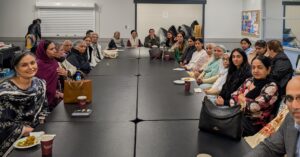
With rainy weather outside, warm chai and pakoras in hand, and a room full of stories moving between past and present, the afternoon was a fitting reminder that folk heritage does not live only in archives or books. It lives in stories people remember, retell, reinterpret, and pass on.
SASI is grateful to everyone who joined us and so generously contributed their own memories and experiences to the conversation, and to the City of Abbotsford for its partnership through Culture Days along with Abby Bhaina (Manmohan jit Kaur and Santosh Pwar) for supporting the gathering with chai and refreshments.
See pictures from the event here.
Dr. Asma Qadri is a SASI Research Associate and Professor at the University of the Punjab in Lahore. With more than 25 years of research experience in classical Punjabi literature and Sufi traditions, her work spans South Asia and the diaspora and focuses on the preservation and understanding of South Asian literary and cultural heritage. The event forms part of SASI’s South Asian Folk Heritage Project, a community-centred initiative led by Dr. Qadri that works to preserve, document, and share diverse South Asian folk traditions through research, public programming, archival work, and community engagement.
]]>Dr. Javid is an Associate Professor of Sociology in UFV’s School of Culture, Media, and Society. His academic and research background brings a strong focus on South Asia, with particular attention to colonialism, political power, inequality, and processes of social and political change.
Dr. Javid received his PhD in Sociology from the London School of Economics, where he was also a Fellow in Political Sociology. Prior to joining UFV, he was an Associate Professor of Sociology at the Lahore University of Management Sciences (LUMS) in Pakistan. His research examines the legacies of colonialism in South Asia, with an emphasis on understanding processes of elite reproduction and the relationship between class, state, and power. His work has explored elections, social movements, democratization, and politics in Pakistan and Punjab. More recently, his research has also examined the rise of right-wing populist leaders in South Asia.
Dr. Javid’s scholarship and experience offer valuable perspectives as SASI continues its work in South Asian-focused research, community engagement, public scholarship, and the preservation and sharing of South Asian Canadian histories. He hopes to expand SASI’s collaboration with researchers and academics In Canada and South Asia itself, and is looking forward to continuing SASI’s strong tradition of work with the local South Asian community in the Lower Mainland.
His arrival also comes at an important moment for the Institute as SASI approaches twenty years of research and community-engaged work at UFV. The SASI team looks forward to working alongside Dr. Javid to build on this foundation and enter the next chapter.
Welcome to SASI, Dr. Javid!
]]>Haq and History began in community rooms out of years of regional consultation, visits to seven regions across the province, conversations with elders and descendants who had waited decades to see their histories told accurately. The bilingual English-Punjabi exhibit eventually started its travels in 2022 as part of the South Asian Canadian Legacy Project (SACLP). Through over 120 years of photographs, oral histories, archival materials, and community records, Haq and History traces South Asian migration, labour, and settlement across British Columbia and asks, at its core, who gets to belong in the history of this province. Each host site integrates local stories into the exhibit, grounding the broader narrative in the specific memories of the community hosting it. Since 2022, Haq and History has travelled to Surrey, Duncan, Golden, Port Moody, Burnaby, and Chilliwack, before arriving back in Abbotsford, the city it now calls home for the second time.

To open the program, Dr. Garry Fehr, Acting Director of SASI, started with a land acknowledgement before welcoming Mr. Bagi Brar of the Khalsa Diwan Society (KDS), a longtime partner of SASI across this project and many others. Mr. Brar thanked attendees for showing up to see the result of years of work come to life.
The afternoon’s speakers each traced a different thread of how the exhibit came to exist. Mo Dhaliwal, digital entrepreneur and longtime friend of SASI, spoke to the gap in representation that this exhibit was built to close. He reflected on “Haq” (Right) as a demand asserting the right to tell one’s own story and returned to the concept of “Waqt” (Time), the sense that this work could not wait, and that recognition is inseparable from timing.

Dr. Tzu-i Chung, Curator of Public Programs and Engagement at the Museum of Anthropology and one of the exhibit’s co-curator at the Royal BC Museum, traced the exhibit’s decade-and-a-half journey across the province. She expressed her plans to work alongside Indigenous artists and other South Asian communities for a new iteration of the exhibit anticipated at the Museum of Anthropology at UBC in 2029.
Finally, Dr. Satwinder Bains, Research Associate at UFV and SASI’s Founding Director, traced the project’s roots back to conversations that began as early as 2002. She thanked KDS for the space to share this history, recognized the SASI team and the many individuals and host sites whose contributions made the exhibit possible, and underscored that this was a team effort larger than any one person. She noted that this ongoing work is built, as she put it, to sow seeds for generations still to come.
The afternoon closed with hot chai and snacks, and an interactive board where attendees added their own families’ immigration stories to the exhibit’s growing record, a fitting close to a celebration centered on whose stories get told, and when.
“Haq and History: Journeys Across BC” is open daily, free of cost, from 9:00 a.m. to 5:00 p.m. at the Sikh heritage Museum and will remain on display through June 2027.
Click here to view photos from the opening.

]]>
Dr. Satwinder Bains, a University of the Fraser Valley Professor Emeritusand founding director of SASI, received the 2026 Heritage BC Outstanding Lifetime Achievement Award in the Professional Achievement category. The award recognizes heritage professionals whose career-long contributions have made a cumulative and lasting impact on the practice and understanding of heritage in British Columbia.
With respect to Dr. Bains life’s work, that impact is difficult to overstate. She began advocating for a dedicated centre for South Asian Canadian research and history in the early 2000s, long before any institution existed to house that work. What followed was the Centre for Indo-Canadian Studies, which officially opened in 2006 at the University of the Fraser Valley, which evolved into the South Asian Studies Institute (SASI) in 2016, and grew into the research institute it is today.
In presenting the award, the Heritage BC jury noted that Dr. Bains has “transformed heritage practice” in the province. They recognized her for pioneering participatory heritage models that place equity, inclusion, and intercultural dialogue at the forefront, noting that her commitment to these values has set a “new benchmark” for heritage practice.
This benchmark is perhaps best reflected in how Dr. Bains has consistently bridged the gap between institutional research and public engagement. Under her leadership, the South Asian Canadian Legacy Project translated a vast breadth of heritage and cutural research into accessible public resources. This included, but was not limited to, a comprehensive social history of South Asians in BC and educational materials to promote inclusive curriculum in BC schools through Saffron Threads. SASI has worked to ensure that South Asian Canadian histories are not confined to academic spaces but are accessible to the broader public through public exhibitions, community programming, and educational outreach.
The development of the South Asian Canadian Digital Archive (SACDA) serves as a key example of this impact by bringing together oral histories, photographs, and archival records spanning over a century of South Asian life in BC. SACDA has since become a resource drawn upon by academic researchers, heritage institutions, educators, and community organizations across the country, contributing to scholarship, curriculum development, and public programming well beyond the Fraser Valley.

Beyond exhibits and archives, Satwinder’s legacy is carried forward by the people she has inspired. Throughout her tenure, she has mentored hundreds of students through research assistantships at SASI, many of whom have carried that training into heritage, education, and community work across the province.
We at SASI are incredibly moved by this recognition of Satwinder’s career and remain inspired by the path she continues to forge for inclusive heritage in Canada.
]]>Born in 1936 in Punjab, India, Devinder left school after Grade 7 and spent her youth preparing for marriage—handcrafting items for a dowry and living under strict gender norms. “We believed our futures belonged to our parents,” she recalls. “We put boys at the front ourselves too—because we didn’t know better.”
Her first poems were letters to a friend who moved away after marriage, quietly expressing her longing. The voice prompted by the longing of her friend would grow louder over time.
After immigrating to England in 1965, and later settling in Canada, Devinder juggled factory work, childcare, and household responsibilities. Her love for poetry and singing didn’t disappear, but she didn’t feel free to pursue it—until a tragic event in 1996 pushed her to write with a purpose.
A mass shooting in Vernon, BC, where a man killed nine people after his wife tried to divorce him, disturbed her deeply. “This tragedy compelled my mom to write about her thoughts and feelings about the role of women in Punjabi culture, how they are mistreated, and how they can be empowered.,” says her daughter Ravi Basi, librarian and manager of multicultural services at the Surrey Library.
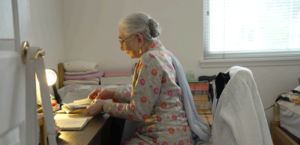
At an age when most people slow down, Devinder began using poetry to confront gender-based violence. Today, Devinder has written and published eight poetry books. Her writing reflects both personal struggle and broader calls for justice. She speaks openly about her experience with depression. During that time, her husband encouraged her to find community, and she joined the Indo-Canadian Senior Centre, where other women supported her creativity.
“They related to her poems,” Basi says. “She would perform her original poetry at the centre every week. The ladies would encourage and support her.”
This transformation from being an invisible older woman to a community voice is not common among Punjabi immigrant women in Canada. Older Punjabi women often experience social isolation, not only due to gender or age, but also because they grew up with limited educational and social opportunities—making them especially vulnerable in Canada. According to gerontologist Dr. Sharon Koehn, many also face neglect in multigenerational households and are made to feel invisible.
Devinder resists that erasure as she continues to write and perform. “If five out of a hundred women take inspiration from my books, I would say my purpose has been fulfilled,” she says.
From Artistic Expression to Systematic Change
Thamilini Jothilingam, digital archivist at the South Asian Canadian Digital Archive (SACDA), an initiative of the South Asian Studies Institute, is preserving Devinder’s poetry and performances as part of a new folk songs collection. “Her story offers a powerful role model—someone who embodies perseverance, passion, and purpose,” says Jothilingam. “The lived experiences of elderly Punjabi and South Asian women are essential—by documenting and preserving their stories, we challenge the structures that have rendered them invisible for too long.”
“I hope they’ll see in her a mirror, a guide, and a reminder that their voices matter. That their art matters. And that it’s never too late to dream, create, or begin anew.”
Systematic support for the women Devinder advocates for is critical. Meena Dhillon, lawyer and co-founder of the South Asian Legal Clinic of BC (SALCBC), works closely with South Asian women facing family violence. “A lot of the women we support have never done anything for themselves,” Dhillon says. “They grew up with no agency. Part of our work is showing them it’s okay to take space.”
Meena co-hosts the Cha, Chaat and Chit Chat support circle with Ravi at the Surrey Library, where Devinder often attends and speaks. “The women love hearing her,” says Dhillon. “She reminds them of their mothers and grandmothers. Her poetry gives them hope—and agency.”
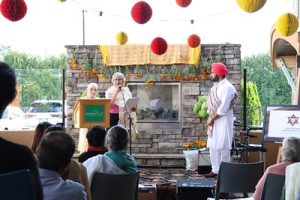
SALCBC is also fighting justice nationally. It recently gained intervenor status in Ahluwalia v. Ahluwalia, a Supreme Court of Canada case debating whether family violence should be recognized as a distinct legal tort. If successful, the case could mark a shift in how courts respond to intimate partner violence—an issue that disproportionately affects immigrant women.
Devinder’s poetry brings awareness to the very issues debated in court, while continuously encouraging women to speak out and leave family violence behind.
She has read her work at literary events, the South Asian Studies Institute, senior centers, and even won “Most Popular Vote” at the PICS Golden Glam-Ma Pageant. Her story is a reminder that dreams deferred are not dreams lost.
“No matter your age or your circumstances,” she says, “you all have something valuable to say, whether it is through writing, story-telling, poetry, dance, singing, or conversation. Don’t let your voice be stuck in your throat.” And to herself, she adds: “Devinder, you will reach the moon.”
]]>Among them was Lea Jose, Research Assistant at the South Asian Studies Institute (SASI), presenting her work on “The Impact of Policy and Laws: The Canadian Government’s Response to Tamil Refugees from Sri Lanka.” She presented both a research poster and a micro-lecture, bringing a largely untold chapter of South Asian Canadian history to a broad UFV audience.
Lea’s research examines the shifts in Canadian immigration policy following the arrival of Tamil refugee ships in the late 2000s. Working with archival materials and policy documents, she traced the government’s response through legislation, media coverage and secondary research materials, revealing how quickly policy can be weaponized against vulnerable populations.
What drew Lea to this project was a realization that came from working at SASI. “When I first found out about the story behind the Komagata Maru Tragedy, I wondered how many people within the South Asian diaspora in British Columbia would be familiar with this history,” Lea reflects. “Given that Canada has around 250,000 self-identified Sri Lankan Tamils, this was an opportunity for me to learn more as someone from the community myself.”
Her research uncovered uncomfortable truths about how media narratives and policy converged to shape the treatment that Tamil refugees received by immigration officers and in refugee hearings. “Most media coverage was discriminatory, and refugees were held to strict standards – even being jailed during their wait for hearings.” She points to Bill C-12 as a particularly troubling example. The legislation, which became law on March 27, 2026, just days before Student Research Day, has drawn condemnation from over two dozen human rights organizations who warn it limits the ability to seek refugee protection, enables mass cancellation of immigration documents, and puts thousands of individuals at risk of persecution and precarity. For Lea, this is exactly why research needs to reach beyond academic circles. “I hope that my work would make it easier for the general public to engage with political discourse and understand how legislation can affect more than just one demographic, whether they are targeted or not.”
In preparation for Student Research Day, Lea reflected, “Getting to do creative work between all the research was a very welcome break.” While the experience was nerve-wracking, she noted that it helped make her research more digestible and engaging for others to interact with. Her presentation showed both the rigor of the research itself and the courage it takes to stand up and share it.
Thamilini Jothilingam, Digital Asset Archivist at SASI and Lea’s supervisor, reflects on the collaborative nature of the project: “What stood out most was Lea’s detailed analysis of how Canadian immigration policies shifted in response to the arrival of Tamil refugee ships. Her close examination of the government’s response revealed a clear concentration of new and proposed policies around the 2009–2010 ship arrivals, highlighting the strength of her analytical and comparative approach. Visualizing her findings made this especially compelling.”
Lea’s work continues SASI’s commitment to documenting overlooked histories within South Asian Canadian communities – ensuring that stories like those of Tamil refugees are preserved and centered in our understanding of Canadian immigration history.
]]>On the opening day, Dr. Satwinder Bains, SASI Research Associate and Advisor to the Chetna Association of Canada, moderated the “Books & Authors” panel featuring two significant works: Fighting the Blemish of Caste by Om Parkash VK Gahatraj and The Past is Never Dead by Ujjal Dosanjh (former Premier of BC). Alongside the authors, Dr. Bains guided a conversation on how narrative and activism can dismantle systemic barriers.
SASI’s Micro-Exhibit: Documenting Chetna’s Organizational History Through the Bodalia Lens
To complement the symposium’s themes, SASI presented a micro-exhibit showcasing a curated selection of photographs, textual documents, and ephemera from the Chandra Bodalia Fonds that document Chetna’s community initiatives and activism over the years. Thamilini Jothilingam (Digital Asset Archivist) introduced the exhibit during opening remarks and thanked Jai Birdi (Executive Director) and the Chetna Association of Canada for their collaboration with SASI.
The Bodalia collection remains the largest known private collection of South Asian Canadian community life in British Columbia. With the support from Council on Library and Information Resources’ Digitizing Hidden Collections: Amplifying Unheard Voices Program, SASI is actively digitizing these records to ensure they are openly and freely available through the South Asian Canadian Digital Archive (SACDA). As we continue to digitally preserve this expansive collection, we invite community organizations that have been an active part of the South Asian community in BC to help us identify events, people, and stories within the collection.
Contact us at sacda@ufv.ca to explore potential collaborations.
]]>The word Trinjan refers to traditional gatherings of Punjabi women who would come together to spin yarn, sing folk songs and share stories. These gatherings were spaces where women exchanged wisdom, humor, and reflection, often expressing themselves through song and poetry in ways not always available elsewhere. Mela, meaning festival, captures the spirit of collective celebration. Together, “Trinjan Mela” revived this tradition in a contemporary setting, creating space for women’s voices and cultural heritage to be shared with a wider community.
The afternoon began with welcome remarks from community leaders and partners who helped bring the event to life. Dr. Garry Fehr, Associate Vice President of Research, Engagement, and Graduate Studies at the University of the Fraser Valley and Acting Director of SASI, reflected on a two-year South Asian Canadian Digital Archive (SACDA) initiative titled the South Asian Folk Heritage Project, led by Dr. Asma Qadri (Research Associate). Through events like Trinjan Mela, the project seeks to preserve and celebrate the rich folk traditions of South Asia through lectures, cultural events, archival recordings, and scholarly engagement. Greetings were also shared by Dr. James Mandigo, President and Vice-Chancellor of UFV; Deputy Mayor Patricia Driessen on behalf of the City of Abbotsford; Abbotsford School District Trustee Arsh Kaler; and Manmohanjit Kaur from Abby Bhaina Events & Exhibitions.
The program was guided by hosts Dr. Asma Qadri and Dr. Satwinder Bains, who moved with fluidity between Punjabi and English throughout the afternoon. Dr. Qadri spoke about the historical role of folklore as a creative outlet for women, particularly during times when formal artistic spaces were limited. Traditions like Trinjan gatherings, she noted, allowed women to share emotion, humor, critique, and imagination through storytelling and song. With Dr. Bains translating and reflecting on these ideas in English, the hosts created a bilingual conversation that connected audiences across generations and cultures.
Poetry and storytelling
Throughout the afternoon, several performances highlighted the power of the spoken word, reminding the audience that storytelling has long been one of the most enduring forms of women’s expression.
Although beloved poet Devinder Kaur Johal was unable to attend in person, the program included a video presentation of her poem “Gidhe Vich Nachdi Da.” The piece, reflecting on the tenderness and playfulness of young love, carried a gentle nostalgia that resonated throughout the auditorium.

Dr. Asma Qadri presented a dramatic reading of “Maa Da Tota” (Mother’s Parrot), written by renowned Pakistani playwright Najm Hosain Syed. Accompanied by young performer Uday Singh, who interacted with a birdcage as a visual metaphor, the piece explored the emotional and social constraints often placed on women within patriarchal structures. Through the image of the parrot, the performance reflected on the ways mothers frequently silence their own desires while caring for others, leaving the audience visibly moved by its intensity.
Motivational speaker Swinder Singh brought another dimension to storytelling with her talk titled “Shifting from Victim to Victorious.” Speaking about resilience and self-belief, she reminded the audience that a person’s worth cannot be defined by society’s expectations around gender or marital status. Her message encouraged listeners to choose strength over fear and to recognize the value of their own voices.
Music across generations
Music surfaced at different moments throughout the program, bridging traditional folk repertoire with contemporary expression.

Avleen Chhabra performed a selection of contemporary folk songs, her voice carrying themes of love, independence, and women’s empowerment. Her performance reflected the ways women’s stories continue to evolve across generations while remaining rooted in cultural memory.

Later in the program, vocalist Harinder Saini, accompanied by Darshan Sharma on the dholki, brought beloved Punjabi folk songs to the stage, including Kehende Ne Naina, Latthe Di Chaadar, and Ambarsare De Paparr. The melodies stirred a sense of shared recognition in the audience, with many singing along as familiar lyrics filled the room.
Dance and cultural expression
Dance added a vibrant visual dimension to the afternoon’s celebrations.
Gurbaksh Kaur delivered an energetic solo bhangra performance that filled the stage with rhythm and confidence, transforming the auditorium into a space of joyful movement.

The Mission Punj-Aab Culture Club led by teacher Tarunpreet Kaur Pandher, followed with a lively group Bhangra performance dressed in traditional kurti-salwar attire. The group, Ishmann Kaur Pandher, Shubreet Kaur Sidhu, Savreen Kaur Kular, Rehat Kaur Rehal, Ashlin Reehn, and Joban Kaur Bhangu, celebrated Punjabi dance traditions while demonstrating how these cultural forms continue to thrive within diaspora communities.
A collective celebration

The final performance transformed the atmosphere of the auditorium into something closer to the spirit of Trinjan itself.
Namrata Chandi and her group, Jaswinder, Sukhminder, Rajwinder, Sarbjit, Nirmal, Raji and Sukhpreet began with traditional folk singing before transitioning into boliyan, playful call-and-response verses often heard during Punjabi wedding celebrations. Soon, the boundary between performers and audience dissolved as guests were invited to join them on stage. What followed was a spontaneous moment of collective joy, as audience members clapped, sang, and joined in giddha together. For a brief moment, the auditorium became exactly what the name Trinjan Mela suggests: a gathering where voices, laughter, and movement circulate freely among community.
Following the performances, guests were invited to enjoy chai (tea), pakoras, and sweets in the lobby, a continuation of the Trinjan tradition of food sharing and communal gathering. Conversations continued long after the official program ended, people lingering to reflect on what they had witnessed and to share their own stories.
 A shared commitment to heritage
Trinjan Mela was made possible through the collaboration of many partners and supporters. SASI extends its sincere gratitude to the City of Abbotsford, Abby Bhaina Events & Exhibitions, and Executive Director, Aaron Levy from CIVL Radio for their partnership in bringing this event to life. Ryan Campbell, MCA Technical Director, ensured seamless audio-visual coordination throughout the afternoon, from rehearsals through the final performance. The event was coordinated by SASI staff Raaynaa Madaan, Thamilini Jothilingam, and Annet Holierhoek, with support from a dedicated team of student research assistants who ensured the afternoon ran smoothly. Most importantly, the celebration would not have been possible without the performers who shared their artistry, the dignitaries and community leaders who joined the event, and the community members who filled the auditorium in support of women’s voices and cultural heritage.
Photography was provided by Dale Klippenstein, courtesy of the City of Abbotsford.
SASI Research Assistant Students behind the success of the event:
- Sadhikpreet Singh
- Devanshi Sharma
- Amarnoor Kaur
- Alia Hijaab Ebayed,
- Amrit Sahota
- Arnav Mehta
- Attya Shahid
- Ayushmaan Ganguly
- Camryn Page
- Darien Unger
- Harshit Kumar
- Kiara Dabreo
- Iori Khuhro
- Leann Preiss
- Makenna Brar
- Samarah Siddique
Click here to view photos from the event.
]]>
Dr. Qadri delivered the lecture in Punjabi, honoring the language in which Baba Farid composed his poetry, while our former director, Dr. Satwinder Bains co-hosted and provided live translation, mirroring the beauty of Dr. Qadri’s words and ensuring everyone could engage fully with the depth and musicality of the discourse.
The lecture revolved around a two-line verse attributed to Baba Farid, later rendered musically by Najm Hussain Syed. From this verse, Dr. Qadri provided insight on what self-refinement actually means, not the external polish we are so used to chasing, but the internal work of acknowledging flaws, learning from mistakes and continuously working toward clarity in our thought and action. She reflected on the energy we expend beautifying the external world, often at the expense of our inner landscapes, and emphasized how Baba Farid’s teachings invite us to turn inward. She urged the audience to soften their ego to create connection and practice silence as a way to carve space for focus and clarity amidst a world that constantly demands our attention.
 The second half brought Baba Farid’s teachings to life through storytelling. Dr. Qadri shared accounts from Sufi tradition, particularly the relationship between Baba Farid and his disciple Hazrat Nizamuddin Auliya, illustrating Drawing on imagery from nature, she compared spiritual growth to a seed recognizing its bond with the soil, a reminder that true development requires awareness of being part of something larger than oneself.
The Q&A session was lively and reflective, with audience members sharing their own insights and questions. Conversations continued well past the official end time, over chai and cookies, as attendees lingered to discuss what had been shared. 
The series continued on February 19 with a lecture on Langar, a living tradition that brings people together through equality, service and shared humanity. The series is part of the South Asian Folk Heritage Initiative, a project led by Dr. Qadri in collaboration with SASI to preserve and celebrate South Asian folk traditions through public programming, archival recordings and community-based cultural events. The Interfaith Lecture Series explores themes of spirituality, heritage and intercultural understanding.
Click here to view photos from the Baba Farid Lecture on Jan 29, 2026.
Click here to view Dr. Qadri’s presentation slide featuring the verse in multiple languages.
Click here to view photos from the Langar Lecture on Feb 19, 2026.
]]>The South Asian Studies Institute is pleased to welcome Raaynaa Madaan (she/her) as the new SASI Coordinator at UFV on January 22nd, 2026!
Raaynaa completed her undergraduate studies at the University of the Fraser Valley in 2025, with a Bachelor of Arts in Psychology and a Minor in Criminology. From her first year as a student, she became closely connected to SASI as a Research Assistant, where she supported the cataloguing of archival records and assisted with community events. This experience became foundational to her understanding of community-engaged research and reinforced the importance of preserving and amplifying South Asian Canadian histories in the Fraser Valley.
Beyond her academic pursuits, Raaynaa has developed a strong foundation in mental health support, crisis response and community-based programming, through roles in student wellness and peer support at UFV, as well as supporting children and families through recreational programs with the Canucks Autism Network. Her work is grounded in trauma-informed, strengths-based practice and a commitment to inclusive and culturally responsive engagement.
Raaynaa is also actively involved in regional and community leadership. She serves on the Fraser Basin Council’s Youth Advisory Committee and Fraser Valley Regional Committee, where she contributes youth-informed perspectives on sustainability, collaboration and community wellbeing.
For Raaynaa, returning to SASI as Coordinator feels like coming home. She is eager to support the Institute’s research initiatives, deepen community engagement and continue the work of documenting and celebrating South Asian Canadian contributions to the Fraser Valley.