The post Extending Swim Season: How Pool Heat Pump Maintenance Saves Energy in Brevard County appeared first on Don't Sweat It Air And Heat.
]]>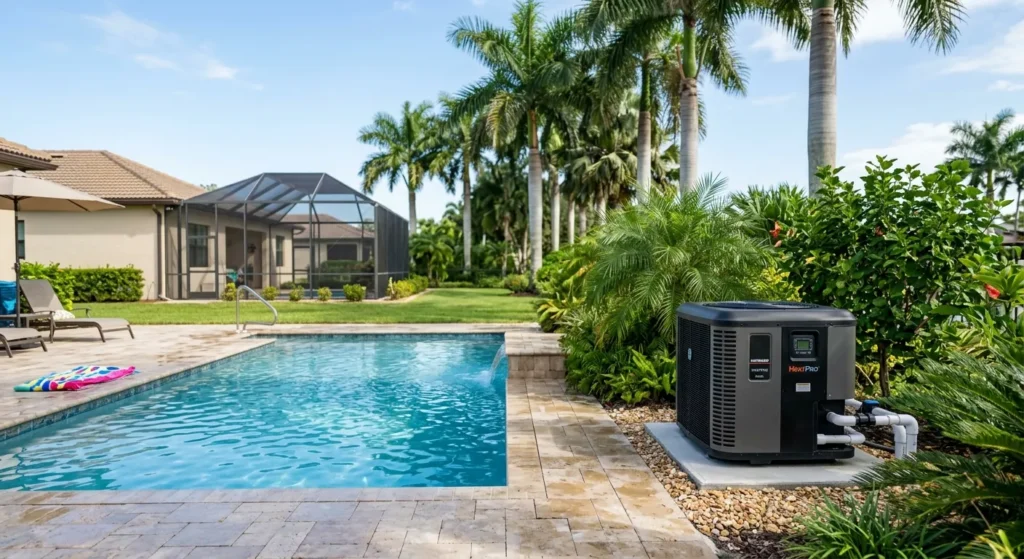
Living along Florida’s Space Coast gives homeowners and commercial property managers a distinct advantage: pleasant weather for most of the year. However, when the coastal breeze picks up during late autumn and winter, pool water temperatures drop rapidly. Investing in professional pool heat pump maintenance ensures your aquatic heater operates at peak thermal performance, protecting your utility budget while keeping your pool comfortable standard year-round.
How Maintenance Saves Energy and Keeps Pools Warm
Regular maintenance on your heat pump lowers energy bills by keeping the system’s heat exchangers, air coils, and electrical components free from buildup, corrosion, and refrigerant leaks.
In Brevard County, airborne salt spray, humidity, and debris constantly degrade heating efficiency. By scheduling yearly maintenance, your heat pump consumes significantly less electricity, transfers ambient heat far more effectively into your water, and prevents unexpected downtime during chilly spells.
| Key Maintenance Task | Primary Energy Benefit | Local Brevard Impact |
| Evaporator Coil Rinsing | Restores optimal airflow and heat transfer | Removes ocean salt spray and sand buildup |
| Refrigerant Level Inspection | Keeps compressor running at rated efficiency | Prevents long cycle times during cold snaps |
| Electrical & Contact Checks | Prevents voltage drops and overheating | Protects against coastal humidity corrosion |
| Water Flow & Filter Calibration | Maintains ideal heat-exchange rate per gallon | Keeps water chemistry from eroding internal titanium |
How Pool Heat Pumps Work in Winter
Understanding how pool heat pumps work in winter helps clarify why ongoing maintenance is so important for Space Coast homeowners.
Unlike traditional gas or electric resistance heaters that generate heat directly, a heat pump acts as a reverse air conditioner. It pulls existing heat from the outside air, compresses it to elevate the temperature, and transfers that thermal energy into the pool water through a titanium heat exchanger.
[ Ambient Air ] > [ Evaporator Coil Extracts Heat ] > [ Compressor Elevates Temp ] > [ Heat Exchanger Heats Pool Water ]During cooler months, ambient heat levels in Brevard County drop. The unit must process a higher volume of air to extract the same amount of heat. If the evaporator coils are clogged with coastal grime or salt crust, the heat pump struggles to extract heat, causing the compressor to run longer and consume significantly more electricity.
Understanding How Pool Heat Pump Maintenance Saves Energy
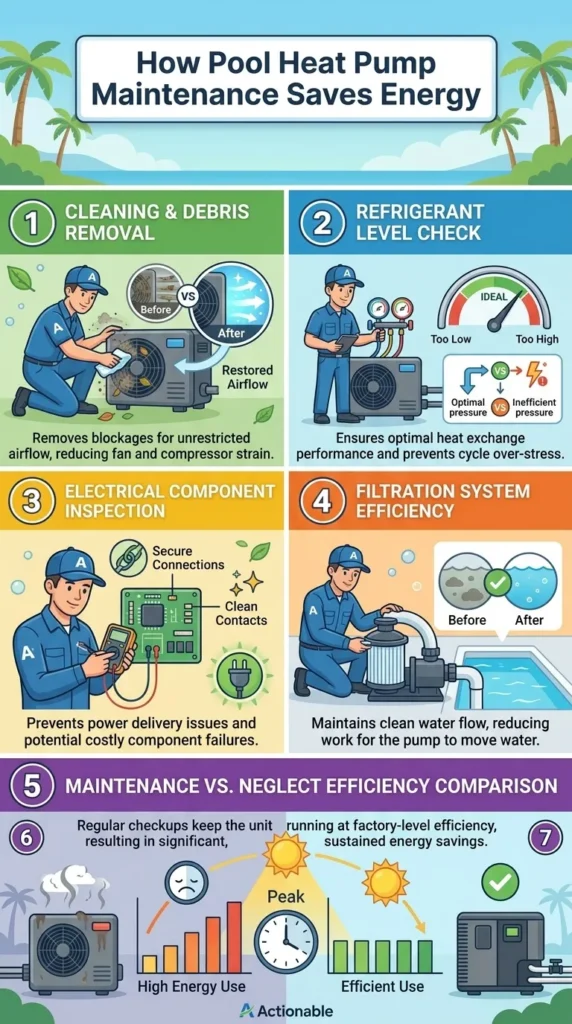
When discussing how pool heat pump maintenance saves energy, the main factor is coefficient of performance (COP). A well-maintained heat pump typically operates at a COP between 5.0 and 6.0, meaning it produces five to six units of heat energy for every unit of electricity consumed.
When maintenance is neglected, system COP drops rapidly due to several issues:
-
- Restricted Airflow: Dirt, leaves, and salt deposits on the outer coils force the fan motor and compressor to work harder, pulling higher amperage.
-
- Refrigerant Imbalance: Slight leaks mean the system must run twice as long to achieve the target water temperature.
-
- Titanium Exchanger Scale: Chemical imbalances create scale inside the heat exchanger, acting as an insulator that blocks heat from reaching the water.
By scheduling routine precision tune-ups with certified technicians, you maintain peak COP levels and avoid unnecessary spike charges on your FPL power bills. Learn more about keeping your system running smoothly by visiting our dedicated Pool Heat Pump Repair & Service page.
Specialized HVAC & Environmental Services for Brevard County
Keeping your home and property comfortable year-round requires more than just pool heating. A comprehensive thermal management strategy balances indoor air quality, climate control, and exterior heating efficiency.
Commercial HVAC Systems
For resorts, homeowners associations (HOAs), fitness facilities, and commercial properties in Titusville, Melbourne, and Palm Bay, commercial HVAC and heating efficiency are essential operating priorities. Our team delivers large-scale maintenance, commercial chiller care, and preventative service plans engineered for high-demand Florida environments. Explore our full suite of solutions on our Commercial HVAC service page.
Smart Thermostats & Automation
Modern pool heat pumps integrated with smart home controllers and indoor HVAC smart thermostats allow homeowners to schedule heating around real-time weather forecasts and off-peak energy rates. Discover how upgrading your controls can save money on our Smart Thermostats page.
Duct Repair & Air Sealing
Indoor comfort relies on leak-free ductwork. Leaky ducts waste up to 30% of conditioned air, forcing your central air conditioner to run continuously. Combining indoor duct restoration with outdoor heat pump maintenance lowers total household utility bills. See how we optimize indoor airflow on our Duct Repair page.
Actionable Pool Heat Pump Efficiency Tips
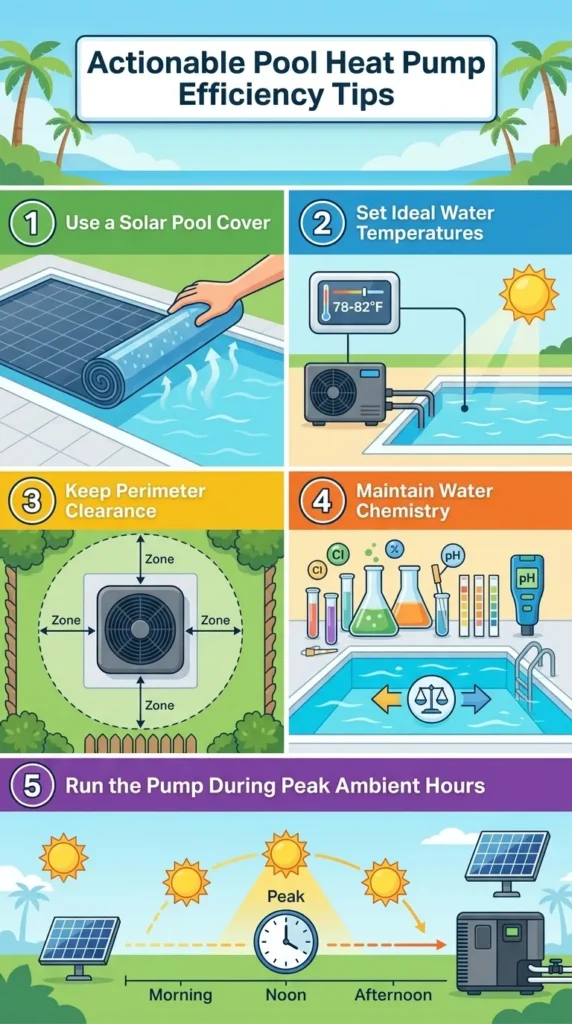
To maximize your system’s performance and extend your heating budget, combine professional servicing with these daily operational practices:
-
- Use a Solar Pool Cover: Extending pool season with heat pump assistance is vastly easier when using a liquid or physical pool blanket. Evaporation accounts for over 70% of pool heat loss.
-
- Set Ideal Water Temperatures: Maintain water between 78°F and 82°F during winter. Raising the temperature to 85°F or higher increases energy usage by up to 10% to 30% per degree.
-
- Keep Perimeter Clearance: Ensure at least 24 inches of clearance around the heat pump and 5 feet above it to prevent recirculating cold discharge air.
-
- Maintain Water Chemistry: Keep pH between 7.4 and 7.8 and total alkalinity between 80 and 120 ppm to prevent corrosion inside the titanium heat exchanger.
-
- Run the Pump During Peak Ambient Hours: Schedule heat pump cycles during the warm afternoon hours when ambient air temperatures are highest for maximum efficiency.
For year-round savings across your entire heating and cooling ecosystem, check out our general Residential AC Services.
Safety Guidelines, Operating Limits, and Local Relevance
System Operating Limits
While Florida heat pumps are highly efficient, they rely on ambient air. When ambient outdoor temperatures drop below 45°F–50°F, heat extraction efficiency decreases, and frost can form on the outdoor coils. Most modern units feature auto-defrost controls, but running a heat pump below its minimum temperature threshold can trigger emergency lockouts.
Electrical & Mechanical Safety
-
- High Voltage Danger: Pool heat pumps operate on 220V/240V circuits near body-of-water equipment. All electrical inspections, contactor replacements, and capacitor tests must be conducted by licensed HVAC/electrical professionals.
-
- Pressure Risks: Refrigerant circuits operate under high pressures. Unauthorized tampering with valves can lead to personal injury or environmental contamination.
The Brevard County Environment
From Cape Canaveral down to Sebastian Inlet, Brevard County properties experience humid, salt-rich air that accelerates metal oxidation and coil deterioration. Local homeowners benefit from specialized anti-corrosion coil coatings and scheduled rinse programs designed specifically for coastal environments.
The post Extending Swim Season: How Pool Heat Pump Maintenance Saves Energy in Brevard County appeared first on Don't Sweat It Air And Heat.
]]>The post AC repair cost in Melbourne FL appeared first on Don't Sweat It Air And Heat.
]]>
How Much Does AC Repair Cost in Melbourne, FL?
2026 Pricing Guide
Wondering how much AC repair costs in Melbourne, FL? Learn what affects air conditioning repair prices, which common problems can increase the cost, and when repairing your system may make more sense than replacing it.
Schedule HVAC ServiceHow Much Does AC Repair Cost in Melbourne, FL?
The cost of AC repair in Melbourne depends on what is wrong with the system, which components are involved, the condition and age of the equipment, and how extensive the repair needs to be.
There is no single price that applies to every air conditioning repair. A simple service issue may require a different amount of labor and parts than a refrigerant leak, electrical problem, compressor issue, or other major repair.
That's why an accurate repair estimate should be based on professional diagnostics rather than a generic price found online. Once the problem has been identified, homeowners can better understand what needs to be repaired and what the repair involves.
What Affects AC Repair Cost in Melbourne?
Several factors can influence the final cost of an air conditioning repair. Understanding these factors can help Melbourne homeowners know what questions to ask before approving service.
Type of AC Problem
The specific problem is one of the biggest factors. Electrical issues, airflow problems, refrigerant concerns, mechanical failures, and component replacement can all require different levels of diagnosis and repair.
Parts and Components
If a failed component needs to be replaced, the type of part, availability, and amount of labor required can affect the overall repair cost.
Age of the System
Older air conditioners may require more frequent repairs or have aging components that are becoming harder to service. System age can also be an important consideration when comparing repair with replacement.
Extent of the Repair
Some problems may be limited to one component, while others can involve multiple parts or underlying issues that need to be diagnosed and addressed.
Refrigerant Problems
Refrigerant-related problems may require testing, leak detection, and additional repair work. Simply adding refrigerant may not address the underlying issue if a leak is present.
Emergency or After-Hours Service
The timing of service can also affect what a homeowner pays. Emergency or after-hours HVAC service may involve different service conditions than a scheduled appointment.
Common AC Repairs That Can Affect Your Cost
Melbourne homeowners may encounter a wide range of air conditioning problems. The cost of each repair depends on the actual diagnosis and the work required to correct it.
 Don't Judge a Repair by the Symptom Alone
Two air conditioners can show the same symptom while having completely different underlying problems. For example, an AC that is not cooling could have an airflow restriction, refrigerant issue, electrical problem, frozen coil, or another system fault. Professional diagnostics help identify the actual cause before repair decisions are made.
Should You Repair or Replace Your AC?
Repair cost is only one part of the decision when an air conditioner develops a major problem. The age and condition of the system, repair history, efficiency, and expected future reliability can also matter.
A repair may make sense when the system is otherwise in good condition and the problem can be corrected without addressing larger equipment concerns.
Replacement may deserve consideration when an older system has recurring problems, major component failures, poor efficiency, or repair needs that are becoming increasingly difficult to justify.
There is no universal repair-versus-replacement answer. A professional HVAC evaluation can help you understand the condition of your current equipment and the options available.
If you're comparing your options, read our guide on AC repair or replacement .
Does Emergency AC Repair Cost More?
Emergency or after-hours HVAC service can involve different service conditions than a scheduled appointment. Availability, timing, and the nature of the problem may affect the overall cost of getting the system serviced.
However, delaying a serious HVAC problem simply to avoid service can sometimes allow the underlying issue to become more complicated. If your system has stopped cooling during hot Florida weather, professional evaluation can help determine what is wrong and what needs to be done.
AC Has Stopped Cooling
If your system is running but your home is not cooling properly, professional diagnostics can identify whether the problem is related to airflow, refrigerant, electrical components, or another issue.
Unusual System Behavior
Repeated cycling, unusual noises, unexpected shutdowns, or other sudden changes can indicate a developing HVAC problem.
Electrical Concerns
Breaker trips, electrical odors, or other electrical concerns should be taken seriously and evaluated by a qualified HVAC professional.
How Can You Avoid Unexpected AC Repair Costs?
No HVAC system lasts forever, and maintenance cannot prevent every possible repair. However, routine care can help identify developing problems and keep important components operating properly.
Learn more about HVAC maintenance plans from Don't Sweat It Air & Heat.
Questions to Ask Before Approving an AC Repair
When you're dealing with an air conditioning problem, understanding the recommended repair can make it easier to compare your options and make an informed decision.
Professional AC Repair in Melbourne, FL
When your air conditioner stops cooling, begins short cycling, develops unusual sounds, or shows another performance problem, getting an accurate diagnosis is the first step toward understanding your repair options.
Don't Sweat It Air & Heat provides HVAC service and repair for homeowners in Melbourne and throughout Brevard County. Professional diagnostics can help determine what is affecting your system and what repair options are appropriate.
Learn more about AC repair services in Brevard County or HVAC service and repair .
Frequently Asked Questions About AC Repair Cost
How much does AC repair cost in Melbourne, FL?
AC repair costs vary depending on the specific problem, parts required, system age and condition, labor involved, and whether the service is scheduled or needed urgently. An accurate price requires diagnosing the actual problem rather than relying on a generic repair cost.
What is the most expensive AC repair?
Major component failures can require substantially more work than routine service issues. Compressor-related problems, extensive refrigerant leaks, and other major system repairs can involve more parts, labor, and diagnostic work. The actual repair cost depends on the equipment and the specific problem.
Is it cheaper to repair or replace an AC?
It depends on the condition and age of the system, the repair required, its efficiency, and how frequently it has needed service. A professional evaluation can help you compare the current repair with the condition and expected future performance of the equipment.
Does AC maintenance reduce repair costs?
Preventative maintenance cannot prevent every repair, but routine inspections can help identify developing problems and keep important HVAC components maintained. Regular maintenance can also help homeowners stay aware of their system's condition.
How do I know if my AC repair estimate is reasonable?
Start by understanding exactly what problem was diagnosed, which components need attention, what work is included, and whether repair or replacement should be considered. A clear explanation of the diagnosis and recommended work makes it easier to evaluate the estimate.
Need to Know What Your AC Repair Will Cost?
Don't guess at the problem or rely on a generic online price. Get your Melbourne, FL AC system professionally evaluated so you can understand the issue and your repair options.
Schedule HVAC ServiceThe post AC repair cost in Melbourne FL appeared first on Don't Sweat It Air And Heat.
]]>The post Why Is My AC Turning On and Off So Frequently? Understanding AC Short Cycling appeared first on Don't Sweat It Air And Heat.
]]>
Why Is My AC Turning On and Off So Frequently?
Understanding AC Short Cycling
If your air conditioner keeps starting and stopping before properly completing a cooling cycle, it may be short cycling. Learn the common causes, warning signs, and when Brevard County homeowners should have their AC professionally inspected.
Schedule HVAC ServiceWhat Is AC Short Cycling?
An air conditioner normally turns on when your home needs cooling and runs long enough to remove heat and humidity before shutting off. Short cycling happens when the system repeatedly starts and stops before completing a normal cooling cycle.
You may notice your AC turning on, running for a short period, shutting off, and then starting again soon afterward. Occasional cycling is normal, but frequent starts and stops can indicate that something is affecting the system's operation.
In Florida, where air conditioning systems can operate for extended periods during hot and humid weather, persistent short cycling deserves attention. The cause can range from a simple airflow restriction to a refrigerant problem, thermostat issue, equipment problem, or system sizing concern.
Common Causes of AC Short Cycling
There are several reasons an air conditioner may turn on and off more frequently than it should. Identifying the underlying cause is important because short cycling is a symptom rather than a specific mechanical problem.
Dirty Air Filter
A heavily restricted air filter can reduce airflow through the system. Poor airflow may affect cooling performance and contribute to operating problems, including frequent cycling.
Oversized AC System
An air conditioner that is too large for the home may cool the space quickly without running long enough to complete a proper cycle. Proper system sizing is important for consistent comfort and humidity control.
Low Refrigerant
Low refrigerant can affect the system's ability to transfer heat properly. A refrigerant problem may be associated with reduced cooling performance or unusual system operation.
Thermostat Problems
A thermostat that is improperly positioned, malfunctioning, or experiencing control issues can cause the system to receive inaccurate signals and cycle at unexpected times.
Frozen Evaporator Coil
Restricted airflow, low refrigerant, or other system problems can contribute to a frozen evaporator coil. When the coil freezes, normal cooling operation can be affected.
Electrical or Mechanical Problems
Problems involving electrical components, controls, motors, or other equipment can affect how an air conditioner starts, runs, and shuts down.
Signs Your AC May Be Short Cycling
Short cycling is often noticeable from the way your air conditioner operates. Pay attention if you regularly notice repeated starts and stops or changes in your home's cooling performance.
Don't Ignore Persistent Short Cycling
Frequent starts and stops do not automatically mean your AC needs to be replaced. Short cycling can have several possible causes, including airflow restrictions, thermostat problems, refrigerant issues, equipment concerns, or improper system sizing. A professional inspection can help determine what is actually affecting the system.
Why AC Short Cycling Can Be a Problem
An air conditioner is designed to operate through normal cooling cycles. When the system repeatedly starts and stops, it may place additional operating demands on components and prevent the system from operating as intended.
Short cycling can also affect indoor comfort. If an AC shuts down too quickly, it may not run long enough to provide consistent cooling and humidity removal throughout the home.
More importantly, short cycling can be a symptom of another HVAC problem. Airflow restrictions, thermostat issues, refrigerant problems, equipment concerns, and improper system sizing can all affect how an air conditioner operates.
Professional diagnostics can help identify the underlying cause instead of simply addressing the repeated starts and stops.
If your AC is repeatedly turning on and off, learn more about AC repair services in Brevard County .
You can also learn more about HVAC service and repair from Don't Sweat It Air & Heat.
What to Do If Your AC Keeps Turning On and Off
If you notice repeated starts and stops, there are a few basic things you can check before scheduling professional service. These simple checks may help identify an obvious issue, but persistent short cycling should be evaluated by an HVAC professional.
Check the Air Filter
Look at your air filter and replace it if it is visibly dirty or restricted. A clean filter helps support proper airflow through the HVAC system.
Check the Thermostat
Make sure your thermostat is set correctly and is not located where direct sunlight or another heat source could affect its temperature reading.
Check Your Vents
Make sure supply vents are open and are not blocked by furniture, curtains, rugs, or other objects that could restrict airflow.
If your AC continues to short cycle after these basic checks, professional HVAC service and repair can help determine the underlying cause.
Can AC Maintenance Help Prevent Short Cycling?
Regular HVAC maintenance can help identify conditions that may contribute to poor cooling performance or unexpected system operation. Preventative service gives a technician an opportunity to inspect important components and evaluate how the system is performing.
Don't Sweat It Air & Heat's maintenance services include important system checks such as cleaning and sanitizing components, checking electrical components, evaluating refrigerant charge, checking temperature difference, and flushing the condensate drain line.
Learn more about HVAC maintenance plans or AC maintenance in Brevard County .
When Should You Call an HVAC Professional?
If your AC continues turning on and off frequently after checking the filter, thermostat, and vents, professional service may be appropriate. Persistent short cycling can have causes that cannot be identified through basic homeowner checks alone.
Professional diagnostics can help determine whether the issue involves refrigerant, electrical components, airflow, thermostat controls, equipment performance, system sizing, or another part of the HVAC system.
You should also consider scheduling service if your system is struggling to cool your home, freezing up, producing unusual sounds, experiencing water issues, or showing other changes in normal operation.
If you suspect a refrigerant problem, see our refrigerant leak AC repair services .
Frequently Asked Questions About AC Short Cycling
What is AC short cycling?
AC short cycling occurs when an air conditioner repeatedly turns on and off before completing a normal cooling cycle. Frequent short cycles can have several possible causes, including airflow restrictions, thermostat problems, refrigerant issues, equipment problems, or improper system sizing.
Why does my AC keep turning on and off every few minutes?
An AC that repeatedly starts and stops can have several possible causes. A dirty air filter, thermostat problem, low refrigerant, frozen evaporator coil, electrical issue, restricted airflow, or oversized system may contribute to frequent cycling. Professional diagnostics can help determine the specific cause.
Can low refrigerant cause AC short cycling?
Low refrigerant can affect an air conditioner's ability to transfer heat properly and may contribute to unusual system operation. If you suspect low refrigerant, a professional HVAC technician can evaluate the system and determine whether a refrigerant leak or another problem is affecting performance.
Can a dirty air filter cause AC short cycling?
A heavily restricted air filter can reduce airflow through an HVAC system and affect its operation. Checking and replacing a dirty filter is a simple maintenance step, but if the AC continues to short cycle after the filter is changed, the system may need further inspection.
Is AC short cycling bad for the system?
Frequent starting and stopping can place additional operating demands on an air conditioner and may be associated with inconsistent comfort and higher energy use. Because short cycling can have different causes, identifying and addressing the underlying issue is important.
Is Your AC Turning On and Off Too Often?
Repeated starts and stops can be a sign that your air conditioning system needs attention. Contact Don't Sweat It Air & Heat for professional HVAC service in Brevard County.
Contact Don't Sweat It Air & Heat TodayThe post Why Is My AC Turning On and Off So Frequently? Understanding AC Short Cycling appeared first on Don't Sweat It Air And Heat.
]]>The post Ductwork Problems: Signs, Causes & Solutions for Florida Homes appeared first on Don't Sweat It Air And Heat.
]]>Ductwork Problems: Signs, Causes & Solutions for Florida Homes
Uneven temperatures, weak airflow, excessive dust, and rising energy bills can all point to problems with your HVAC ductwork. Learn the warning signs, common causes, and when to call a professional in Brevard County.
Schedule HVAC ServiceWhy Your Ductwork Matters in Florida
Your HVAC system can only cool and heat your home effectively when conditioned air can move through the ductwork properly. Ducts carry treated air from your HVAC system into individual rooms and help return air to the equipment for another cycle.
In Florida, your air conditioning system may operate for long periods because of the region's heat and humidity. Problems with ductwork can affect comfort, airflow, efficiency, and the overall performance of your HVAC system.
If certain rooms are consistently warmer or cooler than others, airflow feels weak at your vents, or your HVAC system seems to run longer than normal, your ductwork may deserve closer attention.
Common Ductwork Problems in Florida Homes
Ductwork problems can develop for several reasons, including age, poor installation, physical damage, disconnected sections, insulation issues, and normal wear. Some problems are easy to notice, while others require professional testing.
Leaky Ducts
Gaps, cracks, or loose connections can allow conditioned air to escape before it reaches the rooms where it is needed. This can reduce efficiency and make your HVAC system work harder.
Poor Airflow
Restricted or damaged ductwork can reduce the amount of conditioned air reaching your vents. Weak airflow may contribute to rooms that never seem to reach a comfortable temperature.
Damaged Insulation
Duct insulation helps protect conditioned air as it travels through your home or attic. Damaged insulation can reduce the effectiveness of your HVAC system.
Disconnected Ducts
Duct sections that separate or become loose can cause conditioned air to escape into unwanted areas instead of being delivered through the intended supply vents.
Improperly Sized Ducts
Ductwork needs to work properly with the HVAC system and the home's airflow requirements. Poorly designed or improperly sized ductwork can contribute to inconsistent comfort.
Aging Ductwork
Older duct systems can develop deterioration, loose connections, insulation problems, and other issues that affect airflow and overall HVAC performance.
Signs Your Ductwork May Need Attention
Ductwork problems are not always obvious. Your home can provide several warning signs that something may be wrong with the air distribution system.
Don't Ignore Persistent Airflow Problems
A single warm room does not automatically mean your ductwork needs replacement. HVAC systems have multiple possible causes for uneven temperatures and poor airflow. A professional inspection can help determine whether the issue is related to ductwork, HVAC equipment, thermostat settings, insulation, or another component.
What Causes Ductwork Problems?
Ductwork can experience problems over time because of installation issues, physical damage, aging materials, disconnected sections, insulation deterioration, or changes to the home.
Florida's climate can also place significant demands on HVAC systems because air conditioning is used extensively throughout the year. Poor duct performance can make it more difficult for your system to deliver consistent comfort.
Airflow problems are not always caused by the ducts themselves. Dirty filters, equipment problems, blocked vents, blower issues, thermostat problems, and other HVAC conditions can produce similar symptoms.
That's why professional diagnostics are valuable when airflow or comfort problems continue. A qualified HVAC technician can evaluate the system and help determine whether duct repair, duct replacement, HVAC repair, or another solution makes the most sense.
Learn more about HVAC service and repair from Don't Sweat It Air & Heat.
Duct Repair vs. Duct Replacement
Not every ductwork problem requires a complete replacement. In some situations, repairing a damaged connection, sealing a leak, or correcting insulation may be appropriate.
However, severely damaged, deteriorated, poorly designed, or extensively compromised ductwork may require more extensive work. The right solution depends on the condition of the duct system, the home's layout, the HVAC equipment, and the specific airflow problem.
When Repair May Help
Localized leaks, loose connections, or certain insulation problems may sometimes be addressed without replacing the entire duct system.
When Replacement May Be Needed
Extensive deterioration, widespread damage, significant design problems, or aging ductwork may make replacement a more practical long-term solution.
Professional Evaluation
A professional inspection can help determine the condition of the ductwork and identify the most appropriate approach for improving airflow and comfort.
How to Protect Your HVAC Ductwork
Regular HVAC care can help you identify airflow problems before they become larger comfort or performance issues. Homeowners can take several basic steps to support proper HVAC operation.
Frequently Asked Questions About Ductwork Problems
What are the most common signs of bad ductwork?
Common warning signs can include weak airflow, uneven temperatures between rooms, unusual duct noises, excessive dust, higher energy bills, and an HVAC system that struggles to maintain the thermostat setting. These symptoms can also have other causes, so professional diagnosis may be necessary.
Can leaking ductwork make my AC run constantly?
Leaky or poorly performing ductwork can contribute to reduced airflow and loss of conditioned air. However, an AC that runs constantly can have several possible causes, including equipment problems, refrigerant issues, thermostat problems, insulation concerns, or improper system sizing.
Why is one room hotter than the rest of my house?
Uneven temperatures can be caused by ductwork problems, airflow restrictions, insulation issues, room location, sun exposure, HVAC sizing, or other conditions. A professional HVAC evaluation can help identify the underlying cause.
Can ductwork be repaired instead of replaced?
In some situations, yes. Localized leaks, loose connections, and certain insulation problems may be repairable. If ductwork has extensive damage, deterioration, or design problems, replacement may be a better option.
How often should ductwork be inspected?
There is no single inspection schedule that applies to every home. Ductwork should be evaluated when you notice persistent airflow, comfort, dust, or efficiency problems and during appropriate HVAC service when a technician identifies potential concerns.
Having Ductwork or Airflow Problems?
Don't let uneven temperatures, weak airflow, or persistent HVAC problems affect your comfort. Contact Don't Sweat It Air & Heat for professional HVAC service in Brevard County.
Contact Don't Sweat It Air & Heat TodayThe post Ductwork Problems: Signs, Causes & Solutions for Florida Homes appeared first on Don't Sweat It Air And Heat.
]]>The post Is Your Heat Pump Ready for Florida’s Winter? appeared first on Don't Sweat It Air And Heat.
]]>Is Your Heat Pump Ready for Florida’s Winter? | Space Coast Guide
While summers dominate Brevard County, sudden winter cold fronts can catch your HVAC system off guard. Discover how to optimize your heat pump for reliable warmth when temperatures drop.
Schedule a Heating Tune-UpWhy Florida Winters Still Require Heating Preparation
Living along the Florida Space Coast—from Melbourne and Palm Bay down to Cocoa Beach—means spending most of the year combating intense heat and humidity. However, when winter cold fronts sweep across Central Florida, nighttime temperatures can plunge, making reliable heating essential for your household comfort.
Most homes in our region rely on versatile heat pumps rather than traditional gas furnaces. Because these systems run hard cooling your home all summer long, neglecting them before winter arrives can lead to unexpected breakdowns. Professional HVAC service and repair ensures your equipment transitions smoothly between seasons.
Understanding how your heat pump operates and taking proactive steps ensures your home stays cozy and energy-efficient when chilly weather hits.
How Heat Pumps Handle Dual-Season Comfort
Unlike standard heaters, a heat pump utilizes a reversing valve to pull thermal energy from outdoor air and transfer it indoors, making it uniquely suited for Florida's climate:
1. Reversing Valve Action
During winter months, your heat pump reverses its refrigeration cycle to absorb outdoor heat and release cozy warmth inside your living spaces.
2. High Summer Usage Strain
Because your heat pump handles cooling duties 365 days a year, internal components undergo continuous wear that requires seasonal attention.
3. High Energy Efficiency
Moving heat rather than burning fuel makes heat pumps exceptionally efficient, keeping energy bills low during mild Space Coast winter weeks.
Essential Winter Heat Pump Preparation Checklist
Taking a proactive approach to your home's heating performance protects your equipment and prevents sudden failures during cold snaps:
Important Note on "Emergency Heat"
Many thermostats feature an "Aux" or "Emergency Heat" setting, which activates backup electric resistance strips that consume significantly more electricity. Use this setting sparingly unless your main compressor requires professional service.
Why Professional Heating Diagnostics Matter in Florida
When a heat pump blows lukewarm air or fails to reach your target temperature, attempting a DIY fix can lead to costly component damage. Modern heat pumps feature complex electrical controls, reversing valves, and precise refrigerant levels that require professional tools.
Whether you need a thorough inspection, minor component adjustments, or a complete HVAC system replacement, expert care ensures your home stays safe, efficient, and comfortable all winter long.
Don't wait for a freezing night to discover an issue—proactive maintenance protects your investment and extends the lifespan of your equipment.
Frequently Asked Questions About Florida Heat Pumps
Why does my heat pump blow lukewarm air instead of hot air?
Unlike gas furnaces that produce very hot air (120°F+), heat pumps produce steady, moderate warmth (around 95°F–105°F). This can feel cooler against human skin, but it is completely normal and designed to heat efficiently over time.
When should I use the "Emergency Heat" setting on my thermostat?
Emergency heat should only be used if your outdoor heat pump unit is frozen over or completely broken down. Leaving it on unnecessarily will cause your electric bill to skyrocket because it activates high-wattage backup heat strips.
How often should I have my heat pump serviced?
In Florida, your HVAC system runs almost year-round. We recommend biannual tune-ups—once in the spring before heavy cooling season, and once in the fall before winter temperature drops.
Why is my heating system running continuously?
Continuous running can be caused by dirty air filters, thermostat calibration issues, low refrigerant levels, or improper system load sizing. A professional diagnostic can quickly pinpoint and resolve the root cause.
What areas does Don't Sweat It Air & Heat serve?
We proudly serve all of Brevard County, including Melbourne, Palm Bay, Cocoa Beach, Rockledge, Viera, and surrounding Space Coast communities.
Ready for Reliable Comfort All Year Round?
Ensure your heat pump is ready for chilly winter nights with expert maintenance, repairs, and tune-ups from Don't Sweat It Air & Heat.
Contact Don't Sweat It Air & Heat TodayThe post Is Your Heat Pump Ready for Florida’s Winter? appeared first on Don't Sweat It Air And Heat.
]]>The post Why Is My Furnace Blowing Cold Air? | Don’t Sweat It Air & Heat appeared first on Don't Sweat It Air And Heat.
]]>Why Is My Furnace Blowing Cold Air? | Space Coast Home Guide
Expecting cozy warmth during a Florida cold snap, but getting a chilly draft instead? Discover the common reasons behind your heating trouble and what you should check.
Get Expert Heating RepairA Chilly Draft Instead of Cozy Warmth
Even along the sunny Florida Space Coast, occasional winter cold fronts bring chilly nights where reliable indoor heating becomes essential. When you turn up your thermostat only to feel ice-cold air rushing through your vents, it can throw off your entire household comfort.
While some causes behind a heater blowing cold air are simple user settings you can fix yourself, others point to internal system issues requiring professional HVAC service and repair in Melbourne, Palm Bay, and surrounding areas.
Understanding how your heating system operates and knowing how to safely troubleshoot minor symptoms ensures you stay comfortable and can act quickly when mechanical assistance is necessary.
Common Reasons Your Furnace Blows Cold Air
When your heating system circulates chilly air, the issue typically stems from one of several common mechanical or operational sources across your equipment:
1. Incorrect Thermostat Settings
If your thermostat fan switch is accidentally toggled to "ON" instead of "AUTO," the indoor blower fan will run continuously—even when the heating cycle is completely finished, circulating unheated room-temperature air.
2. Severely Clogged Air Filter
A heavily blocked or dirty air filter restricts critical airflow. This causes the internal heat exchanger to overheat rapidly, tripping the safety limit switch which shuts down the heating elements while letting the fan keep blowing.
3. Ignition or Flame Sensor Failure
Gas furnaces rely on functional pilot lights or electronic hot-surface igniters and flame sensors. If the sensor is coated in soot or the igniter fails, the system will prevent gas flow, resulting in unheated air output.
The Space Coast Heating Troubleshooting Checklist
Before calling for emergency service, walk through these safe, basic diagnostic steps to see if you can resolve the issue yourself:
Important Safety Warning for Homeowners
Never attempt to tamper with gas lines, electrical wiring, or internal furnace components if you suspect a major mechanical failure. If troubleshooting steps do not restore heat, contact a licensed professional immediately.
Preventing Unexpected Breakdowns With Routine Maintenance
The best way to prevent your furnace or heat pump from blowing cold air during a chilly evening is through consistent, proactive upkeep. Systems that go neglected accumulate dust, suffer from worn parts, and experience unexpected seasonal failures.
By scheduling professional tune-ups, our certified technicians can clean coils, calibrate controls, test safety switches, and keep your equipment operating at peak efficiency all year long.
Enroll in our comprehensive HVAC Maintenance Plans to protect your investment, lower your monthly energy bills, and ensure year-round indoor comfort.
Frequently Asked Questions About Furnace Heating Issues
Why does my heater blow cool air when it first starts?
It is entirely normal for a heating system to blow slightly cool air for the first minute or two while the internal heat exchanger warms up. However, if it continues blowing cold air throughout the entire cycle, your system needs troubleshooting.
Can a dirty air filter cause my furnace to blow cold air?
Yes. A clogged filter restricts airflow so much that the heat exchanger overheats. Safety mechanisms then shut off the heating elements while leaving the blower fan running, resulting in cold air.
How do I know if my thermostat is causing the cold air?
If the blower fan runs constantly even when the home is cold, check your thermostat settings. If the fan switch is set to "ON" instead of "AUTO," it will continuously circulate unheated air.
How often should I service my heating and cooling system?
We recommend scheduling professional maintenance at least twice a year—once in the spring for your cooling system and once in the fall before the heating season begins.
When should I call for professional heating repair?
If you have replaced your air filter, verified your thermostat settings, and reset your breakers without restoring heat, reach out to our team through our HVAC service and repair page for fast assistance.
Don’t Let Heating Problems Leave You Shivering
If your furnace is circulating cold air, making strange noises, or failing to keep your home warm, don’t wait. Contact the local experts at Don't Sweat It Air & Heat today.
Schedule Your Heating Repair NowThe post Why Is My Furnace Blowing Cold Air? | Don’t Sweat It Air & Heat appeared first on Don't Sweat It Air And Heat.
]]>The post Why Does My Heater Smell Like It’s Burning? | Melbourne, FL appeared first on Don't Sweat It Air And Heat.
]]>Why Does My Heater Smell Like It’s Burning? | Space Coast Home Guide
That sudden winter chill hits Brevard County, you flip your thermostat to heat, and immediately smell something burning. Before you panic, let's look at what's actually happening.
Get Quick Heating RepairA Sudden Winter Chill & An Unfamiliar Scent
Living along the beautiful Florida Space Coast means keeping your home thermostat set to "Cool" for about ten months out of the year. But when that first sudden Florida cold snap sweeps through Melbourne and the surrounding areas, sending nighttime temperatures plunging into the 50s and 40s, we all rush to our thermostats to turn on the heat.
Within minutes of firing up the system, you might notice a dusty, smoky scent drifting through your vents. If you are experiencing a heater burning smell florida homeowners frequently deal with during these brief cold snaps, your first instinct is likely to panic. However, in the vast majority of cases, this scent is completely normal and safe.
That said, because heating systems involve complex electrical grids and high-voltage connections, it is critical to know exactly what causes this smell, how to diagnose it safely, and when to call a professional for premium HVAC service and repair in Melbourne, FL.
Common Reasons Your Heater Smells Like It's Burning
When an air handler sits completely silent through the hot, humid spring, summer, and early autumn, it acts as a magnet for airborne debris. When you finally call for heat, those elements heat up rapidly, vaporizing anything sitting on them. Here are the three most common causes:
1. Dust on the Heat Strips
Most homes in Palm Bay, Melbourne, and Cocoa Beach rely on electric heat pumps. When outdoor temperatures drop, your system uses auxiliary heat strips (coils of wire that act like a giant toaster inside your system). The dust that has settled on these strips burns away instantly, which is why your heat pump smells like burning during the first seasonal run.
2. Clogged Air Filters
A dirty air filter blocks normal airflow. Without a steady stream of cool air moving through the handler, your system's internal heat will spike to extreme levels. This excessive heat can scorch the paper/fiberglass filter elements or burn the dust resting in your ducts, producing a persistent singed odor.
3. Overheating Motors
If your heating system hasn't been turned on in a long time, the bearings inside the blower motor can seize up. When the motor tries to spin but cannot, it draws excess amperage, causing its copper wiring and insulation to melt. This creates a distinct, dangerous burning plastic or metallic scent.
The Florida Heater Safety Checklist
If you have turned your heat on for the first time this year and noticed a strong odor, follow this quick troubleshooting checklist to see if your system requires emergency service or just a little bit of time to breathe:
Safety Warning for Space Coast Homeowners
Never ignore a persistent burning plastic or metallic smell, especially if it is accompanied by loud screeching, grinding, or humming noises from your indoor air handler or outdoor compressor. This is a clear indicator of electrical shorting or mechanical motor failure that requires immediate professional evaluation.
How to Prevent Heating Smells Before They Start
The absolute best way to ensure your heating system operates safely and smells clean on the first cold night is to stay ahead of the dust. Because our coastal Florida air contains salt and moisture, dust inside an AC cabinet can harden over the summer, creating a thick, stubborn layer of debris on sensitive components.
By scheduling regular, professional preventative maintenance, you can completely eliminate these startup smells. A certified technician can clean your electric heat strips, clean dirty coils, tighten loose wiring terminals, and ensure your system operates safely before the first winter front hits Brevard County.
Signing up for our comprehensive HVAC Maintenance Plans keeps your system running efficiently, lowers your monthly power bills, and guarantees your family’s comfort through all seasons.
Frequently Asked Questions About Florida Heating Systems
Why does my heater smell like it’s burning in Florida?
Since heaters in Florida stay off for almost the entire year, a heavy layer of household dust, dander, and pollen settles on your system's heat strips. When turned on, these strips heat up to high temperatures and burn off the settled dust, creating a temporary burning odor.
How long should the first-time heater smell last?
Under normal circumstances, a dusty burning smell should completely fade away within 20 to 30 minutes of continuous run time. If the smell remains strong after an hour, or if you notice smoke, turn the system off immediately.
Is a burning smell from the heater dangerous?
If the smell is simply dusty, it is completely harmless. However, if the smell smells like burning plastic, ozone, gunpowder, or melting rubber, it indicates a dangerous electrical short, loose wiring, or a failing blower motor that must be inspected by a professional.
Can a dirty air filter cause a heater burning smell?
Yes. A heavily clogged air filter restricts normal airflow through your heating system. This restriction traps extreme heat inside the unit, causing the dust on your coils or the filter itself to scorch, creating a burning smell.
Should I turn off my heater if I smell burning?
If it is the first time running your system this season and the smell is a light, dusty scent, it is safe to let it run for 30 minutes. If the smell is chemical, metallic, or doesn't fade after 30 minutes, switch the system off and call for professional HVAC repair.
Don’t Let Heating Issues Leave You in the Cold
If your heating system is making strange noises, producing a persistent burning odor, or simply failing to keep your family warm, don’t take chances. Get in touch with the local experts at Don't Sweat It Air & Heat today.
Book Your Heating Inspection TodayThe post Why Does My Heater Smell Like It’s Burning? | Melbourne, FL appeared first on Don't Sweat It Air And Heat.
]]>The post AC Repair or Replacement? How to Know What Your Home Needs (2026 Guide) appeared first on Don't Sweat It Air And Heat.
]]>Understanding common repairs helps you decide whether fixing or replacing your system makes more sense.
- AC Refrigerant leak repair
If your AC is low on refrigerant, there’s usually a leak. While fixing it can restore performance, repeated leaks may indicate a deeper issue. - AC compressor replacement
The compressor is one of the most expensive components. If it fails in an older system, replacement is often the better option. - Evaporator coil issues
Damaged or corroded coils can reduce cooling efficiency and lead to system failure if not addressed. - Electrical failures
Wiring problems, capacitor issues, or control board failures can prevent your system from operating properly.
 If multiple major components fail at once, replacing the entire system is usually more cost-effective than repairing each part individually.
The post AC Repair or Replacement? How to Know What Your Home Needs (2026 Guide) appeared first on Don't Sweat It Air And Heat.
]]>The post How Much Does AC Repair Cost in Melbourne, FL? (2026 Guide) appeared first on Don't Sweat It Air And Heat.
]]>The post How Much Does AC Repair Cost in Melbourne, FL? (2026 Guide) appeared first on Don't Sweat It Air And Heat.
]]>The post AC Running But Not Cooling in Florida? Causes & Fixes | Brevard County appeared first on Don't Sweat It Air And Heat.
]]>The post AC Running But Not Cooling in Florida? Causes & Fixes | Brevard County appeared first on Don't Sweat It Air And Heat.
]]>