School board races in Arkansas are nonpartisan, meaning candidates do not run under any political party’s banner. Nothing, however, prevents them from describing themselves as conservatives, liberals, moderates or even apolitical.
Reflecting a national trend, the board races were politicized along ideological lines more than any in Conway in recent memory. Three of the candidates ran as a team, with their campaign materials all sharing the words “strong conservative voices.” One candidate, Linda Hargis, also described herself as a “patriot.”
Those defeated did not run on any partisan labels but clearly diverged from the conservatives on social issues.
The unofficial results, complete except for some provisional ballots yet to be counted, according to the Faulkner County clerk’s office:
Zone One
Amy Ferdowsian 1,060
Jason Sandefer 1,287
Zone Two
Dr. David Naylor Jr. 2,008
Carrie Tinsley 1,098
Zone Three
Diane Robinson 1,069
Linda Hargis 1,185
Candidates for the other zones ran unopposed except for Zone 5, which had no candidate. The incumbent did not file for re-election, and a person who did file later withdrew, county Clerk Margaret Darter said. That will leave six board members unless the one who didn’t file, Scott Champlin, agrees to stay on the board.
Lucas Harder, policy services director for the Arkansas School Board Association, said that under Article 19, Section 5 of the Arkansas Constitution, the board member is to
remain in office until his successor is elected and qualified. That person then is “treated as if they’re elected to a new term,” Harder said.
Under Arkansas Statute 6-13-608, a person can serve only one full term as a “holdover” before he or she must run for re-election or leave office, according to Harder.
If that person doesn’t want to stay in office or can’t do so and leaves the board, he or she can submit a resignation and the board will have 30 days to appoint someone to serve a one-year term, Harder said.
The winners will be sworn in after votes are certified Friday.
The Conway school district has a total of 9,818 students, according to its website.
Janine A. Parry, a political science professor and Arkansas poll director at the University of Arkansas at Fayetteville, said Wednesday that one reason all three “conservatives” won is that “primaries tend to attract more partisan folks or the strongest partisans, so that’s going to be one of the consequences of changing school board elections to coincide with all the partisan positions.”
“We’re going to get higher turnouts, but those folks also are going to be more partisan also by definition. That’s not necessarily a good thing or a bad thing, but it’s going to change the character of the average voter” in a school-board election, Parry said.
But with vote totals in locally zoned races already relatively small, “it’s just not hard to mobilize a couple dozen extra people or a couple hundred and change the outcome of the election,” Parry said. “It’s not that hard to upend these things.”
Because of state legislation approved in 2017, school board races in Arkansas now must take place either at the same time as general or preferential primary elections, or, in non-election years, on one of those equivalent dates. In the past, they were in September and generally had low voter turnouts.
Name recognition can always be a big election factor and might explain why Naylor, a physician who’s part of an established family medical practice in Conway, won by a bigger margin than did the other two conservative candidates.
“A familiar name rises to the top as one of the … clues people will use when there aren’t other clues on the ballot,” Parry said. “If you’re already a well-established person or have the same last name as a well-established person, that’s going to work to your benefit.”
Further, Naylor got his name in education circles months ago. In January, he was among 13 Conway physicians who signed a letter urging the school board to allow protective masks to be optional, not mandatory, during the pandemic. The board voted 6-1 to require masks, in line with a recommendation from a group of other physicians and the president and chief executive officer of Conway Regional Health System. The mask mandate has since ended.
Further, without using the word “masks,” Naylor also evoked their image in his campaign announcement published in Conway’s The Log Cabin Democrat last month when he said, “I believe, after the last 2 years of a pandemic, it would be beneficial to have a physician on the school board.”
Unlike some other physician offices in Conway, the Banister-Lieblong Clinic where Naylor works no longer requires masks.
Naylor did not return a phone message seeking comment on an earlier article previewing the election. Asked if he would like to comment Tuesday night for this article while he was at the courthouse to hear election results, he indicated he preferred to wait.
Hargis, a former teacher and school administrator, posted a statement on her campaign Facebook page Tuesday night thanking her supporters.
“It’s been an eye-opening journey to say the least.” she wrote. “I will do my best to represent the values that you have entrusted in me!! I will work hard for the schoolchildren entrusted in our care as a school district.”
Sandefer, a Conway businessman, did not reply to a Facebook message seeking comment.
Even after losing her re-election bid, Diane Robinson continued her habit of posting positive news about students and faculty on a Facebook page she devotes to school board matters. On Wednesday, she posted videos of one of the district’s employees of the year and of the District Teacher of the Year, Hailey Carr.
And early Tuesday evening, just before Robinson posted the results of absentee and early voting, in which she trailed, Robinson, a senior court research associate who has
worked as a child advocate, took time for a far more important message relating to the Texas school shooting that left 19 children and two teachers dead.
She wrote: “Our core value: maintain a safe and caring environment. At the end of the day, parents expect their children to come home from school safe and sound. What
happened in Uvalde today …would be unimaginable, if we hadn’t seen it before. We heard one of the Sandy Hook parents speak at a National School Board Association
conference and she said your safety strategy cannot be: Not Here.
You cannot assume it won’t happen in your district. That’s why we’ve made safety improvements, both in terms of 'hardening' the entrances to our schools and having
detailed response plans specific to each of our campuses. It also includes making sure we identify and get services for students with mental health problems. Parents, if you
have guns in your home, do not assume that your children don’t know where they are or how to access them. Make sure.”
This story is courtesy of the Arkansas Nonprofit News Network, an independent, nonpartisan news project dedicated to producing journalism that matters to Arkansans.
]]>In the Conway School District, for instance, three of the six board candidates have found another way to signal their political leanings: the term “conservative.” Not surprisingly, you won’t find any of the candidates in the Republican-dominated area calling themselves “liberal” or “moderate.”
All three “conservative” candidates have called for removing politics from the school system, though these races are by far the most political school board races in recent memory.
“It’s pretty easy in rhetoric to accuse others of the very thing that you’re doing,” said Janine A. Parry, a political science professor and Arkansas poll director at the University of Arkansas at Fayetteville.
Thanks to state legislation approved in 2017, school board races in Arkansas now must take place either at the same time as general or preferential primary elections, or, in nonelection years, on one of those equivalent dates. In the past, they were in September and had generally had low voter turnouts.
Further, this year’s board races follow two years of the coronavirus pandemic that left Arkansans and many others in the nation at odds over protective masks, school closings, and the Jan. 6, 2020, Capitol insurrection protesting the election of Joe Biden over Donald Trump.
“When you’re putting your politics on a campaign sign in a nonpartisan race, you’re bringing politics into it,” said board member Diane Robinson, who is seeking re-election. “We all come in with our own perspective. The thing about public school that we have to keep front and center is that we educate every kid that walks in the door, whether they’re conservative or liberal, Christian or Jewish … or whatever” religion.
In Zone 1, businessman Jason Sandefer is challenging incumbent and former teacher Amy Ferdowsian.
In Zone 2, Dr. David Naylor Jr., who has a family medical practice, is opposing former teacher Carrie Tinsley, now an academic adviser at the University of Central Arkansas, for an open board seat.
In Zone 3, Linda Hargis, a former teacher and administrator and self declared “patriot,” is challenging Robinson, a senior court research associate who has worked as a child advocate. As a former state director for Court Appointed Special Advocates, Robinson helped establish local CASA programs around the state.
Hargis, Sandefer and Naylor are running as a team, much like a political party in that some of their posters have pictures of all three candidates and label them “Strong Conservative Voices.” The other three candidates appear to be running more traditionally — as individual candidates rather than a team.

Naylor was among 13 Conway physicians who signed a letter in January urging the school board to allow protective masks to be optional, rather than mandatory, during the pandemic.
The board instead voted 6-1 to require masks, in line with a recommendation from a group of other physicians and Matt Troup, president and chief executive officer of Conway Regional Health System. The mask mandate has since ended.
In his campaign announcement published earlier this month in Conway’s The Log Cabin Democrat, Naylor chose to bring up the pandemic, though he did not mention masks. “I believe, after the last 2 years of a pandemic, it would be beneficial to have a physician on the school board,” he wrote.
Naylor did not return a phone message seeking an interview for this article.
Sandefer declined to do a phone interview. He instead asked what the questions would be and then turned the sample issues a reporter mentioned into part of a Q-and-A on his website.
Hargis did a brief phone interview but became angry after she, not the reporter, raised issues of gay pride and Black Lives Matter being represented in classrooms. She said she thought teachers should be teaching subject content and character. She complained of school bulletin boards that she said have gay pride and Black Lives Matter information on them.
“And I believe every person has a right to live the life he wants to live … but I do not believe that has a place in a classroom or a public education system,” Hargis said.
“I believe the race issue should be handled by parents. I believe the social issue should be handled by parents, not teachers,” Hargis said.
Asked if teaching students to respect all races should be part of teaching character, she paused and said, “Rather than putting any kind of decor in the classroom about race or social agendas. … You could even throw Christianity in there. You should have a teacher in a classroom who’s wise enough to know how to welcome, validate and make students comfortable in their classroom without anything on the wall. If you want to put something, then put things that every child can identify with. Be kind, help someone today, pay it forward, put a smile on your face. That is character.”
Asked if her opponent was also a “patriot,” Hargis said, “I can’t answer” that question.
“I’m going to stop this interview right here and do not print” any of this, she said. “If you print one single thing" from what she had just said, Hargis said she would turn the matter over to one of her sons, whom she said is a lawyer.
Hargis also has had a couple run-ins with people on her campaign Facebook page.
In one case, she wrote a post about the importance of school board races — a post lifted largely, though not entirely, from a website called myfaithvotes.org, which contains, among other things, a lengthy article politicizing the national baby-formula shortage.
Hargis’ opponent, Robinson, said she is concerned about students’ social and emotional well-being in addition to traditional school offerings. While most children will be fine, others lack the emotional and sometimes financial support they need at home to be OK. She said the Black Lives Matter and gay pride materials “contribute to the well-being of some of our most vulnerable students.”
“I would add that LGBTQ young people have higher suicide risk, but that risk is cut by nearly half when they have supportive places in school,” Robinson said.
On racial matters, Robinson said, “Our Black students are regularly seeing incidents of people being killed because they’re Black, as happened in Buffalo this week. This is a source of great stress for some of our students, and it helps them for teachers to acknowledge this.”
Tinsley, who’s running against Naylor, said that while opponents say they want to take politics out of the schools, “It sounds like they just want to take politics they disagree with out of schools.”
She said she “feels like the issue of how to handle our LGBQ … community is a bit of a sticking point between our two campaigns,” though she noted that Naylor “hasn’t really said much about that publicly.”
“I’ve spoken publicly in support of diversity and equity and inclusion and belonging,” she said. “I really believe that education is not a one size fits all.”
Nationally “a lot of fear … has been stirred up” in school board races, Tinsley noted.
Indeed, there’s even been talk of “furries” in the nation’s schools. Not one Conway candidate who talked with the Arkansas Nonprofit News Network favored furries in schools.
Some believe that rumor spread to Conway because of a Facebook post Hargis made and apparently later deleted or changed the privacy settings on.
A photo taken of that post shows that she wrote to someone named Will:
“Will, I love you dearly, but it is going on all over this nation. There are absolutely schools allowing students to meow and bark. I can’t speak for Conway because I have not confirmed it, but I have been told it is happening. I don’t care what anyone identifies as or what their school orientation is. … To each his or her own! I do not want our classrooms filled with social agendas or politics. We need to teach subject matter, character, life skills, etc. parents need to handle the rest of it.”
The furry debate led to a resident’s letter to the editor in the Log Cabin Democrat criticizing the false rumor.
“I’ve heard people say they fear litter boxes in school bathrooms, which is absolutely ridiculous,” Tinsley said. The false rumors are “not taking common sense into account.”
Because students and teachers are also humans, Tinsley, sounding amused, said, “Going to the bathrooms as we always have is probably the best choice.”
Sandefer said online that he would offer a “strong and thoughtful conservative voice for all Conway students.”
On what he believes needs correcting in the Conway schools, Sandefer said, “I keep hearing lack of discipline is an issue in our schools, especially the junior high.”
Further, he said, “Bullying isn’t acceptable, period.”
Sandefer also said he has talked “to several teachers in our schools who feel they are unable to share their opinions without getting in trouble.” He did not say what those opinions were.
Sandefer, who’s challenging Ferdowsian, said, “I’ve heard we have kids choosing to leave the district.”
If elected, Sandefer said, “I want to get to the source of these issues and find the why.”
On his religion, Sandefer said, “So while I won't carry my religious beliefs to the school board, I will carry my core values with me. These core values will go a long way to showing compassion towards all students and staff.”
Ferdowsian said she recalls “reading a comment of someone saying people were more upset about masks than whether students were learning or not.”
"I wish parents would be as concerned about the education their children are receiving” and school funding and resources, she said.
Ferdowsian said schools have a wide “variety of students, and it’s our responsibility to include every single student, no matter their differences,” whether those are race, sexual orientation, religion, physical or mental disability, or economic.
Parry, the political science professor, said the problem of politics in school board races “is happening all over the country.”
“It’s a reflection of the intensity of some of our debates,” she said.
This story is courtesy of the Arkansas Nonprofit News Network, an independent, nonpartisan news project dedicated to producing journalism that matters to Arkansans.
]]>Under the governor’s plan, Arkansas will spend an additional $37.6 million each year to expand a program that pays for direct care workers and other services that help developmentally disabled people stay in their homes or in a community-based setting, as an alternative to institutionalization. These home and community-based services are sometimes called “waiver” services because they are funded through a waiver agreement between federal Medicaid authorities and the state. About 5,000 clients are now on the Arkansas waiver program.
The governor has said all of the roughly 3,200 families now on the waitlist — some of whom have been waiting for more than a decade — should be served by June 2025. Yet the plan may run into a problem. Arkansas, like many states, is facing a shortage of direct care workers, the frontline staff who help disabled, elderly and other clients with daily activities like eating, bathing, getting dressed and using the bathroom.
Teresa Dodson, 49, is the primary caregiver for her 22-year-old son, Nathan, who has autism and requires around-the-clock supervision.
“The governor has been releasing more of the waitlist people to start receiving coverage services,” she said. “That's fabulous. It's not going to help us families if they can't find staff. And the more people we release off of that waiver waiting list, the more people that need staff.”
From 2017 to 2020, the number of nursing assistants, home health aides and personal care aides in Arkansas dropped slightly, from about 41,000 to about 39,000, according to PHI, a national nonprofit that advocates for direct care workers. The workforce likely decreased further over the past two years, fueled by the COVID-19 pandemic and high demand for low-wage workers in other sectors.
Direct care workers are typically paid minimum wage — or close to it — to perform physically and emotionally demanding work. Arkansas’s minimum wage is $11 an hour.
Leaders of home and community-based service providers say finding workers has become much harder over the last year and a half. In January 2021, Easterseals Arkansas had about 14 openings for direct care workers, according to Ron Ekstrand, the CEO of the Little Rock-based provider. By April of this year, it had 52 openings. (Easterseals employs about 250 direct care workers total.)
“There’s something wrong with a system in which we can’t find enough people,” Ekstrand said.
Some help is on the way. In February, the Arkansas Department of Human Services (DHS) announced a $112 million “workforce stabilization incentive” for providers of home and community-based services. Organizations serving developmentally disabled Arkansans will receive about $52 million for worker retention and recruitment, according to DHS spokesman Gavin Lesnick. The remaining $60 million has gone to providers that serve elderly people.
The funding is part of the American Rescue Plan, the federal pandemic relief package signed by President Biden in 2021. The bill provides another $12 million for technology initiatives and $27 million for renovation and construction projects for both groups of Arkansas providers, to be disbursed later this year.
Providers say the one-time money is desperately needed, but it won’t solve their long-term workforce problems. And with the state opening up new waiver slots, families who have been waitlisted for years may still find themselves waiting for services.
Syard Evans is the CEO of Arkansas Support Network, a provider with offices in Springdale, Fort Smith, Camden and Jonesboro. Currently, the organization “does not have the necessary resources to support the clearing of the waiver waiting list,” she said.
As of mid-May, Evans said, almost 40 individuals who had been referred to Arkansas Support Network for services were facing delays in receiving help due to the staffing shortage.
Low wages, tough jobs
Before the pandemic, Evans said, Arkansas Support Network typically had between 85 and 100 job openings a month and about 120 applications. The numbers began to worsen in early 2021. By April of this year, the organization had 182 open positions and just 90 applications.
When employers in other sectors struggle to find workers, they typically increase their starting pay. Providers of home and community-based services don’t have that option.
“Fast food can add 50 cents to every combo meal and generate additional revenue to raise their minimum wages to $15, $16, $17 an hour — we cannot. We're locked into state Medicaid reimbursements,” Evans said. “We do not have the ability to adjust our pricing or what we're being paid or what we're able to bill.”
Starting pay for a direct care worker at Arkansas Support Network is $12 an hour but increases based on education and experience. On average, the direct care workers she hires make $14 an hour, Evans said.

The problem of recruitment predates the pandemic, she said.
“It is a field that has been underfunded and under-resourced from the beginning,” Evans said. “In the mid-’90s, there were organizations that were putting out reports talking about the collapse of the industry if we cannot find a sufficient workforce.” The labor shortage created by the pandemic “looks like it potentially could be the straw that breaks the camel's back.”
Ekstrand said Easterseals participates in an employee retention credit program from the federal government that allows it to pay direct care workers $15 an hour and provide some paid time off and benefits. But the federal program is temporary, and it’s not clear Easterseals can keep paying $15 an hour when it goes away.
“We can’t keep doing it if [Medicaid] reimbursement rates don’t go up,” Ekstrand said.
Ekstrand said he believes many people would enjoy direct care work if they could make a decent living doing it.
“There are people who are wired in a way that they are caregivers by nature,” he said. “But they look at that starting pay and the benefits, and they see these other competitive offers, and they're like, ‘I’ve got to put food on my table. I gotta pay my rent.’ And so, we've got to become more competitive with what we're offering.”
Reade Roberts, a direct care worker who has been employed at Arkansas Support Network in Fayetteville since 2004, said many of his co-workers are leaving the field.
“We've lost staff in my house in the last few months [because they took] a higher paying job,” Roberts said. “They couldn’t afford not to go make an extra $2 or $3 an hour. Even though they really love their work and like the people they support, and we all got along well, just pay-wise they couldn’t continue to do it. And that’s sad. And it’s particularly sad for the people they support.”
Workers feel undervalued, Roberts said.
“What I would want politicians and leaders to realize is that direct support professionals are not fast food workers. We have a lot more responsibility,” he said. “We're the last line of defense for these people to [not] fall through the cracks. And if we don’t step up and do our job … they're not getting taken care of the way they need to or deserve to be.”
Low pay, and the high turnover that comes with it, can also mean a lower quality of care for families.
For the past four years, Teresa Dodson has been Nathan’s only caregiver — a decision she made in an attempt to address behavioral problems her son had developed at school, Dodson said. Nathan’s behavior has since improved, and Dodson recently started bringing a direct care worker into their home for a few hours each week. But she worries that the worker will leave just as Nathan grows to trust her.
“This [direct care worker] has been hired to come work with [Nathan for] $11 an hour. She can't survive on $11 an hour. So about the time that my son gets used to her … I have absolutely no doubt she's going to go find a better-paying job,” Dodson said.
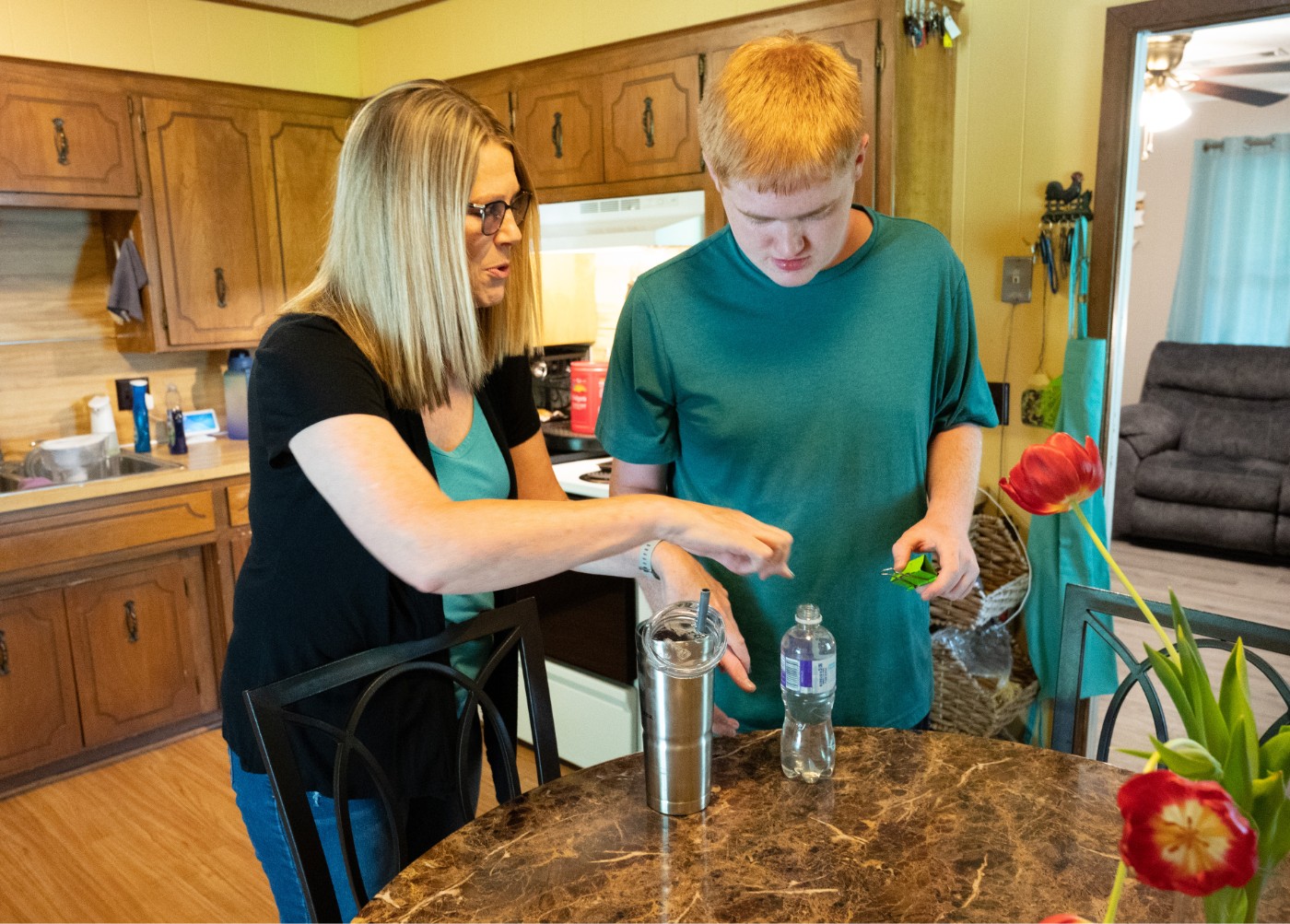
Dodson, who lives in Hot Springs, is a paid caregiver herself. Like many parents of adults with developmental disabilities, Dodson gave up guardianship of her son when Nathan turned 18 so that she could be compensated by Medicaid through a provider organization. (Her husband remains Nathan’s legal guardian.) Although Nathan requires around-the-clock care, she said, the provider can only pay her for up to 60 hours per week.
Dodson’s new direct care worker is now in the home for about 8 hours weekly. “I had to reduce the hours that I'm getting paid by the amount of hours that she is working. So if she works 10 hours a week, I'm only allowed to bill for 50 hours a week,” she said. The worker’s hours are also constrained, Dodson said, because she has three clients but is not allowed to work more than 40 hours total each week.
Dodson said the situation was “ludicrous,” considering Nathan requires 24/7 care. “It's just very frustrating that, because of how little [the provider] is getting paid, they can't pay me for what my son actually needs,” she said. Her emotional health has suffered under the stress, she said, but she can’t find time for therapy because she has to stay home with Nathan.

Tom Masseau, the director of Disability Rights Arkansas, a nonprofit that advocates for the legal rights of individuals with disabilities, said it’s “very taxing” for parents to provide care full-time. But, with a shortage of workers, it’s common.
“A lot of times you see family members coming in and pitching in to help, or one of the parents will quit their job and stay home,” he said. “The alternative is to go to a facility or an institution, and that goes against what we're trying to do with home and community-based services.
A short-term boost
The $52 million in American Rescue Plan funds won’t allow providers to increase wages long-term. DHS has told providers it can only be used for recruitment bonuses, retention bonuses and “complex care retention bonuses.”
Providers will be able to spend up to $1,000 per new employee recruited. Each employee also may be paid up to $15,000 in retention bonuses for the period between October 2021 and March 2024. Providers can spend an additional $3,500 per employee to retain workers who provide care to individuals with complex needs, a category that includes people who are wheelchair-bound or who have a history of behavioral problems, among other issues.
DHS has disbursed the money, but it has yet to reach providers. In Arkansas, Medicaid services for people with developmental disabilities or severe behavioral health needs are paid for through managed care organizations known as PASSEs, or Provider-led Arkansas Shared Savings Entities. DHS distributed the $52 million to the state’s four PASSEs in late March, according to Gavin Lesnick, a DHS spokesman. The PASSEs will begin paying out the money to providers beginning July 1, Lesnick said.
Evans and Ekstrand were part of a working group created to come up with a plan to use the federal funding — and, Evans said, to make sure the state applied for it at all.
“The state was really hesitant about the logistics and the practicality of it all, because it’s one-time money,” Evans said. State officials are sometimes wary of one-off funding, she said, because “people start to rely on it and expect it, and then when it goes away it actually is harmful.”
Evans said providers were told the state would not use the American Rescue Plan money to boost reimbursement rates, since doing so could create an ongoing commitment after the federal relief funds run dry.
“Arkansas was very, very clear from the beginning … they would not take one dollar if it was going to mean that they would have to invest a dollar after the fact and try to figure out how to fund it from someplace else,” she said.
Asked why DHS did not use the money to jump-start an increase in direct care worker wages, Lesnick noted that the one-time federal funds were “aimed at stabilizing programs as they weather the negative effects of the pandemic.”
The agency is making other changes to help providers recruit and retain staff, he said. “This includes eliminating experience requirements for direct support professionals and replacing them with training requirements that mirror what we have allowed during the pandemic,” Lesnick said.
Home and community-based services are already costly. According to a legislative report published in January, annual spending on Arkansas’s developmental disability waiver program reached $307.3 million by 2021, most of which was paid by the federal government. With a total of about 5,000 individuals on the waiver program, the average cost per client was $61,804.
But institutional care is even more expensive. In 2020, Medicaid spent almost $118 million on the 885 developmentally disabled clients housed in the state-managed residential facilities called human development centers — over twice the per-person cost of home and community-based services. (Human development center spending includes the cost of room and board and some other services paid for by Medicaid, however.)
Ultimately, providers say, they need a long-term increase in rates if they’re to pay better wages. Rates are negotiated between providers and the PASSEs, which receive a lump sum from the state for each individual they serve and are tasked with controlling spending.
Ekstrand said the PASSEs must get enough money from the state if they are to reimburse providers adequately. But he also said the PASSEs could be devoting more existing money to developmental disability services.
“It seems like the resources are there,” he said. “We just need to allocate them the right way.”
(Ekstrand noted that Easterseals is an investor in one of the PASSEs, Summit Community Care, though he said Easterseals is not involved in Summit’s decision-making and does not have a seat on its board. Such a relationship is not unusual in Arkansas: Under state law, PASSEs must be majority-owned by providers.)
Ekstrand sits on the board of the Developmental Disability Provider Association, a trade association that is commissioning a study to determine what would constitute a competitive wage for direct care workers. He hopes the study, expected to be published in September, could start discussions about a rate increase.
“We have to make sure that the PASSEs are paying us enough that we can pay our staff, so we can provide our services,” he said.
This story is courtesy of the Arkansas Nonprofit News Network, an independent, nonpartisan news project dedicated to producing journalism that matters to Arkansans.
]]>During a meeting held in Little Rock and streamed online, the Arkansas State University System’s board of trustees voted unanimously to cut 88 instructional positions, or 37% of the 237 total positions at Henderson. Twenty-one of those jobs are currently unfilled.
The ASU System also will gradually eliminate 25 degree programs at Henderson, including those in English, math, history, Spanish, geography, social science, early childhood development and theater arts. Some other programs may be added for deletion later.
Henderson became part of the ASU System in 2021, after years of financial turmoil and deficit spending. By 2019, the school ended the fiscal year on the brink of insolvency. It stayed afloat only with the help of an emergency $6 million loan from the state. Today, the financial picture has improved somewhat, but Henderson remains saddled with tens of millions of dollars in debt and has struggled to attract and retain students.
Of the 66 soon-to-be-eliminated positions that are currently filled, 44 are held by tenured faculty.Those professors may remain employed through the 2022-23 academic year.
The changes will result in annual salary savings of $2.55 million in fiscal 2023 and an additional $2.79 million in fiscal 2024, the ASU System said in a news release. Elimination or reduction in non-instructional unit salaries and restructuring of administration positions have already resulted in $1.8 million of savings, it said.
Among the programs being retained are aviation, nursing, psychology, elementary education, middle-level education, health and physical education, special education, computer science, physics, accounting, and business administration.
Current students and freshmen entering this fall will still be able to complete degree programs that are due to be phased out, school administrators have said.

Chancellor Chuck Ambrose, who joined Henderson in November, said the school will continue to teach core subjects even though degree programs in some of those areas are being eliminated.
“We will still teach math," he told the ASU System board, along with English, biology, art and other subjects.
As for how Henderson will teach English, for example, if it has no English instructors on staff year after next, Ambrose said the university would work with Ouachita Baptist University (which is also in Arkadelphia), community colleges in the region, and the ASU System to provide instruction — sometimes online — for students working toward these “teach-out” degrees, Ambrose said.
“As we have said repeatedly, Henderson will continue to offer [general education] courses such as English, math and history. Multiple resources can be used for this instruction at a lower cost than using tenured faculty” Jeff Hankins, a spokesman for the ASU System, said in an email. Graduates of programs such as education, he said, will still be qualified.
Henderson also will be free to hire part-time, or adjunct, teachers for such subjects in the future, Hankins said.
Speaking to the board, Ambrose said in prepared remarks that faculty were warned on Dec. 9 that budget cuts would be coming. “We notified the campus community that a modified cash budget was required to restore the financial integrity of the university. Without significant reductions in spending, we could not pay our debt service or our vendors and have enough cash remaining to cover our payroll in June,” he said.
“The solvency of Henderson is at risk,” Ambrose said.
That said, he added, “We are not closing. We are not becoming a future trade school.”
Trustee Jerry Morgan asked what would have happened to Henderson if the ASU System had not taken over the small college.
“I truly believe that the university … would have more than likely closed by early 2020,” said ASU System President Chuck Welch, a former president of Henderson.
Henderson officially became part of the ASU System in February 2021. In July 2019, Henderson’s president, Glen Jones Jr., resigned under pressure shortly after securing a $6 million interest-free state loan to keep Henderson afloat. Under Jones’ tenure, the school had engaged in years of deficit spending and depleted its reserve funds.
Jones has since become senior adviser to the president at Georgetown University and is chairman of the board of directors of Southern Bancorp Inc.
Faculty members said they were notified by phone of the recommended cuts Monday before the board formally approved them. Some faculty questioned whether the board was merely rubber stamping Ambrose’s plan, especially since the trustees did not consider budget recommendations made by a faculty committee, which suggested less severe cuts.
Hankins said the calls were a “courtesy” to let faculty members know of the recommendations.
“We otherwise would have blindsided the potentially impacted employees after any board action. And, we didn’t want anyone to learn second or third-hand.”
The academic cuts are the culmination of three years of efforts to get Henderson out of its financial nightmare. In addition to the state loan, which must be paid back by 2028, the school has received millions of dollars in federal pandemic relief funds. Henderson has reduced employees through attrition, cut staff positions, cut administrative pay, and required faculty and staff to take unpaid furloughs.
Those efforts have helped, but Henderson has still struggled — its declining enrollment and low student retention rates made worse by the COVID-19 pandemic and a shrinking population in south Arkansas.

Before the Thursday board meeting, Henderson’s faculty senate approved a resolution expressing no confidence in Ambrose’s administration and requested his “immediate dismissal.”
It was the third no-confidence vote at Henderson in recent years. The first was in May 2018, when Jones was still president. Faculty also voted no confidence in three other senior administrators, including Brett Powell, Henderson’s vice president for finance and administration. At the time, Henderson was overseen by its own board of trustees, which did not heed the faculty’s warning.
The second no-confidence vote came in July 2019, by which time the extent of Henderson’s money problems was finally becoming public. Powell had already left by that point to take a job at Baylor University. When the school became a part of the ASU System in 2021, Henderson’s board was dissolved.
Ambrose did not respond to a request for comment on the recent vote.
There was clearly no mood for firing Ambrose during the ASU System board meeting. The no-confidence resolution itself was barely mentioned; trustee Steve Eddington downplayed the vote, saying it was approved by only a few members of a much larger faculty.
Faculty members and a couple other people were allowed to address the board by video, though each speaker was cut off at the three-minute mark.
Megan Hickerson, a history professor and member of the faculty senate, said in an interview that she proposed the no-confidence resolution, which passed 13-6 with five abstentions.
Because of the short notice about the board of trustees meeting, Hickerson said, there wasn’t time for a faculty-wide vote. She said it was “a little bit rich for a body” like the board of trustees to bring into question the legitimacy of the faculty senate passing a resolution.
“This is what representative bodies do,” she said.
“It seems clear to all of us that [Ambrose] knew what he was going to do” before the faculty committee offered its recommendations for budget cuts, Hickerson said. “We all knew for years … that there was a problem. But nobody would let us help fix it. It’s like the Ph.D.’s on campus are [treated like] the least intelligent ones.”
Biology professor James Engman, the faculty senate president, said after the board meeting that he resigned from the panel at the end of the meeting because he didn’t want to be part of a process that pretends the university has “shared governance.” As president, he did not vote on the no-confidence resolution, he said.
“At this point, I feel there is not a shred of shared governance” on the HSU campus, Engman said. “These [academic and program cuts] are being made without any input from faculty.”
ASU System trustee Price Gardner, however, defended the budget-cutting process.
“I believe the process … has been as transparent as possible,” Gardner said during the board meeting.
Katherine Strause, the chair of Henderson’s art department and a tenured professor in art and painting, said, “Dr. Ambrose is doing what he thinks is right. I get it, but I do not think it is good for this state. … Arkadelphia will be just decimated by this.”
In an interview, Strause, who also addressed the board at the Thursday meeting, said, “We as faculty certainly agree that changes have to be made, and we tried to do that … with Glen Jones and Brett Powell. We tried to take the board by their lapels and shake them and say, ‘They are ruining this school.’ We watched them hire consultants, come up with outrageous plans.”
Hankins said Henderson has not cut and is not planning to cut any sports. He said the school offers 12 sports and NCAA Division II participation requires 10 sports. “Only 5 of 12 sports are men’s sports. No women’s sports can be cut due to Title IX requirements,” he said in an email.
“Athletics is a substantial enrollment and revenue driver for Henderson with around 500 student-athletes,” Hankins added. “Division II is a partial scholarship model. For example, 150 football players split only 36 scholarships, and 50 baseball players share just 8 scholarships. So, we receive tuition and housing revenue, Pell grant revenue, lottery scholarship revenue and many other benefits.”
Asked whether any athletic jobs had been eliminated either through attrition or other cuts, Hankins said, “Various cost savings have been implemented since 2019 in athletics and other non-academic areas.”
Steve Listopad, a Henderson lecturer in journalism and media and adviser to the student newspaper and yearbook for the past five years, said he thought the ASU System board should have delayed a decision.
“There should have been more time for discussion and input and more perspective … particularly discussing other options,” said Listopad, who is leaving Henderson and taking a job with the Arkansas Press Association.
"They could have at least brought up the faculty’s [budget] proposal … and discussed it, but they didn’t. That just solidifies my belief that this was all predetermined,” Listopad said after the meeting.
“I don’t necessarily think the plan is a terrible idea,” he added. “I just don’t think it was handled in the best way. I think there could have been reasonable modifications to the plan … by spreading out some of the reductions instead of entire program cuts, but that’s harder work. It’s not as quick and easy to reduce as it is to cut.”
This story is courtesy of the Arkansas Nonprofit News Network, an independent, nonpartisan news project dedicated to producing journalism that matters to Arkansans.
]]>Wood praised the decision by the Arkansas Judicial Discipline and Disability Commission and called the complaint “baseless, without merit, and politically motivated.”
The allegations against Wood, filed by the Arkansas Public Law Center on Dec. 24, centered on testimony given by her and other witnesses last summer at the federal corruption trial of a former lobbyist. In part, the complaint accused Wood of violating judicial ethics in 2014 by telling one of her former colleagues, then-Circuit Judge Michael Maggio, to delete certain text messages.
Ernie Dumas, a director at the Public Law Center, signed the complaint. (Dumas, a retired journalist, is also the chairman of the board of the Fred Darragh Foundation, a nonprofit that acts as the fiscal sponsor for the Arkansas Nonprofit News Network and has donated to ANNN in the past.)
The Judicial Discipline and Disability Commission sent a letter dated April 15 notifying Wood of the dismissal after an investigative panel completed its review.
“The investigation initiated by this complaint did not reveal or find sufficient facts to support a claim of judicial misconduct, wrong-doing, or incapacity within the Commission’s jurisdiction,” wrote David Sachar, the commission’s executive director.
“It’s disappointing that these false and misleading accusations received attention before they were fairly examined by the JDDC,” Wood said in an emailed statement. “Fortunately, in the justice system, the truth matters.”
“I have been nothing but forthcoming about the truth and have always acted with integrity through this very difficult process and confident justice would prevail,” she added.
Wood, a former circuit judge from Conway, is unopposed in her bid for re-election to the Supreme Court this year.
Dumas said he had not received a copy of Sachar’s letter to Wood. He noted, however, that the letter offered “no explanation for the investigating committee’s finding or who the investigating committee members were.”
“I thought the commission might deal with each of the complaints and explain its findings, as courts, including the Supreme Court, ordinarily do,” Dumas said in an emailed statement.
Dumas said he based the complaint on testimony given at the bribery trial last year of former state Sen. Gilbert Baker. Baker, a former lobbyist and former chairman of the Arkansas Republican Party, once raised campaign funds for candidates including Wood and Maggio, the former circuit judge. Both Wood and Maggio testified at Baker’s trial in U.S. District Court in Little Rock.
A jury ultimately acquitted Baker of conspiracy to commit bribery, but a mistrial was declared on eight other charges. A retrial on those counts is to begin with jury selection May 17.
Baker is charged in an alleged bribery scheme involving Maggio and nursing-home owner and campaign financier Michael Morton of Fort Smith.
Maggio pleaded guilty in 2015 to bribery and was recently released from prison after serving less than half of a 10-year sentence. Morton has denied wrongdoing and is not charged with a crime.
Wood once served alongside Maggio as a circuit judge in Faulkner County before winning election to the Arkansas Court of Appeals in 2012 and then the Supreme Court in 2014. Like Maggio, Wood’s campaign received donations arranged by Baker, including $48,000 from Morton or his nursing homes.
Morton’s donations to Wood’s campaign, however, were made directly, rather than being routed through political action committees, or PACs, as they were for Maggio’s campaign. Federal prosecutors argued that Baker arranged for Morton to donate to Maggio’s campaign via PACs because it was a more roundabout, less transparent method.
Wood testified during the Baker trial that she had talked with Maggio in 2014 about deleting certain text messages. But, she said, the texts in question related to Maggio’s decision to withdraw from his race for the Arkansas Court of Appeals that year. Maggio’s withdrawal followed a scandal over inappropriate online comments Maggio had made, including details of a confidential Arkansas adoption case involving actress Charlize Theron.
Wood said she and Maggio did not discuss deleting texts about campaign contributions made via Baker.
Sachar said the judiciary investigative panel dismissed the complaint against Wood on April 7 by a vote of 2-0. A third person recused, he said. He did not identify the panel’s members.
“The issues alleged had been vetted by the U.S. Department of Justice,” Sachar wrote in an email. “Additionally, the Executive Director of the JDDC is permitted by Rule to initiate an investigation. … Although some of the allegations were the subject of notoriety at the time, no such inquiry was initiated by the Director.
“After conducting the investigation and reviewing the documents and transcripts, the JDDC Investigation Panel did not find sufficient cause to proceed,” Sachar said.
The corruption charges against Baker stem from events in 2013, when Maggio presided over a negligence lawsuit against a Michael Morton-owned nursing home in Greenbrier. A jury in that case awarded a $5.2 million judgment to the family of Martha Bull, a 76-year-old Perryville woman who died in 2008 after a short stay in the Greenbrier facility.
In July 2013, Maggio slashed the jury’s verdict to $1 million, two days after Morton sent tens of thousands of dollars in checks to Baker’s house, some of which was to be deposited in several PACs. Some of the money was intended for Maggio, and some was for Wood. (Wood did not play a role in the Bull case.)
The Public Law Center complaint against Wood contended she spoke to Maggio about deleting certain text messages shortly after the news broke about Maggio’s lowering the nursing home judgment. Wood acknowledged at the trial last summer that she did talk to Maggio about deleting texts, but the contents of those texts is not clear. Wood insisted they were “not texts regarding the PACs” and that she and Maggio did not discuss deleting texts he had exchanged with any individuals other than Wood.
“By instructing Maggio to delete texts between Maggio and herself, especially after the story had broken regarding Maggio and the Martha Bull remittitur, Wood specifically engaged in activity that undermined the integrity and gave the appearance of impropriety,” the complaint alleged.
However, neither trial testimony nor the complaint specifies exactly when in March 2014 the conversation between Maggio and Wood took place.
“Wood’s instructions to Maggio regarding deleting texts to/from Wood arguably amount to tampering with evidence,” the complaint said.
This story is courtesy of the Arkansas Nonprofit News Network, an independent, nonpartisan news project dedicated to producing journalism that matters to Arkansans.
]]>As summer tourist season fast approaches, millions of travelers are booking accommodations on platforms such as Airbnb and Vrbo (Vacation Rentals by Owner). And more property owners and investors in Arkansas are cashing in on the opportunity to rent out rooms, apartments and whole houses on a short-term basis.
The massive growth of the short-term rental industry is also creating headaches for local residents and public officials. From Little Rock to small tourist towns in the Ozarks, more cities across Arkansas are taking steps to regulate short-term rental operators.
In October, Eureka Springs, which sees over 750,000 visitors annually, banned short-term rentals in residential areas. City officials say they were motivated by nuisance complaints and concerns that the town’s limited supply of housing was being snapped up by investors.
Last spring, Fayetteville began requiring operators to obtain a permit and established “density caps” on how many short-term rentals can operate in any single multifamily building and in the city as a whole. Hot Springs, which threatens unlicensed operators with fines of up to $500 per day, has created a new “compliance officer” position specifically to identify violators. And in Little Rock, a draft ordinance regulating short-term rentals will be presented at two public meetings this month.
The first short-term rental digital startup was launched in 1995 by Vrbo, in Aurora, Colorado. The website advertised privately owned ski chalets, beach houses and rural cabins. The industry’s growth accelerated after the founding of Airbnb in San Francisco in 2008, initially a website for hosts to advertise bedrooms for rent in private homes. Listings for private apartment and whole-house rentals soon followed.
As of late last year, Airbnb, which describes itself as the “world’s leading community-driven hospitality company,” was valued at over $100 billion, with an 80% share of the short-term rental market.
The Arkansas Short Term Rental Alliance (ASTRA), an advocacy group, claims short-term rentals generate local jobs, increase property values, and improve communities. ASTRA lobbies city officials with the mission of promoting fair and reasonable regulation of short-term rentals in Arkansas.

(Credit: Jacqueline Froelich)
“Many members of our group vehemently oppose any regulatory framework,” said ASTRA president Logan Humphrey who operates a short-term rental property management firm in Fayetteville. “But others welcome regulations to keep neighborhoods safe and to protect the professionalism of the industry.”
Humphrey said private hosting allows individuals and families to earn a living. Some hosts rent out vacation homes, which otherwise would go unoccupied for many months out of the year. Humphrey said more investors are buying up vacant residential and commercial property to develop as lucrative short-term rental real estate.
Cities often welcome the tax revenue short-term rentals generate, but have had to reckon with growing nuisance complaints from neighbors. And critics say that, without regulatory oversight, short-term rental hosts may dodge taxes, worsen local housing shortages, and avoid inspections applied to traditional accommodations, such as hotels.
“The number of short-term rental operators in the state seems to increase minute to minute,” said Scott Hardin, a spokesperson for the Arkansas Department of Finance and Administration spokesperson. All lodging providers, even those operating without a local permit, are required by state law to register with the state revenue agency, and remit applicable state and local taxes, he said.
Northwest Arkansas
In fast-growing Fayetteville, an estimated 600 short-term rentals cater to visitors attending University of Arkansas football games, cycling competitions, festivals and other events.
The Fayetteville City Council voted unanimously last April to pass an ordinance requiring short-term rental owners to apply for a conditional use permit, obtain a business license to remit necessary taxes and submit to building safety inspections. Since then, the city has twice extended a grace period for owners to secure a permit. Property owners now must voluntarily obtain a permit by May 21 to avoid having to appear before a planning commission in a public hearing.
Once granted, owners have another year to come into compliance with building inspections and codes.
According to Jonathan Curth, Fayetteville’s development services director, the city has received 446 applications. Of those, just 84 are classified as Type 1 rentals, meaning owner-occupied. The rest are Type 2, or stand-alone vacation rentals. Under the new ordinance, both types of rentals require a conditional use permit. To conserve housing in Fayetteville, the ordinance says no more than 2% of the city’s residential units may be Type 2 rentals.

The ordinance also limits the number of occupants per bedroom. Parties, including weddings and receptions are barred. Over 250 licenses have been issued as of March, Curth said.
Unlike some cities, Fayetteville does not actively search for short-term rental owners operating without a permit.
“But unlicensed rentals may be subject to legal action or fines if a complaint is made about the location, and validated,” Curth said. “For neighbors, licensing formalizes and identifies short-term rental owners and properties along with an avenue to pursue problems like noise and parking violations. For visitors, the ordinance offers safety through our building inspections for elements that range from handrails and smoke detectors to furnace inspections and fire extinguishers.”
Taylor and Erika Rayburn operate Stay NWA. The couple owns three luxury vacation homestays and manages around forty vacation rental properties. They also develop and sell short-term rental real estate.
“We are pro-ordinance from a safety perspective, legitimizing and professionalizing the vacation rental industry here,” Taylor Rayburn said. “The part that we don’t agree with are density caps —for example, limiting short-term rentals in duplexes.”
“We have done this for a long time,” he said. “We upkeep properties, maintain good guest experiences, and have good clients come stay. And honestly, long-term renters will trash your place more than someone staying for only two days.”
Rayburn said vacation homestays tend to be self-regulating, meaning those that offer derelict accommodations will yield lousy online reviews.
“People that do this, for the most part, really care about providing a good guest experience,” he said. Hosts who don’t care, he said, are eventually weeded out.
The Rogers City Council voted last summer to collect lodging taxes on short-term rentals and began doing so in January. Bentonville, Springdale and Fort Smith do not yet have regulations in place for short-term rentals.
Hot Springs
As the global pandemic eases, Hot Springs is buzzing with out-of-town visitors, said deputy city manager Lance Spicer.
“There is no way Hot Springs has enough hotel rooms for all these folks, so I figure that short-term rentals are getting good use,” Spicer said.
Hot Springs is benefiting from increased sales tax revenue and investments made in older homes that have been renovated into short-term rentals, Spicer said. But he too is receiving complaints about traffic, trash, noise and public safety in neighborhoods hosting large numbers of tourists.
Last March, the city gathered input from residents and short-term rental operators in a series of public meetings. In May, the Hot Springs Board of Directors adopted an ordinance requiring all short-term rental operators within city limits, which number nearly 650, to obtain a license.
Occupancy data and contact information must be physically posted on all short-term rental building exteriors. The city will issue no more than 500 licenses in residential zones, Spicer said, but commercial zones are not subject to a cap. By October, the city had issued 573 licenses, which require annual renewal.
Unlike Fayetteville, Hot Springs has taken a proactive approach to identifying unlicensed operators. The city has hired a compliance officer and contracts with Host Compliance, a leading national short-term rental monitoring and enforcement firm. And the ordinance mandates stiff penalties: $1,000 for a first offense, not to exceed $4,000. Persistent offenders face daily fines of $500.

“My application for inspection got lost in the shuffle,” said Anna Rodgers, who operates four short-term rentals under an LLC. “I had to email the city employee in charge five times, call and then finally had to physically visit the office.” After fulfilling certain renovation requirements, she passed inspection for licensure this year.
Rodgers said she understands that regulations are intended to maintain safety and protect neighborhoods. “But my concerns are that they are too much, too quickly, which is deterring the influx of investors in our area and slowing progress,” she said.
Rodgers also asks why short-term rentals are regulated by the city while long-term rentals — that is, residences leased or rented to tenants by a landlord — are not.
Short-term rentals remain “a hot, multilayered topic,” for cities like Hot Springs, Spicer said. “We’ve heard at our public meetings from citizens that are against short-term rentals in their neighborhood, but use them as their travel accommodation of choice,” he said.
Little Rock and other cities
Spencer Watson, a spokesman for the city of Little Rock, said planners last summer issued a short-term rental working draft, now posted online for comment. The draft ordinance declares that “the use of homes for short-term rentals across the city is occurring without clear allowances, requiring a regulatory framework.” The ordinance aims to preserve neighborhoods while allowing private homeowners to generate income.
The draft ordinance would categorize short-term rentals by on-site and off-site owner occupancy. A responsible party will be required to be in proximity at all times. An estimated 300 short-term rentals operating within the city will be required to obtain licenses, pay taxes, and pass inspections.
Smaller cities have also seen growth in short-term rentals. Conway counts as many as 70 operations. Russellville is seeing an increase as well, in part to accommodate workers on contract at the nearby Nuclear One power plant.
Even remote Newton County is seeing a surge in short-term rentals and vacation property sales. “I’ve seen small tracts of property sell for a ridiculous price,” County Clerk Donnie Davis said.

Jasper (pop. 482), the county seat, counts 20 short term rentals, said Mayor Jan Larson. The Buffalo National River tourist town has passed an ordinance requiring operators to obtain a permit and has placed a temporary moratorium on overnight rentals in residential areas, she said.
“It’s increased property values and is attracting investors who are buying up our local residences, which means our population will decline if this continues unchecked,” Larson said.
More cities are likely to pass local regulations as short-term rentals continue to proliferate. In late March, as part of its winter conference, the Arkansas Municipal League held a land-use workshop focused on short-term rental controls at the request of members.
Spicer, the Hot Springs official, was one of the panelists at the workshop. The session left him feeling there’s no “one size fits all approach” for cities to approach the issue, he said later in an email. “Regulations that work for Hot Springs might not be needed or wanted in Eureka Springs because each city has its own set of challenges.”
Still, Spicer said, all Arkansas cities have tools at their disposal to regulate short-term rentals if they so choose. “The two main tools for cities to use are their land use regulations (zoning) and taxation (business license and occupation tax, and sales tax) authorities which are granted to cities/counties by Arkansas Code,” he said.
Spicer is urging other city officials to take control of their short-term rentals sooner rather than later. He quoted a popular proverb: “The best time to plant a tree was 20 years ago. The second best time is now.”
This story is courtesy of the Arkansas Nonprofit News Network, an independent, nonpartisan news project dedicated to producing journalism that matters to Arkansans.
]]>Eureka Springs, population 2,166, attracts over 750,000 tourists annually. Visitors can choose to stay in one of the town’s 182 hotels, motels, bed and breakfasts, boarding houses, rustic cabins and cottages, hostels and other accommodations licensed and regulated by the city.
But some options are no longer available. During peak autumn tourist season last year, Eureka Springs passed an ordinance to ban new “tourist lodging” in residential zones. The ordinance is an effort to slow the spread of short-term rentals of furnished rooms, apartments or whole houses, which are commonly advertised on digital platforms like Airbnb and Vrbo (Vacation Rentals by Owner).
The number of short-term rentals operating in Eureka Springs has grown dramatically in recent years as both individual property owners and outside investors, many operating as limited liability companies, or LLCs, realized their earnings potential.

“We have more single family homes that are being purchased by out-of-town folks as second vacation homes,” said Kylee Hevrdejs, Eureka Springs’ historic preservation officer and planner. Housing has become so scarce that many workers in Eureka Springs must live elsewhere in Northwest Arkansas and commute to town, she said.
“We had strangers roaming our streets at all hours, disturbing working folk,” said Melinda Large, one of a group of Eureka Springs residents who had asked city officials to enact the ordinance. Large said short-term rental guests in her neighborhood, the Pines Subdivision, made a racket and left behind trash.
The town already has plenty of tourist accommodations, Large said. “We have to have a place to live.”
Other Arkansas cities are also taking action to regulate short-term rentals. Last year, Fayetteville and Hot Springs enacted ordinances requiring operators to obtain permits. The city of Little Rock is actively developing short-term rental land use controls. A draft ordinance will be presented at two public meetings this month.
Mayors and city administrators welcome the tax revenue short-term rentals generate, but have had to field growing nuisance complaints from neighbors. Critics say that without regulatory oversight, short-term rental hosts may dodge taxes, deplete residential housing supply, and avoid code inspections applied to traditional accommodations, such as hotels.
“The number of short-term rental operators in the state seems to increase minute to minute,” said Scott Hardin, a spokesperson for the Arkansas Department of Finance and Administration. All lodging providers, even those operating without local permits, are required to register with the state revenue agency and remit applicable state and local taxes, he said.
The Arkansas Short Term Rental Alliance (ASTRA), an advocacy group, claims short-term rentals generate local jobs, increase property values, and improve communities. ASTRA lobbies city officials with the mission of promoting fair and reasonable regulation of short-term rentals in Arkansas.
“Many members of our group vehemently oppose any regulatory framework,” said ASTRA president, Logan Humphrey, who operates a short-term rental property management firm in Fayetteville. “But others welcome regulations to keep neighborhoods safe and to protect the professionalism of the industry.”

Eureka’s ban
From Vermont to California, Airbnb and similar companies have had an outsize impact on small tourist communities, where demand for lodging is high and housing can be scarce. So a growing number of towns, like Eureka Springs, are cracking down.
Eureka Springs has long sought to conserve a limited supply of residential housing. Converting a home to a bed and breakfast, for example, requires a conditional use permit from the city. Property owners who advertise an apartment or whole house as a short-term rental typically must obtain a conditional use permit designating the property “tourist lodging.”
Under the new ordinance, the city no longer issues tourist lodging permits in residential areas. The law exempts about two dozen residential properties whose owners had already obtained a permit and a business license before the ordinance passed. Tourist lodging permits may still be issued for property in nonresidential zones.
City officials said no one came forward to oppose the ban, which was unanimously approved by the city council last October.
“I think Eurekans are really, really happy about the new ordinance,” said Melissa Green, a member of the city council, the city planning commission and the advertising and promotion commission. She’s also a long-time owner of several licensed tourist lodgings.
“Our codes allow you to apply for a conditional-use permit to rent part of your home, as a licensed bed and breakfast, where you must live on site,” she said, “or as a licensed, stand-alone guest house, cottage or cabin.” Greene said she voted for the ordinance to preserve residential neighborhoods.
Some property owners have openly advertised short-term rentals on websites such as Airbnb without getting a permit. Hevrdejs, the historic preservation officer, said she and city staff had identified hundreds of short-term rentals operating without permits over the last several years — a huge amount for a small town.
Hevrdejs said the city is on the lookout for violators. She and her staff routinely scour online reservation sites and property sale records and respond to citizen complaints, which are kept anonymous under the new ordinance.
“Offenders are subject to a $250 fine for each offense in every 24-hour period of operation,” Hevrdejs said. “We haven’t had to take action against any property owners at this time.”
A few short-term rental owners, she said, came into voluntary compliance this winter. The city does not require a special permit for rentals over 30 days, and some property owners have started leasing their properties to tenants under a traditional long-term rental arrangement.

Among the impacted property owners are Austin residents Amy Hayes and Michael Box, who purchased and renovated a house in a historic neighborhood last year, before the ordinance was enacted.
“We planned to live upstairs and operate the downstairs apartment as a nightly Airbnb,” Hayes said. Instead, the couple is now renting the upstairs to a long-term tenant. The downstairs is listed on Airbnb — but as a monthly rental, to comply with the city’s 30-day minimum threshold.
“Obviously, we are not making as much money,” Hayes said. “I do think the new rule is pretty rigid. But I see both sides. If Eureka’s Historic District Commission didn’t exist? The character of Eureka would be significantly different – and likely not for the better.”

The prospect of earning short-term rental income has fueled Eureka Springs’ real estate market.
“There are so few homes for sale,” said Diane Murphy, owner of Century 21 Woodland Real Estate. “When anything remotely reasonably priced comes on the market, it sells quickly and competitively.”
Many would-be buyers are looking to invest in short-term rental properties, and Murphy educates them on the city’s rules governing tourist lodging and permits. She said the ordinance won’t help with the housing shortage.
“We need to protect our neighborhoods but the new ordinance won’t increase housing supply,” she said. “In the end, the solution is to create more housing.”
But Sandy Martin, the chair of the mayor’s task force on economic development, said the proliferation of short-term rentals are contributing in part to the city’s affordable housing crisis.
“It makes it difficult to recruit tourist-industry workers because there is no place to live,” she said. “Plus, with gas prices rising, that makes long distance commuting costly.”
Martin said the task force is investigating options to purchase land to build low-income workforce housing, possibly through a nonprofit community land trust or a community development corporation. Eureka counts around 1,300 housing units, 40% of which are classified as long-term rentals.
Suzie Bell, co-founder of the nonprofit Eureka Christian Health Outreach, said housing is a serious problem in Eureka Springs. The charity recently built a low-income residential development, now fully occupied, and is seeking funding to build more.
“A lot of people tell me we don’t have any homeless people here, and I say, well — you are not looking,” Bell said. This winter Bell was able to provide emergency housing to homeless resident Kim York.
“I’d been living out in the woods in a tent for 8 months with my cat,” York said. “I just can’t find an affordable place to live in Eureka.”
This story is courtesy of the Arkansas Nonprofit News Network, an independent, nonpartisan news project dedicated to producing journalism that matters to Arkansans.
]]>Layoffs and budget cuts loom in the near future. Most faculty and staff are now furloughed for one day each week — an effective 20% pay cut. Over the past fiscal year, a hiring freeze has already reduced the number of Henderson employees by almost one-third, mostly among staff.
Faculty positions are likely next in line. On March 28, the board of trustees of the Arkansas State University System approved a resolution certifying that Henderson is in a state of “financial exigency,” a process that allows for layoffs — even of tenured faculty — and other cutbacks. (In higher education, “faculty” refers to employees who teach students, while “staff” refers to non-academic employees.)
Henderson spokeswoman Tina Hall said the school’s academic programs are expected to shrink by “approximately 30-40%.”
“It’s just very unusual for a public institution to be as cash-starved as we [are],” said Henderson Chancellor Chuck Ambrose, who joined the university in mid-November. Ambrose’s appointment represents another step toward stability for Henderson. Since July 2019, when then-President Glendell Jones Jr. resigned under pressure, the school has been headed by interim leaders.
Despite Henderson’s lingering financial problems, ASU leaders and Gov. Asa Hutchinson said they are pleased with its progress. The school is expected to face “a multi-year recovery process,” Hutchinson said in an emailed response to questions.
“It was important that [ASU] System and campus personnel have time to determine the depth and scope of the challenges and to verify financial information,” the governor said. “Significant progress has been made in multiple areas, but there is no quick fix. The global pandemic also slowed recovery efforts and created new challenges.”
In June 2019, Henderson announced a hiring freeze and spending cuts and said the school would end its fiscal year with a budget deficit. Jones said the main cause was about $4.5 million in unpaid student accounts incurred over the previous year. Student debt owed to the school had risen from $3.7 million in the 2013-14 school year to more than $10 million in 2018-19.
Henderson had depleted its reserve funds and was quietly engaged in deficit spending. The next month, as Jones resigned, the state gave Henderson a $6 million interest-free loan to keep it operational. The school has until 2028 to repay the loan.
Henderson has since adopted a policy that does not allow students with a balance to register.

Hall, the Henderson spokeswoman, said campus “investments — including construction of residential facilities such as Reddie Villas and University Place and the student recreation center — contributed to an increase in long-term debt from $14 million to $78 million during the last two decades.”
“The ASU System is looking at options to restructure this debt, which requires payments of approximately $6.9 million annually,” she added.
In July 2019, Moody's Investors Service downgraded university bonds from A3 to Baa2 and gave the school a “negative outlook.” But by late February of this year, Moody’s assigned an A1 rating for $42.2 million in bonds for Henderson and $24.4 million in bonds for ASU. The bonds are to be refinanced to generate cost savings for the institutions.
Moody’s said the upgrade was driven by “strong oversight at the system-level to manage financially weaker members of the system and the ASU board's general obligation commitment to pay debt service[.]”
“This is a strong, third-party validation by a very reputable global research firm that we are taking steps in the right direction financially with Henderson State,” said ASU System President Chuck Welch, who served as president of Henderson from 2008 to 2011.
A shrinking campus
Henderson already has seen its total number of employees drop from 501 to 356 in the past fiscal year as the result of the hiring freeze.
”Many positions that have become vacant in the last couple of years (especially staff) have not been refilled and/or duties have been reassigned within teams,” Hall said in an email. “Also, some classes were reassigned to faculty versus hiring adjunct instructors.”
Henderson also recently began mandatory furloughs for staff and faculty of one day per week — comparable to a 20% salary reduction. To avoid disruption of student schedules, faculty senate President James Engman said the university has asked that faculty members take their furloughs in the form of eight hours off when they would not otherwise be teaching classes.
“I think in a difficult situation, it’s a very logical approach,” said Engman, a biology professor. He noted that he was speaking only for himself and not for the faculty as a whole.
Six administrators, including Ambrose, are taking 20% salary reductions instead of being furloughed in order to continue working full-time, Hall said. Under Ambrose’s contract, his annual salary was $250,000.
Under faculty handbook guidelines, the university can lay off a tenured person when it’s in a state of financial exigency. Still, the teacher is to be given one year’s notice before any such layoff takes effect, Engman said.
Hall said Henderson expects about 12 staff positions to be eliminated this spring but could not give a number for faculty. “Any decisions about faculty positions would not happen until May at the earliest,” she said.
Welch, the ASU System president, said he and Ambrose “are grateful for [employees’] sacrifices as they continue to provide the best possible education and services for our students.”
Steve Listopad, a Henderson lecturer in journalism and media and an adviser to the student newspaper and yearbook for the past five years, is leaving the school at semester’s end to take a position with the Arkansas Press Association.
Listopad said the mood on campus now is “pretty depressed. … Nobody feels like their job is secure.”
“I hear rallying cries: ‘Henderson will survive. We’ll be stronger for it.’ But not for everybody,” Listopad said.

Listopad said he believes Ambrose “was hired to do one thing: that is, to pare it [Henderson] all down and rebuild it.” But Listopad wonders whether the school has explored other possibilities.
“We’re not going to … ask the state for more [money]?” he asked. “Why not? Did we try?”
Along with layoffs, the school likely will be cutting entire academic programs. A committee will begin evaluating programs and recommend which ones should be reduced or eliminated, Hall said. The ASU System board will consider these recommendations, most likely in early May.
“We anticipate that the overall compression of the academic programs will be approximately 30-40% for a permanent reduction of [spending] and/or reallocation of instruction,” Hall said. “In the event it is necessary to eliminate an academic program, actively enrolled students and freshmen entering in Fall 2022 will be supported to complete degrees in those areas.”
In December, the Arkansas Division of Higher Education notified institutions of programs that had so few graduates as to raise concerns about their future viability. The division advised Henderson of 34 such programs.
They ranged from certificates of proficiency in film studies and personal financial planning, neither of which had any graduates at Henderson in 2019, 2020 or 2021, to a commercial pilot certificate, which had a single graduate in that same time span. Also on the list was a bachelor of science degree in mathematics, with seven graduates in 2019, three in 2020 and one in 2021. (Some other Arkansas colleges and universities had equally high numbers of programs on the list.)
Eddie Arnold, a former member of Henderson’s board of trustees, said Henderson officials are “going to have to take the best programs they have and try to enhance those" and move away from “those that are not producing revenue, that have few students.” (Henderson’s board was dissolved when the school joined the ASU System.)
In the past, rather than reducing the university’s academic portfolio, the school “just kept adding more programs,” Arnold said.
‘I blame the board’
After Jones resigned in 2019 amid the financial turmoil, more trouble followed.
That fall, Henderson gained unwelcome national attention when two chemistry professors were arrested for allegedly cooking methamphetamine in a school laboratory. (One has since pleaded guilty; the other was acquitted by a jury.) And in early 2020, two legislative oversight committees held days of hearings on Henderson after audits showed the school was in far worse financial shape than its statements had indicated.

Much of the blame landed on Jones, the former president, and Brett Powell, who had been Henderson’s vice president for finance and administration under Jones. In May 2019, shortly before Jones’ resignation, Powell left to take a job at Baylor University, where he is assistant vice president and controller.
Jones has since become senior adviser to the president at Georgetown University and is chairman of the board of directors of Southern Bancorp, Inc. Jones did not respond to requests for comment sent to Southern Bancorp and Georgetown.
Powell also did not reply to an email seeking comment.
Former board member Arnold said multiple problems led to Henderson’s financial woes, but “ultimately it was the board of trustees that had final oversight.”
“They had a fiduciary duty. … I blame the board more than anybody,” said Arnold, who himself was on the board during Jones’ tenure and suggests board members mishandled the financial challenges the school faced.
Under Jones’ leadership, Henderson’s board was deeply divided. Arnold and a fellow trustee, Brown Hardman, often split with the other trustees, who tended to side with Jones.
“Glen Jones should never have been hired,” Arnold said. “He just didn’t have the qualifications at the time to be a college president.” The board tended to “rubber-stamp” Jones’ decisions, Arnold said.
Arnold also questioned why the university didn’t make cuts immediately in 2019 when officials realized the extent of the problems.
“The problem has gotten much worse” since then, he said. “They just kicked the can down the road.”
Listopad, the journalism faculty member, said he feels the board of trustees didn’t do its duty and failed to get to the truth of what was happening.
“Everybody knows and accepts that the causes of all of our problems [date to] the previous administration, Jones and Powell,” Listopad said. “They hid the school’s finances” from the public, he said.
The governor said trustees have a difficult job overseeing “such large and complex organizations,” and he declined to criticize Henderson’s former board.
The governor noted, however, that in 2021 he signed legislation “to further enhance higher education fiscal accountability and transparency and to assist trustees in their efforts.”
That law requires, among other things, that the state’s public colleges publish on their websites the name and email address of each trustee, the date and location of the school’s board meetings, the agenda and minutes of each board meeting, the school’s annual audit report submitted to the state, and the board’s conflict of interest and commitment policy. The measure, Act 69 of 2021, also requires that colleges update boards annually on the status of student debt owed to the universities.
Larger trends
In the fall semester of 2017, Henderson reported a total of 3,342 undergraduate and graduate students. The number peaked in the fall of 2019 at 4,054 but then began dropping. In the fall of 2021, the total was 2,914.
Engman, the faculty senate president, said the COVID-19 pandemic worsened problems at Henderson, which was already grappling with shrinking enrollment. A declining population in southern Arkansas means fewer high school graduates from the region and fewer students moving on to college.
That trend has “sort of shaken up the entire system,” Engman said. “While many schools have the ability to roll with that … the previous administrations spent our financial reserves down to zero.” That meant Henderson wasn’t equipped to cope with the pandemic’s impact.
Henderson is far from the only Arkansas college to suffer an enrollment drop. Over the past five years, the state’s four-year public universities have seen an almost 10% decline in student headcount, from 100,413 in fall 2016 to 90,920 in fall 2021.
The pandemic worsened the problem. Ambrose said the National Student Clearinghouse indicates the national college-going rate has dropped by 5.8% since 2019.
“There is certainly a direct correlation to the impact of COVID-19,” the chancellor said by email. “We are feeling what most other colleges are feeling or have felt during this time of change. Henderson has not been immune to these challenges. We are feeling some positive energy with admitted first-time freshmen for Fall 2022 up 21%from this time last year.”
Ambrose spoke bluntly during the interview. “Henderson has not worked for most of our students,” he said.
Henderson’s students tend to have “a very hard time staying in school,” he said. “They have a very hard time paying their bills.”
Further, he said, “Our more financially challenged students have very low completion rates. We also have had the lowest net tuition revenue in the state for a four-year [institution]. We make about $1,000 less revenue … per student than our peers.”
Federal pandemic relief money has helped the school survive the past two years, Ambrose said.
The problem is “very complex,” Ambrose said. “We could actually lower our tuition and keep more students. A lot of it is financial.” Two-thirds of Henderson students, he said, are eligible for Pell grants, the federal government’s need-based aid program for college students. And the remaining third don’t graduate at the same rate as the national average, he said.
One reason for the low retention rate is “the way we have packaged our financial aid,” Ambrose said. “Part of it is how we’ve aligned our staff to provide the support our students need to be successful.”
The task, Ambrose said, is to redesign Henderson so that it “actually works for our most average students.” It also needs to reach those students in south Arkansas who “don’t even think college is possible. … We have to broaden who we serve,” he said.
As for the governor, he believes Henderson is “on the right financial track.”
“Efforts by campus and System officials to overhaul institutional processes and stem spending are proving successful,” Hutchinson said. “Obviously, the pain currently being felt by employees is unfortunate and regretful. However, tough decisions must be made to return to the university to full financial sustainability.”
This story is courtesy of the Arkansas Nonprofit News Network, an independent, nonpartisan news project dedicated to producing journalism that matters to Arkansans.
]]>Wildlife management areas like these woodlands just outside of Bald Knob are protected public land set aside by the Arkansas Game and Fish Commission to conserve The Natural State’s wildlife and promote outdoor recreation. Hurricane Lake WMA is best known for its greentree reservoirs, human-made wetland structures that attract ducks — and duck hunters — from miles around.
Levees built around the forest are designed to hold water on the forest floor, imitating the seasonal flooding that occurred naturally in bottomland hardwood forests across the Mississippi Delta before dams and levees tamed the major rivers. Most of those ancient bottomland woods were long ago cleared for timber and to make way for agriculture.
A greentree reservoir is meant to reproduce a flooded forest environment in a controlled manner. Extensive hydrological infrastructure gives land managers control over the timing and depth of floods, allowing them to open and close gates to adjacent waterways. The Game and Fish Commission manages more than 50,000 acres of greentree reservoirs spread across more than a dozen wildlife management areas in the state, and private landowners manage reservoirs of their own. That’s made Arkansas a duck hunting destination.
Yet many of the forests are in poor health. For decades, scientists say, land managers flooded them too early and too deeply, and for too long. What was once believed to be the best strategy for conserving migratory waterfowl populations has inadvertently decimated the cornerstone tree species — specifically red oaks, like willow oaks and Nutall oaks — that make these precious wetlands attractive to ducks.
A 2014 Game and Fish Commission survey of willow oaks in the state’s greentree reservoirs found that 40% of the trees were already dead or irreversibly damaged.

While many private duck hunting clubs have modernized reservoir infrastructure and management strategies for their members, public lands have fallen behind. Now the Game and Fish Commision is trying to make up for lost time. But infrastructure updates alone could cost upward of $70 million over the next 10 years, according to an agency spokesperson.
Last fall, the agency announced major changes to water management plans at three of the state’s most popular greentree reservoirs, including Hurricane Lake WMA. The agency chose not to intentionally flood these highly sought-after hunting grounds during the 2021-22 duck hunting season, which ran from late November through January. The flooding regime will also shift so that the reservoirs are filled more slowly and to depths that will vary with the seasons of nature, not the hunting calendar.
It’s an investment in the future that ruffled feathers among some Arkansans frustrated by disruptions to access to public lands. The Game and Fish Commission hosted town halls across the state last year to educate duck hunters on the science behind the changes and build trust in a strategy that could take many years to show results. At one such event in November in North Little Rock, more than 100 community members attended a presentation and asked questions of state wildlife managers.
“I know people are bothered because they want to duck hunt this year. But I’m thinking 30 years from now,” said Jessica Homan, a biologist with Game and Fish. She wants to preserve this habitat not just for today’s hunters, but for generations to come. “I can’t do that if I don’t make changes now,” she said.
If you build it, ducks will come
The gleaming emerald plumage of a male mallard duck — and the flash of iridescent blue on the wings of the refined females — make this species “the poster child of the duck,” habitat biologist Jake Spears said. Mallards are the most abundant duck species in North America and are particularly important to hunters in Arkansas.
“More mallards spend their winter in Arkansas than any other state in the country,” said Spears, who works for the nonprofit waterfowl conservation group Ducks Unlimited. Mallards are good table fare, readily available and fun to hunt, he said.
“If they’re circling your decoy spread and you hit the call, it’s pretty magical to see them actually respond, turn and come start flying back towards you,” Spears said.
Though some mallards live in one place year-round, others prefer to breed in the northern United States and Canada before migrating south to spend the winter in habitats where food is easier to find.
Filled with starchy acorns and protein-rich invertebrates, Arkansas’s bottomland hardwood forests fit the bill. Though these wetlands once covered around 5 million acres of the state, more than 60% have been destroyed.
The first greentree reservoir was created by accident. In the late 1920s, a rice farmer near Stuttgart looking for a way to store irrigation water built a levee around the woodlands abutting his fields. The artificially flooded timber resembled the natural wetlands once prevalent throughout the state, and the ducks arrived in droves. Soon, private landowners across the state began building these modified forests, and the Game and Fish Commission recognized an opportunity to create its own greentree reservoirs on public lands.

“We have a lot of different habitat types that people can hunt on, but hunting in a greentree reservoir is the top of the line,” Homan said. “That’s what people want.”
Tens of thousands of duck hunters now seek out flooded timber and rice fields every year, according to the Game and Fish Commission.
But after more than 50 years of artificial flooding, the trees have paid the price. Without drastic changes, there may be nothing for the next generation of hunters to enjoy.
The trees are suffocating
The problem is that, like us, trees breathe. Though plants create their own food by taking in carbon dioxide and releasing oxygen through their leaves — a process called photosynthesis — they still have to convert that food into usable energy. This second process — called cellular respiration — requires oxygen gas and is the same reason humans need air to survive.
Tree roots do an excellent job of “breathing in” oxygen from the porous soil during the growing season. When the trees lose their leaves and go dormant in the fall, their energy needs decrease dramatically. This generally happens around the same time of year that water levels begin to rise on the forest floor, which saturates the soil and pushes out the oxygenated air.
If trees are flooded before they go dormant, or if water is still standing on their roots after they start waking up in the spring, they start to drown.
Cypress and tupelo species in greentree reservoirs are the most resilient to flooding, but what the ducks want are acorns, Homan said. Biologists working in these wildlife management areas began noticing forest degradation at some reservoirs in the early 1980s, but it wasn’t until the early 2000s that scientists discovered how poorly — and disproportionately — the keystone oak species had fared.
Looking out across the forest at Hurricane Lake WMA, the trees show a dark green watermark left behind by previous years’ floods. A natural bottomland hardwood forest would only hold water about a foot deep, but the sludge stains on these trees show they’ve been steeped in stagnant pools at least 5 feet deep. That has caused the base of their trunks to distend in what forest managers call “butt swelling.”

Above the waterline, you can also see open, weeping cracks where the trees’ bark has split open. Homan, who is working on restoring the forest at Hurricane Lake WMA, said these are all signs that trees are struggling to take in oxygen.
“The trees [have] just got to the point where they do what they need to do,” she said. “They’re being suffocated.”
A 2014 study of one greentree reservoir by Game and Fish Commission staff showed that 82% of willow oaks had been damaged by flooding, almost half of which were dead or irreversibly compromised. Of the two families of oaks found in greentree reservoirs, red oaks — such as willow and Nuttall oaks — are faring worse than white oaks like overcup oaks. That’s more bad news for ducks, because only red oak species produce acorns small enough for mallards to eat.
In a naturally flooded forest, insects thrive in sunken leaf litter and topsoil. But invertebrate populations suffer in the stagnant, nutrient-poor water of a greentree reservoir that’s been flooded too deeply, Homan said. This deprives ducks of another crucial food source to help them beef up for their spring sprint north.
Moving light and water
Though the Game and Fish Commission has been aware of the issue for years, it has only recently taken sweeping steps toward addressing the problems facing greentree reservoirs on its lands. Agency officials say that it’s taken time to conduct the forest health and hydrology studies needed to design an effective restoration strategy. This data has been important for building trust with land users and securing the necessary permits and money to execute the agency’s plan.
One such project was completed in December 2021 when the Game and Fish Commission installed a $2.8 million infrastructure upgrade at Hurricane Lake WMA that should make it easier for land managers to move water off the reservoirs. Of that amount, more than $1 million was contributed by Ducks Unlimited. The conservation group has secured a grant for an additional $2 million for continued work at the site.

If land managers can keep the land dry, the final step is to propagate the next generation of red oaks. Saplings need at least five years of healthy growth before they can withstand a full flood season, and these small trees need enough sunlight to establish a strong root system. Now, forestry specialists with the Game and Fish Commission and its partners are selectively killing undesirable trees and clearing underbrush to get light on the ground for the young red oaks in some reservoirs.
“If we can get some good establishment of seedlings and [the greentree reservoirs] can be drier longer into the season, I think we can really kick-start the forest,” said Douglas Osborne, a waterfowl ecologist with the University of Arkansas at Monticello and the Five Oaks Ag Research and Education Center.
Though many hunting clubs have already modernized flooding practices on privately owned greentree reservoirs, their membership fees can be expensive. That means hunters who rely on public lands could be disproportionately affected by restoration-related closures on WMAs. But this is also why it’s so important to take proactive steps to preserve this natural resource, according to hunters like Morgan Harris of Prairie Grove. Harris is an executive member of the Arkansas chapter of Backcountry Hunters and Anglers, which advocates for the protection of public lands to promote outdoor recreation.
Harris hunts on greentree reservoirs in eastern Arkansas and other states and says these wetlands are his preferred duck hunting grounds by far. He and other hunters have been frustrated by the recent disruptions, Harris said. But he also understands that flooded timber is doomed without drastic interventions.
“[The Game and Fish Commission] is going about the science and restoring these habitats in the right way,” he said. “I think long term we — the general public — will be much happier knowing that we took the time and the means available to us to improve these habitats.”
Playing the long game
These steps are the first in a long-term restoration strategy that could take many years to show results. And due to the cyclical nature of climate systems and waterfowl migration patterns, scientists still have many questions about how current efforts will play out. In addition to studying forest composition, Osborne and his colleagues are tracking the movements of ducks fitted with satellite transmitters to better understand how waterfowl move through the reservoirs.
“We’re trying to let the mallard tell us what the forest needs to look like,” he said.

The restoration effort is further complicated by shifting weather patterns in the region. Though Hurricane Lake WMA remained dry enough for Game and Fish Commission construction crews to work through December, the last few years of wet winters have filled many of Arkansas’s watersheds to overflowing well into late spring. And wet cycles like this may become more frequent due to changing climate patterns that have increased flood risks across the southern United States.
Much of the flood control infrastructure built by the U.S. Army Corps of Engineers in Arkansas was authorized because of a similar series of wet seasons in the 1920s, said Mike Biggs, a hydraulic engineer with the agency’s Little Rock District. For example, the Corps operates dams on the White River for flood risk management.
When Corps reservoirs in North Arkansas grow full, engineers slowly release water into the White River Basin. That water eventually makes its way to Central Arkansas and onto Hurricane Lake WMA and other greentree reservoirs. Even with a key to the floodgates, Biggs said, the Corps only has control over about 45% of the water in the White River Basin.
“We’re pretty good at doing what we do, but Mother Nature always bats last,” he said.
Because Arkansas typically gets less rainfall in autumn, Game and Fish Commission land managers have less trouble controlling water levels on greentree reservoirs at the beginning of waterfowl hunting season. But the combination of upstream releases and increased precipitation creates a big problem in the spring, when it’s time to move water off the forest in time for the trees to start a new growing cycle, Homan said.
The changing forest composition on greentree reservoirs could have long-lasting implications not just for waterfowl, but also the songbirds and mammals that subsist on the bounty of oak trees. Only time will tell if these efforts are enough to restore the hardwood stands remaining on Arkansas’s public greentree reservoirs.
Looking out across the dying oaks at Hurricane Lake WMA, Homan says she doubts she’ll see the forest restored during her career. “It’s sad, but it’s also hopeful,” she said. “We’ve done a lot of work and I’m seeing progress, but it’s going to be a long-term project.”
This story is courtesy of the Arkansas Nonprofit News Network, an independent, nonpartisan news project dedicated to producing journalism that matters to Arkansans.
]]>
On May 11, a catastrophe was narrowly averted on the I-40 Hernando DeSoto bridge, a 3.3-mile-long structure that crosses the Mississippi River and connects Memphis and Arkansas.
A contractor working for the Arkansas Department of Transportation (ArDOT) noticed a gaping crack in a hollow steel girder, threatening the entire bridge span with collapse. The situation was so dire that the contractor called 911, and authorities shut down traffic within hours. It remained closed for three months while workers performed emergency repairs, costing roughly $10 million.
ArDOT later determined the crack had been visible since at least 2016, according to an amateur photograph taken by a kayaker on the river, 120 feet below. Somehow, despite annual inspections of the bridge, ArDOT had missed it time and time again.
Nine months later, after a federal review and an internal investigation, ArDOT is in the process of implementing major changes to its inspection program that will result in vastly improved oversight. In December, the Federal Highway Administration instructed state transportation agencies across the country to evaluate their bridges for similar vulnerabilities.
As for the I-40 bridge itself, it has never before received such careful attention. During the closure last summer, crews scanned some 500 welds with ultrasonic technology. (Steel plates were installed in 17 spots as a precaution, though no other major defects were found.) Further testing is scheduled for this spring or summer, according to ArDOT spokesman Dave Parker.
But how did the situation become so dire? And who was responsible for missing such an obvious flaw on a bridge that sees 41,000 vehicles cross its span on a given day? A close analysis of an engineering report and interviews with state officials offer some insights.
The key takeaway: Inspection missteps on the bridge may date back four decades.

A critical link
The Hernando DeSoto Bridge was constructed in 1973 and is a vital component of the I-40 federal interstate highway, which stretches from Barstow, Calif. to Wilmington, N. Car. Its failure would have amounted to a catastrophe that would be hard to imagine.
The cracked girder was blamed on a flawed weld — something that plagues similar bridges across the nation due to welding practices that are no longer acceptable today.
Failure of this “fracture critical” element would be expected to cause the bridge span as a whole to collapse. Fracture-critical members are supposed to be given an arms-length inspection every year — that is, inspectors should be close enough to reach out and touch the flawed area.
ArDOT initially blamed one employee, inspector Monty Frazier, who was fired on May 17. Since 2016, Frazier had been part of a team that inspected the bridge, and he led it in 2019 and 2020.
In an interview in July, ArDOT Director Lorie Tudor said Frazier was “the only inspector who looked at that particular tie girder” between 2016 and 2020, even though inspection reports showed otherwise. ArDOT later acknowledged a different inspector had examined the girder in 2018; that employee was “verbally counseled” and received additional training, Parker said in November.
Many specific questions remain about how the crack was missed in recent years, some of which may be answered by an ongoing federal investigation by the U.S. Department of Transportation’s Office of Inspector General. But other information has emerged that gives a sense of the broader inspection failure and how the crack developed.

In November, ArDOT released a Federal Highway Administration review of ArDOT’s bridge inspection program and the results of an internal investigation that recommended placing the program under new management. Two senior ArDOT engineers who oversaw the heavy bridge maintenance section, Mike Hill and Stewart Linz, “retired” that same day.
It also released a third document: a detailed forensic analysis of the crack by Wiss, Janney, Elstner Associates, a Chicago-based engineering firm.
In May, the damaged portion of the girder was removed from the bridge and sent to WJE’s laboratory in Illinois for metallurgical analysis. The 43-page final report delves into the literal minutiae of the fracture — its structure on a microscopic scale — to explain how the crack developed.
The WJE report ties the bad weld back to the original fabrication of steel plates in the late 1960s or early 1970s.
The report focuses on the material causes of the fracture, but it also underscores the scope of the historical inspection failure. Highway authorities have long known the bridge was vulnerable to cracking based on its design, its materials and the period when it was built.
Perhaps most remarkably, the WJE report indicates that a contractor hired by Tennessee highway authorities missed a chance to find the problem almost four decades ago. (Tennessee and Arkansas co-own the bridge and split the costs of maintenance; in general, Arkansas is responsible for inspections and Tennessee is responsible for repairs.)
The crack wasn’t visible to the naked eye at that time, presumably. But in 1982, the Tennessee Department of Transportation performed ultrasonic testing on many of the bridge’s welds, including the specific site where the fracture would later develop. That weld was found to contain a minor defect, which was noted in a report from the time.
The ultrasonic test did not, however, find two other, much larger defects a few inches away in the same weld. Those cracks, lurking unseen beneath the surface of the metal, would eventually develop into the gaping fracture that became visible in recent years.
“We cannot explain how the flaws were missed in 1982,” Parker said in an emailed response to questions about the WJE report. “Based on WJE’s findings, the flaws should have been detectable during the 1982 evaluation.”
Ted Kniazewycz, the director of the Tennessee Department of Transportation’s structures division, said the defects were likely missed because the weld site was unusually wide, due to repairs done during fabrication. “When they were testing the weld, they just didn’t test a big enough area,” he said.
WJE referred all questions about its analysis to ArDOT. The contractor that performed the 1982 ultrasonic test, the Magnaflux Corporation, did not respond to requests for comment.

Hidden flaws
If cracks are found in a structure early on, experts said, they often can be addressed with little disruption.
“If you don't maintain your home, you're going to start getting leaks,” said Gary Prinz, an associate professor of civil engineering at the University of Arkansas who specializes in steel fatigue and fractures. “That doesn't mean that it wasn't built or designed properly. It just means, you know, things happen over time. Just like you would in your home, we do normal repairs and inspections of critical elements to ensure that it continues to operate adequately and to ensure safety.”
Ruchu Hsu, a retired structural engineer who has designed multiple bridges in the U.S. and abroad, said design and construction standards have improved in the 50 years since the I-40 bridge was built. One shouldn’t assume older structures are unsafe, however. They just require diligent inspection.
“Finding a crack on this bridge, it’s a normal thing. It’s nobody’s fault,” Hsu said. “The design was basically good at that time. The construction was good at that time. The only thing, in my view, the only problem, was the inspection.”
The twin arches of the I-40 bridge are examples of a “tied-arch truss” design. The ends of each arch are “tied” together by girders that run along either side of the bottom of the bridge deck. These tie girders hold the arch in tension, much like the ends of a longbow are held together by a string. (A tied arch is sometimes called a “bowstring arch” for this reason.) That means the failure of a tie girder could cause the entire structure to unravel.
On the I-40 bridge, the tie girders are composed of steel plates welded together to form a long, hollow box. The fracture developed within a weld that joins two plates — one thicker, one thinner — both on the front face of a tie girder on the north side of the bridge. The girder runs beneath the bridge deck, below the traffic streaming westbound from Memphis to Arkansas.

The WJE analysis found that two large cracks developed deep within the weld — or, more precisely, within repairs made to the weld during fabrication. The cracks were caused by hydrogen gas building up in the weld metal, a common problem that can be mitigated by practices such as pre-heating the base metal before welding.
Today, the report says, metal fabricators adhere to strict hydrogen control measures and test welds for cracks after a weld is complete. “However, during the era when these tie girders were fabricated, such measures were not fully understood or practiced,” the report says.
Prinz said welding standards have evolved significantly since the 1970s.
“For our new infrastructure going in, there are fracture control plans that are put into place to capture these sorts of weld defects in the fabrication shops,” he said. “And on the back end, post-fabrication or post-erection inspection criteria is specially designed to capture issues like this before they become critical. When followed.”
The WJE report constructs a step-by-step narrative of how the two cracks propagated through the surrounding metal — the growth arresting for a time, then resuming. Eventually the fracture broke through the surface of the metal and became visible on the exterior face of the tie girder.
What the report does not contain, however, is a sense of when that happened. ArDOT has acknowledged the crack could be seen from a distance in 2016. Could it have been visible even longer? Another amateur photo from 2014 that appears to show the crack, published last summer by the Arkansas Nonprofit News Network and The Daily Memphian, has not yet been verified by authorities.
The question is important because ArDOT has insisted the crack went overlooked due to the negligence of Frazier, the fired inspector. But Frazier first began inspecting the bridge in 2016. If the crack was visible before then, others should have seen it as well.
Parker, the ArDOT spokesman, said in November that the agency had not been able to determine whether the crack was visible before 2016. The agency did not interview the inspectors who examined the bridge in 2015 or 2014 as part of its recent internal review, he said at the time.

An early warning
In 1978, just five years after the I-40 bridge opened, state transportation officials across the country received a warning from the Federal Highway Administration: Tied arch bridges were susceptible to weld cracks. A technical advisory said such bridges “should be inspected carefully, especially the tie girders.”
“The serious consequences of weld cracking associated with the tie girder of a tied arch structure should not be overlooked,” the federal advisory said. “Repairs to rectify the above fractures have been very costly, time consuming and in many cases have inconvenienced the traveling public.”
The WJE report notes that at least two tied arch bridges experienced weld cracking in their tie girders in the late 1970s and early 1980s — the I-24 bridge in Paducah, Ky. and the I-29 bridge in Neville Island, Penn. Such concerns prompted the Tennessee Department of Transportation to search the bridge for welding defects in 1982 using ultrasonic testing, according to Kniazewycz, the Tennessee transportation official.
The ultrasonic test identified a one-inch-long defect in weld number NB222W, the bad weld where the fracture would one day develop. The defect was labeled as “slag,” a normal by-product of the welding process. But the test somehow missed two large hydrogen cracks in the repaired portion of the weld, just a few inches away.
Kniazewycz said the hydrogen cracks were likely missed because the weld, having been repaired during fabrication, was wider than other welds on the tie girder.
“They’ll measure from a known point and they know where the weld is supposed to be. That’s where they’ll scratch off the paint and do the testing. But what they didn’t know is that this weld was repaired in the shop, and thus it was a lot bigger,” he said.
That’s the Tennessee agency’s conclusion, he said, not WJE’s. “We don’t know for a fact, and neither do they,” he said.

Raymond Tillman, a licensed professional engineer and past president of a division of the American Road and Transportation Builders Association, said two errors seem to have been made in regard to the 1982 testing.
“Number one, they understated the potential of the problem. And two, they didn’t prescribe follow-on inspections. Or if they did prescribe them, it wasn’t followed,” he said.
“After 1982, they should have said, ‘Whoops, we don’t really know how it will deteriorate, so let’s keep our eye on any potential cracking at the location of field welds.’ Those field welds should have been examined close up since 1982,” Tillman said.

More warnings
In 2011, the Federal Highway Administration issued another technical advisory with implications for the I-40 bridge. The federal agency warned state transportation departments that bridges fabricated from a certain grade of steel known as “T-1” were especially prone to hydrogen cracking. T-1 steel was used to construct the I-64 Sherman Minton Bridge in Louisville, Ky., which was shut down in 2011 after inspectors found extensive cracking in welds on the tie girder. It was also used on the I-40 bridge.
The Sherman Minton Bridge, which crosses the Ohio River, resembles the I-40 bridge in several ways. Both are made of two tied arch truss main spans of similar length. They were constructed about a decade apart — the Sherman Minton Bridge opened in 1962, the I-40 bridge in 1973.
Both were built with T-1 steel at a time before the development of fracture control plans to prevent hydrogen cracking within welds. And both are “fracture critical,” meaning they lack redundancies intended to prevent a collapse in the event of a key component failing, such as a tie girder.
The 2011 federal advisory told states they should check the soundness of welds in tie girders made of T-1 steel. It specifically recommended using ultrasonic testing or a similar method, “unless this verification has been previously conducted.”
But the I-40 bridge had already been tested, back in 1982.
“While [ultrasonic testing] was not required on this bridge in 2012 by [the Federal Highway Administration], in hindsight it would have definitely increased our ability to discover the flaws that were previously undetected,” Parker, the ArDOT spokesman, said.
ArDOT did at least establish a written inspection protocol for the I-40 bridge in 2012. The brief document notes that cracks have been found in the welds of other tied arch spans in the past and references the 1982 ultrasonic testing. “Close visual examinations are made of these welds during each inspection,” it says. But, at 200 words, it provides few details about how inspections should take place.
Tillman said the failure to properly inspect the welds illustrated the importance of having a licensed professional engineer on site during a bridge inspection. ArDOT did not require an engineer to be part of the inspection team on the I-40 bridge during past inspections.
“An inspector says, ‘We went out there and spent some time, and I didn’t see anything,’ and that’s the end of it,” Tillman said. “A professional engineer would have looked more closely and related it to problems in other bridges. A professional engineer should have been aware of the ultrasonic studies that indicated something in 1982 and said, ‘We’ve really got to look at this more closely.’ That’s why you put critical, competent people in the right positions.”
Parker said ArDOT will have a professional engineer on site during future inspections of “complex/major bridges,” as recommended by the recent Federal Highway Administration review of the agency’s policies.
Oversight increased
ArDOT has replaced the leadership of its “heavy bridge maintenance” section, which oversees inspections of major structures like the I-40 bridge. It now requires a professional engineer on site for such inspections. It’s added a fourth statewide inspection team, expanded its use of drones, and recently helped 29 ArDOT professional engineers become certified to be team leads for inspections, according to Parker.
Broader policy changes are ongoing, and the Federal Highway Administration “has and will continue to remain active in assisting ARDOT in strengthening the Bridge Inspection Program through ongoing correspondence and period progress meetings,” Parker said.
The near-disaster has had national consequences. On Dec. 13, the Federal Highway Administration issued an “action memo” referencing the I-40 bridge and requiring state transportation departments to use ultrasonic testing methods to search for weld problems on bridges with similar vulnerabilities.
“A State DOT’s [Department of Transportation’s] failure to take the above actions could unreasonably put such structures at risk of failure and may result in liability for the State DOT in the event of failure,” the memo warned.

Today, the I-40 bridge is likely safer than it has been in years. The WJE report says it is theoretically possible but “highly unlikely” another major fracture could occur at a tie girder weld. But, it continues, “It is prudent to continue regular biannual arms-length fracture critical inspections with ultrasonic testing performed on a periodic (≈10 years) basis.”
Parker said ArDOT planned to follow that recommendation.
On the brink
Despite all the investigation, some questions may never be answered.
One is when the fracture grew from a small, hidden weld defect into a large, visible fracture. Another is what exactly triggered it to start growing.
When metals are stressed repeatedly, they gradually become weaker, and most engineers initially assumed “metal fatigue” played a major role in the development of the I-40 crack. But the WJE analysis found no evidence of fatigue.
Instead, it says the crack propagated due to “an unknown combination of tie girder loading which likely included thermal effects in combination with live loads.”
In engineering language, “loading” simply means a force or pressure placed on a structure. A “live load” is traffic — the weight of the cars and trucks cycling over the bridge. “Thermal effects” refers to stresses due to cooling and heating of the steel, especially during cold weather.
Adel Abdelnaby, an associate professor of engineering at the University of Memphis, said he was not satisfied with WJE’s explanation. “We still don’t know what the loading conditions were,” he said. “So we need more investigation on what exactly happened. That’s the problem. It’s a bridge that affects the lives of so many people, so you have to be sure.”
Parker, the ArDOT spokesman, said the agency “cannot identify a specific event that caused the crack to propagate. For example, a high live load could be fully loaded (legal weight) trucks in all 6 lanes crossing the midspan of the bridge at the exact same time.”
Whatever triggered the crack to grow, one thing is certain: The Memphis region got incredibly lucky.
Newer bridges are built with higher redundancy, meaning they are less reliant on any individual element. With a high-redundancy bridge, Abdenaby said, “if one part fails, there may be problems, but the whole bridge doesn’t collapse. If something fails, something else is going to take over.”
But the I-40 bridge is a low-redundancy bridge. “If this tie girder [completely] fractures, you’re supposed to have the bridge collapse. The whole bridge, right away,” he said. Somehow, the remaining portion of the tie girder managed to keep supporting the span, he said, despite the fact that it was more than halfway severed.
Parker said the arch spans were designed with “a high factor of safety,” meaning they were built to be much stronger than would be needed under normal circumstances.
Prinz said designers make conservative assumptions about the strength of materials, especially in fracture critical members.
“On paper, yes, maybe this thing was compromised. But in reality, the structure is a little bit smarter than we are,” he said. “Steel is a very resilient material.” It’s also possible that other elements of the bridge may have “picked up the slack” from the girder, he said, providing an alternate load path.
In other words, the I-40 bridge proved to be more resilient than expected. But it’s impossible to know just how long the deteriorating girder would have held up.
“We were very fortunate,” Prinz said.
This reporting is courtesy of the Arkansas Nonprofit News Network, an independent, nonpartisan news project dedicated to producing journalism that matters to Arkansans, and is supported in part by a grant from the Fund for Investigative Journalism. This story was co-published with The Daily Memphian.
]]>The attorney general’s office was investigating the company for suspected Medicaid fraud. The state Department of Human Services, which oversees Medicaid in Arkansas, suspended new enrollments to Empower in November due to alleged “misrepresentations” to DHS. And Empower was undergoing an acrimonious corporate divorce with one of its co-owners, Beacon Health Options, which Empower’s lawyers said was trying to “sabotage” Empower on its way out the door.
Now, Empower looks to be in the clear with state regulators — and has found a new financial backer in the form of a Dallas private equity firm.
On Monday, DHS notified Empower CEO Mitch Morris that the company had officially passed a months-long “readiness review” process. DHS officials initiated the review last year out of concern that Empower might not have been prepared to continue serving its members in the wake of its separation from Beacon, one of the nation’s largest behavioral health companies.
In addition to owning a 16.67% share of Empower, Beacon played a critical role in its day-to-day operations and provided key administrative services.
An independent consultant who reviewed Empower’s operational capacity in November on behalf of DHS found “significant concerns” about Empower’s transition away from Beacon. “The number and seriousness [of] issues identified without doubt draw into question Empower’s current readiness to carry out required … functions,” he wrote in a Nov. 30 letter to DHS.
However, that consultant ultimately recommended DHS allow Empower to keep operating in 2022, on a conditional basis, while it continued to monitor the company. With the readiness review now complete, Empower is able to resume enrolling Medicaid beneficiaries — and thus bring in more revenue.
Empower is the largest of four so-called Provider-led Arkansas Shared Savings Entities (PASSEs), organizations that contract with DHS to pay for and coordinate care for high-need, high-cost Medicaid beneficiaries. PASSEs must be majority owned by health care providers, but their role is similar to that of insurance companies. Each PASSE receives a fixed monthly sum from DHS for each of its members — the equivalent of a premium. The PASSE is then responsible for paying for care for all its members, which can include costly services like inpatient psychiatric treatment or around-the-clock help for people with disabilities. In 2020, Medicaid paid out almost $1.3 billion to PASSEs for the roughly 50,000 beneficiaries in the system, according to documents provided to a legislative committee in June. About 20,000 of those are Empower members.
“We are happy to achieve full and final approval and look forward to continued collaboration with DHS,” Morris said in an emailed response to questions. He said Empower was “fully staffed and strongly positioned for continued operations.”
The letter DHS sent to Morris says the agency “will continue to monitor Empower and will hold regular meetings with Empower for enhanced monitoring.”
Empower is also free of the Medicaid fraud investigation. On Jan. 4, the attorney general’s office announced it had reached an almost $8 million civil settlement with Empower, which denies wrongdoing.
Morris said the company’s issues with the attorney general’s office “have been fully resolved.”
On Friday, Empower also completed a deal with a new co-owner: Trive Capital, a Dallas-based private equity firm. After gaining approval from the Arkansas Insurance Department — which regulates PASSEs to ensure they are financially solvent — Trive acquired the 16.67% share of Empower left behind by Beacon. The separation of Beacon and Empower was completed on Dec. 31, Morris said.
At an Insurance Department hearing Friday afternoon, Tanner Cope, a managing director at Trive, said the two sides had expected to close the deal by the end of the year but were delayed by the attorney general investigation and the DHS readiness review.
Morris said Trive and Empower began discussing the acquisition last summer. He declined to answer a question about the terms of the deal or the amount Trive was initially investing in the Arkansas company.
Asked whether Empower families should be concerned that a private equity firm had acquired a portion of their PASSE, Morris said no. “Empower’s #1 priority is always to provide industry-leading services and support to our members and their families. With these changes, Empower is better positioned to do so,” he wrote.
Trive did not respond to calls or emails on Friday seeking comment.
Trive will join the five Arkansas-based health care organizations that now co-own Empower: Arkansas Community Health Network, a consortium of hospital systems; Statera, a long-term care company; Independent Case Management, a provider of home and community-based services for people with developmental disabilities; The Arkansas Healthcare Alliance, a group of providers for behavioral health and developmental disability services; and, ARcare, a network of clinics and other providers.
This story is courtesy of the Arkansas Nonprofit News Network, an independent, nonpartisan news project dedicated to producing journalism that matters to Arkansans.
]]>The Arkansas Public Law Center filed the complaint with the Arkansas Judicial Discipline and Disability Commission on Dec. 24. The complaint was signed by Ernie Dumas, a director at the Public Law Center. (Dumas, a retired journalist, is also the chairman of the board of the Fred Darragh Foundation, a nonprofit that acts as the fiscal sponsor for the Arkansas Nonprofit News Network and has donated to ANNN in the past.)
Wood, who is seeking re-election this year, did not respond to multiple requests for comment for this article. Robert Coon, a political consultant who has commented on Wood’s behalf in the past, also did not return a phone message seeking comment.
Last summer, Wood testified in the trial of Gilbert Baker, a former Republican lobbyist accused of participating in a bribery scheme involving Maggio. Wood once served alongside Maggio as a circuit judge in Faulkner County before ascending to the Arkansas Court of Appeals and later the Supreme Court. Like Maggio, her campaign received donations arranged by Baker, a former state senator from Conway and onetime chairman of the state Republican Party.
At the Baker trial, Wood acknowledged that she had talked with Maggio in 2014 about deleting text messages. But, she said, the texts in question related to Maggio’s decision to withdraw from his race for the Arkansas Court of Appeals that year. That withdrawal followed a scandal over inappropriate comments Maggio had made online.
Wood said that she and Maggio did not discuss deleting texts about a separate matter: campaign contributions made through political action committees, or PACs, controlled by Baker.
The PAC contributions to Maggio led to a federal bribery investigation that eventually sent Maggio to prison and led to criminal charges against Baker. In 2014, however, news of the PAC contributions did not break until about a week after the scandal developed over Maggio’s inappropriate comments online.
According to a court transcript from Baker’s trial, a prosecutor asked Wood if she had talked with Maggio about “whether he should delete texts on his phone.”
“Yes, in regards to why he withdrew from the race,” Wood replied.
“Not texts with you?” Assistant U.S. Attorney Pat Harris asked.
“Not texts regarding the PACs,” Wood said.
The prosecutor pressed Wood on whether she and Maggio had also discussed deleting texts that he had exchanged with others.
“Just you?” Harris asked.
“Just me,” Wood said.
“Anybody else?” Harris asked.
“No,” she said.
Maggio, however, later testified that Wood had asked him in March 2014 to delete text messages he had exchanged with her as well as texts he had exchanged with Baker.
”Did you delete your text messages?” Assistant U.S. Attorney Julie Peters asked Maggio.
“Yes, ma’am,” Maggio said.
The PAC contributions at the root of the case against Baker and Maggio originated with Michael Morton, the owner of multiple nursing homes in Arkansas and a frequent political donor. In 2013, Maggio presided over a negligence lawsuit against a Morton-owned nursing home in Greenbrier. A jury in that case awarded a $5.2 million judgment to the family of Martha Bull, who died after a short stay in the Greenbrier facility.
In July 2013, Maggio slashed the jury’s verdict to $1 million, two days after Morton sent tens of thousands of dollars in checks to Baker’s house that were to be deposited in several PACs controlled by Baker. Some of the money was intended for Maggio. A portion was also intended for Wood.
Federal prosecutors allege Baker was the middleman in an effort to bribe Maggio to reduce the size of the judgment in the Martha Bull case. Morton has never been charged with a crime and denies wrongdoing.
Maggio’s downfall began on March 3, 2014, when a liberal political blog, Blue Hog Report, reported that the judge had made inappropriate online comments on a website for Louisiana State University fans, including details of a confidential Arkansas adoption case involving actress Charlize Theron. Maggio withdrew from the race on March 6.
On March 11, 2014, Blue Hog Report broke a second story — this one about the timing of the PAC donations to Maggio’s campaign and the reduction of the verdict in the Martha Bull case.
The Public Law Center complaint against Wood contends she spoke to Maggio about deleting certain text messages shortly after the news broke about Maggio’s lowering the nursing home judgment. But neither trial testimony nor the complaint specifies exactly when in March 2014 that alleged conversation took place.
“By instructing Maggio to delete texts between Maggio and herself, especially after the story had broken regarding Maggio and the Martha Bull remittitur, Wood specifically engaged in activity that undermined the integrity and gave the appearance of impropriety,” the complaint alleges.
“Wood’s instructions to Maggio regarding deleting texts to/from Wood arguably amount to tampering with evidence,” the complaint alleges.
In September 2014, the state Supreme Court ordered Maggio removed from office because of his online comments and other matters unrelated to the PAC contributions. He later pleaded guilty to bribery. Maggio was recently released from prison after serving less than half of a 10-year sentence.
Baker’s trial last summer ended in an acquittal on a conspiracy charge. The jury deadlocked on eight other charges, and a retrial on those counts is to begin May 16.
The Judicial Discipline and Disability commission’s executive director, David Sachar, declined comment on the pending case. Sachar said state regulations “provide that our investigations must be completed and the case concluded within 18 months.”
“Virtually all are completed within a year,” Sachar said Wednesday. “Some are completed via dismissal within two to three months.”
]]>