The post Want a Smoother Appraisal? Here’s How Agents Can Help With the New UAD 3.6 Appraisal Report appeared first on Birmingham Appraisal Blog.
]]>If you’re a real estate agent, you know how important it is to keep a transaction moving along. The last thing you want is an unnecessary delay, especially when you’re getting close to closing.
One thing that can help is making sure the appraiser has good information about the property before the appraisal takes place.
With the new UAD 3.6 appraisal report, appraisers will be reporting more detailed information about the homes they appraise. This includes information about updates, renovations, additions, and other improvements.
For example, it’s not good enough to just say that a home has been updated. We need to know what was updated, when the work was done, and how extensive the work was.
This is where you, as the agent, can help.
By gathering this information from your seller ahead of time, you can help eliminate some of the back-and-forth that takes place when the appraiser has to track down missing information.
In my previous article, “A Real Estate Agent’s Guide to Understanding the New UAD 3.6 Appraisal Report“, I discussed some of the changes agents can expect with the new appraisal report.
In this blog post, I want to share some things you can do to help the appraisal process go more smoothly. I’ve also included two FREE information sheets that you can use.
Why Is This Information So Important?
Let me give you an example.
Let’s say you’re selling a home that was built in 1995. The seller tells you that the kitchen was remodeled, so you include that information in your MLS listing.
When I visit the property, I can see that the kitchen has been updated. What I may not know is exactly what was done.
Did the seller just replace the countertops and appliances, or did they completely remodel the kitchen? Were the cabinets replaced? What about the flooring? When was all of this work completed?
These are things I can’t always determine just by looking at the property.
If I don’t have this information, I may need to contact you. You then have to contact your seller, wait for them to get back to you, and pass the information along to me.
As you can see, something as simple as getting information about a kitchen remodel can take additional time.
Now, what if you had already asked your seller these questions and had the answers available when I visited the property?
That would eliminate some of the follow-up questions and help me move forward with the appraisal.
Of course, there are other things that can affect how long an appraisal takes, but having good information available from the beginning can certainly help.
What Information Should You Get From Your Seller?
I’m not suggesting that agents need to learn how to complete the new appraisal report. That’s our job.
What I am suggesting is that if you ask the seller about the property before the appraisal takes place, it could make the process smoother on the back end during the appraisal.
There are several areas where this information can be particularly helpful.
1. Kitchen and Bathroom Updates
This is one area where I usually need additional information.
What if your seller tells you that the bathrooms have been remodeled?
What exactly does that mean?
Did they replace the countertops, sinks, and faucets, or did they completely remodel the bathrooms, including the cabinets, flooring, tubs, and showers?
There’s a big difference between the two.
The approximate date of the work is also important. A bathroom that was remodeled two years ago is different from one that was remodeled fifteen years ago.
When you’re talking with your seller, try to find out what was done, which rooms were updated, and approximately when the work was completed.
Don’t worry if they can’t remember the exact dates. An approximate year is helpful, as long as they let us know it’s an estimate.
2. Major Components of the Home
Another area where the seller can help is by providing information about the major systems or components of the home.
I’m talking about things like the roof, heating and cooling systems, windows, water heater, plumbing, and electrical improvements.
For example, I may observe that the heating and cooling system appears relatively new. What I may not know is whether it was installed two years ago or eight years ago.
The same is true for the roof and other major components.
If your seller has owned the home for several years, they probably know when most of these items were replaced.
Having this information available when I visit the property can save us both some time.
3. Additions, Finished Basements, and Converted Spaces
This is another area where a little information can make a big difference.
Let’s say the homeowner enclosed the garage and converted it into a family room.
When was the work completed? Was the garage completely converted, or is part of it still used for parking or storage? Was heating and cooling added?
Or maybe the homeowner finished a portion of the basement several years after purchasing the home.
Knowing when the work was completed, approximately how much space was finished, and what improvements were made gives me a better understanding of the property.
Keep in mind that just because an area has been finished doesn’t automatically mean it can be included in the home’s reported living area. We still have to look at the property and determine how the area should be reported.
The same applies to detached buildings, accessory dwelling units (ADU), pools, and other major improvements.
4. Major Repairs and Other Important Information
It’s also helpful to know if the property has had significant repairs, previous damage, or improvements that haven’t been completed.
For example, maybe the homeowner had a water leak several years ago that required major repairs.
Or maybe they started finishing the basement but haven’t completed the work.
This doesn’t mean that every minor repair needs to be listed. We’re mainly interested in the items that might require additional questions or more research.
It’s not necessary for the homeowner to report on the condition of the property. We just want to know about its history.
A Simple Form You Can Give Your Seller
I realize that agents already have plenty to do when preparing a home for sale. I don’t want to give you another complicated task.
That’s why I’ve created a one-page **Property Updates & Improvements Information Sheet** that you can give your seller.
It covers the main items I’ve just discussed, including kitchen and bathroom updates, major components, additions, and other improvements.
Your seller only needs to complete the sections that apply to their property.
They don’t have to spend hours looking for receipts, permits, or other paperwork. If they already have some of this information available, that’s great. If not, they can simply provide what they know.
I recommend giving this form to your seller when you’re preparing the listing rather than waiting until the appraisal has been scheduled.
There are two reasons for this.
First, you’ll have the information available for the appraiser when the time comes.
Second, you may find information that would be helpful to include in your MLS listing.
The form can also be used by homeowners who are refinancing their homes. I typically provide it to the homeowner when I call to set up the appointment, and they email it back to me or give it to me during the appraisal inspection.
**Download the Property Updates & Improvements Information Sheet Here**
Want a personalized copy?
If you’re a real estate agent and would like to use this form with your sellers, send me your logo and I’ll be happy to create a personalized copy for you at no charge.
Today’s Listing May Be Tomorrow’s Comparable Sale
Here’s something else I want you to think about.
The information you gather from your seller isn’t just helpful for the appraisal of the home you’re currently selling. It can also help appraisers in the future.
Let’s say you list a home today, and it sells. Three months from now, someone else may be appraising another home in that neighborhood and considering your listing as a comparable sale.
When I’m researching comparable sales, one of the first places I look is the MLS.
I’ll review the photographs, property description, and other available information to get an idea of how the property compares to the home I’m appraising.
But here’s where I sometimes run into a problem.
The MLS description says something like “Beautifully updated home with numerous improvements.”
That sounds great, but what does it actually tell me?
Was the kitchen updated? Were the bathrooms remodeled? Did the seller replace the roof or heating and cooling system? When was the work completed?
In a situation like this, I would probably end up contacting you to get more information.
Now imagine that your MLS listing included the approximate dates of the major improvements and a description of what was done.
That would give me a much better starting point when researching your sale.
I’m not suggesting that you need to include every little detail in your public remarks. The important thing is to provide useful information in the appropriate MLS fields or other available documentation.
Remember, your current listing will most likely be a comparable sale in the near future.
The Five-Question Rule
One way to make your property descriptions more helpful is to use what I call the Five-Question Rule.
When describing a major improvement, try to answer these five questions:
- **WHAT** was done?
- **WHERE** was the work completed?
- **WHEN** was it completed?
- **HOW MUCH** work was done?
- **SOURCE** Where did the information come from?
Here’s an example.
Let’s say your seller tells you that the kitchen and bathrooms have been updated.
Instead of just putting “updated kitchen and baths” in the MLS, ask a few more questions.
You may find out that the kitchen was completely remodeled in 2022, including new cabinets, countertops, flooring, and appliances.
The main bathroom may have been completely remodeled in 2021, while the hall bathroom received only new countertops and fixtures in 2023.
As you can see, that tells a lot more than simply saying the home has been updated.
It’s also important to know where the information came from. Did the current homeowner complete the work, or are they relying on information provided by the previous owner?
You don’t necessarily have to include all five answers in your public remarks. It may better to include the information in the agent remarks or upload a data sheet to the listing so that it can be printed out.
The main thing is to collect accurate information and make it available to those who need it.
I’ve created a separate tip sheet with examples of how to use the Five-Question Rule when gathering property information.
**Download the UAD 3.6 Agent Tip Sheet Here**
What Should You Give the Appraiser?
If you’ve already collected the completed homeowner information sheet, you can provide it to the appraiser when the appraisal is scheduled.
You can also provide information about significant improvements, the comps you used when pricing the property, and other property details that may be helpful.
Some agents may be worried that it might look like they are trying to influence the appraiser; however, as long as a predetermined value is not discussed or expected, it should be okay.
It’s still the appraiser’s responsibility to observe the property, verify important information, analyze the market, and develop an independent opinion of value.
And remember, even when you’ve provided a completed information sheet, there may still be some questions that need to be answered.
The goal isn’t to eliminate every question. It’s to avoid spending unnecessary time tracking down information that could have been provided upfront.
Conclusion
The bottom line is that a little preparation before the appraisal can save everyone time.
By asking your seller a few questions about updates, renovations, and other improvements, you can help eliminate some of the back-and-forth that sometimes slows down the appraisal process.
You’ll also have better information for your MLS listing, which may be helpful when the property becomes a comparable sale in the future.
I’ve included two free information sheets that you can use to help gather this information. Feel free to share them with your sellers and other agents.
If you have any questions about the new appraisal report or the type of information appraisers need, feel free to contact me.
And as always, thanks for reading.
If you liked this post, subscribe by email (or RSS feed).
The post Want a Smoother Appraisal? Here’s How Agents Can Help With the New UAD 3.6 Appraisal Report appeared first on Birmingham Appraisal Blog.
]]>The post Data Centers and Property Values: What Birmingham Homeowners Should Know appeared first on Birmingham Appraisal Blog.
]]>Data centers have become the hot topic all across the country, and Birmingham is no different. We’ve heard and read about these facilities in other parts of the country, but now the story is becoming more local, with data centers being proposed in Bessemer and Lakeshore Parkway, as well as potential development in other locations around Jefferson and Shelby counties.

If you are a homeowner or real estate agent, you may be wondering how data centers could affect property values, especially for homes located nearby. At the present time, there is no definitive answer, and I’m not writing this article to provide either a positive or negative spin on the topic because there’s not enough data to say one way or another.
What I am here to discuss is what is happening locally as well as how other parts of the country are being impacted by data centers in their area. Lastly, and most importantly, I would like to discuss how appraisers think about this topic and how it might be handled in an appraisal of your property if you are near a facility.
Before we get into the research, let’s take a look at what is happening now in the Birmingham, Alabama area.
Proposed Data Centers in the Birmingham Area
At the current time, there are two major AI data centers in the Birmingham, AL area that are either being built or proposed. One is off of Lakeshore Parkway, and the other is in the Bessemer area. I should note that DC Blox has an existing data center in Birmingham; however, it is not a dedicated AI factory like the other two and is much smaller. It is reported to have an operating capacity of 5 megawatts.
The Nebius AI Factory is under construction off of Lakeshore Parkway in the former Regions Operations Center. This facility will house a data center approximately 300 megawatts in size and located on approximately 75 acres.
Project Marvel is still in the planning stages and will be located in the Bessemer area near the intersection of Interstate 459 and I-20/59. This facility was initially supposed to be situated on 700 acres; however, the developer has since requested rezoning of an additional 900 acres. It is proposed to be a 1,200 megawatt data center encompassing 18 buildings.
Because this is such a new concept for this area, local municipalities are scrambling to develop ordinances to regulate these types of facilities. Nearby Columbiana passed regulations that require sound studies, landscape buffers, and height limits on the buildings before anything can be built.
With all of this happening in Birmingham and surrounding metro areas, it’s natural to wonder if it could have any impact on home values. In order to do this, we need to look at other areas that have existing data centers to see what the impact has been.
What National Research Shows
Since data centers are new to the Birmingham market, it’s difficult to know how these two proposed developments will affect home prices. When you have limited data in one area, the next best thing you can do is look to other areas that have already experienced what we are about to go through.
Northern Virginia is said to be the largest data center market in the country. There have been market studies done to determine the data center’s effect on nearby home values; however, the results are mixed.
Various studies done by George Mason University give contrasting results. One study showed that homes closer to the data centers sold for higher prices; however, another study showed that new data centers also slowed local home price growth.
In Texas, where data center activity is increasing, home prices fell by a little over 8% in the past year; however, it is not known if this was caused by the presence of the data centers themselves or if it had more to do with other local market forces.
Another study by the University of Rochester showed that there was negligible impact on home values. Many of these studies do seem to contradict themselves, but I think it is important to keep in mind the newness of all of this, and the fact that it may be too soon to tell what the long term effect will be.
Something to consider and keep in mind is the psychology of both buyers and sellers. Some buyers may be reluctant to purchase a home in close proximity to a data center, and some sellers may want to quickly sell their home for fear that the data center will contribute to declining property values.
Some people may be worried that construction noise, increased traffic, and the center’s impact on water and electricity may have an adverse effect. Others may see it as an opportunity because of more jobs, more home buyers (from those filling the jobs), a stronger tax base, and improved infrastructure.
In other parts of the country where large data centers have been around longer than here in Birmingham, there have been some positive influences. Data centers generate a lot of property tax revenue.
These taxes do not come with the same pressures that new residential development does. With new homes, you typically have a larger strain on schools and other public services; however, that is not the case with data centers.
In other parts of the country, the taxes collected from data centers are as high as 20-25% of the entire county’s tax base. This could possibly translate into improved services and infrastructure improvements.
Whether these concerns end up affecting property values depends on how buyers respond in the marketplace. At this point, there simply isn’t enough evidence in Birmingham to know.
Since the national research gives us a limited understanding of the exact impact of data centers, we need to understand what factors actually matter when it comes to how a data center may affect the homes around it.
What Factors Matter? An Appraiser’s Perspective
Regarding data centers, it’s important to keep in mind that not all of them are the same. There are varying sizes, such as the DC Blox that I mentioned previously. This facility is smaller and has an operating capacity of 5 megawatts compared to Project Marvel, which is rated at 1,200 megawatts.
The facilities necessary to support these two totally different centers are the difference between night and day. DC Blox is located near downtown Birmingham and does not take up much space; however, Marvel will be located on approximately 1,600 acres, which is significant.
The impact from each of these types of data centers can vary substantially. The smaller one may have only negligible impact; however, the larger one could be far greater.
A good comparison might be a small industrial building on the outskirts of a neighborhood compared to multiple Walmart supercenters’ worth of server farms. The impact is totally different.
The distance between a house or subdivision and the data center can affect its influence on property values. It all depends on what factors you are looking at. With a data center, several things come to mind. These include sound, the view, and potential increases in traffic.
Each of these factors has the potential to influence nearby home values, and the effect would typically become less noticeable with distance. If the data center is having a measurable influence, a home directly across the street could be affected differently than one a mile away. Just because a data center is in the general area does not mean that all home values would be affected.
So what might homes in close proximity to the data center experience? In other parts of the country, homeowners living near data centers have reported concerns about continuous equipment noise. The sound is something that they constantly hear in the background.
This may not matter to some homeowners, but others may find it annoying. From an appraisal perspective, our job is to measure how this affects a home’s value, which I will cover later in this article.
The value of your home is also influenced by the view. Typically, views like the ocean, mountains, or a golf course are positive factors. On the other hand, views such as the interstate, airport, or a city dump can potentially have a negative impact.
With data centers, you are typically getting large, industrial looking buildings. This is not something that most people find attractive or desirable to look at. Again, this would only impact property values of homes within view and would not have the same effect for homes further away.
Any time construction is in the area, you are going to have heavier traffic. This happens in new subdivisions when the neighborhood is not yet built out. During the construction of data centers, there is going to be heavier traffic of vehicles associated with construction; however, after construction is complete, this typically goes away.
So how would an appraiser actually analyze something like this? Let’s look at the process.
How an Appraiser Approaches This
If the market shows that a data center is having a negative effect on nearby property values, this could fall under a concept appraisers call external obsolescence. This term refers to a loss in value caused by something outside the property’s boundaries that the homeowner cannot control or fix.
Since the negative influence is outside of the property’s boundaries, the only way to fix the problem is to pick up the house and move it to another location. While some houses can be moved, this is not a route most people take.
Think about a home next to a busy interstate, a railroad track, a large warehouse, or beneath high-voltage power lines. The house itself may be in excellent condition, but its location may be the main influence for what buyers are willing to pay.
A large data center located next to a residential neighborhood could fall into this same category, especially for the homes closest to it.
I’ve written about external obsolescence in more detail in another article, which you can read HERE. For this post, I want to focus on how an appraiser determines whether a data center is actually influencing home values.
The first step is to look at the market. Appraisers don’t begin with the assumption that a data center has either a positive or negative effect. We look for market evidence.
One way to measure that influence is through paired sales analysis. We try to find two homes that are as similar as possible in size, age, condition, quality, and other important characteristics. The primary difference is that one is located near the data center while the other is not.
If buyers consistently pay less for homes located near the data center, that difference may indicate the market recognizes an external influence. If there is little or no difference, the market may be telling us the data center is not having a measurable impact.
Another possibility is that paired sales may not be needed at all. In this situation, the subject property and all of the comparable sales are located in the same neighborhood near the data center. Since every property is in the same neighborhood or subdivision and subject to the same outside influence, it is already reflected in the sale prices of the comps.
In that situation, there may not be a need to make a separate adjustment for the data center. The market has already recognized it in the actual sale price paid for the comparable property.
In some neighborhoods, the income approach may provide another way to measure the impact. If a neighborhood has a significant number of rental properties, an appraiser can compare rental rates in neighborhoods located near the data center with similar neighborhoods farther away. If homes near the data center consistently rent for less, that may indicate the market recognizes an influence. On the other hand, if rents are similar, it may suggest tenants are not placing much weight on the data center. Of course, if all of the rental data comes from the same neighborhood near the data center, there would be no reason to make a separate adjustment because that influence is already reflected in the market rents.
The challenge we currently have in the Birmingham area is that these proposed data centers are still new. Some are in the planning stages while others are just beginning construction.
If I were appraising a home near one of these proposed sites today, I would recognize the possibility of an external influence and analyze the market carefully to determine whether buyers are reacting to it. As more homes sell, appraisers will be in a much better position to determine whether buyers are paying less, paying more, or showing no measurable difference for homes near these facilities.
It isn’t an appraiser’s job to decide whether a data center is good or bad for a neighborhood. Our job is to analyze the market and report what buyers and sellers are actually telling us through their actions.
If you own a home near one of the new or proposed sites, here are some things you might want to keep in mind.
What Homeowners Near a Proposed Site Should Know
If you live near where a data center is proposed or being built, there are several things worth paying attention to. I would be careful about relying too heavily on rumors or assumptions because what actually happens may be very different from what people expect.
It is a good idea to pay attention to how these projects develop and what the local regulatory response looks like. For example, the City of Birmingham enacted a 6 month moratorium to evaluate environmental impacts, address community concerns, and establish proper zoning rules. It’s possible that these developments, like zoning regulations, could have a positive impact on property values.
In addition, the regulations may require greater transparency by requiring pre and post construction noise studies to ensure that requirements are met.
This is one reason it’s important to follow how these projects develop and what regulations are put into place. Things like noise requirements, landscape buffers, setbacks, and other regulations could reduce some of the concerns homeowners have about living near a data center.
The best thing to watch is the housing market itself. As more homes sell near these facilities, we’ll have a better understanding of whether buyers are reacting to them and, if so, how much.
Conclusion
Data centers are coming to the Birmingham area, and we’re going to learn a lot more about their impact as these projects progress. The important question isn’t whether they’re good or bad. The important question is how buyers respond to them. That’s ultimately what determines market value. As appraisers, we’ll continue to watch the market, analyze the evidence, and report what buyers and sellers are actually doing rather than relying on assumptions or opinions.
If you have any appraisal related questions, I can answer don’t hesitate to contact me, and as always, thanks for reading.
If you liked this post, subscribe by email (or RSS feed).
The post Data Centers and Property Values: What Birmingham Homeowners Should Know appeared first on Birmingham Appraisal Blog.
]]>The post Is It Time to Remove PMI? What Homeowners Need to Know appeared first on Birmingham Appraisal Blog.
]]>If you paid less than 20% down when you purchased your last home, you’re probably paying a PMI premium. With the strong increase in home values since 2019, there’s a good chance that you can remove PMI since it may not be necessary any longer.

In this post, I thought I would explain what PMI is and why you even have it. In addition, there are some differences between PMI for a conventional loan and an FHA loan.
There are some specific rules that must be met if you have PMI before it can be removed. Also. If an AVM (Automated Valuation Model) was used by the bank to determine your eligibility for PMI removal, it may not have worked in your favor.
By getting your home appraised, you will be able to make an informed decision that could potentially save you money. I’ll lay out the steps you can take to get the process of removing your PMI started.
What is PMI?
PMI stands for Private Mortgage Insurance. It is a type of insurance required by lenders when you buy a home with conventional financing and put down less than 20%.
Mortgage insurance is also required on FHA loans; however, it is known as MIP or Mortgage Insurance Premium and is required on all FHA loans, not just ones with less than a 20% down payment. It stays with the mortgage for the life of the loan or until it can be refinanced into a conventional loan.
The whole reason for PMI is to protect the lender from losses since you put less than 20% down on a conventional loan. This makes it possible to get a mortgage for as little as 3% to 5% down payment.
If you’ve reached the 20% threshold by either paying down the loan or your property appreciating in value since you bought it, you may be able to drop the insurance and stop paying the money for no reason. If you’ve got an FHA loan, you can refinance it into a conventional loan and possibly forgo the insurance and add more money into your pockets each month.
I covered the basics of PMI removal back in 2015, but a lot has changed since then, so I thought I would update you on what’s going on now.
FHA vs. Conventional: What’s the Difference
Most of this article focuses on removing PMI from a conventional loan. If you have an FHA loan, the rules are different.
FHA loans use Mortgage Insurance Premiums (MIP) instead of PMI. While they are similar, they are not removed the same way.
For FHA loans made on or after June 3, 2013, the length of time you must pay MIP depends on your original down payment:
- If your down payment was less than 10%, MIP is typically required for the life of the loan.
- If your down payment was 10% or more, MIP is usually required for 11 years.
So why does this matter?
With a conventional loan, homeowners can often remove PMI once they have built enough equity. In some cases, that may involve obtaining an appraisal to show the lender that the home’s value has increased.
FHA loans generally don’t work that way.
Even if your home has increased in value and you now have more than 20% equity, FHA mortgage insurance usually cannot be removed just because your equity has grown. That’s one of the biggest differences between FHA and conventional loans.
If you have a conventional loan, rising home values may help you remove PMI sooner. If you have an FHA loan, rising home values alone typically will not remove your mortgage insurance.
That doesn’t mean you don’t have options. Homeowners who have built enough equity can choose to refinance into a conventional loan. If you qualify for a conventional refinance and have at least 20% equity in your home, the new loan usually will not require PMI.
The important thing to know is that every loan situation is different. Before making any decisions, it’s a good idea to talk with your lender or mortgage company about the options available to you.
If you’re not sure whether you have an FHA loan or a conventional loan, you can always call your mortgage servicer and ask them. Once you know which type of loan you have, you’ll have a much better idea of what steps may be available for getting rid of mortgage insurance.
Why Now May Be a Good Time to Look at Your Situation
In addition to normal appreciation, home values experienced an extra boost in value due to the COVID era. With a limited housing inventory and lower than typical interest rates, home values appreciated considerably, and some markets have continued to rise.
If you bought a house between 2019 and 2022, and put less than 20% down, you may now have 20% or more equity and could possibly drop the PMI premium. The combination of paying your loan down and the market appreciating has helped contribute to this.
Seasoning Rules and What You Should Know
Something most people don’t realize is that PMI removal is not based solely on your home’s current value. Most lenders also have seasoning requirements, which means you must own the home for a certain period before they will consider removing PMI based on appreciation.
If you have owned your home for less than two years, most lenders will not allow PMI removal based on market appreciation alone. Even if home values in your area have increased significantly, you may still have to wait.
Once you have owned the home for at least two years but less than five years, many lenders require your loan-to-value ratio (LTV) to be 75% or lower before they will remove PMI based on appreciation.
After five years of ownership, the requirement is usually less strict. In many cases, PMI can be removed once your LTV reaches 80%.
There is also an automatic cancellation rule that can be a little confusing. Under the Homeowners Protection Act, lenders must automatically terminate PMI when your loan balance reaches 78% of the original purchase price. Notice that this is based on the original value when you bought the home, not its current market value.
The problem is that automatic cancellation can take years longer than necessary. If your home has appreciated in value, you may already qualify for PMI removal long before your lender is required to cancel it automatically.
The bottom line: don’t assume you have to wait. If home values in your area have increased, it may be worth contacting your lender and requesting a PMI review. A current appraisal could help you get rid of PMI sooner and start saving you money each month.
How AVM’s Factor Into PMI Removal
An AVM or Automated Valuation Model is a method for estimating the value of your home. The best example I can give is the Zillow Zestimate. We’ve all heard of the Zestimate and how inaccurate it can be.
AVM’s are sometimes used by banks to estimate the value of your home. If you contact your lender about getting your PMI removed, they may check the AVM to see if you meet the percentage guidelines.
While the AVM may be able to give your lender a quick answer, it may not always be accurate. The AVM obviously does not go into your house and look at it, so it can miss things, such as condition, recent updates, renovations, unique features, as well as the size of the home. It may also not pick up some recent sales that have occurred in your area that support a higher value.
If the AVM is wrong, your request to drop PMI may get turned down. Not because your home is not worth enough, but because the AVM did not have accurate and up-to-date information.
An appraisal done by a real person will pick up on the things the AVM missed. The appraiser will actually measure the home to get accurate square footage, and they will personally inspect the property to note its condition, features, quality, and any updates that it may have had.
I have firsthand experience with how inaccurate an AVM can be. When you are trying to drop PMI, you want to make sure the appraisal reflects the most accurate information about your house as possible.
Why Ordering Your Own Appraisal is Smart
You should obviously know what percentages you are shooting for regarding equity, but before you call your lender about removing PMI, it may make sense to get an appraisal first. Because the appraisal can tell you where you stand before you start the process.
A lot of homeowners assume they have enough equity to remove PMI, but they don’t really know. Others assume they don’t have enough equity when they actually do. An appraisal takes the guesswork out of it.
If the numbers work, you can contact your lender knowing where you stand in the PMI removal process.
If the numbers aren’t there, that’s helpful information as well. You’ll have a better idea of how close you are and whether it makes sense to try again in six months or a year.
One thing to keep in mind is that not all lenders handle appraisals the same way. Some lenders will accept an appraisal ordered by the homeowner. Others require an appraisal from their own approved appraiser panel. That’s why it’s a good idea to call your lender first and ask about their requirements before ordering an appraisal.
Before ordering an appraisal, you can do a little homework on your own. You can look at recent sales in your neighborhood and compare them to your home. If homes similar to yours are selling for more than they were a few years ago, that’s a good sign that your equity may have increased. You can often find recent sales online through real estate websites, county records, or by asking a local real estate agent.
Keep in mind that this is only a rough check. Not all homes are the same, and things such as size, condition, updates, location within the neighborhood, and lot characteristics can affect value. Still, if recent sales show your home may be worth enough to meet your lender’s PMI requirements, it may be worth taking the next step and ordering an appraisal. The goal is not to determine an exact value. It’s simply to see if you’re in the ballpark before spending money on the process.
The cost of an appraisal is often small compared to the monthly savings from removing PMI. Let’s say your PMI payment is $175 per month and an appraisal costs $400 to $500. In that case, the appraisal could pay for itself in just two or three months. After that, the savings stay in your pocket every month.
The bottom line is simple. Before paying lender fees or starting the process, it may make sense to find out where you stand. An appraisal can help you make that decision with facts instead of guesses.
How to Start the PMI Removal Process
Step 1: Find your current loan balance.
The first thing you’ll need is your current loan balance. You can find that on your mortgage statement. This is the amount you still owe on your loan.
Step 2: Get an idea of what your home may be worth today.
Before spending money on an appraisal, it may be worth doing a little research. Look at recent sales in your neighborhood. You can also talk with a local real estate agent who knows the market.
The goal isn’t to determine an exact value. You’re just trying to find out whether you’re in the ballpark.
Step 3: Do the math.
Take your current loan balance and divide it by your estimated home value.
For example, if you owe $200,000 and believe your home is worth about $260,000, the result is approximately 77%.
If the result is 80% or less, there is a good chance you may qualify for PMI removal. Of course, your lender will make the final determination.
Step 4: Call your lender.
This is an important step because every lender is a little different.
Ask about their PMI removal requirements. Ask whether they allow PMI removal based on appreciation. Also, ask whether they will accept an appraisal you order yourself or if they require one through their own process.
A five-minute phone call can answer a lot of questions.
Step 5: Order the appraisal.
Once you know your lender’s requirements, it’s time to order the appraisal.
Some lenders will let you hire an appraiser directly. Others will want to order the appraisal themselves. That’s why it’s important to ask first.
Step 6: Submit the information to your lender.
After the appraisal is complete, send the appraisal and any other information your lender requires.
The lender will review everything and let you know whether your PMI can be removed.
That’s basically all there is to it. Most of the process involves gathering information and understanding your lender’s requirements. If your home has increased in value over the past few years, it may be worth taking a closer look.
Conclusion
I hope this information has been helpful in learning more about the process involved in dropping PMI. While there’s a chance that you may not qualify to drop PMI, there’s also the chance that you will. And if this is the case, it can help you determine if you are paying for something you may no longer need. If you would like to learn more about our appraisal services or would like to request a quote, head on over to our company website at Birmingham Appraisals, and as always, thanks for reading.
If you liked this post, subscribe by email (or RSS feed).
The post Is It Time to Remove PMI? What Homeowners Need to Know appeared first on Birmingham Appraisal Blog.
]]>The post Agents, Are You Using AI to Price Your Listings? appeared first on Birmingham Appraisal Blog.
]]>You knew it was going to happen. Everybody is using AI to answer questions, help them write better, and create ultra-realistic photos and videos. It was just a matter of time before someone asked AI what their home is worth or how much a home should be listed for.
 Sounds like a fair question. But it’s a little like asking WebMD to diagnose a medical condition without ever seeing a doctor. You might get some helpful information, but the answer is only as good as the information available. AI can’t walk through your house, see the updates you’ve made, evaluate its condition, or understand what’s happening in your local market. Those details often make a big difference when determining value.
I decided to write about this because of something that happened recently during an appraisal. The assignment was for a home that was being purchased. The property was under contract, and all of the comps were indicating a value lower than the contract price. I asked the agent if they would like to provide me with the comps that they used in coming up with the list price.
Normally, when I ask this, an agent will provide me with a printout of their CMA or, at the very least, a list of the MLS numbers for the properties they considered. But this time I received a printout that was obviously from an AI model like ChatGPT.
Before I dig into this topic further, I will say that AI has its place and can provide helpful information on certain topics, and it can help us to perform some tasks by doing a lot of the heavy work. I think it can make us believe that it knows more than it does by feeling authoritative; however, we must realize that it does have limitations, and we need to recognize them.
To accurately price, or appraise, a property, local knowledge and expertise are needed. This knowledge is needed to choose the right data and to apply judgment to the information. To be blunt, AI does not have this type of ability. Not yet, anyway. It’s also important for the user of the AI model to know the right questions to ask.
Getting back to my recent experience, it turns out that the information the AI model collected to support its value suggestion was inaccurate. In addition, some of the “comps” were not even in the subject property’s competitive market area. All of this combined resulted in the property being priced too high. The appraisal came in lower than the contract, and while the property did sell, it was for much lower than the list and contract price.
Why Accurate Pricing Matters
There are numerous things that can happen if a property is not priced accurately. As you read in my example, the appraisal may come in lower than the contract, which can kill the deal unless it can be negotiated.
While the buyer got a better deal, the seller lost the money they were expecting. This can destroy an agent’s credibility and affect their reputation.
AI can be used as a tool to aid in what we are doing but we need to be careful not to ask it to do things it’s not capable of. It can handle some of the tasks that are involved in pricing a property, but asking it difficult questions, especially without complete information, can result in inaccurate answers.
5 Pitfalls of Letting AI Price Your Listing
1) AI doesn’t “know” the market
In the past, I have written about what a competitive market area is and how it is used to choose comps. The information the agent gave me in the example I just described, which was provided by the AI model, did not recognize what the competitive market area for the subject property was.
One of the sales that AI provided, while being somewhat close in proximity, was not even in the same school system as the subject property. The market area was totally different, and the comp sold for a much higher price than what a similar home in the subject’s area would sell for. This resulted in the list price being skewed too high, which caused problems as I noted.
AI did not recognize that the school system or municipality mattered. These are characteristics that drive property values in most areas. If you don’t account for these differences, then a property can be priced inaccurately.
Searching for comparables is more than just looking at what nearby homes sold for. While proximity does have its place in comp selection, other factors must also be present, and that’s where properly defining the competitive market area comes into play.
In case you are wondering if these same rules apply to vacant land as well, it does. The process of finding comparables for land is the same as for houses.
2) The data AI relies on can be wrong
Just like the infamous Zillow Zestimate, AI uses information from public records, like square footage. Public records are famous for having incorrect square footage information on a house.
If you rely on public records for the property you are pricing and the comps, that is a double whammy. The price per square foot of a sale that is calculated by dividing the sale price by the square footage can be wrong, and then if you multiply that by the incorrect square footage of the subject property, that can result in a property value indication that has no resemblance to reality.
3) Price per square foot becomes meaningless
While it can be a reliable and relevant statistic to use in pricing a home in some situations, this only occurs when that number is accurate. If the square footage of the subject property and the comps is wrong, then the price per square foot is irrelevant.
As I stated above, this is also true for land. The amount of acreage and the price per acre must be accurate to nail down pricing.
On another note, the price per acre can be misinterpreted if there are variations in acreage between the subject and sales. Larger parcels typically sell for less per acre compared to smaller parcels, when everything else is equal. AI most likely does not recognize this and can apply a larger or smaller price per acre adjustment when estimating the value of land.
4) AI may confuse above-grade and below-grade areas
Speaking of square footage, one of the issues I saw with the square footage that AI used in my example was that it combined all of the living areas together. It added the heated and cooled areas in the basement to the above-grade area, which is a big no-no.
While all areas of a house are included in the final value, the basement area typically contributes a different amount than the main levels. If you combine them and apply a single price per square foot adjustment, the basement may be overvalued.
These inaccuracies will be found out if an appraisal is required for financing by the buyer. The appraiser will separate the basement area from the above-grade area, which can result in differences between the appraisal and contract price.
5) Macro market statistics may be different than local level numbers
It is important to recognize that macro market trends may be different than local level trends in certain cities, neighborhoods, or subdivisions. While the overall trend for the Birmingham, Alabama real estate market may show an average appreciation rate of 5 or 10%, this may not translate to the local level.
Certain cities, neighborhoods, or subdivisions may be appreciating or depreciating at a different rate. To apply a certain market conditions adjustment to a property regardless of where it is located may not provide an accurate picture of what is happening in the subject’s area.
It is important to analyze the market trends of the competitive market area of the subject in order to get a more accurate understanding of what is occurring at a local level. This will give us a better understanding of supply and demand as well as appreciation rates.
Another Story of AI Craziness
Believe it or not, I have another AI story to share. This one did not involve a real estate agent using AI. Instead, it involved the property owner.
Several years ago, I completed an appraisal on a property. Recently, a real estate agent contacted me about that same property. During our conversation, I learned that the homeowner had asked ChatGPT what the property might be worth.
Just as I mentioned earlier in this post, ChatGPT responded with a very confident answer. It even provided some general support for a value that was outrageously higher than the value I had previously appraised it for. The problem was that the estimate was not supported by market data, and the AI did not have detailed information about the property itself.
The reason I am sharing this story is simple. No matter what question you ask an AI model, it will try its best to give you an answer. To do that, it fills in the gaps with the information it has available. The response may sound convincing and well thought out, but that does not mean it is accurate.
I believe this is something real estate agents are going to encounter more often. Homeowners will ask an AI model what their home is worth and then form a preconceived opinion about value before ever speaking with an agent.
In some ways, this is the Zillow Zestimate 2.0.
The challenge is that it can make it harder to have a productive conversation about pricing a home for sale. The homeowner may become attached to the number the AI provided and may be reluctant to consider other information that points to a different value.
If an agent prices the property based solely on what the homeowner wants to hear, rather than what the market data supports, the home may sit on the market because it is not priced correctly.
As real estate professionals, we have a responsibility to educate the public about the limitations of AI tools. As I have explained throughout this post, AI can be helpful, but it is not a substitute for local market knowledge, property inspection, experience, and professional judgment.
Determining an accurate listing price takes much more than asking a one-sentence question to an AI model. It requires analyzing the property, understanding the local market, and interpreting the data correctly. That is still something that requires human expertise.
What Accurate Pricing Actually Requires
I’ve covered this in previous blog posts, but I’ll review it again here. I’ll try to link to as many previous blog posts as possible in case you want to read something more in-depth about the specific topic than what I am covering here.
Accurately pricing a listing starts with clearly defining the competitive market area. This is an area that goes beyond the subdivision or neighborhood and reaches to specific areas the buyer would consider if a home in the subject neighborhood was not available.
After you have the competitive market area defined, you must then filter the sales by bracketing the subject property characteristics. This includes items such as square footage, location, bedroom and bath count, age, and other property-specific features like amount of land, pools, barns, etc.
While it would be nice to have identical properties to the one we are pricing, this is not a perfect world, and this rarely happens. The sales comparables will have differences in these features, and it is important to understand this and adjust for any differences between the subject and sales.
Generally speaking, a comp that has a superior feature to the subject property requires a downward adjustment to make it more similar, and a property with an inferior feature requires, or lacks a feature the subject has, requires an upward adjustment.
These adjustments are made to bring the comps more in line with the subject and narrow the sale price down. This adjusted sale price then provides a better indication of what the subject property could sell for.
I know that agents may have a difficult time making adjustments to sales like appraisers do, but there are other options. Appraisers utilize a quantitative method to apply dollar adjustments to sales that reflect the contributory value of features or the lack thereof.
Agents who are not familiar with how to determine these adjustment amounts can use the qualitative method. Qualitative analysis involves using quality ratings based on how the sales compare to the subject property.
An example would go something like this: If a sale is better than the subject property in a certain feature, then rather than making a downward dollar adjustment, you would just add a negative (-) sign next to the feature. You would continue to do this for each feature that you have found has meaning to buyers.
After you have added either a positive or a negative sign next to significant features, you would then tally them up and note the net result. If you had 5 positive signs and 3 negative signs, the end result would be 2 positives. By doing this for each sale analyzed, you will get a better understanding of how similar each sale is to the subject property. You would then reconcile to the properties that were the most similar.
In addition to understanding why adjustments need to be made to the sales, it is also important to understand submarket trends where the property is located, not just trends for the overall city. This is where knowledge of the local area, as well as professional judgement, excels over AI models and algorithms.
Conclusion
There is no doubt that AI will continue to improve and expand in the years to come. There is a place for AI in the process of pricing a property, but only as a starting point for the analysis that is best done by a local real estate expert. AI is great for analyzing large data sets that can provide statistical analysis of sales that are located in the competitive market area of the subject. This analysis can help us understand trends that will contribute to a more accurate pricing strategy.
If I can answer any question you may have about comp selection or the pricing process, or if you need an appraisal, feel free to reach out, and as always, thanks for reading.
If you liked this post, subscribe by email (or RSS feed).
The post Agents, Are You Using AI to Price Your Listings? appeared first on Birmingham Appraisal Blog.
]]>The post What Is a Pre-Listing Appraisal — And Should You Get One Before You Sell? appeared first on Birmingham Appraisal Blog.
]]>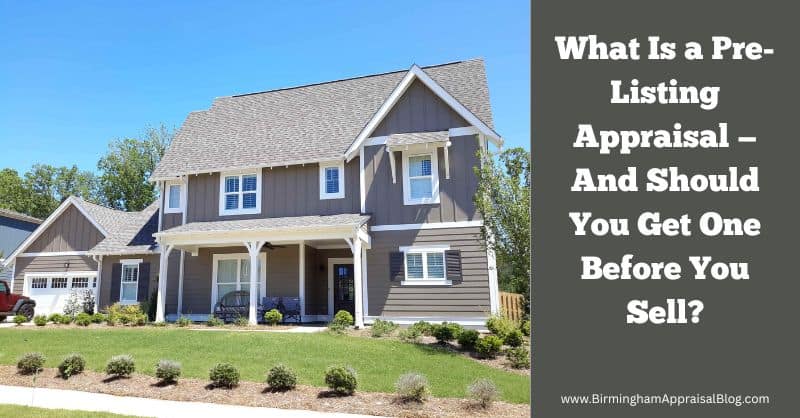
So what exactly is a pre-listing appraisal?
A pre-listing appraisal is an appraisal that is ordered by a seller or their agent before the home is listed for sale. It’s not done for a bank or a lender; it’s done for the benefit of the person selling the home. Just like any other residential appraisal, the appraiser will inspect the property, measure the home, take photos, research recent comparable sales, and arrive at an opinion of market value. The difference is that this appraisal can be used to accurately price your home based on what is currently happening in the market, using recent sales and current listings, which will be the competition for your property.
It’s worth pointing out that a pre-listing appraisal is not the same as a CMA, or Comparative Market Analysis. A CMA is a useful tool that most real estate agents use to come up with a suggested list price, and I’m not saying there’s anything wrong with them. But a CMA is put together by an agent, while an appraisal is done by a licensed or certified appraiser who follows specific guidelines when selecting comparable sales and making adjustments. The two can arrive at similar numbers, but they are not the same thing.
Why would a seller or agent want one?
The most obvious reason is pricing. Setting the right list price is one of the most important decisions you’ll make when selling a home. Price it too high, and buyers will pass on it. Price it too low, and you’re leaving money on the table. A pre-listing appraisal takes a lot of the guesswork out of that decision because it gives you an unbiased, data-driven opinion of what the home is worth in the current market.
I’ve been appraising for around 35 years, and I’ve seen what happens when a home is overpriced. It sits on the market longer than it should, buyers start to wonder what’s wrong with it, and eventually the seller has to cut the price anyway, often ending up below where they would have been if it had been priced correctly from the start. It doesn’t always happen that way, but it happens enough that it’s worth paying attention to.
A pre-listing appraisal can also be a big help when it comes time to negotiate. If a buyer comes in with a low offer, you can always show them the appraisal. And if the buyer’s lender later orders their own appraisal, there shouldn’t be many surprises because you’ve already done the homework.
For real estate agents, a pre-listing appraisal can be a useful tool when you’re working with a seller who is letting their emotions get in the way and may not be realistic about what it’s worth. It’s a lot easier to have that conversation when you have an appraiser’s independent opinion to back you up.
What a pre-listing appraisal is NOT
I want to make sure this is clear because I think it’s where some confusion comes in. A pre-listing appraisal is not the same as the appraisal the buyer’s lender will order after you go under contract. The lender’s appraiser is independent and is not required to reach the same value conclusion you have. Most of the time, the numbers will be close, especially if the pre-listing appraisal was done recently using the same pool of comparable sales. It is possible that they can come in differently because the real estate market is not precise. Most appraisals are within a close range of value
A pre-listing appraisal is also not a home inspection. An appraiser looks at the condition of the home as it relates to value, but we’re not going to be testing every outlet or pulling up flooring to look for moisture. If you have concerns about the physical condition of your home, a home inspection is a separate service.
How much does it cost, and is it worth it?
The cost of a pre-listing appraisal will vary depending on the size and complexity of the home, but most residential appraisals can run anywhere from $450 to $650, depending on the property itself and the location, which determines the scope of work. I know that might sound like an added expense you weren’t planning for, but think about it this way. If a pre-listing appraisal helps you avoid a price reduction of several thousand dollars, or keeps a deal from falling apart at the appraisal stage, it’s probably the best money you’ll spend in the whole selling process.
I’ve had sellers tell me after the fact that they wished they had gotten one before listing. In most of those cases, the home sat longer than expected, the price got reduced, and by the time it sold, they had spent more in carrying costs and stress than the appraisal would have ever cost them. That’s not always how it plays out, but it’s something worth keeping in mind when you’re weighing the cost.
When does it make the most sense?
Not every home sale needs a pre-listing appraisal, but there are certain situations where I think it’s a smart move. These include:
- Homes that are hard to price because there aren’t many similar sales in the area
- Properties that have been significantly updated or renovated
- Homes that are unique in some way — unusual floor plans, large acreage, mixed-use potential
- Sellers who are going the for-sale-by-owner (FSBO) route and don’t have an agent to help them price the home
- Estate or inherited properties, where the family may not have a realistic sense of the current market value
- Situations where the agent and seller are not on the same page about price
On the other hand, if you’re in a neighborhood with a lot of recent sales activity and your home is pretty typical for the area, an agent’s CMA may be all you need. The goal isn’t to add more to your to-do list; it’s to make sure you have the right information before you make one of the biggest financial decisions of your life.
Conclusion
If you’re thinking about selling and any of this sounds familiar, it might be worth talking to an appraiser before you list. A pre-listing appraisal may not get rid of all of the confusion in the selling process, but it can give you a much clearer picture of where you stand before you list your home for sale. If you have questions about the process, feel free to leave a comment below or reach out, and as always, thanks for reading.
If you liked this post, subscribe by email (or RSS feed).
The post What Is a Pre-Listing Appraisal — And Should You Get One Before You Sell? appeared first on Birmingham Appraisal Blog.
]]>