You can read the court’sruling against Gilabert here.
Gilabert’s suit was filed year-end 2012, and generated a year of litigation and upwards of $30,000 in costs for the defendants, despite its transparent lack of merit. The pro se complaint, which made little legal (or logical) sense and was filed beyond the California statute of limitations for libel, nevertheless demanded $10 million in damages. Motivating the suit was Gilabert’s displeasure at a case brief by Logue on HF-Implode.com (a sister site of ML-Implode), recounting his 2007 confession, conviction and imprisonment for hedge fund fraud. The brief consisted solely of excerpts and summarization of federal case files regarding the Gilabert Ponzi from the justice department, the federal courts, and the SEC (which fined and banned Gilabert).
The suit follows in a well-worn pattern of prior ML-Implode attackers, seeking to “whitewash” the online record of their dubious (if not outright criminal) escapades, through the device of frivolous litigation (read about our immediate prior victory here). In this case, it appears Gilabert is grooming the public for his (presumably illegal) re-entry into the money management game, as can be gleaned not only from this suit, but from numerous “astro-turfed” PR wire releases by Gilabert, portraying himself as a benevolent and charitable tycoon (we won’t do him the favor of linking to them, but they are easy to find).
Unfortunately, because the American legal system is so obscenely expensive and provides little in the way of meaningful penalties for frivolous behavior and legal abuse (the present anti-SLAPP ruling being relatively rare), bullies like Gilabert still think they can easily exploit the system to browbeat and silence small-scale critics. And more often than not, they are right — most defendants won’t, or can’t bankrupt themselves to defend free speech, as ML-Implode has.
Further, a reward of costs (such as in this case) is but small consolation to defendants when (as here) it is unlikely to even be collectable. And even if costs are recovered, ML-Implode will receive nothing, because Gilabert’s panicked attempt to dismiss the suit voluntarily after realizing the defendants were formidably “SLAPPing back” resulted in Implode being formally dismissed (the law suit then continued versus Logue, the principal defendant and author of the contributed text).
[We would of course appreciate your donations, as we operate on a shoestring in the face of such continued threats.]
Prior case files and related materials are available here:
- Dismissal with prejudice (`Anti-SLAPP’ ruling in favor of defendants)
- Site of original Gilabert/GLT fund post on HF-Implode (with comments on Gilabert’s threats)
- Logue re-post and additional words after Gilabert threat
- Gilabert’s former Ponzi partner publicly comes clean (while Gilabert, fresh out of jail, denies all)
- Logue and Implode file “anti-SLAPP” in Gilabert case (filing and additional case info)
- Hedge Fund Felon Gilabert Ups Harassment Campaign Against Implode (Gilabert’s attempts to get ML-Implode shut down by its internet hosting companies, before suing)
- The anti-SLAPP motion filed by Defs.
- Gilabert’s filed complaint
The HERA law went into effect on October 1, 2008, effectively shuttering all of these outfits.
An ML-Implode blogger had been investigating one such seller-funded downpayment assistance ‘program’ (SFDAP)-scheme described above, called the Grant America Program (GAP), and decided to blog about it and its ‘colorful’ founder, Christopher Russell. The interesting (some might say shocking) thing about GAP was that it achieved the SFDAP downpayment-channeling (some might say ‘laundering’) by using an Indian tribe — the Penobscot Indian Nation (of Maine) — as the conduit for funds (this was necessary as the IRS had just cracked down on the use of 501(c)3 nonprofits when used for the identical purpose). ML-Implode’s blogger sought to expose the gory details of this questionable scheme (some might argue, illegal even before the 2008 HERA law), as well as other questionable business dealings of Russell — who also happened to be the founder of Ameridream (Russell left Ameridream by 2004 under something of a cloud, which included acrimonious litigation over an ‘F— Ameridream’ web site, and a tax “excess benefit investigation” by the organization’s board. Russell insists to this day the departure was completely copacetic).
After interviewing Russell and poring over existing articles and government reports, the article was published, in mid-September of 2008. While excellent, it added little genuinely new information — instead, mostly pulling together already-public (though disparate and voluminous) items. And given that this sort of scheme was conclusively outlawed by the 2008 HERA law (effective October 1, mere weeks later) — you might think that this was the end of the story. But sadly it was not.
Russell, a litigious fellow, discovered the first version of the article posted to the blog on ML-Implode, and threatened to sue. After slightly softening some of the language (in hopes of appeasing the would-be plaintiff, rather than to correct any actual mistakes), the author re-posted the story a few days later with all of the same information. Russell, whose demand to withdraw the article was totally unqualified (and didn’t contain any actual correction matter), immediately proceed to sue.
The lawsuit was filed in Maryland federal court, and the rest is history.
You can read here about how Russell & friends attempted to get a “prior restraint” injunction on ML-Implode from publishing the article — even before the merits of the case were heard (the worst sort of tactic against free speech). They lost devastatingly (read the opinion denying the injunction).
You can read here how Maryland’s flawed “Anti-SLAPP” law, meant to allow rapid dismissal of frivolous libel suits (importantly, with costs awarded) failed to come to the aid of ML-Implode, as the law is written in such a way that it demands “proof” by the defendants that the suit is motivated by bad faith (the exact opposite burden that would make sense for this sort of law — in contradistinction to California’s Anti-SLAPP provision).
(Later, concrete evidence surfaced that Russell, and implicitly, his counsel, knew the lawsuit was frivolous).
In 2011, the costs of the lawsuit (over $100,000) were taking their toll, and IEHI (ML-Implode’s corporate owner & operator) ran out of funds to continue to pay counsel to defend itself, and thus defaulted. Things looked grim for ML-Implode and the cause of online free speech at that point.
However, in an amazing 11th-hour save (and after three years of searching), IEHI was able to locate a talented attorney willing to continue the case pro bono, Charles Borrero. Borrero led the effort to vacate IEHI’s default (effectively reversing it), which was granted on January 3, 2013.
You can read the motion to vacate memo here and the court’s rationale in granting it here.
At that point, the case was back on, and headed for trial again.
However, IEHI and its counsel wanted to try one last attempt to dispose of the case before any additional time and resources were wasted (including the federal court’s own resources… and your tax dollars), so a motion for summary judgment was put together. IEHI’s motion argued a number of grounds, including the immunity of ML-Implode as a publisher (as opposed to author) of the content (per U.S.C. 47 § 230); the lack of actual malice by ML-Implode or the author in producing and posting the article; journalistic privilege, and the fact that Russell (as someone profiting from government-backed loans) was at least a “limited purpose public figure,” thus deserving of less strict libel protection than a genuine private citizen.
You can read IEHI’s summary judgment memo here.
On September 18, 2013, IEHI’s summary judgment motion was granted, ending the case. You can read the court’s opinion here.
In the opinion, the court agreed powerfully with the USC 47 § 230 argument — that IEHI/ML-Implode had immunity, as a mere publisher-editor of the content, rather than its originator. The court reinforced recent precedents which held that serving (essentially traditional) functions of an editor does not confer liability to any meaningful extent for the purposes of S. 230 immunity.
The opinion is an unqualified victory for free speech, as it even-further eliminates any doubt as to whether independent, online publishing is “real” publishing, deserving of the protection long assumed for major newspapers and magazines, or of the immunity of internet service providers with respect to the user content they carry.
EPILOGUE
Despite the above much-appreciated (and we think, hard-fought) victory (which vests not only for us, but anyone who would make use of free speech online), IEHI would like to caution that “the system” is still far from safe for small, independent authors and publishers of online content — from a casual Facebook comment-poster all the way up to a small, independent online magazine. In the digital age, such persons can be dragged into court in any of the 50 states by someone (particularly rich and entrenched interests) who is merely “offended” by what the poster/author has said (or perhaps has something to hide), and who then retaliates by launching a nuisance libel lawsuit (a “SLAPP” suit) precisely because they know it will bankrupt the target, or force them to back down and self-censor. While such suits are, by their nature, meritless, that is besides the point — they always succeed tactically, as even the Penobscot/Russell suit here did, by destroying the target financially.
For these reasons, IEHI still recommends that anything of importance (i.e., that might upset the “powers that be”) online be published outside of the US, and anonymously.
To bring meaningful free speech back to the US, a patchwork of inconsistently-formulated and applied state “Anti-SLAPP” laws is not enough. In the current world, where increasingly public discourse takes place not in the context of major brick-and-mortar media companies (with their own legal departments), but outside of them, a federal “Anti-SLAPP” law (with teeth) is needed to make the American internet safe for much-needed critical public commentary once again.
ADDITIONAL CASE FILES
- Opinion pro-summary judgment
- IEHI’s summary judgment memo
- Plaintiff’s summary judgment reply brief (a great tour-de-force of bad lawyering!)
- IEHI’s summary judgment surreply (mostly shoots down Plaintiff’s “evidence”, or lack thereof)
- Krowne surreply declaration
- Summary judgment surreply – exhibits
- Court’s opinion granting reversal of IEHI’s default
- Motion to vacate default – IEHI memo
- IEHI’s Anti-SLAPP memo
- Plaintiff’s Injunction – hearing and denial (transcript)
- Original complaint by plaintiffs
- Plaintiffs’ motion for injunction
- IEHI’s opposition to injunction
- Krista Railey’s (the blogger’s) declaration
- Defendants’ exhibits
- Plaintiff Attorney Exhibits
- Russell Exhibits
- Railey Grant America/Penobscot article
Founder, The Implode-o-Meter
There’s been plenty of press about the gold (and silver) “crash” of April 12 and 15th, most of it yielding a not-so-subtle schadenfreude stench. Â This is not so surprising, as anyone who has been openly positive about the precious metals’ prospects given today’s “new normal” of unprecedented “high-powered” money-printing is well-acclimated to being derided as a “gold bug” by a press which is institutionally hostile to the notion of resurgent gold, and in all likelihood, full of writers who fancy themselves financial mavens yet who are smarting for having “missed the boat” on gold themselves.
One of the key arguments of this press coverage as it seeks to provide a “compliant” explanation for the recent gold slam is that the “announced” sale of gold by ailing Cyprus was the trigger that caused the market to take its epic tumble. Â This article is typical.
Nevermind that the “announcement” turned out to be at best a leak, and quite probably, no more than a dubious rumor, as the Cypriot central banking officials quickly (and angrily) went public denying such a sale had even been discussed.
Whether or not this news is “legit”, there’s the tiny little issue of whether it is, in fact, even bearish for gold. Â After all, if it’s not, then it neither explains, nor justifies the gold price slide (implying that perhaps all of those investors and consumers scrambling to buy up every physical ounce of precious metals right now might be onto something), and virtually all of the financial press is either complicit in a manipulation, or has gotten the story so wrong it’s got some very rotten egg on its face.
First of all, the amount of gold would be tiny, which is not surprising, as Cyprus itself is rather smallish. Â Â The sort of proceeds expected, about $525 million, correspond to only about 11 tonnes of gold. Â That might sound like a lot, but as Eric Sprott has pointed out, global central banks (driven mostly by Asian and developing world countries) are actually buying net 500 tonnes of gold a year. Â Â That makes 10 or 11 tonnes look pretty piddling by comparison. Â And indeed, it’s ludicrous to suggest that a one-year decline of this buying from 500 tonnes to 490 tonnes would explain the recent dramatic market move.
The argument is further shown to be inane when you note, as Sprott did, that this net 500-tonne buying trend is only a recent reversal from an approximately 400-tonne a year central bank selling trend (mostly by the strapped-out G8 countries), under the Washington agreement.
If one dwells for too long on these figures, one might legitimately ask whether this dramatic swing (-400 tonnes a year of demand to +500 tonnes) has even been fully priced into the gold market!
But I digress.
Let’s assume for argument’s sake that the Cyprus “gold sale” was to be a large one. Â You still have a major problem for the bearish interpretation of the sale, because this gold wouldn’t be sold in the sense of simply being “dumped” on the open market, but rather, it would be snapped up by counter-parties/creditors of Cyprus who want something concrete (or, viewed another way, some “insurance”) for all their loans to the island.
But, this would perhaps not be so obvious to anyone who was not following recent years’ news about the “re-monetization” of “high-powered” gold (far be it from mainstream financial journalists to keep tabs on such “barbaric” topics. Â Still, I think it is not too much to impose a “should have known” standard on the financial media for such an important subject…)
What do I mean? Â Here’s just a small sampling:
- 2010-12-26: World Bank Boss Urges Gold as Formal Monetary “Reference Point”
- 2011-02-07: JP Morgan Accepts Gold Bullion as Collateral
- 2011-05-25: The Economic and Monetary Affairs Committee of the European Parliament has approved gold to be used as collateral confirming its status as a high-quality liquid asset
- 2011-08-23: German Minister Demands Gold Collateral for Future Bailouts
- 2011-09-21: LBMA campaigns for gold to be Tier 1 asset for banks under Basel III
- 2011-10-07: LCH.Clearnet to Accept Gold As Collateral
- 2012-01-09: Netherlands Urged to Repatriate Gold Reserves
- 2012-06-18: US Financial Authorities Assent to Gold As “Zero-Percent Risk-Weighted” Asset per Basel III
- 2013-01-15: German Bundesbank To Repatriate Gold From New York Fed
- 2013-12-13: EU Regulators To Delay Basel III Implementation Till 2014
In truth, what is going on here is that gold is being “re-monetized,” writ large. Â This is because we are irreversibly past a point where, financially, a “great moderation” is over, and we are in an “age of turmoil”. Â In such an age, when financial trust and reliability breaks down, gold shines. Â That’s because it’s serving its historical and best intrinsic function: as a money of last resort (of course, even in good times, it should still be held as “insurance,” otherwise one is likely to have none of it when the time comes when it is needed more “actively”!)
Global central bankers have acknowledged that we have experienced “some” turmoil, but they are still in denial (or at least, want you to believe) that it is all just a “speedbump”; that they’ve “got everything under control,” and we’re not in some extended “age” of turmoil — which they have no control over, and for which the only way out is to rebuild the economy (organically, from the ground-up — and that means most of the entrenched money and power must lose its position).  Virtually all mainstream media coverage reflects this unified “just a speedbump” storyline.  But, as the above reports abundantly make clear, the trend is in place, and the information is out there revealing that gold is unstoppably cycling back into its “foreground” role.
So what does this have to do with Cyprus? Â Well, characteristic of when gold is re-asserting its monetary role, it is because some of the largest economic entities in the world no longer trust each other, and want something more “concrete” in their dealings. Â Rather than discarding gold like refuse as the “sale” rhetoric might imply, it would only be “sold” because some other major entity really wants it (as is illustrated amply by the above news items). Â This means that the “supply” is never “hitting the market,” so it cannot depress price, and further, it means that there is more demand present than there was in the prior “great moderation”, where gold was simply being “dumped” (the biggest pool of sellers has become the biggest pool of buyers, with no one taking their former place).
This dynamic is corroborated by the switch from 400 tonnes of annual sales to 500 tonnes of annual buying, by central banks alone (per Sprott, above). Â This further illustrates that we have crossed a Rubicon, where now “down” (gold sales) really does mean “up” (large-scale demand for gold outstripping whatever minor sales remain).
Importantly, there is precedent for this in the early 1970s era where the previous global monetary regime of “Bretton Woods” was breaking down, triggered by the US’s 1971 default on its international gold obligations. Â A quick review: from the end of WWII until 1971, the US dollar, backed by gold at a fixed exchange rate, was in turn the basis for all global foreign exchange, with all other developed world currencies secondarily pegged to the dollar. Â As part of this system, countries could “cash out” their surplus dollars in the form of gold, and many did, as trade imbalances increased into the end of the 1960s — until Nixon “unilaterally withdrew” from the system in 1971.
In the tumultous few years that followed, the global financial authorities attempted to maintain the peg to gold at artificially low rates (implying a much more “valuable” dollar and paper money system), ultimately without success. Â By the mid-1970s, the gold-dollar peg was abandoned, initiating a free market in gold that culminated at nearly $800/oz in 1980.
But key for our discussion is that even before gold the gold peg was finally abandoned, central bankers really knew that gold needed to be, and was being “re-monetized” (at something closer to its true market value), and their machinations revealed this. Â Case in point was the bail-out of Italy by Germany in 1974:
… in 1974 the official rate of gold was at $42.22 an ounce. However, the free market price of gold reached $180 an ounce. The free market price of gold increased the borrowing power of bankrupt Italy, which had 2,500 tonnes of gold, from $3.7 billion to $15.8 billion. On September 1, 1974, West Germany lent Italy enough money to stave off complete collapse using the free market price of Italy’s gold holdings as collateral.
The most interesting part in this deal was that West Germany never collected on the gold. It was accepted on faith that if the loan could not be repaid then the gold would be shipped to West Germany. Almost overnight, the gold in Italy suddenly became someone else’s liability. However, as long as Italy was able to make their payments on the bailout then there would be no question of whether or not they would ship the gold in the event of default.
Thus, it is easy for these machinations to take place “behind the scenes” and seem to amount to nothing. Â And here is the real kicker:
This [arrangement] gave every incentive for both West Germany and Italy to hope for the rise in the price of gold.
(Many more enlightening details of this era of history can be found in Antony Sutton’s “The War On Gold”, if you can find a copy.)
In other words, once gold starts being used as high-powered collateral, the “incentive structure” totally shifts, and governments and other major financial entities should actually want the price to rise. Â It is only really a problem for parties (i.e. countries such as the US) prior to the point-of-no-return of re-monetization, who don’t have nearly enough gold to collateralize their liabilities (they are thus facing an overt default).
Viewed through this lens, the tentative Cyprus gold transaction is quite interesting: you have a proposed “sale” of gold to raise EUR 400 million, in order to secure EUR 10 BILLION of bailouts.  For those keeping score at home, that means the gold collateral would be supporting as much as  TWENTY-FIVE TIMES its current “paper money” valuation (depending on the concrete value of whatever other items of collateral Cyprus puts up)!!
And here’s the ultimate upshot: such a transaction would be implicitly acknowledging as much as a $35,000/oz valuation of gold (coincidentally, reminiscent of the zaaaany, “gold-buggy” predictions of the likes of James Turk and Jim Sinclair).  Obviously, if the actual math of the collateral works out to even just a tenth of that, it would still represent more than a doubling of the current gold “price.”  In the 1974 Italy case, it was a 4.2x “revaluation”; so it wouldn’t be surprising if the real conversion rate worked out to something comfortably in the middle of 2 and 25 times (but it would probably be towards the higher end, since governments and banks are so much more indebted now than they were in the Bretton Woods-breakdown era).
Whatever the precise numbers way, selling gold is not what any sane person wants to be doing right now. Â But you won’t hear that from your friendly neighborhood mainstream financial media.
The above hasn’t even touched on the other aspect of the Cyprus debacle: the imposition of a “bail-in” regime where bank depositors can actually lose money. Â This is another “Rubicon” crossed — that deposits are no longer sacrosanct, and it’s not just Cyprus: it has been revealed that both Canada and the EU (and even the Swiss!) have “suddenly” written such “bail-ins” into their ongoing plans. Â Obviously, somewhere, at a very high level, it has been acknowledged that there simply isn’t enough money for “bail outs”, and outright printing of the money is “too obvious” (after gold’s rally to $1900/oz in 2012), so it has been determined that “bail-ins” must be on the table. Â This is a huge deflationary change (meaning money is at risk, i.e. financial panic), which is far more gold positive than run-of-the-mill inflationary expectations.
(For further discussion of this deflationary dynamic specifically as it pertains to gold, see Professor Fekete’s latest excellent article.)
So perhaps the thesis above, that gold is moving rapidly towards “re-monetization” (informal if not formal), actually best explains the recent price turmoil — but not with Cypress as the trigger; instead, with the default of Dutch bank ABN Amro on its physical gold obligations, and soon thereafter, the shutdown of the LBMA physical gold platform (the premier large-scale buying venue) on April 12th, simultaneous with the anomalous, un-economical dumping of 400 tonnes worth of paper gold contracts on the US COMEX futures market. Â In other words, the key large-scale physical buying platform was shut down, leaving an abundance of major physical holders/buyers with little option besides selling or hedging on the futures exchange (see here, here, and here, for details.)
It seems to us that the scramble for physical gold, in acknowledgement of its true value (at much higher fiat money prices than the paper markets reveal today), is unabated by the prior few weeks events, and in all likelihood, has been dramatically accelerated by them… Â “paper” price notwithstanding.
]]>
(See previous article for more background on the case).
Gilabert has been stymied because Logue had already filed an answer against Gilabert prior to his own filing of voluntary dismissal (on 2/22), and timely filed the special “anti-SLAPP” motion to strike (which is with prejudice, awarding costs).
This is the worst of all possible words for the pro se (read: “couldn’t find a lawyer to front this Mickey-Mouse, frivolous, harassing lawsuit”) plaintiff Gilabert — he has lost the ability to intimidate Krowne and Implode, but must still wage the suit he started, and in specific, come up with a compelling answer to Logue’s anti-SLAPP motion, or he will be forced to pay the defense’s costs.
Gilabert has in fact filed an answer, which (unsurprisingly) is completely juvenile, rife with question-begging (i.e., presumes Logue acted with malice) on practically every other line, and even includes fabricated quotes (such as on Page 4 where Gilabert writes falsely as if Logue said “lies on her blog are an issue of public interest.”) Â More seriously, even if Gilabert could find a specific fact that Logue was wrong about, it would not undermine the “sting” standard for libel, which dictates that a statement cannot be libel if the overall thrust of it (the “sting”) is true. Â Gilabert’s reply to the anti-SLAPP conveniently ignores this argument — showing that his approach is still one of hoping to drown out the other side (and anything negative about himself) by being more vocal at “picking nits”.
Meanwhile, Gilabert’s convicted “co-conspirator” Justin Paperny is making it increasingly difficult for Gilabert to argue against the “sting” of truth, as Logue summarized it, since Paperny has publicly come completely clean about the scam and mended his own ways.
(We recommend watching the excellent Matt Damon film “The Informant” for a treatment of the sort of hair-splitting, endless-denying pathological lying demonstrated by Gilabert.)
A hearing will take place on 4/22 in which the anti-SLAPP (and Gilabert’s counter arguments) will be heard.
The case is 2:13-cv-00578-GHK-RZ, Central District of California Federal Court.
]]>For starters, it’s interesting to note that Gilabert’s collaborator (in a “feeder” capacity), Justin Paperny, has come completely clean, admitted to his part in and the overall fraud, and totally reformed himself. Â Yet, despite pleading guilty in the same scheme, Gilabert is still running around denying that the whole thing ever happened.
Regulars may remember that towards the end of 2011, Gilabert awoke from his “slumber” (that is, 5 years in federal prison for hedge fund Ponzi fraud) and went ballistic when he noticed a “squib” about his case on HF-Implode.com. He threatened Implode founder Aaron Krowne by email, demanding the piece be taken down, despite it consisting of nothing more than a basic description of his case from the federal filings and press releases (Gilabert was punished not only by the Department of Justice but the SEC as well). Â (This sort of frivolous libel threat is called a “SLAPP“.)
Not having the financial resources for a fight after four previous frivolous SLAPP suits from various mortgage industry offenders and neer-do-wells (see here, here, and here), Krowne did take down the post, but in its place, put a copy of Gilabert’s outlandish take-down letter and an explanation so readers would know why the piece was gone (and maybe learn a little bit about the lack of practical free speech available to small-time publishers in our country).  Logue re-posted the “squib” on her site, and Krowne linked to that instead.
Logue then wrote additional text underscoring the veracity of her original piece on Gilabert.
In other words, Gilabert’s efforts at intimidation had completely backfired.
(That’s the thing about SLAPP suits — when they work (perhaps most of the time) to silence free speech, they work great, but when they fail, they fail big, and they may very well backfire horribly publicly-wise, and even bury the plaintiff permanently).
Infuriated by the sites’ refusal to completely censor themselves at his whim, Gilabert threatened to file suit. Nothing was done for a year (as it turns out, past California’s statute of limitations for libel), and then belatedly, Gilabert filed suit against Logue, Krowne, and a semi-legible smattering of web site domain names.
Notably, Gilabert filed a self-serving wire press release at the same time as filing his complaint (we won’t link to it and help his cause of “astroturfing” to create a fake positive reputation for himself), portraying himself as a victim merely “trying to clear his good name” from the mean ol’ bloggers (somehow) profiting from defaming him.
While Gilabert never properly served either Krowne or Logue, the defendants were serious about pushing back against Gilabert’s blatant anti-free speech, financial fraud-burying harassment. Logue hired an excellent free speech lawyer, and Krowne (currently a law student and appreciative for the “internship” opportunity) helped put together the filings.
Logue, not a California resident, filed a reply and “removed” the suit to federal court. Gilabert’s outlandish claim of “$10 million” in emotional distress injuries actually assisted this move, since federal courts require a dispute of at least $75,000 to assert diversity jurisdiction (big tactical error, frivolous libel plaintiffs!)
Seeing that the defendants were serious (and presumably, cr*pping his pants thereupon), Gilabert quickly filed a voluntary motion for dismissal without prejudice. Â (Besides, he had already achieved his goal of having a filed complaint upon which to base his self-serving press release).
What Gilabert did not realize is that courts (especially federal courts) do not like their time wasted on patently frivolous suits, especially from incorrigible felons like Gilabert (e.g., Gilabert violated his own conditions of bond by ham-handedly attempting to hide assets from the FBI while his case was pending) and have created a variety of tools to disincentivize and punish frivolous litigation behavior.
One of these is California’s “anti-SLAPP” law, which creates a special type of dismissal for frivolous libel suits. This dismissal is with prejudice (which means the plaintiff cannot re-file) and, importantly, awards costs to the defendants.
The defendants, via Logue, have now filed a California anti-SLAPP motion to strike, and you, dear readers, now get the privilege of reading this very informative, and entertaining document.
]]>The BLS [yesterday, October 5th, 2012] reported a gain of 114,00 in nonfarm payrolls. That compares with a gain of 574,000 in the actual, not seasonally adjusted number. In the actual (NSA) data September is always an up month. Last year the September NSA gain was 697,000. In 2010, it was 496,000. The 10 year average gain for September for 2002 to 2011 was 533,000. This year’s September gain came on the heels of very strong NSA gains in August.
Unlike the August SA number, which had a big upward revision, note that the August NSA number was not revised. There’s a problem with the seasonally adjusted fictional number, not with the actual NSA data. The SA number for this month will subsequently be revised for the current month in each of the next 5 years as the BLS attempts to fit the SA number to the actual change. It will also have a major benchmark revision in February, when the benchmarking process is finalized.
Fox News and Jack Welch are accusing the Administration of cooking the books. Ironically, last month I complained:
The Bureau of Labor Statistics (BLS) must be staffed with Republicans. There’s something wrong with the headline number this month. It is consistent with the pattern of the past 5 months where the seasonally adjusted (SA) headline numbers appear to understate the trend of the actual, not seasonally adjusted (NSA) numbers.
A few weeks after I posted that, the BLS came out with its preliminary benchmark revision announcement that it had underestimated growth from April 2011 to March 2012 by 386,000, and that as a result of the new benchmark all of the previously published data for 2012 would also be revised up.
Lo and behold the August SA headline number has now been revised up by 46,000 and July has been revised up by 40,000. The BLS headline number is really lousy data, but the market pays attention to it. We need to look at the best data we can find to know the truth about what’s going on. That means watching things like the withholding tax data and actual, not seasonally adjusted first time unemployment claims trends.
The BLS will revise this month’s number, not only next month and the month after, but every year for the next 5 years as they hone the SA number to include a look back to pinpoint where this month’s number actually should have been. The truth is that the current SA number is a wild guess and a fraud. It’s wrong, and the BLS statisticians know it and have publicized that fact, but the mainstream media has ignored the warnings for years.
So let’s get real, ok. The SA data is unreal. The actual NSA data is much closer to real. The withholding tax collections are really real, but from time to time may be skewed by IRA distributions, so we need to be alert for anomalies in that data.
The numbers above come from the BLS the Current Employment Statistics Survey or CES, a survey of business establishments. The BLS also does a survey of households. To further complicate matters, the household survey or CPS — Current Population Survey– often tells a different story from the establishment survey.
In the CPS, September is a month in which the actual NSA number usually decreases. This year the number of persons reported as employed in September rose by 775,000 from August, not seasonally manipulated. That compares with a gain of 167,000 in September 2011 and a drop of 204,000 in 2010. The average loss in September for the previous 10 years was -343,000.
The 2% year over year gain is consistent with the gain shown by withholding taxes. By this standard this was a very good month. There was little discrepancy between what the withholding tax data suggested and the BLS actual NSA survey data. If anything, the withholding data suggested a stronger number, but it may have been skewed by non-payroll related factors.
I like to focus on full time rather than total employment. Part time jobs are nice, and for many that hold them, they are a lifeline, but the important metric here is full time jobs. Without those, we’re dead.
As opposed to the gains in total jobs, full time employment in the CPS was down by 536,000. Part time jobs increased by 1.3 million. That reversed a shift over the summer where part time jobs shrank by 1.75 million. This is not about a sudden deterioration in the jobs market. It’s about kids with full time summer jobs going back to school and shifting to part time work. Even though the number working full time dropped by 536,000 in September, the total of 115.7 million is 1.1 million more than were working full time in May, before summer vacations started. Last year over the same time frame the gain in full time jobs was just 362,000. This year’s gain was also far superior to the 10 year average of 350,000.
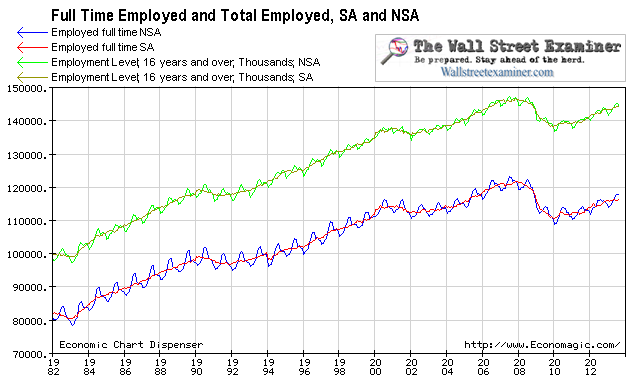
Full Time and Total Employed Long Term View – Click to enlarge
The chart above gives some perspective on how far total employment and full time employment fell in the first stage of this depression, and how much they have yet to recover. The BLS applied big upward revisions to the seasonally adjusted (SA) fiction for July and August bringing it closer to the trend, but it is still a little behind. That should be corrected to some degree in February when the annual benchmark revisions are applied, but the SA line will not fully conform to the trend for another 5 years. Note that prior to 2007 on this chart, the SA lines perfectly mimic the year to year trendlines. That’s because all the revisions have been finalized for those years. This year’s line is still constantly shifting in response to new data and subsequent revisions. The SA line for this year will not be final until 2017.
Seasonally adjusted numbers frequently veer away from reality by the very nature of the arbitrary seasonal adjustment process. ‘Conomists and the media focus almost entirely on this nonsense, which attempts to compare one fictitious number with another fictitious number to derive a fictitious month to month change. Meanwhile they ignore the actual data and ridicule analysts who complain about the misleading nature of the SA data.
If they are going to emphasize the seasonally adjusted fiction, they could at least check it against the trend of the real data, the not seasonally adjusted (NSA) data as shown in these graphs.
The chart below shows the year to year trend line connecting the September data in full time and total employment along with the raw NSA data, and the SA fiction. The seasonally finagled data shows the trend catching up in both series due to the big upward revisions to the July and August data. Prior to this, from March through August the SA line had been diverging from the actual trend, particularly in full time employment.
Unlike technical analysts who actually know how to read patterns and trends in noisy data, the vast majority of mainstream ‘conomists who have sold their souls to the devil (CNBS) seem to have no clue how to to do that. Instead, they use the idealized, overly complicated SA data which obscures the truth. But the public gets it. They can tell by how they, their friends, families and acquaintances are faring in the real world.

Full Time Employment Short Term View – Click to enlarge
June or July is usually the peak month for both total and full time employment. This year the numbers broke last July’s level in April. The economy was a couple months ahead of schedule in affirming the uptrend in jobs. That uptrend is still firmly entrenched, even in the full time jobs including the September decline. The gains have clearly accelerated in 2012 versus 2011. The idea that the economy slowed in 2012 is hogwash. With QE3, the Fed is adding more fuel to a fire that was already beginning to burn hot.
If we had thrown out all the confusing numbers and just look at the actual data on the chart, it was clear that the trend was improving in August. But Wall Street wanted more QE, and the headline numbers through August were just coincidentally playing to what the Street wanted. I wrongly thought that the Fed knew better and wouldn’t act. I gave them too much credit.

Full Time Employment, Stocks, and The Fed – Click to enlarge
The withholding tax data shown below also suggested that something in the labor picture is still undergoing consistent gains, regardless of what the SA data says. Increasing withholding tax collections of 2% in real terms are growing at double the rate of population growth. Stronger economic data immediately ahead may be good news for stocks in the short run, but will probably ring the death knell for bonds.
Stock market performance is at the mercy of the Fed (0r over the past 12 months the ECB, not shown), and employment typically reflects them both. While at times there’s a lag, the linkage is undeniable. Over the past year, the SOMA has not reflected the impact of the Fed’s MBS purchases from the Primary Dealers, a subject which I cover in depth weekly in the Fed Reports. The graph of Fed purchases from the Primary Dealers has been rising steadily since last September. By cashing out the dealers via these MBS buys, the Fed enables the dealers to buy more Treasuries. The next week, the Treasury spends that cash. That’s how Treasury debt is immediately transformed into economic activity and slow and steady job creation. With new QE, the Fed will be adding even more cash to power that trend.
This is activity that is sustained only by increasing government debt, and only as long as the Treasury Ponzi remains intact. But it does remain intact, and it’s resulting in steady gains in employment, including full time employment over the past year. The game should continue until the Fed picks up the marbles or until the other players run out of chips, which probably won’t happen as long as some players are running away from the European gaming tables to play at the US casino or either the Fed or ECB continue to pump liquidity into the system.
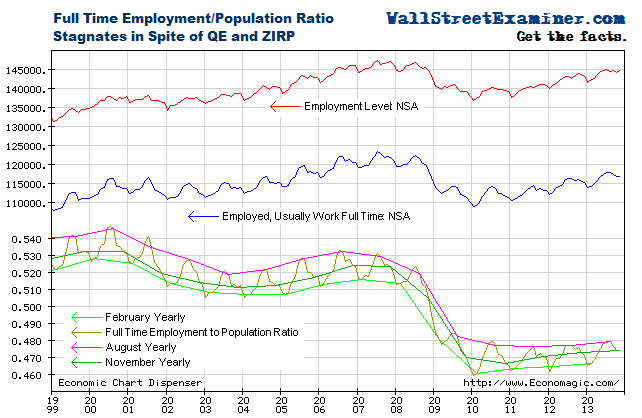
Full Time Employment to Population Ratio – Click to enlarge
Average Weekly Earnings and Hours Worked
Updated October 5, 2012.
Average hourly earnings were up 2.5% y/y in September, accelerating from 1.8% in August. Average weekly earnings were up 4% versus 2.1% in August. Average hours worked were up 1.5% versus 0.3% in August. Therefore the gain in weekly earnings is mostly due to rising wage rates, and to a lesser extent an increase in average hours worked. This is evidence that inflationary pressures are building while the Fed drives in the rear view mirror.
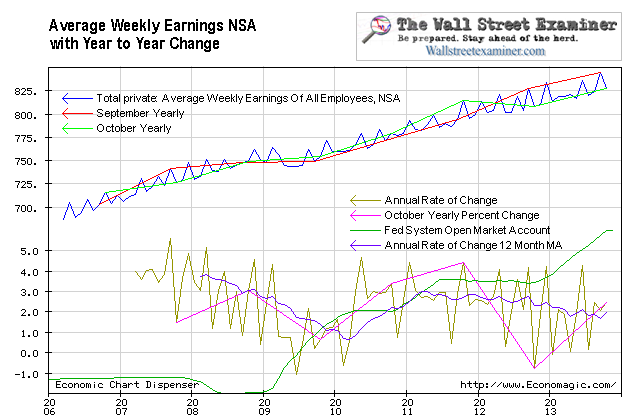
Average Weekly Earnings – Click to enlarge
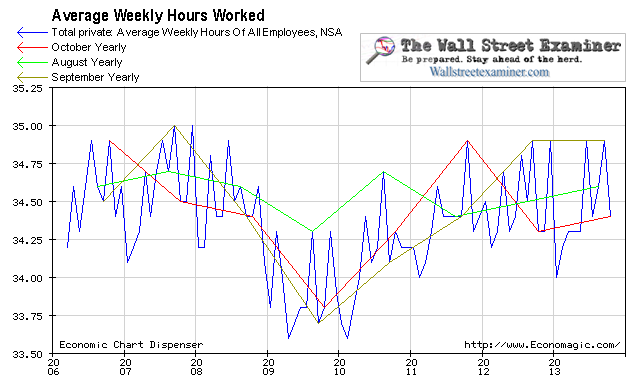
Average Weekly Hours Worked – Click to enlarge
The uptrends in hours and earnings could be a sign that the labor market is tightening in spite of the huge numbers of people out of work. The issue may be that many of the unemployed do not possess the skills that are in demand in the market. Mortgage application takers and processors, and construction laborers generally do not make good computer game programmers. Economic pundits must face the fact that the 10 million fake jobs spawned by the bubble are not coming back. The 7.8% unemployment rate is probably “normal.” The bubble unemployment rate of 5.5% was abnormal.
Stay up to date with the machinations of the Fed, Treasury, Primary Dealers and foreign central banks in the US market, along with regular updates of the US housing market, in the Fed Report in the Professional Edition, Money Liquidity, and Real Estate Package. Try it risk free for 30 days. Donâ€ t miss another day. Get the research and analysis you need to understand these critical forces. Be prepared. Stay ahead of the herd. Click this link and begin your risk free trial NOW!
Imagine how much in bad MBS was sold overall — but whose buyer banks have simply not happened to fall into the eager arms of the FDIC.
Well, you might not have to imagine, because this is now a repeating pattern, with the FDIC (thankfully) becoming much more aggressive in doing something about being effectively insolvent itself.
To wit: back in mid-August, the FDIC announced a suit against eleven banks for selling securities to Colonial Bank, of 2009 Taylor Bean Whitaker-Colonial collapse fame. That suit seeks at least $189 million.
Now, this is all in a day’s litigation for these banks, we’re sure, but we can’t help but observe two things:
-
the Colonial collapse was something we warned about here — a year in advance — and which the government notoriously ignored (admitted by the then-incoming FHFA I.G.). We wonder how much extra money was lost because of that critical final year of the Ponzi scheme.
(Whistleblowing advocates might also want to note from this episode that we were stymied from going public with the tip, rather than just reporting it to FHFA, because of the impact of frivolous `SLAPP’ libel suits on us from corrupt mortgage entities).
- it is not clear in the new suit how much of the losses if any are actually due to the TBW/Colonial Ponzi! What is fascinating is this lifts the curtain a bit more on general losses due to MBS fraud by banks, just beginning to be uncovered by the FDIC.
Initially we assumed this was a transient error and just played the waiting game, as these sort of things usually work themselves out in the internet world. However, after a few days, it was still “radio silence” for COMCAST customers who also happened to be our readers. Complaints continued to pour into our inbox. We began advising people to now actually call COMCAST and complain, since perhaps the ISP was not aware of the situation.
Fantastically, in response, COMCAST technical support staff is actually telling people that the problem is with them (the customers)!
This is despite the fact that if the same people use workarounds — different DNS servers and/or software like OpenDNS –they can access ML-Implode and our other sites just fine. So the problem is provably with COMCAST’s centrally-managed DNS list.
It’s worth noting that COMCAST has over 20% of the internet service provider market share in the US, so one in five people in the US are being blocked from ML-Implode & friends!
Now that many of its own customers have made COMCAST aware of this, and a week has passed, we are forced to consider that “foul play” may be involved.
Many readers will recall that back in June, Wells Fargo, in an unprovoked action, closed the bank account of ML-Implode and, outrageously, all other accounts associated with ML founder Aaron Krowne (including another corp with a separate TaxID, and a nonprofit 501(c)3 — clear tortious interference… if any attorneys out there would like to take this on as a pro bono case…)
Wells Fargo went ahead with this action (a mere one day after Krowne learned it was looming) despite being made aware that there was no justification (i.e. problem with the account(s)). In other words, the decision had apparently been made from the top, and the “account review” letters sent out to ML-Implode were just a smokescreen/fraud.
We wrote about that publicly, which even provoked a canned response from a Wells Fargo PR lackey.
So now we have to wonder: did Wells Fargo pull strings with COMCAST to “punish” ML-Implode by blacking us out to the major US broadband provider? Or — even more disturbing — are Wells and COMCAST both mere instruments of a concerted action being directed from even higher levels — i.e. a harassment and subversion campaign by the government itself (and/or the masters of the all-powerful “banking cabal” — who make the US federal government jump when they say “jump”)?
Since COMCAST is by far the largest ISP, if “someone” wanted to send a signal to our plucky truth-to-power-speaking site by making it “disappear” as viewed from a single internet service provider, COMCAST would be the one to pick to send the clearest message — horse-head-like.
Of prime relevance, such web site/domain name “blackout-like” actions have been one of the government’s single-minded, demented obsessions very recently, as they have pursued a virtual rapid-fire series of legislative attempts to gain the ability to “turn off” internet domain names (and thus the web sites hosted on them) with as little checks on such a power as possible. Usually “copyright piracy” is the bogeyman providing the justification. First there was COICA, which died in the Senate, then SOPA and PIPA, which yielded to public and some industry outcry; and then the ACTA trade agreement (more or less bypasses the whole “Congressional” hassle) which was actually signed (but not yet ratified) in late 2011 and encompasses many of the same censorship risks as SOPA and PIPA.
But even more disconcerting to students of history and those who take close not on how tyranny expands its tentacles is that governments will often seek to pass such laws merely to provide a cover of legality for what they are already doing.
One has to wonder.
]]>The media was a bit excited in reporting that the July federal budget deficit had dramatically shrunken. For example, while noting that “$35 billion in monthly recurring benefit payments that would have been made in July were accelerated to June because July 1 was a Sunday,” Bloomberg’s report neglected to point out that that would have negated the shrinkage. In addition, the report neglected to note that a whopping $23.4 billion end of June semi-monthly withholding tax collection that would normally come in June was delayed until July 2. This was, again, a calendar effect due to June’s last business day being Friday, June 29. Negating those two calendar effects, the budget deficit for July would have been up, not down.
Here’s how Bloomberg reported it.
The U.S. governmentâ€
The gap shrank 46.2 percent to $69.6 billion from a $129.4 billion shortfall in July 2011, the Treasury Department said today in Washington. Last monthâ€
“On an underlying basis and absent policy changes, it appears that we are on a path for the deficit to narrow by roughly $100 billion per year,†said Stephen Stanley, chief economist at Pierpont Securities LLC in Stamford, Connecticut. That is “moving in the right direction but not nearly fast enough,†he said by e-mail before the report.
via U.S. July Budget Gap Narrows on Lower Spending, Payment Shifts – Bloomberg.
Both the Bloomberg reporter and Mr. Stanley apparently failed to consider the details available in the Daily Treasury statement that are not apparent from a cursory review of the monthly Treasury Statement. Tracking the data from the Daily Treasury Statement throughout the month makes these effects clear. I warned Professional Edition subscribers about it on July 13 when the June Monthly Treasury Statement was released.
Wage withholding was down 5.5% in June versus June 2011, falsely suggesting a weakening economy. That was completely due to the last business day of the month falling on June 29. Semi weekly, and twice monthly withholding for the end of June would be delayed into July. In fact, $23.3 billion in withholding taxes were remitted on July 2. Thatâ€
From – Is death star on the horizon for Treasury panic bubble?
When analyzing and comparing Federal revenues and outlays from period to period, being cognizant of the calendar effects is critical to understanding what is actually happening with the trend. Considering these effects, July’s data does not imply that the deficit is improving in any material way. The daily data frequently tells a different story than the mainstream reporting.

Federal Revenues and Outlays- Click to enlarge
Over the past month, outlays have run about even with last year. Revenues were stronger than last year in early July, but dropped back to a very slight net gain in nominal terms in mid July through August 7. In inflation adjusted terms the comparison is now slightly negative year to year. On the basis of the monthly moving average through August 7, the budget gap has not improved at all.
Stay up to date with the machinations of the Fed, Treasury, Primary Dealers and foreign central banks in the US market, along with regular updates of the US housing market, in the Fed Report in the Professional Edition, Money Liquidity, and Real Estate Package. Try it risk free for 30 days. Don’t miss another day. Get the research and analysis you need to understand these critical forces. Be prepared. Stay ahead of the herd. Click this link and begin your risk free trial NOW!
]]>A popular Greenwich, CT real estate blogger who runs the site For What Itâ€s Worth is facing some aggressive bullying by the townâ€s Association of Realtors (the Greenwich Association of Realtors) and the big-money broker firms that sit on its board. This week the blogger, Christopher Fountain, was hauled in by the Greenwich Police after a staff member of the GAR filed a ‘concern for safety†complaint against him. No charges have been filed, but Fountain was subject to an hour long interrogation interview questioning his alleged intent to harm or harass the GAR.
The outspoken Fountain was a former real estate columnist for the Greenwich Post and currently works for EBTrealty to help home buyers find distressed McMansion deals in a town thatâ€s populated by some Wall Streetâ€s most successful and feared players – the hedge-funders. His blog (FWIW) highlights MLS listings by the GAR and informs the reader of details the association doesn’t really want on the open internet – like how much theyâ€ve dropped the price since first listed. His sharp, often gossipy, commentary has drawn near 9 million readers from around the world and challenges the Polyanna-ish fluff stories both Greenwich newspapers often print about the state of home sales for their bread-and butter-advertisers (‘McMansion’ home ads).
The pissing match between the blogger and his own trade association has taken a bizarre turn though as Fountain says the Greenwich PD let him go quickly after they became aware the complaint was exaggerating — if not lying — about Fountain’s actions. Now he says he plans to file an anti-trust complaint with the Department of Justice against the GAR and will contact the Connecticut Attorney Generalâ€s office over what he feels are cartel-like bullying tactics to shut down his independent blog and real estate business.
GAR is known to have some of the highest fees and MLS listing requirements in Fairfield County, CT, tied into some sort of exclusive mandate that doesnâ€t encourage members list elsewhere. The brokers also aren’t allowed to input their own listings it’s all controlled by the GAR staff. So Fountain has been floating business plans on his blog exploring how sellers could reduce their commission fees and is vocal about newspaper ads not being a value-add for the seller. “Any half page ad is really an ad for the broker firm. They donâ€t care about selling that home — they just want the calls coming into their office,†says Fountain.
You can see why he might be a thorn in their side in general, but there was one post that really set the GAR off. Fountain , who often referred to the association as ‘the evil princess†in daily blog post (without naming a specific individual) wrote a post talking about a new bullet called the ‘Zombie Bulletâ€. As a member of a local shooting club, Fountain wrote he was going out to the range — but wouldnâ€t be using any of the fictional ‘novelty bullets’. He also mentioned he would be driving by the GARâ€s headquarters on the way. While his tone might have approached a gray area of appearing to threaten to harm someone, it didnâ€t list anyoneâ€s name or say he was going to use the ‘bullets’ on an individual (or anything more literal, like shoot his gun at a building). Local readers and the GAR know sarcastic humor is often used in his editorial tone. Regardless, the GAR apparently got their vice president, Theresa Hatton, to file a police complaint against Fountain. The blog posting wasnâ€t enough to haul Fountain in, so it appears she gave the GPD ‘something else’ to take the complaint seriously. However, a copy of the complaint isnâ€t available to the public until the detective officially closes the case, so weâ€ll have to wait to see the details.
When I called and emailed Theresa for comment yesterday I got a surprising response. She denied ever filing a complaint and said there would be no further comment from the GAR. So I called the GPD records office and spoke with Gene who confirmed Theresa had filed a complaint (number 12-18939) against Fountain, and that the investigating detective was Robert McKiernan. I called Theresa back reminding her that when you file a police complaint the public can find out, and said that I didnâ€t understand why she was lying about it. Here we have an association go so far as to get a staff member (Fountain thinks a board member put her up to it) to file an aggressive complaint against a person for simply criticizing the organization and then they want to hide when a national journalist wants to report on it. Hmm… something smells funny, perhaps?
Fountain also claims the complaint was premeditated, as he got a call the day before the GPD ever reached out to him, detailing how a Greenwich Sothebyâ€s manager was bragging ‘We got Fountainâ€. A woman from Sothebyâ€s is on the board of the GAR.
Fountain, who is also a seasoned attorney, can handle the legal aspects of fighting what is looking to be very near to an ‘anti-SLAPP’ action against the GAR (SLAPP suits are baseless libel/defamation lawsuits that are levied by well-funded litigants against a smaller opponent whom they wish to silence — something ML-Implode readers know much about). In Fountainâ€s case, his detractors clearly havenâ€t been able to find any instances of libel or defamation, as no suits have been filed against him by realtors or broker firms — but I hear people often complain about the tone heâ€s taken when writing about them. Speculation is indeed often employed at his blog; the problem for ‘the haters’ is that this is the United States of America, so if itâ€s true heâ€s allowed to print it, and he can voice whatever opinion he has on what he is writing about. And if you don’t like it, you donâ€t get to make up a police complaint to try and stop him.
Not able to get an arrest, the Greenwich Association of Realtors has also threatened sanctions against Fountain because he uses ‘their’ house photos and provides links to their site when he writes about home sales. But the house photos donâ€t actually belong to the GAR (that would be the buyer or listing agent) and their listing data is open-sourced, so it doesnâ€t appear that they have an option to sanction. Nethertheless, he has not fought these edicts and has started to source photos from Zillow or other sites and has offered some fun commentary along the way.
Iâ€d imagine his DOJ complaint against the GAR is going to be one heck of good read.
Links for this article:
- http://christopherfountain.wordpress.com/2012/06/18/the-greenwich-association-of-realtors-keeps-up-its-drive-to-shut-down-this-blog/
- http://christopherfountain.wordpress.com/2012/06/18/sothebys-agent-to-third-party-we-finally-got-chris-fountain/
- http://greenwichrealtors.com/
- http://www.linkedin.com/pub/theresa-hatton/3/b2b/51