I quickly caught up to it as it began navigating its way down a boulder-strewn hillside. At this point I was able to photograph a few look back poses, and I started to plan where to position myself next. I had a rough idea of where the cat might be going, and was able to quickly walk ahead on an adjacent trail. As expected, the bobcat began walking through a grassy meadow after making its way down the boulders. It paused a few times, seemingly scanning for prey, and completely tolerant of my presence. It eventually sat down for a few minutes, then without warning ran off and could not be relocated.
In total I had 8 minutes with this individual, and I’m really pleased with the range of poses and photos I was able to capture in such a short length of time.
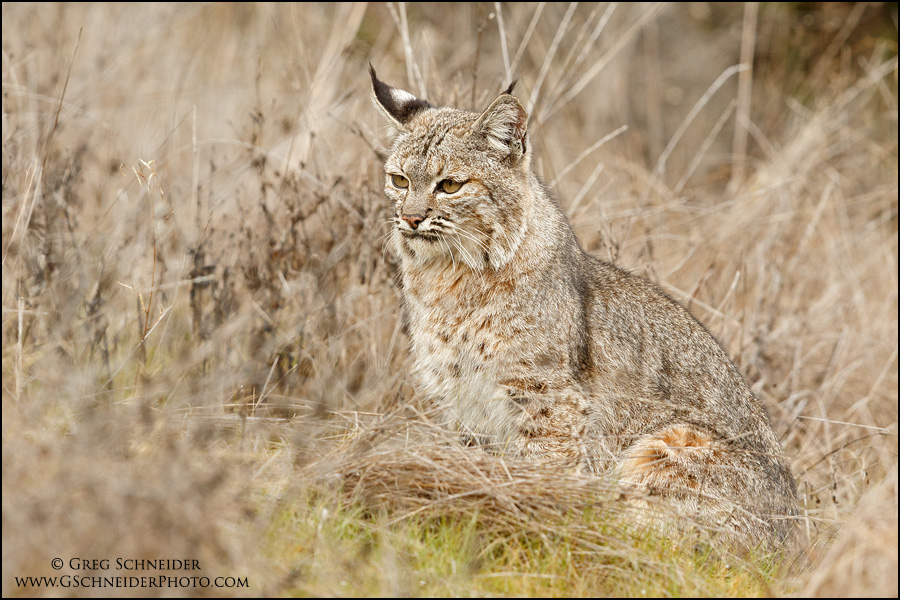
Adult Bobcat resting in grasses (click to enlarge)
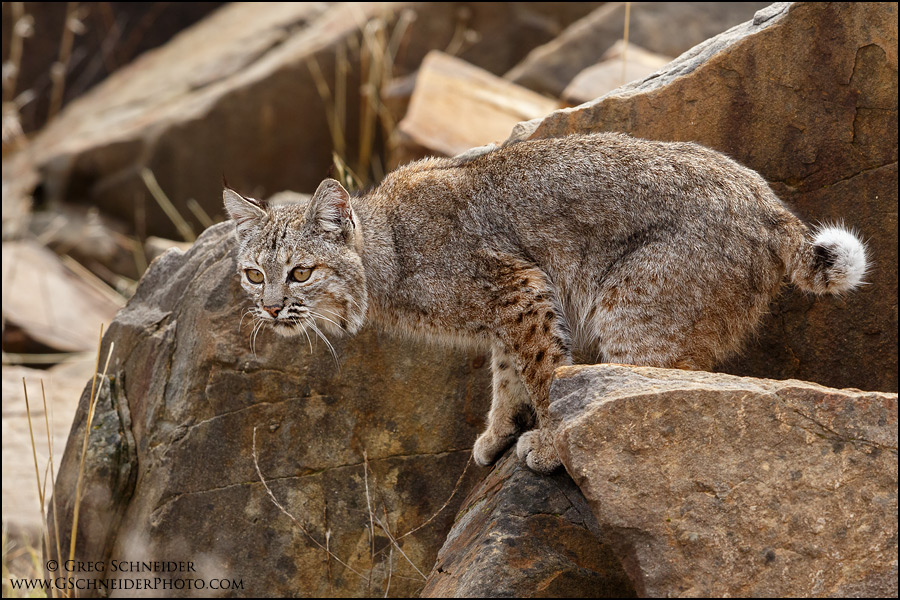
Bobcat stalking on rocks (click to enlarge)
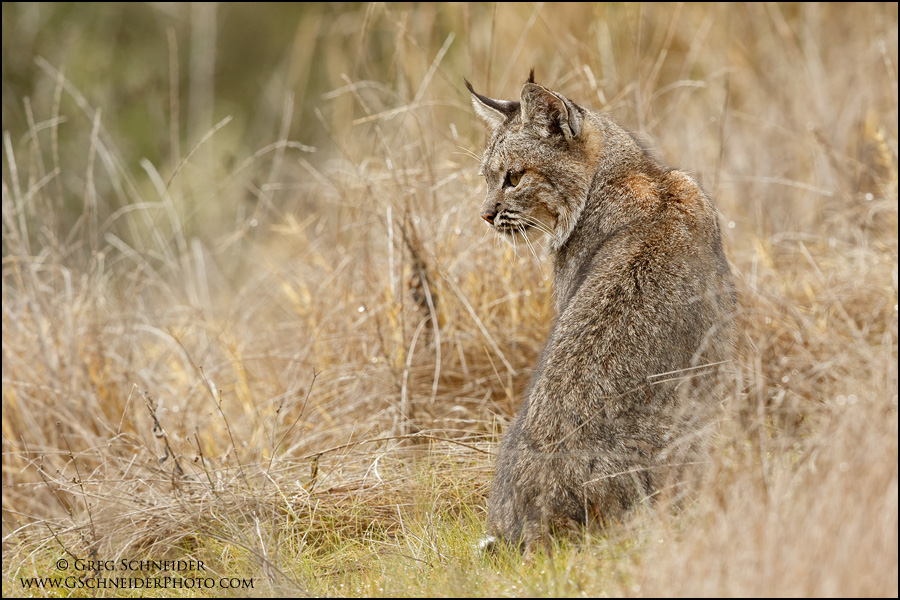
Bobcat scanning meadow (click to enlarge)
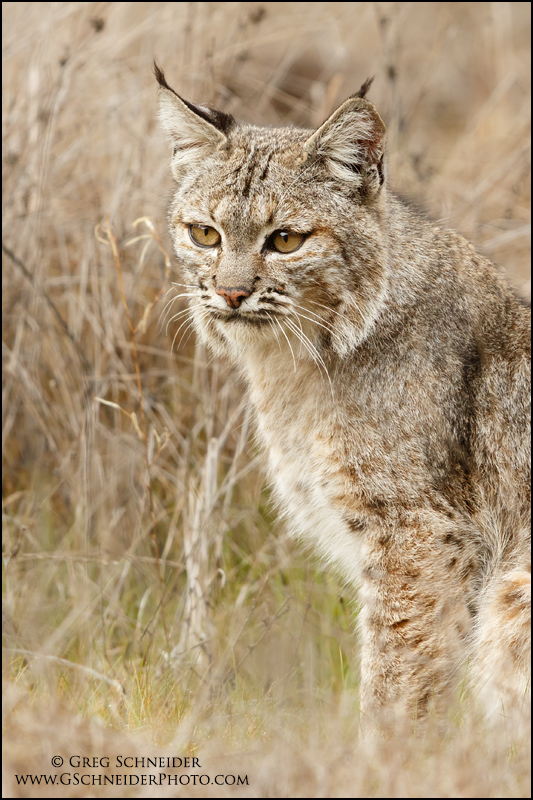
Bobcat Portrait (click to enlarge)
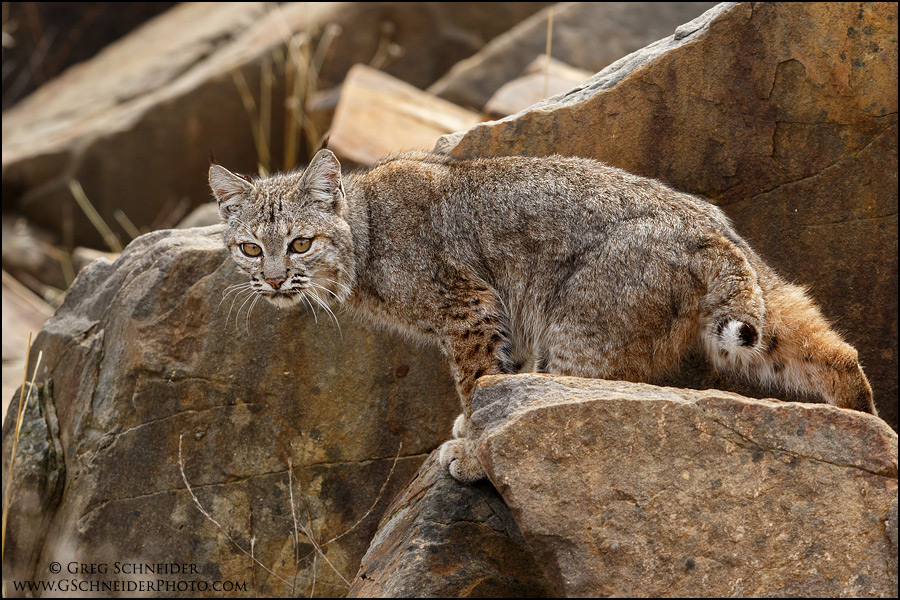
Bobcat on rocks (click to enlarge)
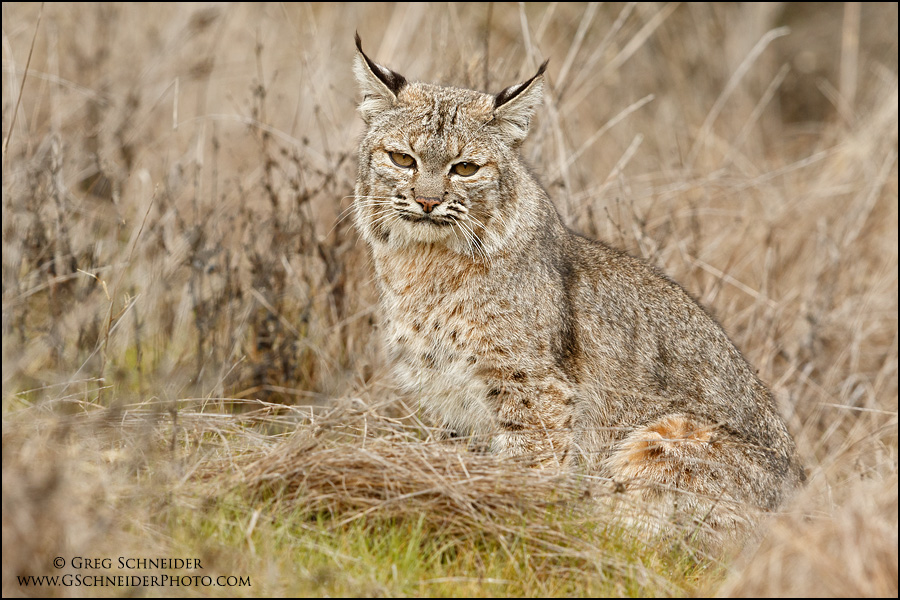
Bobcat resting in grasses (click to enlarge)
On one occasion did obtain several photos, and although the distance was much farther than I would prefer, I used slight more creative cropping to frame the bird in a pleasing way. Traditionally the general rule of thumb would have been to crop with the bird in the lower left part of the frame, but to my eye that left me with far too much of the tree trunk in the frame. To me this gives a great perspective on the typical rain forest habitat this bird lives in.
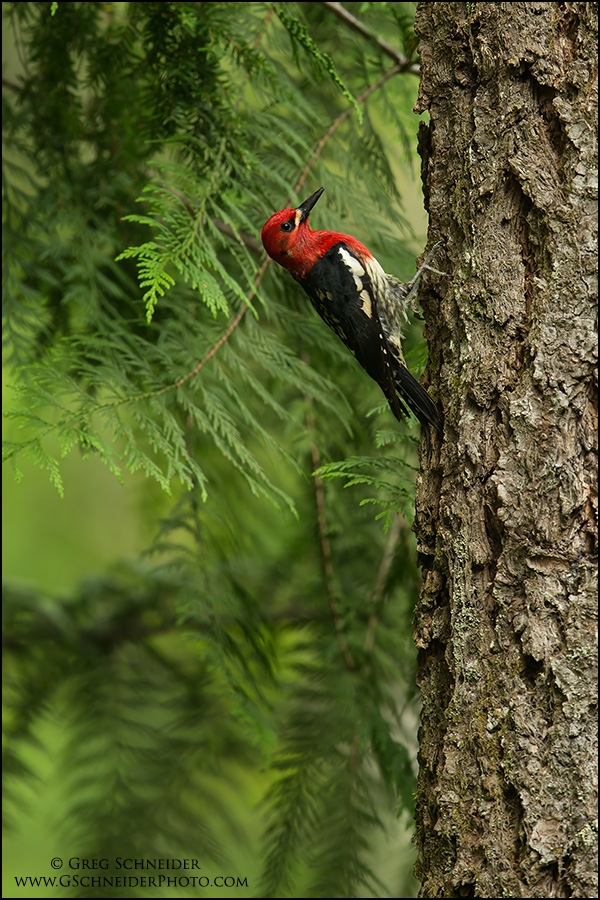
Red-breasted Sapsucker in Habitat (click to enlarge)
Below are a few of my favourite images.

Black Bear cub standing in a blueberry field (click to enlarge)

Black Bear sow (click to enlarge)

Black Bear cub eating blueberries(click to enlarge)
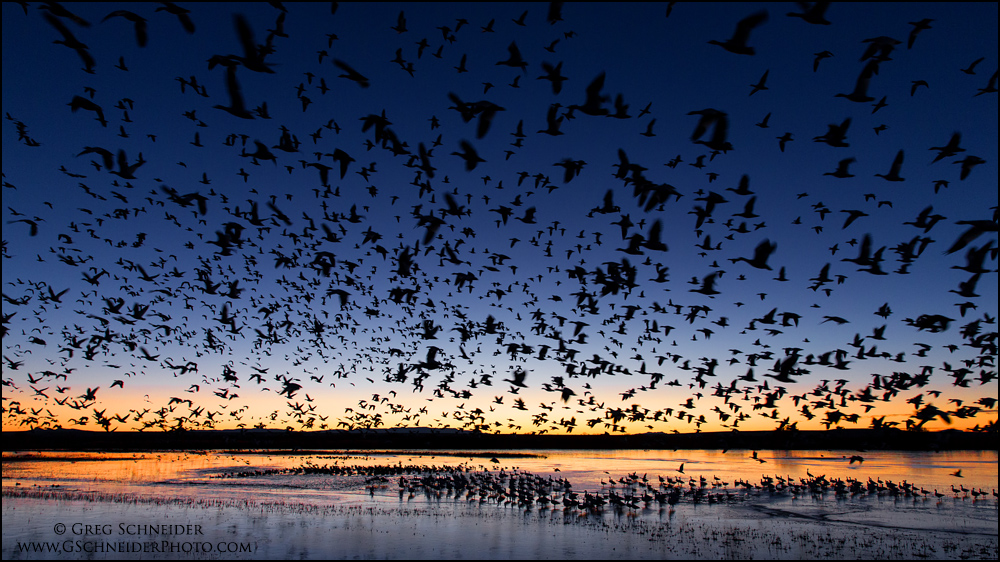
A flock of snow geese takes off at sunrise (click to enlarge)

Canadian Wildlife Magazine June 2013
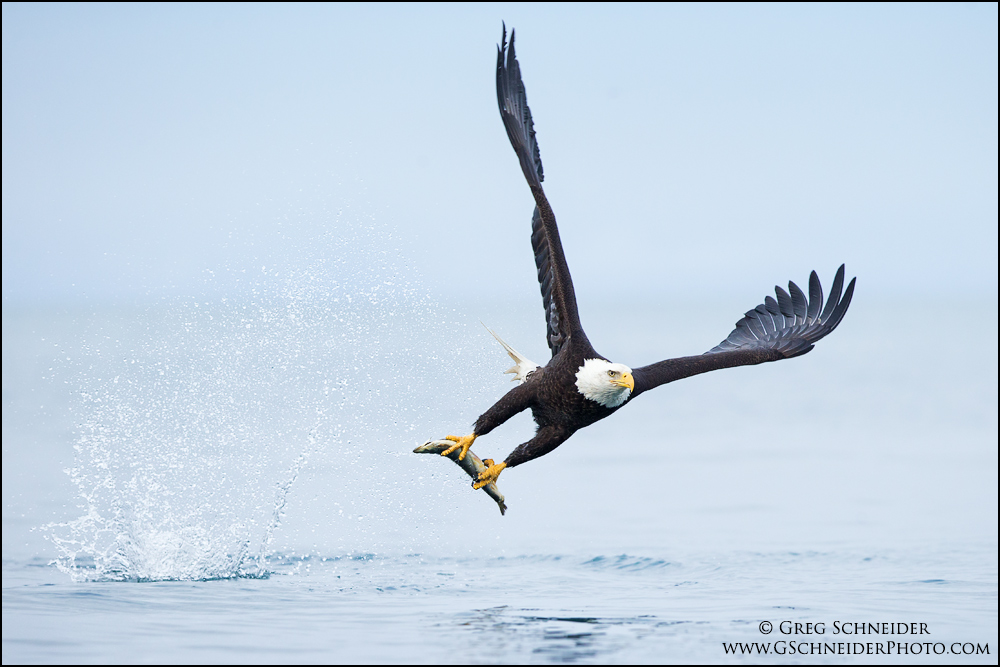
Bald Eagle snatch
I eventually settled on an exposure of 8-10 secs, at f8 and ISO100, which gave me sufficient depth of field for this purpose, and the longer exposure time allowed slightly more leeway for exposure variations and timing. In full disclosure, I did significantly cool the white balance in post processing to achieve the bluer tones, which are actually quite accurate to what I saw, just not what the camera interpreted of the scene.
Be sure to click on the photo for full web sized! Even at that resolution it doesn’t do this photo justice at all, and I wish I felt comfortable to share a high resolution image without having to worry about others using the image.

Prairie Lightning Storm
I visited on several occasions, and while opportunities are never guaranteed, one day in particular was incredible, with the young peregrines testing their wings, chasing each other and learning how to take food from their parents – all in midair. It is one of a kind sight to see a peregrine rapidly coast upwards on thermals, just inches from the gorge’s fall, spiralling hundreds of feet up, only to tuck its wings back in a rapid stoop in pursuit of prey. These spectacular stoops are almost too difficult to photograph at close range, as these have been measured at nearly 200mph! Here’s to hoping they return next year to entertain onlookers. To be honest, I think the birds are almost more curious about us at times than we are of them.
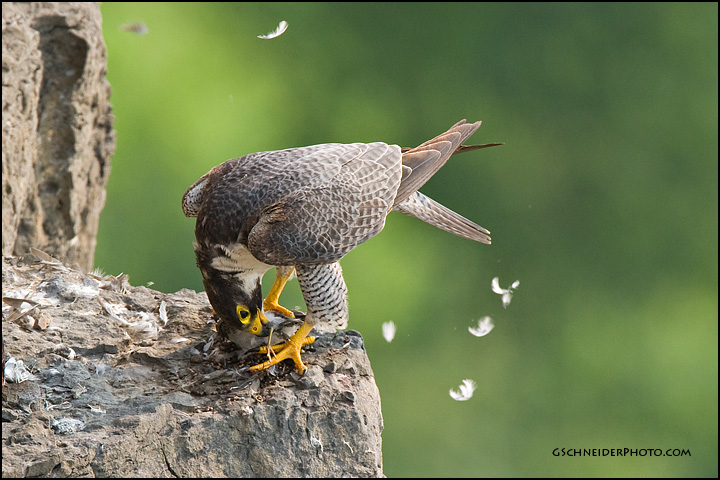
Adult peregrine plucking Spotted Sandpiper prey
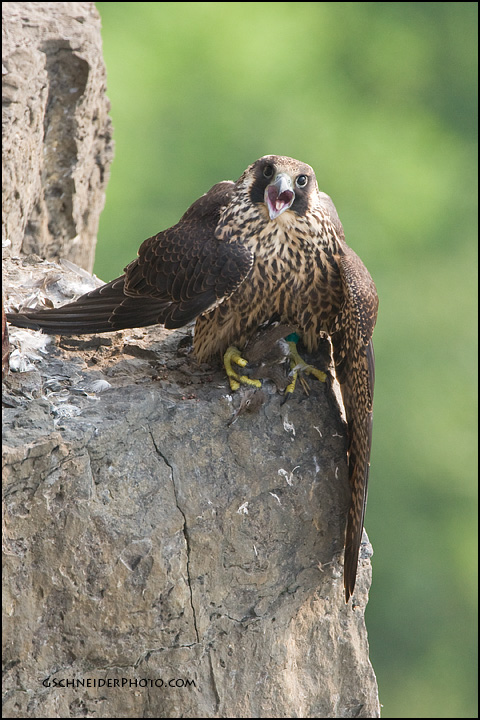
Juvenile peregrine with Spotted Sandpiper
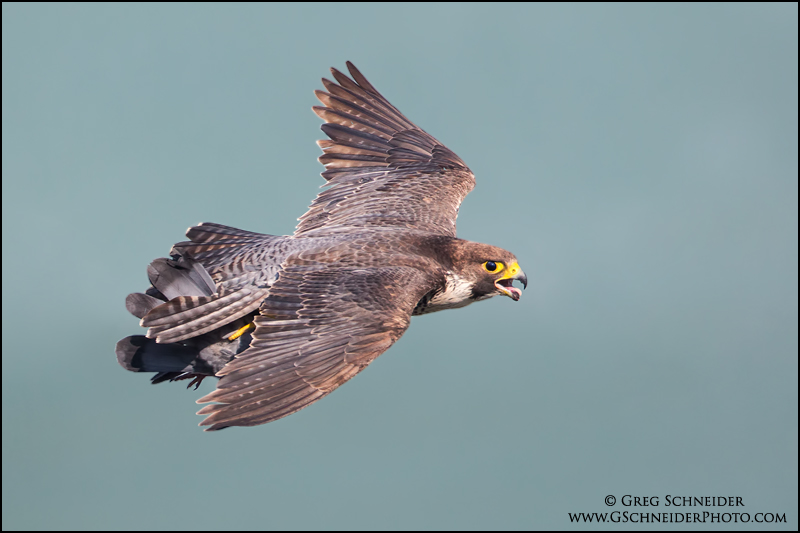
Adult peregrine in flight with pigeon prey
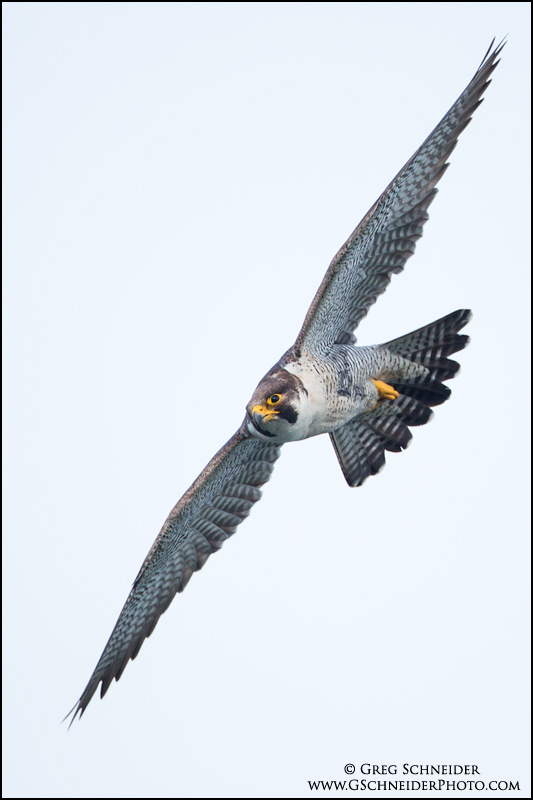
Adult peregrine banking sharply in flight
]]>
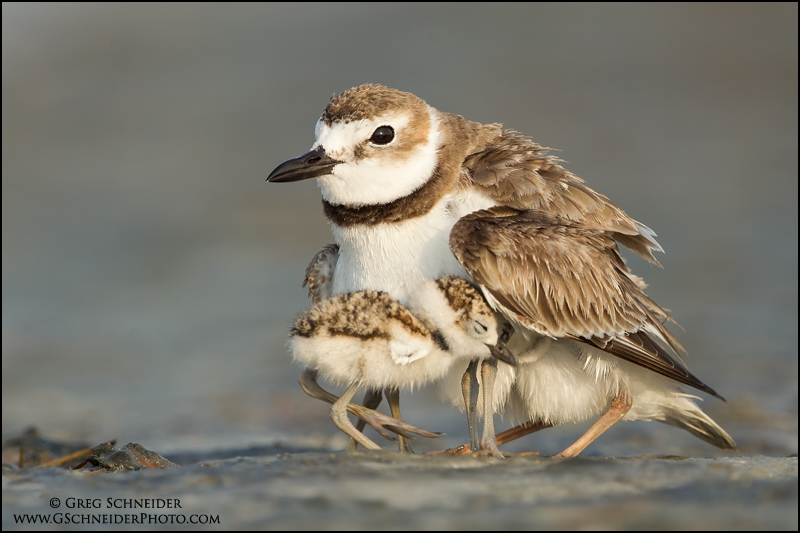
Wilson's Plover female brooding her chicks
- Build: it feels very similar to a 7D, which comes as no surprise as the body shape and buttons are nearly identical. That said, the weatherproofing is an improvement, and the camera feels very solid in hand. The shutter sound is a huge improvement over the 5DII, and it feels like a “quick” camera.
- AF system. This was my biggest concern with the 5D II, and the new AF system takes all those worries away. I would place it in the same league as the 1D Mark IV, equally as good or perhaps even better. Some differences (apart from the 7D-like focus modes) are smaller AF points, less coverage due to the full frame sensor, and less raw drive speed on initial focus acquisition. One issue I do have is that I cannot quickly select an AF point using the joystick as I can with a 1 series body. Having to press the AF button first is hugely cumbersome if you need to do so quickly. EDIT: this can be enabled using a custom function by assigning the joystick to direct AF point selection. There are many new AF settings and tracking modes, which may prove valuable in certain situations, and it’s great to see the menus have been improved with proper descriptions of what each setting does, and what scenarios to use them in.
- Buffer. Rated at 13 images in RAW, I saw about 18 shots at lower ISOs with a 400x card, before it started to slow down. At 6fps this is about 3 seconds of shooting, which is nearly identical in terms of time as the 1DIV buffer, and I don’t see it being a major issue, unless you are shooting at high ISOs and/or with a slower card and frequently hitting the buffer limits. Of course, a larger buffer would be welcome, and Canon has much work to do in catching up to the D4 here.
- Exposure and WB appear solid. I’ve never had major gripes in this regard, and the colour out of camera is far more pleasing than the 5DII, which usually needed extensive correction to look similar to my other bodies. That being said, my initial thoughts are that AWB is a touch cool when outdoors.
- Image quality: It’s hard to quantify this yet. What I can say is the banding that frequently plagued 5DII images is gone, or at least remarkably diminished. I would agree that the noise is lower than either 5DII or 1DIV, but won’t commit to a value. Processing plays a huge role in this, so check out the same images and decide for yourself!
Overall I see the 5DIII as a solid complement to the 1DIV. Due to the greater crop factor, higher fps and f8 focusing ability, I will continue to use the MkIV as my primary bird camera, unless I am not focal length challenged or need better ISO performance, but the new 5DIII is just as competent for everything else. One thing is for certain – you can no longer blame the camera for your shortcomings.
What I should note is there appear to be issues with the IS systems on the 200 f2 IS and 800 IS. Those lenses are seeing more IS vibration and feedback noise when used with the 5DIII, which I quickly noticed. Canon is working on a fix, but until then, it is likely to affect image sharpness at low shutter speeds.
I took some photos of gulls and geese flying around, and the camera tracked beautifully in a variety of AF modes. While these are not overly complicated targets, I do not have the same faith in the 5DII’s AF system. Additionally, I tracked someone jogging towards me for about 15 shots, and the AF was glued until the subject was close to MFD and thus could no longer compensate quickly enough.
- Gull at ISO3200. Blue tends to be a poor channel for noise performance in Canon bodies
- Mallard (ISO400)
- Gull in flight – the DR seems pretty decent
- Mute swan detail
- Goose landing. This is one in a sequence of 6 which were all equally tack sharp. I have my doubts that the 5DII would have performed as well
- Flicker at nest cavity (ISO1600)
]]>