
Is your nonprofit worried about not showing up in AI search results? It’s simpler than you've been told, and you probably already have most of what you need to do it.
The post Nonprofit Leaders: Showing Up in AI Search Results Is Manageable appeared first on Blue Avocado.
]]>
Earlier this year, I told our board members that we’ve already got a game plan in place for AI search. The response was impressed relief. I think they may have assumed it was something we’d need to scramble to figure out.
The truth is we were already doing work on this. We were building good content before AI became the latest run-don’t-walk thing in search optimization. We looked at what we already had and expanded it deliberately, greatly building out our FAQ content and structuring it so AI search tools could read it. And that turned out to be exactly what AI search was looking for.
I’ve been in online marketing for over 25 years, and I was doing SEO before Google existed. I even taught an Internet Marketing class for the Small Business Administration’s SCORE program. I’ve watched every major search change, and if there’s anything that’s remained consistent over the years, it’s that organizations focused on fundamentals tend to land on their feet.
To be clear, I don’t want to oversimplify or be dismissive of AI search optimization. While AI search is the most significant change since the beginning of search, it is also very much the latest phase of the cycle I mentioned above. Nonprofits should have a plan for it. There’s a growing marketing discipline around this, often called GEO, and FAQ content is one piece of it, not the whole picture. For most small- or medium-sized nonprofits without a dedicated SEO person, this is the highest-leverage piece to start with.
So let me tell you what we did at Nonprofits Insurance Alliance (NIA) and what happened. I’ll also tell you how you can do it for your own organization.
First, Know That ‘AI Search’ Is Not One Thing
Part of what’s driving the gold rush around AI search is that everyone is treating AI search like it’s one thing, but it isn’t just one thing.
When someone says “AI search” they might mean Google’s AI Overviews, which appear in roughly half of relevant searches. They might mean ChatGPT’s browsing function. They might mean Perplexity, Gemini, Claude, Copilot, or any number of other Large Language Model (LLM) tools that are now answering questions directly rather than sending users to websites.
Each of these pulls from different sources using different rules that can (and do) often change without notice or explanation.
I recently posted on LinkedIn about how volatile this is: Research tracking AI citation patterns found that when ChatGPT’s retrieval pipeline changed, the overlap in cited sources dropped by roughly 45 percent. Reddit lost 86 percent of its ChatGPT citation share in four days. Four days! No warning, no explanation.
You cannot optimize for all of it. Trying to do so is a distraction.
The only rational response to a fragmented and rapidly changing landscape you don’t control is to focus on what you do control. For most nonprofits, that means your own website and your own content.
At this point, I want to include a word on the environmental concern. I hear it often and it’s legitimate. AI infrastructure consumes significant energy and water, and many mission-driven organizations are very concerned about that.
But your presence or absence in AI search results doesn’t change the energy equation by a single watt. These tools are running whether you show up in AI results or not. The only thing your absence changes is whether your constituents find you or find someone else.
What We Did at NIA
About a year ago, the marketing team at NIA started paying a lot of attention to this, and we made a deliberate decision to get ahead of AI search rather than react to it. It was one of several priorities for the year, but it didn’t need a new budget or staff, so it was easy to greenlight and move on. Getting the content right took months of attention.
We built structured FAQ content. Deciding which questions and answers to include and rewriting years of scattered questions into something clear was most of the work. Our webmaster handled the technical implementation.
The marketing team worked with other departments at NIA to identify the questions nonprofits actually ask, the ones that commonly come up in support calls and emails and conversations, and we answered them clearly and completely on our website. We organized that content with proper headings and logical structure. Where it made sense, we added FAQ schema markup so search engines and AI tools could parse the content more easily.
The underlying principle is that AI tools are hungry. They are crawling the web looking for clear, well-organized answers to specific questions. If your content provides those answers in a format that’s easy to read and parse, you become a source. If your content is vague or outdated, you don’t. If it’s buried in PDFs nobody can index, you don’t either.
The schema markup piece sounds technical, but it isn’t something that requires a developer for most organizations. If your website runs on WordPress, there are plugins that handle it. If you use a website platform like Squarespace or Wix, the basics are often built in.
What matters more than the technical implementation is having clear, well-organized content in the first place. Schema is just extra information that helps AI tools confirm what your content already is.
What Happened
We maintained our organic search traffic despite changes in search behavior. AI-referred traffic increased. It wasn’t dramatic, or some extraordinary number I’m going to cite as proof of genius, but the change was meaningful. It was one thing to notice and validate the approach in the metrics. But it was really nice when the front desk emailed to let me know about the increased calls from people finding on us on ChatGPT (“Whatever your team did, it’s working.”)
I want to be honest about that because I’ve seen too many marketing case studies that turn modest results into miracle stories. What we got was stability and modest growth in a moment when a lot of websites were losing ground. And because it’s something we’ll continue to improve over time, the gains will be cumulative. This is now part of how we review content by default. It’s a system that is ongoing.
Any Size of Organization Can Do This (and You Already Know the Content)
If you’re running a small nonprofit with limited staff and no dedicated marketing person, I want to be direct with you: You don’t need to overhaul your entire digital strategy. You just need to do a few things well.
Start with the questions you get asked constantly. You already know them. Your staff and volunteers already know them. They might include:
- What does your organization do?
- Who do you serve?
- Where do you operate?
- How do people access your services?
- What does the process look like from first contact to outcome?
- How is your organization funded?
- How can someone donate or get involved?
- What makes your approach different from similar organizations?
- How do you measure your impact?
- Who leads the organization and what are their qualifications?
Let’s talk about the answers. AI tools are looking for factual, specific answers to real questions. Leave the marketing copy and hype out of it.
Write your FAQ answers the way you would answer a question from a colleague who has never heard of your organization: Direct and specific, without jargon. Save the mission-driven language for your fundraising appeals.
The answer to “How do I apply for services” should tell someone exactly what to do next.
Use headings. Break content into sections a person can scan. If you can add FAQ schema, great. If you can’t, just focus on the content.
Your website is only part of the equation. The research on this is consistent. A brand’s own website accounts for only 5-10% of what AI tools pull from. Third-party mentions carry the visibility weight.
So, content that you produce that gets picked up and referenced elsewhere is worth more than any technical optimization you could do on your own site. Your content strategy extends to every credible place your audience goes for information.
For nonprofits, that might include sector publications, local press, coalition websites, and the networks your leadership participates in.
One easy trick I recently posted about on LinkedIn: Keep your Google Business Profile or other local listings current. AI tools pull from those directly. It’s a five-minute update that your organization might not have touched in years.
The Bottom Line
Organizations having a hard time with AI search right now are the ones whose content was already not as strong as it could have been: Thin pages, outdated information, vague content that doesn’t actually explain what the organization does, not answering questions that stakeholders and donors actually have. AI search made those weaknesses more of a liability, and organization websites became less visible.
The organizations doing well were already producing content built for their audience. Good content with some structural improvements helped AI tools read what was already there.
I’ve been in this long enough to have seen this pattern before. The fundamentals don’t change as fast as the technology does. Good content, organized clearly, serving a real audience, and distributed through credible channels. That’s what worked before AI search and it’s what works now.
Your board members are going to ask about this. When they do, you can tell them you’re focused on content quality and structure. Tell them you’re monitoring AI-referred traffic. Reassure them that panicking and chasing every new minute platform change is a waste of resources that could go toward mission. Then go write down the questions your organization gets asked most often and answer them clearly on your website.
That’s where to start. For nonprofits of any size, it’s the majority of what you need to do in order to show up in AI results.
The post Nonprofit Leaders: Showing Up in AI Search Results Is Manageable appeared first on Blue Avocado.
]]>
Raising funds for your nonprofit doesn’t have to be stressful. Learn how one California nonprofit proved that, when designed thoughtfully and collaboratively, fundraising can be successful and enjoyable.
The post 9 Principles to Make Your Nonprofit Fundraising Effective — and Fun! appeared first on Blue Avocado.
]]>
This Article is Certified Gold Avocado
Gold never goes out of style — and neither does good advice. The Gold Avocado series showcases some of the very best content that Blue Avocado has for nonprofit leaders, based on overall popularity, reader response, and quality.
Create an effective fundraising campaign that spreads joy — for you, your staff, and the community.
See promotional materials examples at end of article.
Those of us who are executive directors of nonprofits may find ourselves reacting to the prospect of fundraising with mixed emotions. Our response to this critical task could include dreading asking for money, feeling anxious that we won’t meet our goals, or experiencing stress because of the many other responsibilities competing for our attention.
Wouldn’t it be great, though, if you could create a fundraising campaign that spreads joy — for you, your staff, and the community?
A Pain-Free 50th Anniversary Campaign
As the executive director of the nonprofit Sonoma County Parks Foundation (SCPF), I raise money to enhance more than 60 parks in the county parks system, as well as fund parks programs that benefit our community.
When I heard that Spring Lake Regional Park would celebrate its 50th anniversary in 2023, I immediately saw the potential for a fundraising campaign to benefit this beloved local site. With 800,000 visits annually, Spring Lake is among the most popular parks in Sonoma County, California. How could we not have a great time fundraising for this beloved park?
To begin, I set three goals for the Spring Lake Park 50th Anniversary Campaign:
- Raise funds that would address a clear need at Spring Lake Park, as well as meet some of the ongoing fundraising commitments of the SCPF.
- Leverage this milestone anniversary to recruit new SCPF supporters.
- Make the campaign fun for SCPF staff, board, and donors!
SCPF is a relatively small nonprofit, although its budget has grown rapidly in recent years. We now bring in over $1 million in annual funding, and we also have three employees, including myself as full-time executive director and two part-time staff. We’re supported by a strong team of consultants (marketing, finance, accounting) and a volunteer board of 15 directors.
To launch our Spring Lake anniversary campaign, I outlined nine interrelated components that I thought would make the campaign a success. Fundraising is still underway, but the campaign has already exceeded expectations, raising about $60,000, thanks to the exceptional work of the board, sponsorships, and events.
I hope that by sharing some of these points, your nonprofit will be able to adapt our strategies for your own fundraising, benefitting from our many years of trial and error!
Nine Principles to Make Fundraising More Fun
In the examples below, you’ll find several common themes that “put the fun in fundraising” for this campaign.
We know that there’s power — and good vibes — in numbers, so we generally shared responsibilities and collaborated, as well as tried to insert our various ideas of what constitutes “fun” into our activities. The following are some of the specifics that I think made our campaign a success:
1. Engage the board in the campaign and leverage their community connections.
Many of our new board members bring considerable enthusiasm to their volunteer work. We held early meetings with a board committee to plan the campaign, and board members committed to help with the fundraising by seeking campaign sponsors, volunteering at an event, and helping to promote activities like our photo contest (see principle 6 below).
We also — and perhaps most importantly — planned our fundraising activities around what activity leaders personally found fun. One of our board members, for example, is an avid equestrian, who had been lobbying to organize a fundraising ride for several years.
We used the Spring Lake Park 50th anniversary as a compelling occasion to produce this event. Because the number of people who ride horses is limited and we wanted to cast a wider net for event attendees, we expanded the event to allow guests to sign up for either the equestrian ride plus picnic or the picnic alone.
That way, more people could buy tickets to the event and bid at the silent auction. With a horse-centric sponsor for the event — also recruited by the board member — 40 riders and a dozen lunch guests, we were able to net over $10,000.
2. Secure a strong slate of sponsors.
I’ve had the good fortune to work with a stellar marketing consultant for the past five years — who also happens to be the daughter-in-law of The Fund Raising School’s founder (what can I say: this family knows fundraising). This consultant created an attractive sponsorship package with playful fonts to evoke the vibe during the park’s creation in the 1970s.
The three-page packet included a page describing the history and importance of the park and its year-long celebration, a table showing the benefits sponsors would receive, and a final one-page reply form for sponsors.

Helpful Hint: If your organization wants to engage in a campaign like this but doesn’t have a marketing consultant, find examples of marketing materials that you like and ask to be referred to their designer. We also use Canva to create many of our materials.
After we developed our packet, the board members went to work! Much of the board either recruited their employers or solicited outside businesses to be sponsors. In choosing which businesses to approach, board members considered three factors in particular:
- their existing relationships with businesses (e.g., the auto dealership where they bought a car, their dentist);
- personal relationships (board members’ family member or friend); and
- the businesses’ interest in or relationship with Spring Lake Park (e.g. the retirement community that borders the park).
No one likes to waste their — or another person’s — time trying to get money out of someone who is uninterested, so figuring out an angle before the ask helped things go smoothly.
We also approached businesses that had previously been smaller donors and encouraged them to dig a little deeper to help sponsor our campaign. Essentially, we worked to grow what we already had while building off extant networks.
3. Identify specific, achievable, and popular fundraising goals.
Donors are always more engaged when they understand exactly what their contributions support. Experience has shown us that our donors like campaigns that benefit kids in parks, so we paired our goal of $50,000 for a new, accessible kayak launch at the lake with additional funds to support upgrades at a youth environmental center and “camperships” (scholarships for kids to attend summer camps).
Our focus on these three fundraising goals, however, didn’t come out of nowhere. Sonoma County Regional Park managers have been striving to increase accessibility in the parks, so the accessible kayak launch was a priority. And through years of sending donors our online newsletter, we know that stories about kids in parks generate the most donor support.
As such, we chose to fundraise for environmental center upgrades and kid camperships because we expect these topics to appeal to funders — and because we have ongoing commitments to provide funding in these areas.
4. Create fun, attractive swag.
Personally, I’m not into swag, so I was surprised a couple of years ago when our marketing consultant suggested offering donors a cap for their contribution. Yet the significant increase in donations from that effort might have converted me.
But our swag isn’t just any old swag: we offer swag relevant to parks, like fanny packs, reusable water bottles, and coasters with beautiful park images. This time, we had an art team design a bandana with a playful river otter along with a flyer that advises donors to “Donate $50 for the 50th!”
5. Launch a challenge grant if possible.
One board member arranged for me to meet with her family members and discuss the importance to our community of Spring Lake Regional Park. Linking together a business sponsorship, a donation from a family foundation, and personal contributions from family members, we created a challenge grant to incentivize campaign gifts. Essentially, the challenge grant will match gifts by our donors, dollar-for-dollar, up to a total amount of $20,000.
Of course, we’re not the only nonprofit that’s seen how successful a challenge grant can be — although how you mechanize it will depend upon your donor base. For social media savvy nonprofits, a video chain might be a good way to generate widespread attention. In our case, we have an older, local donor base, so we promoted the challenge grant by mail and through our online newsletter.
6. Initiate a photo contest to engage a wider audience.
For this campaign, we launched our first-ever online photography contest. We chose a platform, and then an attorney on our board set up all the rules, terms, and conditions (by far the most difficult part). Essentially, the photos submitted to this contest had to focus on Spring Lake Park: nature and wildlife images. We prohibited photos of people because we didn’t want the hassle of handling photo release forms, especially through the online platform.
The contest offered cash prizes, and youth entries received an additional incentive, with the top 10 finalists earning a one-month free membership to the new local climbing gym (which donated the memberships and became one of our sponsors). Participants in the photo contest paid $10 to enter, and the community voted on their favorite photos, with votes costing $1 per vote. In the first two months, we’ve received more than 100 entries and have raised nearly $3,000.
When we first went with this platform, we noticed that it was unusual for it to host a nature-related contest. Most nonprofits that use it seem to be animal rescue organizations that encourage people to submit pets’ photos. But we think the possibilities for this are endless: maybe you work with kids/young adults and want to encourage them to take the photos. Maybe you restore old buildings and can offer an architectural photo contest. Maybe you want people to use their imaginations — get them out in the community to capture the uncaptured. There are ways to spin this contest idea for a lot of different nonprofits — the question is how you make it work for you.
7. Produce a mailing to send to likely prospects.
Spring Lake Park benefits from its location, where it is surrounded by neighborhoods that give many visitors easy walking and biking access to the park. Neighbors often choose to buy their home because of its proximity to this park. Knowing this, we purchased a mailing list of neighborhoods adjacent to the park and sent an enticing letter.
The envelope continued the “fun” theme, featuring an inviting photo of the iconic lake at the park, along with a teaser: “Help celebrate the 50th anniversary of Spring Lake Regional Park *and win some great prizes while you’re at it!”
We’re monitoring the results of this mailing, which continues to generate responses. So far we’ve received more than 160 donations. We’re particularly pleased that 35% of the gifts are from new donors, as this campaign represents a great opportunity for us to expand our donor database.
Even if you have a tried-and-true donor base you have pulled from, it can be good to expand and see who’s in your neighborhood. You might be surprised at the results!
8. Keep emphasizing the fun factor!
In addition to the fundraising campaign, we created a family-friendly scavenger hunt, in English and Spanish, that members of the community can enjoy for free. The scavenger hunt provided a list of questions related to items that could be found in the park and invited participants to seek out the answers.. Even though it was free, we offered an opportunity for people to donate when they submitted their answers.
This activity has not proven to generate much money towards our fundraising goals, so we might need to re-assess it in the future. On the other hand, it gave us an additional platform to recognize our sponsors, and it got people out into — and enjoying — the park in a new way. Not all wins are monetary, after all, even in fundraising.
9. Spread the word!
Part of our strategy has just been to keep talking about this campaign. We have a website dedicated to it, newsletter articles, sponsor cross-promotions, flyers, social media posts, paid advertising, mailings, press releases, and more still to come. We’ve even cajoled our board members to volunteer at a park table during the summer to pass out information about the photo contest and scavenger hunt (as well as encouraging visitors to donate, of course).
Especially if your nonprofit doesn’t have years of trial-and-error experience, it can be good to throw some spaghetti at the wall and see what sticks. The more you talk about your strategies, the easier it will be to tell which excite people the most. Which strategies do they talk about? Which ones get people engaged? These might be where you should concentrate your energy.
Bring the fun and the money will come.
Of course, our mission at SCPF is to raise funds for our parks, so fundraising is by necessity the focus of our efforts. But just because this is our job doesn’t mean that it can’t be fun.
Think about the programs your nonprofit offers that people enjoy. What aspects of your mission bring people pleasure? If you can answer this question, you might be able to create a fundraising campaign that gets to the heart of your community.
Downloadable Examples
The post 9 Principles to Make Your Nonprofit Fundraising Effective — and Fun! appeared first on Blue Avocado.
]]>
Nonprofit leaders share successful fundraising ideas, from board-funded matching campaigns to visual progress trackers and event-free giving appeals.
The post Nonprofit Leaders Answer: What is One Creative Fundraising Idea That Worked for Your Nonprofit? appeared first on Blue Avocado.
]]>
Many nonprofits are searching for new ways to engage donors, without increasing costs. These real-world examples from nonprofit leaders show how ideas like matching gifts, visual campaign tracking, and even skipping traditional events can help drive stronger fundraising results.
We recently asked the Blue Avocado community, “What is one creative fundraising idea that worked for your nonprofit?” and, as always, the responses were thoughtful, creative, and full of practical wisdom.
Here’s a summary of some of the best answers we received:
Securing Matching Funds to Incentivize Donor Participation
Desert Foothills Land Trust is located in Carefree, AZ. We do not receive a lot of donations over the summer months, as our donor base is enjoying cooler summers elsewhere.
Three years ago, we decided to have an August Match. We only promoted it via e-newsletter and social media. We did not do a mailing because we didn’t want to cannibalize our year-end donors.
The first year we asked our board to fund the Match ($50,000). We hit our target!
Each year has been a varied amount in funding from various funders, but we have always hit or exceeded our goal — including this year.
This has been a successful way of bringing in money during a typically down time.
— Sue Force from Desert Foothills Land Trust
Driving Engagement Through Goal-Oriented Visual Tracking
At Community Impact Network, we tried a “Fill the Bus” fundraiser that turned out to be one of our best campaigns.
We set a goal of raising $10,000 to provide school supplies for local kids and partnered with a local business to match donations up to $5,000.
Instead of just asking people to donate, we made it visual. We had a large graphic of a school bus on our website and social media, with each section filling in as donations came in. We posted updates throughout the campaign and highlighted some of the stories behind the families we were helping.
It worked because people could see the progress and understand exactly what their donation would accomplish. We ended up raising about $16,000.
I’d encourage nonprofits to find a simple, visual way to show progress and connect donations to a specific outcome.
A clear goal, a short timeline, and a matching gift can make a basic fundraising campaign much more engaging.
— Christine Aucoin from CASA of Terrebonne, Inc.
Respecting Donor Constraints While Maximizing Direct Impact
The community we serve and live in has been very vocal with their support for the work our organization does, but it is becoming increasingly apparent that donors and supporters are busier than ever and don’t have as much time or disposable income as they may have in the past.
Every year, we like to put on a large fundraising gala event that is usually responsible for about 40% of our yearly program budget. Unfortunately, over the last few years, we’ve seen a steady decline in attendance.
So this year, Instead of asking our supporters to buy fancy outfits, hire babysitters, and drive across town to eat rubbery chicken, we sent out hilarious (we thought they were) “un-invitations.”
The card invited them to stay home in their pajamas, eat pizza on the couch, and donate what they would have spent on a ticket, outfit, and evening out directly to our mission.
It completely eliminated our event overhead costs, made our donors laugh, and raised more money than our previous in-person dinners because 100% of their gifts went straight to the work. Plus, our community loved the gift of a free evening on their calendar!
— Sarah Lin from Community First Initiative
Note: The opinions and product/service recommendations expressed above are solely those of the participants and do not necessarily represent those of Blue Avocado. Submissions may be edited for length and clarity.
Your Voice Matters!
Help other nonprofits grow by sharing your knowledge and insights with a chance to be featured in the next Ask the Blue Avocado Community results.
The post Nonprofit Leaders Answer: What is One Creative Fundraising Idea That Worked for Your Nonprofit? appeared first on Blue Avocado.
]]>
When policy changes can alter funding, eligibility, staffing, and service delivery overnight, nonprofit leaders can no longer afford to treat civic engagement as someone else's responsibility.
The post When Policy Shifts, Your Mission Is on the Line: Why Nonprofits Can’t Sit Out appeared first on Blue Avocado.
]]>
Across the country, nonprofit organizations are operating in an environment shaped by ongoing policy and regulatory change.
Over the years, I have heard the same concern from nonprofit leaders: The rules keep shifting, and the ground feels less stable.
I have watched organizations adjust in real time — often with little warning — to shifts in eligibility rules, funding formulas, and public priorities which can alter how services are delivered and who can access them.
Even small changes can affect staffing, budgets, and the stability of the communities that nonprofits serve.
In this environment, I no longer see civic disengagement as a neutral choice. If public policy decisions shape our operating environment, then engagement is part of protecting our mission as nonprofit leaders.
In my 20 years working at the intersection of nonprofits and civic participation, I have come to see nonpartisan engagement as practical governance, risk management, and general stewardship.
Policy is Operational
I often hear policy described as something that happens elsewhere, while nonprofits focus on direct service.
From where I sit, policy is operational. It determines:
- Who qualifies for healthcare, housing, food assistance, and education
- How public dollars are distributed
- Which communities feel safe accessing services
When those rules change, it impacts nonprofits immediately.
During the DOGE cuts of early 2025, and the congressional decisions that followed, I watched organizations lose government funding while demand for their services remained.
I spoke with executive directors who were stretching already-thin teams because they could not turn people away. Others, unable to stretch any thinner, had to cut staff and entire programs.
According to an Urban Institute study in October 2025, 29% of nonprofits that experienced government funding disruptions in 2025 reduced their staff, and 23% curbed program services — roughly twice the rate of other nonprofits.
Clearly, many nonprofits were unable to find replacement funding or absorb the cuts. Even “absorbing” may only buy time if it’s not sustainable.
In moments like these, I have seen how the response affects trust. Communities expect nonprofit leaders to navigate uncertainty. When we are unprepared to engage with the policy environment shaping our work, we weaken our own positions.
That is why I know that engagement is not optional.
What I Have Seen in the States
At Nonprofit VOTE, I lead a team that works directly with nonprofit leaders wrestling with these issues.
For over two decades, we’ve worked with partners in our mission to answer one simple question: How could we help the communities our partner nonprofits serve participate in elections, and how can we do it in a way that was nonpartisan, effective, and rooted in trust?
In Arizona, leaders at AZ Impact for Good told us their partners were hesitant to engage civically. I heard concerns about compliance and worries about funder perception. Some executive directors said they did not want to risk appearing political.
In response, my team focused first on clarity:
- We provided detailed guidance on what 501(c)(3) organizations can and cannot do.
- We facilitated conversations where board members and executives could raise concerns openly.
- We made compliance our central starting point, not an afterthought or an add-on meant to merely appease weary leadership.
As that work unfolded, I watched hesitation give way to confidence. Organizations began integrating nonpartisan voter registration into events they were already hosting and sharing factual election information with their communities.
No one changed their mission, because no one needed to change their mission. What changed was their willingness to acknowledge that civic participation was already connected to their work.
In Pennsylvania, my team heard from partners at the Housing Alliance of Pennsylvania that communities were confused by changing rules and unsure where to find reliable information.
Their leaders wanted to respond, but were cautious about entering election-related conversations as polarizing narratives dominated.
I directed our team to provide clear engagement guidelines so organizations could move forward responsibly.
Afterward, leaders shared that clients viewed them as steady sources of information during uncertainty. Hearing that reinforced for me that careful engagement can strengthen trust.
Across these states, I have seen a consistent pattern: When leaders understand the rules and align engagement with mission, their organizations operate with greater confidence, and their communities benefit from clearer information. Communities also deepen their trust with the nonprofits serving them because of this clear, useful, and reliable communication.
And it’s effective! We examined data from our work with 120 nonprofits across nine states who engaged over 60,000 voters, which revealed that voters engaged by nonprofits saw a 10-percentage point boost in voter turnout compared to comparable voters.
And the turnout boost was even larger among young voters, low-income voters, and people of color engaged by nonprofits.
Civic Engagement as Risk Management
When policy uncertainty intensified in 2025, nonprofit leaders reached out to me asking how to respond without crossing legal lines.
I noticed a difference between organizations that had already integrated nonpartisan engagement and those that had not.
The prepared organizations had trained staff, informed boards, and internal guidelines. They were able to communicate accurate information without hesitation.
Our most engaged partners from states such as Michigan and North Carolina were able to address shifting environments head on, instilling action and leadership at a time of confusion and uncertainty for vulnerable communities.
Preparation did not eliminate pressure from these organizations. But, from my vantage point, it reduced confusion at critical moments.
Now, when I speak with boards about risk, I include civic disengagement in that conversation.
Communities most affected by policy shifts are often the least represented. Rapid changes catch organizations off guard. Trust can erode if nonprofits appear tone-deaf or disconnected from broader realities.
What Engagement Can Look Like
In my work with nonprofits, I rarely advise launching something entirely new. More often, I encourage leaders to integrate civic engagement into existing structures and programs, such as:
- Offering nonpartisan voter registration at intake or community events.
- Sharing factual election information in a newsletter that already goes out.
- Training staff and boards, so decisions are grounded in understanding rather than fear.
In Colorado, I saw how the Colorado Coalition for the Homeless was able to incorporate voter information into communications they were already sending, allowing engagement to become routine rather than exceptional.
In addition to registering over 3,000 voters in 2024, they were able to tie local issues their clients dealt with to a local levy connected to an increased budget for homeless and housing services.
Giving their communities a voice on issues that affect their everyday lives gives a sense of empowerment, and advances the overall mission of improving housing-conditions for vulnerable communities.
At another nonprofit in Pennsylvania, the Bradbury-Sullivan LGBT Community Center, my team supported cross-issue candidate forums that brought together housing groups, health providers, and human service organizations.
We helped them in offering voter registration, sharing reminders about upcoming elections, and engaging the youth and community members they serve, ensuring LGBTQ+ people in Lehigh Valley have the information they need to participate in elections centering the needs of their community.
These were measured steps. From my perspective, they reflected deliberate leadership rather than reaction. And in every case, communities began to have a voice in the shifting policies that make up the environments in which they live and nonprofits operate.
Sector data helps put this in perspective. While many nonprofits are already integrating civic engagement into their work, participation is far from universal.
2025 survey data from the Nonprofit Finance Fund, included in Nonprofit VOTE’s “On the Frontlines of Democracy” report, shows that 45% of nonprofits do advocacy work, and 29% of nonprofits do civic engagement activities like voter registration and GOTV.
This is promising, but more than half of nonprofits are not yet civically engaged.
Leadership in Uncertain Times
Nonprofits are often described as the backbone of communities. They continue to hold high levels of public trust, and that trust carries weight.
In times of shifting policy and uncertainty, communities turn to the organizations they rely on to help make sense of what is changing and what it means for their daily lives.
Choosing not to engage can feel like a way to avoid risk. I understand that instinct. But I’ve also seen how quickly disengagement turns into vulnerability.
It’s been said, “If you’re not at the table, you may be on the menu.” We have reached an inflection point where stepping back often leaves organizations vulnerable — reacting to decisions after they are made.
I have also seen what happens when leaders take informed, nonpartisan steps forward.
The leaders who moved ahead did so because they recognized that policy decisions were shaping their clients’ lives every day. Once that connection was acknowledged, disengagement no longer felt neutral.
In a time of ongoing policy shifts and community disruption, the answer is already known. Our missions will not be sustained if we sit on the sidelines.
Practical Steps Nonprofits Can Take
Know the Rules and Stay Nonpartisan
Make sure staff and board members understand what 501(c)(3) nonprofits can legally do, including nonpartisan voter registration and sharing basic election information.
Include trainings for frontline staff carrying out the work, so they know the rules, too.
Work Civic Engagement into Existing Programs and Communications
Include a QR code to your state’s online voter registration portal on flyers around a community resource center or offer voter registration during client intake.
Add election reminders, registration deadlines, or voting information to newsletters.
Think creatively. It works best when it is part of everyday interactions.
Collaborate with Peer Organizations
Partnerships can make the work more effective — and easier.
In Pennsylvania, nonprofits worked together to host candidate forums, addressing a multitude of issues, and sharing important election information with their communities.
Advocacy work also benefits from broader coalitions. Find the coalitions in your state working to advance housing, hunger, education, or critical funding policies that impact your work.
Think strategically and find your group’s value-add to that shared work.
Start Small and Build From There
Even simple steps like sharing election reminders or posting registration information can help communities participate. Or you could sign up to host a National Voter Registration Day event.
Starting small allows you to foster a culture of civic engagement within your nonprofit, its staff, and the communities you serve.
You just have to start somewhere.
The post When Policy Shifts, Your Mission Is on the Line: Why Nonprofits Can’t Sit Out appeared first on Blue Avocado.
]]>
This photo contest for 501(c)(3) nonprofit organizations offers $3,000 in cash donations for 13 winning photos, with a $1,000 grand prize.
The post Nonprofit Photo Contest appeared first on Blue Avocado.
]]>

This is a quick announcement to let everyone know that the NIA 2026 Nonprofit Photo Contest is happening now.
A total of $3,000 in cash donations are available for the 13 winning photos. The grand prize is a $1,000 donation.
NIA members and Blue Avocado subscribers are invited to enter your best photo of your nonprofit in action, building unity in your community!
Everything you need to know is on the official photo contest page.
The contest entry period closes on November 6, 2026!
Nonprofits Insurance Alliance is the publisher and sponsor of Blue Avocado.
The post Nonprofit Photo Contest appeared first on Blue Avocado.
]]>
For the last year, we asked nonprofit leaders where they go for advice. See how webinars, peers, Google, AI, and YouTube stacked up.
The post Where Do Nonprofit Leaders Go for Advice? (No, It’s Not AI) appeared first on Blue Avocado.
]]>
For the last year, we ran a sidebar poll across all of Blue Avocado’s article pages to ask the community a direct question:
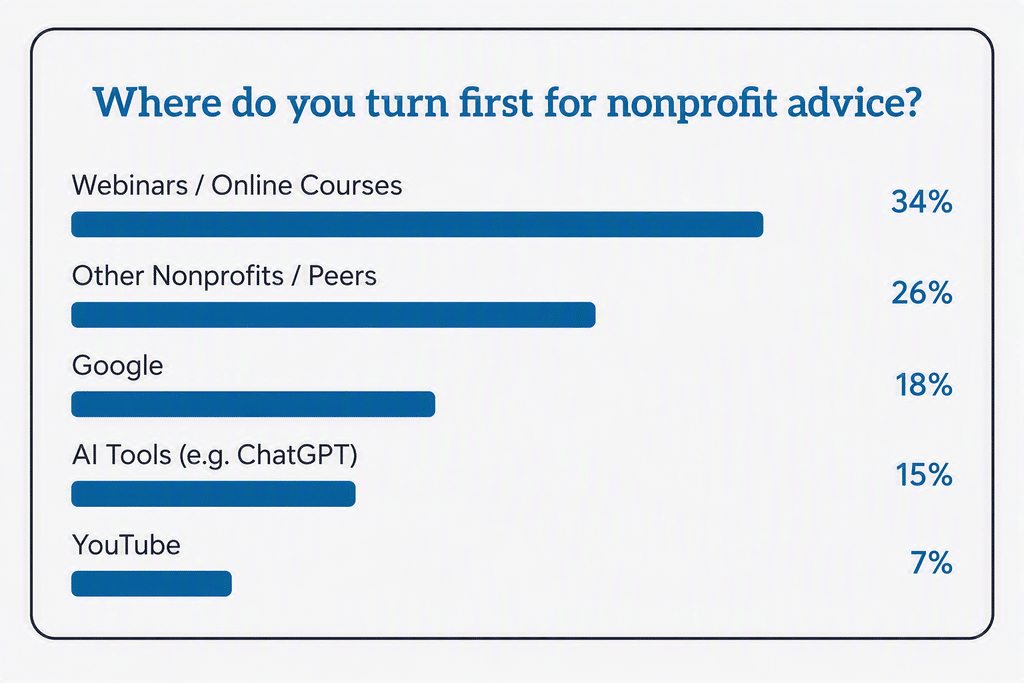
Where do you turn first for nonprofit advice?
Feedback came organically from hundreds of regular site readers. So, the percentage breakdown below offers a clear snapshot of how sector leaders prioritize their learning and problem-solving channels.
If you thought AI would be #1, so did I. But here’s what the results actually show.
#1 Webinars / Online Courses
Webinars and online courses surfaced as the top choice, claiming 34% of the responses. Nonprofit leaders clearly value structured, expert-led training sessions when they need to build skills or strengthen practices.
(In a completely unbiased interpretation of these results, we’d suggest taking a look at Blue Avocado’s free live and recorded webinars for nonprofit leaders.)
#2 Other Nonprofits / Peers
Peer connection followed closely, with 26% of respondents indicating they reach out to other nonprofits and colleagues first. Nothing replaces the perspective of someone who works in the exact same trenches. Direct conversations with fellow leaders provide context and lived experience that standard resources cannot duplicate.
#3 Google
Google accounted for 18% of responses, making it the third most common source of advice. Despite major changes in how information is found online, Google search remains a familiar starting point for many nonprofit professionals.
#4 AI Tools
Artificial intelligence tools such as ChatGPT accounted for only 15% of responses. Given the attention AI has received over the past year, some readers (and Blue Avocado staff) expected it to rank higher. Instead, nonprofit leaders reported turning first to webinars, online courses, peers, and even traditional search engines before AI. The results suggest that AI has become part of the nonprofit advice toolkit, but it has not displaced other sources of guidance.
#5 YouTube
Rounding out the results, 7% of voters selected YouTube as their primary stop. Visual tutorials and recorded presentations offer a practical, step-by-step way to learn new software or explore strategy concepts.
Comparative Chart
Balancing Quick Answers with Trusted Wisdom
These insights show that while AI continues to gain traction, structured education and human relationships remain the foundation for nonprofit guidance.
Thank you to everyone who shared their input in our sidebar poll. Keep exchanging knowledge with your peers, and let us know what topics you want to explore next in the comments below.
The post Where Do Nonprofit Leaders Go for Advice? (No, It’s Not AI) appeared first on Blue Avocado.
]]>
The nominating process is vital to creating a healthy and stable nonprofit. Use these tips to help you nominate engaged, strong board members for your organization.
The post 7 Ideas to Build a Healthy Board Nominating Process appeared first on Blue Avocado.
]]>
This Article is Certified Gold Avocado
Gold never goes out of style — and neither does good advice. The Gold Avocado series showcases some of the very best content that Blue Avocado has for nonprofit leaders, based on overall popularity, reader response, and quality.
A strong nominating committee is key to your nonprofit’s overall health.
It is not uncommon for nonprofit executives and staff to complain about our boards of directors. How often do we become frustrated with a perceived (or real) lack of interest and/or low engagement from our boards? As employees, we tend to think they are the problem. And in some cases, that may be true.
But is it possible that we get the boards of directors we deserve?
Many nonprofit organizations give a cursory glance toward their board nominating process; some even simply go through the formality of a process. Yet a healthy nominating committee should be one of the most critical and strategic standing committees a nonprofit engages. But why is a healthy nominating committee so integral to the nonprofit’s overall health?
It’s relatively straightforward: The board candidates who are put forward now represent the strength — or weakness — of the organization’s future. Or, put another way: Engaged, strong board members make a strong organization. Conversely, no matter how educated, experienced, talented, and farsighted the staff might be, unengaged board members produce a weak nonprofit.
The nominating process is vital to creating a healthy and stable nonprofit. This process should be a strategic, intentional, and ongoing priority for the nonprofit.
When building out a healthy nominating process, here are seven ideas to consider:
1. The nominating process should be a year-round activity.
The nominating committee, board members, and staff should all constantly be on the look-out for potential board members. Throughout the year, the nominating committee should check-in with board members and staff to compile a running list of potential board members and the value they would add to the organization.
Traditionally, nonprofits often look for potential board members who are well-known, active, and respected leaders in the community. However, don’t overlook identifying younger, diverse, and rising leaders who could have something to offer that those older leaders in the community do not.
Remember, the best candidates are not always the most obvious choices. Keep your eyes peeled throughout the year. Be the nonprofit who is known for discovering the diamonds in the rough, and when those jewels leave your board they’re the ones other nonprofits attempt to recruit.
2. The nominating committee should be an active, ongoing committee.
Similar to the previous point, the nominating committee is not a one-time thing. Rather, it must be constantly searching for these dynamic board members throughout the lifespan of the organization. After the creation of the prospective board member list, it should be maintained for as long as the nonprofit exists.
An active and ongoing nominating committee doesn’t need to be large. Prevailing nonprofit practice suggests having two or three board members and one or two community members who are very familiar with your organization (think former, active board members). Task them to be thinking of individuals and submitting names that will be placed on the collective list of potential board members. A few months before the annual meeting, the nominating committee should prioritize these names in terms of the most appropriate candidates.
3. Know what your needs are.
The nominating committee should keep a keen, strategic eye on the skillsets of your current board members. This helps identify what gaps will be created when they rotate off the board at the end of their term.
There are at least two questions to keep in mind as you consider your board members’ strengths and weaknesses:
- What characteristics are needed to fill such gaps?
- What new trends in the community need to be tackled?
- Who can best help address them?
But there are other things to consider as well, including skillsets, familiarity with issues pertinent to your nonprofit, appropriate experience, and demographic factors. Essentially, the nominating committee should be recruiting not only for the nonprofit’s current needs but — just as importantly — be strategic and forward-thinking about what the nonprofit will need in the future.
The nominating committee should always keep the following question in mind: Who can help us reach the goals identified in our strategic plan and beyond?
4. You don’t have to personally know your nominees.
Say someone — perhaps a member of the staff, perhaps another board member — identifies a very strong candidate, but no one in your nonprofit circle personally knows the individual. Don’t let this disqualify the potential board member. If they have the strengths and characteristics you are looking for, don’t be afraid to ask if they would be willing to serve.
The worst thing a potential board candidate can do is say “no.” No harm, no foul. However, you might be surprised how many will ask you to tell them more and eventually say yes to service. Then, you’ve snagged a premier board member. Many times, a board member who is not very familiar with your organization can offer fresh insight and new perspectives that have not been previously considered.
5. Consider a trial run.
Uncertain if a candidate will be a good board member? One way to address this concern is to ask potential nominees to serve first on a committee.
This is a similar process to what is done in major league sports. Essentially you use your existing committee structure as your board of directors’ minor league farm team.
For this trial run, you can watch the prospective candidate, looking for the following:
- Do they come prepared?
- Do they ask good questions?
- Do they offer a unique and valuable perspective?
- Are they a good team player?
- Are they quick to volunteer to do additional tasks?
Identify those potential leaders who are cream rising to the top. If they show leadership in committees, chances are they will display the same leadership qualities on your board.
6. Recruit not just for skill but also for temperament.
Any vehicle needs just the right amount of friction — like wheels on pavement — to move forward. If all board members agree on everything with no questioning or disagreement of any kind, the wheels of the organization just spin. They go nowhere new. The scenery stays the same. A little discomfort or tension can actually be a healthy thing.
But there’s a flip side to this, especially when boards are rife with personal agendas, constant bickering, and/or contentious dissension. Too much friction and people might begin to wonder if anyone is at the wheel.
Ultimately, a nonprofit wants just the right amount of friction. Healthy nonprofit boards have recruited members who can ask the right questions at the right time in the right way. Recruited members who have the skill to ask the tough, uncomfortable, need-to-be-addressed questions in inquisitive, respectful manners provide the right amount of friction — just enough to move forward while keeping the mission and values of the organization clearly in focus.
Part of what makes this friction healthy is the accountability it sustains. This friction keeps the executives accountable to the board, the board members accountable to one another, and the organization accountable to the community as a whole.
7. A candidate doesn’t have to be asked ahead of time if they would be willing to serve.
Consider the difference between picking a team from a playground lineup versus a secret ballot. Some nonprofits want to first ask board nominees if they would be willing to serve before being placed on their list. If the nominee is ultimately not selected, this can sometimes lead to feelings of rejection or harboring ill will toward the organization itself.
In contrast, other nonprofits instead do not ask first. The nominee does not even know they are being considered and thus cannot get disappointed if they are not selected.
In the anonymous process, a prioritized list is created from the names collected throughout the year. The list should have preferred candidates at the top along with a secondary list of qualified alternates. Only after the list is created should the nominating committee approach the prioritized nominees.
As aforementioned, the nominee might not be personally known. Even so, they may be the ideal person whom the nominating committee feels most closely fits the need.
Sometimes, the most desired candidates will say no to service. However, the prioritized list makes recourse simple: If a candidate declines, the committee merely goes to the next alternate on their list.
After securing the nominees needed, the remaining alternates on the list are unaware of their position and, again, do not feel slighted they were not asked to serve. They then can remain on the list until the time a position becomes available.
Great effort but greater reward.
With so much attention on the lack of inclusion and diversity on many boards of directors, if a nominating committee is doing its job correctly, the right people will have a seat at the table.
Ultimately, the nominating committee and the nominating process should be neither minimized nor thought to be of little importance. The process for nominating board members should not be left to one quick meeting right before the end of the fiscal year. It should be deliberate and strategic.
The question of replacing board members should never be a simple matter of easiest available options. In fact, as long as you have a sufficient number of board members to meet the requirements of your bylaws, it’s probably better to leave a board seat vacant until you find just the right person rather than fill it with someone who you suspect may not serve your organization well.
Of course, it must be recognized that we are talking about the inexact science of people and human behavior. However, if your nominating committee is having a very difficult time making their selections, they just may be doing the job right.
Your organization is strongest when the nominating process is a prioritized activity, the board and the staff are actively collaborating, and the committee conducts its role correctly.
And, at the end of the day, a well-chosen board will hopefully give the organization’s executives and staff no reason to complain.
The post 7 Ideas to Build a Healthy Board Nominating Process appeared first on Blue Avocado.
]]>
Nonprofit leaders share practical ways to strengthen collaboration between staff, board members, and volunteers through shared decision-making, feedback loops, and mission-focused engagement.
The post Nonprofit Leaders Answer: How Do You Foster Collaboration Between Staff, Board, and Volunteers? appeared first on Blue Avocado.
]]>
When staff, board members, and volunteers operate in separate spheres, nonprofits can miss out on the vital insights and momentum that drive real impact.
We recently asked the Blue Avocado community, “How do you foster collaboration between staff, board, and volunteers?” and, as always, the responses were thoughtful, creative, and full of practical wisdom.
Here’s a summary of some of the best answers we received:
Transforming Structure and Culture Through Shared Ownership
At the Ag & Food Lab, collaboration isn’t a value statement. It’s built into our structure, starting with how decisions get made.
Each of our four program areas has at least one council serving as a standing feedback loop, so input from staff, board, volunteers, and community directly informs decision-making at every level.
And we’re going further: We’re exploring a worker-driven board model that reframes the relationship between board and staff from oversight to shared ownership.
Around that structural core, we deliberately cross role boundaries. Our recently hired volunteer coordinator invites board members and staff to participate in volunteer events, so the people making decisions are also working alongside the community.
Relationships built side by side make formal collaboration much easier. We treat shared learning as collaboration, too.
Our monthly “lunch and learns” bring together partners, community members, and government representatives to share their stories and experiences intersecting with the local food system. Storytelling is so rich.
Hearing someone’s lived experience first hand builds understanding across staff, board, and volunteers in a way no memo ever could. Regular surveys keep that feedback loop continuous.
Even accountability is collaborative. We build an accountability partner into our project budgets, a third party whose role is to hold the Ag & Food Lab to its vision, mission, and values.
That keeps us honest with each other and with the community we serve.
— Eileen O’Rourke from Ag & Food Lab
Reconnecting Board Members to the Mission via Volunteer Perspectives
Our program hosts quarterly roundtables for our active volunteer advocates. For the summer one, we invited the board members to join the conversation.
It was very impactful because board members were able to hear directly from the advocates about the struggles and successes they experience as they advocate for children in foster care.
The board members walked away with a newfound appreciation of the advocates and a renewed purpose to their role. It was a reminder of their “why.”
— Christine Aucoin from CASA of Terrebonne, Inc.
Cultivating Shared Expectations and Mutual Trust Through Transparent Communication
I foster collaboration between staff, board members, and volunteers by creating a shared understanding of expectations, roles, and communication practices.
When collaborative practice has lapsed over time or needs to be strengthened, I begin with clear written communication that explains the desired change, why it matters, and how each group contributes to success.
I then follow up with in-person conversations with each group so people can hear the expectations alongside their peers, ask questions, and raise concerns in a comfortable setting.
After gathering input from staff, board, and volunteers, I bring the groups together to discuss common themes, address concerns, and reinforce best practices.
This approach helps ensure that everyone hears the same message, understands the expected behaviors, and has an opportunity to contribute to the solution.
The goal is to build a stronger team with a shared definition of collaboration, clear roles for each contributor, and mutual trust in how we work together.
— Shari Wooldridge from East Oakland Community Project
Matching Board Strengths to Active Projects for Collaborative Success
Using board strengths to match them to active projects, encourages completion of the project and collaborative efforts with other staff, board, and volunteers.
This is supported with monthly check-ins from our newsletter/blog/social media team that requires a public-facing update for everyone at one time.
This engages each group to actively hit timelines while supporting the hardworking efforts and growth of the program, as well as important value-adding by highlighting team players within the projects.
Each team is pushing another team to work as collaboratively as possible to show the public their accomplishments and to receive confidence, strength, and support from each other — celebrating each team member in the process!
— Terri Miskiv from Gliding Stars of Central Florida
Utilizing Outdoor Retreats and Interactive Learning to Unite Staff and Board
We use a variety of methods to foster collaboration. With staff, it is monthly staff meetings, that include opening questions that everyone answers.
It has been a great way to get to know each other. We have a twice-a-year staff retreat, often outdoors.
Last June, we spent a day on the river. We have a river scavenger hunt identifying flora and fauna in the riparian corridor and working in teams to do so.
For the board, we offer “lunch and learn” sessions once a month to update them on our programs, as well as quarterly staff reports and work days with the staff.
For our robust volunteers program, we have an active website engagement, monthly river cleanup programs with staff and volunteers, a monthly newsletter with stories about volunteers, volunteer T-shirts, and a yearly holiday dinner.
— Susan Ryan from Russian Riverkeeper
Leveraging Expertise and Judgment-Free Listening to Maximize Talents
Creating space and time to listen without judgement, align around relationship and team expectations of each other, and learning about each others expertise and preferences.
This allows me to leverage those talents in different circumstances and situations. So if someone is good in a crisis, the become integral in crisis scenario plans.
— Judie Caribeaux from Mission + Strategy
Note: The opinions and product/service recommendations expressed above are solely those of the participants and do not necessarily represent those of Blue Avocado. Submissions may be edited for length and clarity.
Your Voice Matters!
Help other nonprofits grow by sharing your knowledge and insights with a chance to be featured in the next Ask the Blue Avocado Community results.
The post Nonprofit Leaders Answer: How Do You Foster Collaboration Between Staff, Board, and Volunteers? appeared first on Blue Avocado.
]]>
Many nonprofits treat grant writing as a final step before a deadline. The most successful organizations involve grant writers early, creating stronger projects and better funding opportunities.
The post Grant Writing: Getting the Most Out of Volunteers, While Giving the Most to Them appeared first on Blue Avocado.
]]>
I teach writing at a university, where one of the most popular classes is called “Introduction to Grant Writing and Project Management.” I want to share three lessons I communicate in my grant writing class. These lessons explain why a grant writing class is different from every other writing class in college, and they explain why a nonprofit might invest in training volunteers and staff in the skills of grant writing.
Lesson 1: Grant Writing is Only Very Slightly About Writing
Amateur grant writers believe that learning grant writing is like learning other kinds of writing. It is not.
There are textbooks and workshops that promise to teach students grant writing, the way that community education classes promise to teach students poetry or memoir writing.
These courses help amateur grant writers pick up some important vocabulary. They teach amateur grant writers the names for genres (e.g., a “Letter of Interest” or LOI). These terms and other tips and tricks help an amateur grant writer polish their work.
But — there are fundamental analytical, project management, and budgeting skills that need to be developed first, before the writing techniques come into play. If these skills are not developed first, the quality of writing will not matter.
Lesson 2: Grant Writing is About Matching Applicants’ Goals to Funders’ Values
Amateur grant writers believe that the best-written grant proposal is the proposal that will be funded. But the quality of the proposal is only a deciding factor when the results are close. The process really begins with matching applicant goals to funder values.
When I teach grant writing, I assign students to learn more about some of the philanthropic foundations in the region — for example, the Ordean Foundation, the Lloyd K. Johnson Foundation, and the Blandin Foundation.
Each of these organizations has a story, sometimes more than one:
- Albert Ordean has a story that explains his reason for establishing the foundation that carries his name.
- Lloyd K. Johnson has a story, one that involves his wife, too.
- The Blandin Foundation has a different kind of story, about a major employer wanting to serve its community, and understanding that story makes clearer what the goals of the Blandin Foundation are.
The most effective grant writers understand that funded projects are projects that match applicant goals to funder values. Role-playing exercises, which begin by understanding the vision of the founder of a philanthropic foundation, help amateur grant writers measure their work against this metric.
The goal of grant writing is not writing up “the best program,” or “the most impactful initiative.” The goal is to demonstrate that an applicant’s program or initiative will contribute to the vision of the funder. How does your proposal make Albert Ordean’s vision manifest, or help make the Blandin Foundation’s vision for its community come closer to a reality?
The same principle can guide state and federal grants. State and federal grants begin with goals set by the government that (legislators believe) can be enacted by grants to others (nonprofits, schools, universities, sometimes even private businesses, and more).
Funded projects and programs are selected because they are well-written, sure, but clear and persuasive writing convinces the program managers that this applicant will achieve the priorities that created the funding opportunity.
Lesson 3: Grant Writing is About Creating a Fundable, Finishable, and Measurable Project
Grant writing is not something that can be added at the end of the project or program development process. It’s not frosting to be added after the cake is baked; grant writers should be involved from the beginning. The grant writer needs immediate access to answer some of the key questions in the grant writing process.
- The grant writer can offer input to ensure that the project is fundable. The grant writer can ensure that the applicant is eligible and that the expenses are allowed within the budget.
- The grant writer can help assess whether the project, program, or initiative is finishable. (There is art here — while an applicant may know that the project is finishable, based on their resources and past experience, the grant writer needs to be able to write persuasively that the project can be completed in the time allotted.)
- Finally, the grant writer can help persuasively convey that project success is measurable. Funders want to know that their dollars have an impact. There are strategies for program evaluation that the grant writer brings to the table that can be brought into the design process.
Bring a grant writer into the everyday workings of your organization. Their proposal will be improved, your programming may be improved, and the project may be more likely to be funded.
Conclusion: Grant Writing Can Be a Gift to the Organization, a Way for a Volunteer to Live Up to Your Values and Goals, too.
The description of the ideal grant writer in this essay, then, is someone who is familiar with your organization’s mission and vision and who understands how programming manifests the organization’s values. The grant writer is trusted enough to participate in the development of the programming or project that the proposal will fund.
I’m not talking about a grant writer who gets a stack of papers two weeks before the proposal is due and works to whip a proposal into shape. I’m talking about a grant writer who is already and organically a trusted part of an organization.
I’d like to suggest that it’s in the best interests of every nonprofit to cultivate volunteers who can give to an organization through grant writing.
This resonates with me both professionally (as someone who teaches grant writing) and personally. I find myself invited to participate in a lot of good causes, and a lot of those invitations come from people who believe that liberal arts professors make significantly more money than we do. I want to give, but I don’t have the disposable income to match my passions.
But I do have the skills necessary to help the artists, the organizations, the sustainable farmers in my region to raise more money than I could ever give. And so I ghostwrite a few grants, as a volunteer with the organization, and I mentor a few folks in writing their own grants. I try to build capacity.
And most importantly, at a time when Gen Z, Millennials, and Gen X are wondering when they will finally be free of their school loans, or when they will finally be able to afford a house — perhaps teaching them to work inside your organization, as a volunteer with the skills to draft grant proposals, is a way to get the most out of them, while giving the most to them?
The post Grant Writing: Getting the Most Out of Volunteers, While Giving the Most to Them appeared first on Blue Avocado.
]]>
Highlighting the personal and professional benefits of serving on your nonprofit’s board can help you make the role more appealing to younger candidates.
The post How to Persuade a New Generation to Join Your Nonprofit’s Board appeared first on Blue Avocado.
]]>
This Article is Certified Gold Avocado
Gold never goes out of style — and neither does good advice. The Gold Avocado series showcases some of the very best content that Blue Avocado has for nonprofit leaders, based on overall popularity, reader response, and quality.
Let me share a story: when I was a senior in high school, the only other candidate for the presidency of our church group was someone who was…well…difficult. My friends convinced me to run; I agreed—and won. For the next year, I planned projects, met people, ran meetings, created events, and worked hard on teams. It was a whirlwind, and most of the time I was smiling.
This profound experience revealed a fundamental truth about nonprofit service: it was fun. It lit a neuron in my brain that felt great and led to decades of service on several boards. I believe that this episode demonstrates the strength of the pleasure principle. Let’s talk about how you can use it to recruit board directors.
But first—what is the pleasure principle?
More than a century ago, Freud explicitly recognized that humans inherently seek pleasure and avoid pain. Based on my experiences as a college student, this is perhaps not a very surprising conclusion—but a conclusion supported by science, nonetheless.
Of course, this human characteristic sometimes gets us into trouble, but it can also act as a powerful motivator. And as we present a new generation with the possibilities of nonprofit board membership, it is crucial to tap into this principle’s universality.
Selling Pleasure, Not Boring Meetings
When a board opportunity is presented to a candidate, it is often framed as a sales “ask.” Basically, you’re saying to a candidate: we represent a worthy organization, and we are asking you to contribute your time, treasure, and talent to help us.
Anyone hearing that request—especially a busy, younger person who is perhaps unfamiliar with board service— will automatically raise their defense shields. They’ll tell you: “I do not have time/skills for this,” or perhaps “I really hate meetings.” If they’re feeling particularly candid, they might even say, “I am not interested in spending my free time with people who are my parents’ age.”
But this line of reasoning can easily drift into an unproductive conversation, which overlooks the fact that nonprofit board service can be enormously entertaining. That is, you’ll spend your time trying to convince the potential candidate that their fears are unfounded instead of focusing on the positive aspects of board service.
So the next time that you are recruiting a board candidate, take the conversation in a different direction. Show them what they’re getting out of board service, not what it’s going to cost them.
The Five Pleasures of Board Service
From my time on boards, I’ve identified five topics which you can raise with board recruits to show how their service will make them smile. Remember to use these to demonstrate to potential candidates—especially younger generations—what they will get out of serving on a nonprofit board. Feel free to add your opinions on other enjoyable topics in the comment section below!
1. They will become a subject matter expert.
In your sales pitch, highlight that joining your nonprofit’s board will provide the candidate with the opportunity to either learn about a subject that they do not understand or deepen their existing subject matter expertise.
Of course, the exact phrasing of this will depend on the candidate’s background. Make sure you research the candidate so that you know where they’re coming from—and how to pitch accordingly.
After I left a job providing legal services to a government social service agency, I was asked to serve on the board of a private social service agency. I already knew about the legal background for these services, but this board seat provided a much broader view into this field while also allowing me to use subject matter talents that otherwise would have gone dormant.
Even if your potential candidate already works within the field, your nonprofit will afford them a different viewpoint, ultimately deepening their understanding of the subject matter.
2. Serving is learning.
This is related to—but importantly also an expansion of—the previous point. You want to make sure that your pitch emphasizes how every aspect of board service teaches valuable skills. This becomes particularly important for those who have not previously served on a board.
During my time on nonprofit boards, I learned how to run meetings. I observed other board members negotiate positions with each other as well as staff regarding mission and strategy. I gained insights into fundraising techniques, event planning, budgeting with unpredictable sources of income, media relations, marketing, and legislative lobbying.
I participated in short- and long-term strategic plans as well as emergency responses. I experienced the challenge of hiring and, yes, firing executive directors. Each instance taught me something new.
Present board service as a learning laboratory rather than a chore, supported by any examples from your experience. For example, if certain board members or staff have exceptional public speaking skills, are wildly successful when they solicit donations, or are masterful in the art of legislative lobbying, highlight how much you have learned from watching them work.
You can talk about the lessons you’ve learned watching a complicated event move from idea to a success—after all, some event planners have this down to a science!
Make sure you emphasize the sheer amount of knowledge (institutional and otherwise) that they’ll have access to through service on your organization’s board. All they have to do is say, “Yes!”
3. A network is waiting to welcome you.
During your recruiting meetings, list all the remarkable people (on your board and beyond) who will become your candidates’ colleagues. As board members, they’ll have the chance to attend some fantastic events at unusual venues with organization members or donors who they do not know—and, without your directorship, they would never get to know.
If you can point to famous or important people who the candidate will hang out with, so much the better. If you throw a terrific party, brag about it.
Now, you might have read those last two sentences and said, “Wait just a minute. Am I really supposed to name-drop all the cool people my org works with? What is this, high school?”
And that’s not an unfair concern. In fact, it might be better to think through what you know about the candidate and come up with a handful of potential matches, even testing the waters during the pitch to see which names get them to bite.
However, everyone wants to hang out with cool people—and that desire can be used to press those pleasure principle buttons.
4. Join an exceptional club.
Becoming a part of a community dedicated to serving a cause develops strong bonds. These bonds can do much more than just expand a LinkedIn network; they can create friendships.
Of course, friends are valuable because friends help each other. But more importantly, friendships—especially those formed in adulthood—make life more enjoyable and are an integral part of living a fulfilling life.
The best way to find new friends is to find people with similar interests. And all your board members have one thing in common: they want to work together to achieve a common goal in your community.
Obviously, you can’t promise your recruit that they are sure to find a new best friend on your board, but you can point out that this service provides many opportunities for them to get to know other board members in informal settings.
And if you can tell a story about strong friendships that you have developed through your nonprofit work, make sure to share that story.
5. Scratch the altruistic itch.
Like many nonprofit board members, I worked for a paycheck—not my passion—for most of my career. This is not to say that I did not enjoy my work. However, nonprofit board membership provided an additional sense of fulfillment, allowing me to use my talents for something beyond corporate or personal profit.
Granted, not every board meeting or activity was exhilarating. Let’s be clear: board service can often test one’s patience. But most of the time when you reflect on your accomplishments, you feel good that you are working towards a better community.
In your pitch to potential candidates, be explicit about how board service can be a source of pride. It’s even better if you can get board members—especially the board chair— to share their stories and positive experiences serving at your nonprofit.
Have current board members speak to specific accomplishments that gave them a sense of satisfaction about their contribution. Not only will this help you attract potential candidates, but it will also remind current board members why they serve, strengthening their connection to your nonprofit.
Remember the board member’s mantra: I participate in my community, therefore I am.
Mahatma Gandhi said that “the best way to find yourself is to lose yourself in the service of others.” Without a sense of yourself, happiness is a rare commodity. While you do not need to quote Gandhi as a part of your recruiting speech, make sure to emphasize how good it feels to serve.
Acknowledge that while you are asking the candidate to share their time, talent, and treasure, you have something—actually so many things (at least five)—to offer in exchange.
Persuading candidates to join your board can take advantage of the pleasure principle by portraying nonprofit service as an enjoyable and fulfilling experience.
So go out there. Ignite that spark of joy in your recruits. Inspire them to embark on a rewarding journey of service and personal growth.
The post How to Persuade a New Generation to Join Your Nonprofit’s Board appeared first on Blue Avocado.
]]>