- Primary research emails – due today
- Attendance reminder: if you’re not sure that you’ll be absent, email me anyway by 11am.
- Reminder about device-free time
AGENDA
- Device time
- News item
- Primary research check-in
- Note my tips. I’ll add notes for your tech topics as I encounter them in my research for Beloved. I am prioritizing tech topics more directly relevant to the novel.
- If your emails go unanswered, what’s your backup plan?
- Device-free time
- Timed exercise
- Discussion circle with audio excerpt
- Final notes on recent reading/watching/listening
ASSIGNMENT
You can use AI, but you must verify any information you find.
- NEWS: Please share and be prepared to explain a relevant news item.
- READ and be prepared to discuss:
- Beloved up until “Let’s see you walk on em.”
(The entirety of Beloved-Part03.mp3) - Short readings on the formalization of medical gynecology during the 1800s. Note: some of their terminology is no longer in keeping with MLA and APA guidelines on inclusive language.
- The first few paragraphs of Medical Apartheid’s Introduction, until “…one benign, one malevolent — of American medical research.”
- Please also have a look at the painting described in Medical Apartheid’s Introduction.
- The first 2.5 pages of Medical Bondage’s Introduction, until
“history evidences how race, class, and gender influenced seemingly value-neutral fields like medicine.”
- Beloved up until “Let’s see you walk on em.”
- EMAIL due now:
- If you haven’t sent me your draft email messages for primary research, do this ASAP!!
- If I’ve responded to your draft messages with approval, please send your emails in accordance with the General Notes for D&T Email Drafts.
- FOR DISCUSSION FACILITATORS: If you’re leading the next session discussion, email me the following by 1:30pm ET on 9/30, as part of your discussion grade:
- your audio excerpt
- a simple discussion question on the Beloved reading assignment
- a more challenging discussion question on the same assignment
- REVIEW and be prepared to discuss:
- Any/all previous assignments
Optional Reading
On the rise of formalized gynecology and obstetrics in the 1800s. Some of their terminology, particularly related to enslavement, is no longer in keeping with MLA and APA guidelines on inclusive language.
- Medical Apartheid, Chapter 2: on antebellum medical experimentation on enslaved people. There’s also a chapter on comparative medical apartheids across the globe. The entire book is also available on audio, see the “Bodily Autonomy” section of the class reading/watching/listening page.
- All of Medical bondage : race, gender, and the origins of American gynecology (2017) by Deirdre Cooper Owens. I also have an audio version of this book; let me know if you’re interested.
- A review in the journal Science of the recent book Saying Anarcha.
- Another well-known instance of medical apartheid in the United States: The Immortal Life of Henrietta Lacks (Skloot 2010). Also made into a film starring Oprah Winfrey.
- Discussion sign-ups are complete. If you didn’t sign up on your own, I signed up for you.
AGENDA
- Device time
- News item
- A closer look at NPS’s Underground Railroad page
- Primary research check-in. Note my tips and start sending emails out this week (see assignment).
- Device-free time
- Timed exercise
- Discussion circle with audio excerpt. Popcorn or go around room?
- Final notes on Session 6 readings
ASSIGNMENT
You can use AI, but you must verify any information you find. I may ask you about it.
- EMAIL:
- As of this writing, four people haven’t sent me draft email messages for your primary research. Please do this ASAP!!
- If I’ve responded to your draft messages with approval, please send your emails in accordance with the General Notes for D&T Email Drafts.
- NEWS: Please share a relevant news item and be prepared to explain it.
- READ and be prepared to discuss these very short readings/watchings:
- WGBH (PBS Boston): Who Made America: Eli Whitney
- PBS Georgia: King Cotton & the Cotton Gin (5:35)
- WNET (PBS New York): The Cotton Economy & Slavery (3:03)
- Connecting Cotton to the Northeast
- NYC Garment District history: read the parts about the 1800s
- Charles River Museum exhibit on The Boston Associates: “venture capitalists of the past”
- NPS.gov page on Lowell’s Southern Connection: Lowell was a textile manufacturing town financed by the Boston Associates. This chapter is from an NPS guide to Lowell National Historical Park.
- REVIEW and be prepared to discuss:
- Beloved up until “She’s not sick!” said Denver, and the passion in her voice made them smile.” (The entirety of Beloved-Part02.mp3)
- Any/all previous assignments
- FOR DISCUSSION FACILITATORS: If you’re leading the next session discussion, email me the following by 1:30pm ET on 9/30, as part of your discussion grade:
- your audio excerpt
- a simple discussion question on the Beloved reading assignment
- a more challenging discussion question on the same assignment
OPTIONAL: More reading on Textile innovation & Slavery
- WGBH: The Cotton Gin & Slavery
- Eli Whitney Museum: The Cotton Gin and its Legacies
- 11-minute video on The Boston Associates
- NYC’s Garment History: A Bibliography
Announcements
- News item is a point (for URL), 2 points (for verbal presentation
- Additional written assignments are up to 3 points for full completion
AGENDA
- Device time
- News item
- Primary research check-in
- Discussion sign-up check-in
- audio clips
- sitting in a circle only if class is smaller than 14 people
- Device-free time
- Timed exercise
- Discussion circle with this audio excerpt
ASSIGNMENT
You can use AI, but you must verify any information you find. I may ask you about it.
- NEWS: Please share a relevant news item and be prepared to explain it.
- READ and be prepared to discuss:
- Beloved up until “She’s not sick!” said Denver, and the passion in her voice made them smile.” (The entirety of Beloved-Part02.mp3)
- Short readings/listenings on wrought iron and railroads:
- The Guardian: Industrial Revolution iron method ‘was taken from Jamaica by Briton’
- Wikipedia: Modern-edge rails
- REVIEW and be prepared to discuss:
- Any/all previous assignments
- FOR DISCUSSION FACILITATORS: If you’re leading the next session discussion, email me the following by 1:30pm ET on 9/28, as part of your discussion grade:
- your audio excerpt
- a simple discussion question on the Beloved reading assignment
- a more challenging discussion question on the same assignment
OPTIONAL: More reading on Railroads and Wrought Iron
- Black metallurgists and the making of the industrial revolution (covered in the Guardian article above)
- UCL’s “Full and unreserved support” for the article above, after blowback to the article
- The Coming of the Railway : a new global history, 1750-1850
- NPR: How the Underground Railroad Got Its Name (with transcript)
- Primary research spreadsheet: To check your assignment due today, I will temporarily lock the sheet after class, then review the revision history.
- A primary research informed consent form has been drafted based on your notes from last week.
Agenda
- Device time
- News item. Reminder: this is a required assignment now!
- Discussion facilitator sign-up. Discussions should be modeled on homework review circles and follow the discussion grading rubric. Please sign up this week, or I’ll assign you a date. Leading a discussion sooner might be easier than later!
- Device-free time
- Timed exercise
- Homework review circle – with this audio excerpt
- Timed exercise review circle
Assignment
You can use AI, but you must verify any information you find. I may ask you about it.
- NEWS: Please share a relevant news item and be prepared to explain it.
- IN BRIGHTSPACE: Please draft an email to each of the contacts listed in your primary research plan that was due today, September 21. Please also share any feedback on the informed consent form.
- READ and be prepared to discuss (in writing and speech):
- 1619 podcast, Episode 2, “The Economy That Slavery Built.” Also available at Apple and Spotify. Listen until the end of Matthew Desmond’s interview at 25:40. Here’s an auto-generated transcript.
- “America’s First Big Business: Not the Railroads, but Slavery.”
- “What is the Underground Railroad?”
- REVIEW and be prepared to discuss:
- Beloved up until “How loose the silk. How fine and loose and free.” (The entirety of Beloved-Part01.mp3)
- Any/all previous assignments.
Grading and attendance begins today!
Agenda
- Device time
- News item
- Primary research planning
- Your primary research should examine technology developed in the 1800s.
- In your final article, you’ll connect it to the diasporic communities described in Beloved and other class readings.
- Please also discuss: if you were being interviewed for this class, what kinds of informed consent would you want from your interviewer? Take notes in the Primary research spreadsheet.
- Note-taking exercise with BELOVED movie. This can and should be applied when you start reading Beloved the novel!
- Device-free time
- Homework review circle
- Timed exercise review circle. Let’s discuss the exercises so far!
- Underline of your text: illegible
- Underline of question text: not addressed
- Check: addressed
- Plus or Star: extra point
- Wavy line: incorrect or at least highly questionable
- Timed exercise
- Please leave a 1-inch margin at the top of every page! This will help me use binder clips to obscure your name while I grade.
Assignment
You can use AI, but you must verify any information you find. I may ask you about it.
- How is the class material so far relevant to news items you’re encountering beyond this class? Please share a relevant news item in this spreadsheet and be prepared to explain to the class.
- Fill out for your primary research plan so far in the Primary research spreadsheet.
- Read and/or listen to the novel Beloved up until “How loose the silk. How fine and loose and free.” (This is the entirety of Beloved-Part01.mp3.)
- If the timed exercises have been a challenge, and/or if reading this novel is a challenge, consider reading and listening at the same time, a.k.a. “immersive reading.”
- Be prepared on to discuss and/or write about any/all previous assignments.
Tomorrow is the last day of Add/Drop. Grading and attendance will begin on Wednesday!
Agenda
- device time
- news item
- APA Bias-Free Language Guidelines (See the full chapter here)
- primary research ideas + bathroom time
- device-free time
- homework review circle
- handwritten timed exercise (practice). Please stay in the room!
- Please use characters’ names!
- If you’re not sure about a definition or a question, you can ask.
- If you finish early, make sure you answered all parts of the question.
- Finishing early -> device time?
- 9/9 Practice Exercise Evaluation Key
- Underline of your text: illegible
- Underline of question text: not addressed
- Check: addressed
- Plus or Star: extra point
- Wavy line: incorrect or at least highly questionable.
- BELOVED movie
Assignment
You can use AI, but you must verify any information you find.
- How is the class material so far relevant to news items you’re encountering beyond this class? Please share relevant news item in this spreadsheet.
- I will use APA Inclusive Language Guidelines, along with the Bias-Free Language Guidelines linked above, to evaluate your midterm and final papers. Please read them and be ready to discuss some new things you learned and/or have questions about. Have you noticed any “terms to avoid” being used in class so far?
- Start planning the who/what/where/why for your primary research. Your primary research plan will need my approval before you can carry it out, so we’re getting started early.
- Watch the film BELOVED up until 01:54:34 (“So long, Paul D.”)
FOR MONDAY 9/21:
- We will switch from watching the film of BELOVED to reading the novel. Read and/or listen to Beloved up until “How loose the silk. How fine and loose and free.” (This is the entirety of Beloved-Part01.mp3.)
- device time
- internalized oppression
- brief definition from U of Wisconsin
- Internalized Racism and Mental Health: The Moderating Role of Collective Racial Self-Esteem (Behavioral Psychology, 2024)
- The legacies of systemic and internalized oppression: Experiences of microaggressions, imposter phenomenon, and stereotype threat on historically marginalized groups (New Ideas in Psychology, 2021)
- internalized oppression
- device free time – in any order
- oldest invention installed on this floor/building
- homework review
- handwritten timed exercise (practice)
- BELOVED movie
Assignment
For all weekly assignments, you can use AI, but you must verify any information you find. I may ask about your sources.
FOR DISCUSSION ON MONDAY:
- How is the class material so far relevant to news items you’re encountering beyond this class? Please share relevant news item in this spreadsheet.
- Do you have a favorite book about the 1800s? If not, find one that you’re curious about! Please make a printout of the cover and bring it to next class.
- Of the following civil & human rights laws/policies for NYU, New York City, New York State, and the United States, which is the most different from the others? Why?
ALSO:
- Make sure you’re familiar with BELOVED film up until the point we stopped in class, about 53:00 minutes.
Continue looking through the novel Beloved. You won’t be asked about it until after Add/Drop, but it doesn’t hurt to start getting familiar!
- device time
- welcome
- syllabus
- device free time
- oldest invention in the room
- BELOVED movie
Assignment
For all weekly assignments, you can use AI, but you must verify any information you find. Don’t be surprised if I ask about your sources.
- Please come to class prepared to verbally discuss the following items without a device in front of you. (Paper-based notes are okay.)
- What’s a surprising fact about minoritized people in the United States during the 1800s?
- What’s a surprising fact about technology from the 1800s?
- What’s a surprising fact about Toni Morrison?
- What type of primary research might you like to conduct on 1800s technology? Note: for this class, survey-based primary research will generally not be accepted, but we can discuss on a case-by-case basis.
- Read and be prepared to discuss the similarities and differences between civil & human rights laws/policies of NYU, New York City, New York State, and the United States.
- Start looking through the novel Beloved. You won’t be asked about it until after Add/Drop, but it doesn’t hurt to start getting familiar!
Contents
- Overview
- Prerequisites
- Learning Goals
- Graded Deliverables
- Course Materials
- Schedule
- Grading
- Attendance Policies
- Tech Policies
- Grading Rubrics
- Other Notes
- Office Hours
- NYU Policies
OVERVIEW
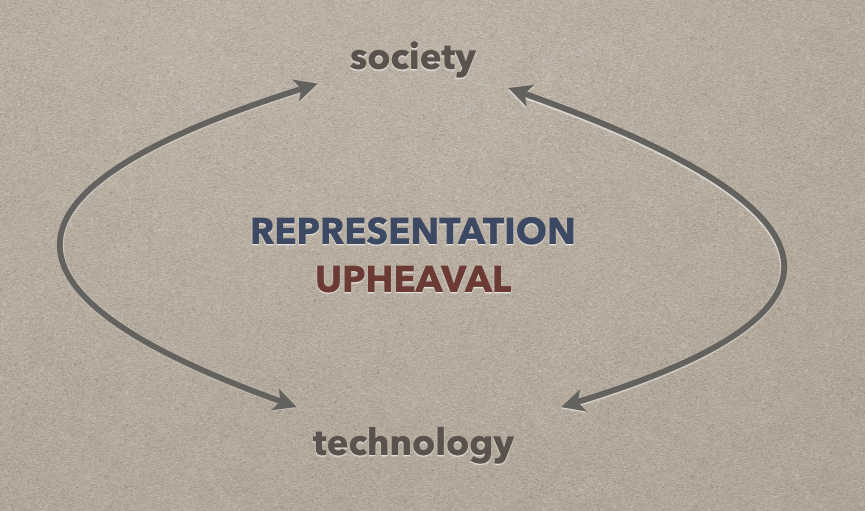
- What does diversity mean in the context of the United States? How does diversity, equity, inclusion, representation and belonging impact the way that technology is designed, developed and scaled in the United States?
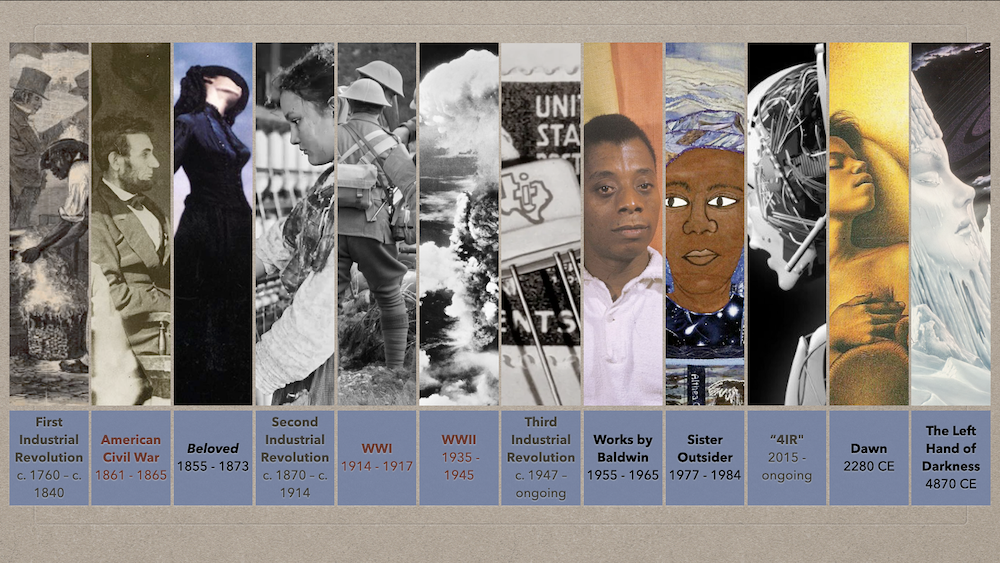
- 2026 is the 250th anniversary of the United States. This year’s Diversity & Technology course will explore disruptive technology’s effect on US diasporic communities around the time of the United States Civil War, with a particular focus on technology’s role in slavery, enslavement, and colonialism.
- To examine disruption on diasporic communities, we will use the novel BELOVED by Toni Morrison as the central class reading.
- To examine disruptive technology on diasporic communities, you will identify technology in BELOVED, then conduct primary research on such technology.
- Except during specified research, discussion, and field trip segments, class is a computer- and phone-free space — we will engage in a number of non-digital activities to develop your critical thinking on the roots of disruptive technology.
Prerequisites
- EXPOS-1 and one TCS elective course.
- This TCS Advanced Seminar is intended to be a capstone of the student’s TCS experience. Although some sophomores might meet the prerequisites, normally this course would be taken in the junior or senior year. For this 4-credit course, students should expect to do 6.6 hours per week of supplemental time as defined by NYU’s guidance on credit hours.
- Recommended prerequisites: This course uses seminal, historical literary work influenced by and influential on feminist theory, queer theory, and critical race theory, with the goal of supporting the values of transformative justice and creating space for transformative learning. Students ideally have theoretical experience in sociocultural analysis or practical experience in movement-building and organizing work.
LEARNING GOALS
- Understand what diversity means under federal, state and city human/civil rights law and history;
- Use close literary reading, as well as secondary and tertiary research, to understand disruptive technology and diasporic community in the context of early America;
- Develop primary research to build scholarly knowledge beyond the public internet;
- Connect this research to your own personal identity, experience, and interests.
Graded deliverables
- A Capstone Article of 14-20 pages, due at the end of the semester.
- Primary Research in the Field: this entails planning, obtaining my approval, conducting, and video-recording primary research on US disruptive technology between 1820-1880. Your primary research will be the basis of your capstone article. Primary research plans may include
- an 30-minute (or longer) interview with a relevant scholar of your choosing
- a visit to a scholarly archive to record research on physical artifacts
- a class field trip (no video-recording required) to a relevant exhibit near NYU Tandon
- a special an investigation of 1800s gynecological artifacts from McGill University’s Medical Library (Prof will provide artifact photos)
- Student-Led Discussion: this entails leading at least one 30-minute class discussion on class reading assignments. Your discussion questions must be accurate, relevant, non-trivial and novel. Your discussion should include at least 2 clips from the BELOVED audiobook to reinforce passages for discussion. These discussions will be computer- and phone-free times except for the classroom computer.
- Handwritten Timed Exercises: You must bring a pen(s) to class! Most weeks will involve in-class timed writing exercises. You will be expected to write legibly, using your own pen. You won’t be able to use a computer or phone during the exercises, though you can use any printed material you wish. I will also have some copies of BELOVED on hand for reference.
- You can use your timed exercises as a secondary basis for your final article.
COURSE Materials
Required Materials
- Your own pen(s) and writing instruments
- Your own notebook
- Beloved by Toni Morrison (novel and film)
- Civil & Human Rights laws and policies of
- Diversity Style Guides for various protected (from SFSU Journalism School). This includes guides on race/ethnicity, gender/sexuality, disability/ability, mental health, religion, and more.
- Kimberlé Crenshaw: Demarginalizing the Intersection of Race and Sex: A Black Feminist Critique of Antidiscrimination Doctrine, Feminist Theory and Antiracist Policies (also cited here)
- MLA Guide to Inclusive Language (NYU login required; summary here)
- APA Bias-Free Language Guidelines (See the full chapter here)
Additional Materials
- Please see the class Reading, Watching, and Listening page. This page will be updated regularly throughout the semester.
SCHEDULE
The general schedule is in this spreadsheet (NYU login required).
We’ll follow this general structure on days when we don’t have field trips:
- 10 minutes: News (devices OK)
- 15-40 minutes: Timed Exercise
- 30 minutes: Student-led discussion
- 25 minutes: Primary research planning (devices OK)
- 25 minutes (time allowing): Story blocking in groups
GRADING
Midterm
- 25% In-class timed exercises
- 30% Participation and discussion leadership
- 45% Midterm report of 1500+ words (plus bibliography). This report should be a write-up of your primary research so far, along with an appendix of any emails, communications, and video recordings of your research. Your report should discuss: How is your research related to BELOVED? How is it related to your identity, interests, and major? What went well? What’s still to do?
- Adherence to Technology Policies (see below)
- Adherence to Attendance Policies (see below)
Final
- 25% In-class timed exercises
- 30% Participation and discussion leadership
- 45% Final Essay of 3000+ words (plus bibliography). This essay must discuss your primary (technology) research, how it relates to BELOVED and its diversity topics, and how it relates to your identity and larger interests. Include an an appendix of any emails, communications, and video recordings of your research.
- Adherence to Technology Policies (see below)
- Adherence to Attendance Policies (see below)
Additional Grading Notes
- I will drop the 14 lowest question-level scores from your timed exercises. As such:
- If you miss class, there is no option to make up the timed exercise. (The two potential exceptions are a Moses Center accommodation, or an excused leave of absence over multiple weeks.)
- If you don’t miss any timed exercises, you will have the option to convert the extra timed exercise grades into extra credit.
- You can lead a second class discussion for extra credit. Available slots will be limited — the number will be determined by the post-add/drop class size.
ATTENDANCE Policies
- Please arrive on time. I’ll give you 10 minutes to trickle in, but late arrivals are disruptive and stressful for me.
- After 3 late arrivals, subsequent late arrivals are subject to a 0.5% deduction from your final grade.
- Illness-Related Absence
- For short illness: up to one calendar week’s (2 consecutive sessions) absence from class due to illness will be excused, without a healthcare provider’s note. Please notify me via email (arlduc [at] nyu.edu) by 11am on the day you’ll be absent. I’m not able to check email between 12-4pm on class days.
- Chronic and long-term illness should be registered with the NYU Moses Center and the Office of Student Advocacy (see “NYU Policies” below for contact info).
- Other Types of Absences
- Unexcused absences: 5 points will be deducted from your midterm and final grades for every class in which I don’t receive 3 hours advance notice. Meaning: I’m flexible if you communicate with me well in advance!
- If you have multiple unexcused absences, please contact the NYU Office of Student Affairs to get help devising a make-up plan (see “NYU Policies” below for contact info).
- To be clear: an absence is unexcused unless you notify me and receive confirmation in advance of class (or the same day, in cases of emergencies).
- If there’s a structural issue that’s keeping you from regularly attending in-person sessions, I will refer you to the Office of Student Advocacy for further mediation and support.
- If you start to feel you can’t keep up with your assignments for this class, I urge you to let me know sooner (e.g. days/weeks ahead) rather than later (e.g. the day of the deadline, or after the deadline has passed). This can be hard to do, especially for minority and marginalized people, but it’s important to ahead of the problem so I can work with you and plan accordingly. I CAN’T STRESS THIS ENOUGH. “Sooner rather than later” is an important rule of thumb for professional settings!
- Unexcused absences: 5 points will be deducted from your midterm and final grades for every class in which I don’t receive 3 hours advance notice. Meaning: I’m flexible if you communicate with me well in advance!
Technology Policies
Policy on Classroom Technology
- Except during News and Research Planning segments, class is a computer- and phone-free space — we will engage in a number of non-digital activities to develop your critical thinking on the roots of disruptive technology. I hope you can enjoy this break from screens!
But for accountability purposes:- The first two violations of this policy will result in a warning.
- The next two violations will result in a 1% deduction from your final grade.
- After that, every additional violation will result in a 5% deduction from your final grade.
Policy on Generative Artificial Intelligence
- You may use generative AI to assist in preparing your capstone article due at the end of the semester.
- You may also use it for research on secondary and tertiary sources (e.g. any research involving pre-existing books, articles, and other media).
- You are responsible for the accuracy, comprehension, and composition of your work.
- You must cite generative AI when you use it.
- If you use AI to analyze a primary research interview, you MUST obtain consent from your interviewee.
- To protect the privacy of your interviewee, please use Google Gemini for any AI interview analysis, since NYU’s enterprise license with Google prohibits the company from using any of your Google Workspace files as AI training data. Please review AI @ NYU for more information.
- I also reserve the right to use generative AI to review your work. I would use Google Gemini for the reasons explained above. I am responsible for letting you know if and when I do so.
GRADING RUBRICS
Timed Writing Exercises
- Comprehension: did you do the reading, watching, and/or listening? (4 points)
- Relevance: did you answer the question? (3 points)
- Cogency: is your argument compelling, convincing, insightful? (3 points)
- Legibility: if I can’t read your handwriting, I won’t be able to give you points for comprehension, relevance, and cogency.
Discussion
Did you demonstrate a curiosity/comprehension of and ask questions about:
- Basics from the assigned reading/listening/viewing
- Deeper themes from the assigned reading/listening/viewing
- How such themes play a role in the development, deployment, and/or dissemination of technology
- How such themes are relevant for diasporic communities who hold one or more protected identities (as defined by NYC Human Rights Law)
- Relevant passages from the assigned reading/listening/viewing
- Relevance to our experience in the present day
In addition, you will be evaluated on - Accuracy and understandability
- Flow and continuity of the discussion
- Use of audio clips to quote the book
Midterm & Final Essays
- Did you organize substantive primary research?
- Did you obtain consent for recording and AI use (if applicable)?
- Did you prepare and ask insightful questions of your subject?
- Did you adequately video record it (unless it was a field trip during class time)?
- Did you make a case for your research as a novel contribution to the field of STS?
- Did you adequately analyze the results?
- Did you tie it to BELOVED?
- Did you tie it to diasporic community (diversity)?
- Did you tie it to disruptive technology?
- Did you tie it to your identity, interests and/or major?
- Did you include a positionally statement?
- Did you discuss the context of this research in the larger STS field?
- Did you discuss next steps?
Other notes
- We may also vote on additional relevant books, stories, or essays to read, discuss, and cite.
- I hope to cite your research, and credit you, in an upcoming publication. A scholarly publication you can add to your resume.
- I generally won’t answer class emails after January 5th.
OFFICE HOURS
Monday and Wednesday by appointment, preferably before or after class. Ask me or e-mail arlduc [at] nyu.edu to make an appointment. I’ll respond within 1 business day. Appointments can be conducted in person or over Zoom.
NYU POLICIES
ACADEMIC HONESTY
All work for this class must be your own and specific to this semester. Any work recycled from other classes or from another, non-original source will be rejected with serious implications for the student. Plagiarism, knowingly representing the words or ideas of another as one’s own work in any academic exercise, is absolutely unacceptable. Any student who commits plagiarism must re-do the assignment for a grade no higher than a D. In fact, a D is the highest possible course grade for any student who commits plagiarism.
DISABILITY & ACCESSIBILITY
If you are student with a disability who is requesting accommodations, please contact NYU Moses Center for Students Accessibility at 212-998-4980 or mosescsd@nyu.edu. You must be registered with CSD to receive accommodations. Information about the Moses Center can be found at www.nyu.edu/csd. The Moses Center is located at 726 Broadway on the 2nd floor.
RELIGIOUS ACCOMMODATION
NYU’s Calendar Policy on Religious Holidays states that members of any religious group may, without penalty, absent themselves from classes when required in compliance with their religious observances. You must notify me in advance of religious holidays or observances that might coincide with exams, assignments, or class times to schedule reasonable alternatives. Students may also contact religiousaccommodations@nyu.edu for assistance.
Severe Weather
In the event that weather or other disruptions close the campus, we will meet at our regular time on Zoom. I will put the Zoom link in Brightspace.
ADDITIONAL SUPPORT
If you find yourself needing additional interpersonal, professional, emotional, and/or other kinds of support in the course of this semester, I strongly encourage you review the policies and absence form at the Office of Student Advocacy. You may also email advocacy.tandonstudentlife@nyu.edu. Professors are working with Student Advocacy to increase the likelihood of your academic success. Professors also follow NYU Guidance on Student Support.
NYU COMPLIANCE + REQUIREMENTS
For further information on NYU guidelines for compliance, please visit the following sites. I will refer to these if we need to address larger policy issues in the class.
- Intro: News Items (20). If you didn’t add a technology-related news item that came to mind during your reading/listening assignment, please add it now. This is a required part of your weekly assignments.
- Research & Cultural Competence Skills/Announcements (25)
- Discussion Sign-up now contains slideshow links
- Timed Exercise quote: “Note that the b in Black should be capitalized because referring to human as colors is “pejorative”.”
- Nell Irvin Painter (Washington Post): Why “White” should be capitalized, too
- Subtext in narrative: the said, the unsaid, the unsayable
- Commas inside quote marks
- Authorial voice in third person (and see TEDed video “First person vs. Second person vs. Third person – Rebekah Bergman“)
- D&T Reading, Watching, Listening
- Timed Exercise quote: “Note that the b in Black should be capitalized because referring to human as colors is “pejorative”.”
- Underground Railroad Walking Tour (65)
Assignment
- Read/listen, take notes, and be ready for in-class timed exercises & discussions on:
- The epigraph and Introduction of Medical Apartheid by Harriet A. Washington, available in ePub and audio. Note that this book was written in 2006; much of its information is (sadly) still correct; but some of its terminology is no longer in keeping with the MLA and APA guidelines on inclusive language.
- “Sonny’s Blues” by James Baldwin, available in epub and audiobook (NYU login required).
- With the audio: start in Part 3 at 35:38 and end at Part 4 at 55:37.
- What current technology issues come to mind from your reading? Please find a news item about a relevant technology issue, and add its URL to the 9/25 tab in D&T News Items 2024.