Pakistan is facing a polio crisis from unvaccinated children, because health workers are viewed with distrust — if not outright targeted by the Taliban. (Why? In 2013, it was revealed that the CIA ran a fake vaccination campaign as cover to hunt for Bin Laden.)
This moving short film is part of a campaign to help rebuild trust, parent by parent, in the health system and vaccinations. TED Fellow Bassam Tariq, a filmmaker (and a Halal butcher), produced the film as a public service announcement aimed at Pakistani migrant workers in the United Arab Emirates. The point: to encourage them to get their children back home vaccinated. The film is being shown in cinemas and migrant camps in the UAE, on airline flights between the UAE and Pakistan, and on Pakistani television.
He tells the Fellows blog about Pakistan’s polio crisis and how he approached the subject.
“Polio is an escalating health crisis in Pakistan because people are reluctant to vaccinate their kids. Their mistrust stems from the discovery that the CIA had been pretending to vaccinate while gathering swab samples to find out where bin Laden and other Taliban leaders were. Because of that, the Taliban is now killing health workers. After the success of These Birds Walk on the festival circuit, I was approached by the Gates Foundation and Image Nation, an Abu Dhabi film group, and commissioned to do a piece that would speak to Pakistani men working abroad, as well as within Pakistan, about polio.
“Pakistani migrants are predominantly men, and they are usually marginalized and spoken down to when it comes to media messaging. So for us, it was important to be authentic and empathetic, and be a voice from home, when speaking about something as serious and urgent as polio.”
This piece first ran on the TED Fellows blog »
]]>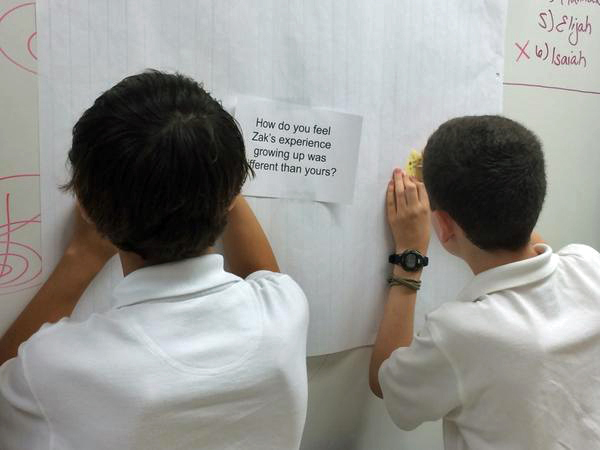
Students at the Davis Academy in Georgia contemplated the differences—and similarities—between Zak Ebrahim’s experience and their own. Photo: Twitter/@sbbEZas123
With Rosh Hashanah fast approaching, Sara Beth Berman of the Davis Academy in Atlanta, Georgia, wanted to create a lesson for the school’s middle school students around the ideas of empathy and forgiveness.
“In the month preceding the Jewish New Year, we talk a lot about how to forgive, how to accept forgiveness, and how do you want to be better in the new year,” says Berman, the experiential educator at this Jewish day school. “I was working on finding something to teach on these topics. And I was coming up short.”
 Zak Ebrahim: I am the son of a terrorist. Here's how I chose peace.
But an a-ha moment came when one of her colleagues, Judaic studies teacher Samara Schwartz, forwarded her a TED Talk all about the life-altering things that happen when we dare to have empathy: Zak Ebrahim’s “I am the son of a terrorist. Here’s how I chose peace.”
Zak Ebrahim: I am the son of a terrorist. Here's how I chose peace.
But an a-ha moment came when one of her colleagues, Judaic studies teacher Samara Schwartz, forwarded her a TED Talk all about the life-altering things that happen when we dare to have empathy: Zak Ebrahim’s “I am the son of a terrorist. Here’s how I chose peace.”
“I thought, ‘This is amazing,’” says Berman, who quickly jumped into a conversation with Schwartz, the school’s administrators and the school’s counseling team to discuss how to frame it for a lesson. “It’s this amazing person with such a positive message, who is a Muslim and whose father who was an extremist terrorist. I watched it a couple of times, and I knew it was going to be powerful.”
On Friday, September 12—just three days after Zak’s talk was released (and the day after September 11)—about 200 middle school students at the academy took part in a lesson framed around Zak’s talk and the song “Change Your Mind” by Sister Hazel. In the classroom where Berman observed, the students sat at desks arranged in a big U-shape and watched the talk. When Ebrahim revealed that his father is El-Sayyid Nosair, who was convicted of planning the 1993 World Trade Center bombing and who assassinated Rabbi Meir Kahane, the leader of the Jewish Defense League, in 1990, the kids audibly gasped.
“They couldn’t believe it,” said Berman. “They said, ‘We didn’t know that you could have a father that’s a bad man and then be so good.’ That’s really an important lesson for us in terms of teaching them how to make their own decisions and grow and be their own people.”
The students in the class also had a big reaction to the part of the talk where Ebrahim describes going to the shooting range with his father and uncles, and the glee that erupted when a target burst into flames. “I’m not sure how many of them could hear this,” says Berman, “but Zak said the Arabic phrase ‘ibn abuh’ — like father, like son. It sounds close to father in Hebrew—‘abba.’”
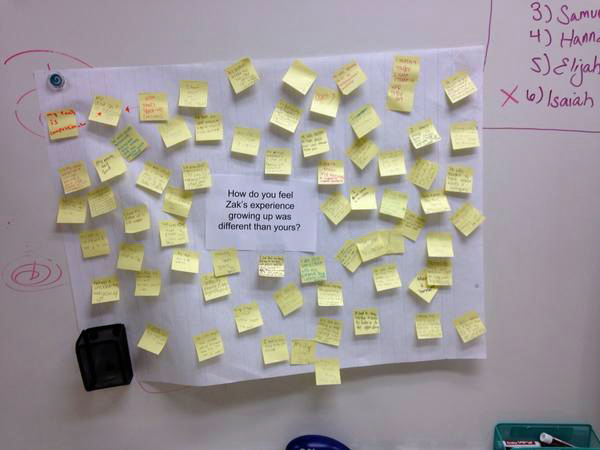
After watching the talk, the students got up from their seats. Around the classroom, a series of questions were posted for them to consider: How do you feel Zak’s experience growing up was different from yours? How was Zak’s childhood the same as yours? Why was he able to be empathetic? How could you be more open and welcoming to your peers who have struggled like Zak has?
Quietly, the students walked around and wrote down their thoughts on Post-it notes, which they then stuck to the walls. Says Berman, “Many students were like, ‘I ran out of Post-its. Can I have more Post-its?’”
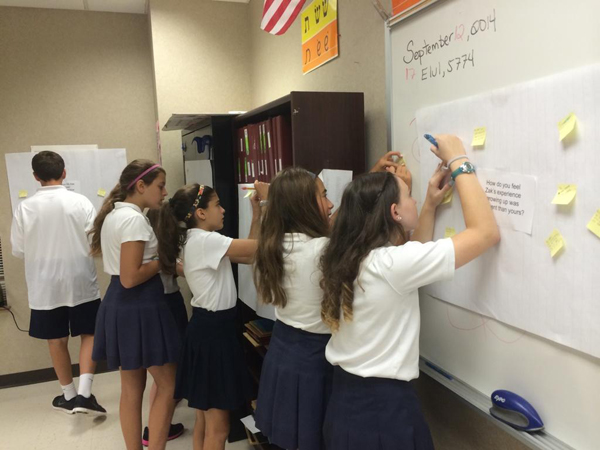
Students reflect on questions spurred by Zak Ebrahim’s TED Talk. Photo: Twitter/@sbbEZas123
Around the question, “Where do you learn stereotypes, and how can we bust them?” students posted answers like, “We learn stereotypes from the people around us, but we can bust them by doing what we think is right.”
The question, “Zak struggled as the new kid in class who was quiet and chubby. Have you ever felt like Zak?” also prompted some interesting answers. One female student wrote, “My brothers make fun of me for being small all the time. So I get what Zak is saying.”
Berman loved watching the students find common ground with Ebrahim. “There were some realizations that Zak was just like them—which was awesome. That’s all we want from our students: to realize that everybody is a human,” says Berman. “When you’re in middle school, it’s really hard to realize that there are other people around you that also have feelings. These are kids, so they aren’t on the terrorist path, but this reminded them that they also shouldn’t be on the bullying path. That they have choices.”
Overall, Berman calls the lesson “empathy paradise.”
The lesson also served as an important opportunity to talk to the kids about the realities of terrorism and about the importance of religious tolerance. “The majority of the kids were not born yet on September 11, 2001,” says Berman. “We really try to speak with kindness and to be authentic that we’re talking about a specific group of extremist terrorists—that we’re talking about ISIS, Hamas and Hezbollah, not Muslim people as a whole.”
Berman and her colleagues work hard to make sure that the students hear from people of many faiths. Last year, the school held a panel that brought together a rabbi, a Baptist preacher, a Presbyterian minister, and an imam, all senior clergy members from around Atlanta. Berman hopes that this talk will further help students be open-minded. “I enjoy finding things to help them have a nuanced understanding of Islam as a religion and Muslim people as a whole,” says Berman.
TED Talks are a popular teaching tool at the Davis Academy for students and teachers alike. And Berman hopes that this talk will have a lasting effect on how students think and act. “We want them to be able to have high-level conversations and to think about becoming a better person in the new year,” she says.
And for Zak Ebrahim, it was incredibly moving to see images of this lesson posted on Twitter. “Beautiful and humbling,” he wrote in response. “This is my dream.”
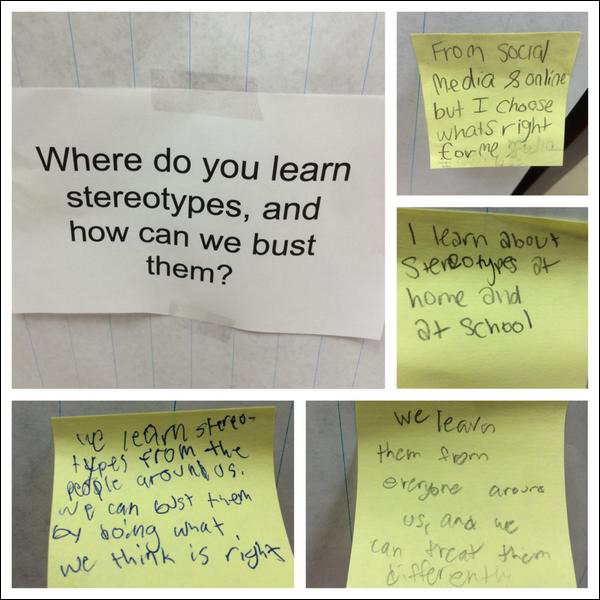
An up-close look at some answers to this question. Photo: Twitter/@sbbEZas123
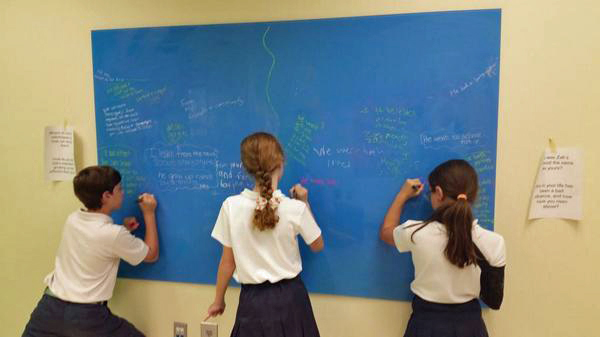
In this classroom, students answer questions on a chalk board. Photo: Twitter/@rabbispen
A scene from the end of this lesson. Photo: Twitter/@rabbispen
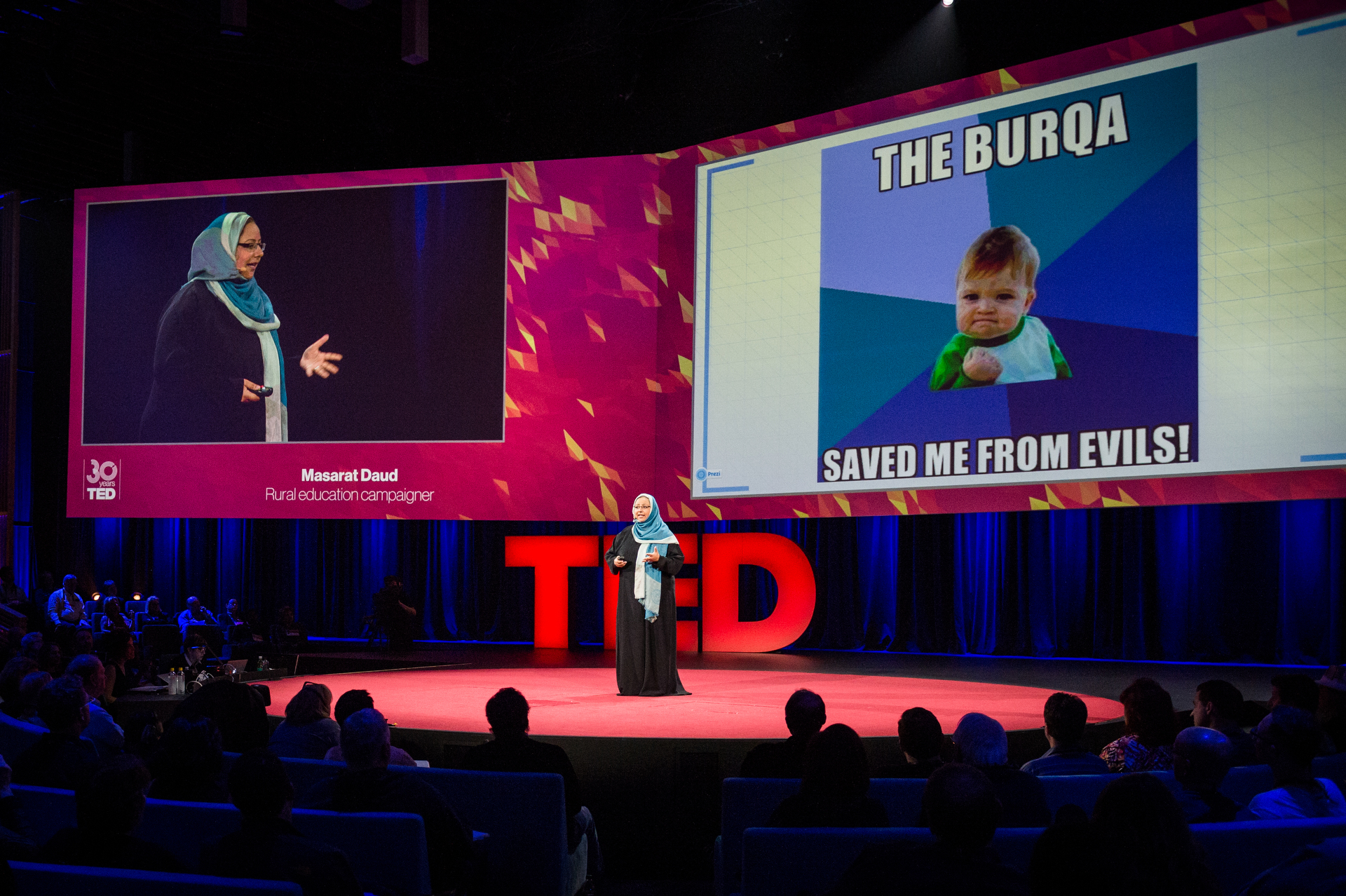
Masarat Daud. Photo: James Duncan Davidson
Masarat Daud wears the burka — but she didn’t always. As a younger woman at university in Dubai, she thought: “People would think I was so religious, no one would want to be friends with me!” She wore western clothes, to the amusement of her parents. But her mother began suggesting she wear the burka, as she had, as her grandmother had, as part of a line of women reaching far back in her culture. So Daud tried it. And now it’s part of her.
“What I’m wearing right now,” she says, “is the burka in my cultural context.” As she points out, the concept of covering the hair, “it’s not an exclusive Muslim thing.” We must agree that the burka evokes a specific set of associations in the wider world, and Daud riffs through them: 9/11, terrorism, repression. But above that, she says, “My burqua is a very important part of my family’s heritage. And it’s also this sense of power and the confidence it gave me, the power to choose and to be myself and respect myself, to be the person that I really am.”
“We all wrestle with this balance of sartorial tensions,” she says. “Should I wear something that honors my cultural heritage, or should I wear something that conforms to other people’s perspectives and expectations?” It’s a provocative idea wrapped in a charming personal story from the indefatiguable leader of TEDxShekhavati, the largest rural TEDx event in the world.
]]>Negin Farsad’s new documentary, The Muslims Are Coming!, churns hilarity out of a not-so-funny subject: Islamophobia. The film follows Farsad, a TED Fellow, and a group fellow Muslim-American comedians (Dean Obeidallah, Aron Kader, Preacher Moss, Kareem Omary, Maysoon Zayid and Omar Elba) as they tour the United States and hold comedic interventions to show conservatives, liberals, big city-dwellers and small town stalwarts alike that, well, Muslims are Americans too. As they set up an “Ask a Muslim” booth and hold a game show called “Name That Religion,” they point out the stereotypes and fear that persist throughout the country. On the flipside, the film examines the problem of support from Muslim community for these comedians who curse regularly and play on cultural differences.
Farsad spent two years making the film, which was financed via Kickstarter and contains interviews with Jon Stewart, David Cross, Janeane Garofalo and Rachel Maddow. And this month it’ll open in six theaters: at the Greg Siskel Film Center in Chicago opening yesterday (Sept. 12), at the Grand Illusion Cinema in Seattle starting today (Sept. 13), at the Downtown Independent Theatre in Los Angeles starting Sept. 14, the Quad Cinema in New York City starting on Sept. 20, at the Somerville Theater in Boston on Sept. 27, and the Rutgers Cinema in New Brunswick, NJ, starting on Sept. 27. There will also be one-time screenings in Denver and Orange County, California. And at the end of the month, the film will be available on iTunes and assorted on-demand services.
]]>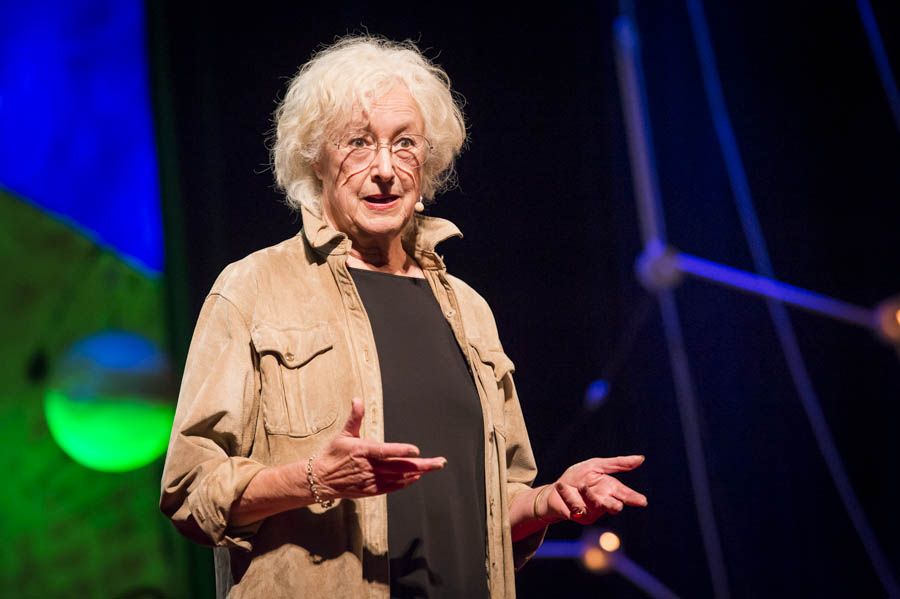
Photo: James Duncan Davidson
A few years ago, Lesley Hazleton, self-described “accidental theologist,” found herself waking each morning with the same question: What happened to Muhammad the night he received the revelation of the Koran? An agnostic Jew, Hazleton was writing a biography of the man who stood in the desert outside of Mecca in the year 610 at the moment that founded Islam as we know it today. It was the core mystical moment of Islam, and as such, it defied empirical analysis. Fashioning herself a rationalist, Hazleton set out to find the truth by studying existing accounts of that night.
 Lesley Hazleton: On reading the Koran
But as Hazleton says — in a gravelly, mythic voice made for fireside storytelling — what struck her in her research was not what happened so much as what didn’t. Mohammed didn’t come floating off the mountain as though walking on air; he didn’t radiate light and joy; he didn’t embrace a sense of an “absolute, foreordained, unquestionable role as the messenger of God.” In fact, says Hazleton, Mohammed himself didn’t believe what he saw was real.
He feared he’d been seized by an evil jinn, a spirit out to deceive him, that he was a majnun, possessed. Mohammed’s first reaction was to leap off a cliff to “escape the terror of what he’d experienced — by putting an end to all experience.”
Mohammed, says Hazleton, did not feel filled with the divine but with doubt, a paralyzing awe. But Mohammed’s fearful response was rejected by conservative Muslim theologians, who had the account of his suicidal thoughts struck from the record, despite the fact that it could be found in the earliest accounts of the night. For Hazleton, however, it was this doubt that made Mohammed seem real to her. After all, she says, “Doubt is essential to faith.”
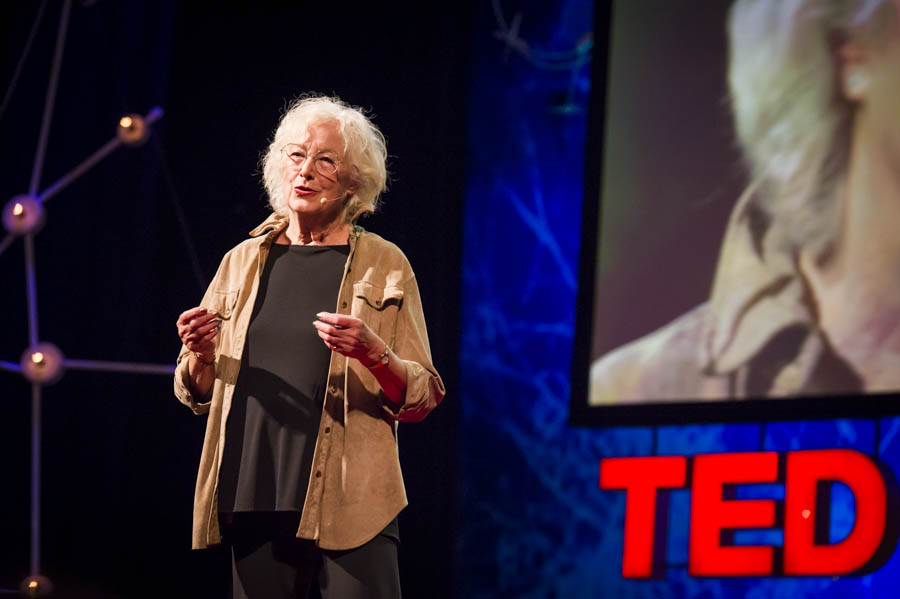
Photo: James Duncan Davidson
Which is why Hazleton is outraged at the arrogance of fundamentalism, which leaves no room for doubt and indeed undermines the struggle of faith. Why does the extremist minority have so much clout? She says with quiet rage, “We’ve allowed Judaism to be claimed by violently messianic West Bank settlers, Christianity by homophobic hypocrites and misogynistic bigots, Islam by suicide bombers. … This isn’t faith. This is fanaticism.”
Hazleton believes that faith is a necessary struggle, which is why, despite her agnosticism she insists on faith — including the faith that peace in the Middle East is possible. “Because,” she says, “Despair is self-fulfilling. If we call something impossible, we act in such a way that we make it so. And I, for one, refuse to live that way.” And she is sure Mohammed would agree.
Lesley Hazleton’s talk is now available for viewing. Watch it here »
]]>
TIME Editor-at-Large Bobby Ghosh covers global affairs and the Middle East. For five years he served as the magazine’s Baghdad bureau chief and, by the end of his tenure, was the longest serving print journalist in Iraq. Most recently Ghosh wrote a cover story on Egyptian president Mohamed Morsi, arguably the most important man in the Middle East at this moment.
In his informative TED Talk on why global jihad is losing, Ghosh discusses how Osama bin Laden misappropriated the word “jihad” — not just for the West but also for Arabs in the Middle East. While he painted it as a violent global holy war, in Islam the term has long referred to the internal, personal struggle to be a better person. Ghosh asserts that with the end of bin Laden came the end of this brand of bin Ladenism. And along with it, the concept of the global jihad.
Ghosh’s ideas are fascinating, but also raise a lot of questions. I caught up with him recently by email to hear more.
Do the Western media and/or government have a vested interest in perpetuating fear mongering in the form of jihadi rhetoric? What does the Western media get wrong about bin Ladenism and jihad?
No, I don’t believe Western media or governments have an interest in perpetuating fear about jihad. They misunderstand the word, but that’s not deliberate. They come by their misunderstanding honestly! The problem, as I say in my talk, is that extremists in the Muslim world have appropriated the word and twisted its meaning — so much so that many Muslims are now unsure what jihad stands for. So it would be unfair to blame Westerners for having the same uncertainty. There are some individuals in the West, just as there are in the East, who play up the worst interpretations, but they are a micro-minority.
How close do you think bin Ladenism is to being over? To what extent is jihad totally local?
I feel that the cult of bin Laden is on its last legs. Much of what passes for violent “jihad” today — whether it’s in Afghanistan, or Mali, or Somalia or Iraq — is, when you look closely, a contest for power and resources in those countries. The people behind the violence sometimes use the rhetoric of global jihad, and claim to be following in bin Laden’s footsteps, but in reality their interests are much narrower than his.
You say at the end of your talk that the original meaning of “jihad” can be reclaimed by Muslims who want peace. Can you elaborate on how this can be done? What does that mean on the ground-level? How do you wage a war on a word?
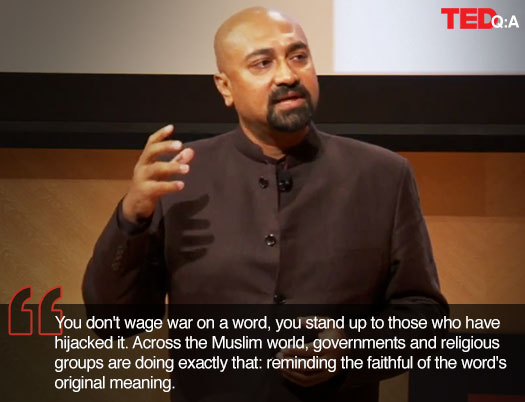
You don’t wage war on a word, you stand up to those who have hijacked it. Across the Muslim world, governments, civil-society organizations and religious groups are doing exactly that. Governments use policing and counterterror strategies to target extremist groups, but the challenge for civil-society and religious groups is to remind the faithful of the word’s original meaning. This is being done through education, through activism and through preaching in mosques and on TV. It’s an uphill struggle: corrupting a concept is easier than redeeming it.
One thing to note: extremists are actually helping to undermine their argument. By killing innocents (many of them Muslims), they are exposing the hollowness of their claims to be protecting the faith. Muslims can see through this.
It helps, too, that in the Arab world there is now demonstrable proof that change can happen without resorting to suicide bombs and IEDs. The Arab Spring may look messy to us in the West, but young people in that region are galvanized by the possibility of changing their lot. They’ve seen that dictators can be toppled by street protest. Bin Laden could never have imagined that.
It’s commonly believed that in the Koran there’s more than one original meaning of jihad, not just the internal struggle you speak of in your talk, but also the physical struggle to defend Islam. How would you respond to those who wish to perpetuate this meaning?
Yes, depending on how you choose to interpret it, jihad has more than one meaning, but nowhere in the Koran does it say it’s okay to kill innocent people. On the contrary, there are many passages that explicitly prohibit such killing.
In your article “The Agents of Outrage,” you mention Internet war-mongering by people like Sam Bacile, Terry Jones and Sheik Khaled Abdallah. What makes this specific kind of drudgery attractive to web users? Could this kind of outrage-machinery mobilization have been possible before the Internet?
The Internet makes it easier for these people to spread their poison, but equally, it allows the antidote to spread quickly. For every website that espouses hateful interpretations of the Koran, there are a dozen that seek to explain Islam in a reasoned manner. The trouble is not with the web, it’s with what happens in the “real” world, where agents provocateur sow discord, militants thrive in it, politicians stoke up the fear, and some people get carried away by it all.
I can’t understand the motivation of people who spread hate and fear in the name of faith, whatever their faith.
Finally: Yahoo! I’m glad you’re alive.
Thanks. … I think!
[ted id=1623 width=560 height=315]
]]>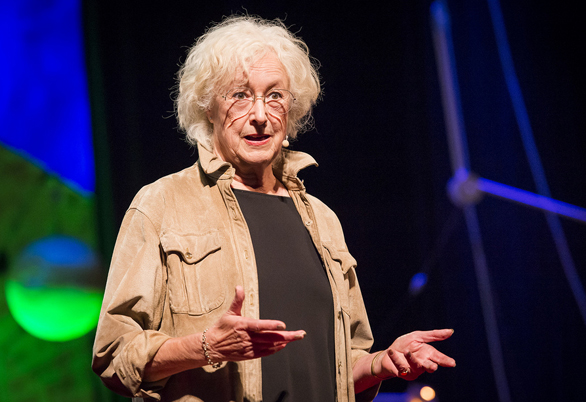
“Accidental theologist” Lesley Hazleton has written a biography of Muhammad. At TEDGlobal 2013, she shares a bold observation about his story. Photo: James Duncan Davidson
The core mystical moment of Islam took place in the year 610, or “half the world and almost half of history away,” as Lesley Hazleton, biographer of Muhammad, puts it. On a hot desert night, this previously ordinary man received the first revelation of the Koran on a mountain outside Mecca.
 Lesley Hazleton: The doubt essential to faith
“What struck me even more than what happened was not what did not happen,” says Hazleton in today’s talk, given at TEDGlobal 2013. “Muhammad did not come floating off the mountain as though walking on air. He did not run down shouting, ‘Hallelujah. Bless the lord.’ He did not radiate light and joy. There were no choirs of angels, no elation, no ecstasy, no golden aura surrounding him. No sense of an absolute foreordained role as the messenger of God. That is, he did none of the things that might make it easy to cry foul and put down the whole story as a pious fable.”
Lesley Hazleton: The doubt essential to faith
“What struck me even more than what happened was not what did not happen,” says Hazleton in today’s talk, given at TEDGlobal 2013. “Muhammad did not come floating off the mountain as though walking on air. He did not run down shouting, ‘Hallelujah. Bless the lord.’ He did not radiate light and joy. There were no choirs of angels, no elation, no ecstasy, no golden aura surrounding him. No sense of an absolute foreordained role as the messenger of God. That is, he did none of the things that might make it easy to cry foul and put down the whole story as a pious fable.”
No, according to Muhammad’s writings, he was convinced that the moment had to have been a hallucination, or the result of possession. He felt a deep sense of fear and even contemplated ending his life, says Hazleton: “He was overwhelmed not by conviction, but by doubt.”
While Hazleton points out that some Islamic theologians reject these accounts of Muhammad’s doubt, she says that it’s exactly this whirlwind of emotions that brought him alive for her. “It allowed me to begin to see him in full,” says Hazleton, whose biography of him, The First Muslim, was published in January 2013 after five years of research. “The more I thought about it, the more it made sense that he doubted,” she continues. “Because doubt is essential to faith.”
To hear what Hazleton means by this bold statement — and its implications for fundamentalists of all religions — watch this blistering talk, which points out that true faith takes deep internal wrestling. It’s a call for all religions to take back the public ground from hardliners who offer pat answers and dogma in place of an individual struggle with hard questions.
In honor of Hazleton’s powerful talk, below, watch six more talks from TED stages that give surprising, subtle understandings of Islam.
 Bobby Ghosh: Why global jihad is losing
Bobby Ghosh: Why global jihad is losing To many, the word ‘jihad’ conjures up images of Osama bin Laden. But as Bobby Ghosh shares in his talk at TEDxGeorgetown, this actually demonstrates a misappropriation of a word with deep religious significance. To the vast majority of practicing Muslims, he says, jihad is an internal struggle for the faith — a struggle against vice, sin, temptation, lust and greed, and toward a life outlined in the Koran. So why is the global understanding of the word so different? Because a small minority of believers see jihad as an external struggle, against forces that threaten the faith. Bin Laden was the latest to espouse this view, says Ghosh, and because of his heinous acts, his definition — to wage a war of terrorism on the West — stuck both in the West and in the Muslim world. In this talk, Ghosh looks at how bin Laden took a beautiful idea and corrupted it — and how why his twisted definition will no longer be able to stick. |
 Mustafa Akyol: Faith versus tradition in Islam
Mustafa Akyol: Faith versus tradition in Islam When journalist Mustafa Akyol traveled to Mecca, he made an interesting observation — that men and women prayed together at the Kaaba but were separated in a nearby Burger King. In this talk from TEDxWarwick, Akyol suggests that many things thought to be core to Islam — like the separation of the genders and the wearing of headscarves for women — are actually long-held local traditions as opposed to religious doctrine. |
|
Lesley Hazleton: On reading the Koran
Lesley Hazleton: On reading the Koran In this talk from TEDxRainier, Hazleton describes how she first became interested in Islam, calling herself an “accidental theologist.” One day, she simply decided to sit down and read the Koran; she found herself thoroughly fascinated by what was inside, because it seemed so far from her expectations. In this talk, she shares the insights and complexities she found within in its pages, and shares why it is easy for both Muslim extremists and “Islamaphobes” to take out-of-context Cliffs Notes from the holy book. Bonus: Read the TED Blog’s Q&A with Hazleton from right after this talk in 2010, when Hazleton shared that she was midway through a book that would allow readers “to get a real feel for [Muhammad] as a person.” |
 Feisal Abdul Rauf: Lose your ego, find your compassion
Imam Faisal Abdul Rauf: Lose your ego, find your compassion The Koran has 114 chapters, and each one begins with “basmala,” a saying which includes the words “In the name of God, the all-compassionate.” Because a Muslim’s mission is to follow in the path of the prophet and take on the attributes of God, this wording is especially meaningful. In this talk from a TED Salon in 2009, Imam Faisal Abdul Rauf looks at the centrality of compassion to Islam, and says that compassion is deeply a part of us. And yet, he also looks at why it is so hard to connect to it – because our egos get in the way. |
 Naif Al-Mutawa: Superheroes inspired by Islam
Naif Al-Mutawa: Superheroes inspired by Islam In 2010, Superman, Batman and Wonder Woman teamed up with The 99, a band of superheroes who derive their powers from the 99 attributes of Allah. In this talk from TEDGlobal 2010, Al-Mutawa explains why he created these superheroes in his comics: to point out the similarities between superheroes and the prophets, while breaking stereotypes of Islam. By reinforcing positive images of Islam, minus the extremism, Mutawa shares how he hopes to create a cross-cultural framework for confronting evil. |
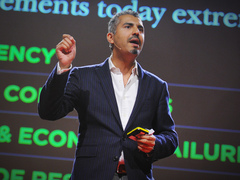 Maajid Nawaz: A global culture to fight extremism
Maajid Nawaz: A global culture to fight extremism Maajid Nawaz is a former Islamic extremist. In this powerful talk from TEDGlobal 2011, he shares his story of how he joined the cause and even became a recruiter for it. His insight? That extremist groups are good at communicating across borders. And that those wishing to spread democracy have a lot to learn from them. |
This post was originally published as a collection of six talks in December of 2012. It was updated to include Hazleton’s latest talk in June of 2013.
]]>