- Choose a Zoho Creator development company in USA that gets your real business not only software build work.
- Search for proof of work in custom applications, Zoho integrations , and outcomes that fit your specific industry across the USA.
- Before you sign anything, confirm Zoho certifications, partnership standing, and hands-on implementation experience.
- Make sure they follow a structured development process, and that they can actually deliver reliable long-term support.
- Don’t choose a provider only because the price is low, instead, prioritize scalability, strong integrations, and real business insight.
- Invest in Zoho Creator Development Services in the USA that result in secure, scalable, future-ready business applications.
Across the USA, a lot of companies are starting to use low-code platforms more and more, to automate those everyday routines, push operational efficiency up, and generally make digital transformation happen faster. Out of all those options, Zoho Creator feels like one of the go-to choices, since it lets teams build custom business applications such as ERP-style systems, CRM solutions, inventory management, client portals, and also approval workflows.
That said, picking the platform is just one piece, not the whole puzzle. What you get at the end really hinges on selecting the right Zoho Creator development company , one that listens to your requirements, designs applications that can scale later on, and connects in a clean way with the tools you already run.
If you’re trying to find the best Zoho Creator development company in USA, you can use this guide to look at the main factors that matter, especially the mix of technical capability and industry experience , plus how they manage planning for the project, handle testing, and keep improving things after go-live.
Why Choosing the Right Zoho Creator Development Company Matters
Implementing Zoho Creator is more than just putting another software project in motion; honestly, it’s a long-term bet on how your business runs. The right Zoho Creator development company doesn’t only “build apps”; it sort of sketches out solutions that help untangle workflows, boost day-to-day efficiency, and still make room for growth later.
When you go with a seasoned implementation partner, your app is more likely to grow with your real needs, not just with a short-term plan.
A good and reliable development partner tends to help you end up with a solution that’s meant for lasting success, because they focus on things like :
- Streamline workflows and trim the manual grind.
- Build applications that expand with your business.
- Connect smoothly with Zoho apps plus third-party systems.
- Protect sensitive business data using secure access controls and proper permissions too.
- Lower long-run maintenance costs, and avoid those painful, expensive redevelopment cycles that show up later.
In the end, partnering with experienced Zoho Creator Development Services helps ensure your solution is secure, scalable, and designed to support what your business wants, over the long term.
8 Things to Look for Before You Choose the Best Zoho Creator Development Company in USA
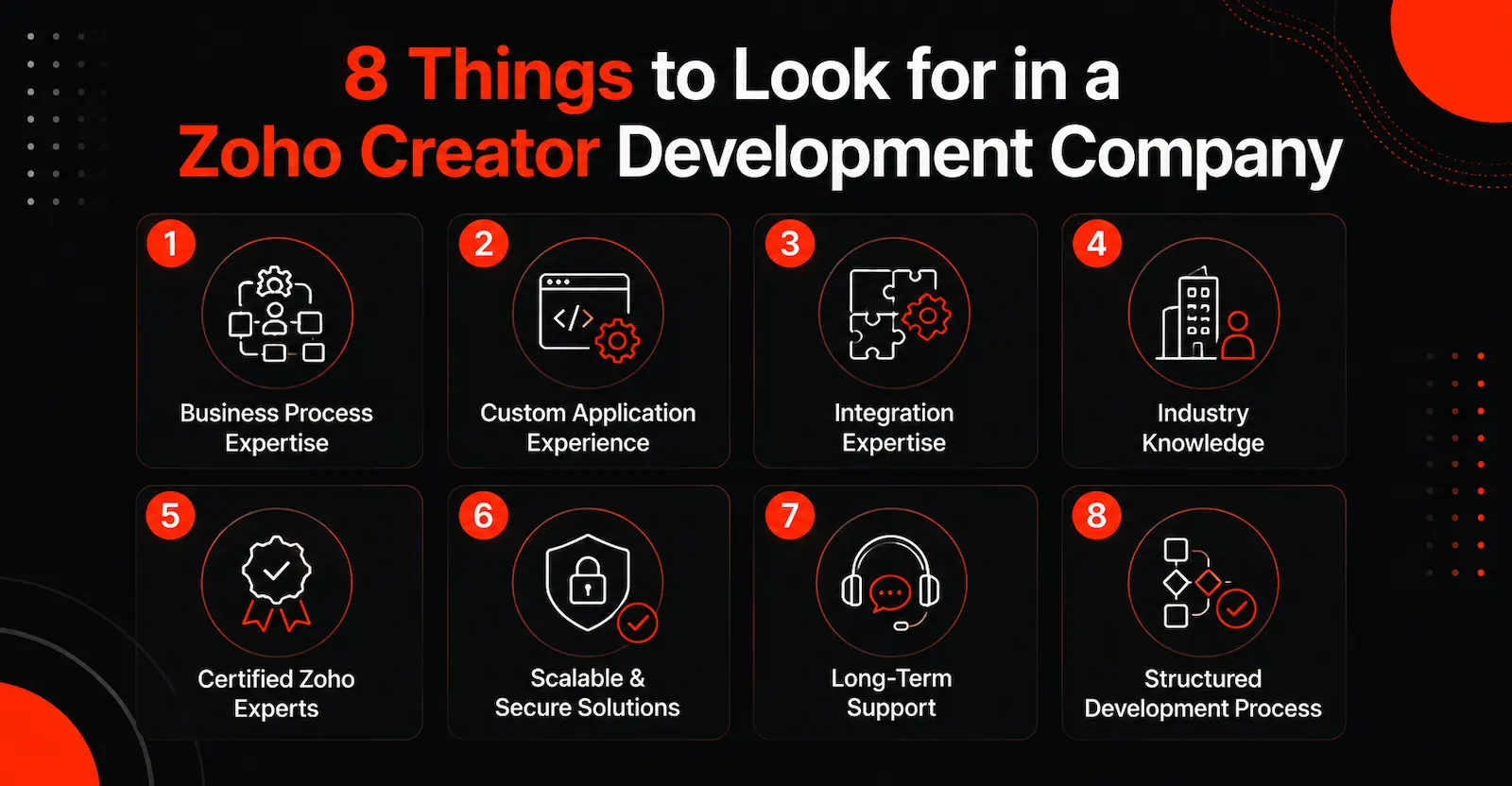
Choosing the right implementation partner can determine whether your Zoho Creator project delivers long-term business value or becomes an expensive redevelopment project.
Beyond technical skills, the best Zoho Creator development company should understand your business processes, build scalable solutions, and provide ongoing support to help your business grow. Here are eight essential factors to evaluate before making your decision
1. Choose a Company That Understands Your Business Processes
A successful Zoho Creator application starts with understanding how your business operates, not just how to write code. Before development begins, the company should analyze your workflows, identify operational challenges, and recommend solutions that improve efficiency.
Look for a development partner that understands processes such as:
- Sales and lead management
- Daily business operations
- Manufacturing workflows
- Inventory and warehouse management
- Finance and approval processes
A successful Zoho Creator application starts with understanding how your business works, not only how to write code. Before development gets going, the company should take a look at your workflows, see what operational problems exist, and suggest solutions that make things faster, steadier, and more efficient. This style of planning becomes even more useful when teams lean into business automation with Zoho to remove manual steps and speed up day-to-day operations.
2. Evaluate Their Experience Creating Custom Business Applications
Every business has unique requirements, so your application should be arranged around your actual workflows instead of leaning too hard on generic templates.
An experienced Zoho Creator development company ought to have a real track record of building custom business apps for a range of industries, not just “similar” projects.
When you speak with them, ask about their background developing solutions like:
- ERP systems
- CRM applications
- HRMS platforms
- Vendor portals
- Customer portals
- Inventory management systems
Also, taking a look at their portfolio and past work usually gives you this calmer feeling that they can manage messy, complex business requirements, and then deliver solutions that fit your organization.
3. Check for Solid Zoho & Third-Party Integration Expertise
Most businesses end up using multiple software tools, so integration becomes one of those critical parts of any Zoho Creator implementation.
Your development partner should be able to connect Zoho Creator with both Zoho applications and outside business systems so the information keeps moving smoothly.
See if they’ve done integrations such as:
- Zoho CRM
- Zoho Books
- Zoho Inventory
- Zoho Flow
- Payment gateways
- Third-party APIs
Strong integration capabilities help avoid duplicated data entry, boost reporting precision, and support connected business workflows.
4. Search for Industry Specific Experience
Every industry has its own operational process , compliance needs, and reporting expectations. If a development company has already worked in your space, it can understand what you’re up against quicker, and then recommend approaches that actually match your business objectives.
This sort of industry experience is especially useful for organizations in:
- Manufacturing
- Healthcare
- Retail
- Distribution
- Professional services
- Construction , etc.
When a firm already understands your industry, the rollout tends to feel faster, requirements get captured in a clearer manner, and the final app usually needs less back and forth revisions.
5. Review Zoho certifications and Partner Statutes
Not every Zoho developer offers the same depth of expertise. Yes, freelancers and independent developers can be very capable technically , but certified partners often have more implementation experience, more direct access to Zoho resources, and they commonly use a more structured development methodology.
Before you pick someone, it’s smart to sort out the distinction between:
- Freelancers
- Independent Zoho developers
- Zoho Partners
- Zoho Premium Partners
Selecting a certified implementation partner often gives you more confidence that the project follows Zoho best practices, and that it’s designed for long term stability as well as scalability.
6. Ensure They Build Scalable & Secure Applications
Your business will keep growing, and your applications should do that too. A well designed Zoho Creator solution should help with future expansion, without making you redo everything from the start.
When you ask about it, try to get clarity on how they handle:
- User roles and permissions
- Data safeguards and encryption approach
- Application performance, response time, and tuning
- Future scaling, load handling, and growth planning
- Security standards and practical best practices
Putting scalability and security into the application early on can actually protect your investment, while also keeping the day-to-day performance steady as your business evolves, and yes, even when the processes change.
7. Review Their Support & Maintenance Services
Development does not really stop after deployment. Ongoing support matters a lot, so your application keeps running smoothly when your business shifts, or when new needs quietly show up.
A trustworthy Zoho Creator development company should provide:
- User training
- Documentation, guides, and handover notes
- Performance optimization and ongoing monitoring
- Bug fixing and issue resolution
- Continuous improvement, updates, maintenance routines
Long-term support is what helps your application stay current, remain secure, and stay aligned with changing business requirements, instead of slowly drifting out of sync.
8. Ask About Their Development Process Before Signing
Before you sign anything, ask about how they actually develop the solution, because having a structured development process lowers the project risks, helps keep communication clear, and makes sure every business requirement gets properly documented before any development starts.
When things stay transparent during the whole implementation lifecycle, it’s also easier to avoid those unpleasant surprises like unexpected delays or scope changes, you know.
Try asking if their process covers things like:
- Discovery workshops
- Requirement gathering
- Wireframing and solution planning
- Application development
- Testing and quality assurance
- Deployment
- User training
A structured implementation process also makes future integrations easier, especially when you understand the Zoho Creator ecosystem and how different Zoho applications work together.
Common Mistakes Businesses Make When Choosing a Zoho Creator Development Company in USA
Picking the wrong implementation partner can cause project delays, more expenses, and apps that just don’t match your longer-term business plans. Before you choose a Zoho Creator development company, try not to fall into these common traps:
- Choosing a firm based only on the cheapest rate.
- Hiring developers but skipping business consulting, or not confirming they understand your domain clearly.
- Overlooking whether they can handle Zoho integrations, and also third-party systems.
- Forgetting to ask if the solution can actually scale once your business starts growing.
- Ignoring data security, user roles, and access permissions until things get messy.
- Accepting the project without solid documentation, or without a real knowledge transfer plan.
- Working with a company that doesn’t offer post-implementation support and ongoing maintenance.
- Skipping discovery and requirement gathering before development really starts, which is kinda risky.
- Not checking their earlier Zoho Creator work, case studies, or client testimonials.
- Focusing purely on technical skills, instead of industry-specific experience.
Avoiding these errors should make it easier to select a dependable partner and get stronger outcomes from your Zoho Creator investment.
To get a better understanding on how CRM integrations can improve your sales process, explore CRM for lead management and see how businesses centralize customer interactions.
Why Choose Business Scales as your Zoho Creator Development Company
Choosing the right Zoho Creator implementation partner is, well, mostly about getting a team that’s seen it before, with real experience, a disciplined development approach, and a consistent track record of actual business results.
At Business Scales, we mix business consulting with Zoho expertise, so we can map out solutions that improve productivity, reduce friction in daily tasks, and keep momentum toward long-term growth even if requirements change midstream, or halfway through.
Here’s the short version of why companies choose Business Scales:
- 10+ years delivering business automation solutions.
- 100+ successful Zoho implementations across multiple industries.
- 50+ certified Zoho professionals, dedicated to consulting, building, and ongoing support.
- Strong experience with custom ERP, CRM, inventory, finance, and manufacturing automation
- Planning from discovery to development, then deployment and user training, end to end.
- Post go-live support, performance tuning and continuous upgrades,
- Trusted across the USA by companies that need scalable Zoho Creator solutions.
Whether you’re just trying to automate one small internal workflow, or you’re planning a full custom setup, our Zoho Creator Development Services are built to deliver secure, scalable, future-ready apps that expand with your business, not fight it, or slow it down.
Final Thoughts
Choosing the best Zoho creator development company in USA is really more than just looking at prices or technical skills. The right implementation partner should not only understand how your business runs day to day, but also should help you build scalable, secure applications and keep things steady with ongoing support, especially as your company grows and stuff changes.
Before you make the call, take a hard look at their industry experience, their implementation approach, how well they can handle integrations, what certifications they have, and what kind of long term support they actually offer.
Investing money into the right Zoho Creator Development Services today can make your operations feel more efficient, lower day-to-day operational expenses, and create a solution that still delivers value for years, without too many surprises later.
Frequently Asked Questions
How do I choose the best Zoho Creator development company in USA ?
Choose the company with proven Zoho Creator experience, industry insight, certified developers, and really solid integration capabilities, a structured development process, and reliable post-launch support.
What should I look for before hiring a Zoho Creator development company ?
Look for experience in custom app development, successful Zoho Creator implementations, smooth integrations, best project management, long- term support, and proven work records.
How much does Zoho Creator development cost for businesses in USA ?
The cost can change a lot; it depends on how complex the project is, how many modules you need, what kind of custom integrations you want, plus automation requirements and the implementation timeline. Most projects are priced based on business requirements.
Should I hire a freelancer or a Zoho Premium Partner ?
Freelancers are sometimes fine for small tasks or minor customizations. But for building complex business applications, ERP systems, or enterprise-level automation, a Zoho Premium Partner is usually the safer, more structured choice. Premium Partners tend to bring certified expertise,organized implementation approach, and long-term support.
How long does a Zoho Creator implementation project usually take?
That really depends on the scope and how complex everything is. For something like simple workflow automation, it can be just a few weeks, but for a custom ERP setup or a multi-module business application, it can run a few months.
Can a Zoho Creator development company integrate Zoho Creator with my existing software?
Yes, absolutely. A skilled Zoho Creator development company can connect Zoho Creator with Zoho CRM, Zoho Books, Zoho Inventory, Zoho Flow, payment gateways, ERP environments, and also other third-party apps using APIs and native integrations.
]]>- Zoho One for small to medium companies bundles apps like CRM, Accounting, HR, Support, and more in one login, and honestly, one subscription to rule them all.
- The data syncs automatically across the apps, so less manual entry and fewer reports that slowly turn into outdated memories.
- Sales, finance, HR, and support all run on connected apps, so the important info moves between departments on its own like it has a mind of its own.
- Zoho Creator is in the suite too, so you can build custom apps instead of just picking generic templates and pretending they fit.
- Zia, Zoho’s built-in AI assistant, brings up insights and flags potential issues across the suite automatically, which is helpful when you’re not checking everything.
Ask any small to medium companies/owner how many logins their team uses in a normal week, and most won’t have an exact number. That’s usually the first sign something’s off. Not that any single tool is bad; it’s more like nobody actually sat down and planned how everything would work together. They just got added, one by one, as problems showed up, kind of quick and unsteady.
The cost shows up in small, annoying ways at first. Like re-typing the same customer details into two separate systems, or finding out the sales number in one dashboard does not match what finance is seeing. It’s rarely one huge failure. It’s more like a bunch of tiny ones, all stacking up. And Zoho One for small to medium companies is built specifically to close that gap, so you can reduce the chaos without losing control.
What Is Zoho One for Small to Medium Companies?
Most small to medium companies don’t begin with one perfect system. They usually start piecemeal, like a CRM here, an accounting tool there, maybe a separate app for HR, and then a few spreadsheets holding everything together. That works for a while. Then the business grows, and suddenly nobody is sure which version of a customer record is the correct one, or where the latest notes are actually stored.
Zoho One for small to medium companies exists to solve that mess. It’s one subscription that gives your business access to Zoho’s full catalog of apps, including Zoho CRM, Zoho Books, Zoho People, Zoho Desk, Zoho Creator, and dozens more, all controlled under one login and one admin panel.
Zoho One vs Separate Business Apps
| Features | Separate Business Apps | Zoho One |
| Login | One login for each tool (often 6-7+ separate logins) | Single sign-on for the whole Zoho suite |
| Data Transfer | Manual data transfer between systems | Automatic data synchronization across all apps |
| Reports | Reports generated separately from each tool, so insights get stale | Unified, real-time reporting across the business |
| Error Risk | Higher due to manual entry and duplicate work | Lower as data is entered once and shared automatically |
| Cost Structure | Multiple subscriptions from different vendors | Single bundled subscription |
| Customization | Limited to the capabilities of individual applications | Highly customizable with Zoho Creator and integrations |
| Administration | Users, roles, and permissions managed separately for each application | Centralized user, role, and permission management across all apps |
Zoho One for small to medium companies takes a totally different approach, not like you have separate vendors and separate logins, everything ends up living under one platform and the apps are designed to share data with each other automatically, so you can manage your business instead of using separate tools.
So when a deal closes in Zoho CRM, it can update your books, your project tracker, and your support system without anyone doing the spreadsheet thing. Honestly, the main win with business automation with Zoho is basically bridging that same disconnect across every department, at once.
How Zoho One Connects Every Part of Your Business
So how does Zoho One work in practice? It connects every department through the same underlying platform, starting with sales.
Sales
Every sales team has its own way of working, and Zoho CRM inside Zoho One is built to flex around that, not forcing some stiff pipeline on everyone. Lead tracking, quotes, follow-ups, and customer history all sit in one place. Then the same information just feeds into the rest of the suite smoothly.
For a closer look at how this works day to day, every sales team has its own way of working, and Zoho CRM inside Zoho One is built to flex around that instead of forcing a rigid pipeline. It’s the same system explained in Zoho CRM lead management, where quotes, follow-ups, and customer history feed straight into the rest of the suite.
Finance & Accounting
Zoho Books handles invoicing, expenses, and financial reporting, and since it’s part of Zoho One, it’s already connected to your sales and inventory data. For businesses operating across the US and Canada, sales tax automation for US and Canadian businesses is one layer small to medium sized teams often underestimate until it turns into a real headache.
HR & People
Onboarding, time off requests, performance tracking, internal approvals- Zoho People covers the basics most small to medium size businesses need without you having to bolt on a separate HR platform and pretend it all plays nicely together.
Customer Service
Zoho Desk gives your crew one place to handle support tickets, customer history, and even response times. Because it sits right inside the same platform as your CRM, support reps can check a customer’s sales history; no need to ask someone from another department.
Custom Workflows with Zoho Creator
This part is where Zoho One for small to medium companies kind of goes farther than what most all-in-one software actually delivers. Zoho Creator is included in the suite, and it lets you craft custom apps and automate workflows that match how your business really runs, not just how some generic template presumes it should.
You can set up a custom approval process , add a client onboarding form, keep an internal request tracker, and if the standard apps do not quite match your needs, Creator lets you create that missing piece.
Benefits of Running Zoho One for Small to Medium Companies
- One login, instead of five or six separate tool subscriptions
- Information moves between departments automatically, so nobody is re-entering the same details twice.
- Less apps to manage means fewer headaches when something breaks , or when it refuses to cooperate.
- New employees pick up one steady interface instead of juggling a different login for every single job function.
- Reporting shows the whole business, not only whatever one app happens to be tracking.
Real Business Problems Zoho One Solves for Small to Medium Companies
Imagine a small retail shop, running one point of sale system, plus a separate CRM, then still using a spreadsheet for inventory. Each time you make a sale, you end up updating three spots by hand. And at the end of the week, the totals rarely line up the way you’d hope, not really clean. Zoho One for small to medium companies keeps it together, though: the sale, the customer record, and the inventory figure all move at once because they sit on the same platform instead of three loosely tied tools that never quite agree.
You see that same story in service companies, agencies and product businesses too. Wherever a business has people manually bridging the gap between apps, that’s usually where Zoho One steps in and earns its keep, even if nobody wants to admit how often it happens.
For retailers specifically, those connected workflows lead to a smoother shopping flow and better customer relationships, with Zoho One for retail.
How AI Makes Zoho One Smarter ?
Zoho One includes Zia, Zoho’s built-in AI assistant, and it shows up across several of the apps. Zia can surface useful insights from your CRM information, suggest a next action on deals, and highlight anomalies in reports before they grow into real issues.
It’s not supposed to replace how your team normally works, more like a thin safety layer that catches patterns a busy group might overlook while they’re juggling everything else.
And for small to medium businesses that don’t have a dedicated data or analytics person, this matters a lot more than it sounds. Basically, some of the analysis happens automatically in the background, instead of someone having to assemble the reports and interpret them manually every single week.
Is Zoho One Right for Your Small to Medium Companies?
Imagine a little retail shop running separate bits for point-of-sale, a CRM, and then a spreadsheet for the stock.
With Zoho One for small to medium companies, the same situation feels different:
- Point-of-sale: You ring the sale up once, and the transaction record basically shows up automatically, so there’s no need to re-enter that information somewhere else later.
- Customer record: The buyer’s purchase history updates in the CRM right away. So when you do support, marketing, or even a repeat sale, you’re not working blind; you’ve already got the full context.
- Inventory: Stock counts shift in real time as the sale moves through, instead of waiting around for someone to remember the spreadsheet update after.
- Reporting: Those end-of-week figures actually reflect reality, because all three areas were updated from the same transaction instead of being copied over, one by one, through separate manual entries.
Final Thoughts
Zoho One isn’t just a bigger bundle of apps. It’s more like a different operating rhythm, where sales, finance, HR, and support pull from the same underlying source instead of living in their own little silos. And yeah, it’s not only the number of apps included; it’s the way they connect, and how smoothly that connection works in practice.
So if your team is still stitching together individual tools, and kind of hoping the totals will magically line up by week’s end, maybe it’s time to see what a connected platform feels like. Our team can go through what a Zoho One setup might look like for your business, step by step.
Frequently Asked Questions
Is Zoho One suitable for small to medium companies ?
Yes, Zoho One can be suitable for small to medium companies,especially when you are working with different departments. That’s basically the moment where swapping logins, and then re-entering the same details starts eating up real minutes, also it eliminates the cost of paying for separate tools.
What is the difference between Zoho One and Zoho CRM?
Zoho CRM is basically one focused app for managing leads, deals, and the whole customer relationship side. Zoho One is the broader bundle, it includes Zoho CRM plus a lot of other apps, for example, finance, HR, support, and even building custom applications. So it is more of a complete ecosystem rather than just one piece.
Can Zoho One be customized for our specific processes?
Yes, and this is where it gets pretty useful for teams that do things their own way. Zoho One includes Zoho Creator, which lets you create custom apps and automate workflows that match how your business actually operates, instead of sticking only with the standard out of the box setup.
How long does a Zoho One implementation take?
It depends on how many departments and processes are involved, and also whether you want custom development beyond the standard apps. A simple setup can happen faster, but if you have to migrate data from several existing systems, that will usually take longer.
Is Zoho One cost-effective compared to using separate apps?
For most small to medium companies, yes especially if you are already using more than one or two tools right now. One Zoho One subscription often comes out cheaper than paying for multiple standalone tools separately, plus it helps avoid the sneaky cost of having to manually connect everything.
]]>A CRM handles customer relationships, accounting software deals with finances, project management tools help sort through tasks,and communication platforms make sure teams stay connected. But yeah, even if each app solves its own small piece, there’s a bigger headache underneath software fragmentation, kind of silently creeping in.
This is exactly where the Zoho Ecosystem shows up in a different way. Instead of pushing isolated business applications, Zoho offers one connected platform that includes more than 60 business apps, and they’re designed to work together pretty seamlessly. If you’re just getting started with Zoho, you can check out our guide on What Is Zoho and How Can It Help Your Business? so you can see how the whole platform supports streamlining operations with an integrated set of tools.
Lots of businesses already think Zoho Creator is just a low-code development platform, but honestly it is way more than that. It is the base layer that lets organizations create tailored applications, automate unusual workflows, and connect every part of the business without going into heavy, complicated code.
What Is Zoho Creator?
Most business software is built to match common business needs. But every company has processes that standard software just can’t fit properly. And this is where Zoho Creator kinda makes the biggest difference, like it just does.
Zoho Creator is a low-code application development platform that helps businesses craft custom apps, automate processes, build dashboards and connect different systems without needing deep programming know-how.
Instead of forcing your business to fit the software, Zoho Creator lets the software bend a bit, so it matches your real world routine.
Whether you’re after a personalized approval flow, a stock visibility tracker, an employee portal, a customer hub, or even a field service setup Zoho Creator makes it doable using a visual drag and drop interface.
Why Zoho Creator Is the Core of the Zoho Ecosystem
Some folks say Zoho CRM is the real center of Zoho, but you know, it depends on what you’re building.
Others insist Zoho Books or Zoho One, plays that role. But the truth is Zoho Creator is what ties the whole ecosystem together, under the surface. Think of Zoho Creator as the engine working beneath the hood.
Every business has unique workflows that can’t always be handled using off the shelf software by itself. Zoho Creator fills those gaps by letting teams build applications that connect straight with Zoho CRM, Zoho Books, Zoho Inventory, Zoho People, Zoho Desk, and dozens of other applications too.
Rather than replacing these apps it sort of adds on to their strengths, and makes the whole ecosystem more flexible, more adaptable, and yes, easier to adjust when things shift.
How Zoho Creator Connects Every Department
Instead of acting like a completely standalone application, Zoho Creator runs alongside other Zoho products, to upgrade how the business works day to day.
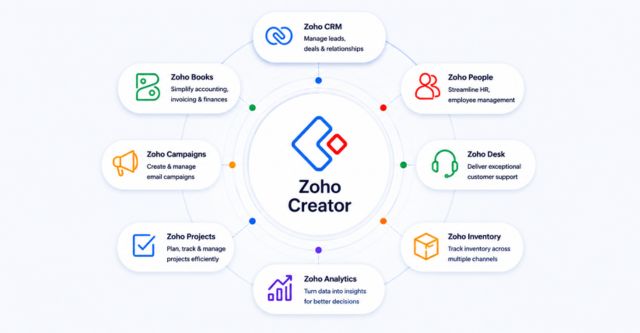
Sales & CRM
Zoho CRM helps businesses manage leads and customer relationships, but let’s be real, every sales process is slightly different.
With Zoho Creator, teams can set up custom lead qualification systems, partner portals, quotation workflows, and customer onboarding applications that integrate right into CRM data. If you want to see how Zoho CRM supports lead management and sales growth, have a look at our guide on How Zoho CRM Helps Manage Leads and Sales in One Place.
The result is a sales process that is tailored on purpose, just for your organization.
Finance & Operations
Financial management sometimes needs workflows that don’t fit neatly inside an accounting tool’s limits.
Zoho Creator lets businesses automate approval routes, milestone based billing, expense management, procurement systems, and custom financial dashboards, while still staying tightly connected with Zoho Books.
That cuts down on manual steps, and it also improves operational visibility, kind of across the board.
Inventory & Supply Chain
When a business has warehouses, or multiple locations it usually needs inventory processes that standard software can’t fully handle.
Using Zoho Creator, organizations can build custom warehouse management, quality inspection forms, supplier portals, barcode related apps, and inventory approval workflows that sync with Zoho Inventory in real time.
Human Resources
Employee management goes way beyond simple attendance and payroll.
Organizations can use Zoho Creator to put together employee onboarding systems, internal request portals, training management applications, equipment request forms, and performance tracking dashboards that integrate directly with Zoho People, without extra duct tape.
Customer Service
Exceptional customer support really needs quick access to information, not more clicks, kind of period.
Zoho Creator lets businesses put together customer self service portals, complaint tracking systems, warranty registration apps, and field service workflows that blend well with Zoho Desk.
Real Business Problems Zoho Creator Solves
One of the biggest advantages of Zoho Creator is its ability to tackle business challenges traditional software just can’t.
For example, a manufacturing company may require a production approval process involving multiple departments. A logistics company may need a custom shipment tracking portal. A healthcare organization may need specialized patient management workflows.
Instead of buying random software for every tiny unique requirement, businesses can create these applications inside Zoho Creator while keeping all the data linked right back to the rest of the Zoho ecosystem.
That flexibility helps organizations innovate without pushing software complexity, too much in the same direction.
The Power of AI in Zoho Creator
Modern application development is getting faster, thanks to artificial intelligence, and honestly it just feels easier than before.
Zoho Creator also has Zia AI, it assists users with creating applications using natural language prompts, it can generate workflows and automate repetitive tasks, plus it improves everyday business productivity, like in a steady kind of way.
Instead of writing super lengthy code, businesses can build these apps more efficiently, which really helps reduce development time.
That’s why low-code development feels more approachable for organizations big or small.
Benefits of Building Your Business Around Zoho Creator
Businesses that adopt Zoho Creator as the center of their digital ecosystem can experience several advantages:
- Build custom business applications without heavy coding
- Connect every Zoho application through one platform
- Reduce dependence on third-party integration tools
- Automate repetitive business processes
- Modernize legacy systems with custom interfaces
- Scale applications as business requirements evolve
- Improve collaboration across departments
- Reduce software development costs
Rather than forcing your team to adapt to rigid software, businesses get a broader flexibility to craft solutions that match their exact operational needs. And if you’re planning to automate business processes across multiple departments, you might find our article on Business Automation with Zoho: Solve Common Business Problems helpful.
Is Zoho Creator Right for Your Business?
Zoho Creator is a pretty good fit for companies that want more flexibility than most traditional software tends to offer.
It is particularly valuable for:
- Manufacturing companies
- Healthcare organizations
- Logistics businesses
- Retail businesses
- Educational institutions
- Financial service providers
- Service-based companies
- Enterprises managing complex workflows
Whether your target is automation, process improvement, or digital transformation, Zoho Creator gives the base you need to build scalable business applications.
Final Thoughts
The Zoho ecosystem is much more than a collection of business applications.
Its true strong point is that flexibility, it can adapt to how every business actually operates. And yeah, that flexibility comes from Zoho Creator.
When you blend low-code app creation with integrations that play nicely across the Zoho ecosystem, Zoho Creator helps teams streamline day-to-day processes, craft custom solutions and even reduce those normal software boundaries.
Instead of pushing your business to adjust to pre-built applications, Zoho Creator lets you design the surrounding environment around your own workflows, and in turn it becomes one of the more helpful platforms for organizations aiming at long-term digital growth.
]]>For retailers, meeting all that can get tricky, because customer details often stay trapped inside separate systems, inventory updates can arrive late, marketing efforts can feel disconnected, and support teams can’t always pull up the full customer history they actually need. The result is this scattered experience, that makes it hard to build meaningful relationships, and that’s where revenue sort of slips away without any noise.
That’s where Zoho One for Retail comes in. By combining customer management, sales, inventory, marketing, support, and analytics in one place, Zoho One helps retailers design memorable shopping journeys that make customers come back again and again.
Why Customer Loyalty Is More Important Than Ever
Many retailers spend a lot of energy on bringing in new customers. Yes, bringing in fresh faces matters, but long-term momentum usually depends on keeping the people you already earned.
Think about a brand you trust. You likely keep buying from them because of the experience they deliver, not only because of the product. Customers who feel acknowledged are more inclined to return, share your business with others, and invest more over time.
Loyal customers typically:
- Make repeat purchases
- Spend more per order
- Engage with marketing campaigns
- Leave positive reviews
- Recommend brands to friends and family
In today’s crowded retail scene, customer loyalty is one of the most dependable engines for steady growth.
What Is Zoho One for Retail?
Zoho One for Retail is a unified business platform designed to help retailers manage every aspect of their operations from a single ecosystem.
Instead of using separate tools for CRM, inventory, marketing, customer support, and reporting, retailers can connect everything through one integrated solution. This creates a complete view of customers and operations, helping teams make faster and smarter decisions.
With Zoho One, retailers can manage:
- Customer relationships
- Inventory and stock levels
- Marketing campaigns
- Customer support
- Sales processes
- Business analytics
- Team collaboration
The outcome is a connected retail operation where information moves easily between teams, without all those awkward gaps and delays.
The Biggest Challenges Modern Retailers Face
Customer expectations have changed dramatically over the last few years. Retail businesses must now manage both online and offline experiences while maintaining consistency across every touchpoint.
One of the biggest challenges is disconnected customer data. A shopper may interact with your website, social media pages, email campaigns, and physical store, but if those systems don’t communicate with each other, delivering a personalized experience becomes nearly impossible.
Inventory management is another common challenge. Retailers often struggle to maintain accurate stock levels across multiple locations, leading to overselling, stockouts, and frustrated customers.
Marketing teams face similar difficulties. Without complete customer insights, campaigns become generic rather than personalized, reducing engagement and conversion rates.
These challenges not only affect operations but also impact customer satisfaction and loyalty.
How Zoho One for Retail Converts Shoppers Into Loyal Customers
Customer loyalty is built through consistent and meaningful experiences. Zoho One helps retailers achieve this by creating a connected customer journey from the first interaction to repeat purchases.
Personalized Customer Experiences
Modern customers expect businesses to understand their preferences.
With Zoho CRM and marketing tools integrated into Zoho One, retailers can track customer behavior, purchase history, and engagement patterns. This allows businesses to send personalized recommendations, targeted promotions, and relevant offers that resonate with individual customers.
Businesses looking to strengthen customer relationships can also explore How Zoho CRM Helps Manage Leads and Sales in One Place to understand how centralized customer information helps improve engagement and conversion rates.
Instead of sending the same message to everyone, retailers can deliver communications that feel tailored and valuable.
Omnichannel Customer Engagement
Today’s shoppers move between multiple channels before making a purchase.
A customer might discover a product on Instagram, visit your website, read reviews, contact support, and then complete the purchase in-store. If these interactions are disconnected, the customer experience suffers.
Zoho One for Retail connects these touchpoints, helping businesses provide a seamless experience regardless of where customers engage with the brand.
Faster Customer Support
Customer service can often determine whether a shopper becomes a loyal customer or a lost opportunity.
With Zoho Desk integrated into Zoho One, support teams can access complete customer histories, previous interactions, and purchase records in one place. This enables faster response times and more personalized support experiences.
When customers receive quick and effective assistance, trust naturally grows.
Retail Automation That Saves Time and Improves Efficiency
Retail teams spend countless hours managing repetitive tasks.
From updating inventory records to following up with customers, many daily activities consume valuable time that could be spent on growth-focused initiatives.
Zoho One helps automate routine processes such as:
- Order confirmations
- Customer follow-ups
- Inventory alerts
- Lead assignments
- Support ticket routing
- Marketing workflows
Automation reduces manual effort, minimizes errors, and allows teams to focus on delivering better customer experiences.
If you’re interested in learning more about business process automation, you can also explore our guide on Business Automation with Zoho: Solve Common Business Problems, which explains how automation helps businesses improve efficiency across departments.
Smarter Inventory Management for Better Customer Experiences
Nothing disappoints a customer more than finding out a product is unavailable after they’ve decided to purchase it.
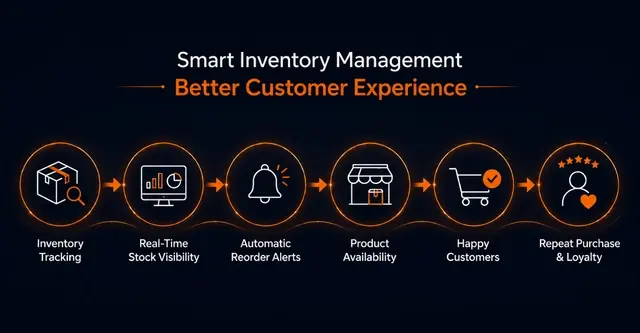
Inventory visibility plays a critical role in customer satisfaction. Zoho One helps retailers maintain accurate stock levels by providing real-time inventory tracking and centralized inventory management.
Retailers can monitor:
- Available stock levels
- Inventory movement
- Purchase orders
- Supplier information
- Reorder requirements
This ensures customers receive accurate product availability information while helping businesses avoid stock-related issues.
Using Data to Make Better Retail Decisions
Successful retailers don’t rely on guesswork. They use data to understand customer behavior and identify growth opportunities.
Zoho Analytics provides detailed insights into key business metrics, including sales performance, customer trends, product demand, and marketing effectiveness.
By understanding what customers buy, when they buy, and how they engage with your business, retailers can make informed decisions that improve profitability and customer satisfaction.
These insights also help businesses identify their most valuable customers and develop strategies to increase customer lifetime value.
Why Zoho One Is Ideal for Growing Retail Businesses
As a retail business grows, managing multiple systems becomes increasingly difficult.
More customers, more products, and more sales channels often create complexity that slows operations and reduces visibility.
Zoho One for Retail simplifies growth by providing a unified platform that scales with your business. Instead of adding more software and creating additional silos, retailers gain a connected system that supports long-term expansion.
If you’re new to the Zoho ecosystem, our article What Is Zoho and How Can It Help Your Business? provides a complete overview of how Zoho applications work together to streamline business operations.
The Future of Retail Is Connected
Retail is moving toward a future where personalization, automation, and data-driven decision-making play a central role.
Customers expect brands to understand their needs, provide relevant recommendations, and deliver consistent experiences across every touchpoint.
Businesses that continue relying on disconnected systems may struggle to keep up with these expectations.
Retailers that invest in connected platforms like Zoho One are better positioned to adapt to changing customer behavior and build stronger relationships over time.
Conclusion
Building customer loyalty is no longer optional for retail businesses. As competition increases and customer expectations continue to rise, retailers must focus on creating experiences that encourage repeat purchases and long-term engagement.
Zoho One for Retail helps businesses achieve this by connecting customer data, inventory, sales, marketing, support, and analytics within a single platform.
From personalized customer experiences and automated workflows to smarter inventory management and actionable insights, Zoho One provides the tools retailers need to turn first-time shoppers into loyal customers.
When every customer interaction feels connected, loyalty becomes a natural outcome and loyal customers are the foundation of sustainable retail growth.
]]>A business in the United States may need to collect state, county, and city taxes, while in Canada you’re often dealing with GST, HST, PST or QST.
For growing companies this stuff can feel like too much too fast, especially if you try to handle it manually. One small tax error can cause compliance trouble, penalties, and then you end up spending hours fixing it. This is where Sales Tax Automation makes a real difference.
Zoho Books automatically works out the correct tax based on your registrations, the customer’s location, product category, and any exemption status.
If you operate across the US and Canada, Sales Tax Automation helps you stay compliant, reduce mistakes, and free up a lot of valuable time.
What Is Sales Tax Automation?
Sales Tax Automation is basically the use of software to calculate, apply, monitor, and report taxes automatically, without all the fuss.
In plain terms, the setup determines:
- Where your customer is located
- What product or service is being sold
- Whether the customer is tax exempt
- Which tax authorities apply
- What rates should be charged
The software then adds the correct tax to the transaction instantly. It’s kind of like using GPS instead of a paper map, only more fiddly.
You still choose the destination, but the software handles the complicated route parts, even when it gets messy and you’re not sure what’s next.
Why Sales Tax Is So Complex in the US and Canada
Sales tax compliance in North America is not exactly straightforward.
In the United States tax rules vary by state and often by county, plus city rules can change the outcome too. A single order may involve several tax jurisdictions at the same time, which makes manual tracking a headache. Businesses also have to watch economic nexus thresholds, basically the point where they get legally pulled into collecting tax in a specific state. It can be confusing , because the “trigger” is very particular.
In Canada, a business may have to deal with different kinds of tax frameworks , like GST , HST, PST, and QST. Each province has its own set of requirements, and honestly those requirements can shift along the way, sometimes without much notice.
As your business grows, the complexity multiplies pretty fast.
Selling to one new state or province may create an entirely new set of compliance requirements.
Why Businesses Are Moving Toward Sales Tax Automation
Many companies begin with spreadsheets and manual calculations.
At first, this worked. But as order volume increases, the process becomes difficult to maintain.
Your accounting team may spend hours each week:
- Verifying tax rates
- Correcting invoices
- Updating spreadsheets
- Tracking exemptions
- Preparing tax reports
This manual effort slows down operations and increases the risk of mistakes.
Sales Tax Automation removes these repetitive chores and makes sure every transaction is calculated the same way, every time, so you don’t end up wondering if anything slipped through.
How Zoho Books Handles Sales Tax Automation
Zoho Books includes built-in Sales Tax Automation for businesses in the US and Canada.
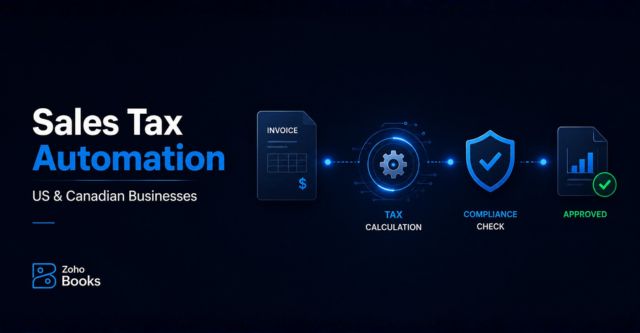
Once activated, the system automatically figures out the correct tax using your business registration details, customer addresses, product tax categories, and the current tax rules.
This means that whether you create:
- Quotes
- Sales orders
- Invoices
- Credit notes
the correct tax is applied automatically.
If you are new to the Zoho ecosystem, our guide on What Is Zoho and How Can It Help Your Business? walks you through how Zoho ties together finance, sales, operations, and customer management into one unified platform.
Key Features of Sales Tax Automation in Zoho
Zoho Books offers a practical set of features designed to simplify tax compliance.
- Automatic Tax Calculation: The software calculates taxes instantly based on customer location, and the taxability rules tied to that situation.
- Real-Time Tax Rate Updates: Tax rules and rates are refreshed automatically when regulations change.
- Nexus Management: You can register the states and provinces where your business is required to collect tax.
- Exemption Handling: Tax-exempt customers such as resellers and nonprofits are managed accurately.
- Audit-Ready Reporting: More detailed tax summaries can make filings easier and help you answer audits with more confidence, not just hope.
Sales Tax Automation for Ecommerce Businesses
Ecommerce companies often create tax obligations in multiple jurisdictions without realizing it.
Selling through platforms such as Shopify, Amazon, and eBay can trigger economic nexus in several states.
Without automation, each order must be checked manually.
With Sales Tax Automation, every order is taxed correctly based on the customer’s location and applicable rules.
This reduces administrative work and helps prevent costly compliance mistakes.
How Sales Tax Automation Supports Business Automation
Tax automation is part of a larger trend toward smarter business systems.
Companies are increasingly swapping out manual work, for connected software, that cuts repetitive tasks and gives better visibility.
If you want to understand how automation can mess with and transform your day to day operations, read our article on Business Automation with Zoho: Solve Common Business Problems.
That page explains how businesses use Zoho to automate accounting, approvals, inventory, and customer workflows, in a way that feels pretty efficient overall.
Sales Tax Automation for Sales and CRM Teams
Tax compliance does not only affect accountants.
Sales teams also benefit when invoices are generated accurately and quickly.
When Zoho Books integrates with Zoho CRM, customer and deal information flows directly into your accounting system.
This reduces duplicate data entry and speeds up order processing.
To learn more, explore our guide on How Zoho CRM Helps Manage Leads and Sales in One Place.
Benefits of Sales Tax Automation
Businesses that implement Sales Tax Automation typically experience several immediate benefits.
- Less manual work for accounting teams
- More accurate invoices
- Faster billing cycles
- Reduced compliance risk
- Better audit readiness
- Easier expansion into new markets
The greatest benefit is confidence.
You know that every invoice is being calculated using current tax rules and your registered jurisdictions.
Who Should Use Sales Tax Automation?
Sales Tax Automation is ideal for businesses that sell across multiple states or provinces, including:
- Ecommerce stores
- SaaS companies
- Manufacturers
- Wholesale distributors
- Subscription businesses
- Professional service firms
If your company is growing and tax compliance is becoming more complex, automation is one of the smartest investments you can make.
Final Thoughts
Sales tax is one of the most complicated parts of running a business in the United States and Canada.
But it does not have to swallow up your team’s time.
Sales Tax Automation helps companies calculate taxes correctly , reduce manual effort, and remain compliant as they expand.
With Zoho Books, the whole flow feels smooth. Every transaction is reviewed, the correct tax rate is applied, and each invoice is produced with confidence.
Your team then spends less time second guessing calculations and more time building something stronger.
]]>Businesses lose conversions because of their unstructured operations which also restrict their growth potential.
Zoho CRM serves as the solution for this situation.
This blog will show how Zoho CRM enables you to combine all your lead and sales management activities into a single platform.
What is Zoho CRM?
Zoho CRM is a cloud-based system which enables businesses to manage customer relationships and monitor leads and control sales activities through organized methods.
The platform serves as a unified system that organizes your sales activities which simplifies the process of managing your business.
With Zoho CRM, businesses can:
- Capture leads from multiple sources
- Track deals across different stages
- Automate follow-ups and tasks
- Monitor team performance
Challenges in Managing Leads and Sales
Before businesses implement a CRM system their staff members experience:
- Leads scattered across emails, forms, and calls
- Missed or delayed follow-ups
- No clear visibility into sales pipeline
- Manual tracking using spreadsheets
- Difficulty in measuring sales performance
These issues create inefficiencies which prevent organizations from closing deals successfully.
How Zoho CRM Helps Manage Leads and Sales
1. Centralized Lead Management
Zoho CRM collects leads from various sources like websites, ads, emails, and calls into one system.
This ensures:
- No lead is missed
- All data is organized in one place
- Easy access to customer information
2. Clear and Structured Sales Pipeline
Zoho CRM allows you to design your sales pipeline based on your actual sales process.
You can:
- Track deals at every stage
- Monitor progress in real time
- Identify delays or bottlenecks
The system enables complete control over your entire sales operations.
3. Automated Follow-Ups and Workflows
Salespeople need to follow up with customers yet they often forget to do so when they perform the task manually.
The system of Zoho CRM provides three automation functions for businesses.
- Automating follow-up emails and reminders
- Assigning tasks automatically
- Triggering workflows based on actions
The system of Business Automation with Zoho provides evidence about how business operations become more effective through automation.
4. Complete Activity Tracking
The platform of Zoho CRM records every customer interaction which includes all customer communication methods.
- Calls
- Emails
- Meetings
- Notes
This database provides your team with full access to all customer information which enhances their communication abilities and decision-making abilities.
5. Real-Time Reporting and Insights
Zoho CRM provides dashboards and reports that help you:
- Track sales performance
- Monitor team productivity
- Analyze conversion rates
The business uses these insights to make decisions which they base on actual data.
How Zoho CRM Improves Business Efficiency
Zoho CRM enables businesses to enhance their sales activities by consolidating all sales activities into a single system.
- Reduce manual work
- Improve response time
- Increase lead conversion rates
- Maintain better customer relationships
- Improve overall sales performance
If you want to know the mechanism of Zoho to support the entire business operations, one may refer to What is Zoho and How Can It Help Your Business?
Zoho CRM as Part of a Connected System
Zoho CRM works best when connected with other Zoho applications:
- Zoho Books for financial management
- Zoho Creator for custom workflows
- Zoho One for complete business management
The system creates a single operating system which connects every department of the organization to work in harmony.
Who Should Use Zoho CRM?
The system of Zoho CRM serves two main user groups who require functionality for their business needs.
- Businesses handling multiple leads daily
- Sales-driven teams
- Growing companies looking for structured processes
- Organizations aiming to improve conversion rates
Key Benefits of Using Zoho CRM
- Centralized lead and customer data
- Better visibility into sales pipeline
- Automated workflows and follow-ups
- Improved team coordination
- Data-driven decision-making
Conclusion
Business growth requires companies to use effective methods for lead management and sales processing.
Zoho CRM provides a structured and connected system that helps businesses track leads, manage deals, automate processes, and improve overall performance.
The system unifies all elements into one location which helps to clear up confusion and decrease manual tasks while teams concentrate on closing deals.
]]>This is where business automation becomes essential.
Businesses can achieve better operational efficiency through automated workflows which decrease manual errors. Zoho provides an all-inclusive business ecosystem that enables you to automate your entire organization using predefined automation methods.
If you’re new to Zoho and want to understand the platform first, you can explore our detailed guide on what Zoho is and how it helps your business, which explains how all Zoho applications work together.
The blog will explain how business automation operates and the ways Zoho provides solutions to common operational issues.
What is Business Automation?
Business automation uses software to conduct repetitive business operations which require no human control.
These tasks can include:
- Assigning leads to different sales teams
- Sending follow-up emails and reminders
- Updating customer records
- Managing approvals and workflows
- Generating reports and dashboards
The primary purpose of business automation establishes an automated system which executes standard tasks while employees concentrate on critical business functions.
Why Business Automation is Important for Modern Businesses
The modern business environment requires companies to achieve quick results because operational efficiency determines their success.
The handling of manual tasks creates operational delays which result in missing communication links between different departments.
The main challenges businesses must handle today include these topics:
- Delayed responses to leads and customers
- Errors caused by manual data entry
- Lack of coordination between teams
- Difficulty in tracking performance
- Time-consuming reporting processes
Business automation solves these business challenges through its ability to establish standardized workflow systems which execute processes in a predictable manner.
Zoho makes this easier by offering tools that are designed to automate processes across departments. To understand the complete ecosystem behind this, you can also read our guide on what Zoho is and how it helps your business.
How Zoho Enables Business Automation
The collection of Zoho applications enables businesses to automate their various operational processes.
For example:
- Zoho CRM helps automate lead capture, assignment, and follow-ups
- Zoho Creator allows businesses to build custom workflows and automate internal operations
- Zoho One connects all applications into one unified system for complete automation
The software tools enable seamless data transfer between different systems which connects all business operations in your organization.
Common Business Problems Solved by Business Automation
1. Missed Leads and Inconsistent Follow-Ups
Businesses that use human operators to manage their leads lose potential business chances. The automated system tracks all leads from initial contact until final assignment and subsequent follow-up operations are executed at scheduled intervals without any delays.
2. Repetitive and Time-Consuming Tasks
Data entry and status updates and reporting tasks require substantial time commitment. Automated systems take over these responsibilities through their capability to conduct tasks without human input.
3. Lack of Process Standardization
Unclear process definitions lead to inconsistent team performance. Automated systems develop workflows which require workers to complete their duties according to established procedures.
4. Poor Team Coordination
Disconnected tools lead to communication gaps. Automation establishes connections between different departmental workflows, which enables all employees to access identical data together with its ongoing modifications.
5. Slow Approval Processes
Manual approvals can delay operations. Automated workflows ensure that approvals happen quickly with instant notifications and predefined rules.
6. Limited Visibility into Business Performance
The businesses need effective reporting systems which will help them track their performance progress. The automated system shows operational data through real-time dashboards which help decision-makers choose better options.
Key Benefits of Business Automation with Zoho
1. Improved Efficiency
The process of automation decreases the need for humans to work manually while it accelerates all operational tasks which leads to greater organizational efficiency.
2. Better Accuracy
The system achieves automated workflow execution which prevents human errors while all system components maintain matching data.
3. Increased Productivity
Employees can dedicate their time to work with high value because they no longer need to complete tasks which require repeated work.
4. Enhanced Customer Experience
The businesses achieve better customer satisfaction because they respond more quickly to customer inquiries while maintaining better communication with customers.
5. Scalable Operations
The implementation of automation will help your business maintain its operational procedures because your organization continues expanding.
Real-World Use Cases of Business Automation
The businesses use Zoho automation to manage their:
- lead and sales pipeline operations
- Automat customer follow-up procedures
- Handling financial processes like invoicing and reporting
- Managing internal workflows and approvals
- Tracking their performance through live dashboard systems
These use cases show how automation can be applied across different business functions to improve overall efficiency.
Why Zoho is a Strong Choice for Business Automation
Zoho provides businesses with its complete ecosystem which contains all necessary tools for business automation.
Businesses prefer Zoho because:
- It offers multiple applications under one platform
- It supports customization based on business needs
- It integrates smoothly across departments
- It is cost-effective and scalable
Your assessment of Zoho will improve when you learn about its complete system which shows how your business will benefit from automation.
Conclusion
Business automation is essential for businesses that want to improve efficiency, reduce manual work, and scale operations effectively.
Zoho provides a practical and flexible platform to implement automation across sales, operations, finance, and more. By creating structured workflows and connecting different processes, businesses can operate more efficiently and focus on growth.
If your business is facing challenges with repetitive tasks and inefficient workflows, automation with Zoho can be the right solution.
]]>This is where Zoho provides a better approach.
If you’re wondering what is Zoho and how it can support your business, it is designed as a technological platform that connects different business processes into one structured system.
The blog will provide an overview of Zoho system operation, its available features, and its impact on business efficiency improvements.
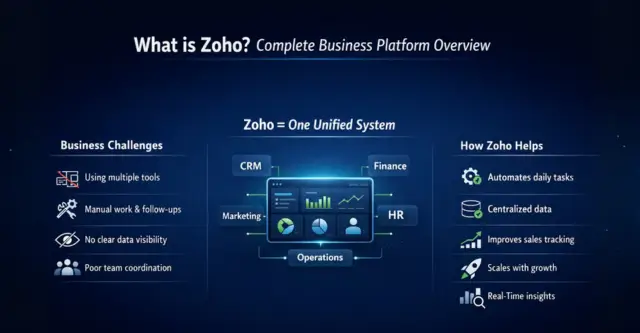
What is Zoho?
Zoho delivers a cloud-based technological platform which provides various business applications that enable organizations to handle their internal operations.
Businesses can use Zoho as a single operating platform because it provides all necessary tools through one unified system.
It includes applications for:
- Sales and customer management operations
- Accounting and finance processes
- Marketing automation functions
- HR and internal operations
- Custom app development
Zoho is designed to act as a complete business system, not just individual software tools.
How Zoho Works as a Technological Platform
The platform of Zoho enables users to operate their business processes through various interconnected applications which work together in unison.
For example:
- Leads captured in CRM move directly into the sales pipeline
- Sales data connects with financial reports
- Customer interactions are tracked across departments
- Workflows are automated across multiple applications
The connected framework enables organizations to decrease their manual operations while achieving operational standardization throughout their business activities.
Core Zoho Applications
The following Zoho applications represent some of the most frequently used software solutions:
- Zoho CRM – Manage leads, customers, and sales pipelines
- Zoho Books – Handle invoicing, expenses, and financial reporting
- Zoho Creator – Build custom applications and workflows
- Zoho One – Access a complete suite of business applications in one platform
The applications function as an integrated system that operates on a single technological platform.
Key Features of Zoho
1. Complete Business Ecosystem
Zoho provides a solution that includes more than 40 applications which support all business functions including sales and marketing and finance and HR and operations through a single management system.
2. Customization Based on Your Workflow
The operational process of every business differs from that of other businesses. Zoho provides businesses with tools to create customized systems which match their specific operational needs through its Zoho Creator platform.
3. Automation of Repetitive Tasks
The software from Zoho enables users to automatically conduct their daily tasks which include follow-up work and sending notifications and granting approvals and updating data.
4. Centralized Data Management
All business data is stored in one system which simplifies the processes of accessing and managing data and analyzing information.
5. Real-Time Reporting and Insights
Zoho provides dashboards and reports which enable businesses to monitor their performance while they make data-driven decisions.
How Zoho Helps Your Business
1. Better Lead and Sales Management
With Zoho CRM businesses can effectively handle lead acquisition and pipeline management and follow-up tracking which leads to better conversion outcomes.
2. Simplified Financial Operations
With Zoho Books users can handle their invoicing expenses and tax management tasks together with their reporting requirements without needing additional accounting programs.
3. Improved Operational Efficiency
Zoho provides a platform through which various departments can collaborate while it reduces the need for staff members to perform tasks manually and it improves overall work efficiency.
4. Scalable System for Growth
Zoho enables businesses to begin their operations with essential software while they can expand their capabilities as their requirements grow which makes it an ideal solution for their future development needs.
5. Unified Business Management
Zoho One enables businesses to control their essential functions through one platform which improves their operational management and performance tracking abilities.
Common Business Problems Zoho Solves
Many businesses struggle with:
- Using multiple disconnected tools
- Lack of visibility into operations
- Manual and repetitive tasks
- Poor team coordination
- Difficulty in tracking performance
Zoho provides a solution to these issues through its integrated technological framework which unites all business functions into a single operational system.
Who Should Use Zoho?
Zoho is ideal for:
- Small and medium-sized businesses
- Startups building structured systems
- Companies which handle various departments
- Businesses looking to improve efficiency through automation
Why Businesses Prefer Zoho
Businesses select Zoho because it provides them with:
- A complete suite of applications in one platform
- Flexibility to match business processes
- Cost-effective solutions compared to other tools
- A scalable system for long-term growth
Conclusion
So, what is Zoho?
The Zoho platform serves as a complete business solution which enables organizations to handle their operations through an interconnected system. The platform delivers everything a company needs to operate its business from sales and finance functions to automated systems and reporting mechanisms.
For companies looking to move away from disconnected systems and manual processes, Zoho provides a practical solution which helps them enhance their business processes and achieve sustainable growth.
]]>