The research projects aims at designing a new solar charging station for e-bikes, which is now available and ready for use at the campus of the University of Twente, in the Netherlands. The charging station offers users one of the three charging techniques available to recharge e-bikes, alongside an integrated solar wheel and a home solar charging kit. This charging station can be considered a Smart Energy Product as it provides 100% green energy for six e-bikes at the same time. People can leave their e-bike at the charging station during the day and charge their bike while they are at the office. In doing so, users have the opportunity to test this new technology while contributing to the research. For instance, participants will have to fill out questionnaires at the beginning, during, and after the testing procedure. Furthermore, Georgia Apostolou, who is working on the project as a postdoc researcher, will take several interviews.
Visit of the delegation of policy-makers of the Northern Provinces
During the visit, Cihan Gercek, postdoc researcher for the CESEPS project, presented to the delegation the solar powered e-bikes project. The future of e-mobility was discussed and particular attention was given to solar e-bikes, their design and the integrated solar panels on front wheels. While answering questions from policy-makers, strong emphasis was also given on the project´s social aim. CESEPS with its new solar charging station is offering a service for every citizen, as every person is allowed to charge their e-bike in a green way. Once the survey is completed, partners in the Consortium hope to implement this project elsewhere if the technical and financial analysis will yield a positive result. This in turn could facilitate the integration of PV panels and renewable energies for public use. For the CESEPS team, connecting policy makers with research institutes is particularly important. Therefore, we would like to thank the delegation for their time and interest in our project, and believe in their will to facilitate the energy transition and the integration of the renewable energies.
Design
Dr Angèle Reinders (ARISE at Design, Production and Management, UT), who initiated the Living Smart Campus project ‘Solar powered e-bikes’, designed the charging station together with colleagues from the Department of Design Production and Management, the Facility Management at University of Twente and the companies ‘Bordbusters’ (construction SLBS), ‘Zelziuz’ (PV panels and Invertor) and ‘IpsumEnergy’ (measurement equipment). Zelziuz and IpsumEnergy are both located in the same region of the Netherlands, which is a good example of national and regional innovative partnership with a potential global impact.
Download the Conference Programme
In Austria, TU Graz will continue to test the Vehicle to Grid (V2G) technology for electric vehicles (EV) and fuel cell electric vehicles (FCEV), while the Austrian Institute of Technology will keep on dealing with Home Energy Management Systems (HEMS), short-term PV forecast and aggregated stationary storage. The latter will be assessed in cooperation with the Utrecht University. In the Netherlands, the University of Twente will focus instead on the solar charging of Electric Vehicles and bikes, as well as on apps with Energy Service and Power Matching City for households with heat pumps. The Utrecht University will focus instead on local stationary community battery.
Felix Lehfuss and David Reihs (AIT) guided participants on a tour through AIT´ Smart Electricity Systems and Technologies Laboratory (SmartEST) where simulations about E-Vehicle charging operations are simulated. Therefore, the CESEPS Consortium had the opportunity to see first-hand how the co-simulation environment works and the requirements for the SEPS testing activities within Work Package 4 and 5.
Further steps in the project will be discussed at the next transnational meeting at the University of Twente, in the Netherlands, later in 2018.
The mass-introduction of small scale power generation units, like photovoltaic systems, in households increases the risk for system unbalances due to their stochastic generation profile. Moreover, upcoming technologies such as electric vehicles, battery storage systems or energy management systems lead to a change from traditional end-consumers to prosumers with a significant different residual load profile. Therefore, forecasting PV generation is crucial to optimize the profile of future prosumers. Whilst traditional weather forecasts are (in the case of Austria) based on a few hundred metering locations, more than 55000 PV systems are currently connected to the Austrian power grid. Due to the low areal coverage of common metering locations, weather forecasts do not take local phenomena like shadows from clouds into account. For this reason, the Austrian institute of Technology is developing an alternative to the traditional weather forecasts. The new approach uses generation data from neighbouring PV systems together with machine learning methods to achieve an individual location based intra-hour forecast.
The local generation from PV Systems is influenced by several factors that are taken into account by three different mathematical models:
- Irradiation model (for covering the annual solar activity above the atmosphere)
- Statistical model (for addressing the stochastic disturbances on solar radiation by atmosphere)
- Physical model (to take local and technical effects of the PV system into account)
Those three aspects are usually modelled independent from one another, due to their diverse nature and characteristics, they also have different effects on the power generation profile of each PV system, which can be measured directly at the inverter or grid connection point. In the past mathematical approaches were necessary to acquire information about the individual characteristics and challenges of each model. However, progresses in machine learning methods could provide a new, unified tool for the analysis of generation data with respect to local power forecasts. With machine learning methods data from distributed PV systems of a larger area can be used for generating local forecasts for individual systems.
In order to analyse the available spatial-temporal measurements of PV inverters, it is important to build a generic model that can learn from large amounts of data and find relations without explicitly given dependencies between measurement stations. Therefore, machine learning algorithms, like neural networks, are a good choice for forecasting as they directly use the time ordered structure of the data. Inputs are thereby ordered according to two dimensions: different measurement stations, which can be integrated with external data, such as daytime and wind, and time. This second dimension is handled separately by feeding multiple time steps at once.
The first results on a simplified set-up for a principal proof-of-concept yielded a positive outcome. Therefore, the next step will focus on adapting the methods on a more advanced model consisting of 25 PV systems arranged in a 5×5 grid, followed by tests under real-world conditions.

Figure 1: A simplified view on the overall concept of the inverter data based short-term forecasting method. Clouds are moving along the wind direction and are causing power drops at local systems. Data exchange between neighbouring systems and the application of machine learning methods can provide an approach for short-term local forecasts.
Another driver for the application of home energy management systems (HEMS) are batteries and electric vehicles, which are also becoming more affordable and widespread. A simple use case for an energy management system which combines PV energy generation with a residential battery energy storage system and an electric vehicle, would be to store the electric energy produced locally by using the battery during the day. In the evening, when no solar photovoltaic electrical energy output is available, the energy accumulated during the day could be used to charge the electric vehicle. In doing so, the self-consumption of PV energy would increase while the average power consumption from the grid would diminish. Therefore, HEMS would pave the way for the optimization of energy consumption by shifting the charging activities of the electric vehicle (EV) to non-peak hours.

Figure 1: Energy Management Testing in the AIT Lab
In order to test different approaches for management systems and their optimization strategies, the Austrian Institute of Technology (AIT) created a corresponding testing environment. The developed evaluation suite combines State-of-the-Art simulations with real live components such as an electric vehicle in the AIT Lab environment. This provides the advantages of a simulated environment with testing actual hardware that will be installed in a future prosumer household. The system developed at AIT can provide conclusive data on different approaches to home energy management. What components should be managed? How much of a difference does the management of a dishwasher or a washing machine actually make? All these questions can be answered with tests carried out by the developed architecture.
A schematic overview of the developed environment can be seen in Figure 2. Since the architecture is agent based, it provides a simple way for evaluating different system compositions and different management scenarios. Including another device in the management process is as simple as configuring it with the uniform communication interface provided in the AIT lab environment.

Figure 2: Schematic Architecture of the Testing Environment
While the Hyundai ix35 can deliver power to the grid thanks to a parallel connection with the integrated fuel cell and battery, the hydroelectric model uses a fuel cell to extend the available range of the battery in a connection in series. Preliminary results on the potential use of this new technology are promising as they show how FCEVs can fully meet the electricity supply of ordinary residential buildings in terms of output power gradient, maximum output power, and storage capacity. Furthermore, the combined use of fuel cell and battery can provide fast power ramps. Therefore, when parked the two cars could provide energy services to grid operators, such as balancing power, frequency control, and voltage control, but also to houses. The fast ramp up/ ramp down rates generated by the constant switching on/off of house appliances could be met by the car thanks to vehicle-to-home connection (V2H). The experiments Carla Robledo, TU Delft, and Ziqian Zhang, TU Graz, performed fall within the projects tasks of grid stability and flexibility, demand side management and forecasting, E-Vehicles Integration, data management and storage as well as Small Pilots on Campus.
In the coming months, further tests will be conducted with the Hyundai ix35 FCEV to measure the dynamic response of the car. The data collected will be analysed to improve the performance of the V2G mode and create tailored smart energy products and services.

Researchers Ziqian Zhang, TU Graz, and Carla Robledo, TU Delft, operating the two hybrid cars.

Circuit tested by TU Delft and TU Graz researchers, including the main devices (fuel cell, battery, measurement tools) and indicating where AC and DC voltage apply.
At the meeting, participants had the opportunity to test drive the hydrogen fuel cell electric vehicle (FCEV) used by the partners at TU Delft for vehicle-to-grid (V2G) studies. In follow-up meetings the CESEPS consortium will proceed to identify the exploitation plans for the promotion of the knowledge that will result from this research project.

Francesca Abbruzzese, TU Delft visiting students, delivering power to the grid produced by the fuel cell electric car
The experiment, conducted at the Delft University of Technology (TU Delft), in the Netherlands, aimed at testing the integration of fuel cell electric vehicles working in vehicle-to-grid (V2G) mode with a prosumer type residential house. For two weeks two visiting students, Francesca Abbruzzese and Anna Rojan, were encouraged to carry out their daily routine while living in the Prêt-à-Loger (PaL) house at the Green Village of TU Delft. The house is an all-electric building equipped with solar panels on the rooftops and heat pumps. Furthermore, they had at their disposal a Hyundai ix35 FCEV, which could be connected to a V2Gdischarge unit (as shown in the picture above) that allowed to deliver power back to the grid complementing the solar panels production. Solar energy can be used during the day to cover the residential energy needs, while at night, parked fuel cell cars can be used as power generators. The car was used both for mobility and power generation thus the hydrogen stored on board (approximately 5 kg) had to be enough to fulfil both purposes. Two different modes of operation were tested in total. Around 3 kg of hydrogen were consumed in V2G mode each day (see Table below).

During the first week, the car was connected in V2G at lower output, allowing it to operate for longer time with the hydrogen available in the on-board tank. On the second week, the car was connected in V2G mode at maximum power output for the V2G connection, for shorter time. The results will contribute to gain new insight to fulfil the nearly zero-energy building target set out by the European directive 2010/31/EU.
For more information related to the article, please contact:
Jorien Van Loon
Project Manager at University of Twente
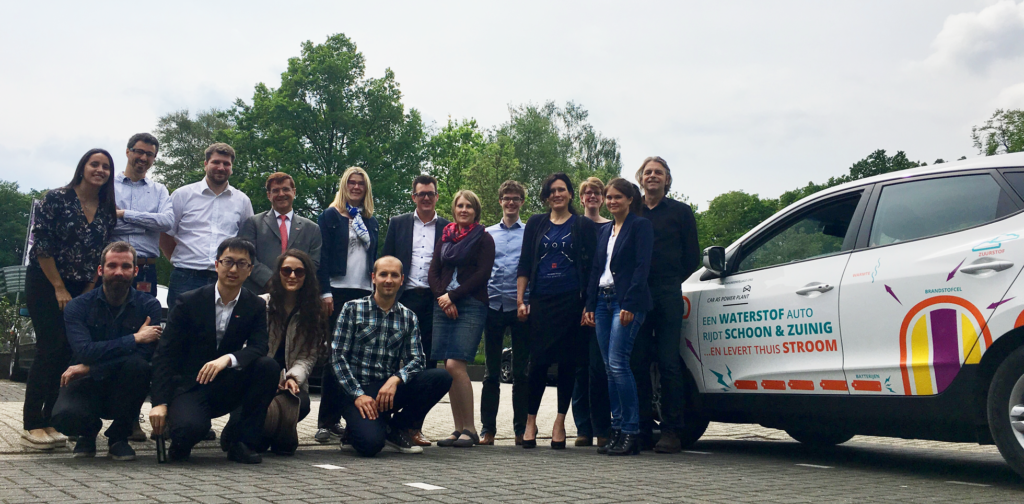
Our colleagues from the Delft University of Technology (TU Delft) joined the event in a Hyundai ix35 Hydrogen fuel cell electric vehicle (FCEV).
The experts from the partner organizations in Austria and the Netherlands held a total of 40 poster and oral presentations describing the project´s objectives and progress, thus contributing to the dissemination of the project results and encouraging the involvement of smart-grids users and stakeholders in CESEPS activities.