
We’re in the home stretch of our 2026 field school season. Students on the Wilderness Bushcraft Semester are out on solos, we’re enjoying a stretch of beautiful weather, and we’ve started picking up and putting away stuff for the long winter ahead.
This time of year I always get restless. When the geese and the leaves fly, I also want to fly. I’ve had this since I was kid and I’m pretty sure I’ll never grown out of it. Immediate busy work includes boats to be put away, a new canoe rack to build, and vehicles to winterize. Then there are websites to update, schedules to create, courses to plan. And lastly there are bigger-picture plans to ruminate on, directions to choose, and ideas to consider about the future. During the rush of the season there is no time to consider these big ideas. But now, as the rest of the season is measured in hours not weeks, it hits all at once.
The nature of life at the field school is putting other life things on hold while we run the long courses. Then, when the season ends, all of those things that have been put off demand attention all at once. An alumnus spent a week with us earlier in the fall, before he started his Appalachain Trail hike traveling north to south. For the next 5-7 months, he’ll be immersed in the hike, with the finish line somewhere over the horizon. But eventually, he’ll get there and have to decide what’s next. When the big goal has been achieved, what then? If you finished a seven-month hike on a Friday in late October, what would you do on Saturday?
We started this field school season about seven months ago. This course ends Friday. And I’m still unsure how to spend Saturday.
]]>
In addition to beginning week 8 of the Wilderness Bushcraft Semester, we’ve been diligently working on the Jack Mountain Bushcraft School Digital Archives project. With the generous help of all of our students, we’ve been digitizing a many of the old, rare books I’ve accumulated over the years. Our “needs to be scanned” pile of books has been shrinking, and some of the rare ones I’ve never seen another copy of are safely in the archives.
In his later years, Mors Kochanski gifted me the entire set of the magazine that he published in Alberta back in the day called Wilderness Arts & Recreation. With the help of the fall 2026 Wilderness Bushcraft Semester students, the entire series has been scanned. Much of this material went on to become the book “Basic Safe Travel And Boreal Survival Handbook“by Kochanski, so there is a way for anyone with interest to access the contents, but I think there is value in having access to the original documents.
And there are always more old books, pamphlets, and articles to scan.
I’m still working on our 2027 schedule, and was recently confronted with the question of whether it will be the last of the old or the first of the new. I’m still working through it, more ideas to come.
We’re having a significant drought in Aroostook County this fall, which has led to the lowest water in the rivers that I’ve ever seen and the leaves coming off the trees earlier than usual. It’s October 11 as I’m writing this and ninety-five percent of the leaves are on the ground. We’ve got two weeks to go on the current semester, and will be working on big projects this week and going out on solos next week. It’s been a busy year, but I’m still having a great time doing the work.
]]>
We’re starting week four of the fall Wilderness Bushcraft Semester today, and I’ve been receiving a bunch of messages about the schedule for 2027. So in planning for 2027, it’s a good time to talk about the experiment that was 2026. This year we decided to run three, back-to-back Wilderness Bushcraft Semester courses. The plan was to fold the multiweek canoe expedition into the semester to make what we offer simpler. Now we’re in the middle of our third semester, and I can say it didn’t work as planned. In a nutshell, we ran into a time crunch on each of the semesters. There just isn’t enough time to do it all in 9 weeks. The result of the experiment is that we didn’t spend as much time out on the rivers as we would have liked. The emphasis went to completeing the course requirements for the journeyman certification. I’m happy with how it all worked out, especially opening up the semester to allow people to come in for a week or more, but in planning 2027 a change is in order.
Here’s the change; we’re bringing back the standalone canoe expedition, although with a major change; it will be an advanced class not open to beginners. Running the rivers of northern Maine during the cold, high waters of spring is something I look forward to each year. And over the years I’ve learned that there just isn’t enough time to teach someone new how to do it safely and well between when the ice melts and we want to be out on the river. The best time to learn the basics is in the summer or early fall, when the water is lower and the temperatures are much warmer. This gives us the ability to run some more challenging spring water and to plan more aggressively. As with all of our extended canoe trips of the last decade, we will be operating under the “travelling solo, together” philosophy, with the stated goals being to build the skills, confidence and experience for solo travel and professional guiding. I’ll be posting more about this course soon.
Other than the big change to the spring, the summer and fall semesters will be similar to years past. From the potential student’s perspective, what to take away from this is that the Wilderness Bushcraft Semester is a great place to learn the basic canoe skills of paddling, poling, lining, etc., but the more advanced experiences take place during the canoe course in the spring.
We’ve had our first frost in the county, the leaves are starting to turn, and fall is on its way.
]]>
We just wrapped up the summer term at the field school. It was our 69th long-term immersion program, and we ended with several new Journeyman certificate holders. Now we’ve got a week to catch our breath before diving into the fall semester.
We’ve had typical summer weather, with some heat and only a few days of smoke from wildfires. Although we’ve had a lot of rain, it hasn’t amounted to much accumulation and the rivers are very low. We had a low water trip on the Allagash during the semester, with the last few days at around 400 cubic feet per second. This is the lowest I’ve ever run the river below the falls, but we were able to pole the entire section with only having to step out a few times to pull over gravel bars. The Aroostook river is very low as well, and the spring I recently found in the woods is still flowing, but barely. We could use a few days of soaking rain to recharge the whole system.
Apples have been on the trees for a few weeks now, and we’re into the season of plenty. One of the students, a keen forager, made some amazing choke cherry fruit leather, and I have been busy saving seeds from our local juneberries to plant for next year. I’ve also sourced some other perennials for planting, increasing the biodiversity of the field school and giving us more useful plants to forage and incorporate into life here. A really cool thing about moving and encouraging native plants is that they already live nearby. So getting them to grow in new spaces is not super difficult. A few of the success stories have been getting milkweed to grow in Moose Vegas, helping to spread the stinging nettle by the stream, getting a lot more juneberries to grow along the edges of fields and roads, and encouraging all the young apple trees that are coming up. A big seed saving project for the fall will be elderberries. We’ve got a bunch of the red-fruited elderberry growing by the guide shack, but found a big patch of black-fruited plants a few miles upriver. When the fruit is ripe I plan to harvest a bunch and save the seeds for planting. We continue to spread the jerusalem artichokes that grow along the river to new spots. And then there is wild rice. Last fall we harvested a bunch downstate and have seeded several local spots. I plan to keep at this until it begins to grown on its own around here. If you’re curious about the plants we regularly see around here, have a look at JMBS Plant List (pdf).
Things are moving forward with our field school campground planning. Starting next year we plan to offer short and long-term lodging (off-grid cabin rental, glamping, solo and group site tent camping, and van and rv parking) for those looking to experience the woods life.
Life is full, and busy. Thanks for reading.
#FullTangLifestyle
#AroostookCounty

I recently learned how to copy the names of all the files in a folder and paste them into a document. Easy stuff, but with me it can take time. So I was able to list all the titles currently in the JMBS Digital Archives as pdf’s. Here’s that list.
As I’ve previously stated, I won’t be posting this anywhere for people to download but anyone is welcome to a copy of it. You just have to contribute. We’ve always got a pile of old books that need scanning. To do this, you need a smartphone and an app. I use one called Genius Scan. There is a free version and it’s easy to use.
]]>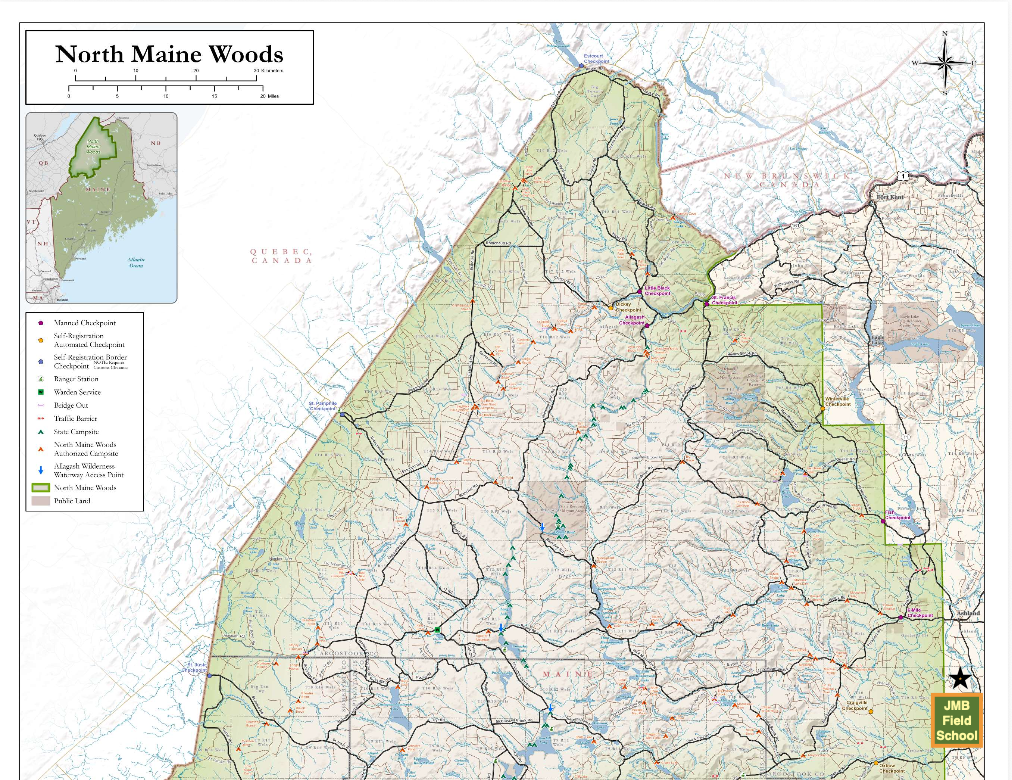
I recently updated our website with a bit of information about the neighborhood (see text below), and in doing so found this updated North Maine Woods map that I dropped our location on. There are so many places to explore around here that one would have to live a very long life to see them all.
Masardis, Maine is a small, rural town in central Aroostook county. It is characterized by wild spaces and just a few people. On our side of the river, the field school abuts the 525 acre Pollard Flat Wildlife Management Area, a state-owned tract of land managed for wildlife and conservation that recently doubled it’s size. Directly out our back door is the North Maine Woods, a 3.5 million acre working forest with no permanent residents, towns or pavement – it is 77 miles from our driveway to the Quebec border (see map above). On the other side of Masardis is the 16,500 acre Scopan Public Reserved Land, and we are a short drive from Katahdin Woods And Waters National Monument and Baxter State Park. Our area offers five canoeable streams within a few miles, as well as a large lake with remote campsites.
To see the full map, click here
#FullTangLifestyle
AroostookCounty

The idea of risk plays a big role in the outdoor industry. Liability insurance is an important consideration for any professional guiding company or wilderness education program, but that’s not what this post is about. Instead, it’s about who bears the financial risk if someone chooses to leave a course or trip because of injury, illness, or other reason? Over the years we’ve had a handful of people who were unable to complete the program they started for a variety of reasons. This happens, and while it isn’t a regular occurrence, it also isn’t exceedingly rare. Things happen, life happens, and sometimes carefully crafted plans don’t make it to fruition.
But when it happens, what happens with regard to tuition or trip fees?
When someone registers for one of our programs, they have to check a box that says they have read and understand our school policies. These are written in plain english, not legalese, and explain how we go about the business of doing business. One of these policies states that if a student leaves a program, we do not provide a refund. It also states that if this is a concern, to consider purchasing travel and/or tuition insurance, depending on the type of program it is.
This isn’t about us being unreasonable or an advertisement for the insurance industry; it is about who carries the burden of risk. Were we to cover this risk, our tuition rates would have to dramatically increase. If you are planning on participating in one of our programs, or any other outdoor or travel related program (bushcraft school, guided wilderness trip, etc.), I encourage you to consider this risk before attending. Travel or tuition insurance can provide compensation if you are unable to complete the program, and there are also plans that cover unforeseen medical and evacuation expenses.
This post is all about planning ahead. After you have a car accident, it’s too late to get collision insurance. Obviously no one except TV psychics can predict the future, but is likely better for you financially to pay a little up front in the form of travel insurance than to lose out on tuition or be stuck with an enormous medical or evacuation bill on the back end due to unforeseen circumstances. It is better to go into a situation with your eyes open to the risks than to ignore them and simply hope for the best.
#FullTangLifestyle
#AroostookCounty

We wrapped up the spring semester a week ago, and started the Advanced Whitewater Canoe Course strongly with a great day on a local rapid and lake going over skills and maneuvers with both pole and paddle. On Tuesday we headed into the woods, to camp at Churchill Dam on the Allagash. After setting up camp, we got on the water and worked on poling in the rip just below the dam. It was hot; a 3-day heat wave with temperatures nearing 90 degrees. And the black flies were bad; as bad as I’ve ever experienced.
The plan was to get up in the morning and run the rapids to Bisonette Bridge, then shuttle back to run them again. We planned three days of this, in order to get in a lot of reps on the fast-moving water. I was up early, and when one of the participants came out of their tent, they were unrecognizable. They had been bit so many times that their body had an allergic reaction to the bites and their face has swelled up so that they looked nothing like their normal self. Black flies have the habit of landing on you, then climbing up under your clothes or headnet before biting you, and this person had bites all over their body. This was bad.
About fifteen years ago I had to evacuate someone from the same location due to similar circumstances. Maybe I’m overly cautious with regard to allergic reactions, but when people have dramatic reactions like this, in my mind they are not far off from a lot of other bad things happening medically. Especially since there was no way to get them out of the bugs except putting them in their tent. It is the sort of thing that is no big deal right up until it becomes a very big deal. I needed to get them away from the bugs to stop them from getting bit (stop adding more poison to their body), as well as monitor their swelling and get within a short distance to medical care if it got worse. So I decided to call an end to the course right then and get that person out of the woods. It sucks having to cancel a course, especially when we were already halfway through, but it would be much worse if their airway had swollen shut, or restricted their breathing even a little bit. So we loaded up our gear and I medically evacuated this person.
It took about two and a half days after coming out of the woods for their swelling to go away and return to normal. I feel like they dodged a bullet. Churchill Dam is notorious for its black flies in June. This I was aware of, having experienced them on many prior trips. The x-factor here was the excessive heat; it made the bugs worse, and was not part of my planning process when I was putting this trip together in my mind last winter.
So on the negative side of the ledger, I had to cancel a class halfway through for the medical evacuation. On the positive side, we averted further medical issues by isolating the afflicted person from further bites, and they eventually processed the poisons out of their bloodstream and returned to normal, although with a healthy respect for black fly season. It wasn’t how I had planned to finish the course or the week, but I think that it was the right thing to do in that situation.
And now it’s Sunday morning and people will be arriving for the summer semester in a few hours. The heat wave broke with a bunch of rain and cool temperatures, and the land around here is at peak lupine. It’s a different place than at the beginning of the spring semester, but each season has its challenges.
]]>
The spring, 2026 Wilderness Bushcraft Semester, our 68th long-term program, is complete. Yesterday we gathered together for a send-off dinner, shook hands and said I’ll see you when I see you.
I never grow tired of watching people of different ages, from different walks of life, from different places coming together and forming into a team. This is different than a friendship because we’re actively working towards specific goals, not just hanging out. It’s where each individual can count on the others to have their back, to give them a helping hand when they need it, or a kick in the ass when that’s more appropriate. It isn’t magic, and I’ve seen it happen so many times that my ongoing fascination with it is likely the outlier, not the thing itself. I think what makes it stand out to me is that it is so rare in the modern world, and it happens with such consistency here.
This isn’t to say we don’t have our share of interpersonal conflict. We do. But when when it comes down to it, when we are shoulder to shoulder working toward a common goal, sometimes struggling, sometimes coasting, but always moving forward, this is when individuals become a team. In my opinion, this is when the magic happens and is the essence of the human experience, whether it’s 2026 or 20,000 years ago.
This is when it doesn’t matter what kind of knife you have, or axe, or any other piece of gear. This is when it doesn’t matter if this is your first time out on the land or if you have a lifetime of experience behind you. This is when what matters is that the other members of the group can depend on you, and you on them. We help others to achieve the goal, to get to the finish line, and they in turn help us get there. This is what is rare in the modern world.
This is also something the corporate team building industry has missed; that it takes authentic challenge and adversity to achieve this, not manufactured, short term games. If you want to build a team, get a group of people together and do something hard with real consequences. The outcome will be something a cushy corporate retreat could never achieve.
I’ve got a weekend of down time before starting the advanced canoe poling and paddling course. It’s going to rain most of the weekend, which should bring up our local waters, but we’re headed to Chase Rapids on the Allagash for a few days where there’s plenty of water, so if the storm goes in a different direction we’ll still have enough. Then another weekend and we start the summer Wilderness Bushcraft Semester, where another team will be built. Summer is busy in Masardis.
]]>
We finished week 8 of our spring semester and have one week to go. The final week is when students go out for the solo experience, putting the things they have learned into use and reflecting on the entire semester. It is the culminating experience that bookends the entire semester.
Maine spring weather has been very cool, with many nights still close to freezing. Last night there was some snow in the mountains, but we didn’t get any.
Foraging season is in high gear, and I’ve been eating cooked cow parsnip greens, stinging nettles, and today will get some milkweed shoots. Yesterday we finished making crooked knives on a campfire, and while we were bending and tempering them we pulled a bunch of cattail shoots from the pond and cooked them like Cossack asparagus. This is when you put the whole shoot on the fire to singe the outside, then pull off the burned leaves and enjoy the roasted and steamed center shoot. It’s my favorite way to eat cattails. The fields are loaded with salad greens, as this is the time of year when many of the small greens you see are not too tough or bitter to put into a salad. Some of what we’ve been eating are dandelion greens and ox-eye daisy greens, with young blue-bead lily leaves chopped up for a cucumber-like taste.
Five of my apple seedlings made it through the winter in pots, and are vigorously growing and ready to be put in the ground. Also the rhubarb is up and the juneberries are in flower with the berries starting to develop.
With the plants have come the bugs, so it is smudge-pot season. Although the recent bout of cool weather has kept the bugs at bay. Everyone has adapted and people are almost never sitting still without a smudge pot smoldering nearby.
So there is a lot going on. Tomorrow we’re out on solos, then back in camp for a few days to wrap up the experience. Life here is good.
]]>
This is the second morning in a row waking up to full sun. It’s been a cold, wet spring so far, and while it was below freezing this morning, once the sun came up the thermometer rose to the soft water zone. From Moonshine Hill I can see Mars Hill, which sits right along the border with New Brunswick, which is where the time zone changes from Eastern to Atlantic. Being on the eastern edge of the time zone and pretty far north, this time of year the days start early. First light this morning was at 4:29 am, and sunrise at 5:04. So if a person wakes up early there are a few hours of sunlight before the work day starts.
As I mentioned, this is the second morning in a row waking up to full sun. With the weather we’ve had part of me thinks the weather gods are lulling us into a false sense of nice weather before dropping a late-season snowstorm on us.
If you’ve been following our blog or videos for any length of time, it may seem that we spend an ordinate amount of time talking about the weather. But when you live or work with people outdoors, the weather dictates not only your daily routine, but what you are likely to encounter interpersonally day to day. After all these years, I know when low pressure system settles over us, and it’s gloomy and rainy, that people will not have anywhere near the motivation they do when there is a high pressure system and there is bright sun in the morning. In fact it’s this human side of the weather that I find so interesting. We have students track their personal energy level along with the weather, and over time most of them see the same trends. It is something hardly any modern people pay attention to, but understanding it can make a huge difference in your interactions with people.
I love a sunny morning, and this morning the sun rose from behind the ridge into a cloudless sky. Like me, the ravens were up early and, like me, they know it is going to be a great day.
Photo: Stinging nettles are above ground. When they are small like this is when they are at their best for eating.
]]>
I made some sourdough bread in a frying pan the other day when I had some company (friends who were coming up to the county to canoe). I had a piece leftover, about 8” by 8” and two inches thick. After it sat out for a few days I grabbed it on my way out the door and flung it into the trees for the critters. This morning I woke up and what do I see? Eddy Raven grabbed the whole thing in his beak and flew into the middle of the field to eat. He must have hurt his neck because it was a big piece of hard bread. I had no idea he could fly off with the whole thing. Those birds are always up to something.
They have a nest full of baby ravens who are well behaved; they wait quietly until Buddy and Eddy (mom and dad) fly back to the nest with something to eat. Then it gets really loud for a bit. Two days ago Buddy chased off another adult raven with a lot of scolding and a close fly-by of the perch where the interloper was sitting. Their nest is in the top of a big white pine about 12 feet from my house, so in some respects we’re like an extended, mixed family.
It is sunny and warm here today, and we’re headed out on the river to paddle from Masardis to Ashland. It’s an easy sell for the group because I told them we take off the river right by the ice cream/takeout food place. If only all ideas were such an easy sell.
Picture above is of our outdoor oven that we often cook pizza and bread in, although the previously mentioned loaf was cooked on a stove.
]]>
The seventh day of May is a personal holiday for me in remembrance of an amazing day in the life of a rural kid. Some of the details are lost to the past, but let me tell you what I remember.
It was 1983 in rural New Hampshire, I was in the sixth grade, and May 7th dawned with a clear blue sky. I had a pretty good day in school, and remember sitting at lunch with a few of my friends. We made a plan to go fishing for brook trout that afternoon. I remember getting home, grabbing my fishing rod and hopping on my bike. I had a small nylon creel that I wore across my chest that held a few lures, and would transport any trout I caught home with me after I had gutted them and wrapped them in grass or leaves. It was about five miles to the small stream where we planned to meet, but in those days for rural kids on a bike, that was relatively short distance to travel for an afternoon fishing trip.
There was an old dirt road that crossed the stream on a rickety bridge, and I met two of my friends there. We started fishing and immediately started catching small trout. I remember the smiles, the laughter, the fun of catching a bunch of fish in a small, out-of-the-way stream that no one else seemed to bother with. I remember the camaraderie, the sunshine on my face and the feeling of wishing the day could go on for ever. After a couple of well-spent hours fishing an exploring the stream, we said our goodbyes, see you tomorrow, and we each headed home in different directions.
I remember having an enjoyable dinner with my family and telling them all about how much fun we had fishing that little stream. I had brought home four of the trout to eat later and had put them in the freezer, and was proud to show them off.
As I was getting ready for bed that night, I remember thinking it had been about as perfect of a day as I could remember, one of those epic days when everything seemed to go your way and you were able to share it with your friends and family. I told my young self that for the rest of my life, I was going to remember this day and how much fun I had. It had been a perfect day, and was to become my own personal holiday, an homage to a day well-lived.
It has now been 43 years since that day, and while some of the memories have faded a bit, many of them are still vivid in my mind. I haven’t been back to that stream in 33 years, but I still keep in touch with those friends.
I have had a lot of other great days in my life, but May 7th will always be a special day for me. I hope today, May 7th, 2026, is a great day for you.
Note: This post has been published several times on the JMB Blog, most recently in 2024.
]]>
It’s week five of the spring Wilderness Bushcraft Semester and yesterday, May 4th, we put canoes on the water for the first time. In early spring the water and the air are cold. This, combined with learning to pole canoes, is often a recipe for people taking unplanned swims. So during years where the cold lingers, we try and stall until we get some warm days to make these swims less hypothermia-inducing. We always have a plan for how to get people warm if it happens, but it’s good for morale if it isn’t too cold. Once people have some experience it isn’t as much of a big deal, but for the initial few excursions on the water, it’s good to have goldilocks weather; warm sun, mild temperatures and not a lot of wind.
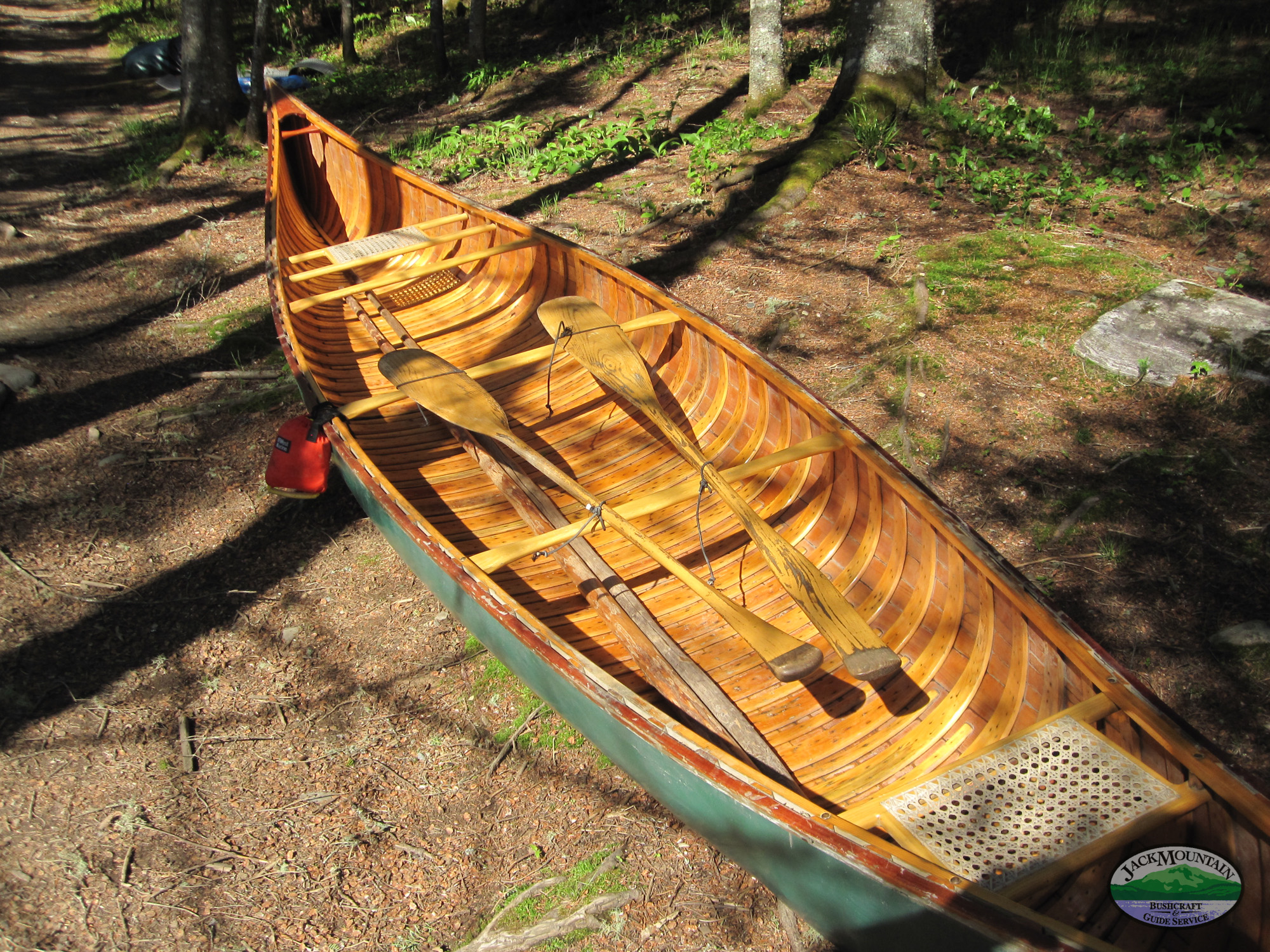
We place a lot of emphasis on the canoe as the method of travel in the north woods. In this part of the world, the canoe as we know it came into existence with the transition from the archaic to the ceramic period, marked by the shift from dugout canoes to birch bark canoes, which took place a little over three thousand years ago. Our modern canoes have changed some of the construction materials, but the finished craft have changed little. A stone-age craft elegant in its simplicity, available to carry a person and their belongings over vast distances with minimal effort. When you realize that a reasonably fit person in an appropriately-sized canoe with some skill and experience is able to transport 1000 pounds of people and stuff across the water, you begin to understand why it was a main source of transportation.
I’ve spent many hours watching water from river and lake shores. Every now and then a natural object floats by and I wonder if a similar floating object inspired those early boat builders. It isn’t a big intellectual leap to see how sticks and logs could inspire dugout canoes and rafts. But what launched the idea for the birchbark canoe? I’ve watched leaves float by on the surface of the water and wondered if maybe it was one of them. It’s probably a bit too whimisical and was more likely a bark vessel that was used for transporting and rock boiling water. But inspiration is often multifaceted, and maybe a floating leaf inspired the bark bowl that held water that inspired someone to think of a larger, reinforced basket that became the canoe. I’ll never know, but I still wonder.
Today we’ll start poling on the pond, then head up to a nearby lake for our initial foray into paddle practice, which will be preceded by a discussion about biomechanics and trimming the boats for wind and current, and a lot of other factual, nuts and bolts stuff. But maybe while we’re going through our catalog of paddle strokes and maneuvers in order to get our crew ready for the upcoming remote river trip, a leaf will float by on the surface of the water. And maybe a similar leaf, years ago, inspired the whole thing.
]]>
Navigation is becoming a lost art. I don’t mean that people can’t find their way around – but the art and science of doing it without a cell phone and gps or map app is becoming a rarity. Rarer still is the ability to navigate from sun, the stars, and those things in the natural world that are always pointing out the directions to us. It’s not that most people have forgotten it, it’s that most people never learned it in the first place. The result is that few modern people have a sense of direction. Take away their devices or connectivity and they are directionless.
With most of the lessons on the skills we cover, the lesson comes first, then there is a something we do with that information that transitions it to knowledge; the active, doing component is what makes it real. We’ve been studying navigation for several weeks, and today it becomes real. Our exercise is to make a map of the area. Using a compass to take bearings, measuring out distance by pacing, and drawing the whole thing up with correct angles, is one of the things we’ll be up to today. And before we start, we have to verify our compasses are working by checking them with the sun. I have two compasses that have become demagnetized over the years; they don’t point anywhere in particular. A quick check with the sun verifys this, and we know to not trust the compass needle. But a demagnetized compass is still a functional protractor, and can continue to be useful.
The takeaway is that it’s the active component, doing something with the information and knowledge, that makes it real and locks it into long-term memory.
]]>
The Changing Of The Seasons
We’ve had some challenging weather lately but this past weekend feels like we turned the corner into spring. Today looks to be another sunny, warm day in Aroostook county, and I’m grateful for it. Today begins week four of the spring, 2026 Wilderness Bushcraft Semester. This morning we’ll start on our second shelter of the course – the Quadpod. Our first shelter uses flexible saplings to make a small dome. The Quadpod uses rigid poles to make a small cone. It’s important to have both of these approaches in your tool kit because you never know what you’ll have available for local resources when you need to build a shelter quickly.
Other projects this week will include finishing and sealing canoe paddles, making a map of the area using a compass, making a simple knife, an introduction to fishing and fly casting, making a bucksaw and making a predator call, and we’ll finish the week with academic background studies on more mammals, plants and fish. We’ll also be starting our outdoor leadership curriculum tomorrow, just in time as next week we start canoeing.
This is a fun part of the course for me because everyone has been here long enough to know all the routines and we are able to cover a lot of ground quickly. Looking out over the Aroostook river valley this morning and the sun coming up behind Squapan mountain I’m reminded of how fortunate I am to get to do this.
]]>
We’re in the middle of week 3 of the spring, 2026 Wilderness Bushcraft Semester and I’m always amazed at the relativity of how we experience time. We’ve all engaged in things that didn’t excite us, during which time seemed to crawl by. I can recall being a kid in school, watching the second and minute hands on the clock count down the moments until the bell rang and we were able to go outside. It seemed to slow down the closer it got to the bell, leaving me to experience those final moments as seemingly hours. Those are the times you wish you could speed time up, sort of like fast forwarding through a movie to get to the good parts. On the other hand, when you’re fully engaged in something you enjoy, the moments, hours, days and weeks seem to fly by. And that’s what I’m experiencing right now. It feels like yesterday I was getting ready for the semester to start, and now we’re two and a half weeks into and we haven’t even hit the water yet! I’ve been making an effort to publish short videos about what we’re up to on the course, and am planning to record a podcast by the end of the week. It’s busy around here.
The weather has been a challenge. April can be a hard month in northern Maine. We all have spring on our minds, thinking about hiking the trails through the woods (still covered in snow), fly casting on the pond (still covered in ice) and canoeing on the river (completely flooded and blown out with snow melt), but the temperatures have been barely making it into the 40s. We have had two days where it got up to near 60 F, but they were just to whet our appetite. We know that warmer weather is coming, but it seems to still be hiding just over the horizon yet.
But the birds and animals aren’t waiting, and have been ramping up the activity. Moose have been active along the road into camp, with some of the guys on the course who are from away getting to see their first one. There is a young beaver who has decided there should be a pond along the road to Moose Vegas and is frantically working on a dam to make it happen. And our resident family of ravens are again nesting in the big white pine tree next to our headquarters. I can tell that the babies will arrive soon because both Buddy and Eddy raven are only using their inside voices in or near the nest. They will both still make a racket when away from the nest, but it sounds like they are ‘cooing’ to the little ones. It is sweet and endearing to listen to. Lastly, the baby snowshoe hares will be arriving any day now. Most years we find one or two next to the pavilion and it’s a great opportunity for a photo. They always blow the roof off of the cuteness meter. The little guy in the photo was hanging out in the pavilion last spring. See what I mean about the cuteness thing?
In review, the land is waking up, we’re incredibly busy, and even though it’s cold there’s no place I’d rather be than right here, right now.
]]>
Last week we kicked off our 27th year with the start of long term program number 68; the spring 2026 Wilderness Bushcraft Semester at the field school. We’re approaching spring this week, but early April is still winter in Aroostook county, Maine. For week one we had torrential downpours, snow flurries, several nights with temperatures in the single digits (F), and lots of wind. As we slide into week 2 today, we’re looking at temperatures above freezing but lots of cold rain. It’s challenging to stay warm and dry.
We spent week 1 working on foundational skills such as making fire, using an axe and knife safely and effectively, barehand navigation and easing into camp routines.
At the start of week two we begin the canoe paddle-making process, as well as dialing in bow drills for lighting fires by friction. And we’re continuing our nature studies curriculum with learning about the weather, trees, fish, and mammals and their tracks. The academic side of our programs gets less fanfare than the hands-on/practical side, but is of equal importance. It adds breadth and depth of knowledge to the hands-on side of things, complementing lessons learned in the field. It is also a way to wisely use our time to keep progressing towards our goals when the weather is challenging. This isn’t to say that there isn’t value in being out in challenging weather; there is. But the important thing from the perspective of the course is to learn from those challenges. At the end of the day as an instructor, I always ask myself if we used the time we had wisely. There are a lot of things packed into the 9-weeks, and a lot of idle time, whether it is relaxing in the sun or suffering in the freezing rain, is not something we have the luxury to indulge.
It’s always a busy time on the Wilderness Bushcraft Semester. I know where the finish line is. We have a long way to go.
About the photo: Snowshoe hare tracks in the snow. It’s just about that time of year for the baby bunnies to arrive. Most years we find one or two of them, so prepare yourself for the tsunami of cuteness when I post the photos.
]]>
Track 1: Professional Development through the Journeyman Certification
Track 2: Student Defined Inquiry (SDI), an independent research study on topic chosen by the student
The Wilderness Bushcraft Semester is not a show and tell type of program where information is presented and students passively scribble about it in a notebook. The course is long in order to give students the opportunity to pursue mastery through actively engaging with the course curriculum.
The curriculum is designed for people pursuing excellence and demonstrating competence with a variety of skills and techniques. This is the Journeyman certification.
But because there are people who have other goals, we offer a second option; the Student Defined Inquiry or SDI. It is based around the idea of an academic independent study, where a student selects a research topic and gets after it.
Whichever track a student chooses, the course remains the same. What changes are our expectation of you and what your are trying to achieve.
The short explanation of how the two tracks differ in practical sense is that for those pursueing an SDI the practical exams during the end of the canoe phase and during week 8 are optional, but students are expected to use this time wisely to pursue their individual research interests, with the aid of an instructor.
Seting clearly defined goals and then achieving them is what we’re all about.
]]>
We don’t have any ticks at our field school in northern Maine. Traditionally, we’ve been quite a bit north of the tick line, below which they live. However, a few hours south the Maine coast is overrun with ticks. The bad news is that they are slowly moving north. The good news is that our predominant tree species is Balsam Fir, and Balsam Fir kills ticks.
According to this article in Nature, the needles and essential oils in Balsam Fir kill overwintering ticks at cold temperatures. Ticks burrow into the leaf litter on the ground as a way to survive a long, cold winter. According to the article, where that leaf litter is composed of fir needles, the ticks have a much lower survival rate. They tested it a bunch of different ways, but their conclusion was that “Balsam Fir needles kill overwintering ticks under both field and lab conditions”.
This is just another reason to love Balsam Fir trees. The picture above was taken at altitude above the field school, and just look at all those beautiful Balsam Fir trees! But don’t take my word for it, go read the article (see link below). And for more information on Balsam Fir, the state of Maine has a great book called Forest Trees Of Maine that is free online. Here’s a link to the section on Balsam Fir (pdf).
https://www.nature.com/articles/s41598-022-15164-z – “Balsam fir (Abies balsamea) needles and their essential oil kill overwintering ticks (Ixodes scapularis) at cold temperatures”
]]>
New Course: Advanced Whitewater Canoe Poling & Paddling
This year we’re offering something new; a dedicated whitewater canoe poling and paddling class. The second week in June is usually our week to canoe the Bonaventure river in Quebec, but neither we or anyone else wants to be crossing the border right now. So we’re pivoting and introducing a new program that fills that gap of an advanced whitewater training course for both paddling and poling, with some prime-season fly fishing thrown in.
The plan is to head into the woods and basecamp at Churchill Dam on the Allagash, and run Chase rapids every day, as well as work on whitewater poling and paddling skills, canoe rescue, fly fishing skills, other camp skills, and learn about the history of the area.
We’ll meet Sunday afternoon at the field school, do a gear shake-down and pack the trailer and van for the trip into the woods. Monday morning we’ll head into the North Maine Woods and drive to Churchill Dam on the Allagash Wilderness Waterway. Just above the dam we can go over paddle strokes in the lake, and the first rip below the dam is a great place to practice moving water poling skills, as well as a good fishing hole. We will work through our entire advanced canoeing curriculum.
The plan for the week is to get a lot of reps running the most challenging portion of the Allagash Wilderness Waterway; from Churchill Dam to Bisonette Bridge, also known as Chase Rapids. The most challenging section is the first 1.5 miles. We’ll run the drops, pole back up, and run them again. The goal is to really learn the river, and how to use the currents and eddies to work for us, not against us.
This is the most consistent bit of whitewater around as it is controlled by a dam, making it reliably runnable even during low-water times of year. The water is rated as a strong class 2. It is fast and shallow, with big rocks and some big waves.
More info on this course and a video of a past trip on Chase Rapids in on the course page at: jackmtn.com/wwcanoe
]]>
In 2026 we are making a big push to simplify what we teach into a consistent, coherent curriculum. In the past, we’ve offered our Wilderness Bushcraft Semester, then had short segments of the curriculum as seperate, stand-alone courses. This year, we’re streamlining the curriculum, but opening up the course to allow people to join us for one week at a time if they choose.
For example, in the past we’ve offered a very popular week-long introduction to bushcraft course called the Summer Woodsman. Now, instead of trying to find a week where it fits into the schedule, it is week 1 of the 9-week semester. Similar with our Canoe Expedition Skills (aka Riverman) course; instead of being a standalone course, it is now week 5 of the spring and summer semester, and week 3 of the fall semester (different in the fall due to weather). And the Professional Canoe Guide Training Course is also part of the WBS, weeks 5-7 in the spring and summer and weeks 3-5 in the fall.
We can only take so many students at a time. In order to not cannibalize the semester prematurely, we won’t be opening up registration for the shorter versions until closer to the run-date.
After running so many semester-length courses over the years, I’ve realized that it’s the course I like teaching. There is a reason for everything we do on it. With short courses, I’ve sometimes felt that the show and tell format with limited field experience isn’t serving the larger educational goals. By this, I mean that sometimes I felt that people didn’t get how what they were doing and learning fit into the bigger picture. It is my hope that the 2026 format change eliminates this concern. The title of this post references the mythical third semester, a reference to a discussion that’s been going on here for at least 15 years. The format change for this year will allow us to fit three semesters in between the deep snow seasons in northern Maine.
As we start our 27th year, I’m more convinced than ever that everything is an experiment. So we’ll try it. If it works well, we’ll keep it.
Our 2026 calendar is nearly complete. I’ll be adding some late-fall programs in the next week, but for now you can check it out on our Calendar page. There are a lot of updates to be made around our website and I’m working on it now.
#FullTangLifestyle
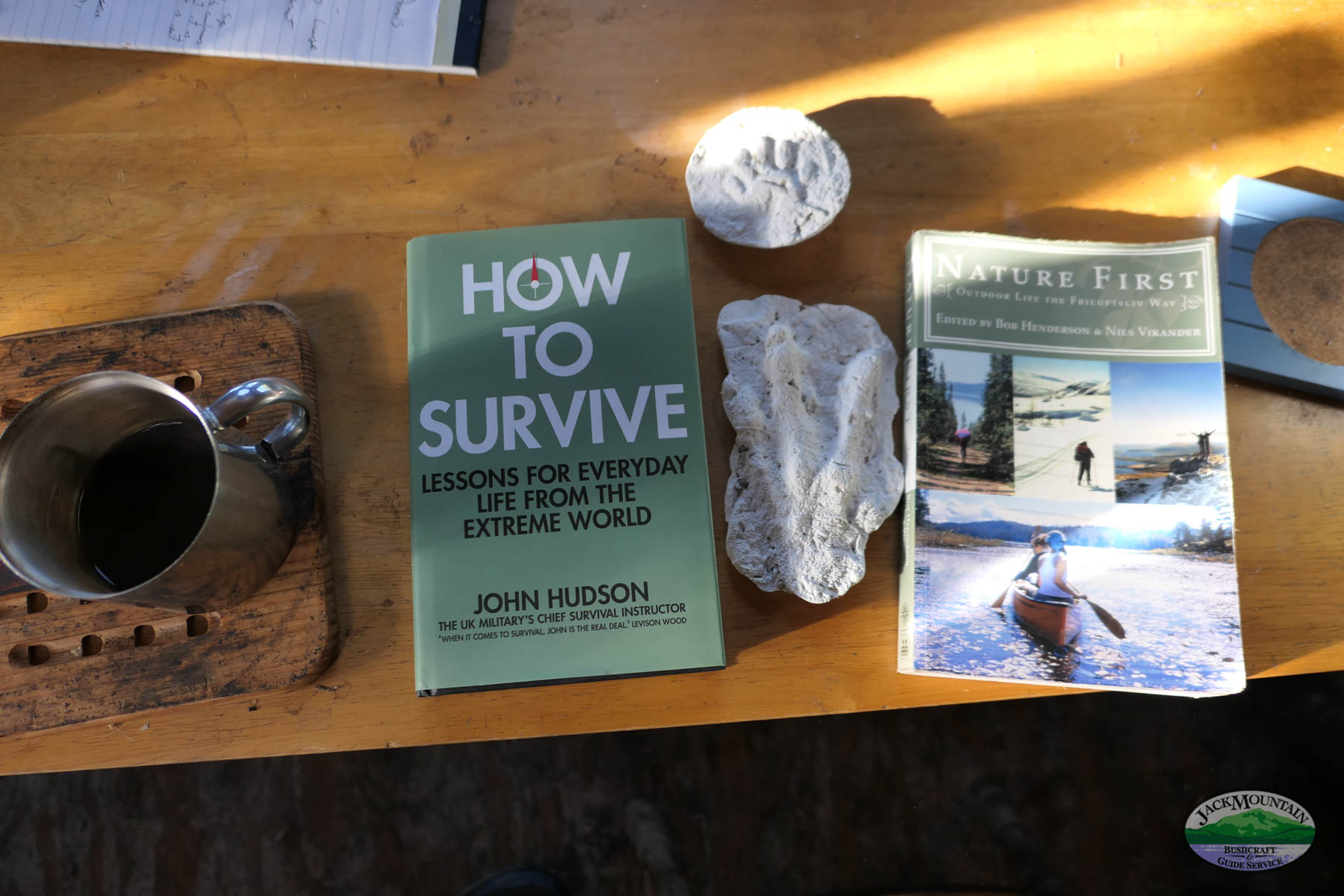
An Ongoing Research Project And The State Of The Archives In 2026.
In 1996 I first met Mors Kochanski when I took a course at his place in Alberta. As anyone who knew him will attest, he was a lover of books and a voracious reader. During the course I asked him if he were running a PhD program in bushcraft and traditional living and travel skills, what would the reading list be? He thought about it for a moment, then said he’d have to get back to me on it. A few months later I got a letter in the mail from him, and it contained a list of around 100 books he had come up with. It took me about ten years (pre-internet for me) to track them all down, but eventually I read them all. I don’t have the original letter anymore (I looked for it a few years ago), but the JMBS Bibliography from 2008 or so contains them, along with some annotations. Read it at: https://www.jackmtn.com/PDF/JMBS_Bibliography.pdf
I have added a lot to the library since then, but the list of my top 21 books at the end still holds up. I’ve also expanded the scope to include permaculture, homesteading, guidebooks of various canoe routes, natural history and field guides, and general related historical and anthropologic texts.
Some of the books that have found their way to me are exceptionally rare and old, and through regular wear and tear are nearing the end of their life. So about 2014 I started scanning them. I also started looking online for pdf copies of books I already had in order to save me the work of scanning them. And I started calling it the Jack Mountain Bushcraft Digital Archives. In addition to creating an archive of important books, it also functions as a portable library that can travel with me. These days I am able to bring it all on a small external hard drive that I can plug into an ipad, and have reading access to the whole thing whether I am waiting out a storm on a canoe trip or traveling cross country.
Currently the JMBS archive of books is at about 46 GB and there is still a lot of work left to be done. I still have a stack of old, rare books to scan, and this stack keeps growing larger.
Upon posting this I will likely get a bunch of emails asking for a download link. While I don’t want to be a gatekeeper for this archive, I also don’t want to post it on the internet. I have known many of the authors whose work is in the archives. Some have been my colleagues, others my heros, and many have been both. So out of respect, and because many of the books are still in print, I have no plans to post it. I have shared it with students, but only after they contributed to the project by scanning one or more old or rare books. My plan is to continue to give it freely to those who contribute.
An interesting side note is the rise of AI and all of the slop that it generates, I think for future generations books that were published before the AI era will be held in higher regard because they won’t contain the slop. By this I mean they can be trusted – with the rise of AI generated stuff comes a lack of trust, at least for me.
So if you’re new and looking for a place to start, check out the bibliography. Then you can look online for digital versions of some of the books. And if you’re new to scanning old books, you don’t need any special equipment. I haven’t used an actual scanner in years, choosing instead to use a smartphone and the Genius scan app.
]]>
A few years ago we ran the backend of our courses in Google Classroom and used Google Docs for all of our documentation. Over the past year we’ve moved away from Google Classroom and now use Mighty Networks (the software behind our private online community at BushcraftSchool.com) to manage the courses, and this winter I’m moving all of our documentation from Google Docs to Markdown. What is Markdown, you ask? It’s a lightweight computer language based on plain text files, with some formatting elements added to make things look a certain way. If that sounds hard, I assure you that there is software to make it as simple as writing in google docs or word.
OK, so there’s the what. But why would I want to do this if the system we’ve been using works. Good question. According to Markdownguide.org, there are a few practical reasons to use Markdown over a word processor. These are my big 3:
- Markdown is portable, meaning no proprietary file formats.
- Markdown is platform-independent. Any device can read and write in it.
- Markdown is future-proof. It doesn’t rely on an app or company to read or edit because it is based on plain text files. I found some files on an old hard drive recently and couldn’t read them because I no longer have the software they were written in. Markdown solves this problem.
In addition to these practical reasons, I’m tired of web-based apps trying to insert AI into everything I do, and am just getting tired of using Google services in general.
On my laptop I create and edit markdown files using Typora. It wasn’t free, but I think it was $15 well-spent. On an ipad and phone, I use an app called 1Writer. The cool thing is that it is a seamless transition from one to the other because of the portability of Markdown. Another popular piece of software is Obsidian. And there are many others. Some are free, some cost a few dollars, they all seem to work. There is a lot of documentation on the web about using Markdown. A good place to start is at Markdownguide.org. If you are the type of person who would rather have a guidebook, check out The Markdown Guide by Matt Cone.
So this winter I’m working on migrating all of our student portfolio files from Google Docs to Markdown so we’ll be able to hit the ground running this spring. I don’t think it will be a big job, with the possible exception of formatting tables for data collection. This might also be no big deal, but I don’t know because I have started yet. Wish me luck.
]]>
In the native lore I’ve read over the years, I’ve come across numerous mentions of the tiny people who live in the forest that white people (modern westerners) can’t see. I’ve talked to one person who, by his own account, has seen them. I’ve also always been interested in the ritual use of psychoactive substances in human history and their effect on culture. So I was intensely interested when I read this paper about a specific mushroom that is not related to the known psychoactive or “magic” mushroom genera, known to result in seeing and interacting with the wee people of the forest.
From the article:
Picture this: You’re enjoying a delicious bowl of mushroom soup, when suddenly you notice hundreds of tiny people dressed in cartoonish clothing marching across your tablecloth, jumping into your bowl, swimming around, and clinging to your spoon as you lift it for another taste. You’re not dreaming — you’ve just experienced the effects of a mushroom known scientifically as *Lanmaoa asiatica*. It belongs to an entirely different class of Fungi than the more commonly known “magic mushrooms” and remains far more mysterious.
What jumped out at me when I read this is that it’s a bolete; a common genera in the woods of northern Maine. Also that they call it the fairytale mushroom, and that they haven’t isolated any specific chemical that leads to the hallucinations. Anyway, lots of interesting things here, so I figured I’d post it and share with our community.
Here’s a link to the article: Experts Explore New Mushroom Which Causes Fairytale-Like Hallucinations
https://nhmu.utah.edu/articles/experts-explore-new-mushroom-which-causes-fairytale-hallucinations
Note: The mushroom in the photo above is the Amanita muscaria, which some years grows in abundance by the field school. It is not the mushroom referenced in the article. I looked but couldn’t find any pictures I have of boletes.
]]>
New evidence is pushing back the date of humans making fire to 400,000 years before present. This is different from humans using fire, and is specifically linked to making it.
From the article:
In a study published today in the journal Nature, a team of researchers claims to have discovered the earliest evidence of fire-making known to science at a Paleolithic site in Barnham, England, dated to over 400,000 years ago. It suggests that humans knew how to make fire approximately 350,000 years earlier than anthropologists believed.
While prehistoric sites in Africa indicate that humans have been using fire for over a million years, pinpointing when humans learned how to *make* it is difficult. People likely started using fire by collecting it from natural wildfires before learning how to start it intentionally.
This will be of interest to anyone who has made a fire by primitive methods, and also those with an interest in human history and evolution. I find the last line of the quotation interesting, as it reflects our western bias. We have a cultural assumption that knowledge progresses as our science teaches it. But in hearing the stories from traditional cultures, it is usually framed differently.
Assuming a generation length of 25 years, this pushes humans making fire back 16,000 generations. That’s a whole lot of ancestors.
Here’s a link to the article on Gizmodo.
And a link to the original study in the journal Nature.
]]>
In the summer of 1995 I Participated in a 4-week primitive living experiment in Alaska. We built shelters, did a lot of rock-boiling in log troughs, ate a bunch of wild foods and lived in shelters we built. It was an amazing learning experience that is still paying dividends in my personal and professional life. To manage the stuff that comes out of our bodies on a regular basis, we dug pit toilets. These smelled bad and were gross. I recall the frustration I had in not knowing how to deal with what comes out of human bodies on a daily basis in a hygenic way. I reasoned that it was ridiculous that as a culture we could put a person on the moon but I didn’t know how to manage what came out of my body on a daily basis without modern infrastructure.
Serendipity was was my friend that year, as that fall I came across a self-published book called “The Humanure Handbook” that was all about composting what comes out of human bodies. If you’ve ever had a problem that was knawing at you, and suddently the solution appeared, you can understand the A-HA moment I had reading through it that first time. The lights were turned on and I now had the information needed to manage bodily fluids and substances.
In the book, and his subsequent works, author Joe Jenkins give you the how-to, explains all the science, arms you with knowledge for how to deal with naysayers, and does it all with a sense of humor. It has allowed me to manage several off-grid, no-infrastructure campsites over the years, as well as use humanure composting as my primary home composting system. As you learn in the book, it is the secret ingredient to a compost pile that makes it heat up, and a hot compost pile digests almost anything.
On a more philosophical note, composting humanure takes a potentially dangerous waste product that must be managed, sometimes at great expense if using modern infrastructure-intensive systems, and turns it into a low or no-cost resource.
I don’t think it will soon replace modern flush toilets for a simple reason; it has to be well-managed. When poorly managed, a humanure composting system can be a disgusting, smelly disease vector. When well managed, it is amazing in its effectiveness, simplicity, and lack of odor.
I tell people coming to the field school on day 1 that if they’re not on board with this system, then have to leave right away. I simply won’t tolerate people who can’t get on board and manage the system the right way, because the will make it gross and unsafe. This is non-negotiable for me. As part of our orientation, I explain that for it to work well, it has to be well-managed. And that we are going to manage the hell out of it. And we do.
The older I get, the more it amazes me that this material isn’t taught at the elementary school level. But it’s not. In fact it’s not taught anywhere, you have to seek out the information yourself, of go somewhere where people have successfully implemented the system. I meet intellligent adults all the time who have no idea how to safely manage what comes out of their bodies daily without PVC pipes, running water, electricity, pumps, big underground septic tanks, or multi-million or billion dollar sewage treatment plants. As I consider this a foundational skill of being a functioning human being, I am amazed and disgusted by this. I realize that I am somewhat of a humanure evangelist and that everyone may not embrace a humanure lifestyle, but not having one or two buckets in the basement or garage as a backup for when modern systems stop working is crazy to me.
If you’ve never seen the book, you can learn more about it at HumanureHandbook.com. On the website you can also download a copy of The Compost Toilet System Condensed Instruction Manual, which is free and a great introduction to the system.
My reason for writing this post was to be inspirational. I’ve been composting human poop for 30 years, it’s not difficult, it’s not gross, and it’s not expensive. It can be the thing that makes composting work for you. It’s a great backup for when modern systems fail. It can allow you to live or camp in a remote place with no infrastructure and not pollute the water or foul the land. It takes a waste product and turns it into a resource. And it is knowledge and a foundational skill you should have if you are to consider yourself an educated human.
Special thanks to Joe Jenkins for publishing the book back in the day and continuing to lead from the front. He is one of my heros and I hope to someday get to shake his hand.
]]>
It’s officially the off season, and I’ve been in Austin, Texas for a little over a week. For the past few years I’ve spent a month or two in Austin with family each winter. I take a few seats out of the van and put in a cot, load it up with some camping gear and make the long drive south and west. I bring a canoe which makes the driving worse due to wind, but I’ve got to have it as there are always trips being planned and new water to explore. And I think I would feel a little naked without one nearby. I’ve got a few poling trips lined up for some of the better known rivers of the Texas hill country, as well as a Big Bend-Rio Grande trip with an old friend.
The plan I’ve used for the past few years is fly back to Maine for our winter programs, then fly back to Texas and drive the van back in March.
After months of not keeping up with email, website updates, and other modern tasks, now is the time I catch up and try to get a little bit ahead. It’s always a bit of an adjustment when I have to start unpacking all the things I’ve crammed into the “do later” bag and actually start doing it now. And after all these years of maintaining such a lifestyle, I’ve become adept at procrastinating and putting off the “doing it now” part of the plan for as many days as I can. But it’s time for me to get back at the other side of my job.
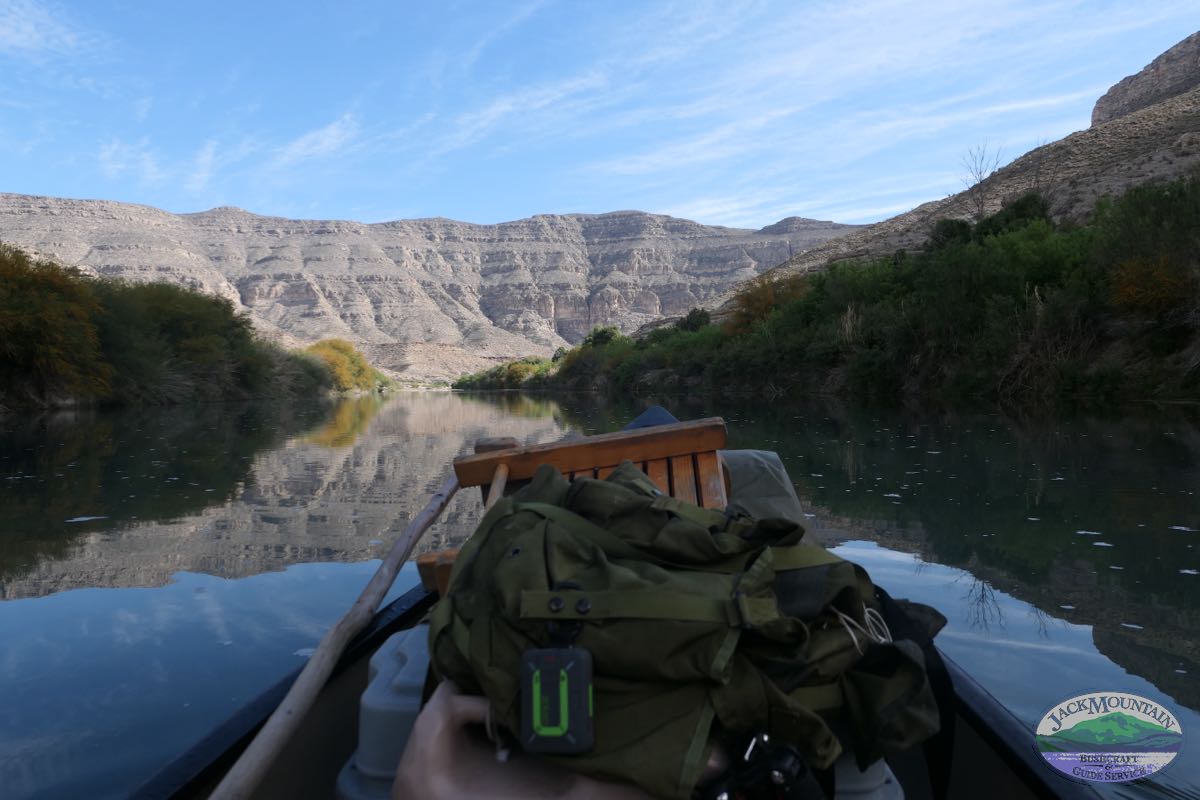
Picture is from my canoe on our October trip on the Allagash. It was a beautiful week during peak foliage, but we did end up windbound for several days.
]]>
The parking lot is empty, the people have gone, and all that’s left is the cleanup. Year 26 and long-term program number 67 are finished. And not a moment too soon, as there’s a bit of snow coming in tomorrow night. I’ve been going since the beginning of April, and now the season is finally completed. It was another great year, meeting some new friends and reconnecting with old ones, and now it’s time to sit back a bit, take stock of what worked and what didn’t, and chart a course forward.
Before such big and lofty things as this, there is cleanup, and alot of it. Managing the field school is something that takes a lot of time and effort, but with the exception of cleaning up after people and taking trash to the dump, it is labor of love.
This photo was taken on Churchill Lake on the Allagash Wilderness Waterway on a beautiful October morning, on our second to last trip of the semester.
]]>
When projects last a long time, they often get things added to them that weren’t part of the initial plan. The longer a thing lasts, the more complex it can become. Last spring I received a message from a person who was interested in coming out for a course, but mentioned that in looking through our website and the various programs we offered, they had no idea where to start. After thinking about trying to come up with a response, I realized that this person was correct; things were too complex. It was time to simplify.
We’re in the final season of year 26 of the Jack Mountain Bushcraft School, and over the years we’ve run a bunch of different programs of different lengths going by different names. And even if they weren’t on our current course calendar, they were on our website, and there was no clear path as to where to start and which way to go. I put myself in the shoes of someone who was looking at what we offer and it left me scratching my head.
I spent the spring and summer ruminating on what we teach and why. At it’s best, education should be transformational. After thinking about what programs we run that have had the greatest impact on our students, I kept coming back to the Wilderness Bushcraft Semester. The long course allows for accumulated reps over time that result in growth not possible in the short courses. Also, the breadth of the curriculum feels complete, drawing on a variety of disciplines.
So, in 2026, during the field school season which runs from spring through fall, we will be running 3 separate Wilderness Bushcraft Semester courses. We will be adding the curriculum for the Professional Canoe Guide Training Course into the Wilderness Bushcraft Semester, including the Engagé certifications for levels 1 and 2. And we will be opening up the course to part-time students, so someone who is interested does not have to come out for the entire course at once. They will be able to come for a week at a time, or for how ever many weeks they have time for. We will not be running any other public programs from spring through fall, as you can currently see on our calendar. We are still open to people coming out for a week, however now it will be a week on the WBS.
More updates and details to come.
#FullTangLifestyle

For years people have asked me if there are decent axes and knives available locally. I can finally say yes. The Gateway Trading Post in Ashland, Maine is 6.5 miles from the field school campus on the way to Ashland.
They carry Snow & Neally Axes and Mora Knives. They also carry a variety of items such as fishing gear, flies and lures, food, and other merchandise. And they are the game registration station for the local area, where people go to have their bears, moose and deer registered and weighed.
So if you lose your axe or knife, or if you are traveling here and don’t have space for such items, you can now get them close by.
]]>
During the summer courses we braintanned two deer hides and made red osier dogwood and spruce root baskets. Here is a photo of one person’s work, with the basket full of summer wildflowers, herbs and berries.
The hides were ones I had scraped a few years ago, so we just did the braining and softening. We spent a lot of time talking about the philosophy of crafting during the courses. These days I find myself discussing the “why” as much as the “how”, and have been thinking about creating a winter reading-based course on the philosophy of crafting.
Another angle: 

Although I haven’t been active online, it has been a busy summer at the field school. We had a solid canoe guide training course with great water levels on the Allagash, followed by week-long summer woodsman 1 and 2 classes. And now we’re a day away from starting the fall Wilderness Bushcraft Semester, our 67th long term program.
This is a magical time of year at the field school. The nights are getting cool, which means the bugs are winding down. Also, the apples are ripe. There are hundreds of old apple trees in the woods near us, so for the next few months we have all the wild apples we can eat. Other wild foods are all over the land as well.
I have some sad news for those who have been following our blog for a while, and especially for those of you who knew her from her time at the field school. Biscuit, our family dog and camp dog for multiple semesters, went to the big kennel in the sky this summer. She lived a great, long life, and was well taken care of. If you got the chance to know her here, you knew she was sweet but also full of mischief. I have many fond memories of her at the field school, going on trips with us, jumping out of the canoe in rapids, jumping out of the canoe and swimming after loons and being sweet and gentle with children. In the photo above, a few friends were hanging around the Guide Shack on a Saturday night during bear season. My friend Ed had shot a bear earlier that day, and she could smell it on him and barked at him for about an hour. When she finally calmed down, we took this photo. The gun, and the whiskey, were Ed’s. One of my favorite photos. It was always fun having her at the field school.
She passed at home, surrounded by her family, and it was very peaceful. We should all be so fortunate. She is already missed.
I’ve got a lot of announcements coming in the next few weeks, more to come soon.
]]>
It’s been a few months since I written or recorded anything. Life at the field school has been busy with the spring Wilderness Bushcraft Semester followed immediately by the Professional Canoe Guide Training Course. I found that my day to day life and work took up all my time, and I was feeling like a break from writing, recording and posting was warranted. When it starts to feel like something I have to do rather than something I get to do, I know I need to step away for a bit.
We’ve got a few days left in the canoe course and we’ve just returned from an 11-day Allagash trip. We had some cool weather and some rain, but overall the weather and water levels were great. We put in at Chamberlain Bridge and paddled south into Telos Lake for our first night, then turned north and paddled the 96 miles to Allagash Village. I have spent the first night of the trip on Telos lake numerous times, and although it adds a few miles to the trip, will likely do it again. For people who have or are planning to canoe the Allagash, you should do the entire waterway at least once. Doing so gives you a sense of scale that paddling sections doesn’t. Don’t get me wrong, I’ve paddled sections and utilized every legal putin for the waterway at one point or another, but the experience of doing the entire thing is just different, and something I highly recommend doing at least once.
Our focus now is getting people through their practical exams with both paddling and poling, and we’ve got some beautiful summer weather for it. In an hour we’re headed out poling on the Big Machias river to work on poling maneuvers in fast water. We had a big rain two days ago that brought the rivers up quite a bit, and we’re going to take advantage of it.
]]>
Week one of our 9-week semester is all about making people self-sufficient. We spend a lot of time workong on fire, cooking over the fire, using an axe to get wood for the fire, sanitation, and settling into the woods life. We also spend a lot of time on the academic side of the course, going through the workbooks, logbooks and other aspects that make up the cerebral side of what we do here. The end result is a mix of both. I’ve always believed that real learning includes both physical and mental components. To focus solely on one or the other is incomplete at best. We have both a body and a mind, and we need to train them both.
Today we finish week one. Among other things, we’ll be working on our wet-weather fire protocol. When small sticks are too wet to light with a single match, we need to take action. It is a meta exercise that brings together most of what we have done so far in order to achieve a goal. There are a series of steps. First, find a dead-standing tree of the appropriate diameter and height. Second, use a series of subjective tests to see if the heartwood is dry. Third, fell the tree, isolate a small section, split it down into small pieces, then carve them into feather sticks that will light. Fourth, light it, cook on it, enjoy the warmth. It is a foundational skill eveyone has to master before we can leave on our first expedition, and they have to accomplish it while not violating any of our safety protocols. Because while an axe cut is a terrible thing in camp, it is far better than an axe cut on a remote expedition where we can’t get someone to the hospital in a timely manner. So we train here first, then expedition.
The weather has turned the corner towards spring, with temperatures rising into the 40’s. Not much snow left except for the road into the field school.
]]>
We received an inch of fresh snow overnight. In planning for it yesterday, we worked on our introduction to mammal studies and first thing this morning we will be covering our introduction to tracking. A fresh inch of snow over a frozen ground is pretty close to as good as it gets in this part of the world for tracking. In deep snow, it can be hard to see the bottom of the track to see the shape of the imprint, count the toes and claws, etc. Also, as the track ages and the weather changes, the sides of the track can melt or be filled in with blowing snow making it difficult to get accurate measurements. As such, in deep snow we are often looking mainly at the gait patterns and measuring the distances between track. When there is no snow, it is difficult to see any tracks unless it is a muddy or sandy area. This is why we place such an emphasis on sign tracking (marks left by an animal that aren’t footprints) in this part of the world, especially during the months without snow. But when there is a fresh inch of new snow, we can see it all: clear prints where we can see and measure the toes, claws, and size of the track, gait patterns and other aspects of the trail, and sign. It doesn’t happen often that we get conditions like these, so today we’re going to take advantage of it.
]]>
The beginning of a bushcraft semester is always marked by a settling in period. Everyone is learning our systems, getting settled with food and shelter, and digging into both the hands-on and academic instruction. It takes time.
By the end of last summer I was pretty burned out with media, social media, shooting video, etc. Yesterday I did my first vlog since last summer, and I feel pretty energized to keep going after such a long break. There is a lot of what we do here that I want to document and share.
For a few years we’ve been numbering our podcast and vlog episodes. I’ve found it is helpful when referring back to a specific episode. I’m going to try it out (numbering) with the blog as well to see how I like it.
Snow again today. Winter keeps hanging on.
]]>
Today marks the start of the spring, 2025 Wilderness Bushcraft Semester, and the 2025 edition of the Expedition Instructor (XI) training program. This is our 65th long-term immersion program. I can see them all in my mind’s eye, stretched out over the past 26 years.
For arrival day yesterday, mother nature decided to roll out the red carpet and we had five fresh inches of snow, but it warmed over the course of the day and much of it melted. Snow this time of year doesn’t last long, but it slows the long-term melt. There are two local spots where the snow takes the longest to melt. One is few hundred yards down the road that I call the Masardis glacier. It’s a spot that gets no southern exposure where big drifts accumulate because of the topography. I’ve seen snow there as late as May 18th. The other spot is the access road into the field school. Much of it also receives no sunlight from the south, and in a few spots the snow accumulates into deep drifts due to northwest winds. Also, the snow is packed from running the snowmobile up and down during winter programs. The result is in a few spots, it is some of the last snow to melt, and this year is no exception. As it is slowly melting and full of water, it is also heavy; too heavy for our small tractor to move with the loader. A few years I’ve paid a guy with a bulldozer to open the road up, but not this year. This year I’m waiting. In a few days, maybe a week, on a warm day where the snow is soft and slushy, I’ll put the truck into 4 wheel drive and try to make it through the deep spots. Once you get through once this time of year, the wheel ruts in the snow aid in the melting process and the rest disappears quickly.
Some years we’ve hauled people’s gear down the hill is sleds by hand. Some years we’ve hauled it in by snowmobile. After talking to the class we decided to stay up the hill for at least a few days. I’ve been developing the area behind the Athenaeum into a campsite and teaching area for a few years now and it has all of the comforts of camp: outhouse, hand pump well, cooking and fire area, and a few tent sites. The official name for the spot is Moonshine Hill, a name coined by a friend.
So today we start the long process of training the next generation of guides and instructors. Similar to a big expedition, after all the planning and preparation, it feels so good to get going. I can see the finish line nine weeks away, and we’ve got a long way to go to get there.
#FullTangLifestyle
#Maine
#Permaculture
#Bushcraft
#AroostookCounty
#MasardisMaine

The last few winters I have taken some time away from the web and the website around the holidays. This year I extended it through the whole month of January. It was good to take a break and reboot, but now I’m ready to jump back in.
Taking time away gives me the perspective to look at what we’re doing to see if we’re still headed in the direction we want to go. Some things I thought about over the break are our continued participation in corporate social media, the types of programs I want to be running moving forward (long vs. short term) and how to organize my day to day life in order to be as productive as possible. More on these topics to come.
As for this year, we’ve got a full calendar and there are still a few more summer programs to be added to it. Our first program of the year is the Boreal Winter Survival Instructor course, which starts in a week. Then I’ll be off to Texas to run the lower Pecos River, before heading north again for an early start to the Wilderness Bushcraft Semester in April. As always, if you have any questions about what we do, get in touch.
]]>
“Imagine after being exhausted at the end of a hard day, you are coming home to this [long silence]. In the little remaining daylight he cannot possibly return to his main hut, his only recourse is to fix this one.” – Werner Herzog from Happy People

Thats the tree coming in from the left
The trapper then commences to put his small cabin back in shape by removing the log (with what I’d call a large hatchet), sloughing off the 5′ of snow on the roof, and then, while softly humming to himself, lighting a fire in the wood stove. While it isn’t clear how cold it is throughout this unexpected home improvement part of the documentary, seeing how he is rocking a few solid beardsicles, it must be at least in the teens, as I have found from experience that you don’t get good facial ice until it is at least that cold.
Man and dog sharing an “OH Sh**” moment
Why do I love this scene? Two reasons. I empathize completely with his reaction (seen in the picture with the dog). This is a moment that we can all identify with. I have seen (and made) that stationary stare, it’s not really looking at the problem as much as it is a glazed over reflection on life, like “Really? Is this what’s going on?” Or perhaps it is an “oh sh** moment.” Either way we all have been in that place, it’s a moment of universal suffering/ resignation that we truly are not in the driver seat. Plus, I love that his dog appears to be having the same thought.
The second reason I bring this scene to you is more personal. While I don’t live in that remote corner of the taiga, I do live in a tent in the woods, off the grid, and have to deal with, admittedly to a lesser degree, many of the struggles the trappers and townsfolk deal with in the documentary. These are common problems anyone has to deal with if you live more or less outdoors; outdoors as in a house/cabin/tent that won’t function without you and that only keeps nature at bay, not completely out. That means your house freezes in the winter, is full of bugs in the summer and provides only a thin veil of protection from the elements. You put in the work to keep it warm, to bring in water, to keep animals out, and to make it comfortable. And the real test is this: imagine coming home to your house and finding the scene above, what would it take to get through the night? Your heat would still probably work, water would still come out of the tap, and you’d have a phone to order a pizza. The point is that living in a modern house and living like the Bob Villa of the Bush in the movie are different lives, very different.

Future syrup
Spring has come early to us in Northern Wisconsin. It is April 4th and we have already had 2 weeks of spring; the ice is off the lake, the snow is mostly gone and the daffodils are poking up around town. The warm days and cool nights have prompted the maple trees on my property to start running sap, and so begins the sugar making season. The process is simple enough- drive in a metal tap, collect the sap (40:1 water to sugar), then boil down the sap until you are left with a thick, sweet syrup. I do it the old fashioned way, pots suspended over an open fire. I don’t have wood delivered so my days are long, collecting wood and keeping the kettles on a rolling boil. A big wind came through the area two days ago while I was boiling and blew over a 40 foot dead poplar, almost squishing me and my dog and completely destroying my boiling rig. Luckily the kettles didn’t spill and both dog and I came away unscathed. Needless to say next time I see a tree and think “You know, I should take that down before it falls on us,” I’m gonna do it. After putting my syruping rig back together I headed back to my tent where I had found the wind had blown down half of my tarp, one end of my tripod holding up the tarp and also disassembled my stove pipe. This was at 7 pm. I was exhausted. So I went back to work fixing my house until well after dark. That’s life in the bush; there is no guarantee that you’re day will ever be over.
It occurs to me as I sit here in my 9′ x 12′ canvas wall tent just above the 45th parallel north, that there is a growing distinction between those people who view bushcraft as a hobby, like model ship building or betting on the ponies, and those who treat it as a lifestyle. I remember a day last fall during the Wilderness Bushcraft Semester when a student said to me “You seem to be into fly fishing way more than bushcraft.” This gave me pause, because on the surface he was right, but when I thought about it more I found the truth: I am obsessed with fly fishing, but it is a hobby, something I do for my overall well being, but it is not integral to my life. It would be similar to saying to someone with a regular 9-5 job and a modern home “Gee, you seem to be more into golf than paying your heating bill or grocery shopping.” And they’d be right, but what we do to pay to the bills, so to speak, is (or should be) a greater measure of what we value; garnish makes a great steak even better, but the steak is the reason we’re there.
I have seen it often amongst people who, for many reasons- time, interest, ability, treat bushcraft as a hobby. There is endless talk around the campfire and comparison of knives, canoes, axes, or whatever. While there is always an inevitable level of this style of conversation amongst passionate outdoors folk as this is how we learn more about our craft or how to improve technique, there a big difference between having these discussions out of function instead of out of form. For example, I appreciate a good axe and I am happy to debate certain qualities of head weight, manufacturer, handle material and grain pattern or bit profile, but ultimately I don’t really care, not because it isn’t important, but because I probably use an axe 300 days a year and it has become less important to me what axe I have as long as its sharp. It is like the 3 part act all of us go through when we learn a skill:
- The novice knows nothing and has nothing but is open to everything
- The skilled acquires everything and gains ability
- The master has nothing but can do anything
I am a novice guitar player. I have put in my share of hours learning how to pick, and I was in a band for a score of years, but I am far from an expert; far from living the life of a musician. I can talk the talk at a guitar shop and bust out chop or two but when it comes down to having an opinion on the fine points of being a luthier, professional guitar player, or composer I am over my head. I could jump on a forum on the web and pipe my 2 cents into a thread about the value of low vs high string action on an acoustic guitar, medium vs thick picks or who was the greatest guitar player of our time but what is my opinion worth? That’s up for debate, while I think each one of us has a voice worth hearing, at the same time I don’t pretend that my opinion is more than that, the thoughts of an amateur.
So, back to the tent. It is still cold as sin in here, the sourdough starter has froze, wires to solar panels have cracked, and the epoxy for at my fly bench is solid, now ruined because of the cold. I choose to live this way, so I am not playing up the whole “oh woe is me” routine. Far from it, I am happy to live like this because it makes me value what I have. When you go home to an automatically heated home, you rarely think when you walk in the door “Wow, thank goodness that heater works all on its own.” When I come back to an ice cold tent, however, I value every BTU I can get out of my wood stove. That stove is why I started thinking about writing tonight.
A couple of days ago I was scrolling through an online forum debating the functional principles of a wood stove. I think I got hooked into reading a thread on dampers in stove pipes and how they are necessary to run a wood stove because I threw mine out at the beginning of last winter as it caused more problems than it solved. I know from experience that they aren’t necessary, yet here were many people saying they are, who do you believe? As I sifted through the comments I started wondering how many of those posts were written by people whose only source of heat is that stove and it’s intricate engineering they are so hotly debating? I don’t mean to say that their thoughts don’t count, I value any ideas that help improve the tools of our trade, but it did get me wondering what percentage of people online (or off line) who are engaged in the conversations revolving around bushcraft or wilderness living actually live the life?
There is a gulf between living a life directly and vicariously living (romanticizing) a life through other people. To live in the bush is far beyond the imagination of the common public. When I tell people I live in a tent, off the grid, in northern Wisconsin and Maine, year round I usually get a reaction somewhere between pity and appreciation, but both are far from recognition of the reality of the life. Again, this life is intentional, so this is not a sympathy fest, I just want to illuminate the difference between a romanticized lifestyle and the real thing. I don’t of course, live the “real thing” as I said. I don’t hunt and forage for all my food, nor do I make all my clothing. My saw has been replaced by a chainsaw and I have a big ol’ 4×4 to get around. I can’t imagine what it would be like without those things, and it is exactly that thought that keeps me from pretending that I do. The parts of this life I do truly live, I have acquired a great understanding of and appreciation for my knife(s).
Many times have I heard the debate over the best knife to have in the bush. As a matter of fact, there is probably no bushcraft topic that takes more space on the web than what is the ideal knife. Fact is is that the best knife is the one that you have with you when you need it. There are certain qualities that are desirable for sure, but if you look past modern youtube woodsman, to people who lived in the bush for real, you will see a galaxy of ideas of what a knife should look like. Point being is that in the bush you have what you have and while you may spend hours talking about how to make improvements in your tools, at the end of the day that knife you have is going to keep you warm and fed, not just take up space in a drawer. This is the main difference between a craftsman and an outdoorsman – one is involved in the minutia of the product and the other in its use.
There is a similar distinction between outdoor or wilderness schools. There are many where you can take a weekend course on, say survival or flint knapping. There are others set up to run like the National Guard, one weekend a month, one week a year. And for many people those schedules fit into their lifestyles. But we shouldn’t forget that 8 one hour courses is not equal to one 8 hour course. The same goes for longer courses, one year of a few afternoon hours here and there with a weekend a month does not equal 9 weeks of full time learning. The difference is exactly the difference between having an opinion about canvas tent design because you slept in one at a traditional skills gathering and having an opinion because you have lived in one for two years straight. I drive a vehicle but that doesn’t mean I am an expert on automotive mechanics, Newtonian physics or the rules of the Department of Transportation.
The internet has made available to anyone the opportunity to be an expert in just about anything. I can be a degree holding doctor in a few hours, a contributor to a hot rod engine repair forum in a few clicks and a critic of red carpet Hollywood women’s evening wear in a couple of days. All it takes is a few clicks, cribbing other people’s work, doing some cursory research and bam! I am off and posting. This is fine with me, I am sure I do it too (that bit about women’s evening wear may or may not be hypothetical), but it does create a situation where it is can be hard to parcel out truth from opinion. If you are wondering, just ask if they live it. If you live in the bush, there is no faking that you know the intricacies of living in the city and vice versa.
]]>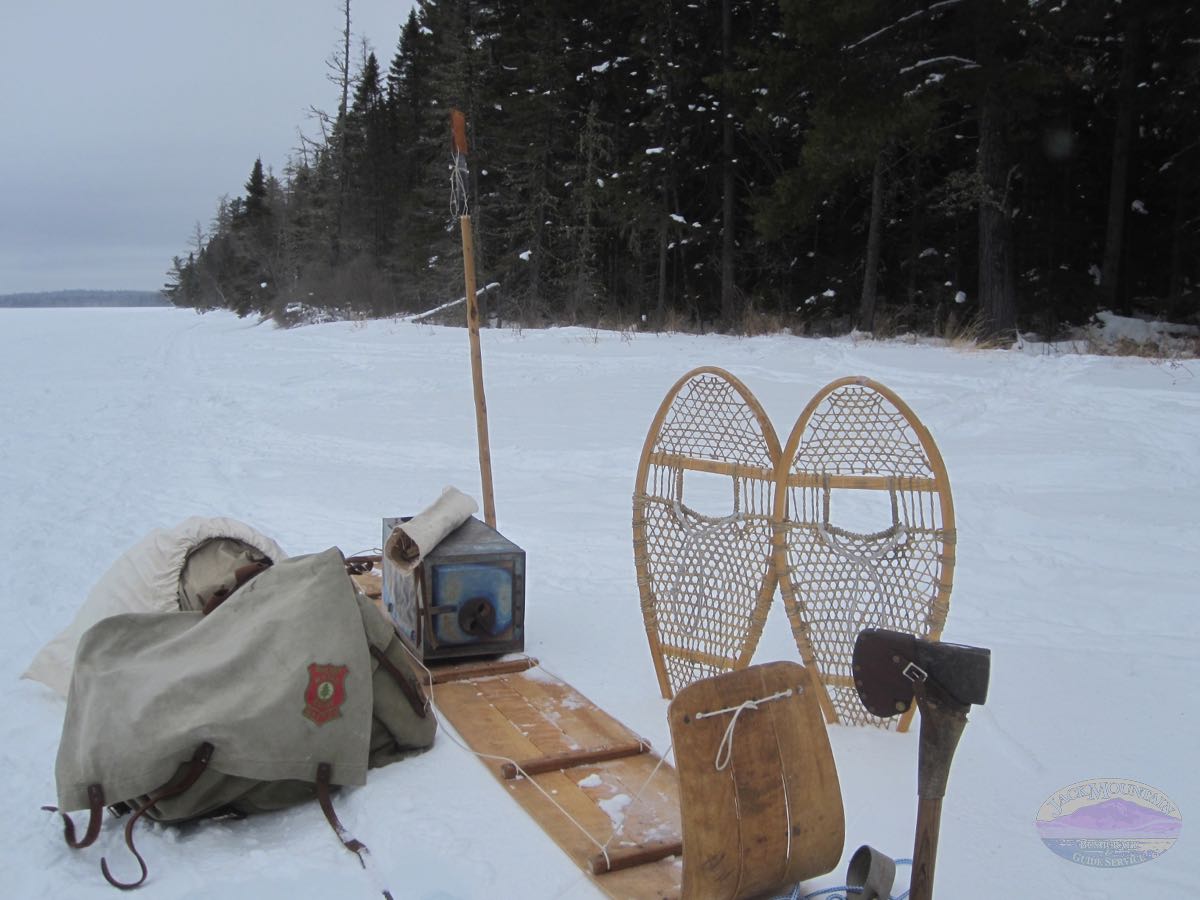
I was a boy when I received my first pair of snowshoes, a wood-framed, rawhide-laced (the rawhide was traditionally made from moose hide and known as babiche, pronounced “bab-eesh”) pair made in Maine that took me on countless boyhood journeys through the winter woods. Since then, I’ve snowshoed all over Maine, New Hampshire, New Brunswick, Quebec and Alaska. A few years ago I did a rough estimation of how far I’ve walked on snowshoes, and it was more than a few thousand miles.
The aboriginal people of Europe and Asia developed skis for moving on deep snow. In North America, they developed snowshoes. Both are ways to walk on deep snow and not sink. They function by spreading your weight across a larger surface area of snow, allowing you to walk on top of the snow instead of “post holing”, or sinking down to the ground with each step. This saves energy and allows you to move much faster. The bigger the frame and the tighter the weave, the more flotation it provides. In waist-deep snow, covering 50 meters with no snowshoes has taken me more than ten minutes; wearing snowshoes, I walked right across it like I was walking down a sidewalk.
Snowshoe Design
Despite our modern homogenization of outdoor gear (ie. the greatest knife for all environments!), snowshoes size and shape evolved with distinct regional differences. In open areas with deep, dry snow and few trees such as Alaska, the shoe that developed was long and narrow. On the other end of North America in northern Quebec, where the snow is deep and the bush is thick, a short, rounded shoe was developed. The important point is that the land and the local snow conditions influenced the size and shape.
Two Pairs
The weather is never static, and as a result there isn’t one perfect pair for any location. The large-framed, finely-woven shoes needed for the deep, dry snow of midwinter wouldn’t last long in the icy, sharp-edged conditions of the shoulder seasons. A smaller, more coarsely-woven pair was kept for such conditions. These late-season conditions are also when an improvised pair such as Kochanski’s ski shoe perform their best.
Keeping a second pair handy isn’t just for the shoulder season. My Cree friends of northern Quebec bring two pairs even in the dry snows of midwinter. The first pair is for covering distances on the trail. They’re longer and narrower. The second pair is for maneuvering in thick bush. They’re shorter and rounder. As with all aspects of outdoor gear, there isn’t that one perfect pair that will do it all.
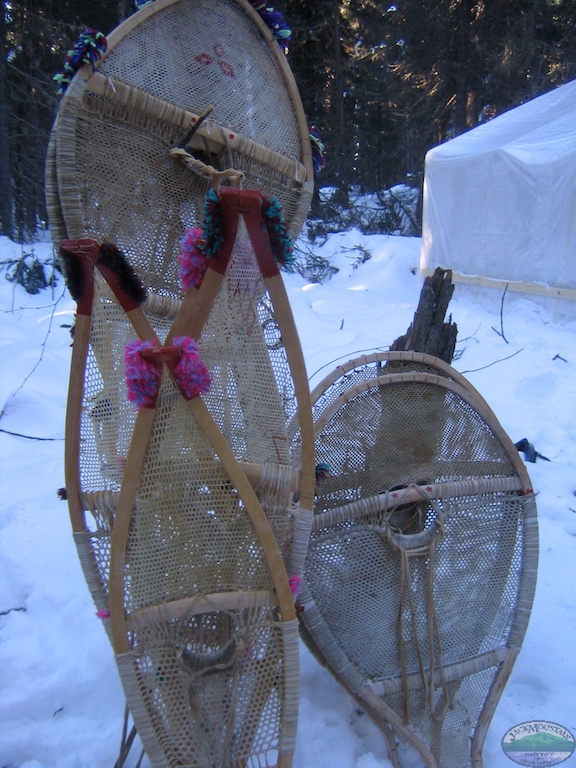
Choosing Your First Pair Of Snowshoes
If you’ve never used snowshoes before, the choices can be bewildering. But there’s a simple piece of advice I give to people coming on our winter trips. Get the biggest pair you can walk in without having to walk bowlegged. If they are of the short and wide variety, you’ll have to take longer than normal steps. When the snowshoe is the right size and the bindings are well-adjusted, you should forget you’re wearing it when walking straight ahead. There can be a slight extension of the forward stride, but ideally you walk with a normal gait, toes forward. There is a painful condition the voyageurs referred to as “Mal de raquette”, which is a straining of the muscles and tendons of the legs as a result of walking bowlegged. I’ve read about it, but thankfully never had it, but I’m told it’s quite painful. Avoid getting it by walking normally.
Axe Or Tapping Stick
Snow will accumulate on the top of the lacing. In a perfect world, the spacing of the weave would allow it to fall through so you’re never lifting the extra snow when you lift your foot. I’ve heard a lot about this perfect world and would like to visit there sometime, but where I’m at snow builds up on top of the shoe. In heavy snow, it adds significant weight to each step. I like to carry my axe or similarly sized stick in my hand to tap the side of the frame, which knocks off most of the snow. In cold, dry snow, I will tap whenever snow starts to build. In wet, heavy snow, I tap much more frequently. I also use the stick to push down on the toes of my snowshoes if I want to back up. Lastly, it’s useful for knocking the snow off of evergreen branches before I walk under them, keeping the snow off of my clothing.
Snowshoe Technique
Unlike skiing, where you can be refining your technique years after you begin, with snowshoeing the vast majority of the techniques are learned in the first few hours. Walking forward in a straight line is simple. If you put them on and try it, you’ll get it quickly. You may fall a few times, but most people pick it up within a few minutes. However, there are four points on technique that aren’t so intuitive.
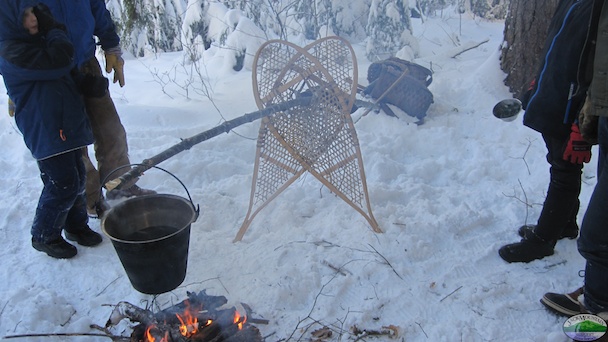
First on this list is turning. This is where the majority of the falls occur because you can’t simply turn like when you’re walking. To turn with a wide radius, take a series of shuffling baby steps where your snowshoes never travel over one another. Lead with the foot in the direction you want to turn, and the other foot follows. Turning with a tight radius is more of a challenge. Lift up one shoe and rotate it 180 degrees in the air. When you place it down, your feet are roughly parallel, but your toes are facing in opposite directions and you resemble a sort of backwoods ballerina. When your foot is firmly planted, lift up the other foot and swing it around.
Second is backing up. Snowshoes don’t have a reverse, at least not when using traditional bindings. Because they’re weighted so that the back end is heavier, when you try to back up the rear of the snowshoe buries itself in the snow. There are two ways to deal with this. The first I already mentioned; carry a stick and push down on the toe of the shoe while backing up. The other way is to lift the shoe clear of the snow, then flex your hamstring and ankle at the same time to flip the tail up. While it’s flipping up, take a quick step backward. It takes some practice, but not that much.
Third is getting up after you fall. If the snow is deep and powdery, it can be very difficult to get back on your feet after you’ve fallen. It’s also a challenge if you’ve fallen backwards. A solution is to roll until you’re on your stomach, then get your shoes under you before trying to stand. Sometimes this will require you to take off the shoes in order to use them as a platform. This is another instance where carrying a stick can be helpful.
Lastly is something few people think of before hitting the trail; how to poop with your snowshoes on. The goal is to take care of your body’s needs without bringing any of it back to camp. First, pack down a small area so that the deep snow doesn’t touch you in unwanted places. Before attending to your duty, point the toes of your snowshoes together and widely splay the tails. If you’re unable to perform such functions in a squat, take the shoes off and stand on one while holding onto a tree. I don’t want to go into too much detail here, but there have been many occasions where people have brought unwanted evidence back into camp, frozen to the tail of their snowshoe. Don’t let it happen to you!
Snowshoe Bindings
Bindings need to hold your toe securely to the shoe and wrap around your heel to keep the shoe from coming off, while at the same time allowing your heel to move. This single pivot design is common to all bindings. Modern bindings are made of rigid materials and fasteners that require your hands to open and close. Traditional bindings, as I define them are flexible and non-rigid, and are thus easily made of of a variety of materials. I’ve always used a traditional binding because that’s what I find the most versatile and comfortable. That they are simple and homemade is just a bonus. On a cold day when those with modern bindings are bending over and taking off their mitts, I can take off and put on my snowshoes with no hands and a turn of the ankle. And I’m not even a magician!
There’s a statistic I’ve heard that 50 people in North America die each year as a result of such modern bindings; mostly ice fisherman whose feet go through the ice, but are unable to get their hands down to release their snowshoe. I don’t know where it comes from or if it’s true, but it makes sense.
Old books on snowshoeing describe native bindings as made out of a thong of braintanned moose hide (buckskin). Traditional woodcraft books describe them made from cotton lamp wick. I’ve tried both of these, but my preference is for nylon cord, reverse wrapped to the proper thickness so it doesn’t chew through my boots. The reason I opt for the nylon is that it doesn’t absorb water like the cotton or buckskin. When you’re on an extended trip and you get spell of weather near or above freezing, cotton or buckskin absorb moisture. When it gets cold again, they freeze solid, making it very difficult to adjust the binding if you want to change from mukluks to rubber boots. The nylon, even when frozen, can usually be thawed by grasping it tightly in your hand for a few seconds. If that doesn’t do it, a few minutes by the wood stove or fire and it’s dry enough to manipulate. In my experience, it takes much, much longer to dry both lamp wick or buckskin. Traditional snowshoe bindings are low tech and can be made out of anything. For several years in the mid 1990’s, my bindings were made from a section of 20 year old water ski rope. Use what you’ve got.
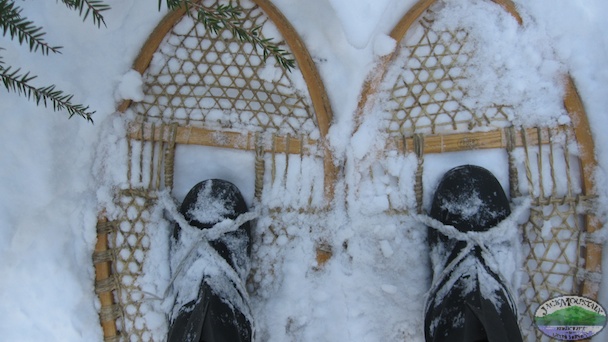
Other Uses For Snowshoes
In addition to walking on them, I’ve used snowshoes as a snow shovel, chair, back rest and pot suspension system. Some have even used them as a trap to catch small birds (I haven’t, I enjoy their cheerful company too much). Improvised snowshoes can even be used as part of a mattress. And there are probably at least 1000 other ways they’ve been used throughout history.
We like to think that technological advances are intuitive, and that we’d figure them out on our own were we to be somehow transported back in time before they were the norm. It’s part of our hubris as a culture. But shrouded in the mists of prehistory there was that first person to make a pair of functional snowshoes, put them on, and walk on top of the snow. Now all these years later we’re still doing it. They, and all who came after and refined the craft deserve our gratitude. Snowshoeing has added immensely to my enjoyment of the natural world. Both exploring the local woods, and on remote expeditions, it is the gateway to a world of winter wonder that can’t be explained, only experienced.
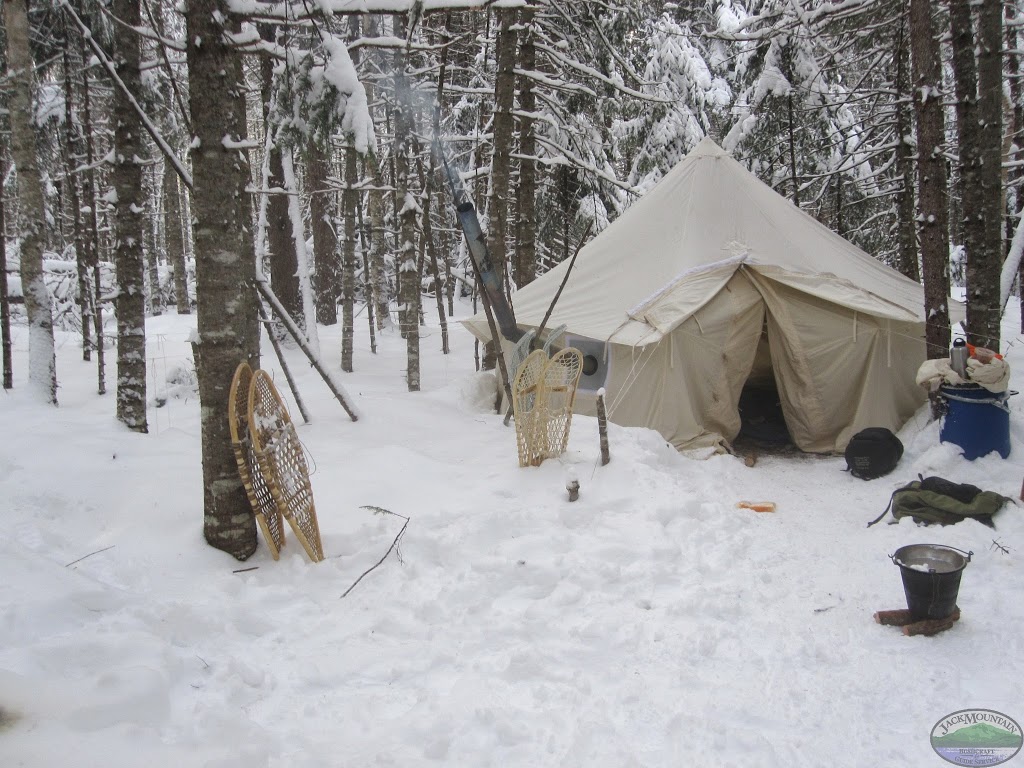
Note: Originally published in a magazine in 2014, reposted in 2024.
]]>
I read this article on the moving magnetic north pole this morning and I thought it would be interesting to anyone who uses a magnetic compass to navigate. I don’t know what the changes on local declination are as a result, but will be interested to find out. It seems that the older barehand navigation techniques are more relevant than ever based on the changing location of the magnetic pole. I’m not sure if the graphic (that I took from the article at ScienceAlert.com) accurately depicts the newly agreed upon location, but if it does it is a long way from where we traditionally teach the location to be. The bigger lesson here is that the only constant is change.
Link to original article: Magnetic North Pole Has Officially Changed Position
]]>
Beginning in 2025, we’re adding a 2-day Wilderness First Aid course to the curriculum of the 9-week Wilderness Bushcraft Semester. This will allow WBS students who are interested in testing for their registered Maine guide licence to do so without having to chase down an outside first aid and cpr class. It also will give them valuable training with regard to what to do when medical care is needed.
These courses (1 in the spring, 1 in the fall) will also be open to the general public on a space-available basis. This means that if you’re interested in taking a wilderness first aid course in northern Maine, you can take it with us. Dates for 2025 are on our calendar.
This photo was taken during the 2024 Maine Guide Medic course, and shows an improvised bandage made from a common fungus and held on with a green stick wrap. Part of the Maine Guide Medic course included using mother nature’s resources to manage backcountry medical situations.
]]>
We’ve done really well over the years when it comes to publicity based on being listed in the top ten bushcraft or survival schools in the USA. It used to be magazines, now it’s blogs and online influencers. And they are all full of shit. This isn’t me being sour grapes because we were dissed. Quite the opposite. We have been benefitting from these lists for several decades. But even though we benefit, I think you deserve to know the truth about how such things work.
We have been in countless top ten or best of lists over the years. But not one of the people who put together these lists has ever been out here to see the place or kick the tires. They do the same things that we all do when researching something; search for it online. Then, based on a website and (maybe) a reputation, they assemble their list. While there is nothing wrong with this, it is completely superfluous. They don’t really add anything to the end result. But they do generate revenue for the site hosting the list, in the form of ad dollars and search engine rankings. This benefits them. It does not benefit the reader looking for unbiased information.
So, in a nutshell, don’t trust the online lists. In anything, really. Fake product reviews are as easily purchased as school reviews are easily made-up. It’s time we all go back to what used to work just fine; word of mouth. Ask around. Talk to people who have been there. Read actual reviews of people who have been there. Visit or talk with the instructors in-person if you can. And realize that if you’re looking for actual, unbiased information, often the internet is not your friend.
#FullTangLifestyle
On our long-term programs, we are working to train participants to be self-sufficient. Both in camp and when we’re out on the trail, we do this by traveling solo together. The idea here is that we expect everyone to pull their own weight, police their own gear, plan and prepare their own meals, have their own stuff, and conduct themselves in such a manner so that they could be having the experience by themselves. We travel as a group for camaraderie and safety, not to take care of one another. In training to be a guide or instructor in the backcountry, this is important. The first step toward learning to take care of others in the backcountry is learning how to take care of yourself.
Years ago on immersion programs we used to plan and pack meals for the group. What we ran into was that some people would never learn how to take care of themselves, choosing instead to ride along on the goodwill of the group. I saw it as a big negative that someone could complete one of our programs and still not be able to provision and cook for themselves. Another common occurrence during those days was that certain people who had nurturing personalities would end up taking care of others who were unprepared. It wasn’t necessarily a negative thing, but those who were unprepared were never met with the consequences of their lack of preparation. Because these individuals were consistently bailed out of experiencing any hardship, the underlying lessons were not learned.
These days, we travel solo together. People are expected to be prepared. We spend a lot of time during the Wilderness Bushcraft Semester on expedition planning, meal planning, packing food, making sure the waterproof systems when canoeing are working, and more like this. This isn’t to say that we don’t share food or ever make group meals, but the expectation is that everyone is learning to have everything they need in order to make the experience a success.
]]>
We’ve had a lot of inquiries about the Expedition Instructor program lately. It is our 6-month immersion that combines all of our professional training programs into a cohesive whole. And as we just wrapped up the field school season, I’ve finally had time to dive in and update the web site with the new information. I’ll reproduce it here, but you can always go directly there on the XI page.
How It Works
The program progresses through five phases, which can be taken in a single year or broken up over a longer timeline. With each phase is a corresponding certification. Successful completion of the certification is required to continue on to the next phase.
Phase 1 – Wilderness Bushcraft Semester, Journeyman Level 1 Certification, 9-Weeks, Spring And Fall Terms
Phase 1 consists of the Wilderness Bushcraft Semester (WBS), our flagship course, and the Journeyman Certification Program. In addition to our standard curriculum, beginning in 2025 the WBS will include a Wilderness First Aid and CPR course in the tuition, preparing students to register for their Registered Maine Guide Exam administered by the state. 2025 tuition for Phase 1 is $8150.
Phase 2 – Professional Canoe Guide Course, Engagé Levels 1 & 2 Certifications, 3-Weeks, Summer Term
Phase 2 is the Professional Canoe Guide Course (PCG, formerly the Wilderness Canoe Expedition Semester), and the Engagé Expedition Canoe Certification, levels 1 and 2. In the rocky mountains, guides traveled with horses and mules as their beasts of burden. In Maine, the guide is his own beast of burden, and his craft is the canoe. Whether to access remote hunting opportunities, fish remote rivers and lakes, or as a vehicle to get people into the wilderness, canoe skills are something that has defined Registered Maine Guides for generations. They are widely known as the most competent canoeman in north America. But these skills don’t come without a price, and that price is a lot of work, a lot of miles and a lot of sweat. This course trains a guide to plan, prepare and pull of extended remote wilderness trips by canoe. It is designed to teach the prospective guide not only how to pass the test to become a guide, but also how to be successful doing the job. 2025 tuition for Phase 2 is $3900.
Phase 3 – Maine Guide Medic – 2 Weeks, Fall Term
There is a medical education requirement in order to become a Registered Maine Guide. It has been our experience that the standard backcountry medical courses and certifications sound great on paper, but they don’t provide a sufficient level of training or experience to deal with an actual medical situation in a remote setting. We designed the Maine Guide Medic to fill this gap. Students receive extensive training that results in the industry standard Wilderness First Responder certification, but also in those areas we feel the standard WFR is severely lacking for working guides in the back country. As such it is a hybrid of an industry standard course and a course designed by working guides who understand the shortcomings of the industry standards. 2025 tuition for phase 3 is $2400.
Phase 4 – Wilderness Bushcraft Semester Instructor Trainee, Journeyman Level 2 Certification, 9-Weeks
Phase 4 is a deep dive into the backend of the the business of outdoor education and where you begin to build the skill sets that will make you successful in the long run. A deep dive into teaching, learning and instructional design. You will be a teaching assistant on a Wilderness Bushcraft Semester course, which means you will both help with student support and, with guidance, begin to teach on topics you’ve spent months perfecting. As you’ll learn, teaching isn’t just providing information to students – it’s a process based around how they best learn. You’ll learn our process for instructional design that’s allowed us to prosper in this field for over a quarter century. You’ll also be learning how to use media to your advantage. The goal is that by the end of the fall semester you have cemented your understanding of how people learn and how best to reach them, as well as have a solid understanding of the business side. 2025 tuition for Phase 4 is $900. Please note that this course is by invitation only. The way to secure an invitation is to complete the other courses and certifications. Also not that there is a significant amount of academic work in order to remain a student in good standing on this course. Those who fall behind will be washed out of the program. Professional training, professional consequences.
Phase 5 – Boreal Winter Survival Instructor Course – 2 Weeks, Winter Term
Phase 5 is the Boreal Winter Survival Instructor Course (BWS, formerly known as the Boreal Snowshoe Expedition). To survive, teach and guide in winter takes a specialized skill set and a lot of experience. Most modern guiding takes place during the warmer weather, including spring and summer canoeing and fishing, early fall hunting, etc. But traditionally there has been in Maine guiding a whole other side to the calendar; winter. And for those who would guide in winter, there is a specialized skill set necessary to do so safely and responsibly. Our winter programs build on the skill sets developed in our other programs, but incorporating the challenges brought by deep snow and deeper cold. Winter survival, moving your body and equipment using snowshoes and sleds, ice safety, traditional shelters (to include improvised winter shelters heated with open fires and canvas tents outfitted with wood stoves) and winter ecology. 2025 tuition for Phase 5 is $2600.
Phases 1, 2, 3 and 5 are approved by the Maine State Approving Agency for veterans to use educational benefits. College credit is available through Western Colorado University, our academic partner. Phase 4 is not covered.
Frequently Asked Questions
How Do I Register For The Expedition Instructor Program?
The XI is the combination of the programs we already offer. It is not a standalone programs. Students sign up for the component parts (phases) as individual programs. Returning students get preferential treatment for spots.
Do I Have To Pay A Deposit For Each Phase?
Yes, to secure a spot on one of our programs you have to pay a deposit.
Can I Complete The XI Program In A Single Year?
Theoretically yes. Many people have tried this route, but less than 30% have achieved this goal. Taking a longer amount of time to complete the requirements is likely a better route, but the option exists to complete the program in a single year. Definitely phases 1-3 can be completed in a single year.
What Is The Best Order To Complete The Phases In?
From the perspective of learning on deep level, the order we have the program laid out is the best order to complete the phases. Note that if one plans to start with with the Professional Canoe Guide Training Course (phase 2) without previously taking the Wilderness Bushcraft Semester, they must first take the Introduction To Canoe Expedition Skills course in order to get they up to speed so they don’t hold the group back.
Can I Register For All The Courses At Once?
Yes, except for phase 4, the instructor trainee on the Wilderness Bushcraft Semester. This is by invitation only. The way to get an invitation is to complete the other certifications.
Where Do I Stay In Between Programs? Can I Stay At The Field School?
Ideally you take a break between sessions and go home, or at least get a change of scenery. We have some limited camping options available at the field school for people not currently enrolled on courses. More information on that coming soon.

We’ve got some announcements about programs coming out as we’re just about finished planning the 2025 season. We are excited to announce our first course by women, for women: the Women’s Bushcraft & Canoe 3-Week Immersion. Created and taught by Tessa and Sam (see photo), both of whom are longtime Jack Mountain Bushcraft School instructors. The course will consist of three phases. Phase 1 is a deep dive into bushcraft and survival, phase 2 is an equally deep dive into the skills of canoeing, and phase 3 is remote expedition on the Allagash, putting all of the skills into practice. For more details, as well as biographical information about the instructors, head over to the page for the course. It’s at http://jackmtn.com/wbc/
]]>
We just finished up the Maine Guide Medic program, our first wilderness first responder program ever at the field school. Two weeks ago we finished the Wilderness Bushcraft Semester, our 63rd long-term immersion program. It has been a busy year, with field school programs beginning when the snow pulled back in April and going straight through to early November. And now the parking lot is empty and things go from a frenetic pace to super slow.
I have a lot of things to share regarding new programs, scheduling, etc., but for now it’s a lazy Sunday morning, a cup of strong coffee and pulling apart an old tent platform to get it ready for some new decking boards next spring.
]]>
It’s getting close to the end of the fall, 2024, Wilderness Bushcraft Semester, and I had a nature day. It was cold (in the 20’s) this morning. On my way down the hill, I saw a bunch of turkeys and a deer. We ran through our day on the course, then I cleaned up the shed near the Guide Shack for a bit. Late in the day, Christopher motioned me to come near the pond. A mink was running around. Then a muskrat swam out of the cattails, toward the mink. We thought we’d see the mink kill the muskrat, but the muskrat thrashed the mink! We watched the fight! The muskrat swam off to the cattails, while the mink hung around in the bushes for a few minutes. Christopher got a few photos of the mink before it ran off down the stream.
At sunset I went up the hill and looked for the comet. I couldn’t see it with just my eyes, but with binoculars I could see it plain as day. And the hunter’s moon.
What a day looking at nature. Awesome.
]]>
We’re finishing up week six of the Wilderness Bushcraft Semester, and tomorrow morning we’re headed to the Allagash for our second trip of the course. We’ll be putting in at Indian Stream and paddling to Allagash Village. We’re in a midsummer weather pattern with a lot of thunderstorms in the afternoon, so that might be a challenge, but the water is high from all the rain so we should have great conditions for the trip.
When we get back from the trip, we have week eight in camp to finish a bunch of projects as well as run our practical exams for the course, before heading out on solos during week 9.
Nine weeks sounds like (and is) a long time, but when you’re as busy as we have been it seems to fly by in an instant.
]]>
I get asked regularly (it happened twice over this past weekend) where my interest in bushcraft began. I feel like I have told the story hundreds of times, but in case you’re new here, here it is. I grew up on a small lake in rural New Hampshire. That’s a photo taken on the lake in the image above. Also in the image, in front of the photo of the lake, is an oddly-shaped log some kids at a summer camp found on the bottom of the lake in the 1950’s. I took the picture above at the Libby Museum in Wolfeboro, New Hampshire, a few years ago, but the display has been there since the early 1970’s, maybe longer. I was at the museum with my dad in 1974 or so, and he showed me the dugout canoe and told me that they found it on the bottom of the lake just a few hundred yards from where we lived. I was full of questions about who built it, when, why it looked different than the canoe we had, what happened to the people who built it, etc. I didn’t know it then, but I had been introduced to my lifelong research interest, and what would later become my job when I founded the Jack Mountain Bushcraft School in 1999.
Dugout canoes never left the body of water on which they were built. In the north, as winter approached, they were sunk to the bottom of the lake by filling them with rocks, to be protected from the ice and preserved by the water. In the spring, the rocks were removed and it was pulled to shore to dry a bit, then used again for another season. This canoe had been sunk to the bottom, but never retrieved by it’s makers, sitting preserved on the bottom until it was discovered by the young men from the summer camp. Our little lake, Rust Pond, was at the top of the drainage. I don’t think there were ever big fish runs there, but there was a native village near where they found the canoe. I think it was there because not far into the woods from that spot is a big swamp that is still full of brown ash trees (Fraxinus nigra), which are still used to make ash baskets, a useful part of the native material culture. I’ve made a few out of trees I harvested from that swamp.
In ancient Greece, a muse was a goddess who inspired people in literature, science and the arts. People often built shrines for the muses, where they could go and be inspired. In our modern world, we call such shrines museums, or the home of the muse. So the short answer of how I became interested in bushcraft was that I went to the home of the muse and was inspired by her. And all these years later that muse still inspires me.
]]>
Maybe you’ve read Dick Proenneke’s books, or maybe you’ve seen his video “Alone In The Wilderness”. He built a cabin in Twin Lakes, Alaska, when he was in his early 50’s, and lived there until his 90’s. Wrote a book, published a video after he passed, and was generally an inspiration to a bunch of young people.
When I lived in Alaska in the 1990s, he was a friend of a friend. I wrote him a letter. He wrote me back, with advice for a young man wanting to live in the bush. I still have the hard copy of the letter. If you make it to Masardis, Maine, I’ll be happy to show it to you. Here it is scanned, so you can read it now.
Download it here. Or go to https://jackmtn.com/PDF/RL_Proenneke_letter.pdf
]]>
We’re into week 3 of the summer 2024 Wilderness Bushcraft Semester and things are humming along. Last week we started canoe paddles and everyone has been diligently working away on them with hand tools. Water levels in the river are dropping to summer lows, limiting the moving water canoeing options nearby, but we’ve been out on the river working on poling skills and the baseline skill level is progressing right on schedule. This morning we’ll be building our first shelter of the course, a bent-sapling dome we call a hoop house.
Although the fall semester was full as of a week ago, we recently had a student drop out, so we’re back to having one spot available for fall. If you’re interested, get in touch.
I’ve been working on the 2025 schedule and have it almost completed. We’ve got a few big announcements coming soon.
#FullTangLifestyle

We’re in the middle of week one on the summer, 2024 Wilderness Bushcraft Semester and we’ve got a heat wave sitting over us. We’ve begun our coursework on understanding the weather and are currently looking at the impacts of weather on human behavior and energy levels. Yesterday the temperature was around 95 degrees F. Today is forecast to be a little hotter. I know that today’s weather will be a challenge for people to stay with it mentally and maintain a decent energy level. In thinking about what we can do as instructors to mitigate these challenges, we decided to spend most of the day in the shade by the river. This way our daily tasks can be regularly interspersed with swims in the cool waters of the Aroostook.
The photo is from our trip last week on the Bonaventure river in Quebec. It is one of the clearest rivers I have ever seen. This picture was shot on the lower river, and you can see how it can give you the sensation of flying as you are floating down it. We all swam on the trip, and the water was clear and cold. I bet it would feel extra-refreshing on a 100 degree day. Stay cool and hydrated out there.
#FullTangLifestyle
#Maine
#Bushcraft
#AroostookCounty
#Masardis Maine

We had a fantastic week canoeing the Bonaventure river in Quebec. The upper river was very low, but thanks to an overnight rain the water level came up and was pretty close to perfect. Although we came close a few times, our crew didn’t dump any boats. I’ve got a bunch of videos to edit, and it will take me some time to do so, but we got a lot of footage of the trip that will eventually be shared. The photo above is from HoboCamp24, where we decided to camp on a small gravel bar at the end of a long and tiring day. Such campsites are not the most luxurious, but they are great for building camaraderie and are usually the most memorable of a trip. Like past Bonaventure trips, it was a party in the Gaspesie and a good time was had by all. We finished the trip in salt water, having paddled all the way to the beach.
Today is the arrival day for the summer 2024 Wilderness Bushcraft Semester Course. It is long-term program number 62, and we’re expecting a full crew. I was hesitant to drop off the grid for the week leading up to a semester, but nothing bad happened as a result so I may be tempted to do so again in the future.
]]>
After wrapping up the 2024 Wilderness Canoe Expedition Semester (WCES) a few days ago and a few days of rest and office work, I’m getting gear and a menu ready for next week’s trip to Quebec to run the Bonaventure River. I’ve been up there a few times, and it’s a real stunner of a river. We put in high in the Chics Chocs mountains and run about 85 miles down to the ocean. Along the way are a bunch of rapids and crystal-clear water.
Eastern Quebec is not far from northern Maine, and like us they have not had much rain this spring. Water levels will be low, which means we’ll be doing a lot of poling. We’ve got a full crew of 6 going, and I’m intending to shoot some video on the river.
The easiest way I know of to pack for a trip like this is to not unpack from the last trip. Yes, I dry stuff out and wash my clothes, but the gear lives in the pack so I’m always ready, or nearly ready, to go.
The photo is from the WCES, early one morning making coffee on an alcohol stove on the side of the river.
]]>
I heard from an old friend and fellow Maine guide last night. He is reading The Last Guide by Ron Corbett, a book about the last of the old-time fishing guides in Algonquin Park in Ontario. He was taken with the author’s ideas on the motivation to be a guide. Seen from a different perspective, it’s a bigger idea on why any of us do what we do. Especially guides. Below is the quotation my friend sent. It made me think about my own motivation for why I do what I do after all these years. And I agree with the author, ultimately we do what we do so the world makes sense to us.
It’s a great book if you ever get a chance to read it.
This was not a job you did for money, or advancement or any of the other reasons adults normally work. To do this job, especially when the world around you had ‘grown up,’ you needed other motivation. A love of fishing, obviously. A love of an uncomplicated life. A love of doing something well, and people noticing. You needed to guide for the reasons a small boy wants to impress his father: so the world would make sense and offer some measure of comfort and affirmation.
From The Last Guide: A Story of Fish and Love by Ron Corbett, p. 196.
]]>
It was a challenging four weeks, but we’ve come to the end of the 2024 Wilderness Canoe Expedition Semester. We covered a lot of miles, passed on the traditions of Maine Guide expedition canoeing, watched people grow, watched friendships flourish, and had a lot of cheap laughs in beautiful places along the waterways of northern Maine. Small groups in remote places facing challenges together, becoming a team and helping one another achieve shared goals, this is the special sauce of the Jack Mountain Bushcraft School. This was our 61st long term program (and our 25th year). I was fortunate to have two capable and experienced guides working with me, and we were all fortunate that the water levels held on until the end of the course after very little rain all spring. I’ve got a bunch of video to sift through and post, as well as an upcoming expedition on the Gaspé peninsula of Quebec, not to mention a 9-week course to prepare for, but today I’m going to relax, fire up the smoker for a long cook, and enjoy the feeling of a job completed.
]]>
My gear is packed, the van is gassed up, and in a few hours we’re headed out on the river for the rest of the month. The plan is to canoe two different river systems, increasing the challenges as the skill and experience level of the group progresses. We will have one resupply day to stock up on fresh foods and any items we run low on.
This is my favorite part about guiding and teaching outdoors; leaving the modern world behind. The next few weeks will be among my happiest of the year, where we are working as a small group with a common goal and life is simplified down to traveling under our own power, taking care of ourselves and each other, and immersing ourselves into the natural world. We get to leave behind the cares of the modern world and live the woods life that hasn’t changed for thousands of years. The things that are valued are physical strength and endurance, gracefulness of movement, and the ability to keep a smile on your face even when cold/wet/accosted by bugs. Things that are not valued are the number of social media followers you have, your credit score, and countless other things our culture has invented that serve to make people unhappy. We’re leaving those behind. For me it is a great antidote to the challenges of modern life.
Until June 1st I’ll be off the grid and not answering (or receiving) any emails or messages. I’ll check in when we get back.
]]>
We had a great 40-mile trip on a nearby river over the past three days. The water was high and cold, the rapids were fast, and the fish were biting. I caught the native (not stocked) 13-inch trout above at one of our campsites, and it made for great eating after slow-roasting it next to the campfire. We saw a few patches of snow in shady spots, but for the most part the woods are now snow-free. I shot a bunch of video and will be putting them out when I get some time to edit. One of the guys took an unplanned swim in a rapid, but the camera had shut off just before so we don’t have any footage. Frustrating.
Tomorrow begins the Wilderness Canoe Expedition Semester, and we’ve got a full crew for it. So on the schedule for today is setting up solar panels, composting toilets, hand wash stations, etc., none of it glamorous but all of it necessary. I’m hoping to get the chores done early so as to get out fishing late in the day.
We’re planning to record a podcast tomorrow morning before students arrive and introduce our two new instructors. It’s been a while since we recorded one, so I’ll have a wire brush handy to knock the rust off of things.
]]>
Yesterday they opened a new VA medical clinic in Presque Isle. The new facility replaces the old clinic in Caribou and features modern facilities. The new facility will be a significant benefit to the veterans we work with.
From the article at thecounty.me:
]]>The 7,500-square-foot facility at 732 Main St. replaces the VA outpatient clinic in Caribou and is 50 percent larger. The new clinic has modernized exam rooms, private offices for mental health consultations and telehealth appointments and an in-house laboratory. VA leaders and veterans groups have advocated for a larger clinic in Aroostook to expand services and decrease the need for veterans to travel downstate.

I’ve been busy getting ready for our first field school program of the year. In The week and a half that I’ve been home, I went from getting vehicles stuck in the snow to bare ground. A lot of water has moved across the landscape. I only had to clear two trees from the road this year, a lot fewer than recent years, and was able to get through the snow drifts. Seasons change quickly when they want to.
I’ve gone through more photos from the Rio Grande trip and will continue to post them. This one is from the morning at the head of the canyons. You can see how dramatic the effect of the morning sun is on the canyon wall in the background. I though it created a nice contrast.
]]>
I recently vacated Texas and made the jump for home in Aroostook County, Maine. We have a 15 passenger van for getting people onto canoe trips, hauling trailers, etc. Last fall I took out a bunch of seats, put a cot in the back, and lived like a king while traveling. #vanlife I took it to Texas, spent time with family, canoed the lower canyons of the Rio Grande, and had an amazing time. Like living in an RV, without going outside I was able to sleep, cook, coffee, bathroom, etc. It’s really all about your systems.
Today was a short drive, only a few hours from a rest stop down on the interstate in Augusta. When I got home, there was too much snow to drive up to the house, so I carried a few things up, got some water at the well, heated it, then bathed and washed off the funk of the drive. It felt great. I smelled much better afterwards.
All along the upper reaches of the drive, there were people in every turnout getting ready for the eclipse. So was I. After visiting with a few friends. I went home and watched the full eclipse with my neighbors. It was amazing. 3 minutes of full darkness. It got colder, I saw Jupiter, and now have a solar eclipse story to tell around future campfires.
But after the eclipse a question lingers, demanding an answer. It was dark for three minutes. It seemed like night. When I was hanging with friends across town, we grilled some stuff and had beer. My question: was this day drinking? Will it go on my permanent record? Part of me thinks it couldn’t be day drinking because it was night. For three minutes. As usual, I have questions but no answers.
Hail the Orb!
]]>
An evening camp scene from our first night on the Rio Grande lower canyons trip. It was a big stone beach that backed up to a small field, and only a few miles from the put-in. We had great sunset light here, as well as room to spread out. Because the water contained a lot of silt in suspension, it took on a greenish hue. This helped to hide the rocks that were lurking just below the surface, and took a few miles of getting used to before I could pick them out. Everything is an adjustment.
#FullTangLifestyle

Recently I joined up with two almuni in west Texas to canoe the 83-mile lower canyons of the Rio Grande river. We put in at Heath Canyon Ranch near La Linda, and paddled/poled/dragged 83 miles downriver to Dryden Crossing. It was a hard trip, marked by low water levels and headwinds, but the scenery was like nothing I’ve ever seen before.
First, the water levels. They were low. Locals said they’ve been low since they finished building a dam on the Rio Conchos in Mexico. Above the confluence with the Rio Conchos, the Rio Grande is often completely dry. The rivers are managed for agriculture and hydro-power, not for tourism or the ecology of the riparian zone. Link: More on the water levels of the Rio Grande and Rio Conchos.
What that meant for us was dragging across gravel bars, and lots of it, as well as a lack of current in the main river channel. When rivers get low, they often develop something I call a “pond and drop” hydrology. Long stretches of river with no gradient turn into ponds with no current, separated by sections where shallow water runs down over gravel bars of varying lengths, often without enough water to float a boat. This is what we found for the first half of the river. We were fortunate to get a bit more water on the lower river, allowing us to pole through shallow rips. But we definitely didn’t run the bigger rapids, as there was nowhere near enough water. This meant carrying twice and lining once. Of the 83 miles, about four were easy; the rest, on account of stiff headwinds and very little current, took significant work and was slow going.
This was my first desert paddling trip. There were no bugs to speak of, and no rain. We made camp along the river and slept out under the stars each night, even though we had two tents with us. We brought a portable toilet and packed out our poop, a fire pan to minimize campfire scars on the land, and a propane cook stove instead of cooking over an open fire.
The scenery was amazing. 1500 foot cliffs routinely rose straight up from the river. Once we passed through the outlaw flats, the remaining 50 miles were spent at the bottom of a series of named canyons. I’ve got a lot of photos and some videos, and will be posting them.
Overall, it was a fun and satisfying trip. I had an absolute blast sharing the river with friends, and the camps at night were full of laughter and shenanigans. I’d definitely do the trip again, but with the caveat that I’d want a bit more water next time. There are other rivers in the area, as well as other canyons on the Rio Grande, that I want to explore. Although no hard plans have been made, our small group of desert adventurers have been discussing the lower Pecos river, as well as some of the upper canyons of the Rio Grande, for next winter.
If you go, you need permits from the national park service to float and camp on the river, as well as a permit to takeout at a private ranch at Dryden Crossing. You’ll also have to track down a vechicle shuttle, or spend an extra day shuttling vehicles yourself.
Exploring out of the way places by canoe is one of my favorite things (along with raindrops on roses, whiskers on kittens and brown paper packages tied up with strings). Getting to do so with old friends, with great weather, amazing scenery was a huge bonus. Low water made it challenging, but at the end of the day I like a challenge. In all, it was a great trip and I’m richer for having done it.
]]>
I was off the grid for a while recently, came home to finish some documentation for an ongoing project, and had to do some research on outfitters in Maine. Several had listed themselves as the “premier” outfitter in Maine. What does this mean? I don’t begrudge anyone for a bit of self-promotion; it comes with the territory of running a small business. But just about everyone is the “premier” according to them. It reminded me of the post below (below the horizontal line), which I originally posted back in 2016. I updated it a bit, and am reposting it because I think it is likely more relevant now than it was then. Hike you own hike, run your own race, do what you do and don’t concern yourself with search engine rankings, top ten lists, or anything else. Most (almost all?) of it is contrived BS anyway. The photo for this post is from what I was doing while off the grid recently; canoeing the lower canyons of the Rio Grande river on the Texas/Mexico border. More on that later.
Age Quod Agis – Do What You Do
I’ve fielded several phone calls in the past 2 days where I was asked to compare our program to some of our ‘competitors’ (their word, not mine). I don’t think we have any competitors because no other school uses our format and no other school shares our objectives and intended learning outcomes. It’s like comparing or ranking apples and bicycles; it doesn’t make any sense.
To create a ranking, the parameters for the programs in question would have to be the same, as would the desired outcomes. That isn’t the case for any two long-term outdoor programs I’ve come across.
Think of a running race where the competitors are all going in different directions, have a different starting and finish line, different distance, and hoping to get different things out of the experience. How would you determine who won? You couldn’t. Things like a race only work if everyone has the same starting and ending point, everyone is chasing the same goal, etc. When the parameters are different, they’re not running the same race or playing the same game. To use the race analogy, you’d have a bunch of people running different distances at different times on different courses of different lengths. How would you choose a winner? A better way to differentiate might be to describe the race, not the racers. For example, someone out on a turkey trot is clearly running a different race than the person on an ultra-marathon.
So don’t listen to anyone running around saying, “We’re number 1!” They want the marketing mojo and social proof that comes with being number one, but subjective assessments like this don’t actually measure anything. Objective assessments, such as how long a company has been in business, how many programs they’ve run, etc., are useful. So is taking into account what they’re trying to achieve.
We’re running our own race, not competing with other schools or outfitters. Our goal has never been to become number one. It has been to run the best programs we can run, to keep getting better, to keep pushing ourselves, and to leave a body of work that leaves no doubt where we stand.
]]>
I’m en route to west Texas to rendezvous with a few old friends. We’re going to meet at Monahans Sandhills State Park (where one of our party is the honcho), spend the night discussing tales of derring-do around a fire, then get up and head south to the border. The put-in for the trip through the lower canyons of the Rio Grande river is 50 miles south of Marathon, Texas. We’ll travel roughly 83 miles over the next week, a mix of flatwater and rapids, through deep canyons, and cut off from the outside world. The last time this group paddled together was on a Webster Stream/East Branch of the Penobscot trip about ten years ago. I’m very excited, both to see some new country and to meet up with some old friends.
The water is low, but I’ll be solo in an 18-foot canoe and poling, so I’ll be drawing very little water. A few inches should be enough in the tough spots.
If you’re interested in following our progress on the trip, I’ve set up a map that will record our progress. You can view it here (full link: https://track.myzoleo.com/livelocation?VADB4lUwfE )
This will be my first canoe trip in the southwest desert country. As I go off the grid until Monday, March 25th, I’ll leave you with a quote of a patron saint of the desert, Edward Abbey.
]]>One final paragraph of advice: do not burn yourselves out. Be as I am – a reluctant enthusiast….a part-time crusader, a half-hearted fanatic. Save the other half of yourselves and your lives for pleasure and adventure. It is not enough to fight for the land; it is even more important to enjoy it. While you can. While it’s still here. So get out there and hunt and fish and mess around with your friends, ramble out yonder and explore the forests, climb the mountains, bag the peaks, run the rivers, breathe deep of that yet sweet and lucid air, sit quietly for a while and contemplate the precious stillness, the lovely, mysterious, and awesome space. Enjoy yourselves, keep your brain in your head and your head firmly attached to the body, the body active and alive, and I promise you this much; I promise you this one sweet victory over our enemies, over those desk-bound men and women with their hearts in a safe deposit box, and their eyes hypnotized by desk calculators. I promise you this; You will outlive the bastards. – Edward Abbey

We’ve had a bunch of registrations recently and I wanted to let people know where we are with regard to available spots in our spring, summer and fall immersion programs for 2024.
- 2 Spots Remaining. Spring Wilderness Canoe Expedition Semester (4-weeks)
- 2 Spots Remaining. Summer Wilderness Bushcraft Semester (9-weeks)
- 4 Spots Remaining. Fall Wilderness Bushcraft Semester (9-Weeks)
- 1 Spot Remaining. Expedition Instructor 6-Month Training Program
We still have plenty of space in our 2024 short courses. If you’re interested in one of these programs and have questions let us know, but be advised we’ll be off the grid for two of the next three weeks running the Rio Grande river in Texas and the Buffalo river in Arkansas.
#FullTangLifestyle

I have updated my contact info our our Contact page. As time has gone by, the phone has become less and less useful to me. Spam texts, spam calls, dealing with Google Voice, etc., have all made it a less-than-pleasant experience. More like an annoyance. So in a bid for simplification and to avoid the annoyances of digital communication in 2024, I’m updating my communication preferences again to point everything that used to go through the phone (voice, text) to Signal. Signal is a messaging app I use and like, and they recently released an update where you can use and keep your phone number private. You can see what this looks like on our contact page at: jackmtn.com/contact/
Email will remain the same.
I still have a phone, and you have my number you can still call. And I’m under no illusion that after publishing a phone number on the web for 25 years spam calls will abruptly stop. But moving forward I’m embracing the change and trying to minimize the number of communication channels that need monitoring. And I’m interested to see if the percentage of messages I get that are spam decreases. We’ll see.
]]>
It can be expensive to buy all the gear you need to participate in outdoor activities, especially when you’re starting from scratch. If you’re coming to the field school, you can rent most of the camping gear needed to participate. This is a great option for those coming for a few days to a few weeks. Maine Gear Share is located in Brunswick, and has a wide variety of outdoor gear available for rent. If you are driving to the field school from the south, you can go right by Brunswick for an easy pick up. You can search the gear they have for rent here or at MaineGearShare.org.
]]>
I’m adding a stop on my trip north after the Rio Grande trip in March; A Buffalo river trip in Arkansas in April. In 2008 we had a student on a semester course who lived off the grid near the Buffalo river in Arkansas. When we were out on the Allagash he told me several times that I should canoe the Buffalo river if I ever had the chance. That has been simmering in the back of my brain since 2008, and this year I’m making the time to do so. It is part of my “get out and see the waterways of North America” tour. I’ve got the maps and have been poring over them, which for me is half the fun. There is a guidebook (The Buffalo River Handbook by Kenneth L. Smith) as well, but thus far I haven’t pulled the trigger on it. If you’ve read the guidebook, let me know if you think I should get it.
The first book I ever had on canoeing was Bill Riviere’s Pole, Paddle and Portage. I’m a big Bill Riviere fan. He was a Maine Guide who spent world war 2 patrolling the Maine/Quebec border on snowshoes. Anyway, in the back of the book he has lists of great, canoeable water in most states. He also has pictures of him, taken by his wife, standing and poling a canoe in the Okeefenokee Swamp in Georgia. It is something I’ve wanted to do since I was a kid; get out and see other parts of the country by canoe. This year I’m doing it. Thank you Bill for the inspiration.
In addition to the trip south and west, in June I’m planning a shorter trip north and east 4.5 hours for a return to the Bonaventure river in Quebec. It is one of my favorites, and I plan to run it during the short break between the Wilderness Canoe Expedition Semester and the summer Wilderness Bushcraft Semester. It is shaping up to be a busy year.
]]>
I don’t like to comment on gear until I’ve had it for a few years and used it hard. And I am wary of gear reviews on the internet. Now, after several hard years of use, I’m ready to spill the beans on something I bring with me on all trips. (Note: I don’t get anything for writing this up. I am not sponsored in any way by this company. I am writing it solely to inform our audience as to what we’ve found has worked for us.) It is a back roller called a Chirp Wheel (scroll down for a picture). I have several sizes but the 6″ version is the one I bring with me. It fits easily inside the small blue barrels (20 and 30 liter). They have larger and smaller versions, but this is the one I like. Your mileage may vary.
It is basically a short piece of thick plastic pipe sheathed in a rubber cover. Although these are rugged, I did once crack one. The company stood behind their product and sent me a replacement, so it was all good. Here’s a link.
After a long day paddling, carrying stuff, being hunched over, I occasionally feel every one of my years, and then some. But after rolling out my back, and hearing all the cracks and pops which sometimes sounds like popcorn being made, I feel good as new. It’s like a trip to the chiropractor, but you only pay once and it goes with you on far-flung expeditions. Usually by the end of any trip, the people with me are asking to borrow it.
I’m not advising you to get one, or to use the same routines I do in order to take care of the body on longer trips. I am definitely advising you to learn what works for you, and to take care of your body. Both on long trips and at home. In addition to restorative practices such as rolling out your back, this includes knowing when to call it a day and not push too hard. The majority of the injuries we see on trips are from people pushing too hard. Take care of your body and it will take care of you.

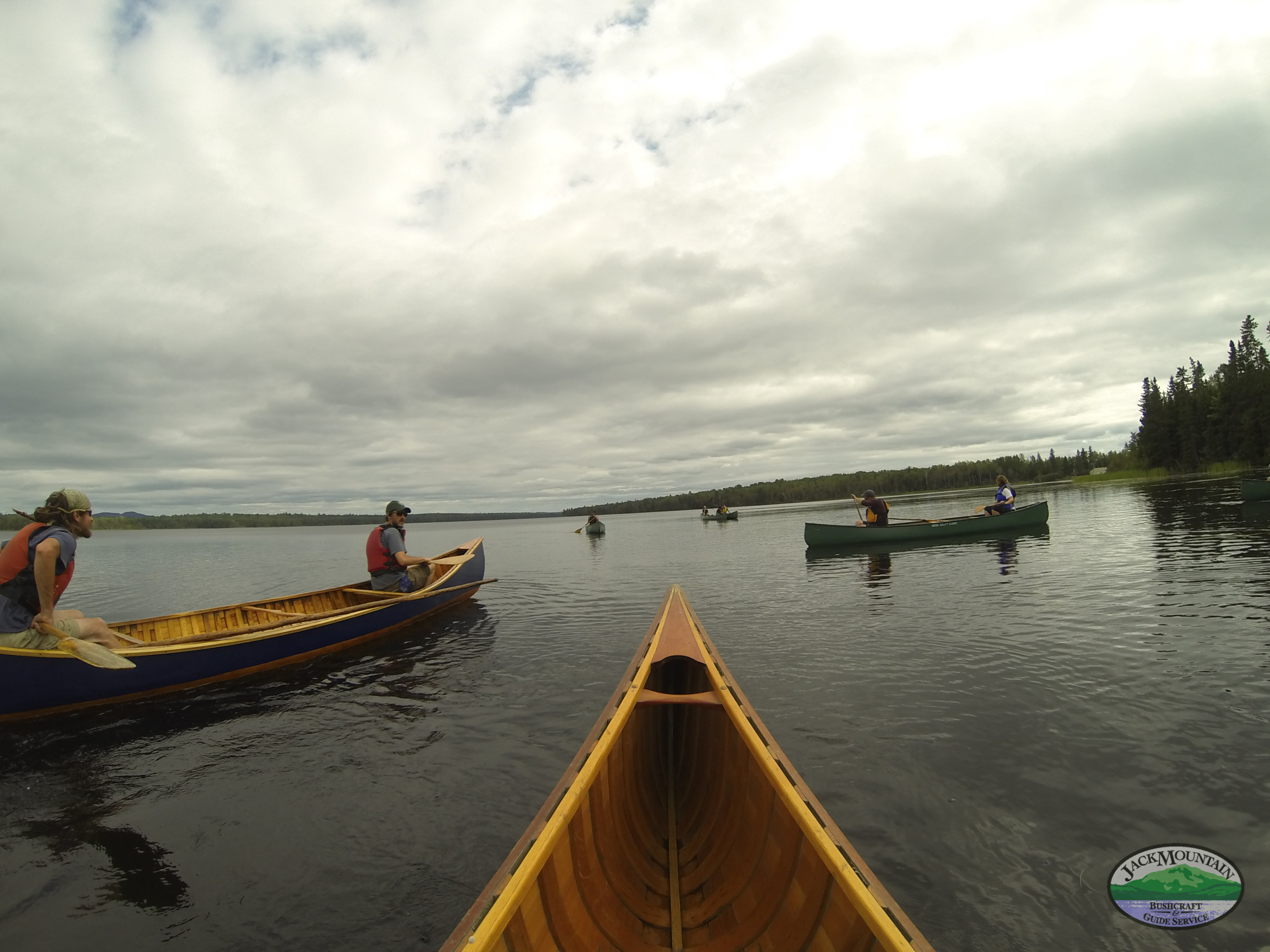
We are (slightly) changing the Wilderness Canoe Expedition Semester for 2024. First, we’re adding a new subtitle to reflect what the course is, the Maine Guide Traditional Canoe Expedition Leadership 4-Week Training Course. I considered changing the course name, but we’ve been running this program for a lot of years, and changing the title would entail not only changing it for us, but also changing it with the Veteran’s Administration, our academic partner universities, etc., so we’ll just change the subtitle. I chose the words carefully, because they have specific meanings. Let’s discuss exactly what those meanings are.
Maine Guide Traditional Canoe Expedition Leadership 4-Week Training Course
Maine Guide. I’ve been a Registred Master Maine Guide for 25 years. I consider Maine Guides to be the best in the outdoor industry. This course is designed to train others to become competent, industry-leading Maine Guides. If you are new to this, a Registered Maine Guide is a state license that allows a person to be compensated for leading others in Maine. You have to pass a test to become one. We teach you what you need to pass the test. More here
Traditional Canoe. The modern world of canoeing has become homogenous around paddling downstream or on flat water. But there is much more to the traditional uses of this amazing craft of the wilderness. Much has been forgotten. I see our job as maintaining and passing along those forgotten skills. We focus our instruction on four disciplines of traditional canoeing. These are paddling, poling, lining and carrying (known outside of Maine as portaging). I have done a lot of solo trips on remote rivers. Knowing all four of these disciplines is what has allowed me to do so safely. Paddling you have probably heard of. Poling is lost art of using a long stick to push off on the bottom of the river in order to control the boat. It provides total control in flat or moving water situations, is a challenge to learn and was developed on the rivers of Maine and Quebec into an art form. Lining is tying a rope or ropes to a canoe and pulling it up. or lowering it down, a rapid. It sounds simple, but there is much nuance here and the devil is in the details. Carrying is learning the skills around using tumplines to carry burdens, being organized, and mechanics of moving heavy things. When these four things are combined, it opens the world of remote rivers up to the traveler in a way not accessible to a person who just knows how to paddle.
Expedition Leadership. Outdoor leader and instructor are terms that get thrown around a lot these days, and are often interpreted to mean advanced practitioner. I disagree. The expedition leader need not be the most skilled paddler or poler. But they need to have a solid set of soft skills, planning skills, and experience with understanding what can go wrong and how to manage a group if it does. I consider these skills to be separate from the mechanics of moving your boat. We spend a lot of time discussing this on the course and make use of teachable moments whenever they arise.
4-Week Training Course. How long does it take to learn the basics of a way of life? How much longer does it take to approach mastery? I say frequently that it is all about the reps, or repetitions. So how long does it take to become a qualified wilderness canoe guide? After 25 years and 60 long-term program, I think I have some insight here. The reason we run this as a separate course from our 9-week semester course is so we can focus on different outcome. Our Intended Learning Outcome (ILO) for this course is for participants to be able to plan, pack, and carry out remote wilderness canoe trips. This includes all of the necessary bushcraft skills needed for living a nomadic life on the wild rivers of the north. It includes the technical skills of paddling, poling, lining and carrying. It includes rescue skills in order to manage a backcountry mishap on the water. And it includes the incremental daily improvements needed to build confidence and convince yourself that yes, you can do this. Lastly, it includes a testing process at the end of the course to hold students accountable to the standards we set forth. Those who successfully complete the course earn our respect, and our Engagé certification.
In addition to the new subtitle, there will be change to how we run the course. Back in the day it consisted of two long trips. While we covered a lot of miles and had a great time doing so, with the focus on miles we didn’t cover as much skill development as I would have liked. So we’re changing things a bit for 2024. Specifically, we’re changing week 4.
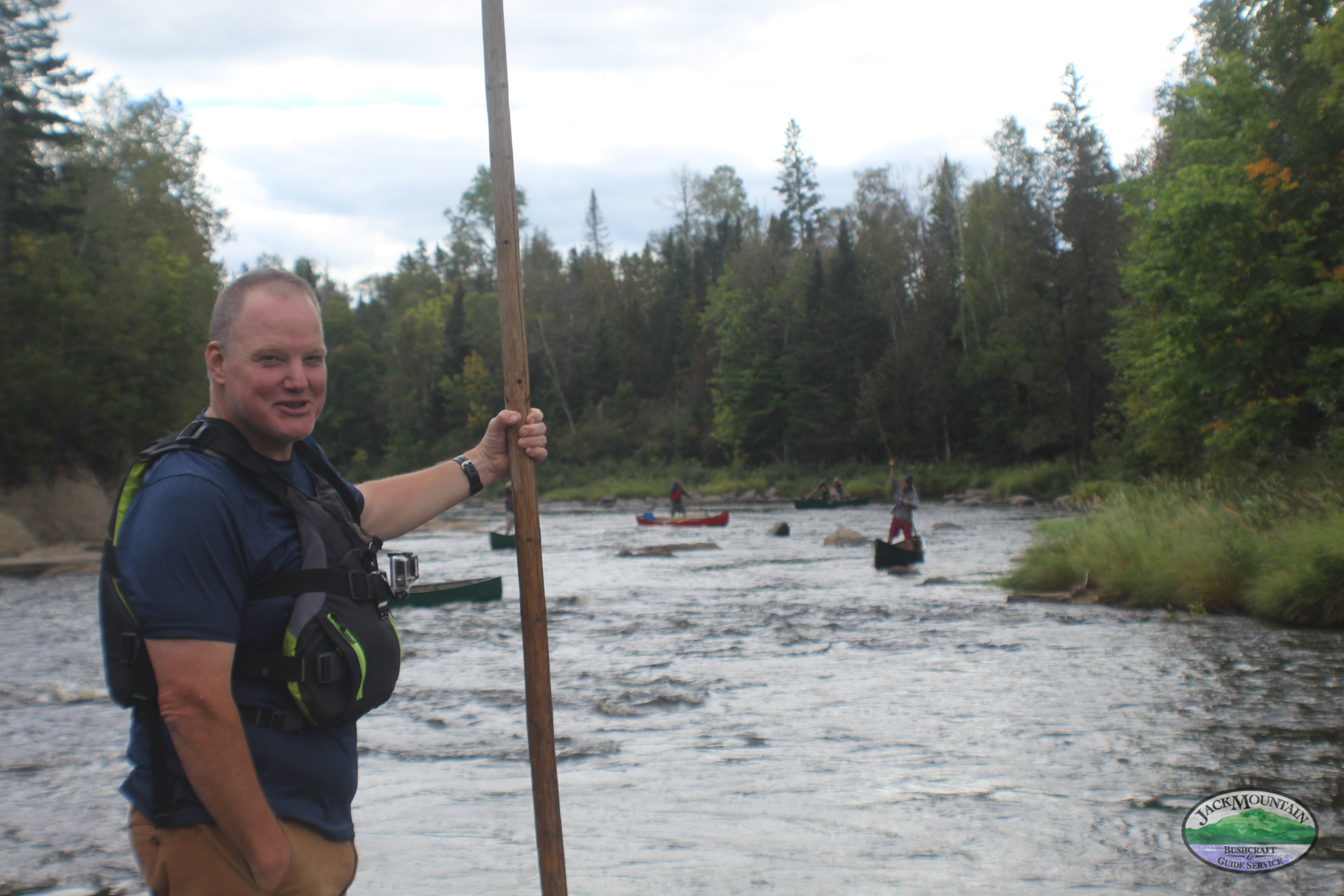
2024 Course Breakdown.
Week 1: Immersion. We’ll be working on poling and paddling daily at the field school. We’ve developed a nice progression of increasingly challenging local water to get people up to speed the fastest way we know how. We’ll also be covering the bushcraft essentials needed to live life out on the river. Lastly, we’ll be learning all about packing and provisioning for an expedition, making menus, learning about campfire cooking and more. To sum up week one, skill building and getting ready would suffice.
Weeks 2-3: Expedition. This is when we take to the waterways and cover some ground. Making miles every day, working on skills, practicing paddle strokes, poling maneuvers, canoe rescue, cooking over a fire, etc. The days are long and full with the timeless rhythms of life on remote waterways.
Week 4: Advanced skills and testing. In years past we took a second expedition on week 4. This emphasis on making miles precluded us from covering advanced skills in enough detail to make them stick, and didn’t allow us time for testing on those skills. This year our emphasis will be on practicing those advanced skills until they are second nature, as well as testing students on them.
The course runs from May 5-June 1. We’ll start with the high waters of early spring, and be off the water just as the bugs get bad (and the fishing gets good). More info on the course is here.
So maybe you’re interested in training to become an outdoor industry leader. Maybe you want to spend four weeks off the grid and learn a new sport. Maybe you’re planning a remote expedition in the future and want to get your skills up to the standard where you could do it safely. There are many reasons people have made their way to Jack Mountain over the past 25 years. If you’re interested, get in touch as only a few spots remain for 2024.
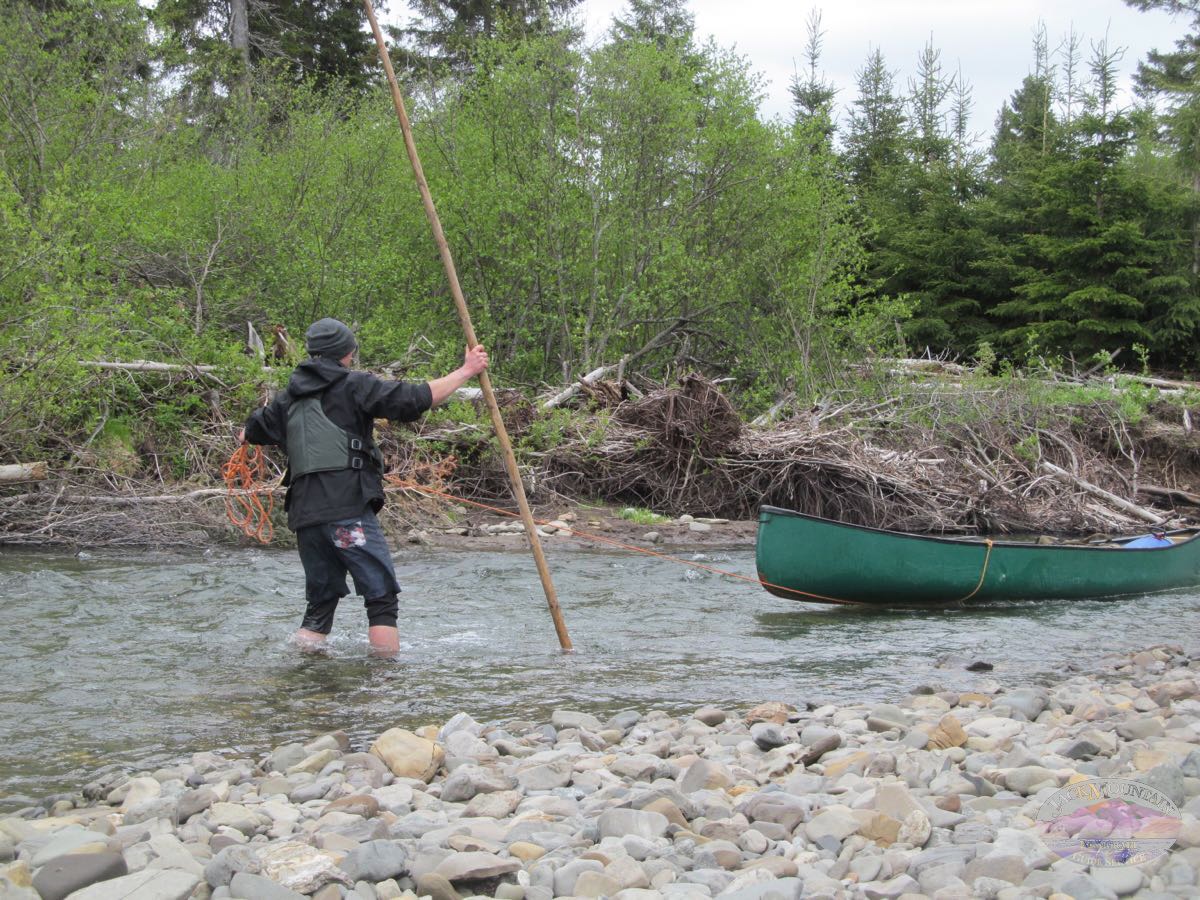 ]]>

It’s been ten years since Brian Kevin’s article The Survivors, about military veterans attending the Wilderness Bushcraft Semester, was published in DownEast Magazine. Of all the media coverage we’ve had over the years, this article is my favorite. The author came and camped with us, got to know the people he was writing about, and captured the essence of the transformation many of them were going through. It is something we continue to see on our long programs; people transitioning to a life after the military and trying to find their footing in the civilian world. Thankfully we’re not at war as much as back in those days, although there are still many challenges these young people face.
I can happily say I’ve stayed in touch with many of those mentioned in the article. Two of the guys will be joining me on the Rio Grande canoe expedition in March, and I speak to a few others regularly.
If you’re looking to find out more information on our programs, or just want to read an interesting story, here’s the link:
https://downeast.com/arts-leisure/survivors/

Recently someone asked me if I had ever paddled the Big Black river. It is a major tributary to the St. John, flowing in across the border from Quebec. It joins the St. John just below the appropriately-named Big Black Rapids. I told them not only had I been down it, but it was written up in a Boston Globe travel article in 2005. June 12, 2005, to be exact, and it was the lead story in the travel section, with lots of photos. And, it was so well received that it went on to be published in a book called “The Best Travel Writing 2006.” I went looking around the web to see if the article was still online anywhere and I ended up finding it on a Boston Globe archives page. So if you’re interested in reading about a trip down the Big Black in early May of 2005, here’s the link:
https://archive.boston.com/travel/explorene/maine/articles/2005/06/12/canoeing_big_black_inspires_thoughts_on_the_nature_of_things/
It was a great trip with great people and we had some deep discussions about the nature of things.
If you’re interested in going, here’s a great write-up on the trip from Allagash Guide Service, as well as a link to their home page.
]]>
I learned a new term yesterday for something we have been doing for five years. The term is Daylight Drive, and it is used to describe an off-grid solar power system that doesn’t include batteries. When you are charging off of our solar panels at the field school, we recommend that you bring your own battery. When the sun is shining, you charge your battery. Then at night or when the weather is bad, you use your battery to charge your devices.
There’s an old farm saying that goes “Make hay while the sun shines.” The idea behind a daylight drive system is to store energy and do your heavy lifting while the sun shines. Why? Because batteries are usually an expensive weak link in an off-grid solar system. I came to use this system because I got tired of maintaining lead-acid batteries for other people who wouldn’t take care to not discharge them too much so as to prolong their life. This article from No Tech Magazine describes the system used at the Living Energy Farm in Virginia. They call it the Living Energy Farm DC Microgrid Energy System, and it is setup where they do all the heavy lifting using power directly from the solar array. They also maintain a much smaller battery bank that can keep lights on at night, but is not scaled to run machinery.
Our system where students maintain their own battery by charging it while the sun shines might not be technically a Daylight Drive system because there is a battery involved, but it operates with the same idea of make power while the sun shines.
If you are interested in different approaches to solving problems with solar power, it is worth a read. Here’s a pdf that Living Energy Farm puts out that describes their system titled DC Microgrids: Home Power With A Dramatically Reduced Financial and Environmental Pricetag.
This thread at Permies.com discusses the idea in some detail.
]]>
We’re currently in the planning stages of a canoe trip through the Lower Canyons of the Rio Grande river along the Texas/Mexico border. A few friends did this several years ago, and I’m really excited about it. We’ve got dates on the calendar for mid-March, and we’re currently looking at shuttles, prepping gear, etc. I have never canoed a desert river and am looking forward to seeing some new country and learning some new skills. There are some distinct differences from the systems and gear perspectives compared to our usual paddling destinations of Maine and Canada. The two that come to mind first are toilet systems and fire systems. As I go through the process of preparing for the trip, I’m sure I will discover more.
This will be a private trip, and participants are all alumni of our program. Part of the fun of any new expedition is in the lead-up to it. Studying maps, going through gear and systems, planning a menu, etc., all add to the anticipation. If I like it as much as I’m anticipating, it may be on the calendar as an open enrollment trip in 2025.
The photo at the top is of two friends who did this trip a few years ago. For more information on the trip and some amazing photos, check out this national park service web page.
]]>
You can follow us on the Fediverse at: @blog.jackmtn.com@blog.jackmtn.com
I’m not usually one to prognosticate about the future of the web, but I am often thinking about how to make our stuff available to our audience, and to give good advice to our students and those just starting out running a business. For years I have been a proponent of the Indie Web and POSSE (publish on your own site, syndicate elsewhere), choosing to publish on our blog, then send it out on the web from there. I have never liked the walled garden of social media, which likely stems from the fact that I remember the web before the rise of social media. It was far from perfect, but it was open. We are all products of a certain era, and my ways were set in a time before social media when people published onto the open web.
With the rise of the Fediverse, those days are returning. Whether they flower and bloom remains to be seen, but I am embracing it nonetheless. This blog, and all of our media, is now on the Fediverse. Thanks to the Activitypub WordPress plugin, our stuff can be read and interacted with on the fediverse on such services as Mastodon. I don’t want to get technical as to how it works (if you want that, you can read more here), but just to explain that it does work, and once it is setup there is no extra work on your part. And while Mastodon is likely the one you may have heard of, there are many other parts of the fediverse that replicate almost all of the commercial social media sites. So while it is cool that there are non-commercial ways (ie. no ads, no algorithms, no tracking) to explore the social web, I think the coolest thing about it is that they communicate with each other. In years past when I posted something I would write it up as a blog post, then create separate social media posts that would link back to it. Granted there are tools now that make this much easier, but it is still fundamentally the same thing. Because big social media created a bunch of walled gardens, there was no way for people who saw a post on one social network to see what I had posted somewhere else. Now they can.
The other issue I have with the big players of social media is their algorithms and pay to play attitude. Whenever I post something to big social media, almost none of our followers see it. Unless, that is, I pay to “boost” the post. No thanks.
If you publish to the web via WordPress, I recommend giving the Activitypub plugin a look. It doesn’t cost anything and has to potential to dramatically increase your reach. And if it doesn’t work out as many are thinking it may, it will almost surely be the stepping stone onto the next big thing. And it gives you a central place to interact with the social web. So instead of monitoring comments on a variety of different sites, they are all centralized. On your own real estate. Making digital sharecropping a thing of the past.
Note: if you do put your stuff on the fediverse, leave a comment and let me know where so I can check it out. You can leave a comment on the blog itself, or directly on the fediverse, and all the comments will be aggregated in both places. Did I mention that the Activitypub plugin has made this possible? Well it has. Pretty cool, right?
]]>
I just read The Compost Toilet Handbook by Joseph Jenkins. If you are coming to the field school you shoulld read it because this is the dry toilet system we’ve been using since 1996. I still recommend that teacher read the humanure handbook as well, but this book separates out the how-to information from the background research, and as such is likely more useful in answering questions about how to operate the system.
On his site, Jenkins has published a short pdf titled Compost Toilet System Condensed Instruction Manual. If you don’t have time to add another book to your to-read list, you should familiarize yourself with this document. Here’s a link: https://humanurehandbook.com/downloads/humanure_instruction_manual.pdf
The system outlined is what allows us to live off the grid with no infrastructure while building soil, recycling organic material and not polluting the groundwater. It is information that every human should be familiar with, and is part of the #FullTangLifestyle
]]>
The JMBS pot system is designed to be functional and economical. The biggest item lacking is a properly-sized bowl for eating out of that nests with the rest of the kit, because the 6-inch pie tins, while they work great as pot lids, are not sized well for use as an eating bowl for an adult, nor are they easy to hold with a pot-grabber (a necessity when the food inside is hot). This problem has now been solved with a 4-cup stainless bowl that nests with the system.
The Midwest Home For Pets 4 Cup bowl is designed to mount to a pet cage. If you buy it new, it comes with a bracket so it can be mounted in such a manner. I stumbled across this item by accident, having picked one up at a thrift store without the mounting bracket a few years ago. Upon bringing it home, I realized that it nested perfectly into the 2-quart pail that is the basis of the system. Since then it has ridden in my wannigan and been my go-to eating bowl. On a fall, 2023 trip someone commented that they wished they could find a bowl of the same size for their kit. So I started doing a bit of research. There were still a few markings on the bowl, and an internet search found the company. I ordered one to make sure that they hadn’t changed the size of the product. It recently arrived, and I learned that it is still the same size, and still nests. The downside is that it costs $10, but the upside is that it will likely last forever, is a convenient size for eating, and is easily held when hot with the standard pot grabber.
A few other ways it can be used are to store leftovers (when used with the pie pan to keep out bugs and critters) as a chafing dish to keep food hot (when used with a pail that has hot water in the bottom), as a mixing bowl, as a bowl for scrambling eggs, etc.
So if you’re looking to upgrade your cook kit, here is a simple addition that will give you a convenient bowl for eating. If the price tag seems excessive for what you get, you’ve got a point and you can always pick up random stainless bowls at a thrift store until you find one that eventually fits your system. The reason for this post is to save you time and point to a product that fits the system and works.
You can get one via Amazon, Tractor Supply, pet stores, and the usual suspects of online retailers. If you click through the link below, they help you search for local retailers by zip code and have links to many online retailers. Be sure to click on the “1 Quart” option as they offer four different sizes.
Is it a necessity? No. Is it a highly-desirable convenience? Definitely. I’ll post a video soon of how it nests, etc.
Update 3/15/24: I bought a second bowl for an upcoming trip and the two nest perfectly in the 2-quart pail.
 ]]>

When I first met Mors Kochanski in 1996 he showed those of us on the course his collection of books. He had a lot of them. At the time he had been teaching a course for the University of Alberta for 25 years or so, had written extensively, and was a lifelong student of everything outdoors. Before the end of the course, I asked him what the reading list would be if he were to put together a PhD program in bushcraft and outdoor living. He said he’d think about it and send me something. A few months went by and I received a letter from him. It contained a list of 100 books, organized by category, with about 25 having been highlighted as the most important. I made it my business to track down those books and read them. It took me about ten years, but I made it through that list. These were the bygone days before the internet, at least for me, so finding the books on the list was quite an ordeal. I remember when I learned you could search for books online a few years later, and was finally able to get a copy of Stefansson’s Arctic Manual. It made finding things much easier because I was no longer limited to the tiny selection in the small town used bookstores. Good memories. That list became the basis of the Jack Mountain Bushcraft bibliography.Here’s a link. Please note that I haven’t edited that document since 2011 or so, meaning there are lots of new additions..
At the field school we now have the Athenaeum which contains physical copies of all those books.Some of the books in the collection are quite rare. And some that used to be common around used book stores are now becoming quite rare. And there are a handfull of which I’ve never seen another copy. With these older, hard to find books, I’m working on scanning them into what I call the Jack Mountain Digital Archives. This is where I keep copies of old and hard to find books and videos so that I can share them within our community. And this past year a few people on a semester course turned me on to some new tools that are great at getting this job done (Genius Scan app). My goal in preserving these is to create a resource for future students, and to pass it along. So if I ever meet anyone who wants to read Cree Trappers Speak, they won’t have to search for ten year before finding a copy like I did. Or sneak into the Dartmouth College library to photocopy Traps And Snares Of The Labrador Peninsula from 1896. Yes, I did that too.
On these short, cold, snowy December days, I have been waiting for a few unrelated things to take place, and using some of the downtime to scan old books. I share some of it on our online community at BushcraftSchool.com.
]]>
The woods are white now, covered in snow. Watching the changing moods, the changing light of the natural world has been one of my lifelong passions. I work to become a better photographer in order to share what I see, but the images my eyes see are often not well-represented with what my camera sees. This image came from a mid-October trip on the St. Croix river, which is the border between Maine and New Brunswick. We spent a week on the river during peak foliage, and it was a feast for the eyes. But when you’re there doing it and living it, the tasks of the day will sometimes make you no longer see the beauty around you as to-do lists fill your brain with what you have to do, then what you have to do next.
I love sharing photos. And seeing photos shared. I think they are a window into other people’s worlds. Or, in this case, a window into a different time in my own world.
#FullTangLifestyle

It has snowed off and on for the last five days, and as I’m writing this it is -6 degrees F and there is 8 inches of fresh snow on the ground. Winter has definitely arrived, and I’m getting excited for winter programs in February. This photo was taken a while back, showing a line of people hauling toboggans across a frozen lake on the Boreal Snowshoe Expedition. in 2024, we’re offering the BSE and the Winter Woodsman. Currently they are both about half full. With our winter programs we have a hard limit on how many people we can take based on how many people we can get into our hot tents. So if you’re interested in exploring winter with us in the new year, keep this in mind.
]]>
Learning how to wash your clothing by hand with limited or no infrastructure, such as when on a long expedition or living off the grid for a length of time, is a useful skill to learn. It is one we are adding to our long-term programs because as the years go by, fewer and fewer people have done it, or even know how.
The easiest way I know of to do this is what we did with lightly-soiled clothing when I was a kid; dunk it in water, swish it around, then hang it on a line in the sun to dry. To this day on long canoe trips, washing clothes is often as simple as wearing them and sitting in the river for 5 minutes, then hanging them up to dry. Sometimes when the weather is warm I just keep them on, allowing them to air dry on my body.
But when clothes start to develop obvious stains, or start to smell, then some sort of soap is needed. More on types of soap in a bit.
A simple way to accomplish washing clothes is with a cook pot, clean 5-gallon bucket, or similar container. Add the clothing, some water, and laundry soap to the container. Then, in the water, wring and agitate the clothing, focusing on rubbing the dirty or smelly parts. Let it soak for a bit in the soapy water when you’re done, then do it again. Repeat if needed. Then remove the clothing and wring out as much soapy water as you can. Put the wrung-out clothes into a second clean bucket or container. I specify that the buckets are clean because we use 5-gallon buckets in our composting toilet system, and you don’t want to mix up your clean containers with these.
In the second clean container that holds the washed clothes, add water until 2/3 full. Then agitate them, wringing and rubbing, until they no longer emit soap into the water. This will likely take a few rounds of rinsing.
From here, wring them out and hang them on a clothesline. You’re done.
There are all sorts of ways you can dress up this process, from hand-held agitators to wash boards to mechanical wringers to computerized washing machines. But the basics endure. It is not a complicated process, although the modern world wants you to believe it is.
When living a bit rough, I like to wash the layers that are against my skin regularly. The outer insulation layers, if I keep them clean of sweat, grease and stains, not as often. So things like socks, underwear, long underwear, t-shirts, etc., get regular washing. It makes them more sanitary (ie. less gross) but also, with regard to living in the cold, allows them to insulate much better. It does this because clothing against your skin often contain dead skin cells, oils and salt from sweat, and other things that fill in the air spaces built into the fabric. The air spaces are what allow it to insulate you from the cold. So when they get full of gunk, it no longer insulates, or breathes. Have you ever worn a pair of wool socks for several days in cold weather? Ever notice how they are less warm with each passing day? This is why. So there are many good reasons to keep your stuff clean, while the only reason for not doing so is laziness.
With regards to soap, any soap that you use on your body or dishes will work. Some seem to work better than others, so pay attention and keep some notes on what has worked best for you.
Years ago we used to make our own soap for use when bathing. It worked well, but we got away from it although I don’t remember why. Another thing we made, which I learned in NH at a workshop with GALA (Global Awareness, Local Action), was our own laundry soap, useful for both laundry by hand and with modern laundry machines. It is all I have used for the past 8 years. It is concentrated, non-toxic, inexpensive, and works amazingly well. And you only use a tiny amount, so one container lasts a really long time. Scroll to the end of this post for how to make it.
Here’s a link to an argument to use soap over detergent for laundry because it is better for your clothes. Laundry Soap Vs. Detergent
Here’s a link to a bunch of useful videos and articles on doing your laundry by hand:
Permies.com
Keep your clothing clean. It will keep you warmer in winter (especially socks and long underwear) and cooler in summer (clean cotton breathes better). If you spend more than a few days living rough, it is something that you not only should know how to do, but also should have done multiple times so there are no mysteries left about the process.
Laundry Detergent – Makes 64oz., 128 Loads Of Laundry
- 1 (5.5oz) bar of “Fels Naptha”
- 1 cup “20 Mule Team Borax”
- 4 cups boiling water
- 1 cup “Arm & Hammer Washing Soda”
- 4 cups warm water
Step 1: Put 4 cups of water in a heavy saucepan to boil. While that is heating, mix the borax and washing soda in a bowl, mixing well.
Step 2: Grate the Fels Naptha.
Step 3: Add the freshly-grated Fels Naptha to the water in the saucepan, stirring constantly. Reduce the heat to medium. It will take 10-15 minutes for the soap to dissolve completely. Don’t let it boil over – gross.
Step 4: Remove the pan from the heat and add in the borax and washing soda. Stir until completely dissolved (3-5 minutes). Do not “under stir” or solution will be gritty. Pour liquid into a 2 quart container. Fill container the rest of the way with warm water. Mix.
Step 5: Store for 24 hours in a cool, dry place. Then mix.
Step 6: Add 1 tablespoon of mix to a load of laundry in any laundry machine. Add it directly with the dirty clothes, not in a “detergent compartment”.
Pro Tip: Add essential oils if you want your laundry to smell a certain way.
]]>
Maybe the rest of the world is catching on. Here’s a link to an article about the use of human urine as fertilizer to contribute to food security: phys.org.
From the article, :”Urine contains nitrogen and phosphorus, two essential nutrients for plant growth. Urine can thus serve as an almost cost-free and locally available nutrient resource for agriculture… New innovations often require change in behavior, habits, and/or incur transaction costs.”
I’m not sure what the transaction costs are, but I completely understand the need for a change in behavior and habits. If this is a new concept for you, read the Humanure Handbook. It’s simple, inexpensive, scalable, and when well-managed, it just works. I’m on year 28 of implementing it. It does take some work, but pouring diluted urine on plants you want to thrive takes no management, just a willingness to change habits and implement a better system.
]]>
Many of our alunmi have become Registered Maine Guides. A guide license is necessary in Maine to receive any form of payment for your services in the field. It is a state license which is granted at the end of a testing process. In recent years students on long courses have tried to get all the requirements needed to go and take the test during the course. I want to encourage anyone interested to take the test, but also to look into the requirements before you arrive at the field school.
Here’s a link to the official requirements: https://www.maine.gov/ifw/programs-resources/registered-maine-guides/becoming-guide.html
In a nutshell, you will need:
– A current first aid and cpr certification
– fingerprints/background check
The fingerprints take time. You cannot send in your application for the test until a month AFTER you have been fingerprinted. Then the wait begins to be scheduled to take the test. In closing, if getting a guide license is something you want to do, start this process early. Ideally you’d have taken care of the requirements and sent in your application before you arrive at the field school. Then it is our job to train you to pass the test.
]]>
The USDA recently updated it’s hardiness zone map with data from the last few years, and northern Maine is getting warmer. On the older maps, Masardis was zone 3B. On the updated map, we’re zone 4A. It’s an indicator of changing times. It also opens us up to a wider variety of perennials we can successfully grow.
Here’s the link: https://planthardiness.ars.usda.gov/
]]>
It has been cold and snowy in Aroostook County this week for the Autumn Woodsman course. We’re past the halfway mark on the course, and thus far we have covered a lot of ground, including axemanship, fire making and management, fire by friction, navigation, hot tents and stoves, woodstove lighting and management, and a bunch of other topics. We’ve also been out on the land harvesting the few remaining wild plant foods and tracking the mammals (beavers, mostly) that can provide sustenance during the colder months. In northern Maine fashion, we’ve had nights well below freezing, a day of rain, a night of snow, a day of snow flurries, and we’re supposed to get a half-day and night of snow today. But Friday is looking to be sunny and almost 40 degrees, without a gusty wind. That is why we run this course at this time of year; because cold weather and snow make almost everything harder in the woods. Not everything, but most things.
This is our final scheduled field school program of 2023, and I’m looking forward to finishing strong.
#FullTangLifestyle

A small shelter next to a long fire, spending the night with no sleeping bag in the cold. The details all matter: The size of the fire, the quality of the fuel, the width of the bed, the distance from the edge of the fire to the back of the shelter, the overhead volume of the shelter, the height of the bed above the ground, the thickness and quality of the mattress, the distance to the fuel pile, the direction of the wind, how closely the fire is aligned to the wind, the opacity of the cover material, ways of minimizing inhaling combustion gasses, and many other factors. These are learned and developed through experience. When an individual has that experience and knows the impact of these variables, we call that skill.
#FullTangLifestyle
One of the shelters students spend the night in on the Wilderness Bushcraft Semester is one with no insulation, just a fire to keep warm. This image is from that night a few weeks ago. It is a great learning experience with regard to the use of fire to keep warm, the science involved with the inverse square law, and understanding how much wood one needs to make it through the night. As with many things that we do, the only way to really know is to do it. This epic photo was taken by one of the guys on the course.
]]>
I’m currently in Austin, Texas for a week visiting family. My son is a freshman in the film program at the University of Texas at Austin. Today a film of his is being shown at the Austin Film Festival as part of their Young Filmmakers Competition. So I’m spending the day as a proud father and enjoying big city life. Here’s a link to the film on Youtube: Monkey Man.
]]>
I was interviewed on CNN last night, on the show Laura Coates Live. They wanted a Registered Master Maine Guide and survival instructor perspective on the fugitive from the Lewiston shootings, potentially hiding out in the woods. It was an interesting experience. Here’s how things like this work, or at least how it worked for me.
I got a call from a New York phone number I didn’t recognize at about 10am. It was a guy who worked on the show, and wanted to know if I was interested in being interviewed about the developing situation in Maine. I said sure. He told me it would happen at 11pm est.
I did a bit of research on the suspect and spent the day as I normally would. I did take some time to make sure I had a clean shirt, and had my son make sure the lighting and audio was good.
As the time approached, I went into a bedroom alone with my laptop. I clicked the link they sent, and just like that, I was on the air with CNN. The host, Laura Coates, asked me a few questions, and I answered them. The whole thing took about 5 minutes.
With media appearances such as this, I am glad to be able to contribute, and hopeful I represented Registered Maine Guides and the town of Masardis well.
]]>
The parking lot is empty. The people are on their way to Austria, England, Thailand, California, Colorado, Illinois, etc., A day to clean up camp a bit before I hit the road for Texas to see my family. We had a great finish to the fall, 2023 Wilderness Bushcraft Semester with three new Journeyman certificate holders, some working right up until the deadline to get everything done.
I’ll be back in a week for our final scheduled field school program of 2023, the Autumn Woodsman course. After that, it’s a few months to decompress, reflect, and plan for the future before winter programs begin.
This was our 60th long-term program, and we’re wrapping up our 24th year of continuous operation as a full-time outfit.
It has been a long season, as we hit the ground running at the end of April and have been pushing hard since then. As a result I’m tired, but the good kind that comes from accomplishment.
The off season isn’t really “off”, it’s just fewer programs and more planning, office work and marketing. It’s less grueling, but also less rewarding. I’m looking forward to it at this point, but after some downtime I’ll start to get excited about getting after it again. Then the maps come out and the scheming begins. But for now, it’s a scramble to catch up on all those things and relationships that have been pushed to the backburner while I’ve been busy taking care of business. Thanks for reading. #FullTangLifestyle
]]>
It is Friday of week 8 (of 9) on the fall, 2023 Wilderness Bushcraft Semester. Everyone has been hard at work and the finish line is coming into view. What remains to finish are some practical exams, the solo, and a night spent in front of a fire with no sleeping bag or blanket.
The night in front of a fire is an advanced exercise that demonstrates mastery of fire and an understanding of the physics of using a fire with a small shelter to create a microclimate to stay warm in the cold. It is a great exercise for this time of year when the temperatures are near the freezing mark. This means no bugs, but no snow either, so a good introduction to the skill set.
There are certain lessons where the only way to learn them is to go and do it. This is one such lesson. Going into the experience people have lots of questions about how much wood they need, how often they will have to adjust the fire, what types of wood to use, etc. For the past eight weeks they have been living and cooking with fire, building shelters, etc., so they have acquired a lot of knowledge about such things.
But the questions persist. I know that they won’t learn from my answers, they will learn by doing it. So I have responded to their questions by referring them back to things they have already done and experiences they have already had, and to quote my old friend David Bosum. On a summer canoe trip in northern Quebec in 2007, one of the students was asking him lots of questions about how he did things in the winter. He politely answered the first two questions, then stopped and said, “The action will answer all of your questions.”
With some things, especially when the goal is deep knowledge, the only way to learn and know is to go and do it. That is what we are preparing for today, and will be experiencing tonight. Because they haven’t yet completed the exercise, asking me about it helps to massage the anxiety of the unknown. But as long as it remains unknown, that anxiety will persist. The way to eliminate it for good is to have the experience. Tben they won’t need to ask questions because they will know.
]]>
We’re at peak foliage in northern Maine right now. The nights are cooling off and it feels like fall. I have been seeing a lot of animals as they get ready for the cold season. Yesterday morning I jumped a deer while riding my bike, and in the evening I saw a lynx crossing the road on the way to town.
This photo is from one year ago, shot from the old fire tower on Deboullie mountain just north of us. It is a beautiful piece of conservation land in the middle of the North Maine Woods.
]]>
I picked up a new piece of software called Retrobatch that batch processes photos and went through all the old hard drives full of photos to make an archive. My rough count is around 37,000 images that I’ve shot over the years. Not all of them are mine; maybe 1000 were taken by others, but somehow made it into the collection. So I will be upping my photo posting game.
I don’t always remember the time or place of the photos, but this one was taken in the spring of 2023, on a chilly day on a local lake.
]]>
Last week we were out on the St. Croix river, which forms the border between the USA and Canada. We had a great week of high water, peak foliage, and warm water. It isn’t often that you get to swim every day of an October canoe trip, but we did. As we begin week 8, there are lots of practical exams to do, lots of academic work to complete and lots of crafts to finish before we head out on solos week 9.
In the photo I am paddling right at the top of Little Falls. The water was higher than I have ever seen it. Usually I pole this rapid on river left, but the water was high enough to run the ledges with a paddle on river right.
]]>
Congratulations to the newest Registered Maine Guide, our own Tessa Storey. Wear that patch with pride because it was earned. We are all proud of you. #fulltanglifestyle
]]>
Today is halfway day for the fall, 2023 semester. To celebrate it we are heading out on the Aroostook river for a few days in canoes. We have had the wettest September I remember, and the rivers in northern Maine are near or at spring flood levels. This means that traveling downstream will be easy, and fast. Many of our big projects for the semester are behind us, including the canoe paddles all the students made with hand tools. We’ve been out on the water and used them, but this will be their first multi-day trip with them. Using the crafts that we make is a key design feature of our immersion programs. How else do you learn how well it works other than by using it?
To go along with the rainy and wet summer, the bugs have been a bit brazen this year. Now the night temperatures are slipping into the 40’s (F) and they are gloriously bug-free, something we have been looking forward to for a while.
The picture above was taken the other day at sunset, behind our headquarters and looking west over the North Maine Woods. Friendships are built fast on immersion programs, and this group of individuals who were strangers a few weeks ago has formed into a team and are ready to face the many challenges of living in the forest. And they are ready to face those challenges together.
]]>
Dutch ovens have been difficult to find since the pandemic took over American life. Because we design our gear list to provide you with useful items, not just things that will get put in an “outdoor gear” box and collect dust, we’re changing our recommendation for a dutch oven for students. In short, we’re removing the legs to make it more versatile so you can use it at home or in the field.

I’m still a big believer that an 8″ (2-quart) dutch oven is one of the most versatile pots around the campfire or in the home kitchen, especially if you’re cooking for 1 or 2 people. That hasn’t changed. The beginning of this spring’s Wilderness Guide Training Semester was cold, and we ended up cooking on a woodstove for much of the first few weeks. A dutch without legs worked great, while a dutch with legs did not.

A small dutch oven is a great hanging frypan, and when it has a flanged lid makes a functional oven for baking bread or roasting meat. So the new recommendation is for a legless, 8-inch, 2-quart cast iron dutch oven with a flanged lid. To get around the oven not having legs, we also recommend getting a dutch oven lid stand that just fits an 8″ oven. Specifically, this 7 7/8″ folding dutch oven lid stand by ForHauz.
You can rake out a bunch of coals from the fire, put the lid holder down, put the oven on the lid holder, then pile coals onto the flanged lid. So it works just like a dutch oven with legs, but you can also use it in the kitchen at home. on a regular burner or in the oven. The lid holder also keeps your lid free of dirt or debris, keeping it out of your food, and can be used to lift a lid or an oven.

The dutch oven I have is from Bayou Classic, but as long as the lid fits and it has a flanged lid, it will work. The Bayou Classic oven came with one of those goofy metal spirals on the bail handle. I call it goofy because it makes it a lot harder to hang the oven over a campfire. So, I cut it off with a pair of pliers, then filed down the ends with the file I keep my axe sharp with.
Looking around at the usual suspects of online commerce, it seems that this is mostly not in stock anywhere. Hopefully there will be some cast iron cookware available before the fall semester begins. Again, it isn’t about the brand. It’s about flanged lid, bail handle and tight-fitting lid.
And if you’re looking for inspiration or recipes to make in your 2-quart dutch oven, pick up a copy of Glorious One-Pot Meals by Elizabeth Yarnell. Highly recommended.
2023 Update: Since writing this post, the price of the Bayou Classic dutch oven has increased significantly. I have since purchased a 2 quart Stansport dutch oven (for $23) and like it as well.
]]>