The post UK Home Office Draws Extensively on 6Rang Research in Guidance on LGBT+ Asylum Claims from Iran appeared first on 6rang.
]]>The UK Home Office’s Country Policy and Information Note on Sexual Orientation and Gender Identity or Expression in Iran, Version 5.0, dated December 2025 and published on the UK government website in January 2026, draws repeatedly on research and documentation produced by 6Rang to examine the legal, political and social conditions facing LGBT+ Iranians.
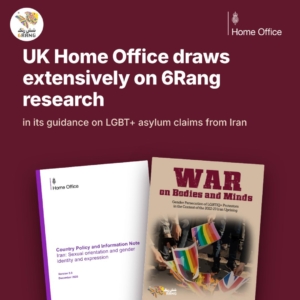
With approximately 80 mentions of 6Rang across the main text and footnotes, the guidance makes extensive use of the organisation’s investigations into criminalisation, coercive medical practices, official hate speech, violence and discrimination against LGBT+ people in Iran.
The guidance is intended to inform decisions on asylum and human rights claims in the UK. It concludes that LGBT+ people living openly in Iran who have not undergone legally recognised gender reassignment surgery are generally likely to face persecution or serious harm from state and non-state actors. It also finds that those with a well-founded fear of persecution are unlikely to obtain effective state protection or find safety by relocating elsewhere within Iran.
The Home Office recognises LGBT+ people in Iran as a particular social group under the Refugee Convention, while emphasising that each asylum claim must be assessed individually.
How 6Rang’s evidence informs the assessment
The document references 6Rang’s investigations across multiple areas, including criminalisation, coercive medical practices, official hate speech and the treatment of LGBT+ people during protests.
Conversion practices: The Home Office cites 6Rang’s research involving 210 respondents, of whom 105 (50%) reported having been offered or pressured to undergo so-called corrective or conversion therapy. Of these 105 respondents, 41 (39%) were under 18 when they encountered such practices.
Of the 105 respondents, 45 (43%) accepted or were compelled to accept these practices, including 15 who were under 18, while 60 were able to refuse them. According to 6Rang’s report, 61% of those who underwent the practices said they had no choice.
Criminalisation: The guidance cites 6Rang’s March 2023 report, Silencing Protests: Official Hate Speech Against LGBT People as a Tool of Suppression, in examining how Iran’s Islamic Penal Code criminalises consensual same-sex sexual acts, with punishments ranging from flogging to the death penalty. These provisions can also apply to children who have reached the age of criminal responsibility under Iranian law.
Source: Silencing Protests: Official Hate Speech Against LGBT People as a Tool of Suppression (March 2023)
Official hate speech and repression: The Home Office also draws on 6Rang’s documentation of official hate speech and violence against LGBT+ protesters during the Woman, Life, Freedom uprising.
In War on Bodies and Minds, based on testimonies from 70 LGBT+ protesters, 6Rang documented how individuals’ actual or perceived sexual orientation, gender identity or expression contributed to heightened violence and repression during protests and detention. The report records physical and verbal abuse, threats of outing, sexual assault and rape by security personnel and interrogators.
Sources: Silencing Protests: Official Hate Speech Against LGBT People as a Tool of Suppression (March 2023) and War on Bodies and Minds: Gender Persecution of LGBTIQ+ Protestors in the Context of the 2022–2023 Iran Uprising (September 2023)
Why this matters
Country-of-origin information plays an important role in assessing asylum claims. For people fleeing persecution, credible, independently documented evidence can help decision-makers understand risks that may be difficult for individuals to prove, particularly where reporting abuses to the authorities could expose victims to further harm.
The extensive use of 6Rang’s research in the Home Office guidance demonstrates the value of sustained documentation, survivor testimony and legal analysis in making the experiences of LGBT+ Iranians visible to international institutions.
For 6Rang, whose work combines human rights documentation, advocacy and support for LGBT+ Iranians, these references demonstrate how evidence gathered from affected communities can inform decisions about international protection and potentially influence government policies towards the Islamic Republic’s human rights violations against LGBT+ people.
The post UK Home Office Draws Extensively on 6Rang Research in Guidance on LGBT+ Asylum Claims from Iran appeared first on 6rang.
]]>The post A joint international call from more than 450 organizations: Stop the Criminalisation of the LGBTI+ Movement in Turkey appeared first on 6rang.
]]>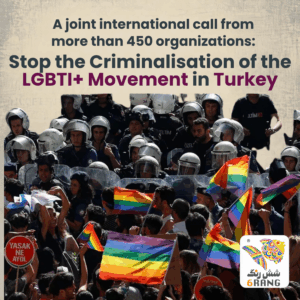
The crackdown started with a court decision blocking access to websites and social media of numerous feminist and LGBTI+ groups, media, student organizations, rights defenders, and activists. On 13 September, police launched operations across several provinces targeting LGBTI+ organisations and human rights defenders. Judicial proceedings have been initiated against more than 160 individuals and 9 associations across 15 provinces. So far, more than 50 LGBTI+ rights defenders, association members, and activists have been detained. The exact number of detainees and the scope of investigations are still being verified.
Members of governing bodies of several associations have been targeted. Offices and homes were searched, and electronic equipment seized. These actions targeted longstanding LGBTI+ and HIV-related organizations, including Kaos GL, Muamma, Mersin 7 Renk, SPoD, HEVİ, Pozitif Yaşam, Listag, Lambda and Pozitif-İz.
We are alarmed by signs that legitimate civil society activities are being falsely labeled as criminal, including accusations related to obscenity, prostitution, drugs, and morality. The prosecution is attempting to create a narrative that LGBTI+ civil society organisations and human rights defenders are part of a criminal organisation. Viewing advocacy, publications, or fundraising as organized crime represents a serious escalation of repression of civic space. We are also worried that lawful domestic and international funding of LGBTI+ groups is being seen as suspicious. Such funding is legal and necessary, already regulated by Turkish law, and should not be considered evidence of criminality. In Turkey, the receipt of funding by civil society organisations (associations and foundations) from abroad and from international organisations is subject to very strict oversight by the General Directorate of Relations with Civil Society, which reports to the Ministry of the Interior of the Republic of Turkey.
The blocking of digital platforms, raids, detentions, equipment seizures, targeting of associations , and scrutiny of lawful funding create a chilling effect on freedom of association, expression, and human rights. These actions are part of a broader anti-gender politics rooted in patriarchy, aiming to control bodies, identities, and relationships. The struggles for LGBTI+ and women’s rights are interconnected, confronting the same patriarchal systems, and attacks on one strengthen attacks on all.
This moment therefore requires more than the protection of fundamental rights. It requires an unequivocal rejection of using “family”, “morality” and gender conformity as instruments to determine whose identities, relationships, speech and freedom of association are considered legitimate.
We call on the authorities in Turkey to:
- immediately release all persons detained solely for exercising their rights to freedom of expression, association and legitimate human rights work, and ensure full respect for due process and access to legal counsel;
- end raids, digital restrictions and other measures that disproportionately obstruct the lawful work of LGBTI+ organisations and human rights defenders;
- ensure that advocacy, publications, organising, membership, donations, fundraising and lawful domestic or international funding are not treated as evidence of criminal activity;
- stop using organised-crime provisions or broadly defined notions of “obscenity”, “morality” or “family” to criminalise LGBTI+ identities, visibility, organising and advocacy;
- end the instrumentalisation of women, children and the “family” to legitimise discrimination against LGBTI+ people, and guarantee that LGBTI+ organisations can operate freely, safely and without intimidation.
We call on international and regional human rights mechanisms, the United Nations, the Council of Europe, the European Union, diplomatic missions, international civil society organisations, foundations and donors to closely monitor these developments, raise them directly with the Government of Turkey and publicly reaffirm the legitimacy of LGBTI+ human rights work.
We also call international partners to stand firmly with LGBTI+ organisations in Turkey and resist attempts to isolate them through portraying international solidarity and lawful fundraising as suspicious or criminal.
Our bodies, identities, relationships and organisations are not crimes.
Human rights advocacy is not a crime.
Solidarity is not a crime.
We stand together with the LGBTI+ movement in Turkey.
Signatories
- >top Association for the Promotion of Cultural Practice
- 3WayKiss
- 6Rang (Iranian LGBT+ Network)
- Asociación Cultural Nohayquorum Madrid Pride
- Aalawya Foundation
- ACCEDER
- ACCEPT LGBTI Cyprus
- Accion Cimadres
- Accountability without borders
- Associazione per la Cultura e l’Etica Transgenere (ACET)
- Actions Communautaires pour le Développement de la Femme (ACODEFEM)
- AEGAL/MADO
- AFA Nederland
- AFDA Familias Diversas
- Affasa
- Africa Centre for Health Systems and Gender Justice
- AKAHATA AC
- All Out
- All Sorts of Queers (ASQ)
- Alliance for Future Generations
- Allied Rainbow Communities
- Almenara Regenerative Cultures
- ALT-TEXT
- Amahoro Human Respect
- Amani Youth Foundation – Uganda
- Anstatt e.V. Verein zur Förderung von Jugendkultur
- Antifa Wien
- APROSEX
- Arcidonna Napoli
- Ariel Maceo Tellez
- Ars Socialis AC
- Artemis feministischer Sportverein Kiel
- Asamblea Transfeminista de la val de Benas
- ASMR
- Asociacion de Mujeres Fasnieras
- Asociación de Mujeres Lilith
- Asociación LEGAYNÉS.
- Asociación Por Tí Mujer
- Associació Drets Sexuals i Reproductius
- Associació Hèlia
- Associació per a la diversitat afectiva als Països Catalans
- Association for Health Policies and Rights Stronger Together Skopje
- Association for Women’s Rights in Development (AWID)
- Association Transmissions
- Associazione per il Recupero, la Promozione e l’Accoglienza (Associazione A.R.Pa.)
- Associazione A.R.Pa. – Centro Antiviolenza Duna
- Associazione Onda Rosa
- Associazione Thamaia ETS
- ATA Sylvia Rivera
- Athens Museum of Queer Arts
- Atlas of Hate
- ATRAHDOM
- Autonomia
- Azadi network
- Barah Aamen
- BASH BACK
- Beam Community Development 360 Initiative
- Bedayaa Organization for LGBTQIA+ Rights in Egypt
- Berlin Muslim Feminists Collective
- Best Practices Policy Project
- Beyond the Margins
- BIPOC-Network and Exchange .
- Blue Diamond Society
- Bonanzafest Cologne
- Bonhishikha
- Brave Dimension Global
- Brave e.V.
- Brückenwind
- Buntwäsche hildesheim e.V.
- Camp Trans CIC
- Campaign Against Homophobia Poland
- Campaign against Homophobia Germany
- CAN-Myanmar
- Canales Asociación Civil
- Casa delle donne Bologna
- Casa delle donne per non subire violenza Bologna
- Casa Kua
- Cênî – Kurdisches Frauenbüro für Frieden e.V
- Centre audiovisuel. Simone.de Beauvoir.
- Centre for Gender Rights “Diotima”
- Centro Antiviolenza M.I.A. – ODV
- Centro Donna Giustizia
- Centro per non Subire Violenza D.I.RE
- CESIDA
- Checkpoint Malta
- CHOISIR
- Christopher Street Day Sachsen-Anhalt e.V.
- CIVICUS
- Climate Action Network Australia
- Climate Emergency Australia
- Climate Justice UofT
- Climáximo
- COEDEN FAWR
- Col•lectiu Posidonia
- Col·lectiu Orgull Osona
- Collective Aid
- Colombia Diversa
- Colors Rainbow
- Common Threads Indigenous Peoples Organisation
- Conectando Derechos
- CORPORACION BARRACA
- Corporación Barraca
- CREA
- Critical Queer Solidarity e.V.
- Crossroads Collective
- CSD Dessau-Rosslau e.V.
- CSD Köthen e.V.
- CSD Magdeburg e.V.
- CSD Stendal e.V.
- Currie Country Social Change
- D.i.Re – Donne in Rete contro la violenza
- D&J Arc-en-Ciel
- Dalan Fund
- Delete Nothing
- Den Haag BIJ1
- Derechos Humanos y Diversidad Asociación Civil
- District Berlin
- Diverse Voices and Action (DIVA) for Equality
- Divine Queer Film Festival
- Doctors for the Environment Australia
- Doorbraak
- Dublin Lesbian Line
- Dyke March Amsterdam
- Dyke March Brussels
- E-graine
- Eastern European Coalition for LGBT+ Equality (EECLGBT)
- EATHAN Foundation
- ECPI-Euroregional Center for Public Initiatives
- Éditions iXe
- Editorial Team Bürgerrechte & Polizei | CILIP
- Ehlenhof e.V.
- eigenMächtig – Beratung und Unterstützung für Frauen und trans* Personen
- ELDH -European Association of Lawyers for Democracy and World Human Rights
- Ella vzw Kenniscentrum Gender en Etniciteit
- Enredaderas: tierra, género y autoconocimiento
- Ensamble Kafka
- Equality Bahamas
- Equipe de Base Warmis – Convergência das Culturas
- Equite Sri Lanka
- EUFORIA. Familias Trans-Aliadas
- European Alternatives
- Fédération des Centres Sociaux et socioculturels de France (FCSF)
- FeauenLesben Gruppe Frankfurt
- Federacion de Asociaciones de Mujeres Arena y Laurisilva
- Federación Plataforma Trans
- fem*FAU (feminists in the Free Workers’ Union)
- Femena
- FEMINA NETWORK
- Feminist Diplomacy Lab
- Feminist Frames
- Feminist Initiative for Health Education and Climate Awareness
- Feminist Task Force
- Feministisches Zentrum Freiburg e.V.
- femLINKPacific
- Figth4Aylesbury
- Fiji Women’s Crisis Centre
- Fiji Women’s Rights Movement
- First Mardi Gras 78ers
- Flláma Cultural
- Flourish NGO
- Flüchtlingsrat Niedersachsen
- Foll Bunt e.V.
- Forbidden Colours
- Förderverein Frauenzentrum Bad Honnef
- Forum Civique Européen
- Foundation for Women and Family Planinng (FEDERA)
- Frauen für Frauen
- Frauenhaus Gießen e.V.
- FrauenLesbenMigrantinnenZentrum Wien
- Frauenzentrum Bad Honnef
- FRI Vestland
- Friends of the Earth Australia
- Friends of the Earth Cyprus
- Fugite
- Fugitive Inages
- Fundación Aspacia
- Fundación Estudio e Investigación Nujer FEIM
- Furia
- Future404
- galck+
- Global Alliance for LGBTIQ+ Education (GALE)
- Garabtaag
- Geen Haat Op Straat
- Gender Advisory Team
- Girls Rock! Pride Rock Rochester
- GIRLxGIRL
- GLAA
- Global Campaign to Demand Climate Justice (DCJ)
- Global Justice Institute
- Global Network of Rainbow Catholics (GNRC)
- Göçmen Kadınlar Birliği
- GongGam Human Rights Law Foundation
- Group d’action feminist Maroc (Gafm.1)
- Hackerspace d’Autodéfense Contre les Cyberviolences (HACC)
- Háttér Society
- Health GAP
- Hellenic Culture Centre
- Héranval
- Hidden Goddess Greece
- HIV Justice Network
- HIV/AIDS Human Rights Action ‘AL’
- Hivos
- Holding the Line
- Holistic Protection Collective
- Human is My ID collective
- Human Rights Foundation
- Humanity For The World (HFTW)
- HuMENA for Human Rights and Civic Engagement
- ICA Foundation Kenya
- The International LGBTQI Youth & Student Organisation (IGLYO)
- International Lesbian and Gay Association (ILGA) World
- International Lesbian and Gay Association (ILGA) Europe
- Infinity Rug
- Inıtıiative Against Femicide
- Initiative for Equality and Non Discrimination (INEND)
- Initiative Gedenkort KZ Uckermark
- Interkular ggmbh
- International IDAHO Committee
- International Lesbian and Gay Association (ILGA) Oceania
- International Planned Parenthood Federation (IPPF)
- International Women’s Development Agency (IWDA)
- Internationalist Queer Pride Berlin
- InterPride
- iProbono
- IraQueer
- Isha L’Isha Haifa Feminist Center
- Ivy Foundation
- JEJAKA
- Just Futures Collaborative
- Just. Equal Australia Inc
- Justice for Sisters
- KAKTUS Malta
- Kaleidoscope Trust
- Kemban Kolektif
- Key Population Advocacy Consortium PNG
- KL Queer Space
- kolekTIRV | For the rights of trans, intersex and gender variant persons
- Kolektiv MANA
- Komitee für Grundrechte und Demokratie e.V.
- Kontakt- und Beratungsstelle für Geflüchtete und Migrant*innen e.V. (KuB)
- La Incidència
- La veilleuse
- Lab Futura
- le Planning familial du Nord
- League of Ex-Muslims
- Legal Centre Lesvos
- Lesbians Against Fascism
- LGBT+ Platform of Kyrgyzstan
- LGBT+Movimento
- LGBTQ Yemen
- Linda Laurie Associates
- Lithuanian Development Cooperation Platform (Lithuanian NGDO Platform))
- Little Red Tarot
- Lobau bleibt
- LooM SWANA
- Lotta e.V. – Verein zur Förderung feministischer Mädchen- und Frauenarbeit
- Lunes lilas
- LUQS – Lesbenarchiv und queere Sammlung Frankfurt
- Magenta
- Mahwari Justice
- Marche mondiale des femmes
- Maria Ines Re
- Mas Llafrenca
- Mayako Pahichan Nepal
- Mediactive Berlin
- medico international
- Mediterranean Institute of Gender Studies
- Mending Minds Foundation (Fiji)
- Merhaba vzw
- Mesahat Foundation for sexual & Gender diversity in Nile valley (Egypt & Sudan)
- Migrant Solidarity Bulgaria
- Migrantinnenverein Düsseldorf e.V.
- Minimantis Berlin
- Mitini Nepal
- Mondro
- MOSAIC, MENA Organization for Services Advocacy Integration and Capacity Building
- Mouvement contre le racisme et pour l’amitié entre les peuples (MRAP)
- Mujer & Mujer Foundation
- NAJMA Network
- National NGO Coalition
- National Queer Theater
- Native Calgarian Podcast
- Nazareth Centre for Rehabilitation
- Nest! Foundation
- New Jersey Red Umbrella Alliance
- New Woman Foundation
- NGO Support Centre
- NOMOS: International Research on Law, Culture, and Power
- Noon Feminist Movement
- Noor
- Nuravi Foundation
- Oceania Pride
- Onusshor
- OOR Saloon
- OurCause
- Oy Gevalt !
- Pacific Women Mediators Network
- PACIFICA Inc. Aotearoa
- International Lesbian and Gay Association (ILGA) Pan Africa
- Parivartan
- Paula e.V. Köln
- PEN Norway
- People’s Medical College (PMC) Hospital & Maternal and Child Health Hospital MCH, Nawabshah
- Peoples Climate Assembly
- Perempuan Mahardhika
- Pink Human Rights Defender NGO
- Pink Noise – Verein zur Förderung Feministisch Popkultureller Aktivitäten
- Piso Thrania
- Plateforme UNITY
- Friends Frangipani Inc. (PNG)
- POCACITO Network
- Popoki Peace Project
- Positive Champions Health and Empowerment Initiative (PCHEI)
- Potgrond
- Prana Transgender Network
- Pride Marseille
- Pride Torremolinos
- Pride Wide Trust
- Purple Royale: Trans Voices Amplified
- QuARC (Queers Against Racism and Colonialism)
- Queer Base – Welcome and Support for LGBTIQ Refugees
- Queer Culture Cooperative HONG-YE-DANG (퀴어문화협동조합 홍예당)
- Queer European Asylum Network
- Queer Refugees, Migrants and Friends Osnabrück
- Queer-Beirat Osnabrück
- Queer-Osnabrück.de
- Queer*referat Uni Mainz
- Queerbase
- Qun Jelesi
- Radicaal Collectief Queer Nijmegen (RCQN)
- Radical Faeries of Berlin
- Radical Women U.S.
- Radical Women Australia
- Rainbow Action Korea
- Rainbow Railroad
- Rainbow Rose
- Raise The Pacific
- Raise Your Voice CBO
- Realizing Sexual and Reproductive Justice
- Reka Si
- ReportOUT
- ReportOUT Nigeria
- RFSL
- Richmond Art Gallery
- Rizomi.lab ETS
- Romnja Feminist Library
- Rownosc.org.pl Foundation
- Safe Space Allies Organization
- Safiya centro antiviolenza centro di promozione sociale e culturale delle donne – APS
- Samoa Faafafine Association (“SFA”) Inc.
- Sanad Collectif
- Sapphic Roots Collective
- SAQFE Organisation
- Sarajevo Open Centre
- SASOD Guyana
- Savie asbl NGO LGBTQI DRC
- Seoul Queer Culture Festival Organizing Committee
- Sexual Assault Crisis Center
- Shabbes 24/7
- Sibyls
- Sidaction
- Sievietei paveicās
- Sinnaneun Center Inc
- Sipineq+
- SIS Forum (Malaysia)
- Sisters 2 Sisters
- Skyline International for Human Rights
- SMEX
- Social Work Action Network in Greece
- Society of Fa’afafine in American Samoa
- Society of Gender Professionals
- Society of Trans Women of the Philippines (STRAP) Inc.
- Solidarité Internationale LGBTQI
- Solidarity With OTHERS
- Somali Aid organisation
- Spanish LGTBI+ Federation (FELGTBI+)
- Spectrum
- St. Paul’s Foundation (Erasing 76 Crimes)
- STAG Initiative
- Strings For Solidarity
- Strong me
- Sex Workers’ Advocacy Network (SWAN Foundation)
- SWANA Pride
- Syrian Home
- t r a n s i e n c e
- Trans Radical Resource Exchange (T-RREx)
- Takatoat
- Talay’an Mena Organization
- Tęczowe Dziki
- The De|Center
- The Fruit Basket
- The Immigrant Artist Biennial
- The Initiative for Equal Rights (TIERs)
- The Post Collective
- The Regional Coalition for Women Human Rights Defenders in South West Asia and North Africa (WHRDMENA)
- Theater Halbe Treppe Dinslaken
- Tiwizi Lab
- Together against poverty Program
- Tonga Leitis Association
- Trans Healthcare Action
- Trans Refugee Initiative Uganda
- Trans Utrecht & Beyond
- Trans Viel Freude
- TransAkcija Institute
- Transat (SWANA)
- Transat (MENA)
- TransCore
- Trillke e.V.
- Trinidad and Tobago Transgender Coalition
- Turkey Litigation Support Project (TLSP)
- Tuvalu Association of Non Government Organisation
- Twilight Support Initiative (TSI) Uganda
- Universités d’Été Euroméditerranéennes des Homosexualités (UEEH)
- “Unión General de Trabajadoras y Trabajadores de España (UGT)
- “
- Un Velos au plafond
- UNAforWomen
- United Nations LGBTI Stakeholder Group
- Universiteto LGBT grupė
- Unizon
- Urgent Action Fund for Feminist Activism
- Vejer sin Fronteras
- Verein HeVio-Health and Violence
- Viluthu
- VPride
- VVN/BdA
- vzw Terra Viva
- Wagayway Equality, Inc.
- Women Solidarity Network (WANA)
- Wen-Do Kollektiv Zürich
- WenDo Dresden
- Coalition of Women Human Rights Defenders in Darfur (WHRDS TMD)
- Women in Development Europe (WIDE) Austria
- Women In Development Europe (WIDE+) Belgium
- WO=MEN Dutch Gender Platform
- WomanUp Foundation
- Women Collective Kenya
- Women Engage for a Common Future (WECF) International
- Women Engage for a Common Future e.V.
- Women Fund
- Women Living Under Muslim Laws (WLUML)
- Women Without Violence International Foundation
- Women’s Intercultural Network
- Women’s International League for Peace and Freedom (WILPF) Germany
- Women’s International League for Peace and Freedom Austria
- Women’s Issues Information Center
- Women’s Major Group
- Women’s Solidarity Network
- Women’s Support and Information Centre NPO
- Women’s Rights Foundation
- World Liberty Congress
- World Organisation Against Torture (OMCT)
- Women’s UN Report Network (WUNRN)
- XPOSED Queer Film Festival Berlin
- XY Spectrum
- Yellowdot
- Young Feminists
- Young Out Here Sri Lanka Trust
- Youth Pride
- Zawaye El Jiran
- Ženaki lobi Slovenije
- Γυναίκες Αλληλέγγυες
- Δίκτυο για τα πολιτικά και κοινωνικά δικαιώματα
- Η φωνή της
- Φυσάει Κόντρα δημοτική κίνηση στην Αγία Παρασκευή
The post A joint international call from more than 450 organizations: Stop the Criminalisation of the LGBTI+ Movement in Turkey appeared first on 6rang.
]]>The post 6Rang Calls for an Independent Investigation into the Suspicious Death of Liana, a 17-Year-Old Trans Girl in Shiraz appeared first on 6rang.
]]>27 August 2026
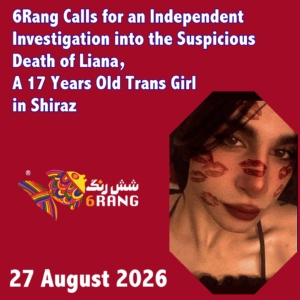
According to people close to Liana who have provided information to 6Rang, she had endured years of violence, humiliation and severe psychological pressure within her family because of her gender identity, appearance and self-expression.
Her family has reportedly attributed her death to a “stroke.” However, given the reported history of abuse and information and documentation made available to 6Rang, we believe the circumstances surrounding her death require independent investigation. At this stage, 6Rang cannot independently establish the medical cause of Liana’s death.
Liana had documented some of the abuse and family confrontations herself and shared recordings with people close to her. According to information received by 6Rang, she was subjected to physical and verbal abuse, restrictions on leaving home and seeing friends, and persistent attempts to suppress her gender expression. She also faced harassment and ridicule while attending a boys’ school.
Liana had also spoken about experiencing sexual abuse as a child and, according to those close to her, did not receive the protection and support she needed from her family.
Yet Liana was much more than the violence inflicted upon her. She loved dancing, colour and joy. She dreamed of one day standing on a stage in a long red dress, dancing, speaking into a microphone and telling the story of her life. She wanted to be seen and loved as she was.
Her death comes at a time of immense suffering in Iran. Amid executions, repression, conflict, poverty and the killing of protesters and civilians, the violence experienced by LGBT+ people can easily disappear from public view. It must not.
For LGBT+ people in Iran, violence does not come only through direct state repression. The Islamic Republic’s criminalisation and stigmatisation of sexual and gender diversity, together with its systematic promotion of discriminatory gender norms and anti-LGBT+ narratives, creates an environment in which abuse within families, schools and communities can flourish with little accountability.
Liana resisted that environment. She resisted the gender norms imposed on her, the demand for silence around violence and sexual abuse, and a culture in which notions of family “honour” can be placed above the dignity, safety and life of a child.
6Rang calls for an independent investigation into the cause and circumstances of Liana’s death and for accountability for anyone found responsible. We also call on the media, human rights organisations and civil society to respect Liana’s gender identity in reporting on her death. Erasing a trans person’s identity after death is itself a continuation of the denial they experienced in life.
At a moment when Iran is confronting multiple and overlapping crises, LGBT+ lives must not become invisible. Every life deserves to be seen, every allegation of serious abuse deserves scrutiny, and every suspicious death deserves truth and accountability.
6Rang calls on journalists, human rights defenders, international organisations and all those who value human life to amplify the voices of Iran’s LGBT+ community, particularly trans people, and to refuse silence in the face of violence.
6Rang (Iranian LGBT+ Network)
27 August 2026
The post 6Rang Calls for an Independent Investigation into the Suspicious Death of Liana, a 17-Year-Old Trans Girl in Shiraz appeared first on 6rang.
]]>The post 6Rang: The Iranian Football Federation Cannot Invoke “Beliefs” to Justify Exclusion appeared first on 6rang.
]]>
Responding to reports that players may be asked to wear rainbow armbands during Seattle’s designated Pride Match, Iranian Football Federation President Mehdi Taj declared: “We make no concessions to anyone when it comes to our beliefs.” Iranian and Egyptian football authorities have reportedly coordinated efforts to oppose Pride-related activities, arguing that they conflict with their religious and cultural values.
We reject this framing.
Human dignity, equality, and freedom from discrimination are not matters of cultural preference. They are universal human rights. No government, federation, or institution should be allowed to invoke “beliefs” as a justification for excluding, stigmatizing, or erasing an entire group of people.
For decades, Iranian authorities have used the language of religion, culture, and morality to justify the criminalization and persecution of LGBT+ people. Under Iranian law, consensual same-sex relations remain criminalized, and LGBT+ people continue to face violence, harassment, arbitrary detention, forced confessions, and severe discrimination. These realities are not abstract debates about values; they are lived experiences for countless people in Iran.
The issue before FIFA is not whether every player personally supports LGBT+ rights. The issue is whether football, as a global sport, will stand for the equal dignity and humanity of all people.
We therefore call on FIFA to remain steadfast in its commitment to inclusion, non-discrimination, and human rights. FIFA must not allow governments or football federations to use claims of religious or cultural sensitivity to undermine the fundamental principles of equality that the organization has pledged to uphold.
We also call on players, teams, supporters, and football associations around the world to recognize what is at stake. When officials claim that respecting LGBT+ people violates their beliefs, the message received by LGBT+ individuals in countries such as Iran and Egypt is that they are unworthy of recognition, protection, and belonging.
The Seattle Pride Match is not a challenge to anyone’s faith. It is an affirmation that LGBT+ people exist, belong, and deserve the same rights and dignity as everyone else.
To the Iranian Football Federation, we say this clearly: beliefs do not grant a license to discriminate.
To FIFA and the global football community, we say: do not look away. Stand with those whose voices are silenced, whose identities are criminalized, and whose humanity is too often denied.
Football belongs to everyone.
The post 6Rang: The Iranian Football Federation Cannot Invoke “Beliefs” to Justify Exclusion appeared first on 6rang.
]]>The post Shadi Amin: “I danced when I heard about Khamenei’s death. But it’s a war between the states, not the people.” appeared first on 6rang.
]]>Shadi Amin: «Ho ballato quando ho saputo della morte di Khamenei. Ma è una guerra tra governi, non del popolo»
05 marzo 2026 • 12:29

La pioniera della visibilità lesbica e fondatrice di 6Rang a Resistenze: «Le nostre voci si perdono nella polvere, nelle esplosioni e nei lamenti. Ho festeggiato per pochi secondi: qualsiasi momento di soddisfazione è offuscato dalla sofferenza dei civili e dalla distruzione delle nostre città». E analizza il futuro del movimento Donna, Vita, Libertà e delle sue istanze
- Iscriviti a Resistenze, la newsletter di Domani sui diritti e le identità negate: arriva ogni due giovedì
Più di un mese fa avevamo parlato con Shadi Amin in occasione delle proteste contro il regime iraniano, quando il paese bruciava di coraggio e rabbia. Oggi la ritroviamo mentre l’Iran affronta una guerra destinata a cambiare lo scenario del Medio Oriente e della società iraniana. In questo momento di confusione mediatica, dare voce alle persone iraniane è l’unica cosa sensata da fare.
Shadi Amin non è una voce qualsiasi: attivista Lgbtq di spicco, direttrice della rete iraniana 6Rang, scrittrice e ricercatrice, da anni denuncia le violazioni dei diritti umani basate sull’orientamento sessuale e sull’identità di genere. È stata membro del consiglio esecutivo mondiale di ILGA e autrice di numerosi testi fondamentali, tra cui Gender X e Crime and Impunity, che documentano l’abuso sistematico dei diritti delle persone Lgbtq in Iran.
Con il progetto No to Forced Sex Change e un innovativo sistema di consulenza online, Amin offre supporto e informazioni a chi vive sotto la pressione di un regime che nega l’esistenza stessa delle persone Lgbtq. Oggi la sua voce è fondamentale: racconta la paura, le contraddizioni, la sopravvivenza quotidiana dei cittadini iraniani, offrendo a Resistenze uno sguardo diretto e implacabile sulle conseguenze della guerra e sulle responsabilità dei governi coinvolti.
L’ultima volta che ci siamo sentiti lei aveva lanciato su queste pagine un appello alla comunità internazionale. Ora il mondo è cambiato. Come interpreta questo attacco unilaterale all’Iran da parte di Israele e degli Usa?
La situazione è cambiata drasticamente in pochissimo tempo, sia tra gli iraniani all’interno del paese sia nella diaspora. A quel tempo, la principale richiesta della comunità internazionale era di aumentare la pressione sulla Repubblica islamica attraverso mezzi diplomatici, richiamando gli ambasciatori, interrompendo legami politici ed economici e offrendo un reale sostegno alle forze di opposizione. Le richieste di intervento militare provenivano solo da una piccola minoranza, spesso spinte dalla disperazione. Tra questi, il campo monarchico intorno a Reza Pahlavi invitava Israele e Stati Uniti ad attaccare l’Iran. Durante le proteste, dichiarazioni di Donald Trump che suggerivano sostegno ai manifestanti avevano creato aspettative irrealistiche all’interno del paese, e alcune persone credevano che un intervento esterno fosse imminente. Ora, a poche settimane di distanza, missili e bombe stanno colpendo le città iraniane mentre la Repubblica islamica reagisce in tutta la regione. Il rischio reale oggi è una catastrofe umanitaria e una guerra che si allarga sempre di più.
Khamenei è morto. Voci si susseguono sulla morte di Ahmadinejad. Posso chiederle se ha festeggiato? Non ci si rallegra per la morte di nessuno: mai. Però di un tiranno a lungo subìto…
Sì, come era stato previsto, suo figlio Mojtaba Khamenei è stato presentato come suo successore. Probabilmente fungerà da portavoce e difensore degli interessi della Guardia Rivoluzionaria e continuerà la politica estera del padre. Khamenei è morto, ma la Repubblica islamica è ancora viva. Molti iraniani stanno vivendo emozioni contraddittorie. Pur essendo la maggioranza contraria alla guerra, il conflitto ha eliminato figure largamente ritenute responsabili di repressione e crimini. La morte di Khamenei ha reso milioni di persone felici e speranzose per un cambiamento in Iran.
Diciamo “grazie” a Trump?
Non intendo ringraziarlo. Ha ripetutamente detto che questa guerra non ha nulla a che fare con la democrazia o i diritti umani. È positivo che lo abbia chiarito, ma aspettarsi gratitudine allo stesso tempo non ha senso. Negli ultimi giorni, la guerra ha già causato una distruzione massiccia e centinaia di morti civili. Non è la guerra del popolo; è un conflitto tra governi. La Repubblica islamica non è solo vittima di questa escalation, ma ne è stata anche uno dei motori. Ogni momento di soddisfazione per l’indebolimento del regime è offuscato dalla sofferenza dei civili e dalla distruzione delle nostre città. La sola morte di Khamenei non fermerà la Repubblica islamica. Se il regime non crolla, o se anche solo crede che il suo crollo si stia avvicinando, potrebbe ricorrere a ritorsioni brutali contro prigionieri politici e cittadini in protesta. Questo è un pericolo che la comunità internazionale deve prendere molto seriamente. Tra coloro che rischiano c’è la vincitrice del Premio Nobel per la Pace Narges Mohammadi. Per quanto riguarda Ahmadinejad, lo stesso presidente che nel 2007 a Columbia University scioccò il mondo dicendo “In Iran non abbiamo omosessuali” e che negò ripetutamente l’Olocausto, secondo alcune fonti sarebbe stato preso di mira dalle forze israeliane. Fonti governative hanno annunciato la sua morte, ma continuano a circolare notizie contrastanti che suggeriscono possa essere ancora vivo. Sì, ho ballato quando ho saputo della morte di Khamenei, ma solo per circa 20 secondi, per registrare un video di solidarietà con il popolo. Qualsiasi momento di soddisfazione, però, è breve e offuscato dalla sofferenza dei civili e dalla distruzione delle nostre città.
Dalle notizie che riceve dall’Iran, come stanno vivendo queste ore i tuoi concittadini e la comunità Lgbtq? Puoi condividere qualche episodio specifico?
Le persone sotto bombardamenti e attacchi missilistici lottano solo per sopravvivere, e i movimenti sociali sono o repressi o costretti ad aspettare. Prima che venisse interrotto l’accesso a Internet, ho parlato con due persone in Iran. Entrambe temevano che, nonostante la guerra, la Repubblica islamica potesse sopravvivere e che gli Stati Uniti potessero eventualmente raggiungere un accordo con un regime indebolito. In queste condizioni, le nostre voci si perdono nel fumo, nella polvere, nelle esplosioni e nei lamenti. L’ombra della morte rende invisibile ogni richiesta di dignità umana.
Cosa può succedere adesso?
La guerra può iniziare in una frazione di secondo, ma la sua fine è imprevedibile. Non è chiaro fino a che punto la Repubblica islamica possa spingersi nel cercare vendetta per la morte del suo leader e dei suoi alti funzionari, né se alla fine possa essere costretta a sedersi al tavolo delle trattative. Per la Repubblica islamica, la preservazione del sistema è la massima priorità. Allo stesso tempo, con la morte di Khamenei, che diventerebbe di fatto un martire per la sua insistenza nel proseguire la guerra, sarebbe difficile per il regime giustificare qualsiasi arretramento da questa strada ai suoi sostenitori. Perciò, come abbiamo visto finora, probabilmente continueranno a sostenere lo slogan “guerra, guerra fino alla vittoria”, a meno che tutti gli oppositori della negoziazione e dei rapporti con Stati Uniti e Israele che occupano posizioni di governo non vengano eliminati nella guerra, permettendo ai sostenitori del dialogo di avere la meglio e raggiungere un accordo con Trump. Un simile sviluppo infliggerebbe un colpo grave ai risultati del movimento Donna, Vita, Libertà e a tutto ciò che ne è seguito».
The post Shadi Amin: “I danced when I heard about Khamenei’s death. But it’s a war between the states, not the people.” appeared first on 6rang.
]]>The post 6Rang Warns Against Instrumentalization of LGBT+ Rights Amid Iran War appeared first on 6rang.
]]>
The statement follows remarks by U.S. President Donald Trump in a recent YouTube interview with influencer and boxer Jake Paul, where he said: “We support gays, but they [the Islamic Republic of Iran] throw gays off buildings.”
While reaffirming that Iran enforces some of the harshest laws criminalizing same-sex relations, 6Rang challenged both the accuracy and the political framing of such claims.
“This is a fact that the Islamic Republic of Iran enforces some of the most severe and violent laws against consensual same-sex relations,”the statement reads. “However, ‘throwing individuals from buildings’ is not a documented legal punishment in Iran and is more often part of political and propaganda narratives.”
The organization also criticized what it described as contradictions in U.S. policy, noting that earlier this year U.S. authorities reportedly attempted to deport an Iranian same-sex couple, a move that, it warned, could place LGBT+ asylum seekers at serious risk. 6Rang reiterated that returning individuals to countries where same-sex relations are criminalized can endanger their lives.
More broadly, the statement places Trump’s remarks within a longer pattern of governments invoking human rights narratives to justify political or military agendas. It points to historical precedents, including the use of women’s rights discourse during the U.S. war in Afghanistan.
At the heart of the statement is a clear rejection of all forms of political exploitation of LGBT+ communities:
“The LGBT+ community and our rights are not tools for any power anywhere in the world.”
6Rang emphasized that Iranian LGBT+ people have long fought for their rights under conditions of extreme risk and repression, and said the struggle would continue until a democratic system that upholds human rights is established.
The organization also warned against both forms of harm: attacks rooted in social stigma and discrimination, as well as the use of LGBT+ rights as a pretext for advancing political or military objectives.
“We will not allow any power to attack us under social taboos or to justify its policies in the name of defending us.”
The statement concludes with a message of defiance and resilience, reaffirming that Iran’s LGBT+ community will continue its struggle for equality and justice, independent of geopolitical agendas.

The post 6Rang Warns Against Instrumentalization of LGBT+ Rights Amid Iran War appeared first on 6rang.
]]>The post 46 Human Rights Organizations Call for an Urgent UN Session on Iran appeared first on 6rang.
]]>
16 January 2025، To: Member states of the United Nations Human Rights Council
Your Excellencies,
We, the undersigned civil society organizations, urge the UN Human Rights Council to urgently convene a special session to address an unprecedented escalation in mass unlawful killings of protesters, amidst an ongoing internet shutdown imposed since 8 January to conceal grave human rights violations and crimes under international law by Iranian authorities.
Since 28 December 2025, an escalating campaign of lethal repression aimed at crushing a mostly peaceful uprising has led to the massacres of protesters during protest dispersals, with the death toll rising to thousands, including by official admission. Establishing the real death toll is not possible at the time of writing, given the unprecedented scale of mass killings since 8 January and amidst an ongoing internet blackout, which has severely impeded communication with the outside world and the ability of human rights organizations to gather and corroborate information.
Verified videos and credible information received by our organizations from individuals in Iran, including journalists, medical workers, protesters, eyewitnesses and victims’ relatives, reveal widespread patterns of security forces positioned on the streets and rooftops, repeatedly firing rifles and shotguns loaded with metal pellets, targeting unarmed protesters frequently in their heads and torsos. According to eyewitness accounts and verified audiovisual evidence, medical facilities are overwhelmed with the injured while distraught families have been searching for their missing loved ones among body bags near overflowing morgues and witnessed bodies piled up in pick-up trucks, freight containers or warehouses.
The evidence gathered indicates a coordinated nationwide escalation in the security forces’ unlawful use of force, firearms and other prohibited weapons against mostly peaceful protesters and bystanders since the evening of 8 January when protests grew in size nationwide. Human rights monitors previously documented that even before the escalating repression on 8 January, security forces unlawfully used rifles, shotguns loaded with metal pellets, water cannon, tear gas, as well as physical beatings, killing dozens. Raids on hospitals, involving the use of tear gas, shotguns and beatings of patients, their relatives and medical workers and arrests of injured protesters in medical facilities have also been documented.
As part of their violent crackdown, security forces have also arbitrarily arrested thousands of protesters, including children, and subjected many to enforced disappearance and incommunicado detention. Given well-documented patterns during previous protests, we are gravely concerned that detainees are at grave risk of torture and other ill-treatment as well as arbitrary executions.
The undersigned civil society organizations are gravely concerned that authorities will once again resort to swift trials that bear no resemblance to judicial proceedings and arbitrary executions to crush and deter dissent. State authorities have labelled demonstrators as “rioters” and “terrorists”, calling for a harsh response by the security forces. The Head of the Judiciary, Gholamhossein Mohseni Eje’i, has ordered provincial prosecutors to show “no leniency” to protesters and expedite their trials. Officials have also called for protesters to face capital offences, including “enmity against God” (moharabeh), raising fears that those arbitrarily detained may face the death penalty.
In a statement from 13 January, High Commissioner Volker Türk said he was “horrified by the mounting violence directed by security forces at protesters across Iran”, adding “this cycle of horrific violence cannot continue… The killing of peaceful demonstrators must stop, and the labelling of protesters as ‘terrorists’ to justify violence against them is unacceptable”.
Tragically for the people of Iran, the latest wave of massacres is the culmination of a long-standing pattern of lethal crackdowns on nationwide protests, including during the November 2019 protests and the Woman, Life, Freedom uprising of September–December 2022. In-depth investigations of the latter led the Independent International Fact-Finding Mission on the Islamic Republic of Iran to conclude that Iranian authorities committed the crimes against humanity of murder, imprisonment, torture, rape and other forms of sexual violence, persecution, enforced disappearance and other inhumane acts.
We urge UN member states to acknowledge that the repeated commission of grave human rights violations and crimes under international law, including during successive waves of protests in Iran, has been made possible by the entrenched and systemic impunity for those responsible for these crimes. The lack of criminal accountability has emboldened Iranian officials to persist in their criminal conduct and deliberately turn to mass killings of protesters demanding human rights and dignity.
In this context, the Council must now act decisively by convening a special session and adopting a strong resolution that signals unequivocally to Iranian authorities that the spiral of bloodshed and impunity must end. Through the special session, the HRC should ensure that the truth about these grave human rights violations and crimes under international law is established and evidence preserved, requesting the Fact-Finding Mission to carry out an urgent inquiry and ensuring it has the resources to carry out its investigations, and request that they submit recommendations on concrete avenues to pursuing comprehensive justice and ending the impunity that is driving the state policy of lethal repression.
The Council must also affirm the rights of people in Iran to freedoms of opinion, expression, association and peaceful assembly as well as their right to freely and equally participate in the political and public life of their country.
To this end, we call on the Council to:
- Extend the mandate of the Independent International Fact-Finding Mission on the Islamic Republic of Iran (FFMI) and renew the mandate of the Special Rapporteur on human rights in Iran;
- Request the FFMI to conduct an urgent inquiry into violations committed in the context of the current wave of protest repression and report to the Council;
- Ensure the FFMI is provided with appropriate additional resources to fulfil its mandate;
- Enhance the joint interactive dialogue with the FFMI and the Special Rapporteur to enable participation of survivors and Iranian human rights defenders.
We thank you for your attention to these pressing issues and stand ready to provide your delegation with further information as required.
Sincerely,
- Abdorrahman Boroumand Center for Human Rights in Iran
- Ahwaz Human Rights Organisation (AHRO)
- All Human Rights for All in Iran
- Amnesty International
- ARTICLE 19
- Association for the Human Rights of the Azerbaijani People in Iran – AHRAZ
- Baloch Activists Campaign
- Balochistan Human Rights Group
- Cairo Institute for Human Rights Studies (CIHRS)
- Center for Human Rights in Iran (CHRI)
- The Centre for Supporters of Human Rights (CSHR)
- Defenders of Human Rights Center (کانون مدافعان حقوق بشر)
- Education International
- Global Centre for the Responsibility to Protect (GCR2P)
- Global Human Rights Defence
- Hawaii Institute for Human Rights
- Hengaw
- Human Rights Watch
- Humanists International
- Impact Iran
- International Bar Association’s Human Rights Institute (IBAHRI)
- International Educational Development (IED)
- International Federation for Human Rights (FIDH)
- International Practice of Human Rights (IPHR)
- International Service for Human Rights (ISHR)
- Iran Human Rights
- Iran Human Rights Documentation Center
- Justice for Iran
- Kurdistan Human Rights Association–Geneva (KMMK-G)
- Kurdistan Human Rights Network
- Kurdpa Human Rights Organization
- Miaan Group
- Minority Rights Group
- Mouvement contre le racisme et pour l’amitié entre les peuples (MRAP)
- Outright International
- PEN America
- Physicians for Human Rights
- Rasank
- Rights Realization Centre
- Siamak Pourzand Foundation
- The Advocates for Human Rights
- Together Against the Death Penalty (ECPM)
- United for Iran
- Unrepresented Nations and Peoples Organization (UNPO)
- World Organisation Against Torture (OMCT)
- 6Rang (Iranian LGBT+ Network)
The post 46 Human Rights Organizations Call for an Urgent UN Session on Iran appeared first on 6rang.
]]>The post Resilience in Repression: Marking 15 Years of 6Rang and the Iranian LGBT+ Movement appeared first on 6rang.
]]>When we created 6Rang in 2009, we did so with the hope that future generations in Iran would experience a more humane world, one where they could live and love with dignity, free from violence, discrimination, criminalisation and fear. What began as a small, determined initiative has grown into the most widely recognised and trusted grassroots organisation documenting and advocating for the rights of LGBT+ people in and from Iran.

Over the past fifteen years, we have carried out continuous, collective, and deeply challenging work. We have demonstrated that a community under severe repression can still organise, support one another, and build a movement grounded in solidarity and shared purpose.

Iranian LGBT+ activists and 6Rang at their first Pride march in Istanbul, 29 June 2014.
Through the production of educational resources, public awareness campaigns, workshops, and the translation of key legal and human rights documents, -as well as the herstory of global movements – we have helped expand understanding of sexual orientation, gender identity, and bodily autonomy in Iran. By amplifying the history and strategies of LGBT+ movements worldwide, we have nurtured hope and created clearer pathways for change.
With the courage and partnership of our community, we have produced dozens of rigorously documented human rights reports, many of which have been submitted to UN mechanisms, international human rights bodies, and global media. These reports have played a critical role in exposing systematic discrimination, violence, and violations committed by the Islamic Republic of Iran against LGBT+ people, and in pressing the state to be held accountable.
We have also witnessed and endured the same violence we document: state-sponsored repression, digital and offline surveillance, smear campaigns, misogynistic and queerphobic attacks, and the cruelty of a society shaped by entrenched stigma. The scars remain, but with the support of our community, we have always stood back up.
Every day, we hear from LGBT+ people in Iran seeking safety and support, from those facing familial violence, conversion practices, threats of arrest, employment discrimination, and assaults on their bodily and personal autonomy. We respond to every message we can, offering guidance, resources, and pathways to protection. We cannot always solve every case, but every time we find a solution together, hope grows stronger.
During the Woman, Life, Freedom uprising, our community stepped forward with extraordinary bravery, sending documentation, photographs, and testimonies from inside Iran, and insisting that this was the time to speak up.
Over these years, we have mobilised the support of more than a thousand political, cultural, and human rights figures worldwide, and we have built strong relationships with hundreds of recognised local, regional, and international human rights organisations. Their solidarity has helped bring global attention to the lived realities of LGBT+ people in Iran.
As part of our evolution and in line with our long-standing commitment to representing the full diversity of our community, this year we are transitioning our official English name from 6Rang (The Iranian Lesbian and Transgender Network) to 6Rang (The Iranian LGBT+ Network). This change reflects the scope of our work and our dedication to defending the rights of all LGBT+ individuals impacted by Iran’s discriminatory laws and social structures- even as we continue to identify ourselves as a lesbian-led network.
Throughout these fifteen years, our team, past and present, has operated with extraordinary discipline, security awareness, and professionalism, enabling 6Rang to remain a trusted lifeline for countless individuals and families. This work inside Iran would have been impossible without their commitment.
Today, 6Rang celebrates, not because the suffering has ended, but because our collective power continues to grow. We celebrate while carrying the grief of decades of repression, and with eyes full of determination as much as tears.
We remain committed to walking alongside our community until the full liberation of all marginalised bodies, until the end of dictatorship and repression in Iran, and until justice, accountability, and the possibility of a safe, ordinary life becomes accessible to everyone.
If we do not stand together, we will be targeted one by one.
Thank you for standing with us. Your solidarity strengthens our struggle for freedom, democracy, and social justice for every member of Iran’s LGBT+ community.
The post Resilience in Repression: Marking 15 Years of 6Rang and the Iranian LGBT+ Movement appeared first on 6rang.
]]>The post Three Years After “Woman, Life, Freedom”: Hopes and Fears of Iran’s LGBTI+ Community appeared first on 6rang.
]]>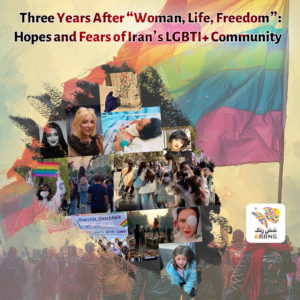
But three years on, how have hopes and fears evolved within this community?
To find out, 6Rang spoke with several LGBTI+ Iranians from different cities and walks of life.
Glimmers of Hope, Lasting Scars
Arad, a gay Kurdish man from Tehran, recalls those early days with both pride and emotion:
“Mahsa was Kurdish; I’m Kurdish too. My conscience wouldn’t let me stay silent. I went to the streets full of hope, believing everything could change. What gives me hope now is how much more aware people have become. Society is opening up, and more experts and allies are finding their place. People have big concerns, yet sometimes they see us standing beside them. Maybe hardship has brought us closer.”
For Arad, the past three years have been a time of witnessing small but meaningful shifts in public awareness; though he knows real transformation is still distant.
“At its core, this movement is about freedom, not just freedom from compulsory hijab. It’s about expanding the very meaning of freedom. When it matures, we’ll finally be able to say we are truly free.”
Between Hope and Harsh Reality
Maryam, a 28-year-old lesbian, describes those early days as a storm of conflicting emotions:
“Back then, everything came at once, fear, anger, joy, hope. But gradually, the darker emotions lingered. After the war and all that’s happened, my hopes feel shattered.”
Still, she sees slow progress in social understanding of LGBTI+ rights:
“Until we can live peacefully, legally, and culturally alongside the ones we love, the journey isn’t over, and that pain remains.”
Maryam believes the LGBTI+ community must become more organized if it wants lasting change:
“We need to know what we want, who could be our allies, and move forward in solidarity. Otherwise, we’ll be ignored again, or any future revolution will leave us behind.”
Yet she refuses to surrender hope:
“Even if most people say there’s no hope left, history shows a determined few can still find the path. Hope finds its way.”
Small Steps, Deep-Rooted Taboos
Maliheh, a lesbian from Isfahan, has witnessed some visible changes in daily lif, though not necessarily for her community:
“After the uprising, restrictions became lighter. In girls’ schools, I saw students walking freely without strict hijabs. Teachers were more lenient. But when it comes to LGBTI+ people, little has changed. The old taboos run deep.”
For Maliheh, real progress requires official recognition:
“As long as the state and the law treat us as illegal and sinful, social change will remain superficial.”
She sees hope only through political transformation:
“Many who oppose this regime don’t have issues with LGBTI+ people. If a revolution happens, there’s room for change. But under this government, there’s little to hope for.”
From Despair to Defiant Hope
Mahan, a gay man from Shiraz, remembers living in utter despair before “Woman, Life, Freedom”:
“I never thought this regime could fall. It targeted our very existence. I felt isolated, hopeless. But when the uprising began, despite all the pain, it lit a spark of hope. I asked myself, could this really be happening? ‘Woman, Life, Freedom?’”
He recalls nights filled with awe and solidarity:
“Every unveiled woman felt like a bullet fired at their [Mullas’] corrupted minds. Streets were filled with women walking freely, fearlessly. We hugged each other, as if promising freedom together.”
Three years later, his hope remains, tempered by realism:
“We’re not there yet, but we’re closer. The very existence of queer life challenges the Islamic Republic. I believe, in the end, we’ll deliver the final blow.”
“My fight began when this regime mocked love and stretched its cruelty beyond limits. Now, we move quietly but steadily toward our goals. One day, I’ll celebrate my wedding in Iran, openly, legally, and with tears of joy.”
Less Fear, Slow Normalization
Aaliya, a trans woman now living in Germany, is cautiously optimistic about changes inside Iran:
“The movement blurred old gender lines. Without strict dress codes, people see a wider range of appearances, not just the traditional ‘feminine’ or ‘masculine.’ That makes queerness less visible and less targeted.”
She believes younger generations, especially Gen Z, hold a more open mindset:
“We used to live only in struggle. Now, queer Iranians are beginning to live, not just fight for acceptance. Even in rural areas, people see us, we’re no longer invisible.”
For her, economic stability and cultural exposure could accelerate progress:
“When families have more access to new experiences, violence against queer people, and women, declines. I believe the future can be calmer, kinder, and more accepting.”
Resistance in the Face of Repression
Mana, a trans woman from Mashhad, recalls attending the cemetery in December 2022, on the day of protester Majidreza Rahnavard’s execution:
“The city was under tight security. At Behesht Reza Cemetery, security forces attacked us, shouting sexual slurs. But I refused to back down.”
She sees queerness itself as inherently political:
“Whether we like it or not, our existence is political. We must stand on the frontlines. I’ve promised myself: as long as I’m alive, I won’t stop fighting. I’m certain the Islamic Republic will fall soon, and we’ll live freely.”
Living Between Hope and Fear
Three years after “Woman, Life, Freedom,” Iran’s LGBTI+ community lives between hope and fear, hope for change, and fear born of long oppression.
For some, like Mahan and Aaliya, the uprising marked a turning point, a step toward visibility and normalization. For others, like Maryam and Maliheh, the absence of legal and structural support still deepens old wounds.
Yet across every story, one truth echoes: Iran’s queer community is more visible than ever. Their presence in the streets and in public discourse has opened a path that even the harshest repression cannot close.
The path to freedom remains long, but the sound of it, once heard, cannot be silenced.
The post Three Years After “Woman, Life, Freedom”: Hopes and Fears of Iran’s LGBTI+ Community appeared first on 6rang.
]]>The post “They See Us as Criminals”: New Report Exposes Systematic Persecution and Forced Displacement of LGBTI Iranians appeared first on 6rang.
]]>
Under international law, forced displacement, when widespread or systematic, may amount to a crime against humanity. This report, released to mark May 17, the International Day Against Homophobia, Biphobia, and Transphobia, is based on testimonies from 25 LGBTI Iranians who have fled the country. It documents a pattern in which legal vulnerability, family abuse, social exclusion, and constant government surveillance form a relentless cycle of forced migration.
Respondents reported experiences of domestic abuse, coerced marriages, conversion therapy, and threats of imprisonment as direct reasons for fleeing Iran. Nearly half, described being monitored or harassed by Iranian authorities even after leaving the country, illustrating the transnational reach of state repression.
Notably, 96% of participants were also members of ethnic or religious minorities, which further compounded their risk. 77% had endured direct violence from family members, often enabled by legal impunity and fear of seeking help. For most, seeking asylum was not a choice, it was a means of survival.
A non-binary respondent who fled Iran in 2017 told 6Rang:
“Iran’s laws see people like me as criminals. There was no way for me to legally change my identity, access gender-affirming healthcare, or even live freely. I was constantly at risk of arrest.”
A lesbian woman who escaped in 2023 said:
“My family saw my sexuality as a disgrace. They tried to force me into a marriage, and when I refused, I was beaten and locked in my home. I knew I had to escape before it was too late.”
Nearly half of the interviewees also reported experiencing threats or harassment abroad, including online abuse and smear campaigns led by Iranian state media.
“Even outside Iran, I am not safe,” said one trans activist in exile. “They spread lies, call us traitors, and try to silence us through fear.”
Transit countries such as Türkiye were also reported to be unsafe, with 76% of respondents facing violence, discrimination, or legal insecurity during their asylum processes.
All respondents said they cannot return to Iran due to threats of arrest, torture, or execution. In some cases, charges like “corruption on earth” have been used to seek the death penalty against LGBTI activists.
Legal and Political Context
Iran’s Islamic Penal Code criminalizes same-sex relations and gender non-conforming expression, with punishments ranging from flogging to execution.
- Articles 234, 236, and 239 outline penalties for same-sex intimacy.
- Article 638 criminalizes cross-dressing.
- In extreme cases, those who advocate for LGBTI rights can be prosecuted under Article 279 for “corruption on earth.”
High-level officials and state-controlled media have routinely promoted hate speech, portraying LGBTI individuals as “diseased,” “subhuman,” or “agents of the West.” This incitement fuels a broader culture of discrimination and violence across Iranian society.
Global Responsibility
6Rang is calling on the international community to take urgent action, to expand targeted asylum pathways, strengthen legal protections for queer refugees, and confront the extraterritorial persecution of LGBTI individuals by the Iranian state.
“We are witnessing a state-orchestrated campaign to erase LGBTI lives, not just in Iran, but beyond its borders,” Shadi Amin, Director of 6Rang, said.
“First and foremost, Iranian society must stop turning a blind eye. But the international community also bears responsibility. These are lives at risk, and silence equals complicity.”
The report makes one thing clear: displacement is not a choice, it is a last resort for survival in the face of criminalization, violence, and erasure.
Read 6Rang’s full report in response to the call for inputs by the UN Independent Expert on sexual orientation and gender identity [here].
The post “They See Us as Criminals”: New Report Exposes Systematic Persecution and Forced Displacement of LGBTI Iranians appeared first on 6rang.
]]>