The post A thru-hike in charts and numbers: PCT mileage stats appeared first on alice hikes.
]]>While I was hiking the Pacific Crest Trail last summer, I recorded where I slept each night in a paper journal. I filled up two Moleskines with mileage, campsites, stories, and stray feathers, and now I’ve pulled out that data and combed through it to give me a big-picture look at my PCT mileage over the entire course of the hike1.
Looking at a list of hike days all together has given me insight about my hike that I didn’t have before:
- Turns out, of my 160 day (159 night) trip, I slept 50 nights in towns or with trail angels, not on the trail.
- I hiked 15% further on days when I was entirely on trail (neither leaving nor arriving in a town).
- Of the nights I spent camped alone on the trail, 81% were before seeing that first cougar while night hiking.
- … and on it goes.
I thought some of you might find these stats interesting too, so I’m sharing them with you today.
How Far Each Day
Let’s start with straight-up mileage. I recorded where I slept each night, so I was able to get a picture of how far I went each and every day.
Total hike days: 160 (April 13 – September 19th, 2014)
This first chart shows my hiking mileage across my entire PCT hike. Hover over a day to see mileage for that day. You can use the tabs in the upper left to zoom in to a closer view of 3 months, 1 month, or 5 days.
The overall picture is all well and good, but it doesn’t tell me much about my average day. How often did I go a particular distance? Did I hike mostly 20s? 25s? 15s? I charted the frequency of different daily mileages to answer this question.
I most commonly hiked 19 or 20 miles per day, and somehow managed to never hike a 29 mile day.
Notes on Zeros and Neros:
- Of the 22 zeros, all were in town, none on trail. 5 (and 1 nero) were due to getting off trail for a family illness.
- Of the 14 nero days up to 10 miles, all started or ended at a town or resupply location
- Of the 18 days between 10 and 15 miles, 4 were in the high Sierra, 2 were with non-thru-hikers, 1 was north of Tuolumne, and the rest started or ended at a town or resupply location
Longest day: 31.6 miles past Olallie Lake
Shortest day: 1 mile across Lake Edison bottom to VVR ferry
Overall average (mean): 16.7 miles/day
Non-zero average (mean): 19.3 miles/day
All-on-trail average (mean): 22.2 miles/day. All-on-trail means I didn’t leave, arrive at, or pass through a town.
Total miles hiked: 2666.3
Eagle eyes will notice that the mileage I hiked doesn’t match the official total. I trail and road-walked around the Mountain Fire, Powerhouse Fire, and Endangered Species closures in southern California, and took a few ~10 mile shortcuts (Oregon Skyline Trail in OR and Goldmyer Hot Springs Alternate in WA).
Town or No Town
Though I had 22 zero days entirely in town, I passed through towns2 on far more days. In fact, I passed through towns on more days than not.
Let that sink in.
More of the 160 days I spent on the PCT saw me arriving in, departing from, staying in, or passing through towns, than days that were 100% on trail.
Not what I would have expected out of a long distance hiking trail. I will say, though, that I didn’t mind it terribly. While I preferred the wilderness sections of the PCT, I appreciated being able to carry less food in the areas with frequent roads, and I certainly could have chosen to stop in fewer towns.
Places to spend the night
I was able to tell from my journal where I had slept each night, and looking at the overall results surprised me a bit. Because I sometimes slept in town without staying a whole day there, the number of nights I slept in town is almost twice as high as the number of zero days I took (22).
Though I appreciate the hospitality and generosity of trail angels, I usually preferred the simple business transaction of paying money for a bed in a motel to the social obligations of staying with people, hence the low number of nights with trail angels.
Campground here means a camping area with some sort of toilet facility, usually for car camping. These were surprisingly frequent along the trail, particularly in SoCal, but also as far north as Rainy Pass and Hart’s Pass in Northern Washington.
Camping alone or with people
Because I started the hike solo, and didn’t join a hiking group until Oregon, I had this idea that I spent most nights alone, at least before my NorCal animal encounters. Turns out, that wasn’t actually the case.
For this chart, I’m only looking at the 109 nights I spent on the trail (including campgrounds), since I was never scared or lonely in a town — except for the dead-animal-smelling room in Chester, CA. That was a super sketch.
Here, 10 means 10 or more.
Notes on camping alone:
- Total nights alone: 26
- Alone before bear: 18
- Alone before cougar: 21
It’s interested to me to see that almost half of my nights on the trail were solo or with one other person. After the bear and the cougar, I was terrified to have another animal encounter on my own, and though I loved the control over my experience that hiking solo gave me, it didn’t feel worth the debilitating fear of the nights. I gave in to this fear for hundreds of miles, and it was only in mid-Washington that my need for solitude and to hike my own hike lead me to start overcoming this conditioning.
Though I loved the freedom of camping alone, some of my favorite nights on the trail were with one or two other hikers. It was lovely to get to make camp and unwind with other hikers, compare notes about the scenery we walked through, share aches and pains and tiny bottles of rum.
Some random numbers
Number of Snickers Bars Consumed: 138 (one for each non-zero day)
Longest number of days between zeros: 26 days (Bend to Stehekin)
Shortest number of days between zeros: 4 (Agua Dulce to Tehachapi, Tehachapi to Lake Isabella)
Unplanned zeros: all of them, I was terrible at planning where I was going to be when.
Number of times I hitchhiked (separate rides, not with people I knew): 17
Number of days I saw my husband: 22 (including 7 hiking days)
1
To get these numbers, I logged all of my mileage data into a spreadsheet using Google Sheets, then exported it as a CSV. I uploaded that to Mode Analytics and used their free service to run SQL queries over my data. I make zero claims to statistical significance about any of these numbers. I rounded to whole numbers when I felt like it. All the charts are made with Google Sheets as well.
2I counted as a town any place I could get a resupply package or purchase supplies. This includes lake resorts like Vermillion Valley Resort (VVR), Shelter Cove, Olallie Lake, Elk Lake, and Stehekin.
The post A thru-hike in charts and numbers: PCT mileage stats appeared first on alice hikes.
]]>The post Food on the PCT: How and what I actually ate appeared first on alice hikes.
]]>Despite this lifelong food obsession, never before hiking 2660 miles in one season have I truly, fully, completely understood the role of food as fuel in my body.
Food on a thru-hike is not a hobby. It’s not trivial. And it’s not always easy. Food on the PCT was energy, pure & simple.
In this post, I’ll talk about not only what I ate on the trail, but also how and when I ate. I’ll talk about how I adapted my diet to my changing needs over the course of the hike, and how I let go of off-trail considerations to listen to my body.

Things I didn’t eat: this old mushroom. My mycological skills are not good enough to ID anything but a chanterelle, and I wasn’t going to take chances on fungi.
Pre-trail preparations and changing preferences
As I described before my hike, I planned to eat food that was calorie dense and delicious. Before leaving for Campo, I bought a month’s worth of food and pre-packaged all the bulk snacks. By two weeks into the hike, I couldn’t stand most of what I’d mixed into those bags, and was very glad I hadn’t bought all 5 months in one go.
It was difficult to get all the calories down the first few days, as I’d expected. I managed by treating eating like a job, and forcing myself to chew mechanically even if I wasn’t interested.
It’s 10 am — eat your cheez-its! 2 pm already? Time to kill those macadamia nuts. It’s 7 pm and I still have to eat a Lärabar?
Bleh. (Shoves Lärabar in mouth.)
Because I had my partner at home mailing me boxes, it was straight-forward to call him from town and say “ditch the snack bags” and “no more dried fruit”. I continued adapting my boxes as I progressed through southern California, and by Oregon, I had my food dialed in.
While I am very glad I planned out the first month of food, I was even more glad that I hadn’t tried to plan the whole hike’s food. Not only did I figure out what food worked best for my thru-hiking style, but my preferences themselves changed as I hiked further.
From no-cook beans to hot chocolate and mac & cheese
The biggest food change I made on the hike was adding a stove at Agua Dulce. For the first 450 miles of the hike, my dinners were rehydrated bean soups with fritos, and I ate no hot anything.
I liked the bean soups (particularly the lentil soup), and didn’t mind eating cold food. What I found I did mind, was eating my cold plain food around other people. As long as I was alone when I ate, and not around other people when they ate a hot meal, I was totally fine with no-cook. I loved the convenience of not pulling out a stove, or having to worry about fuel, wind, or fires.
Unfortunately for my pack weight, I started to appreciate being around other hikers more and more in the mile 300s, and after too many nights staring at Lizard’s mac & cheese, or dreaming about hot chocolate before bed, I decided to add my stove at Agua Dulce instead of Kennedy Meadows.
By the time I got through the High Sierra, I was so used to my cooked dinner and hot chocolate routine that I didn’t even consider switching back to cook-less food.

I didn’t eat this grouse either, even though it walked two feet in front of me, tempting me with its plump body and careless ways.
Eating every hour to manage Hiker Hunger
“An eating and drinking contest, with a little exercise and scenery thrown in.” – Sunny Blende
Isn’t that the perfect description of thru-hiking? Sunny Blende wrote it about ultrarunning, but it’s entirely applicable for walking for 5 months too.
I started out breaking every 2 hours or so — actually stopping and sitting. This gave me time to air out and rest my poor tortured feet, and I would cram a few bars or handfuls of chips in my mouth while I sat. Over time, my breaks decreased, until in early Oregon I was only stopping twice a day for 30-45 minutes at a time.
To get enough calories, I ate while walking, with my trekking poles tucked under my left arm. I designated the left-hand pouch on my hipbelt as my snack pocket, and jammed it full of all my bars and nut butter for the day.
Real hiker hunger took time to get going, and once it arrived, had its peaks and valleys. The hunger was the highest in the High Sierra and Washington, when I felt like I could never get enough food, and came into town wanting to gnaw my own hand off. In most of Oregon, I would walk into town with a handful of bars left, so was carrying too much food.
When I learned to walk a 30 mile day in Southern Oregon, one of the tips I got, from Hot Tang, was to eat every hour, instead of every 2 hours. I adopted that practice and continued it all the way to Canada, regardless of my daily mileage.
When I was rehydrating my bean soups, I would do so at a break around 4:30 pm, then eat it around 5:30 – 6 pm. Once I switched to cooking, I mostly ate at camp, though preferred the nights when I forced myself to stop and cook before making camp.
Sample Day of Food
The chart below shows an example of a whole day’s food in Washington. At 4830 calories, this was probably the most I ever ate in one day. It was also definitely not enough for some of the North Cascades days.
| Sample Day of Penguin food on the PCT | |||
|---|---|---|---|
| Time | Food | Calories | |
| Start hiking | 1 iced coffee packet | 80 | |
| Start hiking | 2 Nature’s Path pop tarts | 420 | |
| Before AM break | 1L Gatorade | 225 | |
| 1 hr later | 1 Clif Bar | 240 | |
| 1 hr later | 1 KIND bar | 190 | |
| AM break | 2 tortillas | 200 | |
| AM break | 1 packet tuna in oil | 190 | |
| AM break | 1/2 avocado | 120 | |
| AM break | peach | 60 | |
| 1 hr later | 1 Lärabar | 220 | |
| 1 hr later | 1 almond Snickers | 230 | |
| 1 hr later | 1 granola bar | 90 | |
| PM break | 1 packet Ramen noodle soup | 380 | |
| PM break | 1 bag Dorito chips | 240 | |
| PM break | 1 oz beef jerky | 80 | |
| 1 hr later | handful black licorice | 160 | |
| 1 hr later | 1 Justin’s almond butter packet | 190 | |
| 1 hr later | 2 Stretch Island fruit leathers | 90 | |
| At camp | 1 box Annie’s Mac & Cheese | 675 | |
| At camp | 2 oz summer sausage | 170 | |
| At camp | 2 oz Tillamook sharp white cheddar | 220 | |
| At camp | 1 hot chocolate packet | 110 | |
| At camp | 1/4 chocolate bar | 250 | |
| Total | ALL THE FOOD. MOAR PLEASE. | 4830 | |
The intersection of comfort, fuel, & variety
Once I was switching up food on the trail, I sometimes did a calories/ounce calculation, but not always. This meant that some of my foods, particularly dinners and the fruit leather, were below my 100 cal/ounce standard. I found them still worthwhile to bring, but do look forward to bringing my food weight down by being a bit more careful about density.
With that caveat, here is basic selection of food I settled into on the trail:
Breakfasts: PROBARs (got real sick of these by Ashland), Nature’s Path Toaster Pastries (Pop Tarts — superior to Kelloggs), brownies (good when not crumbly)
Bars: ClifBars, Lärabars, KIND bars, granola bars (low cal), Snickers (particularly Almond), Almond Joy
Misc: black licorice, Reese’s Pieces, peanut M&Ms, Doritos or other corn chips, potato chips, Fritos
Fruit & nuts: fruit leather, chocolate-covered macadamia nuts, peaches, plums,
Lunch: bread (tortillas, bagels, pita pockets) w/ meat (tuna in oil, lemon pepper flavor, sun-dried tomato flavor, jalepeño flavor, or salami slices) & cheese (cream cheese, brie, cheddar, monterey jack) & avocado; ramen noodles
Dinner: Annie’s Mac & Cheese, Knorr Rice Sides (chicken flavor), or Pasta Sides (Alfredo) with summer sausage & cheese (and butter in the Sierra); Mountain House (beef stroganoff, beef stew, chicken teriyaki); bean soup (black bean, split pea, chili) w/ olive oil & fritos
Drinks: Starbucks VIA coffee packets (2 at a time), Starbucks VIA Iced Coffee or Refreshers Very Berry Hibiscus packets (1 at a time), Gatorade powder (Lemon-lime flavor), hot chocolate, hot apple cider
Foods I tried and hated: Odwalla bars (gross, farty), fruit snacks (low cal, too low enjoyment), CHOCOLATE (for real — I could rarely get myself to eat my chocolate bars, even when starving)

I didn’t even eat these edible stinging nettles. Just looked at them long enough to think “huh, if I cared, I could eat those”, and walked on.
A note on beverages
Pre-hike, I didn’t think too much about what I would drink on the trail, other than plain water. I don’t mind the taste of chemicals in my water, so I hadn’t planned to cover the taste of my treatment. I had even weaned myself out of my 12-18 oz daily coffee habit before departing.
My hike improved noticeably when I started adding in beverages. The gatorade came pretty quickly — I saw other people drinking it and craved it. I added Nuun to the mix at Agua Dulce when I picked some up at REI for Chimp. I drank one tab of that daily until I got suddenly sick of it in Oregon.
Sometime around then I added in cold coffee — I would add 2 packets to a half-full water bottle, shake it up, and drink it while I ate my breakfast pop tarts. After I was done with the coffee, I’d make a full bottle of gatorade and sip that during the morning.
I usually made my hot chocolate (or hot apple cider) at camp, but sometimes I would mix it into cold water in one of my water bottles during the last part of the day and have it as a chocolate shake. I recommend two hot chocolates per day, for maximal deliciousness.
One thing I always did around beverages was make sure I always had plain water for cleaning my hands or washing out cuts. This meant that sometimes I wouldn’t make coffee until mid morning, or I’d delay Gatorade ’til the afternoon. I was glad for this practice when I gashed my thumb near Donahue Pass and had plenty of water to clean out the 3/4″ cut.
Reflections on food choices
Some of my favorite days on the trail were ones when I made dinner early and walked on into the dusk, then had a super simple camp setup. I loved the light at that time of day, and it was nice to get a larger meal before 8 or 9 pm. On further backpacking trips or long hikes, I plan to try this out more and see if I can get it a comfortable part of my routine.
The main reason I didn’t stop early to cook every night was because the people I was hiking with (in Oregon, at least) preferred to cook at camp, and I found it easiest for motivation and companionship to follow their schedule.
Whether or not I do an early dinner and hike more, or do no-cook will depend a lot on who I hike with in the future. It would be fun to find hiking partners whose eating styles matched — this wasn’t something I realized to consider on the PCT.
I would definitely do the snacks-in-the-hipbelt, eat-every-hour hiking method in the future. Heck, I do it on 3 mile day hikes now. It keeps me well fueled, and counteracts the food anxiety. It also allows me to get enough calories during the day that I don’t have to eat more than 600-1000 at one sitting.
One thing I would try next time is eat something right before sleeping. I ate before getting in my tent, but then I would lie there reading and writing in my journal, sometimes for an hour or more. I suspect I would be warmer throughout the night with a snack after book time.
I had made a promise to myself before the trail that I would always have time to stop and take a picture, and when I got into huckleberry territory, I made a similar promise: I would always have time to pick and eat berries. Sometimes that slowed down my mileage a bit (okay, A LOT), but those huckleberry miles were well worth it.

Finally, something I did eat! Huckleberries & the less common blueberries stained my mouth and hands red for miles of OR & WA.
Letting go on the trail
At home, I don’t eat at MacDonalds, I avoid hot dogs and other super processed foods, and I never eat candy bars. I try to know where my meat was raised, and minimize the number of pesticides on my veggies. Picture the Portlandia eco-foodie stereotype and that’s about right.
I let go of my food ethics when I started my hike. Well, maybe not right when I started… but I left them behind pretty quickly on the trail.
With every day being another relentless push northward, slowly breaking down my body and will, I just couldn’t care about the same things I cared about when I lived in a city, slept in a warm bed, and wasn’t in motion 10-12 hours a day.
I still bought the foods I preferred when I had a choice, but when I didn’t, I let myself eat whatever was there. Early on, I had some struggles in the grocery store, and realized that trying to stick to particular food-sourcing was going to be a big mental drain, and I just didn’t have the bandwidth to do it.
I couldn’t walk from Mexico to Canada AND care where my calories came from, be it junk food or questionable hamburgers in town. I met plenty of people who did care, and I salute their mental fortitude, and am glad I knew myself enough to make the right choice for me.
—-
So there you have it, the identity of the half million calories I ate on the Pacific Crest Trail. If there’s anything I left out or you have a question, please leave a comment below.
The post Food on the PCT: How and what I actually ate appeared first on alice hikes.
]]>The post Music and Audiobooks for Better Hiking on the PCT appeared first on alice hikes.
]]>By the time I neared mile 1000, I was starting to go out of my mind with loneliness and exhaustion on big hill climbs. Something needed to change.

And the headphone selfies begin. Stoked to be near town, before the descent to the Feather River & Belden.
I looked around me, saw the majority of other hikers using headphones to listen to music, and decided to make a change. By mile 1200, I had acquired all the tools necessary to plug in and listen all day while I hiked — and boy, am I glad I did.
Particularly when I was hiking solo, audio gave me something to focus on while I walked, and, I’m pretty sure, saved my sanity.
In this post, I’ll talk about why I didn’t start with music on the PCT, why I made the change, what gear set-up I used, and what I listened to (including how to get audio books for free, legally).
Why no music?
I enjoy listening to music at home, but I wouldn’t call myself a dedicated music person. I’d had a long-lasting dislike for wearing headphones — they made me feel claustrophobic. Even when I was training for half marathons in 2006 and 2011, I didn’t use headphones & music to relieve the boredom or provide inspiration.
Given my lack of strong attachment to particular music, I didn’t load any onto my iPhone before starting the trail. Heck, I wasn’t even carrying headphones. My plan had been to keep the phone in my pack for emergencies, and I had no solar panel or battery pack to allow for frequent usage.
For the most part, I didn’t miss music in the beginning of the hike. I occasionally wanted to hear particular songs, but I could do so by YouTubing the videos over wifi in town. I liked having the time alone with my thoughts on the trail, and I loved getting to know the sounds of the forest.
The beauty of solitude only lasted 900 miles or so, though, and I eventually hit a wall.
Making the change to headphones & music
I was sitting on a rock before Sonora Pass one day, working on not crying, when Swig from Weed came up the trail. We’d been leap-frogging since Forester Pass, and would continue to do so until Buck’s Lake, making him one of my most consistent hiking companions in California. It had been a brutal few days out of Tuolumne Meadows, mostly because I had thought the hardest parts of the Sierra were behind me.
(Little did I know, the 3rd & 4th steepest parts of the PCT were descents in that section.)
Swig called out, “Well look at that, a Penguin sunning herself in the Sierra!”
It was so cheerful, and friendly — my spirits were raised completely. We got to talking about how hard the last few days had been, and he told me his trick for combatting the blues: music.
He had a solar panel (a Goal Zero that he wasn’t a big fan of), some earbuds, and a lot of music on his phone. He kept one headphone in, and played music on all the big climbs to keep him going steadily.
I was ripe for something to try, and that’s all it took to convince me.
The set-up: solar panel, battery, Spotify, & earbuds
Once I’d decided on getting music, I went all out. As soon as I got to Lake Tahoe, I set up a paid Spotify account ($10 monthly, or ~$30 for the rest of the hike) and started researching tools to have enough power to listen to music for 10+ hours a day.
I checked out other hikers’ gear, and asked for recommendations. People pretty much either had the Suntactics sCharger-5 USB solar charger, or had complaints, so that was an easy choice. After Loveline lent me his mini external battery to charge my phone at Carson Pass, I decided to copy his entire set-up: the Suntactics panel and the Anker Astro Mini 3000mAh External Battery. During the day he would charge the external battery, then charge his phone off the charged battery at night, and he said that let him have full power daily.
I picked up a pair of cheap earbuds at Staples in South Lake Tahoe, and ordered my panel & battery online, to be shipped to Sierra City.
From Sierra City on, I strapped the solar panel onto the top of my ULA Circuit pack every day, and tucked the external battery into the big mesh pocket. I learned quickly not to leave my phone charging in direct sun (the phone overheats and gives scary warning messages), and adjusted to hooking up the phone to the battery once I made camp, to snuggle in my sleeping bag with me as it charged overnight.

Entering Lassen Volcanic National Park, with my solar panel on my pack and one headphone in.
I was very pleased with this set-up, and used it for the entire hike. As I mentioned in my small items gear review, I had some headphones problems in Central Washington, so I ended up replacing those. Next time I would plan ahead and get a slightly nicer set of earbuds that allowed me to change or pause the song without using my phone.
Hiking Rhythm
Once I was listening to music, I fell into a natural rhythm of hiking through an entire album, then pausing to drink water and check Guthook. I usually got about 2 miles per album; I would break long enough to cue up the next album, but often no more than that. This decrease in long breaks was a big factor in getting my daily mileage up to the point where I could do 30s.
And it felt pretty damn good to realize I could hike uphill for 45+ minutes without stopping. That’s the power of a marching beat and hiker legs, eh?!
On-trail safety & courtesy
I followed my buddy Swig’s lead, and only ever used one earphone while hiking. This meant I got lower sound quality on all my audio, but I found that a better alternative to not being able to hear what was going on around me.
The PCT is a busy trail, particularly near trailheads and day-hike areas, and I wanted to always be able to hear not only wildlife (don’t wanna miss that bear roaring, or the lack of birds singing), but also people trying to pass me or calling for help on the trail.
I wrapped the other headphone cable around my sternum strap to keep it from tangling in branches.
A few times, I used my phone to broadcast music for a group I was hiking with, the rare times I was around people who would admit to liking Britney Spears (love you, Mozzie and Emu!). I made sure not to do this around day-hikers, and did my best to make sure I didn’t blast the ears of any unwilling victims.
My super tasteful audio selection
I loved what I listened to on the trail — and you might hate it. That’s totally fine, go right ahead.
If you’re curious about what I listened to, here’s the deets:
Music
Music choice on the trail (and everywhere) is a matter of personal taste; I found it a fun process to find out what worked for me.
I did a combination of picking music I already liked, trying out new stuff I was curious about, and getting recommendations from audiophiles in my life. It fell into two basic categories (** indicate music I think is particularly great for hiking):
Upbeat music: for climbing hills, or keeping going when tired — anytime I wanted to march to a fast regular beat
- Britney Spears, Femme Fatale **
- Cher Lloyd, Sorry I’m Late **
- Calvin Harris, 18 Months **
- Chromeo, White Women **
- Ke$ha, Animal **
- Duck Sauce, Quack
- Mika, The Origin of Love
- Muse, Black Holes and Revelations ** and The Resistance
- The Faint, Danse Macabre
- Metric, Fantasies **
- Franz Ferdinand, Franz Ferdinand
- Katy Perry, Teenage Dream
- New Pornographers, Electric Version
- Ratatat, Ratatat and Classics **
- Ra Ra Riot, The Rhumb Line
- Robyn, Body Talk **
- David Guetta, anything with Rihanna or Sia **
Pretty/Sad music: for easy listening, flat stretches, chill mornings, calm evenings
- a selection from the Nashville (tv show) soundtrack **
- this was ~80% of what I listened to for a couple hundred miles. SO GOOD.
- Bon Iver, For Emma, Forever Ago **
- The National, Boxer ** and High Violet
- Fleetwood Mac, Rumours **
- The Civil Wars, Barton Hollow **
- Gary Allen, Greatest Hits
- Imogen Heap, Speak for Yourself
- Kacey Musgraves, Same Trailer Different Park
- Maggie Rose, Cut to Impress
- Leonard Cohen, The Essential Leonard Cohen **
- The Magnetic Fields, 69 Love Songs
- Of Monsters & Men, My Head is an Animal **
- Rilo Kiley, More Adventurous
- Vampire Weekend, Vampire Weekend ** and Contra
- Sia, We are Born
- Tegan & Sarah, Heartthrob
Podcasts
Eventually, I wearied of listening to 45 minute chunks of music, and tried out the next most popular audio on the trail: podcasts. I’d never listened to podcasts at home, so I picked up a few recommendations and listened to those:
- Dan Carlin, Hardcore History
- super interesting, super dense, a little goes a long way
- Dan Savage, Savage Lovecast
- the audio counterpart to Dan Savage’s column; if you’re not a reader of the column, uh, be aware that this is quite explicit. sexually.
While I enjoyed these podcasts, particularly Savage Lovecast, I found myself rarely choosing to listen to them. That’s probably because around the same time, I discovered…
Audio books (free!)
I had been checking out e-books from my home public library for the entire duration of the trip, but didn’t make the leap to audio books until I got to Oregon. At that point, I was starting to get a little tired of just music all day, every day, and realized that I could download entire books to listen to.
If you’re not already familiar with your public library’s digital media selection, go educate yourself! Public libraries are wonderful resources for thru-hikers — how else can you get books anytime you have wifi, from anywhere in the world, for free?! Audio books can be quite pricey to purchase (~$40 on Amazon), so it’s not a trivial matter to have access to a wide selection for free.
If you haven’t done so already, you can access these books by getting a library card, downloading the OverDrive app on your phone (iOS, Android, Windows), find your local library in the app and adding it to your phone, and saving your library card number in the app. If you have multiple library cards, you can set up multiple libraries for extra selection.
Once you’ve got the library & card number in your phone, you’re set for the rest of the hike. Each library has different limits on how many books you can have out (mine allow 5-7 at a time per library), but generally it’s enough to get from one town to the next, no problem.
It takes time and bandwidth to download audio files, so it’s best to do so over wifi. If there’s no or poor wifi (*shakes fist at the Snoqualmie Pass motel*), be prepared to incur extra data charges. I found it worth it. YMMV.
Beware downloading errors: One thing you should also know is that it is possible for a file to download incompletely. If this happens, you’ll be listening to a book, days from town, when suddenly it skips forward and you lose whole chapters or sections. It’s like finding the pages ripped out of a book, but hey, at least you’re free to spit out some truly foul expletives ’cause hey, you’re in the wilderness and no one will hear you.
This happened to me twice on the trail, so I recommend you check the size of the downloaded files before leaving town. Each book usually has 10-25 sections, and they should all be approximately the same size, except for perhaps the last one. If any section looks significantly different in size, I recommend deleting it and downloading it again.
I didn’t try out any paid services like Audible, and would love to hear from readers who have experience with those. Worth it? Tell us in the comments.
Here’s what I listened to:
- Scott Lynch, The Lies of Locke Lamora
- excellent book, great narrator, my favorite new fantasy read in years
- Robert Jordan, The Eye of the World
- not the best book, more of a “hey, when else will I read this” choice, but suitably entertaining
- Robert Jordan, The Great Hunt
- … see above
At some point in Washington, I calculated that, if each book were as long as the first one (24 hours of audio) I wouldn’t have time to finish listening to the entire 14 book Wheel of Time series on the trail, even if I listened every minute I was hiking. This made the hike seem shorter, which gave me comfort. As you see above, though, I didn’t even make it through Book 2…
At the end of the day
I loved having audio to listen to on the trail. Between my dance albums, slow sweet music, raunchy podcasts, and alternately stellar and cheesy fantasy novels, I always had something to keep me moving forward and motivated.
While I occasionally missed hearing more of the bird song and nature noises on the trail, in the end, I needed something more to keep going all 2660 miles, and I am very glad that I found that in audio.
Now, in my off-trail life, I find myself listening to entire albums more often than pre-trail. I think having all those hours of focused music appreciation, particularly in nature, really opened me up to listening more actively to tunes, and I’ve found myself enjoying different artists, or familiar artists in new ways.
I’m always happy to get new hiking music recommendations, so if you have any favorite hiking music or other audio, please share it in the comments!
The post Music and Audiobooks for Better Hiking on the PCT appeared first on alice hikes.
]]>The post PCT gear lists: start vs. finish appeared first on alice hikes.
]]>PCT hiker starts with way too much gear, because they didn’t know what they were getting into, then ditches items along the way as they realize they don’t need them. Hiker finishes with a much lighter pack, mirroring their greater understanding of the simplicity of actual human needs, as taught by The Trail. Yada yada.
This was not my story.

Here’s a totally unrelated picture of the inflorescence of a lanceleaf liveforever plant (Dudleya lanceolata), by the PCT in Southern California. You’re welcome.
If you have been following along with my clothing and gear reviews, you will have noticed that I finished with different gear than I started with. I finished weighing all the gear I bought or borrowed during the hike, and as I suspected, found that I added about 5 lbs to my base weight.
Basically, I started with my minimum requirements, and added what I decided I wanted as I went. Worked for me!
So where exactly did that extra weight come from, and how did I feel about it? Read on to find out.
The PCT Gear List(s)
I’ll let you start by taking a look for yourself at my final gear lists below. I have shamelessly copied the format of Justin “Trauma” Lichter’s Winter PCT gear list, with two lists in one, by means of separate columns for start and finish. If I carried an item at both the start (Campo) and finish of my hike (Manning Park), its weight is listed in both columns. As before, individual weights are shown in ounces, with pound weights shown per category and in the base weight and skin-out weight totals.
After listing all my gear, I list the special categories: Sierra and Desert. Finally, I show an estimated total weight for the start of 4 day section, and for my departure from Kennedy Meadows.
Note: These gears lists are not recommendations, rather records of what I used.
Oof! What a beast.
Let’s talk about it.
I really cared about gear before the trail. I wanted to push my limits, to try the lightweight gear I was curious about, and see just how little I could do with. Far from being unprepared by carrying too much, I swung fa-a-ar the other direction, and was unprepared by not having sufficiently practiced with the little that I brought. And didn’t care! I knew enough to know how to stay safe and found on the trail, if not precisely comfortable, in case of some user error regarding the little-tested gear.
And I’m glad I did push my boundaries like this. I’d do it again.
Even now, after the trail, I still enjoy researching gear and thinking about optimal backpacking & thru-hiking systems.
On the trail, however, I didn’t give a shit.
For real, I just didn’t care. I spent hours and HOURS researching tiny details at home, then on the trail would spend 5 minutes and just be DONE. It was a glorious feeling, not giving a shit. Really, it’s one of my favorite take-aways from the hike: once you’re out there, the most optimal piece of gear in the world is not as useful as the working piece of gear in your hand.
I’m not saying I didn’t care when my pack felt heavy. Trust me, I cared. That 41 lbs carry out of Kennedy Meadows?! That sucked. What I didn’t care about, was whether I was being an Ultralight Hiker. I just wanted to be a PCT hiker, all other adjectives optional.
My base weight increased by ~5.2 lbs on the trail, and I was fine. At my average trail body weight of 140 lbs, a 25% load would have been 35 lbs. My 4 day carry estimate put my total pack weight with the heavier final gear at 27.3 lbs — only 19.5% of body weight.
Though my base weight increased over the course of the hike, I am glad that I started out with it as low as it was. Between getting my feet and legs used to walking 20 miles a day, getting my mind used to being in a constant state of motion, and carrying 4 liters of water at a time, having the start of the hike be at the easiest weight setting I could manage was wonderful.
Different next time? Sure.
Despite being satisfied with the gear I used to finish the hike (after all, I got to Canada with it), I would certainly make some changes from that gear for the next thru-hike, particularly if money weren’t an issue.
My 12 oz Rab down jacket is just too heavy to be optimal for thru-hiking, especially when there’s an ~8 oz Montbell down parka on the market. Same for the 10.5 oz Patagonia raincoat. And I am curious about the ZPacks Arc Blast pack, and the Gossamer Gear Mariposa, and lots of other lighter pieces of gear.
Alcohol stoves! Flat tarps! Cuben fiber! So much to research, so much to try.
Final thoughts
While I enjoyed researching lightweight gear options prior to the trail, and look forward to continuing to explore my limits on the trail, my only goal once I was out on the PCT was to finish the hike alive and with all my limbs intact. I found that I didn’t care if I finished fast, or with UL cred, just that I finished (and enjoyed my time).
I was a bit surprised that I felt this way. I thought I would care more that I didn’t use all my boundary-pushing-for-me gear (frameless pack, quilt, poncho-tarp, no-cook system) the whole way, or even half of the way.
I think what happened was that my mind figured out that it only had so much bandwidth while undergoing the tremendous stress of thru-hiking. To accomplish my aim, I set aside all other goals and focused on just walking. Testing certain hiking methodologies, or more precisely, my comfort or interest in such methodologies, turned out to use up too much bandwidth, and I chose to throttle back to the basics of just walking to Canada, with whatever gear would get me there.
On the days when getting myself to keep going was a struggle, not having to tough it out with cold food or a non-private shelter really REALLY helped.
Perhaps now that I have one successful thru-hike under my belt, I’ll have more bandwidth for using more minimal or ultralight gear on the trail. Or even better, I could get out there on more shorter backpacking trips and actually practice with gear in lower stakes situations.
Or, maybe I just like my comforts and only like the idea of ultralight hiking. That would be fine too. Everything is fine.
(See, I didn’t miss all the deep lessons of The Trail.)
For now, I’ll keep researching and planning until the day I leave, then leave it all at the trailhead.
The post PCT gear lists: start vs. finish appeared first on alice hikes.
]]>The post PCT gear review: the small stuff appeared first on alice hikes.
]]>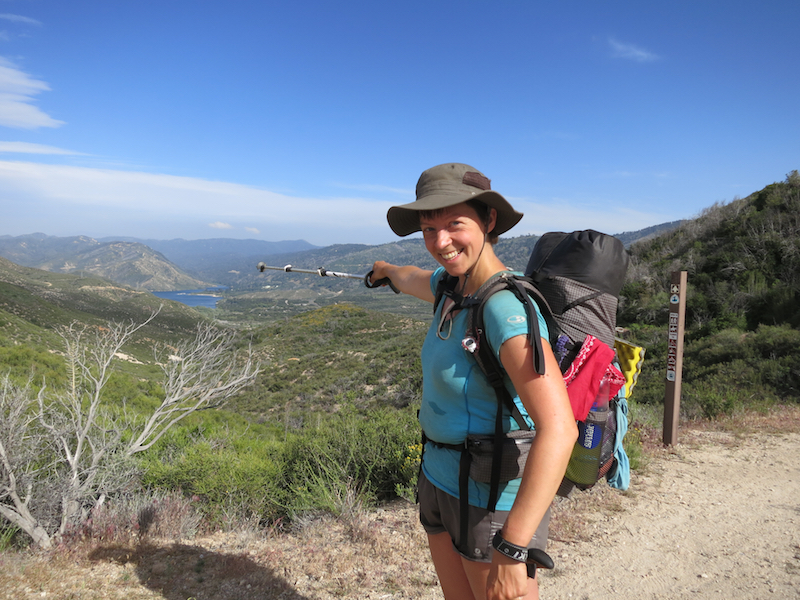
Using my trekking pole to point out Silverwood Lake in SoCal.
Feel free to jump to the topic of your choice:
- food preparation
- water treatment
- Sierra gear
- trekking poles
- survival & tools
- electronics
- medical kit & personal items
- ziplocs
Food preparation
I went no-cook (i.e. didn’t carry a stove) from Campo to Agua Dulce, and was pretty happy with it. I used a small peanut butter jar to rehydrate soup mixes, and a Light My Fire Spork to stir and eat. It doesn’t really matter what kind of jar you use, as long as it has a tight seal; it is nice, though, to be able to fit your hand inside it for cleaning. I would use something like the Talenti Gelato jars next time — any gear choice that starts with eating ice-cream is a good call in my book.
At Agua Dulce, I picked up my MSR MicroRocket canister stove and 0.85L MSR Titan Kettle, and carried both the rest of the way to Canada. I had always planned to have the stove when I entered the Sierra, so that I’d have a way to make hot water to treat hypothermia. I found while doing no-cook, that if I was alone when I ate, I had no problems with it. If I was around other people cooking at night, I missed hot food real bad; I found myself eyeballing Lizard & Boomerang’s Mac & Cheese SO HARD. I also developed a strong hankering for hot chocolate, so stove it was.
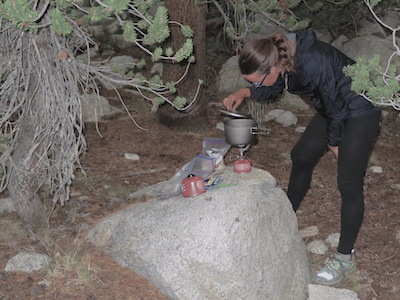
Using the MSR MicroRocket and Titan Kettle on the JMT in 2013.
I should add that adding a stove increased my weight not only due to the weight of the stove and fuel, but because the food I cooked was almost always fewer calories/ounce than bean soup with fritos.
The MicroRocket worked great for me. I was always able to find gas canisters when I needed them; they don’t have to be MSR, but they do have to have the right type of attachment — if in doubt, always check. I didn’t realize how much left-over fuel I had been putting in the hiker box until Washington, when I used the same 4 oz canister from Cascade Locks all the way to Stehekin — over 350 miles. At the time I was cooking dinner every night (Mac & Cheese, rice side, etc.), making 12 oz of hot chocolate, and sometimes cooking a ramen lunch, so it wasn’t like I was barely using the thing.
I also had no issues with getting the stove lit, even in cold temperatures. It heats less quickly and uses more fuel than a Jetboil-style stove, and the fuel cans are heavier than carrying HEET for an alcohol stove. I liked using it despite those traits, as it packs down small (fits inside the Titan Kettle), and it passed the SoCal fire ban requirement of having an off switch.
The Titan Kettle (titanium pot) was also great. I used my hat and buff (in hat configuration) as pot cozies every night, and only spilled food on them once a section or so. It held all my food just fine, though the larger meals got pretty close to the top.
I drank my hot chocolate out of the Titan Kettle until I picked up a light plastic beer mug at the Bend Brewfast; I carried that for the rest of the hike so that I could make my hot chocolate before rehydrating food in the pot.
The Light My Fire spork broke somewhere in the early Sierra. First it cracked, then it snapped below the bowl of the spork. I made do with the stubby spork for several days until I got to Bishop, where I picked up a Vargo Titanium Eagle Spork. The “eagle” bit means it has a tiny carabiner-clip at one end, so you don’t lose it, I guess? I never used the clip, unless you count getting it accidentally clipped to the mesh of my pack. The titanium spork was much more solid than the plastic one — didn’t break, didn’t heat up, could scrape the bottom of the pot better. It was worth the ~$10 to not worry about another utensil busting on me in the backcountry.
The Verdict: I am interested to try out an alcohol stove one of these days, as I saw many hikers using them safely (and a few setting small smoldering fires that they put out…), but until that point, I’m happy with my little MSR MicroRocket stove with the 0.85L MSR Titan Kettle. I might carry the plastic beer mug again, but would skip it if I was trying to lighten up. I would use another titanium fork, like the plain, clip-less Vargo Titanium Spork.
Water treatment
After using the Sawyer Squeeze on the JMT, I decided to try chemicals on the PCT. I used a halogen to treat my drinking water all but a handful of times on the trail, and would do it again. I started out using Aquamira drops, which use chlorine dioxide to kill waterborne pathogens; according to the CDC’s guide to backcountry water treatment, chlorine dioxide is great against bacteria, viruses, and giardia, and weak against cryptosporidium. I found the drops a bit annoying — you have to mix two parts, wait 5 minutes, add it to your water, then wait another 15-30 minutes before drinking. I think the recommendation is for even longer if the water is colder.
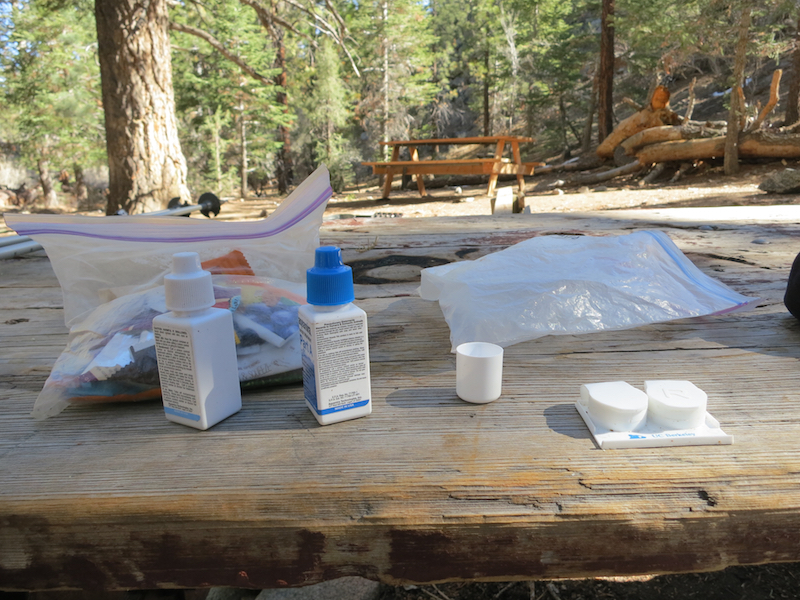
Waiting for Aquamira drops to mix on a picnic table before Big Bear Lake.
I carried an old contact case (pictured above) for mixing two doses of Aquamira simultaneously. I read this online somewhere, don’t remember where. I loved this method, and kept using it even after one lens case started cracking.
I used my bandana to filter big chunks in Southern California, and found that it worked way faster with a larger bottle opening; I started carrying at least one Gatorade bottle to accommodate this.
My first set of Aquamira drops lasted me all the way to Bishop, about 800 miles in. At that point, I switched to using bleach (chlorine). One small (10 mL) bottle lasted me until Ashland, and the next bottle lasted from Bend to Canada.
A note on types of bleach: look on the bottles when you buy, and avoid getting a gel-type bleach. I did this by accident in Ashland, and spent the next several hundred miles wondering if the gel was mixing into my water effectively. Maybe it was? I just didn’t know. It didn’t instantly disperse in the bottle the way regular liquid bleach does, and I decided to not take the chance. I found regular bleach in Bend and dumped the gel.
Bleach is a easier to use than Aquamira — add a drop to a liter of water and wait 30 minutes. The CDC lists it as having high effectiveness against bacteria and virus, but weak against giardia and not effective for cryptosporidium, so it’s chancier than Aquamira. I started by adding 3 drops to a liter, thought that tasted like a swimming pool, then did 2 drops for a day or so, then dropped to a single drop. If a water source looked really sketchy, I’d do two.
The biggest downside to chemical treatment to me was the wait time. If the water was really cold, I would wait an hour for treatment, which meant that I would carry extra water so that I wasn’t refilling only when I was totally out. It was hard at times to watch friends drinking from their Sawyer Squeezes immediately, and I did use my friend’s Steri-pen a few times in Oregon.
I didn’t mind the taste of 1 drop of bleach in 1L of water. Some water out there tastes bad anyway — hello, cow water.
I never got sick from the water on the trail; I would have counted this as three or more bouts of diarrhea in a row. This doesn’t mean my treatment was effective — I might have just not encountered giardia or crypto, or I may have some immunity to giardia.
About two weeks before the end of the trail, I started joking about being in the “giardia-free zone”, which meant that if I contracted giardia from that point forward, I wouldn’t get the symptoms until *after* I had finished the hike. I started being a little less careful about treating my water, though that meant I occasionally drank untreated water from springs where I could see the water coming straight out of the mountain.
Though this must have tempted the gods, I didn’t get any symptoms after the trail either.
I know quite a few thru-hikers who did get giardia or some other persistant nasty GI issue, including one for whom it ended his hike. Even more so than most gear choices, water treatment choice is a very personal one, and one that can have debilitating trail-ending consequences. I saw lots of hikers happy with their Sawyer Squeezes and Steri-pens.
The Verdict: I’ll continue using household bleach in a mini dropper bottle to treat my water in the backcountry, with an occasional bandana to filter out the big chunks.
Sierra gear
Ice/snow traction
I carried Kahtoola Microspikes through the High Sierra, from Kennedy Meadows to South Lake Tahoe, for added traction in icy conditions. They slip over your shoes and provide more traction than the coil-based Yaktrax, for example, but less than full mountaineering crampons. They were extremely helpful when I was descending Mather Pass — the trail was snowed over, and it was fastest and safest-feeling to walk down across an icy snowfield as far as I could, rather than rock-hop the entire way. Combined with my trekking poles, the microspikes kept my feet on the ground, and the rest of me in one place.
When the microspikes weren’t useful was, 1) when I wasn’t using them, and 2) when the snow was too soft to grip.
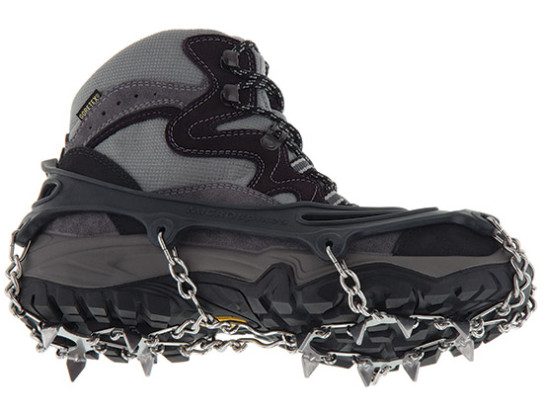
Kahtoola MICROspikes. Image from the Kahtoola website.
I took them off before I slipped on Glen Pass, as they didn’t seem to be helping my travel. Looking back, I think using them and being more patient could have led to a safer descent on that pass. As for soft snow, so much of safe crossing the Sierra passes is timing — early enough that the snow is hard and you don’t post-hole, but not so early that the snow is still icy and slippery. At that right time, microspikes can be very useful. The tricky thing is that it takes time to cross the snowy patches, so the spikes might not be that great for the off-peak hours when you still have to be crossing snow (i.e. when it’s still slick, or when it has started to soften up).
I chose not to bring an ice-ax on the hike, largely because I didn’t know how to use one. If I do another big hike with snowy regions, I will be doing some snow safety training ahead of time, and will bring an ice-ax if I think the terrain and conditions warrant it.
I know hikers who entered the Sierra a few weeks after me, and had virtually zero snow on the passes. I, on the other hand, entered two weeks before the standard “safe entry” date (June 15th), so should have given more thought to what that meant for snow conditions.
A Portland hiker named Leapfrog told me how he uses trekking poles to self-arrest during glissading, and I used his technique with success on Forester Pass. If I were to not bring an ice-ax next time, I would make sure I knew how to use my trekking poles, and like with an ice-ax, carry them in ready position if I should need to self-arrest.
The Verdict: I would carry the Kahtoola Microspikes again, and consider an ice-ax (with training).
Eye protection
The last bit of snow-specific gear I carried in the Sierra was good(ish) sunglasses. I carried a pair of tinted but not polarized glasses for the first part of the hike, and had found that wearing them in low light made it almost impossible to see. I kid you not — wearing those glasses at dusk turned my field of vision into a dark impenetrable haze. I also sat on them at some point, and had taped them together to make it to the next town.
When I got to Bishop, I browsed the gear stores’ selection of sunglasses, and spent a bit more (still only ~$30) on a pair of wrap-around polarized sunglasses. The difference between those and the tinted glasses, in terms of seeing in the bright snow and bright light, was like night and day. With the polarized glasses, I never had to choose between glare and being able to see, and in the brilliant light of the High Sierra, that was a very good think.
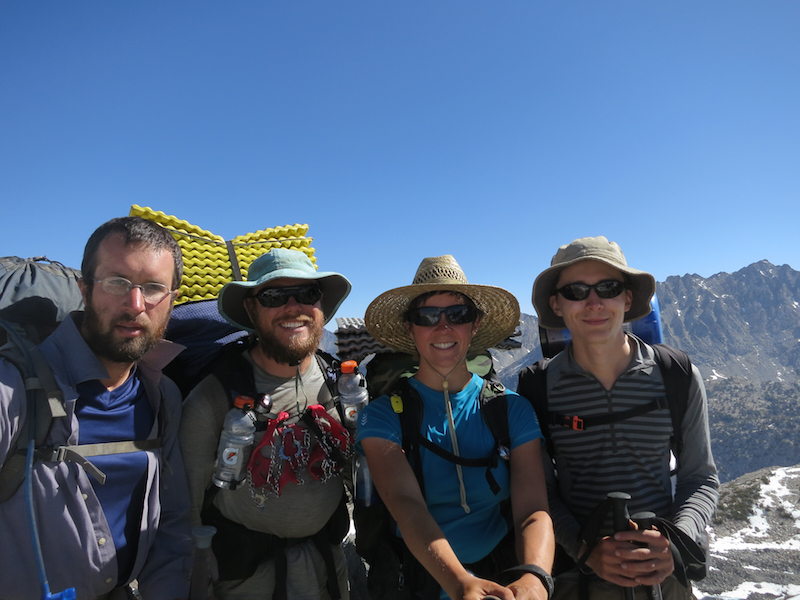
Atop Glen Pass, wearing the wrap-around polarized sunglasses, with Big Boots, Jordi, and Sock Pot.Jordi is showing off his Kahtoola Microspikes on his sternum strap.
I should throw in here, that I have light eyes — grey or blue depending on who you ask — and they are just plain bad in bright light. I’ve always had issues with glare, and growing up in eyeglasses as a kid in the PNW, never really learned to wear sunglasses. The greater utility of the polarized glasses felt like such a revelation. So, if you have blue eyes and have trouble with glare, it’s not you, it’s your iris’ lack of melanin. Treat yourself to some polarized glasses and see easier.
If you happen to be wearing glasses and don’t have prescription sunglasses, just stack those suckers. Function over fashion on the PCT, every time.
The Verdict: I would definitely get polarized sunglasses for at least the snowy sections, and probably the entire trail.
Bear Canister
A friend lent me her bear canister, the same one I’d used on the JMT: the Garcia Backpackers’ Cache Model 812. I think it may be the heaviest bear can out there, so there’s that.
On the plus side, it’s an excellent chair. It also fits easily into my Circuit pack. I could pack all my food into it during the sections where that was mandated, and was happy to send it home after exiting the required zones.
The Verdict: I liked the Garcia Backpackers’ Cache Model 812 bear canister well enough, but would consider splurging on a carbon fiber Wild Ideas Bearikade in the future.
Trekking poles
I started the PCT without trekking poles. To be honest, I had a bit of an anti-trekking-pole feeling going into the thru-hike. They seemed like crutches, and I didn’t want to use a crutch. I’d hiked the whole JMT without them, and if I didn’t need them for the hardest part of the trail, why would I need them for the rest?
All this rhetoric flew out the window when I hurt my feet coming into Idyllwild. I was staying with a friend who gently pointed out that I couldn’t bear weight on either foot — one due to burgeoning blisters, and the other due to tendonitis. With this wake-up call, I decided that I would try whatever it took to keep going, including using hiker-crutches.
Joke’s on me, ’cause it turned out that I *loved* my trekking poles.
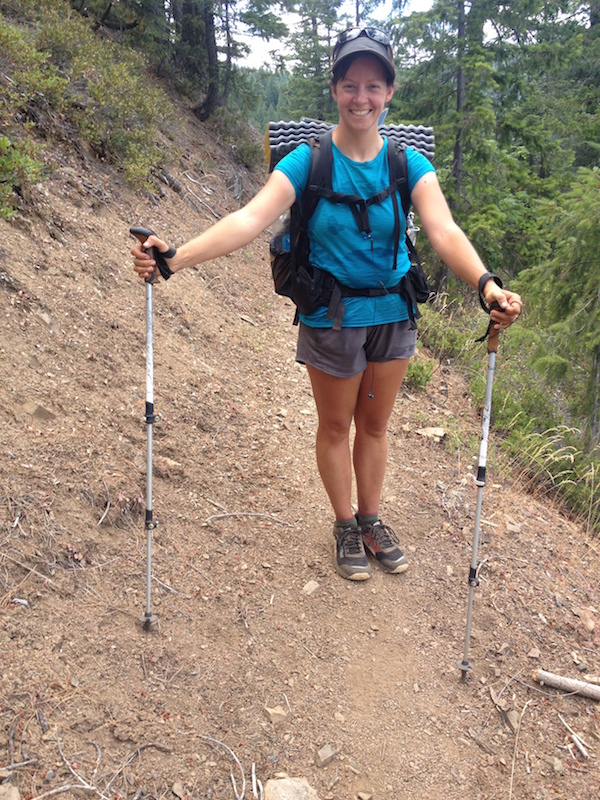
Happily using my Leki Lhasa Lite trekking poles on the descent into Shasta.
The outfitter in Idyllwild carried a small selection of poles, but luckily had some really excellent ones: Leki Lhasa Lite Trekking Poles (women specific). These have flip locks, rather than twist, and cork handles a bit smaller than those on the mens version, which fit my hands well.
Walking with trekking poles helped with my tendonitis hugely. They took some of the stress off my feet, and gave me something to lean on at breaks and while going downhill. I don’t know the science of how much load they shift, but I know my foot healed after I started using them, and that was wonderful.
I liked thinking of it as going from being bipedal to being a quadruped.
The Lhasa Lites lasted me all the way from Idyllwild to Canada, and are still going strong now. The only damage I can see is where desert rodents chewed most of the way through both handle straps. After that incident, I started keeping them inside my bivy sack, and then later inside my tent; I also tried to remember to rinse the tasty sweat out of them in town.
Once I switched to the SMD Skyscape Trekker for my shelter, the Lekis did double duty as tent poles. As the best length for me while walking was 110 cms, but 115 cm when supporting the tent, I learned to set the bottom adjustment at 115 and the top at 105. This made it so that I only ever had to adjust the top, while still having the optimal length at all times.
It took me some time to learn my way around the trekking poles; I read up a bit on the most efficient way to walk with them (plant pole with opposite foot). A thru-hike gives you lots of time to practice, and the motion became second nature within a section or two. I did have some incidents when I would try to scratch my leg with the trekking poles and instead, tripped myself. So, try to avoid that.
In general, though, the trekking poles provided so much extra stability on rocky terrain, while crossing streams and snow fields, and while going down hill. I’ve never had big issues with my knees, but even I was starting to have knee pain during the big downhills in Washington; I think the trekking poles saved me from worse pain.
An added bonus was the endless supply of pole-related humor, you’re a mature adult like myself. Jordi and I spent an entire morning, while post-holing in the Sierra, entertaining ourselves by trading pole jokes — “the handle of my pole is slippery today”, “my pole keeps shortening when I don’t want it to”, you get the picture…
The Verdict: I loved using trekking poles on the PCT, and would buy the Leki Lhasa Lite trekking poles again in a heart beat. Unfortunately, it looks like they have been discontinued (why?!), so I would go with another Leki model, perhaps the cork-handled Cressida or the cheaper, soft-rubber handled Jannu.
Survival & tools
Knife
I carried my Victorinox Swiss Army Climber pocket knife most of the trail, and was happy with it. At 3 oz, it’s heavier than many lightweight pocket knives, and has tools that I never used, but I already owned it before the trip, and free is a good price.

The Swiss Army Climber pocket knife.
Of all the tools on this knife, I used the scissors and longer blade the most. The scissors were so incredibly useful — I won’t go on another trip without them. I cut not only packaging in town, but did most of my medical work with them — trimming dead skin, cutting bandages to size, etc. I also made gear repairs with them, and lent them out to scissor-less hikers. The ~2″ blade I used mostly for cutting food and spreading cream cheese on tortillas.
Beyond those two blades, I used the bottle opener and corkscrew in towns, and the toothpick and tweezers occasionally.
When it became clear that my tent zipper issue wouldn’t have an easy resolution, I picked up a new knife that included pliers: the 2 oz Leatherman Squirt PS4. The pliers did their job on the zipper, but I missed the slightly longer blade of the Swiss Army knife.

The Leatherman Squirt PS4. Image from the Leatherman website.
The Verdict: I have a sentimental attachment to my Swiss Army Climber pocket knife and thought it worked great on the PCT. If I needed pliers, I would use the Leatherman Squirt PS4 again. I might get a straight-up knife next time, instead of a multi-tool, particularly if I thought I’d be using the knife for cutting more than cheese.
Navigation
The PCT is an extremely well marked trail, so I mostly used signage to navigate. I always carried paper Halfmile maps, though, and was glad I did. I got fairly small ones, and next time I might splurge on larger ones (single map to 8.5″x11″) for more visible details.
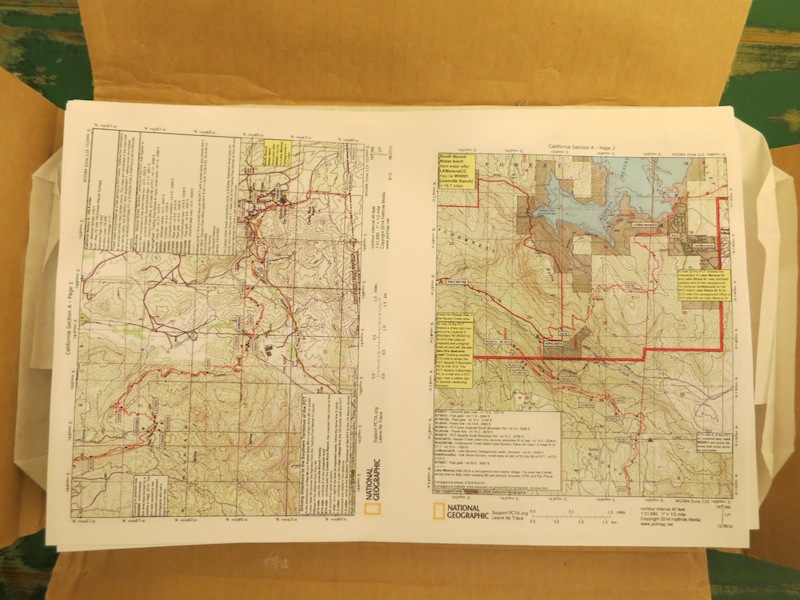
Halfmile’s PCT maps printed two to a page and double-sided.
I carried my Silva Polaris baseplate compass, which I never used. Like insurance, I don’t think tools have to be used to earn a place in my pack, so I’ll keep carrying a lightweight compass on all backcountry trips.
The Verdict: I will continue carrying paper maps, perhaps slightly larger ones. Halfmile’s are the way to go on the PCT. I will also continue carrying my Silva Polaris compass.
Light
My headlamp for this trip was the Petzl Zipka Plus 2, a discontinued model I got back in 2012. I loved so much about it: the retractable cord, its 2.5 oz weight, the red light setting for less jarring night light. I also hated some features: the weak light (max 70 lumens), and the way the lamp slid around on my forehead.
I used the headlamp to set up camp many nights after the summer solstice, when I was hiking later into twilight. I only night-hiked with it a few times, and found it unhelpful. If I had it off, the light of the moon illuminated everything around me, except the tread of the trail. If I had it on, I could see the trail enough to not trip, but nothing outside the trail. I think this is a larger issue to headlamp night-hiking than to just my headlamp, but still. I would want something a lot stronger to do nighthiking in the future.
The Verdict: I would not use the Petzl Zipka Plus 2 for a thru-hike again. I will look around for a light option that puts out more light, and look into better methods for night-hiking illumination.
Repair & Fire
I brought a tiny ziploc of stormproof matches & tinder in case my lighter ever got soaked or wouldn’t work. I never had to use them, but at 0.5 oz, would carry them again.
I also carried a small amount of tenacious tape, and nylon tent patches, which I used for patching my wind pants. I used the tenacious tape to repair a hole i made in my tent with the zipper.
The Verdict: I’ll keep carrying a small amount of stormproof matches & tinder, and tenacious tape & nylon tent patches.
Electronics
I carried quite a few electronics during my thru-hike, and I’m happy about that. I liked having ways to be connected to my partner at home, and to keep the loneliness at bay.
I met other hikers, almost always section or day hikers, who would make statements like “I’m just not out here to be using gadgets, I prefer to be immersed in nature”. When they saw my headphones, some would make comments about “wanting to hear the sounds of nature”, and to them I thought, “That’s nice. I felt that too. For the first 1000 miles of the hike.”
Phone
When I started, my iPhone 4S was tucked away inside my pack. I had some idea that I would only use it for emergencies, or for contacting Russell from towns. Part of this was practicality — the battery would only last so long, and I didn’t want to use it up on frivolous uses, then be SOL in a crisis.
Walking through the ugly civilization of the SoCal part of the trail (giant windmills, walking through towns, lots of roads and train tracks), I made the decision to think of the hike not as a wilderness experience, but as walking across the US. Once I made that mental adjustment, using my phone seemed totally fine, and I realized that there was cell service EVERYWHERE. The abundant service only lasted through SoCal, but I took advantage of it to stay connected with Russell and be a touch less lonely. And Facebook in the wilderness, occasionally.
I used the phone for: navigation apps (Guthook, Halfmile, Google maps), texting, making phone calls, reading (Kindle app, Overdrive library app), listening (podcasts, music, audio books), taking pictures, and blogging (WordPress app).
The phone itself was fine. The battery life is not good, so I would sleep with it in my quilt/sleeping bag to keep it warm. It was a gift from a friend who was upgrading, and it came to me cracked, with a pretty wood backplate (she put a bird on it!). I didn’t get a case for it, and managed to never damage it on the trail. I did manage to get rain in the phone during a 3 mile hike in the Columbia River Gorge last month and now the camera doesn’t work, so I would definitely get a case next time.
The Verdict: I would definitely bring a cell phone on another thru-hike. The iPhone was fine, though one with a better battery life would be better.
Camera
In addition to the phone, I carried a compact point & shoot camera: the Canon Powershot S100. On day 2 the shutter started sticking (probably from desert dust), and by two weeks in, I was having to manually open the shutter, and tap it shut. I tried a few hacks, following instructions online to reset various features, and use air to clean the shutter, but it would go back to sticking within a few days. At Mammoth Lakes, I sent the camera home with Russell for him to mail off for repair.

Canon S100 camera with accoutrements.
Canon repaired the under-warranty camera fully (at no charge, with little hassle, I might add), and I picked it up at Cascade Locks. In between Mammoth Lakes and Cascade Locks, I took pictures with my iPhone, but far fewer, which I’m a bit bummed about. I did enjoy the freedom of not feeling like I should take a pic, but in general, I missed having the real camera. I didn’t miss the weight, though.
While the iPhone camera felt like it wasn’t as good as the Canon S100, I am not a great photographer, and I’ve seen people take better pics with their phones than I could with my camera. I do wish I had realized that the front camera on the iPhone is far lower quality (no more than 72 pixels/inch) than the regular back camera.
I didn’t like using the USB card reader — it was too slow. Instead, I would upload my pictures onto Russell’s computer when he came to visit. Barring that, I would have sent home memory cards. Two batteries was sufficient.
The Verdict: If you like taking pictures and know how to use your camera, carry it! You’ll be glad you did. Send it home if you get tired of it; skip it if you’re fine with phone pics. I’ll keep bringing my Canon Powershot S100 (this model is now outdated), and keep learning how to use it.
E-reader
I carried a Kindle Paperwhite from Agua Dulce to Bartle Gap, and found it very good for keeping my sanity at night. I started out with only a few books on my iPhone, but found that reading drained the battery enough to make the phone die before I got to the next town. Russell had offered me the Kindle before I left, since Kindles have much better battery life — one charge can last 2-3 weeks of reading every day — and once I realized I wanted to be reading nightly, I requested it in my next box.
I used a piece of cardboard cut to the size of the Kindle as a cover, with a rubber band holding it on. This was lightweight and worked well to protect the device. I got in a routine of reading before sleep every single night, and appreciated being able to connect to a wifi network so I could download new books in town.
Once I got my solar panel and no longer had to worry about battery charge on the phone, I sent the Kindle home. I didn’t miss the weight, but I did miss the superior screen for reading.
The Verdict: Carry a solar panel, get reading apps on your phone, and skip the weight of an e-reader (and charger cord).
Personal Locator Device
I carried a borrowed 1st generation SPOT Personal Tracker device. After initial misgivings about feeling too connected to the outside world, I quickly came to love the little beast. I got into a habit of sending an “I’m okay” message every night when I made camp, and as far as I know, most or all of them got through. I never used the Help or Emergency buttons.
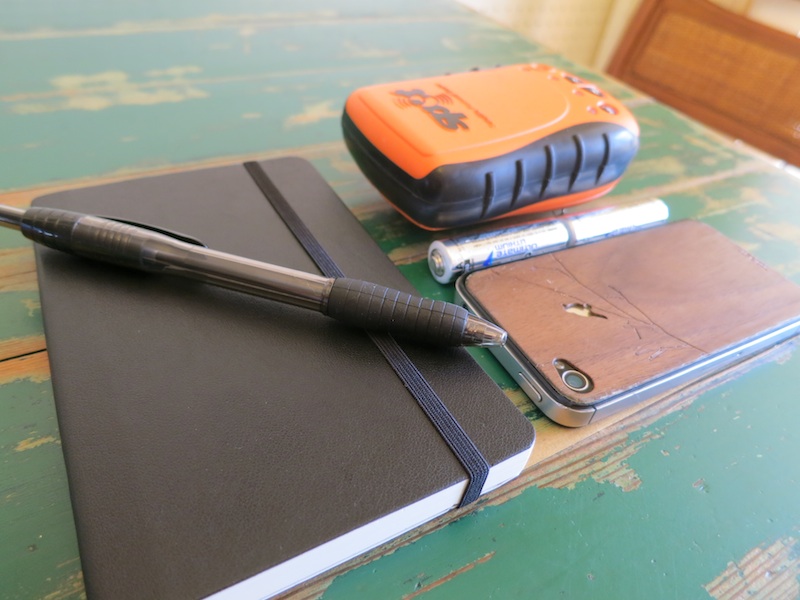
Moleskine journal & pen, SPOT Satellite Personal Tracker, be-birded iPhone.
One of my favorite parts of carrying the SPOT was knowing that someone knew where I was, particularly my husband. I ran the SPOT in tracker mode the whole time, which let people see location updates every 10 minutes or so. When I was feeling low, or hadn’t seen anyone all day, I could think of him (and my parents and friends and family) watching the little dots pop up on their map, and caring.
My Uncle John used my SPOT track to come surprise me on trail outside of Agua Dulce, which was one of my favorite moments of the hike. Russell used the track to find me at the earlier Tehachapi road crossing for our first town rendezvous.
For responsible SPOT track or OK message you, the hiker must train their followers to not freak out if a message doesn’t go through or the tracking drops out. I was glad to hear after the hike that my mother had watched my track disappear at a river crossing, but kept her cool until it reappeared several hours later.
The most critical purpose of the SPOT was in case of a medical emergency. It would have been the only way to get timely assistance in much of the High Sierra and remote parts of Washington.
The Verdict: I will carry a SPOT or similar locator device on future backpacking trips, at the least so they can find my body… Halfmile and Jordi were carrying DeLorme devices that looked intriguing, so I’ll do some research before getting my own device.
Solar Power
I decided to get a solar panel and Spotify subscription so I could listen to music, when I was suffering from the NorCal blues. OH MY GOD, I’m so glad I did.
Once I got my setup, I could put on a dance album and power up a hill with one headphone in. It was amazing. What I listened to evolved over the rest of the hike, but I never stopped having something to keep me going through the hard climbs.
I copied my solar setup from Loveline, who let me charge my phone off his battery at Carson Pass (thanks a bunch!). I used a Suntactics sCharger-5 USB Solar Charger strapped to the top of my pack, hooked up to an Anker Astro Mini 3000mAh External Battery. During the day the battery would charge, and at night I would hook it up my phone. This avoided the on/off trills that iPhones make when they charge, and the battery drain that can occur when the charge goes off (so I hear).
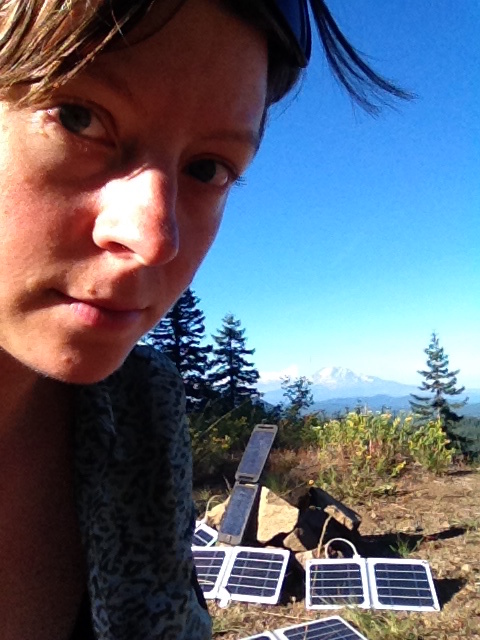
A Penguin, Mt. Adams, some other solar charger, and 4 Suntactics sCharger-5s charging happily in the Washington sun.
I read before the hike that solar panels are “useless in Oregon and Washington”. For the record, I only had 2-3 days in Oregon and Washington when I couldn’t get the battery charged up enough to charge my phone fully at night. Repeat: for only 2-3 days was this solar charger not pulling its weight. The only thing I did differently in the rainy states was to put my phone to charge directly during sunny breaks. I didn’t have a lot of rainy or overcast days though, so YMMV with the weather lottery you draw.
The Verdict: I would definitely start with the Suntactics sCharger-5 solar panel and Anker Astro Mini External Battery, and carry them the whole way next time.
Headphones
I carried a pair of inexpensive earbud headphones that I bought at an Office Max in South Lake Tahoe. They worked fine, until they didn’t. Somewhere early in Washington, my iPhone started spontaneously entering Voice Control Mode, and I couldn’t get it to turn off. I googled the issue during a town stop, and the internets blamed broken headphones. I picked up a new pair at the gas station in Skykomish, and carried them the rest of the way.
The Verdict: I would carry earbud headphones with an inline controller next time, so I could pause or skip music without digging my phone out of my hipbelt pouch.
Journalling
I carried a small Moleskine Classic Notebook for the entire hike; well, two notebooks, sequentially. I wrote in it almost every night, and added feathers that I found along the way. I loved having something physical to write in; the ritual grounded me nightly. The only downside to this notebook was its weight (~4 oz).
I carried two pens the whole trip: one in my med kit and one with my journal. No particular pens, just whatever I found when one ran out.
The Verdict: I might try electronic journalling on a short trip to see if I prefer that method of recording data and feelings. If I don’t dig the e-journal, I’ll carry the Moleskine Classic Notebook again.
Medical & personal
Coming right off a Wilderness First Responder course, I carried a beefy med kit on the PCT. I actually used most of the items in it, though, so for me it was weight well spent.
Med Kit — carried and used
Here is what I carried and how I used it: ibuprofen (pain relief from headaches, infected blisters, tendonitis, menstrual cramps, and general aches & pains), ace bandage (wrapped foot with tendonitis to provide support), paper medical tape (attached clean bandages to cover open blisters), 2×2″ and 4×4″ gauze bandages (covered open blisters), leukotape (covered unopened blisters), needle & thread (lance & thread blisters), lighter (cleaned needle prior to use), scissors on pocket knife (cut off dead skin), Bactrim (antibiotic course for infected blisters), moleskin (reduced friction on blisters), Vicodin (relieved tooth ache on trail), aloe gel (relieved pain from sunburn), sunscreen (prevented sunburn)
Med Kit — carried and didn’t use
I carried (at one point or another) but didn’t use: gauze bandage roll, giardia meds (metronidazole), traveler’s diarrhea meds (cipro), aspirin, tylenol, sugar, extra course of Bactrim, Zantac (prevent ulcers, combat heavy use of ibuprofen), Vagisil (reduce chafing), tegaderm dressing, steristrips, blank paper SOAP note, pen.
I did a pack shakedown at Tahoe, since I was sending my bear canister home at that point, and sent home a fair amount of unused excess med kit items, including the extra Bactrim, the unused Vagisil, the Zantac, and an extra gauze bandage.
The Verdict: I would carry everything in the first category again, plus aspirin, sugar, tegaderm, steristrips, the SOAP note, and pen. I wouldn’t carry the diarrhea meds next time, but rather treat any illnesses as they arose.
Eye care
I got a prescription for Air Optix Night & Day contacts before the trail, which I could wear for up to 30 days in a row. I didn’t go the full 30, but did keep them in continuously between resupply spots, rewetting my eyes in the morning with eye drops, or sometimes just blinking a lot. I carried the 3 oz travel size ClearCare solution and case for cleaning.
I had an incident on one of my first backpacking trips, when I dropped a contact in the dirt, rinsed it with water, put it back it, and promptly got a raging eye infection that left a scar on the back of my eye for several years. Since then, I haven’t effed around with eye care in the backcountry, so when my eyes got irritated on the trail, I switched to glasses until my eyes felt better.
I protected the glasses with a small light case that I neglected to return to my friend’s dad after a backpacking trip several years ago (uh, thanks Pat!). I fashioned a lanyard out of cord from the hiker box to keep the glasses on after they loosened up in the hot hot heat of SoCal.
The Verdict: Maybe I’ll get serious about Lasik? Until then, I’ll keep wearing Air Optix Night & Day or other long-wearing contacts and carrying backup glasses.
Personal hygiene
I carried the following for oral and personal hygiene: toothpaste, travel toothbrush, floss, small mirror, retainer & case, Dr. Bronners liquid soap, toilet paper, a Diva cup, tampons, 2 reusable panty liners from Gladrags, hand sanitizer, Alba chapstick.
I used the tooth cleaning tools daily, and the small mirror to check for bits of food left in my teeth. I basically never used the Dr. Bronners unless something went horribly wrong while wiping (it happens), and then only over a cathole. I used the Diva cup for the first three periods, and switched to tampons for the last three (yup, no skipping periods here). I used the cloth panty liners until I stopped caring about staining wearing underwear.
The hand sanitizer lived in the mesh at the back of my pouch, and I used it after each cathole expedition. The chapstick lived in a belt pouch and I barely used it after the Sierra.
The Verdict: I’d carry all the same again, except the panty liners.
Ziplocs
Last, but not least, ALL THE ZIPLOCS.
My PCT hike was facilitated largely by Ziploc bags. When I think about hikers doing long treks in byegone eras, I don’t think about the weight of the gear or the lack of electronics, I wonder how the hell they managed without Ziplocs.
Gallon, quart, snack size — I used them all. Freezer bags were great for pouring hot water directly into for rehydrating food, but storage bags were fine for repackaging other food. Russell would ship me a handful of quart bags and a few gallon bags in each resupply box, and I almost always used them all.
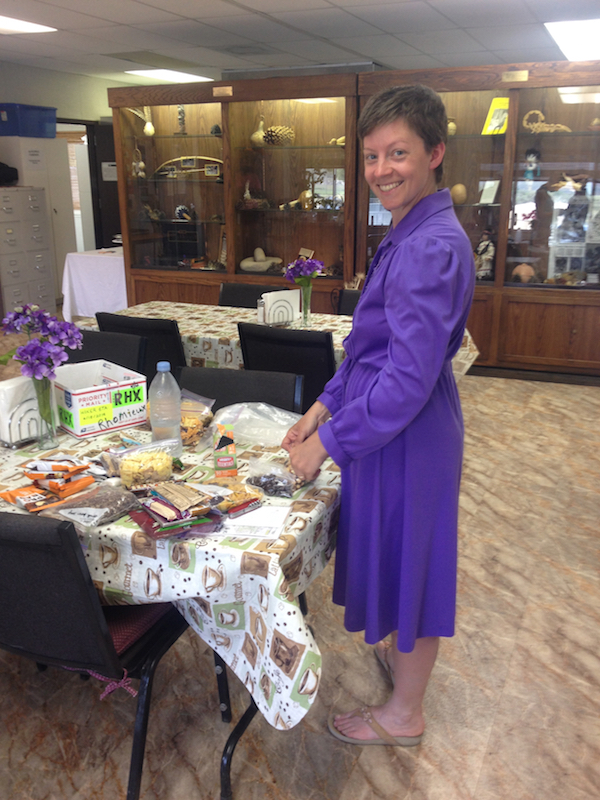
Repackaging food into ziploc bags during my first resupply stop at the Warner Springs Community Center.
Everything, and I mean everything, lived in a ziploc bag. I carried my journal in a ziploc, my TP, my used TP & tampons, even put my wet shoes in a giant one a few times in the Sierra so they didn’t muck up the inside of my tent and didn’t freeze outside.
I carried my food in a 12×20″ OPSAK odor-proof bag from LokSak. I switched it out every month or so. I liked being able to see through to my food, and found the plastic durable. I’m not sure if odor-proof really applied to the bag, since I wasn’t 100% careful with not getting food smells on the outside.
The Verdict: Ziploc bags will save your sanity on the trail. Get some in your resupply boxes or buy some in town. Don’t skimp on quality — you don’t want gatorade powder mucking up your damp pack. OPSAKs are great for food storage.
—-
What did I miss? Ask your questions in the comments.
Check out my PCT gear review: the Big Three.
Read my PCT clothing review.
The post PCT gear review: the small stuff appeared first on alice hikes.
]]>The post PCT gear review: the Big Three appeared first on alice hikes.
]]>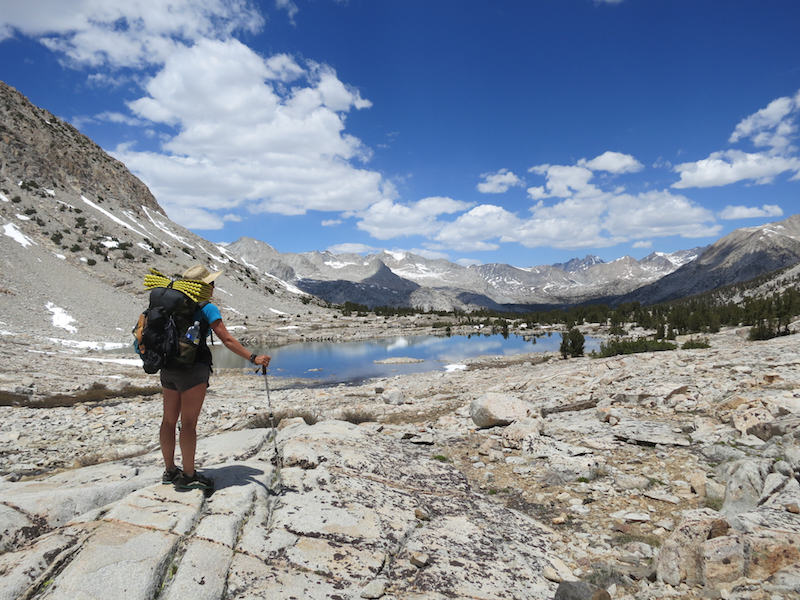
Contemplating Lake Marjorie after climbing Pinchot Pass in the High Sierra, with my ULA Circuit Pack and Therm-a-Rest Z Lite sleeping pad on display.
In this PCT gear review, I’ll discuss the items I used during my 2014 thru-hike for the Big Three: pack, shelter, and sleep system.
Stay tuned for a review of the rest: food prep & cooking gear, water treatment, med kit, snow equipment, electronics, and everything else.
A common thru-hike gear story (cough cough Wild cough) is the one where the hiker starts with a crazy heavy backpack, and sheds weight as they go. This was not my story. I started with the lightest set-up I could manage, and added weight as I went, for a few reasons:
- I wanted to make the beginning of my hike as manageable as possible. While I had hiked the 250 mile JMT the year before, I had been doing a lot of sitting over the winter, and I would only be getting into trail shape on the trail. Having less weight to start was a way to make those first few weeks just a touch easier.
- I wanted to see how ultralight I could go. I figured if I needed something heavier duty, or found I didn’t like how minimal an item was, I could swap it out, and at least I would have given it a try. This worked for me because I already had a set of lightweight gear from previous seasons. Picking up a few pieces of ultralight gear didn’t break the bank (no, that was the WM bag…), and let me push my comfort zone.
Every hiker has a different tolerance level for comfort and for carrying weight, and I think one key to an enjoyable hike is finding your own balance. Some people value comfort, and don’t mind schlepping weight, others value comfort but DO mind the weight, and those people have some decisions to make. Then there are those who care little for comfort, and to their retreating heels I say, brava!
You do you.
Personally, I liked finding the places where I didn’t care about weight-based comfort (i.e. my sleeping pad) and cutting weight there, so that I could carry more elsewhere (my sleeping bag).
As for sourcing gear, I bought as much as I could through discount sites like Backcountry.com, and US-based cottage industry retailers like Mountain Laurel Designs, Six Moon Designs, and ULA. With that in mind, jump on in:
Disclaimer: Each item in this review was purchased by me with my own money, or given as a gift. I am not repping any brand here, just sharing the ones that worked for me.
Packing
Backpack
I started out from Campo using a Mountain Laurel Designs Burn pack, size small with the padded belt, women’s straps, load lifters, compression straps on the sides, and two belt pockets. I emailed with the MLD boss, Ron, before the hike to make the customizations, and thought he gave great service. I loved carrying this pack; it was significantly lighter than my ULA Circuit pack, which helped make the beginning of the hike easier.
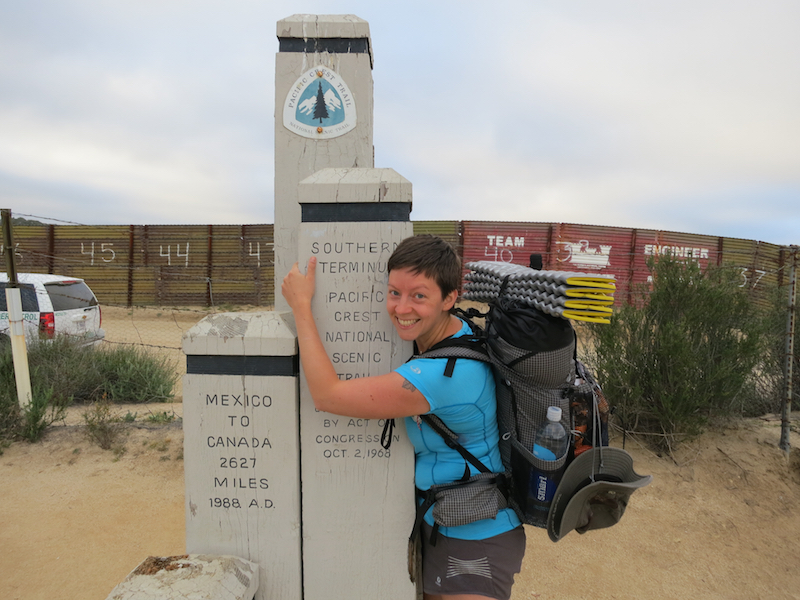
Starting out from the southern terminus with my MLD Burn pack.
The Burn pack is a frameless pack, which was new for me. I had tried it out for a few overnights before starting the PCT, but it took a few weeks on the trail to learn how to really pack it properly so that the weight carried well. I settled into a routine of putting my Therm-a-Rest Z Lite inside, at the back of the pack as a makeshift frame sheet, and that worked great. It meant, however, that I didn’t have the pad outside the pack for easy sitting at breaks, which was a bummer.
I particularly loved how slender this pack was. I could swing my elbows back and not hit the pack, which made me notice it less. I even learned to get the water bottles out from the side mesh pockets without stopping or taking off the pack (push the bottle up from the bottom, then grab it by the cap).
I had anticipated switching this pack out in the Sierra, to have more volume to accommodate a bear canister. The Garcia Backpacker’s Cache 812 does fit in my Burn pack, but only just. I ended up switching it at Agua Dulce instead, to accommodate the volume of a stove and cookable food. I had been leaving town with grocery bags of voluminous food dangling from the outside of my pack for a few sections, and that there told me that I needed more room.
Russell sent me my trusty ULA Circuit pack at Agua Dulce, and I carried it for the rest of the trail. At first the pack seemed SO LARGE, and then I got used to the size and found things to fill it with. By mid-Washington, I was dangling gear off the back again; I suspect I could fill however large a pack I carried.
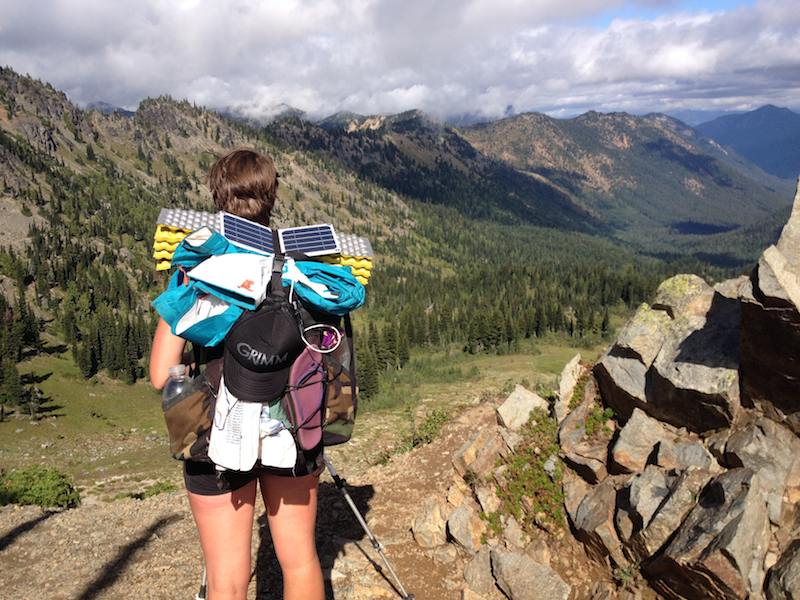
My backpack on full display, after hiking out of Chinook Pass.
The Circuit is a great pack for me. It fits my body well (size small with a medium hip-belt and S-straps), carries weight better than the Burn, and the company provides excellent service. I had purchased the pack for my first JMT section hike in 2012, and used it for my complete 2013 hike as well, so the pack had already gotten good use and a bit of wear, and I knew my way around it.
Eventually, the Circuit’s hip-belt buckle starting popping open both randomly (while hiking down a flat trail) and at inopportune times (while falling down a snowy slope on Glen Pass). It also became too large as I lost belly fat, so I requested a new one when I got to Mammoth Lakes. The folks at ULA offered to send me the malfunctioning part for free, or give me a significant discount on a whole new belt, which I thought was fair, and I took them up on the latter offer. I picked up the new smaller belt in Lake Tahoe and it worked great all the way to the border.
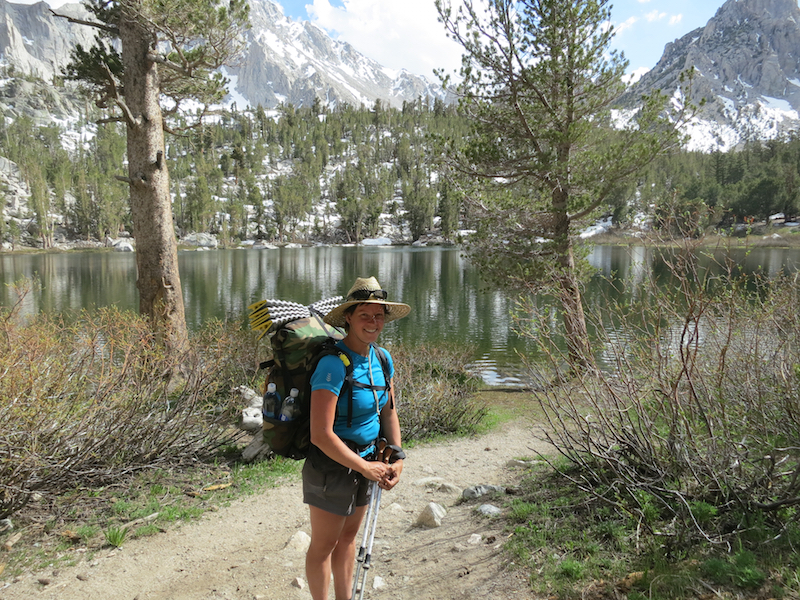
Wearing my fully loaded ULA Circuit on the climb up to Kearsarge Pass and the PCT.
At some point before Tahoe, I felt that the pack was carrying poorly, and checked inside. Sure enough, the hoop strut had busted on one side. I emailed Chris at ULA again, and he express-mailed out a new free strut to my next resupply location (Sierra City). It took me about an hour to wrestle the new hoop into the inside pocket of the pack, but when I managed it and got the pack loaded, it carried wonderfully again. Thanks, ULA!
The Verdict: I loved both packs. The MLD Burn felt so sleek and fast, like I barely had anything on my back. The ULA Circuit carried so well, helping me haul my comfort food and super-warm (read: heavy) sleeping bag up every mountain. I’ll be using the Burn again for summer trips with low volume, or ones with my partner when I’m sharing gear. I’ll probably keep using the Circuit when I want to use my big sleeping bag or have a long food carry. For me, the difference was more about volume than weight. While the Burn hurt my shoulders a bit when heavy, because of the fact that food weight decreases on an hourly basis, total pack weight would drop into a comfortable range quickly.
Pack liner
I used a trash compactor bag as a pack liner, and didn’t use any pack cover. When it rained continuously for hours, rain would seep through the top of my Circuit pack and get my tent (stored at the top, outside of the trash bag) damp. No water made it inside the trash bag, though, and I call that a win. I used the liner throughout the hike since all my insulated gear was down, and I didn’t want to risk soaking everything in a clumsy stream crossing. It never rained while I was hiking with the Burn pack, so I can’t speak to its water resistance.
Every month or so, I swapped the then-dusty and worn bag for a new one. I didn’t find that any brand was substantially better than another.
The Verdict: I see no reason not to keep using a trash compactor bag for a pack liner.
Ditty & dry sacks
My carried clothing lived in an 8L Sea to Summit Ultra-Sil Nano Dry Sack. I never had an immersion event or rainfall day during which water got into my pack liner, so this sack basically acted as an organizer, and pillow. It was great to never have to hunt around for gloves, hat, or long underwear, and with my puffy stuffed inside, this was a bomber pillow.
The full set of Granite Gear Air Zippditty sacks. Image from Backcountry.com.
I carried the SM, MD, and LG Granite Gear Air Zippditty sacks for more organization. The small carried my tooth/hygiene kit, the medium carried my tools (compass, spare batteries, patch kit, etc), and the large carried my medical kit. I loved having these separated and easy to recognize, and would organize like that again.
The Verdict: The Sea to Summit Ultra-Sil Nano Dry Sack was great, and I’d buy it again. Same with the Granite Gear Air Zippditty sacks.
Shelter
Tarp & tent
From Campo to Tehachapi, I had approximately three nights of precipitation, and for one of them, I was under a roof. During this dry time, for practical purposes, my shelter was my Mountain Laurel Designs Superlight Bivy. I slept in this bivy every single night, and loved it. It blocked the wind from getting under the quilt, and gave me a secure home feeling on the trail. I left the zipper open while cowboying in a field the night before Warner Springs, and found a deer tick crawling across my quilt; I slept with it zipped every night thereafter. I thought I might feel claustrophobic, or accidentally suffocate myself with the fabric next to my face, but I got quickly got used to it.
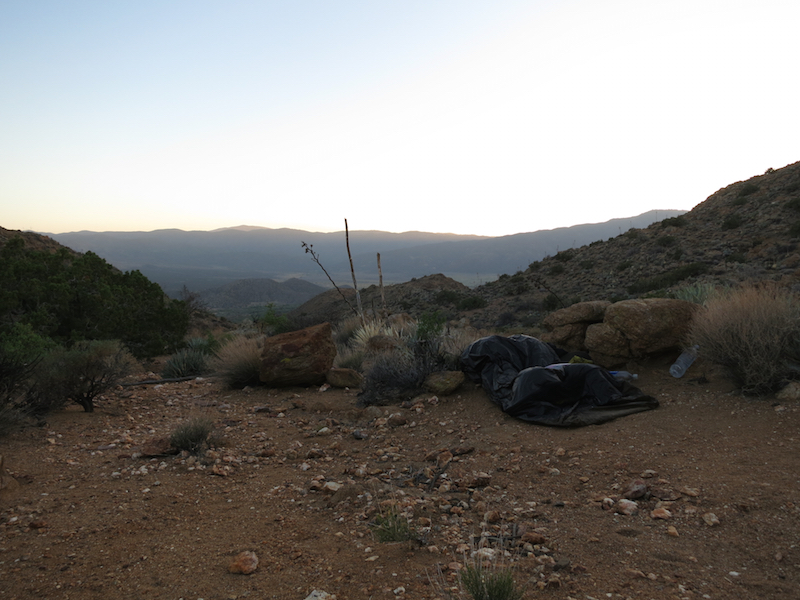
Bivying in the San Felipe Hills past Scissors Crossing.
When I found chew marks on my trekking pole straps and umbrella, I started keeping those in the zipped bivy with me at night, and they fit next to me with no problems.
Besides the bivy, I was carrying the Mountain Laurel Designs Silnylon Pro Poncho, with Kelty triptease guylines cut to size and pre-knotted with bowlines & slipknots, and an assortment of MSR Groundhog Tent Stakes and Vargo Titanium Tent Stakes (shepherd’s hook). I only set it up the two times — once because it looked like it might rain, and basically for practice, the night out of Warner Springs. The next time was at the end of a long day, climbing out of Cajon Pass to Guffy Campground; the last few hours of walking were in the middle of a cloud.
When I got to camp at Guffy, I was mildly hypothermic (some shivering, loss of manual dexterity, blue lips, feeling anxious), and my fingers couldn’t manage the knots to set up the tarp. Luckily, my hiker buddies Backup & Waterfall were camped right nearby, and Backup got out of her tent to help me do my setup. THANK GOODNESS.
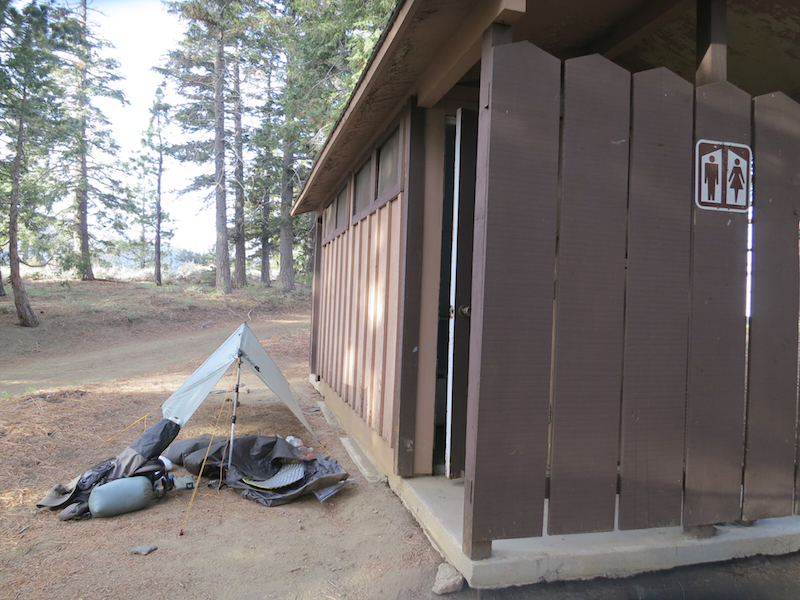
Camping with my tarp in the lee of the toilets.
Without Backup, I think I would have wrapped myself in the tarp and tried to sleep burrito style. Even with the tarp edges pitched as low to the ground as we could manage, I spent the whole night shivering in my quilt & bivy. The next morning, I made an unplanned stop in Wrightwood to warm up, eat some hot meals, and email my friend who had offered me the use of her tent for the trail. I picked it up from Russell when he met me in Tehachapi, and used it for the remainder of the hike; I sent back both the tarp and the bivy to save weight.
I don’t regret starting the hike with the poncho-tarp, at all. I also don’t regret switching to the Six Moon Designs Skyscape Trekker. What it came down to for me was inexperience. I took a gamble bringing the tarp, knowing that I hadn’t set it up enough times to make the process automatic, and then I made a few mistakes around ordering and using the tarp. The first mistake was not special-ordering a shorter tarp. When I put on the standard-sized tarp, it came all the way down my 5’5″ frame to my feet, which would have been terrible for hiking in. As the point of a poncho-tarp is that it replaces your rain gear as well as your shelter, having one that wouldn’t work as rain gear was not practical. I had suspected that it would be too long before I bought it, but I was too lazy to go through the custom order process again, despite having gotten great service from Ron at MLD when I custom ordered my pack.
The second mistake was not setting it up every night for practice, so that when I actually needed it, I’d be good to go. If I had done that, custom-ordered a shorter version, and been enough of a masochist to bluster through the first few hard nights, perhaps I would have carried it all the way to Canada. As it happened, when I got home from the trail, I wrapped it up and sold it right away. I will try out tarp camping again, but probably a flat tarp next time, maybe even Cuben fiber.
As for the SMD Skyscape Trekker, I loved that thing. It’s a single-walled tarp-tent style shelter that uses trekking poles as supports. It turned out that the rain started as soon as I swapped for it, so I quickly got a lot of practice setting it up. The first night out of Tehachapi, I didn’t tighten the guylines sufficiently, and had to wake up every hour when the storm knocked down a trekking pole support. I never made that mistake again, and the tent stayed standing every night thereafter. I used MSR Groundhog stakes and they held in every sort of ground I encountered.
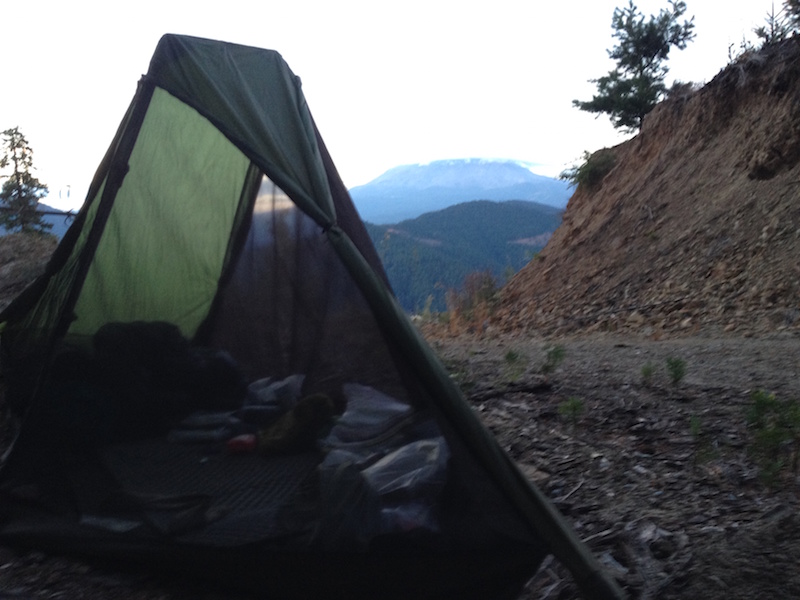
The SMD Skyscape Trekker in skyscape mode, with Shasta in the background.
It took me several hundred miles to realize that I could roll up the opaque sides of the tent and have a *skyscape* view of the stars at night. I did have one night where I had it set up like that when it started to rain, but I managed to hop out of my sleeping bag and get the sides rolled down before my gear got dangerously wet.
My biggest issue with this tent was that the zippers were in a near-constant broken state from partway through the high Sierra, all the way to Canada. The zippers on the door and the door-side vestibule would stop sealing, and my array of hacks only worked a short time each. Body glide seemed to help briefly, then having a seamstress in Mammoth Lakes show me how to crimp the zipper pulls with pliers was useful. I ended up swapping out my pocket knife for one with pliers, expressly so that I could fix my zippers on the go, but even that didn’t work the whole way. It’s a good thing I only had one or two days of bad mosquitos, because I definitely didn’t have a bug-free sleep zone.
This was at least the third season of use for this tent, so I didn’t fault the manufacturer on the zipper issue. It does make me think twice about zippers on a thru-hiker shelter in general, though.
Once I got spooked by the bear outside of Truckee, and then the cougar on Hat Creek Rim, I found myself putting up the tent every night. I liked having a little home away from home. Each item from my pack had its designated spot inside, and I appreciated having an opaque structure in which to change clothes when I camped around other people. I did find myself missing cowboy camping though, and really enjoyed the few nights I did so after getting the tent.
The Verdict: I feel torn on this one. My favorite way to sleep on the trail was cowboying, either with my MLD Superlight Bivy or with just my mummy bag, but I certainly spent way more nights in the SMD Skyscape Trekker. I have plans to get a flat tarp to try out for future hikes, and use that in conjunction with a warm bag and the bivy, but I do highly recommend the Skyscape Trekker for if you like having an enclosed home on the trail.
Groundsheet
I carried a Gossamer Gear Polycryo Groundcloth a couple times on the trail, and it was occasionally useful. When I cowboyed with the bivy, I didn’t use it at all, and I only used it a few times when it looked like rain with the tent. This groundsheet is comically thin and light — I’m pretty sure Gossamer Gear isn’t pranking us by selling marked-up Saranwrap, but sometimes I wondered.
If the ground was not perfectly dry, when I picked up the groundsheet in the morning, it would be covered with tiny bits of bark and dirt, and no amount of shaking would clean it off. Wiping sort of worked, but it’s tricky to wipe down a large piece of thin plastic when you can’t put it on the ground without getting it dirty again. I did my best to camp places that wouldn’t collect water, and was glad that my tent had a solid bathtub bottom, making a groundsheet less essential.
The Verdict: Next time I would just do what I saw a lot of other hikers do: get a piece of Tyvek from a hardware or outdoor supply store, and cut it to fit under my shelter.
Sun shelter
I carried a GoLite Chrome Dome Trekking Umbrella from the border to Tehachapi. I used it about three times, then got trekking poles, and no longer wanted to give up a hand to holding the umbrella. The last time I used it was while crossing the aquaduct, and halfway through that walk, I decided I’d rather have the added speed my trekking poles gave me than the shade from the umbrella.
The thing with hiking with an umbrella is that you have to be constantly turning it to shade yourself from the also-moving sun, as well as angling it to not be catching the wind. I had actually busted one strut of the umbrella in some high wind the very first time I tried it out, before the trail. My toothpick and duct tape fix held up for the 550 miles of the desert, but I was always conscious of breaking it again. I also had a nighttime incident with rodents sometime before Deep Creek — they ate the entire wrist strap off the umbrella, and gnawed chunks out of the handle.
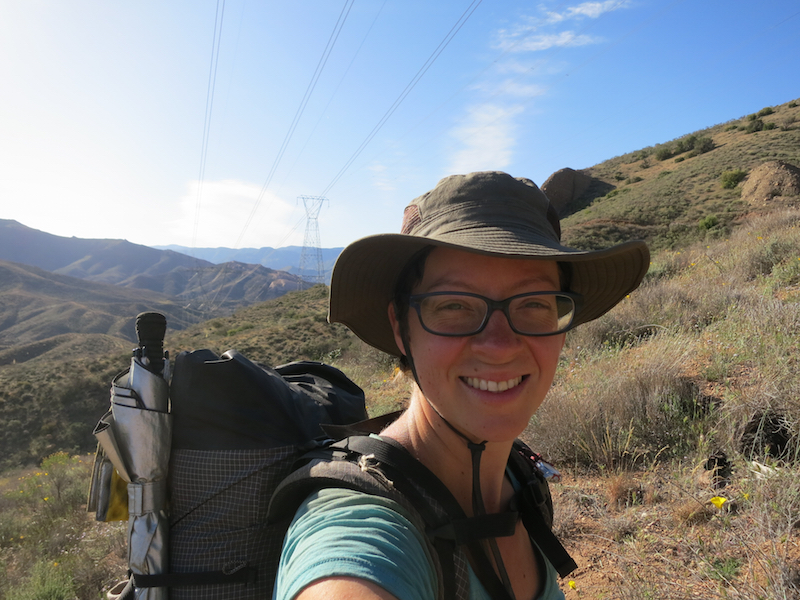
The strapless Chrome Dome Trekking Umbrella in its usual spot, weighing down my MLD Burn pack.
I might try an umbrella again, if I were diligent enough to rig up a hands-free attachment to my pack. Even that wouldn’t resolve the wind/sun angle issues, so I suspect they are just not for me. I will note that I didn’t nap in the heat of the day, and I understand that having an easy shelter for naps is one of the big boons of carrying an umbrella.
The Verdict: I prefer a wide-brimmed hat for sun protection to carrying a trekking umbrella.
Sleep system
Sleeping bag
From Campo to Kennedy Meadows, I used my size SM Katabatic Palisade 30°F quilt. This is a fantastic quilt, and, in conjunction with my bivy sack, kept me warm all throughout the desert. Since it’s a quilt, it was easy to get air flow to keep me cool on the rare warm nights; it also wasn’t hard to clip it to the 2mm cords attached to my sleeping pad to prevent drafts. It did take me a week or two to realize that I should be using the clips further from the edge of the bag for a tighter seal against drafts. The bivy sack prevented any real wind though.

The Katabatic Palisade 30°F down quilt. Image from the Katabatic website.
In Lake Isabella, I decided to move up to a warmer bag for my slightly-early (late May) entry to the Sierra, and had a Western Mountaineering Versalite 10°F down bag shipped to Kennedy Meadows. This bag rapidly became my favorite piece of gear. It kept me warm every single night, including a few nights cowboy camping in the high Sierra. It was actually way too warm in Northern California; I briefly swapped the Palisade quilt back in when I got back on trail at Bartle Gap, but found it too cold, so returned to the Versalite when Russell met me in Etna.
Sleeping in the Versalite feels like sleeping in a warm fluffy cloud. I toss and turn like a rotisserie chicken while sleeping (back-side-back-side-front-side-back), and the Versalite kept me warm and cosy through all that. I had thought I might feel cooped up in a mummy-style bag, but I never did.

The Western Mountaineering Versalite 10°F sleeping bag. Image from the WM website.
Both bags would get wet from overnight condensation, sometimes a tiny bit, sometimes a lot. Whenever this would happen, I took advantage of the first sunny patch I came across the next day to dry out the bag. I never didn’t find enough sun to do the drying. YMMV.
The downsides to the Versalite were its weight and volume, and the occasional overheated night. The stuff sack it came with was too large to fit into my Circuit pack. In order to fit all my gear in aroudn it, I’d have to squish it down, then shove it real quick into the bottom of the pack. To remedy this, I picked up a size small Sea to Summit Ultra-Sil Compression Sack in Bishop, and that did the trick. Because I’m only 5’5″, I can fit into the smallest bags (here, the 5’6″ version), which makes them a tiny bit lighter than those my husband for example could use.
A note on sleeping warm or cold: I started the trail sleeping average. I didn’t tend to overheat, but I had never noticed being super cold at night. I had used the Katabatic Palisade 30°F quilt for the entire JMT with my only uncomfortable night being Guitar Lake. A few months into the PCT, I started feeling colder at night, which I attribute to losing some body fat (converting to leg muscle FTW). By the end of the hike, I was a cold sleeper (very much appreciated having a 10° bag in Washington), and that seems to have persisted into my off-trail life, despite regaining some personal insulation.
The Verdict: I absolutely loved my Western Mountaineering Versalite 10°F bag and will personally be carrying it on cold weather trips going forward (with the Sea to Summit Ultra-Sil Compression Sack). It’s voluminous and a bit heavy at 1 lb 14 oz, so if I were made of money and wanted to spec out a very dialed-in PCT, I might try the slightly lighter and smaller WM Ultralite 20°F bag with 5″ loft next time. The Katabatic Palisade 30°F quilt was also great for slightly warmer weather, and inside a bivy sack, and I’ll keep using it for summer trips. I may also try the quilt with a liner to see if that handles slightly colder weather better.
Sleeping pad
The primary functions of a sleeping pad are to insulate your body from the cold ground, and to provide comfort. Secondarily, they can provide structure to a frameless pack, and give you something to sit on. I used a two-season-old Therm-a-Rest Z Lite — a folding yellow & silver closed cell foam (CCF) pad. It neither insulated well, nor provided much comfort, but worked great as a framesheet in my pack, and was nice to sit on. I had cut off the bottom two sections so that it came down to my thighs, for weight saving; I used my pack to insulate under my feet at night.
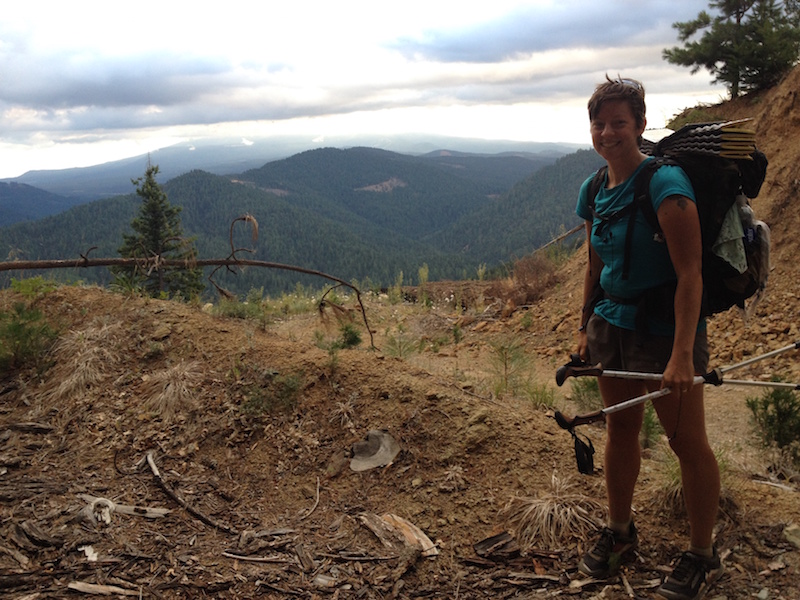
Me and invisible Mt. Shasta, with the Z Lite in its usual spot at the top of my Circuit pack.
You may be noticing by now that I switched a lot of gear while on the trail. I kept thinking to myself that if I wanted to swap out the Z Lite for a comfier pad, then that was okay, that I didn’t need to tough anything out. And every time I had an opportunity to swap it, I just didn’t feel the need to. I think I sleep better on hard ground than some people, though the lack of padding may have contributed to my eventual hip numbness.
A Therm-a-Rest NeoAir blow-up mattress would have been the same basic weight as my trimmed-down Z Lite, and by all accounts, way more comfortable. I was always reluctant to swap something so simple and reliable for something that made crinkly noises and required set-up and take-down time. I did see many hikers on the trail carrying these, though, and I will probably give one a try sometime, particularly because they are much better at insulating. As long as I had alcohol wipes and a patch kit, holes wouldn’t be a big issue, and I hear you get fast at blowing up and rolling up.
For about a minute, I carried a little Therm-a-Rest Z Seat sitting pad that Lizard gave me. At the time, my Z Lite was inside my pack during the day, acting as a framesheet, so I couldn’t haul it out to sit on, and having the little butt pad was really nice for break-time morale. When I switched packs and carried the Z Lite on the outside again, I couldn’t justify the butt pad anymore and hiker-boxed it.
The Verdict: I have an irrational love for my Therm-a-Rest Z Lite CCF pad, despite it being neither plush nor warm. I would start out with a new one next time, though, or try a NeoAir.
—
And there you have it: pack, shelter, sleep.
Nighttime clothing is part of a sleep system; you can check out my clothing review here.
Stay tuned for my review of the small stuff: food prep, med kit, water treatment, electronics, etc.
The post PCT gear review: the Big Three appeared first on alice hikes.
]]>The post PCT clothing review appeared first on alice hikes.
]]>Anything!
(Nothing, if it’s the summer solstice…)

Wearing my old Smartwool long underwear over my shorts for warmth, a bit before Warner Springs.
I wore 4 different shirts, 2 pairs of shorts, 4 different hats, and 5 pairs of shoes over the course of my 160 day PCT thru-hike. Some of it was great, and some did not work for me AT ALL. In this post, I’ll review everything I wore from Campo to Manning Park.
If something sounds like it would work for you, give it a try!
Or don’t.
Each and every hiker has different preferences, and one person’s favorite item could be another person’s biggest hate. The purpose of this PCT clothing review is to let you know this one hiker’s likes and hates, and perhaps in the process give you ideas for where to start your research.
Preferences aside, it’s good to remember that clothing is gear on the trail — wear the wrong garb and you could freeze, burn, or get scratched up by ice or brambles. That being said, it’s up to you to figure out what is right for you. The only real guideline is I’ll give is, no cotton. For reals. You will be sweating for like, 2668 miles of the 2669 mile trail, and you don’t want a material that makes you colder when it’s wet.
Because I like doing research, I spent many hours picking out the “right” clothes for the trip. This did me well for the beginning, but honestly, I ended up changing almost everything in my pack, including my clothes. It was comical halfway through the hike, when I had 10 short minutes on wi-fi to find and buy a replacement, remembering how much thought I’d put into the original item before the trail.
You too may have to throw out all your carefully done research and just get whatever is available in whichever town you’re in. Or you might never change anything. That’s the nature of the beast that is the Pacific Crest Trail.
With that in mind, here are the garments that accompanied me on the PCT this summer:
Disclaimer: Each item in this review was purchased by me with my own money, or given as a gift. I am not repping any brand here, just sharing the ones that worked for me.
On my body
Shirts
I started the hike in a 150 gm merino wool Icebreaker Flash Short Sleeve V-neck t-shirt. It breathed well, didn’t rub raw patches into my skin, and didn’t have seams on the tops of the shoulders for the backpack straps to chafe on. It also stained quickly and severely, and like most thin merino wool, shredded where it rubbed. By the time I got to Bishop at mile 789, I was ready for a new, hole-less shirt. Because I hadn’t planned to swap shirts there, I just went to the outfitters in town and found one on sale for ~$20.

My desert attire: Icebreaker Flash tee and Oiselle Distance Shorts.
The Rab Aeon Tee (short sleeve) is 100% polyester with a high neck, two traits I had avoided pre-hike. By that point I had noticed that the folks wearing polyester shirts didn’t look nearly as dirty as I did in my light thin merino wool, though, and didn’t notice a smell problem with the poly. I wore this short from Bishop all the way to Northern California when I jumped off-trail for a week. I loved it, and returned to it to finish out the trail. The non-v-neck stopped the progress of the chest tan-line, and the smooth fabric didn’t chafe in the slightest.

At Kearsarge Pass in my then-new Rab Aeon Tee.
When I got back on trail in Northern California, I took the opportunity to swap out gear, and switched my top to a thicker merino wool shirt that I already owned: the Icebreaker Tech Lite T-shirt (short sleeve). This shirt was also 150 gm merino wool, but I think I thought it was thicker (and therefore more durable) because of the slubby texture of the material.
(Noticing a color theme here? I may have gotten swept up in the idea of looking like a penguin… er, penguin’s habitat?)

Holes in the back of my Icebreaker Tech Tee, in Bend OR.
Within a week of hiking again in this shirt, I developed saddle sores under my pack on both sides. I chalked it up to hiking through a hot sweaty area (Mt. Shasta and north), and kept going. Feeling the sores crack when I bent over was painful, to say the least, and they took a long time to heal; I still have faint scars. As I hiked into Oregon, I started feeling like the slightly nubby texture of the shirt was exacerbating the rawness of my lower back. By the time I got to Bend, the shirt had developed holes in the back, so I looked for a new one at the REI there.
I hoped to get some sort of polyester print long sleeve button-down, and found the Royal Robbins Light Expedition 3/4-Sleeve shirt. By the time I had hiked to Timberline Lodge, I hated the thing.

Wearing the green printed Royal Robbins shirt at the 2000 mile marker in Oregon.
I must have been high on Town Fumes or something when I bought it, ’cause it was just fugly. It might have looked better in the store, but on the trail I felt like a frump monster, and believe me — the PCT is no fashion show. No one gives a fuck — I didn’t give a fuck, except about that shirt. Anyway, the texture was so smooth that it felt slimy when sweaty, which is All The Time when thru-hiking. I requested a change in my next resupply box, and picked up the Rab polyester t-shirt in my Trout Lake box, then wore it happily to the border.
The Verdict: Next time, I would look for a lightweight long-sleeve polyester shirt to wear from the start, certainly through the desert, or go with the Rab Aeon Tee again. That shirt was fast drying with a smooth weave and SPF 30, didn’t stain or tear, and was always comfortable. Smell was never an issue. A way to vent would be nice (hence considering a button-down next time), but all in all, this was a great shirt.
Shorts
I didn’t bring a single pair of real pants on the PCT. I had fallen in love with wearing running shorts to hike in during my 2013 JMT trip, and knew I’d repeat it on the PCT. I even hunted down the current version of my 2009 running shorts — the Oiselle Distance Short. My legs get hot when hiking, and having them bare was a great way to keep them cool. For sun protection, I wore sunscreen religiously for the first 900 miles of the hike, and on and off after that point.

The well-worn Oiselle running shorts and Icebreaker Tech Lite Tee reaching the Oregon border.
These shorts have a zip side pocket, which was handy for carrying a pocket knife, or ID in town, plus another in the back which I didn’t use due to its placement directly below my pack. The crotch seam started to go after the Sierra, and I sewed it up in Lake Tahoe. They did get stains, but I didn’t really mind, except for the sap stain directly below my crotch that never came out that made it look like I had always just pissed myself…
Sadly, the seam on the shorts went out again in Oregon, and I started flashing people. I had been admiring other hikers’ Spandex shorts for a while, and though I didn’t have the chafe they are usually worn to deal with, I decided to get a pair of those to finish out the trail.
(I had brief issues with chafe in Southern California, but it went away the day I bought Vagisil to treat it. Go figure.)
I was hoping for mid-to-lower-thigh-length shorts, but the Bend REI only had two lengths: super short, and past the knee. With my propensity to overheat through my legs, I opted for the short (super short!) version: the Lucy Hatha Short with 3″ inseam. There was a cheaper version from REI, but the fit of the Lucy shorts felt significantly better.

Wearing the Lucy Hatha shorts and Rab Aeon Tee before Snoqualmie Pass in Washington.
From Bend on, I wore the short shorts — I called them my booty shorts — and I loved them. They fit my hips, butt, and thighs great, didn’t ride up or sag, and I never got chafe wearing them. Somewhere in Washington, I stopped wearing underwear under them, and they never retained a smell.
Pants-less hiking ftw!
The only real downside of these shorts is that I was a bit self-conscious of their length (or lack thereof) off the trail. I ended up wearing my rain pants over them when I was in town or hitchhiking. Otherwise, I was never too cold, and crucially, never overheated. Now, after ~700 miles of hiking, they show barely any wear; no seam problems, stains or tears.
The verdict: I would hike the trail in Spandex shorts like the Lucy Hatha Short next time, though perhaps slightly longer (6-8″ inseam?).
Underpants
I started out with two pairs of merino wool Ibex Balance Briefs, swapping them daily and washing them. I love these underpants. They don’t feel too smooth and smell weird like Ex-Officios, and they are thick enough to be durable without being clunky. Added bonus — they are seamless and tagless.
My issue with these panties was with my choice of colors: Solar blue and avocado green. I wanted to have cheerful colors to boost my trail morale, but the light colors ended up getting real stained real fast. Butts sweat A LOT, and there’s dirt everywhere on the whole trail, and particularly in SoCal, so by the time I got to swimmable bodies of water in the Sierra, the original colors were barely visible. I picked up a pair of (0ld, discontinued) black Icebreaker merino wool panties in Bishop so I’d have less gross undies for swimming.
These worked well, but, like other 150 gm merino wool on the trail, got holes immediately. Once I ripped a hole in them, with my thumb, while putting them on. I don’t know about you, but I don’t want my panties to be as delicate as tissue paper. I eventually sent home one of the Ibex pairs, then threw out the torn Icebreakers.

This mule deer is going commando.
As I mentioned earlier, at some point in Washington I got tired of doing laundry and started going commando. This was fantastic, and I highly recommend it. I still carried one pair of panties for period or emergencies, but wore just the booty shorts the bulk of the time.
The verdict: On a do-over, I would bring one pair of black Ibex Balance Briefs to use on my period, and go commando the rest of the time.
Bra
This was probably the most-researched piece of clothing I wore on the trail. I had worn synthetic material bras on my JMT section hike in 2012 and complete JMT hike in 2013, and was unsatisfied with both. I wanted to find a wool bra for the PCT since I’d been so happy with my wool panties, but spent the spring before the PCT searching high and low without success. I tried the Ibex offerings — Balance Sports Bra and Balance Bralette — but those didn’t work for my frame. The bralette would ride up, and the sports bra was too tight.
I finally resigned myself to a synthetic bra, and boy! am I glad I did. I found a recommendation for Patagonia’s Barely Everyday Bra, and found one in black that turned out to be PERFECT for me. It’s a polyester/Spandex blend, doesn’t have any clasps or adjustment hardware (= less to chafe), and has gathering in the front to take a teensy step away from the loaf look of most sports bras.

The Patagonia Barely Everyday Bra — in my opinion, the perfect thru-hiking bra.
The downside to this bra, and upside, is that it is very thin. This means that A) it dries super quickly after sweating or swimming, and B) if you’re anything like me, you’ll be nipping out in any and all trail photos.
Shrugs. WORTH IT.
The Verdict: Definitely the Patagonia Barely Everyday Bra again. Full disclosure: I am still wearing this bra near daily at home, almost 4 months post-trail. It has zero signs of wear and no smell. Great quality.
Socks
Heavy hiking socks make my feet sweat, and tall socks make my leg hair hurt when it’s long enough, so I knew I wanted short, lightly padded socks for the PCT. I started in Smartwool’s PhD mini light running socks and Injinji wool toesocks. I got a lot of blisters quickly in the desert, and hiker-boxed the toesocks when I got to Agua Dulce.
I have a longer second toe (Morton’s toe) which I would guess contributed to the toesocks never feeling good. Whatever the cause, I had blisters between several of my toes, and the toesocks rubbing on those was super uncomfortable, so I went back to open toe-box socks, and never looked back.
The Smartwool socks were basically fine, but they would get holes easily, usually in the back of the heel first, then over a few toes. I got a pair of Darn Tough socks in Agua Dulce, and this review can just stop there — they’re the best, go buy some now. They will get holes eventually, but it can take 1000 miles, and the company will replace them for free if you mail them in.

Under my socks, my feet always looked like this.
I got whichever style was available at the Northridge REI, which was the Darn Tough 1/4 Cushion Hiking Sock, and that style worked great for me. I picked up a second pair in Tahoe, and from there didn’t replace socks until my friend brought me new Darn Toughs at Snoqualmie Pass.
I used two pairs of socks for most of the trail, on a “wear one, wash one” cycle. When I stopped washing, I just wore the first pair for two days, then the second for the remaining days until town. When I got to Kennedy Meadows, I added a pair of taller Darn Tough Micro Crew Cushion socks for sleeping through the Sierra, and kept them until Tahoe. I brought them back in Washington at Snoqualmie Pass for the last push to the border.
The Verdict: This one’s easy: Darn Toughs. Darn Toughs. Darn Toughs. Two pairs of Darn Tough 1/4 Cushion Hiking socks for most of the trail, with extra warm/sleep socks for the Sierra and/or Washington.
Gaiters
I wore Dirty Girl gaiters from the border to Agua Dulce. They seemed to keep sand and rocks out of my shoes really well, and I wore them daily for a month. I wore long johns daily through Section E to prevent skin contact with Poodle Dog Bush, tucked into my socks, and then the gaiters over those. I ended up getting raised flat red patches around my ankles — some sort of heat rash? I fingered the Spandex Dirty Girls as the culprit in these rashes, and tossed them in the hiker box at Hiker Heaven.

Still wearing the giraffe print Dirty Girl gaiters at the 100 mile marker.
I was disappointed to let them go, because I do think they were helping extend the life of my socks. All that dirt and grit really grinds down the fabric underfoot, and anything that cuts down the dirt level helps. Maybe someone will come out with a breathable, stretchy gaiter that will stay on well like the Dirty Girls; I would give those a try.
The verdict: I would personally skip gaiters next time, but lots and lots of hikers loved them, so if you’ve never tried them, I’d encourage you to give them a go.
Shoes
I hiked the entire PCT in Altra Lone Peak trail runners, and would do so again. I had been getting my feet used to Lone Peaks for 3-4 months before the trail (see my initial review of the 1.5s here), and while I did get a fair number of blisters during the first month or so of hiking, I didn’t get any shin splits, achilles issues, or plantar fasciitis. These are zero-drop shoes (meaning they have no heel) and I think that flat sole really helped strengthen my feet and prevent injuries on the trail.

On left: first pair of Altra Lone Peak 1.5s. On right: second pair, in way better colors.
I switched sizes several times, and eventually landed in men’s size 10 of the newer model, Lone Peak 2.0s. I wanted size 9.5, but the store didn’t have them, and the 10s seemed fine. I made it 700 miles from Bend to Canada on that pair without falling down even once, so the extra half-size didn’t seem to be a problem. The men’s style seemed to fit my toes better; I have a wide toebox with the aforementioned longer second toe, and women’s shoes kept feeling too small.

Wearing my last pair of shoes at the 2100 mile marker: Mens size 10 Altra Lone Peak 2.0s.
It was fun having the second most popular shoe on the trail, after Brooks Cascadia, a very popular shoe that was too narrow for my toes, but which works great for my husband’s feet. The shoe prints of the Lone Peak 1.5s in particular are fun, like a little paw-print.
In all, I went through 5 pairs of trail runners on the trail; two times I switched because of size issues, the other two times because the tread was shot after 750 and 500 miles.

New shoes, 750 mile shoes. Tread, no tread + holes.
I didn’t start the trail with camp shoes, but when I got treated for infected blisters in Big Bear City, I picked up a pair of cheap, lightweight flip-flops at Safeway and used those to let my feet air out at breaks and in the evening. They lasted until Ashland, so I bought another pair of cheap ones at the Albertsons there. I didn’t expect to like having camp shoes as much as I did, but I ended up loving them.
The Verdict: Loved these. Would do Altra Lone Peak 2.0s again, no question. I’d probably go for men’s, one size larger than my street shoes. Cheap flip-flops from any store for camp shoes.
Hats
I wore a hat for shade pretty much the entire hike, and between the dust, the wind, and my jamming my sunglasses into the sides, they just didn’t last that long. I started out with the rather dorky Outdoor Research Transit Sun Hat, which I’d bought a few years back for the JMT, and which seemed the most practical sun hat. It had mesh sides, a brim all the way around, and the crucial chin string to keep in on during the relentless wind in the desert.

Wearing the dopey yet protective OR sunhat in Southern California.
This poor hat really was very functional, but just so ugly. I did appreciate the relative lack of neck burn it provided, though, so I wore it until it shredded in a dryer in Lake Isabella. I replaced it then with a big straw hat with a chin strap from the Lake Isabella hardware store, and wore that until it too shredded, somewhere near Carson Pass.

Wearing the straw hat by rock covered in gorgeous lichen.
In Lake Tahoe, I picked up a Sunday Afternoons Aero Visor, hoping it would let the top of my head cool down better than a full hat. It did that, and folded down quite nicely due to the seam in the middle of the brim, making this my second favorite hat of the trail.

That’s a tall flower! With my sweet visor in Northern California.
I wasn’t planning to switch hats in Trout Lake, but when I came across a ¢50 trucker hat at their annual rummage sale with a giant Grimm logo, I knew it was meant for me, and I mailed the visor home with the ugly green shirt. The Grimm Trucker Hat became my favorite hat of the trail.Having never worn a trucker hat before, I hadn’t realized that the mesh on the sides is functional, letting the sides of your head cool down. The brim was solid, it folded down well due to the foam and mesh nature of the top, and it attached easily to my pack.

Wearing the Grimm trucker hat in Washington.
All that AND I get to rep my favorite supernatural TV show set and filmed in the greater Portland area? Sold!
The Verdict: I would wear any lightweight wide brimmed hat with a chin strap for the desert. For the rest of the way, a trucker hat gets the job done.
In my pack
Long Underwear
I started the trail with 2-season-old pair of black Smartwool Microweight Long Underwear Bottoms. The ultra-thin 150 gm material was very light to carry, but I ended up wearing it frequently, as it was my only pair of long pants, and between the age and the occasional snag, the pants developed serious tears. I walked into Agua Dulce with huge shreds in the thigh region that I’d sewn up several times.

The torn-to-shreds Smartwool long johns I abandoned in Aqua Dulce.
The 200 gm merino of the Icebreaker Oasis Leggings I got next was sturdier, and they made it through the hike without a single tear. That was also in part due to buying a pair of wind pants so that I only had to wear the long johns for warmth at night and not during the day.
In Washington, I added in a second pair of long underwear bottoms, an old pair of silk Eastern Mountain Sports (EMS) lightweight long underwear, to wear while hiking. The idea was that I would have added warmth during the day and still have a guaranteed dry pair in my pack for night, but this ended up being overkill. I think I only wore the second pair once, and was just carrying the weight for nothing.
For long underwear tops, I started with an old black EMS Techwick Lightweight Crew shirt in a polyester/Spandex blend. This shirt is super thin, light, has monkey-paw thumb holes, and has been a reliable garment for 5 years now. I didn’t hike in the shirt in California, wearing it only at night for sleeping. It got the job done. Later, in Washington, I had Russell mail it back to me and I wore it as a second layer during the day.
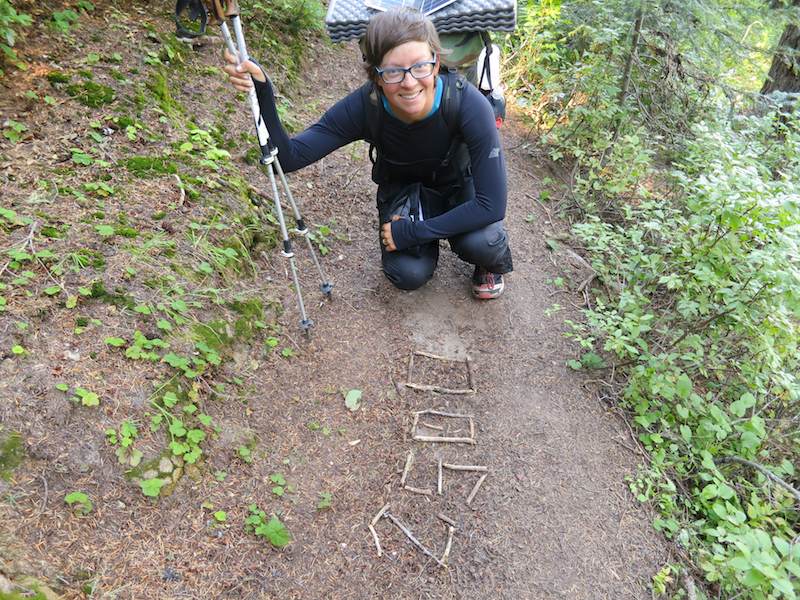
Wearing the EMS Techwick Lightweight Crew shirt and Patagonia Houdini Pants for warmth while walking in Washington.
When I entered the Sierra, I wanted to have a heavier long sleeve shirt, so switched from the EMS polyester to an Ibex Hooded Indie, and LOVED IT. I kept it all the way to the border, I loved it that bad. The hood was just so warm and comfy, it also had thumb holes, and the mid-weight (195 gm) merino wool was durable.

My Ibex Hooded Indie was a lovely chard green.
The Verdict: For bottoms, I loved the lightweight but not ultra lightweight (200 gm) Icebreaker Oasis Leggings, and would carry them the whole way next time. I would start with a lightweight polyester like the EMS Techwick Lightweight Crew or 150 gm long sleeve merino wool shirt for the beginning of the hike, and switch to the heavier Ibex Hooded Indie in the Sierra again.
Wind Shirt & Pants
I started the hike with a poncho-tarp and no raincoat, so my Montbell Tachyon Anorak windshirt got a lot of wear. It’s incredibly lightweight, and super durable — no tears or stains. It cut the cold on windy ridge-walks throughout Southern California, and I would definitely carry it again. The only negative was that the hood would catch wind easily and billow out into a space-helmet-shaped globe if I wasn’t careful about adjusting it to my face.

Wearing dopey hat and Montbell Tachyon Anorak wind shirt for sun protection in SoCal.
At Agua Dulce, the British hiker Will let me try on his rip-stop nylon Patagonia Houdini Pants, and finding them comfortable and suitably light, I got myself a pair that I carried from Tehachapi to Canada. These pants were great for slipping on during breaks for warmth, wearing during glissading, protecting skin from poison oak or post-holing, and looking like a ninja. I did tear a few holes in the seat of my pants when I fell on Glen Pass, but I easily repaired those with nylon tent patches in Lake Tahoe.
Both these items are mens/unisex only, so there’s no real shaping to accommodate women’s bodies. I found the pants (in size small) real tight in the seat until about Oregon, when I think I had lost some weight on the hips that made them fit better.
Verdict: I would carry both the Montbell Tachyon Anorak and Patagonia Houdini Pants again, the whole hike.
Warm hats
I started with an EMS fleece headband, and that was sufficient until the Sierra. I mail-ordered a Smartwool Reversible Training Beanie in their 195 gm merino wool, and carried that the rest of the trail. It was okay, I guess. Kind of thin. It was light, and between it and my buff, my head was never uncomfortable. It wasn’t particularly cozy, though, which would have been nice for morale.

Wearing the Smartwool Reversible Beanie and Patagonia Torrentshell rain jacket on a cold morning, near Glacier Peak in Washington.
The Wool Buff was a last minute, very good purchase. I don’t remember when I had Russell mail it to me, probably at Kennedy Meadows. It worked as a scarf, as a second hat, and as a pot cozy for finishing cooking. It didn’t tear or stain at all, even with all the food I spilled on it. I loved it on the hike, and wear it now IRL.
The Verdict: With the short hair that I had, I would carry the Wool Buff the whole way to provide extra neck warmth. You could probably skip it for warmth with long hair, though I might carry it anyway for pot cozying. I would probably carry the Smartwool Reversible Training Beanie again, unless I found something cozier that wasn’t too too heavy. Maybe a lightweight polyester fleece hat that tied under the chin?
Puffy
I started out carrying the puffy I’d picked up for the JMT two years prior: a Montbell Ultralight Down Vest. I like vests a lot — they keep your trunk warm but let your arms stay unencumbered. This one was great for me through all of Southern California, and between it, my long underwear, and my wind shirt, I was never too cold. I was also not super warm when I wasn’t in my sleeping bag.

Having breakfast at the Sweetwater Cafe in Agua Dulce, wearing the Montbell Ultralight Down Vest over some loaner clothes.
Right when I was in Lake Isabella, 50 miles before Kennedy Meadows, there was a snowstorm with white-out conditions over Forester Pass. After seeing pictures online of hikers wading through snow fields, I made a decision to get a warmer puffy with sleeves for the snowy Sierra. I found a deal on a down Rab Microlight Jacket and had it shipped to Kennedy Meadows and carried it the rest of the way to Canada.
The only downside to this jacket was discovering that the lining was a shocking pink color, which I decided was a feature — you can signal a rescue chopper with magenta! The warmth, fit, and length of this jacket were all great. I might get one with a hood if I had to replace it and was feeling super luxurious.

Wearing my Rab Microlight Down Jacket, about to cowboy camp after Ashland.
The Verdict: Loved the Rab Microlight Jacket and would get it again. It was great to have in the High Sierra, when I was camping before dark to set up for the passes and had some sitting around to do.
Raincoat
Instead of a tent, I carried a poncho-tarp and bivysack for the first 550 miles of the trail. The poncho-tarp was to be my raincoat, and as I didn’t have any real precipitation during that whole section, who knows how it would have performed. When I decided to carry a tent instead of the tarp, I brought on my two-season-old Marmot Crystalline rain jacket as well. This jacket did fine, until I had to wear it for extended hours while hiking in Oregon. Then it shredded, and when it shredded, it shredded HARD. First the back of the neck lost water resistance, then the armpits started tearing.

Wearing the Marmot Crystalline Jacket and Patagonia Houdini Pants for warmth at Thousand Island Lake.
By the time I got to Bend, the armpits were naturally vented through large tears on each side that were working their ways to the tops of the shoulders. This actually wasn’t terrible, but the neck leaking was super unpleasant, so I looked for a new one in town. I found a serviceable lightweight jacket in the Patagonia Torrentshell, and that did me fine up through the end of the trail. It performed as expected — no leaks, no tears. Kept rain off me. My only issue with it was that it was quite a bit heavier than the Marmot jacket.

Wearing the Patagonia Torrentshell for warmth and drizzle-protection, a few minutes from the end of the PCT.
The Verdict: While I use the Patagonia jacket here at home quite a bit, I would look for a lighter jacket next time. Perhaps one of the cuben fibre ones going around? Or a new Marmot Crystalline.
—
And there you have it — all the clothing I wore on the PCT during my 2014 thru-hike.
(You deserve a medal for thru-reading this post.)
If you have any questions about clothing on the PCT, leave them in the comments and I’ll do my best to answer them.
See my gear reviews here: the Big Three (tent, sleeping bag, pack) and the little stuff (food prep, water treatment, snow gear, etc.).
The post PCT clothing review appeared first on alice hikes.
]]>The post The collected PCT journal, and upcoming posts appeared first on alice hikes.
]]>
PCT trail marker out of Kennedy Meadows. No bears allowed!
For those of you just starting to read about my 2014 Pacific Crest Trail thru-hike, I have collected all of my PCT journal entries and posts on the PCT ‘014 page.
The Collected Works of Penguin
Start from the beginning and read to the end, or pick a section that sounds interesting and go from there:
- US-Mexico border/Campo (mile 0) to Warner Springs (mile 110): Hello from Warner Springs CA
- Warner Springs (mile 110) to Idyllwild (mile 152): Resting and regrouping in Idyllwild
- Idyllwild (mile 152) to Big Bear Lake (mile 266): Blister care in Big Bear Lake
- update from Big Bear Lake (mile 266): Green light to hike out
- Big Bear Lake (mile 266) to Wrightwood (mile 370): Quick stop in Wrightwood
- Wrightwood (mile 370) to Agua Dulce (mile 455): Zero day at Hiker Heaven in Agua Dulce, CA
- Agua Dulce (mile 455) to Tehachapi (mile 559): Twenty percent done in Tehachapi, CA
- Tehachapi (mile 559) to Kennedy Meadows (mile 702): Entering the Sierras from Kennedy Meadows
- Kennedy Meadows (mile 702) to Kearsarge Pass/Bishop (mile 789): Out Kearsarge to Bishop, CA
- Kearsarge Pass/Bishop (mile 789) to Mammoth Lakes (mile 907): Past the high passes in Mammoth Lakes, CA
- Mammoth Lakes (mile 907) to Truckee (mile 1156): Over a thousand miles in Truckee CA
- Truckee (mile 1156) to Chester (mile 1335): A visit from a bear, and halfway to Canada in Chester CA
- Chester (mile 1335) to Bartle Gap (mile 1451): Seeing a mountain lion near Mt. Shasta, and a trip off-trail
- Bartle Gap (mile 1451) to Ashland (mile 1727): Holy shit, I walked to Oregon
- Ashland (mile 1727) to Cascade Locks (mile 2155): Across Oregon to the Columbia River
- Cascade Locks (mile 2155) to Snoqualmie Pass (mile 2402): Cascade Locks to Snoqualmie Pass
- Snoqualmie Pass (mile 2402) to Stevens Pass (mile 2476): Up the Goldmyer Hot Springs Alternative to Stevens Pass
- Stevens Pass (mile 2476) to Stehekin (mile 2580): Through Glacier Peak Wilderness to Stehekin
- Stehekin (mile 2580) to Manning Park (mile 2669): Past the Pasayten Wilderness to Monument 78
For the record, the amount I wrote about each section has more to do with my energy level than how much I liked it. For example, Oregon was amazing, but I only blogged a few paragraphs about the whole state. Tsk tsk, past Alice.
Upcoming posts
In upcoming weeks, I’ll be sharing my thoughts and experiences on a variety of topics:
- gear and clothing reviews
- resupply strategy
- mileage trends
- food!
- hiking while being a women (spoiler alert: it’s like hiking while being a man, with more blood)
- injuries and self-care
One of the reasons I started this blog was because I didn’t find a lot of blogs from hikers in my particular situation (solo, female, in a relationship, late 20s – early 30s, lightweight-ish gear approach). I wanted to add my voice to the hullaballoo, in case sharing my experience could help other hikers/readers down the road.
So, if you, dear readers, have any topics you would like to see covered, please tell me in a comment and I will do my best to accommodate your request.
The post The collected PCT journal, and upcoming posts appeared first on alice hikes.
]]>The post Past the Pasayten Wilderness to Monument 78 appeared first on alice hikes.
]]>After a summer of trying to wrap my brain around the enormity of my walk (MEXICO TO CANADA), I was almost there.

Sunset over the Washington Cascades, foreboding the sunset of my hike. Such drama. Wow.
I hiked out from Stehekin with Port, Starboard, Emu, and Mozzie, packing out a small box of wine to celebrate Port’s birthday. We enjoyed fresh fruit trail magic at Rainy Pass, as well as the remarkably clean campsite bathroom — you start to notice things like that after 5 months on the trail.
The weather was socked in frequently during that last section, which felt fitting. Making it through Washington with only one major patch of rain and largely clear skies had been damn good luck. I’d already seen all the major peaks, so a little fog just added character and solemnity to the final stretch.

Trail vs. mist — the (occasional) Washington PCT story.
The second night out of Stehekin, the five of us set up camp in a nice large clearing above a spring. Port & Starboard had gone down to get water earlier, and Emu and I went to get some a bit after dark so we wouldn’t have to go in the morning. We had gotten partway down to the spring when Emu stopped and said “Ooh, I see eyes”.
Her headlamp was more powerful than mine, and for a while I couldn’t find them. She thought it might be a deer, and we crept a bit closer, toward the spring. It moved then, quickly to our left, up towards the camp. At that point she saw a leg and said firmly “that is not a deer”, and I was finally able to see the eyes. Definitely cat.

Mozzie browsing on huckleberries. Another hiker, McButters, saw a bear in this stretch, probably eating the berries too.
Knowing we didn’t want the lion to cut us off from camp, we moved back-to-back and quickly walked back up the rocky path to the tents, talking loudly as we watched for Puss above or below. I won’t lie, it felt a bit hardcore. I may or may not have felt like I was in some cool adventure movie. The heroes don’t get eaten in adventure movies, right?
Mozzie, Port, and Starboard quickly joined us in making a “GTFO, cougar!” ruckus once we got back to camp, and we spent the rest of the evening keeping one eye on our food. It came up the trail and checked us out, and a few of the other women saw the eyes too, but it made no aggressive moves that we observed.
What a way to celebrate the almost-end of the trail, eh?! We left a note the next morning to inform other hikers of its presence.

Switchbacking up up up, through huckleberry bushes turning red with the season.
On the second to last day, I finally saw my bear, in the form of a skin and sacks of meat hung from trees between a hunter’s wall tent and the trail.
Having met hikers who saw no fewer than 8 (!!!) bears on the trail, it was a bit of an oddity that I never laid eyes on a single black bear the whole time.

PCT thru-hiking season overlaps with multiple hunting seasons. Bear skin and meat by a hunter camp in the Pasayten Wilderness.
I would be lying if I said I wasn’t disappointed by the “no bear” aspect of my hike. Sure, I had interacted with a bear — that one that scared the crap out of me by crashing around and circling my tent at night when I was camping alone out of Truckee. Hearing one at night has all of the fear factor and none of the fun — bears are beautiful creatures I feel honored to see in the wild, and would love to see from a respectful distance.
Oh, well. I wasn’t entitled to a bear sighting just for hiking the PCT. I will assume, however, I would have seen that particular bear, had it not met its fate several days earlier.

“50 miles to Canada! eh”
Having felt mentally strong for weeks leading up to the end, I started cracking on the penultimate day. I couldn’t believe the hike was finally coming to an end. I was so close to completing this huge achievement and being in my partner’s arms. I was also out of time to fall head-over-heels in love with trail life and blast through the miles with ease and a peppy attitude.
My Pacific Crest Trail hike experience now was what it was, and I needed to mourn for a moment all the other things the hike could have been. By the next morning, the sadness and fear had been processed and replaced by joy, pride, and EXCITEMENT.
Because my hike was fucking amazing.
Only a few minutes from the end of the trail, my mood could only be described as “stoked”.
I remember not a whit about the last day before reaching the monument. We flew the 11 or so miles to the border, and suddenly we were in the clearing, there was the monument, and I had hiked the PCT. FUCK YEAH.
One of the best parts of my final day on the PCT was sharing it with great people. The four hikers I walked into that clearing with are strong supportive badasses, and I loved finishing out this epic journey in their company.

The incredible hikers I finished the PCT with: (clockwise from the top) Mozzie, me, Starboard, Port, and Emu.
Despite a mostly socked-in last section, the sun came out and shone on our monument photo shoot. I flipped through the register, attempting to count previous hikers before giving up. Too many flip-floppers and sectioners to make an easy accurate count of full thrus, and what did it matter?
*I* had made it.

Climbing down from the monument, oh so carefully. Not worth falling on the last day!
I wrote an entry, drew one last disfigured hiking penguin, and was done.

The Hiking Penguin and some chicken scratch. To read the first half of my comment, you’ll have to go to the monument.
From April 13th to September 19th, I had walked a continuous footpath (mostly) on the Pacific Crest Trail from Mexico to Canada. 5 months and 1 week. 160 days.

I didn’t realize how girth-y the monument was until I climbed up there. Twss?
The cruel little joke of the trail is that once you’ve hiked to Canada, you then have to hike another 8-9 miles on trail, forest roads, and highway to get to civilization at Manning Park.
I may or may not have spent that last section contemplating how many dollars I would pay a taxi service to come pick me up as soon as trail turned into navigable road (at least double, if not triple, digits).

A trail angel provided a creek-chilled beer cache (a.k.a. manna from heaven) by the highway that lead to the Manning Lodge.
Manning Park felt like a resupply stop through the veil of coming down from some potent, life-altering drug trip. My civilization mind turned on rapidly in the whirlwind of hostel rooms, burgers, beer, saying goodbye to my trail friends, a fancy greyhound bus, and all the scrumptious dumplings and Thai food I could cram down my gullet in Vancouver.
I had called Russell from Stehekin with my definite Vancouver arrival date, and he had reserved me a room in town and a direct flight home the next day.
It was over. I had succeeded in the goal I set out to achieve: to walk from Mexico to Canada in one season. Bam.
← Previous: Stevens Pass (mile 2476) to Stehekin (mile 2580): Through Glacier Peak Wilderness to Stehekin
The post Past the Pasayten Wilderness to Monument 78 appeared first on alice hikes.
]]>The post Through Glacier Peak Wilderness to Stehekin appeared first on alice hikes.
]]>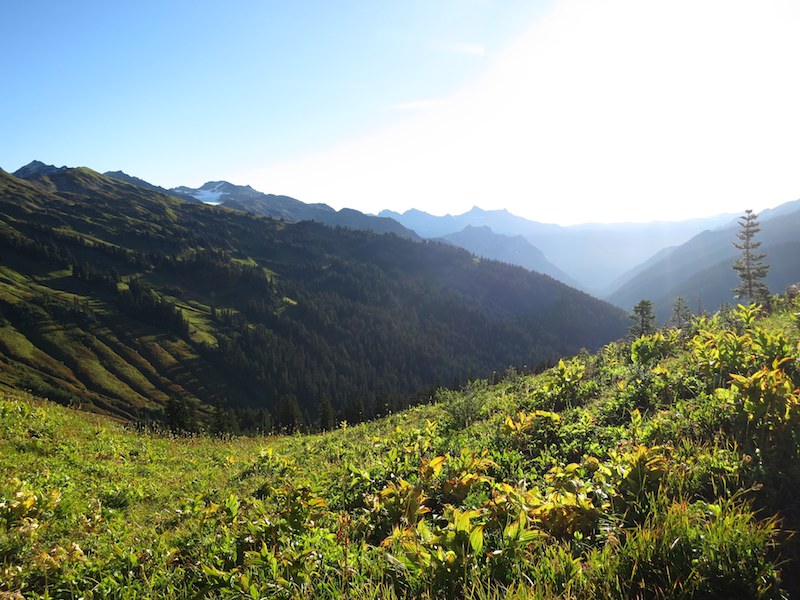
Why did I hike the PCT? Because views like this. Mountains and valleys north of Stevens Pass in the morning light.
After the drama of the missing box, and the hustle & bustle of the Dinsmores’ Hiker Heaven, I was happy to be back out in the woods. After a leisurely lunch in Skykomish and easy ride back to the trail (thanks, Beer’s cousin), I made it 10 miles out of town to camp at the crowded Janus Lake. Port and Starboard showed up that night, as did Emu and Mozzie.
The next day I hiked with those 4 hikers on and off, ending the day at the breathtaking Reflection Pond, which turned out to be the coldest campsite of the night. Over the course of the day I could see Mt. Rainier far behind, Glacier Peak nearby, and a hint of Mt. Baker to the northwest.
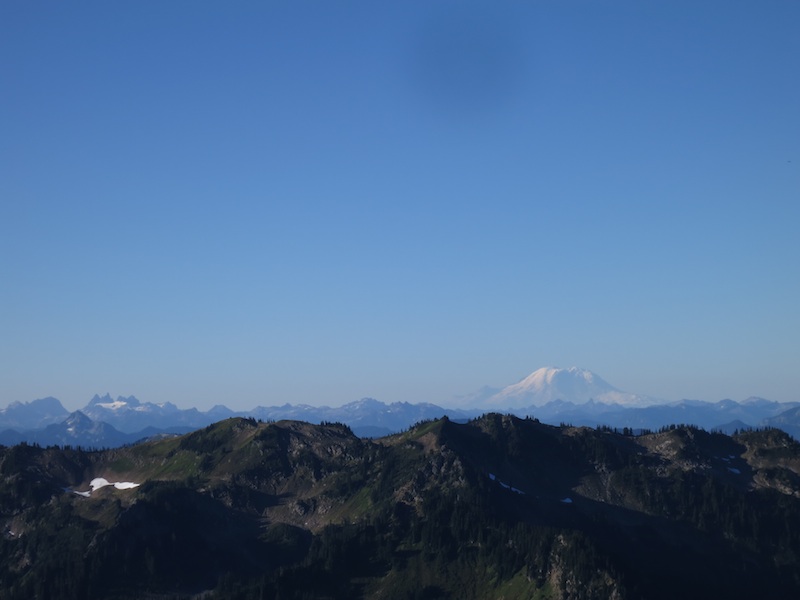
Still boggles my mind — I walked from past that mountain. Mt. Rainier in the distance.
I finagled my tent into a stealth spot on a slope above the pond, under some trees, attempting to get out of the biting wind. That night, I made some questionable excellent decisions to avoid getting out of the tent when nature called. I wrote in my journal:
Just tried to pee into a bottle. Missed. Wet wiped my sleeping mat. Peed into a ziploc. Got pee on a lot of things. Didn’t really care. Felt like I should care.
Aaand, that’s the PCT, ladies and gentlemen. Strips the civilization right out of you, until you no longer care that everything you own is covered, or at least flecked, with urine. And trust me, that’s a good thing. Not only “don’t sweat the small stuff”, but redefine the shit out of “small stuff”.
(Spoiler alert: the only remaining contenders for ‘big stuff” are death, broken legs, and running out of Snickers.)
Need a break from pee stories? Have a pika! It was super cute and squeaked a lot.
The next morning I got up early (for me — it was probably 6:15 or so) and hiked out along the ridgelines between Red and White Pass. As I was tootling along on my own, I saw two raptors circling overhead, one large, one smaller. I stopped, watched them soar and hang still in the air above me for several long minutes.
A hoary marmot in Glacier Peak Wilderness doing its best meerkat impression. Not pictured: the hawk circling overhead, and the (field?) mice whose squeaks touched the upper limit of my hearing.
I watched the smaller raptor flying low near me, and turned back toward the trail, dumb grin on my face, only to see the larger one swooping directly toward me, not 20 feet away. He pulled up shortly, but not until after I felt thoroughly inspected. Gave me shivers and an even larger grin.
Basically, Glacier Peak Wilderness is the most beautiful part of the trail, nay, the world. Go there and weep tears of joy that this landscape exists and you get to be in it.
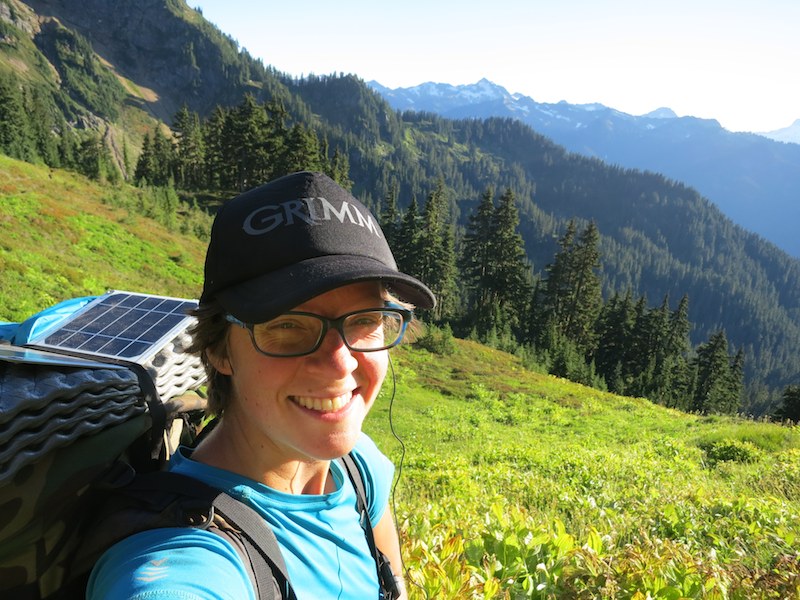
Glacier Peak Wilderness, a.k.a. Ridiculously Beautiful Wilderness.
I pulled ahead of Port and Starboard somewhere that day, and pushed on til dark, making camp at a stealth site above a creek. I was nervous camping alone again, but this time forced myself to cook dinner, albeit right outside my tent while I sat inside. Progress, bitches.
The next day was not the longest in terms of miles, but may have been my hardest of the trail — 25 miles with about 9000 feet of elevation gain. I pushed from 7:45 am to 7:45 pm with only one half-hour break, up two huge climbs, down two slogging descents, and some wandering aimlessly through the rocky Suiattle river bottom on the Old PCT alternate, looking for cairns marking the way to the log “bridge” over the rushing river.
The log bridge over the Suiattle River. There is a new bridge several miles downstream if you don’t like log crossings.
The days were getting harder, more up and down, and the nights were staying cold. My left hip had started hurting after leaving Bend OR, and flared up on the long ascents and descents throughout Washington. At times it was bad enough to make me stop, bend over to take weight off it, and rub the joint until I felt like I could keep going. Oh, and pop 600 mg of Vitamin I, which I generally avoided since the NP in Big Bear warned about possible ulcers from overuse. A few times it felt like cold water splashing on the outside of my hip, and that freaked me out a bit.
The trail was an icy slip-and-slide down the face of this bowl. Can you find Port and Starboard at the saddle.
At the beginning of the trail, sporadic biting pain and paresthesia would have frightened me badly. I might have called Russell crying, wondering if I could finish the hike. Midway through Washington, there was still a part of me that worried about it, but mostly I knew it wouldn’t stop me unless my legs stopped obeying my brain entirely.
I wondered if I was making a choice to put finishing the hike over my long-term health, but I knew I wouldn’t stop even if that were the case. I was too close to the end.
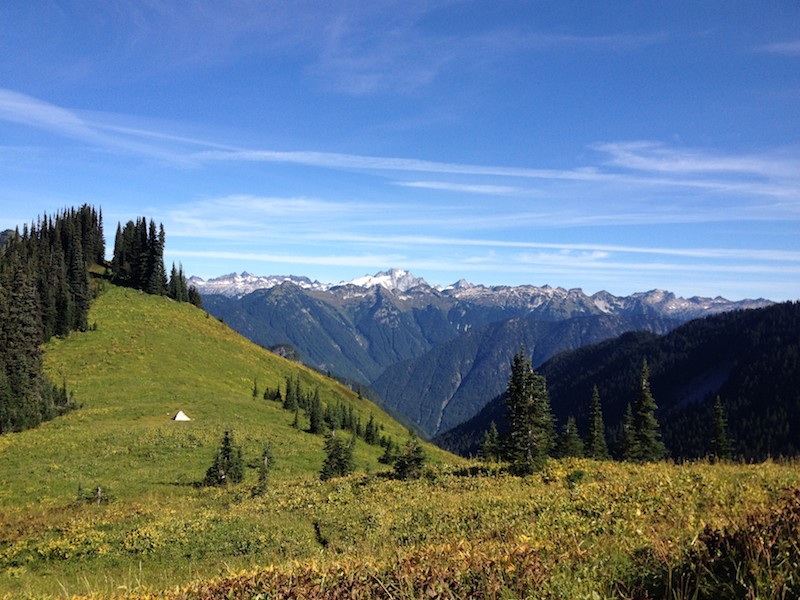
A hunter’s tent on the ridge before the Suiattle River. On my descent, I met the hunter taking a break on his way up.
Nevertheless, between hip aches, knee twinges on downhills, decreased sensation in the tips of my toes, and general feeling of malaise for the entire segment from Skykomish to Stehekin, it felt like my body was starting to give out on me. As Emu put it, “The wheels are coming off the wagon”.
Feeling bone tired at the 2500 mile marker. Squatting is hard when you have been destroying your joints for 5 months.
It didn’t help that my hunger had ramped up again. No amount of food ever felt like enough. The last night of the section, I journaled that I “spilled pasta dinner on my hat, buff, & sleeping bag. Licked it off everything.” That sleeping bag was not clean, AT ALL, and I just didn’t care. The thought of losing those calories was too much to bear.
I walked into Stehekin with nothing but my emergency dinner and two chocolate bars that my body was completely uninterested in up til that point. Thigh Gap and a flip-flopper helped me kill the bars as we waited for the bus to town.
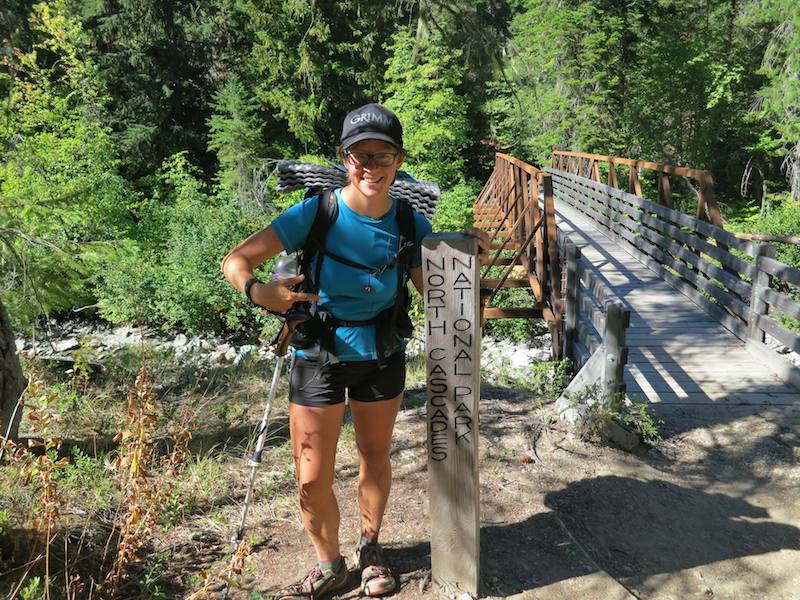
Reaching the last national park of the hike.
Stehekin truly was the incredible haven of pastries and rest that I’d heard about. I managed to go to the fabled bakery no fewer than 4 times, because when I heard that the other women were considering a zero day, I rapidly decided to join them. I hadn’t zeroed since Bend, and it was taking a toll mentally.

No chicken legs here. The amazing hikers who taught me how to hike a 30, and gave me the motivation to keep going when I wanted to quit in Oregon: Sparkle Motion, Beacon, Thigh Gap, Hot Tang, Emu, Mozzie, Wild Card, and yours truly.
Instead of blitzing through the resupply-eat-shower-laundry-eat-sleep-eat haze of recent town stops, I splurged for a hotel room, a nice dinner at the ranch on the zero, and drank lots of beer catching up with Boomerang and other hiker friends while watching seaplanes land and take off on Lake Chelan. Sheer bliss.
Dusk over the Stehekin dock on Lake Chelan. The resort is accessible only by ferry, sea plane, and foot.
Next stop, Canada!
← Previous: Snoqualmie Pass (mile 2402) to Stevens Pass (mile 2476): Up the Goldmyer Hot Springs Alternative to Stevens Pass
→ Next: Stehekin (mile 2580) to Manning Park (mile 2669): Past the Pasayten Wilderness to Monument 78
The post Through Glacier Peak Wilderness to Stehekin appeared first on alice hikes.
]]>