The post Art That Tells a Story: Native American Art at Albany UU appeared first on Albany UU.
]]>The collection features artists from several Indigenous nations, including Onondaga, Mohican, and Abenaki artists. Their work spans contemporary painting, traditional designs, wood carving, and other art forms. Each piece offers a distinct perspective, connecting artistic expression with cultural identity, family stories, spiritual meaning, and the continuity of Indigenous traditions.
Among the works, Brandon Lazore’s Gayaneñhsä•ʔgo•nah explores Haudenosaunee influence on the formation of the United States and the women’s suffrage movement. Terri L. O’Connor’s Renew My Spirit uses the butterfly to symbolize transformation, spiritual awakening, and the beauty around us. Abenaki artists Liz Charlebois and Fernande Andree’ Dennis Newton share traditional and personal expressions through birch bark bittenwork and wood carving. Gordon Williams, Sr., of the Stockbridge Munsee Band of Mohican Indians, shares work rooted in his community’s traditions, including wampum and sacred plants.
These installations invite us to consider Pluralism, one of our UU values: honoring the many identities, cultures, and perspectives that enrich our shared community. They also remind us of Interdependence, the relationships among people, communities, histories, and the living world.
You’ll find the artwork in three locations throughout the building. Look for the QR codes near the installations to learn more about the artists and the stories behind their work.
The next time you visit Albany UU, take a moment to pause, look closely, and discover something new. Art can open a door to understanding, deepen our connections, and help us practice the curiosity and respect that make our community stronger.
Collection 1: Brandon Lazore
Brandon Lazore (Onondaga)
Brandon Lazore is a multidisciplinary artist and a member of the Snipe Clan of the Onondaga Nation. His work brings together influences from Native artists, classical painters, and graffiti artists in a distinctive style he calls “Traditional Graffiti.”
As a professional painter, Lazore collaborates with universities, historical organizations, and municipalities to bring Haudenosaunee and contemporary Native art into public spaces. He enjoys sharing his work and the stories of his people through projects ranging from large murals to tattoo designs.
Gayaneñhsä•ʔgo•nah
Limited-edition giclée print from the Albany UU Collection
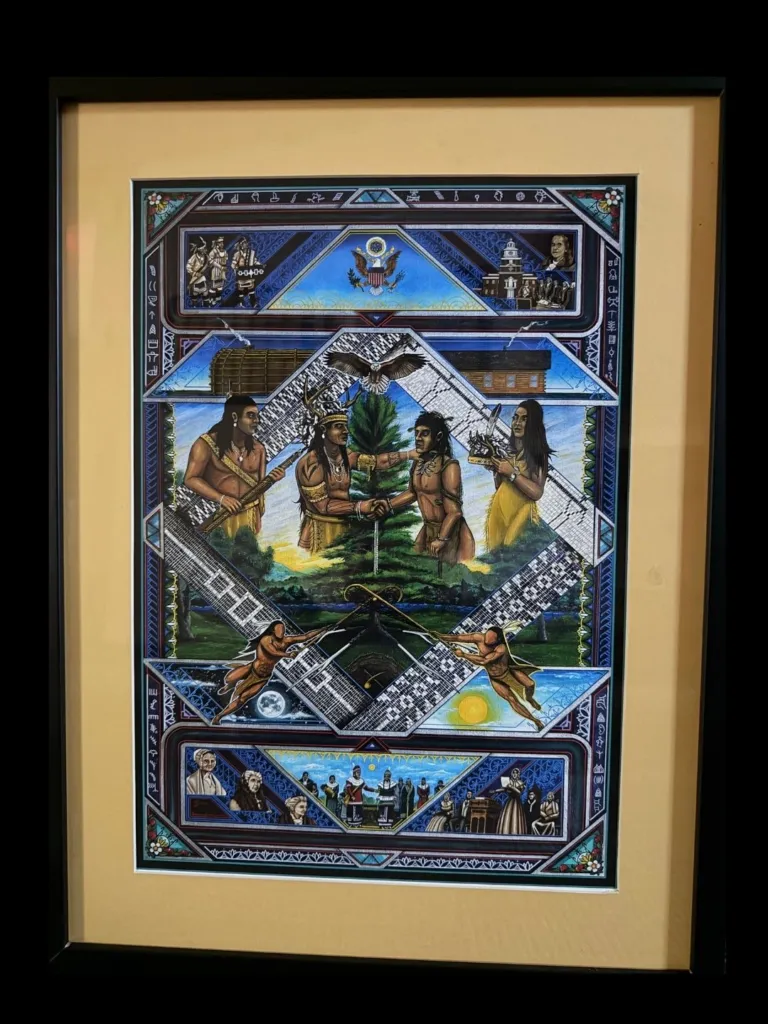
This work explores Haudenosaunee influence on the formation of the United States and the women’s suffrage movement. Its three main sections connect Haudenosaunee leaders, traditions, and symbols with American history. The upper section features Cannasatego, the Seal of the United States, and Benjamin Franklin. The central section traces a transition from a traditional longhouse to a modern one, with the Peacemaker, Tadodaho, Jigonsaseh, and Hiawatha representing the Great Law of Peace. Several wampum belts honor the founders of peace and the traditions they carried forward. The lower section depicts Haudenosaunee women educating American women about their freedoms and status. Lucretia Mott, Elizabeth Cady Stanton, and Matilda Gage appear alongside a scene from the 1848 Seneca Falls Convention. Traditional patterns and symbols from the Condolence Cane complete the composition.
The upper section features Cannasatego, the Seal of the United States, and Benjamin Franklin. The central section traces a transition from a traditional longhouse to a modern one, with the Peacemaker, Tadodaho, Jigonsaseh, and Hiawatha representing the Great Law of Peace. Several wampum belts honor the founders of peace and the traditions they carried forward.
The lower section depicts Haudenosaunee women educating American women about their freedoms and status. Lucretia Mott, Elizabeth Cady Stanton, and Matilda Gage appear alongside a scene from the 1848 Seneca Falls Convention. Traditional patterns and symbols from the Condolence Cane complete the composition.
Wampum Twist
Giclée print from the Albany UU Collection
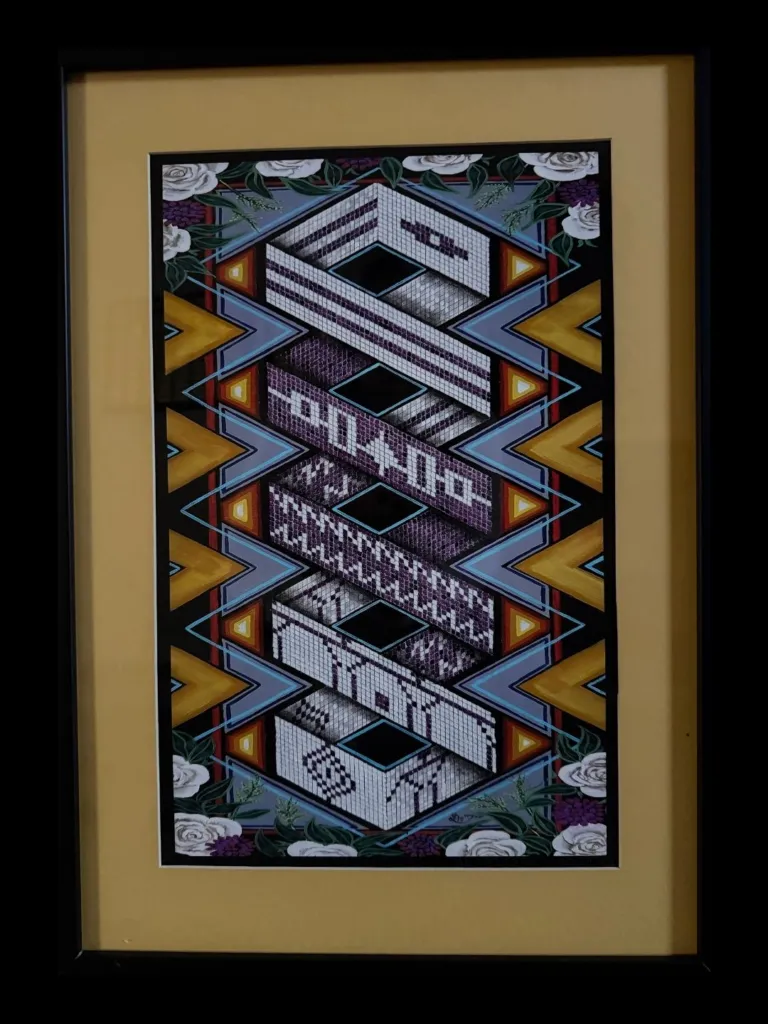
This work brings together several wampum belts, including One Dish, Two Row, Hiawatha, Evergreen Tree, Women’s Nomination, and the Onondaga Friendship Belt. A repeating spike pattern emphasizes the belts’ twisting movement, while floral borders frame the composition. Wampum belts carry meaning within Haudenosaunee history and diplomacy. This work invites viewers to explore the relationships and traditions represented through their designs.
Collection 2: Terri L. O’Connor (Miller), Liz Charlebois, and Fernande Andree’ Dennis Newton
Terri L. O’Connor (Miller) (Mohican)
Terri L. O’Connor (Miller) is an enrolled member of the Stockbridge-Munsee Band of Mohicans in Wisconsin. She spent much of her childhood and early adult life on the Stockbridge Reservation. Her father, an artist, introduced her to oil painting at an early age.
O’Connor describes her art as a reflection of her heritage and a tribute to past Native generations who held on to honor, hope, and survival for future generations.
Renew My Spirit
From the Albany UU Collection
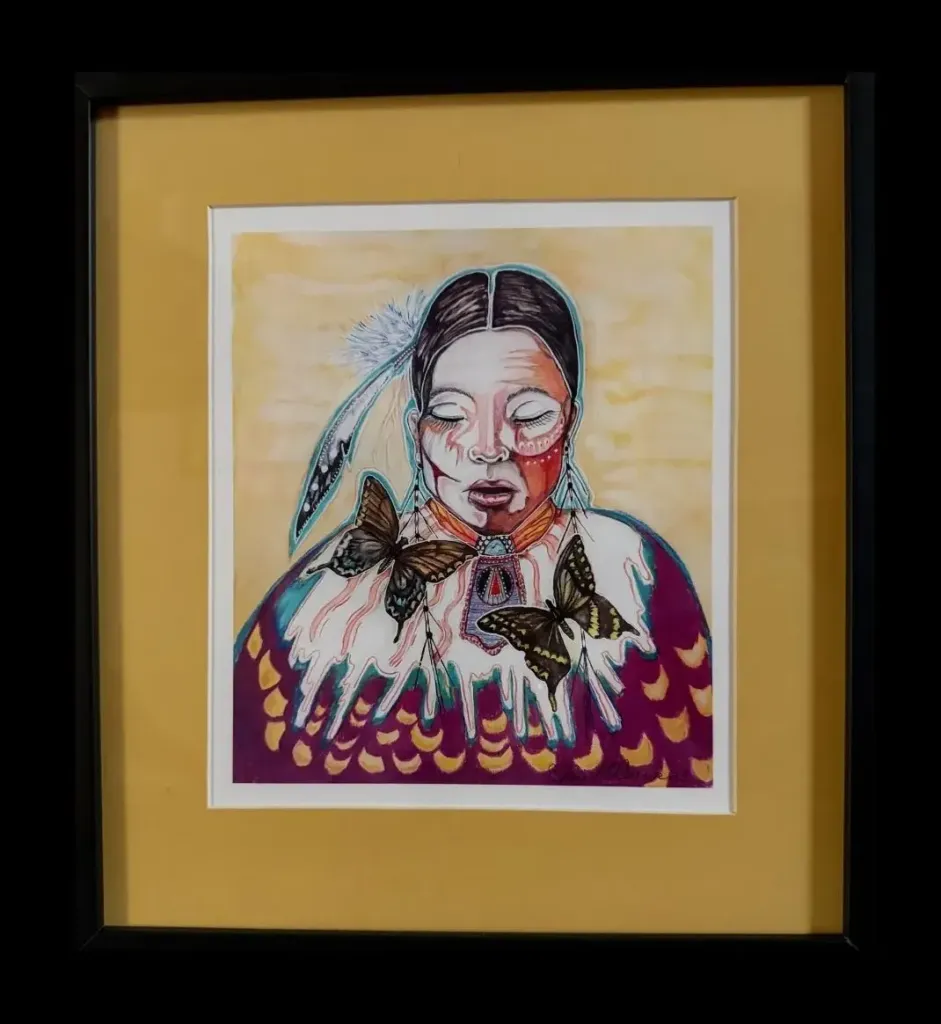
The butterfly represents transformation, beauty, and spiritual awakening. It reminds us to recognize and cherish the beauty around us.
3 Chiefs (The Blanket)
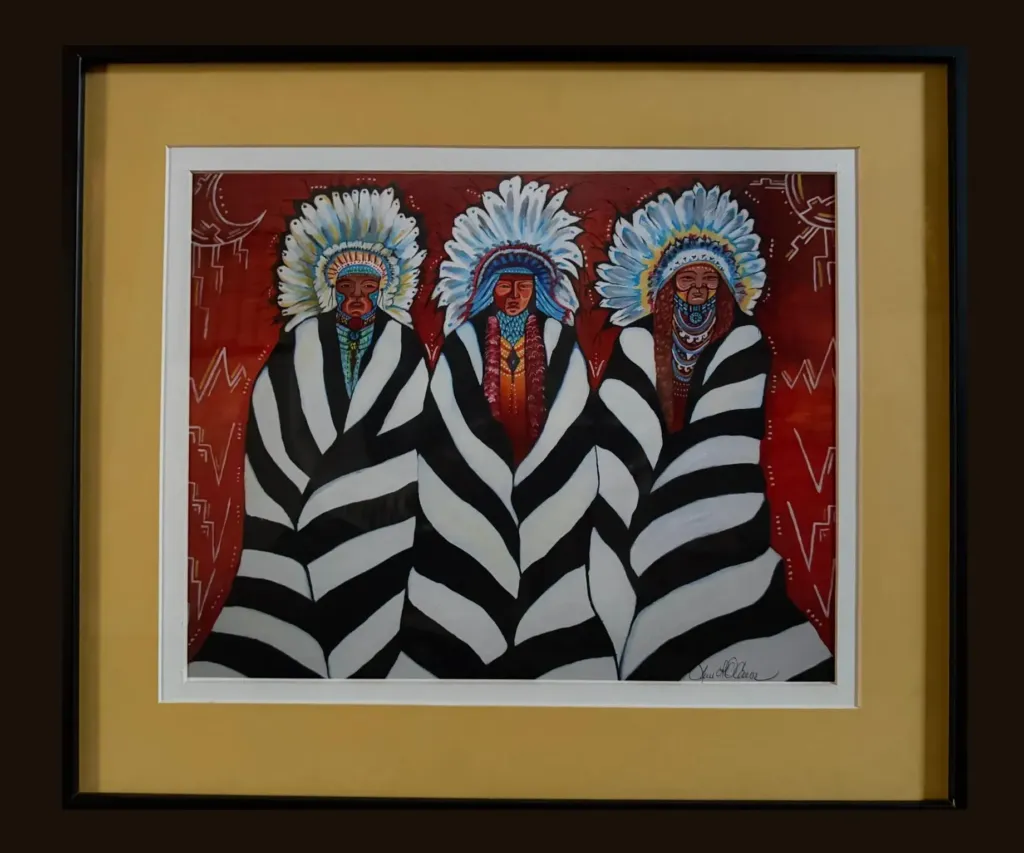
This work draws inspiration from the Navajo blanket and Great Chiefs.
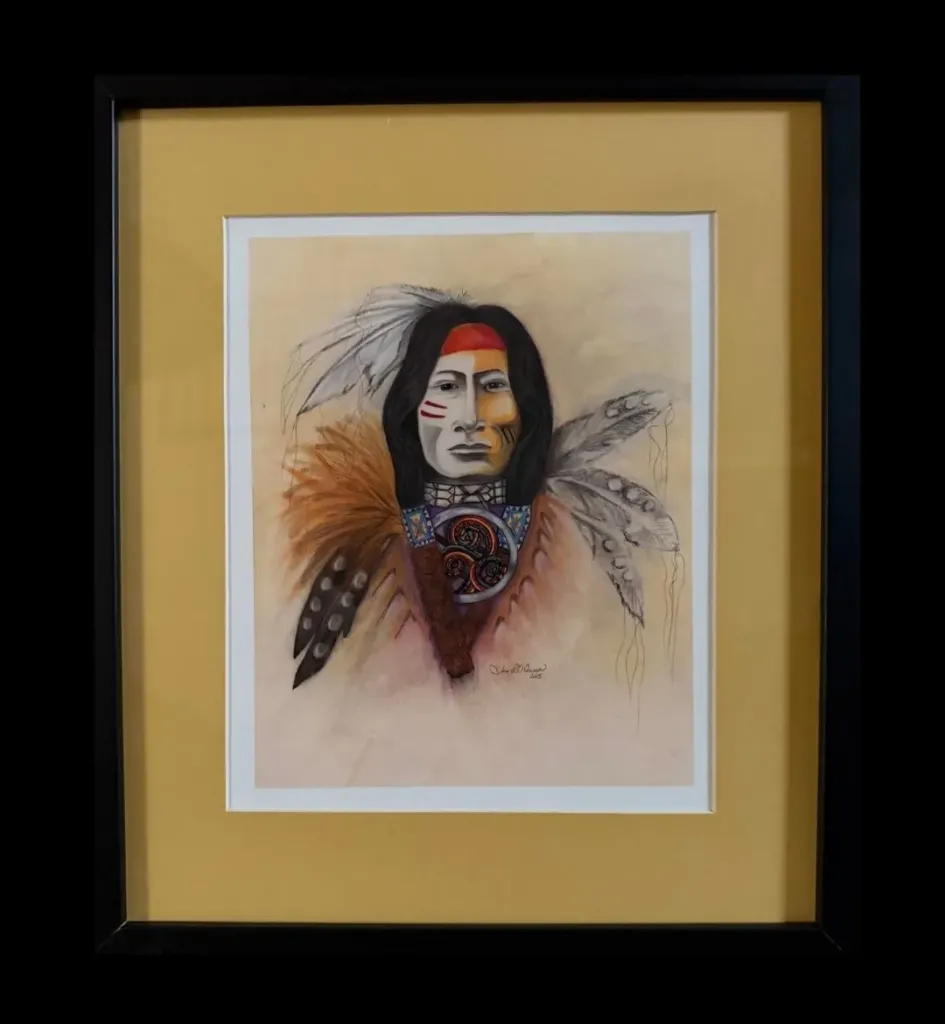
Spotted Eagle
Liz Charlebois (Abenaki)
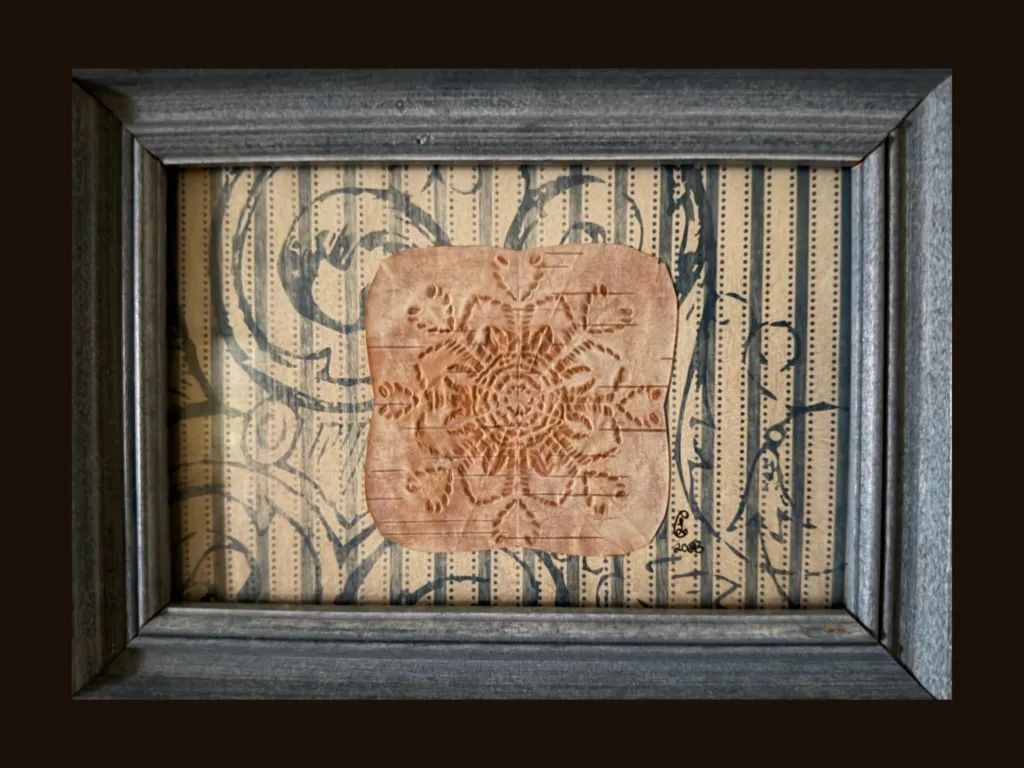
Birch bark biting is an ancient Indigenous art form practiced for centuries in regions where birch trees grow across North America. Artists fold thin layers of birch bark and use their teeth to create patterns on the surface. When they unfold the bark, a symmetrical design emerges. Artists traditionally used these designs as patterns for beadwork and quillwork. The process requires care and skill, beginning with the selection and preparation of the bark, often gathered in spring.
Birch Bark Bittenwork (Walagaskwadigaw8gan)
Donated to the Albany UU Collection by Dick Dana
Fernande Andree’ Dennis Newton (Abenaki)
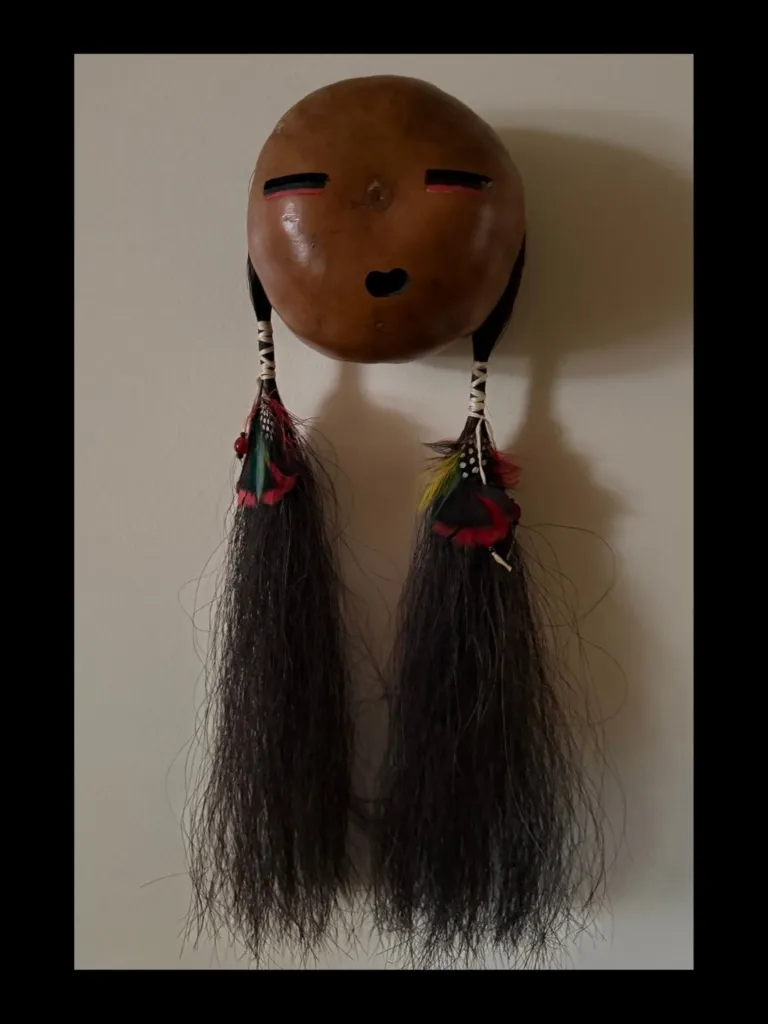
Fernande Andree’ Dennis Newton is an Abenaki artist with roots in the St. Francis Indian Reservation, also known as Odanak, in Quebec, Canada. Her parents both practiced traditional arts. Her father carved wooden figures, masks, and totem poles, and made traditional Abenaki snowshoes and woven pack baskets. Her mother created ash and sweetgrass baskets and sometimes helped design carvings. Newton began wood carving in 1990, two years after her father’s death. Her mother’s encouragement helped her pursue the art, while her father’s guidance continues to inspire her work. In 1998, she began working with hard-shell gourds, creating masks, bells, bowls, jewelry, and imaginative figures. Through wood carving and gourd art, Newton maintains a connection to Abenaki culture and carries forward the stories and artistic traditions her parents shared with her.
The Guardian
Donated to the Albany UU Collection by Vida Wehren
Collection 3: Gordon Williams, Sr.
Woodland Creations: Gii Taa’se Family Artists
Gordon Williams, Sr., belongs to the Stockbridge-Munsee Band of Mohican Indians. His Native name, Kaakska Kweenow, means “Cedar Man.” In his words, he watches over cedar, a sacred plant with many uses in his community. People use cedar in spiritual practices, for protection and healing, and to make tea for singers and drummers.
Williams has long participated in community life on the Stockbridge-Munsee Reservation in Wisconsin. He and his sons began a family drum group in 1994, and they continue to sing together. He later took up crafting as another way to maintain and share cultural traditions.
Williams began working with wampum after someone gifted him a box of wampum shells at a gathering of the 12 Lenape tribes, which include the Stockbridge-Munsee Band of Mohicans. He values the opportunity to work with this material, which holds a place in his culture, and to share his ideas through his creations. He describes each piece as carrying something of himself.
Sacred Plants: Sage, Sweetgrass, Tobacco, Cedar
Donated to the Albany UU Collection by Vida Wehren
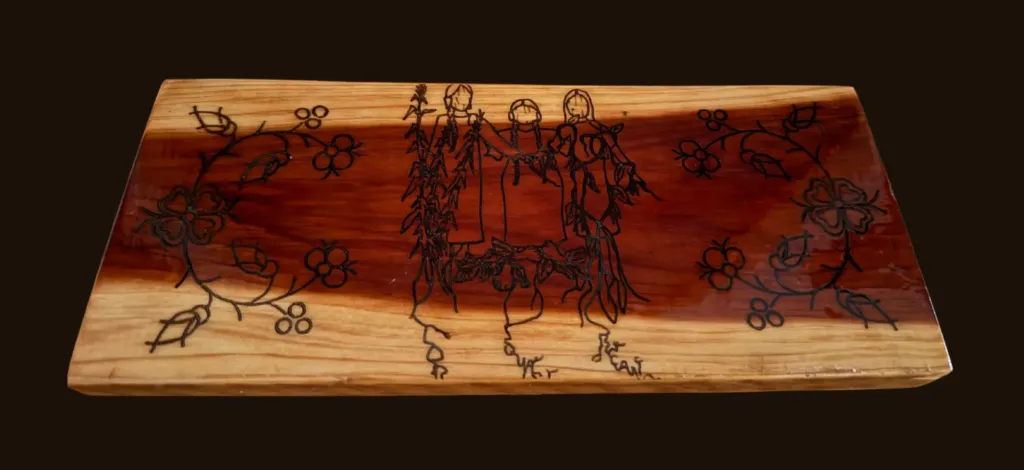
Corn, beans, and squash are known together as the Three Sisters. These crops have long-standing significance in Indigenous agriculture and food traditions.
The Three Sisters: Corn, Beans, Squash
Donated to the Albany UU Collection by Vida Wehren
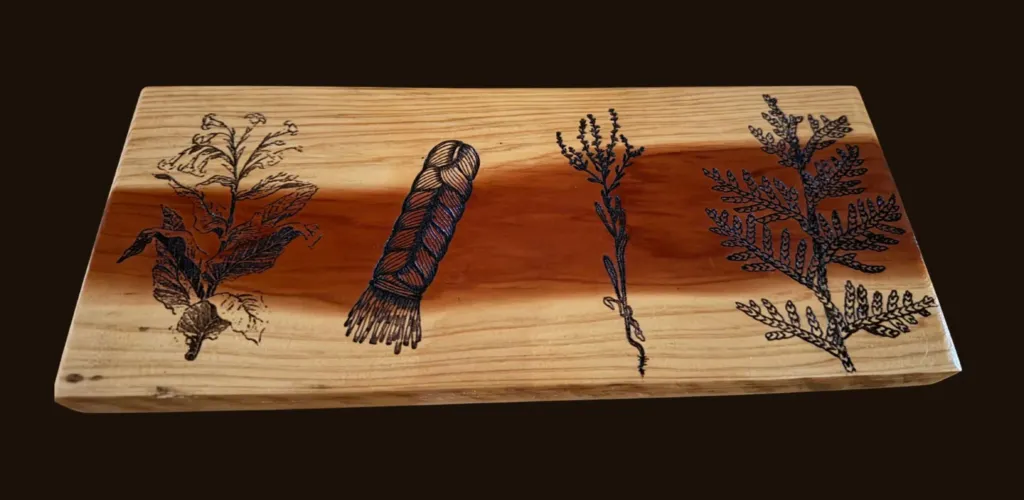
Williams’s work connects artistic expression with cultural knowledge, family, community, and the traditions he continues to practice and share.
The post Art That Tells a Story: Native American Art at Albany UU appeared first on Albany UU.
]]>The post Putting Our Hearts and Soles in Motion: Albany UU and the CROP Walk appeared first on Albany UU.
]]>The Albany CROP Walk began in 1981 as part of a nationwide effort organized by Church World Service to raise funds for hunger and disaster relief. Twenty-five percent of the money raised in the Albany area stays right here in our community, supporting local food pantries and feeding programs. The rest supports hunger and disaster relief work around the world.
Albany UU’s connection to the walk began personally before it became a congregational tradition. Dawn and Dick Dana became involved in the early years, initially walking as a family in support of their friend Ted Lorraine, who helped lead several of the early Albany walks. Their children joined them, riding in strollers as the family made the walk.
Over time, that family tradition became part of Albany UU’s community life. By the late 1990s, Dawn and Dick were helping organize an Albany UU team. Team UU has grown and changed through the years. In some years, only about ten people have participated. In others, the team has topped 50 walkers and even ranked as the largest team in the Albany walk.
The congregation’s generosity has remained constant, even as the number of walkers has changed. In 2025, Team UU earned the Silver Sneaker award for raising the second-highest amount among participating teams. The bronze-and-silver sneaker plaques commemorate the congregation’s fundraising success, and the 2025 Silver Sneaker currently has a place of honor in the Community Hall lobby.
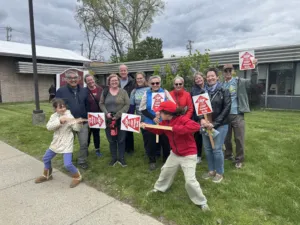 This year, 20 people signed up for Team UU. Fourteen ultimately made it to the walk on May 3, when St. Paul’s Episcopal Church hosted the Albany event. Together, they raised more than $6,700.
Some of Team UU’s walkers have even made the CROP Walk a family tradition of their own. In recent years, members of the congregation have also been joined by a group organized by Barb Cooley at Camphill in Chatham. Several of those walkers are in their 90s, and they hold their own shorter walk on the grounds of their community during CROP Walk weekend.
For Dawn, one of the most meaningful parts of the tradition is seeing compassion passed from one generation to the next. Families walk together, children see adults putting their values into action, and people of many ages come together around a shared purpose.
That is Interdependence in motion. The CROP Walk connects people across congregations, generations, neighborhoods, and continents. A few hours of walking in Albany become part of a much larger effort to address hunger and respond to disasters around the world.
It is also an expression of Generosity. Team UU members give their time, their energy, and their financial support, while the congregation as a whole continues to offer generous encouragement. Every donation and every mile walked adds to the collective effort.
Most of all, the CROP Walk is about Love made visible. Participants walk in solidarity with neighbors close to home and people around the world who face hunger and hardship. They walk because they believe that caring for one another should not stop at the boundaries of our own families, communities, or countries.
And then there is the simple joy of walking together.
This year’s walk had something else to celebrate: it did not rain. After several rainy CROP Walks in recent years, dry weather felt like a gift. But the real source of energy came from the walkers themselves—the conversations, camaraderie, encouragement, and shared determination to keep showing up.
As Dawn puts it, CROP Walkers put their “hearts and soles” in motion for a more just and compassionate world.
For Albany UU, that is the heart of the tradition: walking together, giving together, and teaching one another that compassion becomes more powerful when we put it into action.
The post Putting Our Hearts and Soles in Motion: Albany UU and the CROP Walk appeared first on Albany UU.
]]>The post Standing with the South End: Albany UU and the Kenwood Data Center Fight appeared first on Albany UU.
]]>On August 27, 2026, four members of Albany UU’s Green Sanctuary Team—Chris Bystroff, Hugh Johnson, Barb Spink, and Chuck Manning—stood with about 100 people outside Albany City Hall to speak out against a proposed data center in Albany’s South End.
The rally brought together community members, environmental advocates, elected officials, and local media. State Sen. Kristen Gonzalez, who sponsored legislation calling for a statewide data center moratorium, was in Albany as part of a state-wide tour urging Gov. Kathy Hochul to sign the Responsible Data Center Development Act (A11560).
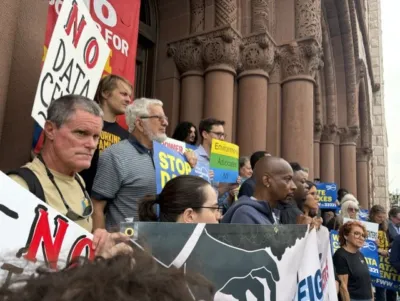
Albany UU did more than show up. The congregation provided the public address system used at the rally, helping make sure that speakers could be heard as they shared their concerns about the proposed development.
And there was a lot to hear.
Several speakers came from communities that would be directly affected by the proposed Kenwood Commons Edge development at the former Kenwood Academy site. The project calls for a large data center as part of a broader technology campus, with additional housing, research, office, and manufacturing space.
For South End residents and advocates, the concern is not simply about one development. They pointed to a much longer history of environmental injustice, and of decisions made without enough involvement from the people who live in the neighborhood. Community activist Paul Collins-Hackett described the proposed data center as part of a pattern in which Albany’s South End has carried environmental burdens while remaining under-resourced and underrepresented.
Data centers were seen by many of the speakers, and by our GST, as a local and global environmental Justice issue. Speakers such as Albany Senator Patricia Fahy pointed out that the new data centers proposed for New York state will double the state’s energy consumption, adding fuel to the fire of global climate change. Consumption of water resources was also pointed out as a source of heat pollution to our river ecosystems.
GST supports stronger safeguards before communities take on projects with significant energy, water, environmental, and infrastructure demands. The questions are not simply whether a project can be built, but who bears its costs, who gets a meaningful voice in the process, and whether the people most affected have the information and power they need to participate.
Those questions connect Albany UU to a larger movement for Equity: making sure that the burdens of development do not fall disproportionately on communities that have already carried more than their share.
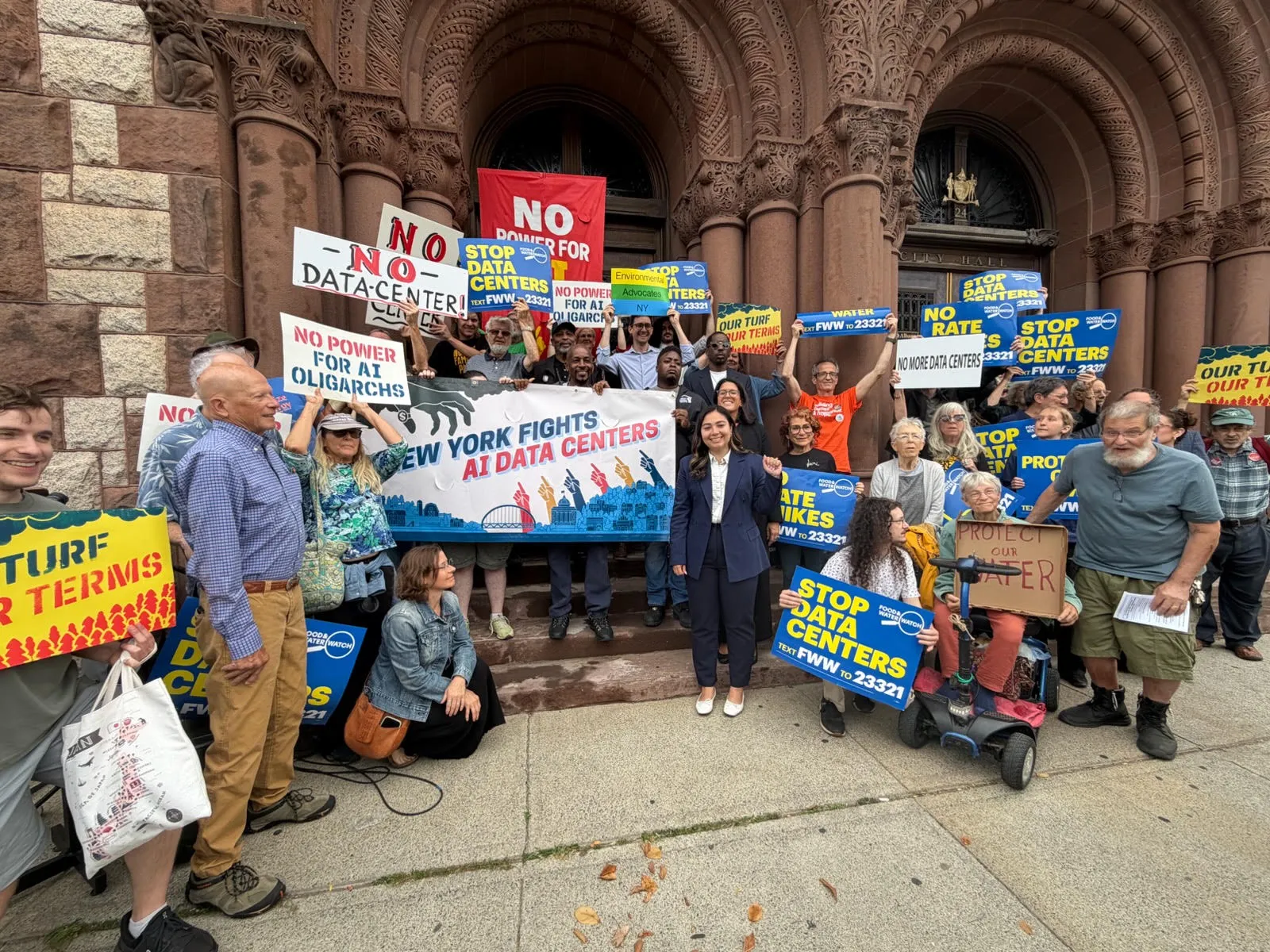
The rally also demonstrated Interdependence. GST is working with a number of local organizations to bring people together around the Kenwood proposal. The next step will be a community meeting at Albany UU on October 19, where participants will hear about the project’s potential financial effects on the City of Albany and its impacts on surrounding neighborhoods. The meeting will also give local groups an opportunity to connect and coordinate their efforts.
For Albany UU, this work is part of a larger commitment to Love in action. Caring about our neighbors means paying attention when they raise concerns about the health and future of their communities, listening to people who are directly affected, and being willing to stand alongside them. Caring about our planet means sending Love to our grandchildren and their grandchildren, who without our collective efforts will be living in a hotter and most hostile climate.
The August rally was one moment in an ongoing effort. The people gathered outside City Hall came with different experiences and different reasons for being there, but they shared a belief that communities deserve transparency, meaningful participation, and a voice in decisions that shape their future.
Albany UU was there to add its voice—and to help make sure those voices could be heard.
The post Standing with the South End: Albany UU and the Kenwood Data Center Fight appeared first on Albany UU.
]]>The post More Than a Logo: A Symbol of Our Community appeared first on Albany UU.
]]>If you’ve been part of Albany UU for the past several years, you’ve probably seen our logo many times — in the lobby and on printed materials, social media, and other places where we share the life of our congregation.
Now, it’s official.

The Albany UU Board of Directors has formally adopted our current logo as the congregation’s official logo.
What makes this story especially meaningful is where it began: with the creativity of one of our own young people.
The logo was designed by Molly, a young member of our congregation, several years ago. Over time, this image has become a familiar and recognizable part of Albany UU. The Board’s decision simply formalizes what has already become true — this design represents our community.
That is something worth celebrating.
One of the beautiful things about congregational life is that everyone has something to offer. Our shared identity is shaped not only by those who serve in formal leadership roles, but by the creativity, ideas, and gifts of people throughout our community.
Molly’s design is a wonderful reminder that young people are not simply the future of our congregation — they are contributors to our present. Their voices, talents, and perspectives help shape who we are.
This story reflects our commitment to Pluralism — recognizing that wisdom and creativity come from people of all ages and experiences. It reflects Transformation — the way individual gifts can become part of something larger than ourselves. It reflects Generosity — the sharing of talents that enrich the life of our community.
As we launch our new website and continue developing our visual identity, you’ll see this familiar logo in new ways. We may create variations of the design to support different uses while staying connected to Molly’s original vision.
Every time we see this logo, we hope it reminds us of what makes Albany UU special: a community where people are invited to share their gifts, where creativity is valued, and where we build something meaningful together.
Grounded in Love, we continue to create a congregation shaped by the many hands, hearts, and imaginations that make Albany UU who we are.
The post More Than a Logo: A Symbol of Our Community appeared first on Albany UU.
]]>The post From a 4-Inch Cube to a New Landmark: The Story Behind Our Banners appeared first on Albany UU.
]]>If you have driven past Albany UU recently, you may have noticed the large banners hanging from the columns outside the Sanctuary. You might assume they were designed as a statement by the congregation.
They weren’t.
The idea came from a 14-year-old in our religious education program.
As part of our annual service celebrating the young people in the coming-of-age program, he presented the congregation with a four-inch 3D-printed model showing banners hanging from the columns of what looked like a Greek temple. The model was his way of expressing what Unitarian Universalism meant to him.
Someone could have simply admired the idea and moved on. Instead, the congregation wondered: What if we made it real?
That question launched a year-long journey from a tiny model to the full-scale installation now visible from West Street. Turning the idea into reality required working through questions of design, color, funding, and the practical challenge of securing large banners against the strong winds that sometimes sweep down the street. The banners went up in late May 2026 and will remain in place for up to a year.
The transformation from a four-inch model to a full-scale installation offers a literal example of Transformation. An idea that existed only in one young person’s imagination became something the entire community could see.
But the story is about more than one young person’s creativity. It is also about what happened when a congregation took that creativity seriously.
Making the banners a reality required many people to contribute their ideas, skills, time, and resources. The process reflects Interdependence: one person may begin an idea, but a community can help it grow into something much larger.
Most of all, the banners are an expression of Love. By listening to a young person’s vision and making space for it to shape our shared environment, Albany UU demonstrated that young people are not simply preparing to become part of the community someday. They are part of the community now.
The installation also celebrates the creativity of all our children and youth. While these particular banners began with one student’s vision, they remind us that important ideas can come from unexpected places, and that religious education can shape the life of the congregation far beyond the classroom.
For the next year, these banners will hang above West Street as a colorful reminder of what can happen when someone imagines what could be, others listen, and a community works together to make it real.
The post From a 4-Inch Cube to a New Landmark: The Story Behind Our Banners appeared first on Albany UU.
]]>The post Showing Up with Pride: Albany UU at the Capital Pride Parade appeared first on Albany UU.
]]>Every June, Albany UU takes to the streets for the Capital Pride Parade. What began as a tradition of being one of the first churches to march in the parade has grown into one of the congregation’s most visible and joyful expressions of welcome.
Over the years, Albany UU’s participation has grown along with the parade itself. For the past two years, a decorated truck has led our contingent along the parade route, making it easy for parade-goers to spot us. Behind it comes a lively group of Albany UU members and friends of many ages, genders, orientations, and races, united by a shared commitment to creating a community where everyone is welcome.
And we bring plenty of enthusiasm with us.
Members fill the parade route with bubbles, candy, and plenty of energy as they celebrate with the crowds. The bubbles may be playful, but the larger message is serious: Albany UU wants people to know that they are welcome here exactly as they are.
That message reflects Love. Showing up for Pride is one way we make our commitment to LGBTQ+ people visible and tangible. Rather than simply saying that everyone belongs, we join our neighbors in celebrating identities, relationships, and communities that deserve to be seen and valued.
Albany UU has been a partner of the Pride Center of the Capital Region and In Our Own Voices, the organizations that present Capital Pride, for many years. Our participation in the parade also reflects our designation as a Welcoming Congregation by the Unitarian Universalist Association and our continuing commitment to welcome people regardless of sexual orientation, gender identity, or gender expression.
The parade also gives us a chance to practice Pluralism. Albany UU members do not all share the same stories or identities, and that diversity is part of what makes our congregation strong. On the parade route, people with many different experiences come together around a shared belief that everyone deserves to live openly, safely, and fully.
And then there is the sheer joy of it.
There is something wonderfully fitting about a congregation carrying a serious message of inclusion into the streets while simultaneously blowing bubbles and tossing candy to strangers. The celebration reminds us that building a welcoming community is not only about confronting injustice. It is also about making room for joy, connection, and celebration.
For Albany UU, the Capital Pride Parade has become a tradition because it brings all of these things together: Justice, Love, community, and a whole lot of fun.
Each year, when we gather behind that decorated truck and head down the parade route, we are doing more than marching. We are showing up for our neighbors, celebrating who we are, and making our welcome visible.
And yes, we’re bringing the bubbles.
The post Showing Up with Pride: Albany UU at the Capital Pride Parade appeared first on Albany UU.
]]>The post Using Less AI: A Small Choice That Can Make a Difference appeared first on Albany UU.
]]>Artificial intelligence is becoming part of everyday life. It summarizes our emails, answers our questions, writes our messages, and even creates images and videos with a few clicks. Many of these features appear automatically, often without us choosing to use them.
While AI can be a helpful tool, it also comes with an environmental cost that is largely invisible to most of us.
Every AI request requires powerful computers in large data centers to process and generate a response. Those data centers consume enormous amounts of electricity, and generating AI images and videos requires far more energy than a simple text request.
Like many environmental issues, the impact of a single action may seem small. But millions of small actions add up. As AI becomes integrated into more of the services we use every day, our collective energy use grows, even when we don’t realize AI is working in the background.
For people of faith, this raises an important question:
How can we use technology thoughtfully?
Our Unitarian Universalist value of Interdependence reminds us that our choices affect people and ecosystems far beyond what we can see. The electricity powering AI servers, the carbon emissions associated with many data centers, and the growing demand for computing resources all become part of the web of relationships that connects us.
Using less AI doesn’t mean rejecting technology. It means using it intentionally.
Sometimes AI may be the right tool. Other times, a traditional web search, a conversation with a friend, a library visit, or spending a little time figuring something out ourselves may be enough. As one of the guides shared by our Green Sanctuary Team puts it: “The best way to reduce energy is to not consume it. Instead of saying ‘just google it,’ figure it out with a friend.”
If you’d like to reduce the amount of AI built into the services you already use, there are practical steps you can take. Our Green Sanctuary Team has assembled two helpful guides:
- Reasons to Use AI Less explains the environmental impact of AI and why thoughtful use matters.
- Some Ways to Turn Off AI provides instructions for reducing AI features in Gmail and web searches, including options for using DuckDuckGo’s “No AI” search.
No single person can solve the environmental challenges created by rapidly expanding technology. But each of us can make choices that reflect our values.
Whether that means turning off AI summaries, choosing a different search engine, asking a friend instead of a chatbot, or simply pausing to consider whether AI is needed for a particular task, these small decisions can become meaningful acts of environmental stewardship.
Living our values doesn’t always require dramatic action. Sometimes it begins with a simple question:
“Do I really need AI for this?”
The post Using Less AI: A Small Choice That Can Make a Difference appeared first on Albany UU.
]]>The post Building Bridges: The Quadriptych of Four UU Congregations appeared first on Albany UU.
]]>Quadriptych was created by children and adults of four UU Congregations.
Left to Right: #1 Albany, #2 Saratoga, #3 Glens Falls, #4 Schenectady.
2009. Mixed Media.
Visitors to Albany UU may notice a series of four colorful panels displayed together as one work of art. Created in 2009, this mixed-media quadriptych tells a story of connection, collaboration, and shared purpose among four Unitarian Universalist congregations in the Capital Region.
Each panel represents one congregation: Albany, Saratoga, Glens Falls, and Schenectady. Together, the four panels form a single work, connected by images of bridges that weave through the landscape. The bridges are more than recognizable features of the region—they represent the relationships that connect communities and the shared work that brings people together.
The project began in 2009 when Rev. Sam Trumbore, then minister at Albany UU, imagined a way for the four congregations forming the Capital Region Unitarian Universalists of New York (CRUUNY) to celebrate their connection with one another. The goal was simple: create something together that would remind people that although each congregation has its own identity, they are part of a larger Unitarian Universalist community.
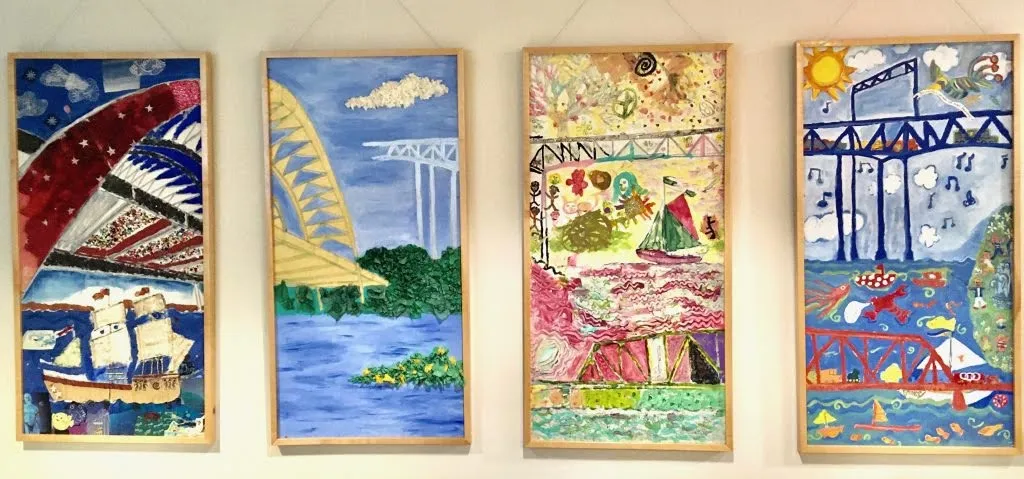
Albany UU member and artist Dan Sekellick developed the design for the project, creating four interconnected scenes in an expressionist style. With assistance from fellow member Terry Way, Dan incorporated recognizable elements of the Capital Region landscape, including bridges that connect places and people throughout the area.
But the artwork was not created by one person alone. Children and adults from all four congregations participated in creating the panels, with Religious Education directors coordinating the work within their communities. Each group contributed its own creativity and perspective, and the final piece emerged from those many individual contributions.
The Quadriptych offers a visual reminder of Interdependence. Like the pieces of the artwork itself, communities become stronger when people bring their gifts together. No single panel tells the whole story. The beauty comes from the relationships between the parts.
The artwork also reflects Pluralism. Each congregation brought its own identity, experiences, and creative expression to the project. The goal was not to make the communities identical, but to celebrate how different voices can contribute to something larger.
The completed Quadriptych was unveiled at a joint worship service in Saratoga in the spring of 2009, where the theme was “Building Bridges.” For a moment, the four congregations gathered not simply as separate communities, but as partners in a shared vision.
After its initial display, the artwork spent several years in storage at Albany UU. In 2023, the Arts & Aesthetics Team rediscovered the piece and began exploring how it could once again become part of the life of the congregation. Albany UU member Brad Workman created the maple framework that now brings the four panels together in a unified display.
The restoration and renewed presentation of the Quadriptych reflects Generosity—the many gifts of creativity, craftsmanship, time, and care that have allowed this artwork to continue telling its story. From the children and adults who created the original panels to the members who helped preserve and display them, each person contributed something meaningful.
The Quadriptych also reminds us of Transformation. A bridge changes what is possible by creating a path between places that were once separate. In the same way, relationships create new opportunities for learning, collaboration, and shared work.
The bridges in this artwork are not only made of lines and colors. They are made of relationships—between congregations, between generations, and between people who believe that more is possible when we work together.
As we encounter these four connected panels at Albany UU, we are invited to remember that strong communities are built by honoring both our unique identities and our shared connections.
Together, we continue building bridges.
The post Building Bridges: The Quadriptych of Four UU Congregations appeared first on Albany UU.
]]>The post Tiny Partners in Caring for the Earth: Worm Composting appeared first on Albany UU.
]]>What if some of the hardest-working environmentalists lived in a plastic storage bin?
Red wiggler worms may not be the first creatures that come to mind when we think about climate action, but these remarkable composters quietly transform kitchen scraps into nutrient-rich compost that helps gardens thrive while keeping food waste out of landfills.
Instead of throwing away fruit peels, vegetable scraps, coffee grounds, and other plant-based food waste, a worm composting bin lets nature do what it has done for millions of years. The worms consume organic material and produce castings—one of nature’s richest natural fertilizers—which can be used to nourish houseplants, gardens, and landscapes.
Worm composting is a wonderful example of Interdependence. Rather than thinking of food scraps as garbage, we begin to see them as part of a cycle. Our leftovers become food for worms. The worms create healthy soil. Healthy soil supports new plants, which eventually become food again. What might have become waste instead becomes part of a living system.
It also reflects Transformation. Banana peels, wilted lettuce, and coffee grounds don’t disappear—they become something new. With the help of thousands of tiny partners beneath the bedding, yesterday’s scraps become tomorrow’s gardens.
One of the joys of worm composting is that it doesn’t require a large yard or elaborate equipment. A simple plastic storage bin, shredded newspaper for bedding, and a colony of red wiggler worms are enough to get started. A well-maintained bin has very little odor and can be kept indoors year-round, making it an accessible way for people in apartments and homes alike to reduce household waste.
At Albany UU, members of the Green Sanctuary Team have long encouraged practical ways to care for the Earth. Worm composting reminds us that environmental stewardship doesn’t always begin with large-scale projects. Sometimes it begins with small daily habits—and some very small helpers.
If you’ve ever been curious about starting your own worm bin, we’ve gathered two helpful resources. One explains how to build a simple home worm composting bin, while the other offers practical information about caring for your worms and getting them off to a healthy start. Together, they make it easy to begin turning kitchen scraps into a valuable resource instead of sending them to the landfill.
Sometimes the smallest members of our community can teach us the biggest lessons: that nothing in nature is wasted, that every living thing has a role to play, and that caring for the Earth often begins with simple choices made close to home.
The post Tiny Partners in Caring for the Earth: Worm Composting appeared first on Albany UU.
]]>The post “I Am Human”: A Message of Shared Humanity in Channing Hall appeared first on Albany UU.
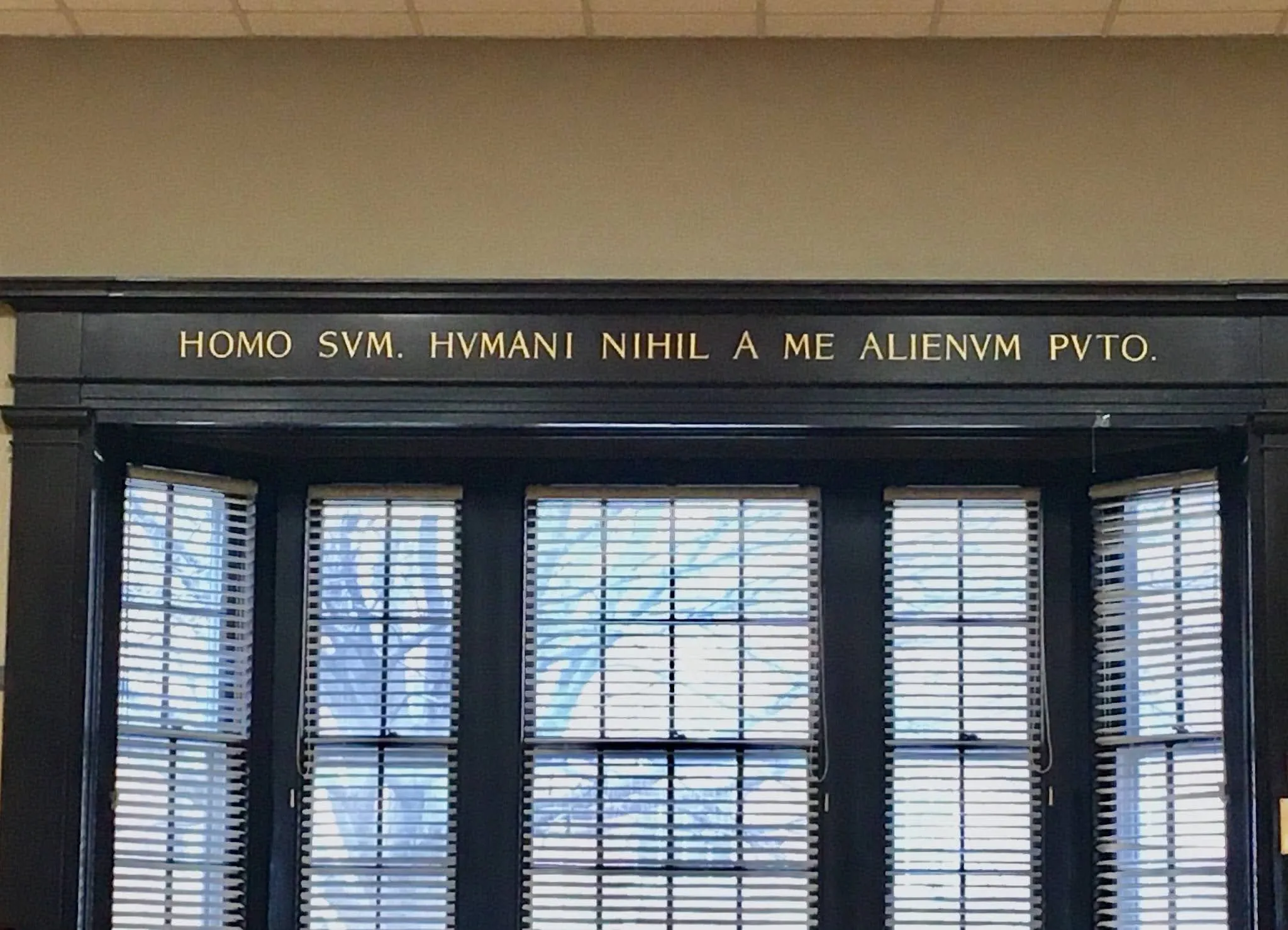
]]>Visitors to Channing Hall may notice a simple Latin inscription painted on the wall:
Homo sum: humani nihil a me alienum puto.
Translated, it means:
“I am human: I consider nothing that is human alien to me.”
Though these words were written more than two thousand years ago, their message continues to resonate. They invite us to consider what it means to recognize our connections with one another and to approach the lives of others with curiosity, compassion, and care.
The phrase comes from the play Heauton Timorumenos (The Self-Tormentor), written around 184 BCE by the Roman playwright Terence, whose Latin name was Publius Terentius Afer. Terence’s own life challenged the boundaries of the world in which he lived. Born in North Africa, he was enslaved and brought to Rome. His owner recognized his intelligence and talent, provided him with an education, and eventually freed him. Terence went on to become one of Rome’s most celebrated playwrights.
In the original play, the phrase is spoken by a character named Chremes, who is criticized for involving himself in another person’s affairs. His response is essentially that concern for others is not interference—it is part of being human. If we share the human experience, then the joys, struggles, and challenges of other people matter to us.
Over the centuries, the meaning of this simple line expanded far beyond its original context. It became a reminder that other people’s lives are never completely separate from our own. Their hopes, struggles, dreams, and experiences are part of the larger human story we all share.
That idea reflects the value of Love at the heart of our faith. To recognize that nothing human is alien to us is to practice empathy—to remain open to the experiences of others and to understand that compassion begins with a willingness to listen, learn, and care.
The phrase also reminds us of Interdependence. Our lives are connected in ways we do not always see. The well-being of our communities depends on our willingness to notice one another, respond to one another, and recognize that caring for others strengthens us all.
The journey of this phrase across centuries and cultures reflects Transformation. Words that began as part of an ancient Roman comedy have continued to evolve, taking on new meaning in different times and places. What began as a character’s response in a play has become a lasting invitation to practice understanding and connection.
The inscription came to Albany UU through the encouragement of Rev. M. McKarl Nielsen, who served as our minister from 1947 to 1951. Recognizing the enduring wisdom of these words, Rev. Nielsen encouraged the congregation to paint the quotation on the wall of Channing Hall. Since then, generations of members and visitors have encountered this quiet reminder of our shared humanity.
Today, these words continue to offer a simple but profound invitation:
Homo sum: humani nihil a me alienum puto.
I am human. Nothing human is foreign to me.
As we pass this inscription in Channing Hall, we are reminded that building a more caring and just community begins with seeing one another more fully. The ancient words invite us to approach each person with curiosity, compassion, and the recognition that we belong to one another.
The post “I Am Human”: A Message of Shared Humanity in Channing Hall appeared first on Albany UU.
]]>