My mother loved to sing. She really, really loved singing. There was always music in our house. My dad played guitar a little but wasn’t that good at it; he was a musician in high school, but his instrument was the Sousaphone and he didn’t continue with it. My mom played clarinet in addition to singing.
I honestly don’t remember enough of Mom’s singing voice to say if she was any good. Her pitch was good and she had a voice part somewhere between alto and soprano. She liked hymns, Anne Murray songs, and country music. We sang together when I was a youngster, and she had me convinced I had some aptitude for it.
I started out as a boy soprano, before I hit puberty. In elementary school I sang a song in a little show called “Children of Mother Goose,” which was fun if not particularly good. Later, as my voice changed, I became involved in middle school choirs. I became a tenor, then a baritone.
High school brought talent shows, musicals, a more formal choir under the wonderful Jeanne Busse, and selection for multiple regional and all-state honors choruses. My friend David Sparks and I did a little recording; he was a brilliant instinctive piano player. We had a lot of fun.
This is also when my interest in audio blossomed into a real specialty. A career on the radio led to a career in radio engineering, and later live sound, recording, and audio for video. Having sung, I made vocals my specialty, learning everything I could about capturing, sweetening, recording, processing, and even coaching vocals. Because to me, there is nothing so beautiful as a great singing voice. I wish I had one.
Since high school I have been very shy about my own voice. I have met, known, worked with, loved, and developed hopeless crushes on people with amazing, breathtaking voices and vocal talent. Yes, I’m as susceptible as any man to a woman’s physical beauty, but the really direct route to my heart is through my sensitive, discerning ears.
Because I know voices, I know mine is nothing special. Harry Chapin, a great storyteller, relates a tale in a song called “Mr. Tanner” that has always struck fear into me. Harry worked in lyrical poetry; I suck at that. So if you don’t mind, let me relate the story in prose, which is my medium.
In the midwestern state of Ohio lived a man who ran a dry cleaning shop. He’d built his business to be the finest in the city and took great pride in it. He also had a tremendous baritone voice! He was in demand at local events and practiced constantly; he loved music but never considered it as a way of making a living.
Friends were always pestering him, saying that he was wasting his gift, that he should sing instead of spending his time as a cleaner. He had a great career ahead of him! He would be a sensation! He should arrange his debut!
It took time. He fought it. But finally he began to buy what they were selling. Maybe he was that good! Maybe he should give it a try! So, with the help of his friends and through the depletion of most of his life’s savings, a concert promoter in New York City set up a date. He rented a concert hall. He arranged travel, publicity, ticket sales. He was excited! It was happening!
The night of the show arrived. Lights came up, the curtain rose, and he stepped onto the stage beaming! Everything seemed to move so quickly. He sang his heart out, and as we all do, he has no idea about his high points, but he heard every little fault in his own performance. But he gave it his all, pouring his very soul into every quaver and crescendo. He felt cautiously triumphant. He had done it – his big debut was in the books!
Waking the next day to the morning paper in his hotel room, he searched quickly for the review! He knew the critics had been present. He saw them, poised on the aisles for a quick escape. He could certainly say this: they’d been concise. Four sentences.
“Mr. Martin Tanner, baritone, of Dayton, Ohio made his town hall debut last night. He came well prepared but unfortunately his performance was not up to contemporary professional standards. His voice lacks the range of tonal color necessary to make it consistently interesting. Full time consideration of another endeavor might be in order.”
Returning to Dayton, Mr. Tanner faced a barrage of questions from his friends and supporters. They all wanted to know about the big show! How had it gone! What was the outcome! He was polite, of course, and grateful, but he offered no real answers.
And he never sang again.
Though some say, if you find yourself downtown in the late night hours, when only the street lights and traffic lights offer relief from the gloom, and if you wander close by his cleaning shop, you might hear him singing softly and shyly to himself as he finishes his nightly work.
I feel Mr. Tanner’s heartbreak, but I also want … no, I NEED that awful review. I could easily find myself believing the people who tell me I can sing, even though I know better! It is SO EASY to be seduced by kind words and wishful thinking. And that is a distraction I can’t allow. I have real, talented, powerful, beautiful voices that deserve my attention and my best work.
I had myself thinking that my best friend had given me the “kind” thumbs down after hearing something I did recently. Turns out I was a little wrong, but I am still chalking that one up in the L column. In fact it’s so bad that I’m posting it here to attract jeers, not cheers. Warts and all. This is how bad I am when I really try! Imagine what my poor steering wheel hears!
And in the final verse of the song, right after the bridge, we have these lyrics:
How do you leave the past behind
When it keeps finding ways to get to your heart?
It reaches way down deep and tears you inside out
‘Til you’re TORN APART — RENT!
And as if to reinforce the double-entendere, the last line of the song describing the sorry state of affairs against which all the cast members are rebelling:
‘Cause everything is RENT!
It’s all in shreds — the past, the establishment, all of it.
Everything but the future.
Genius, that.
Binary numbers are a real pain for people to work with. For one thing, they’re not very compact. 233 is three cool decimal digits, but in binary the most compact way of representing it is 11101001, a full 8 bits. That’s considered a short integer, or a byte. Every character in this blog represents that many bits, so you can imagine how long this sentence would be if it were written out in binary.
Every digit in a decimal number represents a multiple of a power of 10. 635 decimal is (6 x 10^2) + (3 x 10^1) + (5 x 10^0).
The biggest problem is that there is no convenient relationship between binary and decimal. Before programmer’s calculators, the manual way of converting a decimal number to binary was to take advantage of the fact that each binary digit is a multiple of a power of 2. The multiple can be either 1 or 0. So you would write down the powers of two from right to left, then move from left to right asking yourself if that power of 2 fits into the decimal number. If so, put a 1 in that column, subtract the power of 2, and continue with the remainder. If not, put a zero in that column and continue without subtracting. So to convert 67:
| 2^7 | 2^6 | 2^5 | 2^4 | 2^3 | 2^2 | 2^1 | 2^0 | |
| DEC | 128 | 64 | 32 | 16 | 8 | 4 | 2 | 1 |
| FITS? | 0 | 1 | 0 | 0 | 0 | 0 | 1 | 1 |
| 67 | 67 | 3 | 3 | 3 | 3 | 3 | 1 | 0 |
What a pain. So how can we represent these bytes more compactly? How about hexadecimal, or base 16? We can use 0-9, plus the letters A-F. Conveniently, one hexadecimal digit can be represented in exactly 4 bits. So if we write our numbers in hex, converting to binary is easier. F is all ones, A is 0111, 3 is 0011, etc.
25 hex = 0010 0101 (Just convert four bits at a time. Easier!)
Still, doing that in your head can be a pain. There are 16 possible comb8nations of bits in a hex digit, and without going through some math in your head, it’s hard to instantly remember that hex A is 1011 and hex 9 is 1001. It took me a few seconds to think about those.
Back in the dark ages, computers had front panels with switches. Sometimes starting the computer or booting it into a particular low-level program required toggling in an address on the switches. It was tough to stand there and read hex to set the switches; that was slow and cumbersome. There must be a quicker, easier way for the human mind to rapidly convert a fairly compact notation into binary, in his HEAD.
Enter octal, base 8. In octal, every digit can be represented as exactly THREE bits! There are only 8 possible combinations of 3 bits, and anyone can quickly memorize those eight. So on the front panel of a PDP-11 the plastic switch handles were arranged in groups of three — 3 light colored, then three dark, then three light again. Addresses or data to be entered were usually written in octal, and you would just go across the switches.
14773050 was easy. 001 100 111 111 011 000 101 000 … I converted that as fast as I could type it, thanks to knowing those combinations from years of front panel shenanigans.
Octal has fallen out of favor since the demise of the hardware front panel, but I still find it useful now and then, and so do many coders and hardware guys; it’s still available as a working base on many scientific and ALL programmer’s calculators. In fact, instant conversion between octal, hex, binary, and decimal is one reason the rare HP-16C calculator is so prized. It’s ability to convert bases, do complements, and perform bitwise logic operations make it extremely useful! (If you have an iPhone, check out “16C Scientific Calculator” on the App Store. It’s a faithful emulation!)
The awkward relationship between decimal and binary makes real number math inside a calculator or computer interesting. On paper, we can perform computations to any desired precision. But on a calculator the digits are finite, and even inside a computer the precision we can expect depends on how many bytes we are willing to use to store a real number. We have to compromise between the precision we want and the range of numbers we want to represent. This is where floating point arithmetic comes in: we store a signed mantissa (or significand) with the desired precision, and an exponent that represents a power of some base (typically 10). This sort of number is all kinds of fun to work with in binary, and that’s why to this day a computer’s speed is measured in flops … floating point operations per second. Today we hear more about megaflops, gigaflops, and even teraflops when supercomputers are described.
Well, that’s my bit about octal. Geezer mode off.
]]>Part of my island is where I am sitting now. Four bedrooms, three baths, a patio and a studio. My wife lives here, too.
There’s an isthmus that connects me to my workplace. I cross it every morning when I go to work, and cross it again coming home. But that part of the island is pretty solitary, too. I spend most of my time in my office, working over the internet to get my job done, staring into my computers’ screens, taking phone calls. Occasionally someone will stick their head in the door to say hello, but they’re just visiting. When they step away, I’m still on my island.
Sometimes I get in my boat and go somewhere. When I go to work a sound job or something else non-routine, I actually leave my island for a little while. Other people are around, and sometimes they talk to me or interact with me, and I feel engaged, a little less isolated, a little more human. But social interaction is also hard and costs me energy, so I can only handle so much. Then I need to return to my island, to find the place my life force emanates from and recharge.
I like road trips. I love to travel. And when I do get into my car to go somewhere cool or exciting, or even someplace dull that’s just different … well … I take my island with me. Sometimes my wife comes with me, but she has a whole world of her own. But I bring the rest of my island. My car is my island. I have my music, I have my air conditioning, I have a comfortable seat and my phone to keep me in touch with people off the island, and sometimes even ham radio so I can talk to strangers. It gives me a nice feeling, only because it’s a reason to interact with people that involves technology and radio and electronics. And the people I talk to are my brothers and sisters in amateur radio, all of whom worked hard to get their licenses and become one of us. So they’re kind of like short-term friends, although KC4YLX and KB4ENK (or KI4AQL of KC0RPK or KB1LMB or whatever he’s called now) and a few others are friends I’ve known for ages in real life.
I’m always uncomfortable, just a little, when I travel by air or without my car. I’m usually going to a hotel, or to someone’s house, or to a workplace, and I have no island. I feel kind of like that guy in The Terminal. I walk through the airport and I’m just an island myself. I have my little bubble around me made of insecurity and anxiety and discomfort. People pass. I pass people. But they’re just little ships flying by my island without a wave or a smile. I smile. Sometimes I wave, because I’m sure they can see me. But other than that, I’m alone until my island becomes larger … a hotel room, a room where I have to work on code or mix sound, a radio station, a performance venue. Each of these becomes my temporary island.
When I’m home, my island is usually comfortable. I’m in my desk chair now, sitting at my computer typing this. My studio, with everything hastily lifted off the floor, is behind me. In the next room is my recliner where I sit to watch TV. There’s a kitchen where I’ve got stuff to drink and eat. Allison is around somewhere. Two dogs, two cats, and five birds are in there, which is why I’m in the one part of the island that’s almost always quiet. Thinking about life, the universe, and my little island of existence.
My island’s got a phone number. I carry the phone around in my pocket or have it beside me constantly. But my island gets very few calls. A co-worker might call about something office-related. Someone might call to offer me sound work. My best friend touches base now and then. But for the most part, it’s radio silence here. I don’t get calls to come socialize with people. I don’t get calls from friends much, either, other than from the one guy I consider a brother.
My island doesn’t get many visitors. Recently, during Hurricane Florence’s impact and the following day, we had company. Some friends, a couple who live over in the low-lying section of River Bend, got flooded out of their house. They paddled away from it, got lost, ended up at the house of a stranger, and stayed there for a while. Then the stranger’s house flooded, so they took us up on our invitation to stay here. It was kind of cool to feel like the population of this little island doubled (in human terms, at least) overnight. The dog population went up 50%, too. Wee put our heads together and got through the 7 days the island was without power.
They have now rented the vacant house next door to us, and the island’s as it was before. It’s weird to be the way I am. My psychologist says it’s not as simple as being aspie and not as simple as being an introvert. We’re still trying to figure out exactly what it is that separates my island from the world. Progress isn’t linear; I try very hard to remember that bit of wisdom. Lack of any immediate change doesn’t mean I’m not trying or that I’m not working hard at it. The battle is inside where no one can see it.
It gets lonely on this little island sometimes. Sometimes I can feel the world out there, and sometimes I feel the love. Other times what’s outside those walls is scary … even what’s above my covers in bed is scary, and I just pull them over my head, put my CPAP mask on, and concentrate on breathing.
Or I just prowl Facebook, looking for opportunities to make a puckish comment or add insight to a thread about something I know about. I have the feeling I come across as a know-it-all, but my motivation is honest. I’m not all that good at all that many things, so in my field if I can help someone, even a little, i want to. And if someone on Facebook decides it’s a good day to hurt me, read things into my words that were never there, and attribute my honest (and all too frequent) mistakes as deliberate malice, hate, or arrogance, I can just plug up Facebook’s connection to my island with a finger like the Dutch boy did, and move on. (Somehow, that Dutch boy was barking up the wrong tree, but I can’t put my finger on why.)
There, see? I’m trying to be funny and it’ll get me burned at the stake … but the people who’ll do that can’t get to my island unless they’re invited in. So there’ll be this little planet somewhere called Facebook where I’m being burned in effigy while I sit here and drink iced tea.
But this island is part of me. Sometimes it IS me. That’s part of why I was so freaked our during Florence. People probably noticed that at one point, my posts just stopped for a while. It wasn’t lack of power … I am always well prepared with power for phones and iPads and such. No, it was a mild form of panic that set in. I was afraid something was going to happen to the house, something that had already happened to so many people around me and around town. I wasn’t sure what I’d do if my island was destroyed. My wife and I would get out okay, and we’d probably get the animals out, too, but I would have lost my place to be centered, my place to recharge, the place where when Allison and I are on the same page, I find life and happiness and strength. I feel so much for those Florence took this from.
It’s more than what George Carlin called “a place for my stuff.” It’s a place for ME. A large part of my identity is here. Why am I a ham radio operator? Because of that license on the wall. What has my past counted for? Certificates and diplomas on the walls tell a story; it’s boring to some but it’s MY story and I’m stocking to it.
There’s a photograph on the shelf of a pair of houses I found along a railroad track in northwest Georgia. They are abandoned and completely engulfed by Kudzu (an invasive vine). You can’t see a square inch of either house, but the shapes are unmistakable. I took the photo on 35mm film while standing on the railroad tracks, processed the film at home, printed it in a rented darkroom at UVa. I’m proud of it. It’s a cool memory. It’s just one of those things that makes me feel grounded here on this little island, as obscure as those two vine-covered houses.
One of the things I need to work on is finding more reasons to leave the island. Even though social time is difficult and requires energy, I think I need it. Facebook and blogs and e-mail are no way to actually have a life. And I’ve been far too dependent on those things. Artificial socialization. Virtual friends. Something in me needs to see a friendly face now and then. I got to spend a weekend with my best friend recently and it was like I’d suddenly arrived in a larger place. It was like my world, my real world, got a little larger for a while, and it got larger still when his whole family came to visit, too!
I know I’m a person who needs my alone time to recharge my mental batteries, rest, and figure out just where I am and why. I’ve got to have that bit of downtime or I seem to get very edgy and uncomfortable. I’m not sure I understand that, either. But I’m being advised by my psychologist to give myself a break … do the things I need to do to feel good about myself, or at least the ones I can still do … and to extend to myself the grace I extend to others.
I was surprised the other night when I was told I have a certain kind of patience. I don’t think I really do. I see myself as arrogant sometimes, or at least more arrogant than I like to be, particularly when it involves my life’s work. When I’m absolutely sure I’m on solid ground, I tend to dig my heels in and get pretty stubborn and demanding. It’s not a quality I am proud of but I’ll own it. I can do better than that. But at other times, when the whole question is a matter of opinion, emotion, or personal feelings, it’s different. I try to look at the other side, and I understand how they feel, but I’ve got my opinion too, and because they’re both opinions, they’re both equally valid. And BOTH sides can sometimes get very emotionally involved in their own opinions, to the point where they’ve driven a steel pin in the ground, tied a harness to it, and determined they’re not moving. I don’t know anyone who isn’t guilty of that sometimes, and I definitely include myself. Not many of the people in the world who like me know what a complete asshole I can be at times.
But get this. I have one role on this island, and it’s got to do with what drives me. I am not overly ambitious. I harbor no prejudices. I don’t set out to do harm. I am not without sin but my intentions are good. And yes, I know what they say about good intentions. I am not proud of anything other than my few accomplishments in this world, and I know how very small and insignificant they are. I have helped to save a very few lives in my EMT days, and of everything I’ve done, those are the times where I really made a difference.
I am driven by love. I’ve spent a lot of my life alone. I’ve been married twice before my current marriage, to people I honestly loved and treasured and wanted to spend my entire life with. One cheated on me and I couldn’t get past it. The other did the same only in a more ugly way, multiple times. It’s given me a knee-jerk, polarized reaction to anything about marital infidelity. I can’t stomach it. Ever. Because to someone driven by love, it is the ultimate pain. That sort of betrayal tears out your heart, throws it on the ground in front of you, and stomps on it while you watch, dying. Then it stuffs the organ back into your chest, dirtied, beaten, bloody, and full of hurt and fear and pain, and expects you to go on. Just continue your life. The love you felt? It hurts worse than anything you can imagine, but you’re supposed to turn that off. You’re supposed to find, somewhere within your tortured soul, some trust.
After my first marriage ended I spent the better part of 10 years alone. Completely alone. I had a friend or two but I was mostly isolated. People thought I loved my work, but I hid in my work too. Computers, radio, recording, live sound, editing, voice-over … these were me. These were all I was. I dated shallow women. I dated a stripper once, because I felt safe. She slept with everybody, I knew she slept with everybody, so I could just enjoy an evening with a beautiful woman and not even think about getting seriously involved. The idea of giving my heart to another woman was UNTHINKABLE.
And ten years later I did just that. Having been alone for 10 years, I was nothing less than desperate for love. I needed someone to see me, to value me, to want me for what I was. And I thought I found that, but in retrospect, I wonder how I could have been so stupid. She said all the right things. She did all the right things. She treated me well. She appreciated me. In retrospect, though, she used me like a shake-and-bake bag. Because 10 years into that marriage, I found out about the multiple betrayals, the sneaking around, the sleeping around, the other relationships.
Did she tell me? Oh, no. Of course not. Instead, while waiting for her to get home from a night class, I got a call from a very posh restaurant in town, telling me my wife had left her purse there after her dinner with me. Being an inquisitive guy I manipulated the waitress into revealing to me that their dinner had been anything but business. I had been so stupid. I never suspected that the night class she told me she’d enrolled in was adultery 101 and that this older guy, someone I knew, this Robert Duvall-looking bastard was having sex with my wife and had been for the better part of a year. And finding out later that he wasn’t the only recipient of her favors was way, way too much.
The second divorce was rough. I was dying inside, completely destroyed. I’d moved myself into tiny, makeshift quarters, eventually got the cats and birds moved in with me, had to pay a metric ton of alimony because it wasn’t possible to prove the adultery. (I couldn’t afford a better lawyer and she had one who was on the fast track to becoming a judge.) Eventually, I even lost my beloved blue and gold Macaw, Sammy. She somehow convinced the mediator that he was worth $15,000, and I was given a choice of coughing up that amount immediately or handing him over. The day I watched that truck drive away with him inside was almost as hard as the day I found out about the cheating.
The divorce was final in 2005. I dated occasionally, but I think past baggage always got in the way. I found out the hard way that long-distance relationships are hard to do, and that brutal honesty isn’t always good even when it’s necessary. Ever had an ex-girlfriend (with whom you’ve remained friends) describe her sexual encounters with your successor? It’s not pleasant; it’s pretty heart-rending. But the pain of it helped me push away the love I still felt. The pain was useful in that way. It helped me move on. But it’s also the stuff of nightmares. Some of that is still with me.Still haunts me.
James Taylor talks about Herod in one of his songs. It’s a favorite of mine. It talks about how the three wise men dreamed about Herod’s scheme to capture them, and thus warned, they took another route home. The lyrics say,
Home is where they want you now,
You can pretty much assume that you'll be welcome in the end.
Shouldn't let King Herod haunt you so,
Or fantasize his features when you're looking at a friend.
That last part. That’s a curse. It doesn’t matter how long it’s been since yesterday. It doesn’t matter how different today is. It doesn’t matter how hard you try to feel secure. The demon is out there. With the sizzling heat of pain and the piercing edge of heartbreak he has seared his image into my retinas. I might be looking at a person who is eminently, perfectly, absolutely worthy of my trust, and if I am weak or careless,that image will come to me.
The first betrayal was easier. We were not getting along well, there was a lot of distance between us, and she admitted it to me. Oh, it hurt, but I was young and resilient. Or so I thought. Anyway, it was easy to survive and was a quick, no-fault, sign the paperwork and we’re done kind of divorce. No alimony, and thank God, no children because kids don’t deserve to be born into a broken home.
I’ve been told that I don’t trust. Although some things I’ve done have been misinterpreted as distrust, I admit and internalize the fact that I have a problem with trust. It’s because that second betrayal was several orders of magnitude harder for me.
Gary Chapman’s book about the five love languages has a lot of truth in it. My language, in both the giving and receiving directions, is physical touch. It’s been that way since childhood. The other four are good and needed and appreciated, but one hug … one genuine embrace from a human being … is worth a million words of affirmation or ten thousand gifts or acts of service. It’s how I feel. Some of my friends know this. They’ve reached out and hugged me at times when they probably had no idea how much I needed it. Or maybe they did! Either way, thank you. It mattered.
So imagine a man like me, driven by love, and primarily experiencing that love in the form of holding hands, kissing, touching, physical intimacy … being forced to accept and face the fact that his wife — the person to whom he’s given his life, his trust, and his fidelity — has betrayed him in that very way! I wouldn’t believe it. I wouldn’t let it be true. It just couldn’t be, because I’d done the right things right down the line.
I did it to myself. When I was told what was happening, I couldn’t believe it. It was just unthinkable. There must be some mistake, I thought. I wasn’t ready to deal with my wife kissing or having sex with someone else. I had to know. I had to see. So after the call from the restaurant, and over the week or two that followed, I used my head, found out who my real friends were, figured some things out, discovered where I needed to be and when, and I saw.
God, I wish I hadn’t. but I did. No one knew. I slipped in quietly and got away cleanly both times. I was a lot more fit then and had great night vision, and getting somewhere the back way, through dense woods, was no problem. I didn’t see that much, but I saw enough to know it was real. She was there, the guy (a different one each of the two times) was there, and they were doing things you don’t do with your friends or business associates unless your profession is the oldest one. I wanted to scream, but that had to wait until I got back to my car, shaking and crying silently.
That night after the second time, I went to Manuel’s, a watering hole in a fashionable part of Atlanta, and I drank until they cut me off. Then I bought a bottle, got a hotel room, and drank until I passed out. I woke up at some point during the night and finished the bottle. Housekeeping woke me up and I had to leave. I had to drive because I was too dizzy to walk, and I somehow made it to my workplace at the time. They had a couch. I made it there and passed out again. Thank God it was a weekend.
I can’t begin to describe to you how much that knowledge, and particularly that firsthand observation, hurt me. I didn’t think a human being could live through that kind of emotional pain. I felt everything … anger, grief, pain, love, hate, fear, feelings of inadequacy and worthlessness, despondency, and yes, suicidal thoughts. It cost me my job, because I was too mentally screwed up to do it.
I had good healthcare at the time which included mental health services and I got help. I was on medication for a year just so I could function, go to work, sleep at night, and do things we used to do together without crying. I got a new bed. The old one smelled like her, smelled like us, and I couldn’t stand it. I tore up pictures. I tried to erase what I’d seen from my mind but dammit … there was a part of me, way back there in a place I couldn’t reach or destroy … a part of me that still loved. Still wanted. Still longed. It wouldn’t die. It took some really petty things later on — like taking my beautiful bird — to strangle that damned wuss in the back of my mind that was still hanging on.
I can’t seem to help anyone to understand that baggage. The woman I dated for a short time in 2005 didn’t. The woman I had a close and then long-distance relationship starting in the fall of 2005 didn’t either. Neither did the singer with whom I had a short relationship with just before meeting Allison. They all thought they understood, but I don’t know that anyone truly can. When your love language is physical touch and you’re betrayed sexually … I can’t speak for anyone else, but I can tell you I will never be the same. Part of me died, a part of me I miss. Ironic, isn’t it? The same part of me that saw the best in people, the part of my intelligence that misjudged the character of a woman I loved not once but twice, is the part I miss. I don’t know how to turn that back on. I am afraid. This has been a subject of many conversations with counselors, psychologists, therapists, and friends for the past 13 years.
So here I am on my island, surrounded by scary waters, and in those waters is a veritable Loch Ness Monster of pain that rears its head once in a while, just long enough for me to see and react to, but invisible to everyone else seeing my reaction. 13 years. Every time I look at my beautiful wife and see how desirable and outgoing she is, her easy way with people that I don’t have, her huge heart, her intelligence and grace and charm, I feel incredibly fortunate that she chose me as I chose her. And when we have the inevitable problems that any relationship faces, I’m afraid. My pulse races, tears come, and I freak right the hell out because there’s a patch cord still connected in my brain from the “problems and arguments” circuit to the “betrayal/loss” circuit. It’s stuck. I need help to get it unplugged.
And I’m getting help. I’m talking about this to a psychologist, a psychiatrist, to friends I trust. I’m trying. I’m determined. Some things can never be unseen, and some hurts do not heal completely, but I’m trying to fix those things. My adult life has been ups and downs. As ABC used to say, the thrill of victory and the agony of defeat. This is the Wide World of Me, stuffed onto a little island on a quiet street with a wife and a zooful of animals. And a job, and a hobby, and some problems. And a demon who needs to be vanquished.
I can’t talk about this with very many people. I’m embarrassed to cry in public and a lot of these issues drive me there with startling quickness. Over the years, I have learned to control my thoughts and carefully edit how much of myself I reveal in public, and particularly in professional situations. You will see me smiling. I’ll laugh at your jokes and might even make one of my own. I’ll perform well, even flawlessly if I can, because that’s my professional demeanor. I even get ashamed when a pinnacle of vocal performance brings tears to my eyes if I’m mixing. “Where’s your professional detachment, you jackleg?” *
And when I get home, when I’m back here on my little island with a woman who loves me and animals who all want to lick my face off or break my eardrums, I can take down the professional walls. I can stop expending that tremendous energy it takes to keep my mind focused on the now and away from the then and the part of now that’s scaring the literal life out of me.
It’s not fair that all my insecurities and self-doubt and past pain and negativity are depressurized right in my living room, and that my wife sees mostly that. I don’t keep my walls up around her. In a way, that’s because I trust her. I open my heart and trust she won’t do what others have done to me. I am safe to let my guard down because she loves me and does not want me to hurt. Some of my hurt is stuff she can do nothing about save loving me and being there.
I’ve never told anyone this, but do you know why I love road trips so much? Oh, the reasons I give are real ones. It relaxes me, it gives me time to think, it changes the backdrop, lets me put part of my mind into concentration on the road while the rest of it is in contemplation of whatever’s getting me down. But another reason I don’t usually reveal is this:
I can be almost 100% certain I will not see anyone I know. I can drive around in that car with all my walls down. If I’m crying or looking despondent, I really don’t give a damn if someone I’ll never see again notices. I don’t care if that guy in the convenience store sees me wipe a tear while I’m filling my cup at the fountain. I can park and freak out and beat my hands against the steering wheel until they are bruised and I don’t care who’s watching. Because when I’m out driving to anywhere or nowhere, I’m accountable only to myself. Most of the time I know when I ought to pull over and calm down. Other times I know I’ve sat somewhere long enough and really ought to stop wallowing and move.
In other words, no professional detachment or demeanor is required. Nobody’s with me who will get upset or worry if I’m acting a little crazy while I get things worked out. I can sing at the top of my lungs, or scream if that works better. My safety valve can pop and nobody will know or care because it’s just me and my small automotive island and the road.
Writing helps too. I haven’t looked to see how long this post is, but I know it’s long, and I know I’ve been rambling. Just like the last entry, this is blog therapy. I’m letting some of the stuff that’s been trapped in my head out through my fingers into the computer, and I feel a little more of the load fall away with every paragraph I type. It’s not a great idea, mind you, in terms of image. I mean, who blathers on about their inner feelings like this? Who’s going to use this against me someday? I’ll cross that bridge when I get to it. If you’ve had the patience and the stomach to read this post this far, I applaud you; you are more patient than most, and for some reason, you might even care and understand me a little better. But it’s not required or expected. I’m not expecting any words of affirmation, either, though I’m not turning off comments. This is just for me. Some people knit, some people play video games, some people go out drinking, but I write. And now my fingers are tired and my mind is scrambled and I need to go figure out what to do next. To my friends who are reading this: I love you. Your friendship is vitally important to me.
To my wife: I am sorry my demons have caused you pain many, many times. I’ve never wanted to hurt you and I’ve never had reason to distrust you. I’m just damaged and trying to fix myself. Thank you for understanding that.
]]> I had an appointment with my psychiatrist / psychopharmacologist / drug dealer this morning, on a day when I truly feel like crap. I didn’t sleep much and didn’t sleep well, and I’m feeling kind of down. So I’m across the street at a Starbucks with a large cup of venti ounces of caffeine sludge and my laptop.
Allison came home from Georgia last night. The animals had done some bad stuff, the woman cleaning the cages had done some bad stuff and simply not done some important stuff while I was gone, and I didn’t notice any of the above, so she was quite agitated — not at me, she was quick to point out, but displeased in general. We watched a silly comedy movie together while the apparently indignant Bella went and made a puddle in the kitchen. More agitation and chaos, and in my state of more or less perpetual exhaustion, I finally just gave up and tried to go to sleep. It didn’t go well. I have no idea how long I just lay there, awake, ruminating and trying to shut down.
For the whole time Allison’s been gone, through several evenings, weekends, lunch breaks, late nights and mindless TV shows, I’ve been thinking. Doing way too much thinking about my feelings, my career, my life choices, my self-worth. Some of this is directed. Some is just happening because my mind is just focusing on the highest priority problems. Some is probably hormonal or chemical or seasonal. Who knows. But I’ve gotten a lot of perspective on what troubles me.
One thing is the fact, which I’ve slowly come to understand, that I don’t create anything.
I’m an audio engineer. Engineers fix things. We make them better. We solve problems you didn’t even know you had in ways you wouldn’t understand. It’s in our nature.
When I mix a musical, that person standing on the stage creates. He or she sings, and that beautiful voice radiates into the room. All I do is reach out with my microphone and draw some of that sound in. With my tools I gently guide it, shape it. I gently trim away the small vestigial details that do not give me joy, and I carefully brush aside any dust or fog or debris that hides the beautiful details that do bring me happiness. I amplify it, I strengthen it, I let it flow through my console and my amplifiers and I release it into the room to compliment the natural acoustic perfection that’s already waiting to be joined with it. It is beautiful, and I smile as my fingers constantly adjust and perfect what I’ve done. But I didn’t create it. That beautiful person created it. I am but an admiring, helpful conduit for his or her art.
I can sing. I’m not terribly good at it, but I can. I know the mechanics and the physiology and the artistic technique of voice. I’ve even coached voice and have helped a few people develop magnificent vocal skills. But although I can force my voice to do things, I was not born with the natural talent to create. I’ve written maybe two or three songs in my entire life and they all suck. Creating vocal art is not what I was meant to do. Even one of the people I most admire, one of my former bosses back when I was just a kid, heard me singing in a radio station studio and with a rueful expression on his face, told me, “Don’t be a singer.”
I can’t draw. I can’t paint. In fact, you are at this very moment witnessing the one form of creativity, the one art form I have ever been any damned good at. I can write. I can take the stuff that’s inside my head and let it spew out over the keyboard in a way that somehow defies the image of a thousand monkeys on a thousand typewriters and manages to be comprehensible, intelligible, readable. Sometimes it even makes sense to someone other than myself.
So aside from this periodic drivel on my blog and the occasional bit of advertising copy disguised as a news story I don’t create diddly. I’m a mechanic. I’m a filter. I’m a processor. As an audio engineer I’ll give you more of what you already have. If you sound beautiful, I’ll make you sound heavenly.
So what am I good for? That’s the existential imperative for me.
I’m at the tail end of a very long career. I’m functioning in a small, sleepy backwater where although my skills can make a difference, the majority of people don’t know that. Mediocrity is king; in a world where mediocre sound is the norm, precision and dedication and the pursuit of perfection are nice, but by no means required. I’m used to being held to a very high standard in my work — not by myself but by those I work for. I’m used to being critiqued and using those critiques to improve my own performance and to revise my own personal standards.
Instead, I’m in a world where the only one listening with a critical ear is me. Some of the more sound-conscious directors I work with will give me notes, usually general ones about volume or corrective ones when I’ve made a mistake. But the list of notes I give to myself after every performance is much larger and more detailed. They’re after “better than community theatre has ever accomplished here.” That’s a lofty enough goal for most. I, on the other hand, am after “Better than any other person alive sitting in this chair at this moment could ever do.” That’s an impossible goal that is impossible to verify anyway, but that’s me.
A lot of things are missing that I feel I need to make myself complete, and almost all of them are external. I can’t make them happen on my own, though I try constantly. I don’t think I’m codependent but I will freely admit I’m needier than most. I wasn’t born with good looks, or a fantastic voice, or a Richard Burton talent for acting, or a body or mind for dancing. I got a pretty decent helping of brains, but those don’t show. That’s true of most of the things I like about myself; they’re things that probably no one else will ever see unless they spend a lifetime with me. I think inside I’m a pretty good person. I think I have a good heart. I think I have a well-intentioned but flawed soul, one I’d gladly sell to the devil for anything that would make me the kind of person people like. Why do I seek acceptance and approval from other people so damned much? I like myself, most of the time. I fall short of my own standards often but I know it and own it. I fall short of others’ standards even more often, and that’s depressing.
Rambling? Why, yes I am. People are walking in and out of this place, smiling, talking, laughing, shuffling along, frowning. Everyone’s got a life in progress. The most interesting person in the world might have just walked past me, face downcast, intent on caffeinating and getting on with the day ahead, and I would never know it.
What they see is a fat guy at a table, drinking high-octane coffee, typing on a laptop like the average Starbucks millennial, looking up occasionally in thought, unremarkable. While inside my head, there is so much happening, a struggle, a conflict, attempts at resolution, feelings rolling around, annoyance that the keyboard on this laptop appears to have issues with its lower right keys, sadness that I’m feeling out of sorts, happiness that I’m doing something about my issues but disappointment that such is necessary,
Please, doctor, a pill. Give me a molecule that will enter my brain and alter the chemical pathways just enough so that I am still myself, still abnormal, still atypical, still the same unique me, but a slightly different flavor of me. Make me happy when I’m sad. Calm me when I’m freaking out. Make me seek happiness from within when it is unavailable from without. Help me curb the need for things I will never know again. Help me find a sense of self when everything around me seems to be wanting anything but what I am.
Magic beans. Maybe magic beans would work.
I don’t need a life that’s normal. That’s way too far away. But something next to normal would be okay.
I’ll get by.
]]> Allison and I were recently having a conversation about the different kinds of friendships we both experience. Some of the people we know clearly like us very much, for various reasons. But they act toward us in different ways than they do toward their other friends, which confuses me, probably more so because I’m somewhere on the spectrum and rarely read people very well.
It took that conversation with Allison to sort this out for me, but what she said had the ring of truth. Some people have friends they keep in this group over here, and other friends that belong in that group over there, and the two (or more) groups sometimes aren’t allowed to mix much. The criteria for the categories are hard to pin down, but Allison suspects and I agree that age has something to do with it. I sometimes have to force myself to remember that many of the people I call my friends are young enough to be my grandchildren, if I had any children1.
As I thought about this later, I remembered a guy who came to the[campus of Full Sail2 while I was there. I’m pretty sure his name was Ray Newton, and he was a drummer whose claim to fame was drumming on the theme song for The Cosby Show. As a guest speaker, he was less than entertaining to me, talking mostly about himself and how he bested other drummers. “I smoked ’em” was a phrase that was liberally used throughout his presentation.
But he used a common word, “relevant,” in an uncommon way. He talked of other drummers “deluded into thinking they’re still relevant.” He spoke of how “relevant” a particular person was, without specifying what that person might or might not be relevant to. Without that information, the word seemed like little more than an expression of hubris or “trash talk.” But good or bad, the memory of that presentation and that strange usage of “relevant” has stuck with me over the more than two decades that have passed since that day3.
Relevance seems to me to be a factor some might use to separate those groups or categories of friends. It’s just a theory, but I think it might just fit the data.
I feel a kinship with my friend BC. We’ve known each other a long time. We are never at a loss for something to talk about, for common experiences, for shared goals and ideals. BC is my brother in every respect except actual blood relation and so it will always be. Even when we lived on opposite coasts and communications weren’t as open as either of us would have liked, each conversation was like a continuation of the last4, even if they were months apart. I’m pretty sure we’re both pretty relevant to each other.
I’m an introvert. I don’t make friends easily because I find it hard to be at parties or large gatherings. It saps my energy because I am constantly uncomfortable and unsure how to interact. It’s a miracle I ever found a wife, because I never quite got over the small hill that stood between me and asking a friend to hang out, let alone the towering mountain that represented the barrier to asking for a date. So the few very close friends I have are usually extroverts who saw me first, or people I felt enough commonality with to talk to about something other than work. If I’m comfortable enough to talk to you about anything personal, you’ll find that you’re very relevant to me.
I don’t know how relevant I am to others, though. Some people are more open with their personal lives than I am. Some are introverts like me, I’m sure. Some have seen something in me that they respect but that doesn’t necessarily make me relevant — only important, which is a very different thing.
I don’t seek or aspire to importance. Captain Kangaroo5 taught me that it’s nice to be important but that it’s much more important to be nice. I’ve never forgotten that. I know a lot of very important people who are not at all nice, and it strikes me as a very sad and lonely place to be, because while you’re well known and essential, you’re not really relevant to anyone’s life6. I’d rather be obscure, unimportant, and relevant.
I’ll bet you were expecting, after all this thoughtful analysis, that I’d have a strong conclusion as the payoff for reading this far. I’m sorry, but you’re going to be disappointed. All this thinking is less than 24 hours old, and I’m still digesting this jumble of ideas and observations in search of meaning. I never studied psychology. I’ve learned just enough to know that what I know is negligible. As a result, every day of my life is something like a day of research, and I have to accept that some things are going to remain mysteries — it’s as inevitable as the slow loss of brain cells that caused me to puzzle for five minutes over the name of a downtown restaurant7. If you come up with any ideas of your own8, feel free to share them!
1 I do have stepchildren I love very much.
2 Motto: We take your dreams. Seriously.
3 But according to Google, Ray is no longer relevant.
4 Yes, we probably talked about you.
5 If he were on today, would kids watch?
6 Except Putin’s.
7 It was Morgan’s.
8 About relevance, not the restaurant name, silly.
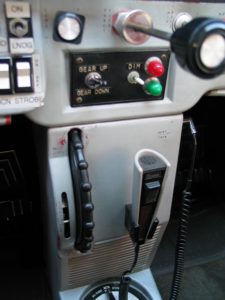
An airplane flying in trim is a truly beautiful thing. It exemplifies balance in all its forms.
An airplane trimmed for straight and level flight will maintain that straight and level flight. It has settled into the perfect balance between lift, thrust, weight, and drag. The forces are in equilibrium. It’s steady.
Sure, things happen. Maybe the pilot bumps into the control yoke and the nose drops. Sure, the plane will start to dive, but then an interesting phenomenon called phugoid oscillation takes place. As the nose drops, the airplane picks up speed. That additional speed adds lift, and the nose rises again. Generally, inertia in the airframe causes the nose to overshoot, rising a little too high. Airspeed drops, lift decreases, and the nose drops again. The cycle repeats.
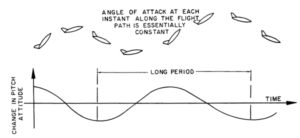
You’d think it would keep going indefinitely, but it doesn’t. Moving the nose up and down requires angular acceleration of the airframe’s mass. Actual work is done by that acceleration, and that work represents a loss in the system, so the oscillations get smaller and smaller until they eventually damp out completely, leaving you in level flight once again.
Sometimes, an inexperienced pilot will see a phugoid cycle happening and overcorrect for it. When the nose goes down he’ll pull up, screwing up the natural damping of the cycle. And when the nose rises he’ll try to push it back over a bit too hard, forgetting that it’ll fix itself if he is just gentle with it … or in fact, just leaves it alone. This has been termed “Pilot-Induced Oscillation,” usually caused by the pilot trying to follow an indication that lags behind the actual state of the airplane. (Following the vertical speed indicator, which has a natural lag of a few seconds, is a typical student pilot mistake.)
This all came to mind this morning because I seem to be trying to trim my own life, and I’m having a hard time. I understand the physics of flight really, really well, but even after 55 years of trying, I haven’t learned a thing about how my life works. So I keep having these oscillations, and I think I’m probably inducing them myself.
When something bad happens, I ham-handedly overcorrect. That pushes things rapidly the other way, because I’m reacting to my own reactions. It’s so, so easy to get into divergent modes and then horse the controls around, putting myself in an even more divergent mode, sometimes on all axes. Pilots call this a “departure” or “upset,” but to me they’re more like crashes. My life should be used to train NTSB investigators. Find the cause. Pilot error.Â
Talking my hands off the controls is hard. It’s my natural instinct to try to fix things, to correct the divergence, to get back into trim. It’s not a perfect metaphor but it’s working for me right now. It describes what’s happening. And I don’t feel I’ve really been properly trimmed for a long time.Â
This is one of those places where the old “first, fly the airplane” advice from my first flight instructor begins to lose its wisdom. Flying the airplane is the very problem I’m fighting with.
And at the moment I’m flying a life that’s got badly mis-rigged control cables, wobbling gyros, bees nesting in the pitot tube, one bad magneto, no stall warning, and a busted radio.
Even on a calm day this thing’s a bitch to fly.
My mother and I had a close relationship, if a rocky one at times. I had as much in common with my mother as I did with my father, but they were very different things. In sharp contrast to my father’s no-nonsense, almost stereotypical stoicism and toughness, my mother was an emotional creature, and passed that nature on to me. It’s because of her that I cry over sappy movies, have a soft spot for all animals no matter how large or small, and have a feeling side that’s just as big as the thinking side my Dad gave me. Mom and I were both as stubborn as mules at times and we didn’t see eye to eye on a lot of different issues, but over the years I’ve come to realize that she really did know me a little better than I knew myself, and I’d have been a lot better off listening to her than thinking I knew everything.
Geraldine Lee Johnson was born into a large family with brothers Bruce, Lucian, Bill, Jim, John, Bill Jr., and sisters Kathryn and Patricia, all children of Ramey and Floetha Lee. Our family is a branch of THAT Lee family, the one so badly maligned in recent years that the name was stripped from a park in my hometown of Charlottesville, VA. I am not the least bit ashamed of this … the Lees were a First Family of Virginia, and our family’s pride long predates the Civil War and what it was fought over. I am proud to be a Lee.
My mom, called Dee by almost everyone, developed an early interest in nursing and upon graduating from nursing school, went right to work, mainly at Catawba Tuberculosis Sanatorium which was near her home. She was a C.T.N., a Certified Tuberculosis Nurse, which was a very rare nursing license that no longer exists. It required the same amount of education and training as an R.N., but in different areas of knowledge. She was later able to become an RN after only a few hours of additional coursework.
Growing up with a nurse for a mother can be very interesting. Most mothers worry and fret over every skinned knee, every bloody nose, every cut or scratch. Not my mom. She knew what was serious and what wasn’t. What needed attention got attention, and what didn’t was laughed off. I remember once lifting a bicycle out of the back of a pickup truck and getting a deep slash about an inch long from the edge of a fender hitting my hand. My father said it needed stitches. She laughed, cleaned it out, taped it together with butterfly bandages, and considered the wound, and the matter, closed. I’m looking at the scar right now as I remember that incident. She was probably right. It’s hard to see now. It would have been far more visible with suture marks.
Mom loved her garden and her flowers. We had a little tiny garden even when we lived (1963-1966) in an old mobile home on Hydraulic Road, on a piece of leased property. But when they bought the house in Batesville in 1967 when I was 5, she went crazy. Our front porch was a jungle of flowers! I never got very interested in plants but boy, did she know them! And she could make anything not just grow, but flourish! The lower part of our backyard became a garden, planted every season with vegetables of all kinds and carefully tended.
My dad didn’t have much living family, but in my younger years all her siblings and her parents were still alive and we made countless trips to New Castle in Craig County to see them. They were a wild and colorful bunch but I loved them all very much. All of the men were military veterans. Bruce and Bill were Navy WWII veterans, John was in the Army, and Lucian and Bill Jr. were Marines. Bill Jr. (Billy) is the only veteran still with us; he served in Vietnam. Kathryn (Aunt Katy to me, Kat to my mom and everyone else) didn’t serve but ended up marrying a military man, Bob Weber. Bob was an army dentist during the Korean war. His son, Bobby, was a Marine helicopter pilot with HMX-1 and flew Marine One. And my aunt Patricia (Patsy) still lives in the southern part of Virginia, and was a nurse until she retired. Her late husband, my uncle Mike, was an officer with the Virginia State Police.
Mom was crazy about birds, too. Owls were her passion and I seem to have inherited that fascination. Her house was like an owl art museum; they were everywhere. A few of her owls are now part of the décor at our house, too. My recording studio is named “Superb Owl,” which is a play on words but also a tribute to her.
Mom did everything she could to attract birds to our house, and later to her back deck when she moved back to New Castle. She put out every conceivable sort of feeder and kept them stocked. She put out nesting boxes. The response was enthusiastic! If you were a birdwatcher, you would need no binoculars at her house. They all came to you, feeding and congregating on the deck, the railing, and the bird baths. She would call them, go right out among them and talk to them. Some even had names.
Once, during a long trip, I left Phoenix, my only bird at the time, with her for a few days. Phoenix was not a bird who was comfortable around strangers, and I was terribly worried he’d bite her, but she thought nothing of it. She had a way with animals, she said. It would be just fine. When I returned, not only was Phoenix having long conversations with her and stepping up very politely, but she’d taught that boisterous, loud bird toÂwhisper, something he remembered thereafter. Amazing.
Mom had a little cockatiel, a lutino she named Big Bird. Cockatiels aren’t great talkers, but she’d taught that one a pretty big vocabulary for a ‘tiel, and it absolutely loved her. She talked to that bird all day, during the time she lived alone, and it was her whole world. One weekend, when I was visiting her during her declining years, she confided in me that she was afraid she’d become unable to take care of Big Bird. I’d become quite experienced with hookbills at the time and she’d met my other birds. Tearfully, she asked me to please take Big Bird home with me and take care of her. It scared me to death. I didn’t know how much stress it might put the bird through, after they’d been so close, and I didn’t know how Mom would keep from going crazy without her companion. And it scared me that she thought she’d become that ill. I agreed, though. It was what she wanted, selflessly wishing her bird the best life possible.
Big Bird was, as I learned over the years, a lot like Mom. She was outspoken, set in her ways, at times cheerful and engaging, at times insistent and tough as nails, and always full of love.
And within five years, they were both gone. Mom is with the Lord she served and sang to all of her days. Her passing was sudden and unexpected and struck me very hard, perhaps harder even than my father’s passing, because while my father was my mentor, my teacher, my friend, my mother was my heart. She understood my emotional nature more than anyone because she was me and I was her. We were more alike than either of us would want to admit sometimes.
When I was down and needed a shoulder, Mom was there. When my marriages and relationships fell apart, she was there. When my animal friends passed away and left huge holes in my life, she was there. When I needed life advice, she was there — her advice always came half from experience and half from the Bible, but it was usually good advice. As it turns out, the only major life event she wasn’t there to help me get through was losing her. She was, in electrical terms, my ground, and losing her left me floating around at all sorts of dangerous potentials. I made a lot of bad decisions until I found a way to ground myself again.
We were not close in the last few years of her life. I lived in Atlanta and she in southern Virginia, and my tumultous and busy life kept me so reactive that I didn’t take the time as often as I should have to call, to visit, to write. When she passed I was working in St. Louis and had to drop everything and rush to her home. She wasn’t there but the guilt sure was. It’s a guilt I still feel just as acutely as the love I still have for the woman who gave me life, and from whose gentle heart so much of me is made.
A couple of weeks ago, an old friend from High School sent me a message on Facebook, saying he’d love to hear how I sang a certain song. (Some people still remember when I sang in High School … some would rather forget.) He’d attached it to the message. When I saw it I dropped my phone and burst into tears. The song was the 1913 hymn, “In The Garden” by Austin Miles.
One August, many years ago, while I was at my mother’s house for the annual Lee Reunion, Mom suggested that she and I sing a song at church that Sunday. That’s the song she selected. We practiced it a couple of times during the week, and on that Sunday morning we stood in front of the whole congregation at the little country church and sang it together in harmony. It is my most vivid memory of singing with my mother, a tiny snippet of my life I will always treasure.
And as I sit here this morning, drinking my coffee in a quiet living room, I hear my little birds talking to me. I cast my eye around the room and it alights on numerous owls that gaze back at me. I glance at the barely-visible scar on my hand. I step out onto the front porch and smell the wildflowers starting to bloom, and hear the wild birds chatting, sometimes raucously and sometimes tunefully from their places in the trees. I stop, even though I am running late for work, and stand still for a minute, letting the feeling of nature, the spirits of the birds and the plants and the animals fill me. She is here.
Happy birthday, Mom. I love you.
Oh, and Mom? As soon as I can get through it without crying, I’m going to record In The Garden for you. Maybe I’ll let Fred hear it too.
[Edited a bit on April 19, 2018. I got confused and left some folks out, and also got some of the branches of service wrong.]
]]>by Scott Johnson
In River Bend the vultures flew,
Their numbers strong and proud.
And on the water tower in
the morning they would crowd.
On broad brown wings they spent their days
On lazy, soaring rounds,
Looking for sad victims
Of the cars that speed through town.

On Clarks Road one can see a few
In morning's grazing light,
But scarcely one is seen in town
Where once they would alight.
I loved the graceful vultures
And was proud to call them friend.
But Jackson now has banished them
From his town, Dead Bird Bend.

"BIRD SANCTUARY!" shouts the sign
In letters bold and white
But just a few yards further on,
Hangs a disgusting sight.
For on the water tower, stuffed
And dangling in the wind
There's a vulture hung in effigy
Welcome to Dead Bird Bend.

"The birds are pooping on my car!"
The vulture haters claim.
"The vulture poop dissolves our paint,"
So Jackson did exclaim.
And just like that, without a thought
Our vultures to defend,
He hung that sick'ning effigy
And gave us Dead Bird Bend.

Each day I wake and mourn the loss
Of natures cleanup crew.
Reporters help us tell our tale.
It's all that we can do.
If I could hang an effigy
Upon the tall beige tower,
It would be one of Jackson,
Thus the vultures to empower.

I venture out most mornings with
My camera at my side,
Hoping I will catch a glimpse
Of what's been pushed aside.
I loved the graceful vultures
And was proud to call them friend.
But not a one has lately soared
The skies of Dead Bird Bend.
]]>
The origin of the following text is unknown to me. I’ve seen it in many forms on the Internet. While I do not know who wrote the original version, I have made a few edits here that I believe improve the flow of the story, correct various imperfections, and make it more entertaining. But I lay no claim to originality of the work itself.
This Is the Title of This Story, Which Is Also Found Several Times in the Story Itself
This is the first sentence of this story. This is the second sentence. This is the title of this story, which is also found several times in the story itself. This sentence is questioning the intrinsic value of the previous two sentences. This sentence is to inform you, in case you haven’t already realized it, that this is a self-referential story, that is, a story containing sentences that refer to their own structure and function. This is a sentence that provides an ending to the first paragraph.
This is the first sentence of a new paragraph in a self-referential story. This sentence is introducing you to the protagonist of the story, a young boy named Billy. This sentence is telling you that Billy is blond and blue-eyed and American and twelve years old and strangling his mother. This sentence comments on the awkward nature of the self-referential narrative form while recognizing the strange and playful detachment it affords the writer. As if illustrating the point made by the last sentence, this sentence reminds us, with no trace of facetiousness, that children are a precious gift from God, and that the world is a better place when graced by the unique joys and delights they bring to it.
This sentence describes Billy’s mother’s bulging eyes and protruding tongue and makes reference to the unpleasant choking and gagging noises she’s making. This sentence makes the observation that these are uncertain and difficult times, and that relationships, even seemingly deep-rooted and permanent ones, do have a tendency to break down.
Introduces, in this paragraph, the device of sentence fragments. A sentence fragment. Another. Good device. Will be used more later.
This is actually the last sentence of the story but has been placed here by mistake. This is the title of this story, which is also found several times in the story itself. As Gregor Samsa awoke one morning from uneasy dreams he found himself in his bed transformed into a gigantic insect. This sentence informs you that the preceding sentence is from another story entirely (a much better one, it must be noted) and has no place at all in this particular narrative. Despite claims of the preceding sentence, this sentence feels compelled to inform you that the story you are reading is in actuality “The Metamorphosis” by Franz Kafka, and that the sentence referred to by the preceding sentence is the only sentence which does indeed belong in this story. This sentence overrides the preceding sentence by informing the reader (poor, confused wretch) that this piece of literature is actually the Declaration of Independence, but that the author, in a show of extreme negligence (if not malicious sabotage), has so far failed to include even one single sentence from that stirring document, although he has condescended to use a small sentence fragment, namely, “When in the course of human events,” embedded in quotation marks near the end of a sentence. Showing a keen awareness of the boredom and downright hostility of the average reader with regard to the pointless conceptual games indulged in by the preceding sentences, this sentence returns us at last to the scenario of the story by asking the question, “Why is Billy strangling his mother?” This sentence attempts to shed some light on the question posed by the preceding sentence but fails. This sentence, however, succeeds, in that it suggests a possible incestuous relationship between Billy and his mother and alludes to the concomitant Freudian complications any astute reader will immediately envision. Incest. The unspeakable taboo. The universal prohibition. Incest. And notice the sentence fragments? Good literary device. Will be used more later.
This is the first sentence in a new paragraph. This is the last sentence in a new paragraph.
This sentence can serve as either the beginning of the paragraph or end, depending on its placement. This is the title of this story, which is also found several times in the story itself. This sentence raises a serious objection to the entire class of self-referential sentences that merely comment on their own function or placement within the story e.g., the preceding four sentences), on the grounds that they are monotonously predictable, unforgivably self-indulgent, and merely serve to distract the reader from the real subject of this story, which at this point seems to concern strangulation and incest and who knows what other delightful topics. The purpose of this sentence is to point out that the preceding sentence, while not itself a member of the class of self-referential sentences it objects to, nevertheless also serves merely to distract the reader from the real subject of this story, which actually concerns Gregor Samsa’s inexplicable transformation into a gigantic insect (despite the vociferous counterclaims of other well-meaning although misinformed sentences). This sentence can serve as either the beginning of the paragraph or end, depending on its placement.
This is the title of this story, which is also found several times in the story itself. This is almost the title of the story, which is found only once in the story itself. This sentence regretfully states that up to this point the self-referential mode of narrative has had a paralyzing effect on the actual progress of the story itself — that is, these sentences have been so concerned with analyzing themselves and their role in the story that they have failed by and large to perform their function as communicators of events and ideas that one hopes coalesce into a plot, character development, etc. — in short, the very raisons d’etre of any respectable, hardworking sentence in the midst of a piece of compelling prose fiction. This sentence in addition points out the obvious analogy between the plight of these agonizingly self-aware sentences and similarly afflicted human beings, and it points out the analogous paralyzing effects wrought by excessive and tortured self-examination.
The purpose of this sentence (which can also serve as a paragraph) is to speculate that if the Declaration of Independence had been worded and structured as lackadaisically and incoherently as this story has been so far, there’s no telling what kind of warped libertine society we’d be living in now or to what depths of decadence the inhabitants of this country might have sunk, even to the point of deranged and debased writers constructing irritatingly cumbersome and needlessly prolix sentences that sometimes possess the questionable if not downright undesirable quality of referring to themselves and they sometimes even become run-on sentences or exhibit other signs of inexcusably sloppy grammar like unneeded superfluous redundancies that almost certainly would have insidious effects on the lifestyle and morals of our impressionable youth, leading them to commit incest or even murder and maybe that’s why Billy is strangling his mother, because of sentences just like this one, which have no discernible goals or perspicuous purpose and just end up anywhere, even in mid
Bizarre. A sentence fragment. Another fragment. Twelve years old. This is a sentence that. Fragmented. And strangling his mother. Sorry, sorry. Bizarre. This. More fragments. This is it. Fragments. The title of this story, which. Blond. Sorry, sorry. Fragment after fragment. Harder. This is a sentence that. Fragments. Damn good device.
The purpose of this sentence is threefold: (1) to apologize for the unfortunate and inexplicable lapse exhibited by the preceding paragraph; (2) to assure you, the reader, that it will not happen again; and (3) to reiterate the point that these are uncertain and difficult times and that aspects of language, even seemingly stable and deeply rooted ones such as syntax and meaning, do break down. This sentence adds nothing substantial to the sentiments of the preceding sentence but merely provides a concluding sentence to this paragraph, which otherwise might not have one.
This sentence, in a sudden and courageous burst of altruism, tries to abandon the self-referential mode but fails. This sentence tries again, but the attempt is doomed from the start.
This sentence, in a last-ditch attempt to infuse some iota of story line into this paralyzed prose piece, quickly alludes to Billy’s frantic cover-up attempts, followed by a lyrical, touching, and beautifully written passage wherein Billy is reconciled with his father (thus resolving the subliminal Freudian conflicts obvious to any astute reader) and a final exciting police chase scene during which Billy is accidentally shot and killed by a panicky rookie policeman who is coincidentally named Billy. This sentence, although basically in complete sympathy with the laudable efforts of the preceding action-packed sentence, reminds the reader that such allusions to a story that doesn’t, in fact, yet exist are no substitute for the real thing and therefore will not get the author (indolent goof-off that he is) off the proverbial hook.
Paragraph. Paragraph. Paragraph. Paragraph. Paragraph. Paragraph. Paragraph. Paragraph. Paragraph. Paragraph. Paragraph. Paragraph. Paragraph. Paragraph.
The purpose. Of this paragraph. Is to apologize. For its gratuitous use. Of. Sentence fragments. Sorry.
The purpose of this sentence is to apologize for the pointless and silly adolescent games indulged in by the preceding two paragraphs, and to express regret on the part of us, the more mature sentences, that the entire tone of this story is such that it can’t seem to communicate a simple, albeit sordid, scenario.
This sentence wishes to apologize for all the needless apologies found in this story (this one included), which, although placed here ostensibly for the benefit of the more vexed readers, merely delay in a maddeningly recursive way the continuation of the by-now nearly forgotten story line.
This sentence is bursting at the punctuation marks with news of the dire import of self-reference as applied to sentences, a practice that could prove to be a veritable Pandora’s box of potential havoc, for if a sentence can refer or allude to itself, why not a lowly subordinate clause, perhaps this very clause? Or this sentence fragment? Or three words? Two words? One?
Perhaps it is appropriate that this sentence gently and with no trace of condescension reminds us that these are indeed difficult and uncertain times and that in general people just aren’t nice enough to each other, and perhaps we, whether sentient human beings or sentient sentences, should just try harder. I mean, there is such a thing as free will, there has to be, and this sentence is proof of it! Neither this sentence nor you, the reader, is completely helpless in the face of all the pitiless forces at work in the universe. We should stand our ground, face facts, take Mother Nature by the throat and just try harder. By the throat. Harder. Harder, harder.
Sorry.
This is the title of this story, which is also found several times in the story itself.
This is the last sentence of the story. This is the last sentence of the story. This is the last sentence of the story. This is.
Sorry.
]]>