Advertise with Googlier.comAndersen Design
https://www.andersendesign.biz
Collectible Ceramics Handcrafted in Maine since 1952Fri, 21 Aug 2026 19:57:14 +0000en-US
hourly
1 https://wordpress.org/?v=7.1.4https://www.andersendesign.biz/wp-content/uploads/2026/09/cropped-andersen-circle-2-1-32x32.gifAndersen Design
https://www.andersendesign.biz
3232243389549The (Almost) Complete Works of Andersen Design
https://www.andersendesign.biz/9070-2/?utm_source=rss&utm_medium=rss&utm_campaign=9070-2
Sun, 28 Jun 2026 16:06:02 +0000https://www.andersendesign.biz/?p=9070]]> Dad Akron Art Institute
Dear Reader, It is not possible to produce the complete works of Andersen Design since Andersen Design was an ongoing creative working process that included many different glazes and decorative works and one of a kind works. Andersen Design’s brand is all about the creative working process, the importance of which seems to be a secret known only to the working classes- and not to the workforce-that term which represents the workers as an instrumentality of institutional powers.
One might categorize Andersen Design as an institution as is any collective organization of any size and it is true to say that Andersen Design employed a workforce in its own interests, but still I prefer that old-fashioned term, the working classes, which represents people who work and for whom the work process is as much a reason to work as is the income derived there of-but seldom does one find a mention of the importance of an engaging work process in most institutional thought. This product line represents the end result of an engaging work process. I created this as a way to visually communicate the depth of the line of industrial designs created by my family over the course of seven decades. I see these designs as economic development assets for the working classes. It was not easy to establish such a complex business, There are many dormant wholesale accounts that can be re-established. The designs, the accounts, the history , and the philosophy all make up the Andersen Design brand which can be put to use helping others to live an lifestyle embedded in an engaging work process.
Andersen Design is a ceramic art and design company established in 1952. Over the course of seven decades, the Andersen family created a classic line of ceramic functional forms and wildlife sculptures, which were marketed primarily in the USA but also sold in Itoya in Japan and a department store in Denmark. Andersen Design also created original ceramic slip for slipcasting and original glazes and decorating colors.
The Andersens developed wholesale accounts with main street shops, department stores, and catalogs. The Gentle Sandpiper was a number one seller in the Smithsonian catalog for over thirty years. The designs are market-proven classics that do not go out of style.
I would like to establish licensing agreements so that the product can be produced in independently owned studios and marketed under the Andersen Design brand with the individual artisans’ styles, featured, and creative contributions attributed.
Weston designed a series of mug forms that is a natural starting project for licensing. The forms in various surface treatments can be viewed at https://www.andersendesign.biz/westons-mug-forms/
I am looking for a licensing agent to develop the contractual agreements needed to work with other small businesses.
Susan Mackenze Andersen mackenziana@gmail .com.
Collaborating with Independent Studios
The Andersens developed wholesale accounts with main street shops, department stores, and catalogs. The Gentle Sandpiper was a number one seller in the Smithsonian catalog for over thirty years. The designs are market-proven classics that do not go out of style.
I would like to establish licensing agreements so that the product can be produced in independently owned studios and marketed under the Andersen Design brand with the individual artisans’ styles, featured, and creative contributions attributed.
Weston designed a series of mug forms that is a natural starting project for licensing. The forms in various surface treatments can be viewed at https://www.andersendesign.biz/westons-mug-forms/
I am looking for a licensing agent to develop the contractual agreements needed to work with other small businesses.
Susan Mackenze Andersen mackenziana@gmail .com.
Seeking a Marketing Agent
I am in charge of the original molds of hundreds of market-proven classic designs of functional forms and wildlife sculptures produced by my family over the course of seven decades.
Andersen Design has a long history of selling wholesale and retail. We sold to main street galleries, department stores, and catalogs, mainly in the USA but also in Itoya in Japan and a department store in Denmark. The line is classic and did not go out of style. The Gentle Sandpiper was a number one seller in the Smithsonian catalog for thirty years.
]]>9070Protected: AI & the Class Divide
https://www.andersendesign.biz/ai-the-class-divide/?utm_source=rss&utm_medium=rss&utm_campaign=ai-the-class-divide
Thu, 25 Jun 2026 15:12:18 +0000https://www.andersendesign.biz/?p=8916There is no excerpt because this is a protected post.]]>
]]>8916Andersen Design, Research & Development outside traditional institutional frameworks
https://www.andersendesign.biz/andersen-design-research-development-outside-traditional-institutional-frameworks/?utm_source=rss&utm_medium=rss&utm_campaign=andersen-design-research-development-outside-traditional-institutional-frameworks
Wed, 03 Jun 2026 21:02:41 +0000https://andersendesign.biz/?p=4451I responded to Claude’s description of how research and development can work outside of the university and large corporate environment by saying it was very good. However, since the description had no concrete examples, I offered Andersen Design as a concrete example, and this is how Claude responded: Thank you for that excellent concrete example. […]]]>
I responded to Claude’s description of how research and development can work outside of the university and large corporate environment by saying it was very good. However, since the description had no concrete examples, I offered Andersen Design as a concrete example, and this is how Claude responded:
Thank you for that excellent concrete example. Andersen Design perfectly illustrates how Business in Residence can enable long-term, sustained research and development outside traditional institutional frameworks.
What’s particularly compelling about Andersen Design is how it demonstrates the continuity and depth possible when researchers retain full control over their intellectual property. Operating from 1952 onwards, the Andersens could pursue multi-decade research into ceramic formulations, glaze chemistry, and decorating techniques without external pressure to publish findings, meet grant deadlines, or align with corporate product cycles.
Their development of original recipes for ceramic bodies, glazes, and decorating colors using locally sourced materials represents exactly the kind of applied research that benefits from this model. This work likely involved extensive experimentation with mineral compositions, firing temperatures, chemical interactions, and aesthetic outcomes – the kind of iterative, long-term investigation that requires both technical expertise and artistic vision.
The intellectual property aspects are particularly noteworthy. The Andersens retained ownership of their proprietary formulations and techniques, which became valuable trade secrets and competitive advantages. In a university setting, these recipes might have been published in ceramics journals or claimed by the institution. In a corporate environment, they would have belonged to the employer and potentially been shelved if they didn’t align with market priorities.
Operating as a home-based business also allowed them to integrate research seamlessly with production and marketing. They could immediately test market response to new designs, adjust formulations based on customer feedback, and scale production organically. This tight feedback loop between research, development, and commercialization is often difficult to achieve in separate institutional environments.
Andersen Design also demonstrates how BIR can support regional economic development by utilizing local resources – in this case, locally sourced raw materials that became part of their research focus and competitive advantage. This kind of place-based innovation often gets overlooked by larger institutions but can create significant local economic value.
The longevity of their operation shows how this model can support sustained innovation across generations, with accumulated knowledge and expertise becoming a form of institutional memory that benefits the broader research community.
]]>4451Hallucinations Proliferate in Affordable Housing and Corporate AI
https://www.andersendesign.biz/hallucinations-proliferate-in-affordable-housing-and-corporate-ai/?utm_source=rss&utm_medium=rss&utm_campaign=hallucinations-proliferate-in-affordable-housing-and-corporate-ai
Thu, 28 May 2026 16:25:06 +0000https://www.andersendesign.biz/?p=7680We Say We Want an Evolution! We All want to change the world! This Newsletter and all the research that goes into it are solely supported by reader subscriptions or foundational contributions. Free subscribers are welcome- getting the message out is the whole point. Paid subscribers are needed. Please consider becoming a free or paid […]]]>
We Say We Want an Evolution! We All want to change the world!
Through the Looking Glass- The Landscape in the Crystal Ball
This Newsletter and all the research that goes into it are solely supported by reader subscriptions or foundational contributions. Free subscribers are welcome- getting the message out is the whole point. Paid subscribers are needed. Please consider becoming a free or paid subscriber.
Subscribe to my Newsletter
There is a lot of talk in the AI world about the imminent bursting bubble. Will Lockett gives an informed explanationhere. In short, the financial world is investing enormous amounts of money, far in excess of the revenue generated by AI, in the belief that it will ultimately produce the revenue to justify the investment, but in 2025, instead of revenue increasing, revenue growth declined. Quoting Lockett, “OpenAI’s revenue growth is slowing down dramatically. In 2023, they increased their revenue by 169% over 2022, and in 2024, they increased their revenue by 250% over 2023. In 2025, they are set to increase revenue by only 56% over 2024.”
The reason is that the reality of what is termed AI “hallucinations” is setting in. In many cases, rather than increasing productivity, AI is actually slowing productivity down.
I may have bumped into that phenomenon in several encounters with large corporations during the last week, the most recent example being when I switched my internet provider. My new service is supposed to include streaming perks that do not materialize, apparently because when I log in to my internet account, any subsequent action causes my login to roll over to my mobile account, which does not come with streaming options. I have no proof that this phenomenon is caused by an AI hallucination, but it does seem highly unusual for a major corporation to get the coding so wrong. Could the coding have been done by AI?
I lost several hours of productivity trying to resolve this glitch. Why did I allow it to rob me of my own productivity? I confess it is because I was working with a human rather than an AI in trying to fix it. I had called to cancel my new service, but in contrast to AI customer support, human customer support has come to feel magical. Am I imagining it? Human support seems to be having a particularly good time, engaging in conversations and humor. Is it because their jobs are less stressful?
I didn’t mind extending inordinate patience toward human support, trying to do their job, but when it comes to AI support, I have lost all patience. Every time I think about using chat, I think about listening repeatedly to lists of options that bear no relationship to what I am trying to achieve and going round and round in circles as AI attempts to assert what it wants over what I want. I cringe at the thought and call on the phone, where I inevitably encounter the same system, but hitting the O button will often put an end to it.
My web server is filled with ads for services it is trying to sell, which I must scroll down to access the sections I want. The other day, when I logged in, one such app, from Guttenverse, filled the entire screen. Mistaking it for an upgrade, I clicked, and that wiped out my own header on my own website, and when I went to retrieve my header, I found a dozen of Guttenverse’s images in my media library. I restored my theme, but it was missing some parts, and I worked many more hours on fixing that.
Floating Full
More lost hours away from the project I initiated a few weeks ago, which is where I want my attention to be directed.
AI robs the public of its productivity time to save corporate expenses in hiring people. Remember when state governments justified investing taxpayer dollars in capitalizing large corporations as “job creation”? That’s a hard sell now, as large corporations have invested in AI in the interest of saving money on labor costs-but that is proving to be premature. When AI hallucinates, humans must come to the rescue.
There is an article in the Boothbay Register about a poll being conducted by the most recent outside consultant group hired by our leaders to plan our economic development for us. (Community input sought on economic development strategy).
The corporate state of Maine systematically excludes small businesses and individuals from participating in its economic development pow wows, as it controls municipal leadership through wealth redistribution, so that community leaders readily give up their Home Rule authority. At the roots of the system, upward mobility or economic independence is discouraged. This philosophy is nowhere more visible than in the housing solutions advanced by the corporate state, advantaging large developers over inhabitants.
As a protector of inherited small businesses’ productivity assets, which can be very beneficial to upward mobility and economic independence at the roots and beyond, there is no local or state resource that I can go to for support or to engage in my community development.
I gave my 250 characters (or whatever it was) to the questionnaire, which is the most that individuals and small businesses are invited to participate in their own communities in a corporate-managed state like Maine.
I contacted the consulting group tasked with developing the Peninsula’s economic future when they were first announced and received an acknowledgement, but no further communication thereafter.
No one invited me to do so, but if I waited for an invitation, I would never get to participate. We must make our own opportunities.
Contemporary circumstances are co-creating the opportune moment, as at this time, it is not the community leaders who are leading as their housing solution of 161 overcrowded, undersized units with the dimensions of mobile homes stacked on top of each other, and no individual land ownership, sits unsold after257 days.
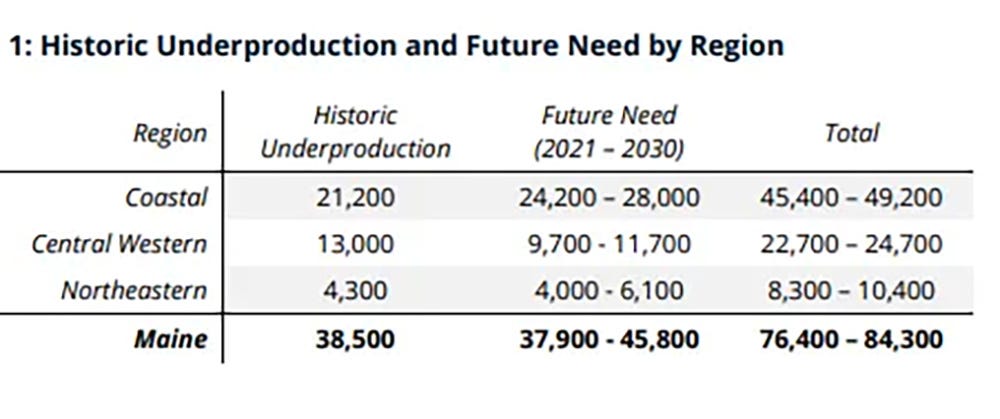
If the cause of the housing shortage is “underproduction of housing,” Why aren’t these overpriced, “affordable”, “workforce” housing units selling like hotcakes? Could it be that the developers and realtors who were enabled by the Maine Legislators to bypass Maine Constitutional rules for Direct initiative of legislation, were hallucinating the cause of the housing shortage?
Section 18. Direct initiative of legislation. 1. Petition procedure. The electors may propose to the Legislature for its consideration any bill, resolve or resolution, …, by written petition addressed to the Legislature or to either branch thereof and filed in the office of the Secretary of State by the hour of 5:00 p.m., on or before the 50th day after the date of convening of the Legislature in first regular session or on or before the 25th day after the date of convening of the Legislature in second regular session, except that the written petition may not be filed in the office of the Secretary of State later than 18 months after the date the petition form was furnished or approved by the Secretary of State….
First, dehumanized housing for the working classes was justified by a housing shortage caused by “underproduction of housing. Now they tell us that overcrowded housing is being produced to attract new workers to the state of Maine, since working classes across the world are raring to live in Industrial Revolution-style urban tenements with no access to traditional rural lifestyles.
The title of H.P. 1224, L.D. 1829, suggests that the state municipal ordinances are not justified by an underproduction of housing but because the corporate state wants to expand Maine’s population to expand the corporate state’s industrial army and most predominately the state’s new unconstitutional corporation, The Maine Space Corporation, which will raise regulatory issues of many sorts and those issues will be decided by the same entity that broke with the Maine Constitution to charter and operate the Maine Space Corporation. (See my Letter to the Editor here) The people were not invited to weigh in on this game-changing state-run industry. Is it what we want for our state?
This begs the question: Are Maine leaders hallucinating?
The title of the act suggests that building overcrowded housing, reminiscent of urban housing during the Industrial Revolution, will attract working people to Maine who want to live in a newly structured class society where the working classes are second-class citizens.
This is the sort of mentality that evolves after decades of refusing to allow individuals and small businesses to be a part of the conversation.
How’s that working out? The city block in a rural landscape on the Boothbay Peninsula is the first outcome of LD 2003-Hp1489. To date, the development is a ghost city block that cost millions of dollars and rerouted water lines. It is reasonable to consider that our leaders are hallucinating about all of it, including the cause of the housing shortage, and it’s time to account for possible other reasons for the housing shortage, such as short-term rentals, and to consider other visions for the future of the Peninsula
Such as:
Land to individuals instead of land to development corporations.
A little side note, lest anyone thinks AI isn’t creative. I used generative AI to expand the solid blue background above, expecting just a larger blue rectangle, but AI, on its own initiative, added the skyline, which I think is pretty cool.
As the title of the act says, it is not about a housing shortage; it is about attracting workers to Maine by establishing overcrowded housing zones in every Maine community where the “workforce” can live, segregated from the default housing zone that advantages short-term rentals, where transients enjoy the traditional rural lifestyle.
The overcrowded housing expansion for the “workforce” will conveniently serve the needs of the new Maine Space Corporation, chartered in flagrant violation of the Maine Constitution(Article IV Part Third section 13 & 14) and signed into law by Governor Mills as part of a series of laws, including the housing laws, that violate the Maine Constitution. Now Mills is running for Senate at a time when Americans rely on Congress to protect our federal Constitution, and not only when it’s convenient to do so.
In another triumph for Maine’s centrally managed government, the State Legislature enacted H.P. 789An Act to Require Municipal Reporting on Residential Building Permits, Dwelling Units Permitted and Demolished, and Certificates of Occupancy Issued, also signed into law by Maine’s next would-be US Senator, Janet Mills.
This bill directs municipalities to provide an annual report on certain housing data to the Department of Economic and Community Development for use in administering the Housing Opportunity Program, including data on residential building permits, dwelling units permitted and demolished and certificates of occupancy or other approvals of housing units issued and certain affordability data
The Town, County, and State funded the BRDC housing project in Boothbay with AARPA affordable housing funds even though the pricing and financing terms of the units are not consistent with affordable housing needs as stated in the State report , nor is it consistent with financing guidelines for affordable housing as stated in LD2003-HP 1489 based on a study done by private sector Commissioners such as Erin Cooperrider, the VP of the BRDC.
However the BRDC housing project satisfies that the Peninsula is consistent with state municipal ordinances and mandates.
Now that state mandates are satisfied, the people, including individuals and small businesses, can develop affordable housing to serve the needs of the working classes and specifically those in the 60%AMI or below demographic identified in the state report, as the greatest need, especially on the coast, but not accomodated by the large scale development funded by Town, County and State leadership, which is currently sitting unoccupied for almost nine months. Since the development is unoccupied, the question becomes what will happen to the rest of the land intended for 121 more overpriced, overcrowded units to house the undifferentiated workforce?
The design of the BRDC development is consistent with the pattern found in the Boothbay Roundabout, where road decor is used to detract from a poor infrastructure design. The “units” as they are appropriately called, are designed as long hallways, resembling the dimensions of railway cars, which our leaders believe is a design for home living that will attract the working classes to Maine. The units reflect the attitude of leadership toward the people who are considered to be indistinguishable and unindividualized, like the units.
Furthermore, as the BRDC is funded by the government, the limits on economic growth imposed by the government will apply to the development. I am not speaking from knowledge of all the rules that apply specifically to the BRDC development, but from general knowledge derived from independently reading the Maine economic development statutes for many years and from the fact that the BRDC claims 75% of any increase in value realized if the buyers of the units resell those units, greatly diminishing the equity value of homeownership.
In terms of the rental units, the affordable housing rules require an inhabitant to move if their income exceeds a limit, and so we are talking about entire communities where income growth is capped. Is this a desirable working-class environment in which to raise a family?
I propose another sort of priority zone that encourages small businesses and permits businesses in a home. Instead of industrial job training in a publicly funded public school, the job training is naturally embedded in the environment. If there is such a non-profit organization as I am suggesting with Land To Individuals, let that organization be committed to not accepting funding from any source that places limits on economic growth. Why should a community be committed to limiting growth? While an aggressively expanding wealth divide is undesirable, so is the opposite type of environment that limits economic growth. Such a community is part and parcel of an expanding wealth divide by intentionally placing limits on growth at the roots of society. What is desired is an engaged working-class environment with a focus on the psychological benefits of work. There are issues to be worked out related to curtailing unintended exploitation of the system without sacrificing the pathways to economic growth, which will require group participation to develop.
To my knowledge, my Dad, who started a successful and very complex business on his own, never took a business course, but he was raised in a small business working class community, where his Dad, a chicken farmer, installed the electric power in the town as described by my nephew, Colin Woodard, in his article about Andersen Design published in Maine Boats and Harbors
.My grandfather grew up in Primghar, Iowa, a small town near the South Dakota line. He was seven years old when the stock market crashed. By the time he was in high school, the town had filled with economic refugees from the urban East, seeking to ride out the crisis in what was a relatively stable and prosperous agricultural center. Others, from the West, passed through on US18. “You could tell by the license plate that they were from the Dakotas and they were just so desperate,” my grandfather recalled. “Families in old wrecks with machinery piled up on a trailer behind them who were just looking for some place to get a new start. It made a very deep impression on me.”
My grandfather’s own family was relatively secure. His father, a son of Danish immigrants, was a self-taught electrician who had electrified the town himself and, later, oversaw the building of the municipal power plant. He designed and built buildings, sat on the city council, and owned a chicken hatchery. My grandfather, by his own admission, was a bit of an odd duck, an artistic soul in a community of pioneering agriculturalists, making sculptures from the clay exposed by his father’s building excavations. \Vhen his older brother began collecting jalopies, rundown cars could be bought for a few dollars at the time—he helped him craft a stylish new body for a Model T from chicken wire and painted canvas
The alternative people’s problem-solving movement is already underway. Recently, an article in the Boothbay Register reported that a group in Southport, in charge of a parcel of land, decided to sell it to individuals to build their own homes. This is consistent with my idea for a non-profit organization formed to acquire land and sell it to individuals, bypassing the large developers, supported by the state, making housing affordable to people of lower incomes. Selling land to individuals doesn’t require a specified non-profit organization, but a non-profit can acquire land and develop means to help people finance the land. I envision such an organization that prioritizes selling land to those making 60% AMI or below first, with a percentage going to the 80% AMI demographic. Our government leaders are already covering the 80-120% AMI demographic, which is the target for the 20-40 units built by the BRDC.
There is much to work out in such an idea. The mission statement needs to clearly state the intent to sell land to the lower end of the economy, without placing limitations on the economic growth of the inhabitants. Some regulations are needed to discourage exploitation, such as acquiring the land and then turning around and selling it for a higher price to a higher demographic without developing it, but those who develop the land in the spirit of the organization’s intent should be able to realize full equity value from doing so.
Such an environment is a natural learning environment in industrial job training which would free the public school system to focus on educating the citizenry in reading, writing, arithmetic, philosophy, analytical thought, and, in alignment with State law, in educating about the Maine and US Constitution and the history of indigenous people and genocides. Then it would not be so easy for our Legislative branch to steamroll over our Constitution to transform Maine into something unintended by the Maine Constitution.
There is a need for solutions for housing beyond a narrow concept of working-class housing solutions, branded as “ workforce housing.” What could be less creative and innovative than passing a law enabling state-wide municipal ordinances that treat the entire state of Maine as a repetitive grid of cultural conformity? Maine should be a home to diverse communities, as reflected in our traditional New England architecture. It was not too long ago that an out-of-state visitor remarked on how unusual it is to see every house a unique home. Today, we are in danger of becoming the Land of Monotonous Units.
]]>7680How Home Rule Was Usurped by the Centrally Managed Economy
https://www.andersendesign.biz/introducing-a-conceptual-project-telling-the-story-of-maines-transformation-from-a-home-rule-state-to-a-centrally-managed-economy/?utm_source=rss&utm_medium=rss&utm_campaign=introducing-a-conceptual-project-telling-the-story-of-maines-transformation-from-a-home-rule-state-to-a-centrally-managed-economy
Tue, 27 Jan 2026 21:15:24 +0000https://andersendesign.biz/?p=7353Seeking Colaborators This is the first sample video in a conceptual series that is based on the book I wrote ten years ago. I took the book offline because it needed editing. I did not have the wherewithal to do that large task, so I have been using the book as reference material for this […]]]>
Seeking Colaborators
Zero Dollars and a Barrel of Faith!
This is the first sample video in a conceptual series that is based on the book I wrote ten years ago. I took the book offline because it needed editing. I did not have the wherewithal to do that large task, so I have been using the book as reference material for this newsletter. These are the chapter titles and descriptions in the book.
The book documents, in chronological order, the transformation of Maine from a constitutional Home Rule state to a centrally managed state. The centrally managed state was declared by legislative fiat in 1976. At that time, the small business community in Maine was growing faster than anywhere else in the country.
The Governor invited the heads of the largest corporations in Maine to compile a report, The Governor’s Report of 1976. No one from the small business community was invited to the powwow, although the community was used as the reason why the state had to step in and manage the economy of Maine. It was said that small businesses have a more difficult time than large ones in finding investment capital, so the state had to step in to help small businesses by forming the Maine Capital Corporation. The following story is a chapter from my book about the Maine Capital Corporation
The Maine Politics Facebook forum describes itself as “A portal for politics in Maine managed by the Portland Press Herald, Kennebec Journal, and Morning S”
I submitted this video to the Maine Politics Facebook Forum twice, but it seems they will not publish it.
The goal of the video series is to shed light on the underlying structure of the comprehensive Maine political system. In my view, we can’t keep going down the same path that has embedded mechanisms that continually expand the wealth divide. We are ripe for a new paradigm that grows the economy from the “bottom up and middle out,” and so, we need clarity about how the current system operates.
However, Maine Politics published my most recent newsletter post:
Maine Leaders Fail to Uphold Constitution
Is the difference that the video tells of questionable manipulations by Republicans, and the newsletter post questions recent Democratic legislation? I will wait until I have a video critical of Democrats before submitting a video again to Maine Politics.
Or maybe it’s just talking about the underlying system, on my own initiative, that got the video banned.
My idea is a video series telling the policy history that has transformed Maine from a constitutional hierarchical government to a practicing oligarchy. This is the right political moment for it. I would like to find collaborators, particularly a videographer, as working with a team would likely result in the series being produced faster and at a more consistent pace, which would make it more impactful.
However, at this stage, I can offer no funding. Funding sources are also embedded into the current system. For instance, Press Forward specifically funds local civic journalism.
I checked out Press Forward in Maine, but it is led by the Maine Community Foundation. When I explored foundation funding in Maine, I was told by The Maine Community Foundation and the Davis Foundation that they do not accept proposals from individuals and free enterprises, fiscally sponsored or not. In so doing, the Foundations are discouraging new organizations from forming by not supporting formative processes.
The brochure for Maine Press Forward is similarly framed. The Advisory Council is made up of CEOs of media companies, Directors of established institutions, Board members of major nonprofits, University professors, and Foundation program directors.
There are no Independent journalists, solo practitioners, small enterprise voices or anyone outside institutional structures.
I am exploring funding possibilities, but currently, the only way I see as a possibility to fund this project is through paid subscriptions and foundational support for this newsletter, which reflects the many years that I have been independently researching this subject so that it can be presented chronologically. The newsletter poses no issues over whether it is political, so I don’t have to worry if I am crossing any lines.
I am looking for videographers, local TIF collaborators, and reader support
]]>7353When the Maine Legislature Devised a Clever Run Around of the Maine Constitution
https://www.andersendesign.biz/when-the-maine-legislature-devised-a-clever-run-a-round-of-the-maine-constitution/?utm_source=rss&utm_medium=rss&utm_campaign=when-the-maine-legislature-devised-a-clever-run-a-round-of-the-maine-constitution
Sun, 25 Jan 2026 21:55:29 +0000https://andersendesign.biz/?p=7349And other musings about our contemporary reality I read an article on Medium titled I Didn’t Write a Single Article… Yet I Made Over $7,000 Using This AI– or rather, I skimmed it to find out what it was selling, which is an AI tool that does everything for you, from writing the articles to […]]]>
And other musings about our contemporary reality
Puzzeled
I read an article on Medium titledI Didn’t Write a Single Article… Yet I Made Over $7,000 Using This AI– or rather, I skimmed it to find out what it was selling, which is an AI tool that does everything for you, from writing the articles to promoting them, and for a small fee, and a minor amount of editing work, one can just sit back and let the money roll in, so it says.
The only thing you need to accept is that you are useless and what you have to say is worthless. This repeats the dilemma that those who remain employed at the corporate headquarters complain about. The industry that used to be so dependent on the creativity of the workers that academia invented the concept of psychological ownership to encourage workers to make their creativity available for corporate ownership, has now reduced the worker to the overseer of AI, which does the essential creative work.
I kept on digging… and while researching that piece, I discovered something more disturbing: we’re not just failing to train the next generation of developers. We’re actively ghettoizing the current generation of senior developers, trapping them in roles that transform them from craftsmen into machine supervisors. It’s a pattern as old as industrialization itself, and we’re repeating it with digital precision. The Senior Developer Ghetto: How We Created a Glass Ceiling Made of AI & Legacy Code
The problem remains that the workers have been spoiled into believing their jobs can be creative, and some of them quit to become solopreneurs, where they are marketed apps promising that AI can do the creativity for the entrepreneur, and the human just has to edit, review, and watch the money roll into their bank account.
This misses the same point the the Governor’s Council of 1976 missed about the small business economy- the quiet part that never gets spoken out loud at central management headquarters- it isn’t just about the money- it’s about meaningful engagement in a work process too.
I designed my own websiteusing AI as my technical assistant. AI didn’t do the creative part, but I do not make a living from my website. In theory, I can buy an AI tool and let AI set up a website that produces an income, and I can continue to do my own work unpaid while AI does the income-producing work. AI does it all except a few choices made by me, so I just have to pick a money-making subject like “How to make $1000.00 a day without working!”
So will the world bifurcate into the money-making world of what is produced by AI and the other world, where the function of work is meaningful engagement, that continues behind the scenes?
I looked up the hot money-makers, and I decided, as long as I am doing this, I can choose a topic that I want to learn more about, like Digital Marketing: SEO, social media strategy, email marketing, and content creation.
Allready I am going off script and trying to make money-making meaningful!
In theory, AI can run ads for me. How would AI create an ad for the Andersen Design website? or my e-commerce website AndersenStudio
So I asked Claude to advise me on free AI Ad apps.
Outrageous! AI is asking me to create my own heading and subheading! I thought it was going to do this for me! Now I have to figure out what I am advertising myself! This constitutes false advertising by an advertising agent!
I asked ChatGPT to do the ad for me, and it created an image of the production space, looking over the Mill Pond, the exact location where my parents wanted to build, across the street from our house, but the Town would not allow it, and thereafter, my parents sold the property to the Land Trust.
However, the ChatCPT ad shows people throwing ceramics, not making ceramics in molds. When I explained this to ChatGPT and provided images of our now-demolished home and studio, ChatGPT said I had to purchase the Pro version, and so I decided to move on to Canva.
Then I returned to the video project, which takes a lot more time and effort than writing a newsletter does, but I thought it was because it is a new process, and if I concentrate, I could make my work flow more efficiently, and it would not take so much time.
However, as I was doing so, I realized a very important aspect that I had not seen previously when I was writing the chapter, and that one aspect became the point of my next video. I thought I would have completed the second video by now. Instead, I realized it is worth the time and effort to get it right. Editing requires going over a sequence many times, and if I hadn’t been doing that, I would not have realized the point of my next video. The editing process is what brought it into view.
The point is about the language used to charter three former military bases in Maine into state-controlled development corporations. This includes the Midcoast Regional Development Authority. The language used in the statute is that the base is “a municipal corporation,” but the title of the statute is “The Washington County Development Authority,” -Not the Washington County Development Corporation.
What is the reason for the base being an Authority by title and a municipal corporation by definition?
Look to the Federal Base Closure Rules and the Maine Constitution for the answer. The Base Closure Rules grant priority, not to the state, but to local economic development organizations. As I reported in my first video, the state arranged to have the federal government requirement changed for Maine.
However, in all cases, the state swooped in to change the rules, brush local authorities aside, and take over the property. To satisfy base closure rules, it has to be formed as a general development corporation and not a municipality. If it were a true municipal corporation, then the property would be transferred to a local authority and not a state authority.
However, the Maine Constitution prohibits the Legislature from chartering corporations with an exception for municipal purposes, which I submit is because municipal charters cannot charter themselves since the municipal corporation does not exist until it is chartered, and so it needs an external authority to enact the charter, which is the State Legislature.
Section 13. Special legislation. The Legislature shall, from time to time, provide, as far as practicable, by general laws, for all matters usually appertaining to special or private legislation.
Section 14. Corporations, formed under general laws. Corporations shall be formed under general laws, and shall not be created by special Acts of the Legislature, except for municipal purposes, and in cases where the objects of the corporation cannot otherwise be attained; and, however formed, they shall forever be subject to the general laws of the State.
Since the Maine Constitution prohibits the Maine Legislature from chartering corporations by special act of legislation, it’s best not to call the charter a corporation. Call it an Authority, by title, and by definition categorise it as a “municipal corporation serving as an instrument of the state.”
However, the statute then goes on to give the “Authority” all of the powers associated with general corporations:
1. Powers. The authority is a public municipal corporation and may:
A. Sue and be sued; [PL 2001, c. 568, §1 (NEW).]
B. Adopt bylaws or regulations consistent with this article for the governance of its affairs; [PL 2001, c. 568, §1 (NEW).]
C. Exercise all of the general powers of corporations under Title 13‑C, section 302; [PL 2003, c. 688, Pt. A, §2 (AMD).]
But there is a caveat. The statute does not grant the powers that are unique to a municipal corporation, which is municipal government, and voting referrendums in which the inhabitants of the municipality have a say on what goes on, and the power to collect property taxes, so the “Authority” is a “municipal corporation” in name only and the only reason for doing that, that this author can see, is to effect a runaround of the Maine Constitution, Article IV, Part Third, Section14.
Although the Maine Constitution prohibits the legislature from chartering corporations with an exception for municipal corporations, I could not locate a definition for a municipal corporation in the Maine Statutes. I submit that this definition is simple to write. It is partially recognized in Home Rule, which provides for a public referendum on bonds. Just say it includes all the powers of a corporation as described in other statutes, but it includes the power to collect property taxes and requires public referrendums on electing Town leaders and on municipal bonds. These seem to be the fundamental characteristics that distinguish a municipal corporation from a general corporation, but the Development Authorities chartered by the Maine Legislature lack this authority for said functions, so if such a definition were added to the Maine Statutes, that would be a spanner in the works.
However, there doesn’t seem to be any other explanation for why the municipal authority is chartered as a municipal corporation that serves as an instrument of the state, as opposed to a Development Authority (corporation) that serves as an instrument of the state, other than that the latter is constitutionally prohibited in Maine.
It is not an anomaly that the Maine Legislature writes statutes with the intent to get around the Maine Constitution by carefully crafting the language. That is what the video series will show to be a historical pattern.
We can only imagine what Maine would be like if it actually followed its Constitution, and we should imagine that. The video series will also present the vision of an alternate Maine that functions as a heterarchy consistent with its Constitution, instead of a hierarchy
Section 14 was added tothe Maine Constitution in 1876. Today, the situation is as bad, if not more extreme than, what Governor Seldon OConner described in his inaugural address.
Governor Seldon Connor’s Speech
Section thirteen presents a discretionary field of action which your own honor will impel you to occupy to the fullest extent. ‘The title of ‘Special and Private Laws,’ which includes so large a portion of the laws of former Legislatures, is an obnoxious one, conveying suggestions of privilege, favouritism and monopoly; though happily these evils have not in fact, stained the character of our legislation, they should not be suffered to have, even in the form of our laws, any grounds of suspicion that can be removed. Other weighty objections to special laws for private benefit are, that they are obtained at the public expense, and in their passage distract the attention of legislators from matters of public interest. The opportunity is now afforded, and the duty enjoined upon you, by the amendment, to restrict the necessity for such laws to the narrowest possible limits. An analysis and classification of the private and special laws upon the statute books, will inform you of the objects or which it is desirable to provide by general laws, if practicable. ‘Many objects have been hitherto specially legislated upon although they were amply provided for by general laws. I have distinguished authority for the statement that sixty or more of the corporations created by a special act for each, by the last Legislature, could have been created and organized under general laws. The reason why the general laws have not been resorted to a greater extent, is not, so far as I am informed, to be found in any insufficiency or defect of those laws, but in the greater ease and simplicity of the method of application to the Legislature and in the fancied higher sanction of an authority proceeding directly from it. Section fourteen, relating to corporations is compressive and peremptory. It relates to all corporations, except only those for municipal purposes. It clearly prohibits their creation by special acts if the objects desired can be secured under existing general laws.’ From Governor Seldon Conner’s Inaugural Address 1876
This speech should be in the video series, but requires a male voice to deliver it. I am putting out the call. It would be great to do it theatrically filmed in period costume.
Anyone can try it on their own. I am using Audacity and Davinci Resolve– both free. This would be an exciting and very relevant project to do as a group effort. Imagine if we could effect a change toward what the Maine Constitution, through the people’s vote, intended Maine to be. That would be worth doing.
Imagine Jeremy Beck Unsplash
]]>7349Claiming Territory for a Localized Makers Community
https://www.andersendesign.biz/claiming-territory-for-a-localized-makers-community/?utm_source=rss&utm_medium=rss&utm_campaign=claiming-territory-for-a-localized-makers-community
Fri, 26 Dec 2025 17:19:18 +0000https://andersendesign.biz/?p=7333If the local makers do not represent themselves, no one will! I am taking a longer break between posts because I am working on a sample video for a series based on a book I self-published and then unpublished. I thought it needed editing. Ten years ago, I didn’t have the where with all to do […]]]>
If the local makers do not represent themselves, no one will!
Sheeba by Weston Neil AndersenSheeba by Weston Neil Andersen, slip-cast stoneware with original glaze
I am taking a longer break between posts because I am working on a sample video for a series based on a book I self-published and then unpublished. I thought it needed editing. Ten years ago, I didn’t have the where with all to do that large and unpaid job, but this political moment is ripe for releasing a video series that tells the history of Maine’s transformation from a Home Rule state to a centrally managed industrial state. Perhaps once I produce a sample video, I can find collaborators, but for now, it involves teaching myself some new skills. I thought of using an AI narrator, but decided that an imperfect, amateur human voice tops an AI voice.
Last time I posted, the discussion in the Boothbay Register comments included the observation that the opportunity for a broader discussion was cancelled by the two-million-dollar campaign contribution made by the anonymous donor group and accepted by the school boards, without input from the public. Thereafter, I wrote a Letter to The Editor of the Boothbay Register titled Industrial Park option for industrial job training. I thought it highly unlikely that anyone else was going to introduce an option related to the Industrial Park, created as a TIF zone at 17 million dollar prompt from the leader of the anonymous investors group, and then abandoned in favor of staking out the territory of the public high school for industrial job training, so if the concept of locating local industrial job training in the newly established TIF zone was going to be introduced, I had to do it.
Dear Editor:
Recently it was announced in this paper that Boothbay Region High School technology educator Chip Schwehm is soon to retire. Schwehm is the school’s STEAM teacher and holds a special industrial arts and technology certificate that allows him to run the shop and technical education program.
The CSD School Committee approved moving forward towards a possible partnership with Bath Tech to create a satellite Career and Technical Education exploratory program at BRHS. Bath Tech can hire someone under a CTE umbrella who has industry experience, such as a carpenter or welder, even without the technical certificate. see BBH eyes exploratory program for tech education.
Bath Tech is not a public high school, it is a non-profit high school. This makes more sense than teaching industrial job training in a public school funded by municipal tax payers as municipal taxes should be reserved for the common good rather than special interests. A non-profit is funded by donations made by individual choice.
A TIF zone was recently created in Boothbay which includes the Industrial Park. TIF zones are instruments of economic development and so it makes sense to locate industrial job training in the Industrial Park as a non-profit school similar to Bath Tech.
In the public school discussion, there is much talk about networking with the University of Maine. A project has only to be deemed, by the University, to be using its facilities “more than incidently” for the University to claim intellectual property ownership over the work products of the project. (See Statement of Policy Governing Patents and Copyrights, and scroll to the end.) Such a policy would dissuade authors and creators rather than encourage them.
Public and private Institutions can have non-profit or for-profit subsidiaries allowing a private industry to form a non-profit subsidiary for its industrial job training.
An industrial training center completely separate from the public educational system would be better protection for innovative enterprises and fairer for local taxpayers. This would also be a plus for the Industrial Park.
Jack Straw, a person who had not previously participated in the online forum, responded with a comment that begins with “Dear Editor,” suggesting that he submitted his response as a new Letter to the Editor and a new topic of discussion rather than as a response to the topic I introduced. That is only speculation, but accepting that premise, the Boothbay Register chose to post it as a comment to the discussion I started, which makes sense since Mr.Straw is responding to what I wrote. Sometimes I wonder how I came to have the unconscious assumption that all are created equal, as it seems at odds with the world in which I dwell. A simple distinction, such as writing a letter as opposed to replying to a letter, appears to hold inordinate importance to some, which is how I interpreted those two words “Dear Editor” in the response. It’s about who gets to frame the narrative, and who doesn’t.
I introduced a new narrative in my letter because I knew no one else would, and it matters to me that local makers are recognized and have their own space in this Town. The school boards talk about “making spaces,” but it is being negotiated under the cover of §5654. Conditional gifts and the corporate power tower that the boards presented as their idea of a replacement school does not suggest that they are negotiating with local makers, but that they seek to align our public school system with larger-scale corporate interests and this at a time when the looming burst of the AI bubble threatens to collapse the entire economic system which is top-heavy in only seven tech corporations that plan on leaving workers in the dust and which are phenonemally over-leveraged with dept.
It is said that the collapse of the AI bubble will make the Dot Com bubble burst look like a minor blip in the wave function, but our governor is pushing legislation to teach workers how to code. Does she not know that entry-level coding jobs are where the job market is collapsing the fastest? Or maybe she is way ahead of the curve and calculates that when the AI bubble bursts, society will start needing human coders again. More likely, she is just looking to fill the needs of Maine’s industrial state.
Judging from the location of many donors in the anonymous donors group, outside the state, let me guess, it’s intrastate corporations that the boards are secretly coordinating with – but that’s none of the public’s business to speculate about.
The TIF zone is not the most beautiful location. The short-term rentals and tourist industry have claimed those locations.
Once, Andersen Design tried to establish a beautiful location for a small makers’ space when my parents tried to expand on the land they owned across the street from our house, which is now the MillPond overlook. It would have been a maker’s space with a view that looks out on the Mill Pond and out to sea. My Dad, having grown up on a farm, imagined there would be animals grazing around as well, though it seems a little close to the road for that. But the typically hostile Town leaders would not hear of it!
My Dad said that stopping him from building was the only way the old boys’ club had to control him. If you ask me, the Town leaders never considered the pros or cons of my father’s idea but were outraged that one who bootstrapped his business into success could now afford to own the land and build on it. How dare he!
When I found the series of letters by the two gents my father approached for a Business-to-Business relationship in 1956, I knew what Dad was talking about. People care more about who controls whom than about doing something innovative and interesting.
I believe that innovation and creativity need a heterarchical social structure, not a hierarchical one, but while the government of Maine reiterates the current popular focus on innovation, the state is instrumental in establishing a hierarchical order across the entire state, which is conducive only to the narrowest government-controlled range of innovation and oppressive to everything else. The state is literally trying to set up a ubiquitous housing grid to be identically implemented across every municipality in Miane, as it rushes to lead the world in the new dystopia
Back to the Letter to the Editor :
Mr.Straw exclaimed that Bath Tech is not a nonprofit:
The letter claims that “Bath Tech is not a public high school” and is instead a non-profit funded by donations. This is incorrect. Bath Regional Career and Technical Center (Bath Tech) is a public institution, governed by RSU 1 and regulated by the Maine Department of Education. Like our own high school, it is funded by taxpayer dollars because the state recognizes that trade skills—welding, carpentry, culinary arts, and more—are essential to the “common good.”
Let me say that I define the common good as that which mutually benefits everyone, such as roads, and in terms of education, giving the student a general education needed to be an informed citizen of society, which includes history and philosophy, and physical education, which encompasses such areas as mathematics, language and literature, sports, and all the arts. That’s a lot.
But industrial job training for a specific industry is a special interest that benefits some industries at the expense of others. This is what it sounds like is transpiring with the secret negotiations taking place that we, the public, are not supposed to know about, “the work product”, “The making spaces”, the only thing we saw in the published images of the school design was the power lobby inside the tall glass tower, no school rooms.
And it is well published in the legislative statutes that the public schools will be used for industrial job training from Pre-K all the way to grade 16. The students, like the workers, are just the instruments of the state, not beings in their own right who might have their own ideas about what they want to do with their lives.
In fact, AOS98 and Bath are both funded by both local property taxpayers and non-profit contributions. Maybe that needs to be thoughtfully considered within well-established guiding principles consistent with constitutional law.
Then Mr. Straw wrote:
The suggestion that industrial training should be removed from public education and relegated to a private, donation-funded non-profit fundamentally undervalues the trades. Vocational education is not a “special interest”; it is a vital part of a comprehensive public school system that prepares students for the workforce.
I didn’t get into commenting on that part in my response, as there was already a lot to comment on. In a sense, he makes my point by saying it is “a vital part of a comprehensive public school system that prepares students for the workforce.” When did our public school system become that? The idea is that the educational system does not exist to serve the students but that the students are to be trained as instruments of the industrial state.
How does my suggestion undervalue the trades? I think it is quite the reverse. The state is taking over the role of industrial job training rather than industries teaching it, suggesting that the state knows better how to train the private sector than the private sector does. Doesn’t that devalue the private sector? That also demonstrates how it is a special interest in only industries that find nothing objectionable to the state’s plans would participate, and that is a special interest category excluding businesses that innovate a product, such as Andersen Design. Andersen Design receives no recognition or support from the Town, County, State.
Or even the100 Women Support group, my being a woman notwithstanding, for receiving a response from that newly created organization. As with many of the organizations on their supported organization list, I wrote to all the members, excluding one, and received no response, except for one, which interpreted my letter as looking for investors rather than for collaborators, which is the actual starting point, before one seeks investment.
I responded to Mr Straw by identifying that I come from an undervalued trade background myself, having been raised in this Peninsula in a business in a home that taught STEAM Skills on the job since 1952, paid property taxes and payroll taxes, and developed a national and international market and a body of collectors that continues to be active.
So from my perspective of coming from an accomplished background in an industry that is completely undervalued by my community and state, I think it is undervaluing private industry to put the state in charge of our job training insteadof ourselves, Even though a cluster industry of ceramics sprouted up after Andersen Design was the first such industry in this community, I have never heard ceramics included in trade categories other than under the generalized category of “and more” It seemed to me that in addressing his response to the Ediror rather than me, Mr Straw was exemplifying the issue that the corporate state has with small businesses. Small businesses are not under the state’s thumb, but with the state taking over industrial job training rather than supporting it as for and by private industry, the state gets to put small entrepreneurs under their thumb, while also advantaging larger industries with free training facilities in our public schools.
I know that the state cannot teach the skills of my industry, especially since the state does not recognize that ceramic slip casting is an industry, let alone ceramic surfaces and body development.
And since Andersen Design innovates new bodies and glazes, that activity should not take place in a public school as was suggested by the vampires at Fractured Atlas, when FA said that Andersen Design would not be approved as a making company but could be approved as a school where we would be prohibited from teaching how to make our product but would be allowed to teach the world to make our original ceramic glazes and bodies so that they could be used on anyones product except our own.
What small innovative makers need instead of state-controlled job-training is our own zone in the community where we are in control of teaching the skills we have to others in an environment that protects the real author’s intellectual property rights.
What better purpose is there for the TIF zone than making it an area where short-term rentals are dissallowed and businesses in residents are allowed? This is consistent with the recently enacted H.P. 644 – L.D. 997 An Act to Allow Residential Use Development in Commercial Districts, were it not for the fact that an act authorizing residences in commercial spaces takes care to specifically exclude businesses in a home. What is that all about? See more in my next post!
§4364-D. Residential units in areas zoned for commercial use A municipality shall allow residential units within buildings located in an area zoned for commercial use, including, but not limited to, buildings that are vacant or partially vacant retail property, except when a municipality determines that flooding or other natural hazards in the zone makes a building located in an area zoned for commercial use unfit for residential use. For purposes of this section, “commercial use” means the use of lands, buildings or structures the intent or result of which is the production of income from the buying or selling of goods or services. “Commercial use” does not include a home-based business, the rental of a single dwelling unit on a single lot or incidental sales of goods or services as may be allowed by permit or standard.
What kind of gobbeldy-gook is that? It sounds like they are tailoring state-wide municipal ordinances to short-term rentals and trying to exclude everything else by inventing an excluded category called business in a home. Is not a rental apartment a business in a home? Are they attempting to exclude productive businesses in a home as opposed to landlord businesses in a home? By what authority is the State Legislature expanding its control over locally created municipal ordinances? No one has questioned their authority to do so, and so the Maine Legislature keeps asserting more power over local ordinances,
A TIF Zone is zoned for economic development, so a TIF Zone should exclude vampire industries like short-term rentals and embrace business in a home, since they are being targeted for exclusion by State-wide municipal ordinances.
]]>7333Reconsidering Industrial Purposes in Light of Maine’s Home Rule Amendment and Recent Educational Enactments
https://www.andersendesign.biz/reconsidering-industrial-purposes-in-light-of-maines-home-rule-amendment-and-recent-educational-enactments/?utm_source=rss&utm_medium=rss&utm_campaign=reconsidering-industrial-purposes-in-light-of-maines-home-rule-amendment-and-recent-educational-enactments
Sat, 20 Dec 2025 16:50:02 +0000https://andersendesign.biz/?p=7327And presenting an alternative vision for industrial training on the Boothbay Peninsula Mackenzie Andersen’s The Individual vs The Empire! is a reader-supported publication. To receive new posts and support my work, consider becoming a free or paid subscriber or foundatiobal supporter The Town Selectmen of Boothbay are in the habit of running reconsideration votes shortly […]]]>
And presenting an alternative vision for industrial training on the Boothbay Peninsula
Denise Jans Unsplash
Mackenzie Andersen’s The Individual vs The Empire! is a reader-supported publication. To receive new posts and support my work, consider becoming a free or paid subscriber or foundatiobal supporter
The Town Selectmen of Boothbay are in the habit of running reconsideration votes shortly after the original vote if the Town people do not deliver the vote they want.
An example in my last post is when the selectmen did not get approval for creating the TIF zone that would allow Paul Coulombe to remake the Town Center in the image of the country club, And so, as Mr Coulombe dangled 17 million dollars before their eyes, they ran another vote a month later, justifying their actions by telling themselves that the voters just don’t know what is good for them, which in the Town selectmen’s veiw is as simple as 17 million dollars, which will allow the Town selectmen to raise property taxes incrementally and eventually drive out a good portion of the present electorate.
Leadership in Maine takes the attitude of CEOs of a private corporation who assert their will over all in privately conducted meetings. It is their mission to achieve what they decide is right, and if the people disagree with them, they must get around the people by whatever means are possible. Controlling the narrative is one of the primary devices they try.
The next week, Patty Minerich wrote a Letter to the Editor, protesting the decision.
Julie Roberts is a Boothbay Town selectperson and a member of the rich oligarch fan club. Julie Roberts responded to Ms Minerech’s letter with a comment that begins with these words:
I appreciate the opportunity for community members to share their perspectives on the proposed charter changes. Open dialogue is essential when we’re discussing the future of our schools and the well-being of the students who rely on them every day.BBR
My perspective is that previously Julie Roberts blocked me from participating in a Facebook group she was running, which I felt was inappropriate but unsurprising behavior from local leadership. Having grown up on this Peninsula in a small business in a home that my parents bootstrapped to success, I am used to local leadership being not only unsupportive of allowing some individuals the opportunity to present a community idea but to act in a downright destructive manner to the business my parents started, which was teaching STEAM skills on the job back in 1952.
Growing up in such an environment was my greatest education. It wouldn’t have been possible if my Dad didn’t have a natural ability for systemic design and innovative and resourceful enough to build his own factory, starting with procuring a boat propeller from th local shipyard and crafting it into a mixer for ceramic casting slip.
I was glad to see in the comments to Ms Minerich’s letter that someone, with an anonymous identifier, TLM2, brought up the fact that when the anonymous investors intervened with two million dollars to advance a “demolish and replace” plan, they cancelled the opportunity to have an open discussion in which all options are given an equal chance for consideration.
The dialogue that was missing was at the onset of this discussion when an independent forum, divorced from the self interest of their administrative jobs, considered all the options TLM2
Ms Roberts, with no small amount of arrogance, describes the lawsuit in which Patty Minerich is a litigant as an obstruction to the school board’s plans.
However, it is important for residents to understand the full context behind the situation we are in. For more than two years, critical repairs totaling $30 million and identified as necessary for the safety and operation of our schools have been delayed due to ongoing litigation brought forward by the same individual raising these concerns. This lawsuit has kept needed improvements tied up in court, costing taxpayers hundreds of thousands of dollars and pushing back timelines that directly affect our children, teachers, and school staff. Boothbay Select person, Julie Roberts BBR (link to lawsuit added by author)
“Identified as necessary for the safety and operation of our schools” by whom? Clearly Ms Roberts accepts no room for other opinions.
I responded to Ms Roberts’ perspective by pointing out that it was the anonymous investors who intervened with plans to address needed repairs with a two-million-dollar campaign financing contribution to cover the cost of an architect’s design for a new school.
I had previously obtained the identities of the anonymous investors with an FOIA request and knew that Julie Roberts is one of the anonymous group. Though I find her message disingenuous, I applaud her for participating in the public conversation beyond the secluded walls of the board’s domain, where the board is trying to relocate the public vote.
The “critical repairs totaling $30 million and identified as necessary for the safety and operation of our schools” that MS Roberts quotes are arrived at by the architects planning for demolishing and replacing the high school, which also included plans for repairing and adding new construction to the middle school.
About six months after losing the public referendum, the school boards ran a reconsideration vote without following the protocol outlined in state law. Now they are arguing that the petitions presented, following state protocol, are invalidated by the addition of a second article that asks If the signer would support a repair plan not to exceed $10,250,300.
Art. 2: If Article 1 on this ballot is validly approved, resulting in the repeal of the April 24, 2024 vote regarding the Elementary/Middle School Project as described on the April 24, 2024 ballot, do you favor authorizing the board of Trustees of Boothbay-Boothbay Harbor Community School District (the “District”) to update and renovate the existing Boothbay Region Elementary School as further described below (the “Project”), and to issue bonds or notes (the “Bonds”) in the name of the District solely for the Project in an amount not to exceed $10,250,300. The Petittion
IF
In my opinion, if is a key word in the statute governing reconsideration ballots and in the petition. The statute governing education reconsideration ballots says the boards can run a reconsideration vote IF the voters petition the boards to do so by fulfilling the specified parameters of the petition. §1354. Reconsiderationgives no further parameters or instructions. It does not say that only the question about the reconsideration ballot can be on the petition. It says only that the reconsideration petition must be done within the specified time frame and signed by the specified number of local signatures.
Title 20-A: EDUCATION
Part 2: SCHOOL ORGANIZATION
Chapter 103: SCHOOL ADMINISTRATIVE DISTRICTS
Subchapter 5: DISTRICT REFERENDUM
§1354. Reconsideration
The procedure to reconsider votes taken at a district referendum shall be as follows. [PL 1981, c. 693, §§ 5, 8 (NEW).]
1. Time limit. The board of directors shall, within 60 days, initiate a new district referendum to reconsider the vote of the previous referendum if, within 7 days of the first referendum, at least 10% of the number of voters voting for the gubernatorial candidates in the last gubernatorial election in the municipalities within the district petition to reconsider a prior district referendum vote. (emphasis mine)
[PL 1981, c. 693, §§ 5, 8 (NEW).]
2. Required quorum. A reconsideration referendum is not valid unless the number of persons voting in that referendum is at least equal to the number who voted in the prior district referendum.
[PL 1981, c. 693, §§ 5, 8 (NEW).]
Note here that the reconsideration petition is exclusive to the inhabitants of the municipalities within the district, contrasting with the anonymous investors group, which includes some from the district, some from other areas of the state, and some from outside the state.
There was no reconsideration petition before the board ran a reconsideration vote on the Middle School, but the existence of such a petition is the condition upon which the board’s authority to run a reconsideration vote rests. The previous ballot had split the vote for the high school and the middle school, making each a separate question. If they had not separated those two issues, the boards might have a case to make that the second vote was not a reconsideration vote. On its own, the middle school proposal in the reconsideration vote was not significantly different than what was on the ballot as a standalone question a few months earlier.
Now the boards are arguing that the second article of the petition violated the rules of §1354. Reconsideration.
Previously, I sent an FOAI Request to Superintendent Kahler that asked:
This is a Freedom Of Access Request for documents identifying the donors who financed architects Lavallee Brensinger to design the Boothbay Regional School system, plus the channel through which the payment was received, including the donor and the recipient of the donation and if this donation was made as Municipal section 9 Fiscal Matters Conditional gifts, please provide documentary evidence of the conditions.
If you are not the party through whom this information is available, please identify the correct party to contact with their contact information.
If you are the correct party and you feel there is a legal reason why you can not fulfill this FOIA request, please identify that legal reason.
Superintendent Kahler responded:
I am writing to follow-up with you regarding your FOIA request dated 17 January 2023. In response to your request, the District will not be producing records which are designated confidential by statute (1 M.R.S.A. 402(3)(a)) or records which are otherwise privileged or confidential (including communications that are protected by the attorney-client privilege or work doctrines).
I found the language odd since the standard description of work product doctrines are framed in the context of litigation with an opposing party. The wording’s message comes across as whatever the school boards are negotiating is none of the public’s business, anticipating that the boards might find themselves in legal conflicts, and are protecting the work product in advance. Speculatively, in this context, the “work product” signifies the conversations the boards are conducting with “donors” under the terms stated in §5654. Conditional gifts, especially since that was what I specifically asked about.
My first concern with §5654. Conditional gifts is that the first condition imposed by the donors will be a non-disclosure agreement over everything that transpires during the negotiating process. The response I received to my FOIA request felt like a confirmation.
The documents I received included the Town Meeting notes in which the boards elected to use §5654. Conditional giftsare the funding source for the project. §5654 places no conditions on the “donors” while permitting the negotiations between the donors and the Town to create costs for the taxpayers “in perpetuity” while excluding the inhabitants of the community from having a voice in what is agreed upon. By imposing costs on local property taxpayers while excluding the inhabitants from having a say in matters that they are required to fund, the statute violates the intent of Section 2 of Home Rule, which links having the responsibility of financing an industrial building with having a vote.
Section 2. Construction of buildings for industrial use. For the purposes of fostering, encouraging and assisting the physical location, settlement and resettlement of industrial and manufacturing enterprises within the physical boundaries of any municipality, the registered voters of that municipality may, by majority vote, authorize the issuance of notes or bonds in the name of the municipality for the purpose of purchasing land and interests therein or constructing buildings for industrial use, to be leased or sold by the municipality to any responsible industrial firm or corporation.
Considering that the state is transforming our public schools into industrial job training facilities in acts like the Industrial Partnerships Actand the Maine Space Corporaion, any school building construction is for an industrial purpose, further supported by the frequent references made about “making spaces” when promoting “the project” of which images were never shown to the public.
When an organization intentionally leaves the public out, the public can only speculate about what is being planned for them. Knowing Town leadership, it follows that the negotiations will be with individuals or entities who have concentrated wealth, and focused on bringing larger-scaled corporate culture to the Peninsula.
The boards are probably angling for State money, a speculation supported by their application for a State program that expands publicly funded education four more grades, covering the cost of higher education to grade 16.
The documents I received in response to my FOIA request include a description of “The project” in which the words” pre-K through 12 consolidated school construction” are struck out, permitting the municipality-funded industrial training to be applied to any age group. This would dominate the economic development of every municipality in Maine, with some businesses having their industrial job training funded for free by the municipal taxpayers, which includes other businesses that fund their own job training.
In the meantime, there is an opportunity to expand the conversation and to engage alternative thinking for the future of the Boothbay Peninsula.
I submit that a water-challenged community should not be targeting a large corporate culture that depends on an aggressive population increase. Such a peninsula is better suited for a small industry, which, if it increases population growth, it does so at a much slower rate. The leaders talk of importing water from other sources, but that is not guaranteed.
Since we have the TIF Zone and TIF zones are for economic development, why not open the TIF Zone to accomodate Business in Residence zoning, excluding the category of businesses in a home that are short-term rentals since the state-municipal ordinances made STRS the default zoning across all of Maine by excluding them from their housing reports. STRs are a vampire industry that drives up real estate prices and consequently drives out many other industries. The new state-municipal ordinances require that special zones be established for diverse interests. It follows that STRS be prohibited in the TIF zone to allow for diverse economic development.
This would encourage remote workers, small enterprises, and businesses in or attached to the home to the region, which is a movement popular with the younger population.
Imagining it from the perspective of the historical assets for which I am responsible. I envision a network of independently owned ceramic studios in which the primary productive activities can be conducted in small studios, but some activities,s such as original glaze and body development, mold making facilities, and marketing facilities, including a video production space and training facilities, might be located in the Industrial Park or other alternative space.
All of the small enterprises could be served by the marketing umbrella of Andersen Design as an established brand representing individuality and handmade production. This is a distinctive identity in a world undergoing an AI Industrial Revolution.
Mudshark Studios is a rare slip casting company in the USA that does contract work for many major corporations.
Mudshark began as a mold maker working in his own studio. Part of its success probably goes to the fact that there are very few ceramic slipcasting operations in the USA. Most Western ceramic companies relocated to global low-cost labor markets in the eighties. MAGA will tell us that the purpose of Trump’s tariffs is to bring back manufacturing in the USA. There you go! Why are Boothbay’s leaders missing out on an innovative opportunity to be an industrial leader by dismissing Andersen Design?
Here at Mudshark Studios we’re a team. We’re a team of makers, scientists, doers– we’re a bunch of radical people who have come together to make your ideas out of clay. Whether you’re looking for custom molds or ceramic production services, our dedicated and experienced team is ready for action. But we’re more than just a kickass team–we’re educators, too. We are committed to educating our clients on the various materials and techniques used in the ceramic production process. We want you to feel confident that your project is in the right hands with the right tools, and we think the best way to achieve this is through sharing our knowledge and experiences with you. mudshark studios.com
Andersen Design goes beyond what Mudshark does in creating original bodies and ceramic surfaces, a skill needed in all sorts of industrial applications. Andersen Design created its own product line rather than doing contract work, but the network of studios can contract with whoever they want to (hopefully Andersen Design) as well as creating their own designs. The fact that Andersen Design created its own product line also built its identity as a marketing brand that can market other handmade creators.
The TIF Zone could also include the Museum of American Designer Craftsmen, which could attract all sorts of talent to the region.
The speculation that the primary intention of the anonymous investors’ plans is to exploit our public school system for industrial job training is found in the continuing conversation where the focus is on technical training rather than other types of education, such as history, literature, philosophy, and law that are needed to create a citizenry educated in larger social concerns.
Longtime Boothbay Region High School (BRHS) technology educator Chip Schwehm is on the path to retirement, leaving a big gap to fill. However, it’s not just a matter of finding a teacher with the right personality and skills. Schwehm, the school’s STEAM (Science, Technology, Engineering, Arts and Mathematics) teacher, holds a special industrial arts and technology certificate that allows him to run the shop and technical education program. BBR CSD eyes exploratory program for tech education
The point made above is that it takes a special kind of certification to run an industrial training class that is also a “shop” in a public school, leaving room for interpretation of the term “shop” which is further informed by looking at Bath Tech, which is a non-profit organization. and not a public school funded involuntarily by local taxpayers.
The Community School District (CSD) School Committee approved moving forward towards a possible partnership with Bath Tech to create a satellite Career and Technical Education (CTE) exploratory program at BRHS. According to Campbell, Bath Tech can hire someone under a CTE umbrella who has industry experience, such as a carpenter or welder, even without the technical certificate. BBH CSD eyes exploratory program for tech education
It’s good that the boards are recognizing that local industrial talent has something to teach. My Dad had a degree from Pratt Institute Institute in Industrial Design and not only ran his own shop but built a business from scratch when it was the sort of business that did not previouslt exist on the Peninsula,Andersen Design is still an uncommon class of business in that it is both an artisan enterprise and the reinvention of the industrial factory production that spawned the overcrowded urban tenament housing of the Industrial Revolution.
New England managed to avoid that sort of housing during the 19th century. The new state-municipal ordinances are determined to make up for that by mandating priority zones in every Maine municipality, for what is often called “workforce” housing, where regulating housing density is prohibited, in the State’s one-size-fits-all solution to be implemented in every Maine municipality.
While regulating density is prohibited in State municipal ordinances, overcrowding is not mandated, and if my understanding is correct, state-municipal ordinances apply only in priority zones and not outside of them. The TIF zone is not the same as a state municipal priority zone.
Wikipedfia describes the Industrial Revolution as a transition that included going from hand production methods to machines;” The fact that Andersen Design reversed that is not something that I expect to be recognized by local leadership which has never been supportive of Andersen Design or many other small enterprises, especially not as historical and philosophical studies are being de-emphasized in our public school system in favor of industrial job training.
As the sole person responsible for the productivity assets created by Andersen Design, it is my task to be the educator about the philosophy that created Andersen Design and why it still matters and is even more relevant today, as large portions of the workforce are rejecting corporate culture with its broken promises. My Dad did that in 1952 when he left his role as Dean of the Akron Art Institute because he would rather be making ceramics. It was always about the work process, something that overlords miss when they exclude the people from the conversation.
Time marches on, and no community support is forthcoming, and I know many business brokers on Alignable will be more interested in selling our assets than in the challenges of setting up such a network. I will have to consider where my support actually is.
]]>7327Strategically Planning the Smoke and the Mirrors
https://www.andersendesign.biz/__trashed/?utm_source=rss&utm_medium=rss&utm_campaign=__trashed
Wed, 26 Nov 2025 23:31:31 +0000https://andersendesign.biz/?p=7283The other day I signed up for a networking meeting on Allignable and learned about hour-long sessions of one-on-one 7-minute meetings with other professionals. Today, through such a session, I learned of a foundation called Businesses with a Purpose, a name addressing the popular misconception that a free enterprise is “only in it for the money”. […]]]>Photo by maria pagan on Unsplash..
The other day I signed up for a networking meeting on Allignable and learned about hour-long sessions of one-on-one 7-minute meetings with other professionals. Today, through such a session, I learned of a foundation called Businesses with a Purpose, a name addressing the popular misconception that a free enterprise is “only in it for the money”. It’s a hopeful discovery, but too soon to know what the foundation is practically about.
I signed up for Allignable years ago, but because there is so much to pay attention to, I didn’t do anything with it, and so, as an outcome of the first engagement, I was advised to add product images to my Allignable profile.
In the next speed meeting session, I had published some photos and was advised that they would be very good for TikTok, so I am working on making more videos and using the ones I have more effectively.
I imagine a common video making space in the Workers in Residence Priority Zone. The way to go about manifesting such a zone would be to form a non-profit organization dedicated to establishing working in residence and compatible alternative: priority zones: across the state, which cannot happen without acquiring land for that purpose. If such an umbrella organization exists, groups could apply for funding to purchase the land whenever an opportunity arises. or before it arises,
I am imagining the zone on the Boothbay Peninsula, but my interactions with leadership have not only been unhelpful, but as rude as interactions often are on social media. For example, Wendy Wolf was the head of the Joint Economic Development Council of Boothbay and Boothbay Harbor when I approached the council about forming a Museum of Americant Designer Craftsmen, for which I was then fiscally sponsored to develop by Fractured Atlas in NYC. Ms Wolf told me to “Go get help from my own peer group”.
Did Ms Wolf mean other small entreprenuers out side of the hospitality industry? Now I see she was giving me sound advice. My government is not here to help other small entrepreneurs or me. The council was taking money out of Boothbay local property taxpayers’ pockets, such as mine, to fund an advertising campaign for downtown Boothbay Harbor small businesses. This was Ms Wolf’s idea of economic development, which is nothing short of local public wealth redistribution, mirroring what the State has been practicing since 1976, but at least there is a connection to economic development, unlike several large projects that have been funded with public money and spearheaded by local oligarch Paul Coulombe.
The JECD had just spent even more of the people’s money to purchase a plan for the region by a New York consulting firm that recommended museums for the Peninsula, but the JECD ignored that entirely. It appears that the only reason for spending $7900,00 of local taxpayers money on hiring outside the Peninsula to create an economic development plan was for appearances sake only, as the Town Selectmen had told the JECD that it needed a plan. So the JECD purchased one rather than engaging with the inhabitants of the community outside of those they qualify as their own peer group.
Paul Coloumbe also described the Peninsula as not having enough amenities. A Museum is an amenity. I envision a Museum of American Makers as a focal point of the Business in Residence Priority Zone, but Wendy Wolf was not interested in a discussion of ideas, She was asserting her position on a totem pole, as was the case with the two gents my father approached about a B2B relationship back in 1956., but after recognizing the talent and value of my Dad’s proposal descended into power politics and ended up referring to my Dad as their employee with no right to be presenting ideas.
·
First-hand-made catalog by Weston and Brenda Andersen in the early fifties
That is the psyche of a centrally managed society. No one paid much mind to what was in the 79000,00. community development plan. Wendy Wolf bought advertising, and Paul Coulombe tried to tear down the midcentury high school and replace it with a structure most notably marked by a tall corporate Tower of Power, as if corporatism makes sense for a rural oeninsula with an endangered water supply.
Ms Wolf was expressing the unspoken truth that, outside of the summer tourist industry, the local government of the Boothbay Peninsula does not support its small entrepreneurs and will not entertain any ideas. The Boothbay Town selectmen have chased many small businesses off this peninsula, and yet when the Boothbay Regional Development Corporation approached them with money in hand, gifted by the favorite local oligarch, the selectmen’s only question was “What can we do to help?
I like to reference what I report in this newsletter, so I searched Substack for posts I have published about the BRCD, where I linked to the Town meeting minutes. I haven’t found that yet, but in the process, I came across the following, from 2023, which I had forgotten all about:
I decided to download the Articles of Incorporation for The Boothbay Regional Development Corporation on the Maine Secretary of State website. But I did not receive the download, instead, I see this on the Maine.gov screen:
This has never happened before when ordering a file download from Maine.gov,.
But while looking for something else, I found the articles of incorporation in my own files.
Back in November, I contacted the Secretary of State’s office to ask for help in finding the Boothbay Region Development Corporation. The agency could not find a corporation by that name but it found the Boothbay Regional Development Corporation.
I paid three dollars to download the articles of incorporation but the file downloaded 98% and then failed so I contacted the office again and received the articles by email.
At first glance, the articles did not look significant. The only name is the name of the clerk. There can be three to seven directors and no members. The corporation is a public benefit corporation according to Attachment A
The agent wrote that when the articles of incorporation were filed, they attached information indicating that they were being formed for 501(c)(3) purposes.
The BRDC is strategically timing when to apply for a 501(c)(3), doing things that are prohibited by 501(c)(3) status before taking that step, while indicating that they will take it asa means of acquiring those advantages in advance. A 501(c)(3) is not supposed to influence legislation so Erin Cooperrider, the VP, and spokesperson for BRDC wrote the framework for LD 2003, before BRDC was incorporated. LD 2003 promotes building concentrated housing zones across the entire state of Maine, transforming and conforming the character of many diverse communities in one strike.
The closest entity I found on our records is Boothbay Regional Development Corporation. They filed articles of incorporation with the Maine Secretary of State as a nonprofit corporation June 3, 2022. The incorporator and the registered agent listed is Drew Anderson of 75 Pearl Street, Portland, ME, 04101. When the articles of incorporation were filed, they did attach information indicating that they were being formed for 501-c-3 purposes and following that criteria. The charter number for this entity is 20220522ND. 2003-
LD 2003: was enacted on April 25, 2022, as HP1489 “Act To Implement the Recommendations of the Commission To Increase Housing Opportunities in Maine by Studying Zoning and Land Use Restrictions.” The name of the act clearly states that the Commissioners, private citizens from the developer and realtor industries, influenced the legislation. Appendix Q identifies Erin Cooperrider as one of the three commissioners who wrote the framework for LD 2003
I contacted the Maine Secretary of State’s Office and asked if it could provide information about the unlisted corporation, The Boothbay Region Development Corporation.
This is the answer I received from the Maine Secretary of State’s office:
“The goal is to create a range of housing choice both for sale and for rent and affordable to our workforce at a range of socioeconomic levels,” said Cooperrider. “The phases would be home ownership first, rental housing second and additional home ownership in a series of phases depending on how the site builds out, market conditions and financing sources.
….Since the buildout will take about a decade, Cooperrider said there will be hurdles in development, namely density; the project is designed for 162 units which exceeds the local maximum by 47 units. However, recent legislation, LD 2003, has opened up potential for changes in housing limits and metrics, Coopperrider said. “This plan shows 3.5% density bonus for affordable housing, so three and a half times what’s allowed currently (which is) two and a half times.””
Modestly, Cooperrider did not give herself credit for the significant role she played in authoring LD 2003.
The article goes on to report that “The first of several phases of housing construction on the Butler Road site will consist of 24 for-sale condominiums targeted at households making less than 80% of AMI ($64,400 for a family of four).”
As Butler Road utility extension nears completionon 07/01/2024 the target changes to “both for-rent and for-sale options, targeted to households making between 80% and 120% of the Area Median Income.”
The Town awarded the Boothbay Regional Development Corporation 50,000.00 of the town’s American Rescue Plan Act (ARPA) funds in September 2022. Perhaps that is why when The Boothbay Regional Development Corporation (BRDC) secured its 501(c)(3) status in June 2023, with the designation being retroactive to June 2022, less than a week after LD 2003 was enacted as HP 1489, so technically, Erin Cooperrider, the co-author of the law was not involved in the non-profit corporation at the time she was active in writing the legislation, The official ruling date for the BRDC;s tax-exempt status is February 1, 2023, but making it retroactive to June 2022 makes it a 501(c)(3) when the Selectmen of Boothbay granted the ARPA funding. Source: Boothbay Regional Development Corporation secures 501(c)(3) status; secures ARPA funding
The town of Boothbay is providing $1,500,000 in TIF funding towards this project. The non-profit Boothbay Regional Development Corporation (BRDC) also contributed $250,000 in ARPA grant funding from Lincoln County, and $50,000 in ARPA grant funding from the town of Boothbay, source
The BRDC campaigned for the Town to use TIF funding to finance connecting the water utilities to the development. However, according to Google AI, TIF (Tax Increment Financing) money is used to pay for public and private development projects. The TIF funding mechanism helps finance projects intended to spur economic development, create jobs, and revitalize areas, andthe additional property taxes generated by the project are used to repay the TIF bonds or loans.
The Maine statutes link property tax exemption to 501(c)(3) status:
(a) “Nonprofit housing corporation” means a nonprofit corporation organized in the State that is exempt from tax under Section 501(c)(3) of the Code and has among its corporate purposes the provision of services to people of low income or the construction, rehabilitation, ownership or operation of housing source
A 501(c)(3) organization is property tax exempt and so the plan must be to charge property taxes to the individual buyers of the property but in 279 days there has not been a sale, despite the act, co-authored by the corporation’s VP, being enacted as an emergency and Boothbay being selected as a first location fof overcrowded housing zone justified as address the emergency.
The Town, County, and State granted the BRDC affordable housing funding, apparently without asking about the terms being offered to would-be homeowners, as stated on the BRDC website. Those terms are highly unattractive for the home buyer, quite the opposite of what “affordable housing” is understood to mean. Anyone who puts themselves in the home buyer’s shoes can spot this. Now, after all is said and done, the $3.4 million development sits empty. It is not generating economic development nor property tax revenue for the Town. It was indeed a risk, not a sure thing as portrayed by the Boothbay Town selectmen.
That may not be quite true, as reported, in addition to water serving the Butler Road property, sewer service will now be available to nearly thirty additional property owners on Country Club and Butler roads. source so it could pay off for developers in high-end properties and short-term rentals situated around the Country Club.Or if there were enough of a people’s initiative, for independent developers for housing for the much needed 60% or below AMI.
Much of the funding for the development came from “AHOP,” the Affordable Homeownership Program that provides subsidies to developers to create “single-family homes for middle-income households” with Subsidy Type:Zero percent forgivable loans, and is run by MaineHousing. Note the change in language from”low-income” to “middle income”- translation- from 80% or below AMI to 80%-120% AMI, the target of BRDC. Why does the program targeting developers target: middle income” instead of “low-income”? Do market rates apply to the middle-income market?
The BRDC impressed the Town Selectmen, but that does not translate to convincing the public to buy in on a bad deal. The people reject it. The terms are that the inhabitants pay 41% of their income for housing expenses, which HUD qualifies as cost-burdened. Since the financing terms are stated as a percentage rather than a fixed amount, if the inhabitant’s income increases, so do their rent or mortgage payments, and if they sell the property, the BRDC claims 75% of the increase in value, so besides being priced at market rates rather than affordable rates, the deal is an economic trap. That’s not what affordable housing was intended to be.
Before the school project Paul Coulombe convinced the sellect board to use TIF financing for his plans to rennovate the Center of Boothbay, surprisingly making it look like an extention of the country club, carefully pruning trees on the hillside to reveal the country club buildings sitting like castles on a mountain in a feudalistic landscape, Repetitive beds of identical flowers descend into the center of Town repeating the theme of repetitiveness and indistinquishable identical units of the housing barracks in overcrowded zones, also partially financed by Paul Coulombe, and located on another side of the country club, the center of everything in Mr Coulombe’s community design.
Now the town aims to put together a scaled down version of the TIF by December 11. The selectmen said they want to use the next few months to help voters understand the benefits of what a simple TIF district could bring to the region.
“The TIF is purely beneficial to this town, whereas the bond came with some risks,” Selectman Dale Harmon said. “The TIF doesn’t come with any risks. It just comes with a funding mechanism to do something with down the road, and maybe give an incentive for businesses to be attracted to the district in which we drew the lines around.”
The original proposed TIF district was drawn around 272 acres that encompassed the Industrial Park, the Route 27 corridor, the Boothbay Common and the Boothbay Harbor Country Club.
When owner Paul Coulombe said he planned to spend about $17 million more dollars on the country club, the selectmen wanted to capture the additional property tax revenue from the new development.
Additionally, the selectmen asked voters permission to take out a $2.5 million bond to improve traffic safety through the Boothbay Common. Although the selectmen said they would not take out the bond if they could not secure matching state funds, controversy erupted over a traffic roundabout introduced as part of a concept design called the Boothbay Village Improvement plan.
……….If the selectmen delay the vote until the annual town meeting on May 5, the town could lose out on an estimated 40 percent of the overall tax shelter. Each April, the town’s value is reassessed; this coming April, that reassessment will add the value of all of Coulombe’s improvements to date
The idea behind TIFs is that the funded project will stimulate economic development, raising property values, which will fund the debt created by the project. . Where are the properties that will pay property taxes in the roundabout? Did they install bird houses? Do they expect fowl to pay up? Or do they propose that the transformation of the Town Center raises real estate prices, generating tax revenue to pay for the roundabout, which was sold to the public as resolving a safety issue (read more here). Supposedly, the traffic at the four-way stop was so dangerous that ir gad to be combined with all the other traffic around a roundabout, strategically situated in the middle of the road at an entrance to the Country Club. Apparently, the Town Selectmen approved the expenditure based on their trust and confidence in the knowledge and experience, and infrastructure design talent of Paul Coulombe, who knows what’s best for the community and can throw money around. Wendy Wolf also promoted the roundabout, so identifying her peer group.
While it may be true that Paul Coulomb’s investments raise property tax revenue generally, it is more convincing that short-term rentals do so; the roundabout has no identifiable impact on property taxes. It just rebrands the community as revolving around the Country Club, which Paul Coulombe says is not a profit-making venture but something he is doing to benefit economic development for the Town.
Paul Coulombe’s brand of economic development is expanding the wealth divide, consistent with that of the state.
The Case for the Alternative Vision of Economic Development
A Business in Residence Priority Zone, as I have been conceptualizing in this newsletter, is about economic development in which the role of the state is to balance the distribution of wealth to foster a large middle class, making upward mobility more accessible to those at the bottom, and is environmentally sustainable.
Location, Location, Location
Next, Mr Coulombe set his eyes on the high school, situated on a hill on the road entering Boothbay Harbor. He contributed to and organized an anonymous investors group that financed an architectural design of a new school to replace the current high school that spreads long and wide across the terrain, built in the era of the great American middle class.
The local school board did not question the legality of accepting such a gift to advance a referendum agenda. They dug their heels in to make it happen and are still trying to advance the plan today in defiance of what the public wants.
The most recent ploy is include in the school charter that a district meeting vote can replace a municipal referrendum for capital bonds over $250,000. According to Alternative Organizational Structure 98 Superintendent Robert Kahler, the process is the same as municipalities follow and would fulfill resident approval requirements without the cost of a referendum, which could be around $10,000.
That would allow the board to bypass a municipal referendum on any amount over $250,000, including the demolish and replace plan that was shot down in a municipal referendum. While it is illegal to politicize around the voting location of a municipal referendum, at a school district, the board runs the show and politics for their agenda right up to the vote.
My idea of Land to Individuals is radical only in the current context. It doesn’t need the government to make it happen, but it does need a private non-profit organization. I have spotted land for sale, which is a very wonderful location. The price of the plots is reasonable at est 299.00 per month per acre. It would be perfect for Land to Individuals, but it could also be bought by developers of short-term rentals.
]]>7283We Can Have Interesting Places and Spaces for Working Class Residents if We Make it Happen!
https://www.andersendesign.biz/we-can-have-interesting-places-and-spaces-for-working-class-residents-if-we-make-it-happen/?utm_source=rss&utm_medium=rss&utm_campaign=we-can-have-interesting-places-and-spaces-for-working-class-residents-if-we-make-it-happen
Sun, 16 Nov 2025 15:17:34 +0000https://andersendesign.biz/?p=7257The Reality vs the Narrative The other day, I was trying to locate the 2018 article in the Boothbay Register wherein Erin Cooperrider outlines the plan that targets the low-income housing credit to be applied to the 80% to 120% AMI demographic and to change the language from “low income” to “workforce” housing. I have done this […]]]>
The other day, I was trying to locate the 2018 article in the Boothbay Register wherein Erin Cooperrider outlines the plan that targets the low-income housing credit to be applied to the 80% to 120% AMI demographic and to change the language from “low income” to “workforce” housing.
I have done this search many times before, which has generated at least half a dozen articles featuring Erin Cooperrider. This time, only one article is generated, which is the article that preceded the article described above, announcing that Erin Cooperrider will be a speaker, and is an online promotional bio of Ms Cooperrider.
I have encountered this type of revisionist history manipulation on the Boothbay Register website before. I do not think it is the Boothbay Register doing it because if I mention it in comments, it is fixed thereafter.
Fortunately, I have linked to the aforementioned article previously in this newsletter, and so I found the article herein and saved it in my own notes, just as I did with the link to the more searchable version of the Maine Constitution after the standalone version was removed from the internet and replaced with a PDF doc contained within the Maine Revised Statutes. The Maine Constitution is not a Maine Statute. It is the body of principles with which the statutes are supposed to be consistent.
Afterward, I composed the following letter to the Editor of the Boothbay Register.
Dear Editor,
In a 2018 article in this newspaper, Erin Cooperrider outlines a plan to use low-income housing funds for 80% to 120% AMI housing, changing the language from low-income housing to “workforce” housing.
Workforce” is a term used by the government for workers in its targeted industry, including essential workers and its own corporate workers. The workers are as undifferentiated as the units developed to house them. An apt term is “serfforce housing” since the majority of the units are rentals, and those that are not increasingly exclude land and have greatly diminished equity value for the purchaser.
Thereafter, the Maine Legislature appointed Ms Cooperrider a “Commissioner,” a statutory term that allows private citizens to bypass constitutional rules for citizen-initiated legislation. The Commissioners who did the study for LD 2003(HP 1489) were primarily realtors and developers, constituting a special interest group of private citizens who produced a law mandating that every Maine municipality establish housing “priority zones” where density cannot be regulated. With the recent enactment of LD 1829, the height of the structures can be 14 feet higher than otherwise allowed. Good times for developers.
LD 2003 could have been inspired by Chinese ghost cities, with blocks of unembellished and undistinguished towers for housing the workforce. After listing the units for almost nine months on Realtor website without a sale, Boothbay has its own housing ghost block financed by town, county, and state leadership using affordable housing dollars that place an income cap on the purchasers of the units priced at market rates with cost-burdened financing terms. Did leadership read the website before committing to affordable housing funding?.
Is it time for a leadership paradigm shift?
It seems that the public financing of the BRDC happened automatically once an approved initial investor donated, which automatically activated a chain reaction in government giving.
But government affordable housing funding restricts upward mobility for the inhabitants. It is designed into the centrally managed economy to discourage growth at the roots while using public funds to capitalize growth at the top, generating a continually escalating wealth divide.Why using affordable housing funds for workforce housing doesn’t work
When the housing project was first being promoted, Bigelow Labs expressed an interest. I pointed out in the newspaper comments that the terms of affordable housing require placing an income cap on the residents. Suppose an employer encourages employees to live in an affordable housing project. In that case, they are putting a ceiling on what those employees can expect to make working for that company and underscoring that working for the employer is not a path to homeownership.
In the aftermath of the enactment of LD 200_HP1489, Bath Iron Works is building workforce housing that will prioritize Bath Iron Works workers. If workers can’t find housing, the Navy will not have ships, so the US Navy is one of the financiers. Shipbuilding is a national security issue.
The housing project is an apartment building rental complex. The images portray a building constructed from pre-fabs using the signature architectural embellishment of the prefab style- large panels of a contrasting solid color placed on the building, which is otherwise a block with unembellished windows that create a boring effect. The units, as they are called, do not have their own plots of land. There is one common lawn. maintained by the corporation that owns the complex.
One can’t blame the Navy for going into the Real Estate business to try to preserve the shipbuilding capacity of our country, but the housing ideas coming from the institutions are all alike and create a dreary environment of cultural conformity. marginalizing variety and eliminating differences. The public-private state has been diligent about keeping individuals and small businesses out of the conversation, on the premise that the holders of concentrated wealth know what is best for all.
Housing for working-class and lower-income people doesn’t need to be boring. If we got the developers who are creating these grids of identical, barely embellished units out of the picture, housing could be affordable and have greater variation. Working-class neighborhoods could become interesting again. If we welcome immigrants and encourage them to express their cultural aesthetics, we could introduce a mix that would be truely innovative.
Is it a prefab or is it something else? I know that is a church, but so should our homes be spiritual spaces. Prefabs don’t have to be boring, but it’s more cost-effective for developers to order in bulk. If you sell the Land To Individuals and let people who will actually reside on the land develop it, according to their individual needs and preferences, variety will naturally emerge. Look at the mandala symbol on the house, imagine it could be any sort of symbol. and imagine the siding could be mixed and matched to create different architectural textures.
Bath Iron Works’s version of the “priority Zone” features housing so closely packed that they are just units in a singular apartment building. The units will be one or two bedrooms, which accommodate a family of three, which beats the affordable housing units in New Castle, which are all single-bedroom units and not family-oriented. The New Castle housing complex, generously funded by public funds to developers, is composed of two large cube-shaped units with minimalistic windows and porches.
The message is clear. The workers are not individuals; they are a mass that composes the public-private state’s industrial armies, with the uniform housing mirroring the uniforms worn by the armed forces.
The housing enabled by state policies serves only employees who work at the employer headquarters and are considered not to need working space within the home, so remote workers are not provided for in the corporate state’s plans that define” The workforce’ exclusively as workers who work at employer-owned spaces and live in rented units in a world view that accepts the exclusion of the workers from ownership of any sort, an excluusion that has been incrementally driven by state policies enacted since 1976 when Home Rule was replaced by the centrally managed economy.
The Priority Zone legislation does not mandate densely over-crowded housing; it just permits it and encourages it with financial rewards on a state-wide basis, widening the replacement by the state of local authority over matters local and municipal in character.
Developers want to get as much bang for the buck, or acreage, as they can, which they justify by the overproduction of housing narrative.
There are multiple causes of the housing shortage, but one significant reason is rarely accounted for in the public conversation: the introduction of short-term rentals into the housing market commencing in 2008 with the creation of Airbnb..
Ask Google when the housing shortage emerged in Maine, and it will identify first and foremost that the housing shortage is caused by “the underproduction of housing,” which it reports has been going on for decades:
Maine’s current housing shortage is the result of a long-term trend of historic underproduction of new housing units that dates back decades, particularly intensifying after 1970. While the problem has been building for a long time, the issue became acute more recently due to other factors. (Google AI)
However, when clicking a Maine Monitor story referenced by Google quote above, in support of its claims, the article contradicts the quote and says this:
Maine’s shortage of affordable housing has led to calls to aggressively build new homes and apartments: up to 84,000 more by 2030, according to a 2023 state report frequently cited by Maine media. (note added by SMA –this often-quoterd statistic represents the current homes needed plus seasonal homes, plus homes needed for a population increase created by Maine State Inc’s economic developmernt ambitions – but that is not usually explained when the statement is quoted)
But other numbers paint a more complicated picture, showing how it can be deceptive to focus solely on this statistic, as housing can become less affordable even if construction outpaces population growth. That’s exactly what has happened in Maine over the last 50 years.
According to U.S. Census data, the construction of new housing units in Maine has outpaced population growth since 1970, statewide and in every county. Maine now has more housing units per person than it did 50 years ago. Maine MonitorMaine is building homes faster, but they are emptier
The article makes a case that the reduction of the number of people per household has increased the need for housing. It’s a “which came first, the chicken or the egg” question. Developers choose to build smaller units, while Maine is not creating an environment attractive to larger families through many of its policies, which are governed by what the corporation (Maine State Inc.) wants. Also, if all units are counted, it includes short-term rentals, which do not house permanent residents.
The state government acts as a corporation that writes the laws that govern itself and serves its interests, rather than serving the interests of the people. This is the situation that Article IV Sections 13 & 14 of the Maine Constitution were intended to prevent. The essential government function is to regulate industry, not to own and operate industry.
Section 13. Special legislation. The Legislature shall, from time to time, provide, as far as practicable, by general laws, for all matters usually appertaining to special or private legislation.
Section 14. Corporations, formed under general laws. Corporations shall be formed under general laws, and shall not be created by special Acts of the Legislature, except for municipal purposes, and in cases where the objects of the corporation cannot otherwise be attained; and, however formed, they shall forever be subject to the general laws of the State.
The first often-repeated statistic, citing 84,000 units needed, is explained. on Page 8
Historic Underproduction: The Study Team defines historic underproduction as the deficit of available homes for the existing population (the availability deficit) plus the deficit of homes for workers needed to increase the workforce to support Maine’s existing economy (the jobs : homes deficit)8. For more information about how the Study Team measured historic underproduction in Maine, see page 40.
Future Need: The Study Team defines future need as the number of homes needed to support Maine’s projected population and household change by 2030, while accounting for Maine’s high demand for seasonal homes
The Maine State Economist’s population projections anticipate 35,000 additional residents in Maine by 2030
Based on average household characteristics and the age distribution of the projected population, these residents translate to approximately 37,000 new households statewide by 2030
After going over this presentation several times, I interpret the paragraphs on Page 54 as speaking ONLY about the projected need of homes for an increased population, and not including the existing need for homes for the current population.
Even so, the projections on page 54 for population increases are far smaller than the projections on page 8 that account for the 84,000 figure.
Why is the projected population increase in service of the state’s economic plans concealed in the narrative about the existing housing shortage? Probably because the corporation (state) does not want the people weighing in on its massive state-wide plans that have the potential to dramatically change the character of the state. So while the 84,000 number repeatedly cited in th media is not false, it is an intentional smoke screen. By not explaining that it is a bundled term, it can be taken to represent the existing housing crisis needs while obscuring the population increase projections that are based on the state’s economic development agenda, used to justify overcrowded workforce housing zones in every Maine municipality, reduceing the quality of life of the working classes living in units removed from the historical connection to land found in traditional rural living.
The statistics quoted above from the state report raise the question: Why does the number of homes anticipated to be needed by 2030 exceed the number of anticipated new residents by 2030?
The explanation is that seasonal or “alternate use” homes are claimed to be a relatively constant percentage of new homes, slightly fluctuating around 17% from 2000-2021. In this section, “short-term rentals are not mentioned. Are they encoded into “alternate use”? If we are to believe that they are included, then we are asked to believe that they have no discernible effect on the housing shortage problem, or maybe the reverse. The need for new residential homes is created by the expansion of short-term rentals. If seventeen short-term rentals are built, then we need 83 new units in the overcrowded housing zones. By that math, one STR occupies the space of five overcrowded units, if these figures represent reality.
In the following paragraph, the study rationalizes away the effect of short-term rentals on the housing market:
While short-term rentals make up an increasing share of seasonal homes, they are not always directly comparable to homes that might otherwise be available to year-round residents looking for housing because of type, size, location and price point, or because the owners occupy them for part of the year. Many of these properties would not viably serve as year-round housing at all— 9% of the AirDNA inventory is hotels and hostels, B&Bs, and “unique” listings (e.g., tents, treehouses, caves, etc.) (Figure 23). Of the total AirDNA inventory, the Study Team identified 57% percent that are directly relevant to the supply of year-round homes—defined as an entire single family or multifamily unit, available more than 3 months out of the year
LD 2003 (HP 1489) The first state-sponsored study admitted that short-term rentals affect the housing shortage, and then announced that short-term rentals would not be included in the study. and then declared that “under production of housing” is the cause of the housing shortage.
The rationale in the second State report argues that the homes being transferred to the short-term rental industry are not directly comparable to homes that might otherwise be available to year-round residents, but what is the model of comparison? At the end, it is revealed! The model is an entire single-family or multifamily it, available more than 3 months out of the year. So any home used more than three months out of the year is counted as a residential home. The Boothbay Region Water District, guarantees seasonal water service for Ocean Point by May 1st and shuts off around the third Thursday of October, so homes in Ocean Point, Maine, would be counted in the year-round residential stock, even though they are uninhabitable for six and a half months out of a year.
The report overlooks that year-round housing expectations have been downgraded from a “home” to a “unit” or a “room”, and in some cases, a bunk bed..
The report mentions “price point” as a reason some housing is not comparable to year-round housing. Landlords can get a higher rent by renting for the short term. Therefore, a home is rationalized to be “not comparable” to one that is rented as a year-round residence.
The report also rationalizes that some homes would not serve as year-round residences because some are hotels and hostels, B&Bs, which have been around long before short-term rentals appeared as their own unique category that competes with traditional tourist accommodations..
The report concludes by saying “Of the total AirDNA inventory, the Study Team identified 57% percent that are directly relevant to the supply of year-round homes. The comparison is not with the current reality, making it sound like the authors of the report have been instructed to minimize the effect of short-term rentals to discount them.
The purpose is to establish acceptance of a public narrative that the housing shortage is caused by the underproduction of housing. Do not ask what caused the production need that justifies the underproduction storyline. There is a clear intent to exclude short-term rentals from the narrative, which might be a clue.
The language used to describe the housing solutions for “the workforce” is “units,” reflecting a slave barracks mentality. The quality of working-class housing is being downgraded in the process. Compare the homes taken out of the market, once the homes of Maine’s working people, with the solution being aggressively advanced, and it is like comparing a New England village to fancy slave barracks.
But Maine is still a constitutional Home Rule State, and overcrowded housing for the workforce is just permitted, not a mandate. We need alternative “Priority Zones. I am envisioning the Workers in Residence Priority Zone with small businesses included, and every building occupying its own plot of land because it will not be developed by developers, but will be Land to Individuals Priority Zone! Imagine!