The post Half-million mixed-status families in Arizona will face vastly different realities under Trump or Harris immigration policies first appeared on Arizona Capitol Times.
]]>WASHINGTON – Fear for his undocumented parents haunted Mario Montoya throughout his childhood in Mesa. Sometimes it turned to outright terror, like the time his mom got into a car crash.
“One of my first thoughts was … what if the police asked for her immigration status?” said Montoya, 26, who now studies law in Seattle. “What if I don’t see her again?”
His parents finally received legal status a few months ago, 11 years after President Barack Obama’s Deferred Action for Childhood Arrivals program, or DACA, lifted the risk of deportation from their son.
Nationwide, 22 million people live in mixed-status households, including over half a million in Arizona, according to estimates from FWD.us, an immigration advocacy group. In these homes, anxiety never goes away – and the actual risk of deportation can hinge on elections.
Former President Donald Trump has vowed to launch “the largest deportation operation in the history of our country,” and to eventually round up and expel everyone living in the country illegally – a population pegged at 11 million in 2022 in an April report from the Department of Homeland Security.
Deportation on that scale would impact another 11 million Americans who live with those undocumented immigrants – children, siblings and parents.
Asked last month during a visit to the U.S.-Mexico border in Arizona whether he would deport undocumented immigrants with a child or spouse who is an American citizen, Trump told NBC News that “provisions will be made, but we have to get the criminals out.”
Montoya calls the plan “inhumane” and worries that Trump would be able to deliver on promises if he wins again. “He’s going to be more prepared than he was last term to try to enforce what he wants,” he said.
Vice President Kamala Harris has promised to ramp up border security – a nod to concerns that illegal crossings hit record levels under President Joe Biden.
At a rally in Glendale on Aug. 9, Harris told the crowd that her vision for immigration reform “includes strong border security and an earned pathway to citizenship.”
She’s vowed to sign the bipartisan border bill that Trump helped to quash in May.
That bill would have added $20 billion to the Homeland Security budget, made it harder to request and receive asylum, and let authorities shut the border when illegal crossings spiked.
It offered no special protection for undocumented immigrants. Nor did it extend the DACA program that helped Montoya and hundreds of thousands of others brought into the country illegally as children.
“At the moment, I don’t really have faith in any party when it comes to immigration rights,” said
Kevin Carreño Wissar, 21, a Glendale Community College student born in Chihuahua, Mexico.
Wissar said he came to the United States at age 6. He’ll be eligible to apply for a green card next year – lawful residency – after a decade of waiting.
“In my ideal world, I would just want there to be a way for anybody here that is considered undocumented to have an actual pathway to citizenship,” he said.
It’s not the only looming concern for mixed-status families in Arizona.
Republicans in the Legislature put a measure called Proposition 314 on the November ballot that would make it a state crime to cross the border illegally. If approved, police could arrest anyone who can’t prove U.S. citizenship or legal residency and state courts could order deportations. Federal courts have blocked similar laws in Texas and other states.
Immigrant advocates point to Trump’s record as president as evidence he would pursue harsh policies if reelected.
Under a “zero tolerance” policy that began in summer 2018, federal authorities separated 5,000 children from their parents. Visa denials skyrocketed under his administration. During the COVID-19 pandemic, Trump used an emergency public health authority known as Title 42 to order mass expulsions and turn away asylum seekers.
If Harris wins, “we don’t expect that any of those ridiculous things would happen,” said Yunuen Trujillo, a managing attorney at the Coalition for Humane Immigrant Rights. “Based on what (Trump) did in the past also meant that if there was a denial, even if it was for a ridiculous reason, you know that that person could be transferred to ICE for deportation proceedings.”
Lynn Marcus, director of the immigration law clinic at the University of Arizona law school, agreed that Harris would “seek to avoid family separation since she’s emphasized keeping families together.”
“Trump’s position has always been that the rule of law is paramount and to him that means rounding up and deporting everyone who is deportable without regard to individual circumstances or ties to U.S. citizens,” she said.
Undocumented adults have few options to seek naturalization without leaving the country.
“There’s a huge risk that if you leave the country you’ll lose your job, be stranded abroad, run out of money, be at risk from violence from cartels,” Marcus said. It’s “a significant impediment to people who could otherwise qualify to get a green card.”
Apart from military families, parole in place – remaining legally in the U.S. while awaiting naturalization – is generally not an option.
Biden’s Keeping Families Together initiative, unveiled last month, would extend parole in place to an estimated 500,000 undocumented spouses and 50,000 undocumented stepchildren of U.S. citizens. A federal judge in Texas temporarily halted the policy late last month.
According to U.S. Citizenship and Immigration Services, the people targeted by the new policy have lived in the U.S. for an average of 23 years.
“One of the biggest myths is that if (an undocumented) person is married to a U.S. citizen, it’s a defense against deportation or they can apply for a green card and get one,” Marcus said.
For more stories from Cronkite News, visit cronkitenews.azpbs.org.
The post Half-million mixed-status families in Arizona will face vastly different realities under Trump or Harris immigration policies first appeared on Arizona Capitol Times.
]]>The post GOP leaders prepare to sue Biden over monument law first appeared on Arizona Capitol Times.
]]>Republican lawmakers are following in Donald Trump’s footsteps, questioning the constitutionality of an old law President Joe Biden is using to expand national monument protections.
The Antiquities Act of 1906 grants U.S. presidents the power to expand or reduce national monuments which give geographical areas certain protections, without getting permission from Congress.
In August, Biden used the act to expand the Baaj Nwaavjo I’tah Kukveni – Ancestral Footprints of the Grand Canyon National Monument in Northern Arizona – by roughly one million acres to the dismay of many Republicans.
Although the Biden administration said the land was federal and tribal to begin with – and the tribal communities supported the expansion – Republicans wasted no time in calling the expansion a “land grab” by Biden.
Now, the Arizona House and Senate have jointly hired attorney D. John Sauer to sue Biden’s administration for overstepping its bounds, according to House Speaker Ben Toma, R-Peoria.
Sauer is a member of the conservative Federalist Society – and was hesitant to comment on the details of the upcoming case.
He declined to say whether the case will focus on private land being taken in the monument expansion. As to whether he’ll argue that the one-million-acre designation goes against the clause in the Antiquities Act requiring that the smallest possible area is designated, Sauer said, “That language in the Antiquities Act is something that one might expect someone to be looking at closely in those contexts.”
Trevor Reed, a professor of law at the Sandra Day O’Conner College of Law at Arizona State University, said Sept. 21 that attempts to challenge the smallest possible area clause may run into issues, as it could lead to land managers having to split large landscapes into protected areas due to natural terrain and historical landmarks.
“There’s also other arguments that say a monument can’t just be a fragment of little, tiny sites all over a landscape. That doesn’t make much sense – that’s a practical nightmare,” Reed said.
This is not the first time the Antiquities Act has been challenged. Trump used the act to reduce several national monuments when he was president, leading to lawsuits from several environmental groups – although Biden reversed his reductions shortly after taking office thereafter before a district court weighed in on the issue.
But prior attempts to challenge a president’s monument designation have been unsuccessful. Last month, District of Utah Judge David Nuffer threw out the state’s lawsuit against the Biden administration after the president expanded the Bear Ears and Grand Staircase National Monuments back to their pre-Trump administration sizes.
Nuffer wrote in his decision that Utah didn’t obtain a statutory waiver from Congress for a court to proceed with the state’s lawsuit.
“The United States, as sovereign, is immune from suit save as it consents to be sued. The government consents to be sued only when Congress unequivocally expresses its intention to waive the government’s sovereign immunity in the statutory text. Without a statutory waiver by Congress, judicial review of a president’s actions is only permitted for constitutional challenges,” Nuffer wrote in his decision.
Mark Squillace, a professor of natural resources law at the University of Colorado Law School, said he believed any legal challenge filed over Arizona’s monument would be unlikely to succeed.
“The legislators in Arizona, I would say, are going to have a hard time getting past the court on standing grounds,” Squillace said. “It’s a longshot lawsuit it seems to me. It hasn’t succeeded anywhere else. There has never been a decision from the Supreme Court or any other federal court holding that the president had gone too far … this would be unprecedented if it were in any way successful,” he continued.
Utah Republican Gov. Spencer Cox said in a statement following Nuffer’s decision that the state intended to take its case to the U.S. Supreme Court.
Toma said on Sept. 20 that he and Senate President Warren Petersen, R-Gilbert, are watching the Utah lawsuit closely and using it to inform their decisions.

“The House and Senate are on the same page on this and we’ve agreed to work together,” Toma said. “If we can help each other, between us and Utah, the answer is yes – absolutely I’m more than happy to do that.”
Sauer said of the Utah case, “We’re aware of that lawsuit, and we’re considering it carefully in our analysis. That said, nothing that’s happened in that lawsuit undermines … our grave concerns about the legality of the designation in Arizona.”
Squillace said the court has indicated it is open to hearing a case over the Antiquities Act after Chief Justice John Roberts questioned in a 2021 statement if presidents have abused a provision of the 1906 law that requires monuments to be “limited to the smallest area compatible with the care and management of the objects to be protected.”
The Supreme Court declined to hear a case if former President Barrack Obama exceeded his authority when he created the Northeast Canyons and Seamounts Marine National Monument in the Atlantic Ocean. Roberts suggested a case related to the two Utah monuments would result in “better opportunities” to review the Antiquities Act.
“That has raised the alarm bells for some people who support the Antiquities Act as to whether or not the Supreme Court could be hostile to these big landscape level monuments, but that would take a long time to reach the Supreme Court,” Squillace said.
Petersen directed attorneys to roundup residents, industries and local governments that could be impacted by the monument, according to a Senate GOP news release. Petersen and Toma intend to file a lawsuit by the end of the year or early 2024

“Using the guise of creating a ‘Grand Canyon’ national monument in a remote area that is not even connected to the Grand Canyon is completely disingenuous,” Petersen said in a statement. “This move has nothing to do with protecting the Grand Canyon. It has everything to do with fulfilling (Biden’s) tyrannic desires to block responsible mining and agriculture production in an effort to cater to the extremists who elected him into office. I look forward to fighting on behalf of Arizona in court.”
Although the land newly designated as part of the monument was largely federal and tribal, the new designation caused some significant changes.
Mining is heavily affected.
In the past, uranium mining in Arizona and in neighboring states contaminated water supplies and caused cancer, especially among tribal communities. The new monument designation heavily restricts uranium mining.
That’s something the tribal communities in northern Arizona celebrated when Biden made the expansion happen last month.
“These companies come in, stake claims, mine uranium, leave and are not responsible for cleanup,” Havasupai Tribal Council leader Carletta Tilousi said in August. “Families are still suffering from it and dying from cancer. … My dad just died of cancer a couple of years ago and I don’t want that to happen to anybody else.”
Thirteen tribes requested the expansion and worked toward it for years.
Reed, the ASU law professor, pointed out that several of the new monuments created by the Biden administration are historically unique because they’re managed by tribal coalitions.
“I think that’s actually a really exciting thing,” Reed said. “I think a lot of people feel like, well if tribes have any level of control, then nothing is going to happen with these places. But we have tribes with really diverse interests … It’ll be really interesting to see how this all plays out in the years to come.”
The post GOP leaders prepare to sue Biden over monument law first appeared on Arizona Capitol Times.
]]>The post Hobbs says state officials don’t have unilateral right to keep Trump off ballot first appeared on Arizona Capitol Times.
]]>Democratic Gov. Katie Hobbs said neither she — nor any other state official — has the unilateral right to keep Donald Trump off the ballot for the state’s presidential preference primary based on the 14th Amendment.
That’s also the view of Republican Sen. Ken Bennett who served for six years as the secretary of state, Arizona’s chief election officer.
But Adrian Fontes, the current secretary of state, hasn’t reached that conclusion yet of whether he can decide that the actions of the former president in and around Jan. 6, 2022, violate a provision of the post-Civil War amendment that bar anyone who has “engaged in insurrection or rebellion” against the government from holding federal office. Instead, his press aide said Thursday that Fontes is actively seeking legal advice.
Fontes, though, is not the only one. His counterparts from other states have said they also are looking for guidance.
For the moment, Fontes has some time.
The earliest anyone seeking to get on the March 19 ballot can file the necessary paperwork is Nov. 10, with a deadline of Dec. 11. More to the point, Fontes must decide by Dec. 14 whose name can be on the ballot.
Hobbs, who was secretary of state until becoming governor in January, said Thursday she doesn’t see any wiggle room for her Democratic successor.
“It is not up to any elected official to get involved in that,” she said. “It’s up to the courts.”
But don’t look for the governor to be the one to seek judicial intervention.
“I’m not going to be a part of that,” Hobbs said.
Bennett said the secretary of state does have some authority to decide who gets a chance to run for president.
“There are things you can do in Arizona that can keep you off the ballot,” he said.
The Prescott Republican said there is a form that those seeking ballot status in Arizona have to fill out, asking would-be candidates whether they meet the three criteria outlined in the U.S. Constitution.
“You have to be 35 years of age, you have to have lived in the country for 14 years, and be a natural-born citizen,” he said. “If you don’t check those three boxes and you don’t attest with your signature that you meet those qualifications, you shouldn’t be on the ballot.”
And anything else?
“Not for the reasons of January 6th,” Bennett said.
He said that’s especially true given that Trump has not been convicted of anything related to the events leading up to and during the riot where the former president’s supporters sought to halt the counting of the electoral votes in an unsuccessful bid to keep him in office and deny the election to Joe Biden.
“Just to hypothesize that he might be off the ballot because of what happened on January 6th I think is complete inappropriate,” Bennett said.
Bennett has some history in this area of what a secretary of state can — and cannot — do in determining the qualifications of presidential contenders. And it starts with the fact that he said discovered in 2012 that Democrat Barack Obama, seeking reelection, had not checked the three boxes on the state form when he first ran in 2008.
“I was shocked,” he said.
The problem, said Bennett, was resolved when Obama’s campaign provided a signed form.
Yet Bennett caused headlines when he requested the state of Hawaii provide a certification that it had a birth certificate on file for Obama. He said Thursday, however, that had nothing to do with whether Obama’s name was going to be on the ballot.
So why ask for it?
“I basically requested that document because I had people, mostly a lot of Republicans, saying ‘We don’t believe he was born in Hawaii,’ ” Bennett said.
The actual birth certificate was not subject to disclosure. But Bennett said he was informed there was a statute in Hawaii that allows election officials from other states to get “this certain certification in lieu of a birth certificate.”
“So I simply did that to prove to people who (were) contacting my office saying, daily, ‘What are you going to do to make sure that he was really eligible to run for president,’ ” he said.
That involved getting a $5 money order, filling it out, and sending it to Hawaii. And Bennett said what he got was the verification that Barack Hussein Obama II was born on Aug. 4, 1961 in Honolulu, with the names of the parents and the hospital of his birth.
But Bennett said it would not have mattered — at least to him for the purposes of the 2012 presidential primary — if he never got the document about Obama.
“If he filled out the form that Arizona produces and checked those three boxes and signed the form, he would have been on the ballot,” he said.
He was — but only for the general election. The Democrats, with an incumbent in office, opted out of the preference primary, with party officials giving their delegates to Obama.
There was a 2012 primary on the Republican side, with Mitt Romney winning in Arizona. He eventually got his party’s nomination only to lose in November to Obama.
The post Hobbs says state officials don’t have unilateral right to keep Trump off ballot first appeared on Arizona Capitol Times.
]]>The post Biden makes Grand Canyon monument designation, citing Arizona tribal heritage, climate concerns first appeared on Arizona Capitol Times.
]]>TUSAYAN, Ariz. (AP) — Declaring it good “not only for Arizona but for the planet,” President Joe Biden on Tuesday signed a national monument designation for the greater Grand Canyon, turning the decades-long visions of Native American tribes and environmentalists into reality.
Coming as Biden is on a three-state Western trip, the move will help preserve about 1,562 square miles (4,046 square kilometers) just to the north and south of Grand Canyon National Park. It was Biden’s fifth monument designation.
Tribes in Arizona have been pushing the president to use his authority under the Antiquities Act of 1906 to create a new national monument called Baaj Nwaavjo I’tah Kukveni. “Baaj Nwaavjo” means “where tribes roam,” for the Havasupai people, while “I’tah Kukveni” translates to “our footprints,” for the Hopi tribe.
“Preserving these lands is good, not only for Arizona but for the planet,” said Biden, who spoke with a mountain vista behind him, using a handheld mic against the wind and wearing a baseball cap and dark sunglasses against the sunshine and heat. “It’s good for the economy. It’s good for the soul of the nation.”
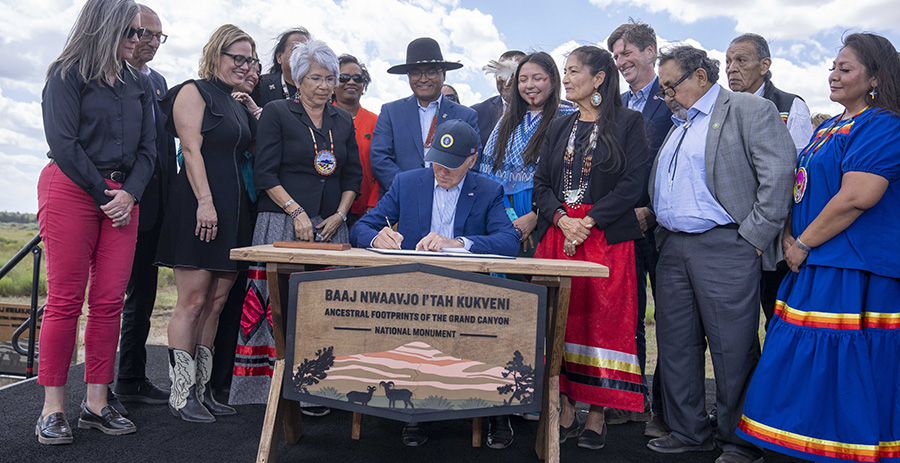
Biden likened the designation to his administration’s larger push to combat climate change and noted this summer’s extreme heat, which has been especially punishing in places like Phoenix. He said extreme heat was responsible for more deaths than other natural disasters like floods and hurricanes combined but added, “None of this need be inevitable.”
The president spoke in an area that is between Pinyon Plain Mine, which is being developed and has not opened, and Red Butte, a site culturally significant to the Havasupai and Hopi tribes. The audience included a number of people in traditional native dress, including feathered headbands and hats.
Biden said the new designation would see the federal government live up to its treaty obligations with Native American tribes after many were forced in decades past from their ancestral homes around the Grand Canyon as officials developed the site of the national park.
“At a time when some seek to ban books and bury history, we’re making it clear that we can’t just choose to learn what we want to learn,” Biden said, a reference to his frequent criticism of some top Republicans who have sought to impose limits on school libraries, citing parental complaints about explicit material.
The president also criticized adherents of the “extremism” of former President Donald Trump’s “Make America Great Again” movement for opposing his administration’s effort to fight climate change.
The political stakes are high. Arizona is a key battleground state that Biden won narrowly in 2020, becoming the first Democrat since Bill Clinton in 1996 to carry it. And it’s one of only a few genuinely competitive states heading into next year’s election. Winning Arizona would be a critical part of Biden’s efforts to secure a second term.
Later Tuesday, Biden flies to New Mexico, considered safe for Democrats in 2024, and he will visit the Republican stronghold of Utah after that.
Republican lawmakers and the mining industry have touted the area’s economic benefits and argued that mining is a matter of national security.
U.S. Reps. Bruce Westerman, chairman of the House Natural Resources Committee, and Paul Gosar, an Arizona Republican who also holds a leadership position on the committee, released a letter to Biden on Tuesday, criticizing the designation and suggested it “would permanently withdraw the richest and highest-grade uranium deposits in the United States from mining—deposits that are far outside the Grand Canyon National Park.”
The Interior Department, reacting to concerns over the risk of contaminating water, enacted a 20-year moratorium on the filing of new mining claims around the national park in 2012.
Existing mining claims will not be affected by this designation, senior Biden administration officials counter. Furthermore, the monument site encompasses around 1.3% of the nation’s known and understood uranium reserves. Officials say there are significant resources in other parts of the country that will remain accessible.
Invitees at Tuesday’s event included Yavapai-Apache Nation Chairwoman Tanya Lewis, Colorado River Indian Tribes Chairwoman Amelia Flores, Navajo President Buu Nygren and Havasupai Tribal Councilwoman Dianna Sue White Dove Uqualla.
Uqualla is part of a group of tribal dancers who performed a blessing at the designation ceremony.
“It’s really the uranium we don’t want coming out of the ground because it’s going to affect everything around us — the trees, the land, the animals, the people,” Uqualla said. “It’s not going to stop.”
Gov. Katie Hobbs said, “the Grand Canyon is known as one of the seven natural wonders of the world, but we know it for so much more.” In his own remarks, Biden mistakenly referred to the Grand Canyon as one of the nine wonders of the world, but he went back and corrected himself.
“There’s no national treasure, none, that is grander than the Grand Canyon,” the president said.
Opponents of establishing a monument have argued it won’t help combat a lingering drought and could prevent thinning of forests and stop hunters from keeping wildlife populations in check. Ranchers in Utah near the Arizona border say the monument designation would strip them of privately owned land.
In 2017, Democratic President Barack Obama backed off a full-on monument designation. The idea faced a hostile reception from Arizona’s Republican governor and two senators. Then-Gov. Doug Ducey threatened legal action, saying Arizona already has enough national monuments.
The landscape of Arizona’s political delegation has since changed considerably. Hobbs, Democratic U.S. Sen. Mark Kelly and U.S. Sen. Kyrsten Sinema, an independent, are all on board.
Mining companies and the areas that would benefit from their business remain opposed. Buster Johnson, a Mohave County supervisor, said the monument proposal feels solely politically driven and there should have been another hearing on the matter. He doesn’t see the point of not tapping into uranium and making the country less dependent on Russia.
“We need uranium for the security of our country,” Johnson said. “We’re out of the game.”
No uranium mines are operating in Arizona, although the Pinyon Plain Mine, just south of Grand Canyon National Park, has been under development for years. Other claims are grandfathered in. The federal government has said nearly a dozen mines within the area that has been withdrawn from new mining claims could still potentially open.
After Arizona, Biden will go on to Albuquerque on Wednesday, where he will talk about how fighting climate change has created new jobs. During a visit to Salt Lake City on Thursday, the president will mark the first anniversary of the PACT Act, which provides new benefits to veterans who were exposed to toxic substances. He’ll also hold a reelection fundraiser in each city.
The post Biden makes Grand Canyon monument designation, citing Arizona tribal heritage, climate concerns first appeared on Arizona Capitol Times.
]]>The post Judge blocks limits on asylum at US-Mexico border but gives Biden administration time to appeal first appeared on Arizona Capitol Times.
]]>WASHINGTON (AP) — A federal judge on Tuesday blocked a rule that allows immigration authorities to deny asylum to migrants who arrive at the U.S.-Mexico border without first applying online or seeking protection in a country they passed through. But the judge delayed his ruling from taking effect immediately to give President Joe Biden’s administration time to appeal.
The order from U.S. District Judge Jon Tigar of the Northern District of California takes away a key enforcement tool set in place by the Biden administration as Covid-based restrictions on asylum expired in May. The new rule imposes severe limitations on migrants seeking asylum but includes room for exceptions and does not apply to children traveling alone.
“The Rule — which has been in effect for two months — cannot remain in place,” Tigar wrote in an order that will not take effect for two weeks.
The Justice Department immediately appealed the order and asked for it to be put on hold while the case is heard. The agency said it’s confident the rule is lawful.
Immigrant rights groups that sued over the rule applauded the judge’s decision.
“The promise of America is to serve as a beacon of freedom and hope, and the administration can and should do better to fulfill this promise, rather than perpetuate cruel and ineffective policies that betray it,” American Civil Liberties Union attorney Katrina Eiland, who argued the case, said in a statement.
The ACLU and other groups had argued the rule violates a U.S. law that protects the right to asylum regardless of how a person enters the country. The groups said it forces migrants to seek protection in countries that don’t have the same robust asylum system and human rights protections as the United States. They also argued that the CBP One app the government wants migrants to use doesn’t have enough appointments and isn’t available in enough languages.
The administration had argued that protection systems in other countries that migrants travel through have improved. But Tigar said it’s not feasible for some migrants to seek protection in a transit country and noted the violence that many face in Mexico in particular.
“While they wait for an adjudication, applicants for asylum must remain in Mexico, where migrants are generally at heightened risk of violence by both state and non-state actors,” the judge, an appointee of President Barack Obama, wrote.
He also wrote that the rule is illegal because it presumes that people are ineligible for asylum if they enter the country between legal border crossings. But, Tigar wrote, Congress expressly said that should not affect whether someone is eligible for asylum.
The judge also rejected the administration’s arguments that it had provided other avenues for people to come to the U.S. and that should be taken into account. The administration has pointed to a program that allows as many as 30,000 migrants from Cuba, Haiti, Nicaragua and Venezuela if they have a sponsor and fly into the U.S. The judge noted that such pathways are not available to all migrants.
The Biden administration also argued that it was allowing potentially hundreds of thousands of people into the U.S. through the CBP One app. Migrants use the app to schedule an appointment to present themselves at the border to seek entry to the U.S. and request asylum.
Tigar noted that the 1,450 appointments currently available daily outstrips demand, leaving asylum seekers waiting in Mexico where they’re at “serious risk of violence.”
The Biden administration said the asylum rule was a key part of its strategy to strike a balance between strict border enforcement and ensuring several avenues for migrants to pursue valid asylum claims. According to Customs and Border Protection, total encounters along the southern border — meaning migrants who either came to one of the ports of entry or tried to cross between them — were down 30% in June compared with the previous month. The agency said it was the lowest monthly total since February 2021.
Critics have argued that the rule is essentially a newer version of efforts by President Donald Trump to limit asylum at the southern border.
Trump derided Tigar as an “Obama judge” after Tigar rejected a Trump administration policy barring people from applying for asylum except at an official border entry point. That effort got caught up in litigation and never took effect.
Tigar also ruled against the Trump administration’s efforts to limit asylum to people who don’t apply for protection in a country they travel through before coming to the U.S. The Supreme Court eventually allowed that.
The post Judge blocks limits on asylum at US-Mexico border but gives Biden administration time to appeal first appeared on Arizona Capitol Times.
]]>The post Biden administration tells judge its new asylum rule is not reboot of Trump’s efforts first appeared on Arizona Capitol Times.
]]>WASHINGTON (AP) — The Biden administration argued Wednesday that its new asylum rule is different from versions put forward under President Donald Trump in a court hearing before a judge who threw out Trump’s attempts to limit asylum on the U.S.-Mexico border.
“2023 is not 2019,” said Erez Reuveni, the Department of Justice lawyer who argued the case.
The rule makes it extremely difficult for migrants who come directly to the southern border to get asylum unless they use a government app to make an appointment or they have already tried to seek protection in a country they passed through on their way to the U.S.
Opponents say it’s essentially a rehash of Trump efforts — a question that gave the online hearing Wednesday a sense of deja vu. The San Francisco-based federal judge who will decide the case, Jon S. Tigar, ruled against the Trump administration’s two attempts to limit asylum.
President Joe Biden’s administration instituted its rule on May 11 with the expiration of a Covid restriction known as Title 42 that had limited asylum seekers at the U.S.-Mexico border. The lawsuit challenging the new rule is being heard as congressional Republicans are attacking the administration for what they say is a failure to control the roughly 2,000-mile (3,220-kilometer) border with Mexico.
The administration argues that its rule encourages migrants to use lawful pathways into the U.S. and prevents chaos at the border. But immigration rights groups suing to get rid of it say it endangers migrants and is illegal.
At the outset of Wednesday’s hearing, Tigar said he would have more questions for the government than the groups trying to stop the asylum rule. He also referenced his history with Trump’s attempts to limit asylum.
“I read somewhere that 2023 would be a good year for sequels,” Tigar told Reuveni as the lawyer prepared to begin his arguments.
Reuveni argued that the Biden rule is different from Trump’s attempts to limit asylum, noting that exceptions are being granted at a rate of 9%.
“This is not a toothless exception,” he said.
Katrina Eiland, an attorney for the American Civil Liberties Union, which is representing the immigrant rights organizations that sued over the Biden rule, argued Wednesday that it violates immigration law that allows people to seek asylum wherever they arrive on the border.
“Thousands of people with valid claims … have been ordered removed and in many cases removed to likely persecution. This rule has consequences,” Eiland said.
Tigar was appointed by President Barack Obama. Trump derided him an “Obama judge” after Tigar rejected a policy barring people from applying for asylum except at an official border entry point. Trump’s remark prompted U.S. Supreme Court Chief Justice John Roberts to weigh in to defend the impartiality of judges.
Tigar also ruled against the Trump administration’s efforts to limit asylum to people who don’t apply for protection in a country they travel through before coming to the U.S. The measure would have applied to children traveling alone, while the Biden rule does not.
The Supreme Court eventually allowed that Trump rule to go into effect. But the one barring people from applying for asylum except at an official border entry point was caught up in litigation and never took effect.
Immigrant rights group say the Biden rule forces migrants to seek protection in countries that don’t have the same robust asylum system and human rights protections as the United States and leaves them in a dangerous limbo. They also argue that the CBP One app that the government wants migrants to use doesn’t have enough appointments and isn’t available in enough languages.
But Reuveni argued that there has been real progress in other countries such as Mexico, Belize and Costa Rica so that migrants can seek protection there.
He also took exception to the criticism of the app and other ways that the administration has used to provide legal pathways to migrants coming into the country. Just recently the government increased daily appointments via the app to 1,450, which is more than 500,000 people a year.
Reuveni noted that a program the government started in January grants parole to as much as 360,000 people a year from four specific countries. Republican-aligned states have their own lawsuit over that program.
All of those measures, Reuveni said, means it’s “really unfair to suggest that there’s no way to get your foot in the door.”
Reuveni noted that encounters at the southern border have dropped significantly since Title 42 went away and the rule as well as other measures went into place. He emphasized that while this rule isn’t the only reason for the drop, the government does consider it to be a “strong contributing factor.”
Whatever Tigar decides, the case will certainly be appealed.
Reuveni at one point told Tigar that the administration was arguing on the “assumption you’re going to rule against us totally.”
The administration won’t have to wait long to find out.
Tigar estimated he would take a week or less to issue a ruling. He said if he rules against the government, he will honor the administration’s request that such a decision not take effect for 14 days to give it time to appeal.
__
Follow Santana on Twitter @ruskygal.
The post Biden administration tells judge its new asylum rule is not reboot of Trump’s efforts first appeared on Arizona Capitol Times.
]]>The post Senate passes 11th-hour debt ceiling bill, heading off threat of default first appeared on Arizona Capitol Times.
]]>The U.S. Senate gave final approval to a bill to suspend the debt ceiling, just days before today’s “X-date” when Treasury officials said the government would run out of money and default on its debts.
The 11 p.m. vote on June 1 came after senators rejected a string of amendments to reach a final vote on a bill that few embraced. It passed with little time to spare following weeks of negotiations between the White House and House Republicans.
“This was a prime example of the sausage-making factory in front of us not exactly looking pretty,” said Bradford Fitch, president and CEO of the Congressional Management Foundation. “Divided government requires the process to be messy.”
The Fiscal Responsibility Act passed the Senate 63-36 on June 1, a day after it passed the U.S. House on a bipartisan 314-117 vote. President Joe Biden signed the bill over the weekend.
Arizona’s two senators, both of whom voted for the bill, said it should not take a threat of default to get Congress to act.

“We should never even get this close to defaulting. The full faith and credit of the United States should never be in question,” U.S. Sen. Mark Kelly, D-Ariz., said before last week’s vote. “I think it’s ridiculous that time and time again we get this close.”
This was not the first time Congress has run right up to the deadline on critical legislation, and it’s not likely to be the last, said Thomas Kahn of American University’s Center for Congressional and Presidential Studies.
“If you have the same dynamics in two years, with a Democratic president, Republican Congress, yes, I don’t have any doubt Republicans will use the threat of default to extract concessions once again,” Kahn said.
“Historically, Republicans are much more wary of voting for debt ceiling increases and use it as leverage to get other things,” said Kahn, who spent more than 30 years working in Congress, 20 years of which were on the House Budget Committee.
That’s exactly what House Speaker Kevin McCarthy did. He said Republicans would agree to raise the debt ceiling above $31 trillion if the White House agreed to negotiate on budget cuts and policy changes.
Without a higher debt ceiling, the government would not have been able to borrow money to pay its bills, resulting in a default that experts say would lead to economic catastrophe. After initially refusing to negotiate, Biden agreed to talks.
Those negotiations led to a bill that suspends the debt limit until 2025, rescinds billions of unused pandemic-relief funds and proposed IRS funding, and includes several policy changes sought by Republicans. The bill streamlines the permitting process for energy projects and imposes new work requirements for federal assistance programs. It also caps nondefense discretionary spending.
The final product was criticized by conservatives for not going far enough to rein in spending and by progressives for giving in to GOP demands. That divide was reflected in the final House and Senate votes, with the right and left wings of each party voting against the bill.
But most were like Kelly, who said the risk of default outweighed disagreeable portions of the bill.
“I’ve got concerns on a number of things in the legislation, you know, compromise is essential here so we don’t go over this fiscal cliff,” he said before the vote. “I think sometimes a responsible compromise is that there are things that we’re not all happy about.”
In a prepared statement, U.S. Sen. Kyrsten Sinema, an independent, said “default is not an option and Congress’s willingness to hold our nation’s economy hostage for political points is wrong.”
The bill could have been derailed June 1 in the Senate, when leaders allowed limited debate on 11 amendments that, if approved, would have forced the bill back to the House with the clock ticking.
Republicans offered 10 amendments, on everything from immigration to trade with China, and Sen. Tim Kaine, D-Va., tried to stop fast-tracking of the Mountain Valley Pipeline. Kelly voted against all the amendments while Sinema opposed all but one, an amendment that would have increased defense spending.
All 11 amendments failed, setting up a final vote shortly before 11 p.m.
Kahn saw the effects of default brinksmanship firsthand. When President Barack Obama and then-Speaker John Boehner took negotiations up to two days before a possible default in 2011, he said, the stock market dropped significantly and interest rates rose, costing Americans more than $1 billion.
Kahn said defaulting on our debt would send the country into a recession, resulting in hundreds of thousands of lost jobs, skyrocketing interest rates and a severely damaged stock market. That could endanger Social Security and Medicare payments and military salaries.
“The government would have to pick and choose which bills to pay and which couldn’t,” he said. “It would create a really holistic set of choices.”
Kahn said that, unlike years past, there are now “a growing number of people who actually are willing to go into default unless their concessions are met.”
Like Kahn, Fitch thinks the process could repeat itself in the future, though maybe not as dramatically.
“This one was definitely a little bit more of a cliffhanger because of the timing involved,” Fitch said. “I just always like to point out that anytime we have divided government, it never looks great.”
The post Senate passes 11th-hour debt ceiling bill, heading off threat of default first appeared on Arizona Capitol Times.
]]>The post Death of 8-year-old girl in Border Patrol custody highlights challenges providing medical care first appeared on Arizona Capitol Times.
]]>SAN DIEGO (AP) — The recent deaths of an 8-year-old Panamanian girl and 17-year-old boy from Honduras who were under U.S. government supervision have again raised questions about how prepared authorities are to handle medical emergencies suffered by migrants arriving in the U.S., especially as agencies struggle with massive overcrowding at facilities along the southern border.
Anadith Tanay Reyes Alvarez became unresponsive on what was at least a third visit to medics Wednesday at a Border Patrol station in Harlingen, Texas, and died later in a hospital, U.S. Customs and Border Protection said. The girl had complained that day of vomiting and stomach pains.
She died on her family’s ninth day in custody; the most time allowed is 72 hours under agency policy.
The family told agents that the girl had a history of heart problems and sickle cell anemia, CBP acknowledged in its second statement on the death. She was diagnosed with influenza on the family’s sixth day in custody, which prompted them to be moved to another station.
CBP published a detailed account on Sunday, confirming key aspects of what the girl’s mother said two days earlier in an interview with The Associated Press. It initially published only a brief statement.
Mabel Alvarez Benedicks told the AP that agents repeatedly ignored pleas to hospitalize her medically fragile daughter as she felt pain in her bones, struggled to breathe and was unable to walk. She said the daughter was finally taken in ambulance after falling limp and unconscious and bleeding from the mouth.

Agents said her daughter’s diagnosis of influenza did not require hospital care, according to the mother.
The girl’s death came a week after 17-year-old Ángel Eduardo Maradiaga Espinoza of Honduras died in U.S. Health and Human Services Department custody. He was traveling alone.
Why are so many people in Border Patrol custody?
A rush to the border before pandemic-related asylum limits known as Title 42 expired brought extraordinary pressure. The Border Patrol took an average of 10,100 people into custody a day the second week of May, compared to a daily average of 5,200 in March.
The Border Patrol had 28,717 people in custody on May 10, one day before pandemic asylum restrictions expired, which was double from two weeks earlier, according to a court filing. By Sunday, the custody count dropped 23% to 22,259, still historically high.
Custody capacity is about 17,000, according to a government document last year, and the administration has been adding temporary giant tents like one in San Diego that opened in January with room for about 500 people.
Those who qualify to be released from custody to pursue asylum are processed for immigration court, which takes 90 minutes to two hours for a single adult and longer for families and creates severe bottlenecks.
By contrast, it takes only 20 minutes to release someone with instructions to report to an immigration office in 60 days, a common practice in 2021 and 2022. A federal judge in Florida who ordered an end to quick releases in March also blocked the administration’s attempt to resume them last week in what officials described as an necessary emergency response to overcrowding.
Amid this month’s surge, hundreds of migrants slept on the ground, many for days, on U.S. soil between two border walls in San Diego as hundreds more holed up in a remote mountainous area east of the city in huts made of tree branches. The agency provided a limited diet of water and chips or granola bars. Pedro Rios, director of the American Friends Service Committee’s U.S.-Mexico border program, said the Border Patrol told him to call 911 when volunteers encountered an 8-month-old between the walls who was “listless and vomiting.”
What happens when someone is taken into custody?
Border Patrol holding facilities are short-term, with people sleeping on floormats with foil blankets. Thick plastic curtains have replaced chain-link fences to prohibit free movement.
Single adults may be transferred to U.S. Immigration and Customs Enforcement to be deported, released in the U.S. with notices to appear in immigration court or held for long-term detention.
ICE had nearly 26,000 people in long-term detention in April. Its facilities resemble prisons and often are prisons, operated by local police agencies or prison companies like CoreCivic and The Geo Group Inc.
The government generally cannot hold families more than 20 days under a 2015 court order. President Joe Biden broke with predecessors Donald Trump and Barack Obama by refusing to detain families at all beyond their initial 72 hours with the Border Patrol. His administration recently adopted curfews with electronic monitoring for families released in four cities until they pass initial asylum screenings.
Children traveling alone are transferred to the U.S. Health and Human Services Department, which generally places them with parents or relatives after short stays in contracted holding facilities. In 2021, the department was unprepared to take children in 72 hours, causing them to languish in Border Patrol care. It eventually contracted for convention centers in California, military bases in Texas and other temporary sites.
The Border Patrol returns some migrants who do not qualify for release in the U.S. to Mexico, including Cubans, Haitians, Nicaraguans and Venezuelans, as well as Mexicans.
To deport non-Mexicans, ICE runs charter flights and, in rare cases, flies commercial. In April, ICE chartered 117 flights, including 33 to Guatemala, 21 to Colombia, 20 to Ecuador and 17 to Honduras, according to Witness at the Border, an advocacy group that relies on flight data.
What medical care is available at Border Patrol holding facilities?
The Border Patrol’s parent agency, Customs and Border Protection, created a chief medical officer position in 2020 but services are limited. During a tour of a major holding center in McAllen this month, officials said they had about 100 medications on hand and that 23% of detainees had medical needs. The center has a medical booth and a more private exam room with two stethoscopes hanging on the wall.
Medical personnel screen for infectious disease — a critical job during Covid. They also ensure detainees have needed medications, deliver babies and respond to any need that can avoid a trip to the hospital.
Its facilities added more than 1,000 “medical contractors” in the last two years, Troy Miller, CBP acting commissioner, said Sunday. He promised “immediate action to review and, where needed, strengthen practices to ensure immediate and appropriate care is being provided to all individuals, especially those who are medically at-risk.”
Are current challenges new?
No, and the growing presence of families and unaccompanied children at the border over the last decade has presented U.S. authorities with enormous responsibilities for medical care.
At least six children died during a roughly yearlong period from 2018 to 2019 during the Trump administration; they were held in either Border Patrol or Health and Human Services custody. In March, a 4-year-old “medically fragile” Honduran girl who was in the care of the Health and Human Services died in a Michigan hospital three days after cardiac arrest.
In 2019, amid a previous surge of border crossings, the Homeland Security Department’s internal watchdog observed 750 adults crammed in a space for 125 in El Paso, Texas. People stood on toilets for space to breathe. Another watchdog report in 2019 from Rio Grande Valley found that men were held in standing-room only for a week and some children under 7 were in overcrowded conditions more than two weeks.
___
Associated Press writer Rebecca Santana in Washington contributed to this article.
The post Death of 8-year-old girl in Border Patrol custody highlights challenges providing medical care first appeared on Arizona Capitol Times.
]]>The post Judge orders halt to fast releases at US border with Mexico first appeared on Arizona Capitol Times.
]]>
MIAMI (AP) — A federal judge Wednesday ordered the Biden administration to end the expedited releases of migrants who enter the United States illegally from Mexico, potentially straining already stretched holding facilities.
The order won’t take effect for a week to give the government time to appeal. The Homeland Security and Justice departments had no immediate comment.
In declaring a key administration tool illegal, U.S. District Judge T. Kent Wetherell II offered a scathing review of President Joe Biden’s border policies in a 109-page opinion, which followed a January trial in Pensacola, Fla.
The administration has “effectively turned the Southwest Border into a meaningless line in the sand and little more than a speedbump for aliens flooding into the country,” he wrote.
Wetherell, an appointee of President Donald Trump, criticized a decision to stop building a border wall, end a policy to make asylum-seekers wait in Mexico for hearings in U.S. immigration court and shift enforcement priorities. He also faulted the administration for ending family detention at the border, a decision that officials have begun to reconsider.
“Collectively, these actions were akin to posting a flashing ‘Come In, We’re Open’ sign on the southern border,” Wetherell wrote.
Wetherell’s language echoed Republican talking points heaping blame for all the border’s ills on Biden. While numbers have soared in the last two years, similar challenges dogged his predecessors, Trump and Barack Obama.
“Today’s ruling affirms what we have known all along, President Biden is responsible for the border crisis and his unlawful immigration policies make this country less safe,” said Ashley Moody, Florida’s Republican attorney general, who sued on behalf of the state in 2021. “A federal judge is now ordering Biden to follow the law, and his administration should immediately begin securing the border to protect the American people.”
At issue is the administration’s growing use of parole to quickly remove migrants from Border Patrol custody to pursue their immigration cases. They are typically told to report to immigration authorities in two months and tracked with a mobile device.
The Border Patrol paroled 572,575 migrants last year, including a record-high 130,563 in December. Parole plunged 96% to 5,225 migrants in January after the administration announced measures aimed at deterring Cubans, Haitians, Nicaraguans and Venezuelans from crossing the border illegally and instead seek protection by applying online, finding a financial sponsor and entering the U.S. at an airport.
Parole is far faster than the time-consuming job of agents issuing notices to appear in immigration court. It has dramatically alleviated overcrowding at Border Patrol facilities, which hovered around 12,000 toward the end of last year but fell below 5,000 in January.
Immigration advocates warned that Wetherell’s ruling could exacerbate conditions.
“Should it take effect, this decision will mean greater health and safety risks for detained migrants and greater pressure on our agents at the border,” said Jennie Murray, president of the National Immigration Forum.
___
Spagat reported from San Diego.
The post Judge orders halt to fast releases at US border with Mexico first appeared on Arizona Capitol Times.
]]>The post Plunge in border crossings could blunt GOP attack on Biden first appeared on Arizona Capitol Times.
]]>
SAN DIEGO (AP) — A sharp drop in illegal border crossings since December could blunt a Republican point of attack against President Joe Biden as the Democratic leader moves to reshape a broken asylum system that has dogged him and his predecessors.
A new poll by The Associated Press-NORC Center for Public Affairs Research shows some support for changing the number of immigrants and asylum-seekers allowed into the country. About 4 in 10 U.S. adults say the level of immigration and asylum-seekers should be lowered, while about 2 in 10 say they should be higher, according to the poll. About a third want the numbers to remain the same.
The decrease in border crossings followed Biden’s announcement in early January that Mexico would take back Cubans, Haitians, Nicaraguans and Venezuelans under a pandemic-era rule that denies migrants the right to seek asylum as part of an effort to prevent the spread of Covid. At the same time, the U.S. agreed to admit up to 30,000 a month of those four nationalities on humanitarian parole if they apply online, enter at an airport and find a financial sponsor.
The administration has also proposed generally denying asylum to anyone who travels though another country on their way to the U.S. without seeking protection there — effectively all non-Mexicans who appear at the U.S. southern border.

The new rules put forth by Biden could help the president fight back against critics who complain he hasn’t done enough to address border security issues. But the moves have also fueled anger among some of his Democratic allies who are concerned that he is furthering a Trump-era policy they view as anti-immigrant and hurting vulnerable migrants who are trying to escape dangerous conditions in their native countries.
And the new changes — and subsequent drop in illegal border crossings — are unlikely to stop the barrage of attacks from conservatives who see border security as a powerful political weapon.
Biden has been on the defensive as Republicans and right-wing media outlets have hammered him over the soaring increase in migrant encounters at the border. The new House GOP leadership has held hearings on what it calls the “Biden border crisis” and talked of impeaching Homeland Security Secretary Alejandro Mayorkas.
Agents detained migrants more than 2.5 million times at the southern border in 2022, including more than 250,000 in December, the highest on record. According to a U.S. official who was not authorized to discuss the matter publicly and spoke on condition of anonymity, Border Patrol agents stopped migrants about 130,000 times in February, similar to January.
Among Republicans, the poll shows about two-thirds say there should be fewer immigrants and asylum-seekers, while only about 1 in 10 say there should be more.
Democrats are split: About a quarter say the number of immigrants should increase, a quarter say it should decrease, and about 4 in 10 say it should remain the same. They are slightly more supportive of asylum-seekers specifically, with 37% supporting an increase, 26% backing a decrease, and 36% saying the number should remain the same.
Under U.S. law, numbers are not capped on asylum, which was largely a policy afterthought until about a decade ago. Since 2017, the U.S. has been the world’s most popular destination for asylum-seekers, according to U.N. figures. Even those who lose in court can stay for years while their cases wind through a backlogged system.
Omar Reffell, a 38-year-old independent voter in Houston, said that he supports immigration but that news coverage of “caravans of people trying to cross the border” sends the wrong message to migrants.
“People think that they just show up at the border, come across, there is not going to be any repercussions,” Reffell said. “I’m not against immigration. I think immigration is good for the country, but it has to happen in a very orderly manner or it puts a lot of stress, especially on the border states being able to provide resources.”
More than 100,000 migrants each month were being released in U.S. border cities late last year with notices to appear in immigration court or report to immigration authorities.
Dan Restrepo, a top White House adviser on Latin America during Barack Obama’s presidency, believes the American public will accept high levels of immigration — if a systematic process can be followed.
The challenge in managing migration “is the sense of chaos and disorder that can be created by images of overwhelmed processing facilities and the like at the physical border,” he said. “It’s less the numbers and more the imagery” that bothers voters.
Republicans cast Biden’s expansion of humanitarian parole for four nationalities as a political ploy to divert attention from the border and are not likely to let up on their criticism of the president on immigration. The Federation of American Immigration Reform, an anti-immigration group, called January’s plunge in border numbers “a shell game” to boost Biden’s reelection prospects.
Fox News Channel has hit hard on the story over the last year. Reporter Bill Melguin said in a “Battle for the Border” special on Nov. 3 that he had spent more than 200 days on the Texas border.
“We’ve been shooting the video all day long,” Melugin said in a typical report from the Texas town of Eagle Pass. “We keep getting these massive groups of 150 to 200 crossing every single day.”
The network’s night-vision drone cameras have showed hundreds of migrants walking across the border, each one appearing as a luminous white stick slowly advancing across a dark screen.
The poll found 39% of U.S. adults approve of how Biden is handling immigration, and 38% approve of him on border security — slightly below his overall approval ratings. About two-thirds of Democrats but only about 1 in 10 Republicans say they approve of his handling of either issue.
The poll was taken Feb. 16-20, just before the administration proposed on Feb. 21 that asylum should generally be denied to migrants who pass through another country without applying for protection there if it is deemed safe. The administration is angling to have the new rule take effect before the pandemic-related limits on asylum are expected to end May 11, though legal challenges appear imminent.
Becky Steelsmith, a 70-year-old independent voter from Zachary, La., is reluctant to heap blame on Biden because solutions also eluded his predecessors, but she notes that the optics are not great.
“The only reason why I disagree with Biden’s handling of it is that I think he’s a little too soft,” said Steelsmith, a retired teacher. “I’m not saying it’s his fault that it’s happening. I’m saying that as president, he needs to sit down and really focus and come up with some kind of a solution, or the beginning of a solution.”
___
The poll of 1,247 adults was conducted using a sample drawn from NORC’s probability-based AmeriSpeak Panel, which is designed to be representative of the U.S. population. The margin of sampling error for all respondents is plus or minus 3.7 percentage points.
The post Plunge in border crossings could blunt GOP attack on Biden first appeared on Arizona Capitol Times.
]]>