The post Physics, perseverance and the podium appeared first on Physics, Astronomy, and Materials Science Blog.
]]>
Representing the College of Natural and Applied Sciences (CNAS), Janson will speak at the 1 p.m. ceremony on May 8.
“It means a lot to me because graduation brings everyone together to reflect on a shared experience. I hope to represent that in a genuine, relatable way,” she said.
Making Mo State home
Originally from Durbanville, South Africa, Janson began her university studies at another institution as a competitive swimmer. In August 2022, she transferred to Missouri State to pursue physics at a higher level.
The university allowed her to continue competing in swimming while also pursuing her academic goals. The welcoming environment from both her team and the physics faculty and staff helped ease her transition.
“Missouri State gave me that opportunity. It felt like a place where I could grow in more than one way,” she said.
Growth in research
Janson’s interest in physics stems from her enjoyment of solving complex problems and uncovering logical structure step by step. She values this discipline for its emphasis on understanding rather than rote memorization.
Research in the physics, astronomy and materials science department shaped her growth as a physicist. She credits her time in department head Dr. Robert Mayanovic’s lab, where she studied nanoscale drug delivery systems. There, she began by observing and assisting with basic tasks before progressing to synthesizing nanoparticles and later mentoring new students in the lab.
“Over time, I took on more responsibility in the synthesis process, understanding the reasoning behind each step,” Janson said.
An experience she found especially meaningful occurred while presenting her research about functionalizing chitosan nanoparticles at the 2025 CNAS Undergraduate Research Symposium.
During her poster presentation, a conversation with a biology professor gave her a new perspective on her work and helped her recognize its broader impact. This boosted her confidence and motivated her to apply physics in impactful, real-world ways.
Balancing swimming and other activities
As a member of Missouri State Swimming and Diving, Janson has had to balance the demands of collegiate athletics with her academic schedule and other commitments.
“I’ve learned to break things down step by step and stay disciplined,” she said.
One of her favorite memories as a swimmer was winning a Missouri Valley Conference championship with the women’s swim team in 2024.
“I led off the first conference relay of the meet,” she said. “I was so nervous, but the senior girls — the ones we all looked up to — had my back. We not only won that relay; we broke records.”
In addition to swimming, Janson has been involved with the Student-Athlete Advisory Committee and the African Student Association on campus. All these experiences helped her build a community and feel a strong sense of belonging.
What comes after graduation
After graduating this spring, Janson plans to pursue a master’s degree in bioengineering at the University of Kansas, with a focus on tissue engineering and nanoengineering. She hopes to build on her physics background and apply it to real-world biomedical challenges.
Her academic path has been informed by both research and hands-on work in medical physics and immunology settings. These opportunities have strengthened her interest in applying science to health care.
“I’m really excited to keep building on my studies here in the United States and move toward a career where I can apply what I’ve learned in a meaningful way,” Janson said.
The power of support
As a commencement speaker, Janson emphasizes the importance of shared experiences and support systems in reaching graduation. She sees college not as an individual achievement, but as a collective effort shaped by relationships and community.
“Behind every degree is a story of support, shared challenges and people who helped us along the way,” she said.
The post Physics, perseverance and the podium appeared first on Physics, Astronomy, and Materials Science Blog.
]]>The post Curiosity in action appeared first on Physics, Astronomy, and Materials Science Blog.
]]>Across disciplines, they are asking bold questions, testing new ideas and gaining hands-on experience in the fields they plan to lead in the future. Among them are three students from the department of physics, astronomy and materials science:
- Bishwash Devkota, senior, physics/astronomy and astrophysics
- Brogan Homburg, senior, physics/astronomy and astrophysics
- Moupia Tajrin Oyshi, graduate student, materials science
Devkota
A native of Kathmandu, Nepal, Devkota moved to Springfield, Missouri, in 2022 to pursue a physics degree at Missouri State.
“I’ve always been interested in knowing about our place in the universe, which is what led me to pursue a major with an emphasis in astronomy and astrophysics,” he said.
His research focuses on planetary dynamics by using computer simulation and studying “the orbital dynamics of a planet in the habitable zone near M stars (coolest stars) and G stars (sun-type stars).”
This work involves determining the stability of potentially habitable planets. It could help narrow down which planets in the habitable zone deserve the most resources and time, specifically those that show long-term stability.
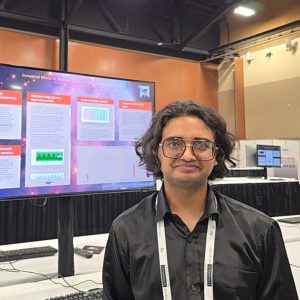
“This experience has taught me the basics of planetary dynamics and given me the confidence to be an independent researcher. I’ve been exposed to data analysis and theoretical modeling, which are essential for research,” Devkota said.
His favorite part about his research has been sharing it with the public. He has presented at three American Astronomical Society meetings; at the NASA Missouri Space Grant Consortium at Missouri S&T in 2023, 2024 and 2025; and the Mid-American Regional Astrophysics Conference in Columbia, Missouri, in 2025.
“The habitability of exoplanets is always an exciting topic for the public. In every interaction, I get a lot of questions from people of different ages and backgrounds, and it’s always exciting to answer them,” he said.
Dr. Sarah Morrison, assistant professor of astronomy, has served as Devkota’s mentor through his research process. She has taught him how to approach problems methodically and how to ask the right questions to solve them.
After graduation in May 2026, he plans to attend graduate school. He wants to further explore the dynamics of exoplanets and get more involved in observational dynamical research, which focuses on the “what” and “why” rather than the “how.”
Homburg
Homburg grew up reading science fiction books and watching movies that sparked his interest in science and space. Now, at Missouri State, he is studying the subjects in more depth, conducting research on subdwarf B stars.
These stars fall between main sequence and dwarf stars in size. With guidance from his research and academic advisor Dr. Mike Reed, distinguished professor of astronomy, Homburg is

investigating why subdwarf B stars are almost fully core and lack the outer layer seen in other stars. The research points to the likely explanation being in “binary interactions, since most known subdwarf stars exist in binary systems.”
“I’ve learned analytical writing and have grown extremely confident in my programming and computer science abilities. I also now understand how to research subjects and how science careers really work,” he said.
Homburg presented his research at the NASA Missouri Space Grant Consortium at Missouri S&T in 2024 and 2025. He also shared his work at the American Astronomy Society meeting in Washington, D.C., in 2025 and the SdOB12 (Hot Subdwarf Stars and Related Objects), an international scientific meeting in Little Switzerland, North Carolina, in 2025.
For Homburg, the most exciting part of his research journey has been the opportunity to travel to Valparaíso, Chile, last fall with Reed’s collaborator on subdwarf stars. During this trip, he got to work on telescope research with the University of Chile.
“The biggest highlight was visiting the Atacama Desert and seeing the clearest night skies in the world,” he said.
Homburg began his accelerated master’s program in natural and applied science this spring. After graduating in May 2026, he plans to continue his research with Missouri State faculty and collaborators in Valparaíso, noting he “would not have been able to do this work without Missouri State’s strong global connections.”
Oyshi
In May 2023, Oyshi earned her bachelor’s degree in materials and metallurgical engineering in her home country of Bangladesh. She learned about Missouri State’s materials science master’s program from a peer at her undergraduate institution, applied and secured a graduate assistantship from the department of physics, astronomy and materials science starting in fall 2025.
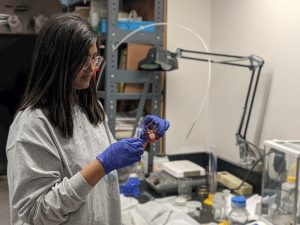
For her research, she is working with her research advisor Dr. Robert Mayanovic, department head of physics, astronomy and materials science, to develop nano-sized particles made from natural substances found in crab and shrimp shells. These particles are designed to deliver cancer medicine directly to cancer cells, rather than targeting both cancerous and healthy cells.
“After learning about Dr. Mayanovic’s research on nanomaterials for drug delivery, I knew it was something meaningful I wanted to be a part of,” Oyshi said. “He has been incredibly supportive throughout my research. Whenever I encounter challenges, he helps me think through possible explanations and encourages me to explore solutions through careful study and experimentation.”
They also collaborate with biology department head Dr. Kyoungtae Kim’s research group to test the biological performance of their materials in cancer cells.
“I was especially excited about working on a project that combines materials science and biology to solve real medical problems,” Oyshi said.
The biggest lesson about research for Oyshi is it “requires constant curiosity and critical thinking.” She realized that continuously asking questions and seeking answers are essential for innovation and improvement.
Her positive research experience has inspired her to pursue a PhD in the biomedical field after completing her master’s degree. She wants to continue researching new materials that improve health care and patient outcomes.
Explore the department of physics, astronomy and materials science
The post Curiosity in action appeared first on Physics, Astronomy, and Materials Science Blog.
]]>The post Dr. Tiglet Besara featured in Mind’s Eye appeared first on Physics, Astronomy, and Materials Science Blog.
]]>Besara and his students explore novel materials by creating entirely new compounds with unique properties.
His research focuses on thermoelectrics — materials that can convert waste heat into usable energy — with potential applications in energy efficiency, electronics and sustainability.
Congratulations Dr. Besara!
The full story is now available online.
Excerpt:
Physicist Dr. Tiglet Besara doesn’t just study compound elements — he’s literally creating new ones.
He is an element explorer of sorts, specifically in a field known as novel materials exploration. This is the process of discovering new materials with unique properties. The work can help address global challenges, such as climate change and resource scarcity.
Besara is credited with creating three new compounds right from his lab in Kemper Hall. His goal? Among many things, to discover new compounds that could be used as thermoelectrics. In layman’s terms: Can these elements capture waste heat and turn it back into energy we can use?
The post Dr. Tiglet Besara featured in Mind’s Eye appeared first on Physics, Astronomy, and Materials Science Blog.
]]>The post Excelling on the international stage appeared first on Physics, Astronomy, and Materials Science Blog.
]]>Led by Dr. Ridwan Sakidja, professor of physics, astronomy and materials science, the team comprised two Missouri State alumni, Matthew Bruenning and Gaige Riggs. They both graduated from the Master of Science in Materials Science program.
The team was named a finalist in the MITRE sector of the Potomac Quantum Innovation Center Global Industry Challenge (PQIC) 2025. It ranked in the top 28 out of more than 600 participants from 60 countries. It advanced through three competitive rounds from April to July 2025, earning finalist recognition across all four challenge sectors: Financial Services, Infrastructure, Life Sciences and Risk Management and Insurance.
Hosted by Connected DMV and supported by sponsors like Aqora and qBraid, the PQIC invited student innovators, entrepreneurs and industry teams from around the world to solve complex, real-world problems using quantum computing.
“Although we didn’t win the top prize, being named among the top 28 globally — less than 5% of all entries — strongly validates the Quantum Bears team approach and vision,” Sakidja said.
The team’s submission for the infrastructure challenge focused on using quantum computing to improve asphalt pavement binder design for transportation. It developed a method to simplify large material models while retaining critical atomic-level accuracy.
A growing quantum legacy
This latest recognition adds to the team’s growing list of international honors:
- First place in the EPRI Fusion Quantum Challenge 2025 for nuclear fusion materials
- Top three in Smart Coating and top 15 overall in the Airbus and BMW Quantum Computing Challenge 2024
These successes support Missouri State’s broader goal of advancing emerging technologies through education and research. In the College of Natural and Applied Sciences, the department of physics, astronomy and materials science has launched Missouri’s first quantum computing track in the bachelor’s degree in physics program.
Learn more about physics, astronomy and materials science
The post Excelling on the international stage appeared first on Physics, Astronomy, and Materials Science Blog.
]]>The post Missouri State team finishes first in Global Quantum Challenge appeared first on Physics, Astronomy, and Materials Science Blog.
]]>The team comprised Dr. Ridwan Sakidja, professor of physics, astronomy and materials science, and Gaige Riggs, a Master of Science in Materials Science graduate. They took home the first-place prize.
About the challenge
This year’s global competition brought together 23 submissions from 12 countries to develop quantum-driven solutions in two critical areas: radiation-resistant materials and plasma stability.
Participants had to use quantum computing to simulate how fusion materials degrade under intense radiation, an essential hurdle in building sustainable energy systems. Sakidja and Riggs tackled this challenge by developing an innovative approach that simplifies the quantum modeling process. This makes it feasible with today’s limited and noisy quantum hardware.
“Our proposal uses quantum computing to model radiation damage by shrinking and compressing the Hamiltonian, so it becomes manageable for quantum hardware,” Sakidja said. “We’re thrilled this approach was recognized and excited about its potential for future materials research.”
The Hamiltonian is a mathematical representation of the total energy of a system, including both kinetic and potential energy. In quantum mechanics, it plays a central role in predicting how a system evolves over time, making it essential for modeling complex physical phenomena like radiation damage.
A powerful concept
The team’s winning submission focused on reducing the complexity of radiation damage modeling. Fusion energy systems subject materials to intense stress and bombardment from neutrons. However, today’s quantum devices struggle with the large-scale simulations such systems require.
To solve this, Sakidja and Riggs used recently developed sparsification and compression techniques to “shrink” the quantum problem to its essential elements. Their model zeroed in on the most affected regions of the material, then applied quantum algorithms optimized for the Noisy Intermediate-Scale Quantum era.
“I believe the jury appreciated our main philosophy to scale up,” Sakidja said. “By making the model smaller and more focused, we could design a solution that fits within the realistic capabilities of today’s quantum systems.”
Lessons and next steps
As part of its prize, the team will co-author a white paper with fellow winners to share their techniques with the scientific community.
According to Sakidja, the biggest challenge was distilling a complex, dynamic physical problem into a form suitable for current quantum machines.
“This is only the beginning,” he said. “We’re excited about quantum computing’s rapid growth and proud to be preparing our students for a future where these skills will be in high demand across industries.”
Learn more about physics, astronomy and materials science
The post Missouri State team finishes first in Global Quantum Challenge appeared first on Physics, Astronomy, and Materials Science Blog.
]]>The post Illuminating a path to discovery appeared first on Physics, Astronomy, and Materials Science Blog.
]]>Whether you wear glasses, have an MRI, connect to fiber-optic internet or use a security system, chances are you’ve experienced the benefits of optics.
Through his studies at Missouri State University, Heath Gemar found his calling in optics while combining his plethora of scientific interests.
“Growing up, I was always pretty good at math, and so I was always interested in harder and harder problems,” he said.
Taking his talents a step further, Gemar decided to dual major in applied mathematics and physics at Missouri State.
“You find out that the language of math can describe how things are operating and how [math and physics] interact with one another, then that becomes more intriguing,” Gemar said. “So then, you just start digging more and more into both math and physics, because they kind of coalesce with one another.”
Gemar chose to pursue his undergraduate degrees at Missouri State because he could easily commute from his classes in Springfield to his job in Branson.
Building his research experience, Gemar would often assist graduate students while working in pulsed laser deposition, a method that uses a laser to produce a fluid which is then deposited on another substrate (or substance).
He extends his gratitude to his undergraduate advisor, Dr. Kartik Ghosh, for providing these hands-on learning opportunities.
Amping up his scientific mastery
Upon graduating with his two majors in 2013, Gemar decided to continue his education at Missouri State by getting his master’s degree in materials science.
“Seeing the utility of materials science and how it’s so multidisciplinary and can be applied to a multitude of problems really made it intriguing.”
Diving into graduate research, Gemar studied exoplanets and how their atmospheres would evolve due to certain content or temperature constraints.
He also explored how light scatters through an atmosphere (or material) and what that looks like spectrally.
“So, if we were to examine spectra from an actual exoplanet, we might be able to correlate the two and say, ‘Oh, it’s maybe in this kind of temperature range or it’s in this step of evolution,’” he said.
Gemar’s graduate advisor, Dr. David Cornelison (or Dr. C, as he is known to students), was a big influence on Gemar’s decision to stay at Missouri State. Because of Cornelison’s mentorship, Gemar felt supported in his academics and had a clearer vision of his career path.
With the help of Cornelison and a fellow student, Gemar enjoyed growing and promoting the Society of Physics Students at MSU.
“I think we started to build a really good community of people, always going to the library together to study on things and doing the community outreach through Dr. C,” Gemar said.
Lighting the way into a bright future
In 2016, Gemar earned his master’s degree from Missouri State.
Afterward, he graduated from the University of Central Florida with his PhD in optics and photonics.
Gemar currently works as an optical physicist at a naval research lab in Washington D.C., where he develops novel imaging techniques for the U.S. Navy.
“Imaging is seeing with your eyes, but you can also see a thermal signature, which is like the infrared kind of cameras that you may see, where you have really bright spots and then dark spots based off somebody’s body heat or something,” Gemar said.
In his work, he also uses sensing to explore spectral signatures, the reflection from an object seen through many wavelengths.
Gemar hopes to continue advancing his research and making important discoveries for his field.
“I’d probably say my current goal is to continue to get more programs funded that we’re working on here at the lab and just to continue to push the boundary forward in everything that we’re doing,” he said.
Master in materials science at MSU
The post Illuminating a path to discovery appeared first on Physics, Astronomy, and Materials Science Blog.
]]>The post Becoming a force in her field appeared first on Physics, Astronomy, and Materials Science Blog.
]]>They study and explain the workings of the universe.
For Yashasvi Moon, all three of these sciences are the fuel for her undergraduate research.
Double majoring in physics and mathematics, Moon proves to be a hard-working problem solver.
In spring 2021, she began her first semester at Missouri State as an international student from Napur, India.
“MSU has been very welcoming of international students, which I really, really appreciate,” Moon said.
She chose to attend Missouri State after receiving one of MSU’s international student scholarships, which she said was “very financially good for me and my family.”
Gravitating toward multiple sciences
During her time at Missouri State, Moon has been developing a passion for physics that she’s had since she was very young.
“I just really liked physics as a kid,” Moon said. “My mom is a biochemist, so she would take me to her lab when I was little and show me her experiments and everything. That was really cool. I think that, initially, got me into science.”
She’s also had a long-time interest in geometry, which led her to also pursue a mathematics degree.
In her first year at MSU, Moon chose to take the career prep physics track, a general physics degree option designed to prepare students for the workplace.
“I really liked [physics], because it explained stuff like the natural phenomena around me…It can help us test theories, and it can explain stuff around us.”
However, within the last three years, Moon’s interests began to evolve, so she added an astronomy track to her physics degree.

Igniting a spark for physics in young minds
As an active student in the physics department, Moon participated in community outreach events, where she and other physics students would explain and demonstrate physics phenomena to local school children.
Because of these opportunities, Moon became interested in teaching.
“I feel like we don’t really see women scientists a lot, so I feel like it helps to have a role model – or not even a role model, but just a woman, like a physicist or a scientist who is there for inspiration to younger girls who would want to pursue STEM,” she said.
Moon is also the vice president of the Society of Physics Students (SPS) on campus.
“I recently initiated or started a collaboration – which I hope is going to continue – with the newly-established Women in STEM club of MSU,” Moon said.
Recently, she united the two groups for an outreach science demonstration at Greenwood Laboratory School.

Orbiting around research opportunities
Moon knows that the road to graduate school means reaching out to external universities to secure an REU (i.e. Research Experiences for Undergraduates).
“Just getting those opportunities has been really difficult because of funding restrictions and everything,” Moon said.
After a lot of persistence, she secured an REU at the University of Illinois Urbana-Champaign in summer 2023. It was during this experience that she uncovered her fascination for astronomy and took the initiative to learn more about it.
“I picked out a book. I just started reading it, and it turned out astronomy really interested me,” Moon said.
In summer 2024, Moon secured another REU, where she identified 9,000 new galaxies that host tidal disruption events, a phenomenon that occurs when a star is torn apart after approaching a black hole.
Moon also earned second place at the 2024 CNAS Undergraduate Research Symposium for her research on transient events observed by the South Pole telescope.
“Words of advice for physics students, specifically, is to get into research. The sooner you get into research, the better,” Moon said. “Also, again, the path is not linear. My path was all over the place. I first liked physics, then I liked math, and now I’m into astronomy. I never thought I would do astronomy.”

Her future’s written in the stars
Along with research, Moon was supported by constructive courses and knowledgeable faculty.
“I think the classes that I’ve taken and everything, they’ve been very, very helpful. Like the physics classes. Like quantum mechanics with Dr. Mitra. That was one of the best classes I’ve ever taken, and I just got so much out of it,” she said.
Moon also acknowledges Dr. David Cornelison for his efforts in organizing the physics outreach events and fostering her passion for physics.
Inspired by Cornelison’s guidance, Moon and her physics classmates nominated him for the 2024 Excellence in Public Affairs Award. Cornelison was one of three faculty to win the award.
“One last thing about the physics department, they’ve just been extremely, extremely supportive in whatever our students want, not just me.”
In the math department, Dr. Les Reid has been instrumental in her academic growth.
“He is extremely smart. I really like geometry, as I said, and he’s very into geometry,” she said.
Moon expects to graduate in May 2025.
She is in the process of submitting applications to graduate school. Moon hopes to get her PhD in either astronomy or astrophysics.
“After that, I do want to be a professor and teach and simultaneously do research, because I really like to teach or just explain stuff to students,” Moon said.
Major in physics at Missouri State Dive into math at MSU
The post Becoming a force in her field appeared first on Physics, Astronomy, and Materials Science Blog.
]]>The post Get ready for the upcoming total solar eclipse appeared first on Physics, Astronomy, and Materials Science Blog.
]]>If you miss it, the next one that can be seen from the United States is in 2044.
People all over the world anticipate this rare astronomical event, marking their calendars and making plans to witness the solar eclipse firsthand. Whether they’re seasoned astronomers or casual observers, the prospect of seeing the moon pass in front of the sun ignites a sense of wonder and curiosity.
“This substantial gap between total solar eclipses is due to the specific alignment of the Earth, moon, and sun required for them to happen,” said Dr. Sarah Morrison, assistant professor of astronomy at MSU.
The total solar eclipse on April 8 will take place in the early afternoon, with the duration spanning a few hours. The path of totality will pass through Missouri, including cities like West Plains and Poplar Bluff.
In Springfield, there will be 97% obscurity around 1:54 p.m.
A watch party will be held at Plaster Stadium for students to enjoy the eclipse. The event runs from 1 – 2:30 p.m. allowing students to enjoy games and view the eclipse. Free viewing glasses will be handed out to the first 1,000 attendees.
Understanding the science
Scientists predict the path of totality by tracking the orbits of the Earth, moon, and sun. They analyze the alignment of these celestial bodies to pinpoint when and where an eclipse will occur. The precision of these predictions has improved over time, allowing for accurate forecasts of eclipse events.
“Eclipses provide unique opportunities for scientific research,” Morrison said. “They allow for the study of the sun’s corona and provide a test for theories like general relativity. Additionally, eclipses offer a chance to observe celestial phenomena, such as comets, and study how eclipses impact weather and temperature.”
What to expect
Historically, eclipses have held various cultural and historical significance. They have been interpreted as omens or signs of impending events in different cultures. The ability to predict eclipses was once considered remarkable and even alarming, demonstrating a deep understanding of celestial mechanics.
Much like humans, animals and wildlife can exhibit various responses to solar eclipses.
“They may react to the changes in light and temperature associated with an eclipse,” Morrison said. “Some animals, especially those active during dusk or dawn, might become quieter or more vocal.”
Observable phenomena such as shadow bands passing across the ground during an eclipse could also influence animal behavior.
Viewing safety
While viewers in Springfield will not see a total solar eclipse, eclipse glasses are still necessary to view the event safely.
“It’s essential to emphasize the importance of protecting both eyes and camera equipment during the eclipse,” Morrison said. “Staring at the sun without proper eye protection, particularly during partial phases, can cause permanent damage to the retina.”
Eclipse glasses are specially designed to protect the eyes from the harmful rays of the sun during a solar eclipse. So, it’s crucial to ensure the glasses are legitimate and will provide adequate protection.
Morrison notes viewers should be cautious of counterfeit glasses and ensure they obtain eclipse glasses from reputable sources. The American Astronomical Society offers guidance on finding legitimate eclipse glasses. The glasses do have an expiration date and may degrade over time, especially if they are not stored properly. Exercise caution when reusing old eclipse glasses, as their effectiveness may have diminished.
For cameras, use solar filters to prevent damage to the camera’s detector.
Explore opportunities in physics, astronomy and materials science
The post Get ready for the upcoming total solar eclipse appeared first on Physics, Astronomy, and Materials Science Blog.
]]>The post Calculating her career trajectory appeared first on Physics, Astronomy, and Materials Science Blog.
]]>Solving complex equations, however, takes an ambitious pursuit of knowledge.
Cue Helena Bel, a double major in mathematics and physics.
With a zest for learning, Bel looked at universities that would allow her to explore both subjects.
Opportunities started adding up and began directing her toward Missouri State.

Right on par
Since she was nine years old, Bel has been a dedicated golfer.
Her proficiency on the golf course rewarded her with a scholarship from Missouri State and motivated her to join the women’s golf team.
After high school, Bel took a chance and uprooted her big-city life in Zaragoza, Spain to get an education in the United States.
“I knew I wanted to come to the U.S. to play golf in college,” she said.
She enrolled as an international student at Missouri State, where her scholarships would help cover her tuition.
Upon moving to Springfield, she was welcomed by friends who helped her transition to college life in the U.S.
Together, Bel and her friends share household responsibilities and serve as an emotional support system for each other.
“I know I’m going to remember all the memories that we have and everything that we’ve done in this house for the rest of my life. It’s so fun,” Bel said.

Summing up her interests
Throughout her studies at Missouri State, Bel developed valuable personal and professional skills.
“I really enjoy the (mathematics) major and the classes that I’m taking,” she said. “I think it’s really helped me learn to think and be very analytical.”
Recognizing her knack for numbers, she found herself drawn toward the mathematics program.
“Growing up in school, I’ve always been really good with math,” Bel said. “I also have a good memory, so I was good in history, remembering dates and stuff.”
Going hand-in-hand with her mathematics interests, she also decided to study physics in college.
“My last year in high school, I took a physics class, and I really, really enjoyed it too.”
Bel’s fascination with math and physics was inspired by her aunt’s career choice: engineering.
Ever since Bel was a child, she has been impressed by her aunt’s intelligence. Bel’s admiration for her aunt also served as an incentive, leading her to acquire the knowledge that would allow her to closely follow in her aunt’s footsteps.
“She was so smart, probably one of the smartest people I know,” Bel said. “I was always like, ‘I want to be like her.’”

Finding strength in numbers
Bel’s educational journey was guided by supportive mentors who challenged and encouraged her to grow in her interests.
Getting out of her comfort zone, Bel has improved her research and presentation skills under the supervision of Dr. Ridwan Sakidja, a professor in the physics, astronomy and physical sciences department.
“Dr. Sakidja is awesome. I really like how he teaches, and he’s very helpful with me,” Bel said.
She recalls one of her favorite classes was PHY 291: Introduction to Computational Physics taught by Dr. David Cornelison.
“It was a fun class, and I really, really like how (Dr. Cornelison) taught the class. I also got to do a project with him. He was really understanding,” Bel said. “He was awesome. He was probably one of my favorite teachers that I’ve had so far.”
Bel plans to graduate in fall 2024 with her mathematics degree and in spring 2025 with her physics degree.
After graduation, she plans to pursue her master’s degree in data science.
Dr. William Bray, the mathematics department head, has been supportive of her goals by assisting her search for graduate schools with a data science program.
“In the math department, my advisor, William Bray, he is also really, really good,” she said. “He makes my life so much easier. He’s a really good advisor.”
Although Bel is still figuring out her place in the professional sphere, she continues to prove that she is anything but average in her academic pursuits.

The post Calculating her career trajectory appeared first on Physics, Astronomy, and Materials Science Blog.
]]>The post A summer of learning appeared first on Physics, Astronomy, and Materials Science Blog.
]]>Or, alternatively, learning new things and gaining professional experience.
Missouri State University students in various disciplines of the physics, astronomy and materials science (PAMS) department had memorable summers through sponsored internships.
“I’m very happy our students had opportunities to learn and work in some of the finest research centers in the country,” said Dr. Robert Mayanovic, professor and PAMS department head.
Jared Shortt
Materials science graduate student Jared Shortt interned in the U.S. Air Force Research Lab on the Wright-Patterson Air Force Base in Dayton, Ohio.
“I studied light-matter interactions for a subfield of material science known as optoelectronics,” Shortt said. “I assembled a unique piece of equipment that used a technique known as three-pulse four-wave mixing. It gives us an idea of how light interacts with the electrons of a material.”
He cherished his experience for both the connections and knowledge he gained.
“I met so many people who knew pools of knowledge I hadn’t encountered,” Shortt said. “I had the privilege to work with them on projects I wouldn’t have been able to otherwise.”
Riley Hochstein
Even while pursuing a physics major, mathematics, chemistry and biomedical science minors and certificates in computational science and biomedical physics, Riley Hochstein still searched for knowledge and opportunities.
He interned for the National Institute of Mental Health in Bethesda, Maryland.
“I was responsible for developing a device for magnetoencephalography, which measures magnetic signals arising from the heart,” he said.
While using 56 extremely sensitive lasers, Hochstein and his team created computer models to investigate these signals. He oversaw taking measurements, writing computer code and interpreting results.
“The end goal is to create new technology that could better predict cardiac disease,” Hochstein said. “This same technology used to be extremely cost-intensive, but now with the use of lasers, we can lower costs. I was in charge of starting this project for development.”
The experience was one to remember.
“I loved my summer in Washington, D.C. I was living a couple blocks from the White House and got to learn so much, not only in terms of my research, but in terms of culture, history and politics,” Hochstein said. “My team was fantastic and I was enriched with so much knowledge. The D.C. area is drastically different from Springfield and I loved every second of this new opportunity.”


Emily Rapp
A triple major in applied mathematics, materials physics and astrophysics, as well as a computational science certificate student, Emily Rapp had a special opportunity with Cornell University.
Her internship was with the Cornell Laboratory for Accelerator-based ScienceS and Education (CLASSE). Their particle accelerator research program is in Ithaca, New York.
From coding to GIFs, her responsibilities spanned both. She wrote a code that detects and categorizes quenches (or loss of superconductivity) in super conducting radio frequency cavities.
“These cavities are what accelerate the particles in a particle accelerator, and CLASSE monitors their performance using a grid of temperature sensors on the outside of the cavity,” Rapp said. I could then take this data and map it to create GIFs of thermal events in these cavities.
“I’m definitely not exaggerating when I say this summer was the best summer of my life,” Rapp said. “I loved N.Y., I loved the research and I loved all the people I met.”


The post A summer of learning appeared first on Physics, Astronomy, and Materials Science Blog.
]]>