The post Project communication skills: the reason good plans still fail appeared first on the indigo blog.
]]> Projects don’t stall in the plan. They stall in the conversation.
Ask anyone who has run a project what went wrong, and they rarely blame the spreadsheet. The timeline was fine. The tasks were clear. What went wrong was a moment: a sponsor asking “are we still on track?” in the lift, a question from the board nobody had prepared for, a supplier calling with bad news five minutes before a meeting. Those are tests of project communication skills, not planning.
Not everyone managing a project is a project manager. Some people do it full-time. Others are managers, specialists and team leaders who deliver change alongside their usual responsibilities. They might coordinate a new process, implement a system, improve a service or lead an internal initiative.
Projects vary and responsibilities differ, but the challenge is the same: getting people on board, keeping them informed and knowing what to say when things don’t go to plan.
No matter the project, progress depends on more than a good plan. It depends on strong project communication skills: communicating clearly, thinking on your feet and keeping people moving in the same direction.
On large projects: bigger rooms, higher stakes
On a large project, you’re likely to report to sponsors, steering groups and senior stakeholders. They have little time and they want the headline. When an update wanders through the background before reaching the point, confidence drops, whatever the actual progress.
The people who do well in these rooms aren’t necessarily the most technical. They answer the question asked, explain what it means and say what they need. When a curveball comes, they stay composed and give a clear answer rather than a long one.
Whether you’re an experienced project manager or a specialist leading a project within your department, the ability to communicate clearly with senior stakeholders can make a real difference.
On smaller projects: there’s nobody else to speak for you
On a smaller project, you might be the project manager, the communications team and one of the people doing the work. There’s no project office to prepare the update or someone else to handle the difficult conversation.
Progress gets shared in passing: in a team meeting, on a Teams call or in a two-line message.
That makes every short exchange important. If people can’t quickly understand where things stand, what’s changed and what you need from them, small projects can drift. Deadlines slip, responsibilities become blurred and people gradually lose sight of what needs to happen next.
The challenge isn’t necessarily the size of the project. It’s keeping people informed, decisions moving and responsibilities clear, particularly when you’re juggling other priorities.
Projects don’t just happen at your desk
Some of the most important project conversations happen away from your desk: in the corridor, on a site visit, over coffee or when someone calls with a question you weren’t expecting.
The conversations that move projects forward rarely come with an agenda, a presentation or time to prepare. Someone asks how things are going. A colleague challenges a decision. A stakeholder wants an explanation. You have a few seconds to make your point.
And these moments aren’t exclusive to people managing projects alongside their usual roles. Even experienced project managers spend much of their time dealing with unexpected questions and conversations outside formal meetings.
A clear, confident answer builds trust and keeps people engaged. A hesitant or rambling one can leave them wondering what’s really going on.
Project communication skills: what good looks like
You don’t need to be a natural speaker. A few habits can make a noticeable difference:
- Answer the question first. Give the headline, then the detail if they want it.
- Stop when you’ve made your point. Extra words rarely add confidence.
- Pause before you answer. Taking a moment to gather your thoughts helps you respond with more confidence and clarity.
These are useful habits, but knowing what to do and being able to do it under pressure are two different things.
When a senior stakeholder challenges your figures, a sponsor asks an unexpected question or a problem needs explaining quickly, you need to organise your thoughts as well as your words. That’s where a structure for your thinking makes a difference. It gives you a way to find your main point, shape your response and communicate it clearly, even when you haven’t had time to prepare.
The skill behind the plan
Good project management gives people a plan to follow. Good project communication gives them the understanding and confidence to follow it.
Plans, schedules and risk logs matter. But a project only moves forward when people understand what’s happening, know what’s expected of them and have confidence in the decisions being made.
Strong project communication skills, particularly when questions are unexpected and the pressure is on, aren’t something you’re either born with or without. They can be developed with the right techniques and practice.
Think on Your Feet® helps people organise their thoughts quickly and speak clearly under pressure, whether they’re presenting to a board, updating a colleague or answering an unexpected question in the corridor. Explore Think on Your Feet® workshops
Managing projects alongside your day job? The Project Management Survival Guide gives you practical tools and techniques to plan, manage and deliver projects without getting buried in unnecessary theory. See upcoming Project Management Survival Guide dates
Frequently asked questions
What are project communication skills?
Project communication skills are the ability to explain where a project stands, what it needs and what happens next, clearly and briefly, to the right people. They include written updates, but much of the work is verbal: meetings, calls, quick conversations and answering questions you weren’t expecting.
Why do good project plans still fail?
A plan only works if people understand it, support it and act on it. When updates are unclear, questions go unanswered or bad news is explained badly, confidence drops and decisions stall, even when the plan itself is sound.
Do I need to be a project manager to need these skills?
No. Many projects are run by managers, specialists and team leaders alongside their usual roles. Anyone who has to keep colleagues, senior stakeholders or suppliers on board needs to communicate clearly, often without time to prepare.
How can I get better at answering unexpected questions about my project?
Start with three habits: answer the question first, stop when you’ve made your point and pause before you reply. Under real pressure, a reliable structure for organising your thoughts makes the biggest difference, and that can be learned and practised.
What is Think on Your Feet®?
Think on Your Feet® is a workshop that helps people organise their thoughts quickly and speak clearly and concisely under pressure, whether in a meeting, on a call or in an unplanned conversation.
Which course should I take if I manage projects alongside my day job?
For practical planning and delivery skills, the Project Management Survival Guide is a two-day workshop with public dates online and in London. If speaking clearly under pressure is the bigger challenge, start with Think on Your Feet®.
The post Project communication skills: the reason good plans still fail appeared first on the indigo blog.
]]>The post The competitive advantage most businesses leave to chance appeared first on the indigo blog.
]]> Every business seeks an edge, yet creative thinking as a competitive advantage is often overlooked. Many invest in new technology, new hires, consultants and products. Meanwhile, creative thinking may already sit within their workforce.
The problem is that most organisations leave this capability to chance.
Creative thinking means generating ideas, challenging assumptions and exploring alternatives before deciding what to do. People can develop these skills, but they need practical techniques and opportunities to apply them.
Creative thinking training gives organisations a way to build those skills across their existing workforce.
Employers are paying attention. The World Economic Forum’s Future of Jobs Report 2025 ranks creative thinking fourth among the core skills employers say their workforces need today. It also identifies creative thinking as a skill expected to grow in importance towards 2030.
Creative thinking as a competitive advantage: what you gain
Competitors can buy similar software, recruit from the same talent pool and compete on price. Developing the way your people think together gives you another way to stand out.
- More options before committing. Explore alternatives rather than settling for the first workable answer.
- Decisions that have been properly examined. Consider different perspectives, potential benefits and risks before deciding what to do.
- A more consistent approach to problem-solving. Give people shared techniques instead of relying on familiar responses or repeatedly revisiting the same arguments.
- More flexible responses to change. Question assumptions and explore alternatives when markets, customer expectations or technology shift.
This matters even more as AI becomes commonplace. Producing ideas is becoming easier, but generating options is only part of the process. People still need to challenge suggestions, develop promising possibilities and decide which ones are worth pursuing.
We explore this in AI can give you lots of ideas. Challenge, develop and pick the right one with Lateral Thinking and Question. Challenge. Evaluate. Decide. AI can’t do that.
Creative thinking as a competitive advantage: why it costs less than you think
Competitive advantage often requires investment in technology, recruitment or external expertise. Creative thinking training is another option: it develops the capabilities of people you already employ and gives them techniques they can apply across different challenges.
- It develops the people you already have. Equip existing employees with practical techniques for thinking through challenges, rather than relying solely on finding the right new hire.
- The skills have multiple applications. The same techniques can be used across projects, meetings, planning and decision-making, rather than being tied to one specific problem.
- It works across departments. Creative thinking is relevant to sales, operations, management, service delivery and strategy. A shared approach can help people apply the skills in different contexts.
- It can help reduce avoidable waste. Examining alternatives before committing to a decision can help teams identify weaknesses earlier and avoid pursuing ideas that haven’t been properly considered.
The value comes from developing skills that people can use repeatedly, rather than buying a solution for just one challenge. The return depends on how well the techniques are applied and reinforced.
We’ve also explored why relying on one creative individual isn’t enough in Stop waiting for creative people. Start building creative skills. When more people develop the skills, the organisation becomes less dependent on a handful of individuals to generate ideas.
So why do so few organisations use it?
If creative thinking can make such a difference, why is it so rarely developed deliberately? Several assumptions get in the way.
- “Some people are just creative.” Creative thinking is often treated as an innate talent. In practice, people can learn techniques for generating ideas, challenging assumptions and exploring alternatives.
- “We run the occasional brainstorm.” A one-off session can be energising, but it doesn’t necessarily change how people approach problems afterwards.
- “It’s nobody’s job.” Creative thinking matters across departments, yet responsibility for developing it can fall between teams.
- “We can’t measure it.” Creative thinking can be harder to measure than sales or productivity, but organisations can assess whether teams explore alternatives, examine problems thoroughly and explain the reasoning behind decisions.
Often the missing piece is a practical method people can use consistently, not a lack of creative people.
What building this advantage looks like
Developing creative thinking across a team doesn’t need to start with a major programme. It needs practical techniques, opportunities to practise and a reason to use them.
- Teach practical techniques. Lateral Thinking helps people generate ideas and challenge assumptions. Six Thinking Hats® gives teams a structured way to examine issues from different perspectives.
- Use real business challenges. Give people opportunities to practise the techniques on problems they recognise from their own work.
- Create a shared approach. When a team learns the same methods, members can use them together rather than relying on individual preferences.
- Reinforce the learning. Encourage people to use the techniques in meetings, planning sessions and everyday problem-solving so they become familiar tools rather than one-off workshop exercises.
Lateral Thinking and Six Thinking Hats® complement each other by supporting different parts of the thinking process. Read Six Thinking Hats® and Lateral Thinking: why they work best together to explore how the two approaches work together.
For a closer look at the practical benefits, read Creative thinking is a skill you can learn. Here’s what training changes. Our overview of Creative thinking skills training explores the wider case for developing these capabilities.
Frequently asked questions
Is creative thinking as a competitive advantage realistic?
Yes. Creative thinking can help organisations generate alternatives, examine problems from different perspectives and make more considered decisions. The advantage comes from developing these skills across a team and applying them consistently, rather than relying on a few individuals to come up with good ideas.
Why describe creative thinking as a low-cost competitive advantage?
It builds on people you already employ and develops skills that can be applied across different work situations. Training offers a way to develop existing capabilities, although the cost and return will depend on the programme, how the skills are applied and how well the learning is reinforced.
How long before we see results?
Participants can start applying techniques during a workshop and in subsequent work situations. Broader changes in how a team approaches problems develop as people practise the techniques, use them on real challenges and reinforce what they’ve learned.
Does creative thinking matter in the age of AI?
Yes. AI can help generate ideas and suggest possible solutions, but its output still needs to be evaluated in context. People need to question assumptions, explore alternatives and exercise judgement when deciding what to use. Creative and critical thinking skills help them do that more effectively.
Which creative thinking course should we start with?
It depends on your objectives. Lateral Thinking focuses on generating ideas and challenging assumptions. Six Thinking Hats® helps people examine issues from different perspectives and make more considered decisions. The Course in Creativity combines both approaches in one programme.
Stop leaving creative thinking to chance
Your people are already solving problems, making decisions and looking for better ways to work. Give them practical techniques to generate more ideas, challenge assumptions and make more considered decisions.
The Course in Creativity combines Lateral Thinking and Six Thinking Hats® to develop both idea generation and structured decision-making.
- Course in Creativity: Explore the programme and dates
- Lateral Thinking: View public workshops
- Six Thinking Hats®: View public workshops
- Training your team: Explore in-house options
Most businesses leave creative thinking to chance. You don’t have to.
The post The competitive advantage most businesses leave to chance appeared first on the indigo blog.
]]>The post Creative thinking is a skill you can learn. Here’s what training changes. appeared first on the indigo blog.
]]>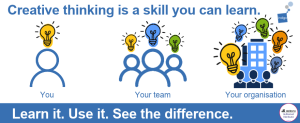 Most organisations want more creative thinking, but far fewer train their people to do it. Which leads to faimilar results: the same few people supply the ideas, the first workable suggestion wins, and decisions can end up being shaped by whoever argues most convincingly.
Creative thinking training gives people practical techniques to generate ideas, challenge assumptions and explore alternatives. Rather than relying on inspiration or individual talent, people learn a structured approach they can practise and apply to real workplace challenges.
So what does effective creative thinking training actually change for individuals, teams and the wider organisation?
What good creative thinking training looks like
A one-off brainstorm or an inspirational talk can feel energising, but it doesn’t necessarily change how people work the following Monday. Effective creative thinking training gives people something they can continue to use long after the workshop ends.
Three things make the difference.
- A method, not a mood. People learn specific techniques for generating ideas and a clear structure for working through them, rather than waiting for inspiration to strike.
- Practice on real challenges. Techniques become easier to apply when people practise them on problems they actually face at work.
- A shared language. When a whole team learns the same approach, people can work through challenges together without having to establish a new process every time.
This is also why hiring one creative person rarely transforms an entire team. We explore the reasons in ‘One hire won’t make your team more creative‘. Training gives more people the techniques to contribute, reducing reliance on a small number of confident idea-generators.
What changes for you
For individuals, one of the biggest benefits is having a starting point when an idea doesn’t come easily. Creative thinking becomes less dependent on inspiration and more about knowing how to approach a problem.
- Ideas on demand. Deliberate techniques give you somewhere to start when you’re stuck, rather than leaving you waiting for a flash of inspiration.
- A way past the first answer. You learn to challenge assumptions and explore alternatives before settling on the obvious option. Our guide to Lateral Thinking explains how structured techniques can help.
- Rough ideas that become usable. A half-formed suggestion can be developed into something worth exploring instead of being dismissed before its potential is understood.
- More confidence in meetings. Having a method to work through a problem can make it easier to contribute ideas, question assumptions and explain your thinking.
People don’t become endlessly creative overnight, but they gain practical ways to move forward when the answer isn’t obvious.
What changes for your team
When a team shares a method for thinking through problems, meetings can become more productive. Instead of competing to defend individual opinions, people have a structure for exploring an issue together.
- Less unproductive arguing. With Six Thinking Hats®, teams can examine an issue from different perspectives in a structured way, helping people explore the problem rather than simply defend their own positions.
- More voices heard. A shared process creates opportunities for people with different communication styles and levels of confidence to contribute, rather than allowing the most vocal participants to dominate.
- Ideas developed before they are judged. Giving suggestions room to develop before evaluating them can help teams recognise potential they might otherwise overlook.
- More considered decisions. When people examine alternatives, potential benefits and risks, they have a stronger basis for agreeing on a way forward.
These changes don’t happen automatically after one workshop. They develop as people use the techniques in their everyday work.
What changes for your organisation
When creative thinking skills are developed across a business, the benefits can extend beyond individual workshops or teams.
- Better-examined decisions. Teams have practical ways to consider risks, benefits and alternatives before committing to a course of action.
- Less reliance on a few individuals. Creative thinking becomes a capability more people can contribute to, rather than something expected from a handful of naturally inventive employees.
- A common approach across departments. People from different functions can use shared techniques to explore problems, develop options and work towards solutions, rather than starting from scratch each time.
The aim is to give people practical skills they can draw on when they need to solve problems, improve processes or find a different way forward.
If you’re considering how to develop these capabilities, our overview of creative thinking skills training explains why employers invest in these skills.
Why idea generation and decision-making work best together
Generating ideas without a way to assess them can leave you with a long list and no clear decision. Making decisions without generating fresh ideas can leave you choosing between the same familiar options.
Effective creative thinking brings the two together: generate possibilities, explore them properly and decide which options are worth pursuing.
That’s why Lateral Thinking and Six Thinking Hats® complement each other. Lateral Thinking helps people generate alternatives and challenge established patterns, while Six Thinking Hats® provides a structured way to examine an issue from different perspectives.
We explain the relationship in Six Thinking Hats® and Lateral Thinking: why they work best together.
Frequently asked questions
Does creative thinking training really work?
Creative thinking training can help people develop practical techniques for generating ideas, challenging assumptions and exploring alternatives. Its value depends on the quality of the training, opportunities to practise and whether people apply the techniques to real work.
How long does it take to see a difference?
Participants can start applying techniques during a workshop and in subsequent work situations. Developing consistent habits across a team takes practice, reinforcement and opportunities to use the techniques on real challenges.
Should we train individuals or a whole team?
Both approaches have benefits. Individuals can develop techniques they use in their own work, while training a whole team creates a shared language and approach that people can use together. The right option depends on your objectives and the challenges you want to address.
Do people need to be creative to benefit from training?
No. Creative thinking training is not just for people who already consider themselves creative. Practical techniques give people structured ways to approach problems, generate alternatives and develop ideas, regardless of whether creativity comes naturally to them.
What should creative thinking training include?
Effective creative thinking training should teach practical techniques, give participants opportunities to practise them and show them how to apply the techniques to real workplace challenges. For teams, a shared approach can help people generate alternatives and examine ideas more systematically.
Which creative thinking course should we choose?
It depends on what you want to achieve. Lateral Thinking focuses on generating ideas and challenging established patterns. Six Thinking Hats® helps people explore issues from different perspectives and improve decision-making. The Course in Creativity brings both approaches together in one programme.
Develop creative thinking across your team
Creative thinking shouldn’t depend on who happens to have a good idea. Give your people practical techniques to generate alternatives, challenge assumptions and examine ideas before deciding what to do next.
The Course in Creativity combines Lateral Thinking and Six Thinking Hats® to develop both idea generation and structured decision-making.
- Course in Creativity: Explore the programme and dates
- Lateral Thinking: View public workshops
- Six Thinking Hats®: View public workshops
- Training your team: Explore in-house options
Give your people a method and creative thinking stops being left to chance.
The post Creative thinking is a skill you can learn. Here’s what training changes. appeared first on the indigo blog.
]]>The post Neuroinclusive communication at work: How Think on Your Feet® can help appeared first on the indigo blog.
]]> In short: Neuroinclusive communication at work means making it easier for people with different thinking and communication styles to share their ideas and understand one another. Think on Your Feet® is a communication skills programme that teaches practical techniques for organising thoughts and giving clear, concise answers. Its central principle is “pause, then structure”: take a moment to choose a framework, then organise your answer around it. This gives people a practical way to respond to unexpected questions and communicate clearly under pressure, while helping whole teams understand one another better.
“So, what do you think?” It sounds like a simple question. But answering it in a meeting can be hard when you have little time to organise your thoughts, several people are listening and you’re expected to respond straight away.
People think and communicate differently. Some like to talk an idea through as they go. Others prefer time to process a question before they answer. Some communicate best when they know what to expect.
These differences can be especially relevant for neurodivergent people, including some people with ADHD, autism or dyslexia. Everyone’s experience is different, though, and neurodivergence doesn’t automatically mean someone finds communication difficult.
Awareness is an important starting point. Practical skills matter too, because they can help people organise their thoughts, explain their ideas and take a fuller part in workplace conversations.
What is Think on Your Feet®?
Think on Your Feet® is a communication skills programme that teaches people to organise their thoughts quickly and give clear, concise answers, especially when they’re put on the spot.
Its central principle is simple: pause, then structure.
Instead of trying to find the perfect answer immediately, you take a moment to organise your response around a clear technique. For example, you might describe a situation using past, present and future.
A simple structure gives your answer direction and makes it more memorable, with less waffle. It helps you decide what to include, what matters most and when you’ve made your point.
Think on Your Feet® is a general workplace communication programme, not a clinical intervention or a substitute for individual support. Its structured approach offers a practical way to organise thoughts and communicate clearly, although individual preferences and needs vary.
What is neuroinclusive communication at work?
Neuroinclusive communication recognises that people process information, express ideas and interact in different ways. It aims to remove unnecessary barriers so everyone has a fair opportunity to contribute.
In practice, this can mean:
- Giving people time to think before expecting an answer.
- Sharing meeting agendas and questions in advance where possible.
- Using clear language and explaining unfamiliar terms.
- Making it clear what an answer is for and how much detail is expected.
- Offering different ways to contribute, such as speaking, writing or following up after a meeting.
- Avoiding assumptions about someone’s ability based on how quickly or confidently they speak.
These approaches can benefit many people, including disabled colleagues, neurodivergent people and those working in a second language. The aim isn’t to make everyone communicate in the same way. It’s to give everyone a fair opportunity to be heard.
How does structured communication help neurodivergent colleagues?
No single approach works for every neurodivergent person. Even so, a simple structure can offer practical benefits for people who find it helpful:
- It gives you a starting point – An unexpected question can leave anyone unsure where to begin and what content to include. Having a toolkit of techniques to choose from gives you somewhere to start, so you’re not building every answer from scratch.
- It makes expectations visible – Workplace conversations come with unspoken rules. How much detail is needed? What matters most? When should you stop? A clear structure makes the shape of an answer more predictable for both the speaker and the listener.
- It helps keep information organised – When a conversation moves quickly, it can be difficult to keep track of several points at once. Learning how to group your thoughts into a clear sequence can make information easier to organise and help you link ideas together.
- It creates space to think – You don’t always have to answer instantly. A deliberate pause gives you a moment to consider what to say and how to say it, rather than feeling you must respond immediately. Where more processing time is needed, a pause may not be enough on its own. Additional time, written information or other adjustments may also help.
- It helps the whole team follow the conversation – Structured answers can make discussions easier to follow. Colleagues can identify and remember the main point more readily when information is presented in a clear order.
Where does structured communication help at work?
Think on Your Feet® is most useful wherever people need to organise information and respond clearly. Examples include:
- On-the-spot questions: Responding clearly when a colleague, manager or customer asks for your view without warning, whether that’s in a corridor, on a call or by instant message.
- Meetings: Sharing a view, answering a question or contributing to a discussion.
- Presentations and Q&A: Answering questions that go beyond your prepared material.
- Conversations with senior leaders: Getting the main points across when time is short.
- Client and stakeholder discussions: Explaining a recommendation, responding to concerns or working through a problem.
- Performance reviews and interviews: Structuring examples and explaining your experience.
- Written communication: Organising emails and messages so the main point is easy to find.
The Think on Your Feet® techniques are particularly relevant when there’s little time to prepare. They can also strengthen planned communication, where a clear structure helps the audience understand the message.
How does clear communication benefit the whole team?
When people organise their messages clearly, colleagues can identify the main point, understand the reasoning and agree what happens next more easily.
This can help teams:
- Follow discussions more easily.
- Identify key information and recommendations.
- Reduce unnecessary clarification.
- Make better use of meeting time.
- Hear a wider range of perspectives.
- Focus on the substance of an idea rather than how confidently it’s delivered.
Clear communication is only one part of effective teamwork. People also need opportunities to contribute, respectful listening and a culture where questions and different viewpoints are welcome.
Communication training as part of a neuroinclusive workplace
Communication training works best as one part of a wider approach to neuroinclusion, alongside practices such as:
- Providing written information before meetings.
- Allowing additional processing time.
- Offering written alternatives to verbal contributions.
- Making reasonable adjustments to working practices.
- Asking people about their communication preferences rather than making assumptions.
When a team learns the same techniques together, everyone has access to the same tools. Nobody needs to disclose a diagnosis or explain why they find a particular situation challenging to take part in the training.
Learning a communication technique should never become a condition for receiving support or reasonable adjustments. The aim is to give people more options, not to expect everyone to communicate in one way.
Frequently asked questions about neuroinclusive communication
What is neuroinclusive communication?
Neuroinclusive communication recognises that people process information and communicate in different ways. It aims to reduce unnecessary barriers by using clear language, making expectations explicit and offering different ways to contribute.
How can employers improve neuroinclusive communication?
Employers can share meeting agendas in advance, use clear and direct language, allow time to process questions and offer different ways to contribute. They should also ask about individual preferences and make reasonable adjustments where needed.
Is Think on Your Feet® designed specifically for people with ADHD, autism or dyslexia?
No. Think on Your Feet® is a general communication skills programme, not a specialist neurodiversity intervention. Its structured approach may be useful for some neurodivergent people, although individual preferences and needs vary.
How does Think on Your Feet® help people answer questions under pressure?
It teaches people to pause briefly, choose a structure and organise their answer around it. This provides a clear starting point and helps the listener follow the main message.
Do employees need to disclose a disability to attend?
No. The programme teaches general communication skills, and participants don’t need to disclose a disability or diagnosis. Organisations should still consider individual accessibility requirements when arranging training.
Can Think on Your Feet® replace reasonable adjustments?
No. Communication training can complement reasonable adjustments and other workplace support, but it can’t replace them. Employers should continue to consider individual needs and their responsibilities towards disabled employees.
Is neuroinclusive communication only relevant to neurodivergent people?
No. Clear language, predictable structures and different ways to contribute can benefit many people, including disabled colleagues, people working in a second language and anyone who prefers time to process information.
Can whole teams attend Think on Your Feet® together?
Yes. Indigo Business Services offers public workshops for individuals and in-house training for organisations, giving colleagues the opportunity to learn and practise shared communication techniques.
Explore Think on Your Feet® with Indigo Business Services
Neuroinclusive communication at work isn’t about speaking quickly or confidently. It’s about making communication clearer, recognising different needs and giving people the opportunity to contribute.
Think on Your Feet® gives people practical techniques for communicating clearly in everyday work situations, including when they’re faced with an unexpected question.
To help your team communicate with greater clarity, explore our Think on Your Feet® communication skills training or contact Indigo Business Services to discuss public workshops and in-house delivery.
The post Neuroinclusive communication at work: How Think on Your Feet® can help appeared first on the indigo blog.
]]>The post Six Thinking Hats® and Lateral Thinking: Why they work best together appeared first on the indigo blog.
]]>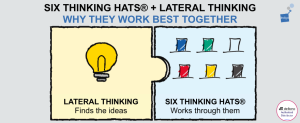 Six Thinking Hats® and Lateral Thinking are two of Dr Edward de Bono’s best-known tools, and people often treat them as alternatives. Combined, they cover both halves of a good decision: generating ideas worth considering and deciding which ones to pursue.
Most teams struggle with one half more than the other. Some run out of options and keep returning to the first idea that seems to work. Others have plenty of ideas and no sensible way to choose between them, so the discussion turns into a contest. Six Thinking Hats® and Lateral Thinking each tackle one of those problems, and each is stronger with the other. That is why we offer them together in our Course in Creativity.
What Lateral Thinking gives you
Lateral Thinking gives teams a set of practical techniques to generate new ideas and challenge the way a problem is framed. Our guide, What is Lateral Thinking?, covers the basics. In practice, it gives you:
- A way past the first idea. Most of us stop at the first answer that works. Lateral Thinking gives you tools to keep going and find better ones.
- The habit of challenging assumptions. Unquestioned assumptions stall problems. Lateral Thinking exposes them.
- Techniques to generate ideas on demand. Use the techniques deliberately, so your team never has to wait for inspiration or for the one person who is “good at ideas”.
- A way toshape rough ideas into something usable.Take a half-formed suggestion and develop it before anyone writes it off in the first minute.
That matters even more now that AI can produce ideas in seconds. The skill is in challenging, developing and choosing, as we explain in AI can give you lots of ideas. Challenge, develop and pick the right one with Lateral Thinking.
What Six Thinking Hats® gives you
Six Thinking Hats® gives a team a shared structure for looking at an issue from one perspective at a time: facts, feelings, risks, benefits, new ideas and managing the process. Our guide, What is Six Thinking Hats®?, explains each hat. In practice, it gives you:
- Meetings that stay on track. When everyone looks at the same perspective together, the discussion stops pulling in six directions at once.
- Less arguing and more exploring. Nobody has to defend a position, which is the idea behind parallel thinking®.
- Every voice heard. Quieter people get a proper turn, and risks can be raised without anyone feeling attacked.
- Better-tested decisions. Benefits and risks both get a full hearing, in an order the team chooses on purpose.
Six Thinking Hats® and Lateral Thinking at a glance
The two tools answer different questions, which is why they fit together so well.
| Lateral Thinking | Six Thinking Hats® | |
| The question it answers | What else could we do? | How do we think this through together? |
| What it gives you | New ideas, fresh angles and a way to challenge assumptions. | A shared structure for looking at an issue one perspective at a time. |
| Where it helps most | Stuck on the first idea, or short of options. | Meetings that argue, stall or go round in circles. |
| What you take away | Techniques you can use to generate and develop ideas on demand. | A way to run discussions and make better-tested decisions. |
Why Six Thinking Hats® and Lateral Thinking work better together
Each tool covers a gap in the other.
Lateral Thinking on its own can leave a team with a pile of new ideas and no agreed way to examine them. Where unusual suggestions get dismissed by the loudest voice, or admired and then forgotten. Six Thinking Hats® on its own can give a team a beautifully organised discussion of the same old options. A well-run meeting still needs something worth discussing.
Together, they give a team techniqies to widen the options and a process to work through them. Lateral Thinking gives the team more to work with. Six Thinking Hats® gives the team a way to work through it.
Example of how it looks: when a team is deciding how to cut customer complaints:
- Set the process. The team agrees the order they will use the hats and how long they will spend on each.
- Start with the facts. What do we know about the complaints, and what do we still need to find out?
- Generate new ideas. The Green Hat is where Lateral Thinking techniques come in, challenging assumptions about the problem and producing options the team wouldn’t reach on its own.
- Look for the value. The team asks what is useful in each idea, including the odd-looking ones, before judging any of them.
- Test the risks. Only then does the team ask what could go wrong with the strongest options.
- Agree the next steps. The process is closed with a clear outcome that everyone leaves with.
The result: a better set of options and better-tested choice – from the same people in the same meeting.
This is the thinking behind our Course in Creativity, a combined workshop that brings Six Thinking Hats® and Lateral Thinking together.
What you get when you learn both
For the business
- A wider range of options on every important decision.
- Choices that have been properly tested before money and time are committed.
- Less reliance on one or two “creative” people to keep ideas flowing.
For the team
- A shared language for generating ideas and for discussing them.
- Meetings where new ideas get a fair hearing instead of a quick dismissal.
- Less friction, because disagreement is handled by the process.
For you
- The confidence to find fresh ideas when the obvious ones run out.
- A clear way to lead a discussion and keep it productive.
- Skills you can use on your own decisions as well as in group settings.
Frequently asked questions
Do I need to learn both?
No. Each can be used on its own and each brings clear benefits. Combine Six Thinking Hats® and Lateral Thinking for a way to find ideas and how work through them, which is where the two reinforce each other.
Is there a workshop that covers both?
Yes. The Course in Creativity workshop combines Six Thinking Hats® and Lateral Thinking, so you learn both tools and how they fit together.
Which should we start with?
Start with the problem you recognise most. If your team keeps settling on the first idea or runs out of options, begin with Lateral Thinking. And if meetings are full of arguement, they stall or go round in circles, begin with Six Thinking Hats®.
Are they only for creative roles?
No. They are skills for thinking, and any team that makes decisions can use them, whatever its function.
Does AI make these skills less important?
It makes them more important. AI can generate a long list of ideas quickly, and someone still has to challenge them, develop the promising ones and choose between them. These two tools help with exactly that.
Can we train our team in-house?
Yes. Both programmes can be run for your own team, and can be tailored to the decisions and challenges you face. You can find out more about our in-house options below.
Ready to learn Six Thinking Hats® and Lateral Thinking?
Public workshops are open to individuals from any organisation, groups and teams can be trained through our in-house options. Course in Creativity combines both workshops together.
- Course in Creativity (Six Thinking Hats® and Lateral Thinking together): indigobusiness.co.uk/Workshop/de-bonos-course-in-creativity
- Six Thinking Hats® workshop: indigobusiness.co.uk/hats
- Lateral Thinking workshop: indigobusiness.co.uk/Workshop/de-bonos-lateral-thinking
- In-house training: indigobusiness.co.uk/in-house
More ideas. Better decisions. Both skills, one team.
Indigo is the exclusive UK distributor for Edward de Bono Limited, bringing his practical creative thinking workshops to UK businesses.
The post Six Thinking Hats® and Lateral Thinking: Why they work best together appeared first on the indigo blog.
]]>The post Stop arguing. Start Parallel Thinking®. appeared first on the indigo blog.
]]>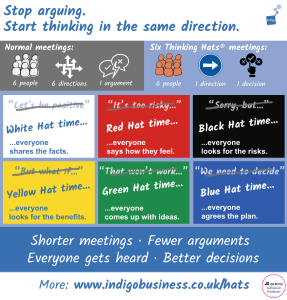 A good argument feels like progress. Voices get raised, points get scored, someone “wins”. It looks like a team that cares. But, Parallel Thinking®, where everyone looks in the same direction at once, usually leads teams to better decisions.
Yet when the meeting ends, ask what the team actually discovered. Usually, very little. Everyone defended the view they walked in with, and the decision went to whoever argued best, not to the best idea.
Most of us were taught to think together by arguing. It’s also one of the least effective ways to do it.
Why arguing is a poor way to think together
In an argument, the goal is to be right. That changes how people behave.
- People defend instead of explore. Once someone has taken a position, every new piece of information becomes ammunition for it or a threat to it.
- Good points from the “other side” get ignored. Admitting the opponent has a fair point feels like losing, so useful insights are left on the table.
- Ideas get judged before they’re understood. People attack a suggestion in its first sentence, before anyone has seen what it could become.
- The best arguer wins, not the best answer. Confidence, seniority and stamina decide the outcome more often than the evidence does. We look at this in more detail in The loudest person in the room isn’t always right.
The cost is real. For the business, it means slower decisions and choices that haven’t been properly tested. For the team, it means winners, losers and lingering friction after the meeting ends. And for individuals, it means energy spent on point-scoring rather than thinking, and a habit of keeping quiet to avoid the fight.
From debate to Parallel Thinking®
Dr Edward de Bono saw adversarial argument as one of the biggest limits on how groups think. His answer was Parallel Thinking®, and Six Thinking Hats® is how teams put it into practice. If you’re new to the method, our plain-English guide, What is Six Thinking Hats®?, explains the six hats and what each one is for.
Instead of two sides facing each other, everyone faces the same way. The whole team looks at the issue from one perspective at a time, together. Nobody is defending a position, so there is nothing to win. The only goal left is to see the issue as fully as possible.
Take a team deciding whether to launch a new service. In an argument, one side lists the reasons to go and the other lists the reasons to stop, and each defends their corner. With Parallel Thinking®, the whole team spends a few minutes on the facts together, then on the benefits together, then on the risks together. Same people, same issue, but nobody is defending a position, so the benefits and the risks both get a proper look.
That shift changes the feel of a meeting. Disagreement stays, and it stops being a contest. A concern becomes something the team examines together, and a bold idea gets room to develop before it is judged.
The hats themselves are quick to learn. Knowing how to combine them for different situations is the skill that turns a good idea into a real change, and that is what the workshop is built around.
What changes when teams use Parallel Thinking®
For the business
- Decisions based on the whole picture, not on who argued hardest.
- Less time lost to re-opening decisions that never had real buy-in.
- A team that tests ideas thoroughly without tearing them down.
For the team
- No winners and losers, so less friction carried into the next meeting.
- Room for challenge without anyone feeling attacked.
- A shared way of working that makes it easier to agree how to disagree.
For you
- Less energy spent defending your position, more spent on the problem.
- The freedom to change your mind without it feeling like a defeat.
- Meetings where you can say what you see, not what wins the point.
Frequently asked questions
Isn’t a bit of healthy debate a good thing?
Challenge is essential. The problem with debate is that it turns challenge into a contest. Parallel Thinking® keeps all the challenge but removes the need to win, so concerns get a full hearing instead of being used to score points.
Won’t stopping the arguing mean everyone just agrees?
No. The aim is a well-tested decision. Risks and objections still get raised, often more thoroughly than before, because they’re examined by the whole team rather than defended or dismissed by one side.
My team doesn’t argue, they just go quiet. Is this still relevant?
Yes. Silence is often the other side of argument: people hold back because speaking up means getting drawn into a fight. When there’s nothing to win or lose, it becomes much easier to contribute.
Does it work when the most senior person has already made up their mind?
It helps. Because everyone looks at the same perspective together, a senior view gets examined like any other, without anyone having to openly challenge the boss.
Can we use it for one-to-one conversations, not just group meetings?
Yes. Parallel Thinking® works with two people as well as twenty, and many people also use it to think through their own decisions.
Ready to try Parallel Thinking®?
On our Six Thinking Hats® workshop, you’ll learn the sequences that turn the hats from a neat idea into a tool your team uses every week. You’ll practise on real challenges and leave ready to run your next meeting differently.
- Find out more about the workshop: indigobusiness.co.uk/hats
Six people. One direction. Better decisions.
The post Stop arguing. Start Parallel Thinking®. appeared first on the indigo blog.
]]>The post What is Six Thinking Hats®? A plain-English guide appeared first on the indigo blog.
]]>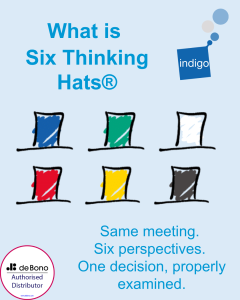 Six Thinking Hats® isn’t about putting people into boxes. It’s about stopping everyone from thinking in different directions at once. Some assume it’s an icebreaker. Others assume it’s a way of assigning personality types to a team. Neither is right.
Six Thinking Hats® is a structured method for group and individual thinking, developed by Edward de Bono. It gives a team a shared way to examine a problem, decision or plan from different perspectives, rather than having everyone argue from a different angle at the same time.
This guide explains what Six Thinking Hats® is, what the six hats represent and where it fits alongside other structured thinking approaches such as Lateral Thinking.
What is Six Thinking Hats®?
Six Thinking Hats® is a way to structure how a group thinks and discusses something, rather than telling people what conclusion to reach.
In most meetings, everyone brings a different lens to the table at the same time. One person is focused on risk. Another is excited about the opportunity. Someone else has a concern they never quite get the chance to raise. The result can be a conversation that jumps between viewpoints without properly examining any of them.
Six Thinking Hats® provides a shared structure for looking at an issue from different perspectives.
Instead of a meeting where:
“I think this is too risky.”
“Well I think it’s a great opportunity.”
“Can we just get the facts straight first?”
all happen at once, Six Thinking Hats® gives those different ways of thinking their own place in the discussion. It’s a method for organising thinking, not a personality framework.
Six Thinking Hats® isn’t just a meeting gimmick
It’s easy to assume Six Thinking Hats® is simply a way to liven up a meeting. It isn’t.
Each “hat” represents a specific mode of thinking. The method gives people a shared language for recognising different perspectives and making sure they aren’t overlooked. That matters because discussions don’t always naturally produce a balanced view. A confident opinion can dominate. A concern can be dismissed too quickly. An interesting possibility can disappear because the conversation moves straight into criticism. Facts can get mixed up with assumptions.
Six Thinking Hats® provides a structure for separating these different kinds of thinking rather than allowing them all to compete at once. The difference is between hoping a discussion covers the important angles and deliberately creating space for them.
What do the Six Thinking Hats® represent?
The method uses six named perspectives, each represented by a colour. You don’t need to learn how to run a Six Thinking Hats® session to understand the basic idea. The hats represent different modes of thinking:
- White Hat is concerned with facts, information and what is known or still needs to be found out.
- Red Hat represents feelings, hunches and intuition, without requiring them to be justified.
- Black Hat represents caution, risks, difficulties and what could go wrong.
- Yellow Hat represents benefits, value and the positive possibilities of an idea.
- Green Hat represents creativity, new possibilities, alternatives and different ways of looking at something.
- Blue Hat represents the thinking process itself: the structure, focus and organisation of the discussion.
The important point isn’t the colours themselves. It’s the deliberate separation of different modes of thinking.
Why sequencing matters
Knowing what the hats represent is the easy part. Most people can learn the six colours in a couple of minutes. The real skill is in how they’re used in a real discussion: the sequence, emphasis and way each perspective is brought in can all affect the quality of the thinking.
The key is sequencing: building the right order of hats to use so the discussion covers what it needs to, rather than jumping between perspectives at random. Get the sequence wrong – moving to Yellow Hat optimism before the risks have had a proper airing, for example – and the discussion can end up just as unbalanced as it would have been without any structure, just with colour-coded labels on it.
That’s why Six Thinking Hats® is something teams learn to use together, rather than something one person reads about and tries to run solo.
Can Six Thinking Hats® be taught?
Yes. That’s the whole point of it being a method rather than a personality trait. Six Thinking Hats® isn’t about naturally balanced people running naturally balanced meetings. It’s a learnable approach that can be applied to individual and group thinking.
That makes it particularly useful for teams that already know each other well – where habits, assumptions and hierarchy can otherwise influence who gets heard and which ideas get explored. You don’t need a naturally balanced team to have a more balanced discussion. You need a shared method.
What does AI have to do with Six Thinking Hats®?
AI has made it easier than ever to produce an answer quickly. But a fast answer isn’t necessarily a complete answer. AI-generated analysis can sound confident and comprehensive while still missing important perspectives. It may identify the facts and obvious benefits, for example, while giving less attention to risks, human reactions or genuinely different possibilities.
That creates a familiar problem in a different form: a team can mistake a fluent answer for a fully considered one. Six Thinking Hats® provides a way of thinking about that problem. It gives teams a framework for considering whether an issue has been examined from the different perspectives that matter: including those that may not have appeared in an initial AI-generated response.
AI can produce a confident-sounding answer. The question is whether the thinking behind that answer has been properly challenged. It’s a similar problem to the one AI creates for idea generation, covered in our guide to Lateral Thinking – a fluent AI answer is a starting point, not a finished one, whether the task is generating options or examining them.
Where does Lateral Thinking fit in?
Six Thinking Hats® and Lateral Thinking are often mentioned together because both were developed by Edward de Bono, but they do different jobs.
- Six Thinking Hats® is primarily a structured way to examine an idea, decision or plan from different perspectives.
- Lateral Thinking is primarily about opening up new perceptions and generating alternatives that teams might not otherwise reach.
The distinction matters. Examining an idea properly doesn’t automatically mean the team had enough good alternatives to examine in the first place. Teams also need ways of challenging established thinking and opening up new possibilities.
The two approaches are complementary rather than competing.
- Lateral Thinking helps generate alternatives and challenge established thinking.
- Six Thinking Hats® provides a structure for examining an issue from different perspectives.
Together, they form part of a broader approach to creative and critical thinking.
Six Thinking Hats®, creative thinking and critical thinking
Six Thinking Hats® is closely related to both creative and critical thinking, but it isn’t simply another name for either.
- Critical thinking is the broader process of examining, questioning and evaluating information, assumptions and conclusions.
- Creative thinking is concerned with generating new or useful ideas and possibilities.
The method brings different kinds of thinking into a shared structure. The Green Hat explicitly creates space for creativity and alternatives, while the other hats represent different perspectives that can bring facts, caution, benefits, feelings and process into the wider discussion.
That makes Six Thinking Hats® particularly relevant to teams that need to do more than simply generate ideas or criticise them. It creates a framework for recognising that good thinking can involve different perspectives and that those perspectives don’t always naturally appear in a meeting.
The real value comes from being able to move between different kinds of thinking deliberately, rather than allowing one mode of thinking to dominate the discussion.
This is increasingly relevant when AI is involved. AI can make it easy to arrive at a confident-sounding conclusion quickly, but people still need to think critically about what has been considered, what may have been missed and what deserves further exploration.
Who uses Six Thinking Hats®?
Despite the name, Six Thinking Hats® isn’t a niche technique reserved for facilitators or away-days. It can be relevant anywhere a group needs to make a decision, weigh up a plan or work through a complex issue without one perspective automatically dominating.
That includes:
- Strategy
- Leadership
- Project and change management
- Risk and governance
- Product development
- Operations
- Customer service
- Marketing
- Sales and business development
Because the method is based on a shared structure rather than personality, it can be used with many different types of teams and working environments.
The aim isn’t to make everyone think alike. It’s to make sure different kinds of thinking have a chance to be considered.
Learn Six Thinking Hats® in practice
Understanding what Six Thinking Hats® is only takes you so far. The real value comes from knowing how to apply the method effectively to real decisions, discussions and challenges. That’s something that’s much easier to understand by experiencing the approach rather than simply reading about it.
Our Six Thinking Hats workshop introduces the method and gives participants the opportunity to experience it in practice, working with real decisions and challenges.
Get in touch to talk about bringing Six Thinking Hats® to your team, or view upcoming public workshop dates.
Frequently asked questions
Who invented Six Thinking Hats?
Six Thinking Hats® was developed by Edward de Bono, who also coined the term “Lateral Thinking” in 1967. He later developed Six Thinking Hats as a separate, complementary method for structuring group discussion and decision-making.
What do the Six Thinking Hats mean?
The six hats represent different modes of thinking: White for information and facts, Red for feelings and intuition, Black for caution and risks, Yellow for benefits and value, Green for creativity and alternatives, and Blue for the thinking process itself.
Is Six Thinking Hats a personality test?
No. The hats don’t represent personality types. They represent different modes of thinking that can be considered as part of a structured approach to thinking and discussion.
Is Six Thinking Hats the same as critical thinking?
They overlap, but they aren’t exactly the same.
Critical thinking is a broad term covering the examination and evaluation of ideas and information. Six Thinking Hats® is more specific: it’s a defined method for structuring how a group examines an issue from different perspectives.
Can Six Thinking Hats be taught?
Yes. Six Thinking Hats® is based on a learnable structure rather than an innate personality trait. It can be taught, practised and applied to real business discussions and decisions.
How is Six Thinking Hats different from Lateral Thinking?
Six Thinking Hats® focuses primarily on examining an idea, decision or plan from different perspectives.
Lateral Thinking focuses primarily on generating alternatives and finding different ways to approach a problem in the first place.
The two approaches are complementary and can support different parts of the thinking process.
The post What is Six Thinking Hats®? A plain-English guide appeared first on the indigo blog.
]]>The post The loudest person in the room isn’t always right appeared first on the indigo blog.
]]> We’ve all been in a meeting where someone states their view with total confidence. Nobody pushes back, not because they agree, but because pushing back feels like more effort than it’s worth.
The conversation moves on and a decision is made. It isn’t always the wrong decision, but it hasn’t necessarily been tested against anything else. Confidence and correctness are not the same thing. They just sound the same in a meeting.
Why the loudest voice usually wins
It’s not really about volume; it’s about certainty. The person who sounds most sure of themselves becomes the easiest to agree with. Agreeing takes little effort; disagreeing takes a reason, saying it out loud, and being willing to be wrong in front of the group.
For many people, it’s easier to let the conversation move on. So the room can default to whoever is most sure, whether they’ve actually thought it through or simply arrived at an answer fastest.
What gets lost when this happens
Not every quiet person in the room is wrong. Some of them are just quiet.
- The colleague who spotted the risk but didn’t want to be the one who “slows things down”.
- The team member who had a genuinely different idea but assumed it had probably already been considered.
- The person still turning the problem over in their head when the room had already moved on to the next agenda item.
None of that shows up in the minutes – it just quietly doesn’t happen and the team never finds out what it missed.
The bigger cost is to the organisation: missed risks, weaker ideas and decisions that haven’t been properly tested.
The issue isn’t who’s in the room, it’s the structure of the meeting
It’s tempting to frame this as “some people are naturally more assertive” and leave it there. But that framing lets the actual problem off the hook.
The issue isn’t who’s in the room. It’s that many meetings have no structure for making sure different perspectives get heard. So, by default, the loudest voice can fill the space everyone else leaves empty. Change the structure, and you change who gets heard.
What good looks like instead
Picture the same meeting, run differently:
- Someone leads the meeting through a clear process, rather than simply opening the floor to whoever wants to speak first.
- The team looks at the facts first, together, before anyone argues for a particular answer.
- Then the risks get a proper airing, deliberately, rather than being raised apologetically by whoever’s brave enough.
- Then the benefits.
- Then the alternatives – a genuinely different way of looking at the problem.
Everyone is looking at the same question from the same angle at the same time, on purpose. Nobody has to fight for airtime, because everyone has a defined way to contribute.
The discussion becomes less about who has the strongest voice and more about what the team can actually see. The loudest person in the room doesn’t disappear. They just stop being the only one who gets heard.
And it doesn’t require everyone in the room to change their personality. It requires a structure for thinking differently.
That’s exactly what Six Thinking Hats® provides.
Why this takes training, not just a read
The theory behind Six Thinking Hats® is simple. That’s exactly what makes it easy to underestimate. Most people can grasp the six perspectives in a couple of minutes: facts, feelings, risks, benefits, possibilities and managing the process. It sounds straightforward enough to just start using off the back of an article.
Knowing what the hats are isn’t the same as knowing how to use them. The real skill is in the sequencing, which perspectives to bring in, when to spend longer on one than another and how to adapt that for the situation in front of you.
Get the sequencing wrong and you can end up with the same unstructured discussion you started with, just with colour-coded labels on it. That’s why teams train in it together, rather than one person reading about it and trying to run it solo.
Training a team
Once a team has been through it together, Six Thinking Hats® becomes something more useful than a technique, it becomes a common language.
“Can we get some Black Hat on this?” is a lot faster, and a lot less personal, than “I think you’re being too optimistic.”
That shared language is what makes it a genuine team effectiveness and collaboration tool, not just a decision-making exercise for one meeting.
Trained properly, it also becomes something teams can reach for in more than one situation: a fast, structured way into a difficult decision; a way to pressure-test a plan before committing to it; or a way to work through a stuck problem without the same two or three people doing all the talking.
The benefit to the team is more balanced thinking, better-tested decisions and meetings that actually move somewhere.
The benefit to the organisation is that this stops depending on any one person’s meeting-chairing skills, or on hoping the right mix of people happens to be in the room. It becomes a repeatable capability the business can rely on.
Curious what that structure actually looks like in practice? Find out how Six Thinking Hats® works.
Get in touch to talk about bringing this to your team, or view upcoming public workshop dates.
Frequently asked questions
Why does the loudest person in a meeting usually win the argument?
It’s less about volume and more about certainty. Agreeing with someone who sounds confident takes no further effort, while disagreeing means having a reason, saying it out loud and risking being wrong in front of the group. Most people, most of the time, find it easier to let the conversation move on.
Is this a personality problem — do quieter people just need to speak up more?
No. Framing it as a personality issue lets the real problem off the hook. The issue is that most meetings have no structure for making sure every relevant perspective gets heard, so by default the loudest voice fills the space everyone else leaves empty. Changing the structure changes who gets heard, without anyone needing to change who they are.
What actually fixes this?
A structured way of running the discussion, looking at facts, then risks, then benefits, then alternatives, one at a time, together, rather than leaving the floor open to whoever speaks first or loudest. That’s what Six Thinking Hats® provides.
Can a team pick this up just by reading about it?
Knowing what the six perspectives are isn’t the same as knowing how to sequence them for a real discussion. The skill is in adapting the order and pace to the situation in front of you, which is why teams train in it together rather than one person trying to run it solo.
The post The loudest person in the room isn’t always right appeared first on the indigo blog.
]]>The post What is Lateral Thinking? A plain-English guide appeared first on the indigo blog.
]]> “Lateral Thinking”, usually said to mean something vague like “thinking outside the box” or “being creative”. That’s not wrong, exactly. But it doesn’t tell you what to actually do differently.
Lateral Thinking is a structured approach to generating alternatives and finding different ways forward. The term was coined by Edward de Bono in 1967 and describes a set of techniques that anyone can learn and apply. It isn’t a personality trait, and you don’t have to be naturally “creative” to use it.
This guide explains what Lateral Thinking actually is, how it differs from conventional problem-solving, and where it fits alongside other structured thinking tools such as Six Thinking Hats®.
What is Lateral Thinking?
Lateral Thinking is a way of deliberately moving beyond the obvious way of looking at a problem.
Most problem-solving follows a logical, sequential path. You start with what you know, build on it step by step and work towards a conclusion. That’s useful for many situations.
But when a team keeps approaching a problem in the same way, it can also keep producing the same kinds of answers. Lateral Thinking introduces techniques designed to disrupt that familiar pattern.
Instead of simply asking: “What’s the logical answer?”
You might ask: “What assumption are we making?”
“What if we approached this completely differently?”
“What other starting point could we use?”
The aim isn’t to abandon logic. It’s to deliberately generate alternatives that conventional, sequential thinking may not readily produce and then use judgement to decide which ideas are worth developing.
Crucially, Lateral Thinking isn’t about waiting for inspiration to strike. It’s a method that you can learn.
Lateral Thinking isn’t just “thinking outside the box”
“Think outside the box” is a useful phrase, but it’s not a method. It tells people they should find a different idea without telling them how to find one. That’s the important distinction. Lateral Thinking provides specific techniques for deliberately changing the way a problem is approached, challenging assumptions and generating alternatives.
So instead of telling a team: “Let’s think outside the box.”
You can give them a Lateral Thinking technique that changes the way they think about the problem. The difference is between being told to think differently and knowing how to do it.
What does Lateral Thinking actually involve?
Lateral Thinking includes specific, named techniques such as challenging assumptions, provocation, random entry and generating alternatives.
You don’t need to master every technique to understand the principle behind them. Each is designed to help a team break away from its usual route through a problem and generate alternatives deliberately.
- Challenging assumptions surfaces the unstated “rules” a team has been treating as fixed. Once those assumptions are visible, the team can question whether they actually need to remain in place.
- Provocation deliberately disrupts the normal pattern of thinking, creating a starting point that would not normally arise from a straightforward discussion.
- Random entry introduces an unrelated word, object or concept to create new associations and connections with the problem.
- Alternatives encourage the team to approach the problem from a different starting position, rather than automatically using the same route every time.
The common thread is simple: Don’t wait for a different idea to appear. Use a technique to deliberately generate one.
Can Lateral Thinking be taught?
Yes. That’s one of the fundamental ideas behind the approach. Lateral Thinking isn’t presented as an innate ability that some people have and others don’t. It is a set of techniques that can be learned, practised and applied to real problems.
That makes it particularly useful in organisations. Rather than hoping the right person happens to have the right idea at the right moment, teams can develop a shared approach to generating alternatives. You don’t have to be naturally creative to think laterally, you need to know how.
If your team doesn’t use AIWithout AI in the mix, businesses have always faced the same problem: the first workable idea often becomes the final one.
The team may never discover whether there was a better alternative because nobody deliberately looked for one. Idea generation can also become concentrated in the hands of the people who are most confident, most senior or most comfortable speaking up. Lateral Thinking changes that by giving everyone a repeatable way to generate alternatives. It means teams don’t have to rely entirely on inspiration, confidence or whoever happens to have an idea first. |
If your team does use AIWith AI in the mix, the risk changes shape rather than disappearing. AI can produce a plausible-sounding answer in seconds. That’s incredibly useful, but it also makes it easier to stop thinking once something usable appears on screen. The team still ends up settling for the first workable idea. Lateral Thinking provides a way to treat an AI-generated answer as a starting point rather than a finished one. The team can challenge the assumptions behind it, explore alternative directions and deliberately develop something that is better suited to the actual problem. AI can generate possibilities. |
The underlying issue is the same whether the first idea comes from a person or a machine: If you don’t deliberately look beyond the first answer, you may never find the better one.
Where does Six Thinking Hats® fit in?
Lateral Thinking and Six Thinking Hats® are often mentioned together because both were developed by Edward de Bono, but they do different jobs.
- Lateral Thinking is primarily about opening up new perceptions and generating alternatives most teams wouldn’t otherwise reach.
- Six Thinking Hats® can provide a structured way to examine an idea from different perspectives. Those perspectives include facts, feelings, risks, benefits and possibilities, alongside managing the overall thinking process.
The distinction matters.
Generating more ideas doesn’t automatically mean making better decisions. Teams also need to examine ideas properly, identify what they may have missed and consider the implications before deciding what to do.
The two approaches are complementary rather than competing. One can help a team move beyond the obvious. The other can help them examine what they have before deciding how to proceed.
Lateral Thinking, creative thinking and critical thinking
Lateral Thinking is closely related to creative thinking, but the terms aren’t interchangeable, and it isn’t fully separate from critical thinking either.
Creative thinking is the broader concept: generating new or useful ideas and possibilities. Lateral Thinking is a defined set of techniques that sits within it: a specific, deliberate way of generating alternatives and moving beyond established patterns of thinking.
Critical thinking is concerned with examining, questioning and evaluating information, assumptions and conclusions. Lateral Thinking is mostly about generating rather than evaluating. But a Lateral Thinking technique like challenging assumptions is really doing both at once: it generates a new direction by questioning something the team has been treating as fixed. Lateral Thinking even has its own techniques for this: Treatment and Assessment are used to shape, strengthen and conduct a preliminary evaluation of an idea before it goes any further, effectively an early pass at what Six Thinking Hats® does in full. The two aren’t as neatly separable as the labels suggest.
In practice, a team typically moves between them: using Lateral Thinking to generate alternatives, then Six Thinking Hats® to challenge and evaluate what’s been generated — with a fair amount of overlap between the two along the way.
This is particularly relevant when AI is involved. AI can make it easier to generate a plausible answer, but people still need to decide whether that answer is appropriate, what it may have missed and what other possibilities are worth considering.
Who uses Lateral Thinking?
Despite the name, Lateral Thinking isn’t a niche technique for creative industries.
It can be applied anywhere a team needs to generate options, solve problems, challenge assumptions or find a different way forward.
That includes:
- Strategy
- Marketing
- Product development
- Operations
- Customer service
- Leadership
- Project and change management
- Process improvement
- Innovation
- Sales and business development
And because Lateral Thinking is based on techniques rather than personality, it isn’t reserved for people who consider themselves “creative”. You don’t have to be naturally creative to think laterally.
Learn Lateral Thinking in practice
Understanding what Lateral Thinking is only takes you so far.
The value comes from being able to use the techniques when you’re faced with a real problem, challenge or opportunity – particularly when the obvious answer isn’t good enough. Our Lateral Thinking workshop teaches the techniques directly, giving participants the opportunity to apply them to real problems and challenges.
 Get in touch to talk about bringing Lateral Thinking to your team, or view upcoming public workshop dates.
Frequently asked questions
Who invented Lateral Thinking?
The term “Lateral Thinking” was coined by Edward de Bono in 1967. He subsequently developed the concept into a broader set of techniques and thinking tools.
Is Lateral Thinking the same as creative thinking?
They overlap, but they aren’t exactly the same. Creative thinking is a broad term covering the generation of new or useful ideas. Lateral Thinking is more specific: it refers to a defined set of techniques for deliberately generating alternatives and moving beyond established patterns of thinking.
Can Lateral Thinking be taught?
Yes. Lateral Thinking is based on learnable techniques rather than an innate personality trait. The techniques can be taught, practised and applied to real business problems.
How is Lateral Thinking different from Six Thinking Hats®?
- Lateral Thinking focuses primarily on generating alternatives and finding different ways to approach a problem.
- Six Thinking Hats® can provide a structured way to examine an idea or situation from different perspectives, including facts, feelings, risks, benefits and possibilities.
The two approaches are complementary and can support different parts of the thinking process.
The post What is Lateral Thinking? A plain-English guide appeared first on the indigo blog.
]]>The post AI can give you lots of ideas. Challenge, develop and pick the right one with Lateral Thinking appeared first on the indigo blog.
]]>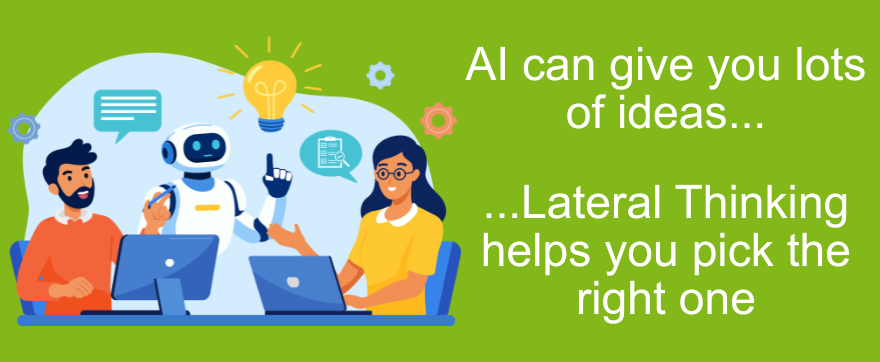 Ask most AI tools for a plan, a campaign idea or a solution to a problem, and you’ll get something usable within seconds. It reads well, sounds confident and it may even look finished. And for a lot of teams, that’s where the thinking stops.
The ‘finished-looking’ answer is the trap. AI’s first response often draws on patterns in the material it has learned from. That makes it remarkably good at producing something plausible and useful quickly – but not necessarily something distinctive, original or right for your specific problem.
Treating that first response as the finished idea skips the steps that makes it better: developing it, challenging it, and adapting it to what your business, customers, or situation actually need. That’s where Lateral Thinking comes in.
AI makes generating ideas easier. It doesn’t make creative and critical thinking less important. It makes them more important.
Why AI’s first answer isn’t necessarily the best one
AI is genuinely good at producing a plausible first draft: a structure, a set of options, a starting list of ideas.
What it doesn’t automatically know is which of those ideas is actually right for your business, your market or your customers. It can also converge on the obvious. Ask for marketing campaign ideas, ways to improve a process or solutions to a business problem, and you may get variations on familiar suggestions – competent, safe and not necessarily very different from what another organisation could generate with the same tool.
That’s not a reason to stop using AI. It’s a reason not to stop thinking when AI gives you an answer. When anyone can generate ten campaign ideas, draft a strategy or suggest solutions in seconds, the advantage shifts to the people who can generate alternatives, challenge assumptions, spot what has been missed and decide which ideas are actually worth developing.
Lateral Thinking: taking a starting point somewhere better
This is exactly where Lateral Thinking can add value.
Lateral Thinking gives teams specific, repeatable techniques for deliberately generating alternatives beyond the first, most obvious answer – whether that answer came from a colleague, a brainstorm or an AI tool. An AI-generated idea might be perfectly reasonable.
Lateral Thinking encourages the team to ask:
- What else could this be?
- What if we challenged the assumption behind it?
- What happens if we approach the problem from a completely different direction?
Provocation techniques can help teams deliberately move away from an existing idea and explore what else is possible. Having the techniques to be able to challenge the assumptions built into an AI-generated answer can uncover a different direction entirely. And developing an idea rather than simply accepting or rejecting it can turn a reasonable first draft into something much more useful.
Used this way, AI becomes a faster starting point, not a shortcut past the thinking. The team still has to do the part that matters: deciding what’s actually worth pursuing.
Six Thinking Hats®: making sure the idea stands up
Generating more ideas is only part of the challenge.
Once a team has developed different options, it needs to examine them properly before deciding what to do. Six Thinking Hats® provides the structured approach for this.
The method enables teams to deliberately look at an idea from different perspectives: facts, feelings, risks, benefits and possibilities – within an overall thinking process. This matters more, not less, when AI is involved. An AI-generated option can sound authoritative even when it is wrong, incomplete or simply unsuitable for a specific situation. More AI-generated options don’t automatically lead to better decisions either. Teams still need to to have the practical tools to confidently ask:
- What do we know?
- What are we missing?
- What are the risks?
- What could work?
- What concerns do we have?
- What else should we consider?
A structured approach helps make that thinking deliberate rather than leaving the discussion to whoever speaks most confidently or agrees most readily with the AI-generated suggestion.
Creative thinking and critical thinking in an AI workplace
AI has changed the cost of generating ideas. It can produce possibilities quickly and give teams something to react to instead of starting with a blank page.
But that changes the value of human thinking rather than removing it.
- Creative thinking helps teams move beyond the obvious.
- Critical thinking helps teams challenge, examine and evaluate what they have produced.
Both matter when AI is part of the workflow. A team that simply accepts the first AI-generated answer may be moving quickly, but it isn’t necessarily thinking differently. The team that deliberately develops alternatives, challenges assumptions and examines its options is doing something much more valuable.
The World Economic Forum’s Future of Jobs Report 2025 identifies creative thinking among the core skills expected to remain important as the world of work changes. As AI makes generating plausible answers increasingly easy, knowing what to do with those answers becomes increasingly important too.
What this looks like in practice
A team using AI well doesn’t treat its first output as the answer. They treat it as raw material – a quick way to get past the blank page, not a replacement for the thinking that follows. Lateral Thinking can push the ideas further. Six Thinking Hats® can provide a structured way to examine the options from different perspectives.
AI makes the starting point faster to reach. The human thinking determines where you take it. That is the opportunity.
The next step
Your team is probably already using AI to generate ideas, draft content, explore options or solve problems. The real question is what happens next:
- Does someone challenge the first answer?
- Does the team explore alternatives?
- Does anyone question the assumptions behind it?
- Do people develop the idea further?
- And, when there are several possibilities, do they have a structured way to examine them before deciding?
These are not skills AI makes irrelevant, they are the skills that become more valuable when AI makes the first answer easy.
Lateral Thinking and Six Thinking Hats® give teams practical techniques to develop ideas, challenge assumptions and examine possibilities deliberately – rather than relying on whoever happens to be the most senior person in the room or push back the loudest.
AI can give your team a start. The thinking determines what happens next.
Get in touch today to talk about bringing Lateral Thinking or Six Thinking Hats® to your team, or book your place on an upcoming workshop.
Frequently asked questions
Doesn’t Lateral Thinking training compete with using AI tools?
No, it is designed to work alongside them. AI is fast at producing a starting point. Lateral Thinking gives people repeatable ways to challenge that starting point, generate alternatives and develop ideas that are better suited to the actual problem.
Why can’t AI just do this part too?
AI can certainly generate more variations and challenge ideas when prompted to do so. The issue is that generating more output isn’t the same as deliberately exploring a problem from different perspectives. Teams still need to decide what matters, which assumptions should be challenged, which alternatives are genuinely different and which ideas are worth developing.
Lateral Thinking provides a structured way to do that deliberately.
How is this different from just prompting AI more carefully?
Better prompting can improve the raw material AI produces, but it doesn’t replace the team’s own thinking about which ideas to pursue and why. Lateral Thinking and Six Thinking Hats® give people repeatable methods for developing, challenging and examining ideas, not simply a better first draft.
Who should learn Lateral Thinking?
Anyone who regularly needs to generate ideas, solve problems or explore alternatives – not just people in traditionally “creative” roles.
Lateral Thinking is a technique, not a personality trait, which is exactly why it can be learned and applied in different roles and situations.
Sources
- Future of Jobs Report 2025 – World Economic Forum – source for the claim that creative thinking is identified among the core skills expected to remain important as the world of work changes.
The post AI can give you lots of ideas. Challenge, develop and pick the right one with Lateral Thinking appeared first on the indigo blog.
]]>