The post Automated petition review: A game changer or just a tool? first appeared on Arizona Capitol Times.
]]>Key Points
-
AI tools speed up signature review process in candidate legal challenges
-
Software used in 2024 election proved faulty, causing lawsuit dismissals
-
Attorneys continue to push human review as crucial to ensuring accuracy
A candidate’s place on the ballot is a numbers game. And now, developments in artificial intelligence software created to review candidate petitions streamline the play.
Over the past few election cycles, candidate legal challenges — the process of suing to knock someone from the ballot for failure to secure enough signatures — have become increasingly aided by automated petition review software.
But even though the software can now run line-by-line through signatures, having licensed attorneys verify the results remains crucial, especially after a failure of a nascent petition review software last cycle led to the dismissal of four lawsuits.
Still, law firms plan to deploy software again this cycle. Election attorneys pioneering the technology, and those opting for the old-fashioned way, think an all-out replacement for human review is still way off.
“Maybe at some time in our lifetimes, AI will be a substitute for basic human judgment,” election attorney Kory Langhofer said. “But it’s not there yet.”
It’s candidate filing season, leaving those running for statewide and legislative office to turn in nomination petitions bearing enough valid signatures to make it on the ballot.
And immediately after the Secretary of State’s Office doors shut and lock at 5 p.m. on the filing deadline of March 23, the ten-day window for candidate legal challenges opens.
No government official initially takes on the task of combing through candidates’ petitions. Instead, checks on signatures are made solely by private litigants.
“Let’s say you needed 5,000 signatures. You could write Mickey Mouse down 5,000 times, and unless someone challenges you, you’re going to be on the ballot,” election attorney Tim La Sota said. “We rely on private litigants to enforce these signature requirements, otherwise, there’d be no incentive to get actual good signatures.”
A “good signature” comes from a qualified elector registered to vote in the candidate’s jurisdiction and either registered with the same political party as the candidate or as an unaffiliated voter.
Electors can only sign one petition for a single office, unless, like in House races, more than one candidate is running. And beyond the signature itself, a signer must jot down a legible printed name, address and date.
Under state law, any elector is entitled to litigate a candidate’s eligibility over signatures, and many do.
In 2024, 21 candidates faced legal challenges. Of the 21 candidates, 11 withdrew, two were disqualified by court order, six stayed on the ballot after cases were dismissed, and two kept their candidacy after prevailing in court.
Candidate nomination challenges require a line-by-line review of petition sheets. For both the plaintiffs and the defense, that often means close reviews and fights over the many nuances of election season.
La Sota, a Republican election attorney, said he still sues and defends candidate petition challenges the “old fashioned way” by having reviewers go line-by-line, or audit a sample of signatures and dig deeper in the event of a high error rate.
But in recent cycles, some election attorneys are turning away from old habits, opting instead to pursue automated review processes.
Langhofer, a Republican election attorney at Statecraft, co-founded Signafide in 2018, a machine learning software trained to go line-by-line to identify petition defects and invalid signatures.
Signafide uses AI to complete its own assessments and to speed the process for living, breathing signature review personnel. But, because AI can be error prone, Langhofer said at least two human reviewers always check the resulting reports before a signature is flagged.
In 2024, a competitor to Signafide emerged in Veracity Petitions, LLC. The software, spearheaded by election attorneys Brett Johnson and Eric Spencer at Snell and Wilmer, rolled out in 2024.
But four lawsuits relying on Veracity Petitions’ software were voluntarily dismissed after opposing counsel on both sides of the aisle found the majority of allegedly invalid signatures were not invalid at all.
In one case, 77 of the 103 claims of allegedly invalid signatures were found to be baseless. In another, a county report found of the 820 allegedly invalid signatures, 449 were valid.
Andy Gaona, a former election attorney who defended a challenge against Marlene Galán-Woods in the 1st Congressional District in 2024, wrote in a letter to Spencer that the “entire case (along with others brought by your firm) was predicated on the abject failure of Veracity Petitions’ software platform.”
Spencer and Johnson did not respond to a request for comment. But as for this cycle, Veracity Petitions is still around.
Per the website, the company continues to utilize signature recognition software to detect invalid signatures, with attorney and reviewer validation deployed before issuing a final report.
“With Veracity Petitions’ software, attorneys are now able to take customers’ petitions and process thousands (or even hundreds of thousands) of signatures — accurately — in a fraction of the time,” the website reads. “Customers can expect the right turnaround time to make key campaign decisions and meet litigation deadlines.”
How petition review software fares across the board this cycle remains to be seen, and paper candidate petition challenge could be more sparse going forward as candidates opt to use E-Qual, the secretary of state’s online petition signature platform that verifies a voter on the spot.
But in any case, attorneys stress the continued need for a human stopgap.
“People who sign with terrible handwriting or have spelling mistakes are troublesome for things that care about details, like computers,” Langhofer said. “It’s just a really, really hard problem to solve. I don’t think it’s an imminent threat to human reviewers.”
The post Automated petition review: A game changer or just a tool? first appeared on Arizona Capitol Times.
]]>The post Mayes uses ‘public nuisance’ law to target proposed Surprise ICE facility first appeared on Arizona Capitol Times.
]]>Key Points:
-
Attorney general probes ICE facility under state public nuisance law
-
Joins federal lawmakers in concerns over impact to community
-
Federal compliance with state law still an open question
Attorney General Kris Mayes is probing Immigration and Customs Enforcement’s proposed 1,500-bed detention facility in Surprise for potential violations of public nuisance law.
In a letter to Department of Homeland Security Secretary Kristi Noem, Mayes asked for information on the facility’s potential impact on local schools, traffic, noise, water supply, waste disposal, medical care and workload for local first responders.
Mayes’ letter follows a line of information inquiries from members of Arizona’s congressional delegation. By adding to the pile, she equips her own inquiry with some legal teeth.
Unlike her predecessors, Mayes has taken a broad interpretation with public nuisance law, and has led the legal charge on a variety of public issues like excessive groundwater pumping, a proposed aluminum plant and now the “seven football field sized prison” ICE plans to “plop down in the middle of the city of Surprise.”
“Kristi Noem, in her own communications, noted that they work within state and federal regulations and laws, so she intends to work within state laws,” Mayes said. “And I would assume she’s not going to have a problem abiding by our nuisance law.”
Mayes’ letter, sent Feb. 9, begins by noting that the proposed processing and detention facility, located at Sweetwater Avenue and Dysart Road in Surprise, is in the middle of a residential area. And, despite being located in Surprise, Mayes pointed out the department had kept city officials and residents in the dark about the project.
In a statement, Surprise city officials said, “The City was not aware that there were efforts underway to purchase the building, was not notified of the transaction by any of the parties involved and has not been contacted by DHS or any federal agency about the intended use of the building.”
Mayes referenced a Surprise City Council meeting on Feb. 3 where more than 80 residents “spoke at length of the project’s harm to their community,” with overlapping concerns about potential impacts on schools, water, waste, trash, medical services, property values and economic development. She then framed the same concerns within the constructs of public nuisance law and sent a list of demands for more information.
Within the letter, Mayes asked for more details on how the federal agency plans to ensure that the construction and operations of the center do not interfere with the functions of nearby schools like Dysart High School.
She also raised questions about the number of vehicles, associated traffic, pollutants, dust and noise, complying with lighting requirements inside and outside the facility under city and county laws, the amount of water needed for construction and operations, and the plan for waste disposal.
Finally, she inquired about the presence of adequate medical care and the impacts to local municipal services, like fire, law enforcement and emergency response services.
The state’s public nuisance law empowers the attorney general to sue to enjoin or prevent any activity found to be “injurious to health, indecent, offensive to the senses or an obstruction to the free use of property that interferes with the comfortable enjoyment of life or property by an entire community or neighborhood or by a considerable number of persons.”
Mayes has relied on public nuisance law throughout her tenure, but only one claim remains alive in court.
The attorney general is currently in litigation with Fondomonte Arizona, a Saudi Arabian-affiliated alfalfa farm, for what she is calling excessive groundwater pumping.
A Maricopa County Superior Court judge is also now considering whether the implementation of an active management area for water regulation in the area negates or amplifies the need for public nuisance litigation, with a final ruling on Mayes’ claim still coming down the line.
Prior to Fondomonte, Mayes sued two companies planning to build a mine near a residential area under public nuisance law, claiming potential structural damage, excessive dust and noise and increased traffic. The suit was voluntarily dismissed after a neighbor purchased the disputed land.
Mayes also threatened to sue Riverview Dairy, LLC, a dairy farm, under the law for excessive groundwater pumping.
Though the issue never went to court, the attorney general and the company entered into a settlement in which Riverview agreed to pay $11 million to remedy lost and strained groundwater access.
Though Mayes said the ICE facility may well fit into state public nuisance law, whether the federal government will bow to state law remains a key concern.
In Surprise’s statement, officials said the federal government was not subject to local zoning regulations.
Mayes anticipated the same pushback, though she noted a statement on the DHS website in which it would comply with “federal, state, and local laws and regulations, in operation of DHS facilities.”
“We’ll see what they have to say,” Mayes said.
Mayes also asked for copies of responses to questions posed by U.S. Reps. Paul Gosar, Yassamin Ansar, Greg Stanton and Adelita Grijalva, Arizona members of Congress.
Gosar, a Republican, sent the first letter on Feb. 4. He started by clarifying he “strongly” supported ICE operations but noted that the impacts of immigration policy are “most acutely felt at the local level.”
“A detention facility of the reported size raises legitimate and reasonable questions for nearby residents, schools, first responders, and local governments. Concerns regarding infrastructure capacity, traffic, emergency services, environmental impacts, and public safety deserve serious consideration,” Gosar wrote. “These are not anti-illegal immigration concerns; they are common-sense expectations of transparency, planning, and accountability.”
Gosar and Mayes overlapped on inquiries about consultation with local governments, schools, law enforcement, traffic impacts and adequate medical services.
However Gosar did add his own questions to the mix concerning the facility’s population, oversight on operations, security measures, timelines for development and expansion, contingency plans for growth and future plans for communication and local consultation.
Mayes identified Gosar’s letter as the catalyst for her own.
“Quite frankly, when I read Congressman Gosar’s letter, it struck me that he was asking the kinds of questions that go into a possible nuisance lawsuit,” Mayes said.
In a Feb. 6 letter, Democrats Ansari, Stanton and Grijalva similarly asked about community impact, operational footprints and the department’s authority to purchase, acquire and convert the property. And most recently, U.S. Sens. Mark Kelly and Ruben Gallego added another letter to the pile on Feb. 10, with similar questions.
Mayes set a response deadline for Feb. 17, as did Gallego and Kelly. Gosar asked for a response by Feb. 18 and Ansari, Stanton and Grijalva set a Feb. 20 deadline.
The Department of Homeland Security and ICE did not respond to a request for comment.
The post Mayes uses ‘public nuisance’ law to target proposed Surprise ICE facility first appeared on Arizona Capitol Times.
]]>The post Swoboda steps back as Republican Party of Arizona appoints new chair first appeared on Arizona Capitol Times.
]]>Key Points:
- Sergio Arellano elected chair of Republican Party of Arizona
- Sitting chair Gina Swoboda left seat to pursue congressional run
- Eligibility questions and hand count prolonged meeting
Sergio Arellano was elected as the next chair of the Republican Party of Arizona at the annual mandatory meeting on Jan. 24, following a run-off with Pam Kirby.
Despite rumors that sitting chair Gina Swoboda would secure a nomination from the floor and stay at the helm, the meeting went by without any major upsets.
“Enough of the division, enough of the fighting, let’s focus on winning and kicking butt in November,” Arellano said.
Nominations started with four candidates – Arellano, Kirby, Kathleen Winn and Robert Branch.
The initial round of voting put Arellano and Kirby in a runoff, with Arellano taking 655 votes and Kirby taking 603, and dropped Branch, with 200 votes, and Winn, with 196 votes.
A brief last-ditch effort to keep Swoboda resulted in drawn-out procedural tension and a run-off vote between Sergio Arellano and Pam Kirby, stretching the meeting until late evening.
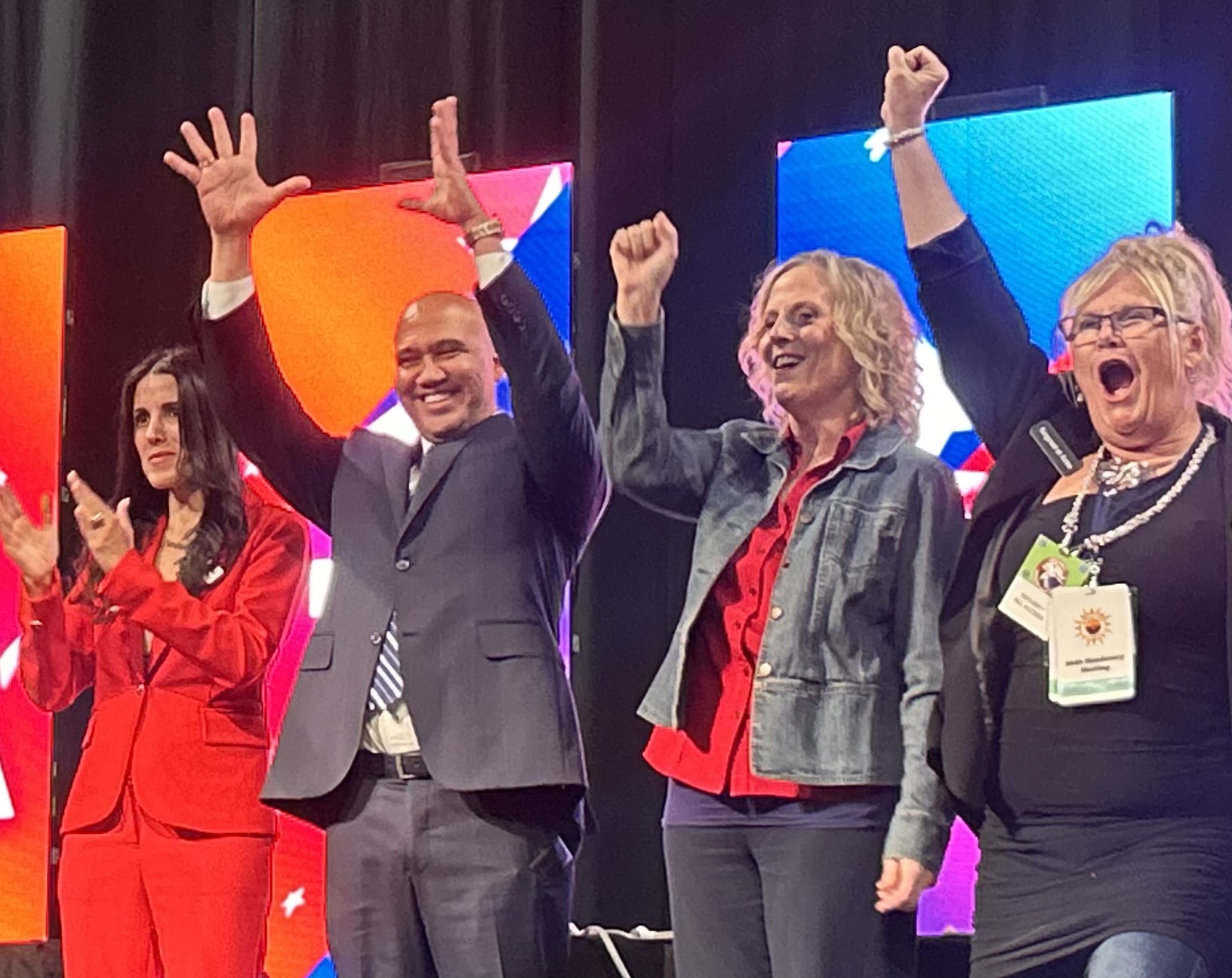
In the final round, Arellano prevailed, with 761 votes to Kirby’s 621.
Before any votes were cast, Saturday’s meeting kicked off with a debate over whether to allow a “fractional” appointed state committeemen to vote, and for Arellano, to run for a leadership position.
Under state law and bylaws, the party elects one state committeeman for every three precinct committeemen, ensuring a proportionate share for each legislative district.
But the math required rarely yields a clean round number and often leaves decimals, or “fractional” appointments, in an awkward gray area. In past chair practice, remaining fractions were typically rounded up, giving way to the appointment of additional committeemen.
Swoboda said under her leadership that, instead of rounding up each decimal to a state committeeman, the party would add all the remaining decimals, creating a total of 16 “fractional” state committeemen.
Ahead of the meeting, legal threats challenged the practice altogether.
The party maintained fractional reserve appointments as a reasonable interpretation of the law, but decided to vacate state committeemen status for the 16 “fractional” members, Arellano among them, citing potential damage to party unity and finances.
The decision made Arellano, a fractional member, no longer eligible for the chair or the committee. But after a back-and-forth on points of order and information, and ultimately a motion, the party voted to allow the 16 members to vote, clearing the way for Arellano.
The field stuck to the four candidates despite ultimately unsuccessful motions to first request Swoboda reconsider her resignation and then to throw her name in the chair race.
Amid a run for Congressional District 1, Swoboda said she would resign upon election of a new chair. Though there was some speculation that Swoboda would try to stay, she told the party today it was time for her to step aside and thus shut down a motion to nominate her.
“Don’t try to keep me, let’s just go. It’s been an honor,” Swoboda said. “Just continue to work together.”
Swoboda’s time at the helm oversaw the return of big-dollar donors, increased voter contact spending, and coordinated campaigns, reaping wins for the Republican party up and down the ballot in 2024.
Her work inspired the ire of Turning Point, though, culminating in an ultimately unsuccessful effort to oust Swoboda at the 2025 organizational meeting.
Criticism of Swoboda continued, but in a departure, Turning Point did not charge into the chair race at the same tenor this year, offering no single endorsement.
Arellano now takes the mantle, bringing with him his experience as a son of immigrants, a veteran, president and CEO of Tipping Point, LLC, a political consulting firm, and as a founding member of the AZGOP Latino Coalition.
He attributed his success to his work to expand party membership and donors during his campaign.
“We can address and expand the umbrella a little bit more to welcome individuals who are tired of one side or the other as far as rhetoric goes,” Arellano said. “We lead with conservatism and family values.”
As for day one business, Arellano hopes to start dialing for dollars, a task won with a plan, an outline of what it takes to win the state.
And as for party unity, Arellano wants to lead with communication.
“People are in this party because they believe in what we have to offer,” Arellano said. “But also, they deserve recognition, they deserve a shout out for running for office, they deserve data, they deserve support.”
Arellano prevailed over Kirby, former first vice chair and executive director of the AZGOP.
Her time in party leadership, though featured in her run for chair, was marked with controversy, as pointed out in attack ad played at the top of the meeting.
Kirby, as second in command to then-chair Kelli Ward, spent big on a campaign bus and an election party rather than on voter contact in the lead-up to 2022, leaving the party in difficult financial straits in the aftermath.
She now works as the founder and president of the Arizona Coalition of School Board members. In her campaign video, Kirby championed her efforts to elect conservative school board members and noted her efforts with Latinos for Trump and Women for Trump.
And in her remarks to the party, she hit hard on election integrity, going so far as to call for a “one day, one vote, required ID, no machines” approach to elections.
Branch, former candidate for Maricopa County Supervisor District 4 and Superintendent of Public Instruction, called for a steadier fundraising mechanism, with increased reliance on the precinct committeemen to keep party momentum going down the ballot.
Winn, chair of the Pima County Republican Party and former congressional candidate, called for bringing Independents into the party and strengthening fundraising.
In her final remarks, Swoboda urged the party to find common ground in 2026.
“I just want you to work together and go win,” Swoboda said.
The post Swoboda steps back as Republican Party of Arizona appoints new chair first appeared on Arizona Capitol Times.
]]>The post Arizona restricts farming to protect groundwater supply first appeared on Arizona Capitol Times.
]]>Get 24/7 political news coverage and access to events honoring top political professionals
The post Arizona restricts farming to protect groundwater supply first appeared on Arizona Capitol Times.
]]>The post Grand Canyon State’s namesake threatened first appeared on Arizona Capitol Times.
]]>Get 24/7 political news coverage and access to events honoring top political professionals
The post Grand Canyon State’s namesake threatened first appeared on Arizona Capitol Times.
]]>