By this time it has become obvious that the biggest challenge facing the bus industry is getting people comfortable about getting back into buses. Here are some thoughts on this subject.
Those who have done historical research in transportation can tell you about early days when the railroads, electric interurban lines and buses all battled for passenger miles. The reality was that it was less of a battle between different modes of transportation than a battle between public transportation and the passenger car. Because of the pandemic, we are substantially in that same position today.
Initially, ownership of a private auto was substantially limited to the rich. Not only were they expensive but there was a lack of roads outside of larger communities going any substantial distance. Henry Ford built his Model T from 1908 to 1927. Eventually, mass production reduced the price to where more people could afford to own one. But reliable long distance roads were a long time coming. Testing the roads, a military convoy rolled from Washington, D.C. to San Francisco along what became known as the Lincoln Highway in the summer of 1919. It took them two months. However, both roads and autos have improved since then, making them competition to public transportation.
When the pandemic hit, the number of autos on the road declined because businesses were closed and some people could work from home. This hurt both public transportation as well as the auto industry – which already was faced with the ride-hailing startups as well as the movement towards electric and autonomous vehicles. However, as the situation eases, the experts are predicting that the pandemic will foster a substantial increase in the ownership and use of private passenger cars. People used to social distancing and concerned for the transmission of the virus will opt to travel alone in autos rather than join others on buses and trains.
Increased use of private autos will be good for the auto industry. Expectations are that used cars will start selling again and new cars will move faster after a couple of months. But, this same situation is expected to cause major problems in bigger cities where the increased number of cars will exceed road and parking space. The experts are warning of forthcoming increases in commute and travel time because of this.
This may or may not affect autonomous and electric vehicles. It has been noted that autonomous vehicles on public roadways have proven to be more challenging than expected. But, autonomous operations on farms and in industrial applications have shown success because of the absence of traffic lights and other vehicles while taking advantage of the lack of regulations on private property. Movement to electric vehicles could depend in part on fuel costs, which are expected to remain low for several months.
As you can guess, this increased use of passenger cars will be harmful to ridership on buses and other forms of public transportation. There are two basic alternatives. One is to simply hold off until a vaccine and improved treatment is available. The second is to find ways to make buses more acceptable to passengers. There may not be one answer for all since state and local laws can vary from place to place. But there are a number of different things currently available and I am sure that more will be available as time goes on.
Many of the bus manufacturers and suppliers have devices and products available to help isolate passengers. A couple of the bus manufacturers have shields and similar devices of several kinds that will isolate the driver from the aisle or serve to separate the passenger seats. Marco Polo from Brazil has even offered a three-row interior of individual seats separated by antimicrobial curtains. A few operators are using double deck buses because they provide more distancing between passengers because of the additional seats.
You can also get a UV light kit that mounts in the ductwork of the bus that reduces bacteria, viruses and mold while being substantially unobtrusive to the passengers. Irizar has a device that checks the temperature of boarding passengers and whether they have a mask. There are several systems and products that clean the interior air in different ways.
Getting people out of cars and back into buses will be the biggest challenge right now to getting the bus industry rolling again. Look around and see what options, products and systems are available to do this. You might also want to see if you can get help from municipalities that are swamped with an increased number of private cars and are willing to work with you in various ways.
There may also be some other ideas that could help get buses moving again.
Indications are that people are increasingly buying things online for delivery rather than going to a store. Can you somehow get into this? At one time Greyhound ran buses that had few passenger seats but were filled with package express. I once ran a scheduled route where the package express contributed a significant part of the income.
There are areas that are expanding if you can figure out how to get involved. Both the vitamin and sports equipment industries have been booming. In addition, people are doing more cooking, baking and more people are maintaining a garden.
Another area looking for help is “last mile delivery” of both people and products. With people, the train or bus station can leave them a significant walking distance from their destination or place of employment. With products, there are numerous items including food and merchandise that need to be moved from the restaurant or store to their destinations.
What we need to do is to find ways to get people comfortable enough to leave their private autos and get back on the bus. Or, you might be able to find new and different ways to use your staff and vehicles.
Good luck.
]]>Among the more popular questions and inquiries we have heard lately are those involving the emerging and evolving MCI product line. If you have fallen behind with keeping up with all of the improvements, developments and evolution at MCI in 2019, you are not alone. This seems to be a common, current situation as MCI has shifted into high gear with new developments and models.
Gone are the days when MCI, or most bus manufacturers, fielded a single model. For a few years, from 1981 to 1984, MCI offered only one model, the MC-9. The 35-foot MC-5C had been discontinued following a major order that went to Saudi Arabia and the new “letter” models like the 102A3 did not appear until 1985. Following years saw a movement to multiple models for different purposes – such as higher quality charters and tours – and more recently we have seen more movement to alternative fuels including hybrid systems, CNG and now battery-electric power. Add to this MCI’s revolutionary new low-entry commuter coach and you have an increasingly expanded product line.
Your staff here at National Bus Trader took the time to look into all of this in order to keep our readers up-to-date. Following are some of the highlights of current developments at MCI and where their product line is going in the future. We will split this information into several sections to make it more logical. Since MCI continues to offer both D and J models, we will cover them separately. We will briefly review the missing model letters and also provide special attention to MCI’s new battery-electric buses.
The MCI D Models
Historically, the D models trace their heritage back to MCI founder Harry Zoltok and the company’s early days in Winnipeg. Greyhound of Canada needed buses that could be reliable in Canadian winters and on often-questionable roads. Zoltok developed those buses, MCI built them, and Greyhound was so impressed that they bought the company.
Over the years this product line involved the various Courier models followed by the MC-1 through MC-9 from 1959 to the early 1990s. Greyhound began putting MCI coaches into its fleet in the mid-1960s with the MC-5 model. The newer “letter” models were introduced in 1985 with the 96A3 and 102A3, that followed through with the B and C models to the introduction of the D in 1991 as the 45-foot 102DL3. This series is regarded by most bus people as among the most reliable and durable coaches in the world. Some have called them the “workhorses” of the bus industry and today’s MCI’s gatherings are still called Reliability Rallies.
High-Floor D Models
The traditional D models are now often referred to as the “high-floor” models to distinguish them from the new low-entry model. Included is the 45-foot D4500 that was originally introduced as the 102DL3, was renamed the D4500 in 2001 and offered an updated design in 2006 as the D4505, primarily for private sector scheduled service applications. The D4500 name remains current for the public sector commuter coach. A companion 40-foot model was originally introduced as the 102D3 in 1993, was renamed the D4000 in 2001 and offered an updated design in 2006 as the D4005.
This particular series of coaches has a lot going for it. It represents the largest number of coaches on the road and traditionally has been the best seller in previous years. It is offered with the Cummins ISX/X12 engine, a high-mounted cooling system with electric fans, and is available in either 45-foot or 40-foot lengths. The 45-foot coaches typically seat 57 to 61 passengers. These coaches are Altoona tested, Buy America compliant and have been proven in commuter operations.
Over the years, MCI’s D models have been very popular with private operators for scheduled service where their reliability is a major asset. Many operators also use them in charter and tour service. In addition, variations on these models were built as commuter coaches for numerous operations in both the United States and Canada. It should be mentioned that in addition to conventional diesel engines, they were also available with hybrid and CNG power. This series became the most popular commuter coaches on the highways.
MCI will upgrade these models in 2020. The new 45-foot high-floor D coach will be known as the model D4520 and will include some of the exterior design and features introduced in the D45 CRT LE. Eventually, a 40-foot D4020 model will also be become available. A Cummins X12 engine will be offered as standard equipment. At a future date, both models will be available with battery-electric power, presumably designated as the D4520e and D4020e, with focus on the D4520e due to the ability to package more batteries and thus more range.
“In reality, the J4500e will be first to market, followed by the D45 CRTe LE. Our message of 100 percent battery-electric combined with MCI workhorse reliability is resonating with operators on the West Coast,” said Brent Maitland, MCI vice president of marketing and product planning. “MCI’s move into battery-electric is one of our most significant, and our all-electric J4500e and D45 CRTe LE models that inaugurate the MCI CHARGE product line-up are consistent with our sister company New Flyer brand of electric low-floor transit models.”
New D45 CRT LE
The latest addition to the MCI D series coaches is the revolutionary D45 CRT LE. Looking at the model number, we can see it signifies: D=D series coach, 45=45 feet long, CRT=Commuter Rapid Transit and LE=low entry. It is basically a variation on the traditional D series coaches for public sector commuter applications. It recently passed Altoona certification, allowing the use of federal funds for procurement. The low-entry coach is both innovative and pioneering because it offers a second entry door for ADA applications. Designed with the help of organizations for people with mobility challenges, the D45 CRT LE is a breakthrough in technology by being the first high-level coach to offer simplified ground level entry and exit for mobility devices.
“This is the biggest model development for MCI since the E-Coach program in the late 1990s,”said Maitland. “The project engagement of end-users, which included volunteers from leading advocacy groups for people with disabilities, led to such a significant advancement in accessibility. The acceptance from the customer base continues to be amazing, both in the private and public sector.”
Alberta’s Bow Valley Regional Transit, the first operator to take delivery of the MCI D45 CRT LE, was followed by SouthWest Transit, Eden Prairie, Minnesota. In the private sector, MCI also begun delivering a custom order for a Silicon Valley employer which included flat-screen monitors and onboard workspace areas.
Although the D45 CRT LE has a traditional front entry door, it also has a low-entry door at the center of the coach. This allows simple and quick entry and exit to mobility devices via a ramp to a low-entry vestibule with seating area inside the coach. Two mobility devices can be accommodated in this area plus a seat for a companion. The remainder of the coach has conventional seating on a higher level including a single set of seats and an aisle going around the special low area. A major advantage of the curb level center door with a ramp is that it allows passenger mobility devices to enter and exit the coach much quicker and with far less effort than using a wheelchair lift.
In addition to two passengers using mobility devices, the C45 CRT LE can seat another 50 passengers in regular coach seating. The coach can be configured with seating for up to 54 passengers. Overall length is about 45 feet while width is the expected 102 inches. With a height of 111⁄2 feet, the C45 CRT LE can fit through a 12-foot garage door. A Cummins engine with an Allison transmission is the standard power train, but other options may be available.
A battery-electric version of the D45 CRT LE was introduced by MCI at its Bay Area sales and service center on October 1, 2019. It will soon be added to the MCI product line as the D45 CRTe LE in the near future. More information on the electric coaches will be provided later. Other specialty coaches provided by MCI include coaches for colleges and universities with special features as well as Inmate Security Transportation Vehicles.
The Missing Alphabet Models
Since some people will ask, let me take a moment to answer questions about the missing alphabet models. MCI enjoyed much success with their earlier Courier and models 95 and 96 but started a numeric model numbering in 1959 when they began to develop a new design for Greyhound. This went from MC-1 to MC-9, with some extra variations on the MC-5, and continued into the 1990s when an MC-12 for scheduled service was added. In 1985, MCI switched to the alphabet and started with the A models. Models B and C followed in short order and the model D was originally introduced in 1991 as MCI’s first production 45-foot coach.
The question is: what happened to the letters between the D model and the new popular J model? Here are short answers.
Introduced in 1998, the E model first appeared as the 102EL3 and was known as the Renaissance®. It was the first MCI model to use web frame integral construction rather than their traditional platform integral. This change allowed for a new and modern appearance more suited to the upscale charter and tour market. Renamed the E4500 in 2001, it remained in production until 2011 and fostered today’s popular J model.
Built in Mexico during the Dina years, the F model MCI F3500 was a 35-foot, two-axle coach that was in production from about 2001 to 2003. About a third of these were built as motor home shells. The G model was designed for scheduled service with the help of Greyhound and had several component differences from traditional MCI models. A G4100 model followed by the G4500 were built from about 1999 to 2004. Most of them went into the Greyhound fleet.
There is no MCI H model. This letter was skipped by MCI because it is used by another manufacturer. The letter I was also skipped, either because it looked like the number one or because it had become synonymous with Apple.
The MCI J Models
When MCI introduced its E model Renaissance® coach in 1998, operators were delighted with the new attractive styling. Many of them asked for a model with similar upscale styling but more of a bread-and-butter coach. Hence, the J4500 was introduced in 2001. Within only a few years it eclipsed the D4500 as the best selling coach on the market as it became popular in scheduled service as well as charters and tours. What is noteworthy is that the MCI engineers continued to upgrade and improve the J4500 almost annually, thus increasing its popularity. E4500 operators began switching to the J4500 as it received improvements. This trend increased as the J4500 evolved until the E4500 itself was fully replaced by the J4500 in 2011.
Currently, MCI continues to offer the popular 45-foot J model as the J4500 and recently added a 35-foot J3500 model. A battery-electric version of the J4500 has been in testing for a year, and both an electric J4500e and J3500e model will be added to the MCI product line in the near future. “The J3500 offers commonality and familiarity with the 45-foot version, the J4500,” said Maitland. “Our customers wanted the J3500 and we were able to deliver it with maximum parts commonality, while both drivers and passengers will have seamless transition to this coach in terms of look, feel and operations.”
The J4500 for 2020
Following an award-winning interior redesign in 2018, MCI has continued to make improvements in the J4500, the most popular model on the market. It now offers impressive legroom with the optional 60-passenger interior plus a new swing-out cooling module and e-Fan system that improves fuel economy while reducing maintenance time. The air conditioning belt drive system now has double belts while estimated fuel efficiency has been improved by up to four percent.
The J4500 has a length of 45 feet, a width of 102 inches and an overall height of around 11 feet, eight inches. For 2020, the J4500 will introduce the new Cummins X12 engine with 410 horsepower and 1,450 lb-ft of torque or an optional upgrade to 455 horsepower and 1,550 lb-ft of torque. These options provide lighter weight for even greater fuel efficiency. Detroit Diesel’s DD13 engine will continue to be an option based on customer demand while it is available. Operators get a standard 30-month warranty plus the Super 60 (five-year) extended coverage on selected parts and components.
Several systems on the J4500 will aid operators in monitoring performance and planning maintenance. The standard Allison Gen V transmission has prognostics capability. With the Cummins engines you can get the “Cummins Connected” option for enhanced engine diagnostics. Likewise, the Detroit engine has a “DD13 Virtual Technician” option for enhanced engine diagnostics.
In addition to enhanced interior ambiance, the J4500 features a new entry, a new driver dash and instrument panel, as well as pre-selected Blues, lounge and tech trim packages. Options include a rear window, upgraded trims and seating, a branded puddle and interior light, and color LED interior lighting. There is also an improved wheelchair lift door.
One of the best features of the J4500 is its Advanced Driver Assistance Systems (ADAS) that assists drivers in making the coach travel safer. Included is the latest generation Bendix Wingman Fusion Adaptive Cruise/Collision Mitigation system that integrates a forward-facing camera and radar with vehicle recognition software. This takes a major step forward with new options including Following Distance Alerts (FDA), Adaptive Cruise Control with Braking (ACB), Collision Mitigation (CMT), new Stationary Vehicle Braking (SVB), new Lane Departure Warning (LDW), and new Traffic Sign Recognition (TSR).
Also available is the impressive 360-degree “birds eye view” camera system. Moving into the future, the next features in the planning stage include Automatic Emergency Braking, Pedestrian Collision Warning, Blind Spot Assistance and a Drowsy Driver System. Said Maitland: “ As an industry leader, our goal is to be a leader in ADAS systems for our vehicles, often using technology proven in the passenger car and truck segments.”
Worth special mention is the new J4500 Livery Edition. An increasing number of limo operators have been moving up to coaches as their operations expand into larger groups. The J4500 Livery Edition combines the advantages and features of limos and coaches by providing a special interior that includes black diamond-stitched leather seating. This special interior has proved to be more and more popular in the livery market.
The J3500 for 2020
Originally introduced in 2018, the J3500 offers the same styling and many of the same features as the J4500. It has the same width and height as the J4500, but the length is 35 feet. It is primarily intended to provide the same high-class travel as the J4500 but for smaller groups. While the J4500 will typically seat 56 to 60 passengers, the J3500 is geared to groups of up to 44 passengers. An additional advantage of the J3500 is its fleet compatibility. In addition to some parts commonality with the J4500, the J3500 also makes it easier for your drivers and maintenance staff to transition.
The new J3500 proved immediately to be so popular that demand exceeded production in 2019. Moving into 2020, the J3500 offers several features. Noteworthy is the positive impact on passengers of an interior experience to match the J4500. Like the larger coach, the J3500 offers impressive legroom with interiors seating up to 44 passengers. It also provides a remarkable amount of passenger storage space in the enclosed overhead parcel racks while underfloor baggage bay space is impressive at 285 cubic feet without a wheelchair lift. In addition, the J3500 offers a turning radius of just under 33 feet, making it highly maneuverable for those trips that go into traffic and tight places.
Early operators of the J3500 included Tuscaloosa Charters, Gulf Coast Tours, Arrow Stage Lines, Tri-State Travel and Cline Tours. Other companies have ordered the J3500 in order to provide big coach features to their smaller groups.
Moving Into Battery-Electric Power
MCI is moving towards a growing product line with the J4500, the J3500, two high-floor D models of different lengths, two Commuter Coaches of different lengths and the new D45 CRT LE commuter coach with low entry. Plans are to offer all or most of these models with battery-electric power in the future.
The transit bus industry is rapidly embracing battery-electric buses for several reasons. While the initial investment in a battery-electric bus is higher than a typical diesel bus, both regular operating costs and maintenance costs are lower. In addition, a battery-electric bus is essentially zero emissions in operation. Because of battery technology, the operating range of battery-electric buses is limited but may be suitable for many transit applications and can be enhanced with overhead or under pavement recharging systems at the end of the line although depot charging will likely be the standard for early adopters
MCI has been able to tap into decades of electric bus manufacturing technology at parent company New Flyer. Their resulting electric drive system is specifically designed for coaches and will work on either the J or D45 CRT series coaches. It incorporates a high-torque Siemens electric drive system using a 2130 lb. ft. electric motor. Power storage is provided by a extended capacity Lithium Ion battery system, currently exceeding 450 KWH.
Major advantages of the battery-electric coaches are that they will be less expensive to operate and maintain. They will also be cleaner and will essentially have zero emissions. Negatives are that the battery-electric coaches will cost more to purchase, will have reduced underfloor luggage capacity and your operating range will have limitations unless you can recharge along the way.
While the state-of-the-art in batteries limits operating range without recharging batteries, it is workable for some coach applications including commuters and shuttles. The MCI electric coaches will be designed for highway speeds and are planned to have a range of more than 200 miles and greater if the operator can accommodate a midday recharge. Experts at the Vehicle Innovation Center in Anniston, Alabama will help customers in designing their battery-electric coaches and increase their understanding of the required infrastructure. They can be recharged in under four hours or options are available to recharge while away from the garage.
A prototype electric J4500, to be known as the J4500e, was already in testing in late 2018 [see the February, 2019 issue of National Bus Trader]. This coach is being put through some rather extensive tests including cold weather testing at Michigan’s Keweenaw Peninsula that is notorious for its heavy snow coming off Lake Superior. A battery-electric version of the new D45 CRT LE low-entry commuter coach was introduced at the MCI Reliability Symposium on Tuesday, October 1, 2019 at the Bay Area MCI Sales and Service Center. It will also be involved in testing in the months ahead. This will be follow by several more J4500e units in 2020.
“California is at the epicenter of the move to electric vehicles and we are excited to have showcased the first D45 CRTe LE at our first Reliability Symposium at our Bay Area MCI Service Center on October 1,” said Maitland. “Full ESC brake certification is a development milestone and will now be showing the coach to customers throughout the area as we move to production units in 2020.” All of this innovation and new developments will give MCI its largest and most diversified coach product line to date. We here at National Bus Trader will try to keep up with all of these new developments and directions from MCI.
]]>Another new model that is joining the MCI product line is the 35-foot J3500. Effectively a shorter sibling to the J4500, the J3500 offers all of the big coach amenities and features for smaller groups. While the J3500 offers several features and advantages, two are noteworthy. Unlike the body-on-chassis buses, the J3500 is integral and has the durability as well as passenger comfort and amenities like the big coaches. Hence, you can send it out on the highway and on longer charters and tours. Being based on the 45-foot J4500, the J3500 not only makes driver transition easy but also requires little change for technicians and reduces parts inventory. Heritage This new J3500 has an interesting heritage. Back in the late 1990s, MCI was offering their “D” model in both 40-foot and 45-foot lengths. The latest model in a constantly improving product line, the D coaches continued to be built in the old platform integral way as originally developed by MCI founder Harry Zoltok. The “D” coach and its older siblings gave MCI its reputation for durability and reliability.
Several MCI customers approached the company and asked whether it would be possible to take this heritage of reliability and durability but put it into an attractive package that would turn heads in the tour and upscale charter business. MCI’s engineers complied and developed what became the “E” model or Renaissance coach. Introduced in 1998, it offered a radical new style and several upscale features that made it an excellent addition to the product line and a compliment to the “D” models. While the “D” models continued as the undisputed leader in scheduled service, commuter coaches and reliability, the new “E” model Renaissance provided similar features in a more attractive package for tours and upscale charters.
Expectedly, there were several MCI customers who liked the design and appearance of the new “E” model, but had an interest in matching that modern and attractive appearance with more of a “bread and butter” type coach. Once again, the MCI engineers retired to their drawingboards to address customer needs. This time they came up with the J4500 model. Introduced in 2001, it offered the attractive design of the “E” model but was more of a “jack of all trades.”
This universal appeal was soon obvious. Peter Pan put the J4500 into scheduled service while other operators sent it out on charters and higher quality tours. By 2004, the J4500 became the most popular coach on the market, a record it has kept in subsequent years. What makes the J4500 so unique is that the MCI engineers kept on working on enhancements and improvements every year or two. Before long, the J4500 had replaced the “E” model. There were a substantial number of improvements in 2018 and more again in 2019.
 Meanwhile, MCI operators were looking for a higher quality coach for smaller groups. While body-on-chassis and cutaway buses were practical for shuttle service and short runs, many operators were seeking a smaller coach suitable for long distance charters and tours with underfloor luggage space, air ride suspension and all of the passenger amenities offered by the larger coaches.
As a result, MCI’s engineers came up with the J3500 model. It is effectively a 35-foot version of the J4500. Hence, it offers the features of the most popular coach on the market but in a 10-foot shorter length for smaller groups. This introduction is more of a milestone in our market than most people might think. While Eagle built a handful of 35-foot coaches at Brownsville and Neoplan did produce a few at Lamar, the last real ongoing regular production of a 35-foot coach in the United States and Canada goes back to 1980. It was then that MCI discontinued its MC-5C model. Hence, we are talking about a gap of about 38 years.
Similar Yet Different
The first question most people ask is how similar is the J3500 to the ever-popular J4500? What has been left out? What items are missing?
In general, MCI went though a lot of trouble to make the J3500 as similar and as compatible with the J4500 as possible. While they look different from the side, if you look at them head-on, you may not be able to tell them apart. Drivers should have no difficulty transitioning to the J3500 from the J4500 because the cockpits are essentially the same. While there are changes in the engine compartment (the J3500 does have a smaller engine), your service staff and technicians will be very familiar with the setup and appreciate the spacious engine bay area that improves maintenance access. In addition, you will find that the majority of J3500 parts are the same as for the J4500, so there are a minimum number of unique parts that need to be stocked for the J3500.
The differences in the J3500 are exactly where you would expect them – related to length and capacity. With a length of 35 feet, the J3500 is 10 feet shorter than the J4500. Hence, the J3500 has only two axles while the J4500 has three. Nominal passenger capacity on the shorter coach is 40 or 44, with good legroom like the longer coach.
 Other noteworthy differences include the fact that the J3500 has a turning radius of less than 33 feet. Hence, it is very maneuverable in tight spaces and an excellent choice where getting in and getting around matters. The wheelbase on the 35-foot coach is 228.8 inches compared with 315 inches in the 45-foot coach. You get a slightly smaller fuel tank with the J3500, 164 gallons, as compared with the 183-gallon tank on the J4500. Luggage capacity on the J3500 is 285 cubic feet without a lift and 270 cubic feet with the wheelchair lift.

The front overhang on both models is the same at 78.25 inches while the rear overhang on the J3500 is only 120.29 inches compared with 150.25 inches on the longer coach. Many of the other specs are the same for both models: a width of 102 inches, a height of 140.75 inches (about 11 feet and 8 inches), and an interior height of 78.25 inches.
Perhaps the single biggest difference is that the J3500 comes with the smaller 2017 EPA Cummins L9 350 horsepower engine. Having ridden on a pilot model of the J3500, I tend to feel that this engine is more than adequate. As a past owner and driver of an MCI MC-5A with the 8V-71 engine rated at 318 horsepower, I think that the Cummins L9 in the J3500 will do fine. The L9 setup in the new J3500 also benefits from a simplified single module aftertreatment system.
 Beyond this, it is obvious that MCI is not cutting back on amenities or features in the J3500. As a general rule, whatever comes with the J4500 will come with the J3500 and whatever is an option on the J4500 will be an option on the J3500. All of those interesting features that were added to the J4500 for 2018 will be on the J3500 coaches as they come off the line.
This would include the redesigned engine air intake system and engine compartment as well as the newly redesigned restroom. You will find the improved passenger area with coordinated interior trim packages and multi-color interior programmable lighting. Also included are the improvements in the front stepwell and driver’s area.
New Features
New features being added to the J4500 will also be on the new J3500 coaches when they come off the assembly line. The first pilot models of the J3500 had the traditional cooling fans. However, as they are put into regular production, the J3500 coaches will come off the line with the new electronically controlled e-fan system and swing-out radiator. MCI notes its new swing-out cooling module e-Fan system improves coach reliability and fuel economy while drastically reducing the time required for service to after treatment sensors and all “hot side” engine components.
The production J3500 coaches will also likely include the optional Bendix® Wingman® Fusion system that will be available with the 2019 models of the J4500. This system gathers input from radar, video and the braking system to create a highly detailed and accurate data picture on bus operations and the area surrounding the bus. Data comes in from the next-generation radar, camera and brake systems. This is constantly being gathered, shared and confirmed by the system to see what actions are called for, with the main functionality including enhance collision mitigation with the ability to stop the coach when a stationary vehicle is detected, adaptive cruise control with braking, lane departure warnings and traffic sign recognition, all integrated into MCI’s high definition instrument panel for ease of visibility for the driver.
This new system does incorporate the Bendix ESP® Electronic Stability program full-stability system. Plus it has the AutoVue® Lane Departure Warning System from Bendix CVS. It also has the Bendix Wingman Advanced Collision Mitigation Technology.
New features include Stationary Vehicle Braking (SVB) that uses data from both radar and a camera to watch the road ahead. When a stationary metallic object is identified in the path of the bus, the driver is given a warning. If the driver fails to take action, Wingman Fusion can automatically engage the brakes to assist the driver in reducing the severity of the impact or avoiding a collision.
Yet another new feature of Wingman Fusion is that the camera can read speed limit signs along the road. When the bus is moving at more than 20 miles per hour, the system can compare the speed limit signs with the actual bus speed. If the driver is operating five miles per hour above the posted speed an audible warning will sound. At 10 miles per hour above the posted speed, the system will provide a one-second dethrottle of the engine to get the driver’s attention.
Production and an Electric Model
 MCI is already taking orders for the J3500. Current plans are to have the J3500 coaches in regular production in early 2019 with the first deliveries soon afterward.
Like the battery-electric J4500e CHARGE, a battery-electric version of the J3500 is contemplated for the future. The reduced length and high maneuverability of the J3500 will make the battery-electric version an excellent choice for many shuttle operations and possibly for local sightseeing.
]]> Founded in 2003, the company began on the premise to supply eastern Tennessee with the highest level of motorcoach services. The company’s visionary Nick Cazana, who had a true passion for the motorcoach industry, demands Premier to be much more than a name for his company but also a way of doing business. That vision and his passion for building relationships and providing a premier service to customers has been the cornerstone of the company’s success. Today, Premier has grown to become a leader in charter service with a well-rounded fleet of 51 vehicles ranging from 14-passenger shuttles to 81-passenger Van Hool double-deck coaches. Premier primarily runs charter service to New York City, Washington, Orlando, Chicago as well as other U.S. and Canadian destinations.
A long-time ABC customer, Premier began purchasing Van Hools in 2004 and the two companies have worked well together to satisfy its customer base. ABC and Premier work together to supply many special amenities for its customers. When asked about the acquisition of the new Van Hool coaches, Nate Frederick, chief operating officer, Premier Transportation, stated, “What’s not to love about a new Van Hool? Our customers enjoy the great amenities and fantastic styling and our drivers rave about the incredible ride and solid engineering.
Premier was one of the first private operators to purchase a Van Hool TD925 double-deck coach solely for charter service. This was an undeveloped market which presented a challenge and opportunity for the operator. The company was successful and creative in establishing a market for this specialty coach and shortly added a second double-deck to the fleet.
 “We are thrilled to have such a close relationship with Premier for so many years,” said Jim Morrison, vice president, sales, for ABC Companies. “Seeing this company’s growth over the years has been exciting, and we are very proud to be part of that growth.
Premier devotes significant time and effort making sure it turns out a consistently great product and service. “Over the past 14 years Premier continues to evolve its coaches to include the latest technology, providing its customers top of the line service,” said Jeff Jolley, account manager with ABC Companies. “The company is active in the industry and has been a member of UMA, ABA and TNMCA since 2005 stating that these organizations give the tools we need to know where to focus our attention.”
ABC Companies is a leading provider to the transportation industry with diverse product and service offerings that cover a full spectrum of operational needs including new and pre-owned, full-size highway coach equipment, transit and specialty vehicles. ABC supports customers with a comprehensive after sale service network for service and repairs, collision services, extensive OEM and quality aftermarket parts needs for transit, motorcoach and heavy-duty equipment from 10 strategically placed locations throughout the U.S. and Canada. Additionally, private and municipal financing and leasing options are available through the company’s financial services group. For more information, contact ABC Companies at (800) 222-2875 or visit www.abc-companies.com.
]]> The people from MCI very graciously invited us to take a close look at the first prototype electric J4500e CHARGE coach on the road. Since we knew that our National Bus Trader readers would be interested, we quickly accepted. Hence, we were able to poke our heads into each compartment, take photos and check out all the new and improved systems and components. Following that, we then were invited to jump into the driver’s seat and see how this new electric coach operated. We were also able to obtain information on the coach that we could share with our readers.
A condensed report would include the fact that several components and systems were converted from an existing 2017 clean-diesel J4500 to electric operation replacing mechanical or belt-driven items. In spite of these changes and improvements, drivers should have no difficulty in transitioning from diesel to battery-electric power. Your technicians will smile because the J4500e is simpler in operation, is easier to maintain and clean. Although MCI plans to accommodate systems that allow you to charge it along the way, the approximate 200-mile range essentially limits the coach to commuter and shuttle work until higher capacity batteries come along. Due in large part to the expensive batteries, the J4500e will cost about twice as much as the equivalent diesel coach. You will have less underfloor storage space than on the equivalent diesel coach because of the batteries.
Background
 While an electric J4500 was inevitable, the joining of MCI and New Flyer about four years ago moved the project along and also guarantees that the J4500e combines the best of two worlds. On the one hand, it is the result of eight decades of coach building expertise at MCI that has created the most reliable and durable of coaches. On the other hand, the J4500e takes advantage of decades of electric bus experience at New Flyer.
The MCI heritage includes engineering and building coaches that operate reliably in the varied weather, temperatures and roads of Canada. Add to this MCI’s decades of building coaches that meet the exacting needs of Greyhound operations nationwide. The result is a coach that is easily at the top in regard to reliability, durability and operations.
There is 20 years of heritage and development behind the J4500 model. It started in 1998 when MCI introduced their “E” or Renaissance model to offer new styling geared more towards tours and upscale charters. The J4500 was originally introduced in 2001 to offer a “bread and butter” companion to the “E” model. The J4500 soon turned into a Cinderella story. Continued improvements to the J4500 made it more attractive to operators and suitable for scheduled service, charters and tours. By 2004, the J4500 became the most popular coach on the market, a position it has held ever since. These improvements are ongoing. Last year saw a modification in the engine compartment and interior that offered a rear window and more legroom for an increase to 60 passengers. The most recent improvement involved going with an electric fan cooling system with a swing out radiator for the engine compartment that is easier to maintain.
New Flyer’s heritage with electric buses dates back 50 years. Looking for a way to move forward with trolley buses, Toronto asked New Flyer to rebuild one in 1967. It was so well received that an order for 151 similar buses followed. As time went on, New Flyer became a major supplier for electric buses that operated in different cities.
Moving beyond trolley buses, New Flyer developed a hydrogen fuel cell, electric drive and then their battery-electric drive. Today New Flyer’s low-floor Xcelsior transit bus line is available with diesel, CNG, hydrogen fuel cell and battery electric power with the all-electric version falling under the Xcelsior CHARGE brand that will be common with MCI. In addition to the shorter transit bus lengths, New Flyer is also producing 60-foot articulated battery-electric buses with bus rapid transit (BRT) features.
Hence, the J4500e CHARGE is in a position to take advantage of both the MCI coach building and the New Flyer electric bus expertise and experience.
Changes in Systems and Components
The single biggest difference between the diesel coach and the electric coach is moving to electric systems and components in a few areas. I stress the fact that none of these significantly changes how you drive the coach and, in many if not most cases, the driver moving from a diesel coach to an electric coach may not even notice these changes.
Obviously, the major change is from a diesel engine to an electric motor to move the coach. However, in going all electric there are other systems and components that need to be changed. The most obvious are the components and systems that took power off the diesel engine. Since the electric motor does not run continuously, it is not very workable to use it to drive systems and components. The most obvious of these would include power steering, the engine compartment cooling system, the air compressor and the air conditioning compressor, and passenger and driver heating systems.
MCI has already moved to an electric fan cooling system. This is less of a problem on the electric coach since the electric motor and related components generally do not throw off as much heat as a diesel engine. Nevertheless, the drive motor and its controls require a dedicated cooling system. The coach air compressor for brakes, suspension and other items is now electric and located low in the engine compartment towards the center. The air conditioning compressor is also now electric and is currently mounted in the third luggage compartment for this prototype test coach.
In the past we often counted on getting passenger heat from the engine or a diesel-fueled auxiliary heater. In the electric coach, the heaters are expectedly electric and are located in the second luggage bay on the curbside. The new steering system is electric over hydraulic and is in the forward street side compartment below the driver.
Let me again stress that while these components and systems have changed, their basic function has not. In many cases, if you do not tell the driver, he or she may not immediately guess that these components have changed. The smart ones will figure it out anyway.
Batteries
 As you probably have already guessed, batteries for travel are a major component of the J4500e. MCI has elected to go with 450kWh Nickel Manganese Cobalt (NMC) batteries that are part of the Lithium Ion family. In addition to being heavy and expensive, they do take up a lot of room. Four of them are located in the second luggage bay and four more are towards the back of the engine compartment. There is a ninth battery located immediately behind the third luggage compartment in what I think was the area formerly used for the fuel tank.
It should be noted that the MCI engineers put a lot of effort into battery placement. Battery location is very important from the standpoint of weight and balance, as well as for proper axle weight requirements.
In your garage or depot these batteries can be charged in about three hours using a 150 kW plug-in cable depot charger. Fully charged, they provide a range of about 200 miles, but this changes depending on the number of stops, road grade, average speed and the use of heat and air conditioning. In the future, the J4500e will also have the option of being equipped to charge along the way using an overhead or in-ground system. I should note that the J4500e does have a regenerative braking system that puts power back into the batteries when braking.
There is a need for infrastructure for charging since you cannot simply plug the coach into a conventional electrical outlet. You can have these special cables added in your garage or yard, but you obviously need to have enough incoming electric power to make them work.
In MCI’s case, given the need to move the electric coach around the country for various testing and customer demonstrations, they have purchased a standalone diesel generator trailer that can charge the coach for local use at any location. A dedicated truck pulls the generator while another dedicated truck with a flatbed transports the electric coach. This clearly illustrates the ease of moving diesel only powered vehicles. This is the same approach used by New Flyer to showcase their Xcelsior CHARGE electric bus. It is not really anticipated that regular bus operators would normally use this approach.
I should mention that in addition to the banks of NMC batteries, the J4500e still has a regular 12/24V bus battery. This is used for the lights and other low-voltage items on the coach.
Engine Compartment
 When you look into the engine compartment, there are two things you immediately notice. One is that there is no engine. The second is that it is very clean since there is no diesel fuel or larger quantities of lubricants.
Looking into the engine compartment from the rear, you will find the fans on the left where they always were, but now they are electric fans. As you move from left to right across the engine compartment what you see are several boxes. Towards the left on top is the AUX Inverter. Below that are several different electrical components including the motor inverter, the high voltage fuse box, inverter for the motor, and DC/DC converter to supply the 12/24V system and charge the coach batteries. The coach air compressor is towards the center but lower.
Behind these boxes and towards the front of the coach is the pack of four batteries. The actual electric motor for moving the coach is located below and a little forward of the batteries. It is connected directly to the coach driveline and there is no transmission. MCI uses a Siemens 2024 electric drive system that is designed to handle long distances and higher speeds. Members of the MCI staff have indicated that the coach can reach higher speeds but will be limited to 72 miles per hour due to tire ratings, as with all MCI vehicles. Also lower speeds are similarly more efficient and will extend the range of the coach. This type of electric motor has been proven in other electric bus operations.
Expect that your technicians and maintenance staff will be delighted with the J4500e CHARGE. I have talked with service people and technicians who work on electric buses. While I hear different things from different people, there are a few things that are typical. One is that they like working on the electric buses because they are cleaner. While you may still have to deal with road grit, there is no diesel fuel or DEF to get things dirty or sticky. Consider the fact that when your staff works on an electric bus in the garage, there is no need to connect an exhaust hose to the tailpipe because there is no tailpipe.
The second thing I hear is that electric buses are easy to maintain. Many of the parts and systems that cause the most trouble are gone. Belts are gone and hoses have been reduced. Fuel filters have been eliminated and there is no engine coolant, no starter and several other items have been simplified.
A third point is that the electrical components typically require less rebuilding and replacement than diesel bus components. There are examples of electric motors and other components from electric buses and streetcars being reused in new buses and railcars.
Comparison to the Diesel J4500
With the exception of the driveline and some components, the new electric J4500e is essentially the same coach as the diesel J4500. They are both 45 feet long, 102 inches wide and about 11 feet and 9 inches high. The passenger capacity on both is essentially the same . . . 56 passengers with high legroom for up to 60 passengers. Both offer Wi-Fi, electrical outlets and the optional RGB programmable lighting to upgrade the interior.
As a general rule, features and options available on the diesel J4500 will also be available on the electric J4500e. Both 45-foot models, as well as the 35-foot J3500, will now have the new swing-out radiator and e-Fan system. This replaces the traditional belt-driven systems and also eliminates the need for a fan clutch, a miter box and driveshaft. The e-Fan system quickly swings out to provide easy access for faster maintenance and also eliminates the need to maintain and drain coolant.
Most other features found on the diesel J4500 will also be available on the electric J4500e. This includes the latest-generation Bendix Fusion collision mitigation system that was recently upgraded with a forward-facing camera with vehicle recognition software to detect and stop for stationary vehicles in the roadway. The system also offers lane departure warning and traffic sign recognition. A new 360-degree camera provides improved visibility, especially during low speed operation, and can serve to avoid some costly repairs.
It should be noted that the electric J4500e will have the same high level of support as the other MCI models. This includes support by the 24/7 technical call center, technical training and parts supply through NFI parts.
Test Drive
 I was fortunate in having prior experience in driving electric buses including both those with hub motors and the direct drive system. In spite of the fact that some of the electric bus components and systems are different, I find that there is no substantial difference in the driving and only a little difference in monitoring gauges and systems.
Like diesel buses, you will find a battery shut off switch. If your company policy is to shut off the batteries overnight or when the coach is not in use, you probably want to continue this procedure. Some people are talking about adding solar panels to the roof. They really do not generate that much power but can be helpful in making sure that your battery system is “topped off.”
Sliding into the driver’s seat, you will see very few differences from a diesel bus. With the diesel bus, you have to start the engine and may have to wait for the air system to build up. With an electric bus, you simply turn the bus on. If your air pressure is low, you will still have to wait for it to build up. While the diesel engine runs continuously,the electric motor only runs when the bus is moving.
Your gear selector is no longer a gear selector. Expect to see D, N and R only. This is because the J4500e has no transmission and no gears. The electric motor is connected directly to the driveline and simply runs faster for higher speeds.
Different from a diesel bus is the fact that you will see new gauges and indicators on the dash that show you the amount of charge remaining in your batteries and the amount you are using. Essentially, your remaining battery charge is similar to the fuel gauge on a diesel-powered coach. If you run out of diesel fuel or battery charge, the coach is not going anywhere. Hence, you need to monitor your battery charge much like you monitor a fuel gauge.
Let me expand this thought in two ways. One is that with a diesel bus you are essentially charging your batteries all of the time. This is because your engine is always running, consuming fuel and turning the alternator. With a battery-electric bus you are essentially discharging your batteries all of the time. Make sure you do not run out of battery charge. MCI has indicated that their electric coaches can be fitted with plans to provide a variety of recharging strategies such as en route overhead or in-ground charging systems along the way to extend the range of the coach. Note that alternate charging systems may only work in certain applications. It is anticipated that most operations will have depot charging at a home base.
A second thought I will share with you is that – depending on outside temperatures and your use of heat and air conditioning – maybe less than half of the electricity being used will be going to actually move the coach. One test using MCI telematics showed that 44 percent of the electric power was going to move the coach, 24 percent was used on the high voltage accessories, low voltage accessories used 18 percent and the remaining 14 percent was used to run the electric heater.
A side note is that while the same diesel bus can be sold to different operators, these electric buses may be modified or have options for individual buyers. In addition to modifying the battery system to individual needs, some operators may want some type of along-the-way charging capabilities included on their coaches.
This has been simplified for customers. New Flyer and MCI have invested in a dedicated infrastructure Project Management Team that is based in the MCI/New Flyer Vehicle Innovation Center (VIC) in Anniston, Alabama. This group will sit down with you to learn your operating requirements and needs, as well as in-field route mapping and analysis. They will then help you spec your coaches properly and also assist with charging strategy and infrastructure planning.
The Romans called it “caveat emptor,” which translates into “Let the buyer beware.” I have seen some electric bus ranges mentioned that seem impossible – because they are. If you turn off some of the accessories as well as the heat and air conditioning, and then use an ideal test track, you too can get some impressive range numbers. In comparison, the MCI people have been working with “real world miles” and can honestly tell you how heating, air conditioning, grades and accessory loads will impact your operation.
You get the coach moving in the usual way by taking off the parking brake, hitting the “D” button and pressing down on the accelerator. The first thing you will notice is that acceleration is both quiet and smooth. Since there are no gears, the electric motor simply turns faster to provide more speed. This smooth and quiet acceleration is often noted positively by the passengers.
While “jack rabbit” starts are usually not recommended, I can say that the J4500e seemed more than capable of matching or beating the diesel buses “out of the gate.” In fact, there are places with hills, like Seattle, that prefer electric buses because they seem to do better on hills. MCI is using a high-torque electric motor for these same reasons.
When you slow down, you will most likely feel the regenerative braking kicking in. Regenerative braking is nothing new and has been around for a century on electric locomotives. What happens is that regenerative braking turns your electric motor into a generator and feeds electric power back into the battery system. This extends the range of the coach and does suggest that operations with substantial braking, such as commuter or shuttle runs, will actually build up some charge along the way.
The team at MCI advised that the current setup for both acceleration and regenerative braking is to closely mirror the performance and drivability of diesel coaches, which makes the vehicle more comfortable for operators and drivers.
Coach handling was great as always, but I think we have to credit this to MCI and the J4500 and not to the new battery-electric system. While some of the systems and components are different, the suspension and ride remain impressive. The only difference I noted was in the new electric (over hydraulic) steering system. While I had no problem with the former system, I did like this new steering better. It might be difficult to come up with an exact reason, but I liked the feel of the system and it seemed somehow a little more positive.
Testing and Production
 I should stress that the coach we drove and photographed was actually the first prototype of the J4500e. It had been originally built as a diesel coach but was used for the first electric prototype. Hence, the exact placement of some components may be changed by the time regular production starts. Regular production coaches will certainly have the high-quality fit and finish we expect from MCI.
What is anticipated is that as we roll into 2019, MCI plans to have an electric J4500e coach and electric D45 CRTe LE low entry Commuter Coach on the road for testing and demos. [D=MCI “D” model, 45=45 feet long, CRT=Commuter Rapid Transit, e=electric and LE=Low Entry.] The D45 CRT LE, for example, will have to go back to Altoona, a test they recently passed with their diesel version. These coaches may be operated at times by MCI staff or may be used as customer test vehicles. Their purpose is to gather information in actual operation and provide feedback to the factory engineers on ways to improve systems and design prior to the start of production.
Expectations are that the testing and engineering should be completed in the first half of 2020 and that regular production will start later in the year. The first production units of the electric J4500e CHARGE should roll off the assembly line somewhere around September of 2020.
For those who ask, at least two additional MCI electric coach models are currently planned for the future. All of this electric range is planned to carry the CHARGE branding, which is common with New Flyer. One would most likely be called the D45 CRTe CHARGE. It will be similar to the D45 CRTe LE but without the lower vestibule. Hence, it will eventually replace the traditional D4500 and D4505 scheduled service and commuter coaches in the MCI product line and be offered in either diesel or electric. In addition, an electric version of the new 35-foot coach, probably designated as the J3500e CHARGE, will become available. However, the engineering and components on the J3500e may be somewhat different because of its shorter length.
Keep watching the news for information on these new electric coaches being developed, being shown and going into production.
]]>Temsa recently announced that they are moving to a company-owned distributor for the American market. This is a substantial show of confidence in the American market as well as the Temsa products. Creating a new distributor for national support is a major undertaking and somewhat unique.
Those historians among our readers will remember that two of the three bus manufacturer national support networks were built slowly over several years for pre-owned coach sales. The third followed upon a dealer network. Temsa is essentially unique in putting together their own national distributor network virtually overnight. This obviously shows their concern for providing support and service for their customers as well as making a major commitment to this market.
Temsa History
Temsa already has decades of expertise with buses and years of experience on the American market. The company was founded in 1968 and is headquartered in Adana, Turkey. Temsa builds several models of transit and intercity coaches with about 75 percent of production being exported to more than 66 countries.
The story behind Temsa in America starts more than a decade ago. Bus operators had been looking for a suitable long distance coach for smaller groups. Putting a smaller group in a larger bus was awkward, but there were no small integralcoaches on the American market. Yes, several mid-size body-on-chassis buses were available that were suitable for shorter trips, but operators were looking for a smaller integral coach with big coach amenities including underfloor luggage space, a restroom, reclining seats and air ride suspension.
Realizing that there was a need, the Temsa engineers put their small coach experience and design expertise to work and came up with their TS 35 model for the American market. With a length of 35 feet and a capacity of 38 or 40 passengers, it offered air ride suspension, underfloor luggage capacity, reclining seats, a restroom and other big coach features. Introduced to the American market in 2008, it soon became a hit with operators seeking an integral coach with big coach features for smaller groups. In addition to being less expensive to purchase, it also proved to be economical to operate.
After the TS 35 was on the market for a few years, some operators began asking for an even smaller coach. Temsa complied with their 30-foot TS 30 coach that was introduced in 2012. It offered a typical capacity of 30 passengers with the same big coach features and amenities found in the TS 35. The most recent development with the shorter coaches came in 2016 when Temsa introduced an enhanced version of the TS 35 known as the TS 35E. This was particularly noteworthy since it was the first time in about 39 years that a 35-foot coach on the U.S. and Canadian market was so successful that it was succeeded by an upgraded model.
Bus operators were so pleased with the shorter coaches that they asked for a full-size 45-foot coach from Temsa. This project started in 2011 and involved substantial input from American operators in a product committee. In 2012, the product committee visited the Temsa factory to view an early prototype and make suggestions and recommendations. Another meeting of the committee was held in 2013 to review additional changes. It was not until 2014 that this new TS 45 model was introduced to the American market. This brought the Temsa product line in the United States to three coaches of different lengths of 30, 35 and 45 feet.
Temsa’s Decision
In speaking with the Temsa staff and management, they offered eight different reasons why the decision was made to go with a company-owned distributor.
• This arrangement provides direct contact between the customer and the manufacturer. Hence, solutions come directly from the factory and not via an intermediate distributor.
• Working with a company-owned distributor provides customers with faster technical support.
• A company-owned distributor gives customers better service on warranty problems.
• Spare parts will come from the factory and parts availability will be improved.
• A company-owned distributor will be able to provide Temsa owners with more efficient mobile support and service.
• Parts pricing will be more competitive.
• A company-owned distributor will be able to more quickly react to customer needs and requests.
• This system will also provide customers with better online tools from training videos to online parts service.
Temsa North America Locations
Even as we write this, Temsa North America is already opening service, parts and support locations. In addition to a goal to be “Stronger than ever,” Temsa is also trying to be “Closer than ever” with plans to have five locations open in 2019. They will be located in the Southeast, Northeast, Midwest, Southwest and West. Each location will have a service truck to offer road-call assistance within a specified range from the service center. Each location will also have TS 35E and TS 45 coaches for sale with the 30-foot TS 30 coach available soon.
Temsa North America, Inc. is based in Orlando, Florida on approximately six acres. This location has four service bays, as well as a wash bay and a dump station. It also provides a parts warehouse with 6,000 square feet of space. Opening approximately late March is a Temsa facility in Burlingame, California. It is located only five minutes away from the San Francisco Airport and has four service bays.
Next is Egg Harbor, New Jersey. This facility will have four service bays and is located adjacent to the Atlantic City Airport. It is expected to open by the end of April. In addition, two more locations will open later in 2019. Included will be a facility in the Southwest states as well as a Midwest location in or around Chicago. Hence, Temsa North America expects to have five locations open by the end of the year with more to come as future needs dictate.
Each of these locations will provide warranty service as well as parts, repairs and regular service. A full inventory of Temsa parts will be stocked at each location. Service and repairs include but are not limited to preventive maintenance, HVAC, brakes and air systems, electrical systems, suspension and steering, bodywork and accessories including audio/video systems and 110-volt outlets.
It was pointed out that while these will be Temsa locations, they will also service other makes and models. Technicians will be trained on and certified on all coach systems in order to offer service in all manufacturers’ coaches.
Information on Temsa’s warrantly support is also available online at warranty.na@temsa.com.
Temsa North America Staff
Temsa has been busy putting together a staff for Temsa North America. Many of them have extensive experience and expertise in the bus industry. Here is a partial list of some of the new staff as of this writing.
Randy Angell, is the national sales manager. Randy has more than 15 years of experience in the motorcoach industry. He  was previously employed by ABC Companies before joining CH Bus Sales who represented Temsa as a distributor. While with CH Bus Sales, Randy played a big role in the distribution and sales of several Temsa coaches into the West Coast and Midwest territories. Randy says “I am very excited about the sales team we have and are assembling. Temsa is a very large company with a vision for the U.S. that is very exciting. I am looking forward to our journey and our growth here in the U.S. We have many exciting things coming in the near future. We are committed to the U.S. market and are excited to be out there working and taking care of our Temsa customers needs.
”

Anthony (Tony) Mongiovi serves as a regional sales manager for Temsa North America. He is a transportation industry veteran with more than 35 years of experience with board-base operations and fleet maintenance experience for both public and private transportation providers. Mongiovi served as vice president of Northeast sales and service for CH Bus Sales prior to coming on board with Temsa North America.
Mongiovi started his bus career right out of college by working as a parts manager for DeCamp Bus, one of the oldest motorcoach companies. His 35 years in the industry includes 12 years as vice president of sales and service Northeast for ABC Companies, 18 years of sales and service and branch manager with Atlantic Detroit Diesel, and five years as branch manager with Johnson and Towers, a Detroit Diesel-Allison distributor. “Working with this Temsa team is going to be an exciting endeavor,” said Mongiovi. “I know we will provide our Temsa customers with a very high level of service going forward.”
 Tim Guldin is the regional sales manager and will be selling Temsa coaches in the Southeast part of the United States. Guldin has some diverse bus experience in transit, coach and parts. He started in the industry in 1981 working for the material control department at SEPTA in Philadelphia on the transit side of the business. Guldin moved to the supplier side of the industry in 1986 by working in sales for Muncie Reclamation and Supply, which later became Muncie Transit Parts. In 1996 he was promoted to vice president of sales for the United States and was responsible for overseeing materials and procurement for Muncie.
More recently, Guldin moved to Florida to run the parts division for ABC Companies during which time ABC acquired Muncie Transit Parts. In 2012, he began selling Temsa coaches. Today he is responsible for selling Temsa coaches in the Southeast part of the United states. Guldin says “ I am very excited to be part of Temsa and truly believe that our future is bright. I am looking forward to getting back in front of my customers once again with a full offering of coaches and great support.” Having the direct support of Temsa as the manufacturer is extremely beneficial.
 Wes Lefler is an account executive on the West Coast. Wes brings years of service experience from his previous employer of more than 13 years at ABC Companies. Lefler has worked for years assisting in the West coast growth of the motorcoach industry from working with the tech companies to local coach customers as well. Lefler has a very good name in the industry and everyone is excited to have him join the Temsa Sales Team. Wes said, “I am looking forward to the opportunity to get in with the Temsa group as I see great potential. I also see the strength and motorcoach choices that Temsa offers as a huge opportunity not only for me as a salesman, but for my customer base to expand off the selection that Temsa brings to this market. I am excited and looking forward to the future.”
 Andy Byars can boast of 36 years in the bus industry and is Temsa’s new pre-owned sales manager. Byars started with Greyhound Lines in 1984 and spent 22 years managing various Greyhound locations. He then decided to move into a retail operations center and spent 11 years working for a motorcoach dealer as an operations manager. He then moved into fleet operations with All Aboard American Holdings as the corporate director of maintenance. From here he joined Temsa in 2017.
Byars has substantial experience in the motorcoach industry from service management to sales valuations. “I consider myself very knowledgeable in this industry and I am very pleased to offer my experience to Temsa North America and look forward to a very long and successful future.”
 Ryan Angell is an account executive in the Midwest Territory. Ryan brings more than five years of experience to Temsa in his young career. Ryan most recently was employed by CH Bus Sales and spent time both in the Southeast as well as the Midwest. Ryan is young, eager and willing to be out there supporting his customers and he is considered to be one of the young talents on the Temsa sales team long into the future. Ryan says “ I am very excited to be part of the Temsa team. We have a bright future and I look forward to getting out and taking care of our customers like they deserve. Temsa brings a variety of offerings to the market and that is what I feel is a huge strength and one that eventually will give us a big advantage.”
 Mark Santoyo is Temsa’s after sales and spare parts manager. Santoyo has been involved in the bus industry for more than 25 years. He started off in the industry for Greyhound Lines back in 1989 as journeyman technician. Since then he has worked on both sides of the motorcoach business as an operator and retail. Santoyo most recently comes from Coach USA as the western regional director. He says, ”I am committed to providing top rate customer service and quality repairs to provide the ultimate customer service experience.” He also mentioned that he is very excited to be part of the Temsa team and looks forward to the bright future of Temsa and all of their customers.
 Neil Wells is the new national parts sales manager. Wells’ experience in the bus industry dates back to 1997 when he joined ABC Companies. He wore several hats at the ABC Florida location before taking a position as the parts manager for the Western region. After six years in the Western region, Wells worked on the ABC Greyhound and Van Hool refurbishment projects for three years.
In 2014, he joined CH Bus Sales as their parts director. While with CH Bus Sales, Wells helped to expand and improve their operations and service levels. He says, “I am now excited to be a part of the team at Temsa North America.”
 Deniz Cetin is the Temsa North America country manager. Cetin has more than 15 years of experience in the motorcoach industry, 11 years with Temsa. He is responsible for Temsa’s North American market as well as Central and South America. Cetin played a big role in establishing Temsa North America in the U.S. “Temsa has a lot to offer to the U.S. market and I am very excited about the team we have been building in the U.S. Our plan is to continue to expand our products and services in the U.S. market and stay closer and stronger than ever,” stated Cetin.
New Coach Sales
New Temsa coach sales are doing well. As this is written in early 2019, Temsa North America has both their 45-foot TS 45 coach for sale as well as the popular 35 foot TS 35E. A newer version of the TS 30 is coming and sales will start in the second quarter of 2019. As in the past, the Temsa coaches will use well-regarded components. They will have the features desired by passengers.
Temsa North America is working with customers to provide an attractive price point within the market followed by economy of operation and ongoing support. The new Temsa North American locations will be able to provide the parts, support and service to keep these coaches on the road and earning for their owners.
Pre-Owned Coaches
Pre-owned bus and coach sales will be available at the various Temsa locations. For information, view the details online at temsa.com/us/en/pre-owned.
Temsa Parts Sales
Temsa already has three parts managers working at different locations in the United States to make your parts ordering smooth and efficient. Major parts shipping locations will be located on the West Coast, Midwest and East Coast. This will allow customers to order parts no matter the time of day. Parts orders can be placed by phone at (833) NA-TEMSA [(833)
628-3672] or (407) 807-6950 or online at partorders@temsa.com.
Technical Support and Training
Temsa will be offering support and training at customer locations as well as more detailed and formal scheduled sessions at various Temsa locations. Plans are to follow customer deliveries with on-site staff training in their own facilities. This will include “Product Familiarization” training as well as “Preventive Reactive Maintenance” sessions.
Formal training sessions will start in the third quarter of 2019. They will be scheduled at various Temsa locations around the country and will cover various components and systems. Included will be electric and writing, schematics and diagnostics, HVAC systems, suspensions, shock absorbers and air bellows. Information is available by phoning (833) NA-TEMSA or (833) 628-3672. Technical support will be available 24/7.
Customer Support Representatives
As of late March, Temsa already has three customer support representatives on the road. They are located in the West, Midwest and East regions. Two more will come on board soon to provide service for customers located in the Southeast and Southwest regions. In addition to providing support and service,these field tech vans will also carry parts in case customers need any urgent parts.
Temsa Partner Network
In the works is a Temsa partner network. Contracts will be negotiated with independent service providers to support Temsa’s ability to reach customers where they need it the most. These locations and their support are part of Temsa’s plan to become “closer than ever” for their customers. More details will be available in the near future.
Looking Ahead
As this article is being written in March, Temsa is opening their service, support and parts locations. Five initial locations should be open by later in 2019. This includes Orlando, Florida; Egg Harbor, New Jersey; Burlingame, California; and two more locations, one in the Midwest near Chicago and one in the Southwest. Additional locations will be considered for the future and the forthcoming Temsa In addition to the new Temsa locations, parts may be ordered either by phone at (407) 807-6950 or on line at partorders@temsa.com.
Currently, both the 35-foot TS 35E and 45-foot TS 45 coaches are in stock and available to customers. A new 30-foot TS 30 model will be launched in 2019 and sales will start in the second quarter. A battery-electric version of the TS 45 will become available in 2020.
Clearly, Temsa North America shows Temsa’s commitment to the bus market in the United States and Canada.
]]>Photos courtesy of Prevost
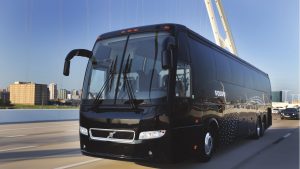 The 2019 Volvo 9700 on exhibit from Prevost during the United Motorcoach Association (UMA) Expo, January 6-10, 2019, Ft. Lauderdale, Florida, will introduce several bold new features certain to change the game and open new doors. Together with the bright and airy interior design, the debut of adjustable seat tracks, a second entry door option and factory-installed lower mirrors promises a passenger experience – and a driver’s dream – as fresh and exciting as when Prevost first introduced this coach to North American operators in 2009. It is fitting to mark the 10th anniversary of its launch with the introduction of these exciting product enhancements. The 9700 model has been manufactured in Europe as well, but the model we distribute has always been manufactured in Mexico and is engineered specifically for the North American demands and DOT regulation. That is what makes our model unique.
Adjustable seat tracks increase flexibility Catering to customers’ needs is 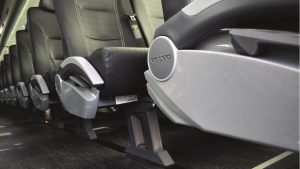 easier than ever with the installation of adjustable seat tracks for the first time in the Volvo 9700. Operators can now configure the plush and ample Amaya 800 seats to accommodate any specific number of passengers at any time. Unlike the standard 56-passenger configuration with the seats bolted in place, each seat now slides easily in its track – or can be removed entirely – to create more space and legroom.
“Rearranging the seats takes relatively little time, and is well worth the effort when you see passengers boarding the coach only to realize the cabin has been tailored precisely to the size of their group,” says Roy Furo, national sales manager, Volvo 9700. “This capability alone creates a perfect opportunity for the ultimate customer service. These new seat tracks are sure to become a strong selling point and increase revenue for operators who make use of this feature on their new Volvo 9700s.”
According to Helene Gamner, product line manager for the Volvo 9700, with every new feature or improvement, Prevost takes a closer look at where additional enhancements and upgrades may be needed. “In the case of the new seat tracks, we found we also gained an additional 10 millimeters to the gangway,” she says. “This slight adjustment is enough to ease the way for passengers passing through the cabin.”
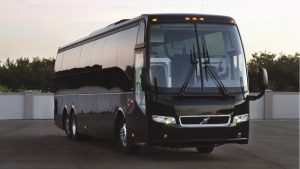 A second entry is the Tour de Force The 2019 Volvo 9700 on exhibit at UMA Expo will showcase a second entry option. The entry was placed in the mid-section to allow the passengers to board and deboard the coach with greater efficiency. “This second door is an innovative and functional enhancement that evolved from a demand from the market,” says Gamner. “Operators and their customers were asking for this feature, but maybe not anticipating it would be available.” It is now. According to Furo the mere mention of a Volvo 9700 with a second door is creating a buzz.
“It is incredibly important for us to be able to offer this option to our customers at this time,” he says. “We believe this two-door model will be a boost to scheduled service and shuttle operators, particularly in their work with large corporations that provide high-end transportation as part of the employment package.” While Prevost says it developed the two-door shuttle coach with specific operators in mind, Gamner adds that the second door also has the interest of other markets. “The call is for a more expedient coach experience,” she says. “It seems more than a few business groups are wishing for a way to move their customers on and off a coach faster.”
The two-door model also has space to house a wheelchair lift beneath the stairwell. It can be fitted during production or installed as a later upgrade. According to Prevost, this is the only two-door coach available in North America with this capability. The onboard restroom with a two-tank freshwater flush system is conveniently situated in the mid-door stairwell.
 Mirror placement is a choice The European-styled rearview mirrors mounted high on the front panel are the standout feature on the Volvo 9700. However, beginning with the 2019 model, customers may now request the lower North American–style mirrors. While the lower mirror placement was previously available only after-market, they can now be included in the production order. “Even for this North American version, we elected to keep the upper European-style mirrors standard as they are a distinct feature of the Volvo 9700 and more fuel efficient,” says Gamner. “In terms of fuel efficiency, we found the air-drag on the middle of the coach significant enough to merit the higher placement of the mirrors.”
Gamner further points out that the upper placement of mirrors on European coaches are in fact a legality, and not so much an aesthetic — and certainly something to think about. “Europe has a law that specifies the placement of the mirrors to protect passengers and pedestrians walking beside the coach,” she says. “While there is no such law in North America, we are seeing transit agencies taking it on themselves to elevate the mirrors and guard against such an accident.”
The Volvo 9700 evolves for new markets As motorcoaches gain more traction in the limousine livery sector and this niche continues to evolve, the Volvo 9700 appears to have found a new home, driven by its smooth handling, sophisticated interior and highend appointments. “To better serve this growing market, we have introduced a pure limousine treatment as an option,” says Gamner. “This edition features a more sublime, polished appearance that sends an inviting message to limousine and livery operators who may be eyeing motorcoaches.
The all-black exterior, coupled with a gray and black interior featuring leather seats and sparkled gray wood grain flooring, opens the door wider to chauffeured markets.” Considering the beginning price point of the Volvo 9700, these additional features should appear very inviting,” says Furo. “We will have this model available for demos following UMA and taking orders throughout the year.”
Gold Shield and WeDriveU are onboard Of the operators lining up for a first look, George Doyle and T.G. Doyle, owners of Gold Shield Transportation, a chauffeur transportation operation based in Lexington, Kentucky, are especially interested. Claiming to be the largest Volvo coach operator east of the Mississippi, Gold Shield runs 16 Volvo 9700s and has purchased only new model products since moving into motorcoaches in 2015.
“The change to adjustable seat slides has our attention,” says Gold Shield Chief Operations Officer T.G. Doyle. “We provide transportation for a number of sports teams, and simply being able to offer these taller athletes more legroom will mean everything to them. Being able to custom fit the coach for their trips will significantly boost our customer service.” The Volvo 9700 was new to North America when motorcoaches began trending in the limousine industry. Both the concept and the brands were not lost on Gold Shield.
“From the OEMs we could choose from, a business person such as myself always looks at the bottom line,” says Gold Shield President George Doyle. “For our first coach, the price point for the new Volvo 9700 just made sense and we were confident in Volvo manufacturing.” The Doyles say the confident relationship they enjoyed with the Prevost staff at the start has only strengthened with time.
“Our sales rep has a very good understanding of how we operate,” says George Doyle. “In situations he could not address, he has put us in touch with the correct people. Outside normal preventive maintenance, our issues have been minor and the Prevost team has always stepped up to help.” In addition, Gold Shield’s Customer Support Manager gets a special shout out. Their CSM was assigned to them before the company event took delivery of its first coach. “Our CSM stopped by, introduced himself and offered his cell phone number,” Doyle says. “When I reminded him we only had issues at night and on weekends, he said if we call he would always answer, and that’s the way it has been.”
WeDriveU, Inc., a transportation solution leader headquartered in Burlingame, California, specializes in shuttle service for employers and universities. WeDriveU provides transportation for more than six million passengers annually, utilizing a fleet of 750 assorted vehicles from SUVs to motorcoaches. Kyle Carson, vice president of fleet management, says the Volvo 9700 is a perfect fit for the long-distance commuter shuttles in regions such as the San Francisco Bay Area. “We rely on partners like Prevost to help us provide a safe, productive and comfortable ride for our passengers,” Carson says.
The WeDriveU fleet covers 20 million miles a year for employers and universities so Carson’s team focuses on matching the right vehicle strategy to each customer’s unique routes and transportation requirements. “The Volvo 9700 delivers reliability at a tremendous value and includes amenities such as workstations and leather seats for enhanced passenger comfort and productivity,” says Carson.
Carson praises the flexibility and responsiveness Prevost has shown WeDriveU. “Everyone on our Prevost team is responsive and flexible to our need for optimal uptime and safety,” he says. “We especially appreciate the maintenance network with specialized expertise in Volvo equipment.”
 Grown from a heritage of safety and quality The 2019 Volvo 9700 for North America is cultivated from distinctive corporate cultures and nationalities, and deeply rooted in Volvo safety values from when Volvo Bus Corporation and the Henlys Group, Inc. acquired Prevost Car Inc. in 1995. Volvo Bus became the sole owner of Prevost in 2004 and in 2009, entrusted the Canadian coach builder to market, promote, sell and service the very popular Volvo 9700 in the U.S. and Canada.
From its headquarters in Quebec, Montreal, Prevost oversees the manufacturing of the coach in Tultitlán, Mexico. Volvo Powertrain North America manufactures the Volvo D13 diesel engine and the I-Shift transmission at its plant in Hagerstown, Maryland. As the mutual product of these two highly respected corporations with long histories, the Volvo 9700 has come to enjoy solid brand recognition and has earned a respected reputation for safety, comfort and luxury.
See the NEW 2019 Volvo 9700 Prevost invites all coach operators and staff to its booth #2421 during UMA Expo to check out the 2019 edition with the newest options.
]]>