The post What New Projects in Noida Could Shape the City’s Next Real Estate Growth Story? appeared first on Blogs.
]]>For new projects in Noida, better connectivity improves access, employment centres support housing demand, and commercial activity creates demand for offices, retail and services. Together, these factors are reshaping Noida’s next real estate growth corridors.
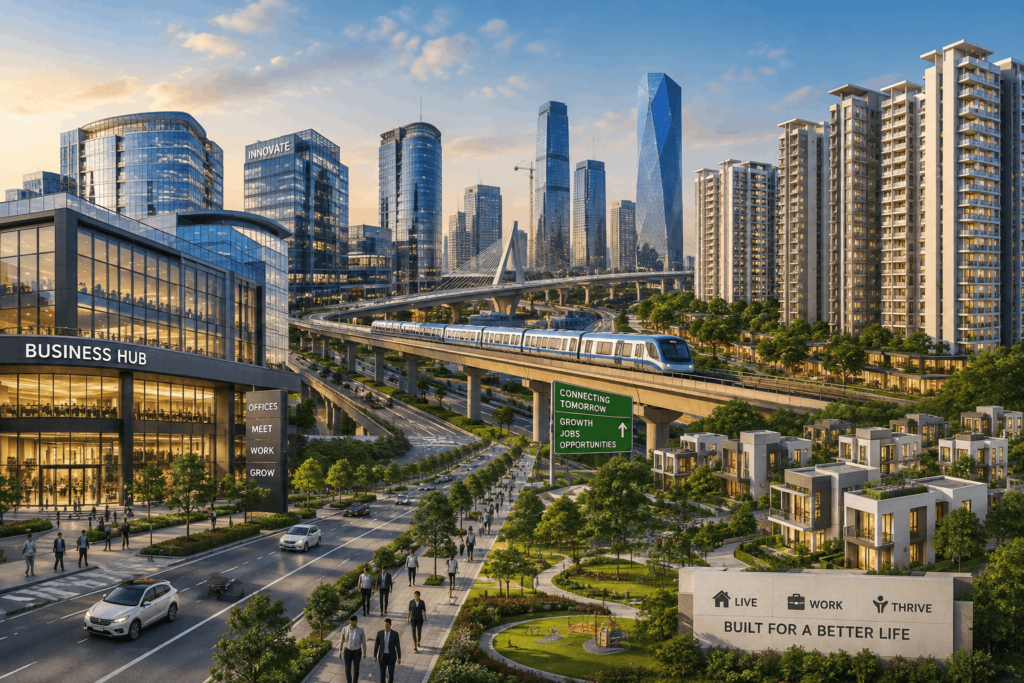
A Quick Snapshot of Noida’s Development
| Development | Key Numbers | Other Important Data |
| Yamuna Pushta Elevated Road | ₹4,000 Cr. 50 km. 8 lanes | Earlier plan: 31 km |
| Agra-Gwalior Expressway | ₹4,613 Cr. 88 km. 6 lanes | 30-month construction period. 20-year BOT |
| Noida International Airport | 500-acre medical hub | 480-acre university township. 300-acre Taiwan City |
| Airport Ecosystem | 300-acre pharma cluster | International stadium. Interstate bus terminal |
| Delhi-NCR Office Market | 3.55 MSF leasing in Q2 2026 | Noida: 30% of net office absorption |
| India Data Centres | 9,030 MW pipeline | 4.33 lakh jobs. 195 MSF housing demands by 2030 |
*Prices and market figures are indicative and can change based on project inventory, market conditions and transaction timing.
Noida’s ₹4,000 Crore Elevated Road Could Transform Connectivity
The National Highway Authority (NHA) has proposed a 4,000 crore Yamuna Pushta elevated road, which is set to strengthen connections between Noida, Greater Noida, and the Yamuna Expressway region.
The proposed corridor spans approximately 50 km, connecting Noida near Sector 94 with Greater Noida and extending towards the Noida International Airport region. The project’s real estate relevance comes from the connectivity it adds between established Noida sectors and emerging development areas. Better access can expand commuting zones and make locations more practical for residents and businesses.
For property in Noida, the corridor is significant because it connects with the rapidly developing Yamuna corridor. The elevated road will begin near the Okhla Barrage in Sector 94, run parallel to the Yamuna embankment and connect with the Yamuna Expressway, passing through Sectors 95, 125, 126, 127, 128, 129, 130, 131, 132, 133, 134 and 135.
This alignment connects corporate offices, premium residential sectors and surrounding sectors, extending its significance beyond a single road to a wider regional connectivity network.
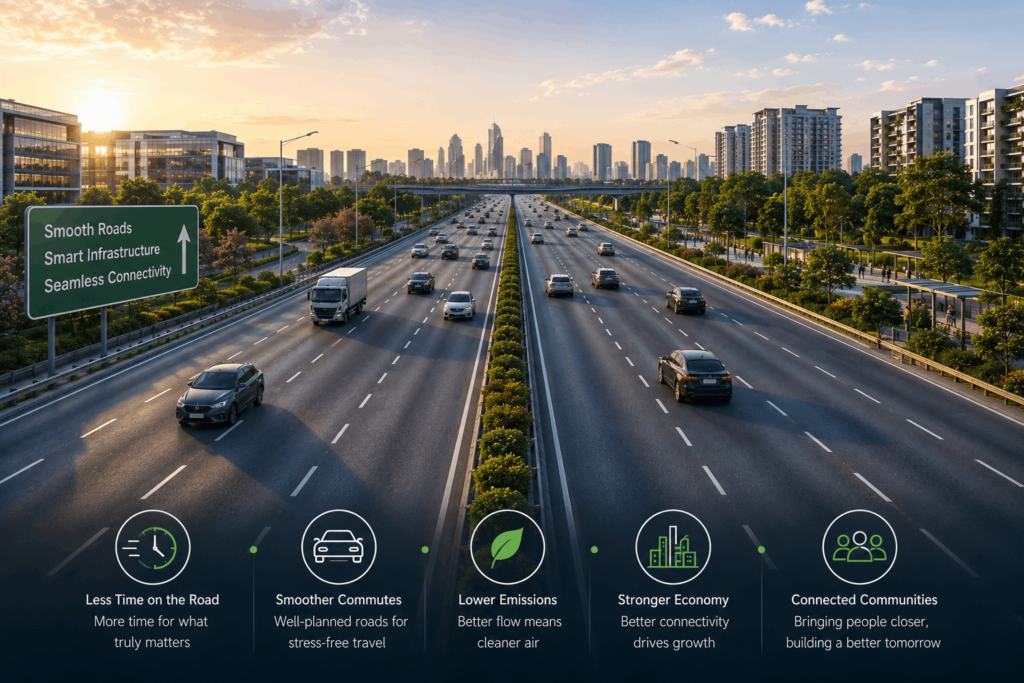
Agra-Gwalior Expressway Could Strengthen the Yamuna Expressway Network
The proposed Agra-Gwalior Greenfield Expressway is an 88-km, six-lane, access-controlled project with an estimated cost of 4,613 INR crore. It is designed to improve the connectivity between Agra and Gwalior, reducing travelling time as well.
While the project isn’t located in Noida, its relevance to this growth corridor lies in its connection with the broader Yamuna Expressway. This additional expressway linkage strengthens regional movement of people and goods, connecting Delhi NCR with major markets in Uttar Pradesh and Madhya Pradesh.
For the Noida-Yamuna corridor, this creates a stronger foundation as the area develops into a major aviation, industrial, and institutional centre.
Noida International Airport Is Creating a Larger Economic Ecosystem
Noida International Airport is becoming a catalyst for development beyond aviation, with YEIDA approvals for major projects across healthcare, education, manufacturing, sports, and transport.
Recent approvals for development across Noida International Airport include:
- 500-acre Medical Hub: Planned across Sectors 13 and 14, the hub is expected to bring super-speciality healthcare, a medical college, research facilities, diagnostics, AYUSH services, and medical tourism infrastructure.
- 480-acre University Township: This proposed project in Sector 14 will expand higher-education infrastructure and create an ecosystem around students, faculty, and education-related services
- 300-acre Taiwan City: YEIDA has reserved land in Sector 6 for Taiwanese companies and investors in electronics, technology, and manufacturing.
- 100-125 Acre Pharmaceutical Manufacturing Cluster: Also planned in Sector 6, the cluster will focus on pharmaceutical formulation manufacturing, including tablets, capsules, injectables, oral liquids, and other finished medicines.
- 50-Acre International Stadium: Planned in sector 23D, this modern international-standard stadium is expected to host national and international matches and provide better training and competition facilities.
- Interstate Bus Terminal: Land in sector 23C has been reserved for an interstate bus terminal to meet rising transport demand around the airport.
These developments create diverse employment across healthcare, education, manufacturing, technology, electronics, pharmaceuticals, logistics, and support services.
These new projects in Noida drives real estate demand. Workers need homes, businesses need commercial space, and growing communities need retail, healthcare, and education.
The airport is therefore more than an air connectivity project. It is emerging as an anchor for a new economic zone.
Office Growth Could Drive Future Property Demand
Delhi NCR recorded 3.55 million sq. ft of gross office leasing in Q2 2026, with Noida accounting for 30% of the region’s net office absorption. Noida Expressway was among the active office locations. These growing businesses have a multiplier effect on a wider local ecosystem, increasing demand for homes, mobility, dining, healthcare, and everyday services.
The corridor combines office activity, residential development, and improving regional connectivity. As these components develop together, commercial and residential markets can reinforce each other.
Stronger connectivity makes the region more accessible for businesses, which encourages job creation and attracts residents. As the population grows, demand for homes, retail, services and new businesses rises with it.
Data Centres Could Create a New Housing Demand Cycle
India’s data-centre expansion is creating demand across a wider employment ecosystem. A Square Yards report estimates that India’s data-centre pipeline could generate approximately 4.33 lakh ecosystem jobs by 2030 and around 195 million sq. ft. of housing demand across India.
Uttar Pradesh alone is expected to account for approximately 22.7 million sq. ft. of residential activity, highlighting the potential housing impact of the state’s growing data-centre ecosystem.
As technology infrastructure expands, these facilities require engineers, technicians, security personnel, construction workers, maintenance teams, and specialists in power, cooling and telecommunication. And they all require housing and everyday services within commuting distances, thus paving the way for supporting employment outside the facilities.
The broader effect is a more diversified employment base supporting demand, increasing prices, and growth potential for Noida’s residential and commercial real estate.
FAQs About New Projects in Noida
- What are the major new projects coming up in Noida?
Key developments include the proposed 50-km Yamuna Pushta elevated road and improved connectivity towards Jewar, Noida International Airport, and surrounding medical, university, manufacturing, and pharmaceutical projects. Office and digital infrastructure expansions are also shaping the region.
- How will the new elevated road affect Noida property?
The proposed elevated road will strengthen connectivity between Noida, Greater Noida, and the Yamuna Expressway region. Its significance for real estate comes from improving access between established markets and emerging development areas.
- How is Noida International Airport driving development around Noida?
The airport is attracting healthcare, education, manufacturing, pharmaceutical, sports, and transport projects. These developments create employment and support business activity, strengthening demand for housing and commercial services.
- Is commercial property in Noida likely to benefit from office expansion?
Noida accounted for 30% of Delhi NCR’s net office absorption in Q2 2026. Continued office activity supports demand for commercial spaces and the residential and service ecosystems around employment centres.
- How could data centres impact housing demand in Noida?
Data centres generate demand through direct and supporting employment. The state recorded 46,049 new housing units in H1 2026, up 31% year-on-year, while approximately 22.7 million sq. ft. of residential activity is expected.
Conclusion
Noida’s next real estate cycle is being driven by a shift in where jobs, businesses, and infrastructure are converging. As the region develops and commercial activity expands, growing business and technology hubs are driving property demand outward along the Noida-Greater Noida Expressway and into emerging growth corridors.
This is why new residential and commercial projects are being launched, such as ACE Arte in Sector 150, a luxury 3 & 4 BHK residential development with landscaped surroundings and a signature clubhouse, reflecting the growing demand for premium housing in areas where connectivity, employment, and large-scale infrastructure are converging.
On the other hand, ACE 153, located in Sector 153, features Grade A offices and premium retail spaces, strengthening the commercial infrastructure along the same corridor. Together, these developments reflect the direction of Noida’s next property cycle. As infrastructure and employment move into emerging corridors, residential and commercial development naturally follows.
ACE ARTE – RERA REG NO. UPRERAPRJ528653/07/2026 | www.up-rera.in/projects
ACE 153 – RERA REG NO. UPRERAPRJ423807 | www.up-rera.in/projects
The post What New Projects in Noida Could Shape the City’s Next Real Estate Growth Story? appeared first on Blogs.
]]>The post How to Make Apartments in Noida Extension Feel More Spacious appeared first on Blogs.
]]>Greater Noida is emerging as one of the fastest-selling residential markets in Delhi-NCR, attracting investors and end users seeking premium and luxury housing. When evaluating apartments in Noida Extension, buyers often focus on carpet area and room dimensions. These numbers matter, but they are only part of the big picture. Layout, natural light, colours, interiors, storage, and the visual connection between spaces can all influence how large a home feels.
When aligned well, all these elements can make an apartment feel brighter, spacious, and open without adding even a single square foot.
What Makes an Apartment Feel More Spacious?
An apartment feels more spacious when it has good natural light, an efficient layout, minimal visual clutter, smart storage and furniture that suits the available space.
When evaluating an apartment, look for:
- Open visual sightlines
- Natural light and ventilation
- Proportionate furniture
- Consistent colours
- Functional storage
- Clear movement
A slightly smaller apartment with a well-designed living room, practical bedrooms and furnishing could be easier to live in than a larger apartment with cluttered interiors and furniture. This is why buyers considering property in Noida Extension should spend time understanding the actual floor plan rather than rely solely on the stated apartment size or a furnished sample unit.
Read More: Document Checklist to Buy a Flat in Noida Extension

7 Ways to Make Apartments in Noida Extension Feel More Spacious
1. Maximise Natural Light and Ventilation
Natural light is one of the simplest ways to make an apartment feel bigger. A room with lots of daylight looks brighter, deeper, and less cramped than a dimly lit room of the same size.
- Keep windows as unobstructed as possible.
- Opt for light or sheer curtains
- Try reflective surfaces to distribute light
When looking for apartments in Noida Extension, look at the size, orientation and position of the window instead of their number.
2. Choose a Light, Cohesive Colour Palette
Colour can alter the appearance of a room without altering its size.
- Choose whites, creams, warm neutrals and soft earthy tones
- Small shifts in neutrals can give a room character
- Too much colour blocking can break up a smaller space
- Use a similar palette so the eye moves naturally from one space to another
The idea is not to leave the flat looking empty. It’s to have enough visual continuity that the space you do have feels connected.
3. Select Scale-Appropriate Furniture
One of the most common mistakes in the interiors of apartments is the selection of furniture by preference, not by proportion.
- Select furniture according to room size
- Keep your bedroom decor simple
- Smaller profile sofas with raised legs have less visual bulk
- Choose multifunctional furniture with built-in storage.
- Use nesting tables, folding dining sets and sofa beds.
A large sectional sofa may look amazing in a showroom but overbearing in a small living room. Likewise, a dining table that is too large can limit movement and make a typically comfortable space feel cramped.
4. Use Mirrors and Reflective Surfaces Strategically
Mirrors can create the impression of greater depth by reflecting light and extending the visual field.
- Place opposite or near a window to reflect natural light
- Use mirrors to reflect an attractive view or another well-designed part
- Use one or two strategically positioned pieces
Covering every available wall with reflective surfaces can make the room feel visually busy. The goal is to extend the room visually while keeping the overall design balanced.
5. Create Smarter Storage
Clutter can make even a well-sized apartment look crowded and smaller than it actually is. So, to efficiently use the space, you should create concealed storage pockets within the architecture of the apartment, such as
- Beds with built-in drawers
- Tables or sofas with cabinets
- Wall-mounted TV and media units
- Multipurpose furniture
When countertops, dining tables, and floors remain clear, the apartment instantly looks bigger and spacious.
6. Keep Flooring and Design Elements Visually Continuous
Too many visual breaks can make an apartment feel like a collection of small spaces rather than one cohesive home.
- Using similar flooring across connected areas
- Keep wall colours, finishes and materials consistent.
- Add statement furniture, lighting and accessories for character
The aim is not to make every room look identical but maintain an overall sense of continuity.
7. Make Balconies Part of the Living Experience
Your balcony is more than just a bit of extra outdoor space. When you put a little thought into the design, it can feel like a natural, cosy extension of your living room.
- Add compact chairs, a small table, or a slim bench.
- Use a few well-placed plants for greenery.
- Keep the balcony open and uncluttered.
When you’re looking at properties, try to look past the square footage. It’s all about how the space fits into your day-to-day life, not just how it looks on a brochure.

What Should You Look for When You Buy a Flat in Noida Extension?
If you’re planning to buy a flat in Noida Extension, look beyond the total square footage when assessing how spacious a home will feel.
| Factors | Impact |
| Carpet Area vs. Super Built-Up Area | When comparing apartments, check the carpet area rather than relying on the quoted super built-up area. The carpet area gives you a clearer idea of the space you can actually use inside a flat |
| Efficient Floor Plan | Look for a floor plan that efficiently uses the available space. Fewer unnecessary passages, awkward corners, and poorly positioned doors can leave more usable room for furniture, movement, and everyday activities. |
| Window Placement and Natural Light | Check the position and size of windows in each room. Good natural light can make interiors feel brighter, more open, and welcoming, while also reducing the need for artificial lighting during the day. |
| Balcony Size and Usability | Calculate whether the balcony offers enough depth for comfortable use. Its privacy, accessibility, and orientation can also affect how enjoyable the space feels for relaxing, entertaining, or simply getting some fresh air. |
| Storage Provision | Look for adequate wardrobe space, utility areas, and built-in storage. Well-planned storage helps keep everyday belongings organised, allowing you to maintain a cleaner and more spacious-looking home. |
| Room Dimensions | Consider the dimensions of individual rooms instead of focusing only on the total apartment size. Each room should have enough space for essential furniture while still leaving comfortable areas for movement. |
| Ceiling Height | It can influence how open a room feels. Higher ceilings may add visual volume, although the overall sense of spaciousness also depends on the room’s proportion, windows, and interior design. |
| Privacy and Visual Connectivity | An open layout can make an apartment feel larger, but private spaces should still have enough separation. Consider how the bedrooms, bathrooms, and living areas connect without compromising comfort or privacy. |
| Your Lifestyle Requirements | Think about how you plan to use your home. If you need a study, entertaining area or extra storage, choose a layout that supports those needs rather than simply opting for the largest apartment. |
Read More: 10 Questions to Ask Before Buying a Flat in Greater Noida
Can Interior Design Make a Smaller Apartment Feel Like a Larger Home?
Yes. Interior design cannot increase the actual carpet area, but it can significantly improve how spacious and functional a home feels.
Visual continuity, decluttering, appropriately sized furniture, effective lighting, mirrors, vertical storage and multifunctional spaces can all improve the perception and usability of an apartment.
However, interior design has limits. A clever layout cannot compensate for fundamentally poor room proportions, inadequate natural light or insufficient storage.
That is why spaciousness should be considered before you buy, not only after you move in. The right apartment gives your interior choices a stronger foundation.
FAQs About Apartments in Noida Extension
How can I make my apartment feel bigger?
Use natural light, lighter colours, proportionate furniture, strategic mirrors, vertical storage and consistent flooring. Keeping everyday surfaces and walkways free from clutter can also make a significant difference.
Which colours make an apartment look more spacious?
Light shades such as white, cream, warm neutrals and soft earthy tones can reflect light and create a more open appearance. Using related colours across connected spaces can also improve visual continuity.
Does natural light make a home look bigger?
Yes. Natural light can make rooms appear brighter and create greater visual depth. Unobstructed windows, sheer curtains and reflective surfaces can help distribute daylight throughout the space.
Does built-in storage make sense in smaller apartments?
Built-in storage can be useful because it can be designed around the apartment’s dimensions and use vertical space efficiently. Floor-to-ceiling wardrobes and concealed cabinets can also reduce visible clutter.
What should I check when choosing property in Noida Extension?
Look beyond the quoted apartment size. Check the carpet area, floor plan, room dimensions, window placement, natural light, ventilation, balcony usability, storage, circulation and how well the layout suits your lifestyle.
Conclusion
A home should not feel restrictive once you start living in it. The best apartment gives you enough flexibility to adapt as your needs change, whether that means creating a work-from-home corner, making room for growing children, or simply having space to unwind at the end of the day.
But layout and interiors are only one part of the decision. Factors such as location, connectivity, amenities, construction quality and the overall neighbourhood can also influence how well a flat in Noida works for long-term living.
For instance, ACE Han’ei in Sector 12, Greater Noida West, combines expansive decks and wrap-around balconies with thoughtfully planned lifestyle spaces. These features enhance the spaciousness of the unit while meeting the practical requirements of everyday living.
When you compare apartments in Noida Extension, think beyond how the home looks during a property visit. Picture your everyday life inside it. If the space feels comfortable, functional and easy to adapt to today, it is more likely to continue feeling like home tomorrow.
ACE HAN’EI – RERA REG NO. UPRERAPRJ677887/10/2024 | www.up-rera.in/projects
The post How to Make Apartments in Noida Extension Feel More Spacious appeared first on Blogs.
]]>The post What Makes a Flat in Noida Perfect for Long-Term Living? appeared first on Blogs.
]]>You should consider the layout of the apartment, the neighbourhood, the amenities available, and its connectivity with the city and other parts of the region. Most of the new buyers look for a home that’s near to their workplace.
That’s why when exploring flats for sale in Noida, look for one that supports your changing lifestyle needs. A growing family needs spacious apartments that have enough rooms to accommodate children, grandparents, and work-from-home setups.
Thoughtfully planned communities are enriched with amenities, well-connected roads, and infrastructure designed for futuristic opportunities and long-term living.
Why Thoughtfully Planned Residential Projects Matter for Long-Term Living
In the modern real estate market, the value of property is not measured by its size or price but by the lifestyle it offers. From architectural details to project features such as swimming pools, landscaped gardens, and other facilities.
When choosing a residential community for the long term, you should consider a few of these factors:
- Functional layout that includes practical room planning, efficient use of space, and flexibility to make everyday living easier.
- Lifestyle amenities such as fitness centres, sports facilities, and clubhouses that support recreational and wellness activities.
- Quality construction ensures durable materials, reliable workmanship, and finishes that guarantee long-term comfort and low maintenance.
- Strategic location gives you access to all important parts of the city and regional connectivity for low transit time.
- Well-planned communities offer a balance of privacy, amenities, green spaces, security, and everyday conveniences.
- Safety and security with controlled access, surveillance, and security measures that help residents feel safe at home.
- Maintenance and facility management that keep common areas, amenities, landscaping, and essential services well maintained over time.
Together, these elements make a residential project more valuable and a better place to call home. A thoughtfully planned community can support you through different stages of life, from independent living and marriage to raising a family and enjoying a comfortable retirement.
Also Read: Guide to Buying Property in Noida
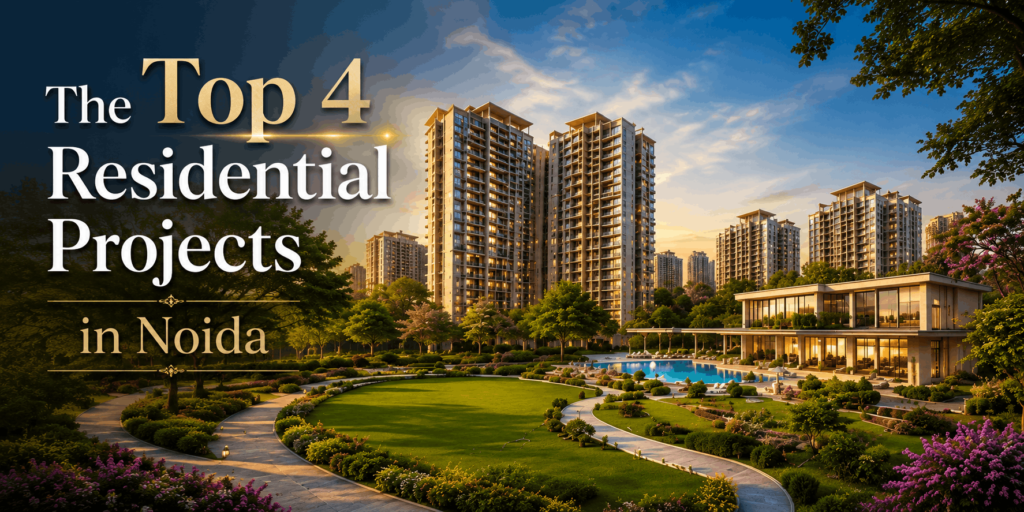
ACE HAN’EI: Creating a Premium Living Experience in Greater Noida West
ACE Han’ei is a premium residential project in Sector 12, Greater Noida West. It is designed for buyers who seek spacious homes and an exceptional urban lifestyle. The project features 3 and 4 BHK homes with contemporary architecture, landscaped environs, and lifestyle-orientated amenities.
Its spacious floor plans provide room for a growing family, a place for a home office or just to make everyday life more comfortable. ACE Han’ei offers recreational amenities, wellness areas and community spaces that extend the residential experience beyond the apartment and create an environment designed to support families in various stages of life.
ACE VERDE: Combining Modern Residences With Expressway Connectivity
Located along the Yamuna Expressway, ACE Verde combines modern residences with the advantages of a growing infrastructure corridor. The project offers studio apartments and spacious 3 and 3.5 BHK residences within a planned township environment.
Its neoclassical architecture, landscaped surroundings, and two clubhouses create a residential setting focused on comfort and community. The project’s location also places residents within an evolving infrastructure ecosystem shaped by the Noida International Airport, industrial development, and planned commercial activity. For long-term buyers, this combination of modern living and expressway connectivity can make the location as important as the home itself.
ACE TERRA: Offering Spacious Homes Designed Around Family Needs
ACE Terra offers spacious 3 and 4 BHK residences designed for families who value more room and greater flexibility. Located along the Yamuna Expressway, the project features expansive decks and thoughtfully planned living spaces that can support changing family requirements, work-from-home needs, and everyday comfort.
Contemporary architecture, landscaped green spaces, water features, and lifestyle amenities create a premium residential environment beyond the apartment. Club Spade adds dedicated spaces for recreation and social interaction, allowing residents to enjoy a wider range of experiences within the community.
ACE STARLIT: Bringing Designer Residences for Contemporary Lifestyles
ACE Starlit is a completed residential project in Sector 152, Noida. It is a mix of modern architecture, premium interiors and smart planning. The project offers spacious 2- and 3-BHK homes with Italian marble flooring, modular kitchens, fitted wardrobes and modern layouts.
Low-density planning, three-side-open residences and glass-façade towers provide a more open residential environment with greater access to natural light, ventilation and privacy. Lifestyle-centric spaces and a retail hub further add to the everyday convenience, and the proximity to Sector 148 Metro Station ensures seamless connectivity across Noida and the broader NCR region.

Understanding Value Beyond Noida Flat Price
Knowing about Noida’s flat price is important when considering buying a home, but price alone doesn’t determine its long-term value. Two flats within the same price range can offer very different living experiences, levels of exclusivity, and future potential.
If you’re buying a home in Noida and want to make a value-driven investment, here are a few factors to consider:
- Location and road infrastructure
- Developer’s prestige
- Architecture and interiors
- Surrounding developments
- Future growth opportunities
- Maintenance cost
This is why it is not always the cheapest flat that delivers the best value. Look for a home that is well-designed, situated in a progressive location, delivers comfort and stays attractive for future buyers.
Also Read: Why Some Areas in Noida Deliver Higher Returns
Finding a Home Designed for the Future
The right home should not just meet your current needs but also adapt to your future lifestyle and growth. Look beyond the apartment size and evaluate the location, project planning, and surrounding community development to ensure it understands its long-term value and potential for appreciation.
When exploring flats for sale in Noida, compare the design, road connectivity, amenities, and long-term sustainability of each project. These factors do more than just enhance comfort and convenience. They can also contribute to a secure and value-driven investment.
In Noida, ACE Group has developed several notable projects that reflect the evolving expectations of modern homebuyers. From spacious residences, contemporary architecture, lifestyle-focused amenities and strategically selected locations, its developments are designed to support elevated living and long-term property value.
FAQs
What makes flats for sale in Noida suitable for long-term living?
A flat can be a good option for long-term living only when it offers spacious layouts, useful amenities, good connectivity and access to schools, healthcare and shopping. These factors support changing lifestyle and enhance the quality of the residential community.
What should buyers consider before they buy a flat in Noida?
Buyers should assess the project beyond the brochures and sample apartment. Check the developer’s delivery record, RERA details, construction status, maintenance costs, and other legal standings. They should even pay a site visit to analyse the neighbourhood, community projects, and supporting infrastructure.
How does location impact the long-term value of a flat in Noida?
Upcoming developments, commercial activities, employment opportunities, and planned urban projects can affect the demand and the price of the flat in Noida. Therefore, you should evaluate the current advantages and long-term growth potential of your property location.
Does Noida’s flat price depend on amenities and connectivity?
The short answer is yes. But the Noida flat price also depends on other factors such as project density, construction quality, apartment orientation, and overall demand of the area. Amenities and connectivity also add value, but they should be assessed alongside the complete offering of the neighbourhood.
Why are premium residential projects preferred for long-term living?
Premium residential properties tend to offer long-term appeal because of the project standards, developer’s reputation, high-class amenities, built-in features, security, and a refined living experience. Usually these projects feature swimming pools, gyms, leisure and entertainment pockets, kids’ play areas, smart security and other exclusive features you won’t find in older developments.
ACE VERDE – RERA REG NO. UPRERAPRJ913692/03/2025 | www.up-rera.in/projects
ACE HAN’EI – RERA REG NO. UPRERAPRJ677887/10/2024 | www.up-rera.in/projects
ACE TERRA – RERA REG NO. UPRERAPRJ683816/04/2024 | www.up-rera.in/projects
ACE STARLIT – RERA REG NO. UPRERAPRJ677294 | www.up-rera.in/projects
The post What Makes a Flat in Noida Perfect for Long-Term Living? appeared first on Blogs.
]]>The post Which Upcoming Developments Can Increase the Value of Plots in Yamuna Expressway? appeared first on Blogs.
]]>While the corridor was once viewed as a long-term investment destination, buyers are now considering the employment opportunities and residential communities that may develop around these projects.
The upcoming YEIDA Film City, industrial parks, technology infrastructure, connectivity and planned urban development could create new business opportunities and employment zones while increasing demand for housing and everyday services. For buyers considering Yamuna Expressway residential plots, the important question is how these developments may impact future residential property demand and value.
Why Upcoming Developments Matter for the Future Value of Plots in the Yamuna Expressway
Infrastructure can improve access to a location, but economic activity gives people a reason to stay. When new businesses enter an emerging regional location, they can create employment opportunities. Employment attracts workers, supporting demand for housing and everyday services. Over time, this can contribute to stronger property demand.
The relationship often develops in stages:
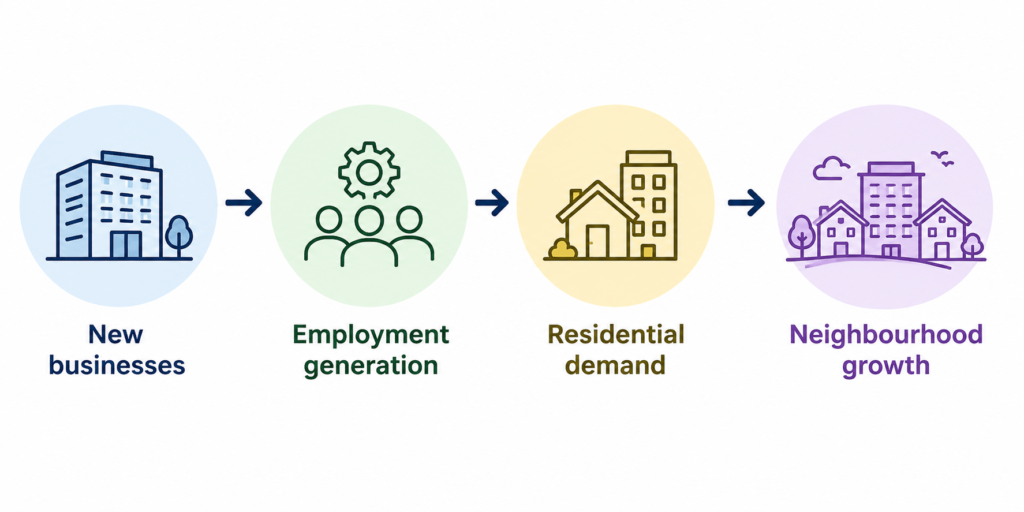
The overall effect of these developments will become more apparent in the coming days, but their impact on investor sentiment for Yamuna Expressway property is already becoming evident. The region is slowly transforming itself into a well-planned urban destination with planned industrial zones, developing infrastructure, and robust expressway connectivity.
However, as these changes take place, social infrastructure, employment opportunities and other businesses may be needed in addition to expectations for future gains on residential plots.
YEIDA Film City in Sector 21 Creating a New Entertainment and Business Hub
The upcoming International Film City in YEIDA’s Sector 21 is expected to become one of the region’s most prominent entertainment-led developments. The project is being developed through a public-private partnership and is planned to include film production infrastructure, a film institute, and supporting facilities.
Future projects may also include hospitality, retail, entertainment, and other commercial components. A film city requires much more than studios. It can create opportunities for production companies, media professionals, technicians, artists, training institutions, event businesses, hospitality providers, and supporting service industries.
This type of ecosystem may influence nearby residential demand in several ways:
- Professionals may prefer homes closer to their workplaces
- Production and media businesses may create demand for rental accommodation
- Hotels, restaurants, retail outlets, and service providers may expand around the development
- New commercial activity may encourage the growth of supporting neighbourhoods
For buyers considering Yamuna Expressway residential plots, the long-term opportunity lies in the wider ecosystem that may develop around the Film City, not only the project itself. As employment and commercial activity increase, planned residential communities may become more relevant to people seeking homes near emerging business zones.
YEIDA Master Plan 2041: Transforming Yamuna Expressway Into a Planned Urban Destination
The future of the Yamuna Expressway is not based on a single project. The region is being developed through a wider planning framework that includes residential areas, commercial zones, industrial sectors, transport networks, public facilities, and green infrastructure.
This approach is important because isolated development can create uneven growth. A planned urban framework can help organise land use and provide room for residential communities, businesses, employment zones, and social infrastructure to develop together.
The broader development strategy focuses on:
- Residential and mixed-use zones
- Commercial and institutional development
- Industrial and manufacturing sectors
- Improved road and infrastructure networks
- Green and environmentally conscious urban planning
For long-term investors, planned development can offer greater visibility into how a region may evolve. It also allows infrastructure and public services to expand alongside new residential and commercial activity.
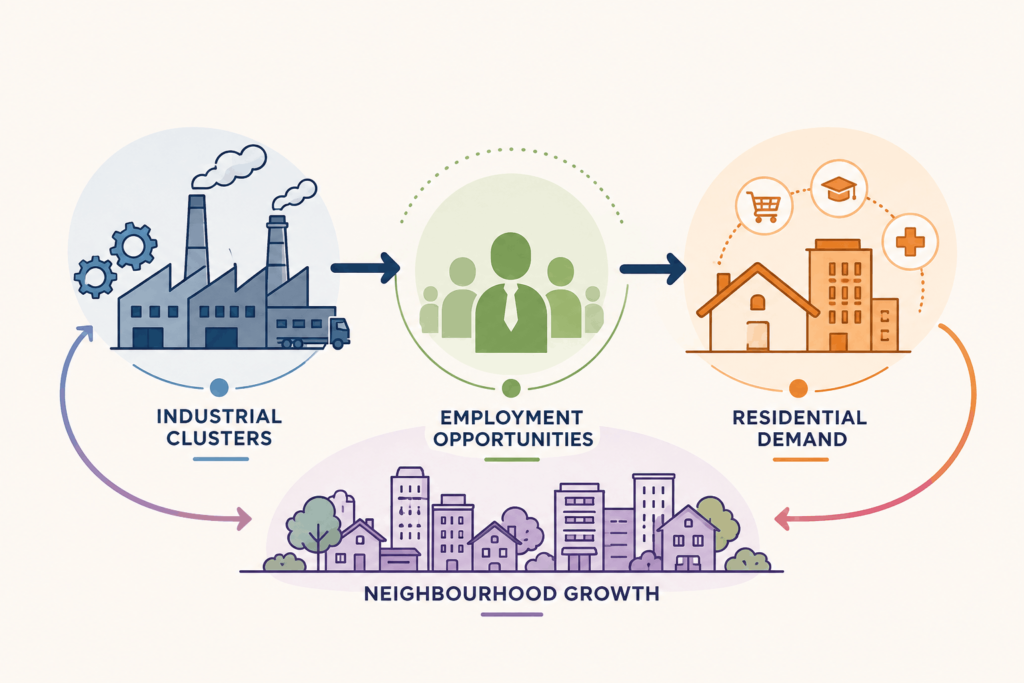
Industrial Clusters Creating Employment Opportunities and Residential Demand
The Yamuna Expressway region is developing a diverse industrial base rather than relying on one sector. Government-backed projects such as the Toy Park, Apparel Park, Handicraft Park, and other manufacturing clusters are intended to support specialised businesses and create employment opportunities.
| Development | Focus Area | Potential Economic Impact |
| Toy Park | Toy manufacturing and related businesses | May support suppliers, logistics companies, packaging services, maintenance providers, and other allied industries, increasing economic activity across the region. |
| Apparel Park | Textile, garment, and apparel industries | Can create employment across production, design, quality control, logistics, and support services. Growing business activity may also increase demand for housing and everyday facilities. |
| Handicraft Park | Artisan-led manufacturing and traditional industries | Planned to include workshops, production units, and outlets, creating opportunities for artisans and related businesses while supporting employment growth. |
| MSME and Manufacturing Clusters | Small and medium enterprises across multiple industries | Can generate local employment and support a broader business ecosystem by encouraging growth across different industries and services. |
As industrial and business activities expand along the corridor, it can create employment opportunities and increase demand for nearby residential clusters, rental accommodations, retail, schools, healthcare facilities, and other daily conveniences.
For buyers considering plots in the Yamuna Expressway, this could support sustained housing demand in liveable neighbourhoods.
AI Data Centre Hub Development: Adding a Technology Advantage to Yamuna Expressway
The Yamuna Expressway is also emerging as a location for digital infrastructure. YEIDA has established a framework for data centre parks and has also been working to attract technology-focused investments to the region.
In February 2026, an agreement was announced for a proposed 1GW AI and high-performance computing hub in the Yamuna City region. The proposed development involves land allocations across YEIDA sectors and is expected to support large-scale digital infrastructure.
While data centres do not create the same type of workforce as large manufacturing units, they still can attract specialised professionals, tech engineers, cloud services businesses, and other supporting industries.
For residential buyers, the significance lies in the diversification of the local economy. Over time, higher-value employment may support demand for well-planned residential communities that offer better infrastructure, green spaces, security, and other lifestyle facilities.
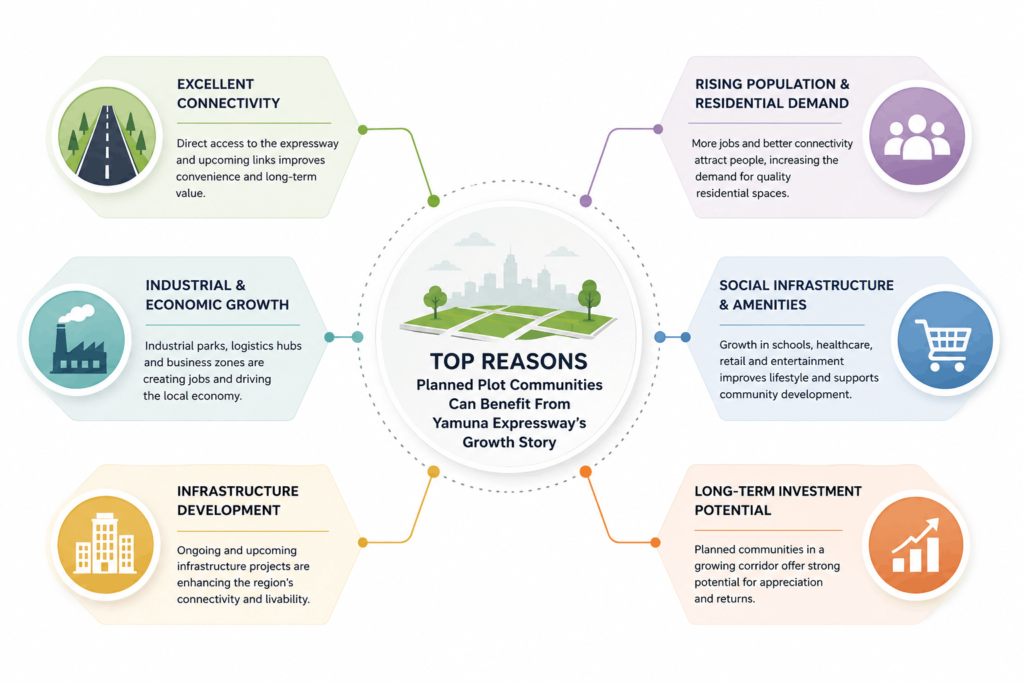
Why Planned Plot Communities Can Benefit From Yamuna Expressway’s Growth Story
As Yamuna Expressway develops, buyers may look beyond location and price to evaluate planning, infrastructure, developer credibility, and future neighbourhood growth.
Planned-plotted communities offer a more organised alternative to standalone land parcels. For example, ACE Estate features landscaped spaces, modern infrastructure, community amenities, and the Blue Trail water body. Meanwhile, ACE Acreville is a 100-acre gated township with green avenues, water features, and lifestyle spaces.
When evaluating Yamuna Expressway residential plots, buyers should consider:
- Access to major growth zones
- Developer credibility and project approvals
- Community planning and infrastructure
- Long-term residential potential
As economic activity expands, well-planned communities may become more relevant to buyers looking to build homes within an established neighbourhood.
Frequently Asked Questions About Plots in Yamuna Expressway
Which upcoming developments can increase the value of plots in the Yamuna Expressway?
YIEDA Film City, industrial parks, and data centres can boost the value of plots in Yamuna Expressway. However, their impact depends on project completion, employment growth, and surrounding neighbourhoods.
Why are investors interested in Yamuna Expressway residential plots?
Investors are attracted by regional connectivity, upcoming infrastructure, industrial growth, and long-term development potential. Buying plots in this expanding corridor gives flexibility for future construction and land ownership.
How will YEIDA Film City impact property in the Yamuna Expressway?
It will attract media production and other supporting industries such as hospitality, advertising, and tech professionals. In turn, it can boost demand for nearby residential and commercial properties.
Are plots in the Yamuna Expressway suitable for long-term investment?
Plots in the Yamuna Expressway are ideal for long-term investors, as it is still an emerging community with escalating growth potential. When choosing an investment property, check approvals, RERA details, registration, and legal documentation for a safe and secure purchase.
What should buyers check before investing in plots in the Yamuna Expressway?
When buying a property in an emerging market, buyers should focus on project location, road access, infrastructure, surrounding developments, and land ownership documents.
Explore Future-Ready Plot Opportunities in the Yamuna Expressway
The growth of the Yamuna Expressway is not dependent on a single project. Developments across entertainment, manufacturing, technology, aviation, and planned urban infrastructure are creating multiple economic growth drivers along the corridor.
As these sectors expand, they increase the employment rate and strengthen the demand for residential communities. Housing schemes that offer organised planning, infrastructure, and developer credibility stay attractive for decades. This is how investors and buyers can benefit from well-positioned projects designed for long-term growth.
If you’re exploring plots in the Yamuna Expressway for investment, planned-plotted communities such as ACE Estate and ACE Acreville offer a structured residential environment with community amenities, social infrastructure, and thoughtfully planned neighbourhoods that support the region’s ongoing development.
ACE ACREVILLE – RERA REG NO. UPRERAPRJ248777/03/2025 | www.up-rera.in/projects
ACE ESTATE – RERA REG NO. UPRERAPRJ442226/10/2024 | www.up-rera.in/projects
The post Which Upcoming Developments Can Increase the Value of Plots in Yamuna Expressway? appeared first on Blogs.
]]>The post 10 Questions to Ask Before Buying Flats in Greater Noida West appeared first on Blogs.
]]>But buying a home is about more than finding a good price or choosing the biggest apartment within your budget. You also need to consider how the location, apartment, and residential community will fit into your life over the next few years.
Before investing in flats in Greater Noida West, take the time to look beyond the brochure. Ask how practical the home is, what the neighbourhood may look like in the future, and whether the project can support your changing needs. If you’re looking for a property in Noida Extension, these questions will help you make a more informed decision.
What Kind of Lifestyle Does This Location Support Five Years From Now?
When evaluating a location, look at both existing amenities and future development. Greater Noida West already has schools, healthcare facilities, and retail destinations.
The proposed metro corridor from Sector 61 to the Greater Noida West and the Char Murti underpass aim to improve traffic movement across the area. Together, these developments may strengthen everyday convenience and long-term property demand.
The location offers convenient access to major employment hubs, including Sector 62, Greater Noida Knowledge Park, and the Noida-Greater Noida Expressway business corridor. This reduces daily commute times, supports a better work-life balance, and makes the area more attractive for working professionals.
Is the Apartment Layout Designed for Real-Life Living?
A spacious apartment is not always a practical choice. Look at how the rooms connect, where furniture can be placed, and whether the available space can be used comfortably.
Natural light and ventilation also make a noticeable difference to everyday living. Check whether the bedrooms offer privacy, whether the kitchen is functional, and whether balconies are large enough to be used. A well-planned layout can make a home feel comfortable long after the excitement of moving in has passed.
You should also think about how you’ll use the space a few years from now. If you work from home or plan to do it in the future, check whether there’s enough room for a dedicated workspace.
Also notice the practical details. Is there enough storage for the things you use every day? Is there a separate utility area for laundry? Good cross-ventilation can also make the home feel cooler, brighter, and more comfortable throughout the year.
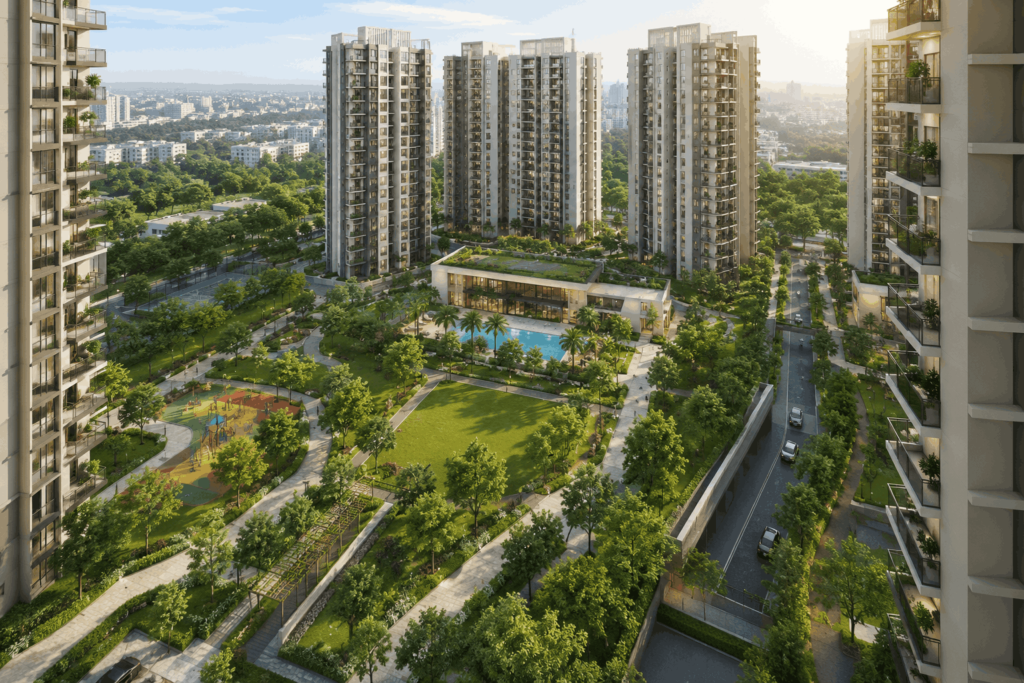
What Is the Density of the Residential Community?
The number of towers and apartments within a project can affect how the community feels once residents move in. A densely planned development may experience more activity around lifts, parking areas, entrances, and shared facilities.
Look at tower placement, open spaces, and the number of homes sharing common amenities. A well-planned community should balance residential density with enough room for movement, privacy, and recreation. This can have a major impact on your experience of living there.
How Will Daily Life Be During Peak Hours?
A short site visit may not show what the project feels like during busy hours. If possible, visit during morning and evening peak hours to see how smoothly vehicles move through the main gate, whether parking is easy to access, and if lifts can easily handle resident traffic.
While you’re there, check if the visitor parking is adequate and whether ambulance or fire engines can enter the community without obstruction. A visit after a heavy rainfall can also reveal how well the project manages drainage, waterlogging, and road access. These everyday details can have a greater impact on your living experience than the apartment itself.
Does the Project Offer Enough Privacy and Personal Space?
Privacy is not only about the size of your apartment. It also depends on how towers, balconies, and windows are positioned.
Check the distance between buildings and whether neighbouring apartments directly overlook each other. Consider possible noise from roads, common areas, or nearby towers. Good planning can provide more natural light and ventilation while giving residents enough personal space to feel comfortable in their homes.
What Kind of Community Will You Become Part of?
When you buy a home, you also become part of a residential community. Think about the people who may live there – would it be families, working professionals, or retirees? And whether it offers spaces where residents can interact.
Parks, clubhouses, children’s play areas, and multipurpose spaces can encourage residents to spend time together while community events and festive celebrations help create a stronger sense of belonging. Although every community culture develops naturally over time, thoughtful planning can make everyday living more connected, engaging, and enjoyable.
How Well Does the Project Balance Green Spaces and Urban Living?
For urban buyers, green spaces, parks, and entertainment spots are important. In developing communities, you should ensure that the planned areas in the master plan are implemented and usable in everyday life.
Look for walking paths, landscaped areas, outdoor seating, play zones, and open spaces that residents can use regularly. At ACE Han’ei, expansive green landscapes are combined with features such as an exclusive cycling track, yoga, Pilates, and other lifestyle amenities. This creates a balanced residential environment where residents can enjoy open spaces without moving away from urban conveniences.
Will the Home Remain Valuable as Your Needs Change?
When buying a home, ensure that it meets your future needs and lifestyle. Your family may grow or your priorities may change. It is equally important to choose a developer with a strong track record of delivering quality projects and maintaining them after possession.
Before you buy a flat in Noida Extension, also assess the project’s resale value and rental potential. A well-located home within a thoughtfully planned community, it may remain attractive for future buyers and tenants, adding to the long-term growth.
What Makes This Project Different From Other Options Nearby?
When buying a home, don’t just compare projects based on price alone. Look at the apartment design, architecture, open spaces, amenities, and the overall approach to community planning. It is equally important to evaluate the developer’s delivery track record and verify the project is RERA registered.
For example, ACE Divino focuses on premium homes and lifestyle amenities within a thoughtfully planned residential environment. ACE Han’ei takes a more luxury-focused approach, with spacious residences, contemporary architecture, and an elevated living experience.

Are You Buying for Today’s Price or Tomorrow’s Value?
A lower price may make a property attractive today, but long-term value depends on more than affordability. Consider the location’s future development, infrastructure, demand, project planning, and the quality of the surrounding neighbourhood.
The best home purchase usually balances lifestyle and investment. You should be comfortable living in the property while also considering how it may perform as an asset over time. Looking beyond the current price can help you make a decision that remains valuable in the years ahead.
Find Your Ideal Home in Greater Noida West
When looking for a house, you should not only consider the property itself but also the value it delivers. You should consider location, layout, community development projects, greenery and sports facilities, healthcare institutions, commercial activities, and future potential during property purchase.
When exploring flats in Greater Noida West, compare projects based on how well they support your lifestyle today and your requirements in the future. A thoughtfully planned community can offer more than a home. It can provide convenient access to daily needs, spaces to connect with others and an environment designed for comfortable living.
ACE Group’s residential developments in Greater Noida West offer exemplary communities planned around contemporary architecture, spacious homes, lifestyle amenities, and long-term liveability. Whether you’re buying your first home, moving to a larger space, or making a long-term investment, choose a property that aligns with your lifestyle and future goals.
FAQs
What are the important questions to ask before buying flats in Greater Noida West?
Check the location, apartment layout, community density, privacy, parking, lift access, green spaces, amenities, and future value. You should also consider how the home may support changes in your family, work, and lifestyle over time.
Is Greater Noida West a good location for buying a home in NCR?
Greater Noida West is a growing residential destination with modern housing, improving regional connectivity, and access to school, healthcare, retail, and daily conveniences. However, buyers should evaluate the exact location, project planning, and future development before making a decision.
What factors should I consider when choosing property in Noida Extension?
Consider the project’s location, developer track record, approvals, apartment design, tower density, open spaces, amenities, and future growth. These factors can influence both everyday living and the property’s long-term value.
How can I identify a well-planned residential project in Greater Noida West?
Review the master plan, tower spacing, open areas, internal roads, parking, lift access, and shared amenities. A well-planned community should balance residential density with privacy, accessibility, greenery, and everyday convenience.
What makes premium flats in Greater Noida West different from regular apartments?
Premium flats may offer larger layouts, better architecture, enhanced amenities, more privacy, and thoughtfully planned common spaces. However, buyers should assess the quality and usability of these features rather than relying only on premium branding.
ACE HAN’EI – RERA REG NO. UPRERAPRJ677887/10/2024 | www.up-rera.in/projects
ACE DIVINO – RERA REG NO. UPRERAPRJ6734 | www.up-rera.in/projects
The post 10 Questions to Ask Before Buying Flats in Greater Noida West appeared first on Blogs.
]]>The post What Will Yamuna Expressway Residential Plots Look Like in the Next 5 to 10 Years? appeared first on Blogs.
]]>With the recent developments, planned industrial zones, and the rise of residential townships, Yamuna Expressway is moving from an infrastructure-led market towards one shaped by actual end-user demand.
For buyers considering Yamuna Expressway residential plots, this changes what they are actually buying into. Land in this region is no longer being considered only as a speculative purchase. It is a long-term asset that can eventually become customised homes in a planned environment.
Over the next 5 to 10 years, more people could eventually live and work around the airport, industrial zones, and planned residential communities. But what will this transformation actually mean for buyers?
Let’s understand how plots in Yamuna Expressway may evolve in the coming decade.

How Infrastructure Will Reshape Plot Value Over the Next Decade
When Yamuna Expressway is mentioned today, the most talked-about topic is the Noida International Airport. The airport matters, but the biggest change may come from the economic activity it attracts.
Airports create ecosystems. Logistics, manufacturing, hospitality, offices, and supporting businesses begin to cluster around it, creating jobs along the way. At the same time, better road and transport connectivity can bring Yamuna Expressway closer to Delhi-NCR and nearby cities, making it easier for people to live, work, and travel across the region.
The long-term vision extends beyond the airport. YIEDA’s Master Plan 2041 outlines a planned urban and economic region with industrial, commercial, residential, and institutional development. The plan includes airport-linked development, logistics infrastructure, commercial and corporate spaces, public transport integration and knowledge-based institutions.
Corporate activity is also expected to expand through proposed business- and technology-focused developments. For example, YEIDA has proposed a FinTech Hub near the airport, designed to support financial services, IT and digital businesses, along with corporate offices and related infrastructure.
Educational development could add another layer to the region’s growth. Institutions such as NMIMS are developing campuses in Yamuna City, while other universities have proposed large educational, research, and innovation facilities. These projects could attract students, faculty, researchers and supporting businesses, creating demand beyond the airport workforce.
As companies, institutions, and industries establish operations around the airport and nearby sectors, housing demand naturally follows. Improved connectivity can further expand this demand by making the corridor more accessible to professionals and families living in neighbouring parts of NCR. That could support demand for both Yamuna Expressway flats and plotted developments.
Developers are responding to this demand with townships designed with proper infrastructure, amenities, and planned communities. The focus is gradually shifting towards developments that attract future buyers and end-users who actually intend to live there.
From Empty Land to Planned Communities: How Plot Development Will Evolve
In the early phase of the Yamuna Expressway, many buyers purchased plotted lands with appreciation in mind rather than immediate use. Large parcels of land were still underdeveloped, while major projects like the international airport were still being planned.
As more buyers begin considering the corridor for living, standalone plots with limited surrounding development become less attractive than organised communities that feature:
- Authority-approved layouts
- Internal roads and drainage systems
- Parks and open spaces
- Security & community facilities
- Better access to daily necessities
Today, a plotted development has to offer more than marked-out plots. Roads, drainage, open spaces, security, and everyday conveniences all influence whether people can actually live there.
Two of ACE Group India’s plotted projects are examples of this approach, combining individual plots with the infrastructure and planning expected from a residential community. ACE Estate is an integrated, plotted township on the Yamuna Expressway, spread across approximately 275, 186 sq,m and designed around green spaces, amenities, and community living.
On the other hand, ACE Acreville, a 100-acre gated township in Sector 22A, combines premium plots with landscaped avenues, water bodies, and shared community spaces. Both projects reflect how plotted developments are moving beyond individual land parcels to create complete residential environments.
Over the next decade, the quality of the community around a plot may matter as much as the plot itself.
How Buyer Profile Will Change in the Next 5–10 Years
The next phase of demand is likely to come from several groups, each with a different reason for choosing the corridor.
- First-time Homebuyers
As property prices increase in established NCR locations, new homebuyers may find Yamuna Expressway attractive because it can offer more space at a comparatively low entry cost, along with the freedom to build a home around their budget, family size, and preferred home design.
- NCR Professionals
As new job hubs develop around the airport and industrial corridors, professionals may prefer living closer to their workplaces. At the same time, improved infrastructure could make commuting to other parts of the NCR easier, giving residents better access to jobs and amenities. This can reduce long daily commutes while allowing homeowners the opportunity to build a home with the space and layout they need.
- NRIs Seeking Long-Term Land Assets
To NRIs, residential plots serve as a tangible asset with long-term potential. Land in a plotted development gives them the flexibility to hold the investment, sell it later, or build a home in this growth corridor to enjoy a similar lifestyle they are accustomed to abroad.
- Families Seeking Lifestyle Upgrades
For families, the appeal lies in having larger homes, private outdoor spaces, and better access to open areas. Planned-plotted communities could offer the lifestyle at a more accessible price than many established NCR locations. Instead of paying a premium for a smaller plot or a limited living environment in a mature market, buyers can secure more space, open areas, and planned community amenities along the Yamuna Expressway.

How Pricing and Appreciation Patterns Will Change
Prices in emerging corridors can move quickly on the back of infrastructure announcements and expectations of future development. The Yamuna Expressway has seen a similar surge in demand with Noida International Airport, and planned connectivity links have influenced buyers’ expectations.
Over the next 5 to 10 years, appreciation in Yamuna Expressway residential plots is expected to depend less on infrastructure announcements and more on visible progress on the ground. The completion of major projects, businesses creating new jobs, and amenity-rich residential communities like ACE Estate and ACE Acreville will attract people who are genuinely interested in living there.
Key factors that could influence future prices include:
- Completion and usage of major infrastructure projects, such as the Noida International Airport and Film City
- Growth of employment hubs nearby
- Availability of schools, healthcare, retail, and daily conveniences
- Layout quality, internal roads, open spaces, and community infrastructure like the Sports City and International-Grade Cricket Stadium.
- Road connectivity with sectors linking tourist destinations of Delhi and Agra
- Developer credibility and project approvals
Risks and Realities Buyers Should Still Understand
The airport, industrial development, and proposed connectivity projects create a strong growth case for Yamuna Expressway. But their impact will not be uniform across the corridor. Before investing in the region, buyers should consider the following:
Not All Plots Will Appreciate Equally
A rising corridor doesn’t mean every plot will see the same price growth. A project located close to major infrastructure, employment hubs, established communities, or everyday amenities may attract buyers sooner than one in a less developed area. Industrial investment also doesn’t automatically translate into housing demand. The jobs created, commuting patterns, and workforce requirements will determine how much residential demand reaches nearby areas.
Also Read: High ROI Plots for Sale in the Yamuna Expressway
Development Timelines May Vary Across Sectors
Yamuna Expressway covers a large area, and development will move at different speeds across its sectors. Noida International Airport could generate significant economic activity, but businesses, logistics networks, offices, and supporting services will take time to develop. Buyers should therefore assess the current state of a location instead of relying only on the corridor’s long-term potential.
Oversupply Could Affect Certain Micro-Markets
More development can also bring more competition. If several plotted projects target the same buyers in one micro-market, supply could outpace immediate demand. This may slow resale activity and price growth, particularly if the surrounding area lacks the jobs, infrastructure, and amenities needed to attract enough end-users.
Legal Verifications Remain Critical
Buyers should verify land ownership, title records, layout approvals, development permissions, and RERA registration where applicable. The developer’s track record also matters. Future infrastructure cannot compensate for unclear ownership, missing approvals, or documentation problems affecting the plot or project.
Infrastructure Delays Can Temporarily Affect Market Sentiment
Proposed links such as the DND-Faridabad-Sohna-Jewar Greenfield Link and Ganga Expressway could improve access to the region, but the benefits depend on construction progress and completion. Buyers should examine when these links are likely to become usable rather than treating the proposed connectivity as an immediate advantage.
The growth of the Yamuna Expressway seems stable, but it alone cannot determine the returns for each corridor. Location, connectivity, legal clarity, approvals, development quality, and actual housing demand will matter more. For buyers, selecting the right project and micro-market may ultimately prove more important than simply investing in the corridor.
The 5–10 Year Outlook in Simple Terms
Over the next decade, the Yamuna Expressway could become a place where people live and work rather than simply visit to evaluate a property. More of the corridor could be occupied by residential communities, local retail, and services that support everyday life.
In the next 5-10 years, you may see residents eventually commuting to work, dropping their children at school, shopping locally, and spending weekends within their own communities.
At that point, buyers for Yamuna Expressway residential plots will be paying for what the surrounding neighbourhood offers.
The conversation will gradually shift from “Will this area develop?” to “Which community best suits my family’s lifestyle and long-term goals?” That is often the point at which a developing corridor becomes a mature residential market.
Conclusion
For buyers, the decision isn’t just about the ownership of the land. It is about finding a location and investing in a community which is most likely to evolve in the future with better growth prospects and an ROI surge. Today, investors and end-users alike consider factors such as planning quality, legal clarity, connectivity, and infrastructure before reaching a decision.
As infrastructure and residential development continue to reshape the region, residential plots will increasingly be valued not just for the land they offer but for the communities they become part of. For those thinking beyond immediate returns, Yamuna Expressway could become one of NCR’s most compelling long-term residential markets.
FAQs
What will Yamuna Expressway residential plots look like in the future?
The future of residential plots along the Yamuna Expressway is expected to be based on infrastructure planning that focuses on amenities, neighbourhood growth, and social facilities.
Will plot prices increase in the next 5–10 years?
Yes, prices are likely to increase. The pace and consistency of appreciation will depend on project execution, location, approvals, connectivity, and the development around each plotted community.
Is Yamuna Expressway a good long-term investment for plots?
Yes, the residential plots in the Yamuna Expressway show a long-term potential. But the returns depend on the project selection. Location, approvals, developer’s credibility, and surrounding infrastructure play a critical role.
What factors will influence future plot prices the most?
Future prices are likely to be influenced by project completion, employment growth, township quality, legal approvals, and availability of social infrastructure.
Will it be an investor-driven market in the future?
Probably not. As residential communities develop and employment opportunities increase, more buyers may purchase plots for building homes rather than only for future resale.
ACE ACREVILLE – RERA REG NO. UPRERAPRJ248777/03/2025 | www.up-rera.in/projects
ACE ESTATE – RERA REG NO. UPRERAPRJ442226/10/2024 | www.up-rera.in/projects
The post What Will Yamuna Expressway Residential Plots Look Like in the Next 5 to 10 Years? appeared first on Blogs.
]]>The post Sector 150 Noida Prices Have Risen 128% Since 2021: Is It Still Worth Buying in 2026? appeared first on Blogs.
]]>According to various property listings, industry trends, and ANAROCK’s Q1 2026 Residential Market Viewpoints Report, property prices have climbed from around ₹5,700/sq ft in late 2021 to an average of ₹10,000-14,500 per sq ft with premium residences crossing over ₹15,000/sq ft. This represents an appreciation of nearly 128% in less than five years.
Naturally, one question keeps coming up.
Have investors already missed the opportunity, or does Sector 150 still have room to grow?
The answer isn’t simply yes or no.
If you’re expecting another 128% jump over the next five years, that may be unrealistic. But if you’re looking at long-term wealth creation, better infrastructure, and legally compliant projects with strong liveability, Sector 150 continues to stand out as one of the strongest micro-markets along the Noida-Greater Noida Expressway.
The key is choosing the right project. RERA compliance, Occupancy Certificate (OC), and registry status matter more today than ever before.
How Much Have Prices Actually Grown?
Sector 150’s growth story isn’t about rising prices. It reflects a market that has matured from an emerging residential destination to one of NCR’s strongest-performing micro-markets.
In late 2021, apartments were available at 5,700 INR per square foot. Today, most ready-to-move and premium developments are priced between 10,000 and 14,500 INR per square foot, with luxury residences commanding even higher values.
According to ANAROCK’s Q1 2026 Residential Market Viewpoints Report, the sector has witnessed nearly 128-139% price appreciation while rental values have increased by 66%, fetching average rentals of 23,000-35,000 INR. Among the top 7 cities, NCR also recorded the highest concentration of luxury and ultra-luxury supply, with 54% of its new launches priced above INR 2.5 Cr.
| Metric | 1 BHK | 2 BHK | 3 BHK | 4 BHK |
| Typical Size (Sq. Ft.) | 600-750 | 1,000-1,250 | 1,600-2,100 | 2,500-3,500+ |
| Avg. Price/Sq. Ft. (2021) | ₹5,700 | ₹5,700 | ₹5,700 | ₹5,700 |
| Avg. Price/Sq. Ft. (2023) | ₹8,500 | ₹8,700 | ₹9,000 | ₹9,200 |
| Avg. Price/Sq. Ft. (2026) | ₹11,500 | ₹12,000 | ₹12,500-13,500 | ₹13,500-15,000+ |
| Indicative Property Value (2026) | ₹70-90 lakh | ₹1.2-1.7 Cr | ₹1.8-2.8 Cr | ₹3-4.5 Cr+ |
| 1-Year Appreciation | 10-12% | 10-12% | 11-13% | 12-15% |
| 3-Year Appreciation | 35-40% | 38-42% | 40-45% | 45-50% |
| 5-Year Appreciation | 100-120% | 110-125% | 120-130% | 125-140% |
| Average Monthly Rent (2026) | ₹23,000-28,000 | ₹28,000-38,000 | ₹40,000-60,000 | ₹60,000-90,000+ |
*Note: Indicative market averages are based on prevailing listings, resale transactions, and rental trends in Sector 150, Noida. Actual prices vary by project, unit size, floor, specifications, and legal status.
For both end-users and long-term investors, Sector 150 continues to offer a compelling combination of capital appreciation, rental income, and future growth potential.

Three Real Factors That are Driving The Growth of Noida’s Property Market
The sharp rise in property prices across Sector 150 is not the result of a single announcement or short-term market sentiment. Instead, it reflects several long-term developments that have strengthened buyer confidence and improved the area’s investment outlook. In the past few years, these are the few structural factors that have worked together for its progress.
1. Registry Ban Lift Created Immediate Buyer Confidence
One of the biggest developments came in April 2026, when the 222nd Board Meeting of the Noida Authority approved a mechanism allowing registries in eligible projects. According to Hindustan Times report, developers deposited 25% of the outstanding dues, subject to prescribed conditions.
For buyers, this addressed one of the biggest concerns in the market. When a project becomes registry-ready, ownership transfer becomes smoother, financing becomes easier and buyer confidence improves significantly.
With more buyers competing for the same property, demand naturally increased. Moreover, registry-ready homes also became more attractive for banks because they offer clearer documentation and approvals, making them suitable for home loans.
According to 99acres, registry-ready units can attract a 15-20% premium simply because buyers are willing to pay for reduced risk.
This shift has naturally strengthened buyers’ confidence, improved market liquidity, and supported higher property value.
2. Airport-Linked Infrastructure is Reshaping the Region
Every property market has been driven by the infrastructure; the stronger it is, the higher the price appreciation. This is why Sector 150 has been able to benefit from multiple large-scale developments, including the Noida International Airport at Jewar.
We’ve seen a similar pattern across the country, especially in airport-led corridors. According to the Jet Set Growth Report published by Square Yard:
- Bengaluru’s Devanahalli corridor experienced 90% sustained residential and commercial growth between 2020 and 2025 following airport development.
- Similarly, Hyderabad’s Shamshabad corridor saw a significant 74% residential property price appreciation after the international airport became operational.
- In NCR, Gurugram’s Golf Course Extension Road gained momentum, resulting in 90% price appreciation as connectivity improved alongside employment growth.
Better roads and transport networks don’t just reduce travel time. They make a location more attractive for businesses, create employment opportunities, and bring a larger pool of homebuyers and tenants into the market.
Sector 150 is benefiting from this cycle through major infrastructure projects such as the 10-lane Yamuna Pushta Road and the Noida-Greater Noida Expressway. They continue to provide fast access to Noida’s business districts, Greater Noida, Delhi, and the Yamuna Expressway corridor, reshaping residential markets over the long term.
3. Limited Land Supply and Growing Demand
Developed under the Sports City framework, 70% of its land is reserved for
- Open spaces
- Sports infrastructure
- Greenery
Only about 30% is available for residential and commercial development.
This planned approach has helped create one of Noida’s greenest residential neighbourhoods, offering a lifestyle that is difficult to replicate in more densely populated locations.
It has also created a natural supply constraint. And in real estate, limited supply combined with growing demand often supports long-term price appreciation.
This scarcity has already started influencing pricing, particularly in premium developments offering larger layouts, low-density living, and extensive open spaces.

Who Should Buy a Property Right Now in Sector 150?
After a 128% surge in the past five years, it is imperative for buyers to wonder if the sector is still worth the investment. The answer typically depends on your individual investment goals, but Sector 150 still offers opportunities for several buyer types.
Long-Term Homebuyers
Sector 150 is ideal for growing families looking for a healthier, more balanced lifestyle. Its sports-led planning, expansive green spaces, and low-density development give children room to play and grow.
Meanwhile, the seamless regional connectivity attracts more businesses, better social infrastructure and employment opportunities. It is the kind of planned neighbourhood that many densely developed urban areas can no longer offer.
Investors with a Three-to-Five Year Horizon
Medium-term investors can still benefit from Sector 150’s stable growth. Although another price hike of 128% seems unlikely, the market maturity has also reduced investment risk.
Limited residential and commercial property supply coupled with growing consumer demand and infrastructure-led development, the region is expected to support steady price appreciation and stronger long-term value over the next three to five years.
Buyers Prioritising Legal Clarity
The recent registry reforms have shifted buyer priorities from simply comparing prices to evaluating a project’s legal readiness. Investing in a project with RERA registration, Occupancy Certificate, registry eligibility, and a strong developer track record helps minimise legal risks, ensures smoother ownership transfer, and improves resale and financing prospects in the future.
NRIs Seeking Long-Term Growth
Sector 150 appeals to NRI buyers because of its planned infrastructure and amenity-rich residential corridor. Its proximity to the Noida International Airport, strong regional connectivity, established developers, and growing commercial ecosystem can support long-term capital appreciation and rental demand. For NRI buyers, the focus should be on projects with clear legal documentation, RERA registration, completed approvals, and reliable property management.
FAQs
Why did Sector 150 prices rise so sharply since 2021?
Strong infrastructure development, improving connectivity, limited residential supply, and greater legal clarity. The registry-related reforms have all contributed to the sharp rise in property prices.
Will prices keep rising at the same rate?
Probably not. Future appreciation is expected to be steadier and driven by infrastructure demand and the quality of individual projects rather than the rapid gains seen in recent years.
Is Sector 150 better for investment or end-use?
It is well-suited for both. End-users benefit from its premium lifestyle and connectivity, while long-term investors can benefit from its limited supply and continued infrastructure-led growth.
Final Word
From an emerging residential destination, Sector 150 has evolved into one of the most established premium housing markets in Noida. Its 128% property price surge isn’t just about increasing prices but a neighbourhood that delivers long-term ROI and lifestyle upgrades currently unmatched among Uttar Pradesh’s strongest-performing premium residential micro-markets.
While experts believe Sector 150 micro-market has reached its maturity, transitioning to a more consistent price hike, the growth fundamentals are still firmly in place, ensuring increasing property value.
That is why the priority should no longer be the lowest entry price for buyers exploring Noida Expressway flats for sale. You should base your investment and choose the project that fits the bill. It should feature clear legal documentation, registry eligibility, RERA compliance, and a proven track record, ensuring a secure and rewarding investment.
ACE Group is one such renowned builder in Noida featuring thoughtfully designed homes in Sector 150. With a new residential project coming soon in this sector, buyers have an opportunity to invest in one of Noida’s most desirable neighbourhoods through a development built on trust, compliance, and long-term value.
The post Sector 150 Noida Prices Have Risen 128% Since 2021: Is It Still Worth Buying in 2026? appeared first on Blogs.
]]>The post Complete Documentation Checklist: What You Need Before You Buy a Flat in Noida Extension appeared first on Blogs.
]]>In most property transactions, the paperwork falls into three categories. Some of them need to be provided by the builder to show that the project has all the necessary approvals. The other two categories are for the buyers who need to submit documents for identity verification and loan approval. A few of them also are generated during the purchase process and become a part of your ownership record.
Whether you’re buying yourself a home for the first time or adding another property to your portfolio, knowing what each document is for makes the process much easier. In this blog, we will cover the key documents you should verify before buying a property in Noida Extension, along with the paperwork you’ll need to keep ready at every stage of the transaction.
Why Documentation Matters Before You Buy a Flat in Noida Extension
It’s easy to get caught up in things like the location, floor plan, or launch price of the project. But before you pay the booking amount, spend a few minutes checking the paperwork. The documents behind the project are just as important.
It tells you whether the project has the necessary approvals, whether the builder is legally allowed to develop the land, and whether there are any obvious issues that could create problems later.

For buyers considering apartments in Noida Extension, a quick document check will help you avoid delays in possession, ownership disputes, or investing in a project that hasn’t received the required permissions.
Another important step is checking whether the project is registered with the UP RERA. Under the Real Estate (Regulation and Development) Act, eligible residential and commercial projects must be registered with the authority.
Documents to Check From the Builder/Developer
Before booking a property in Noida Extension, ask the builder to share the key project documents. A reputed developer is usually transparent about these approvals and should be able to provide them when requested. Taking a few minutes to review these documents can help you understand whether the project has met the necessary legal and regulatory requirements.
- RERA Registration Certificate
Check the project’s UP RERA registration or verify the registration number directly on the official UP RERA portal before you decide anything else. Enter the registration number on the official UP RERA website to verify the project’s approvals, construction status, and other key details. If a project isn’t registered where required, treat it as a red flag.
- Approved Building Plan/Layout Plan
This document shows whether the project has been approved by the relevant authority. It also helps you check if the actual construction matches what the builder is advertising.
- Completion Certificate (CC)/Occupancy Certificate (OC)
For any ready-to-move property, ask for these documents:
- Completion Certificate (CC): Confirms the building has been constructed according to the approved building plan.
- Occupancy Certificate (OC): Certifies that the building is ready to be occupied and has essential services such as water and electricity.
If the builder cannot provide an OC for a ready-to-move project, ask why before making a decision.
- Title Deed/Chain of Title Documents
The title deed confirms who legally owns the land. The chain of title (where available) shows how ownership has changed over time. Both help establish that the builder has the legal right to develop and sell the property.
- No Objection Certificates (NOCs)
Builders need approvals from different departments before construction can begin. These may include fire, environmental, airport, and other statutory clearances. Ask whether the required NOCs have been obtained.
- Encumbrance Certificate
An Encumbrance Certificate helps verify whether any registered financial liabilities or legal encumbrances exist on the property. It is a useful document for checking that the property has a clear legal record before you proceed.
Documents You (The Buyer) Need to Arrange
Once you’ve verified the project’s paperwork, keep your documents ready. These are required for identity verification, loan processing, and property registration.

- PAN Card & Aadhaar Card
These are the basic identity documents required for KYC and almost every property transaction.
- Income Proof
If you’re taking a home loan, the bank will ask for documents such as salary slips, bank statements, Form 16, or Income Tax Returns (ITRs) to assess your repayment capacity.
- Bank Loan Pre-Approval/Sanction Letter
While not compulsory, a pre-approved or sanctioned loan helps speed up the buying process and gives you a clear budget before booking.
- Passport-Size Photographs
Keep a few recent passport-size photographs; they are usually required for loan applications, KYC formalities, and registration documents.
- Address Proof
Documents such as a passport, driving licence, voter ID, or utility bill may be accepted as proof of your current address, depending on the lender or registration authority.
Documents Generated During the Purchase Process
As the purchase moves forward, you’ll receive several important documents. Keep them safely, as they serve as proof of the transaction and ownership.
- Allotment Letter
Issued after booking, it confirms that the flat is allotted to you along with the payment schedule and booking details.
- Payment Receipts
Collect a receipt for every payment you make. They serve proof of payment if any issue comes up later.
- Agreement to Sell
This document records the agreed sale price, payment terms, possession timeline, and the responsibilities of both parties. The Agreement to Sell outlines the terms of the transaction but does not transfer ownership. Ownership legally transfers only after execution and registration of the Sale Deed.
- Sale Deed
It is the legal document that transfers ownership from the seller to the buyer after registration.
- Registration & Stamp Duty Receipt
Once the Sale Deed is registered, you’ll receive the registration record and stamp duty receipt. Since stamp duty differs from one state to another, always check the applicable rate before registration.
Quick Verification Checklist
| Document | Provided By | Purpose |
| RERA Registration Certificate | Builder | Confirms the project is legally registered |
| Approved Building Plan | Builder/Competent Authority | Verifies construction has been approved |
| Completion Certificate (CC)/Occupancy Certificate (OC) | Competent Authority | Confirms construction is complete and the building is fit for occupation |
| Title Deed | Builder/Seller | Establishes legal ownership of the land or property |
| Encumbrance Certificate | Competent Authority | Confirms the property is free from legal or financial liabilities |
| Buyer KYC Documents | Buyer | Required for identity verification and registration |
| Loan Sanction Letter | Bank | Confirms approved financing for the purchase |
| Sale Deed | Sub-Registrar | Serves as the final legal proof of property ownership. |
FAQs
- Is RERA registration mandatory for flats in Noida Extension?
Eligible residential projects must be registered with UP RERA. Before booking a property, buyers should verify the project’s RERA registration number on the official UP RERA portal.
- What if the builder does not have an Occupancy Certificate?
For a ready-to-move property, an Occupancy Certificate is important because it confirms that the building is approved for occupation. If it’s unavailable, ask the builder for the reason and seek clarification before proceeding.
- How long does sale deed registration take?
The registration process is usually completed on the day of registration if all documents are in order. However, the time required to receive the registered documents may vary depending on the local sub-registrar’s office.
- Can I book a flat without a home loan sanction letter?
Yes. Buyers can book a property without a sanction letter if they meet the builder’s booking requirements. However, obtaining a loan pre-approval or sanction beforehand can make the purchase process smoother, especially when buying through home financing.
Takeaway
Every home purchase comes with paperwork, and it’s worth taking the time to go through it before signing any document. A few checks today can save you from unexpected issues later, whether it’s related to approval, ownership, or project status. If a document isn’t available or something doesn’t seem clear, ask questions before moving forward.
If you’re planning to buy property in Noida Extension, choose a developer who is open about project approvals and other information. Projects like ACE Han’ei and ACE Divino are both UP RERA-registered projects.
Buyers can independently verify the registration details of these projects through the official UP RERA portal before making an informed decision.
ACE DIVINO – RERA REG NO. UPRERAPRJ6734 | www.up-rera.in/projects
ACE HAN’EI – RERA REG NO. UPRERAPRJ677887/10/2024 | www.up-rera.in/projects
The post Complete Documentation Checklist: What You Need Before You Buy a Flat in Noida Extension appeared first on Blogs.
]]>The post Can These Four Mega Projects Drive the Next Growth Cycle for Property in Noida? appeared first on Blogs.
]]>Another wave of large-scale projects is now putting the region back in the spotlight. The expansion of Namo Bharat, the proposed Namo Cities under NCR Plan 2041, fresh investment commitments announced during the UP Global Growth Dialogue 2026, and the proposed Ganga Expressway link, all point towards long-term regional growth.
For homebuyers, investors, and businesses, these projects raise an important question: Could they influence where the next growth corridors emerge? Understanding how these developments fit into Noida’s larger growth story can provide useful context when evaluating flats for sale, office spaces in Noida or the city’s long-term investment potential.
Quick Snapshot: Four Projects Shaping Noida’s Next Growth Phase
Before we discuss each of these new large-scale developments, let’s have a quick overview of the current status of the projects and the expected completion timeline.
| Project | Current Status | Expected Timeline |
| Namo Bharat Expansion | Secured Union Cabinet approval | Completion date and milestones are yet to be officially announced. |
| Namo Cities | Proposed plan awaiting approval | The cities are mentioned under the NCR Plan 2041. The timeline hasn’t been announced. |
| ₹29,000 Crore New Investments | Investment commitments announced in UP Global Growth Dialogue 2026 | To be executed in phases over the coming years, subject to project approvals. |
| Yamuna-Ganga Link Expressway | Approved. Land acquisition and planning underway | Expected to be completed by 2029 (subject to construction progress). |
How Could the ₹19,390 Crore Namo Bharat Expansion Improve Property in Noida?
This newly proposed expansion project is expected to improve connectivity between Gurugram, Faridabad, Noida, and Greater Noida, making travel across these major NCR cities faster and more convenient. While the project is primarily aimed at improving regional mobility, it could also influence how people choose where to live.
When travelling becomes easier, homebuyers often start looking at areas beyond those closest to their workplaces. Locations that offer larger homes, better amenities, or more competitive prices become practical options as long as daily travel remains convenient.
Improved connectivity can benefit in different ways:
- Working professionals may find it easier to live in Noida or Greater Noida while commuting to business hubs across the NCR.
- Families could have more flexibility to choose neighbourhoods with good schools, hospitals, parks, and other everyday conveniences without sacrificing accessibility.
- Rental demand may also improve as tenants generally prefer locations with easy access to multiple employment centres.
Some residential corridors are better positioned to benefit from this improved connectivity. Established residential corridors like Noida Expressway , Greater Noida and Sector 150 already attract buyers because of their competitive property prices, planned communities, growing social infrastructure and strong regional connectivity. Meanwhile, the Yamuna Expressway region also gains indirectly as improved access complements ongoing developments and industrial projects.

What Could the Proposed Namo Cities Mean for the Future of Property in Noida?
The proposed Namo cities are a part of the bigger NCR Plan 2041, which aims to spread growth more evenly across the National Capital Region instead of concentrating it around Delhi. The plan includes four new urban centres, one each in Delhi, Haryana, Rajasthan, and Uttar Pradesh.
The key highlight of the plan is the Transit-Oriented Development (TOD) programme that focuses on building homes, offices, schools, hospitals, retail spaces, and transport systems around the high-capacity Namo Bharat stations. Instead of piecemeal expansion, these cities will be structured as integrated urban centres.
Such development will make it easier for people to live closer to their workplace and access everyday services without travelling long distances. Businesses also benefit from better transport systems as they improve accessibility for employees, customers, and suppliers. As more companies move in, new jobs are created, and that naturally brings demand for housing, whether people buy or rent it.
Noida already has much of the infrastructure that supports this type of growth. Its road network, metro connectivity, residential sectors, commercial districts, and expressway are already in place. As new urban centres come up across the NCR, Noida is likely to remain closely connected to them for broader regional growth.
Can ₹29,000 Crore in New Investments Strengthen Demand for Property in Noida?
At the UP Global Growth Dialogue 2026, Uttar Pradesh attracted fresh investment commitments worth 29,000 crore. Several announced investment proposals are expected to benefit Noida and Lucknow, where developers have proposed projects ranging from Grade A office spaces and business parks to mixed-use developments.
The announcement also gives a glimpse into where the state wants to head next. Uttar Pradesh is actively pitching itself as a destination for Global Capability Centres (GCCs) and large corporate offices with a target of 500 GCCs and 40 million sq.ft. of Grade A office space by 2031. If these plans gather pace, Noida is likely to remain one of the key locations driving that growth.
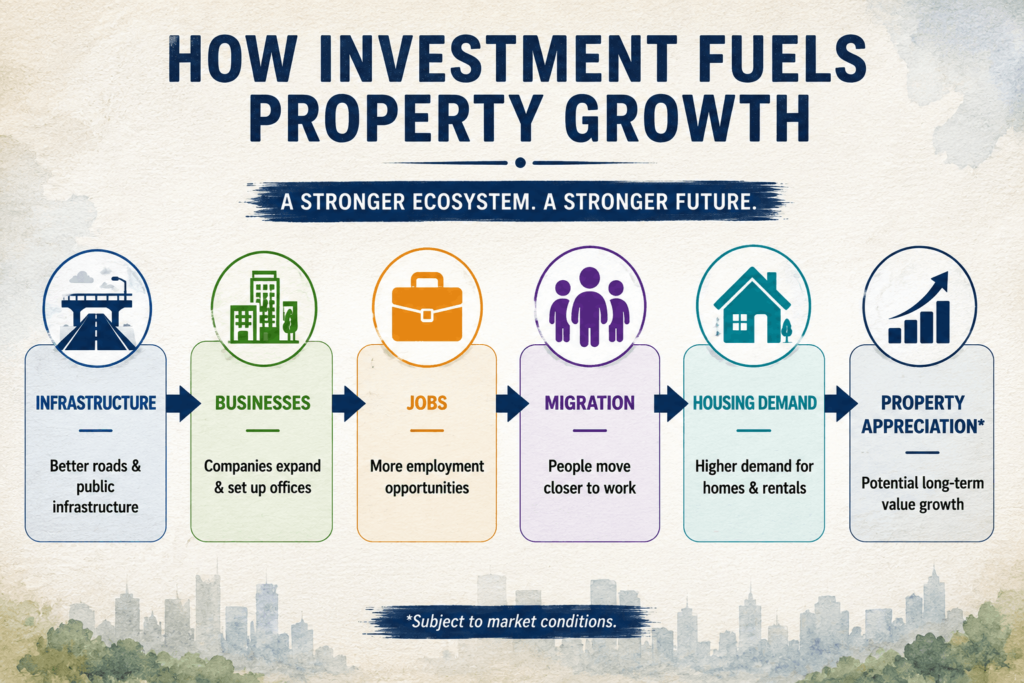
One thing worth noting is where these investments would be heading. Much of it is tied to office spaces in Noida and commercial projects. That’s significant because commercial investment usually has a ripple effect. As business districts grow, the surrounding areas often see higher demand for rental homes, apartments, retail outlets, cafes, schools, and other business services.
How Could Ganga Expressway Connectivity Expand Noida’s Growth Potential?
The proposed 74.3 km Greenfield Link Expressway may not be the biggest infrastructure project in Uttar Pradesh, but it could become one of the most important connectors. Estimated to cost around 4,000 crore, the road will link the Ganga Expressway with the Yamuna Expressway near Noida International Airport.
The project is being developed by UPEIDA and will pass through several villages across western Uttar Pradesh. It is designed to connect infrastructure that’s already taking shape.
- Noida International Airport becomes the centre of the network
- The Yamuna Expressway links the airport with Noida and Greater Noida
- The Ganga Expressway opens up access to cities across western, central, and eastern Uttar Pradesh
The new link road will be a connector, allowing it to function as one connected transport network instead of separate corridors. Districts such as Meerut, Hapur, Bulandshahr, Badaun, Shahjahanpur, Hardoi, Prayagraj, and other locations along the Ganga Expressway will get a more direct route to the Noida International Airport and the NCR. Shorter routes can benefit daily commuters, inter-city travellers, commercial vehicles, and freight operators alike.
Better road access means businesses in more parts of Uttar Pradesh can connect to it without taking long detours. For industries that rely on moving goods, whether it’s manufacturing, warehousing, logistics, e-commerce or exports, that kind of connectivity matters.
For the property market, the bigger takeaway is the way these projects are beginning to work together. Instead of looking at the airport, the expressways, or industrial corridors as separate developments, they’re gradually becoming parts of one larger network that strengthen several residential corridors and drive prices for sale in Noida.
Conclusion
These developmental projects create opportunities for businesses and jobs, and sustained economic activity will impact the property prices in Noida. The encouraging part is that the recent announcements aren’t limited to transport projects. They are also backed by commercial investments and long-term urban planning.
Better regional rail, planned urban centres, commercial investments, and Noida International Airport, and expressway connectivity are all being developed as a part of the larger ecosystem. If these plans move forward as intended, they could make Noida more than just an extension of Delhi. They could strengthen its role as a business, residential, and employment hub.
The post Can These Four Mega Projects Drive the Next Growth Cycle for Property in Noida? appeared first on Blogs.
]]>The post Noida Expressway Property 2026: Sectors, Prices & Growth Potential appeared first on Blogs.
]]>The corridor has emerged as an important growth corridor for the region, linking key employment centres in Noida, Greater Noida and Delhi, and is witnessing continuous upgradation of infrastructure, metro expansion and proximity to the Noida International Airport. Its planned development model and robust commercial ecosystem keep it drawing in end-users and long-term investors.
The corridor connects South Delhi with Greater Noida by providing a planned, metro-connected infrastructure network. Homebuyers are increasingly shifting towards expressway sectors, heavily searching for projects in Sector 150, Noida, and looking at modern flats in sectors 137 and 152, where modern housing projects offer more competitive pricing and structured development.
The Noida Expressway, in contrast to the old core cities, is designed around its wider roads and greater access to the metro, alongside airport-driven economic growth.
In this guide, we review the pricing trends by sector, indicators that the property is investment-safe and the real on-the-ground liveability of the projects, allowing you to filter out all the glossy project brochures.
What Makes Noida Expressway Different From Other NCR Property Corridors in 2026?
Many NCR markets grew organically and later struggled with congestion and infrastructure pressure. The Noida Expressway followed a different path. It was first planned with sustainable, future-led infrastructure, organised sectors, and dedicated residential and commercial zones.
Here’s how the Noida Expressway is growing through strong infrastructure, shifting demand, and future development plans.
Key Sectors for Property Investment in Noida Expressway
From established commercial hubs to emerging micro-markets, several sectors along the expressway offer strong potential for capital appreciation and long-term investment returns. In this section, we will discuss key investment destinations along the Noida Expressway, their growth drivers, and why these sectors attract investors and property buyers.
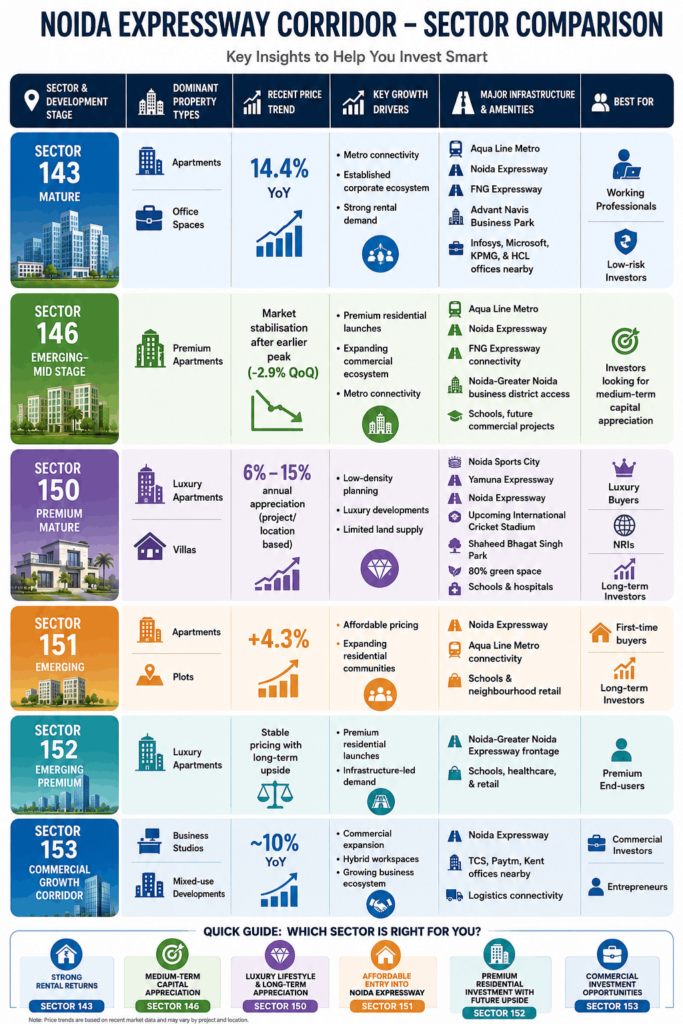
Are New Launch Projects Better Than Resale Flats in Noida Expressway in 2026?
Buyers’ preferences have evolved significantly over the last few years. The real question is not just whether to choose a new launch or resale flat, but how your time horizon and risk appetite shape that decision.
Resale Projects
Resale flats give you absolute clarity. What you see is exactly what you get. You don’t have to worry about a developer running out of cash or delaying construction for three years.
Furthermore, in mature societies along the expressway, the community is already active, the security guards are trained, and the local maintenance systems are up and running. The only downside is getting older architecture and standard layouts, and you might have to spend a tidy sum on renovation.
New Launch
New launches are attracting buyers right now because they offer modern floor plans that match current lifestyles: dedicated home office nooks, larger balconies, smart-home automation integration, and energy-efficient building materials.
Many buyers are leaning towards these options because developers are offering flexible, construction-linked payment plans. This lets you spread out your financial liability rather than taking a massive home loan hit all at once.
Type of Flats and Budget Required to Buy Noida Expressway Property
Prices have evolved significantly across the corridor. The days of finding a quality 3 BHK for ₹60 lakhs along the expressway are well behind us. The rise of hybrid work models has increased demand, driving preference for larger homes, dedicated workspaces, and lifestyle-focused communities, while also maturing the market into a distinct multi-tier ecosystem.
| Configuration | Average Carpet Area (sq.ft.) | Budget Range (Mid-tier) | Budget Range (Luxury) | Buyer Type |
| 2 BHK Apartment | 950-1200 | 85 lakhs – 1.1 crore | 1.3 crores – 1.6 crores | First-time buyersYoung professionals |
| 3 BHK Apartment | 1400-1850 | 1.4 crores – 1.8 crores | 2.1 crores – 2.8 crores | Family upgradersend-users |
| 4 BHK/Luxury Penthouse | 2500-4000+ | 2.5 crores | 4.2 crores – 7.5 crores | NRIs, HNIs, premium lifestyle buyers |
Sources: ANAROCK Property Consultants Reports, Knight Frank India Research, & JLL India Residential Reports
Connectivity-led development along the expressway is influencing location preference more than ever. At the same time, rising property values have pushed buyers into clearer budget tiers, from entry-level mid-segment housing to mid-range family clusters and premium gated communities
That said, price points are not considered uniform across the Noida belt. They vary by sector, project, developer, and maturity of the surrounding infrastructure. Therefore, it is important to evaluate micro-markets individually rather than treating Noida as a single real estate destination.
Each budget now clearly defines not just the home size but also the lifestyle it unlocks.
Will Noida Expressway Still Grow After 2026 or is Most Growth Already Priced in?
This is perhaps the biggest question investors ask. Many market observers believe the corridor remains in its growth phase.
While short-term price corrections can always happen in specific pockets, the broader economic foundation for the expressway remains incredibly solid. According to infrastructure timelines tracked by the Ministry of Road Transport and Highways, the regional connectivity web is expanding rapidly.
The massive catalyst is the Noida International Airport. As commercial operations scale up, corporate offices, transit hotels, and logistics hubs will naturally gravitate toward the expressway corridor.
Alongside the airport, metro expansion, and widening commercial development are strengthening the corridor’s position as a high-growth urban spine. These factors are a part of a coordinated infrastructure shift that continues to unlock fresh demand.
In Noida, you aren’t just buying a piece of residential brick and mortar; you are buying into the primary economic growth engine of western Uttar Pradesh.
Why Noida Expressway Remains a High-growth Property Corridor in The NCR
When you weigh the pros and cons, the expressway corridor presents a highly compelling case. It systematically addresses the major pain points that plague other parts of NCR: chaotic traffic, unplanned infrastructure, lack of green spaces, and disconnected workplaces.
Whether you decide to lock in a ready resale unit in a mature hub like Sector 137 or build long-term wealth through low-density projects in Sector 150, you are investing in a sub-market designed for the future. The era of high-density, chaotic living is losing its charm, and prospective homebuyers are actively choosing space, structure, and sanity.
If you’re considering investment opportunities in this corridor, ACE Group projects along the Noida Expressway present future-ready real estate options designed for long-term capital growth and lifestyle alignment.
The post Noida Expressway Property 2026: Sectors, Prices & Growth Potential appeared first on Blogs.
]]>