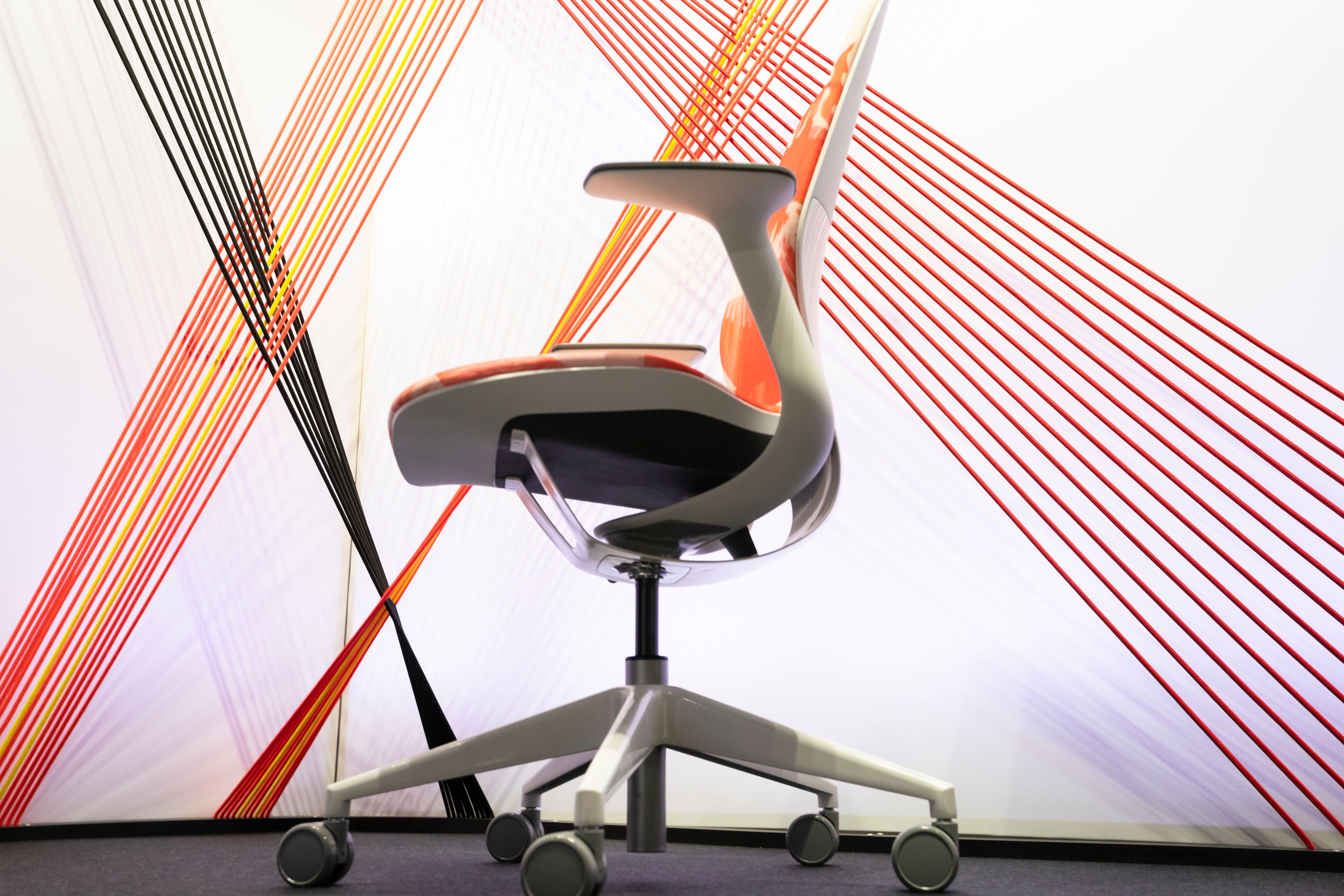
But would it be a dream to sit on? Steelcase showed off its SILQ Chair at TED2018: The Age of Amazement, April 10 – 14, 2018, Vancouver. Photo: Jason Redmond / TEDs
It’s only fitting that the chair which serves as the focal point of the Steelcase exhibit space at TED2018 was inspired, in part, by a TED Talk. Back at TED2009, Steelcase VP of Global Design and Product Engineering James Ludwig saw athlete and Paralympian Aimee Mullins speak about her different prostheses (TED Talk: My 12 pairs of legs). He was especially intrigued by her carbon-fiber “cheetah feet” and how they could store and release energy. He wondered: Could this wondrously light yet stiff yet flexible material — revolutionizing airplane, car and bicycle manufacturing — be used in a desk chair?
Carbon fiber hadn’t been used in mainstream furniture, but Ludwig was also bent on following a vision he’d had the previous year. The standard high-tech office chair had become what he calls “an exquisite machine” — consisting of up to 250 parts — but he’d tired of these contraptions. “I didn’t want to feel like I was sitting on a mechanical bull,” says Ludwig (can we get an amen?). He wanted to make a chair that was far simpler, so he sketched one that sat on “four leaf-like tendrils.” He had no idea how he’d build it, but that’s the task of industrial designers: envisioning what doesn’t exist — and then making it happen.
Mullins’s feet lingered in his mind, and he thought back to his dream seating and realized he might have found a solution. His next step was to see if a chair could even be made from carbon fiber. The result, which took him and his team several years to design and execute, was the LessThanFive, named because it weighs less than five pounds.
The game was on. In the Steelcase Innovation Center in Grand Rapids, Michigan, Ludwig found a corner space, papered the windows, gathered a handful of colleagues, and set to realizing the chair that he’d seen only in his mind. Six months later, he had a prototype. It was everything he wanted — responsive and streamlined — except for its price: it would be prohibitively expensive to produce. “Carbon fiber is a handicraft; it needs to be finished by hand,” explains Ludwig.
He told his engineers that they needed to figure out how to do it more cheaply. After some grumbling and sighing, they returned to work and created what Ludwig evasively refers to as a “proprietary fiber and material composition” — in other words, a patent-pending substance made from a high-performance polymer. Upholstery, molding and operations teams were called in, and 18 months later, Ludwig’s creation was released in January 2018: the SILQ chair.
He had a lofty mission: “I wanted it to look like Isamu Noguchi had an aerospace degree.” And with its soft curves and sculptural lines, it kind of does. It also drastically reduced the number of parts: just 30. The special polymer replaced many of the springs and hinges that provide flex and support in the typical desk chair. And in a welcome development to anyone who’s hit the wrong switch and made their chair plummet ridiculously during a meeting, it has only one lever that raises and lowers the seat.
But how does it feel? Well, when I sat in the SILQ, it felt like it was made for someone my size. In some sort of industrial-design wizardry, the back cradled my lower back and my head in the right spots — it was the opposite experience of sitting in an airplane seat where I always feel like I’m wearing someone else’s shoes. “This is a once-in-a-decade chair,” pronounces Ludwig.”It’s intuitive and material-based.” Maybe so, but to me, it was something much more special: comfortable.
]]>
Designers solve problems and bring beauty to the world. At TEDNYC Design Lab, a night of talks at TED HQ in New York City hosted by design curator Chee Pearlman with content producer Cloe Shasha, six speakers pulled back the curtain to reveal the hard work and creative process behind great design. Speakers covered a range of topics, including the numbing monotony of modern cities (and how to break it), the power of a single image to tell a story and the challenge of building a sacred space in a secular age.
First up was Pulitzer-winning music and architecture critic Justin Davidson.
The touchable city. Shiny buildings are an invasive species, says Pulitzer-winning architecture critic Justin Davidson. In recent years, cities have become smooth, bright and reflective, as new downtowns sprout clusters of tall buildings that are almost always made of steel and glass. While glass can be beautiful (and easily transported, installed and replaced), the rejection of wood, sandstone, terra cotta, copper and marble as building materials has led to the simplification and impoverishment of the architecture in cities — as if we wanted to reduce all of the world’s cuisines to the blandness of airline food. “The need for shelter is bound up with the human desire for beauty,” Davidson says. “A city’s surfaces affect the way we live in it.” Buildings create the spaces around them; ravishing public places such as the Plaza Mayor in Salamanca, Spain, and the 17th-century Place des Vosges in Paris draw people in and make life look like an opera set, while glass towers push people away. Davidson warns of the dangers of this global trend: “When a city defaults to glass as it grows, it becomes a hall of mirrors: uneasy, disquiet and cold.” By offering a series of contemporary examples, Davidson call for “an urban architecture that honors the full range of urban experience.”
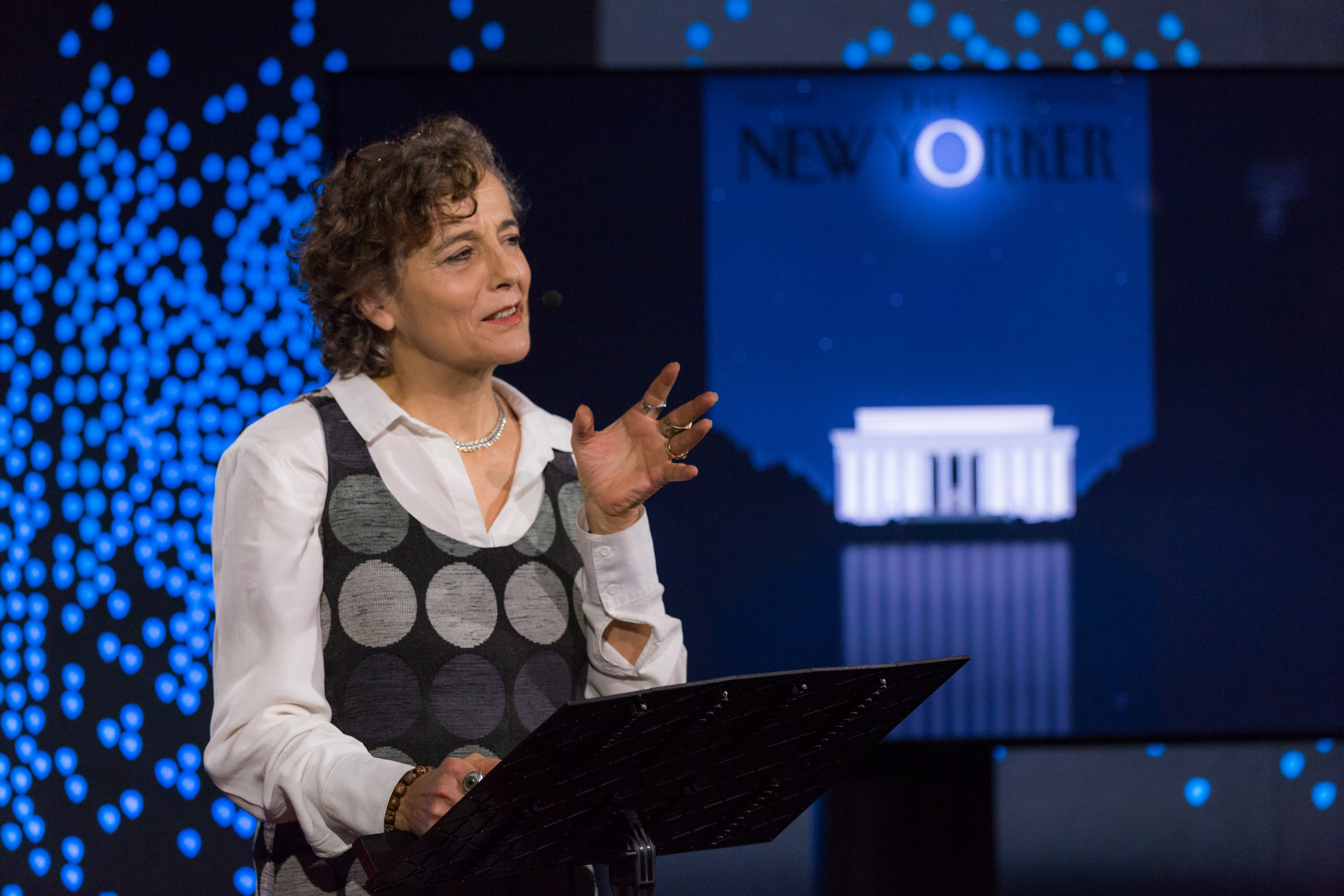
“The main thing we need right now is a good cartoon,” says Françoise Mouly. (Photo: Ryan Lash / TED)
The power of an image to capture a moment. The first cover of The New Yorker depicted a dandy looking at a butterfly through a monocle. Now referred to as “Eustace Tilley,” this iconic image was a tongue-in-cheek response to the stuffy aristocrats of the Jazz Age. When Françoise Mouly joined the magazine as art editor in 1993, she sought to restore the same spirit of humor to a magazine that had grown staid. In doing so, Mouly looked back into how The New Yorker covers reflected moments in history, finding that covers from the Great Depression revealed what made people laugh in times of hardship. For every anniversary edition of The New Yorker, a new version of the Eustace Tilley appears on the cover. This year, we see Vladimir Putin as the monocled Eustace Tilley peering at his butterfly, Donald Trump. For Mouly, “Free press is essential to our democracy. Artists can capture what is going on — with just ink and watercolor, they can capture and enter into a cultural dialogue, putting artists at the center of culture.”
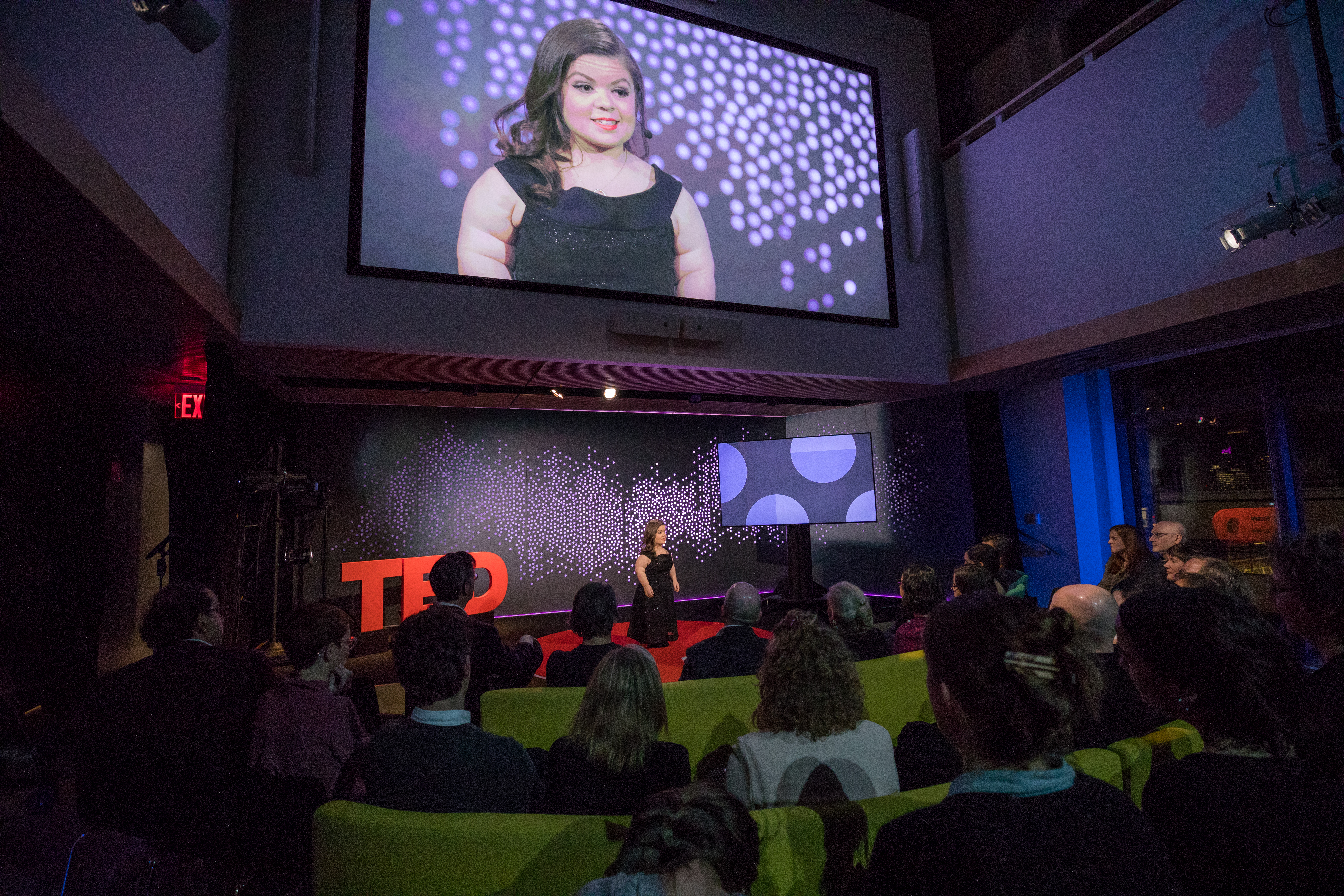
Sinéad Burke shared insights into a world that many designers don’t see, challenging the idea that design is only a tool to create function and beauty. “Design can inflict vulnerability on a group whose needs aren’t considered,” she says. (Photo: Ryan Lash / TED)
What is accessible design? “Design inhibits my independence and autonomy,” says educator and fashion blogger Sinéad Burke, who was born with achondroplasia (which translates as “without cartilage formation”) the most common form of dwarfism. At 105 centimeters (or 3 feet 5 inches) tall, Burke is acutely aware of details that are practically invisible to the rest of us — like the height of the lock in a bathroom stall or the range of available shoe sizes. So-called “accessible spaces” like bathrooms for people in wheelchairs are barely any better. In a stellar talk, Burke offers us a new perspective on the physical world we live in and asks us to consider the limits and biases of accessible design.
The beat of the Book Tree. Sofi Tukker brought the audience to their feet with hits “Hey Lion” and “Awoo,” featuring Betta Lemme. For the New York City–based duo, physical performance is a crucial element of their onstage presence, demonstrated through the use of a unique standing instrument they designed called the “Book Tree,” made from actual books attached to a sampler — with each percussion comes a beat. Their debut album, Soft Animals, was released in July 2016, and their single “Drinkee” was nominated for Best Dance Recording at the 2017 Grammys.
Finding ourselves in data. Giorgia Lupi was 13 when Silvio Berlusconi shocked many in Italy by becoming prime minister in 1994. Why was that election result so surprising, she wondered? This was the first time when the “data” she had gave her a distorted image of reality: the information available to her was simply too limited and imprecise, too skewed to give any real picture of what was going on. In America’s 2016 election, when we had many more data points and many felt the sample was representative enough, most data analysts still predicted the wrong outcome. Lupi, the co-founder of data firm Accurat, suggests that such events highlight larger problems behind data’s representation. When we focus on creating powerful headlines and simple messages, we often lose the point completely, forgetting that data alone cannot represent reality; that beneath these numbers, human stories transform the abstract and the uncountable into something that can be seen, felt and directly reconnected to our lives and to our behaviors. What we need, she says, is data humanism. “To make data [sets] faithfully representative of our human nature, and to make sure they won’t mislead us anymore, we need to start designing new ways to include empathy, imperfection and human qualities in how we collect, process, analyze and display them.”
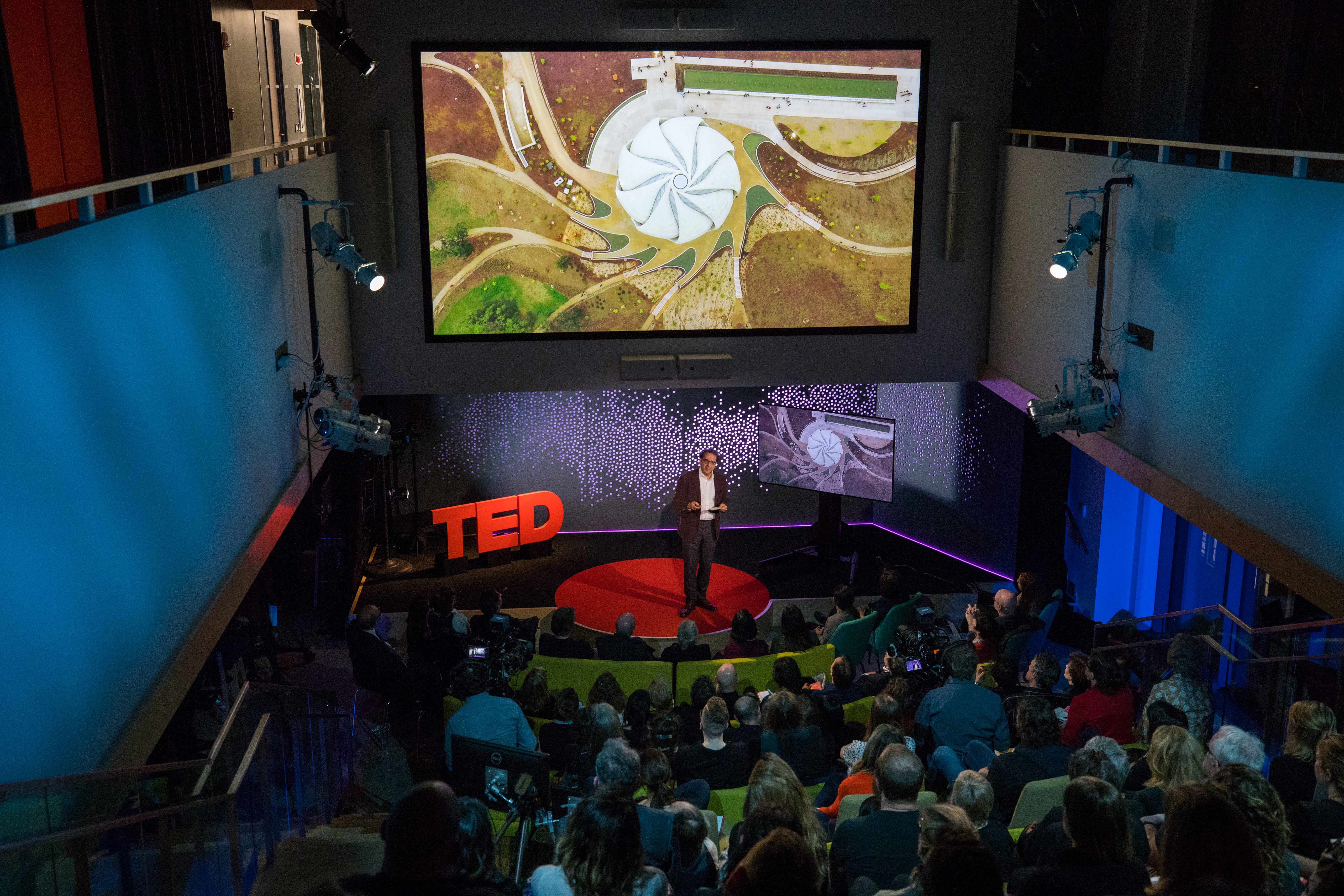
Siamak Hariri describes his project, the Bahá’í Temple of South America in Santiago: “A prayer answered, open in all directions, capturing the blue light of dawn, the tent-like white light of day, the gold light of the afternoon, and at night, the reversal … catching the light in all kinds of mysterious ways.” (Photo: Ryan Lash / TED)
Can you design a sacred experience? Starting in 2006, architect Siamak Hariri attempted to do just that when he began his work on the Bahá’í Temple of South America in Santiago, Chile. He describes how he designed for a feeling that is at once essential and ineffable by focusing on illumination and creating a structure that captures the movement of light across the day. Hariri journeys from the quarries of Portugal, where his team found the precious stone to line the inside of the building like the silk of a jacket, to the temple’s splendid opening ceremony for an architectural experience unlike any other.
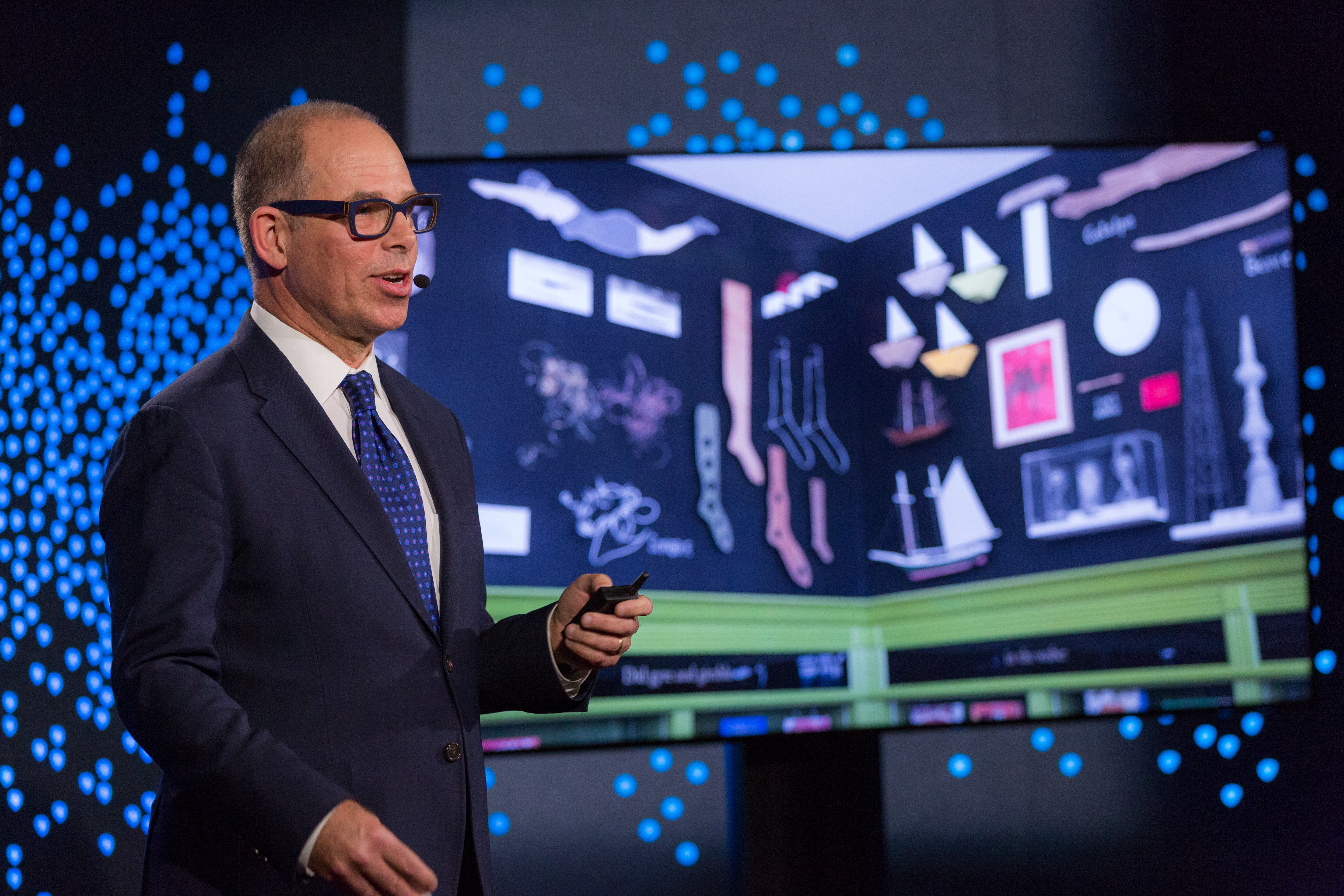
In the final talk of the night, Michael Bierut told a story of consequences, both intended and unintended. (Photo: Ryan Lash / TED)
Unintended consequences are often the best consequences. A few years ago, designer Michael Bierut was tapped by the Robin Hood Foundation to design a logo for a project to improve libraries in New York City public schools. Beruit is a legendary designer and critic — recent projects include rebranding the MIT Media Lab, reimagining the Saks Fifth Avenue logo and creating the logo for Hillary Clinton’s presidential campaign. So after some iterating, he came upon a simple idea: replacing the “i” in “library” with an exclamation point: L!BRARY, or The L!BRARY Initiative. His work on the project wasn’t over. One of the architects working on the libraries came to Bierut with a problem: the space between the library shelves, which had to be low to be accessible for kids, and the ceilings, which are often very high in the older school buildings, were calling out for design attention. After tapping his wife, a photographer, to fill in this space with a mural of beautiful portraits of schoolchildren, other schools took notice and wanted art of their own. Bierut brought in other illustrators, painters and artists to fill in the spaces with one-of-a-kind murals and art installations. As the new libraries opened, Bierut had a chance to visit them and the librarians who worked there, where he discovered the unintended consequences of his work. Far from designing only a logo, Bierut’s involvement in this project snowballed into a quest to bring energy, learning, art and graphics into these school libraries, where librarians dedicate themselves to excite new generations of readers and thinkers.
]]>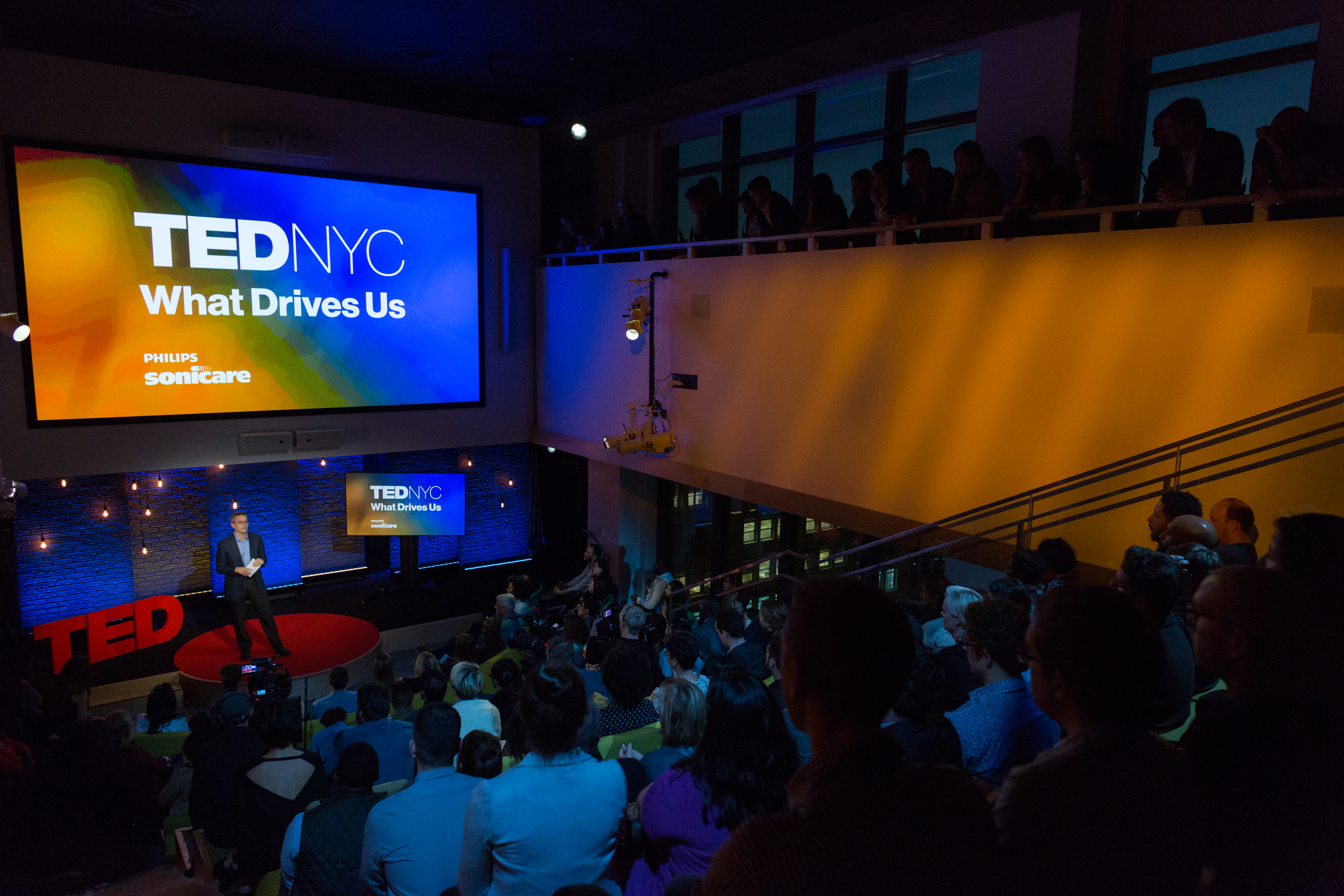
TED’s Science Curator David Biello hosts TEDNYC: What Drives Us, a night of talks in our New York City offices. (Photo: Ryan Lash / TED)
We’re creatures of curiosity. Our impulse to explore and investigate has led us to incredible discoveries about the world around us and about ourselves. Despite our amazing advances, questions still abound: How might we change, mold or reshape our nature and behavior? What inspires us to take action? What shifts our motivations? How do we uncover the hidden drivers of behavior and use that insight to unlock our potential?
On Wednesday night at TED HQ in New York City, during an evening of talks supported by Philips Sonicare and hosted by TED Science Curator David Biello, five speakers (and one wonderful performer) tackled these questions and another fundamental one: What drives us to explore, create and change the world?
First up was the author of The Confidence Game, Maria Konnikova.
The power of a well-told story. Good stories capture our attention, and the best ones engross us entirely. Con artists know this truth intuitively, says writer and deception expert Maria Konnikova, and it’s exactly how they deceive — they play to our emotions and exploit our tendency to get carried away by a compelling tale. Konnikova gives the example of Sammy Azzopardi, an Australian woman whose macabre knack for narrative allowed her to impersonate a cast of teenage victims of terrible sexual violence, duping the governments of both Ireland and Canada in the process. But grifters like Sammy aren’t the only ones spinning false narratives, warns Konnikova, which is why she believes that “the most powerful weapon in the world isn’t a gun — it’s a well-told story.”
Beyond BMI. According to Olivia Affuso, an academic researcher who specializes in obesity reduction, the standard we use to measure excess body fat, known as the Body Mass Index, or BMI, too often incorrectly labels otherwise healthy patients as having an unhealthy weight, and vice versa — sometimes with serious consequences. Affuso and her team have developed an alternative to the BMI that pairs digital photographs, easily taken with a cheap camera or a cell phone, with computer analysis to provide every patient with an individual assessment of his or her body composition. The results are highly accurate and inexpensive to produce, which means better, more personalized healthcare for us all.
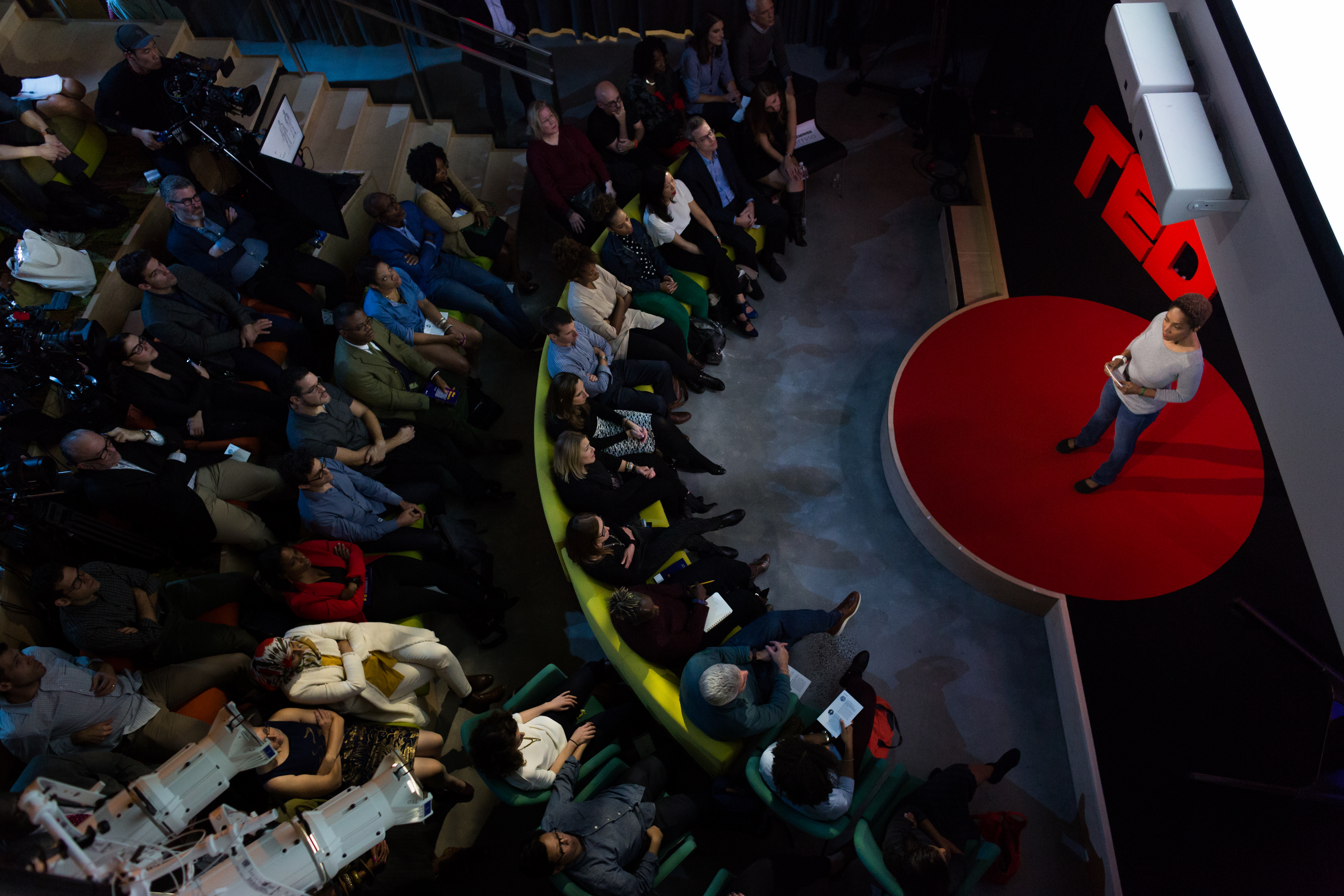
Olivia Affuso discusses a cheap, easy and more accurate alternative to BMI, which could lead to better health outcomes for us all. “Let’s move beyond the BMI,” Affuso says, “so everyone can get the personalized healthcare they deserve.” (Photo: Ryan Lash / TED)
The places we live aren’t inevitable. Infrastructure is the foundation for our economy, our social lives and our culture, and it matters to the way we live. In the twentieth century, as America expanded and the highways and automobiles of the sprawl changed the country’s landscape, the country’s cultural momentum changed with it, for good and for bad. But the effects of the sprawl were not inevitable, says urban planner, designer, and author Ryan Gravel, and we don’t have to be stuck in what he calls “the dystopian traffic hellscape” of modern cities. Gravel details how he and his team are working on a massive revitalization project of a 22-mile loop of rail corridors circling downtown Atlanta known as The BeltLine. What started as a grad school thesis and a dream has turned into a vision for a system of rails, trails and greenspace that will seamlessly connect 45 Atlanta neighborhoods. Today, with the help of fellow architects, community advocates, developers and nonprofit partners, the BeltLine is in the early stages of implementation, and it’s already changing residents’ expectations for living in the city. “The people of Atlanta fell in love with a vision that was better than what they saw through their car windshields,” Gravel says, “and the people of Atlanta made it happen.”
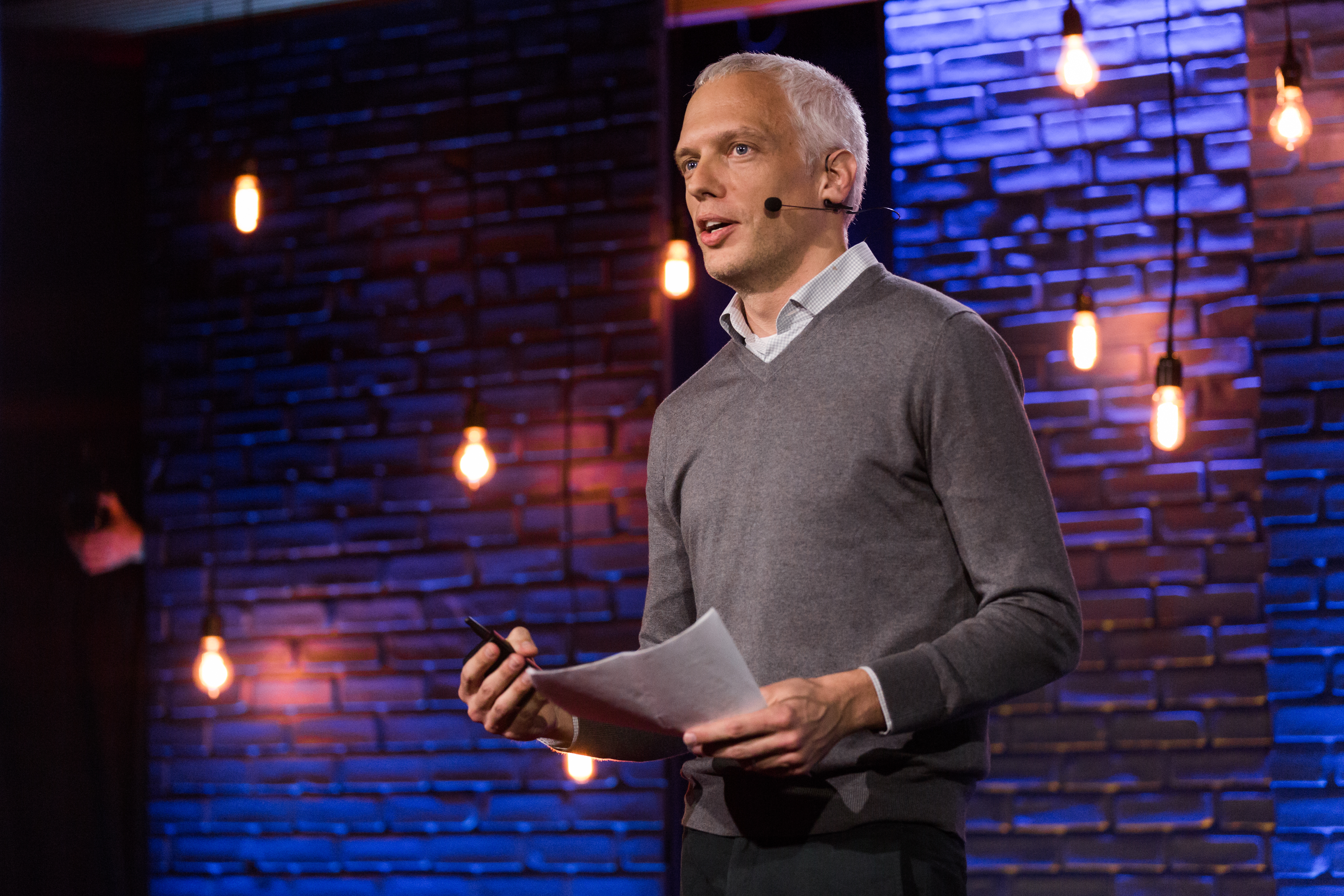
“If we want something different, we just have to speak up,” says urban planner, designer and author Ryan Gravel, as he details plans for a huge revitalization project in downtown Atlanta. “We have to participate actively in the process of shaping change.” (Photo: Ryan Lash / TED)
A fresh take on a jazz legend. Accompanied by the strains of a single guitar, jazz singer Candice Hoyes treats the audience to poignant melodies from her debut album, songs Duke Ellington fans may already know and love. Blending jazz and classical styles, On a Turquoise Cloud reimagines rare songs from Duke Ellington’s career by offering fresh and creative arrangements of the songs from some of today’s jazz icons.

Candice Hoyes treats the TEDNYC: What Drives Us audience to a soulful performance of rare Duke Ellington songs. (Photo: Ryan Lash / TED)
Fighting climate change with mind … and heart. Alongside science and stats, Jill Kubit believes that we need to talk about climate change from a place of love — a concept inspired by becoming a parent, which transformed her view of the future. Her project, DearTomorrow, uses letters, videos and photos dedicated to loved ones to make the threat of climate change feel more tangible while connecting the issue to values we already hold dear. This is not an answer to climate change, she says: “This is about us and the people we love now.” By opening up the conversation between generations in such a visceral way and shifting our perceptions of what the future means to us, we may be able to solve this looming crisis not just with intellect and reasoning, but with heart, too.
]]>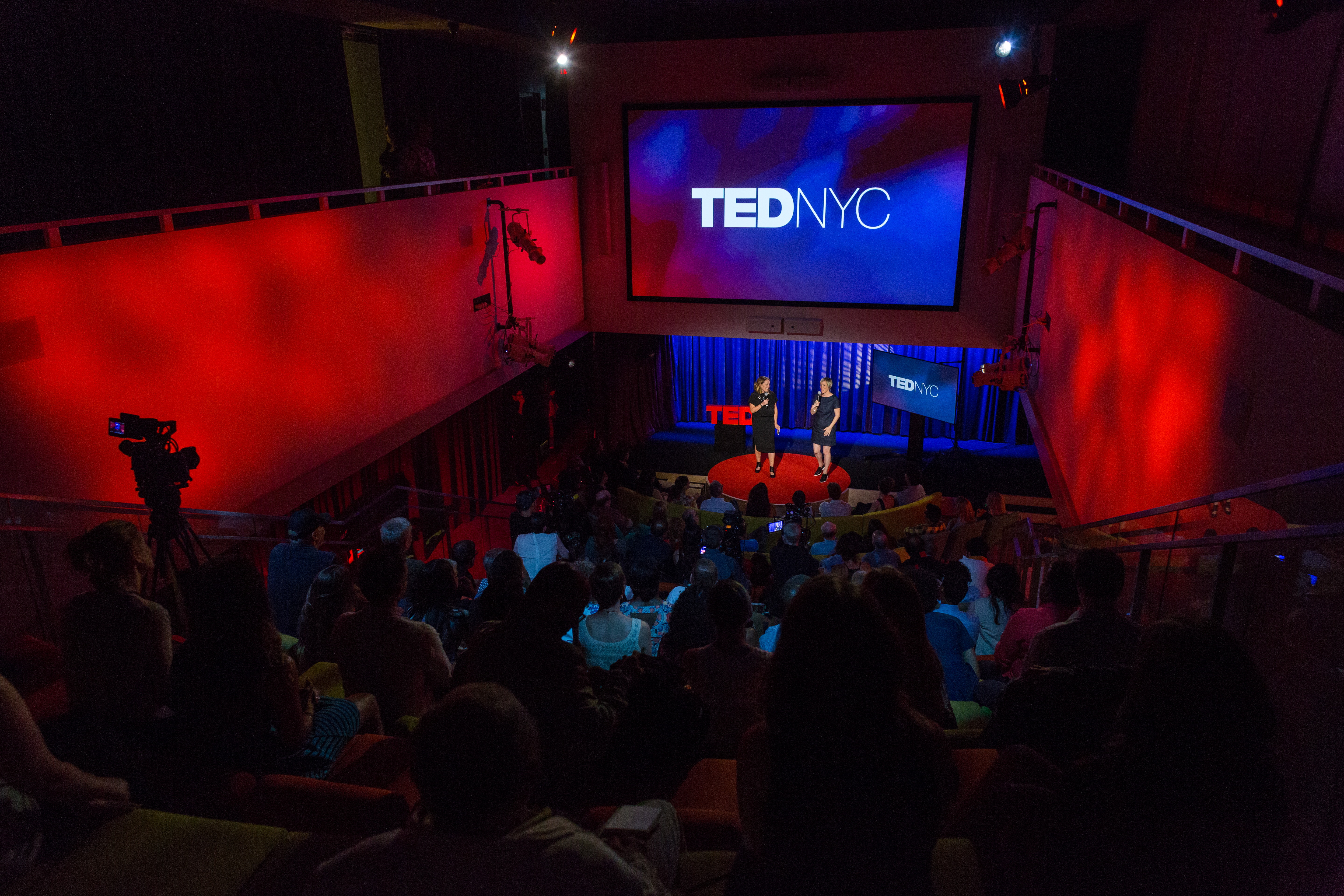
TED curators Kelly Stoetzel and Helen Walters host the very first TEDNYC event in New York, NY, on September 7, 2016. (Photo: Ryan Lash / TED)
The conversation around the upcoming US presidential election is full of frenzy, headache and noise. But elections are about more than divisiveness and disagreement — they’re civic events worthy of celebration, and, while it may seem unbelievable at the moment, they hold the promise of transforming governments for the better.
At TEDNYC: The Election Edition, six speakers who think about elections differently — whether as a design challenge, a translation project or the stimulus for creative work — spoke about why the future of our shared political sphere may be brighter than it seems, and why it’s absolutely and completely necessary for Americans to vote in November.
It was our very first salon in the new theater at TED HQ, a custom-made cavern of seats, screens, cameras and all of the technical wizardry necessary to film sessions of expertly curated, intellectually stimulating TED Talks. The theater has been the working focus of many talented and dedicated TED staffers for countless months, and tonight’s inaugural session was a landmark moment for the organization and the first step in a new adventure that we can’t wait to share with you.
First up was the author of the best-selling memoir, Hillbilly Elegy, J.D. Vance.
America’s forgotten working class. J.D. Vance grew up in a small, poor, predominantly white town in the Rust Belt of southern Ohio, where he had a front-row seat to the social ills plaguing so many working-class towns like his: a heroin epidemic, families torn apart by divorce and sometimes violence. In these forgotten parts of America, structural barriers like a lack of jobs, failing schools and brain drain often prevent poor families from joining America’s fabled upward mobility. But, Vance noted, something much more difficult to quantify was infecting the minds of kids he grew up with — a sense of hopelessness and despair, a feeling that they’d never get ahead no matter how hard they worked. With the help of a perceptive grandmother who told him not to believe the deck was stacked against him, a four-year crash course in character-building in the form of the Marine Corps and a lot of luck, Vance closed the social-capital gap and went on to law school and a career in finance. But a lot of kids from his town won’t have that good luck, and that, he says, raises important questions that everyone from community leaders to policy makers needs to ask: How do we help more kids from towns like his?
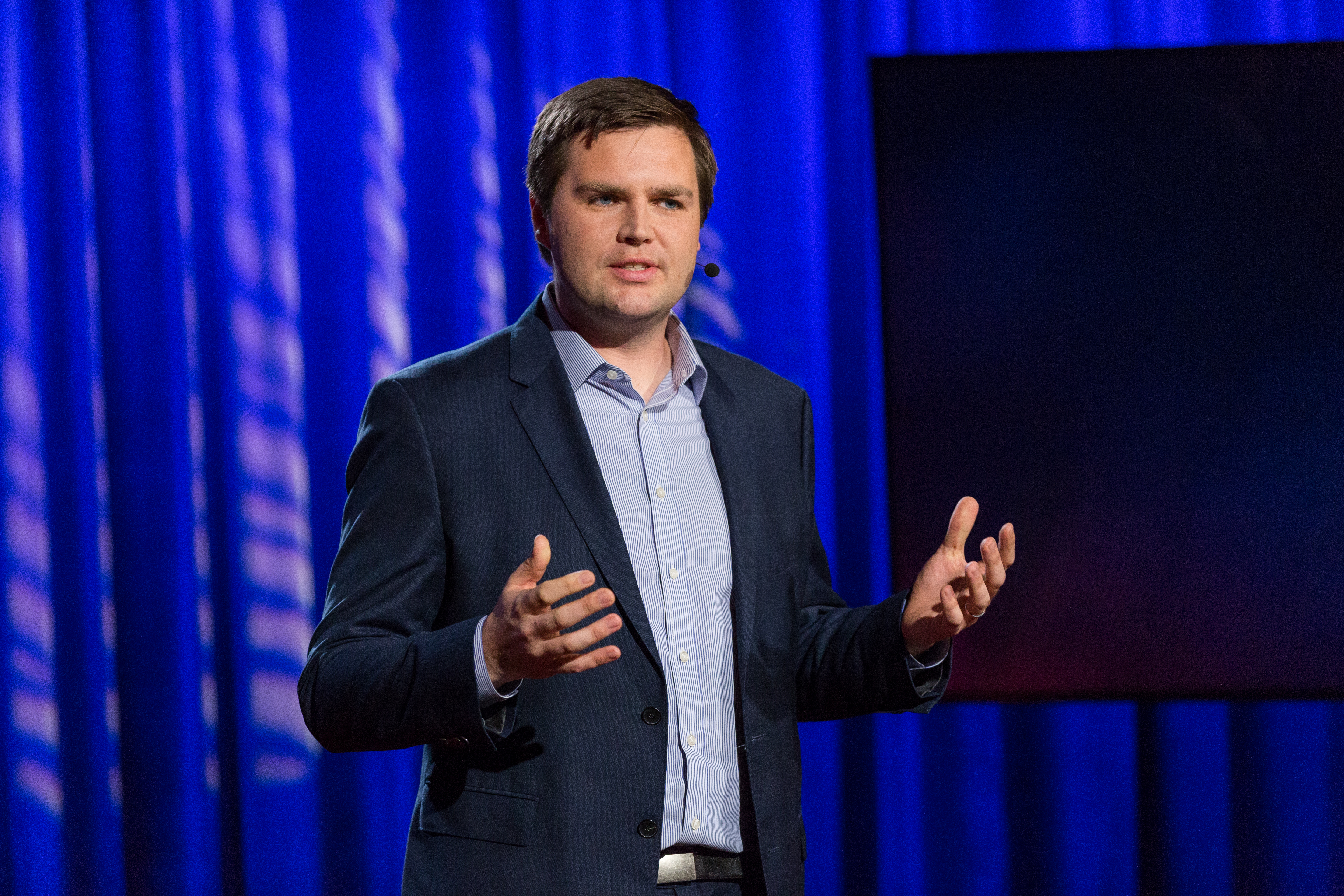
The author of Hillbilly Elegy, J.D. Vance, spoke about growing up poor in southern Ohio, where his classmates shared “a sense of hopelessness that leads to conspiratorial places, the sense that ‘No matter how hard I work, they’re not going to let me in.'” He spoke at TEDNYC in New York, NY. (Photo: Ryan Lash / TED)
“Historical eras do come and go.” Journalist Michael Tomasky gives a historical crash course on how American politics has turned into such a polarized battlefield — and shares three rays of hope for the future that may break through the current ideological maelstrom. (A few key changes are on the near horizon, he says — including, believe it or not, reform of the dreaded filibuster.) Most of all, he encourages us to take the long view. “Historical eras do change,” says Tomasky. “All is not lost.”
Why ballot design matters. You’ve almost definitely made mistakes when you’ve voted, and you probably didn’t know it, says civic designer and ballot design researcher Dana Chisnell. She explains how ballot designs have confused voters and, in turn, influenced election outcomes, breaking down the story of an electoral disaster in Sarasota County, Florida — where, in 2006, 18,000 Floridians left the polls without recording a single vote in the congressional race, the hottest race on the ballot — as well as the infamous hanging chads of the US presidential election of 2000. Chisnell shares ten simple design principles, like using mixed-case lettering and avoiding centered type, which she and her team have developed to improve election ballots and to help people vote the way they intend. Learn more about the design principles and the quest to design the perfect ballot here.
Songs of protest. “When they say we want our America back, what the f*** do they mean,” asks Jill Sobule in “America Back,” a song she played often at Bernie Sanders rallies that became an anthem of his campaign. With an upbeat tune and a hefty dose of humor, Sobule reflects on the long history of immigration in America — and the anti-immigration sentiment that has always accompanied it. She also shared with the audience her wish to reinvigorate the tradition of protest art through her initiative My Song Is My Weapon, an online hub where artists and musicians can share, create and collaborate on protest songs and protest art.
A shared language of democracy. As a consultant for the United Nations, Philippa Neave works with emerging democracies to organize their very first elections, helping with the details those of us in established democracies take for granted: how to register, how to vote, why you should vote. And so often, one of the biggest stumbling blocks is language. In many countries, the appropriate language to describe the electoral process simply does not exist — or when it does, the concepts the words represent are not well understood. To right the problem, Neave worked with colleagues to establish the Arabic Lexicon of Electoral Terminology, a reference tool in Arabic, English and French that covers eight Arab countries. Even with this technical reference tool, Neave still sees an important missing piece of the puzzle, “a work of reference for the average person,” because it is only by creating a shared language and shared understanding of democracy that we can hear the voice of the voiceless: “The silent majority is silent because they don’t have the words. Let’s give them the words.”
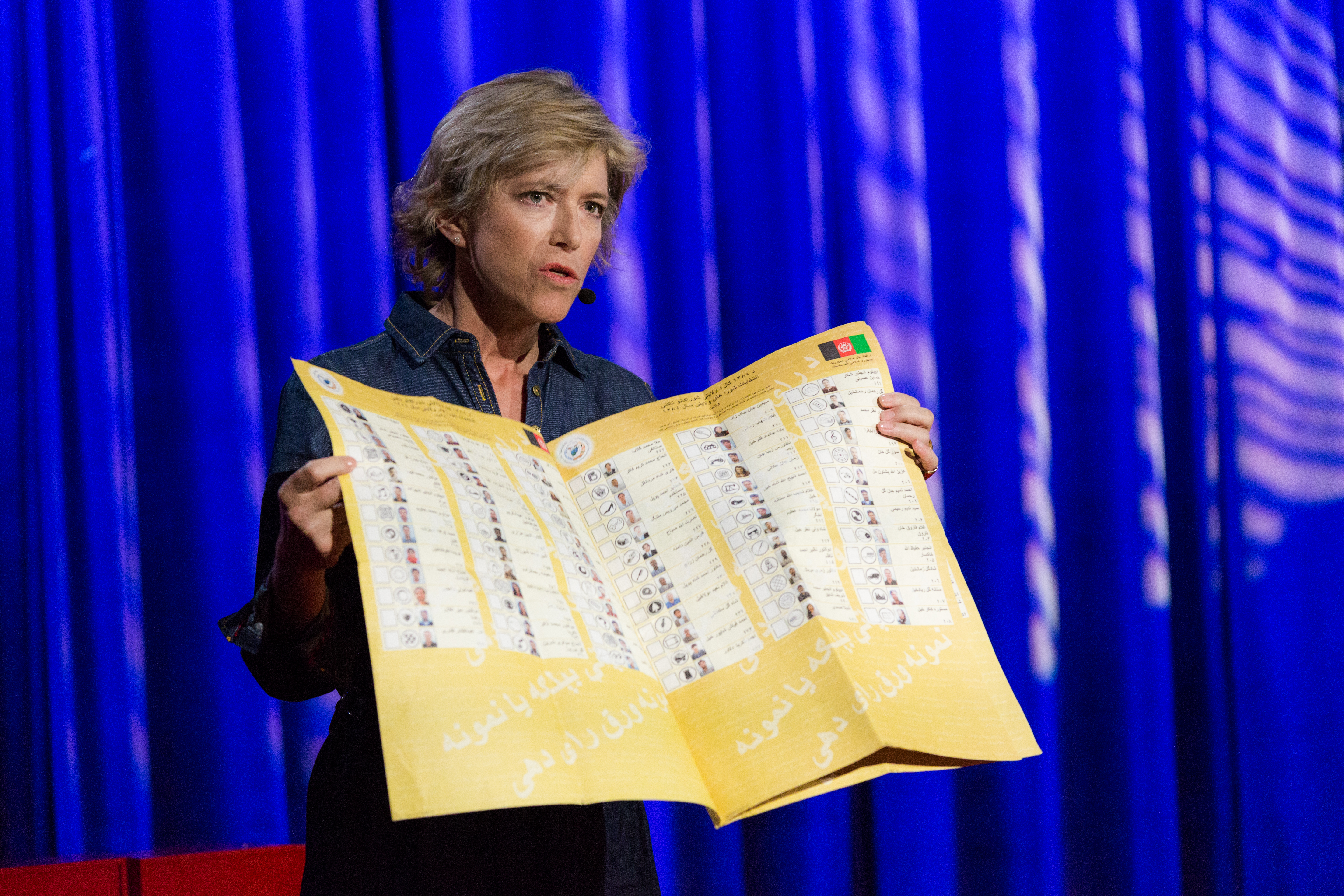
Elections consultant Philippa Neave holds up a ballot from the 2005 election in Afghanistan, whose citizens were so eager to run for office for the first time that the ballot ended up being the size of a newspaper. She spoke at TEDNYC in New York, NY. (Photo: Ryan Lash / TED)
It’s our country, too. Sayu Bhojwani, president and founder of The New American Leaders Project, tells the essential American immigration story through her own 16-year journey to becoming an American citizen — and urges her fellow immigrants to find their own power in the political process, by voting, by running for office, and simply by speaking up about what they care about. “Immigrants’ votes, voices and vantage points can help make our democracy strong,” she says. “We have fought to be here.”
The joy of voting. There was a time in America when voting was fun. That time, says civics educator Eric Liu, is called most of America’s history. Tracing the robustly, raucously participatory history of voting in America, from the Revolution through to the Civil Rights era, Liu recalls American traditions of parades, street theater, open-air debates, festivals and bonfires on election day. “Decades of television and the Internet have killed much of that joyful culture of voting,” he says. “The couch has replaced the commons, and the screen has made most citizens spectators.” How can we get people excited about voting again? In partnership with the Knight Foundation, Liu has launched The Joy of Voting project, inviting artists, activists, designers, and educators across the country to come up with creative projects — from DJ sets to plays to punk rock satire — to encourage the far-too-many Americans who don’t vote to express themselves at the ballot box. “Why bother voting? Because there is no such thing as not voting,” Liu says. “In a democracy, not voting is voting — for all that you may detest and oppose.”
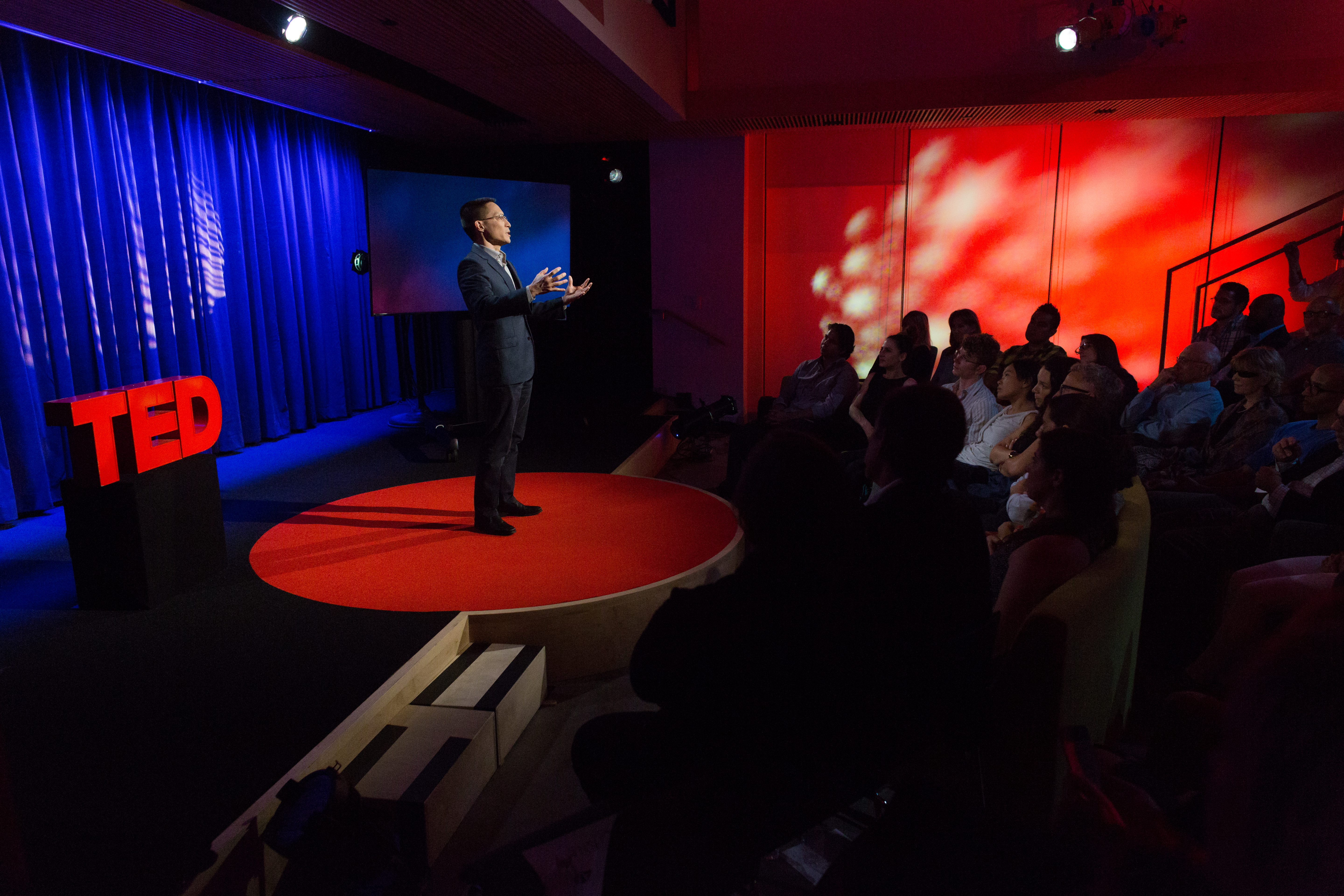
“Not voting can be dressed up as an act of passive resistance,” says Eric Liu, “but it’s actively handing power over to people who will gladly take advantage of your absence.” He spoke at TEDNYC in New York, NY. (Photo: Ryan Lash / TED)
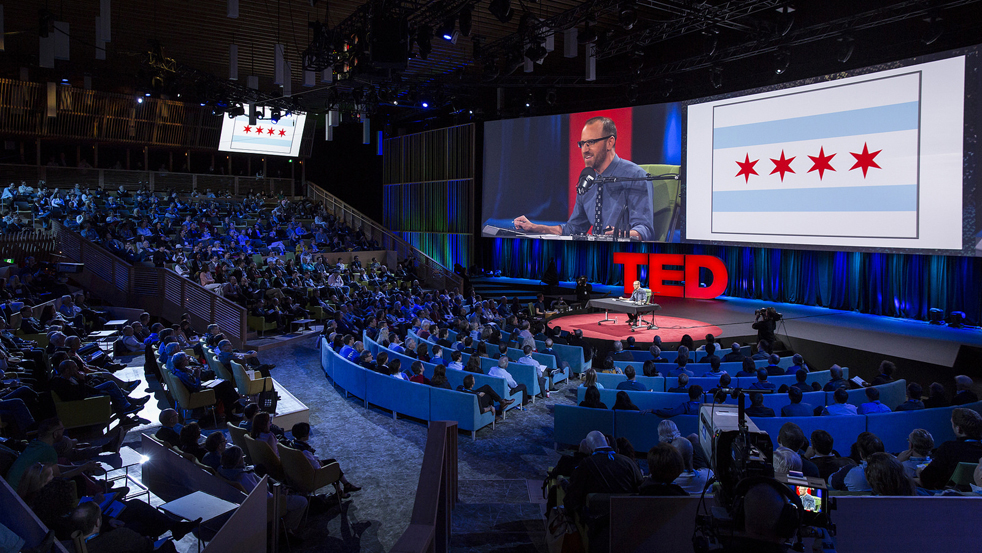
After an awkward rehearsal in front of junior high schoolers, Roman Mars decided not to give the traditional TED Talk. Instead, he brought a table and all his radio gear — and put on a live radio show at TED2015. Photo: James Duncan Davidson/TED
Roman Mars had two ideas for his TED Talk: the talk he thought he should give and the talk he wanted to give.
As the creator of 99% Invisible, a podcast about the design elements in life that usually go unnoticed, Mars felt like his talk should tackle the basic principles of design and how they affect us. But a part of him wanted to focus on his latest obsession: city flags.
“I was a little sheepish to even tell people that I actually wanted to talk about flag design,” he said.
He was psyching himself out, worrying about what he thought a TED Talk should be — big, important, inspiring. He wasn’t sure what to do. So he decided to test out a sweeping talk on the nature of design at his niece’s junior high school, down the hill from where he lives in the East Bay, just outside San Francisco. A group of students gathered in the auditorium to watch him. And it was … awkward. For everyone.
“As a radio producer, I take comfort in keeping my hands busy. I get really antsy if my hands don’t have anything to do,” said Mars. “Activities like hitting the clicker and pressing the music cue are important. Even holding a script calms me down and makes me feel right.”
Clearly the stereotypical sage-on-a-stage TED Talk style wasn’t for him. But it sparked an idea: what if he created a live radio show on a table, right on the TED stage?
Mars was nervous about sharing this idea with the TED staff. So he procrastinated … for months.
“I felt honored to be invited to speak at TED. I wanted to be easy,” he said. “I didn’t want to rock the boat by saying, ‘Well, how about a table?’ I wanted it to seem like I was a good choice, and that I wasn’t demanding.”
But when he finally fessed up to TED’s curation team, their response shocked him: They loved the talk, and they loved the table.
“It was clearly the talk he wanted to give,” said content director Kelly Stoetzel. “It was so much better than the version he thought he was supposed to give.”
“It was validating to know they wanted me to be comfortable being me,” said Mars. “I realized that TED doesn’t have just one style.”
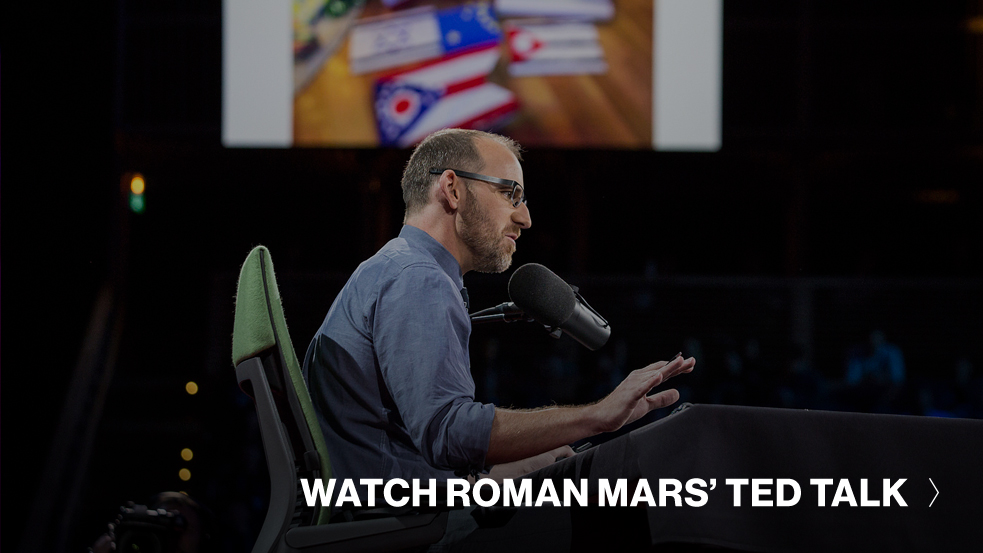
Mars walked onstage at the TED2015 conference in March looking confident despite his nerves. It was his first time being filmed doing a radio piece, not to mention the live audience.
His radio props waited for him on the table: a microphone, a script and a control board that is an instinctual extension of his fingers, cueing sound effects, music and recorded interviews. He took a seat in a rolling office chair.
Right away, Mars addressed the question floating through the audience’s minds. “I know what you’re thinking. Why does this guy get to sit down?” he said. “It’s because … this is radio.”
He pressed a button to kick off his music. From there, he introduced the audience to the study of flags, vexillology, and shared five design principles that city flags should follow — but often don’t.
“It was a pinnacle of my career,” Mars said. “I could have been [onstage] for an hour.”
Mars’ talk posted on TED.com in May 2015. It has been watched more than one million times so far.
“I’m going to be the flag guy forever,” he joked.
Since his talk, Mars has teamed up with Autodesk for a campaign to redesign the San Francisco flag. About 1,200 people signed the petition as of last week, and the hope is that the city will go for it. They’re asking 99% Invisible listeners and notable designers to imagine a new, more iconic flag. As Mars told the San Francisco Chronicle, “The right flag could encapsulate what it means to be a resident of San Francisco.”
But even those far from his city of residence have reached out about his flag obsession.
“A couple of weeks ago, I was tweeted at about 100 times in one day about my opinion on the redesign of the flag in New Zealand,” he said. “The truth is, it’s hard to weigh in on their flag design without any of the cultural history of New Zealand in my brain and bones.”
New Zealanders even invited Mars to be on the flag design committee. He referred them, as he does others, to vexillologist Ted Kaye of the Portland Flag Association, who Mars interviewed for his TED Talk.
“I’m not the expert,” Mars said. “I’m a journalist.”
]]>
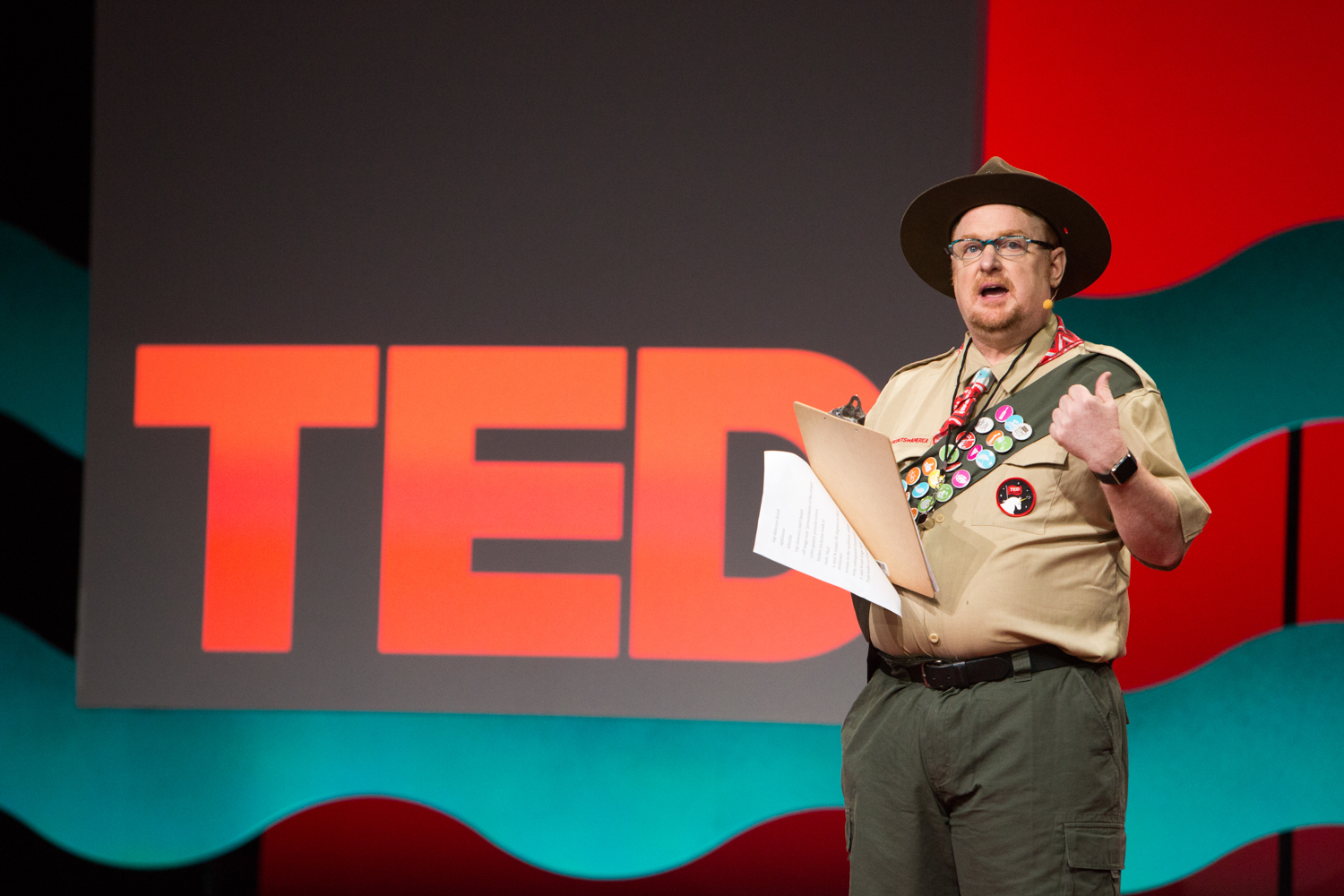
Be prepared: Tom Rielly opened the first session of TED Fellows Retreat talks in Scoutmaster regalia. His bandana and (de)merit badges were all designed by TED Fellow Safwat Saleem. Photo: Ryan Lash/TED
Camp: a home under the stars and sun. A space to dream, commune with friends, create — and play. That’s the atmosphere TED Fellows director Tom Rielly wanted to create for this year’s TED Fellows Retreat, which took place at the Asilomar Conference Grounds in Pacific Grove, California, August 25-28. To create the look and feel for the event, he commissioned satirical artist and TED Fellow Safwat Saleem to bring his sense of color and whimsy to all the details — from backpacks to bandanas to (de)merit badges.
Saleem tells the TED Blog how he came up with the design language for the Retreat:
“I went to scope out Asilomar months before the retreat. It is built right on the Pacific, among sand dunes, cypresses and pines. It was designed in 1912 by Julia Morgan, of Hearst Castle fame, so there’s an elegant feel to the rustic, exposed wood and stone buildings.
One of the first things I noticed was the cafeteria bell, which rings through the grounds at mealtime. When the bell goes off at 6pm, it’s time for dinner – and you have to be out within an hour. It really felt like camp. The Retreat’s theme unfolded from there. We thought: what if all the staff members were camp counselors with whistles? What if we made neckerchiefs like the Boy Scouts?
The name of the retreat had already been decided: “Swimming Against the Tide” – a nod to the marine environment, as well as a tribute to the Fellows, who so often work against the odds and mainstream to achieve extraordinary things. The challenge was to represent the name, the camp aesthetic and the natural environment with a design language that could be modified and used from signage and printed materials to stage design to accessories.
During that first stay in Asilomar, I was amazed to hear the ocean waves roaring all night through the window. Meanwhile, I thought about how, at camp, one of the things you do is write letters home — and the postmark stamp looks like a wave. Finally, I thought about a salmon swimming upriver and its sine-wave movement. These three thoughts coalesced into a wave pattern that became the visual motif of the Retreat. We developed the colors: beige, blue and green to reflect the sand, water and trees of Asilomar.

Sand, water, trees: The TED Fellows Retreat’s design language unfolded from the natural environment surrounding the Asilomar Conference Grounds in Pacific Grove, California. Image: Safwat Saleem
The design extended into the built environment. Michael Witlin, the retreat director, took the camp theme and colors and ran with them — lighting up the night courtyard with large blue and green bubble lights, so that it glowed with a watery hue. As people walked into the Sunset Theater for the TED Fellows Talks, the theme of trees, water and sand extended into ambient and atmospheric video projections made by TED Fellow Gabriel Barcia-Colombo.
I haven’t designed anything at this scale before, where the visual vocabulary was woven into every aspect of a multi-day event. It was great to work with a group of people who don’t say ‘no’ much. I could come up with ideas — ‘Let’s do a camp flag with unicorns!’ and ‘Let’s do (de)merit badges!’ — that would likely be turned down by a more traditional client. This team was all for it.”
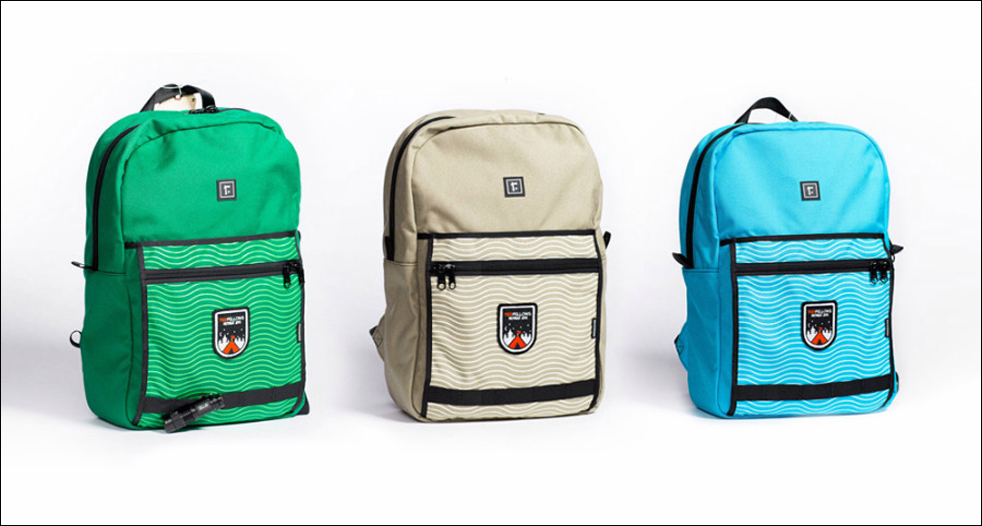
“The Retreat backpack, made in collaboration with Mark Dwight of Rickshaw Bagworks, came in green, beige and blue. The front panel was screen printed with the wave motif, and decorated with a hand-sewn patch of a tent nestled under the stars.” Photo: Bret Hartman/TED
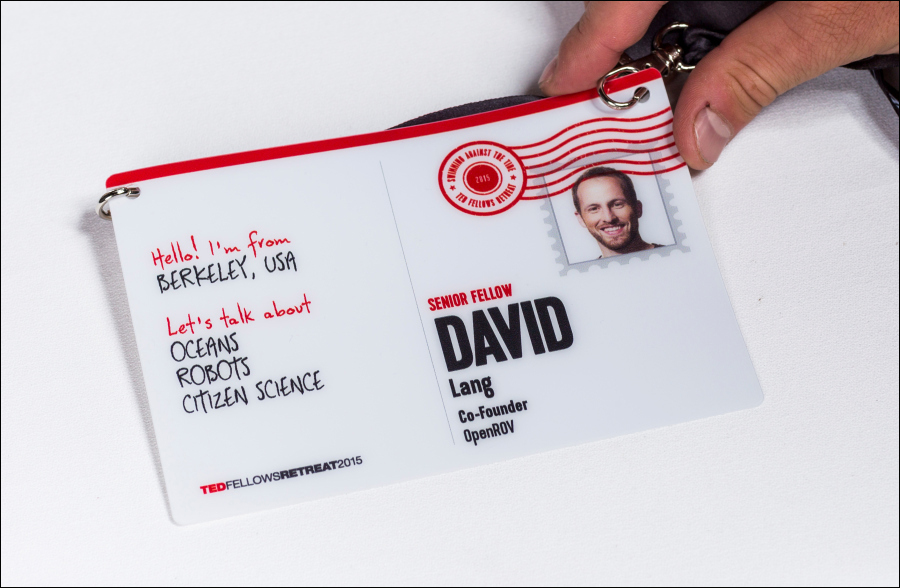
“The TED Fellows Retreat badges were designed to look like postcards with postmarks. The postmark design was echoed in a projection onto a courtyard wall at night.” Photo: Bret Hartman/TED
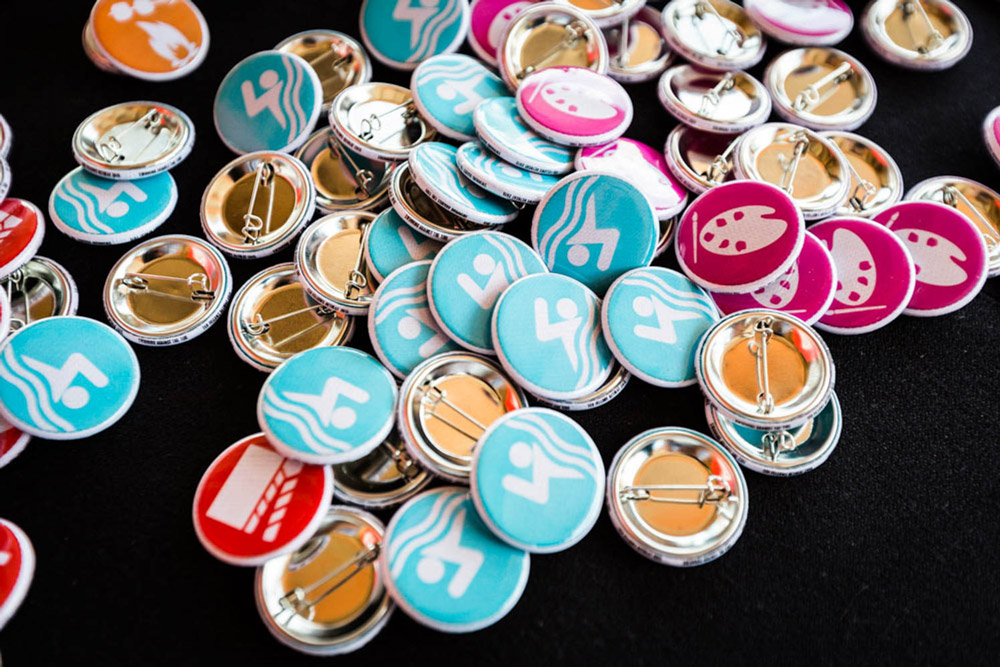
“We wanted Scout badges, the kind you get when you’ve learned how to make a fire. But embroidered patches are expensive, so we designed pins. There’s one for each activity we did at the TED Fellows Retreat — whale watching, kayaking, participating in the talent show, etc. But a few are tongue-in-cheek. Fellows are legendary for taking snacks home after conferences, so there’s a stealing snacks badge.” Photo: Bret Hartman/TED
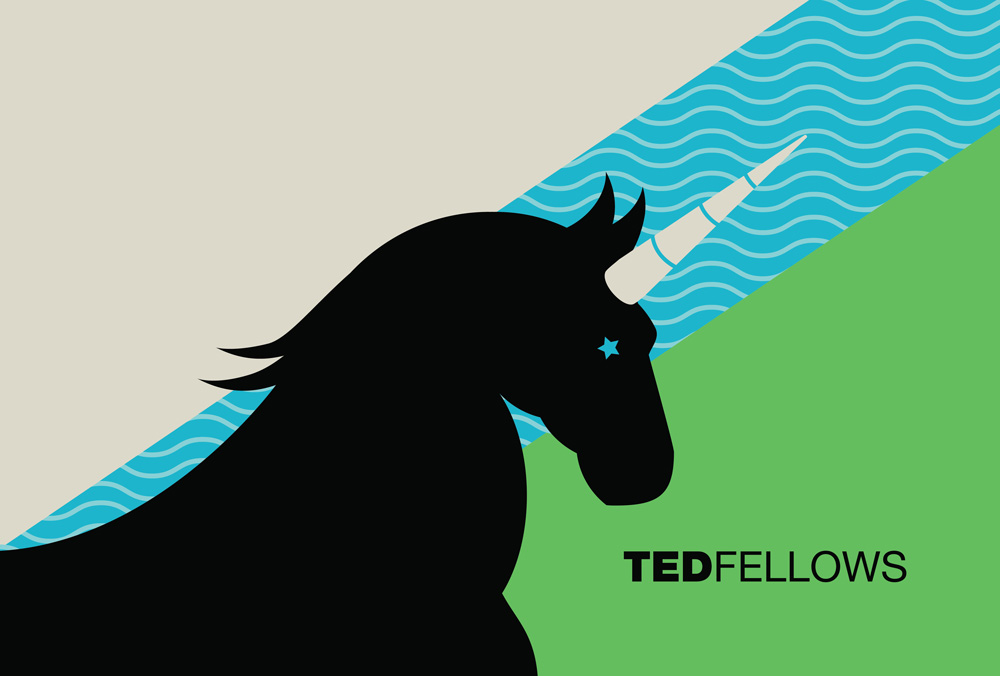
“Boy Scouts always have flags, so we designed a custom, tongue-in-cheek flag for the TED Fellows Retreat. The day of talks opened ceremoniously with Tom Rielly marching onstage and waving it.” Image: Safwat Saleem
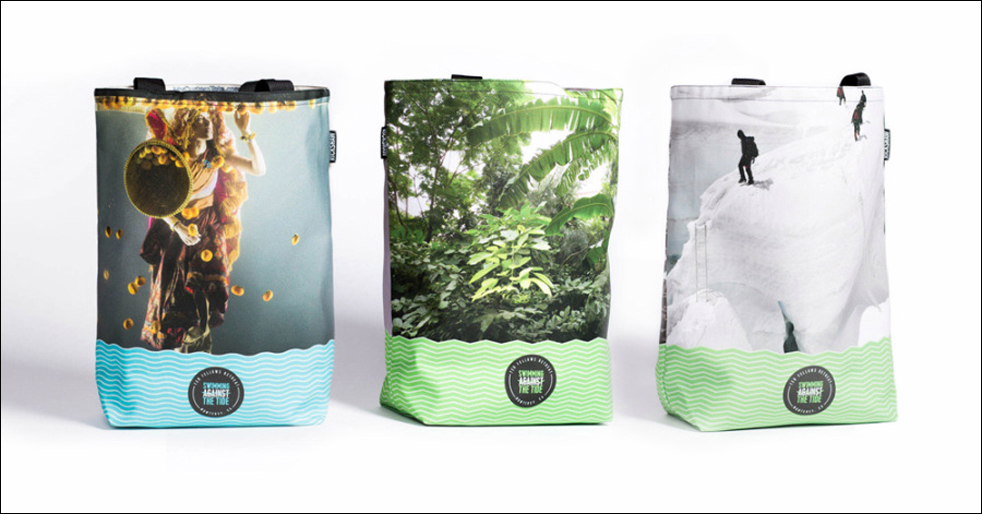
“We digitally printed tote bags with images representing the work of 90 Fellows — one on each side. The images weren’t paired randomly, I found a visual connection — be it color, element or placement. Each bag could be printed on-demand, so we were able to make 45 different image combinations. We wanted everyone to have one that was as close to unique as possible.” Photo: Bret Hartman/TED
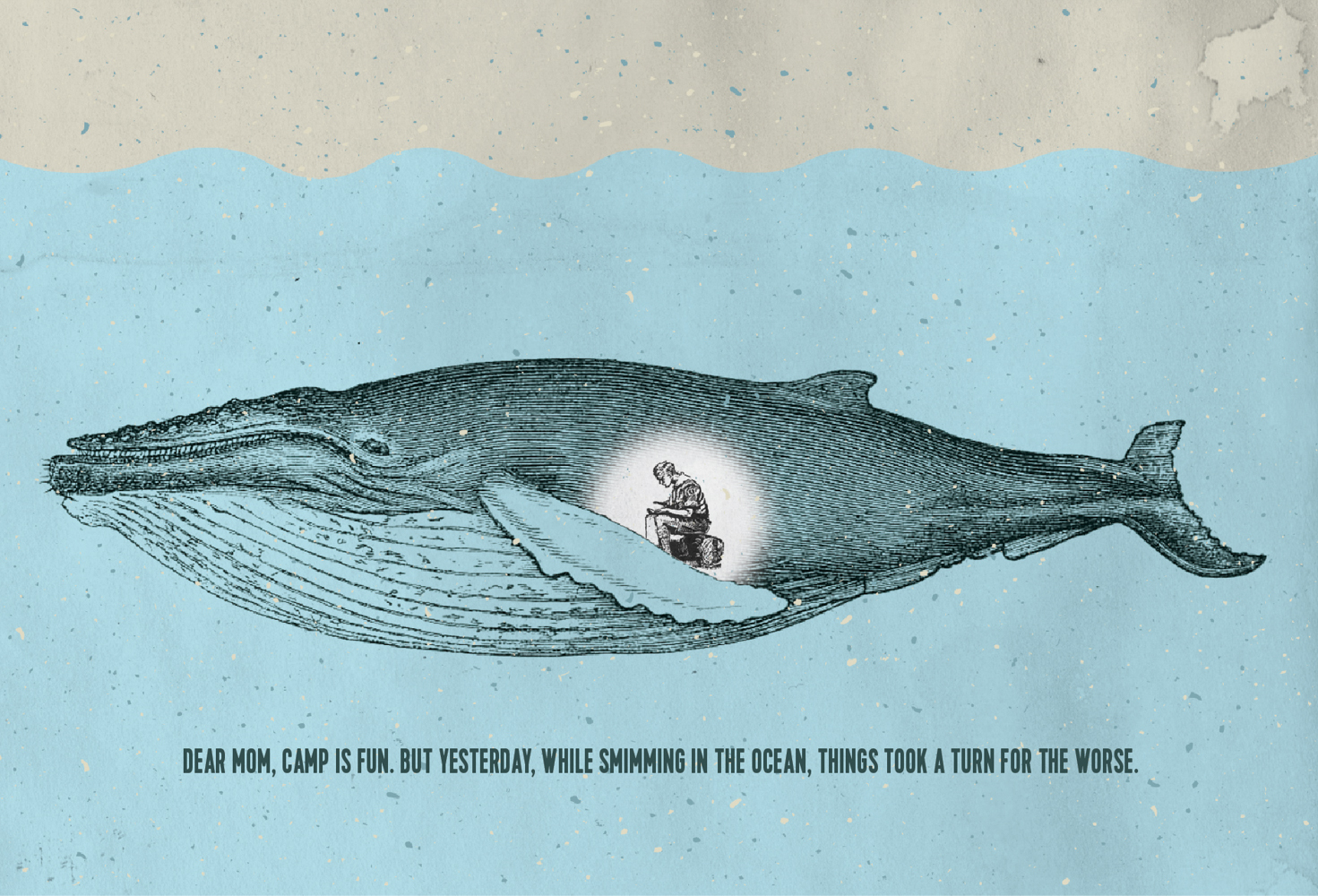
“In the satirical vein of Allan Sherman’s ‘Hello Muddah, Hello Faddah,’ I made a set of six postcards with nontraditional messages to help TED Fellows keep in touch with people at home.” Image: Safwat Saleem
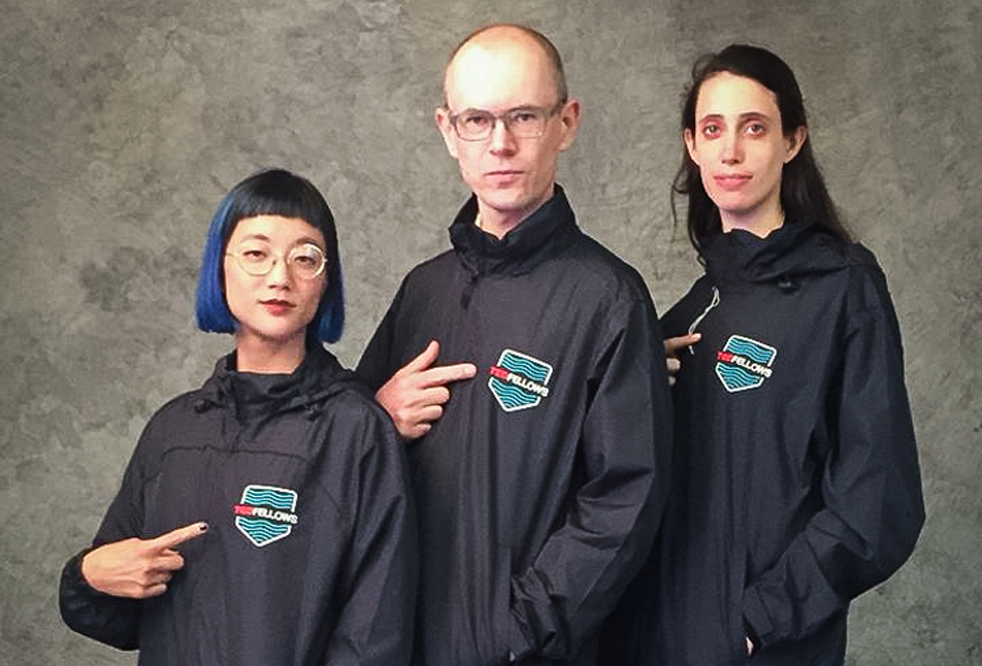
“We gave all the TED Fellows a special retreat windbreaker — modeled here by Christine Sun Kim, Chris Woebken and Kitra Cahana. The chevron-shaped patch has the ‘Swimming Against the Tide’ logo.” Photo: Bret Hartman/TED
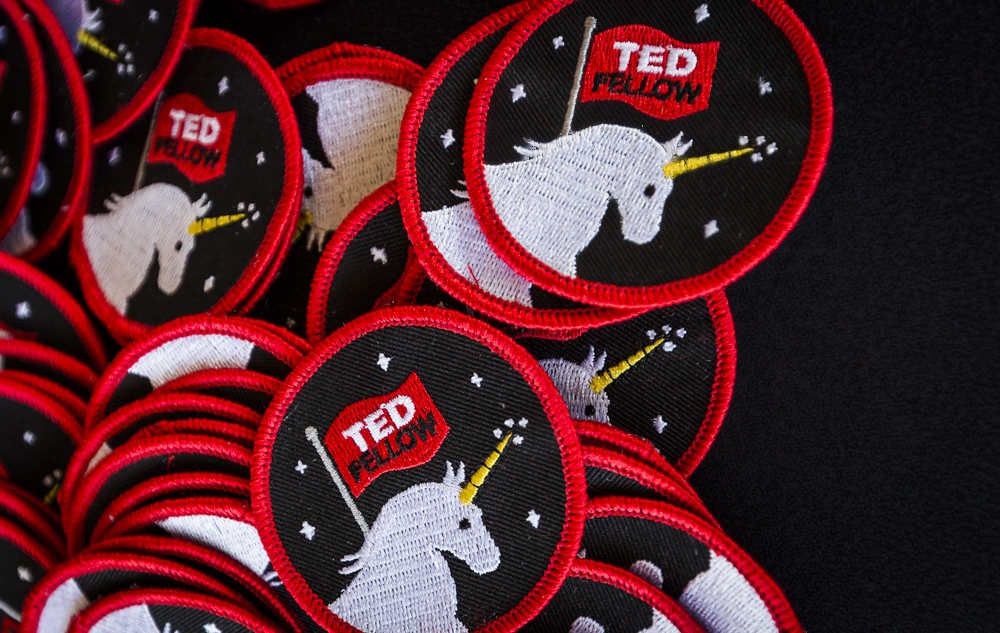
“And I designed an iron-on, embroidered patch featuring the TED Fellows Retreat mascot — the unicorn.” Photo: Bret Hartman/TED
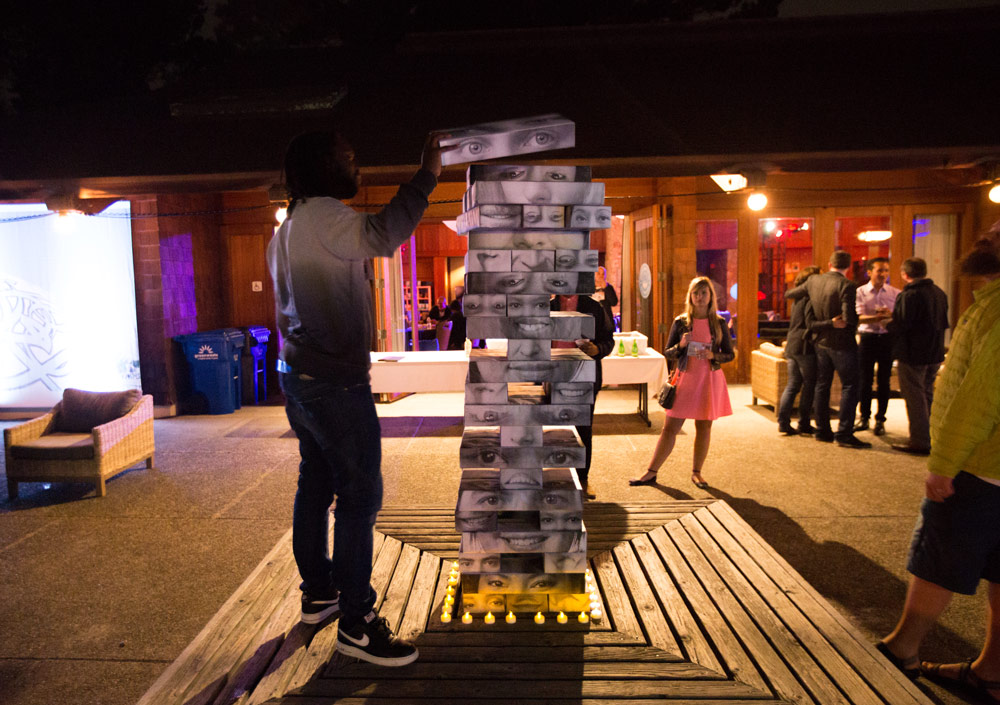
“Staying true to the camp spirit, we wanted to have old-school games that attendees could play. TED Fellow and designer Sarah Sandman came up with the giant Jenga idea: huge blocks made out of photos of the Fellows.” Photo: Sarah Sandman
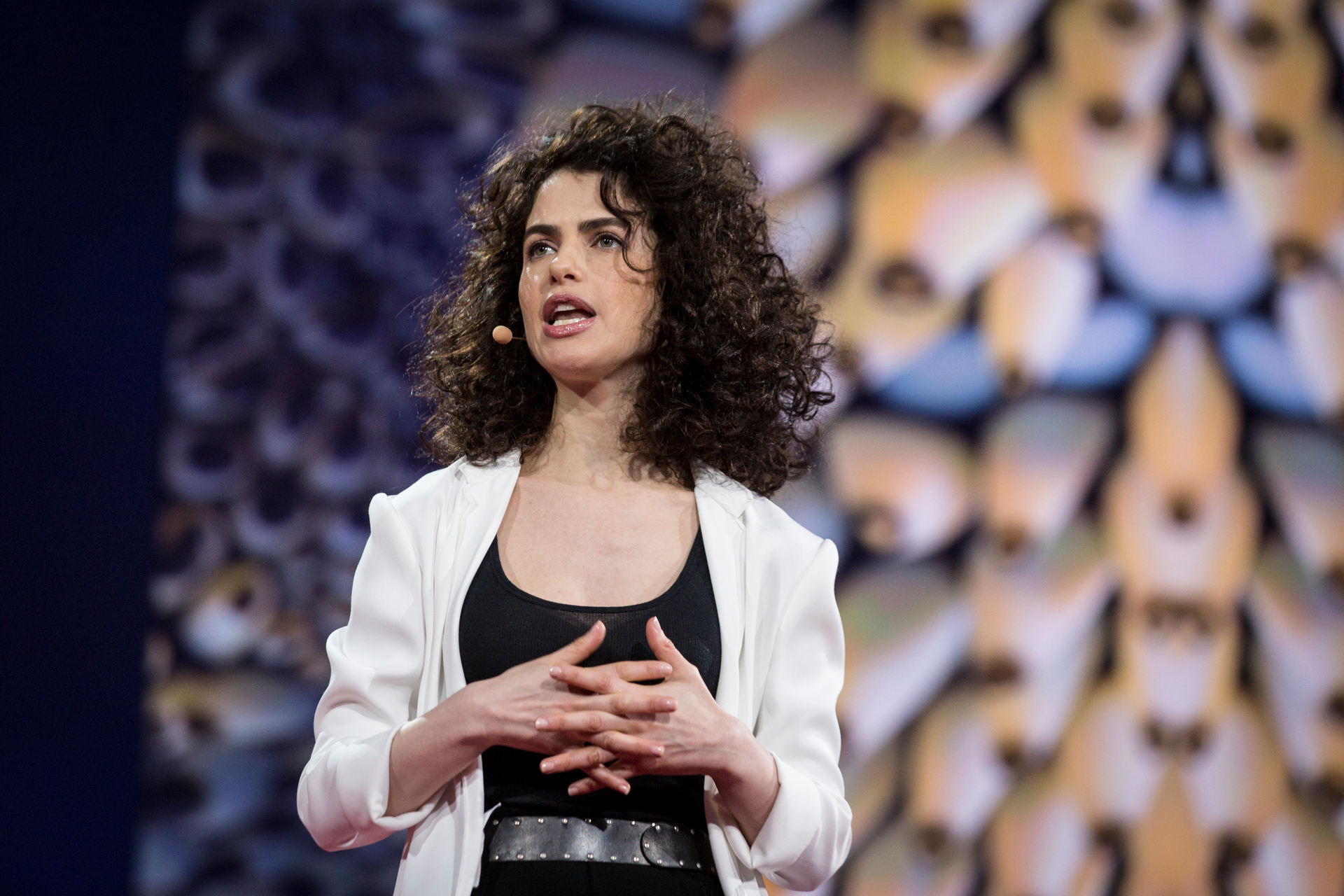
Neri Oxman speaks at TED2015 – Truth and Dare, Session 10. Photo: Bret Hartman/TED
In a session that honors the “deeply practical and the entirely improbable,” pyromantics and biosynthetic designers meet artists and flag-worshippers. Helen Walters, host of Session 10: Creative Ignition, calls this session a “celebration of the catalytic thinking that reshapes the world around us.” Here’s a recap:
How to reboot society. Lewis Dartnell asks us to imagine an apocalypse. Not because it’s fun, but because “it’s a great thought experiment.” What would we need to know to rebuild? For food, we could scavenge—which would keep us alive for about 55 years. But beyond that, we need to glean nutrients, which involves building millstones and using fire. Fire, in a tin-can “gasifier stove,” could provide heat, help us cook, and even keep our machines going. From there, it’s possible to make glass, which Dartnell says is key to understanding the world and increasing human knowledge. “It is science that built our modern life, and it is science you would need to build from scratch,” he says.
A scourge of bad flags. “Once you understand the design of flags, you can understand the design of almost anything.” Roman Mars is the host of 99% Invisible, a podcast about design and architecture. He takes the stage (and a seat) to break down one of his shows examining vexillology, or the study of flags. Because as he says, “Few things give me joy like a well-designed flag.” Mars reveals five basic principles of flag design: 1. Keep it simple 2. Use meaningful symbolism 3. Use two or three basic colors 4. No letters or seals 5. Be distinctive. (Which is indeed a great guideline for any basic design at all!) He shows the beauty of the Chicago city flag and contrasts it with the chaos of Milwaukee, Wisconsin’s city flag, which is so ridiculous and convoluted that it has a flag within its flag. Jokes Mars’ guest from the radio show, Ted Kaye, “If you need to write the name of what you are representing on the flag, your symbolism has failed.” Mars believes deeply in the marriage between good design and civic pride — so why not care more about our city flags?
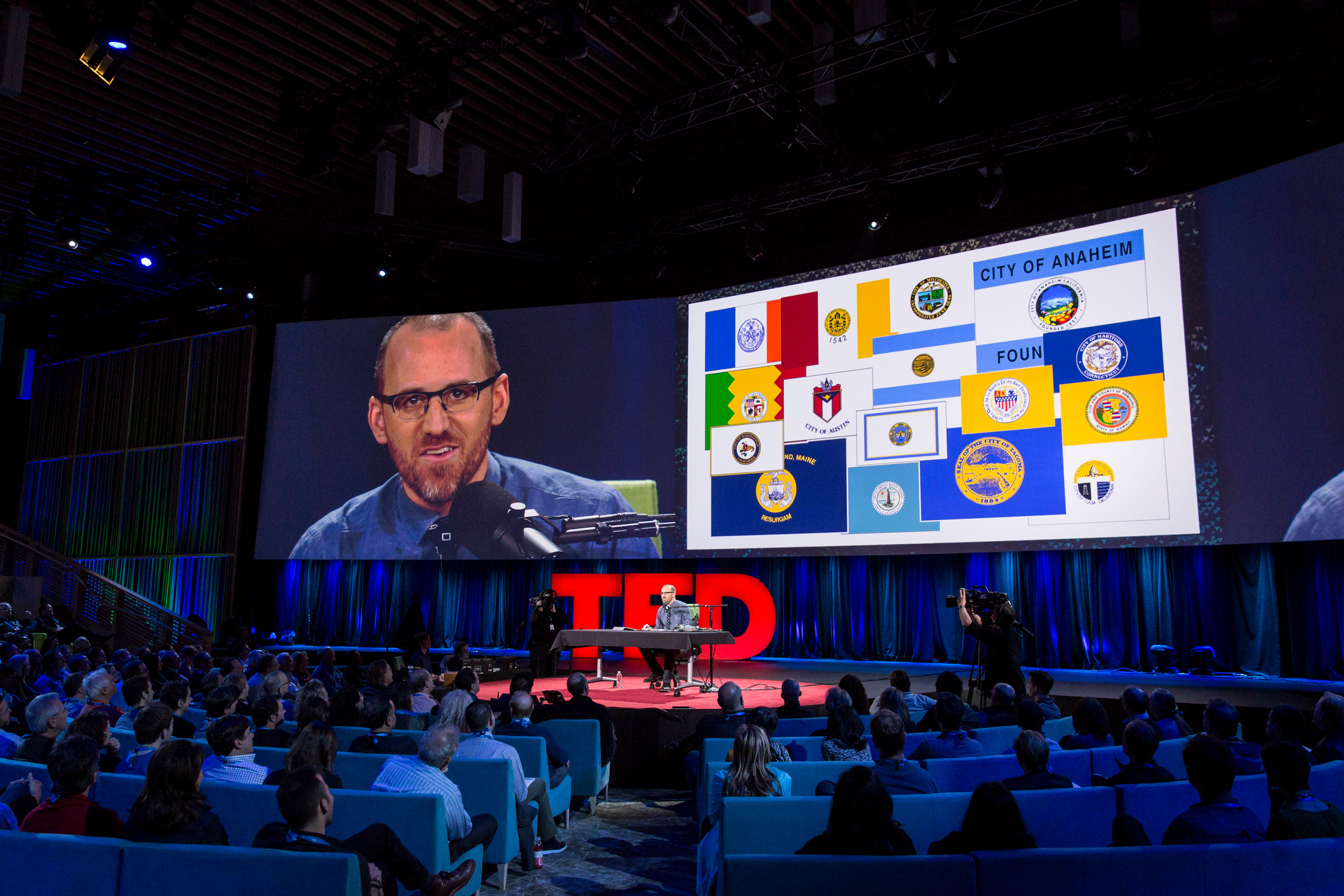
Roman Mars rails against the scourge of bad city flags Photo: Bret Hartman/TED
The words of TED. Dictionary evangelist Erin McKean is here to tell us the top 10 words of TED2015 so far. They are: neurodiversity, kinetic attack, court scraper, photoclinometry, placemaking, wide pin, vexillologist, umwelt, frass, upstander. To find out what these words mean, and how they popped up at TED, check the TED Blog tomorrow.
A flaming history. “We’re a uniquely fired creature on a uniquely fired planet,” says fire historian Stephen Pyne. Unlike other elements like water and earth, fire is not itself a substance – it’s a reaction. And this shapeshifting element has been integral to humanity’s survival, says Pyne. Our advantage over other animals is distinct: We have small guts and big brains because we could cook food; we went to the top of the food chain because we could cook our landscapes (in the form of trees); and finally we became a geological force because we could cook the planet — pulling coal, gas and oil from the very Earth. Says Pyne, “We hold fire power as species monopoly. That’s our unique ecological signature.” Moving through ages of biological, aboriginal, agricultural and industrial fire, Pyne shows us the power of the flame.
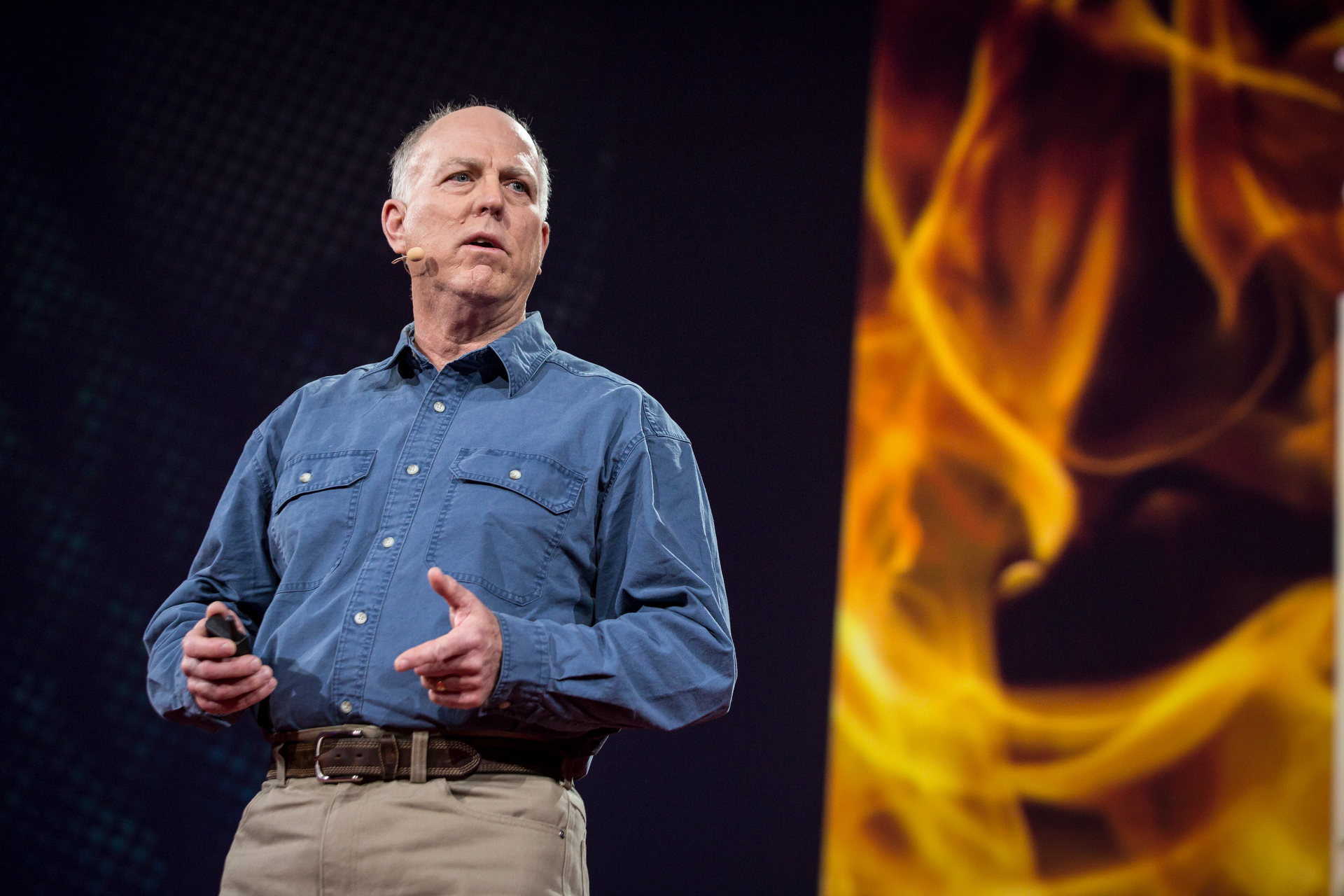
Stephen Pyne speaks at TED2015 – Truth and Dare, Session 10. Photo: Bret Hartman/TED
Internet of Moving Things. We have 1,440 minutes in a day. That’s all we get to work, live and play. In a brief yet engaging talk, Shiva Shivakumar, founder of Urban Engines, asked how we can get back some of our time, even as more and more of us crowd into fast-paced cities. By aggregating and analyzing cloud data from the Internet of Moving Things –any device, app, or software that tracks movement throughout space—he created interactive models that visualize patterns of movement through out cities. This provides useful information on everything from how bad traffic in São Paolo will be after a soccer game, to the best bus routes to take in San Francisco.
Photosynthetic wearables. Designer and architect Neri Oxman works at the intersection of assembly and growth. Using the “biblical material” chitin, as well as E. coli, silk, and other natural materials, she and her team at MIT co-create new structures with nature. “We live in a special time in history — a rare time,” says Oxman. She notes that the confluence of four fields — computational design, additive manufacturing, materials engineering, and synthetic biology — is giving designers access to new tools and ways of being. For the first time, she reveals at TED a photosynthetic wearable grown from bacteria on the human body. “Think of it not as evolution by natural selection but evolution by natural design.”
The world from inside a box. “This is not about thinking outside of the box, it’s about thinking inside the box.” Artist Dustin Yellin zooms in on the colorful, incredibly detailed worlds that live inside the glass boxes he’s been making for the past ten years. The tiny landscapes are funny, dark, playful, provocative, and they capture the changing cultural DNA of our society’s fabric. From a Jesus with his locusts to an old lady playing guitar to some avocados, from a bird god tied up to a battleship to a collection of terrorist trading cards (you know, like baseball cards), Yellin’s boxes are macabre and stunning at the widest and smallest scales. And for the past several years Yellin has been working on a new kind of box – one made of brick instead of glass. At Pioneer Works in Brooklyn, he has built what he calls “a museum of process,” a new kind of multidisciplinary space where geneticists, physicist, sculptors, painters, programmers can all work together to create new forms. Says Yellin, this social sculpture is “not about seeing work finished, but rather work made.”
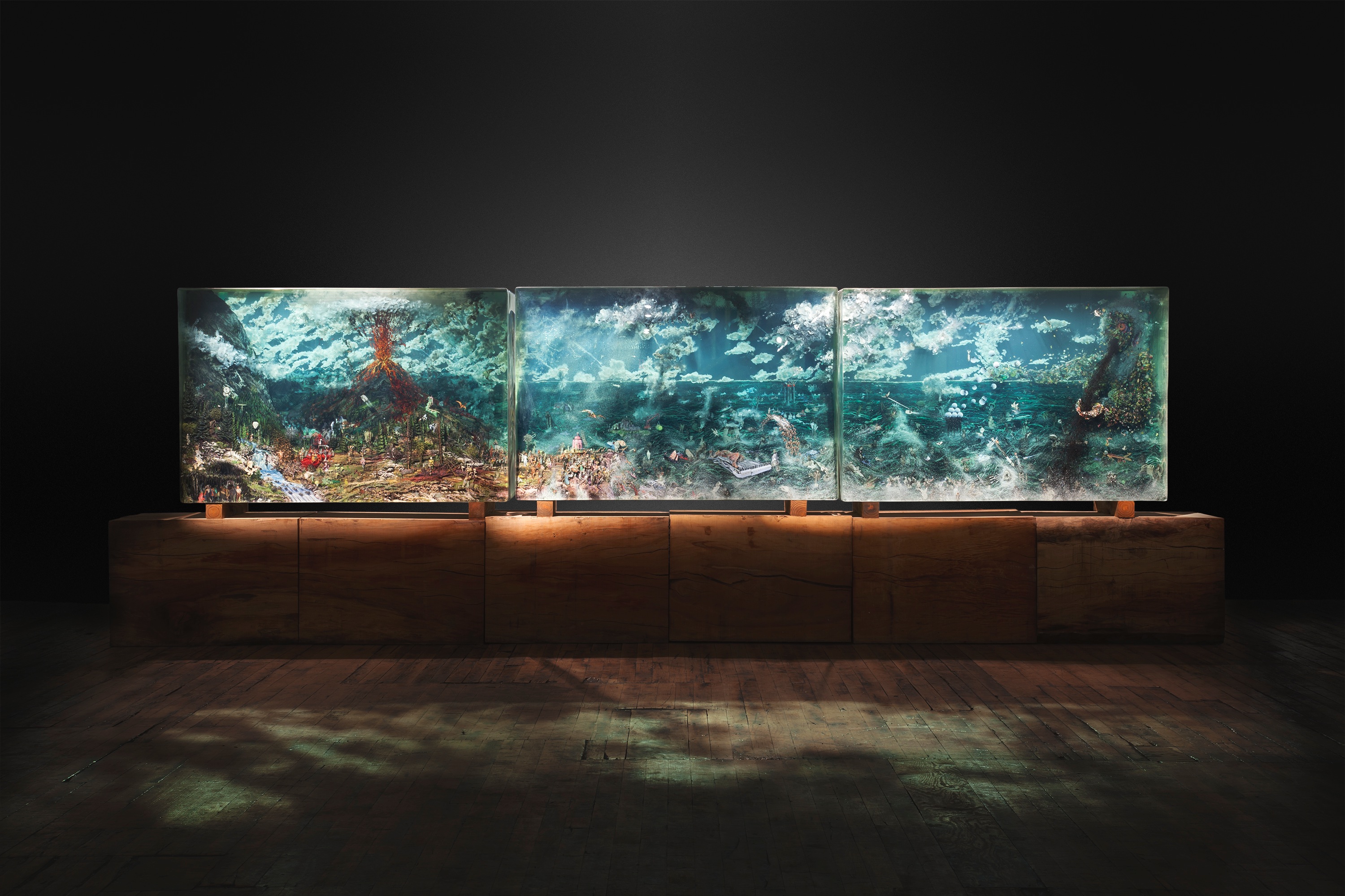
The Triptych, Dustin Yellin masterwork, made of glass and found objects. Photo courtesy of Dustin Yellin.
You can watch this session, uncut and as it happened, via TED Live’s on-demand conference archive. A fee is charged to help defray our storage and streaming cost. Sessions start at $25. Learn more.
]]>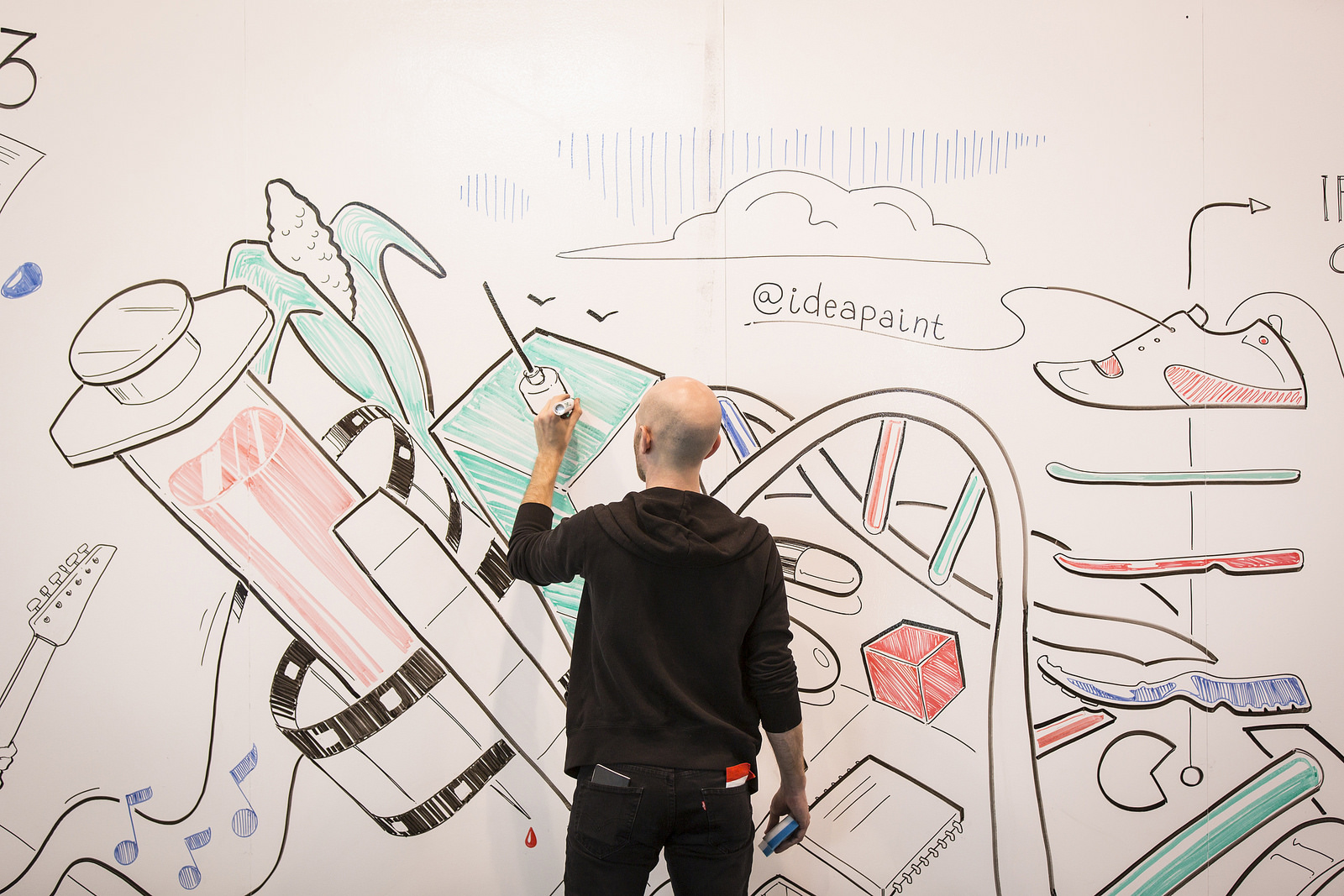
Artist Derek Cascio colors on the walls of the Vancouver Convention Center, thanks to IdeaPaint—which turns any wall into a whiteboard. Photo: Ryan Lash/TED
After a full day of talks, after TEDsters have headed out to after-hour dinners and events, the Vancouver Convention Center is far from empty. In addition to the tech workers and hospitality team who labor through the night to ready the TED stage for a new day of sessions, a single figure is busily at work.
Derek Cascio is a visual artist and industrial designer. He works overnight, mapping out a massive black and white mural onto the walls of the convention center. His chosen medium: dry erase marker. He’s able to draw directly on the walls, thanks to a quick-drying substance called IdeaPaint that turns any surface — painted wall, wallpaper, table, you name it — into a whiteboard.
Cascio gets a sneak peek at a few of the day’s talks, so he can start creating a first layer of illustrations. Then, during the sessions, he invites TEDsters to add to his drawings: astronauts, ballerinas in blindfolds, a bat emitting sound waves.
“This is a group who loves to interact and doodle,” he notes as we watches a ring of conference attendees layer colors, cartoons and graffiti onto his 10- by 20- foot wall-turned-coloring-book. It’s floor-to-ceiling, with all the furniture in between.
Cascio is great at walking potential collaborators through initial hesitation. He knows it’s a bit iconoclastic to encourage people to draw on top of someone else’s work. Not to mention, we’ve all been told not to write on the walls since we first tried as toddlers. But Cascio knows the magic words, which he offers to a TEDster as she pauses in front of the mural: “It’s erasable. If you mess up, you can try it over again.”
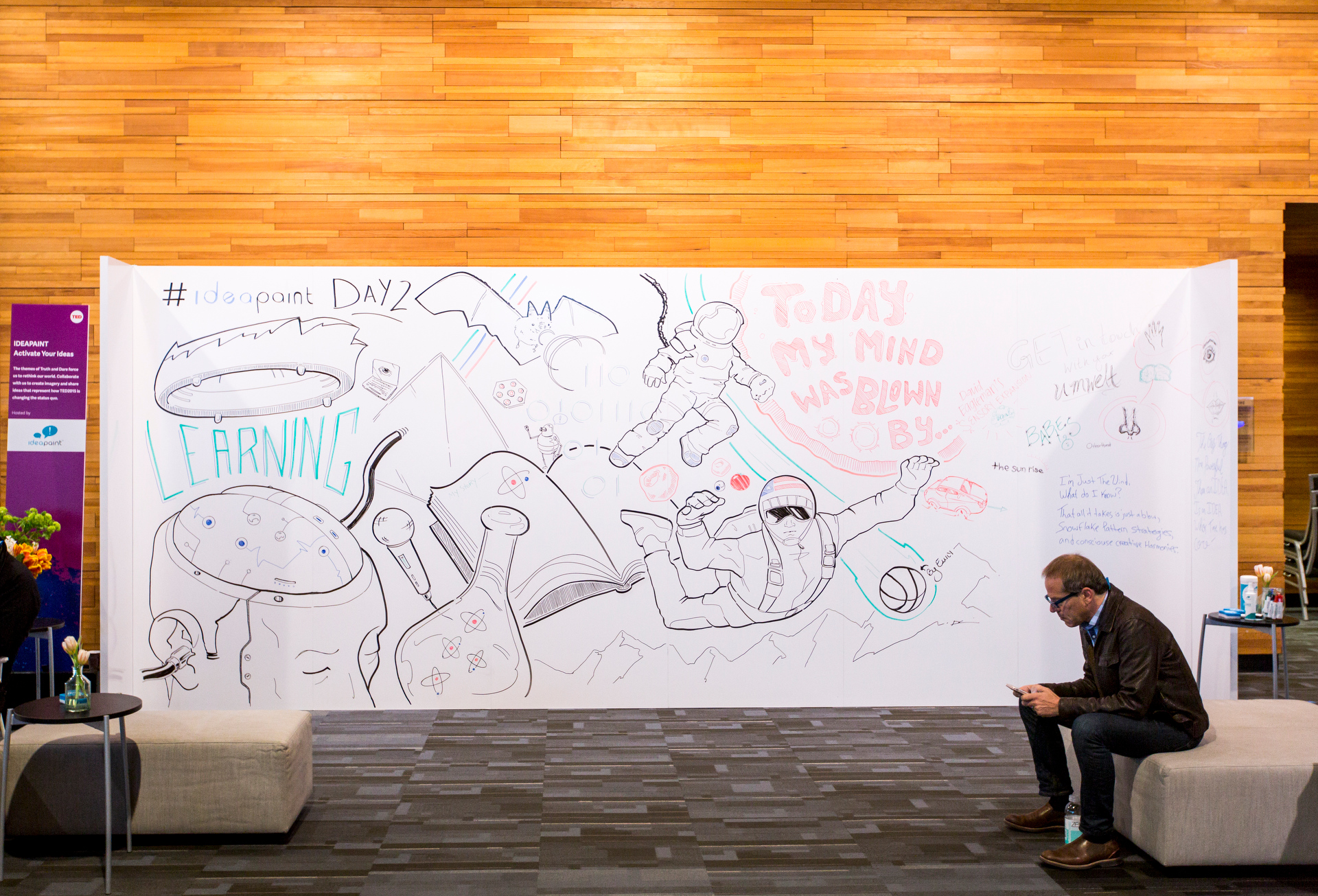
Over at the IdeaPaint wall, attendees are encouraged to draw on the wall and add to Cascio’s designs. Photo: Ryan Lash/TED
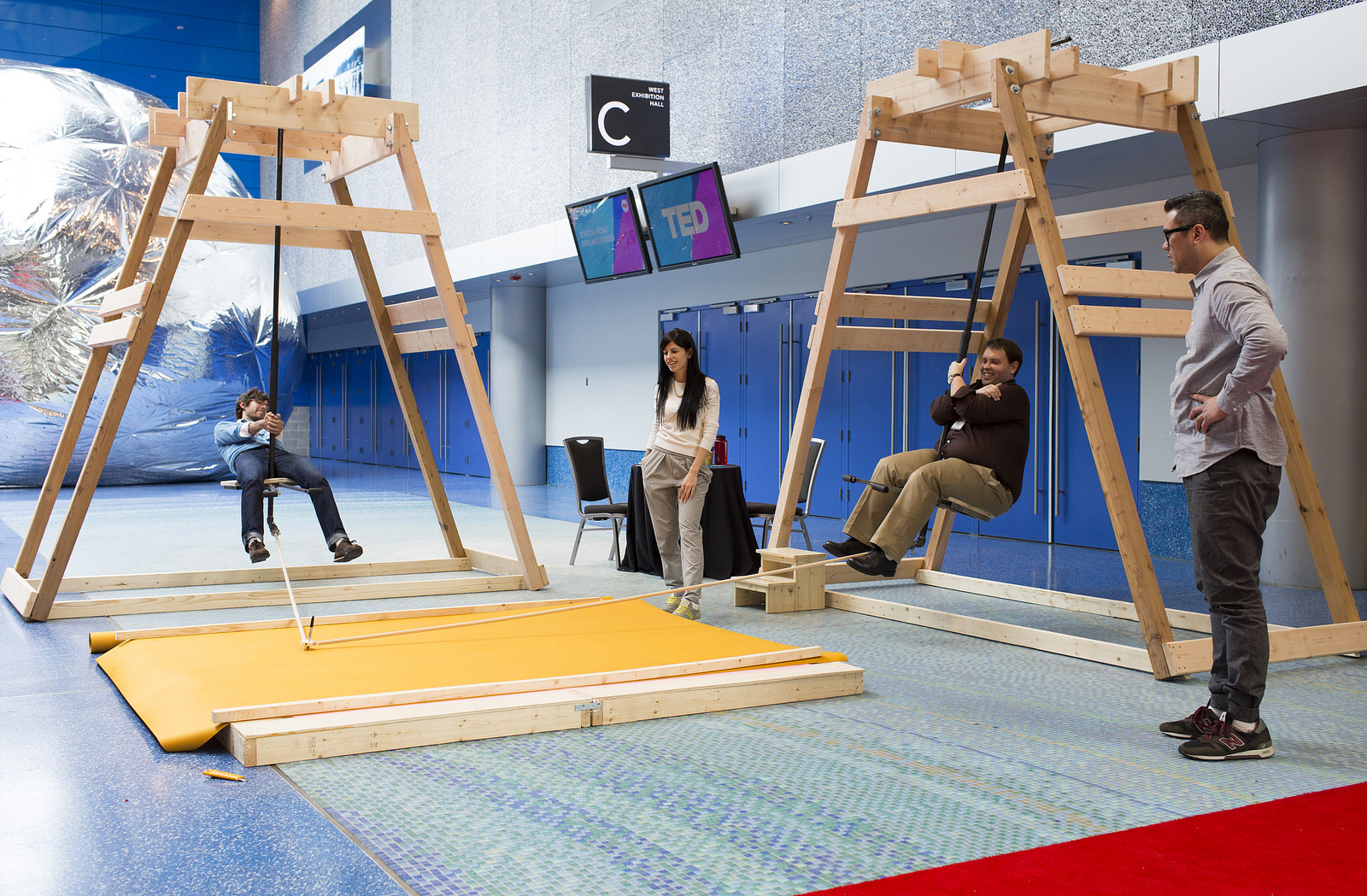
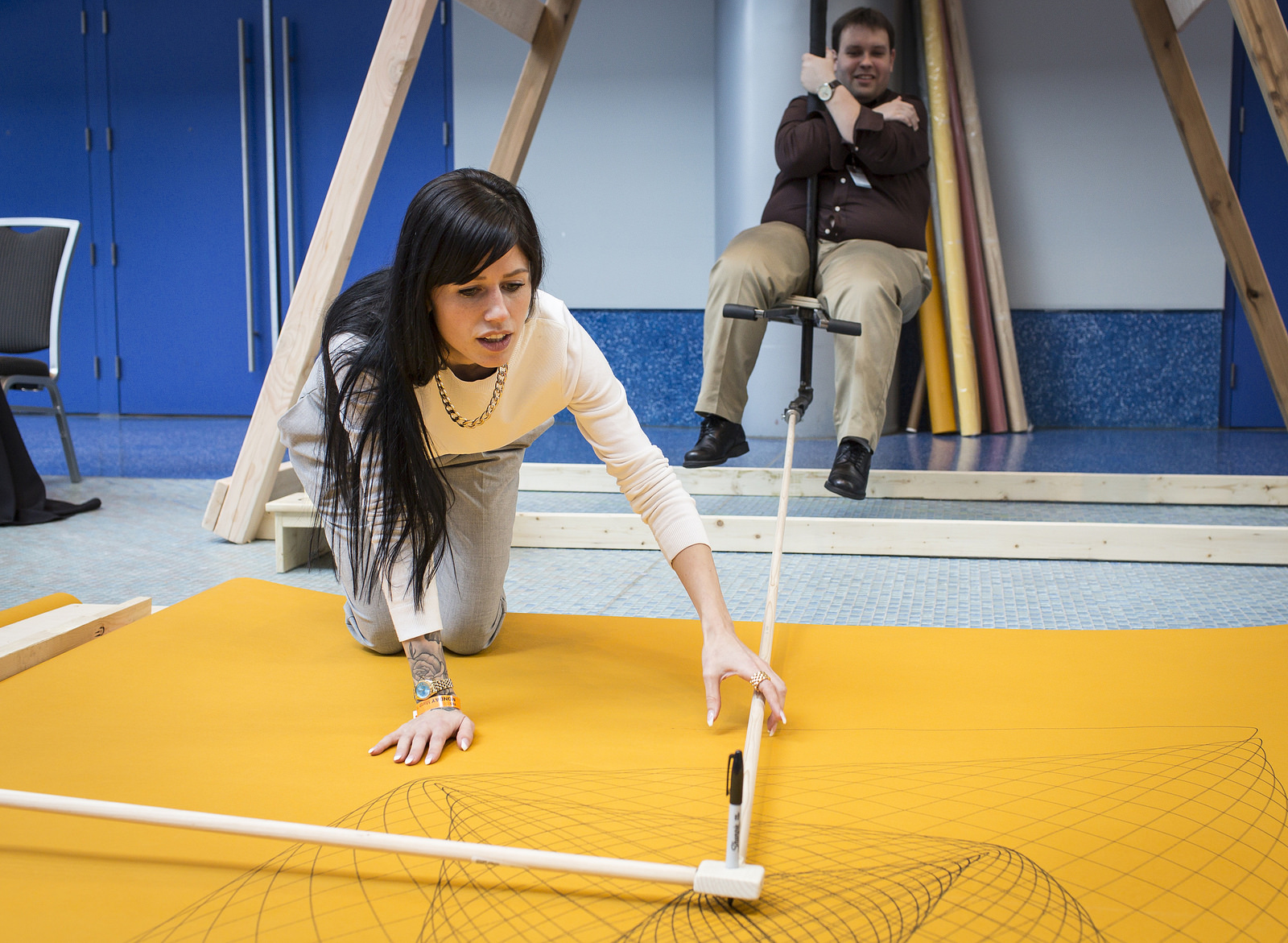
Two attendees on the the Harmonograph Swingset, an adaptation of a 19th-century invention that turns the frequency of relationships into art. Photo: James Duncan Davidson/TED
If a meet-cute is going to happen at TED2015, it will likely happen downstairs on the first level at the Harmonograph Swingset. This modern-day, hand-crafted timber swing, a take on a 19th-century invention, records harmonic frequencies as visual art.
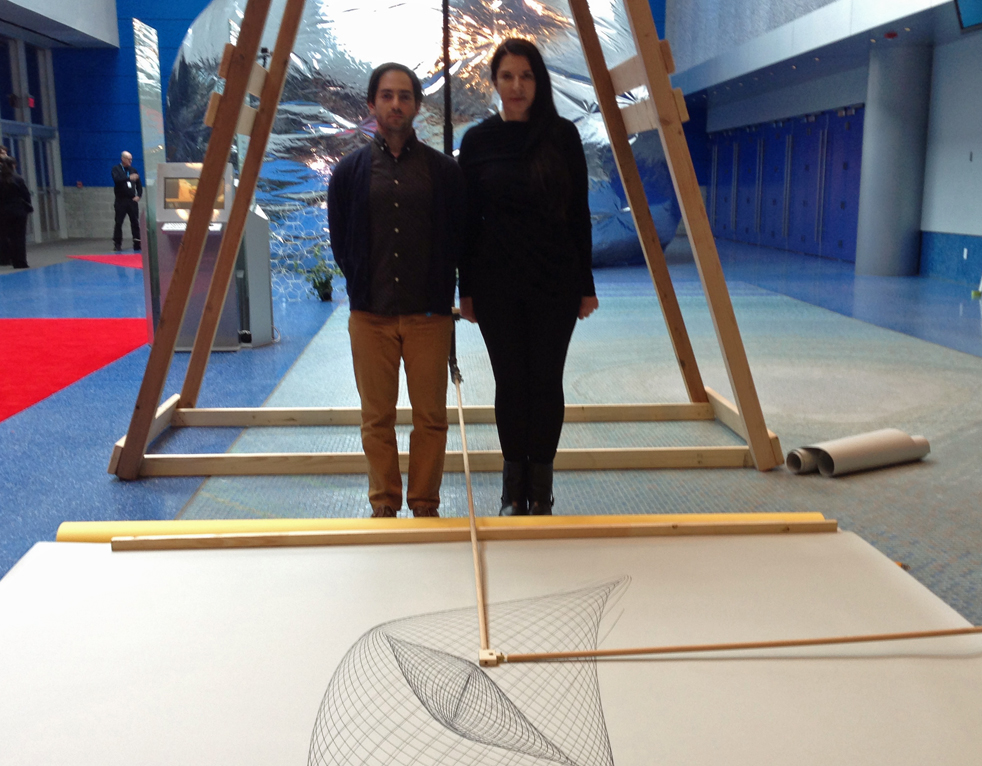
The swingset is made of two seats, set at right angles and connected to two poles on universal joints, which operate like pendulums. It is operated by human weight. The two pendulums meet in the middle at a marker, which hovers over an enormous piece of heavy drawing paper. When TED attendees sit two at a time in the swing, the pens move across the paper, forming a precise graphic record of the harmonic frequency of the pair.
“Each visual representation is one of a kind,” says Carley Stadelmann, co-creator of the swing. She and Jeremy Wong — her artistic partner, as well as partner in real life — are inviting TEDsters throughout the week to ride the swing and create a harmonograph portrait with an old friend or a stranger. “If he and I were to ride it,” she says, pointing to Wong, “it would be completely different than if you and I were to ride it together.”
Stadelmann is an inventor and an artist. She is drawn to the visible representation of unheard sound made possible by the machine, as well as to the emotional value of a portrait of two people’s unique frequencies. It can record the frequency of a couple, of a mentor and student, of two friends, of two strangers. “People take the sheets home and frame them like portraits,” says Wong. “They’re very special.”
The two are at TED to get feedback from the creatives and engineers attending. Stadelmann hopes to scale the installation: her goal is to rebuild the project as a giant outdoor sculpture on one of Vancouver’s beaches, where people could draw ephemeral frequency portraits in the sand.
But aside from being fun, the Harmonograph Swingset is also educational. “I like the idea of taking a basic concept and making it interactive so someone can learn at the same time,” she says. “That’s really important to me.”
Artist and inventor Carley Stadelmann helps retrieve an image from the swingset. Photo: James Duncan Davidson/TED
Marina Abramovic hopped on the swing with Casey Caplowe. Photo: Carley Stadelmann
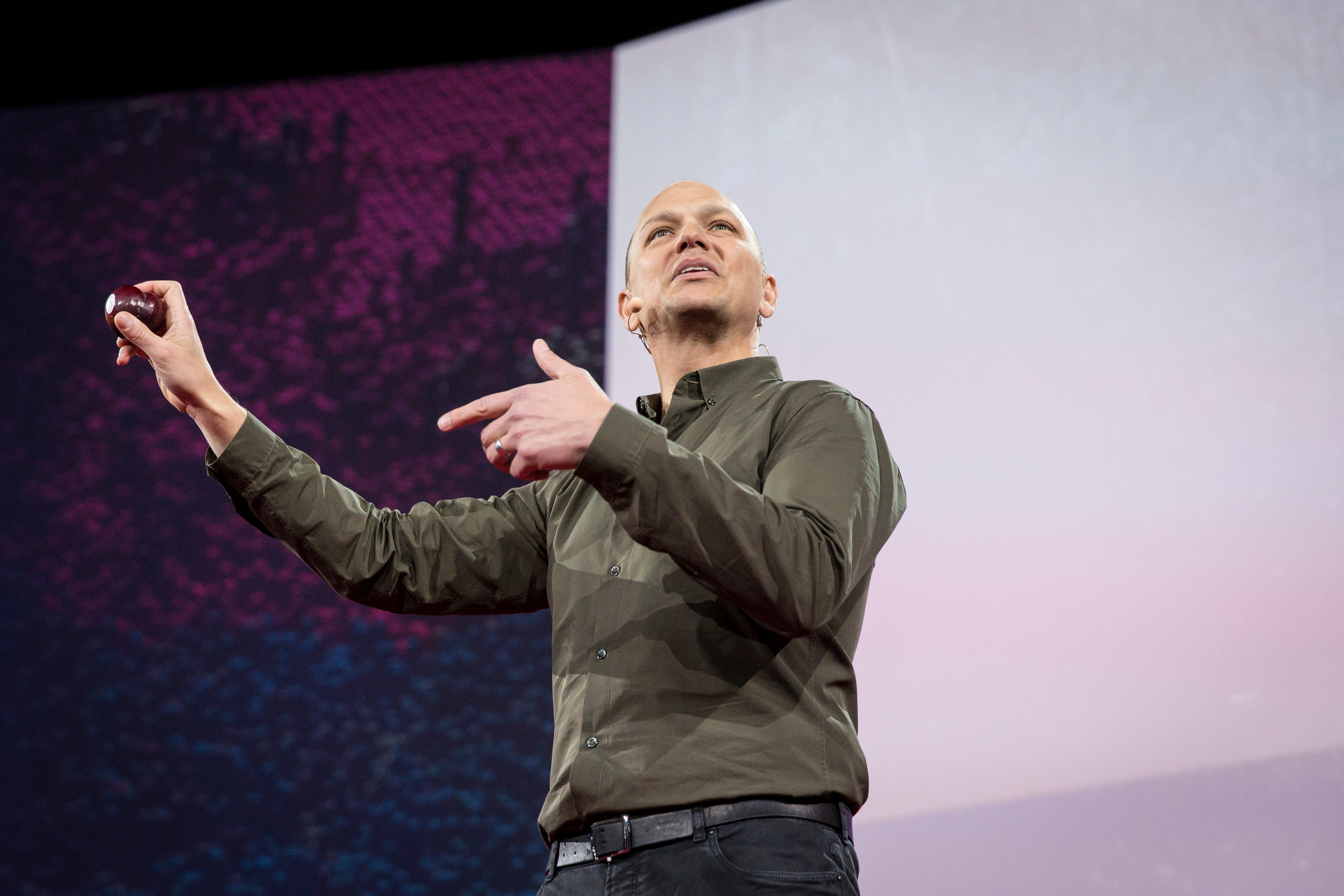
Tony Fadell worked on the design of the iPod; now he’s building better home appliances. Photo: Bret Hartman/TED
As a product designer, it’s Tony Fadell’s job to imagine invisible improvements to everyday objects. That’s how he developed the iPod and revolutionized the way the world listens to music. Now at Nest, he’s trying to bring that same creativity to one of the realms that has proved most elusive for tech: household appliances. Teamed up with Google, Nest is hoping to bring us one step closer to a truly smart home.
In this insightful talk, the product designer shares how he fights back against the human tendency towards habituation — our natural penchant for internalizing everyday patterns and behaviors into habits, even if they are unpleasant or not user-friendly. He uses the example of the tiny sticker on fruit: the first time you had to find the sticker, dig it out of your fruit and flick it off your finger, it was pretty annoying. By the tenth time, it probably didn’t bother you as much, and by the hundredth time, you probably did not notice it at all.
 For product designers like Fadell, the trick to improving these user experiences is to notice the “little idiotic details” of things we do every day that we don’t even remember. “It’s seeing the invisible problem, not just the obvious problem, that’s important,” says Fadell. “There are invisible problems all around us. First we need to see them. To feel them. Then we can solve them.”
This is how Mary Anderson invented the first windshield wiper in 1902 — riding a streetcar on a cold and rainy day, she decided that there had to be a better way to clearing the windshield than the driver opening the window, leaning out in the rain, and drying off the windshield by hand. Remaining in her seat, Anderson began sketching the world’s first windshield wipers.
“Our challenge is to wake up each day and say: how can I experience the world better?” says Fadell.
He offers three tips to fight our constant tendency towards habituation:
1) Look broader. There are often lots of steps leading up to the problem, and lots of steps after it. Fadell suggests looking at the whole process, start to finish, to identify problems that need improving. Using this approach, Fadell’s team at Nest improved thermostat design by incorporating an algorithm to predict user’s temperature preferences and save energy
2) Look closer. Focus on the small details that make all of the difference. At Nest, Fadell spent months agonizing over designing the perfect screw to make home installation as easy as possible. Though the process was time intensive, Fadell thinks this small detail made all the difference.
3) Think younger. Fadell’s kids often ask him big, creative questions about the world we live in: Why can’t cars fly around traffic? Why don’t my shoelaces have velcro? Why doesn’t the mailbox just check itself and tell us when it has mail? The more we’re exposed to something the more we get used to it. When kids run into problems, they try to solve it and find a better way. Have young people, and people with young minds, on your team, Fadell suggests.
]]>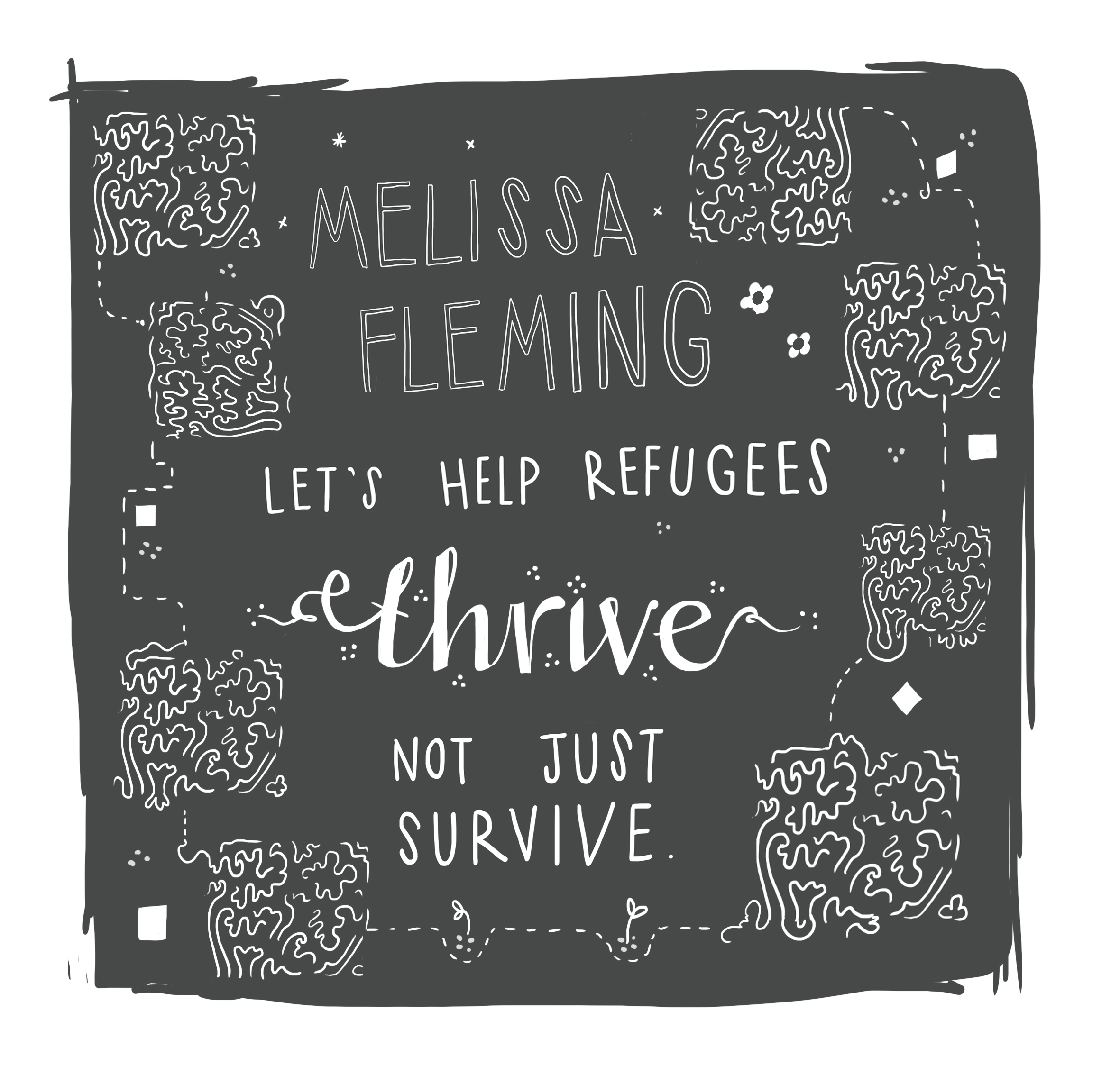 “Syrians are just looking for a quiet place where nobody hurts you,” says one refugee, who survived a capsized escape craft on his dangerous journey. Clarice Holt, an illustrator in London, was moved by the simple, powerful truths she heard in Melissa Fleming’s TED Talk, “Let’s help refugees thrive” — and made these beautiful illustrations to show the personal stories and shattering data of the modern refugee crisis.
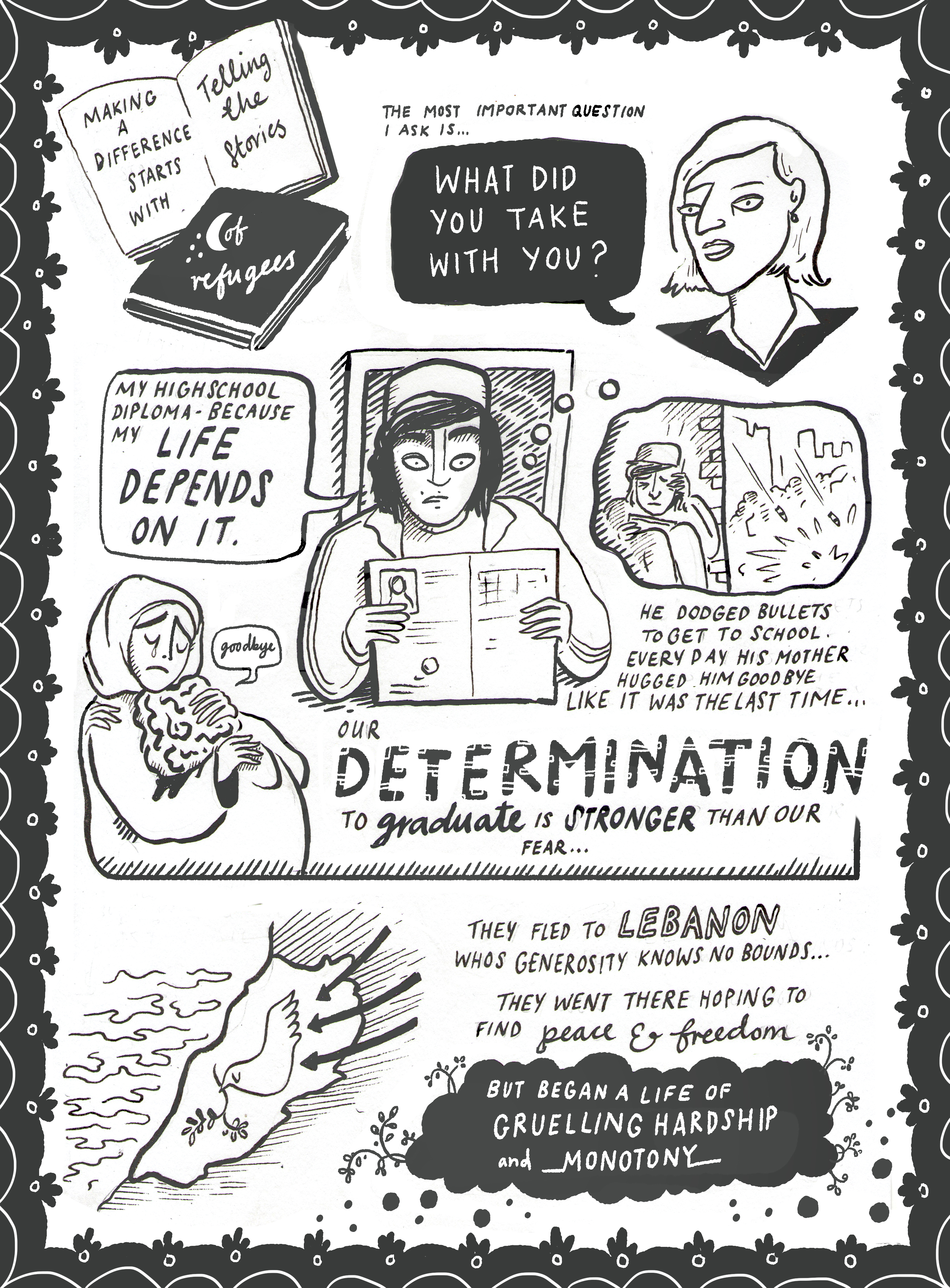
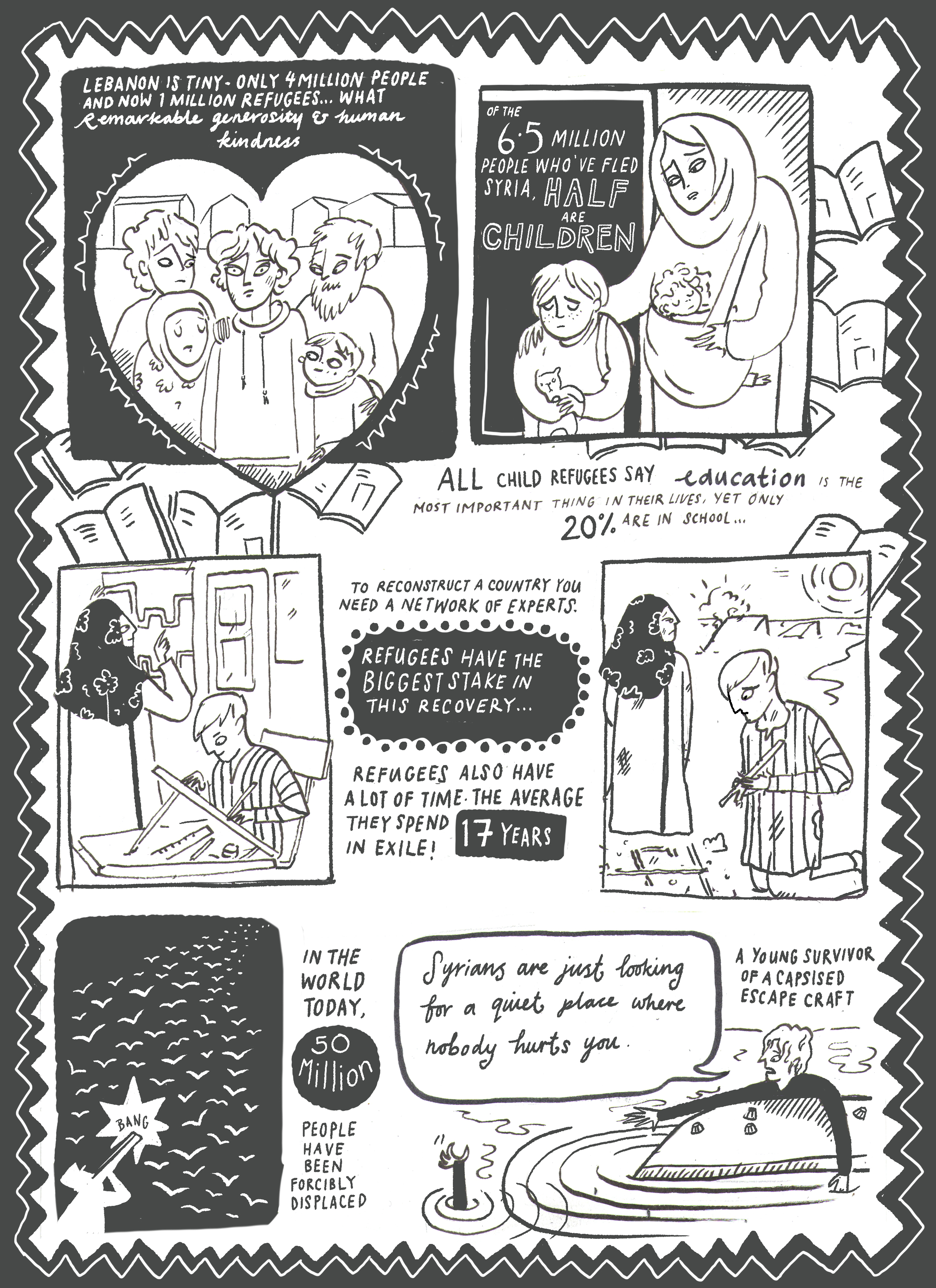
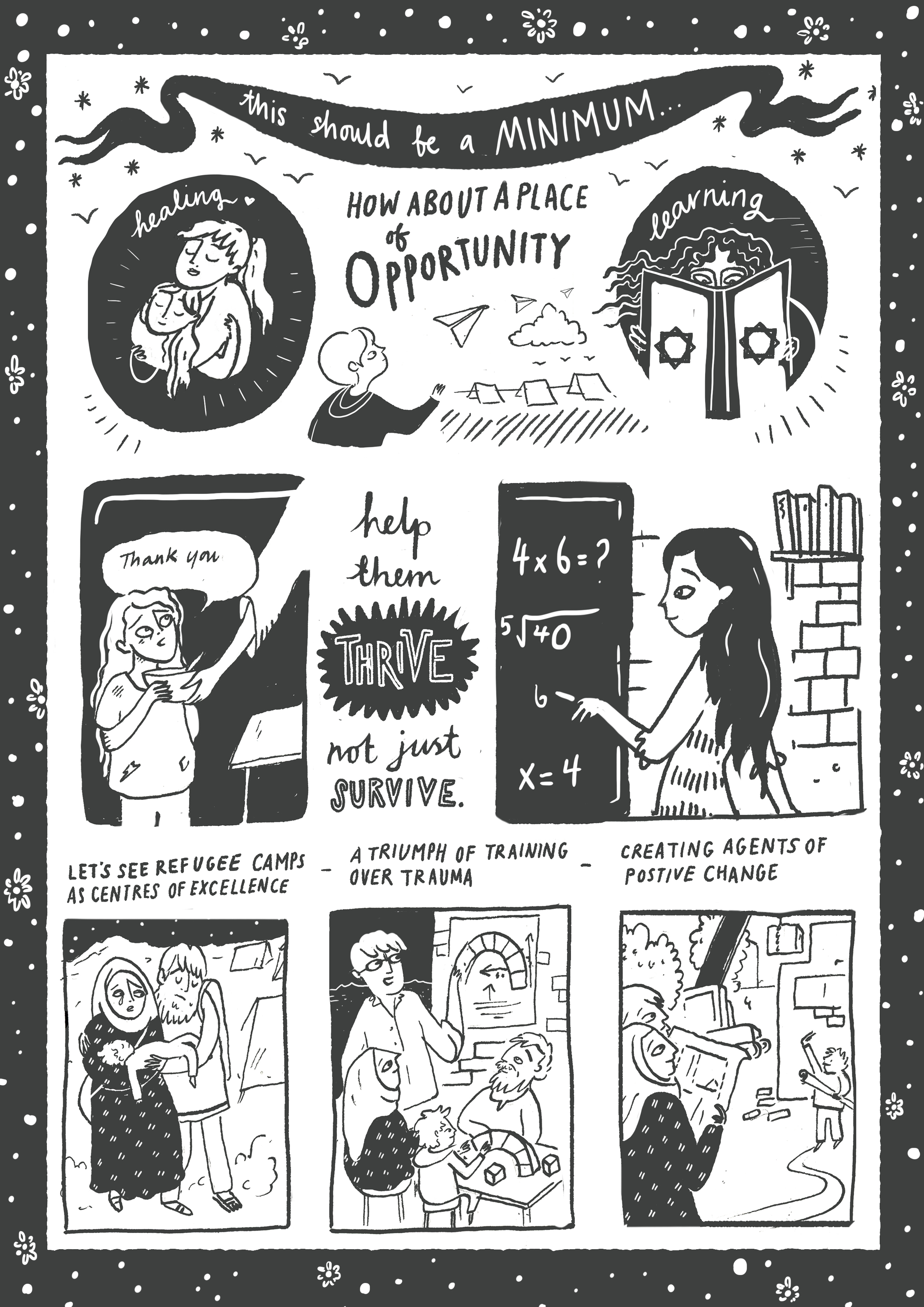
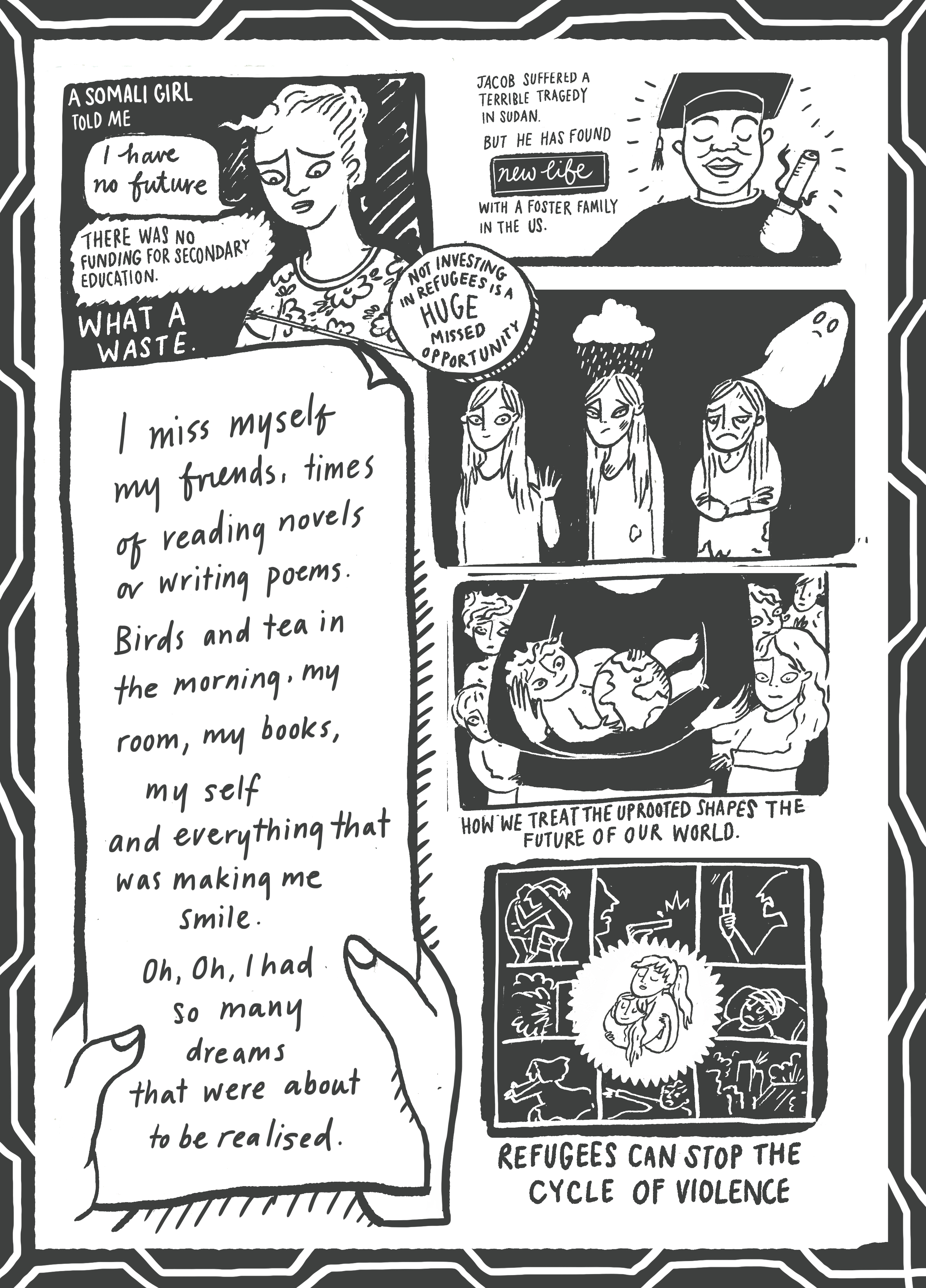
About the artist: “An illustration can be like Mary Poppins’ spoonful of sugar,” says Holt. “If someone is captivated by an image, they can absorb so many things along with it.”
Holt began the sketch in pencil, then used a brush pen to draw the images. She cleaned it all up using a Wacom tablet and her laptop. “I am really into pattern, and the fact that the talk centered on Syria, which has a rich history of decorative art, inspired me to cram as many patterns in as possible,” she says. “I chose to make the whole thing a dark, charcoal gray—a nod to the monotony and hardship of refugee camps.”
Melissa Fleming saw the sketches on Twitter. “I was blown away,” she says. “It warms my heart that a young artist in England would care enough to engage her talent to make a difference for the refugee cause.” She retweeted to share the images — and then emailed TED to tell us about them too. “I love how she highlighted the facts and figures, but brought the personal stories alive. It is a complete talk in itself in a few evocative frames,” she says.
As Holt says, “I hope it makes people want to go and give the gift of their talents, whatever those may be, to people who need them to rebuild their lives. I hope this image passes on that itchy, scratchy, philanthropy feeling that I got from Melissa’s talk.”
Watch this powerful TED Talk, which manages to make an issue that usually feels overwhelming and distant feel personal, immediate and changeable.
Fanfare shares art, music, video remixes and more created by TED fans around our content. Have something you’d like to share? Write contact@ted.com and tell us about it.
]]>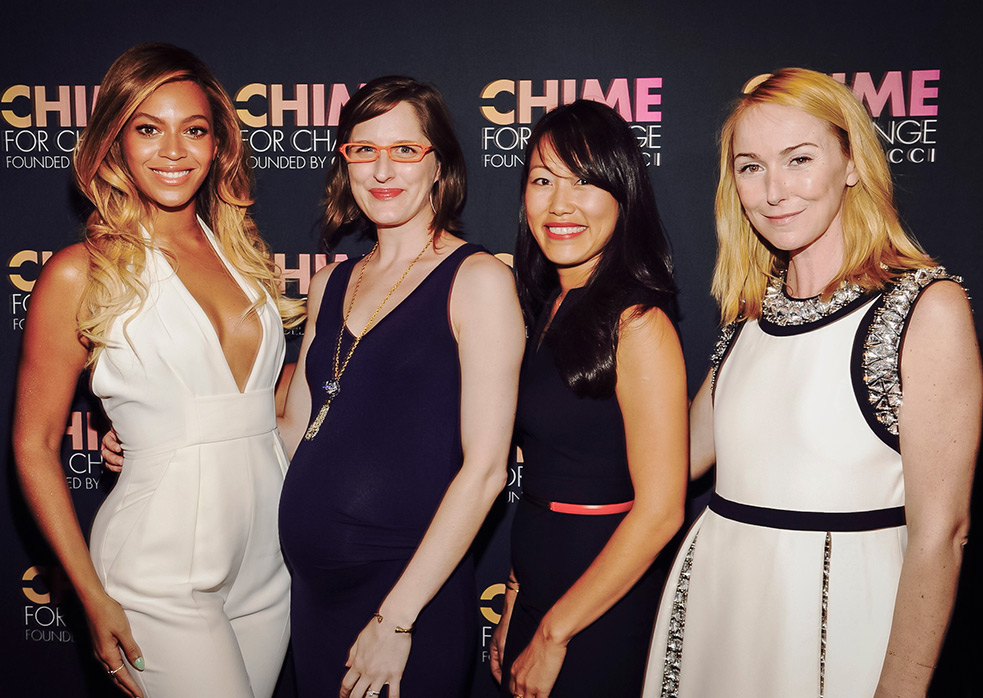
Beyoncé has given a big boost to TED Fellow Jane Chen’s (near right) effort to deliver the Embrace baby warmer to moms whose babies desperately need it. Here, the two pose with Amy Shaw from Millennium Promise (near left) and Frida Giannini of Gucci (far right). Photo: Courtesy of Jane Chen
Jane Chen knew that, for her low-cost baby incubator to save lives, moms would need to love it. But she had no idea that one of the world’s most famous moms—Beyoncé—would become one of her biggest supporters.
Last week, Beyoncé announced a $125,000 donation to Embrace Innovations, Chen’s organization that makes the low-cost infant warmer, which looks like a tiny sleeping bag. The donation will fund testing of the device in Ethiopia, Ghana, Kenya, Malawi, Mali, Nigeria, Rwanda, Senegal, Tanzania and Uganda — and could help 1,900 underweight babies survive and thrive. This donation, announced at an anniversary party for Gucci’s Chime for Change, was the domino effect of Chen stepping on to the TEDWomen 2013 stage.
At TEDWomen, Chen gave an update on Embrace — and admitted that she and her team had missed something in their original thinking on the device.
 Jane Chen: A warm embrace that saves lives
(Watch her 2009 TED Talk, “A warm embrace that saves lives.”) At first, she and her team imagined that local clinics and hospitals would give the baby warmer to new moms. But after observing in the field in India, Chen’s team realized they couldn’t count on overworked health workers to teach new moms how to use the baby warmer. They needed to make Embrace easy enough for moms to use it on their own to protect their babies. As Chen says, “A mother will do anything to save her child.”
Jane Chen: A warm embrace that saves lives
(Watch her 2009 TED Talk, “A warm embrace that saves lives.”) At first, she and her team imagined that local clinics and hospitals would give the baby warmer to new moms. But after observing in the field in India, Chen’s team realized they couldn’t count on overworked health workers to teach new moms how to use the baby warmer. They needed to make Embrace easy enough for moms to use it on their own to protect their babies. As Chen says, “A mother will do anything to save her child.”
Chen went back to the drawing board, getting more input from mothers this time. The team simplified the directions, making them easy even for people who can’t read. They also rebuilt the temperature gauge on the device, after noticing that some caregivers, assuming that Western medicine was too extreme, were setting the temperature too low to work. As a result of this observation, they swapped out the temperature dial, and replaced it with a green ready-to-use light. Another design tweak allows a mother more skin-to-skin contact with her baby.
After presenting this reframing at TEDWomen, Chen was approached by Robert Triefus, chief marketing officer of Gucci, and Susan Chokachi, Gucci’s senior vice president of marketing and communications.“They told me they had taken a trip to Malawi with UNICEF and seen the desperate need for incubators firsthand,” says Chen. “They were interested in helping Embrace in some capacity.”
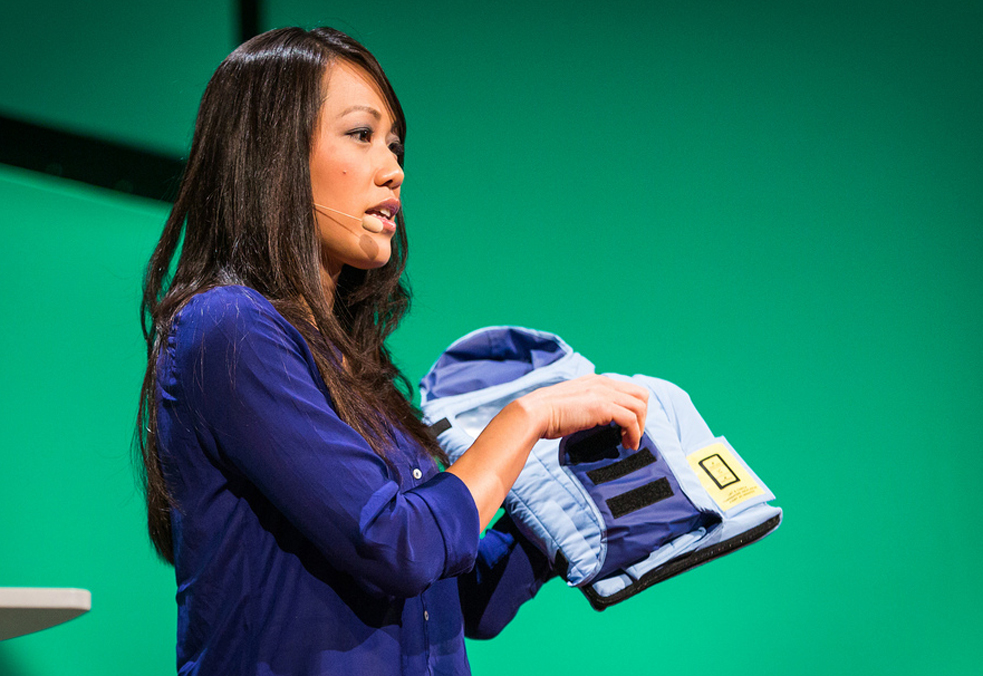
Jane Chen gives a peak at the Embrace, redesigned with moms in mind. Photo: Marla Aufmuth
About a year ago, Gucci launched Chime for Change, a global campaign led by Gucci Creative Director Frida Giannini, Salma Hayek and, yes, Beyoncé. Chime for Change supports projects—so far, about 300 of them—that promote education, health and justice for girls and women around the world. They arranged a call with Chen.
Chime for Change uses a crowd-funding platform to raise money for projects. The group decided to post a project that Embrace Innovations was planning with the Millennium Promise, which works to untangle the interrelated challenges of poverty in villages in 10 African countries. They set their goal at $25,000 to bring Embrace to three Millennium Village sites in Mali, Kenya and Uganda.
“Susan and I had multiple calls over the next few months to move this all along. She’s been an incredible champion,” says Chen. “And Frida Giannini — Chime for Change is her brainchild. She said to me that as a mother, what we’re doing is particularly emotional for her.”
Earlier this month, Chen got word that Gucci was planning a one-year anniversary event for Chime for Change in New York City, and that they’d be donating 10% of proceeds from three days of sales in their flagship store to a group of four organizations, including Embrace’s partnership with the Millennium Promise. (The other recipients: Shining Hope for Communities, Girls for Gender Equity, and the Coalition to Abolish Slavery & Trafficking.) On Tuesday, June 3, Chen glammed herself up and headed to Gucci’s Fifth Avenue store. “As soon as I walked in, I noticed dozens of photographers taking pictures of someone—I couldn’t quite tell who it was,” she says. “Turned out that it was James Franco.”
But the most exciting part of the night was Beyoncé’s donation.
Earlier, it had been announced that a mystery donor was giving $500,000 to the four organizations—$125,000 of it to Embrace’s Millennium Promise partnership. The donor, of course, turned out to be Beyoncé, who arrived in a white jumpsuit. (Yes, you can care about the world and still appreciate fabulousness.)
“She told me how incredible she thought the innovation was. I think what struck me was how sweet and genuine she was—and just so excited about our work,” says Chen. “One of my most memorable moments was getting to dance with her after we spoke.”
Chen also felt instant camaraderie with Beyoncé’s publicist. “She was in tears,” says Chen. “She had a premature baby, and her sister did as well. Given her first-hand experience, she truly understood.”
With the gift, Chen will be able to pilot Embrace in seven more villages, bringing the total to 10, and bringing the device into an additional seven countries. Chen hopes that big things could come of this. “We want to get on the radar of the governments in these countries, which can help scale this even further through getting it into the public health infrastructure,” she says.
Overall, this experience has been both unexpected and delightful for Chen.
“I love fashion and have always been a Gucci fan,” says Chen. “Given the work they’re doing, I respect the brand even more now. I’m hoping I can convince them to do a Gucci version of our baby sleeping bag.”
Support Embrace’s non-profit arm »
Donate to Embrace Innovation’s partnership with Millennium Promise »
]]>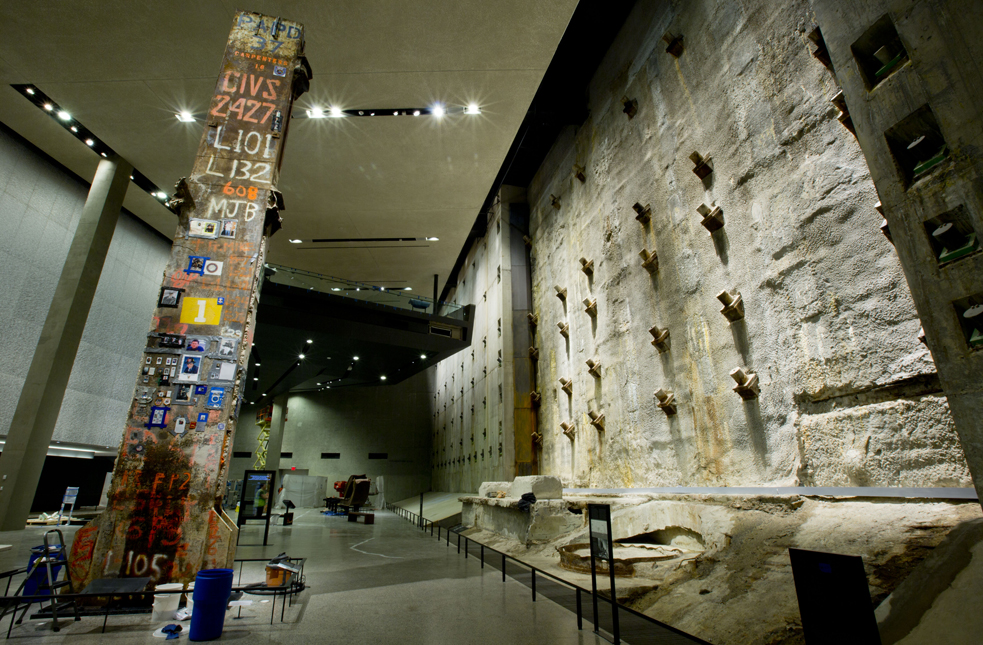
A look at the Slurry Wall inside the National 9/11 Memorial Museum. Here, lead exhibition designer Tom Hennes reflects on it opening to the public. Photo: Jin Lee
If you watch TED Talks, you know Tom Hennes’ designs well. His firm, Thinc Design, created the stage for the TED conference in Monterey and Long Beach from 2003 through 2012. Thinc Design was also the lead exhibition designer for the National September 11 Memorial Museum, which opened to the public yesterday. The TED Blog asked Hennes to reflect on the opening:
At 9 o’clock yesterday morning, the doors of the 9/11 Memorial Museum opened for the first time to the general public, represented in the growing queue by a slightly wary group led by an intrepid woman in a pink t-shirt. I’ve become so accustomed to the sound of workers and machinery down there, 70 feet below the Memorial plaza, that the relative hush of people encountering the vast museum spaces for the first time caught me a bit off guard. People moved slowly, deliberately, taking it all in, reading—reading everything—looking, taking pictures, talking with each other in barely audible tones. They leaned over the edge of the entry ramp in front of the immense piece of impact steel—a mangled trio of steel columns from the façade of the North Tower just above the impact of Flight 11 from about the ninety-sixth floor—looking intently at the inward-bent claw at its lower terminus. They paused at the images of missing posters, quietly looking, before moving downward, along the Vesey Street Stair—that last stairway to safety for so many people on 9/11—toward the bedrock level that is the museum’s main floor. And there they wandered, looking around, still speaking quietly with each other, to the other parts of the museum; a regular, if halting, processional that dissolved into myriad paths according to the interest, inclination, and depth which each person in the museum sought—or could tolerate..
Our work on the museum over the past seven years has similarly threaded among the polarities and contradictions of this all too deeply-felt and widely-experienced event. The central design challenge is not, as it is in so many museums, to bring the material to life. Rather, the central design challenge is to maintain that aliveness while making it bearable to witness. This includes not only the material that pertains to the attacks themselves and the way people experienced them—as difficult as that is. It also pertains to responses people have had to the events that may differ, sometimes strongly, with those that others may have had. Along with a wide-ranging team—both inside the museum and among its consultants and many constituents—the design team has sought to create a museum that presents a wide range of perspectives on what happened, giving everyone—we hope—familiar points of reference that feel authentic to their own experience of 9/11. At the same time, in the same space, people may also encounter other kinds of experiences and responses that may at first seem alien to them. By maintaining the first-person voice throughout, and by continuously re-grounding the exhibits in lived experience, we have sought to create conditions where people feel comfortable moving out of their own experience to witness the events and others’ myriad responses to them with greater empathy and an increased sense of how they themselves relate to 9/11. By witnessing others, and being witnessed by others in the museum, we are all brought into closer contact with our own humanity.
Such depth of feeling and response to others are only possible in a space that feels safe. Safety arises out of a feeling of containment and protection, and out of the ability to control our own experience. This means giving people choices as to where to go and what to encounter, as well as a way of navigating the space that makes those choices clear. It also requires ready access to exits and relief spaces where people can sit and reflect, as well as staff ready to be of assistance when needed. But safety is not the only requirement. For people to be able to push beyond their own frames of reference also requires the presence of the other, contrasting perspectives that inhabit the spaces, and the awareness that a turn in one direction can lead into more challenging terrain than a turn in another. In this way, the museum becomes what the team has come to call ‘safe enough’—providing enough safety to allow the experience to enter us in the museum, but not so safe that we don’t stretch our own horizons and come to new insights about ourselves and others. Choice comes into play and the design becomes an essential aspect of the experience as a whole when it enables each of us to navigate a path that is ‘safe enough’ for us.
At nine o’clock yesterday morning, the first people who were not family members, survivors, rescuers, or recovery workers walked into the museum and through the cloud of voices in the introductory exhibit that tell stories of where they were on 9/11 and how they felt, their words projected as a map of the world onto screens. These first witnesses to the museum walked through, taking in the knowledge that they, too, were witnesses to 9/11. An hour later, the first of the day’s wanderers through the museum arrived at the recumbent piece of steel, located in the vast space called Foundation Hall—between the Last Column and the escalator that would carry them back to the surface—where they could use an electronic pen to write their thoughts and see them projected onto another map of words, now projected onto the base of the huge Slurry Wall that once formed the foundation of the World Trade Center and now forms the perimeter wall of the museum. Wherever they had been then, on that September 11 in 2001, they were here now, at this place, on May 21 in 2014, as part of a growing community of witness. Theirs was a journey that will be repeated millions of times over the coming years. I can only hope that the museum will bring the journeyers closer to their own experience and toward a sense of fulfillment in the journey, so that they feel more ready to engage with the complex world, with all its difficulties and opportunities alike, that awaits their return to the surface.
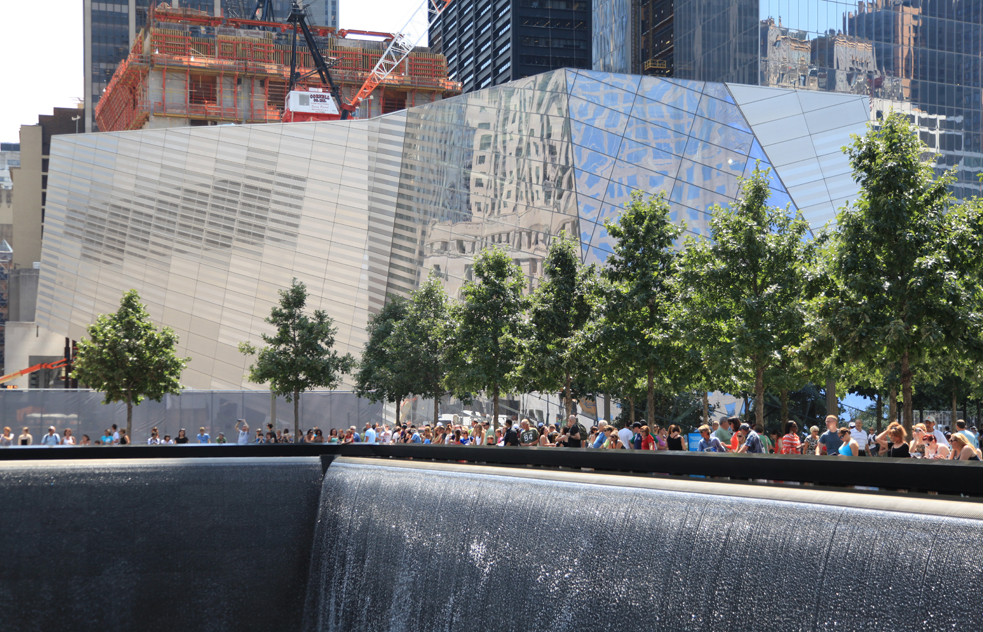
The exterior of the National 9/11 Memorial Museum. Photo: Amy Dreher
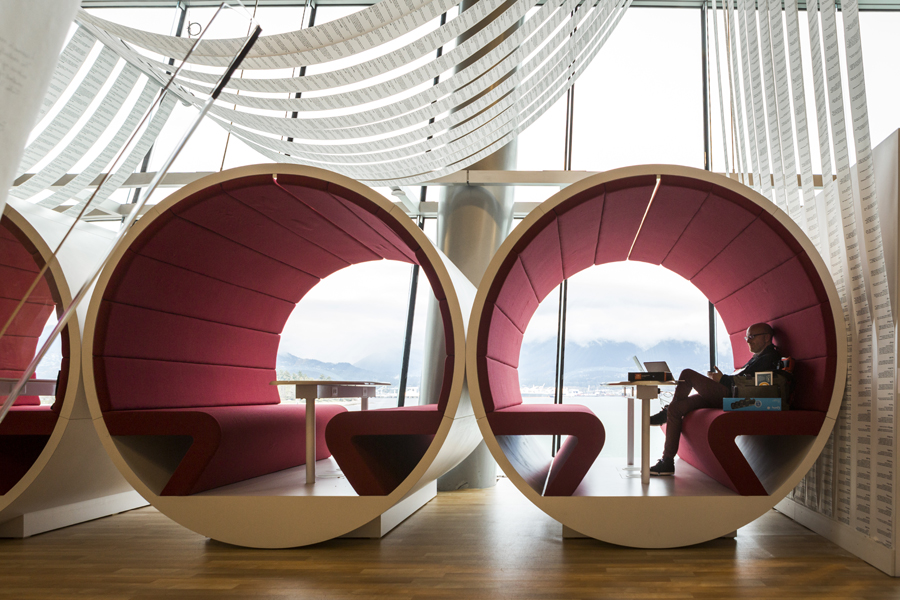
A look at the Target Design Café at TED2014, with the North Shore Mountains in the background. Photo: Bret Hartman
For years now, Target has invited designers like Isaac Mizrahi (watch his TED Talk), Diane von Furstenberg (check out her TED playlist) and, most recently, abstract pattern-master Peter Pilotto to dream up collections. So when it came to creating the Target Design Café at TED2014, we knew it was going to be cool. The space features three enormous white barrels with plush red interiors that are perfect for lounging. Also in the space: a robotic arm composing quotes coming from the mainstage, graphologists analyzing attendees’ handwriting, and artist Daniel Duffy’s live action portraits of TED2014 speakers.
Our favorite feature in the space is a simple one. On the cloth strips that cascade in a canopy over it all, there is writing. Here, Target has printed quotes from TED Talks about design. Below, 10 of the quotes that we find especially inspiring. But there are hundreds more up there. So if you’re onsite, stop by and pick your favorite.
“You could look at nature as being like a catalog of products, and all of those have benefited from a 3.8-billion-year research and development period.” — Michael Pawlyn
“The best way to accomplish serious design … is to be totally and completely unqualified for the job.” — Paula Scher
“Design [is] the emerging ethos formulating and then answering a very new question: What shall we do now, in the face of the chaos that we have created?”— John Hockenberry
“If anybody here has trouble with the concept of design humility, reflect on this: It took us 5,000 years to put wheels on our luggage.” — William McDonough
“Style makes you feel great because it takes your mind off the fact that you’re going to die.” — Isaac Mizrahi
“The idea of being able to build things bottom up, atom by atom, has made [scientists] all into tinkerers. And all of a sudden scientists are seeking designers, just like designers are seeking scientists.” — Paola Antonelli
“[Designs] have a moral component just in the vision of ‘the good life’ that they present to us.”— Sebastian Deterding
“My idea of a perfect world really can’t be designed by one person or even by a million experts. It’s going to be seven billion pairs of hands, each following their own passions.” — Jay Silver
“When people say, ‘I don’t get art’ … that means art is working.” — John Maeda
“As an architect you design for the present, with an awareness of the past, for a future which is essentially unknown.” — Norman Foster
Read all TED Quotes on design »
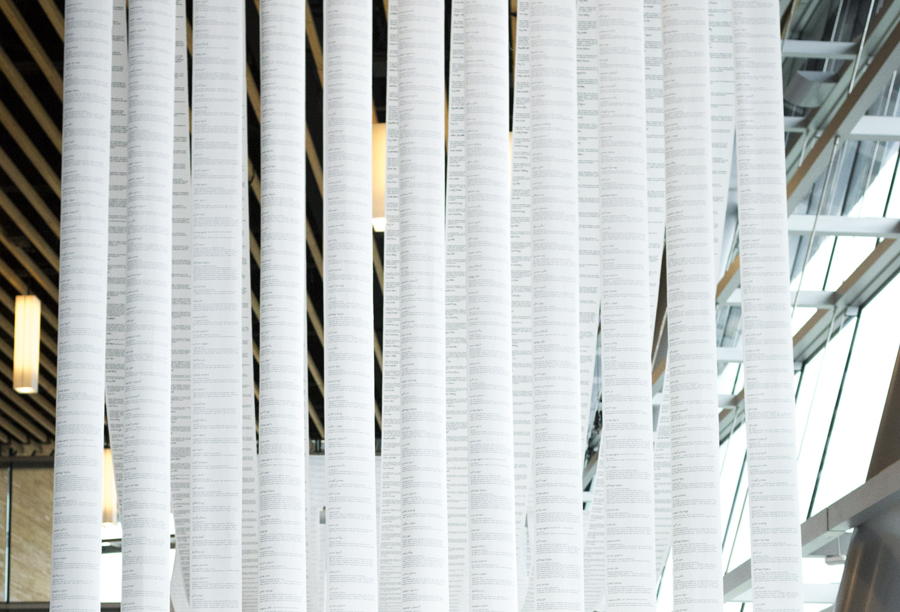
A close-up look at these quotes. Photo: Bret Hartman
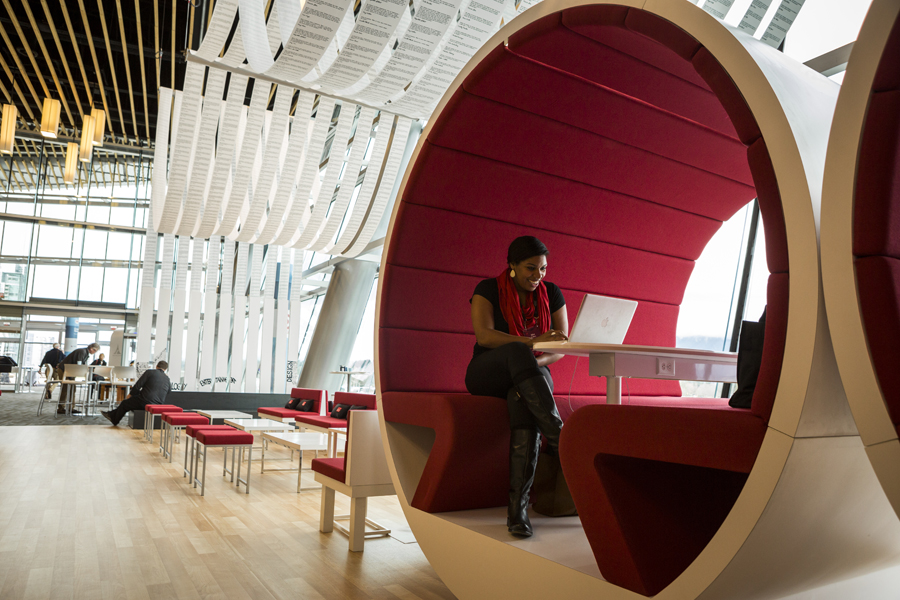
An attendee enjoys the space. Photo: Bret Hartman
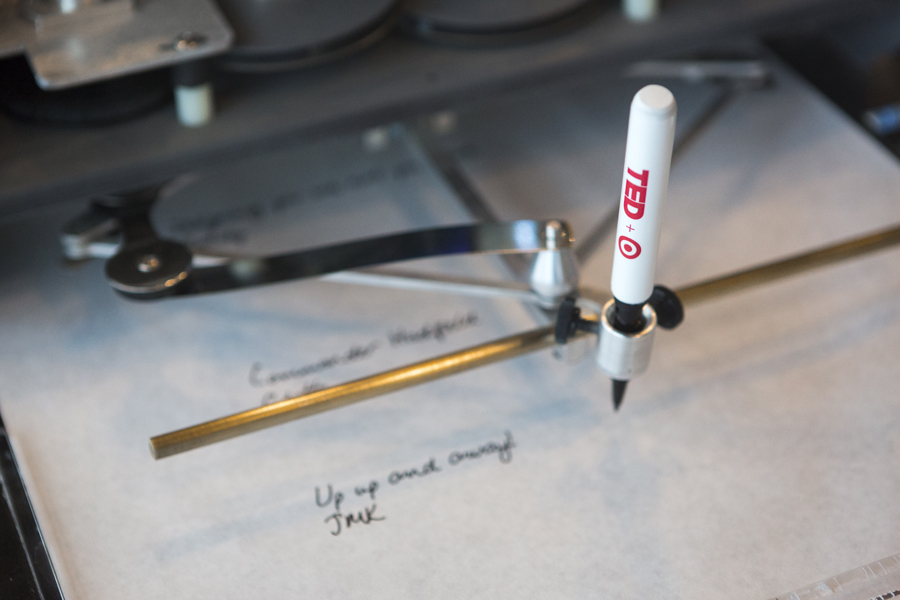
A look at that robotic arm. Photo: Bret Hartman
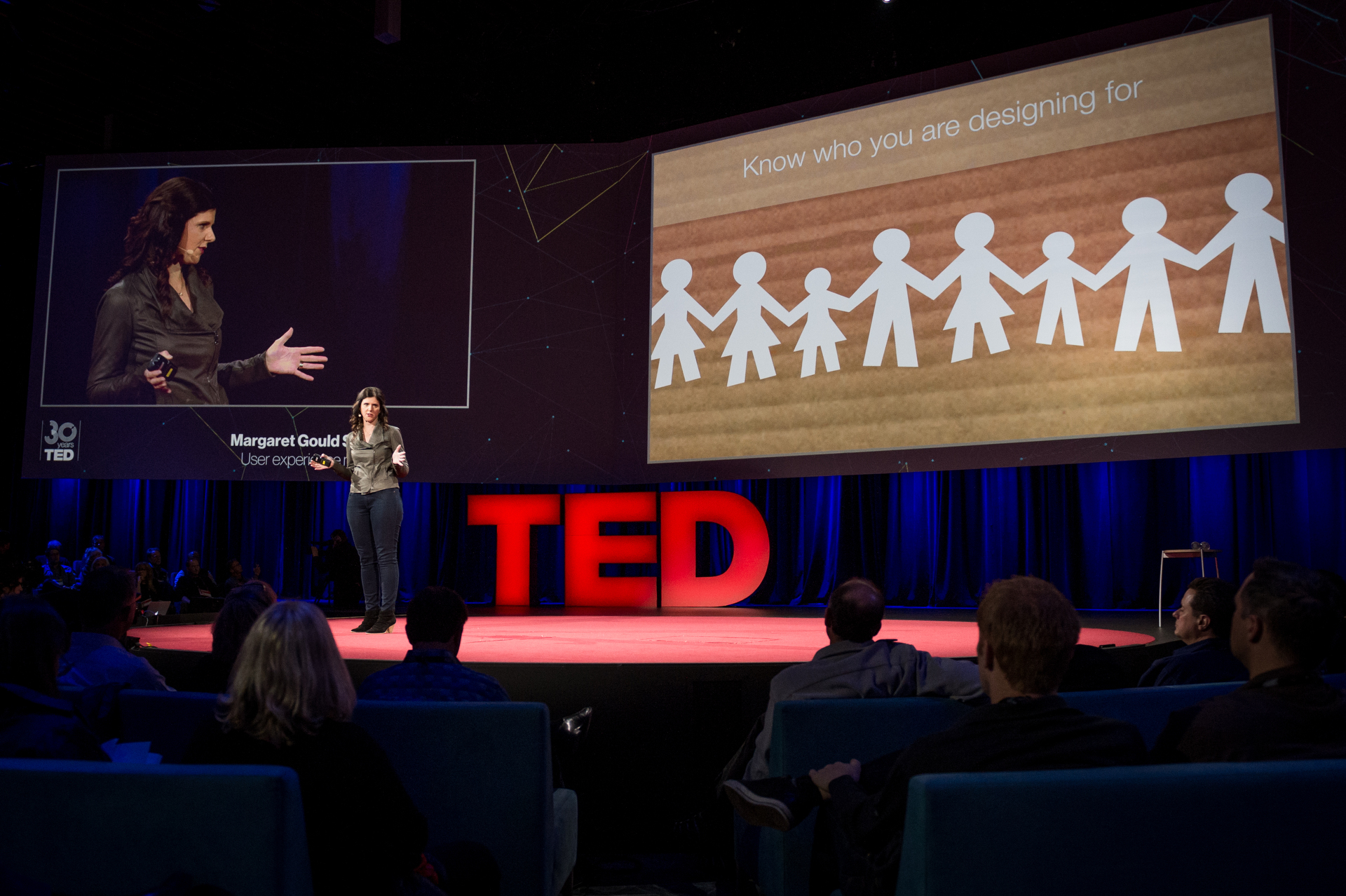
Margaret Gould Stewart. Photo: James Duncan Davidson
“What do you think of when I say the word design?” Margaret Gould Stewart, director of product design at Facebook, is here to talk about the kind of design that you normally don’t think about — the design of digital systems that are used by billions of people each day.
As examples, Steward reminds the audience that Google handles 1 billion searches per day. People upload to YouTube more in a single day than all of the US television networks broadcast in the last 5 years combined. Facebook transmits the photos, messages and stories of over 1.23 billion people, or about 1/6 of humanity.
“What’s really hard at designing at scale,” she says, “is that it requires a bizarre combination of two things, audacity and humility.” Audacity to believe that what you’re doing is important, and humility because it’s not about the designer’s portfolio, but about the people they are designing for. It’s also a new problem. “There is no design school that offers, ‘How to Design for Humanity 101.'”
That said, she and her colleagues have learned a lot about how to design at scale. She shared three lessons.
Lesson 1: No such thing as a small detail
Facebook recently had a problem: They wanted to redesign the Like button — the little blue thumbs-up that lives on outside websites. It seems simple, but it has to work all over the place, in an incredible number of contexts. “Designing this button was a huge pain in the butt.”
The designer who did the work put in an estimated 280 hours to redesign it. Why so much time for one button? Because, “When you’re designing for the world, there’s no such thing as a small detail.” The Facebook Like button and the Share button that accompanies it are seen on average 22 billion times a day and on over 7.5 million websites, Stewart says: “It’s probably the single most viewed design element ever created.”
Lesson 2: How to use data
Facebook has a huge amount of data about how its users behave, “but it’s not as simple as following the numbers.” As an example, Facebook once had a very simple tool for reporting photos for spam and abuse. But they found that only a small percentage of photos reported were actually violating the community standards.
It turns out a lot of them were people asking for photos of themselves to be taken down, “This was a scenario that the team never took into account before.” So they added a tool to request that the uploader take the photo down. But that didn’t work — only 20% of people used it. So they went back again. This time they consulted with experts on conflict resolution, and learned that they actually had to help people express to their friend how the photo makes them feel, not just request that they take it down.
Now when someone goes to report a photo there is an option to take it down because they don’t like it, and it’s embarrassing. The tool then provides them with language to send in a message to the friend who posted it. This had a huge impact. Before, 20% used the tool; now, 60% do. Surveys also showed that people on both sides of the conversation were happier. That same survey showed that 90% of your friends want to know if they’ve done something to upset you. (“I don’t know who the other 10% are,” she says, “but maybe that’s what our ‘unfriend’ feature is for.”)
She is clear that at Facebook, “we use a lot of data, but also iteration, research, testing, intuition, and human empathy. It’s both art and science.”
She also says that the term ‘data-driven’ drives her team nuts. She say, “It would be irresponsible of us not to rigorously test our designs, but the fact is, data analytics will never be a good substitute for design intuition. Data can help you make a good design great, but it will never make a bad design good.”
Lesson 3: Manage change carefully
Stewart also spends a lot of time designing the introduction of change. “People,” she says, “can become very efficient at using bad design. Even if a change is good in the long run, it’s still frustrating when it happens. Especially true of user-generated content platforms, where people can rightfully claim a sense of ownership.”
Years ago, when she was at YouTube, they were wondering how to get more people to rate videos. They had a five-star rating, but they discovered that people mostly rated things with all five stars, a few of them used one star, and almost no one used the three stars in the middle. So they wanted to switch to a simpler up/down model.
They believed the change was right, but knew people wouldn’t like it. So, before the change, the team published the data on their blog and engaged in conversation with the larger industry.
The whole world
These lessons are helpful, “but they won’t mean anything if you don’t understand something more fundamental. You have to understand who you’re designing for.” At some point you run up against the walls of your bubble — such as the bubble around Silicon Valley workers, who get crabby when they lose 4G service for 10 minutes. “What if,” she asks, “you had to drive four hours to charge your phone? What if you had no access to public libraries? What if your country had no free press? What would these products mean to you?”
She shows a photo of several common “feature” phones, non-smartphones, and reminds us that this is what the internet will look like for the next 5 billion people to come online. She says, “If you want to design for the whole world, you have to design for where people are, not where you are.”
She says designing on a global scale can be difficult work, and the humility part can be especially hard. “Almost everything that I’ve designed in my career is gone, and everything I will design will fade away. Here’s what remains: the never-ending thrill of being a part of something that’s so big that you can never get your head around it.”
]]>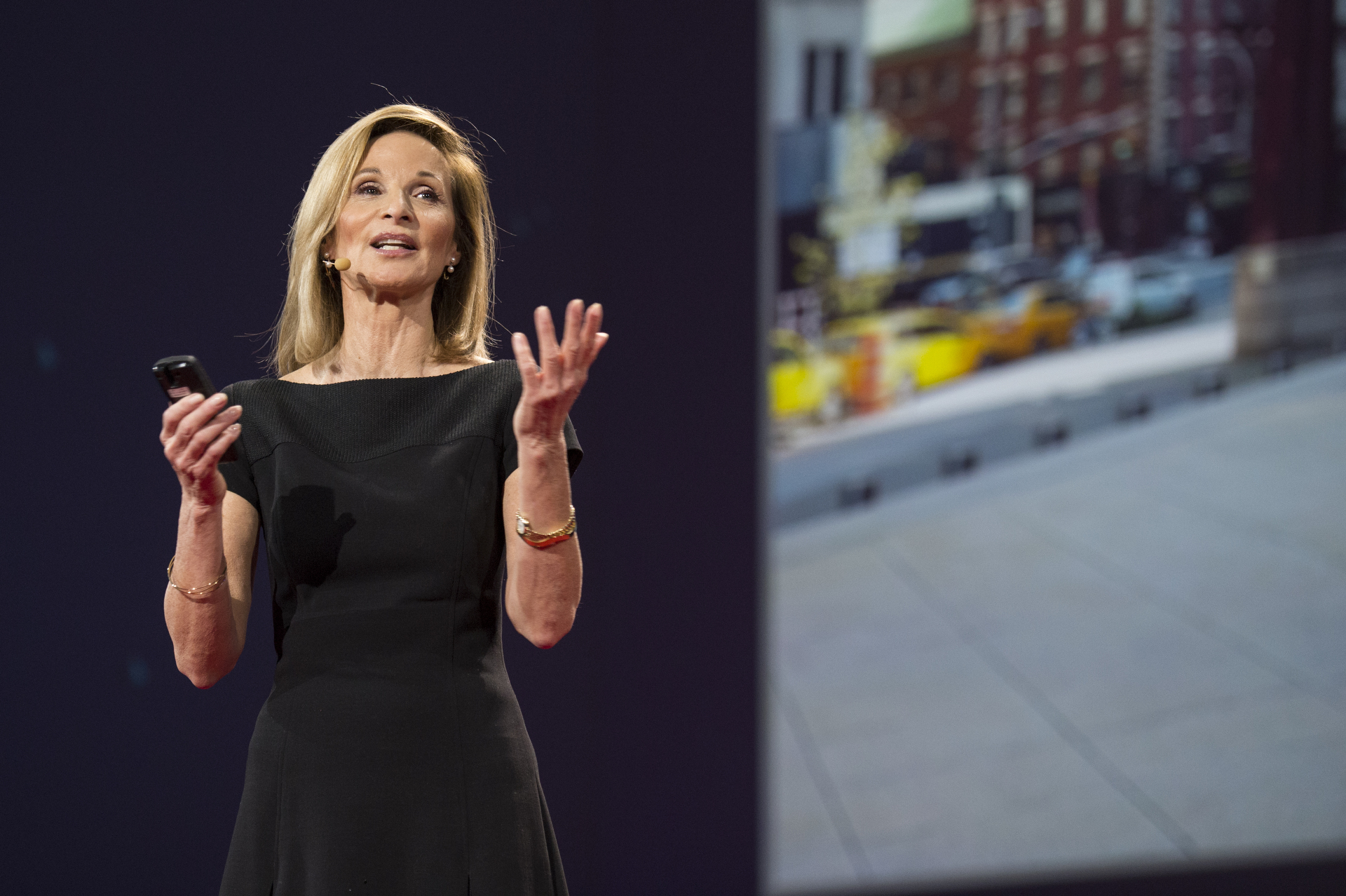 When we think of cities, we think of buildings and skyscrapers and stray cats. For Amanda Burden, who spent 12 years as New York City’s director of urban planning, they’re primarily about people. They’re about where people go and where they meet — that’s the core of how cities work. And for the people, even more important than the buildings are the public spaces in between them. Those, to Burden, are what makes the cities come alive.
The central question she asks is, “What makes a public space work? What is it about unsuccessful places that keeps people away?” Burden, it turns out, was trained as an animal behaviorist, but she uses those skills to study how people interact with their spaces.
Her first inspiration was Paley Park, a small space in midtown Manhattan. She was fascinated by it in part because it happened to have been built by her stepfather. And because of that, “I knew that places like Paley Park didn’t happen by accident.” She found several reasons it worked: It was comfortable, it had movable chairs, the people attracted other people, and it was green. “Why weren’t there more places with greenery and places to sit in the middle of the city, where you didn’t feel like a trespasser?”
The problem is that this isn’t how cities have been designed. She shows a bare concrete plaza, a very familiar sight in modern cites. Not only does it look desolate, she says, but it feel dangerous. But, she says, “Architects love them: they are plinths for their creations.” (Calling Marc Kushner!) For developers as well, there is nothing to water, and no “undesirable people” to worry about.
Over years she has learned how hard it is to create meaningful places. In NYC, someone has to think very hard about every detail. Her first project was in Battery Park, at the time a landfill that had laid barren for 10 years. In 6 months it would go bankrupt. So they came up with a crazy plan. They would build a park first, and see what development happened. Crucially, they made a mockup, and as she sat on the bench, the railing was at eye level, ruining the experience. The details were crucial. Successful design, Burden believes, depends on the individual experience.
Twenty years later, then-Mayor Bloomburg made Burden his city planner comissioner. He pointed out that soon the city would increase from 8 to 9 million people. “So where are you going to put 1 million new people?” he asked. The big problem was where to grow in a city that was already built out to its edges. Where to put housing? What about cars? So they needed to build up, and use the city’s greatest asset, the transit system. The central idea was to channel and redirect all new development around transit. And to do that they needed to redo the zoning, targeting where development could go, and prohibiting development in car-oriented parts of the city.
But all of that re-zoning needs the approval of the community, and getting that approval can be difficult. And the way you get that approval is by listening. “People know if you understand their neighborhoods. It’s not something you can just fake.” So she walked the city, thousands of hours, year after year, and spent as much time listening. She became “a geeky zoning expert, finding ways zoning could address a community’s concern.”
Over the course of 12 years the city re-zoned 124 neighborhoods, 40% of the city. That’s 12,500 blocks. And now 90% of new development in NYC is within a 10-minute walk of a subway.
On the water and in the air
Her main mission, though, was still to create great public spaces — spaces that would make a difference in people’s lives. For example, in recent years her team has completely revitalized the waterfront in Greenpoint and Williamsburg, which had been a wasteland, inaccessible. Now it’s a thriving park, with people coming from all over the city to be there. But even more than that, she says, “I know they changed the lives of people who live there, but it also changed New Yorker’s view of their city.”
This has happened in other areas as well. Lower Manhattan now has public waterfront on all three sides, in stark contrast to the 1990s. All around the city, where there used to be parking spaces there are now pop-up cafes. “What’s the trick?” asks Burden. “How do you turn a park into a place people want to be? It’s up to you, not as a city planner, but as a human being. You don’t tap into your design expertise, you tap into your humanity.”
She then talks about the High Line, a new park so loved by the TED audience that it gets applause just at the mention of its name. It was an elevated railway that has been rebuilt into a gorgeous path full of plants and water. Not everyone likes it. “Developers,” she says, “see only one thing: customers. Wouldn’t it be great to put shops all along the High Line? Wouldn’t that make more money for the city?… No, that would make it a mall, not a park.”
Burden finishes with a powerful message: “If there is any single lesson I’ve learned, it is that public spaces have power. It’s not just the people using them, it’s the even greater number of people who feel better about their city just knowing that they’re there… A successful city is like a fabulous party, people stay because they are having a great time.”
]]>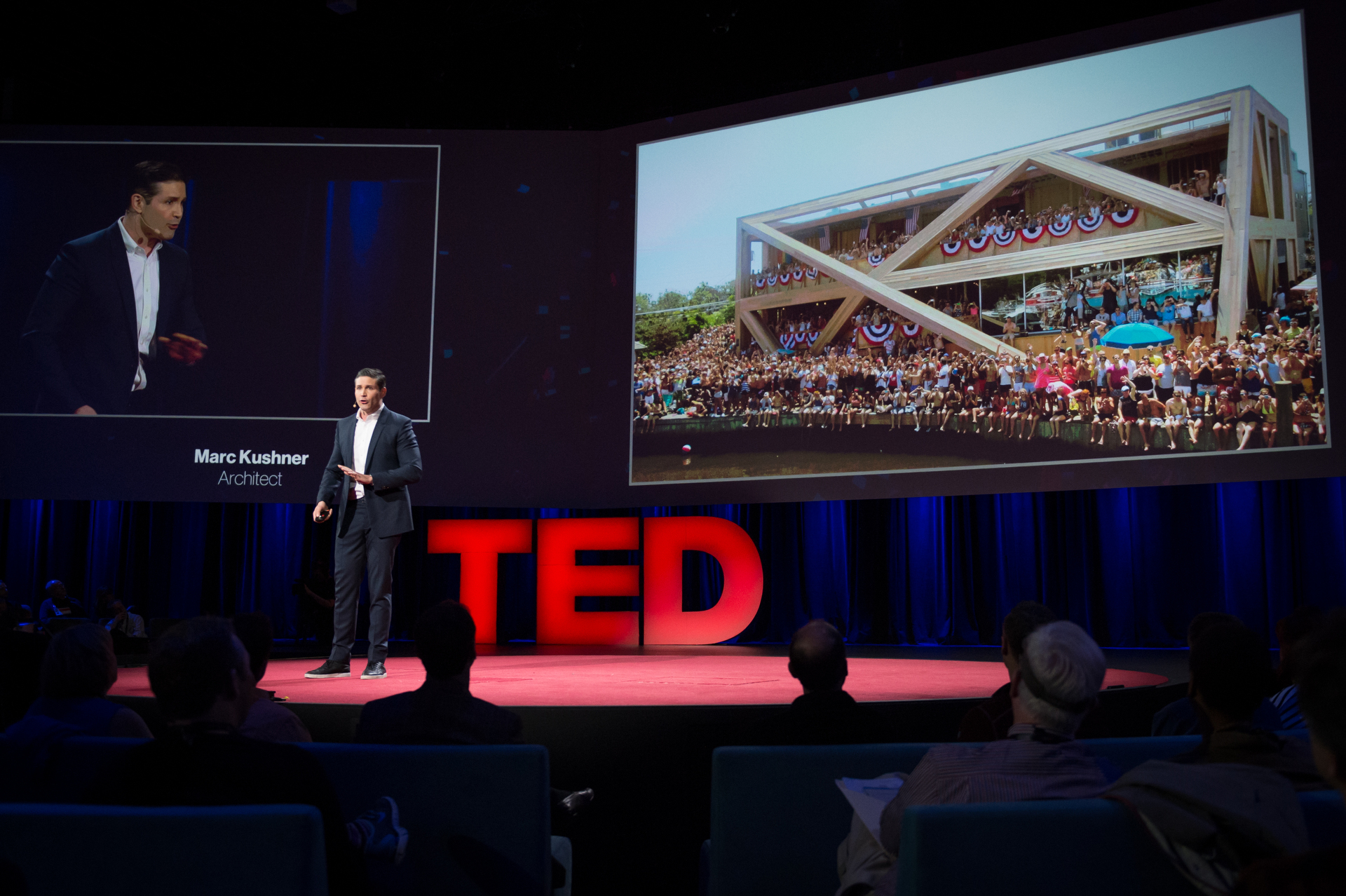
Marc Kushner. Photo: James Duncan Davidson
“Architecture is shaping our lives in ways we don’t even realize,” says architect Marc Kushner in his talk at TED2014. Co-founder of Architizer, an online catalog of architecture projects worldwide, Kushner is dedicated to connecting people with the structures in which they spend their lives.
Structures can inspire feelings like strength and power and stability, Kushner says, but they can also inspire discomfort, isolation, and — in some cases — public outrage. “Building things is terrifying,” he says, “it’s expensive, it takes a long time, and it’s very complicated.”
Fear of negative public perception of their projects can stop architects from taking risks, Kushner says, from innovating, from making buildings that deviate from the norm. “The people who build things — developers and governments — are naturally afraid of innovation; they would rather just use those forms they know you’ll respond to,” he says — which is why so many firms defer to bland building types.
This doesn’t mean that there are no architects in the world taking risks and expanding their craft. Right now, architects all over the world are drawing inspiration from technology, science and our changing world, like those behind the Seattle Central Library, a building inspired by new-media consumption, or those behind a Miami Beach parking garage that doubles as a community space for yoga classes, events, even weddings.
“Architecture works on the principle of a pendulum,” Kushner says. “On the one side is innovation, and architects are constantly pushing for new technologies, new types, new solutions to problems.” On the other, he says, is time-trusted symbols — beautiful but safe designs that have existed since nearly the beginning of architectural history.
This pendulum settled in the middle in 1997, Kushner says, when Frank Gehry revealed the Guggenheim Museum Bilbao in Spain. “This building fundamentally changes the world’s relationship to architecture,” Kushner says. “Tourism in Bilbao increased by 25,000 percent after this building was completed … [This was] a rare moment when critics, academics and general public were completely united.”
Right then, something happened that seemingly had never happened before: Thanks to the galvanizing force of new media, radical architecture became associated with pop culture. Gehry was a guest star on The Simpsons. People clamored for a Gehry in their town. Gehry’s designs were built all over the globe.
Without open and expanding media, this blast of public attraction to shocking designs would hardly be possible, says Kushner. But where once, you only had access to buildings to which you could walk, people can now see designs thousands of miles away with a click of a mouse or a scroll of an Instagram feed. “We are living on the verge of the greatest revolution in architecture since the invention of steel,” Kushner says. “It’s a media revolution.”
In the age of the smartphone, Kushner says, “The building becomes disembodied from the site … The speed of communication has finally caught up to the speed of architecture.”
This came to life for him when his firm started to plan a new design to replace a building that had burned down on Fire Island in New York. “We proposed a building that was audacious, that was different,” he says, “something the community had never seen before.” As plans moved forward, his client and his co-designers were apprehensive, all worried the building would be rejected by the community. “So we created a series of photorealistic renderings,” Kushner says, “and we put them on Facebook, and we put them onto Instagram … so when it was built, and the rendering looked exactly like the finished product, it was already a part of the community.”
Instagram photos and Facebook comments gave the public ownership of the building, Kusher says: “It ceased to be an edifice and became media … Because digital media hasn’t just changed the relationship between all of us, it’s changed the relationship between us and buildings.”
Digital media has made almost everything about architecture change, Kushner says. “We don’t need the Greeks to tell us about architecture, we can tell each other about architecture.” Because, in the end, “Buildings don’t just reflect our society, they shape our society.”
]]>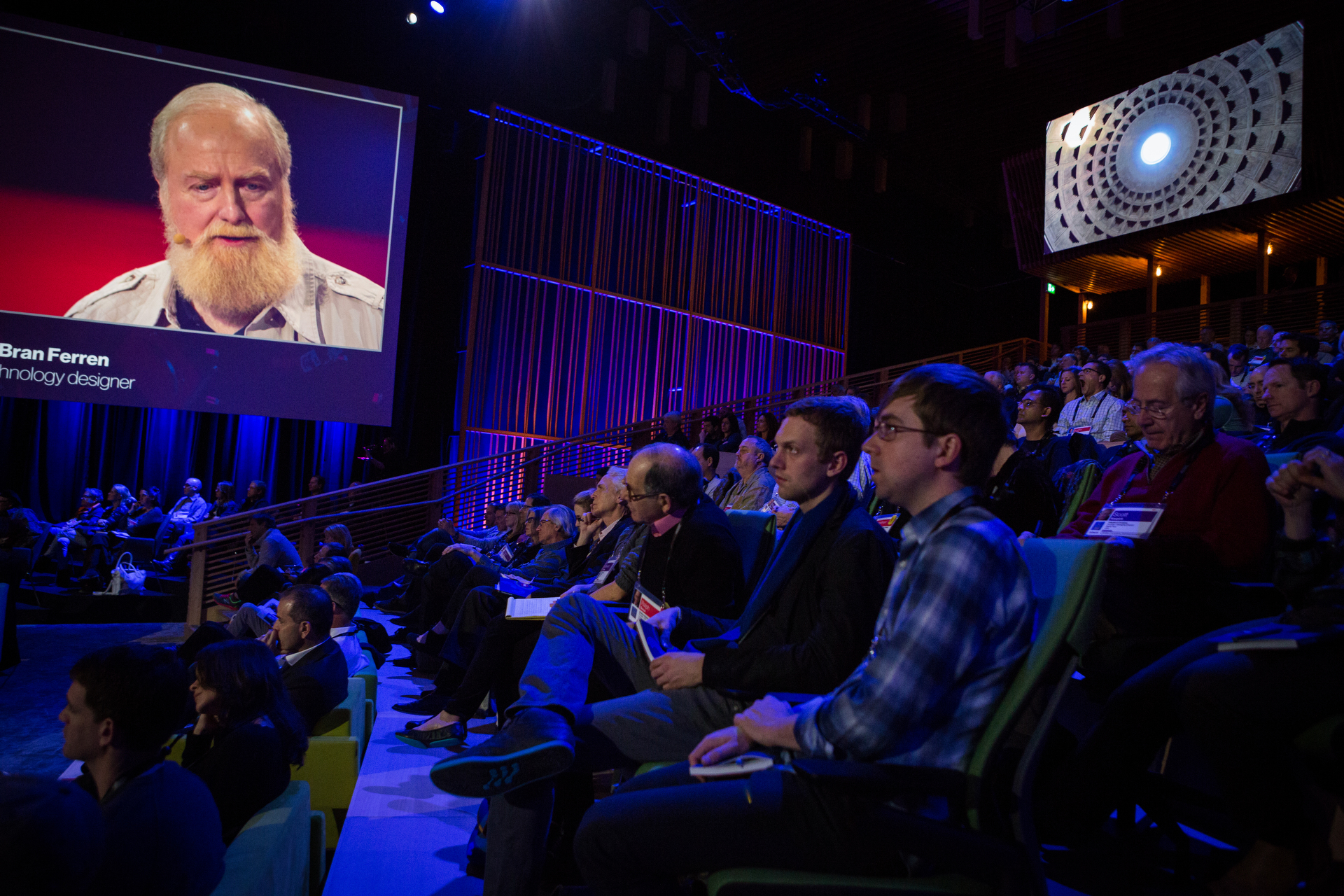
Bran Ferren. Photo: Bret Hartman
Bran Ferren’s life pivoted on a trip to Rome at age 9. He’s the son of two passionate abstract expressionist artists, who taught him that art wasn’t just decorative but about communicating ideas, and the grandson of a cabinet-making factory owner, who often took him on field trips to buy electronics to take a apart and reassemble. So Ferren didn’t have high expectations when his family visited the Pantheon.
“From the outside, it didn’t look particularly interesting,” Ferren, the former president of R&D at Walt Disney Imagineering and the co-founder of Applied Minds, says on the TED2014 stage. “But when we walked inside, I was immediately struck by three things. It was pleasantly cool, despite the oppressive heat outside. It was very dark. And the only source of light was a big open hole in ceiling, called the oculus … As we walked to the center of the room, I looked up at the heavens through the oculus. It was the first church I’d been in that provided an unrestricted view between god and man. Something about this place just felt special.”
“When was this built?” Ferren asked his father, assuming that at least its incredible dome must have been a modern creation.
He was shocked when his father answered, “About 2,000 years ago.” That moment, he says, changed everything.
“For the first time I realized people were smart 2,000 years ago,” says Ferren. “Contrary to what I’d been taught in school, I realized that the worlds of art and design were not incompatible with science and technology. My teachers told me I had to get serious and focus on one or another, but I decided to look to polymaths like Michelangelo, Leonardo da Vinci, and Benjamin Franklin, who did the opposite.”
Ferren is still blown away by the marvel of the Pantheon. “It survived gravity, barbarians, looters, developers and the ravages of time,” he says. “No amount of brute force gets you the dome of the Pantheon. It is still the largest unreinforced dome that’s ever been built. To build the Pantheon took some miracles and, by that, I mean things that are technically barely possible, very high risk and might not actually be accomplishable at that moment in time.”
The building of the Pantheon required five miracles, says Ferren:
- The Romans had to invent super-strong concrete to allow for construction.
- They had to be able to vary the density of the concrete, using five rings of coffers diminishing in size.
- They had to create the natural convection of air.
- They had to recognize that light was a substance and could be designed.
- They had to understand the Venturi effect.
Creating something like the Pantheon takes unthinkable creative vision, says Ferren. “It is my belief that to create these rare game-changers requires you to pull off at least five miracles. No matter how talented, rich or smart you are, you only get one miracle,” he says. “Rare visionaries have the ability to notice when others have provided enough of the miracles to bring the goal within reach.”
This leads Ferren to wonder: What are the Pantheons of our time? “Putting a man on the moon was a good one, and returning them safely to Earth wasn’t bad either,” he says. But the most obvious answer doesn’t quite meet the criteria.
“One is tempted to say today’s Pantheon is the Internet. But I actually think that’s quite wrong,” says Ferren. “The internet is not the Pantheon, it’s more like the invention of concrete. Important and absolutely necessary to build the Pantheon, but entirely insufficient itself.” It’s the physical things that people will create with the Internet that will matter, he says.
Instead, Ferren looks to an idea from “the late 1930s that’s been revived every decade since”: autonomous vehicles. This will be the game-changer, Ferren predicts. “Much of our world is designed around roads and transportation—this was as essential in Rome as it is today,” he says. “This will be the key technology to allow us to redesign our cities and by extension human civilization.”
Autonomous vehicles will not only save lives—10,000 in the United States per year and a million globally. It will clear road congestion, and give us back valuable time that today is wasted. And autonomous cars will cut pollution in half, Ferren says. Getting there will take five miracles, some of which are already here:
- You need to be able to know exactly where you are and exactly what time it is. (Thanks GPS.)
- You need to know where all roads are and what the rules of driving on them are. (Check, in-car navigation systems.)
- You need near-continuous communications with other vehicles nearby. (Ferren says that current wireless technology, with modifications, could get us there.)
- You need restricted roadways that people agree are safe to use. (We could start with HOV lanes.)
- And you need the ability for machines to recognize people, signs and symbols. (For this a car might need to wake up to ask its passenger a question, the answer of which it could then share with all other vehicles.)
“I predict that autonomous vehicles will permanently change our world over the next several decades,” says Ferren. “The beginning is only a few years away.”
But even more advances could be just around the corner.
“The ingredients for the next Pantheons are all around us, waiting for visionary people with multidisciplinary skills to make them,” says Ferren. “These people don’t spontaneously pop into existence, they need to be nurtured. Just as my grandpa did, and just as my parents did, we need to encourage [kids] to find their own path, even if it is very different from our own.”
He concludes with a beautiful thought. “Art and design are not luxuries, nor somehow incompatible with science and engineering,” says Ferren. “They are essential to what makes us special.”
]]>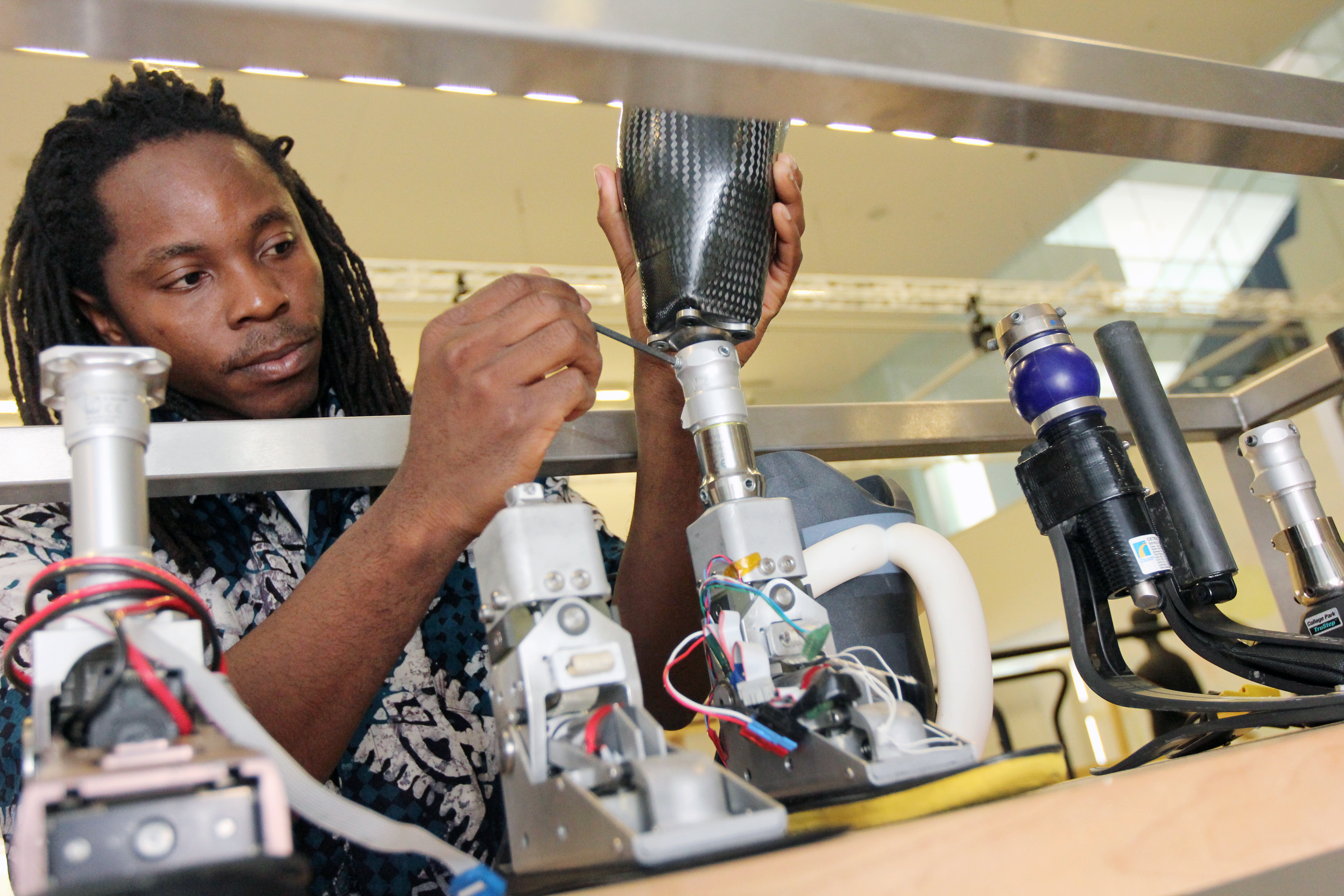
David Sengeh tinkers with his design for a 3D-printed prosthetic socket. Photo: Allegra Boverman.
A persistent sight in David Sengeh‘s childhood, growing up in Sierra Leone: amputees. Losing a limb was an all-too-common fact in the civil-war-torn region. But as if the loss of a limb weren’t enough, the aftermath was almost worse, Sengeh saw, as he watched family members and friends struggle with ill-fitting, uncomfortable prosthetics that hurt too much to wear.
Here, the 2014 TED Fellow, now studying at the MIT Media Lab, talks about his idea of redesigning the socket that connects an artificial limb to a human body — and his dream of creating custom-designed, low-cost, comfortable sockets that 3D printing technology could make accessible to anyone, anywhere. An edited transcript of our conversation follows.
You’ve chosen to work on one of the major after-effects of war and help those who have lost limbs regain some quality of life. Why?
I wanted to be part of a generation that solved problems instead of creating them; a generation that created products, services and opportunities for our own children; a generation of action-oriented youth who could correct some of the wrongs from the generations before us.
What was your initial goal?
Originally, my dream was to build a prosthetic bank in Sierra Leone, a place where people, especially growing children, could bring in broken prosthetics and get a new one. But I had also observed that many of the amputees in Sierra Leone would not use their prostheses even though they had received them for free. The reason? They were uncomfortable. At the end of day, it doesn’t matter how powerful your prosthetic leg is, if the socket is poorly designed and uncomfortable, you won’t wear your leg.
Is that a common issue?
When I talk to my friends with amputations either back home or in the United States, it is obvious how debilitating current design approaches are. Patients are often left immobile because their discomfort is too high to use their legs. This takes away independence and that limits the ways in which they can create value in society.
What’s going on? Why are current designs so inadequate?
Because prosthetic sockets are designed with plaster molds and casts, modified based on the prosthetist’s experience, and dependent on the patient’s limb on that single day, the final socket is almost never comfortable. There is uneven pressure over the entire limb, leading to pressure sores and deep tissue injury. This subsequently leads to secondary problems, including back pain. The current carbon fiber socket or polyurethane sockets are not conducive to a changing anatomy.
Where are you at with your thinking now?
In my last year at Harvard, I met Professor Hugh Herr of MIT’s Media Lab – who works on the design of bionic products and is himself a double amputee. I told him about my prosthetic bank idea. His immediate response was that it would not work, because comfortable prosthetic sockets would need to be custom-made for each patient (two people cannot use the same socket) in a cost-effective, repeatable and reliable way.
Even Professor Herr himself faced the same problem: it takes on average three months, and often years, to get a comfortable prosthetic socket. But to me, forcing a patient to use a product that is not optimal is unacceptable in an age when we have advanced tools for imaging, design, modeling and manufacturing.
So how are you thinking about creating a new, more comfortable prosthetic?
We are using advances in medical imaging and computer-aided design and manufacturing to create custom prosthetic sockets that are more comfortable. I use MRI images to develop models for each patient — making it possible for patients to send in scans from anywhere in the world — and from those results develop a multi-material 3D-printed prosthetic socket. Because this socket could be printed anywhere, it could also be immediately delivered to the patient. The 3D printing process allows us to use flexible, rubber-based materials over specific anatomical landmarks where pressure should be relieved. These products are being tested by patients, including US veterans. In one of our trials, an active veteran who has been an amputee for over 20 years said of a socket: “It’s so soft, it’s like walking on pillows.” Another noted: “It’s effing sexy.”
What’s your hope for the design in the future?
Disability in this day and age should not prevent people from living meaningful lives that enable them to create value for society. In many cases where solutions exist, the products are developed for those who can afford the premium price. My hope and desire is that the tools and processes being created in our research group will bring low-cost and and highly functional prosthetic sockets to patients all over the world. For me, a place to begin repairing the bodies and souls of those affected by war and disease is by designing comfortable and affordable interfaces that will help them take the step that moves them from disabled to living a meaningful and productive life.
This article was published as part of our “Questions Worth Asking” series. This week’s teaser: “Should we redesign humans?” See also a playlist of talks featuring thoughts on this topic from the likes of Juan Enriquez and Anthony Atala — and an admittedly incomplete tour of the history of biomaterials.
]]>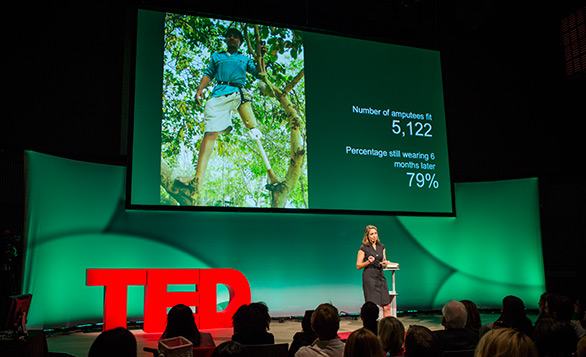
Krista Donaldson of D-Rev speaks at TEDWomen about the need for a cheap and functional prosthetic knee that amputees will want to wear. Photo: Marla Aufmuth
“How do you ensure technology reaches users?” Krista Donaldson asks in her TED Talk. “How do you put it in their hands?”
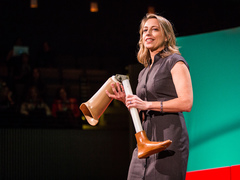 Krista Donaldson: The $80 prosthetic knee that's changing lives
Donaldson is the CEO of D-Rev, which creates medical devices for people around the world who make less than $4 a day. She spoke at TEDWomen this past December about the company’s in-development prosthetic knee, which costs $80 but has the functionality of knees that cost thousands. After the talk, she expected to get scattered emails about it. But, she says, “I hadn’t realized the full power of TED.”
Krista Donaldson: The $80 prosthetic knee that's changing lives
Donaldson is the CEO of D-Rev, which creates medical devices for people around the world who make less than $4 a day. She spoke at TEDWomen this past December about the company’s in-development prosthetic knee, which costs $80 but has the functionality of knees that cost thousands. After the talk, she expected to get scattered emails about it. But, she says, “I hadn’t realized the full power of TED.”
As of last week, D-Rev has received 120 enquiries about the knee, called ReMotion, that mention Donaldson’s TED Talk — either from people in need of the knee themselves, or offering to distribute it to those who need it. For example, requests have come in from amputees in Algeria, India, Uruguay and Pakistan; from distributors in Egypt, The Philippines and Mexico who are interested in selling the knee; and from prosthetic clinics in Bosnia, Cambodia and Tanzania interested in fitting people for ReMotion once it becomes available. The knee is expected to begin shipping in the fall.
For amputees — and friends and family members — who write in, D-Rev plans to keep them updated via email. Donaldson says, “We have all of their information, and we’re actually going to be sending out the first note pretty soon. It’s basically — this is the timeline we’re on, this is how you can get more information, here’s some resources in the meantime.” These emails will be targeted by location, so that a person gets accurate info on when ReMotion will be shipped to their area.
But it’s about more than the product. In this in-between stage, D-Rev sees its mission as connecting people who write them with clinics, where they can receive care now and where they can eventually be fitted for ReMotion.
“There was a request that came in recently from an amputee in Kenya, and he was not well-connected with the clinics in that country. We’re able to connect him with a clinic,” Donaldson says. “One of the challenges that we see with amputees, particularly ones who are low-income and living in low-income areas, is that they actually don’t know what services are around them, because it’s expensive. If you don’t have someone that tells you, you may not know that there’s a clinic that’s just a few hours away.”
D-Rev is also working on connecting prosthetics clinics so they can learn from each other. “[Fitting the knee] is not something you can just do yourself — you have to go to a certain type of prosthetics clinic that has the skill process to do it. It’s very standard in a lot of industrialized countries, but in lower-income countries, you have to go to one of the higher-trained ones,” says Donaldson. “Clinics are pretty fragmented, but our hypothesis is that we’re going to start seeing clinics and groups of clinics that’ll work together and better communicate. We’re starting to see that happen, and one of the roles we’ve been stepping into, with TED’s help, is facilitating that. Our hopes would be to see, for example, some of our partners in Indonesia send their best prostheticists to work in a school in India, and help those programs develop. To me, that’s much more powerful than all these independent programs all over the world.”
Donaldson is excited that D-Rev has been able to connect with prosthetics training schools, like TATCOT in Tanzania. She also got an email from an administrator at a South African university that had recently added a prosthetics and orthotics group. “He was interested not only in how we could all be involved together, but he wanted to know more about the overlap of engineering and prosthetics and orthotics,” she says. “Which to me is also really exciting, because there’s such a value in different disciplines working together to solve problems. Having local engineers and local students working on some of the problems that they’re dealing with — that’s my hope in how a lot of change will happen.”
For now, D-Rev continues usability testing of ReMotion, and is setting up manufacturing and distribution channels. And this, says Donaldson, is a challenge. “We talked to various couriers and logistics services, and one of them that will go unnamed but is very well-known said, ‘Oh, we deliver to 95% of the world.’ And we were like, ‘Well, we’re actually interested in the other 5% too.’”
Want updates on ReMotion? Head to the D-Rev website »
]]>