
This combination was taught at the 1962 Chicago National Association of Dancing Masters Ballroom Workshop by Grace Hanson. The combination is entirely socially leadable and features a side by side open box and concludes with a open walk and underarm turns for both follower and leader.
* This combination requires leaders to change timing twice and therefor is recommended for the experienced dancer.

In the image above you may have noticed the basic step timing is described as 1, 2, 3 & 4. Such timing was occasionally taught for one of several reasons.
- Some songs of the time did have that Cha Cha Cha timing, especially those written by American recording artists (one such example is Sam Cooke).
- This was often used as a beginner count since it started on the first beat and utilized timing that was familiar to many Americans who danced Lindy Hop. Later the students would be taught to shift to 2, 3, 4 & 1 timing after acclimating to the cadence and music.
- Some texts are written is step timing and not musical timing, thus the counting would be then applied to the appropriate musical timing. This method is still taught as step count timing to instructors today as one method of teaching.


In 1961 New York City dance halls, a new sound was being heard, it wasn’t the driving rhythms of the Mambo or Merengue, nor was it the undulating Cha Cha Cha. This was a complex and melodic sound that was both energetic and yet also sophisticated, that sound was the Pachanga! The Pachanga in the U.S. is most commonly associated with the famous NYC Palladium theater that claimed itself “Home of the Mambo and Cha Cha Cha”. While it is true that the Palladium openly embraced and helped promote this new music and dance, it’s creation, success, and ultimate downfall reside in the hands of others. To truly understand the story of Pachanga we need first to understand the land and times of its origin.
Pachanga is the title of a song written in 1959 by Cuban composer and band leader Eduardo Davidson.

This was the same year that Fidel Castro seized power and It was to be the last big break through from Cuban airwaves to reach the U.S. On August 6, 1960 television began to be nationalized in Cuba and was immediately censored and utilized for political propaganda, by May 24, 1962 all media in nationalized. Most artists saw this censoring as unbearable for it limited their expression and a mass exodus of musicians ensues. On April 16, 1961 Castro declared Cuba a socialist state and on February 7, 1962 the U.S. Congress banned all imports from Cuba to the U.S. and with this deathblow nearly 40 years of cultural exchange come to an abrupt end. But not before one last export in the form of El Pachanga!
The song El Pachanga! debuted in a live performance on May 21, 1959 on the CMQ television’s musical program “Casino de la Alegria” and proved a hit almost immediately. For that performance Davidson hired dancers to interpret Pachanga music in five different Cuban ethnic styles. Truly an ingenious idea to appeal to a wide market, but he had actually choreographed a specific dance already, one tied to the music.
The actual roots of the sound lay in a Bembe-Samba hybrid. Brazilian Samba rhythms were combined by Davidson with Bembe music from the Afro-Cuban Lucumi culture utilizing a Charanga orchestral lineup. Charanga orchestras utilize a wooden flute, violins, bass, piano, guiro, timbales, and tumba to produce a delicate yet rhythmic sound. Originally Eduardo Davidson’s choreography was based Afro-Cuban Lucumi dance, which came by way of the southwestern Nigerian Yoruba tribes Bata dances. Cuban culture is deeply tied to its African roots and nowhere is it more evident than in their music and dance.
It is estimated that 700,000 West Africans were shipped via the slave trade to the island of Cuba and of those 60% were from the Nigerian Yoruba related tribes. In Cuban culture the term Lucumi refers to the Yoruba people of four specific tribal ancestries that accounted for approximately 45% of the slave population. With the Yoruba people came their language, religion, music, and dance, much of which has survived to this day.
An interesting and easily confused side note is the mislabeling of the original sheet music as Merecumbe, a sort of Merengue-Cumbia musical form attributed to Colombian composer Pacho Galan. Davidson later explained he knew Pachanga was possibly a best seller and intentionally hid it under a unassuming genre heading on the sheet music, in order to throw off his musical rivals to the true constructs of this new sound. It was also labeled as Merengue on U.S. sheet music, publishers felt it would sell better if associated with a style already popular in the U.S. market.
While Davidson’s original choreography envisioned the dance being based on Lucumi Bembe style dances with flourishes of Samba no pe’ (a solo form), other dancers and trends within Cuban culture would just as quickly come to redefine it . Two of the most respected Cuban Orchestras of the time Jose’ Fajardo and Orquesta Aragon quickly capitalized on the new sound and collaborated with Davidson. These polished acts featured dancers who took elements of Davidson’s material and blended it with theirs, thus influencing the dance.
The influence of 40 years of Jazz music and dance on Cuban performers is quite evident in Pachanga as well. Many of the core elements of dance can be directly traced to dances popularized in U.S. cities during the roaring twenties Jazz, Swing, and Bop eras. Dance moves bearing names like Truckin’, Susie Q, St. Louis Hop, Drag Hesitation, Bop, and Shag had long since left their mark on Cuban chorus dancers who were keen to keep up with American trends for performances that often catered to wealthy American tourists. Cuban movie theaters often played American films and by the mid 1950’s T.V. was streaming American television programs into Cuban homes. Youth especially were tuning in with shows like American Bandstand disseminating all the latest fads.

It didn’t take long for a Miami based record shop named owner Sidney Trott to catch wind of the new craze. Sidney had previously lived in Havana Cuba and owned the largest dance studio there for many years. He was also an accomplished record producer while in Cuba and was very connected to the music industry in Both Havana and New York City.
One of his friends from his days as pro dancer, Bernie Sager, had also relocated to Miami from New York City. Sidney wasted no time and called Bernie from Havana, convincing him to take a research trip to Cuba in January of 1960 to learn it first hand.
Bernie upon arrival took to the streets and literally carrying a stack of bills threw money at anyone who could teach him a new Pachanga step. Sidney later recalled with amusement the massive crowd that soon formed around Bernie. After returning to Miami Bernie devised a Ballroom (partner) version of the dance using the most common Pachanga steps. Bernie debuted the Pachanga to a crowd of 15,000 in Miami on May 21, 1960 at a concert featuring the quite famous Jose’ Fajardo’s Charanga Orchestra (no doubt Sidney helped line the show up). Sidney then traveled to New York City, teaching it to many prominent instructors there. It didn’t take long and by May of 1961 New York’s Latin dance scene was Pachanga crazed.

Sadly, there were not enough Charanga bands outside of major cities to introduce the sound to the greater public, nor was the energetic polyrhythmic dance within the grasp of most casual dancers. Pachanga soon faded into obscurity almost as quickly as it arrived, surviving now in movements adopted into Bachata, Cha Cha Cha, or shine steps in Salsa.

The writing may have always been on the wall though. John Lucchese a prominent New York dance master who literally wrote the book in 1961 on Pachanga alluded to Pachanga’s future fate. Lucchese felt the music and dance where simply too complex for the average person, and that while Mambo and Cha Cha Cha where firmly established, Pachanga simply wouldn’t take root. He correctly surmised that it’s only hope for survival was in being adapted as steps to add to the already established forms Mambo and Cha Cha.


Reviving A Classic Ballroom Dance and Mixer
In 1936 a sound and was being introduced to New York city ballrooms by Cuban band leader Eliseo Grenet. It didn’t take long for Latin American dance instructor Rodolfo D’Avalos to realize Conga’s potential and adapted a ballroom version from the movements of Cuban Nanigos carnival performers . Today only the Conga line variant survives, reduced to little more than forming a line and meandering about the ballroom. The Conga of old was both simple enough to learn quickly and yet varied enough to engage the seasoned dancer. Conga originally allowed both partner dancing and social mixing to coexist in one dance. This mixer served the role of getting people to interact as a group in a light hearted and creative way, a truly worthy goal for any social environment. So with that I invite YOU to learn this Cuban inspired original from our past.
Conga music is played in 2/4 time at a tempo range of between 58-64 measures per minute, with an accent falling on the second beat of every other measure. Each figure will require two or more measures to complete i.e. each step/movement discussed takes a beat.
The dance character is similar to American style Rumba utilizing a compact frame, hip action, and loose knees throughout, while feet remain close to floor utilizing ball-flat during steps
*Note: Step descriptions are given for lead, follower does natural opposite unless otherwise noted

The Conga Rock Partners can assume closed, open, or conversational dance positions in this figure. There are four steps total taken in this figure.

Left forward count 1, Right forward count 2, Left small step forward count 3, Replace weight to right on count 4 at same time lightly kick Left leg forward from the knee.
Cross Basic Danced in closed position
Counts 1-4: 1 step Left foot to Left , 2 Cross Right foot in front of Left, 3 Step Left foot to Left, 4 Drop Left heel while at same time extending Right toe to side to accent. (pictured below)

Reverse figure to Right for counts 5-8. (pictured below)

*Progressive Basic in Open or Conversational Position (pictured below)
Footwork is almost identical to Cross Basic except all steps are taken forward on counts 1-3 (picture 1 at right) and 5-7 (picture 2) for both Leader and Follower. On counts 4 and 8 free leg brushes forward.

*Open Cross Basic danced in Open or Conversational Position (pictured at right)
Footwork is almost identical to Cross Basic except counts 1-3 are taken forward by BOTH lead and follow, then right leg (for leader) is kicked up behind. On counts 5-7 Both lead and follow step back, cross, back finishing figure with a kick forward with left leg (for leader) on 8
*Cross Basic Turns Footwork and timing same as for regular Cross Basic, however Leader does a free spin to Left on steps 1-3, while Follow does free spin to right on steps 1-3. Turn may be reversed on second half of Cross Basic with leaders rotating to Right and Follows to the Left on counts 5-7.

Criss Cross Turns Counts 1-4 same as Cross Basic, on counts 5-8 Leader does Rock Basic in place while the Follower does a regular Cross Basic. Partners should end in a right hand hold at arms length. Both lead and follow now begin Cross Basic Turns to their Right for counts 1-4 and then Reverse directions Both turning Left for counts 5-8 from a left to left handhold. From a Right to Right hand hold Both lead and follow Reverse directions again turning Right for counts 1-4.. Leader then marks time with a Rock Basic in place while he to free spin Left from a Left to Left handhold. Leader finishes figure by returning to a closed dance hold.
Conga steps were commonly incorporate into other dances like Rumba/Bachata (utilizing cross timing) and Merengue (utilizing rock timing). Conga figures and styling are fun easy ways to spice up these related dances, so have at it!
For my fellow researchers and those curious to learn more about this dance I’ve included some primary documents from my personal collection. One of particular note is the first one that features the original Conga as described by it’s creator and taught at the 1941 Dance Masters of America national teachers convention that year. I’ve also decided to include selections from “Fun Dance Rhythms” by Alma Heaton (who was greatly responsible for Bringham Young University’s Ballroom program), his book has many Conga Line variants including the Bunny Hop!

1941 Dance Masters of America – Conga by Rudolfo D’Avalos pg.7 
1941 Dance Masters of America Convention – Conga by Rudolfo D’Avalos pg.8 
1938 Dance Masters pg.6 La Conga by Donald Sawyer 
1938 Dance Masters pg.4 La Conga by Donald Sawyer 
1938 Dance Masters pg.5 La Conga by Donald Sawyer 


Below: The article as it originally appeared in American Dancer Magazine
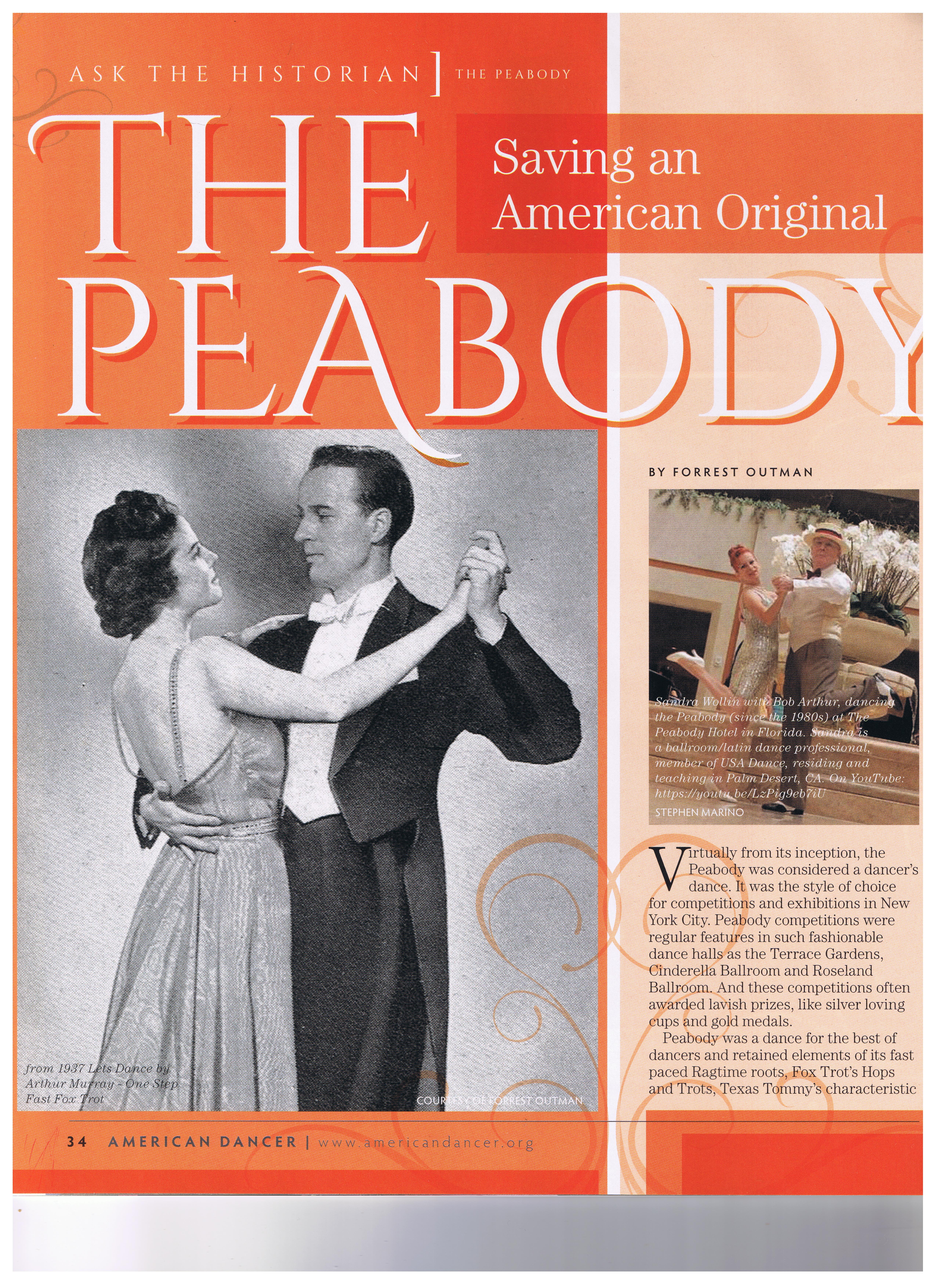
 In my article I revealed that it is possible that the Peabody was named after the infamous New York police captain William Frank Peabody. I have been able to find two instances of him winning dance competitions and I’ve included those sources so that you need not take my word for it and also to aid other researchers. I also relayed my doubts as to him being obese and thus using an outside partner position, as it appears he was an amateur boxing champion of some stature and clearly fit, again I’ve included that source below.


I also mentioned that the Peabody was a variant of One Step and that all vintage sources were clear about that, to this end I’ve included a few sources to demonstrate as such.

Peabody One-Step is New York’s latest hit.

The above advertisement to the right is quite interesting, as it’s evident that Peabody was not a completely separate form, but rather added to the One Step lexicon.
]]>
A Few Quick Points on Why Latin Hustle is the Bomb!
I love, love, love, me some Latin Hustle! Latin Hustle is, sadly, a dance that has fallen through the cracks of history. Latin Hustle is such a smooth, comfortable, and unique style that it certainly deserves to be remembered and survive in dance culture.
It’s 6 NOT 3!
To begin with it’s a six count dance, NOT three. If someone claims otherwise, ignore them; they either don’t know or forgot over the years (happens to the best of us). You shouldn’t just take my word for it, on that we agree, so I’ve provided multiple sources from the 70’s below to prove my point.

The big deal with six count based patterns is that it slows the flow down and makes the dance both calmer and easier to learn than it’s fast paced three count evolution. Many people struggle with three count Hustle because it can be really jerky and spastic feeling when you are constantly passing your partner and rotating every three counts, thus Latin Hustle is the solution…boom, problem solved!
And Another Thing!
Latin Hustle has some really great moves that are fun and interesting in ways we don’t see anymore, thus giving you more options in your dance arsenal to express the music and connect with your partner. Many of the figures from vintage instructional texts changed my personal view of what Hustle was and wasn’t, almost exclusively for the better.
If you want to mix Latin Hustle with 3 Count Hustle it’s easy: simply do a ball change action counting &, 1, instead of tapping on count 1 and then dance the rest of the pattern exactly the same. Fusion of Hustle systems works out for the simple fact that they evolved from one another.
Lastly, it’s easy to fuse into West Coast Swing and 3 Count Hustle. Actually, Latin Hustle was often compared to West Coast Swing (WCS) by instructors of the period. Not only that, but some WCS moves actually are Hustle moves that were adopted. The secret to adapting patterns is simply to count Hustle patterns 5,6 counts as 1,2 in WCS and voila!


Source: Night Moves by K-tel, 1979


I recently purchased the Dancing Masters of America; Description of Dances Taught book for the 1940 convention and promised to share some of the material with those that follow me online. There is some fairly novel and unique information in that publication to be certain, but I felt compelled to share the genius of the simplicity of the Lindy Hop instruction given.
Let me state upfront the goal of a dance master was to teach social dancing first and foremost to the masses in an easy and functional way. Their goal was not initially exhibition, though they did teach such material as well, as professional stage dancing school also existed in yesteryear for that express purpose. I feel many teachers could learn from the simplicity in approach they took.
For starters, Lindy fundamentals were very rarely taught in Shuffle (a.k.a. double-time / triple-step) timing until after someone was able to dance in single time. Let someone master three steps per bar before we ask them to do five steps per bar, especially if they have little or no prior dance experience. The extra time they now have can be focused on connection and remembering the next fundamental pattern. Look at the very last figure, it’s actually the third figure repeated in shuffle (aka triple-step / double-time). It’s not a new figure, but rather the point is to take what the student is already functional in and THEN up the complexity.
Another example of a simple progressive approach they utilized was the amount of turn employed. Note that they only do quarter rotations for a throw out into break-away position (aka send out) and returning to closed. The other figures use half rotations (for rotating basic, passes, and under arm turns), broken down via two quarters rotations. Utilizing less rotation does not detract from the joy of dance and insures success for both leader and follower alike. The ability to have a feeling of success on the dance floor encourages the dancer and affords them the confidence to believe they can in fact learn to Lindy versus a complex or difficult approach which often frustrates the novice and leaves them wanting to give up.
Finally there is no blended rhythm (i.e. six AND eight count). Instead they teach eight count passes and turns. These turns are also only half rotations (180 degrees) broken into two quarters for simplicity and flow. The use of eight count based figures is often very helpful for musicians who like to phrase and feel uncomfortable with inter-measure phrasing when they are initially learning.
To my fellow instructors and any novice that may read this, please remember that a student must first walk before they run and that the goal of a great teacher isn’t to show them what YOU can do, but rather what you can do for THEM.

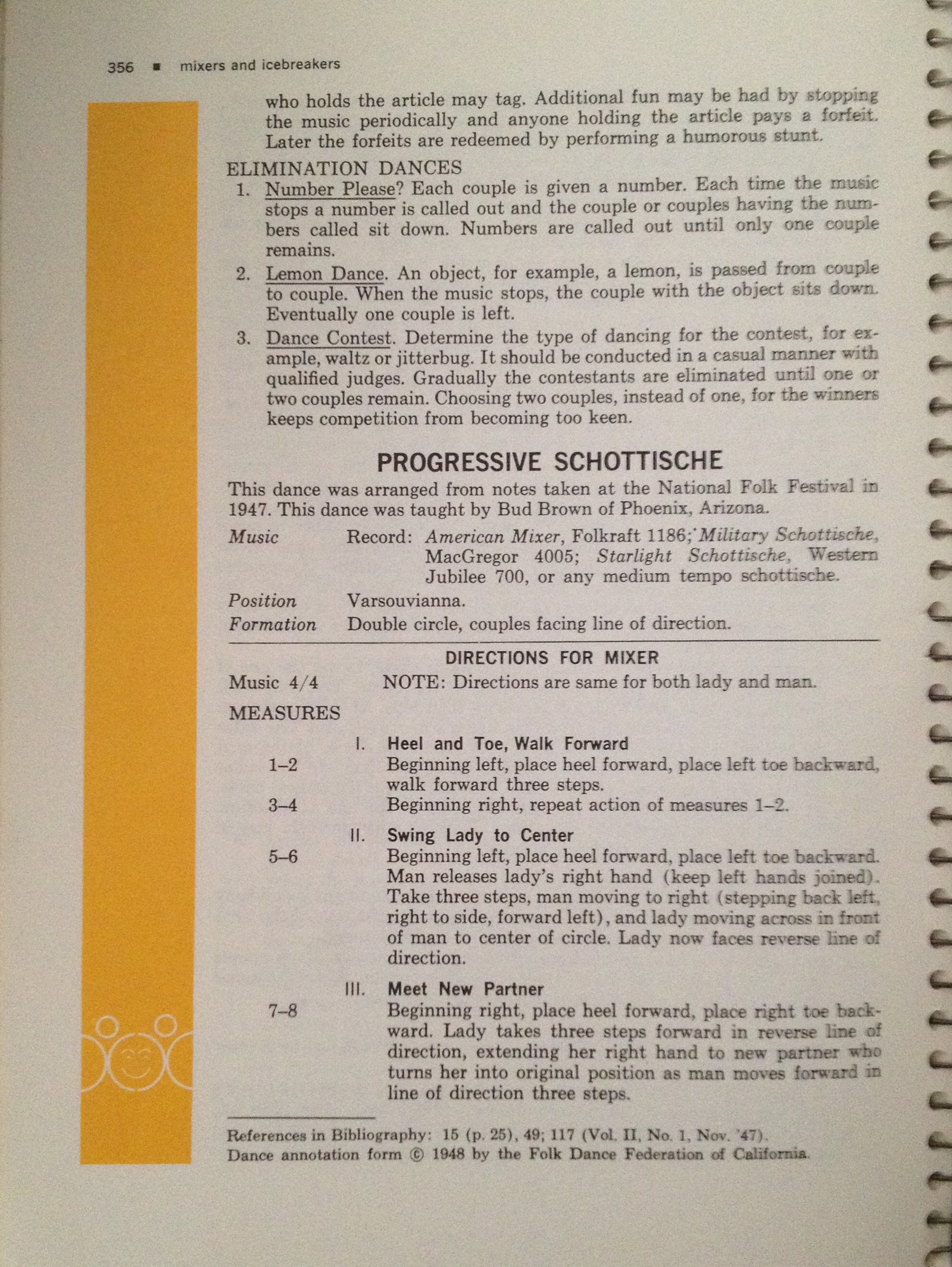
I’ve chosen the following pages to provide readers the opportunity to learn a variety of methods to introduce some social mixers into their dance parties. I recommend a game, mixer, or elimination dance after every fifth song minimum. Having scoured through many dance programs through the years I find the average ratio was four songs between mixers. The mixers are meant to liven up the affair and get everyone involved and introduced to others, ice breakers of sorts for social dances.
Citation: Harris, J. A., Pittman, A., Waller M.S. (1968). Dance A While (4th ed.). , (pp. 353-356). Minneapolis, Minn.; Burgess Publishing Company.
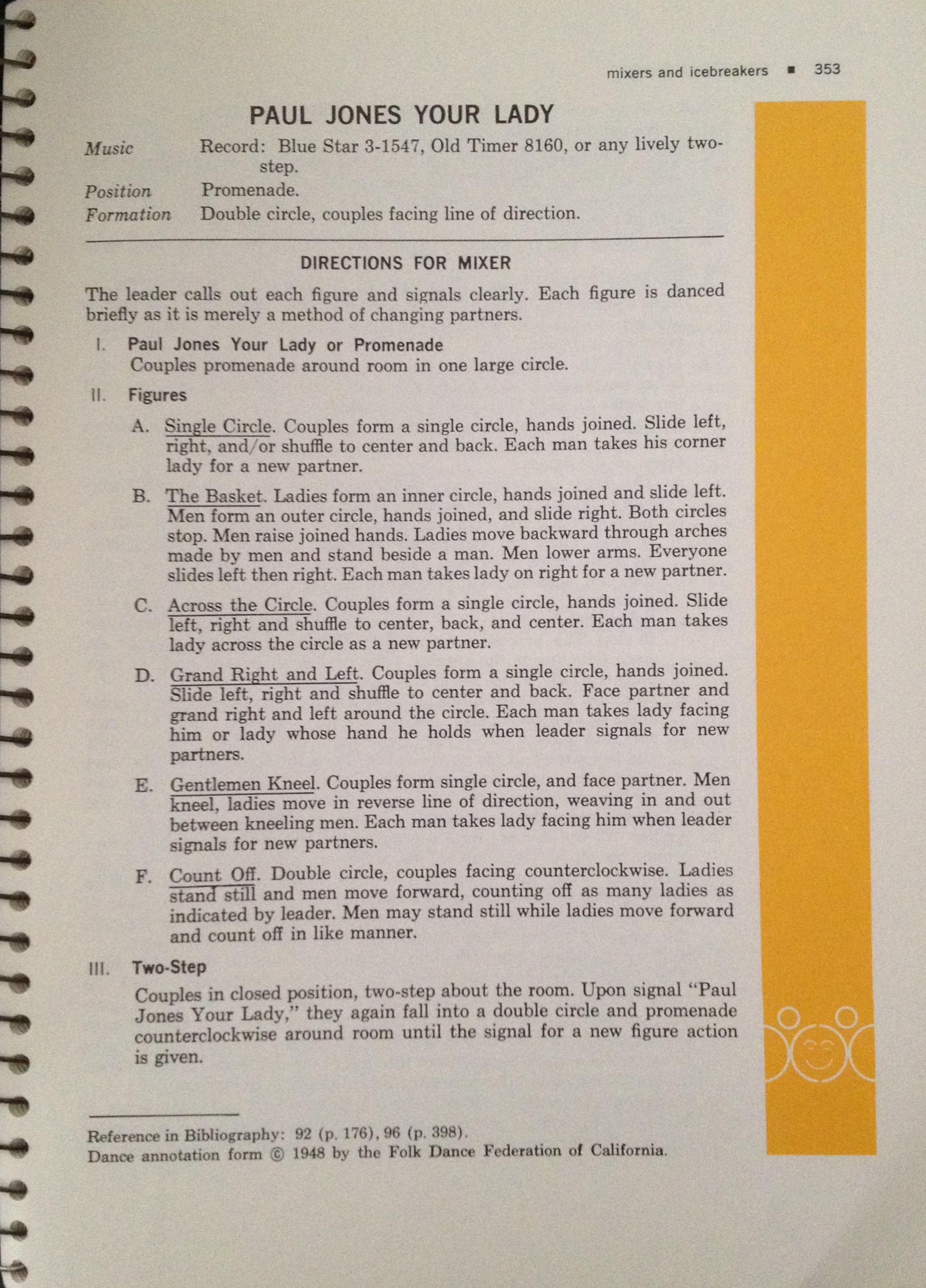
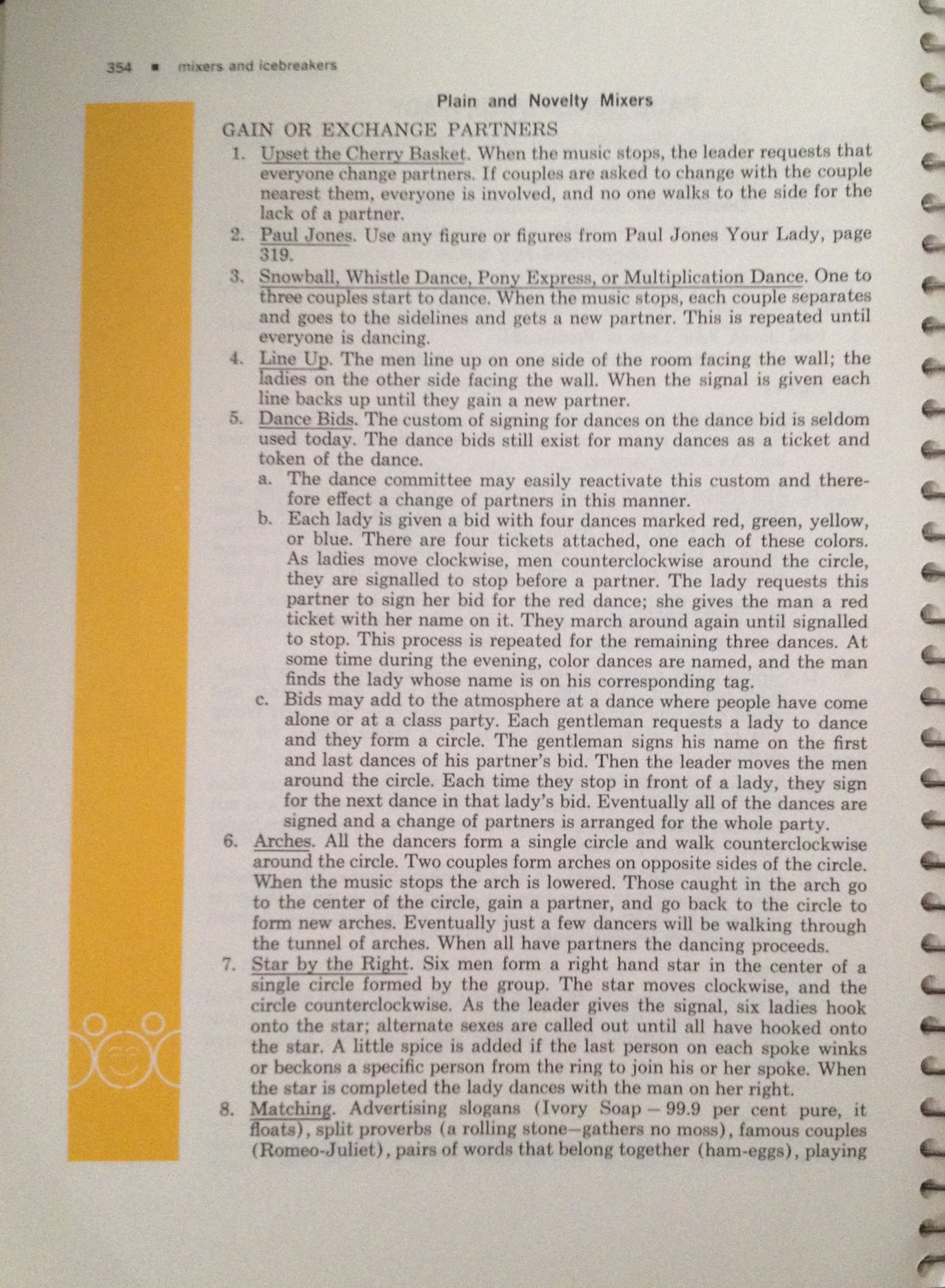
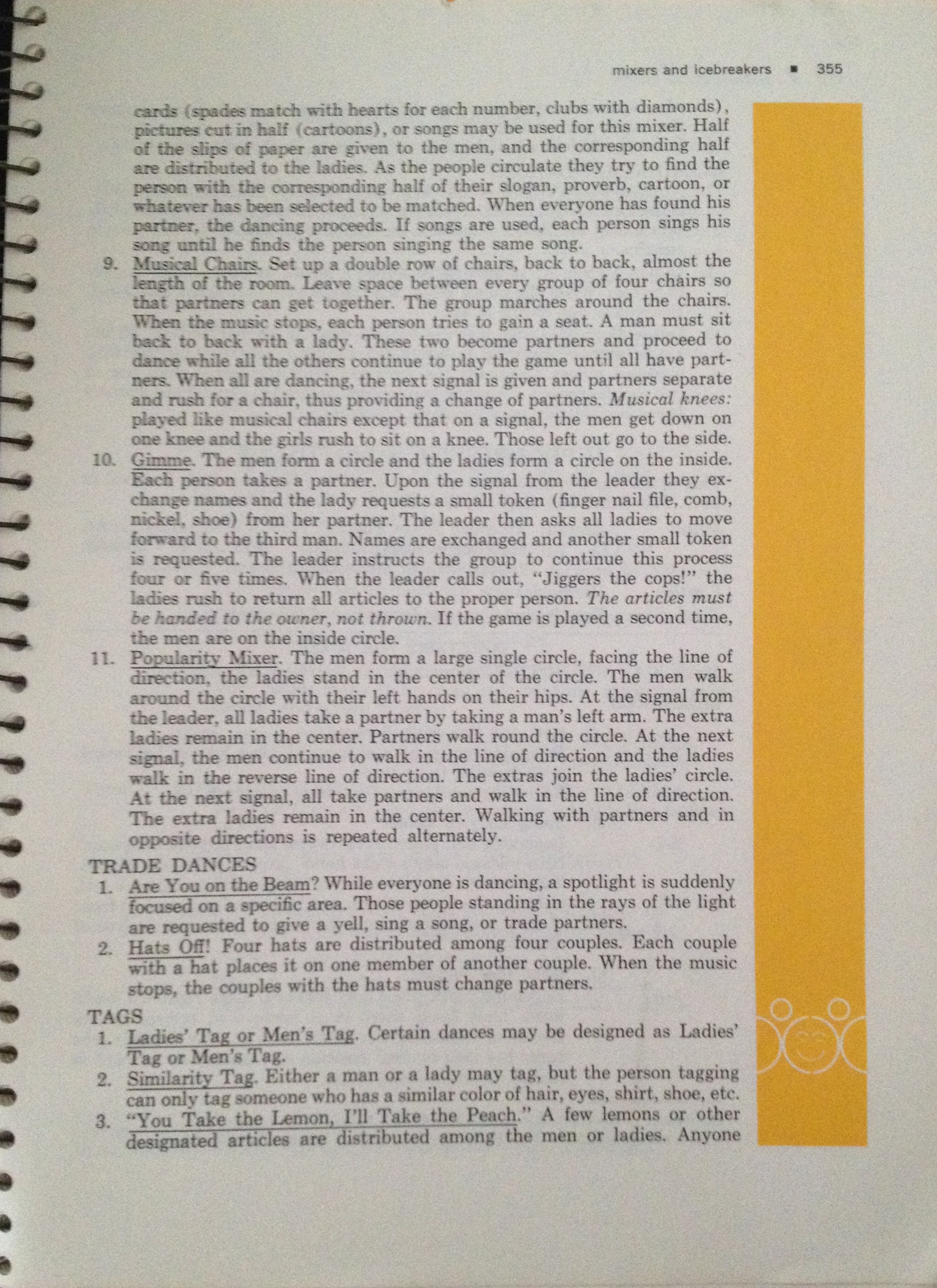
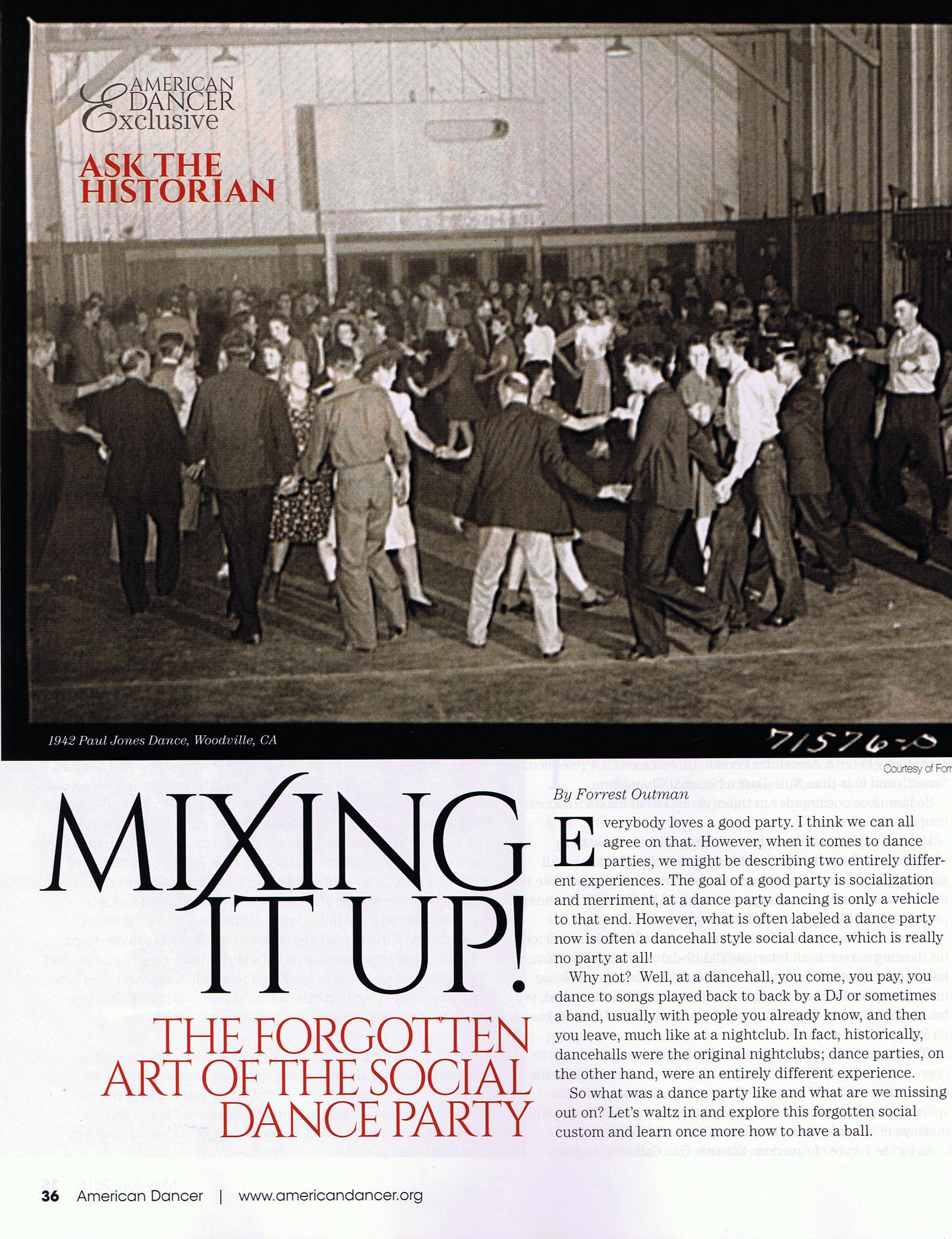

 Citation: Outman, F. (2016, May-July). Mixing It Up! The Forgotten Art Of The Social Dance Party. American Dancer, 2016 (60), 38. http://dancehistorian.com/mixing-it-up-the…cial-dance-party/

In walking based dances such as Fox Trot, Waltz, and Tango one of the first lessons taught in dance studios is to walk “naturally” forward using a rolling heel to toe action or inversely backward rolling from toe to heel. The reasoning given is that is allows for a smooth walking action, better balance/control, powerful movement, and is essential to quality swing/sway technique and the resulting rise/fall. This explanation of need of such technique is taught worldwide and accepted universally in the competitive ballroom arena. Professionals with 50+ years of experience are steadfast in advocating the necessity for heel to toe rolling action.
So, why then am I telling you that all of them are wrong? The direct answer is; Fox Trot, Waltz, and Tango all substantially pre-date the use of the natural walk i.e. heel/toe rolling steps. The first use of this movement was documented in the 1948 publication “A History of English Ballroom Dancing: (1910-1945)” by Philip J.S. Richardson. Richardson was the editor of “The Dancing Times,” a London publication which was the leading dance trade magazine of Europe as well as playing a key role in the formation of the ballroom division of the Imperial Society of Teachers of Dance. He vividly notes that it first became utilized in England in 1922 and was used intermittently within a dance. He later goes on to express that by 1930 it was becoming the dominant form for competitive English dancers. Waltz had been popular of over a hundred years by then, the Tango came into vogue in 1911, and the Fox Trot came to be in June of 1914. The English style of dancing using a rolling action came to influence American dancers even later still.
Armed with this knowledge it is clear that ballroom dancers were quite able in dancing without the need for such a technique, but rather it was a new tool added to enhance the dances. A dancer can be impeccably smooth and not use heel leads. I offer as example the Tango dancers of Argentina whom more often than not do not use heel/toe & toe/heel rolling actions in their dance walk. The Argentine Tango is a very smooth, complex, and nuanced dance which requires exceptional balance and responsiveness in partnership. This is made possible via controlled grounded weight shifts despite being toe/ball based movements. Stranger still is the call for use in Fox Trot. Fox Trot is not necessarily a smooth dance, though it’s slow form often is. The first forms of Fox Trot were very vibrant with hops, lilts, and Trotting i.e. a bouncing (rise and fall) from foot to foot as you stepped. The Fox Trot eventually splintered into several forms based on tempo; Slow Fox, Westchester, Quick Time/Fast Fox Trot, Peabody, and Collegiate/Swing versions.
Below right is an except from Betty White’s “Ballroom Dancebook for Teachers” (1962) which clearly articulates the differences of toe vs. heel leads
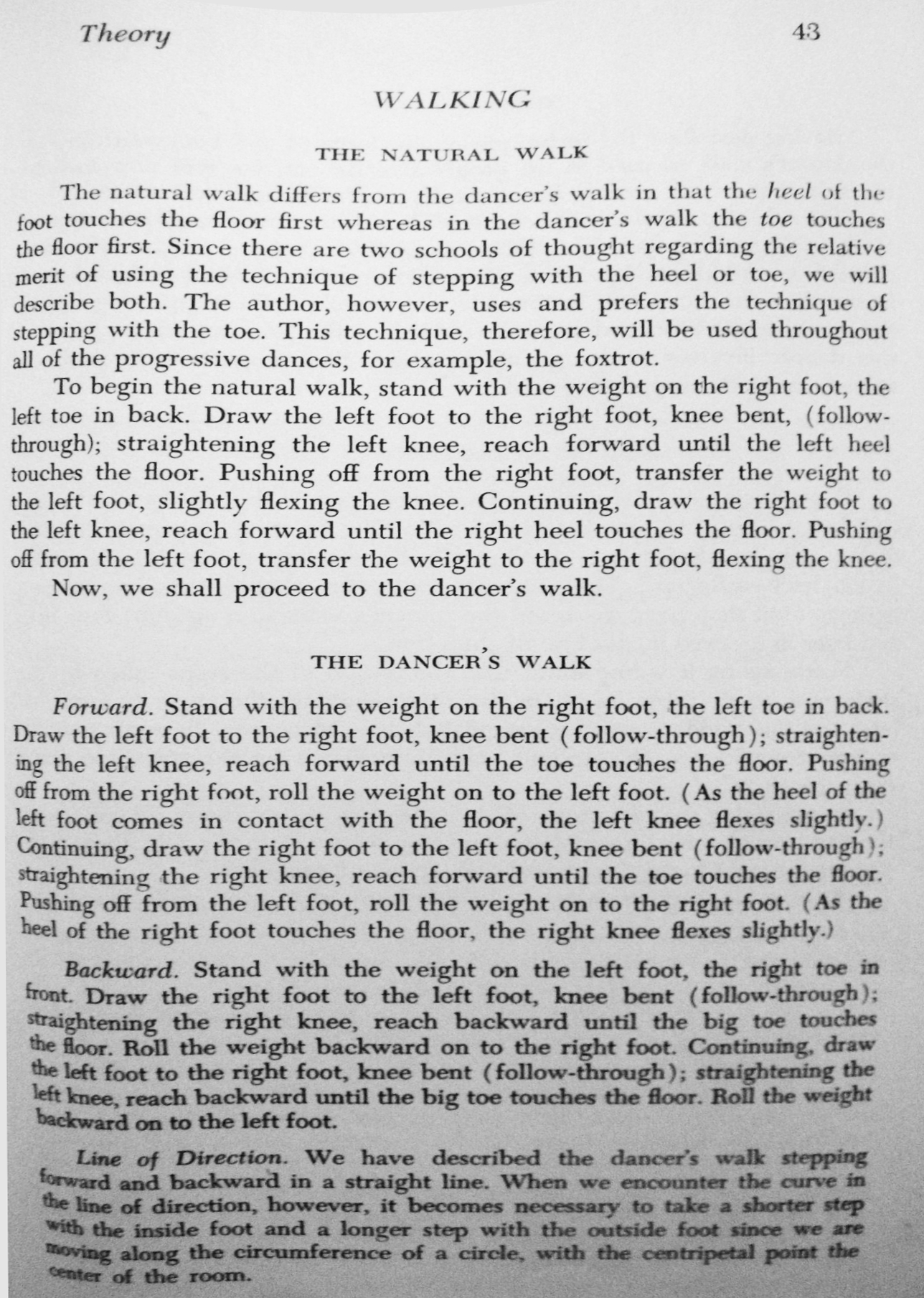
Below left I’ve include a walk description from “How Become A Good Dancer” Arthur Murray, 1938 . Note that the image above conveys the common usage of toe leads in ballroom dance.

It is my aim to not chastise but rather remind that there is room for all and we as teachers and practitioners need not limit our creative expression to only one of many tools available. I enjoy the use of many styles and techniques in any dance form, the greater the vocabulary the greater the possibilities that arise.
One final note; please don’t tell others it’s “wrong” to toe lead, not only are you wrong, but you may have made a simple enjoyable dance unnecessarily complex. I challenge you to learn and teach all the tools and not just your preferences. Art is subjective and what is desirable has always been argued, but natural is not a universal term for some toes leads are much more comfortable and as such shouldn’t be shunned. The marriage of the old and new ultimately leads to a better understanding of what dancing was, is, and can be.
I hope to one day see all of you unabashedly toe leading, until then, happy dancing and don’t take this article too serious it’s only dancing.