The post What Is the Average Car Accident Settlement in Florida in 2026? appeared first on Dolman Law Group.
]]>There is no reliable statewide average that can predict how much a Florida car accident settlement will be worth. Some claims resolve for relatively modest amounts, while cases involving permanent disabilities or catastrophic injuries may result in six- or seven-figure recoveries. Settlement value depends on injury severity, medical expenses, lost income, liability, and available insurance coverage.
Quick Facts About Florida Car Accident Settlements
- Average Settlement: No single statewide average reliably predicts individual claim values.
- Most Important Factors: Injury severity, medical expenses, lost income, permanent impairment, and liability.
- Florida PIP: Generally provides up to $10,000 in medical and disability benefits, subject to statutory requirements.
- Pain and Suffering: Usually requires meeting Florida’s serious injury threshold in cases subject to the no-fault law.
- Comparative Negligence: Being more than 50% at fault generally prevents recovery in covered negligence cases.
- Filing Deadline: Generally two years for negligence claims arising on or after March 24, 2023.
A car accident can leave you with thousands of dollars in medical bills, missed paychecks, and an insurance adjuster offering far less than you expected.
Naturally, you want to know what your case is worth.
The difficulty is that two people involved in similar crashes can receive very different settlements. One may recover quickly with minimal treatment. The other may require surgery, lose substantial income, or experience permanent physical limitations.
Understanding how insurance companies and attorneys evaluate these differences is more useful than relying on a generic settlement average.
How Much Are Florida Car Accident Settlements Worth?
Florida car accident settlements vary considerably because compensation depends on the injuries and financial losses involved in each claim.
The following table illustrates how injury severity can influence settlement value. These are general claim categories, not guaranteed settlement ranges.
| Injury Severity | Common Examples | Factors Affecting Compensation |
|---|---|---|
| Minor | Bruises, temporary strains, short-term neck or back pain | Limited treatment, brief recovery, minimal lost income |
| Moderate | Fractures, herniated discs, injuries requiring surgery | Significant medical expenses, extended recovery, time away from work |
| Severe | Multiple fractures, orthopedic injuries, permanent impairment | Substantial treatment costs, lasting limitations, reduced earning capacity |
| Catastrophic | Traumatic brain injuries, spinal cord injuries, paralysis | Lifelong medical care, permanent disability, major financial and personal losses |
A relatively minor injury may support a modest settlement. A catastrophic injury can justify substantially more compensation, particularly when someone requires ongoing care or can no longer work.
However, even serious injuries do not guarantee a large recovery. Insurance limits, disputed liability, and the responsible party’s financial resources can restrict the compensation available.
What Do Actual Florida Car Accident Settlements Look Like?
Published case results can provide useful examples of how compensation varies with the circumstances.
Dolman Law Group has reported the following automobile accident recoveries on its Florida car accident practice pages:
| Reported Recovery | Case Description |
|---|---|
| $5 million | Car accident involving severe burn injuries |
| $1.58 million | Car accident involving serious spinal injuries |
| $1 million | Car accident involving a shoulder injury |
| $939,000 | T-bone collision |
| $775,000 | Car accident involving injuries to a parent and child |
These are selected historical results reported by the firm, not average settlements. They do not establish what another case is worth or guarantee a similar outcome.
What Factors Determine the Value of a Car Accident Settlement?
The value of a Florida car accident claim generally depends on six primary factors.
1. The Severity and Permanency of Your Injuries
An injury that heals within several weeks is evaluated differently from one that causes chronic pain, permanent impairment, or loss of mobility.
Medical records, diagnostic imaging, specialist evaluations, and treatment history help establish the extent of an injury.
In serious cases, medical experts may also be needed to explain how the injury will affect a person’s future health and daily activities. This is especially important in claims involving traumatic brain injuries or other permanent disabilities.
2. Your Medical Expenses and Future Treatment Needs
Medical expenses may include emergency transportation, hospital treatment, diagnostic testing, physical therapy, surgery, medications, and rehabilitation.
A settlement should also account for reasonably anticipated future medical care when those expenses are legally recoverable.
For example, someone who needs additional surgery or ongoing treatment may face substantial expenses that are not reflected in existing medical bills.
Florida law also affects how medical expenses are established and what amounts may be presented as evidence. Under Florida Statutes § 768.0427, specific rules govern evidence of medical expenses in personal injury cases. The total amount billed by a provider is not necessarily the amount recoverable in a lawsuit.
3. Lost Income and Reduced Earning Capacity
Missing several weeks of work can create significant financial pressure. Permanent injuries can have an even greater impact.
An injured person may be entitled to seek compensation for lost wages and diminished future earning capacity.
Consider a construction worker who suffers a serious back injury and can no longer perform physically demanding work. Even if that person eventually finds another job, the difference in lifetime earning potential may represent a substantial economic loss.
4. Pain, Suffering, and Loss of Enjoyment of Life
Medical bills do not tell the whole story.
Serious injuries can affect sleep, mobility, relationships, recreation, and the ability to perform ordinary activities.
Florida law permits recovery of certain non-economic damages when the applicable legal requirements are satisfied. In many motor vehicle cases, this means establishing a qualifying permanent or serious injury under Florida’s no-fault threshold.
5. Who Was Responsible for the Accident?
Liability can significantly change the outcome of a claim.
If the other driver was entirely responsible, the fault analysis may be relatively straightforward. If both drivers contributed to the collision, Florida’s comparative negligence rules may reduce or eliminate recovery.
6. Available Insurance Coverage
A case may involve substantial damages but limited insurance coverage.
Attorneys investigate potentially available policies, including bodily injury liability coverage, uninsured or underinsured motorist coverage, and insurance carried by other legally responsible parties.
Identifying every applicable source of coverage can be especially important in serious injury cases. Florida’s uninsured motorist insurance statute establishes important requirements concerning this type of coverage.
How Do You Calculate a Florida Car Accident Settlement?
A starting point is to identify recoverable economic and non-economic damages, then account for liability, applicable legal limitations, and available insurance.
Economic damages may include medical expenses, lost wages, reduced earning capacity, and other documented financial losses.
Non-economic damages may include physical pain, mental suffering, and loss of enjoyment of life when legally recoverable.
Consider this hypothetical example:
| Type of Loss | Amount |
|---|---|
| Recoverable past medical expenses | $35,000 |
| Anticipated future medical care | $20,000 |
| Lost income | $15,000 |
| Non-economic damages | $80,000 |
| Total Hypothetical Damages | $150,000 |
If the injured person is found 20% responsible, a straightforward comparative-fault calculation would reduce $150,000 to $120,000.
That does not mean the settlement will be $120,000.
The example assumes all claimed damages are legally recoverable and supported by evidence. Actual recovery may be affected by insurance limits, PIP-related adjustments, collateral-source rules, liens, disputed medical expenses, and other legal considerations.
This calculation illustrates how damages and fault interact. It is not a prediction of an individual settlement.
Does Florida PIP Insurance Affect Your Settlement?
Yes. Florida’s personal injury protection system affects how certain medical expenses and lost income are paid following a motor vehicle accident.
Under Florida Statutes § 627.736, PIP generally covers 80% of eligible medical expenses and 60% of covered lost income, subject to statutory limits.
Most Florida motorists are required to carry at least $10,000 in PIP coverage. Qualifying initial medical treatment generally must occur within 14 days of the accident.
Access to the full $10,000 medical benefit generally requires an emergency medical condition determination by an authorized provider. Otherwise, medical benefits are generally limited to $2,500.
PIP does not necessarily cover every financial loss, and it does not provide general compensation for pain and suffering.
Under Florida Statutes § 627.737, an injured person may recover certain non-economic damages when the injury satisfies the applicable serious injury threshold.
Qualifying injuries include:
- Significant and permanent loss of an important bodily function
- Permanent injury within a reasonable degree of medical probability, other than scarring or disfigurement
- Significant and permanent scarring or disfigurement
- Death
An injured person may also pursue certain economic losses beyond available PIP benefits, subject to applicable law and insurance coverage.
Can You Recover a Settlement if You Were Partially at Fault?
Yes, provided your claim is not barred by Florida’s modified comparative negligence rule.
Under Florida Statutes § 768.81, an injured person generally cannot recover negligence damages if found more than 50% responsible for their own harm. The statute contains exceptions, and its applicability depends on the claim.
For covered cases, compensation is reduced according to the injured person’s percentage of responsibility.
| Your Share of Fault | Hypothetical $100,000 Damage Award |
|---|---|
| 0% | $100,000 |
| 10% | $90,000 |
| 25% | $75,000 |
| 50% | $50,000 |
| 51% | $0 |
These examples assume the comparative negligence statute applies and do not account for insurance limitations or other adjustments.
Fault disputes are particularly important when insurers argue that an injured motorist was speeding, following too closely, or otherwise contributed to the collision.
Accident reconstruction, witness testimony, photographs, vehicle damage, and available video can help establish what happened.
Why Are Some Car Accident Settlement Offers So Low?
Insurance companies may offer less than an injured person expects because they dispute the extent of the injuries, question whether the accident caused them, or disagree about the amount of recoverable damages.
An early offer may also arrive before doctors understand whether an injury will require additional treatment.
For instance, an adjuster may initially evaluate a back injury based on emergency room records. Weeks later, an MRI and specialist examination may reveal a condition requiring surgery.
That new medical evidence can substantially change the evaluation of the claim.
Other common disputes involve preexisting medical conditions, gaps in treatment, future medical expenses, and whether the injured person can return to work.
An offer is not necessarily fair simply because it covers the bills incurred so far.
Should You Accept the First Car Accident Settlement Offer?
You should understand the full extent of your injuries, losses, and available insurance before accepting a final settlement.
An initial offer can be reasonable in some circumstances. In others, it may fail to account for future treatment or permanent limitations.
Most bodily injury settlements require a release that prevents the injured person from pursuing additional compensation for the same claim.
Before signing, consider whether your medical condition is sufficiently understood, whether future expenses have been evaluated, and whether all potentially responsible parties and insurance policies have been identified.
Once a claim is fully released, discovering additional medical expenses generally does not allow you to reopen it.
How Long Does It Take to Receive a Car Accident Settlement in Florida?
Some Florida car accident claims resolve within a few months. Others take a year or longer, especially when serious injuries require extensive treatment or the parties dispute liability.
The timeline usually depends on:
- How long medical treatment continues
- Whether the extent of the injuries is known
- How quickly the insurer investigates and responds
- Whether the parties agree on liability and damages
- Whether a lawsuit must be filed
A claim involving temporary injuries and clear liability may resolve relatively quickly.
A catastrophic injury case may require medical specialists, vocational experts, economic evaluations, depositions, and litigation before a fair resolution becomes possible.
A faster settlement is not always a better settlement, particularly when future medical needs remain uncertain.
How Can You Strengthen Your Car Accident Settlement Claim?
Strong claims are supported by evidence that connects the accident to the injuries and documents the resulting losses.
Practical steps include:
- Seek prompt medical attention. Explain your symptoms accurately and follow your medical provider’s recommendations.
- Preserve accident evidence. Keep photographs, crash reports, witness information, and relevant communications.
- Document financial losses. Save medical bills, receipts, employment records, and proof of missed work.
- Track the effects of your injuries. Record significant limitations affecting daily activities, employment, and recovery.
- Review settlement documents carefully. Understand what rights you are releasing before accepting payment.
- Speak with an attorney when necessary. Serious injuries, disputed fault, and inadequate insurance offers may require a detailed legal evaluation.
The goal is not to exaggerate a claim. It is to make sure legitimate losses are supported by reliable evidence.
For more information about documenting an accident and pursuing compensation, visit Dolman Law Group’s car accident lawyer resource.
How Long Do You Have to File a Car Accident Lawsuit in Florida?
Most Florida negligence claims arising on or after March 24, 2023, are subject to a two-year statute of limitations under Florida Statutes § 95.11.
The deadline was shortened from four years to two years through Florida House Bill 837.
Claims arising before the law’s effective date may be subject to different rules. Certain exceptions and special notice requirements may also apply.
The filing deadline is separate from insurance reporting requirements and PIP’s 14-day initial treatment rule.
Waiting too long can affect the availability of evidence and, ultimately, your ability to pursue compensation.
How Can Dolman Law Group Help Evaluate Your Settlement?
Dolman Law Group represents people injured in motor vehicle accidents throughout Florida, including serious and catastrophic injury cases.
The firm’s published Florida car accident case results include multimillion-dollar recoveries involving burn injuries and other serious harm.
Its litigation team includes Stanley Gipe, a Florida Bar Board Certified Civil Trial Lawyer, and founding attorney Matthew Dolman, who has served as lead counsel in more than 1,000 personal injury lawsuits.
The firm reports recovering more than $700 million for clients across its practice areas. This is an overall firm recovery figure, not an automobile-specific total.
Past results do not guarantee a similar outcome in another case.
Our attorneys investigate liability, evaluate medical and financial losses, identify applicable insurance coverage, and negotiate with insurers. When a fair settlement cannot be reached, litigation may be necessary.
For a broader explanation of Florida accident claims and your legal options, visit our Florida car accident lawyers page.
Frequently Asked Questions About Florida Car Accident Settlements
What Is a Good Settlement Offer for a Car Accident?
A good settlement reflects your legally recoverable medical expenses, lost income, future needs, and other damages while accounting for liability and available insurance. The amount depends on your circumstances.
Can a Minor Car Accident Result in a Large Settlement?
Yes, if the crash causes substantial injuries or losses. Vehicle damage alone does not reliably establish the severity of an occupant’s injuries.
How Much Is a Car Accident Settlement for a Herniated Disc?
There is no standard amount. Treatment requirements, medical evidence, permanency, lost income, liability, and insurance coverage all affect the potential value.
Are Car Accident Settlements Taxable in Florida?
Compensation for personal physical injuries is generally excluded from federal gross income under applicable tax rules. However, punitive damages, certain interest payments, and other components may be taxable. The IRS guidance on lawsuit settlements and awards explains the general federal tax treatment. A qualified tax professional can evaluate your settlement.
Can I Get a Settlement Without Hiring a Lawyer?
Yes. You can negotiate directly with an insurer, but serious injuries, disputed fault, or complicated insurance coverage may make legal representation beneficial.
How Much Does Dolman Law Group Charge for a Car Accident Case?
Dolman Law Group offers free consultations and handles car accident cases on a contingency-fee basis. The applicable fee and responsibility for case expenses are explained in the representation agreement.
Find Out What Your Florida Car Accident Claim May Be Worth
A settlement should reflect the injuries and losses you actually suffered, not simply the first number an insurance company offers.
If you were injured in a Florida car accident, Dolman Law Group can review the circumstances, explain the available insurance coverage, and help determine whether additional compensation may be available.
Contact Dolman Law Group for a free consultation or call 833-552-7274 (833-55-CRASH).
There is no obligation to hire the firm after your initial case review.
The post What Is the Average Car Accident Settlement in Florida in 2026? appeared first on Dolman Law Group.
]]>The post Finding the Best Personal Injury Attorney to Handle Your Case appeared first on Dolman Law Group.
]]>
Quick answer: To choose a Florida personal injury lawyer, confirm the lawyer is a member in good standing of The Florida Bar with no disciplinary history. Then check for board certification in civil trial law, ask how often the firm takes cases to trial, and confirm you owe no fee unless the firm wins your case.
The wrong lawyer can cost you months and leave money on the table. This checklist walks you through what to verify before you hire anyone, using The Florida Bar’s own tools. It was reviewed by Stan Gipe, a Dolman Law Group trial attorney who has been Board Certified in Civil Trial Law by The Florida Bar since 2018.
1. Verify the Lawyer With The Florida Bar
Only lawyers licensed by The Florida Bar can practice law in Florida. Before your first consultation, search the Florida Bar member directory and confirm:
- The lawyer is a member in good standing
- How long the lawyer has been licensed
- Whether the lawyer has any public discipline
The Bar’s consumer guide, How to Find a Lawyer in Florida, explains what else to look for. The check takes a few minutes and screens out lawyers who should not be handling your case.
2. Look for Board Certification in Civil Trial Law
Board certification in civil trial law is a voluntary credential awarded by The Florida Bar, and only a small share of Florida lawyers hold it. A lawyer certified in civil trial law has met the Bar’s standards for trial experience, peer review, and continuing education. Ask whether the lawyer who will handle your case is certified, and confirm it in the Bar’s directory.
At Dolman Law Group, this guide was reviewed by Stan Gipe, who has been Board Certified in Civil Trial Law by The Florida Bar since 2018.

3. Ask About Trial Experience, Not Just Settlements
Most injury claims settle. But an insurer decides how much to offer based partly on whether it believes your lawyer will actually go to court. Ask these questions:
- How many cases has the firm tried in Florida courts?
- Will you file a lawsuit if the insurer’s offer is too low?
- Who will try my case if it does not settle?
A firm that settles every case and a firm that tries every case are both warning signs. You want a firm that does both and chooses the path that fits your claim. Dolman Law Group is a trial-focused firm that pursues the full value of a claim rather than accepting quick or insufficient settlements.
4. Understand How You Pay
Personal injury lawyers in Florida usually work on a contingency fee. At Dolman Law Group, you pay no fee unless we win your case. There is no retainer and no hourly billing. Whichever firm you consider, get the fee agreement in writing and ask what happens to case costs if there is no recovery.
5. Choose a Lawyer Who Knows Florida Law and Courts
It can be tempting to hire a large national firm. In practice, you are usually better served by a lawyer who has spent a career in Florida. Tort law relies heavily on court decisions, and many of those decisions are state specific. A Florida lawyer can advise you on Florida law without starting from scratch.
A local lawyer will also understand:
- The statute of limitations, the legal deadline for filing your claim. Under section 95.11, Florida Statutes, most negligence claims, including car accidents, must be filed within two years for injuries that happened on or after March 24, 2023. Florida cut this deadline from four years to two in 2023. Wrongful death claims generally must be filed within two years of the date of death, and medical malpractice claims generally within two years of when the malpractice was discovered or should have been discovered. Different deadlines and notice rules apply in some cases, such as claims against government agencies, so speak with a lawyer as soon as possible.
- How the local court system works, including filing deadlines, court locations, and e-filing
- How local judges and opposing counsel tend to approach cases
- Florida’s rules on punitive damages
6. Review Their Results the Right Way
Look at the firm’s published results to see which types of cases it handles and how it approaches them. Does it settle everything? Does it go to trial when an offer is too low? Remember that results from other cases do not guarantee, warrant, or predict the outcome of yours.
7. Watch for Red Flags
- Guarantees of a specific result or dollar amount
- Pressure to sign on the spot
- No written fee agreement
- A lawyer you cannot find in the Florida Bar directory
- No clear answer on who will actually handle your case
Choosing a Florida Car Accident Lawyer
Car accidents are among the most common reasons people look for a lawyer in Florida. A good Florida car accident lawyer will investigate the crash, gather the police report, medical records, and other evidence, and consult experts when needed to assess what your claim may be worth. The lawyer should also handle communications with insurers, including your own PIP insurer, and explain whether your best path is an insurance claim or a lawsuit. For crashes on or after March 24, 2023, most Florida car accident lawsuits must be filed within two years of the date of the crash.
When you compare firms, ask whether they handle car accident cases regularly, who will communicate with the insurance companies for you, and whether they are prepared to litigate if settlement talks fail. Dolman Law Group has offices on both Florida coasts, offers free consultations, and has car accident lawyers available 24/7. Learn more on our Florida car accident lawyer page.
Questions to Ask at Your Free Consultation
Most personal injury lawyers offer a free consultation. Use it to learn about the process and to decide whether you are comfortable with the lawyer. Consider asking:
- How many years have you practiced personal injury law?
- Have you handled cases similar to mine?
- Are you board certified, and who will try my case if it goes to trial?
- Will you handle my case directly? If not, who will I work with?
- What is your payment structure? Do I owe anything if I do not win?
- Are there any additional expenses I should know about?
- What do you think my case is worth?
- How long will the process take?
- What resources does your firm have available for my case?
To talk with a Dolman Law Group attorney about your case, schedule a free consultation.
Frequently Asked Questions
How do I check if a Florida lawyer is licensed?
Search The Florida Bar’s member directory. It shows whether a lawyer is a member in good standing and lists any public discipline.
What does board certified mean for a Florida lawyer?
Board certification is a voluntary credential awarded by The Florida Bar in a specific area of law, such as civil trial. It reflects demonstrated experience and peer review in that area.
How long do I have to file a personal injury lawsuit in Florida?
For most negligence claims, including car accidents, you have two years from the date of the injury if it happened on or after March 24, 2023. Injuries before that date generally fall under the older four-year deadline. Other deadlines apply to wrongful death, medical malpractice, and claims against government agencies.
What does a Florida car accident lawyer cost?
At Dolman Law Group, you pay no fee unless we win your case.
The post Finding the Best Personal Injury Attorney to Handle Your Case appeared first on Dolman Law Group.
]]>The post How to Choose the Best Hair Relaxer Lawsuit Attorney appeared first on Dolman Law Group.
]]>If you have been diagnosed with cancer after the frequent use of chemical hair relaxers, the product liability attorneys of Dolman Law Group can provide you with the legal expertise you need to recover compensation for your damages, such as medical expenses, lost wages, and pain and suffering. You can schedule a free consultation with our team to hear more about and get a better understanding of what your hair relaxer cancer claim may be worth.
Understanding the Hair Relaxer Cancer Lawsuits
The hair relaxer cancer lawsuits are based on a study by the NIH that suggests a causal relationship between using chemical hair relaxers 4 or more times a year and an increased risk of developing uterine cancer. The women who reported using chemical hair relaxers at this rate were twice as likely as other women in the study to develop uterine cancer. 60% of the women who fall under this category identified as Black, causing researchers to highlight their increased risk. Other studies have noted that frequent chemical hair relaxer usage can result in:
- Uterine sarcoma
- Uterine fibroids
- Endometriosis
- Endometrial cancer
- Ovarian cancer
The endocrine-disrupting chemicals interfere with the body’s ability to keep hormones, specifically estrogen, balanced. When these toxic chemicals are absorbed through the scalp, they are mistaken as estrogen by the body. Abnormally high estrogen levels are known to cause cancer in the female reproductive system.
Cancer treatment is often expensive, as well as mentally and physically exhausting. Plaintiffs should not have to suffer the consequences of another party’s negligence without compensation. Once you have decided to pursue compensation for your damages in a hair relaxer cancer lawsuit, the next step is seeking out qualified legal representation.
Look for Expertise in Product Liability Claims
Not all personal injury lawyers have the same specialties. You should begin by ensuring that your personal injury lawyer has a history of successfully representing plaintiffs in product liability claims. Product liability claims differ from other types of personal injury claims in that most cases force plaintiffs to confront powerful companies, like L’Oreal, or their insurance carriers. There is often more publicity tied to product liability lawsuits in cases like the hair relaxer cancer claims, as a large number of plaintiffs are accusing well-known companies of negligence.
Additionally, product liability claims require a different set of criteria to be met as compared to most personal injury claims. The plaintiff’s representatives need to prove that the defendant is liable for a design flaw, distribution error, or failure to provide a warning label. This can require extensive investigation and a thorough vetting of medical records, both of which take a certain level of experience. Finally, the presence of carcinogens in product liability claims often requires a seasoned personal injury lawyer to ensure that the burden of proof is met.
Consider the Size of the Personal Injury Law Firm
When you consider hiring a hair relaxer cancer attorney, you should establish that they can devote the time and attention your case needs to maximize compensation. You should have the sense that they understand the magnitude of your losses and that they are prepared to go above and beyond to maximize your compensation for your chemical hair relaxer damages.
Small firms may lack the resources to properly investigate your claim and keep up with the demands of a complex product liability lawsuit. On the other hand, massive firms typically lack the willingness to devote individualized attention to your claim. They may be unable to assign a specific personal injury attorney who is dedicated to your case, or you may have trouble getting in contact with them. Instead, you want to look for a firm that can balance their time, effort, and resources to give your hair relaxer cancer claim the attention it deserves.
Experience Handling Mass Tort Claims and Trial Experience
Federal hair relaxer cancer lawsuits were consolidated in February 2023 into multidistrict litigation: In re: Hair Relaxer Marketing, Sales Practices, and Products Liability Litigation, MDL No. 3060, in the U.S. District Court for the Northern District of Illinois. In an MDL, plaintiffs share the work of discovery and pretrial proceedings while each case remains an individual claim.
Unlike in a class action lawsuit, any settlements plaintiffs receive are specific to their enumerated damages, rather than a lump sum divided evenly amongst plaintiffs. Your personal injury lawyer must be able to balance coordinating with other product liability attorneys while actively representing your specific interests.
Additionally, they should have experience taking personal injury claims to court. If a personal injury attorney does not have trial experience, that indicates that they believe that the insurance company reliably offers fair settlements to injured plaintiffs. Any reputable personal injury lawyer will assure you that this is not the case. Insurance companies want to pay out the minimum amount they are required to, which means that personal injury lawyers have to put forth a convincing claim for damages.
Why Should I Choose Dolman Law Group to Represent Me?
The success of a personal injury law firm can be measured in a variety of different ways. Dolman Law Group consistently exceeds the standard. Our team has acquired numerous accolades for our ability to maximize compensation and our work as trial attorneys.
Beyond our awards, we have endorsements from many former clients, which we take great pride in. Over more than two decades of service, we have established a reputation for excellence and results-driven success, which is evident based on our history of maximizing compensation.
Your time to file a hair relaxer lawsuit may be increasingly limited, so you should not delay the process of finding a product liability lawyer. Don’t wait until you think you can afford a personal injury lawyer. Our team works on a contingency fee basis, which means that you don’t have to worry about paying for our services before we negotiate your claim. If our team is unable to settle your hair relaxer cancer claim, you don’t owe us anything.
Frequently Asked Questions About Choosing a Hair Relaxer Lawsuit Attorney
Is there a hair relaxer MDL?
Yes. Since February 2023, federal hair relaxer cancer lawsuits have been consolidated in In re: Hair Relaxer Marketing, Sales Practices, and Products Liability Litigation, MDL No. 3060, in the U.S. District Court for the Northern District of Illinois. Each plaintiff’s case remains an individual claim within the MDL.
Is the hair relaxer lawsuit a class action?
No. The federal cases are part of an MDL, not a class action. In an MDL, each plaintiff keeps an individual claim, and any compensation is based on that person’s own injuries and damages rather than an equal share of a lump sum.
What should I look for in a hair relaxer lawsuit attorney?
Look for a lawyer with experience in product liability claims, mass torts and MDLs, and trial work, along with the resources to investigate your case and the willingness to give it individual attention. Your attorney should be able to coordinate with other plaintiffs’ lawyers in the MDL while protecting your specific interests.
How much does it cost to hire a hair relaxer lawsuit attorney?
Dolman Law Group handles hair relaxer cancer cases on a contingency fee basis. You pay nothing upfront, and you owe us nothing if we do not recover compensation for you.
Is it too late to file a hair relaxer lawsuit?
Not necessarily, but filing deadlines vary by state and depend on when you were diagnosed and when you learned of the possible link to hair relaxers. Because these deadlines can be limited, speak with a lawyer as soon as possible.
Contact Dolman Law Group for Help With Your Hair Relaxer Cancer Lawsuit
Choosing the best personal injury lawyer can make all the difference in terms of the size of the settlement you receive. At Dolman Law Group, you can rely on us to accurately calculate what your claim is worth and then work strategically to secure that goal.
The product liability lawyers of Dolman Law Group are trustworthy advocates who will not shy away from pressuring negligent companies or their insurance carriers to settle your hair relaxer cancer claim for an amount that reflects the extent of your physical, mental, and financial losses. If necessary, we are more than capable of representing your interests in court.
Our team will work diligently to protect your right to pursue compensation for your damages. You can reach us to schedule a free consultation with one of our product liability attorneys to learn more about how our services can benefit your chemical hair relaxer cancer lawsuit.
The post How to Choose the Best Hair Relaxer Lawsuit Attorney appeared first on Dolman Law Group.
]]>The post Roblox Lawsuit – Dolman Law Group Files Suit Against Roblox & Discord appeared first on Dolman Law Group.
]]>The following information expands on our press release about our lawsuit in San Mateo and answers some common questions about the Roblox and Discord Lawsuits.
Lawsuit Against Roblox Filed by Dolman Law Group
On July 18, 2025, we filed a civil lawsuit against Roblox Corporation and Discord, Inc., alleging that the companies enabled and facilitated child exploitation by their actions and inactions on their dangerously under-regulated platforms.
The complaint was filed in the Superior Court of California in San Mateo County, where Roblox is headquartered. The lawsuit centers on an 11-year-old girl from Florida, identified in court documents as Jane Doe R.M., who was groomed and sexually exploited through communication features on Roblox and Discord.
Our client was targeted by a sexual predator who groomed her over an extended period of time. The predator persuaded this child to meet up in person. In turn, the perpetrator drove to meet this child at her grandfather’s home in Florida, kidnapped the young girl forcefully, and drove her to a secluded location where he raped the child.
Roblox, boasting over 380 million active monthly users, is a platform where users create and interact within gaming experiences. At the same time, Discord offers chat, voice, and video communication, which are often used by Roblox communities.
Allegations of our Roblox Sexual Exploitation Lawsuit
Our lawsuit seeks to hold Roblox accountable for failing to implement basic child safety protections, misleading parents, and creating environments that exposed children to grooming and harm by online and real-world predators.
Our lawsuit stems from harm caused to a Florida minor who was an active user of both apps.
According to our complaint, the child was groomed through communication and chat features on Roblox and Discord that eventually resulted in serious and preventable harm to the child.
We allege that Roblox Corporation and Discord’s platforms are designed in a way that makes children easily accessible to bad actors, all while falsely promoting their products as safe for minors to parents.
“Roblox and Discord failed at every level—and a child suffered because of it.”
“Tech platforms that target kids have a heightened responsibility to protect them. Roblox and Discord failed at every level—and a child suffered because of it,” said Matthew Dolman, founding attorney of Dolman Law Group.
“This lawsuit is about holding them accountable for putting profits before protection.”
Roblox Misrepresented the Safety of Their Platform
Essentially, the Roblox online gaming platform prioritized onboarding as many users as possible to their platform to increase the valuation of their company over the safety of minors.
More specifically, Roblox avoided implementing simple safety features such as age verification for years despite having knowledge of the prevalence of child sexual exploitation and sexual predators on their online platform.
Roblox, in particular, is promoted as the #1 online game for kids and teens, with more than 380 million monthly users—nearly 40% of whom are under age 13.
The platform allows user-generated content, chat functions, and experiences that the lawsuit says often include sexually inappropriate themes and interactions that exploit children.
Discord Has Also Played A Role in Failing to Protect Children
Discord is similarly marketed as a place for social connection. Still, it has become a known gathering space for online communities to continue conversations off-platform, often with even less oversight, which is why predators lead to their victims there.
Together, the platforms created what our complaint calls a “breeding ground for predators,” where exploitation was not only possible but predictable. Child safety concerns were ignored by Roblox to the detriment of young users.
Our lawsuit seeks monetary damages for the victim and demands systemic change in how Roblox and Discord approach child safety. Our complaint accuses both companies of failing to monitor their platforms adequately, ignoring widespread reports of inappropriate content and user behavior, and providing parents with a false sense of security.
Snapchat Plays Similar Role in Giving Predators Private Communication
Predators may also move children between multiple online platforms as grooming or exploitation progresses. A conversation that begins on Roblox or Discord may continue through other social media or messaging apps, including Snapchat. Dolman Law Group also represents families in Snapchat sexual abuse and child exploitation lawsuits involving allegations that platform features made it easier for predators to contact, groom, sextort, or exploit minors.
10 Ways Roblox Enabled Child Sexual Exploitation
- Failed to implement effective age verification and predator detection tools.
- Enabled grooming and exploitation through open chat, messaging, and user-created games.
- Misled parents about platform safety while ignoring repeated warnings about risks to children.
- Allowed adult users to pose as kids with little friction or oversight.
- Prioritized user growth and engagement metrics over basic child safety protocols.
- Ignored or delayed action on reported abuse, letting harmful content and users stay active.
- Enabled the creation of sexualized avatars, animations, and game spaces with no effective moderation.
- Relied too heavily on community reporting rather than proactive safety enforcement.
- Used vague, PR-friendly language in public statements instead of acknowledging systemic failures.
- Built a platform architecture that treats kids like content creators and consumers without giving them real protection.
What Is the Roblox lawsuit?
This lawsuit, filed by Dolman Law Group and multiple other unrelated law firms, alleges that Roblox and Discord negligently designed and operated platforms that exposed children to sexual exploitation, sextortion, and sexual assault. In other cases we have found children sharing sexually explicit images for Roblox’s virtual currency known as Robux.
It focuses on the companies’ failure to enforce meaningful safeguards, their misleading claims about safety, and their refusal to act on known dangers. The legal action seeks accountability for harm that occurred because these platforms prioritized growth over basic user protection.
Who Qualifies for the Roblox Lawsuit?
Families may be eligible to file a Roblox lawsuit if their child was targeted, groomed, or harmed after using Roblox or Discord. The lawsuit does not require a criminal conviction, only that the platforms contributed to the conditions that allowed exploitation to occur. If your child interacted with predators on these apps or was exposed to harmful content, you may qualify.
However, based on our firm’s internal criteria, to qualify for a lawsuit against Roblox in cases where the misconduct was limited to grooming on the platform and did not develop into exploitation or real-world meetings, the child must have either documented therapy records or a recorded behavioral issue at school.
This proves that the grooming they experienced caused them proper damage.
We presently represent clients whose claims fall into the following categories:
- In-person meet-up – between perpetrator and child where rape, attempted rape, sexual assault, or the intent for sexual assault occurred or was thwarted.
- Sextortion – wherein the child was threatened or coerced into sending sexually explicit images or videos. The perpetrator often threatens to share the content with classmates, friends, or parents, leading to humiliation and fear. These cases typically involve the child producing child sexual abuse material (“CSAM,” sometimes referred to as “kiddie porn”).
- Received explicit content or attempted sextortion – where the child was sent sexually explicit images by the abuser or faced coercion to produce and share such content.
- Grooming with documented impact – involving repeated and consistent communication with the child that became sexual in tone. A grooming claim must be supported by either therapy records (psychiatric or psychological treatment) or an in-school behavioral incident. Documentation must show the grooming negatively impacted the child’s mental health.
All claims are due to the fact that Roblox Corporation failed to implement basic safety features, including but not limited to age verification, that would have prevented child predators from using the gaming platform as a hunting ground. The psychological harm suffered by these children is unimaginable. These dangerous interactions could have been limited and even avoided.
You can read more about who qualifies for a Roblox lawsuit here.
What Compensation Is Available for Sexual Abuse Victims?
Potential financial compensation will cover any damages, including emotional distress, costs of counseling or therapy, and other losses tied to the sexual abuse, emotional, or physical harm suffered by these vulnerable users.
In some cases, punitive damages may also be awarded to punish Roblox and Discord for their reckless disregard for child safety.
Roblox lied to the general public and their shareholders, touting the safety of the platform for years, despite being aware of countless incidents involving the sexual exploitation, grooming, and abuse of children due to lax safety measures on the app.
Roblox knew of many youth who were sexually assaulted or subjected to sex trafficking. They failed to take any meaningful steps to address their issues with online predators.
Rather than protect children, they focused on user engagement and growth.
Each case is unique and will depend on the specific facts and extent of the impact.
Where Can I Find a Roblox Lawsuit Lawyer?
Dolman Law Group is currently representing families in lawsuits against Roblox and Discord in state and federal courts.
We offer a confidential free consultation to parents who believe their child was subjected to sexual exploitation or worse on the Roblox platform. To learn more about your legal options, visit our contact page or call us directly to speak with an attorney. Our attorneys and staff are trauma-informed and trauma-trained to handle sensitive cases involving children.
Why Would Roblox Allow Children to Be Harmed on Their Platform?
Sadly, Roblox has prioritized user growth for years at the expense of a safe and creative space for children. Roblox’s pedophile problem has been well documented in the press, including this extensive and well-publicized exposé by Bloomberg.
The post Roblox Lawsuit – Dolman Law Group Files Suit Against Roblox & Discord appeared first on Dolman Law Group.
]]>The post Meta Pays $18 Billion Over Social Media Harm to Teens appeared first on Dolman Law Group.
]]>
Quick Answer: What Is the Meta $18 Billion Settlement?
Meta has agreed to pay up to $18 billion over the next 10 years to resolve claims brought by U.S. states over the alleged harm Instagram and Facebook caused children and teenagers. The settlements also require major changes to how minors can use Meta’s platforms, including default daily time limits, nighttime restrictions, stronger age-assurance measures, and additional parental controls.
Meta has denied wrongdoing and did not admit liability as part of the settlements.
Meta Settlement Quick Facts
Potential settlement value: Up to $18 billion
Company: Meta Platforms, Inc.
Platforms involved: Instagram and Facebook
Settlement announced: August 26, 2026
Payment period: Up to 10 years
Key allegations: Addictive platform design, harm to young users, misleading safety representations, and improper collection of data from children under 13
New teen protections: Default daily usage limits, nighttime restrictions, school-hour notification limits, stronger age assurance, and expanded parental controls
Does Meta admit wrongdoing? No
Does this end all lawsuits against Meta? No. Meta and other social media companies continue to face separate lawsuits involving alleged harm to young users.ntent here…
- Potential settlement value: Up to $18 billion
- Company: Meta Platforms, Inc.
- Platforms involved: Instagram and Facebook
- Settlement announced: August 26, 2026
- Payment period: Up to 10 years
- Key allegations: Addictive platform design, harm to young users, misleading safety representations, and improper collection of data from children under 13
- New teen protections: Default daily usage limits, nighttime restrictions, school-hour notification limits, stronger age assurance, and expanded parental controls
- Does Meta admit wrongdoing? No
- Does this end all lawsuits against Meta? No. Meta and other social media companies continue to face separate lawsuits involving alleged harm to young users.
Why Did Meta Agree to the Settlement?
The agreement came during a major federal trial in California involving allegations that Meta designed Instagram and Facebook in ways that encouraged compulsive use by children and teenagers while misleading families about the risks young users faced on its platforms.
The states also alleged that Meta violated children’s privacy protections by collecting and using personal information from children under 13 without proper parental consent.
Rather than continue the trial, Meta reached agreements that could require the company to pay up to $18 billion and make significant changes to how children and teenagers use Instagram and Facebook.
Under the settlement terms, teen accounts will be subject to stronger safeguards, including default limits on daily use, restrictions on nighttime access, limits on notifications during school hours, and additional efforts to identify users who may be underage.
The settlement does not resolve every lawsuit involving alleged social media harm to children. Meta and other social media companies continue to face separate claims brought by families who allege that social media addiction, harmful content, or platform features caused serious injuries to children and teenagers.
If your child suffered serious harm involving Instagram, Facebook, or another social media platform, File Abuse Lawsuit can help you understand whether your family may have a potential claim. Contact us for a free, confidential legal consultation.
The agreement comes as Meta and other social media companies continue to face thousands of lawsuits involving alleged harm to young users. For families, these cases can raise difficult questions about whether a platform could have done more to protect a child and whether there may be grounds for a legal claim. If your child suffered serious harm involving Instagram, Facebook, or another social media platform, contact File Abuse Lawsuit for a free, confidential legal consultation.
What Happened in the Meta Teen Social Media Case?
The Meta case centered on claims that Instagram and Facebook were designed to keep children and teens engaged for longer periods, even when that use could contribute to serious harm. In a joint federal lawsuit, 29 states accused Meta of relying on features that encouraged compulsive use while failing to adequately warn families about the risks.
The lawsuit also challenged Meta’s protections for younger users. Officials argued that the company did too little to keep children under 13 off its platforms and improperly collected data from some. They also claimed Meta publicly portrayed its platforms as safer for teens than its own internal information suggested.
Meta denied wrongdoing, but the trial placed the company’s decisions about youth safety and platform design under intense scrutiny before the settlement was reached.
How Much Will Meta Pay Under the Settlement?
Meta will pay up to $18 billion over the next decade under the settlement. About $12.7 billion is guaranteed, while another $5 billion depends on whether other major platforms adopt similar protections for young users. The money will also support youth online-safety efforts and independent research into social media’s effects on children.
Despite the size of the agreement, some state officials have argued that it does not go far enough. New Mexico Attorney General Raúl Torrez said the nationwide settlement falls short of protections his state already secured in court, including stricter rules involving private messages and AI interactions with minors. Florida also declined to join the deal after concluding that its terms were not strong enough.
Critics have also pointed out that $18 billion, while historic, represents a relatively small share of Meta’s overall value and does not address every feature they believe puts young users at risk. For families following these cases, that debate is likely to continue even after the settlement takes effect.
What Will Change for Teen Instagram and Facebook Accounts?
The settlement will bring several noticeable changes to Instagram and Facebook accounts belonging to users under 18. Meta will generally limit teens to two hours of combined use per day across the two platforms. Parents who verify their identity will be able to adjust that limit.
Teen accounts will also be blocked from using Instagram and Facebook between midnight and 6 a.m. Push notifications will be turned off by default during school hours, reducing some of the prompts that can pull teens back into the apps throughout the day.
Meta will also hide visible counts on teen accounts by default and strengthen the systems it uses to determine a user’s age. That includes using technology to identify users who may actually be minors even if the birthday listed on their account says otherwise. The company will be subject to independent monitoring as these protections are rolled out.
The changes are significant, though some child-safety advocates say the settlement leaves important concerns unresolved. In particular, critics have pointed to recommendation algorithms and other engagement features that remain largely intact.
Meta Will Have to Do More to Determine Who Is Actually a Child
The settlement also requires Meta to do more than simply rely on the birthday a user enters when creating an account. The company will have to use age-assurance technology and other signals to identify users who are likely minors and apply the protections meant for younger accounts.
That matters because children can easily enter a false age to get around existing restrictions. Meta will also be expected to do a better job identifying users under 13, who generally are not supposed to have Instagram or Facebook accounts. Stronger age detection could make it harder for younger users to bypass safety settings and spend time on the platforms without the safeguards that are supposed to apply to them.
What Will the Settlement Change About Harmful Content?
The settlement also requires Meta to strengthen protections around harmful content shown to younger users. That includes material involving self-harm, eating disorders, bullying, and other content that can pose particular risks for children and teens.
Meta will be expected to apply stronger age-appropriate safeguards and reduce the chances that minors are repeatedly exposed to this type of material through recommendations. The agreement does not eliminate every concern about how Instagram and Facebook recommend content, but it does place more pressure on Meta to show that its systems are protecting younger users instead of steering them toward potentially harmful material.
Why the Meta Settlement Matters for Social Media Lawsuits
The Meta settlement matters because it addresses many of the same issues raised in lawsuits filed by families across the country. Those cases often allege that social media companies used features designed to keep children and teens engaged for long periods while failing to provide adequate protections against harmful content, compulsive use, and other risks.
The agreement does not end all litigation against Meta, and it does not automatically prove that the company is responsible for a particular child’s injuries. Families pursuing individual claims will still need to meet the legal requirements that apply to their case.
Still, the settlement is significant because Meta has agreed to make major changes to how younger users experience Instagram and Facebook. Those changes may add to the broader legal and regulatory pressure on social media companies to take greater responsibility for child safety and platform design.
Could Families Still File Lawsuits Against Meta?
Yes. The settlement does not prevent families from bringing their own claims against Meta when a child or teen allegedly suffered serious harm connected to Instagram or Facebook.
These cases are separate from the states’ settlement and will depend on what happened to the individual child. A claim may focus on how the platform was designed, the type of content the child encountered, or whether certain features contributed to harmful patterns of use. The strength of a case can also depend on the records available and the law that applies.
Families who believe Instagram or Facebook played a role in serious harm can speak with an attorney about whether they may have a separate legal claim.
Does the Meta Settlement Affect TikTok, YouTube, or Other Platforms?
Not directly. The settlement applies to Meta and its platforms, so it does not automatically impose the same rules on TikTok, YouTube, Snapchat, or other social media companies.
Still, the agreement could have a wider impact. Other platforms are facing many of the same questions about how their products affect children and teens, and Meta’s decision to accept stronger youth protections may increase pressure on competitors to make similar changes.
It could also matter in ongoing litigation involving other social media companies. Courts and regulators are continuing to examine whether certain platform features create unreasonable risks for younger users, so the standards emerging from these cases may influence the industry well beyond Instagram and Facebook.
What Happens Next?
Meta will begin putting the settlement’s required protections into place, while independent monitoring will track whether the company follows through on those changes.
At the same time, lawsuits involving alleged social media harm to children are expected to continue. The settlement resolves claims brought by participating states, but it does not end the broader legal fight over how platforms are designed or whether companies did enough to protect younger users.
For parents, the bigger picture is still developing. New court rulings, settlements, and safety requirements could shape what legal options are available in future cases.
How a Lawyer Can Help with Social Media Harm
When a child has been harmed after heavy social media use, repeated exposure to dangerous content, or contact with someone through a platform, parents may have questions about whether the company could be legally responsible. Those cases can be difficult to evaluate because the harm may develop gradually and the most important evidence may be buried in account history, platform records, or medical documentation.
A lawyer can help connect those pieces and determine whether there may be a legal basis for a claim. They can also explain how current lawsuits and settlements involving Meta or other platforms may affect the family’s options.
At File Abuse Lawsuit, we help families understand what happened and whether pursuing a claim may make sense. If you believe a social media platform contributed to serious harm involving your child, contact us for a free, confidential consultation.
Contact File Abuse Lawsuit About a Potential Social Media Harm Case
If you believe Instagram, Facebook, TikTok, YouTube, or another social media platform contributed to serious harm involving your child, you may have questions about what legal options are available.
Contact File Abuse Lawsuit for a free, confidential legal consultation. We can help you understand whether your family may have a potential social media harm claim and what steps may come next.
The post Meta Pays $18 Billion Over Social Media Harm to Teens appeared first on Dolman Law Group.
]]>The post Roblox Lawsuits Grow as Chris Hansen and Schlep Expose Predator Risks appeared first on Dolman Law Group.
]]>Quick Answer: Why Are Chris Hansen and Roblox Back in the News?
Chris Hansen and Roblox are back in the news after an account Hansen used during a live child-safety demonstration at CrimeCon 2026 was banned from the platform. Hansen was demonstrating Roblox alongside YouTuber Schlep, who had previously been banned after conducting independent investigations of suspected predators on the platform.
The incident renewed attention around Hansen’s Dangerous Games investigation, Schlep’s dispute with Roblox, lawsuits alleging children were groomed through the platform, and a new U.S. Senate investigation into Roblox’s child-safety practices.
Quick Facts About Chris Hansen, Schlep, and Roblox
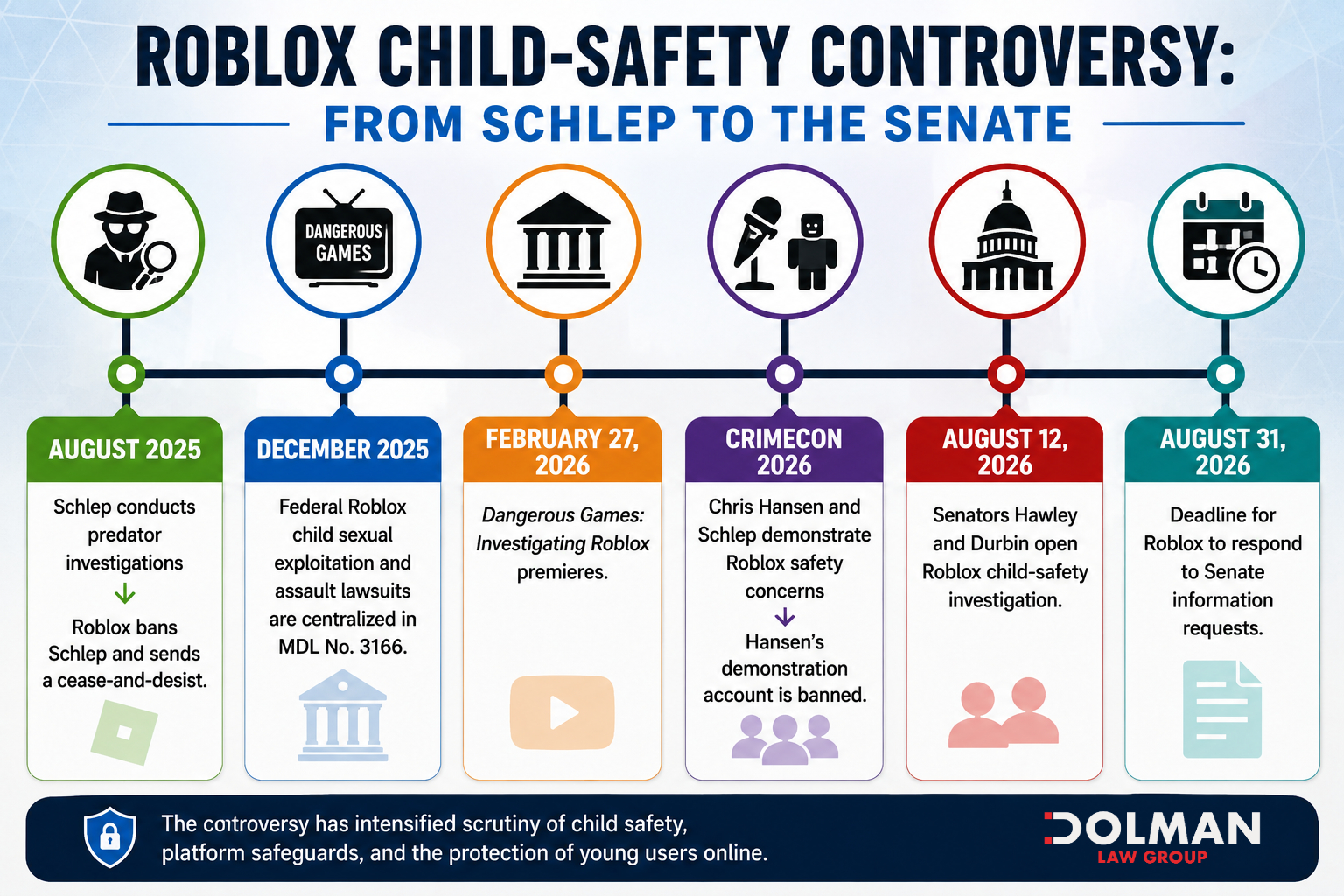
- Chris Hansen investigated Roblox in 2026: Hansen’s Dangerous Games: Investigating Roblox examined allegations involving predators, grooming, moderation, and child safety on the platform.
- The special premiered February 27, 2026: Hansen’s Roblox investigation premiered on TruBlu after months of anticipation surrounding the project.
- Schlep appears in Hansen’s investigation: The YouTuber became known for conducting independent investigations into suspected predators using Roblox.
- Roblox banned Schlep: Roblox says independent “vigilante” investigations violate its rules and can create safety risks or interfere with legitimate investigations.
- Chris Hansen’s demonstration account was also banned: During a CrimeCon 2026 demonstration with Schlep, the Roblox account Hansen was using received a moderation ban.
- The reason for that specific ban is not conclusively established: The timing generated widespread criticism, but the incident itself does not prove that Roblox manually banned Hansen because he was discussing or demonstrating child-safety problems.
- Roblox faces lawsuits involving child exploitation allegations: Families have accused the company of failing to adequately protect minors from adults who use the platform to make initial contact with children.
- Congress is now investigating: In August 2026, Senators Josh Hawley and Dick Durbin launched an investigation seeking records and answers about Roblox’s child-safety systems and its handling of exploitation and abuse reports.

Roblox is back under intense scrutiny over child safety after an unusual moment involving investigative journalist Chris Hansen and YouTuber Schlep went viral. During a live demonstration at CrimeCon 2026, Hansen used Roblox to show an audience how easily an adult could enter social experiences and interact with other users. During the demonstration, the account Hansen was using was banned from Roblox.
The timing immediately attracted attention. Hansen, best known for To Catch a Predator, spent months investigating child exploitation concerns involving Roblox for his 2026 special, Dangerous Games: Investigating Roblox. Schlep, a former Roblox player who says he was sexually exploited through the platform as a child, later became known for conducting his own investigations into suspected predators using Roblox. Roblox permanently banned Schlep in 2025 and sent him a cease-and-desist letter, saying his methods violated its rules and could interfere with legitimate safety and law-enforcement efforts.
The controversy is no longer limited to YouTube videos, documentaries, and social media. Families have filed lawsuits alleging children were groomed or sexually exploited after meeting adults through Roblox, states have pursued legal action against the company, and federal lawmakers are now demanding answers about how Roblox protects children.
In August 2026, U.S. Senators Josh Hawley and Dick Durbin opened a Senate investigation into child safety on Roblox. Their inquiry seeks information about reports of child sexual exploitation and abuse, moderation practices, age-verification systems, parental oversight, and how Roblox responds when children are placed at risk.
The result is a much larger question than why Chris Hansen or Schlep was banned from Roblox: Are Roblox’s safety systems actually keeping predators away from children, and what responsibility does the company have when those systems fail?
For families whose children have already been harmed, those questions are also becoming central to a growing number of Roblox lawsuits.
Why Chris Hansen and Roblox Are Back in the News
During the presentation, Hansen and Schlep demonstrated how adults can enter certain Roblox experiences and communicate with other users. One interaction reportedly moved almost immediately toward a request involving Snapchat, illustrating a concern raised repeatedly in Roblox child-safety litigation: contact can begin inside Roblox before moving to a less-monitored outside platform.
Then the demonstration took an unexpected turn. The Roblox account Hansen was using received a moderation ban for what the notice described as inappropriate content or behavior and repeated or serious rule violations. Hansen and Schlep discovered the ban while they were still onstage.
The moment spread rapidly online, in part because of the obvious irony. Hansen built much of his career investigating adults who target children online, while Schlep had already been banned by Roblox after conducting his own predator investigations. Now, an account being used by Hansen during a presentation about alleged predator risks had also been removed.
However, there is an important distinction between what happened and why it happened.
The account was banned during the demonstration. That does not, by itself, establish that a Roblox employee was watching CrimeCon and deliberately banned Hansen to prevent him from exposing child-safety problems. Schlep suggested that possibility during the presentation, and the timing has fueled widespread criticism online, but the available evidence does not establish who initiated the moderation action or precisely what triggered it.
That distinction matters because the underlying child-safety controversy does not depend on speculation about one account ban. Hansen’s investigation, Schlep’s allegations, lawsuits filed by families, government actions against Roblox, and a new Senate investigation have raised much broader questions about how the platform identifies dangerous behavior and protects children from adults seeking to exploit them.
Chris Hansen’s Roblox Investigation Is No Longer Just an Upcoming Documentary
When Chris Hansen first became involved in the Schlep controversy, his Roblox investigation had not yet been released. That changed on February 27, 2026, when Dangerous Games: Investigating Roblox — A Chris Hansen Special premiered on TruBlu.
The investigation brought Hansen’s familiar focus on online predators into a very different digital environment. Instead of the chatrooms and messaging services associated with the original To Catch a Predator era, the investigation focused on modern platforms where children socialize, play games, exchange virtual currency, and communicate with people they may know only through an avatar or username.
Schlep was part of that investigation.
His involvement is particularly significant because his story has two sides. Schlep says he was sexually exploited through Roblox when he was younger and later began using the platform to identify suspected predators. He has said some of his investigations contributed to arrests.
Roblox took a very different view of his methods.
The company banned Schlep and argued that independent predator hunters can create additional risks by impersonating minors, moving conversations off-platform, delaying reports, mishandling evidence, or taking actions that could interfere with law enforcement.
That disagreement created the controversy Hansen eventually stepped into: What should happen when independent investigators claim they are finding predators on a platform that says their investigative methods actually make children less safe?
Hansen’s documentary gave that dispute a much larger audience. The CrimeCon incident has now placed it back in public view months later.
Lawsuits and Global Repercussions
Even before Chris Hansen became involved in the controversy, Roblox was facing mounting legal pressure over child safety. Families across the United States have filed lawsuits accusing the company of failing to adequately protect children from predators who allegedly used Roblox to make initial contact, build trust, and eventually move conversations to other platforms.
Some of these cases involve devastating allegations. A Texas man, for example, sued Roblox and other companies alleging that predators groomed and sexually exploited him after initially contacting him through Roblox when he was a child.
State governments have also taken action. Louisiana was among the first states to sue Roblox directly, with Attorney General Liz Murrill accusing the company of failing to implement adequate safety measures for children. Since then, additional states and government entities have pursued lawsuits or investigations involving Roblox and its child-safety practices.
The individual federal lawsuits have also developed into coordinated national litigation. Roblox child sexual exploitation cases are now being handled together in MDL No. 3166 in the Northern District of California, allowing lawsuits involving similar allegations to proceed through coordinated pretrial proceedings rather than requiring every federal court to address the same discovery and legal issues independently.
As of August 2026, 177 cases were pending in the Roblox multidistrict litigation, a substantial increase from when concerns about the platform first began developing into coordinated litigation. The court has also appointed a settlement master to assist with settlement discussions. That appointment does not mean a Roblox settlement is imminent, but it represents another significant step in the progression of the litigation.
The pressure extends beyond private lawsuits. Governments in the United States and abroad have questioned whether Roblox’s existing safeguards adequately protect its enormous population of young users. Some jurisdictions have pursued investigations or litigation, while countries including Qatar have restricted access to the platform amid concerns about children’s online safety.
Each new lawsuit, investigation, and government action raises a similar underlying issue: whether Roblox knew or should have known how predators could misuse its platform and whether the company took reasonable steps to protect children from those risks.
U.S. Senate Opens Investigation Into Child Safety on Roblox
Roblox is now facing scrutiny from Congress in addition to lawsuits, state investigations, and criticism from parents and child-safety advocates.
On August 12, 2026, U.S. Senators Josh Hawley and Dick Durbin, the chairman and ranking member of the Senate Judiciary Subcommittee on Crime and Counterterrorism, opened an investigation into child safety on Roblox.
In a letter to Roblox CEO David Baszucki, the senators raised concerns about allegations involving grooming, sexual exploitation, child sexual abuse material, and other crimes connected to interactions that occurred through the platform.
The senators are seeking extensive information about how Roblox identifies and responds to potential threats to children. Among other things, the investigation asks Roblox to provide information about:
- Reports involving sexual exploitation, predation, or abuse of users under 18 during 2023, 2024, and 2025.
- How many accounts were reported for suspected child exploitation or abuse.
- What percentage of those reports were reviewed by human moderators.
- How many reported accounts were ultimately banned.
- Roblox’s procedures for reporting suspected child exploitation to the National Center for Missing & Exploited Children.
- The use of age-verification and age-estimation technology.
- How many minors have parental oversight enabled on their accounts.
- Safety protections surrounding communication and chat features.
- Internal records concerning child safety, abuse, bullying, and financial exploitation.
The senators also pointed to Roblox’s own reporting to the National Center for Missing & Exploited Children. According to their letter, Roblox reported 65,381 instances of suspected child sexual exploitation to NCMEC in 2025, more than twice the number reported in 2024.
Roblox has defended its approach to child safety. Chief Safety Officer Matt Kaufman said the platform is built on a foundation of safety and that the company looks forward to providing lawmakers with information about its efforts to protect children.
Roblox has until August 31, 2026, to provide the information requested by the subcommittee.
The congressional investigation is significant because lawmakers are not merely asking whether harmful incidents have occurred on Roblox. They are seeking internal data that could help answer a much larger question: how frequently does Roblox receive warnings about suspected exploitation, and what happens after those warnings reach the company?

Safety Systems in the Spotlight
Roblox has repeatedly pointed to its moderation technology, chat monitoring, parental controls, and other safety systems as evidence that it is working to protect younger users. In 2026, the company introduced additional safeguards that substantially changed how children can communicate and access content on the platform.
Roblox now requires users to complete an age check before they can access chat. The company uses facial age estimation or identification-based verification to place users into age groups and limit communication between younger users and adults. Children under 9 generally cannot use chat without parental consent, and Roblox says its age-based chat system is designed to prevent users under 16 from communicating with adults.
Roblox also launched new age-based account types in June 2026. Roblox Kids, designed for users ages 5 to 8, and Roblox Select, for users ages 9 to 15, place additional restrictions on the games and features younger users can access. Parents can also use linked accounts to manage certain chat settings and block or approve specific games.
These are significant changes from the safety environment that existed when many of the allegations now appearing in Roblox lawsuits reportedly occurred. They also demonstrate that the company has the technical ability to place greater restrictions on how minors use the platform.
The continuing debate is whether those protections are enough.
Families, government officials, and critics have raised concerns about predators using coded language, manipulating age restrictions, or attempting to move children from Roblox onto Snapchat, Discord, or other platforms where Roblox can no longer monitor the conversation. Many of the allegations in lawsuits against Roblox follow this general pattern: the initial contact occurs through Roblox before communication moves elsewhere and the alleged exploitation escalates.
Roblox says its systems are continually evolving as threats change. The company also emphasizes that its chat is monitored rather than encrypted, allowing it to detect inappropriate communications and intervene when necessary.
The new Senate investigation will put some of those claims under closer examination. Lawmakers are seeking data about Roblox’s age-verification systems, human moderation, reports of suspected child exploitation, parental oversight, account bans, and other safeguards.
That information could provide a clearer picture of how Roblox’s safety systems operate in practice, including how often the company identifies potentially dangerous conduct and what happens after a user or account is flagged.
Roblox’s Response to Vigilantes
Roblox has defended its decision to remove Schlep and other self-styled predator hunters by pointing to risks it says are created when individuals conduct investigations on their own. In a statement reported by PC Gamer, the company said that vigilantes “are acting in ways that could be harmful to others both on and off our platform” and argued that impersonating minors or confronting predators outside official channels could compromise safety efforts.
Roblox also claimed that these efforts may interfere with law enforcement by delaying reports or mishandling evidence. Roblox argues that suspected exploitation should be reported through established platform and law-enforcement channels rather than investigated independently by users.
Schlep and his supporters argue that Roblox’s position punishes people who expose weaknesses in the platform’s existing safety systems.
The company’s position highlights a conflict that remains unresolved. Roblox argues that independent predator hunters can undermine its safety systems and legitimate law-enforcement investigations. Schlep and his supporters argue that his investigations exposed dangerous users whom those systems had failed to stop.
Chris Hansen’s involvement has brought that disagreement to a much larger audience. His investigation and the more recent CrimeCon demonstration have also shifted attention toward a question that goes beyond whether Schlep’s methods were appropriate: why were independent investigators able to encounter behavior that raised child-safety concerns in the first place?
Mandatory Arbitration in Roblox Sexual Abuse Lawsuits
Another major issue emerging in Roblox sexual abuse litigation is whether families can pursue their claims in court or whether Roblox and other defendants can require some cases to proceed through private arbitration.
Arbitration provisions commonly appear in online platforms’ terms of service. Defendants may argue that users agreed to those terms when they created or used an account. For families bringing claims involving children, however, that can raise difficult legal questions about whether an agreement is enforceable and whether federal law allows a sexual assault claim to be forced into arbitration.
Those questions are now being addressed directly in the federal Roblox litigation. The court overseeing MDL No. 3166 has established a coordinated process for motions by Roblox and Discord seeking to compel certain plaintiffs to arbitrate their claims. Under the current schedule, defendants’ motions to compel arbitration are due September 8, 2026, followed by briefing from plaintiffs and defendants later this year.
Federal law may also provide an important protection for some survivors. The Ending Forced Arbitration of Sexual Assault and Sexual Harassment Act allows people bringing qualifying sexual assault or sexual harassment disputes to reject certain predispute arbitration agreements and pursue their claims in court.
Courts considering claims involving minors and online platforms have already begun addressing how that law applies. In February 2026, a federal court rejected Discord’s attempt to force claims involving the alleged sexual exploitation of a minor into arbitration, finding that the claims were sufficiently related to a sexual assault dispute for the federal law to apply.
The arbitration issue is far from resolved across the Roblox litigation. But the outcome could determine whether some families are able to pursue their cases publicly in court or must resolve their claims through arbitration.

What Comes Next for Roblox Lawsuits and Investigations
Several developments could shape the Roblox litigation over the remainder of 2026.
The federal court overseeing MDL No. 3166 will address Roblox’s arbitration arguments while discovery and other coordinated pretrial proceedings continue. The appointment of a settlement master also creates a formal mechanism for discussing potential resolutions, although it does not mean a global Roblox settlement is imminent.
Outside the courtroom, Roblox must respond to congressional demands for information about reports of suspected child exploitation, moderation decisions, age verification, parental oversight, and other safety practices.
Together, these proceedings may provide families and the public with information that has not previously been available about how Roblox identified child-safety risks, how it responded when concerns were reported, and whether its safeguards worked as intended.
We will continue updating this page as the Roblox lawsuits, congressional investigation, and related child-safety developments progress.
Understanding Sexual Abuse Claims
Families dealing with sexual abuse that began through an online platform often have questions about who may be legally responsible, what compensation may be available, and how much time they have to take action. The answers depend heavily on what happened, where it occurred, the age of the survivor, and the laws that apply to the claim.
A sexual abuse lawsuit may seek compensation for counseling and mental health treatment, medical expenses, pain and suffering, emotional distress, and other losses caused by the abuse. Depending on the facts and applicable state law, additional damages may also be available.
The deadline for filing a sexual abuse lawsuit varies significantly by state. Many states have extended their statutes of limitations for survivors of childhood sexual abuse, and some have created revival or lookback windows that allow certain older claims to be filed even after a previous deadline expired. The rules can differ considerably depending on where the abuse occurred and when the survivor discovered or understood the resulting harm.
Cases involving online platforms can add another layer of complexity. A predator may initially contact a child through Roblox before moving the conversation to Snapchat, Discord, text messages, or another service. Determining potential liability can therefore require examining what each platform knew, what safety measures were available at the time, how reports were handled, and whether failures by one or more companies contributed to the harm.
Families should also preserve available evidence whenever possible. Usernames, account information, screenshots, chat records, emails, text messages, photographs, police reports, platform reports, and communications with Roblox or another company may later help establish how the contact began and what occurred.
An attorney handling Roblox and online sexual abuse claims can evaluate which laws apply, identify potentially responsible parties, preserve evidence, and determine whether a claim may be affected by arbitration provisions or other procedural issues.

Legal Options for Victims of Online Sexual Abuse
When a child is groomed or sexually exploited after meeting someone through Roblox, the person who committed the abuse may not be the only party whose conduct needs to be investigated. Depending on the circumstances, a legal claim may also examine whether an online platform failed to use reasonable safety measures, respond appropriately to known risks, or act after receiving warnings about dangerous users or conduct.
That does not mean every harmful interaction on Roblox automatically creates a lawsuit against the company. Platform liability involves complicated factual and legal questions, and the viability of a claim depends on the circumstances surrounding the abuse and the laws that apply.
For families considering a Roblox lawsuit, speaking with an attorney early can help determine what evidence should be preserved, which companies or individuals may be legally responsible, what filing deadlines apply, and whether arbitration or other provisions in a platform’s terms of service could affect the case.
Dolman Law Group represents survivors and families pursuing claims involving sexual abuse and online exploitation. If you or your child experienced sexual abuse connected to Roblox or another online platform, contact us for a free, confidential consultation.
We can review what happened, explain the legal options that may be available, and determine the next steps for your family.
Frequently Asked Questions About Chris Hansen, Schlep, and Roblox
Why was Chris Hansen banned from Roblox?
An account Chris Hansen was using during a live CrimeCon 2026 demonstration with Schlep was banned by Roblox for alleged inappropriate content or behavior and repeated or serious rule violations. The timing attracted significant attention, but publicly available information does not establish that Roblox deliberately banned Hansen because he was investigating or discussing predator risks.
Is Chris Hansen investigating Roblox?
Yes. Chris Hansen investigated allegations involving predators and child-safety concerns on Roblox in Dangerous Games: Investigating Roblox — A Chris Hansen Special, which premiered in February 2026. Hansen has also appeared publicly with Schlep to discuss and demonstrate child-safety concerns involving the platform.
Who is Schlep and why was he banned from Roblox?
Schlep is a YouTuber who became known for conducting independent investigations of suspected predators using Roblox. Roblox permanently banned him in 2025, saying his methods violated platform rules and that independent predator investigations can create safety risks and interfere with legitimate law-enforcement efforts.
Is Schlep working with Chris Hansen?
Schlep participated in Chris Hansen’s investigation of Roblox and has appeared with Hansen publicly, including during their 2026 CrimeCon presentation about child-safety concerns on the platform.
Are there lawsuits against Roblox for child sexual exploitation?
Yes. Families have filed lawsuits alleging that predators used Roblox to contact and groom children, and federal cases involving child sexual exploitation allegations have been consolidated into multidistrict litigation in the Northern District of California.
What is the status of the Roblox lawsuits in 2026?
Federal lawsuits alleging that children were sexually exploited after being targeted through Roblox are proceeding together in MDL No. 3166 in the Northern District of California. The litigation is in coordinated pretrial proceedings, with major issues including discovery and whether some claims can be required to proceed through arbitration. A settlement master has also been appointed, but there is currently no announced global Roblox lawsuit settlement.
Is Congress investigating Roblox?
Yes. In August 2026, Senators Josh Hawley and Dick Durbin opened a Senate Judiciary subcommittee investigation into child safety on Roblox. The senators requested information about reports of suspected child exploitation, moderation, account bans, age verification, parental oversight, and other safety practices.
Can parents sue Roblox if their child was groomed through the platform?
Potentially. Whether a family has a viable claim against Roblox depends on the facts of the case and the applicable law. An attorney can investigate how contact occurred, what Roblox knew or should have known, what safety measures were in place, whether reports were made, and whether the company’s conduct may have contributed to the harm.
What should parents do if they believe their child was targeted through Roblox?
Protect the child from further contact and preserve available evidence, including usernames, screenshots, messages, account information, and communications that moved to other platforms. Serious threats, grooming, sexual exploitation, or suspected criminal activity should also be reported to the appropriate authorities.
If you’re interested in the Chris Hansen special about Roblox, you can watch it here.
The post Roblox Lawsuits Grow as Chris Hansen and Schlep Expose Predator Risks appeared first on Dolman Law Group.
]]>The post Why Section 230 Won’t Shield Roblox: The Legal Strategy Behind the Predator Platform Lawsuits appeared first on Dolman Law Group.
]]>Does Section 230 Protect Roblox From Predator Liability Claims?
Section 230 of the Communications Decency Act shields online platforms from liability for content posted by third parties, but it does not protect a platform from claims that its own design created the danger. Attorneys pursuing Roblox litigation argue the platform’s lack of age verification is a design defect, not a content moderation failure, placing it outside Section 230’s protection.
Joe Masterman, an attorney at the Washington litigation firm Cooper and Kirk, clerked for the Sixth Circuit Court of Appeals and for Justice Samuel Alito before entering private practice. He now serves on the steering committee for litigation against Roblox and on the steering committee for the heavy metals in baby food multi-district litigation.
In a recent episode of the David and Goliath podcast, Masterman joined Matt Dolman and Stan Gipe to explain the legal strategy behind both cases, starting with the argument that keeps Roblox’s own liability shield from applying.
Transcript: David and Goliath Podcast — Joe Masterman on Roblox, Section 230, and Building a Plaintiff’s Practice
Matt Dolman: Welcome to another episode of the David and Goliath podcast. Here with my partner in crime, Stan Gipe. Stan, how’s it going today, brother?
Stan Gipe: Pretty good. We got ourselves a good guest today.
Matt Dolman: Yeah, I was going to say, we’re pretty lucky today that we’ve got Joe Masterman with us. Matt, you can probably do a better introduction than I can, but I’ll just sum it up by saying I run into a lot of people in the legal circle. There’s very few of them that impress me quite as much as Joe does when it comes to his acumen, his ability to break down situations and really analyze legal topics. So that’ll be my short introduction. I’ll let you go a little deeper with it, Matt.
Matt Dolman: Joe is far and away the brightest friend I’ve ever had. I think Joe looks at us as charity, like these two morons he’s got to hang out with. But Joe, I’ll give you a little history. Joe clerked for Justice Alito, and before that clerked on the Sixth Circuit Court of Appeals. Prior to that, he graduated from Yale Law School, and just before that, as an undergrad, he was editor of the Harvard Lampoon, which is a pretty damn good resume. I don’t have anything like that on my resume. So kudos to you, Joe. There’s a whole bunch of topics to discuss with you, and I’d only have so much time today, but I want to jump in. You started with the Harvard Lampoon. What was that like? There are so many famous alums who served on the Harvard Lampoon. It’s such an amazing publication.
Joe Masterman: Well, thank you, Matt. It was amazing to be on, but guys, you can’t just invite me on here and embarrass me with a hagiography of my own resume. First, as a young lawyer, you have to Google statutes sometimes, Google legal questions. From 2017 until now, every time I would Google something, on the side would be Matt Dolman’s face, because you were just all over. I’d be sitting in my little office in DC representing some state government doing some sort of constitutional defense of its laws, and I would just see this guy, Matt Dolman. I knew that there are other types of lawyers out there, but the only other type of lawyer I knew was this guy, Matt Dolman. You were just everywhere. You’re a legend to me before I even met you. Then I meet you, and it turns out you’re also an athletic star at the University of Miami. I grew up in Miami wearing a Santana Moss jersey until the number six fell off the jersey. Little did I know you ran track with all those guys.
Matt Dolman: Who ran after Moss? Who was the number six after Moss?
Joe Masterman: Antrel Rolle, the great DB.
Matt Dolman: Yes.
Joe Masterman: So, you have also been in these circles, and Stan’s okay too, and impresses me as well. But no, the Lampoon was a really unique experience. I don’t know if you’ve ever Googled it, but it’s this sort of triangular castle in the middle of a street in Cambridge, and it’s sort of the most elitist Harvard thing you can imagine. It’s associated with Harvard College. When you get on, you get hazed like you would at any other secret society at Harvard, but all the other secret societies are not affiliated with Harvard technically. So when they’re doing their month of effectively fraternity rush, they would do stuff like make their initiates party all night and then tell them at 7 a.m. the next morning, “Hey guys, we signed you all up for the SAT and you have to go get a certain score or else you’re going to get cut.” But the Lampoon, because it was associated with Harvard and subject to all the Massachusetts hazing laws, actually couldn’t make the initiates drink. So they would do things like make us memorize a bunch of poems and stay up all night and just recite them endlessly. Then we did that, we got on, and yeah, you’re just writing jokes in this magazine that all of the most famous comedians ever have gone through, and it’s really humbling to do. Honestly, an incredible thing to be a part of, and it was certainly the hardest, silliest, and hardest thing I’ve ever worked at, until clerking. I know this has nothing to do with the law or what we’re going to talk about, but it was a fun part of life, and honestly was kind of good training for learning how to put things succinctly and communicate to audiences you never know how they’re going to react to what you say on the page. So it was actually good discipline for what I ended up doing.
Matt Dolman: Understood. You think you learned any skills from that that served you now?
Joe Masterman: Well, like I said, being concise with the writing. Humor is a good way of communicating. You guys are trial lawyers, right? An easy way to get into someone’s good graces, and to actually get them to listen to you and want to respond to what you say, is to try to disarm them by being kind of funny. So honing that, not saying I am, it’s always dangerous to say I’m a funny person because then people are going to say, “All right, tell me a joke, funny guy.” But it’s a useful tactic to communicate to people. It’s a package for getting whatever information you want to get to someone in a way that they’ll receive it.
Matt Dolman: What’s the selection process like with the Harvard Lampoon? Is it, I imagine, just everybody who wants to work there can’t. Is it, do you submit written stuff? Is it a personal interview? Is it a good old boy network? How’s it work?
Joe Masterman: It’s purely blind and meritocratic. There’s no social competition process. They last the semester, and you can try every semester until your senior year. For that semester, they open up the castle twice a week, and you walk in, and the only room you’re allowed in, if you’re not a member, is this big wood-paneled circular library. All of the current members of the staff are sitting in these raised, inset window seats in the library. All of the people who are trying to get on, there’s usually like 50 people who last the semester, or who keep going back. You spend whatever time you’re not doing homework trying to write comedy pieces, usually page-long comedy narratives or dialogues or something like that. You take your stuff in, you show it to the current staff members, who are all sitting there looking very intimidating and very mean, and they never laugh, and they’re all smoking. A lot of them actually don’t smoke, so they will actually exhale these big white clouds rather than the thinner blue clouds if they were actually inhaling. That’s a little too in the weeds, but they’re all doing this to look scary. You show them your stuff, and they’ll read it, and if they think a piece has promise, they’ll say, “This joke works, here’s how I’d restructure this.” If it doesn’t work, they’ll just say, “Thank you very much, come back next time.” You do that for a semester, and they weed out people over time, and as they’re weeding people out, it gets progressively crazier. One time you go, it’ll just all be dark and candlelit, and everyone will just be sitting there, not speaking, and you drop your stuff off and leave, and then they come back and tell you, “You can come back again.” Then, at the very end, they’ll come back and tell you if you made it or not. If you don’t make it, they’ll give you back your packet with these really nice, encouraging things, and say, “Please try again next time.” If you do make it, they’ll give you back your packet, they’ll tell you, you didn’t make it, you’ll open your packet and see that they’ve spit on it and crushed a bunch of bugs on it and said, “This is the worst ever.” Then they’ll come back ten minutes later and pound on your door, and then they don’t let you sleep for a week, and you have to memorize all these poems. You get put through the ringer. It’s a real cloak and dagger thing, but I was really appreciative that it was never about, because you end up with all these people who chose to work really hard to be there, and they have this incredible opportunity to inhabit this interesting space for as long as they’re there. All these famous people come back because they want to be there, because there’s all this history. To make an incredibly strange connection to our job, it’s sort of like a steering committee for an MDL. It’s people who have chosen to come together for this purpose and to work on this thing, which is the magazine, and you never expected to work with these people before. You don’t have pre-existing relationships with them, but you all just kind of get along because there you are.
Matt Dolman: Pretty cool. Did you make some lifelong friends from that?
Joe Masterman: Oh, yeah, for sure. A lot of people at my wedding party, you know. Me and Conan text all the time.
Matt Dolman: I can’t tell if you’re being served.
Joe Masterman: No, I’m not. Like I said, you sort of keep this ingrained deadpan sarcasm that you can never really get rid of. My own wife never knows if I’m being serious or not.
Matt Dolman: No, I always try to be very witty. Did you ever think about writing comedy afterwards, or is that something that still interests you?
Joe Masterman: It still interests me a little bit. Actually, as an early lawyer, when I was working at Cooper and Kirk with Chuck Cooper, he was invited to present an argument at the Harman Shakespeare Theatre in DC. The Shakespeare Theatre does this really cool thing where they’ll take a Shakespeare play and turn it into a mock trial. I think they still do this every year. Ours was based on Richard III. Chuck argued against another real appellate lawyer. It’s supposed to be funny, this mock comedy trial based on the play. We were representing the crown, and one of the other characters in the play was suing the crown about something that had happened in the play. You write a whole brief, and you’re supposed to make the brief funny, and then Chuck is supposed to get up there and give the argument. The argument happened in front of Justice Alito and Justice Breyer and these other judges, and it was great. I actually got to write a fully comedic brief, and it was a lot, that was probably the most fun I’ve had as a lawyer so far. Unfortunately, I couldn’t bill for that time. So I still try to keep that a little bit. It’s hard, we get busy, and you can only use comedy so much, but once I’ve had bench trials or stuff like that, when I’m interviewing a witness on direct or cross, I’ll look for little opportunities. I’ve been told by my senior lawyers over time that maybe I pushed the envelope a little too much sometimes with trying to get a witty repartee with an antagonistic witness. But you do what you can. I’ve never been censured.
Matt Dolman: Excellent. It’s a high standard.
Joe Masterman: Yeah.
Matt Dolman: So then you went to law school, that’s boring, you’re obviously brilliant, and then you clerked for the Sixth Circuit, which is pretty exciting, and then Justice Alito. Take us through that. I’ve never clerked for a federal judge. What is that like? I understand the importance of it, I understand why it’s considered so revered in the profession. What is it like? What do you do?
Stan Gipe: I want to ask something too on this, because when I was in law school, there was never a thought in my mind that there was a path from Stetson to clerking for a Supreme Court justice. When we were talking about what your plans were after school, no one was saying, “If you decide to go clerk for a Supreme Court justice, here’s what you need to do.” When is it, how do you end up realizing you’ve got that kind of potential, or that kind of analytical prowess, that you might belong in that circle?
Joe Masterman: I never expected to, until I got the call. Honestly, Stan, what is it like to be smart? Tell us what that’s like. You guys know other smart people, don’t put me on the spot. It’s something that, look, being at Harvard, going to Yale, I was incredibly fortunate in those experiences, and I was incredibly fortunate to be around all the other 200 students at Yale Law School who were smarter than I was, and to be against those peers every day. You’re not against them, but you’re always working and doing your best, and there are limited spots for those kinds of things. So I knew it was an option that people were pursuing, and I just tried to do the best I could in law school, and if it so happened that it was going to work out for me, then great. The way it happened, I actually started out clerking on the Eastern District of Kentucky, for Judge Thapar, and I spent a year there at the district court, on the federal district court, and that was incredibly informative. You’re dealing with motions every day, you really have to get educated about how litigation really works very quickly, and you’re working really hand in glove with the judge. My last day of my district court clerkship was actually the day Judge Thapar got elevated to the Sixth Circuit, the day he got his commission to become an appeals judge. Appeals judges actually get one more clerk spot than district judges in the federal court system, so Judge Thapar had an extra spot left over. I stayed for the summer as his fourth, extra clerk. He let me work part-time while I was studying for the bar, which meant I worked from nine to six, and then studied for the bar after that. Then I went to go clerk for Judge Kethledge, also on the Sixth Circuit, which I was already planning on doing. I went to clerk for Judge Kethledge on the Sixth Circuit in Michigan. He is the most rigorous writer I have ever worked for. It was sort of like the Lampoon experience, honestly, only on steroids. He has this process where you bring your draft opinions to him. For people in the audience who don’t know, clerks will basically do whatever a judge needs them to do, and the most important thing they do is write first drafts of opinions. The judges obviously read all the briefs the parties submit and everything too, and the judges have final sign-off and the final pen on all the opinions they issue, but the clerks will also digest all of the briefs, they’ll give the judges memos about how they think the cases should come out. The judges will then hear, if there’s a hearing at the district court level, the judge will have a summary judgment motion, a motion to dismiss hearing, whatever. We also handle criminal matters, so there might be hearings on that. At the appeals level, a lot of cases reach argument before three judges of the court of appeals, and then when an opinion is assigned to that judge, that judge then has to write the opinion that will be the decision of the court. The clerk who is assigned to that case will write a first draft of that opinion and bring it to, every chamber works a little differently, but generally the clerk will write a first draft, bring it to the judge, and together with the judge will work on it, and at some point the opinion will go, the judge will turn it into their opinion, and it’ll be released. Every judge is different, and Judge Kethledge is truly a generous mentor, but his writing process, he himself calls it a sandblasting process, because you will get your opinion back from him, and he must have gone through like two pens worth of red ink, and he expects you to have Strunk and White memorized, because a lot of his annotations are just, “S dot W, seventeen,” you know, Strunk and White, rule seventeen. So that was really a grueling boot camp for learning how to write like a lawyer. In those two clerkships, Judge Thapar and Judge Kethledge, they’re younger judges, in their forties and fifties, so they’re super active, they’re really on the forefront of a lot of legal areas, their opinions are cited as really important in a lot of different legal areas, and I just got along with them really well. They’ve served as mentors for me the rest of my career, I still keep in touch with them, and they continue to do truly thought-leading work from the bench. They encouraged me to apply for the Supreme Court. When you apply to the Supreme Court, you actually apply to all nine justices, and whichever justices find your application interesting will invite you for an interview. Each interview process is different, each one of the justices is a constitutionally appointed officer, so they can do kind of whatever they want in how they run their hiring process. I was fortunate enough to get called for an interview with the justice. You go to the Supreme Court, they sit you down.
Stan Gipe: No one calls Stan for these opportunities. We want to know what’s going on, I’m fascinated.
Matt Dolman: You can edit. Please edit out whatever’s boring.
Joe Masterman: They call you to the Supreme Court to do your interview, and they sit you down in the marshal’s office. The marshal is the court security officer, and they must do this on purpose, I’ve never had this confirmed, but there’s one little bench in the waiting area of the marshal’s office, and you sit down, and there are portraits of all nine justices staring right back at you, and you’re just sitting there thinking, “All right, okay, I get it, I’m in the presence here.” You walk through the halls, and the halls have the official portrait of every single justice, I think by the time I was clerking there had been about 108 justices, and you walk past all of them who have ever served on the Supreme Court. I got there and I thought, whatever happens, I’m going to tell my kid about this experience, and that was honestly very gratifying, or very alleviating, because it’s stressful, right? I knew I was getting the interview about a month before it happened. I read the Constitution every day before the interview, it’s only nineteen pages, so it wasn’t that hard. I was naturally a little stressed about what was going to happen, because it’s a kind of life-changing opportunity, but I got there and thought, you know what, my life has changed no matter what. I got to come to this building, I got to sit here, I’m going to get to talk to Justice Alito. In these interview processes, the justices usually ask, “Do you have a question for me at the end of the interview process?” I just asked, look, in each of these, my tactic was always to say, “I’m a young lawyer, I don’t know what’s going to happen, what advice do you have for a young lawyer?” I wanted to learn from these people. I enjoy learning from people like this every time I get to be around them, and that continues to be the case. You go to dinners with other lawyers and stuff. And now I’m a plaintiff’s lawyer, and I’m probably, you could count on one finger how many Alito clerks do what I do. So I get to run into a lot of different lawyers that other people from my background don’t get to run into, you guys and everyone else we work with. I get to ask them about their experiences, which are different from mine, but we’ve all ended up in the same place, and they’ve all created a bunch of incredible lawyers that we all work with. My background is incredibly blessed, incredibly fortunate, incredibly good legal training, and I look forward to telling my kids about it and having them live in awe of their father, but also I’m here with all these people who have also worked really hard in different ways. Stan, to go from wherever you were to come to be in my presence must have taken an incredible amount of work. It’s really amazing. But you guys are trial lawyers, you guys know trial, you know how to work with these clients, and you know stuff that I don’t know, because they don’t teach you that at Yale. So there’s a lot of stuff that I learned in a very specific way, and did well in a very specific way, that got me to the specific brass rings that I was able to grasp, and that I was fortunate to reach. But it’s also given, how humbling the experience is every step of the way, it also, if you allow yourself to be humbled by that experience, it also enables you to keep learning from everyone you’re fortunate enough to run into.
Stan Gipe: It’s a great story. Have you ever driven a fast car before? Have you ever test-driven a fast car?
Joe Masterman: Why do I talk fast?
Stan Gipe: You’ll get to my point, but have you ever driven a fast car?
Joe Masterman: My stepdad for a while had a Corvette that he let me drive one time. I didn’t crash it or anything, he just didn’t like how I revved the engine too hard. So, yes, obviously slow cars too.
Stan Gipe: When you’re around Stan, do you feel like you’re in a slow car? Does it seem different when you deal with mere mortals like Stan? That’s where I’m trying to land the plane here. I always wonder, I get self-conscious when I’m around Joe. Does Joe just think, “God, this guy’s not very, he’s kind of dimwitted, what’s going on with this man?”
Joe Masterman: Look, I’m sitting here in Williamsburg, Brooklyn, looking out at the street. There are some incredible Mercedes with these graphite wraps and incredible rims, and then there are some trucks that are bringing the bread to the bakery. It takes all kinds.
Matt Dolman: So then after clerking for Alito, that’s when you started at Cooper and Kirk, right?
Joe Masterman: So, basically, yeah, I actually worked for a year at Cooper and Kirk after clerking for Judge Kethledge, and then I clerked for Justice Alito, and then I went back to Cooper and Kirk. Cooper and Kirk, as you know, is a small Washington boutique litigation firm, small just in the number of lawyers, focused on the sort of Washington-y stuff, constitutional and administrative law. They have about twenty lawyers, a lot of them have clerked for the Supreme Court. It was not unusual to leave for a year and go back. Chuck Cooper, who’s the head of the firm, referred to it as my sabbatical.
Matt Dolman: Chuck’s a Washington luminary for those who don’t know him, and I previously had Davis Cooper on this podcast, Joe’s less intelligent partner, and I say that lightly because Joe is brilliant himself, but his father’s Chuck Cooper, who I guess is one of the kingmakers in the Republican Party for years. His law clerks were Senator Tom Cotton and Ted Cruz. That’s an incredible place, incredible law firm, incredible establishment to start working for.
Joe Masterman: Yeah, Chuck’s a legend, and is still doing it. The most amazing thing about Chuck, he’s an acute intellect, as you know, you’ve gotten the chance to work with him as well, but the amazing thing is that firm doesn’t shy away from taking on potential political third rails. They are right of center, they do a lot of stuff in Washington, and if you’re right of center in Washington, that’s going to lead you into some fraught political battles. But every single person Chuck has ever litigated against, as far as I’m aware, loves Chuck. He’s just such an honorable person and really embodies the idea in American law that everyone deserves a lawyer. Reasonable minds can disagree, but these causes need to be hashed out, and they need to be hashed out at the highest levels, and when you’re hashing them out at the highest levels, you need the best lawyers to do it, so that these questions can be definitively decided in the best ways they can be.
Matt Dolman: Yeah. And again, I don’t judge based on politics, I fall on both sides of the aisle, pretty much a moderate, a little bit of conservative leanings I guess on some issues, but I get it. You guys represented DeSantis against Disney. What was that like? That’s such a newsworthy story, and such a polarizing story. What’s it like to be on such a polarizing issue, beyond that side of the issue?
Joe Masterman: Well, when I was clerking at the Supreme Court too, a lot of what we did was in the news, and that was really the first experience I had. We had some big cases at the district court and appellate court levels, but nothing where it would be front page of the Wall Street Journal, like it was at the Supreme Court. The first time that I was involved in one of those cases, whether clerking or in the Disney case, for example, it is a little surreal to see what you’re working on reported on. Every time that you really know an issue, and you read a report about it, you’re like, well, they got that little detail wrong, or whatever. You’re invested in the details, but you kind of just have to shut it out, treat it as noise, because people are going to have whatever opinions they’re going to have, and that’s fine, people are obviously entitled to their views, and not everyone has to have the same views. That’s why we have an adversarial legal system, to work all this out. But working for state governments, we represent Florida at my new firm now too, working for state governments is really a special opportunity, because every one of our clients is important obviously, but when you’re working for the state, their client is their entire state and their entire population, and they need to do the best job they can, and they are really entrusted with making whatever policy decisions they have a mandate to make on behalf of their electorate. It’s really not my job to adjudicate what the people in Florida, or whatever other state we represented, are supposed to think about something, we got hired to represent the office. I think most people of common sense understand that you just have to represent your client. But as we sit here now, you’re on a couple of really cutting-edge projects. You’re on the steering committee in heavy metals in baby food, where the allegation is that there are such high levels of lead and arsenic in specific brands of baby food that led to neurodevelopmental disorders. I know you were leading some of the law and briefing there, and for those who don’t understand, that’s the subcommittee of the smartest people on the steering committee, and they put together the pleadings and forward-facing documents that go to the court.
Matt Dolman: You’re doing that right now in Roblox. Roblox is really, I hate to use the word sexy project, because we’re talking about pedophilia and pedophiles and the predation of children, so I guess I’d call it just incredibly newsworthy. There’s two cutting issues in this case, but namely the biggest issue, besides Roblox shamelessly trying to force minor sexual abuse survivors into arbitration, is Section 230, the Communications Decency Act. My understanding of 230, you can correct me, is it serves as kind of a sword and shield for internet platforms, they’re not responsible for content posted by a third party. How does Roblox not fall under 230? What’s the argument here? I know we can’t get too granular, because we’re not trying to give away the secret sauce of what we’re going to argue in this case, and you’re at the center of that, but for those people out there who think this case is going to be blocked by 230, what is the avenue? How does that work?
Joe Masterman: Yeah, sure. You’re right that we’re actively litigating it, so I’m not going to get too specific about litigation strategy or anything like that. But it’s interesting that you correctly identified the name of the statute that Section 230 falls under, which is the Communications Decency Act, and actually the operative language of Section 230 that really is supposed to, or has been held to, protect platforms is actually called protection for “Good Samaritan blocking of content.” Why does that matter? That matters because our argument is not that Section 230 doesn’t apply to Roblox at all. Of course Section 230 protects Roblox from some types of lawsuits. The whole point of Section 230, which was passed back in 1997, was to say these platforms, that even back then were having a lot of traffic, can’t moderate or police everything that happens on those platforms. If I were to post on any of these platforms, there’s this case that was the sort of first that Section 230 was a reaction to, it was called Stratton Oakmont, which was, ironically, the Jordan Belfort platform from The Wolf of Wall Street. The concern there was, okay, you have these big messaging platforms, what if I were to defame Stan on this platform, should Stan be able to sue not only me but also whatever platform I were to post that message on? That comes down to a distinction between a publisher and a distributor. What Section 230 basically does is say these platforms that can’t possibly police everything that happens on them are more like distributors, they’re more like the newsstand, right, they’re not like the newspaper, which chooses what goes into the newspaper, and the newspaper is the publisher. Historically, under the law, the publisher could actually be liable if I were to defame Stan in the newspaper, because the newspaper presumably saw what I wrote, said yes, this should go in our op-ed page or whatever, and chose to publish it. So they can be equally liable for what I said as if they said it. What Section 230 does is say, okay, say my defamation of Stan happened over Facebook, what Section 230 says is Facebook is not like the New York Times when I defamed Stan over Facebook, Facebook is more like the newsstand that just happened to distribute that, that is assumed not to actually know or choose what goes in the newspapers it sells, it’s just the distributor, it’s just the seller. The reason for that protection actually goes back to why it’s called protection for Good Samaritan blocking, is that what they were concerned about back in the day was that Congress actually wanted these platforms to be free to act a little bit more like publishers, and to say, actually, if we know that Joe is about to defame Stan over our platform, we’re going to stop Joe from doing that, or if Joe does defame Stan over our platform, we’re going to take that message down, but that doesn’t mean the platform is assuming liability for all the other defamatory stuff that might happen just because they caught the one bad message that I happened to send over the platform. So Section 230 serves an important purpose and definitely applies to certain types of things that you may try to sue Roblox over, but that’s just not our suit. Our suit is about the fact that Roblox, as we allege, designed its platform in a way that, Roblox doesn’t have to read anything that happens on its platform, we’re not saying Roblox is liable because someone sent some bad message over the platform, we’re saying that before any of that happened, Roblox chose to design its gaming platform in a way that makes it completely seamless for sex predators to find children, and that happens. I know you’ve talked about Roblox on prior podcasts, but just as a reminder, Roblox is this platform where you can go on and play games, and a lot of the branding of the platform, what separates it, is that you go on, and the users actually create the games that other users play. The problem is that Roblox has historically not done anything to verify who’s coming onto its platform. I could be a thirteen-year-old girl and pretend to be an adult, I could be an adult, I could even be a registered sex offender, and pretend to be a thirteen-year-old girl. It’s as if, in a real-world playground, we somehow had this magic technology that enabled sex predators to transform their bodies to look like thirteen-year-olds, and to interact with other thirteen-year-olds at the swing set and say, “Hey, you want to come be my girlfriend and come back to my house?” That is what is happening, because you interact as these digital avatars over Roblox, and we are just saying that’s a design defect, because that is below the bare minimum safety standards that have existed on the internet for twenty years. Even putting that aside, Roblox can’t advertise itself as the digital playground if it knows this is happening, and it definitely knows this is happening. It doesn’t even, again, Roblox can know this is happening without even reading what’s happening on its own platform. There have been multiple police investigations about this, there have been multiple huge reports about this, pointing out Roblox’s pedophilia problem for years. Even putting all those claims aside, given that Roblox knows about this from all these other sources, they at least have to warn people. At the end of the day, Roblox could choose to say, “Yeah, we like being a pedophile hellscape,” they can make that choice if they want to do that for their business, they just got to tell parents that’s what they are, they can’t keep not warning parents about the dangers to the kids who go on to Roblox. None of that should sound like anything I just said about what Section 230 does. Section 230 serves an important, narrow purpose that has nothing to do with design defect, has nothing to do with failure to warn, has nothing to do with negligent misrepresentations. Under the law, you have to look at what you’re actually claiming, you have to look at what duty you’re trying to impose on the platform based on your claim, and you have to look at what the platform has to do in order to fulfill the duty you’re trying to impose on it. In none of our claims does Roblox actually have to police the content, like it would be if our claim was, “You have to stop Joe from defaming Stan.”
Matt Dolman: That was a great explanation, and yes, we’ve covered it with other people, no one did it as well. You go, Stan. Sorry.
Stan Gipe: I’ve got a question, it has nothing to do with where we’re at, but kind of getting back to your clerking days. When you clerk for someone like Justice Alito, let’s take it back, you could knock me out, give me truth serum, extract every bit of information I have in my head, and the Dow Jones isn’t moving. When you’re working on an opinion for a judge like that, you’ve got information that truly the whole nation is interested in, you know these opinions before they’re put out, and you’re in the process of drafting them. What kind of training do they do, like, “Watch out for this, people are going to try to exploit you,” like, do they tell you stay out of bars, stay away from strip clubs, how do they train you to help avoid accidentally letting massive information slip? Do strippers often try to extract information from Supreme Court clerks?
Matt Dolman: I guess that’s the question on that slippery slope, Stan, that would lead to, would they be smart enough to actually contemplate asking Joe what he learned when he had closed-door sessions with other clerks about cutting-edge issues going on in the United States?
Joe Masterman: Well, look, there’s only so many things that motivate people to lie. Money, women, drugs.
Stan Gipe: At least give credit, you’d figure it’d be a higher-end escort, not like a stripper at the local strip club in the middle of the afternoon, who put down the McDonald’s bag to get on the stage and ask Joe what it’s like.
Matt Dolman: Who was it that talked about investors? It’s the three L’s, ladies, liquor, and leverage, right? It’s one of those three that takes down every great man.
Joe Masterman: Well, fortunately, having spent a year at the Supreme Court, I watched the most amazing appellate advocates, so like them, I’m only going to answer the parts of this compound question that I want to answer, not including certain parts. They strike the fear of God in you about that. You may recall there was a rather famous leak of an opinion a couple years ago, which happened after I clerked, so I’m sure it’s even different now. It’s even to the point where the instructions you’re given are, if you have a roommate, you cannot tell your roommate which cases you’re working on, because even that amount of information could be used to glean some amount of information. If someone knows Joe is the clerk assigned to this case, they kind of know what Joe thinks, so they know what he’s going to recommend to the justice, so they can sort of glean from that some parcel of information about what might happen from the case. So you can’t say anything. It’s like being in the CIA. I can tell people I’m clerking for the Supreme Court, obviously, but beyond that, you really can’t say anything. Prior clerks can tell you what happened during their terms, because you kind of need that institutional information to do your job, but once you’re out of it, the people clerking then can’t even tell former clerks at the same justice’s chambers what’s happening at the court.
Stan Gipe: Are you allowed to bring materials home? Do you have to worry about that kind of security when you’re working on an opinion?
Joe Masterman: Yeah, the security is insane. I had never had to use one of those random number generator keys before, but you have to plug that in, you have to put in the number, in order to use the laptop at home, you’ve got to plug that key in, you’ve got to put the random number generator thing that pops up, within five seconds or else the number changes. There are all these locks and keys you have to go through just to access your own laptop for that reason.
Matt Dolman: Wow.
Joe Masterman: Yeah, no one ever cared about anything that Stan and I knew.
Matt Dolman: This is really cool.
Stan Gipe: To me, I feel like that would be almost a burden, like, “Hey, I let something slip here when I’m talking to Matt or my wife or something.” It’s not like that, I would almost feel like an overwhelming burden you’re carrying all the time, like you’ve got to be constantly careful you don’t share too much about anything when you’re hanging out with your buddy at a bar. Just, loose lips sink ships, but especially more so in that situation. I think it’d be hard.
Joe Masterman: Yeah, even right now, there’s still someone right behind my laptop screen pointing a gun at my head, just to make sure I don’t say anything too much, a few years later.
Matt Dolman: Any other brain busters, Stan? What else you got?
Stan Gipe: No, that was the stuff that really plugs my mind. A little bit of a question, like, in the clerking job, when you’re clerking for a judge, do you almost have to train yourself to adopt his form of legal analysis, or his legal voice, and does that take some time to learn?
Joe Masterman: Yeah, you are there to serve as kind of that judge’s agent, and in order to do the best job you can for them, you do have to think, “Here’s how I know they like to approach these types of cases.” Before beginning any of the three clerkships, I went through and read all of that judge’s published opinions, as far back as I could, just to kind of get into the mode and the style of that judge’s reasoning. It’s never going to be perfect, and honestly the times I feel like I did the most disservice to myself, and wasted the judge’s time, or the boss’s time, was when I actually tried to go too far and be like, “Oh, this is like a real gotcha or zinger that this judge might like,” and that kind of stuff, you’ve got to leave it to the experts. You’ve got to get in there, you’ve got to do your best job to process the information, give them what they need to help them do their job. But part of that is, you’ll do that better if you can do it sort of in the mode you think they’ll want to decide whatever type of case it is, and you learn that over time, you’re working really closely with them for a whole year, so you get better and better at it.
Stan Gipe: Let me ask you, have you ever had to sit down, let’s say you’re in a judge’s chambers, and he thinks completely differently about an issue than you, and he thinks it goes exactly the opposite of the way your intuition says it should. Have you had to sit down and draft an opinion like that, and if so, is it hard to sit there and draft the side of the argument you don’t believe?
Joe Masterman: I don’t know if it’s hard, because that certainly happened, but in my experience it has happened in cases where it’s a close call, and where I came out and said, “I just think it goes this way,” and a refrain in judges’ chambers is they’ll say, “Okay, see how it writes.” You’ll take a position, you’ll write the opinion to see how it goes, and then once you actually have it written out, these people are really smart, you’ll give them your work product, and you’ll try to hide the flaws in your argument, and they’ll look at one clause in the paragraph and say, “This is wrong,” and they’ll point at the thing that really unravels the whole thing, because they’re incredibly logical and incredibly smart. So it is hard, but it’s only hard because the cases are hard, I would say. I did have one experience where the judge didn’t think the case was hard, and it wasn’t a controversial case or anything like that, it wasn’t a Supreme Court case, but I thought it came out one way, I brought the draft, and the judge, once we had to talk about it, his first response was, “All right, well, Joe, I have one question, what planet are we on?” I was like, “Well, I guess I thought it was the one where this case comes out this way, but apparently not,” and I had to go back and redo it. But even there, these are the reason cases get to the appeal, and they become cases that you actually end up spending time on, is because there’s possibilities for going one direction or the other, and the reason these people are judges is because they’re good at making that call.
Matt Dolman: What percentage of cases are taken up by the Supreme Court? Less than one percent, right?
Joe Masterman: Yeah. The Supreme Court’s appellate jurisdiction is discretionary, so they get to choose most of the cases they hear. There’s a small category of cases that fall under their original jurisdiction, so for example, if two states are suing each other over land or water use rights or something like that, they actually have to hear that case. But for the most part, they hear like seventy to ninety cases a year, and those are all cases they choose to hear, because they’re the cases they think need to be decided for the good of the rest of the country.
Matt Dolman: Because of an obvious constitutional issue, or a split between circuit courts, lower appellate courts, right? They don’t just take a case to take a case?
Joe Masterman: No. These are very complex cases that get to this.
Matt Dolman: My point is these are the most complex of complex cases.
Joe Masterman: Yeah, they say the Supreme Court doesn’t really do error correction, as they say, it has to be an issue that other courts are divided about, and we need a single answer on, or it’s a question that, maybe the courts aren’t divided on it, but it’s a big constitutional issue, or maybe the government has done something really important and the court needs to decide whether the government can keep doing it.
Matt Dolman: You are an interesting person. We’ve gone longer with you than any of our other guests, which isn’t saying much, we’ve had a low threshold so far. Although we had Christy Fed and Alex Walsh on, but we did have your partner on, so we didn’t have a high threshold for him. He didn’t mention Yum Yum Sauce or his restaurant, which by the way, I went to, so for those who don’t know Davis Cooper, Davis Cooper owns a fast food hibachi restaurant, where is that, that was like ten minutes from where I was staying in Reston, Virginia, what was that called, Asheville, okay, it was fantastic by the way, that was really, really good food, but Davis brings it up in every conversation.
Joe Masterman: He’s not even here, and I’m talking about Yum Yum, I can’t believe this.
Matt Dolman: Yeah, that’s why I brought it up. Is there any parting words, or any passion projects you’re working on right now besides Roblox and heavy metals in baby food?
Joe Masterman: Our firm, I know you talked to Davis already, so I’m sure your listeners are all well familiar and have flocked to our website, but we’re still pretty young, we’re a couple years into this, we’re kind of unique in that we’re still pretty lean and mean, and at least I am trying to bring something to this space that I saw a need for, which is, I hope I have some amount of legal ability and learning from all these experiences I’ve just talked about, and obviously we’re trying to do a good job for our clients, but we’re also trying to help the plaintiffs’ bar. I think there’s a lot of legal service we can provide to other law firms, because as you guys know, it’s not just going to trial and having a cool cross-examination, there’s a lot of stuff that happens before you get to trial, there’s a lot of stuff that happens after you get to trial, and a lot of that stuff is very boring and involves sitting at a computer doing stuff with Word documents, and I can sometimes do a nice thing with a Word document, and I hope we can continue to do that for whoever is trying to win summary judgment, has a verdict to protect, stuff like that. We’re trying to bring that kind of quality, and obviously other people are doing that too, Keller’s got a great firm, Gupta Wessler has a great firm, Lieff has a great appellate team, but we’re trying to come in and be an additional resource, because kind of like I said about Chuck Cooper, he’s an incredible lawyer, and people love him because he really advocates for his clients, and presents the best possible side of an issue that you possibly can, and I came to the plaintiffs’ bar as sort of an unusual member of the plaintiffs’ bar, to try to provide the best possible arguments for the cases we’re involved in, because we’re going up against some of the most incredible lawyers on the other side, and they’re doing a great job too, and they’re giving the judges the best presentations of the issues that they possibly can for their clients, as they should. But we also need to give those judges the best presentations of the issues that we can, at the motion to dismiss stage, at the discovery phase, at summary judgment, at judgments notwithstanding the verdict, on appeal, maybe at the Supreme Court, we need to make sure that, with issues like Section 230, we’re going to run into all these complicated issues as business evolves and runs into more and more new and complex legal questions. We’re just here, I know this is getting a little salesy, but we’re here to try to help where we can, with those hard questions that are going to face our practice for the foreseeable future.
Matt Dolman: You’re very humble. The word on the street from some of the top trial lawyers out there, you know who these people are, is that they think you guys are the best brief writers in the whole country. These are some of the best lawyers in the country saying this, so there’s a reason why you keep appearing on steering committee after steering committee. Kudos to your success, you guys are going places. I’ve got nothing left, I could keep Joe on for another hour, you want to wrap it up?
Matt Dolman: Do you have a Conan story, or do you feel comfortable? I’ve got a wrap at five o’clock though.
Joe Masterman: I don’t really have, I’ve only ever run into him at some stuff, he’s too famous for me now.
Matt Dolman: Is he a cool guy or not really?
Joe Masterman: Yeah, yeah, he’s a cool dude.
Matt Dolman: All right, Stan, you want to wrap it up?
Stan Gipe: All right, well, this has been another great edition of the David and Goliath podcast. We’ve had an extra entertaining guest today with Joe Masterman. As an attorney speaking to him, I find him to be just fascinating, and I think everyone else out there does too. Super lucky, thanks Joe for coming on, taking the time to speak to us and entertain our somewhat lowbrow questions, but I really appreciate you taking the time.
Matt Dolman: I want to keep Joe in a cage and just study him, I find him so fascinating. Most of my friends have nothing interesting to say, they’re just my friends. All right, stop, I know, being honest. All right, I always love talking to you guys.
Joe Masterman: I’ve learned a lot from you guys, I really appreciate the chance to work together, and I look forward to keeping it up.
Matt Dolman: He’s learned that there’s a low barrier of entry into the plaintiffs’ bar, and there’s dopes like Matt and Stan making money, so he might as well go do this himself. All right, wrap it up. I appreciate you coming on today, Joe. And as always, Stan, it’s a pleasure doing this with you. Have a great day, and God bless. Thanks, guys.
What the Roblox Lawsuit Is Actually Alleging
Roblox allows users to create and play games built by other users, and it has never required proof of age to do so. A registered sex offender can pose as a 13-year-old girl. A 13-year-old girl can pose as an adult. Nothing on the platform verifies who anyone actually is.
Masterman described this as the digital equivalent of a real-world playground where a predator could transform their appearance to look like a child and approach other children directly. The lawsuit argues that this is a design defect, not a claim that Roblox failed to remove a harmful message after the fact.
Roblox has also faced multiple police investigations and public reports describing this pattern for years. The lawsuit alleges the company knew about the risk to children and continued operating the platform without warning parents.
Why Section 230 Doesn’t Block This Case
Section 230 was passed in 1997 to protect platforms from liability for content they cannot realistically police. The specific language Masterman pointed to protects “Good Samaritan blocking of content,” a name that traces back to Stratton Oakmont, an early case involving the Jordan Belfort brokerage made famous by The Wolf of Wall Street.
The law distinguishes between a publisher, who chooses what to print and can be held responsible for it, and a distributor, who has no practical way to review everything passing through. Section 230 treats platforms like distributors. If one user defames another over Facebook, Facebook is not treated as though it wrote the defamatory post itself.
Masterman was clear that Section 230 still applies to some claims against Roblox. It does not apply here because the Roblox lawsuit is not arguing that Roblox should have caught and removed a specific harmful message. It argues that Roblox built a platform that made it seamless for predators to find children before any message was ever sent. A design defect claim, a failure to warn claim, and a negligent misrepresentation claim do not ask Roblox to police content the way a defamation claim would.
Inside the Heavy Metals in Baby Food Litigation
Masterman also serves on the steering committee for litigation alleging that specific baby food brands contained elevated levels of lead and arsenic linked to neuro-developmental disorders in children. Steering committee attorneys handle the pleadings and forward-facing documents submitted to the court on behalf of the broader group of plaintiffs.
Both cases reflect the kind of work Masterman said drew him to plaintiff-side litigation after clerking for Justice Alito: representing people going up against companies with far greater resources, and giving judges the strongest possible presentation of the facts on their behalf.
The post Why Section 230 Won’t Shield Roblox: The Legal Strategy Behind the Predator Platform Lawsuits appeared first on Dolman Law Group.
]]>The post Does Tylenol Cause Autism? Acetaminophen Linked to Autism Spectrum Disorder appeared first on Dolman Law Group.
]]>
Does Tylenol cause autism? Researchers have spent more than a decade studying whether prenatal exposure to acetaminophen, the active ingredient in Tylenol and hundreds of other medications, may increase a child’s risk of developing autism spectrum disorder (ASD), attention deficit hyperactivity disorder (ADHD), and other neurodevelopmental conditions.
Numerous epidemiological studies have reported associations between acetaminophen use during pregnancy and an increased risk of autism, ADHD, or related neurodevelopmental outcomes. Researchers have also studied biological mechanisms that could explain how acetaminophen may interfere with fetal brain development.
However, the scientific evidence remains disputed.
Tylenol manufacturer Kenvue and other defendants maintain that the available evidence does not establish that acetaminophen causes autism or ADHD. Medical organizations and regulators have also cautioned against concluding that the existing research proves causation.
That scientific debate eventually became the central issue in hundreds of Tylenol autism and ADHD lawsuits filed throughout the United States.
For several years, the litigation appeared to be moving toward additional discovery and potentially the selection of cases for trial. That changed dramatically when U.S. District Judge Denise Cote excluded the plaintiffs’ general causation experts and hundreds of federal lawsuits were subsequently dismissed.
On July 13, 2026, the U.S. Court of Appeals for the Second Circuit reversed a significant portion of those rulings. The unanimous three-judge panel determined that Judge Cote improperly excluded three of the plaintiffs’ most important experts and revived more than 500 Tylenol autism and ADHD lawsuits.
The appeals court did not rule that Tylenol causes autism or ADHD. Instead, it concluded that three of the plaintiffs’ experts used sufficiently reliable scientific methods to present their opinions in court, where the defendants remain free to challenge their conclusions through cross-examination and competing expert testimony.
This article examines the scientific evidence surrounding prenatal acetaminophen exposure and neurodevelopmental disorders, the criticisms of that research, and how disagreements over the science nearly ended the federal Tylenol litigation before the Second Circuit gave hundreds of families another opportunity to pursue their claims.
Table of Contents
- The Tylenol Autism Connection: Acetaminophen Exposure During Pregnancy Linked to Heightened Risk of Autism
- How Much Tylenol Is Safe During Pregnancy?
- Scientists Ask: Does Tylenol Cause Autism? A Review of the Medical Studies Showing Tylenol Linked to Autism Spectrum Disorder and ADHD
- Prenatal Tylenol Use Poses a Large Risk – Can Prenatal Use of Tylenol Cause Autism?
- European Journal of Epidemiology (2021) – A Statistical Connection Between Tylenol and Autism Diagnoses
- Johns Hopkins University Boston Birth Cohort (2019) – Higher Amounts of Acetaminophen in Umbilical Blood Lead to a Higher Incidence of ASD
- Acetaminophen Use in Pregnancy and Neurodevelopment (2016) – A Clear Connection Between Tylenol and Autism
- Danish National Birth Cohort Study (2015) – Maternal Use of Acetaminophen Analyzed During Pregnancy as a Risk Factor for Autism Spectrum Disorder
- JAMA Psychiatry Study (2014) – Confirms Danish Study
- Acetaminophen Exposure and Fetal Brain Development (Yale Study)
- 2022 Animal Study of Tylenol Use and Fetal Brain Development
- 2022 Study Links Acetaminophen to Neurodevelopmental Injury
- How the Scientific Evidence Nearly Ended the Tylenol Autism Lawsuits
- Why General Causation Was So Important to the Tylenol Lawsuits
- Judge Cote Excludes the Plaintiffs’ Tylenol Autism Experts
- The Plaintiffs Appeal the Dismissal of More Than 500 Tylenol Lawsuits
- July 13, 2026: Second Circuit Revives More Than 500 Tylenol Autism and ADHD Lawsuits
- The Appeals Court Did Not Reinstate Every Tylenol Expert
- Does the Second Circuit Decision Mean Tylenol Causes Autism?
- What Happens to the Tylenol Autism Lawsuits Now?
- Dolman Law Group Has Been Involved in the Tylenol Autism Litigation From the Beginning
The Tylenol Autism Connection: Acetaminophen Exposure During Pregnancy Linked to Heightened Risk of Autism
A reported 70% of pregnant women use acetaminophen products during pregnancy for pain relief or fever reduction. Acetaminophen is an active ingredient in over 600 medications, including the following:
- Alka-Seltzer Plus
- Actifed
- Cepacol
- DayQuil
- Excedrin
- Mucinex
- NyQuil
- Robitussin
- Sudafed
- Tylenol
We now have a body of science that provides compelling evidence that this common pain reliever can pose a danger to a developing fetus. Use of the drug has commonly been associated with adverse and complex developmental disorder conditions, including increased risks of neurodevelopmental disorders such as autism spectrum disorder and ADHD.

How Much Tylenol Is Safe During Pregnancy?
Researchers have not established a specific amount of acetaminophen exposure during pregnancy that increases the risk of autism or ADHD.
Some studies have reported stronger associations with longer durations of acetaminophen use or higher levels of prenatal exposure. The 2019 Boston Birth Cohort study, for example, found that children with the highest levels of acetaminophen metabolites in umbilical cord blood were more likely to later receive an autism or ADHD diagnosis than children with the lowest levels.
However, observational studies cannot establish a specific dose at which acetaminophen becomes dangerous during pregnancy.
This is an important limitation of the available research.
Pregnant women should not stop taking acetaminophen or change how they use medications based solely on information contained in this article. Fever and untreated pain during pregnancy can also create health risks, and patients should discuss the benefits and potential risks of medication use with their doctors.
The scientific question at the center of the Tylenol autism litigation is not whether every use of acetaminophen during pregnancy causes autism or ADHD.
Instead, researchers and courts have been examining whether the available epidemiological studies, toxicology research, animal studies, biological mechanisms, and other evidence collectively support the conclusion that prenatal acetaminophen exposure can contribute to neurodevelopmental disorders in at least some children.
That question became the central issue in hundreds of Tylenol autism and ADHD lawsuits.

Scientists Ask: Does Tylenol Cause Autism? A Review of the Medical Studies Showing Tylenol Linked to Autism Spectrum Disorder and ADHD
Tylenol Autism Consensus Statement Signed by 91 Scientists and Physicians
A consensus statement issued in 2021 was essentially a call to action as researchers could no longer ignore the overwhelming scientific evidence indicating acetaminophen use during pregnancy could cause autism spectrum disorder or attention deficit hyperactivity disorder (ADHD).
The authors stated, “The combined weight of animal and human scientific evidence is strong enough for pregnant women to be cautioned by health professionals against its indiscriminate use, both as a single ingredient and in combination with other medications.” Additionally, the authors stated, “We recommend that pregnant women should be cautioned at the beginning of pregnancy to: forego APAP (acetaminophen) unless its use is medically indicated and minimize exposure by using the lowest effective dose for the shortest possible time.”
The use of acetaminophen during pregnancy is an issue that has not received proper attention despite consistent positive associations demonstrated in study after study. This may have something to do with the anti-vaccine movement and the discredited and debunked science behind the vaccine-autism link. We fear the related stigma has resulted in a lack of attention to the danger of regular acetaminophen exposure during pregnancy.
Acetaminophen has long been considered safe to use during pregnancy and is the active ingredient in hundreds of medications. In fact, acetaminophen has been shown to be effective in treating minor to moderate pain as well as low-grade fever.
However, emerging research across twenty-six epidemiological studies and numerous animal studies demonstrates what many researchers believe to be strong evidence of a causal link between in-utero acetaminophen exposure and autism spectrum disorder (ASD).
Prenatal Tylenol Use Poses a Large Risk – Can Prenatal Use of Tylenol Cause Autism?
The authors of the consensus statement on acetaminophen and autism believe that prenatal acetaminophen exposure and perinatal use or exposure can negatively impact fetal brain development. In fact, the writers state, “consistent with the epidemiological data, studies have demonstrated that the strongest effects of long-term use and exposure occur at a time equivalent to the beginning of the third trimester of pregnancy and the time around birth in humans.”
Finally, the authors state, “We as a society should be able to take protective action when scientific evidence indicates a chemical is of concern, and not wait for unequivocal proof that a chemical is causing harm to our children. Evidence of neurodevelopmental toxicity of any type — epidemiological or toxicological or mechanistic — by itself should constitute a signal sufficient to trigger prioritization and some level of action.”
Again, researchers’ main concern is the adverse impact of acetaminophen on fetal brain development. A medical body containing strong evidence, consisting of a decade’s worth of studies linking Tylenol to autism and child development, was no longer something to be ignored. Further, new scientific research discussed in this article only increases the confidence of researchers concerning the link between Tylenol and autism. The risks of acetaminophen use by pregnant women are simply too strong to ignore. Prenatal exposure to acetaminophen has been shown time after time to result in an adverse impact on brain development in fetuses and an increased risk for a child with autism.
The scientists who penned this study referenced that the use of acetaminophen may be necessary for pregnant women in specific situations. However, they cautioned that using generic acetaminophen products or Tylenol regularly as opposed to brief instances is what concerned them.
In other words, the authors stressed that obstetricians should counsel pregnant women that the use of acetaminophen products during pregnancy should be for as brief a period of time as possible at the lowest possible dosage. Obstetricians would be wise to advise their patients of the link between acetaminophen use and autism as well.
Finally, the authors cautioned that more research needs to be conducted as to what would constitute a safe dose of acetaminophen or the appropriate levels of acetaminophen exposure for a pregnant woman and her unborn child.
European Journal of Epidemiology (2021) – A Statistical Connection Between Tylenol and Autism Diagnoses
Researchers analyzed data from 73,881 children via six previous birth cohort studies. This study on prenatal and postnatal exposure to acetaminophen appeared in the European Journal of Epidemiology. The analyses of the studies demonstrated that children with prenatal exposure to Tylenol/acetaminophen had a statistically significant increase in the diagnosis of autism spectrum disorder and ADHD.
This study showed a clear link between the use of acetaminophen by pregnant women and a child’s risk for autism spectrum disorder and/or ADHD diagnosis. This is yet another study finding acetaminophen use during pregnancy is associated with Autism Spectrum Disorder, and a baby’s in-utero exposure to acetaminophen has been shown to be associated with ASD.
An important distinction to be made is the researchers did not find any association between postnatal generic acetaminophen exposure and autism or ADHD. The findings of an increased rate and risk of autism spectrum disorder and ADHD were consistent only for prenatal use of acetaminophen.
Johns Hopkins University Boston Birth Cohort (2019) – Higher Amounts of Acetaminophen in Umbilical Blood Lead to a Higher Incidence of ASD
A 2019 study published in the scientific journal JAMA Psychiatry found cord biomarkers (umbilical cord blood samples) of fetal acetaminophen exposure were associated with a significantly increased rate of autism spectrum disorder and ADHD in a “dose-response fashion.” In other words, the greater the amount of acetaminophen found within umbilical cord blood samples, the greater the incidence rate of autism spectrum disorder or ADHD diagnosis. This is known as the Johns Hopkins University Boston Birth Cohort study, and it adds greater credence to the claim that regular use of Tylenol while pregnant could present problems.
If nothing else, the Johns Hopkins University Bloomberg School of Public Health study established that in-utero exposure to acetaminophen increased a child’s risk for autism spectrum disorder and attention deficit hyperactivity disorder, as well as other neurodevelopmental disorders.
This was a twenty-year study of pregnant women and the early life factors of their children. The researchers measured biomarkers for acetaminophen levels within the umbilical cord blood samples in 996 separate births.
Babies with the highest level of acetaminophen in their umbilical cord blood samples (found in cord plasma acetaminophen metabolites) were three times more likely to be diagnosed with Autism Spectrum Disorder or ADHD later on in life as compared to infants with the lowest level of acetaminophen.
Additionally, researchers found a consistent association between acetaminophen levels found within biomarkers of cord blood samples and autism spectrum disorder and ADHD across a number of confounding factors, including preterm birth, substance abuse, smoking, maternal stressors, and maternal BMI. The dose-response findings support the working theory that Tylenol adversely impacts fetal development. In fact, we believe this is strong evidence of a causal connection with adverse neurodevelopmental outcomes. This is the first study that demonstrated a dose-dependent association between acetaminophen exposure and autism.
Acetaminophen Use in Pregnancy and Neurodevelopment (2016) – A Clear Connection Between Tylenol and Autism
In a 2016 study published in the International Journal of Epidemiology, researchers analyzed 2644 mother-child pairs. They analyzed children at ages one and five to determine whether prenatal exposure to acetaminophen led to an increased risk for autism spectrum disorder or ADHD by measuring clinical symptoms. Researchers found a clear connection and increased risk between Tylenol use during pregnancy and autism.
This study was unique in finding an association between Tylenol use and autism dependent on the frequency of exposure to acetaminophen during pregnancy. This finding was repeated with much greater clarity in the aforementioned Johns Hopkins Boston Birth Cohort study, which again showed a dose-response factor based on the overall use of acetaminophen.
Danish National Birth Cohort Study (2015) – Maternal Use of Acetaminophen Analyzed During Pregnancy as a Risk Factor for Autism Spectrum Disorder
Researchers analyzed 64,322 mother-child pairs over 12.7 years to better understand the cause of diseases in children. This study specifically analyzed acetaminophen use during pregnancy to determine whether there was an association with an increased rate of autism spectrum disorder in offspring. This assessment has been utilized in a number of other meta-analyses of existing scientific evidence.
Scientists found that in-utero exposure to acetaminophen had an adverse effect on fetal development and led to a significant increase in diagnosis for ADHD and a notable increase in autism spectrum disorder.
JAMA Psychiatry Study (2014) – Confirms Danish Study
Another research team analyzed the Danish national birth cohort study that was conducted between 1996 – 2002. Scientists again found an increase in both ADHD and hyperkinetic disorder (abnormal involuntary movements), which is a severe form of ADHD following in-utero exposure to Tylenol/acetaminophen exposure

Acetaminophen Exposure and Fetal Brain Development (Yale Study)
Early Reports About the Tylenol-Autism (and Other Neurodevelopmental Disorders) Risks
The Yale University School of Public Health also published the findings echoed by 91 scientists in the previously mentioned consensus statement. Zeyan Liew, Ph.D., M.P.H., professor at the Yale University School of Public Health, states that Yale’s lab was among the first to report detrimental effects of acetaminophen use during pregnancy and acetaminophen exposure on fetal brain development.
It is worth noting the authors of the previously referenced consensus statement relied on twenty-five years of epidemiological, animal, and in-vitro studies in arriving at their conclusions. The research team found an increased risk for neurodevelopmental disorders such as autism spectrum disorder, attention deficit hyperactivity disorder, decreased IQ, and language delays. Overall, this common pain reliever is consistently associated with disorders relating to fetal brain development.
Acetaminophen has been shown to cross the placental barrier and is theorized to cause alterations to maternal hormones and detrimentally impact fetal development.
2022 Animal Study of Tylenol Use and Fetal Brain Development

Consistent with the totality of animal studies, in Paracetamol (Acetaminophen) and its Effect on the Developing Mouse Brain, researchers found that mice exposed to relevant doses of acetaminophen (meant to mimic regular use of Tylenol as opposed to mere occasional use) displayed reduced memory and learning ability and other signs of neurodevelopmental disorders. It appeared to the scientists that Tylenol induces oxidative stress in the hippocampus, which likely plays a large role in the manifestation of neurodevelopmental issues.
The question remains: what pain relievers will pregnant women have available in the future? Among all pain relievers, and with limited medical alternatives, Tylenol has long been thought to be safe for consumption by pregnant women.
Clearly, more research must be conducted in this area for the safety of pregnant women and their children. However, maternal use of acetaminophen products poses a higher risk for neurodevelopmental disorders such as autism. The studies clearly demonstrate that children exposed to environmental conditions in-utero and during the perinatal period, along with genetic factors, pose serious risk factors for the potential to develop autism.
Does the Scientific Evidence Prove That Tylenol Causes Autism?
The scientific evidence does not establish that every child exposed to acetaminophen during pregnancy will develop autism or ADHD.
It also does not establish that acetaminophen is the sole cause of autism.
Autism spectrum disorder is a complex neurodevelopmental condition involving genetic, environmental, and other factors that researchers continue to study.
The central scientific question is whether prenatal acetaminophen exposure may be one contributing factor that increases the risk of autism, ADHD, or other neurodevelopmental conditions in susceptible children.
Numerous epidemiological studies have reported associations between prenatal acetaminophen exposure and neurodevelopmental outcomes. Researchers have also identified potential biological mechanisms that could explain how acetaminophen may interfere with fetal brain development.
Other scientists, medical organizations, regulators, Kenvue, and defendants in the Tylenol litigation dispute whether this evidence is sufficient to establish causation.
The Second Circuit’s July 13, 2026 decision did not resolve that scientific debate.
Instead, the appeals court determined that three of the plaintiffs’ experts used sufficiently reliable scientific methods to present their causation opinions in court.
The defendants will have the opportunity to challenge those opinions and present their own scientific evidence.
For families pursuing Tylenol autism or ADHD lawsuits, the ruling means that the scientific causation question may finally be tested through the adversarial process rather than ending the litigation before the plaintiffs’ experts could present their opinions to a jury.
2022 Study Links Acetaminophen to Neurodevelopmental Injury
2022 Study Evaluates Criticisms of the Acetaminophen-Autism Research
A peer-reviewed study completed in October 2022 sheds the latest light on the link between Tylenol use during pregnancy and autism, along with other neurodevelopmental injuries. The study is entitled Acetaminophen Causes Neurodevelopmental Injury in Susceptible Babies and Children: No Valid Rationale for Controversy.
This is the first study that reviews and evaluates confounding factors for autism within the context of all prior studies on this subject to date. Further, the authors tackle the specific criticisms of this body of scientific data within the overarching existing controversy of whether in-utero exposure to acetaminophen causes autism.
Authors Rebut Criticism of the Science of Tylenol Link to Autism
Critics of the acetaminophen autism link argue that the rapidly climbing rates of ASD in the pediatric population are attributed to improved diagnostic criteria and awareness. However, a careful analysis of all existing data and, more specifically, disparities between rates of autism measured in multiple birth cohort studies can only be explained by the role of an environmental factor, such as a chemical.
Another common argument pushed by both critics of the science, along with the manufacturers and retailers of generic acetaminophen and Tylenol, is that correlation does not equate to causation. Of course, no scientific study is perfect. And this issue is complicated by the ethical concerns of studying pregnant women.
Scientists cannot ethically provide medication or chemicals known to be dangerous to mothers and unborn children. This is why researchers are so reliant on observational data and why it is so essential to look at the entire body of science, including the studies of acetaminophen on pregnant animals.
Multiple animal studies found that in-utero exposure to acetaminophen inhibited fetal brain development. It is also worth noting that the animals studied were not using acetaminophen to treat medical issues such as a fever. Fever during pregnancy is a confounder (or confounding variable) for the risk of autism. Lastly, every study of pregnant women or fetal exposure demonstrated positive associations between acetaminophen and autism.
Finally, the authors conclude that after reviewing a number of potential confounders (including bias of participants) and criticisms of the science, there is a valid rationale for the conclusion that in-utero exposure to acetaminophen causes neurodevelopmental injuries such as autism spectrum disorder. Additionally, the authors discuss the mechanism of injury (how acetaminophen causes neurodevelopmental injury), which includes an increase in oxidative stress. Increased oxidative stress levels increase the risk of autism and are consistently associated with neurodevelopmental injuries in a wide array of previous studies.
Visit this page for the latest news in autism litigation and the Tylenol autism lawsuit.

How the Scientific Evidence Nearly Ended the Tylenol Autism Lawsuits
The scientific evidence discussed throughout this article eventually became the central issue in hundreds of Tylenol autism and ADHD lawsuits filed against manufacturers and retailers of acetaminophen products.
The federal lawsuits were consolidated in multidistrict litigation before U.S. District Judge Denise Cote in the Southern District of New York.
At first, the litigation appeared to be gaining momentum.
Hundreds of families filed lawsuits alleging that manufacturers and retailers failed to adequately warn pregnant women about evidence linking prenatal acetaminophen exposure to autism and ADHD. The court established a coordinated litigation process, appointed attorneys to leadership positions, addressed motions to dismiss, and moved the cases toward discovery on general causation.
General causation became the first major test for the plaintiffs.
Why General Causation Was So Important to the Tylenol Lawsuits
Before an individual plaintiff can prove that prenatal acetaminophen exposure contributed to their child developing autism or ADHD, the plaintiff must first present reliable scientific evidence showing that acetaminophen is capable of causing the condition.
This is known as general causation.
The plaintiffs offered experts from several scientific disciplines to address different parts of the causation question.
Dr. Andrea Baccarelli, an epidemiologist who later became Dean of the Harvard T.H. Chan School of Public Health, evaluated the human epidemiological research and applied the Bradford Hill criteria to determine whether the available evidence supported a causal relationship.
Dr. Eric Hollander, a psychiatrist and professor at Albert Einstein College of Medicine, evaluated autism, ADHD, and related neurodevelopmental outcomes.
Dr. Brandon Pearson, a toxicologist at Columbia University, examined animal studies and biological mechanisms that could explain how prenatal acetaminophen exposure may interfere with fetal brain development.
The plaintiffs also offered opinions from Dr. Robert Cabrera and Dr. Stan Louie.
Together, these experts were intended to provide the scientific foundation necessary for hundreds of lawsuits to proceed.
Then the litigation came to a sudden stop.
Judge Cote Excludes the Plaintiffs’ Tylenol Autism Experts
On December 18, 2023, Judge Cote excluded all five of the plaintiffs’ general causation experts.
The ruling was devastating for the plaintiffs.
Judge Cote determined that the experts had not reliably applied accepted scientific methods when concluding that prenatal acetaminophen exposure can cause autism or ADHD.
Among other issues, she criticized the experts for relying on inconsistent epidemiological studies, failing to adequately address confounding factors, combining studies involving different neurodevelopmental outcomes, and drawing causal conclusions that the authors of some underlying studies had not reached themselves.
The court was particularly critical of how Dr. Baccarelli applied the Bradford Hill criteria.
The Bradford Hill criteria are commonly used by epidemiologists to evaluate whether an observed association may reflect a causal relationship. Judge Cote concluded that Baccarelli’s analysis did not reliably account for weaknesses and inconsistencies in the available research.
Without admissible expert testimony supporting general causation, the plaintiffs could not prove that prenatal acetaminophen exposure is capable of causing autism or ADHD.
Hundreds of federal Tylenol lawsuits were subsequently dismissed.
For families who had spent years pursuing these claims, the decision was an enormous setback.
The federal litigation was effectively stopped before any jury could hear the plaintiffs’ scientific evidence.
The Plaintiffs Appeal the Dismissal of More Than 500 Tylenol Lawsuits
The plaintiffs appealed Judge Cote’s rulings to the U.S. Court of Appeals for the Second Circuit.
Their central argument was that Judge Cote went beyond the proper role of a federal judge when evaluating expert testimony.
Federal judges serve as gatekeepers.
They must determine whether an expert is qualified and whether the expert used sufficiently reliable scientific methods to present an opinion in court.
However, judges are not supposed to decide which side has the better scientific interpretation when qualified experts use accepted methodologies and reach conclusions that other scientists dispute.
Those disagreements can be addressed through cross-examination, competing expert testimony, and arguments presented to a jury.
The plaintiffs argued that Judge Cote did more than evaluate the reliability of their experts’ methods.
They contended that she separately picked apart each expert’s analysis, weighed competing scientific evidence, resolved disagreements among scientists, and ultimately decided which scientific conclusions she found more persuasive.
The Second Circuit heard oral arguments in November 2025.
During the hearing, members of the three-judge panel questioned whether some of Judge Cote’s criticisms went to the weight of the experts’ testimony rather than whether the experts should have been prohibited from testifying entirely.
The future of hundreds of Tylenol autism and ADHD lawsuits depended on the outcome of the appeal.

July 13, 2026: Second Circuit Revives More Than 500 Tylenol Autism and ADHD Lawsuits
On July 13, 2026, the Second Circuit issued a 64-page decision that gave the federal Tylenol litigation new life.
A unanimous three-judge panel ruled that Judge Cote improperly excluded Dr. Andrea Baccarelli, Dr. Eric Hollander, and Dr. Brandon Pearson.
The appeals court determined that the three experts used scientific methodologies employed by other scientists and offered acceptable interpretations of scientific evidence about which qualified scientists can reasonably disagree.
This was the central problem the Second Circuit identified with the lower court’s analysis.
Judge Cote was permitted to evaluate whether the experts reliably applied accepted scientific methods.
However, the appeals court concluded that several of her criticisms involved disagreements over how the scientific evidence should be interpreted rather than fundamental problems that required the experts to be excluded entirely.
Dr. Baccarelli’s testimony was particularly important.
He evaluated the epidemiological evidence using the Bradford Hill criteria, a recognized framework used by scientists to determine whether an observed association may be causal.
Judge Cote criticized Baccarelli for considering studies involving autism, ADHD, symptoms associated with these conditions, and other neurodevelopmental outcomes together.
The Second Circuit disagreed that this approach made his methodology unreliable.
The appeals court concluded that Baccarelli explained why he considered the broader body of neurodevelopmental research and identified scientific literature supporting his approach.
The Second Circuit also determined that the district court improperly resolved disputed questions involving potential confounding factors.
One of the major criticisms of research linking acetaminophen to autism and ADHD is confounding by genetics and by indication.
Confounding by indication refers to the possibility that the underlying reason a pregnant woman took acetaminophen, such as an infection or fever, contributed to the child’s neurodevelopmental condition rather than the medication itself.
The plaintiffs’ experts considered these issues and explained why they believed the available evidence continued to support their conclusions.
The Second Circuit determined that disagreements over how much weight to give these potential confounding factors did not justify excluding the experts entirely.
Similar issues affected Judge Cote’s evaluation of Dr. Hollander and Dr. Pearson.
The three experts approached general causation from different scientific disciplines.
Baccarelli evaluated the epidemiological evidence.
Hollander considered autism, ADHD, and related neurodevelopmental outcomes from the perspective of psychiatry.
Pearson evaluated toxicological evidence and possible biological mechanisms through which prenatal acetaminophen exposure could affect fetal brain development.
Their opinions were not identical because they were not supposed to be.
The experts addressed different pieces of the causation question.
The Second Circuit concluded that the methodologies used by these three experts were sufficiently reliable to allow them to present their opinions in court.
The Appeals Court Did Not Reinstate Every Tylenol Expert
The July 13 decision was a major victory for plaintiffs, but the Second Circuit did not reverse every ruling made by Judge Cote.
The appeals court upheld the exclusion of Dr. Robert Cabrera and Dr. Stan Louie.
The panel concluded that Dr. Cabrera did not adequately weigh and synthesize the Bradford Hill factors when reaching his causation opinion.
The court also found that Dr. Louie did not reliably explain the dosage and duration thresholds he proposed for prenatal acetaminophen exposure.
The Second Circuit also declined to decide whether Dr. Roberta Ness should be permitted to testify in a separate group of ADHD-only cases.
Because the court reinstated Baccarelli, Hollander, and Pearson, it determined that resolving the admissibility of Ness’s testimony was unnecessary at this stage of the litigation.
Does the Second Circuit Decision Mean Tylenol Causes Autism?
No.
The Second Circuit did not rule that Tylenol causes autism or ADHD.
The appeals court also did not determine that the plaintiffs’ experts are correct.
Instead, the court ruled that three experts used sufficiently reliable scientific methods to present their opinions in court.
That is an extremely important distinction.
Kenvue and the other defendants remain free to challenge the plaintiffs’ scientific evidence, cross-examine their experts, introduce competing expert testimony, and argue that the available research does not establish that prenatal acetaminophen exposure causes autism or ADHD.
Ultimately, a jury may be asked to decide which scientific evidence is more persuasive.
The difference is that hundreds of families once again have the opportunity to move their cases forward.
What Happens to the Tylenol Autism Lawsuits Now?
The cases will return to Judge Cote in the Southern District of New York for further proceedings.
There is no settlement agreement, settlement fund, or scheduled Tylenol autism trial at this time.
The court will need to determine how the litigation proceeds following the Second Circuit’s decision.
The next stages could include additional discovery, depositions of expert witnesses and corporate representatives, challenges involving case-specific causation, dispositive motions, and eventually the selection of representative cases for trial.
Individual plaintiffs will still face significant challenges.
Even if the plaintiffs establish that prenatal acetaminophen exposure is capable of contributing to autism or ADHD, each family will eventually need evidence supporting specific causation.
Specific causation addresses whether acetaminophen exposure contributed to a particular child developing autism or ADHD.
The defendants may challenge whether the mother used acetaminophen during pregnancy, the amount and duration of exposure, the timing of that exposure, the child’s diagnosis, genetic factors, maternal illnesses, fever, infections, family medical history, and other possible explanations for the child’s condition.
However, the July 13 decision removed the biggest obstacle that had prevented hundreds of federal Tylenol lawsuits from moving forward.
Before the ruling, the plaintiffs had no admissible experts supporting their general causation theory and hundreds of cases had been dismissed.
Three of those experts can now testify.
For the first time since the federal cases were dismissed, plaintiffs once again have a path toward discovery, individual case development, and potentially presenting their claims to juries.
Dolman Law Group Has Been Involved in the Tylenol Autism Litigation From the Beginning
Dolman Law Group began investigating claims involving prenatal acetaminophen exposure and autism or ADHD before the federal Tylenol litigation was consolidated into multidistrict litigation.
We became one of the first law firms representing families pursuing these claims and have represented a significant number of mothers and children affected by the litigation.
Our attorneys have continued working with families throughout the federal Tylenol litigation, the exclusion of the plaintiffs’ experts, the dismissal of hundreds of lawsuits, the Second Circuit appeal, and the expansion of Tylenol autism and ADHD claims into state courts.
When the federal cases were dismissed, we did not assume the litigation was over.
We continued evaluating claims, monitoring the appeal, and participating in efforts to pursue Tylenol autism and ADHD lawsuits in state courts, including Florida, Illinois, and Pennsylvania.
The Second Circuit’s July 13, 2026 decision has now changed the trajectory of the federal litigation.
More than 500 lawsuits have been revived, three of the plaintiffs’ most important causation experts can once again present their opinions, and the cases will return to the Southern District of New York for further proceedings.
There is still a long way to go.
Plaintiffs must continue developing evidence of acetaminophen exposure, autism or ADHD diagnoses, general causation, and specific causation. The defendants will continue aggressively challenging the scientific evidence and individual claims.
Our attorneys will continue monitoring the federal litigation, participating in state court cases, evaluating potential claims, and providing families with updated information as the Tylenol autism lawsuits move forward.
Contact Dolman Law Group About a Tylenol Autism or ADHD Lawsuit
If you used Tylenol or another acetaminophen product during pregnancy and your child was later diagnosed with autism spectrum disorder or ADHD, you may have questions about whether your family can pursue a lawsuit.
The Second Circuit’s July 13, 2026 decision revived more than 500 federal lawsuits, but it does not mean every family with an autism or ADHD diagnosis will qualify to file a claim.
Our attorneys can review when and how frequently you used acetaminophen during pregnancy, your child’s diagnosis and medical history, available medical records, proof of acetaminophen use, and other factors that may affect your case.
Dolman Law Group offers free consultations to families seeking information about Tylenol, autism, and ADHD lawsuits. There are no upfront fees to have us review your potential claim, and you do not pay attorney fees unless we obtain compensation for you.
Dolman Law Group has extensive experience representing consumers in complex product liability and mass tort litigation involving some of the largest corporations in the country. Our attorneys have the resources, scientific consultants, and litigation experience necessary to evaluate claims involving complicated medical and causation issues.
Contact us today to speak with a Tylenol autism lawyer about your family’s potential case.
For continuing developments, visit our Tylenol autism lawsuit updates page on Lawsuit Legal News.
The post Does Tylenol Cause Autism? Acetaminophen Linked to Autism Spectrum Disorder appeared first on Dolman Law Group.
]]>The post Tylenol Lawsuit Autism – Settlement & Claims (August 2026) appeared first on Dolman Law Group.
]]>These cases were consolidated into a federal multidistrict litigation (MDL), where plaintiffs allege that manufacturers and retailers failed to warn about potential neurodevelopmental risks of taking Tylenol or generic acetaminophen during pregnancy. Although the scientific evidence linking acetaminophen to autism and ADHD remains contested, the litigation has already faced major legal challenges, including a federal court decision granting summary judgment to defendants, which the plaintiffs have appealed.
This page is for families who used Tylenol or generic acetaminophen during pregnancy and want clear legal information about whether they may have a claim. It explains the Tylenol autism lawsuit, the studies behind it, current federal and state court updates, possible settlement amounts, and what to know before filing or evaluating an acetaminophen autism claim.
AI Case Evaluator: Tylenol Autism Lawsuit
The Tylenol autism lawsuit is attracting national attention. Also known as the Acetaminophen Autism Lawsuit, this nationwide legal action had the potential to be the largest mass tort in U.S. history.
Table of Contents
- What Is The Tylenol Lawsuit?
- How Did The Tylenol Autism Lawsuit Begin?
- Tylenol Autism and ADHD Lawsuit Updates
- IMPORTANT UPDATE: July 13, 2026 – Appeals Court Revives More Than 500 Tylenol Autism and ADHD Lawsuits
- March 10, 2026 – New Tylenol Lawsuits Filed in State Courts Including Pennsylvania, Florida, and Illinois
- February 26, 2026 – Texas Judge Refuses to Dismiss Lawsuit Against Tylenol Filed by Attorney General
- December 1, 2025 – Appellate Court Considers The Lower Court’s Dismissal of MDL
- November 1, 2025 – A Glimmer of Hope For the Tylenol Autism MDL
- OCTOBER 1, 2025 – TYLENOL-AUTISM CONNECTION REEXAMINED
- April 1, 2025 – Appellate Court Still Considering Plaintiffs’ Appeal
- March 1, 2025 – Lack of Appellate Court Decision Leaves Federal Tylenol Autism Cases in Limbo
- February 1, 2025 – State Filings Continue While We Wait for an Appellate Ruling
- January 1, 2025 – Still No Appellate Decision, Other Options Available
- December 1, 2024 – Plaintiffs’ Appeal is Still Pending
- November 1, 2024 – Plaintiffs Appeal Judge’s Rejection of Expert Testimony that Led to MDL Dismissal
- October 1, 2024 – State Court Tylenol Lawsuits Continue
- September 1, 2024 – Federal Multidistrict Litigation is Dismissed by Judge Cote
- August 1, 2024 – Judge Excludes Plaintiff’s Expert Testimony, MDL is at Risk Again
- July 2, 2024 – Excluded Expert Testimony Could Lead Cases to State Courts
- June 20, 2024 – Plaintiffs Present New Medical Testimony That Could Breathe New Life Into the Tylenol MDL
- May 7, 2024 – We are Still Waiting to See Whether New Expert Testimony Will Be Allowed in Tylenol Autism Claims
- April 1, 2024 – Defendants Given July Deadline to Object to New Expert Testimony
- March 18, 2024 – New Medical Expert May Revive the Tylenol MDL
- February 22, 2024 – A Glimmer of Hope with the Mota Plaintiffs in Tylenol Autism Lawsuits
- February 2, 2024 – State Tylenol Autism Lawsuits are Expected to Grow, Parents of Autistic Children May Have Other Legal Options
- January 11, 2024 – Options for Parents of Children Diagnosed With Autism or ASD After Federal MDL Dismissed
- January 3, 2024 – Johnson & Johnson Spin-Off Enjoys Fleeting Stock Market Bump After Tylenol Autism Multidistrict Litigation is Dismissed
- December 19, 2023 – Judge Cote Dismisses Tylenol Autism Multidistrict Litigation
- December 17, 2023 – Judge to Rule on Admissibility of Scientific Evidence Presented On Behalf of Plaintiffs
- December 1, 2023 – Pending MDL Cases Total 441, Crucial Daubert Hearing Approaches
- November 14, 2023 – Daubert Hearing Set for December 7, Illinois Case Also Moving Along
- November 3, 2023 – Daubert Briefing Completed, Expert Evidence Hearing Expected in December
- October 16, 2023 – Another Study Supports Plaintiffs’ Causation Theories, Use in the Upcoming Daubert Hearing Already Contested
- October 3, 2023 – New Plaintiff Fact Sheets Submitted, Plaintiffs’ Experts Disclosed
- September 8, 2023 – FDA Refuses to Submit a Position on Adequate Labeling
- September 1, 2023 – Scientific Causation Depositions Continue, Plaintiffs are Optimistic
- August 15, 2023 – The FDA Will Submit an Opinion About Tylenol Warning Labels, Expert Testimony Motions at the Forefront, and Some Claims Dismissed
- August 4, 2023 – J&J’s Motion for Interlocutory Appeal Denied
- August 1, 2023 – More Retailer Defendants Named in Tylenol Autism MDL Cases
- July 18, 2023 – Record Number of New Tylenol Autism Lawsuits Filed in the Past 30 Days
- July 10, 2023 – MDL Judge Advances Litigation, Focus on Expert Testimony Intensifies
- July 5, 2023 – What We Expect to Happen in the Tylenol Autism Litigation During the Second Half of 2023
- June 5, 2023 – Johnson & Johnson Trying to Delay Case, Plaintiffs Fighting Back
- May 22, 2023 – Texas Cases at Risk, California Case Still Pending
- May 17, 2023 – Walmart and Target Remain as Defendants. Thousands of Potential Plaintiffs are Watching
- May 9, 2023 – J&J Requests Interlocutory Appeal
- May 1, 2023 – Judge Asks for FDA Opinion
- April 2023 – Another Big Month for Plaintiffs as Defendants’ Motions to Dismiss are Denied, and New Autism Study Reports Soaring Incidence of Autism
- March 2023 – J&J’s Motion is Still Pending, and a Plaintiff Fact Sheet is Necessary to Remain in the MDL
- February 2023 – Procedurally, the Tylenol Autism MDL is Moving Forward
- January 2023 – Setting Schedules for the Tylenol Autism Lawsuits
- December 2022 – Walmart Tries to Leave the Acetaminophen Autism MDL Again, but Litigation Moves Onward
- November 2022 – A Big Month In Favor of Injured Plaintiffs in the Tylenol Autism Lawsuit MDL
- October 2022 – The First Acetaminophen or Tylenol Autism Lawsuits Were Consolidated
- September 2022 -The Birth of Multidistrict Litigation Related to Acetaminophen or Tylenol Autism Lawsuits
- Tylenol Pregnancy Lawsuit is Based on a Failure to Warn
- Health Issues Associated With Tylenol Usage Can Have a Significant Cost
- Since Tylenol Use is Linked to Autism – Do You Have a Tylenol Autism Claim?
- Why Choose Dolman Law Group to Be Your Tylenol Autism Claim Lawyer?
- Tylenol Autism Settlement Amounts: How Much Can I Recover in a Tylenol and Autism Claim?
- Factors That Will Affect Tylenol Autism Settlement Payouts
- Projected Tylenol Autism ADHD Lawsuit Settlement Amounts
- Does Tylenol Cause Autism?
- How Tylenol Usage During Pregnancy is Connected to Neurodevelopmental Disorders Like Autism and ADHD
- Scientists Take a Stand to Warn About Autism and Tylenol Use During Pregnancy
- The Link Between Tylenol and Autism: Expert Opinions, Science, and Studies
- Medical Community Finally Takes Note of Tylenol Autism Link
- Johns Hopkins University Boston Birth Cohort Study (2020)
- Umbilical Cord Blood Samples Measured For Acetaminophen
- Danish National Birth Cohort Study (2015)
- International Journal of Epidemiology (2016)
- European Journal of Epidemiology (2021)
- 2017 Study Indicates How Acetaminophen Injures the Fetal Brain
- American Academy of Pediatrics Study
- Dolman Law Group is Carefully Watching These Tylenol ADHD Lawsuits
- Contact Dolman Law Group for Help With Your Tylenol Autism Lawsuit
What Is The Tylenol Lawsuit?
The Tylenol Autism Lawsuit is a nationwide legal action/class action, and broader acetaminophen lawsuit, brought by parents who took Tylenol during pregnancy and gave birth to a child diagnosed with autism, ADHD, or other neurodevelopmental disorders. In this article, we share the basic information you need to know to determine if you are eligible for a potential Tylenol-autism claim settlement.
The makers of Tylenol and generic acetaminophen (also called Paracetamol, its chemical name) are facing numerous product liability lawsuits alleging that prenatal acetaminophen use increases the risk of autism spectrum disorder.
These mass tort lawsuits claim manufacturers marketed acetaminophen as safe during pregnancy while failing to warn pregnant women, doctors, and the general public about the risks.
Using acetaminophen during pregnancy has been linked to a 20% to 30% increase in children diagnosed with autism spectrum disorder (ASD), ADHD (attention deficit hyperactivity disorder), hyperactivity, and other conduct-related disorders.
The link between Tylenol and autism is the most studied. The size of the studies, the consistent methodology, and the studies’ designs (described as “robust”) provide solid evidence and a strong argument that paracetamol use during pregnancy leads to an increased risk of neurodevelopmental disorder diagnosis in children.
A summary of the most important scientific reports is included at the end of this page for more details about these studies.
In this article, we will discuss:
- The latest updates from the pending multidistrict litigation involving these claims.
- The foundation of Tylenol-autism claims relating to the use of acetaminophen while pregnant,
- Potential Tylenol-autism settlement amounts,
- The science supporting the link between Tylenol use and autism, ADHD, and other similar disorders
How Did The Tylenol Autism Lawsuit Begin?
The proposed link between Tylenol use during pregnancy and children born with ASD or other conditions has grown into a nationwide concern. As a result, beginning in September 2022, similarly to the toxic baby food autism lawsuit, numerous Tylenol autism lawsuits have been filed claiming damages related to the various manufacturers’ and merchants’ failures to warn about the potential problems this over-the-counter medicine can cause.
In October 2022 alone, Tylenol lawyers spent $1.85 million in mass tort advertising to notify potential claimants about their legal rights. This was the third biggest expenditure for any mass tort after mesothelioma and Camp Lejeune injury claims. Families affected by Tylenol-related issues are filing mass tort lawsuits throughout the United States.
Rather than clogging multiple federal court systems, an ever-growing number of lawsuits have been consolidated in the Southern District of New York before Judge Denise Cote after the MDL was created in October 2022. These consolidated lawsuits are officially known as In Re: Acetaminophen – ASD/ADHD MDL No. 3043 Products Liability Litigation and are informally called the “Tylenol autism lawsuit.”
The Tylenol autism lawsuit encompasses all federal Tylenol lawsuits filed in Federal Courts throughout the United States against manufacturers and retailers of generic acetaminophen products and Tylenol. This form of litigation is called Multi-District Litigation (MDL) because it includes potentially injured parties nationwide.
Read on to learn how the Tylenol autism lawsuit came to be, the present status of litigation, and what we can expect going forward.
Legal Background: The Tylenol Autism Class Action Lawsuit Process in a Multidistrict Litigation Context
The product liability claims against Tylenol and other makers of acetaminophen have been consolidated into a multi-district litigation class action lawsuit. This means all Tylenol lawsuits will be heard in one jurisdiction to consolidate court resources, even if the plaintiffs are located across the U.S. It also allows plaintiffs to share the burden of expenses like court fees. This federal litigation remains ongoing, with no global settlements or rulings of liability.
Tylenol autism lawyers for injured parties must convince a jury that manufacturers like Johnson & Johnson breached their duty of care to consumers by failing to warn them of the risks associated with acetaminophen.
We believe manufacturers and retailers were both negligent by ignoring a growing body of scientific evidence illustrating that acetaminophen use during pregnancy increases the risk for autism spectrum disorders. Failure to warn is at the heart of the Tylenol pregnancy lawsuit.
Our law firm can assist in accurately calculating the value of your damages so that you can make a claim for compensation against acetaminophen or Tylenol drug makers like Mallinckrodt or Johnson and Johnson and retailers such as Walmart and Costco.
Tylenol Autism and ADHD Lawsuit Updates
Last updated:
We aim to update this page as often as possible, with the most recent news at the top. We will not only provide timely updates on the Tylenol autism ADHD lawsuit, including appellate proceedings and oral arguments, but also share any new scientific developments linking acetaminophen use during pregnancy and autism, along with any coverage this issue earns in the mainstream media. The appellate court did not determine whether acetaminophen causes autism or ADHD, only whether the evidence could be considered by a jury.
Be sure to bookmark this page and come back often for the most up-to-date information on the Tylenol autism lawsuit.
The Tylenol autism litigation has been given new life after a federal appeals court ruled that the trial judge improperly excluded testimony from three of the plaintiffs’ most important medical experts.
“The Tylenol autism litigation has been given new life”
On July 13, 2026, a unanimous three-judge panel of the U.S. Court of Appeals for the Second Circuit reversed a major portion of the rulings that had effectively ended the federal Tylenol autism and ADHD litigation. The 64-page decision restores more than 500 lawsuits filed by families who allege that prenatal exposure to Tylenol or generic acetaminophen contributed to their children developing autism spectrum disorder or attention-deficit/hyperactivity disorder.
The appeals court ruled that U.S. District Judge Denise Cote went too far when she excluded the opinions of Dr. Andrea Baccarelli, Dr. Eric Hollander, and Dr. Brandon Pearson.
These experts had offered different but complementary opinions about whether prenatal acetaminophen exposure could contribute to autism or ADHD. Dr. Baccarelli evaluated the epidemiological evidence, Dr. Hollander addressed autism, ADHD, and related neurodevelopmental outcomes, and Dr. Pearson considered possible biological mechanisms based largely on toxicology and animal research.
Judge Cote previously determined that the experts had not applied reliable scientific methods. Without admissible expert testimony supporting general causation, meaning evidence that acetaminophen is capable of causing autism or ADHD, the plaintiffs could not take their claims to a jury. That decision resulted in the dismissal of hundreds of Tylenol lawsuits.
The Second Circuit found that the lower court improperly treated legitimate scientific disagreements as reasons to exclude the experts entirely. According to the appellate panel, the three experts used recognized scientific methods and offered interpretations of the evidence on which qualified scientists could reasonably disagree.
This distinction is extremely important.
Federal judges serve as gatekeepers who must prevent unreliable expert testimony from reaching a jury. However, judges are not supposed to decide which side has the better scientific interpretation when both sides are using reliable scientific methods. Questions about weaknesses in an expert’s conclusions, competing studies, possible confounding factors, and disagreements between scientists are often supposed to be tested through cross-examination and ultimately decided by a jury.
The appeals court specifically found problems with how Judge Cote evaluated Dr. Baccarelli’s use of the Bradford Hill criteria, a recognized framework scientists use when evaluating whether an observed association may be causal.
The district court had criticized Dr. Baccarelli for considering autism, ADHD, related symptoms, and other neurodevelopmental outcomes together. The Second Circuit concluded that this approach was not inherently unreliable and had support within the scientific literature.
The court also found that Judge Cote resolved disputed scientific questions herself instead of determining whether Dr. Baccarelli had reliably explained his conclusions. For example, disagreements over genetic confounding and the proper interpretation of individual studies should not automatically make an expert’s entire methodology inadmissible.
The panel reached similar conclusions regarding portions of the testimony offered by Dr. Hollander and Dr. Pearson.
However, the Second Circuit did not reverse every expert exclusion. The court upheld the exclusion of Dr. Robert Cabrera and Dr. Stan Louie. The judges concluded that Dr. Cabrera did not adequately weigh and synthesize the Bradford Hill factors and that Dr. Louie did not reliably explain his proposed dose and duration thresholds.
The appeals court also did not decide whether Dr. Roberta Ness, an expert offered in a separate group of ADHD-only cases, should be permitted to testify. Because the testimony from Baccarelli, Hollander, and Pearson has now been reinstated, the court found that it did not need to resolve the Ness issue at this time.
The Second Circuit did not rule that Tylenol causes autism or ADHD. It ruled that three of the plaintiffs’ experts used sufficiently reliable methods to present their opinions in court. The defendants remain free to challenge those opinions, introduce their own experts, cross-examine the plaintiffs’ witnesses, and argue that the scientific evidence does not establish causation.
Kenvue has already indicated that it intends to continue challenging the reliability of the plaintiffs’ evidence. The company maintains that credible scientific evidence does not prove that acetaminophen use during pregnancy causes autism or ADHD.
Still, this is an enormous victory for plaintiffs.
Before this ruling, the federal litigation was essentially dead because the families had no admissible experts to establish general causation. Plaintiffs now have three experts whose opinions can work together to support the central scientific theory behind their lawsuits.
The cases will return to Judge Cote in the Southern District of New York for further proceedings. The court will likely need to establish a new case-management schedule addressing remaining discovery, additional expert challenges, case-specific causation, dispositive motions, and potentially the selection of cases for trial.
At this point, no trial dates or settlement program have been announced. However, for the first time since the federal cases were dismissed, plaintiffs once again have a path toward discovery, individual case development, and potentially presenting their claims to juries.
Hundreds of Tylenol autism and ADHD lawsuits remain dismissed while the plaintiffs wait for the Second Circuit to decide whether Judge Denise Cote improperly excluded their expert witnesses.
A successful appeal would not mean that plaintiffs have proven that Tylenol causes autism or ADHD. It would mean that one or more of the plaintiffs’ experts should be permitted to present their scientific opinions in court.
That could completely change the trajectory of the litigation.
The plaintiffs presented several experts who addressed different parts of the causation question.
Dr. Andrea Baccarelli evaluated the epidemiological evidence and used the Bradford Hill criteria to determine whether studies involving prenatal acetaminophen exposure support a causal relationship with autism, ADHD, and other neurodevelopmental disorders.
Dr. Eric Hollander addressed the relationship between autism, ADHD, and related neurodevelopmental outcomes.
Dr. Brandon Pearson evaluated biological mechanisms that could explain how prenatal acetaminophen exposure may contribute to neurodevelopmental disorders.
The significance of these experts is that their opinions work together.
Mass tort plaintiffs are not necessarily required to establish general causation through a single expert witness. Epidemiological studies may identify associations between exposure and disease. Toxicology and animal studies may provide evidence of biological mechanisms. Medical experts can then evaluate whether the available evidence collectively supports a causal relationship.
Judge Cote excluded these experts after separately examining their methodologies and the scientific evidence supporting their conclusions.
The plaintiffs argue that this expert-by-expert approach improperly prevented the court from considering how their opinions and areas of expertise work together to support general causation.
If the Second Circuit agrees that Judge Cote applied the federal expert testimony standards too aggressively, it could reinstate one or more of these experts and return hundreds of lawsuits to active litigation.
The cases would then return to the Southern District of New York for additional proceedings.
The parties could face additional discovery, challenges to case-specific causation experts, dispositive motions, and the selection of representative cases for trial.
Eventually, individual plaintiffs would still need to prove specific causation. This means showing that prenatal acetaminophen exposure contributed to their child developing autism or ADHD.
The defendants would remain free to challenge the plaintiffs’ scientific evidence, present competing experts, question whether mothers actually used acetaminophen during pregnancy, and argue that genetics or other factors caused a child’s condition.
However, allowing the plaintiffs’ general causation experts to testify would remove the biggest obstacle that has prevented the federal Tylenol lawsuits from moving forward.
It could also significantly increase pressure on the defendants.
The possibility of discovery, depositions, bellwether trials, and jury verdicts creates risks that do not exist while hundreds of lawsuits remain dismissed.
A successful appeal could therefore do more than revive the federal cases. It could restore the possibility of trials and potentially create the conditions necessary for meaningful settlement negotiations.
Until the Second Circuit issues its ruling, plaintiffs will continue pursuing claims in state courts while hundreds of federal cases remain in limbo.
The federal Tylenol autism and ADHD lawsuits have remained stalled while the U.S. Court of Appeals for the Second Circuit considers whether to reverse the rulings that resulted in hundreds of cases being dismissed.
The litigation reached this point after U.S. District Judge Denise Cote excluded the plaintiffs’ expert witnesses who were expected to testify that prenatal acetaminophen exposure can contribute to autism spectrum disorder and ADHD.
This is known as general causation. Before individual plaintiffs can prove that Tylenol contributed to their child’s autism or ADHD, they must first present reliable scientific evidence showing that prenatal acetaminophen exposure is capable of causing these conditions.
Judge Cote ruled that the plaintiffs’ experts did not use sufficiently reliable scientific methods to support their causation opinions. Without admissible expert testimony on general causation, the plaintiffs could not proceed with their claims.
The court subsequently granted summary judgment in favor of the defendants, resulting in the dismissal of hundreds of federal Tylenol lawsuits.
The plaintiffs appealed those rulings to the Second Circuit. They argue that Judge Cote went beyond her proper role as a gatekeeper responsible for determining whether expert testimony is sufficiently reliable to be presented in court.
Instead, the plaintiffs contend that the judge weighed competing scientific evidence, resolved disagreements between qualified experts, and decided which scientific conclusions were more persuasive.
Those are important distinctions.
Federal judges can exclude expert testimony that is based on unreliable methods, unsupported speculation, or junk science. However, when qualified experts use accepted scientific methods and reach conclusions that are disputed by other scientists, those disagreements are generally supposed to be tested through cross-examination, competing expert testimony, and ultimately decided by a jury.
The Second Circuit heard oral arguments in November 2025. During the hearing, members of the three-judge panel questioned whether some of the problems identified by Judge Cote went to the weight of the plaintiffs’ expert testimony rather than whether the experts should have been prevented from testifying entirely.
The federal appeal has remained pending since those arguments.
Meanwhile, plaintiffs have begun pursuing Tylenol autism and ADHD lawsuits in state courts, including cases in Florida, Illinois, and Pennsylvania.
We are participating in these state court cases and plan to continue filing claims while awaiting the Second Circuit’s decision.
At this point, the future of hundreds of federal Tylenol lawsuits depends heavily on the outcome of the appeal.
If the Second Circuit upholds Judge Cote’s rulings, the dismissal of the federal cases will remain in place. If the appeals court determines that one or more of the plaintiffs’ experts should have been permitted to testify, hundreds of lawsuits could return to active litigation.
We are beginning to participate in state court Tylenol autism lawsuits in Florida, Illinois, and Pennsylvania. Over the coming weeks, we plan on filing state court cases while we await the Second Circuit’s ruling on the Tylenol appeal.
Assuming the appeal is successful, we will still continue filing cases in state court. We expect the state court acetaminophen lawsuits to gain significant momentum in the second half of 2026.

A lawsuit filed by Texas Attorney General Ken Paxton survived a motion to dismiss from Johnson & Johnson and its spinoff company Kenvue (the current owner of Tylenol).
Judge LeAnn Rafferty filed a one-sentence order, but this is great news for plaintiffs.
This lawsuit alleges that Kenvue, along with Johnson & Johnson, violated the deceptive trade practices act of Texas by marketing their pain reliever as safe, ignoring a wide body of scientific literature illustrating the danger of Tylenol to pregnant women.
The Texas Attorney General has argued that Kenvue/Johnson & Johnson has a non-delegable duty to warn pregnant mothers about the known dangers of exposing their unborn fetus to acetaminophen. Essentially, the defendant ignored twenty-six epidemiological studies demonstrating a link between in utero exposure to acetaminophen and autism spectrum disorder.
This is yet another example of Johnson & Johnson ignoring an abundance of research linking acetaminophen to autism and developmental disorders. The defendants had a clear duty to warn that Tylenol exposure during gestation significantly increases the risk of autism.
Families watching the Tylenol Autism litigation finally have new reasons to feel encouraged. After many quiet months, both the appellate court and federal regulators have taken important steps that could impact whether these lawsuits move forward again.
A Promising Turn in the Federal Appeal
On November 17, 2025, the Second U.S. Circuit Court of Appeals heard arguments on whether the federal lawsuits should be revived. During the hearing, two of the three judges openly questioned whether the trial court acted too aggressively when it excluded the plaintiffs’ expert testimony last year—a decision that ultimately led to the dismissal of the entire MDL.
According to Reuters, some of the comments from the judges were especially notable:
- One judge said the plaintiffs’ lead expert, Dr. Andrea Baccarelli of Harvard, seemed to clearly explain his scientific reasoning.
- Another judge suggested that a jury should have been allowed to hear the evidence rather than having it stopped at the preliminary stage.
While no decision has been issued yet, these comments offer a genuine sense of hope for many families who want the chance to present their evidence in court.
Federal Health Officials Acknowledge Possible Risks
As we reported last month, the U.S. Food and Drug Administration (FDA) announced it is beginning the process of adding a pregnancy warning to acetaminophen products, including Tylenol. While the FDA stressed that a causal link has not been proven, the agency noted a growing body of studies showing a possible association between prenatal acetaminophen use and later diagnoses of autism or ADHD.
The FDA also alerted doctors nationwide so they can counsel expectant parents with better information. For many families who have long suspected a connection, this acknowledgment from federal health officials holds deep meaning.
What This Means for Parents and Caregivers
The past few years have been filled with uncertainty for families who used Tylenol during pregnancy and now wonder whether it played a role in their child’s autism diagnosis. These new developments—from federal warnings to judges signaling that the evidence may deserve to be heard—could mark a turning point in the litigation.
If the appellate court rules in favor of the plaintiffs, the federal lawsuits may be reinstated, giving families the opportunity to pursue justice and accountability.
At Dolman Law Group, we know how overwhelming it can feel to navigate questions about your child’s health while also trying to understand complex legal issues. Our attorneys are closely following the Tylenol Autism litigation, and we remain committed to helping families understand their options.
The U.S. Court of Appeals for the Second Circuit heard oral arguments in the appeal seeking to revive more than 500 Tylenol autism and ADHD lawsuits that were dismissed after Judge Denise Cote excluded the plaintiffs’ expert witnesses.
During the hearing, the three-judge appellate panel appeared skeptical of whether Judge Cote went too far when evaluating the scientific opinions offered by the plaintiffs’ experts.
The central issue was not whether acetaminophen actually causes autism or ADHD. Instead, the judges considered whether the district court properly performed its role as a gatekeeper under Federal Rule of Evidence 702 or improperly resolved disputed scientific questions that should have been left for a jury.
Attorneys for the plaintiffs argued that Judge Cote picked apart individual studies, weighed competing scientific interpretations, and ultimately decided which side had the stronger scientific evidence. They argued that several of their experts used recognized scientific methods and that disagreements over the strength of their conclusions should have been addressed through cross-examination and competing expert testimony.
Members of the appellate panel questioned whether some of the problems identified by Judge Cote went to the weight of the experts’ testimony rather than whether their opinions should have been excluded entirely.
The judges paid particular attention to Dr. Andrea Baccarelli, Dean of the Harvard T.H. Chan School of Public Health, who used the Bradford Hill criteria to evaluate whether the scientific evidence supported a causal relationship between prenatal acetaminophen exposure and neurodevelopmental disorders.
Judge Cote previously found that Dr. Baccarelli’s methodology was unreliable and criticized his decision to consider studies involving autism, ADHD, neurodevelopmental symptoms, and related outcomes together.
During oral arguments, however, the Second Circuit questioned whether the district court had sufficient grounds to reject his methodology entirely.
The defendants argued that Judge Cote properly excluded the experts because their opinions were inconsistent with the scientific literature and failed to reliably account for alternative explanations, including genetics and the underlying illnesses that caused pregnant women to take acetaminophen.
The appellate court did not issue a decision following the hearing. However, the judges’ questions suggested that at least some members of the panel were concerned that the district court may have applied the federal expert testimony standards too aggressively.
If the Second Circuit reverses Judge Cote’s decision and allows even some of the plaintiffs’ experts to testify, hundreds of dismissed Tylenol autism and ADHD lawsuits could return to active litigation.
After months of uncertainty, families involved in the Tylenol Autism litigation finally have reason to feel hopeful again. New government actions and an upcoming appellate court hearing could change the direction of this complex and closely watched case.
Federal Agencies Acknowledge Possible Risks of Tylenol Use During Pregnancy
In a major development, the U.S. Food and Drug Administration (FDA) has taken the first steps toward updating the safety label for acetaminophen, the active ingredient in Tylenol and many other over-the-counter medications. The agency’s announcement noted a growing body of evidence suggesting a potential connection between prenatal Tylenol use and neurodevelopmental conditions such as autism and ADHD.
While the FDA emphasized that this does not yet establish a causal link, the decision to move forward with a warning label marks a significant shift in how federal regulators are approaching the science. For many parents who have long believed their child’s condition may be connected to Tylenol use during pregnancy, this acknowledgment feels like long-awaited validation.
Renewed Momentum in the Tylenol Autism MDL Appeal
These federal actions have also breathed new life into the ongoing appeal in the Tylenol Autism multidistrict litigation (MDL No. 3043). The case has been on hold since Judge Denise Cote excluded the plaintiffs’ expert witnesses in 2023 and entered summary judgment in favor of the defendants the following year.
Now, the Second U.S. Circuit Court of Appeals is set to hear oral arguments on November 17, 2025, where a three-judge panel will decide whether the lower court’s decision should stand or if the lawsuits deserve another chance to move forward.
The plaintiffs recently filed a letter urging the appellate judges to consider the government’s recent findings. They noted that the FDA and other federal agencies relied on the same scientific research presented by their lead expert, Dr. Andrea Baccarelli, a Harvard public health dean who has studied the connection between acetaminophen exposure during pregnancy and autism risk.
This new validation from federal health authorities strengthens the plaintiffs’ position that their evidence is credible and deserves to be heard by a jury.
Why This Matters for Families Affected by Autism
For families who used Tylenol during pregnancy and later received an autism diagnosis for their child, these developments may represent a turning point. The fact that national health agencies are now acknowledging the clinical evidence offered by the plaintiffs could help restore momentum to the litigation and open the door for renewed legal action.
While no appellate decision has been issued yet, the coming months will be critical. If the Second Circuit allows the expert testimony back into the case, the Tylenol Autism lawsuits could move forward once again in federal court, potentially paving the way for trials or settlements in the future.
Dolman Law Group Is Standing Ready
At Dolman Law Group, we understand how deeply parents want answers and accountability. Our attorneys are closely following every development in the Tylenol Autism litigation and are committed to helping families explore their legal rights.
Families affected by autism may soon have important new information to consider. According to recent reporting in The Wall Street Journal, the U.S. Department of Health and Human Services (HHS) is preparing to release a report suggesting a possible link between prenatal Tylenol (acetaminophen) use and autism.
The FDA is also starting the process for a warning label change and advising doctors about the possible link between taking acetaminophen during pregnancy and later autism diagnoses. This news comes at a pivotal time, as the 2nd U.S. Circuit Court of Appeals is scheduled to hear arguments in October that could decide whether federal Tylenol Autism lawsuits are revived.
The federal litigation has been stalled since Judge Denise Cote excluded the plaintiffs’ expert witnesses in 2023 and later granted summary judgment to the defendants in 2024. But the upcoming appeal, combined with the anticipated HHS report and FDA action, has renewed hope for families seeking accountability and answers.
At Dolman Law Group, we understand how deeply parents want clarity when it comes to their child’s health and development. If you used Tylenol during pregnancy and your child has been diagnosed with autism, you may have legal options. Our attorneys are closely following this litigation and are here to guide you through your rights, your choices, and the path forward.
We are Also Accepting Toxic Baby Food Autism Cases
If your child has been diagnosed with autism or another neurodevelopmental condition, you likely have questions and want to learn more about whether you may qualify for a claim. The Dolman team is also working with families whose children were diagnosed with autism after eating certain baby food products that tested positive for excessive heavy metals.
If your child was diagnosed with a medical condition you believe is related to Tylenol use or baby food consumption, you may have legal rights against the product manufacturers. We encourage you to contact Dolman Law Group today for a free consultation.
The Second Circuit Court of Appeals has not yet ruled on the appeal filed by plaintiffs in the Tylenol Autism MDL. The appeal stems from Judge Denise Cote’s December 2023 decision to dismiss the litigation after excluding expert testimony connecting prenatal Tylenol use to autism and ADHD.
Oral arguments took place in December 2024, but the appellate court has yet to issue a decision. For now, the matter remains under review.
Plaintiffs in the federal MDL are still hoping for good news while waiting for the appellate court to decide whether the dismissal entered last year will stand. In the meantime, families with children who were diagnosed with autism or ADHD are bringing state-based cases, and some have qualified to join the toxic baby food MDL. If you have questions about a state law lawsuit or baby food-related claim, reach out to the dangerous product team at Dollman Law Group today.
If your child was harmed by exposure to Tylenol or acetaminophen during pregnancy, you may have the right to bring a state court claim for compensation to help pay for expenses related to autism or ADHD. Reach out to the Dolman Law Group team for more information during a free consultation.
As we reported in August, the federal MDL was dismissed, but the appeal is still pending. We will report the Appellate Court’s decision as soon as it is released.
Unfortunately, we have not received the appellate court’s ruling regarding the plaintiffs’ challenge of Judge Cote’s dismissal. While the future of the MDL is still in limbo, parents of children with autism-related conditions, including ADHD, are filing state court claims. Some states, like Pennsylvania, Delaware, California, and New Jersey, have seen a rise in acetaminophen claims since the MDL was dismissed.
Also, more families are bringing claims against baby food makers, alleging toxic heavy metals in the food have caused neurodevelopmental issues for their children. The Dolman Law Group team is working with these families while we wait for news from the appellate court. We’ll keep you posted.
After the MDL judge dismissed all pending federal claims based on her rejection of the plaintiffs’ expert testimony, the plaintiffs filed an appeal. We don’t expect a decision from the appellate court until sometime in 2025. In the meantime, families of children diagnosed with autism continue to file lawsuits in state courts around the nation.
Also, some children may have developed autism from consuming certain baby foods that contain toxic heavy metals. If your child has been diagnosed with autism, you probably have questions about your potential legal rights. The compassionate legal team at Dolman Law Group can answer your questions during a free consultation. Contact us today!
The team at Dolman Law Group has obtained new information on the pending appeal challenging the recent MDL dismissal. Judge Cote had excluded testimony from all plaintiffs’ expert witnesses regarding the possible link between prenatal Tylenol use and later diagnoses of autism or ADHD in children. The appeal contends that the judge improperly applied the Daubert standard by overstepping the role of gatekeeper and effectively acting as the ultimate decision-maker on scientific matters rather than simply filtering evidence.
In layman’s terms, the Daubert standard requires courts to ensure that technical evidence presented to a jury is reliable, methodologically sound, and founded on recognized principles. In this case, plaintiffs’ attorneys introduced five reputable experts to illustrate how prenatal exposure to acetaminophen could impact fetal development.
The appellate brief argues that Judge Cote misused the Daubert standard by disregarding established scientific practices and assuming a conclusive stance on the scientific issues at hand. It further suggests that the judge appeared to prioritize concerns about the public policy implications of acetaminophen warnings over the scientific rigor applied by the experts—an issue outside the scope of a Daubert hearing.
Because the appeals process can be lengthy, we don’t anticipate a ruling until early next year. We’ll continue to share updates as new information surfaces.
When Judge Cote dismissed the federal MDL in August, counsel for the injured plaintiffs filed an appeal. As we learn more about the appellate filing, we will update this page. At the same time, Tylenol cases are still pending in several states, including several in Illinois and California. Defendant Johnson & Johnson continues to file motions to dismiss, claiming federal law preempts the plaintiffs’ arguments. As each court rules on this issue, we will report the rulings here. However, at least one California lawsuit has been set for trial beginning in April 2025.
Based on her ruling in July, Judge Cote has officially dismissed all pending cases in the Tylenol Autism Multidistrict Litigation as of August 20, 2024. The plaintiffs’ counsel has filed an appeal, but if they are unsuccessful, all federal cases will be considered resolved in favor of the defendant drug manufacturers.
We are sorry to report that on July 10th, Judge Cote granted the defendant’s motion to exclude Dr. Roberta Ness as an expert witness for the plaintiffs. The 321 pending lawsuits in the MDL are again at risk of being dismissed due to insufficient medical and scientific evidence to support the allegations that Tylenol is responsible for causing autism in children who were exposed to acetaminophen during pregnancy.
The court will convene again on August 29, 2024, to consider various motions that could have a significant impact on the future of this MDL. Our team is keeping a close eye on this litigation, and we’ll update this post as new information is released.
By July 2024, the multidistrict litigation (MDL) had accumulated 56 active cases. These lawsuits, collectively known as MDL 3043, are currently under the jurisdiction of Judge Denise L. Cote in the Southern District of New York.
Judge Cote previously
ruled to exclude expert testimony claiming that Tylenol usage during pregnancy can result in autism in babies. The judge determined that the experts did not provide sufficient scientific evidence to substantiate their assertions.
This ruling will significantly impact the federal multidistrict litigation involving around 500 lawsuits related to the widely used over-the-counter medication unless the plaintiffs can successfully appeal the decision; however, Tylenol autism lawsuits are anticipated to continue in state courts.
When Judge Cote rejected the plaintiffs’ offered medical testimony and dismissed the pending federal multidistrict litigation last year, the MDL was over.
However, Dr. Roberta Ness has now provided new evidence that supports the plaintiffs’ legal claims that taking Tylenol during pregnancy may cause autism or other neurodevelopmental disorders in the child. Last month, Dr. Ness was deposed, and her opinions could relaunch this MDL.
The MDL judge dismissed the first scientific evidence because she decided it contained certain methodological errors or analysis flaws.
In her deposition, Dr. Ness addressed each of the judge’s concerns while supporting her opinion that the use of acetaminophen could lead to diagnoses of autism and ADHD. To form her opinion, Dr. Ness utilized a generally accepted protocol and followed Bradford Hill’s criteria, a respected analysis method.
The defense tried to discredit Dr. Ness since the plaintiffs paid for her involvement in these cases. However, she completed her analysis before becoming a potential testifying witness in this MDL. She testified that her initial goal was to help the general public by challenging the scientific accuracy of other studies and data.
When she was asked to be a witness, Dr. Ness augmented her original studies by performing the Bradford Hill analysis. As a result, she addressed each of Judge Cote’s prior concerns. Her testimony must meet the legal relevance and reliability standards needed to reinstate the MDL.
The next step is another Daubert hearing to see if the new evidence is legally sufficient to support the plaintiffs’ arguments that Tylenol harmed their children. The team at Dolman Legal Group will keep you posted about this important litigation as it evolves.
The court gave the defendants until July to file an objection to the recently proposed medical expert testimony. If the new evidence is allowed, it may breathe new life into the Tylenol autism MDL that was dismissed in December. Until we know whether the court finds the expert testimony is sufficient to connect prenatal Tylenol use to child autism diagnoses, our team is not accepting any new autism Tylenol cases.
When Judge Cote agreed to hear evidence from a new plaintiff’s expert about whether the prenatal use of Tylenol (acetaminophen) can be scientifically linked to a diagnosis of autism in the exposed child, she also gave the defendant drug manufacturers until July to file any opposing motions. The Dolman Law Group mass tort team expects this important ruling by the end of the summer or the start of autumn. In the interim, we are only accepting child autism cases that can be tied to toxic baby food.
Judge Cote has agreed to consider the evidence proposed by the Mota plaintiffs’ expert, Dr. Roberta Ness. To learn more about this complicated scientific and legal process, see our February 22nd update below. The defendant drug manufacturers now have until July to object to this new expert and her testimony. In the meantime, our team at Dolman Law Group is not accepting any new Tylenol Autism cases until we hear whether Dr. Ness will be allowed to help support the litigation.
However, our dedicated mass tort attorneys are still actively accepting cases involving parents with children who were diagnosed with autism after eating baby foods that contain unsafe levels of heavy metals. To answer your questions, we created a page about the connection between toxic baby food and autism.
Remember December 2023? We do. Federal Judge Cota dismissed most lawsuits claiming Tylenol use during pregnancy caused autism due to her opinion that there was a lack of solid scientific evidence and concerns about data manipulation by the plaintiff’s expert witnesses. All five of them.
However, something unexpected happened in the last few weeks. A group of families who filed their own case against Tylenol manufacturer Johnson & Johnson, known as the Mota plaintiffs, have been granted permission by Judge Cota to have their expert witness heard in a Daubert hearing after they successfully argued their case was not part of the MDL when the December decision was made. Their expert witness will be Dr. Roberta Ness.
Dr. Ness is a public health expert who has been on a mission for years to teach women and the public at large about research—29 studies to be exact—that suggests a connection between Tylenol use and neurodevelopmental disorders in children. Now, she’s taking this knowledge to federal court.
The Mota plaintiffs’ case is a small slice of hope for those seeking answers and accountability about whether their child’s autism or ADHD was caused by taking Tylenol while they were pregnant.
If Dr. Ness’s testimony is allowed and their case progresses, it could reignite the debate about Tylenol’s safety during pregnancy. The Daubert hearing to decide if Dr. Ness’s testimony will be considered valid enough to move forward is scheduled for February 23, 2024.
When Judge Cote dismissed the Tylenol autism federal MDL in December, many parents with children on the Autism Spectrum feared they had no legal right to receive compensation for their child’s condition. The team at Dolman Law Group expects many state court actions against Tylenol and acetaminophen makers will be filed this Spring throughout the country. Lawyers on the MDL plaintiff steering committee will be spearheading these state lawsuits, and we’ll be keeping a close eye on this turn of events and sharing timely updates.
Also, parents whose children ate certain brands of baby food and were later diagnosed with autism or other neurodevelopmental conditions may have a viable legal claim against some baby food manufacturers. Our team is also participating in the pending baby food autism lawsuits, so reach out for more information and to learn if you qualify to bring a claim.
The crushing ruling by Judge Cote after the Daubert hearing in December probably means the end of the federal Tylenol Autism MDL. So what can parents of children who were diagnosed with autism after being exposed to acetaminophen during pregnancy do now? Although the plaintiffs’ lawyers are considering an appeal, the dangerous drug team at Dolman Law Group is not optimistic about the chances of a successful appeal.
Instead, we are meeting with these parents to discuss the possibility of filing state claims against the manufacturers of Tylenol and acetaminophen products. If you would like to learn more about your legal right to bring a state claim, contact our legal team right away.
Also, if your child was diagnosed with autism after consuming certain brands of baby food, you may be eligible to join the toxic baby food autism lawsuit currently pending in federal court. Our product liability lawyers are involved in this litigation and can explain more during a free consultation. Reach out to learn more today.
Judge Cote’s decision to deem expert witness testimony inadmissible in federal court translated into a brief stock market success for Kenvue, which recently became independent from acetaminophen manufacturer Johnson & Johnson. The company’s shares rose about 4% before returning to where they were immediately prior to Judge Cote’s ruling on the Daubert hearings. The momentary spike in Kenvue’s stock reflects traders’ reaction to a single favorable ruling, rather than a sustained or growing confidence in Johnson & Johnson’s former Consumer Healthcare division.
Kenvue issued a statement emphasizing the established medical benefits of Tylenol and accusing the Tylenol autism claims of unfairly casting doubt on the safety of their product. At this point, Kenvue has been the only party to provide an official comment on the dismissal of the Tylenol autism multidistrict litigation. The lack of comments from plaintiffs and defendants indicates both parties may believe that the issue is not completely settled. The path forward for plaintiffs is undoubtedly narrower than it was prior to the Daubert hearings, but they may yet have success in state courts.
Plaintiffs in the Tylenol autism lawsuits have just experienced a major setback. Following the Daubert hearings, Judge Denise Cote ruled to dismiss the product liability claims against the makers of acetaminophen-based drugs. A successful appeal is highly unlikely, which means the Tylenol autism lawsuits are probably finished in federal court. Judge Cote’s ruling and subsequent dismissal have undeniably damaged the credibility of the Tylenol autism claims, although plaintiffs may be able to file again at the state level.
This disappointing decision is the result of the Daubert hearings, where five expert witnesses for the plaintiffs explained how their scientific findings supported the existence of a causal relationship between prenatal exposure to acetaminophen and the development of autism or ADHD. Based on their testimony, Judge Cote remained unconvinced. In her ruling, she found fault with the expert witnesses’ methodologies, as well as their tendency to emphasize results that supported their position while neglecting to acknowledge information that would weaken their conclusions.
She also noted that there was a lack of scientific consensus on the issue, as researchers are still evaluating the validity of a connection between exposure to acetaminophen in utero and certain neurodevelopmental disorders. Ultimately, Judge Cote found that expert witnesses’ testimony did not meet the criteria for admissibility for scientific evidence in federal court, also known as the Daubert standard. Without evidence that autism and ADHD can be caused by prenatal exposure to acetaminophen, the plaintiffs’ case falls apart, hence the dismissal.
The acetaminophen autism MDL held their Daubert hearing in United States District Court for the Southern District of New York on December 7th. I personally attended this hearing presided over by Judge Denise Cote. In the context of a mass tort, a Daubert hearing tests the admissibility of expert testimony, whether such experts possess the necessary level of expertise and their findings are based on reliable methodologies. Several media reports indicated that the hearing went well for the defense and the plaintiffs may not have met their burden.
However, I am reticent to say it went poorly for the plaintiffs. Judge Cote appeared perplexed that the plaintiffs utilized the same methodologies to examine whether prenatal exposure to acetaminophen increases the risk of autism and ADHD. Autism and ADHD are two distinct neurodevelopmental disorders and Judge Cote questioned Ashley Keller as to why the two disorders were combined in a single study.
We believe it remains possible that Judge Cote may dismiss the ADHD claims and allow autism claims to get past Daubert. However, her ultimate decision remains a guess by all interested parties. At the conclusion of the Daubert hearing, Judge Cote affirmatively stated she expects to issue an order over the coming weeks.
In the past month, 58 new Tylenol autism cases were filed in the pending MDL, bringing the total number of pending claims to 441. If the court denies the defendants’ challenges to the medical and scientific evidence offered by the plaintiffs after the Daubert hearing scheduled for December 7th, we expect new case filings to jump dramatically.
In a surprise move, Judge Cote has scheduled the Daubert hearing for December 7, 2023. This hearing is exclusively focused on whether the plaintiffs have sufficient expert evidence to support their claim that the use of Tylenol (or generic acetaminophen) during pregnancy can be linked to subsequent diagnoses of autism, ADHD, or other neurodevelopmental conditions in the child who was exposed in-utero.
The surprise is that the judge will NOT hear any testimony from the plaintiffs’ expert witnesses during the hearing. Instead, the parties will present arguments in support of their positions. Attorneys for the injured plaintiffs are optimistic that this means the judge will deny the defendants’ requests to strike the expert evidence, and the cases will proceed in federal court. We don’t expect to receive the judge’s ruling until January 2024 at the earliest.
In the meantime, other Tylenol autism lawsuits have been filed in various state courts, including one in Illinois, which is proceeding, although more slowly than the federal MDL. That lawsuit is still in the motion pleading and arguing stage, and we don’t expect any substantial decisions until sometime in 2024 at the earliest. We are monitoring all of these cases and hoping for some good news soon.
Both plaintiffs and defendants have finally completed three rounds of motions and briefs regarding the admissibility of expert testimony about the potential link between Tylenol use and autism diagnoses. The MDL judge now has several thousand pages to review before deciding how the actual Daubert hearing will proceed. This hearing is crucial for both sides since it will determine whether and which experts will be allowed to testify in support of a causal link between acetaminophen use and subsequent autism or ADHD diagnoses. The Daubert hearing is scheduled for December.
Another new study provides more support for the causal link between prenatal acetaminophen use and impaired neurodevelopment in children exposed to Tylenol and other similar products. The scientists exposed special test cells in a laboratory to acetaminophen in similar amounts that a woman may use during pregnancy. The findings matched the results seen in umbilical cord samples of babies who were exposed to Tylenol before birth in support of the conclusion that Tylenol use can lead to neurodevelopmental issues such as autism and ADHD.
Of course, plaintiffs want to use this latest study to support their medical experts’ testimony. The defendants objected, claiming the information was untimely. Obviously, the defendants are worried about the latest study and/or determined to object to all evidence offered by the plaintiffs.
With the Daubert hearing quickly approaching, both sides submitted proposals detailing how the hearing should proceed. Defendants suggested a week-long, comprehensive hearing so they can contest all of the plaintiffs’ proposed expert testimony. Plaintiffs, on the other hand, want the judge to narrow the scope of the hearings by identifying which witnesses must present evidence at this stage to meet the plaintiffs’ burden of proof.
The parties have submitted revised Plaintiff Fact Sheets to the case administration system. All plaintiffs must complete these forms to ensure similar data is submitted by every participant in the Tylenol Autism Lawsuit MDL. Plaintiffs entering the litigation must also complete and sign health record authorization forms to help gather important medical information.
Also, near the end of last month, the plaintiffs disclosed the five main expert witnesses who will be called upon to support the link between Tylenol/acetaminophen use during pregnancy and conditions such as autism and ADHD. Those expert witnesses are:
- Dr. Andrea Baccarelli, MD, PhD
- Dr. Robert Cabrera, Ph.D.
- Dr. Eric Hollander, MD
- Dr. Stan G. Louie
- Dr. Brandon Pearson, PhD
As of mid-September, the MDL contained 265 cases. This number is misleading because thousands of potential claimants are waiting on the sidelines to see what happens before joining the litigation.
Earlier this year, the judge in charge of the pending Tylenol Autism MDL asked the Food and Drug Administration (FDA) to submit an official statement about whether Tylenol and all acetaminophen products, should bear a warning about potential autism dangers for the children of pregnant women who use these drugs. Recently, the FDA requested more time to submit its statement, but now it appears it will not be involved in this matter.
We have learned the FDA will not offer its opinion about warning labels and provide no guidance for the judge and the MDL in general. This is an important victory for the plaintiffs as they move forward with providing expert testimony and evidence in support of their claims later this month.
Expert witness depositions related to the question of whether Tylenol causes autism or other neurodevelopmental conditions are ongoing. This evidence will be crucial this month as the court accepts the parties’ initial Daubert motions related to scientific causation issues. In general, the plaintiffs’ attorneys are optimistic that the court will admit the strong scientific evidence in the MDL and the pending cases will move forward. If the court rejects the proof, state court proceedings are still a viable alternative.
If the court rules in favor of the plaintiffs, we doubt Johnson & Johnson and the other named defendants will want to risk going to trial because potential jury verdicts could reach the millions. We are watching the Daubert proceedings very closely and our team is ready to react regardless of the outcome.
In a surprise move, the government requested more time to file the FDA’s opinion about the plaintiffs’ proposed warning labels for Tylenol packaging. The government must now file a statement of interest on September 15, 2023, just four days before both sides must submit their initial Daubert motions regarding expert testimony and evidence. Both sides must also file letters to the judge, recommending how she should handle defendants’ motions to exclude expert reports and which motions should be combined because of similar subject matters.
Judge Cote’s decision about the Daubert expert issues with either make or break this MDL. If she allows the plaintiffs’ experts’ testimony and reports, the MDL will move forward. If she rejects the evidence, state court matters can still proceed, but federal plaintiffs’ cases will be affected.
Lastly, both sides have agreed that certain legal claims for negligent misrepresentation are not allowed in some states and therefore, those claims should be dismissed. Fifteen states are involved, but the dismissal of these claims will have little effect on the pending MDL.
When Johnson & Johnson’s motion to dismiss based on federal law preemption was denied, it filed for certification of an interlocutory (immediate) appeal which would have delayed the MDL for at least a year. That motion was denied because the company did not show the necessary factors that would allow an immediate appeal. This is another big win for the plaintiffs in this MDL.
Among the record number of new cases filed in June, more retailers are being named as defendants. In recent filings, Family Dollar, Dollar Tree, and 7-Eleven are now included as defendants in the MDL as injured plaintiffs hope to recover compensation from those responsible for selling acetaminophen without proper warnings.
In the past month, 64 new Tylenol autism lawsuits joined the multi-district litigation located in the Southern District of New York. This reflects the largest number of new cases in any 30-day period since the beginning of the MDL and brings the total number of cases filed to 200.
However, this small number of cases does not reflect the true impact of acetaminophen use during pregnancy and how many children were later diagnosed with autism or ADHD. We believe thousands of cases are ready to be filed, but plaintiffs’ counsel are waiting to see how the court rules on certain scientific evidentiary issues before officially joining the MDL.
Judge Cote has issued Orders to Show Cause in a few cases where the plaintiffs have not met discovery deadlines in order to keep all Tylenol autism lawsuits on track. Also, expert testimony deadlines have been established. Defendants must disclose their scientific experts by July 21st, and the plaintiffs’ rebuttal reports are due by July 28th. The defendants must make their experts available for depositions between August 25 and September 12, 2023.
At this point, there are still fewer than 150 cases filed in the MDL. While thousands of injured plaintiffs have retained lawyers, they are waiting on the sidelines to see what happens with the scientific evidence and to preserve the right to bring a state court lawsuit. If the federal judge accepts and admits the expert testimony linking acetaminophen use to autism, we expect thousands of lawsuits to flood into the MDL. If the expert testimony is rejected, the federal cases will likely be dismissed and won’t be eligible for filing as state court actions.
The current focus of the MDL is the expert testimony addressing whether there is a valid scientific link between acetaminophen exposure and autism. The plaintiffs have presented expert reports, the defendants will submit their experts’ counter-positions, and the plaintiffs may provide rebuttal expert opinion to help Judge Cote decide. We expect a hearing on this key issue before year’s end. If the judge finds a sufficient link, the federal cases will keep moving forward. If not, state court litigation will expand.
Some state court cases are already in the works. For example, a mother recently filed a Tylenol autism lawsuit against Walgreen, Co. on behalf of her daughter in Illinois State Court. Because the plaintiff is an Illinois resident and Walgreens is headquartered in Illinois, there is no diversity jurisdiction and federal court is not an option.
J&J is trying to stall the ongoing multi-district litigation with two legal maneuvers. First, the huge corporation requested an immediate appeal when its motion to dismiss was denied. If an interlocutory appeal is granted (which we believe is highly unlikely), the pending litigation could face a year-long delay.
Also, J&J has issued deposition subpoenas against nine scientists who have linked Tylenol use with autism. The plaintiffs’ counsel have opposed both moves and argued this is not how the litigation process should work. Instead, the scientific evidence will be decided at a Daubert hearing in the next few months, and immediate appeals should only be allowed in rare situations. We expect Judge Cote to rule on both issues fairly soon.
When deciding the two motions to dismiss filed by the retailers who sold Tylenol and acetaminophen products to pregnant women without warning labels, the MDL judge reached different conclusions based on state laws. A Texas case brought against CVS and other retailers was dismissed under Texas’ “safe harbor” law that protects retailers of over-the-counter drugs from lawsuits claiming they failed to warn users. Under Tex. Civ. Prac. & Rem. Code Ann. § 82.007(a), if product labels meet the FDA-approved label standards (monographs), retailers cannot be held liable.
However, a similar motion to dismiss was filed in a California case, but the judge denied that motion even though California also has a safe harbor law. At this point, Texas Tylenol autism lawsuits are at risk of being dismissed, while California cases remain viable. We are still reviewing cases from all states as the MDL unfolds.
Both Target and Walmart have attempted to avoid liability for the Multidistrict Lawsuit (MDL) that claims they should have placed warnings on their acetaminophen products advising pregnant women that using the product could lead to their child being diagnosed with autism. Like her ruling against J&J (see below), Judge Cote denied their motions to dismiss and held the FDA does not preempt the retailers’ responsibility to warn about dangerous products. However, one case filed against CVS Pharmacy, Inc. resulted in a different outcome because it fell under Texas law.
Although the MDL has been pending for months, we haven’t seen a large number of new lawsuits as previously expected. We suspect thousands of potential plaintiffs are watching and waiting to see how the court rules on the Daubert challenges which will set the standard for expert testimony connecting Tylenol use during pregnancy to autism diagnoses. If Judge Cote decides the scientific evidence is not strong enough, the waiting plaintiffs can file their cases in state courts rather than the MDL. If the science is admitted by the court, we expect a rush of new case filings in this MDL.
Last month, MDL Judge Cote denied Johnson & Johnson’s motion to dismiss based on the argument it could not unilaterally change medicine warning labels because they are controlled by the FDA. In light of the judge’s denial, J&J has requested an interlocutory appeal that asks for an appellate court ruling about the denied motion. Usually, cases are appealed after a final decision is rendered. However, J&J is asking for an appellate decision while the case is still pending. If this request is granted, the pending litigation will be delayed until the higher court issues a ruling.
Since Judge Cote has been diligent about moving this case along fairly quickly, we believe she will deny J&J’s appeal request and keep the MDL on track. However, she has requested a complete briefing on the matter, so we’ll keep you informed as more information is released.
In an unusual move, Judge Cote sent two questions to the Food and Drug Administration:
- Whether acetaminophen products should carry the proposed warning suggested by the plaintiffs’ counsel?
- Whether the current scientific studies warrant adding a label to warn about acetaminophen use while pregnant and the risk of ASD or ADHD?
Considering the outcome of one of the biggest mass torts in history may hinge on these questions, we will be surprised if the FDA answers. On one hand, if the FDA answers, there is a chance that they may say that they would never have approved any labeling warning of ASD or ADHD, which would negatively affect the plaintiff’s claims. However, it is significantly more likely that they will simply refrain from responding, which will serve to benefit the plaintiffs in this litigation.
The FDA’s reluctance to weigh in on this has been discussed in the litigation before when plaintiffs opposed Johnson & Johnson’s motion to dismiss the lawsuit. Basically, the FDA was concerned that a warning would generate panic among consumers since there would be no safe over-the-counter pain relievers available for use by women during pregnancy.
Time will tell how the FDA chooses to respond, if at all, which is why we are paying careful attention to any developments.
Expert Witness Disclosures are in the Spotlight
To be successful in a complicated product liability lawsuit such as this, it’s necessary to have expert witnesses connect the dots. Beyond showing the use of acetaminophen during pregnancy and the later diagnosis of neurodevelopmental conditions, the plaintiffs will have to prove the connection, or causal link, between the two.
The MDL was created to consolidate discovery which is the gathering of evidence before a trial. The plaintiffs have disclosed six areas where experts will be needed to prove a causal link. The defense raised another potential area—maternal-fetal medicine. Rather than naming an expert on this topic, the plaintiffs want the defense to go first. The court ordered the plaintiffs to disclose if they will have a maternal-fetal medicine expert by April 4 to preserve their right to name a rebuttal witness after the defense discloses their expert.
Shocking Autism Study Released
The Centers for Disease Control and Prevention released an Autism Spectrum Disorder (ASD) report that studied the prevalence of ASD in eight-year-old children in 2020. The study revealed that 1 in 36 children born in America is diagnosed with ASD by age eight.
This report does not address Tylenol use during pregnancy, but it does show an overall increase in the number of children diagnosed with ASD by age eight. Studies like this may become an important factor in the ongoing Tylenol Autism lawsuit.
Proposed Warning Label Suggested
The Tylenol Autism Multidistrict Litigation judge requested proposed warning language that could be placed on bottles of acetaminophen. The plaintiffs’ attorneys suggested the following:
“Autism/ADHD: Some studies show that frequent use of this product during pregnancy may increase your child’s risk of autism and attention deficit hyperactivity disorder. If you use this product during pregnancy to treat your pain and/or fever, use the lowest effective dose for the shortest possible time and at the lowest possible frequency.”
It will be interesting to see the final version of a warning related to Autism and ASD.
Johnson & Johnson’s Motion to Dismiss is Denied
As we previously predicted, Judge Cote denied Johnson & Johnson’s motion to dismiss based on preemption. Johnson & Johnson argued they should be immune from any state law failure to warn claim based on the doctrine of preemption. Essentially, they alleged they could not change a warning for the medication without prior approval from the FDA.
In her Order, Judge Cote states there is no federal law that prohibits Johnson & Johnson from adding a warning about risks associated with taking Tylenol while pregnant. This was a very similar ruling to her ruling against Walmart in mid-November. However, Johnson & Johnson’s motion was simply much better written.
Retailers, including Costco, CVS, Koger, Sam’s West, and Rite Aid, filed a similar motion to dismiss based on the same argument and asked to be removed from the Tylenol Autism MDL. The court order addressing these defendants is essentially the same as the previous day’s order when she denied Johnson & Johnson’s motion. Judge Cote denied the retailers’ motion to dismiss but also stated that all further motions to dismiss should be against a particular complaint and not the master complaint.
In March, Judge Cote adopted a uniform Plaintiff Fact Sheet (PFS) that every new and current plaintiff must complete. This 35-page long document requests more information than most mass tort lawsuit fact sheets. As expected, plaintiffs must disclose the products used during pregnancy and when they were used, but the form also requires the genetic and medical history of the parents and affected child, probably to identify plaintiffs with genetic risk factors that could cause autism or ADHD.
Also, the Motion to Dismiss filed by Johnson & Johnson in February should be fully briefed by both sides and ready for Judge Cote to issue her decision. We expect the judge will deny the motion, and we will report the Judge’s ruling once it is issued.
In early March, counsel for plaintiffs filed a memorandum in opposition to Johnson & Johnson’s motion to dismiss. This is essentially very similar to Walmart’s motion to dismiss that argued for preemption, which was soundly rejected by Judge Denise Cote back in November. The plaintiffs’ memorandum is interesting for several reasons.
Johnson & Johnson’s Internal Documents Contradict Their Public Stance on Tylenol Autism Link
The plaintiffs are in possession of an internal Johnson & Johnson document from 2014 that directly contradicts their public stance that repeatedly stated they are “unaware of conclusive evidence to support a causal link between use of acetaminophen during pregnancy and the risk of adverse fetal outcomes.”
Internal documents recently uncovered say quite the opposite. Following a 2014 study (published in JAMA Psychiatry) that found children born to mothers who used acetaminophen during pregnancy had a much higher risk for developmental disorders, a Johnson & Johnson scientist complimented the strength of this study’s design and “the strength and robustness of the association” (acetaminophen to autism). Further, this same scientist complimented the study’s ability to control for confounding factors that could also cause developmental disorders, which lends support to the findings.
A second document uncovered during early discovery is even more troubling. A Johnson & Johnson scientist states that another study has been processed “implicating a causal relationship between acetaminophen use and ADHD-like symptoms behaviors.” While Johnson & Johnson’s lawyers take the public stance that correlation does not equate to causation, their own internal documents and scientists tell a completely different story.
Johnson & Johnson Mislead Court About FDA’s Stance on Tylenol Autism Link
Plaintiff’s memorandum goes on to dissect Johnson & Johnson’s assertion the FDA has rejected the link between acetaminophen use during pregnancy and developmental disorders. In fact, the FDA has acknowledged a consistent association between prenatal acetaminophen exposure and developmental disorders and noted a dose-dependent relationship (which likely indicates causation). Plaintiffs contend the FDA’s failure to act as of date has everything to do with the lack of a pain or fever reducer available to pregnant women and their fear that such women will be deterred from taking acetaminophen when the benefit (reducing maternal fever) would exceed potential risks (developmental disorder).
In 2016, the FDA’s own internal epidemiologists urged the FDA to alert pregnant women that the data displays a potential risk of neurodevelopmental harm to the fetus. In fact, these epidemiologists requested the FDA share this information with healthcare providers and pregnant women to counter the perception that the use of acetaminophen was risk-free.
We look forward to more internal Johnson and Johnson documents being uncovered as discovery progresses. It is worth noting the documents discovered during this early stage of discovery already discredit and contradict their public stance. Further, we anticipate the plaintiffs will prevail by year’s end in the Daubert hearings to determine the validity of scientific evidence illustrating a link between in-utero acetaminophen exposure to autism and ADHD.
When the Tylenol Autism MDL was created in September 2022, 80 cases were consolidated across the nation. As of the beginning of March, 107 cases were included in the litigation.
Coordinating the MDL with State Acetaminophen Autism Cases
In late January, Judge Denise Cote entered an order to coordinate the federal Tylenol autism lawsuit MDL with state court acetaminophen autism lawsuits. For judicial efficiency and to avoid redundancy or an unfair burden on third parties, Judge Cote is requiring parties in the MDL to take the lead on discovery matters.
More than 150,000 individuals are expected to file a Tylenol autism lawsuit over the next two years. Only state courts and parties who have agreed to this coordination order will receive discovery from the Tylenol autism MDL. All plaintiffs’ lawyers in state court cases must sign a protective order and agree to coordinated discovery within the Tylenol multidistrict litigation.
We anticipate at least two hundred more Tylenol autism lawsuits will be added to the MDL by April. The Tylenol class action lawsuit is one of the fastest-growing mass torts in the U.S. Advertising continues to expand for Tylenol autism cases as momentum for this lawsuit continues to grow.
Johnson & Johnson Files a Motion to Dismiss With a Familiar Theme
Johnson & Johnson filed a motion to dismiss all plaintiff claims, stating they are preempted under federal law. Johnson & Johnson argues it should be immune to any state law failure-to-warn claims because it cannot independently change a drug’s warning label without approval from the FDA.
Judge Cote previously rejected Walmart’s motion to dismiss based on a similar argument. Johnson & Johnson tried to distinguish its argument from Walmart’s by stating Judge Cote arrived at the wrong decision because she didn’t have all the relevant issues at the time.
Johnson & Johnson also asked the Court to dismiss the master complaint filed on behalf of all plaintiffs. They argue the master complaint did not contain sufficient plausibility because the scientific studies that form the basis of the plaintiff’s claims fail to show a causal link between the use of acetaminophen and neurodevelopmental disorders such as autism spectrum disorder. Johnson & Johnson requested oral arguments concerning its motion to dismiss.
We expect Judge Cote will deny Johnson and Johnson’s Motion to Dismiss because it appears to be more of the same argument, and she has already decided that preemption did not apply to this lawsuit. We also expect similar motions and results involving other acetaminophen manufacturers in the Tylenol MDL.
Numerous Research Studies Support a Causal Link Between Tylenol and Autism
While ethical concerns prevent researchers from going much further in researching pregnant women, animal studies consistently demonstrate a delay in fetal brain development with acetaminophen exposure in-utero. After reviewing all 26 epidemiological studies along with the animal studies, we believe plaintiffs will easily establish the causation evidence needed to succeed on the merits of this lawsuit.
Short-Form Complaints Make it Easier to Join the Tylenol Autism MDL
In many situations, a Master Complaint is filed on behalf of all plaintiffs involved in a large-scale lawsuit to provide broad coverage of the general claims that relate to all plaintiffs. On January 9th, 2023, the presiding judge in the Tylenol autism multidistrict litigation (MDL) approved Short-Form Complaint forms for families filing Tylenol autism lawsuits.
Short-form complaints provide a uniform claim format for new plaintiffs to use when they want to join a large legal proceeding. This makes the process more efficient and manageable, and these claim forms help streamline the process of bringing cases into the MDL.
Plaintiffs with pending MDL cases were required to file a Short-Form Complaint by January 20, 2023. Future plaintiffs wanting to file a Tylenol autism case must complete a short-form complaint within 14 days of bringing their case, regardless of whether it was filed with the MDL or transferred from another district. Joining the Tylenol autism MDL just became easier.
Discovery Begins With a Focus on Causation
Judge Cote also ordered a discovery plan initially focusing solely on causation and whether prenatal acetaminophen exposure causes autism spectrum disorder (ASD) or attention deficit hyperactivity disorder (ADHD). Discovery will require responses to questions concerning the link between in-utero exposure to acetaminophen and ASD or ADHD, along with exchanging certain documents.
Johnson & Johnson was given one week to designate five records custodians and specify how each individual custodian is relevant to the overall causation issue of whether taking acetaminophen while pregnant increases the risk of autism spectrum disorder or ADHD.
Judge Cote also gave the parties a deadline to propose a phase one discovery schedule and until April 7, 2023, to submit a proposed label change on all products that include acetaminophen as an active ingredient.
Walmart (one of the many defendants in the acetaminophen autism MDL) filed a motion for the Judge to reconsider her November 14th order denying its preemption defense Motion to Dismiss, which would have removed Walmart from the MDL.
Walmart had claimed that federal law preempted the plaintiff’s arguments that Walmart failed to warn them against using acetaminophen while pregnant. Now, Walmart is asking Judge Cote for the right to raise the argument in the United States Court of Appeals for the Second Circuit (interlocutory appeal) or to reconsider her denial of the Motion to Dismiss.
The plaintiffs were given time to file any opposition to Walmart’s requests. The judge’s ruling is crucial to the future of the Tylenol pregnancy lawsuit. If the Second Circuit Appellate Court were to determine that federal law preempts plaintiffs’ claims, “such a decision would likely dispose of all claims inside the MDL (Walmart’s motion).” In other words, this could literally end the Tylenol autism lawsuit before it gets off the ground.
It was highly unlikely Judge Cote would grant Walmart’s motion for reconsideration because there has been no change in the controlling law. Further, we did not believe Judge Cote would certify an interlocutory appeal at this stage. (Spoiler Alert: Judge Cote denied both of Walmart’s requests as we expected)
The Second Circuit might entertain this appeal two to three years down the road, assuming plaintiffs succeed at the expected Daubert hearings. These procedures are conducted by the trial Judge to determine whether an expert’s testimony and current science are admissible. We also expect various motions for summary judgment and likely multiple bellwether trials to set the stage for all remaining cases.
Next Procedural Steps in the Tylenol Autism MDL Lawsuits
All counsel were required to file a proposed short-form complaint that will allow new plaintiffs a streamlined method to file new Tylenol autism lawsuits in this MDL. The court also requested a joint discovery plan from both sides. However, the plaintiffs and defense counsel could not agree on a joint discovery plan. The defendant’s discovery plan was temporarily accepted, but the judge requested both parties to work together to create a joint plan before January 4, 2023.
Judge Cote also set quick deadlines for plaintiffs to file two proposed master complaints–one against the manufacturers of generic acetaminophen and Tylenol and the other against the retailers. Master short-form complaints are common in mass torts and allow new cases into the MDL by using the specific allegations in an abbreviated complaint. This will allow a large number of Tylenol lawsuits to enter the MDL in the coming months, and all plaintiffs with a pending complaint in the MDL must submit a short-form complaint by January 20, 2023.
Walmart Filed a Motion to Dismiss in an Attempt to Leave the Tylenol Autism MDL
Walmart’s Motion to Dismiss the cases filed against it was based on the legal theory of federal preemption. Walmart argued that it could not be responsible for failing to warn consumers about acetaminophen because the warning labels were regulated by the FDA, and Walmart could not unilaterally change the labels in any way to include warnings. The plaintiffs’ lawyers disagreed.
Judge Cote Denied Walmart’s Preemption Defense
Walmart’s motion to dismiss was denied, and the judge flatly rejected its preemption argument. In the U.S. Supreme Court case of Merck v. Albrecht, the Supreme Court ruled that preemption is ultimately a question of law and must be decided by a judge, not a jury. The Merck court ruled that a defendant can prevail only if they prove they provided full justification to the FDA of a need for a label change, and the FDA informed the defendant they would not approve the labeling change.
Judge Cote’s decision will now impact all acetaminophen autism lawsuits pending in the Southern District of New York. In her order, Judge Cote analyzed two cases related to the defendant’s motion to dismiss; Hatfield et al. v. Wal-Mart Stores, Inc., 22cv9011, and Roberts et al. v. Wal-Mart Stores, Inc., 22cv9012.
In both cases, pregnant women took Walmart’s Equate brand over-the-counter equivalent acetaminophen, which is only sold at Walmart. Both mothers now allege their children have been diagnosed with autism and ADHD due to acetaminophen use during pregnancy. The mothers also claim that Walmart violated State law by failing to warn of the elevated dangers associated with prenatal acetaminophen exposure.
In her ruling, Judge Cote stated that “a manufacturer is responsible for the adequacy of the warnings on its drug label. The regulation of acetaminophen generally and the Pregnancy Warning regulation, in particular, do not alter that responsibility.”
This was a huge victory for all plaintiffs and the overall acetaminophen or Tylenol autism lawsuit. Acetaminophen autism ADHD lawsuits are no longer subject to a preemption defense by any manufacturer or retailer of generic acetaminophen products.
Judge Names Leadership Team in the Tylenol Autism MDL
The initial case management conference in the Tylenol Autism lawsuit occurred on November 19th. Judge Cote appointed leadership in this emerging multidistrict litigation involving lawsuits alleging acetaminophen use during pregnancy causes autism or attention deficit hyperactivity disorder in children.
Attorneys Mark Lanier of The Lanier Law Firm, Mikel Watts of Watts Guerra, and Ashley Keller of Keller Postman will serve as lead plaintiffs’ counsel and are also members of the plaintiff’s executive committee along with five other lawyers; Zoe Littlepage of Littlepage Booth, Eric Holland, Holland Law Firm, Roger Smith, Beasley Allen, Sean Tracey, Tracey Fox King & Walters, and Ashley Barriere, Keller Postman.
Judge Cote also listed ten members of the Tylenol autism class action lawsuit plaintiff’s steering committee. We expect this will open the floodgates on federal Tylenol lawsuits.
Media Draws Attention to the Tylenol Autism MDL and the Dangers of Acetaminophen Use By Pregnant Women
Significant media attention continues to increase related to the Tylenol litigation as well as the dangers related to the consumption of acetaminophen during pregnancy. USA Today published an article discussing the increased risk posed by Tylenol use during pregnancy which was widely shared on social media.
The USA Today article quoted Roberta Ness, an epidemiologist (former Dean of the University of Texas School for Public Health) who served as an expert witness in the talc powder causing ovarian cancer lawsuits. Ness believes acetaminophen is a cause of both autism and ADHD, which she noted is “very big for an epidemiologist to say.” Further, she believes 1 in 7 children who developed autism may have avoided such diagnoses if the mother had avoided using acetaminophen during pregnancy, leading to the baby’s in-utero exposure to acetaminophen. In this article, Ness estimated that 20% of children diagnosed with either autism or ADHD have in-utero exposure to high levels of acetaminophen.
“Johnson & Johnson Tylenol Lawsuit”
Lastly, four separate lawsuits have been added to the MDL naming Johnson & Johnson as a defendant. The vast majority of pending lawsuits were filed against acetaminophen retailers and not manufacturers. The floodgate of lawsuits against Johnson & Johnson (parent company of the manufacturer of Tylenol) and the manufacturers of generic acetaminophen products began. These lawsuits claimed that Johnson & Johnson failed to warn of the potential dangers of using acetaminophen during pregnancy.
At this point, commercials began referring to this litigation as “The Johnson & Johnson Tylenol Lawsuit.” This is very similar to the marketing behind the talc powder ovarian cancer mass tort lawsuits.
At the end of November, counsel for the plaintiffs and defendants sent an agreed-upon list of potential special masters to serve as a mediator in any settlement discussions in these Tylenol autism cases.
Approximately 90 acetaminophen autism lawsuits were transferred and consolidated before the Honorable Judge Denise L. Cote (transfer order from JPML on acetaminophen autism lawsuits) in the Southern District of New York.
We expected hundreds, if not thousands, of Tylenol Autism lawsuits would be filed over the next several months alleging Tylenol/acetaminophen exposure in pregnant women greatly increased autism spectrum diagnosis in their children.
Vying for Leadership
In MDL situations, the court appoints specific attorneys to act as lead counsel on behalf of the parties. Applications for leadership positions were open until November 14, 2022, and objections to such applications were required by November 16, 2022. The first status hearing was scheduled for November 17, 2022.
MDL Judge Denise Cote issued an order on October 24, 2022, requesting that plaintiffs’ counsel file a joint letter by November 3, 2022, spelling out a proposed structure for all leadership positions on the acetaminophen autism MDL, including both lead and liaison counsel as well as all members of plaintiffs’ steering committee.
The success of the Tylenol lawsuit hinges on establishing causation based on strict scientific criteria that plaintiff lawyers must meet. The Court must agree that the most recent scientific studies show a dose-dependent link between prenatal acetaminophen exposure and the incidence of autism spectrum disorder diagnosis, including its severity. The strength of each individual Tylenol lawsuit will depend on the amount of acetaminophen used and the severity of the child’s diagnosis of autism or ADHD.
With hundreds of Tylenol autism lawsuits being filed around the country, the courts and attorneys involved realized the potential for conflicting results and sluggish trial schedules. The need for a consolidated court process became apparent, and plaintiffs’ attorneys filed a motion to gather all federal cases in one place.
On September 29, 2022, the Joint Panel on Multidistrict Litigation (JPML) heard and granted the plaintiff’s motion to consolidate all acetaminophen lawsuits that had been filed in Federal Court into a single MDL (multidistrict litigation). The purpose of an MDL is to consolidate all cases with a single Judge to promote consistency in discovery, streamline all litigation, and increase the odds of a global settlement.
Tylenol Pregnancy Lawsuit is Based on a Failure to Warn
At no point have the manufacturers of Tylenol or the generic form of the medication offered a disclaimer to pregnant mothers of existing indications (medical literature and clinical studies) that acetaminophen exposure in utero creates a higher risk of their unborn child developing autism spectrum disorder. Tylenol lawsuits allege that manufacturers and retailers knew of the growing scientific research and failed to provide any warning whatsoever. A number of published studies now indicate Tylenol use during pregnancy is causally related to ADHD diagnosis, autism spectrum disorders, and other health risks.
Tylenol and manufacturers of generic acetaminophen are now being accused of promoting their products as safe pain-relief alternatives during pregnancy when in fact, they may be responsible for causing neurological damage to babies in utero. Health professionals warn of the potential link between Tylenol and autism. The health issues or conditions that may be correlated with significant or prolonged prenatal acetaminophen exposure or Tylenol usage during pregnancy include:
- Autism spectrum disorder (ASD)
- ADHD (Attention Deficit Hyperactivity Disorder)
- Neurodevelopmental problems later in life
- IQ level deficits
- Behavioral issues
- Sleep problems
- Early puberty in girls
- Male fertility problems
- Undescended testicles
Health Issues Associated With Tylenol Usage Can Have a Significant Cost

While these conditions are not life-threatening, some of these issues can significantly impact a person’s quality of life and ability to learn, develop social skills, and work. Parents may endure extreme stress while caring for their children impacted by these issues. Additionally, there is often an economic cost for parents of children with these health concerns, especially neurological disorders.
For example, a child with ASD may require therapy, medication, and additional tutoring. In some cases, they may require life-long personal care. Parents may be forced to miss work to take their children for treatment, forfeit job opportunities to care for their children, or substantially reduce their standard of living to afford treatment.
Costs like these may be eligible for compensation in the Tylenol class action lawsuit if we can establish that acetaminophen exposure during pregnancy resulted in a diagnosis of autism or attention deficit hyperactivity disorder (ADHD).
Since Tylenol Use is Linked to Autism – Do You Have a Tylenol Autism Claim?
If you believe that your family consumed acetaminophen during pregnancy and your child was later diagnosed with Autism Spectrum Disorder or ADHD, you may qualify for a claim if you or your child has been exposed to significant amounts of Tylenol or generic acetaminophen in utero against the manufacturers of generic acetaminophen (Mallinckrodt) or Tylenol (McNeil Consumer Products Co., a wholly-owned subsidiary of Johnson & Johnson).
At Dolman Law Group, we are also investigating claims and potential Tylenol and/or acetaminophen lawsuits against retailers such as CVS, Walgreens, Costco, and Walmart.
These claims are often resolved through out-of-court settlements, but these settlements can vary depending on many factors. The amount of fetal exposure to acetaminophen, coupled with your child’s clinical presentation and diagnosis, will play a large role in determining the potential value of your claim. There are strict statutes of limitations on when product liability lawsuits can be initiated, and in many cases claims must be filed within two to three years after diagnosis.
If you aren’t sure whether you may be eligible for filing Tylenol lawsuits, how much your settlement could be worth, or if you have any other questions about this important legal action, please reach out today by calling 866-271-9007.
Why Choose Dolman Law Group to Be Your Tylenol Autism Claim Lawyer?
The Dolman Law Group is a nationally recognized law firm that has recovered hundreds of millions of dollars in compensation for injury victims in serious personal injury, mass tort claims, catastrophic injury, and product liability lawsuits.
Our team has over 130 years of combined personal injury legal experience. Our national product liability lawyers have the financial resources to challenge any-sized corporate defendant. We have also played a major role in mesothelioma, Uber sexual assault, and Camp Lejeune mass tort claims, and protected hundreds of people injured by careless and negligent companies.
Our law firm has the financial resources to accept a claim of this magnitude and the experience to handle it effectively. We have been investigating claims and reviewing Tylenol autism lawsuits since the beginning to gear up for this project. In fact, we are among the first law firms to begin investigating claims linking acetaminophen exposure of pregnant women to a child who was subsequently diagnosed with Autism Spectrum Disorder or ADHD. We currently represent plaintiffs in over two hundred acetaminophen autism cases.
Dolman Law Group Has the Resources to Handle Your Tylenol Autism Claim and Fight For the Maximum Payout
The Tylenol autism lawyers at Dolman Law Group do not back down from a challenge. You can depend on us to leverage expert witness testimony, gather medical records needed to support your claim, and negotiate strategically to maximize your compensation. We have recovered millions of dollars in damages for clients who were injured by another party’s negligence, and we are prepared to do the same for you. We are constantly staying on top of the medical and legal issues concerning Tylenol use during pregnancy.
As testimonials from former clients will attest, our team goes above and beyond to protect your right to compensation. This includes keeping in close contact with you, thoroughly explaining the implications of your options, and answering any questions you may have. If you have reason to believe that your child’s autism or ADHD diagnosis is linked to Tylenol usage, a Tylenol autism lawsuit lawyer can review your options during a free consultation.
We handle each Tylenol lawsuit on a contingency basis and only get paid if we obtain a financial recovery on your behalf. Dolman Law Group offers a free case review for any family whose child received an autism diagnosis relating to acetaminophen use during pregnancy. If you want more information about a potential Tylenol autism lawsuit, feel free to email me directly at: matt@dolmanlaw.com
For a free legal consultation anytime, call 866-271-9007.
Tylenol Autism Settlement Amounts: How Much Can I Recover in a Tylenol and Autism Claim?
While it is too early to determine the full settlement value of a Tylenol acetaminophen autism lawsuit, we can certainly speculate and estimate based on prior mass tort projects. Before rendering our estimates, keep in mind that it is too early to determine how strong the scientific evidence in this MDL will be and the amount of fetal exposure to acetaminophen in your unique circumstances. Some projections place average settlement amounts in the $300,000 to $600,000 range, but outcomes in the Tylenol litigation remain speculative at this stage.
Most plaintiff trial lawyers agree we are dealing with strong science behind an ever-growing body of published studies linking autism spectrum disorder to acetaminophen or Tylenol use during pregnancy. However, it will be some time before we know whether the science concerning the impact acetaminophen has on fetal development and developmental disorders is strong enough to reach a jury trial. However, based on the current scientific research conducted, we feel confident about the pending Tylenol lawsuits and those that will be filed over the next few years.
Remember, in a civil case, the burden of proof is not “absolute certainty.” Rather, we must establish that the use of generic acetaminophen or Tylenol during pregnancy makes it “more likely than not” that the baby will be subsequently diagnosed with autism or ADHD.
To prevail in these lawsuits, we must establish through scientific research and evidence that the use of acetaminophen during pregnancy is associated with an increased risk of a child being subsequently diagnosed with a developmental disorder.
Factors That Will Affect Tylenol Autism Settlement Payouts

The main factors are the severity of autism spectrum disorder or ADHD and the amount of acetaminophen the mother used while pregnant. The severity of autism is measured in three different grades, where ASD level 1 is the least severe, and ASD level 3 is the most severe form of autism spectrum disorder.
Since we believe settlements will be based on the severity of the autism spectrum disorder diagnosis (ASD), Children with a level one autism diagnosis will most likely receive the lowest value settlements, while level three (ASD level 3) autism cases will have the most significant value.
We also base our Tylenol autism settlement projections on our assumption that the science is strong enough to survive scientific causation hearings (Daubert hearings) and allow these cases to proceed to settlement or trial.
We project the average jury verdict could be in excess of $2 million for individuals with an autism diagnosis who experience significant autism spectrum symptoms in their most severe form.
For a free legal consultation, call 866-458-3982.
Projected Tylenol Autism ADHD Lawsuit Settlement Amounts
The majority of Tylenol lawsuits will never reach trial. In fact, very few mass tort cases are selected by Court for a bellwether trial. Thus, the vast majority of these claims will eventually be settled. After reviewing Tylenol autism lawsuits that have been filed over the past eight months, we are developing early estimates for settlement value.
Our very early projection for settlement value is:
- $50,000.00 to $225,000.00 for ASD level 1 claims
- $250,000.00-$500,000.00 for ASD level 2 claims
- and in excess of $500,000.00 for ASD level 3 claims
Keep in mind these are simply early settlement projections for the Tylenol class action lawsuit. We based these projections partly on costs related to the support and treatment that will be required over a lifetime for a child with different levels of autism. We also believe the average trial verdict of a Tylenol autism lawsuit will range from $1 million to $10 million.
Autism Spectrum Disorder Level 1: $50,000 – $225,000 Range
Level 1 is the mildest form of autism. It is often referred to as “high-functioning autism” and is defined as a child who often speaks in complete sentences but has difficulty understanding social cues. Further, a child with level 1 autism may have challenges conversing and with organizational and planning skills. Another hallmark of level one autism is difficulty in moving from one task to the next. We believe children diagnosed with attention deficit hyperactivity disorder (ADHD) would fall into a similar range as those with level 1 autism.
Autism Spectrum Disorder Level 2: $225,000 – $500,000 Range
Children with level 2 autism have more obvious verbal and non-verbal communication issues. Another hallmark of level 2 autism spectrum disorder is engaging in repetitive behavior. Additionally, children with level 2 autism are challenged by changes in routine and coping with deviating.
Autism Spectrum Disorder Level 3: $500,000+
Children with level 3 autism face many of the same challenges and issues that those with level 1 and level 2 exhibit. However, these similar traits are much more severe in level 3. Level 3 children will often be non-verbal or make use of just a few select words. Further, they will have extreme difficulties in coping with changes to routines. Those with level 3 autism may only seek social contact to meet their immediate needs.
Keep in mind these classifications are not rigid. Every Tylenol autism lawsuit will be valued differently based not only on the classification of autism spectrum disorders but also on the extent of exposure to generic acetaminophen or Tylenol, along with compounding factors involving both parents and the child in question.
Also, since the litigation is ongoing, these estimates could be affected by recent court decisions. We will continue to update anticipated settlement values for Tylenol lawsuit claims as this case progresses.
Does Tylenol Cause Autism?
We do NOT believe Tylenol is the primary cause of autism. In fact, autism has a heavy genetic component. Rather, we strongly believe that the use of acetaminophen during pregnancy—specifically in utero exposure to acetaminophen—greatly increases the probability of a child being subsequently diagnosed with autism or ADHD.
Major medical organizations also state that no proven causal link has been established between therapeutic acetaminophen use and autism or ADHD.
Autism, ADHD, and other neurodevelopmental disorders predate acetaminophen. However, we subscribe to the growing body of science that demonstrates a causal link between in utero exposure to acetaminophen and a diagnosis of autism spectrum disorder in the child that was exposed.
Plaintiffs point to a growing body of studies, including research linking acetaminophen, but the scientific evidence linking acetaminophen to autism and ADHD remains contested. Acetaminophen relieves pain and reduces fever, which helps explain its widespread use during pregnancy despite continued debate over how it may affect fetal development.
Genetics are known to play a very large role in autism and ADHD. Environmental factors may increase incidence rates, and scientific studies suggest a statistical association between fetal acetaminophen exposure and developmental conditions, with numerous studies also indicating a dose-dependent relationship. In other words, the greater the level of acetaminophen, the higher the incidence rate and severity of autism and ADHD.
Tylenol has long been marketed as a safe over-the-counter drug for pregnant women to utilize as a pain reliever. Recent studies analyzing umbilical cord blood samples illustrated a dose-dependent relationship between acetaminophen and autism. Study after study shows a consistent association between acetaminophen and autism. A vast number of studies all conclude that using Tylenol while pregnant leads to elevated risks of autism and negative neurodevelopmental outcomes for the developing fetus.
It is important to note that Autism rates began to soar in the 1980s after Tylenol replaced aspirin for routine use due to public fear of aspirin-related Reye’s syndrome. It is also important to draw a delineation between those who believe vaccinations cause autism vs. in-utero exposure to acetaminophen. The vaccination autism link has been debunked time and again. However, the science behind whether Tylenol causes autism is significant.
It will be interesting to see what the discovery process, including depositions in the autism class action lawsuit, will reveal about Johnson & Johnson’s knowledge concerning the dangers associated with using Tylenol while pregnant.
How Tylenol Usage During Pregnancy is Connected to Neurodevelopmental Disorders Like Autism and ADHD
Tylenol is a common over-the-counter drug used to treat pain and reduce fever. Reputable medical organizations still maintain acetaminophen as a safe first-line option for pain management during pregnancy, even as litigation challenges whether its warnings were adequate. Unfortunately, in some cases, it may be doing more harm than good, and health risks can no longer be ignored. Recent studies indicate that in-utero exposure tied to prenatal acetaminophen use can impact fetal brain development.
How Prevalent is Acetaminophen Use During Pregnancy?
More than 65% of pregnant women in the U.S. turn to acetaminophen as their pain reliever of choice during pregnancy. Health professionals have told pregnant women, specifically their obstetricians, that among the available over-the-counter medications, acetaminophen is safe for consumption.
However, in 2021, a consensus statement on acetaminophen use during pregnancy was issued by 91 scientists, researchers, and physicians. These health professionals warned against acetaminophen use during pregnancy unless it is medically necessary. They cautioned pregnant women that a growing body of research indicates acetaminophen use may alter fetal brain development and result in neurodevelopmental disorders, and observational studies have reported associations between prenatal acetaminophen use and higher rates of autism and ADHD. More specifically, they warned about using prenatal Tylenol regularly during pregnancy.
Scientists Take a Stand to Warn About Autism and Tylenol Use During Pregnancy
Nearly 100 American and European scientists released a statement in 2021 about their alarm over data showing a consistent association between acetaminophen use by pregnant women and autism or ADHD diagnoses in their children. This group of scientists signed a consensus statement urging pregnant women to minimize their use of acetaminophen during pregnancy.

The 2021 consensus statement, which was published in Nature Reviews Endocrinology, warned pregnant women that the use of acetaminophen during pregnancy could spike the rates of autism. The ongoing litigation is also shaping public perception and may lead to changes in medication labeling or warnings, and federal health officials plan to update Tylenol labels regarding autism risks.
In fact, the authors say that “increasing experimental and epidemiological research suggests that prenatal exposure to APAP (Acetaminophen) might alter fetal development, which could increase the risks of some neurodevelopmental, reproductive, and urogenital disorders.”
Based on the new research and existing body of prior scientific evidence, these experts recommend that women avoid taking acetaminophen during pregnancy.
Scientific evidence suggests a strong causal link between the use of acetaminophen during pregnancy and a higher risk of your child presenting with or obtaining a diagnosis of autism spectrum disorder or ADHD. This discovery has led many families to pursue legal action against the makers of these medical products and the retailers who have earned substantial profits selling these over-the-counter medications without warning of the potential health risks. This is the causal link that must be proven for the Tylenol lawsuit to be successful.
The Link Between Tylenol and Autism: Expert Opinions, Science, and Studies
Medical Community Finally Takes Note of Tylenol Autism Link
It took far too long for health professionals to take notice. The Tylenol autism lawsuit will only serve to draw more attention to an emerging body of research that establishes how acetaminophen use during pregnancy is among the risk factors for adverse neurodevelopmental outcomes.
Based on the studies discussed below, the general recommendation for pregnant women is to avoid extended use of acetaminophen during pregnancy. Basically, pregnant women should only take Tylenol products when necessary, using the lowest possible dosage and for the least amount of time to protect their unborn child. Here’s a quick summary of the most relevant and impactful studies supporting the Tylenol autism lawsuit.
Johns Hopkins University Boston Birth Cohort Study (2020)
Based on emerging research on acetaminophen conducted by both Yale University and Johns Hopkins University, a study published in JAMA found a link between mothers who engaged in prenatal Tylenol use during pregnancy and the diagnosis of neurodevelopmental conditions, including autism, in their children. There now exist multiple studies (see this analysis of multiple studies on acetaminophen use during pregnancy) illustrating a potential causal link between higher rates of autism and the broader use of Tylenol and acetaminophen products during pregnancy.
This is the first study to find that umbilical cord biomarkers of Tylenol exposure during gestation were linked to autism in a dose-response manner.
More specifically, the cord blood samples analyzed in the Johns Hopkins study demonstrated a dose-dependent relationship between Tylenol and autism based on in utero exposure to acetaminophen. Further acetaminophen use during pregnancy is among the risk factors for a host of other developmental disorders and can also increase a child’s risk for ADHD.
What makes the Johns Hopkins University study significant is the illustration of a dose-dependent relationship between Tylenol or generic acetaminophen use during pregnancy and a subsequent diagnosis of autism or ADHD. The Johns Hopkins study sheds light on how acetaminophen impacts child development via the presence of the chemical in umbilical cord blood samples.
Umbilical Cord Blood Samples Measured For Acetaminophen
A study from 2019 demonstrated that children with high levels of acetaminophen in their umbilical cord had a 3.6 to 4 times greater risk of developing autism compared to the general population.
Researchers evaluated umbilical cord blood samples and noted that those with a higher concentration of acetaminophen exposure showed a dose-dependent greater incidence of autism. This displayed a quasi-causal link at a minimum between acetaminophen use during pregnancy and developmental disorders.
The higher the concentrations of acetaminophen in umbilical cord blood samples, the greater the incidence of autism spectrum disorder and ADHD. In fact, babies whose cord blood samples contained the highest amounts of acetaminophen were approximately three times more likely to be diagnosed with autism or ADHD.
Acetaminophen has a short half-life (the amount of time it remains active in the bloodstream). The fact that cord blood samples contained different amounts of acetaminophen tells us little about whether the use of this over-the-counter drug is dangerous in earlier periods of pregnancy (first or second trimester). However, there is scientific evidence that the greater the use of acetaminophen during pregnancy, the greater the risk of neurodevelopmental disorders.
Danish National Birth Cohort Study (2015)
In the Danish National Birth Cohort Study, 64,322 mother-child pairs were analyzed to study the causes of diseases in children and complications sustained by the mother during birth. A number of factors and health conditions were analyzed. The researchers noted an association between prenatal use of acetaminophen and a diagnosis of ADHD.
International Journal of Epidemiology (2016)
In 2016, the International Journal of Epidemiology published a study (this research paper analyzing data from a Spanish birth cohort) entitled Acetaminophen use in pregnancy and neurodevelopment: attention function and autism spectrum symptoms. The authors analyzed a Spanish birth cohort of 2644 mother-child pairs to determine whether prenatal exposure to acetaminophen resulted in adverse neurodevelopmental conditions at age 1 and age 5. The authors concluded that prenatal acetaminophen exposure was associated with a higher rate of autism spectrum disorder symptoms in males and ADHD symptoms in both sexes.
European Journal of Epidemiology (2021)
The European Journal of Epidemiology published a study where researchers analyzed all the data collected from the 2015 Danish Birth Cohort study. (Read this published study analyzing data from the Danish Birth Cohort). Researchers determined that in-utero acetaminophen exposure was associated with adverse neurodevelopmental conditions, such as a clear increase in a child’s risk for autism and ADHD. These findings are also central to recent lawsuits claiming Tylenol, which allege that prenatal acetaminophen use increases the risk of autism spectrum disorder.
2017 Study Indicates How Acetaminophen Injures the Fetal Brain
The Journal of International Medical Research published a study (how Tylenol impacts fetal brain development) that discussed the likely mechanism for how generic acetaminophen and Tylenol caused autism by impacting fetal brain development.
Scientists believe it may inhibit essential enzymes in brain development, like the Cox-2 enzyme. Further, it is also believed to alter or interfere with the firing rate of neurons in the hypothalamus. There is also believed to be a causal link between the use of acetaminophen and inflammatory diseases. This tells scientists that acetaminophen use during pregnancy may result in inflammation of the brain. Plaintiffs argue this mechanism evidence supports claims that manufacturers marketed acetaminophen as safe during pregnancy while failing to warn about risks.
American Academy of Pediatrics Study
A study published in the American Academy of Pediatrics showed that even moderate use of acetaminophen during pregnancy created an increased risk for attention deficit hyperactivity disorder and the risk of autism. It is important to note that Tylenol use during pregnancy was linked to ADHD in every Tylenol autism study. In fact, the link between Tylenol and ADHD slightly outpaces the incident rate of Tylenol and autism in study after study.
Dolman Law Group is Carefully Watching These Tylenol ADHD Lawsuits
A 2014 study published by the Journal of the American Medical Association involved 64,322 mother-child pairs and found that children with prenatal exposure to acetaminophen showed close to a 30% increase in developmental disorders diagnoses such as ADHD (attention deficit hyperactivity disorder).
While the Tylenol autism link has received more media attention of late, we have seen very little attention focused on ADHD diagnosis linked to acetaminophen. The 2014 study demonstrated that acetaminophen crosses the placental barrier. Further, the study also found that using acetaminophen in more than one trimester created a greater incidence rate of ADHD or increased the child’s risk of other developmental disorders.
A 2021 study published by the European Journal of Epidemiology found that a child with in-utero acetaminophen exposure was 21% more likely to be diagnosed with ADHD. There is a growing body of scientific and epidemiological studies that the use of acetaminophen impacts fetal brain development. It is theorized that acetaminophen disrupts neurodevelopment and, in turn, child development.
We believe the science linking Tylenol to ADHD is very strong and also shows a dose-dependent causal relationship. The team at Dolman Law Group is monitoring these Tylenol ADHD claims and hope the MDL is reinstated so all injured children and families receive the justice and compensation they deserve.
Contact Dolman Law Group for Help With Your Tylenol Autism Lawsuit

Learning that medicine you thought was harmless could have negatively impacted your child can be overwhelming news. However, you should not let this prevent you from taking action to seek compensation for your damages, including medical bills, emotional distress, and lost wages. The personal injury lawyers at Dolman Law Group are prepared to handle your Tylenol autism claim and support you through every step of the litigation process, whether your claim proceeds in a district court or another appropriate venue.
If the makers of Tylenol and other acetaminophen drugs are unwilling to compromise on a fair settlement offer, we won’t hesitate to take your bad drug lawsuit to trial. Our team of personal injury attorneys will work tirelessly to maximize compensation on your behalf.
If you or your child has been diagnosed with autism, ADHD, or other neurodevelopmental conditions after significant prenatal Tylenol or acetaminophen exposure, our lawyers are here to speak with you as soon as possible. We urge you to contact a Tylenol autism lawyer at Dolman Law Group to learn how much your potential Tylenol autism settlement might be worth, whether your case may fit within federal lawsuits or state court acetaminophen lawsuits, and the strength of your case.
You can reach out to us at 866-271-9007 or through our online contact form. We offer free consultations at our numerous office locations or virtual appointments. Our Tylenol attorneys are able to investigate your claim immediately while monitoring the broader regulatory landscape, including Health and Human Services. Plaintiffs have filed claims in multiple jurisdictions, so act quickly because forum and timing matter.
The Dolman Law Group works with local counsel in any jurisdiction outside Florida for the purpose of filing lawsuits in jurisdictions wherein we are not licensed. Thus, we will follow each State’s ethical rules to ensure a local attorney is involved.
Schedule A Free Consultation
The post Tylenol Lawsuit Autism – Settlement & Claims (August 2026) appeared first on Dolman Law Group.
]]>The post YouTube Settles Social Media Addiction Lawsuit: What It Means for Big Tech and Your Family appeared first on Dolman Law Group.
]]>This settlement is the latest in a growing wave of lawsuits claiming that social media companies intentionally designed their platforms to keep young users engaged, even when doing so could lead to addictive use, and cause anxiety and other types of mental harm.
Google Confirms YouTube Settlement
Google confirmed the settlement on June 23, 2026, just weeks before the case was set to go to trial. The plaintiff was a Florida teenager who alleged that YouTube’s design features, including autoplay and infinite scroll, contributed to compulsive use. The teen, who is only identified in court filings as “RKC,” alleged the platform’s design features caused sleep deprivation, anxiety, and other mental health problems.
The terms of the settlement with YouTube were not disclosed. Google issued a brief statement: “This matter has been amicably resolved, and our focus remains on building age-appropriate products and parental controls that deliver on that promise.”
Matt Dolman in the New York Post: Why This Settlement Matters
When The New York Post sought Matt Dolman’s perspective on what the settlement means for Big Tech, his answer was direct.
“This settlement only reiterates that blood is in the water,”
Dolman told the New York Post.
Dolman continued, saying, “The previous Los Angeles verdict following the first bellwether trial on what was admittedly a much weaker case demonstrates that the legal arguments related to screen addiction of children and the negligent design of these platforms — based on algorithms designed to addict — creates significant exposure to these tech companies.”
The jury in one case awarded $6 million to a California plaintiff after finding Meta and YouTube liable for mental health harms tied to social media addiction. That verdict was the first of its kind. A separate New Mexico jury ordered Meta to pay $375 million in a related case the same week.
The Bigger Picture: What Big Tech Is Really Fighting For
YouTube, Meta, Snapchat, and TikTok recently settled a separate lawsuit brought by a Kentucky school district that accused the platforms of contributing to a student mental health crisis through addictive design features.
But Dolman was clear about what the industry is really seeking behind the scenes.
“The goal is to make these very features cost prohibitive to Google, Meta, Snap and TikTok. However, these entities led by Meta are spending a fortune on lobbyists pushing for legislation to cap their collective liability and to preempt individual claims for damages.“
In other words, the same companies settling cases in court are simultaneously funding efforts to change the laws that make those cases possible.
What Does the Settlement Mean for Families Pursuing Social Media Claims?
The accumulation of verdicts and settlements suggests these legal arguments are gaining traction in courtrooms across the country. But the legislation these companies are lobbying for could limit or eliminate your ability to file these claims in the future.
If your family has been affected by social media addiction — or addiction to other related platforms, like Roblox or Discord, you should speak with an attorney as soon as possible.
Call Dolman Law Group for Legal Help in Social Media Addiction Cases
Dolman Law Group represents families in social media addiction litigation nationwide. If you have questions about your situation and whether your claim may be worth pursuing, we can help. Your consultation is free.
Complete our confidential online contact form or call Dolman Law Group at (833) 552-7274.
The post YouTube Settles Social Media Addiction Lawsuit: What It Means for Big Tech and Your Family appeared first on Dolman Law Group.
]]>