Advertise with Googlier.com Aspire Market Guides https://aspiremarketguides.com Wed, 30 Sep 2026 22:03:28 +0000 en-US hourly 1 https://aspiremarketguides.com/wp-content/uploads/2026/04/cropped-aspiremarketguides-com-32x32.jpg Aspire Market Guides https://aspiremarketguides.com 32 32 UBS appoints inaugural onshore alternatives business lead https://aspiremarketguides.com/alternative-investments/ubs-appoints-inaugural-onshore-alternatives-business-lead/ https://aspiremarketguides.com/alternative-investments/ubs-appoints-inaugural-onshore-alternatives-business-lead/#respond Wed, 30 Sep 2026 22:03:28 +0000 https://aspiremarketguides.com/alternative-investments/ubs-appoints-inaugural-onshore-alternatives-business-lead/

Yasmine Raso


Yasmine Raso

Senior Journalist

1 October 2026

Senior appointment

UBS has moved to further establish the local footprint of its Unified Global Alternatives (UGA) business with the appointment of Richard Johnson as Head of Unified Global Alternatives (UGA) Specialists Australia.

Johnson brings close to three decades of experience in global investment and funds management to the role and will take responsibility for spearheading the firm’s UGA-focused local distribution strategy, working closely with Wayne Gordon, Head of Advisory & Sales GWM Australia.

The UGA business combines UBS’ Asset Management and Global Wealth Management capabilities to service clients’ alternative investment needs through the development and delivery of a global open architecture platform that offers exposure to hedge funds, private equity, private credit, real estate, infrastructure and multi-alternative investment products.

The division also offers its sophisticated clients access to exclusive co-investments and secondary market opportunities.

“With this move, I am confident that we will be better positioned to provide our local Global Wealth Management and Asset Management clients with dedicated alternatives expertise and build stronger connections to UGA’s global platform,” Lukas Erard, UGA Head of Distribution (ex. US) at UBS, said in a company-wide announcement.

“We look forward to the contribution he will make to our clients and excited at the potential to the growth of our Australian franchise.”

Relocating from Zurich to Melbourne to commence in the new role from 1 November, Johnson will report to Gunther Jost, UGA Regional Head APAC, and Nicki-Marco Weber, Head UGA Asset Management Alternative Investment Specialists Ex-US.


Source link

]]>
https://aspiremarketguides.com/alternative-investments/ubs-appoints-inaugural-onshore-alternatives-business-lead/feed/ 0
Trump’s economic claims face reality check as US-Iran war sends fuel prices soaring https://aspiremarketguides.com/economics/trumps-economic-claims-face-reality-check-as-us-iran-war-sends-fuel-prices-soaring/ https://aspiremarketguides.com/economics/trumps-economic-claims-face-reality-check-as-us-iran-war-sends-fuel-prices-soaring/#respond Wed, 30 Sep 2026 22:01:58 +0000 https://aspiremarketguides.com/economics/trumps-economic-claims-face-reality-check-as-us-iran-war-sends-fuel-prices-soaring/

US President Donald Trump gestures during a media talk at the Oval Office. — Reuters/File

US President Donald Trump acknowledged on Wednesday that he has failed to effectively explain his economic record to voters, as the war with Iran drives up fuel costs and growing economic anxiety threatens to overshadow his message ahead of November’s congressional elections.

“I’ve done a very bad job of explaining how good the country is doing,” Trump told a Hispanic Heritage Month event at the White House, while insisting that “the country’s doing better than it has ever done.”

Trump’s comments came as he prepares for a 32-day campaign push for Republican candidates in the November 3 midterm elections, with control of Congress at stake.

The president’s economic message faces a difficult backdrop. The war with Iran has disrupted energy supplies and sent US gasoline and diesel prices sharply higher, while consumer confidence plunged in September to its lowest level in nearly 12 and a half years.

Reuters/Ipsos polling earlier this month found Trump’s overall approval rating at 32%, his lowest of either of his presidential terms, with only 17% of respondents approving of his handling of the cost of living. The poll also found that dissatisfaction over inflation had spread to Republican voters.

The economic pressure has been particularly visible at the pump. Diesel prices recently reached a record $6.53 a gallon, according to AAA data cited by Reuters, while states across the country have taken measures to try to contain fuel costs amid supply disruptions linked to the Iran war, attacks on Russian refineries and declining global inventories.

Oil prices also rose on Wednesday as US-Iran talks stalled and fuel markets tightened. Brent crude settled at $103.50 a barrel, up 91 cents on the day and about 14% for September, while US West Texas Intermediate settled at $90.42.

The White House has been under pressure to limit the domestic economic fallout from the conflict. Reuters reported in May that administration officials were considering measures including a possible suspension of fuel taxes as gasoline prices surged and hopes for a quick end to the war faded.

Yet the broader US economy has continued to show areas of strength. The economy grew at a revised annualised rate of 2.2% in the second quarter, with consumer spending rising 3.8%, according to government data reported by Reuters. Business investment linked to artificial intelligence infrastructure has also helped support growth.

That contrast is at the heart of Trump’s argument: he says the underlying economy is strong but that his administration has failed to communicate its achievements effectively.

“We’re not getting the word out,” Trump said at the White House event. “I’m going out because nobody’s selling it. We’re doing an extremely poor job of promotion, and an extremely great job of running the country. But we’ll get the word out. It should not be hard.”

Trump also acknowledged the historical difficulty facing presidents in midterm elections, noting that the party occupying the White House typically loses congressional seats in the first election after a presidential vote.

“We have to turn this around,” he told supporters.

His campaign schedule reflects the urgency of the coming weeks. Trump is due to travel to Texas and Oklahoma on Thursday, visit Alabama on Friday and campaign in Ohio on Saturday as Republicans pour resources into races that were previously considered relatively safe.

The Iran war has become an increasingly prominent issue in those contests. Reuters reported last week that Republican candidates in several states have begun distancing themselves from Trump’s Iran policy as voters confront higher food and fuel costs and questions about the war’s duration.

Trump’s latest comments come as Washington and Tehran remain engaged in diplomatic efforts. Iranian Foreign Minister Abbas Araqchi has received US feedback through Qatari mediators on a seven-day trust-building proposal that includes steps towards reopening the Strait of Hormuz, although differences remain over the sequence and conditions for implementing the plan.


Source link

]]>
https://aspiremarketguides.com/economics/trumps-economic-claims-face-reality-check-as-us-iran-war-sends-fuel-prices-soaring/feed/ 0
One Lake Partners buys control of K-pop RESCENE bread maker at $80 mn valuation – KED Global https://aspiremarketguides.com/equity-investments/one-lake-partners-buys-control-of-k-pop-rescene-bread-maker-at-80-mn-valuation-ked-global/ https://aspiremarketguides.com/equity-investments/one-lake-partners-buys-control-of-k-pop-rescene-bread-maker-at-80-mn-valuation-ked-global/#respond Wed, 30 Sep 2026 21:41:28 +0000 https://aspiremarketguides.com/equity-investments/one-lake-partners-buys-control-of-k-pop-rescene-bread-maker-at-80-mn-valuation-ked-global/

One Lake Partners buys control of K-pop RESCENE bread maker at $80 mn valuation  KED Global


Source link

]]>
https://aspiremarketguides.com/equity-investments/one-lake-partners-buys-control-of-k-pop-rescene-bread-maker-at-80-mn-valuation-ked-global/feed/ 0
Jeeves Raises $110 Million To Scale Stablecoin-Native Banking Platform https://aspiremarketguides.com/cryptocurrency/jeeves-raises-110-million-to-scale-stablecoin-native-banking-platform/ https://aspiremarketguides.com/cryptocurrency/jeeves-raises-110-million-to-scale-stablecoin-native-banking-platform/#respond Wed, 30 Sep 2026 21:20:25 +0000 https://aspiremarketguides.com/cryptocurrency/jeeves-raises-110-million-to-scale-stablecoin-native-banking-platform/

Jeeves has raised $110 million in equity funding to expand its stablecoin-native banking platform for global enterprises, while also launching a proprietary stablecoin wallet capable of making payouts to 190 countries.

The round was led by CoinFund, with participation from AllianceBernstein, Andreessen Horowitz, Coinbase Ventures, CRV, GIC, Global PayTech Ventures, ParaFi, Vista, Wintermute, Y Combinator, and other investors.

Jeeves said revenue has increased 4x during the past 14 months, while total transaction volume has tripled year-over-year to more than $5 billion in annualized platform volume.

Stablecoin transactions have emerged as one of the company’s fastest-growing businesses. Stablecoin-settled activity increased from effectively zero eight months ago to approximately $1.5 billion in annualized volume.

Jeeves serves thousands of companies across technology, mobility, financial services, retail, and e-commerce. Customers include BMW, H&M, Lululemon, Burger King, Kavak, and XP, and more than 80% of customers use multiple Jeeves products.

Its platform includes corporate cards, accounts payable, treasury payments, spend management, and AI-powered financial workflows. Jeeves uses stablecoin infrastructure to move funds between markets more quickly than traditional correspondent banking networks.

Jeeves is also expanding its stablecoin card offering from 25 to 35 countries, adding markets including Argentina, Costa Rica, the Dominican Republic, Guatemala, Panama, Peru, Paraguay, and Uruguay. The company is opening an office in Madrid to support further global expansion.

Alongside the funding, Jeeves is introducing a proprietary stablecoin wallet, global AI spend tracking, and a new accounts receivable module, creating a broader financial operating system for companies conducting business across multiple countries.

KEY QUOTES:

“The enterprises that choose Jeeves are global by default, requiring corporate cards, accounts payable, treasury payments, and financial automation that span continents, and every one of them is tired of legacy infrastructure that wasn’t built for that. We built Jeeves as a banking platform on stablecoin rails because that’s the only way to give companies the same speed and cost structure moving money between São Paulo and Berlin that they get transacting within one country.”

Dileep Thazhmon, Founder and CEO of Jeeves

“Stablecoins are fundamentally changing finance for enterprises, but thus far, very few companies have created robust stablecoin-based infrastructure ideally suited to enterprises. Jeeves has built a full enterprise stack that allows enterprises to run their day-to-day operations, corporate cards and invoice payments atop stablecoins, bringing speed, modern money capabilities and much lower costs to their customers.”

David Pakman, Managing Partner and Head of Venture Investments at CoinFund


Source link

]]>
https://aspiremarketguides.com/cryptocurrency/jeeves-raises-110-million-to-scale-stablecoin-native-banking-platform/feed/ 0
Trading Axi select: Why position sizing, not strategy, determines who gets funded https://aspiremarketguides.com/trading/trading-axi-select-why-position-sizing-not-strategy-determines-who-gets-funded/ https://aspiremarketguides.com/trading/trading-axi-select-why-position-sizing-not-strategy-determines-who-gets-funded/#respond Wed, 30 Sep 2026 21:15:58 +0000 https://aspiremarketguides.com/trading/trading-axi-select-why-position-sizing-not-strategy-determines-who-gets-funded/

Abstract

This paper examines trader behaviour within the Axi Select framework, focusing on how position sizing, rather than strategy selection, determines survival and progression. Using a $500 entry account as the baseline, we analyze how different risk-per-trade models interact with drawdown constraints, market volatility, and trade sequencing. The findings show that while a higher risk (5% to 10%) can accelerate outcomes, it materially reduces the probability of passing the evaluation phase. In contrast, a controlled risk framework of 1%-2.5% maximizes the trader’s ability to survive volatility and complete the required trade sequence. The conclusion is clear: in Axi Select, the edge is not what you trade, but how much you risk while trading it.

1. The Axi select reality: You are being tested on survival

Axi Select is often approached as a trading opportunity.

In reality, it is a risk management test disguised as a trading program.

The structure implicitly rewards:

  • Consistency over aggression.
  • Discipline over conviction.
  • Survival over short-term performance.

This creates a mismatch between how traders want to trade and how they must trade to progress.

2. The $500 constraint: Small capital, big consequences

With a $500 starting balance, every decision is magnified.

At this scale:

  • 1% risk = $5.
  • 5% risk = $25.
  • 10% risk = $50.

This matters because the effective failure threshold is typically in the range of 10% drawdown.

Which means:

The account is not designed to absorb mistakes — it is designed to expose them.

3. The core trade-off: Speed vs survival

There are two distinct ways to approach Axi Select:

Path A: High Risk (5%–10%)

  • Faster P&L swings.
  • Potential for rapid progression.
  • Extremely sensitive to loss sequencing.

Path B: Controlled Risk (1%–2.5%)

  • Slower growth.
  • Higher consistency.
  • Greater tolerance for variance.

The key insight:

Axi Select rewards completion of the process, not speed through it.

4. Variance compression in Axi select

At elevated risk levels, traders experience variance compression.

At 10% risk:

  • 1 loss = -10%.
  • 2 losses = -19%.

At 2.5% risk:

  • 3 losses = -7.3%.
  • 5 losses = -12%.

In Axi Select terms:

  • High risk reduces the number of allowable errors to near zero.
  • Moderate risk allows the trader to complete the required trade sequence.

5. The “Not behind the 8 ball” argument — and Why It still fails

It is technically correct that:

One 10% loss does not place the trader at an immediate disadvantage.

However, Axi Select is not a single-trade game.

It is a multi-trade consistency test.

After one large loss:

  • Risk tolerance collapses.
  • Psychological pressure increases.
  • Trade selection becomes distorted.

The trader is not mathematically impaired, but is operationally constrained

6. Market regime matters: Why now is the hard mode

Current conditions are defined by:

  • Oil-driven volatility.
  • Geopolitical headline risk.
  • Cross-asset instability.

In this regime:

  • FX behaves less predictably.
  • Stops are more likely to be triggered by noise.
  • Correlations break down.

Which leads to a critical adjustment:

A 2.5% risk in this environment can behave like 4% or more in normal conditions

7. The 20 trade reality: Process over outcome

Axi Select requires a sequence of trades.

This transforms trading into:

  • A process completion exercise.
  • Not a single high-conviction opportunity.

The implication:

Traders must optimize for consistency across trades, not magnitude within trades

A structured approach, such as a 20-trade test phase, becomes essential for:

  • Measuring discipline.
  • Validating execution.
  • Managing emotional variance.

8. Recommended framework for axi select

A practical structure aligned with survival and progression:

Risk Allocation

  • Base trades: 1%.
  • High-conviction trades: 2% to 2.5%.
  • Absolute maximum: 3%.

Execution Rules

  • 1 to 3 trades per day.
  • Pause after two consecutive losses for an interday time out.
  • Predefined stop loss on every trade (I will discuss that in another blog post).

Market Selection

  • Focus on:
    • EUR/USD.
    • USD/JPY (with yield awareness).
    • AUD/NZD.
  • Avoid:
    • Oil-sensitive pairs.
    • Highly reactive instruments during geopolitical spikes.

9. When not trading is the trade

One of the most underutilized edges in Axi Select is selectivity.

In unstable regimes:

  • The signal-to-noise ratio deteriorates.
  • False moves increase.
  • Execution quality declines.

Choosing not to trade is not inactivity.

It is risk preservation

10. Conclusion: The trader who lasts, passes

Axi Select does not reward the most aggressive trader.

It rewards the trader who:

  • Maintains discipline under constraint.
  • Survives variance.
  • Completes the process.

The central takeaway is this:

In Axi Select, position sizing is the strategy.

Everything else is secondary.

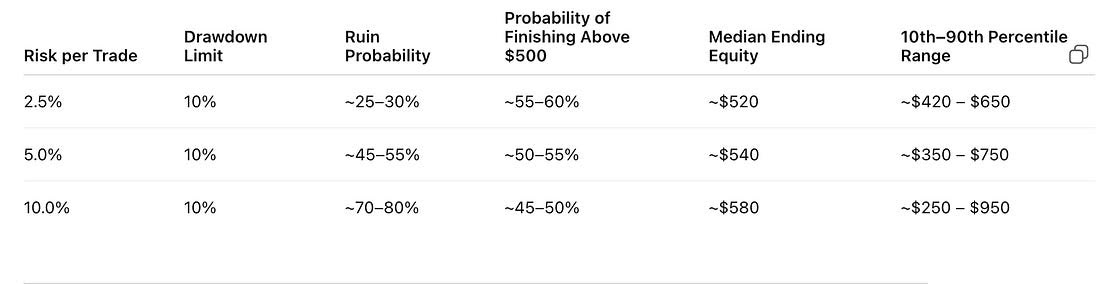
Risk of ruin across position sizing (Axi select framework)

Assumptions: 20 trades, $500 starting equity, 50% win rate, 1.2R average winner, fixed fractional risk model

Chart

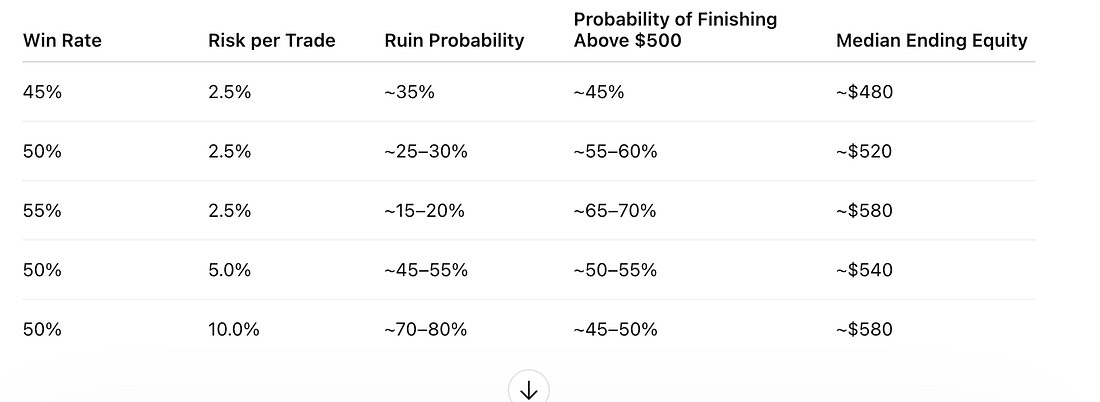
Sensitivity to Win Rate (10% Drawdown Limit)

Chart

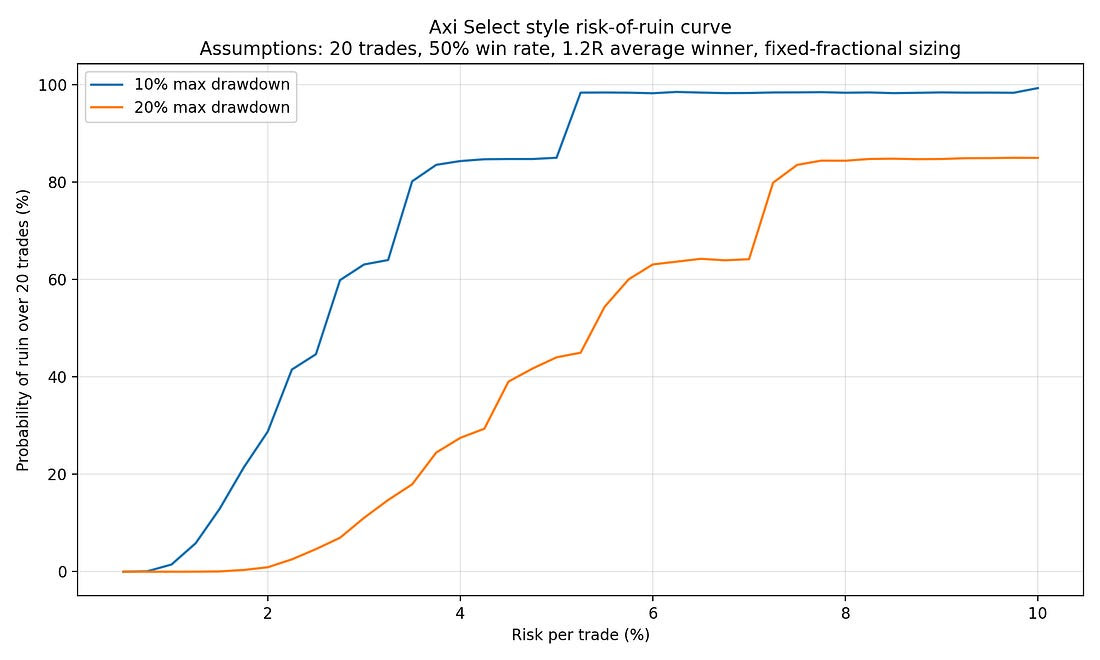
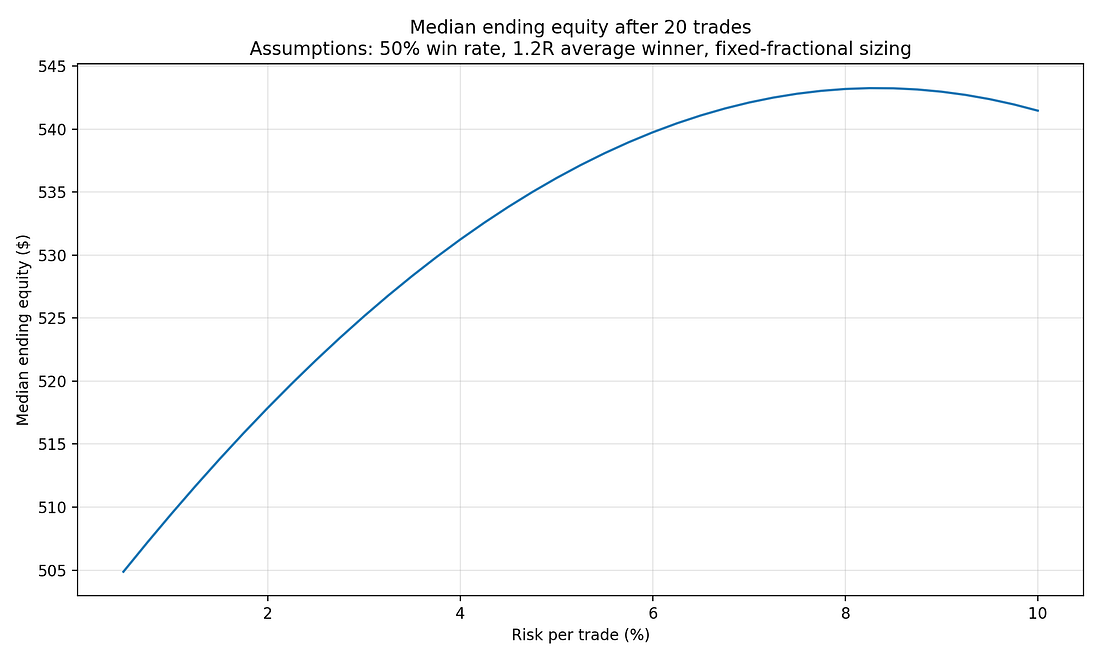
Key assumption set:

20 trades, $500 starting equity, fixed fractional sizing, 50% win-rate baseline, 1.2R average winner, with ruin defined as breaching a maximum drawdown threshold.

Chart
Chart


Source link

]]>
https://aspiremarketguides.com/trading/trading-axi-select-why-position-sizing-not-strategy-determines-who-gets-funded/feed/ 0
Should Invesco S&P MidCap Value with Momentum ETF (XMVM) Be on Your Investing Radar? https://aspiremarketguides.com/mutual-funds/should-invesco-sp-midcap-value-with-momentum-etf-xmvm-be-on-your-investing-radar/ https://aspiremarketguides.com/mutual-funds/should-invesco-sp-midcap-value-with-momentum-etf-xmvm-be-on-your-investing-radar/#respond Wed, 30 Sep 2026 21:12:28 +0000 https://aspiremarketguides.com/mutual-funds/should-invesco-sp-midcap-value-with-momentum-etf-xmvm-be-on-your-investing-radar/

Looking for broad exposure to the Mid Cap Value segment of the US equity market? You should consider the Invesco S&P MidCap Value with Momentum ETF (XMVM), a passively managed exchange traded fund launched on March 3, 2005.

The fund is sponsored by Invesco. It has amassed assets over $496.35 million, making it one of the average sized ETFs attempting to match the Mid Cap Value segment of the US equity market.

Why Mid Cap Value

Compared to large and small cap companies, mid cap businesses tend to have higher growth prospects and are less volatile, respectively, with market capitalization between $2 billion and $10 billion. Thus, companies that fall under this category provide a stable and growth-heavy investment.

Value stocks have lower than average price-to-earnings and price-to-book ratios. They also have lower than average sales and earnings growth rates. When you look at long-term performance, value stocks have outperformed growth stocks in nearly all markets. But in strong bull markets, growth stocks are more likely to be winners.

Costs

Since cheaper funds tend to produce better results than more expensive funds, assuming all other factors remain equal, it is important for investors to pay attention to an ETF’s expense ratio.

Annual operating expenses for this ETF are 0.39%, putting it on par with most peer products in the space.

It has a 12-month trailing dividend yield of 1.93%.

Sector Exposure and Top Holdings

Even though ETFs offer diversified exposure that minimizes single stock risk, investors should also look at the actual holdings inside the fund. Luckily, most ETFs are very transparent products that disclose their holdings on a daily basis.

This ETF has heaviest allocation to the Financials sector — about 36.2% of the portfolio. Energy and Consumer Discretionary round out the top three.

Looking at individual holdings, Pbf Energy Inc (PBF) accounts for about 4.19% of total assets, followed by Hf Sinclair Corp (DINO) and Macy’s Inc (M).

The top 10 holdings account for about 22.28% of total assets under management.

Performance and Risk

XMVM seeks to match the performance of the S&P MIDCAP 400 HIGH MOMENTUM VALUE INDEX before fees and expenses. The S&P MidCap 400 High Momentum Value Index is composed of securities with strong value characteristics selected from the Russell Midcap Index.

The ETF has added roughly 11.3% so far this year and is up roughly 16.47% in the last one year (as of 09/30/2026). In the past 52-week period, it has traded between $58.42 and $75.86.

The ETF has a beta of 0.97 and standard deviation of 18.16% for the trailing three-year period. With about 80 holdings, it effectively diversifies company-specific risk.

Alternatives

Invesco S&P MidCap Value with Momentum ETF holds a Zacks ETF Rank of 2 (Buy), which is based on expected asset class return, expense ratio, and momentum, among other factors. Because of this, XMVM is an excellent option for investors seeking exposure to the Style Box – Mid Cap Value segment of the market. There are other additional ETFs in the space that investors could consider as well.

The iShares Russell Mid-Cap Value ETF (IWS) and the Vanguard Morningstar Mid-Cap Value ETF (VOE) track a similar index. While iShares Russell Mid-Cap Value ETF has $14.86 billion in assets, Vanguard Morningstar Mid-Cap Value ETF has $23.05 billion. IWS has an expense ratio of 0.23% and VOE charges 0.05%.

Bottom-Line

Passively managed ETFs are becoming increasingly popular with institutional as well as retail investors due to their low cost, transparency, flexibility and tax efficiency. They are excellent vehicles for long term investors.

To learn more about this product and other ETFs, screen for products that match your investment objectives and read articles on latest developments in the ETF investing universe, please visit Zacks ETF Center.

Want the latest recommendations from Zacks Investment Research? Today, you can download 7 Best Stocks for the Next 30 Days. Click to get this free report

Invesco S&P MidCap Value with Momentum ETF (XMVM): ETF Research Reports

This article originally published on Zacks Investment Research (zacks.com).

Zacks Investment Research


Source link

]]>
https://aspiremarketguides.com/mutual-funds/should-invesco-sp-midcap-value-with-momentum-etf-xmvm-be-on-your-investing-radar/feed/ 0
Beyond the trophy deals, the buyer pool is shifting https://aspiremarketguides.com/alternative-investments/beyond-the-trophy-deals-the-buyer-pool-is-shifting/ https://aspiremarketguides.com/alternative-investments/beyond-the-trophy-deals-the-buyer-pool-is-shifting/#respond Wed, 30 Sep 2026 21:02:26 +0000 https://aspiremarketguides.com/alternative-investments/beyond-the-trophy-deals-the-buyer-pool-is-shifting/

Trophy hotel deals in the U.S. have grabbed headlines in 2026, with some of the largest hotel transactions in years changing hands.

But underneath those marquee sales, a different acquisition market is taking shape, with a shifting mix of buyers.

“If you look at the acquisition market, what is trading — yes, we’re seeing these big luxury trades — but when you back that out, the bulk of the trades are institutional capital offloading and mid-market family office buyers buying,” said Ryan Bosch, principal at Phoenix-based Arriba Capital.

Bosch said those buyers are picking up select-service and compact full-service hotels from institutional owners including Blackstone, Brookfield, Highgate and REITs like Ashford Hospitality Trust. He said regional banks and private debt funds are financing many of those acquisitions, with buyers also getting more creative with their capital stacks.

“The debt markets are extremely flush right now across the board … I’m seeing more creativity in the [capital] stack than we have in the last 12 months,” he said.

Interviews with hotel capital markets executives point to an acquisition market heading into the fall with plenty of capital, but uneven liquidity. Developers are increasingly turning to acquisitions as an alternative to costly new construction, trophy hotels continue to trade, and REITs are reemerging as buyers. But deal size matters: Smaller acquisitions are getting financed more efficiently, while larger transactions can still struggle to find enough buyers and capital to make the numbers pencil.

Larger means less liquid

Jared Schlosser, head of credit originations and Commercial PACE for Atlanta-based private lender Peachtree Group, said the larger the hotel deal, the less liquidity there is today.

He said unlike in previous years, Peachtree has done several $100 million-plus deals in 2026 because relatively few lenders can handle transactions that size.

“There’s a limited universe that can do a hotel deal of that size,” Schlosser said.

More of those larger loans reaching Peachtree also reflects what’s happening at the other end of the market (sub-$30 million deals), Schlosser said.

“That tells me the smaller deals are getting done by banks, and the bigger deals are getting done by private,” he said.

Schlosser said new equity and a reset basis make the deals more attractive to lenders than refinancings.

“If you’re a lender and you have the choice between doing an acquisition and getting fresh cash in or doing a refinance where you’re actually not getting fresh cash in, you’re going to pick the acquisition deal 10 times out of 10,” he said.

Developers become buyers

The high cost of new construction is creating another class of hotel buyer: developers who have become acquirers, according to Michael DiPrima, an executive vice president overseeing the West Region for CBRE. 

“When you think about how expensive it is to develop today… or just the timing from when you break ground to the time that hotel opens, oftentimes developers can buy assets today and be at 50% of what it would cost to build,” he said.

“Now they’ve pivoted to saying we’re looking to acquire hotels that have deep renovation and/or PIP needs because there’s a construction element to it. There’s a value-add component where we can pitch our services,” DiPrama said, adding this is especially true in Southern California right now. “That is definitely a common theme that we’re seeing, but also it’s the strength of the private capital that’s out there today.”

Developers aren’t the only private buyers taking advantage of the current acquisition environment, DiPrama said. He said single-family offices are flush with capital and are increasingly investing directly rather than through funds.

“There continues to be a very strong dynamic of single-family offices looking to invest in hospitality,” he said.

Those buyers also want a specific type of hotel, DiPrama said.

“There’s also a flight to quality for what they’re looking for. The family offices specifically want to have newer vintage, or they want something special within the luxury real estate side,” he said.

More buyers, fewer deals

Kevin Davis, Americas CEO of JLL Hotels & Hospitality, said JLL has seen more large transactions and a higher average deal size in 2026. U.S. hotel transaction volume reached $13.7 billion during the first half of 2026, up 45% year over year, according to JLL.

Davis expects fewer hotels to come to market in the fourth quarter, possibly increasing competition among buyers before deal flow picks up again in early 2027.

“There have been a lot of deals in the market in 2026 that took investors’ time and attention,” he said. “There will be fewer deals in the market in the fourth quarter than there were in the second and third quarters, and as a result, I think you will see investors competing for fewer opportunities. So it’ll be more competitive.

“That is a prelude to a very strong start to 2027, with a lot more transactions being in the market.”

That buying window for private capital could be getting more competitive. Davis said hotel REITs, largely absent from the acquisition market in recent years, are beginning to return as bidders.

“It certainly means downward pressure on cap rates. It means a more robust competitive environment when you’re selling assets,” he said. “When REITs were out of the market, private equity had their run of the place. They could chase assets without fear that lower-cost-of-capital buyers were there.”

For institutional-quality hotels that fit naturally into lodging REIT portfolios — what Davis calls “REIT food” — the return of REIT buyers could make an already competitive acquisition market even tougher for private equity.

“There’s a good likelihood that a REIT will prevail over private equity,” he said.



Source link

]]>
https://aspiremarketguides.com/alternative-investments/beyond-the-trophy-deals-the-buyer-pool-is-shifting/feed/ 0
ARGENTINE ECONOMY MINISTER CAPUTO SAYS JAPAN HAS OPENED ITS MARKET TO ARGENTINE BEEF – news.cgtn.com https://aspiremarketguides.com/economics/argentine-economy-minister-caputo-says-japan-has-opened-its-market-to-argentine-beef-news-cgtn-com/ https://aspiremarketguides.com/economics/argentine-economy-minister-caputo-says-japan-has-opened-its-market-to-argentine-beef-news-cgtn-com/#respond Wed, 30 Sep 2026 20:05:26 +0000 https://aspiremarketguides.com/economics/argentine-economy-minister-caputo-says-japan-has-opened-its-market-to-argentine-beef-news-cgtn-com/

ARGENTINE ECONOMY MINISTER CAPUTO SAYS JAPAN HAS OPENED ITS MARKET TO ARGENTINE BEEF  news.cgtn.com


Source link

]]>
https://aspiremarketguides.com/economics/argentine-economy-minister-caputo-says-japan-has-opened-its-market-to-argentine-beef-news-cgtn-com/feed/ 0
Bitcoin’s Biggest Holders Ramp Up Buying While Retail Traders Remain Flat https://aspiremarketguides.com/cryptocurrency/bitcoins-biggest-holders-ramp-up-buying-while-retail-traders-remain-flat/ https://aspiremarketguides.com/cryptocurrency/bitcoins-biggest-holders-ramp-up-buying-while-retail-traders-remain-flat/#respond Wed, 30 Sep 2026 19:47:25 +0000 https://aspiremarketguides.com/cryptocurrency/bitcoins-biggest-holders-ramp-up-buying-while-retail-traders-remain-flat/


Bitcoin’s largest holders are increasing their positions again, creating a divergence from smaller retail investors who remain inactive.

Bitcoin climbed above $87,400 last week, but the rally has since lost momentum. The world’s largest cryptocurrency then tested the $83,000 range before it surged past the upper boundary of its weekly range at $85,000.

Amidst the stagnation, larger holders are increasing their holdings again.

Whale Accumulation Returns

According to blockchain analytics platform Santiment, wallets holding between 10 and 10,000 BTC added 41,025 units over the past 10 days. Their total balance has now reached 13.64 million BTC, equal to about 67.93% of Bitcoin’s total supply. Santiment explained that these whale and shark wallets are now at their highest holdings since the market rally in mid-August.

There is a clear difference between large and small holders. Wallets holding less than 0.01 BTC have remained mostly unchanged during the same period. Santiment revealed that stronger market conditions have historically appeared when larger holders accumulate while smaller traders sell.

However, the analytics firm said the current pattern is not a guaranteed signal for Bitcoin’s price. Market watchers will likely focus on whether large holders continue adding BTC and whether retail investors begin reducing their positions. The trend could provide another indicator of changing market sentiment in the coming days.

Adding to the bullish picture, BIT Research said Bitcoin’s bear market may have already ended. The firm identified the cycle low in late July after the asset held above $62,900 and showed signs of weakening downside momentum. Since then, BTC has reclaimed key levels, including its 21-week moving average at $69,272, and moved above its March 2024 high of $73,084.

The report also highlighted Bitcoin’s cost basis. The True Market Mean currently stands at $76,897, which essentially means that the typical holder is back in profit. This could reduce selling pressure from investors looking to exit at break-even. The firm expects an upside range of $185,000 to $215,000 in its bullish scenario.

You may also like:

However, crypto analyst Doctor Profit speculated a short-term pullback before BTC’s next move higher. He pointed to bearish signals across several indicators, including RSI, MACD/PPO, and MFI, while also noting weaker trend strength on the ADX indicator.

ETF Inflows and Corporate Buying

Even as the market moves through a quieter stretch, institutional demand is still showing up. US-listed spot Bitcoin ETFs, for instance, attracted a whopping $2.4 billion last week. This week started at a slower pace, but the flow has remained positive. The funds raked in just over $31 million on Monday and another $66 million on Tuesday.

Corporate buyers have also stayed active. Strategy added another 1,665 BTC over the past week. The company paid an average of $85,681 per coin, taking its total holdings to 847,666 units. Strive has added to the buying activity as well. CEO Matt Cole said the company spent $94.5 million on 1,107 BTC at an average price of $85,400. Its total holdings have now reached 27,462.


Source link

]]>
https://aspiremarketguides.com/cryptocurrency/bitcoins-biggest-holders-ramp-up-buying-while-retail-traders-remain-flat/feed/ 0
Great Plains Board Approves Infrastructure Commitment – FIN News https://aspiremarketguides.com/alternative-investments/great-plains-board-approves-infrastructure-commitment-fin-news/ https://aspiremarketguides.com/alternative-investments/great-plains-board-approves-infrastructure-commitment-fin-news/#respond Wed, 30 Sep 2026 19:00:25 +0000 https://aspiremarketguides.com/alternative-investments/great-plains-board-approves-infrastructure-commitment-fin-news/

Great Plains Board Approves Infrastructure Commitment  FIN News


Source link

]]>
https://aspiremarketguides.com/alternative-investments/great-plains-board-approves-infrastructure-commitment-fin-news/feed/ 0