The term “children of war” refers to children born as a result of sexual violence, sexual slavery, and forced marriages imposed by members of the Indonesian military on women in prisons, military bases, and survivors’ homes. Women also suffered the loss of parents, siblings, relatives, and children. In many cases, children died from hunger, disease, beatings, punishment, and violence. Families also lost their homes, land, agricultural fields, livestock, and other sources of livelihood.
Book Tetun Version:
The stories of survivors and children of war are important for present and future generations. They remind us that during conflict, women and children are often particularly vulnerable to physical and psychological violence and the loss of their livelihoods and rights. Understanding and preserving this history is essential to preventing similar violence and suffering in the future.
Although the war ended, its consequences continue. Sexual violence and other forms of abuse can continue in different forms and involve different perpetrators. Survivors and children of war continue to face discrimination, stigma, and stereotypes. Some experience difficulties obtaining baptism certificates and official RDTL documentation, accessing property and inheritance rights, and receiving recognition from the State.
The book therefore highlights the need for collective and participatory reparations. Families, communities, churches, and State institutions all have important roles in supporting survivors and children of war. Justice, health, education, and human-resource institutions should provide psychological support, healthcare, access to justice for past violations, and basic rights such as housing, food, and education. These structures must be strengthened to help survivors restore their dignity and improve their quality of life.
Survivors and children of war should also be empowered to participate actively in their own recovery. Their experiences, knowledge, strength, and testimonies are valuable contributions to society. Supporting them to share their stories and become witnesses to history can help ensure that past violations are acknowledged and not repeated.
Communities also have a responsibility to create safe and supportive environments through reconciliation. Survivors should not be treated as perpetrators or blamed for what happened to them. Instead, they should be recognized as victims and, in many cases, as people who demonstrated courage and resistance during the struggle for independence. Such recognition can help reduce stigma and discrimination. The State should take a leading role in implementing the recommendations of the Commission for Reception, Truth and Reconciliation in Timor-Leste (CAVR).
Women survivors and children of war should not be remembered only as victims who experienced suffering for many years. They are also people with resilience, knowledge, strength, and visions for the future of Timor-Leste. Their histories deserve to be documented, archived, valued, shared, and memorialized as an important part of the country’s history and struggle for independence.
Listening to their stories and recognizing their lived experiences allows society not only to remember the past but also to learn from it. By acknowledging their dignity and contributions, Timor-Leste can strengthen public awareness and contribute to a future based on peace, justice, reconciliation, equality, and respect for the human dignity of women, survivors, and children of war.
]]>The book, entitled Lalatak no Roman Pirilampu: Book of Memories of Past Survivors, documents the experiences, resistance, resilience, and continuing struggles of women survivors and children affected by the conflict. In particular, it recounts the experiences of serious human rights violations suffered during the Indonesian occupation, including trauma, conflict-related sexual violence, torture, detention, hunger, neglect, displacement, loss of homes, loss of livestock and farmland, and the loss of children, husbands, and other family members. The book also documents the challenges that survivors have continued to experience following independence, these include family rejection, lack of access to or recognition of land rights, social exclusion, isolation, stigmatization, discrimination, and mistreatment within communities. Some survivors have also experienced discrimination within churches and other institutions. At the same time, many survivors feel that the State has not adequately recognized their suffering, contributions, and rights, leaving them feeling forgotten, abandoned, discriminated against, and undervalued.
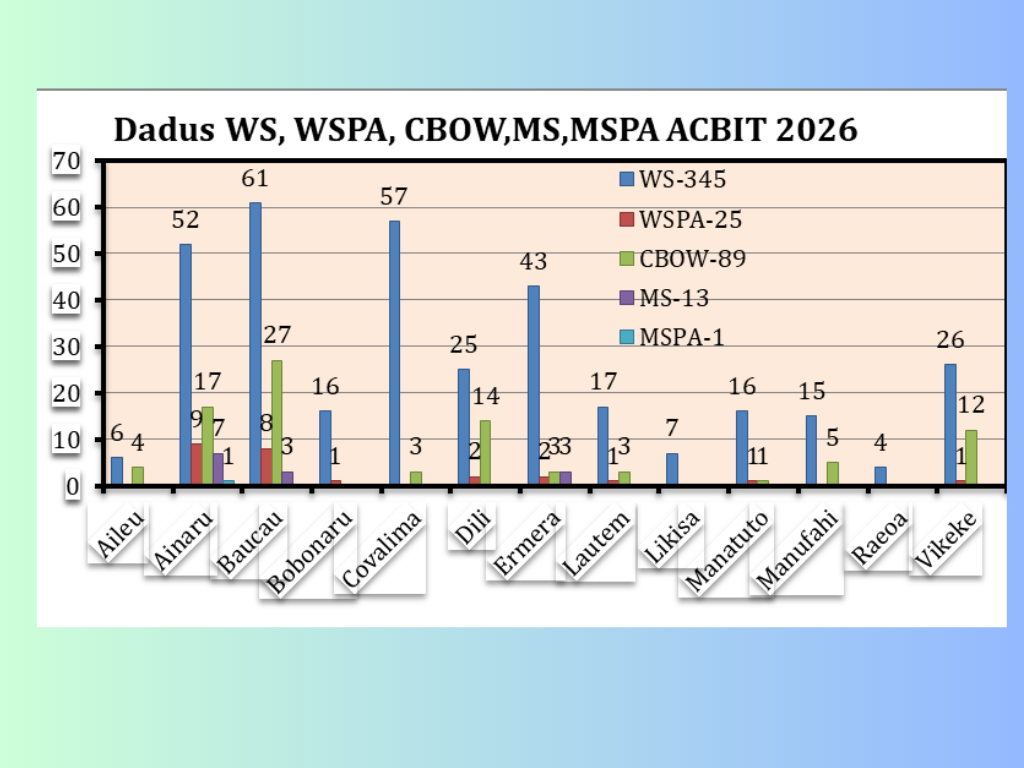
The book is divided into ten chapters and covers experiences from 13 municipalities, including Women Survivors (WS) and Children Born of War (CBOW), as presented in Table 1.
 Preserving women survivors’ and their children’s memories of occupation, trauma, resistance, and survival is essential to ensure their experiences are not forgotten or distorted and to include their contributions to Timor-Leste’s independence in the national history. It also supports survivors and grassroots groups, including PIRILAMPU leaders, to build leadership and advocacy skills so they can speak for themselves and help drive survivor-centred justice and change. The publication also aims to advance knowledge and understanding of the history and experiences of survivors of conflict-related sexual violence (CRSV), including the specific challenges faced by women survivors and children born of war. It seeks to strengthen public understanding of survivors’ and victims’ rights to reparations and to reinforce awareness of the State’s obligations to respect, protect, and fulfil these rights.
During the book launch process, the initiative received direct appreciation and recognition from several local authorities and other stakeholders. The President of the Ainaro Municipal Authority acknowledged that survivors have not received sufficient attention and continue to face difficult circumstances, particularly in relation to their children who were born as a consequence of the war. The President of CCLN Oecusse recognized the significant role of women in the struggle for independence, emphasizing that the achievement of independence was not the result of men’s efforts alone, but also depended on the courage, sacrifice, and contributions of women. The President of the Manatuto Municipal Authority encouraged survivors not to be afraid when seeking assistance or addressing cases involving documentation, justice, or churches. He expressed a commitment to facilitating direct engagement with the relevant authorities when problems arise, emphasizing that the responsibility of public institutions is to ensure fair and equal treatment for everyone. Meanwhile, the Secretary of Finance Administration of the PAM Covalima delegation emphasized the importance of women’s contributions and highlighted the value of history as a lesson for future generations, she described the book as “like a golden stone,” These statements from local authorities demonstrate that the book launch created an important space for dialogue between survivors and public institutions.
The book launch involved a wide range of activities designed to promote public awareness, community participation, and dialogue. These activities included community socialization sessions, poetry performances, presentations of the book’s content, wall journals, concerts, bazaars, and open-stage activities. The launch activities were conducted across 13 municipalities in Timor-Leste and involved local authorities, community leaders, civil society organizations, the PNTL, government institutions and relevant directorates, including representatives from the Ministry of Health, Ministry of Education and Ministry of Justice, CCLN, survivors, and their children, the book was also distributed directly to key stakeholders who have an important role in ensuring that the voices and demands of survivors are heard and reflected in public policy and institutional responses. A total of 986 people participated in the launch activities, comprising 578 women and 408 men. The level of participation demonstrates the importance of creating public spaces in which survivors’ experiences can be heard, discussed, and acknowledged by communities and institutions.
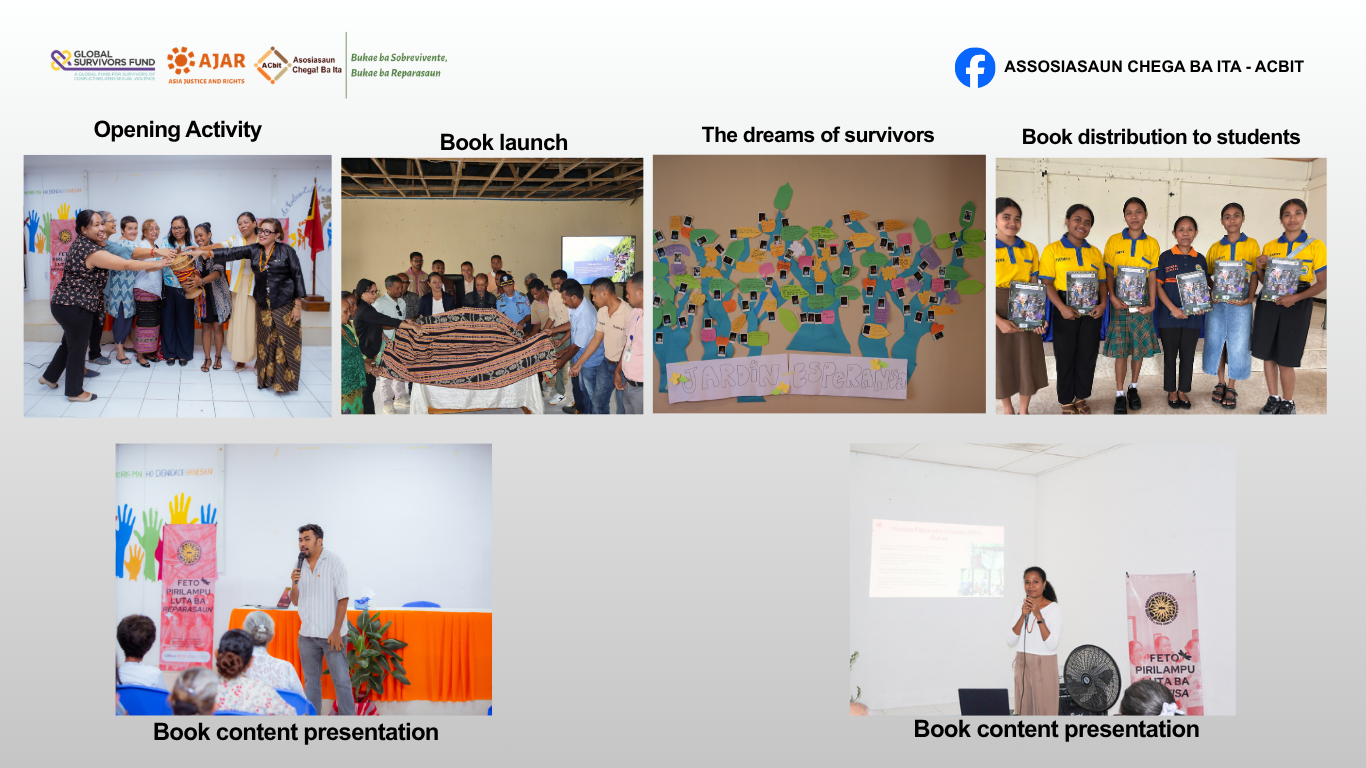
The distribution of the book ensures that survivors’ testimonies and the findings of the research can continue to inform public dialogue, institutional decision-making, academic research, community awareness, and advocacy beyond the launch events. The book represents the final outcome of the Bukae Program, a three-year initiative led by ACbit, AJAR, and the Global Survivor Fund, together with local NGOs. The program sought to strengthen transformative and co-creative approaches to reparations for survivors. Bukae is a term used by Timorese people to describe a bote used to carry food on long journeys. For survivors, the concept of Bukae represents the idea of interim reparations, symbolizing the sharing of life-sustaining resources and support so that survivors can continue their long journey toward truth, justice, healing, and recovery.
The Bukae Program was developed in response to the recommendations of the CAVR concerning the establishment of a national reparations program for victims of past conflicts, including women who experienced sexual violence. However, despite these recommendations, the State has not yet implemented a comprehensive national reparations program. The launch of Lalatak no Roman Pirilampu: Book of Memories of Past Survivors represents far more than the publication of a book. It is an important advocacy initiative that brings together survivors’ memories, research evidence, community participation, public recognition, and the continuing demand for justice and reparations.
]]>
Land is an essential resource for women and men, supporting farming, livestock, gardening, livelihoods, housing, and family security. However, for women survivors in Caicassa and Bibileo, access to and control over land remain challenging due to patriarchal cultural practices. If not addressed, these challenges can reinforce gender inequality and increase survivors’ vulnerability, affecting not only land access but also tenure security, dignity, community relationships, economic opportunities, and their ability to build sustainable livelihoods and rebuild their lives.
ACbit considers coordination with the Government, particularly the Secretariat of State for Lands and Property (SETP), essential to addressing the challenges faced by women survivors. This engagement enables survivors to present their concerns, complaints, and recommendations directly to government representatives and community leaders. Following consultations, Mr. Jaime Xavier Lopes of SETP demonstrated commitment to understanding community concerns and facilitating dialogue among survivors, affected communities, and indigenous communities. With support from Oxfam Timor-Leste, SETP and ACbit facilitated community dialogues involving the President of the Municipal Authority, Municipal Directorate of Lands and Property, community leaders, local authorities, PNTL, community representatives, women survivors, affected communities, and indigenous communities. Their participation enabled diverse perspectives to be heard and supported fair, inclusive, and community-accepted solutions. The dialogue aimed to provide a safe space for mediation, understanding, negotiation, and conflict resolution while protecting the safety, dignity, and rights of women survivors.
In Caicassa, the community dialogue has made important progress, with communities reaching consensus that respects local customs and cultural practices. Women survivors have gained greater recognition of their rights to participate in land-use and ownership decisions and have greater freedom to use land for farming and livelihoods, strengthening their dignity, security, and economic well-being. In Bibileo, Viqueque Municipality, negotiations remain ongoing, as the community and survivors have not yet reached a mutually acceptable solution. The complexity of the dispute requires time, patience, continued commitment, meaningful participation, and ongoing dialogue to build trust and achieve a fair and sustainable solution.
The dialogue process was supported by Participatory Action Research (PAR), which documented women survivors’ experiences and challenges related to land access and use in Bibileo and Caicassa. Using participatory methods such as Stone and Flowers, Timeline, Livelihood, and Community Mapping, survivors and communities shared their experiences of forced displacement and land disputes. The findings show that past conflicts continue to affect survivors’ lives through restrictions on land use, difficulties repairing homes, discrimination, intimidation, and challenges in registering land. These issues affect their livelihoods, dignity, land rights, gender equality, and social inclusion.
The community dialogue between women survivors, affected communities, and indigenous communities is an important step toward resolving longstanding land conflicts and strengthening social cohesion. The experience in Caicassa shows that, with support from government institutions, community leaders, civil society, and communities, dialogue can promote culturally appropriate solutions while protecting survivors’ rights and dignity. However, the situation in Bibileo shows that land disputes linked to historical displacement, customary practices, community relations, and gender inequality remain complex and require continued dialogue and mediation. Moving forward, women survivors must remain at the center of the process, with their voices and recommendations reflected in land-related decisions. Strong coordination among government, communities, indigenous groups, civil society, and survivors is essential to ensure fair land access, sustainable livelihoods, protection from discrimination and intimidation, and lasting peace and reconciliation.
]]>ACbit-artikel-com,Bemori-Along with Women Pirilampu, AJAR and ACbit continue to advocate for the dignity of survivors, especially the results of the government-level politivism through the implementation of a Reparation Law that recognizes the victim. It also aims to raise public awareness of the truth and dignity of survivors, build solidarity for survivors and war children, in reflection of the transformation including advocacy campaigns through poetry, music, music /collage to make it easier for people to understand and take part in this important day.

Also to ensure and recommend to the government of Timor-Leste, National Parliament, community leadership, civil society in public policy that can also accumulate survivors according to the CAVR recommendation report, in addition to university students, activists, community not only learn history but need to internalize in social practice and add survivors’ suffering during conflict and political history Timor-Leste between the period 1974-1999, became an important lesson in ending the chain of violence.
In this celebration a brief interview was held with survivors about past events and the consequences they have experienced to date.

According to survivor Rosa said: in 1974-1999 we faced various challenges our reputation is like a broken stone, memories I will remember about the critical sexual violence in the past years. I had 2 children at that time, I gave birth to one of them in a cave, my husband was armed, he ran into the forest with his 2 commanders and left us alone, one of my two children held his hand to the forest there was no food, no water I was about my husband, they burned me and beat me.
In addition, Ms. Idalina said: They always collect so that we are a wife or children of the Indonesian military, we feel very sad and shock but we don’t collect anything, we just write it in our heart with our eyes. Therefore I ask the government to protect the community especially for survivors we do not ask for money and wealth, but we only ask to write our mother’s storeys on the stone and iron that can be held by the rain and rain but that it cannot be destroyed.
The intervention of the Head of State of the PLP Party, Ms. Maria A. L. Sarmento, stated that seeking the truth is a legal obligation of the state and society to know the sufferers. We celebrate to confirm the memory, the truth, the essential pillars of justice, repair, and prevention of future violations. Victims require public recognition, concrete repair measures, and need to be effectively guided in public policy making the law on repair sets out the criteria for accessibility in the report.
]]>During the 16-day campaign, PIRILAMPU, with the support of ACbit and AJAR, is screening the “BUKAE” video across all 13 municipalities, and at the same time mobilized 699 peoples signed a petition to the National Parliament, calling for political measures or legislation to recognize survivors as victims of human rights violations who have the right to reparation.

Isabel as a PIRILAMPU’s president, stated “The activities carried out in 12 municipalities and RAEOA are part of PIRILAMPU’s advocacy efforts to raise awareness among the public, including authorities such as government, religious leaders, local authorities, resistance organizations, and others, about the reality of life for survivors or victims of sexual violence and the children born out of rape- children born as a result of past conflict.”
PIRILAMPU deeply appreciates those who voluntarily showed solidarity with us through signing the petition, and we will bring it to the National Parliament so that they can also consider our demands for justice that we continue to fight for.
]]>From 25–27 September 2025, ACbit organized a three-day workshop at Pirilampu Hall in Dili, together with 25 participants – survivors’ children and families – from seven municipalities: Ainaro, Baucau, Bobonaro, Dili, Ermera, Covalima, and Viqueque.
The workshop aimed to socialize the history of past conflicts from the period 1974–1999 with participants, mainly as the younger generation, so they could learn and reflect on the inhumane acts that occurred in the past and ensure they are never repeated in the future.
Zelia, a participant from Baucau, expressed her gratitude: “Through this workshop, I gained deeper knowledge of our struggle for liberation. The visit to CNC (former Balide Prison) and the mural painting in Lakoto made me feel the suffering people endured during that period, especially the pain experienced by women.”
Another participant, Urbano, shared: “After learning history properly, I realise that independence was achieved through diverse sacrifices. We were killing each other, we were forced to leave our place, suffer sexual violence, etc. That is why we must learn from our past to ensure that such cruel and inhumane actions are never repeated, while valuing the independence we hold today.”

ACbit trainer, Nizio Carvalho, emphasized: “Our goal is not only to help participants understand the history of past conflicts but also to analyse their root causes and consequences. Through the Uma Dame Method, we reflect on how to build a lasting and ideal peace for the future of Timor-Leste.”
This initiative has also been carried out in Ermera, Baucau, and Covalima, engaging both students and survivors’ families in meaningful dialogue and reflection on history as a foundation for peacebuilding.
]]>
In May, ACbit facilitated a two-day training on the “Basic Concept of Women’s Land Rights” for women survivors, their families, and Dinamizadora in Mauchiga, Ainaro. Survivor Amelia dos Santos shared that the training was very helpful because it made her understand that women also have rights to land and now, she knows how to ensure fair distribution of land and resources within the family. She explained that in the past, they were bound by patriarchal practices that disregarded daughters, and once women married, they were not considered to have land rights from their families. However, she realized that land is essential for life and that even a small piece of land can help sustain survival.
After the training, ACbit observed that it was necessary to provide further and more specific training on the “Special Land Regime Law.” Therefore, in August, ACbit, in collaboration with Consultants AFJTL, conducted another three-day training for survivors in Mauchiga, Ainaro. The aim was to provide survivors with more comprehensive knowledge so they could confidently protect their rights under the law. One of survivor shared, “Only after this training did I become aware that intelligent people have taken advantage of our ignorance and, together with local authorities, occupied our inherited land. Now I understand, and I will demand and strive to reclaim the rights that belong to us according to the law.”
This activity was made possible with the support of Oxfam and collaboration with community leaders and Dinamizadora in Mauchiga.

Click the link below
FINAL ASC STATEMENT Our Fight Is One_ A Call to End Genocide, Illegal Occupation, and for Justice in Palestine .docx

Dinamizadora, who play a crucial role in advocating for the rights of survivors, because they serving as the ears, eyes, and bridges for those survivors who are most vulnerble. To strengthen their effectiveness in this role, ACbit facilitated a three-day training for dinamizadora from 14–16 August 2025. The training aimed to strengthen their knowledge and skills to effectively support survivors through advocacy at the local, municipal, and national levels.
The program included key materials on Women in Conflict and Gender Justice, as well as simulations on advocacy and communication. These sessions allowed dinamizadora to practice strategies, on how to engage with relevant institutions and authorities to find solution and resolve challenges faced by survivors, particularly in the rural areas.
Carlota Maria Da Costa, a dinamizadora from Baucau, said: “I really value the materials provided by ACbit, as they help us understand survivors’ rights and how to connect them with the right institutions. For instance, we accompany survivors to process their documents to access elder subsidy (terseira idade). These materials are a valuable guide for us to apply in the field.”
Irene, a dinamizadora from Ainaro, also shared her experience: “This training is very helpful because we practiced advocacy strategies, and learned effective ways of communication to ensure our messages are heard. As a dinamizadora, I will apply this knowledge to help survivors who need my support.”
This training was carried out in collaboration with dinamizadora from seven municipalities and was supported by Misereor.
]]>To reinforce its commitment to this mission, ACbit organized the Chega! Mobile Exhibition in schools across several municipalities, inviting survivors to directly share their painful experiences from the past conflict with students, so they can learn and reflect, ensuring such human rights violations are not repeated in the future.

From mid-2024 to 2025, ACbit has carried out the Chega! Mobile Exhibition in 8 schools in three municipalities: Baucau, Atauro, and Ermera, reaching a total of 444 students.
The students showed great enthusiasm and appreciation in learning about the history of conflict in Timor-Leste, especially the untold stories of survivors whose experiences are often missing from the official historical narrative.
Deonisia Soares, a student from 99 Secondary School in Atauro, said, “This exhibition helped me understand the history of the conflict in Timor-Leste, and the consequences of war for vulnerable people – especially women, who not only suffered but also contributed to the struggle for independence, though their history are not recognized as other heroes.”
“This history is part of our identity. It is essential for us, the younger generation, to learn about it so we can value and honour all those who sacrificed their lives for our independence.” Stated by Flavia D. Menezes, a student from ESTV Cabo Martinho Guisarudo School in Ermera municipality.
The exhibition engaged not only students but also survivors and their families, along with teachers. Pe. Aderito M. E. V. da Costa, SDB, Director of ESSA Baucau School, stated, “We truly appreciate this exhibition initiative by ACbit, because it helps students learn history from a human perspective—guiding them to value humanity, and to avoid any inhumane acts or resorting to violence in their lives.”
This activity is support by MISEREOR which will continue to be implemented in schools in other municipalities, to disseminate the recommendations of the Chega! Report to the new generation, to ensure that human rights violations do not occur in the future.
]]>