Draft legislation, now working its way through Parliament, could soon lead to automatic tax filing for some Canadians. But, not everyone thinks this is such a good idea. Earlier this month, both the Taxpayers’ Ombudsperson, and Tax-Filer Empowerment Canada (TFEC), made submissions asking the government to reconsider the proposed amendments now being studied by parliamentary committees.
The concept of automatic tax filing – where the government prepares your tax return for you – has been discussed for years. After all, the government already has much of the information we enter on our tax returns. Take, for example, employment income. The government knows exactly how much employment income you were paid, to the penny, as well as how much taxes were withheld, along with your Canada Pension Plan (CPP) or Québec Pension Plan (QPP) contributions, and Employment Insurance (EI) premiums. All of this information must be reported to the Canada Revenue Agency by employers, annually, via your T4 slip.
Similarly, if you earn investment income from your brokerage account or income from a mutual fund, these are also reported to the CRA on your T5 or T3 slips. Even your annual registered retirement savings plan (RRSP) contributions are electronically tracked by the CRA.
Which begs the question: why do we spend so much time, and money each year to essentially re-input information into our returns that the government already has? While the government has a tool, Auto-fill My return , which makes inputting tax information easier, we still need to complete the return ourselves, and submit it.
Over the past decade, the CRA has been working to make tax filing easier for some Canadians by introducing programs such as SimpleFile . This program offers secure tax filing methods (digital, phone, paper) to eligible individuals with a lower income and a simple tax situation that allows them to answer a series of quick questions. The CRA then processes the return with the information it has on file.
Many other countries have already pursued full-scale automatic tax filing . In nearly 30 countries, the tax authorities provide residents with a prefilled tax return, which includes a preliminary tax liability assessment. Taxpayers can then review and modify the information on their tax return, if needed, before submitting it.
Among the items contained in last year’s federal budget were proposed amendments to the Income Tax Act to grant the CRA the discretionary authority to file a tax return on your behalf, provided certain conditions are met. This legislation is now contained in Bill C-31 and would expand automatic tax filing beyond SimpleFile to include both deemed, or automatic, filing, and pre-filled tax returns through your CRA My Account .
To qualify for the automatic filing, an individual’s taxable income must be below the lower of either the federal basic personal amount ($16,452 for 2026) or provincial equivalent amount (plus the age amount and/or disability amount, if applicable); all the individual’s income must be from sources for which the CRA has already received the information; the individual hasn’t filed a return in least one of the preceding three taxation years and the individual still hasn’t filed their return 90 days after the tax filing deadline.
Before auto-filing on an individual’s behalf, the CRA would provide them with the information it already has, giving them 90 days to review the information and submit any changes to the CRA. If the individual doesn’t confirm the information (with or without changes) within 90 days, the CRA could file a tax return on the individual’s behalf, allowing them to receive any available credits and benefits. Individuals would also have the ability to opt out of automatic tax filing.
From September to December 2025, the CRA held a public consultation process to get feedback on the future of automatic tax filing. It received 11,000 submissions and held roundtable discussions. Participants included community and Indigenous organizations, academics, members of the tax filing industry and individuals. In May 2026, it issued its findings in the Automatic tax filing consultation report .
Participants expressed broad conditional support for automatic tax filing services for individuals with a lower income and a simple tax situation. Support was especially high from community organizations and academics.
Participants described the benefits that automatic tax filing services could have for those who would be eligible. They said that automatic tax filing services would increase access to benefits and credits, ensuring that individuals receive the benefits and credits for which they are eligible. It would reduce individuals’ reliance on and the cost of tax preparer and software services, and be an efficient tax filing option, ensuring returns are filed on time.
They did, however, raise concerns, including a risk that online, automatic tax filing services would exclude vulnerable populations, such as those who don’t file or are behind on filing, those with locked CRA accounts, newcomers and seniors. They also noted the risk of inaccurate or incomplete pre-filled returns, including missed credits and deductions. Some expressed concern about lower personal autonomy and responsibility in tax filing, as well as potential conflicts of interest with the CRA both filing and assessing individual returns.
Bill C-31 is currently being considered in committee, after second reading. Earlier this month, the Office of the Taxpayers’ Ombudsperson submitted a brief to the House of Commons Standing Committee on Finance outlining its concerns and recommendations about the proposed automatic filing. In a press release, François Boileau, the Taxpayers’ Ombudsperson, said that while helping lower-income Canadians access the benefits and credits they are entitled to is a worthy objective, “any automatic tax filing system must be practical, effective, and designed to provide uninterrupted access to essential financial support.”
The Ombudsperson is concerned that deemed filing, as currently proposed, could create several service issues. For example, the proposed legislation does not prescribe a specific date when taxpayers must be notified or when returns would be filed on their behalf, creating a risk of benefit interruptions. Further, continued participation in deemed filing will ultimately lead to ineligibility because the proposed legislation stipulates that to be eligible, a taxpayer must not have filed for one of the preceding three tax years. In addition, safeguards are also needed to ensure taxpayer information is accurate before benefit payments are issued.
The Taxpayers’ Ombudsperson recommends that the CRA prioritize pre-filled tax returns through CRA accounts rather than deemed filing on taxpayers’ behalf.
Last week, TFEC, a national association of leading tax preparation and software companies, also called on the government to pause the rollout of automatic tax filing.
“We fully support the government’s goal of ensuring vulnerable Canadians receive the benefits they are entitled to,” said Dan Pfeffer, executive director of TFEC, in a release. “But automatic filing will not achieve that goal if the CRA lacks the information needed to prepare complete and accurate returns.”
TFEC says automatic filing risks leaving vulnerable Canadians with incomplete returns and missed benefits. It identifies three primary concerns. First, the CRA may not have information about expenses, life changes or other circumstances that affect eligibility for credits and benefits. Second, the program targets previous filers and does not help people who have never filed or recovered benefits from unfiled prior years. Finally, benefit payments may not reach recipients when the CRA has missing or outdated banking and mailing information.
In the end, while automated filing may be a laudable goal, Canada’s personal tax system may be too convoluted to make it work. In an April 2026 C.D. Howe paper, Simple on Paper, Complex in Practice : The Limits of Automatic Tax Filing, author Alexandre Laurin,
drawing on the U.K. experience, argues that successful automation is closely linked to tax simplicity.
“Canada’s complex federal-provincial system, with its many tax and benefit provisions requiring direct taxpayer input, makes automatic filing difficult for most individuals,” wrote Laurin.
Jamie Golombek, FCPA, FCA, CFP, CLU, TEP, is the managing director, Tax & Estate Planning with CIBC Private Wealth in Toronto. Jamie.Golombek@cibc.com .
If you liked this story, sign up for more in the FP Investor newsletter.
]]>In real terms, Canadians’ incomes have essentially stagnated for over a decade. Contributing factors include persistently slow growth of wages and salaries, as well as high inflation starting in 2021. But an often-overlooked factor is that via rising income taxes and higher mandatory contributions to the Canada/Quebec Pension Plan governments are taking a bigger bite out of people’s incomes.
Transfers from households to governments rose steadily over the past five years, from 29.7 per cent of household primary income to 33.3 per cent. In the last two years they grew by 9.8 per cent, much faster than incomes did. The government’s increased take from paycheques was led by sizeable hikes in “contributions” to social insurance plans, i.e., payroll taxes, mostly for the Canada and Quebec Pension Plans (C/QPP). Personal income taxes also accelerated, rising 12.4 per cent over the past two years, compared with 9.8 per cent in the previous two years.
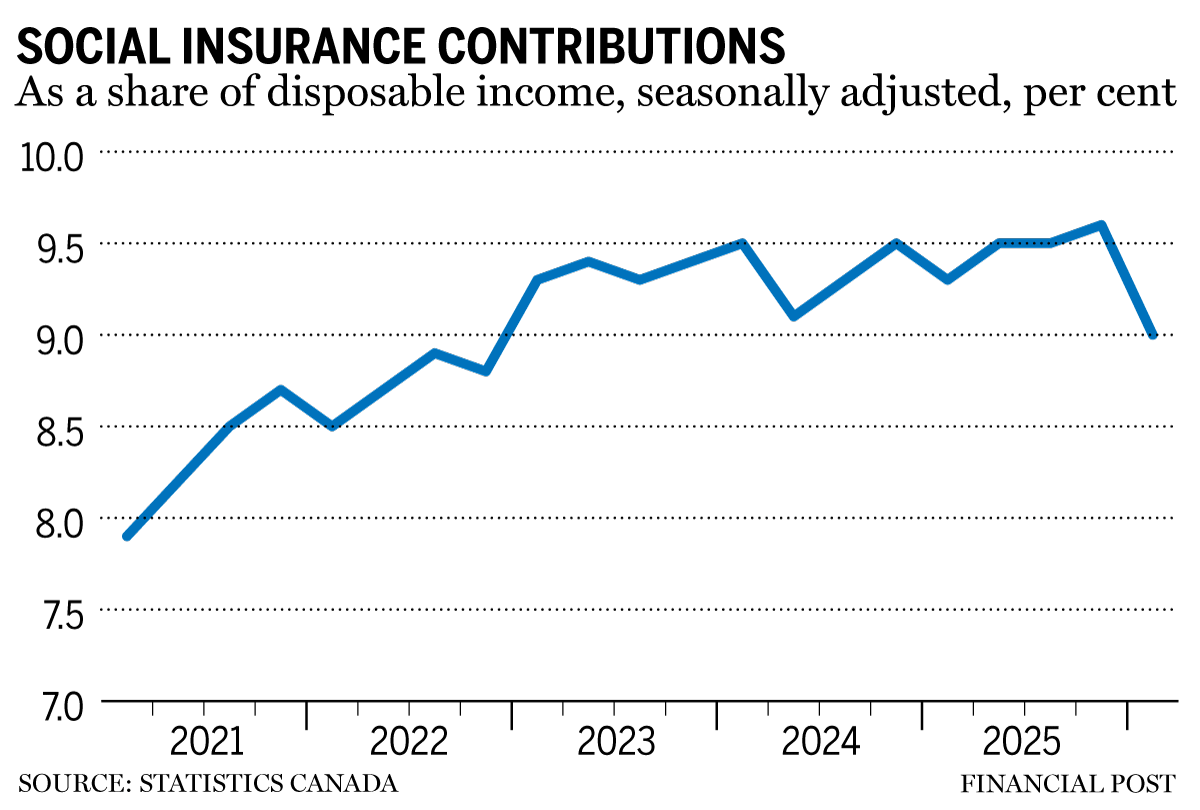
Over the past five years, the revenue raised by social insurance contributions mandated by governments rose fully 57.9 per cent, largely because of the 2018 “enhancement” to the Canada/Quebec Pension Plans, which brought both higher contribution rates and a higher maximum contribution. Bigger pension plan contributions reduced household disposable income by a full percentage point after 2021. That’s a significant amount at a time when slow income growth and high inflation were already squeezing real incomes. At $173.4 billion, social insurance contributions added almost 50 per cent to personal income taxes, which totalled $418.7 billion in 2025.
At the time, one criticism of the 2018 overhaul of the C/QPP was that higher contributions might coincide with and therefore aggravate a slump in income growth. In the event, that’s exactly what happened. Not taking a full percentage point out of disposable incomes would have helped offset the affordability crisis, especially for young people, who will not see the benefit of higher pensions for decades but face the immediate problem of being unable to buy a home and start a family. As a rule, higher pension plan contributions should only be implemented when the economy is booming, as in the late 1990s, not when it is faltering, as was the case for most of the past decade.
The hike in pension contributions also raised their take to near 10 per cent of paycheques. In his 2016 book Prisoners of Hope about the Johnson presidency in the 1960s, Randall Woods cited research by experts that found workers rebelled when contributions to social security programs exceeded 10 per cent of pay, just as they rebel when income tax rates surpass 50 per cent.
Governments now generally acknowledge that the hike in contributions to the C/QPP was unnecessarily steep. The latest actuarial studies conducted by the Office of the Superintendent of Financial Institutions have found that these pension plans were overfunded, and the contribution rate for the QPP was therefore cut in 2026, with a cut coming for the rest of Canada next year. Pension contributions fell 5.6 per cent early in 2026, though that’s small consolation for households who for years have been over-contributing even as many struggled to cover basic needs.
Governments like to claim they are trying to make life more affordable for Canadians. In 2024, the Trudeau government boasted that its $250 “Working Canadians Rebate” would put money “directly into the pockets of the middle-class — those who have worked hard to beat inflation,” while the companion temporary two-month GST/HST exemption would enable them to “buy essentials like groceries, snacks and kids’ clothing.” The reality is that such tax rebates are usually a one-time payment, while higher prices and rising taxes and pension contributions are much longer-lasting, if not permanent.
Bringing real relief to Canadians will require permanent cuts in taxes and social insurance “contributions.”
Philip Cross is a senior fellow at the Macdonald-Laurier Institute.
]]>Liam,* 67, is retired, single and focused on managing his finances as effectively as possible.
He is considering a registered retirement savings plan (RRSP) and registered retirement income fund (RRIF) meltdown, a tax strategy that involves drawing down his registered retirement savings before required to increase his income and smooth out lifetime tax.
He is also looking into a reverse mortgage as a living inheritance for his nieces and nephews or to free up funds to expand his modest lifestyle.
Liam lives in Ontario where he owns a home valued between $650,000 and $700,000. His monthly income is about $3,000 from part-time work ($500), Canada Pension Plan (CPP) benefits ($510), Old Age Security 65 ($740), and Guaranteed Income Supplement (GIS) payments ($1,000), and dividends ($250 automatically deposited to a tax-free savings account , or TFSA). His monthly expenses are $2,200. He wants to save $50,000 over the next four years for a new vehicle and pays $850 a month on a $78,000 mortgage.
“I could pay off the mortgage, but I prefer leaving that money in my TFSA where it can grow,” he said. He may downsize down the road if the house becomes too much or to boost his investments.
Liam’s portfolio includes nearly $240,000 in RRSPs and about $120,000 in a TFSA invested in a mix of growth and conservative bank-managed mutual funds. He has $30,000 in contribution room in his TFSA.
While Liam thinks withdrawing the RRIF minimum and tapping into his TFSA as needed should be able to cover his expenses, he wonders if there is a strategy that could create more financial flexibility without affecting government benefits and reduce his lifetime taxes.
For example, in 2030, after he has converted his RRSP (which he estimates should be worth about $300,000 at the end of 2029) to a RRIF, does it make sense to start to “meltdown” the account? Specifically, he wonders if, in addition to CPP and OAS, he should apply his marginal tax rate of 19.05 per cent to systematically withdraw between $30,000 to $35,000 a year from his RRIF and contribute any funds he doesn’t immediately need to his TFSA and to pay off any potential tax liability.
If so, he wonders when. “Should I wait until later in the year (November or December) to calculate and execute this extra ‘meltdown withdrawal’?” he asked.
“Is there a better way to manage cash flow and tax-plan in my 70s and 80s?”
What the expert says
Liam’s $360,000 portfolio is $140,000 more than needed to support his lifestyle, which is likely about $36,000 a year after tax for life, according to Ed Rempel, a fee-for-service financial planner, tax accountant and blogger. This takes into account current expenses as well as mortgage costs.
“However, the only reason he needs this much is because he will stop working at some point and his future RRSP income will trigger a significant GIS clawback,” said Rempel. “There is an opportunity for Liam to minimize that impact, but it is unconventional and starts with understanding his actual tax situation.”
Part of the challenge is there are specific rules for the types of income that are taxable or trigger a GIS clawback and those that don’t.

“Liam thinks he is in a low 19 per cent tax bracket, but he is effectively in a 50 per cent tax bracket. He actually pays 0 per cent in income tax because his taxable income ($21,000) is less than his basic and age tax credits (approximately $25,660). However, every additional dollar of taxable income he earns from his RRSP and RRIF will reduce his GIS by 50 per cent of his adjusted taxable income,” said Rempel. “For example, the minimum RRIF withdrawal would be about $13,000 a year, which would reduce his GIS by $6,500 to $5,500 a year.”
He added, “The actual RRSP meltdown strategy involves borrowing to invest and using your RRIF to pay the tax-deductible interest. Liam may not have the tolerance for the risk or complexity involved.”
In Liam’s interpretation of the strategy, he is thinking to just withdraw much faster, not borrow. Rempel said while Liam’s approach could work, it would require a significantly higher drawdown amount.
“I believe the optimal annual amount to withdraw from his RRSP is $66,000, not $30,000 to $35,000,” he said.
“It is aggressive to withdraw that much and will deplete his RRSP in about four years but it works because it would bring his taxable income up to $94,000 during these four years. This will provide the money to buy his new vehicle, maximize TFSA contributions and accumulate $90,000 in a tax efficient non-registered account,” he added.
“Liam would lose his GIS completely for these four years and pay about $14,500 a year income tax. This means about two thirds of his RRSP would be taxed about 21 per cent, instead of the 50 per cent clawback. During this period, the bank would withhold about $20,000 of tax and he should get a refund for the $5,500 difference,” he said.
“After the four years, he should get about $10,000 a year in GIS payments for the rest of his life and he will effectively be in a 50 per cent tax bracket. However, with tax-efficient investing, he should only have between $1,000 and $3,000 a year of taxable investment income.”
If Liam does decide to go this route, Rempel recommended starting the strategy now and implementing it near the end of this year, at which point he can estimate his taxable income for the year to determine exactly how much to withdraw from his RRSP. “The longer his RRSP grows, the more tax and GIS he will lose when he withdraws it.”
Keeping the mortgage and letting the money in his TFSA grow is good thinking, said Rempel. “Liam’s current investments should generate a long-term average return of about 5.25 per cent. He can renew his mortgage at 3.7 per cent, so it is better for him to keep the investments and the mortgage.”
He added, “Before giving any money to his nieces and nephews, he should make sure he will be financially independent and never need financial help from his family.”
*Names have been changed to protect privacy.
Do you have a wealth building question for Family Finance? Email wealth@postmedia.com.
]]>Q. My wife, Rina, and I are both 63 years old, and will retire at age 65. I know there are many advantages to delaying Canada Pension Plan (CPP) and Old Age Security (OAS) until 71, as you get higher monthly payments for life. But our parents all died in their late 70s. I also have some chronic health issues. Should I take OAS and CPP at 65, forgoing the larger payments at age 71? My wife plans to take her CPP and OAS at age 65, with her CPP being about half of a full CPP. Our assets include $350,000 in registered retirement savings plans (RRSPs) split equally at $150,000 each, as well as $100,000 each in our tax-free savings accounts (TFSAs). We have a paid off house worth $700,000 and need about $50,000 net a year to live comfortably. We have no company pensions. —Thanks, Francesco and Rina
FP Answers: Francesco, the advice to delay government benefits has become almost automatic in some retirement conversations. Wait longer, collect more and you will be better off. It sounds smart, mathematical and disciplined. The problem is that retirement does not unfold on a spreadsheet. It unfolds in real life with health issues, market cycles, family history, spending needs and the very human desire to enjoy the early, active years of retirement.
In your case, I’m going to speak to OAS first, and then tackle CPP.
For OAS, I would not delay it and take it at 65. That may surprise people who have been told delaying is always the sophisticated answer. But after more than three decades of advising retirees, I can tell you the better answer is not the one with the largest future payment, it is the one that gives the retirement plan the highest probability of working.
CPP and OAS are often discussed together but they are fundamentally different. CPP is a contributory pension tied to your working years and can provide survivor benefits to a spouse, subject to program rules. It forms part of the household’s long-term income structure. OAS is different. It is based largely on residency, not contributions, and it generally stops when you die. It does not transfer in the same meaningful way as CPP. That distinction matters.
When you delay OAS, you are not strengthening a survivor benefit for Rina. You are making a personal longevity bet.
If you delay from 65 to 70, you forgo five years of payments in exchange for a higher monthly amount later. The challenge is that you must live long enough to recover what you gave up, often well into your early 80s before the math begins to favour the decision.
That is a meaningful assumption. In your situation, it is not one I would be eager to make. You mentioned that your parents both died in their late 70s, and that, combined with your own chronic health issues, is important to acknowledge as it does influence how you think about your long-term health, and how a planner should plan for it, because these aren’t minor details. These two points are quite central to planning because they do not guarantee a shorter retirement, but they also weaken the case for delaying OAS.
Your asset base also matters. Between you, there is roughly $350,000 in RRSPs and $200,000 in TFSAs, plus a paid-off home. That is a solid foundation, but not one that easily absorbs five years of deferred government income.
You are targeting about $50,000 per year after tax to live comfortably. With no company pensions, CPP and OAS become critical components of your income.
If you delay OAS, that income must come from your portfolio. On paper, that may look manageable, but it is important to remember that real markets do not move in straight lines. This is where sequence risk becomes important. Sequence risk (or sequence of returns risk) is the danger of facing poor investment markets early in retirement. If you retire at 65, delay government income and encounter weak markets early while drawing more heavily from your portfolio, you risk doing lasting damage. You are selling assets when they are down, leaving less capital to recover when markets improve. This is one of the most underappreciated risks in retirement. Taking OAS at 65 reduces that pressure. It provides immediate, predictable income when employment income stops. It allows your investments more breathing room and reduces the likelihood of drawing too aggressively at the wrong time.
That is why, in your situation, I would take OAS at 65 and not overcomplicate that decision.
Now, let’s tackle CPP. Because CPP offers survivor benefits and increases meaningfully when delayed, there are many cases where deferring makes sense, particularly for healthy retirees with strong longevity and significant assets. But planning must also fit the realities of the household, and therefore CPP deserves more thought before executing.
In your case, delaying CPP would create the same strain as delaying OAS. You would give up income today in exchange for a larger payment later, a benefit that only pays off if you live long enough and if your portfolio holds up during the early withdrawal years.
Given your health profile, family history, lack of pensions and moderate savings, I would lean toward taking CPP at 65 as well. Some planners may argue for delaying at least one of the couple’s CPP benefit. I understand that perspective. But in this case, I believe stability today matters more than a larger future cheque that may never fully deliver.
There is also a lifestyle consideration that should not be ignored. The years from 65 to 75 are often the most active in retirement. This is when people travel, renovate, help family, pursue hobbies and enjoy their time while health permits. Creating unnecessary financial tightness in those years to improve projections at age 85 misses the point.
Good retirement planning is about living well, managing risk and ensuring the income plan is durable. So, I recommend you take OAS at 65 and strongly consider starting CPP at 65 as well. Use those benefits to create a reliable income floor. Be thoughtful with RRSP withdrawals. Preserve TFSAs for flexibility and tax efficiency. Keep home equity as a backstop, not a primary plan.
If your health improves, spending is lower than expected or investments perform strongly, you can adjust over time. But I would not begin retirement by giving up guaranteed income on the assumption that future math will work out.
It’s important to be practical in retirement, which means prioritizing certainty and flexibility, and reducing pressure on the portfolio.
Mark Dumanowski, B. Comm, CIM, FCSI, is a senior wealth adviser and portfolio manager with The Dumanowski Investment Group with National Bank Financial Wealth Management. Reach him at mark.dumanowski@nbc.ca or www.markdumanowski.com.
Do you have a question for FP Answers? Email wealth@postmedia.com.
]]>Q. I am 46 years old and live in Edmonton. I currently have $10,000 saved for emergencies and no money invested. Three years ago, I was involved in a car crash and suffered a brain injury. I was awarded some money from the insurance company just this past year and I was required to take the money as a monthly annuity until age 65.
Right now, my income includes $2,600 per month (at 55 it increases to $2,850), all tax free. Plus, I get $650 per month through Canada Pension Plan disability benefits for a total of $3,250 monthly. My monthly expenses total $1,800, meaning I can save roughly $1,450 per month to invest every month.
Also, if I can earn the roughly $7,500 per year that is allowed while on CPP disability, then I will have another $625 per month to invest. I would also like to take a vacation each year but that doesn’t have to be more than $2,500 total. This annuity money runs out when I reach 65 years of age. What can I do to ensure I won’t be cash strapped at that time? Should I consider saving in tax-free savings accounts (TFSAs), registered retirement savings plans (RRSPs) or both?
I am also in the process of applying for the disability tax credit (DTC) so hopefully I can utilize the registered disability savings plan (RDSP) and grants. Any help on this would be appreciated. —Best, Anita
FP Answers: The disability tax credit, if approved, will be helpful for your situation, Anita. The DTC is available for individuals with a severe or prolonged physical or mental impairment. Because it is a non-refundable tax credit, and your income is mostly tax-free, you may not save any tax. But it is the gateway to the registered disability savings plan (RDSP) you mentioned.
To qualify, you would need to have restrictions that prevent you from performing a substantial portion of daily activities. Usually, the condition must have lasted at least 12 months or be expected to last at least that long, with two or more significant limitations if a single limitation does not justify the impairment. The application process involves medical certification from a licensed practitioner who can assess the severity of the disability.
The RDSP is a registered account designed to help eligible individuals benefit from long-term tax-deferred growth, as well as government grants and bonds that can supplement investment growth. You can contribute to the account until age 59, and withdrawals generally begin by age 60.
It would be a good time to open the account if you qualify for the DTC, as you have a limited number of years to benefit from government grants, which are only available until age 49. You may be eligible for up to $3,500 in grants and $1,000 in bonds annually, as well as retroactive grants and bonds available going back up to 10 years that could total tens of thousands of dollars.
Outside of the RDSP, which should be your first choice, you should consider a TFSA. If you have lived in Canada every year since 2009, you could have TFSA contribution room of $109,000 if you have never contributed nor withdrawn from a TFSA. Investment growth, income and withdrawals are not taxed, and withdrawn amounts can be recontributed in future years once new contribution room is available.
RRSPs are generally more suitable for individuals with higher taxable income who expect to be in a lower tax bracket in retirement. Since RRSP contributions reduce taxable income, these accounts can improve tax efficiency over time. At this time, contributing to an RRSP may not be the most appropriate strategy since your taxable income is quite low. Contributing may not save much or any tax, and withdrawals could be taxable and reduce future government benefits. As such, prioritize your RDSP if you qualify for the DTC, followed by a TFSA, followed by a regular, taxable non-registered account.
Your Canada Pension Plan Disability benefit will convert to a CPP retirement pension once you turn 65. The CPP retirement pension is calculated based on your contributions and a special disability drop-out provision excludes years you were receiving a disability benefit and not contributing. This means your income may change at age 65 due to the transition in benefit types and will typically decrease.
However, at age 65, you will also be eligible for Old Age Security (OAS). If you have lived in Canada for most of your adult life, you will be entitled to the full benefit, which is approximately $743 per month. The benefit is income-tested and may be partially clawed back at higher income levels, which may not apply in your case.
Low-income OAS recipients may also qualify for the Guaranteed Income Supplement (GIS), which provides additional tax-free income if income falls below certain thresholds.
Given your current income and savings capacity, I would plan around these income sources while prioritizing contributions to RDSP (if eligible) and TFSA accounts using your annual surplus.
Andrew Dobson is a fee-only, advice-only certified financial planner (CFP) and chartered investment manager (CIM) at Objective Financial Partners Inc. in London, Ont. He does not sell any financial products whatsoever. He can be reached at adobson@objectivecfp.com.
Do you have a question for FP Answers? Email wealth@postmedia.com.
]]>Q: My parents are in their late 70s and live on Canada Pension Plan and Old Age Security income. Whenever I bring up their finances, they change the subject or tell me not to worry. I love them and do not want to overstep, but I worry they do not have money saved to cover an emergency or a health scare and might go into debt. How do I start this conversation without making them feel judged or that they will lose their independence? —Diane
FP Answers: Many adult children understand exactly how you feel. Their love for their parents is mixed with hesitation about crossing a line that has never been crossed before in the family. That discomfort is normal, and it does not mean the conversation is off limits. It simply means the approach matters as much as the message.
A family meeting announced in advance can feel like an ambush for parents who value independence, and it may trigger defensiveness before anyone has even mentioned money. Instead, look for a natural opening such as a news story about a scam targeting seniors, a friend’s parent moving into assisted living or even your own retirement planning . Saying that you recently updated your will or beneficiaries, then asking whether they have done the same, can be a low pressure way to broach the topic.
Keep the first conversation narrow. You do not need a full picture of your parents’ savings, pensions, debt and expenses in one sitting. Look for an opening that respects their pace and ask just one specific question. For instance, asking whether they have an updated will and power of attorney is concrete, practical and far less likely to feel critical than asking whether they have their debts under control.
Power of attorney and estate documents are useful entry points for another reason. They focus on planning and protection rather than on whether someone has enough money. They can also reveal whether important decisions have already been thought through, such as who would step in if help were needed and how your parents would like to live as they age.
Expect the subject to come up more than once. Parents who have spent decades managing their own money rarely share all of that information the first time it comes up. Rather than trying to understand everything at once, focus on a few practical details. Do they have legal documents, including a health care directive, in place? Do they have enough cash available to cover an unexpected expense? Does someone know where important documents are kept? Answers to those questions can provide reassurance and help identify any gaps that need attention.
If your parents do open up and the numbers are tighter than expected, do not panic. CPP and Old Age Security cover basic living costs for many seniors, but rarely much beyond that, so a modest shortfall is common and often manageable with a plan. Seniors with a low income may qualify for the Guaranteed Income Supplement , a tax-free monthly top-up. Your parents can verify their eligibility on the federal government’s free benefits estimator . From there, a budget built around their real income and expenses can go a long way, and a financial planner who works with seniors can help sort out what is realistic without adding family tension to the mix.
Waiting rarely makes this easier. The longer these conversations are avoided, the more likely it is that a health scare or another crisis will force decisions under pressure. You do not need every answer right away, but for the sake of your own planning , you need a clearer picture of whether your parents have the resources, documents and support they would need if something unexpected happened.
Do you have a debt question for FP Answers? Email wealth@postmedia.com.
Mary Castillo is a Saskatoon-based credit counsellor at Credit Counselling Society, a non-profit organization that has helped Canadians manage debt since 1996.
]]>Among the numerous fiscal con jobs in Prime Minister Mark Carney’s Liberal economic update is the ongoing attempt to lower perception of the government’s debt level by claiming assets that Ottawa does not own. The government claimed “net debt” — which logically implies total debt minus assets supporting the debt — would come in at $1.4 trillion this fiscal year.
It’s a fake number. The actual net debt figure is $2.2 trillion. The Carney Liberals are now in the habit of including in assets money that does not belong to the government, namely $800 billion in value sitting in the Canada Pension Plan (CPP). As many critics and observers have noted, inclusion of the pension assets is nothing more than an accounting trick. The money technically and politically belongs to Canadians as pension savings; the government could not use the money if it had to pay down debt.
But that’s just one part of the muddle behind Ottawa’s pension fixations. A deeply ironic aspect is that most of the $800 billion sitting in the CPP exists as a result of deliberate and strategic investing outside of Canada, with most of it going to the United States. In 2025, only 12 per cent of its $800 billion was invested in Canada, with 47 per cent going to the U.S. and the remainder elsewhere. Foreign investments have made the CPP one of the best performing pension funds in world, with U.S. and foreign investments generating $550 billion or almost 70 per cent of all assets now held for Canadian pensioners. Quebec’s Caisse de dépôt pension system also invests 70 per cent of its assets abroad.
Despite the obvious benefits to pensioners, nationalists and interventionists see foreign investments by Canadian pension funds as detrimental to Canadian economic growth. The CPP and Quebec funds are part of the Maple Eight group of government pension funds that now manage $2.3 trillion on behalf of pensioners. Jim Stanford, former auto workers union economist, wrote recently that “Shockingly, our own Canada Pension Plan has half its total assets in the U.S.” It’s time, he said, to “bring some of that capital home.”
It is time, according to Policy Options in a paper that often seems to have been ghostwritten by Carney, to “incentivize” pension funds to double their Canadian investments, to “mandate” investments at home, to “unlock” and “harness” the pool of capital that is allegedly doing nothing for Canada or the Canadian economy. “Bring Canada’s pensions funds back home,” it said.
The real reason the funds do not focus more on Canada would be the same regulatory environment that deters foreign investors from investing in Canada. Canada is also a small economy that, by definition, does not have the economic scale to support the range of risks needed to keep a trillion-dollar pension fund safe and sound.
The interventionist theory is that Canadian money invested in the U.S. is an economic drag that undermines Canada’s economy by starving Canadian investment. There are two fundamental errors in this theory. First is the idea that money going to the U.S. and elsewhere is a loss to the Canadian economy. Second, the reason Canadians invest in the U.S. and elsewhere may be the same reason Canada has had trouble attracting investment into Canada.
The benefits to Canadian pension funds and pensioners from investing abroad are obvious. But Canadian corporate investments abroad also generate billions in benefits that are not easily tabulated. A Bank of Canada technical study in 2018 found that direct investment by Canadian firms in “greenfield” projects in the U.S. and elsewhere produced net benefits for Canada and the companies. “Firms that invest abroad tend to see more important productivity gains one to two years after the investment, compared with firms that are otherwise similar but remain domestic, suggesting that outward investment has beneficial implications for investing firms.”
For the most part, over the past two decades, foreign investment flows have been driven by market dynamics. Money flows in and out of Canada in search of the best opportunities and returns. The more liberal the movements to maximize returns, the greater the impact on growth and other performance measures.
It works both ways, when money leaves Canada and when it comes into Canada. Here are two examples:
• When money leaves Canada: Canadian corporations build and invest abroad, expanding their futures to the long-term benefit of Canadians. The CPP invests all over the world, from India to Brazil to Japan. It projects self-sustainability for the next 75 years. That might change, of course, if the federal government continues to buy votes by reducing the pension contributions of individual Canadians, which it announced this week via a $3-billion contribution cut that would trim the fund’s projected asset base.
• When money comes into Canada: In a country that often looks upon foreign investment as a negative to be controlled, Shell’s announcement this week that it is set to invest US$13.6 billion to fund LNG exports by pipeline through the United States was widely welcomed.
Canada needs more of that kind of foreign investment, and it needs more Canadian investment into the United States. It’s paid off in the past, and it will continue to in the future.
• Email: tcorcoran@postmedia.com
]]>After decades of work, retirement is supposed to feel like freedom, and for many Canadians it did, until costs for groceries and essentials soared. What was once a comfortable retirement income in 2021 now does not go as far.
Many retirees are therefore reconsidering their financial plans, not due to poor decisions but because the economic landscape has changed and retirement can be expensive. Fortunately, there are practical ways to supplement your retirement income without sacrificing the lifestyle you have built.
The reality of a fixed income in a high-cost era
People tend to spend to the level of their income, whatever that income happens to be. When costs rise faster than income does, something must give. For retirees, that tension can feel especially stressful because the usual options, such as asking for a raise or picking up more hours, are not available.
During certain periods after the pandemic, investment returns were strong and some households benefited from rising real estate values. Some retirees were temporarily shielded from the rising cost of living expenses. But market volatility is real and a portfolio that looked healthy at retirement can look different a few years later, particularly for those drawing down their savings during a downturn.
Before exploring ways to bring in more income, it is worth taking a careful look at your current budget. Tracking actual spending for a month or two often reveals expenses that have quietly crept up or debt payments that consume significant portions of your income.
Trimming expenses will not solve everything, but it creates breathing room while you explore other options.
Revisiting when you draw CPP and OAS
If you retired early and have not yet started collecting Canada Pension Plan (CPP) or Old Age Security (OAS) benefits, the timing of when you begin drawing them deserves careful thought. You can choose to start receiving CPP as early as age 60 with reduced payments or delay receiving it to increase your monthly amount, up to age 70.
CPP also has a child-rearing provision that no matter when you begin receiving the CPP benefits, could increase the amount you receive each month. Apply for the child-rearing provision when you apply for any CPP benefit .
OAS follows a similar logic. Delaying OAS from age 65 to 70 increases the monthly payment by 36 per cent. If higher living costs are manageable in the short term through other means, waiting even a year or two to start these benefits can meaningfully improve long-term income. These are not decisions to make quickly or without guidance. A Certified Financial Planner (CFP) or financial adviser can calculate the break-even points based on your health, other income sources and tax situation. What works for one household may not work for another, so personalized advice is crucial.
Part-time work that fits your life
Returning to paid work is a straightforward way to top up retirement income and for many retirees it adds welcome structure and social connection. The key is to find work that matches your energy, schedule and interests, not just any paycheque. Also be sure that you are not taking on work because family members are costing you more than you can afford.
Contract and consulting work suit retirees with specialized expertise, as organizations often value experienced professionals for project-based work that does not require full-time hours. Knowledge gained in fields such as accounting, education, project management, health care or skilled trades remains valuable.
Seasonal and flexible retail or service jobs are another option, especially for those who enjoy interacting with people and want predictable hours. Many employers appreciate older workers for their reliability and customer-service skills.
If you are still collecting or planning to collect CPP, note that working while receiving CPP before age 70 means you can still contribute to the plan and earn post-retirement benefits that will modestly increase your future payments.
Turning a hobby or skill into income
Retirement often frees up time for creative or hands-on activities that were not possible during a busy career. Many retirees find their hobbies can also generate income.
Woodworking, jewelry making, photography, baking, sewing or gardening can lead to sales at local markets, online platforms such as Etsy or through community connections. Teaching skills such as music lessons, language tutoring or cooking classes offers another way to earn flexible, modest income.
The goal does not need to be a full side business . Even a few hundred dollars a month from something you already enjoy doing can meaningfully reduce financial pressure.
Generating income from your assets
If you own your home or have other assets, there may be opportunities to generate income without selling anything. Renting out a basement suite, a laneway home or even a spare room can provide a reliable monthly contribution to household income.
If your cottage or vacation property is unused for part of the year, renting it out seasonally can be a practical option. Short-term rental platforms make this easier but be sure to check rules, regulations and tax details first. Consulting an accountant is wise, and if renting is not a suitable option, downsizing your home may help reduce expenses.
Building a retirement budget that reflects today
Whether or not topping up income becomes part of your plan, regularly updating your retirement budget to reflect current expenses and income, including irregular costs and debt payments , will help you address any gaps as early as possible. For support with debt, you may want to seek support from a non-profit credit counsellor and for investment decisions, seek guidance from a qualified financial adviser.
Retirement is not a fixed destination. It is a phase of life that keeps evolving. Adapting your financial approach, even modestly, can make a meaningful difference in how comfortable the years ahead will feel.
Mary Castillo is a Saskatoon-based credit counsellor at Credit Counselling Society, a non-profit organization that has helped Canadians manage debt since 1996.
]]>Now that both of their children have started their careers, are married and purchased their first homes, Timothy,* 57, and Margaret, 53, are ready to retire. Ideally, they both want to leave the workforce in two years when Timothy can retire with his full defined-benefit pension after 30 years of work.
“We’ve helped the kids with their weddings and down payments and want to start enjoying our next phase,” said Timothy. They plan to travel, spending winters in warm climates, and summers exploring Canada. Their desired travel budget in retirement is $20,000 a year. “Will we be able to maintain or increase this in retirement?” asked Timothy. “Or should we decrease it?”
Timothy currently earns about $115,000 and Margaret earns about $94,000 before tax. In 2028 Timothy’s annual pension income will be $46,200 before tax and Margaret’s will be about $49,000. Their annual pension income will drop to about $23,000 and $35,000, respectively, when they each turn 65. Their target combined annual income in retirement is $84,000 after tax. Their current annual expenses are $40,000.
Timothy and Margaret are mortgage-free and own a home in Ontario conservatively valued at about $750,000. They plan to stay as long as possible. Their investment portfolio includes $506,000 in registered retirement savings plans (RRSPs) invested in growth-oriented mutual funds and $208,000 in tax-free savings accounts (TFSAs) invested in guaranteed investment certificates (GICs) and exchange-traded funds (ETFs).
Timothy and Margaret anticipate they will need about $7,000 a month after tax during retirement to maintain their current lifestyle — more than their pension incomes will provide. They wonder: What is the most tax-effective way to make up the shortfall and avoid government clawbacks? Should they tap into their RRSPs or apply for Canada Pension Plan (CPP) benefits? At what age would it be most advantageous to start collecting their government pensions?
Most importantly, is retiring in two years feasible? Should they invest significantly in their mutual funds to make sure they can retire in 2028? If they do retire early, will their investments provide the income they need for the rest of their lifetimes?
What the expert says
The good news: Timothy and Margaret will be able to retire comfortably in two years thanks to living within their means and consistently making sound financial decisions, said Eliott Einarson, a retirement planner at Ottawa-based Exponent Investment Management. “They don’t have huge incomes, substantial wealth or enormous pensions, but their discipline reflects the wisdom of an old proverb, which states that money accumulated little by little will steadily increase over time.”
While their financial outlook is strong, Einarson said their focus now should be on developing a tailored retirement income plan that efficiently uses their current assets and pensions to address future cash flow needs. He recommended they start with a review of their retirement income goals.
“Their desired retirement income of $84,000 a year after tax includes a $20,000 travel budget and buffer for extra expenses that may come up. If they retire in two years, their combined unreduced pensions alone will total about $67,000 after tax until Timothy turns 65 — well above their current annual expenses of $40,000. They can supplement cash flow needs and continue to invest in their TFSAs with RRIF (registered retirement income fund) income for the next 35 years.”
Einarson said a retirement income plan should demonstrate that their pensions and government benefits will meet most of their future needs, even if their employer pensions have limited indexing guarantees.
He recommended Timothy and Margaret apply for CPP and Old Age Security (OAS) at age 65 and use registered investment income to address any shortfalls before then. He also suggested they continue to maximize contributions to their TFSAs each year. This will allow them to take advantage of tax-free growth without any mandatory withdrawals.
“At 65, the bridge benefits on their pensions will fall away, significantly reducing income. Waiting until 65 to tap into CPP will ensure a level income when combined with their pensions and that they will receive the maximum benefit, fully indexed for their lifetimes,” he said
“Income splitting pensions and registered income post 65 will give them a large tax advantage and allow them to avoid any OAS claw back while meeting their income targets and investing in their TFSAs.”
A retirement income plan will also allow Timothy and Margaret to compare the impact of different income targets, something Einarson recommends to ensure they are minimizing tax and maximizing TFSAs — their most powerful long-term assets — each year.
The goal is to draw down RRSPs while they are both alive and split this income because RRSPs are taxed at the highest rate on the death of the second tax payer. “Potentially taking a higher income, topping up TFSAs annually for longer-term compounding is a good strategy for survivor and estate planning,” said Einarson.
“Partnering with a professional on a retirement income plan can give Timothy and Margaret clarity about their future income sources, tax benefits from income splitting, how surplus income can fund TFSA contributions and projected net worth and estate growth,” he said.
*Names have been changed to protect privacy
Are you worried about having enough for retirement? Do you need to adjust your portfolio? Are you starting out or making a change and wondering how to build wealth? Are you trying to make ends meet? Drop us a line at wealth@postmedia.com with your contact info and the gist of your problem and we’ll find some experts to help you out while writing a Family Finance story about it (we’ll keep your name out of it, of course).
]]>Q. I am a single 61-year-old and my concern for my nest egg is simply maintaining the capital. I’m not optimistic about the world economies and wonder if Treasury bills or guaranteed investment certificates (GICs) are enough of an investment to simply keep my principal intact over the next few years. I make about $60,000 annually and have about $200,000 in savings split equally between my tax-free savings account (TFSA) and registered retirement savings plan (RRSP). I have no employer pension and plan to take my Canada Pension Plan (CPP) and Old Age Security (OAS) at age 65, which I will be able to live on since the mortgage on my condo will be paid off by then. Is this a good strategy or am I overlooking something? I am a very conservative investor holding 80 per cent fixed income in my investments. —Silvia
FP Answers: Hi Silvia. With what is going on in the world I can understand why you are not feeling optimistic about world economies and why you want your principal protected. GICs will do this, but I think you are overlooking a few things. My concern is that you are accepting things as you see them, and having a conservative investment mindset may lead to conservative living and a retirement that is more frugal than it needs to be. Let’s not let that happen to you and instead come up with a conservative plan that will enhance your retirement.
One thing you may have overlooked is your spending needs. I don’t know you but will CPP and OAS, about $24,000 a year, really be enough? Most of it will be tax free once you are 65 and claiming the age credit but it may still fall short of really providing you with a comfortable retirement. Have you accounted for lump sum money needs such as a new car? We need to find a way to get your income up.
Other things you may have overlooked are longevity risk, inflation and loss of purchasing power, which are all related risks. Ask yourself: If you live a long time will your money run out? What about inflation, which is probably the biggest risk retirees face? As prices increase will you continue to be able to afford tomorrow what you can today?
GICs are great for preserving capital but they are not great at protecting purchasing power, which is the reason for investing in equities. There is a real risk with GICs that the after-tax return will be less than the rate of inflation. I’m sure you have heard the expression, “A million dollars is not what it used to be,” which is an eloquent saying about the loss of purchasing power.
The biggest thing you may be overlooking is how a conservative investment approach can curtail retirement living. Worries about the future may prevent you from ever spending your money until eventually you die with your $200,000 or more, never enjoying the experiences the money could have brought you.
A quick solution may be to increase your equity exposure but that adds volatility risk and I don’t think that is for you. I am going to lay out a conservative retirement plan, starting at age 65, that will reduce longevity risk and loss of purchasing power risk, make better use of your money and increase your guaranteed income.
Delay your CPP and OAS to age 70. Convert your RRSP to a registered retirement income fund (RRIF) at age 65 and draw about $24,000 a year, inflation adjusted, so the RRIF is depleted before the year you turn 69. Then the year you turn 69, draw $24,000, inflation adjusted, from your TFSA. This will give you the $24,000 a year you expected from CPP and OAS. Your RRIF will be gone and you will have about $70,000 left in your TFSA.
At age 70 you will start to collect your CPP and OAS. Your CPP will be at a minimum 42 per cent higher than it would have been at age 65 and your OAS about 36 per cent higher. This is guaranteed pension income, increasing with the rate of inflation, lasting the rest of your life no matter how long you live.
On top of that, you will collect the Guaranteed Income Supplement (GIS,) an income tested pension that will also increase by the rate of inflation. I estimate that with the CPP, OAS and GIS, your indexed income after age 70 will be about $36,000 a year, and from age 65 to 70 about $24,000, as you are anticipating. Would you want to do some part-time work for the extra income and social benefits between age 65 and 70?
To be fair, you could start your CPP and OAS at 65 and qualify for some GIS for an income of about $29,500 and at age 70 it would be about $32,000. You will still have your RRSP and TFSA but the forced RRIF withdrawals at age 72 will result in some GIS reduction.
Silvia, I hope I have given you enough to get you thinking. My suggestion is you take these ideas to a financial planner and model out a few different scenarios. I don’t have all your financial information and there may be a better CPP and OAS start date combination that maximizes the GIS than the one I described. It’s worth your time to look at a few options with a planner.
Allan Norman, M.Sc., CFP, CIM, provides fee-only certified financial planning services and insurance products through Atlantis Financial Inc. and provides investment advisory services through Aligned Capital Partners Inc., which is regulated by the Canadian Investment Regulatory Organization. He can be reached at alnorman@atlantisfinancial.ca.
]]>Q. I have been on disability for several years due to a chronic illness. I am approaching 65 years of age in less than two years. At that time, my disability payments end and my Canada Pension Plan (CPP) payments are reduced, which should be offset by Old Age Security (OAS). I have savings and annuity payments but need assistance in budget planning and asset allocation for an uncertain life expectancy. —Thank you, Mark
FP Answers: Mark, I am sorry to hear about your disability. My wife has a mild brain injury and is collecting CPP disability, so I have a sense of what you are experiencing financially and know it must be tough to be single and disabled.
Let’s get right to budgeting because taking control of your cash flow is key for you, and for everyone. Budgeting is one method but it is not a naturally easy thing to do and it requires the discipline that most people don’t have. Budgeting is good for vacation planning or home renovations but not for living your life. Ideally you can implement a cash flow management system you can automate.
Fortunately, the Certified Cash Flow Specialist Program for financial professionals provides a system that controls your spending, frees up money, and best of all, once it is set up it runs on autopilot, meaning there is nothing you need to do. I have summarized below how it works. It may sound a little confusing but take your time and I’m sure you will get the idea.
The first step is to write out all of your expenses and itemize them into two categories: working cash flow (WorkingCF) and active cash flow (ActiveCF). WorkingCF expenses can be expenses that get you ahead. There is no risk of overspending and there is no emotional pull to want to spend more. They are usually fixed payments, often a need, and the payments are easily automated. Some examples include phone, hydro, fuel and debt payments.
With ActiveCF expenses there is often an emotional pull to want to spend more. They are often variable expenses, meaning things you want but don’t need, and it is difficult to automate the payments. Some examples include entertainment, vacation, and some groceries.
Now you have a list of expenses divided between WorkingCF expenses and ActiveCF expenses. Tally up all of the expenses for each category and then work out what you spend weekly on WorkingCF expenses and ActiveCF expenses.
Finally, determine your weekly take home pay and calculate what percentage your weekly ActiveCF expenses are to your weekly take home pay. Aim for a ratio of 20 per cent ActiveCF to take home pay. If you are in good financial shape 20 per cent may be too restrictive but if you are having real money issues, try restricting your ActiveCF expenses to 15 per cent of your take home pay.
Automate things by setting up two bank accounts and call them WorkingCF and ActiveCF. Your income goes into the WorkingCF account and pays all WorkingCF expenses. Automate every expense and never make ATM withdrawals from the account. Attach a credit card to the account so it is automatically paid off each month and use the credit card to pay WorkingCF expenses that can’t be automated, such as gas. Each week auto transfer 20 per cent of your weekly take home pay to your ActiveCF account.
Use your ActiveCF account for ActiveCF expenses. You can have a debit card on this account but not a credit card. Only use cash for the first 60 days and if you ever find yourself slipping, stop using the debit card and go back to using cash. Ideally, you will spend a little less money than your weekly amount, and you will build up a float in the account.
Ideally, you will find that after paying your WorkingCF and ActiveCF expenses you still have surplus money. Use this money to increase debt payments, invest, or enhance your lifestyle. Again, automate what you can.
That should address your budgeting question. Regarding your question about asset allocation, there are two general approaches to allocating investments: asset allocation and asset dedication.
Normally, with asset allocation you complete a questionnaire and the results point to an appropriate allocation. With asset dedication you anticipate your future spending and allocate that amount to cash or bonds. For example, if you think you will spend $90,000 from your investments over the next three years, allocate $90,000 to cash or bonds. The idea is that if markets drop you have three years for markets to recover. The three years is only an example, and you may want a longer time period.
Mark, it is worth talking through a few things with a planner and preparing a financial plan because asset allocation is also a personal thing that should match up with your lifestyle spending. You mentioned an uncertain life expectancy, so there may be unexpected medical expenses. You have an annuity. What else? These things must be factored in.
I wish you all the best Mark and I hope you have a strong supportive social network.
Allan Norman, M.Sc., CFP, CIM, provides fee-only certified financial planning services and insurance products through Atlantis Financial Inc. and provides investment advisory services through Aligned Capital Partners Inc., which is regulated by the Canadian Investment Regulatory Organization. He can be reached at alnorman@atlantisfinancial.ca.
]]>Could retirement really be just a year away? Arnold*, 56, and Heather, 60, are hoping the answer is yes.
The Ottawa-based couple have been running the numbers and scenario planning. They anticipate they will need to generate $118,730 after tax annually in retirement, which includes about $15,000 for travel. The empty nesters would also like to help their three young-adult children save for down payments on their first homes.
Arnold earns $125,000 a year before tax and Heather earns $100,000. They both have employer-based defined benefit pension plans that are indexed to inflation. If they retire next year, Arnold’s annual pension income will be about $48,000 (with a monthly bridge of $892 until age 65) and Heather’s will be about $40,000 (with a monthly bridge of $170 until 65) – not enough to meet their target retirement income. However, the couple wonders if their target income is an accurate reflection of the cash flow they will need to live comfortably for the next 30 years or more and if their budget calculations are accurate.
The couple’s investment portfolio includes $350,000 in self-directed registered retirement savings plans (RRSPs) invested in a range of exchange-traded funds (ETFs) across asset classes.
Their primary residence is valued at about $1 million with a $245,000 mortgage. They also own a self-sustaining rental property valued at $420,000 with a mortgage of $250,000. The couple will receive an inheritance of $150,000 in spring 2026, at which point they plan to list the rental property for sale. They want to use the inheritance and the proceeds from the sale to pay off the mortgage on their forever home. Additional funds from the sale of the rental property would be invested.
The couple is also concerned about how to best minimize tax. They plan to start withdrawing from their RRSPs before age 65 and defer Canada Pension Plan (CPP) and Old Age Security (OAS) benefits until age 70. “Is this a good strategy?” they wonder and, most importantly, are they on track to retire next year?
What the expert says
“Thanks to their large pensions, the good news is that if their desired lifestyle — $95,000 a year to spend in retirement — if correct (and that may be a big “if”), Arnold and Heather are on track to retire next year,” said Ed Rempel, a fee-for-service financial planner, tax accountant and blogger.
“There are two reasons to question this. First, they question it themselves. Second, it sounds like that is what they are spending now. With their current salaries, after tax and after allowing for 10 per cent of their salaries to go to their pension contributions, they should be bringing home about $140,000 a year total. If they are only spending about $120,000 a year (including their mortgage payment), then they should have been able to save about $20,000 a year in the past several years (unless they had unusual expenses). Have they been able to save it? If not, then they might not be happy with $95,000 a year to pay for a retirement lifestyle. Many people assume their cash flow needs in retirement will match their current spending while forgetting unusual expenses, such as buying a car every few years or modest home improvements or large trips or gifts to their kids,” he said.
Rempel suggested a good test of their retirement lifestyle could be not to touch their RRSPs and live only on their pensions. “If they can do that, then they can afford their desired retirement lifestyle.”
When it comes to their inheritance and what to do with the rental property, Rempel said selling the rental property and using the proceeds plus their inheritance to pay off the mortgage on their forever home is likely both the simplest option and best choice, especially since they are currently both in high tax brackets and the goal is to retire in the lowest tax bracket.
“They can use any additional money to maximize their RRSPs this year before they retire. If they retire sometime during 2027, then 2026 would be the last year with full salaries to get the maximum RRSP contribution refund,” said Rempel.
“If they would invest the money for growth, they could get a return significantly higher than their mortgage interest rate, but with them saying their current balanced ETFs are invested across asset classes, the return is likely to be similar after tax to their mortgage rate. Their mortgage would take about 14 years to pay off with their current payments, so these investments would need a decent return to cover their mortgage payments.”
If they do retire early, Rempel also agreed with their tax minimization strategy. “It is best for Arnold and Heather to start both CPP and OAS at age 70 and tap into their RRSPs to meet their cash flow needs not covered by their pensions,” which he expects to be about $20,000 a year.
“Deferring CPP from age 65 to age 70 gives them an implied return of 6.8 per cent a year, which is likely greater than the returns generated from their conservative balanced investments,” he said.
However, if they want to live only on their work and government pensions and leave their investments to grow, Rempel said they could each consider deferring only one of the government pensions to age 70. “If they go this route, there is a bigger benefit to deferring CPP than OAS,” he said.
“If they can live essentially off their pensions and government pensions and not touch their investments, then they should have about $300,000 that they can leave for larger additional spending like buying a car or taking a larger trip, to cover the potential cost of a retirement home in the future, and to help their adult children with their home down payments,” he said.
Rempel recommended keeping at least $100,000 or $200,000 for emergencies or for a potential future retirement home. “If they give away all their investments to their children and only have pensions, then they would have nothing to fall back on for cash-flow emergencies.”
*Names have been changed to protect privacy
Are you worried about having enough for retirement? Do you need to adjust your portfolio? Are you starting out or making a change and wondering how to build wealth? Are you trying to make ends meet? Drop us a line at wealth@postmedia.com with your contact info and the gist of your problem and we’ll find some experts to help you out while writing a Family Finance story about it (we’ll keep your name out of it, of course).
]]>In 2026, for the eighth year in a row, Ottawa is whacking workers with a Canada Pension Plan tax hike. For someone earning $85,000, the combined worker and employer CPP tax in 2026 is $9,292.90, including the government’s new “CPP2,” which was imposed beginning in 2024. That’s an annual tax increase of 4.9 per cent, more than double the current inflation rate of 2.2 per cent. At $85,000 annual earnings, the cumulative tax hike over eight years is 79.1 per cent in nominal terms, or about 42.1 per cent after accounting for inflation.
The government calls its tax hike “the CPP enhancement” and back in 2017 justified it by saying it helps Canadians “meaningfully reduce the risk of not saving enough for retirement.” But by paying a higher CPP tax, workers today are not actually saving more for their retirements. They are paying for benefits to retirees today, with the expectation that when they retire they will receive benefits funded by CPP taxes on the next generation of workers, plus any investment returns from the Canada Pension Plan Investment Board (CPPIB).
But even if workers were able to directly fund their retirements through CPP taxes, it would still be a bad, wasteful government program. The CPP’s premise is that some Canadians would not save enough for retirement on their own, so everyone should be forced to pay into a pension fund to reduce these people’s under-saving. By the same logic, since some Canadians are overweight, the federal government should impose a CEE (Canada Exercise Equipment) payroll tax to fund shipments of exercise equipment to everyone’s house to mitigate the problem of under-exercising.
For that matter, if the government needs to force everyone to save a certain amount for retirement each year, why not also have it decide how much everyone should spend on groceries, shelter, electronics, transportation, travel and so on?
Higher taxes and smaller paycheques mean workers have less money to contribute to TFSAs, RRSPs and other investments, so a higher CPP tax may not actually increase overall retirement savings. In a 2016 publication “Five Myths Behind the Push to Expand the Canada Pension Plan,” Fraser Institute economists argued that “any increase in the CPP will be offset by lower savings in private accounts,” which was the conclusion of an earlier study on CPP tax hikes between 1996 and 2004. The other four CPP myths? That Canadians do not save enough for retirement on their own; that the CPP is a low-cost pension plan; that it produces excellent returns for workers; and that its expansion would help financially vulnerable seniors.
In recent years, these arguments against expanding the CPP have only gotten stronger. Since switching from passive management (i.e., tracking broad market indices) to active management in 2006, the CPPIB’s expenses have exploded and its employee head count has increased from 150 to more than 2,100. Canadians forced to pay into the CPP have not benefitted from this increased cost. “Over the past five years,” according to the CPPIB’s Annual Report 2025 , “the Fund earned a net return of 9.0 per cent, compared to the Benchmark Portfolios return of 9.7 per cent.” So with the CPP, Canadians have paid more to get less.
Measuring the performance of the CPP since the inception of active management by comparing its return to the benchmark portfolios, “the Fund generated an annualized value added of negative 0.2 per cent.” Compounded over 19 years, that is a sizable erosion of Canadians’ retirement savings. Some of this underperformance might well be attributed to playing politics with Canadians’ savings: in early 2022, the CPPIB committed to transitioning its operations and investments to net-zero emissions by 2050. Thankfully, it has since abandoned that commitment.
In addition to its financial underperformance, the CPP gives Canadians less flexibility and less choice than private options. If someone wants to buy a house, they can draw down their private savings to make a down payment, but they cannot withdraw from what they have paid into the CPP. Or suppose someone has a terminal illness and is not expected to live to retirement age. Is it sensible for the government to force this person to save for their retirement — especially through the CPP? Upon their death, their private savings can be passed down to their family. Not so the money they were forced to pay into the CPP.
The CPP hurts workers because individuals themselves, not the federal government, have the best information and incentives to manage their finances. Personal finance is, after all, just that: personal finance. It is not, and should not be, government finance.
]]>Q. I’m a 58-year-old woman living in Hamilton, Ont., and I would like to retire at age 65. I have a small mortgage on my bungalow of about $140,000. As for savings, I have $50,000 invested outside registered accounts, all in Canadian blue-chip dividend paying stocks. I also have $60,000 in a balanced exchange-traded fund (ETF) in a registered retirement savings plan (RRSP) and $70,000 in a balanced ETF in a tax-free savings account (TFSA). I save about $2,000 per month from my pay. I have a defined benefit pension plan with my employer that will pay me $1,600 a month before tax if I contribute to age 65. My Canada Pension Plan (CPP) at age 65 is estimated to be $1,100 a month before tax, according to the Canada Revenue Agency (CRA). I will also receive Old Age Security (OAS). Am I on the right path to a comfortable retirement ? Any thoughts, ideas or suggestions to increase my wealth would be most welcome. —Thank you, Jennifer B.
FP Answers: Jennifer, I don’t know if you are on the right path to a comfortable retirement, but you are certainly on a good path. Look, lifestyle drives everything. It is the reason you get up and go to work and the reason you make smart money choices so you can maintain your lifestyle. Your first step to getting on the right path is to start by identifying your current lifestyle and visualize how it may change in the future. Do this by writing down how much you spend and on what. It’s simple but most people don’t do it.
Now you want to make sure you can maintain and maybe enhance your lifestyle without the fear of ever running out of money, no matter what. To confirm this, list out your current and future assets and income and project them into the future. Will you have sufficient income to maintain your lifestyle? If you become disabled or suffer a critical illness, will you continue to live with dignity? If there are any gaps, what do you need to do to close them?
I am sensing you have doubts, which is why you are looking for suggestions on how to increase your wealth. Work through the steps above, either on your own or with a planner, to see if you even have a gap. You may find you have no reason for doubts to enter the picture.
From what I can see you will have a retirement income of about $42,000 annually based on your pension, CPP, and OAS, which I am sure is not enough. You have your liquid assets, RRSP, TFSA and non-registered money, which you can draw on at any time to bring your income up. Plus, you are saving $24,000 annually, which has me thinking you have a high income. If this is the case, likely your best option is to contribute to an RRSP first, which allows you to use up your past contribution room over time. This is followed by the TFSA and finally, the non-registered investment account.
Have you given some thought to your savings and mortgage strategy? What is the after-tax return on your dividend paying Canadian blue-chip stock portfolio? That is the return that counts, not the return you see on your investment statements. I bet most people don’t even think about after-tax returns because it is difficult to calculate and the tax is paid out of a different pocket.
Guestimate your after-tax return and compare it to the interest rate on your mortgage. It may make sense to use your non-registered investments, depending on the size of the potential capital gain, to pay down your mortgage. The odd person will take this one step further and re-borrow the money to invest. They will have their non-registered investments and mortgage back but the mortgage interest is tax deductible and they can use the dividends to pay down the mortgage.
You might even want to collapse your TFSA and pay off your mortgage within a year. Financially, there is no difference between paying down a mortgage and making TFSA contributions if the interest rate is the same for both. If there is an inheritance in your future, you can reload your TFSA.
Jennifer, if you have doubts about your retirement readiness find a planner who will do a projection for you. I find it surprising the number of people that come to me with enough or more than enough but just don’t know it.
Allan Norman, M.Sc., CFP, CIM, provides fee-only certified financial planning services and insurance products through Atlantis Financial Inc. and provides investment advisory services through Aligned Capital Partners Inc., which is regulated by the Canadian Investment Regulatory Organization. He can be reached at alnorman@atlantisfinancial.ca.
]]>Colin,* 55, and Marcella, 54, are ready to retire. The Halifax-based couple have one child in university and are effectively empty nesters. They are prepared to downsize if necessary to pursue their love of travel and other hobbies – hopefully in the next one to two years.
Colin and Marcella have saved aggressively to be in a position to start their post-work lives but they want confirmation their investment portfolio will comfortably sustain them throughout retirement. They have a target combined after-tax retirement income of between $140,000 and $150,000.
“We think we have done all the right things, but uncertainty in the markets causes us concern. We do not have defined benefit pensions and will be relying on our investments, Canada Pension Plan (CPP) and Old Age Security (OAS) benefits,” said Colin.
Colin’s current annual pretax income is about $235,000 and Marcella’s is $123,000.
They own a home valued at $1.1million with a $70,000 mortgage that they plan to pay off in March 2027 when it matures. They also inherited a share in a property that is up for sale and their stake is valued at $125,000. Part of the proceeds of the sale will be used to pay off a $40,000 home equity line of credit (HELOC) taken out to cover the capital gains on the inheritance.
The couple’s current annual cash flow, which includes money earmarked for savings, is about $230,000. They expect this to drop to about $115,000 when they retire and after they pay off the mortgage and HELOC and stop contributing to their registered savings plans and employee stock purchase plans.
Colin and Marcella have built an investment portfolio worth about $2.75 million. This includes nearly $2 million in registered retirement savings plans (RRSPs) and about $290,000 in locked-in retirement accounts (LIRAs) that are all 60 per cent invested in equities and 40 per cent in fixed income. They have about $140,000 in tax-free savings accounts (TFSAs) invested in guaranteed investment certificate (GIC) funds. Both Colin and Marcella own shares in their respective companies. The book value of Colin’s stock is $305,000 and Marcella’s stock is valued at $53,000. They have a registered education savings plan (RESP) worth about $80,000.
Colin and Marcella each have $100,000 whole life insurance policies and $500,000 term life policies. They also each have term life policies through their employers valued at $350,000 and $120,000. They have had the whole life policies for decades and no longer pay premiums but wonder if they should maintain their individual 10-year term life policies, which have another four years to maturity. Colin would also like to know when he and Marcella should apply for CPP and OAS to avoid any clawback.
Most importantly, can they realize the early retirement they are hoping for? “Do we need to downsize our home? Adjust our portfolio? Are we able to leave the work world behind in 2026 or 2027? If not, then when?”
What the expert says
“Colin and Marcella have done an excellent job saving. Based on a simple overview of their investment accounts, retiring in 18 months when their mortgage is paid off is a reasonable and attainable financial goal,” said Graeme Egan, a financial planner and portfolio manager who heads CastleBay Wealth Management Inc. in Vancouver.
“Assuming a five per cent pre-tax return for their registered accounts over the next year and a half, their net worth should grow to approximately $3,050,000, not including any additional savings between now and March 2027,” said Egan.
“Earning a pretax five per cent return on the $3,050,000 would generate $152,500 per year pretax without drawing down capital. Assuming most of this income is withdrawn from their RRSPs ($76,250 each annually), this would result in an effective tax rate of 25 per cent, netting them $114,375 per year or $9,500 per month, very close to their desired after-tax goal of $115,000,” Egan said.
The $150,000 does not include CPP or OAS benefits, which, given that it appears they do not need the additional income, Egan suggested they delay until age 65. “This will replace some income they would otherwise take out of their portfolio or provide them with extra income to travel more in one year. They might be subject to some OAS clawback at that time, but planning around the clawback should not be a priority for them in this case.”
For a detailed strategy for the most tax efficient drawdown of their capital during retirement, along with when to start CPP and OAS, Egan suggested they ask their current adviser or a fee-only financial planner to prepare projections for them.
When it comes to their portfolio, Egan suggested they maintain their current 60/40 asset mix until they retire, at which point they could consider lessening the equity exposure to 50 per cent. He also recommended that Colin and Marcella review the current components of their various accounts to ensure their portfolio is properly structured. “For example, their respective TFSA accounts should be 100 per cent equity, given the tax benefits of TFSAs. Fixed income should be held in their RRSP accounts.”
Egan also recommended they continue to maximize their respective annual contributions to their RRSPs and TFSAs as well as maximizing their company stock savings, especially if they are getting some form of company matching on the plans.
“At retirement, they will need a strategy to sell their respective company stock to diversify away, given the large exposure, and de-risk their holdings in one company,” Egan said.
In terms of investments, if Colin and Marcella aren’t already using them, Egan recommended they consider exchange-traded funds (ETFs), which typically have low management expense ratios and a wide range of options, including all-in-one asset allocation such as equity/fixed-income ETFs. “Using ETFs will save after-tax fees annually versus retail mutual funds.”
Given the size of their estate and their self-sustaining whole life policies, Egan said he does not see a need for Colin and Marcella to keep their term life insurance policies and recommended they let them lapse at maturity.
*Names have been changed to protect privacy.
Are you worried about having enough for retirement? Do you need to adjust your portfolio? Are you starting out or making a change and wondering how to build wealth? Are you trying to make ends meet? Drop us a line at wealth@postmedia.com with your contact info and the gist of your problem and we’ll find some experts to help you out while writing a Family Finance story about it (we’ll keep your name out of it, of course).
]]>Northern Ontario-based Lars,* 63, and Anna, 59, retired in 2021 and 2022, respectively. Since then, they have lived comfortably but want to ensure they are managing their investment portfolio so that it will meet their needs throughout their lifetimes and leave an inheritance for their four adult children.
This is a second marriage for both and they are debt-free and own a home valued at $400,000.
Anna’s income comes largely from an employer pension that is indexed to inflation ($45,600 a year after tax) and her registered retirement savings plan (RRSP) at $8,000 a year. At this level of withdrawal, her RRSP will be depleted the year she turns 65, at which point she plans to access Canada Pension Plan (CPP) and Old Age Security (OAS) benefits. Anna also has about $95,000 in a tax-free savings account invested in Guaranteed Investment Certificates (GICs) and $20,000 in cash savings.
Lars’s income comes solely from his savings and they want to make sure Lars’ investments will be able to generate $50,000 a year in the most tax-efficient way.
Lars’ investment portfolio is worth about $1.2 million and includes just over $111,000 in a non-registered self-directed online brokerage account and $400,000 in GICs at 3.25 per cent. He has about $575,000 in RRSPs invested in stocks ($225,000) and GICs ($350,000 at 3.5 per cent), and $121,000 in a TFSA invested in stocks ($68,000) and GICs ($53,000 at 3.5 per cent). All of the GICs are set to mature in June 2026. Lars invests largely in dividend-paying stocks across industries (banks, energy, autoparts, retail, utilities, communications), with the exception of technology.
Lars withdraws $25,000 a year from his RRSPs, an additional $5,000 in dividends and about $20,000 in interest from his GICs. “Should I be drawing down more from RRSPs? To this point, I’ve just been withdrawing what I need. My focus is to keep my income to about $50,000 or less to minimize income tax.”
He plans to convert the remainder of his RRSPs to a registered retirement income fund ( RRIF ) at age 65 to take advantage of the federal pension income tax credit. Is this a good idea?
Lars also plans to defer CPP and OAS until age 68 to maximize payments. At that point, he expects to receive $1,284 a month in CPP payments and about $900 a month in OAS payments.
“How much interest, dividend and capital gains income should I be withdrawing each year? Am I withdrawing an appropriate amount from my RRSPs? Will my investments provide me the income I need going forward?” he asked.
“I believe to grow and sustain my portfolio that I should have more of my money in a balanced mutual fund where I could better tolerate the risk. However, with the market being at an all-time high and all the uncertainty in our economy because of what’s happening in the United States, I feel I have more to lose than to gain at this time.”
What the expert says
“Lars and Anna are in a stronger financial position than they realize. What is lacking is a retirement income plan that demonstrates how future income from all sources will sustain their comfortable lifestyle throughout their lives,” said Eliott Einarson, a retirement planner at Ottawa-based Exponent Investment Management.
Lars and Anna have sufficient assets to work with an independent financial planning professional and a portfolio manager, who has both a fiduciary duty and transparent fee, to design a customized strategy, he said.
“A portfolio consisting of fixed income and dividend paying securities would create both growth and income over time. This asset mix combined with some extra cash for near-term income will help Lars with accepting some normal volatility, knowing that his immediate income needs are taken care of and will be constantly replenished by passive interest and dividends on his invested assets. This would serve him better than simply putting his assets into balanced mutual funds, which limits his income options as the portfolio is tied to a single unit price rather than allowing separate management of individual securities,” Einarson said.
An initial running of their current investments through planning software reveals Lars and Anna can maintain their current $8,000 after tax monthly income throughout retirement without having to count on investment returns to meet their future needs, said Einarson.
“Based on rolling average annualized returns of five per cent, they will go from a current net worth of about $1,750,000 to well over $5,000,000 in 30 years. The key for them is Anna’s pension making up about half of their income needs, and much of the rest coming in five years when they both plan to take CPP and OAS – a good strategy if they have no health or longevity concerns. The longer someone lives, the more they benefit from deferral of government benefits and the higher monthly payouts,” he said.
For Lars, this means most of the income needs will be drawn over the next five years until he elects his government benefits. After that only modest income is needed from his registered accounts, said Einarson. “As a result, he can expect to leave his non-registered investments to grow, as well as their TFSAs, which should be topped up annually.”
Einarson recommended holding longer-term investments in their TFSAs. “Right now they are being used as simple savings accounts. If invested well, the TFSAs will compound into what could likely be their largest and most tax-friendly estate asset over the next 30-plus years.”
While GICs are a great tool, he said, Lars and Anna need to consider the long-term effects of inflation. “Being overexposed to low-interest and no-growth assets will erode purchasing power and the ability to provide a robust estate to their children,” said Einarson.
“Lars worries that markets are at all-time highs, but the S&P 500 has hit record highs about 1,325 times in the past 75 years, so that is not a good enough indicator on its own to stay on the sidelines.”
*Names have been changed to protect privacy.
Are you worried about having enough for retirement? Do you need to adjust your portfolio? Are you starting out or making a change and wondering how to build wealth? Are you trying to make ends meet? Drop us a line at wealth@postmedia.com with your contact info and the gist of your problem and we’ll find some experts to help you out while writing a Family Finance story about it (we’ll keep your name out of it, of course).
]]>The share of seniors aged 65 and older has steadily increased over the past 20 years, rising from 13 per cent in 2005 to about 19 per cent in 2025. Statistics Canada modelling suggests that it could be as high as 32 per cent of the population in 50 years. This has some people wondering whether the Canada Pension Plan (CPP) will be there when they retire.
South of the border, the 2025 Trustees Report for the U.S. Social Security — the CPP equivalent in the U.S. — issued a stark warning recently. The report stated that the fund will “be able to pay 100 per cent of total scheduled benefits until 2033, unchanged from last year’s report. At that time, the fund’s reserves will become depleted and continuing program income will be sufficient to pay 77 per cent of total scheduled benefits.”
Unless U.S. lawmakers take action to eliminate shortfalls, pensioners could see their benefits fall.
European retirement pensions, especially those in countries using pay-as-you-go systems, such as Germany, France, Italy and Spain, are facing similar demographic challenges. There are too many older people collecting pensions and not enough younger people contributing, and that is affecting immigration policies to soothe the stress on the social security system.
Canada’s primary retirement pension, the CPP, takes a different approach from some European plans. Rather than pay-as-you-go, where today’s workers fund current pensioners directly, the CPP is a partially funded plan. It is only partially reliant on current contributors as a result.
As of June 30, the Canada Pension Plan Investment Board (CPPIB) reported assets of about $732 billion. Roughly half of the $17 billion increase over the previous three months came from investment appreciation and the other half came from contributions exceeding pensions paid.
Every three years, the federal, provincial and territorial finance ministers assess the health of the CPP, which is formally audited by the Office of the Chief Actuary. There is an upcoming report expected later this year. The last review, tabled in Parliament in December 2022, reported that “the CPP is financially sustainable for the next 75 years at the current level of contributions.”
Until the 1990s, the CPP was a pay-as-you-go model but key reforms culminated in a 1997 agreement by federal, provincial and territorial governments to implement major changes. Contribution rates were increased and the investment strategy switched from low-risk, low-return government bonds to include public and private equities as well as other asset classes with higher return potential.
It could be argued that U.S. and European governments should have foreseen the pension crises they currently face, given long-standing demographic trends. The baby boomers have been aging for 75 years and birth rates have been declining for 50 years. So, Canada gets credit for planning ahead a generation ago.
Some people wonder if the retirement age might be pushed back for the CPP. There do not seem to be any imminent indications of a change. But back in 2012, the federal government proposed a change to the other Canadian retiree pension – the Old Age Security (OAS) – to push back the eligibility age from 65 to 67 between 2023 and 2029. This decision was subsequently reversed in 2016.
The OAS pension is not based on a worker’s contributions. It is instead based on years of residency in Canada. A recipient is entitled to a pension that is not funded, so there is no dedicated pool of investments set aside like there is with the CPP. This introduces an element of risk for this pension in the future, particularly for those with higher incomes. There is already a means-testing element to the OAS, with a pension recovery tax applying to high-income retirees who may have their pension clawed back.
Many countries have delayed their retirement age due to pressure on their social security systems. Earlier this year, Denmark moved to raise its retirement age to the highest in Europe. It is currently age 67, but will increase steadily to 68 in 2030, 69 in 2035, and 70 by 2040. The changes apply to those born since 1971, who turn 55 next year.
Although it may be politically unpopular amongst younger voters to push back the retirement age, there is some merit for the approach. Life expectancy in many countries has been rising, such that the years people spend in retirement are significantly more than in the past. This shift, coupled with fewer taxpayers and more pensioners, is bound to lead to challenges.
The maximum CPP retirement pension in 2025 ranges from $11,005 at age 60 to $24,418 at age 70. The earlier you begin your pension, the less you get. Although the maximum at age 65 is $17,196, the average applicant receives just $10,134. The lower average is because the typical pensioner has not contributed the maximum to the CPP during enough of their working years.
The plan does allow a drop-out for periods when parents with young children may have had low or no earnings when calculating their pension so that they are not penalized. Immigrants to Canada may also benefit from international social security agreements with the federal government. These agreements can recognize periods of contributions to pensions in other countries for enhancing a CPP pension, or periods of residency abroad for the OAS program.
Recent enhancements to the CPP that began in 2019 will provide higher pensions for retirees in the future. This pension increase coincides with a rise in contributions to ensure these higher payments can be funded.
As it stands, today’s pensioners and contributors should have confidence in the stability of the CPP. It differs from other foreign pensions that are strained. The OAS is certainly more precarious, and the federal government will continue to be under pressure to maintain it.
CPP and OAS alone will fall short of funding retirement for most Canadians who will need to save on their own. Even if they are entitled to the maximum for both pensions and defer them to age 70, the payments are just over $3,000 per month. But people should not worry about whether the CPP is going to be there for them. It may not be enough, but it is not at risk.
Jason Heath is a fee-only, advice-only certified financial planner (CFP) at Objective Financial Partners Inc. in Toronto. He does not sell any financial products whatsoever. He can be reached at jheath@objectivecfp.com.
]]>What do you do when you’re well into retirement and your portfolio is no longer keeping up with expenses?
This is the situation Jonathan,* 83, and Ellen, 76, worry they are facing. The Alberta-based couple are both in good health and expect to live well into their nineties. They have built up a healthy, professionally managed balanced and diversified portfolio with an asset allocation of 60 per cent bonds and 40 per cent equities including alternative investments for Jonathan, and 55 per cent equities and 45 per cent bonds for Ellen.
The portfolio includes $380,000 in tax-free savings accounts ( TFSAs ), $1.3 million in non-registered accounts and $4.7 million in registered retirement income funds ( RRIFs ). It generates about $670,000 in investment income each year ($305,000 for Jonathan; $363,000 for Ellen). They also own a home valued at $1.4 million.
“Our accountant says that we are RRIF rich and has put us on an accelerated program where we are withdrawing more from our RRIFs than the minimum requirement with the idea that the RRIFs be completely drawn down by my age of 90,” said Jonathan. “The theory being that this will put us in the most favourable tax brackets and lower the amount of tax payable by our estate. However, minimizing tax now for the purpose of leaving a legacy is not an issue for us.”
The couple withdraw $200,000 a year for living expenses and taxes. Over the past three years, returns for Jonathan’s holdings have averaged 1.8 per cent while Ellen’s investments have averaged 2.5 per cent. During this same period the total value of the couple’s assets has decreased significantly, exceeding their withdrawals.
“If the capital base keeps going down at this rate, then I have some concern,” said Jonathan. “Should we now start taking the minimum amount from our RRIFs with the idea that we should preserve the capital as much as possible?”
What the expert says
Jonathan and Ellen are worried their portfolio is not earning an adequate rate of return to offset their annual withdrawals, but this may be a case of Jonathan reviewing their combined portfolio when the tariff chaos hit equity markets around the world, said Graeme Egan, a financial planner and portfolio manager who heads CastleBay Wealth Management Inc. in Vancouver.
“Jonathan and Ellen should be getting quarterly portfolio performance (information) from their adviser showing returns for the most recent quarter, the last six months, one year and since inception, with the focus on since-inception performance data,” he said.
“If Jonathan is just comparing year-end to year-end values without adjusting for RRIF withdrawals then that is not an accurate portfolio performance calculation,” said Egan.
The good news: “June was a stellar equity recovery month, which should improve their long-term since-inception return after fees and help to offset their RRIF withdrawals so far in 2025,” he said. Egan said he believes Jonathan and Ellen’s finances are in good shape, well managed and should be able to continue to deliver the returns they want.
Given Jonathan’s age, an asset mix of about 60 per cent fixed income and 40 per cent equities is appropriate, said Egan. “Though I would suggest at least a 70 per cent fixed-income exposure and exclude any alternative investments. Ellen’s higher exposure to equities is likely due to her younger age. This, too, is appropriate.”
When it comes to their accelerated RRIF withdrawals, Egan agreed with Jonathan and Ellen’s accountant that this is the right strategy.
“Any surplus they don’t need can be re-invested into their respective TFSA accounts if they have contribution room each year, and then their respective non-registered accounts. The RRIF withdrawals combined with their CPP ( Canada Pension Plan ) benefits should more than meet their spending needs long-term,” said Egan.
“To gain confidence in this strategy, they could request their adviser map out best- and worst-case projections in terms of drawing down all investments by the time Ellen is 95, at which point she will have likely downsized, freeing up capital from the sale of their principal residence.”
*Names have been changed to protect privacy.
Are you worried about having enough for retirement? Do you need to adjust your portfolio? Are you starting out or making a change and wondering how to build wealth? Are you trying to make ends meet? Drop us a line at wealth@postmedia.com with your contact info and the gist of your problem and we’ll find some experts to help you out while writing a Family Finance story about it (we’ll keep your name out of it, of course).
]]>Q. Does it make sense to cash in registered retirement savings plans ( RRSPs ) to maximize Old Age Security ( OAS ) and Guaranteed Income Supplement ( GIS ) payments? A serious cancer illness in 2014 caused us to lose our way financially. My husband Ron and I are both 62 years of age now and Ron has $125,000 in an RRSP but no tax-free savings account ( TFSA ). Ron expects about $8,000 annually from Canada Pension Plan ( CPP ) and I expect about $6,400 annually and we expect to retire at age 65 in 2028. We have no other retirement income. Should we cash in RRSPs by December 2028 (Ron’s and my retirement date) and pay the taxes now so we qualify for GIS at retirement? Any RRSP money after tax paid on the withdrawal would go into TFSAs. Ronald’s annual employment income for 2022, 2023 and 2024 will be about $50,000. I have a small income of $8,000 annually through part-time work. We are more than able to live on our CPP, OAS and the GIS (amount based on our CPP income of $14,400), withdrawing about $5,000 annually from the TFSA money we build up from the RRSP transfers. We will sell our home when Ron turns 71 with expected equity of $250,000. We expect a small inheritance of $80,000 by 2030. —Elise and Ron in Moncton
FP Answers: Elise and Ron, I love your thinking on this.
My only caution is that you don’t fixate on one strategy and miss better strategies. I like to step back, look at the big picture, and run different solutions to test different ideas. This allows us to see, and understand, why one strategy is superior to another. I am not suggesting your thoughts are not the way to go, just that you want to be sure, or as sure as you can be, especially when you are about to put the RRSP sell order in knowing you will have to pay a lot of tax.
To get a sense of how all the pieces may come together I modelled four different solutions:
- Do nothing now and at age 65 draw on your RRSPs as needed.
- Draw down on your RRSP so it is gone by the year you turn 65 and add the proceeds to your TFSAs so you can maximize the GIS. This is your thought.
- Don’t touch your RRSP until age 65 and then convert it to a RRIF and withdraw it all, splitting the effective “pension income” between the two of you to lower taxes.
- Delay your CPP to age 70 to get the higher CPP. Between age 65 and 70 replace your CPP with RRIF withdrawals which will lead to lower RRIF minimum withdrawals after age 70.
In all cases I assumed you will add what you can of your inheritance and the proceeds of the home sale to your TFSA.
The accompanying table lays out the results.

As you can see from the table your intuition is correct if you are using your final net worth at age 91 as your measure. It is better to deplete your RRSP by the year you turn 64. This approach gives you the lowest taxable income and the highest GIS. The amount of GIS a lower income person or couple will receive is based on net income minus OAS. Also, money drawn from a TFSA is not considered income, which I am sure is why you suggested drawing from your RRSP and building your TFSA.
It is interesting to note that the solution with the highest net worth is also the solution paying the highest amount of tax. It is not shown in the table but for solutions No. 2 to No. 4 all the tax was paid in the first three years while Ron was working. In solution No. 4 when CPP is delayed to age 70 the only tax paid is on Ron’s income. There is no tax owing on future RRIF withdrawals because of your low income.
Now look at the breakaway age. This is when your net worth in solutions No. 2 to No. 4 becomes larger than your net worth in solution No. 1. You will notice that by delaying CPP there is no net worth advantage until age 90. This is partially because the larger CPP income reduces the amount of GIS received. In many cases lower income households may be better off starting CPP at 65 or earlier.
Finally, you are ending up with a large net worth at age 91 which means you could and likely will be spending more. I have done a preliminary overview, but I would recommend you take a little more time to think about your cash flow and spending. For example, what will you do for housing once you sell your home? Changes in cash flow may point to a different solution.
I hope you remain cancer free and enjoy a healthy retirement.
Allan Norman, M.Sc., CFP, CIM, provides fee-only certified financial planning services and insurance products through Atlantis Financial Inc. and provides investment advisory services through Aligned Capital Partners Inc., which is regulated by the Canadian Investment Regulatory Organization. He can be reached at alnorman@atlantisfinancial.ca.
]]>At 65, Kate* is rebuilding her life and finances in a new province after a costly divorce wiped out her savings. “I want to make sure I am setting myself up for a successful old age. My dream is to buy a house, but I don’t know if that’s out of reach or even practical.”
Having spent most of her life in Ontario, Kate moved to Alberta to be close to her son and grandchildren. She retired from her full-time government job at age 58 and from her part-time job last year, after realizing the minimum wage earnings weren’t worth the effort and increased income tax hit.
Kate’s monthly income is $5,351.68 after tax. This includes $4,624.01 a month from her indexed employer pension, and $727.67 a month from Old Age Security. She plans to apply for Canada Pension Plan ( CPP ) benefits (about $1,100 a month) next year. She wondered, “Does this make sense?”
Her primary focus is paying off $42,625 in debt held in lines of credit. She makes monthly payments of $500 to $600 and plans to have the debt paid off within five years. She asked, “Is this a good goal? Is there a better way to restructure debt repayment?”
Until then, Kate plans to continue to live with family but ideally would like to purchase her own home. However, she is not sure she would qualify for a mortgage or if she would be better off renting. Home prices in her desired area are in the $350,000 range and rental prices average about $2,200.
Kate’s total monthly expenses are about $3,100. She has contributed $14,000 to a registered retirement savings plan ( RRSP ) invested in a bank sponsored growth oriented mutual fund, and has $37,000 in cash in two soon-to-be-merged tax-free savings accounts ( TFSAs ).
“I’d like to invest the money in my TFSAs and reinvest the earnings and dividends to increase the value but I don’t know how to go about it,” said Kate. “How can I grow this tiny nest egg? I just turned 65 so I’m feeling RRSPs are probably not the best way to go, since I only have six years before I’d have to convert to a registered retirement income fund ( RRIF ). I do not have an investment adviser or a non-registered account of any kind. If I am advised to purchase ETFs (exchange-traded funds), I wouldn’t know what to do. I’m also worried about the global economy and (U.S. President Donald) Trump’s next move. I do not want to support the American economy.”
What the expert says
Kate’s frugal lifestyle and large employer pension have put her in a solid financial position, said Ed Rempel, a fee-for-service financial planner, tax accountant and blogger. “She does not really need any retirement savings, and should be able to buy a home and live comfortably.”
Rempel recommended Kate apply for CPP now rather than wait until next year for three reasons:
- Deferring CPP to age 70 gives her an implied return of 6.8 per cent a year, which is a bit lower than the interest on two of her credit lines, and probably lower than her investments would make as growth mutual funds.
- Starting CPP now and saving it will help her pay off her credit lines in three and half years, instead of four and half years.
- CPP will not push her into a higher marginal tax bracket, leaving her at a reasonable 30.5 per cent tax bracket.
Rempel agreed with Kate’s focus on paying off her credit lines before investing more, especially if she wants to buy a home. “She has been paying $500 to $600 a month on her credit lines, but should actually have enough cash flow to pay $3,000 a month once her CPP starts.
“Paying off the loans of $42,625 and then saving $75,000 for the down payment, closing and moving costs is a total of $118,000. If she can save $3,000 a month, she should be ready to buy her home in about three and a half years,” he said.
Rempel estimated owning a home will likely cost Kate at least $300 a month more than the average rental rate of about $2,200 in her desired location. “A mortgage of $280,000 with a long-term average mortgage rate of 4.5 per cent would have mortgage payments of $1,550 a month. Adding property tax, utilities and some maintenance costs puts her cost of owning at about $2,500 a month.”
Though not her first choice, Kate could also rent within about a year at lower expense and with more flexibility. Or, if she stays with her family for a few years while paying off her loans and invests $3,000 a month before moving out and renting her own place, she could save $75,000 or more to invest, Rempel said. This money should be able to grow to about $300,000 in 15 years, assuming a return of seven per cent to 8 per cent. “This could allow her a more comfortable lifestyle.”
That said, Kate could be just as well off if she buys a home, said Rempel. “Homes in Alberta have been rising in value about two per cent to three per cent a year on average over the last decade, so she should gain some growth in value over time. Thanks to the income from her employer and government pensions ($91,000 a year), if she pays off her loans and buys a home, she does not need to save or invest more to have her desired lifestyle.”
If Kate decides to invest more, which Rempel said she could easily do if she stays with family for a few years and then rents a home, he recommended she prioritize investing inside a TFSA and working with an investment adviser who can explain the risk, expected returns from various types of investments and help take the emotion of investing. “Investing globally is the broadest diversification and the U.S. is about 70 per cent of the world’s stock market and the main investment growth area, so avoiding it for political reasons could cost her a lot over time.”
Kate is in a 30.5 per cent tax bracket now and is expected to be in the same tax bracket regardless of claiming RRSP tax deductions or taking income from a RRIF in the future.
*Name has been changed to protect privacy
Are you worried about having enough for retirement? Do you need to adjust your portfolio? Are you starting out or making a change and wondering how to build wealth? Are you trying to make ends meet? Drop us a line at wealth@postmedia.com with your contact info and the gist of your problem and we’ll find some experts to help you out while writing a Family Finance story about it (we’ll keep your name out of it, of course).
]]>James,* 72, and Nguyen,* 46, have been married seven years and, until recently, were worry-free with respect to finances, even with the high cost of living in Toronto.
That changed when the federal government made steep cuts in the number of foreign study permits. Nguyen, a college lecturer, lost her job and $60,000 annual income.
Now, the couple is contemplating whether they should move to Nguyen’s native Vietnam, where they first met and where they believe they can comfortably live on James’ retirement savings and pensions.
A do-it-yourself investor, James has saved $400,000, including $200,000 in high growth stocks, $140,000 of which is equally held in tax-free savings accounts ( TFSAs ) and registered retirement income funds ( RRIFs ). He also holds $60,000 in an investment trading account and $200,000 in an employer retirement fund managed by the defined contribution pension plan administrators, which generally follows the S&P 500. Nguyen has about $40,000 in a savings account.
“We could buy a lovely two-bedroom condo in Ho Chi Minh City for $160,000 to $180,000,” said James. Still, their preference is to stay in Toronto – but only if their savings will continue to grow and provide Nguyen a comfortable lifestyle after James dies.
Can James and Nguyen afford to stay in Toronto, where James has lived and worked for 51 years? If not, and they do move to Vietnam, what will happen to James’ Canada Pension Plan ( CPP ) and Old Age Security ( OAS ) benefits and employer pension? Will he face non-resident withholding taxes on CPP and OAS? And what could this cost? Will he have to pay any Canadian income tax in Vietnam?
James’ current monthly income is about $4,470. This includes $1,363 in CPP payments, $647 in OAS payments, $600 from an employer pension, and $1,860 from RRIFs. The couple’s current monthly expenses are $4,291, including $2,000 in rent and $741 in life, long-term care and critical care insurance premiums. “Will these plans be valid in Vietnam?” James asked.
As well, given his age, he wonders if he should shift away from growth stocks to dividend-paying stocks. “I want to make sure my holdings do not depreciate. I withdraw about six per cent from my RRIFs and want to grow my capital by at least that same amount so that in 10 or 20 years when I die, that will still be there for my wife.”
What the expert says
Eliott Einarson, a retirement planner at Ottawa-based Exponent Investment Management, understands the appeal of moving to Nguyen’s lower-cost home country, but it may not be the solution to their financial concerns, he said.
“The first step is to consult a cross-border tax accountant specializing in this area of tax to confirm tax rates on income and potential loss of benefits like the OAS if they make a permanent move,” said Einarson. “Once they have this information, a retirement plan will help them understand the financial impact of different scenarios.”
Since most of James’s RRIF is with a large financial institution, Einarson recommends he request some retirement planning from that company or from his insurance adviser. “In addition, he can ask about the long-term care insurance benefits. Will they pay for care in another country? What will those facilities look like?” Einarson said.
Einarson points to other risks and considerations, such as the loss of medical and social services and other benefits Canada offers, tax rates and changes that come with a permanent move, currency risk on exchange rates since all pension income would be in a foreign currency and the cost to relocate. “What is Nguyen’s plan if something happens to James and his pension and CPP are reduced or eliminated?” asked Einarson.
While moving to Vietnam might initially look affordable, the couple does not have a home to sell in Canada to subsidize the cost of purchasing a home in Vietnam, so if they buy a condo it will take all their non-registered investments, savings, and more, he said. “James would only be left with $270,000 registered investments that he is drawing from, a modest company pension income plus CPP,” said Einarson.
“Even if what remains can create enough income to live on, around $3,800 before tax, they must consider the ‘what-if’ scenarios in detail. What if James’s remaining RRIF funds don’t perform as expected or the rising RRIF minimum withdrawals that come with age deplete the account and nothing is available for Nguyen? If they use all other capital to buy a condo, what will they do if they need money for anything unexpected? With an almost 30-year age gap, what remains for income may not be sufficient for Nguyen over her lifetime, which could be three to five decades of retirement after James passes. In addition, Nguyen would not be adding to her CPP if she no longer works in Canada and would be giving up her future OAS payments by not residing in Canada.”
Einarson said staying in Toronto might be the best choice. The couple’s total monthly expenses are about $4,300 and James has a monthly income of about $4,470. “Assuming this is his total gross income, if they remain in Canada, they can keep the TFSA and non-registered money invested and make up any shortfall from the $40,000 in savings until Nguyen finds work.”
Einarson is concerned that James’s desire for an annualized compounding of his portfolio of at least 12 per cent may not be realistic, especially if he wants to both draw an income of six per cent and reduce risk. “Shifting towards dividend-paying stocks may give him more certainty but this strategy should be only one element of managing the overall portfolio. James may have distinct objectives for various accounts, necessitating investments that are appropriately aligned with those specific goals, allowing him to grow some accounts while depleting others,” said Einarson.
“To offset the increasing minimum required withdrawals from his RRIF, James could consider keeping the non-registered and TFSA accounts invested and adding to the TFSA each year he has extra funds.”
Overall, Einarson said James’s goal to maintain his current capital balance of $400,000 seems reasonable, but Nguyen will likely need to find some work to cover any budget deficit, at least until she can receive CPP income.
“They have a lot to learn and consider before potentially moving. Since they really would like to stay in Toronto, they should focus on making that work,” said Einarson.
*Names have been changed to protect privacy.
Are you worried about having enough for retirement? Do you need to adjust your portfolio? Are you starting out or making a change and wondering how to build wealth? Are you trying to make ends meet? Drop us a line at wealth@postmedia.com with your contact info and the gist of your problem and we’ll find some experts to help you out while writing a Family Finance story about it (we’ll keep your name out of it, of course).
]]>By Tegan Hill
The Alberta government of Danielle Smith is asking Albertans what they think about withdrawing from the Canada Pension Plan (CPP) and establishing a new Alberta pension plan. Public discussion has largely centred on the important but essentially technical aspects of how separating from the CPP would take place. But in practical terms, what is the potential for Albertans?
Compared to the rest of Canada, Alberta has relatively high rates of employment , higher average incomes and a younger population. As a result, Albertans collectively contribute more to the CPP than retirees in the province receive in total CPP payments. That means that if Alberta were to leave the CPP, Albertans could pay less into a provincial plan, with lower contribution rates on their paycheques, and yet receive the same pension benefits in retirement as they do under the CPP. If they wished, they could use the savings to increase their private retirement income.
Consider an example. According to one estimate in a Fraser Institute study published in 2019, if Alberta withdrew from the CPP and formed its own plan, Albertans’ contribution rate could fall from the base CPP rate of 9.9 per cent to just 5.85 per cent. And, according to a new study also published by the Fraser Institute, if you’re a typical Albertan making roughly $50,000 (in 2025), and you began contributing at age 18, you’d save roughly $50,023 in contributions over your working life. If you invested these savings in a private account (e.g., an RRSP or TFSA) and factored in the power of compound interest, you could generate $189,773 in private retirement savings. Combine that with the $264,968 you’d receive from the new provincial pension plan and you’d have $454,741 in retirement income (pre-tax).
That’s 71.6 per cent more under a provincial pension plan than that same Alberta worker would generate under the CPP alone. To emphasize, these private savings are solely financed by investing the difference between what people currently pay into the CPP and what they could pay into a provincial pension plan. And they would still receive the same pension benefits as under the CPP.
Estimates of what contribution rates would be in a hypothetical Alberta pension plan do vary. But even if we assume the rate would be higher than estimated in the 2019 study, Albertans could receive more in retirement with the provincial pension plan than under the current CPP.
Imagine a second scenario. Again, suppose a person makes roughly $50,000 a year (in 2025), but the contribution rate for a new Alberta pension plan is 8.21 per cent (as estimated by economist Trevor Tombe in a study published in Canadian Public Policy in 2023). They would still generate $329,640 in pre-tax retirement income from the combination of the new provincial pension and their private savings. That’s a 24.4 per cent increase from the $264,968 they would receive from the CPP. It’s obviously less than if the contribution rate were just 5.85 per cent, but it’s still a nest egg that is almost a quarter larger than under the current system.
As discussions around a provincial pension plan continue, it’s important that Albertans know their options. Compared to what they would receive under the CPP, they could enjoy higher retirement income under a provincial pension plan due to increased private savings.
Tegan Hill is director of Alberta policy at the Fraser Institute.
]]>For many Canadians, retirement is a date circled on a calendar rather than a concept. It is a moment in time when rush hour commutes are replaced by long walks on the beach. The problem is not every senior wants to, or is able to, retire and some mid-career savers could take a different path to financial freedom.
Financial independence instead of the end of work
An alternative approach could be working toward a time when you work because you want to as opposed to because you have to work. Organizations are responding by adopting senior-friendly roles and age-diverse hiring protocols, such as phased retirement and modified roles.
If part-time employment is not an option in a current role, seek out a new one. Self-employment may be another option. According to Statistics Canada, in 2022, 27 per cent of Canadian women and 41 per cent of Canadian men aged 65 to 74 were self-employed, and still working by choice rather than necessity.
Cash flow modelling
Retirement planning often reflects the life-cycle hypothesis, which was an economic concept developed by Franco Modigliani and Richard Brumberg in the 1950s. Its premise is that savers tend to smooth their consumption over their lifetime, saving during their working years, and dissaving, or spending their savings, during retirement. Spending is assumed to remain stable and constant. Its application to retirement planning tends to include an abrupt end to working and saving and a switch to drawing down savings thereafter.
It is a simple solution to the complicated task of planning financially for retirement. And as a result, financial planners often assume steady spending throughout a client’s lifetime, with a full-stop retirement at age 60 or 65. Financial consumers and financial planners alike should challenge each other to look at different ways of accumulating and decumulating.
Retirement is often more variable, including travel early in retirement, gifts to children, home downsizing, and inheritances. Or part-time work can help supplement spending for those whose savings cannot maintain their lifestyles.
CPP and OAS
You can start your Canada Pension Plan (CPP) retirement pension between ages 60 and 70. Healthy seniors who expect to live well into their 80s might benefit from deferring their CPP to age 70. They will receive fewer total months of payments during their lifetime, but the monthly payment amounts will be higher. If they live to their mid-80s and beyond, their financial outcome may be better.
Employees aged 65 or older must continue to contribute to the CPP by default. If their CPP is maxed out based on their contribution history these contributions will not increase their pension. However, they could consider starting their CPP at 65. They may not need the income, but the subsequent contributions they make can then boost their CPP, with an adjustment the following year. This is called a post-retirement benefit (PRB).
Alternatively, they can opt out of future CPP contributions once Canada Revenue Agency (CRA) approves Form CPT30. Employees must file this form and provide the CRA approval to their company to stop CPP contributions.
Old Age Security (OAS) can start as early as 65 or as late as 70. If you are still working at 65 and your income exceeds about $93,000, your OAS will be subject to a recovery tax. This clawback of OAS could negate the benefit of applying at 65. Like CPP, its deferral can be beneficial for healthy retirees who live well into their 80s. The cumulative lifetime payments may be more lucrative, even after adjusting for the time value of money. But for high-income retirees still working, applying just to lose some or all of their pension may make deferral even more enticing.
Tax planning for continued work
Pre-retirees planning to work past the traditional retirement age have unique tax considerations. Proactive planning can reduce tax, maximize retirement income and increase estate value.
Registered retirement savings plan (RRSP) contributions reduce the current year’s tax. But retirees working into their 70s may find their income is higher in their 70s than in their 60s. This can arise due to government pensions such as CPP and OAS beginning and also mandatory withdrawals from their RRSP. Most retirees convert their RRSP to a registered retirement income fund (RRIF) , with minimum withdrawals beginning the year they turn 72. If seniors contribute at a low income in their 60s and then withdraw at a higher income in their 70s, it is common to pay a tax rate on these withdrawals that is 15 to 30 per cent higher just a few years later, especially with the means-tested clawback of their OAS. For this reason, RRSP contributions can lead to more lifetime tax despite an up-front tax refund in some situations.
People older than 71 who can no longer have an RRSP of their own can still contribute to an RRSP if their spouse is younger and opens a spousal RRSP. The contributor can be any age if the spouse account holder is under 72. Someone who has carried forward RRSP room or who continues to accrue RRSP room from working should consider whether a spousal RRSP contribution makes sense.
RRIF account holders can base withdrawals on their age or their spouse’s age. If a spouse is younger, the minimum withdrawals will be lower. Up to 50 per cent of RRIF withdrawals after age 65 are considered eligible pension income that can be moved on a couple’s tax returns between spouses. This is called pension income splitting, and it may allow high-income workers to reduce their RRIF income by up to 50 per cent, having this taxed to their lower income spouse instead.
Self-employed seniors who are sole proprietors may benefit from incorporation of their business if their income is significant. Corporate profit does not need to be withdrawn, and the tax deferral can be over 40 per cent. That said, incorporation has legal and accounting costs, so these expenses need to be compared to the potential tax savings.
Involuntary retirement
The primary risk with planning to work well into your 60s or 70s is that you may not be able to choose your retirement date. An employee could be terminated as part of a restructuring.
For those counting on working much longer for financial reasons, this can be difficult. For those counting on doing so for lifestyle reasons, going to work in the morning and being unexpectedly retired by the end of the day can be a tough pill to swallow.
Those who are self-employed may be more able to choose the timing of their retirement but economic forces or industry changes can surprise them. Health is a wild card for many seniors as well, who may suddenly find themselves unable to work for reasons beyond their control.
Some of the healthiest, happiest seniors whom I meet are still working past the traditional retirement age, or after the point when they could afford to retire. Whether by choice or necessity, we should all be more open to the concept of retirement looking different than in the past.
Jason Heath is a fee-only, advice-only certified financial planner (CFP) at Objective Financial Partners Inc. in Toronto. He does not sell any financial products whatsoever. He can be reached at jheath@objectivecfp.com.
]]>Q. I am 73 and retired. I was an independent contractor for many years and have no company pension. I took Canada Pension Plan (CPP) and Old Age Security (OAS) income at age 70. It brings in about $29,000. I take out the minimum amount yearly from my registered retirement income fund (RRIF). For 2024, it was about $15,000. I own a mortgage-free house in Toronto and I also have some non-registered investments. I am single, have no children or family, and would like to die broke. I have been somewhat frugal most of my life and now I find it difficult to spend money. I could really use some help. —Thank you, Linda
FP Answers: Linda, I’m reminded of Jim Collins’ classic business book on leadership, Good to great, about how good companies become great ones. He suggests that “good” is the enemy of “great” and that few people attain great lives, in large part because it is just so easy to settle for a good life. Linda, you are asking, “How do I turn a good retirement lifestyle into a great retirement lifestyle?”
There are just two things to do: identify the things you want to do that are within your financial means and find the inspiration to do them. I have many clients like you, Linda, who have good lifestyles with surplus money. When I ask them what they would like to do with their extra money, they don’t know. It is not easy to make changes when things are good and you have financial unknowns around your income and longevity.
To help identify things to do and find the inspiration to turn a good lifestyle into a great lifestyle, complete a personal needs and values evaluation, a concept I was introduced to through Oregon-based coaching organization CoachU. If you can align your activities with your needs and values, you will have a great retirement.
Personal needs are not the same as wants; they are conditions, things, and feelings, that are the very things you need to really get on with your life and be your best. Some examples of this include being accepted, being loved, freedom, duty, work and certainty. Linda, what personal needs do you require so you are feeling your best? Working to meet any unmet needs can be inspirational.
Values reflect the things and activities you are naturally drawn to and are a must for you to be yourself. Some examples of values include creating, adventure, contributing, discovering, pleasure, and teaching. Think of things you have done in the past when you were energized, glowing and on top of the world. Chances are you were doing something that aligned with your values. Most people get too busy with their day-to-day routine, have other obligations or have settled for second best, preventing them from living their values. Linda, when you consider your values, what activities can you do that will reflect your values, and allow you to be you?
Once you create a vision of life based on your needs and values, you will find it easier to want to spend, gift or donate. You will just need the confidence of knowing your financial resources will support your vision.
The Washington, D.C.-based Retirement Income Institute may have one answer to providing confidence. Their report, Guaranteed income: A license to spend, suggests spending increases if you incorporate guaranteed annuities into your income plan. They found that people are more likely to spend income, rather than sell investments, to pay for non-essential items such as dining out, travel, donations and other things that align with your needs and values.
Linda, I will give you an example such as the one used in The Retirement Income Institute’s research paper. Given the choice, if you are going to spend $10,000 a year, not indexed, would you rather have a guaranteed lifetime income of $10,000 a year or a lump sum of $137,000 to draw $10,000 from, which is the amount needed to purchase an annuity paying you $10,000 a year? The research suggests most people would prefer the guaranteed income and would need a lump sum double the $137,000 before drawing $10,000 a year to spend on non-essential items.
Let’s take that research and apply it to your situation. You have a house that is likely worth $1 million or more, some non-registered money, which should go into a TFSA, and about $280,000 in a RRIF (which I based on your minimum withdrawal).
What do you think about using your $280,000 RRIF to purchase a non-indexed life annuity paying $21,523 a year for life? That’s a guaranteed amount deposited into your bank account month after month for the rest of your life.
Consider how this compares to a RRIF earning five per cent and drawing the RRIF minimum.
You are currently drawing about $15,000 from your RRIF, roughly $6,500 less than the annuity payment. Your minimum RRIF withdrawal is projected to increase yearly, but it won’t be until you are aged 93 before the minimum payment gets to $21,747, which is slightly more than the annuity payment. At age 95 the minimum payment begins dropping below the annuity payment and at age 100 the RRIF payment drops to $8,677. At the end of your 100th year there will be about $46,000 left in your RRIF.
If you ever need some lump sum money you can use your non-registered or TFSA money and eventually the equity in your home.
What do you think? The final decision is yours to make. Consider talking to an advisor about this option and see if it’s something that would work for you.
Allan Norman, M.Sc., CFP, CIM, provides fee-only certified financial planning services and insurance products through Atlantis Financial Inc. and provides investment advisory services through Aligned Capital Partners Inc., which is regulated by the Canadian Investment Regulatory Organization. He can be reached at alnorman@atlantisfinancial.ca.
]]>Q. I turned 65 in June 2024. I still work full-time and my yearly income is about $96,000. I also collect a survivor benefit of $389 a month. I have worked for 20 years full-time and would like to delay collecting Canada Pension Plan (CPP) and Old Age Security (OAS) until age 70. Also, can I still work past age 70 while collecting CPP and OAS, and what would be the pros and cons of doing so? I have only about $250,000 in total savings with $150,000 of that in a registered retirement savings plan (RRSP.) I also have an outstanding mortgage of $100,000 on my condo. I have no company pension and will have to rely on my investment returns and employment earnings for a few years to add to savings. —Thanks, Sarah
FP Answers: Sarah, you have hit the magic age of 65 when you have CPP and OAS options. It is also an age when people spend more time contemplating their mortality and what they want to do. I don’t know what you want or what it will cost but I can see you are looking at some of the financial resources you have and trying to figure out how to make things work. I will touch on the CPP and OAS , and then give some thoughts on how to find some money and get what you want.
The common questions around CPP at age 65 are: Should I start it now and invest it or pay down my mortgage? If I start it now, should I or shouldn’t I continue contributing to CPP? Is it better delaying CPP for the larger pension? Similar questions come with the OAS. Start now and invest or delay it? And how does the clawback work?
Sarah, based on what you have written, I think the CPP and OAS decision is fairly simple: delay both to age 70 or until you stop working, whichever comes first. Delaying CPP and OAS and continuing to contribute to your CPP, which you haven’t maximized, will give you a larger guaranteed indexed pension for life. Plus, you don’t need the extra income while you are working, even if you were to use it to pay down your mortgage.
Don’t worry about working beyond age 70 and collecting CPP and OAS. I don’t see anything negative there. Sure, you will have to pay more income tax, and you will likely lose some, but not all, of your OAS. But does that matter? You have more money in your pocket and feel more secure and comfortable spending your money and enjoying life. Keep the focus on you and what you want, using all your financial resources to support those wants.
Speaking of what you want, do you know what all of those wants will cost? You may want to talk to a financial planner to find out. Once you know the cost you will see the gap between where you are today and where you want to be. Then you can think about how to fill the gap. Your plan appears to be to keep working and delay CPP and OAS. There is nothing wrong with this if you like working, and the longer you work the less you have to save. But be cognizant of the fact that one day your retirement savings may become your disability savings. What is your plan if you are not able to continue working?
As a guess, your combined CPP and OAS will come to about $35,000 annually at age 70, which is a good fully-indexed base income. On top of that you have $150,000 in RRSPs, $100,000 in a non-registered account, and a condo with a $100,000 mortgage. You also have a good income allowing you to save some money.
RRSP contributions may be your best bet. The deductions will allow you to save more than you might otherwise be able to do, and when you withdraw the money you will be in a lower tax bracket. You may be tempted to delay claiming the deduction until you are receiving your OAS to reduce your income and claw-back. Don’t. Take the deduction now and invest the money so you get the investment growth now because you may find yourself in a lower tax bracket if you are not working past age 70.
Consider paying off your mortgage with your non-registered account and then opening a secured line of credit against your condo. This will allow tax-free withdrawals from the line of credit to fund some of your retirement. I know it is preferred not to have debt in retirement but you must work with what you have.
I also wouldn’t add to a TFSA unless you get a financial windfall. Contributing to a TFSA or paying down debt have the same tax-free benefits, and both increase your net worth. As a guide, if the mortgage rate is higher than the TFSA return you will increase your net worth faster by paying down your mortgage.
Of course, Sarah, you can always sell your condo and rent. As you think things through, considering all of your wealth, you will figure it out.
Allan Norman, M.Sc., CFP, CIM, provides fee-only certified financial planning services and insurance products through Atlantis Financial Inc. and provides investment advisory services through Aligned Capital Partners Inc., which is regulated by the Canadian Investment Regulatory Organization. He can be reached at alnorman@atlantisfinancial.ca.
Bookmark our website and support our journalism: Don’t miss the business news you need to know — add financialpost.com to your bookmarks and sign up for our newsletters here.
]]>U.K. Chancellor of the Exchequer Rachel Reeves wants to create a pension mega-fund by merging 86 local authority pension funds, now holding C$650 billion in assets, to take advantage of risk-pooling and economies of scale. Recently, she has encouraged U.K. pension bosses to learn more about the “Canadian model,” which is widely admired. Trouble is, some of the model’s shine is starting to come off, which has prompted a debate in the U.K.
Devised about three decades ago, the Canadian “Maple Model” embodies three critical elements: large management teams choosing their own investments rather than outsourcing asset selection; investment in private equity, real estate and other non-marketed assets to improve returns; and good governance independent from governments.
How have Canadian pension funds been doing? In its annual pension report , released in December, the OECD compares the performance of pension providers (i.e., pension funds and financial institutions providing pensions) across 32 advanced countries (not including the U.K., where data was not available). From 2009-23, Canadian pension providers earned a 4.5 per cent annual average real rate of return, bettered only by Costa Rica (5.3 per cent) and Israel (5.5 per cent).
Our two large public pension funds have performed even better than that in the past 15 years. CPP had the third highest annual real rate of return (7.6 per cent) while QPP had the sixth highest (6.4 per cent) among 22 public pension funds examined by the OECD. The top performer in this group was the New Zealand Superannuation Fund, with a whopping real investment return of 9.8 per cent since 2009, followed by the Sweden-AP6 fund at 7.9 per cent.
Despite their good long-term performance Canadian pension plans have hit a snag recently, in part due to slumping commercial real estate prices since the pandemic. From 2019-23 Canadian providers eked out only a two per cent annual real return, which seven countries bested, with Costa Rica at 5.7 per cent and Israel at 4.9 per cent.
In the past five years, CPP’s returns dropped to 4.2 per cent, barely half its 15-year performance, and it’s now only eighth best among the 22 public pension funds. QPP fell to 3.4 per cent, 10th best. The top four performing public pension funds in the past five years were superstars Sweden-AP6 (10.4 per cent) and NZ Superannuation Fund (4.9 per cent), as well as Japan-GPIF (7.7 per cent) and Sweden-AP3 (4.9 per cent)
This disappointing recent performance of Canadian funds is what has raised doubts in the U.K. about the Maple Model. Being big has its limits. After all, the New Zealand and Swedish funds, vastly smaller than CPP and QPP, have consistently done better in the past decade and half.
Big may even be a problem. “Diseconomies of scale” arise when organizations become so big they have trouble keeping their operations efficient. For example, Alberta’s AIMCO was heavily criticized for rising operational and capital costs before Alberta’s UCP government fired the board and management. Large organizations become bureaucratic and slower to respond to events. Internal controls can become sloppy: for example, three former Caisse de dépôt et placement du Québec employees in India were accused this year of bribery to win solar contracts.
The U.K. pension bosses also believe they can focus on smaller but profitable investments large funds would ignore. And they note recent high-profile losses. OMERS took a full write-down this year of its C$1.25 billion investment in Thames Water, a debt-ridden U.K. water company, while CPP, OMERS, CDPQ and Investment Management of Ontario are looking at more than C$1.1 billion now at risk in the Chapter 11 bankruptcy of Swedish battery maker Northvolt AB.
In small economies, it is only natural to diversify risk by investing outside the country. New Zealand’s pension funds invest no more than five per cent of funds in listed domestic equities. Norway’s mammoth C$1.3-trillion pension fund invests outside the country to reduce the government’s exposure to oil pricing risk. For its part, CPPIB holds 12 per cent of its assets in Canadian investments, three times more than Canada’s 3.7 per cent share of global markets.
What really gets governments salivating over large pools of pension funds is the opportunity to push investments to domestic companies, risk be damned, rather than to diversify globally for better returns for the people whose saving has created the pools. Chancellor Reeves recently muddled the U.K. debate by proposing that the local pension authorities save five per cent of their funds for local investments. Quebec’s Caisse explicitly invests in Quebec companies to encourage local economic development.
In 2005, Ottawa and the provinces wisely eliminated a regulation that limited the Canada Pension Plan’s holdings of foreign assets. But in its recent fall economic statement Ottawa adopted a “carrot” approach — subsidies — directed at pension plans to invest in politically favoured investments, in this case, artificial intelligence data centres using green energy. If pension plan performance deteriorates as a result, the losers, quite apart from the taxpayers who finance the subsidies, will be the workers and employers whose money is at stake and whose interests should determine how it’s invested.
Workers beware! Big pension plans and government partnerships are not your friends.
]]>Canada’s chief actuary has determined that Alberta is not entitled to take more than half the funds in the Canada Pension Plan if its provincial government decides to follow through on a proposal to leave the national retirement scheme.
Chief actuary Assia Billig, in her assessment released on Friday, said she independently assessed the legislation behind the CPP and concluded the province would not be entitled to walk away with $334 billion of the fund’s projected assets by 2027, as contemplated in a report by Lifeworks commissioned by Alberta’s government.
Lifeworks, a unit of Telus Health (Canada) Ltd., produced the number based on its assessment of what the contributions of Albertans since the 1960s would be worth.
The chief actuary did not say exactly how much of the CPP fund Albertans would be entitled to, which would be used to create a separate, standalone Alberta Pension Plan, but she concluded it would be more in line with the amount calculated by University of Calgary economics professor Trevor Tombe.
He said Albertans should get between 20 per cent and 25 per cent of the CPP fund in a 2023 analysis, which was based on publicly available information about contributions and his assessment of language in the legislation that governs the CPP.
“ The Government of Alberta’s preferred estimate that 53 per cent of the CPP would go to Alberta is clearly rejected,” Tombe said on Friday, adding that he and the chief actuary used different logic, but arrived at the same conclusion.
That actuary’s conclusion, he said, “is entirely consistent with the original meaning of the CPP Act, a plain reading of the language of the act, and the historical operation of the plan for the first several decades of the CPP when we actually recorded explicitly the part of the investment income that was accounted for by each province.”
Tombe said his analysis does not mean that a standalone Alberta Pension Plan would not be viable.
The chief actuary’s report “means only that the benefits put forward by the government in its engagement last year were exaggerated,” he said. “There are still benefits to a separate plan. There are also costs and risks. Balancing those is the tricky part, and where reasonable people may disagree.”
Alberta’s United Conservative Party government has been exploring creating its own retirement scheme because, among other things, the province has a younger population with higher relative pensionable earnings, so it believes Albertans have contributed disproportionately to CPP yet receive the same level of benefits as retirees in other provinces.
The government has said that should it decide to move ahead with a plan to withdraw from the national scheme, it would first be put to a provincial referendum.
On Friday, Alberta Premier Danielle Smith told the Canadian Press at an unrelated news conference in Calgary that a precise number on what Albertans would be entitled to would have to be obtained before a referendum could happen. Early surveys and polling suggested Albertans were lukewarm on the idea of withdrawing from CPP.
Opponents of withdrawing suggest that a standalone provincial plan, even one managed by the existing Alberta Investment Management Corp. , would struggle to match investment returns obtained by the Canada Pension Plan Investment Board (CPPIB) because it would not have comparable size and scale.
Alberta pulling out could also prompt the exit of other provinces, such as British Columbia , which could destabilize the remaining national retirement fund, those opposed to Alberta’s plan have said.
As of Sept. 30, the CPP fund had assets of $675 billion and a 10-year annualized net return of 9.1 per cent.
Michel Leduc, CPPIB’s senior managing director and global head of public affairs, said it is too early to comment on the chief actuary’s findings and what that might mean.
“We would need to review carefully and consult with our own experts before we have anything meaningful to say,” Leduc said.
• Email: bshecter@postmedia.com
Bookmark our website and support our journalism: Don’t miss the business news you need to know — add financialpost.com to your bookmarks and sign up for our newsletters here.
]]>By Julie Cazzin with Allan Norman
Q : I will be 65 in December. I’m still working a full-time salaried job that I plan to continue for two more years. I know I can opt out of paying Canada Pension Plan (CPP) at age 65, but only if I collect my CPP. I earn $220,000 a year and planned to start collecting CPP at age 67. Being in the top tax bracket, I won’t collect Old Age Security (OAS) until age 67 because it will all be clawed back.
But I wonder if it’s worth starting to collect CPP at age 65, simply because I could save on paying my portion of CPP contributions ($4,055.50 for 2024). I’d get to keep 50 per cent of my full CPP, which is $7,000 a year or so. I’d save $11,000 total, which I would then invest in a tax-free savings account (TFSA) . Is taking CPP at 65 under these circumstances a good option for me? I looked at the post-retirement benefit (PRB) that I would pay into for two years if I keep contributing to CPP, but it doesn’t look that attractive. — Charles
FP Answers : Charles, before I answer your question, remember that you can split your CPP with your wife and if she is in a lower tax bracket, you may be left with a higher after-tax amount to invest. The amount you can split is based on the number of months you live together while contributing to CPP and there is an application you must complete.
The two variables to consider when deciding when to start your CPP are how long you are going to live and the future rate of return on your investments. A longer life suggests delaying CPP, while higher investment returns point to starting CPP early. There is a third and often ignored variable, which I call the licence-to-spend concept.
The deciding variables don’t change with the addition of the post-retirement benefit. Anyone working between the ages of 60 and 70 has the option of earning the PRB. Salaried employees between 60 and 65 who are receiving CPP contribute to CPP and earn PRBs. At 65, you can complete a form and opt out of CPP contributions if you are still working and collecting your CPP.
Charles, you will be working beyond age 65, so you can opt out of CPP contributions if you start your CPP. Doing this means you won’t get the benefits of delaying CPP past age 65, but, as you point out, you can invest the after-tax value of CPP in your TFSA.
To earn the PRB, you can either start or delay your CPP, but opt to continue making CPP contributions. Your CPP contributions for 2024 will be $4,055.50 based on the new CPP contribution requirements: $3,867 for the normal CPP and $188 for the enhanced CPP. The combined contribution will earn PRB credits of $44.46 per month or $534 per year.
Is it worth making the CPP contributions? Simple math shows it will take 7.6 years ($4,055.50/$534) to break even, forgetting investment returns, inflation, the benefits of delaying CPP and the licence to spend.
As a reminder, CPP increases 0.7 per cent per month for every month you delay past age 65, or a 42 per cent increase from age 65 to 70. In addition, the CPP benefit amount is adjusted to wage inflation prior to starting CPP, meaning the 42 per cent increase may be larger because wage inflation has grown at a faster rate than the consumer price index (CPI).
The other significant, but hard-to-measure reason for delaying CPP is your licence to spend, as described in a May 2024 research paper , Guaranteed Income: A License to Spend. The paper said retirees prefer to live off an income rather than sell their investments and spend the proceeds.
It said that if a person had additional income of $10,000 per year, they would comfortably spend that money on nonessential items such as dining out or vacations. At the time of the research, $140,000 would purchase an annuity paying $10,000 per year. In other words, the $10,000 per year was equivalent to having $140,000, and yet the research participants were reluctant to draw $10,000 from the $140,000 to spend.
What about you? Would you be just as happy to draw and spend $10,000 from a $140,000 investment? Or would you find it easier to spend $10,000 if you received it as income each year?
Charles, adding up the financial and behavioural benefits of delaying CPP makes arguing for early CPP tough unless you aren’t healthy or really need the money. Even if you start CPP early, invest the proceeds and do well, it is doubtful it will have the same spending value as the CPP income. Before making the decision, you should review it with a financial planner.
Allan Norman, M.Sc., CFP, CIM, provides fee-only certified financial planning services and insurance products through Atlantis Financial Inc. and provides investment advisory services through Aligned Capital Partners Inc., which is regulated by the Canadian Investment Regulatory Organization. He can be reached at alnorman@atlantisfinancial.ca.
Bookmark our website and support our journalism: Don’t miss the business news you need to know — add financialpost.com to your bookmarks and sign up for our newsletters here.
]]>By Julie Cazzin with Andrew Dobson
Q : I’m starting my own company and would like your thoughts on taking a salary versus dividends. I’m thinking of going the dividend route simply to avoid Canada Pension Plan (CPP) premiums. What are the pros and cons of this? — Jason in Alberta
FP Answers : The first thing I would consider, Jason, is whether to incorporate in the first place. You can be self-employed, earn income as a sole proprietor and report it on your personal tax return . If you incorporate, this comes with legal fees, accounting fees and additional bookkeeping.
Common reasons to incorporate are liability protection, involving shareholders, and if you expect to earn more income than is needed for your lifestyle expenses. The last point can result in serious tax savings if you can retain some of your profit corporately rather than withdrawing it personally. Tax deferral can be more than 40 per cent when comparing corporate tax rates to the top personal tax rates in some provinces.
The decision to take a salary or dividends involves an understanding of corporate and personal tax integration. If an owner-manager pays out all their corporate income as salary, it would be similar to if they earned it all personally in the first place. The corporation would claim a tax deduction for the income paid out, so the corporation would have no taxable income, and the employee would pay tax on the income instead.
Dividends are a bit different. A dividend is a payment of after-tax profit to a shareholder. A small-business corporation typically pays between eight per cent and 16 per cent tax on its income. It can then pay a dividend to a shareholder that is taxed at a lower rate than salary, generally about the same eight per cent to 16 per cent lower, but the rate differential can be less or more depending on a taxpayer’s income, deductions and credits.
The lower tax rate on dividends is meant to account for the corporate tax already paid. Corporate-personal tax integration is not perfect, but pretty close. The point being that an owner-manager should be nearly indifferent between salary and dividends from an all-in tax perspective.
It is possible for a new business to not pay out income to employees and/or shareholders in its early days, especially when starting up or before becoming profitable. Since paying salary involves registering a payroll account with the Canada Revenue Agency and remitting CPP contributions and income tax to the CRA, it can be more complex for new business owners.
Dividends can be simpler since the corporation can pay them out without having to worry about withholding tax and government remittances. The drawback is you could end up spending money that has not had sufficient (or any) tax withheld and being surprised by your tax bill at year-end.
If you want to avoid CPP premiums, paying out dividends would accomplish this. That said, avoiding CPP will not necessarily put you ahead. CPP may be considered a payroll tax, but it is not exactly a tax. It is a contribution to a pension plan that will pay you an income in the future.
The implied rate of return when a business owner has to pay the employer and employee CPP contributions may not be high, but it is still effectively a benefit. It is also a form of forced savings that someone might not otherwise replicate on their own.
The benefits of choosing a salary go beyond more predictable tax payments and CPP benefits. Salary also counts as earned income and creates registered retirement savings plan (RRSP) contribution room, whereas dividends do not. Salary also has the potential for easier income verification when applying for credit, can qualify for certain tax credits such as the Canadian Employment Credit, and allows for certain deductions like child-care expenses.
Depending on the rationale behind your decision, Jason, it may not make sense to contribute to CPP. This may be the case if you are a disciplined and aggressive self-directed investor with low investment fees. A shortened life expectancy may be another reason. You may have already maximized CPP based on your past contributions or have other defined-benefit pension income that is sufficient to meet your income needs.
Regardless, I believe that it will be prudent to review the benefits of CPP ahead of tax savings because avoiding CPP can provide short-term savings at the expense of a long-term reduction in retirement income.
Andrew Dobson is a fee-only, advice-only certified financial planner (CFP) and chartered investment manager (CIM) at Objective Financial Partners Inc. in London, Ont. He does not sell any financial products whatsoever. He can be reached at adobson@objectivecfp.com.
]]>
Most Canadians — in fact nine out of 10 — say the Canada Pension Plan is an important source of their retirement income and six out of 10 say it’s essential and they can’t do without it.
Yet according to a new report from the National Institute on Aging , the vast majority are not making the most of the government retirement plan.
Canadians can start claiming at age 60, but the earlier you start, the lower your payments. You can defer your pension until age 70 and the longer you wait the higher payments climb.
According to the report, waiting until 70 would more than double your monthly pension than if you start collecting CPP at age 60.
A Canadian with median CPP income and average life expectancy is losing out on more than $100,000 worth of income, in current dollars, by taking CPP at age 60 rather than 70, said Bonnie-Jeanne MacDonald, the NIA’s director of financial security research and head author of the report.
Yet nine out of 10 Canadians opt to take these benefits by age 65 or earlier.
Claiming CPP is easy, but deciding when to claim is not, said MacDonald. Despite being one of the most important financial decisions Canadians will make, two out of five CPP recipients say they didn’t consult anyone or any resources before making it.
“This is a once-in-a-lifetime, high-stakes financial decision, and its complexity leads people to make choices that are not in their best interest,” said MacDonald. “By claiming too early, recipients are reducing the lifetime income security that they report to want and will most likely need.”
The stakes have never been higher. More than a thousand Canadian baby boomers are making the claiming decision every day, and while retirement costs are increasing, sources of secure long-term retirement financing are shrinking, the study says.
Since the 1970s, access to defined benefit pensions has decreased in the private sector from three in 10 to one in 10 today.
And while two-thirds of Canadians hold registered retirement savings, such as RRSPs or defined contribution plans , the median balance is only $100,000.
“This level of savings is frighteningly inadequate,” said MacDonald.
“In the new reality of longer lives, less available family support and growing fiscal pressures on health and social programs for older adults, it is critical to use the little retirement savings held by Canada’s substantial retiring population as efficiently as possible.”
Deferring CPP isn’t for everyone and the report stresses it is not meant as personal financial advice. For retirees facing financial hardship or ill health that means shorter life expectancy, claiming CPP at 60 is a rational decision.
Nor is deferring without controversy. Some argue that waiting just means you are getting higher payments for a shorter period of time.
But what the report argues is that it makes more financial sense for retirees to use their less secure RRSP savings first to bridge the gap until age 70, allowing a higher and more secure income to kick in.
“Drawing on personal savings in early retirement as an income bridge to a higher delayed CPP/ QPP benefit is a financially advantageous investment strategy to generate greater secure lifetime income,” said MacDonald.
An earlier NIA study found that four out of five Canadians with RRSPs or RRIFs would get more lifetime income by using a portion of these savings to bridge the gap until 70 than spreading them out over the span of their retirement.
The report also argues that most Canadians can afford it. Using a Statistics Canada simulation model, the NIA calculated that more than half of 60-year-old Canadians could have delayed their CPP and 27 per cent could have waited until 70 by using only a portion of their private savings.
Even $100,000 in RRSPs, though not much over the entirety of a retirement, is enough to bridge the income gap, said MacDonald.
Why Canadians are not waiting spans a range of reasons, from ignorance of the rules to bias among financial advisers to human psychology. A poll in 2018 by the federal government found that two thirds of Canadians didn’t know that waiting to claim CPP would increase their payments. A common fear is that the government pension plan will run out of money.
The purpose of the paper and a series of reports to come is to shift the paradigm and help Canadians make more evidence-based and unbiased CPP claiming decisions, said MacDonald.
And behaviour is slowly changing. Over the past 10 years there has been a move away from claiming CPP at age 60, but it has been gradual and only one in 10 wait past age 65, she said.
Sign up here to get Posthaste delivered straight to your inbox.


The Magnificent Seven ride again. April has been a bumpy month for markets but this group, which includes Nvidia Corp. , Apple Inc. and Amazon.com Inc. , is still running ahead of the pack.
The 10 largest U.S. stocks combined now represent a record 34 per cent of the S&P 500 Index market capitalization, says Bank of America strategists, who bring us today’s chart.
The strategists led by Michael Hartnett say the leadership of these mega-caps will remain until real 10-year yields rise to about 3 per cent or “higher yields combine with higher credit spreads to threaten recession.”

- Earnings: Cargojet Inc, Gibson Energy Inc, Domino’s Pizza Inc, Revvity Inc, Franklin Resources Inc, Paramount Global



- Meet Nvidia’s Canadian secret weapon
- CRA’s tax deadline is just days away — and more Canadians are going to miss it
- Why the smart money is buying single-family homes

A whopping 25 per cent of Canadians say they’ll miss the April 30 tax-filing deadline entirely, thereby risking a late-filing penalty and arrears interest on any tax owing. That’s just one reason why tax expert Jamie Golombek says it’s important to do some tax planning year-round, not just in the last few days of April. Get some last-minute tips here.
Are you worried about having enough for retirement? Do you need to adjust your portfolio? Are you wondering how to make ends meet? Drop us a line at aholloway@postmedia.com with your contact info and the general gist of your problem and we’ll try to find some experts to help you out while writing a Family Finance story about it (we’ll keep your name out of it, of course). If you have a simpler question, the crack team at FP Answers led by Julie Cazzin or one of our columnists can give it a shot.
McLister on Mortgages
Want to learn more about mortgages? Mortgage strategist Robert McLister’s Financial Post column can help navigate the complex sector, from the latest trends to financing opportunities you won’t want to miss. Read them here
Today’s Posthaste was written by Pamela Heaven with additional reporting from Financial Post staff, The Canadian Press and Bloomberg.
Have a story idea, pitch, embargoed report, or a suggestion for this newsletter? Email us at posthaste@postmedia.com .
Bookmark our website and support our journalism: Don’t miss the business news you need to know — add financialpost.com to your bookmarks and sign up for our newsletters here.
]]>Canada’s biggest pension funds have largely rebuffed recent pressure to pour more of their billions of investment dollars into their home market, but a new campaign backed by 90 business leaders in cluding chief executives of some of the country’s biggest companies appears set to escalate the debate.
In an open letter to federal and provincial finance ministers on March 6, the business leaders call for rules and new incentives to reverse a decline in domestic investments to bolster the economy, with a specific focus on the pension giants.
“Without government sponsorship and considerable tax assistance, pension funds would not exist. Government has the right, responsibility and obligation to regulate how this savings regime operates,” says the letter signed by dozens including BlackBerry Ltd founder Jim Balsillie , Metro Inc. chief executive Eric La Flèche, the CEOs of telecommunications companies Telus Corp., Rogers Communications Inc. and Quebecor Inc., and former Bank of Nova Scotia and Air Canada CEOs Brian Porter and Calin Rovinescu.
“Increasing investments in Canada should be a national priority,” they said in the letter to be published in newspapers including the National Post, Globe and Mail, and Quebec publications La Presse and Le Devoir.
Globetrotting pension funds
The letter suggests Canadian pension funds have reduced their holdings in publicly traded Canadian companies from 28 per cent of total assets at the end of 2000 to less than four per cent at the end of 2023, and that the country’s eight largest pensions have invested some $88 billion in China, more than the $81 billion they have in Canadian public and private companies combined.
Less investment in Canadian businesses increases their cost of capital, discounts their value, reduces their ability to grow and makes Canada less attractive, the letter said, arguing that more investment in Canada would have “considerable” knock-on effects on the Canadian economy , creating jobs and improving incomes, which would in turn increase contributions to retirement plans.
Montreal-based asset manager Letko Brosseau & Associates Inc., which got the ball rolling on the open letter, made enough of a case last year in pre-budget talks to prompt federal Finance Minister Chrystia Freeland to include a few lines in her 2023 fall economic statement calling for Canada’s globetrotting pension funds to invest more of their $3 trillion in assets in their home market.
At the time, she promised that the government would work “collaboratively” with Canadian pension funds to “create an environment that encourages and identifies more opportunities for investments in Canada by pension funds and by other responsible investment pools, while helping to deliver secure pensions for Canadians.”
Peter Letko, co-founder of the firm, said one idea they have put forward is to create a capital reserve requirement for pensions that would require them to set aside reserve funds based on the risk of countries in which they invest. This would incentivize investments in a less risky country like Canada, he said.
“We think that might work. That’s just a suggestion we have,” he said, adding that he thinks the chase for returns outside the country after years of Canadian pensions investing primarily in domestic bonds has gone too far. “We don’t know what the government might finally consider as a way to encourage more Canadian investment.”
‘Creatures of government’
Some have interpreted the push as a call to create a dual mandate for Canada’s largest pensions, such as the one that already exists for the Caisse de dépôt et placement du Québec, which invests to generate long-term returns for beneficiaries, but also to contribute to Quebec’s economic development.
By contrast, the Canada Pension Plan Investment Board (CPPIB) has a sole mandate under its governing legislation of maximizing returns without undue risk.
Letko said his firm hasn’t expressly called for a wider embrace of a dual mandate, but does view large pensions such as the CPPIB, Ontario Teachers’ Pension Plan and Alberta Investment Management Corp. (AIMCo) as “creatures of government” and separate from corporate pensions that don’t share the same tax benefits or an implied government guarantee.
“We think the government does have some right to have an influence over the regime” in which these large funds operate, he said. “But we’re not suggesting the government tells these pension funds exactly where to invest.”
Pension pushback
Canada’s largest pension funds including CPPIB and AIMCo, pushed back after Freeland appeared to embrace Letko Brosseau’s arguments last fall, arguing that they already invest more in Canada than the country’s position among global capital markets would dictate and should be allowed to invest independently based on returns, not geography.
For example, officials at the CPPIB have said Canada represents about 2.5 per cent of global capital market opportunities, while the fund’s commitment to Canada is generally in double digits. Investing outside Canada also has the benefit of exposing beneficiaries to diversification in terms of geography and a range of factors from immigration and fertility to economic performance, CPPIB officials have said.
Evan Siddall, chief executive of AIMCo, said in December 2023 that the fund’s substantial investments in Canada sit around 44 per cent and diversification is a means of mitigating risk. He added that the Canadian government could encourage pension funds to invest more in the domestic market by privatizing airports, toll roads, bridges, ports, and pipelines, the sort of infrastructure investments Canadian pensions invest in internationally.
Privately, some pension executives have suggested Letko Brosseau is trying to boost its own returns by creating conditions in which Canada’s large pension funds are forced to invest in domestic equities markets.
Letko said that’s not the case, and added that he is not opposed to global investments, which his own firm pushed for when there was a cap on Canadians investing more than 10 per cent of their assets outside the country.
“Our mandates are international…. We’ve been investing around the world and we want to continue to do that,” he said. “So, no, we’re not doing it because of that. We’re doing this because we see a problem for the Canadian economy.”
• Email: bshecter@postmedia.com
Financial Post
Bookmark our website and support our journalism: Don’t miss the business news you need to know — add financialpost.com to your bookmarks and sign up for our newsletters here.
]]>Roaring equity markets as 2023 drew to a close helped boost assets managed by the Canada Pension Plan Investment Board to $590.8 billion in the third quarter ended Dec. 31, up from $576.1 billion in the previous quarter.
The gain — which represented a 3.3 per cent net quarterly return for the larger base CPP account in the fund and five per cent return for the additional CPP account introduced in 2019 — was partially offset by foreign exchange losses due to a stronger Canadian dollar relative to the U.S. dollar. The blended return for the quarter was 3.4 per cent.
“Strong performance of global equity and fixed income markets during the final months of calendar 2023 contributed to the fund’s continued growth,” said John Graham, chief executive of CPPIB, which also attributed part of the quarterly growth to gains in credit, private equity, energy and infrastructure assets.
“We remain focused on applying our investment capabilities to prudently manage the fund to deliver long-term value for CPP contributors and beneficiaries,” Graham said.
The base CPP account ended the third quarter with net assets of $557.7 billion, up $11.4 billion from the end of the previous quarter. The gain consisted of $17.8 billion in net income less $6.4 billion in CPP outflows. The Canada Pension Plan Investment Board (CPP Investments) routinely receives more CPP contributions than required to pay benefits during the first part of the calendar year, partially offset by benefit payments exceeding contributions in the final months of the year. Base CPP has a five-year annualized net return of 7.7 per cent.
The additional CPP account ended the third quarter with net assets of $33.1 billion, up $3.3 billion from the end of the previous quarter. The gain consisted of $1.6 billion in net income and $1.7 billion in net additional CPP contributions. The five-year annualized net return of the additional CPP account is 5.3 per cent.
Due to the differences in their design and net contribution profiles, the assets in the additional CPP account are expected to grow at a much faster rate than those in the base CPP account.
The overall fund, which includes both the base and additional CPP accounts, has increased by $20.7 billion in the first nine months of the fiscal year, consisting of $15.3 billion in net income and $5.4 billion in net CPP contributions. This put the fund’s fiscal year-to-date net return at 2.6 per cent and the 10-year annualized net return at 9.3 per cent.
In the 10-year period leading up to and including the third quarter of fiscal 2024, CPP Investments has contributed $319.4 billion in cumulative net income to the fund.
A triennial review by the chief actuary, published in December 2022, found both base and additional CPP sustainable over the long term at the legislated contribution rates. The projections are based on the assumption that, over the 75 years following 2021, the base CPP account will earn an average annual rate of return of 3.69 per cent above Canadian consumer price inflation and the additional CPP account will earn an average annual real rate of return of 3.27 per cent.
• Email: bshecter@postmedia.com
Bookmark our website and support our journalism: Don’t miss the business news you need to know — add financialpost.com to your bookmarks and sign up for our newsletters here.
]]>Jason Heath, managing director at Objective Financial Partners, speaks with the Financial Post’s Larysa Harapyn about retirement planning strategies, including why you might consider deferring your CPP, tapping into your home equity and the case for working longer, even if it’s just part time.
]]>By Doug Chandler and Bonnie-Jeanne MacDonald
At a meeting of federal and provincial finance ministers this month, Chrystia Freeland, Canada’s minister of finance, wisely agreed to refer the Alberta proposal to withdraw from the Canada Pension Plan (CPP) to Canada’s chief actuary. She said she will ask the chief actuary to determine the asset transfer from the CPP to a new Alberta pension plan based on a reasonable interpretation of the legislation. Federal and provincial officials will work together to determine the precise scope of the work.
Engaging the chief actuary is the best path forward — but asking the right questions is critical.
The problems with the 53 per cent asset transfer estimate
Until now, as discussed in our earlier article , the obstacle to informed debate has been uncertainty around the size of the asset transfer. In addition to the challenge of interpreting the legislation, there are significant problems with the data that Alberta’s consultants used to determine that Alberta would be entitled to 53 per cent of the entire CPP fund. The allocation of CPP benefits and contributions depends on the province of employment, but the only readily available data were by province of residence, leading to data errors whenever Canadians move from province to province or commute across provincial boundaries for work.
Many Canadians have said Alberta’s number doesn’t make sense, given that the province accounts for only about 17 per cent of CPP contributions. They question the appropriateness of applying an antiquated formula conceived for a different set of circumstances half a century ago. But to arrive at an asset transfer number as low as 17 per cent of the CPP assets would require more than a reinterpretation of the existing legislation: It would require disregarding the legislation.
Asking the right questions
With its access to federal government administration data, the Office of the Chief Actuary is in the best position to overcome the data problems faced by Alberta’s consultants and provide insight into the consequences of alternative interpretations of the Canada Pension Plan Act. As Canada’s chief actuary, Assia Billig is responsible for advising the government on the financial sustainability of the CPP and Canada’s other social programs.
But simply asking her to estimate the asset transfer based on a single interpretation of the provisions in the Act is insufficient. The chief actuary should be asked to provide insight into the risks of a standalone Alberta pension plan and a residual CPP. How much riskier will this proposed arrangement be?
Understanding the risks
The quantification of financial risks is exactly what actuaries are trained for, and it’s central to understanding the obligations and risks accompanying different interpretations of the Act.
For example, Alberta’s consultants reported that the withdrawal and accompanying 53 per cent asset transfer would increase the minimum required contribution in the CPP for base benefits from 9.54 per cent to 10.36 per cent. Alberta Premier Danielle Smith said this would translate into an increase in contributions of $175 a year for both employers and workers in the remaining provinces.
But this is only true if the actuarial assumptions are precisely fulfilled. Smith posits using up the entire protective buffer built into CPP’s funding to arrive at her estimate. If things turn out worse than expected, the effect of Alberta’s withdrawal will be greater, given that there is no buffer left. If things work out better than expected, CPP’s current 9.9 per cent contribution rate will continue to be bigger than the minimum required, but Alberta’s withdrawal will continue to cut into the margin. Either way, the impact of Alberta’s withdrawal is substantially greater once financial risks are factored in.
There are other risks. For the provinces that remain behind, the CPP’s funding position could be worse, making the contribution rate more dependent on population and real wage growth. In other words, if fertility or immigration rates are less than the actuary’s assumptions, contribution rates would need to rise faster. For Alberta, if supported by a large asset transfer, its lower contribution rate would be more sensitive to investment risks.
Even if Alberta abandons its proposal, now is the time to resolve just what Section 113(2) of the Act should say. The chief actuary should suggest a mechanism for future asset transfers that is less controversial and less disruptive — one that would not encourage opportunistic withdrawals by other provinces in the future.
Doug Chandler is a Calgary-based actuary and an associate fellow of the National Institute on Ageing, Toronto Metropolitan University.
Bonnie-Jeanne MacDonald is a Halifax-based actuary and the Director of Financial Security Research at the National Institute on Ageing, Toronto Metropolitan University.
Bookmark our website and support our journalism: Don’t miss the business news you need to know — add financialpost.com to your bookmarks and sign up for our newsletters here.
]]>If you and I opened a joint savings account and, after a few years, one of us decided to pull out, the division of the remaining balance presumably would have something to do with how much each of us had put in over the years, what the return on our joint savings had been, and what it had cost to run the account (i.e., just how exorbitant the bank charges had been). And, of course, it would help a lot if at the outset we had written down the rules under which either of us could withdraw.
The Canada Pension Plan, established in the mid-1960s and substantially re-jigged in the 1990s, is a little more complicated than a joint savings account — OK, it’s a lot more complicated — but when it was set up the provinces who joined did write themselves rules to govern how much a province would take with it if it decided to withdraw. The operational part of those rules is reproduced below. Granted: to understand them, it’s probably better to be a lawyer or accountant, maybe both, even if the several excisions indicated by ellipses do make the original a little clearer.
But the principle seems to be: consider what provinces contributed, what they took out and what their fair share of the plan’s administration costs was. Of course, provinces don’t finance pension plans, people and businesses do, so tracking problems arise. If people who worked in Alberta all their lives retire to British Columbia, should their CPP benefits be credited to their old home province or their new one?
What I read suggests withdrawal provisions were written into the CPP at the insistence of Ontario premier John Robarts, a proud and devoted Canadian (born in Alberta) who was a key player in remaking this country in the 1960s. The deep principle behind them was that a province shouldn’t have been made worse off by joining CPP and if it was, it should receive sufficient funds at withdrawal to make it whole — a difficult counterfactual whose honouring could easily require several times the funds available.
At the time, Ontario was the country’s economic engine. (I suppose now it’s the country’s economic battery, with all the reliability problems that involves.) If patriotic Ontario thought a province, i.e., itself, might be hard done by the CPP and therefore need reasonable withdrawal rules, then withdrawal should hardly be seen as the dastardly anti-Canadian act some people paint it as today. Especially since the 1990s reforms of the system left the rules essentially unchanged. Not to mention that from the very beginning, one province, Quebec, decided not to join CPP at all and instead set up its own QPP — an act of financial apartness tolerated by Lester Pearson’s “co-operative federalism.”
On the other hand, a decent respect for the opinions of fellow Canadians means Alberta should have good reason for withdrawing. That its citizens have been paying in more than they’ve been taking out is not one. They’re younger on average than other Canadians and more likely to be working. That’s how pension plans roll. Albertans’ time will come.
If the argument is that Alberta wants to be like Quebec and use captive funds to support local investment, which quickly and predictably devolves into crony capitalism, or in Quebec’s case crony social democracy, that would be a bad reason. All governments are moving in the direction of government-directed growth financed with captive funds. It didn’t work in the previous five millennia, it’s not going to work in this one.
If Alberta thinks, as Andrew Coyne periodically writes , the Canada Pension Plan Investment Board has morphed into a bloated private equity fund employing more than 2,000 people and spending $4 billion a year to essentially track the market, and the province would prefer a barebones operation that follows the simple investment rules Burton Malkiel revealed to us all in his 1973 classic, A Random Walk Down Wall Street , that’s another thing. Slash all the salaries, fire all the help and buy exchange-traded funds.
Of course, if that’s what Albertans truly believe, what they, and we, really need are withdrawal rules under which individual CPP members can choose to take their accumulated contributions elsewhere and seek their own financial returns without worrying their savings will be co-opted by politicians in thrall to the latest economic policy fads.
The CPP exit rule
From section 113 of the Canada Pension Plan Act:
(T)he amount to be calculated … in the case of any province shall be calculated … as the amount obtained by adding
- (a) the total amount of all contributions credited …, in respect of employment in that province or in respect of self-employed earnings of persons resident in that province, and
- (b) the part of the net investment return … and all interest credited …, that is derived from the contributions referred to in paragraph (a),
and subtracting from the total so obtained
- ( c) such part of all amounts paid as … benefits under this Act …, and
- (d) the part of the costs of administration of this Act …, that is equal to the proportion of those costs that the total amount of the contributions referred to in paragraph (a) is of the total amount of all contributions …
Financial Post
Bookmark our website and support our journalism: Don’t miss the business news you need to know — add financialpost.com to your bookmarks and sign up for our newsletters here.
]]>The Canada Pension Plan fund’s net assets increased by $1 billion in the second quarter after investments eked out a 0.1 per cent return.
The increase in net assets for the period ending Sept. 30 — bringing assets in the fund to $576 billion — came from $488 million in net income and $700 million in net transfers from the Canada Pension Plan (CPP) .
The results in the latest quarter were helped by positive performance in credit and private equities and gains across U.S. dollar-denominated assets, which benefited from a strengthening U.S. dollar relative to the Canadian dollar . However, returns were offset by losses in fixed income due to continued high interest rates and weak performance in public equities as global markets declined.
“Our diversified portfolio remains resilient, and while we expect these challenging investing conditions to persist for the near term, we are confident that our active management strategy will continue to deliver positive long-term results for CPP contributors and beneficiaries,” said John Graham, chief executive of CPP Investments , the professional organization that invests money not needed to pay current CPP benefits.
The fund’s assets increased by $6 billion in the first half of the current fiscal year. However, the fund posted a net loss of $4 billion during the six-month period and net assets grew as a result of the $10 billion in net CPP contributions. The fund’s net return was negative 0.7 per cent for the first half of the year.
The fund, which includes the combination of the base CPP and additional CPP accounts added since 2019, has posted a 10-year annualized net return of 9.6 per cent. Over a 10-year period including the second quarter of fiscal 2024, CPP Investments has contributed $311 billion in cumulative net income to the fund.
The base CPP account ended the second quarter with net assets of $546 billion compared to $547 billion at the end of the previous quarter, despite posting a net return for the quarter of 0.2 per cent, as a result of $2 billion in net base CPP outflows.
The additional CPP account ended its second quarter of fiscal 2024 with net assets of $30 billion, compared to $28 billion at the end of the previous quarter. However, the $2 billion increase in assets consisted of a net loss of $392 million and $3 billion in net additional CPP contributions. The additional CPP account’s net return for the quarter was negative 1.3 per cent, and the net return since inception in 2019 was 4.5 per cent.
CPP Investments noted that additional CPP was designed with a different legislative funding profile and contribution rate compared to the base CPP.
“Given the differences in their design, the additional CPP has had a different market risk target and investment profile since its inception in 2019,” the pension management organization said in a Nov. 9 statement.
“As a result of these differences, we expect the performance of the additional CPP to generally differ from that of the base CPP. Furthermore, due to the differences in their net contribution profiles, the assets in the additional CPP account are also expected to grow at a much faster rate than those in the base CPP account.”
• Email: bshecter@postmedia.com
Bookmark our website and support our journalism: Don’t miss the business news you need to know — add financialpost.com to your bookmarks and sign up for our newsletters here.
]]>Canada Revenue Agency earlier this month announced the new 2024 numbers for Canada Pension Plan (CPP) contributions, and while the CPP earnings limits and corresponding contributions do go up each year, starting Jan. 1, 2024, phase two of the CPP enhancements means that some higher-income earners will be contributing more, but will also get more in return.
Before sharing the new 2024 figures, let’s review the basics. The CPP is a mandatory contributory pension plan that covers nearly all Canadian workers, other than those in Quebec, who are covered by the Quebec Pension Plan (QPP). The CPP provides basic income replacement for its contributors and their families when the contributor retires, dies or becomes disabled. The CPP is financed by contributions from employees, employers and self-employed individuals, and the funds are professionally managed by the CPP Investment Board.
Enhancements to the CPP began in 2019 and, once fully implemented, could potentially increase the maximum CPP retirement pension by up to 50 per cent for younger workers just starting out. Phase two of the enhancements begins in January 2024.
Both employees and business owners are required to contribute to the CPP based on pensionable earnings. Since 2019, the CPP contribution rate has gradually increased every year to 5.95 per cent in 2023 from 4.95 per cent in 2018 (before the enhancement), for a total increase of one percentage point for both employees and employers. If you’re self-employed, you pay both the employee and employer portions, for a 2023 contribution rate of 11.9 per cent.
For 2023, Canadians over 18 who make more than $3,500 annually contribute 5.95 per cent of their employment income (above that base amount) to the CPP, up to the year’s maximum pensionable earnings (YMPE), which is $66,600 for this year. This YMPE is referred to as the “first earnings ceiling” in light of the upcoming enhancements. Given the YMPE of $66,600 and the basic exemption of $3,500, this means the maximum employee CPP contribution this year is $3,754 (double that, or $7,509, if you’re self-employed).
For 2024, employee and employer CPP contribution rates will remain at 5.95 per cent, but the maximum pensionable earnings will increase to $68,500, while the basic exemption amount remains at $3,500. This increase was calculated in accordance with CPP legislation, and takes into account the growth in average weekly wages and salaries in Canada.
This means the 2024 maximum CPP contribution will be $3,867.50 for each of the employee and employer portions. The self-employed CPP contribution rate remains at 11.9 per cent, and the maximum contribution will increase to $7,735.
Starting Jan. 1, 2024, however, a second CPP contribution rate and earnings ceiling is being introduced that will be called the “year’s additional maximum pensionable earnings” (YAMPE). It will only affect workers whose income is above the first earnings ceiling.
The level of the second earnings ceiling is based on the value of the first earnings ceiling. For 2024, the second earnings ceiling was set at an amount that is seven per cent higher than the first earnings ceiling, and for 2025, the second earnings ceiling will be set at an amount that’s 14 per cent higher than the first earnings ceiling.
As a result, for 2024, pensionable earnings between $68,500 and $73,200 will be subject to “second CPP contributions” (CPP2) at an employee/employer rate of four per cent, with a maximum contribution of $188 each. The 2024 self-employed CPP2 contribution rate will be eight per cent, and the maximum self-employed contribution will be $376.
Let’s take an example. Mudit has an annual income of $120,000, which is higher than the second earnings ceiling. He will make base and first CPP contributions at a rate of 5.95 per cent and, beginning in 2024, second CPP contributions at a rate of four per cent on the difference between the annual YAMPE and the YMPE.
For 2023, Mudit contributed $3,754 of CPP contributions, being 5.95 per cent of the 2023 YMPE of $66,600, less the $3,500 base amount. For 2024, given the new YMPE of up to $68,500, which is the first earnings ceiling, he will contribute $3,867 of base CPP. Given the second earnings ceiling for 2024 of $73,200, Mudit will contribute the full $188 in second-level CPP for total 2024 CPP contributions of $4,055.
The good news is that Mudit (and all employees) can claim a 15 per cent federal non-refundable credit on base CPP contributions, which are calculated at a rate of 4.95 per cent, and a tax deduction for both first CPP contributions (one per cent) and the upcoming second CPP contributions.
Self-employed Canadians who contribute 9.9 per cent to CPP can claim a 15 per cent non-refundable federal tax credit on 4.95 per cent of the base CPP contributions, and a tax deduction for the other 4.95 per cent. They can also claim a tax deduction on the enhanced portion of their contributions (two per cent in 2023).
For incorporated self-employed business owners, including professionals such as doctors, lawyer and accountants who operate through professional corporations, the increased cost of CPP contributions in 2024 (just over $8,100 for income of $73,200 or more) must be considered when the compensation decision to pay yourself salary or dividends (which are not subject to CPP contributions) is made for next year.
It’s also important to note that not everyone will fully benefit from the CPP enhancements. How much your CPP benefits increase will depend on how much you contribute to the enhancements and for how long.
For example, the CPP enhancement will only benefit you if you have worked and contributed in 2019 or later. The longer you contribute to the enhanced CPP program, the larger your total CPP pension will be at retirement.
Consequently, employees just entering the workforce will see the largest increase in CPP benefits while employees who are currently near the end of their working lives will see a small increase. If you’re currently receiving CPP, your CPP benefits won’t increase beyond the annual inflationary adjustment.
Jamie Golombek, FCPA, FCA, CFP, CLU, TEP, is the managing director, Tax & Estate Planning with CIBC Private Wealth in Toronto. Jamie.Golombek@cibc.com .
If you liked this story, sign up for more in the FP Investor newsletter.
]]>
Trevor Tombe, professor of economics at University of Calgary, talks with Financial Post’s Larysa Harapyn about what Alberta’s Canada Pension Plan exit would mean to Canada. He discusses how it would impact other provinces, federal services and more.
Listen to Down to Business for in-depth discussions and insights into the latest in Canadian business, available wherever you get your podcasts . Check out the latest episode below:
Bookmark our website and support our journalism: Don’t miss the business news you need to know — add financialpost.com to your bookmarks and sign up for our newsletters here.
]]>As the bickering begins over how much of the Canada Pension Plan fund Alberta would be entitled to if it pulls out of the national pension scheme, there is a fast-growing pool of money managed by CPP Investments on which all appear agreed the western province would have a much smaller claim.
The separate investment pool run alongside the CPP fund’s core assets since 2019 is part of an “enhanced Canada Pension Plan” created when Ottawa and the provinces agreed to overhaul the scheme, a change that included additional phased-in contributions and additional benefits down the road. By the beginning of 2027, this additional CPP pool is projected to grow to around $92.5 billion from just over $11 billion in 2021, according to the latest report from the Office of the Chief Actuary, which reports to the federal government on pension plans and social programs.
That pool of funds was not the main focus of reaction to a report by Lifeworks, made public by Alberta Premier Danielle Smith’s government on Sept. 21, which stunned many with the conclusion that Alberta could walk away from involvement in the CPP with a $334-billion asset transfer. The report used a formula to determine Alberta would be entitled to 53 per cent of the base CPP fund’s projected value of nearly $636-billion by January 2027, the year by which the province could realistically start its own separate pension.
However, when it comes to the additional post-2019 CPP fund, including contributions and investment returns, the Lifeworks report notes that Alberta would be entitled to only about 17 per cent — or $16 billion of that $92.5 billion in 2027. That’s because assumptions that Albertans have historically paid more than their fair share into the CPP due to factors such as the province’s younger population, high employment and better-paying jobs would not have the same impact on returns generated over a relatively short timespan.
The ability of provinces to exit the fund is not in dispute. When CPP was created in 1966 , the nine provinces that joined were given an out clause allowing them to withdraw at any time and go it alone with a provincial pension plan, as Quebec had done by not joining the national scheme in the first place.
Doug Chandler, an independent research actuary and associate fellow of the National Institute on Ageing, said this was essentially a “money-back guarantee” that is now likely to play out very differently for the two asset pools within CPP, given their different characteristics.
“The additional benefits are quite new and so a money-back guarantee on the additional contributions that started in 2019 works pretty well,” he said, adding that the asset transfer could be compared to a private sector company transferring the pension assets associated with a unit it was selling.
Additional CPP, funded through phased-in contributions to pay for the gradual increase in benefits , has a lower-risk profile than the base fund and an asset mix that is a blend of the core fund’s diversified portfolio of equities, fixed income, real assets and absolute return strategies and a supplementary pool comprised solely of fixed income.
The Chief Actuary’s report published at the end of 2021 projected that the additional CPP fund created in 2019 would grow to nearly $199.6 billion by the end of 2030. By 2050, it is projected to reach $1.3 trillion.
Chandler said the impact on this growth if Alberta pulls out of the national pension scheme would be minor.
“All the numbers would be, what, 17 per cent smaller, but the pattern would be the same…. For the next decade or so, assets for additional benefits will ramp up very quickly,” he said.
“The additional benefits are just getting started and will be fully funded — so assets, liabilities and funding for the remaining provinces should grow much as before.”
As a result, the additional CPP pool would make up a larger percentage of the total fund than currently contemplated — CPP as a whole was projected to reach more than $3 trillion by 2050 in the Chief Actuary’s latest report — given the larger impact Alberta’s departure would have on the base fund.
However, Chandler said that shift would not offset the challenges an asset transfer on the order of $334 billion, as floated by the Alberta consultant’s report, would pose for future CPP benefits.
“Assets and liabilities for both base and additional benefits would be smaller going forward, not only because of the assets and liabilities transferred to Alberta at the outset, but also because fewer Canadians would be participating in the CPP in the future,” he said.
In the case of the base benefits, the Lifeworks consultant’s report estimates that the target ratio of assets to expenditures — a measure of benefits security — would be reduced to 5.1 years from 8.4 years for the residual CPP after an Alberta withdrawal. Meanwhile, Chandler said, the “steady state” funding method in place for CPP since the 1990s means there is no built-in requirement for extra contributions to build assets back up to the current ratio.
“So assets for base benefits in the residual CPP would remain lower indefinitely,” he said.
Clara Vargas, senior vice-president of Canadian structured finance at DBRS Morningstar, said the two CPP fund pools would be affected by Alberta’s withdrawal in different ways because their characteristics and risk profiles are not the same.
Still, a reduction in assets driven by the province’s departure from the national scheme, combined witha change in the demographic profile of CPP without that province’s younger population, could lead to changes in CPP Investments’ risk appetite and asset mix.
“(This) would have an impact on expected returns,” she said.
Nevertheless, she said the fund, even if reduced in size as suggested by the Alberta consultant’s report, would remain large enough to pursue an international strategy to diversify by geography and asset classes to support long-term growth.
“We expect that even with a lower asset base under management, CPP Investments would retain the scale and global clout that would allow it to continue to source attractive investment opportunities and maintain a global and diversified asset portfolio,” Vargas said.
How much Alberta will walk away with if the province pulls the trigger on withdrawing from CPP is contentious and observers have predicted the matter will be subject to negotiations and could wind up before the courts.
Michel Leduc, senior managing director and global head of public affairs at CPP Investments, the pension management organization that invests on behalf of the CPP Fund, called the asset transfer amount cited in the Alberta consultant’s report “impossible,” given the composition of the national pension scheme. If Ontario and British Columbia followed Alberta’s lead, the fund would be drained and the remaining provinces would owe money to the ones withdrawing, he said.
“A province that accounts for only 16 per cent of total contributions can’t legally or realistically be allowed to claim more than half the assets,” Leduc said in a Sept. 21 interview.
• Email: bshecter@postmedia.com
Bookmark our website and support our journalism: Don’t miss the business news you need to know — add financialpost.com to your bookmarks and sign up for our newsletters here.
]]>In 2020, when the country entered lockdown to prevent the spread of the fast-emerging COVID-19 virus, Bill* was offered and took a buyout package from his longtime employer, Bell Canada.
He was 58 and had worked for Bell for 32 years, or more than half his life. Divorced with two adult children, it was right around the time he and his ex-wife sold the family home they had purchased together. They split the sale price of $635,000.
“We just missed the buying frenzy,” he said.
Bill opted to move into a rental in Ottawa’s Byward Market rather than purchase another home. It was part of his strategy to ensure he has enough wealth to see him through retirement. His original plan was to retire at 60 — his current age — or possibly 61.
“I have a defined-contribution pension. It’s literally a pot of money. It’s not a guaranteed cheque each week or month,” Bill said.
To this point, Bill hasn’t touched the pension funds ($834,320) or any of his other investments. These include a registered retirement savings plan ($172,000) tax-free savings account ($74,000 invested in a balanced growth fund) BCE Inc. stock (worth $127,000 and pays quarterly dividends of $1,775), a non-registered investment account ($92,000 largely invested in bonds) and cryptocurrency stocks ($7,000).

Instead, he is drawing down from his cash savings ($217,000) to pay his living expenses. He carries no debt, and his biggest cost is rent, at $1,675 a month. In total, he spends about $3,200 each month, but he hasn’t started to travel yet, something he’d like to do.
This summer, Bill plans to take a two-week trip to Paris. In the winter, he may go to Florida and rent for a few months. He also has a friend with a place in Ecuador that he could cheaply rent. Overall, he anticipates his retirement will include a couple of trips a year. He also wants to leave money for his children if he can.
At this point, he plans to leave his pension with Bell, which has low management fees, and then convert it into a locked-in retirement account and withdraw funds as needed.
“My parents both lived into their 80s. I’m looking for a path to make sure I don’t run out of money,” Bill said. “I’m planning to start taking CPP (Canada Pension Plan) and OAS (Old Age Security) at 65, but would it be better to hold off until I’m 70? Am I spending too much? Do I have too much cash? Should that money be put in other places? How should I be drawing down funds to make sure it will last?”
What the experts say
“I’ve had many people come to me over the years in the same position as Bill. During the build-up years, they knew what to do, but they’re not so sure about how best to take that money out,” said Ed Rempel , a fee-for-service financial planner, tax accountant and blogger.
Bill’s total investments are a bit more than $1.5 million. A good number and one Rempel believes is enough for Bill to be able to enjoy the retirement he wants if he shifts cash into investments that reflect his risk profile and desired rate of return, and withdraws an appropriate percentage based on the types of investments he’s in (that is, conservative, moderate growth).
“Invest long term and then set up automatic monthly withdrawals to ensure tax efficiency,” Rempel said.
Based on current expenses and factoring an additional $10,000 each year needed for travel, Bill will spend about $48,000 net each year. That means he needs about $60,000 before tax, Rempel said.
“As long as he doesn’t get too conservative with his investments and he can invest effectively and tax-efficiently, I think he can be confident and live the lifestyle he wants,” he said.
Rempel said that living off cash sounds logical, but the reality is you end up with less money in the long run than from investing in equities.
“It’s a 30-year retirement and cash earns very little return,” he said. “Seventy to 80 per cent of retirement income is growth after retirement. If he’s 70-per-cent invested in equities, that generates more growth over time and he can take four per cent a year out. If he’s more of a moderate investor, I suggest withdrawing 3.5 per cent a year. That plus CPP will provide much more than he’s living on now.”
Rempel said the only reason to hold cash is for significant unusual purchases within a year or so, while an unsecured line of credit can be used to cover any emergencies.
Allan Small, senior investment adviser at iA Private Wealth Inc., agrees Bill has too much cash and should use that money to invest.
The first step will be for Bill to determine his risk tolerance. For example, if he wants to stay in low-risk investments, short-term bonds and high-interest savings accounts are paying close to five per cent and some money-market instruments are paying more than five per cent when upwards of $100,000 is invested.
“If he’s willing to take on medium risk, I would suggest buying dividend-paying stocks,” Small said. “Ultimately, this is a conversation he should have with a wealth management adviser and tax professional.”
Small also recommends converting the defined-contribution pension plan into an RRSP or locked-in retirement account to gain flexibility.
“If he takes that money and puts it into investments that generate a five-per-cent rate of return, that’s almost $42,000 that he can draw on that doesn’t touch the principal,” he said. “Or he could choose to grow those funds, and when he is ready to take an income, he will have more money to work with.”
Small points out that converting the pension plan will allow Bill to name his children as beneficiaries, giving them access to all the remaining funds in the account. This may not be the case with the pension plan.
With respect to when Bill should start taking CPP and OAS, Rempel said the most important considerations are how he invests and taxes.
“I recommend he start CPP now and OAS at 65. This will allow him to pay the least amount of tax,” he said. “As well, he can’t leave CPP and OAS to his kids, while taking them early allows him to leave more of his investments in his estate.”
*Name has been changed.
By John Graham
Recently, CPP Investments had the pleasure of hearing directly from Canadians as our senior leaders crisscrossed the country to host in-person public meetings capped by a national virtual meeting.
What I heard is that Canadians are worried about the global economy and the repercussions for their retirement security. That’s no surprise, considering the news we’ve all faced this year.
The cost of living has been on everyone’s mind as inflation reached multi-decade highs. Russia’s invasion of Ukraine and monetary policy initiatives by the Bank of Canada, U.S. Federal Reserve and many other Western central banks have made this a remarkably volatile year in financial markets. I also heard your concerns about the world that future generations will inherit amid an existential climate threat.
It’s understandable that this backdrop would make Canadians feel uneasy about their financial future.
What I can tell you is this: in a world that’s awash in geopolitical and economic uncertainty, the 21 million contributors and beneficiaries who CPP Investments works to support every day can have confidence that the Canada Pension Plan (CPP) Fund will be there for them in retirement.
The Office of the Chief Actuary (OCA) of Canada is tasked with assessing the CPP’s long-term sustainability every three years. In the most recent review, the OCA confirmed that, as at Dec. 31, 2018, the CPP remains sustainable over a 75-year horizon.
So, that means for generations to come, Canadians can count on the CPP to serve as the foundation for their retirement, along with their savings and workplace pensions, for those who are fortunate enough to have one.
As a country, we can take pride in having the financial bedrock that the CPP Fund provides. Since CPP Investments was created in 1997, we’ve had a singular focus on growing the CPP Fund by investing its assets. And we’ve come a long way since the initial transfer of $12.1 million from the CPP in 1999 gave us a springboard for our first investments.
We are not immune to the conditions that have caused turmoil in markets this year, but our prudent, diversified approach has allowed us to demonstrate resilience. We recently announced that CPP Investments ended its fiscal second quarter with $529 billion in assets, an increase of $6 billion from the previous quarter. The downturn in equity and fixed-income markets that persisted through the quarter limited our return on investing activities to 0.2 per cent, which nonetheless outpaced major global stock markets, including the S&P 500, which sank 5.3 per cent in the same period.
One of CPP Investments’ advantages, particularly at a time like this when it seems the mood of the market can swing from one day to the next, is our long-term approach. Our active management strategy of investing across asset classes and geographies is designed to deliver returns over the long haul. This investing style has resulted in a 10-year net return of 10.1 per cent as at the end of September 2022.
Our long-term approach means the 21 million Canadians who depend on the CPP can take comfort in knowing that we’re not chasing fad investments that might be the hottest, latest thing in markets one day, only to come crashing down the next. We’re investors, not speculators.
As the end of the calendar year approaches, there’s no immediate end in sight for the uncertainty that has disrupted markets and the economy thus far in 2022. Nevertheless, I’m cautiously optimistic.
Why?
Because CPP Investments’ distinctive mandate and approach leaves us well positioned to navigate bumps in the road.
We may have some more challenging times ahead, but we’re creating value for generations.
John Graham is CEO of CPP Investments, the global investment organization that manages the CPP Fund.
]]>By Julie Cazzin with Allan Norman
Q : I’m retiring next year at age 59 and have a defined-benefit (DB) pension plan with my employer, so I will need to make some choices before starting it. What is a pension bridge benefit in a DB plan? Should I take or forego this option? I also need to decide on the percentage of the survivor benefit of my pension that will be payable to my spouse, Richard, upon death. There are several options. Richard doesn’t have an employer pension, but has roughly $250,000 in his registered retirement savings plan (RRSP) and plans to retire later than me — in four years when he reaches age 65. He has worked part time for the past 10 years and earns roughly $40,000 annually. What other options should I pay attention to? I don’t want to make a mistake. — Rinalda
FP Answers: Rinalda, I can understand your confusion and concerns around decisions about pension bridging and survivor benefits. These are decisions that will have lasting impacts on you and your husband’s lifestyles, taxes and possible government benefits. With a quick review of the basics, you’ll be able to decide which options are best for you.
All DB pension plans have a lifetime pension that may or may not be indexed to inflation. In addition, some plans offer bridging benefits, which is additional pension income paid from the time you retire until you turn age 65, at which time the bridge benefit stops.
Other plans, such as yours, allow a blending of the bridge benefit into the lifetime pension, so a smaller total pension is received before age 65 and a slightly larger pension after age 65.
The bridging benefit is intended as a Canada Pension Plan (CPP) substitute until taken at the normal retirement age of 65. Although, this doesn’t mean you can’t start your CPP at age 60 and collect both if starting CPP early makes sense in your situation.
Even though the bridge benefit is designed as a CPP substitution, it’s normally less than what your CPP would be, so your total income at age 65 will likely increase when the bridging drops off and you start CPP and Old Age Security (OAS).
In deciding if you should take the larger bridging benefit before age 65 or blend it into your lifetime pension, think about your desired lifestyle and financial requirements throughout retirement. Will you spend a steady income or are you more likely to spend more when you are young, healthy and able?
If you’re thinking of blending your bridge benefit into your lifetime pension, will you be able to afford your desired lifestyle between now and 65 without having to heavily draw on your investments or starting CPP early? If not, consider taking the larger bridge benefit to 65.
When it comes to survivor benefits, think insurance. If you predecease your husband, what income will he need? Keep in mind that when you die, your OAS will stop and some of your CPP will transfer to your husband if he is not already getting the maximum CPP for an individual, but he will no longer be able to split pension income and he may find that his expenses don’t drop.
Most pension plans provide a survivor benefit worth two-thirds of your lifetime pension, not including the bridge benefit. In your case, you have additional options such as a 50-per-cent survivor benefit or no reduction in your pension.
Your lifetime pension will be reduced when a survivor benefit is selected. The greater the survivor benefit, the greater the reduction in your pension.
Your husband can sign off and agree not to receive survivor benefits, and if he did, you would receive a larger lifetime pension. For most people, it is best to maintain survivor benefits. The reasons why you may consider waiving them include if your husband has a shortened life expectancy, a good pension or more than enough money.
What makes this a tough decision is not knowing our life expectancies. If you knew your husband was going to predecease you, then you would waive survivor benefits. If you were going to live a shorter life than what the actuaries predict, then you wouldn’t blend your bridge benefit into your lifetime pension.
We don’t know when we are going to die, so base your bridging benefit decision on your lifetime lifestyle needs and think insurance when deciding on survivor benefits.
Allan Norman provides fee only certified financial planning services through Atlantis Financial Inc. Allan is also registered as an investment advisor with Aligned Capital Partners Inc. He can be reached at www.atlantisfinancial.ca or alnorman@atlantisfinancial.ca
_____________________________________________________________
If you like this story, sign up for the FP Investor Newsletter.
_____________________________________________________________
]]>If you’re feeling blue about a call for Ottawa to delay CPP benefits two more years — reported online Tuesday here and in Wednesday’s newspaper — consider what the country’s top retirement guru has to say on the subject.
Below is the complete text of an email sent to me by actuary Malcolm Hamilton, a partner with Mercer in Toronto. I’ve added some subheads. Otherwise, over to you Malcolm:
Delaying CPP exacerbates gap with Ottawa’s gold-plated DB pension plans
This is Jon again. In an earlier blog we published the views of Morneau Sobeco chief actuary Fred Vettese, who views later CPP as a global trend Canada won’t escape. But Vettese also makes the cogent point that any such delay in benefits will just exacerbate the gap between the later retirement of average Canadian workers, and the ultra-early retirement of the nation’s politicians and civil servants. Ultimately, their gold-plated Defined Benefit pensions are backstopped by the tax dollars of all those working Canadians being asked to push off retirement for another two years.
— 62 —
]]>As noted in last Friday’s blog , the focus of pension reform has shifted from expanding the CPP to Pooled Registered Pension Plans or PRPPs. We look at this in the column in Tuesday’s paper but space precluded including all the excellent input I got from several sources. We’ll try to make up for that by letting these sources speak for themselves in full via this blog.
We’ll start with Morneau Sobeco chief actuary Fred Vettese, who has previously made the case here for expanding CPP contributions by raising the earnings base on which CPP contributions and ultimately benefits are calculated. Still makes sense to me but it appears that for now at least, an expanded CPP is a non-starter with Quebec and Alberta not onside.
Practical to make PRPPs work and revisit in five years
As Fred put it in a subsequent email to me, “ the most practical way to proceed is to make this PRPP idea work as best we can and do a post-mortem in 5 years. By then, we may find that the PRPP approach is not effective in expanding coverage and that we need to look again at the CPP. Or, we might thank our lucky stars we dropped the expanded CPP idea if it looks to be a financial disaster in a global context. I still predict we will circle back some day to the idea of raising the CPP retirement age but don’t expect any serious discussion for years to come, except maybe in Quebec where the QPP is already under water .”
Below, in his own words, with subheads added by me, is Fred Vettese’s analysis of the impact Pooled RPPs will have on our retirement system:
Ian Markham: Major challenges for both PRPPs and expanded CPP
The article in the paper also mentions Towers Watson’s Ian Markham, who sent the following via email:
Malcolm Hamilton: There’s room for both but some unanswered questions
Next, the always quotable partner at Mercer, Malcolm Hamilton, provided the perspective below, including a few questions no one has yet answered:
Keith Ambtachtsheer: the three features PRPPs must have before they’re a game-changer
Consultant Keith Ambachtsheer sent the following succinct summary of the three extra features PRPPs must have before they can be a pension game-changer in this country:
And finally, Doug Carroll of Invesco Trimark said this:
— 62 —
]]>
Plenty of fodder in today’s papers for those who envy millionaires or the gold-plated pensions of Canada’s politicians, newly minted or otherwise.
The FP’s coverage of the widely reported global millionaire study from the Deloitte Center for Financial Services can be found here , while Bill Hanley’s attack on bizarre MP pensions is here .
Interesting timing on the millionaire study, coming so soon after an election that featured the victorious center-right Tories and left-of-center NDP as the newly installed Opposition.
No doubt the new bumper crop of rookie NDP MPs is licking its chops at the prospect of soaking all these alleged new millionaires — 668,000 new ones in Canada by 2020.
If these new MPs can keep their seats for just six years, Hanley’s analysis suggests some of those 20-something lefty politicians and departing separatist MPs will have pensions that put them either in the millionaire camp or close to it — if you consider the nest egg the rest of us would have to put aside to generate comparable investment income through our RRSPs, TFSAs and non-registered savings.
The term “Millionaire” has been devalued

However, I’ve long argued that while the term “millionaire” still seems to have some cachet, in the year 2011 it hardly constitutes immense wealth. A scene from one of those Austin Powers films comes to mind. Mike Myers plays Dr. Evil, who was clearly thinking of 1950s era millionaires when his price for not destroying the world was “a million dollars” — until he realizes he needs to radically inflate the figure for fear of appearing ridiculous.
The Deloitte study includes the value of a principal residence so many Vancouver homeowners may qualify as “millionaires” even if their financial assets are zilch. The study’s definition of wealth also includes other non-financial assets, such as business ownership and something it calls “durables.”
Most “rich” are “dime-a-dozen millionaires”
The study divides “millionaires” into three cohorts. The first, which I’d dub “dime-a-dozen” millionaires, have US$1 to US$5 million. The second, which I’d term “rich,” have US$5 million to $30 million. And the third group, with more than US$30 million, I’d term Ultra High Net Worth: Deloitte calls them “Ultra-wealthy” but you can use the term “filthy rich” if you prefer it.
There are only 17,000 filthy rich Canadians in 2011, a number projected to rise to 27,000 by 2020. As a percentage of all households, the filthy rich will move from 0.13% of the population today to 0.19% by 2020.
There are 182,000 “merely rich” Canadians currently, and Deloitte projects this will grow to 234,000 by 2020.
Most Canadian MPs are or soon will be millionaires

The big number the media focused on — the dime-a-dozen millionaires — is 1.546 million Canadians with US$1 million to US$5 million, a group that will grow to 2.52 million by 2020. So most of the 668,000 “new” Canadian millionaires will be in the dime-a-dozen category, including perhaps some of those rookie NDP MPs if they can last six years in office.
Just as the pyramid of wealth rapidly narrows as you ascend it, I imagine the dime-a-dozen category contains a lot more people in the $1 million camp than the $3 million or $5 million camp. It’s not that meaningful to lump them all into this category — just as some may object that our otherwise-broke millionaire Vancouver homeowner is not really a classic millionaire so too some might argue our MP pension millionaires aren’t true millionaires either, whether or not they’re socialists or separatists.
Inflation also causing millionaire “bracket creep”
It’s also worth looking at some of the forecast assumptions contained in the study’s appendix. Because of inflation, there’s a bit of “bracket creep” as inflation pushes more Canadians into the lowly $1 million “millionaire” category. The study assumes 2.42% annual inflation from 2011 to 2015 and then 2.5% inflation from 2016 to 2020.
Because of decades of books and movies, the public is accustomed to thinking of a “millionaire” as someone with immense wealth. But even if you don’t count a million-dollar-home, consider the lifestyle of someone with just $1 million in financial assets.
Does $42,000 net annual income make you a millionaire?
Let’s give them a 6% annual return that might be obtained with a normal balanced portfolio of stocks and bonds. That means the $1 million portfolio will generate annual pre-tax income of $60,000. At a 30% tax rate, that would net $42,000 income to live on.
Compare that to the annual politician salaries of $157,000 mentioned in Bill Hanley’s piece or Gilles Duceppe’s annual MP pension of $141,000 and tell me with a straight face that we should “envy” the dime-a-dozen millionaire.
Maybe “Big CPP” and more TFSA contribution room not so outrageous after all?
Meanwhile, the millions of taxpayers that make those MP pensions possible get a pittance from the Canada Pension Plan — and as we noted yesterday , will have to work till 70 if we wish to maximize it. In a public email, Albertan Fred Wansleeben recently told his MP, Ted Menzies, he’s outraged by the gap between MP pensions and worker pensions:
Wansleeben also has an excellent suggestion on how the TFSA could be used to help seniors, outlined in my weekend column in the paper here .
[np-related]
]]>As I reported online earlier today , a University of Toronto thinktank has issued a paper urging Ottawa to postpone the normal CPP retirement age from 65 to 67 and to move the minimum age for receiving early reduced benefits from 60 to 62. This appears to be a worldwide trend: from the US to the UK, from Spain to Germany: with much gnashing of teeth.
While the gut reaction of aging baby boomers to such proposals is resistance or a feeling the government might “renege” on the deal — many of them have been paying in to CPP since soon after its launch in 1966 — even if adopted as official government policy, odds are it would be phased in over many years. For those who are hanging on waiting for 60 or 65, it’s more likely that only a two-, four- or six-month postponement might be the result.
Morneau Sobeco chief actuary Fred Vettese argues below that it’s not a matter of if but when we should raise the Canada Pension Plan retirement age, as well as the Quebec Pension Plan.
Most employers targeting 62, Morneau Sobeco found
Here’s Fred’s analysis, emailed to me after I asked him to comment on the Mowat study, and published here with permission. Subheads added by me:
— 62 —
]]>
Four months after the Conservatives opted instead to beef up employer pensions, Liberal Leader Michael Ignatieff has revived the idea of an expanded “Big CPP.”
He also promises to match the NDP’s pet project of giving the country’s poorest seniors top-ups to the Guaranteed Income Supplement, a measure that was also in last week’s short lived federal budget.
As announced Wednesday in Vancouver, Ignatieff also promised a new Secure Retirement Option (SRO), billed as a voluntary and portable tax-deductible savings option backed by the publicly-run Canada Pension Plan.
Secure Retirement Option has same contribution limits as RRSPs

The so-called SRO would let workers save an extra 5 to 10% of pay, using the same contribution limits as RRSPs. And in an odd shot at higher-income earners, the Liberal press release says this will “prevent upper income earners from accessing an unfair amount of tax sheltering.”
That’s curious, given that the total amount of tax-sheltered retirement savings, whether through RRSPs or employer pensions, has long been about half of what it is in the U.S. or the U.K. Also, according to Towers Watson actuary Ian Markham, those voluntary contributions will erode individuals’ RRSP contribution room, which may mean no new net savings from the program.
The pension industry debated reform throughout 2010, with a gradually expanded Big CPP favoured by labour leaders. The CPP entails a form of payroll tax, with contributions split between employers and employees, so an expanded CPP would require higher premiums from both.
Tories, financial industry favor PRPPs
However, in December, Finance Minister Jim Flaherty instead unveiled proposals for Pooled Registered Pension Plans or PRPPs, aimed at letting small and medium size businesses share resources and cut costs through traditional employer pensions. The goal is to help out the estimated 3.5 million middle-income private sector workers who have no employer pension.
The PRPP has already had initial negotiations with the provinces, so is already moving down that path, Markham says. “The Feds did agree the provinces are free to force employers to offer a PRPP. I wonder if the Liberals would go down that path as well?”
Ignatieff acknowledges three quarters of private-sector workers are not in employer pensions (RPPs) but dismisses PRPPs as being fraught with “risk, complexity and hidden management fees.” They offer “little more than RRSPs already offer” but naturally appeal to the banks and insurance companies that will manage them, he said.
But the Liberal analysis is off base when it declares many RRSPs have annual charges of 2% or more. That may be true for those who hold mutual funds in their RRSPs, but it’s patently untrue for self-directed RRSPs holding individual stocks or exchange-traded funds.
Ignatieff also accuses Stephen Harper of “abandoning” the CPP and delivering no serious pension reform the last five years, conveniently forgetting 2009’s revolutionary Tax Free Savings Accounts, pension splitting and now the PRPPs.
Labour likes Big CPP, especially in addition to their lush pensions
One reason Labour likes an expanded CPP is it promises a guaranteed or “defined” benefit that will be there regardless how financial markets behave. Ignatieff reminded voters that (under Lester Pearson), the Liberals created the CPP in 1965. A backgrounder says any such expansion requires approval of two thirds of the provinces but most support a gradual expansion of the plan.
Quebec may be a problem since it runs its own QPP separate from the CPP. Ian Markham says in its recent budget, Quebec said contributions would have to be hiked just to maintain existing benefits. In addition, just two weeks ago, Quebec proposed its own version of a PRPP.
Gradual CPP expansion OK only if done right
A gradual expansion of the CPP is a good idea but only if it is done right, says Fred Vettese, chief actuary with Toronto-based Morneau Shepell. “That means responsible employers who already provide pension coverage should be able to pare back that coverage dollar for dollar to reflect the increase in CPP.”
But that’s not what labour groups have in mind, Vettese says. “They want to see a bigger CPP pension cheque in addition to the employer pension they already get, and in some cases the resulting pension will be excessive.”
Consultant Greg Hurst, of Vancouver-based Greg Hurst & Associates Ltd., agrees: “Higher CPP benefits would unnecessarily benefit those who already have good pensions. It will also cost taxpayers more money to support higher CPP contributions of public sector employers, that already offer very generous pension plans.”
Secure Retirement Option a voluntary DC pension
The Secure Retirement Option (SRO) resembles the voluntary savings plan proposed by pension consultant Keith Ambachtsheer and others, Vettese says:
Of the SRO, Hurst says the financial industry already delivers pension programs for employees of medium and larger enterprises at costs lower than current administration and investment costs of the CPP. He favours the Tories’ PRPP:
Both are possible but three-way balance needed
Actuary Malcolm Hamilton, worldwide partner with Mercer’s, has said he favours a “modest” expansion of CPP but that the gradual nature of it will be of little use to those already near retirement. There’s room for both an expanded CPP and PRPPs, he told me in December .
Most financial planners believe retirement should be like a three-wheeled tricycle, with income coming from a government wheel, employers and private savings. Government already provides Old Age Security, GIS and the CPP (albeit with premiums from employers and workers), while individuals have RRSPs, TFSAs and taxable investments.
It’s the employer wheel that seems wobbly and it seems to me that by focusing on employers, the Conservatives’ PRPPs provides more balance than a Big CPP. But it’s no surprise proponents of Big Government also want a Big CPP.
— 61 —
]]>By Julie Cazzin, with Janet Gray
Q : Hi, I’m 59 years old and fully employed. My annual salary is $70,000. I don’t have a registered retirement savings plan (RRSP) or other investments, but I do have a small pension from my employer that will pay me about $1,500 a month at age 65. I still have a mortgage of $200,000 at 2.4 per cent, as well as annual bill payments totalling $22,000. Should I apply for the Canada Pension Plan (CPP) now and use those funds to invest or pay down my debt? Or should I wait until I’m 65? — Ryan in Penticton, B.C.
FP Answers : Your question is one I hear a lot from pre-retirees. CPP is a pension funded from employee and employer contributions made during your working years. The amount you receive in retirement is based on three main criteria: the starting age of receiving the benefit, how much and how many years you contributed to it, and your average earnings while working. The 2022 maximum benefit at age 65 is $1,253.59 month, although the average benefit (as of June 2021) is $619.68.
Ryan, you can take CPP as early as age 60, but you’ll receive reduced benefits. If you wait until you turn 65, you’ll receive your full benefits. You can also choose to delay your benefits until age 70, which gives you increased benefits.
You can receive CPP retirement benefits at age 60 while continuing to work and your CPP contributions while working will permanently increase your benefits the following year and ongoing.
Every month below age 65 that you take CPP means a decrease of 0.6 per cent monthly (or 7.2 per cent per year), for a 36-per-cent total decrease if taken at age 60. For example, instead of receiving the age 65 monthly maximum of $1253.59, you would receive about $802. That amount will be the permanent amount for your lifetime other than inflation adjustments and possible additional contributions if you work to age 65.
Now, if you wait until age 70, your age 65 amount increases by 8.4 per cent annually, or 42 per cent at age 70. Instead of $1,253.59, your age 70 benefit would be about $1,780. But it’s not just about waiting for the larger amount. Some people might have a reduced longevity or have few other income sources. Not everyone will qualify for the maximum benefits since it’s based on your years of contributions (40 maximum) and the years of maximum qualified income (that was $61,600 in 2021).
Ryan, there are some other things to consider. You mentioned you have a pension at retirement. Does your pension include a bridge portion to age 65? A bridge benefit is a temporary pension designed to fill the financial gap between early retirement and age 65. This could allow you to wait at least to age 65 to take CPP after the bridge benefit ends.
It’s also important to consider if you’ll have other sources of income from age 60 to age 65 or 70 that you could use, which would then allow you to wait for a larger CPP benefit at age 70. In your situation, if taken now, CPP benefits (which are fully taxable) might also move you into a higher tax bracket and you would be hit by the double whammy of having to receive a lower benefit and paying more tax on your total annual income.
Your mortgage interest of 2.4 per cent is less than the increase you would earn if you wait to take CPP at a later date. It might be better to allow the CPP to grow at 7.2 per cent annually than to take it to pay down a debt of 2.4 per cent.
Before making a final decision, I suggest you contract Service Canada to get your CPP statement estimate of benefits. It will give you a better idea of your financial situation and future choices. Most Canadians should start with taking CPP at age 70 in mind, and then determine which age is best for them based on their situation and the above-mentioned factors.
—Janet Gray is a fee-for-service certified financial planner and money coach in Ottawa.
_____________________________________________________________
For more stories like this one,sign up for the FP Investor newsletter.
______________________________________________________________
]]>
By Julie Cazzin, with John DeGoey
Q : What happens if I pass away before — or just after — starting to collect my Canada Pension Plan (CPP)? And how is it distributed to seniors? As a new senior, I see so many irregularities with CPP distributions. The assumption that all boomers like me are wealthy is an erroneous one. Many of us don’t have any other pension income. And I believe that single seniors especially don’t receive money from CPP in proportion to what couples receive. Any transparency you can shed on this issue would be appreciated. — Maria
FP Answers: Maria, you want to know more about how CPP is distributed to seniors, and particularly where contributions go for those who die soon after — or even before — collecting. Such a delicate topic may strike many as being fundamentally unfair. Why spend an entire adult lifetime paying into something only to get little or nothing on the way out?
Before getting into those thorny areas, it should be noted that most Canadians leave money on the table precisely because they don’t want to feel the pain caused by these circumstances. Many Canadians take CPP on or before their 65th birthday, even though most of them would be better off if they waited as long as possible — meaning until age 70.
Actuaries and aging experts are nearly unanimous in saying that Canadians underestimate their own longevity risk. Indeed, Purpose Investments Inc. recently released a new fund that was engineered and developed precisely because of this challenge.
Two caveats that should be used when discussing CPP are that everyone’s situation is different, and that no one knows when their time will be up. As such, decisions need to be customized to your own circumstances.
Still, the evidence is clear. Most of the time, most people will end up better off if they wait as long as possible before claiming CPP. Research done for the FP Canada Research Foundation emphatically demonstrates this point . However, getting people to act in their own best interest is challenging when the prospect of so-called free money is dangled in front of them.
The above points needed to be clearly stated before answering your question because context is important. The premise of the question is fair, but it’s not all that representative of the broader population.
Despite concerns about premature death, most Canadians live longer than they think they will. As a monthly taxable benefit used to supplement retirement income, CPP is a vital part of their retirement plans. Recent changes allow the plan to ultimately pay up to one-third of your pre-retirement income. The previous target was one-quarter.
Still, the assumption that nearly all retiring boomers are wealthy is, indeed, incorrect. For 2019, the maximum monthly CPP amount you could receive as a new recipient at age 65 is $1,154.58. The average monthly amount, however, is only $679.16. Your situation (contribution history) will determine how much you’ll receive.
If you pass away before collecting or soon after starting CPP, the money contributed remains part of the plan’s total pool of capital. If you have a surviving spouse, that person is entitled to a survivor’s benefit equal to 60 per cent of your entitlement if they are 65 or older. If they are less than 65, they will receive a flat rate portion plus 37.5 per cent of the contributor’s retirement pension, provided the survivor is not receiving other CPP benefits.
Many considerations impact the payments you can receive. For example, people who were long-time single parents or who took time out of the workforce to raise children will have their payment adjusted.
But the main message is that Canadians should truly think about what their needs are likely to be in their autumn years. Too often, people take any pension money as soon as it’s available to them, even though they would likely receive far more if they resisted the natural temptation and waited until there was a genuine need instead.
All told, Canada’s public pension system is one of the best on the planet. It is well run and has been deemed to be sustainable for many generations going forward. It is not going to run out of money and will not be readjusted to lower benefits. It is a prudent, measured program that generally does a good job of maintaining dignity and a minimum standard of living for ordinary Canadians.
John De Goey is an IIROC-licensed portfolio manager with Wellington-Altus Private Wealth (WAPW) in Toronto. This commentary is the author’s sole opinion based on information drawn from sources believed to be reliable, does not necessarily reflect the views of WAPW, and is provided as a general source of information only. The opinions presented should not be relied upon for accuracy nor do they constitute investment advice. For proper investment advice, please contact your investment adviser. De Goey can be reached at john.degoey@wprivate.ca.
_____________________________________________________________
If you like this story, sign up for the FP Investor Newsletter.
_____________________________________________________________
]]>“It’s always so attractive,” Milton Friedman said, “to be able to do good at somebody else’s expense.” It must be very attractive to be in the position of the do-gooders controlling the investments of the Canada Pension Plan, who have at their mercy some 20 million people in the category of “somebody else” and some $550 billion in cumulative forced contributions at their disposal to accomplish their arbitrary notions of good. As a recent missive from CPP Investments states, “We commit our portfolio and operations to being net zero of GHG emissions across all scopes by 2050.”
Good grief! The job of a fund manager entrusted with managing other people’s money, absent contrary instructions from the people to whom the money belongs, is to invest it to maximize financial returns without taking inappropriate risk. Catherine McKenna, the former Liberal environment minister who foreshadowed the pernicious politicization of the CPP by declaring in 2018 that “Canadians can be proud” of the pension fund investing billions in renewable energy, might be fine with her retirement savings being invested to stop global warming. The same cannot be said for millions of other Canadians who are forced, by virtue of working, to pay into the program.
Of course, CPP Investments claims that its net-zero strategy is consistent with its mandate “to invest the assets of the CPP Fund with a view to achieving a maximum rate of return without undue risk of loss.” Supposedly the companies that are decarbonizing are also the ones that will provide the highest returns on investment. Yet as the CPP do-gooders make clear in their 10-page backgrounder , “Investing in the path to net zero,” their objective is not simply to maximize returns based on where the economy is headed. Instead, it is to use other people’s money to push the economy in their preferred direction, which is informed by disproportionate climate concern.
“We contribute to global standard-setting that fosters economy-wide GHG emissions reductions and company-specific disclosure on the path to net zero,” the document reads. Elsewhere: “CPP Investments proposes market adoption of a reporting framework that will direct companies to project their capacity to abate greenhouse gas (GHG) emissions.” And there is the expectation for “companies to report on Environmental, Social and Governance (ESG) factors relevant to their industries and investment decision-making. We support and publicly advocate for organizations to align their reporting with the Task Force on Climate-related Financial Disclosures (TCFD).”
A perusal of the entire document makes clear that the CPP do-gooders are squarely focused on climate change activism, pushing the world’s economies to net-zero emissions, and imposing “stakeholder” obligations and environmental regulatory burdens on corporations. And just as CPP Investments is abandoning its responsibility to achieve maximum returns, it is pushing for an economic framework that browbeats corporate boards into similarly abrogating their own responsibilities to shareholders — that is, to increase risk-adjusted profits — and instead devote company resources to climate reporting, decarbonization, and participating in raising climate alarm.
CPP Investments does not plan to divest from oil and gas companies, but instead will leverage its position in those and other companies to achieve its goal of “focusing boards on climate change.” CPP Investments plans to vote against reappointing directors who are insufficiently climate-concerned, and if their “expectations on climate-related oversight are not being met,” it will divest from those companies. Doing so supposedly will improve investment returns because insufficient corporate climate concern impairs shareholder value — a dubious claim, to say the least. Meanwhile, CPP Investments’ demands for climate standards and reporting really do destroy shareholder value.
To make matters worse, while CPP Investments looks to impose ever more climate obligations on the companies it invests in, it declares that it is already imposing significant climate costs on the Canadians whose money it is managing by making its own internal operations carbon-neutral by the end of next fiscal year. How much of other people’s money is CPP Investments spending to make itself carbon-neutral? It surely cannot be cheap. When it was founded in 2000 the organization had five employees, but according to its 2021 annual report it now has 1,936 full-time employees, nine global offices, and $1.4 billion in annual operating expenses.
The CPP Investments annual report, like its net-zero document, expresses support for “the decarbonizing of our economic system,” which “requires fundamental change in the real economy.” Both reports make for depressing reading and should engender from all Canadians tired of seeing their money wasted the response: “Spare me the do-gooding and give me my money back.”
Financial Post
Matthew Lau is a Toronto writer.
]]>