The post Grimoires: The Spellbooks With Instructions For Everything From Treating Bee Stings To Summoning Demons appeared first on All That's Interesting.
]]>
Library of CongressAn excerpt from the Picatrix, a Latin translation of an Arabic grimoire from the 11th century.
In musical and film adaptations of Gregory Maguire’s Wicked, a pinnacle moment for Elphaba before she turns into the Wicked Witch of the West comes when she is able to read from The Grimmerie. This grimoire, or book of magic, appears as nonsense scrawled on the page for everyone else, but Elphaba can interpret it and perform the spells written inside — for better or for worse.
This is just one of countless pop culture references to grimoires, but these spellbooks have a long and controversial history. They date back to ancient times, when they listed basic incantations for healing illnesses and protecting against evil. But as time went on, they became more complex.
By the Middle Ages, grimoires had expanded to include instructions for making money, creating magical amulets, predicting the future, and even summoning demons. This last bit, in particular, was frowned upon by the Catholic Church, which began banning the books and even targeting those who owned them in the witch trials that plagued Europe during the Renaissance.
Still, despite the centuries of controversy surrounding them, grimoires are used in the modern magic community to this day. Read on to learn more about these fascinating spellbooks.
The History Of Grimoires
The earliest evidence of written magical incantations dates back more than 2,500 years to ancient Mesopotamia. In what’s now Iraq, archaeologists have uncovered cuneiform clay tablets engraved with charms and spells for good health and protection from evil spirits.

Metropolitan Museum of ArtA Babylonian tablet calling upon a deity associated with healing to help an ailing patient who was supposedly attacked by a ghost.
Similar texts from Egypt have also been discovered. The Greek Magical Papyri, which were written between the second century B.C.E. and fifth century C.E., contain everything from folk remedies and love charms to instructions for summoning demons.
Some of the most famous grimoires from ancient times are attributed to King Solomon, a prominent figure in the Old and New Testaments of the Bible who is theorized to have ruled over the Kingdom of Israel from roughly 970 to 931 B.C.E. The Testament of Solomon claims that the king received a magical ring from the archangel Michael that allowed him to control demons. Solomon then commanded the demons to help him build his temple in Jerusalem.
Two other grimoires that appeared much later — likely between the 14th and 17th centuries — also claimed to be written by King Solomon. The Greater Key of Solomon and Lesser Key of Solomon describe how to create magical amulets, summon the spirits of the dead, become invisible, make animal sacrifices, find love, and more.

Public DomainA page from the Greater Key of Solomon showing examples of pentacles, which are drawn “for the purpose of striking terror into the Spirits and reducing them to obedience.”
Historians largely agree that none of these texts were actually written by Solomon — and some believe that the fabled king never really existed at all.
Indeed, during the Middle Ages, it was fairly common for authors to claim that their grimoires were written by other historical figures to make them more credible. Spellbooks attributed to Aristotle, Virgil, Ptolemy, and the biblical figure Simon Magus were published during the Middle Ages, but like the texts said to be written by Solomon, it’s likely that none of them were legitimate.
Perhaps the most famous of these false grimoires was said to be written by Moses himself.
How Magic Spellbooks Were Intertwined With Religion
Historically, magic was closely linked to religion. It was once believed that Jewish people had secret magical knowledge that they learned from Moses.

Public DomainA seal from the Sixth and Seventh Books of Moses. The grimoire states that carrying this seal with you “will cause you to be very agreeable and much beloved, and will also defeat all your enemies.”
Traditional Christian beliefs attribute the first five books of the Bible to Moses, but around the 18th century, a grimoire called The Sixth and Seventh Books of Moses claimed to be lost writings of the prophet himself.
The text included sections called “Healing by Amulets,” “Healing by Charms,” and “Remedies and Charms Against Sorcery.” One part instructed readers to “drink one-eighth ounce of ass’s milk, which is 40 days old” to treat a wasp sting. Another read: “If a man be bitten by a snake, let him take 79 hairs from the tail of a white she-ass, tie them with a silken thread, and he that is bitten sit upon them.”
The book also included information on warding off witches:
“If you meet witches you should utter the following charm: ‘Hot dirt, in perforated baskets, in your mouths, ye enchanting women. May your heads become bald; may the wind blow away your bread crumbs; may it scatter your spices; may the fresh saffron which ye have in your hands fly away.'”
Initially, the Catholic Church wasn’t particularly outspoken about books like these. As Christianity spread across Europe in the early Middle Ages, religious officials divided grimoires into two categories: “natural magic” and “demonic magic.” The books that dealt with natural magic — like astrology, alchemy, and botany — were accepted by religious leaders. These spells and concoctions simply harnessed the powers that God had created.
However, grimoires that dealt with divination, necromancy, or demons were forbidden by the Church. This type of magic was considered to be from the Devil, not from God. During the Inquisition, forces confiscated and burned grimoires. By 1599, the Church had created a list of banned magic books.

Public DomainThe title page of the Catholic Church’s Index Librorum Prohibitorum, which included many banned grimoires.
And when a text called the Pseudomonarchia Daemonum — which listed 69 demons, their attributes, and how to conjure them — was published in the 16th century, the Church authorized the production of several works of exorcism to counteract this Satanic knowledge.
By that point, the introduction of mass printing had made grimoires widespread in Europe. Unfortunately, this coincided with an uptick in witch trials across the continent — and simply possessing a grimoire was enough to be suspected of witchcraft. In Iceland, an estimated one-third of the people who stood trial for witchcraft owned a spellbook of some sort.
But despite centuries of persecution, grimoires still exist to this day.
Modern Spellbooks And Grimoires
Today, many references to grimoires come from pop culture, like The Grimmerie in Wicked or the Necronomicon from the stories of H. P. Lovecraft. However, many people use spellbooks in their own modern magic practices.
The neopagan religion of Wicca, for instance, has the Book of Shadows as one of its most important texts. Wicca was founded in the 1940s by retired civil servant and occultist Gerald Gardner, who claimed a secret coven of witches gave him the information that he later compiled into the grimoire.

Public DomainA 17th-century painting by David Teniers the Younger depicting one witch preparing a potion and another reading from a grimoire.
According to Wicca doctrine, the witches were the last in a line of followers of an ancient fertility religion that had been persecuted by Christian authorities for centuries. This grimoire became cemented in pop culture after it appeared as an important plot point in the popular TV show Charmed.
As such, even nearly 1,000 years of controversy have not been able to suppress these ancient spellbooks and the magic they purportedly hold.
After reading about the history of grimoires, dive into the strange pages of the Voynich Manuscript, the “world’s most mysterious book.” Then, discover the story of Hecate, the Greek deity who served as the patron goddess for witches.
The post Grimoires: The Spellbooks With Instructions For Everything From Treating Bee Stings To Summoning Demons appeared first on All That's Interesting.
]]>The post What Does ‘To Run The Gauntlet’ Mean? How A Form Of Corporal Punishment Became A Popular Idiom appeared first on All That's Interesting.
]]>
Wikimedia CommonsToday, “running the gauntlet” is only used figuratively, to mean facing trials and hardships, but it used to be a brutal corporal punishment.
In today’s world, the idiom “running the gauntlet” is often used to describe when someone is facing extenuating circumstances, sharp criticism, and trials and tribulations.
But, before it became abstracted from its original meaning, running the gauntlet was a form of corporal punishment, used by militaries around the world. In the punishment, individuals were forced to run between two lines of soldiers armed with weapons, like spears, clubs, or whips. As the person ran, the people in either row would repeatedly attack them — sometimes with deadly consequences.
Not to be confused with other phrases like “run the gamut” and “throw down the gauntlet,” running the gauntlet has a troubled, bloody history.
The Surprisingly Violent Etymology Of ‘Run The Gauntlet’
The word gauntlet comes from the Swedish word “gatlopp,” a combination of “gata” and “lopp,” meaning “lane” and “running,” respectively. It was likely adopted by English soldiers in the 17th century.
Then, English soldiers adopted a number of Swedish words and customs while fighting in the Thirty Years’ War (1618 to 1648). At that point, the Swedish Army practiced the running the gauntlet punishment, and continued to do so with decreasing frequency until it was abolished in the Army in 1851.

Wikimedia CommonsA depiction of a man being forced to run the gauntlet.
But as running the gauntlet became less common in Sweden, it became more popular in England. The word “gauntlet” was originally spelled “gantelope” or “gantlope” in English, but it became “gauntlet” over time because of its similarity to the unrelated word “gauntlet” — derived from the French to mean an armored glove.
And, actually, running the gauntlet had existed under other names before.
From Ancient Rome To The British Royal Navy, Running The Gauntlet Kept Soldiers In Line
In ancient Rome, the military used harsh punishments to keep its soldiers in line. One was decimation, which killed a tenth of a disobedient unit. Another was fustuarium, which was somewhat similar to running the gauntlet. While it did not involve running between two rows of people, soldiers punished by fustuarium would get hit by blunt weapons until they died.
And in the centuries that followed, running the gauntlet — or a version of it — was practiced by many militaries across Europe.

Wikimedia CommonsThe German military employed a version of this corporal punishment in the 16th century.
The German Landsknecht mercenaries employed the corporal punishment in the 16th century in its military judicial systems called the “Court of Pikes” or the “Law of the Long Pikes.”
When a soldier committed a particularly egregious offense — one that reflected poorly on his entire regiment — he was often forced to undergo the Spießrutenlauf, or running of the gauntlet. In other societies, this punishment merely inflected physical harm. But for the Landsknecht, it was a death sentence.
As described on the History of the Germans podcast, soldiers armed with pikes formed a corridor in an east-west direction known as die Gasse (“the alleyway”). If any of the pikemen moved, allowing the condemned to escape, he would take his place.
The guilty soldier would confess and forgive his comrades before entering the corridor. If he refused, he was sometimes dragged by a rope, or forced along from behind. Then, the man ran through the gauntlet.
A bit later, the punishment was similarly used by the British Royal Navy — until it was abolished in 1806. However, it was not used as a form of capital punishment.
For the British, running the gauntlet was historically a punishment for more minor offenses, such as leaving quarters messy, or failing to return to the ship on time after leave.

Wikimedia CommonsMany militaries who used running the gauntlet as capital punishment considered it an honorable death.
The condemned had to run the gauntlet a set number of times around the deck, while his fellow sailors hit him with makeshift whips. Depending on who was getting punished and the closeness of the crew, at times sailors purposefully gave small blows as a form of protest against the punishment.
But running the gauntlet existed outside of Europe as well.
A Punishment For Captives Of Native Americans
European militaries were not the only ones to practice running the gauntlet. Native American tribes also used the punishment on captives.
One account of this occurrence was described by the Jesuit Isaac Jogues while he was a prisoner of the Iroquois in 1641.
“We met the youth of all that district, awaiting us in a line on each side of the road, all armed with clubs, “Jogues wrote. “Our order was as follows: in the front of the line they placed a Frenchman, alas! entirely naked, not having even his drawers; Rene Goupil was in the centre, and I, last of all, closed the line. The Iroquois scattered themselves through the line between us and the Hurons, to check our speed … and ease to our torturers to strike us thus separately as we passed. Long and cruelly indeed “did the wicked work upon my back,” [Psalms, cxxviii. 3] not with clubs merely, but even with iron rods.”
In 1755, Charles Stuart, taken prisoner by Lenape warriors during the Great Cove massacre also described being forced to run the gauntlet. Stuart described two rows with about a hundred Native Americans on each side, who were armed with weapons such as “axes, tomhawks, cutlasses, hoop poles, and pieces of wood,” and being forced to run through them.

Wikimedia CommonsNative Americans were also described as employing the torture on captive prisoners.
Around the same time, John Stark was captured by Abenaki warriors and brought to Canada. As he described later in his memoir, the Native Americans forced him to run the gauntlet. But Stark knew what to expect and so, instead of running through the warriors, he grabbed one of their weapons and fought back.
The Abenaki were so impressed they adopted him into their tribe.
The Use Of The ‘Running The Gauntlet’ Idiom Today
Since the 19th century, documented accounts of the punitive use of running the gauntlet are few and far between.
During the days of the communist Polish People’s Republic in the mid-20th century, there were accounts of prisoners and protestors being forced to run the gauntlet, which the government called the “path of health.” These punishments and forms of torture have also been called “welcome parades.”
But today, “running the gauntlet” is mostly seen in sports. For instance, the gauntlet is a common drill where players must be blocked or checked by their teammates in a row. It has also been used in belt ceremonies in Brazilian jiu-jitsu: when a student is promoted to a higher belt, they must run through two rows of their classmates, who hit them with their own belts.

Wikimedia CommonsToday, running the gauntlet often means running through a high-five tunnel.
In the military, running the gauntlet is still done. But it’s a far less painful version meant to be a rite of passage — not a way to punish soldiers.
After reading about the history of the phrase “running the gauntlet” as a corporal punishment, learn about how being hanged, drawn, and quartered became the most brutal punishment in history. Then, discover 11 of the most horrific medieval torture devices.
The post What Does ‘To Run The Gauntlet’ Mean? How A Form Of Corporal Punishment Became A Popular Idiom appeared first on All That's Interesting.
]]>The post Archaeologists Exploring The Ruins Of Ancient Troy Just Found A Bone Flute From The Era Of The ‘Iliad’ And The ‘Odyssey’ appeared first on All That's Interesting.
]]>
Turkish Ministry of Culture and TourismFor the first time in 160 years of excavations, archaeologists unearthed a musical instrument at Troy: a flute made of bone.
Archaeologists excavating the ancient city of Troy in Turkey discovered a bone flute that dates back about 2,800 years. This marks the first time that a musical instrument has ever been found in the city’s 160 years’ worth of excavations.
Archaeologists hope that the discovery of the flute, as well as a 4,500-year-old humanoid idol, will shed light on the cultural traditions of Troy, the ancient settlement best known as the site of the mythic Trojan War.
The Discovery Of A 2,800-Year-Old Bone Flute Among The Ruins Of Troy
The bone flute was unearthed in what’s known as the site’s Archaic layer, suggesting that this instrument dates back to about the eighth century B.C.E.
This pivotal period in classical antiquity is roughly when the first Olympic Games took place and when legend says Romulus and Remus founded Rome. Also at this point in time, Troy was beginning to rise back into importance following centuries of decline.

Turkish Ministry of Culture and TourismThe bone flute dates back 2,800 years, around the time of the Iliad.
According to the announcement of the discovery made by the Turkish Ministry of Culture and Tourism, the bone flute’s head has been preserved, while its body has been lost to history.
Dr. Rüstem Aslan, the director of the Troy excavations, emphasized the discovery’s importance.
“We know about musical instruments from many depictions elsewhere. However, this is the first time a bone flute has been encountered in the history of Troy excavations,” Aslan said.

Turkish Ministry of Culture and TourismThe head of a 4,500-year-old humanoid idol (right) was also unearthed, but experts aren’t sure about its purpose.
In addition to the bone flute, archaeologists also found the head of a 4,500-year-old humanoid idol.
The object was unearthed in a fire-damaged archaeological layer dating back to Troy II, or the city’s Early Bronze Age phase of occupation. During this period, Troy was a fortified settlement, well-connected to other civilizations across western Anatolia due to its position near the Dardanelles Strait.
Now, researchers hope that these artifacts can offer insight into the relatively little understood cultural traditions of ancient Troy.
How These Finds Could Shed Light On The Culture Of Troy In The Time Of The Iliad
An unprecedented sort of entry in Troy’s archaeological record, the bone flute will hopefully serve as a window into the folkways and culture of everyday people living in Troy 2,800 years ago.
Archaeologists noted that the age of the musical instrument is particularly relevant, as it dates back to the same period associated with the legendary Greek poet Homer.

Wikimedia CommonsThe ancient city of Troy was allegedly the site of the legendary Trojan War, as described in Homer’s Iliad.
The composition of Homer’s epics the Iliad and the Odyssey is generally dated to the eighth century B.C.E. — just like the bone flute. However, the precise dating of Homer’s works remains under debate.
The Iliad tells the tale of the legendary Trojan War — including the use of the famed Trojan Horse — which occurred (if it actually happened) in Troy. Meanwhile, the Odyssey narrates the story of how the Greek hero Odysseus journeyed home after the war.
In Book 10 of the Iliad, Homer describes the Greek king Agamemnon standing over the Trojan plain, marveling “at the many fires that burned before the face of Ilios, and at the sound of flutes and pipes, and the din of men.”

Turkish Ministry of Culture and TourismResearchers hope that the bone flute and idol head will shed new light on the cultural traditions of ancient Troy.
If it in fact occurred at all, the Trojan War is usually thought to have taken place around 1200 B.C.E. When Homer was writing about it some four centuries later, he may have included flute-playing in the narrative because it was popular in his time — even if it may not have been popular 400 years earlier.
Although the coincidence of a flute being found at Troy and a flute at Troy being described by Homer is intriguing, archaeologists stressed that there is no concrete evidence that directly links the newly-unearthed instrument to either Homer or the composition of his poems.
Aslan also highlighted a different coincidence involving the recent film adaptation of the Odyssey. According to Aslan, in order to produce the song of the Sirens for the film, the producers made experimental music with a reconstruction of an eighth-century B.C.E. flute, not unlike the one that was just recently found.
Although much about this flute remains unclear, its discovery opens up new avenues of further study into the captivating story of ancient Troy.
After reading about the bone flute and idol head found in Troy, discover the stories of 13 incredible sunken cities from history. Then, learn all about the gods and goddesses of ancient Greece.
The post Archaeologists Exploring The Ruins Of Ancient Troy Just Found A Bone Flute From The Era Of The ‘Iliad’ And The ‘Odyssey’ appeared first on All That's Interesting.
]]>The post Why The Norse Underworld Known As Helheim Isn’t As Fearsome As It Seems appeared first on All That's Interesting.
]]>
Public DomainThe Norse goddess Hel sits in Helheim with Garmr, the dog that guards the gates to the underworld.
Most people have heard of Valhalla, the Norse afterlife where Vikings feasted, drank, and fought to the death only to rise again each day. But there was another realm for the dead that isn’t as well-known: Helheim.
While there are some exceptions to the rule in Norse mythology, Valhalla was generally reserved for heroic warriors who perished in battle, and Helheim was the afterlife for people who died from old age, illness, or accidents. It was ruled by the goddess Hel, who lived in a great hall called Éljudnir, or “Sleet-Cold.”
As the name of Hel’s home suggests, Helheim was said to be an icy realm with dense mists. However, it wasn’t a negative place. Most Norse literature described it as a neutral or even positive location that was simply the next stage of being after life. As in Valhalla, the deceased ate, drank, slept, and fought just like they had during their lifetimes.
Read on to learn more about the Norse underworld and the gloomy goddess who ruled over it.
Meet Hel, The Norse Goddess Of Death
Hel, the Norse goddess of death, was so enmeshed with the world of the dead that she shared a name with it.
In Norse mythology, Hel was born to the trickster god Loki and the giantess Angrboda along with her siblings, the monstrous wolf Fenrir and the sea serpent Jörmungandr.

Public DomainHel (center) with her siblings, Jörmungandr and Fenrir. Their mother, Angrboda, sits in the background.
According to the 13th-century Prose Edda, written by the Icelandic scholar Snorri Sturluson, Odin gave Hel domain over the underworld: “Hel he cast into Niflheim… that she should appoint abodes to them that are sent to her, namely, those who die from sickness or old age.”
Old Norse poetry doesn’t make the difference between Helheim and Niflheim particularly clear, but it’s believed that Niflheim was the general realm of ice and mist, while Helheim was the underworld located within Niflheim.
Sturluson noted that Hel lived in “a great mansion, and the walls around it are of strange height, and the gates are huge.” He also described her as half blue and half flesh-toned, with “very stern and grim” looks.
But despite Hel’s chilling appearance and demeanor, Helheim doesn’t seem to have been such a frightening place.
Life And Death In The Norse Underworld
In addition to Sturluson’s Prose Edda, Helheim is also mentioned in the Poetic Edda, a collection of anonymous Norse poems that were passed down orally throughout the centuries.
One of these poems states that the underworld was located beneath one of the roots of Yggdrasil, a massive ash tree said to support the entire universe. Its upper branches held Asgard, the realm of the gods.
Most mentions of Helheim in Norse literature are vague, but it didn’t seem to be a place of eternal torment or punishment. Rather, it was simply a continuation of life, where the deceased ate, drank, slept, and essentially existed as they did in the mortal realm.

Public DomainHelheim was described as dark, cold, and misty, but not necessarily evil.
In the Prose Edda, Sturluson does mention some more sinister aspects of the underworld — but that may be due to Christian influence in the region as the religion spread across the globe in the Middle Ages. Aside from both serving as afterlives, Helheim and Hell seemingly have nothing in common.
In the Bible, Matthew 13:42 describes Hell as a “blazing furnace” where there is “weeping and gnashing of teeth.” Helheim, on the other hand, was a land of icy mists, and its inhabitants were never said to be in distress.
But while Helheim itself wasn’t fearsome, the journey there was harrowing.
The Daunting Road To Helheim
Much like the Greek underworld, Hades, living beings could travel to Helheim, either to gain knowledge or retrieve a deceased spirit.
One poem in the Poetic Edda, “Baldr’s Dreams,” describes a trip Odin took to the underworld to figure out why his son, Baldr, was having nightmares. He traveled to Helheim on his horse, Sleipnir, and had a vicious encounter with a dog upon his arrival: “The hound he met that came from Hel… Bloody he was on his breast before, at the father of magic, he howled from afar.”

C. E. Brock/MyNDIRGarmr rushes at Odin as the god rides his horse, Sleipnir, into Helheim.
This dog was likely Garmr, the hound said to guard the gates of Helheim — essentially the Norse equivalent of Cerberus.
Baldr later descended to the underworld himself after Loki tricked his brother, Hodr, into shooting him with a toxic mistletoe dart. After Baldr’s death, a messenger deity named Hermod was sent to Helheim to retrieve him.
The Prose Edda describes his journey as a perilous one filled with obstacles. First, he “rode nine nights through deep and dark valleys,” before coming to a bridge guarded by a giantess named Modgud.
After questioning Hermod about his motives, Modgud informed him that Helheim was “downward and northward,” so he “rode on till he came to Hel’s gate.” Upon his arrival at Hel’s hall, the goddess of the dead told Hermod that she would only release Baldr “if all things… both quick and dead, will weep for him.”

Louis Moe/MyNDIRModgud guarding the brige that leads to Helheim.
Hermod then rode back to Asgard, and the gods spread the news across the world. Men, animals, stones, and trees alike wept for Baldr — but one giantess named Thok refused. She said, “Thok will weep with dry tears for Baldr’s burial; neither in life nor in death gave he me gladness. Let Hel keep what she has!” Thus, Baldr remained in Helheim.
Another Norse text, the 12th-century Gesta Danorum, mentions a journey to what has been interpreted as Helheim. In this story, King Hadingus ventured to the underworld with a strange woman to discover where fresh herbs grew in the winter. They had to cross a “River of Blades” — perhaps the Slidr River described in the Poetic Edda as pouring “through poisoned vales with swords and daggers.”
The king and his companion then reached a high wall separating the living and the dead. The woman threw a dead rooster over this wall, and when it landed on the other side, it came back to life and began crowing.
These tales of Helheim are fairly obscure, but they paint a picture of a fascinating Norse underworld that contrasts sharply with the popular image of Valhalla.
After reading about the Norse underworld known as Helheim, discover the captivating stories of 13 famous Vikings. Then, learn about Mictlantecuhtli, the death god who ruled over the Aztec underworld.
The post Why The Norse Underworld Known As Helheim Isn’t As Fearsome As It Seems appeared first on All That's Interesting.
]]>The post Archaeologists In Alaska Found 13,000-Year-Old Relics From Some Of The First Settlers To Cross The Bering Land Bridge Into North America appeared first on All That's Interesting.
]]>
Kelly GrafArchaeologists excavating Shég’ Xdaltth’i’ found more than 80,000 relics that demonstrate how ancestral Native Americans lived some 13,000 years ago.
Archaeologists excavating a prehistoric site in Alaska known as Shég’ Xdaltth’i’ discovered a wealth of remains from a 13,000-year-old base camp built by some of the first ancestral Native Americans to settle the continent.
The site was near the Bering Land Bridge, a stretch of terrain connecting Asia and North America that formed 35,000 years ago, but has been underwater for the last 12,000 years. Although researchers know that people from Asia crossed this bridge in order to first settle the Americas, the archaeological record for the region is lackluster.
Now, archaeologists hope that this camp will fill in the record and shed more light than ever before on how early humans originally settled in North America before the dawn of recorded history.
The 13,000-Year-Old Artifacts Found At Shég’ Xdaltth’i’
Excavations at Shég’ Xdaltth’i’, located around 30 miles southeast of Fairbanks, have resulted in the discovery of more than 80,000 artifacts, according to a statement on the discovery from the University of Kansas. Shég’ Xdaltth’i’ (meaning “they were there” in the Native Alaskan language of Athabascan) was occupied on and off for more than 1,000 years, allowing researchers to now uncover a wide variety of relics.

Kelly GrafThese discoveries add a wealth of new material to the previously-meager archaeological record of the Beringia region.
Researchers led by Dr. Kelly Graf of the University of Kansas were studying the site’s oldest areas of occupation, which date back to around 13,800 years ago, during the Late Pleistocene.
As described in a new study published in Science Advances, researchers uncovered a hearth, a small pit, and the impression of a wooden post, which suggested that these ancestors of Indigenous Americans built shelters on the site that would have been tent-like structures. If this theory is confirmed, these would be some of the first dwellings ever constructed in not only North America, but the Western Hemisphere as a whole.
Near this possible shelter, the team identified a pit oven in the ground with remnants of charcoal and animal bones.
The archaeologists also uncovered remains belonging to more than a dozen wolf-like animals. Analysis of one of the jawbones determined that the animal was neither the now-extinct dire wolf, the Beringian wolf, nor the modern gray wolf. Instead, it appears to be some sort of other, unknown relative of the wolves we know today.

Kelly E. Graf et al., Sci. Adv. 12, eaeh0802 (2026).The team discovered fragments of bone needles, which were likely used to sew clothing.
Previous studies have found that Siberian wolves were the ancestors of early domesticated dogs in North America, which opened up questions for the new study’s researchers about whether the wolf-like canids found at Shég’ Xdaltth’i’ were domesticated as well.
In addition to animal remains, archaeologists uncovered eight pieces of bone needles, the oldest-known tools of their kind ever found in the Western Hemisphere. These needles were likely used for sewing warm clothes designed to combat the frigid temperatures of Late Pleistocene Alaska.
What These Discoveries Reveal About Some Of Beringia’s Very First Settlers
These finds greatly contribute to the archaeological record of prehistoric Alaska and show how certain cultural practices crossed over the Bering Land Bridge right along with the original settlers.
For instance, archaeologists discovered stone tools in diamond-shaped forms, which share characteristics with objects found farther west in Asia, including in northern Siberia.
Tools made from obsidian were also discovered, with geological analysis showing that the stone in question originated hundreds of miles northwest of Shég’ Xdaltth’i’. This means that certain techniques and materials moved across great distances along with the ancestral Native Americans who came to Alaska from Asia during the Late Pleistocene.

Kelly E. Graf et al., Sci. Adv. 12, eaeh0802 (2026).Stone tools found at the site share characteristics with those discovered on the western side of the Bering Land Bridge, in northern Siberia.
Researchers also emphasized that the sheer amount and variety of archaeological finds trumps any discoveries made at previously-unearthed prehistoric camps elsewhere in the region, supporting the theory that Shég’ Xdaltth’i’ was a prominent settlement for some of the very first ancestral Native Americans.
Indeed, these discoveries provide unique insight into the lives of some of the earliest settlers to build communities on the North American continent roughly 13,800 years ago.
As Kelly Graf said, “It’s fascinating to me how people have evolved and how our meager beginnings as hunter-gatherers have led to where we are now.”
After reading about the 13,000-year-old camps found in Alaska, look through these photos from when Americans first settled Alaska. Then, discover the history of the Inuit people.
The post Archaeologists In Alaska Found 13,000-Year-Old Relics From Some Of The First Settlers To Cross The Bering Land Bridge Into North America appeared first on All That's Interesting.
]]>The post Inside Nine Of The Weirdest Medieval Customs That Range From The Bizarre To The Downright Sadistic appeared first on All That's Interesting.
]]>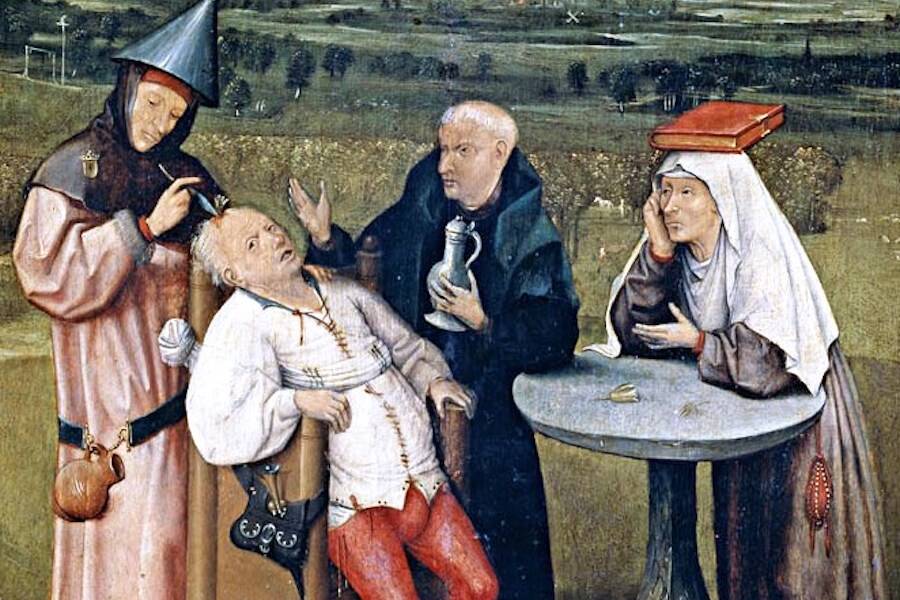
Wikimedia CommonsFrom divorce by combat to the “medical” practice of trepanation (pictured), these medieval customs will leave you thankful to live in modern times.
It can be hard to imagine just how difficult life was for people in the Middle Ages. And from today’s modern perspective, some of their most common practices seem downright sadistic. From horrific medical treatments and animal trials to vile dishes and bizarre divorce proceedings, the nine medieval customs below prove how odd the Middle Ages were — and how far we’ve come since then.
Physicians treated everything from headaches to possessions with trepanation, the practice of drilling holes in the head to let the brain “breathe.” Divorces could be handled by physical combat between spouses. And hemorrhoids were burned off the anus with glowing-red irons — or scraped off by the doctor’s unwashed fingernails.
While every historical period tends to reflect on the previous one and shudder, medieval traditions take the cake. From food and sex to science and the law, every facet of life in the Middle Ages was stranger, harder, or more disgusting than ours. And though they may seem far-fetched, these customs were quite real — and common — just a few centuries ago.
Medieval People Burned Cats For Fun
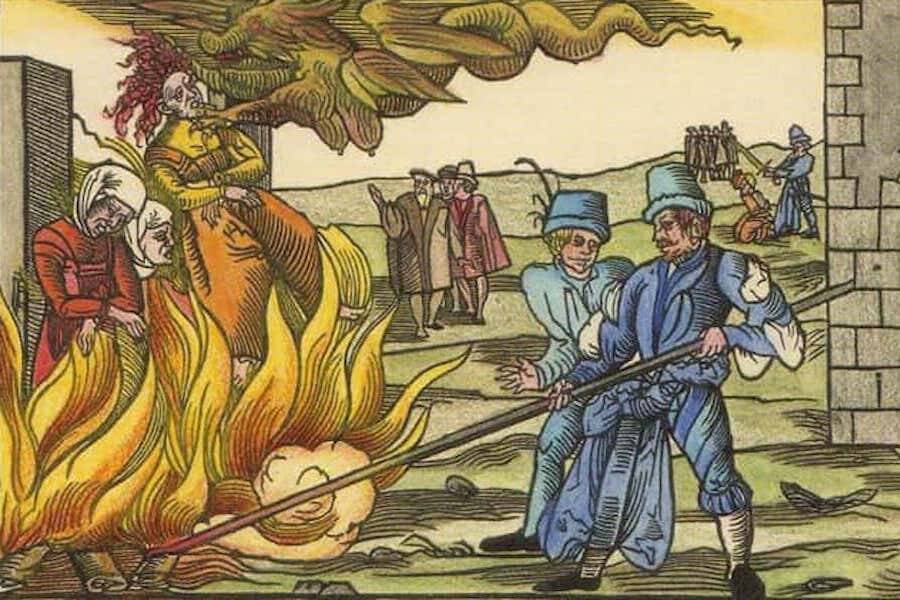
Wikimedia CommonsIn the Middle Ages, Pope Gregory IX issued a papal bull alleging that heretics worshipped cats — leading to their mass slaughter.
While the Ancient Egyptians worshipped cats as goddesses, medieval Europeans associated them with the devil. Christians in the Middle Ages believed God gave them dominion over Earth’s natural world. While dogs happily did their bidding, cats appeared unable to be controlled — striking terror into the hearts of men.
These anxieties even found their way into religious law when Pope Gregory IX issued a papal bull called Vox in Rama on June 13, 1233 A.D. This official decree declared that Satan himself routinely took the form of a cat — and that devil worshippers kissed the animal’s anus at Black Magic banquets to garner Lucifer’s favor.
“Of common wild cats I need not to speak much, for every hunter in England knoweth them, and their falseness and malice are well known,” wrote Edward, Duke of York, in the 1400s. “But one thing I dare well say that if any beast has the devil’s spirit in him, without doubt it is the cat, both in the wild and the tame.”
This feline phobia skyrocketed during the Bubonic Plague in the mid-14th century because it was commonly believed that cats spread the lethal bacterium rather than rats. Meanwhile, during the reign of Pope Innocent VIII in the 15th century, the entire species was excommunicated as the Church embarked on European witch crusades.
“Parisians liked to incinerate cats by the sackful, while the Courimauds (or “cour à miaud” or cat chasers) of Saint Chamond preferred to chase a flaming cat through the streets,” historian Robert Darnton writes in The Great Cat Massacre. “In parts of Burgundy and Lorraine they danced around a kind of burning May pole with a cat tied to it.”
Cat burnings across Europe continued for centuries, with scholars estimating the death toll reached into the millions. While cats were mostly incinerated, the Danish trapped them in barrels and beat them to death, and Belgians threw them off towers. Fortunately, animal cruelty laws in the 1800s ended this systematic slaughter.
The Horrifying Practice Of Trepanation
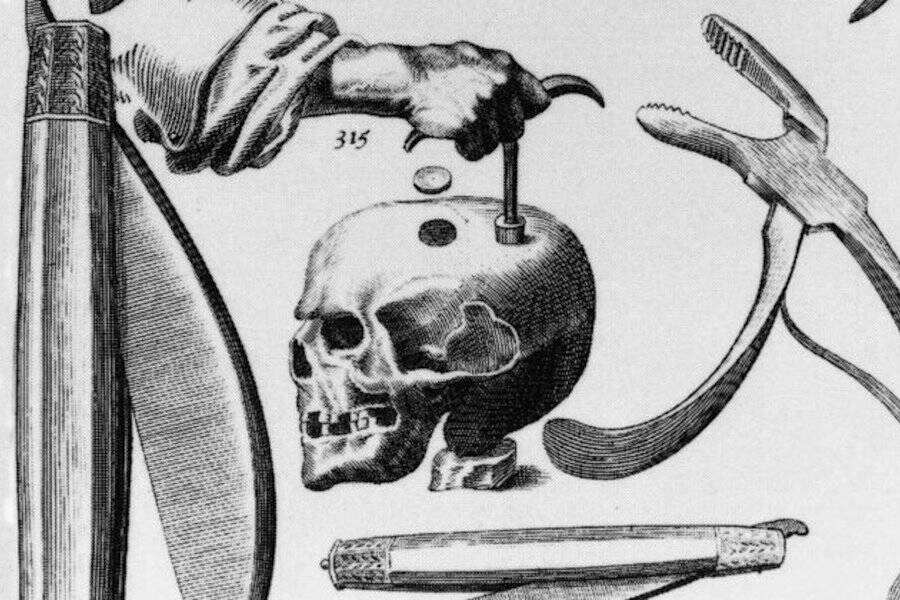
MITMedieval doctors believed trepanning (or drilling) the skull could alleviate a roster of ailments.
Trepanation might sound like nervous hesitation, but the medieval surgery was far more gruesome than that. Derived from the Latin trepanum, which translates to “borer,” the aptly named primitive practice led medieval doctors to drill holes into the skulls of their patients to alleviate a variety of ailments — from seizures to migraines.
Physicians believed exposing the dura mater membrane of the brain and spinal cord to fresh air would help cure people of their afflictions. Doctors used a roster of crude instruments to do so, from rocks and wooden tools to metal clamps and drills. Preparations naturally included shaving part of the ailing patient’s head.
Trepanations were often conducted for issues like epilepsy or demonic possession. The medieval custom had ancient roots, however, having been performed by civilizations across the globe for millennia. According to Dr. Miguel A. Faria Jr. of Surgical Neurology International, it might have even been the first medical procedure in history.
“Trephination (or trepanation) of the human skull is the oldest documented surgical procedure performed by man,” Faria Jr. wrote in Surgical Neurology International. “Trephined skulls have been found from the Old World of Europe and Asia to the New World, particularly Peru and South America, from the Neolithic age to the very dawn of history.”
Modern historians first learned of the surgery’s historical scope after American diplomat E.G. Squier found a trepanned skull in Peru in the 1860s. He noted that the skull showed signs of regrowth, meaning the patient had survived the ordeal — before researchers around the world unearthed further examples of the practice.
From Ancient Greece and Rome to Africa, South America, and the South Pacific, trepanations were more common than previously thought. While many were conducted to relieve pressure or remove skull fragments after an accident, others were utterly misguided — and failed to exorcise people of their demons.
The post Inside Nine Of The Weirdest Medieval Customs That Range From The Bizarre To The Downright Sadistic appeared first on All That's Interesting.
]]>The post From The Real-Life ‘Conjuring’ To A Satanic Nun, Explore 9 Horrifying Tales Of Demonic Possession appeared first on All That's Interesting.
]]>Some, like Latoya Ammons, had multiple witnesses — nurses, priests, and even police — to back up their stories. Others enlisted the help of paranormal investigators like Ed and Lorraine Warren, who also swear that the strange events in question actually happened.
These nine stories of demonic possession are chilling examples of the inexplicable, from people talking in tongues to random murders.
Nicole Aubrey And The ‘Miracle Of Laon’

API/Gamma-Rapho via Getty ImagesA depiction of Nicole Aubrey’s exorcism in Laon, France.
In November 1565, a French teenager named Nicole Aubrey (sometimes spelled Obry) started to suffer from a mysterious ailment in Vervins, France. She reportedly spoke in a “gruff” voice, refused to eat, and was racked with convulsions reportedly so violent that it took 12 or 15 men to hold her down.
Priests in Vervins determined that Aubrey was being possessed by a demon and tried to exorcise her. But they found that Aubrey’s demon was no run-of-the-mill evil spirit — it was “Beelzebub, the Prince of the Huguenots.”
Amidst the highly charged atmosphere between French Catholics and French Huguenots, or Protestants, Aubrey’s alleged demonic possession became more than a provincial affair. The Bishop of Laon himself was called to exorcise Aubrey and, when he failed, the teenager was transferred to Laon.

Sepia Times/Universal Images Group via Getty ImagesThe town of Laon, France, and its majestic cathedral, photographed in 1895.
There, Aubrey’s alleged demonic possession became something of a public spectacle. According to Gizmodo, she was transferred every day from the convent where she was staying to the Cathedrale Notre-Dame de Laon. As a rapt crowd listened, her demon gave sermons on the evil of the Huguenots.
“I with my obstinate Huguenots will do Him [Christ] more evil than the Jews did!” Aubrey is said to have roared. She also reportedly told the crowd that local Huguenots had taken a communion wafer, cut it up, and burned it.
Ultimately, priests were successful in their attempts to exorcise the “demon.” According to The Crime of Crimes: Demonology and Politics in France, 1560-1620, one eyewitness said that the demon finally left Aubrey’s body after producing smoke, thunder, and a thick fog that “encircled the belltowers of the church.”
It’s unknown what happened to Aubrey after that. But her alleged demonic possession caused waves in Laon, ratcheting up tensions between local Catholics and Protestants. The event — called the Miracle of Laon — even inspired copycat “possessions” elsewhere in France.
Zozo Demon: The Evil Spirit Allegedly Conjured By Ouija Boards

Denver Post via Getty ImagesThe story of the Zozo Demon went viral in 2009 after someone described their experience with a Ouija board, but this story may be much older.
Some people buy Ouija boards in hopes of communicating with spirits. But Darren Evans allegedly got more than he bargained for when he used one in 2009 — and allegedly found himself communicating with a demon.
As Evans explained on an online ghost forum on March 24, 2009, he was using his Ouija board one day when the planchette started jerking between the letters “Z” and “O,” spelling out “Z-O-Z-O-Z-O-Z-O-Z-O-Z-O.” He claimed that the “demon” said it wanted to take Evans’ family to paradise, and then spelled out “H-E-L-L.” Shortly thereafter, Evans found his one-year-old daughter drowning in an overflowing tub.
Though Evans was able to rescue his daughter, he isn’t the only person who claimed to have encountered the Zozo Demon. After posting his account online, others came forward with similar stories.

Wikimedia CommonsPazuzu, a Mesopotamian deity that some claim bears a resemblance to the Zozo Demon.
These stories bore a strong resemblance to Evans’ account. Someone would be using the Ouija board, then notice that the planchette began flying between the letters “Z” and “O.” After that, the planchette would start spelling out obscenities and threats.
Chillingly, variations of the Zozo Demon seem to appear throughout history. Some believe that the demon bears an unsettling resemblance to Pazuzu, a Mesopotamian deity thought to be the ruler of the demons. And an 1816 account of a French exorcism describes a young girl possessed by three demons named “Mimi, Capoulet, and Zozo.”
Whether or not the Zozo Demon truly exists is, of course, up to debate. But Ouija board users might want to use caution the next time they place their fingers on the planchette.
The post From The Real-Life ‘Conjuring’ To A Satanic Nun, Explore 9 Horrifying Tales Of Demonic Possession appeared first on All That's Interesting.
]]>The post The Eerie Story Of Stull Cemetery, The Tiny Kansas Graveyard Said To Contain A Portal To Hell appeared first on All That's Interesting.
]]>
Gatsbydog3/Wikimedia CommonsStull Cemetery, as seen in 2019.
The sleepy village of Stull, a small settlement about 50 miles west of Kansas City, shot into the spotlight in the 1970s after a University of Kansas student newspaper alleged that the Stull Cemetery was haunted. What’s more, the paper claimed that the cemetery contained a portal to hell.
In the aftermath, the town — home just a few dozen people — received an influx of thrill seekers. The visitors flocked to Stull Cemetery, and the abandoned church on the grassy hill next to it, on Halloween and the spring equinox, to see if they could spot the “devil.” Some of the cemetery’s visitors even claimed that they had paranormal experiences while at the graveyard.
As time went on, however, the residents of Stull became fed up with the cemetery visitors, who at times wreaked havoc on the peaceful burials of their loved ones. Today, trespassers face a hefty fine.
So what’s the true story of Stull Cemetery? It starts with the tiny village of Stull itself which, until the 1970s, was just a dot on the map.
The Quiet History Of The Tiny Town Of Stull, Kansas
The village of Stull, founded in 1857 by a group of Pennsylvania Dutch settlers, was originally known as Deer Creek. Its first settlers, whose ancestry was German, spoke German as their native language.
In the late 1800s, the settlement formed a post office, and the town was renamed after its then-postmaster, Sylvester Stull. Even after the post office closed down in 1903, the name stuck.
In the years that followed, life in Stull was quiet. In 1912, only 31 people lived in town — and its maximum population never exceeded 50. Stull’s dwindling residents had to spend hours to reach the nearby cities of Lecompton, Lawrence, and Topeka, especially once its last school closed in 1962.

Bhall87 (talk)/Wikimedia CommonsA quiet street in Stull, Kansas, as seen in 2009.
But in the next decade, Stull suddenly got an influx of interest.
‘Diabolical, Supernatural Happenings’: The Birth Of The Legend Of Stull Cemetery
The legend of Stull Cemetery was popularized after a news story from a student at the University of Kansas. In a 1974 article entitled “Legend of Devil Haunts Tiny Town,” student Jain Penner wrote:
“Far removed from the horrible story of The Exorcist or the bizarre black masses recently discovered in Los Angeles, and tucked away on a rough county road between Topeka and Lawrence is the tiny town of Stull. Not unlike the town of Sleepy Hollow, described by Washington Irving in his famous tale, Stull is one of those towns motorists can miss by blinking. Stull and Sleepy Hollow have another thing in common. Both are haunted by legends of diabolical, supernatural happenings.”
The article claimed said that many of the university students had heard ghost stories about Stull from their own grandparents — but that some had also had their own firsthand encounters. One said they’d been grabbed by the arm by an invisible force; another claimed to have experienced unexplained memory loss while in the cemetery.

Wikimedia CommonsThe village of Stull is tiny and rural, with the largest population never exceeding 50 residents.
After the article was published, a population of ghost hunters and thrill seekers began visiting the cemetery to experience the “supernatural happenings” themselves.
In particular, it soon became a popular tradition for high school and college students from nearby Lawrence or Topeka to go to the cemetery twice a year — on Halloween and the spring equinox — when the devil was purported to visit the site. These journeys to the cemetery often turned into parties, and over time the graveyard started to deteriorate, to the chagrin of Stull’s remaining residents. But rumors about Stull Cemetery continued.
And one of the main stories concerns the cemetery’s church.
The Mysteriously Abandoned Church — That Some Claim Contained A Portal To Hell
Throughout its history, church was the most prevalent community establishment in Stull. Families in the village met and prayed at each other’s homes until 1867, when Evangelical Emmanuel Church was built.

Territorial Capital MuseumThe former stone church was abandoned in 1922 when Stull residents built a new wooden church.
The church, made of stone, was used until 1922, when residents of Stull raised $20,000 to fund a new wooden-framed church across the road. Once the construction was complete, residents abandoned the former stone church, which rested on the grassy hill above Stull Cemetery.
Over the course of the 20th century, the old stone church fell into disrepair. It became one of the central Stull Cemetery legends, with some claiming that its basement led straight into Hell. Meanwhile, others stated that rain never fell in the church — even though the structure was missing its roof.
But then it was mysteriously demolished in 2002.
Major Weiss, the then-owner of the cemetery property, told The Lawrence Journal-World in 2002 that he had no idea that the razing was taking place, and had not authorized it. However, a cemetery neighbor said that one of the walls of the church had caved two weeks prior, and it was reported in the following days by The Lawrence Journal-World that an owner of the church property ordered the demolition after a sheriff had recommended it.
Stull residents continued to use the wooden-framed church across the way, which still holds services under the name Stull United Methodist Church.

Wikimedia CommonsThe new church in Stull caught fire in 2022, possibly from a lightning strike.
However, on July 25, 2022, the church caught fire in the afternoon — also mysteriously. There were no injuries reported but the building suffered a great deal of damage. Local news reports from that time said that officials theorized the fire was caused by a lightning strike.
But the church wasn’t the only allegedly eerie part of Stull Cemetery.
Stories Of The Devil And Paranormal Activity
One of the legends swirling around Stull Cemetery was that of Oliver Bahnmaier, a two-year-old boy who died after accidentally wandering into a field his father was burning in Lecompton. The boy was buried in Stull Cemetery, and a story began that if one stepped on Oliver’s tombstone, they would be transported to Hell.
Another story concerns two young men who visited the cemetery and said a strong wind began blowing out of nowhere when they walked in. Frightened, they ran off the property and tried to reach their car. However, they found that their car had been moved to the other side of the highway — facing the opposite direction.

Wikimedia CommonsNow, the property is lined with a chain link fence to defend against vandals.
A different man also claimed to feel the strong winds, but inside the abandoned church. He claimed that the air was so strong it knocked him to the ground.
Rumors also spread that the town was originally named “Skull” but changed to “Stull” to cover up any connections to the devil. Similarly, people claimed that the original settlers practiced witchcraft — but there’s no historical evidence to back that up.
People have also claimed that in the 1990s Pope John Paul II allegedly ordered his plane to avoid flying over eastern Kansas so he wouldn’t fly over satanic ground. This also hasn’t been proven.
The Legend Of Stull Cemetery Today
As decades passed, locals in Stull grew frustrated with the hordes coming to the cemetery — where many of their family members and loved ones were interred. Reports of vandals knocking over headstones became more common, and eventually the sheriff got involved. Locals were especially incensed, since they believe that there’s no truth to the rumors about Stull — and a report from Snopes suggested that Penner’s piece, written for the paper’s Halloween edition, was printed later due to a paper shortage.
To prevent unwelcome visitors, a chain link fence was erected around the cemetery grounds, and the site is patrolled regularly by security. “No Trespassing” signs were also installed on the fence. These precautions caused the number of visitors to die down, except around Halloween.
The cemetery is also locked at night, and the consequences for trespassing are up to six months in jail or a fine of up to $1,000.
Although the paranormal tourism around the cemetery has decreased, Stull Cemetery has been immortalized in legend. It also served as an inspiration for the popular 2000s TV show “Supernatural,” where the two main characters are from Lawrence, Kansas — because of its closeness to Stull.
After reading the spooky story behind the reportedly haunted Stull Cemetery, explore 11 of the world’s most haunted places in history. Or, enjoy this collection of chilling ghost stories.
The post The Eerie Story Of Stull Cemetery, The Tiny Kansas Graveyard Said To Contain A Portal To Hell appeared first on All That's Interesting.
]]>The post Excavators Preparing To Build An Elementary School In Germany Just Uncovered A 7,000-Year-Old Burial appeared first on All That's Interesting.
]]>
State Office for Archaeology SaxonyArchaeologists discovered a Neolithic burial as well as the remains of a Linear Pottery culture wooden house at the site of a future school in Leipzig.
Before the construction of an elementary school in Leipzig, Germany could commence, archaeologists did preventative excavations at the site in order to protect any historical artifacts that could be hiding underground.
Although archaeologists expected to make at least a few finds, they were shocked to unearth fully intact remains in a burial that dates back a whopping 7,000 years — making this the oldest-known grave ever found in the area.
The Discovery Of A 7,000-Year-Old Burial At A German Construction Site
Preventative excavations were essential at this location because it’s near a previously-known Bronze Age archaeological site, according to the Saxony State Office for Archaeology’s announcement of the discovery.
Moreover, prehistoric artifacts are relatively common in the area because it’s shielded against flooding from the White Elster River, and lies within the Leipzig Lowland Basin, which has repeatedly proven to be a rich archaeological region.

Wikimedia CommonsThe site is protected against flooding from the White Elster River, seen here running through the city of Leipzig.
This land had been occupied by a building complex in the 1960s, which had since been torn down. Despite this previous construction and the resulting disruption of the terrain, archaeologists made a number of well-preserved discoveries that exceeded their expectations.
Rather than a few scattered objects, the team instead found evidence of an entire prehistoric settlement, complete with the remains of houses and the 7,000-year-old grave.
“The discovery of a burial in the middle of the settlement was a surprise,” the officials said in the statement. “This is a rare stroke of luck, as bone preservation is so poor in large parts of Saxony that graves can only be identified by the objects placed in the grave and the shape of the grave pits.”

State Office for Archaeology SaxonyThe crouched position of the skeleton allowed the researchers to identify the burial as belonging to the Linear Pottery culture.
The archaeologists have not yet identified the sex or age of the deceased, but were able to note that the skeleton was buried lying down on its left side, with its legs drawn up in a crouching position.
In addition to the grave, archaeologists unearthed the remains of a 98-foot wooden house, and they also partially excavated two others.
What This Burial Reveals About The Linear Pottery Culture

Wikimedia CommonsAn example of a vessel made by the Linear Pottery culture, this one found elsewhere in Germany.
Researchers believe that the person buried here belonged to the Linear Pottery culture, a group that flourished throughout Europe between roughly 5500 and 4500 B.C.E.
The culture is named for its distinctive decorating of pottery, which has been found across the continent, from Hungary to the Paris Basin. Over the years, many such artifacts have also been found in and around Leipzig.
Although the grave contained no pottery or other grave goods, archaeologists were nevertheless able to link the body to the Linear Pottery culture due to its crouched position — a characteristic of Linear Pottery culture burials — as well as the context clues provided by the remains from the surrounding settlement.
The wooden longhouses that made up this settlement are also characteristic of the Linear Pottery culture. Such houses are identified via postholes that are still preserved in the ground. These holes would have held wooden posts that served to support the house’s roof and walls.
In this most recent discovery, the largest longhouse would have once measured an astonishing 98 feet in length.

M. Bajka/Provincial Office for the Protection of MonumentsAnother example of the remains of a Linear Pottery culture longhouse, this one discovered in Poland.
During the Linear Pottery era, Neolithic people were experiencing a transition from hunting and gathering to a more sedentary lifestyle, in which they began to live in settlements where they could farm and domesticate livestock.
“This means that the approximately 7,000-year-old burial is the oldest grave discovered to date within the city limits of Leipzig,” officials said.
Archaeologists will continue to excavate the site until it is fully surveyed, at which time the Saxony State Office for Archaeology is expected to analyze the discoveries for more information about the skeleton itself.
Meanwhile, plots that have already been excavated are slowly opening up for the construction of the new elementary school.
After reading about the 7,000-year-old burial found during school construction in Germany, discover nine of the world’s oldest human-made structures and the histories behind them. Then, learn about the “Cheddar Man,” the oldest complete skeleton ever found in Britain.
The post Excavators Preparing To Build An Elementary School In Germany Just Uncovered A 7,000-Year-Old Burial appeared first on All That's Interesting.
]]>The post 7 Creepy Cold Cases Where The Killer And Victim Still Remain Unknown appeared first on All That's Interesting.
]]>
Wikimedia Commons
It’s a scenario that plays into two of our worst fears. Killers who can get away with murder and the thought of dying without anyone noticing that we’re gone.
As many details of these cold cases are perplexing, we may never know the identities of the victims in these mysterious cold cases, and therefore never get any closer to finding out what — or who — killed them.
Cold cases like this were more prevalent before the science of DNA and forensic diagnostics were commonly used to solve crimes. But even after exhuming decades-old corpses for new DNA testing, the victims in these cold cases remain unidentified; any chance for justice lessening by the day.
Then again, just because a case is cold, doesn’t mean it’s closed. There are many advocates for these victims, especially children, who refuse to give up the search for answers.
Famous Unsolved Cold Cases: The Unknown Man of Somerton Beach

Wikimedia CommonsThe cipher found in the dead man’s book.
Of all the cold cases, this could be the most bizarre and unsolvable. In late 1948, a couple found an immaculately dressed dead man on Australia’s Somerton Beach. Outside of these simple facts, any new evidence collected only seems to lead investigators in circles.
Some strange features of the 40-ish-year-old man’s body included small pupils, extremely muscular calves, and oddly wedge-shaped toes. His feet were described by an examiner as “rather striking, suggesting—this is my own assumption—that he had been in the habit of wearing high-heeled and pointed shoes.”
The man’s stomach contained a lot of blood, suggesting he was poisoned. But there wasn’t the faintest amount of poison detected in the food or body. At the court inquest, the coroner thought the only answer could be one of two extremely rare untraceable poisons; of which the names he refused to say out loud.
The belongings in the man’s pockets proved to be inscrutable; a pack of gum, matches, two combs, and a pack of Army Club cigarettes mixed with seven more expensive cigarettes named Kensitas. All the name tags on the clothes had been removed. Inside a secretive inner pocket in the waistline of his pants was a tightly rolled scrap of paper that read ‘Tamám Shud’; Persian for ‘it is ended.’
The Tamám Shud scrap, they finally determined, was from a rare New Zealand edition of The Rubaiyat of Omar Khayyam, a book of poetry from the 12th century. By pure happenstance, two men who had been following the case in the papers remembered seeing a copy of the book in the backseat of a car they were in. They recovered it and delivered it to the police.
The last page that would have contained the man’s scrap was torn out. When put under ultraviolet light, the book revealed a handwritten cipher. The code was sent to Naval Intelligence, who determined it to be unbreakable.

Wikimedia CommonsThe man found on Somerton Beach, Australia in 1948.
Police found another dead man in Australia with a copy of The Rubaiyat after the war. But according to both the publisher and libraries around the world, there were only five editions printed – and this man held the seventh edition. That makes this copy of the book just as unexplainable. Perhaps they weren’t books at all, but spy gear in disguise?
At any rate, the identity, both the cause of death and the killer of the man remains a mystery.
Wych Elm Bella

Wikimedia CommonsThe skull of “Bella”, found inside a Wych Elm tree.
In 1943, four boys trespassing in the Hagley Woods area of Worcestershire, England discovered something eerie inside a wych elm tree. Instead of the bird’s nest they were looking for, they found a human skull. Nervous to be caught, they vowed not to ever speak of it, but the skull haunted one of the boys so much that he told his parents.
When the police investigated, they found an (almost) whole female skeleton tucked down inside the trunk of the tree. The bones of one hand were missing, but they were located a short distance from the rest of the body.
There was also a shoe, small pieces of tattered clothing, and a gold ring with the woman, who would have been 30-35 years old. Police estimated she’d been in the tree for about 18 months.
Further study revealed a piece of taffeta cloth in the mouth of the skull, suggesting suffocation as the cause of death. Every dentist in the country was contacted, in the hopes of garnering a positive ID from dental records. Even though the woman appeared to have recent dental work, no dentist had any record of her.

Wikimedia Commons Graffiti that immortalizes the inevitable question behind this notorious cold case.
Roughly six months after her discovery, graffiti started appearing. “Who put Bella down the wych elm?” and other similar sentiments begged the question; who’s Bella, and who knows more than they’re letting on?
Who this woman was or who might have killed her is still a mystery, though there are at least a few theories. The most interesting of which had Bella as a Nazi spy named Clarabella who was scheduled to parachute into the area in 1941.
The post 7 Creepy Cold Cases Where The Killer And Victim Still Remain Unknown appeared first on All That's Interesting.
]]>The post Franceska Mann, The Polish Ballerina Who Killed A Guard At Auschwitz appeared first on All That's Interesting.
]]>
Public DomainFranceska Mann fought back against the Nazis — and reportedly even killed a concentration camp guard.
In the fall of 1943, Franceska Mann boarded a train in Warsaw alongside thousands of other Jews. They thought they were being ferried to safety — to Switzerland, or perhaps to South America — but they had been deceived. Instead, Mann and the others were sent to Auschwitz.
When she realized what was happening, Mann resolved to fight back. Some say that she seduced the guards; others claim that she fought back when the guards tried to undress her. But Mann somehow wrested a firearm away from a camp guard. She killed a guard named Joseph Schillinger and badly injured another one before the Nazis brutally executed her and the others.
This is the story of Franceska Mann, the former ballerina who is believed to have killed a Nazi guard at Auschwitz.
The Polish Ballerina Who Was Sent To The Warsaw Ghetto
Born on Feb. 4, 1917 as Franceska Manheimer, in Warsaw, Poland, Franceska Mann was drawn to dance from a young age. She studied freestyle, ballet, and tap dancing, and, according to the Warsaw Ghetto Museum, became “one of the most promising Polish dancers” of the late 1930s.
Before World War II, she performed in operas, cabarets, and even in the short film “Polki słyną” (“Polish Women Are Known For”). Mann’s career as a dancer seemed sparkling, and she even won fourth prize at the International Dance Competition in Brussels, triumphing over 120 other dancers.

Public DomainFranceska Mann was a talented dancer, and one of the most renowned Polish dancers of her day.
Things in Mann’s personal life were going well too — she married a musician, Mark Rosenberg, and the couple had a daughter together. But everything changed after the Nazis invaded Poland in September 1939.
Like many other Jews in Warsaw, Franceska Mann was imprisoned in the Warsaw Ghetto. There, she struggled to survive alongside hundreds of thousands of other people crammed into a space of just 1.3 square miles.
How Franceska Mann Fought Back Against The Nazis At Auschwitz
In 1943, Franceska Mann’s fortunes seemed to change. After the Warsaw Ghetto was destroyed by the Nazis following the Warsaw Ghetto Uprising, she and many other Jews went into hiding. Then, they learned that Jews with foreign passports would be allowed to leave the country.

National Archives and Records AdministrationNazi troops stand on on Nowolipie Street in Warsaw, Poland, during the Warsaw Ghetto Uprising in the spring of 1943.
But this rumor — known as the Hotel Polski affair — was actually a cruel Nazi ruse meant to lure Polish Jews out of hiding. It worked. Thousands of Jews collected the right documents and boarded trains, hoping to be taken to safety. Instead, they were sent to concentration camps.
Mann boarded one of these trains in October 1943. According to the Jewish Women’s Archive, she believed that the train was headed to Switzerland, where she and the others would be exchanged for German prisoners of war. But the train wasn’t headed to Switzerland — it was going to Auschwitz. On their arrival on October 23, Mann and the others were told to remove their clothing so they could be “disinfected” before crossing the border.
Once she realized what was happening, Franceska Mann resolved to fight back. However, no one knows exactly what happened next.
In one version of the event, Mann performed a striptease for the guards, distracting them. Then, when she removed her shoes, she suddenly hurled them at senior squad leader Walter Quakernack, grabbing Quakernack’s gun and shooting Joseph Schillinger and Wilhelm Emmerich. Schillinger was killed; Emmerich was badly injured and left with a limp.

Public DomainHungarian Jews arriving at Auschwitz in May 1944.
That said, another version of the story has Mann throwing her bra instead of a shoe. And another version claims that Mann refused to undress; when Schillinger tried to pull off her bra, she wrested his gun away from him.
Whatever happened, Schillinger ended up dead.
The other women, inspired by Mann, rose up against the concentration camp guards. But they were quickly subdued. According to the Jewish Women’s Archive, they were either gunned down, or forced into the gas chamber. Franceska Mann died that day, on Oct. 23, 1943, at the age of 26.
The Legacy Of Franceska Mann, The Ballerina Who Killed A Concentration Camp Guard
After the Holocaust ended, stories spread about the woman who had stood up to the Nazis. The story was repeated so many times, by so many people, that historians are certain that a woman at Auschwitz killed a concentration camp guard. Indeed, the story even came up at the trial of Adolf Eichmann in the 1960s, in which Schillinger was described as one of the camp’s most brutal guards — one who was “murdered by a woman in transport.”
But there is some doubt about this woman’s identity.

Auschwitz-Birkenau Memorial and MuseumFranceska Mann purportedly used her final moments to resist the Nazis.
The Auschwitz-Birkenau Memorial and Museum — while acknowledging that Schillinger and Emmerich were shot by a woman in the undressing room of a gas chamber in October 1943 — noted that the woman’s name is not known for sure. “Her identity is not 100 percent confirmed,” the museum wrote on X in 2022. “It is believed it was was Franciszka Mann.”
That said, Mann has been named by different sources as the woman who shot Schillinger. Sadly, her identity is impossible to prove with total accuracy, because Mann — and many witnesses to her act — were murdered.
But whether or not Mann was the woman who killed Schillinger in October 1943, her story is worth remembering. Like so many other Holocaust victims, she was in the prime of her life when she was murdered. Franceska Mann was talented and beautiful; she was a mother, a wife, and a dancer.
And, very possibly, she spent her final moments fighting back against the Nazis. Though there was little hope of success, Franceska Mann took a chance. With her final breath, she killed one of Auschwitz’s worst guards.
After reading about Franceska Mann, the ballerina who purportedly killed a Nazi guard at Auschwitz, look through these chilling photos that explain the Nazis’ rise to power. Or, discover the inspiring stories of nine ordinary people who became heroes during the Holocaust.
The post Franceska Mann, The Polish Ballerina Who Killed A Guard At Auschwitz appeared first on All That's Interesting.
]]>The post A Farmer Working His Land In Northern Egypt Just Stumbled Upon Two Colossal Statues Of Ramesses The Great appeared first on All That's Interesting.
]]>
Egyptian Ministry of Tourism and AntiquitiesAfter the farmer found a rock with hieroglyphics on it, he contacted archaeological officials who fully unearthed two statue heads of the beloved pharaoh who ruled 3,200 years ago.
An Egyptian farmer named Khaled al-Shahat was surveying his land in the Nile Delta when he spotted something out of the ordinary: a pink rock peeking out from beneath the dusty ground.
After alerting the authorities, archaeologists came to his land in the village of Behbeit El-Hagar and discovered the remains of two statues of Ramesses II, the legendary ancient pharaoh who had one of the longest reigns in Egyptian history.
The Accidental Discovery Of Two Statue Heads Depicting Ramesses The Great

Egyptian Ministry of Tourism and AntiquitiesWith the heads measuring about five feet tall, experts estimate that the complete statues would have reached heights of almost 30 feet.
“I was working on my land on Friday when I came across an unusual stone,” al-Shahat told CBS News. “I informed the relevant authorities, and they came to examine it.”
According to a statement by the Egyptian Ministry of Tourism and Antiquities, archaeologists found two heads that once sat atop grandiose statues paying tribute to the ancient pharaoh Ramesses the Great.
Based on the size of one head, which measures about five feet high, archaeologists determined that the larger of the two statues stood around 28 feet tall in its glory days.
This statue head was also wearing the double crown that symbolizes the unification of Upper and Lower Egypt. The team furthermore discovered an upper fragment of this statue’s back pillar, which features a hieroglyphic inscription that identifies the pharaoh’s Horus name (a particular kind of royal moniker used in ancient Egypt) as “Hor-Ka-Nakht-Mery-Maat.”

Egyptian Ministry of Tourism and AntiquitiesA pink granite block was found near the statue remains, featuring the inscriptions “Nesw-Bity” (King of Upper and Lower Egypt) and “Sa-Ra” (Son of Ra, the sun god).
The archaeologists also discovered an eight-foot section of a second statue that likewise depicts Ramesses II. The base and legs of the statue were missing, but the head was present and wearing a “nemes,” a striped headdress worn by pharaohs.
The pink granite that al-Shahat had originally spotted was one tiny piece of a four-foot block that was found about three feet away from the second statue’s remains. The block is engraved with two hieroglyphic inscriptions that describe the pharaoh as “King of Upper and Lower Egypt” and the “Son of Ra,” an ancient Egyptian sun god.

Egyptian Ministry of Tourism and AntiquitiesKhaled al-Shahat was honored by the Egyptian government for his handling of this historic discovery.
In honor of this historic discovery, Egypt’s minister of tourism and antiquities gave al-Shahat a plaque of appreciation and awarded him and his wife a trip to Saudi Arabia to complete the Umrah pilgrimage to Mecca.
“I was surprised and happy when they discovered more antiquities,” al-Shahat told CBS News. “They told me this might change the history of the area.”
What This Find Could Reveal About This Site’s Importance During Ramesses II’s Reign
These new discoveries join a vast catalog of artifacts related to Ramesses II, widely believed to be ancient Egypt’s most important and longest-serving pharaoh, with a reign that stretched from around 1279 to 1213 B.C.E. While Ramesses II was on the throne, Egypt was at the height of its power, with an empire that stretched into modern-day Syria.
A legend even in his own time, Ramesses II had countless buildings erected and dedicated to him during his reign. Many of them have since been found throughout Egypt, including the famous temples at Karnak and Abu Simbel.
Meanwhile, untold numbers of statues depicting Ramesses II were built both during and after his reign. To be sure, this is far from the first time, even in recent years alone, that a statue of Ramesses the Great has been uncovered.
The missing upper half of a colossal Ramesses II statue was discovered in the Minya Governorate in 2024 — 94 years after the bottom was first unearthed. Meanwhile, another Ramesses II statue was found right under the streets of Cairo in 2017.

Egyptian Ministry of Tourism and AntiquitiesIn 2024, archaeologists discovered the missing half of another massive Ramesses II statue elsewhere in northern Egypt.
And given such discoveries, perhaps it’s surprising that this particular site hadn’t been excavated before now.
Mahmoud Emam, an Egyptologist at Cairo University who is familiar with the site of the most recent discovery, told Live Science that Behbeit El-Hagar is known for its temple dedicated to Isis, and that the newly-uncovered statue remains were found right on the western side of the temple complex.
In 2017, Emam and other researchers reported on previous discoveries of other fragments inscribed with the name Ramesses II unearthed near the Isis temple, one from a wall and the other from a statue.
“We concluded that Ramesses II had undertaken major building works at the temple and recommended further archaeological investigations to shed more light on the early history of the site,” Emam said.

Egyptian Ministry of Tourism and AntiquitiesThe farmer, Khaled al-Shahat, was honored by Egypt’s Minister of Culture and awarded a trip to Saudi Arabia.
Now that these discoveries have been made, researchers have all the more reason to further explore the history of this site.
The Egyptian Ministry of Tourism and Antiquities said that excavations will continue on al-Shahat’s land in an effort to discover more about the statues and the overall importance of this site during the reign of Ramesses II.
After reading about the Egyptian farmer who discovered two Ramesses II statues on his land, dive into the era of Egyptomania, when fascination with ancient Egypt took over the Western world. Then, discover who really built the pyramids of Giza.
The post A Farmer Working His Land In Northern Egypt Just Stumbled Upon Two Colossal Statues Of Ramesses The Great appeared first on All That's Interesting.
]]>The post How Charles Van Doren’s Winning Streak On <em>Twenty-One</em> Almost Brought Down The Quiz Show Industry appeared first on All That's Interesting.
]]>
NBC/Contributor via Getty ImagesCharles Van Doren won $129,000 during a 14-week winning streak on the quiz show Twenty-One in the 1950s.
“I was involved, deeply involved, in a deception.” That’s what Charles Van Doren told U.S. Congress in 1959.
Just two years earlier, Van Doren had appeared on the cover of magazines and was beloved by the American public for his astounding winning streak on the television quiz show Twenty-One. But after he took home $129,000, another contestant came forward with allegations that the show was rigged.
In an effort to raise ratings, producers had scripted nearly every aspect of Van Doren’s performance. They fed him the answers to questions, ordered his opponents to respond incorrectly, and even coached him on how to act when the cameras were rolling.
The scandal uncovered the seedy truth about American game shows in the 1950s — and almost brought the entire industry crashing down.
Charles Van Doren’s Life Before The Scandal
Charles Van Doren was born into an academic family in 1926. His father, Mark Van Doren, taught English at Columbia University and won the Pulitzer Prize for poetry when Charles was a teenager. His mother, Dorothy, was an editor who published nine books of her own. And his uncle, Carl Van Doren, won the 1939 Pulitzer Prize for his biography on Benjamin Franklin.

Walter Sanders/The LIFE Picture Collection/GettyCharles Van Doren in 1959, during his time as a university professor.
Charles followed in his parents’ footsteps, studying at the University of Cambridge, graduating from St. John’s College, and later earning a degree in astrophysics and a Ph.D. in English from Columbia.
While teaching literature at Columbia in 1956, Van Doren met Albert Freedman, a producer on the NBC quiz show Twenty-One. Freedman and his co-producer, Dan Enright, were impressed with Van Doren’s polished look and polite demeanor. They thought he would make an excellent candidate to defeat the show’s reigning champion, Herb Stempel.
Van Doren wasn’t sure — he didn’t even own a television — but the producers were persuasive.
Bettmann/Contributor via Getty ImagesAlbert Freedman, the NBC producer who convinced Charles Van Doren to appear on Twenty-One.
Ratings had dropped during Stempel’s winning streak, and advertisers were pressuring Freedman and Enright to revive them. In a 2008 article for The New Yorker, Van Doren recalled Freedman telling him that sponsors wanted “somebody more sympathetic” on the show.
“I’ve thought about it, Charlie,” Freedman said, “and I’ve decided you should be the person to beat Stempel. And I’ll help you do it.”
How Producers Rigged Twenty-One
Charles Van Doren’s first appearance on Twenty-One came on Nov. 28, 1956. And by Dec. 5, he’d emerged victorious over Stempel, ending his opponent’s six-week winning streak.

Public DomainHost Jack Barry asks Charles Van Doren a question on the NBC quiz show Twenty-One.
During his coaching sessions ahead of each episode, Van Doren said that Freedman “would ask me questions, I would answer them — and then he would tell me how to answer them: pause here; add this or that remark aside; always seem to be worried, anxious; never answer too quickly, let suspense build up.”
Van Doren’s appearance provided such a boost to ratings that even after he defeated Stempel, producers decided to keep him on the show. Viewers loved him for his charming disposition. He was smart, well-spoken, and clean-cut. Charles Van Doren quickly became a media darling.
He received hundreds of letters per week from fans, had to change his phone number due to constant phone calls from journalists, and even answered his door several times to find single women waiting for him on the other side. In February 1957, he appeared on the cover of Time alongside the headline “The Wizard of Quiz.”
Van Doren’s winning streak lasted 14 weeks until he was defeated on March 11, 1957, by a lawyer named Vivienne Nearing. As he wrote in The New Yorker, “[Host] Jack Barry asked both of us to name the kings of Norway, Denmark, Sweden, Jordan, Iraq, and Belgium. According to our covert script, Nearing knew the answers and I didn’t.”

Public DomainVivienne Nearing, host Jack Barry, and Charles Van Doren on the day of Van Doren’s final appearance on Twenty-One.
Still, Van Doren walked away with a total of $129,000 — more than $1.5 million today. NBC also offered him a three-year contract. He began working as a news writer for the studio, and he later appeared on Today as a cultural correspondent and guest host.
But his time in the spotlight wasn’t over yet.
Charles Van Doren’s Scandal Comes To Light
In 1958, Herb Stempel decided to blow the whistle on the Twenty-One scandal. He’d been ordered to lose to Van Doren back in 1956, but Dan Enright had purportedly promised him a spot on another NBC show. When that didn’t materialize, Stempel came forward.
At first, the media dismissed his claims. He had no real evidence, and at first glance, he appeared to be nothing more than a sore loser. Then, another former contestant named James Snodgrass came forward with proof. He’d kept a record of the answers that producers fed to him and sent them to himself via registered mail before each taping.

Bettmann/Contributor via Getty ImagesJournalists photograph Charles Van Doren as he testifies before Congress in 1959.
At this point, the New York District Attorney’s Office began investigating the scandal. According to PBS, Charles Van Doren initially denied all allegations. “It’s silly and distressing to think that people don’t have more faith in quiz shows,” he told reporters.
Then, he went into hiding.
Van Doren reemerged on November 2, 1959, to testify in front of a congressional committee after he received a subpoena. It was then that he admitted that Twenty-One was rigged:
“I was involved, deeply involved, in a deception… I asked [Freedman] to let me go on the program honestly, without receiving help. He said that was impossible. He told me that I would not have a chance to defeat Stempel because he was too knowledgeable. He also told me that the show was merely entertainment and that giving help to quiz contestants was a common practice and merely a part of show business.”
In the aftermath of the admission, Charles Van Doren was dropped by NBC and resigned from his position at Columbia. But the impact of the scandal went far beyond his personal life.
Twenty-One was canceled, and host Jack Barry didn’t appear on another major television game show for years. Enright and Freedman also faced career difficulties. What’s more, viewers began questioning whether other quiz shows were rigged.
Ratings plummeted, shows went off the air, and the entire game show industry was on the brink of collapse. In fact, Jeopardy! was created in the early 1960s in an effort to revive the genre.
Van Doren went on to work as an editor for Encyclopedia Britannica, and he later joined the faculty of the University of Connecticut, Torrington. He died of natural causes in April 2019 at age 93.

Hollywood PicturesRalph Fiennes (left) as Charles Van Doren in the 1994 film Quiz Show.
But before his death, his role in the Twenty-One scandal was immortalized in the 1994 film Quiz Show, which was produced by Robert Redford and starred Ralph Fiennes as Van Doren.
Van Doren turned down an offer to act as a consultant during production, but he saw the movie after it was released. As he wrote in The New Yorker, “I understand that movies need to compress and conflate, but what bothered me most was the epilogue stating that I never taught again.”
Until the end, Charles Van Doren was fiercely proud of his academic roots — and not even a quiz show scandal could change that.
After learning about Charles Van Doren and the 1950s quiz show scandal, go inside nine vintage Hollywood scandals. Then, read about Nasubi, the contestant who survived history’s cruelest game show.
The post How Charles Van Doren’s Winning Streak On <em>Twenty-One</em> Almost Brought Down The Quiz Show Industry appeared first on All That's Interesting.
]]>The post Workers Preparing To Build A House On The Corsican Coast Just Stumbled Upon A Roman-Era Dwelling Carved Directly Into The Bedrock appeared first on All That's Interesting.
]]>
Brice Chevaux, InrapThis ancient Roman-era dwelling was found during preventative excavations ahead of planned house construction on Corsica.
In a preventative archaeological excavation before a new house was to be built on the island of Corsica, researchers found the remains of a Roman-era home that was carved directly into the bedrock at least 1,600 years ago.
Found on the island’s northern Cap Corse peninsula, this ancient dwelling was built around 100 feet uphill from a pier that comes from the same era. Following the discovery of this seaside abode, researchers are curious about just how extensive of a port settlement may have surrounded this house well over a millennium ago.
The Discovery Of An Ancient Roman-Era House Carved Right Into The Bedrock In Corsica
Preventative excavations took place in May and June of 2026, and covered around 1,600 square feet of land. This is only the second time that a preventative excavation has been done on the island’s northern peninsula, which stretches about 20 miles long.

Maxime Hermsdorff, InrapArchaeologists discovered that slabs of schist rock were used to partition the house into separate rooms.
The first excavation, according to a statement put out by INRAP, took place in the spring of 2025, and it uncovered the Roman-era pier on the peninsula, which sits within the Bay of Meria. The newly-discovered house was found 100 feet above the pier, carved into the protruding rock that overlooks the bay.
Archaeologists ultimately discovered that the house covered about 540 square feet and was constructed in two phases. First, the house’s builders carved into the underlying schist — a metamorphic rock that splits easily into slabs — in order to make the foundation.
The removed schist was then cut into square blocks which were laid upon the foundation in an alternating pattern — first, placed in parallel with the foundation’s edge, and then perpendicularly — in order to form a secure wall.

Brice Chevaux, InrapArchaeologists found a millstone in one of the pits that had been dug into the corners of the house.
Archaeologists also found several post holes packed with stone wedges, indicating that large schist slabs were placed upright on their edges and held in place by these stones and wooden posts. These monoliths may have been used to separate rooms within the home. Additionally, other post holes found nearby could have been used to hold upright beams that might’ve supported a tiled roof.
Within this carefully-built structure, archaeologists also unearthed a wealth of artifacts that paint a picture of ancient domesticity: fragments of cooking pottery, as well as glassware, iron tools, and a millstone.
What This Find Could Reveal About Life Along The Bay Of Meria During Antiquity
The discovery of the house carved into bedrock, in tandem with the pier from the same era that was found right nearby, has researchers curious about the extent of the Roman-era settlement that once sat on the Bay of Meria at Cap Corse.

Brice Chevaux, InrapThe residents of the house may have worked at the pier, located only about 100 feet away.
Archaeologists are unsure whether the two excavations revealed just a single house with its own pier, or if these finds are indicative of a hamlet or larger seaside settlement.
“It’s quite rare to have several avenues of investigation in the same area, especially here in Meria where the land is rather limited,” dig director Brice Chevaux told Corse Net Infos. “Since it’s the same chronological window, we can be certain that the people who lived here had a commanding view of the landing stage.”

Nathalie Gonzalez, InrapResearchers also found a Roman-era pier nearby, indicating that this area may have once held a larger seaside settlement.
Chevaux believes that a large settlement once stood here and that the pier was large enough to have needed multiple laborers who in turn would have needed their own houses on the slopes along the bay. Researchers presently suspect that a village of seaside laborers sprang up here during the late Roman era before eventually being abandoned in the sixth century C.E.
This timeline is based on ceramic fragments dating to Late Antiquity that were found at both the dwelling and the ancient pier. Rare finds on an island like this, these artifacts suggest that ancient Corsica was part of various Mediterranean trade networks during the Roman era. Prior discoveries, like a marble altar with an inscription dedicated to Emperor Claudius that was found in the Bay of Meria in 2012, support this notion as well.
Taken together, all of this further supports the theory that a settlement perched here at Cap Corse could have been an important economic and even cultural center more than 1,500 years ago.
After reading about the Roman house carved into bedrock in Corsica, dive into the story behind the death of Napoleon, a Corsican native. Then, take a look into nine of the world’s oldest human-made structures and the histories behind them.
The post Workers Preparing To Build A House On The Corsican Coast Just Stumbled Upon A Roman-Era Dwelling Carved Directly Into The Bedrock appeared first on All That's Interesting.
]]>The post Daisy And Violet Hilton, The Conjoined Twins Who Were Forced To Become Sideshow Performers appeared first on All That's Interesting.
]]>
Wellcome CollectionThe Hilton sisters, as seen in circa 1927.
Before they could even walk or talk, Daisy and Violet Hilton were put on display. Conjoined twins born in 1908, they were a curiosity in their hometown of Brighton, England, and visitors came in droves to poke and prod at the girls, even lifting their clothing to examine where the twins were conjoined at the buttocks and hips. This marked the beginning of the Hilton Sister’s long — and often tortured — careers in show business.
Abandoned by their mother at birth, Daisy and Violet Hilton suffered under the thumb of a succession of abusive managers. Though they became popular vaudeville, sideshow, and burlesque performers, and even appeared in a handful of films, they had a complicated relationship with their careers.
“We fooled ourselves,” Violet once remarked, “that by entertaining others we were making ourselves happy.”
This is the story of Daisy and Violet Hilton, from their long career in show business, to the sad and lonely way they died.
The Hilton Sisters Were Abandoned At Birth — And Immediately Put On Display
The Hilton sisters were born on Feb. 5, 1908, in Brighton, Sussex, England. But their birth was not a happy occasion. Their mother, an unmarried barmaid named Kate Skinner, was horrified to find that her twins had been born conjoined at the hip. According to Brighton & Hove Museums, she believed that it was punishment from God, for giving birth out of wedlock.

Brighton & Hove MuseumsDaisy and Violet Hilton at the age of four.
Skinner abandoned the twins, who were swiftly adopted by midwife Mary Hilton. However, Mary did not adopt the Hilton sisters out of the goodness of her heart. Rather, she saw an opportunity for profit.
A landlady as well as a midwife, Mary made postcards of the twins, which she sold at her pub. Curious locals soon came to see the Hilton sisters and, according to the Daily Mail, their earliest memories were the smell of “brown ale” and of strangers lifting their clothing to see their joined flesh.
When the Hilton sisters were a bit older, Mary Hilton traveled around Europe with them. Daisy and Violet were taught how to play instruments and dance, and they soon appeared before eager crowds as “The Royal English United Twins” — allegedly distant relations of Queen Victoria. But if they ever complained about the work, Mary would beat them with the buckle of a belt.
After Mary’s daughter, Edith, married an American named Myer Myers, Daisy and Violet Hilton moved to the United States. But Mary Hilton’s death in 1919 did not improve the Hilton sisters’ lives. Rather, under the management of the Meyers, things became much worse.
How Daisy And Violet Hilton Escaped From The Abusive Control Of The Meyers
Brought to San Antonio, Texas, Daisy and Violet Hilton were once again put on display. The Meyers forced the girls to learn violin, clarinet, piano, and saxophone, kept them isolated from the outside world when they were not on stage, beat them when they resisted, and pocketed their earnings.
To strangers, the Hilton sisters seemed to have a glamorous life. They were highly paid vaudeville performers, making an estimated $5,000 per week (more than $80,000 today) and they performed along the likes of Bob Hope. But their home life was lonely and violent, and the Meyers were so cruel that many of their fellow performers took notice.

Wellcome CollectionThe Hilton sisters and their abusive guardians, the Meyers.
Indeed, Harry Houdini reportedly noticed how the Meyers took all the Hilton sisters’ earnings, and advised them to emancipate themselves from their guardians’ control. Daisy and Violet Hilton did just that; in 1931, they sued the Meyers and were freed from their contract. What’s more, they were also awarded $100,000 in damages — more than $2 million today.
But while the Hilton sisters were free for the first time in their lives, more tragedy awaited.
The Final Years And Tragic Deaths Of The Hilton Sisters

Wellcome CollectionThough they successful freed themselves from the Meyers, the Hilton sisters struggled as vaudeville went out of fashion.
After their emancipation, the Hilton sisters struggled to find work; the era of sideshows and vaudeville performances was ending. As the Daily Mail reports, Daisy and Violet resorted to a number of “stunts” to make ends meet, including a sham marriage with gay actor Jim Moore.
They also appeared in the controversial 1932 movie Freaks, alongside many other sideshow stars of the day, and, in the 1940s, even turned to burlesque as “The World’s Only Strip-Teasing Siamese Twins.” But neither these ventures, nor a 1951 autobiographical movie dubbed Chained For Life were much of a success. Indeed, the Hilton sisters were effectively broke.
Their career in show business came to an end in 1961, when they were abandoned by their manager at a drive-in in Charlotte, North Carolina. Daisy and Violet Hilton, then in their early 50s, took a job in a local grocery store to make ends meet.
Then, in January 1969, the Hilton sisters were found dead at their home in Charlotte. Both had died from the so-called Hong Kong flu at the age of 60. Though Daisy had died first, and Violet survived had several days, she had not called for help.
They were laid to rest at Forest Lawn West Cemetery in Charlotte, North Carolina, where a local reverend stated: “Daisy and Violet Hilton were in show business for all but the last half dozen years of their life. In the end, though, they were cast aside by the glittery and glamorous world they had been part of for so long. In the end, it was only ordinary people who showed they cared about them.”
Though they had spent most of their lives as minor celebrities, Daisy and Violet Hilton led sad lives. They were abandoned and abused, exploited and discarded. In the end, they had only each other to rely on.
After reading about Daisy and Violet Hilton, the conjoined twin sisters who became sideshow stars in the 20th century, discover the story of Chang and Eng Bunker, the “original” conjoined twins who also became sideshow stars. Or, discover the stories of other performers whose physical attributes lead them to perform in so-called “freak shows.”
The post Daisy And Violet Hilton, The Conjoined Twins Who Were Forced To Become Sideshow Performers appeared first on All That's Interesting.
]]>The post 9 Chilling Native American Ghost Stories, From Cannibals To Evil Otters appeared first on All That's Interesting.
]]>Some stories feature ghosts so fearsome that no one will speak their real name — like the so-called skinwalkers or Stick People. Others weave together tales of cannibalism, drowned spirits, and violent ghouls.
Often, these were told as cautionary tales that implored young ones to be careful of the water’s edge or to avoid causing discord among their family. But more often than not, these Native American ghost stories offer a warning: The world is full of darkness, and it might be closer than you think.
Chindi: The Ghost Created By A Dying Breath

U.S. National Archives and Records AdministrationAny chindi that died in a Navajo home, called a hogan, could potentially infect the inclosed space.
The Navajo believed that death could be a dangerous business. According to the legend of the chindi (chʼį́įdii), a person’s dying breath could contain everything bad or out of harmony about them, and it could become a ghost made of their worst traits.
As this Native American ghost story goes, once set loose, the chindi is said to cause serious harm to the living. After all, they’re filled with the most desperate and dire human characteristics like hatred, jealousy, and greed. They can inflict “ghost sickness,” which causes hallucinations and death, on anyone who crosses their path.
Navajo legend maintains that destroying the deceased’s belongings or refusing to say their name could prevent the chindi from causing serious harm.
Alternatively, they tried to ensure that people died outdoors. That way, the vengeful spirit could disappear in the wind, usually in the form of a dust devil. If the whirlwind spun counterclockwise, that meant the person who died had a great number of evil habits.

IAEA Imagebank/FlickrNavajo legend states that the chindi appeared as dust devils, and ones that turned counterclockwise were especially evil.
Some Navajo peoples also allegdly employed “ghost beads” to fend off vengeful chindi spirits. These were often hollowed out berries or turquoise strung together.
But the Navajo couldn’t always control where someone died. If a tribal member died indoors, usually in a Navajo dwelling called a hogan, then the living had few options. The chindi now allegedly controlled the residence. So, the living abandoned it.
Some people, however, were said to have used the chindi for their own evil devices. Navajo medicine men could allegedly summon a chindi to attack someone who had wronged them. Other myths claimed that Navajo witches could poison someone with ghost sickness by taking a piece of the corpse and making it into a bead or powder and then slipping it into someone’s food.
Given that, in modern times, most deaths occur indoors, there’s no telling how many chindi could be running amok.
Wendigo: The Cannibal Of Native American Ghost Stories

FlickrA depiction of the terrifying wendigo.
One of the scariest creatures from Native American ghost stories, the wendigo, is sometimes described as an evil spirit, and sometimes as a malevolent monster. In all tales, it’s defined by its desperate, insatiable hunger for human flesh.
According to legends told by a number of different tribes, including the Algonquian Ojibwe, Eastern Cree, Saulteaux, Westmain Swampy Cree, Naskapi, and Innu, a wendigo is created whenever a human resorts to cannibalism. Indeed, their name roughly translates to “the evil spirit that devours mankind.”
These evil spirits are described as towering, emaciated beings with gray skin and deep-set eyes. The Algonquian claim that wendigo have skeletal and deformed bodies that are missing fingers and toes. The Ojibwa say that the wendigo are lipless with sharp teeth, and leave footprints of blood.

YouTubeThe wendigo is said to be a flesh-eating humanoid that lurks in the woods.
Some Native American ghost stories claim that the wendigo lies in wait in the woods. There, it lures unsuspecting travelers deeper into the forest by mimicking human voices so that it can devour them. But every time the wendigo eats, it grows bigger and needs to eat more.
Other tales say that the wendigo can manipulate people and force them to become cannibals, too. This was the case for a Native American man named Swift Runner who, after he murdered and ate his family in the winter of 1879, claimed that a wendigo had possessed him.
Though reports of wendigo sightings or wendigo-related cannibalism have thinned out since the 1920s, there have been eerie reports as recently as 2019, when some suspected that these strange screams they heard in the Canadian woods might be a wendigo, furious with hunger, searching for its next victim.
The post 9 Chilling Native American Ghost Stories, From Cannibals To Evil Otters appeared first on All That's Interesting.
]]>The post Why Angola Prison In Louisiana Has Been Called The ‘Alcatraz Of The South’ appeared first on All That's Interesting.
]]>
Public DomainInmates picking cotton at Angola Prison, circa 1901.
Angola Prison is the largest maximum-security penitentiary in the United States — and one of the most notorious. Officially known as the Louisiana State Penitentiary, the facility takes its nickname from a haunting source: the antebellum plantation that once stood on the property.
Angola Plantation was owned by Isaac Franklin, who enslaved roughly 100 laborers there. After the Civil War, it was purchased by former Confederate soldier Samuel Lawrence James, who used the convict lease system to farm the land.
This method proved so profitable that the property was transformed into a prison after James’ death. The inmates were in charge of harvesting cotton, herding cattle, and growing crops to sell in the surrounding community.
The practice continues to this day, and some prisoners make as little as two cents per hour for their labor. This, paired with “horrifying” conditions within the facility, has earned Angola Prison yet another nickname: “Alcatraz of the South.”
How A Louisiana Plantation Transformed Into A Maximum-Security Prison
Before the Civil War, the land where the Louisiana State Penitentiary stands today belonged to Isaac Franklin, a wealthy plantation owner who enslaved around 500 Africans on his properties along the Mississippi River.
Angola Plantation, a swampy forest where roughly 100 men and women lived and worked, was named for the African region of Angola where many enslaved laborers originated. Conditions there were brutal. Deadly illnesses frequently spread through the living quarters, and runaway attempts were common.

Louisiana State Penitentiary MuseumLouisiana State Penitentiary, commonly known as Angola Prison, occupies roughly 18,000 acres along the Mississippi River in Louisiana.
Upon Franklin’s death in 1846, his widow combined four of his plantations — including Angola — and sold them to Samuel Lawrence James, a former Confederate officer. To run his 18,000 acres of land, James leased convicts from the state of Louisiana — and worked many of them to death.
James died in 1894, and six years later, Louisiana purchased his property to build a penitentiary. The new state prison opened in 1901, and it soon became infamous for its horrendous conditions.
Life At Angola Prison, The ‘Alcatraz Of The South’
The harsh labor that had built Angola Plantation continued when the site became a state prison. Inmates spent their days farming, herding cattle, and picking cotton. In their 1992 book The Life and Legend of Leadbelly — the biography of a folk singer who was once imprisoned at Angola — Charles Wolfe and Kip Lornell described the penitentiary as “probably as close to slavery as any person could come in 1930.”

Library of CongressHuddie Ledbetter, the folk singer known as Leadbelly (pictured here in the foreground), was imprisoned at Angola for attempted homicide in the 1930s.
In 1951, 55 inmates at Angola Prison cut their own Achilles tendons to protest against “brutality” at the facility. They were dubbed the Heel String Gang because they hopped around on one foot and sang a tune they called “The Heel-String Boogie.” As the Alexandria Daily Town Talk reported that May, the prison responded by considering “the abolition of corporal punishment.”
Still, Angola was considered the “worst prison in America” throughout the 1950s, and the American Bar Association reportedly referred to the penitentiary as “medieval, squalid and horrifying” in the 1970s.
One of the penitentiary’s worst areas was the Red Hat Cell Block, a solitary confinement unit. Inmates there had to wear distinctive red hats while working in the fields. Before it closed in the 1970s, per Mother Jones, men who had been incarcerated in the unit described “a dungeon crawling with rats, where dinner was served in stinking buckets splashed onto the floors.”

Public DomainInmates bunking in the hallway of Angola Prison due to overcrowding. 1975.
Reform efforts in recent decades have made conditions at Angola Prison slightly better — but it remains a grim place to this day.
Angola Prison In The Modern Era
In many ways, the Louisiana State Penitentiary still holds onto its plantation past. It operates as a working farm, and new inmates are often assigned to the cotton fields to labor in the brutal heat of the Deep South while guards patrol on horseback. They reportedly face punishment if they refuse.
According to PBS, prisoners sued the penitentiary in September 2023 to end this practice during the Louisiana summers. “I saw guys collapse,” one inmate told reporters. “There were dudes that got heat stroke. There were dudes with underlying conditions, older or had some sort of disability, but they had to go out there, too.”

The Atlantic/YouTubeA correctional officer on horseback oversees Angola Prison inmates as they work in the fields in 2015.
Other prisoners farm corn and soybeans that are then sold on the open market. There are also several manufacturing facilities that are staffed by inmates. The prison reportedly brings in millions of dollars each year from these endeavors — while the inmates make as little as two cents per hour for their work.
As such, the debate surrounding Angola and its prison labor system is heated. Some people believe that the work is appropriate due to the nature of some inmates’ crimes. In 2016, 71 percent of those incarcerated at the Louisiana State Penitentiary were serving life sentences.
Notable former prisoners include Derrick Todd Lee, the Baton Rouge serial killer who murdered seven women. Ronald Dominique, the “Bayou Strangler” behind the deaths of dozens of homeless men, is still incarcerated there.
However, opponents of the system argue that this forced labor is a form of cruel and unusual punishment. And perhaps no aspect of life at Angola sparks as much criticism as the Angola Prison Rodeo.
The event has been held each April and October since the 1960s, and it has become so popular that the penitentiary built a 10,000-person stadium in 2000. It features horses and cattle raised at the facility — and the inmates are part of the entertainment. Some volunteer for “Convict Poker,” in which four men play cards in the arena while an angry bull runs at them. Critics call it inhumane, but not all of the prisoners agree.

Angola Prison Rodeo/Facebook“Convict Poker” at the Angola Prison Rodeo.
Donald Cook, an inmate who has been imprisoned at Angola for murder since 1991, signs up for the rodeo each year. He once suffered seven broken ribs and a collapsed lung when he was struck by a bull, but he told Mississippi Public Broadcasting in 2025, “The rodeo has showed me a purpose and a life in here.”
Throughout the rest of the year, the prison offers several other opportunities for inmates to fulfill their passions. The institution produces a magazine called The Angolite that is written and edited by prisoners and available to the general public. It also hosts the country’s only FCC-licensed radio station that is operated by inmates.
Under Warden Burl Cain, who served at Angola from 1995 to 2016, the rate of violent crimes and murders within the walls of the penitentiary fell sharply. Still, Angola Prison maintains its vicious reputation.
Shortly before Hurricane Gustav made landfall in Louisiana in September 2008, as reported by CBS News at the time, New Orleans Mayor Ray Nagin announced at a press conference, “We will have zero tolerance for looters. You will go directly to Angola Prison, and God bless you when you go there.”
After learning about the history of Angola Prison, go inside 11 of history’s most daring prison escapes. Then, discover the stories of 11 infamous Alcatraz inmates.
The post Why Angola Prison In Louisiana Has Been Called The ‘Alcatraz Of The South’ appeared first on All That's Interesting.
]]>The post Inside The Horrific Spree That Made Earle Nelson Once The Most Prolific Serial Killer In U.S. History appeared first on All That's Interesting.
]]>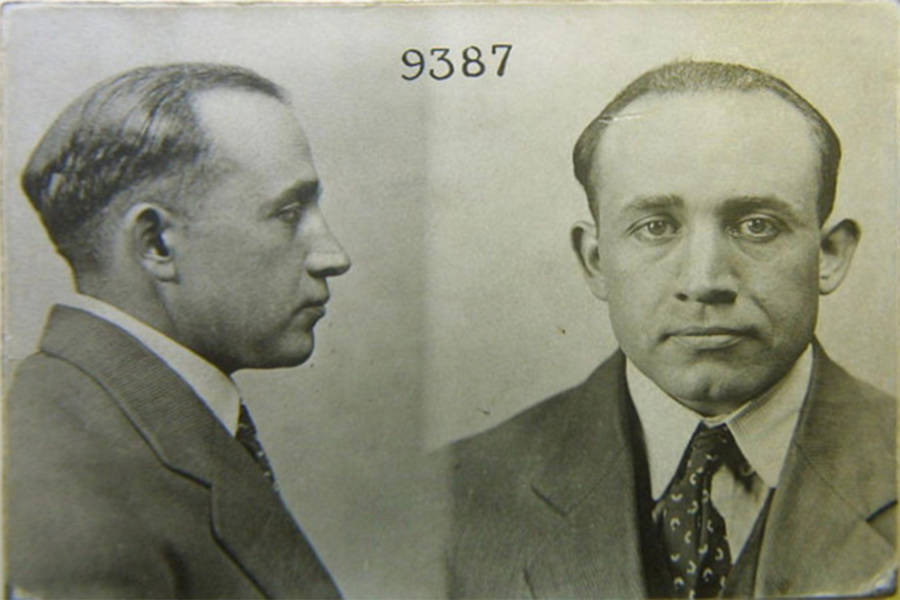
Manitoba Provincial PoliceA 1927 mugshot of Earle Nelson, also known as the “Gorilla Killer.”
Over a 16-month period in the 1920s, a serial killer named Earle Nelson murdered at least 22 people across the United States and into Canada. Most of his victims were middle-aged women, but Nelson also killed an eight-month-old baby — by strangling him with his own diaper.
Before Nelson’s arrest in 1927, he was known in the media as the “Gorilla Killer,” because witnesses reported that he had long arms and large hands. He targeted landladies who advertised rooms for rent in local newspapers, posing as a potential tenant to gain access to their homes. Once inside, he would violently strangle them.
Nelson then sexually assaulted his victims’ bodies before hiding them and fleeing the scene. While his early crimes centered around San Francisco and Portland, he later killed several people in the Midwest, New York, and Pennsylvania. Then, in June 1927, he murdered two young women in Canada.
Earle Nelson was arrested by Canadian authorities shortly after the second attack, and he was convicted of murder and sentenced to death later that year. He was hanged on Jan. 13, 1928, at age 30, bringing an end to the reign of the deadliest serial killer in U.S. history at the time.
The Troubled Early Life Of Earle Nelson
Earle Nelson had a tough start to life. He was born in San Francisco in 1897, but before his second birthday, both of his parents died of syphilis. He was raised by his maternal grandmother, who was a devout Pentecostal woman.
Nelson’s disturbing behavior began at a young age, and it was only exacerbated by a head injury he suffered in a bicycle accident when he was 10. As a teenager, he was reportedly obsessed with the Book of Revelation — but he also spent his free time at brothels.
His first arrest came in 1915, when he broke into what he thought was an abandoned cabin. He spent about a year behind bars only to be arrested for burglary and larceny several more times over the next two years.

Public DomainEarle Nelson spent much of his early adulthood in and out of California’s Napa State Mental Hospital.
In late 1917, Nelson tried to join the military, but he deserted after a few weeks. He then enlisted in multiple other branches under false names, and during a brief stint in the U.S. Navy, he was committed to a psychiatric facility for bizarre behavior.
He escaped from the institution so many times that the staff began referring to him as “Houdini.” He was initially released in 1919, but two years later, he disguised himself as a plumber and tried to sexually assault a 12-year-old girl at a home in San Francisco. He was recommitted to Napa State Mental Hospital but was free once more by 1925 — and then his violent killing spree began.
The Vicious Crimes Of The ‘Gorilla Killer’
On Feb. 20, 1926, Earle Nelson went to the home of 60-year-old Clara Newman, who ran a boarding house in San Francisco. As she was showing him around, Nelson suddenly strangled her. He then sexually assaulted her corpse and hid it inside a vacant room. Over the next six months, he murdered four more women along the California coast. Then, he headed to Portland and killed three women in three days.

Google MapsEarle Nelson’s first known victim was Clara Newman, who ran a boarding house at 2037 Pierce Street in San Francisco. The home is pictured here on the far left.
On Nov. 18, 1926, Nelson returned to San Francisco and murdered Anna Edmonds. The following day, he went to the home of 28-year-old H. C. Murray, who was selling her house in Burlingame.
According to Harold Schechter’s 1998 book Bestial: The Savage Trail of a True American Monster, Nelson kept pointing out the architectural details on the home’s ceilings. “I realize now,” Murray later told reporters, “that he was trying to get me to look up towards the ceiling, so that he could get behind me and grab my throat.” Murray would be Nelson’s only known survivor.
Four days later, Nelson was in Seattle, where he killed Florence Monks, stole her jewelry, and then gifted it to two other women. The following week, he murdered yet another woman in Portland.
By this point, Earle Nelson’s crimes were all over the news. He was known as the “Dark Strangler” or the “Gorilla Killer,” as witnesses who spotted him near his various crime scenes noticed that he had long arms and large hands. Landladies were warned not to show their homes alone, and police departments up and down the West Coast were on the hunt for the elusive suspect — but he had already headed east.
Earle Nelson Goes On The Move
In late December 1926, there was a crime spree in Iowa and Missouri with chilling similarities to the murders that had recently gripped California and Oregon. Over a six-day period, three women were strangled to death and raped. The third victim was 28-year-old Germania Harpin, who was attacked in her home while her husband was away at work. After killing Germania, Earle Nelson also murdered her eight-month-old son, Robert, by strangling him with a diaper.

Public DomainGermania Harpin and her eight-month-old son, Robert, were two of Earle Nelson’s 22 victims.
After a four-month hiatus, the Gorilla Killer struck again. This time, he murdered a Philadelphia landlady. One month later, Nelson rented a room in Buffalo — then strangled and raped the owner of the boarding house. Two days after that, he murdered both a landlady and a boarder at a home in Detroit before moving on to Chicago and killing another woman there.
By this point, Earle Nelson’s official victim count of 20 made him the most prolific serial killer in U.S. history at the time. But he wasn’t done yet.
On June 8, 1927 — four days after the Chicago murder — Nelson kidnapped 14-year-old girl Lola Cowan in Winnipeg, Canada. Her body was later found under the bed at the boarding house where Nelson was staying. Per Dirk Gibson’s 2006 book Serial Murder and Media Circuses, the police noted that Cowan was “mutilated in a manner reminiscent of Jack the Ripper.”
Then, on June 10, Nelson killed his final victim: 27-year-old Emily Patterson. He stole several items from her home — and this would ultimately lead to his downfall.
The Arrest Of One Of America’s Most Prolific Serial Killers
Nelson sold his loot from Patterson’s home at various secondhand shops, and the salesmen who purchased them were later able to identify him. On June 14, 1927, a man matching Nelson’s description was taken into custody, but he escaped the following day. He was arrested again near the border of Canada and North Dakota on June 16 — and broke out of jail yet again.
Finally, on June 17, Earle Nelson was caught for good. He lied about his identity, claiming that his name was Virgil Wilson, but his fingerprints matched those found at the Gorilla Killer’s crime scenes.

Manitoba Provincial PoliceEarle Nelson after his arrest by Canadian authorities in June 1927.
Nelson insisted that he was innocent, but at his trial for the murders of Cowan and Patterson in November 1927, he was found guilty and sentenced to death. Per a 1927 report in The Guardian, when asked if he had anything to say about the verdict, Nelson responded, “No, not that I know of.”
Nelson’s attorneys attempted to get his death sentence overturned by claiming that he was insane, but their appeal failed. Earle Nelson was hanged in Winnipeg on Jan. 13, 1928, at age 30. His final words were reportedly, “I forgive those who have wronged me.”
While Nelson has been officially linked to 22 murders, he’s suspected of killing an additional seven victims before his infamous crime spree began. During the 16-month period between 1926 and 1927, he murdered a woman once every three weeks on average. To this day, nobody knows what his true motive was, and there is still some debate surrounding whether or not he was actually insane.
But we do know that Earle Nelson was the most prolific serial killer in American history at the time. And his macabre reign continued until Samuel Little and John Wayne Gacy came along in the 1970s, sparking the true age of the serial killer.
After learning about Earle Nelson, discover the grisly crimes of Patrick Kearney, the necrophilic serial killer who had a genius IQ. Then, read about Gary Ridgway, the “Green River Killer” who terrorized Washington State in the 1980s and ’90s.
The post Inside The Horrific Spree That Made Earle Nelson Once The Most Prolific Serial Killer In U.S. History appeared first on All That's Interesting.
]]>The post Archaeologists In Turkey Believe They Just Found The World’s Oldest Shipwreck appeared first on All That's Interesting.
]]>
Hakan ÖnizResearchers off the coast of Kekova Island in Antalya discovered artifacts from a shipwreck that dates back as far as 4,700 years.
An ancient cargo vessel believed to be the world’s oldest shipwreck has been found off the coast of Turkey. This sunken ship dates back an astonishing 4,700 years — right around the time when the pyramids of Egypt were being built just across the Mediterranean Sea.
Although the actual body of the ship has disintegrated over the years, archaeologists believe that the submerged cargo that they discovered will help shed light on the seafaring civilizations that were thriving in the Mediterranean during the Early Bonze Age.
The Discovery Of What’s Believed To Be The Oldest Shipwreck Ever Found
The remaining cargo and other artifacts from this sunken ship were discovered at a depth of almost 100 feet off the shore of Kekova Island in Antalya.
Before this historic discovery, the oldest-known shipwreck ever found dated back 4,200 years. It was also found in the Mediterranean Sea, off the coast of Greece. Meanwhile, the world’s oldest intact shipwreck was discovered in 2024 in the Black Sea, and dates back 2,400 years.

AFP PHOTO/Black Sea MAP/EEF ExpeditionsThe oldest intact shipwreck ever found, as seen soon after it was discovered in the Black Sea in 2024.
Despite the absence of the wooden structure of the newly-found boat in Turkey, archaeologists were able to determine that it was about 33 feet long before it sank. Divers also uncovered three stone anchors and around 30 ceramic amphorae, or storage pots.
Divers originally found these artifacts in 2022, but did not initially realize just how ancient they really were. It wasn’t until recent research led by the Mediterranean Archaeology Association that researchers discovered that these relics were in fact thousands of years older than they first thought.
“When we first found the wreck four years ago, the shapes of the amphorae reminded us of types dating back only 100 or 200 years, so we didn’t immediately grasp its true significance,” Professor Hakan Öniz, a marine archeologist from Akdeniz University who led the expedition, said to IFLScience. “However, we later became excited when we saw the same amphora forms in a publication on Egyptian archaeology and returned to the site. Indeed, they were similar to those found at the Giza pyramids in Egypt.”
Öniz also noted to the BBC that the decoration techniques on the pots resembled other examples of amphorae made in Egypt and the Middle East between 4,400 and 4,700 years ago.

Hakan ÖnizSome 30 amphorae were found overall, and some of their contents remained intact.
“We can definitely say our wreck is early Bronze Age. This is 100 percent,” Öniz told the BBC.
Furthermore, the research team invited Australian archaeologist Karin Sowada, a leading expert on amphorae, to analyze the recent finds. Sowada confirmed to PEOPLE that “these are the oldest known remains of a seagoing ship yet found,” and that the remains give “archaeologists a time capsule from the past.”
What This Discovery Means For Historians’ Understanding Of Ancient Maritime Trade
Archaeologists discovered hardened resin and traces of ancient liquid inside the pots, despite the fact that they’d been submerged underwater for thousands of years. This discovery opened up questions for the researchers about both what the ship was transporting and where it was going.

Hakan ÖnizResearchers discovered hardened residue in the ceramic pots that could be olive oil or wine.
Sowada told PEOPLE that the “ship represents a ‘missing piece’ of the story about ancient trade relations in the eastern Mediterranean.”
The Mediterranean was a hub of economic activity during the Early Bronze Age. Researchers believe this particular cargo ship was carrying amphorae made in the Jordan Valley, and was heading west, possibly to Troy or the Minoan civilization on Crete.
Öniz noted to PEOPLE that the substances found in the amphorae are still being analyzed, but they could be remnants of olive oil or wine. He also said that the researchers found a submerged “churning amphora,” which was likely used by sailors on board the ship.
“They probably kept goats on the ship, utilizing their milk—rather than just their meat—during long voyages. They were producing their own butter and cheese right there on the ship,” Öniz said.
The team has only analyzed a few of the artifacts discovered so far, but they plan on completing further analysis over the coming months.
The artifacts will be displayed in the new Mediterranean Underwater Archaeology Museum in Antalya, which will hopefully also open in the coming months, offering the public a glimpse into what life was like on the high seas several thousand years ago.
After reading about what’s believed to be the oldest shipwreck ever found, dive into the story of how the ancient pyramids of Egypt were built. Then, discover the history behind 13 incredible sunken cities from the distant past.
The post Archaeologists In Turkey Believe They Just Found The World’s Oldest Shipwreck appeared first on All That's Interesting.
]]>The post The Breakers: Inside The Opulent Gilded Age Mansion Built By Cornelius Vanderbilt II appeared first on All That's Interesting.
]]>The enchanting Breakers mansion in Newport, Rhode Island, is the epitome of Gilded Age luxury. Built by Cornelius Vanderbilt II, then one of the richest men in America, the 70-room mansion was a stunning summer getaway for the wealthy Vanderbilt family.
The mansion's classic Italian Renaissance design and brilliant ocean views made it a beloved residence for the family for years. But after Cornelius' death in 1899, his family faced increasingly rising costs to maintain the residence. The mansion not only required dozens of staff members, but also tons of coal to operate — which became too much even for the Vanderbilts.
In the mid-20th century, The Breakers Newport opened its doors to the public. Every year since, thousands of visitors have flocked to the mansion for a glimpse at Gilded Age opulence.
Cornelius Vanderbilt II's Life Of Luxury
Cornelius Vanderbilt II was born on Staten Island, New York, in 1843. Purportedly the favorite of his grandfather — who made the family's fortune through in the railroad and shipping industry — Cornelius was a businessman and railroad magnate. When his grandfather and father died, they both left him millions of dollars.
In 1867, Cornelius married Alice Claypoole Gwynne, and the couple had seven children. Though he and his family primarily lived at a massive mansion in Manhattan, they also bought property in Rhode Island.

Wikimedia CommonsCornelius Vanderbilt II was the favorite grandson of the railroad magnate Cornelius Vanderbilt.
In 1885 — the same year Cornelius became president of the New York Central Railroad — he and his family purchased a mansion in Newport for $450,000 (or around $16 million today). Previously owned by tobacco manufacturer Pierre Lorillard IV, it burned to the ground in 1892.
Cornelius then set out to build a new mansion — The Breakers.
Breaking Ground On The Breakers, The European-Inspired Mansion In Newport
In order to avoid the tragedy of another house fire, Cornelius Vanderbilt commissioned the architect Richard Morris Hunt, a prominent Gilded Age architect, to design the new house with steel, brick, and limestone. As the Preservation Society of Newport County reports, the house's boilers were also designed to be tucked safely underground.

Library of CongressThe exterior of The Breakers in Newport, Rhode Island.
The 70-room, five-story Breakers mansion was built between 1893 and 1895. It was designed with Italian Renaissance flourishes, including Roman arches and columns, and the mansion's 50-foot ceilings in its Great Hall was meant to evoke the fresh-air beauty of Italy's open-air courtyards. Other touches, like the intricate, hand-set tile mosaics in the Billiard Room and outdoor corridor (loggia), also created an atmosphere of European elegance.
Meanwhile, the mansion's chandeliers sparkled with Baccarat crystal, and the panels in the Morning Room shone with platinum leaf.

Renata3/Wikimedia CommonsPlatinum details on the panels in the Morning Room.
Though The Breakers was built with Old World elegance, it also had the latest technology. The mansion was hooked up to electricity (though it also used gas lighting) which, at the time of the Gilded Age, was a novelty. As if this wasn't enough, the mansion also had 27 fireplaces.
Marked with 30-foot-high iron gates, the sprawling mansion sits on a 13-acre property that extends to the cliffs overlooking the Atlantic Ocean. If its inhabitants ever grew tired of dozens of beautiful rooms inside, they could easily walk to gaze out at the splendor of the sea.
But The Breakers had cost some $7 million to build — and it would prove to be expensive for even the Vanderbilts to maintain.
The Rising Cost Of Maintaining The Mansion — And How It Opened To The Public In The 1970s
In 1899, Cornelius Vanderbilt II died of a stroke at the age of 55. At the time of his death, his estate was appraised at over $72 million, $20 million of which was real estate — including The Breakers. Today, the value of Cornelius' estate would be around $2.83 billion.
He left The Breakers to his wife, Alice. But as time went on, the costs of maintaining The Breakers grew substantially more expensive. By the mid-1920s, the property taxes for the mansion rose to $83,000 annually. And, in order to run, the mansion required dozens of servants, and over 150 tons of coal each year.

Wikimedia CommonsCornelius bequeathed a life interest in The Breakers to his wife Alice.
Still, Alice managed to keep the house running for 35 more years until her death at the age of 89 in 1934. She bequeathed the house to her youngest daughter, Countess Gladys Széchenyi.
Although Gladys had inherited a share the Vanderbilt fortune, rumors swiftly spread that The Breakers had become more of a burden than a gift. Though Gladys did briefly occupy the mansion, she allowed the Preservation Society of Newport County to offer tours of the first floor of the property in 1948.
In return, the Preservation Society covered operating expenses and maintenance costs. Then, in 1972, the Preservation Society bought the property outright for $365,000 (roughly $2.81 million today.)

ZR1748/Wikimedia CommonsThe exterior of The Breakers in 2023. The famous Gilded Age mansion has been opened to the public for decades, and has welcomed thousands of visitors.
The Breakers in all its glory was designated as a National Historic Landmark in 1994 — and is still visited by hundreds of thousands of tourists in Rhode Island every year.
In the gallery above, take a step inside The Breakers in Newport, the opulent Gilded Age mansion that was built by one of America's wealthiest families.
After reading about the history of The Breakers, the stunning Gilded Age mansion built by the Vanderbilts in Newport, Rhode Island, discover the chilling histories of behind these infamous haunted mansions. Then, learn about the 10 richest people in human history.
The post The Breakers: Inside The Opulent Gilded Age Mansion Built By Cornelius Vanderbilt II appeared first on All That's Interesting.
]]>The post ‘A Cultural And Historical Atrocity’: A Carving Older Than The Pyramids Was Just Destroyed By Border Wall Construction In Arizona appeared first on All That's Interesting.
]]>
Russ McSpadden/Center for Biological DiversityResearchers initially believed that the carving that was damaged by border wall construction was 1,000 years old, but they’ve since learned that it is in fact closer to 6,500 years old.
For thousands of years, an enormous fish-shaped ground carving has sat in the Sonoran Desert of Arizona, stretching 272 feet across. Researchers initially believed that this sacred Indigenous art, known as the Las Playas Intaglio, only dated back 1,000 years. However, experts recently discovered that it’s actually more than 6,500 years old, making it older than both Stonehenge and the pyramids of Egypt.
But in April 2026, construction workers building the Trump administration’s second border wall in Arizona drove equipment through the geoglyph, leaving behind a devastating 50-foot gash.
The Destruction Of The Las Playas Intaglio, The Oldest-Known Geoglyph In The Americas
As described in a new article published in The SAA Archaeological Record, researchers who studied rock samples extracted from the site determined that the ancient carving is around 7,000 years old.
Researchers dated the samples by analyzing the rocks’ natural “varnish” layers that form over time on the surface, thus indicating how long the rock has been exposed to air.

Russ McSpadden/Center for Biological DiversityLocal tribal representatives had previously told contractors that the land in question was sacred and had asked that they avoid it — but to no avail.
The resulting age estimate makes this carving the oldest-known geoglyph in the Americas.
Study authors David Whitley and Ronald Dorn wrote that the intaglios that archaeologists have found in Arizona — geoglyphs specifically etched into desert floors — were part of religious rituals for these ancient Indigenous populations.
The carving lies on the ancestral lands of the Tohono O’odham tribe, and is protected within the Cabeza Prieta National Wildlife Refuge in Arizona, which contains more than 800,000 acres of wilderness and hiking trails.

Russ McSpadden/Center for Biological DiversityAdvocates are concerned about the lack of care and caution among contractors building the border wall.
“The wildlife refuge itself is a gem of the Sonoran Desert,” Russ McSpadden, a southwest conservation advocate at the Center for Biological Diversity, the organization that documented the carving’s destruction, told Outside. “Before the border wall, it connected to this larger protected desert landscape, which is the El Pinacate and Gran Desierto de Altar Biosphere Reserve in Mexico. And that connected to the Organ Pipe Cactus National Monument.”
The Consequences Of Damaging This 6,500-Year-Old Indigenous Carving In The Sonoran Desert
According to the statement put out by the Center for Biological Diversity in April, contractors clearing the way for a second wall along the Arizona-Mexico border put a 50-foot scrape through the ancient carving.
Along with other conservation advocates, McSpadden is concerned about what the destruction of the Las Playas Intaglio means for future protection of public lands and sacred Indigenous sites.

Russ McSpadden/Center for Biological DiversityContractors tore a 50-foot gash through this stunning piece of ancient Indigenous artwork.
“They just ran right through the fish, basically severing its head from its body,” McSpadden told Outside. “About 30 percent of it was damaged. The fish was decapitated. This is a slap in the face to our shared human history.”
According to a Tuscon Sentinel report from May, Tohono O’odham leaders said that “the site was desecrated despite the fact that it previously had been identified by a cultural protection monitor as a site for the contractor to avoid.”
It is nevertheless unclear how much contractors knew about the exact location of the intaglio beforehand.
A spokesperson for U.S. Customs and Border Protection told Outside that the agency “secured the remaining portion of the site, and it is being protected in place.”

Russ McSpadden/Center for Biological DiversityIn the words of the Center for Biological Diversity, “This is an irreplaceable piece of human history that’s been permanently scarred.”
However, McSpadden and the study authors warn that more protections and cautionary measures need to be taken in future border wall construction.
“The circumstances with respect to the Las Playas Intaglio furthermore are especially alarming given the federal government’s plans for additional border wall enhancements,” wrote Whitley and Dorn.
According to the Center for Biological Diversity, much damage has already been done during border wall construction, like the blasting of Monument Hill, a burial ground sacred to the O’odham Tribe in Organ Pipe Cactus National Monument, in 2020.
And in 2025, the U.S. Department of Homeland Security attempted to waive various environmental, cultural, and public health laws in order to speed up construction on the border wall in southern Arizona.
“Imagine the worldwide outrage if a government bulldozed part of Stonehenge to build a wall,” McSpadden said. “This sacred place is even older. Indigenous heritage deserves that same commitment to protection. Congress needs to demand records and testimony establishing who authorized and carried out the work. People deserve to know what warnings were given and why safeguards, if they existed, failed.”
After reading about the oldest geoglyph in the Americas being damaged by border wall construction, go inside the surprising history of totem poles, the Indigenous landmarks of the Pacific Northwest. Then, see Edward Curtis’ stunning photos of Indigenous Americans taken in the early 1900s.
The post ‘A Cultural And Historical Atrocity’: A Carving Older Than The Pyramids Was Just Destroyed By Border Wall Construction In Arizona appeared first on All That's Interesting.
]]>The post Paul John Knowles, The Vicious Serial Killer Known As The ‘Casanova Killer’ appeared first on All That's Interesting.
]]>
Wikimedia CommonsPaul John Knowles, smoking a cigarette in a photo taken after he was arrested.
At first glance, Paul John Knowles seemed charming and handsome. One woman even referred to him as “a cross between Robert Redford and Ryan O’Neal.” But Knowles was actually a vicious, remorseless serial killer. In 1974, he killed at least 18 people — and perhaps as many as 35.
Dubbed the Casanova Killer, Knowles’ crime spree took place over just a matter of months. Between July and November 1974, he traversed the country, murdering victims in Georgia, Florida, Texas, Nevada, and Alabama.
But at the end of the year, Knowles’ string of gruesome crimes caught up to him. Paul John Knowles was killed on December 18, 1974, while attempting to escape from investigators in Douglas County, Georgia.
This is his grisly story.
‘I’ve Always Been A Criminal’: The Crime Spree Of Paul John Knowles
Born in 1946 in Orlando, Florida, Paul John Knowles drifted into a life of crime at a young age. According to reporting from the New York Daily News, he already had a decade-long rap sheet when he was sent to prison for the first time at the age of 19, for kidnapping a police officer. Over the next eight years, Knowles cycled in and out of prisons across the country.
“I’m a criminal, and I’ve been a criminal since I was a little kid,” Knowles once told a psychiatrist in a recorded interview.

IMDBPaul John Knowles had a long criminal history before he turned to murder in 1974.
By early 1974, Knowles was serving time at the Raiford Penitentiary, in Starke, Florida, when he struck up a correspondence with a San Francisco waitress named Angela Covic. Over a series of letters, the two fell in love. Covic got Knowles a lawyer, who in turn arranged for him to be released on parole.
But when Knowles turned up on her doorstep that May, Covic had second thoughts. The man she’d fallen in love with — who she thought she would marry — had an “aura of fear” around him. Covic broke off the relationship, and Knowles returned to Florida. Before long, he was back behind bars.
There, while serving time for stabbing a bartender during a fight, Paul John Knowles plotted his escape. On July 26, 1974, he was able to pick the lock on his cell and vanish into the night.
Just hours later, he murdered his first victim.
The Gruesome Murders Of The Casanova Killer
After escaping from jail, Paul John Knowles broke into the Jacksonville home of 65-year-old Alice Curtis. The retired school teacher was later found bound and gagged; according to A&E she choked to death.
Over the next four months, Knowles continued to kill. That August, he killed 13-year-old Ima Jean Sanders and 49-year-old Marjorie Evelyne Howie in Georgia. In September, Knowles murdered 32-year-old William Bates after sharing a drink with him in Ohio, as well as 62-year-old Emmett Johnson and 59-year-old Lois Johnson — a couple camping in Nevada.
“I think he was more vicious than Bundy was,” retired investigating officer James Josey told Atlanta station WXIA-TV in 2019. “He had no compunction about killing you, makes no difference whether he strangled you, whether he shot you, whether he stabbed you or what… He was tough. He was mean.”

YouTubePaul John Knowles’ mugshot.
Indeed, Knowles’ victims, methods, and locations continued to change, making it difficult for investigators to keep up with him. Some of his victims were children; others were elderly. Some were burgled as well as killed, while others seemed to be deliberately targeted. Many times, Knowles also sexually assaulted his victims before killing them.
Meanwhile, those who survived their encounters remembered that Knowles was both handsome and cruel. Survivor Barbara Mabee Abel, whom Knowles abducted and sexually assaulted in November 1974, told People that she tried to placate him by telling him he “looked like Robert Redford.” Journalist Sandy Fawkes, who had a brief romance with Knowles around the same time, remembered him as a “dreamboat.”
Abel and Fawkes were the lucky ones. Shortly after their encounter with the killer, Knowles abducted state trooper Charles Campbell and businessman James Meyer, who were later found shot to death and handcuffed to a tree.
The Downfall And Death Of The Casanova Killer
Shortly after Paul John Knowles killed Campbell and Meyer, the serial killer crashed his car while being pursued by law enforcement. He dashed into the woods near McDonough, Georgia, where he ran into 27-year-old David Clark. Armed with a shotgun, Clark was able to hold Knowles at gunpoint until the police arrived. Then, on Nov. 17, 1984, Knowles was arrested.
That could have been the end of the story. Investigators believed that Knowles had killed 18 people — he claimed to have killed as many as 35, and detailed his alleged kills in a series of taped confession — but the Casanova Killer never stood trial. Instead, his life came to a sudden end.

Digital Library of GeorgiaPaul John Knowles was arrested in November 1974, four months after he started his bloody murder spree.
The month after he was arrested, Knowles agreed to show investigators from the Georgia Bureau of Investigation one of his crime scenes. But he was able to escape from his handcuffs by using a paperclip, and he lunged for the gun of Douglas County Sheriff Earl Lee. Luckily for Lee, GBI agent Ronnie Angel reacted quickly — and shot Knowles three times in the chest.
Knowles, at the age of 28, was killed immediately.
As such, some mystery remains about the crimes of Paul John Knowles. Over just a matter of months in 1974, he killed at least 18 people — but it’s very possible that he killed more. Knowles himself claimed to have killed 35, and investigators wouldn’t be surprised if the true number of his victims was actually even higher.
“If you told me he killed 100,” Angel, the agent who killed Knowles, later remarked according to the Macon Telegraph, “I could believe that.”
After reading about Paul John Knowles, the Casanova Killer who murdered at least 18 people in 1974, check out the gruesome story of the unsolved Hinterkaifeck murders. Then, learn more about the chilling murders of John Wayne Gacy, the real-life killer clown.
The post Paul John Knowles, The Vicious Serial Killer Known As The ‘Casanova Killer’ appeared first on All That's Interesting.
]]>The post Michael Malloy Was Murdered In An Insurance Scam — But It Took His Killers Many Attempts To Finish The Job appeared first on All That's Interesting.
]]>
Wikimedia CommonsTony Marino’s speakeasy, where the “Murder Trust” hatched their plan to kill Mike Malloy.
Michael Malloy was like a lot of down-on-their-luck, unemployed men in New York City during the Great Depression. Lacking a steady job or a place to live, he spent most of his time at a local speakeasy. But he became known as the “Rasputin of the Bronx” because, in the 1930s, Malloy somehow survived multiple murder attempts.
In July 1932, a group of men at the bar where Malloy liked to drink hatched a plan to kill him. They figured that Malloy could be easily tricked into drinking himself to death and, if they took out a life insurance policy on him, they could split the profits. But Malloy did not drink himself to death. And over the next seven months, he would survive all attempts to murder him.
Aside from one.
In February 1933, Michael Malloy’s killers finally succeeded in murdering their victim. By then, however, word about Mike “the Durable” Malloy had spread, rousing suspicion from the authorities. Each one of his main murderers was swiftly arrested, found guilty, and sent to the electric chair.
This is the strange story of Michael Malloy, the homeless alcoholic who defied multiple murder attempts.
The Sinister Plot To Murder Michael Malloy
In the 1930s, Michael Malloy was a regular at Tony Marino’s speakeasy in the Bronx. Little was known about him. He had no family or friends, and no one even knew his exact age. But regulars at the speakeasy knew that Malloy came from Ireland — and they knew that he liked to drink. Every day, he showed up at Marino’s and drank until he passed out.
Times were hard, and on one July afternoon in 1932, a friend of Marino’s named Francis Pasqua suggested a way to make some quick cash. Why not take an insurance policy on Malloy? Then when the homeless man died, Marino, Pasqua, and their accomplices — which came to include Daniel Kriesberg and Joseph Murphy — could split the cash.

Public DomainTony Marino, one of the men who plotted to murder Michael Malloy for an insurance payout in the 1930s.
According to Smithsonian Magazine, Pasqua suggested that if Marino took out the insurance policy, he could “take care of the rest.” Indeed, Pasqua knew that Marino had pulled off a similar scheme the year before; he had befriended a homeless woman, taken out an insurance policy in her name, gotten her drunk, and then doused her bed in ice water. She died of bronchial pneumonia, and Marino had easily collected the insurance payout.
Michael Malloy, who seemed well on the way to drinking himself to death, seemed like a much easier victim.
“He looks all in,” Marino declared. “He ain’t got much longer to go anyhow. The stuff is gettin’ him.”
The “Murder Trust,” as the plotters came to be known, agreed to split the profits of the insurance policy. If they succeeded, they would each receive a share of $3,576 (more than $85,000 today).
Conning Malloy into signing three insurance policies was easy enough. As Irish Central reports, the plotters bought Malloy drinks and asked him to sign a petition so Marino could run for public office. Without reading the documents closely, Malloy scribbled out his signature.
But Michael Malloy would prove more difficult to kill than the Murder Trust had anticipated.
The Many Failed Attempts To Murder The ‘Rasputin Of The Bronx’
At first, the Murder Trust hoped that Michael Malloy would simply drink himself to death. Marino poured him free drink after free drink, hoping that he would fall and hit his head, or choke on his own vomit. But after three days of nonstop drinking, Malloy seemed perfectly fine. On the fourth day he arrived at the bar and exclaimed, “Boy! Ain’t I got a thirst.”
When this didn’t work, the plotters quietly served Malloy wood alcohol, which could cause blindness and death even in small amounts. To their shock, Malloy happily threw back the drinks. At one point, he did pass out. But after sleeping for a few hours, Malloy awoke and declared, “Gimme some of th’old regular, me lad!”
According to the New York Daily News, the plotters began to get desperate. All this free alcohol — not to mention the insurance premiums — had started to add up. Marino began serving Malloy drinks laced with antifreeze. Then turpentine. Then rat poison. But nothing seemed to effect Malloy at all.

Public DomainFrancis Pasqua, one of the main plotters of the Murder Trust.
Next, the Murder Trust decided to switch gears. Marino served Malloy raw oysters soaked in wood alcohol, but rather than drop dead, Malloy liked the meal so much that he suggested Marino open a restaurant. The plotters also tried serving Malloy a sandwich made of rotten sardines mixed with shrapnel; Malloy not only ate it, but asked for a second sandwich.
By this time, it was winter. So the plotters tried something else. On a cold night, with temperatures plunging below freezing, they brought an inebriated Malloy to the nearby Crotona Park. They dumped him on a park bench, stripped off his shirt, and poured water on him. They were sure that Malloy would freeze to death — but Malloy managed to rouse himself and make his way back to Marino’s, where he fell asleep. In the morning, he complained merely of a “wee chill.”
The increasingly desperate Murder Trust then hired a cab driver named Harry Green to run Malloy down. As usual, the plotters got Malloy drunk, then placed him in the path of Green’s cab. After two misses, Green hit Malloy and backed over his body. The plotters fled as a passing car approached, but they were sure that Malloy had been killed.
But a few days later, Malloy limped back into his favorite speakeasy. Aside from a fractured skull, a concussion, and a broken shoulder, Malloy was in good spirits. He had only the haziest memory of being hit by a car, and, having spent some time in the hospital, he announced that he was “dying for a drink!”
Like Rasputin, Michael Malloy had defied multiple attempts on his life. But Rasputin’s killers were ultimately successful, and so were Malloy’s.
The Death Of Michael Malloy — And The Arrest Of His Killers
On Feb. 21, 1933, the Murder Trust finally killed Michael Malloy.

New York Medical Examiner’s OfficeMichael Malloy was finally murdered in February 1933, seven months after the Murder Trust first plotted his demise.
First, Marino challenged Malloy to a drinking match. He drank whiskey; Malloy was served wood alcohol. Then, when Malloy became badly drunk, he was brought to a tenement near Marino’s speakeasy. There, the plotters murdered him by placing a tube connected to a gas light feature into his mouth. They turned the gas on — and left him to die.
This time, Malloy perished. But things hadn’t gone according to plan for the Murder Trust before, and they didn’t fall into place even after Michael Malloy was dead.
Though they received an $800 payout from Metropolitan Life Insurance, Prudential Life Insurance started asking questions. Things appeared highly suspicious: not only Malloy had been hastily buried, but Marino had previously collected the life insurance of another homeless person. Under pressure, the plotters and their accomplices began to talk
Before long there was enough evidence to arrest the “Murder Trust.” Frank Pasqua, Tony Marino, Daniel Kriesberg, and Joseph Murphy appeared at the Bronx County Courthouse. First, they tried to plead insanity, and when that didn’t work they tried to implicate each other. But their arguments fell on deaf years.
Harry Green, the cab driver who’d hit Malloy, was sent to prison. But Pasqua, Marino, Kriesberg, and Murphy found guilty of first-degree murder and sentenced to death. They were executed by electric chair at Sing Sing prison in the summer of 1934.
“Perhaps,” a reporter wrote when the four men of the Murder Trust were convicted, “the grinning ghost of Mike Malloy was present in the Bronx County Courthouse.”
After reading about Michael Malloy, the Rasputin of the Bronx who survived multiple murder attempts in the 1930s, learn about some of history’s most infamous murders. Or, go inside the chilling story of serial killer Jeffrey Dahmer.
The post Michael Malloy Was Murdered In An Insurance Scam — But It Took His Killers Many Attempts To Finish The Job appeared first on All That's Interesting.
]]>The post Archaeologists Believe That This Mass Grave Found In Latvia Holds The Brutalized Victims Of A Viking Raid appeared first on All That's Interesting.
]]>
Gerhards, G. et al. Journal of Archaeological Science: Reports (2026) Copyright ElsevierArchaeologists discovered a 1,200-year-old grave in Latvia that was filled with six people who may have died in a Viking raid.
Archaeologists excavating a 1,200-year-old grave in Latvia discovered the remains of six people who may have been brutally killed during a Viking raid.
Those buried here have Indigenous Baltic ancestry, indicating that they were local to this region and not foreign soldiers or settlers. This, combined with the fact that they were killed so violently, points to a raid as a possible cause of death — but were the Vikings behind it?
The 1,200-Year-Old Grave In Latvia That Could Reveal The Bloody Aftermath Of A Viking Raid
This newly-studied grave is one of hundreds in the Čunkāni-Dreņģeri cemetery, near the Gulf of Riga in the Baltic Sea. The site was first found in 1924, and holds burials dating from the 7th century to the 11th century C.E., which spans Latvia’s Iron Age.
Although most of the burials in the cemetery only house one set of remains each, this grave, which was dated to the second half of the ninth century, stood out because it holds six people.

Wikimedia CommonsThe burial is part of the Čunkāni-Dreņģeri cemetery near the Gulf of Riga, pictured here.
As reported in a new study published in the Journal of Archaeological Science: Reports, researchers performed genetic analysis of the remains of the six people: four men, a boy, and a girl.
They discovered that one of the men was the father of the boy, and another man was a third-degree relative such as a first cousin or great uncle. DNA could not be extracted from the girl, so her relation is unknown, but the other two men were confirmed to be unrelated to the others.
Researchers suggest that, although the deceased were not all related, they may have come from the same community or household and were killed in the same violent event.
The father, the third-degree relative, and one of the unrelated men all suffered and died from “sharp force” injuries perhaps from an axe or sword, according to the researchers. However, it remains unclear how the other people died.

Gerhards, G. et al. Journal of Archaeological Science: Reports (2026) Copyright ElsevierThe researchers found that three of the men suffered violent and ultimately fatal injuries.
Researchers also noted that it could be the case that the two children and the fourth man suffered from soft-tissue injuries that simply didn’t show up in the new analysis of these remains.
Based on the injuries that researchers could identify, these deaths were extremely violent. One man had defensive cuts on his arm and hand, while a jaw-shattering blow killed another man, and a third man was almost decapitated.
What This Discovery Could Reveal About Life During The Early Viking Age
Although these deaths were violent, the archaeologists recognized that the burial plot’s arrangement was careful and ritualistic, rather than being a hurried and haphazard mass grave.
The group was buried with grave goods in accordance with local Baltic customs. The girl, the only female deceased, was buried pointing northwest, and the males were lined up beside her with their heads pointing southeast. This same type of gender-based distinction has been seen by archaeologists in other graves from this era that have been unearthed across the region.

Wikimedia CommonsThe people buried here were Semigallian, an Iron Age community that lived near the Gulf of Riga (and whose territory can be seen on this 16th-century map).
But, regardless of who killed them and how, the question remains: who were these people who died so brutally some 1,200 years ago? If nothing else, we know that they died where they lived.
“They were most likely local people,” study co-author Elīna Pētersone-Gordina, an archaeologist at the University of Latvia, told Live Science in an email.
Genetic analysis confirmed that all of the deceased had Indigenous Baltic ancestry. During the ninth century, in the early Viking Age, Latvia was home to Indigenous Balts, including the Semigallians and the Curonians, and not a part of the Scandinavian Viking world. The researchers determined this group was Semigallian, a Latvian Iron Age farming community.
Viking burials dating to the eighth century C.E. that held men with battle wounds had previously been discovered in the Eastern Baltic region, suggesting that raiders had come to this area previously.
However, it’s still uncertain that these deaths were the result of a Viking raid. And if it wasn’t the Vikings, then the question becomes: Who was it?
After reading about the 1,200-year-old burial in Latvia that may hold victims of a Viking raid, discover the complicated story of Freydís Eiríksdóttir, the legendary viking sister of Leif Erikson. Then, learn the haunting legend of Leshy, the child-snatching trickster spirit of Slavic lore.
The post Archaeologists Believe That This Mass Grave Found In Latvia Holds The Brutalized Victims Of A Viking Raid appeared first on All That's Interesting.
]]>The post The Chilling Story Of Ruth Snyder, The First And Only Person Ever Photographed Dying In The Electric Chair appeared first on All That's Interesting.
]]>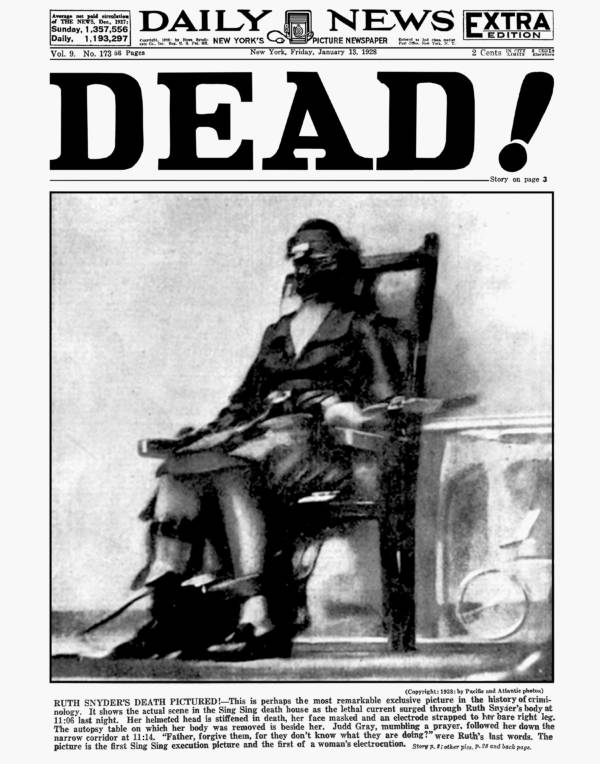
Tom Howard/NY Daily News Archive via Getty ImagesThe front page of the New York Daily News the day after Ruth Snyder’s execution.
At least, not until the photo of Ruth Snyder’s execution appeared the next day in the New York Daily News.
The first and only person to be photographed dying in the electric chair, Snyder’s final moments had been captured by Tom Howard, a photographer from the Chicago Tribune who had been enlisted by the New York Daily News. Howard, hired by the New York paper in the hopes that the prison staff would not recognize a journalist from out of town, had hidden the camera on his ankle. He was able to capture the infamous photo of Snyder’s execution by using a trigger attached to a wire that ran up his pant leg.
It was a stunning end to the story of Ruth Snyder, whose brutal murder of her husband had filled tabloid pages for months — and would later inspire the classic noir film Double Indemnity.
The Life And Crimes Of Ruth Snyder, The Woman Found Guilty Of Murdering Her Husband

Wikimedia CommonsRuth Snyder took out a double indemnity life insurance policy on her husband, which would double the payout of he died by accident, suicide, or murder.
By 1925, Ruth Snyder was deeply unhappy in her marriage. Not only was Snyder’s husband allegedly still in love with his late fiancée, but he also spent more time drinking than he did with Snyder or their nine-year-old daughter. That summer, Snyder met a corset salesman named Henry Judd Gray — and embarked on a passionate extramarital affair.
Two years later, Snyder and Gray decided to run away together, and according to Smithsonian Magazine, they planned to fund their new life by taking out a life insurance policy on Snyder’s husband. Snyder took out a policy on her husband for $45,000 (more than $800,000 today) and included a “double indemnity” clause which meant the policy would pay double if he died “by misadventure.” This could include suicide, an accident — or murder.
Then, on March 20, 1927, they put their plot into action. Snyder and Gray murdered Snyder’s husband by hitting him with the weight from a window sash, forcing chloroform-soaked cotton up his notes, and strangling him with a picture frame wire. Then, Snyder called the police and claimed that “two giant Italians” had violently broken into their home in Queens, New York.

Public DomainHenry Judd Gray, Ruth Snyder’s lover and accomplice, who was also sentenced to death.
But their story quickly fell apart. Though Snyder claimed that the “Italians” had burgled their home, the “suspects” had left behind her husband’s gold pocket watch. And though she said that the killers had tied her up, the police found it suspicious that they’d tied only her feet, but not her hands.
Under pressure, Snyder and Gray cracked — and turned on each other. Both were arrested, found guilty of first degree murder, and sentenced to death.
The Grisly Story Behind The First Photograph Of An Execution By Electric Chair
The press coverage of Ruth Snyder’s crime, trial, and death sentence became a media circus. Tabloids published lurid — and often false — details in a bid to outdo each other, and Snyder was described as a “synthetic blonde murderess,” the “Ice Matron of Queens Village,” and as “a shallow-brained pleasure-seeker, accustomed to unlimited self-indulgence, which at last ends in an orgy of murderous passion and lust.”
And as the date of her execution approached, the New York Daily News plotted a way to beat them all: by getting a photo of Ruth Snyder in the electric chair. But this was easier said than done.

Lewis Lawes Papers, Special Collections, Lloyd Sealy Library, John Jay College of Criminal Justice/CUNY Ruth Snyder, seen here at Sing Sing prison, became the center of a media firestorm after she was found guilty of murdering her husband.
There were two primary obstacles: cameras were not allowed in the execution chamber at Sing Sing prison and the prison staff would recognize anyone working for the Daily News. So, as Time reports, the newspaper quietly hired Tom Howard, a photographer for the Chicago Tribune.
On the date of Ruth Snyder’s execution, Jan. 12, 1928, Howard filed into Sing Sing prison alongside roughly two dozen other people. The guards did not recognize him, and they did not notice the camera he’d hidden at his ankle.
Then, he waited. As The New York Times reported at the time, Snyder was brought to the execution chamber at 11 p.m. Crying and praying, she was strapped into the electric chair as 24 witnesses, including Howard, looked on. At 11:01, the chair’s electric current was activated.
By 11:04, Ruth Snyder had gone still. A doctor examined her body and stated: “I pronounce this woman dead.”
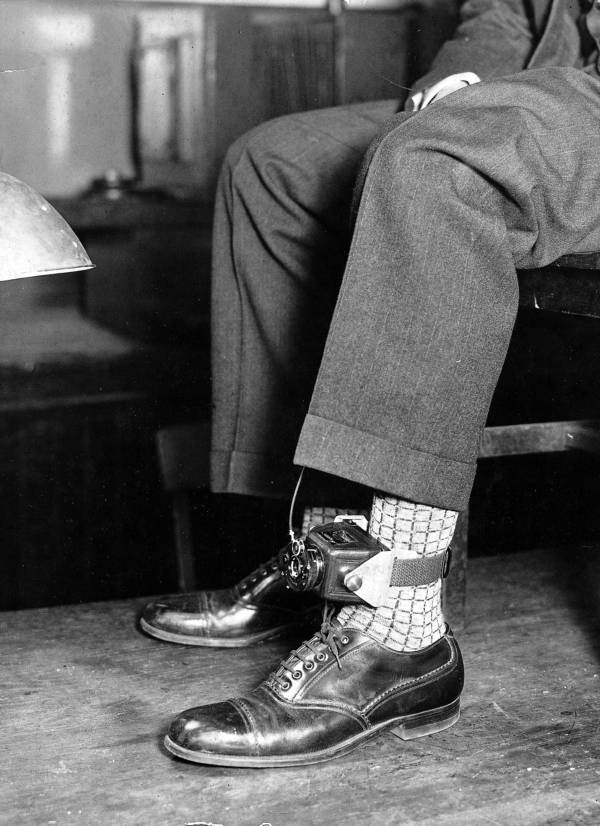
NY Daily News Archive via Getty Images
Tom Howard’s ankle camera.
With their attention on the scene before them, no one seemed to have noticed Howard as he photographed the dying woman.
The Chilling Photograph Of Ruth Snyder In The Electric Chair
The next morning, the New York Daily News ran Howard’s photo of Ruth Snyder on the front page, alongside the headline “DEAD!”
The paper sold out in minutes.
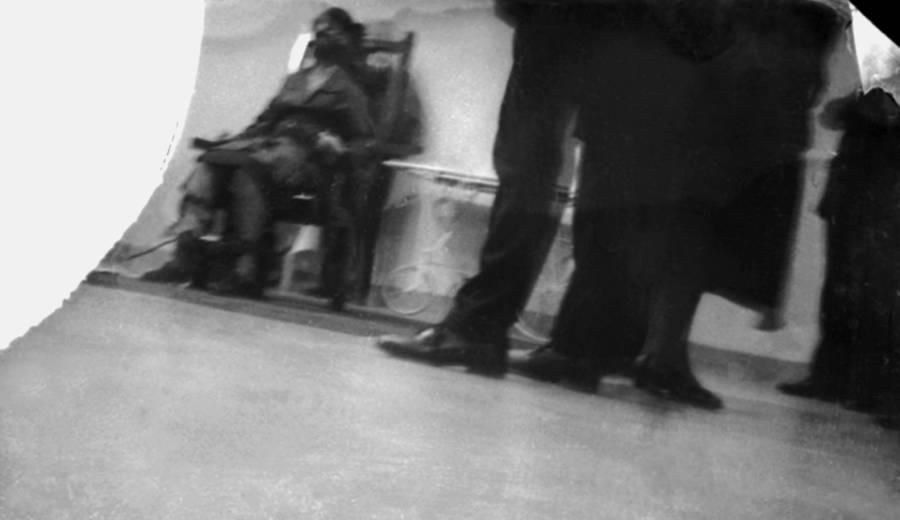
Tom Howard/NY Daily News Archive via Getty ImagesTom Howard’s original photo.
Howard’s photo, for which he earned $100 — almost $2,000 today — was scandalous. Though the first execution by electric chair had taken place almost forty years earlier, Snyder was the first person to be photographed while dying in the electric chair. And no one has been photographed dying by the electric chair since — even though Gray was executed the same night.
Indeed the photo, which was controversial from the beginning, remains so today. It showed the reality of the electric chair in grisly detail, and made Snyder’s death into yet another tabloid story. Many took issue with the graphic nature of the photo, and the fact that it depicted a human being — even one who had been found guilty of murder — in her dying moments.
For decades after, anyone attending an execution was thoroughly searched before they were allowed in the room – with attention paid to pant legs.
After learning about Ruth Snyder and the first picture of an electric chair execution, discover the chilling story of Martha Place, the first woman to be executed by electric chair. Or, go inside the death of Ted Bundy, the infamous serial killer who was executed by electric chair in 1989.
The post The Chilling Story Of Ruth Snyder, The First And Only Person Ever Photographed Dying In The Electric Chair appeared first on All That's Interesting.
]]>The post Why Ellie Nesler Was Hailed As A Hero For Shooting A Man In A California Courtroom appeared first on All That's Interesting.
]]>
Pillar Point Studios/YouTubeEllie Nesler, the California mother who killed the man accused of molesting her son in 1993.
On April 2, 1993, Ellie Nesler walked into a small courtroom in Jamestown, California, and shot Daniel Mark Driver, the man who was accused of sexually assaulting her young son.
Driver died at the scene, and people across the nation initially praised Nesler for her vigilantism. Driver was already a convicted child molester when he allegedly assaulted Nesler’s son and several other boys at a church camp. According to Nesler’s supporters, she had simply taken justice into her own hands.
But as Nesler stood trial for murder, it was revealed that she had been under the influence of methamphetamine at the time of the shooting. Public opinion soon turned against her.
Ellie Nesler ultimately spent three-and-a-half years behind bars for manslaughter — but shortly after her release, she was arrested once more for selling meth. And her son, William, was later convicted of murder after stomping a man to death. This is the family’s controversial story.
Ellie Nesler’s Life Before The Shooting
Before she became a national headline, Ellena “Ellie” Starr Nesler was a working mother from California’s Gold Country. She married young, got divorced, and then met Bill Nesler, a local coal miner and crop-duster. They had a son, William, before moving to Liberia so Bill could seek gold. While there, Ellie gave birth to a daughter named Rebecca.
When civil war broke out in the late 1980s, Ellie returned to California with her children while her husband remained in Africa. Back in Tuolumne County, Nesler supported her family through welfare and odd jobs. Then, she was introduced to Daniel Mark Driver, a seemingly devout Christian.

Find a GraveEllie Nesler as a teenager in California.
Ellie’s sister, Jan Martinez, had the idea to send their children to the church camp where Driver worked as a dishwasher. When Nesler expressed doubts about Driver, as reported by the Stockton Record in 1997, Martinez told her, “Don’t be ridiculous… he packs a Bible. He’s into God.”
But Ellie Nesler was right to be suspicious. In 1983, Driver had been convicted of child molestation, but he spent just a few months behind bars. However, Nesler didn’t know this, so she agreed to send seven-year-old William to camp.
Shortly after he returned, William began acting strange. According to the Los Angeles Times, he eventually told Martinez that Driver had done “nasty things” to him. But he begged her not to tell anyone, because “Danny said he would kill me and my sister and mom if I told.”
In 1989, Nesler filed a complaint alleging that Driver had molested William and three other boys at camp. But by then, Driver had fled. He was finally arrested in late 1992 or early 1993. His preliminary hearing was set for April 2, 1993 — and young William would have to testify.
The Shooting Of Daniel Mark Driver
On the morning of Driver’s hearing, William Nesler began vomiting because he was so anxious to face his abuser. Ellie was already upset, but when Driver walked into the courtroom, he reportedly “smirked” in her direction — and Nesler became enraged.
As Driver took his seat, Nesler pulled a gun out of Martinez’s purse and shot him five times in the back of the head. He died almost instantly.

Tesera EntertainmentA dramatic reenactment of Daniel Mark Driver’s death from the 1999 movie Judgment Day: The Ellie Nesler Story.
Two days later, Martinez told The New York Times, “She wouldn’t have done it if he didn’t have that cocky look in the beginning.”
Nesler was immediately taken into custody, and during a police interview later that day, she told officers, “The man is sick. He deserved to die. Maybe I’m not God, but I’ll tell you what, I’m the closest damn thing to it.”
Ellie Nesler was charged with murder, and while many people decried her vigilante justice, others saw her as a hero. She received thousands of letters from supporters, who donated $40,000 toward her legal fees. A local waitress told The New York Times that Jamestown residents were saying that Nesler “deserves a medal and they want to be on the jury so they can let her go.”
But soon, information came out that turned public opinion against her.
Ellie Nesler’s Complicated Legal Saga
In the months leading up to her trial, Nesler admitted that she’d “done crank” before Driver’s hearing, and a blood test showed that she had methamphetamine in her system at the time of the shooting. But while this dulled the initial support for Nesler, it didn’t have a significant legal impact.
At her trial in August 1993, Nesler pleaded not guilty by reason of insanity. While the jury didn’t agree, they did convict her of voluntary manslaughter rather than murder.
Nesler was sentenced to 10 years in prison, but she ultimately spent just three-and-a-half years behind bars, partly because she’d been diagnosed with breast cancer. She was released in 1997, but just four years later, she was arrested again.
In October 2001, Nesler gave methamphetamine to an informant. A few days later, she purchased 10,000 tablets from him. She pleaded guilty to the drug charges and was sentenced to an additional six years in prison.
While she was serving her time, her son was facing his own legal battles. In June 2004, 23-year-old William Nesler allegedly stole tools from David Davis. When Davis confronted Nesler in front of three police officers, Nesler punched him and was imprisoned for battery.

California Department of Corrections and RehabilitationWilliam Nesler, still behind bars for murder, in 2025.
The very day he was released from jail, Nesler attacked Davis again, viciously stomping his head. Davis died from his injuries, and Nesler was convicted of first-degree murder. In 2005, he was sentenced to at least 28 years in prison.
The following year, Ellie Nesler was released. But her cancer had returned, and she passed away in 2008 at age 56.
In her final days, Nesler expressed some guilt about her actions — but not because Driver was dead. As her daughter, Rebecca Nesler, told the Los Angeles Times in 2005, she once told her mother that she had “saved a lot of boys” by killing Driver.
“Yes,” Ellie replied, “but I didn’t save my own.”
After learning about Ellie Nesler and the courtroom killing of Daniel Mark Driver, go inside some of history’s most notorious acts of vigilante justice. Then, discover the story of Marianne Bachmeier, the mother who shot her daughter’s killer in the middle of his trial.
The post Why Ellie Nesler Was Hailed As A Hero For Shooting A Man In A California Courtroom appeared first on All That's Interesting.
]]>The post This Painting Was Purchased At An Estate Sale In Michigan For $30. It Just Sold At Auction For $1.3 Million appeared first on All That's Interesting.
]]>
Freeman’sGertrude Abercrombie’s 1951 painting Alderman Merriam’s Shells was rediscovered in 2025 when it was bought at an estate sale for $30.
When a collector was browsing the offerings at a picked-over estate sale in Kalamazoo, Michigan in 2025, he ended up coming across an interesting looking painting and bought it for $30. Since identified as a 1951 work from American surrealist Gertrude Abercrombie entitled Alderman Merriam’s Shells, that painting, just sold at auction for $1.3 million.
Not only did this figure wildly surpass the auction house’s pre-sale estimate of $200,000, it also represents a record-breaking price for the work of Abercrombie, whose reputation in the global art world has grown immeasurably over the last decade.
“As happy as we are to have recaptured the record sale price for an artist we have long championed, we are even happier for our eagle-eyed consignor who saved this masterpiece,” said Zack Wirsum of Freeman’s auction house in a recent statement.
How Gertrude Abercrombie’s Alderman Merriam’s Shells Was Rediscovered
Gertrude Abercrombie created this 8×11-inch oil painting in late 1951. At the time, Robert Merriam was alderman of the fifth ward of Chicago, which included Hyde Park, the neighborhood where Abercrombie lived for most of her life. The pair were acquainted at the time, and he lended her shells from his collection as references for her painting.

Freeman’sThe back of the painting has a note from when John T. Reynolds loaned it to exhibitions in 1952 and 1953.
Soon after the painting was complete, Abercrombie gave it to Dr. John T. Reynolds of Kalamazoo, Michigan as a form of payment for a medical operation he performed on her in early 1952. Reynolds loaned the work for exhibition at several galleries in New York, Chicago, and Milwaukee.
A Chicago Tribune article about one of Abercrombie’s exhibitions featured Alderman Merriam’s Shells along with several others. Describing her painting style in the article, Abercrombie said, “I’m not interested in complicated or commonplace subjects. Instead, I like to paint simple things that are a little strange.”
Alderman Merriam’s Shells falls in line with this description, as it features nine simple, realistic shells, yet they’re arranged in strange positions, as one seems suspended above a dark void.

The Chicago TribuneA Chicago Tribune article from the early 1950s featured an image of Alderman Merriam’s Shells.
While on exhibition and in Reynold’s possession, the painting was offered for sale between 1952 and 1953 for prices ranging from $50 to $150. But nobody bought the painting, and Reynolds kept it in his home until his death. It was only rediscovered at his estate sale in 2025, nearly 75 years after Abercrombie originally painted it.
The man who found it at the estate sale, a collector of records and vintage furniture, described the sale as “picked over” by the time he arrived.
The painting was stashed in a back hallway of the residence, near the garage. The finder barely made out its inscription: “abercrombie ’51.” Being familiar with Abercrombie’s work, the man bought the painting and excitedly went on his way.
He then felt compelled to bring the painting to the Milwaukee Art Museum, which was conducting an Abercrombie survey. The exhibition catalog actually had a historical photograph of the shells painting, which led the owner to ask for help from Susan Weininger, an Abercrombie expert, who confirmed that the painting was indeed the original Alderman Merriam’s Shells.
Why Gertrude Abercrombie Eventually Became A Big Name In The Global Art Scene
Born in 1909, Gertrude Abercrombie was a self-taught artist who grew up in Chicago and attended the University of Illinois at Urbana-Champaign, where she majored in Romance languages. She did drawing work in the advertising business and for Sears, but by the beginning of World War II, she began to focus on painting.

The Chicago TribuneGertrude Abercrombie said that she liked to paint simple things, but in a strange way.
Her work quickly gained positive attention from critics, and Abercrombie got her first one-woman show at the Chicago Art Institute in 1944.
In the early 1950s, Abercrombie was at her most productive, completing painting after painting, at least in part due to financial concerns.
Abercrombie had been married to a lawyer named Bob Livingston, but that ended in 1948. She then married Frank Sandiford, who had been a small-time criminal and worked in a record store. Because Abercrombie’s financial situation had thus changed, she needed to produce many small paintings, which she sometimes made into pins and brooches. These were sold at local art fairs to help cover basic living expenses.

Archives of American Art, Smithsonian InstitutionGertrude Abercrombie’s reputation in the global art world grew immeasurably following an exhibition of her works in 2018.
Soon enough, however, Abercrombie became the “Queen of Chicago,” hosting many artists and intellectuals from across the Midwest in her Hyde Park brownstone.
By 1951, the year she completed Alderman Merriam’s Shells, she was already well-known in the neighborhood, and was frequently spotted out and about while wearing a peaked hat that famously made her look like a witch. Between that and her friendships with jazz musicians like Dizzy Gillespie and Charlie Parker, Abercrombie became known to many as the “jazz witch.”
It wasn’t until 2018 that Abercrombie’s work was exhibited to a global audience. Since then, she has assumed her place as a titan of American surrealism, with 80 of her paintings having now sold for more than $100,000 at auction — with the recent $1.3 million sale the crown jewel of the bunch.
After reading about the Gertrude Abercrombie painting that sold for $1.3 million at auction after being bought at an estate for $30, take a look at these 40 photos of stunning street art from around the world. Then, read the true stories behind nine allegedly haunted paintings.
The post This Painting Was Purchased At An Estate Sale In Michigan For $30. It Just Sold At Auction For $1.3 Million appeared first on All That's Interesting.
]]>The post 33 Stunning Photos Of Old Penn Station, Once An Architectural Marvel Before It Was Demolished appeared first on All That's Interesting.
]]>Before New York City's Pennsylvania Station became the busiest transit hub in the country — and one of the most reviled train stations in America — it was a classic example of beautiful Beaux-Arts architecture and the fourth largest building in the world.
Now, decades after it was demolished and rebuilt to be completely underground, New York's plans to restore the former architectural landmark are underway. Take a look at Penn Station's complicated past.
The Old Penn Station

Getty ImagesThe interior inside Penn Station nearby the information booth.
Before it was reduced into the confusing underground labyrinth that it is now, Pennsylvania Station — simply referred to as Penn Station these days — was an architectural marvel. The old Penn Station was built in 1910 after it was commissioned by the Pennsylvania Railroad Company (PRC) as a means for commuters to get across the Hudson River without jumping on a ferry.
The project was supposed to be another impressive feat of engineering by the PRC which billed itself as "the standard railroad of the world" in the early turn of the 20th Century. During the construction of the original building, Penn Station stretched over eight acres of land in Manhattan, making it a prominent landmark in the city.
But more impressive was the design inside. The main waiting room of the old Penn Station was modeled off of the Roman Baths of Caracalla, and was the biggest indoor facility New York City had ever had.
The majestic structure featured a striking marble ceiling that hovered above commuters at 148 feet high, accentuating its classic Beaux-Arts design. The stately train station also featured pink granite, a grand staircase 40-feet wide, and a dignified colonnade outside with iron-and-glass roofs that hanged over the train platforms.

Ralph Morse/The LIFE Picture Collection via Getty ImagesCrowds lining up for seats in Penn Station.
The magnificent architectural features of old Penn Station was the brainchild of Charles McKim, who came from a prolific firm known for its Gilded Age designs. Besides drawing inspiration from the Ancient Roman baths, McKim also sought his ideas from the grandeurs of European landmarks.
The colonnaded exterior of Penn Station, for example, was modeled off Gian Lorenzo Bernini's Piazza San Pietro and John Soane's Bank of England building.
Back then, Penn Station wasn't just a train station, it was considered a state-of-the-art transportation facility, too.
The main reason behind the station's construction was to provide a more efficient way for commuters across the river to get into Manhattan.

Geo. P. Hall & Son/The New York Historical Society/Getty ImagesAn arcade and drug store inside the station.
Because there was no other way to cross the Hudson without getting on a boat, passengers would have to go through the hassle of transiting off the trains which stopped at the edge of the Hudson river. They would need to board and disembark again at the port before taking the ferry across.
"They were met with total chaos at the busy port, which was unacceptable to the Pennsylvania Railroad, which was determined to get across the river," said historian Jill Jonnes during a panel about the station's history at the Museum of the City of New York.
To realize their ambitions to tunnel under the river, the PRC enlisted English engineer Charles Jacobs, who had already constructed other tunnels the city's East River, to spearhead the construction. After they succeeded, Penn Station became one of the greatest engineering feats of its time.
Demolishing A Landmark

Walter Daran/Hulton Archive/Getty ImagesProtesters marching with placards outside Penn Station with signs that read 'Don't Poison Penn' and 'Don't Amputate Renovate.'
Sadly, however, the novelty of Penn Station's grandeur wore off and reality set in. The train boom that the Pennsylvania Railroad Company had been banking on, which would have driven revenue from the stream of passengers commuting through the newly built station, did not come to fruition.
Though the old Penn Station served 100 million passengers yearly during its peak in 1945, more people were being drawn by the affordable air travel industry that began in the late 1950s. The Interstate Highway System also made it easier to commute on land without hopping on a train. These trends in traveling habits among the public had a drastic impact on the amount of train passengers commuting through Penn Station.
In the end, the PRC was unable to afford the upkeep of Penn Station's beautifully-designed structure and corridors, so they were keen to find a way to get it off their hands while making a little bit of money. The PRC knew they could make big money by selling the air rights above the station which ultimately led to the old Penn Station's demise.
In 1962, plans were revealed to demolish the terminal and build Madison Square Garden on top of it. The new design made the train station entirely underground, meaning there was no need for the stately architecture above it, leaving the PRC free to make a little bit of money off Madison Square Garden's construction.

Robert R McElroy/Getty ImagesCommuters were still able to go through the station during its three-year dismantling.
The decision drew between 150 and 200 picketers in front of Penn Station to protest the structure's demolition, collecting signatures for a petition against the station's leveling. Most of the protesters were from the Action Group for Better Architecture which was formed by a band of designers and architects after the Penn Station demolition plans were made public.
The New York Times even called the structure's intentional dismantling a "monumental act of vandalism." Regardless, the station's demolition began a year after the plans were first announced.
The intentional destruction of the old Penn Station left a bad taste among the city's architectures who believed that the train hub should have been saved as part of New York City's architectural heritage. But not all was lost.

Wikimedia CommonsBefore it was demolished in 1962, the old Penn Station was a majestic architectural landmark.
The protest against Penn Station's demolition, though relatively small, was enough to spark the architectural preservation movement in the U.S.
The Landmarks Preservation Commission (LPC) was formed largely due to the loss of the original Penn Station. The New York Landmarks Law was also passed three years following Penn Station's demolition. Indeed, that law helped save the Grand Central Terminal and more than 30,000 other buildings from similar fates.
Penn Station, Resurrected

FlickrNow, Penn Station serves 650,000 commuters daily.
Ironically, train ridership in and out of the city through Penn Station has grown tremendously since the fall of the old transit hub.
Once considered an unnecessarily expensive endeavor, Penn Station — the new station constructed completely underground — is now the busiest terminal in the country. Today, nearly 650,000 commuter rail and Amtrak riders commute through the station each day, making its modern maze design completely inadequate to herd passengers between corridors efficiently.
"Penn Station is un-New York. It is dark, it is constrained, it is ugly, it is dated architecture, it is a lost opportunity," New York Governor Andrew Cuomo said of the newer Penn Station. "Frankly it is a miserable experience... It is a terrible impression" of New York, he continued.

David Handschuh/NY Daily News Archive via Getty ImagesModern Penn Station is the busiest train station in the country, yet it is also one of the worst in terms of accommodating volume of commuters.
To rectify this, the state government has proposed to rebuild Penn Station — well, kind of.
As of September 2018, part of the historic James A. Farley Post Office, located right across from the old Penn Station to complement the station's old Beaux-Arts style structure, has been gutted and remodeled to make way for New York's new Moynihan Train Hall.
The billion-dollar project will have the new train hall connect with the current underground Penn Station, providing passengers with new entrance points to the station, more tracks, and a larger space for the commuter crowds.

New York Governor's OfficeThe state is in the midst of an ambitious project to build new entry ways into the underground station to alleviate passenger congestion.
As part of this overhaul, construction will also be done along the city's 33rd Street to build a grand entrance into Penn Station. The station entrance will lead to a spacious sun-lit pedestrian plaza that stretches between Seventh to Eighth Avenues.
Then Governor Andrew Cuomo said that the new Penn Station entrance was part of a holistic effort to transform it into a "world-class" facility — not unlike the original structure that had been built over a century ago before it was leveled to dust. The entirety of the Moynihan Train Hall was completed in 2020.
Although the new Penn Station plans are not exactly Romanesque architectural feats, they will certainly provide passengers with a better experience than they are subjected to now going through the historic train station.
Now that you've learned all about Penn Station's complicated history, get a glimpse of old New York before the skyscrapers in 39 vintage photos. Then, read about six other historical train stations from around the world.
The post 33 Stunning Photos Of Old Penn Station, Once An Architectural Marvel Before It Was Demolished appeared first on All That's Interesting.
]]>The post The Extraordinary Story Of Unsinkable Sam, The Ship’s Cat That Allegedly Escaped Three Sinkings During World War 2 appeared first on All That's Interesting.
]]>
Public DomainGeorgina Shaw Baker’s 1940s portrait of Unsinkable Sam.
In 1941, most newspapers were filled with reports of the latest World War II battles and casualty lists. But that November, a remarkable story emerged about an unexpected figure: a black-and-white cat dubbed Unsinkable Sam.
The lucky feline — whose real name was Oscar — was found floating amidst the wreckage of the HMS Ark Royal after it was destroyed by a torpedo. He’d been traveling on the vessel as a ship’s cat, and he was rescued by British sailors.
But as Oscar’s story made headlines, it began to transform. Some sailors claimed that the cat had also survived the sinking of the German battleship Bismarck and the HMS Cossack, earning him the nickname Unsinkable Sam.
While these stories have never been confirmed, Unsinkable Sam served as an inspiration for millions during one of history’s darkest eras — and his portrait is held in the collections of the National Maritime Museum to this day.
The Alleged German Origins Of Unsinkable Sam
The Kriegsmarine, the naval forces of Nazi Germany, launched the battleship Bismarck in February 1939, just seven months before the Third Reich invaded Poland and kicked off World War II. By 1941, the ship was stationed in the North Atlantic Ocean to disrupt the merchant ships carrying supplies from North America to Britain.
Aboard the Bismarck was a crew of around 2,200 men, and it’s said that among them was the black-and-white cat that would soon become known as Unsinkable Sam.

Public DomainAccording to legend, Unsinkable Sam was rescued alongside other survivors of the Bismarck in May 1941.
The Bismarck was destroyed on May 27, 1941, following an intense three-day battle against the British Royal Navy. Only about 115 of the ship’s passengers survived the sinking — including the cat.
Did Unsinkable Sam Really Survive Three Shipwrecks?
As the legend goes, sailors on the British destroyer HMS Cossack pulled the creature from the ocean and named him Oscar (sometimes spelled Oskar as a nod to his German origins), since the “O” flag is the international maritime symbol for “Man Overboard.”
But five months later, the Cossack suffered a disaster of its own when it was hit by a German torpedo. The ship was towed toward Gibraltar, but the damage was too extensive. Thankfully, the crew — including Oscar — was able to evacuate the vessel before it sank.
Oscar was then purportedly transferred to the HMS Ark Royal — where he faced death yet again. On Nov. 13, 1941, the Ark Royal was struck by a German torpedo, too. The crew abandoned ship, and in the chaos, Oscar was found floating on a plank. In his 1957 book Ark Royal: The Life of an Aircraft Carrier at War, William Jameson wrote that the cat was “angry but quite unharmed.”

Public DomainUnsinkable Sam was found floating in the water as the HMS Ark Royal sank in November 1941.
Newspapers soon picked up the story of “Unsinkable Sam,” but his tale varied by source. Some papers didn’t mention the Bismarck or Cossack at all, while the Belfast Telegraph reported in December 1941 that Oscar had indeed been a ship’s cat on the Bismarck but hadn’t been on board the Cossack when it was struck. That version of the story emerged in a later article.
However, Oscar may not have been on the Bismarck at all. There are no official records of his presence on the ship, and the few surviving crew members reportedly didn’t remember a cat on board.
There’s also the issue of Oscar’s supposed appearance. Newspapers printed photos of different cats they claimed were Unsinkable Sam. One showed a tabby cat, while a later story pictured a cat named Simon from the HMS Amethyst.

National Museums LiverpoolSome newspapers claimed this photo pictured Unsinkable Sam, but it’s actually a ship’s cat named Simon.
Still, there does seem to be one legitimate photo of Oscar that was printed in the Belfast Telegraph. It matches the pastel portrait of Unsinkable Sam created by Georgina Shaw Baker that is now held by the National Maritime Museum.
So, although there is reason to be skeptical of the tale of Unsinkable Sam, there is also reason to believe it.
The Remarkable Stories Of Other Maritime Cats
Oscar certainly wasn’t the first “able seacat.” As long as ships have been sailing the seas, cats have been brought on board for pest control purposes. There is evidence that ancient Egyptians carried felines along maritime trade routes, and even the Vikings seemingly brought feline companions on voyages.
A 2025 study found that the earliest known domestic cats in North America died in a shipwreck off the coast of Florida in 1559. And a tabby named Mrs. Chippy accompanied Ernest Shackleton on his 1914 expedition to Antarctica.
During World War II, many ships carried cats, both to serve as mousers and to entertain the troops. There was Convoy, the lovable feline on board the HMS Hermione who slept in a miniature hammock that the sailors crafted for him. And Simon — the black-and-white cat often mistaken for Unsinkable Sam — served on the HMS Amethyst in the late 1940s.

Public DomainConvoy the cat sleeping in a hammock on the HMS Hermione in 1941.
Simon was found wandering the streets of Hong Kong by a British seaman, who smuggled him onto the Amethyst. He became the ship’s mascot, but in 1949, he was badly wounded when a Chinese vessel opened fire on the Royal Navy sloop.
He miraculously survived, and he was awarded the Dickin Medal, also known as “the animals’ Victoria Cross.” He remains the only cat in history to receive the award. Sadly, Simon contracted a virus while in mandatory quarantine before entering the United Kingdom, and he died in November 1949.
Unsinkable Sam’s story had a much happier ending. According to the Royal Museums Greenwich, after he was rescued from the HMS Ark Royal, he was taken to the offices of the governor of Gibraltar. He then headed to the United Kingdom, where he found a home at a “Sailors’ Rest” in Belfast.

Belfast TelegraphUnsinkable Sam with his new owner in Belfast after surviving at least one — and potentially three — shipwrecks.
As the Belfast Telegraph reported in 1941, “All cat owners will realise that since then it has been necessary to issue an order confining Oscar to barracks because fond though he may be of sailor men… Oscar’s knowledge of the district would not be sufficient to bring him home should he wander far afield.”
Oscar’s new mistress described him as “winsome and affectionate,” and the newspaper noted that while “he may be a prisoner… he is undoubtedly happy and content.” Indeed, Unsinkable Sam remained happily in the home until his death in 1955 around age 15.
Now that you’ve learned about the unbelievable tale of Unsinkable Sam, look through 30 vintage photos of animals fighting in wars. Then, discover the stories of 11 dogs who earned the title “man’s best friend.”
The post The Extraordinary Story Of Unsinkable Sam, The Ship’s Cat That Allegedly Escaped Three Sinkings During World War 2 appeared first on All That's Interesting.
]]>The post Kouri Richins Killed Her Husband With A Fentanyl-Laced Cocktail — Then Wrote A Children’s Book About Grief appeared first on All That's Interesting.
]]>
Summit County Sheriff’s OfficeKouri Richins, the Utah mother who was convicted of killing her husband by lacing his Moscow Mule with a lethal dose of fentanyl.
In the early morning hours of March 4, 2022, Kouri Richins called 911 after finding her husband unresponsive in bed. She claimed that he’d had a shot of alcohol and a THC gummy before going to sleep, but a medical examiner later discovered that Eric Richins had overdosed on fentanyl.
In the wake of Eric’s death, Kouri played the part of the grieving widow. She even published a children’s book about grief called Are You with Me? But just two months after the book was released, Kouri was charged with her husband’s murder.
Prosecutors alleged that she had given Eric a fentanyl-laced cocktail on the night of his death. They also presented evidence that she had previously tried to poison him — after opening several life insurance policies in his name.
Kouri Richins was found guilty of murder and sentenced to life in prison without the possibility of parole. This is the disturbing story of her sinister plot to kill her own husband.
The Death Of Eric Richins
From the outside, Eric and Kouri Richins seemed like a happy Utah couple. Eric ran a successful masonry business, and Kouri was a real estate agent and house flipper. They had three young sons, and in 2022, they were approaching their 10th wedding anniversary.
But things weren’t as they seemed. Kouri was deeply in debt, and Eric had consulted with a divorce attorney and secretly changed his will to make his sister the beneficiary.
What’s more, Eric was suspicious of Kouri after several strange incidents. During a trip to Greece in 2019, Eric had fallen ill after sipping a drink that Kouri handed to him. And on Valentine’s Day 2022, he had eaten a sandwich that Kouri left on his truck seat alongside a love note, only to break out in hives. Eric later told his business partner that he thought his wife was trying to kill him.

Kouri Richins/Facebook Kouri Richins purportedly tried to kill her husband, Eric Richins, on at least two occasions before she fatally poisoned him in 2022.
Then, on the night of March 3, 2022, Eric and Kouri were supposedly celebrating a successful real estate transaction when Kouri made him a Moscow Mule containing a lethal dose of fentanyl. By the time she called 911 to say that he was “cold to the touch,” he was gone.
Kouri told the police that Eric had previously been addicted to painkillers, so his death didn’t seem particularly suspicious. But as investigators uncovered the events leading up to that night, it became clear that Kouri Richins wasn’t as innocent as she appeared.
Why Did Kouri Richins Kill Her Husband?
An investigation revealed that Eric and Kouri Richins were having problems for years prior to Eric’s death. In October 2020, Eric had met with a divorce attorney. At that time, he established a trust for his children and cut Kouri out of his will, naming his sister as the sole beneficiary instead.
What’s more, according to Utah station KPCW, Kouri took out four life insurance policies on Eric without his knowledge between 2015 and 2017. They totaled nearly $2 million.

Utah Department of CorrectionsKouri Richins was convicted of aggravated murder, attempted aggravated murder, insurance fraud, and forgery in March 2026.
When Kouri discovered that Eric had removed her from his will — at a party she held the night after his death to celebrate the purchase of an investment property she’d closed on that very day — she was “enraged.” She punched Eric’s sister and was charged with assault.
And after Kouri Richins was arrested for Eric’s murder in May 2023, prosecutors revealed that Richins was having an affair with a man named Robert Josh Grossmann. According to CNN, she texted him just two weeks before Eric’s death saying, “I do want a future together. I want you… If he could just go away and you could just be here! Life would be so perfect!!!”
All of this information alone didn’t necessarily point to murder — but Kouri’s purchase of fentanyl pills in the weeks leading up to Eric’s death raised even more suspicions.
The Evidence Against Kouri Richins
As reported by CNN in 2026, a woman who cleaned the Richins’ house testified that she sold Kouri Richins fentanyl pills on four occasions in early 2022.
Carmen Lauber told the court, “She’d called me and asked me if I could reach out to somebody for some pain meds for an investor that she knew.” Lauber gave Kouri one batch of fentanyl shortly before Valentine’s Day. A few days later, Kouri asked for more, claiming that the pills weren’t strong enough.
A medical examiner later determined that Eric Richins had five times the lethal dose of fentanyl in his system when he died.

East Idaho News/YouTubeKouri Richins in court just before learning that the jury found her guilty of murder.
“One or two pills might be accidental,” Summit County Chief Prosecutor Patricia Cassell said at Kouri Richins’ trial, according to CBS News. “Twenty — or five times the lethal dose — is not accidental. That is someone who wants Eric dead.”
In addition, prosecutors searched the internet history on Kouri’s phone and found inquiries for “what is a lethal dose of fentanyl” and “luxury prisons for the wealthy.”
The case was chilling — and it was made even more disturbing by the book Kouri published just a month before her arrest.
In March 2023 — exactly one year after Eric Richins’ death — Kouri Richins released a children’s book titled Are You with Me? It was meant to help children cope with grief.
Kouri told KPCW that she wrote it about her husband “because [her kids were] going through the sadness of knowing that he’s not here, presently.” Texts later reportedly revealed that Kouri had hired a ghostwriter for the book.

Amazon Digital Services, LLCKouri Richins’ children’s book, Are You with Me?, which was published just two months before her arrest.
With all of this evidence laid out in front of them, a jury found Kouri Richins guilty of her husband’s murder. In May 2026, she was sentenced to life in prison without the possibility of parole.
At her sentencing hearing, one of Eric and Kouri Richins’ sons wrote a statement that read: “You took away everything from me and my brothers. I don’t want you out of jail because I will not feel safe if you are out… I don’t want you to hurt anyone again.”
In response, Kouri stated, “As much as you’ve been influenced into thinking that Dad was murdered, that I took your dad from you, that is completely wrong. An absolute lie.”
While Kouri Richins continues to maintain her innocence, she will likely spend the rest of her life behind bars.
After learning how Kouri Richins murdered her husband with a fentanyl-laced Moscow Mule, go inside the story of Ashley Benefield, the ballerina behind the “Black Swan” murder. Then, read about Susan Wright, the “Blue-Eye Butcher” who fatally stabbed her husband and then claimed self-defense.
The post Kouri Richins Killed Her Husband With A Fentanyl-Laced Cocktail — Then Wrote A Children’s Book About Grief appeared first on All That's Interesting.
]]>The post How Jack McCall Murdered Wild Bill Hickok, One Of The Most Legendary Lawmen Of The Old West appeared first on All That's Interesting.
]]>
Public DomainJack McCall, the little-known drifter who fatally shot Wild Bill Hickok in 1876.
On Aug. 2, 1876, Jack McCall walked into a Deadwood saloon, approached Wild Bill Hickok from behind, and shot him in the back of the head. Hickok died instantly, and McCall was arrested for murder.
At an impromptu “miner’s trial,” McCall claimed that Hickok had previously killed his brother, so he’d shot him in revenge. McCall was acquitted, and he fled to Wyoming — but he wouldn’t remain free for long.
McCall may have gotten away with Hickok’s murder if he had lain low. But when he continued bragging about the crime, authorities in Wyoming decided to hold another trial. They claimed that the makeshift court in Deadwood had no real legal jurisdiction, so McCall’s acquittal wasn’t legitimate.
At his second trial, Jack McCall was found guilty. He was hanged on March 1, 1877, but his legacy as the man who took down one of the Wild West’s most legendary lawmen has made him a notorious figure in American history.
Who Was Jack McCall?
Historians know very little about Jack McCall’s life before he killed Wild Bill Hickok. He was likely born in Kentucky in the early 1850s, but as a young adult, he headed west to hunt buffalo.

Public DomainDeadwood, pictured here in 1876, hosted many notable Wild West figures, including Calamity Jane, Wyatt Earp, and Wild Bill Hickok.
By 1876, he’d made his way to Deadwood in the Dakota Territory. The town had emerged as a small mining camp after gold was discovered in the Black Hills in 1874, but it grew rapidly. By the time McCall arrived, the population exceeded 10,000, and the streets were filled with saloons, gambling halls, brothels, and other lawless businesses.
Another new Deadwood resident was Wild Bill Hickok, who rode into town in late July 1876. Wild Bill, whose real name was James Butler Hickok, had risen to fame on the frontier as a skilled soldier, lawman, and gunslinger.
While in Deadwood, Hickok took to playing poker at Nuttal & Mann’s Saloon No. 10. It was there, on the night of August 1, 1876, that Jack McCall joined Hickok’s table.

Public DomainWild Bill Hickok, the lawman and gunslinger who was murdered by Jack McCall in 1876.
Hickok, McCall, and several other men played poker for a while, but McCall eventually ran out of money. According to some versions of the story, Hickok offered to buy McCall breakfast and warned him not to gamble again until he’d recouped his losses. This seemingly offended McCall — and he returned to the saloon the following day to make his displeasure known.
The Murder Of Wild Bill Hickok
On August 2, 1876, Jack McCall walked back into Nuttal & Mann’s Saloon and ordered a drink from the bar. He spotted Hickok playing poker once more — but he wasn’t in his usual position. Hickok preferred to sit with his back to the corner so he could see any approaching threats, but another man had supposedly taken the seat by the time Hickok arrived. When he refused to switch spots, Hickok had to sit with his back to the door, instead.

Herndon Davis/Denver Public LibraryA drawing depicting the 1876 murder of Wild Bill Hickok.
This gave McCall the opportunity he was looking for. He walked up behind Hickok, pulled out his revolver, and fired a single shot at the back of the lawman’s head. Some reports claim that he shouted, “Damn you! Take that!” as he pulled the trigger.
Wild Bill Hickok fell dead instantly, and McCall ran out the door. He purportedly tried to jump onto a horse, but the saddle was loose, and he was apprehended after falling off.
The following day, Jack McCall faced a jury of various miners and local businessmen. Because the Dakota Territory hadn’t yet entered the Union, there was no formal legal system in place, so the trial was fairly informal. McCall testified that Hickok had killed his brother in Abilene, Kansas, several years earlier, so he’d shot Hickok to avenge his death.

South Dakota State Historical SocietyA photo purportedly depicting the trial of Jack McCall in Deadwood on August 3, 1876.
It’s unclear whether this is true, but the jury seemingly believed McCall, and he was acquitted. The decision wasn’t without controversy. According to Cowboys & Indians magazine, the Black Hills Pioneer reported on August 5, “Should it ever be our misfortune to kill a man… we would simply ask that our trial may take place in some of the mining camps of these hills.”
Jack McCall was a free man, but he feared for his safety in Deadwood, so he soon fled to Wyoming Territory. He hoped the change of location would save his life — but instead, it marked the beginning of his end.
A Second Trial For The Man Who Killed Wild Bill Hickok
Once he reached Wyoming Territory, Jack McCall grew bold. He began bragging about Hickok’s murder at various saloons, which angered local lawmen. Under United States law, nobody could be tried twice for the same crime — but Deadwood wasn’t necessarily under U.S. jurisdiction. Thus, the “miner’s trial” ruling couldn’t be enforced outside of the territory.

South Dakota Public BroadcastingA sketch of Jack McCall, who was around 23 when he killed Wild Bill Hickok.
A federal judge in the Dakota Territory determined that McCall could indeed be brought to trial again, and in December 1876, he faced a jury once more. This time, he claimed that he was intoxicated at the time of the shooting and didn’t remember anything about it. McCall was found guilty of murder and sentenced to death.
He tried to appeal, going so far as to petition President Ulysses S. Grant to commute his sentence. McCall even tried to escape from prison at one point, viciously beating a guard and making it through the front door before running into a U.S. marshal.
Despite these desperate attempts to evade justice, McCall’s execution was scheduled for March 1, 1877. That morning, he was led to the gallows in Yankton, Dakota Territory, and hanged in front of an estimated 500 onlookers. He was 24 years old.
As reported by the Boston newspaper The Pilot in March 1877, “McCall bore up with remarkable nerve, and at no time showed the slightest indication of giving way.” Indeed, as a marshal was putting the noose around his neck, McCall told him to “draw it tight, that there might be no mistake.”
Jack McCall was buried near Yankton, and when the cemetery was moved several years later, the men who the killer’s body purportedly found the noose still around his neck.

Deadwood Alive/FacebookWild Bill Hickok’s murder is such a major part of Deadwood’s history that actors stage popular a reenactment of Jack McCall’s trial in the town’s historic district each summer.
To this day, it’s unclear exactly why McCall killed Hickok. Perhaps the lawman really had shot his brother. Maybe Hickok’s poker advice offended him and he wanted payback. Or perhaps, as one witness allegedly claimed, Hickok had “snatched” a card from McCall’s hand, and he retaliated in a drunken rage.
Regardless of the true reason, the murder put Jack McCall’s name in history books alongside one of America’s most legendary figures — an unexpected legacy for a little-known Wild West drifter.
After learning about Jack McCall, the man who killed Wild Bill Hickok, read about some of the most notorious outlaws of the Old West. Then, go inside another infamous frontier shooting: the gunfight at the O.K. Corral.
The post How Jack McCall Murdered Wild Bill Hickok, One Of The Most Legendary Lawmen Of The Old West appeared first on All That's Interesting.
]]>The post ‘It Would Have Been Very Gruesome’: Researchers Just Proved That Egyptian Rulers Were Buried With Dozens Of Human Sacrifices appeared first on All That's Interesting.
]]>
American Geographical Society Library, University of Wisconsin-Milwaukee LibrariesThe royal tombs in Abydos were constructed 500 years before the Giza pyramids.
In Umm el-Qaab, a royal funerary complex in Abydos, ancient Egypt’s first pharaohs were laid to rest some 5,000 years ago — alongside dozens of their subjects. For decades, this burial arrangement puzzled archaeologists and historians, largely because many of these people seemed to have died at the same time, and it wasn’t a case of natural causes.
Over the years, researchers have theorized that these people were what’s known as retainer sacrifices: intentional killings of people close to the king so they can accompany him into the afterlife. Now, a forensic study of the skulls found at Abydos has finally confirmed this macabre theory.
The Discovery Of Subsidiary Burials At The Royal Tombs In Abydos
The tombs at Abydos were constructed in around 3000 B.C.E. by the first pharaohs of the newly-unified Egypt. These complexes contained royal tombs for the kings, as well as a network of chamber tombs plus other areas likely used for rituals. Furthermore, subsidiary graves surrounded those royal tombs and enclosures.
“Each subsidiary burial was a simple chamber in a row of dozens of others,” Dr. Roselyn Campbell, the author of the new study, said in a recent statement about her findings. “Some people had a simple coffin. Most people had a few grave goods, like ceramic vessels, and many graves also included small objects like copper tools, projectile points or small ivory figurines.”

Wikimedia CommonsEgyptologist Flinders Petrie could not prove his theory that the people buried in Abydos were sacrifices.
English Egyptologist Flinders Petrie first excavated these tombs in the 1920s, at the height of the Egyptomania craze. Needless to say, he was surprised to come across hundreds of smaller graves surrounding the royal ones. He found a few grave markers that had some official titles on them, mostly those of low-level officials and artisans. However, little other information was apparent.
Because it seemed unlikely to Petrie that so many subjects would die of natural causes at the same time, he theorized that they had actually all been victims of retainer sacrifice.
As Campbell notes, retainer sacrifice has long been practiced in many cultures due to “beliefs that the sacrificed individuals will continue to serve the ruler in some kind of afterlife,” but “some retainers might have volunteered to die to achieve eternal life or honor; others may have been chosen or even forced.”

Roselyn A. Campbell, Frontiers in Environmental Archaeology, 2026The subsidiary burials of those who were sacrificed surround the royal tombs within the funerary complex.
However, Flinders Petrie could not come up with any hard evidence of lethal trauma to the remains, and without any hard evidence, the case went cold.
How Modern Forensics Helped Confirm That The Umm el-Qaab Burials Were Human Sacrifices
However, Campbell’s new study published in the journal Frontiers in Environmental Archaeology appears to have finally solved the mystery.
Campbell attempted to reassess the remains found at the Umm el-Qaab burials by applying modern forensic analysis to the skulls.
“I was drawn to these retainers partly because, even though they were buried around royalty, they are mostly relegated to footnotes in the grander narrative,” Campbell said in the statement. “Who were these people and how did they view the ruler and their own role in his or her life and death?”
Flinders Petrie reburied most of the remains from the burials, but kept the skulls. Campbell analyzed 46 of those skulls, held in the Duckworth Collection at Cambridge University.

Wikimedia CommonsMore than a dozen skulls recovered from Umm el-Qaab came from people who were killed deliberately in a form of human sacrifice.
Ultimately, Campbell used modern forensics to uncover something that Flinders Petrie had missed a century before: 18 of the 46 skulls suffered from significant linear fractures that had initially been mistaken for naturally-occurring damage. Campbell’s study was able to identify them as injuries that had occurred before death.
Campbell discovered that these fractures likely resulted in a quick succession of unconsciousness followed by internal bleeding and then death. She also noted that there was evidence of sharp-force trauma on some of the skulls, including a “chopping injury” to one person’s eye and a “penetrative” injury to the side of another person’s head.
This new forensic evidence indicates that these individuals were deliberately killed via head trauma as a form of human sacrifice.
“This question of whether or not retainer sacrifice was practiced in Egypt has been debated for over a century, but this is the first study to examine the human remains from the tombs themselves,” Campbell told The Guardian.
Still, researchers were unable to determine what exact instrument was used to kill these people. According to the statement, linear fractures are typically caused by a flat, wide weapon — perhaps made of wood — but could also be caused by a fall.
For now at least, that aspect of this 5,000-year-old Egyptian mystery will remain unsolved.
After reading about these human sacrifices in ancient Egypt, learn about Sekhmet, the bloodthirsty, lion-headed goddess of war and healing in ancient Egypt. Then, discover the truth about how the pyramids were built.
The post ‘It Would Have Been Very Gruesome’: Researchers Just Proved That Egyptian Rulers Were Buried With Dozens Of Human Sacrifices appeared first on All That's Interesting.
]]>The post A Scientific Institution Called For New Inventions — So Benjamin Franklin Wrote A Letter Advocating For A Solution To Smelly Farts appeared first on All That's Interesting.
]]>
Philadelphia Museum of ArtA politician, inventor, and philosopher, Benjamin Franklin wrote the “Fart Proudly” essay as a satirical piece discussing the problem of flatulence.
Benjamin Franklin is known for many things. He was an inventor, a publisher, a philosopher, and one of the Founding Fathers. He was also the author of an essay known today as “Fart Proudly.”
The essay, which Franklin wrote as a joke in 1781, discussed the common problem of flatulence — and its odor. Ever the inventor, Franklin appealed for a solution for “the odiously offensive smell” that accompanied farts, and even proposed some possible solutions of his own.
This is the surprising story of Benjamin Franklin and his 1781 essay, “A Letter to a Royal Academy About Farting,” which is known today as “Fart Proudly.”
The History Behind Benjamin Franklin’s ‘A Letter to a Royal Academy About Farting’
By 1781, Benjamin Franklin was a busy man. After making his fortune in the printing business in the 1720s and 1730s, Franklin had become increasingly involved in politics and civic affairs. He’d long advocated for uniting the American colonies and, after helping to draft the Declaration of Independence, he became the minister to France. Franklin had his hands full, yet he managed to write a satirical essay on farting that year.
Franklin’s essay didn’t come out of nowhere. Rather, he was responding to the Royal Academy of Brussels, a prestigious European institution, which had recently offered a prize for scientific papers.

The White House Historical AssociationA portrait of Benjamin Franklin in 1767.
But Franklin — who had written satire since he was a teenager under the name “Mrs. Silence Dogood — decided to have some fun with his response. The result was “A Letter to a Royal Academy About Farting,” or “Fart Proudly.”
In it, the Founding Father discussed the problem of flatulence — and how the scientific community should come up with a solution.
Benjamin Franklin’s ‘Fart Proudly’ Essay
In Fart Proudly, Benjamin Franklin begins by applauding the Royal Academy of Brussels for seeking practical inventions, which, he remarks, “has not always been the case with all Academies.” As an inventor himself, Franklin believed strongly that inventions should serve a practical purpose.
“Permit me then humbly to propose one of that sort for your consideration, and through you, if you approve it, for the serious Enquiry of learned Physicians, Chemists, &c. of this enlightened Age,” Franklin wrote.

Public DomainThe Benjamin Franklin National Memorial at the Franklin Institute in Philadelphia, Pennsylvania.
His practical invention, Franklin continued, had to do with a problem that everyone on Earth had had at one point or another: flatulence.
“It is universally well known, That in digesting our common Food, there is created or produced in the Bowels of human Creatures, a great Quantity of Wind,” Franklin stated. “That the permitting this Air to escape and mix with the Atmosphere, is usually offensive to the Company, from the fetid Smell that accompanies it. That all well-bred People therefore, to avoid giving such Offence, forcibly restrain the Efforts of Nature to discharge that Wind.”
But this restraint, Franklin continued, could cause “Pain” as well as “future Diseases, habitual Cholics, Ruptures, Tympanies, &c. often destructive of the Constitution, & sometimes of Life itself.” In other words, Franklin warned that holding in farts could not only be painful, but fatal. (A gastroenterologist told MEL Magazine that death was a highly unlikely result.)

Public DomainBenjamin Franklin in 1782.
Franklin suggested that the Academy seek “some Drug wholesome & not disagreable, to be mix’d with our common Food, or Sauces, that shall render the natural Discharges of Wind from our Bodies, not only inoffensive, but agreable as Perfumes.” He suggested that perhaps “a little Powder of Lime (or some other thing equivalent)” could do the trick.
“In short,” he finished, “this invention, if compleated, would… [provide] universal and continual UTILITY [rendering all other proposals the Academy may receive] scarcely worth a FART-hing.”
The Silly Legacy Of The ‘Fart Proudly’ Essay
What did the Royal Academy of Brussels think of Benjamin Franklin’s “Fart Proudly” essay? Did anyone snicker at his final quip? We’ll never know, because Franklin did not send the essay. Instead, he shared it with friends.
In 1783, he passed it along to philosopher Richard Price, calling his “Fart Proudly” essay: “a jocular Paper I wrote some Years since in ridicule of a Prize Question given out by a certain Academy on this side the Water.”

Public DomainA depiction of Benjamin Franklin’s return to Philadelphia in 1785, four years after he wrote his “Fart Proudly” letter.
Today, Benjamin Franklin is far better known for other accomplishments aside from his “Fart Proudly” essay. In 1783, he helped negotiate the Treaty of Paris, which brought an end to the Revolution War, and he became an important advocate for the nascent U.S. Constitution in 1787.
By the time he died in 1790, he was remembered not only for his important role in creating the United States of America, but also for his many inventions — from the lighting rod to the bifocals — as well as his many witty sayings.
But “A Letter to a Royal Academy About Farting,” or “Fart Proudly,” is a small but important part of Benjamin Franklin’s legacy. He was a serious man living in a serious time. Yet he also found joy in humor, bawdiness, and satire. His essay on flatulence proves that Franklin was far more than the two-dimensional figure found in classical paintings or textbooks.
Rather, he was a full human being. In between practicing diplomacy and advocating for American independence, he found time to indulge lighter, more humorous subjects. Like many people today, he got a chuckle out of writing about flatulence — from its unpleasant odor to the risks of holding it in. And Benjamin Franklin used the considerable power of his pen to investigate the issue, one that still bedevils the world to this day.
After reading about the surprising history behind Benjamin Franklin’s “Fart Proudly” essay, discover the dark sides of some of America’s Founding Fathers. Or, go inside the complicated question of who wrote the U.S. Constitution.
The post A Scientific Institution Called For New Inventions — So Benjamin Franklin Wrote A Letter Advocating For A Solution To Smelly Farts appeared first on All That's Interesting.
]]>The post The Controversial Life Of Robert Wagner And His Troubled Marriage To Natalie Wood appeared first on All That's Interesting.
]]>
Public DomainRobert Wagner, pictured here in 1967, is best known for his roles in A Kiss Before Dying, The Pink Panther, Austin Powers, and the TV show Hart to Hart.
Robert Wagner spent more than seven decades in Hollywood, becoming one of the industry’s most recognizable leading men. He starred in dozens of films and television shows, including It Takes a Thief, Hart to Hart, and the Austin Powers movies, while his marriages to actresses Natalie Wood and Jill St. John kept him in the public eye.
But Wagner’s glamorous Hollywood life took a dark turn in November 1981, when his wife, Natalie Wood, disappeared from their yacht near Catalina Island off the coast of California.
Wood was found dead in the water the next morning. Her death was initially ruled an accident, but decades later, investigators reopened the case and began questioning what had actually happened aboard the yacht that night. Wagner was named a person of interest in the case, though investigators never charged him in connection with Wood’s death.
So what really happened between Robert Wagner and Natalie Wood? This is the story of the Hollywood star, his famous marriage, and the mystery that has followed him for the rest of his life.
The Rise Of Robert Wagner
Robert Wagner was born in Detroit in 1930, but he grew up in Los Angeles and began pursuing an acting career in the early 1950s. With his good looks and a polished screen presence, Wagner quickly found work in Hollywood and established himself as a leading man.

Public DomainRobert Wagner in a 1954 publicity portrait taken during the early years of his Hollywood career.
His first credited appearance was in the 1951 World War II film Halls of Montezuma, and he was soon cast in several more patriotic movies, like With a Song in My Heart and Stars and Stripes Forever. By 1952, he’d landed his first lead role in Beneath the 12-Mile Reef.
Throughout the 1950s and ’60s, Wagner made a name for himself in Hollywood with his roles in Prince Valiant, A Kiss Before Dying, and The Pink Panther. But his career really took off when he moved into television. In 1968, he began starring in It Takes a Thief, which ran through 1970. And in 1979, Wagner landed another starring role in the mystery series Hart to Hart, becoming a familiar face to TV audiences.
By that point, however, his personal life was nearly as famous as his acting career.

Public DomainRobert Wagner and Natalie Wood in 1960, during their first marriage.
In 1957, Wagner had married beloved actress Natalie Wood. Although they divorced in 1962 — purportedly due to jealousy and affairs — they eventually reunited and married again in 1972. By 1981, they were seemingly living together happily with their seven-year-old daughter, Courtney.
Then came one night that would change both of their legacies forever.
The Night Natalie Wood Disappeared
In November 1981, Robert Wagner and Natalie Wood were spending Thanksgiving weekend near Catalina Island aboard Wagner’s yacht, the Splendour. They were joined by fellow actor Christopher Walken — who was filming Brainstorm with Wood at the time — and the boat’s captain, Dennis Davern.
On the evening of Nov. 28, the group had dinner and drinks on shore. But once they returned to the yacht, tensions rose. Wagner was purportedly upset that Wood was giving Walken so much attention.

Steve Schapiro/Corbis via Getty ImagesRobert Wagner and Natalie Wood on the Splendour about five years before her mysterious drowning in 1981.
In his 2008 memoir, Pieces of My Heart, Wagner wrote that he’d had an argument with Walken about Wood’s career. Walken thought that she should take on more films, while Wagner believed that she was already spending too much time away from her family.
As Wagner recalled in his memoir, “At one point I picked up a wine bottle, slammed it on the table, and broke it into pieces. Natalie was already belowdecks at that point… The last time I saw my wife she was fixing her hair at a little vanity in the bathroom while I was arguing with Chris Walken. I saw her shut the door. She was going to bed.”
Wagner stayed up for a while longer chatting with Walken and Davern, and when he went to bed, he realized that both Wood and the yacht’s dinghy were missing.

Los Angeles Public LibraryThe Splendour during the investigation into Natalie Wood’s death.
Robert Wagner reported Natalie Wood missing around 1:30 a.m. on Nov. 29. Several hours later, searchers found her body roughly a mile from the Splendour. She was wearing a red down jacket, a flannel nightgown, and socks. Her blood alcohol level was later measured at 0.14 percent.
Natalie Wood’s death was ruled an accidental drowning. The prevailing theory was that Wood had fallen into the water while trying to secure the dinghy closer to the yacht so it wouldn’t bang against the hull as she slept. For years, that was the official explanation.
But Wagner was the last person known to have seen Wood alive, and he had argued with her before she disappeared. That would eventually make his account of the night a central part of the investigation.
Robert Wagner’s version of events was generally accepted until 2000, when Dennis Davern came forward with a different story than the one he’d initially told investigators. As Davern explained to Vanity Fair at the time, Wood and Wagner were “fighting like crazy… I’d never in a million years seen them fight like that before. I just couldn’t believe it.”

Los Angeles Public LibraryDennis Davern, the captain of the Splendour who has implied that Robert Wagner played a role in Natalie Wood’s death.
Davern claimed that he heard Wagner and Wood walk toward the dinghy, and it sounded as if someone were untying the smaller vessel. Then, everything went silent, and Wagner returned to the yacht’s bridge “tousled, sweating profusely, as if he had been in a terrible fight, an ordeal of some kind.”
Around 1:30 a.m., Wagner said he was going to check on Wood and then returned to announce that she was missing. When Davern tried to turn on the floodlights and search for Wood, Wagner allegedly told him not to because he didn’t want to disturb the other boats around them.
Davern’s story continued to evolve, and by 2011, he was openly stating that Robert Wagner was responsible for Natalie Wood’s death. The police reopened the case — and eventually named Wagner a person of interest.
Did Robert Wagner Play A Role In Natalie Wood’s Death?
After the investigation into Natalie Wood’s death began anew, a review of Wood’s 1981 autopsy raised additional questions.
She had bruises on her right forearm, left wrist, and right knee, as well as a scratch on her neck and a scrape on her forehead. It is possible that these injuries occurred when Wood fell into the water and struggled to get into the dinghy. However, investigators questioned whether some of the bruises may have already formed before she entered the water.

Public DomainRobert Wagner started dating actress Jill St. John three months after Natalie Wood’s death, and they have been married since 1990.
Wagner maintained that Wood’s death was an accident and denied any role in her disappearance. But in 2013, a coroner changed Wood’s cause of death from “accidental drowning” to “drowning and other undetermined factors.”
While Robert Wagner is no longer considered a person of interest today due to a lack of evidence, Wood’s death continues to follow him. He’s not just a legendary film and TV star anymore — he’s inextricably enmeshed in one of the biggest mysteries in Hollywood history.
After learning about Robert Wagner’s career and relationship with Natalie Wood, read about the tragic deaths of nine Hollywood stars. Then, go inside the allegedly cursed productions of 11 movies.
The post The Controversial Life Of Robert Wagner And His Troubled Marriage To Natalie Wood appeared first on All That's Interesting.
]]>The post Melting Ice In Southern Norway Just Revealed Dozens Of Prehistoric Arrows Dating As Far Back As 6,000 Years appeared first on All That's Interesting.
]]>
Secrets of the IceResearchers excavating Norway’s glaciers discovered 48 prehistoric arrowheads.
Archaeologists in Norway just made a series of astonishing discoveries while exploring the Jotunheimen mountains about 200 miles northwest of Oslo. In all, researchers recovered 48 prehistoric arrows from the melting ice, including one that dates as far back as 6,000 years.
Not only is this discovery significant because of what it could reveal about how prehistoric people hunted in Norway several millennia ago, but also because of how it lays bare the staggering effects of climate change on the region’s glaciers.
The Prehistoric Treasures Revealed By Melting Ice In Southern Norway
The archaeologists behind these new finds are part of Secrets of the Ice, the world’s most prominent glacial archaeology program, which has been investigating this region of Norway since 2006.

Espen Finstad/Secrets of the IceThe team has been excavating the region for 20 years, and they’re increasingly discovering older and older artifacts.
Over the course of those 20 years, the program, which is a collaboration between the Innlandet County Council and Oslo’s Museum of Cultural History, has found more than 5,000 artifacts across 73 archaeological sites.
The finds include hunting equipment like bows and arrows that have served as evidence of ancient reindeer hunting, as well as objects from everyday life like shoes. Meanwhile, there’s also been no shortage of weapons, ranging from arrows to Viking swords.
These objects are often made from organic materials like wood and leather that typically break down over time. However, the ice helps prevent decay.
“What makes finds from ice patches so special is the preservation of organic materials such as wood, hide, sinew and textiles,” the researchers said. “Frozen in time in the ice, they give us an exceptionally detailed glimpse into the past.”

Åsa Rommetveit Celius/Secrets of the IceThe oldest find from the newly-uncovered haul was this slate arrowhead that dates back at least 5,000 years.
This excavation season, archaeologists worked on ice patches near the Langfonne, Storfonne, and Handklefonne glaciers of Kvitingskjolen mountain.
As described in a recent statement from Secrets of the Ice, the oldest find from the season was an arrowhead made of slate, spotted among gravel and resting on a boulder. The arrowhead, found along with two fragments of its shaft, dates back to somewhere between 5,000 and 6,000 years ago.
Other significant finds included a 3,000-year-old arrow that was recovered fully intact along with a wooden shaft. This arrowhead, surprisingly enough, was made from a freshwater mussel shell. Meanwhile, some of the other newly-unearthed arrowheads were made out of everything from bone to iron.

Secrets of the IceResearchers found one arrowhead made from freshwater mussel shell.
While these discoveries are thrilling for researchers, they’re also a grim reminder of the effects of climate change.
How Climate Change Is Revealing Older And Older Relics From Underneath The Ancient Ice
When archaeologists started surveying the Jotunheimen mountains in 2006, most of their finds dated back less than 2,000 years. But now, due to human-caused climate change, many of the glaciers and ice patches they had been exploring are melting, unveiling older and older artifacts in the earlier layers of ice that sit beneath the newer ones.
“For thousands of years, ancient ice has safely preserved unique objects from the past,” wrote Secrets of the Ice in their new statement. “In many places, ice that has survived for thousands of years is now beginning to disappear completely. And this is where we see the connection: The oldest ice contains the oldest finds.”
So, although these discoveries can provide new insights into the lives of those traveling and hunting in these glaciers during the Bronze and Stone Ages, they also show how ancient ice is becoming a thing of the past.

Åsa Rommetveit Celius/Secrets of the IceIce that has been around for thousands of years is now melting at a faster rate than ever before due to climate change.
“We have always acknowledged this contradiction and the reality behind our work,” Espen Finstad, a lead archaeologist with Secrets of the Ice, told the news site Science Norway. “But this is the first time it has truly affected us on an emotional level. This year, there was a much deeper sense of seriousness and sadness.”
The artifacts from the recent excavation will be stored at the Norwegian Mountain Center and exhibited in a refrigerated display. Then, in December, they will undergo more conservation processes at the Museum of Cultural History.
As the ice of Jotunheimen’s glaciers continues to melt over the coming decades, archaeologists will have a tighter and tighter window in which to recover ancient artifacts while they’re still protected by the ice.
“Only patches of ice remain where we once had large ice patches. It’s brutal,” Finstad told Science Norway. “And this year, that reality struck us more forcefully than ever before.”
After reading about the arrows unearthed in Norway, discover 11 of Earth’s most unbelievable prehistoric animals. Then, learn how melting ice on Mount Everest is revealing bodies of fallen climbers.
The post Melting Ice In Southern Norway Just Revealed Dozens Of Prehistoric Arrows Dating As Far Back As 6,000 Years appeared first on All That's Interesting.
]]>The post Archaeologists In Egypt Just Found A 1,900-Year-Old Ring Depicting The Lighthouse Of Alexandria appeared first on All That's Interesting.
]]>
C. Gerigk/F. Goddio/Hilti FoundationArchaeologists in the Eastern Harbor of Alexandria discovered a rare bronze ring engraved with an image of the Lighthouse of Alexandria.
Excavations taking place in the Eastern Harbor of Alexandria, Egypt have recently recovered pottery and glass artifacts, as well as a rare bronze ring emblazoned with an image of the Lighthouse of Alexandria. Egyptian officials said that this was the first time that the lighthouse, one of the Seven Wonders of the Ancient World, was found depicted on a ring of this kind.
The Lighthouse of Alexandria, built in the third century B.C.E., was lost in the beginning of the 14th century, following a series of earthquakes. But now, with this ring in hand, archaeologists could perhaps gain fresh insights into the story of the ancient world’s most impressive tower.
The Discovery Of An Ancient Ring Depicting The Fabled Lighthouse Of Alexandria
The finds were announced on social media by the Egyptian Ministry of Tourism and Antiquities, and the work is being done by the European Institute of Underwater Archaeology and Egypt’s General Department of Underwater Archaeology.

C. Gerigk/F. Goddio/Hilti FoundationThis rare ring was found in the waters near Antirhodos, the now-sunken island that once housed the ancient royal palace of Alexandria.
This current excavation season covers four main points of interest located in the Eastern Harbor, in the Mediterranean just off the northern coast of Egypt. These sites include the Temple of Isis, the palace on the royal island of Antirhodos, a nearby obelisk, and the Timonium, or Palace of Antony.
So far, this season’s finds span from the fourth century B.C.E. to the fourth century C.E. Archaeologists have recovered tableware, vessels, bottles, oil lamps, and pieces of glass vessels, but most noteworthy is surely the ring.
This rare relic came from excavations around Antirhodos, in the grand royal harbor of Alexandria (named for Alexander the Great), known as Portus Magnus.
The image of the lighthouse carved into the ring was meant to be used as a seal that would leave an impression on wax or clay when pressed into it. Such rings were used for administrative and economic tasks, like sealing correspondences, validating official documents, or closing up jars carrying goods like wine or olive oil.

Wikimedia CommonsThe Lighthouse of Alexandria operated for centuries before gradually falling apart throughout the Middle Ages.
Dr. Hisham El-Leithy, the Secretary-General of the Supreme Council of Antiquities, said that this is the first time that archaeologists have discovered a seal ring with a depiction of the Lighthouse of Alexandria.
El-Liethy added that the seal image resembles other depictions of the lighthouse seen on coins unearthed by archaeologists that date to the second century C.E., which thus may be the era in which the ring was made.
What This Find Could Reveal About The Lighthouse, One Of The Ancient World’s Seven Wonders
The lighthouse once loomed more than 300 feet tall — around the height of a modern 40-story building — above the island of Pharos in order to guide ships to shore and help captains avoid shipwrecks at night.

Wikimedia CommonsThe lighthouse disappeared after a series of earthquakes in the early 14th century, but its ruins were eventually discovered in the 1900s.
Though estimates vary, the lighthouse took at least a decade — and perhaps as many as three — to complete. It wasn’t finished until the reign of Ptolemy II, who ruled from 284 to 246 B.C.E.
The lighthouse certainly added to the rich vitality of Alexandria, which also contained the tomb of Alexander the Great, the Museum of Alexandria (a classical center of learning), the Serapeum temple, and the Library of Alexandria, said to be the ancient world’s greatest repository of knowledge.
However, like so many of Alexandria’s ancient landmarks, the lighthouse was eventually destroyed. During the Middle Ages, especially during one event in 956 C.E., earthquakes caused cracks in the structure, then subsequent earthquakes in 1303 and 1323 brought the tower tumbling down.
In 1994, archaeologist Jean-Yves Empereur, who founded the Center for Alexandrian studies, discovered the actual, physical remains of the lighthouse in the waters off Pharos Island. And, in 2025, archaeologists continued pulling blocks of it out of the harbor.

CEAlex/GEDEON ProgrammesIn 2025, blocks from the famed lighthouse were recovered from the Eastern Harbor.
Now, more research must be done to confirm the presumed purpose of the newly-uncovered ring. Divers are continuing to explore the four sites in the Eastern Harbor, and, once those are finished, they will begin new excavations in Abu Qir Bay.
After reading about this bronze ring with an image of the Lighthouse of Alexandria, discover the stories of 13 incredible sunken cities from history. Then, go inside the chilling mystery of the Flannan Isles Lighthouse.
The post Archaeologists In Egypt Just Found A 1,900-Year-Old Ring Depicting The Lighthouse Of Alexandria appeared first on All That's Interesting.
]]>The post Ishi, The ‘Last Wild Indian’ Who Entered Modern Society — Then Died From Tuberculosis Five Years Later appeared first on All That's Interesting.
]]>
Public DomainIshi, the California Yahi man who was known as the “last wild Indian.”
In 1911, a starving Native American man walked out of the wilderness near Oroville, California. He wouldn’t speak his own name, but anthropologists referred to him as Ishi.
Ishi was seemingly the last surviving member of the Yahi tribe, a subgroup of the Yana people who once lived near the Sierra Nevada Mountains of California. Most of the Yahi had been killed by settlers in the 1860s in a series of massacres that only Ishi and a dozen others survived.
Ishi was taken in by anthropologists at the University of California, Berkeley, who introduced him to modern society while learning as much as they could about his lost culture. But tragically, Ishi’s time with them wouldn’t last long.
By 1915, Ishi had contracted tuberculosis. He died on March 25, 1916, bringing an end to the story of the “last wild Indian.”
The Massacre That Wiped Out The Yahi People
On Jan. 24, 1848, James W. Marshall found gold at Sutter’s Mill near Coloma, California, sparking the gold rush that brought some 300,000 hopeful prospectors west.
The population of San Francisco — a fledgling township in 1848 — grew from 1,000 to 25,000 in just two years. The supply ships that carried the growing city’s goods unloaded and then sat abandoned in the harbor; their crews had fled to search the hills for ore.
This influx of settlers forever changed the way of life for the Indigenous tribes who had lived in California for centuries. Their traditional hunting and fishing grounds were disturbed by the mining process. Game vanished, and fish died in the polluted water supplies.

UC Berkeley, Phoebe A. Hearst Museum of AnthropologyIshi demonstrating how to make a salmon harpoon. 1914.
The newcomers also brought diseases that were unfamiliar to Native American immune systems, such as smallpox and measles. The tribes tried to fight back, but they were no match for the settlers’ guns.
These afflicted groups included the Yana and Yahi, who lived in the foothills of the Sierra Nevada Mountains. By the time Ishi was born — sometime between 1860 and 1862 — the Yahi population had fallen to less than 400.
Then, in 1865, settlers began slaughtering the Yahi people. After the Three Knolls Massacre, only a few dozen Yahi remained, including Ishi and several members of his family. They fled deeper into the wilderness, where they remained in hiding for decades.
Ishi Emerges From The Wilderness
In 1908, a group of surveyors came across Ishi with his uncle, mother, and another Yahi woman. They fled once more as the men destroyed their home and stole their supplies.

UC Berkeley, Phoebe A. Hearst Museum of AnthropologyIshi often demonstrated how his people made weapons, built fires, and hunted.
Three years later, Ishi emerged from the wilderness near Oroville, California. He was alone and starving. The last remaining members of his family had died, and he was seemingly the final Yahi man alive.
As former Oroville chief of police Ad Kessler recalled in a 1971 interview, he was called to the scene, where he handcuffed Ishi. “Ishi smiled,” Kessler said. “I thought he would be a little objecting, but he was smiling. I took his other wrist and I tied them together to put the handcuff on. Ishi, he smiled and… he was just tickled to have those bright [handcuffs].”
Ishi was eventually taken to anthropologists at the University of California, Berkeley. In Yahi culture, nobody can speak their own name unless they are first introduced by another member of their tribe. Because there was nobody left to reveal Ishi’s true name, the anthropologists referred to him as “Ishi,” the Yahi word for man.

UC Berkeley, Phoebe A. Hearst Museum of AnthropologyIshi standing next to a traditional Yana house that he built. 1912.
The media soon dubbed him the “last wild Indian,” and researchers set out to learn what they could about his people. It wasn’t a complete picture. Ishi, after all, had been born as the Yahi were already dying out, and many traditions had been lost.
Still, Ishi taught them Yahi stories and songs, and he demonstrated how to make arrowheads and other weapons. According to the University of California, San Francisco, anthropologist T. T. Waterman noted that Ishi’s “gentlemanliness… lies outside of all training and is an expression of inward spirit.”
Ishi lived in an old law school building in San Francisco, where he worked as a janitor. Visitors would flock to the campus on weekends to watch Ishi make tools, shoot arrows, and build fires according to his customs.

UC Berkeley, Phoebe A. Hearst Museum of AnthropologyIshi (front left) at the Orpheum Theatre in San Francisco to see British performer Lily Lena. 1912.
The anthropologists also introduced Ishi to modern society, taking him to musical performances and other events. However, this also introduced Ishi to illnesses to which he had no immunity, and he spent weeks at a time in the hospital with various ailments. Then, in 1915, he was diagnosed with tuberculosis.
The Death Of Ishi, The ‘Last Wild Indian’
On March 25, 1916, Ishi died from tuberculosis in a California hospital around age 55. His last words to Saxton Pope, a doctor who had befriended Ishi and often went hunting with him, were allegedly, “You stay. I go.”
Anthropologist Alfred Kroeber told Pope that it was against Yahi tradition to perform an autopsy, as the body of the deceased needed to remain intact. However, Pope performed one anyway per hospital policy.

UC Berkeley, Phoebe A. Hearst Museum of AnthropologyAnthropologist Alfred Kroeber and Ishi, circa 1911.
Ishi’s brain was then preserved, while his body was cremated with a bow and arrows, acorn meal, shell bead money, tobacco, and obsidian flakes. His brain was sent to the Smithsonian Institution, and his remains were buried in a California cemetery.
In 2000, as reported by SFGATE at the time, the Smithsonian returned his brain to members of the Redding Rancheria and Pit River tribes, who trace their ancestry back to the Yana people. It was then interred with his remains in a new location.
In recent years, there has been some debate over whether Ishi was truly the last Yahi man. Steven Shackley, a research archaeologist at the Hearst Museum of Anthropology, told the Berkeleyan in 1996 that Ishi likely had Wintu or Nomlaki blood in addition to Yahi heritage.

UC Berkeley, Phoebe A. Hearst Museum of AnthropologyOne of the final photos of Ishi taken before his death in March 1916.
“Arrowpoints made in the historic Yahi sites excavated by the Department of Anthropology in the 1950s and housed at the museum are quite different from Ishi’s products,” Shackley said. “But tools and arrowpoints made at historic Nomlaki or Wintu sites also housed at the museum bear striking resemblance to those made by Ishi.”
“[I]t appears he was not the last purely Yahi Indian,” Shackley continued. “This makes Ishi’s story even more romantic and sad. Being of mixed blood, he is an example of the cultural pressure the Anglos placed on the dwindling number of Indians in the mid- to late-1800s to marry their enemies.”
Regardless of Ishi’s true background, he remains a symbol of the loss of Native American culture and the struggles his people faced in California and beyond.
After learning about Ishi, look through 44 colorized photos of Native Americans. Then, discover the stories of nine overlooked Native American women.
The post Ishi, The ‘Last Wild Indian’ Who Entered Modern Society — Then Died From Tuberculosis Five Years Later appeared first on All That's Interesting.
]]>The post The Chilling Crimes Of Béla Kiss, The Hungarian World War 1 Soldier Who Murdered Nearly Two Dozen Women appeared first on All That's Interesting.
]]>
Public DomainBéla Kiss, the Hungarian soldier who murdered at least 24 people in the early 20th century.
In 1916, police officers in Cinkota, Hungary, made a horrific discovery on the property of a local tinsmith named Béla Kiss: the corpses of one man and 23 women. They were stuffed into metal drums, and several had puncture wounds in their necks and the blood drained from their bodies.
Kiss had seemingly begun his killing spree in 1903. He lured victims in by posting advertisements in the newspaper posing as a lonely widower in search of a wife. When women responded, he would invite them over and then strangle them.
The police tried to track Kiss down, but there was a problem: He had been conscripted into the Austro-Hungarian Army in 1914 to fight in World War I. Military officials traced him to a hospital in Serbia, but when they went to arrest him, they discovered that he had placed the corpse of another soldier in his bed and fled.
Witnesses reported various sightings of Kiss over the following years, but none were ever confirmed. Some people believe that he died in combat, but others think that Béla Kiss changed his identity — and got away with murder.
The Disturbing Crimes Of Béla Kiss
Béla Kiss was born in Austria-Hungary around 1877, but little is known about his early life. As an adult, he moved to Cinkota, a town near Budapest, where he worked as a tinsmith.
According to some reports, he married a woman named Marie in the early 20th century. Their relationship purportedly ended when he discovered that she was having an affair with another man — and he murdered both of them and told the neighbors that she had left him to run away with her lover.
As early as 1903, Kiss was posting advertisements in local newspapers. Some offered his services as a matchmaker or fortune teller, while others claimed that he was a lonely widower in search of a companion. Dozens of women responded to these ads, but when they arrived at Kiss’ home, they were instead met by a vicious killer.

Public DomainBéla Kiss’ house in Cinkota, Hungary, where he carried out his vicious crimes.
Kiss strangled his victims before sealing their bodies in metal drums filled with alcohol. Neighbors noticed these barrels scattered across his property, and at one point, the police even questioned Kiss about them. But he simply told the officers that he was storing fuel ahead of the impending war in Europe.
Béla Kiss’ housekeeper, a woman named Mrs. Jakubec, knew that her employer frequently corresponded with a variety of women, but she rarely interacted with them and didn’t notice anything particularly suspicious.
When World War I broke out in 1914, Kiss was conscripted into the Austro-Hungarian Army. He left his property under the care of Jakubec — and she never could have expected that she would soon find herself in the middle of a gruesome investigation.
How The Police Uncovered The Crimes Of Hungary’s ‘Vampire’ Serial Killer
While Bella Kiss was away at war, his landlord, Márton Kresinszky, came to his house to carry out some renovations. While there, he noticed the metal drums and decided to peek inside one. He pried the lid off with Kiss’ neighbor, Béla Takács.
They were met with a horrific odor. According to the Hungarian outlet Index, the newspaper Az Újság reported at the time: “Inside the first barrel, they found the decomposing corpse of a woman — distorted beyond recognition — with thick, golden-blonde hair.”

Public DomainThe metal drums that held the corpses of Béla Kiss’ victims.
The men immediately alerted the police, who ultimately uncovered 23 more bodies on Kiss’ property.
Some of Béla Kiss’ victims had puncture wounds in their necks, and the blood had been drained out of their bodies — suggesting that he had practiced vampirism on their corpses. He soon became known as the “Vampire of Cinkota.”
One of the barrels held the body of a woman named Margit Tóth, a 37-year-old hotel cook who had vanished in April 1906 after visiting Kiss. When Tóth’s friend came to Kiss’ home looking for her a few days later, Kiss reportedly said that Tóth left after they had an argument.
During the course of the investigation, detectives learned that a former neighbor had heard screams and strange gurgling sounds coming from Kiss’ property on three separate occasions in 1906 and 1907, but he seemingly never reported the incidents.

Public DomainMargit Tóth, one of Béla Kiss’ early victims.
Investigators also entered a locked room that Kiss had purportedly told Jakubec never to open. Inside, they found Kiss’ correspondence with more than 70 women alongside books about poison and the occult. Through these letters, they learned that Kiss seemingly targeted victims who had no close relatives so nobody would report them missing. He’d also convinced many women to send him money by promising them marriage.
The police immediately notified the Austro-Hungarian Army, ordering officials to arrest Kiss if he was still alive. Several months later, Károly Nagy, the head of detectives in Budapest, received word that Kiss was being treated at a military hospital in Serbia. But when authorities arrived at the hospital, Béla Kiss was gone. In his bed was the corpse of another soldier.
What Happened To Béla Kiss?
Police forces across Hungary were alerted to keep an eye out for Béla Kiss, but while several sightings were reported, none were ever confirmed. Meanwhile, dozens of people came forward about long-lost loved ones, concerned that they may have been victims of Hungary’s “vampire” serial killer.
Someone purportedly spotted Kiss leaving the Times Square subway station in New York City in 1932, but after that, he was never seen again.

New York Public LibraryBéla Kiss was last seen in Times Square in 1932.
Some people believe that Béla Kiss faked his death and spent the rest of his life living under a false identity. Others think that he was actually killed during the war. There were rumors that he’d been imprisoned in Romania or fled to Turkey only to die of yellow fever. But, just like the alleged sightings, nothing was ever confirmed.
In the end, nobody knows what happened to Kiss. But his chilling crimes continue to haunt the people of Hungary, and his mysterious disappearance only adds another layer of horror to his macabre legacy.
After learning about the disturbing crimes of Béla Kiss, the “vampire” serial killer of Hungary, go inside the story of Elizabeth Bathory, Hungary’s “Blood Countess” who may be the most prolific female serial killer in history. Then, learn about the Angel Makers of Nagyrév, the Hungarian women who poisoned dozens of men and women in their small village.
The post The Chilling Crimes Of Béla Kiss, The Hungarian World War 1 Soldier Who Murdered Nearly Two Dozen Women appeared first on All That's Interesting.
]]>The post The Shadowy Story Of Operation Condor, The Covert Plot To Eliminate Political Dissidents Throughout South America appeared first on All That's Interesting.
]]>
Wikimedia CommonsOperation Condor ran for roughly a decade, but its impact is still felt to this day.
In the 1970s and 1980s, thousands of people in South America disappeared. They were men and women; young and old. The one thing they all had in common was that they were suspected left-wing activists, members of political parties or groups that had formed in response to their increasingly authoritarian, right-wing governments. They were victims of a covert, transnational plot known as Operation Condor.
Named after the vulture that soars over the Andes, Operation Condor involved eight South American military dictatorships — Argentina, Chile, Uruguay, Bolivia, Paraguay, Brazil, Peru, and Ecuador. The nations collaborated in a violent network that spanned four-fifths of the continent, and sought to eliminate political dissidents.
The governments worked together to send death squads throughout South America to kidnap, torture, and murder political exiles. While most victims disappeared forever, some of their stories have survived.
Indeed, much of what is known about Operation Condor today has been pieced together from international court cases, as well as the declassification of thousands of pages of U.S. intelligence — documents that reveal the United States’ quiet support of the South American operation.
This is the story of Operation Condor.
The Cold War Politics That Led To The Formation Of Operation Condor
As The Guardian reported in 2020, Operation Condor was born out of Cold War politics. In the 1960s, Argentinian Marxist revolutionary Ernesto “Che” Guevara set out to build a guerilla army to overthrow the forces of capitalism and imperialism in South America. A close ally of Fidel Castro, Guevara was killed in 1967 — but his vision of a Marxist revolution lived on.

PhotoQuest/Getty ImagesThe U.S. saw Ernesto “Che” Guevara’s plans for a Marxist revolution across South America as an existential threat.
The United States, fresh from the Cuban Missile Crisis, saw such a vision as an existential threat. As such, the Americans offered support as a series of right-wing military coups swept the continent.
As right-wing governments took control, many leftist activists and sympathizers fled their homelands. But they could not escape. As the Associated Press reported in 2016, these right-wing, military dictatorships came together in the early 1970s and made an agreement to exchange information on anyone suspected of being a leftist.

Wikimedia CommonsU.S. Secretary of State Henry Kissinger, shown here shaking Chilean dictator Augusto Pinochet’s hand in 1976, played a role in Operation Condor.
A short time later, in November 1975, representatives from Argentina, Bolivia, Paraguay, Chile, and Uruguay met in Santiago, Chile, where they founded the “Condor System.” Ultimately joined by Brazil, Ecuador, and Peru, this organization became known as Operation Condor. And it sought to do more than gather intelligence on political exiles — it sought to eliminate them.
How Operation Condor Operated Across Four-Fifths Of South America
The international network created through Operation Condor enabled the regimes to focus on the elimination of exiles; those who had fled their counties of origin yet were still perceived as a threat. At times, their families were also persecuted. And by 1978, eight South American countries were taking part in Condor, effectively creating a borderless region where right-wing dictatorships had free rein to inflict terror on thousands of victims.
In this way, Operation Condor enacted the same human rights violations that were already committed by the military regimes of each country — but made them possible transnationally.

Public DomainIn 1976, Jorge Rafael Videla became Argentina’s new president through a military coup.
The operation relied on a centralized database situated in Chile that streamlined all the intelligence collected about subversion in the region, and was upheld by Condortel, a secret and encrypted communications channel. Its operators oversaw the exchange of information, joint operations to arrest victims, and the transportation of victims from the country where they’d been arrested to their home country.
For almost a decade, until the early 1980s, Operation Condor would operate throughout South America. And though its exact number of victims is unknown, some estimates suggest that some 60,000 were killed.
Kidnapped, Disappeared, Tortured, And Murdered: The Harrowing Stories Of Operation Condor Victims
Though the aim of Operation Condor was to suppress a Marxist uprising, the regimes also violently repressed all forms of opposition, including teachers, students, journalists, and peaceful activists. And though methods differed from regime to regime, Operation Condor collectively perpetrated extrajudicial executions, kidnappings, forced disappearances, baby stealing, sexual violence, and torture.

plancondor.orgAgustín Goiburú Giménez, a Paraguayan doctor, was one Operation Condor’s victims.
According to a database compiled by the University of Oxford known as Plancondor.org, Operation Condor victim Agustín Goiburú Giménez was a Paraguayan doctor who was married with three children. He consistently denounced the Paraguayan regime and helped found the Movimiento Popular Colorado, an opposition party to the dictatorship of General Alfredo Stroessner.
Giménez fled from Paraguay, but could not outrun Operation Condor. In February 1977, he was abducted in broad daylight while in the city of Paraná, Argentina. Argentinian agents worked with Paraguayan agents, and the activist vanished.
He has not been seen since Easter 1977.
Other Operation Condor victims include Argentine poet, activist, and journalist Marcelo Ariel Gelman and his wife, María Claudia García Iruretagoyena, who was seven months pregnant at the time at the time of their abduction in 1976. According to The New York Times in 2011, Iruretagoyena was transferred to a clandestine detention center in Uruguay, where she gave birth to her daughter. The baby was placed in a basket, and left on the doorstep of a Uruguayan police officer.
Iruretagoyena was never seen alive again. Gelman’s body was later found inside a tank in a canal.

plancondor.orgOperation Condor victim María Claudia García Iruretagoyena has not been seen since the 1970s, and her husband was killed.
The stories of torture and kidnappings are endless. According to The Guardian, some victims were even drugged, tied to concrete blocks, and tossed into the sea from a helicopter.
The Fall Of The Covert Operation — And The Ongoing Fight For Justice
In the 1970s and 1980s, the South American military regimes remained in power, and true justice could not be achieved. However, evidence of Operation Condor was being quietly gathered.
In 1977, for example, a Uruguayan journalist named Enrique Rodriguez Larreta provided evidence of his own abduction and torture through Amnesty International in London; In 1979, American journalist Jack Anderson published a story in the Washington Post about the role Operation Condor had played in the 1976 assassination of Orlando Letelier — an outspoken opponent of Chile’s dictator Augusto Pinochet — in Washington D.C.

Wikimedia CommonsThe assassination of Orlando Letelier, an opponent to Pinochet, in Washington D.C. spurred public conversation about Operation Condor.
And as the right-wing regimes began to fall in the 1980s, more progress was made. In 1984, the Nunca Más (Never Again) report was published by Argentina’s National Commission on the Disappearance of Persons, which investigated the government’s violent systemic disappearing of people.
But as University College London professor Francesca Lessa, who is also involved in Plancondor.org, wrote for The Conversation in 2025, seeking justice was delayed due to “impunity laws” sanctioned by democratic governments in Argentina and Uruguay. The laws, made in 1986 and 1987, prevented proceedings against those accused of committing crimes as a part of a military dictatorship, and were intended to prevent further uprisings.

Wikimedia CommonsAugusto Pinochet, the former Chilean dictator, was arrested in 1998 for human rights abuses, including those done during Operation Condor.
In 1998, however, some justice was finally served when the former Chilean dictator Pinochet was arrested in London for human rights abuses — including those committed as a part of Operation Condor.
Although Pinochet was spared from court on medical grounds, Lessa’s research has tracked around 50 criminal trials related to Operation Condor since 1976. Around 40 of these trials have led to convictions, with over 100 people sent to prison.
The Legacy Of The Operation Condor And Its Lessons For The Future
Despite this justice being served, families of Condor victims have faced bureaucratic setbacks in the pursuit of holding regime officials accountable.
The transnational nature of Operation Condor has made justice extremely difficult to achieve. There is no fully-realized global criminal justice system, which significantly slows down the judicial process, forcing victims to navigate a web of national laws, international treaties, and human rights tribunal rulings.

Wikimedia CommonsMemorials for victims of authoritarian regimes have been erected across South America.
“The trouble with borders is that it is easier to cross them to kill someone than it is to pursue a crime,” Carlos Castresana, a prosecutor who has pursued Operation Condor cases and the dictators behind them in Spain, remarked to The Guardian.
And even now, with more and more public information about the years-long secret military persecution, the crimes committed during Operation Condor still haunt South America.
Fear of right-wing state terror remains, especially as many of the continent’s leaders have swung to right-wing populism.
But, those fighting for justice for Operation Condor victims in court believe doing so now will allow others to do the same in the future — if it comes to it.
“It would be presumptuous to claim that tyranny will stop because of this,” Pablo Ouviña, a prosecutor who led a trial in Buenos Aires, told The Guardian. “What we can show, however, is that if it does reappear, it will be probably be tried in court later on.”
After reading about Operation Condor, learn about the deadliest dictators in history. Then, look through these eight bizarre failed U.S. president assassination attempts.
The post The Shadowy Story Of Operation Condor, The Covert Plot To Eliminate Political Dissidents Throughout South America appeared first on All That's Interesting.
]]>The post How The Mighty American Chestnut Tree Vanished From Forests Across The United States appeared first on All That's Interesting.
]]>
Internet Archive Book Images/FlickrAn American chestnut tree in New York, circa 1900-1909.
From Florida’s panhandle to coastal Maine and across the Appalachians to the Mississippi River, the proud and mighty American chestnut tree once blanketed the eastern U.S.
As many as four billion chestnut trees created a massive canopy — and provided a home and food source for a complex forest ecosystem. Entire industries depended on the sprawling hardwood forest.
Then, in 1904, a biologist noticed a strange growth on a chestnut tree at the Bronx Zoo.
Within decades, nearly every American chestnut tree in the country died from the blight. But there’s still hope that this tree species could be revived.
The Proud History Of The American Chestnut Tree
For centuries, American chestnut trees provided shade, food, and building material. Calorie-dense and packed with antioxidants, chestnuts were a healthy food source and medicine for Indigenous people, and European settlers found that the sturdy, rot-resistant wood was good material for building furniture, fences, and even log cabins. According to the American Chestnut Foundation, some telephone poles and railroad ties made from American chestnut trees are even still in use today.

Brooklyn MuseumChestnuts roasting on an open fire were a staple of American winters – until a blight destroyed billions of American chestnut trees.
Indeed, the chestnut trees played an important role in every part of life. The Cherokees used its leaves to treat heart pain and heal sores; cattle and pigs grazed on chestnuts to fatten them up before the slaughter; and countless people were buried in chestnut wood caskets. Hawks roosted in the tree’s branches, and wild turkeys sheltered near the roots.
The trees were so abundant — at one point, there were four billion across the country — that their chestnuts were easily gathered. According to the Sierra Club, the chestnuts fell “in carpets half a foot thick” which people could gather by the handful. One railway station in West Virginia purportedly once shipped 155,000 pounds of chestnuts after an abundant season.
But a 20th-century blight would nearly wipe out the trees completely.
‘A Gloomy View’: Inside The Spread Of The American Chestnut Tree Blight

United States Forest ServiceA man next to a mighty American chestnut tree in Mitchell County, North Carolina. 1914.
In 1904, orange patches appeared on the American chestnut trees at the Bronx Zoo in New York. Biologist William A. Murrill was called in to investigate, and found that a fungus had attacked the trees.
“My observations in the Bronx this season have led me to take a gloomy view regarding the immediate future of the chestnut here,” Murrill wrote a year later. He warned that the blight could eventually kill every American chestnut tree. But the warning came too late — the blight had already spread to New Jersey, Maryland, Virginia, and Washington D.C.
What was the chestnut tree blight? Caused by the fungus Cryphonectria parasitica, the disease penetrates the trunk and grows under the tree’s bark. After orange cankers appear on the trunk and branches, the tree’s towering limbs would die. Next the trunk would succumb.
Though the tree’s roots remained healthy, the tree itself was dead.
And the blight spread shockingly fast. The disease-carrying fungus traveled by wind, and spread 50 miles a year. Though Boy Scouts were tasked with tramping through the woods and destroying infected trees to stop the spread, the blight seemed unstoppable. Before long, scores of the beloved trees were dying across the country.
But where did the devastating disease come from?
Where Did The American Chestnut Tree Blight Come From?
As the American chestnut tree blight spread across the United States, scientists puzzled over the source of the disease.

National Park ServiceThe blight causes orange cankers, which spread up and down the tree and kill it.
“The origin of the disease and the center of its distribution are still entirely unknown,” Murrill wrote in 1908, “while the area of its distribution is known very imperfectly as yet and can be determined accurately only by careful field explorations conducted by competent persons.”
So what caused the blight? Ultimately, scientists determined that the blight had originated from imported Japanese chestnut trees, which had arrived in the United States in 1876. Though the Japanese trees carried the blight, they were resistant to its scourge. However, the American chestnut tree had no resistance to the disease.

Wikimedia CommonsThe original range of the American chestnut tree covered much of the eastern U.S.
In their attempt to stop the blight, Americans made it worse. According to the Connecticut Agricultural Experiment Station, Americans planted 25 Japanese chestnut trees in a healthy Pennsylvanian forest, hoping that this would stop the blight from spreading. Instead, it likely made things worse.
Within 50 years, all four billion American chestnut trees had been infected. Instead of roasting homegrown chestnuts every holiday season, Americans had to import chestnuts from Europe.
“I was born in 1930, and I only remember dead trees,” biology professor Blair Carbaugh remarked to the Sierra Club. “There were dead stems in the woods here and there. My father and grandfather told me they’d been chestnuts and these were their standing skeletons.”
But some still hope that the mighty American chestnut tree could be saved.
The Revival Of The American Chestnut Tree
The blight may have effectively killed every American chestnut tree, but it didn’t make the tree extinct. That’s because the disease does not harm the tree’s underground roots — small sprouts remain.
According to the Sierra Club, there are still about 430 million wild American chestnuts in the country. But none can grow above ground for long without eventually becoming infected.

National ArchivesAt the brink of extinction, the American chestnut tree may be making a comeback.
The American Chestnut Tree Foundation wants to change this. Through a combination of scientific research and breeding, the organization is working to develop a “blight-resistant and Phytophthora-resistant American chestnut tree.” But even if their reforestation project works, it will take generations to regrow a forest of four billion.
“We call this a century project,” SUNY biology professor William Powell told the Sierra Club. “To get it to look even somewhat like it did before the blight is going to take centuries. It’s for the next generation — it’s planting a tree you’ll never enjoy the shade of.”
After learning about the American chestnut tree, the once prevalent species that was decimated by a 20th-century blight, discover the fascinating story of the Methuselah tree, the oldest tree in the world. Then check out the most amazing trees on Earth.
The post How The Mighty American Chestnut Tree Vanished From Forests Across The United States appeared first on All That's Interesting.
]]>The post Archaeologists In Russia Just Found An Ancient Warrior’s Grave Filled With Weapons, Sacrificed Animals, And A Jug Emblazoned With A Pentagram appeared first on All That's Interesting.
]]>
Abramzon et al., Russian Archaeology, 2026This 2,000-year-old burial of a Maeotian warrior also contained the remains of his horse, a pentagram-adorned drinking vessel, and a rare gold coin.
Archaeologists excavating an ancient necropolis in the North Caucasus region of southwestern Russia discovered a young Maeotian warrior’s grave including his horse, his weapons, and various animal offerings.
Two of the warrior’s grave goods in particular have piqued the interest of researchers: a rare gold coin known as a stater that was placed by his jaw, and a drinking vessel with a pentagram etched into its side. Researchers hope that these goods, along with the many other artifacts buried with the young man, will reveal more than ever before about the Maeotian society that flourished along the Sea of Azov more than two millennia ago.
The Maeotian Warrior’s Grave Found At An Ancient Necropolis In Russia
In a recent study of the Vinogradny 1 necropolis, researchers identified a staggering 155 ancient graves at the site. This enormous ancient cemetery sits near the modern-day city of Krymsk, and archaeologists date its construction back to somewhere in the first or second century B.C.E.
The new study largely focuses on a special circular region of about 20 feet in diameter that sits at the center of the necropolis. There, a narrow, six-foot shaft with nine steps leads down to the groundwater level.

Wikimedia CommonsThe necropolis sits in the North Caucasus region of Russia, along the Sea of Azov, pictured here.
On the floor of the shaft, archaeologists found a gold coin, which they interpreted as a votive offering that had been tossed down there to honor the warrior at the time of his interment.
Moreover, this area contained two burials. One of these, labeled Burial 97, contained the complete skeletons of three horses and a bull, as well as remains from a dog, cow, and pig.
The other, labeled Burial 52, is that of the young warrior, who was between 25 and 30 when he died. An adult horse was buried alongside him, including its iron bits and a girth buckle.
The warrior was also buried with various weapons, including an iron spear, javelin, arrow, and a knife, as well as offerings of food.
What The Pentagram Jug And The Warrior’s Other Grave Goods Reveal About Maeotian Customs
The location of the warrior’s grave beneath the necropolis’ special inner circle suggests that he held a prestigious place within this Maeotian community.

Abramzon et al., Russian Archaeology, 2026One of the warrior’s grave goods was a vessel emblazoned with a pentagram, a symbol of protective magic.
Likewise, other valuable objects had been deposited in his grave, including a clay bowl, a handmade vessel, and a glass alabastron, a type of container used for oil or perfume.
But one vessel stood out among the rest: a small, two-handled kanatharos used for drinking — onto which someone had etched a pentagram.
According to the study’s authors, the pentagram served as a symbol of protective magic and was placed upon objects in hopes of saving them from harm. During antiquity, the pentagram was similarly believed to have healing powers.
Other comparable discoveries involving pentagrams have been made in the region surrounding the Sea of Azov, and they’re often connected to the military or to war in one way or another.
This pentagram found in the Maeotian warrior’s burial was likely left there in hopes of providing him with protection as he transitioned from the living world to the afterlife.

Abramzon et al., Russian Archaeology, 2026Archaeologists also found a gold coin, rare for the region, beneath the warrior’s lower jaw.
In addition to the pentagram, a gold coin was found beneath the warrior’s jaw. The coin weighed around eight grams and featured an image of a deified Alexander the Great on one side, and Athena along with Nike in her hand on the other.
Not to be confused with the other stater deposited in the shaft as a sort of offering, this coin was placed directly on the warrior’s body, possibly in his mouth.
The researchers interpret this placement as a potential example of “Charon’s obol,” a custom that refers to the ancient Greek myth of Charon, the ferryman who shuttles people from the land of the living to the land of the dead, ruled by Hades. In this ritual, a coin is put in the mouth of the deceased as a form of payment to Charon for the ride he provides.
The coin itself, however, is fairly unique in the archaeological record of this region around the Sea of Azov, opening up more questions for the study’s authors about the involvement of the Maeotians in the wider political and economic contexts of the ancient Mediterranean.
After reading about the warrior buried with a pentagram jug 2,000 years ago, look through these 31 colorized photos of Imperial Russia. Then, discover seven of history’s most notorious occultists.
The post Archaeologists In Russia Just Found An Ancient Warrior’s Grave Filled With Weapons, Sacrificed Animals, And A Jug Emblazoned With A Pentagram appeared first on All That's Interesting.
]]>The post Oliver Sipple Saved President Ford From An Assassin — Then Suffered For It For The Rest Of His Life appeared first on All That's Interesting.
]]>
Christopher Springmann/The LIFE Images Collection via Getty Images/Getty ImagesOliver Sipple, the Vietnam veteran who likely saved President Gerald Ford’s life in September 1975.
On Sept. 22, 1975, a Vietnam veteran named Oliver Sipple stopped Sara Jane Moore as she attempted to assassinate President Gerald Ford in San Francisco. He was applauded for his bravery — but this act of courage ultimately ruined his life.
Newspapers quickly picked up Sipple’s story, and when they learned that he was homosexual, they framed him as a gay hero. There was only one problem: Sipple hadn’t yet come out to his family.
He became estranged from his parents after they learned the truth about his sexuality. Sipple tried to sue the newspapers for invasion of privacy, but he lost his case and ultimately spiraled into alcoholism.
Oliver Sipple passed away in 1989 at age 47, seemingly from alcohol poisoning. He had saved the president’s life — but he destroyed his own in the process.
Who Was Oliver Sipple?
Oliver Wellington “Billy” Sipple was born in Detroit in 1941. He dropped out of high school due to his struggles with dyslexia, and he enlisted in the United States Marine Corps in the 1960s. “I didn’t really know what war was,” Sipple told Time in 1975, “but I wanted to fight for my country.”
He served two tours of duty in Vietnam, but his second was cut short after he was injured by shrapnel in December 1968. After that, Sipple said, “I was a pretty screwed up guy both physically and mentally. I learned war is no John Wayne movie.”
After Sipple was medically discharged from the Marines, he moved to San Francisco, where he became active in the LGBTQ community and the burgeoning gay rights movement. He also befriended Harvey Milk, the first openly gay man to be elected to public office in California.

Bettmann / Contributor via Getty ImagesHarvey Milk used Oliver Sipple’s heroism to push forward acceptance toward the LGBTQ community despite the fact that Sipple hadn’t come out to his family.
Despite his openness about his sexuality in San Francisco, Oliver Sipple never came out to his devout Baptist family. But in 1975, they learned his secret anyway — in the most public way possible.
Sara Jane Moore’s Assassination Attempt On President Gerald Ford
On Sept. 22, 1975, 33-year-old Oliver Sipple stood with a crowd in front of San Francisco’s St. Francis Hotel to see President Gerald Ford, who had just attended a luncheon inside. Suddenly, a shot rang out. The woman standing beside Sipple, Sara Jane Moore, had just attempted to assassinate the president.
Moore’s first shot missed by just a few inches, and as she prepared to fire again, Sipple grabbed her arm. Moore’s second bullet injured a bystander, but Sipple’s actions likely saved President Ford’s life.

Gerald R. Ford Presidential Library and MuseumPresident Gerald Ford wincing at the sound of Sara Jane Moore’s gunfire on Sept. 22, 1975.
As local newspapers began to report on the assassination attempt, Harvey Milk reached out to a reporter at the San Francisco Chronicle to inform him that Sipple was gay. According to Randy Shilts’ 1982 biography of Milk, The Mayor of Castro Street, Milk told his speechwriter, “It’s too good an opportunity. For once we can show that gays do heroic things.”
The newspapers seized the opportunity to add a sensational spin to their stories, and soon Oliver Sipple’s sexuality was splashed across headlines nationwide. His family soon learned the truth about his sexuality — and they were distraught.
Sipple became estranged from his mother. “For a period of time, she didn’t want to have nothing to do with him,” Sipple’s brother George told the Washington Post in 2006.

Bettmann / Contributor via Getty ImagesSara Jane Moore, a 45-year-old accountant, mother of four, and FBI informant, was arrested for attempting to assassinate President Ford.
However, his parents eventually accepted him, according to George. “They didn’t like it,” George said. “Only thing was: Don’t bring a lot of your friends.”
Still, other reports claim that Oliver Sipple’s father prohibited him from attending his mother’s funeral, implying that he was ultimately disowned by his family after all.
But even if Sipple did maintain some sort of relationship with his parents, it was strained. And this interpersonal turmoil combined with unwanted media attention would lead Sipple down a dark path.
How Saving The President Ruined Oliver Sipple’s Life
In the immediate aftermath of the assassination attempt, Gerald Ford sent Sipple a note that read, “I want you to know how much I appreciated your selfless actions last Monday. The events were a shock to us all, but you acted quickly and without fear for your own safety… You have my heartfelt appreciation.”
Some people questioned why Ford didn’t invite Sipple to the White House — and came to the conclusion that it was because he was gay. However, in a 2001 interview, Ford explained, “I wrote him a note thanking him… As far as I was concerned, I had done the right thing and the matter was ended. I didn’t learn until sometime later — I can’t remember when — that he was gay.”
Ford continued, “I don’t know where anyone got the crazy idea I was prejudiced and wanted to exclude gays.”
The rumor seemingly arose from the media frenzy surrounding Oliver Sipple. Indeed, Sipple himself admonished the newspapers that reported on his sexuality.

High Point EnterpriseAn article about Oliver Sipple’s sexuality published in the High Point Enterprise on Sept. 26, 1975.
Three days after the assassination attempt, The New York Times reported on a news conference Sipple held to denounce the press — with the headline “Homosexual Controversy Erupts About Man Who Deflected Pistol.”
In his statement, Sipple explained, “My sexual orientation has nothing at all to do with saving the president’s life… My sexuality is a part of my private life and has no bearing on my response to the act of a person seeking to take the life of another. I am first and foremost a human being who enjoys life and respects life.”
Sipple ultimately filed a $15 million lawsuit against multiple newspapers and reporters for invasion of privacy. However, in 1984, a court ruled against Sipple, claiming that his sexual orientation was a key part of the story.
By this point, Sipple was spiraling into alcoholism. And on Feb. 2, 1989, he was found dead in his San Francisco apartment at age 47. He had a bottle of whiskey beside him and had seemingly died from alcohol poisoning several days earlier. The thank-you letter from President Ford was framed on his wall.
“He lived a very sad and hurting existence for the past 14 years because he saved the president’s life and that caused an interest in the fact that he was gay — which for him had been a very private fact,” Sipple’s attorney, John E. Wahl, told the Orlando Sentinel at the time.
“He was punished for his heroism.”
After reading about Oliver Sipple, learn about Squeaky Fromme, the Manson Family member who tried to assassinate President Ford less than three weeks before Sara Jane Moore. Then, discover the heroic stories of nine LGBTQ soldiers.
The post Oliver Sipple Saved President Ford From An Assassin — Then Suffered For It For The Rest Of His Life appeared first on All That's Interesting.
]]>The post Archaeologists Exploring The Mountain Forests Of Central Germany Just Discovered An Ancient Roman Temple Dedicated To The God Of War appeared first on All That's Interesting.
]]>
Thomas Kurella/hrArchaeologists uncovered a Roman temple dedicated to Mars, the god of war, in a German forest.
In the forests of Germany’s Taunus Mountains, near the modern-day town of Rosbach vor der Höhe, archaeologists recently found the remnants of a Roman temple dedicated to Mars, god of war. Within, they recovered a number of astonishing artifacts, including a small bronze statuette of the goddess Victoria as well as two votive stones.
Although archaeologists had long been excavating the nearby Roman fort of Kapersburg, the surrounding vicus, or civilian settlement, had remained a mystery. But now, archaeologists believe these new discoveries will shed valuable light on how Romans in the area lived, worshipped, and defended their borders some two millennia ago.
The Discovery Of A Roman Temple Dedicated To Mars In The Mountain Forests Of Central Germany
The discoveries, announced by the Hessian Archaeology Department, come from excavations of the Kapersburg vicus that have been ongoing since 2024.

Landesamt für Denkmalpflege Hessen (LfDH)The temple was found among ancient ruins located near the Roman military fort known as Kapersburg.
During the Roman era, Kapersburg was part of the Upper German-Raetian Limes, the defensive system that secured the Roman territory north of the Alps. For around 150 years, the Roman auxiliary unit known as Numerus Nidensium was stationed at this fort. This site is widely considered to be one of the most well-preserved ever found in this region of the Limes.
“Here we have layers of preservation that are unparalleled in Hesse, precisely because no agriculture has taken place here,” said Dr. Kai Mückenberger, an archaeologist who led the excavation.
The fort has been studied since the late 1800s, most significantly during excavations led by Louis Jacobi and the Imperial Limes Commission.
The civilian settlement attached to the fort, however, has remained less understood. Now, during these recent excavations, archaeologists believe they can finally shed more light on what life was like in the nearby vicus.

Lars Görze MA, LfDHThe temple likely had an ambulatory, or covered walkway, but much about its design remains unknown.
Among the most important finds, archaeologists identified a rectangle, about 16 feet long, right under the forest floor. In the middle of the structure were well-preserved walls, about a foot and a half thick, forming a small square.
Soon enough, the team realized that they had stumbled upon a temple.
“We were absolutely thrilled,” archaeologist Katharina Grießhaber told the local German news site hessenschau. “Finding such beautiful Roman walls is a real highlight.”
The archaeologists said they could not find a fourth wall that would have enclosed this prayer room, indicating that one side of it was left open, or was perhaps walled off with a wooden gate instead.
Additionally, the strong foundation surrounding the outer structure of the temple suggests that it may have also had an ambulatory, or covered walkway.

Lars Görze MA, LfDHResearchers discovered a statuette of Victoria, the Roman personification of victory.
Buried near the remnants of the temple, archaeologists also found the remains of a statue that likely depicts Mars, votive stones, and a statuette of Victoria, the Roman personification of victory.
The statuette has features commonly associated with Victoria: wings, a palm branch, and a victory laurel.
Grießhaber said that settlers of Kapersburg likely went to the temple to offer sacrifices to these gods in exchange for protection or counsel.
What This Find Reveals About Life In Ancient Kapersburg
In addition to the religious finds, archaeologists uncovered extensive remnants of craft production, including a smithy, or blacksmith workshop. Researchers believe these workspaces were later replaced with residential buildings.

Lars Görze MA, LfDHA Late Antique brooch found at the site suggests that other groups occupied the settlement after the Romans left.
Archaeologists also found remains of Roman roads, which have helped them reconstruct the organization of the civilian settlement. In all, these findings have shown archaeologists that the vicus was not just an attachment to Kapersburg, but a complex settlement with its own economic vitality.
These recent excavations may also give insight into life in the region during the decline of the Roman Empire and its Limes system in the mid-third century C.E.
Although Kapersburg began to cease its military operations around that time, archaeologists found artifacts that suggest the settlement saw use even after the Roman soldiers left.
Archaeologists discovered a brooch as well as pieces of pottery that date to Late Antiquity in the centuries following the fall of Rome.
Researchers are tentatively associating these artifacts with the Alemannic groups that once lived in the region, but more study must be done to determine who may have occupied this historic site after the Romans left some 1,800 years ago.
After reading about the Roman temple dedicated to Mars that was found in a German forest, dive into the Pax Romana, the two centuries during which the Roman Empire thrived and enjoyed relative peace. Then, learn about nine of the worst emperors to ever rule Rome.
The post Archaeologists Exploring The Mountain Forests Of Central Germany Just Discovered An Ancient Roman Temple Dedicated To The God Of War appeared first on All That's Interesting.
]]>The post Inside The Amazonian Guards, The Elite All-Female Unit That Protected Libyan Dictator Muammar Gaddafi appeared first on All That's Interesting.
]]>
Libyan dictator Muammar Gaddafi relied on an elite group of women as his personal bodyguards.
In 1969, Muammar Gaddafi led a coup that overthrew Libya’s government. A decade later, Gaddafi declared himself the Brotherly Leader and Guide of the Revolution. And at around this same time, he began to employe an elite cadre of bodyguards to flock him at all times — a group of tall, beautiful women known as Gaddafi’s Amazonian bodyguards.
“We had three jobs,” said former guard Nisrine Abdul Hadi, “to support the male army, to do ceremonial things, like guarding. And to fight if necessary.”
But after Gaddafi was overthrown in 2011, the dark truth of his Amazonian bodyguards emerged.
The Murky Origins Of Gaddafi’s All-Female Guards
By the 1980s, Libyan leader Muammar Gaddafi was increasingly seen as erratic and dangerous. The United States had designated Libya as a state sponsor of terrorism, and as the criticism of Gaddafi grew on the world stage, he increasingly relied on his private guards for his safety. These guards included a group of women.
In Libya, they were known as Haris al-Has, or “the private guards.” Outside of Libya, this all-female unit became known as the Amazons, after the mythical women warriors.

Public DomainMuammar Gaddafi in 2009.
Though it’s difficult to determine how many women served in this role, one former Gaddafi loyalist told The Guardian in 2011 that there were “around 400 of them over 10 years.”
“They did not have the same rules,” she added. “They were the elite girls.”
Long Hair, Lipstick, And Automatic Weapons: The Amazonian Bodyguards
The women who served as Gaddafi’s Amazonian bodyguards were tall and attractive. Purportedly handpicked by the dictator, they were said to be virgins sworn to a life of chastity. And unlike most women in Libya — who wore veils in public — they kept their hair uncovered. The bodyguards also wore lipstick and jewelry, and guarded Gaddafi while wearing high heels.
These female bodyguards certainly made the dictator stand out on the world stage. But Gaddafi’s Amazonian bodyguards were not just window dressing. As the Huffington Post reported in 2011, the women underwent rigorous training to protect the Libyan leader. They learned martial arts, practiced firing guns, and could even fly fighter jets.

European Union/Wikimedia CommonsAmazonian guards accompanied Gaddafi on domestic and international trips.
The women were lodged at the headquarters of the 77th Brigade, right next to Gadhafi’s Bab al-Aziziya compound. They were expected to keep their ears open at all time, and if they heard anything suspicious, to report it back to Gaddafi and his family.
“We were told to report to the family anything strange you see, or hear. Don’t talk to anyone about it,” Nisrine Abdul Hadi, one of the former Amazonian bodyguards, told The Guardian. “Maybe he trusted us more, or maybe he just liked girls.”
From the outside, the life of one of Gaddafi’s Amazonian bodyguards looked luxurious. The guards were well-dressed and beautiful, and they followed the dictator around the world. But after Gaddafi was overthrown in 2011, the dark truth about his Amazonian bodyguards came out.
The Dark Truth Of Gaddafi’s Amazonian Bodyguards
In 2011, Muammar Gaddafi was overthrown after 42 years in power, and killed in the town of Sirte. With his regime dismantled, the world heard from Gaddafi’s Amazonian bodyguards for the first time.
Some had joined him willingly. Aisha Abed El Salaam Ali, who spoke to the Express Tribune in 2011, joined Gaddafi’s army in 1984 and rose to the rank of lieutenant-colonel — becoming one of the highest ranking female officers in the Libyan army. For years, she oversaw Gaddafi’s Amazonian bodyguards, and claimed that the dictator had picked women to guard him “to show that Libyan women had equal rights to their male counterparts.”

European Union/Wikimedia CommonsMuammar Gaddafi’s Amazonian bodyguard had to be tall and attractive.
But others had no choice in the matter. One woman told The Guardian that she was sent to join Gaddafi’s army by her family. Another told CNN in 2011 that she was forcibly taken from her mother by a family friend. She continued that while some of the women were “ardent” supporters of Gaddafi, she was effectively held captive. When her brother came to try and retrieve her, he was turned away.
What’s more, she claimed that Gaddafi’s Amazonian bodyguards were forced to execute rebels. And she grimly recounted that every member of her unit was raped by their male superiors.
“That is where I was raped,” one of the former bodyguards told The Guardian after Gaddafi’s fall. “They would come and take us by the hand and walk us down the corridor. We knew what would happen.”
Meanwhile, many women denied that they had been one of Gaddafi’s Amazonian bodyguards at all once his regime fell. According to Der Speigel, one claimed she was just a typist. Another said she’d been paid to stand in front of Gaddafi’s compound with a Kalashnikov.

ليبي_صح/Wikimedia CommonsRebels clash with the Libyan Army in 2011.
Now, more than a decade after the dictator was forced from power, the full truth of Gaddafi’s Amazonian bodyguards seems more elusive than ever before. For years, they seemed to be just another piece of his eccentric rule. Beautiful and glamorous, with long hair and high heels, they flocked him as he traveled the world. But behind the scenes, the Amazonian bodyguards seemed to have a very different life.
While some seemingly took great pride in their role as the dictator’s bodyguards, others were forced into the role. They suffered from cruelty and sexual violence, and were forced to commit violence themselves.
And while some of these women spoke up, many more stayed silent. What were their lives like, when they weren’t being photographed at Gaddafi’s side? The world may never know the full truth.
After reading about Gaddafi’s Amazonian bodyguards, and the dark truth behind their glamorous appearance, discover the fascinating story of the Dahomey Amazons, the all-female army of 19th-century West Africa. Or, read about the deadliest dictator in history.
The post Inside The Amazonian Guards, The Elite All-Female Unit That Protected Libyan Dictator Muammar Gaddafi appeared first on All That's Interesting.
]]>The post This Cipher That Napoleon Used Went Unsolved For 217 Years. ChatGPT Just Solved It In Six Hours appeared first on All That's Interesting.
]]>
Wikimedia CommonsNapoleon sent the cipher to General Auguste de Marmont in March 1809 in hopes of warning him about enemy troop positions on the eve of war with Austria.
In March 1809, on the precipice of war with the Austrian Empire, French leader Napoleon Bonaparte sent a message to his senior general, Auguste de Marmont. The first line was in standard French: “You must have received, General Marmont, my letters of the 8th, 14th and 20th of this month.” But the next 24 lines were all written in code.
After the cipher’s answer key was lost to history, the letter’s secrets remained shrouded in mystery for 217 years. However, Carter Church, an AI engineer at the cybersecurity company SentinelOne, just cracked the code using OpenAI’s GPT-6 Astra system.
How Napoleon’s Encrypted Letter From 1809 Was Decoded With AI
The note’s encoded portion contains 1,300 characters, including two-digit numbers, invented symbols, and letters.
According to Church, GPT-6 Astra transcribed the characters while also comparing them against previous decoding work done on the letter by other cryptographers in a process that took six hours.

J. Vilcoq, “Le Chiffre sous le Premier Empire,” Revue historique des Armées 25(4), 1969An engineer used the AI model GPT-6 Astra to decode the letter.
The system then deciphered the message through a process of trial and error in which it determined where certain symbols and letters fit best throughout the message. If the placement of a certain symbol made the coded French smoother, the AI then checked that matchup everywhere else in the message, and compared its findings to additional evidence gathered from Marmont’s later memoirs.
Although this process could have been done manually, it would have been laborious and taken much longer than it did.
Church even noted that the act of transcribing a cipher and analyzing it are often separate skills, if not entirely distinct careers. But with the AI model used here, these two tasks were done together in one workflow, which also referred back to the letter to crosscheck the decoding work in real time as it was being done.
Church said that he had not been interested in attempting to decode a cipher until he was inspired by another tech developer’s success in using an AI model to decipher a 1941 German Army message encrypted with the famous Enigma code.
What Napoleon Wrote To General Marmont On The Eve Of War With Austria
In February 1809 — about a month before the letter in question was sent — the Austrian Empire decided that it was going to go to war with Napoleon. The Austrians had witnessed Napoleon take over Spain the previous spring and figured that they were next, unless they struck while Napoleon’s best troops were busy in Spain.

Wikimedia CommonsIn 1809, Napoleon had recently taken over Spain, and the Austrian Empire was preparing for war, figuring that they were next.
Archduke Charles of the Austrian Empire had spent three years raising an army made up of hundreds of thousands of troops.
Napoleon, who could see this strike brewing, needed to get in touch with his best general, Marmont, who was stationed with his best troops across the Adriatic Sea in modern-day Croatia — with Austrian territory between them.
So, Napoleon, writing from Paris, sent Marmont a coded letter on March 16, 1809 containing details of the locations and statuses of the French and Austrian armies that had gathered on the eve of war.
In the now-deciphered letter, Napoleon instructs Marmont: “Austria will be attacked at once on every side. She is consequently hastening toward her ruin. When you receive the order to march, you must not allow yourself to be intimidated by a few troops or a gathering of rabble.”

Wikimedia CommonsAuguste de Marmont, Napoleon’s best general, was stationed in modern-day Croatia and isolated from the other French armies at the time that Napoleon sent this encoded message to him.
In the end, Marmont was able to execute Napoleon’s orders, marching out of Croatia and aiding in Napoleon’s win over Austria at the Battle of Wagram. Marmont was then elevated to the rank of marshal.
Marmont’s most famous act, however, came later in 1814, when Napoleon’s enemies were swarming at the gates of Paris. Marmont and two other marshals came to a secret agreement with these armies to betray Napoleon and surrender. This act of betrayal is what convinced Napoleon to give up his throne, which he would only briefly reclaim before losing it again and ultimately dying in 1821 at age 51.
Marmont then served the Bourbon King Louis XVIII, and was later in charge of quelling the July Revolution of 1830 in Paris. And when Marmont was unable to stop the revolt, King Charles X famously asked him: “Will you betray us, as you betrayed him?”
After reading about how a software engineer used AI to decipher Napoleon’s encoded letter, learn the truth about how tall Napoleon really was. Then, learn about the life of Joséphine Bonaparte, Napoleon’s first wife.
The post This Cipher That Napoleon Used Went Unsolved For 217 Years. ChatGPT Just Solved It In Six Hours appeared first on All That's Interesting.
]]>The post How An Enslaved Woman Named La Malinche Helped Hernán Cortés Topple The Aztec Empire appeared first on All That's Interesting.
]]>
Roberto Cueva del Rio/Wikimedia CommonsA 20th-century painting of La Malinche and Hernán Cortés speaking with Mesoamerican leaders.
La Malinche — also known as Malintzin and Doña Marina — was a Mesoamerican woman who served as a trusted advisor and interpreter to Spanish conquistador Hernán Cortés in the 16th century. She played a key role in Cortés’ conquest of the Aztec Empire, and she’s even been referred to as “the real conqueror of Mexico.”
Because of this, many Mexicans have historically viewed La Malinche as a traitor to her own people. But her story was much more complex than that.
As an enslaved woman who was gifted to Cortés and his men, Doña Marina had little agency. She may have agreed to help Cortés to save her own life or secure her freedom, and she might not have been aware of the devastating impact her assistance would have on her homeland.
Indeed, because La Malinche gave birth to Hernán Cortés’ son — one of the first mestizos in Mesoamerica — she is sometimes celebrated today as the mother of modern Mexico. This is her complicated story.
Who Was Malintzin Before She Met Hernán Cortés?
Little is known for certain about Malintzin — not even her original name. What historians have learned about the woman who became known as La Malinche comes mostly from secondhand accounts. She was likely born around 1500 into a noble Nahua family. The Nahua people shared their language with the Aztecs, which gave Malintzin the knowledge she would need to help Hernán Cortés later in her life.

Alfredo Ramos MartínezLa Malinche was also known as Malintzin and Doña Marina.
When she was still a child, Malintzin was either kidnapped into slavery or sold by her own family. One account claims that her mother gave her to slave traders after her father’s death to secure her half-brother’s position as heir.
She was purchased by the Chontal Maya from the Mexican state of Tabasco and lived with them for the next several years — until Cortés and his men arrived in the spring of 1519. The conquistadors defeated the Chontal Maya in a brief battle, and the Mesoamericans then offered them gold, food, and 20 enslaved women as a symbol of peace. One of those women was Malintzin.
The Spanish baptized her and bestowed the Christian name Marina upon her. Because the Nahuatl language doesn’t have the “r” sound, her fellow Mesoamericans called her Malina and later added the honorific “-tzin” to the end, leading to the name Malintzin. The Spanish may have then misheard “Malintzin” as “Malinche,” which is how she became known as La Malinche.
Public DomainHernán Cortés, the Spanish explorer known for his violent conquest of the Aztec Empire.
Malintzin was initially given to a conquistador named Alonso Hernández Puertocarrero, but when Cortés realized that she could speak both Nahuatl and Maya due to her time as a slave, he took her as his own consort. According to Spanish historian Francisco López de Gómara’s 16th-century book about Cortés’ conquest of Mexico, Cortés “promised her more than her liberty” if she would serve as his interpreter and help him befriend her people.
It’s unclear whether La Malinche felt forced into this arrangement or gladly accepted — but it would ultimately contribute to the fall of the Aztec Empire.
How La Malinche Became The ‘Real Conqueror Of Mexico’
Hernán Cortés only briefly mentioned La Malinche — who was referred to as Doña Marina after she started helping Cortés — in letters to the Spanish monarch. Still, she served as an indispensable translator and a strategic liaison between the Europeans and the Indigenous people of Mesoamerica.

Wolfgang Sauber/Wikimedia CommonsA mural of La Malinche negotiating a treaty between Hernán Cortés and the people of Tlaxcala.
“[T]his slave woman broke the rules when she became a translator,” Sandra Cypess, professor emeritus of Latin American history at the University of Maryland, told NPR in 2015. “In the Catholic faith, women were not supposed to talk in public. And she talked. In Aztec culture, Moctezuma was the Aztec ruler, known also as Tlatoani, or ‘he who speaks.’ Only the powerful spoke.”
La Malinche further secured her position in the eyes of the Spanish by acting as their ally. Some accounts claim that she once discovered that the Cholulan people were secretly plotting to attack the conquistadors and warned Cortés of the danger. The Spanish were then able to strike preemptively. However, this story may have been concocted by the conquistadors to justify their violence against the Cholulans.
But La Malinche did seemingly help negotiate a treaty between the Spaniards and the people of Tlaxcala. The Tlaxcaltecs later played a key role in Cortés’ campaign against the Aztecs at Tenochtitlan.
La Malinche was also present during Cortés’ first meeting with Emperor Moctezuma II. Because she was from a noble Nahua family, she was able to speak in the emperor’s dialect. She had also picked up Spanish by that point, allowing her to translate between the two men as Moctezuma sized up the threat in front of him.
Public DomainTlaxcaltec artwork from the 16th-century depicting La Malinche and Hernán Cortés.
By 1521, Cortés and his men had seized Tenochtitlan, leading to the collapse of the Aztec Empire. This may have happened regardless of La Malinche’s assistance, but multiple conquistadors specifically mentioned her in their accounts of the conquest.
However, La Malinche wasn’t just an interpreter for Hernán Cortés — she was also the mother of his firstborn son and heir.
The Modern Controversy Over La Malinche
The year after Cortés conquered the Aztec Empire, La Malinche gave birth to his son, Martín Cortés. He was one of the first mestizos born in Mesoamerica, and as such, he served as the symbolic beginning of a new population in Mexico.
Public DomainToday, La Malinche is seen as both a traitor and the mother of modern Mexicans.
But while La Malinche was honored by many during her lifetime, her reputation changed over the centuries. To some modern Mexicans, her story is one of deep betrayal. Indeed, the Spanish word malinchista emerged as a popular insult used to describe someone who prefers a foreign culture over their own.
La Malinche’s story is much more complicated than that, though. Many contemporary historians highlight the desperate circumstances in which she found herself and commend her for her resilience and self-preservation. As an enslaved woman stuck between two warring cultures, she may have felt that she had no other choice.

Javier Delgado Rosas/Wikimedia CommonsThe “Monumento al Mestizaje” in Coyoacán portrays Hernán Cortés, La Malinche, and their son, Martín.
Little is known about La Malinche’s life after Cortés was done with her. She helped him suppress an uprising in Honduras in the mid-1520s, but shortly after, she married a man named Juan Jaramillo and had a daughter. She seemingly died around 1529, and her legacy exploded into the controversy that follows her name to this day.
The true role of La Malinche, Malintzin, or Doña Marina in the conquest of the Aztec Empire may be up for debate, but as Cortés’ soldier Bernal Díaz del Castillo wrote in Historia Verdadera, “[W]ithout the help of Doña Marina we could not have understood the language of New Spain and Mexico.”
After this look at the life of La Malinche, learn about La Noche Triste, the night Hernán Cortés almost lost his hold on Tenochtitlan. Then, discover 12 explorers who changed world history.
The post How An Enslaved Woman Named La Malinche Helped Hernán Cortés Topple The Aztec Empire appeared first on All That's Interesting.
]]>The post The Dramatic History Of San Francisco’s Cliff House, The Beloved Estate That Survived The 1906 Earthquake And A Sailboat Full Of Dynamite appeared first on All That's Interesting.
]]>
USC Libraries Special CollectionsSan Francisco’s Cliff House has long overlooked the Pacific.
In the mid-19th century, San Francisco was a boomtown flush with wealth after the Gold Rush. Real estate developers, looking to capitalize on the city’s good fortunes, built San Francisco’s Cliff House in 1863, a luxurious resort at Lands End with stunning views of the Pacific Ocean.
But, like the city of San Francisco itself, the fortunes of the Cliff House would ebb and flow over the years. Though it survived the 1906 San Francisco earthquake, the building was destroyed by fires multiple times. The current structure, the third iteration of the Cliff House, dates from 1909.
From its humble beginnings as a one-story wood structure to the stylish concrete building of today, this is the story of San Francisco’s Cliff House.
The First San Francisco Cliff House, The Luxury Resort Built At Scenic Lands End

Los Angeles County Museum of ArtCliff House as seen in 1868, shortly after it opened at Lands End.
San Francisco’s Cliff House was built at Lands End, a scenic clifftop vista overlooking a rocky coastline, located six miles from the city proper. It was built by real estate tycoon Charles Butler, with financial support from State Senator John P. Buckley. When Cliff House opened its doors in 1863, as a restaurant and bar, it was managed by Captain Junius G. Foster.
Though the roadhouse had stunning views, its distance from the city made it difficult to access. That suited San Francisco’s elites just fine; because not everyone could afford such a journey, Cliff House soon became an exclusive locale. Those that could afford it often traveled in a horse-drawn stagecoach, which trekked from San Francisco to Cliff House every Sunday.
According to the National Park Service, three U.S. presidents made the trek to Cliff House over the years, along with wealthy San Franciscan families like the Hearsts and Stanfords. In June 1864, Mark Twain even wrote an account of Cliff House while working as a reporter for the Daily Morning Call.

Library of CongressA painting of Cliff House from 1872.
“Cliff House, perched on the very brink of the ocean, like a castle by the Rhine, with countless sea-lions rolling their unwieldy bulks on the rocks within rifle-shot, or plunging into and sculling about in the foaming waters,” Twain wrote. “Steamers and sailing craft are passing, wild fowl scream, and sea-lions growl and bark, the waves roll into breakers, foam and spray, for five miles along the beach, beautiful and grand, and one feels as if at sea with no rolling motion nor sea-sickness, and the appetite is whetted by the drive and the breeze, the ocean’s presence wins you into a happy frame, and you can eat one of the best dinners with the hungry relish of an ostrich.”
When the wealthy visitors dried up, Cliff House offered gambling and alcohol, which in turn gave it a seedy reputation. But then, in 1881, San Francisco’s future mayor, millionaire Adolph Sutro, bought the resort.
Disaster, Destruction, And Rebirth: The Second Iteration Of San Francisco’s Cliff House
Though Sutro had big dreams for Cliff House, his early tenure was marked by multiple disasters. In 1884, rowdy boys rocked a bridge and it flipped, tossing dozens into the crashing waves and sand below. And in 1887, an abandoned sailboat packed with illegal dynamite ran aground and exploded. The subsequent explosion was so powerful that, according to SF Gate, it “smashed every window and demolished half of Sutro’s restaurant.”
But Sutro capitalized on the disaster. When thousands of curious San Franciscans arrived to survey the damage, they flocked in droves toward the “Bar Open” sign that had been erected in the ruins.
Even when the resort burned down entirely in 1894, Sutro refused to give up on his dream. Instead, he poured a fortune into building a second version of the Cliff House. In 1896, the doors of the iconic spot opened yet again.

National ArchivesThe second version of the Cliff House looked like a seaside castle.
This time, San Francisco’s Cliff House had been designed as a Victorian dollhouse, towering eight stories above the cliffside. With turrets and spires, it looked like a seaside castle. It boasted an observation tower, private dining rooms, an open-air veranda, and plenty of other luxurious amenities.
Next to the towering, castle-like Cliff House, Sutro also built the famous Sutro Baths. The saltwater swimming complex had six swimming pools, a skating rink, and a museum.
Indeed, the second iteration of San Francisco’s Cliff House was a success. But it sadly met the same fate as its predecessor. Though the resort survived the 1906 San Francisco earthquake, it burned to the ground in 1907.
Adolph Sutro, who died in 1898, didn’t live to see his dreams go up in flames. But his daughter, Emma Sutro Merritt, resolved to rebuild the resort.

California State ArchivesFires burned the Cliff House to the ground in 1894 and 1907.
And in 1909, San Francisco’s Cliff House opened yet again.
The Third And Final Iteration Of San Francisco’s Famous Seaside Resort
The first two Cliff Houses had burned down; the third was made with fireproof steel-reinforced concrete. And whereas its predecessors had loomed over the sea, the new neoclassical structure had a more modest design, and looked like it was part of the landscape.

Public DomainA postcard of the third Cliff House, which opened in 1909.
In 1937, the Sutro family sold Cliff House and it was modified multiple times over the years. In the 1950s, it even had a sky tram that carried tourists from the Sutro Baths up to the resort.
Finally, in 1977, the National Park Service bought the Cliff House and added it to the Golden Gate National Recreation Area. The building continued to operate with a restaurant until 2020, when it closed.

Wikimedia CommonsAfter the National Park Service took over the Cliff House, it closed in 2020.
The Cliff House is currently undergoing renovations, including extensive exterior repairs — but has plans to reopen in the future.
“It’s a touchstone for San Francisco,” Nicole Meldahl, the executive director of the Western Neighborhoods Project, told SF Gate in 2025. “People get very emotional about the Cliff House in ways I don’t see with other restaurants or historical sites… Going back to this place people have been sitting in since 1863 grounds us in a shared commonality with each other and to our ancestors. I think we need that now more than ever.”
After reading about San Francisco’s Cliff House, the iconic resort that has been rebuilt three times, check out these stunning photos of Old West mining towns. Then learn about some of history’s most famous landmarks that no longer exist.
The post The Dramatic History Of San Francisco’s Cliff House, The Beloved Estate That Survived The 1906 Earthquake And A Sailboat Full Of Dynamite appeared first on All That's Interesting.
]]>The post A New Species Of Dinosaur With Four Wings Was Just Identified By Paleontologists In China appeared first on All That's Interesting.
]]>
Mr. Zhao ChuxangPaleontologists studying the Early Cretaceous Jiufotang Formation in northeastern China identified a new microraptor species known as Norellraptor barsboldi.
Paleontologists in northeastern China discovered a well-preserved fossil of a tiny dinosaur that lived more than 100 million years ago. Although the creature resembles a bird, this microraptor is unlike anything scientists had ever seen before — and it had four wings.
Researchers studying this newly-identified species of microraptor, named Norellraptor barsboldi, furthermore believe that this animal’s very existence challenges the long-held notion that prehistoric birds and microraptors evolved to take flight simultaneously and shared a common ancestor. Rather, researchers now argue that flight evolved separately among different groups.
The Remarkably Preserved Four-Winged Dinosaur Fossil Found In China
In a recent study published in Nature Communications, paleontologists describe both the new species and the broader implications of their findings in terms of dinosaur evolution.
This exceptionally well-preserved feathered dinosaur fossil was found in rocks from the Jiufotang Formation in northeastern China, which dates back to the Early Cretaceous period, somewhere between 145 million and 100 million years ago. In general, microraptors like this one are predominantly discovered in China and usually found in rocks dating to the Early Cretaceous.

Andrea Cau et al., Nature CommunicationsThe researchers studied the specimen’s forearm to determine that it was around three years old when it died.
Due to the fossil’s completeness, the researchers were able to estimate the dinosaur’s age when it died by studying its left forearm and comparing it to other juvenile and adult microraptors. They determined that this microraptor was at least three years old when it died — and that it was just 21 inches long.
The new microraptor was named Norellraptor barsboldi in honor of paleontologists Mark Allen Norell and Rinchen Barsbold, who both passed away in 2025.
N. barsboldi had sharply curved teeth and claws, which is likely suggestive of its predatory abilities.
Scott Hartman, a paleontologist at the University of Wisconsin-Madison who wasn’t involved in the study, told Live Science that this tiny dinosaur likely ate small mammals, lizards, amphibians, and young dinosaurs.

Wikimedia CommonsMicroraptors were the size of many modern birds and likely feasted on lizards, amphibians, and small mammals.
“These are clearly little predatory buggers. If you’re leaping onto things or dropping onto things, that kind of control would be pretty important,” Hartman said. “It wouldn’t have been attacking any large dinosaurs. That would be like mosquitoes attacking battleships.”
What The Discovery Of Norellraptor barsboldi Reveals About Dinosaur Evolution
Although micropators like N. barsboldi were close relatives of birds, they are not the ancestors of birds as we know them today. Research has shown that birds belong to a similar group, Avialae, which contains both birds and dinosaurs.
Analysis of microraptor fossils and Avialae fossils has shown that all of these animals had feathers — but little common ground has been established beyond that. For decades, researchers have been unsure if flight originated in a common ancestor for both of these groups, or if the ability to fly and grow feathers evolved more than just once.
Now, the paleontologists behind the N. barsboldi discovery believe that they have found an answer.

Andrea Cau et al., Nature CommunicationsResearchers determined that microraptors like this one evolved to take flight in a different way than birds did.
Their analysis showed that around 30 percent of the 194 changes recognized throughout the evolution of microraptors also happened throughout bird evolution. These changes include feathers, the fusion of bony bulges to the ribs to create a more rigid torso, forelimb bones becoming more durable than hind limbs, and an ulna that grew longer than the humerus.
However, according to the researchers, these changes occurred in different orders between the two groups.
“This demonstrates that microraptors acquired traits convergent with the early evolutionary stages of true birds, albeit through a distinct evolutionary pathway, supporting the hypothesis that flapping flight evolved independently in non-avialan dinosaurs and birds,” Rui Pei, a paleontologist at the Institute of Vertebrate Paleontology and Paleoanthropology at the Chinese Academy of Sciences who wasn’t involved in the study, told Live Science.
Although the exact flight mechanism used by microraptors has not been determined, Hartman suggested to Live Science that the dinosaurs may have used a mix of gliding and flapping flight.
“I doubt they could climb trees like a squirrel to gain height because their forelimbs don’t have that range of motion,” Hartman said, adding that they may have been able to leap from hills or cliffs. It could also be possible that the wings had other purposes than flight, Hartman noted, like warming eggs or demonstrating healthiness to attract mates.
The study’s authors concluded that different selective pressures likely caused the evolution of flight-related features in each lineage. This study sets the stage for further research and evidence collection to determine how widespread this growth pattern was among bird-like dinosaurs — and keep charting the path by which dinosaurs eventually came to rule the skies of prehistoric Earth tens of millions of years ago.
After reading about the newly-discovered four-winged dinosaur in China, discover the Nodosaurus, the armored dinosaur that roamed the Earth 100 million years ago. Then, read up on the 11 most unbelievable prehistoric animals.
The post A New Species Of Dinosaur With Four Wings Was Just Identified By Paleontologists In China appeared first on All That's Interesting.
]]>The post Why The Magic Bullet Theory Surrounding John F. Kennedy’s Assassination Is So Controversial appeared first on All That's Interesting.
]]>The magic bullet theory, also known as the single bullet theory, posits that the second bullet Oswald fired struck both JFK and Texas Governor John Connally, who was sitting in front of him in the presidential limousine. Though this seems implausible, the Warren Commission agreed that it was possible after recreating the assassination in Dallas, and it remains generally accepted to this day.
Public DomainPresident John F. Kennedy was assassinated while riding through Dallas in his limousine on Nov. 22, 1963.
The theory may seem minor, but if it’s true, it means that it’s possible for Oswald to have acted alone. Based on footage of the assassination, there wouldn’t have been enough time for Oswald’s gun to fire twice in the two seconds between the moment JFK was first hit and the instant Connally was struck. Thus, if the same bullet didn’t hit both men, it strengthens the claims of those who insist that there was a second shooter.
For this reason, the magic bullet theory remains a key point of debate among conspiracy theorists — despite the conclusions of the Warren Commission.
What Is The Magic Bullet Theory?
As President John F. Kennedy and Texas Governor John Connally rode through Dallas in the presidential limousine on Nov. 22, 1963, three shots rang out above Dealey Plaza. The first seemingly missed its target, and the third fatally struck the president in the head. But what about the second shot?
According to the magic bullet theory, Lee Harvey Oswald’s second bullet entered JFK’s back, exited through his throat, hit Connally’s back, left his chest, and traveled through his right wrist before lodging in his left thigh.

Public DomainJackie Kennedy holds President John F. Kennedy moments after he was fatally struck by Lee Harvey Oswald’s final bullet.
This means that the bullet would have had to travel through 15 layers of clothing, seven layers of skin, 15 inches of muscle tissue, and Connally’s rib and wrist bones.
Officially, this purported series of events is known as the single bullet theory, but critics have dubbed it the “magic bullet theory” because it seems so implausible. The Warren Commission came to a different conclusion, however.
The Warren Commission’s Investigation Of The JFK Assassination
One week after John F. Kennedy’s death, President Lyndon B. Johnson established the Warren Commission to investigate the assassination. The panel met for the first time in early December and set out to answer a variety of questions about the tragedy: Who killed JFK? Why? Did he act alone? Was a conspiracy involved?
The final report, published in September 1964, stated that Lee Harvey Oswald had indeed been the lone shooter. But their path to that conclusion wasn’t straightforward.

Library of CongressThe Warren Commission panel in August 1964.
Witness reports varied about the number of shots fired. Most people heard three shots, but some reported hearing two, four, or even more. The Warren Commission ultimately decided that “the weight of the evidence indicates that there were three shots fired,” and all of them had come from the sixth floor of the Texas School Book Depository.
In May 1964, the Warren Commission and the Secret Service reenacted the assassination in Dealey Plaza to test the timing and trajectories of the three shots. By that point, they were in possession of the Zapruder film, the clearest known footage of JFK’s assassination.
In frame 205 of the film, President Kennedy is seen waving to the crowd. He appears to be struck by a bullet around frame 225, and Connally is seemingly hit between frames 235 and 240. This amounts to roughly 2.3 seconds of footage — but it would be difficult, if not impossible, for Oswald’s rifle to fire and accurately strike two targets in such a short timespan.

KRQE/YouTubeA still from the Zapruder film showing President Kennedy and Governor Connally seemingly reacting to gunshot wounds.
If Oswald didn’t fire twice, only two other options remained: Either there was a second shooter or the same bullet struck both JFK and Connally. This was the crux of the magic bullet theory.
Critics say that the bullet would have had to zig-zag in order to cause all of the injuries attributed to it. However, the Warren Commission found that, due to Connally’s position in the limousine — in front and slightly to the left of the president — it was indeed possible for a single bullet to have traveled in a straight line to cause all of the non-fatal wounds on both JFK and Connally.
Thus, the panel concluded, “Although it is not necessary to any essential findings of the Commission to determine just which shot hit Governor Connally, there is very persuasive evidence from the experts to indicate that the same bullet which pierced the President’s throat also caused Governor Connally’s wounds.”
Still, not everyone agreed.
Arguments Against The Magic Bullet Theory
The bullet at the center of the single bullet theory — known as Warren Commission Exhibit 399 — raised several questions of its own.

National ArchivesWarren Commission Exhibit 399, the bullet found near a stretcher at Parkland Hospital.
It was found near the stretcher that had carried Governor Connally to Parkland Hospital, perhaps after falling out of his leg. However, Secret Service agent Paul Landis claimed that he found a bullet lodged in the back of the seat where Kennedy was sitting. Landis stated that he intended to give the bullet to a supervisor, but he absent-mindedly placed it on the president’s stretcher instead. Because of this, it’s unclear if Exhibit 399 is even the right bullet.
But if it is, critics say the bullet wasn’t damaged enough to have caused so many injuries. As such, there was hardly widespread acceptance of the Warren Commission’s findings. Even several members of the panel were skeptical about the final report.

Wittiko/Wikimedia CommonsThe proposed trajectory of the single bullet that struck President Kennedy and Governor Connally.
And since Oswald was killed by Jack Ruby two days after the assassination, he couldn’t provide any clarity about the single bullet theory, either.
However, in recent years, advancements in technology have provided new ways to test the magic bullet theory. In 2013, Luke and Michael Haag — a father-and-son forensics team — used 3D laser scanners to assess the trajectory of Oswald’s bullets more precisely than ever before.
As Luke Haag told CBS News, one bullet could “easily” have struck both JFK and Connally.

Public DomainAn early test of the magic bullet theory used a simple rod to recreate the trajectory of the bullet.
“People didn’t understand then and don’t understand now,” Haag said. “[The bullet] will go through a lot of material, and then when it comes out it starts tumbling… and that’s how it hit Connally.”
“The entry wound in Connally is very important because it’s the consequence of a yawed bullet,” Haag continued, “so it had to be a destabilized bullet from somewhere.”
When asked if the magic bullet theory could be true, Michael Haag responded, “As far as the neck wounds to the president and the wounds to John Connally, absolutely.”
Indeed, despite how extraordinary it sounds, most experts agree that a single bullet struck both President Kennedy and Governor Connally. Unless new evidence emerges, it’s unlikely that there was a second shooter on the Grassy Knoll, that the Secret Service was secretly involved in the assassination, or that it was all orchestrated by the CIA.
After learning about the arguments for and against the Warren Commission’s “magic bullet theory,” go inside the conspiracy theories about who really killed JFK. Then, learn about the other U.S. presidents who died in office.
The post Why The Magic Bullet Theory Surrounding John F. Kennedy’s Assassination Is So Controversial appeared first on All That's Interesting.
]]>The post Elvita Adams Jumped From The Empire State Building In 1979 — And May Have Been Saved By A Gust Of Wind appeared first on All That's Interesting.
]]>
JET MagazineElvita Adams in the emergency room at Bellevue Hospital following her leap from the Empire State Building.
On Dec. 2, 1979, 29-year-old Elvita Adams leaped from the observation deck on the 86th floor of the Empire State Building. But she didn’t die.
Instead of plummeting 1,000 feet to the sidewalk below, Adams landed on a narrow ledge one story down. A security guard heard her moaning in pain, and she was rushed to the hospital with a broken pelvis.
At the time, the police posited that a strong gust of wind may have blown Adams back toward the building. Other experts say that’s unlikely, and Adams simply got lucky by not jumping out far enough to miss the ledge.
Regardless of what saved Elvita Adams’ life that December night, she’s one of the only people who has leaped from the Empire State Building and lived to tell the tale.
Elvita Adams’ Jump From The Empire State Building
In 1979, Elvita Adams was a struggling single mother who couldn’t find a job and reportedly received just $100 per month to support herself and her 10-year-old son. By December, she was facing eviction, and she saw no way out of her struggles.
On the evening of Dec. 2, she traveled from her home in the Bronx to the 86th-floor observation deck of the Empire State Building. As she later told JET magazine, she wanted to see the city lights.
“They were so pretty,” Adams recalled. “I wanted to reach out and touch them.”
Adams scaled the eight-foot-tall fence surrounding the observation deck — and jumped. But instead of plummeting 1,000 feet, she fell just 20 before landing on a three-foot ledge protruding from the 85th floor.

The New York TimesAn article about Elvita Adams published in The New York Times on Dec. 3, 1979.
A security guard named Frank Clark heard her groans of pain around 8:15 p.m. and pulled her in through the window. She was transported to Bellevue Hospital, where she was diagnosed with a fractured pelvis.
“All I remember is the pain,” Adams told JET. “I was in so much pain that I wasn’t afraid.”
The police determined that Elvita Adams’ leap was a suicide attempt, and they theorized that the wind had blown her onto the ledge. Gusts reportedly reached up to 39 miles per hour that night, and they may have been even higher at the altitude from which Adams jumped.
“I’m not sure if the wind pushed me back, or pushed me off,” Adams said. Indeed, it may not have played a role in her survival at all. But nevertheless, she lived. Little is known about Adams’ life after the incident. There are rumors that she became a comedian, though these have never been confirmed. But thanks to her thwarted jump, she’s still alive today.
Surprisingly, Elvita Adams isn’t the only person whose life was saved by the tiny ledge on the 85th floor.
How Thomas Helms Survived A Leap From The Empire State Building
Four years before Adams jumped from the observation deck, a 26-year-old man named Thomas Helms tried to take his own life in the same way.
He also landed on the 85th-floor ledge, and he climbed through a window bloodied and bruised after lying unconscious for 30 minutes. William R. Suchanek, who was the director of security on the observation deck at the time, told the The New York Times, “He was lucky, he must have jumped close to the building. That setback is no more than three feet wide.”

Leslie WongThe narrow ledge where Elvita Adams and Thomas Helms landed is highlighted here in red, just below the observation deck.
Suchanek also spoke of the preventative measures taken to prevent suicide attempts at the Empire State Building. “We have eight guards, five during the day at various intervals, but you can rarely tell who’s going to jump.”
Dozens of people have jumped from the building since it was completed in 1931, but Thomas Helms and Elvita Adams are the only two who are known to have survived. A tall barrier was first installed to prevent deaths after a string of suicides in the 1940s — including the infamous death of Evelyn McHale.
The Deaths That Came Before Elvita Adams’ Survival
Evelyn McHale was a 23-year-old woman from California who moved to New York with her father as a teenager. At the time of her death, she was working as a bookkeeper on Long Island, but she had traveled into the city to visit her fiancé.
She leaped from the 86th floor of the Empire State Building on May 1, 1947, and landed on a parked car on the street below. A photography student named Robert Wiles took a photo of her body that was published in LIFE and later called “the most beautiful suicide.”

From Original Negative / Alamy Stock PhotoBefore 1947, a simple stone parapet was the only barrier on the 86th-floor observation deck of the Empire State Building.
But Evelyn McHale wasn’t the first to die at the building. Before construction was even complete, a carpenter’s assistant jumped 57 floors to his death. And in 1935, 20-year-old Irma Eberhardt became the first person to leap from the 86th-floor observation deck after an argument with her fiancé.
Then, in 1946, another person jumped from the observation deck. Like Elvita Adams and Thomas Helms, he landed on the 85th-floor ledge, breaking his legs. However, he then dragged himself to the edge and rolled off.
At the time, there was just a short stone parapet surrounding the observation deck. It wasn’t until Evelyn McHale’s suicide that officials at the Empire State Building installed an even taller barrier that curves inward at the top and is studded with spikes to prevent anyone from climbing over.

Daniel Penfield/Wikimedia CommonsThis barrier was first installed in 1947 to prevent suicides at the Empire State Building.
As The New York Times reported in 1947, General Hugh A. Drum, the president of Empire State, Inc., stated at the time, “Although the problem of suicide is primarily a police matter, the building desires to render every possible assistance in curbing those bent on ending their own lives as well as preventing any possible injury to people in the street.”
Still, as the story of Elvita Adams shows, the barrier couldn’t stop everyone.
After reading about Elvita Adams’ jump from the Empire State Building, learn about some of history’s most famous suicides. Then, look through these photos of New York City before it was covered in skyscrapers.
The post Elvita Adams Jumped From The Empire State Building In 1979 — And May Have Been Saved By A Gust Of Wind appeared first on All That's Interesting.
]]>The post The Tragic Story Of The <em>Titanic</em> Lifeboats — And The Role They Played In The Infamous Sinking appeared first on All That's Interesting.
]]>
National Archives and Records AdministrationOf the 20 Titanic lifeboats, just 18 were launched — and most of them weren’t even filled.
On April 14, 1912, at 11:40 p.m., the RMS Titanic struck an iceberg in the North Atlantic. Just over two hours later, at 2:05 a.m., the last of the Titanic lifeboats was launched from the ship. This boat, Collapsible Boat D, hit the water 15 minutes before the vessel sank beneath the waves forever.
Overall, some 700 people were able to escape the Titanic on lifeboats. But 1,500 others were doomed to die in the freezing waters of the Atlantic.
Not only did the ship carry fewer lifeboats than it could have, but many of the lifeboats launched on the night the Titanic sank were not filled. In other words, even though the Titanic did not have enough lifeboats to save everyone on board, many people died needlessly on the night the ship sank.
The Hidden Danger Of The Titanic Lifeboats

Public DomainA woman looks in the direction of one of the Titanic lifeboats, shortly before the ship set out on its maiden voyage.
At the time of its construction, the Titanic was the largest ship of its day. And it had ample space for lifeboats. Originally, the ship was meant to carry 48 lifeboats. Then, this number was slashed to 32. Then, because of potential cluttering on the deck, the Titanic ultimately carried just 20 lifeboats.
Fourteen were full-sized, able to carry 65 passengers. The ship also had two emergency boats, which could carry 40 people, and four collapsible boats that could carry 47 people. In total, these 20 boats could carry 1,178 people. But when the Titanic launched from Southampton on April 10, 1912, for its maiden voyage to New York, there were far more people — 2,200 — onboard.
That said, the Titanic had more lifeboats than the law demanded. As History Net notes, a ship of its size was only required to carry 16 lifeboats. This was because advances in shipbuilding, the addition of wireless communication, and the establishment of sea routes made full evacuations unlikely.

Wikimedia CommonsThe Titanic actually carried more lifeboats than legally required in 1912.
And the Titanic, after all, was thought to be “unsinkable.”
The Tragic Failure Of The Titanic Lifeboats

Public DomainTitanic passenger Percival White standing on the Boat Deck, in front of a lifeboat. Both White and his son lost their lives in the sinking.
After the RMS Titanic set sail on April 10, 1912, few people onboard thought much about the 20 white lifeboats which ringed the Boat Deck, the highest deck on the ship. But as several survivors later recounted, they did notice that the ship’s crew never held a lifeboat drill.
According to Encyclopedia Titanica, such drills were usually held on Sundays, and at least two passengers expressed disappointment that they never happened. While the ship’s crew had tested the gear to lower the lifeboats, there’s some mystery around why the Sunday lifeboat drill failed to occur. It’s possibly because of strong winds that day or because a drill would interrupt meal service. But for whatever reason, the lifeboat drill never happened.
And then, on April 14, the Titanic suddenly found itself in need of its lifeboats. At 11:40 p.m. that night, the ship hit an iceberg in the North Atlantic.
By midnight the captain, Edward Smith, was informed that the ship would sink. And at 12:05 a.m., he gave the order to ready the ship’s lifeboats. But it then took about 40 minutes for the first lifeboat to launch — why?

Public DomainThe Titanic captain, Edward Smith, learned that the ship would sink around midnight. But many people didn’t realize how dire the situation was.
There were multiple reasons. After the ship hit the iceberg, it took time to uncover the lifeboats, call the crew to the deck, and to convince people to get into the lifeboat. Many didn’t believe the danger — or were in denial of it — and hesitated before leaving the ship. The Titanic lifeboats, which were suspended high above the dark, cold sea below, seemed far less welcoming than the luxury vessel, which few believed could actually sink.
Meanwhile, the captain’s orders to “put the “women and children in and lower away” caused confusion and dismay. On the starboard side of the ship, First Officer William Murdoch interpreted the order to mean women and children first. He thus prioritized lifeboats with women and children, then allowed men in if there was room. But on the port side, Second Officer Charles Lightoller interpreted the order to mean women and children only.
This meant that many women delayed evacuation, as they resisted leaving their husbands. Others, including Ida Straus, refused to leave the ship at all.
As a result — and because some of the crew feared that that lowering filled lifeboats might cause the gear that held them to break — most of the Titanic lifeboats were not filled when they launched. The first lifeboat, Lifeboat 7, carried just 28 people. Later, Emergency Lifeboat 1 carried just 12.
The Last Lifeboats To Leave The Titanic — And Their Fate After The Sinking
In the end, the Titanic sank so quickly that the crew did not have time to launch all the lifeboats. Collapsible B and Collapsible A were both washed from the deck as the crew struggled to get them ready.
Then, adrift in the dark waters, the survivors watched as the Titanic sank.

Public DomainA depiction of the Titanic sinking. Many of the lifeboats rowed away, out of fear that they could be pulled in by the ship’s suction, or swamped by survivors.
“The cries from the poor souls struggling in the water sounded terrible in the stillness of the night,” recalled crewman Joseph Scarrott. “It seemed to go through you like a knife.”
Most of the lifeboats rowed quickly away from the sinking. They feared both that the suction from the ship could pull them under, and that survivors in the water might swamp their ship. As it were, there were very few survivors. Though the Titanic had plenty of life rings and life vests, this was little help in the frigid waters of the Atlantic. Scores of people died from hypothermia.
The rest waited in the cold and dark for hours, until the RMS Carpathia arrived to rescue them around 4 a.m. And, from there, the 700 Titanic survivors were brought to New York.
But what happened to the Titanic lifeboats?
According to Encyclopedia Titanica, the lifeboat’s name plates were taken off, and they were swiftly sold. Meanwhile, the lack of lifeboats on the Titanic led to a campaign for “lifeboats for all” and shipping companies rushed to add additional lifeboats to their ship. (That said, Sir Alfred Chalmers of the Board of Trade later argued that the Titanic crew would not have been able to fill additional lifeboats in the time it took for the ship to sink.)

Public DomainThe rescued Titanic lifeboats.
“Everybody learns by experience,” said Bruce Ismay, the director of the White Star line and a survivor of the Titanic. “One thing I learned from my experience is that the laws relating to the preservation of life in case of just such an accident are not adequate. They were based, no doubt, upon the assumption that these great steal ocean liners were unsinkable.”
Ismay added: “…but experience has taught us that in certain circumstances there are at present no such things as unsinkable ships.”
After reading about the Titanic lifeboats, and the role they played in the infamous sinking, discover the heartbreaking stories behind these Titanic artifacts. Or, go inside the strange history of ‘The Wreck of the Titan,’ the 1898 novella that seemed to predict the Titanic sinking 14 years before it happened.
The post The Tragic Story Of The <em>Titanic</em> Lifeboats — And The Role They Played In The Infamous Sinking appeared first on All That's Interesting.
]]>The post This 2,800-Year-Old Palace Discovered In Ethiopia May Have Been One Of The World’s Very First ‘Skyscrapers’ appeared first on All That's Interesting.
]]>
ⓒartefacts-berlin.de, DAI Orient Department // Mike Schnelle, Building ResearchA new study has shown that the Grat Be’al Gibri palace at Yeha could have supported 16-19 floors.
Today, the world’s great skyscrapers, built with steel frames and concrete, reach heights of more than 2,000 feet. Although the skyscraper may seem like a symbol of modernity itself, the fact is that, thousands of years ago, ancient builders were attempting to reach great heights as well.
Researchers studying the Grat Be’al Gibri palace in Yeha, an ancient site in northern Ethiopia, have revealed experimental and complex techniques employed by ancient builders working on this monumental palace circa 800 B.C.E. These techniques, researchers believe, strengthened the walls of the ancient palace so much that they could have supported 16-19 stories — perhaps making Grat Be’al Gibri an ancient “skyscraper,” one of the world’s first.
The Astounding Ancient Palace Of Grat Be’al Gibri In Yeha
This new study is built upon research that has been accumulating for more than a century. Researchers first began investigations at the ancient site in 1906, and, in the 1970s, archaeological excavations revealed ruins of the palace’s ground level, as well as its monumental entrance.

E Africa/FacebookThe palace has been investigated by archaeologists for more than a century, many of them attempting to determine how tall the building really was.
Since 2009, an Ethiopian-German joint project has been working to reconstruct the palace’s layout and determine how impressive the building once was when it was in use close to 2,800 years ago.
The palace has been identified by researchers as the largest known structure of its kind dating from the early first millennium B.C.E. in southern Arabia and northeastern Africa.
Its ground floor footprint spanned about 200 by 200 feet, but only parts of this floor have been preserved. Still, archaeologists have determined that the building sat on a massive, raised podium that stood around 20 feet tall.
The entrance of the palace had a monumental gateway with six sandstone pillars standing about 32 feet tall, a wide staircase, and enormous doors.

Wikimedia CommonsWith a footprint spanning nearly 200 feet by 200 feet, Grat Be’al Gibri was one of the largest palaces of its era.
With these ruins left to study, previous researchers were able to surmise that the ancient palace was at least several floors tall. This earlier research proposed virtual reconstructions of Grat Be’al Gibri with five main stories and three stories set back above them.
However, a study published in July in the journal Heritage, determined that the walls of the palace had the theoretical ability to support a building with 16-19 stories, rather than just eight.
What New Research Reveals About The Construction Of Ethiopia’s Ancient “Skyscraper”
In the recent study, researchers attempted to answer the question of how much weight, and thus how many stories, the surviving walls of the palace could have carried.

Mike Schnelle/DAI OrientThe walls in the palace were built with a combination of stone, clay mortar, and timber.
This required a detailed look at the palace’s ancient building techniques. The walls of Grat Be’al Gibri were made with a combination of stone, clay mortar, and wooden beams. The beams were made from African olive and Cordia africana timber, a choice that may have contributed to the durability of the walls, as both trees resisted wood-eating pests like termites.
The beams were cut into rectangles measuring around 8 to 11 inches in length, and close to 9 inches in width. The timber layers intersected within the wall, potentially held together by wooden nails that had been recovered at the site.

ⓒartefacts-berlin.de, DAI Orient Department // Mike Schnelle, Building ResearchPrevious research had determined that the building was only eight stories tall (shown here).
Unlike other ancient wall systems studied in the area, researchers noted, these walls were built with horizontally-installed timber, a technique unique to the ancient people in Yeha that also shows evidence of a developed building tradition.
Using three-dimensional virtual modeling of the palace, accounting for uncertainty in the properties of the building materials, researchers showed that the timber and stone walls could have theoretically supported a structure stretching up to 16-19 stories high.
The authors still stress that this does not mean the palace actually was 16-19 stories tall in its heyday. Rather, the study shows how builders working 2,800 years ago developed techniques sophisticated enough to support a structure comparable to a modern-day skyscraper.
After reading about the ancient Ethiopian palace that could have been 16-19 stories tall, discover nine abandoned castles around the world that are haunting shells of their former glory. Then, look through these 44 photos of African kingdoms taken just before European colonization.
The post This 2,800-Year-Old Palace Discovered In Ethiopia May Have Been One Of The World’s Very First ‘Skyscrapers’ appeared first on All That's Interesting.
]]>The post The Eerie Story Of The Porsche 550 Spyder That James Dean Was Driving When He Died In A Tragic Crash In 1955 appeared first on All That's Interesting.
]]>
Bettman/Getty ImagesJames Dean in his 1955 Porsche 550 Spyder shortly before his death in September 1955.
On Sept. 30, 1955, 24-year-old James Dean died in a violent car crash while traveling to Salinas, California. In the aftermath of the tragedy, rumors began to spread that James Dean’s Porsche 550 Spyder was cursed.
Dean had purchased the car, which he called “Little Bastard,” less than two weeks before his death. It was declared a total loss after the collision, but its components were sold off and placed into other vehicles, and its frame was salvaged by auto customizer George Barris.
Several cars that contained parts from James Dean’s Porsche later crashed as well, leading to at least one fatality. And according to Barris, the body of the vehicle was involved in a series of mysterious accidents that led to several injuries.
What’s more, the Porsche allegedly vanished from a sealed boxcar in 1960 — and it hasn’t been seen since. But were all of these rumors true? Or were they part of a publicity stunt orchestrated by Barris to advertise the car’s cross-country tour?
‘Little Bastard,’ James Dean’s Porsche 550 Spyder
In the summer of 1955, James Dean filmed what would be his final movie, Giant. He’d already made a name for himself as an American heartthrob through his roles in East of Eden and Rebel Without a Cause, and Warner Brothers wasn’t taking any chances with their star. During production, the studio banned him from racing, a hobby he’d recently picked up.
Dean had purchased his first race car, a Porsche 356 Super Speedster, in March 1955. He entered a race in Palm Springs, finishing second overall, and later placed third at an event in Bakersfield. His third and final race that May ended prematurely when his car broke down. So, when Dean wrapped his final scene in Giant, he purchased a 1955 Porsche 550 Spyder with plans to redeem himself at the Salinas Road Race in early October.

Chad White/Wikimedia CommonsBefore purchasing his infamous Porsche 550 Spyder, Dean participated in several races with his Speedster.
James Dean’s Porsche was nicknamed “Little Bastard,” purportedly because a Warner Brothers executive had referred to Dean by that very epithet after a disagreement on the studio lot. The actor even had the name painted on the back of the car.
In his 1985 autobiography, Blessings in Disguise, actor Alec Guinness recalled meeting James Dean in Los Angeles just two days after he purchased his Porsche. As Dean showed off his new car, Guinness had a sinking feeling. As he wrote in his book:
“I heard myself saying in a voice I could hardly recognise as my own, ‘Please, never get in it.’ I looked at my watch. ‘It is now ten o’clock, Friday the 23rd of September, 1955. If you get in that car you will be found dead in it by this time next week.’ [Dean] laughed. ‘Oh, shucks! Don’t be so mean!'”
Tragically, Guinness’ words would prove to be prophetic.
The Car Crash That Killed A Hollywood Icon
On Sept. 30, 1955 — exactly one week after running into Guinness — Dean left Hollywood to participate in the Salinas Road Race the following day. He initially planned to tow the Porsche, but his mechanic, Rolf Wütherich, reportedly wanted him to drive it instead so he could break in the engine.

Warner Bros./Getty ImagesJames Dean’s racing hobby would lead to his violent death in 1955.
So, with Dean in the driver’s seat and Wütherich riding along as a passenger, the men set off for the 300-mile trip to Salinas. Around 3:30 that afternoon, they were stopped by the California Highway Patrol outside of Bakersfield, and Dean received a ticket for driving 10 miles per hour over the speed limit.
Just over two hours later, James Dean’s Porsche was traveling west on U.S. Route 466 near Cholame when a Ford Tudor suddenly turned left in front of the car. Some reports claimed that Dean was driving 85 miles per hour at the time, but Ron Nelson — one of the officers who worked the scene of the crash — told the Los Angeles Times in 2005 that the actor’s speed was likely closer to 55 miles per hour.

John Springer Collection/CORBIS/Corbis via Getty ImagesThe “Little Bastard” was completely destroyed in a head-on collision, and James Dean was pronounced dead at the hospital.
Regardless of the precise speed, the crash was violent. The Ford was pushed nearly 40 feet down the road, and Dean’s Porsche reportedly cartwheeled several times before landing in a nearby ditch. Dean survived the initial impact, but he was pronounced dead upon arrival at the hospital at 6:20 p.m. Wütherich survived with severe injuries, while the other driver, 23-year-old Donald Turnupseed, walked away from the scene of the crash. He was never criminally charged for his role in the collision.
The “Little Bastard” was ultimately declared a total loss — but that wasn’t the end of its story.
Was James Dean’s Porsche Really Cursed?
In the aftermath of the crash, James Dean’s Porsche was towed to a salvage yard in Burbank, where it was purchased by Dr. William Eschrich. Eschrich dismantled the car and put its engine in his own Lotus Mark IX. He also loaned out several other parts, such as the transmission.
The purported “curse” of the Porsche first struck in October 1956, when Eschrich crashed his Lotus while competing in the Pomona Sports Car Races. He survived, but another driver wasn’t so lucky. Troy McHenry, who was allegedly driving a car containing another component from James Dean’s Porsche, struck a tree and was killed during the same race.

Getty ImagesAlthough James Dean’s Porsche was totaled, several components were salvaged and reused.
Meanwhile, the shell of the car was purchased by George Barris, the so-called “King of the Kustomizers.” It was crumpled, but Barris restored it and placed it on public display as a traveling highway safety exhibit.
Barris later claimed that bad luck seemed to follow the Porsche. For instance, after he sold two tires from the vehicle, they allegedly blew at the same time, causing yet another accident. And in March 1959, the car suddenly caught fire while in storage.
There were additional rumors that the Porsche fell off of a display while on tour, crushing someone below. It also purportedly fell on a driver named George Barkus, killing him, though most of these tales are unconfirmed.

Bettmann/Getty ImagesAlthough James Dean’s legacy is enshrined in his performances in films like Rebel Without a Cause, it is also entangled with the tales of his “cursed” Porsche.
Barris also claimed that James Dean’s Porsche vanished from a sealed boxcar in 1960 while it was being shipped from Miami to Los Angeles. However, skeptics believe that this — along with the stories of various injuries and mishaps involving the vehicle — was part of a publicity stunt orchestrated by Barris to spark more interest in the car.
As such, it’s difficult to say whether the “Little Bastard” really was cursed. The Porsche seemingly hasn’t been seen since 1960, despite a $1 million reward offered in 2005, which only adds to the mystery surrounding the iconic car.
After reading about the purported curse of James Dean’s Porsche, “Little Bastard,” go inside the terrible stories behind the most infamous deaths of Hollywood stars. Then, look through these 33 iconic photos of Elizabeth Taylor, the “Queen of Hollywood.”
The post The Eerie Story Of The Porsche 550 Spyder That James Dean Was Driving When He Died In A Tragic Crash In 1955 appeared first on All That's Interesting.
]]>The post How Dorothea Lange Revealed The True Horrors Of The Great Depression Through Her Photography appeared first on All That's Interesting.
]]>One of her most famous images is Migrant Mother, which became a symbol of the hardships of the era. It shows a woman, her face lined with worry, her hand on her chin, as her children nestle into her shoulder.
But this was just one of the tens of thousands of photos that Lange would take during her lifetime. Lange's photography shows men waiting in breadlines, Dust Bowl migrants making their way to California, and Japanese-Americans in World War II internment camps.
Above, take a look at 44 Dorothea Lange photos. And below, learn more about the woman behind the camera.
Dorothea Lange's Path To Photography
Born on May 26, 1895, in Hoboken, New Jersey, Dorothea Lange had a number of difficult experiences early in her life. When she was seven, she developed polio, which left her with a lifelong limp. And when she was around 12, Lange's father abandoned the family. According to the Oakland Museum of California, these early brushes with pain gave Lange empathy for the "the walking wounded," people in some kind of distress.
"I had in my early years, a variety of experiences that a child shouldn't really meet alone... Now I know how much that has given me," she later remarked.
As Lange later stated in a 1964 interview with the Smithsonian Institution, her mother and grandmother encouraged her to go into teaching, but she was drawn to photography — despite having never owned a camera.

Public DomainDorothea Lange with her camera in 1935.
After apprenticing with different photographers, Lange made her way west. There, in 1919, she opened a portrait studio in San Francisco. Lange and her first husband, Maynard Dixon, traveled around the Southwest, where Lange photographed Hopi Native Americans. Meanwhile, Lange also began to take photos of the growing crisis of the Great Depression.
Dorothea Lange's photos eventually caught the attention of the Resettlement Administration, which sought to aid poor rural Americans during the double crises of the Great Depression and the Dust Bowl. She was hired by the agency to document the plight of the afflicted — which led to some of her most famous photographs.
Dorothea Lange's Photos Of American History As It Happened
In 1935, Dorothea Lange married labor economist Paul Taylor, and they traveled across the country to photograph sharecroppers, poor farmers, Dust Bowl migrants, and impoverished families living in labor camps. Her most famous picture, the Migrant Mother, was taken in 1936. It depicts a young woman named Florence Owens Thompson who had traveled to California from Oklahoma.

Dorothea Lange/Library of CongressDorothea Lange's Migrant Mother photo depicts a woman named Florence Owens Thompson.
"Her method of work," Taylor later recalled of his wife, as reported by NPR in 2008, "was often to just saunter up to the people and look around, and then when she saw something that she wanted to photograph, to quietly take her camera, look at it, and if she saw that they objected, why, she would close it up and not take a photograph, or perhaps she would wait until... they were used to her."
The most iconic Dorothea Lange photos documented the Dust Bowl and the Great Depression. Indeed, in 1941, she became the first woman to be awarded a prestigious Guggenheim Fellowship for her photography. But she continued to document American history in the years that followed.
During World War II, Lange began photographing the internment of people with Japanese ancestry. These people — many of them American citizens — were sent to camps in remote locations like Manzanar, California, or Heart Mountain, Wyoming, shortly after the Japanese attack on Pearl Harbor in December 1941.
According to the National Trust for Historic Preservation, the War Relocation Authority (WRA) tasked Lange with documenting the positive side of Japanese internment. However, the WRA was displeased that Lange documented all aspects of life in the camps and impounded hundreds of her images.

Dorothea LangeA young girl and her family wait to board a bus that will take them to an internment camp.
"I fear the intolerance and prejudice is constantly growing. We have a disease," Lange wrote to photographer Ansel Adams, who also photographed the camp at Manzanar. "It's Jap-baiting and hatred. You have a job on your hands to do to make a dent in it — but I don't know a more challenging nor more important one. I went through an experience I'll never forget when I was working on it and learned a lot, even if I accomplished nothing."
Today, Dorothea Lange's photos are an important piece of American history. Like her images of the Dust Bowl and the Great Depression, her pictures of Japanese internment captured a crucial era.
But she wasn't done yet.
The Later Work Of America's Iconic Photographer
Though Dorothea Lange began to develop health problems in the mid-1940s, she remained productive. She photographed the United Nations Conference in San Francisco, co-founded the photography magazine Aperture, published photo essays for Life magazine, and traveled the world with her husband.
But in 1964, shortly after the Museum of Modern Art proposed a retrospective exhibition of Lange's photographic work, Lange was diagnosed with cancer of the esophagus. Though the MoMA exhibition went forward — it was just the sixth dedicated to a solo photographer, and the first to feature a woman photographer — Lange would not live to see it.

Rondal Partridge ArchivesDorothea Lange in 1964, the year before she died from esophageal cancer.
She died on Oct. 11, 1965, at the age of 70. But Dorothea Lange's photos lived on.
Today, she is one of the most important photographers in U.S. history. Lange's images of Americans standing in breadlines during the Great Depression, making their way to California from the depths of the Dust Bowl, or waiting to be deported to World War II internment camps resonate to this day.
"Photography," Lange once remarked, "takes an instant out of time, altering life by holding it still."
Dorothea Lange's photos do exactly that — they capture a moment, a person, an era. In the eyes of her subjects, history comes to life.
After seeing Dorothea Lange photos that captured American history as it happened, look through this collection of famous photographs that changed the world. Or, discover the life and work of Edward Curtis, the photographer who took pictures of Native Americans as the rise of reservations and assimilation threatened to change their world forever.
The post How Dorothea Lange Revealed The True Horrors Of The Great Depression Through Her Photography appeared first on All That's Interesting.
]]>The post Archaeologists In Turkey Just Found A 2,100-Year-Old Shipwreck Filled With Luxury Tableware Once Highly Prized In Ancient Rome appeared first on All That's Interesting.
]]>
Turkish Ministry of Culture and TourismThankfully for researchers, these pieces were preserved in shockingly good condition, as they’d been carefully packed into wooden crates and separated with layers of clay for protection.
Archaeologists excavating a shipwreck off the Mediterranean coast of Turkey found thousands of pieces of tableware that the vessel had been carrying — ceramic plates, bowls, and serving dishes — when it sank some 2,100 years ago.
Researchers believe the cargo originated from the region around the ancient port city of Rhosus, in modern-day Arsuz, Turkey, which served as a hub for elite tableware production at the time. Rhosus tableware was so well-known that even the Roman statesman Marcus Tullius Cicero famously mentioned ordering it in a letter from 50 B.C.E.
The Discovery Of An Ancient Shipwreck Filled With Luxury Tableware
According to an announcement about the discovery made by Turkey’s Minister of Culture and Tourism, Mehmet Nuri Ersoy, excavations on the shipwreck began in 2025.
Since then, marine archaeologists have recovered thousands of ceramic pieces, which have since been transferred either to Antalya Museum or to conservation labs.

Turkish Ministry of Culture and TourismThe wreck required aquatic robotic systems to assist in the excavations.
The wreck, sitting at depths between 140 and 180 feet, revealed 122 distinct types of tableware of different forms and sizes. Due to the wreck’s deep location, the excavations have required underwater robotic systems to support the marine archaeologists’ work on the ocean floor.
This excavation is a part of a broader project to recover wrecks along Turkey’s Mediterranean coast. In 2025, archaeologists associated with this project discovered ten shipwrecks during surveys along the coast.
One such shipwreck was also found laden with hundreds of well-preserved ceramics. Other marine archaeologists diving elsewhere in Turkey’s waters have also discovered a 1,500-year-old wreck carrying 10,000 ceramic plates, as well as a 1,100-year-old ship that sank with jugs of olive oil aboard.

Turkish Ministry of Culture and TourismResearchers identified 122 distinct types of dishes within the haul of tableware.
This most recent ship dates back to around 2,100 years ago, and was transporting thousands of ceramics, packed together for shipment across the Mediterranean. The 122 distinct dish types also provide a detailed window into the variety of tableware available in the ancient world.
This large collection also gives insight into how ceramics were packed and distributed. The ceramic pieces found in the shipwreck were packed with clay between them before being placed inside crates, in order to reduce the risk of them breaking while at sea.
Thankfully for researchers, this packing method also aided in preserving the tableware long after the ship sank, allowing modern experts to glean insights from it that they might not otherwise be able to.
The Historical Significance Of The Rhosus Tableware Recently Found In Turkey
During the Late Hellenistic and Early Roman period, much of the Mediterranean’s fine tableware was produced in the port of Rhosus in present-day Turkey. Historians know this in part due to various written records left behind by the Romans.

Turkish Ministry of Culture and TourismThe ceramics likely originated from ancient Rhosus, noted for its fine tableware by the likes of Cicero.
Rhosus was mentioned, for instance, in a letter from the famous orator Cicero to his close friend Titus Pomponius Atticus, which he wrote while he was governor of Cilicia in about 50 B.C.E. In the note, Cicero writes that he had ordered Rhosica vasa, which means vessels or dishes from Rhosus.
In the centuries following the discovery of that short reference to these ceramics, archaeologists and scholars have debated the exact production site of Cicero’s tableware. Some scholars have suggested that Cicero’s ceramics may have been what’s known as Eastern Sigillata A — popular ancient clay tableware originating somewhere along the Gulf of İskenderun in southeastern Turkey — but the debate has continued.
Although it is unknown who ordered the newly-found tableware shipment, the recent shipwreck discovery provides important physical evidence of the region’s thriving maritime economy in ancient times: the processing of orders, mass production of hundreds of different kinds of vessels, deliberate packing of the shipment, and the voyage to bring that shipment to its intended recipient.
After reading about the shipwreck found off the coast of Turkey filled with ancient tableware, look at these 10 astonishing sunken ships from around the world. Then, dive into the ancient story behind the “sword of Damocles,” popularized long ago by Cicero.
The post Archaeologists In Turkey Just Found A 2,100-Year-Old Shipwreck Filled With Luxury Tableware Once Highly Prized In Ancient Rome appeared first on All That's Interesting.
]]>The post How A $25,000 Beach Cottage Became One Of The Most Iconic Homes In American History appeared first on All That's Interesting.
]]>It was there, in 1953, that John F. Kennedy brought Jackie after proposing marriage. The Kennedy Compound also acted as a "Summer White House" in the 1960s, where President Kennedy could take strolls along the beach as he wrestled with "tough decisions." And in 1963, the president's mother, Rose, was at the home when she heard of her son's assassination.
Above, look through 33 photos of the Kennedy Compound. And below, discover how it became one of the most iconic homes in American history.
The Origin Story Of The Kennedy Compound
According to the John F. Kennedy Hyannis Port Museum, the origins of the Kennedy Compound on Cape Cod can be traced to 1926. That summer, Kennedy family patriarch Joseph P. Kennedy Sr. rented Malcolm Cottage in Hyannis Port for his young family.
Kennedy Sr. had previously tried to find a summer home in Cohasset, a coastal town about an hour from Hyannis Port. However, he was turned away from the exclusive Cohasset Golf Club, allegedly because he was Irish Catholic. When Kennedy Sr. learned that Hyannisport Club was more welcoming to Irish Catholics, he decided to give it a try.
He liked the area so much that he purchased Malcolm Cottage two years later for $25,000 (roughly $485,000 today). It would soon become known as the Kennedy Compound.
The house at Hyannis Port became a summer destination for the Kennedy family, which included Joseph, his wife Rose, and their children: Joseph Jr., John, Rosemary, Kathleen, Eunice, Patricia, Robert, Jean, and Edward.

Kennedy Family CollectionThe Kennedy family in Hyannis Port. July 1934.
The Kennedys cherished their summers on Cape Cod. As an adult, John F. Kennedy bought his own home in Hyannis Port, just behind his father's house. So did his younger brother, Robert. These three oceanside properties, which total six acres, make up what's known today as the Kennedy Compound.
The compound would be the site of great triumph — and great tragedy — for the Kennedy family over the years.
Tragedies And Triumphs In Hyannis Port
John F. Kennedy spent many happy boyhood days in Hyannis Port. And as he geared up to run for president in 1960, the Kennedy Compound became the headquarters for his presidential campaign. Indeed, JFK watched the election results at the Kennedy Compound after voting in Boston. And it was in Hyannis Port that he celebrated his victory over Richard Nixon.

Kennedy Family CollectionJohn F. Kennedy, alongside Jackie and Caroline Kennedy, on Nov. 8, 1960 — Election Day.
"Ladies and gentlemen, I have received the following wire from Vice President Nixon," John F. Kennedy, the president-elect, announced the next night at the Hyannis Armory. "In that wire he says, 'Senator John F. Kennedy, Hyannis Port, Massachusetts. I want to repeat through this wire the congratulations and best wishes I extended to you on television last night. I know that you will have united support of all Americans as you lead the nation in the cause of peace and freedom during the next four years.'"
Though his presidency took JFK to Washington, D.C., he and his family still spent their summers at the Kennedy Compound in Hyannis Port — which became known as the "Summer White House."
"Hyannis Port became, during the summers, a major national and international dateline," the John F. Kennedy Hyannis Port Museum explains. "The massive and intensive press coverage — newspapers, TV and glossy magazine color photos — of the wealthy, powerful and glamorous family at work and play in seaside settings focused national attention on Cape Cod."

Cecil Stoughton. White House Photographs. John F. Kennedy Presidential Library and Museum, BostonPresident John F. Kennedy on the presidential yacht, the Honey Fitz, while in Hyannis Port. September 1963.
But on Nov. 22, 1963, the glamour of the Kennedy White House came to a sudden, violent end. Rose Kennedy was at the Kennedy Compound when her son Robert, then the attorney general, called her to let her know that John F. Kennedy had been shot in Dallas. Robert then called again to let her know that the president was dead.
The assassination of John F. Kennedy marked the end of an era. But the Kennedy Compound remained an important meeting place for his family.
The Kennedy Compound In Recent Years
The Kennedy family continued to spend time in Hyannis Port in the second half of the 20th century. In 1994, 30 years after the president's assassination, his son, John F. Kennedy Jr., brought his then-girlfriend, Carolyn Bessette, to the Kennedy Compound to meet his famous family.
According to The Kennedy Heirs: John, Caroline, and the New Generation — A Legacy of Tragedy and Triumph by J. Randy Taraborrelli, the meeting did not go well. JFK Jr.'s aunt Ethel (the wife of Robert Kennedy, who had been assassinated in 1968) quizzed guests on current events. Ethel asked Carolyn about the federal assault weapons ban, and when Carolyn expressed ignorance, Ethel remarked: "You may want to read up on it."
Though Carolyn purportedly swore she would never return to the Kennedy Compound, she did. In fact, she and JFK Jr. — then her husband — were flying to Hyannis Port to attend a family wedding when their plane crashed off the coast of Martha's Vineyard on July 16, 1999. The crash killed the famous couple, as well as Carolyn's sister, Lauren.

MediaPunch Inc / Alamy Stock PhotoJohn F. Kennedy Jr. and his wife, Carolyn Bessette-Kennedy, died in a plane crash while JFK Jr. was flying them to Hyannis Port for a family wedding.
Indeed, Hyannis Port was often the site of sad events. Joseph P. Kennedy Sr. died there in 1969; so did his wife, Rose, in 1995, and their son, Ted Kennedy, in 2009. But the family has also celebrated many happy occasions at the Kennedy Compound, from the engagement of JFK and Jackie back in 1953 to the marriage of Robert and Ethel's granddaughter, Sarah Kennedy, in 2023.
Now, roughly a century since Joseph P. Kennedy Sr. first bought the Main House at the Kennedy Compound, the Kennedy family continues to spend time on Cape Cod. In recent years, the entire family has gathered to celebrate the Fourth of July together in Hyannis Port.
In that way, the Kennedy Compound is still an important place. Not only is it special to the Kennedy family to this day, but the sweeping grounds of the compound, with its views of Nantucket Sound, are also imbued with history.
It was there, in 1960, that JFK waited to hear the results of the election — and celebrated with his family. It was there that he spent summers with his wife and children, taking a break from the pressures of the White House. And it was there, in 1963, that his mother walked along the beach after she heard about his assassination.
As Jackie Kennedy famously told a Life reporter from the Kennedy Compound just four days after her husband's funeral, "Don't let it be forgot, that once there was a spot, for one brief shining moment that was known as Camelot — and it will never be that way again."
After reading about the history of the Kennedy Compound in Hyannis Port, go inside the tragic events that make up the alleged Kennedy curse. Or, go inside the many conspiracy theories about who killed JFK.
The post How A $25,000 Beach Cottage Became One Of The Most Iconic Homes In American History appeared first on All That's Interesting.
]]>The post Archaeologists In Greece Found An Ancient School Complete With Intact Benches Where Students Like Alexander The Great Listened To Lectures More Than 2,000 Years Ago appeared first on All That's Interesting.
]]>
Hellenic Ministry of CultureArchaeologists in northern Greece discovered the school where it’s likely that Aristotle taught Alexander the Great and other Macedonian royals.
Archaeologists excavating near Naousa in northern Greece recently uncovered a roughly 2,400-year-old school complex, or gymnasium. The site, which stood in the ancient Macedonian town of Mieza, may have been where Aristotle taught in the 4th century B.C.E.
The storied Macedonian king Alexander the Great, as well as other Macedonian royals, were likely pupils at the school, where they were taught by none other than Aristotle himself. Although more research must be done before definitively confirming such facts, archaeologists hope the excavations will shed light on education in ancient Macedonia.
The Discovery Of This Ancient Greek Gymnasium Among The Ruins Of Mieza
The discovery, announced in a statement by the Hellenic Ministry of Culture, happened gradually, according to Angeliki Kottaridi, the archaeologist who directed the excavations.
“A few years ago, I identified the ancient remains next to the ancient theater of Mieza,” Kottaridi told Live Science. The excavations on the school complex began in 2024. However, some excavations occurred at the complex roughly two decades ago as well, digs that uncovered a monument dedicated to nymphs.

Hellenic Ministry of CultureExcavations began at this 30-acre site in 2024.
The school had been destroyed by the Romans in 168 B.C.E., following the second Battle of Pydna. But many of the plaster walls and stone floors have survived to this day.
Excavation of these remains began in 2024 and now cover 30 acres of land. So far, archaeologists have identified two banquet halls, a sporting arena with a covered running track that stretched about 200 meters, a stadium, covered hallways, classrooms, a roofed porch, and water systems.
They also found a palaestra, or a training room for wrestling and boxing. This year, archaeologists focused primarily on that section of the building complex.

Hellenic Ministry of CultureThe complex was decorated with mosaic floors that closely matched the floors of the palace in Aigai, the ancient royal capital of Macedonia.
The complex was decorated with columns and lavish mosaic floors that resemble those at the palace in Aigai, the ancient royal capital of Macedonia where Alexander the Great and his father Philip II lived.
Archaeologists were also able to identify rooms that were likely used for socializing, including drinking parties, given their inclusion of raised platforms that would have held couches.
Among the larger ruins, archaeologists furthermore uncovered a wealth of small artifacts including coins, pottery, and writing styli.
What This Find Reveals About Alexander The Great And Aristotle
The gymnasium dates back to the 4th century B.C.E., during the reign of Philip II. Researchers believe that this is the school where Aristotle taught Philip II’s son, Alexander the Great, along with other Macedonian royals.
In his biography of Alexander the Great, Plutarch wrote that the young royal was educated at a school in Mieza by Aristotle. Plutarch added that Philip II commissioned the construction of the school “for the education of his son Alexander and the children of the noble Macedonians,” Kottaridi told Live Science.
According to legend, Alexander the Great rose to power by slicing through the formidable Gordian Knot, foretelling his takeover of much of Asia.

Wikimedia CommonsAlexander the Great conquered vast swathes of territory stretching from Greece to India.
But much of Alexander the Great’s early life left little mark on the archaeological record. The identification of his place of education could reveal much about the legendary king, whose mystery stretches even to the nature of his bizarre death at age 32 and the location of his tomb.
Elizabeth Baynham, a senior lecturer at the University of Newcastle in Australia who was not involved in the excavations, told Live Science that the quality of education that Alexander received from Aristotle would have been excellent.
“Alexander—who by all accounts was highly intelligent—was taught by one of the finest minds of the ancient world in terms of range and insight. Aristotle would have only been in his early 40s,” Baynham said.
She also noted that, due to the threat of political assassinations, the school was placed at a safe distance from Macedonia’s ancient capital, Pella. Baynham said that this was “far enough away to potentially give Alexander a chance for escape if his father was assassinated.”
Although more research needs to be done to confirm that this was indeed the place where Alexander the Great was taught by Aristotle, it should nevertheless provide fascinating insights about education and young life in ancient Macedonia.
After reading about the discovery of the school where Aristotle likely taught Alexander the Great, dive into the story behind the death of Socrates. Then, discover the mystery of the Lighthouse of Alexandria and its demise.
The post Archaeologists In Greece Found An Ancient School Complete With Intact Benches Where Students Like Alexander The Great Listened To Lectures More Than 2,000 Years Ago appeared first on All That's Interesting.
]]>The post The Little-Known Life Of The Rusty-Spotted Cat, The Elusive Predator That Weighs Just Three Pounds appeared first on All That's Interesting.
]]>
David V. Raju/Wikimedia CommonsThe rusty-spotted cat is the smallest feline in the world, with a body that’s just 13 to 19 inches long.
In the wilderness of India, Sri Lanka, and Nepal lurks a fierce predator, quietly stalking its prey through the region’s jungles and grasslands — but it only weighs three pounds. The rusty-spotted cat may be the smallest wild feline in the world, but it’s built to kill.
The largest known rusty-spotted cats are roughly 19 inches long and weigh less than four pounds, making them even smaller than Africa’s black-footed cat. They’re found in a wide variety of habitats, from dense forests to grassy expanses, though it’s estimated that just 10,000 mature individuals exist in the world.
Because they’re so elusive, scientists don’t know much about their behavior in the wild. They seem to be nocturnal hunters that prey upon birds and rodents — but they also have a taste for chicken.
This has caused the rusty-spotted cat to be targeted by farmers, threatening their already low population. However, recent observations suggest that the felines are more widespread than previously believed, providing a glimmer of hope for the future of the world’s smallest cat.
The Smallest Cat In The World
The rusty-spotted cat (Prionailurus rubiginosus) is closely related to several other feline species, like the flat-headed cat, fishing cat, and leopard cat. However, it’s much smaller than its cousins, and it’s known as the “hummingbird of the cat family.”

David V. Raju/Wikimedia CommonsAn adult rusty-spotted cat can weigh anywhere from 2.2 to 3.5 pounds.
Full-grown rusty-spotted cats range from 13 to 19 inches in length — not including their long, bushy tails — and weigh between 2.2 and 3.5 pounds. They’re just a bit smaller than the black-footed cats of southern Africa, which reach lengths of nearly 20 inches and can weigh over five pounds.
It was once believed that these tiny hunters lived only in the moist forests of southern India and Sri Lanka, but they’ve now been observed across most of the Indian subcontinent and even into Nepal. Their habitats also range from tropical rainforests to dry deciduous forests and scrublands, and the rusty-spotted cats in Sri Lanka have been divided into two additional subspecies: Prionailurus rubiginosus phillipsi (which live in the island’s wet forests) and Prionailurus rubiginosus koladivius (which live in the dry lowlands).
The only real physical difference between these various subspecies is the color of their coat. The typical rusty-spotted cat is brownish gray with rust-colored spots, while P. r. koladivius has a grayer head and darker spots and P. r. phillipsi has an overall richer coloration.

Abujoy/Wikimedia CommonsThe cats reach maturity at around 68 weeks of age, which is also when they fully develop their distinctive rusty spots.
All rusty-spotted cats have four dark lines running over their head from above their eyes and dark streaks on their cheeks. They also have long, bushy tails that are roughly half their body length, ranging from six to 11 inches.
While they’re certainly ferocious wild animals, their small stature has historically made them beloved pets of the naturalists who studied them in the 19th century.
Historical Accounts Of Rusty-Spotted Cats
In his 1884 book Natural History of the Mammalia of India and Ceylon, British naturalist Robert Armitage Sterndale wrote of two rusty-spotted kittens he was gifted while living in Central India. He recalled of the creatures:
“They became perfectly tame, so much so that, although for nine months of the year I was out in camp, they never left the tents, although allowed to roam about unconfined. The grace and agility of their motions was most striking… Whilst I was at work I usually had one in my lap and the other cuddled behind my back on the chair.”

Joachim S. Müller/FlickrA rusty-spotted cat at Germany’s Frankfurt Zoo.
Fellow naturalist T. C. Jerdon also had a rusty-spotted cat as a pet in the 1840s. “[I]t became quite tame,” he wrote, “and was the delight and admiration of all who saw it. Its activity was quite marvellous, and it was very playful and elegant in its motions.”
Jerdon’s cat liked to chase squirrels on the roofs of nearby bungalows, but it once tried to take on a much larger animal: a gazelle.

David V. Raju/Wikimedia CommonsThe rusty-spotted cat has eyesight that is six times more powerful than a human’s.
According to Jerdon, “When it was about eight months old I introduced it into a room where there was a small fawn of the gazelle, and the little creature flew at it the moment it saw it, seized it by the nape, and was with difficulty taken off.”
These accounts reveal the spunky personality of rusty-spotted cats, but their behavior in the wild is much more difficult for scientists to observe.
Why We Know So Little About Rusty-Spotted Cats
P. rubiginosus was first scientifically described in the mid-19th century, but because there are so few of these cats — and because they’re so elusive — it’s difficult to observe their behavior. According to the Felidae Conservation Fund, scientists estimate that just 10,000 mature rusty-spotted cats exist in the wild.
Unlike some other feline species, like domestic house cats, rusty-spotted cats give birth to just one or two kittens per litter, which keeps their population numbers lower.

Lenie Beutler/Wikimedia CommonsMost of what is known about rusty-spotted cats has been learned from studying them in captivity.
While around 50 rusty-spotted cats live in captivity worldwide, it’s difficult to compare their behavior to that of their counterparts in their native habitats. For instance, the cats in zoos and sanctuaries live for roughly 12 years, but their lifespan in the wild is unknown.
Their hunting patterns are also something of a mystery. Trail cameras have captured footage of the creatures prowling at night, and they seemingly hide in trees or caves during daylight hours. They mostly prey upon rodents and birds, though they also eat lizards, frogs, and insects. They’ve even been spotted hunting outside of termite mounds in Sri Lanka after heavy rains. And despite their small size, they ambitiously target chickens.
This causes a problem for rural farmers who may rely on their chickens’ eggs or meat for their livelihood. Rusty-spotted cats who venture onto farms are often killed, further threatening their numbers.

Cloudtail the Snow Leopard/FlickrRusty-spotted cats have been spotted stealing chickens from farms.
The International Union for Conservation of Nature (IUCN) lists the species as near threatened, though the organization notes that their population is decreasing. While the cats are protected across most of their range, their pelts have turned up in illegal trade markets, introducing another concern for conservationists.
For now, scientists continue to study the rusty-spotted cat to learn more about the species and how best to protect the world’s smallest cat.
After reading about the cute but deadly rusty-spotted cat, look through 44 photos of cute baby animals. Then, learn about the smiling Australian marsupial known as the quokka.
The post The Little-Known Life Of The Rusty-Spotted Cat, The Elusive Predator That Weighs Just Three Pounds appeared first on All That's Interesting.
]]>The post The Wild Life Of Wavy Gravy, The Colorful Counterculture Icon appeared first on All That's Interesting.
]]>
wavygravy.netWavy Gravy was born Hugh Romney, and grew up as the neighbor of Albert Einstein in Princeton, New Jersey.
Wavy Gravy, a man who embodied the Summer of Love, has been called many things throughout his life. His parents called him “Hugh Nanton Romney Jr.” Jerry Garcia’s daughter called him a “living Buddha.” And a police officer once dubbed Wavy Gravy as “too weird to arrest.”
A performer and peace activist who rubbed elbows with Bob Dylan, Lenny Bruce, and the Merry Pranksters, Wavy Gravy famously ran the Hog Farm commune in the 1960s. In 1969, the Hog Farm commune served as ‘security’ at Woodstock, calling themselves the “Please Force.”
This is the colorful story of Wavy Gravy.
Hugh Romney Jr. Before He Was Wavy Gravy
Wavy Gravy was born on May 15, 1936, as Hugh Nanton Romney Jr., and grew up in Princeton, New Jersey. From a very young age, he lived an unusual life — according to his website, Romney took boyhood walks alongside none other than Albert Einstein. While Romney doesn’t remember what they talked about on their walks, he does remember the scientist’s white hair, twinkling eyes, and, according to Berkeleyside, his unique smell.
After his parents divorced, Romney moved with his mother to Albany, New York, then to West Hartford, Connecticut. He graduated high school, served briefly in the Army, then studied theater at Boston University on the GI Bill before he made his way to New York City in the late 1950s.
There, he began to experiment with poetry and jazz, and became the poetry and entertainment director at the iconic Gaslight Café in Greenwich Village.

Bettmann/Getty ImagesArtists at the Gaslight Café in 1959.
The venue was the heart of beatnik culture, and Romney worked closely with the likes of Tiny Tim and Bob Dylan. In fact, Dylan was Romney’s roommate for a time, and the musician even used Romney’s typewriter to write a first draft of the lyrics for his iconic song “A Hard Rain’s A-Gonna Fall.”
Romney also became friends with the comedian Lenny Bruce, who offered to become his manager. Bruce booked him opening slots as a monologist for John Coltrane, Thelonious Monk, and Peter, Paul & Mary.
And Bruce brought Hugh Romney Jr. to California, where he’d make a number of fateful encounters.
The Colorful World Of 1960s California
In California, Romney performed with the Committee, a groundbreaking improvisational theater company in San Francisco. He also met his wife, Bonnie Beecher (who later became known as Jahanara Romney), at the restaurant where she worked in Los Angeles, in 1965.
The couple moved to a one-room cabin outside of L.A., but were evicted after their landlord stopped by and saw Ken Kesey and around 45 of his Merry Pranksters hanging around. Kesey and his group were traveling the country on their bus, Furthur, and spreading the word about LSD.

Ian Burt/FlickrWavy Gravy and his wife had a visit from Ken Kesey and his Merry Pranksters, which resulted in them moving to Hog Farm.
But Romney and his wife weren’t homeless for long. As fate would have it, the farmer at a nearby hog farm had just suffered a stroke and needed caretakers. Romney and his friends stepped up.
They were given the farm “rent free” in exchange for taking care of the forty hogs. The collective became known as the Hog Farm, which today is considered the longest-running hippie commune in the country. The group hosted events, and put on shows alongside Cream, Jimi Hendrix, Jefferson Airplane, and the Grateful Dead at the Shrine Auditorium.
As Romney later put it: “We were a light show, a rock band, a painting, a poem, an anti-war rally, an anthem for freedom and change.”
Meanwhile, Romney’s association with the Merry Pranksters continued. He’s even credited with coining the term “Electric Kool-Aid” to describe the Kool-Aid-laced LSD the group shared during their “acid tests.” The phrase was famously used in the title of Tom Wolfe’s 1968 book, The Electric Kool-Aid Acid Test.
From Woodstock To The Texas Pop Festival: How Hugh Nanton Romney Jr. Became Wavy Gravy
Because of the Hog Farm’s experience organizing events, the promoters of Woodstock asked Romney if he could help with security for their upcoming festival. The group agreed, but renamed themselves the “Please Force.”
“If there is serious trouble we have ordered a carload of lemon pies and seltzer bottles for riot control,” Romney told a reporter at the time.
The group was also tasked with running a kitchen that served free food, and putting together a “freak-out tent” for anyone experiencing a bad trip. Soon, Romney began giving announcements to the crowd as well.

John Dominis/Getty ImagesThe Hog Farm commune served as the “Please Force” at Woodstock.
After rain storms turned the festival into a field of mud, Romney told the crowd, “What we have in mind is breakfast in bed for 400,000!” — and led a granola giveaway for the crowd. Later, Entertainment Weekly named Romney’s quip as one of the top entertainment lines of the 20th century.
Two weeks after Woodstock, the group was invited to the Texas Pop Festival, where Romney took over emcee duties. But due to years of protests and police beatings, Romney had a bad back, and had to lie down on stage.
It was during one of these moments that B.B. King, perhaps attempting to encourage the injured Romney, remarked to him, “You’re wavy gravy,” and leaned Romney up against his amplifier.
From that moment on, Hugh Nanton Romney Jr. called himself Wavy Gravy. He even made it his legal name.
Wavy Gravy’s Later Activism, From Healing The Blind To Volunteering At Hospitals
Despite his injuries, Wavy Gravy continued journeying with the Hog Farm. The group took two buses filled with food and medical supplies to Bangladesh (then East Pakistan) in 1970 after a massive cyclone struck the country, killing between 300,000 to 500,000 people.
But when the group finally reached the border of the country, they were turned away due to the Bangladesh Liberation War. They decided, instead, to head north to Nepal, and spent 30 days trekking in the mountains, offering aid to anyone they came upon.
The trip inspired the creation of the Seva Foundation, which Wavy Gravy co-founded, an organization with the mission to treat blindness across the world.

Wikimedia CommonsLater in life, Wavy Gravy settled in Berkeley, California, and volunteered as a clown.
“Seva has now given back sight to 10 million blind people in 25 countries and treated 75 million people, mostly for free,” his fellow co-founder Dr. Larry Brilliant told Berkeleyside. “And that wouldn’t have happened without Wavy.”
In the late 1970s, Wavy Gravy and the Hog Farm settled in Berkeley, California. Wavy Gravy and his wife founded Camp Winnarainbow, a performing arts and circus camp, and Wavy Gravy began volunteering as a clown at the local Oakland Children’s Hospital.
“I became a clown when these docs came to the house in Berkeley and asked me to come cheer up kids,” Wavy Gravy recalled to Vanity Fair in 2011. “I’d just had my third spinal fusion and I was looking for something to take my mind off the pain I was in.”
In 1993, Wavy Gravy also had the rare honor of having a Ben & Jerry’s ice cream flavor named after him. The flavor — caramel and cashew brazil nut ice cream with a chocolate hazelnut fudge swirl and roasted almonds — was discontinued in 2001 but is remembered in the company’s Flavor Graveyard.
Wavy Gravy remains a counterculture icon to this day. In May 2026, he celebrated his 90th birthday with a benefit concert in San Francisco.
After reading about the life of Wavy Gravy, dive into the wild life of Sonny Barger, the Hells Angels president who led the club to fame. Then, learn about Neal Cassady, the beat figure who inspired Jack Kerouac’s On The Road.
The post The Wild Life Of Wavy Gravy, The Colorful Counterculture Icon appeared first on All That's Interesting.
]]>The post Thomas Jefferson’s DNA Has Officially Proven That He Fathered Children With Sally Hemings appeared first on All That's Interesting.
]]>
National Portrait GalleryHistorians have long agreed that Thomas Jefferson fathered children with an enslaved woman named Sally Hemings — and recent DNA evidence has backed this up more than ever before.
Thomas Jefferson, the third U.S. president and main author of the Declaration of Independence, was an outspoken critic of slavery. However, he kept more than 600 enslaved people at his Virginia home and plantation, Monticello.
Though many Americans may be able to generally accept that Jefferson’s legacy contains multitudes, at least one sticking point has remained: Did Jefferson have children with an enslaved woman of his named Sally Hemings?
Many historians and researchers have long agreed that Jefferson was indeed the father of Sally Hemings’ children. And while it had been strongly suggested by DNA evidence back in 1998, it hadn’t been absolutely proven with Jefferson’s own DNA — until now.
After 15 years of research, spurred by the discovery of the first actionable sample of Jefferson’s DNA, Smithsonian scholar Richard Kurin and his collaborators confirmed that Sally Hemings’ living descendants share DNA with none other than Thomas Jefferson.
Inside The Relationship Between Thomas Jefferson And Sally Hemings
Before his wife Martha died in 1782, she and Thomas Jefferson had six children, but only two survived past early youth, Martha and Maria. Upon Martha’s death, Jefferson promised her that he would never remarry.

Public DomainThe journalist James Callender published details about Jefferson’s involvement with Hemings some 200 years ago.
Soon afterward, however, rumors about Jefferson’s involvement with an enslaved woman at Monticello began circulating, and persisted into his presidency. He was primarily exposed by journalist James Callender, who published Jefferson’s deeds starting with a report in Virginia’s Richmond Recorder in 1802.
At the same time, Jefferson was being publicly criticized by abolitionists for the hypocrisy of keeping enslaved people while speaking out against slavery. This criticism only took a darker turn when his relationship with Hemings was revealed, especially due to its likely nonconsensual nature.
Hemings was, in fact, owned by Jefferson, having been the daughter of Jefferson’s father-in-law and the enslaved woman Elizabeth Hemings, and inherited by Jefferson after he married Martha. Jefferson also owned Hemings’ brother, James Hemings, along with other members of the family.

Thomas Jefferson Foundation at MonticelloThere are no known surviving photos of Sally Hemings or her children. Her grandson Beverly is pictured here, seated on the left, with his three sons.
Jefferson himself kept no extant record of his connection to Sally Hemings, but did note that she had six children, four of whom lived past infancy: William Beverly in 1798, Harriet in 1801, Madison in 1805, and Eston in 1808.
Before his death in 1826, Jefferson had William Beverly and Harriet leave Monticello and he also freed Madison and Eston in his will. He never officially freed Sally Hemings herself.
How This Discovery Confirms Longstanding Claims About Thomas Jefferson Fathering Sally Hemings’ Children
The historical record has long made Jefferson’s paternity of Hemings’ children all but certain. The Monticello statement on the new research points to not only Callender’s reports, but also the 1873 account from Madison Hemings stating that he and his siblings were indeed Jefferson’s children.

Danielle KurinRichard Kurin led the most recent study that proved Thomas Jefferson’s paternity of Sally Hemings’ children.
In 1998, the first DNA research on the subject came out. Eugene Foster analyzed the Y chromosome passed down from fathers to sons, and found matches between male descendants of Jefferson and Hemings. However, some scholars still questioned the results, arguing that other male members of the Jefferson family could have fathered the children.
Still, in 2000, the Thomas Jefferson Foundation concluded that “the best evidence available suggests the strong likelihood” that Thomas Jefferson fathered Eston Hemings, and probably all six of Sally Hemings’ children listed in Jefferson’s records.
But this recent study led by Richard Kurin absolutely confirms Jefferson’s paternity via sequencing of Jefferson’s own DNA.

Hugh Talman/Smithsonian InstitutionResearchers managed to extract Thomas Jefferson’s DNA from his hair in order to compare his genetic material with that of Sally Hemings’ descendants.
This 15-year research project, riddled with dead ends and roadblocks, finally turned a corner when researchers managed to extract enough of Jefferson’s DNA to use in testing thanks to hair samples found at Monticello — and discovered a match between his specific DNA and that of Hemings’ descendants.
“The DNA speaks for itself,” Kurin told NPR. “We know that there are descendants of Madison Hemings and Eston Hemings that have a whole lot of Thomas Jefferson DNA.”
After reading about Thomas Jefferson and Sally Hemings’ children, dive into nine presidential sex scandals that shocked America. Then, discover the sad history of the Clotilda, the last known slave ship in American history.
The post Thomas Jefferson’s DNA Has Officially Proven That He Fathered Children With Sally Hemings appeared first on All That's Interesting.
]]>The post The Story Of Stuckie, The Dog That Got Trapped In A Chestnut Oak Tree In Georgia — And Turned Into A Mummy appeared first on All That's Interesting.
]]>
RedditStuckie, still stuck in his tree, is on display at the Southern Forest World museum in Georgia.
There are some things loggers expect to encounter when cutting down trees, like bird’s nests, woodland creatures, and plenty of insects. But when a group of loggers with the Georgia Kraft Corp. cut down a tree in the 1980s, they came upon a surprising sight: a mummified dog stuck in the tree’s center, who has since been nicknamed “Stuckie.”
The dog’s body, which had been trapped in the tree for approximately 20 years, is incredibly well preserved. His form is still easily discernible, his teeth are white and sharp, and he even seems to be mid-snarl.
So how did Stuckie get into the tree? And how was he mummified?
This is the strange story of Stuckie, the unlucky dog that ran up a tree in the 1960s — and got stuck there for all time.
The Discovery Of Stuckie In The 1980s
The story of Stuckie began in the 1980s, when a group of loggers from Georgia Kraft Corp. lopped off the top of a chestnut oak tree. As they prepared to load the tree into a transport truck, however, they noticed something unusual from its center: a snarling, mummified dog.
The surprised loggers had intended to pulp the log but, instead, they brought the tree and the dog inside it to the Southern Forest World museum in Georgia. As WTOC reports, the museum deals with anything related to forests, and has a number of curious objects on display including a piece of tree that dates back to the Pilgrims, and a tree which grew inside of another tree.

Southern Forest World Museum/YouTubeStuckie was likely in the tree for about 20 years before loggers found him in 1980.
The museum accepted the strange donation. But the discovery of Stuckie prompted more questions than answers. How did the dog get in the tree?
How Did Stuckie Get Into The Tree?
Stuckie was discovered 28 feet up the tree. It’s believed that he was chasing prey — possibly a raccoon — which he followed into a hole at the bottom of the chestnut oak. Though the smaller prey was able to climb up the hollow center of the tree and escape, Stuckie became hopelessly trapped.
From the position of the dog’s paws, experts believe that he continued to climb until he wedged himself in. Unable to turn around, the dog died.

Southern Forest Museum/FacebookStuckie on display at the Southern Forest World Museum, where the mummified dog is one of the museum’s most popular attractions.
“He’s a hunting dog, so we assumed that he was chasing something in the tree,” Bertha Sue Dixon, who runs the Southern Forest World museum, told Newsweek. To WTOC, she added: “You can actually tell how good a dog he was because he really tried to get through this hole.”
That could have been the end of Stuckie’s story. He could have decayed, or been eaten by other animals. But instead, something curious happened. Over the next 20 years, Stuckie became mummified.
The Mummification Of The Trapped Dog
How did Stuckie get mummified? For one, he was trapped so high in the tree that most other creatures could not access his body to consume his remains. For another, the way that air moved through the hollow tree kept other animals from catching Stuckie’s scent. So animals could not detect Stuckie’s remains, and they had no reason to climb inside of the tree.
But Stuckie also didn’t decay because of a unique set of circumstances.

Jakec/Wikimedia CommonsAn example of a chestnut oak tree. These trees contain tannins, which helped mummify Stuckie after the dog got stuck in the tree in the 1960s.
As Newsweek reports, the chestnut oak tree where he was trapped effectively became his “coffin.” Chestnut oak trees contain tannin, a natural substance which prevents decay by absorbing moisture. This stopped all microbial activity, which meant that Stuckie didn’t decay at all. Instead, he dried out.
Stuckie became a mummy, forgotten in the chestnut oak tree for the next two decades. If the loggers hadn’t happened to chop down his tree in the 1980s, he may have stayed there for even longer.
Indeed, it’s not the first time that an incredibly well-preserved animal has been found long after it died.
Other Mummified Animals In History
Despite spending some 20 years stuck in a tree, Stuckie was incredibly well preserved when loggers came across his remains. But he’s far from the only animal that has been mummified over time.
Other examples include a saber-tooth kitten that died some 37,000 years ago (preserved in the icy plains of Siberia), a 50,000-year-old Ice Age wolf pup found in a bed of volcanic ash in Canada, and a group of naturally mummified llamas that were sacrificed between 1432 and 1459 in Peru.

A. V. Lopatin et al., Scientific Reports 2024The 37,000-year-old saber-toothed kitten, which still had soft, intact fur, despite dying tens of thousands of years ago.
In this way, Stuckie is not so unusual. Throughout history, other animals have died and their bodies have been preserved for years, decades, centuries, or even longer. But Stuckie’s storey is unique because it’s so sad.
Back in the 1960s, the hunting dog — who scientists believe was just four years old at the time of his demise — did what he’d been trained to do. He hunted. Sadly, Stuckie’s final hunt led him to his death. Hopelessly trapped in the tree, Stuckie passed away. But the tree protected his body.
Today, Stuckie is one of the most popular exhibits at the Southern Forest World museum. Though he may have been forgotten in life, this unlucky dog certainly hasn’t been forgotten in death.
After learning about Stuckie, the dog that got trapped in a tree and mummified over 20 years ago, check out this Nodosaur dinosaur mummy, which was found with its skin and guts intact. Then, read about this Incan ice mummy, one of the best preserved mummies in the world. Finally, read the story of Balto, the dog who saved an Alaskan town.
The post The Story Of Stuckie, The Dog That Got Trapped In A Chestnut Oak Tree In Georgia — And Turned Into A Mummy appeared first on All That's Interesting.
]]>The post The Little-Known Story Of Charles Stanley Gifford, Marilyn Monroe’s Father Who Refused To Have Anything To Do With Her appeared first on All That's Interesting.
]]>
Find a GraveCharles Stanley Gifford was confirmed to be Marilyn Monroe’s biological father in 2022.
As much as she tried to hide it from the public, Marilyn Monroe, the iconic bombshell of the 1950s, had a tumultuous life before her rise to stardom. And one part of that was the absence of a father figure. But Monroe long suspected that her father was a man named Charles Stanley Gifford.
On her birth certificate, Monroe’s mother Gladys Pearl Baker wrote that Monroe’s father was her then-husband Martin Edward Mortensen. However, Baker later told her daughter that she suspected that her actual father was a different man — Gifford. Monroe even tried to reach out to Gifford on multiple occasions, but he refused to develop a relationship with her.
Despite his reluctance, a 2022 DNA test proved what Baker had long suspected — Charles Stanley Gifford was indeed Marilyn Monroe’s father.
So who was he?
Who Was Charles Stanley Gifford?
Charles Stanley Gifford was born in Newport, Rhode Island, in 1898. As a boy, he made his way to California, and established a career in the film industry.

Public DomainCharles Stanley Gifford met Marilyn Monroe’s mother, Gladys Pearl Baker, while working at RKO Studios.
Gifford also got married. In 1919, he wed Lillian Priester and the couple had two children together. However, the marriage was unhappy. According to the Daily Mail, Lillian filed for divorce a few years later, claiming that Gifford “shamelessly boasted of his conquests with other women.”
Before the divorce was final, Gifford, then a supervisor at RKO Studios, crossed paths with Gladys Pearl Baker, who Newsweek reports worked at the company as a film cutter. The two soon began an affair.
But when Baker got pregnant, Gifford left her. And since Baker was still technically married to another man, Martin Edward Mortensen, his name, not Gifford’s was added to the birth certificate of her baby, Norma Jeane Mortensen, who was born on June 1, 1926.

Silver Screen Collection/Hulton Archive/Getty ImagesGladys Pearl Baker’s then-husband was listed as Marilyn Monroe’s father on her birth certificate.
Though Gifford purportedly lived in the same apartment building as Baker and her infant daughter, he was not involved in their lives. He remarried, and left the film business to operate a dairy. Gifford died in 1965.
But before he passed away, Charles Stanley Gifford seemingly knew that there was a strong possibility that he was Marilyn Monroe’s father.
Marilyn Monroe’s Many Attempts To Establish A Relationship With Her Father
Marilyn Monroe had an unstable life from the beginning. When she was just two weeks old — by then, she had been renamed Norma Jeane Baker — she was sent to live with a foster family. Monroe’s mother had become mentally unstable (she would later be diagnosed with paranoid schizophrenia) and could not care for her baby daughter. Monroe had a chaotic childhood as a result, bouncing between foster families, orphanages, and other homes.

Silver Screen Collection/Contributor/Getty ImagesMarilyn Monroe spent much of her childhood hopping between foster homes due to her mother’s unstable mental health.
Monroe, meanwhile, longed to know more about her father. Though her mother erroneously claimed that he had been an actor, she also showed Monroe a picture of him and told Monroe his name: Charles Stanley Gifford. And when Monroe was an adult, she tried to reach out to him.
In the 1996 documentary “Marilyn Monroe: The Mortal Goddess,” Monroe’s first husband, James Dougherty, claimed that Monroe knew about Gifford and even tried to reach out to him before she became a star.
“She got on the phone and she looked up his number and she called him,” Dougherty said in the documentary. “He wouldn’t recognize her. He said, ‘No, I don’t know who you are. See my attorney.'”
According to Dougherty, the interaction left Monroe “real sad.”

Wikimedia CommonsMarilyn Monroe long suspected that Charles Stanley Gifford was her father, but he refused to develop a relationship with her.
But it wasn’t the last time that Monroe tried to reach out. According to the Daily Mail, Monroe tried to reach out to Charles Stanley Gifford at least twice in 1950. By that point, she was famous. But he still turned her away. On both occasions, Gifford told her more or less the same thing: “Listen, Marilyn, I’m married, I have children. I don’t want you to start any trouble for me.”
According to one of Monroe’s friends, who overheard one of their conversations, these attempts “did her no good…It broke her heart.”
Curiously, despite his resistance to Monroe’s overtures, Gifford did send her a get well card at some point (the card is undated). According to People, the premade card read: “This cheery little get-well note comes specially [sic] to say that lots of thoughts and wishes, too, are with you every day.”

Julien’s AuctionsThis note, found among Marilyn Monroe’s personal belongings after she died, suggested that the actress and her father did correspond on occasion.
Gifford added Monroe’s name to the card, though he spelled it wrong (“Marylyn”) as well as a postscript, “A little prayer too. Stanley Gifford, Red Rock Dairy Farm, Hemet, Calif.”
But Marilyn Monroe sadly had many demons, including her lack of a father. On Aug. 5, 1962, she was found dead in her Los Angeles home. She had overdosed on barbiturates at the age of 36.
Gifford died three years later. But he wasn’t definitively identified as Marilyn Monroe’s father until much later.
The Identification Of Charles Stanley Gifford As Marilyn Monroe’s Biological Father

Michael Ochs Archives/Getty ImagesMarilyn Monroe tragically passed without being able to develop a deep connection with her father, Charles Stanley Gifford.
Though Charles Stanley Gifford was rumored to be Marilyn Monroe’s father, the truth didn’t come out until June 2022. Then, the results of a DNA test were released in a French documentary called “Marilyn, Her Final Secret.”
As shown in the documentary, a team of scientists tested a lock of Monroe’s hair, which was held at the coroner’s officer after her death. Monroe’s naturally brunette hair had been severely bleached, removing most of her DNA, but the scientists were able to extract enough to check it against DNA from Gifford’s great-granddaughter.
The test came back as a match. Charles Stanley Gifford was indeed Marilyn Monroe’s father. But he never filled that role for her, despite her many attempts to develop a relationship with him.
“Most people can admire their fathers,” Monroe told her third husband, the playwright Arthur Miller. “But I never had one.”
After reading about Charles Stanley Gifford, Marilyn Monroe’s biological father, discover the tragic backstories of Hollywood’s most famous child actors. Then, learn nine famous deaths that rocked old Hollywood.
The post The Little-Known Story Of Charles Stanley Gifford, Marilyn Monroe’s Father Who Refused To Have Anything To Do With Her appeared first on All That's Interesting.
]]>The post Archaeologists Believe They’ve Just Identified Remains From The Original 2,200-Year-Old Settlement Of Paris appeared first on All That's Interesting.
]]>
Anastasia Choquet/DRAC Île-de-FranceArchaeologists excavating a hospital courtyard in Paris discovered a wall that may have been part of Lutetia, the city’s ancient precursor.
Archaeologists just discovered an ancient wall beneath a hospital in Paris that they believe was part of the city’s original settlement during the late Iron Age.
This roughly 2,200-year-old stretch of wall was found just steps from the Notre Dame Cathedral on the Île de la Cité, an island in the river Seine. It was likely built by the Gallic Parisii people who lived along the river in the pre-Roman era.
Now, archaeologists hope that this discovery will shed more light than ever before on Lutetia, the ancient precursor to Paris, before its capture by the Romans some two millennia ago.
The Historic Discovery Of What Could Be Paris’ Original Ancient Settlement
The excavation beneath the courtyards of the Hôtel-Dieu hospital began in February 2026, according to a statement from France’s Ministry of Culture.
Archaeologists were carrying out the excavation as part of a restructuring of the hospital site. While they had hopes of perhaps finding traces of ancient dwellings and remnants of medieval structures, the discovery of this stone wall dating all the way back to the earliest days of Paris surpassed all expectations.

Anastasia Choquet/DRAC Île-de-FranceThe discovery was made on the Île de la Cité, an island in the River Seine that may have been the center of Lutetia.
The stone-and-wood wall, measuring 72 feet long, is believed to have been a fragment of a fort in Lutetia. Though Île de la Cité has historically been recognized as one possible site of Lutetia, and thus the center of ancient Paris, little hard evidence for this had been uncovered — until now.
“We may be looking at one of the most important remains ever discovered for understanding Gallic Lutetia,” said Minister of Culture Catherine Pégard. “Scientific caution dictates that its function and chronology still need to be verified, but the convergence of evidence is particularly remarkable.”
However, archaeologists had previously found a necropolis possibly linked to Lutetia underneath a busy bus station. But this discovery was made in mainland Paris, and not on the Île de la Cité.

Anastasia Choquet/DRAC Île-de-FranceThis 72-foot stone wall is believed to have been built by the Gallic Parisii people who resided here before the Roman conquest.
In any event, this newly-discovered wall has another direct tie to Lutetia, one that has to do with Julius Caesar’s conquest of the ancient city.
This Site’s Possible Connection To Lutetia And Julius Caesar
During the early first century B.C.E., Lutetia was in its pre-Roman period and was occupied by the Gallic Parisii people. Then, Roman conquest began when Julius Caesar and his confederates initiated the Gallic Wars, which ran from 58 to 50 B.C.E., in hopes of taking control of the entire region.
Lutetia was mentioned in book seven of Caesar’s famous writings about the Gallic Wars, but it was only identified as being situated on an island in the River Seine. This vague description has been puzzled over by historians for centuries, with little archaeological evidence coming along to shed any light.
Meanwhile, historians know that Caesar and his army fought the Battle of Lutetia in 52 B.C.E. In his writings, Caesar describes his troops heading “for Lutetia, a town of the Parisii, situated on an island in the river Seine,” adding that once the Gallic tribes knew the Romans were coming, they “ordered Lutetia to be set on fire and the bridges belonging to the town to be cut down.”

Anastasia Choquet/DRAC Île-de-FranceLutetia was mentioned in book seven of Caesar’s writings about the Gallic Wars, only describing it as an island in the River Seine.
That said, while the Romans won a decisive victory against the Parisii people, the ancient city had already been burned and the bridges to the island had been cut down, so there was no settlement, as such, left for Caesar to conquer.
Ever since, the site of ancient Lutetia had gone undiscovered — perhaps, that is, until now.
Researchers believe that the recently-unearthed wall could have belonged to the very ramparts that Caesar would have had to conquer. In fact, the wall shows evidence of fire damage while burned seeds and wood fragments were also discovered nearby. This indicates that the area was destroyed by a fire — which may have been the very one set during the battle of 52 B.C.E.
Carbon dating of the charred materials suggests that they date to between 200 and 10 B.C.E., which obviously lines up with the timeline of the battle. Additionally, further evidence of military conflict came in the form of a Gallic spearhead that was found at the foot of the stone wall.
For now, however, the Ministry of Culture is still preaching caution about whether or not this discovery represents the remains of Lutetia and thus the origins of ancient Paris itself. Either way, the wall certainly remains a unique discovery, one that reveals a crucial part of Paris’ pre-Roman past.
After reading about the ancient settlement discovered underneath a Parisian hospital, dive into the story of Julius Caesar’s famous boast, “Veni, vidi, vici.” Then, take a look at these 33 chilling photos of the Paris Catacombs that house the bones of more than 6 million people.
The post Archaeologists Believe They’ve Just Identified Remains From The Original 2,200-Year-Old Settlement Of Paris appeared first on All That's Interesting.
]]>The post The Sad Story Of The <em>Clotilda</em>, The Last Known Slave Ship In American History appeared first on All That's Interesting.
]]>
New York Public Library Digital CollectionsThis schooner, the Zeldina, bears a strong resemblance to the Clotilda, which was destroyed in 1860.
On July 9, 1860, Captain William Foster anchored the Clotilda off the coast of Alabama and brought 103 captive Africans onto land. The Clotilda, the last known U.S. slave ship to bring captive Africans to America, did so illegally. The international slave trade had been banned for 52 years.
Wary of being caught, Foster burned the ship after he anchored it in Mobile Bay. But he could not erase what he had done. The surviving Africans from the Clotilda, unable to return home after the Civil War, established their own community called Africatown. There, they maintained their language and customs and reached a peak population of 12,000 people.
And the remains of the slave ship — which Foster had tried to destroy — was rediscovered almost 160 years later.
The End Of The International Slave Trade
By the middle of the 18th century, enslaved people were found in all 13 American colonies, and by the time the Revolutionary War broke out, over half a million slaves toiled in the nascent nation. They were especially important in the South as the labor that fueled the region’s agricultural economy.
After the American Revolution, many Northern states passed laws to abolish slavery in their states. In the South, however, the reliance on slavery only grew — especially with the invention of the cotton gin in 1793.

Wikimedia CommonsThe invention of the cotton gin in the late 18th century only cemented the South’s reliance on slavery.
By 1807, the South had a self-sustaining population of enslaved people, and Congress voted to abolish the international slave trade. Starting in 1808, “the importation of slaves into any port or place within the jurisdiction of the United States… from any foreign kingdom, place, or country,” was banned.
However, the international slave trade in the United States quietly continued for decades afterward. And the Clotilda was the last slave ship to make one of these clandestine voyages.
The Clotilda’s Illegal Voyage
The captain of the Clotilda, William Foster, worked for Timothy Meaher, a wealthy slave owner in Mobile, Alabama. Meaher had built the Clotilda, an 86-foot-long schooner, for the lumber trade, but later added a false deck so that the ship could secretly transport enslaved Africans.

Mobile Public Library, Local History & GenealogyTimothy Meaher orchestrated the illegal voyage and kept 30 enslaved Africans on his property.
In May 1860, the ship arrived in the West African port of Ouidah. There, according to the History Museum of Mobile, Foster then purchased 125 enslaved Africans but, fearing detection, ultimately set sail with 110 people.
As the Clotilda Memorial writes, these 110 people had been kidnapped from the Kingdom of Dahomey (present-day Benin). Mostly children, teens, and young adults between the ages of two and 40, they were forced to walk 250 miles to the coast, then locked into the dark, stifling hold of the Clotilda. They spent six weeks at sea, during which seven of them would perish.

Alabama Historical Commission
The ship’s registry, which identified the Clotilda as a lumber vessel.
The Clotilda reached Mobile, Alabama on July 9, 1860. The enslaved Africans onboard were loaded into a riverboat, and Foster burned the Clotilda to cover up his crimes. Then, the enslaved people were divided between Meaher, Foster, and others, and some were sold to slave dealers.
But things in the nation were changing quickly. Nine months later, the Civil War began — and the conflict led to the end of slavery in the United States.
The Establishment Of Africatown
For five years, the enslaved Africans from the Clotilda toiled on plantations and steamboats. But after the end of the Civil War, they were emancipated. However, they were unable to return home.
Instead, they came together to establish their own community.

University of South AlabamaCudjo Lewis, one of the last survivors of the Clotilda, co-founded the community Africatown.
Working together to buy tracts of land, roughly 30 of the Clotilda survivors pooled their money and began to purchase land just north of Mobile in 1866. They called their new community Africatown.
The community, which included Cudjo Lewis, Sally “Redoshi” Smith, and Matilda “Àbáké” McCrear, celebrated and maintained their customs, language, and traditions. They built homes for each other and, after many converted to Christianity, also constructed a church. At its peak in the mid-20th century, Africatown was home to 12,000 people.
And, incredibly, some of its members lived into the 20th century. Lewis died in 1935 at the age of 95, Smith died in 1937, and McCrear died in 1940.

Public DomainMatilda McCrear, who died in 1940, is the last known survivor of the transatlantic slave trade.
They’re considered the last known survivors of the Clotilda — and the transatlantic slave trade.
In 2012, the Africatown Historic District was listed on the National Register of Historic Places. But mystery remained about the exact location of the Clotilda shipwreck — until 2019.
The Discovery Of Clotilda
Because Foster had burned and sunk the slave ship, historians believed the vessel was lost forever. But, in 2018, researchers and archaeologists discovered remains of the wrecked ship in the Mobile River in Alabama.
For months, divers collected fragments from the wreck like iron fasteners and wooden planks, which were compared against construction notes detailed in the ship’s registration documents. Then, in May 2019, after a year of research, scholars confidently identified the wreck as that of the Clotilda.

Mark Thiessen/National GeographicBolts and wood planks found in the Mobile River were positively identified in 2019 as belonging to the Clotilda.
After almost 160 years, the last known slave ship to arrive in the United States had been found.
“This was a search not only for a ship,” Slave Wrecks Project Co-Director Paul Gardullo remarked upon the confirmation that the wreck was indeed the Clotilda. “This was a search to find our history and this was a search for identity, and this was a search for justice.”
After reading about the history of the Clotilda, the last U.S. slave ship to bring captive Africans to America, discover the story of the Exodusters, the Black Americans who fled the South for Kansas during the ‘Great Exodus of 1879.’ Then look these photos of the Reconstruction era.
The post The Sad Story Of The <em>Clotilda</em>, The Last Known Slave Ship In American History appeared first on All That's Interesting.
]]>The post Archaeologists In China Uncovered A Medieval Woman Who Had Her Nose Brutally Removed From Her Face As Punishment For Stealing Or Adultery appeared first on All That's Interesting.
]]>
Qian Wang, Texas A&M University College of DentistryThis skull has provided the first-ever archaeological evidence of the ancient Chinese punishment of nose amputation.
Historical records have long since revealed the various brutal methods for punishment of criminals that authorities used in ancient and medieval China. One of the most gruesome was nasal amputation: cutting the nose right off of the face.
However, there hadn’t been any archaeological discoveries to directly back up the existence of this grisly practice — until now. A new study details the discovery of the 700-year-old skull of a woman found in a Chinese cemetery whose missing nose was likely the result of punitive amputation for either theft or adultery.
Archaeologists Discover The 14th-Century Skull Of A Woman Whose Nose Had Been Removed

Journal of Archaeological Science: Reports The woman’s skeleton was found in 2019 during excavations at Sanzhiyuan Cemetery in eastern China.
The woman’s remains were found in 2019 during an excavation of Sanzhiyuan Cemetery in China’s eastern Henan province. The skeleton was discovered among 300 other burials, but this one was certainly not like the rest.
According to the new study, published in the Journal of Archaeological Science: Reports, the woman had been buried face down on the edge of the cemetery in a wooden coffin. The only object found with her was a copper hairpin.
Radiocarbon dating placed the woman’s lifetime somewhere between 1298 and 1404, during either the Yuan dynasty or the early Ming dynasty. Physical examination of her skull and pelvic bones also revealed that she was between 40 and 45 when she died.

Qian Wang, Texas A&M University College of DentistryThe woman’s skull showed that only half of the bridge of her nose remained.
This original 2019 excavation was part of a salvage dig before construction commenced in the area. Analysis of the recovered remains has gradually been carried out in the years since. The woman’s skull was not identified as a potential case of nose amputation until 2024, when archaeologists were finally able to take a closer look.
Researchers noticed that the skull had an enlarged nasal opening and that the woman’s two nasal bones had been cut, leaving only half of the bridge of her nose remaining. They also found that several of the woman’s internal nasal bones were broken.
All in all, researchers said, these injuries would have left the woman’s face with a hauntingly “hollow appearance.”
The surrounding facial bones showed no signs of fractures or healing, and her front teeth were intact. This indicated to researchers that her missing nose was likely not the result of an accident or fall of some kind.
The researchers did acknowledge that the woman’s missing nose could perhaps be the result of a disease or birth defect. However, the most probable explanation, especially considering her face-down burial, was that her nose was amputated as punishment for a crime.
What This Find Reveals About Crime And Punishment In Medieval China

Qian Wang, Texas A&M University College of DentistryNose amputation was one of the “Five Punishments” of ancient China, along with foot amputation, tattooing, castration, and death.
But what sort of crime would be punished with a nasal amputation?
“In ancient China’s agriculture-based economy, theft of livestock such as cattle and donkey was not uncommon, yet there could be other reasons, such as adultery,” study co-author Qian Wang, a biological anthropologist at Texas A&M University, told Live Science in an email. “At the end of the Yuan Dynasty, such a felony was punished by nasal amputation.”
Punitive nasal amputation was first recorded in ancient Chinese inscriptions made on what are known as oracle bones, animal bones or turtle shells used to predict the future. According to the study, during the Shang dynasty (1600 to 1046 B.C.E), nasal amputation was represented by a character that depicted a knife positioned at the side of a nose.
However, no archaeological proof of this grim practice had been found before now. This lack of evidence was especially surprising because nasal amputation was one of the notorious “Five Punishments” of ancient China, along with tattooing, foot amputation, castration, and death.

Qian Wang, Texas A&M University College of DentistryNose amputation was recorded in ancient Chinese inscriptions, but the woman’s skull found in Sanzhiyuan Cemetery constitutes the first-ever direct archaeological evidence of this grisly practice.
Researchers also found that the woman’s bones had healed extensively, suggesting that she lived for at least several years after her punishment. But the accompanying shaming apparently never went away, as evidenced by her burial.
“We believe this woman was a kind of cast-off after death. She was buried face-down, suggesting a discriminatory attitude,” Wang said to Live Science. “Her burial, alone, in a place without her family or community, could be a decision of disapproval.”
After reading about the 14th-century Chinese woman whose nose was likely cut off as a punishment, learn about lingchi, the Chinese execution method reserved for the very worst criminals. Then, dive into the story of Lady Dai, the stunningly intact ancient mummy of a Chinese noblewoman.
The post Archaeologists In China Uncovered A Medieval Woman Who Had Her Nose Brutally Removed From Her Face As Punishment For Stealing Or Adultery appeared first on All That's Interesting.
]]>The post Jon-Erik Hexum, The Up-And-Coming Actor Who Was Killed In One Of Hollywood’s Most Tragic On-Set Accidents appeared first on All That's Interesting.
]]>
Harry Langdon/FlickrCelebrated as the next big Hollywood actor in the 1980s, an on-set gun accident cost Jon-Erik Hexum his life.
The death and violence portrayed in shows and movies is fake. But real-life fatalities have occured in Hollywood. In 1993, actor Brandon Lee was accidentally shot to death; in 2021, so was cinematographer Halyna Hutchins. And in 1984, 26-year-old actor Jon-Erik Hexum fatally shot himself while making a joke on the set of the TV show Cover Up.
Annoyed by delays on set that day, Hexum raised the .44 Magnum pistol to his head as if he were in a game of Russian roulette. It was loaded with blanks, but when Hexum pulled the trigger, the gun emitted a powerful explosion. The material in the blank cartridge smashed a piece of Hexum’s skull into his brain, and the up-and-coming actor died just six days later.
But Jon-Erik Hexum’s tragic death ended up saving many lives.
The Rise Of A Hollywood Sex Symbol
Born on Nov. 5, 1957, Jon-Erik Hexum grew up in Tenafly, New Jersey. After his father left when Hexum was four, his mother raised him and his brother on her own. His mother encouraged his interest in the arts and, after college, he moved to New York and then Los Angeles to work as a model and actor.
In 1982, Hexum landed his first starring role playing a time-traveler in the NBC series “Voyagers!” One year later, he starred in “The Making of a Male Model,” a TV movie, opposite Joan Collins. The next year, Hexum won a role in the football biopic The Bear, his first time acting in a feature film.
As his star began to rise, Hexum was increasingly seen as a sex symbol. The actor leaned into this reputation, sharing his exercise tips in a 1984 interview. “I’ve always had the Rocky mentality and I believe in taking care of myself,” Hexum told the Akron-Beacon Journal. “And it’s good for my career, too.”

ABCProduced by hit maker Aaron Spelling, “The Making of a Male Model” helped propel Jon-Erik Hexum to fame.
The actor’s next big break came that same year. Hexum was cast as Mac Harper in the new CBS series “Cover Up,” in which he’d play an undercover CIA agent pretending to be a male model.
Sadly, Jon-Erik Hexum would lose his life in a shocking on-set accident.
How Jon-Erik Hexum Died On The ‘Cover Up’ Set
As “Cover Up” began filming its first season in 1984, Jon-Erik Hexum purportedly became frustrated with the direction of the show. His girlfriend at the time, actress E.G. Daily, told The Sun Online in 2018 that the actor was “frustrated” and “stressed out” during the filming of the show.

CBSThe poster for “Cover Up,” the TV show that Jon-Erik Hexum was filming when he fatally shot himself on accident.
“I remember it being a very strange few weeks,” Daily recalled. “He was very stressed, more stressed than I remember him ever being.”
On Oct. 12, 1984, Hexum and the rest of the cast convened at 20th Century Fox to film the show’s seventh episode, entitled “Golden Opportunity.” During one scene, Hexum’s character was supposed to fill a .44 Magnum revolver with cartridges, and Hexum was given a real gun and a number of blanks.
But as People reported in 2025, delays on set made Hexum irritable.
When he was told that there would be even more delays, Hexum held the gun to his head. Jokingly, he remarked to the surrounding cast and crew: “Can you believe this crap?” and then pulled the trigger.
Hexum seemingly believed the blanks were harmless. Instead, the proximity between the gun and Hexum’s head proved deadly. The blank cartridge contained a wad of paper, which the gunpowder blasted into Hexum’s skull. A coin-sized fragment of bone entered Hexum’s brain, causing massive bleeding. En route to the hospital, Hexum lost several pints of blood.

CBSJon-Erik Hexum played a James Bond type on the CBS show “Cover Up,” opposite Jennifer O’Neill.
Though he underwent five hours of emergency surgery at Beverly Hills Medical Center, doctors were ultimately unable to save his life. Six days later, Jon-Erik Hexum was pronounced dead at the age of 26.
Daily was shocked to learn that playing with a prop gun had cost Hexum his life. “He was such a big man,” Daily recalled. “So when I heard he got hurt, I never thought it would have been life-threatening, in a million years.”
How Jon-Erik’s Death Saved Other People
Jon-Erik Hexum’s death was a terrible, unexpected tragedy. It stands as one of the worst on-set accidents in Hollywood history, which include the accidental shooting death of Brandon Lee in 1984, and the grisly helicopter death of actor Vic Morrow, alongside two child actors, in 1982.
But Hexum’s shocking death helped save the lives of others. Hexum was an organ donor, and, after his death, his heart, kidneys, corneas, and even his skin were donated. As the New York Post reported in 2018, his corneas were given to a 66-year-old man and a young girl, his skin helped a three-year-old boy with serious burns, and one of his kidney’s saved a five-year-old boy.

Harry LangdonJon-Erik Hexum decided to become an organ donor after an organ donation saved his friend’s cousin’s life.
Hexum’s heart, meanwhile, saved the life of former Navy SEAL and Purple Heart recipient Michael Washington.
“Because of this man, I’m alive today,” Washington remarked in an interview with “West 57th,” in 1985, “so it becomes real personal.”
When the media learned that Washington received Hexum’s heart, it triggered a minor scandal because Washington owned Swinging Susy’s, Las Vegas’ oldest escort service. But according to Washington, “the Hexum family didn’t really care about all that.” He continued: “What they cared about was giving the organ to help a family, and seeing someone survive. It gave an opportunity for my two kids to still have a father.”
Indeed, though Jon-Erik Hexum’s death was a terrible tragedy, his organs helped save many people’s lives.
“I know [the Hexum family] wants their son to live on in me,” Washington told the Los Angeles Times in 1985, about a year after Jon-Erik Hexum’s death. “They want me to remember him every day — and I do.”
After reading about the accidental death of Jon-Erik Hexum, discover the dark stories of Old Hollywood’s worst scandals. Or, learn about the deaths of nine Hollywood icons that shocked the world.
The post Jon-Erik Hexum, The Up-And-Coming Actor Who Was Killed In One Of Hollywood’s Most Tragic On-Set Accidents appeared first on All That's Interesting.
]]>The post Who Was Green Boots? The Story Of The Man Behind Mt. Everest’s Most Famous Body appeared first on All That's Interesting.
]]>
Maxwelljo40/Wikimedia CommonsThe corpse known as “Green Boots” has sat on Mt. Everest for more than 30 years.
More than 200 bodies litter Mount Everest. They are the corpses of ambitious climbers ranging from amateur dreamers to experienced mountaineers. The most famous of them all is known simply as “Green Boots.”
Green Boots perished when a blizzard unexpectedly struck Everest in May 1996, leading to the deaths of eight climbers. His body remained curled in a cave at an elevation of 27,900 feet for nearly 20 years until it was moved to a more obscure location in 2014. But the debate surrounding his identity remained.
The climber was long believed to be Tsewang Paljor, a member of the Indo-Tibetan Border Police who died in the 1996 disaster. But now, Indian officials have announced that Green Boots is actually Paljor’s fellow expedition member Dorje Morup.
For now, Green Boots remains atop Mt. Everest. But authorities hope to retrieve the body by the end of 2026, bringing closure to his family and an official end to a decades-long mystery.
The 1996 Mt. Everest Disaster That Led To The Death Of Green Boots
On the morning of May 10, 1996, six members of the Indo-Tibetan Border Police (ITBP) began their summit attempt on the North Face of Mt. Everest. They hoped to become the first Indian expedition to summit the mountain from the Northeast Ridge. Among them were Dorje Morup, Tsewang Paljor, and Tsewang Smanla.
They were one of four groups that had their sights set on the peak that day. In addition to a Taiwanese expedition, there were two teams approaching the summit from the South Col. One was led by Rob Hall and the other by Scott Fischer.
When the weather started to turn, three of the ITBP climbers turned back. But Morup, Paljor, and Smanla were determined to make it to the top. They reached the summit late that afternoon and began their descent — but it was too late.
Soon, the vicious winds and blinding snow trapped the men in the Death Zone, the area above an elevation of 26,200 feet where the temperatures are frigid and oxygen levels are too low to sustain human life.

Luca Galuzzi/Wikimedia CommonsThe original location of Green Boots’ body near the summit of Mount Everest, marked here by a cross with the number two.
On May 11, ITBP commander Mohinder Singh asked a Japanese team that was attempting to summit the mountain to keep an eye out for the three men, as he had lost radio contact with them. According to a 1997 article published in the Himalayan Journal, the Japanese climbers came across Morup slowly descending that morning.
Per the article, “He had refused to put on gloves over his frostbitten hands. He was finding difficulty in unclipping his safety carabiner at anchor points and the Japanese team unclipped it for him before attaching him to the next stretch of the fixed rope.”
The team reportedly came across Morup again on their way back down the mountain, but he seemed as if he could descend on his own, so they proceeded without him. Dorje Morup died that afternoon.
On May 15, another group came across a frozen body lying beneath a rocky overhang just off the trail. The man was wearing bright green mountaineering boots, and the climbers who passed by the corpse began referring to him as “Green Boots.”
The Debate About The Identity Of Green Boots
In the aftermath of the 1996 Mt. Everest disaster, there was considerable debate over the true identity of Green Boots. While the 1997 Himalayan Journal article had seemingly identified him as Dorje Morup, other climbers believed that Tsewang Paljor had been the man wearing the bright boots.
Indeed, the media identified Green Boots as Paljor for decades. The corpse became a symbol of the hundreds of bodies on Mt. Everest and a landmark for climbers summiting from the Northeast Ridge.

Indo-Tibetan Border PoliceTsewang Paljor, one of the members of the ITBP expedition, was long thought to be Green Boots.
One man, David Sharp, even sought shelter in the so-called Green Boots’ Cave in May 2006. It’s unclear if he reached the peak or not, as he died alongside Green Boots. It’s believed that several climbers passed by Sharp as he froze to death because they mistook him for the famous corpse.
A decade later, a Chinese expedition reportedly moved Green Boots to a less visible location. Still, the conversation surrounding the body continued — and in June 2026, an ITBP official stated that the agency had officially identified him as Dorje Morup.
Morup’s son, Punchok Dorjai, has his doubts about the announcement. “If the body hasn’t even been brought down yet, how did they identify it?” Dorjai asked in an interview with Climbing Magazine.

Public DomainIndian authorities hope to remove Green Boots’ body from Mt. Everest by the end of 2026.
According to the Malaysian outlet The Star, the ITBP confirmed Morup’s identity through a “prior verification process” in 2024, but it’s unclear when or how they obtained the man’s DNA.
If the ITBP’s plans are successful, Green Boots will be removed from Mt. Everest by October 2026, and further DNA testing will confirm his identity. If he is indeed who they say he is, Morup’s family will finally have closure after 30 long years.
Who Was Dorje Morup?
Lance Corporal Dorje Morup was 48 years old when he set out to conquer Everest. He grew up in a small mountain village in northern India, left school when he was still a child, and worked as a laborer before he joined the ITBP.
When he volunteered for the ITBP’s Everest expedition, his wife was worried. “She didn’t want him to go,” his son Dorjai told Climbing Magazine. “But who was I to say anything? It was his dream to become an Everester.”

Indo-Tibetan Border PoliceDorje Morup perished in the 1996 blizzard that killed seven other climbers on Mt. Everest.
The night before he left to fulfill his dreams, Dorje Morup told his wife, Konchak Yangskit, that he wanted to make his country proud — but he promised that he would return home. She never saw him again.
From the little radio communication the rest of the ITBP team had with Morup, Paljor, and Smanla, it was clear that the men were determined to reach the peak despite the ominous weather. Harbhajan Singh, another ITBP member, said, “I think they must have thought, ‘Let’s just try now that we’re this far.’ It’s hard to think straight at those altitudes. The brain isn’t getting enough oxygen.”
“I only knew there was a storm on the mountain,” Yangskit told the BBC in 2026. “Even though we organized cremation prayers at home, my heart refused to believe that he had died.”
Even now, 30 years later, Yangskit still dreams that Morup is out there somewhere. “She says she’ll only believe [Green Boots is] him when she sees his face,” Dorjai said. “Even now, somewhere in her heart, she thinks one day he might suddenly come back.”
Until Green Boots’ body is removed from the mountain and tested once more, Morup’s family won’t accept that Mt. Everest’s most famous corpse is the man they’ve been mourning for decades. But if he is?
“We are planning to keep the Green Boots,” says Dorjai.
After reading about Green Boots, Mt. Everest’s most famous body, go inside the tragic story of Hannelore Schmatz, the first woman to die on Mt. Everest. Then, learn about Tenzing Norgay, the unsung hero of the first successful Everest expedition.
The post Who Was Green Boots? The Story Of The Man Behind Mt. Everest’s Most Famous Body appeared first on All That's Interesting.
]]>The post Soldiers In South Korea Were Sweeping For Landmines And Uncovered The Oldest Gunpowder Weapon Ever Found In The Country’s History appeared first on All That's Interesting.
]]>
Korea Heritage ServiceSouth Korean soldiers on a mine-detection operation discovered a small bronze hand cannon, the oldest gunpowder weapon ever found in the country.
South Korean soldiers sweeping Mount Geumseong for landmines unexpectedly discovered a small bronze cannon that dates back 600 years, making it the country’s oldest-known gunpowder weapon ever found.
The weapon, known as “Hwangja Hwatong,” also features an inscription that records its name, weight, age, provenance, and manufacturer. This information has enabled researchers to date the cannon back to the late Goryeo or early Joseon period, six centuries ago.
The Discovery Of This Medieval Hand Cannon, The Oldest Gunpowder Weapon In South Korean History
The weapon was found in November 2023 by soldiers performing a mine-detection operation. The soldiers were checking an area on the mountain suspected of containing mines before the construction of a hiking trail in the area was set to commence. It was then that they discovered this stunning bronze artifact, just four inches below the ground.
The mountain is near the Yeongsan River region, which has historically served as an important area in terms of military strategy. The summit, for instance, has been used by the military as an air-defense station since 1966.

Korea Heritage ServiceThe weapon weighs a little over two pounds, indicating to researchers that it was used as a portable firearm.
The Hwangja Hwatong was presented to the Naju National Research Institute of Cultural Heritage in September after three years of analysis and expert review.
The weapon is more than nine inches in length, with a diameter of around half an inch. The cannon weighs only two pounds, indicating that it was designed to be a portable firearm.
Scientific analysis also revealed that the weapon was cast from a bronze alloy mainly composed of copper, tin, and lead.

Korea Heritage ServiceTwenty-seven characters across six columns were inscribed on the cannon, identifying the weapon’s manufacturers and production date.
The weapon has three main sections: a socket that would hold a wooden handle, a gunpowder chamber, and a muzzle from which the projectile would be released. According to researchers, the weapon likely discharged arrows or other projectiles.
The most prominent feature of the artifact is its inscription of 27 characters organized in six columns. The letters were engraved into the handle socket, and an additional character was inscribed near the muzzle.

Korea Heritage ServiceA reconstruction of how the Hwangja Hwatong would have been used.
After analysis, researchers determined that the text classifies the weapon as a hwatong hand cannon and identifies the weapon’s weight as one geun and fourteen nyang, which are traditional Korean units of measurement. The character engraved near the muzzle means “eight,” and was likely a production or inventory number.
Most intriguingly to the researchers, the inscription also contains the names of two individuals: the supervising manufacturing official holding the title “noksa,” named An Hyu-bo, and the craftsman, Seok.
This means that the weapon came from the late Goryeo or early Joseon periods. It was during this time that officials involved in arms production held the title of “noksa.”
However, more specific dating of the cannon has proven difficult.
When This “Exceptionally Rare” Hwatong Was Made
The inscription furthermore states that it was manufactured in the twelfth month of a Jeongsa year. This name is part of the pre-modern style of Korean dating, which operated on a 60-year cycle.
Because researchers know that this weapon was produced in a Jeongsa year, they know which year within the cycle this weapon was made in — but not which cycle specifically. They then used context clues to narrow it down to two cycles, meaning that this cannon could have been produced in one of two years, 60 years apart: either 1377 or 1437.
If the weapon was manufactured in 1377, it would have been in the final years of the Goryeo Dynasty. During that year, the government had established the Hwatong Dogam, an agency with the sole responsibility of manufacturing firearms.

Wikimedia CommonsThe weapon could have been manufactured in 1437, under the reign of King Sejong.
If the weapon was made in 1437, it would have been under the reign of King Sejong, during a time when the state was actively working to improve its firearms.
Although the researchers cannot yet determine the exact manufacturing date, either one establishes the Hwangja Hwatong as the oldest gunpowder weapon ever found on the Korean Peninsula.
“This is an extraordinary discovery with immense academic, historical and cultural value,” Cho Mi-soon, director of the Naju National Research Institute of Cultural Heritage, said during a press briefing. “It comes from a crucial transitional period between the late Goryeo and early Joseon dynasties, when physical artifacts of firearms are exceptionally rare.”
After reading about the oldest-known gunpowder weapon ever found in South Korea, read about the all-female Haenyeo divers of Jeju, South Korea’s largest island. Then, discover the story of Yi Sun-Sin, the fearless Korean admiral who never lost a ship.
The post Soldiers In South Korea Were Sweeping For Landmines And Uncovered The Oldest Gunpowder Weapon Ever Found In The Country’s History appeared first on All That's Interesting.
]]>The post An Architecture History Professor In Ireland Just Found The Shell Of A Medieval Castle Hiding Inside A Victorian University Building appeared first on All That's Interesting.
]]>
University College DublinArchitecture experts identified the medieval remnants and walls of Roebuck Castle beneath the plaster of the present-day building.
New research has shown that the remains of a medieval castle, long believed to be lost to history, have actually been hiding inside an active building on an Irish university’s campus.
The medieval fortress Roebuck Castle was likely built in the early 13th century and served as an important Norman stronghold. For centuries, historians believed that this Dublin castle was demolished and its stone was recycled sometime in the 19th century.
However, it’s now clear that the castle was actually incorporated into a building at University College Dublin that countless people cross paths with day in and day out.
The Rise And Fall Of Dublin’s Roebuck Castle
Roebuck Castle once sat imposingly on one of the main roads leading to medieval Dublin. In the decades following the Anglo-Norman invasion of Ireland in 1169, the castle was likely built as a fortified residence to harbor prominent people in the area.
Its occupants included several men who held the title Lord High Chancellor of Ireland, as well as the then-King of England and Ireland James II, although his stay there is attested to by historical tradition more so than archaeological evidence. Nevertheless, James II purportedly lived in the castle until 1688, when he lost his throne during the Glorious Revolution.

Wikimedia CommonsRoebuck Castle, built in the decades following the Anglo-Norman invasion of Ireland in 1169, likely housed James II, the King of England and Ireland in the late 17th century.
Over the course of the Middle Ages, the castle was altered several times.
By the 18th century, Roebuck Castle had fallen into disrepair and ruin, and it was believed to have been demolished and cleared away for redevelopment of the site. This was a common practice at the time, as castles’ stonework could be successfully reused in the construction of new homes.
Because subsequent Georgian and Victorian redevelopment occurred on the Roebuck property, it was thought that the castle had been knocked down, all of its remnants lost to history.
The Rediscovery Of The Medieval Castle Sitting Right Within University College Dublin
Professor Tadhg O’Keeffe, a specialist in medieval architectural history at the University College Dublin (UCD), however, identified the castle’s surviving walls and features beneath the plaster of the existing building on the university’s campus.

University College DublinProfessor Tadhg O’Keeffe identified medieval castle walls beneath the modern-day building, which looks almost entirely Victorian.
Although the site was already known to UCD as the medieval site of Roebuck Castle, it was not known that the current building contained the actual remains of the medieval castle.
These historic findings have now been published in Archaeology Ireland magazine.

National Library of IrelandGabriel Beranger’s 1765 watercolor of Roebuck Castle helped provide O’Keeffe with the castle’s later architectural details.
O’Keeffe discovered the castle beneath the building’s walls with help from a watercolor depiction of Roebuck Castle from the 18th century. The painting by Gabriel Beranger, a Dutch-born artist of Huguenot descent living in Dublin, documents his visit to the ruins in 1765.
“Beranger’s depictions of the ruined castle are really fascinating,” O’Keeffe said in a UCD statement about the discovery. “He captured the basic form of the building, as you would expect, but thankfully he also captured some of those small details which are the clues needed to work out the building’s structural history.”
By analyzing the painting in comparison to the university building, O’Keeffe was able to identify how the current building was constructed around the medieval fortress.
“From the outside, the present building looks to be entirely Victorian. Inside, though, the walls of the old castle are preserved,” O’Keeffe said in the statement. “We are incredibly lucky that the Georgian and Victorian modernizers of the property simply built around the medieval castle rather than demolish it.”

Wikimedia CommonsBeranger’s detailed depictions of the ruins fueled the re-examination of the campus’ existing building.
O’Keeffe also added that the redevelopers built little else on the site around the medieval ruins, and that the courtyard seen today is the actual medieval castle’s courtyard.
The discovery is significant because few medieval castles have survived in south Dublin, as many like it were demolished in the 17th century, with their stonework recycled for use in other residences.
“It was always assumed that the old castle’s luck finally ran out at the end of the 18th century when its then-owner set about modernizing the property,” O’Keeffe said to the Irish news site The Journal. “It was also assumed that, if anything did manage to survive that episode, it certainly could not have survived the building of the Victorian house that we see on campus today.”
But survive is precisely what Roebuck Castle did.
“It is wonderful to be able to welcome back Roebuck’s medieval castle,” O’Keeffe said, “and to know that it won’t get lost again.”
After reading about the rediscovery of a lost medieval castle inside a university building in Dublin, dive into the histories behind nine of the most haunted castles in history. Then, learn the story of Hy-Brasil, the mythical Irish island that purportedly appears only once every seven years.
The post An Architecture History Professor In Ireland Just Found The Shell Of A Medieval Castle Hiding Inside A Victorian University Building appeared first on All That's Interesting.
]]>The post Inside The Groundbreaking Life Of Mary Fields, The Gun-Toting, Whiskey-Drinking Legend Who Was The First Black Postwoman In U.S. History appeared first on All That's Interesting.
]]>
Mary Fields was the first Black postwoman in American history — and a Wild West legend.
Aloft on a stagecoach, Stagecoach Mary Fields thundered over the treacherous territory of the Wild West. Every week, she covered over 300 miles to deliver packages and letters at the turn of the 20th century.
The first Black woman — and the second woman ever — to receive a Star Route contract from the United States Post Office Department, Fields was said to have “the temperament of a grizzly bear.” Six feet tall and prone to drinking in saloon and smoking cigars, she was tough, loyal, and dearly beloved by her fellow residents of Cascade, Montana.
Indeed, it was Stagecoach Mary’s commitment to her community that transformed her into a legend. This is her story.
Mary Fields’ First Foray Into The West
Born around 1832 or 1833 in Tennessee, Mary Fields grew up enslaved, and the details of her early life are unknown. According to Montana Women’s History, her mother was possibly a house slave, and her father was possibly a field slave. But what is known is that Fields’ life transformed in the 1860s, when the Civil War brought the end of slavery in the United States.
After this point, Fields’ life starts to come into focus. After the Civil War ended, Fields became a free woman. She found work on Mississippi River steamboats, including the Robert E. Lee, where she met Judge Edmund Dunne. After they met, the judge hired Fields as a servant in his household.
In 1870, Fields traveled to the Ursuline Convent in Toledo, Ohio, where the judge’s sister, Amadeus Dunne, was the Mother Superior. Though Fields ruffled feathers at the convent — she reportedly replied that she needed “a good cigar and a drink” when one of the nuns inquired about her journey to Ohio — she quickly got to work as the convent’s groundskeeper.

Wikimedia CommonsMother Mary Amadeus Dunne.
In her role as groundskeeper, Fields washed laundry, bought supplies, and took care of the convent gardens and grounds. According to Portraits of Women in the American West, Fields was even known to snap at nuns who dared walk across her recently cut grass, and one nun even complained, “God help anyone who walked on the lawn after Mary had cut it.”
Shortly after Dunne left Toledo to serve at an Ursuline convent near Cascade, Montana, Fields followed. She had heard that the Mother Superior had fallen ill, and arrived in 1885 to help nurse her back to health.
After Mother Amadeus’ recovered, Fields settled in at the new convent. She drove the convent’s wagon team, collected supplies, and transported visitors. And when her wagon flipped after a pack of wolves spooked the horses one night, Mary Fields guarded the supplies from the circling wolf pack, knowing how important they were to the convent’s survival.
Becoming The First Black Woman To Carry Mail

Wikimedia CommonsSaint Peter’s Mission, 17 miles from Cascade, Montana.
Though Mary Fields was an important part of the convent community, she certainly didn’t live a nun’s life. Standing six feet tall and weighing over 200 pounds, Fields wore men’s clothing, drank hard liquor at local saloons, smoked cigars, and got into fights. Indeed, Fields vowed that she could knock out any man with a single punch — and she never lost a bet.
But after Fields and a male janitor at the convent got into an argument, and both pulled guns on each other, the local bishop decided that he’d had enough. As the National Park Service reports, the bishop banned Fields from the convent despite the protestations of the nuns.
Fields moved to the nearby town of Cascade, where she was the only Black resident from 1886 until 1914. After trying and failing to open a restaurant and a laundry business, Fields ultimately secured a contract to be a Star Route Carrier for the United States Post Office Department in 1895. Though in her early 60s at the time, Mary Fields quickly got to work.

Ursuline Sisters ArchivesMary Fields sitting on her stagecoach.
The first and only Black woman delivering mail in the West — and the second woman to ever receive a Star Route contract from the United States Post Office Department — Fields’ main route took her between Cascade and the convent. She earned the nickname “Stagecoach Mary,” and steadfastly delivered the mail while armed with a rifle and a revolver.
Fields picked up and delivered the mail, protected it from bandits, and drove her stagecoach along several routes, driving over 300 miles a week. When winter snow blocked the roads, Mary Fields even threw a mail sack on her shoulder and walked over 30 miles wearing snowshoes.
Montanans applauded Fields for her commitment – and her kindness.
The Legend Of Stagecoach Mary
After eight years of delivering the mail, Mary Fields left her stagecoach behind and opened a laundry business. While at a local bar, Fields spotted a customer who hadn’t paid his two-dollar laundry bill. She left the bar, punched the customer, and returned to declare, “His laundry bill is paid.”
Indeed, Fields became something of a local legend in Cascade. She was so beloved by her fellow residents that, when Montana passed a law banning women from saloons, the mayor of Cascade purportedly declared that Fields was an exception. Restaurants gave Fields meals for free and when Fields’ home and laundry business burned to the ground in 1913, the townspeople all came together to help Stagecoach Mary rebuild.

Wikimedia CommonsA photograph of St. Peters Mission. Stagecoach Mary is on the right.
She was so beloved that, when Mary Fields died on Dec. 5, 1914 while in her early 80s, her funeral was among the largest that Cascade had ever seen.
Gary Cooper, who would go on to become a Hollywood star in dozens of Westerns, met Mary Fields in Cascade when he was nine years old. Years later, according to Ebony Magazine, Cooper eulogized her by saying:
“Born a slave somewhere in Tennessee, some say in 1832, Mary lived to become one of the freest souls to ever draw a breath or a .38.”
After reading about Stagecoach Mary, learn about the Black cowboys who shaped the Wild West. Then, discover the incredible story of Bass Reeves, the Black Wild West lawman who some say inspired the Lone Ranger.
The post Inside The Groundbreaking Life Of Mary Fields, The Gun-Toting, Whiskey-Drinking Legend Who Was The First Black Postwoman In U.S. History appeared first on All That's Interesting.
]]>The post Seven Times Teddy Roosevelt Should Have Died — But Somehow Didn’t appeared first on All That's Interesting.
]]>
Topical Press Agency/Getty ImagesThe 26th president of the United States, Teddy Roosevelt survived several brushes with death in his life.
In 1912, President Theodore Roosevelt was shot in the chest by an assassin. Not only did he survive, but he continued on to his speaking engagement as if nothing had happened and famously boasted that the assassin’s bullet lodged in his chest wasn’t enough “to kill a bull moose.”
That failed assassination stands as the most famous moment that Roosevelt cheated death, but it’s hardly the only time that he grappled with the Grim Reaper. Indeed, death had stalked Roosevelt since childhood.
From battling asthma as a boy to nearly losing his life in the Amazon, Theodore Roosevelt faced death more than once during his 60 eventful years on earth. As it turns out, it’s pretty tough to kill a “bull moose.”
Theodore Roosevelt’s Sickly Childhood
Smith Collection/Gado/Getty ImagesA portrait of Teddy Roosevelt when he was around 10 years old in 1868.
Though Theodore Roosevelt later developed a reputation for being tough — nay, unstoppable — he spent his childhood plagued by health problems. Born on Oct. 27, 1858, Roosevelt suffered from constant ailments like colds, coughs, and fevers. But the worst of all was his asthma.
“I was a sickly, delicate boy, suffered much from chronic asthma, and frequently had to be taken away on trips to find a place where I could breathe,” Roosevelt recalled in his autobiography. His asthma attacks were so bad that his father often bundled him into the family’s carriage and took him for rides in hopes that the fresh air would help.
But Roosevelt’s ill health had an unexpected benefit. Bereft of physical strength, the young boy turned to intellectual pursuits. He devoured books, developed a love for nature, and even used his collection of animal specimens to start the “Roosevelt Museum of Natural History.”
Library of CongressTeddy Roosevelt as a young man, circa 1884.
Still, Roosevelt’s father challenged him to develop his brain and his brawn.
“Theodore, you have the mind, but you have not the body, and without the help of the body the mind cannot go as far as it should,” he counseled his son during Roosevelt’s teenage years. “You must make your body.”
Roosevelt wholeheartedly followed his father’s advice. He began a strenuous exercise regimen, helped by the installation of a new gymnasium in his family’s home, and started to grow stronger. But though Roosevelt had started to strengthen his body, death still lingered nearby.
Shortly before he graduated from Harvard University in 1880, a doctor found that the future president had a dangerously weak heart. He advised Roosevelt to refrain from physical activity, including running up stairs. Roosevelt, however, dismissed the doctor’s dire warnings of early death.
“I am going to do all the things you tell me not to do,” Roosevelt replied. “If I’ve got to live the sort of life you have described, I don’t care how short it is.”
As history knows, Theodore Roosevelt stayed true to his word. Despite the danger of a weak heart hanging over him, the future president would charge forward into life — and beat death again and again.
Chasing Boat Thieves Down The Little Missouri River In North Dakota
Public DomainTheodore Roosevelt in hunter attire in 1885.
Teddy Roosevelt showed his fearlessness in the face of danger just a few years after his doctor’s warning, but not without suffering from another devastating heart problem: heartbreak.
In 1884, Roosevelt lost both his mother and wife in quick succession. His mother, Martha, died of typhoid fever on Feb. 14. Just hours later, Roosevelt’s wife, Alice, died of kidney disease two days after giving birth to their daughter. “The light has gone out of my life,” the grieving Roosevelt wrote.
Wracked with despair, Roosevelt decided to go west. In the spring of 1886, as the National Park Service reports, Roosevelt established himself as the Billings County Deputy Sheriff. And on one cold day in March, the future president plunged into danger — almost literally — in pursuit of boat thieves.
Theodore Roosevelt Digital Library/Dickinson State UniversityA photo taken by Roosevelt during the pursuit of three boat thieves in the Dakota Territory.
Then, three boat thieves cut Roosevelt’s boat from its mooring at Elkhorn Ranch in the Dakota Territory and slipped away down the frigid Little Missouri River. Rather than let them go — as Roosevelt’s college doctor might have recommended — Roosevelt roused his ranch hands, who built a second boat for the pursuit.
For three days, he and his men pursued the thieves down the ice-packed river. The temperature plunged to zero degrees, and Roosevelt worried about the possibility of a shootout. But on the third day, they caught up with the thieves and were able to capture them without a struggle.
On the return journey — through temperatures so cold that Roosevelt could not bind his captives’ hands or feet, lest they get frostbite — Roosevelt led his men through “Indian country” and hoped that they didn’t run into any aggressive warriors. They didn’t, and Roosevelt was able to hand his captives to the sheriff. He even earned a $50 reward for capturing the three thieves.
“In any wild country where the power of law is little felt or heeded, and where everyone has to rely upon himself for protection, men soon get to feel that it is in the highest degree unwise to submit to any wrong,” he later wrote, “no matter what cost of risk or trouble.”
The post Seven Times Teddy Roosevelt Should Have Died — But Somehow Didn’t appeared first on All That's Interesting.
]]>The post Willie Francis Was Sentenced To The Electric Chair When He Was 17. Then A Drunken Prison Guard Botched His Execution appeared first on All That's Interesting.
]]>
Public DomainWillie Francis in his cell four days after his first “execution.”
On May 3, 1946, 17-year-old Willie Francis was led to an electric chair known as “Gruesome Gertie.” When the switch was flipped, the current began traveling through the teen’s body — but he didn’t die.
A drunk prison guard had wired the device incorrectly, subjecting Francis to a non-lethal electrocution. Francis’ case was then picked up by attorney Bertrand DeBlanc, who argued in front of the U.S. Supreme Court that subjecting him to execution a second time would constitute cruel and unusual punishment.
The justices didn’t agree. Willie Francis faced the electric chair once more on May 9, 1947. This time, the device worked as intended.
However, the botched execution isn’t the only controversial part of Francis’ story: Some experts question whether he was even guilty of the murder he was sentenced to death for.
The Investigation Into The Murder Of Andrew Thomas
In December 1944, the body of a pharmacist named Andrew Thomas was found behind his home in St. Martinville, Louisiana. He had been shot four times.
The police initially had no leads on who had killed him, but in August 1945, officers detained 16-year-old Willie Francis while he was visiting his sister in Port Arthur, Texas. They suspected that Francis was dealing drugs — purportedly because he was carrying a briefcase — but when they searched his belongings, they allegedly found a wallet holding Thomas’ ID.
Francis was arrested for the murder of Andrew Thomas, and his trial began the following month. Prosecutors never presented Thomas’ wallet as evidence — but they didn’t have to. Francis had confessed to the crime.

Public DomainWillie Francis was 16 years old when he was arrested for the murder of Andrew Thomas.
Still, the circumstances surrounding Francis’ confession were questionable. He wrote it without an attorney present less than two days after his arrest, and some of his statements were perplexing. As recorded in an article written by Professor Deborah Denno at Fordham University School of Law, Francis’ first confession read, “I Willie Francis now 16 years old I stole the gun from Mr. Ogise at St. Martinville La. and kill Andrew Thomas November 9, 1944 or about the time at St. Martinville La it was a secret about me and him.”
It’s unclear what “secret” Francis was referring to. It may have simply been the murder itself, but author Gilbert King posited in his 2008 book The Execution of Willie Francis that the teen was referring to a secret he had with “Mr. Ogise.”
This Mr. Ogise was actually August Fuselier, a deputy sheriff who had supposedly reported his .38 caliber Smith & Wesson missing shortly before Thomas’ murder. There is no evidence of this report, and the weapon mysteriously vanished before Francis’ trial.
What’s more, Fuselier had once purportedly walked into Thomas’ drugstore and warned him to stay away from his wife, “or he wouldn’t live long.”

The Ernest J. Gaines Center at the University of Louisiana at LafayetteWillie Francis’ signed first confession for the murder of Andrew Thomas.
Still, Francis signed a second confession on August 6 that stated, “Yes Willie Francis confess that he kill Andrew Thomas on November 8, 1944 i went to his house about 11:30 PM i hide backing his garage about a half hour. When he came out the garage i shot him five times. That all i remember A short story.”
Despite the discrepancy in the date of the murder between Francis’ two official statements and the lack of any forensic evidence linking Francis to the scene of the crime, he was swiftly convicted. His trial lasted less than two days, and the jury deliberated for just 15 minutes.
Willie Francis was sentenced to death, and his execution date was set for May 3, 1946.
The First Execution Of Willie Francis
When 17-year-old Francis took a seat in “Gruesome Gertie” on May 3, he was prepared to die. The St. Paul Pioneer Press reported at the time that the teen was “thinking of going to Heaven” when the switch was flipped — but the current wasn’t strong enough to kill him.
Francis later said that the electric shock “tickled a little but didn’t hurt much. I couldn’t breathe very well with the straps over my face.” From the chair, he shouted, “I am not dying!” and “Take it off! Let me breathe!”

Public Domain“Gruesome Gertie,” the electric chair that led to Willie Francis’ botched execution.
Prison officials turned off the electricity after roughly 30 seconds, and Francis reportedly walked away without any severe burns. It was later revealed that an intoxicated prison guard had incorrectly wired the device. Francis would later say, “God fooled with the electric chair.”
Following the debacle, Louisiana Governor Jimmie Davis rescheduled Francis’ execution for May 9, 1946. Instead, the teen’s case was picked up by attorney Bertrand DeBlanc, who had been good friends with Andrew Thomas. He took Francis’ appeal to the Supreme Court in November, arguing that a second execution would constitute cruel and unusual punishment. DeBlanc also claimed that Francis’ sentence violated the Fifth Amendment double jeopardy clause.
According to a 2008 report in the Washington Post, the justices were deadlocked, and the final vote came down to Felix Frankfurter.
Library of CongressAssociate Justice Felix Frankfurter of the U.S. Supreme Court.
Frankfurter ultimately upheld Francis’ death sentence, but he regretted his decision almost immediately. In the months before Francis’ rescheduled execution date — May 9, 1947 — the justice tried to convince Governor Davis to commute Francis’ sentence to life in prison. “I have little doubt that if Louisiana allows Francis to go to his death,” Frankfurter said, “it will needlessly cast a cloud upon Louisiana for many years to come.”
Frankfurter’s pleas were ignored, and Willie Francis faced death yet again.
The Death And Legacy Of Willie Francis
While DeBlanc was determined to keep fighting for Francis, the teen was tired of being disappointed, and he told DeBlanc, “I’m ready to die.” According to a 1947 report by Time, Francis stated shortly before his execution, “I’m wearing my Sunday pants and my Sunday heart to the chair. Ain’t going to wear no beat-up pants to see the Lord.”
Willie Francis was executed as scheduled on May 9, 1947. He was 18 years old.
Bettmann/Getty ImagesWillie Francis reading in his prison cell in 1946.
The debate about his guilt continues to this day. While he did officially admit to killing Andrew Thomas, he also wrote bizarre messages on his cell wall that threw those confessions into question. One read, “Practically I killed Andrew by accident. It will happen once in a life time.” Another stated, “Of course I am not a killer.”
In the end, the truth about Thomas’ murder may never be known. Perhaps Francis did shoot him in cold blood. It was reported by some newspapers at the time that Francis had previously done odd jobs around Thomas’ store and was angry at the pharmacist for reprimanding him.
Maybe, as Gilbert King theorized, there had been some sort of agreement between Francis and August Fuselier, and Francis had taken the fall.
Or, perhaps, Willie Francis was an easy target for a small-town murder case that demanded justice.
After learning about Willie Francis, discover the stories of eight other botched executions throughout history. Then, read about William Kemmler, the first man to be killed in an electric chair.
The post Willie Francis Was Sentenced To The Electric Chair When He Was 17. Then A Drunken Prison Guard Botched His Execution appeared first on All That's Interesting.
]]>The post Lionel The Lion-Faced Man Was Billed As A Fearsome Sideshow ‘Freak,’ But Stephan Bibrowski Was Anything But appeared first on All That's Interesting.
]]>
Getty ImagesNoted sideshow performer Stephan Bibrowski, also known as Lionel the Lion-Faced Man.
Stephan Bibrowski was highly curious about the world. He spoke multiple languages, and once dreamt of becoming a dentist. But Bibrowski had a condition known as hypertrichosis, which caused excessive hair growth all over his body. At the turn of the 20th century, he had little choice but to put himself on display in sideshows.
For years, Bibrowski performed in popular sideshows, where he was described as “half-man half-lion” and dubbed “Lionel the Lion-Faced Man.” Though some sideshow performers were exploited, Bibrowski found circus work so profitable that he put his dreams of dentistry aside.
This is his singular story.
The Early Life Of Stephan Bibrowski, The Boy Seen As A Monster
Stephan Bibrowski’s life was unusual from the beginning. Born in 1890 outside of Warsaw, Poland, he came into the world covered with a thin fuzz of golden hair. Bibrowski had a condition called hypertrichosis (known as “werewolf syndrome”) which caused excessive hair growth.
Bibrowski’s mother was horrified. According to the Brooklyn Public Library, she had purportedly seen Bibrowski’s father attacked by a lion while she was pregnant, and she believed that this had caused her son’s condition.

Wikimedia CommonsThis portrait shows Stephan Bibrowski, a.k.a. Lionel the Lion-Faced Man, when his hair was at his longest.
As Bibrowski wrote in The Story of My Life by Lionel, the Human Lion, a promotional biographic pamphlet, his mother was ostracized by her fellow villagers, who believed that her baby was evil. When she went out the streets, they threw stones at her, and a village official even asked her to leave. But when Bibrowski was four, his mother had a chance encounter with a German showman named Joseph Sedlmayer.
Sedlmayer had recently toured around Russia with two dwarfs, and immediately saw Bibrowski’s potential as a sideshow performer. He adopted the child, lovingly raised him as his own son, and renamed “Lionel.”
Then, when Bibrowski was 12 years old, Sedlmayer took the boy to the United States. He had arranged for Bibrowski to join the world of sideshows.
Becoming Lionel, The ‘Lion-Faced Man’
Stephan Bibrowski was not the only sideshow performer with hypertrichosis: Fedor Jeftichew had performed as the “Dog-Faced Boy” before him, as had the famous “Bearded Lady” Annie Jones. And like them, Bibrowski was a hit.
As a sideshow performer with the Barnum & Bailey Circus, Bibrowski charmed audiences. He not only impressed them with his appearance — and gentle, intelligent demeanor — but also performed gymnastics, and stunned the crowd by conversing in five different languages.
Indeed, while many sideshow performers were forced to perform or outright abused, Bibrowski seemed to take great pride in his work — and his appearance. When a hotel he was staying at caught fire, Bibrowski was purportedly the first to evacuate because he didn’t want to risk singeing his hair. When he did accidentally catch his hair on fire while smoking a cigarette in 1912, he went into seclusion for a full year to grow it back.

Public DomainA group of the Ringling Brothers’ “sideshow freaks.” Stephan Bibrowski is pictured on the top right. 1924.
His work was profitable — far more profitable than dentistry, which he’d once considered. And Bibrowski was a highly popular performer. When he returned to Germany after five years in the United States, some 200,000 people came to see him at the “Lionel Exhibit” at the October Fair in Munich.
Bibrowski’s success allowed him to indulge his passions, which included traveling, attending lectures, music, and his garden, “his greatest pride.”
The Legacy Of Stephan Bibrowski, The Lion-Faced Man

Public DomainStephan Bibrowski with a newspaper in 1909. He was highly intelligent, spoke multiple languages, and attended lectures in his free time.
In the 1920s, Stephan Bibrowski moved to New York City, where he performed at the Coney Island Dreamland Circus. As elsewhere, his hairy appearance — his hair grew eight inches long on his face — drew massive crowds. By the late 1920s, Bibrowski had saved up enough to retire for good.
Bibrowski moved back to Germany but, sadly, he didn’t have many years left to tend his garden or listen to music. In 1932, when Stephan Bibrowski was just 41 years old, he died of a heart attack in Berlin.
He died as one of the most popular sideshow performers of his age, and seemed, from the outside, to enjoy the work more than many other performers. Bibrowski’s career was highly lucrative — it allowed him to travel the world, indulge his hobbies, and retire at a young age.
But Bibrowski left behind no indications of what he really thought about his life in the sideshows, aside from his promotional biography which, of course, largely focused on the positive aspects of his life as a performer.

Wellcome CollectionA postcard featuring Stephan Bibrowski, which was probably sold at the venues where he performed.
What did he think about his early childhood, when his fellow villagers thought he was the spawn of evil and cruelly ostracized his mother? How did it feel to leave his family at the age of four, and join the household of a showman? Did Bibrowski want to start performing in the United States when he was 12, or did the thought fill him with terror and shame?
And was this famous sideshow performer, who appeared before audiences of hundreds of thousands of people, lonely when the spotlights went dark?
Because Stephan Bibrowski left few records of his own behind, we’ll never know for sure. But what is clear is that he found a way to succeed at a time when his condition left him few options. During his life, Bibrowski had no way to manage his hypertrichosis (there is no cure today, but there are treatment options). Instead, he leaned into it — growing his hair long, posing for photographs, and demonstrating his intelligence before crowds.
Proving, to them, that he was far from a “monster” or a “freak.”
After reading about Stephan Bibrowski, also known as Lionel the “Lion-Faced Man,” discover the story of Isaac W. Sprague, the unbelievably thin sideshow performer known as the “Living Skeleton.” Or, learn about sideshow performer Fanny Mills, who became famous for her unusually large feet.
The post Lionel The Lion-Faced Man Was Billed As A Fearsome Sideshow ‘Freak,’ But Stephan Bibrowski Was Anything But appeared first on All That's Interesting.
]]>The post Freddie Lee Glenn, The Man Convicted Of Killing Kelsey Grammer’s Sister appeared first on All That's Interesting.
]]>
Colorado Department of CorrectionsFreddie Lee Glenn, the man who was convicted of murdering Karen Grammer and two others in 1975.
In the summer of 1975, a violent crime spree across Colorado Springs left three people dead. The string of robberies, kidnappings, and murders was later linked to Michael Corbett, Larry Dunn, and 18-year-old Freddie Lee Glenn.
For the first two crimes — the murders of Daniel Van Lone and Winford Proffitt — Glenn simply acted as the driver. But he seemingly played a larger role in the death of Karen Grammer, the younger sister of actor Kelsey Grammer.
On July 1, 1975, Grammer was kidnapped from a Red Lobster restaurant, sexually assaulted, stabbed 42 times, and left to die at a trailer park. While Glenn was ultimately convicted of her murder, he maintained his innocence, claiming that Dunn had done the actual stabbing.
Still, Freddie Lee Glenn remains behind bars more than 50 years later. He has been eligible for parole several times, but Kelsey Grammer continues to protest his release, calling Glenn a “butcher” and a “monster” for his part in Karen Grammer’s death.
Who Was Freddie Lee Glenn?
Freddie Lee Glenn was born on Jan. 6, 1957, in St. Petersburg, Florida. His father served in the military, so Glenn moved across the country as a child, but his family had settled back in Florida by his teenage years. In 1974, when Glenn was 17, he set off for Colorado Springs to escape an abusive situation at home.
He eventually found employment as a civilian at Fort Carson, the U.S. Army base in Colorado. He became popular among the soldiers there because he had a car, and he soon befriended two of them: Michael Corbett and Larry Dunn.

Colorado Department of CorrectionsMichael Corbett was convicted alongside Freddie Lee Glenn for the three murders committed during their 1975 crime spree.
As reported by the Denver Westword in 2022, Glenn later said, “I wish I had never met them.”
On June 19, 1975, Glenn agreed to drive Corbett and Dunn to the nearby Four Springs Motor Inn. There, the two soldiers kidnapped Daniel Van Lone, a cook at the motel. Glenn drove to a remote area, where Corbett and Dunn robbed Van Lone, only to find that he had just 50 cents. Corbett then shot Van Lone in the head, killing him.
The following week, Glenn drove Corbett to Prospect Lake, where Corbett met another soldier named Winford Proffitt, purportedly to sell him marijuana. Instead, Corbett fatally stabbed him with a bayonet — just to see what it was like.
But their chilling crime spree wasn’t over yet.
The Murder Of Karen Grammer
On July 1, 1975, Glenn, Corbett, Dunn, and a fourth man named Eric McLeod went to a Red Lobster with plans to rob the restaurant. They weren’t successful, but on their way out, they kidnapped Karen Grammer, an 18-year-old employee who was waiting for her boyfriend to finish work. They were worried that she might be able to identify them.
The men robbed a nearby 7-Eleven and then took Grammer back to McLeod’s apartment, where they repeatedly sexually assaulted her. Glenn later insisted that he had no part in the rape, and he was never charged for the crime.
Afterward, the four men promised to take Grammer home. Instead, they drove her to a trailer park. What happened next is up for debate.

ABC News/YouTubeKaren Grammer was just 18 years old when she was brutally murdered in Colorado Springs.
Freddie Lee Glenn claimed that Dunn was supposed to let her go, but he instead stabbed her 42 times. Dunn — who received immunity in exchange for his testimony against his accomplices — stated that it was Glenn who stabbed Grammer in the hand, back, and throat before leaving her to die.
At his 2022 parole hearing, Glenn told the board, “There was a struggle. There was a panic… I don’t remember stabbing Karen Grammer. We were on acid. We were high… but I accept responsibility.”
After the men left, Grammer crawled 50 yards to a nearby trailer for help, but she didn’t make it in time. Her body was later found on the home’s porch steps. She had bled out from her severed carotid artery.
At first, the police weren’t able to identify her body. But when Grammer’s roommate later called in to report her missing, they put the pieces together.
Kelsey Grammer, who was 20 at the time and still several years away from his first acting role, was tasked with identifying his younger sister’s body. He never forgot what he saw — and he was determined to ensure that Freddie Lee Glenn and his accomplices never walked free.
Freddie Lee Glenn’s Life Behind Bars
While Glenn accepted responsibility for his role in Karen Grammer’s murder, he maintained that he had no recollection of stabbing her. Still, Dunn’s testimony was enough for a jury to find Glenn guilty. He was sentenced to death, though that was later reduced to life in prison when Colorado did away with capital punishment.

Kelsey Grammer/Karen: A Brother RemembersKelsey Grammer with his younger sister, Karen, two years before her murder.
Corbett received the same sentence, and he died behind bars in 2019. But before his death, he echoed Glenn’s version of events, claiming that Dunn had indeed been the one who killed Karen Grammer.
Dunn walked free due to his deal for immunity, and McLeod pleaded guilty to rape and armed robbery and spent around 10 years behind bars.
Meanwhile, Freddie Lee Glenn was reportedly a model inmate. He mentored his fellow prisoners, enrolled in rehabilitative programs, and was never written up. As his first parole hearing approached in 2009, he hoped that he would be released. But Kelsey Grammer had other plans.

Public DomainA decade after Karen Grammer’s murder, Kelsey Grammer rose to fame in sitcoms like Cheers and Frasier.
As reported by the Denver Post at the time, Grammer wrote an email to the parole board that read, “This is a butcher. This is a monster. I can never escape the horror of what happened to my sister.”
“She wrote poetry and loved being alive,” Grammer said of his sister. “She had so much to live for… I miss her. I miss her in my bones.”
Glenn was remorseful for his role in Karen Grammer’s murder, saying, “I apologize for my participation in something so terrible… I am very, very sorry.”
Still, the board denied his parole. Glenn was denied again in 2014, 2017, and 2022. After his most recent hearing in 2022, his fianceé, Belinda Gardner — who met Glenn before he was imprisoned — told Westword, “I don’t see that there is anything he could do that would make a difference. I feel like there’s a red stamp on his record that says ‘Never Parole.’ I feel like Kelsey Grammer’s weight on this is heavier than it should be.”

Colorado Department of CorrectionsFreddie Lee Glenn has spent more than five decades behind bars for his role in the 1975 Colorado Springs murders.
Kelsey Grammer maintains his position, however. At Glenn’s 2014 hearing, as reported by the Denver Post, Grammer told Glenn, “I accept your apology. I forgive you. However, I cannot give your release my endorsement. To give that blessing would be a betrayal of my sister’s life… If someone did to your sister what you did to mine, what would you think should be done to him?”
Freddie Lee Glenn’s next parole hearing is in 2027. But for now, he remains behind bars, constantly regretting the deadly decisions he made at 18.
After reading about the life and crimes of Freddie Lee Glenn, go inside the story of Phil Hartman the actor and comedian who was murdered by his wife. Then, learn about Robert Blake, the famed actor who was convicted of killing his wife.
The post Freddie Lee Glenn, The Man Convicted Of Killing Kelsey Grammer’s Sister appeared first on All That's Interesting.
]]>The post The World’s First New Cat Species In 100 Years Has Just Emerged From The Cloud Forests Of Bolivia appeared first on All That's Interesting.
]]>
Joel Sartore/National Geographic/YouTubeThe “tilcayo tiger” is the first new cat species that’s been identified in the wild since 1923.
A new cat species has been found for the first time in more than a century. The tilcayo cat, or Leopardus tilcayo, is native to the Yungas cloud forests of Bolivia, and was discovered by scientists after it turned up in a local wildlife sanctuary, where someone dropped it off just thinking it was an ordinary housecat.
Before now, the last living cat species to have been discovered after being previously unknown to science was the Uruguayan pampas cat, first identified in 1923.
The Discovery Of Leopardus tilcayo, The First New Cat Species That’s Been Found In 100 Years
Paola Nogales-Ascarrunz, a biologist, conservationist, and National Geographic Explorer, first laid eyes on this brand-new cat after staff at the Senda Verde Wildlife Sanctuary reported that a peculiar feline had been dropped off there. The cat first arrived there in 2017, when a local man turned him over because he could no longer take care of him — all the while thinking that this was a normal domestic cat.

Wikimedia CommonsThe tilcayo cat is native to the Yungas cloud forests of Bolivia.
The cat, a ten-year-old male, measures about 18 inches long and weighs around three pounds, making it smaller than the average housecat.
“Its fur is light brown … with irregularly shaped rosettes across its body,” Nogales-Ascarrunz told Reuters.
But though we of course have a full rundown of its appearance, not much is known about the cat’s behavior and lifestyle, as it has only been examined in captivity. However, scientists have found remains of rodents in its scat samples, perhaps pointing to a diet of small mammals. It’s also been suggested by camera-trap footage that the cats are more active at night.

Joel Sartore/National Geographic/YouTubeThe cat, at around 18 inches long and three pounds in weight, is smaller than an average domestic cat.
When christening this new creature, scientists kept the name “tilcayo,” which is the moniker that local communities had already been using to refer to it for decades.
“It’s our way of honoring their ancestral knowledge and connection to this animal,” Nogales-Ascarrunz told Discover Wildlife.
Where This Brand-New Tilcayo Species Fits Within The “Cryptic” Class Of Tiger Cats
The discovery of this new cat species — detailed in a study in the journal Current Biology — has also paved the way for a redrawing of the wider family tree associated with the tiger cat species.
Tiger cats are a “cryptic” collection of species, which means that they are not easily distinguished by their physical features, and have long been considered to be a single species based on their similar appearances.
“Tiger cats have been enigmatic for decades,” Eduardo Eizirik, who worked with Nogales-Ascarrunz, said to Discover Wildlife.
In 2013, scientists had identified the already-found tiger cat specimens into two species: the northern (L. tigrinus) and southern tiger cat (L. guttulus). Then, in 2017, the eastern tiger cat (L. emiliae) was posited as a distinct species, and the clouded tiger cat (L. pardinoides) was proposed as a subspecies in 2024.
And, most recently, when the researchers analyzed DNA from 38 cats sampled from across South America, as well as eight museum specimens, the team confirmed the presence of at least five separate wild cat species under the tiger cat umbrella: L. tilcayo, L. guttulus, L. emiliae, L. pardinoides, and L. tigrinus; and a new Peruvian subspecies, L. tigrinus antisuyo.

Joel Sartore/National Geographic/YouTubeIn addition to identifying this new species, researchers also found at least five distinct subspecies within the tiger cat group.
According to the genetic analysis, the lineage of the newly-announced tilcayo cat species from Bolivia separated from that of the other tiger cats around 1.4 million years ago, meaning that it’s had an entirely separate evolutionary history.
In appearance, the tilcayo cat can also be differentiated from the oncilla (L. tigrinus) by its larger rosettes, more slender tail, and its muted fur color.
“We never expected this Bolivian tiger cat to be a separate species, and no one had ever proposed it as a different animal, subspecies or otherwise,” study co-lead author Jonas Lescroart told Reuters.
Can We Discover — And Protect — Other New Species Of Cats Found Elsewhere Around The World?
Researchers hope that further genetic analysis will open up additional pathways for finding more undiscovered cat species across the globe — and determine how to best protect them.
The International Union for Conservation of Nature (ICUN) Red List notes that the tiger cat group contains two vulnerable species with declining populations.
What’s more, when the tiger cat species was separated into five subspecies, the population for each one obviously decreased, making them more vulnerable and in need of conservation efforts. That said, little is known at present about the size of the remaining Leopardus tilcayo population.
“Showing the general public that even in a flagship group such as cats … there are still new species to be discovered may transmit an important message,” Eizirik told Reuters. “There are many undiscovered species out there in the world, and they are at risk of disappearing before we even discover them.”
After reading about the world’s first new cat species in more than a century, check out seven places around the globe that have become overrun with cats. Then, learn about Félicette, the first cat ever sent to space, as well as the thylacine, the Tasmanian tiger that’s said to be extinct — but might not be.
The post The World’s First New Cat Species In 100 Years Has Just Emerged From The Cloud Forests Of Bolivia appeared first on All That's Interesting.
]]>The post The Story Of William Murdoch, The Doomed First Officer On The RMS <em>Titanic</em> appeared first on All That's Interesting.
]]>
Wikimedia CommonsWilliam Murdoch, on the left, was the first officer on the Titanic during its ill-fated maiden voyage.
On April 14, 1912, at 11:40 p.m., First Officer William Murdoch was the officer on watch when a large iceberg was sighted directly in the path of the RMS Titanic. The next moments would alter Murdoch’s legacy forever.
As the ship neared the iceberg, some testified that Murdoch yelled orders to turn the ship left, then right, a maneuver that was meant to swing the ship away from the danger. However, confusion about what exactly Murdoch said — and a theory that he could have saved the ship by sailing straight at the iceberg instead of trying to avoid it — has propagated in recent years.
Whatever Murdoch said, he bravely oversaw the evacuation of the ship’s starboard side during the sinking, organizing lifeboats amid the chaos. But Murdoch didn’t escape the ship himself. One theory, popularized by the 1997 film, suggests that he died by suicide, though there’s little evidence of this.
While much about that night remains a mystery, prior to the Titanic disaster, William Murdoch lived a full life that was dedicated to the sea.
The Seafaring Early Life Of William Murdoch
William McMaster Murdoch was born in Dumfries, Scotland on Feb. 28, 1873, the fourth of seven children of Captain Samuel Murdoch and his wife Jane Muirhead.
The Murdochs were an experienced seafaring family that spanned generations. But, as Encyclopedia Titanica notes, only William Murdoch chose a sailing career.

Find a GraveWilliam Murdoch came from a seafaring family. His father, pictured here, was Captain Samuel Murdoch.
Murdoch began his career with an apprenticeship in sail aboard the Charles Cotesworth, which was commanded by Captain James Kitchen, in 1888. Murdoch’s first voyage on the ship was to San Francisco via Cape Horn. Rounding Cape Horn was especially important to Murdoch and his family — they believed that a man was only considered a sailor once he had managed the difficult journey.
After several more voyages and working up the ranks, Murdoch passed the exam for the Extra Master’s Certificate in 1896, on his first try. At the time, that was the highest qualification a nautical officer could have.
Joining The White Star Line
William Murdoch transitioned to working on steamships in 1899 when he joined the White Star Line. That year, Murdoch went on his first maiden voyage as the fourth officer of the new White Star steamer Medic, which also inaugurated the company’s new Australia service.

Wikimedia CommonsWilliam Murdoch and Charles Lightoller worked together on the Medic before the Titanic.
On the ship’s second voyage, Murdoch served as third officer, alongside the newly appointed fourth officer Charles Herbert Lightoller — who would later serve as Murdoch’s second officer on the Titanic.
Murdoch retained third officer status until he was promoted to second while serving the Runic in 1901. That ship is also where Murdoch met his future wife, Ada Florence Banks, whom he later married in England in 1907.

Wikimedia CommonsWilliam Murdoch, pictured here with the crew of the Medic, worked up the ranks to first officer during his seafaring career.
Murdoch was transferred to the Arabic as a second mate for the ship’s maiden voyage in 1903, and was involved on an incident on the ship that later became a seafaring legend. As chronicled in Captain Alan Villiers’ 1962 book Of Ships And Men, Murdoch ably avoided a collision with another ship — even though it meant disobeying orders to steer the ship in a different direction.
“I remember one night… when the lookout struck the bell for a light on the port bow… Murdoch went at once to the wing of the bridge,” Captain Edwin Jones recalled to Villiers. “I didn’t see anything, for a while. But Murdoch did! And realized on the instant what it was, and precisely what sort of ship was showing it and what she was doing. I never forgot what he did. Before I knew what was happening, he rushed to the wheel, pushed the quartermaster aside, and hung on to the spokes… If Murdoch… had put that wheel over we’d have been into that sailing-ship.”
Jones added: “That man let nobody down aboard the Titanic, I’m sure of it.”
In 1911, Murdoch went on his fourth maiden voyage with the Olympic as first officer. The ship was one of three, new, big White Star cruisers along with the Titanic and the Britannic. After the Olympic had a non-fatal collision and needed repairs in Belfast, Murdoch signed onto the Titanic.

Wikimedia CommonsWilliam Murdoch also served on the Olympic, the sister ship of the Titanic.
While he was originally supposed to be chief officer on the doomed ship, William Murdoch was demoted to first officer — a rank familiar to him by then — when another man was transferred to the vessel.
William Murdoch And The Sinking Of The Titanic
On the afternoon of April 14, 1912, Murdoch was relieved from his post by Lightoller to grab a quick bite to eat. When Murdoch returned to his post at around 1 p.m., Lightoller passed on a message from the ship’s captain Edward Smith regarding potential ice hazards.

Public DomainThe RMS Titanic sank just a few days into its maiden voyage in April 1914.
Murdoch took dinner at 6:30 p.m. that evening with the other officers, and returned to the bridge at around 10 p.m. Lightoller recalled that he told Murdoch that the ship would likely encounter an ice field around 11 p.m.
Then, just before 11:40 p.m., Murdoch was on the bridge when a large iceberg was seen directly in the ship’s path. Lookout Frederick Fleet rang the warning bell, and Murdoch ran to the bridge, ready to yell orders.
The next few moments have been heavily debated. Though conflicting testimony later emerged, it’s largely agreed that Murdoch ordered the ship “Hard-a-starboard!”, turning the ship to port, or the left, and then “Hard-a-port!” executing an evasive maneuver known as “porting about.”
Whatever Murdoch did, however, he was unable to avoid catastrophe. The ship collided with the iceberg just 37 seconds later, and the iceberg cut a long gash across the ship’s starboard side.
As passengers on the ship were evacuated, Murdoch was in charge of the lifeboats on the starboard side. He followed the famous “women and children first” rule, and helped untold numbers evacuate the sinking ship. However, despite the rescue efforts, only a mere 700 passengers survived the tragedy out of the over 2,200 people aboard the ship.

Wikimedia CommonsOut of the 2,200 passengers aboard the ship, only 700 survived the tragedy.
William Murdoch was one of them. His body was never recovered.
The Controversies Around William Murdoch’s Final Moments On The Titanic
Many rumors and stories emerged in the aftermath of the Titanic sinking, particularly about an officer who had died by suicide as the ship went down. Some claimed that this officer was Murdoch.
At least two passengers claimed to have seen an officer shoot one or two men during the panic of the sinking — and then shoot himself.

Wikimedia CommonsA memorial for William Murdoch was erected in his hometown.
In a letter to Murdoch’s widow, however, Lightoller denied this. He claimed that he saw Murdoch be swept overboard in the final moments of the ship’s sinking. That said, Lightoller admitted during his testimony in the U.S. inquiry of the disaster that he was working on the port side, and Murdoch on the starboard side, which casts some doubt on his story. Indeed, it’s possible that Lightoller wanted to shield Murdoch’s widow from the truth.
Meanwhile, some have claimed in recent years that Murdoch could have saved the ship by steering it straight toward the iceberg — though this would have caused significant loss of life onboard. However, the British inquiry concluded that Murdoch was not at fault for the disaster. He had done what any experienced ship’s officer would do: try to avoid a collision.
In the end, though some have questioned Murdoch’s decisions, his hometown of Dalbeattie has long remembered him with honor. The town erected a memorial plaque at the town hall and high school, and established a Murdoch Memorial Prize.
And William Murdoch ultimately lived up to his family name by dedicating his life — and death — to the sea.
After reading about the life of the Titanic’s First Officer William Murdoch, look through these 55 photos of the Titanic in color. Then, discover the heartbreaking stories behind these Titanic artifacts.
The post The Story Of William Murdoch, The Doomed First Officer On The RMS <em>Titanic</em> appeared first on All That's Interesting.
]]>The post The Sad Story Of Maria Feodorovna, The Last Dowager Empress To Ever Rule Russia appeared first on All That's Interesting.
]]>
Vladimir Makovsky/Wikimedia CommonsDeclared the “Lady of Tears” for the tragedies she experienced, Maria Feodorovna outlived the Russian Empire.
Shortly before her 17th birthday, Maria Feodorovna — then known as Princess Dagmar of Denmark — became engaged to Nicholas Alexandrovich, the heir to the Russian throne. But before they could wed, Nicholas died. It was the first of many tragedies in the life of the royal woman who became known as the “Lady of Tears.”
Married to Nicholas’ brother, Alexander, Feodorovna became the tsarina after the assassination of her father-in-law, Alexander, in 1881. Thirteen years later, she became a widow when her husband died, then watched her son, Nicholas II, ascend to power during a tumultuous time in Russian history.
Powerless to stop it, Feodorovna could only watch as the Bolsheviks arrested her son, daughter-in-law, and grandchildren in 1917. But until the end of her life, she refused to believe that they had been murdered.
This is the tragic story of Maria Feodorovna.
From Dagmar of Denmark to Maria Feodorovna
Before she became known around the world as Empress Maria Feodorovna of Russia, Princess Dagmar of Denmark was born on Nov. 26, 1847, to a minor noble family in Denmark. However, her family’s fortunes changed in 1863, when her father Christian IX unexpectedly ascended to the throne. He became the King of Denmark, and Dagmar became a Danish princess.
Her prospects — and the prospects of her siblings — changed immediately. Her brother became King of Greece, while her sister Alexandra married Albert Edward, Prince of Wales — the future King of England.

Jens Petersen/Wikimedia CommonsAs a teenager, Dagmar of Denmark became a princess, transforming her life.
Dagmar, meanwhile, was soon engaged to Nicholas Alexandrovich, the Russian heir apparent. Though the couple was eager to wed, Nicholas was struck down by cerebrospinal meningitis at the age of 21 in April 1865. His dying wish was that Dagmar marry his brother, Alexander.
Both agreed to the match, and Dagmar married Alexander on Nov. 9, 1866, in the Imperial Chapel Winter Palace in St. Petersburg. She was no longer Dagmar of Denmark, but Maria Feodorovna of Russia.
It was a happy day, and Feodorovna’s arrival in the country had coincided with a period of particularly spectacular weather. But dark days lay ahead.
The Tragedies Of The Russian Royal Family

Royal CollectionAlexander Alexandrovich and Maria Feodorovna.
Maria Feodorovna’s early days in Russia were happy ones. She dedicated herself to becoming as Russian as possible, and swiftly won the admiration of her new subjects. “From the start, she conquered the hearts of the whole Russian people and became a Russian woman in the best and highest sense of the word,” a Russian diplomat declared.
Then, in May 1868, Feodorovna gave birth to a son and heir, Nicholas, the future Nicholas II. Though it was a joyous occasion, Nicholas would lead a tragic life — he would ultimately be the last emperor to rule Russia.
Indeed, tragedy was just around the corner. In 1881, Tsar Alexander II was violently assassinated in a bombing attack. Feodorovna’s husband became Tsar Alexander III, and she became Empress Maria Feodorovna.
As The New York Times wrote in 1927, Feodorovna had “one of the keenest minds for international politics in Europe” and she played an important role as her husband’s advisor. But her reign was ultimately short-lived. In 1894, Alexander III developed kidney disease died at the age of 49.
The death of Alexander III thrust Nicholas into power at the age of 26. But though he originally relied on the counsel of his mother, Nicholas and his wife Alexandra ultimately fell under the sway of the Russian mystic Rasputin. Feodorovna’s appeals to her son to “be Tsar!” went nowhere, and Feodorovna was increasingly pushed out of the center of power.

Public DomainNicholas and his future wife, Alexandra Feodorovna, in 1894.
But Nicholas struggled to govern his unruly empire. And as World War I dragged on, many Russians turned against the tsar. Revolutionaries forced Nicholas II from power in March 1917, then placed him and the entire Romanov family under house arrest just a week later.
Maria Feodorovna shared one final goodbye with her son shortly after his abdication. She never saw him again.
How Maria Feodorovna Refused To Believe Her Son Was Dead
With her son Nicholas and his family under house arrest, Maria Feodorovna could have fled from Russia. Instead, she chose to remain close, in Crimea, and secretly exchange letters with her son.

Public DomainThough Maria Feodorovna stubbornly insisted on staying in Crimea, she was ultimately forced to flee from Russia in 1919.
But by the summer of 1918, the letters stopped arriving. On July 17, 1918, Nicholas, his wife, and five children, were executed in Yekaterinburg, Russia.
Maria Feodorovna, however, refused to believe that her son was dead.
“Thanks be to God that the most terrifying rumours concerning my poor beloved Nicky seem to be untrue,” Feodorovna wrote to her nephew according to Coryne Hall, the author of Little Mother of Russia: A Biography of Empress Marie Feodorovna. “After several weeks of terrifying suspense and proclamations, I have been assured that he and his family have been released and brought to a place of safety… in my heart of hearts, I have never given up hope or believed the dreadful rumours. Now that I have heard from several sources [that Nicholas was alive], I have to hope that it is true.”
Though Feodorovna wanted to stay in Crimea, she was ultimately forced to flee. In 1919, Feodorovna boarded a British battleship which had been sent by English King George V, Feodorovna’s nephew, to save his aunt. Feodorovna then spent her final years in Denmark, waiting for her son and his family to reappear.
Until her death Maria Feodorovna refused to believe that her son, daughter-in-law, and grandchildren had been killed. She clung to hope that somehow, Nicholas had escaped. But in the end, the “Lady of Tears” outlived her fiancé, her father-in-law, her husband, her son, and her grandchildren.
She outlived the Russian Empire. Maria Feodorovna, Russia’s last dowager empress died on Oct. 13, 1928, at the age of 80.
After reading about Maria Feodorovna, the last dowager empress of Russia who never believed that her son had been killed, learn more about the short life of Anastasia Romanov and the intrigue surrounding her death. Then, learn about the brutal murder of Rasputin by Russian nobles in 1916.
The post The Sad Story Of Maria Feodorovna, The Last Dowager Empress To Ever Rule Russia appeared first on All That's Interesting.
]]>The post A Researcher Going Through Old Manuscripts In A University Library Just Uncovered A 1,700-Year-Old Fragment From The ‘Odyssey’ appeared first on All That's Interesting.
]]>
Utrecht UniversityA fragment of Homer’s Odyssey dating back to at least the fourth century C.E. was found in Utrecht University’s library.
To this day, Homer’s Odyssey remains one of the Western World’s most timeless works of art — even more so now that Christopher Nolan’s 2026 movie adaptation has reached millions of viewers across the globe. In the same way that today’s movie audiences have flocked to theaters to watch the story of Odysseus’ voyage back home to Ithaca, countless readers across the ancient Mediterranean devoured the original text some 2,000 years ago.
Now, a papyrus fragment from a 1,700-year-old copy of the Odyssey, surely belonging to one of the story’s ancient fans, has been found hiding in plain sight in a Dutch library.
The Discovery Of A Tiny Papyrus Fragment From Homer’s Odyssey That Dates Back 1,700 Years
The fragment was found by professor, papyrologist, and ancient Greece expert Mark de Kreij while he was examining a collection of early Christian manuscripts owned by the Utrecht University library, according to a statement from the university.

Universal PicturesMatt Damon, center, plays Odysseus in Christopher Nolan’s 2026 film adaptation of the Odyssey.
The university had acquired the collection of texts around 70 years ago from an heir of the German scientist Carl Schmidt. Since then, it hadn’t been extensively studied.
These works included multiple pieces written in Coptic, the Egyptian language that uses the Greek alphabet. These had been examined by another historian in depth. However, a smaller group of Greek papyri in the collection had gone largely unnoticed.
When de Kreij noticed the papyrus fragment, he quickly recognized what story it told. The text appeared to have been a part of a pocket edition of the Odyssey, made in Egypt circa 300 C.E.

Radboud University Professor and papyrologist Mark de Kreij determined that the fragment likely came from a pocket edition of the epic that was produced in Egypt.
More specifically, this fragment likely originated from the Fayum oasis south of Cairo.
This discovery was the second time this year that a fragment from a Homeric epic was unexpectedly uncovered. In the spring, archaeologists in Egypt studying a Roman-era mummy found fragments of the Iliad in its abdomen.
Both Homer’s Iliad and Odyssey were written in the late eighth or early seventh century B.C.E. The Iliad tells the story of the 10-year Trojan War, while the Odyssey details the Greek hero Odysseus’ decades-long journey back home to Ithaca from Troy after the war.
The Pivotal Moment From The Odyssey That Survived On This Papyrus
De Kreij identified that the fragment contained text from Book 12 of the Odyssey, specifically the moment when it is revealed that Odysseus’ men had succumbed to their greed and ate the sacred cattle of the Sun god Helios.
The sorceress Circe warned Odysseus to avoid Helios’ island Thrinacia, but he and his men wash up on its shore after sailing past and surviving their encounters with the six-headed monster Scylla and the monstrous whirlpool Charybdis. Odysseus knows that if his men harm any of Helios’ cattle, they’ll be killed, so he forbids his men from killing them.

Wikimedia CommonsThe parchment contained an excerpt from the pivotal moment when Odysseus realizes his men ate the sacred cattle of the Sun god Helios.
But after a month of low food supplies, Odysseus’ men kill and eat the sacred cattle. Helios asks the gods to enact vengeance, and Zeus destroys their ship and kills the entire crew but Odysseus.
De Kreij said that he wasn’t surprised that this excerpt survived since it occurs in the middle of the epic, and a book would naturally wear down from the outside in.
“There are so many boring parts in The Odyssey. This happens to be a really fun passage,” de Kreij told the Dutch news site RTV Utrecht.
Regardless of which passage it contains, the mere existence of this find is remarkable, as only around 30 similar Odyssey fragments from this era have ever been discovered worldwide.
Although de Kreij first found the fragment in 2024, the university only announced the discovery now, ahead of his upcoming book on its collection, entitled, Hieratic, Demotic, Greek, and Coptic Texts in the Utrecht University Collection.
“I have the best job in the world,” de Kreij told RTV Utrecht, remarking on his incredible discovery. “I am a treasure hunter. Every day you find something nice. This is one of them.”
After reading about the 1,700-year-old Odyssey fragment found in a Dutch library, learn about the most important Greek gods and goddesses from ancient mythology. Then, dive into the history of the Voynich Manuscript, the world’s most mysterious book.
The post A Researcher Going Through Old Manuscripts In A University Library Just Uncovered A 1,700-Year-Old Fragment From The ‘Odyssey’ appeared first on All That's Interesting.
]]>The post 7 Bizarre Witch Tests That Were Basically Impossible To Pass appeared first on All That's Interesting.
]]>
Kean Collection/Archive Photos/Getty ImagesAs anti-witch hysteria took hold of Europe and North America, scores of innocent people were subjected to torturous witch tests.
As Europe and North America were gripped by anti-witch hysteria in the 16th and 17th centuries, myriad innocent men, women, and even children were accused of sorcery and subjected to torturous witch tests in order to prove their culpability.
However, long before they came to be viewed as the hag-like sorceress that the people of Salem, Massachusetts came to fear, witches were considered to be powerful priestesses who performed healings, delivered babies, and provided wise counsel for kings in ancient civilizations. But the history of witches is one of misogyny and fear, and so the reverence of these women later disappeared as male rulers sought absolute power.
Intimidated by their influence, patriarchal societies accused these women of demonic possession in order to defame and disempower them. Some scholars point to the rise of Christianity, in particular, as the impetus for witch hunts in Europe and North America.
By the end of America’s period of anti-witch hysteria during the Salem Witch Trials in 1693, five accused witches had died in prison, one had been pressed to death, and 19 others had been hanged. And by the late 18th century in Europe, between 40,000 and 60,000 people had been executed for witchcraft.
The unfortunate many who were accused of witchcraft endured witch tests that ranged from the absurd to the unbelievably inhumane. One test required being weighed against the Bible while others involved torture. Indeed, these are by far the most bizarre and violent tests that the accused were subjected to.
The Impossible ‘Swimming A Witch’ Test

History CollectionOne witch test, called “swimming a witch,” involved tying up a victim and throwing them into the water to see if they would float.
During the witch hunt craze that dominated Europe throughout the 16th and 17th centuries, one of the most popular witch tests was the so-called “swimming a witch” test.
If a person was accused of witchcraft, they were taken to the nearest body of water and stripped down to their undergarments. Then their hands were bound together, and they were dumped into the water to see if they would float.
The test hinged on the idea that witches would float because the water would reject them.
According to researcher Russell Zguta, this “trial by water” approach was based on the religious belief that water was a sacred element. If the person was indeed possessed by evil, then the water would refuse them and force them to the surface.
But this method posed an obvious quandary: innocent victims were likely to drown. The inadequate solution to this was to tie a rope around the victim’s torso so that if they sank, thereby proving their innocence, they could then be rescued. But accidental drownings still happened.

Mount Holyoke CollegeA witch would be rejected by water and forced to float to the surface.
There were also rare instances in which the accused actually did float. A 1613 pamphlet titled Witches Apprehended, Examined and Executed described the case of a woman named Mother Sutton and her daughter Mary in Bedford, England who both stood accused of being witches.
Their guilt was allegedly proven through two swim tests, during which they were taken to a nearby mill dam where they were stripped of their clothing and their arms crossed over their chests, and then bound.
Somehow, both women floated to the surface, suggesting that the accusations were true. Then, a second swimming test was carried out, but this time their hands were bound to their feet. Miraculously, the mother and daughter were once again able to float to the surface. The two women were consequently imprisoned, brought to trial, convicted of witchcraft, and executed.
This witch test was commonly used to seek out alleged witches across England, and the practice also later spread to Germany and Spain.
The Witch Cake Made Of Urine That Was Fed To A Dog

PxhereAccording to 17th-century lore, a witch’s cake was made out of rye flour, maybe ash, and urine from the person reportedly suffering under a witch’s spell.
If someone was suspected of being a victim of sorcery in 17th-century England and America, then a “witch’s cake” was baked in order to see whether or not they were truly hexed. Of course, this turned into a recipe for disaster.
When someone was believed to have fallen ill because of a witch’s spell, their urine was mixed with rye flour and possibly ash and then baked into a cake. After that, the cake was fed to a dog.
Dogs were considered familiars or animal helpers that were associated with the devil. If a dog became ill after eating the witch’s cake, then the person whose urine was baked into it was believed to be a victim of witchcraft. It was then suggested that the dog could help sniff out the witch responsible for the spell.

Getty ImagesThe witch’s cake test was used in the first accusations of witchcraft during the Salem Witch Trials.
This test spread from England to New England and quickly became a primary method to weed out witches during the Salem Witch Trials.
In January 1692, nine-year-old Elizabeth Parris, the daughter of Salem’s Reverend Samuel Parris, and Abigail Williams, the reverend’s 12-year-old niece, started behaving erratically. Their ailments were undiagnosable and untreatable, according to contemporaneous doctors, and so their urine was baked into a witch’s cake on the suggestion of a neighbor.
The cake itself was reportedly made by the Parris family’s two slaves, John Indian and his wife Tituba. But this test didn’t reveal much about the Parris girls’ situation and the supernatural test was enough to anger the reverend, who condemned the act as “going to the devil for help against the devil.”
The neighbor was thus punished by the church, and the girls, still allegedly under the influence of witchcraft, accused Tituba and two other women of casting a spell on them. Tituba confessed, which likely spared her from execution. She was imprisoned and later escaped to freedom, but the rest of her life is lost to history.
The post 7 Bizarre Witch Tests That Were Basically Impossible To Pass appeared first on All That's Interesting.
]]>The post Inside The Chilling Murder Of Lindsay Hawker And The Two-Year Manhunt For Her Killer appeared first on All That's Interesting.
]]>
Hawker FamilyLindsay Hawker dreamed of traveling to Japan to teach English — but her time there was cut short by Tatsuya Ichihashi.
In October 2006, Lindsay Hawker left England and traveled to Japan to begin a year teaching English. She had just graduated from the University of Leeds and planned to pursue a master’s degree after gaining some experience abroad.
But Hawker had bigger plans than simply spending a year in Japan. She dreamed of traveling the world with her boyfriend once her teaching contract ended. Her time in Japan was supposed to be the beginning of an adventure.
Instead, it would be the last place she would ever live.
On March 25, 2007, Lindsay Hawker met a man named Tatsuya Ichihashi for an English lesson — and she was never seen alive again.
Who Was Lindsay Hawker?
Lindsay Ann Hawker was born on Dec. 30, 1984, and grew up in Coventry, England, with her parents and two sisters. She was a bright student who studied biology at the University of Leeds.
In 2006, Hawker graduated with first-class honors, but she wasn’t ready to settle into a conventional life. She wanted to travel and experience the world.
After graduating, she accepted a job teaching English in Japan, giving herself a chance to live abroad before returning to school for a master’s degree.

Hawker FamilyLindsay Hawker was just 22 years old when she was murdered in 2007.
Hawker moved to Japan in October 2006 to teach English at Nova, a private English conversation school. She shared an apartment with two other female teachers in Chiba Prefecture, just outside of Tokyo.
Hawker quickly settled into her new life. Her parents traveled to Japan to celebrate her birthday in December. They found their daughter happy and thriving in the country she had been so excited to explore.
She also remained close to her family back home. Hawker regularly kept in touch with her parents through phone calls, emails, and Skype. For her family, hearing from Hawker was simply part of everyday life.
But one day, those messages suddenly stopped coming.
How Lindsay Hawker Met Tatsuya Ichihashi
On March 20, 2007, Lindsay Hawker was traveling home from work when a man approached her near a train station. His name was Tatsuya Ichihashi.
Ichihashi told Hawker that she was his English teacher. She knew he was lying. Hawker knew her students, and Ichihashi wasn’t one of them — but he continued talking to her.
When Hawker unlocked her bicycle and started riding home, Ichihashi followed her. He eventually reached her apartment and asked if he could have a glass of water. Hawker felt sorry for him and let him inside.

Police PhotoTatsuya Ichihashi, the man who raped and murdered Lindsay Hawker.
Her two roommates were home, so Hawker introduced them to Ichihashi. He then asked if she would give him private English lessons.
The request wasn’t unusual. Nova allowed its teachers to give private lessons as long as they followed certain rules, including meeting students in public places. So, Hawker agreed to meet him at a cafe a few days later.
Before leaving, Ichihashi handed her a piece of paper with his name, phone number, and email address. He had also drawn a picture of Hawker.
That evening, Hawker sent an email to her boyfriend back in England. According to the British newspaper The Northern Echo, it read: “Love u lots dont worry abt the [guy] who chased me home, its jus crazy Japan.”
At the time, there was no reason to think the strange note or foreboding email would become evidence in a murder investigation. However, they would later help the police find the man who killed her.
A Brutal Murder In An Ichikawa Apartment
On March 25, 2007, Lindsay Hawker met Ichihashi at a cafe near her home for the English lesson they had arranged. Security cameras captured the two sitting together. Hawker appeared to keep some distance from Ichihashi as they talked.
When the lesson ended, Ichihashi told Hawker that he didn’t have the money to pay her. He said he had the cash at his apartment, so Hawker agreed to return with him.
The two took a taxi to Ichihashi’s apartment in Ichikawa. Hawker asked the driver to wait, because she expected to be gone only a few moments. She followed Ichihashi inside. Seven minutes passed, but Lindsay Hawker never returned.

CCTVCCTV footage captured Lindsay Hawker and Tatsuya Ichihashi meeting at a cafe on the morning of her murder.
The taxi driver eventually left, unaware that he had just watched Hawker walk into the place where she would die.
The next day, Hawker’s friends and coworkers began to realize something was seriously wrong. She hadn’t shown up to teach her classes, something that was completely out of character for her. They alerted the police, and Hawker’s roommates gave officers the information Ichihashi had left behind. On March 26, investigators went to Ichihashi’s apartment.
But there was a problem. The officers did not believe they had enough evidence to force their way inside. Still, they could see someone through the window, and they also noticed something strange on the balcony. Ichihashi’s bathtub appeared to have been moved outside.
By 8 p.m., nearly a dozen officers had gathered outside the apartment. Then, Ichihashi walked out. He was barefoot and carrying a backpack — and when he saw the police, he immediately ran.
One officer managed to grab the backpack, but Ichihashi kept going. He vaulted down the stairway and disappeared into the streets.

Associated Press/YouTubeLindsay Hawker’s body was found in a bathtub on Tatsuya Ichihashi’s balcony.
For Lindsay Hawker’s family, the search for their missing daughter was about to become something far worse. When the police finally entered the apartment, they found Hawker’s body in the bathtub on the balcony, buried beneath soil and sand.
Her hands and feet had been bound, and she was gagged. She had seemingly been strangled to death.
The young woman who had left England to see the world had been found dead in the home of a man she’d met only days earlier. And Tatsuya Ichihashi was gone.
The Manhunt For A Killer
Tatsuya Ichihashi had escaped before police could arrest him. Now, he was one of Japan’s most wanted men.
Police distributed thousands of wanted posters and released photographs of Ichihashi to the public. They also released the drawing he had made of Lindsay Hawker, hoping someone would recognize the unusual image and identify the man who created it.
But Ichihashi was determined not to be found.
He moved around Japan, avoided cameras, and kept his distance from other people. At one point, he found work at a construction company in Osaka, using a false name and living in a dormitory with other laborers.
Ichihashi began changing his appearance. He used a boxcutter to remove moles from his face and scissors to slice off part of his lower lip. He also saved money while working and eventually underwent cosmetic surgery, including procedures on his nose and eyelids.

Onlooker UK/YouTubeTatsuya Ichihashi tried to disguise himself after seeing wanted posters with his face printed on them outside a police station.
But the changes that were supposed to help Ichihashi disappear ultimately brought investigators closer to him. In 2009, a clinic in Nagoya became suspicious of the scars on his face and contacted the police with photographs showing his altered appearance. Investigators released the images to the public, and Ichihashi saw them on television.
He knew the search for him had intensified. Ichihashi bought another disguise, adding facial hair in an attempt to hide his identity. Then, he prepared to disappear again. But he wouldn’t get the chance.
On Nov. 10, 2009, someone spotted a man resembling Ichihashi at a ferry terminal in Osaka. The police rushed to the scene as he was preparing to board a ferry to Okinawa. This time, Ichihashi had nowhere to run.
He was finally arrested more than two-and-a-half years after Lindsay Hawker’s murder.
Tatsuya Ichihashi’s Chilling Murder Trial
Ichihashi did not immediately confess after his arrest. He was initially charged with abandoning Hawker’s body before prosecutors brought additional charges related to her rape and murder.
Eventually, Ichihashi admitted that he had raped Hawker and suffocated her to prevent her from screaming for help, but he continued to insist that he had not intended to kill her. The prosecution argued otherwise.
The question before the court was whether Lindsay Hawker’s death had been an unintended consequence of the attack or whether Ichihashi had deliberately killed her to silence her and conceal what he had done.
In court, Ichihashi acknowledged responsibility for Hawker’s death. He also apologized to her family. But her parents did not accept his apology. They wanted the harshest possible punishment for the man who had taken their daughter’s life. They asked for the death penalty.

Police PhotoTatsuya Ichihashi after his attempts to alter his appearance.
Japan does have capital punishment, but the death penalty is rarely imposed when someone has killed only one person, particularly when the defendant has no previous murder convictions. On July 21, 2011, the Chiba District Court sentenced Ichihashi to life in prison. The judges rejected his claim that Hawker’s death had been accidental, finding that his actions were deliberate and brutal.
For Hawker’s parents, the verdict brought an end to the legal battle. As reported by the Wall Street Journal in 2011, Hawker’s father spoke to the press after Ichihashi’s sentencing, saying, “We’ve waited a long time for today. We’ve waited four-and-a-half years to get justice for Lindsay, and we have achieved that today, and we are very pleased.”
Today, Ichihashi remains incarcerated for Lindsay Hawker’s murder. He wrote a book about his time on the run titled Until I Was Arrested and offered the royalties to Hawker’s family, but they rejected the money.
Hawker’s family wanted her to be remembered as more than the British teacher whose body was found buried in a bathtub. She was a university graduate who had worked hard for her future. She was a daughter and sister who had traveled across the world because she wanted to experience something new. Sadly, one disturbed man brought all of her dreams to a devastating end.
After learning about Lindsay Hawker’s murder in Japan, read about the Monster with 21 Faces, the mysterious criminal who terrorized Japan with kidnappings, extortion, and threats of poisoned candy. Then, explore another disturbing Japanese case involving Otoya Yamaguchi, the teenager who assassinated a politician during a televised debate.
The post Inside The Chilling Murder Of Lindsay Hawker And The Two-Year Manhunt For Her Killer appeared first on All That's Interesting.
]]>The post Unraveling The 1993 Khamar-Daban Incident, One Of The Most Mysterious Hiking Disasters In History appeared first on All That's Interesting.
]]>
Family of Timur BapanovIn August 1993, seven hikers ventured into the Khamar-Daban mountain range. Only one came home.
Everyone has heard of the Dyatlov Pass incident, when nine Soviet hikers perished under mysterious circumstances in the Ural Mountains in 1959. But not as many people know about the Khamar-Daban incident, an equally eerie tragedy that occurred in Russia three decades later.
On August 2, 1993, seven hikers from Kazakhstan set out for a trip through the Khamar-Daban mountain range in southern Siberia. The group was led by 41-year-old Lyudmila Korovina, an experienced hiking instructor who held a prestigious Master of Sports title. She was joined by six students between the ages of 15 and 24.
The expedition was supposed to be a challenging yet peaceful journey through the mountains. But six members of the group didn’t make it out alive.
The sole survivor was 17-year-old Valentina Utochenko, who was found wandering alone in the wilderness four days after the deaths of her fellow hikers. She described a bizarre series of events that officials struggled to explain — and much of the Khamar-Daban incident remains a mystery to this day.
The Hikers Who Mysteriously Perished In Siberia
The seven hikers who set out to conquer the Khamar-Daban mountain range were part of the Azimut tourist club in Petropavl, a city in northern Kazakhstan. Their leader, Lyudmila Korovina, had years of experience teaching young people how to survive difficult expeditions. Her six young students were Tatiana Filipenko, 24; Alexander Krysin, 23; Denis Shvachkin, 19; Valentina Utochenko, 17; Viktoriya Zalesova, 16; and Timur Bapanov, 15.

Family of Timur BapanovThe seven hikers as they embarked on their expedition.
The group trained together before leaving Kazakhstan, and Korovina carefully plotted their route. According to the Russian outlet Komsomolskaya Pravda, preparations began six months ahead of the trip. The schedule was planned down to the hour, and a daily food ration was allotted to each hiker.
Korovina’s team began their hike in the Buryatia region of Siberia on August 2, 1993. There were two other hiking groups in the area at the time, including one led by Korovina’s 16-year-old daughter, Natalia.
Everything initially went as planned, and the group arrived at Retranslyator Peak on August 4. But as they began to descend, a rainstorm struck. Korovina reportedly had the hikers build a camp in an exposed location, and they were unable to get a fire going due to the conditions.

Svetlana Ivanova/Wikimedia CommonsLyudmila Korovina’s group was hiking through the Khamar-Daban mountain range just below the westernmost edge of Lake Baikal.
As Utochenko told Komsomolskaya Pravda in 2018, “It was freezing cold at the summit. Early morning. We were asleep. Korovina woke us up and told us to pack our things and descend into the gorge. She was trying to save us. She just didn’t make it in time.”
The group managed to build a fire and eat breakfast together before continuing their descent. Then, tragedy struck.
Inside The Disturbing Khamar-Daban Incident
While walking at an elevation of roughly 7,861 feet, Krysin — who was at the back of the group — suddenly started screaming. He fell to the ground convulsing, and foam was coming out of his mouth.
Korovina ran to Krysin, but as she reached him, she started experiencing similar symptoms. “Korovina sat down next to him, hugged him, and that was it,” Utochenko recalled. “She never got up again. And then all Hell broke loose.”

DyatlovPass.comLyudmila Korovina, the group leader who perished during the Khamar-Daban incident.
“It was like a horror movie,” Utochenko continued. “Everyone was falling; there was blood everywhere, foam coming from mouths, blood running from noses.”
Shortly after Korovina fell, Filipenko started grabbing her throat as if she couldn’t breathe. She crawled to a rock and hit her head against it repeatedly until she seemingly lost consciousness.
The two youngest hikers, Zalesova and Bapanov, then began to run, but they soon started throwing up blood and pulling off their clothes before they collapsed, too.
At this point, only Utochenko and Shvachkin remained. They also ran, but Shvachkin fell into convulsions, and Utochenko left him behind. She later said that she passed out in “a state of delirium,” and when she came to, she returned to the site of the Khamar-Daban incident to get the necessary supplies for her journey out of the wilderness.

Alava/Wikimedia CommonsValentina Utochenko was found by kayakers on the Snezhnaya River four days after her fellow hikers perished.
Utochenko wandered for four days, following power lines and rivers until she came across a group of kayakers on August 9. She tried to tell them what had happened, but she was incoherent, and she then fell into a traumatized silence.
Helicopters didn’t begin searching for the dead hikers for another two weeks, and the bodies were located on August 24. A medical examiner performed autopsies to determine what had killed the hikers — but they left more questions than answers.
What Caused The Khamar-Daban Incident?
According to the autopsies, five of the six hikers had died from hypothermia, while Korovina had suffered a heart attack.
The group had been in frigid conditions due to the unexpected rain, and severe hypothermia can cause victims to experience seizures and behave unexpectedly. This would explain why some of the hikers stripped off their clothing. But it would not explain why they were bleeding from the ears and nose, as Utochenko reported.
In her 2018 interview with Komsomolskaya Pravda, Utochenko gave her own opinion on the Khamar-Daban incident: “I think pulmonary edema set in. The symptoms fit — frothing, blood from the mouth, delirium.”

Public DomainThe Khamar-Daban incident has been compared to the events at Dyatlov Pass.
However, the hikers were at an elevation of less than 8,000 feet. High-altitude pulmonary edema is common in areas like Mt. Everest’s Death Zone, but it doesn’t typically appear until climbers reach elevations well above 8,000 feet.
It’s also unlikely that all six hikers would have been stricken at the exact same time. And why did 17-year-old Utochenko survive when the much more experienced members of the group and healthy men in their prime collapsed?
In the wake of the tragedy, rumors flew about its true cause — and some were more sinister than the others.
Theories About ‘Buryatia’s Dyatlov Pass’
While hypothermia and pulmonary edema — or perhaps a mix of the two — remain the leading theories for the Khamar-Daban incident, several other explanations have emerged over the decades.
As rescuer Valery Tatarnikov told Komsomolskaya Pravda in 2018, “The death of Korovina’s group remains a great mystery to me. The taiga isn’t a desert or the polar ice caps. If you’re an experienced hiker — which Korovina was — and you’re in the forest in summer, it’s impossible to die of cold.”

Emilianka/Wikimedia CommonsExperts have found inconsistencies between Utochenko’s reports and the hikers’ official causes of death.
The hikers’ death certificates listed protein deficiency and malnutrition as contributing factors to their demise. While Utochenko has stated that they had plenty of food to eat, some theorists believe that Korovina was starving her students.
Another rescuer, Yuri Golius, recounted a previous encounter he’d had with Korovina. She had taken two teenage boys hiking near Lake Baikal, and when they emerged from the mountains, they were exhausted.
“I asked what was going on,” Golius told Komsomolskaya Pravda. “Korovina explained that she was practicing a sort of ‘survival school’ method — taking a group on a hike with minimal food and clothing. She claimed this was how she trained them to be ready for unforeseen situations.”
If Korovina had indeed been limiting her students’ rations, a vitamin deficiency may have made them more susceptible to hypothermia or pulmonary edema.
Other theories claim that the group ingested toxic mushrooms and roots or drank tainted water from Lake Baikal. Perhaps Utochenko didn’t consume as much as the other hikers, so her symptoms weren’t as extreme.

Opioła Jerzy/Wikimedia CommonsRescuers found golden root in the hikers’ backpacks. The plant is not toxic, but consuming too much can lower blood pressure, which could have compounded the symptoms they experienced.
Then, there’s the nerve agent theory. The Soviet Union — and later Russia — had developed a family of deadly nerve agents known as Novichok. There are claims that Russia was testing the chemical weapons in southern Siberia in the early 1990s, and the Khamar-Daban incident may have been sparked by unknown contact with the poison.
The government may have then tried to cover up the tragedy, leaving the hikers’ bodies to decompose for two weeks before trying to locate them so evidence of their complicity would go unnoticed. Corrupt officials could have even ordered the medical examiner to list hypothermia as the cause of the hikers’ deaths.
Of course, this is just one of dozens of theories about the Khamar-Daban incident. Even more than 30 years later, the tragedy remains one of the hiking world’s greatest — and eeriest — mysteries.
After reading about the Khamar-Daban incident, look through these photos from the Dyatlov Pass incident. Then, go inside the harrowing stories of nine climbers who died on Mt. Everest.
The post Unraveling The 1993 Khamar-Daban Incident, One Of The Most Mysterious Hiking Disasters In History appeared first on All That's Interesting.
]]>The post ‘I Had Chills’: A California Geologist Just Stumbled Upon An Enormous Mastodon Tooth While Performing Routine Fieldwork appeared first on All That's Interesting.
]]>
Balance HydrologicsGeologists surveying a forest in the San Francisco Bay Area recently stumbled upon a molar belonging to a prehistoric Pacific mastodon.
As recently as 11,700 years ago, Pacific mastodons were roaming the terrain in what’s now California, Oregon, and elsewhere in the American West. These giant herbivores — hairy relatives of today’s elephants — are now extinct, but humans are still finding fossils that shed light on their fascinating story.
Now, geologists near San Francisco just made an exciting chance discovery of a fossilized mastodon molar, one that they hope will provide more insight into the life of this little-understood mastodon species, which was only officially identified in 2019.
The Accidental Discovery Of A Fossilized Mastodon Tooth Just South Of San Francisco
Brigid Lynch, a geomorphologist with the hydrology consulting firm Balance Hydrologics, discovered the molar earlier this year during a field survey of a creek in a San Mateo County nature preserve in the Santa Cruz Mountains.

MidpenResearchers discovered the tooth after taking a closer look at what they thought was only an “oddly shaped rock.”
Lynch and her colleagues were surveying the creek as a part of a habitat enhancement project for the threatened California red-legged frog.
That’s when Lynch stumbled upon what looked like an “oddly shaped rock,” according to a statement about the discovery from Midpeninsula Regional Open Space (Midpen), which runs the preserve.
But after closer examination, it was clear that the rock was in fact a fossilized mastodon tooth dating back to the last Ice Age.
“As a geologist, I’ve gone out and seen stuff in the field, but definitely nothing as exciting as this,” Lynch said.

MidpenLynch only realized that the mystery object she’d found was a mastodon tooth when she performed a reverse Google image search on a photo she’d taken of it.
Wayne Thompson, CEO of the paleontology consulting firm that carried out a preliminary analysis, said in the statement that the tooth is in “immaculate condition,” and is the “most complete mastodon molar from our area.”
In addition to this recent find, a foot-long Pacific mastodon molar was discovered by a woman on a Santa Cruz beach in 2023. She posted a photo of the fossil on Facebook, asking for inquiries about identifying it.
Thompson was the one who actually came across that photo and identified the object as a Pacific mastodon molar, which was then given to the Santa Cruz Museum.
At the time, Thompson reported to the Los Angeles Times that it was only the third time a Pacific mastodon tooth had ever been found in the region.
Now, with another mastodon tooth in hand, Thompson and his colleagues are delighted. Upon this most recent discovery, Thompson “had chills and shivers up and down [his] spine.”
How This Mastodon Molar Could Shed New Light On Life During The Last Ice Age
Closely related to the American mastodon species, the Pacific mastodon was first recognized in 2019. Although both of these elephant-like species roamed North America during the Pleistocene epoch (2.6 million to 11,700 years ago), the Pacific mastodon’s habitat stretched farther west.

Haley GrunlohThe Pacific mastodon is the most recently-discovered mastodon species, only officially recognized in 2019.
Fossils from the two distinct species have revealed further differences, such as a narrower third molar, wider hind-legs, and sometimes-absent lower-jaw tusks among the Pacific mastodon.
According to the statement, although mastodons were herbivores like mammoths, they did not only feed on grasses, but also used their trunks to strip leaves, soft shoots, and foots of tall, woody plants. This animal behavior is called “browsing” and is seen in modern-day animals like giraffes and various deer.
The Pacific mastodons likely coexisted with other now-extinct species, such as bison-sized Jefferson’s ground sloths, Columbian mammoths, and western camels.

Balance HydrologicsAs Brigid Lynch first approached the tooth, she thought it might actually be some kind of strange organism, prompting her to warily ask her colleague, “Do you think we should touch it?”
In order to get a more precise date for the tooth, Midpen sent it to Stanford University’s Doerr School of Sustainability to undergo carbon dating.
Researchers are also planning on creating a 3D version of the molar that Midpen can use for public outreach and education about the species.
In general, the researchers believe that this well-preserved fossil will provide new information about these giant creatures who began roaming the Earth millions of years before humans.
As Thompson said, the molar is “another puzzle in the Ice Age saga that we can put into place.”
After reading about the mastodon molar found in California, discover 11 of Earth’s most unbelievable prehistoric animals. Then, learn about when woolly mammoths went extinct.
The post ‘I Had Chills’: A California Geologist Just Stumbled Upon An Enormous Mastodon Tooth While Performing Routine Fieldwork appeared first on All That's Interesting.
]]>The post 9 Women Who Fell In Love With Cold-Blooded Killers — Even After Their Dark Crimes Were Revealed appeared first on All That's Interesting.
]]>In 1979, the trial of Ted Bundy made history as one of the first murder trials ever broadcast nationally to American homes. While the serial killer’s crimes were clearly shocking to the general public, this case was also illuminating for the flirtatious female response it received. Bundy even famously got married to a longtime admirer in the middle of his trial.
Bundy wasn’t the only murderer to find love — and tons of female fans — after being arrested for unspeakable crimes. In 1993, countless women followed the trial of brothers Lyle and Erik Menendez, who had viciously murdered their own parents. And even the infamous cult leader Charles Manson met a woman who wanted to marry him while he was in prison.
A bizarre phenomenon in our media-centric world, some of history’s worst killers have been treated like rock stars — but why? One possible theory is hybristophilia — the official term for being sexually attracted to people who commit outrageous crimes. Indeed, there are some women out there who openly identify as hybristophiles, and others who strongly hint at feeling this unusual attraction.
However, psychologists have also pointed out that some women who “love” killers might actually just love the media attention that comes along with their association to someone so notorious. And in other cases, it may simply be an extreme version of a woman thinking she can change a man — despite his heinous crimes.
Of course, most women make it a point not to date, marry, or have children with murderers. However, the women below were so smitten with these violent convicts that they actually did. Here’s how things turned out for them.
Afton Burton And Charles Manson

FacebookAfton Burton and Charles Manson received their marriage license on November 7, 2014. However, the pair never ended up getting hitched.
Without question, Charles Manson was one of the most infamous cult leaders of the 20th century. In the 1960s, his LSD-fueled philosophies inspired societal dropouts so much that they were willing to commit murder for him. While Manson never actually killed anyone himself, the “Sharon Tate murders” committed by his followers in 1969 cemented him as the face of evil.
Devoted Manson Family cult members either trusted in his apocalyptic visions or simply enjoyed the criminal lifestyle they were encouraged to follow. Either way, their vicious crimes in California arguably marked the end of the counter-culture movement that had taken off in the 1960s.
In 1971, Manson was convicted for the murders of the famous actress Sharon Tate and six other people. Although he was initially sentenced to death for his crimes, California temporarily suspended the death penalty in 1972. So he was simply sentenced to life in prison instead.
But for Afton Burton, Manson was innocent of all charges — and a wrongly imprisoned environmentalist. While it’s true that Manson wrote rather eloquently about humankind’s destruction of the environment, the evidence against him for his horrific crimes was extensive.
Manson had been infamous around the world for nearly 20 years before Burton was even born. And yet she was so drawn to the convict that she became determined to catch his eye — and an official promise to marry her. And that’s exactly what she did.
Burton began corresponding with Manson when she was just 17 years old — all because a friend showed her his environmental writings. She would eventually use all her savings to move from her home in Illinois to California, where she started visiting Manson in prison in 2007.
“I was forcefully excommunicated from my friends for a long period of time in my teen years,” Burton recalled. “I couldn’t have any contact at all with any of them. It had a big effect on my life.”
This sacrifice on Burton’s part so that she could see Manson ultimately led to the pair becoming a couple — and getting their marriage license on November 7, 2014. Burton, whom Manson called “Star,” was 26 years old at the time. Manson was 80.
As she explained on her pro-Manson website, Burton said part of her desire to wed him was that marriage would allow her access to information and documents that are usually only reserved for family.

MansonDirectManson said their relationship was a publicity stunt, while Burton claimed that their wedding was postponed “due to an unexpected interruption in logistics.”
While Burton was clearly enamored with Manson, the former cult leader said that their wedding plans were “a bunch of garbage.”
“That’s trash. We’re just playing that for public consumption,” he told reporters. Ultimately, Burton claimed on her website that they postponed the wedding “due to an unexpected interruption in logistics.”
But even when wedding bells appeared to be around the corner, Burton’s family stood by her side all the while. Not even her devout Baptist father allowed Charles Manson to ruin his relationship with his daughter.
“We have not, we are not going to, and we never will, no matter what she does in her life, disown our daughter,” Phil Burton said.
Many believe that Burton was only involved with Manson so that she could take control of his estate after he died. Eerily, a rumor circulated in 2015 that she was marrying him in the hopes of receiving the rights to his body — so she could put his corpse on display and charge people to see it.
However, others wonder if Burton was simply put under a spell similar to that of his former Manson Family followers. When he was put into solitary confinement, she shaved her head and carved an “X” into her forehead just like his “girls” did during his 1971 trial.
To this day, Burton maintains that her relationship with Manson was mutual and remains fond of him even after he died in 2017.
Carole Ann Boone And Ted Bundy

TwitterCarole Ann Boone and Ted Bundy with their daughter in the 1980s.
When Ted Bundy was on trial for kidnapping and murdering a 12-year-old, Carole Ann Boone not only continued her relationship with him but agreed to marry him and have his child.
With one of the strangest proposals to ever grace a courtroom and the backdrop of Bundy’s horrific crimes, Carole Ann Boone is undoubtedly one of the most enthralling cases of hybristophilia.
Bundy and Boone first met while they were working together at the Department of Emergency Services in Olympia, Washington in 1974. By day, the notorious serial killer was helping authorities search for missing women. But by night, he was secretly killing them and disposing of them.
“I liked Ted immediately. We hit it off well,” Boone said. “He struck me as being a rather shy person with a lot more going on under the surface than what was on the surface. He certainly was more dignified and restrained than the more certifiable types around the office.”
Though the twice-divorced mother was initially ignorant of her new lover’s recreational activities, Boone was highly aware of the charges leveled against him in 1979 and 1980. As one of the most publicized trials of the century, it was nearly impossible not to be. And yet, she decided to marry him anyway.
Whether it was hybristophilia or a deep-seated conviction that she could change him, Boone’s loyalty to the psychotic killer was first documented after his initial arrest in 1975. Not only did the two correspond through letters, Boone also visited him in prison for seven days.
Some speculate that Boone helped Bundy escape a Colorado prison in 1977, though that has yet to be proven. What’s unquestionable is that she went where he went — and fiercely defended him at all costs despite the overwhelming evidence of his guilt.

NetflixCarole Ann Boone at Ted Bundy’s 1980 trial in Orlando.
Not even the vicious murders he committed in 1978 at a sorority house in Florida could convince her to break things off. Despite the fact that Bundy would soon be found guilty of multiple murders, Boone remained loyal to him — and she even moved to Florida just to support him in court.
Perhaps most shocking was Boone taking the stand at his 1980 trial as a ploy to marry him. At that point, Boone and Bundy had been talking about marriage for a while but they were unable to find a minister to marry them.
And so Bundy took advantage of an old Florida law, which said that a properly phrased proposal in an open courtroom would constitute a legal ceremony — as long as it was in the presence of court officers. To Bundy’s delight, his plan worked like a charm.
At this point, Bundy had already been sentenced to death for the sorority murders and was about to be found guilty of a 12-year-old girl’s murder as well. Ultimately, Bundy would eventually go on to confess to 30 murders total — but he may have actually committed up to 100.
For Boone, none of this mattered as much as marrying the man she loved — and having a child with him. While Bundy was on Death Row, he and Boone welcomed a daughter in 1982, though no one is quite sure how this happened as conjugal visits were not technically allowed.
One wild rumor suggests that Boone smuggled in a condom during a visit and had Bundy use it on his own, tie it shut, and then return it to her through a kiss. But in reality, it’s more likely that Boone and Bundy bribed a guard to allow them to have sex, which was a common practice among Death Row inmates and their lovers.
In any case, Rose Bundy was born in 1982, and the couple enjoyed their family visits in prison for a few years until Boone divorced Bundy in 1986. She reportedly never saw or spoke to him again before his execution in 1989.
The whereabouts of Carole Ann Boone and Rose Bundy remain a mystery.
The post 9 Women Who Fell In Love With Cold-Blooded Killers — Even After Their Dark Crimes Were Revealed appeared first on All That's Interesting.
]]>The post The Stories Behind History’s Most Haunting Mount Everest Deaths — And The Bodies Left Behind appeared first on All That's Interesting.
]]>Although it’s hard to say exactly how many people have died climbing Mount Everest, we’re left with dozens of devastating stories of Mount Everest deaths as well as equally devastating reports of the actual bodies on Mount Everest that have served as guideposts for subsequent climbers.
With corpses hard to retrieve in such harsh conditions, estimates say that more than 200 Mount Everest bodies currently remain trapped right where they fell. Unfortunately, the death toll only seems to be climbing at quicker and quicker rates.
China and Nepal control Everest’s northern and southern sides, respectively. Nepal, however, offers entry to the more popular route, for a price. Thanks to its government’s reliance on the lucrative lack of regulations, permits have gone through the roof. In 2019, a record-breaking 891 people summited Mount Everest — while 11 climbers died.
For most of these climbers, the horror stories of the worst Mount Everest deaths must surely strike fear into their hearts before they begin their journey. And once they’re on the mountain’s unforgiving slopes, the bodies on Mount Everest will only serve as further reminders of the risks behind this climb.
However, there’s never any shortage of people willing to make the journey, hoping that they won’t end up like those whose deaths on Mount Everest haunt climbers and non-climbers alike to this day.
How Hannelore Schmatz Suffered One Of The Most Heartbreaking Mount Everest Deaths Of All Time

DWHannelore Schmatz and her husband Gerhard were avid climbers.
In 1979, German mountaineer Hannelore Schmatz became the fourth woman in history to reach Mount Everest’s summit. At the same time, her 50-year-old husband, Gerhard, became the oldest person to reach its peak. Both would have been remarkable accomplishments were it not for the tragedy that befell the Schmatzes just afterward, ending with their deaths.
For years before their fateful Everest journey, the Schmatzes’ confidence was riding high following their successful 1973 expedition to Earth’s eighth-tallest mountaintop, Manaslu.
The 26,781-foot colossus in Nepal is only around 2,300 feet shorter than Everest. To prepare for their Everest expedition, they climbed a new mountain every year until 1979 — the year their names were added to the tragic list of Mount Everest deaths.

YouTubeThe frozen corpse of Hannelore Schmatz.
Gerhard described his wife as “a genius when it came to sourcing and transporting expedition material,” while he was in charge of logistics and the more technical aspects of the climb. With equipment at the ready and six other professional climbers by their side, the Schmatzes set out for Everest in July 1979.
After making it through “the yellow band” — a regional altitude level of 24,606 feet — the Schmatzes traversed the Geneva Spur. They reached the South Col camp at 26,200 feet on September 24 and set up the last high camp of their trek. But a days-long blizzard forced them back down the mountain.
During their second ascent, the couple split up — never realizing that their split would be forever. Gerhard’s group made it back to South Col first and began the journey to Everest’s peak. And even though Gerhard and his group reached the summit on October 1, they were forced back down rapidly due to worsening weather conditions.
Meanwhile, the descending group warned Hannelore Schmatz and her team that it was too dangerous to continue. Gerhard’s notes described his wife as “indignant,” and she forged ahead at 5 a.m. the following day. As Gerhard arrived back down at base camp at 6 p.m., he was alerted via radio that his wife had made it to the top.

Maurus Loeffel/FlickrHannelore Schmatz was the first woman to die on Mount Everest.
Unfortunately, Hannelore and American climber Ray Genet were both overcome with exhaustion during the descent. Despite being warned against taking refuge by their accompanying sherpas, they built a camp and took shelter. But this shelter was built in the Death Zone, and needless to say, the area lives up to its name.
Genet died of hypothermia, leading Hannelore and two sherpas to frantically attempt their descent. Tragically, her body had already begun to shut down. Her last words were simply, “water… water.” Sitting down with no more energy left to spare, she slumped against her backpack and died.
Hannelore Schmatz was the first woman and the first German national to die on Everest’s treacherous environs. She joined hundreds of other climbers who’ve perished on Mount Everest and became its frozen warning signs. Mount Everest bodies like these have indeed served as guideposts for other climbers for years. But in the case of Hannelore Schmatz, the wind eventually threw her frozen corpse from the side of the Kangshung Face, never to be seen again.
The Tragic Story Of David Sharp And The Fellow Climbers Who Passed Him By

YouTubeDavid Sharp had scaled several mountains before trying his hand at Mount Everest.
Of all the people who died on Mount Everest, few have stories as tragic as that of David Sharp. In 2006, Sharp was determined to make his third, and last, attempt to climb Mount Everest.
On May 14, 2006, David Sharp was near the top when he waved his fellow climbers off and told them: “I just want to sleep.” These were the last words he ever spoke, as the British mountaineer froze to death just a few hours later and joined the tragic ranks of the bodies on Mount Everest.

Wikimedia CommonsThe North Face of Mount Everest, which claimed Sharp’s life.
Before he left England, Sharp had assured his mother that he would “never [be] alone. There are climbers everywhere” on Mount Everest. Unfortunately, that sense of security was nowhere to be found on the last day of his life. His group had only noticed he was missing after descending back to base camp.
That night, a group of climbers reached the limestone cave where the legendary “Green Boots” pointed the way. Green Boots, known as the most infamous of all the Mount Everest bodies, was an Indian climber in green boots who has served as a landmark for climbers since his death in 1996. But the climbers suddenly spotted a second body right next to that of Green Boots, not knowing at first that it was David Sharp or what condition he was in.
Huddled around his knees with icicles on his eyelashes, the figure failed to respond to their calls. But rather than radio for help, they continued on with their climb. A second group spotted the man 20 minutes later — this time the figure reacted and waved them off. Numerous similar accounts were reported.

Sandra Mu/Getty ImagesThe frostbitten fingers of Mark Inglis, one of the many climbers who passed David Sharp while he was still alive.
When climber Maxime Chaya and his team discovered Sharp, his face was already turning black. Chaya sat and prayed with Sharp, but ultimately didn’t rescue him.
In fact, none of the more than 40 climbers who saw or otherwise interacted with Sharp rescued him — and the question of why they didn’t remains tragic all these years later. But the frozen corpse of David Sharp remains on Everest to this day. Like the other frozen bodies on Mount Everest, it serves as a macabre reminder of the hundreds of other Mount Everest deaths throughout history.
The post The Stories Behind History’s Most Haunting Mount Everest Deaths — And The Bodies Left Behind appeared first on All That's Interesting.
]]>The post This Ancient Ring Found Near Jerusalem May Have Been Worn By An Employee Of Pontius Pilate appeared first on All That's Interesting.
]]>
C. Amit/IAA Photographic Department (photo); J. Rodman (drawing); both courtesy of Roi PoratA new study determined that this 2,000-year-old copper ring likely belonged to a Judean worker in Pontius Pilate’s government.
A small ring made of copper alloy and adorned with a Greek inscription and an image of a pottery vessel was unearthed at Herodium, an ancient mountaintop fortress in the Judean Desert, in the 1960s. However, it then languished in storage for decades, going completely forgotten until researchers discovered it anew in 2018.
In the several years since, scholarly debate has ensued as researchers have disagreed about the origins and meaning of this 2,000-year-old relic. The biggest questions concern the fact that the ring’s inscription appears to invoke Pontius Pilate, the Roman governor of Judea who ordered the crucifixion of Jesus.
Prior study had dismissed a possible link between Pilate and the ring, but the latest research suggests otherwise.
Initial Theories About The Ancient Ring Uncovered In The Judean Desert
As detailed in a new study published in the journal Palestine Exploration Quarterly, Catherine Bonesho, a professor of ancient Judaism, has made fresh observations about the ring’s Greek inscription. Her analysis suggests that the ring was likely worn by someone who was working for Pontius Pilate, possibly an enslaved person or formerly enslaved person.

G. Foerster; courtesy of Roi PoratThe ring was discovered in Herodium, a mountaintop fortress in the Judean Desert, in the 1960s — then it went forgotten in storage until 2018.
This theory aligns with what was originally put forth by Israeli scholars in 2018, when the ring was first presented to the public.
These scholars determined that the ring dated back 2,000 years, and that its Greek inscription, ΠΙΛΑΤΟ, indicated that it either belonged to a person named Pilate (not necessarily the governor) or to a worker in Pontius Pilate’s administration.
They also noted that the pottery vessel design on the ring supports the idea that the artifact likely belonged to a local Judean resident, as opposed to a Roman worker, as this engraving’s imagery and style were common in Jewish motifs in Judea at the time.
In addition, copper alloy metals were more commonly used to make jewelry worn by lower-class members of society, pointing to the ring’s owner being a local Judean or low-ranking worker, and not a Roman.

Wikimedia CommonsPontius Pilate was the Roman ruler of Judea who ordered Jesus’ crucifixion.
However, other scholars then pushed back against this theory. A 2023 study of the ring made the argument that the seemingly-single-word inscription actually contains two words, which have no connection at all to Pilate.
But now, the most recent research is pushing back against this and offering a conclusion that’s similar to the one offered in 2018.
Why Researchers Now Believe The Ring’s Owner Was An Employee Of Pontius Pilate’s Government
In her recent study, Bonesho contradicts the 2023 research by building upon the 2018 study and offering a more specific interpretation of the Greek lettering on the ring.
Prior research had suggested that the Greek lettering was a misspelled or abbreviated Greek word that means “belonging to Pilate.” But Bonesho has now concluded that the lettering is a transliteration of the Latin word PILATO, meaning “for Pilate” or “to Pilate.”

The ring may have been used to stamp clay or wax seals marking various materials meant for the governor..
While the ring most likely did not belong to Pilate himself — given the previously-made arguments about the ring’s lower-quality material and Judean motifs — Bonesho argues it was likely worn by an enslaved or formerly enslaved worker who contributed to the administrative work of Roman Judea.
The ring might have even been used as a tool to imprint Pilate’s name onto wax or clay seals that would have marked various materials meant for him and his associates.

Wikimedia CommonsThe Judean Desert, part of the territory presided over by Pontius Pilate 2,000 years ago.
Bonesho’s argument is built on an irregularity in the Greek spelling. The exact Greek transliteration of the Latin PILATO would be ΠΙΛΑΤΩ, with an omega rather than a final omicron, or O. But, Bonesho argues that, a person with only basic knowledge of Latin, living in a region ruled by the Romans for less than a century, might easily mistake the transliteration and replace the omega with the Greek omicron: ΠΙΛΑΤΟ.
Beyond confirming the ring’s connection to Pontius Pilate, Bonesho contends that her research has shed new light on the daily lives of workers in Judea 2,000 years ago — and proven that it wasn’t just the Romans who were carrying out the area’s administrative work.
“Complexity often gets lost in popular narratives of how things worked at that time,” Bonesho said in a statement. “But understanding the ring gives us more insight into what the Roman administration of early Roman Judea looked like, in terms of how authority was distributed into the lower echelons of the political structure.
After reading about the 2,000-year-old ring that likely belonged to Pontius Pilate’s employee, discover the story behind Jesus’ real name. Then, learn about what Jesus really looked like.
The post This Ancient Ring Found Near Jerusalem May Have Been Worn By An Employee Of Pontius Pilate appeared first on All That's Interesting.
]]>The post James Stacy, The Double-Amputee Actor Who Went To Prison For Child Molestation appeared first on All That's Interesting.
]]>
Wikimedia CommonsJames Stacy was beloved actor who became a double amputee, then went to prison for child molestation.
In 1973, James Stacy’s life changed in an instant. The up-and-coming actor, who’d made a name for himself as a star of TV Westerns in the 1960s, was driving on his motorcycle with his girlfriend when they were struck head-on by a drunk driver. Stacy lost his left leg and his left arm; his girlfriend was killed. But that wasn’t the end of his story.
After the tragedy, Stacy returned to acting. He found work in TV and movies, and was even nominated for a couple of Emmys. However, Stacy’s return to fame would come to an abrupt and shocking end in the 1990s.
In 1995, James Stacy plead no contest to charges of child molestation and was sentenced to six years in prison. By the time he died in 2016, he had left behind a mixed legacy of tragedy, resilience, and a terrible fall from grace.
How Maurice William Elias Became James Stacy
Born Maurice William Elias on December 23, 1936, James Stacy grew up in Los Angeles. As People reported, Stacy came from a working-class background. His father was a bookmaker, his mother was a waitress, and Stacy found work as an usher at a movie theater, where his love of films was first born.

Film Favorites/Getty ImagesJames Stacy’s publicity portrait for the film Winter-A-Go-Go, 1965.
After high school, Stacy briefly attended Glendale Community College, but left after just one year to pursue his dreams of playing professional football. He had been drafted by Canada’s British Columbia Lions but this dream proved to be short-lived. After two months, Stacy was cut from the team.
Next, he decided to try acting.
To be a movie star, he decided he’d need a sleek stage name. So Stacy left “Maurice William Elias” behind. Inspired by his film idol, James Dean, and his cousin, Stacy, the budding actor became “James Stacy.”
And soon, acting jobs started coming his way.
James Stacy’s Rise To Stardom
After starring in a Pepsi-Cola commercial, James Stacy’s Hollywood career started to take off. He secured roles in TV and film, and won a recurring role in the sitcom The Adventures of Ozzie and Harriet from 1958 to 1963.
“I had lines like ‘Hey, Rick, want a hamburger?'” Stacy recalled.
In the 1960s, Stacy made guest appearances on other popular shows, including on Gunsmoke and Perry Mason. But his big break came in 1968, when Stacy starred on the TV Western Lancer.

CBS via Getty ImagesJames Stacy as Barry Conrad on the Perry Mason show.
The show was a hit. According to Stacy’s obituary in The New York Times, Lancer got positive reviews as “big, fast-paced and explosive with action.”
Though the show ended after just two seasons — and though James Stacy had gone through two divorces in the 1960s — his career in Hollywood seemed bright. But then everything changed in 1973.
How The Western TV Star Became A Double Amputee

Hulton Archive/Getty ImagesJames Stacy and his first wife, Connie Stevens, before their divorce.
On Sept. 27, 1973, James Stacy took his girlfriend out on his motorcycle. But as they drove through the Hollywood Hills, a drunk driver hit them head-on.
“I thought I could feel my mind slipping away from my body and I thought it was all over,” Stacy said in an interview after the accident.
Stacy lost his left leg and his left arm; his girlfriend was killed.
Not only was Stacy supported by his peers in Hollywood, who raised money for his recovery, but he also won a historic lawsuit against the bar that had overserved the drunk driver. Stacy was awarded $1.9 million (more than $11 million today) and, as the Los Angeles Times reports, he filmed a number of public service announcements warning against drinking and driving.
But he longed to return to acting. Though roles for disabled actors were rare, Stacy’s friend Kirk Douglas cast him in the 1975 film Posse, in a role Douglas had specifically written for Stacy. A few years later, Stacy stunned audiences with his portrayal as an angry amputee and Vietnam War veteran in the 1977 TV movie Just a Little Inconvenience. Stacy’s stirring performance fueled the film’s success and led to his first Emmy Award nomination.

NBCJames Stacy after the motorcycle accident that left him a double amputee.
“It’s the most literal type of casting, perhaps, but Stacy’s performance is powerfully commanding and straightforward,” critic Tom Shales wrote in the Washington Post. “Stacy carries the show, and makes ‘Inconvenience’ far more than just another TV tearjerker.”
James Stacy’s Downward Spiral And Conviction
After the success of Just A Little Inconvenience, James Stacy appeared on another TV movie, My Kidnapper, My Love, and snagged other roles on 1980s shows like Cagney & Lacey and Highway To Heaven. But he continued to struggle with his disability — and began drinking heavily.
In 1980, Stacy was fined $750 and ordered to carry out 250 hours of community service after he broke a waitress’ nose at a hotel near Palm Springs. As UPI reported at the time, Stacy was also put on probation and ordered to abstain from drinking and places that serve alcohol.
“My dad has a big heart,” his daughter, Heather, told People. “It’s just with the alcohol, it gets so distorted.”

Walt Disney Television via Getty Images James Stacy with co-star Linda Marsh in Marcus Welby, M.D.
Indeed, Stacy’s downward spiral continued. In 1995, the 11-year-old daughter of a friend accused Stacy of touching her inappropriately. Stacy admitted that he’d touched the girl’s genitals, but claimed that it wasn’t molestation — and that he had been teaching the girl about acupuncture.
However, just a few months later, Stacy began harassing a nearby family with two girls, ages 12 and 16, by loitering continuously outside their house. Stacy remained even when he was asked to leave, and at one point drunkenly entered the house in his wheelchair and yelled, “Come talk to me, I know you’re in there!” Shortly after that, he also broke into a nearby backyard where two young girls, ages 10 and 11, were playing on a trampoline.
Stacy was subsequently arrested and plead no contest to charges of child molestation. Before his sentencing, he fled to Hawaii, where he attempted to die by suicide by jumping off a cliff. However, Stacy survived.
“I even screwed this up,” he recalled thinking.
In the aftermath, James Stacy was sentenced to six years in prison. He served out his prison sentence at the California Institution for Men at Chino. Upon his release, he spent the remainder of his days out of the public eye.
The Death Of James Stacy — And His Role In ‘Once Upon A Time…In Hollywood’
On Sept. 9, 2016, James Stacy died after going into anaphylactic shock after to receiving antibiotics He was 79 years old.
By then, few remembered Stacy, the once-promising actor who had come back from a terrible tragedy, then lost it all. But Stacy’s memory was revived in the 2019 film Once Upon A Time…in Hollywood.
The film follows industry buddies Rick Dalton (played by Leonardo DiCaprio), a Western TV veteran, and his stunt double Cliff Booth (played by Brad Pitt) during the height of “hippie Hollywood.” The story unfolds under the shadow of the Manson murders, which took place in August 1969, and it includes a cameo by James Stacy, played by actor Timothy Olyphant.

Getty ImagesTimothy Olyphant starred James Stacy in Quentin Tarantino’s Once Upon a Time… in Hollywood.
In the movie, James Stacy is at the peak of his stardom. By 1968, he had begun his starring role on Lancer, and his career seemed full of promise. But Stacy would face tragedy and scandal in the years to come. And he would ultimately die in obscurity, his golden Hollywood dreams long forgotten.
After this look at TV star-turned-convict James Stacy, learn read about the very first movie sequels, remakes, and reboots. Then, refresh your knowledge on the Manson murders of 1969 with these Charles Manson facts.
The post James Stacy, The Double-Amputee Actor Who Went To Prison For Child Molestation appeared first on All That's Interesting.
]]>The post Ron DiFrancesco, The Last Person To Escape From The South Tower On 9/11 appeared first on All That's Interesting.
]]>
Keynote Speakers CanadaRon DiFrancesco was the last person to emerge from the South Tower before its collapse on 9/11.
On Sept. 11, 2001, Ron DiFrancesco went to work on the 84th floor of the South Tower of the World Trade Center. A money-market broker, DiFrancesco had just settled into his desk when he heard a giant boom and his building shook — a hijacked airplane had just hit the nearby North Tower.
No one realized it yet, but the 9/11 terrorist attacks had begun. Roughly 15 minutes later, a second plane hit the tower that DiFrancesco was in, and he and thousands of others desperately tried to escape the building.
Most people in the floors at or above the impact zone — floors 77 to 85 — perished. Yet DiFrancesco was able to escape. In fact, he is considered to be the last person to get out of the South Tower before it collapsed.
In the aftermath, DiFrancesco has credited an otherworldly voice, which encouraged him at his most desperate moments, for his survival that day.
The Confusion Before The Chaos Of 9/11
A Canadian employed on a U.S. immigration work visa, Ron DiFrancesco had studied business at the University of Western Ontario before landing his job at Euro Brokers. Originally from Hamilton, Ontario, DiFrancesco considered it an honor to be working in the towering World Trade Center in Manhattan.
“It was great to go to New York, to make it — to feel the rush of working at the World Trade Center,” DiFrancesco later said to the Toronto Star.
But on Sept. 11, 2001, DiFrancesco’s life changed forever. At 8:46 a.m., American Airlines Flight 11 — violently hijacked by five al-Qaeda terrorists — crashed into the North Tower. In the neighboring building, DiFrancesco had just settled into his desk on the 84th floor of the South Tower. He heard a loud boom and saw smoke and flames pouring out of the impact site.

Michael Foran/Wikimedia CommonsShortly after a hijacked plane hit the North Tower, another plane hit the South Tower as well.
At first, DiFrancesco stayed put. It was the other tower, not his, that had been hit, and the instructions blaring over the intercom promised that the South Tower was “secure” and that there was “no need to evacuate.”
But as DiFrancesco spoke to friends and loved ones, a friend from Toronto strongly urged him to get out. Roughly 15 minutes after the plane had hit the North Tower, DiFrancesco agreed, and made his way toward the elevator.
Only moments later, at 9:03 a.m., United Airlines Flight 175 crashed into floors 77 through 85 in the South Tower.
“Its starboard wing cut right through our trading room,” Ron DiFrancesco later recalled, according to the Canadian outlet Thunder Bay News. “I think now many of my associates perished on impact.”
Trapped In The Upper Floors Of The South Tower

Andrew Lichtenstein/Corbis via Getty Images
A woman stares in disbelief at the burning World Trade Center on Sept. 11, 2001.
As Ron DiFrancesco later told Forbes, the impact of the plane crash was so powerful that the he felt the South Tower sway seven or eight feet. He thought for a moment that the building might tip all the way over.
Once the building stopped swaying, DiFrancesco made his way to Stairway A. Luckily, he had found the only one of the building’s three emergency stairwells that was still unobstructed, and he joined a number of other people who were trying to escape from the building via the staircase.
But as they made their way down, DiFrancesco’s group encountered a second group going up. The second group told them that it was impossible to descend — there was too much fire and smoke. While the group debated what to do, DiFrancesco briefly joined one of his colleagues, Brian Clark, in an attempt to free someone who was trapped in an office. But he was overcome by smoke, and ultimately decided to keep going up.

Cflm001 (talk)/Wikimedia CommonsThe impact sites at the World Trade Center. In the South Tower, one stairwell — Stairwell A — was still accessible to survivors above the impact zone.
Though DiFrancesco caught up with his original group, the situation became even more dire. All the fire doors were locked. And the smoke was getting thicker. By the time DiFrancesco reached the 91st floor, he began to panic.
There didn’t seem to be a way out. But going up felt wrong. So Ron DiFrancesco turned around and started going down the stairs again.
How Ron DiFrancesco Was Saved By ‘Third Man Syndrome’ On 9/11
As Ron DiFrancesco descended, he encountered more smoke, fire, and heat. Though DiFrancesco tried to protect himself with a piece of drywall, things felt hopeless. He lay down — and then he heard a voice.
Like other people who have been trapped in dire situations, DiFrancesco experienced a case of what seemed to be Third Man Syndrome. Just before he was about to give up, he heard a voice instruct him: “Get up!”

In Memoriam Sept 11/FacebookRon DiFrancesco later said in interviews that he heard an unseen voice that told him to “get up.”
The voice called DiFrancesco by his name, and encouraged him to keep going. As he got to his feet, he felt a presence, though nobody was there.
“I was led to the stairs. I don’t think something grabbed my hand, but I was definitely led,” DiFrancesco later recalled in The Third Man Factor: Surviving the Impossible by John Geiger. When DiFrancesco encountered flames, the presence urged him forward. “[I]t led me to the stairwell, led me to break through, led me to run through the fire… There was obviously somebody encouraging me. That’s not where you go, you don’t go toward the fire.”
But on the other side of the flames, DiFrancesco found a clear, well-lit stairwell. The voice vanished, and DiFrancesco soon encountered a group of firefighters, who instructed him to continue his descent.
Ron DiFrancesco hurried down as fast as he could to the lobby.
Ron DiFrancesco’s Escape From The South Tower
Outside the South Tower, the World Trade Center looked like a war zone strewn with victims and debris. But Ron DiFrancesco didn’t have long to comprehend the horror outside. Moments later, he heard an “ungodly roar.”
It had been 56 minutes since the hijacked plane hit the South Tower. DiFrancesco turned around just long enough to see a huge fireball coming out of the sky. The 110-story tower had started to collapse.

Public DomainSmoke pouring through the streets of Manhattan after the collapse of the South Tower.
DiFrancesco remembered running, and being hit hard on the head by something. Then he lost consciousness, and woke up a few days later in St. Vincent’s Hospital in Manhattan with his wife, Mary, at his side.
“I had burns over 60 per cent of my body. I had been intubated. I had a sizable laceration in my head and a broken bone in my back. My contact lenses were melted to my eyes,” he told Thunder Bay News. “But I was alive, alive to join the rest of the world to try to make sense of that horrific day.”
In the end, Ron DiFrancesco is believed to be the last person to escape the South Tower before it came crashing down at 9:59 A.M. The tower collapsed in just ten seconds, killing anyone still trapped inside. He was one of just 18 people to escape from at or above the impact zone of the South Tower, and one of just four to escape from above the 81st floor.
He survived. But almost 3,000 people died on that day, in New York City, Washington D.C., and Pennsylvania.
In the weeks, months, and years after the tragedy, Ron DiFrancesco has struggled with survivor’s guilt, and said little publicly about what he’d experienced that day. But, in recent years, DiFrancesco has opted to share his story to spread a message of hope and perseverance. He still credits the voice he heard — whatever it was — for his escape on 9/11.
“The faithful, and I count myself among you, by the way, will have very little trouble understanding what that [voice] means,” DiFrancesco remarked. “The more secular may believe it was my adrenaline-fuelled synapsis. Here’s what I do know. If I ever hear a voice, that clear, that calm and that forceful, telling me to get up, I’ll do it. It made me get up, back on my feet, and I followed the voice back into the thickest of smoke and the fire.”
After reading the astounding story of Ron DiFrancesco’s survival on 9/11, learn about Genelle Guzman-McMillan, the last person rescued from Ground Zero after the 9/11 attacks. Then, discover Mark Bingham, the 9/11 hero who helped lead a passenger revolt on Flight 93.
The post Ron DiFrancesco, The Last Person To Escape From The South Tower On 9/11 appeared first on All That's Interesting.
]]>The post Paleontologists In North Dakota Have Discovered The First-Known Footprints Of A Full-Grown T. Rex appeared first on All That's Interesting.
]]>
Denver Museum of Nature & SciencePaleontologists in the North Dakota Badlands identified the first-known trackway of an adult T. rex that’s ever been found.
Kent Hups, a high school teacher in Colorado, has been hunting for fossils as a hobby for decades. Recently, while exploring in the North Dakota Badlands, he noticed something out of the ordinary.
“I saw something sticking up out of the ground, and it looked really peculiar, like nothing I’d ever seen before,” Hups told National Geographic. Soon enough, Hups would realize that he had stumbled upon the very first series of footprints belonging to an adult Tyrannosaurus rex that’s ever been found.
The Discovery Of The First Footprints Of An Adult T. Rex That Have Ever Been Found
Hups co-authored the study on the discovery, which was published in the Journal of Vertebrate Paleontology earlier this month, alongside Tyler Lyson and other scientists from the Denver Museum of Nature & Science.
Denver Museum of Nature & ScienceBefore this discovery, paleontologists had only ever identified two adult T. rex footprints in the entire world, one in New Mexico and one in Montana.
The team determined that the footprints date back to 66.5 million years ago. The discovery of the T. rex footprints is extremely rare, as paleontologists have only ever identified two adult T. rex footprints in the entire world, one in New Mexico and one in Montana.
The new find, however, is the first time that a series of prints from one specific creature (also known as a trackway) has ever been identified.
This recent discovery spans 23 feet, and consists of four footprints, two from the right foot and two from the left, with each one measuring about three feet long.
After using high-resolution 3D surface scanning, researchers estimated that the dinosaur was moving at around 3.5-4.5 m.p.h.

Andrey Atuchin/Denver Museum of Nature & ScienceScientists estimate that the T. rex was moving at about the pace of a briskly walking human.
The footprints were identified in the region known as Hell Creek Formation, famous for its dinosaur fossils.
Hell Creek, which used to be a forested floodplain populated by streams and swamps, contains well-preserved bones due to its soft sediment. However, other remnants of dinosaurs, like their footprints, are usually lost due to the area’s watery terrain.
Researchers have frequently unearthed Triceratops bones in the region, and they even excavated a fully intact Triceratops head, neck, and chest in 2025.
However, the newly-found T. rex trackway may very well stand as the region’s most astonishing prehistoric find for decades to come.
This Discovery’s Place Among The Most Important T. Rex Finds Ever Made
According to fossil evidence, T. rex lived around 66 to 68 million years ago, during the Cretaceous period. Often regarded as the most fearsome of all dinosaurs, T. rex measured up to 20 feet tall and 40 feet long, making it among the most imposing of the prehistoric carnivores. But their reign didn’t last long, as they were among the last non-flying dinosaur species to roam the planet before a mass extinction wiped all of them out.
Denver Museum of Nature & ScienceT. rex fossils have been discovered in the Hell Creek Formation before, including the most complete T. rex skeleton ever unearthed, known as “Sue.”
T. rex fossils had already been found in this area. The famous fossil collector Barnum Brown found one of the first T. rex skeletons in 1902 in eastern Montana, in the Hell Creek Formation. The legendary “Sue,” the most complete T. rex skeleton ever found, was also uncovered in the region, as well as two other skeletons known as “Stan” and “Gus.”
Around 10 miles from the recently-discovered trackway, researchers discovered a “Teen Rex,” or juvenile T. rex, that is now housed in the Denver Museum of Nature & Science.
The consecutive footprints of a single adult T. rex, however, had never been discovered — until now.
“Bones tell us an enormous amount about these animals, but footprints capture a moment of behavior,” Tyler Lyson, senior curator of vertebrate paleontology at the Denver museum, said in a statement. “With a trackway, we can actually follow an animal as it moved across the landscape. That is incredibly rare for T rex.”
Denver Museum of Nature & ScienceThe trackway spans 23 feet, and consists of four footprints, each one about three feet long.
In their paper, Lyson and his team suggest that, after the animal left, its prints filled with sandy water that contained bacteria. That water, with a high concentration of organic matter, likely enabled sediments and minerals to crystallize in layers, until a concoction of calcium carbonate and sandstone solidified into the fossil we have now.
Now, three of the footprints are about to be recovered by helicopter and taken to the Denver museum.
“It’s a really hard thing to excavate because it’s rock-on-rock, not rock-on-bone,” Lyson told National Geographic.
The team hopes to share updates about the conservation of the footprints in the winter, opening a window for the public into the details of this exciting discovery.
“As a teacher, I’m always telling my students that science starts with curiosity, passion and careful observation,” Hups said in the statement. “I never imagined that could lead me to a discovery like this.”
After reading about the first-known adult T. rex footprints ever found, learn about the Nagatitan, an 88-foot behemoth that’s the largest dinosaur ever discovered in Southeast Asia. Then, learn about the new dinosaur species named “star lizard” in honor of David Bowie.
The post Paleontologists In North Dakota Have Discovered The First-Known Footprints Of A Full-Grown T. Rex appeared first on All That's Interesting.
]]>The post The Story Behind The Photo Of A Doomed Fire Truck Heading Toward The Twin Towers On 9/11 appeared first on All That's Interesting.
]]>Eighteen minutes later, he watched in shock from his 10th-floor window as the second plane tore into the South Tower. The 20-year-old ran for his camera to capture a devastating moment in American history.

Aaron McLamb/New York Daily NewsThe photo Aaron McLamb took of Ladder 118 racing toward the Twin Towers.
“It was almost surreal being that high up looking at everything going on down below,” he told New York Daily News. “You couldn’t hear the crackling of the fire or the creaking of the buildings. The only thing we could hear were the sirens from the fire trucks going across the bridge.”
He then snapped an unforgettable photograph of the Ladder 118 fire truck speeding to its death, with the Twin Towers smoking in the background.
The Ladder 118 Team Before 9/11

Wikimedia CommonsThe firehouse on Middagh St., where the Ladder 118 team was stationed on September 11, 2001.
On that Tuesday morning, firefighters were stationed at the Middagh St. firehouse, ready for action. Moments after the second plane crash, the call of catastrophe came. Firefighters Vernon Cherry, Leon Smith, Joey Agnello, Robert Regan, Pete Vega, and Scott Davidson jumped into the Ladder 118 fire truck and were on their way.
Vernon Cherry had been planning to retire at the end of the year. The 49-year-old had worked as a firefighter for nearly 30 years and had made a name for himself during that time. Not only was he one of few black firefighters in New York in 2001, he was also a talented singer.
Another man breaking racial barriers on the team, Leon Smith was a proud member of the Vulcan Society, an organization for black firefighters. He had always wanted to help people, and had been with the FDNY since 1982.
Joseph Agnello was looking forward to celebrating his upcoming 36th birthday when Ladder 118 got the call on 9/11. He was a proud father with two young sons.
Lt. Robert “Bobby” Regan was also a family man. He had started his career as a civil engineer but joined the FDNY when his daughter was born in order to spend more time with her.
Like his lieutenant, Pete Vega didn’t start as a firefighter. Instead, he had spent six years in the U.S. Air Force and served in Operation Desert Storm before being honorably discharged. He became a firefighter in 1995, and in 2001 he had just completed a B.A. in Liberal Arts from the City College of New York.
Scott Davidson — the father of Saturday Night Live star Pete Davidson — began his firefighting career just a year before Vega. He was known for his humor, his heart of gold, and his love of Christmas.
The Infamous Photo Of Them Racing Across The Brooklyn Bridge

Photo by NY Daily News Archive via Getty ImagesNew York Daily News front page dedicated to Ladder 118. Dated Oct. 5, 2001.
At the same time that the Ladder 118 team was speeding toward flames, Aaron McLamb was pausing his work at a Jehovah’s Witness facility — where he printed Bibles — to watch smoke spreading across the city.
“At that point, we understood that it was some sort of intentional act,” McLamb said. “The big ‘t’ word (terrorism) was not on everybody’s lips then but it was understood that something deliberate just happened.”

Wikimedia CommonsThe attacks on the Twin Towers from a firefighter’s perspective.
The young man had grown up wanting to be a fireman, often stopping by the Middagh St. firehouse to admire the trucks, so he was waiting for the rig to make its way across the bridge.
“I remember telling one of my colleagues, ‘Here comes the 118,'” he said.
As it dashed past, he managed to capture the glint of red before it reached the city. Little did he know that this photo would come to represent the sacrifice of hundreds of first responders during the 9/11 attacks.
How Ladder 118 Met Its Fate

Mario Tama/Getty ImagesA firefighter breaks down at the scene of the fallen towers.
Without knowing it, McLamb had forever memorialized this team’s final run. None of the six firefighters on Ladder 118 made it out of the rubble that day.
After crossing the bridge, Ladder 118 pulled into the doomed Marriott World Trade Center hotel. The six firefighters ran up the stairs and helped countless panicked guests escape.
Bobby Graff, a mechanic at the hotel, was quoted as saying: “They knew what was going on, and they went down with their ship. They weren’t going to leave until everyone got out. They must have saved a couple hundred people that day. I know they saved my life.”

Getty Images343 firefighters died during the 9/11 attacks, including the six men from Ladder 118.
Ultimately, over 900 guests and employees were saved that day. However, when the Twin Towers finally collapsed, the hotel went down with them. So did hundreds of firefighters, including the six members on Ladder 118.
All but one of their bodies were discovered months later, some lying only a few feet apart from one another. Agnello, Vega, and Cherry were later buried in adjacent plots in Brooklyn’s Green-Wood Cemetery.
As Joey Agnello’s wife said, “They were found side by side, and they should stay side by side.”
The Legacy of the Fallen Heroes

Richard DrewAnother famous photograph from the 9/11 attacks shows a man falling from one of the towers.
A week after the attacks, McLamb brought a stack of his developed photos from that day to the firehouse. The remaining firefighters at the Brooklyn Heights location recognized the trademarks of Ladder 118.
“Once we realized it was ours, it sent chills down your spine,” said retired firefighter John Sorrentino in an interview with New York Daily News.
McLamb gave his photo to the New York Daily News, and days later it was plastered across the front page.
Like other famous photos from the terror attack on 9/11, the picture of the doomed fire truck now represents the patriotism and tragedy of that September day.
“They say a picture is worth a thousand words,” said Sorrentino. “I don’t think there’s any word that describes that picture.”
While many people have struggled with survivor’s guilt after the attacks, Aaron McLamb being one of them, those who knew the Ladder 118 team have found a way to remember them.
At their old firehouse, the duty board has remained untouched since that September morning, the names of the six men still written in chalk next to their assignments. Their portraits have also been hung, alongside Robert Wallace and Martin Egan, two other firefighters from that firehouse who were killed that day.
Former Saturday Night Live star Pete Davidson, who was only seven years old when his father Scott Davidson died, has a tattoo of his dad’s badge number, 8418.
As Sorrentino said: “What happened that day will never be forgotten. And those men will never be forgotten. We won’t let that happen.”
Now that you know the story behind the 9/11 photo of Ladder 118, check out more photos that reveal the tragedy of September 11, 2001. Then read about how 9/11 is still claiming victims, years after the attacks.
The post The Story Behind The Photo Of A Doomed Fire Truck Heading Toward The Twin Towers On 9/11 appeared first on All That's Interesting.
]]>The post Inside The Events Of September 11, 2001 And The Lingering Questions Surrounding The Tragedy appeared first on All That's Interesting.
]]>
Robert/Wikimedia CommonsUnited Airlines Flight 175 strikes the South Tower as the North Tower smolders beside it on Sept. 11, 2001.
As many have recalled, September 11, 2001, began as a beautiful, clear day in New York City. Subways rumbled underground, workers made their way to their offices, and the city slowly began to wake up. But everything changed in one nightmarish instant, when American Airlines Flight 11 crashed into the North Tower of the World Trade Center. The deadliest terrorist attack in world history had begun.
On that morning, 19 terrorists affiliated with al-Qaeda hijacked four commercial airplanes. Two planes were flown into the World Trade Center in New York City, one was flown into the Pentagon in Washington, D.C., and the final plane crashed into a field in Pennsylvania following a revolt from the passengers. It was likely bound for the White House or the U.S. Capitol.
The 9/11 attacks not only killed almost 3,000 people; they also transformed the course of world events. This is the full story of September 11, 2001.
What Happened On 9/11?
On the morning of September 11, 2001, a group of terrorists hijacked four commercial airplanes in the United States. The planes were flown into different targets, including the World Trade Center in New York City and the Pentagon in Washington, D.C., killing thousands of people. Today, 9/11 is considered the deadliest terrorist attack in history.
Who Was Responsible For The 9/11 Attacks?
The 9/11 attacks were directly perpetrated by 19 terrorists linked with the Islamic extremist group al-Qaeda. In 2004, al-Qaeda founder Osama bin Laden claimed responsibility for 9/11 — though U.S. intelligence agencies had tied him to the terrorist attacks almost immediately.
Why Did The September 11 Attacks Happen?
According to bin Laden, 9/11 was planned in retaliation for U.S. policy in the Middle East. Bin Laden specifically cited America’s support of Israel’s 1982 invasion of Lebanon as one of the reasons for the attack.
Indeed, it wasn’t the first time that the World Trade Center had been the target of a terrorist plot. In 1993, Islamic extremist terrorists had attacked the complex in the 1993 World Trade Center bombing. This attack, which the group’s ringleader Ramzi Yousef hoped could bring down the Twin Towers, was also planned in retaliation for U.S. policy in the Middle East.

MARIA BASTONE/AFP via Getty ImagesA scene from the 1993 World Trade Center bombing, which killed six people and injured more than 1,000.
In fact, Yousef was the nephew of Khalid Sheikh Mohammed — one of the primary architects of the September 11 attacks.
How Many Airplanes Were Hijacked On 9/11?
Four airplanes were hijacked on 9/11: American Airlines Flight 11, United Airlines Flight 175, American Airlines Flight 77, and United Airlines Flight 93.
How Many Places Were Targeted On 9/11?
The 9/11 terrorists targeted the World Trade Center in New York City, the Pentagon in Washington, D.C., and another unknown target in Washington, possibly the U.S. Capitol or the White House, which they didn’t reach.
Where Did The Planes Crash On 9/11?
As intended, the terrorists flew planes into the North and South Towers of the World Trade Center in New York City and the Pentagon in Washington, D.C. However, the terrorists did not reach their final target. United Airlines Flight 93, which may have been bound for the U.S. Capitol or the White House, crashed into a field in Pennsylvania instead.
Where Did The 9/11 Planes Take Off From?
American Airlines Flight 11 and United Airlines Flight 175 took off from Boston at 7:59 a.m. and 8:14 a.m., respectively; both planes were bound for Los Angeles. American Airlines Flight 77, also bound for Los Angeles, took off from Washington, D.C. at 8:20 a.m., and United Airlines Flight 93 took off from Newark en route to San Francisco at 8:42 a.m. According to the 9/11 Memorial & Museum, Flight 93 was supposed to take off at 8 a.m., around the same time as the other three planes, but was delayed.
By the time Flight 93 left the airport, air traffic controllers had begun to get word that something was wrong. At 8:19 a.m., Betty Ong, a flight attendant on American Airlines Flight 11, called American Airlines ground personnel.
“The cockpit’s not answering. Somebody’s stabbed in business class. And I think there’s mace… we can’t breathe,” Ong said, just 20 minutes after the plane had taken off. “I don’t know. I think we’re getting hijacked.”
What Time Did 9/11 Happen?
Shortly after Ong’s phone call, the 9/11 attacks began. At 8:46 a.m., American Airlines Flight 11 crashed into the North Tower of the World Trade Center.

Public DomainA camera in Brooklyn captured the moment that American Airlines Flight 11 was flown into the North Tower of the World Trade Center at 8:46 a.m.
The plane smashed into floors 93 through 99, killing the 76 passengers, 11 crew members, and five hijackers on board, as well as hundreds of people inside the tower.
What Was The Timeline Of The 9/11 Attacks?
After the attack on the North Tower, the attacks of September 11 progressed quickly.
At 9:03 a.m., United Airlines Flight 175 crashed into the South Tower of the World Trade Center. The plane sliced through floors 77 through 85, killing the plane’s 51 passengers and nine crew members, as well as hundreds in the building. Roughly 30 minutes later, at 9:37 a.m., American Airlines Flight 77 crashed into the Pentagon in Washington, D.C. All 53 passengers and six crew members on the plane were killed, as well as 125 military and civilian personnel on the ground at the Pentagon.
At 9:59 a.m., the South Tower of the World Trade Center collapsed, killing hundreds of people trapped inside and the first responders attempting to rescue them. Just minutes later, at 10:03 a.m., United Airlines Flight 93 crashed into a field outside Shanksville, Pennsylvania. And at 10:28 a.m., the North Tower of the World Trade Center collapsed, killing more than 1,000 victims.
What Happened At The Pentagon On 9/11?
American Airlines Flight 77 crashed into the Pentagon at 9:37 a.m. The plane struck the building’s E Ring (the outermost ring) at the first deck level between Corridors 4 and 5, and came to a stop in the alleyway between C Ring and B Ring. At 10:15 a.m., part of the Pentagon’s E Ring collapsed.

Public DomainPlane debris litters the lawn in front of the Pentagon after the 9/11 attack in Washington, D.C.
“The entire building literally felt like it had completely lifted off the foundation,” Lieutenant Colonel Paul “Ted” Anderson recalled to HISTORY.
Anderson, who had watched on TV as United Airlines Flight 175 hit the South Tower, initially thought that the Pentagon had been bombed. He helped rescue people from the building until firefighters arrived and took over.
What Happened On Flight 93?
Of the four hijacked planes on 9/11, United Airlines Flight 93 was the only one that didn’t hit its intended target. It was hijacked around 9:28 a.m., when terrorists broke into the cockpit. Air traffic controllers heard the pilot’s mayday call, and a flight attendant also alerted United Airlines of the hijacking.
The plane, which had been flying west, suddenly turned east — toward Washington, D.C. It’s believed that the four terrorists intended to hit the U.S. Capitol or the White House, but as passengers reached out to loved ones and learned about the terrorist attack taking place, they decided to fight back.
At 9:57 a.m., a number of passengers — including Tom Burnett, Todd Beamer, and Mark Bingham — stormed the cockpit. They were aided by flight attendant Sandy Bradshaw, who boiled water to help with the attack.
Sadly, they were not able to retake control of the plane, which crashed into a field near Shanksville, Pennsylvania, at 10:03 a.m. But they did force the terrorists to abandon their original target. Indeed, the plane was just 20 minutes away from Washington when it went down.
Why Did People Jump Out Of The World Trade Center?
Some of the most harrowing images from September 11, 2001, are those of people jumping from the burning World Trade Center. According to The New York Times, the exact number of 9/11 victims who died by jumping is not known. Indeed, there’s still considerable debate about why these people jumped — or if what they did could be classified as “jumping.”

Jose Jimenez/Primera Hora/Getty Images
A 9/11 victim jumping from the Twin Towers during the September 11 attacks.
The simplest answer is that conditions in the building were hellish: The fires in the tower burned extremely hot — up to 1,800 degrees Fahrenheit in some places — thick smoke filled the air and made it difficult to breathe, and many people were trapped with no way out.
“This should not be really thought of as a choice,” Louis Garcia, New York City’s chief fire marshal, remarked to The New York Times in 2004. “If you put people at a window and introduce that kind of heat, there’s a good chance most people would feel compelled to jump.”
That said, some people may have been blown out of the building, some may have fallen while trying to get breathable air, and some may have instinctively flung themselves away from the intense heat.
But many questions remain about the people who jumped from the World Trade Center, including the unidentified “Falling Man” who was photographed that day.
Did Anyone Who Jumped Out Of The Twin Towers Survive?
No, sadly, everyone who jumped out of the Twin Towers on 9/11 died.
Did Anyone On The Top Floors Of The World Trade Center Survive?
In the North Tower, no one above the 92nd floor survived (the plane had struck floors 93 through 99, killing many people and trapping even more). This included staff and guests at Windows on the World, the restaurant located on the 106th and 107th stories of the North Tower.
More people survived from the top floors of the South Tower — but not many more. Just 18 people managed to escape from above the impact zone (stories 77 to 85).
How Long Did It Take For The Twin Towers To Collapse?

Pauljoffe/Wikimedia CommonsThe collapse of the South Tower, as seen from Williamsburg, Brooklyn.
The South Tower collapsed at 9:59 a.m., 56 minutes after it was hit. The North Tower collapsed at 10:28, 102 minutes after it was hit.
The collapse of the two towers sent a tidal wave of dust into the streets below. Marcy Borders, known as the “Dust Lady,” was photographed shortly after the South Tower collapsed.
Was Anyone Rescued After The Towers Collapsed?
After the North and South Towers of the World Trade Center collapsed, first responders started to search for anyone who might be trapped in the rubble. Assisted by rescue dogs, they ultimately saved 20 people from the debris at Ground Zero.
The last person pulled out of the rubble was Genelle Guzman-McMillan. She had made it from the 64th floor to the 13th floor of the North Tower before it collapsed, and she was rescued 27 hours later.
How Many People Died During 9/11?
The people who died on 9/11 include Father Mychal Judge, the fire department chaplain who became the first official victim of the attacks; Rick Rescorla, the vice president of security at Morgan Stanley who spent his final moments helping people escape the towers; and thousands of others. The official 9/11 death toll is 2,977 (which does not include the 19 terrorists).
However, given the unknown number of undocumented workers in the World Trade Center, and the survivors who later died from conditions caused by exposure to toxins from Ground Zero, the true death toll is much higher.
How Many First Responders Died On September 11, 2001?
During 9/11, more than 400 first responders were killed, including 343 firefighters, 71 police officers, and eight EMT workers.

Anthony Correia/Getty ImagesA firefighter at Ground Zero.
These victims included firefighter Daniel Suhr, who was killed when he was hit by someone jumping out of the South Tower, and Scott Davidson, the father of comedian Pete Davidson, who died when the North Tower collapsed.
How Did The United States Respond To The 9/11 Attacks?
In the aftermath of the 9/11 attacks, President George W. Bush announced that the United States would “make no distinction between the terrorists who committed these acts and those who harbor them.”
A month later, on Oct. 7, 2001, the “War on Terror” began when the United States and its allies invaded Afghanistan. The conflict was later expanded to include Iraq, and it endured for the next two decades.
Meanwhile, Osama bin Laden was killed by U.S. forces on May 2, 2011.
How Long Did 9/11 Take To Clean Up?
The process to clean up Ground Zero took just eight months — from September 2001 until May 2002.
During the clean-up process, workers found a number of artifacts from 9/11 victims, including ID cards, pagers, shoes, wallets, and glasses. According to CNN, workers found just 289 intact bodies at Ground Zero, though they also recovered thousands of human remains.
What Happened To The World Trade Center Site After 9/11?
Today, the World Trade Center site is a memorial and museum dedicated to the 9/11 attacks. The site itself was opened to the public on Sept. 12, 2011, and the National September 11 Memorial & Museum opened in May 2014.

King of Hearts/Wikimedia CommonsOne World Trade Center, also known as the Freedom Tower, at the site of the former World Trade Center.
Six months after the museum opened, the 1,776-foot-high Freedom Tower, also called One World Trade Center, opened at the site.
Are They Still Finding Bodies From 9/11?
No, bodies are not still being discovered at Ground Zero. That said, officials are still working to identify the human remains from the Twin Towers through DNA testing. In 2025, NPR reported that no DNA matches have been found for approximately 40 percent of the victims known to have died at the World Trade Center.
After reading about the terrorist attacks of September 11, 2001, learn how the people of Gander, Newfoundland helped 6,500 stranded passengers on 9/11. Or, discover the uplifting story of Michael Hingson, the blind man who made it out of the North Tower thanks to his guide dog, Roselle.
The post Inside The Events Of September 11, 2001 And The Lingering Questions Surrounding The Tragedy appeared first on All That's Interesting.
]]>The post Inside The Health Crisis Of 9/11 First Responders And How The U.S. Government Made It Worse appeared first on All That's Interesting.
]]>
BETH A. KEISER/AFP/Getty Images 9/11 first responders search through the rubble of the World Trade Center on September 13, 2001.
On September 11, 2001, American life changed forever. Nineteen al-Qaeda terrorists hijacked four U.S. passenger planes and launched attacks on New York City and Washington, D.C. As the disaster unfolded, thousands of 9/11 first responders rushed to help the survivors.
In New York City alone, over 100 EMS units and private ambulances raced to the scene of the Twin Towers of the World Trade Center, where two planes had crashed into the iconic buildings.
Meanwhile, the NYPD and Port Authority sent out over 2,000 officers to secure the area. And the FDNY dispatched at least 214 units, including 112 engines, 58 ladder trucks, five rescue companies, seven squad companies, and four marine units to help rescue as many people as possible.
As the dust settled, it soon became clear that some of the 9/11 first responders would be counted among the victims. Among the nearly 3,000 people who died on 9/11 in New York City, 343 were firefighters and paramedics, 23 were NYPD officers, and 37 were Port Authority officers.
However, those 9/11 first responders weren’t the only ones who lost their lives. In the years since September 11, 2001, several 9/11 first responders who survived the terrorist attacks have suffered greatly. Many of them are now battling cancer and other horrific conditions. And to make matters worse, they’ve had to fight to get help from the U.S. government.
How 9/11 First Responders Have Suffered Since The Terrorist Attacks

Jose Jimenez/Primera Hora/Getty Images9/11 first responders run as a cloud of toxic smoke looms behind them.
The 9/11 first responders who survived the tragedy escaped with their lives. But the terrorist attacks left a deep mark upon them — and not just an emotional one. A number of recent studies have shown that many of these heroes suffer from high rates of cancer and cognitive impairment.
In 2020, Mount Sinai released a report that noted a high level of cancer among many 9/11 first responders. Short of calling the cancer rates an “epidemic,” doctors at Mount Sinai did acknowledge “evidence of increased risk for certain cancers among WTC-exposed responders.”
They also reported that police officers and other recovery workers suffered from cancer at a 9 percent higher rate than normal. In addition, they had a 25 percent higher risk of prostate cancer, a 41 percent higher risk of leukemia, and a whopping 219 percent higher risk of thyroid cancer.
First responders from 9/11 have also shown high rates of cognitive impairment. A study presented in July 2020 at the Alzheimer’s Association International Conference revealed that those responders with cognitive impairment often have a “brain age” that’s 10 years older than normal.
This may put the first responders at a high risk of Alzheimer’s and dementia, which they might also develop much earlier than usual.

Getty ImagesA firefighter shouts directions on 9/11, as toxic smoke billows behind him.
“The environmental exposures and psychological pressures experienced by responders during 9/11 and its aftermath has had an insidious effect on their health and well-being,” explained Dr. Benjamin Luft, the director of the Stony Brook WTC Health and Wellness Program.
What’s more, several 9/11 first responders also suffer from a horrifying respiratory condition known as the “World Trade Center Cough.”
“The symptoms these patients have are terrifying,” said Dr. Michael Crane, the director of the World Trade Center Health Program’s lead clinical center at Mount Sinai. “They will suddenly wake up and find they cannot breathe.”
Crane noted that this cough likely comes from the plumes of toxic smoke that the September 11th first responders breathed in.
“It was thick, terrible stuff. A witch’s brew,” Crane said, noting that it likely contained burning jet fuel, plastics, metal, fiberglass, and asbestos.
But despite the high rates of illnesses among 9/11 first responders, many of them were forced to spend years fighting for assistance.
Inside The Class-Action Lawsuit Launched By Thousands Of Plaintiffs

TED WARREN/AFP/Getty ImagesRescue workers search through the wreckage of the World Trade Center on September 24, 2001.
It didn’t take long for 9/11 first responders to start getting sick. And as more of them continued to fall ill, they began to file lawsuits.
One lawsuit, which began as a single case for a 9/11 first responder who developed leukemia after the attacks, escalated into a massive case with thousands of plaintiffs. Attorney David Worby, who took on the lawsuit in 2004, acknowledged that doing so was a huge risk on his part.
“I started this suit on behalf of one cop that got sick,” he explained. “Nobody would touch the case with a 10-foot pole because it was considered unpatriotic to say anything against the cleanup or the EPA.”
But the Environmental Protection Agency did indeed shoulder some blame. In fact, as early as September 12th, a high-ranking federal scientist had warned the EPA about asbestos, acid gases, volatile organic compounds, and heavy metals that were still in the air. But he was ultimately ignored.
On September 18th, Christine Todd Whitman, who was the head of the EPA at the time, publicly vouched for the safety of the air in New York City. She claimed that the air “did not pose a health hazard” and that “given the scope of the tragedy from last week, I am glad to reassure the people of New York… that their air is safe to breathe and the water is safe to drink.”
A report conducted by the EPA’s Inspector General later stated that the EPA lacked “sufficient data and analyses to make such a blanket statement.”
What’s more, the report found that The White House Council on Environmental Quality (CEQ) “convinced the EPA to add reassuring statements and delete cautionary ones.”
In the end, Worby filed suits against the City of New York, the Port Authority, and the EPA for exposing workers to carcinogenic particulate matter. It was an uphill battle, but he succeeded. Worby won $1 billion for his 8,000 clients.
“[My clients] are getting sick because of people like Christine Todd Whitman and [former New York City Mayor] Rudy Giuliani,” Worby said.
“[M]y people don’t want their names to be on the wall, because they are not victims of terrorists — they’re victims of bad government.”
The Long, Painful Fight To Get Help From The U.S. Government

Zach Gibson/Getty ImagesComedian Jon Stewart applauds 9/11 first responder Luis Alvarez during a House Judiciary Committee hearing on reauthorization of the September 11th Victim Compensation Fund in 2019.
As many 9/11 first responders battled to get the medical care they needed, they got help from a surprising source: comedian Jon Stewart.
In 2010, Stewart — then the host of The Daily Show — spent an entire episode criticizing lawmakers for bickering over the James Zadroga 9/11 Health and Compensation Act. The act, named for a firefighter who’d inhaled toxic chemicals at Ground Zero and later died, granted $4.3 billion to 9/11 survivors for their medical treatment, benefits, and support.
However, some lawmakers believed that the act was too expensive. In response, Stewart accused them of “an outrageous abdication of our responsibility to those who were most heroic on 9/11.”
Though some Republicans tried to filibuster the bill, it ultimately passed in 2011. And after another round of political infighting, lawmakers voted to extend the Zadroga Act again in 2015 — this time for 75 years.
However, they did not extend one crucial part of the bill: the September 11th Victim Compensation Fund. So, in 2019, Jon Stewart went back into battle. This time, Stewart joined forces with Luis Alvarez — a 9/11 first responder with colorectal cancer — and traveled to Capitol Hill to fight for funding.
While Alvarez had received healthcare, he acknowledged that many of his fellow first responders could not say the same. To make matters worse, the September 11th Victim Compensation Fund was at risk of running out of money. Not willing to stand by and watch others suffer, Alvarez made an impassioned case before Congress — despite being near death.
“This fund isn’t a ticket to paradise, it’s to provide our families with care,” said Alvarez, a retired NYPD detective. “You all said you would never forget. Well, I’m here to make sure that you don’t.”
At his side, Stewart lambasted Congress for its failure to keep a close eye on the fund. But he was especially furious with congresspeople who refused to show up to the hearing and listen to the first responders speak.
At the hearing, Stewart said, “I can’t help but think what an incredible metaphor this room is for the entire process that getting health care and benefits for 9/11 first responders has come to. Behind me, a filled room of 9/11 first responders, and in front of me, a nearly empty Congress. Sick and dying, they brought themselves down here to speak — to no one. Shameful.”
But their testimony did seem to make a difference. The day after Stewart and Alvarez appeared before Congress, lawmakers passed the Never Forget the Heroes Act, which extended authorization for the fund through 2090. A little over a month later, the act was signed into law, finally ensuring that victims could seek the help that they needed for the rest of their lives.
However, the struggle of 9/11 first responders is far from over.
Illnesses Among September 11th First Responders Over Two Decades Later
Sadly, physicians suspect that 9/11 first responders suffering from diseases like cancer and cognitive impairment will face worsening health conditions.
“Cancers take 20 years to develop… we might see something different 20 years down the line,” said former NYC Health Commissioner Dr. Thomas Farley in 2012. Indeed, by 2020, 227 New York City firefighters had died of 9/11-related illnesses. The NYPD has lost more than 200 officers because of 9/11 diseases since 2011, and more than 500 are suffering from cancer.
“We lost 23 NYPD officers in the attack,” said Richard Dixon, who responded to the 9/11 attack in New York City as an NYPD officer. “But many more have died since then of these September 11-related illnesses.”
Even Luis Alvarez, who testified on behalf of other 9/11 survivors before Congress, succumbed to his illness in June 2019 — mere weeks before the act he tirelessly fought for was officially signed into law.
“I’m nobody special,” Alvarez said from his hospice bed shortly before he died. “I did what all the other guys did and now we’re paying the price for it. We did our job, now Congress has to do theirs.”
Fortunately, with the reauthorization of the September 11th Victim Compensation Fund and various successful class-action lawsuits, many 9/11 first responders have received the help they needed.
But in the coming years, many more may suffer from increased risks of cancer, cognitive impairment, and early death. And so as Americans move forward from September 11, 2001, they should keep one thing in mind.
When it comes to 9/11 first responders and the selfless sacrifices that these brave men and women made: “Never Forget.”
After learning about the health crisis of 9/11 first responders, take a look at these heartbreaking photos of 9/11 artifacts. Then, read up on some of the 9/11 conspiracy theories that some people actually think are true.
The post Inside The Health Crisis Of 9/11 First Responders And How The U.S. Government Made It Worse appeared first on All That's Interesting.
]]>The post The Story Of Marcy Borders, The ‘Dust Lady’ Of 9/11 appeared first on All That's Interesting.
]]>
Stan Honda/Getty ImagesThis photo of Marcy Borders, covered in dust on September 11, 2001, saw her dubbed the “Dust Lady.”
Underneath the layer of soot, her expression clearly conveys the shock of what she’d just survived. But although she lived through 9/11, Marcy Borders would later endure a decade-long struggle with trauma before she succumbed to cancer in 2015. This is the haunting story of the “Dust Lady.”
How Marcy Borders Survived The Terror Attacks On The World Trade Center

Andrew Lichtenstein/Corbis via Getty ImagesChaos erupted after American Airlines Flight 11 was hijacked by terrorists and crashed into the World Trade Center in New York City.
At 8:46 a.m. on September 11, 2001, Marcy Borders and her Bank of America colleagues were at work in the North Tower of the World Trade Center when they suddenly felt the building shake violently. At first, they didn’t know what had caused the unnerving quakes.
As it turned out, an airplane that had been hijacked by al Qaeda on its way from Boston to Los Angeles had just crashed into the building. It struck the tower between the 93rd and 99th floors — just 12 stories above where Borders was sitting.
Borders, then 28, began to panic in front of her coworkers.
“They tried to calm me down, told me to relax, take deep breaths, but the way the building was shaking, I couldn’t sit there,” she recalled. Her nerves quickly gave way as she witnessed chairs, office supplies, and — most horrifyingly — people, crashing down outside past the windows. Borders headed for the stairs.

Mario Tama/Getty ImagesHorrified onlookers stare in disbelief at the World Trade Center as smoke and ash fill the air.
As she made her way down 81 floors, Marcy Borders saw even more disturbing things unfold.
“You just heard people screaming, stay away from the glass; stay away from the glass,” Borders said. “You saw injured — I saw people with objects in them, burnt skulls. It was crazy compared to what I just left.”
As terrified civilians ran down the narrow stairs, firefighters came running up in the opposite direction. They brushed past Borders, shouting, “Run, and don’t look back!”
These images would stay with Marcy Borders for the rest of her life, just as the iconic photo of her covered in dust would soon haunt the world from that day forward.
The Story Behind The “Dust Lady” Photo

Coleman-RaynerMarcy Borders battled depression and alcoholism following her traumatic experience.
Marcy Borders made it out of her building just as the South Tower collapsed. In less than two hours, both of New York’s iconic Twin Towers would fall, spewing massive clouds of debris and ash.
Amidst the chaos, a stranger pulled Borders to safety as she was followed by a cloud of dust from the collapsed South Tower.
“Every time I inhaled, my mouth just filled up with it. I was choking,” Borders said. “I couldn’t see my hand in front of my face. I was just like, you know, saying to myself and saying out loud that I didn’t want to die; I didn’t want to die.”
By the time Borders and her rescuer made their way to a nearby lobby, the young clerical assistant was covered in soot that enveloped her whole body except parts of her face.
“I try to take myself from being a victim to being a survivor now. I don’t want to be a victim anymore.”
Photographer Stan Honda, who was covering the chaos at Ground Zero for the AFP, was also sheltering inside the lobby.
“You could tell she was nicely dressed for work and for a second she stood in the lobby,” Honda recalled the moment he saw Borders. “I took one shot of her before the police officer started to direct people up a set of stairs, thinking it would be safer off the ground level.”

Stan Honda/AFP/Getty ImagesDuring the 9/11 attacks, 2,977 people died.
The image of Marcy Borders, covered in dust after she just barely escaped one of the most violent terrorist attacks in recent history, quickly became Honda’s most recognized photo from the day.
It was published in newspapers and magazines all over the world. After the photograph’s release, the AFP received a phone call identifying the “Dust Lady” as Marcy Borders.
The 9/11 terrorist attacks killed 2,977 people and caused an estimated 6,000 injuries. Others, like Marcy Borders, survived the incident but endured decades of physical and mental anguish.
The Tragic Toll That 9/11 Took On Marcy Borders, “The Dust Lady”

Lou Rocco/Walt Disney Television via Getty ImagesMarcy Borders appeared on The View in 2011. She died of stomach cancer four years later.
Marcy Borders counted herself among the lucky ones. Still, she suffered from unimaginable harm after the attack.
“She was scared. She told me she was afraid to go back into New York, that she was frightened of tall buildings and planes,” said Honda, who came to Bayonne, New Jersey, to interview Borders a couple weeks after the attacks.
The trauma she endured that day would lead to a decade-long battle with depression and substance abuse. Years after, she was still too terrified to venture into Manhattan and mostly stayed near her home in New Jersey.
In 2014, Marcy Borders was diagnosed with stomach cancer, just a few years after recovering from substance abuse and doing multiple stints in rehab. Before her death, she revealed that she was struggling to pay off $190,000 in medical bills.
Marcy Borders died on August 24, 2015. She was 42.
It’s unclear whether her stomach cancer was directly caused by the toxic fumes she inhaled at Ground Zero. But as of August 2015, about 3,700 survivors and first responders who had been nearby the World Trade Center site had been diagnosed with cancers linked to the terrorist attack.
To the world, Marcy Borders became known as the “Dust Lady” of 9/11 through her famous photograph. But to her family and friends, she was more than a victim of 9/11; she was Marcy.
“Not only is she the Dust Lady, but she is my hero,” her daughter Noelle said. “And the dust has settled, and she is free now.”
Now that you’ve gotten to know the real woman behind the “Dust Lady” photo from 9/11, read the story behind the doomed fire truck heading toward the burning Twin Towers. Then, learn the tragic story behind the “The Falling Man” photo, another iconic image from the 9/11 tragedy.
The post The Story Of Marcy Borders, The ‘Dust Lady’ Of 9/11 appeared first on All That's Interesting.
]]>The post The Story Behind “The Falling Man,” The Tragic Photo Of A 9/11 Jumper appeared first on All That's Interesting.
]]>Just like that, American history changed forever. The images from that tragic day are as horrific as they are iconic: smoke trailing from the twin towers, people running in fear on the ground below, and, eventually, two holes in the iconic city skyline.
While those photos accurately portray the trauma and heartbreak felt by all that day, there are others that tell more personal stories. One of the most gut-wrenching was taken by photographer Richard Drew of the Associated Press shortly after the second tower was hit. Known as “The Falling Man,” the photo was widely published the next day. Many outlets chose not to run it again for years due to backlash. but it left a lasting impact on all who saw it.

Richard Drew/Associated Press“The Falling Man.”
Of all the 9/11 jumpers who fell to their deaths that day, perhaps none has remained as haunting as “The Falling Man.” And though some believe he was a man named Jonathan Briley, the identity of this tragic figure remains uncertain to this day.
“A Quiet Photograph”: The Story Of “Falling Man”
“It’s a very quiet photograph,” Drew says about “The Falling Man.” “It’s not like a lot of other violent photographs from other disasters.”
Indeed, it is not. Other photos from 9/11 show flames, debris, and falling buildings, but “The Falling Man” shows the desperation of one man with no option but to leap from a skyscraper window. It also echoes the fate of the approximately 200 approximately 200 people who fell or jumped while trying to escape the conditions in the towers.
After the attacks, the New York City medical examiner’s office refused to call those who had jumped “jumpers.” That term had previously been used to define those who had planned to jump to their death, rather than those forced to by tragic circumstances.

Jose Jimenez/Primera Hora/Getty ImagesAnother unidentified 9/11 jumper shown plummeting from the World Trade Center as it becomes engulfed in flames.
Drew saw many 9/11 jumpers that morning, a horrific sight for someone who had no idea what he was getting into. He recalled being told of the incident by a fellow photographer while working the first day of Fashion Week. Like many, Drew wasn’t aware of the seriousness of the attacks yet. He simply believed some kind of explosion had taken place. He soon received word that a plane had hit the towers, and he caught a train across town.
Drew remembered arriving by subway at the scene, coming up from the Chambers Street exit and watching helplessly as dozens of people began to fall from the top floors. His journalistic instincts immediately kicked in and he began to capture the chaos on film, snapping photos of those on the ground and in the air.
“I didn’t know I had that photograph of that man in that position until I actually saw it on my computer,” Drew said of “The Falling Man.” “I called one of our photo editors and I showed him the picture and I said ‘This is it, this has got to be the picture.'”
The photo editor agreed. The next day the photo appeared in dozens of publications across the country, including the New York Times. The backlash over the photo’s graphic nature was so severe that it wasn’t run again.
“It was a very brave thing for them to use that picture,” Drew said of the Times. “It was the only picture that was like that… the only picture that showed any kind of human interaction [with the building] like that.”
Was Jonathan Briley “The Falling Man”?
Despite the infamy of the photograph, the man in the photograph has never been identified.
“We don’t know if he died on the way down… they say there are rumors that you die before you… you know, if you fall…” Drew said of the man’s fate. “We don’t know if he was forced out by [the] fire or if he chose his fate.”
Because the body was never recovered, there has never been any conclusive identification. Over the years, theories emerged over his identity, though none have been proven.
A reporter for the Canadian publication The Globe and Mail once claimed that the man was Norberto Hernandez, a pastry chef at Windows on the World, a cafe on the 106th floor of the North Tower. Initially, Hernandez’s family was inclined to agree, though they were less convinced after further inspection of his clothing in the photo.

CNNJonathan Briley, the 9/11 victim who may be the man depicted in the “Falling Man” photo.
Another reporter for Esquire claimed that the man was a different employee of Windows on the World, a sound engineer named Jonathan Briley. Briley’s manager at Windows on the World, as well as his family, agreed that the man’s clothing in the photo resembled Briley’s usual attire.
“When I first looked at the picture […] and I saw it was a man — tall, slim, I said, ‘If I didn’t know any better, that could be Jonathan,'” his sister Gwendolyn told The Sunday Mirror.
But although Jonathan Briley’s clothes and general description seems to match what we can see in the “Falling Man” photo, we can’t be sure. For one thing, those close to him weren’t positive what he wore to work that day. He left for work early that morning and kissed his wife goodbye while she was still asleep.
The Haunting Legacy Of The Unidentified 9/11 Jumper
Today, “The Falling Man” represents much more than just one man’s fate that day. It encapsulates all the 9/11 jumpers who chose to leap and has become an impetus for introspection for those who watched the tragedy from afar: given the choice, or perhaps lack thereof, what would you have done that day?

Jose Jimenez/Primera Hora/Getty ImagesAn unidentified September 11th jumper falls toward the ground.
“I’ve never regretted taking that photograph. It’s one of the only photographs that shows someone dying that day,” Drew said, pointing out again that most photos reflect the destruction of the towers and not the pain of the people. “We have a terrorist attack on our own soil and we still don’t have pictures of people dying.”
Drew hopes that “The Falling Man” can now come out of the shadows after more than two decades. It’s no longer a gruesome shot of a single 9/11 jumper’s fate, but a quiet reminder, suspended in history, of the fate of hundreds.
“I like to think of him as sort of the unknown soldier,” said Drew. “Let him represent everyone that had that fate that day.”
After learning about “The Falling Man” photo from September 11th, read about 9/11 conspiracy theories that persist to this day. Then, see the most poignant artifacts from 9/11.
The post The Story Behind “The Falling Man,” The Tragic Photo Of A 9/11 Jumper appeared first on All That's Interesting.
]]>The post The Twin Towers Were Once The Tallest Buildings In The World. These 33 Photos Show How Impressive They Really Were appeared first on All That's Interesting.
]]>When construction wrapped on the Twin Towers in 1973, they were briefly the tallest buildings in the world. At 110 stories each, it was possible to see all the way to Connecticut from the top floors on a clear day.
The skyscrapers appeared in countless films and television shows — and they were the scene of several high-profile real-life events, too. In 1974, Philippe Petit walked between the two buildings on a tightrope with no safety gear. And in 1993, a bomb exploded in the parking garage beneath the North Tower, killing six people and injuring more than 1,000.
Below, read more about the history of the World Trade Center. And above, look through 33 stunning photos of the Twin Towers in all their glory.
The Construction Of The World Trade Center Complex
In 1958, Chase Manhattan Bank vice president David Rockefeller founded the Downtown-Lower Manhattan Association (D-LMA) to revitalize the area that was once one of the top business districts in the nation.
The organization's ultimate urban renewal plan included the development of a massive office complex called the World Trade Center. It would hold various businesses, financial firms, and government offices — including the Port Authority headquarters — to showcase New York City as a world power when it came to international trade.
The complex was initially set to be constructed along the East River, but because Port Authority operates in both New York and New Jersey, the site was moved to Lower Manhattan's West Side. This decision was met with backlash from business owners, but the government seized 16 acres of land through eminent domain, and construction began in 1966.
Balthazar Korab/Library of CongressArchitect Minoru Yamasaki looks down on a model of the Twin Towers.
Minoru Yamasaki, the architect who designed the World Trade Center, called it "a living symbol of man's dedication to world peace," according to the 9/11 Memorial & Museum.
By 1970, the exterior of the North Tower was complete, and both structures were officially dedicated in 1973. Photos of the Twin Towers don't do justice to their size. They were the tallest buildings in the world at the time, with the North Tower standing at 1,368 feet and the South Tower at 1,362 feet. Both buildings had 99 elevators, and each of their 110 floors was about an acre in size.

Smurfy/Wikimedia CommonsThe lobby of the North Tower as seen in 2000.
So much concrete was used to construct them that it could have been paved into a sidewalk that stretched from New York City to Washington, D.C. And from the highest floors, it was possible to see 45 miles on a clear day — all the way to Connecticut.
By the mid-1970s, the World Trade Center was a bustling business hub. As such, the Twin Towers attracted plenty of attention.
The Glory Days Of The Twin Towers
In August 1974, the Twin Towers made headlines for an unexpected reason. Philippe Petit, a French highwire artist, installed a tightrope more than 1,300 feet above the ground between the North and South Towers. Over the course of 45 minutes, he walked across the wire eight times — with no net or harness.

CBS Sunday Morning/YouTubeFootage from Philippe Petit's tightrope walk between the Twin Towers in 1974.
Photos of the Twin Towers performance show Petit high above the other surrounding skyscrapers, and in some images he's even lying down on the tightrope. He was arrested for trespassing, but the charges were ultimately dropped in exchange for a free show for children at Central Park. His daring stunt brought much-needed positive publicity to the Twin Towers, as their construction was still controversial among New York City residents.
Public opinion soon changed, however. In 1976, a restaurant called Windows on the World opened on the 106th and 107th floors of the North Tower. It was popular among both tourists and locals, and during its final full year of operation in 2000, it was the highest-grossing restaurant in the country.
The Twin Towers were also the site of several disasters, even before 9/11. The most infamous of these was the 1993 World Trade Center bombing.
On Feb. 26, 1993, terrorist Ramzi Yousef parked a Ryder van in the parking garage beneath the North Tower. The vehicle was rigged with a bomb, which detonated at 12:18 p.m. The blast tore a 100-foot-wide hole through four levels of concrete and knocked out electricity to the World Trade Center.

Rick Maiman/Sygma via Getty ImagesThe parking garage beneath the North Tower after the World Trade Center bombing.
Six people were killed, including five Port Authority employees who were near the blast site and a man who was parking his car at the time. More than 1,000 other people were injured, mostly from smoke inhalation during the evacuation process.
Yousef stated at his trial that his goal was to send the North Tower toppling into the South Tower, leveling both buildings and killing everyone inside. He wasn't successful, but less than a decade later, his uncle Khalid Sheikh Mohammed masterminded the deadliest terrorist attack in world history — one that brought both Twin Towers down.
The Horrific Photos Of The Twin Towers On 9/11
On Sept. 11, 2001, terrorists linked to the Islamist extremist group al-Qaeda hijacked four airplanes and crashed two of them into the Twin Towers.
Photos of the Twin Towers from that fateful day capture the planes flying into the North and South Towers, smoke billowing from the buildings, and the ultimate collapse of the iconic structures.
The official death toll for 9/11 is 2,977, and roughly 2,600 of those victims died in the Twin Towers. In the North Tower, nobody above the impact zone (the plane struck between the 93rd and 99th floors) survived. Horrifying images show office workers jumping from the windows to escape the raging inferno behind them.

Public DomainThe rubble of the Twin Towers after their collapse on Sept. 11, 2001.
The second plane hit the South Tower between the 77th and 85th floors, and several people from the upper stories managed to escape because a single stairwell was left intact. However, many were still in the process of evacuating when the South Tower fell at 9:59 a.m.
The North Tower followed at 10:28 a.m. More than 440 first responders were killed as the structures collapsed, including 343 firefighters, 71 police officers, and eight EMS workers.
The photos of the Twin Towers from that day are some of the most haunting in American history. However, while it makes sense that the buildings are remembered most in the context of 9/11, it is important not to forget the glorious decades when the Twin Towers stood as icons of New York City.
After reading about the glory days of the Twin Towers before 9/11, discover the history of New York's tenements in the early 1900s. Then, look through these 39 vintage photos of old New York's skyscrapers.
The post The Twin Towers Were Once The Tallest Buildings In The World. These 33 Photos Show How Impressive They Really Were appeared first on All That's Interesting.
]]>The post Archaeologists Unearth Stingray Barbs In Southern Mexico That The Maya Likely Used To Draw Blood For Ancient Rituals appeared first on All That's Interesting.
]]>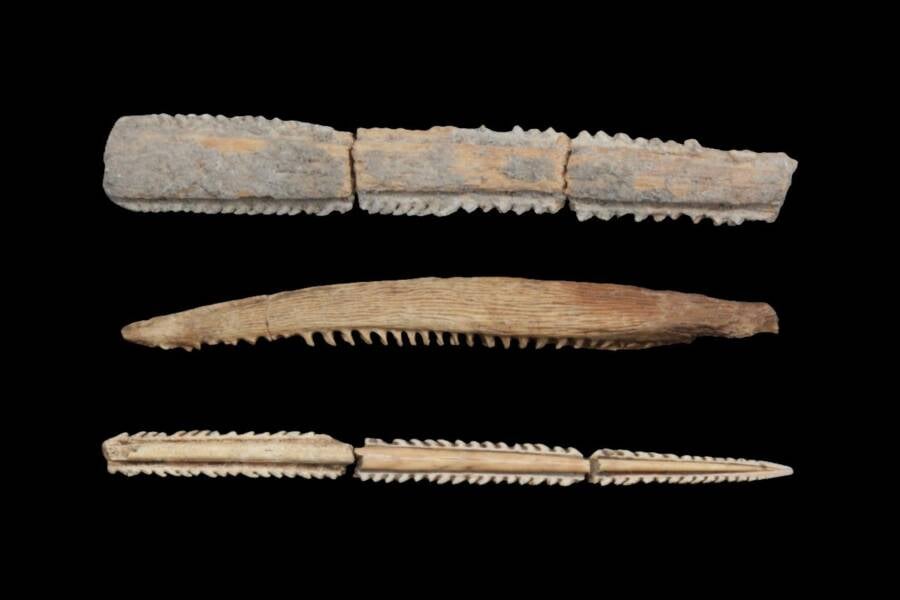
Amiel Luna/INAHArchaeologists in Mexico found three stingray barb fragments and one catfish spine alongside human remains.
Archaeologists in southern Mexico have uncovered stingray barb fragments as well as one catfish spine among ancient human burials that sit along the construction route for the new Maya Train. Now, researchers are studying whether these unusual artifacts were once used in Maya bloodletting rituals.
Researchers believe that studying these specimens could shed new light on the Maya civilization’s storied self-sacrifice rituals during the pre-Columbian period.
The Discovery Of The Stingray Barbs Among Ancient Maya Burials In Mexico
The three stingray barbs and catfish spine were discovered in 2021 during excavations of Section 1 of the Maya Train, a 140-mile stretch from Palenque, Chiapas, to Escárcega, Campeche.
The specimens were uncovered in a roughly seven-acre area near Tenosique, Tabasco in southern Mexico. Now, according to an announcement from Mexico’s National Institute of Anthropology and History (INAH), researchers are studying the objects to determine how they were used, and why they were found near human remains.
Aldo Dena/INAHResearchers believe the stingray barbs may have been used during Maya bloodletting rituals.
One of the stingray fragments measures a little over an inch long. Both of its ends are fractured, which was likely caused by pressure from surrounding residue.
The fact that the barb’s surface is polished from contact with rough sediments has indicated to researchers that it came from the same archaeological layer as the human burial. However, researchers cannot rule out the possibility that the barb was deposited there later, as an offering to the dead.
The other stingray barbs also have polished surfaces and fractures from surrounding sediment, indicating to researchers that they were also deposited around the same time as the human remains.
The catfish spine was discovered in a burial with the remains of an adult man. This spine was particularly intriguing to the archaeologists, as these are not commonly linked to ritual self-sacrifice among the Maya.
What This Find May Reveal About Ancient Maya Sacrificial Rituals
In the INAH statement, archaeologist Said Amiel Luna Limón said that evidence collected from the Maya civilization has pointed to ritual bloodletting being practiced from the Late Preclassic period through the Postclassic — approximately 500 B.C.E. to 1520 C.E.
Aldo Dena/INAHArchaeologists are especially intrigued by the presence of the catfish spine because these bones are not commonly associated with Maya bloodletting rituals.
During such rituals, one drew their own blood as an offering to higher powers, as well as a way to purify the body in preparation for a larger ceremony. Researchers believe that bloodletting was practiced by Maya elites in particular and was done to maintain cosmic order.
Oftentimes, women drawing blood pierced their tongue, which was associated with fertility, while men pierced their penis which was associated with creation.
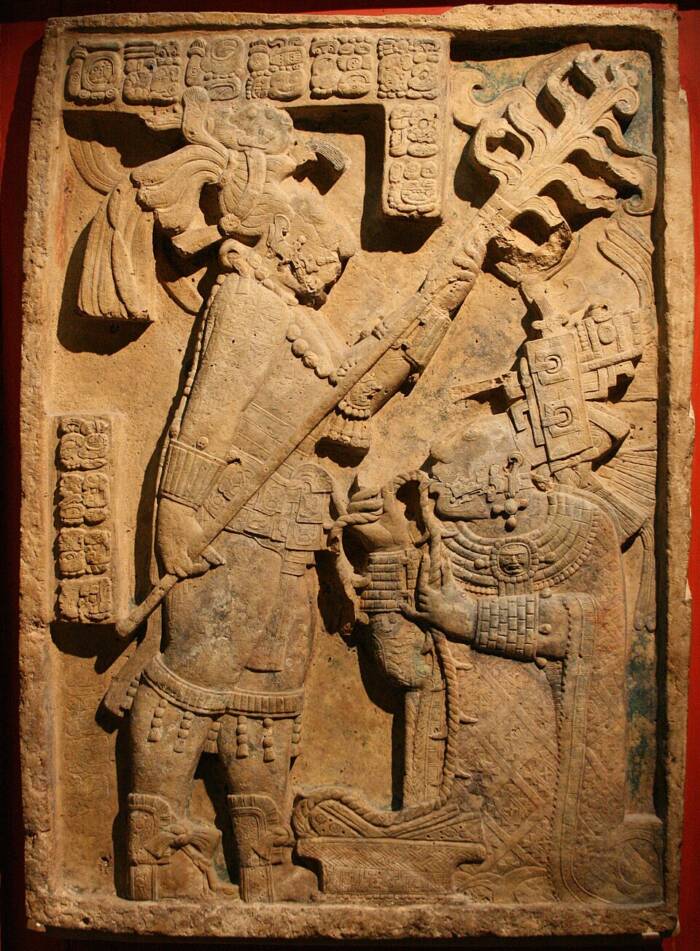
Wikimedia CommonsBloodletting rituals are often associated with Maya elites, as depicted in this piece in which Lady K’ab’al Xook, the wife of the ruler, pulls a barbed rope over her tongue.
“In the Southern Lowlands, the stingray sting was the preferred instrument, as has been recorded in lintels and documents where it is described that the blood was collected in containers that held leaves of tree bark, which, once dry, was burned and, in this way, ascended, immaterialized, to the ‘other world,'” Luna Limón said.
Marisol Arce Acosta, head of the Zooarchaeology Laboratory for the Maya Train Archaeological Salvage Framework Project, said that the stingray remains belong to the whip ray or eagle ray families, both saltwater groups.
Less is certain about the catfish spine, which belongs to the freshwater Ictaluridae family. Although there is not enough evidence to indicate that the spine was used as a bloodletting implement, Arce Acosta noted that the spine “is functionally suitable for the ritual.”
The ongoing research into this and other questions is now being co-led by Arce Acosta and Luna Limón. Meanwhile, Mexico’s Secretary of Culture, Claudia Curiel de Icaza, emphasized that, even though the finds were initially made in 2021, further research will only continue to reveal the secrets of the past.
“Each find recovered during an archaeological salvage operation opens new questions about our past. These objects … provide evidence for understanding the ritual practices of these ancient societies,” Curiel de Icaza said. “This is the value of studying and preserving these materials: knowledge does not end with their recovery, but continues in laboratories and can yield results for years to come.”
After reading about the discovery of ancient stingray barbs that may have been used by the Maya for bloodletting practices, learn the truth about human sacrifice in various cultures around the world. Then, read about the study that might have determined what ended the Maya civilization.
The post Archaeologists Unearth Stingray Barbs In Southern Mexico That The Maya Likely Used To Draw Blood For Ancient Rituals appeared first on All That's Interesting.
]]>The post Inside The Tragic True Stories Of The 9 Deadliest Days In American History appeared first on All That's Interesting.
]]>Since 1790, the U.S. population has risen from four million to more than 340 million. During the deadliest day of the Civil War at the Battle of Antietam, the population was about one-tenth the size it is now. So the 3,600 soldiers who were killed then would be the equivalent as losing 36,000 people today.
On top of that, many more people die every day in the United States than those directly affected by catastrophic events like natural disasters, terrorist attacks, and pandemics. In 2020, heart disease alone killed nearly 2,400 per day — about the same number who died during the attack on Pearl Harbor.
Yet, it’s the magnitude of single, deadly events that makes their legacy so powerful. Indeed, the tragic impact of these deadliest days in American history is still acutely felt, whether in a city’s architecture or in the memories of those who survived. Read on to see nine candidates for the deadliest days in American history.
The Deadliest Day In American History: The 1900 Galveston Hurricane

Wikimedia CommonsThe Galveston hurricane killed up to 12,000 people.
The fact that the 1900 Galveston Hurricane is still the deadliest natural disaster in American history speaks to its terrifying destruction. Regionally known as the 1900 Storm, the Category 4 hurricane tore through the Texan town on Sept. 8 at speeds of 135 miles per hour — and left between 8,000 and 12,000 people dead.
When the storm descended on Galveston, it ripped over 3,600 homes and commercial businesses from their foundations like paper. While the destruction of infrastructure was unlikely to have been averted with prior warnings, the death toll could have been, had it not been for an incompetent U.S. Weather Bureau.
The predecessor to the National Weather Service, the U.S. Weather Bureau was only 10 years old at the time, and tracking hurricanes across the Atlantic was still a primitive science. Nonetheless, “any modestly educated weather forecaster would’ve known” where the storm was headed, says MIT professor of atmospheric science Kerry Emanuel.
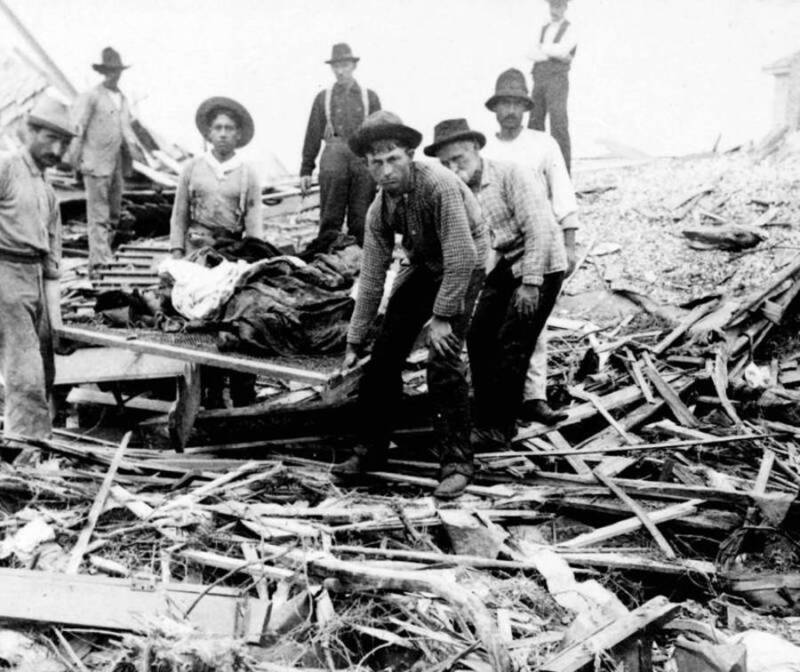
Wikimedia CommonsAbout 3,600 homes and businesses were destroyed.
At the time, scientists in Cuba had developed expert knowledge about tracking hurricanes in the storm-prone Caribbean. And they first observed the storm picking up in early September when it made landfall in Puerto Rico. And as it passed over the northern tip of Cuba, they correctly predicted that it would head northwest, straight into the Gulf of Mexico.
But in the wake of the Spanish-American War, the Weather Bureau’s director, Willis Moore, had made an appalling decision.
According to Emanuel, Moore “was so jealous of the Cubans that he shut off the flow of data from Cuba to the U.S.” and told American forecasters in the region “that they could not on their own issue a hurricane warning, that they had to go through Washington.”
So when the Weather Bureau sent their forecast that the hurricane would pass over Florida and head to New England, Galveston residents were left entirely unprepared for the disaster.
And although Isaac Cline, the Weather Bureau’s chief observer in Galveston, urged locals to leave town at the last minute, nobody listened. The day the hurricane made landfall, it inundated the streets, which rose to a peak elevation of just eight feet above sea level, with a 15-foot storm surge — and killed Cline’s wife.
“The Galveston hurricane made people realize you can’t play politics with a weather bureau,” says Emanuel. “If you make it political, people will die.”
And with upwards of 12,000 people killed by the hurricane, Sept. 8, 1900, might be the deadliest day in American history.
The Deadliest Battle In American History: Gettysburg
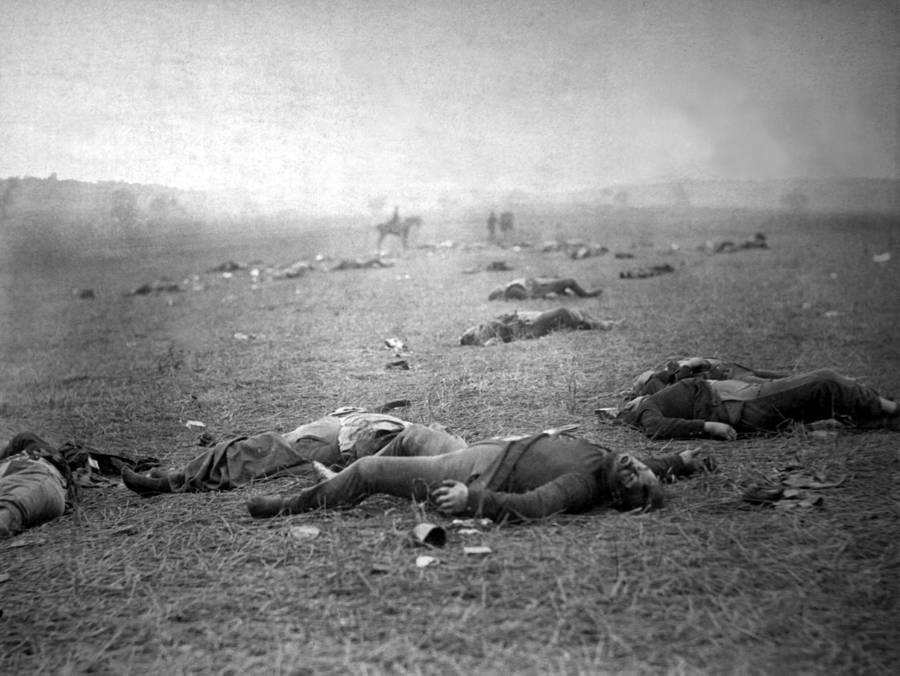
Timothy H. O’Sullivan/Wikimedia CommonsKnown as the “Harvest of Death,” this photo shows Union soldiers scattered across the battlefield.
The Battle of Gettysburg in Pennsylvania lasted for three days, from July 1 to July 3, 1863. It left more than 40,000 dead or wounded soldiers scattered across the battlefield. When the deafening gunfire ceased and the smoke settled, it became clear that the Civil War battle had killed 7,000 to 10,000 men.
After decades of tension over slavery between northern and southern states, the election of Abraham Lincoln in 1860 caused seven southern states to secede. Fought by the northern Union Army and the southern Confederates, Gettysburg became the bloodiest battle ever fought on American soil.
Confederate General Robert E. Lee had hoped to win this battle north of the Mason-Dixon Line to force the north into negotiations. While his army of 28,063 soldiers exceeded Union General George Meade’s by 5,000, he failed and fled south.
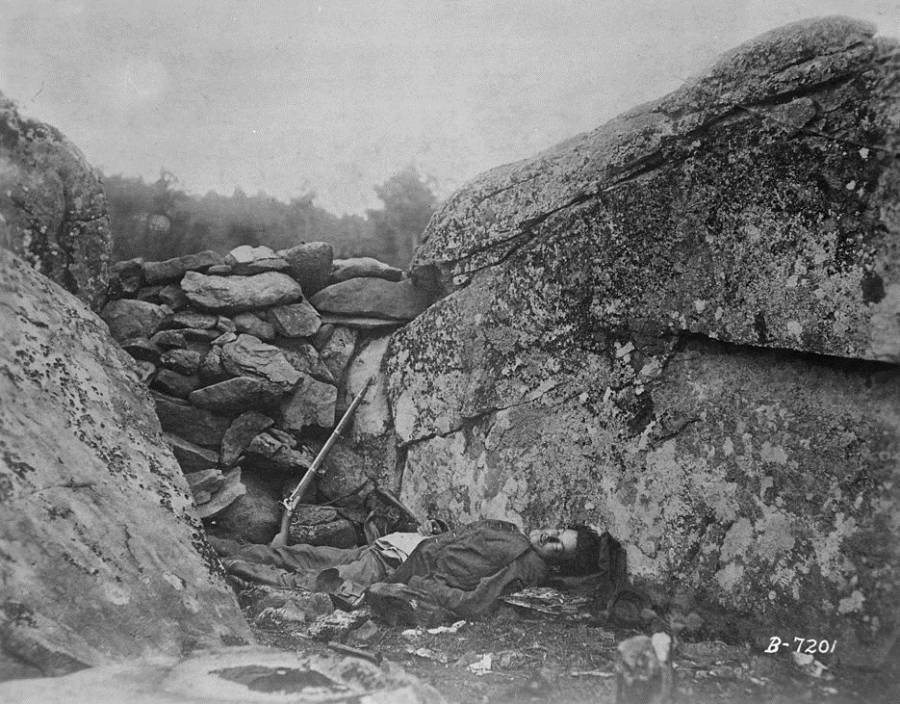
Mathew Brady/Wikimedia CommonsThe body of a Confederate sharpshooter is left lying where he was shot.
The battle’s aftermath as detailed by a New Jersey soldier was macabre:
“Some with faces bloated and blackened beyond recognition, lay with glassy eyes staring up at the blazing summer sun; others, with faces downward and clenched hands filled with grass or earth, which told of the agony of the last moments. Here a headless trunk; there a severed limb; in all the grotesque positions… they lay.”
By the end of the third day, Confederate casualties had approached 60 percent, with 3,903 men killed. While 18,735 of them lay wounded, 5,425 had either been captured or gone missing. When General Lee withdrew on the rainy afternoon of July 4, the Union tallied its own losses to fewer, albeit similarly harrowing results.
With 3,155 soldiers killed, 14,529 wounded, and 5,365 captured or missing, the Union victory certainly didn’t feel like one. Soldiers on both sides had never engaged in strife of this scale before, with many traumatized or disfigured for the rest of their lives.
Most grueling of all, the Civil War would rage on for two more years. When General Lee capitulated in April 1865, it finally ended — but only after 750,000 soldiers and 50,000 civilians had died in the conflict.
The post Inside The Tragic True Stories Of The 9 Deadliest Days In American History appeared first on All That's Interesting.
]]>The post Christopher Amoroso, The Port Authority Policeman Who Died Rescuing Others On 9/11 appeared first on All That's Interesting.
]]>
Voices Center for ResilienceChristopher Amoroso died while saving lives as a Port Authority police officer.
Christopher Amoroso had been a Port Authority police officer for less than two years when he reported for work at the World Trade Center on September 11, 2001. Amoroso, then 29 years old, said goodbye to his wife Jaime and young daughter Sophia Rose like he would on any other work day. But tragically, it would be the last time they saw him.
Amoroso was one of the first officers on the scene after two hijacked planes struck the Twin Towers in a coordinated terrorist attack on Sept. 11, 2001. He was injured by falling debris but refused medical attention, and helped rescue people until the towers collapsed.
His final moments were captured by a photographer, who snapped a picture of Amoroso helping a woman to safety. After rescuing her, he ran back into the building to try and save others.
This is his story.
Who Was Christopher Charles Amoroso?

Voices Center for ResilienceChristopher Amoroso grew up in North Bergen, New Jersey, with four brothers and two sisters.
Christopher Amoroso was born on June 1, 1972 in Rockville Center, New York. He grew up in North Bergen, New Jersey, alongside his four brothers and two sisters.
After graduating from North Bergen High School in 1990, Amoroso attended St. John’s University in Queens, New York. After college, Amoroso worked for Consolidated Dairies as a route manager — but his dream was always to become a police officer.
According to Amoroso’s sister Jess, Amoroso failed the police test four times before passing it on the fifth try. He enrolled in the the Port Authority Police Academy in 1999 and graduated the following year.

Port Authority of New York and New JerseyChristopher Amoroso was so determined to be a police officer that he took the police exam five times.
Meanwhile, Amoroso was also building his family. He married his wife Jaime in November 1999, and the couple, along with their baby daughter Sophia Rose, lived in Huguenot on Staten Island. In his free time, Amoroso liked playing sports and watching the History Channel.
“He was the type of guy who wanted to make you laugh, make you feel the love, and always had a beer in hand. He was the type of guy everyone looked up to,” his sister Jess wrote for the Travis Manion Foundation.
The Heroism Of Christopher Amoroso On 9/11
On the morning of Sept. 11, 2001, Christopher Amoroso was assigned to work at the World Trade Center. As the New York Daily News notes, he was working on rotation, and could have just as easily been assigned to Newark Airport. Instead, Amoroso said goodbye to his wife and daughter, and left.
“I remember he left and he said I’m working at the World Trade Center,” Amoroso’s wife Jaime recalled to NBC in 2021. She remembered that she told her husband to be careful. “He goes, ‘what’s going to happen?'”

TheMachineStops (Robert J. Fisch)/Wikimedia CommonsFlight 175 hitting the South Tower of the World Trade Center on Sept. 11, 2001.
That morning, at 8:46 a.m., the 9/11 attacks began when American Airlines Flight 11 smashed into the North Tower of the World Trade Center. Then, at 9:03 a.m., United Airlines Flight 175 hit the South Tower. Both aircrafts had been hijacked by al-Qaeda terrorists. A third hijacked plane, American Airlines Flight 77, was heading toward the Pentagon, and a fourth hijacked plane, United Airlines Flight 93, would crash in a field in Shanksville, Pennsylvania, after its passengers fought back against the terrorists.
But as the World Trade Center burned, first responders had no idea that the day would end with nearly 3,000 fatalities, including 400 of their own. They were focused on saving lives. And so was Christopher Amoroso.
Then 29 year old, Amoroso was trained in special tactics and fire control, important skills for the catastrophe unfolding at the World Trade Center. Though he was struck in the face by falling debris, he refused to get medical help, and instead led a number of people to safety from the lower levels of the towers. A New York Daily News photographer named Todd Maisel even captured a picture of Amoroso helping a woman away from the buildings.
Todd Maisel/NY Daily News ArchiveDespite being injured by debris, Christopher Amoroso continued rescuing people from the World Trade Center.
In his final moments, the Port Authority Police Benevolent Association reports that Amoroso collected oxygen packs and hard hats, and then headed back into the North Tower. Sadly, both of the towers soon collapsed: the South Tower at 9:59 a.m., and the North Tower at 10:28 a.m.
Christopher Amoroso died alongside hundreds of other first responders.
‘I’m Alive Because Of Him’
Christopher Amoroso’s name is etched into a number of 9/11 memorials across the country, and he’s survived by his family, his wife, and his daughter. Amoroso’s story was also featured as a part of The New York Times’ “Portraits of Grief” series that followed the Sept. 11 attacks.
In the piece, 19-month Sophia Rose tells her mother that she has “Daddy’s fingers” while taking a bath after Amoroso’s death. When Amoroso bathed Sophia Rose, he would wiggle his wrinkly fingers at her.
Voices Center for ResilienceAmoroso is remembered by his surviving family, including his daughter Sophia Rose and his wife Jaime
“The baby is too young to understand that her father, 29, a Port Authority police officer, died when he went back into the World Trade Center’s north tower after leading a group of people to safety. She will not remember the thousands of people, including hundreds of police officers, who spilled out of Our Lady Star of the Sea Church in Staten Island for his memorial service,” The New York Times piece reported.
But there was also someone else who deeply mourned Christopher Amoroso: the woman from the photograph.
For decades, her identity was unknown. But 20 years after 9/11, she was identified as Suman Dhamija, an Indian woman who was working in the World Trade Center at the time.
“My mother has severe asthma so after running down the stairs of the 2nd tower and with all the debris and smoke in the air, she could not breathe,” her son wrote online. “Officer Amoroso helped lift her up and walk away from the towers. This photo was taken before the 2nd tower collapsed.”
Dhamija moved to India but never forgot how Amoroso saved her life.
“He said, ‘Ma’am, relax. We are here to help,'” Dhamija recalled to NBC. “I wish the best for his family, for his loved ones. If he wasn’t there, there is no way I could have made it.”

Voices Center for ResilienceChristopher Amoroso spent his last moments saving people on 9/11.
Dhamija, now a grandmother, often thought about Amoroso. “I always felt bad because I have lived my life, and he was still so young,” she said. “… He wasn’t scared, but I was scared.”
After reading about the life and death of 9/11 hero Christopher Amoroso, discover the sad story of Father Mychal Judge, the first confirmed victim of 9/11. Then, look through these photos of heartbreaking 9/11 artifacts.
The post Christopher Amoroso, The Port Authority Policeman Who Died Rescuing Others On 9/11 appeared first on All That's Interesting.
]]>The post A Group Of Actors Went On An Archaeological Dig In Poland To Prepare For A New Movie About Hunting For Relics From Napoleon’s Army — And Found The Real Thing appeared first on All That's Interesting.
]]>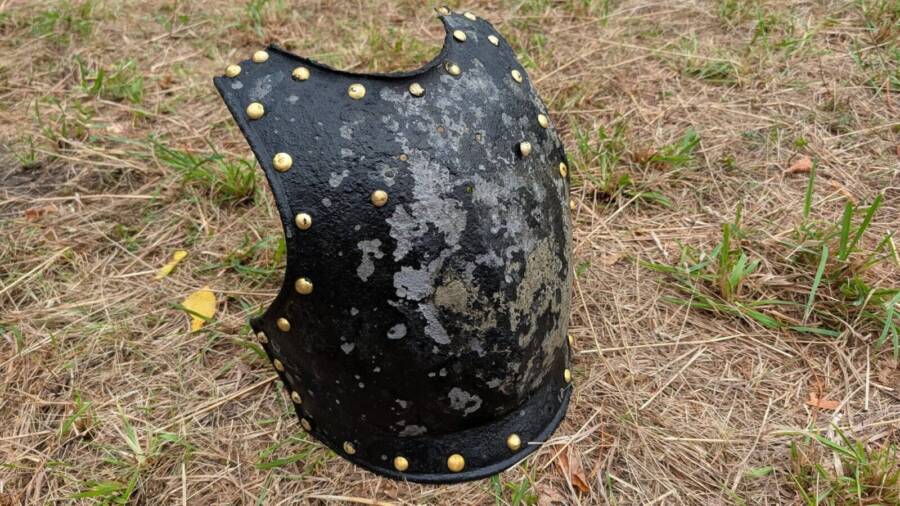
Muzeum Domu Śląskiego w ZiębicachA group of actors preparing for a movie stumbled upon a piece of 19th-century cavalry armor in the moat of a Polish palace.
A group of actors in Poland recently joined an archaeological dig in the muddy moat of an historic palace near Kostomłoty in order to prepare for an upcoming movie about treasure hunting. The goal was to gain a sense of what the experience was like before they acted it out themselves.
However, they gained something more than just acting experience when they stumbled upon a real piece of 19th-century cavalry armor. This stunning find, hidden in the moat for centuries, sheds new light on the rich legacy of Pielaszkowice Palace and its place in the history of the Napoleonic Wars.
The Fortuitous Discovery Of 19th-Century Cavalry Armor At Poland’s Pielaszkowice Palace
Writer Joanna Lamparska of the Hi!History YouTube channel organized this treasure hunt with help from experienced excavators. The actors that joined them on this expedition were preparing for an adaptation of the famous Polish novel Satan from the Seventh Grade by Kornel Makuszyński.
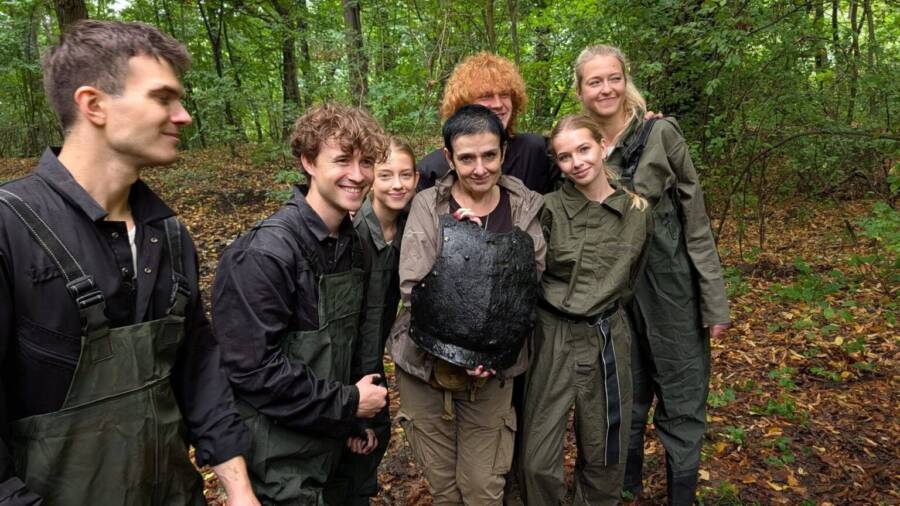
Muzeum Domu Śląskiego w ZiębicachThe actors were treasure hunting to prepare for an upcoming film adaptation of the Polish novel Satan from the Seventh Grade.
The novel tells the story of a mystery surrounding treasure associated with one of Napoleon’s soldiers. Pielaszkowice Palace, located in southwestern Poland, has a strong real-life connection to the story of Napoleon and his armies, so it served as an apt location for the actors to understand what a real treasure hunt like those described in the novel would feel like.
But this practice run suddenly turned real when Wiesław Andrysiak of the DRACO History Explorers Association pulled a piece of 19th-century armor from the palace’s muddy moat.
“It’s an incredible find that miraculously survived to this day,” Lamparska said.
Muzeum Domu Śląskiego w ZiębicachLikely belonging to either a Prussian of French cavalryman, this 19th-century cuirass had been lost for decades.
This breastplate, or cuirass, was worn on the torso and made to defend against sword and lance blows while also lending its wearer an appearance designed to intimidate the enemy.
The armor was found in the thick silt of the palace moat, where it might have simply been discarded and lost for two centuries, although researchers are still unclear on how exactly the armor ended up where it did.
In addition to this piece of chest armor, the team also uncovered sections of park sculptures and metal fittings, while this moat perhaps contains even more relics from the palace’s rich history.
What This Find Reveals About The Palace’s Rich History
In 1813, during the Napoleonic Wars, Pielaszkowice Palace carved out its place in history as the location where a truce between Napoleon’s forces and the allied Russian and Prussian armies was signed.
This ceasefire came about after the battles of Lützen and Bautzen gave both sides time to re-strategize. However, the agreement lasted just nine weeks before fighting began anew. In the following months, Austria joined the allied coalition and the scales tipped in favor of those armies, causing Napoleon to eventually suffer a major defeat at Leipzig.
Wikimedia CommonsPielaszkowice Palace was an important site during the Napoleonic era, and was later heavily looted by the Red Army toward the end of the World War II.
Although the palace holds an important place in the history of the Napoleonic Wars, this does not necessarily mean that the cavalry armor found in the moat will be identified as an artifact from that time.
According to the Muzeum Domu Śląskiego w Ziębicach, we currently know that the find is a 19th-century cuirass likely coming from somewhere in Germany, but its precise age and military affiliation will only become clearer after further study takes place.

Wikimedia CommonsThe 1813 truce between Napoleon’s army and the allied Prussian and Russian armies was signed at Pielaszkowice Palace.
Long after the Napoleonic era, the palace experienced another round of tumult amid the waning months of World War II. In 1945, the palace was looted by the Red Army, and several historical accounts describe objects from the residence being thrown into the moat.
After the war, local residents recovered valuable porcelain from the moat, but much of what was thrown out remains lost to the layers upon layers of mud.
The latest finds thus open up the possibility of discovering more artifacts from both 80 years ago and the Napoleonic era — in all, a fascinating window into several key chapters in this palace’s long history.
Now, the cuirass will undergo preservation work before joining the collection of the Muzeum Domu Śląskiego w Ziębicach. This work may reveal markings or details in the metal that could give researchers crucial information about the age and provenance of this incredible find.
After reading about how a group of actors found 19th-century armor in a Polish castle’s moat, learn about this 1,900-year-old iron shield found in a Polish scrapyard. Then, learn about the winged hussars, the feared cavalrymen of the Polish army.
The post A Group Of Actors Went On An Archaeological Dig In Poland To Prepare For A New Movie About Hunting For Relics From Napoleon’s Army — And Found The Real Thing appeared first on All That's Interesting.
]]>The post How The RMS <em>Olympic</em> Narrowly Averted The Tragic Fate Of The <em>Titanic</em> appeared first on All That's Interesting.
]]>
Public DomainThe RMS Olympic arrives in New York Harbor after its successful maiden voyage in June 1911.
The RMS Olympic was not nearly as famous as its younger sister ship, the Titanic — but its life was almost as remarkable.
The Olympic was the first in the White Star Line’s trio of Olympic-class luxury ocean liners. It set off on its maiden voyage from Southampton to New York City in June 1911, and it was soon frequented by famous figures from around the world.
Unlike the Titanic and the third ship in the trio, the Britannic, the Olympic had a successful 24-year career as both a passenger liner and a troopship. But while the vessel avoided the tragic fate of its two sisters, it did have several brushes with disaster.
This is the story of the RMS Olympic, from its star-studded voyages across the Atlantic to its service during World War I.
The RMS Olympic: The Oldest Of Three Sisters
In the early 20th century, the White Star Line was in a heated competition with its main rival, the Cunard Line, to create fast, reliable, and comfortable passenger ships to travel between Europe and the United States.
When the Cunard Line introduced the Lusitania and the Mauretania, White Star Line executives decided they would get the upper hand by building three of the most luxurious ocean liners the world had ever seen. The first would be the RMS Olympic, soon followed by the Titanic and the Britannic.
Construction on the Olympic began in December 1908 at the Harland & Wolff shipyard in Belfast, Ireland. By the time it was completed in 1911, the Olympic was the largest passenger liner in the world at 882 feet and nine inches long.

Public DomainThe RMS Olympic (right) and RMS Titanic under construction in Belfast in 1910.
The Titanic was built alongside the Olympic, with construction beginning in March 1909. The two vessels had identical exterior dimensions, but the White Star Line made several changes to the Titanic to make it more luxurious, such as enclosing one of the promenades and replacing another with large staterooms.
After completing its sea trials, the RMS Olympic was ready for its maiden voyage on June 14, 1911. The mighty ship departed from Southampton, England, where a new deep-water dock had been built to accommodate the Olympic-class ocean liners.

Public DomainOne of the promenade decks on the RMS Olympic. On the Titanic, this deck was enclosed in glass.
The Olympic carried 1,313 passengers on its first trip across the Atlantic. It was captained by Edward Smith — the same captain who went down with the Titanic less than a year later.
The ship maintained an average speed of nearly 25 miles per hour, reaching New York City in five days, 16 hours, and 42 minutes. It was greeted by thousands of spectators who wanted to see the trailblazing vessel for themselves.
The ship was open to the public for several days until it departed on its return voyage, and the June 22, 1911 edition of The New York Times included a detailed description of the “genuine sea monster”:
“The impression of hugeness given by the external appearance of the Olympic is intensified on entering the interior of the ship where the amount of space on every deck cannot fail to impress the observer. The saloons, staterooms, bathrooms, swimming pool, smoking rooms, lounges, squash and racket courts, promenade decks, and dining saloon are so large that they resemble the rooms of a large Summer hotel more than those of a ship.”
A new era of ship travel had begun.
How The Sister Ship Of The Titanic Survived Disaster
Though the Olympic had survived its maiden voyage, the sister ship of the ill-fated Titanic would soon face several disasters of its own.
The first came on Sept. 20, 1911, shortly after the Olympic departed for its fifth voyage. While traveling through the Solent, a strait between Great Britain and the Isle of Wight, the ship was hit by a warship called the HMS Hawke.
The captain of the Hawke hadn’t expected the Olympic to have such a wide turn radius, and he was unable to avoid hitting the ship’s starboard side. The bow of the Hawke gashed two holes in the hull of the Olympic, flooding two of its watertight compartments — but the ship stayed afloat.
Public DomainDamage shown on the RMS Olympic and the HMS Hawke following their collision in 1911.
No one died in the incident, but the Olympic remained out of service for two months for repairs. Workers took parts from the Titanic, which was still under construction at the time, to patch up its sister ship.
This delayed the planned completion of the Titanic, as well, but the ship eventually set off on its maiden voyage on April 10, 1912. Tragically, it struck an iceberg on the night of April 14 and sank into the icy Atlantic less than three hours later, killing approximately 1,500 passengers and crew members.
The RMS Olympic was returning from New York City on that fateful night and was roughly 500 miles from the Titanic when it received the first distress signals. The Olympic headed toward the scene at full speed, but it was too late.
The Carpathia — a Cunard Line ship — assisted with the rescue. The Olympic reportedly offered to take on some survivors, but White Star Line officials didn’t want to cause further distress by placing the traumatized passengers on a ship that was identical to the one they just escaped.
Public DomainThe RMS Olympic, on the left, next to its sister ship, the Titanic, on March 6, 1912 — just a month before the latter’s tragic maiden voyage.
After the sinking of the Titanic, more lifeboats were added to the Olympic to prevent a similar tragedy. But just a few years later, the ship was refitted once more — this time to carry World War I troops.
From Luxury Ocean Liner To Troopship To Scrap Metal
In May 1915, the British Admiralty requisitioned the RMS Olympic to transport troops from England to mainland Europe and the Mediterranean. The ship also carried American troops to Britain after the U.S. joined World War I and brought Canadian troops back home once the conflict came to an end. This earned the vessel the nickname “Old Reliable.”
In 1917, the hull was painted in dazzle camouflage to make it difficult for enemy vessels to observe which direction it was moving.

Public DomainThe Olympic in dazzle camouflage while serving as a troopship during World War I.
However, on May 12, 1918, the RMS Olympic was almost the victim of a devastating torpedo attack. While traveling through the English Channel toward France with U.S. troops on board, the ship’s crew spotted a German U-boat nearby.
The Olympic rammed the submarine, slicing through its pressure hull. The crew later learned that the U-boat had been planning to fire torpedoes at the Olympic but was delayed by mechanical issues.
It was pure luck that saved the Olympic from the same tragic end its sister ships faced. The Britannic had sunk in November 1916 after striking a naval mine in the Aegean Sea, and if the German submarine had been able to fire, the RMS Olympic likely would have suffered a similar fate.
After the war, the Olympic returned to service as a passenger liner. Throughout the 1920s, the luxury ship carried famous figures like Marie Curie, Arthur Conan Doyle, Charlie Chaplin, Hollywood lovebirds Mary Pickford and Douglas Fairbanks, and even the future King Edward VIII.
But as the global economy crashed during the Great Depression, demand for ocean travel plummeted. Those who were still traveling by sea had larger, faster, and more up-to-date ships to choose from. It was time for “Old Reliable” to retire.

Public DomainThe grand staircase on the Olympic, pictured here, was virtually identical to the staircase on the Titanic.
The RMS Olympic left New York for the final time on April 5, 1935. That fall, the vessel was sold off and disassembled. Many of its fittings were auctioned off to hotels and other businesses as decorations. England’s White Swan Hotel installed part of the ship’s grand staircase, and patrons there can still see it today.
These bits and pieces of the RMS Olympic are all that remains of what was once the world’s largest ocean liner. But its legacy as a troop transport vessel, the sister ship of the Titanic, and an icon of the seas in the early 20th century endures to this day.
After reading about the RMS Olympic, the sister ship of the Titanic, go inside the incredible story of Violet Jessop, the woman who survived crashes on the Olympic, Titanic, and Britannic. Then, learn about Charles Joughin, the White Star Line baker whose drunkenness saved his life when the Titanic sank.
The post How The RMS <em>Olympic</em> Narrowly Averted The Tragic Fate Of The <em>Titanic</em> appeared first on All That's Interesting.
]]>The post Paul Avery, The Journalist Who Received An Eerie Message From The Zodiac Killer After Writing About The Case appeared first on All That's Interesting.
]]>
KRON-TV/YouTubePaul Avery speaks about the strange card he received from the Zodiac Killer in an interview on October 31, 1970.
On Oct. 27, 1970, San Francisco Chronicle journalist Paul Avery received a strange card in the mail. It read, “Peek-A-Boo! You Are Doomed!” — and it was signed by the Zodiac Killer.
Avery had been reporting on the mysterious serial killer’s crimes and cryptic letters for over a year, and he’d even tried to track the criminal down himself. And the ominous note wasn’t going to stop him.
Indeed, a month after receiving the Halloween card, Avery wrote an article claiming the Zodiac Killer had fatally stabbed a woman in Riverside, California, back in 1966. While the police never officially linked this murder to the Zodiac, Avery’s work raised questions about whether the killer’s crimes really were limited to the Bay Area.
Paul Avery was later portrayed by Robert Downey Jr. in the 2007 film Zodiac. He’d been dead for seven years by the time the movie was released, but his life hadn’t ended quite the way the film implied. While Avery did take some precautions after receiving the Zodiac Killer’s chilling note, the threat didn’t derail his career. He continued working as a journalist well into the 1990s — though he never did discover the Zodiac’s true identity.
Paul Avery’s Career In Journalism
Paul Avery was born Paul Stuart Depew II in Honolulu in 1934. His parents divorced when he was young, and he later took the surname of his stepfather, Howard Avery.
His journalism career began in 1955 at age 21, when he got a job at Mississippi’s Vicksburg Post-Herald. Over the next several years, he worked for newspapers in Texas, Alaska, and Hawaii before settling in California in the late 1950s.

San Francisco Police DepartmentA press badge belonging to Paul Avery, circa 1969 or 1970.
By 1959, he’d joined the staff of the San Francisco Chronicle, but he took a brief leave of absence in the 1960s to move to Vietnam. There, he helped found a freelance photojournalism agency that operated during the war.
Avery returned to the Chronicle as a police reporter in 1969 — and soon picked up his biggest story yet.
The Zodiac Killer’s Reign Of Terror
In December 1968, high school students David Faraday and Betty Lou Jensen were shot and killed while parked on a lovers’ lane in Benicia, California. The police had no idea who was behind the murders, but in July 1969, the killer struck again.

San Francisco ChroniclePaul Avery’s byline on a January 1970 San Francisco Chronicle article about the Zodiac Killer.
This time, he shot Darlene Ferrin and Michael Mageau, who were sitting in Ferrin’s car while on a late-night date. Ferrin was killed, but Mageau survived and was able to provide a rough description of the perpetrator.
A month after this second attack, the Zodiac Killer sent his first cryptic letters to three San Francisco newspapers. The one that arrived at the Chronicle office read, “This is the murderer of the 2 teenagers last Christmass at Lake Herman & the girl on the 4th of July near the golf course in Vallejo.”
It was at this point that Paul Avery began covering the story. The first article about the mysterious killer, printed in the August 2, 1969 issue of the Chronicle, included the cipher that the Zodiac had attached to his letter.
The killer struck again in September 1969, stabbing Bryan Hartnell and Cecelia Shepard in Napa County. Hartnell survived, and the description of the Zodiac he gave to Avery’s coworker, Chronicle cartoonist Robert Graysmith, became one of the most famous sketches of the criminal.

Robert Graysmith/FacebookRobert Graysmith’s famous drawing of the Zodiac Killer.
The Zodiac’s final known murder came on Oct. 11, 1969, when he fatally shot Paul Lee Stine in San Francisco’s Presidio Heights neighborhood. A week after this crime, Avery wrote an article calling the Zodiac “a clumsy criminal, a liar and possibly a latent homosexual.”
But although he was seemingly done killing, the Zodiac continued sending bizarre notes to various newspapers — and in October 1970, Paul Avery received a message of his own.
The Zodiac Killer’s Chilling Threat To Paul Avery
On the morning of Oct. 27, 1970, the San Francisco Chronicle office was bustling with activity as usual. When the mail was delivered, there was an envelope addressed to “Paul Averly.” Inside was a Halloween card with a drawing of a skeleton on the front. It read: “I feel it in my bones, You ache to know my name, And so I’ll clue you in… But, then, why spoil the game!”

Public DomainThe inside of the Halloween card Paul Avery received from the Zodiac Killer.
The inside of the card also included the message, “Peek-A-Boo! You Are Doomed!” and the Zodiac’s signature symbol.
Four days later, Avery gave an interview to KRON-TV. “I think that the Zodiac is just making an idle threat, frankly,” Avery said. “He has bragged of killing up to possibly 14 people but there’s absolutely no evidence that he’s killed more than five… I think he wanted to get himself a little publicity.”
“I think it’s an idle threat,” Avery continued, “but at the same time… I’m going to be very careful.”
Avery reportedly began carrying a gun with him, and when his coworkers at the Chronicle had buttons made that read, “I Am Not Paul Avery,” he donned one, too.
Still, he didn’t stop trying to track the killer down. In November 1970, he linked the Zodiac to the 1966 murder of 18-year-old Cheri Jo Bates in Riverside, California. This was never confirmed, but if it’s true, it means that the killer didn’t confine himself to the Bay Area — and there may be even more victims out there that simply haven’t been connected to him yet.

Public DomainThe scene of the 1966 murder of Cheri Jo Bates, who was slashed to death near the library at Riverside City College.
As news on the Zodiac Killer slowed down, Paul Avery picked up several other major stories, such as the 1974 kidnapping of Patty Hearst. He left the Chronicle in 1976 to write for The Sacramento Bee, and he later worked for the San Francisco Examiner until his retirement in 1994.
Avery died from pulmonary emphysema on Dec. 10, 2000, at age 66. Seven years later, Robert Downey Jr. portrayed Paul Avery in Zodiac — but the film wasn’t completely accurate when it came to Avery’s ultimate fate.
How Zodiac Got The Journalist’s Story Wrong
In Zodiac, Avery becomes paranoid after receiving the letter from the Zodiac. He begins drinking heavily and doing drugs, bringing his career at the Chronicle to an end and forcing his transfer to The Sacramento Bee.

Paramount PicturesRobert Downey Jr. as Paul Avery in the 2007 film Zodiac.
In reality, the Halloween card didn’t have quite such a negative impact on Avery. He paid careful attention to his surroundings, particularly when leaving his office after work, but he didn’t become as paranoid as the movie suggests.
Avery was a heavy drinker and smoker, but his addiction didn’t ruin his life. He reportedly had some strife with his fellow employees at the Chronicle before he left his position there, but he continued on to have a successful career elsewhere, and he even helped write a book about Patty Hearst and the Symbionese Liberation Army.
As Robert Downey Jr. told the Los Angeles Times in 2007, “[Avery] was a serious journalist. He was a real amalgam of what makes journalists in the true sense of the word.”
After reading about the life of Paul Avery, discover nine potential suspects who may have been behind the Zodiac Killer’s crimes. Then, go inside the stories of nine of California’s most deranged serial killers.
The post Paul Avery, The Journalist Who Received An Eerie Message From The Zodiac Killer After Writing About The Case appeared first on All That's Interesting.
]]>