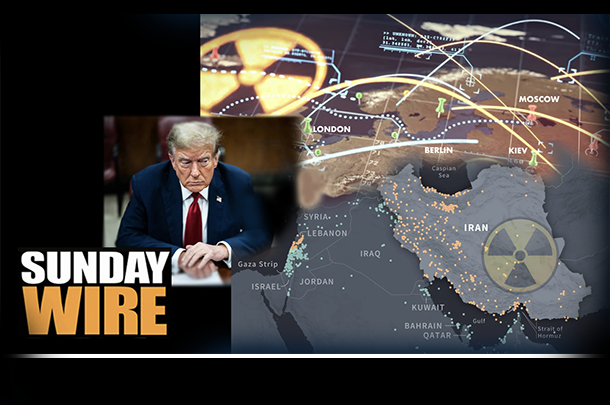
Episode 618 of SUNDAY WIRE SHOW resumes this week, October 25, 2026, broadcasting LIVE on Alternate Current Radio (ACR)…
Sunday Wire Radio Show Archives
LISTEN LIVE ON THIS PAGE – START TIMES:
4pm-7pm UK*(Daylight savings this week only | 12pm-3pm EST (US) | 9am-12pm PST (US)

This week on the SUNDAY WIRE, host Patrick Henningsen returns this week for our regularly scheduled program. Two extremely important elections are scheduled for this week: the Serbian elections and the fate of former President Aleksandar Vučić, and of course the much anticipated Israeli elections that will determine the fate of their current leader and wanted war criminal Benjamin Netanyahu. We’ll talk about why. This weekend the world staring at the precipice of another horrific round of war against Iran by the US and Israel. Over in Europe, the CIA, NATO warhawks, and the Zelensky regime—are colluding to sabotage yet another potential path to a peaceful resolution. Later in the Overdrive hour, we’re joined by teammates Bryan “Hesher”McClain, Adam “Ruckus” Clark, and Basil Valentine for deeper look into these and other breaking developments. All this and more…
SUPPORT OUR PLATFORM AND JOIN OUR 21WIRE COMMUNITY @21WIRE.TV
This month’s featured music artists: The Real Anthem Band, Joseph Arthur, Peyoti for President, Peter Conway & Red Rumble, and Phil Zimmerman
WATCH IT LIVE ON YOUTUBE, X, RUMBLE, FACEBOOK AND HERE:
.
Listen to latest available audio upload here:
NOTE: Our weekly show will be available in podcast recording after the LIVE program, here at 21WIRE and on all major podcasting platforms (see links below).
Sunday Wire Radio Show Archives
This Al Jazeera investigation exposes links between Turning Point UK, a right-wing student movement involved in anti-immigrant protests, and a paramilitary who offers to arrange murders for money. Undercover journalists investigate a network of activists and far-right groups accused of fuelling anti-migrant unrest on Britain’s streets. Secret recordings show TPUK’s leader arranging a fake political rally and brokering a murder-for-hire plot, revealing connections between culture-war activists and members of the Ulster Volunteer Force, proscribed by Britain as a terrorist organisation. Watch:
.
Run time: 46 minutes
Written and Produced by: Kevin Hirten, Simon Boazman, and Craig Pennington
Production: Al Jazeera Investigative Unit
SEE MORE SUNDAY SCREENINGS HERE
READ MORE UK NEWS AT: 21st CENTURY WIRE UK FILES
SUPPORT OUR INDEPENDENT MEDIA PLATFORM – BECOME A MEMBER @21WIRE.TV
VISIT OUR TELEGRAM CHANNEL
]]>Dialogue Works host Nima Alkhorshid talks with 21st Century Wire’s Patrick Henningsen about these and key issues. Watch:
.
READ MORE IRAN NEWS AT: 21st Century Wire Iran Files
SUPPORT OUR INDEPENDENT MEDIA PLATFORM – BECOME A MEMBER @21WIRE.TV
VISIT OUR TELEGRAM CHANNEL
]]>In the Eyes of Truth host Stanislav Krapivnik speaks with 21st Century Wire editor Patrick Henningsen about these and other key geopolitical details. Watch:
.
READ MORE GEOPOLITICS NEWS AT: 21st Century Wire Geopolitics Files
SUPPORT OUR INDEPENDENT MEDIA PLATFORM – BECOME A MEMBER @21WIRE.TV
VISIT OUR TELEGRAM CHANNEL
]]>Host Danny Haiphong discusses these critical geopolitical issues with 21st Century Wire’s Patrick Henningsen and Deep Dive host Lt Col Daniel Davis. Watch:
.
READ MORE YEMEN NEWS AT: 21st Century Wire Yemen Files
SUPPORT OUR INDEPENDENT MEDIA PLATFORM – BECOME A MEMBER @21WIRE.TV
VISIT OUR TELEGRAM CHANNEL
]]>
Freddie Ponton
21st Century Wire
Their methods are documented, their political objectives acknowledged, and their international circulation known. Yet, peaceful demonstrators repeatedly lose control of their own gatherings when black blocs appear. The consequences extend beyond the streets – used by government afterwards to justify harsh measures.
With the Gilets Jaunes (Yellow Vests) coordination calling for fresh demonstrations on 24 October, the question of protection is already urgent again. Will black-bloc groups once again be allowed to disrupt the mobilisation, leaving peaceful protesters and shopkeepers to bear the costs?
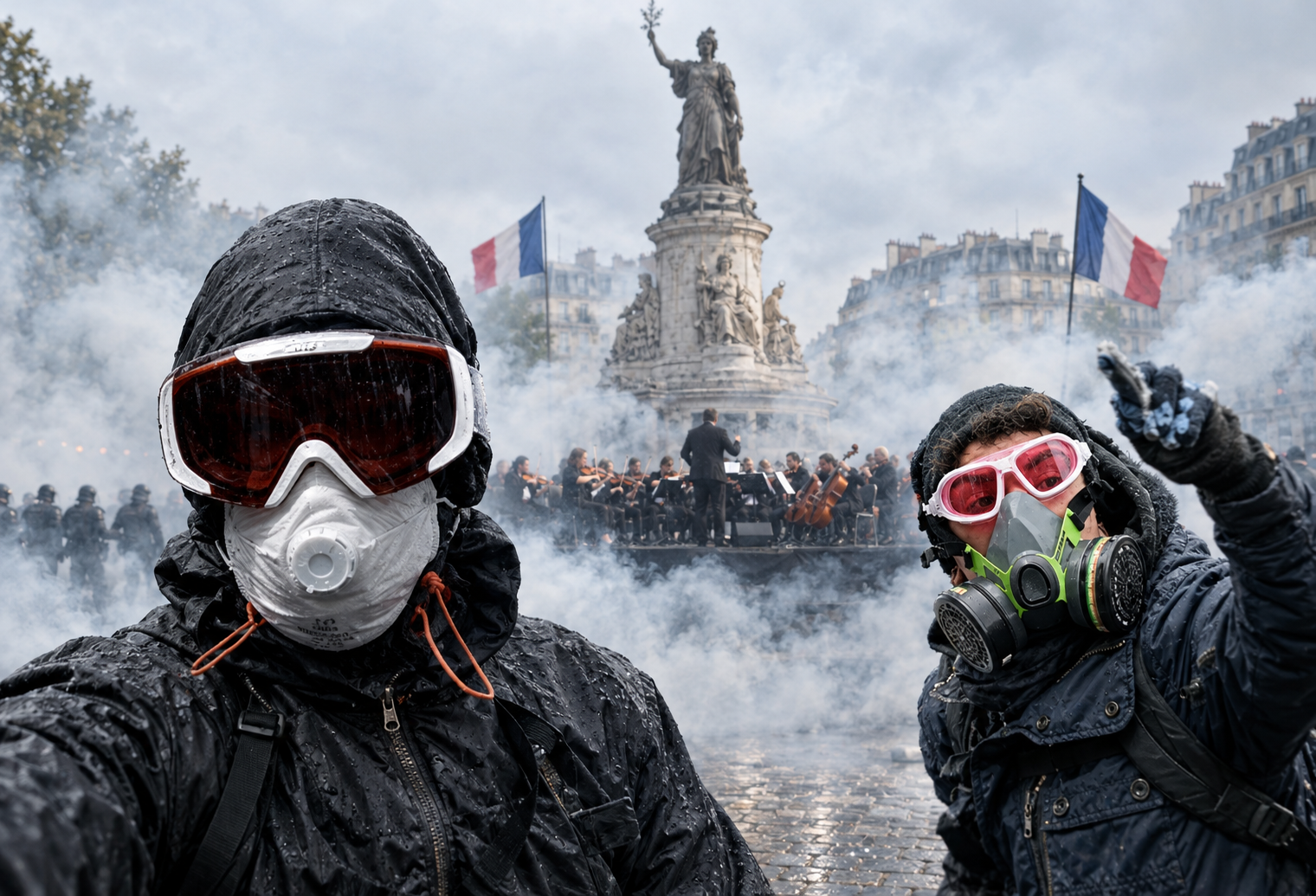
At approximately 12:20 on 17 October, tear gas reached the Orchestre du Nouveau Monde at Place de la République. The musicians had arrived around 11:30 to rehearse for a declared appearance supporting the mobilisation. The main procession was not due to leave until the afternoon. They continued playing for roughly twenty minutes before stopping and dispersing, according to the accounts published by Le Monde and Télérama.
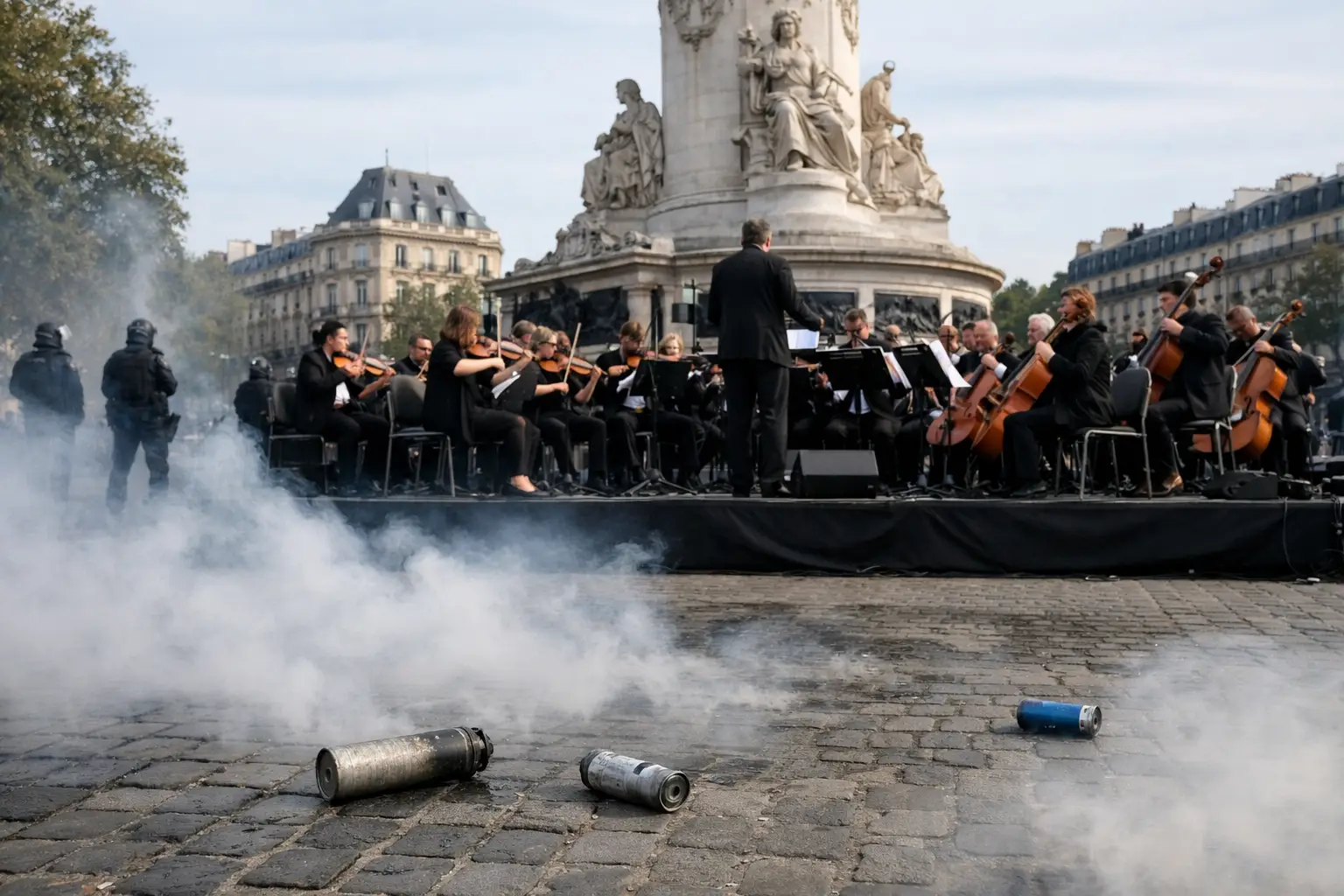
IMAGE: The Orchestre du Nouveau Monde’s interrupted performance at République illustrates the exposure of peaceful participants before the march began (Source: The Paris Times)
The gathering at République formed part of a wider student mobilisation in Paris and across France. Franceinfo reported that organisers put nationwide turnout at 800,000, while Interior Minister Laurent Nuñez cited 550,000 across France, including 110,000 in Paris.
Before the march could properly assemble, masked, black-clad groups were already confronting police around the square. Reports describe projectiles and fireworks, followed by police charges, tear gas, and further clashes. People arriving to demonstrate found themselves inside a confrontation already underway.
The orchestra was among those affected. Its members had brought instruments, notified the authorities and organised a peaceful performance. In an interview afterwards, musician Étienne Cognet described being gassed as unprecedented in the ensemble’s five years of demonstrations.
Although the procession eventually departed, its departure neither restored the concert nor undid the dispersal of those who had gathered beforehand. A demonstration can be sabotaged without being cancelled when its assembly is disrupted, its participants scattered and its demands overshadowed by the violence before the first banner moves. Responsibility rests with those choosing confrontation, but also with authorities charged with protecting participants from a foreseeable threat rather than merely responding to the destruction afterwards.
Black blocs are hardly an unknown quantity. The Research Centre of the National Gendarmerie Officers’ School (CREOGN) has published descriptions of their methods, political objectives, and international connections. Parliamentary hearings have examined advance warnings, delayed orders, and alleged decisions not to intervene. That accumulated knowledge makes the authorities’ preparation and decisions at République central to any account of why peaceful participants were left exposed.
What is Black Bloc?
Black bloc is often described by the mainstream press and government as an amorphous, radical activist movement which uses protest tactics in which individuals and affinity groups form a largely anonymous contingent within a demonstration. Participants are commonly associated with anarchist, anti-capitalist, anti-fascist and other far-left movements. Black clothing and face coverings help conceal their identities and make individuals harder to distinguish, while helmets, goggles and other protective equipment offer varying protection during confrontations with police.
However, critics believe those labels do not settle what their actions achieve. When they fracture a protest, eclipse its demands, and supply the government with images it can turn against its opponents, their professed purpose collides with their political effect. The government’s use of that disorder is its own responsibility. But militants who choose their targets for political reasons cannot dismiss the political consequences when their actions help the government discredit the protest.
That accumulated knowledge begins with a history more than four decades old. The practice emerged in West Berlin’s autonomous squatting milieu in the 1980s. In a July 2016 research note for the Gendarmerie officers’ research centre, Alice Cantiteau traced its spread through publications, activist culture, and international gatherings. Seattle’s 1999 demonstrations against the World Trade Organization brought major international visibility; the Nice European summit in 2000 became an early French milestone.
Subsequent French mobilisations, including Notre-Dame-des-Landes and the 2016 labour-law protests, gave authorities further opportunities to study the phenomenon. On 1 May 2018, a large black bloc assembled separately from the union procession at the beginning of the Paris demonstration, as a later parliamentary report records. Arriving early and occupying the front was already part of the record.
The familiar explanation that a black bloc is a tactic rather than an organisation captures its temporary form without fully accounting for the relationships that allow it to reappear. Cantiteau describes autonomous groups coordinating horizontally through shared practices. She also identifies political objectives, including opposition to capitalism and state authority. Her account describes organisation without a central hierarchy—not an absence of organisation.
StreetPress’s May 2016 immersion gives those relationships a more concrete form. Jonathan and Ahmad, two participants interviewed by the reporters, described an affinity group held together by friendship and political agreement. Members organised parties and concerts and met for football. Their ambitions extended beyond defeating the labour-law proposal: they wanted people to remain organised after the mobilisation and challenge the wider economic system.
The reporting also documented a division of roles. Supporters shielded participants from police observation while they changed clothing; others supplied material during confrontations. Some joined the clashes, while sympathisers helped preserve anonymity by dressing similarly without taking part in violence. Street medics treated injured people in the wider cortège de tête, but did not participate in the fighting. Not everyone at the front took part in the violence, or bore responsibility for it.
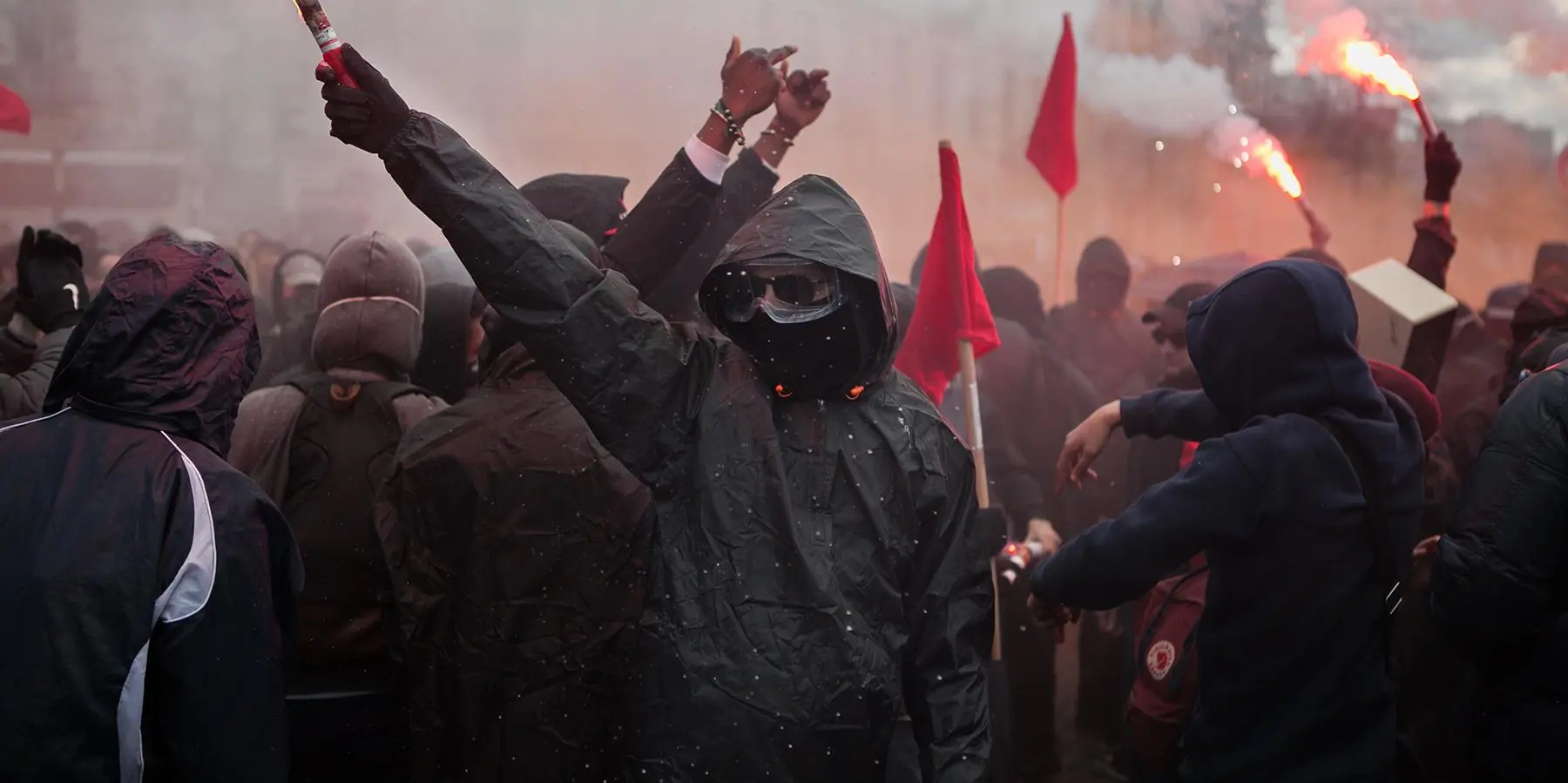
IMAGE: Shared clothing and practical support helped preserve anonymity during the 2016 labour-law protests. Photograph by Pierre Gautheron (Source: StreetPress)
The visible bloc could disperse at the end of a march without dissolving the relationships that brought it together. Friendship, shared political commitments and practical cooperation sustained activity beyond the demonstration. Describing the formation as leaderless does not account for those enduring relationships, or explain how influence operates within them.
The financial picture is less clear. Cantiteau’s observation that black blocs do not require substantial resources sits alongside her description of transnational mobility, including German and Italian participants attending demonstrations abroad. Such travel entails costs and practical arrangements, even where equipment is inexpensive. Her note does not establish who pays for transport, where participants stay or what support they receive. These are unanswered questions about resources—not evidence, by themselves, of a central treasury, or cross-border command.
Calling a black bloc a temporary formation leaves much of its organisation outside the frame. The relationships that bring participants together, provide practical support and transmit experience begin before the march and survive afterwards. An account confined to the masked formation in the street leaves those networks unexplained.
The same distinction must apply to the state’s response. Masks can obstruct identification during a confrontation; they do not, by themselves, explain what authorities knew beforehand, what they could substantiate, or how they acted on it.
“They disperse” describes what happens at the end of a confrontation—not an adequate explanation of why the next one remains so difficult to prevent. Failure is not an explanation.
The Government knew what was coming
The destruction in Paris on 16 March 2019 followed advance warning of black-bloc participation. The Senate Law Commission’s information report, published on 10 April 2019, examined why that warning had not produced a more effective response.
Interior Minister Christophe Castaner maintained that both participation and violence had been anticipated. Laurent Nunez said intelligence services were monitoring participants, but proving that they were collectively preparing violence remained difficult. Commission Chair Philippe Bas questioned why surveillance had not led to judicial action, asking what prevented authorities from bringing the people under surveillance before the courts.
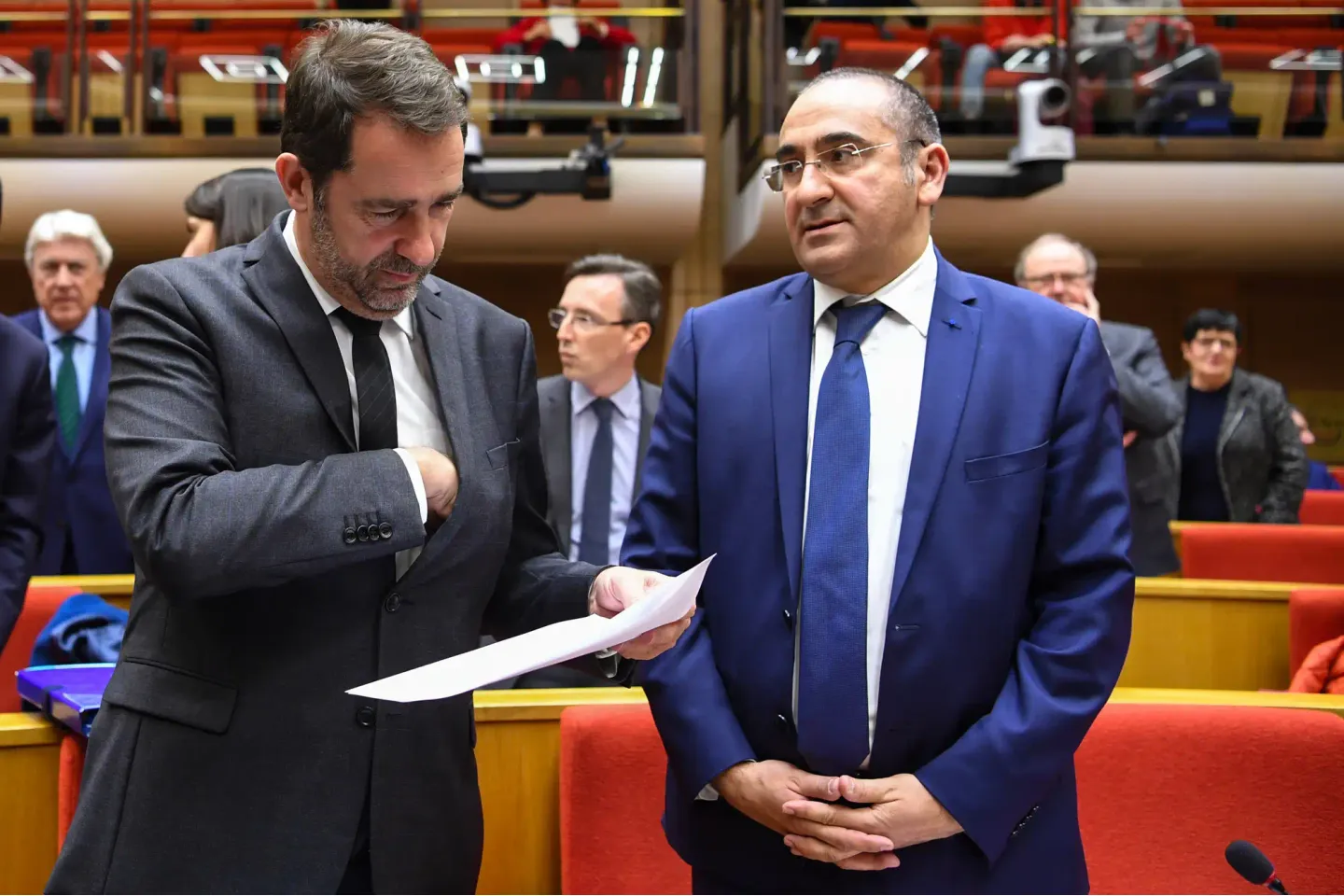
IMAGE: Christophe Castaner, left, and Laurent Nuñez at the Senate on 19 March 2019, facing parliamentary questions after the violence on the Champs-Élysées. Photograph by Eric Feferberg/AFP (Source: Paris Match)
These were people whom intelligence services had reportedly identified before the demonstration, not just masked figures investigators later tried to identify from footage. Yet the report noted limited use of the offence of collectively preparing violence. It also recorded accounts of delays of up to thirty minutes between requests for instructions and the orders that followed. Some units reportedly received instructions to hold back despite believing they could intervene.
The reported delays and instructions to hold back place the chain of command at the centre of the failure. Requests to intervene went unanswered while units waited for orders. Establishing who handled those requests and why intervention was delayed is necessary to distinguish operational constraints from errors of judgment, or failures of coordination. Calling the outcome a tactical failure does not explain the decisions that produced it.
The commission also described separate chains of command that hampered coordination between units maintaining public order and those making arrests, sometimes producing contradictory manoeuvres. These were weaknesses in the organisation of the police response, not surprises sprung by the crowd. Two years later, parliamentarians were still questioning why people said to be identified remained able to participate in further disorder.

IMAGE: Demonstrators near the Arc de Triomphe on 16 March 2019, during the mobilisation that prompted Senate scrutiny of police preparedness and command. Photograph by Sylvain Lefeuvre (Source: Radio Parleur)
During the 2021 debate on proposed administrative protest bans, Philippe Gosselin, then a Les Républicains MP, said several hundred individuals were clearly identified, yet not all had been subject to judicial measures. Stéphane Peu, then a member of the Groupe de la Gauche Démocrate et Républicaine (GDR) at the National Assembly, challenged police conduct during the Paris demonstration of 1 May 2018. He alleged that officers had allowed approximately a thousand black-bloc participants to assemble on the Pont d’Austerlitz in Paris while conducting checks elsewhere. Peu’s account placed the failure before the confrontation, when a large group was assembling at a known location.
Other MPs, including Paul Molac, Dimitri Houbron, and Sacha Houlié, questioned how protest bans could stop people whom police could not identify or apprehend. The National Assembly’s Laws Committee rejected the proposal’s sole article.
The disagreement exposed two separate problems. Some individuals were said to be known to police, but had not faced judicial measures. Others remained unidentified. Any additional protest ban would still depend on identifying the person concerned and enforcing the restriction.
The figures also need context and scrutiny. The 2021 report quoted the police union Alliance’s claim that courts had imposed only 32 supplementary protest-ban penalties over twenty years. But that figure covered one particular penalty, not every court-ordered restriction that could prevent someone from attending a protest. In the 2019 Senate hearings, Nicole Belloubet, then France’s justice minister, explained that courts also barred people from specified places.
The Senate’s 2019 report challenged the idea that judicial leniency was the main problem. It found that courts had responded quickly and firmly where sufficient evidence existed. But its figures covered arrests and convictions across the Yellow Vest protests, not specifically experienced black-bloc participants. Those totals could not establish how effectively the courts were dealing with that particular group.
Following the 17 October 2026 protests and the violence that weekend, the Senate’s Laws Committee again turned to police preparedness. Announcing its investigation into the events of 17–18 October, it said serious failures in anticipation and preparation had left police rapidly overwhelmed. Seven years after the 2019 hearings, the committee was again examining how the authorities had prepared for disorder, and why their response had failed.
The public record still does not show how many repeat participants were identified before a protest, prosecuted afterwards, and prevented from returning. The 2019 Senate report and the 2021 parliamentary debate provide figures and individual accounts, but no continuous picture of what happened to the same people. Without that accounting, announcements of arrests and prosecutions do not demonstrate whether the authorities have stopped repeat offending.
The acknowledgement also came from within the government. Speaking on France Inter on 19 October, Interior Minister Laurent Nuñez admitted a “loss of control” in certain large cities and shortcomings in anticipating the mobilisation and deploying sufficient police. He said he had offered his resignation, which President Emmanuel Macron refused. The failure of preparation was no longer simply an opposition allegation. The key minister responsible for this spectacular failure had acknowledged it himself.
The European dossier on Black Bloc
The gap between warning and preparation was not confined to France. In its account of the policing of Genoa’s 2001 G8 protests, dated 20 September 2001, Italy’s centre-left Ulivo opposition argued that police commanders had detailed knowledge of black-bloc methods. It cited an order issued by the police chief on 12 July and alleged that planned containment measures were not carried out. That order provided a concrete basis for assessing the commanders’ subsequent decisions.
Hamburg’s investigations after the 2017 G20 protests reveal a different problem. In September 2018, VICE reported that police had processed approximately 17 terabytes of video footage using facial-recognition software. According to a parliamentary answer cited in the article, the software had identified three people by that point.
Those interim results showed the limits of the technology at that stage. Processing vast quantities of footage had yielded few identifications, and identification still had to be followed by evidence of an offence. The scale of surveillance alone said little about its effectiveness in establishing responsibility for violence.

IMAGE: Black-bloc participants behind the “Welcome to Hell” banner in Hamburg on 6 July 2017, ahead of the G20 summit (Source: CNBC)
The French record also describes how participants gain experience across borders. In her 2016 research note, Alice Cantiteau linked German and Italian participation in demonstrations abroad to the spread of black-bloc tactics. Giving evidence to the Senate in 2019, police-union representative Claude Fourcaulx described foreign participants gaining experience in France, and French participants doing the same abroad. Methods learned in one country could then inform confrontations in another.
But learning is not confined to protesters. Police services also have opportunities to study successive confrontations and adapt their response. The circulation of experienced participants helps explain the challenge authorities face. It does not, on its own, explain why documented methods repeatedly catch them unprepared.
The methods were familiar, documented in French parliamentary reports long before the gathering at République. Repeated failures against a known threat leave the authorities answerable for their preparation, their operational decisions, and the political use they make of the resulting violence. Responsibility for discrediting a protest does not necessarily end with those throwing projectiles. It extends to a government when it uses that destruction to discredit people whose gathering it was supposed to protect.
A protest taken away
The musicians at République had organised their appearance, notified the authorities, and gathered before the march. Yet their performance ended under tear gas while the wider demonstration was still forming. They lost not only the space to perform, but the opportunity to give the protest a different cultural expression through art and music rather than confrontation.
Those choosing confrontation bore responsibility for their actions. But the police response also shaped what happened to everyone around them. Protecting the demonstration meant preventing violent participants from dictating the conditions for the peaceful majority. At République, the effects of that confrontation reached musicians who had taken no part in it.

IMAGE: A young woman rinses her eyes with saline after exposure to tear gas at Place de la République during the 17 October mobilisation. Photograph by Maxime Sirvins (Source: Politis)
The procession’s eventual departure should not conceal what disruption before the march could accomplish. A planned march brings people together along a declared route, supported by organisers, stewards, and a police deployment. Confrontation at the assembly point can undermine those arrangements before they take effect. People seeking to avoid the violence may retreat into side streets, or set off in smaller groups, separated from the organisers and stewards they expected to follow. That fragmentation can make it easier for troublemakers or looters to blend in with peaceful protesters, while making it harder for organisers to distinguish and isolate disruptive behaviour. Disruption at the outset can weaken the organisation of a march before it begins, leaving peaceful participants less able to maintain its character and direction.
Destruction can also displace the substance of a mobilisation. Images of broken windows, looted shops, and confrontations offer an immediate story, while explaining the grievances takes more time. Police are there to protect the demonstration and its participants, but Black-Bloc attacks can redirect their operations towards containing disorder. That shift can leave peaceful protesters facing police violence and dispersal measures where they were entitled to expect protection. Organisers, meanwhile, are pressed to account for actions they neither planned nor endorsed, while the government speaks about restoring order.
For the government to benefit from that shift, militants and ministers need to share neither intentions nor objectives. A group can attack the state while weakening the movement seeking to hold it to account. The political effect of an action is not necessarily the one its participants intend.
At République, peaceful participants had already borne the consequences of confrontation. Would students, the Yellow Vests, or an opposition party competing in the coming presidential election now be made to answer for it? And whose interests would that attribution serve?
Black blocs, police infiltration and the state
Police informants operate within the militant networks behind radical protest. Blast reported that one had supplied information for more than three years, maintaining more than 1,000 conversations with five police contacts and helping identify and locate activists. Behind the apparent anonymity of the crowd were sustained relationships with the services monitoring it.
An account of authorities perpetually taken by surprise leaves those relationships out. Recurring confrontation must be assessed against the information gathered beforehand and the decisions taken by those receiving it.
At Metz, L’Est Républicain described footage of a grenade deployment in the passage Blondel and quoted an unnamed police source identifying the masked men as BAC officers dressed like demonstrators. The source defended their disguise as necessary. That explanation addresses their appearance, not their actions.
In the recording circulated on X, a masked man makes a throwing motion into the passage before a loud detonation. A bystander protests that nothing was happening there. The three men subsequently leave accompanied by uniformed police.
French agents provocateur throw grenades on the street to coax police violence
They then NOD to the cops and leave TOGETHER with them https://t.co/vSK6XV8Rf1— The Gulag (@WelcomeTheGulag) October 19, 2026
L’Est Républicain also reports that fireworks mortars had been fired around the Place d’Armes. The bystander’s objection concerns the passage at that moment; it challenges the need for force at that particular location rather than establishing that the entire square was peaceful. The accessible article provides no operational explanation for the grenade deployment.
The sequence points towards a provocative intervention. The men’s departure alongside police places their conduct within the account of police responsibility. Their actions cannot disappear beneath a general label of protest violence. Neither can their disguise shield those responsible for their deployment from scrutiny.

IMAGE: Mark Kennedy, the undercover police officer who spent seven years inside activist networks and whose conduct the Court of Appeal described as “arguably, an agent provocateur.” (Source: Independent)
In Britain, undercover officer Mark Kennedy spent seven years among green and environmental activist groups. A parliamentary report records the Court of Appeal’s finding that he exceeded his authorisation and appeared to act as an enthusiastic supporter of a planned power-station occupation—“arguably, an agent provocateur.” Twenty activists’ convictions were overturned after evidence concerning his role and material supporting the defence had not been disclosed.
Kennedy’s involvement went beyond collecting names. The parliamentary account of the operation discusses his participation in preparations for the action. An official inspection report records his attendance at a briefing, reconnaissance for police activity and involvement in the team planning to climb the power-station structures. An officer embedded to gather intelligence had become involved in preparing the action itself.
The FBI’s domestic COINTELPRO programme pursued political disruption explicitly. The US Senate’s Church Committee documented covert operations intended to discredit organisations and turn potential allies against one another. FBI records held by the University of California, Berkeley include a fabricated warning of an impending ambush intended to intensify conflict between the Black Panthers and the rival US Organization. The authorities were cultivating antagonism, not merely recording it.
Black-bloc violence can achieve what the government cannot achieve through political argument alone. It pushes protesters’ demands aside and turns a mobilisation against government policy into a debate about public order. Instead of defending its policies, the government can demand that its opponents defend themselves against accusations of violence.
Black blocs may oppose the state, yet their violence can help the government discredit the protest and deflect attention from its demands. Intelligence infiltration and disguised police interventions make the state’s relationship with that violence part of the story—not merely its response afterwards.
One could argue that chaos becomes politically useful when it discredits the protest and supplies an accusation against the opposition. The government need not organise every confrontation to exploit the result. But when men identified by a police source as officers throw a grenade in what seems a deliberate attempt to create more chaos, while dressed like a member of the black bloc, the state is not merely responding to events—its own police are helping shape them.
Conveniently blaming the Left
The commissioner’s complaint exposes the conflict between the services’ findings and the account they were being asked to endorse. According to those written exchanges, the desired conclusion had already been selected, and responsibility was to fall on LFI, despite the services’ contrary assessment. This was pressure to make intelligence serve a political accusation rather than establish responsibility.
Paris prosecutor Laure Beccuau could not confirm the government’s identification of the perpetrators with the ultraleft, according to Mediapart. The political attribution was being challenged by the institutions charged with establishing responsibility. On 20 October, RTL reported Manuel Bompard’s announcement that he intended to refer Interior Minister Laurent Nuñez to the Cour de justice de la République over the reported instructions. The government’s handling of blame had itself become a matter of accountability.
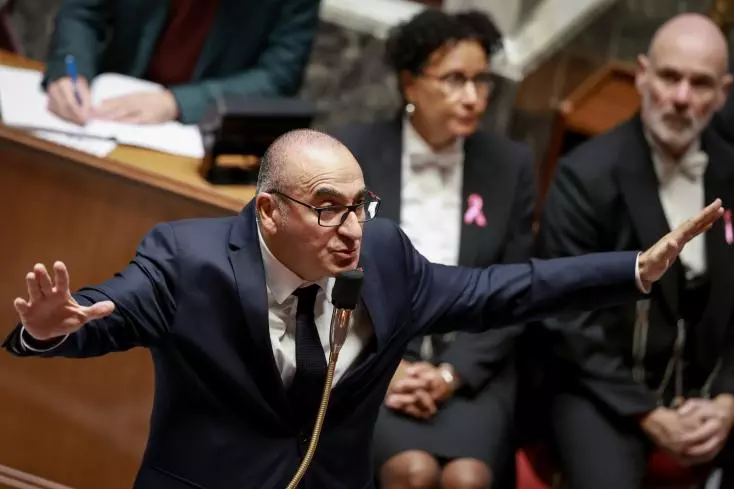
IMAGE: Interior Minister Laurent Nuñez addresses the National Assembly on 20 October 2026, amid controversy over the government’s attribution of responsibility for the protest violence. Photograph by Kenzo Tribouillard/AFP (Source: TV5Monde)
Black-bloc confrontations can disrupt a mobilisation, displace its demands, and expose peaceful participants to consequences they did not choose. Mediapart’s reporting describes pressure on intelligence officials to turn responsibility for disorder into an accusation against a political opponent. The government’s political use of disorder makes its handling of black-bloc violence part of the same account of responsibility. It must answer for how it confronted that violence as well as how it used the aftermath against its opponents. A movement can be damaged by those who disrupt it in the street, then discredited by those who assign the blame.
Ahead of the 2027 presidential election, blaming a major opposition party shifts the debate. Instead of defending its response to public grievances and explaining how it handled the demonstration, the government puts its opponents in the position of having to answer for violence.
Shopkeepers, injured protesters, and police officers bear costs that no revolutionary language can explain away. Peaceful participants lose control of their demonstration, while mass arrests extend the consequences beyond those involved in confrontation. Their actions can reinforce one another without coordination. Neither should escape scrutiny simply because they declare themselves enemies.
The musicians at République came to make themselves heard, not to provide the backdrop to someone else’s confrontation. Their interrupted performance brings us back to what this violence takes from a protest, and whom that loss serves. In other words: black blocs should be judged by effect of their actions, and how they transform the dynamic of a movement—and not by the radicalism they claim. Conversely, a government that seeks to capitalise on the resulting destruction against its political opponents must also answer for its own policing and intelligence failures.
READ MORE FRENCH NEWS AT: 21st Century Wire France Files
SUPPORT OUR INDEPENDENT MEDIA PLATFORM – BECOME A MEMBER @21WIRE.TV
VISIT OUR TELEGRAM CHANNEL
]]>
Freddie Ponton
21st Century Wire
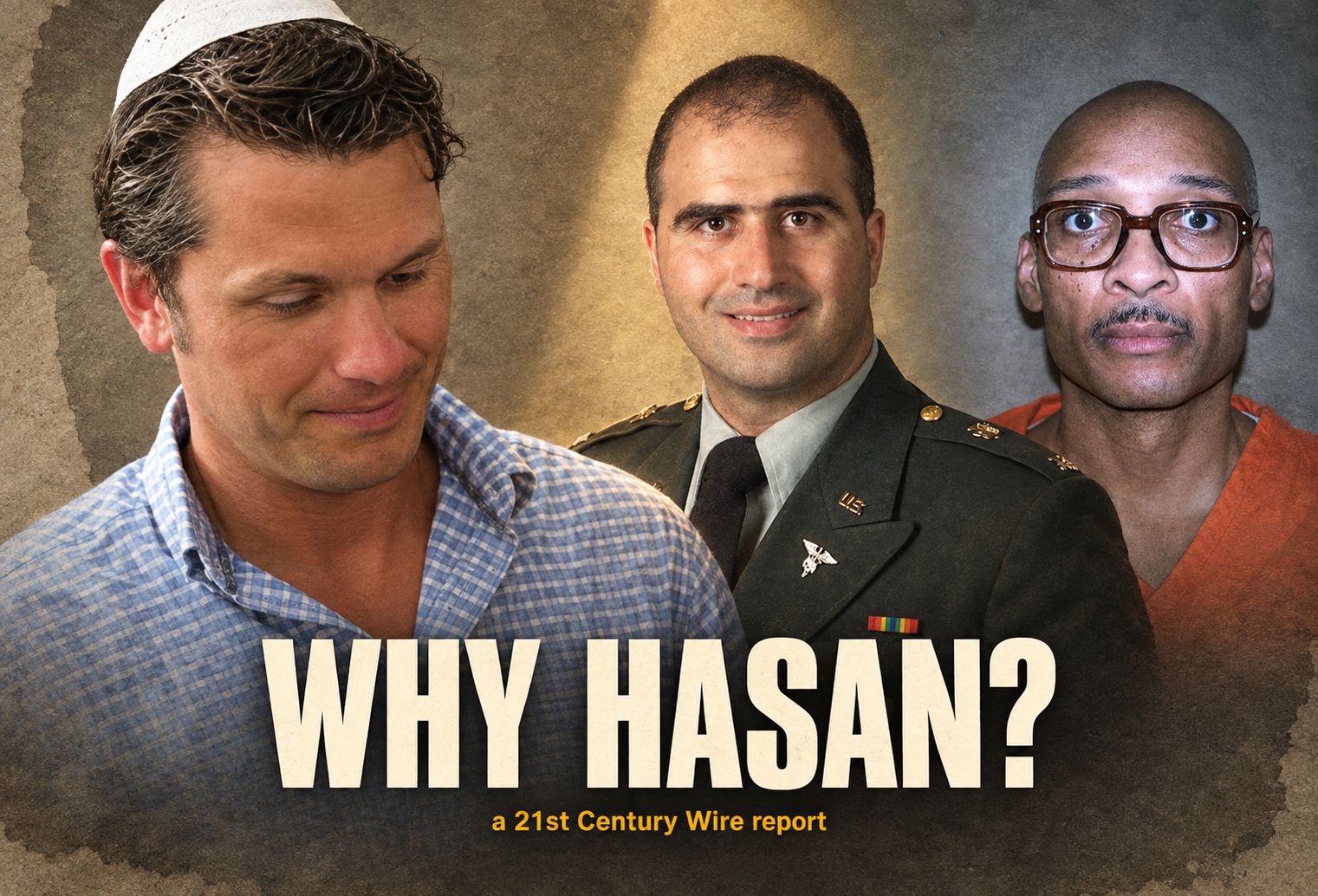
Former US Army psychiatrist, Nidal Hasan, is scheduled to be executed by military firing squad at Fort Hood base on December 3, 2026, at 1 p.m. CST, returning him to the site of the infamous mass shooting in 2009, in which he murdered 13 people and attempted to murder another 32. In his defense, Hasan stated in his trial that he had switched sides in what he called an American “war on Islam,” and believed the American soldiers at Fort Hood were about to deploy to Afghanistan, and pose an immediate danger to Muslims and Taliban militias there.
President Donald Trump approved his death sentence on October 2, at the recommendation of Defense Secretary Pete Hegseth, according to a post on X from Pentagon spokesperson Sean Parnell.
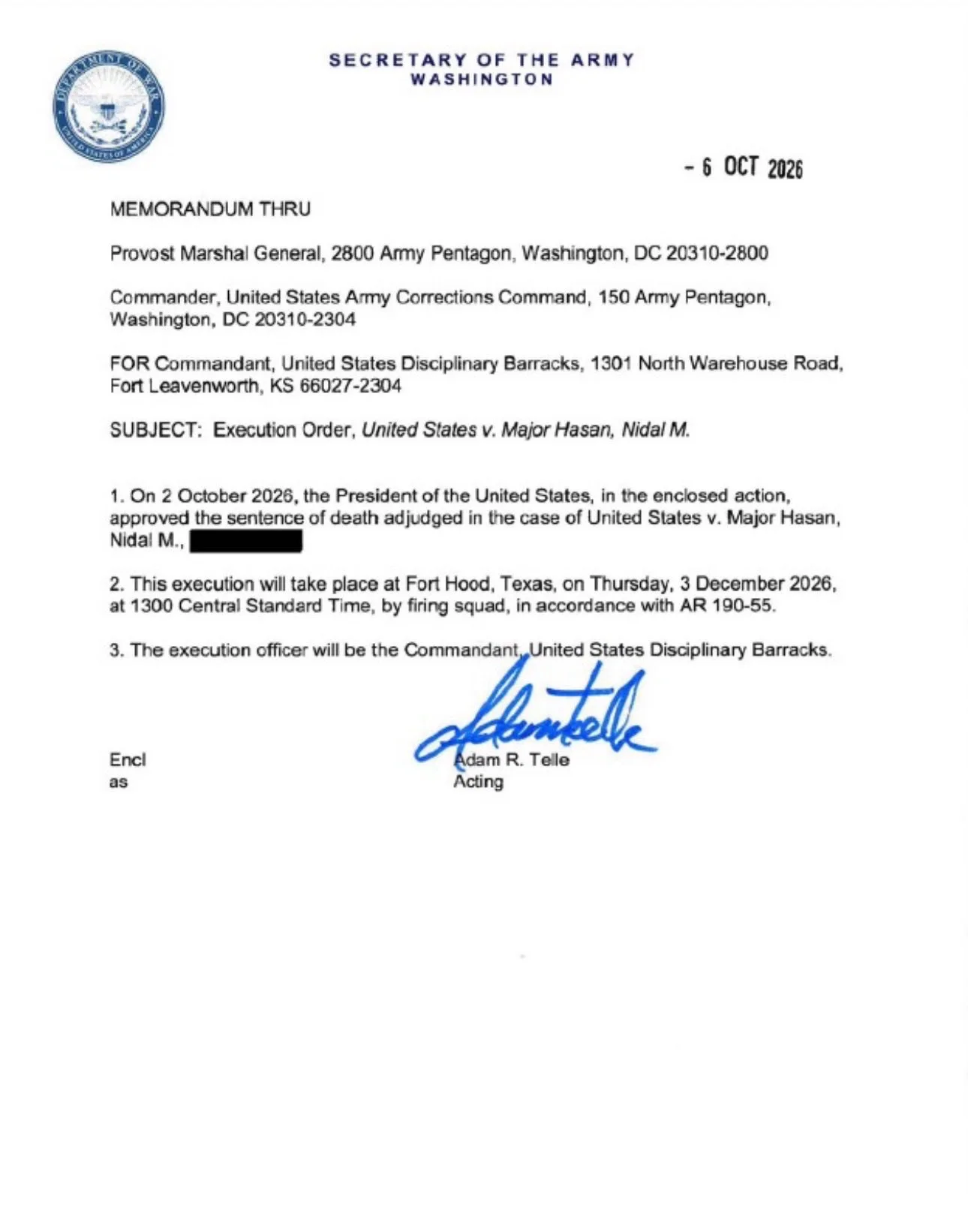
IMAGE: Acting Army Secretary Adam Telle’s October 6 order directing Nidal Hasan’s execution by firing squad at Fort Hood on December 3, 2026 (Source: Office of the Secretary of the Army)
Rather than being executed behind the walls of the federal facility at Terre Haute, Indiana, where the Army normally sends condemned prisoners, Hasan will face an Army firing squad at the scene of his crime.
More crucially, Hegseth has also proposed a worldwide livestream of the event, which would be an unprecedented global media broadcast of an American execution—civilian or military.
The cancellation of the proposed broadcast left unanswered why Hasan was chosen ahead of prisoners who had spent decades longer on military death row.
Why did Hegseth move Hasan ahead of Gray and Akbar?
Of the four prisoners under military death sentences at Fort Leavenworth, Ronald Adrin Gray, Hasan Akbar, Timothy Hennis and Nidal Hasan, Hasan is the most recent arrival.
Gray, a Black former Army specialist convicted of multiple murders and rapes committed around Fort Bragg, has been on military death row since 1988.
Hasan was not the only Muslim on military death row. Hasan Akbar, a 34-year-old Muslim from South Los Angeles, had been sentenced to death way back in 2005 for killing two US military officers in Kuwait.
After President George W. Bush approved Gray’s execution in July 2008, the Army set a date of December 10 of that year, but a federal judge issued a stay on November 26. The stay was eventually lifted in 2016, yet Gray continued pursuing federal habeas challenges, and according to the Army’s own 2026 legal-journal account, the Army had not set a new execution date.
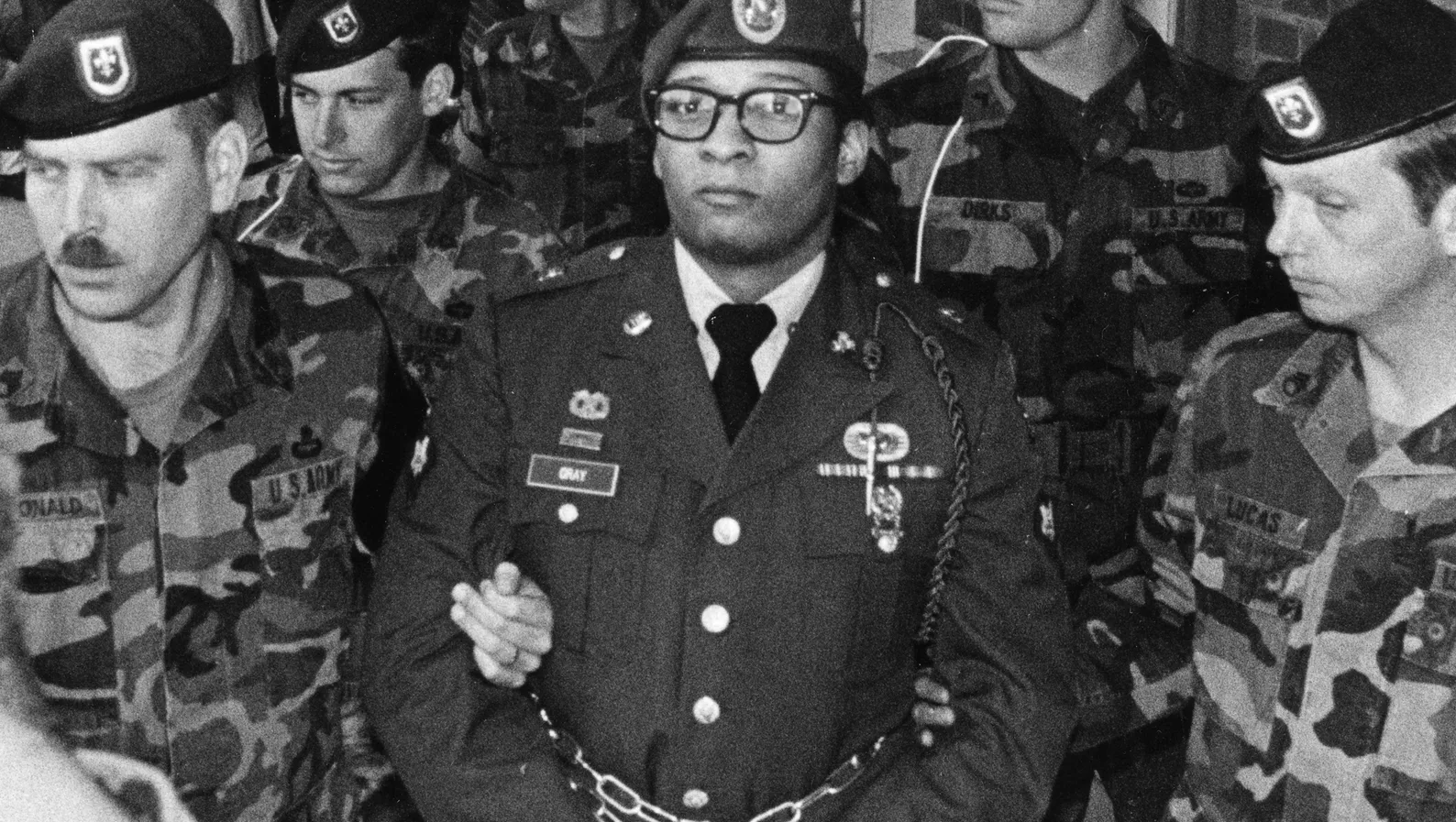
IMAGE: Ronald Gray leaves a Fort Bragg courtroom under military escort on April 6, 1988. President George W. Bush approved his execution twenty years later, but a federal judge stayed it (Source: The Fayetteville Observer)
To this day, Gray remains on military death row at Fort Leavenworth, having filed a new habeas petition in December 2018 that raised 19 challenges to his convictions and sentence, as detailed in a June 2021 federal-court order. The proceedings continued into at least March 2024, when a further order described the issues as “extremely complex.”
Hasan’s case reached presidential review after the Supreme Court declined his petition in March 2025, completing his direct appeals. He could still seek federal habeas relief, the same avenue Gray has pursued.
Gray’s litigation history may help explain the different treatment, but it does not establish why the Army left him unscheduled—while Hegseth publicly prioritised Hasan. The Pentagon advanced Hasan’s execution after the presidential approval in 2026, while Gray still remained without a date—no less than 18 years after his sentence received the very same authorisation.
Why Hasan, then? Gray already had presidential approval, and Akbar’s presence on death row means Nidal Hasan’s Muslim identity alone cannot explain why he has been fast-tracked by the Trump administration.
Hasan’s political usefulness offers one possible explanation, since his punishment at Fort Hood could turn the scene of his attack into a stage for “fighting radical Islam” which Hegseth has publicly associated Hasan’s execution. This theme becomes even more relevant when married with the fact that the Trump administration is struggling to justify two costly war of aggression it is prosecuting against Muslim countries—on Iran, and Yemen.
Did Hegseth set Hasan’s execution machine in motion?
Hegseth publicly committed himself to Hasan’s execution in September 2025—before the president had even approved the death sentence. The Pentagon confirmed that the Army was moving his case forward, but as yet has offered no explanation for prioritising him over the other three prisoners on military death row.
Five months later, in February 2026, the Army circulated Operation Resolute Justice, an internal plan for the potential execution of all four prisoners. It assigned responsibilities and set timelines for transporting the prisoners, arranging witnesses, and coordinating with the official federal execution facility at Terre Haute.
Hegseth’s push to execute Hasan appears to have helped turn dormant procedures into active preparations. An Army legal-journal article linked his request to renewed attention to execution procedures among military lawyers, and described an accelerated timeline in Hasan’s case.
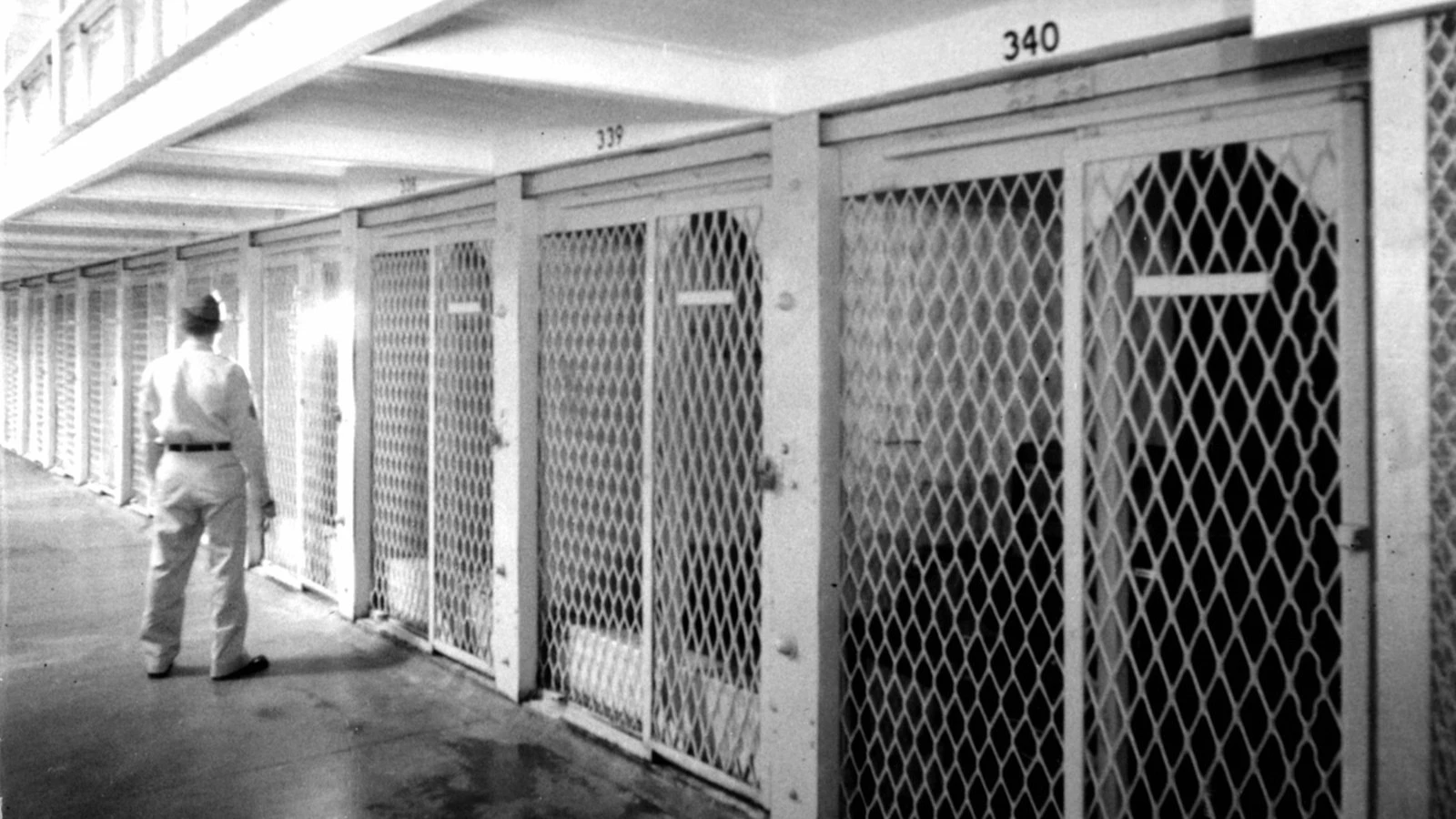
IMAGE: Cells in the original U.S. Disciplinary Barracks at Fort Leavenworth, known as the “Castle”. The Army reproduced this archival photograph in its 2026 review of execution procedures following Hegseth’s push to execute Hasan (Source: U.S. Army / The Army Lawyer)
It’s true that Trump’s Executive Order 14164 had already established a federal policy favouring capital punishment, but it did not expressly order military executions. Again, it must be noted that Hegseth gave that broader agenda a specific target when he publicly demanded Hasan’s execution—months before the Army circulated its four-prisoner plan in Operation Resolute Justice.
The originating instruction remains outside of the public record examined here, leaving unresolved whether or not Hegseth’s demand launched the plan, or accelerated work already underway. His intervention placed Hasan at the centre of the military’s return to executions, and the arrangements that followed have clearly designated his death as more important than those of the other prisoners that would’ve been scheduled ahead of Hasan.
Operation Resolute Justice reportedly called for transferring condemned prisoners to Terre Haute, where the federal government already had the personnel and infrastructure to carry out their executions by lethal injection. However, in the case of Hasan, standard procedures have suddenly been rewritten. Fort Hood replaced Terre Haute, and Army riflemen replaced lethal injection, bringing Hasan back to the scene of his crime to face execution.
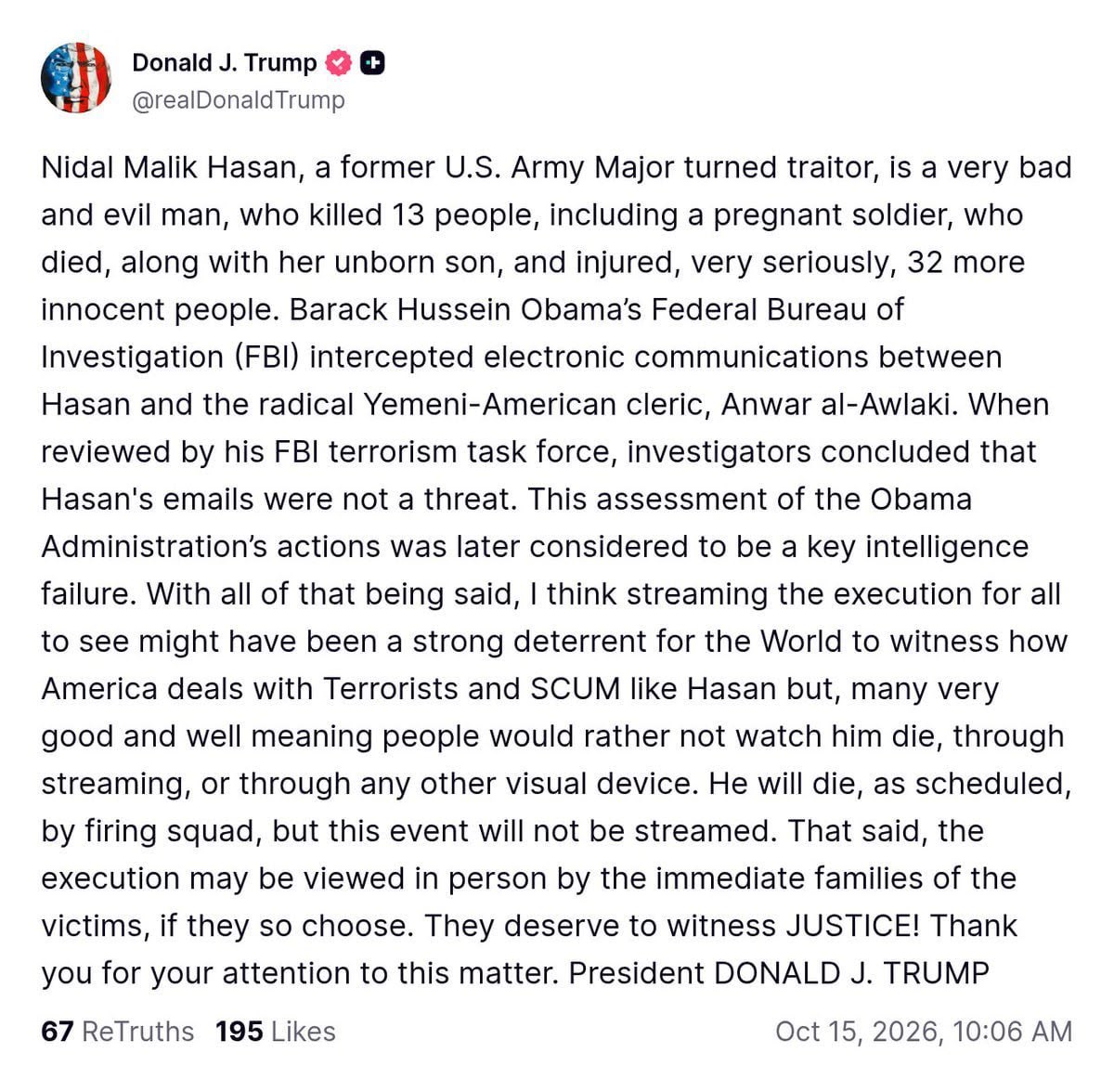
Hegseth’s proposed livestream execution would have broadcast Hasan’s death to a global audience, which Trump had initially endorsed the livestream, but then subsequently reversed his support for the broadcast, ruling it out on October 15, while still allowing victims’ immediate families to attend in person.
.
Army Regulation 190-55 limits attendance to approved witnesses, including military personnel, families, and victims’ representatives, and at least two news-media representatives, and bars anyone under 18. Broadcasting the execution to an unrestricted global audience would have taken it well beyond the normally controlled arrangements.
The evidence now indicates that the proposed livestreamed killing was the work of a small group at the Pentagon. According to CNN, citing sources around the decision process, Hegseth, acting Army Secretary Adam Telle, Pentagon spokesperson Sean Parnell, and Parnell’s staff, had decided that his promise of a “public” execution meant an online broadcast. Three sources told the network that the announcement caught Pentagon and Army officials ‘off guard’.
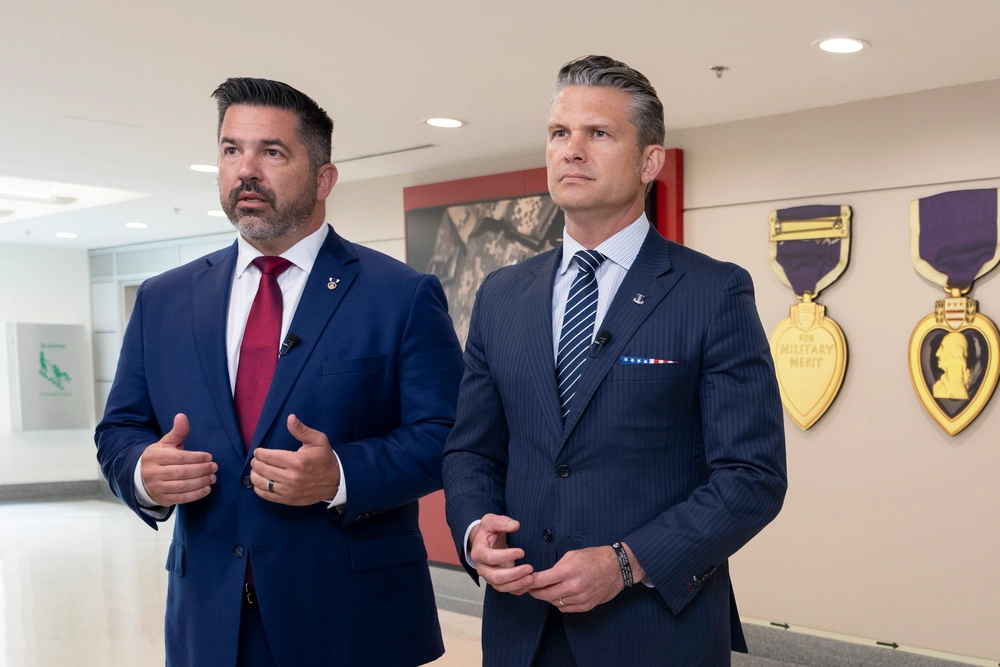
IMAGE: Pete Hegseth and Sean Parnell recording Pentagon remarks in August 2025. CNN later identified both among the officials who decided Hasan’s execution would be livestreamed (Source: U.S. Department of Defense / DVIDS)
As Trump asserted that the final decision on livestreaming would be his, advisers explored ways to limit what viewers would see. By October 13, ABC News reported, they were considering cutting away before the shooting or placing the camera outside the execution area. The Pentagon continued to insist that the broadcast would proceed, with a defence official telling ABC, “The Secretary is correct. It will be live streamed. Details will follow.”
Two days after Hegseth’s announcement, a media backlash ensued, and Trump then withdrew his endorsement of the broadcast, although he still argued that streaming it might have served as a deterrent by showing the world how America ‘deals with terrorists’.
Trump likely judged that, with opposition intensifying and the midterm elections approaching, the political risks of broadcasting the execution could be immense.
Hegseth’s livestreamed global provocation
Pentagon spokesperson Sean Parnell and his staff are reported to have helped make the decision that Hasan’s execution would be livestreamed, placing the Army leadership in a potentially compromising position. Taking the execution beyond approved witnesses and onto a global platform would have politically exposed the Pentagon in ways that previous administrations could hardly have imagined. Once released, the footage would then take on a life of its own—far beyond what would normally be carefully crafted and tightly controlled messaging by the Pentagon. The same images intended to demonstrate American strength could be recut and recirculated, over and over, and more likely by a plethora of Islamic organizations, not to mention the very ‘radical’ organisations which Hegseth was seeking to confront through this incredible public spectacle. In all practical terms, Hegseth’s livestream event should really be viewed as a political provocation.
SEE ALSO: Crusader-in-Chief: Pete Hegseth’s Christian Zionist Mission to Help Israel Confront Iran
The irony here is that it was originally Hasan’s desire to be killed during the mass shooting, as he believed that would make him a martyr—a fate he was unable to attain, due to the fact that he was wounded by military police during his attack. By fast-tracking his execution, and broadcasting it globally, Hegseth was clearly giving Hasan the very religious platform he was seeking. Indeed, Hasan has stated that his execution would fulfil martyrdom, according to a George Washington University case study drawing on correspondence with him. Few could argue that by broadcasting footage of American soldiers killing him would provide great propaganda and recruitment material for jihadist groups and their supporters to promote the martyrdom he sought.
DOCUMENT: A GWU study records Hasan’s belief that execution would make him a martyr (Source: George Washington University)
HASAN A CASE STUDY
ABC News reported concerns inside the administration that the recording could be used for recruitment. Lawmakers and national-security critics also warned of the broadcast’s wider consequences.
Hegseth’s ‘American Crusade’ against Islam
Hegseth called Hasan’s crime a “radical Islamist attack in uniform”, and emphasised that American soldiers would carry out the punishment, as Rolling Stone reported. His language presented the firing squad as military retribution against the ‘Islamist enemy’, injecting a clear ideological and geopolitical theme into the livestream broadcast.
In his book, American Crusade, Hegseth rejects the description of Islam as “a religion of peace”, and invokes the Christian crusades beginning in the 11th century as directly connected to today’s Christian nationalist anger, as NPR’s examination of his published work demonstrates. This also ties directly to Hegseth’s own extremist Christian Zionist believes, including his controversial public calling for the rebuilding of a Jewish Third Temple on the present Islamic holy site of the Al Aqsa Mosque in Jerusalem—a brazen move which which almost certain ignite a global religious war, pitting Christian Zionists and Jewish Zionists against the global Muslim community.

IMAGE: Hegseth’s American Crusade, published in 2020, lays out the worldview examined here (Source: Hachette Book Group))
Moreover, Trump’s self-styled “Secretary of War” Hegseth also has the crusader iconography tattooed over large parts of his body, featuring a large Jerusalem Cross on his chest, and the latin phrase “Deus Vult” tattooed on his right arm, along with the word “Infidel” written in Arabic along the bottom of his right bicep. These reinforce Hegseth’s own radical political worldview in which Christianity and America face a shared enemy, and that military power must be deployed to fight this holy war.
An Army officer who attacked fellow soldiers and later described his desire for martyrdom, Hasan embodied the Islamist enemy inside the gates’ of the West, further fueling the obvious ‘clash of civilizations‘ which is being aggressively deployed by the conservative right in order to frame the highly emotive immigration issue that is dominating large sections of the western political discourse. Thus, by emphasising that US soldiers would carry out his capital punishment, Hegseth could present the execution as the military confronting and destroying that enemy.
There is also an obvious revanchist theme, as Hegseth also views a military firing squad as a return to the ‘greatest generation’, engendering “the mentality we had in World War II, which was to win.”
The message is clear: the public spectacle of Hasan’s execution could dramatise the confrontation between America and radical Islam—a clear motive that runs through Hegseth’s published work.
While this political motive does not prove why he was selected ahead of Gray, it undeniably sharpens the question of how his case became the priority.
Was Hasan talking to a federal informant?
The story of Nidal Hasan eventually leads us to one Anwar al-Awlaki, the infamous American Islamic cleric with whom Hasan corresponded, and who later became associated with al-Qaeda. But al-Awlaki was already known to the government long before Hasan began writing to him, as the National Security Archive’s collection of documents shows.
Whenever Awlaki is mentioned in conjunction with the Nidal Hasan case, it is reflexively framed as Awlaki somehow radicalising Hasan, thus reinforcing the narrative that Hasan’s criminal act was inspired by al-Qaeda. However, many journalists and researchers have previously highlighted al-Awlaki as a ‘person of interest’—not necessarily as a ‘terror mastermind’, but as a possible government informant.
In February 2002, reports revealed al-Awlaki as having visited the Pentagon as an invited luncheon speaker—while under FBI investigation. Surveillance logs record agents following him to the building. A peculiar dilemma: one part of the government was welcoming the man, while another was watching him.
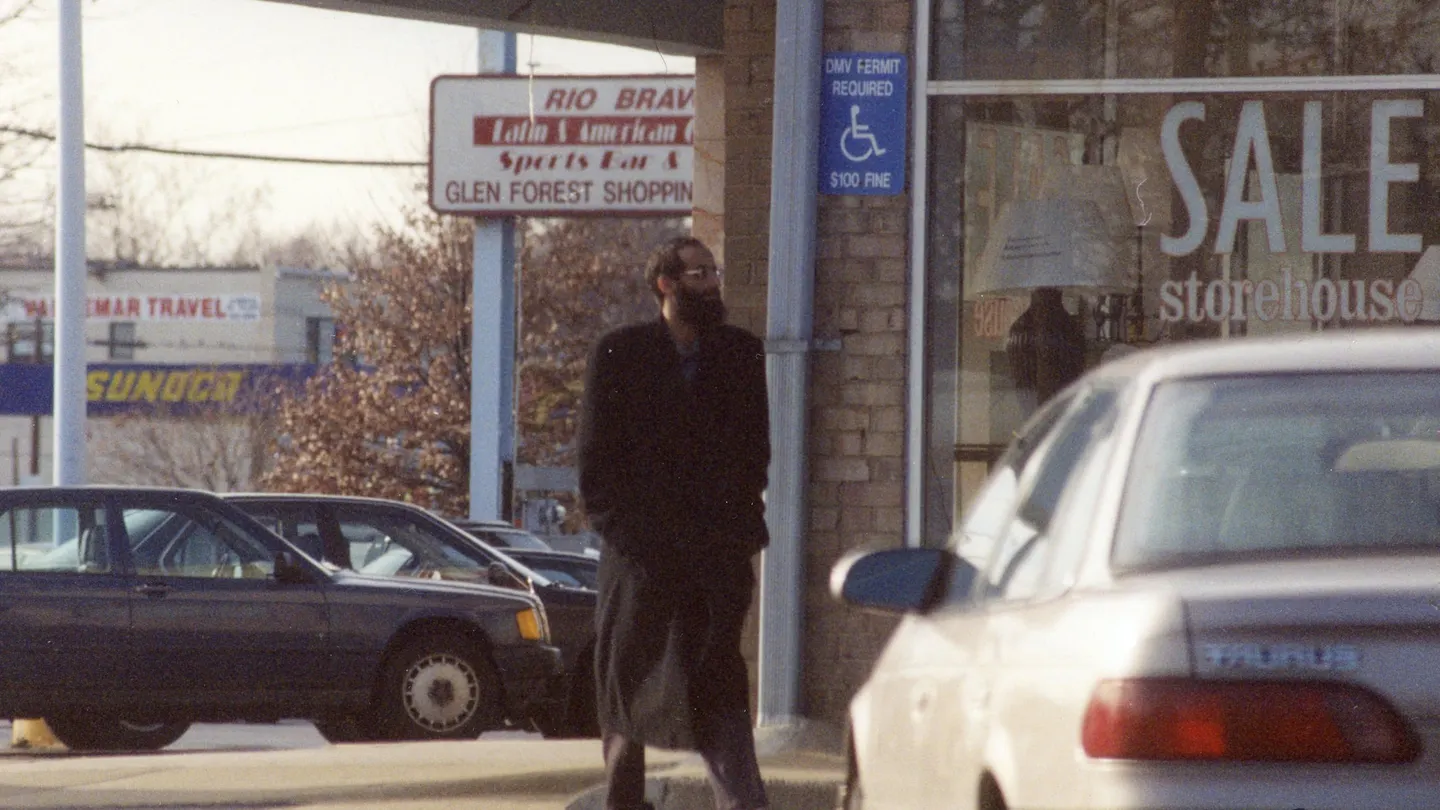
IMAGE: FBI surveillance of Anwar al-Awlaki on February 5, 2002, the day he attended a Pentagon luncheon (Source: Fox News)
It turns out that FBI agents had previously interviewed al-Awlaki repeatedly following September 11 and placed him under round-the-clock surveillance, according to records in the National Security Archive’s collection. Reporting on the precarious Pentagon visit raised more questions—a narrative at odds with the government’s public characterization of him as a leading ‘terror’ figure.
When pressed on the matter, the Pentagon publicly described the seemingly unlikely invitation as outreach to the Muslim community, according to CBS’s reporting. But the same report said officials also regarded al-Awlaki as a potential investigative source. That leaves an open question as to whether their contact served more than one purpose, without establishing that the luncheon itself was an attempt to recruit, or debrief him as a military intelligence asset. However, it confirms that at the very least, al-Awlaki had a relationship with the US government.
Before al-Awlaki returned to the United States from the UK in October 2002, his case had already reached the FBI director and the attorney general. A Fox News investigation drawing on records obtained by Judicial Watch identified an October 3 memorandum from Robert Mueller to John Ashcroft, marked secret and bearing an al-Qaeda-related designation. The substantive text was entirely redacted, revealing the level at which his case was being discussed, but not what officials intended to do.
When al-Awlaki arrived at JFK on October 10, 2002, customs officers detained him. However, FBI special agent Wade Ammerman intervened, and authorised his release—despite what Fox News described at the time as an active arrest warrant. The Justice Department withdrew the warrant that same week, saying the underlying passport-fraud case was weak. The case becomes more compelling, after Al-Awlaki later appeared with a government witness at the home of Ali al-Timimi, a Virginia-based Islamic scholar under investigation by Ammerman’s counterterrorism investigation, although the reporting could not establish whether or not the FBI had arranged that visit.
Twelve days after the airport release, an October 22 FBI memorandum bearing al-Awlaki’s name carried the synopsis “Asset reporting,” according to the same investigation. Al-Timimi’s defence attorney interpreted the document as indicating that al-Awlaki either was an asset, or had been put in contact with one. Note that this was the attorney’s assessment, and not a confirmed finding. Certainly the wording warrants further examination, although it does not, by itself, establish that al-Awlaki was an informant in this instance. Nor can this potentially important detail be ignored, as it could form a trail of evidence that would indicate that al-Awlaki may have much more than the public face of an ‘American al-Qaeda’.
More questions began to mount. Asked about a possible recruitment effort in 2013, Mueller said he had no personal knowledge of one, but could not rule out an approach elsewhere in the FBI or another agency, according to Fox’s account of the exchange. Al-Timimi’s lawyers were also seeking evidence that al-Awlaki had been a government informant when the men met in October 2002. Prosecutors maintained that they had disclosed everything required and declined to say whether al-Awlaki had been an informant, according to the Associated Press report.
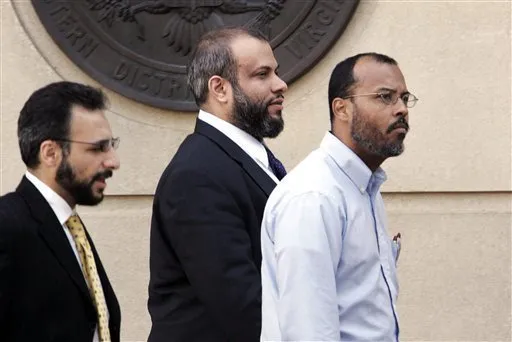
IMAGE: Ali al-Timimi outside court in 2005. His lawyers later sought records on al-Awlaki’s possible informant role. (Source: San Diego Union-Tribune)
Mueller’s answer left the recruitment question unresolved, while the discovery dispute brought the possibility that al-Awlaki had worked with the government in relation to the court case. Another key unanswered question is what US government officials sought from the cleric, and whether those earlier dealings shaped how they assessed him when Nidal Hasan began writing to him years later.
Hasan began writing to al-Awlaki in December 2008, repeatedly seeking religious guidance and approval. The cleric sent only two direct replies—one of which was addressing Hasan’s search for a Muslim wife, according to an examination of the messages published after the Webster Commission’s review. Neither reply contained terror attack instructions or overt operational planning. The correspondence reveals Hasan’s attraction to al-Awlaki, but does not show the cleric recruiting him or directing the attack. The FBI was intercepting their messages before the shooting, yet it’s Washington’s assessment that these were consistent with Hasan’s professional psychiatric research, and so they did not pursue a fuller terrorism investigation, according to the Senate investigation into ‘missed warnings’. After the massacre, the Webster Commission identified shortcomings in how the bureau reviewed information, handled investigative leads and resolved disagreements between offices, as the FBI acknowledged in its response to the findings. Thus, it was concluded that investigators had access to the correspondence, but failed to assess its significance and act on the warnings it contained.
DOCUMENT: The Webster Commission recorded an unresolved FBI disagreement over Hasan—and no further action by either field office. (Source: Webster Commission report, hosted by CNN)
william.webster
The emails received a different kind of scrutiny at Hasan’s court-martial. Judge Tara Osborn excluded the correspondence, concluding that the redactions needed to avoid unfair prejudice by association would diminish its evidentiary value. Messages that had helped shape the public account of Hasan’s radicalisation therefore never became trial evidence of recruitment or direction by Anwar al-Awlaki.
What remains undisclosed is whether Hasan’s defence received records concerning possible source recruitment, the classified October 2002 activity, the JFK release, or the informant allegations raised in al-Timimi’s case. The record examined here does not establish what Hasan knew about those dealings, or whether he knew anything at all. But if he learned that the cleric whose guidance he sought had worked with the government, that knowledge could have changed his understanding of this critical chain of events. Establishing whether any such relationship existed, and whether Hasan knew of it, requires examining what his defence requested and what the government searched, disclosed or withheld.
Regardless, Hasan’s responsibility for the Fort Hood murders does not settle those questions. So before officials turn his execution into the closing scene of an American soldier’s recruitment by an ‘al-Qaeda enemy’, they should also account for their own dealings with that supposed outsider. CBS reported that officials had regarded al-Awlaki as a potential investigative source, years before the government intercepted Hasan’s appeals to him. Executing him would foreclose any further opportunity to question him about them. Yet another good reason why there should be a full disclosure of these communications before an execution, and not left to languish in speculation for years afterwards.
The government’s book on al-Awlaki was eventually closed on September 30, 2011, when President Obama ordered a drone strike in al-Jawf Province of Yemen, killing al-Awlaki, said to be leader of Saudi-backed al-Qaeda in the Arabian Peninsula (AQAP), followed by another drone strike in Yemen on October 14, 2011, which killed his 16-year-old Abdulrahman al-Awlaki, also American citizen.

IMAGE: Hegseth holds a Torah scroll donated by Joseph Frager’s family during a Frager-organised visit to Hebron in August 2016 (Source: Israel National News)
Israel’s role in elevating Pete Hegseth in the Trump administration
While the mainstream media narrative tells the story that Donald Trump’s decision to select Pete Hegseth as Secretary of Defense was because of his high-visibility position as a Fox News host, the reality is that pro-Israel advocacy and conservative Zionist networks played the decisive role in elevating and positioning, and lobbying US senators for this key cabinet position. Details from multiple investigations reveal how the Israel lobby had already positioned Hegseth as a trusted, hardline Christian Zionist ally long before his nomination in late 2024.
His Christian nationalist confrontation with Islam gives Hasan’s execution even more political significance, and connects Hegseth’s insistence on staging this public spectacle to his intimate relationships with hard-right Israeli and Christian-Zionist circles. These connections include Joseph Frager, the Israel Heritage Foundation and Jonathan Burkan. The details of these relationships leave no doubt as to how Hegseth was shortlisted for his current role. Examining those relationships helps explain the radical religious political world in which Hegseth has been operating in, and how Israel capitalized on its influence to shape Hegseth into its most malleable tool within the Trump administration. This includes how Israel has successfully pulled the US into the disastrous Iran war.
Hegseth was not the only official involved in shaping the execution’s public presentation. It was Acting Army Secretary Adam Telle who set the date and location and reportedly joined the livestream decision, previously led the Trump White House’s Senate liaison operation. His official Army biography credits him with helping deliver the Abraham Accords, placing another participant in the execution planning within the administration’s broader project of strengthening Israel’s regional position.
Pentagon spokesperson Sean Parnell brought his own outspoken support for Israel and Netanyahu. In May 2021, he publicly affirmed Israel’s right to defend its people, and following October 7, 2023, he praised Netanyahu’s leadership and demanded uncompromising retaliation against Hamas. Again, it was Parnell and his staff who decided that Hasan’s execution should be livestreamed. Undoubtedly, Hegseth’s portrayal of America and Israel as partners in a civilizational struggle gives the proposed spectacle its wider political significance. The killing of an ‘Islamist enemy’ could have become an image of vindication for constituencies already persuaded that overwhelming force must be deployed in defence of Western civilisation, which is ‘under siege from radical Islam’. Their language and clarion call echo near-identical rhetoric by Israeli Prime Minister Benjamin Netanyahu (currently wanted by the International Criminal Court for crimes against humanity), who has repeatedly framed Israel’s various wars of aggression a defense of “Western and Judeo-Christian civilization against radical Islam”. From a political perspective, the radical Christian nationalist and Zionist beliefs and alliances of Hegseth, Telle, and Parnell make the intended message a matter of public accountability.
These men owe the public an explanation as to exactly whose interests, and whose security would have been served by broadcasting Hasan’s death to the world, as well as what role their own ideological and religious beliefs have played in rewriting US military procedures on executions.
Ben-Gvir and Hegseth seek to weaponise state executions for political ends
It’s important to note here that Israel’s controversial National Security Minister, Itamar Ben-Gvir, has made capital punishment for Palestinians convicted of ‘terrorism’ by Israeli military courts a central pillar of his radical political project. The execution facilities and observation booths for victims’ families give that project a physical form, making the prisoner’s death something to witness, with the state’s power on full display.
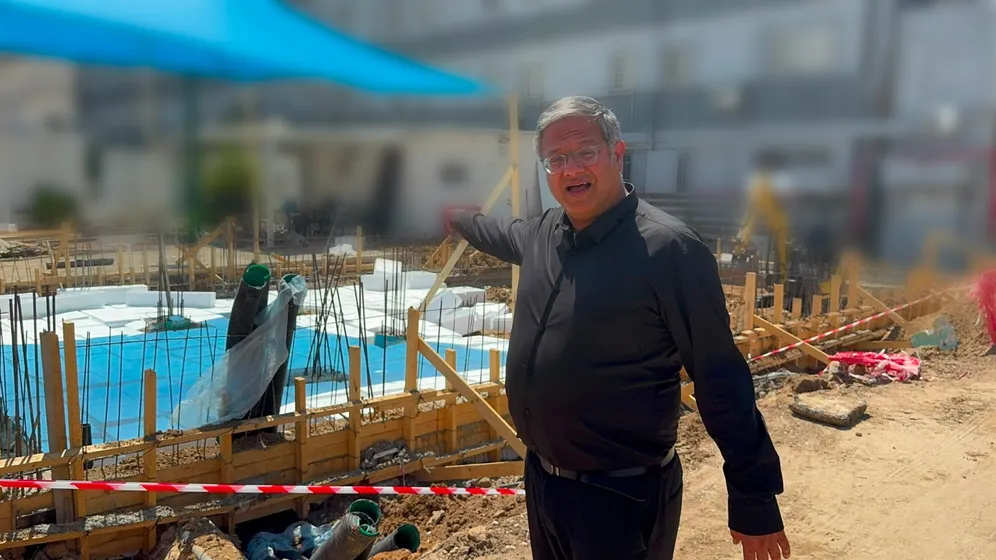
IMAGE: Ben-Gvir presents the execution facility under construction, announcing plans for observation areas for victims’ families (Source: i24NEWS)
It must also be stressed that Ben-Gvir’s medieval-style gallows and Hegseth’s livestreamed spectacle would have served different audiences, but both placed spectatorship at the centre of capital punishment. One offered victims’ families a view of the execution, while the other would have opened it to the world. Both are invoking similar themes of a civilisational war on ‘Islamic terror’. In both, the condemned prisoner could become a stand-in for a larger enemy, his killing presented as proof that the state could deliver the retribution its leaders had promised.
That said, the timing of Ben-Gvir and Hegseth’s state spectacles should not be treated as mere coincidence. These two archaic initiatives are very much linked, and stem from the same political and ideological source, and carry the same objectives.
In both cases, Ben-Gvir and Hegseth are weaponising the death sentence to promote their beliefs, turning the killing of a prisoner into a public demonstration of how they intended to confront their enemies. Ben-Gvir had invoked an American precedent to defend observation booths where families of victims could watch executions. Hegseth proposed taking that spectacle to a global audience, using an execution to project a message of power far beyond the prison walls. Both cast Christians and Israelis as allies in a civilisational struggle against an Islamic enemy, which makes the spectacle an instrument of incitement in a global religious war.
How Hasan’s death could become the military’s new template
Operation Resolute Justice covers all four military death-row prisoners, and the arrangements developed for Hasan could shape the executions that follow. Decisions about the method, personnel, execution site, witnesses, security and public access could outlast the controversy surrounding this incident.
A 2019 revision of Army Regulation 190-55 removed the requirement for lethal injection and gave the Army secretary authority to choose the method of execution. The regulation also requires execution protocols, trained personnel and after-action reports, providing an institutional framework through which preparations for one execution can inform the next. The choices surrounding Hasan could therefore help establish how a reactivated military-execution system operates—whether or not his death is broadcast.

IMAGE: The Army’s execution checklist requires coordinated facilities, trained personnel and a protocol for the chosen method. Highlighting added (Source: U.S. Army regulation, hosted by FederalLibrary.us)
Military-commission cases at Guantánamo fall under a separate statutory framework, which authorises the defence secretary to prescribe execution procedures and requires presidential approval and completed judicial review before a death sentence can be carried out. Any extension of the arrangements developed for Hasan to those cases would require separate examination of the governing rules and litigation.
Hasan may be the politically easiest prisoner through whom to reactivate that system, a man so reviled that the machinery assembled to kill him attracts much less scrutiny than the man does. His notoriety gives officials room to establish new practices that could remain on the books long after his execution.
Ronald Gray already had presidential approval for his execution, yet he remained unscheduled, while Hegseth advanced Hasan. Gray offered an established route to resuming military executions. Hasan offered a political opportunity—a prisoner whose crime and identity matched the enemy Hegseth has spent years telling his audience America must confront.
Hegseth has urged Christians, alongside ‘their Jewish allies’ and the Israeli military, to take up a struggle against the Islamic enemy. An American firing squad killing Hasan at Fort Hood would have turned that rhetoric into a global media spectacle, giving Hegseth a massive platform to promote his Christian crusade.
Trump stopped the broadcast, but Hasan is the prisoner chosen to die first, while other longer serving inmates are left waiting. While Hasan will surely die for his crime, will Hegseth and company ever be held accountable for the rank politicisation of his death?
READ MORE ISRAEL NEWS AT: 21st CENTURY WIRE ISRAEL FILES
SUPPORT OUR INDEPENDENT MEDIA PLATFORM – BECOME A MEMBER @21WIRE.TV
VISIT OUR TELEGRAM CHANNEL
]]>
Episode 617 of SUNDAY WIRE SHOW resumes this week, October 18, 2026, broadcasting LIVE on Alternate Current Radio (ACR)…
Sunday Wire Radio Show Archives
LISTEN LIVE ON THIS PAGE – START TIMES:
5pm-8pm UK Time | 12pm-3pm EST (US) | 9am-12pm PST (US)
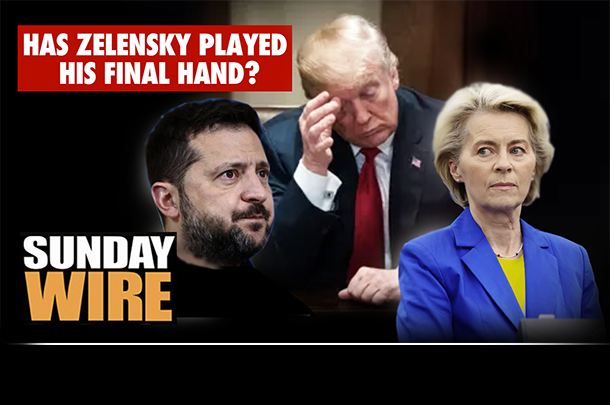
This week on the SUNDAY WIRE, host Patrick Henningsen returns this week with our regularly scheduled program. This may have been Zelensky’s worst week yet since his political reality show “Servant of the People” began. After throwing his toys out the pram after hearing US was going to release Russian diesel, the Little Green Goblin of Kiev has decided to verbally attack Trump, and defy Washington by launching more terrorist attacks inside of Russia. Meanwhile, no less than 30 Gen Z youth protests and riots have broken out in at least 15 country, with that number growing by the hour. Riots in France seem to be the catalyst, as the you begin to connect their domestic austerity with their wasteful governments’ geopolitical antics in places like Ukraine, Palestine and Iran. What will unpopular elites do now? Later in the Overdrive hour, we’re joined by teammates Bryan “Hesher”McClain, Adam “Ruckus” Clark, and Basil Valentine for deeper look into these and other breaking developments. All this and more…
SUPPORT OUR PLATFORM AND JOIN OUR 21WIRE COMMUNITY @21WIRE.TV
This month’s featured music artists: The Real Anthem Band, Joseph Arthur, Peyoti for President, Peter Conway & Red Rumble, and Phil Zimmerman
WATCH IT LIVE ON YOUTUBE, X, RUMBLE, FACEBOOK AND HERE:
.
Listen to latest available audio upload here:
NOTE: Our weekly show will be available in podcast recording after the LIVE program, here at 21WIRE and on all major podcasting platforms (see links below).
Sunday Wire Radio Show Archives
Max Blumenthal of The Grayzone rips the cover off the media deceptions and atrocity hoaxes Israel pushed after October 7 to create political space for its gruesome assault on the Gaza Strip. Blumenthal exposes the US mainstream media’s role as a megaphone for the Israeli government, introducing new lies even after their initial ones were debunked. Atrocity Inc raises serious questions about the official narrative of October 7, while revealing how Israel’s army has consciously engaged in the same hideous atrocities which it falsely accused Palestinian militants of committing. Watch:
.
Run time: 44 minutes
Written by: Max Blumenthal and Sut Jhally
Directed & Edited by: Sut Jhally
Produced by: Max Blumenthal and Ahmad Hussam
Production: The Grayzone and Propaganda & Co
SEE MORE SUNDAY SCREENINGS HERE
READ MORE PALESTINE NEWS AT: 21st CENTURY WIRE Palestine FILES
SUPPORT OUR INDEPENDENT MEDIA PLATFORM – BECOME A MEMBER @21WIRE.TV
VISIT OUR TELEGRAM CHANNEL
]]>Dialogue Works host Nima Alkhorshid talks with 21st Century Wire’s Patrick Henningsen about these and other crucial details in this story. Watch:
.
READ MORE YEMEN NEWS AT: 21st Century Wire Yemen Files
SUPPORT OUR INDEPENDENT MEDIA PLATFORM – BECOME A MEMBER @21WIRE.TV
VISIT OUR TELEGRAM CHANNEL
]]>