The post Your Expertise Won’t Make You Successful in Leadership appeared first on 21st Century Learning.
]]>Most school leaders are promoted because they were great at something else. They ran a brilliant classroom, led the curriculum committee, or kept the technology running. Then one day the job changes, and the skills that got them there stop being enough.
In a recent live webinar, we’ve gathered some great minds for a conversation on: Your Expertise Got You Into Leadership. It Won’t Make You Successful There.
Facilitated by Dr. Ben Sheridan, the panel brought together Lural Ramírez (Head of School, Academia Cotopaxi, Quito), Dr. Ryan Persaud (Director, Bonn International School), Dr. Tim Stewart (Director of Leadership Recruitment and Global Partnerships, Search Associates) and Dr. John Nash (Associate Professor of Educational Leadership, University of Kentucky), with Dr. Howard Stribbell, 21C Learning’s Chief Learning Officer. Between them they have worked in schools on five continents. Here is what they wish they had known sooner.
1. The first lesson is humility
Tim Stewart did not hesitate. “The biggest lesson in leadership when I actually became a leader was humility,” he said. “Up until the point where I was actually in charge, I thought I could do it all, and I thought I could do it better than most people.” Stepping into the role made it clear he needed to surround himself with people who were smarter than him.
Ryan Persaud agreed. The work ethic that gets you noticed only carries you so far, because as you move up, “that bucket’s just going to get exponentially bigger.” The answer is to hire for the skills you lack, “and not having an ego about it.”
Lural Ramírez added what comes next. Once a strong team is in place, “your job is really just to support.” She spends much of her time in one-on-ones asking her leaders simple questions: What are you working on? What do you need? What can I help you think about?
2. Stop being the fastest person to answer
John Nash named a habit many new leaders carry over from their old roles. “If you come in someplace and you’re always answering first, you’re just teaching everyone else to wait for you to say something.”
Ben Sheridan described the same shift from his own career in technology, where things either work or they don’t. Leadership is different. You rarely have the whole picture, yet you still have to move. The discipline is to decide with the best information you have, then watch closely and adjust. As Ben put it, “If you’re talking, you’re not learning.”
3. Learn the business side, so operations serve learning
Howard Stribbell pointed out that international school leaders rarely have a central office behind them. In a small school, a new leader can be curriculum director, SEL director and athletic director at once, while also fixing the Wi-Fi. The panel shared practical ways to close the gap:
- Take a finance course. Ryan, who trained in business before teaching, urged every leader to get comfortable enough to sit with the director of finance and understand the numbers.
- Ask your board to invest. Tim’s board sent him to business school. “The boards are often filled with business people. They value somebody who is a learner in that space.”
- Use AI as “a silent but very powerful partner” to fill operational knowledge gaps, as Tim suggested. Ben’s own senior team is piloting AI to automate operational work and free up time for teaching and learning.
- Hire a strong director of teaching and learning who can keep curriculum moving when operations pull you away.
Lural offered a warning. “Sometimes I’ve arrived in contexts where the operational tail is wagging the dog.” Operations should sit underneath learning and support it. The more a head understands finance and operations, the better they can keep learning at the center.
4. Fix the system, not just the problem
John Nash shared a line he borrows from healthcare: “Every system is perfectly designed to get the results it gets.” If the same parent complaint or student behavior keeps coming back, your school is producing it. Fixing it once only fixes it once.
His practical test: keep a list. If you find yourself solving the same thing more than twice, “that might be a systems agenda.” To see the system, “ask one more question before you offer any answers.” Talk to long-serving staff and ask what they would do if you weren’t there. And “sometimes you let a solution that’s about 80% as good as yours go forward because they own it.”
Tim’s version was simpler: “You’ve got to turn into a three-year-old.” Keep asking why. He was candid that the root cause is sometimes uncomfortable. A hiring pattern, traced back far enough, can reveal institutional bias, and tackling it takes courage.
5. Listen and act: push on purpose, stay open on method
Howard described experience as a double-edged sword. The moment you say “that happened at my last school, and we fixed it like this,” you stop looking at the context. Yet he also hires leaders, and when candidates promise to do nothing but listen for a year, his answer is blunt: “I’m not paying you to just listen.”
John resolved the tension. Leaders can listen, learn and act. But a listening tour that leads nowhere burns “a little bit of a social bridge there that could really bite you later.” His advice: “Push on the purpose. Be firm about what students need, but listen on the method.” Start with small tests, and expect what Michael Fullan calls the implementation dip before things improve.
The panel also shared how to listen with direction:
- Ask questions that point the way. Tim asks teachers how their formative assessments shape instruction and interventions. The question signals what he values before he says it.
- Ask everyone the same two questions. Lural asks each person, “What do you hope that I never change?” and “What do you most want me to spend my attention on in that first semester?” As she said, “It’s not really what each individual person answers. It’s the pattern.” Protect what they love, focus where they ask, and there is little pushback when you act.
- Respect the web of relationships. Ryan noted that staff who have worked together for 15 or 20 years have deep connections that a newcomer cannot see in the first few weeks. Your fix may be right, but your method may not fit the culture.
6. Give yourself grace, and protect your capacity
Lural became a head of school at 32, often as the first female leader a school had known. Her advice to her younger self was grace. “We’re all doing our very best, and sometimes our very best is not great.” Ryan, who is often “the first in that room” at regional heads’ meetings, spoke to the extra pressure that brings and the patience it requires.
Howard was honest about the job. “There’s no such thing as work-life balance. It’s all rhythm and choices.” He treats physical and mental capacity as the fuel for leadership capacity: when either is drained, so is your leadership. The panelists’ own rhythms were refreshingly ordinary:
- Tim keeps one evening a week with people who have nothing to do with school.
- Ryan lifts weights five days a week and cooks for his family on weekends.
- Lural relies on humor every day and sport whenever she can.
- John has reframed an old people-pleasing habit with one sentence: “Not everything is my problem.” He plays guitar with his wife.
- Ben blocks time in his own calendar every Sunday, before everyone else fills it.
The hard way, or a better way
One attendee asked whether the move from expert to leader can be trained for, or whether people just learn it the hard way. Too often it is the hard way, alone. This panel showed another route: humble questions, small tests, honest peers and a lot of listening, followed by action.
The full conversation is available to watch here. Our next leadership panel is on 8 December; we’d love to see you there, join our mailing list to get notified when registration opens.
This webinar is part of the free community events organized in conjunction with the Applied Leadership Certificate. Find out more.
The post Your Expertise Won’t Make You Successful in Leadership appeared first on 21st Century Learning.
]]>The post The Third Teacher: Inside Brighton College Bangkok’s Award-Winning Campus appeared first on 21st Century Learning.
]]>That’s the idea behind “the third teacher,” the philosophy at the heart of Brighton College Bangkok Vibhavadi’s campus, and the subject of the latest episode of Education Vanguard, 21CL’s podcast where we sit down with the school leaders quietly rewriting what great education looks like.
Brighton College Bangkok Vibhavadi was the public’s pick for the Public Choice Award for Innovative Facilities at the ASEAN School Awards 2026 — chosen not by a panel of judges, but by educators and communities across the region who saw something worth celebrating. See the their winning submission

To mark the win, 21CL’s CEO & Founder Justin Hardman sat down with Crispian Waterman, Headmaster of Brighton College Bangkok Vibhavadi, for a conversation about what happens when a campus is designed to teach as hard as its staff do.
“The environment communicates the expectations”
For Waterman, the third teacher isn’t really about architecture at all — it’s about what an environment tells a child without a single word being spoken. The first teacher is the person standing in front of the class; the second is the peers a child learns alongside; the third is the space itself. At Brighton College Bangkok Vibhavadi, that space is designed to say one thing consistently: explore, collaborate, ask questions, and make mistakes.
He’s careful, though, to draw a line between the building and the learning. A school’s design and technology hub, its science labs, its art spaces and libraries are all built to encourage particular behaviours — but the building itself doesn’t educate anyone. People do. What the campus creates, in Waterman’s framing, is opportunity: raw material that only becomes learning once teachers pick it up and run with it. As he puts it, a great teacher can teach well in a poor classroom, and a poor teacher will struggle even in the world’s most impressive facility — so the real investment, always, is in the pedagogy, not the square footage.

Three values, mapped to three spaces
Brighton College Bangkok Vibhavadi’s three values — kindness, confidence, curiosity — aren’t just words on a website for Waterman. Walking through the conversation, he assigns each one a home on campus.
Curiosity lives in the maker space, the design and technology hub, and the university-grade science laboratories, where students are given room to experiment without needing a guaranteed outcome — to try something, get it wrong, recover, and try again.
Confidence belongs to the theatre, which Waterman describes as one of the most transformative spaces on campus: a child who lacks confidence can walk onto that stage and, given permission to be brave, be performing in front of hundreds of peers and family before long.
Kindness, by contrast, isn’t tied to a flagship room at all — Waterman locates it in the least glamorous corners of the school, the dining hall, the tutor rooms, the everyday spaces where houses and year groups simply spend unstructured time together and build a sense of belonging.
It’s a reminder that “innovative facilities” doesn’t only mean the flashiest room in the prospectus — sometimes the most important space on campus is the one nobody photographs.
British heritage, Thai identity
As one of a growing number of UK-heritage schools opening campuses in Bangkok, Brighton College Bangkok Vibhavadi has had to work out what travels well and what needs to adapt to a new context. Waterman is clear that the school’s core identity — its academic ambition, its focus on character development, and what he calls the “distinctive Brighton College confidence” to push pupils toward the best version of themselves — transfers easily to any country.
Thailand, though, isn’t just a location for the school, in his telling; it’s part of its identity. That means pupils get an outstanding British education while staying genuinely connected to the country they’re growing up in — its culture, history, language and traditions given real status within the life of the school, not treated as an add-on.

Measuring what the building can’t guarantee
Wellbeing sits close to the centre of the school’s pitch, but Waterman is notably cautious about drawing a straight line from architecture to outcomes. He resists putting a number on how much any one building or facility “produces” a wellbeing result, arguing there are simply too many variables in a school to isolate cause and effect that cleanly.
Instead, the school triangulates a wide set of signals: pupil voice, parent feedback, staff observation, attendance and behaviour records, and pastoral and academic data. Now in its second year, Brighton College Bangkok Vibhavadi is seeing what Waterman describes as a genuinely positive energy across the school — one the team hopes will continue translating into measurable academic outcomes over time.
Advice for school leaders: build for flexibility, not for Instagram
Asked what he’d tell another head planning a campus investment, Waterman didn’t point to a single flagship space — he pointed to a principle. His main advice is to protect flexibility: build spaces that can adapt as pedagogy evolves and technology changes, rather than locking a school into a fixed vision of what a classroom or a lab should look like today.
His clearest warning is against designing for the camera. Spaces that only look good in photographs miss the point, he argues — the goal should be spaces designed for children to collaborate, get messy, and fail safely, with genuine thought given to where a less confident child might find somewhere to belong.

The 20-year test
The episode closes on a question about legacy: what does Waterman hope a Brighton College Bangkok Vibhavadi graduate remembers about the campus, decades from now? Not an academic lesson, he says, but a feeling — that this was a place where they discovered who they could become, and a lasting sense that they used to belong here. If a graduate can walk back through the doors one day with pride, gratitude and a genuine sense of belonging, Waterman says, “then I think we’ve done our job.”
Listen to the full conversation between Justin Hardman and Crispian Waterman on Education Vanguard
Subscribe wherever you get your podcasts to catch every episode spotlighting ASEAN School Awards winners and finalists.
Curious about the Public Choice Award for Innovative Facilities, or how your school’s story could be featured next? Explore the ASEAN School Awards.
Reach out to Justin Hardman at jahardman@21c-learning.com if you’re keen to be featured.
The post The Third Teacher: Inside Brighton College Bangkok’s Award-Winning Campus appeared first on 21st Century Learning.
]]>The post Leading Technology When You Don’t Hold the Keys: Lessons from Seven International School Technology Leaders appeared first on 21st Century Learning.
]]>We recently brought together a panel of technology leaders from across the international school world to talk about how they handle this. Warren Apel facilitated. The panel included Ryan Persaud (Head of School, International School of Bonn), John Mikton (International School of Geneva), Dr. Daniela Silva Chong (International School of Curitiba), Dr. Shannon Doak (Nanjing International School), Cherry Siddall (Canggu Community School), Mike Gooch (HOPE International School) and Maureen Cullen (American Embassy School, New Delhi). Here is what stood out.
Measure by learning impact, not newness
On AI, the panel agreed that being first isn’t the goal.
“Just because it’s new, it doesn’t mean we have to adopt it”
said Daniela Silva Chong. Before anything is adopted, her school looks hard at whether it actually helps teachers or students, or whether it just replaces something that already worked.
The International School of Curitiba goes a step further with what Daniela calls educational pruning: deliberately removing tools that add cognitive load without adding value. Most schools find it easy to add things. Few build in a regular habit of taking them away.
Shannon Doak described a clear filter. Compare any new tool with the school’s mission, vision, strategy and definition of learning. If it fits, pilot it. If the pilot works, commit to it for at least three years before reviewing it again. “You’re going to use it for quite some time so that you can learn to do it well.” Mike Gooch put it simply: avoid the shiny object.
Anchor decisions in values, not tools
John Mikton moved the question away from tools altogether. If the tools are going to keep getting better, he asked, what is the value that won’t change?
“What is the non-negotiable that your school is willing to commit to long-term when uncertainty and change are constantly coming at it?”
When a school is clear on its “moral pedagogic compass,” John argued, change gets easier to handle. New tools will keep arriving in different forms, but the compass stays put and acts as the filter.
Maureen Cullen added a non-negotiable that should be on every school’s list: child safeguarding and data protection. Tools that give students sensible starting guardrails are the ones her school chooses to support.
Make room for the conversation, and widen who’s in it
Things are changing too fast for a one-off decision. Ryan Persaud described giving AI a standing place in his school’s committee structure for the whole year. He stressed that the room needs a real cross-section of the school: people from primary, middle and high school who use these tools every day and can say what’s working, what’s overwhelming and what should be pruned.
The panel pushed for even wider voice:
- Students. Several schools run student pilots and include student representatives in AI governance groups. Students give feedback on the tools and on the wording of AI policy. Warren noted that some of the most useful feedback he gets comes from 9th and 10th graders. They say what they think but aren’t power users, so they show quickly how much teaching a tool will actually need.
- Support and administrative staff. John made the case for a group that’s often missed. Office and support staff increasingly depend on these tools for their workflows, and they see them through a completely different lens.
Cherry Siddall also showed where the strategy meets real students. With Year 13 IB deadlines approaching, her school teaches responsible AI use through its core program, with a traffic-light system that now extends to younger year groups.
Lead through influence: slow down to speed up
The best of the conversation came when Warren asked how technology leaders lead without positional authority.
Ryan Persaud has been both a tech director and a head of school. He said the job demands that you be “a good negotiator and a good collaborator and a little bit of a good salesperson.” That means showing clearly how something benefits teachers and, in the end, students.
John Mikton argued for patience. “Be willing to be a bit of a tortoise,” he said. He described the practice of 100 conversations when you arrive at a new school:
“You talk to everybody: the bus driver, the cook. And it’s amazing what kind of information you get of what is working and not working. Because the SIS might be working for a teacher, but for the cafeteria staff, it is a total nightmare.”
Knowing that one principal likes to deliberate and another likes to act tells you how to approach each of them. Daniela called this building relational capital: learn names, stories and the “sacred cows” before you try to move anything. She also encouraged technology leaders, who are often not the loudest people in the room, to trust what they know and speak up. “Making mistakes is okay.”
Other panelists added practical habits:
- Build trust as a person, not just a colleague. Shannon walks the building, drops into classrooms and asks about pain points and about people’s weekends. “Technology isn’t about tech. It’s about the service industry.”
- Be the teachers’ advocate, and bring data. Maureen sees her role as spotting patterns in what teachers are struggling with and taking specific evidence (“I was at this meeting and I heard this”) to the people who decide.
- Make it easy. Cherry’s approach is to meet people where they are and design each request so it takes as little effort as possible, because teachers often see technology work as an add-on.
- Show the time savings. Mike noted that a veteran teacher becomes an advocate the moment you show them a 20-minute daily task can take two minutes.
- Drop the jargon. Ryan warned that technical leaders can slip into a language that heads, curriculum directors and principals don’t speak. Plan your communication so everyone in the building can see what you’re trying to do and why it matters to them.
Bridge IT and teaching and learning by design
The last theme was the gap between the operational IT side and the pedagogical side. The panel’s advice: don’t wait for the two sides to meet on their own. Build situations where they have to.
- Cross-pollinate. John used to send his technicians into classrooms. One came back amazed at how much assessment teachers were juggling. One of his principals asked to spend a day on the help desk. Shared experiences like these build empathy in both directions.
- Co-locate. At AES, integrators and IT now share an office. When a ticket comes in, they look at it together and work out whether it’s a Google Admin setting, a PowerSchool issue or a classroom workflow problem. It’s collaboration just when it’s needed.
- Make the reasons visible. At Curitiba, departments regularly show their work to the rest of the school. IT maps out compliance, risk, data protection and safeguarding so that when the answer is “not that tool,” teachers understand why. Daniela reports better buy-in from teachers, operational staff and even students.
The takeaway
Across the hour, the panel kept landing on the same point: technology leadership is mostly about people. The tools will keep changing. Clear values, trust, patience, and making room for every voice in the building are what last.
These themes are at the heart of the International School Technology Leadership Certification (ISTLC), a three-day in-person program for technology leaders from education, IT and corporate backgrounds. Upcoming cohorts run in Hong Kong, Bonn and Dubai.
The post Leading Technology When You Don’t Hold the Keys: Lessons from Seven International School Technology Leaders appeared first on 21st Century Learning.
]]>The post School Brand Strategy: A Framework for Clarity and Impact appeared first on 21st Century Learning.
]]>Insights from Education Vanguard Podcast
This insights document is based on insights from Ewan McIntosh, founder of No Tosh and specialist in school brand strategy, shared in conversation with 21CL on the Education Vanguard Podcast.
“A good strategy, mission or vision is a start. But every communication has to lift those words off paper and into people’s imaginations. Frameworks get you so far; but those daily communication habits are where you bring your brand alive.”

What Is Brand, Really?
Brand isn’t your logo, your slogan, or your marketing materials. Brand is what other people say about you. Marketing is what you say about yourself—brand is the conversation happening at dinner tables, in parent WhatsApp groups, and between colleagues at the coffee machine.
Every school has a brand, whether they’ve intentionally shaped it or not. The question is: do you know what people are actually saying, and does it reflect what you want them to understand about your school?
The Three Questions Every School Must Answer
Before investing in new campaigns, refreshed websites, or polished videos, sit with these questions:
What is your brand? Can you articulate in plain language what makes your school distinctive—not in educational jargon, but in words a grandparent or new-to-town family would immediately understand?
Does anyone know it? Is your brand identity clear to your teachers, your admissions team, your current families? When someone asks a parent at a party “What’s your school like?”, can they answer confidently and consistently?
Does anyone care? Does your brand connect to something families actually value, or are you communicating things that sound impressive but don’t influence decisions?
Brand and Strategy: Partners, Not Sequence
A common misconception is that brand strategy comes after school strategy is complete. In reality, they must develop together. Your head of school is your chief communicator—every weekly email, every assembly speech, every conversation with prospective families shapes perception. If your brand team and your leadership team work in isolation, you’ll end up with beautiful messaging that doesn’t match the lived experience, or a strong school culture that nobody outside understands.
The person responsible for your brand should be close enough to leadership that they’re part of strategic conversations, not just handed decisions to communicate after the fact.

The Right to Win
Many schools claim similar strengths: “holistic education,” “academic excellence,” “nurturing environment,” “international mindset.” The problem is that your competitor can say exactly the same things. When everyone claims the same territory, no one stands out.
The critical question becomes: What is your right to win in the space you’re claiming? This isn’t about what you wish to be known for—it’s about where your authentic strengths, your community’s values, and genuine market differentiation intersect. If you can’t defend your claim with evidence and stories that only you can tell, you’re competing on territory anyone can occupy.
From Telling to Showing
Audit your own website right now. How much of it tells people what you are (“We are academically excellent”) versus shows them through specific examples, stories, and evidence?
Most school websites are filled with declarations. “We develop the whole child.” “We prepare students for a changing world.” “We foster creativity and critical thinking.” These statements require belief without proof.
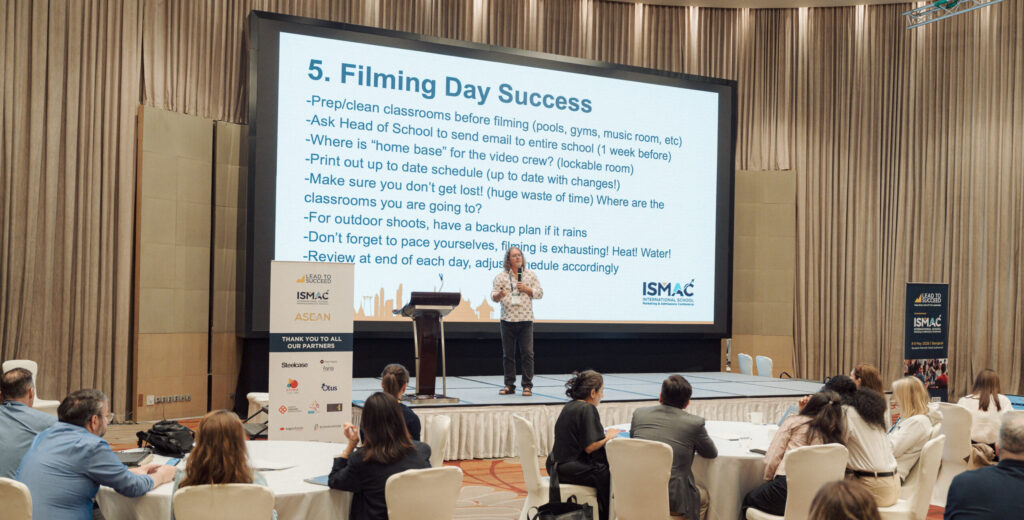
The schools that cut through are the ones that show: a specific story about how a student approached a problem, a glimpse into how a particular lesson unfolded, a moment that captures your culture in action. When you show rather than tell, you become distinctive by default—because no one else has your exact stories.
The Plain Language Advantage
Educational jargon creates distance. When your website talks about “inquiry-based pedagogical approaches” or “differentiated learning modalities,” you’re speaking to other educators, not to the families trying to make one of the most important decisions of their lives.
Translate what you do into language anyone can understand. Describe what actually happens in your classrooms as if explaining to a thoughtful friend who knows nothing about education. This simple act—describing reality in plain terms—often reveals what’s genuinely special about your school. The authentic story, clearly told, is more compelling than any polished slogan.
The “Sports Photo” Problem
Here’s a diagnostic question: Does your communications team spend their days being pulled across campus to capture whatever’s most photogenic at any given moment?
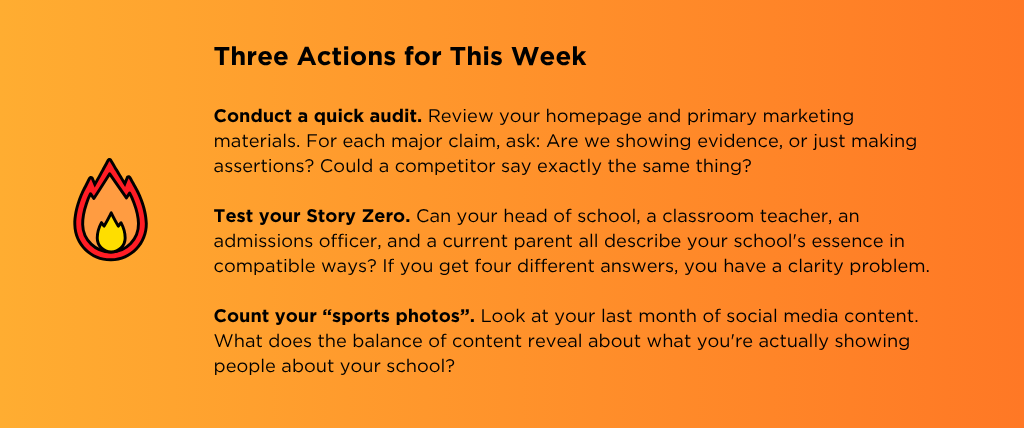
If your Instagram feed is dominated by sports matches, musical performances, and smiling students at events—but rarely shows the intellectual life of your school—you may have a brand clarity problem. When you don’t know what you’re trying to show, you default to what’s visually obvious.
A school with clear brand identity can make a maths lesson as compelling as a championship game, because they know what they’re revealing about who they are through every piece of content they share. The question isn’t “What looks good?” but “What does this show about what we stand for?”
The Story Zero
Every school needs what might be called a “Story Zero”—the foundational narrative from which all other stories emerge. This isn’t a tagline or mission statement. It’s the essential truth about your school that, once articulated, makes every other communication decision easier.
When you have Story Zero clear, you can evaluate any opportunity, any request for coverage, any speech through a simple filter: Does this reinforce our core story, or does it dilute it? Teachers know why certain initiatives get supported. Parents can explain your school to others. Your head of school can speak with consistency whether they’re at a board meeting or a casual coffee with prospective families.
Relentless Positivity
Strong brands resist the temptation to define themselves against competitors. When a competitor makes claims that feel unfair or inaccurate, the instinct is to respond with “No, actually we’re the real…” But defensive positioning keeps you in someone else’s conversation.
The alternative is relentless positivity—consistently articulating what you stand for without reference to what others lack. This isn’t naive optimism; it’s strategic discipline. It allows you to control your own narrative and projects confidence that attracts rather than arguments that exhaust.

Students as Brand Ambassadors
Student voices can be powerful in communicating brand—but only when authentic. The student who’s been coached to deliver talking points, or the IB Diploma student who’s learned to speak in institutional language, can feel less genuine than saying nothing at all.
The most effective student voices come from unscripted moments: roundtable conversations where the initial performance gives way to honest reflection, casual interactions with prospective families, or observations from daily school life. If you’re going to feature students, invest the time to capture them being genuinely themselves rather than performing what they think you want.
The Internal Brand Effect
Brand strategy isn’t only about attracting families. When your school’s identity is clear, teachers understand why certain initiatives succeed and others don’t. New hires can self-select based on genuine fit. Parents engage with appropriate expectations. Leadership can make consistent decisions without relitigating values in every conversation.
A clear brand creates coherence that makes every part of the organization more effective. It’s not just about external perception—it’s about internal alignment that shows up in culture, decision-making, and daily experience.
Starting the Work
Brand strategy requires honest assessment and collaborative development. It cannot be delegated entirely to a marketing team or imposed by leadership—it emerges from understanding what your school genuinely is and finding the words that make that truth compelling.
Begin by listening: to current families about why they chose you, to departed families about why they left, to prospective families about what they’re seeking. Compare what you discover with what you’re currently communicating. The gaps between reality, aspiration, and perception reveal where the work needs to focus.
Summing Up
The post School Brand Strategy: A Framework for Clarity and Impact appeared first on 21st Century Learning.
]]>The post Leading Is Not a Solo Endeavor: Closing the Gap Between Expertise and Capacity. appeared first on 21st Century Learning.
]]>I have experienced this transition firsthand, and I continue to see it unfold among leaders at every level of schools. It has made me rethink what we mean by “preparing someone for leadership.” An important distinction exists between learning about leadership and preparing to lead.
From “ME” to “WE”
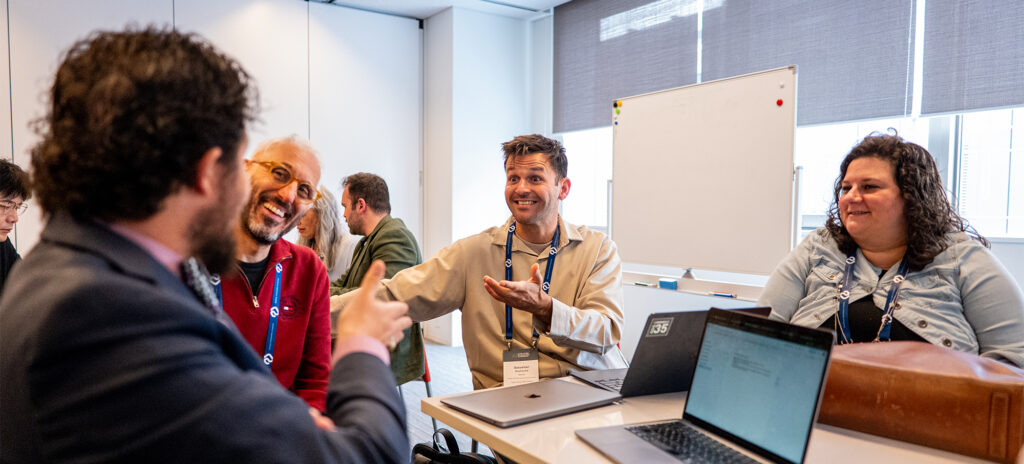
Early leadership development should focus on self-awareness, communication, relationships, and leadership identity. We need to understand ourselves before we can lead others effectively. However, at some point, that development must cross a threshold. The question shifts from Can I be an effective leader? to Can I help a group of people become more effective together?
That is a fundamentally different challenge. Spillane, Halverson, and Diamond (2001) helped shift leadership thinking away from the idea that leadership resides primarily in an individual position. From a distributed perspective, people enact leadership through interactions among people, situations, routines, and structures. That matters for leadership preparation: we cannot develop leaders only as individuals, because leadership happens in relationship with others.
Knowing how to run a meeting is useful. Knowing a change framework is useful. Understanding conflict styles is useful. However, none of that guarantees that a leader can walk into a complicated situation, listen carefully, sense what is happening beneath the surface, bring different perspectives into the conversation, and help a group decide what to do next. That takes more than knowledge.
Professional capital, not simply individual expertise
Hargreaves and Fullan (2012) offer a useful lens here: professional capital comprises three interconnected forms of capacity. Human capital is what we know and can do. Social capital is the relationships, trust, and networks through which we learn and work with others. Decisional capital is the professional judgment we develop through experience, reflection, and repeated opportunities to make decisions in complex situations.
Leadership preparation tends to invest heavily in the first. We teach theories, frameworks, strategies, and technical skills, and those things matter. However, human capital alone is insufficient. A leader may know a great deal about change and still struggle to build the trust needed to lead it. A leader may understand multiple decision-making frameworks and still struggle to exercise judgment in ambiguous situations. A leader may be exceptionally capable individually and still, without meaning to, limit the capacity of those around them.
Leadership requires expertise, relationships, and judgment working together, a claim my dissertation research helped sharpen. I studied educators in a sustained, cohort-based professional learning program and examined how they perceived the development of their professional capital. Participants consistently described collaboration, structured reflection, authentic application, and professional networks as central to their growth. More strikingly, they did not view human, social, and decisional capital as separate. They described them as mutually reinforcing: as they developed expertise, they gained new perspectives from others; those relationships gave them places to test ideas and receive feedback; applying what they learned created opportunities to make decisions; and reflection helped them reconsider those decisions. Over time, many also described increased confidence, professional agency, and readiness to take on leadership responsibilities (Sheridan, 2026).
One implication I keep coming back to: knowing more can make someone more knowledgeable without making them more prepared to lead.
From individual confidence to collective efficacy
Another shift matters as people prepare for leadership. We often focus on whether an individual feels capable of doing the work. However, leadership ultimately requires a different question: Do the people in this group believe we can accomplish something together?
Collective efficacy research defines it as a group’s shared belief in its capacity to achieve desired outcomes (Goddard, Hoy, & Hoy, 2000). This definition more closely reflects the real work of leading teams. Strong leaders do not just bring expertise into a room. They create conditions that surface, challenge, combine, and put to use the expertise already in the room. They build trust, help people make sense of complexity, create room for meaningful participation, favor inquiry over quick answers, and help teams develop confidence not only in the leader but also in one another.
This is where leadership preparation should begin: moving from individual competence to collective capacity. This matters enormously for change, too. Schools are complex organizations, and most meaningful improvement requires people to reconsider existing practices, test new approaches, work through disagreement, interpret evidence, and adjust along the way. A leader cannot simply know the answer and convince everyone else to implement it. The capacity to lead change is closely tied to the capacity to learn with others.

So what should preparation actually look like?
This brings me back to how we design leadership development. If leadership is relational, contextual, and dependent on professional judgment, preparing leaders cannot primarily mean giving them more leadership content. They need opportunities to practice the work.
Effective professional learning already offers some clues. Darling-Hammond, Hyler, and Gardner (2017) identified collaboration, active learning, feedback and reflection, modeling, expert support, and sustained duration as features of effective professional development. My own research pointed in a similar direction: participants described the interplay among sustained collaboration, reflection, authentic application, feedback, and professional networks as especially important to their development (Sheridan, 2026).
Leadership preparation should create similar conditions: opportunities to examine authentic problems, engage with relevant research and frameworks, test ideas with trusted peers, hear perspectives from different contexts, make decisions, take action, and then return to examine what happened. What worked? What did not? What assumptions proved wrong? What evidence emerged? What would they do differently next time? The developmental value comes not from doing this once but from repeating the cycle over time.
This thinking is shaping a leadership development program I am helping build for international school educators and leaders. During the preparation phase, the focus intentionally shifts from Leading Self and Leading Others to Leading Teams and Leading Change. The goal is to create repeated opportunities for leaders to build the professional capital, collective efficacy, and judgment needed to lead teams and drive change.
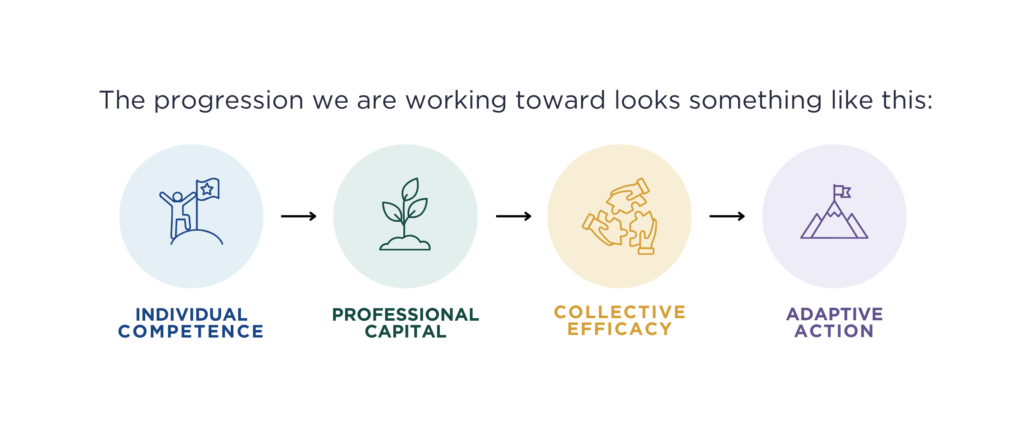
That progression has changed how I think about the word preparation. We cannot prepare leaders by handing them answers to situations they have not yet encountered; contexts, people, and challenges will always change, and what works in one school may fail in another. What we can offer developing leaders is repeated opportunities to think, collaborate, decide, act, reflect, and refine their practice alongside others.
Perhaps the real purpose of leadership preparation is not to make future leaders certain about what to do, but to make them increasingly capable of learning, deciding, and acting with others when the answer is uncertain.
References
Darling-Hammond, L., Hyler, M. E., & Gardner, M. (2017). Effective teacher professional development. Learning Policy Institute.
Goddard, R. D., Hoy, W. K., & Hoy, A. W. (2000). Collective teacher efficacy: Its meaning, measure, and impact on student achievement. American Educational Research Journal, 37(2), 479–507.
Hargreaves, A., & Fullan, M. (2012). Professional capital: Transforming teaching in every school. Teachers College Press.
Sheridan, B. J. (2026). The relationship between participants in the Certificate of Educational Technology and Information Literacy (COETAIL) program and professional capital [Doctoral dissertation, University of Kentucky].
Spillane, J. P., Halverson, R., & Diamond, J. B. (2001). Investigating school leadership practice: A distributed perspective. Educational Researcher, 30(3), 23–28.
The post Leading Is Not a Solo Endeavor: Closing the Gap Between Expertise and Capacity. appeared first on 21st Century Learning.
]]>The post 21CL Launches Educator Events and Conference in 2026/2027 School Year appeared first on 21st Century Learning.
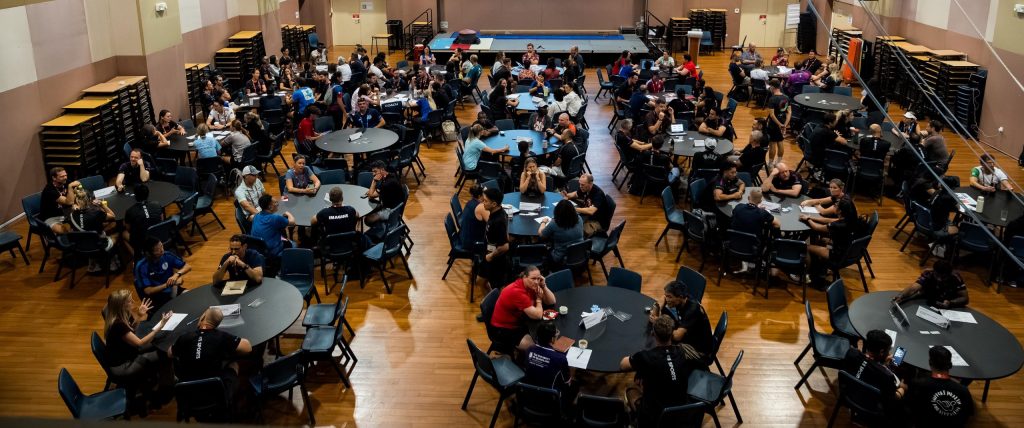
]]>Planning professional development for an international school is a year-round juggling act — budgets, staff coverage, board approval, and travel logistics all need lead time. 21CL’s 2026–2027 calendar brings every major event under one roof, so school leaders, PD coordinators, and marketing teams can map out the year in a single sitting instead of chasing down a dozen separate event pages.
What’s on the Calendar
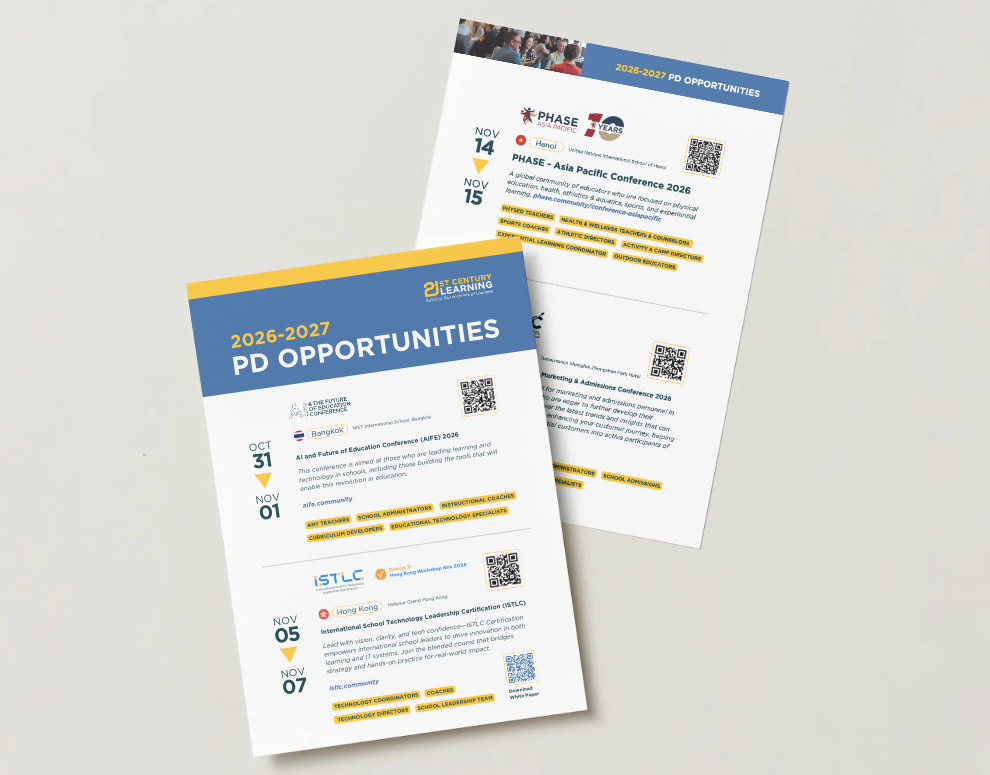
The lineup spans the full range of roles in a school community:
- AI and Future of Education Conference (AIFE) — Bangkok (Oct 31–Nov 1, 2026) and Dubai (May 14–15, 2027), for teachers, admins, coaches, and edtech specialists
- International School Technology Leadership Certification (ISTLC) — blended cohorts in Hong Kong (Nov 2026), Bonn (Apr 2027), and Dubai (May 2027) for tech coordinators and directors
- PHASE Asia Pacific & PHASE China — Hanoi (Nov 14–15, 2026) and Beijing (May 29–30, 2027), for PE, health, and outdoor education staff
- International School Marketing & Admissions Conference (ISMAC) — Shanghai (Dec 4–5, 2026) and Bangkok (May 7–8, 2027), built for marketing and admissions teams
- BWF Coach Education Level 1 — Kuala Lumpur (Jan 22–24, 2027) for PE teachers and badminton coaches
- Greater Bay Area School Awards & ASEAN School Awards — Hong Kong (Mar 11) and Bangkok (May 7, 2027), open to any school and service providers for recognizing innovation and celebrate development in education
- 21st Century Learning Conference (21CLHK) — Hong Kong (Mar 12–13, 2027), the 18th annual the flagship gathering for educators and edtech professionals
- AIFE Student Leadership Conference — Bangkok (Mar 13–14, 2027), for student leaders and guidance counselors
- OFFSEAS Conference — Jakarta (Apr 24–25, 2027), focused on outdoor and experiential learning
- Lead to Succeed Summit — Bangkok (May 7–8, 2027), for current and aspiring school leaders
Who Should Download It
This calendar is built for anyone working in the international education space:
- School leaders, principals, and board members setting the year’s PD budget
- Teachers, coaches, and department heads looking for relevant certifications
- Marketing and admissions teams benchmarking against peer schools
- EdTech companies and education providers scouting exposure to their audience via sponsorship & exhibition opportunities
Get the Full Calendar
Want the complete schedule with dates, venues, and audience tags in one place? Reach out to the 21CL team (info@21c-learning.com) to download the full 2026–2027 PD calendar and start planning your school’s year today.
21st Century Learning (21CL) organizes top-tier conferences and events that align with its mission of “Building Communities of Learners” including: 21st Century Learning Hong Kong Conference, GBA School Awards, ASEAN School Awards, AI & the Future of Education Conference, PHASE (Physical Education, Athletics, Health & Wellness), OFFSEAS (Outdoor Education), Lead to Succeed (Education Leadership) and the International School Marketing & Admissions Conference (ISMAC).
Led by educators with deep experience in Education Leadership, Professional Learning, EdTech and Progressive Pedagogy. 21CL also offers consultancy and professional learning services for schools.
The post 21CL Launches Educator Events and Conference in 2026/2027 School Year appeared first on 21st Century Learning.
]]>The post What International School Marketing Needs More Than Another Conference appeared first on 21st Century Learning.
]]>Marketing, admissions, and communications professionals in international schools are expected to do beyond their normal job description. Agree or disagree?
They’re expected to tell compelling stories. Build trust with families. Navigate AI. Strengthen enrollment. Manage school reputation. Support leadership.
And somehow STILL keep up with an industry that’s constantly evolving.
As much as they are sharing the same challenges, many professionals are still trying to solve these challenges in isolation.
That was exactly why the International School Marketing & Admissions Conference (ISMAC) was started.

ISMAC – A Community Built Around Shared Challenges
Unlike other education industry conferences, ISMAC focuses entirely on the people responsible for how schools communicate, recruit, retain and grow.
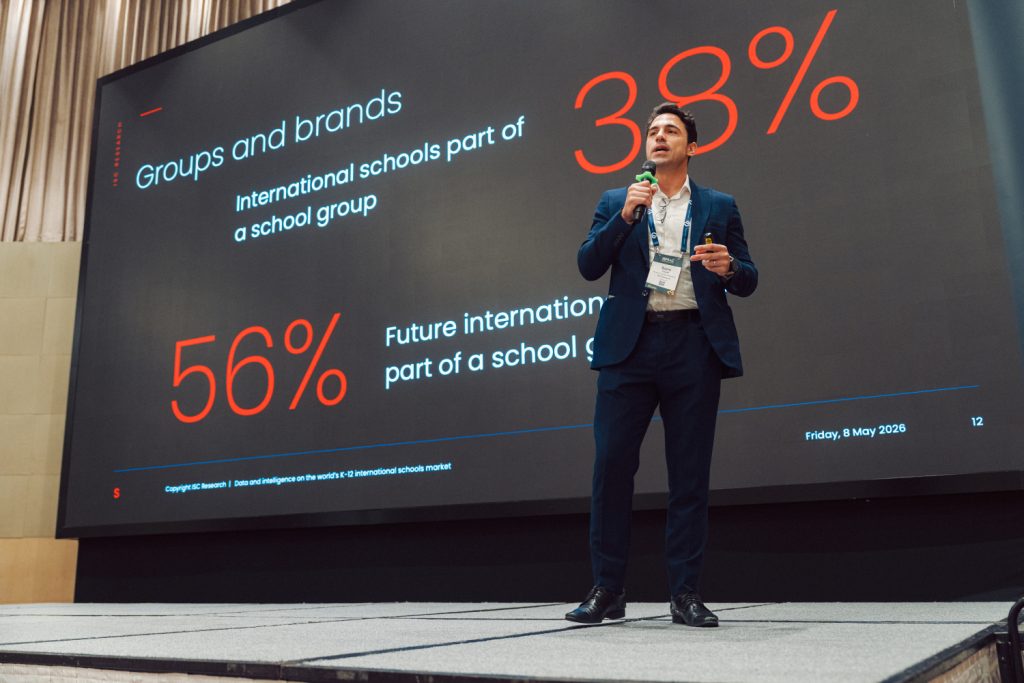
Over two days at our inaugural conference in Bangkok, professionals from international schools across Asia and beyond came together, not just to listen to presentations, but to have conversations.
Conversations between marketing teams.
Conversations between admissions professionals.
Conversations between school leaders.
Conversations that continued long after the sessions ended.
Some schools even attended with their complete teams, bringing together marketing, admissions, communications, and leadership to the conference.
Ensuring that instead of returning home with individual notes, they left with shared ideas, aligned priorities, and the beginnings of action plans.
We should never forget about the power of peer learning
One message surfaced repeatedly throughout the interviews:
“You’re not the only one facing these challenges.”
Whether discussing enrollment, parent engagement, branding, AI, or communications, attendees spoke about the value of sitting around the table with people who truly understand their day-to-day work.
The result wasn’t just networking.
It was camaraderie.
It was discovering best practices from schools facing similar situations.
It was forming relationships that continue long after the conference ends.
For many attendees, those peer conversations were just as valuable as the keynote sessions.
Authentic Stories Matter More Than Perfect Marketing
One of the strongest themes from ISMAC 2026 was authenticity.
Parents today are incredibly discerning. They aren’t looking for polished marketing language or carefully crafted slogans. They’re looking for schools that genuinely reflect who they are and whether they’re the right fit for their family.
Several attendees highlighted sessions that reinforced the importance of removing jargon and communicating with honesty and humanity.
Great school marketing isn’t about saying more. It’s about saying what matters – and more importantly, saying it truthfully.

Practical Ideas You Can Use on Monday Morning
While strategy was an important focus, attendees also appreciated how practical the conference was.
From discovering new AI tools that could streamline everyday work to exploring fresh approaches to storytelling, branding, admissions, and communications, participants left with ideas they could immediately put into practice.
The value wasn’t theoretical – it was actionable.
More Than a Conference
It was amazing to see how this inaugural conference had gathered professionals of the same passion and common purpose, and perhaps the most encouraging feedback wasn’t about a particular speaker or workshop after all.
It was about what ISMAC could become.
Again and again, attendees expressed the same hope:
This shouldn’t happen just once a year.
ISMAC isn’t simply building another conference. It’s building a professional community where international school marketing, admissions, and communications professionals can continue learning from one another throughout the year.
Because when schools learn together, their community benefits. From staff members, to students, to the families and beyond.
Join the Conversation
Whether you’re leading enrollment strategy, managing your school’s brand, overseeing admissions, creating content, or shaping communications, ISMAC offers an opportunity to learn alongside peers who understand your challenges.
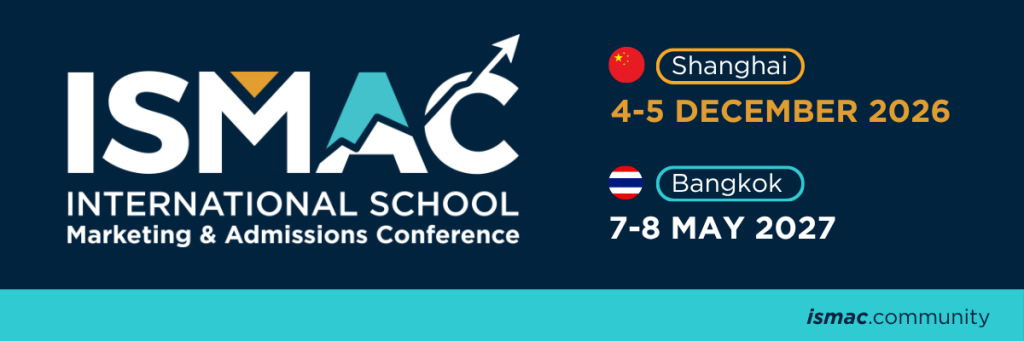
ISMAC will return in the new 2026/2027 school year, on 4-5 December in Shanghai and 7-8 May in Bangkok.
Join us and share your expertise as a speaker. Together, we’re building the future of international school marketing, admissions, and communications.
The post What International School Marketing Needs More Than Another Conference appeared first on 21st Century Learning.
]]>The post 6 Reasons Why EdTech and AI Providers Should Come to AIFE 2026 This October appeared first on 21st Century Learning.
]]>October/November is the peak season for EdTech and AI solution providers. With schools settling into the academic year and industry expos like EDUtech Asia just starting, it’s the ideal moment to connect meaningfully with your core users: educators actively seeking AI and EdTech solutions they can adopt right away.
AIFE 2026 (AI & the Future of Future Education) takes place on 31 October – 1 November at NIST International School, Bangkok (just right before EDUtech Asia). It offers a high-quality, high-conversion opportunity to engage decision-makers in a more focused, personal, educator-led setting.
Why Exhibit at AI & the Future of Education Conference?

The Only AI + K‑12 Conference in Southeast Asia
Unlike broad-based expos, AIFE is highly-focused on the intersection of AI and K‑12 education. This niche positioning means you’ll meet school leaders and educators who are actively exploring the implementation of AI and EdTech tools.

Purpose-Driven, High-Intent Attendees
Because content at AIFE is for educators, from educators; the audience is highly engaged, dedicated, and are keen to take home action plans from the conference. Your exhibitor table won’t just get foot traffic – it’ll get real conversations with end users and decision-makers looking to implement new solutions. Check out these numbers and school profiles at AIFE 2024

Speaking Opportunities & Deep Brand Integration
As an exhibitor, you can have the opportunity to present a session alongside practitioners and innovators. With over 30 sessions planned around “Rethinking Thinking & Evolving Literacies”, your brand can be part of shaping the future of AI in schools. View upcoming sessions.

Affordable, High-Touch Exhibiting Opportunities
Exhibitor packages are priced to be accessible – with the same ticket price as general attendees and a modest exhibition space fee. The venue, Jakarta Intercultural School, offers an immersive environment for live demos, workshops, and authentic interactions. View partnership opportunities and prices

Meet International School Buyers, Not Just Browsers
AIFE events typically attract attendees from 20+ countries, especially international schools keen to incorporate AI initiatives in school. It’s the perfect place to engage with schools ready to invest in next-gen solutions.

A Community, Not Just a Commercial Expo
Unlike larger, sales-centric expos (EDUtech Asia, BETT Asia), AIFE cultivates genuine engagement. You won’t get lost in a sea of booths. Instead, you’ll network at curated social events, engage in meaningful dialogue, and build relationships that convert into long-term partnerships.
Be part of the AI-powered future in education.
Join us in Bangkok on 31 October – 1 November to showcase your solution, build meaningful leads, and shape the future of K-12 learning. Reach out to us at info@21c-learning.com for more info.
The post 6 Reasons Why EdTech and AI Providers Should Come to AIFE 2026 This October appeared first on 21st Century Learning.
]]>