For many flatter trips around Singapore, the lighter and simpler 4-speed system is entirely sufficient. The 12-speed becomes more valuable when your rides include steeper slopes, heavier luggage, headwinds, longer distances or unfamiliar routes.
The short answer is: choose the 4-speed if low weight and simplicity matter most; choose the 12-speed if you want the broadest range and the least limitation on where you can ride.
This guide explains the practical difference from the perspective of everyday Brompton use in Singapore.
Brompton 4-speed vs 12-speed at a glance
| Comparison | Brompton 4-speed | Brompton 12-speed |
|---|---|---|
| Gear range | 163% | 402% |
| System | Four external derailleur gears | Four derailleur gears combined with a three-speed internal hub |
| Shifters | One trigger shifter | Two shifters: derailleur and hub |
| Character | Light, simple and direct | Versatile, wide-ranging and adaptable |
| Best suited to | Flatter urban rides, shorter commutes and weight-conscious owners | Hills, longer rides, luggage and varied routes |
| Main advantage | Lower weight and fewer components | Much wider choice of comfortable gears |
| Main compromise | More limited on steep climbs and fast open sections | Additional weight and a slightly more involved shifting system |
The exact weight and equipment depend on the Brompton line, handlebar, rack, lighting and other specifications. Always compare complete bicycles in equivalent configurations rather than judging by the number of gears alone.
What does “gear range” mean?
The number of gears tells you how many selectable ratios a bicycle has. Gear range tells you how far the gearing extends from its easiest gear to its hardest gear. For real-world riding, the range is often the more important figure.
The current Brompton 4-speed drivetrain has a 163% range. Its four sprockets—11, 13, 15 and 18 teeth on standard configurations—provide useful steps for city riding while keeping the system compact and light.
The Brompton 12-speed drivetrain has a substantially wider 402% range. It combines the four-speed derailleur system with a three-speed internal hub, producing low gears for climbing, middle ratios for everyday riding and higher gears for faster sections.
This does not mean that a 12-speed is automatically faster. It means you have a better chance of finding a comfortable pedalling rhythm across different gradients, speeds and loads.
When is a Brompton 4-speed enough in Singapore?
Singapore is not completely flat, but many everyday cycling routes are gentle enough for a 4-speed Brompton. It can work very well for:
- Short and medium-distance commuting
- Park connectors and flatter urban routes
- Breakfast, café and neighbourhood rides
- Rail Corridor journeys with a relaxed pace
- Cycling to an MRT station and continuing by train
- Riders who travel light and rarely carry large front luggage
- Owners who strongly value a lighter bicycle
The 4-speed has a clean, direct feel. One trigger shifter controls the four derailleur gears, so it is quick to understand and easy to operate. Riders who use their Brompton mainly as a compact urban mobility tool may never feel that they are missing anything.
Its lower weight is particularly relevant if you regularly carry the bicycle upstairs, lift it into a vehicle or move through stations where lifts are inconvenient. Once folded, even a modest weight difference can become noticeable when repeated every day.
Where does the 12-speed help?
The 12-speed makes the strongest case when your journeys go beyond flatter point-to-point transport. Its wider range is useful for:
- Mount Faber, Henderson Road, Kent Ridge and other steeper areas
- Longer weekend and community rides
- Heavy front luggage or touring loads
- Headwinds on exposed stretches
- Riders who want smaller choices between comfortable pedalling efforts
- Travel to places where the terrain is unfamiliar
- Owners who want one Brompton for the widest variety of uses
The easiest gears reduce the effort needed to keep the pedals turning on a climb. The higher end of the range is useful when the road opens up or slopes down. Between those extremes, the additional ratios make it easier to avoid feeling that one gear is too easy while the next is too hard.
For a rider who wants to explore Singapore freely without planning routes around hills, the 12-speed is the more reassuring choice.
How does the Brompton 12-speed system work?
The system combines two types of gearing. The derailleur moves the chain across four rear sprockets, while the three-speed hub changes the broader range. Together, they provide 12 selectable combinations.
A practical way to think about it is:
- Use the hub to choose a broad low, middle or high range.
- Use the four derailleur gears to fine-tune your pedalling within that range.
The external derailleur shifts while you are pedalling lightly because the chain must move between sprockets. The internal hub can shift while the bicycle is stationary, which is useful if you stop at a traffic light in a high gear and want an easier gear before moving off.
There is a short learning period because the 12-speed has two controls, but most owners adapt quickly. You do not need to memorise every possible combination before riding. Start in the middle hub range, use the derailleur normally, and change the hub range when you need gears that are meaningfully easier or harder.
Is the 4-speed easier to maintain?
The 4-speed has fewer drivetrain components and no internal gear hub, so it is mechanically simpler. That simplicity appeals to riders who want a lightweight, straightforward urban bicycle.
The 12-speed has an additional hub shifter, cable and internal gearing system. It therefore requires correct adjustment and adds some weight. However, it is an original Brompton system designed as an integrated package, and the internal hub keeps its gear mechanism protected inside the rear wheel.
Both systems still need normal preventive care: a clean and lubricated chain, correctly adjusted gears, sound cables, suitable tyre pressure and periodic servicing. More gears should not be treated as a substitute for proper setup.
808 Cycles supports original Brompton gearing configurations. We recommend choosing the factory system that suits your needs instead of buying a bicycle on the assumption that an aftermarket conversion will solve the decision later.
Does the 12-speed change the folded size?
No meaningful difference in folded footprint should drive this choice. Both systems are engineered to fit within Brompton’s compact fold.
The practical portability difference is weight. A 4-speed configuration is generally lighter because it does not carry the three-speed internal hub and its related controls. The precise difference varies between C Line, P Line and T Line configurations, as well as racks, handlebars, saddles, lighting and accessories.
If carrying matters to you, fold and lift the actual bicycles. A specification sheet cannot tell you whether the difference feels worthwhile on your staircase or during your MRT journey.
Which gearing is better for commuting?
For a flat or gently rolling commute, the 4-speed can be the better tool. It is lighter, simple to shift and provides enough range for many city journeys.
The 12-speed is preferable when your commute includes repeated slopes, longer distances, strong headwinds or a heavily loaded bag. It also provides more flexibility if you sometimes extend your commute into a leisure ride.
Think about the most demanding part of your regular journey—not only the easiest section. If one steep climb makes you avoid cycling altogether, the wider gearing may help you use the bicycle more consistently. If you rarely encounter that situation, carrying the lighter 4-speed every day may be the more valuable benefit.
For more mixed-transport advice, read our guide to bringing a Brompton on Singapore’s MRT.
Which gearing is better for leisure rides and travel?
A 4-speed is enjoyable for relaxed city exploration, café rides and flatter routes. Its lighter weight can also be attractive when the bicycle must be lifted frequently during a journey.
A 12-speed is the safer all-round choice for longer rides and overseas travel because you may not know the terrain in advance. Luggage, fatigue and heat can make a gradient feel harder late in a ride, even if it looked manageable on a map.
If your Brompton will be your only bicycle and you expect your riding ambitions to grow, the 12-speed provides more room to explore. If you already know that your use will remain compact, urban and relatively flat, the 4-speed may be all you need.
Should a first-time buyer choose 4-speed or 12-speed?
Choose the 4-speed if:
- Your usual routes are mostly flat.
- You prioritise the lowest practical carrying weight.
- You prefer one simple shifter.
- Your rides are generally short to medium in distance.
- You travel light and do not expect frequent steep climbs.
Choose the 12-speed if:
- You want the widest possible range for Singapore’s varied routes.
- You regularly climb hills or carry luggage.
- You take longer rides or travel with your Brompton.
- You prefer more choices for maintaining a comfortable cadence.
- You would rather accept additional weight than risk feeling under-geared.
Neither is universally better. The best system is the one that removes the biggest barrier to using your Brompton. For one owner, that barrier is carrying weight. For another, it is a steep climb on the way home.
Does the bicycle line matter too?
Yes. Gearing is only one part of the decision. Frame materials, overall weight, fork design, component specification and price also differ between the C Line, P Line and T Line.
Read our Brompton C Line versus P Line comparison and our guide to the Brompton P Line versus T Line before comparing specific bicycles.
A lighter line with 12-speed gearing can still be easier to carry than a heavier line with fewer gears. Compare complete bicycles rather than assuming the drivetrain alone determines portability.
Frequently asked questions
Is a Brompton 4-speed enough for Singapore?
Yes, for many riders. It suits flatter commutes, park connectors, mixed MRT journeys and relaxed urban riding. The decision changes if your regular routes include steep climbs, heavy luggage or longer distances.
Can a 4-speed Brompton climb Mount Faber?
A fit rider may manage it, but the limited low-end range demands more effort. A 12-speed gives you substantially easier gearing and is the more comfortable choice for repeated or steeper climbs.
Is a Brompton 12-speed difficult to use?
It uses separate controls for the four-speed derailleur and three-speed hub, so it takes slightly longer to learn than the 4-speed. Most riders adapt quickly by using the hub for broad ranges and the derailleur for smaller adjustments.
Does a 12-speed Brompton fold larger?
No meaningful folded-size difference should affect the decision. The 12-speed system is designed to remain within Brompton’s compact folded package, although it adds weight compared with an equivalent 4-speed configuration.
Is a 12-speed Brompton faster than a 4-speed?
Not automatically. It has a wider range, which can help you pedal comfortably on more terrain. Actual speed depends more on fitness, riding position, tyres, conditions and luggage.
Can I convert a Brompton 4-speed to 12-speed later?
Changing between the systems involves more than adding sprockets; the rear wheel, hub controls, cables and other parts differ. Do not treat it as a simple future upgrade. Choosing the appropriate original configuration at purchase is usually the cleaner approach.
Which gearing should I choose if I am still unsure?
Test both on the same route, including a slope, and lift both while folded. Choose the 4-speed if its range feels sufficient and you value its lower weight. Choose the 12-speed if the easier gears make you more confident about riding further and more often.
Compare Brompton gearing at 808 Cycles
808 Cycles has been a Brompton Authorised Dealer in Singapore since 2016. We ride Bromptons ourselves and can help you compare original 4-speed and 12-speed configurations based on your routes, fitness, luggage and carrying requirements.
Browse our current Brompton C Line bicycles, Brompton P Line bicycles, Brompton T Line bicycles or all Brompton folding bicycles available in Singapore.
Still deciding? WhatsApp 808 Cycles to arrange a showroom visit and test ride. Tell us where you normally ride and whether you need to carry the folded bicycle—we will help you compare the options honestly.
About the author: Bob Lee is the founder of 808 Cycles, a Brompton Authorised Dealer in Singapore since 2016. He rides a Brompton regularly and helps customers choose, set up and maintain their bicycles for everyday use in Singapore.
]]>Both fold to almost the same compact size. Both work well for commuting, leisure rides, public transport and storage in a Singapore apartment. Both are handmade around the familiar Brompton design. The real differences are in their materials, carrying weight, ride feel, components and price.
The short answer is this: the C Line is the better-value choice for most riders, while the P Line makes sense for people who will genuinely benefit from a lighter bicycle and its more refined component package.
This guide compares the two from the perspective of real use in Singapore—not simply from a specification sheet.
Brompton C Line vs P Line at a glance
| Comparison | Brompton C Line | Brompton P Line |
|---|---|---|
| Positioning | The classic, all-round Brompton | The lighter, more performance-focused Brompton |
| Main construction | Steel main frame, rear frame and fork on standard models | Steel main frame, titanium rear frame and carbon fork on current Mk2 models |
| 12-speed example at 808 Cycles | C Line M12R: from 12.0 kg | P Line Mk2 M12R: approximately 11.1 kg |
| 12-speed gear range | 402% | 402% |
| Folded footprint | Compact Brompton fold | Broadly the same compact Brompton fold |
| Ride character | Stable, familiar and reassuring | Livelier, lighter and more refined over road vibration |
| Best reason to choose it | Value, simplicity and classic Brompton character | Easier carrying and premium components |
| Current 12-speed M12R example | S$3,270 | S$5,120 |
The weights and prices above refer to current rack-equipped 12-speed examples listed by 808 Cycles on 3 September 2026. Exact figures vary with gearing, handlebar, rack, lighting and special-edition equipment. Check the individual product page for the specification and current price of the bicycle you are considering.
What is the Brompton C Line?
The Brompton C Line is the modern version of the folding bicycle that made Brompton famous. Its steel construction gives it the familiar Brompton ride, while its compact fold makes it easy to bring into the MRT, store beside a desk or keep inside a small home.
Calling it the “standard” Brompton should not be mistaken for calling it basic. A current C Line can have a wide-range 12-speed transmission, Mid handlebar, mudguards and an Advance Roller Rack. For many owners, it already does everything they need a Brompton to do.
The C Line is especially compelling when you spend most of your journey riding the bicycle rather than carrying it. If you have lift access at home and work, roll the folded bike through stations, and only lift it briefly into a car or over a kerb, the extra cost of the P Line may not deliver enough practical benefit.
What is the Brompton P Line?
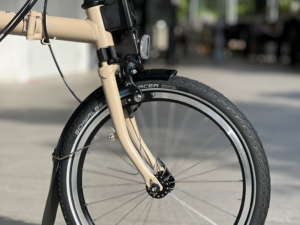
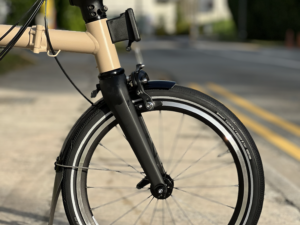
The Brompton P Line keeps the steel main frame but replaces other major components with lighter materials. Current P Line Mk2 models use a titanium rear frame, carbon fork, aluminium stem and handlebar, and a selection of lighter components.
The result is a Brompton that feels easier to pick up, quicker to manoeuvre and slightly more responsive on the road. Brompton also describes the carbon fork as vibration-damping, which can take some of the harshness out of broken road surfaces before it reaches your hands.
The P Line is not dramatically smaller when folded—the main benefit is reduced weight and a more premium ride and component package. That distinction matters. If your main challenge is fitting a bicycle under a desk or into a car boot, both lines solve it. If your challenge is carrying the bicycle up stairs every day, the P Line has the clearer advantage.
How noticeable is the weight difference?
For the current rack-equipped 12-speed examples at 808 Cycles, the C Line M12R is listed from 12.0 kg and the P Line Mk2 M12R at approximately 11.1 kg. That is a difference of about 900 g.
On paper, 900 g may not sound transformative. In practice, it can be noticeable when lifting the folded bicycle repeatedly—especially on staircases, across overhead bridges or into a vehicle. It matters less once you are riding or rolling the folded bike on its roller wheels.
Be honest about your routine:
- Frequent stair carrying: the P Line’s lower weight becomes valuable every day.
- Mostly lift access: the C Line’s weight is less likely to be a problem.
- MRT plus short walks: either works well; the rack-equipped versions are especially convenient for rolling.
- Regular air travel: every kilogram can matter, although airline baggage rules and the weight of your case must also be considered.
The best way to judge the difference is not to read another number online. Fold and lift both bicycles using the same technique, then imagine repeating that movement during your actual commute.
Do the C Line and P Line ride differently?
Yes, although the difference is subtler than the gap in price might suggest.
The C Line has the solid, composed feel many riders associate with a traditional Brompton. Its steel construction is comfortable, predictable and well suited to city riding.
The P Line feels lighter and more eager when accelerating or changing direction. Its carbon fork is designed to reduce vibration, while its lighter front end and updated components contribute to a more refined feel. Riders who are sensitive to road buzz or who enjoy a livelier bicycle may appreciate it immediately.
Tyres, tyre pressure, handlebar height, saddle position and luggage load can also change how a Brompton feels. A correctly fitted C Line may suit you better than a P Line in the wrong configuration. This is why a meaningful test ride should include fitting advice rather than a quick lap on an unfamiliar setup.
Is the P Line faster?
Not automatically. A lighter bicycle can feel quicker when accelerating and climbing, but your fitness, riding position, tyres, luggage and route usually make a larger difference to real-world speed.
For Singapore commuting, the P Line’s biggest practical advantage is usually easier handling off the bike—not a dramatic increase in average speed. Choose it because its lower weight and ride refinement improve your routine, not because you expect it to turn every journey into a race.
What about 4-speed versus 12-speed?
This is a separate decision from C Line versus P Line. Both lines can be found with different gearing configurations, and the right choice depends on where and how you ride.
A 4-speed model is lighter and mechanically simpler. Its 163% range can be enough for flat urban journeys, park connectors and riders who value low weight over maximum versatility.
A 12-speed model offers a much broader 402% range. It is the more flexible choice for Mount Faber, Henderson Road, longer weekend rides, heavier front luggage or anyone who prefers smaller steps between comfortable pedalling ratios.
If you are comparing two 12-speed models, the C Line and P Line give you the same broad percentage gear range. The decision then comes back to materials, weight, ride feel and budget.
For a detailed explanation of the two drivetrains, read our Singapore guide to Brompton 4-speed versus 12-speed gearing.
Which is easier to use with Singapore’s MRT?
Both are excellent for mixed cycling and public-transport journeys because they share the compact Brompton fold. The P Line is easier to lift through a station or onto a train, but the C Line remains highly practical—particularly with a rack and good roller wheels.
If you normally wheel the bike from the gantry to the platform and only carry it for short moments, the difference may not justify the price premium. If your journey includes staircases or long walking transfers, the P Line’s weight saving becomes more meaningful.
Read our practical guide to bringing a Brompton on Singapore’s MRT for folding etiquette and everyday travel tips.
Is the P Line worth the additional cost?
At the time of writing, the current 808 Cycles C Line M12R examples are listed at S$3,270, while the P Line Mk2 M12R Dune Sand is listed at S$5,120. The difference is S$1,850.
That premium buys lighter materials, an easier carry and a more refined set of components. It does not buy a smaller fold, a wider 12-speed gear range or permission to use the MRT—both bicycles already provide those fundamental Brompton advantages.
The P Line is worth considering when:
- You carry the bicycle up stairs or lift it several times on most journeys.
- You place high value on weight reduction.
- You prefer the ride feel of the carbon fork and titanium rear frame.
- You appreciate its premium component package and intend to keep the bicycle for many years.
- The additional cost is comfortable within your budget.
The C Line is likely the better purchase when:
- You want the best balance of capability and price.
- You rarely carry the bicycle for more than a few moments.
- You want the classic steel Brompton experience.
- You would rather spend the difference on luggage, riding equipment or future servicing.
- You are unsure whether you would notice or value the P Line’s refinements.
For many first-time owners, the C Line is the rational choice. For someone who already knows that carrying weight is the main barrier to using a bicycle regularly, the P Line can be the smarter long-term decision.
Which Brompton would we recommend?
There is no honest answer based only on which model costs more.
Choose the C Line if you want a highly capable Brompton with strong value, broad configuration choices and the traditional steel character. It is not a compromise for ordinary Singapore use; for many riders, it is the most sensible model in the range.
Choose the P Line if frequent lifting is part of your real routine, or if you genuinely value its lighter construction, carbon fork and more refined component package. The benefit is most convincing when it removes friction from using your Brompton every day.
If you want an even lighter comparison, read our guide to the Brompton P Line versus T Line in Singapore. You can also explore the long-term cost of Brompton ownership or our checklist for buying a used Brompton in Singapore.
Frequently asked questions
What is the main difference between a Brompton C Line and P Line?
The standard C Line uses steel for its main frame, rear frame and fork. A current P Line Mk2 combines a steel main frame with a titanium rear frame, carbon fork and lighter components. This reduces carrying weight and changes the ride feel, but both retain the compact Brompton fold.
Which is lighter: C Line or P Line?
The P Line is lighter. In the current rack-equipped 12-speed examples at 808 Cycles, the C Line M12R is listed from 12.0 kg and the P Line Mk2 M12R at approximately 11.1 kg. Always compare like-for-like configurations because racks, lighting, saddles and gearing affect the final weight.
Do the C Line and P Line fold to the same size?
They have broadly the same compact folded footprint. The P Line’s main portability advantage is lower weight, not a substantially smaller folded package.
Do the 12-speed C Line and P Line have the same gear range?
Yes. Current 12-speed versions use Brompton’s combined derailleur and internal-hub system to provide a 402% range. Model-specific component details may differ, so check the exact bicycle listing.
Which Brompton is better for commuting in Singapore?
Both work well. The C Line offers better value if you mainly ride and roll the bicycle. The P Line is more attractive if your commute includes frequent lifting, stairs or transfers where lower weight makes the journey easier.
Is the C Line durable enough for daily use?
Yes. The C Line is Brompton’s classic city bicycle and is designed for regular use. Whichever line you choose, correct setup, tyre pressure, chain care and preventive servicing matter more than the model name alone.
Should a first-time Brompton buyer choose C Line or P Line?
The C Line is the best-value starting point for many first-time buyers. Choose the P Line when you already know that lower weight or its particular ride and components will make you use the bicycle more often.
Compare the C Line and P Line in person
808 Cycles has been a Brompton Authorised Dealer in Singapore since 2016. We ride Bromptons ourselves and can help you compare weight, handlebar height, gearing, rack options and luggage based on how you genuinely plan to use the bicycle.
Browse our current Brompton C Line bicycles, Brompton P Line bicycles or all Brompton folding bicycles available in Singapore.
Still undecided? WhatsApp 808 Cycles to arrange a showroom visit and test ride. Bring your normal work bag if possible—the most useful comparison is the one that reflects your actual journey.
About the author: Bob Lee is the founder of 808 Cycles, a Brompton Authorised Dealer in Singapore since 2016. He rides a Brompton regularly and helps customers choose, set up and maintain their bicycles for everyday use in Singapore.
]]>Before paying, look beyond the paint colour and accessories. Worn tyres, hardened rim tapes, rust, drivetrain wear and unauthorised modifications can quickly turn a seemingly cheap Brompton into an expensive repair project. Use these 12 checks to judge the bike properly and budget for the work it may need.
1. Confirm that it is a genuine Brompton
Check the frame and serial numbers, and ask the seller for the original receipt or ownership history where possible. The numbers should be clear, untampered with and consistent with the bicycle being offered. Be cautious if the seller cannot explain where the bike came from, refuses to provide identifying details, or pressures you to complete the deal immediately.
A genuine, traceable bicycle is also easier to service correctly because its model year and original specification can be identified.
2. Inspect the frame, hinges and fork
Examine the main frame tube, rear frame, fork and handlebar stem under good lighting. Look for dents, cracks, ripples in the paint, deep scratches around welds or signs that damaged areas have been touched up.
Fold and unfold the bicycle several times. Both hinges should close positively, and the hinge clamps should tighten securely without needing excessive force. A small cosmetic mark is different from structural damage; if anything looks distorted or misaligned, have the bicycle inspected before buying it.
3. Look carefully for rust
Singapore’s humidity can corrode a Brompton even when it is rarely ridden. Inspect the seatpost, inside the seat tube where visible, brake-caliper bolts, chainring bolts, spoke nipples, cable fittings and other exposed steel hardware. Surface marks may be manageable, but widespread corrosion suggests long-term damp storage and may hide additional problems.
Ask where the bicycle was kept. Indoor storage in a dry room is preferable. A bike left outdoors, on a balcony or on a porch may have suffered repeated condensation and rain exposure.
4. Check tyre age, tread and sidewalls
Do not judge a tyre only by how much tread remains. Rubber hardens with age, especially when a bicycle has sat unused for years. Inspect both tyres for cracks, small pits, flat spots, exposed threads, brittle sidewalls or a shiny hardened surface.
Old tyres can have poor grip in wet conditions even if they still look “new”. If the bicycle dates from the COVID cycling boom and retains its original tyres, include replacement tyres in your budget.
5. Remember the inner tubes and rim tapes
Inner tubes and rim tapes also deteriorate with time. A hardened tube can split, while cracked or displaced rim tape can expose the tube to spoke holes and cause sudden punctures. These parts cannot be assessed fully from an exterior photograph, so assume that an older, long-unused bicycle may need fresh tubes and rim tapes.
6. Test every gear under load
A quick spin of the wheel while the bike is on a stand is not enough. Ride the bicycle safely and shift through every gear while applying moderate pedal pressure. The changes should be predictable, without hesitation, grinding or the chain jumping unexpectedly.
A gear that works during a gentle test may skip when climbing. Problems can come from adjustment, worn cables, a stretched chain, worn sprockets or incompatible aftermarket parts.
7. Inspect the chain, chainring and rear sprockets
Look for rust, stiff links and heavy dirt on the chain. Check whether the chainring teeth or rear sprocket teeth look hooked, pointed or unevenly worn. A new chain fitted to badly worn sprockets may still skip, so these components often need to be assessed as a system.
Ask what parts were previously replaced and whether original Brompton gearing components were retained. Keep this information with the bicycle’s service history.
8. Check the brakes properly
Squeeze both brake levers. They should feel firm and return smoothly. Inspect the brake pads for remaining material and even contact with the rim. Pads must not touch the tyre, and the calipers should release cleanly after braking.
Also inspect cables, housings, fixing bolts and levers for corrosion or damage. Never treat an improvised brake modification as an upgrade merely because it looks different or expensive.
9. Examine the wheels and rims
Spin each wheel and watch the rim relative to the brake pads. Side-to-side movement, rubbing, loose spokes or a pulsing brake feel may indicate that the wheel needs attention. Inspect the rim braking surfaces for excessive wear, dents and damage.
At 808 Cycles, lateral wheel truing is measured using a dial gauge and completed to ±0.05 mm as part of eligible full-service work.
10. Test the complete folding sequence
A Brompton should fold and unfold smoothly without forcing parts into position. Test the rear-frame fold, main hinge, handlebar stem, seatpost and pedal. Confirm that the folded package sits correctly and that catches, clamps and contact points operate as intended.
Difficulty folding may be caused by adjustment, damage, incompatible accessories or modifications that interfere with the original design.
11. Identify unauthorised or incompatible modifications
Modified bikes require extra care. Ask the seller for the original parts and a list of everything changed, especially brakes, gearing, wheel components and control parts. Some aftermarket combinations make diagnosis difficult and may prevent a straightforward replacement with original Brompton parts.
808 Cycles uses original Brompton gearing components for service replacements and does not support unauthorised gear conversions. If a bicycle has been substantially modified, obtain an assessment before committing to the purchase.
12. Calculate the real cost after servicing
Add the likely refurbishment cost to the asking price. A cheaper bicycle needing tyres, tubes, rim tapes, chain, sprockets, brake pads, cables and corrosion work may cost more overall than a better-maintained example.
Ask for service invoices rather than relying only on statements such as “hardly used” or “recently serviced”. Low mileage does not stop rubber from ageing or humidity from causing corrosion.
Used Brompton or new Brompton?
A carefully maintained, original-specification used Brompton can offer excellent value. It may be the right choice if its history is clear, the frame is sound and the final cost remains attractive after preventive maintenance.
A new bicycle may be the better option when the used bike has uncertain ownership, structural damage, extensive corrosion or complicated modifications. Compare the complete ownership cost, not just the advertised price.
What should you do after buying a used Brompton?
If the service history is incomplete, arrange a thorough inspection before regular riding. A full service is especially sensible for a bicycle that is more than two years old, has been stored unused or has unknown replacement parts.
An eligible 808 Cycles full service can include Continental Contact Urban tyres, Continental inner tubes, original Brompton rim tapes, an original Brompton chain and rear sprockets, general cleaning and lateral wheel truing to ±0.05 mm. Complimentary two-way bicycle transport makes the process convenient for owners across Singapore. See our Brompton servicing information for current package details.
Frequently asked questions
Is a lightly used Brompton automatically in good condition?
No. Rubber parts age even when the bicycle is not ridden, and Singapore humidity can cause corrosion during storage. Condition, storage and maintenance history matter more than mileage alone.
Should I service a used Brompton immediately after buying it?
If the history is unknown, the bike is over two years old or it has been unused for a long period, a full inspection and preventive service are recommended before frequent riding.
Are aftermarket modifications always a problem?
Not every accessory is harmful, but changes to brakes, gears and critical components must be compatible and safely installed. Unauthorised conversions can complicate repairs and may prevent direct replacement with original Brompton components.
What are the most common hidden costs?
Age-hardened tyres, inner tubes, rim tapes, worn chains and sprockets, thinning brake pads, cables, wheel work and corrosion-related replacements are common costs that buyers overlook.
Before deciding, compare the long-term cost of Brompton ownership in Singapore and learn why a bicycle that has sat unused may still need a full service.
Need a used Brompton checked in Singapore?
808 Cycles Pte. Ltd. is a Singapore Brompton Authorised Dealer. If you are considering a used bicycle—or have already bought one—WhatsApp +65 9820 8642 to arrange an assessment or convenient two-way pickup for servicing.
You can also browse more practical ownership advice in our Brompton articles.
]]>Since then, normal work and family commitments have returned. Some of these bicycles have remained folded in storerooms, utility rooms, balconies or corners of living rooms for several years.
If this describes your Brompton, it may still look almost new—but that does not necessarily mean it is ready to ride.
Tyres, inner tubes and rim tapes continue to age even when a bicycle is not being used. Singapore’s humidity can also encourage corrosion on exposed steel components. Before unfolding your Brompton and taking it back onto the road, it is sensible to have it properly inspected and serviced.
808 Cycles makes this convenient with two-way bicycle pickup and delivery in Singapore.
Does an Unused Brompton Really Need Servicing?
Yes. At 808 Cycles, we recommend a full service approximately every two years or 10,000 kilometres, whichever comes first.
The two-year recommendation applies even if the bicycle has only been ridden a few times.
A bicycle does not stop ageing when it is folded. Over time, the rubber compounds in its tyres, inner tubes and rim tapes can harden, dry out or crack.
A Brompton that has been sitting unused for several years should therefore be inspected before returning to regular use. Simply inflating the tyres and riding away may not reveal components that have deteriorated during storage.
What Can Happen While a Brompton Is in Storage?
Several problems can develop even when the bicycle is not being ridden.
Tyres can harden and crack
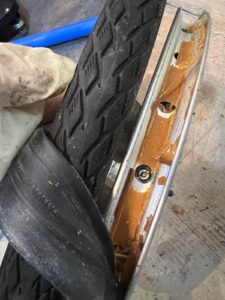
Tyres gradually deteriorate with age and exposure to heat and humidity. The rubber may harden, reducing its grip, while cracks or small pits can develop in the surface.
Inspect the tyres for:
- Cracks along the tread or sidewalls
- Small pits or holes in the rubber
- Flat or deformed areas
- Exposed casing threads
- Unusually hard or slippery surfaces
Tyre condition is especially important in Singapore, where riders regularly encounter wet roads, painted markings, metal drain covers and slippery paths.
Inner tubes and rim tapes can deteriorate
Inner tubes can dry out and become less reliable with age. Rim tapes may also harden, shift or crack, potentially exposing the inner tube to the spoke holes inside the wheel rim.
This can cause punctures even when the tyre still appears serviceable from the outside.
Steel components can corrode
Singapore’s humidity can cause corrosion even when a bicycle has not been ridden in the rain.
Areas that commonly require attention include:
- The chain
- The seatpost
- Brake-caliper bolts
- Chainring bolts
- Other exposed steel components
Bromptons stored outdoors, on balconies or on porches are particularly vulnerable.
Lubricants can dry out
Old chain lubricant can dry up or attract dirt. A chain that has been left untouched for years may become dry, rusty or stiff, even if it has covered very little distance.
How Often Should You Service a Brompton?
For most Brompton owners, 808 Cycles recommends a full service every two years or 10,000 kilometres, whichever comes first.
The appropriate interval also depends on how frequently and under what conditions the bicycle is used.
Occasional riders
Even if you only ride a few times each year, arrange a full inspection after approximately two years. Age-related deterioration can affect the tyres, inner tubes, rim tapes and other components regardless of the distance travelled.
Regular commuters
If you use your Brompton regularly for commuting, inspect its chain, rear sprockets, brake pads and tyres frequently. Do not wait until the two-year mark if the braking, shifting or handling begins to feel different.
Heavy users
High-mileage riders should arrange a full service at approximately 10,000-kilometre intervals. Depending on the riding conditions, the chain, rear sprockets, tyres and brake pads may require replacement sooner.
Frequent wet-weather riders
Rainwater encourages corrosion and washes lubricant away from the chain.
After riding in the rain:
- Dry the bicycle thoroughly.
- Allow any trapped moisture to evaporate.
- Lubricate the chain after it has dried.
- Store the bicycle in a dry indoor environment.
An air-conditioned bedroom or another dry interior space is ideal.
Do not leave your Brompton outdoors, on a balcony or on an open porch. Even if the bicycle is sheltered from direct rain, prolonged exposure to Singapore’s humidity can cause corrosion.
A small and carefully directed application of WD-40 Multi-Use Product on exposed steel brake-caliper bolts and steel chainring bolts can help displace moisture.
Take care not to spray it onto the wheel rims, brake pads, tyres or other braking surfaces. WD-40 Multi-Use Product should also not be used as a substitute for the correct bicycle-chain lubricant.
Warning Signs That Your Brompton Needs Attention
Arrange an inspection if you notice any of the following:
- The chain skips when you pedal
- Gear changes are hesitant, noisy or unreliable
- Tyre casing threads are becoming visible
- The tyres have cracks, pits or hardened surfaces
- The bicycle suffers repeated punctures
- The brake pads are becoming thin
- Braking performance has deteriorated
- The wheels appear to wobble
- The chain is dry, stiff or rusty
- Rust is developing on the seatpost, bolts or other components
- The bicycle has been stored for several years without inspection
Do not wait for a component to fail during a ride. Preventive maintenance is safer and usually less disruptive than dealing with a puncture, unreliable brakes or a mechanical breakdown away from home.
Three Essential Things to Do Between Services
1. Lubricate the chain
Clean and lubricate the chain regularly, particularly after riding in the rain. Always allow the chain to dry before applying a suitable bicycle-chain lubricant.
2. Check the tyre pressures
Small Brompton tyres naturally lose pressure over time. Check and inflate them regularly according to the recommended pressure range printed on the tyre.
Correct tyre pressure helps the bicycle roll efficiently and reduces the risk of pinch punctures and premature tyre damage.
3. Keep the bicycle dry
This is especially important in Singapore.
Dry the bicycle thoroughly after riding in the rain and store it inside a dry room. Avoid balconies, porches and other areas exposed to rain, condensation or consistently high humidity.
If you remember only one piece of maintenance advice, remember this:
Keep your Brompton dry.
What Is Included in a Full Brompton Recommissioning?
Every bicycle is different. 808 Cycles will inspect your Brompton before confirming which parts need to be replaced.
For a Brompton that has been unused for several years, a comprehensive recommissioning may include:
- New Continental Contact Urban tyres
- New Continental inner tubes
- New original Brompton rim tapes
- New original Brompton chain
- New original Brompton rear sprockets
- Brake-pad inspection and replacement where required
- Brake and gear adjustment
- General cleaning
- Wheel inspection and precision truing
- Inspection for corrosion, wear and age-related deterioration
Using the correct components helps preserve the bicycle’s intended braking, shifting, folding and riding performance.
Precision Wheel Truing to Within ±0.05 mm
Wheel truing at 808 Cycles is measured with a dial indicator rather than judged only by eye.
Each marking on the gauge represents 0.01 mm. Where the condition of the rim permits, we reduce its maximum total lateral movement to 0.10 mm. This is equivalent to approximately ±0.05 mm from the centre.
This measurement allows the lateral movement of the rim to be checked precisely as the wheel rotates.
It is one example of the attention to detail that goes into a full service at 808 Cycles.
Be Careful With Unauthorised Brake and Gear Modifications
Brompton brake and gear components are designed to work together as complete systems.
Changing individual parts without properly considering compatibility can affect braking performance, gear operation, cable routing and the availability of replacement parts in the future.
If non-original brake or gear components have been installed, an authorised Brompton dealer may not be able to replace an individual aftermarket part directly with an original Brompton component.
The original component may no longer be compatible with the modified assembly. In some cases, the complete brake or gear system may first need to be restored to its original Brompton specification.
Before making modifications to your Brompton, consider:
- Whether the component is compatible with the complete system
- Whether original replacement parts can still be installed later
- Whether the modification changes the cable routing
- Whether it affects the folding operation
- Whether it affects braking or shifting reliability
- Whether the installer can provide replacement parts and ongoing technical support
Cosmetic customisation is one matter. Unauthorised modifications to safety-critical brake and gear components should be approached much more carefully.
If your Brompton has already been modified, let 808 Cycles inspect it before purchasing replacement components.
Convenient Two-Way Brompton Pickup and Delivery
Many owners know that their bicycles require attention but keep postponing servicing because they are busy or do not have an easy way to transport the bicycle to a workshop.
808 Cycles provides two-way bicycle pickup and delivery in Singapore for full-service jobs.
We collect your Brompton, inspect and service it, and return it after the work has been completed.
You do not have to find time to drive to the workshop or carry an unrideable bicycle on public transport.
The collection service is especially convenient if your Brompton:
- Has flat or badly deteriorated tyres
- Has not been unfolded for several years
- Cannot currently be ridden safely
- Has visible rust or mechanical problems
- Requires a complete recommissioning
- Has been stored away since the COVID cycling period
Lack of time does not have to prevent you from bringing your Brompton back to life.
Frequently Asked Questions
Do I need to service my Brompton if I have only ridden it a few times?
Yes. At 808 Cycles, we recommend a full service after approximately two years even if the bicycle has seen very little use.
The rubber compounds in the tyres, inner tubes and rim tapes continue to age. Tyres may harden or crack, reducing their grip, while deteriorated rim tapes can contribute to punctures.
Low mileage does not necessarily mean that every component remains in good condition.
My Brompton has been folded indoors since the COVID period. Can I simply inflate the tyres and ride it?
We recommend having it inspected first. Tyre cracks, hardened rubber, damaged rim tapes, corrosion and dried drivetrain lubricant may not be immediately apparent.
Is surface rust normal in Singapore?
Singapore’s humidity makes corrosion more likely, particularly on exposed steel components.
Early surface corrosion may be treatable, but prevention is better. Dry the bicycle after wet rides and keep it inside a dry room.
Can you collect a Brompton that cannot be ridden?
Yes. Our two-way collection service is particularly useful for bicycles with flat tyres, deteriorated components or mechanical problems that make them unsuitable to ride.
Do you use original Brompton components?
We use original Brompton chains, rear sprockets, rim tapes and other appropriate original parts where specified.
We also use Continental Contact Urban tyres and Continental inner tubes for the recommissioning package described above.
The parts required will depend on the bicycle’s model, age, condition and previous modifications.
Can you service a Brompton with aftermarket modifications?
We can inspect the bicycle first.
However, unauthorised modifications to the brake or gear systems may prevent original Brompton components from being fitted individually. It may be necessary to restore the relevant system to its original configuration before original replacement parts can be installed.
How do I arrange collection?
Send us a WhatsApp message with photographs of your bicycle and a short description of its condition. We will advise you on the next step and make the necessary collection arrangements.
Bring Your Brompton Back to Life
Your Brompton was designed to be ridden—not forgotten in a corner.
If it has been collecting dust since the COVID cycling period, arrange an inspection before returning to the road.
A proper service can identify deteriorated tyres, inner tubes, rim tapes, corrosion and drivetrain wear before they cause punctures, unreliable braking or a breakdown.
With two-way bicycle pickup and delivery, getting your Brompton serviced is convenient even if you have very little free time.
WhatsApp 808 Cycles at 9820 8642 to arrange a two-way bicycle pickup.
Related Brompton guides:
How Much Does It Really Cost to Own a Brompton in Singapore?
Is a Brompton Worth Buying in Singapore? A Long-Term Owner’s Perspective
Buying a Used Brompton in Singapore? 12 Things to Check Before You Pay
]]>Before they even think about model, colour, gearing, luggage, or accessories, they ask a very reasonable question:
“How much does it really cost to own a Brompton in Singapore?”
The honest answer is this:
A Brompton costs more upfront than many bicycles, but if you use it regularly, maintain it properly, and choose the right setup from the beginning, the long-term value can be very strong.
The real question is not just “How much does a Brompton cost?”
The better question is:
“Will I use it enough for it to become part of my lifestyle?”
If the answer is yes, a Brompton can make a lot of sense in Singapore.
The Upfront Cost: Buying the Bike
The biggest cost is, of course, the bike itself.
Brompton models vary depending on frame material, gearing, handlebar type, colour, luggage options, and specification.
Generally, the more premium models are lighter, more refined, and more expensive. A standard steel model will usually be the most accessible way into Brompton ownership, while lighter models such as the P Line and T Line cost more because of their materials, components, and engineering.
In Singapore, many buyers compare the cost of a Brompton against a normal bicycle.
But that is not always the right comparison.
A Brompton is not just a bicycle you ride. It is a folding bicycle designed to fit into small homes, MRT journeys, taxis, cafés, offices, hotels, and overseas travel.
You are paying not only for the ride, but for the fold, the compact size, the convenience, and the ability to use the bike in many different parts of daily life.
That is why the upfront price needs to be considered alongside how often you will use it.
Should You Buy the Cheapest Brompton?
Not necessarily.
Buying the cheapest model may save money at the start, but it may not always be the best long-term choice.
If you plan to carry the bike often, a lighter model may be worth considering.
If you plan to ride longer distances or travel overseas, wider gearing may be useful.
If you plan to use the bike for commuting or errands, luggage options may matter more than colour.
The best-value Brompton is not always the lowest-priced one.
It is the one that suits how you will actually ride.
This is why a test ride and proper model comparison are important. A bike that fits your lifestyle is more likely to be used regularly, and a bike that is used regularly gives better value over time.
Accessories: What Do You Really Need?
Many new Brompton owners get excited about accessories.
That is understandable. Brompton has a huge ecosystem of bags, lights, racks, grips, saddles, roller wheels, stands, and travel cases.
But you do not need to buy everything on day one.
For most new owners in Singapore, I would start with the essentials:
- a good front luggage bag
- front and rear lights
- basic cleaning items
- a comfortable helmet
- upgraded roller wheels if you wheel the bike folded often
The front luggage system is one of the most useful Brompton features. A good front bag can carry groceries, a laptop, camera gear, food, a change of clothes, or daily essentials without making the bike awkward to ride.
That makes the Brompton far more practical for everyday life.
However, it is easy to over-accessorise.
Start with what you need now. Add accessories later when your riding habits become clearer.
Servicing: The Cost Many Buyers Forget
Like any bicycle, a Brompton needs maintenance.
The good news is that Bromptons are generally reliable when looked after properly. The design has been refined over many years, and most parts are serviceable or replaceable.
But no bicycle is maintenance-free.
In Singapore’s climate, heat, humidity, rain, dust, and frequent stop-start riding can all affect wear. Chains, tyres, brake pads, cables, rollers, bearings, and drivetrain parts will eventually need attention.
How often you service the bike depends on how much you ride and the conditions you ride in.
A casual weekend rider may need less frequent servicing.
A daily commuter or long-distance rider will need more regular maintenance.
As a simple guideline, regular inspection and preventive servicing are much better than waiting until something fails.
A well-maintained Brompton rides better, folds better, lasts longer, and is safer.
Common Wear-and-Tear Items
These are some parts that Brompton owners should expect to replace over time:
Tyres
Tyres wear down with mileage and can also be affected by age, cuts, punctures, and road conditions.
If you ride often, tyres are a normal ownership cost.
Inner Tubes
Punctures happen.
Keeping spare tubes or knowing where to get help quickly is part of practical bicycle ownership.
Chain
Chains wear with use.
Replacing a worn chain at the right time can help extend the life of other drivetrain parts.
Sprockets and Chainring
If a chain is allowed to wear too far, it can accelerate wear on sprockets and chainrings.
Preventive maintenance can save money in the long run.
Brake Pads
Brake pads wear depending on riding style, weather, terrain, and mileage.
In wet conditions, they can wear faster.
Cables
Brake and gear cables may stretch, corrode, or become less smooth over time.
Fresh cables can make the bike feel much better.
Rollers
If you wheel your folded Brompton often, roller wheels can wear or become noisy.
Many owners upgrade them for smoother rolling.
None of these costs should scare you away from owning a Brompton.
They are simply part of owning a real bicycle that gets used.
The Singapore Climate Factor
Singapore is tough on bicycles.
Humidity can encourage corrosion. Sudden rain can wash dirt into moving parts. Heat can affect rubber components over time. Frequent short rides may involve lots of braking, shifting, folding, unfolding, and stop-start movement.
This is why cleaning and lubrication matter.
You do not need to obsess over the bike, but basic care helps.
Wipe it down after wet rides. Keep the chain clean and lubricated. Check tyre pressure. Listen for unusual noises. Do not ignore rough shifting or weak braking.
Small problems are usually cheaper to fix than big problems.
Insurance, Theft, and Storage
One hidden advantage of a Brompton is that it can usually be stored indoors.
This can reduce theft risk compared with leaving a bicycle locked outside for long periods.
In Singapore, many owners keep their Brompton inside the home, office, hotel room, or café where appropriate. This is one reason the compact fold is so valuable.
That said, you should still be careful.
If you need to leave the bike outside, use a good lock and choose a visible location. Avoid leaving an expensive bicycle unattended for long periods.
Some owners may also consider bicycle insurance, especially for higher-value models.
Whether that is worthwhile depends on how and where you use the bike.
Travel Costs: Optional, But Worth Considering
One reason many people buy a Brompton is overseas travel.
If you plan to fly with your Brompton, you may eventually consider a proper travel case, protective bag, or transport accessories.
This is not essential for every owner.
But if you imagine riding in Japan, Taiwan, Korea, Europe, Australia, or elsewhere, the travel aspect can become a major part of the value.
Instead of renting an unfamiliar bicycle overseas, you can bring your own.
You already know how it fits. You know how it rides. You know how to fold it. You know where your luggage goes.
For frequent travellers, that can make the Brompton feel much more worthwhile.
Cost Per Ride: A Better Way to Think About Value
Instead of looking only at the purchase price, think about cost per ride.
If someone buys a Brompton and rides it five times a year, it will feel expensive.
If someone rides it twice a week for years, the cost per ride becomes much more reasonable.
A Brompton can be used for:
- commuting
- breakfast rides
- park connector rides
- errands
- MRT-connected journeys
- overseas travel
- café rides
- fitness
- tours
- weekend exploration
The more roles it plays in your life, the better the value becomes.
That is why the most important question is not whether a Brompton is expensive.
It is whether you will use it.
A Brompton Can Also Save Money
A Brompton will not replace every transport cost for everyone.
But it can reduce some spending.
You may take fewer short taxi or ride-hailing trips. You may ride to nearby errands instead of driving. You may combine cycling with MRT instead of using private transport. You may enjoy local breakfast rides instead of more expensive outings.
Over time, these small savings can add up.
But I would not recommend buying a Brompton purely because you think it will “pay for itself” financially.
Buy it because it genuinely improves how you move, travel, explore, and enjoy Singapore.
Any transport savings should be seen as a bonus.
Buying New vs Used
Some buyers consider buying a used Brompton to reduce the upfront cost.
That can be a good option if the bike is genuine, well maintained, and correctly assessed.
However, used bikes can come with hidden wear.
A bike may look clean in photos but need tyres, chain, sprockets, cables, brake pads, hinge attention, or other servicing soon after purchase.
If you are buying used, inspect carefully or have the bike checked by someone who knows Bromptons.
A lower purchase price is only a good deal if the bike is in sound condition.
For buyers who want peace of mind, proper setup, model guidance, after-sales support, and warranty coverage, buying new from an authorised dealer may still be the better long-term decision.
Where You Buy Matters
With a Brompton, the shop matters.
This is not because the bike is difficult to own, but because the right advice at the start can save you money and frustration later.
You want to choose the right handlebar, gearing, luggage, saddle, pedals, tyres, and accessories for your actual use.
A good setup makes the bike more enjoyable.
A poor setup may lead to unnecessary upgrades later.
You also want someone who can support the bike after purchase.
Brompton ownership is not just about the sale. It is about service, maintenance, parts, fit, folding technique, travel advice, and practical experience.
That support has value.
So, How Much Should You Budget?
The total cost depends on your chosen model and accessories.
A simple way to think about it is:
1. Bike
This is your main cost.
Choose based on lifestyle, not only price.
2. Essential Accessories
Budget for practical items such as lights, bag, helmet, and basic care products.
3. Servicing and Wear Parts
Expect ongoing maintenance if you ride regularly.
4. Optional Upgrades
Add these later once you know what you actually need.
5. Travel Gear
Only needed if you plan to fly or travel frequently with the bike.
You do not need to buy everything immediately.
A smart Brompton setup grows with the rider.
Is a Brompton Expensive?
Yes, compared with many bicycles.
But expensive and poor value are not the same thing.
A Brompton can be expensive upfront and still be good value if it fits your lifestyle, gets used often, and lasts for many years.
The problem is not buying an expensive bike.
The problem is buying the wrong bike.
If a Brompton makes you ride more often, explore more places, take more spontaneous trips, reduce storage worries, combine cycling with MRT, and travel with your own bicycle overseas, then the value becomes much easier to understand.
Who Gets the Best Value From a Brompton?
You are likely to get strong value from a Brompton if you:
- live in an apartment, HDB flat, or condominium
- want a bike that stores indoors easily
- plan to ride regularly
- combine cycling with MRT or taxis
- enjoy local food and café rides
- travel overseas and want to bring your bike
- care about long-term reliability and serviceability
- value convenience as much as speed
You may get less value if you only ride a few times a year, have no storage issue, or mainly want a bicycle for competitive speed.
Frequently asked questions about Brompton ownership costs
Is a Brompton expensive to maintain in Singapore?
Routine maintenance is manageable when wear is addressed early. The larger costs usually arise when ageing tyres, tubes, rim tapes, chains, sprockets, brake pads or cables are allowed to deteriorate together. Preventive servicing also helps identify corrosion before it becomes a more expensive repair.
How often should a Brompton be serviced?
As a practical baseline, 808 Cycles recommends a full service approximately every two years or 10,000 km, whichever comes first. Daily commuters, wet-weather riders and heavily used bicycles may need attention sooner.
Does an unused Brompton still cost money to maintain?
Yes. Rubber components age with time, not only mileage, and Singapore humidity can encourage corrosion. A bicycle that has been stored for years may need tyres, tubes, rim tapes, lubrication and a safety inspection before returning to regular use.
Which accessories should a new owner budget for first?
Prioritise items that support real daily use: a suitable front bag, reliable lights, a well-fitting helmet and any rack or roller setup needed for folded transport. Buy around your actual journeys rather than adding accessories simply because they are available.
Can a Brompton reduce other transport costs?
For some owners, yes. A Brompton can replace short car, taxi or ride-hailing journeys and combine with the MRT for longer trips. The saving depends on how consistently the bicycle becomes part of your routine.
Final Thoughts: The Real Cost of Brompton Ownership
The real cost of owning a Brompton in Singapore is not just the purchase price.
It includes accessories, servicing, wear parts, care, and possible upgrades.
But it also includes something harder to measure:
Convenience.
Freedom.
Flexibility.
The ability to ride when you want, fold when you need, store it indoors, bring it onto public transport, take it into cafés, travel overseas, and explore Singapore at your own pace.
That is what many owners are really paying for.
A Brompton is not the cheapest way to own a bicycle.
But for the right person, it can be one of the most useful, enjoyable, and long-lasting purchases they make.
Thinking of Buying a Brompton in Singapore?
If you are considering a Brompton and want to understand the real cost of ownership, visit 808 Cycles for a test ride and practical advice.
We are a Brompton Authorised Dealer in Singapore, and we can help you compare models, choose the right gearing, select useful accessories, and understand how to maintain your bike properly.
The best Brompton is not necessarily the most expensive one.
It is the one you will actually use.
Related Brompton guides:
Brompton C Line vs P Line: Which Should You Buy in Singapore?
Brompton 4-Speed vs 12-Speed: Which Should You Choose in Singapore?
Has Your Brompton Been Sitting Unused? Why It May Be Time for a Full Service
Brompton P Line vs T Line: Which Should You Buy in Singapore?
Is a Brompton Worth Buying in Singapore? A Long-Term Owner’s Perspective
About the author
Bob Lee is the founder of 808 Cycles, a Brompton Authorised Dealer in Singapore. Since 2016, he has helped riders choose, set up and maintain their Bromptons, serviced hundreds of folding bicycles, and guided cycling experiences around Singapore. Learn more about Bob Lee.
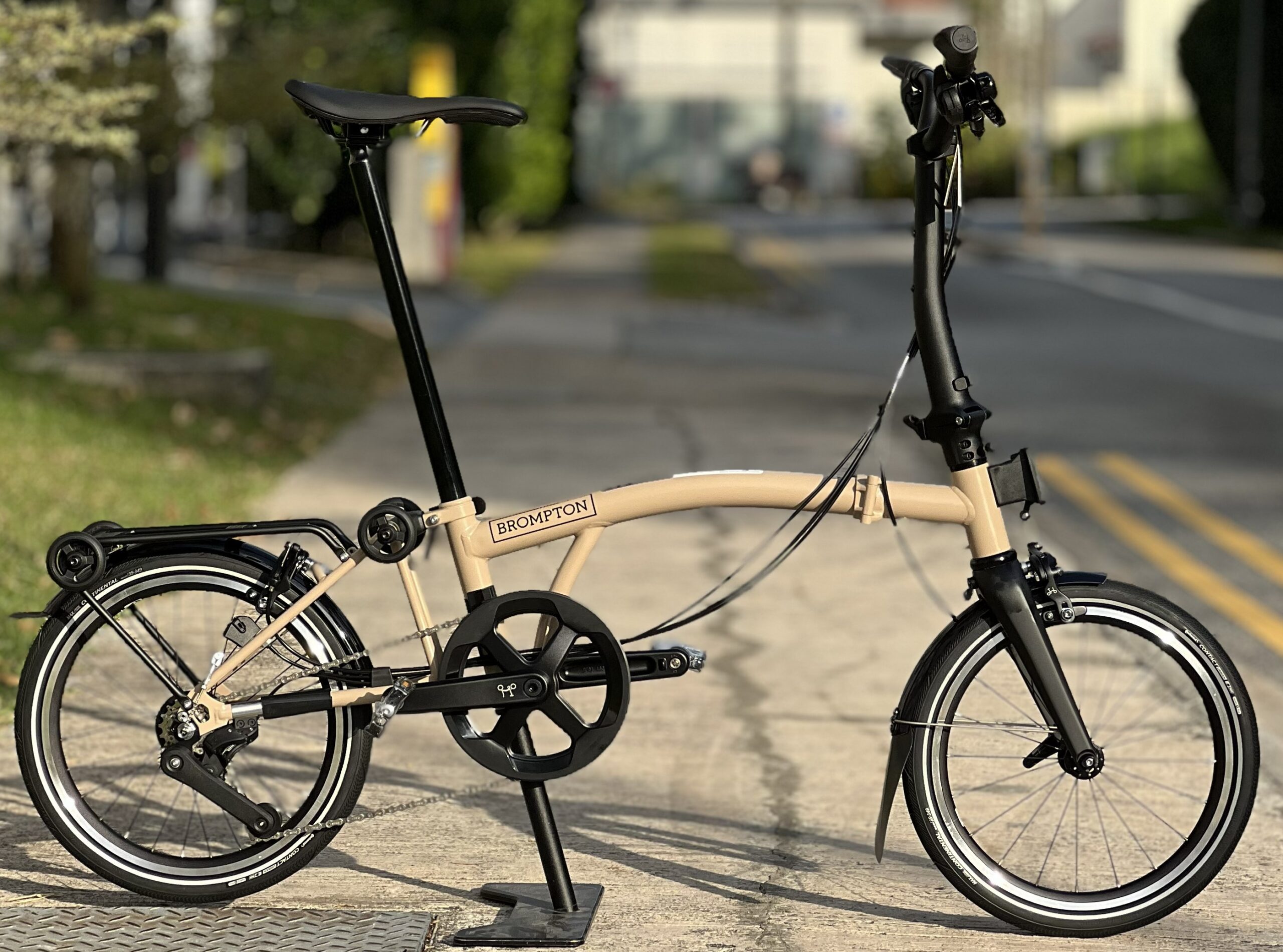
If you are considering a premium Brompton in Singapore, there is a good chance you are comparing two models:
Brompton P Line and Brompton T Line.
Both are lighter, more performance-focused versions of the classic Brompton folding bike. Both are beautifully engineered. Both fold compactly. Both work extremely well for Singapore’s mix of cycling paths, MRT journeys, cafés, offices, apartments, and overseas travel.
So which one should you buy?
The simple answer is this:
Choose the P Line if you want the best balance of performance, practicality, durability, and value. Choose the T Line if you want the lightest and most special Brompton available.
Let’s look at the differences properly.
P Line vs T Line: The Main Difference
The biggest difference between the P Line and T Line is not just the price.
It is the philosophy.
The P Line is the lighter, sportier evolution of the classic Brompton. It keeps a strong steel main frame, adds lightweight performance parts, and uses titanium and carbon components to reduce weight and improve the ride.
The T Line goes much further. It is Brompton’s lightest model, built around a titanium frame with extensive use of carbon components. It is designed for people who want the most advanced, lightest, and most refined Brompton experience.
In simple terms:
P Line = performance, practicality, and everyday usability.
T Line = ultimate lightness, engineering, and premium feel.
Both are excellent. The right choice depends on how you plan to use the bike.
Why Weight Matters in Singapore
Singapore is one of the best cities in the world for a folding bike because cycling often combines with other parts of daily life.
You may need to:
- carry your bike up a short flight of stairs
- lift it into a car boot or taxi
- roll it through an MRT station
- bring it into a lift
- store it inside an HDB flat or condominium
- carry it into a hotel room overseas
- move it around a café, office, or shopping mall
This is where weight matters.
A lighter Brompton is not just easier to ride. It is easier to live with.
Every kilogram saved becomes noticeable when you are lifting the bike, carrying it over steps, or moving it around indoors.
That is why both the P Line and T Line are so appealing in Singapore.
Brompton P Line: The Sensible Premium Choice
For many riders, the P Line is the sweet spot.
It offers a meaningful weight saving over the classic all-steel Brompton while still retaining the familiar Brompton character that owners love.
It feels lighter, more responsive, and easier to move around. The ride is lively without feeling too delicate. The handling is confident. The folded bike is easier to roll and lift than a heavier model.
For Singapore use, this makes a lot of sense.
You get a bike that feels special but still practical enough for regular use. You can ride it to breakfast, bring it onto the MRT, use it for park connector rides, commute with it, travel with it, and enjoy weekend exploration.
The P Line is not the cheapest Brompton, but it is probably the premium Brompton that makes the most sense for the widest range of riders.
Who Should Choose the P Line?
The P Line is ideal if you want a premium Brompton but still want to be practical.
It is especially suitable if you:
- want a lighter bike than the standard all-steel Brompton
- ride regularly in Singapore
- combine cycling with MRT, taxis, cafés, and indoor storage
- want a bike that feels sporty but not overly precious
- care about performance but also value durability
- want one Brompton that can do almost everything
- are buying your first premium Brompton
For many owners, the P Line is the “just right” option.
It gives you much of the lightness and performance improvement you want, without going all the way to the ultra-premium T Line.
Brompton T Line: The Ultimate Lightweight Brompton
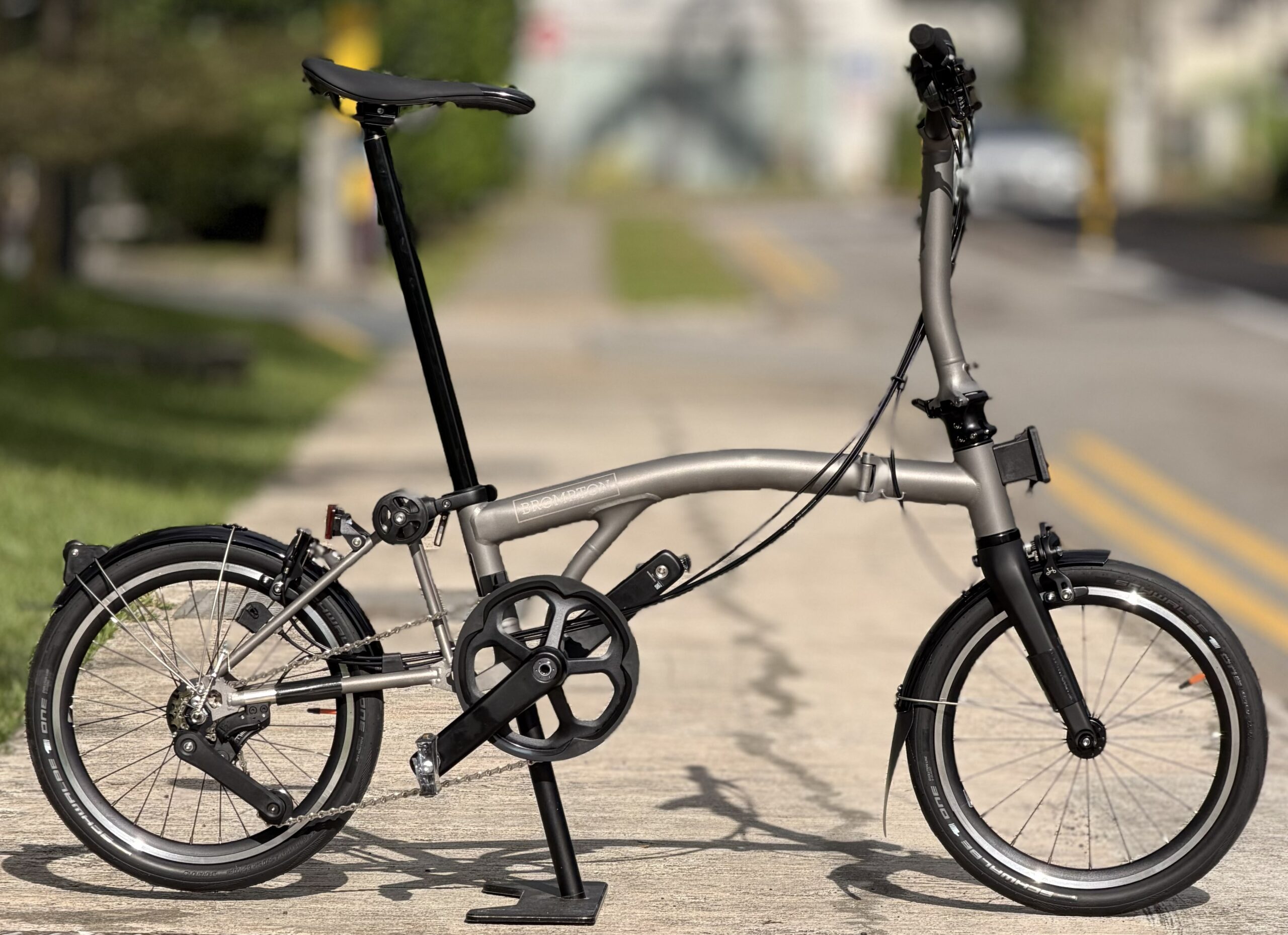
The T Line is different.
This is not simply a lighter version of the P Line. It is Brompton pushing the idea of a folding bike as far as possible.
The T Line is built around an ultra-light titanium frame, with many specially developed lightweight components. The result is a Brompton that feels astonishingly light when lifted and extremely lively when ridden.
For some riders, that feeling alone is the reason to buy it.
If you regularly carry your bike, travel often, live in a walk-up apartment, or simply appreciate fine engineering, the T Line is deeply appealing.
It feels special every time you touch it.
And that matters, because a Brompton is not just something you ride. You also fold it, lift it, roll it, store it, and bring it into your life.
Who Should Choose the T Line?
The T Line is ideal if you want the very best Brompton and are willing to pay for it.
It is especially suitable if you:
- want the lightest Brompton possible
- carry your bike frequently
- travel often with your Brompton
- appreciate titanium, carbon, and advanced engineering
- want something rare, premium, and special
- already own a Brompton and want the ultimate upgrade
- are less price-sensitive and more experience-driven
The T Line is not necessary for everyone.
But for the right person, it is unforgettable.
4-Speed or 12-Speed?
Both the P Line and T Line are available in different gearing options, and this is another important choice.
A 4-speed setup is lighter, simpler, and excellent for city riding. While Singapore is relatively flat, you may encounter some difficulties climbing some gentle slopes around, unless you are a strong or seasoned rider.
A 12-speed setup gives you a much wider gear range. This is useful if you want more flexibility for longer rides, hillier routes, overseas travel, touring, or carrying luggage.
In Singapore, the 4-speed is recommended only for seasoned/strong riders.
If you are planning to ride longer distances, bring the bike overseas, or simply want a wider range of gears, the 12-speed option is worth serious consideration. Considering that it costs only a little bit more than the 4-speed, this represents greater value-for-money.
The 12-speed is hence more versatile, and will also have better resale value.
P Line 12-Speed: Best All-Rounder for Singapore and Travel
The P Line 12-speed is a strong choice if you want one Brompton that can handle more varied riding.
It gives you a wider gear range, which can be helpful for longer rides, slopes, overseas trips, and touring. If you want to ride beyond short urban routes, the 12-speed gives you more flexibility.
For Singapore riders who plan to travel with their Brompton, this is worth considering.
Japan, Taiwan, Korea, Europe, and Australia can all involve terrain that feels very different from Singapore. A wider gear range can make overseas riding more comfortable and enjoyable.
If you want one premium Brompton to use locally and overseas, the P Line 12-speed may be the most versatile choice.
T Line 12-Speed: Best for Lightweight Performance With Range
The T Line 12-speed is for the rider who wants almost everything.
You get the lightness and special feel of the T Line, together with a wider gear range for more varied riding.
This makes it especially appealing if you want a premium lightweight Brompton for both Singapore and overseas travel.
It is not the most budget-conscious choice, but it may be the most complete choice if you want a bike that is light, capable, and highly versatile.
Which One Is Better for Daily Use?
For most daily users, the P Line is the more sensible choice.
It is lighter and more enjoyable than a standard all-steel Brompton, but still feels like a bike you can use regularly without worrying too much.
You can ride it to work, bring it to breakfast, take it on the MRT, and use it for weekend rides. It feels premium, but not overly precious.
The T Line can absolutely be used daily too, but many owners may naturally treat it with a little more care because of its price and premium materials.
That does not mean the T Line is fragile. It simply means the P Line may feel more relaxed for rougher everyday use.
Which One Is Better for MRT and Mixed Transport?
Both are excellent.
The Brompton fold is already one of the biggest reasons to buy a Brompton in Singapore. Whether you choose P Line or T Line, you still get the compact fold that makes MRT, taxi, office, café, and home storage much easier.
But if you are constantly lifting the bike, the T Line has the advantage.
If your commute involves stairs, frequent carrying, or lots of transitions between riding and public transport, the lower weight of the T Line becomes more noticeable.
If you mostly roll the bike when folded and only lift occasionally, the P Line will already feel very manageable.
Which One Is Better for Overseas Travel?
Both can be excellent travel bikes.
The P Line is a strong travel choice because it balances weight, practicality, and robustness. It is light enough to move around more easily, yet still feels like a bike you can use confidently in different cities.
The T Line is especially appealing if you want to reduce carrying weight as much as possible. When travelling through airports, train stations, hotels, and unfamiliar streets, every kilogram saved can make a difference.
For overseas travel, I would also pay close attention to gearing.
If you are travelling to places with more hills, a 12-speed option may be more useful than simply choosing the lightest possible setup.
Which One Is Better Value?
The P Line is better value for most riders.
It gives you a very noticeable upgrade in performance, weight, and usability without reaching the price level of the T Line.
If you are buying your first Brompton and want something premium, the P Line is the safer recommendation.
The T Line is not about value in the conventional sense.
It is about owning the lightest, most advanced, most special Brompton. If that matters to you, then the T Line can be worth it. But if you are mainly asking which bike gives the best balance of benefits for the money, the answer is usually the P Line.
My Practical Recommendation
If you are unsure, start by asking yourself one question:
How often will I carry the bike?
If the answer is “occasionally,” the P Line is probably enough.
If the answer is “all the time,” the T Line becomes much more compelling.
For most Singapore riders, my practical recommendation would be:
Best all-round premium choice: P Line 12-speed
Best lightweight city choice: P Line 4-speed
Best ultimate lightweight choice: T Line 4-speed
Best no-compromise premium choice: T Line 12-speed
So, P Line or T Line?
There is no bad choice here.
The P Line is probably the better choice for most people. It is light, fast, practical, and premium without feeling excessive. It is the Brompton I would recommend to many Singapore riders who want a serious upgrade and intend to ride regularly.
The T Line is for the rider who wants something more special. It is lighter, more exclusive, and more technically impressive. It makes the most sense if weight matters deeply to you, or if you simply want the best Brompton experience available.
Put simply:
Buy the P Line with your head.
Buy the T Line with your heart.
But whichever model you choose, the real value comes from using it.
Ride to breakfast. Explore the Rail Corridor. Bring it onto the MRT. Take it overseas. Fold it beside your table. Store it inside your home. Let it become part of your life.
That is when a Brompton starts to make sense.
Frequently asked questions
What is the main difference between the Brompton P Line and T Line?
The P Line balances lower weight, everyday durability and value. The T Line uses substantially more titanium and carbon components to minimise carrying weight and deliver Brompton’s most exclusive lightweight specification.
Which is lighter, the P Line or T Line?
The T Line is lighter in comparable configurations. The practical value of that difference depends on how often you carry the folded bicycle up stairs, through stations or while travelling.
Do the P Line and T Line fold to the same size?
Both retain Brompton’s compact folding format. Their most meaningful portability difference is carrying weight rather than a dramatically different folded footprint.
Should I choose 4-speed or 12-speed?
Choose 4-speed if low weight and simplicity matter most and your routes are relatively flat. Choose 12-speed if you want substantially broader gearing for hills, luggage, longer rides or unfamiliar travel routes.
Is the T Line worth the premium in Singapore?
It can be if minimum carrying weight is central to your routine or you specifically value its materials and engineering. For most riders seeking a premium all-round Brompton, the P Line remains the more balanced value choice.
Thinking of Buying a Brompton P Line or T Line in Singapore?
If you are deciding between the Brompton P Line and T Line, visit 808 Cycles for a test ride.
We are a Brompton Authorised Dealer in Singapore, and we can help you compare the models, understand the differences, choose the right gearing, and set up the bike for the way you actually ride. Browse the Brompton bicycles currently available at 808 Cycles.
The best Brompton is not always the most expensive one.
It is the one that fits your lifestyle.
Further reading:
Brompton C Line vs P Line: Which Should You Buy in Singapore?
Brompton 4-Speed vs 12-Speed: Which Should You Choose in Singapore?
10 Hidden Places in Singapore You Can Explore More Easily by Brompton – 808 Cycles
10 Reasons Why Singapore Is One of the Best Cities in the World to Own a Brompton – 808 Cycles
How Much Does It Really Cost to Own a Brompton in Singapore?
Is a Brompton Worth Buying in Singapore? A Long-Term Owner’s Perspective
Can You Bring a Brompton on Singapore’s MRT? A Practical Guide for Owners and Buyers
About the author
Bob Lee is the founder of 808 Cycles, a Brompton Authorised Dealer in Singapore. Since 2016, he has helped riders choose, set up and maintain their Bromptons, serviced hundreds of folding bicycles, and guided cycling experiences around Singapore. Learn more about Bob Lee.
There is nothing wrong with that.
But Singapore looks very different from the saddle of a bicycle.
On a Brompton, the city opens up in a more personal way. You move slowly enough to notice old bridges, back lanes, railway traces, quiet canals, historic neighbourhoods, mature trees, and local breakfast spots — but quickly enough to connect places that would feel too far apart on foot.
That is why a Brompton is such a wonderful way to explore Singapore.
It is compact, easy to fold, easy to bring indoors, and practical enough to combine with the MRT when the weather turns hot or wet.
Here are 10 hidden places in Singapore that are especially enjoyable to explore by Brompton.
1. Rail Corridor
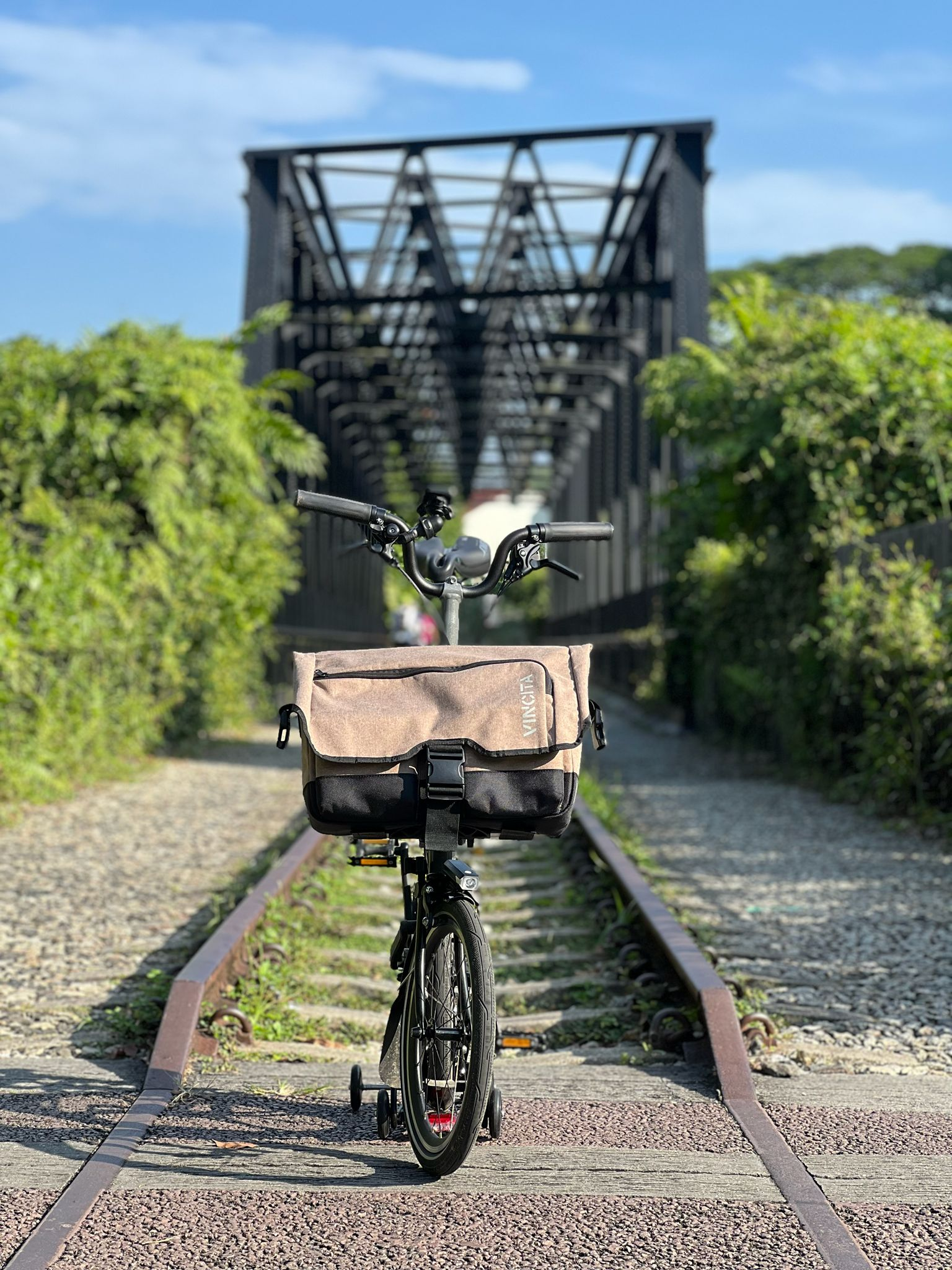
The Rail Corridor is one of the best places in Singapore to understand why cycling here can be so special.
Once a railway route, it is now a green corridor running through the heart of the island. Instead of traffic lights, shopping malls, and expressways, you get gravel paths, greenery, old railway memories, birdsong, and a slower rhythm of movement.
A Brompton works well here because you do not have to ride the entire route in one go. You can explore a section, stop for breakfast, fold the bike, and continue your journey by MRT or taxi if needed.
For beginners, this flexibility matters.
A full-sized bicycle often makes you feel committed to the entire ride. A Brompton gives you choices.
2. Bukit Timah Railway Station Area
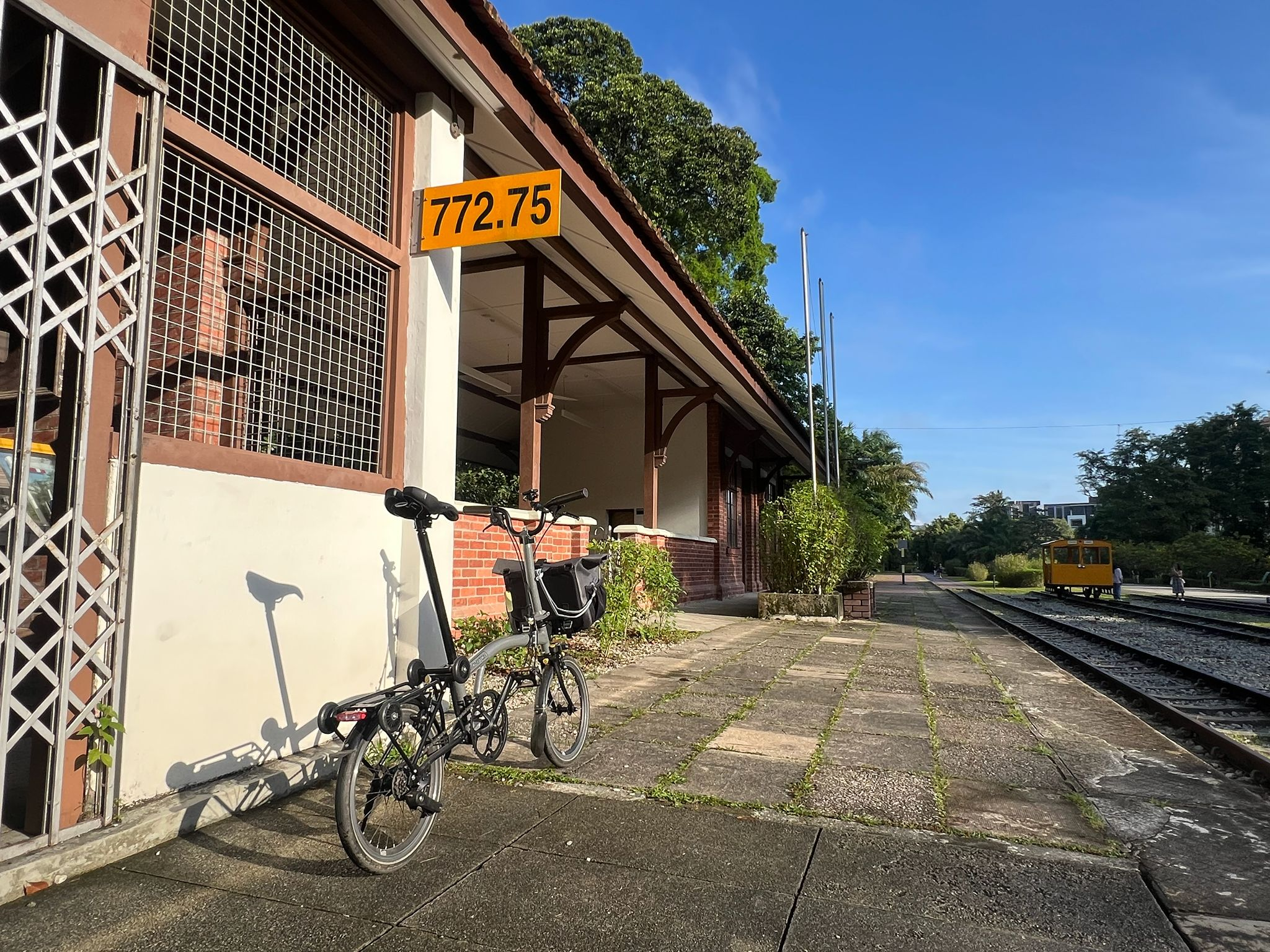
The old Bukit Timah Railway Station area is one of the most photogenic sections of the Rail Corridor.
It is not just a cycling stop. It is a reminder of an older Singapore, when railway lines connected the island to the Malay Peninsula and trains passed through areas that are now parks, paths, roads, and neighbourhoods.
Today, the area has become a popular heritage and photography spot.
By Brompton, you can arrive without worrying too much about parking. Fold the bike if needed, walk around slowly, take photos, and continue along the corridor at your own pace.
It is a good example of why a Brompton suits Singapore: ride, fold, pause, explore, repeat.
3. Duxton Plain Park
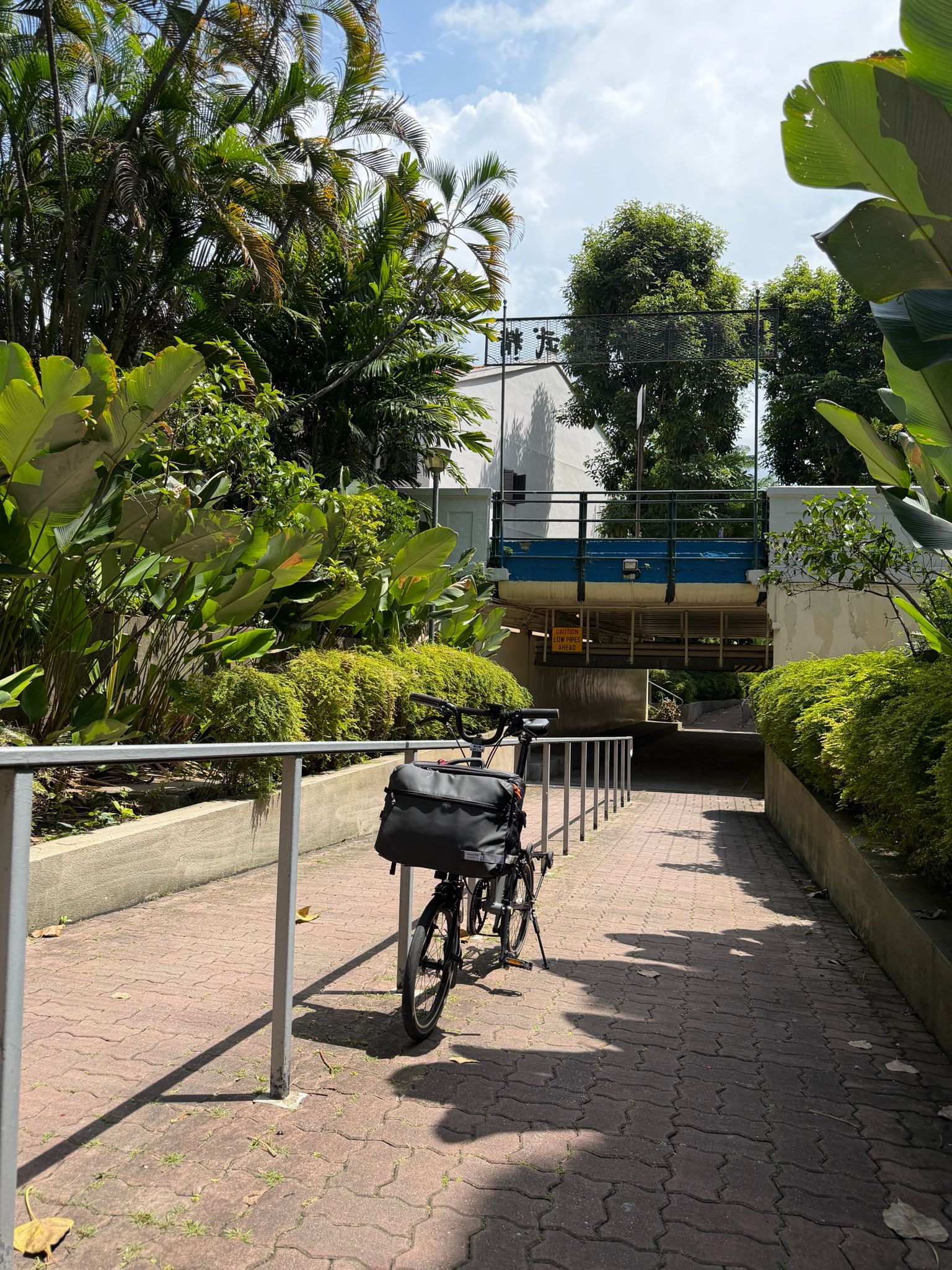
Many people pass through the Tanjong Pagar and Chinatown area without noticing Duxton Plain Park.
It is a quiet linear park tucked between buildings, shophouses, residential blocks, and roads. It does not feel like a major tourist attraction, and that is precisely its charm.
On foot, it may feel like a small neighbourhood shortcut.
On a Brompton, it becomes part of a much bigger story. You can link it with Tanjong Pagar, Chinatown, Everton Park, Neil Road, Keong Saik, and the old railway approach towards the former Tanjong Pagar Railway Station area.
This is the kind of place that shows Singapore at a human scale.
Not the postcard skyline.
Not the air-conditioned mall.
Just old paths, local life, trees, and city textures that are easy to miss.
4. Cavenagh Bridge and the Singapore River
Cavenagh Bridge is one of the most beautiful heritage bridges in Singapore.
Many people see it while walking around the Fullerton and Singapore River area, but cycling there gives you a different sense of connection. You can approach the river slowly, stop for photos, continue along the Civic District, and link the area with Esplanade, Marina Bay, Boat Quay, and Raffles Place.
This is also one of the easiest places to understand Singapore’s transformation.
In a short ride, you move between colonial-era buildings, historic bridges, modern skyscrapers, luxury hotels, public art, and riverfront dining.
A Brompton is perfect here because the area is better enjoyed slowly.
You are not trying to cover distance.
You are noticing details.
5. Fort Canning and the Old Orchard Story
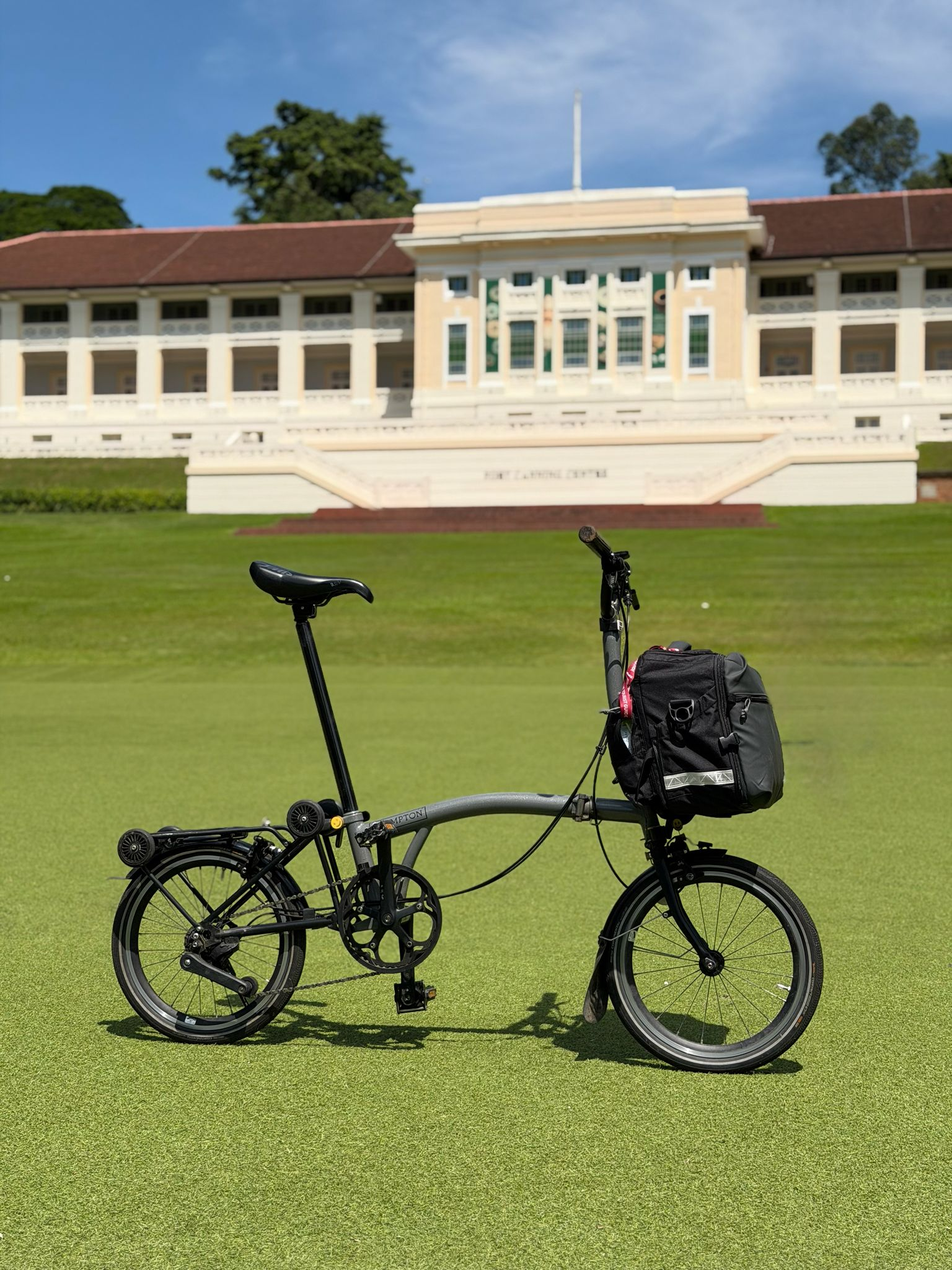
Fort Canning is often associated with history, greenery, and the famous spiral staircase photo spot.
But there is more to the area than Instagram queues.
Ride around the edges of Fort Canning and you begin to connect different layers of Singapore: colonial history, old botanical interests, nearby museums, the Singapore River, Dhoby Ghaut, and Orchard Road.
This is also a good place to talk about the older story of Orchard Road.
Long before Orchard Road became a shopping belt, the area was associated with plantations, orchards, and nutmeg. That older landscape is almost impossible to imagine today when you are surrounded by malls, hotels, and traffic.
A Brompton helps you connect that past and present.
You can ride from the Orchard area to Fort Canning, then continue towards the Civic District or Singapore River. It becomes a short ride through a surprisingly rich slice of Singapore history.
6. Tiong Bahru Back Lanes
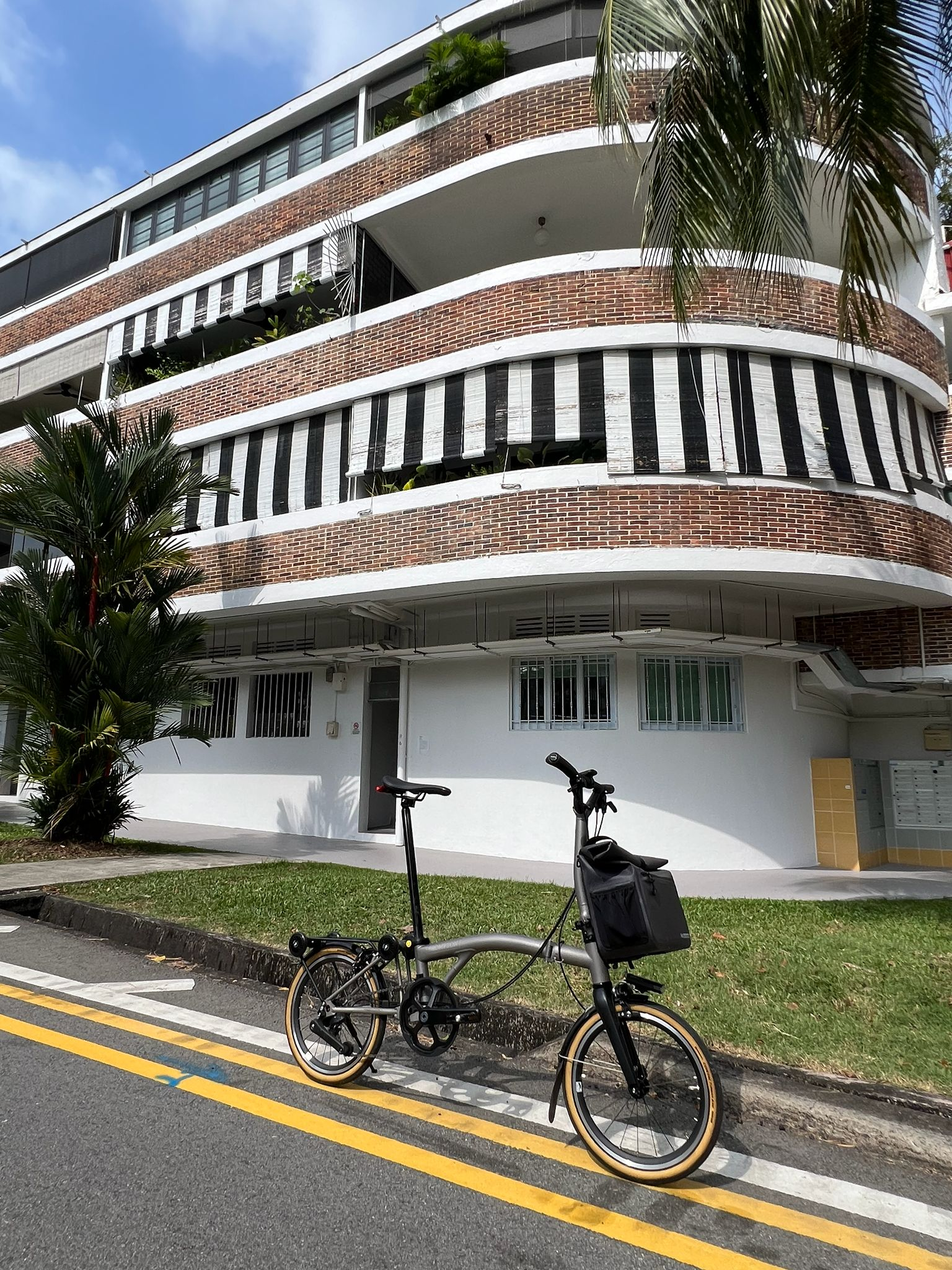
Tiong Bahru is one of Singapore’s most charming neighbourhoods, but many people only know it for cafés and the market.
The real pleasure is in the details.
Curved apartment blocks. Old staircases. Back lanes. Quiet corners. Mature trees. Morning market life. Small shops. A mix of old residents, young families, café-goers, and visitors.
It is a neighbourhood that rewards slow exploration.
By Brompton, you can move through the area gently without treating it like a checklist. Stop for breakfast, fold the bike near your table, take a slow loop through the estate, then continue towards the Singapore River, Chinatown, Alexandra, or the Rail Corridor.
This is not high-speed cycling.
This is urban wandering.
And the Brompton is very good at that.
7. Queenstown for Local Breakfast and Old Neighbourhood Life
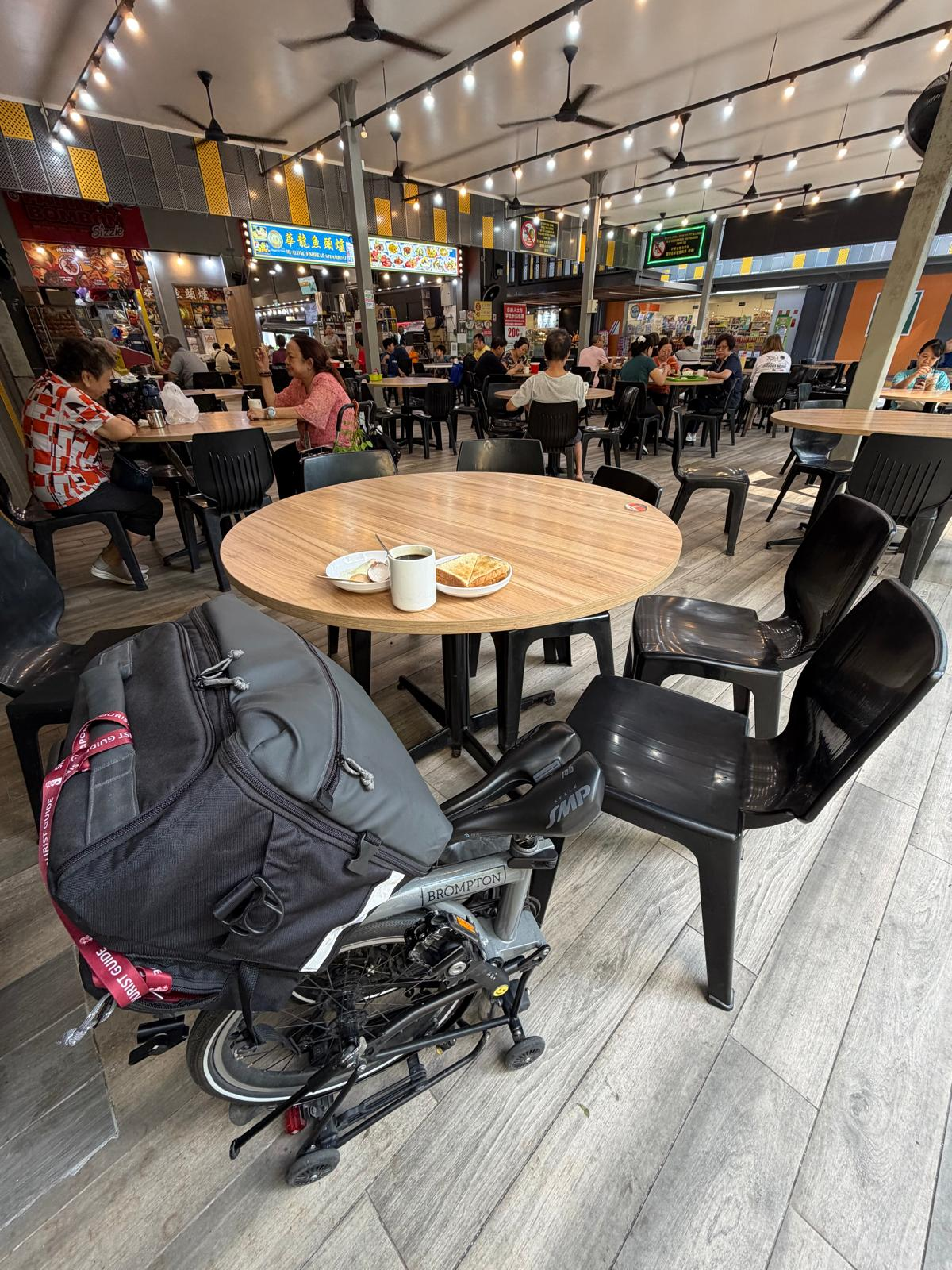
Queenstown is not usually the first place tourists think of when they visit Singapore.
That is exactly why it is interesting.
It offers a very different experience from Marina Bay or Orchard Road. Here, you get local neighbourhood life, coffee shops, older housing estates, hawker food, community spaces, and a quieter view of Singapore.
For Brompton riders, Queenstown works well as a breakfast stop after a Rail Corridor ride.
You can ride through greenery, stop for local food, experience a non-touristy neighbourhood, then cycle back or take public transport depending on the weather and your energy level.
This is one of the pleasures of exploring Singapore by bike.
The destination does not always have to be famous.
Sometimes the best stop is simply a good local breakfast in a real neighbourhood.
8. Kampong Glam Side Streets
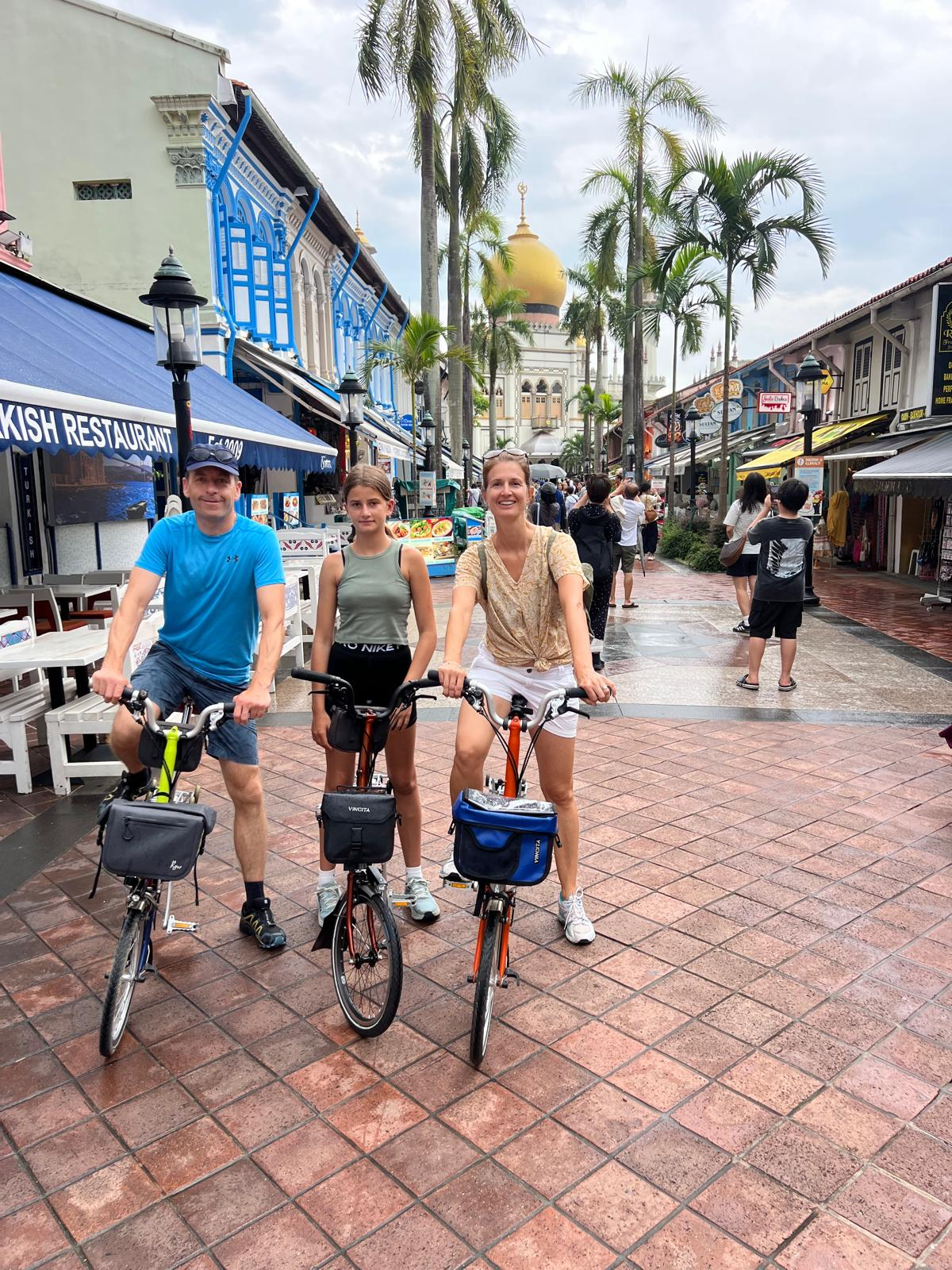
Many visitors go to Kampong Glam for Haji Lane, Arab Street, and the Sultan Mosque area.
Those are worth visiting, but the neighbourhood becomes much more interesting when you explore the side streets.
On a Brompton, you can move between colourful shophouses, textile shops, cafés, murals, religious landmarks, and quieter lanes without feeling rushed.
This is a good area for people who like photography, food, and culture.
It is also a good example of how a Brompton lets you cover more than a walking tour while still feeling connected to the street.
You can ride slowly, fold when the area is crowded, walk for a while, then continue riding when the streets open up again.
9. Little India Beyond the Main Road
Little India is full of colour, sound, food, flowers, temples, shops, and constant movement.
Most people experience it along the main streets.
By Brompton, you can explore more gently, turning into side streets, pausing for photos, stopping for snacks, and connecting the area with Rochor, Jalan Besar, Kampong Glam, and the Civic District.
Of course, this is an area where you should ride slowly and respectfully.
When it gets crowded, fold and walk.
That is the beauty of the Brompton. It does not force you to behave like a road cyclist everywhere. It lets you adapt to the place.
In a busy cultural district, sometimes the right thing to do is simply fold the bike and become a pedestrian for a while.
10. Hidden Canal and Park Connector Links
Some of the most enjoyable Brompton rides in Singapore are not at famous landmarks.
They are along small canal paths, park connectors, neighbourhood links, and unexpected green edges that quietly connect one place to another.
These routes may not look impressive on a tourist map, but they are often what make local cycling enjoyable.
You might find yourself riding beside a canal, passing under a road, entering a park connector, emerging near a coffee shop, then continuing into another neighbourhood.
This is the Singapore that drivers rarely notice.
For Brompton owners, these little links are gold.
They turn short local rides into mini adventures.
Why These Places Are Better by Brompton
You can visit many of these places on foot, by MRT, by bus, or by taxi.
But the experience is different.
Walking can be slow.
Driving can make parking difficult.
Public transport can bring you close, but not always through the interesting in-between spaces.
A Brompton gives you the best of several worlds.
You can cover more ground than walking. You can stop more easily than driving. You can fold and take public transport when needed. You can bring the bike close to you instead of worrying about parking.
Most importantly, you experience the city at a more human pace.
Fast enough to explore.
Slow enough to notice.
Tips for Exploring Singapore by Brompton
If you are new to cycling in Singapore, start with short, easy routes.
Ride early in the morning when the weather is cooler. Bring water. Use lights. Be considerate on shared paths. Slow down near pedestrians, children, and elderly residents. Avoid treating park connectors like race tracks.
Singapore is not just a place to ride through.
It is a place to observe.
That is what makes Brompton riding so enjoyable here.
For Visitors: A Different Way to See Singapore
If you are visiting Singapore, a Brompton cycling tour can show you a side of the city that is difficult to experience from a bus, taxi, or standard walking tour.
You can see heritage districts, riverfront areas, local neighbourhoods, old railway traces, food stops, and quiet corners in a single ride.
It is not about cycling fast.
It is about seeing more, feeling more, and understanding how different parts of Singapore connect.
For Locals: Rediscover Your Own City
If you live in Singapore, a Brompton can help you rediscover familiar places.
Many locals spend years moving between home, work, malls, and the same few food spots. But by bicycle, even familiar neighbourhoods can feel new again.
You notice older buildings.
You find quieter paths.
You discover breakfast places you never tried.
You realise that Singapore is more layered, more walkable, more rideable, and more interesting than it sometimes feels from inside a car or MRT train.
That is one of the greatest joys of owning a Brompton.
It turns the city into something to be explored, not just crossed.
Frequently asked questions about exploring Singapore by Brompton
Are these Singapore cycling routes suitable for beginners?
Many sections are beginner-friendly when ridden slowly, but conditions vary. Start with park connectors and quieter stretches, avoid unfamiliar busy roads, and shorten the route by combining your ride with the MRT when necessary.
Can visitors bring a Brompton on Singapore’s MRT?
Yes, provided it is fully folded and handled within LTA’s public-transport rules. Keep it clear of doors and aisles, use wider fare gates where available and move towards less crowded parts of the train.
What is the best time to explore Singapore by bicycle?
Early morning is usually cooler and quieter. Check the weather, carry water and lights, and keep an MRT option in mind for sudden rain, strong heat or fatigue.
What should I carry on a Singapore Brompton ride?
Bring water, lights, a small pump or repair kit, rain protection, your phone and a secure way to carry personal items. A front bag keeps weight on the frame rather than your shoulders.
Can I join a guided Brompton ride in Singapore?
Yes. 808 Tours offers guided cycling experiences led personally by an STB-licensed tourist guide, combining local neighbourhoods, heritage stories, green corridors and food stops.
Thinking of Exploring Singapore by Brompton?
At 808 Cycles, we do not just sell Bromptons. We ride them, service them, travel with them, and use them to explore Singapore.
If you are thinking of buying a Brompton, visit or contact 808 Cycles via WhatsApp for a test ride and we can help you choose a model and setup that suits your lifestyle.
And if you would like to experience Singapore by Brompton before deciding, join one of our guided cycling tours. You will get to ride through heritage districts, green corridors, hidden corners, and local food stops with a licensed Singapore tour guide.
A Brompton is not just a bicycle.
In Singapore, it can become your key to a different side of the city.
Further reading:
Brompton C Line vs P Line: Which Should You Buy in Singapore?
Brompton 4-Speed vs 12-Speed: Which Should You Choose in Singapore?
10 Reasons Why Singapore Is One of the Best Cities in the World to Own a Brompton
Can You Bring a Brompton on Singapore’s MRT? A Practical Guide for Owners and Buyers
Is a Brompton Worth Buying in Singapore? A Long-Term Owner’s Perspective
About the author
Bob Lee is the founder of 808 Cycles, a Brompton Authorised Dealer in Singapore. Since 2016, he has helped riders choose, set up and maintain their Bromptons, serviced hundreds of folding bicycles, and guided cycling experiences around Singapore. Learn more about Bob Lee.
Singapore may be small, hot, humid, and occasionally very wet — but for Brompton owners, it is also one of the most practical cities in the world.
At first glance, that might sound surprising.
After all, Singapore is not Amsterdam. It is not Copenhagen. It is not a city where bicycles dominate the roads.
But a Brompton is not just a normal bicycle.
It is a compact folding bike designed for mixed-mode transport, small living spaces, city riding, travel, and everyday convenience. And when you look at how people actually live and move around in Singapore, the Brompton starts to make a lot of sense.
Here are 10 reasons why Singapore is one of the best cities in the world to own a Brompton.
1. Singapore Is Compact Enough to Explore by Bicycle
Singapore is small, and that is a good thing for cyclists.
Many useful journeys are within comfortable cycling distance. A ride from home to the nearest MRT station, coffee shop, park connector, office, school, or shopping mall may only take a few minutes.
For longer rides, Singapore also offers plenty of interesting routes. You can cycle from neighbourhoods into town, from the city towards the East Coast, or from residential estates into green corridors and park connectors.
A Brompton works beautifully in this environment because it does not need every journey to be a full cycling journey.
You can ride part of the way, fold the bike, take the MRT, then continue riding again later.
That flexibility suits Singapore very well.
2. It Fits Into HDB Flats, Condominiums, and Small Apartments
One of the biggest problems with owning a full-sized bicycle in Singapore is storage.
Many people live in HDB flats, condominiums, or apartments where space is limited. A full-sized bicycle can take up precious room, block walkways, or end up being stored outside where it is exposed to rain, humidity, and theft risk.
A Brompton solves much of this problem.
When folded, it becomes compact enough to keep indoors. It can sit near the door, under a desk, beside a cabinet, or in a corner of the living room.
This is not just about convenience. It also changes how often you use the bike.
If your bicycle is easy to reach, easy to store, and easy to bring out, you are more likely to ride it.
3. It Works Well With Singapore’s MRT System
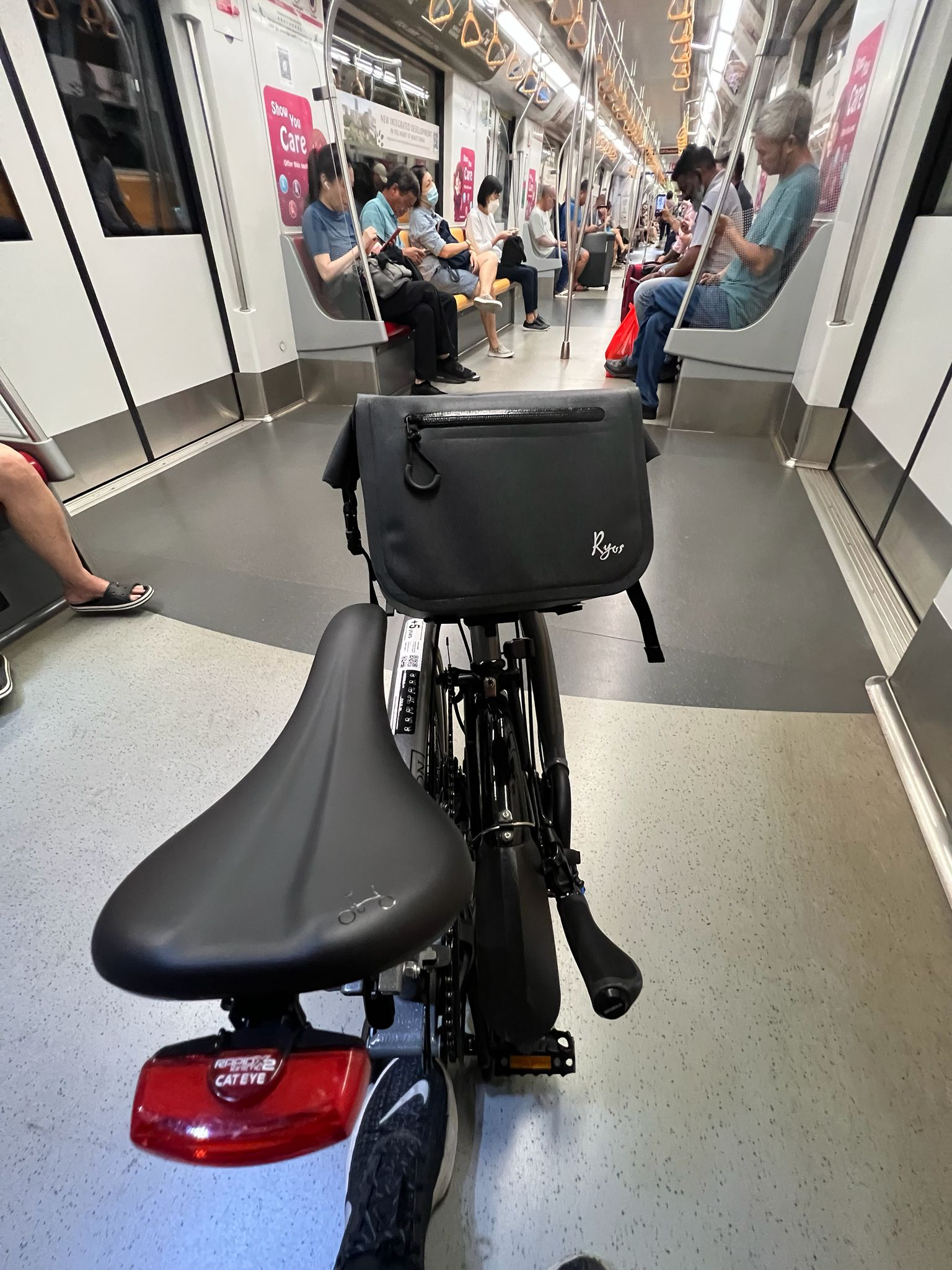
One of the biggest advantages of owning a Brompton in Singapore is that it can be combined with the MRT.
You can ride when the weather is good, fold the bike when you need to take the train, and continue your journey without worrying about finding bicycle parking.
This is especially useful in Singapore because weather and energy levels can change quickly.
A morning ride may feel wonderful. A hot afternoon ride home may feel less wonderful.
With a Brompton, you always have options.
Ride one way. Take the MRT back. Ride to a meeting. Fold and continue by train. Cycle to breakfast, then take public transport home before the sun gets too hot.
This is where the Brompton becomes more than just a bike. It becomes part of your transport system.
4. It Makes Park Connectors More Accessible
Singapore’s park connectors and cycling paths have made recreational cycling much more enjoyable.
You can ride through green spaces, along canals, beside waterways, and through neighbourhoods without always needing to be on busy roads.
The Brompton is ideal for this kind of riding.
It is not designed to be the fastest bicycle on the road. It is designed to be convenient, enjoyable, and practical. That makes it perfect for relaxed rides along park connectors, morning breakfast loops, evening rides, and casual weekend exploration.
For many new cyclists, this is exactly what they want.
Not racing. Not training. Just a pleasant way to move around Singapore.
5. Singapore’s Food Culture Makes Cycling More Fun
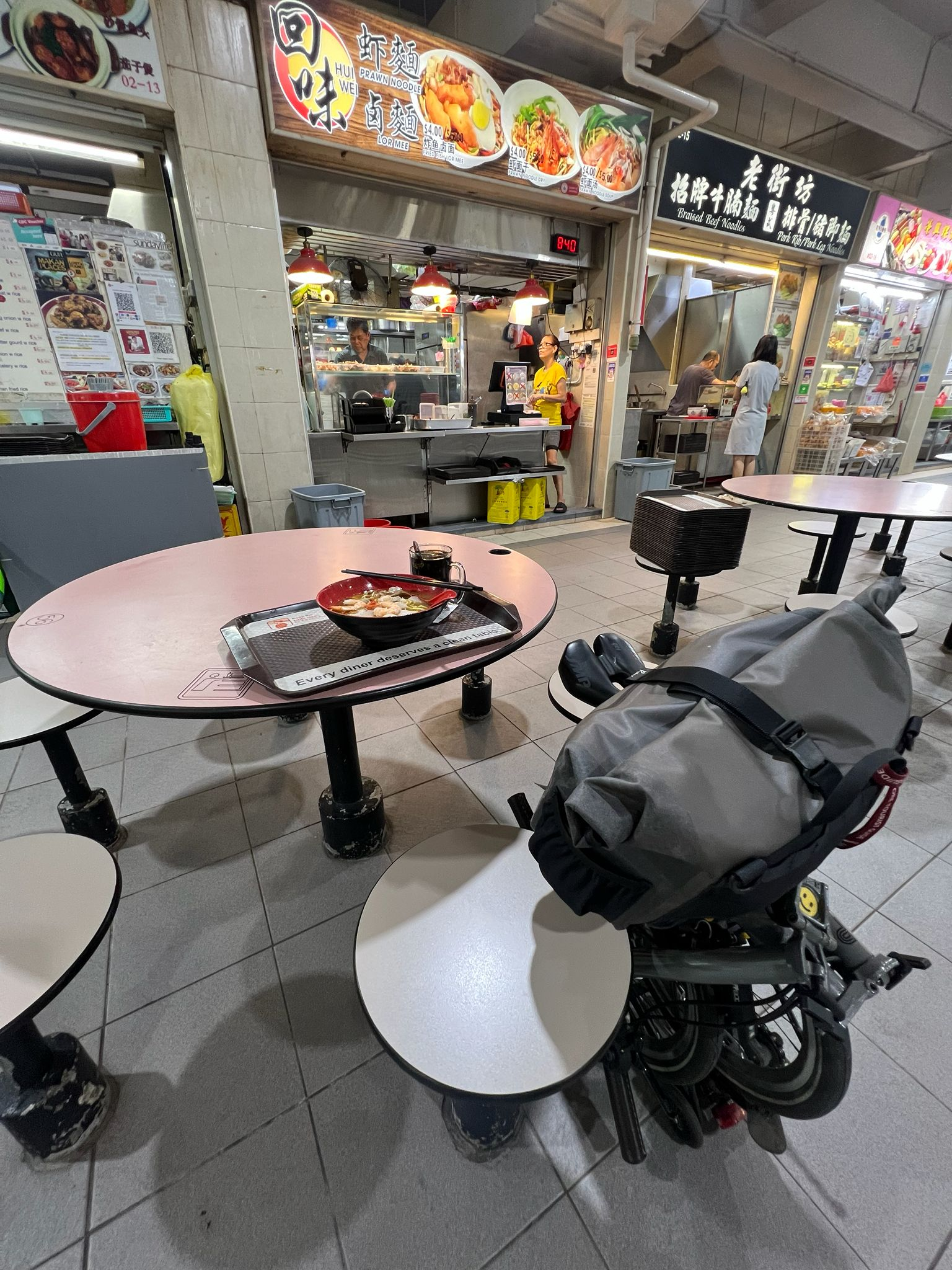
In Singapore, cycling and food go naturally together.
A Brompton ride does not have to be about distance, speed, or performance. It can simply be a ride to a good hawker centre, a quiet café, a local breakfast spot, or a favourite kopi stop.
This is one of the most enjoyable ways to use a Brompton.
Ride in the morning before it gets too hot. Stop for kaya toast, prata, nasi lemak, wanton mee, or kopi. Fold the bike beside your table. Enjoy breakfast. Continue riding or take the MRT home.
That is the Brompton lifestyle in Singapore.
It is practical, social, and very local.
6. It Helps You Avoid the Worst of the Heat
Let’s be honest: Singapore can be hot.
This is one reason many people hesitate to cycle. They imagine arriving everywhere sweaty, tired, and uncomfortable.
A Brompton helps because you do not have to cycle the entire journey.
You can choose the most pleasant parts of the route and skip the unpleasant parts. Ride early in the morning. Take the MRT during the hottest part of the day. Cycle through shaded park connectors. Fold and enter an air-conditioned mall when needed.
This flexibility makes cycling less intimidating, especially for beginners.
You are not committing to suffer through every kilometre. You are giving yourself more options.
7. It Is Useful for Everyday Errands
A Brompton is not only for weekend rides.
It can be useful for daily errands too.
You can ride to the supermarket, collect takeaway food, visit the post office, go for breakfast, drop by a café, or run short neighbourhood errands without always needing a car or ride-hailing service.
With a front luggage system, the Brompton becomes even more practical. A front bag can carry groceries, food, a laptop, camera gear, or daily essentials without affecting the steering too much.
This is one of the hidden strengths of the Brompton.
It is not just a folding bike. It is a small urban transport tool.
8. You Can Bring It Indoors More Easily
One major concern for bicycle owners in Singapore is theft.
Even with a good lock, many cyclists feel uneasy leaving an expensive bicycle outside for long periods.
A Brompton reduces that concern because it can often be folded and brought indoors.
Offices, cafés, hotels, lifts, shops, and homes become much easier to manage when your bicycle folds into a compact package.
Of course, you should always be considerate and follow the rules of each building or business. But compared with a full-sized bicycle, a folded Brompton gives you far more options.
For many owners, that peace of mind is worth a lot.
9. It Is Excellent for Overseas Travel
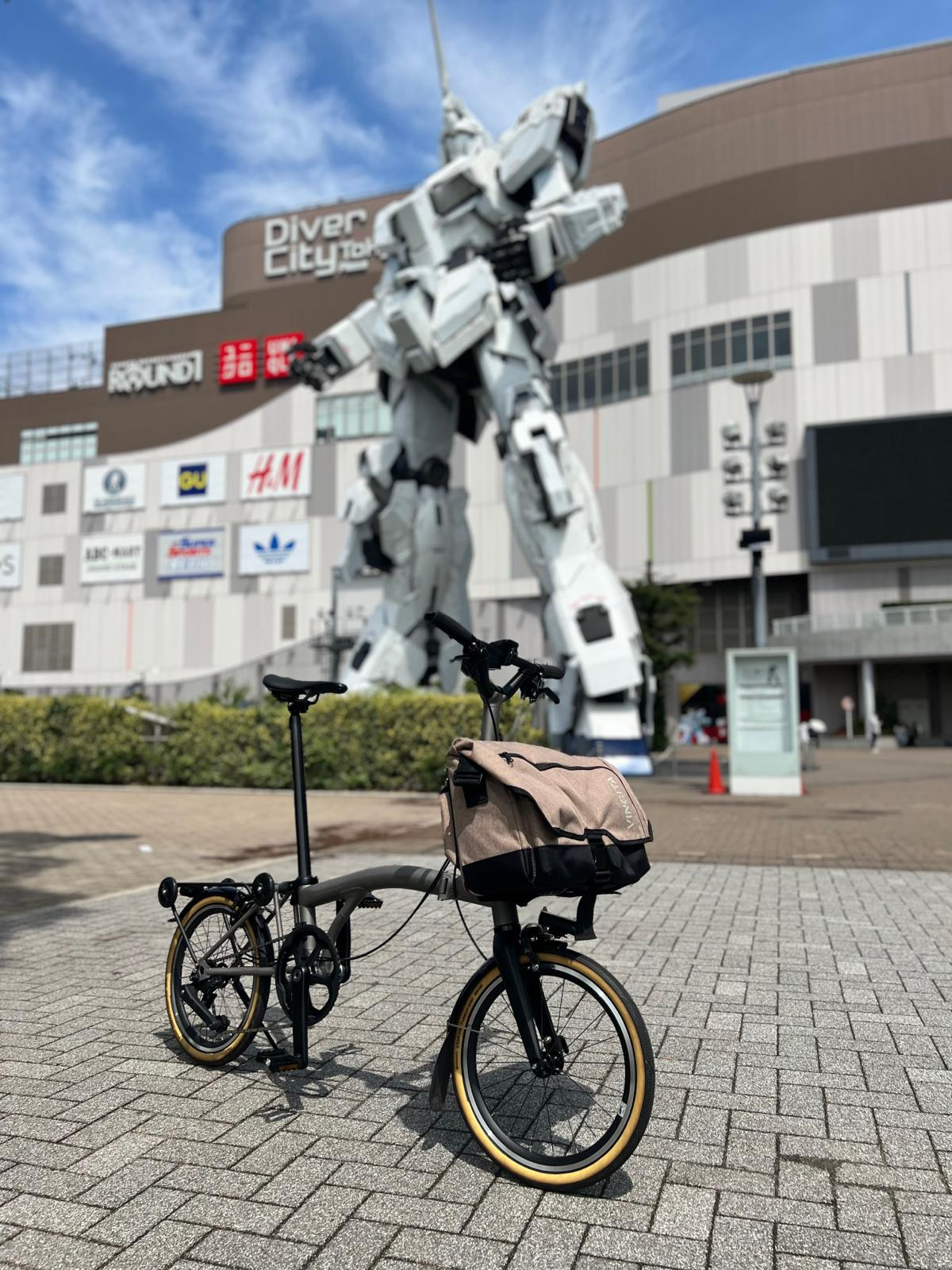
Singapore is one of the world’s best travel hubs.
From Changi Airport, it is easy to fly to Japan, Taiwan, South Korea, Thailand, Australia, Europe, and many other places where cycling can be a wonderful way to explore.
This is where a Brompton becomes especially exciting.
Instead of renting an unfamiliar bicycle overseas, you can bring your own. You already know how it rides, how it fits, how it folds, and how to carry your belongings.
For many Brompton owners, the bike becomes a travel companion.
You can explore quiet streets in Japan, riverside paths in Europe, coastal towns in Taiwan, or city parks in Australia — all with your own familiar bicycle.
That ability to travel with the bike is one of the biggest reasons people fall in love with Brompton ownership.
10. It Lets You Discover a Different Side of Singapore
Many people think they know Singapore.
They know the malls, the expressways, the MRT stations, and the usual tourist attractions.
But Singapore looks very different from the saddle of a bicycle.
On a Brompton, you begin to notice old buildings, hidden lanes, quiet canals, historic bridges, mature trees, railway remnants, back alleys, old neighbourhoods, and local food spots that are easy to miss by car or train.
This is also why Brompton cycling tours work so well in Singapore.
The bike is small enough to move through tight urban spaces, practical enough to combine with public transport, and comfortable enough for a relaxed exploration of the city.
A Brompton lets you experience Singapore at a human pace.
Fast enough to cover ground. Slow enough to notice details.
Is Singapore Perfect for Cycling?
No city is perfect.
Singapore can be hot. Some roads are still not comfortable for less confident cyclists. Afternoon storms can appear quickly. Park connectors can get crowded on weekends. You still need to ride responsibly and share paths graciously with pedestrians and other users.
But this is exactly why a Brompton works so well.
You are not forced to ride all the time. You can adapt.
If the route is pleasant, ride.
If the weather changes, fold.
If the distance feels too far, take the MRT.
If the train is crowded, wait or cycle a little further.
The Brompton gives you choices.
Who Benefits Most From Owning a Brompton in Singapore?
A Brompton is especially suitable if you:
- Live in an apartment, HDB flat, or condominium.
- Want to combine cycling with MRT, taxis, or ride-hailing.
- Prefer relaxed city rides over racing.
- Enjoy food, café, and lifestyle rides.
- Want a bicycle that can be brought indoors.
- Travel often and like the idea of bringing your own bike overseas.
- Want to explore Singapore in a slower, more personal way.
It may not be the best choice if your main goal is competitive road cycling or high-speed long-distance riding.
But for urban living, everyday convenience, and flexible exploration, the Brompton is very hard to beat.
So, Is Singapore a Good City for Brompton Owners?
Yes.
In fact, Singapore may be one of the best cities in the world to own a Brompton precisely because of how the bike fits into local life.
Small homes. Short distances. MRT connectivity. Hot weather. Sudden rain. Food culture. Park connectors. Overseas travel. Indoor storage. Urban exploration.
These are not problems for the Brompton.
They are reasons why the Brompton makes sense.
A good bicycle should fit your lifestyle. In Singapore, few bicycles fit daily life as naturally as a Brompton.
Frequently asked questions
Why is a Brompton especially practical in Singapore?
Its compact fold fits smaller homes and makes it easier to combine cycling with MRT, taxis, offices, cafés and indoor storage. That flexibility is useful in Singapore’s heat, sudden rain and dense urban environment.
Can a Brompton be stored in an HDB flat?
Yes. A folded Brompton occupies far less floor space than a conventional bicycle and can usually be kept indoors, reducing exposure to theft, rain and humidity.
Is a Brompton suitable for daily commuting?
Yes, when the line, gearing, luggage and riding position match the journey. Riders who frequently carry the folded bike may value lower weight, while longer or hillier routes benefit from wider gearing.
Can I take a Brompton on Singapore public transport?
A properly folded Brompton fits within LTA’s stated size limit for bicycles on trains and buses. It must remain folded in stations, interchanges and vehicles, and must not obstruct other commuters.
Which Brompton should a Singapore buyer choose?
The right choice depends on carrying frequency, terrain, distance, luggage and budget. Compare the C Line and P Line for materials and weight, then compare 4-speed and 12-speed gearing for the routes you actually ride.
Thinking of Buying a Brompton in Singapore?
If you are wondering which Brompton model is right for you, visit 808 Cycles for a test ride.
We are a Brompton Authorised Dealer in Singapore, and we can help you compare the different models, understand the fold, choose useful accessories, and find a setup that suits your lifestyle.
You can also join one of our guided cycling tours to experience how a Brompton feels in real Singapore conditions — from park connectors and heritage districts to hawker stops and hidden corners of the city.
Further reading:
Brompton C Line vs P Line: Which Should You Buy in Singapore?
Brompton 4-Speed vs 12-Speed: Which Should You Choose in Singapore?
10 Hidden Places in Singapore You Can Explore More Easily by Brompton
Can You Bring a Brompton on Singapore’s MRT? A Practical Guide for Owners and Buyers
How Much Does It Really Cost to Own a Brompton in Singapore?
About the author
Bob Lee is the founder of 808 Cycles, a Brompton Authorised Dealer in Singapore. Since 2016, he has helped riders choose, set up and maintain their Bromptons, serviced hundreds of folding bicycles, and guided cycling experiences around Singapore. Learn more about Bob Lee.
“Can I bring it on the MRT?”
The short answer is yes — and this is one of the biggest reasons why a Brompton makes so much sense in Singapore.
A Brompton is not just a bicycle. It is a bike that can become part of your daily transport system. You can ride when you want to ride, fold when you need to take public transport, and continue your journey without worrying too much about parking, theft, rain, or fatigue.
For a small city like Singapore, that flexibility is a big part of the Brompton appeal.
Why MRT Compatibility Matters in Singapore
Singapore is compact, connected, and generally very easy to move around.
But the weather is not always kind.
Some days are too hot. Some afternoons are too wet. Some evenings you may simply be too tired to ride home after a long day.
This is where a Brompton becomes especially useful.
You might ride from home to the park connector, continue towards town, stop for coffee, then take the MRT back. Or you might cycle to a meeting, fold the bike, bring it indoors, and continue by train later.
With a full-sized bicycle, that kind of flexibility is usually much harder.
With a Brompton, it becomes normal.
The Key Rule: Fold It Before Entering the Station
In Singapore, foldable bicycles are allowed on public transport, but they must be folded when you are in MRT/LRT stations, bus interchanges, terminals, trains, and buses.
That means you should not ride your bicycle through the MRT station.
Fold it before entering, then push, wheel, or carry it.
This is both a rule and basic courtesy. MRT stations can be crowded, and an unfolded bicycle can become a tripping hazard or block other commuters.
The good news is that a Brompton fold is compact, quick, and secure. Once folded properly, it becomes much easier to handle than most other bicycles.
Does a Brompton Fit Within the Size Limit?
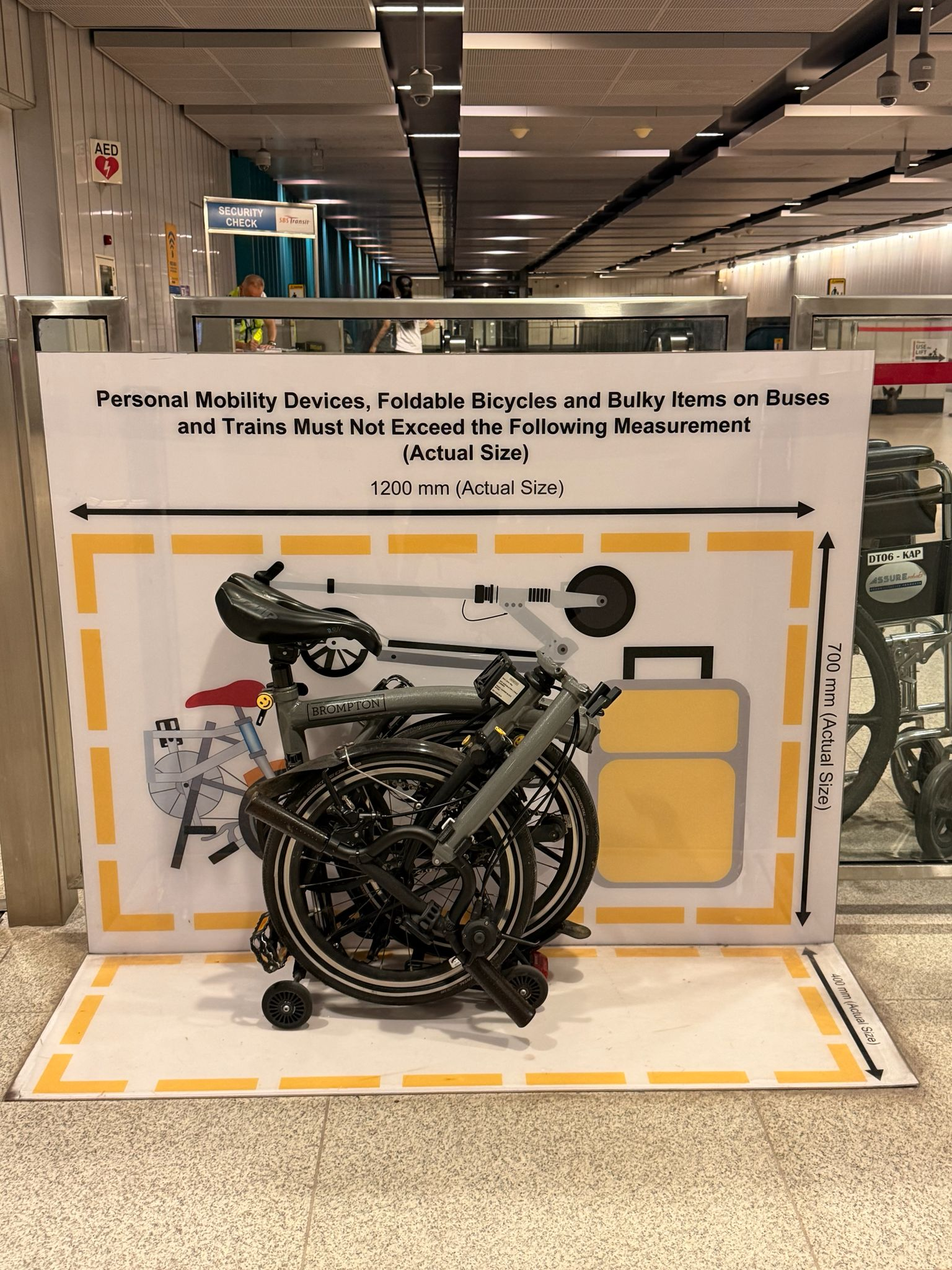
Yes, a standard Brompton fold is well within Singapore’s public transport size limit for foldable bicycles.
This is one of the biggest advantages of the Brompton design. Many folding bikes fold, but not all fold small. The Brompton’s compact fold is what makes it especially practical for mixed-mode commuting.
Once folded, it can usually be placed beside you, wheeled through wide fare gates, brought into lifts, or kept close without taking up too much space.
That compactness is not just a technical feature. It changes how often you are likely to use the bike.
A bicycle that is easy to bring along becomes a bicycle you ride more often.
MRT + Brompton: Real-World Scenarios
Here are some situations where MRT compatibility becomes genuinely useful.
1. When It Suddenly Rains
This is Singapore. A sunny ride can turn into a thunderstorm very quickly.
With a Brompton, you are not trapped.
Fold the bike, head to the nearest MRT station, and continue your journey by train.
2. When You Are Too Tired to Ride Back
Sometimes the ride out is fun, but the ride home feels a little too ambitious.
A Brompton gives you the option to ride one way and take public transport back.
This is especially useful for beginners who are still building confidence and fitness.
3. When You Want to Avoid Peak Heat
Singapore’s midday heat can be intense.
You can ride early in the morning, enjoy breakfast, then take the MRT back when the sun gets stronger.
That makes cycling more enjoyable and less intimidating.
4. When You Are Meeting Friends or Family
Not everyone wants to cycle both ways.
With a Brompton, you can ride to a café, restaurant, hotel, or shopping mall, then fold the bike and continue your day without worrying about where to park it.
5. When You Are Exploring Singapore
A Brompton is perfect for combining cycling with MRT stops.
You can ride along the Singapore River, explore the Civic District, continue to Kampong Glam, then take the train home from the nearest station.
This is also one of the reasons Bromptons work so well for Singapore cycling tours.
Is It Easy to Push a Folded Brompton?
Yes, especially if the bike is set up properly.
Many Brompton owners use a rack or upgraded roller wheels to make the folded bike easier to move around. With the right setup, the folded Brompton can be wheeled rather than carried most of the time.
This matters more than people realise.
A bike may look light on paper, but if it is awkward to move when folded, you may end up using it less. The Brompton’s small folded footprint and wheeling ability are major reasons why it works so well for Singapore.
Should You Bring a Brompton on the MRT During Peak Hours?
You can, but you should be considerate.
During crowded periods, it is best to avoid blocking doors, aisles, and walkways. Move to less crowded areas where possible, and hold on to your folded bike securely.
If the train is packed, it may be better to wait for the next one or cycle part of the route instead.
The best Brompton owners are not just riders. They are also considerate commuters.
What About Buses?
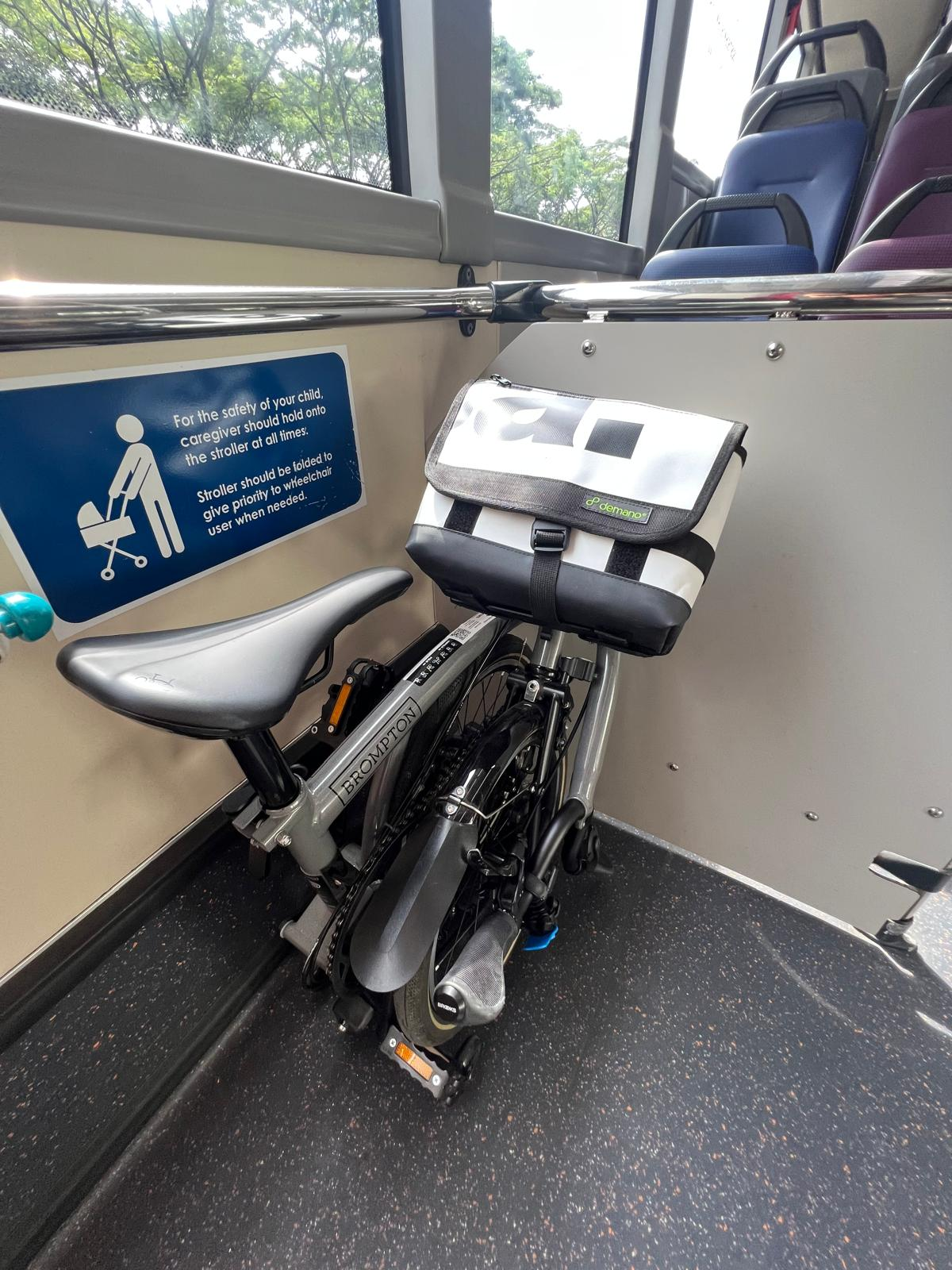
Foldable bicycles can also be brought onto buses, subject to the same general requirements.
However, buses are usually tighter than MRT trains, so you need to be extra mindful of space.
Personally, I find the MRT more comfortable for travelling with a folded Brompton, especially during longer journeys. Buses can still be useful, but space is more limited, particularly when the bus is crowded.
Can You Bring a Brompton Into Shopping Malls and Cafés?
In many cases, yes — especially when the bike is folded and handled like a personal item.
This is one of the hidden benefits of owning a Brompton.
Instead of locking your bicycle outside and worrying about theft, you can often fold it and bring it with you. It can fit under some tables, beside your seat, in offices, lifts, hotel rooms, and even supermarket aisles when handled carefully.
Of course, always be considerate and follow the rules of each building or business.
Why Brompton Works So Well for Singapore Living
Many Singaporeans live in HDB flats, condominiums, or apartments where space is limited.
A full-sized bicycle may require a storeroom, balcony, corridor space, or external parking. A Brompton can usually be kept indoors, which helps protect it from weather and theft.
This makes ownership much easier.
You are not just buying a bike for the road. You are buying a bike that fits into your home, your commute, your weekend plans, and your travel habits.
That is where the value really comes from.
Is MRT Compatibility a Good Reason to Buy a Brompton?
Yes — if you genuinely plan to use it as part of your lifestyle.
If you only want a bicycle for occasional weekend rides from home, there are many bicycles that can do the job.
But if you want a bicycle that can combine with MRT, taxis, cafés, supermarkets, hotels, offices, and overseas travel, the Brompton becomes much harder to beat.
The fold is not a gimmick.
In Singapore, the fold is the feature that turns the bike into a daily companion.
Tips for Taking a Brompton on the MRT
Here are a few practical tips:
- Fold the bike before entering the station.
- Use the wide fare gate where available.
- Keep the bike close to you on platforms and trains.
- Avoid blocking doors and walkways.
- Move towards less crowded areas of the train.
- Wipe or cover dirty wheels if needed.
- Be patient and considerate during peak hours.
These small habits make the experience better for everyone.
Frequently asked questions about taking a Brompton on the MRT
Are foldable bicycles allowed on Singapore trains all day?
Yes. LTA states that foldable bicycles may be brought on trains and buses at all hours, provided they comply with the rules. Courtesy still matters during crowded periods, and the first or last train car is often less busy.
What is the size limit for a folded bicycle on public transport?
The stated maximum is 120 cm by 70 cm by 40 cm when folded. A standard folded Brompton fits comfortably within this envelope.
Must a Brompton be folded before entering an MRT station?
Yes. It must remain folded in MRT and LRT stations, bus interchanges and terminals, and on trains and buses. Push, wheel or carry it while folded rather than riding inside these areas.
Do I need to cover a folded Brompton?
A complete bag is not generally required, but dirty or wet wheels must be wrapped and protruding parts likely to injure someone or damage property must be covered or retracted.
Where should I stand with a folded Brompton on the train?
Keep hold of the bicycle and make sure it does not block aisles, doors or passenger movement. Use the wide fare gate where available and move towards a less crowded part of the train.
So, Can You Bring a Brompton on Singapore’s MRT?
Yes, and that is one of the strongest reasons to own one here.
Singapore is one of the best cities in the world for a bike like the Brompton because you do not have to choose between cycling and public transport.
You can do both.
Ride when it is enjoyable. Fold when it is practical. Take the MRT when it rains, when you are tired, or when you simply want to continue your journey another way.
That freedom is what makes a Brompton different.
Thinking of Buying a Brompton in Singapore?
If you are wondering whether a Brompton fits your lifestyle, visit 808 Cycles for a test ride.
We are a Brompton Authorised Dealer in Singapore, and we can help you compare the different models, understand the fold, and choose a setup that works for your daily life.
You can also join one of our guided cycling tours to experience how a Brompton works in real Singapore conditions — from park connectors and heritage districts to hawker stops and MRT-friendly routes.
Further reading:
Brompton C Line vs P Line: Which Should You Buy in Singapore?
Brompton 4-Speed vs 12-Speed: Which Should You Choose in Singapore?
Is a Brompton Worth Buying in Singapore? A Long-Term Owner’s Perspective
10 Reasons Why Singapore Is One of the Best Cities in the World to Own a Brompton
Brompton P Line vs T Line: Which Should You Buy in Singapore?
About the author
Bob Lee is the founder of 808 Cycles, a Brompton Authorised Dealer in Singapore. Since 2016, he has helped riders choose, set up and maintain their Bromptons, serviced hundreds of folding bicycles, and guided cycling experiences around Singapore. Learn more about Bob Lee.
After all, a Brompton is not the cheapest bicycle you can buy. Model specifications, availability and prices change over time, so check our current Brompton bikes in stock for live Singapore pricing. The more useful question is:
“Is a Brompton really worth it in Singapore?”
Having ridden Bromptons for years, sold them since 2016, serviced hundreds of them, and guided countless rides around Singapore, my answer is simple:
For the right person, absolutely.
Why Bromptons Make Sense in Singapore
Singapore is one of the most Brompton-friendly cities in the world.
We have a growing network of cycling paths, excellent public transport, and relatively short commuting distances. Unlike many cities where cyclists must battle steep hills or extreme weather conditions, Singapore’s terrain is generally manageable for most riders.
What makes a Brompton particularly suitable is its ability to combine cycling with public transport.
Need to take the MRT during peak heat or a sudden thunderstorm? Fold the bike and hop on.
Need to take a taxi home after dinner? Fold the bike and place it in the boot.
Living in a condominium or HDB flat with limited storage space? Fold the bike and keep it neatly indoors.
The flexibility is something most full-sized bicycles simply cannot match.
The Fold Changes Everything
Many people assume a Brompton is just a small bicycle with small wheels.
In reality, the fold is what you’re paying for.
A Brompton folds into a remarkably compact package in under 20 seconds. Once folded, it can be wheeled into shopping malls, supermarkets, offices, cafés, hotels, and lifts with minimal fuss.
I’ve personally taken my Brompton into supermarkets while shopping, brought it into hotel rooms during overseas trips, and wheeled it through airports and railway stations around the world.
The convenience quickly becomes addictive.
Surprisingly Comfortable for Long Rides
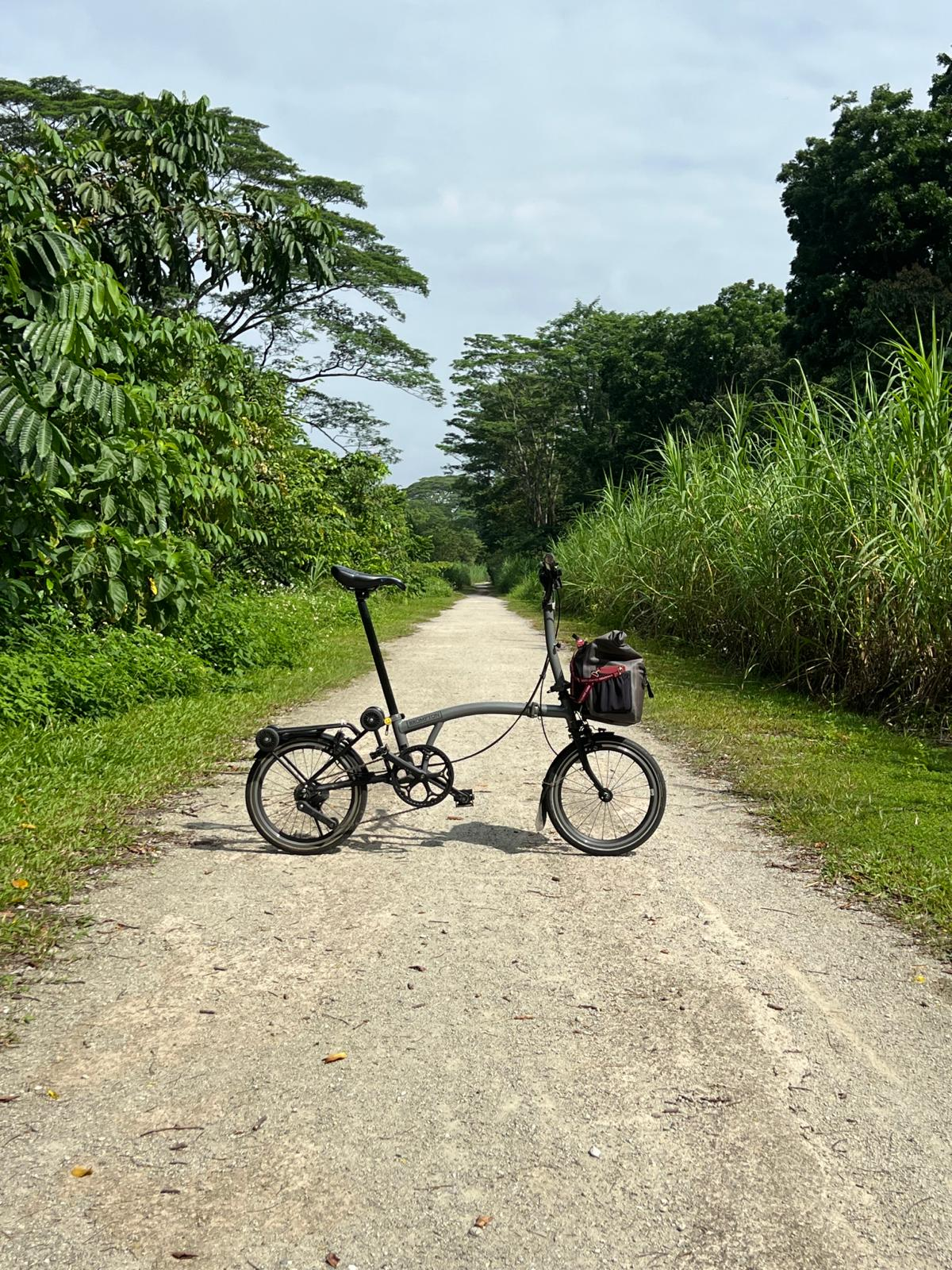
One of the biggest misconceptions about Bromptons is that they are only suitable for short commutes, and only on nicely paved roads.
In reality, many Brompton owners regularly ride 30km, 50km, or even longer distances, both on paved roads, and on light gravel.
I’ve guided visitors around Singapore on Bromptons, covering heritage districts, nature parks, and hidden neighbourhoods. Many first-time riders are surprised by how comfortable and stable the bike feels.
Yes, a Brompton rides differently from a road bike. It’s definitely not as fast, but for urban riding, recreational rides, commuting, touring, running errands, it performs exceptionally well.
Perfect for Overseas Travel
One reason many of my customers choose a Brompton is the ability to travel with it.
Instead of renting an unfamiliar bicycle overseas, you can bring your own Brompton almost anywhere.
Whether you’re exploring Japan, Taiwan, South Korea, Europe, or Australia, having your own bicycle means you can start riding immediately upon arrival.
Many owners consider this alone enough reason to justify the investment.
What About Maintenance?
Another pleasant surprise is that Bromptons are generally very reliable.
The design has been refined over decades, and replacement parts are widely available.
Like any bicycle, regular servicing is important. However, with proper care, a Brompton can easily provide many years of dependable use.
Many owners continue riding the same Brompton for ten years or more.
The recommended maintenance interval is every 2 years, or 10,000km, whichever comes first. Check out the servicing packages available here.
Who Should Buy a Brompton?
A Brompton is ideal if you:
- Live in an apartment or condominium with limited storage space.
- Want to combine cycling with MRT, buses, taxis, or ride-hailing services.
- Travel frequently and want to bring your bicycle overseas.
- Enjoy exploring Singapore’s parks, neighbourhoods, and hidden corners.
- Value convenience and practicality.
Who Might Not Need a Brompton?
A Brompton may not be the best choice if:
- Your primary goal is competitive road cycling.
- You only ride occasionally a few times per year.
- Storage and transport convenience are not important to you.
There are many excellent bicycles available today, and the best bicycle is always the one that fits your lifestyle.
So, Is a Brompton Worth It?
For many Singaporeans, the answer is yes.
A Brompton isn’t simply a bicycle. It’s a transportation tool, a travel companion, and a lifestyle product that makes cycling easier to fit into everyday life.
The real value isn’t found in the components or specifications alone.
It’s found in the freedom to ride more often, travel more easily, and explore places that might otherwise be inconvenient to reach.
After years of riding, selling, servicing, and touring on Bromptons, that’s still the reason I continue to ride one today.
Thinking About Buying a Brompton?
If you’re curious about whether a Brompton is right for you, visit 808 Cycles for a test ride. We’re a Brompton Authorised Dealer in Singapore, and we’d be happy to help you compare the different models and find one that suits your lifestyle.
You can also join one of our guided cycling tours to experience Singapore from the saddle of a Brompton before deciding whether it’s the right bike for you.
Frequently Asked Questions
Is a Brompton worth it for daily use in Singapore?
For riders who value compact storage, easy mixed-mode travel and a bicycle that can fit into everyday routines, a Brompton can be a strong long-term investment. Its value is highest when the fold helps you ride more often, store the bike indoors and combine cycling with public transport or ride-hailing.
Can I bring a Brompton on Singapore’s MRT?
Yes. Fold the bicycle before entering stations and vehicles, keep it within the permitted size, cover protruding parts and avoid blocking doors or aisles. See our practical MRT guide for Brompton owners for the current rules and considerate travel tips.
How much does a Brompton cost in Singapore?
Pricing depends on the model, gearing, material and specification, and can change with stock availability. Check our current Brompton bikes in stock for live pricing, then read our Brompton ownership-cost guide to budget for maintenance and useful accessories.
Is a Brompton suitable for beginners?
Yes. A Brompton is approachable for new riders, but the best setup depends on your height, route, fitness and expected luggage. A test ride helps you compare handlebar positions, gearing and ride feel before buying.
Which Brompton model should I choose?
Choose according to how you will use the bike. Start with our C Line vs P Line comparison, then compare 4-speed and 12-speed gearing. Riders prioritising minimum weight can also review the T Line alongside the P Line.
\n\nFurther reading:
Can You Bring a Brompton on Singapore’s MRT? A Practical Guide for Owners and Buyers
10 Reasons Why Singapore Is One of the Best Cities in the World to Own a Brompton
Brompton P Line vs T Line: Which Should You Buy in Singapore?
How Much Does It Really Cost to Own a Brompton in Singapore?
Has Your Brompton Been Sitting Unused? Why It May Be Time for a Full Service
About the author
Bob Lee is the founder of 808 Cycles, a Brompton Authorised Dealer in Singapore. Since 2016, he has helped riders choose, set up and maintain their Bromptons, serviced hundreds of folding bicycles, and guided cycling experiences around Singapore. Learn more about Bob Lee.