- In response, Stewart shouted: “Get stuffed. Bahrain’s a great place. End of.”, adding “Go away, I hate you” before subjecting Sayed Ahmed Alawadei to racist abuse ordering him to “Go back to Bahrain.” Soon after, he added: “now you shut up you stupid man.”
- Alwadaei, the director of the Bahrain Institute for Rights and Democracy (BIRD), asked Bob Stewart as he was approaching Lancaster House, “Bob Stewart, for how much did you sell yourself to the Bahraini regime?”, adding “you were paid by them recently”, referring to a lavish trip to the country last month during sham elections where Bob exclaimed “God save the King of Bahrain” in a speech praising the country’s dictatorship. Stewart also claimed in a debate in the House of Commons this year that “Bahrain does not have political prisoners”.
- Alwadaei was injured by the Bahraini police in 2011 and subsequently imprisoned and tortured, and sentenced by a military court for taking part in a pro-democracy uprising in 2011.
- Alwadaei fled to the UK in 2012 and was granted political asylum by the UK Home Office, where he later co-founded the Bahrain Institute for Rights and Democracy (BIRD) and continued to advocate for the respect of human rights in Bahrain, expose violations and work to hold perpetrators to account, particularly with regards to death penalty and political prisoners.
- In 2020, Alwadaei was the recipient of the Index on Censorship award for his advocacy in Bahrain.
- Alwadaei’s Bahraini citizenship was also revoked months after protesting against King Hamad’s presence at the Royal Windsor Horse Show in 2013, rendering him stateless in a blatant breach of international law and meaning he is unable to “go back to Bahrain”.
- A report published by the UN Secretary General in September 2022 on individuals subjected to reprisals as a result of engagement with UN bodies stated: “The cases of Mr. Sayed Ahmed Al- Wadaei and several of his relatives were included in the 2018, 2019 and 2020 reports of the Secretary-General on allegations of arbitrary arrest, ill-treatment, removal of citizenship and reprisals against family members for Mr. Al-Wadaei’s continuous engagement with the UN. Mr. Al-Wadaei.”
- A Bahrain news agency has published photos of Bob Stewart standing next to the Bahraini Ambassador to the UK and former PM Theresa May. Conversative Party Chairman, Nadhim Zahawi, was also at the event where he was an “honoured guest” and delivered a speech.
- Alwadaei has submitted a complaint to the Parliamentary Commission for Standards and the Chairman of the Conservative Party, Nadihm Zahawi, and is seeking legal advice to submit a complaint before the police.
Sayed Ahmed Alwadaei, Director of the Bahrain Institute for Rights and Democracy (BIRD) commented: “When I asked Bob Stewart about his links with Bahrain’s dictatorship, he told me “Bahrain’s a great place… I hate you … Go back to Bahrain” and said “now you shut up you stupid man”.
“I still have the scars from where the authorities kicked me in the head, and if I went back to Bahrain I would face further torture and imprisonment. My family members are still suffering from reprisals. My brother-in-law, Sayed Nizar Alwadaei, is languishing behind bars in Bahrain’s jail after harrowing torture, in what the UN has deemed to be a reprisal for my human rights activities, and went on to call for his release.”
“I don’t believe I would have been told to “go back” to the country that violently tortured me if it weren’t for the colour of my skin. No one should be subjected to racist abuse, particularly for holding an MP to account for accepting lavish gifts from one of the world’s most repressive regimes, and then acting as its mouthpiece by publicly denying its notorious and extensively documented human rights abuses which have been condemned by the United Nations.”
Background:
- On 3rd December, The Independent revealed that Bob Stewart MP: “who declared “God save the King of Bahrain” during a speech received at least £10,000 worth of hospitality and travel from the country’s rulers, The Independent has learnt. Bob Stewart, who has also spoken in defence of the regime in parliament, has been paid to travel to the country on multiple occasions, with thousands of pounds spent on him each time.”
- Last month, Bob Stewart MP visited Bahrain as part of a four day trip, which was paid for by the Government of Bahrain, according to the parliamentary record.
- Bob Stewart intervened in a House of Commons debate in January on political prisoners in Bahrain stating: “I have very close contacts with Bahrain, and it would dispute those figures for the number of people utterly and completely. Bahrain does not have political prisoners; they are all prisoners who are there because they have committed a crime.”
Recent joint work of BIRD with Human Rights Watch and Reprieve:
- An October 2022 report by BIRD and Human Rights Watch found serious and persistent human rights violations underlying the convictions and death sentences of cases of eight men, including pro-democracy protesters Mohammed Ramadhan and Husain Moosa who are currently at risk of imminent execution.
- The report documents a litany of shocking human rights abuses including manifestly unfair trials and the use of torture such as electric shocks to the chest and genitals, sleep deprivation, beatings, and attempted rape, to coerce confessions from the eight death row inmates;
- Bahrain’s Ministry of Interior, Ministry of Interior Ombudsman and Special Investigations Unit are all beneficiaries of the UK government’s taxpayer-funded Gulf Strategy Fund, named in the report as being implicated in these abuses;
- The Telegraph reported the UK government may have “broken its own rules by allegedly not properly assessing its financial support to Bahrain’s judicial system […] that would be a breach of the UK’s own guidelines” and that “the FCDO would not say” whether it had received assurances from Bahrain as its policy requires it to do.
- In July 2021, BIRD and Reprieve published a report that found a significant escalation in the use of the death sentences in Bahrain since the Arab Spring protests, with death sentences rising by over 600%.
- On 28 March 2021, Bahrain experienced the largest single-day rise in new Coronavirus cases since the pandemic first began, with 1027 new cases confirmed
- Vast majority of new cases are among Bahraini citizens, raising concerns that the outbreak in Jau Prison has contributed to this spike
- BIRD has confirmed cases in all 3 Prison Wards in Building 21 of Jau Prison, the epicentre of the outbreak, placing 478 political prisoners at risk of infection.
- Prison Ward 3:
- On 26 March 2021, 28 individuals from Prison Ward 3 of Building 21 tested positive for COVID-19.
- All 28 and anyone who shared a cell with them has been transferred to Prison Ward 2 at Building 21 – It is unclear whether those who tested negative but were in contact with those who tested positive were later separated when transferred to Prison Ward 2, or mixed all together.
- This includes everyone from cells 2, 5, 6, 7, 8, 11, 12, which typically house between 10 and 12 inmates, meaning up to 84 of these inmates are at risk of infection (these seven cells have now been emptied).
- Information circulated by families of inmates on WhatsApp suggests that at least 55 individuals from Building 21 have tested positive for COVID-19; BIRD has been able to verify 30 of these cases so far.
- Prisoners at Building 21 are currently confined to their cells for 24 hours a day
- Many infected individuals in the prison have been unable to contact their families since last week
- BIRD is further concerned by reports that an individual – Ahmed Mohamed Saleh Jasim Hasan Ali – has tested positive for COVID-19 and is now in an Intensive Care Unit (ICU) and that his family has not been updated on his condition
Bahrain Response on 28 March 2021:
- See the Ministry of Interior statement: The MoI contradicts itself when talking about transparency – they provided information dating back to February last year, mentioning irrelevant information, without providing any updates on the scale of the outbreak in prisons.
- Please see the Ombudsman statement, which fails to provide any detail on cases
- The Ministry of Health response does not provide any details about the number of individuals infected at Jau Prison, or the number hospitalised.
Bahrain Response on 23 March 2021:
- BIRD is concerned about misinformation provided by the Ministry of Interior on 23 March which concealed the true scale of the outbreak at the time, failing to inform infected inmates’ families in a timely manner and deceiving the public.
- This appeared to be a concerted attempt from the Ministry of the Interior to avoid international scrutiny on the outbreak ahead of Formula One races in the country on 27 and 28 March.
Sayed Ahmed Alwadaei, Director of BIRD, Commented: “Withholding or providing false information about the severity of the outbreak and preventing inmates from contacting loved ones is fueling panic among their families. Locking inmates in overcrowded cells for 24 hours will have serious impacts on their mental health. If Bahrain’s government is serious about tackling this outbreak, they should be fully transparent rather than undermining the seriousness of the situation at hand.”
—
27 March 2021 – An outbreak of Coronavirus has been confirmed at Jau Prison in Bahrain, with at least 21 verified cases of infected political prisoners. Bahrain’s Ministry of Interior (MoI) has actively attempted to conceal the true scale of the outbreak and authorities have further clamped down on prisoners’ freedoms, the Bahrain Institute for Rights and Democracy stated today.
Building 21, which exclusively houses political prisoners, is at the epicentre of the Coronavirus outbreak. This puts hundreds of political prisoners at serious risk. With the Formula One (F1) Grand Prix taking place in Bahrain this weekend, the gaze of millions worldwide is upon the country. The MoI’s efforts to silence concerns is an apparent attempt to distract onlookers from the mistreatment and suffering of Bahrain’s prisoners.
The Bahraini Ministry of Interior’s Attempt to Conceal the Outbreak
On 23 March 2021, the MoI posted a tweet confirming 3 positive cases, although the true figure of confirmed cases at the time was at least 10, raising serious concerns about the MoI’s release of inaccurate information in an effort to cover up the outbreak. Since 23 March, the MoI has not released updated figures or information about the virus’ spread. This appears to be an active attempt by Bahrain’s MoI to deceive the public about the true nature of the outbreak. This week prison authorities threatened inmates with punishment for speaking out about Coronavirus (see below).
Confirmed Cases of Covid-19 in Building 21
The Coronavirus outbreak in Jau Prison is likely to involve tens, or even hundreds, of inmates. Building 21 in Jau Prison houses 478 inmates, all of whom are political prisoners convicted on charges related to their activities of protest and political dissent. Ward 2 in building 21 houses 157 inmates, all of whom have been evacuated. At least 30 individuals are reported to have been removed from ward 3, which houses 156 inmates. Testing of inmates at prison ward 3 began on 22 March, but authorities waited until 26 March to test the ward’s remaining inmates.

Positive Coronavirus tests were verified by BIRD using the Ministry of Health’s open track and trace system, cross referenced with individuals’ Central Population Registry (CPR) numbers (Link provided).

Those who have tested positive include the brother-in-law of BIRD Director Sayed Ahmed Alwadaei, Sayed Nizar Alwadaei, his cellmate and cousin Ali Hasan, and renowned Bahraini photojournalist, Sayed Ahmed Humaidan. Family members have been unable to contact Sayed Nizar since the 25 March 2021 and are concerned for his wellbeing. Indeed, families of the many inmates who have tested positive are terrified for their loved ones.
I am saddened to announce that my brother-in-law Sayed Nizar has tested positive for #Covid19 at Jau Prison in #Bahrain.
We have been unable to contact him since he was tested & are concerned for his wellbeing.@moi_bahrain are concealing the true scale of the outbreak pic.twitter.com/5ANzSitgkr
— Sayed Ahmed AlWadaei (@SAlwadaei) March 27, 2021
Sayed Nizar and Ali Hasan share a cell with at least 10 other people, all of whom are likely to be infected with the virus. Other inmates at building 21 who have flu-like symptoms may have Coronavirus but have not yet been tested. Although BIRD has verified 21 positive cases of Coronavirus in building 21, the true number of cases is likely to be much higher.
Overcrowding, Punitive Measures and Coronavirus Risks
Worsening conditions have accompanied the Coronavirus outbreak at Jau Prison, as authorities attempt to silence inmates and prevent them from speaking out about the health situation. As of today, BIRD received reports that prison guards warned inmates not to mention Coronavirus during their telephone calls, or their call will be immediately cut off and all future calls would be punitively suspended.
All prisoners at building 21 are now only allowed 15 minutes outside their cells, in breach of international regulations. Prisoners also report that all telephone calls have been suspended with only irregular video calls permitted, ostensibly to control the flow of information leaving the prison.
Overcrowding is an additional problem. Building 21 has the capacity to house a maximum of 360 individuals (120 people per ward and 10 people per cell, with 12 cells per ward). With 478 inmates, the prison is currently functioning at 33% above maximum capacity since it houses an additional 118 prisoners who are forced to sleep on the floor. Such overcrowding makes social distancing impossible. In addition, the prison relies on a central air conditioning system which is likely to facilitate the spread of the virus.
Meals have also been disrupted. Previously, the prison catering company used inmates to deliver meals around building 21. Since 25 March, however, the meal delivery system has changed and food is delivered in small packages to prisoners’ cells. Reportedly insufficient quantities of food are contained within meal packages.
Sayed Ahmed Alwadaei, Director of the Bahrain Institute for Rights and Democracy (BIRD), commented: “As the Formula One Grand Prix takes place this weekend, Bahrain is desperately trying to cover up a serious outbreak of Coronavirus. The overcrowded cells and unhygienic conditions which prevail in Bahrain’s prisons have long forecast a perfect storm for a Coronavirus outbreak. For almost a year, inmates have been warning that the prison was unprepared to tackle the virus and now their worst fears have been confirmed. Their lives are now seriously endangered
The Ministry of Interior has made blatant attempts to deceive the public about the scale of the outbreak and keep it under wraps. Bahrain must provide all individuals who tested positive with immediate adequate medical care and reinstate prisoner’s telephone calls so that they can contact their concerned families.”
Background
Sayed Nizar, declared arbitrarily detained by the United Nations Working Group on Arbitrary Detention, is serving an 11-year sentence in Jau Prison in reprisal for the activism of his brother-in-law, BIRD Director Sayed Ahmed Alwadaei. On 25 March, 61 British lawmakers wrote to Stefano Domenicali, CEO and President of F1, highlighting the case of Sayed Nizar Alwadaei.
Notes for Editors
BIRD can provide a detailed breakdown of verified cases.
]]>The resolution, which passed by 689 votes to 11 with 45 abstentions, represents the first major intervention by the European Parliament on human rights in Bahrain since a similar resolution was adopted in June 2018. The vote followed the signing of an agreement between EU High Representative Josep Borrell and Bahrain’s Minister for Foreign Affairs Dr Abdullatif bin Rashid Al Zayani last month aimed at promoting cooperation in “areas such as trade, research and innovation, clean energy and renewables.”
The resolution was debated during an EU plenary session earlier today, during which MEPs raised concerns about the human rights situation in Bahrain and urged the EU to take a strong stance on the issue. In her response, Commissioner Jutta Urpilainen asserted that the EU had raised a number of human rights concerns, including the cases of several prominent political prisoners. She also highlighted the EU’s plan to help Bahrain “build a more inclusive society” by “sharing EU expertise and best practices with authorities in Manama.”
Key elements highlighted by the resolution include:
- The use of the EU human rights sanctions regime against perpetrators of grave human rights violations in Bahrain.
- Calls for Bahrain to end the ongoing repression of civil society, including by releasing political prisoners including Danish-Bahraini citizen Abdulhadi Al-Khawaja, as well as Naji Fateel, Abdulwahab Hussain, Ali Hajee, Sheikh Ali Salman and Hassan Mushaima, “who have been detained and sentenced for merely exercising their right to freedom of expression”;
- The rise in the use of the death penalty in Bahrain, with particular reference to the case of Mohammed Ramadhan and Husain Moosa, whose death sentences were upheld in July last year despite credible evidence that they were convicted on the basis of confessions extracted under torture;
- Bahrain’s detention of several children in the run-up to the tenth anniversary of the 2011 uprising, including seriously ill 16-year old Sayed Hasan Ameen, who was handed a six-month non-custodial sentence along with four other juveniles this morning on charges linked to protests in 2020;
- Deteriorating conditions in Bahrain’s prisons, including “the continuing use of torture” and the a culture of impunity protecting abusers; and
- The arbitrary deprivation of Bahraini nationals citizenship, “which has in many cases resulted in people being left stateless” in violation of international law.
Read the full text of the resolution here.
Yéelen Geairon, commenting on behalf of the European Centre for Democracy and Human Rights (ECDHR), commented: “After months of cooperation preparation, it is gratifying to see the adoption of this important resolution on human rights in Bahrain. This represents an invaluable step towards not only securing the release of political prisoners but also encouraging political reform in the kingdom. This joint-action is an important symbol of solidarity with the oppressed peoples of Bahrain”
Sayed Ahmed Alwadaei, Director of the Bahrain Institute for Rights and Democracy (BIRD), commented: “While we welcome the adoption of this timely resolution, the EU must realise that providing technical support to Bahrain in the absence of concrete reform measures will only provide Bahrain with a convenient cover-up for their continued abuse of their citizens. Nine years of British technical support has failed dismally to improve the human rights situation in Bahrain; the EU must avoid falling into the same trap by ensuring any advancement of EU-Bahraini relations must be conditional on the release of Bahraini political prisoners.”
Husain Abdulla, Executive Director of Americans or Democracy and Human Rights (ADHRB), commented: “Given the recent cooperation agreement signed last month between the EU and Bahrain’s Minister of Foreign Affairs, this resolution should ensure that human rights concerns are not neglected in any future EU-Bahrain relationship. Human rights are a core feature of European democracy and MEPs must ensure our values are not compromised when dealing with abusive states.”
]]>On March 17, 2020, Bahrain completed the release of 1,486 prisoners, 901 of whom received royal pardons on “humanitarian grounds.” The remaining 585 were given non-custodial sentences. While this is a positive step, the releases so far have excluded opposition leaders, activists, journalists and human rights defenders – many of whom are older and/or suffer from underlying medical conditions. Such prisoners are at high risk of serious illness if they contract COVID-19, and thus ought to be prioritized for release.
“Bahrain’s significant release of prisoners is certainly a welcome relief as concerns around the spread of COVID-19 continue to rise. Authorities must now speedily release those who never should have been in jail in the first place, namely all prisoners of conscience who remain detained solely for exercising their right to peaceful expression”, said Lynn Maalouf, Amnesty International’s Middle East Director of Research. “We also urge the authorities to step up measures to ensure full respect for the human rights of all those deprived of their liberty.”
Opposition leaders imprisoned for their roles in the 2011 protest movement remain behind bars. These include Hassan Mushaima, the head of the unlicensed opposition group Al-Haq; Abdulwahab Hussain, an opposition leader; Abdulhadi Al Khawaja, a prominent human rights defender; and Dr Abdel-Jalil al-Singace, the spokesman for Al-Haq.;
Other prominent opposition figures, including Sheikh Ali Salman, secretary general of the dissolved Al-Wefaq National Islamic Society (Al-Wefaq), also remain imprisoned. Sayed Nizar Alwadaei, who was deemed arbitrarily detained by the United Nations in “reprisal” for the activism of his brother-in-law, the exiled activist Sayed Ahmed Alwadaei; and human rights defenders Nabeel Rajab and Naji Fateel, have not been released either. Amnesty International considers them to be prisoners of conscience who should be released immediately and unconditionally.
The Bahrain Center for Human Rights has documented that a total of 394 detainees of the 1,486 released were imprisoned on political charges. According to Salam for Democracy and Human Rights, another Bahraini nongovernmental group, 57 of the 901 prisoners who received a royal pardon were imprisoned for their political activities, while the rest were given non-custodial sentences. Since the Bahraini government has not made available any information on the charges for which those ordered released had been convicted the exact figures cannot be verified. However, it is clear that people imprisoned for nonviolent political activity are in the minority of those released.
Scores of prisoners convicted following unfair trials under Bahrain’s overly broad counter-terrorism law have been overlooked and denied early release or alternative penalties, even though other inmates serving considerably longer sentences were freed. This includes Zakiya Al Barboori and Ali Al Hajee, according to the Bahrain Institute for Rights and Democracy.
Conditions in Bahrain’s overcrowded prisons compound the risk of COVID-19 spreading. The lack of adequate sanitation led to a scabies outbreak in Jau Prison – Bahrain’s largest prison – and Dry Dock Detention Center in December 2019 and January 2020. Almost half of the Dry Dock Detention Center’s prison population was infected. In 2016 a governmental Prisoners and Detainees Rights Commission found buildings at Jau Prison to suffer from “bad hygiene,” “insect infestation” and “broken toilets.”
Furthermore, Amnesty International, Human Rights Watch, and the United Nations have expressed their concern over the authorities’ persistent failure to provide adequate medical care in Bahrain’s prisons. This has endangered the health of some unjustly imprisoned persons with chronic medical conditions, such as Hassan Mushaima and Dr Abdel-Jalil al-Singace, who may now be at heightened risk of contracting COVID-19.
Hassan Mushaima, 72, has diabetes, gout, heart and prostate problems, and is also in remission for cancer. Prison authorities have routinely failed to take him to appointments due to his refusal to submit to wearing humiliating shackles during transfers to his appointments. International human rights mechanisms have said that the use of restraints on elderly or infirm prisoners who do not pose an escape risk can constitute ill-treatment.
Dr Abdel-Jalil al-Singace, 57, has post-polio syndrome and uses a wheelchair. Prison authorities have also refused to transport him to his medical appointments due to his refusal to wear shackles.
“As the world faces the unprecedented COVID-19 crisis, it is more important than ever that the international community work together to contain its spread and ensure that the health and rights of the vulnerable are protected,” said Husain Abdullah, Executive Director at ADHRB. “Bahrain’s allies, in particular the UK and US, should explicitly call on Bahrain to secure the release of all those solely imprisoned for their peaceful opposition to the government.”
States have an obligation to ensure medical care for all those in their custody at least equivalent to that available to the general population and must not deny or limit detainees equal access to preventive, curative or palliative health care. Given that conditions in detention centers pose a heightened public health risk to the spread of COVID-19, and the persistent failure to provide an adequate level of care to those in their custody, there are grave concerns about whether prison authorities could effectively control the spread of COVID-19 and care for prisoners if there is an outbreak inside Bahrain’s prisons.
The Bahraini authorities should seize the opportunity to immediately and unconditionally release everyone imprisoned solely for peacefully exercising their rights to free expression, including Hassan Mushaima, Dr Abdel-Jalil al-Singace, Abdulahdi Al-Khawaja, Abdulwahab Hussain, Nabeel Rajab, Naji Fateel, and Sheikh Ali Salman. The convictions of those imprisoned following unfair trials – including Sayed Nizar Alwadaei – should be quashed, or at the very least they should be released pending fair re-trial.
The risks posed by the COVID-19 pandemic to those in detention should be a strong factor weighing toward the reduction of the prison population through the release of pre-trial detainees, particularly given the poor, unsanitary conditions in Bahrain’s prisons and the inadequate provision of medical care. In addition, prisoners who are especially vulnerable to COVID-19, such as those with underlying medical conditions and the elderly, should be considered for early release, parole, or alternative non-custodial measures as a means to further reduce the prison population and prevent the spread of COVID-19.
In any event, the authorities should ensure that anyone who remains in custody has access to disease prevention and treatment services, including ensuring physical distancing of prisoners at all times, including in housing and eating and social areas. Prison authorities should screen all guards to prevent the introduction of COVID-19 into prisons and provide appropriate information on hygiene and supplies and ensure that all areas accessible to prisoners, prison staff, and visitors are disinfected regularly. They should develop plans for housing people exposed to or infected with the virus in quarantine or isolation and ensure that necessary medical care is available.
“Bahrain’s first wave of prison releases was positive, but insufficient,” said Joe Stork, Deputy Middle East Director at Human Rights Watch. “The authorities should further reduce the prison population by releasing those who are imprisoned solely for their political beliefs or for exercising their right to free speech and peaceful assembly. Meanwhile, the authorities should ramp up efforts to ensure that the remaining prison population has access to the medical care, is protected from transmission and is provided the information that they need to combat the COVID-19 pandemic.”
“With Coronavirus presenting an unprecedented threat to life, it is vital that Bahrain’s political prisoners are released. Since 2011, the government has pursued a campaign of revenge against opposition leaders and rights activists for calling for democratic reforms; it is time for them to rise above petty politics to protect the life of all their citizens.” said Sayed Ahmed Alwadaei, Director of Advocacy at BIRD.
Signed by:
Americans for Democracy & Human Rights in Bahrain (ADHRB)
Amnesty International
ARTICLE 19
Bahrain Centre for Human Rights (BCHR)
Bahrain Institute for Rights and Democracy (BIRD)
CIVICUS: World Alliance for Citizen Participation
Committee to Protect Journalists (CPJ)
English PEN
European Centre for Democracy and Human Rights (ECDHR)
Global Legal Action Network (GLAN)
Gulf Centre for Human Rights (GC4HR)
Human Rights First (HRF)
Human Rights Watch (HRW)
IFEX
Index on Censorship
International Service For Human Rights (ISHR)
World Organisation Against Torture (OMCT)
PEN America
PEN International
REDRESS
Reprieve
Download a PDF of the statement here: Free Imprisoned Rights Defenders and Activists
]]>Hajer, 51, was convicted on 30 October 2017 alongside her son, Sayed Nizar Alwadaei, and nephew, Mahmood Marzooq Mansoor, on fabricated charges of planting a fake bomb. While Mahmood is due to be released in a month’s time, Sayed Nizar, who was just 18 when he was arrested, faces a total sentence of 11 years. The UN Working Group on Arbitrary Detention has deemed all three arbitrarily detained in “reprisal” for Sayed Ahmed’s activism in the UK.
No words can express this feeling.
My mother in law Hajer Mansoor is finally free after 3 years in jail for my activism.
Throughout her ordeal, Hajer has held her head high in the face of injustice. An inspiration to me & to many, many people in #Bahrain and beyond. #HajerFree pic.twitter.com/UINexrmEc5
— Sayed Ahmed AlWadaei (@SAlwadaei) March 5, 2020
The campaign for Hajer’s release has been among the most prominent in Bahrain’s recent political history. In April 2019, 54 MPs, lawyers and prominent human rights groups published an open letter in The Guardian calling for Hajer’s release, while over 80 MPs have signed an Early Day Motion criticising her imprisonment.
Last November, 52 members of the European Parliament condemned Hajer’s “cruel and inhumane treatment” in prison, while the U.S. State Department previously raised “major concern” that Hajer and her family members’ “confessions were obtained under duress”.
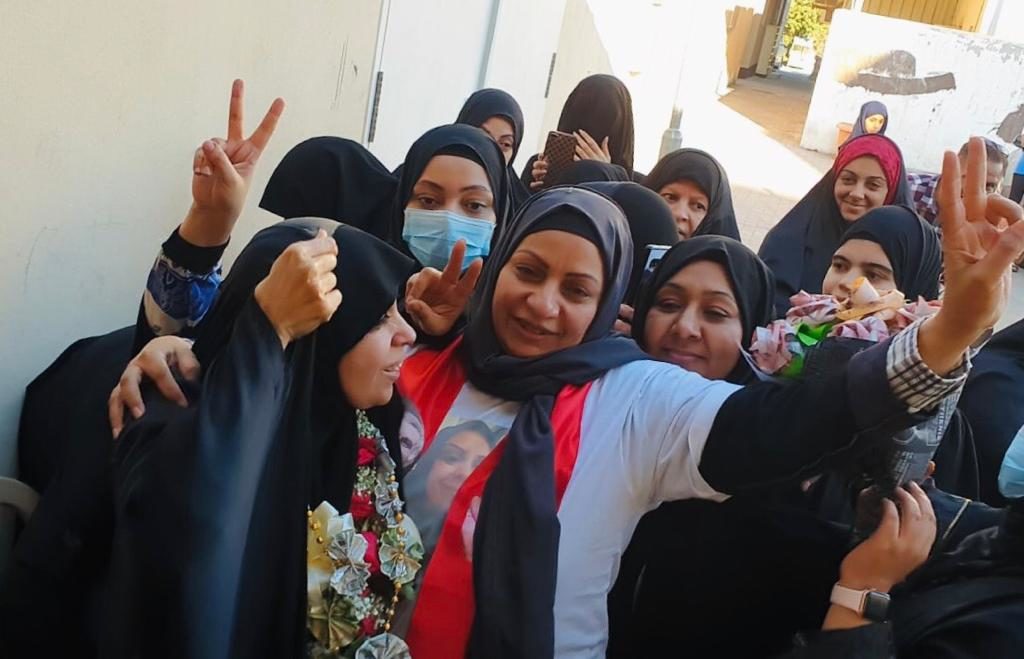
During her imprisonment at Isa Town Female Detention Centre, Hajer consistently provoked the ire of prison authorities by exposing human rights abuses, including religious discrimination and medical negligence. She has been persistently targeted for speaking out from prison and last November eight UN experts expressed “grave concern” that her conditions of detention “may amount to torture”.
Following Hajer’s release, only one female political prisoner remains incarcerated in Bahrain. Zakeya Al Barboori, 31, is serving a five year sentence after being convicted in 2018 in an unfair trial under Bahrain’s overly broad counter-terrorism law. She was also stripped of her citizenship, although this was reinstated last year.
Sayed Ahmed Alwadaei, Director of Advocacy at BIRD, commented: “Hajer’s release is undoubtedly a joyous moment for my family. Throughout her imprisonment, Hajer has remained unbowed and I have been personally inspired by her bravery in the face of persistent discrimination by a spiteful prison administration. However, while we are all relieved that Hajer is finally coming home, her son and nephew continue to be arbitrarily detained in reprisal for my activism in the UK. It is time for the government to end this petty vendetta and release my family members.”
Amnesty International commented: “Hajer Mansoor was imprisoned for three years on patently absurd charges based solely on her family relationship with Sayed Ahmed al-Wadaei, a human rights activist who now lives in the United Kingdom. As such, Amnesty considers her a prisoner of conscience for as long as she remains locked in a Bahraini prison cell. She should never have spent a single day in detention, as her trial was from start to finish an act of reprisal intended to harm a critic of the Bahraini government who had escaped beyond their reach. While we welcome the news of her impending release, Hajer’s jailing is unfortunately only one of a number of similar cases in which Bahraini families have been targeted for reprisals because of who they are related to. Indeed, two more of Sayed Ahmed’s own family members still remain behind bars.”
Aya Majzoub, Bahrain Researcher at Human Rights Watch, commented: “The release of Hajer Mansoor is a bittersweet moment for her and her family, who are celebrating her freedom while lamenting the needless suffering that her imprisonment caused and remembering the two other family members who remain unjustly imprisoned. The Bahraini authorities robbed her of the three years that she spent in prison and subjected her to degrading treatment solely because she was the relative of Sayed Ahmed Alwadaei, a prominent and outspoken activist. Unfortunately, this case is neither isolated nor uncommon in Bahrain, where the government subjects dissidents and human rights defenders to harassment, intimidation, and trumped up criminal charges.”
Husain Abdulla, Executive Director at Americans for Democracy & Human Rights, commented: “The judicial harassment of Sayed’s family sadly reflects wider patterns of repression against activists and their relatives in Bahrain, which have only intensified since the election of President Trump. Until Bahrain’s allies withdraw the carte blanche they have given the Bahraini government to crush all opposition without consequence, the persecution of dissenting voices is likely to continue.”
Background: Arrest, Torture, Trial and Detention
Hajer was detained on 5 March 2017, just days after Sayed Ahmed participated in the UN Human Rights Council in Geneva. During interrogation, Hajer was questioned repeatedly about her son-in-law’s activities, subject to threats against family members and forced to stand for ten hours until she collapsed and had to be rushed to hospital.
As a result of her ill treatment, Hajer confessed to charges of planting a “fake bomb”, a confession which she later retracted. Nonetheless, Hajer was convicted on 30 October 2017 alongside her son, Sayed Nizar Alwadaei, and nephew, Mahmood Marzooq Mansoor, based solely on “confidential sources” and her coerced confession, in the absence of any physical or forensic evidence. In an embarrassing diplomatic blunder, the Bahrain Embassy in London informed then-Foreign Secretary Boris Johnson of Hajer’s conviction by an “independent Bahraini court” a week before their actual conviction.
After arriving at Isa Town Female Detention Centre, Hajer was persistently targeted for her political status and punished for speaking out about her mistreatment. In September 2018, days after her case was raised in the Parliament, Hajer was assaulted by the head of the prison, Lieutenant Colonel Mariam Albardoli.
After the assault, Hajer was subject to a range of punitive measures including solitary confinement, religious discrimination, medical neglect and obstruction of family visits. Between September 2018 and July 2019, Hajer was granted a solitary family visit after substantial international pressure.
Hajer’s nephew, Mahmood, is also due to be released imminently. However, Sayed Nizar, who was just 18 when he was arrested and severely tortured, had additional charges brought against him in prison, bringing his total sentence up to 11 years in prison. All three were deemed to be arbitrarily detained by UN WGAD.
]]>The event included a panel of experts who discussed the brutal crackdown on political opposition, human rights defenders and journalists, that Bahrain has faced since 2011. Hannah Philips from AOHR moderated the event and opened the discussion. She first focused on the suppression of freedom of speech and association and the deliberate denial of medical care and religious freedoms in Bahrain’s prisons. She went on to highlight Bahrain’s prison rate – the highest per capita in the Arab World, before introducing the panelists.
Lucilla Berwick, Research and Advocacy Associate at BIRD, discussed the findings of BIRD’s recent joint report with Americans for Democracy and Human Rights in Bahrain on the abuses female activists and human rights defenders have faced since 2017 in the country, a pattern never documented at length before.
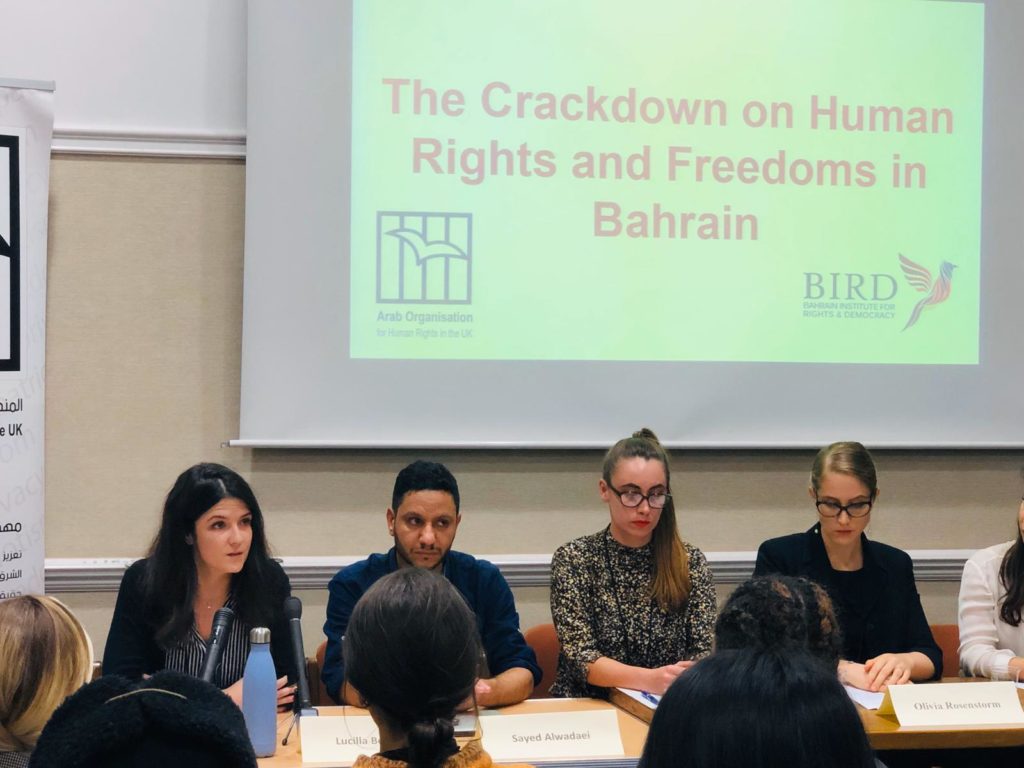
Her remarks focused on multiple violations and abuses experienced by the nine women featured in the report, from the moment of their arrest, through their interrogation, trial and detention. These include physical, psychological and seuxal torture, denial of legal representation and inhumane prison conditions. Lucilla went on to describe the detrimental impacts of UK foreign policy, including training to police and security forces, which has “in some circumstances contributed to human rights abuses in Bahrain.”
In particular, she focused on the £6.5 million of technical assistance spent by the Foreign Office since 2012 to train oversight institutions which have been internationally criticised for their lack of independence. While the Foreign Office boasts about the success of these bodies, many victims tell another story. Investigations have routinely found no fault in the actions of state officials, often justifying abuses entirely. Yet, Lucilla said, “these are the very organisations that the Foreign Office continues to tell torture victims to refer their complaints to.”
Bahar Saba, Middle East and North Africa Caseworker at Reprieve, discussed the dramatic increase in executions in Bahrain, which resumed in 2017 after a seven-year moratorium. “Bahraini courts continue to sentence individuals to death in proceedings that fall far short of international standards,” she asserted.
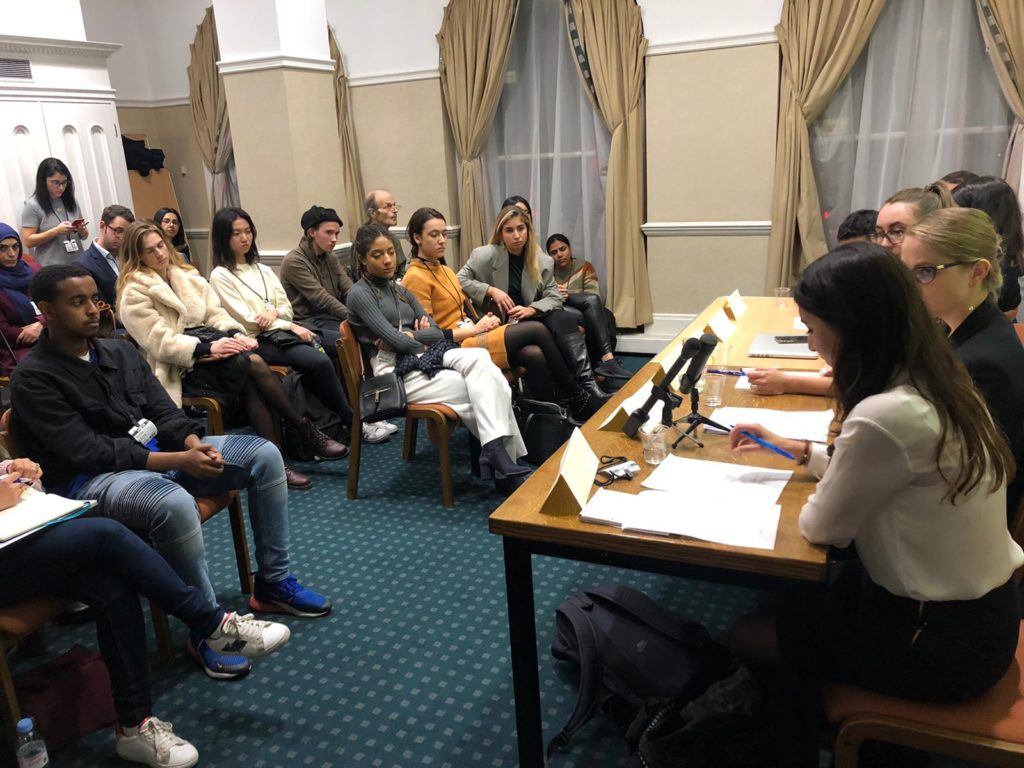
Bahar discussed the concerning cases of death row inmates Maher Al-Khabbaz, Mohammed Ramadan and Hussein Moosa, focusing on the torture they were subjected to to estract confessions. Not only does the death penalty itself conflict the International Covenant for Civil and Political Rights (ICCPR), of which Bahrain is a signatory, but those sentenced to death regularly report due process violations and torture. “Despite its international obligations, Bahrain’s use of the death penalty continues to infringe on the right to life” she emphasised.
Bahar concluded by discussing how the number of individuals on death row has tripled despite the UK’s technical assistance programme. She particularly criticised the Ministry of Interior Ombudsman and the Special Investigations Unit, two beneficiaries of the programme, who she asserted have continued to cover up cases of torture, allowing individuals to be sentenced to death on the basis of forced confessions. Bahar called for greater transparency and more robust investigations.
The third speaker, Bahraini activist Ali Mushaima, spoke about his experience in Bahrain’s prisons and imprisoned father, 71-year-old opposition leader Hassan Mushaima, who continues to be denied medical care while serving an unlawful life sentence at Jau prison. “I myself, was in prison three times. The first time was when I was only 15 years old. I remember all the details… how they tortured me, the dates, and the cell I stayed in” Ali recounted.
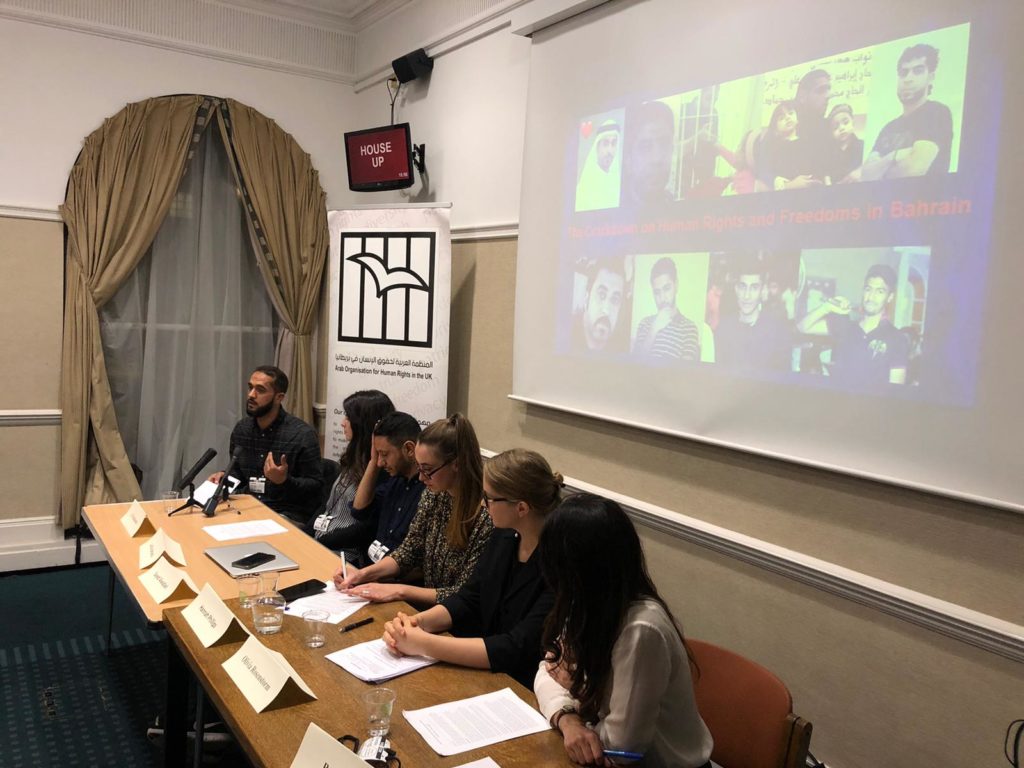
Hassan Mushaima is recovering from lymphoma and suffers from multiple health conditions including diabetes, gout and high blood pressure. However, prison authorities have routinely failed to provide him with specialist care. “In order to get medical treatment, you have to agree to be humiliated” Ali said, referring to the shackles the administration imposes on political prisoners which violate the Mandela Rules on the treatment of prisoners.
In August 2018, Ali spent 63 days protesting outside the Bahraini embassy in London to demand Bahrain provide him with medical care. For 46 of those days he was on hunger strike. “You can imagine the severity of the situation if someone has to sleep on the street in London to demand medical attention for their father in Bahrain.” Ali also drew attention to the wave of hunger strikes in Bahraini prisons since August, including dozens currently refusing food in Jau Prison.
Olivia Rosenstrom, a barrister at Temple Garden Chambers, discussed the types of violations the Bahraini government is implicated in and the legal remedies that can be taken in order to stop them.
She emphasised Bahrain’s failure to fulfil its international obligations. The detention and harassment of photographers, journalists and activists, and the general crackdown on freedom of expression violates several treaties, including the ICCPR. She also condemend the continued use of coerced confessions in Bahraini courts, which violates the Convention Against Torture and Other Cruel, Inhuman or Degrading Treatment or Punishment (CAT), to which Bahrain is party. Olivia also mentioned some of the consequences of citizenship revocation, including barriers to free movement and access to education, employment and medical care.
Olivia went on to assert the necessity of human rights conditions on trade and security agreements. Unfortunately, the UK and EU appear to be taking a “pragmatic and commercial” approach to their relationship with Bahrain, prioritising strategic aims over. Olivia concluded by providing some concrete solutions; 1) to push for a UN General Assembly inquiry into the human rights abuses in Bahrain; 2) to apply economic pressure and sanctions from the EU, UK and other countries and 3) refer human rights abusers to the International Criminal Court and impose sanctions to offenders travelling to the UK.
The final speaker, BIRD’s Director of Advocacy Sayed Ahmed Alwadaei, opened his remarks by playing a tearful message from his mother-in-law Hajer Mansoor, who complained about the poor and cruel conditions in the Isa Town Prison, where she is currently imprisoned in reprisal for Sayed’s work. The call reveals “the level of pain caused by the abuses taking place in prison” Sayed said.
Sayed went on to recount a phone call from Jau prison he received in July this year, which made him realise that two torture victims, Ali AlArab and Ahmed Almalali, would be executed within hours. “This is what I call the feeling of helplessness, and there’s nothing worse than helplessness.” Commenting on the failure of international condemnation to halt the executions, he emphasised the need for concrete action by states, rather than mere statements of concern.
He concluded by discussing the case of Moosa Mohammad, a Bahraini activist who climbed onto the rooftop of Bahrain’s London embassy to protest the executions. Moosa was brutally beaten by embassy staff members and police were forced to storm the building. He complained that Bahrain has faced “zero consequences” and criticised the UK government’s failure to respond. If Bahrain are emboldened to attack protesters in front of British police without consequence, imagine what they can do in Bahrain, when no one is watching, Sayed asked. He concluded by stressing the importance of parliament holding the UK government to account. “We do have a say,” he said, “and with everyone’s support, hopefully we can get there.”
The discussion was followed by a question and answer session, in which panelists reflected on the failures of governments and the international community to end abuses in Bahrain and hold the perpetrators to account. Solidarity was shown with Bahrainis from an audience member from repressive Eritrea, who shared her country’s experience with international human rights mechanisms and their limitations.
]]>The letter highlighted the case of Hajer Mansoor, mother-in-law of the Director of Advocacy at the Bahrain Institute for Rights and Democracy (BIRD), Sayed Ahmed Alwadaei, who claims that prison authorities have restricted access for several months to mammogram results and failed to arrange recommended follow-up appointments for a range of conditions including a lump in her breast and kidney stones. Reports of medical negligence are common in Bahrain; Amnesty International have condemned the practice and called for Bahrain to end their mistreatment and release Ms Mansoor.
The letter also drew attention to punitive restrictions on family visitation and prisoners time outside of their cells. When an assault led by prison director Lt. Col. Mariam Albardoli on Ms Mansoor and her cellmate, Medina Ali, was reported in the British press in September last year, prisoners have been restricted to their cells for up to 23 hours a day.
Since the assault, a glass barrier has also been erected between prisoners and their families during visits, preventing physical contact between prisoners and their relatives. Due to the distress such conditions would cause their young children and elderly parents, Ms Mansoor, Ms Ali and their cellmate, Najah Yusuf, have refused visits and therefore have not seen their children for over nine months.
Prison authorities refused requests for families to be able to visit the prison without the barrier for the Eid holiday – traditionally a time for clemency.
Today, BIRD received news that Ms Mansoor and her cellmates have had their phone calls suspended for a week, further contributing to their isolation.
Sayed Ahmed Alwadaei, BIRD Director of Advocacy commented: “It is heart-breaking to see my mother-in-law subjected to such degrading treatment. Female political prisoners in Bahrain have consistently protested the deteriorating conditions in Isa Town Prison, to no avail. For too long there has been a deafening silence from the British government regarding conditions in Bahrain’s prisons; today’s letter sends a strong message that MPs will not permit Britain’s allies to abuse human rights unabated.”
16 Cross-party MPs urge @Jeremy_Hunt to press #Bahrain to end ‘Punitive Measures’ against female political detainees.
– My mother in law Hajer Mansoor is being denied access to adequate medical care.
– Hajer, Madina & Najah haven’t seen their families for 9 months and counting. pic.twitter.com/tZyXwY91EC
— Sayed Ahmed AlWadaei (@SAlwadaei) June 19, 2019
Najah Yusuf is a Bahraini activist and mother-of-four, who was imprisoned in 2017 for social media posts which included criticism of Formula One’s Bahrain Grand Prix. Ms Yusuf’s allegation that her conviction depended on a confession coerced after she was tortured and sexually abused in detention triggered significant condemnation from international human rights groups in March this year.
Hajer Mansoor, along with her son Sayed Nizar Alwadaei and nephew Mahmood Marzooq, were declared as “arbitrarily detained” by the UN Working Group on Arbitrary Detention earlier this year. UN experts deemed their sentences as a “reprisal” for the activism of her son-in-law, BIRD Director of Advocacy, Sayed Ahmed Alwadaei.
Read the Letter by 16 MPs.
]]>Find below the full letter:
We write to express our deep concern for the family of Sayed Ahmed Alwadaei, director of the Bahrain Institute for Rights and Democracy (BIRD). Mr Alwadaei was granted refugee status in the UK in 2012 in recognition of the dangers he faced in Bahrain. While in London, Mr Alwadaei has continued to fight for the rights of torture victims and prisoners sentenced to death for peacefully protesting against the Bahraini regime. The family of Mr Alwadaei has been subjected to numerous human rights violations by the Bahraini authorities in response to BIRD’s work, including arbitrary detention, unfair trial, ill-treatment and possible torture.
The United Nations working group on arbitrary detention concluded that Mr Alwadaei’s family were “deprived of their liberty, interrogated and prosecuted for their family ties with Sayed Ahmed Alwadaei and that these were acts of reprisal”. The Bahraini government responded with a smear campaign of false and misleading information about Mr Alwadaei and his family.
Such abuse is an attempt to intimidate Mr Alwadaei to prevent him from continuing his work. This has been condemned by over 80 members of the UK parliament.
The British government has repeatedly committed to support human rights defenders. It must condemn the persecution of Mr Alwadaei and his family, assert his right to criticise abuses in Bahrain, and advocate for the release of his unlawfully detained family members. Security assistance to Bahrain should be conditional on Bahrain’s adherence to its international human rights obligations.
Maya Foa Director, Reprieve
Kate Allen UK director, Amnesty International
Jodie Ginsberg CEO, Index on Censorship
Antonia Byatt Director, English PEN
Rebecca Vincent UK Bureau Director, Reporters Without Borders
Rowan Kinchin Director, Campaign Against Arms Trade
Jago Russell Chief executive, Fair Trials
Saloua Ghazouani Oueslati MENA Director, Article 19
Rupert Skilbeck Director, Redress
Joe Stork Chair of the Advisory Board, the Gulf Centre for Human Rights
Husain Abdulla Executive director, ADHRB
Brian Dooley Human rights campaigner
Stephen Knafler QC Landmark Chambers
David Lock QC Landmark Chambers
Tim Buley Landmark Chambers
Jane Deighton Founding partner of Deighton Pierce Glynn
Daniel Carey Deighton Pierce Glynn
Stephen Cragg QC Doughty Street Chambers
Tim Cooke-Hurle Doughty Street Chambers
Chris Henley QC Carmelite Chambers; chair of Criminal Bar Association
Sheona York Clinic solicitor and reader in law, University of Kent
Angela Jackman Senior lecturer, City Law School
Dr Sam Raphael Senior lecturer, International Relations, University of Westminster
Tony Fisher Fisher Jones Greenwood
Prof Juan E Mendez Former United Nations special rapporteur on torture
Martyn Day Founder of Leigh Day
Astrid Perry Leigh Day
Saimo Chahal QC Bindmans LLP
Dan Squires QC Barrister, Matrix Chambers
Samantha Knights QC Refugee and human rights barrister, Matrix Chambers
Hugh Southey QC Human rights barrister, Matrix Chambers
Daniel Machover Head of civil department, Hickman & Rose Solicitors
Peter Bottomley MP Conservative, Worthing West
Fiona Bruce MP Conservative, Congleton
Ian Blackford MP SNP Westminster leader
Paul Scriven Liberal Democrat, House of Lords
Ed Davey MP Liberal Democrat, Kingston and Surbiton
Christine Jardine MP Liberal Democrat, Edinburgh West
Alistair Carmichael MP Liberal Democrat, Orkney and Shetland
Tom Brake MP Liberal Democrat, Carshalton and Wallington
Andy Slaughter MP Labour, Hammersmith
Jim Cunningham MP Labour, Coventry South
Jo Swinson MP Liberal Democrat, East Dunbartonshire
Matt Western MP Labour, Warwick and Leamington
Alex Norris MP Labour, Nottingham North
Lloyd Russell-Moyle MP Labour, Brighton Kemptown
Catherine West MP Labour, Hornsey and Wood Green
Philippa Whitford MP SNP, Central Ayrshire
Angus MacNeil MP SNP, Na h-Eileanan an Iar
Stephen Gethins MP SNP, North East Fife
Chris Law MP SNP, Dundee West
Stuart McDonald MP SNP, Cumbernauld, Kilsyth and Kirkintilloch East
Martyn Day MP SNP, Linlithgow and East Falkirk
Caroline Lucas MP Green party, Brighton Pavilion
These tweets followed the significant attention when the head of the prison, Lieutenant Colonel Mariam Albardoli, was identified as the individual responsible for perpetuating the abuses against Ms Mansoor, including in a letter sent by six United Nations Experts and in an article published in the Daily Mail.
The Bahraini Embassy in London published:
- https://twitter.com/BahrainEmbUK/status/1108449031833964546
- https://twitter.com/BahrainEmbUK/status/1108458333055401987
- https://twitter.com/BahrainEmbUK/status/1108458390106320897
https://twitter.com/BahrainEmbUK/status/1108449031833964546
These tweets also disclose the email addresses of all those copied in the correspondence, in a gross miscarriage of confidentiality. This is particularly concerning given that the Ombudsman’s own policy guarantees “Full confidentiality … during the investigations and, according to the law, no-one can access or reveal details about them in any way.”
The Ombudsman claims to be an “independent secretariat” both financially and administratively from the Bahraini Government. However, sharing private communications with the Bahraini Embassy in London, which primarily represents the interests of the Bahraini state abroad, is at odds with holding the Bahraini authorities to account. Therefore, this incident throws into question the Ombudsman’s alleged independence from the Bahraini Government.
Commenting, Sayed Ahmed Alwadaei said: “It was shocking to see my private communications with the Ombudsman, a body that is supposed to be independent from the Bahraini government, published by the Bahraini Embassy in London on their Twitter account. This is a blatant breach of confidentiality and indicative of a bias.
Six UN experts have identified Lt Col Albardoli as the prison official responsible for the abuses in Isa Town Prison. Instead of independently investigating Albardoli’s role, the government has thrown its full weight behind her. This clearly shows that the reprisals against my mother-in-law are backed by the state.
If the government has nothing to hide, they should allow the UN Special Rapporteur on Torture to investigate the systematic abuse occurring in Isa Town Prison.”
Previous Breach of Confidentiality
The Ombudsman has already breached Mr Alwadaei’s confidentiality in the past. In August 2018, they included the First Secretary of the Bahrain Embassy in London, Fahad Al Binali, as well as Minister of Foreign Affairs, in his communication with the Ombudsman without Mr Alwadaei’s prior consent or notification.
Notably, when Mr Alwadaei first tried to initiate investigations into the ill-treatment of his family in August 2017, the Ombudsman raised issues of consent that delayed the opening of the investigation.
]]>
The Bahrain Institute for Rights and Democracy (BIRD) condemns today’s decision in the strongest term and urges the Bahraini authorities to ensure their immediate and unconditional release.
Commenting, Sayed Ahmed Alwadaei, the Director of Advocacy at the Bahrain Institute for Rights and Democracy (BIRD) said: “This is what you expect from a corrupt injustice system. I will not rest until my family is free. Their continued imprisonment is a shameful reminder of the UK’s weak position when dealing with human rights abuses committed by an ally country.”
Today’s decision marks the end of a long and flawed trial marred with due process violations. Ms Mansoor, Mr Nizar Alwadaei, and Mr Mansoor were arrested in March 2017, while Mr Alwadaei was attending the 34th session of the Human Rights Council in Geneva. The three were subjected to physical and psychological abuse and sentenced on trumped-up charges of planting fake explosive devices to create terror among the population.
The three were convicted on the basis of “confidential sources” and coerced confessions, as the prosecution failed to present any physical evidence linking the three to the alleged crime. An appeals court had upheld their sentence on 20 December 2017.
In January 2019, the UN Working Group on Arbitrary Detention declared the detention of Ms Mansoor, Mr Nizar Alwadaei and Mr Mansoor as “arbitrary” and as an “act of reprisal” for Mr Alwadaei’s human rights work in London. The group also called for their immediate and unconditional release.
Mr Nizar Alwadaei is serving a total of 11 years in prison as a result of two additional cases, one of which was also upheld by the Court of Cassation on 11 February 2019.
International response
The international response in relation to the case of Mr Alwadaei’s family has been almost unanimous in condemning the abuse and judicial harassment suffered by the three.
UK Parliament
- 83 UK MPs have signed EDM 509 raising concerns about the case
- 19 Feb 2019: the Chair of the All-Party Parliamentary Group (APPG) on Democracy and Human Rights in the Gulf, Chris Law MP, wrote to MENA Minister Alistair Burt urging him to address human rights issues during his trip to Manama on 20 February
- 11 Sep 2018: Westminster Hall Debate on Human Rights and Technical Assistance to Bahrain mentioned reprisals against Sayed Ahmed’s family.
European Parliament
- 22 Feb 2019: The Chair of the Human Rights subcommittee at the European Parliament, Antonio Panzeri, issued a statement condemning the imprisonment of all three individuals, adding that their release is “is the only way to ensure fair justice.”
- 22 Feb 2019: 7 MEPs wrote to the EU High Representative Federica Mogherini
- 20 Mar 2018: Julie Ward MEP wrote Letter to High Representative
- 12 Feb 2018: The High Representative replied to a Parliamentary Question stating that Sayed’s family case is “well known”.
- 23 Oct 2017: 40 MEPs sent Letter to High Representative of the EU
- 17 Oct 2017: MEP Julie Ward further questioned the HR/VP
US Department of State
- 22 Mar 2018: DoS spokesperson answered question about Duaa Alwadaei
- 17 Nov 2017: DoS spokesperson answered question about Sayed’s family, saying it represents a “major concern”
Human Rights Community
- Amnesty International issued a statement condemning the denial of medical access to Ms Mansoor, labelling her a “prisoner of conscience.”
- The UN Special Rapporteur on the Situation of Human Rights Defenders expressed concern for Ms Mansoor’s poor prison conditions in Isa Town Prison.
- On 12 Sep 2018: UN Secretary-General in its annual report, expressed serious concerns for the “ongoing trend of harassment and intimidation” against Bahraini human rights defender, including Mr Alwadaei’s family as a result of his cooperation with the UN.
UK Government
The UK Foreign and Commonwealth Office (FCO) has never acknowledged that these measures have been arranged in response to Mr Alwadaei’s activism.
Since August 2017, Mr Alwadaei has been in contact with oversight bodies to request them to conduct an investigation into accounts of ill-treatment and torture alleged by his family in prison. The FCO has been involved in the entire correspondence between Mr Alwadaei and the Ombudsman, witnessing firsthand how they have systematically failed to conduct impartial investigations thereby paving the way for the unlawful conviction of Mr Alwadaei’s family.
Nevertheless, the FCO still encourages Mr Alwadaei to refer his concerns to these oversight bodies and has never acknowledged the damage they have caused to his personal and professional life.
Background Information
The targeting of Mr Alwadaei’s family has gone beyond the conviction of his mother-in-law, brother-in-law and cousin to three years’ imprisonment in October 2017.
Mr Nizar Alwadaei is serving 11 years in prison in total as a result of two additional criminal cases. On 29 November 2017, he was sentenced to another 3 years on identical charges, a sentence that was upheld by the Court of Appeals on 8 February 2018, and further upheld by the Court of Cassation on 11 February 2019. He has now exhausted all legal remedies in relation to this case. On 26 March 2018, he was sentenced to an additional 7 years, a sentence that was reduced to 5 years on 5 June 2018.
On 21 March 2018, Mr Alwadaei’s wife, Duaa Alwadaei, was sentenced in absentia to two months in prison for allegedly insulting a public official at Bahrain International Airport on 26 October 2016. The incident to which Mrs Alwadaei’s charges relate took place after Sayed Ahmed participated in a protest against the King of Bahrain’s meeting with Prime Minister Theresa May in London. Mrs Alwadaei resides in London.
On 16 September 2018, Ms Mansoor was subjected to assault by the head of Isa Town prison, Major Maryam Albardoli and other prison guards together with her fellow inmates Medina Ali and Najah Yusuf. This incident followed the publication of a report by the UN Secretary-General, wherein serious concerns were expressed for the “ongoing trend of harassment and intimidation” against Bahraini human rights defenders, including Mr Alwadaei’s family as a result of his cooperation with the UN.
Since the assault, further restrictions on phone calls, family visits and time allocated outside the cell have also been imposed on all inmates. As a result, Ms Mansoor has not seen her family since September 2018. As of February 2019, Ms Mansoor is being denied access to urgent medical treatment for a lump in her breast that she fears might be cancerous and other medical issues. In February 2019, the UN Special Rapporteur on the Situation of Human Rights Defenders expressed concerns for Ms Mansoor’s poor prison conditions at Isa Town Prison.
]]>