This buidling is 160 years old (because the 'other' cathedral was taken over by the Church of Ireland - according to Fr Brian who met us this morning), and underwent some significant renovations about 20 years ago which brought out the colours that are visible in the photo. Again, it is a beautiful church in which to celebrate the liturgy of the Church, and a fitting place to end our time of pilgrimage together.
Tomorrow, we head back to Dublin to board various aircraft to various locations - including Australia - when the real work of the pilgrimage begins.
]]>The Cathedral is a unique combination of the original construction and a more contemporary setting, which I'm not sure works, and like other such buildings it lacked a certain 'something', as if it was no longer primarily a place of the worship of God. Again, that feeling could entirely be down to me.
After taking a brief coffee and comfort stop at the St Patrick's Visitor Centre in the town, we moved on the St Patrick's Church for the celebration of Mass.
The church dates to the late 1780s, but has clearly been extended and refurbished since the original construction. The result is, in my opinion, very tasteful, and provides a wonderful space for the celebration of the contemporary liturgy by the community.
One of the features of the church is a series of mosaics that feature excerpts from the life of St Patrick, the viewing of which was a highlight of this visit to St Patrick's Church, Downpatrick.
After Mass, we returned to the St Patrick's Visitor Centre for lunch.
An unplanned visit today was to the Saul Church, a church built in the 1930s on a site reputedly gifted to St Patrick as home. The word 'saul' is a corruption of the Irish word for barn, which is exactly what St Patrick was a given.
It's an interesting site. Unfortunately, we were unable to get inside the church because there was a service underway, but it was a good stop to make, completing the connection with both Down Cathedral and St Patrick.
And then it was back to Belfast for some downtime before dinner.
]]>Our stop in Sligo was more along the lines of a comfort and coffee stop, and after refueling ourselves we kept moving, stopping just outside the town to view the Celtic Knot in the middle of a plantation of trees. It was a fleeting stop with picturesque views.
The reason we were heading to Enniskillen was in order to visit Devenish Island, which house the runs of a monastery established by St Maloise and a much later Augustinian priory.
To get to the island we needed to board a boat for the short trip, a boat staffed by three local men who were not only very hospitable but also very knowledgeable about both Enniskillen history and what we would find on Devnish Island.
The monastery appears to be incredibly isolate in contemporary times, but our local guides assured us that the surrounding islands, most of which are uninhabited, would have been the home to a population that would have both supported and been supported by the monastery and priory.
As is always the case when visiting such a monastic site, I find it interesting to muse on what life would have been like 'way back then' without the kind of technology that we rely on now. In particular, we no access to the kind of modern boats we have now, how would the monastic residents have got about - indeed, would they have gotten about.
The trip was interesting and a good investment in time - and the opportunity to see the 'blue missile' (the kingfisher) on the trip back was part of that.
After our trip to Devenish Island, we adjourned for a quick lunch break in the town of Enniskillen, with Mum & I finding a very nice cafe where we could have something tasty and quick before climbing back on the bus. Being a Sunday, any crowds that might ordinarily be in the city centre were still at home!
And after lunch, it was back on the bus and straight to Belfast.
Arriving in Belfast, our first stop was to head to St Mary's Church, Chapel Lane to celebrate Mass.
This church, which is in the middle of a 'less than savoury' part of Belfast, was built in 1783, and was the first Catholic church to be built in Belfast. It has its own unique charm, and celebrating Mass in there with our pilgrim group was a delight, particularly since being a Sunday we included more song.
And after Mass, it was off to our hotel, the last such stop before our departure from the pilgrimage.
]]>After breakfast, we were taken on a guided tour around the site, hearing the story of the original apparition, the development of the site, the building of the basilica, and more. In the middle of the tour we celebrated Mass in the Apparition Chapel, before taking up the tour again with a visit to the onsite museum.
The rest of the day was given over to exploring the site, or resting, or prayer, or...whatever each individual pilgrim wanted to indulge in. It was a great way to spend and afternoon, just soaking in the atmosphere, and the peace, of this site that sees hundreds of thousands of people visit each year.
After a light lunch, and a little nap, Mum & I explored the Chapel of Reconciliation, which neither of us could remember from our visit eight years ago. We wander through the basilica again, paying particular attention to the architectural features incorporated in the building that give a symbolic representation of the desire for peace.
For example, the columns around the outside of the basilica are built with stone from each of the counties of Ireland, while the inside of the building features replicas of famous windows from an abbey or monastery in each of the four provinces of Ireland. These little architectural touches might seem unimportant in the grand scheme of things, but to my mind represent a foresight in creating a building that is a national - as in all of Ireland - shrine.
I think I may have to come back...and spend more than one day in the place.
]]>Along the way to Limerick, we stopped for a coffee and comfort break in the picturesque town of Adare, the most expensive place to own property in the entirety of Ireland. This is largely because of the heritage preservation orders on many of the older buildings that are still thatch-roofed, and descendent from the manor properties occupied by manor tenants.
I wish we had more time to explore the town, but there was a cathedral waiting for our attention!
From Adare, we continued on to the centre of the City of Limerick and a visit to St Mary's Church of Ireland Cathedral. We had the luxury of a guided tour offered by some volunteers from the cathedral community, who shared with us the 850 year history of the building, the way in which was ravaged in the past - especially by the forces of Oliver Cromwell - and the efforts to restore it and return it to a building fit for the worship of God.
While there are certainly elements within the building that are beautiful, the overall effect of the building left me rather cold. There was something 'missing', and I wasn't the only member of the group that mentioned or observed it. It was almost like the building, originally intended for the worship of God, had been transformed into something else, a place where people visit and wander and look, but don't engage in the primary purpose of the building. That effect may have had something to do with the glossy brochures and the entrance charge - but it could also just be about me.
There was small highlight for me - as I was walking out from the grounds I happened upon a small stone, almost by chance, that marked the connection of the building with the Order of Malta dating back to the early 1200s. The connection has echoes with my own connection with St John Ambulance, since the two orders claim similar foundations.
After having a quick bite to eat, we headed off from Limerick towards our next destination, the Cliffs of Moher, with some trepidation. Why, I hear you ask. Because the rain had set in and was of a nature as to make us question whether we could actually visit the Cliffs!
But being people of faith, we set out in hope nevertheless and after one final stop for coffee, we proceeded to the Cliffs...and were pleasantly surprised that the rain eased off as we got closer and eventually stopped. There was even an appearance of sun at one point!
All of which meant that we were able to experience the picturesque majesty of the Cliffs of Moher without any inclement weather and could wander up to the tower to view everything in its grandeur.
Having been to the Cliffs before, I thought I wouldn't appreciate their spelndour as much this time as on my last visit. But I was wrong. The sight of these cliffs, which have stood the assault of the Atlantic winds and waves for aeons, still filled me with delight and awe.
The weather was kind to su during our visit, and even the winds from the Atlantic seemed to behave themselves. After our visit, it was back on the bus to head towards our next destination where we would be housed for two nights, Ireland's National Eucharistic and Marian Shrine at Knock.
]]>Dingle was gearing up for its annual food festival over the coming weekend - a festival that eight years ago on our previous visit we landed right in the middle of. There were plenty of people around, and that added to the whole experience.
Dingle is the kind of town that draws one to itself...and if I ever win the lottery, there may be a new resident!
One of the things we have been constantly exposed to during our trip through Ireland are the stain glass windows created by Harry Clarke. In Dingle, unsurprisingly, there are some more to see in the old Presentation Sisters Convent that is now been recreated as An Diseart, the Institute of Irish Culture and Spirituality.
An Diseart is a place where local artists are able to come, practice their craft in a spiritually conducive space, and offer their works for sale. It is also where conferences can be held, spiritual retreats can be hosted, and people are welcome to explore the building and gardens.
Regrettably we didn't have all that much time in the building, but I did ensure I was able to capture the glory of the stained glass windows in the old convent chapel.
We celebrated Mass today in St Mary's Church, Dingle, a church building that surprises me because the external view doesn't quite match the internal view, i.e., when you walk into the building what you are presented is not what was expected having looked at the building from outside.
The external looks like what it is, a church built decades ago, prior to the liturgical reforms of the Second Vatican Council, and in need of repair - indeed, as is currently going on.
The internal look, however, is decidedly in keeping with the liturgical reforms and quite pleasantly so in my humble estimation. It is a warm and inviting space, that well serves the contemporary liturgy of the Roman Rite of the Latin Church.
As always, we were made to feel "most welcome" by the parish staff who assisted us.
After lunch in Dingle - for which Mum & I returned to the same restaurant we dined in eight years prior - we boarded the bus for the trip around Slea Head Drive, stopping at a number of places that are considered pertinent in our exploration of the Soul of Ireland.
The first stop was to see the Beehive Huts almost at the very end of the peninsula - but that was aborted when the landowner had decided to double his prices compared to what had been agreed with the tour company. We moved on, just down the way, to a different set of huts and a proprietor who was much more reasonable - thanks to the bargaining genius of our coach driver, Conor.
The beehive huts are fascinating buildings both in terms of construction and their purpose. How anyone survived living in them when facing the winds straight off the Atlantic ocean is anyone's guess. To do so while seeking the ascetic monastic existence is even more confounding.
When I first encountered the Gallarus Oratory, or the Séipéilín Ghallarais in the Irish, some eight years ago, I knew almost immediately that I had come across a place of special significance, a place where prayers had been said for centuries, and a place that had captured those prayers in the very fabric of itself.
And today's encountered was very much the same, and couldn't even be dampened by the rain we experienced during our visit to this site.
The building is about 1300 years old, and a perfect specimen of dry rubble masonry. It has stood before Atlantic gales and invasions by both Vikings and Normans, and still stands as a place of prayer for anyone who enters into its environs - as we discovered when the pilgrims entered into the building and sang...
I couldn't help but remember the impression I had eight years ago, and simply place my hands and head against the stones that had heard prayers spoken century after century.
Just up the road from the Gallarus Oratory is the ruins of Kilmalkedar Church, which started as a monastic community. The site contains a number of unique items - a sun dial with pre-Christian overtones, and the 'wedding stone' which according to tradition invites a potential husband and wife to insert their fingers into the same hole from different sides of the stone and thus becoming 'one'.
The site is fascinating both in terms of the architecture that still exists and its religious and spiritual history. We only had a short time at the site because of the lack of safe parking for the bus, but it was wonderful to visit the site once again.
]]>This church building is simply stunning. There's no other word for it. The walls are constructed in such a way as to remind this observer of the building of older buildings found in Ireland - something that seems appropriate to the area in a way.
The 'renovation' of the interior apparently met with some opposition in the past, but I have to say that I found it a masterful and indeed beautiful adaptation of a church built 100+ years ago to bring it into conformity with the revised post-conciliar liturgy.
After Mass was celebrated, we moved on to a local coffee shop recommended by our driver, Conor, which is where the statue of an eagle was found and photographed.
Our visit to Muckross House was a visit to a house that was completed in 1843, although the family who had it built ultimately lost because they 'agreed' to host Queen Victoria in 1861, with the connected expense of having to renovate the house in preparation for the visit. The family were ultimately bankrupted by the end of the centure, never fully recovering from the expense, nor gaining the social capital they hoped to gain.
The house and estate were purchased by Lord Ardiluan, a member of the Guinness family (yes, that Guinness family) who used the house and grounds as a location for hunting, shooting, and fishing.
In 1911, the house and estate was purchased by a wealthy American industrialist as a wedding present for his daughter and her husband. When the daughter died unexpectedly in 1929, her husband and the parents gifted the house and estate to the Irish State, with it becoming the very first National Park.
Leaving Muckross House, we embarked on a trip round the Ring of Kerry - a journey that was highlighted for me by a visit to the Daniel O'Donnell Memorial Church, in the grounds of which is the grave of Monsigher Hugh O'Flaherty, whose story I have been fascinated within since I first saw the movie "The Scarlet and the Black".
]]>This church, still under the care of the Franciscans, dates back to the early 1800s following Catholic emancipation and was completed much later after the Famine was 'over', though never forgotten.
Holy Trinity is a large church by some standards, and for me at least was a little dim in places. The highlight architecturally were the three Clarke stain glass windows, which unfortunately were not able to display their full brilliance because of the external weather.
As always, we were made to feel "most welcome" by Brother Laurence who greeted us and explained some of the history of the building before Mass began. And after Mass, it was back on the bus (quickly before the Garda caught up with Conor's potentially illicit parking) and we were heading out of Cork towards our next stop, with today's ultimate destination being Tralee in County Kerry.
The trip from inner city Cork to Blarney Castle is relatively short - less than 30 minutes - and along the way our guide, Fionnuala, shared the castle's history with us in preparation for the visit.
The weather was foul by the time we got to the castle, raining rather heavily and making the whole experience potentially murky, so Mum and I, who had visited the castle and its gardens before, decided to stay in the Woollen Mill and its restaurant. It was, as it turned out, a very wise decision.
Which meant, of course, that I didn't kiss the Blarney Stone (though one member of the pilgrimage group cheekily suggested that I had no need of its alleged properties!), though I was never going to venture that high and adopt the necessary position to do so in the first place.
After some time in Blarney, including taking lunch, we were once more on the bus and heading to our overnight stay in Tralee, where we would be based for three nights.
]]>One can only imagine what it would have been as a monastery and as a cathedral, but there's a clear sense of that as you enter into the ruins of the cathedral itself.
The Rock of Cashel holds a particular especial place for Mum's side of the family: the farm from which our ancestor departed for Australia is located only a couple of kilometres inland from the Rock itself, almost visitble (if one has good eyesight, that is) from the top of the Rock.
The other significance for Mum's side of the family is the rite of burial for some of the ancestors - including one we discovered who we had lunched with when last we visited but now lays interred in the family plot atop the Rock. It was moving to stand there at the grave of family members...including Richard. It probably explains why he didn't respond to emails...
Unfortunately, we weren't able to visit Cormac's Chapel, but we did visit the Hall of the Vicars Choral, an interesting building of later addition.
Because we weren't able to visit Cormac's Chapel on the Rock of Cashel, we made a decision to move on from Cashel, where we originally planned to have lunch, and head to Cahir (pronounced "Care") and in Irish as an Chathair.
The town is host to a stone fort that is a famous movie star, which dates back to the middle of the 1100s, but that's not why we chose to visit it.
We visited the town - as brief as we did - because it is reputedly the place where St Declan, who had set out from his monastery in Ardmore to meet St Patrick, was met by St Patrick, who having heard St Declan was on the way, set out to meet St Declan.
They met according to legend on the site upon which the town of Cahir stands.
]]>All of which was perfectly fine, since most of the day was going to spent on the bus heading away from Glendalough towards Waterford, and ultimately Cork via Ardmore.
We were heading to Waterford primarily to attend Mass at Sacred Heart Church in Waterford, which was originally going to be a 'private' Mass for us at 1pm, but we adjusted the pilgrimage itinerary to leave a little earlier and participate in the parish Mass at 11.30am.
The church itself, as you can see, was quite beautiful, shaped in the round, with such great potential for the celebration of the contemporary liturgical form. The font was of an interesting shape and design and situated between chair, ambo and altar - a particularly interesting choice.
As always, we were made to feel "most welcome" and we joined in the parish's celebration of the Sunday Mass.
After Mass we headed back into the centre of Waterford City for the opportunity for lunch and a little exploration.
The last activity planned for today was a visit to Ardmore, to the site of the monastery founded by St Declan in the 400s, which makes it older that Glendalough, and in a time before St Patrick.
The name, Ardmore, means 'Great Height' in Irish, and was 'chosen' by Declan simply because it 'seemed right', even though some of his monks were not happy with the chosen location. And yet, the monastery flourished and became a place of 'great height' in learning and spiritual practice.
The site itself is very small and compact, located on a headland overlooking a beach and small bay. While the local area is now well populated with people, farms, and other activities, it would have been a 'wild place' when Declan and his monks arrived - a wonderful place to commune with God.
And after Ardmore, it was on to Cork where we will be based for two nights.
]]>This a church building that is simple yet beautiful, and features two icons - of St Kevin and of St Lawrence O'Toole - inside the building as well as a memorial to the Twin Towers in New York City in the grounds crafted by a local resident who happened to be in that City on that fateful 11 September.
The grounds also feature a well-kept labyrinth, which unfortunately I had no time to walk, as well as many other features to encourage the spiritual life. The grounds, while not extensive, have been managed well for that purpose - which only goes to show what can be done if there is a desire to use the space well and a willingness to expend the resources to bring the desire to life.
We celebrated Mass together in St Kevin's Church as we prepared to spend the day pondering his place in the life and soul of Ireland, predominantly through what we would do after Mass was concluded.
I have to confess that today, and this particular visit, has been at the very centre of my hopes for this particular pilgrimage. After a very short and hurried visit eight years ago, I've been wanting to return to the Glendalough Monastic Site, that place where St Kevin established his monastery, ever since. And here it was, a whole day dedicated to exploring this place that has been in my memory for all those years.
The monastic site itself is, of course, ancient, dating back to the sixth century, but the place in which it is located - the Valley of Two Lakes (Gleann Dá Loch in the Irish) - has been a place of significance for a lot longer. St Kevin originally came to this place in search of solitude and the ascetic life, a rich part of the Celtic expression of Christianity, wherein holy men and women desiring to be closer to God left the company of others and went into the wild places.
And there can be little doubt that this valley would have been a wild place.
Our guide through the monastic site was a most interesting fellow, and he made the site come alive from the stories and information he shared in what can only be described as a thoroughly Irish manner - full of story and colour and passion.
We were privileged to be able to access St Kevin's Church, normally locked and off limits to visitors, at the end of our tour, a fitting place to end the exploration of the site, and be set free to explore the rest of the valley and all it has to offer.
After a quick bite to eat in preparation for what was to come, Mum and I set off to walk from the monastic site to the upper lake of the valley, It's not a terribly long distance, but the path undulates and can be a little uneven in places.
The walk was beautiful and the peace was only disturbed by other visitors who seemed to be determined to set a personal best time while talking with their companions about mundance and profane things. I'm not convinced that the beauty surrounding them was fully appreciated, but I could, of course, be wrong. Regardless, Mum and I walked slowly taking it all in, seeing the beauty and all that reveals of the presence of the Divine.
Those who know me well will appreciate that my photgraphic passion runs to anywhere that water and rocks come together, and there was certainly plenty of opportunities for that as we got closer to the upper lake.
We also discovered - semi-randomly, since I had been told to keep my eyes open for it - a ruined church near the upper lake known as the Reefert Church, the name in Irish meaning the 'Burial Place of the Kings'. This site, just off the lake, is supposedly the original location of the tomb of St Kevin, so local chieftains also chose to be buried there. It is a 'thin place'...
Mum and I also walked up the incline - very bravely in Mum's case, for which I am grateful - to find the site of St Kevin's Cell. When we got there there was a group of students and their guide there, but very soon Mum and I found ourselves alone, sitting there high above the upper lake, listening to the wind in the trees, the call of birds, and watching the lake below use ... just as I imagine St Kevin would have done in his quest for solitude and the presence of God made manifest in nature.
]]>In heading to Kildare we were entering into the Curragh, Ireland's prime thoroughbred horse breading country, and there was plenty of evidence of the significance of this industry to the nation.
Our first stop on this day dedicated to St Brigid was to St Brigid's Well - or one of them at least. This one is located on what would have beeb grazing pasture for Brigid's Monastery, and the site on which the butter for which she was famously known would have been produced.
These day the site is one of pilgrimage, evidenced by the many offerings left around the site as signs of prayers requested. It clearly still has a powerful place in the folk religion of the Irish people, Christian and otherwise, and there was a peacefulness about it that is clearly tied to it being a place of prayer.
Afterwards, because we were running early, we went around the corner to the Irish National Stud for morning tea.
Our next stop was to St Brigid's Cathedral, Kildare which is reputedly located on the site of the original monastery founded by St Brigid, and which she ruled (both women and men) with dedication and great spiritual insight for many a year.
The church that stands on the site now is a much later construction and is the Cathedral Church of the Church of Ireland's Diocese of Kildare. It is a beautiful building and was decorated when we visited as a result of the annual Harvest Festival.
There is a round tower in the grounds, and also, supposedly, the original fire temple in which the perpetual fire was tended by holy women from the monastery. The fire is no longer present, and is now kept by the Brigidine Sisters at Solas Bhride - but see below…
Having explored the original location to St Brigid's monastery, we moved to the local parish church for the celebration of Eucharist. It will surprise you not that the church is dedicated to St Brigid!
St Brigid’s Church, Kildare has a more modern interrior to the other churches we’ve visited for Mass so far on our trip through Ireland, and had a completely different vibe about it as well. Nevertheless, we were greated with the same “you’re very welcome” that we have been graced with in each location.
After Mass, we returned to the Irish National Stud for lunch.
After a light lunch, some of the group decided to have a tour of the Stud and the associated Japanese Gardens. Myself, not being interested that much in thoroughbred horses, along with a few others, walked to the nearby Solas Bhride Spirituality Centre & Hermitages, operated by the Brigidine Sisters.
There were two reasons for me wanting to do this. Firstly, I wanted to visit the perpetual fire that is now in the keeping of the good Sisters. Secondly, the grounds hosted a labyrinth, and I felt a strong urge to walk it.
Walking the labyrinth was a wonderful experience - as I have often found it to be - and really centred me again after a day when I was experiencing some frustration. Taking the time to slowly walk into and out of the labyrinth, deliberately, prayerfully, purposefully, help me to once again regain some perspective, balance, and insight. I really wish I had the opportunity to walk a labyrinth more often...
Along the way to Solas Bhride from the National Stud, I came across some ruins, which on further investigation were once a Monastery belonging to the Knights Hospitaller, one of the forerunners of the Most Venerable Order of the Hospital of St John of Jerusalem, of which I am privileged and honoured to serve as State Chaplain in New South Wales. It was an unexpected and poignant moment.
]]>At this point, I need to pause and apply appropriate approbation to our coach driver, Conor, who has manoeuvred our touring coach through the sometimes restricted streets of Dublin with the skill of a tailor threading a needle. Today was certainly a prime example of this!
The Church of Our Lady of Lourdes sits within what can only be described as a deprived neighbourhood of Dublin, and yet has a beauty of its own that is hard to fully capture in words. We were made to feel "most welcome" (as the Irish keep telling us in many different contexts) yet in a way very different to our time in St Andrew's Church yesterday.
For me the most significant feature of this church is that it is the home of the Shrine of the Venerable Matthew Talbot, who needs no real introduction. Matt Talbot lived, workds, and died in the parish community in which the church sits.
After lunch back in the centre of Dublin, where we were allowed to "go feral and unsupervised" as our guide, Fionnuala, describes it, we travelled to Mercy International Centre on Baggott Street, the first House of Mercy established by Catherine McAuley.
Our visit, coincidentally, fell on Mercy Day, the annual celebration of the founding of the house and, this year, the 199th anniversary of that event. Among the photos you will see the logo that was launched today for the bicentenary celebrations in 2027.
We toured the Centre, and we heard Catherine's story. We visited her grave in the garden, and we wandered into her office, that place from which she orchestrated the spread of the Sisters of Mercy from Dublin across the world. This was not my first visit to Baggot Street, and yet it was still a joy to hear once again the story - particularly after attending the opening and blessing last Friday of the Catholic College in Medowie that bears her name.
]]>The church building dates back to 1832., and it's a beautiful church, in its own way. The church has played a significant role in Irish history, and has been associated with many notable figures, including Irish revolutionaries and literary figures. Its location in the heart of Dublin has made it a witness to significant historical events.
At the completion of Mass in St Andrew's, we embarked on a tour of Dublin City, particularly of the Georgian Squares which are such a feature of the city's layout. As part of this tour we visited two riverside features that date back to the Great Famine that plagued and desolated Ireland.
Along the quayside on the Liffey, the Famine Statues are a striking and haunting reminder that the Great Famine impacted everyone in the country who happened not to be British. This singular event in Irish history cut the population of Ireland from eight million to four million, through death or emigration, and the country has never really recovered. The population of Ireland now sits around seven million people.
Just along from the Famine Statues is the Jeannie Johnston, a replica of the original now moored on the Liffey, was one of many similar vessels that facilitated the emigration of Irish men, women, and children from the shores of the island of Ireland to Canada and the United States. The difference between the Jeannie Johnston and other similiar vessels, however, is that the master of the ship was a Christian man who was not comfortable with the sometimes profiteering nature of shipowners who saw emigrants as cargo to bring profit rather than as people who should be cared for.
The ship's captain took it upon himself, and his own purse, to buy in extra rations, to provide a medical presence on the ship, to ensure passengers were allowed up on deck regularly, and generally were treated as human beings and noy cargo, As a result, in all the trips across the Atlantic, not a single life was lost.
Much of the history of contemporary Ireland is found in the regular clash of both culture and governance, and a visit to the GPO Museum on O'Connell Street sets that history out clearly, tracing the timeline that led specifically to the 1916 Easter Rising which, while a defeat for the Irish rebels, was also a loss for the British forces that opposed them.
The 1916 Rising was a prime motivating force that led, ultimately, to independence and the establishment of the Republic of Ireland.
As far as I am concerned, a visit to Dublin would be incomplete unless one visits Trinity College Dublin and the Book of Kells of which it is the custodian.
The Book of Kells features the four gospels, richly and ornately illustrated in a distinctive Celtic style, and is, in my humble opinion, one of the great treasures of Christianity and of Ireland. Of particular interest on this particular visit to the Book of Kells was the page that was on display: that of the Virgin Mary and Child as featured in the Gospel of Matthew, illustrated with very significant overtones of Eastern Christian iconography - which tied neatly into a book I'm working my way through across the course of this particular pilgrimage.
The other noticeable 'improvement' since my last visit to the Book of Kells some eight years ago is the construction of the Red Pavilion that both enhances the exhibition of the Book of Kells and the other significant feature of the Trinity College Dublin Library: The Long Room.
The Long Room, of course, is the famous 'upper room' of the library building that is bibliophile's true delight. Although the books are no longer stored there, and indeed although the building will close in October 2027 for some necessary renovations, the space is simply wonderful and emblematic of the Irish love of learning and education.
Now also the 'nation's front room' where celebrities and VIPs of all sorts are welcomed, the Long Room also features exhibitions on suitable subjects, at the present moment featuring "Gulliver's Travels" as the celebration of the 300th anniversary of its original publication.
Wandering the specific buildings that house the Book of Kells and the Long Room makes one yearn to study at Trinity...a dream perhaps, but it's always good to dream.
]]>When I first arrived yesterday at the hotel where we are staying while in Dublin, I look out the window as I was closing the curtains and I notice something enticing: a little park that seemed to be ‘just around the corner’, providing a glimpse of something green in the midst of otherwise grey buildings.
This morning, having breakfasted and finding myself at something of a loose end, predominantly because we were still awaiting the remaining members of our little pilgrimage group to join us, I walked outside the door, turned left, and journeyed around the corner of the building.
And there it was, the park, the place of greenery, that I had glimpsed from my hotel room window.
It is known as the ‘Peace Park’, or ‘Páirc na Síochána’ in the Irish, and was dedicated in 1988 to Ireland’s desire for peace during the Troubles. It was quiet, unadorned apart from the sculptured image you see in the photos below, and just sitting there, bearing a silent witness to something that we should all be seeking: peace.
The first official activity of the pilgrimage, however, didn’t occur until after lunch, and after all but one of the pilgrim group had arrived in Dublin and to the hotel. That action was a visit to St Patrick's Cathedral, Dublin which, conveniently, was a very short walk from the hotel. So we decided to walk!
Before we set off, our guide, Fionnuala, told us about the incredible history and background to both St Patrick's Cathedral and Christ Church Cathedral, which is located across the road from our hotel. The first is said to be 'in liberty' because it was built outside the walls of the City of Dublin by those who, for a variety of reasons, took exception to the status quo of Christ Church Cathedral, which was most definitely built within the said walls.
Along the walk, Fionnuala showed us the social housing built by the Guinness Family (yes, that Guinness Family) for their workers. It has to be said that the efforts on the part of Guinness Family was remarkably ahead of their time and would be surprising in some parts of the world even to this day. The houses are still used as social housing, though not for the Guinness workers.
A little further along we came to the wonderful space that is St Patrick's Green, located right next to the eponymous Cathedral, and another example of wonderful green spaces that are dotted around the city. Here, in the middle of the park, we heard more of the story of St Patrick's Cathedral, along with the story of Dean Swift - he of "Gulliver's Travels" fame - especially the charitable efforts he inaugurated, some of which continue down to this very day.
And then…we entered into the Cathedral itself.
This is a place of history, beauty, and consequence for the nation of Ireland. It is regarded as the National Cathedral of (the Church of) Ireland, and also plays home to a number of significant occasions. It is also the Cathedral of the Irish Defence Forces, as evidenced by the historical colours of Irish regiments laid up in the military chapel.
The space reeks of history, evidenced not only by the various memorials to famous and significant Irish citizens, but also in the stone itself. It has stood there for centuries, from the time long before the Reformation, and it's history leaps out from the very fabric of the building.
The last activity of the pilgrimage planned for today - or at least proposed and undertaken for today - was a visit to Pheonix Park to visit the Papal Cross, erected in 1979 for the Mass celebrated by Pope John Paul II during the very first Papal Visit to Ireland.
It stands on a rise, around which 1.25 million people (from a population at the time of approximately 4 million) gathered to witness the celebration of Eucharist at that site.
As we were driving into and out of Pheonix Park, Fionnuala, our guide, also shared some interesting extracts from Irish history centred on that particular piece of real estate. I particularly liked the statement that Pheonix Park is bigger than Central Park in New York City...but don't tell the Americans!
And from there, it was back to the hotel to ready ourselves for dinner, the first dinner we will share as pilgrims exploring the soul of Ireland.
]]>The pilgrimage proper has not yet commenced - that’s tomorrow, Tuesday 22 September - so some might be asking why this particular column has been committed to paper … or what passes for paper in this continually developing technological age.
The reality is that this pilgrimage might begin tomorrow, but it started a long time ago, almost eighteen months ago in fact, when I first approached the tour company, Harvest Journeys, to put something together for what was initially envisaged as a pilgrimage primarily targeted at the parishioners of St Francis of Assisi Parish, Dungog Gresford.
Much water has passed under the bridge of the preparatory stage of this pilgrimage, with changes, adaptations, and edits, and the journey that is about to embarked upon by twenty-four intrepids pilgrims doesn’t quite look like either what was originally envisaged or what was initially planned.
The reality is that the pilgrimage almost immediately took on a life of its own, with growth, successes, disappointments, and everything in between across time from the moment it was first conceived until it has take on a life of its own,
It is also true that the more immediate preparatory stage for this writer is also coming to a close as the pilgrimage begins to shift from a concept, admittedly well-developed and planned, to a reality that has gathered pilgrims from a variety of places to Dublin ready to embrace whatever comes next.
The final phase of the preparatory stage has been the journey from the small rural setting of parish, across almost thirty-six hours of travel featuring three separate flights, layovers, and delays and disappointment. All of those experiences have become part of the pilgrimage journey for this writer, just as the experiences of other group members have become part of the journey of pilgrimage.
For that reason, the preparation for this particular pilgrimage journey, or more accurately the more immediate aspects of the preparation, are just as much a part of what will come from the pilgrimage, how it will be remembered, and what it will reveal to the pilgrims and others during and after the pilgrimage.
With both the promise and hope for prayers,
Andrew
]]>After briefly continuing the theme of acclamation, the Presider then moves into the epiclesis, that part of the Eucharistic Prayer in which
by means of particular invocations, the Church implores the power of the Holy Spirit that the gifts offered by human hands be consecrated, that is, become Christ’s Body and Blood (GIRM, n.79c).
This invocation of the Holy Spirit over the gifts of bread and wine is a very powerful reminder that the consecration of bread and wine into the Body and Blood of Christ is not caused by human action, but is truly the action of the Holy Spirit.
The invocation of the Holy Spirit, the epiclesis, is achieved not only in words but in actions. It is during this part of the Eucharistic Prayer that the Presider (and concelebrants if present) first joins his hands together and then holds them extended over the bread and wine, palms down, during the invocation of the Holy Spirit (see Order of Mass, n.109) before finally making the sign of the cross once over the bread and chalice.
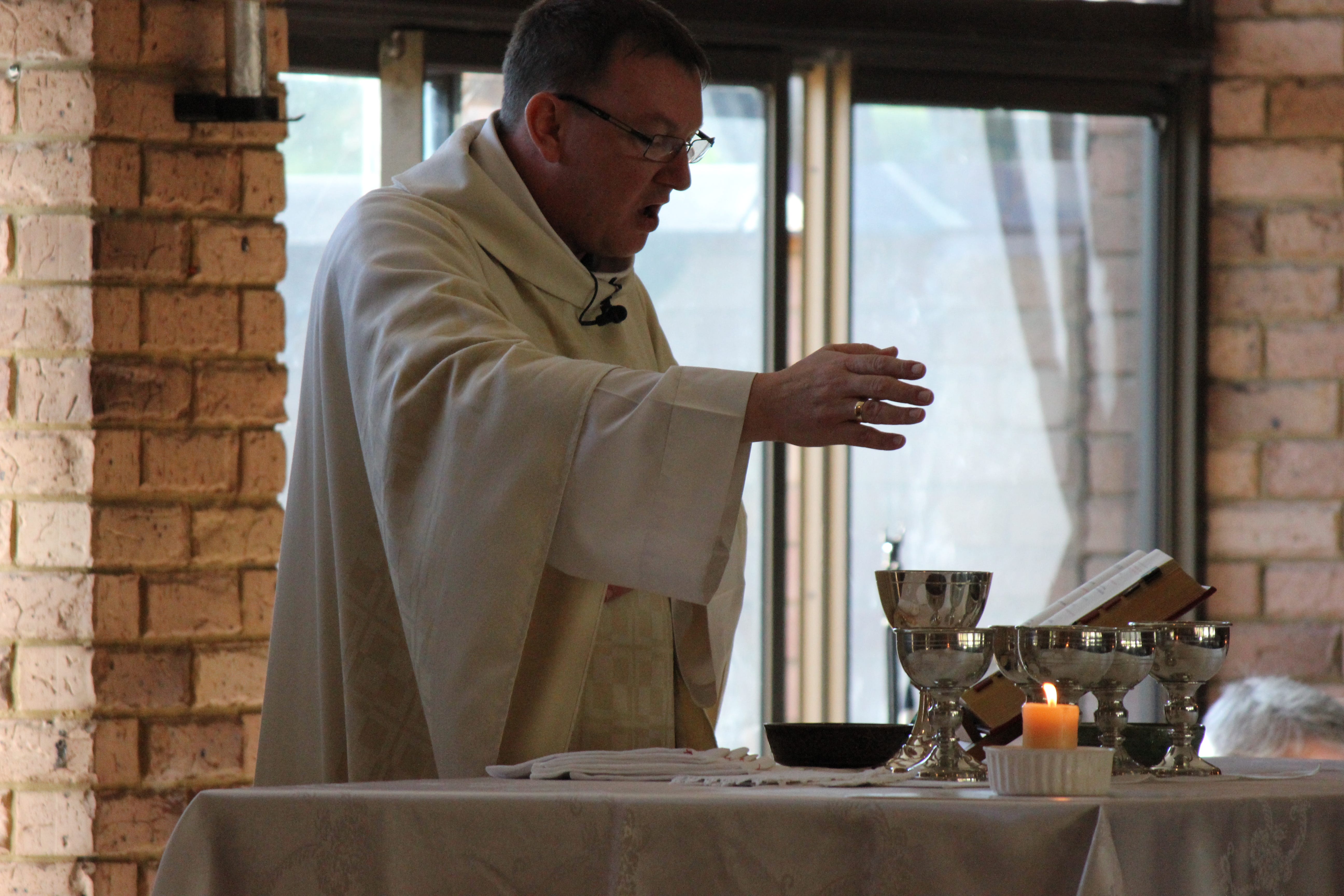
This action on the part of the Presider may be accompanied by the ringing of bells as a “signal to the faithful” (GIRM, n.150). This is not a requirement per se and only takes place “if appropriate”.
It is to be regretted that there are times when the epiclesis is missed by some members of the assembly because they are more intent of focussing on the contents of their personal missal, rather than being attentive to the invocation of the Holy Spirit over the bread and wine that will become the Body and Blood of Christ.
If the ringing of “a small bell” (GIRM, n.150) helps people to become attentive to what is being prayed in word and action, then perhaps such a bell should be rung. It would be infinitely preferable, however, if the entire assembly was so involved in the praying of the Eucharistic Prayer that the ringing of such a bell is simply redundant.
Having implore the descent of the Holy Spirit, the Eucharistic Prayer moves on to what is now called the Institution narrative, that part of the Prayer which
by means of the words and actions of Christ, that Sacrifice is effected which Christ himself instituted during the Last Supper, when he offered his Body and Blood under the species of bread and wine, gave them to the Apostles to eat and drink, and leaving with the latter the command to perpetuate this same mystery (GIRM, n.79d).
Some commentators and members of the faithful hold that these words are the central action of the entire Mass, the ‘moment’ when bread and wine become the Body and Blood of Christ.
I prefer to think that the ‘moment’ occurs at some point between “The Lord be with you” spoken by the Presider at the beginning of the Preface and the “Amen” spoken by the assembly at the end of the Eucharistic Prayer, that the whole of the Eucharistic Prayer, indeed the whole of the Mass, is consecratory rather than limiting the ‘moment’ to just these words.
My preference is bolstered by the reality that there is at least one Eucharistic Prayer used in the Eastern Churches that does not contain any of the words of the Institution Narrative and yet is considered to be valid in and of its nature.
Whatever the case, however, we will resume our exploration of the Eucharistic Prayer next week in Part 8 of our walk through the Liturgy of the Eucharist.
To be continued…
]]>It may be of interest to readers that there are ten Eucharistic Prayers currently authorised for use with The Roman Missal, with seven of these appearing in the Missal itself and the other three being found elsewhere.
In addition to the well-known Eucharistic Prayers I-IV, The Roman Missal also features two Eucharistic Prayers for Reconciliation and one Eucharistic Prayer for use in Masses for Various Needs. This latter Eucharistic Prayer comes in four variations, which some people suggest means there are, in fact, thirteen authorised Eucharistic Prayers currently in force.
In other resources there is to be found the three Eucharistic Prayers for Masses with Children. The reason for them being in a separate resource is a simple one: they are not found in the Latin original, and therefore they are not found in the English translation. It is one of the peculiarities of the current translation regime applicable to the liturgies of the Latin Church.
Although the choice of which Eucharistic Prayer is used on a particular occasion is primarily at the discretion of the Presider, the General Instruction of the Roman Missal (GIRM) does provide some guidance later within its text (see n.365).
The Eucharistic Prayer is made up of a number of elements, each of which is significant both in itself and as part of the whole. These elements are outlined in the GIRM in n.79.
The first of these elements is thanksgiving, which is expressed most especially in the Preface that is part of the Eucharistic Prayer.
There are numerous Prefaces available in the Missal, each serving to “bring out more fully the motives for thanksgiving” and setting out in various ways “the different facets of the mystery of salvation” (GIRM, n.364).
Some of the Prefaces are applicable to only one celebration of the liturgical year, others are applicable to particular liturgical seasons, while others are more generic and can be used on a number of occasions.
Indeed, some of the Eucharistic Prayers mentioned above have their own Preface associated with them either by default or invariably. In the case of those with invariable Prefaces, this limits the times when those particular Eucharistic Prayers can be used.
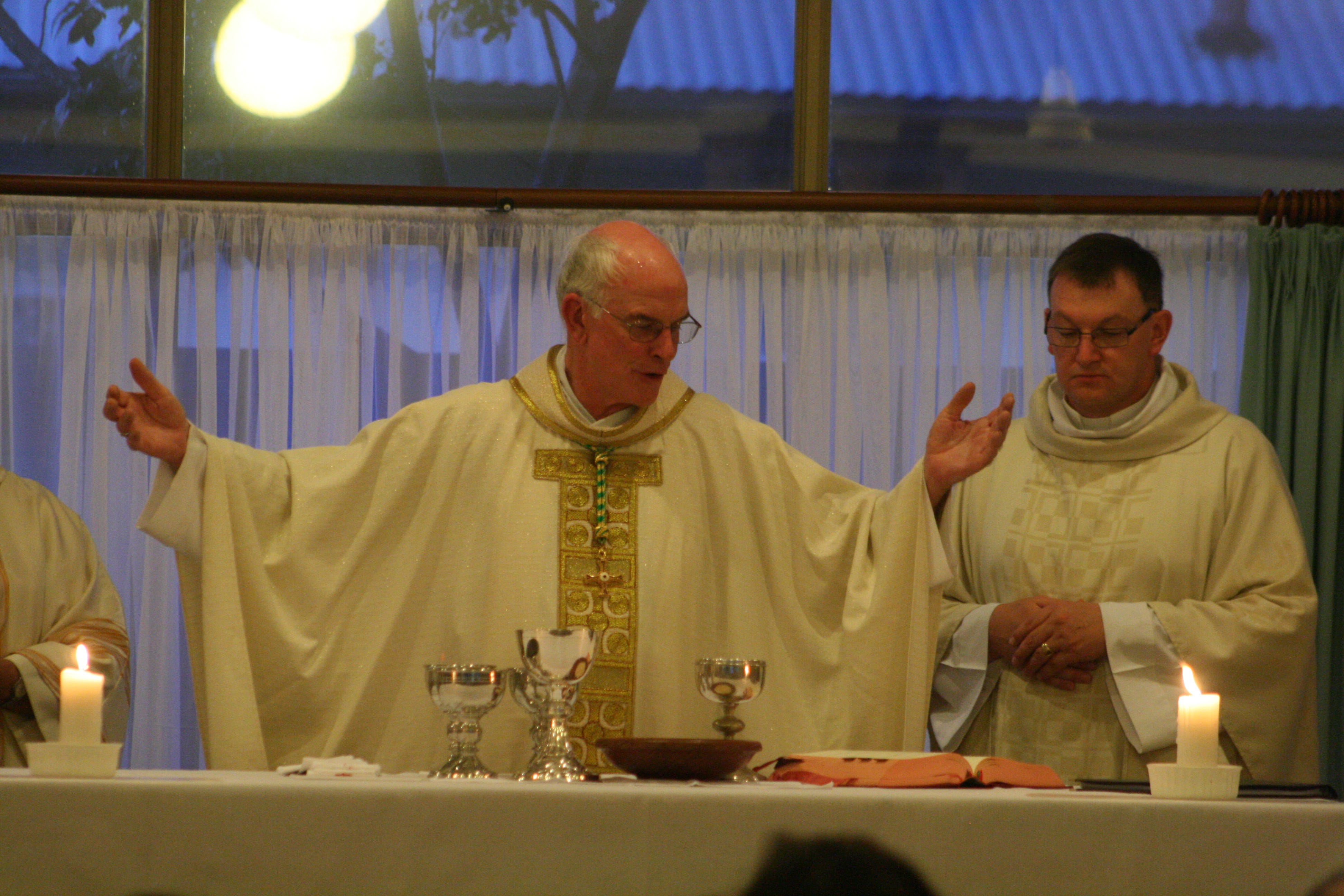
The Preface begins with a dialogue between the Presider and the assembly, starting with the ubiquitous “The Lord be with you”. The words of the primary part of the Preface, which is spoken aloud by the Presider on behalf of all those who have gathered, “glorifies God the Father and gives thanks to him for the whole work of salvation or for some particular aspect of it” (GIRM, n.79a).
Towards the end of the Preface, the prayer transitions to the second constitutive element of the Eucharistic Prayer, with the Presider inviting the assembly to join the heavenly powers in acclamation, by joining in the Sanctus (Holy, Holy, Holy), the first of what are sometimes referred to as the Eucharistic Acclamations.
Like all such acclamations found during the liturgy, it is preferable for the Sanctus to be sung, and to be sung by the whole assembly. If for some reason it is not possible to be sung, then it is said by all those who are present (GIRM, n.79b).
After the Sanctus has been sung or said, the assembly kneels, ready to participate in the remainder of the Eucharistic Prayer in reverent silence (cee GIRM, n.78).
Sometimes it is seen that members of the assembly begin to kneel before the Sanctus is finished, but we should be careful to ensure that we do not cut short our participation in the Sanctus by doing so nor unduly anticipate our change of posture for what is still to come.
When the Sanctus is completely finished, then we kneel, and the Presider waits until the assembly has changed posture and settle once more before continuing to voice the Eucharistic Prayer in the name of all those who have gathered.
There is no need to rush this; we have plenty of time to offer “the centre and high point of the entire celebration” (see GIRM, n.78).
Next week, in Part 7 of our exploration of the Liturgy of the Eucharist, we will continue looking at the nature and content of the Eucharistic Prayer.
To be continued…
]]>As part of the transition from the “Take” part of the Liturgy of the Eucharist to the “Bless” part, the Presider says the Prayer over the Offerings, one of the prayers that make up the Proper of the Mass (along with the Collect and the Prayer after Communion).
The General Instruction of the Roman Missal covers this very succinctly in n.77, while the Order of Mass provides a little more detail in nn.29-30.
The Prayer over the Offerings begins with an invitation to the entire assembly to pray, along with the Presider, that what is about to be offered, i.e., the gifts of bread and wine, will be acceptable to God.
At the end of this invitation, the assembly stands and responds accordingly, before the Presider extends his hands and prays the Prayer over the Offerings set down for that particular celebration.
The assembly gives its assent to that prayer by saying “Amen”. With that “Amen”, the gathered assembly moves to the praying of the Eucharistic Prayer.
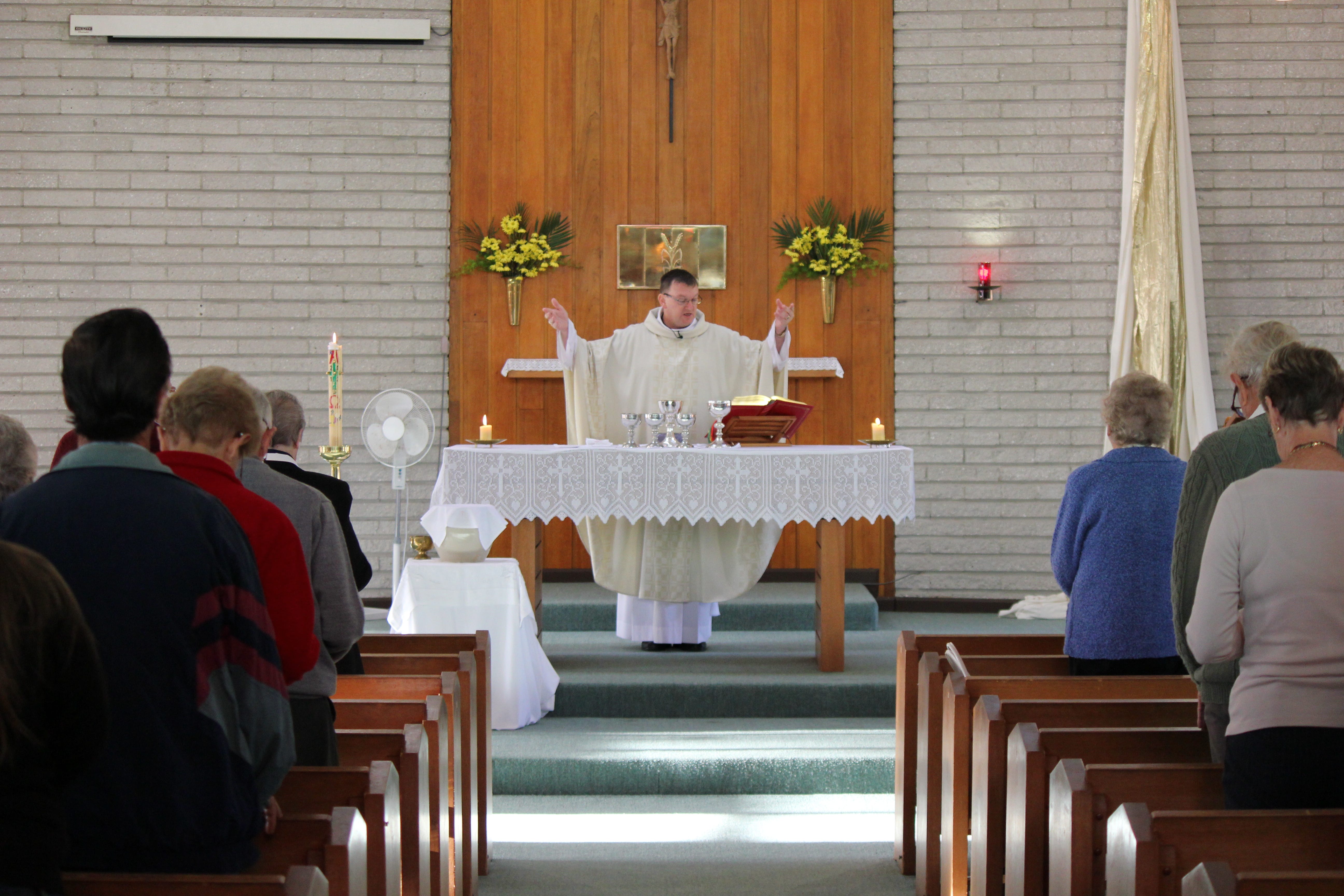
The General Instruction of the Roman Missal captures the fundamental nature of the Eucharistic Prayer in n.78, which is worth quoting in full:
Now the centre and high point of the entire celebration begins, namely, the Eucharistic Prayer itself, that is, the prayer of thanksgiving and sanctification. The [Presider] calls upon the people to life up their hearts towards the Lord in prayer and thanksgiving; he associates the people with himself in the Prayer that he addresses in the name of the entire community to God the Father through Jesus Christ in the Holy Spirit. Furthermore, the meaning of this Prayer is that the whole congregation of the faithful joins with Christ in confessing the great deeds of God and in the offering of Sacrifice. The Eucharistic Prayer requires that everybody listens to it with reverence and in silence.
Before moving on, there are a couple of things that flow from this description that are worthy of some additional commentary.
Firstly, the Eucharistic Prayer is not the prayer of the presiding priest. At least, it is not his alone. The entire Eucharistic Prayer is prayed by the gathered assembly, although spoken aloud by the Presider “in the name of the entire community”. This is not simply something “Father says”; this is our prayer, the prayer of the priestly people of God joined “with Christ in confessing the great deeds of God and in offering Sacrifice”.
And secondly, because the Eucharistic Prayer is very much the prayer of the entire gathered assembly, its praying requires an active attentiveness “in reverence and silence”. We do not ‘turn off’ at this point, nor perhaps should we become distracted by making sure we’re on the right page of the personal missal in our hands. Our reverence and silence is exercised by listening to the prayer, our prayer, being spoken aloud on our behalf by the presiding priest. This “centre and high point of the entire celebration” surely warrants, indeed requires, our clear, undivided attention.
Next week, in Part 6 of our exploration of the Liturgy of the Eucharist, we will continue looking at the nature and content of the Eucharistic Prayer.
To be continued…
]]>It should surprise no one that that since the bread and wine are being processed, there should be sung accompaniment. This singing “which continues at least until the gifts have been placed on the altar” follow the “norms on the manner of singing … as for the Entrance Chant” (GIRM, n.74).
Those ‘norms’ determines both who does the singing, and what is sung, and is reflected in n.48 of the GIRM. In essence there is plenty of scope for the what, and the who has a number of permutations from the choir alone, through alternating between choir and assembly, to assembly alone.
The most important thing, clearly, is that there is singing, so much so that the General Instruction says that “Singing may always accompany the rite at the Offertory, even when there is no procession with the gifts” (n.74).
Once the bread and wine have been received by the Presider, they are “placed on the altar … to the accompaniment of the prescribed formulas” (n.75). These prescribed formulas begin with “Blessed are you…”, reminiscent of the Jewish prayers of blessing used during ritual meals, the same prayers that would have been prayed by Jesus and his Disciples at the Last Supper.
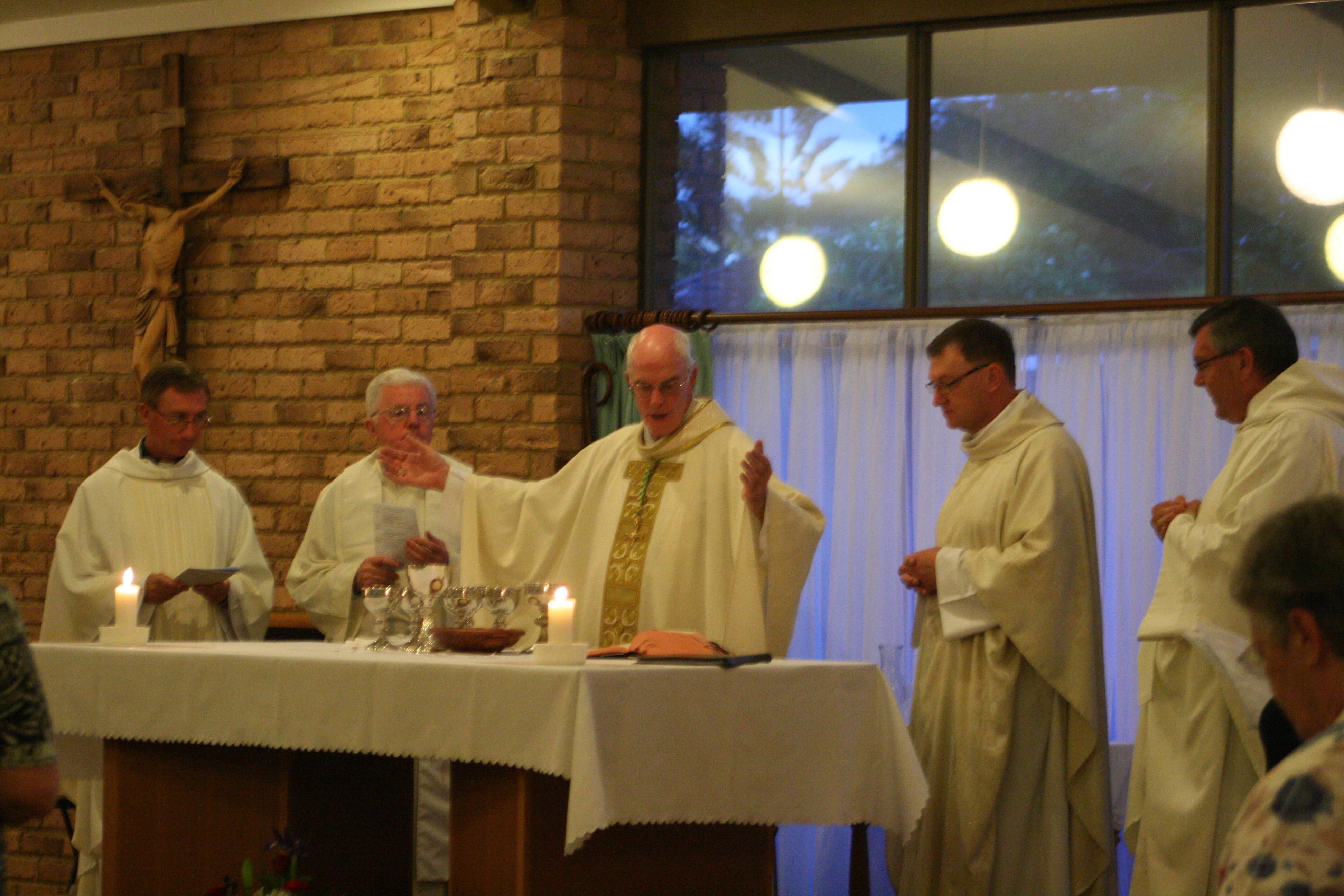
When said aloud by the Presider the formulas can invoke the response “Blessed be God forever” from the gathered assembly, but only in specific circumstances. The Order of Mass says, in nn.24 and 25, that “If, however, the Offertory Chant is not sung, the [Presider] may speak these words aloud; at the end, the people may acclaim”.
There are some who suggest that the prescribed formulas used at this point of the Liturgy of the Eucharist should always be said aloud, even if there is singing, with the Presider waiting until the singing is completed before saying, aloud, “Blessed are you…”. Such a practice is completely contrary to even a cursory reading of the General Instruction and the Order of Mass.
In short, if there is singing, then the words are said by the Presider quietly; if there is no singing, then and only then, is it possible for the words to be said aloud and the assembly respond. Anything else is simply not appropriate.
On some more solemn occasions, it is possible for the use of incense at this point. The Presider first incenses the bread and wine on the altar, and then proceeds to incense the altar itself along with the cross that stands near or on it. This is done to “signify the Church’s offering and prayer rising like incense in the sight of God” (n.75).
But it is not only the bread and wine that is incensed at this point: the Presider and whole assembly are also incensed, which further connects the offerings of bread and wine with the offering of themselves undertaken by the Presider and people.
After any incensing has been complete, the Presider washes his hands, symbolic of “the desire for interior purification” on the part of the Presider. Although the origin of this action probably goes back to the days when the people who gathered brough a whole range of gifts, including some that might be “messy”, those days are well behind us.
The significance of the washing of hands is no longer about the Presider having physically clean hands, but rather more about having a clean heart before continuing with the Liturgy of the Eucharist. This is highlighted by the words the Presider uses while undertaking this action:
Wash me, O Lord, from my iniquity
and cleanse me from my sin.
With this simple action with profound symbolic meaning completed, the “Take” part of the Liturgy of the Eucharist comes to a close. Next week, in Part 5 of our exploration of the Liturgy of the Eucharist, we will move on to look at what happens during the “Bless” part.
To be continued…
]]>